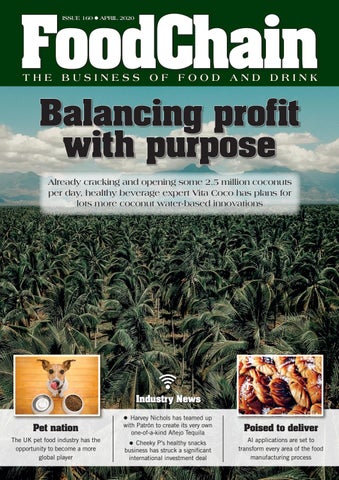
FoodChain ISSUE 160
l
APRIL 2020
THE BUSINESS OF FOOD AND DRINK
Balancing profit with purpose Already cracking and opening some 2.5 million coconuts per day, healthy beverage expert Vita Coco has plans for lots more coconut water-based innovations
Industry News Pet nation The UK pet food industry has the opportunity to become a more global player
l Harvey Nichols has teamed up with Patrón to create its very own one-of-a-kind Añejo Tequila
Cheeky P’s healthy snacks business has struck a significant international investment deal l
Poised to deliver AI applications are set to transform every area of the food manufacturing process
FoodChain ISSUE 160
l
APRIL 2020
THE BUSINESS OF FOOD AND DRINK
Balancing profit with purpose Already cracking and opening some 2.5 million coconuts per day, healthy beverage expert Vita Coco has plans for lots more coconut water based innovations
Editor’s Welcome
Industry News Pet nation The UK pet food industry has the opportunity to become a more global player
l Harvey Nichols has teamed up with Patrón to create its very own one-of-a-kind Añejo Tequila l Cheeky P’s healthy snacks business has struck a significant international investment
Poised to deliver AI applications are set to transform every area of the food manufacturing process
Chairman Andrew Schofield Managing Director Joe Woolsgrove
Above and beyond
Editor Libbie Hammond Assistant Editor Will Daynes Staff Writer Alex McDonald Art Editor Fleur Daniels Sales Mark Cawston Dave King Theresa McDonald Sam Surrell Web Sales web@schofieldpublishing.co.uk Exclusive Features Darren Jolliffe Operations Director Philip Monument Operations Manager Natalie Griffiths Editorial Researcher Adam Blanch Mark Cowles Jeff Goldenberg Mark Kafourous Tarjinder Kaur-D’Silva James Page Wendy Russell Office Manager Advertising Administrator Tracy Chynoweth Social Media Abigail Blake
W
e are hearing the term ‘hero’ being applied to a vast range of usually overlooked staff in the service industries at the moment – the delivery drivers, the checkout staff, the shelf fillers – everyone along the
supply chain that is usually taken for granted, has now got the recognition they have always deserved. Little farm shops are striving to meet the needs of the community and the giant supermarkets have adapted to social distancing, panic buying and the insurmountable demand for deliveries – lessons are being learned daily that will be remembered for years to come. It’s a tough, challenging time and everyone is feeling the pressure. I salute
Follow us at:
everyone involved in feeding the nation at the moment and going forward, and I can’t wait to share your stories and how you have gone above and beyond to support the country and help us fight towards a brighter future.
foodchainmag
FoodChain Magazine
@FoodChain_mag
Schofield Publishing Cringleford Business Centre, 10 Intwood Road, Cringleford, Norwich, NR4 6AU, U.K.
T: +44 (0)1603 274130 www.foodchainmagazine.com
libbie@schofieldpublishing.co.uk
© 2020 Schofield Publishing Ltd
Please note: The opinions expressed by contributors and advertisers within this publication do not necessarily coincide with those of the editor and publisher. Every reasonable effort is made to ensure that the information published is accurate, and correct at time of writing, but no legal responsibility for loss occasioned by the use of such information can be accepted by the publisher. All rights reserved. The contents of the magazine are strictly copyright, the property of Schofield Publishing, and may not be copied, stored in a retrieval system, or reproduced without the prior written permission of the publisher.
www.foodchainmagazine.com
1
Contents Features & Profiles 4
Chocolate A taste of the future
4
8
Sara Jayne Stanes, founder of the Academy of Chocolate, explains why we should be looking for a taste of ‘real chocolate’
8
Pet food Pet nation
Nicole Paley, Deputy Chief Executive of the Pet Food Manufacturers’ Association (PFM) answers some questions about the pet food sector
Packaging Informed choices
There’s a sensible debate to be had around responsible consumption, and packaging design plays an important role
Artificial Intelligence Poised to deliver
Chocolate
12
14
18
14
Every area of the food manufacturing process is set to be transformed by artificial intelligence applications, from demand forecasting to preventative cleaning
News
10
Up-to-date products and announcements from the food and beverage sector
Taste Test
Artificial Intelligence
11
The FoodChain team sample a selection of new and innovative foods and drinks
11
28
Owton’s Traditional Family Butchers
2
www.foodchainmagazine.com
3
8
12
Pet food
18
Packaging
24
Bidfood
34
Chesterfield Poultry
38
Vita Coco
Michael Farms Inc www.foodchainmagazine.com
3
A taste of the future Chocolate. To some a simple confection and to others a sophisticated delicacy, as layered as a fine wine. But what is ‘real’ chocolate and why should consumers be more discerning? Libbie Hammond spoke to Sara Jayne Stanes, founder of the Academy of Chocolate, to find out
4 www.foodchainmagazine.com
Chocolate
www.foodchainmagazine.com 5
H
‘
aving now been in existence for 15 years, the Academy of Chocolate still maintains the philosophy upon which it was founded - the belief that eating fine chocolate is one of life’s great pleasures. “We wanted to campaign for better chocolate and to promote a greater awareness of the difference between fine chocolate and mass-produced chocolate confectionery,” Sara Jayne Stanes, founder of The Academy of Chocolate, explained. “We wanted to encourage chocolate lovers to look ‘beyond the label’,” she continued. “This also meant improving the standard and knowledge of chocolate in the UK by promoting an understanding of the ingredients of chocolate, through the chain, from bean to bar.” When talking to Sara, she emphasised the point above about ‘real’ chocolate, and the Academy’s desire to establish the difference between chocolate and
6 www.foodchainmagazine.com
... one of the Academy’s roles is to encourage the transparent sourcing of cocoa beans from the plantations and encourage their production in socially fair and environmentally undamaging conditions
chocolate-confectionery, which is a product manufactured with a lot of sugar and little actual cocoa solids. “With the confectionery style products, most of us (including me when I first started) never taste the chocolate itself, as it is masked with so much sweetness that it kills the flavour. Chocolate ‘addiction’ comes from the sugar not the chocolate, particularly as the majority of chocolate confectionery contains only very small amounts of chocolate in the first place.” So, if we want to experience some
‘real’ chocolate, what do we, as consumers, need to look for? “The cocoa solid content should be more than 60 per cent,” Sara confirmed. “Cocoa solids are simply the cocoa bean. However, like most things in life, the strength does not always indicate a good cocoa.” According to Sara, ‘proper chocolate’ can only be created from the careful assembly of a myriad of factors including the variety of the beans, where they are grown, the fermentation process, the drying, and the manufacturer’s recipe and methods, not just chocolate with high cocoa solids. Therefore, the cocoa producers themselves play a pivotal role in helping consumers find real chocolate, but as Sara pointed out, this isn’t straightforward. “The Academy believes that in reality, few producers really understand the difference between fine chocolate and confectionery. Nor do they realise that chocolate is made from a fruit, the cocoa bean, with flavours
Chocolate that can be very subtle if they are not masked in sugar and fat. “As a result, it is difficult for consumers to find a selection of fine chocolate and make up their own minds. We strongly believe that giving people the chance to savour and to learn about fine chocolate will give them a greater appreciation and therefore anticipation for more ‘proper’ chocolate’.”
Prestigious awards It is not just the producers that need to expand their understanding of chocolate, as the cocoa farmers themselves also have a crucial role to play, and Sara noted that over the last 20 years there has been a refreshing trend to link the cocoa farmer with the whole production process. “This is partly because of the exploding interest in ‘real’ chocolate and the internet. This is a great move as we can begin to understand the journey from the farmer to the factory and the different varieties of beans and the method of processing - which is harvest, fermenting (to get the best flavours and ameliorate the astringency and bitterness), drying, shipping to the factory, sorting roasting, winnowing, grinding, refining, conching, and finally tempering (oh and enjoying!) Because of this openness there has been a greater understanding between the farmer and the manufacturer, which has in turn led to greater communication and cooperation. “In addition, one of the Academy’s roles is to encourage the transparent sourcing of cocoa beans from the plantations and encourage their production in socially fair and environmentally undamaging conditions.” Raising awareness of the importance of the provenance of chocolate and the significance that the right ingredients plays in the creation of ‘real’ chocolate is one of the Academy’s major responsibilities, but it is by no means its only function. It also identifies, recognises and showcases the world’s most talented chocolate producers and finest chocolates, through its own prestigious Academy of Chocolate awards. “These were also launched in
2005, when we received 12 awards entries. To give you an idea of how far they have come, so far this year, we have seen around 1600 entries, which marks a significant improvement in awareness,” noted Sara. She also highlighted the hard work of Silvija Davidson and Westminster Kingsway College as well as a host of expert judges in the success of the awards. Sadly, due to the coronavirus pandemic the Awards judging process had to be halted, but the samples are being kept safe under the correct conditions and Sara was confident the Awards would be back on track as soon as is feasible. The amazing array of different products that are sent in for the Academy judges to assess each year
often give an insight into the trends that are likely to emerge in the future. From looking at 2019’s award winners, a lot of dark chocolates were given prizes – for this year Sara is predicting that ‘dark milk’ chocolate will be very much on the chocolate agenda. “Most milk chocolate contains about 25-30 per cent cocoa solids. Today there are more and more dark milk chocolate bars containing anything up to 60 per cent cocoa solids. They’re very delicious!” she added. Before we finished our conversation, Sara also highlighted the team the Academy, who she credits with being a major part of its success in the industry. “We could not have achieved what we have over the years without a strong team of AoC management including Chantal Coady OBE, Sarah Jane Evans MW, Marie Pierre Moine, Clive Martyr, Simon Wright, Will Torrent, Angus Thirlwell, Christopher Reeves, Robin Dand and Piers Zangana for our comms.” We must also include a reference to legendary chef Michel Roux OBE, who sadly passed away in March this year, shortly after Sara’s interview. She credited him as her ‘chocolate mentor’ and he had been the Patron of the Academy since its foundation. “Michel Roux was, and always will be, a hospitality champion,” she said. “It was a privilege for all of us at the Academy to know him. His presence and influence will outlive us all.” The Academy of Chocolate has gone from strength to strength since its foundation, and Sara says that its ambition to see chocolate savoured in the same way as fine wines is still something it is hoping will come to fruition. “Once you have discovered what pleasure, complexity, richness and wide sensations there is in fine chocolate, you never look at chocolate the same way, you never buy chocolate the same way,” she said. “We want to bring this opportunity to as many people as possible, with no vested business nor commercial interest. We have already seen fantastic growth in understanding and appreciation of real chocolate and expect this to continue to grow.” D For further information please visit: www.academyofchocolate.org.uk
www.foodchainmagazine.com 7
Pet nation As the voice of the pet food industry turns 50, Nicole Paley, Deputy Chief Executive of the Pet Food Manufacturers’ Association (PFMA) answers some questions about the sector and how the Association has grown and diversified
8 www.foodchainmagazine.com
W
hat drove the formation of PFMA in 1970?
Fifty years ago, four companies - Spillers, Quaker Oats, Petfood Ltd and Stamina Ltd - formed the Pet Food Manufacturers’ Association (PFMA), united in the desire for a single voice to represent the pet food industry. Quaker Oats and Stamina eventually became part of Spillers, which is now Nestle Purina Pet Care, while Petfood Ltd became Mars Petcare. The driving issue at the time was VAT on pet food. Pet food companies were campaigning for pet food to have the same VAT status as human food, which was zerorated. It was felt unjust that food for pets was taxed, particularly given the important societal role they play. Beyond VAT, there was also a keenness to provide advice to smaller pet food companies, share information with organisations interested in animal welfare and to act as an industry voice talking to government.
Even in the early days PFMA represented manufacturers of all pet foods, not just cats and dogs. At the time of PFMA’s formation, budgies were the third most popular pet in the UK. PFMA’s pet population survey, which is still ongoing today, estimated that in 1975 there were 5.7 million dogs, 4.3 million cats and 2.9 million budgies. We are now feeding a nation of over 20 million pets with around nine million dogs, 7.5 million cats and 500,000 indoor birds.
How does PFMA today differ from the PFMA of yesteryear? PFMA has come a long way since its formation. We now represent around 80 companies, which accounts for over 90 per cent of the UK market. Industry has also prospered reaching a value of around £3 billion in 2019. However, the core aims have remained the same and the association has helped industry navigate through significant challenges
Pet food from BSE in the late eighties to present day Brexit.
What are the key trends in the pet food industry? In terms of trends, the humanisation of pets is the biggest and most impactful trend in the pet food industry and most pet parents refer to their dog or cat in terms traditionally reserved for children. Pets are undeniably close to our hearts with 12m UK households owning a pet (around 40 per cent) and treating them as one of the family. In the same way that humans are looking for healthier options, pets are increasingly being treated to premium products with a focus on additional benefits for specific needs. These products appear in all life-stage and life-style categories from kitten, puppy and senior through to working, active and indoor pets. The growing field of small animal nutrition science has enabled a significant amount of product innovation. The downside to humanisation is the rise in pet obesity. In our latest pet obesity report, which was released in 2019, we highlight that an alarming 51 per cent of dogs, 44 per cent of cats and 29 per cent of small mammals are overweight or obese. With almost 8.5m pets in the UK currently overweight, the last five years has seen a worrying increase and today almost 600,000 more UK pets are overweight or obese and at risk of living two years less than a healthy, fit pet.
There is a lot of collaboration between industry, vets, retailers and welfare organisations to address this. Education is key.
What is the current hot topic for the industry? Sustainability has become a more urgent issue and is a vital component of the industry agenda now and as we move forward. Topics such as sustainable ingredient sourcing, pet food packaging and recycling, animal welfare, environmental impacts of the manufacturing process are all important topics for our association and our members.
Where does the UK currently stand on animal welfare? World Animal Protection ranks 50 countries around the globe according to their legislation and policy commitments to protecting animals. Countries are ranked from grade A to G on various indicators and the UK sits alongside Austria, Switzerland and New Zealand in achieving Grade A status. The second review has recently taken place and the results expected soon. PFMA is keen for the UK to maintain its position.
Has animal welfare always been on the PFMA agenda?
the All-Party Group for Animal Welfare (APGAW), joining other inuential voices in the welfare sector to ensure animal welfare is a key consideration, particularly with Brexit discussions ongoing. We have some of the highest feed safety and animal standards in the world; we want to ensure this remains the case.
What lies ahead for PFMA as we enter a post Brexit world? As we embark on 2020 and beyond, the need for an industry voice has never been greater. We face the prospect of new legislation, which we will need to shape, and the opportunity for the UK pet food industry to become a more global player, which we will need to drive. In 2018 we launched the PFMA Pet Food Vision, a vision that focuses on the core pillars underpinning PFMA and the UK pet food industry: animal welfare, nutrition, safety and standards and sustainability. Brexit has made us look at where we want the UK pet food sector to be as a more global player. We consider the UK pet food industry to be world leading in the areas of animal welfare, nutrition and safety and standards – this is the story we want our members to go out and tell. We look forward to working with our members and our colleagues in the pet care sector on this. D
The welfare of both farm animal and companion animals is important to us and PFMA became a co-sponsor of
For more information about PFMA and the pet food industry, including the latest facts and figures, please visit: www.pfma.org.uk
www.foodchainmagazine.com 9
IndustryNews Unique tequila Harvey Nichols has teamed up with Patrón to create its very own one-of-a-kind Añejo Tequila. Exclusive to Harvey Nichols, this unique bottle is the first single cask Patrón to be made available in the UK. Patrón launched its single barrel programme in 2014, allowing close friends and partners an opportunity to create their own Tequila. As guests of this iconic brand, Harvey Nichols travelled to Hacienda Patrón in Atotonilco El Alto, Jalisco and tasted through a variety of Tequilas. It was when Patrón poured the richest Añejo that Harvey Nichols decided, with a few additional months of ageing, that it would become its Barrel Select. Distilled in January 2017, this 100% Blue Weber Agave Tequila was filled into a single Allier oak barrel. The Tequila was then matured in just such a barrel for 33 months – 20 longer than required by law to be called an Añejo and almost long enough to become an Extra Añejo. It was then filled into just 366 limitededition bottles.
Investment boost
“We’re so excited to see the first single cask Patrón expression from
Two young entrepreneurs who set up a healthy snacks business
our Barrel Select program available in the UK, go into the off-trade with
less than two years ago are celebrating after striking a significant
Harvey Nichols,” said Matthew Sykes, Senior Director of Global Marketing
international investment deal.
for Patrón Tequila. “We launched Barrel Select in 2014 allowing friends
Co-founders Gregory Goh and sister Gracia set up the Cheeky P’s
of the brand to get their own one-of-a-kind tequila, aged in our barrel
brand with the help of Newcastle University START UP back in 2018.
room at our home, Hacienda Patrón in Jalisco, Mexico. Now, Harvey
Originally from Sarawak, Malaysia, the pair of Newcastle University
Nichols customers will be able to buy this unique Añejo tequila from
graduates swapped spreadsheets for snacks to bring their vegan, gluten-
Harvey Nichols online.”
free and high in protein roasted chickpea nibbles to the market.
https://www.harveynichols.com/brand/patron-/3223555harvey-nichols-barrel-select-anejo-tequila/p3795979/
Their Cheeky P’s range of healthier snacks has secured deals with multiple national distributors, including North-East based Epicurium, to supply to health stores, convenience stores, farm shops and pubs around the UK as well as being stocked by some major retailers including Ocado and CentreParcs. As the company approaches its two year anniversary, the business has struck an investment deal with Spanish food group Dacsa, along with a number of angel investors. Cheeky P’s co-founder Gregory Goh said: “This investment will not only allow us to create new products, but with Dacsa on board we will have support beyond the financial investment to help accelerate growth to the next level. “We can really focus on building our brand and expanding our product range to support the increasing appetite for healthier plantbased snacks. It is a rapidly growing market, to which our innovative products are ideally suited, and I am very excited about what the future holds for Cheeky P’s.” Corporate lawyer Amy Wanless, from leading North East commercial law firm Muckle LLP, acted for Cheeky P’s, helping to deliver the multinational investment round. “Amy and her team at Muckle have been absolutely fantastic throughout this whole process. Their knowledge, expertise and strong advice have been invaluable in delivering this pivotal deal,” added Gregory.
www.cheekyps.co.uk
10 www.foodchainmagazine.com
TasteTest
Born in the amazon
A new drink experience Kolibri Drinks is a pioneering botanical drinks brand, born out of the rising trend for healthy, non-alcoholic and sophisticated beverages. Offering three delicious flavours – Cardamon & Chilli, Strawberry & Basil, and Elderflower & Lime – the lightly carbonated drink offers a cocktail-esque experience, best served over ice in a balloon glass. What’s more, the flavour profile can be tailored to the individual’s choice as it comes separately in an innovative squeezable cap. With only 0-40 calories per bottle (around a third of a gin and tonic) and 100 per cent natural ingredients, Kolibri
was created to be the go-to non-alcoholic drink for the conscious consumer. https://kolibridrinks.co.uk
“I loved the packaging before I tasted the drink, as the glass bottle had a good weight to it, and made it feel like something more than a soft drink,” said our tester. “I tried the strawberry and basil, which was really interesting, but what I really loved was the squeezable cap that let me add agave nectar to my own taste. Not only was this a bit of fun, it was also a brilliant way to adjust the drink to my exact requirements. Very clever!”
“I loved how the gin is helping the indigenous communities,” said our tester. “But the most important thing is how it tasted and it was delicious! It was really quite distinctively fruity, and when I used grapefruit soda as recommended to make their signature Amazonian G&G, it was a really refreshing and sophisticated drink.”
Cool container If you’re eating lunch al-desko, or looking for a way to keep food hot or cold on the move, Klean Kanteen’s range of Tare It Up Food Canisters replace a lifetime of throwaway plastic containers and bags. These Vacuum Insulated Food Canisters are especially great for keeping food cold and fresh or piping hot, but can also be used for storing leftovers in the fridge or transporting food to work, school or on your next adventure. www.kleankanteen.co.uk
A new gin has been introduced to the UK thanks to the expertise of DUSA, Diplomático Rum’s Venezuelan distillery. Canaïma is a finely balanced gin including ten of 19 botanicals sourced in the Amazon with the help of local communities. At 47% ABV, Canaïma delivers great harmony of flavours and aromas for a unique taste profile. Producing Canaïma Gin is a complex process given that each botanical is individually treated, macerated and distilled. Macerating and distilling each botanical in small batches of 500 litres allows the Master Distillers to create a uniquely crafted gin reflecting DUSA’s long tradition of gin making. “Our intention has not only been to bring to the world an exceptional gin but also to contribute to the well-being of local communities through our collaboration with the Tierra Viva Foundation and Saving the Amazon,” adds Edouard Beaslay, Canaima’s Global Marketing Director. www.canaimagin.com
wide mouth, which made it easy to fill and eat from with no mess. I love a functional product that really does what it is supposed to – a great little addition to my cupboard!”
“I was impressed by The Klean Kanteen canister I was lucky enough to try,” said our tester. “It was a lovely solid stainless steel container, very easy to transport and clean, and kept my lunch lovely and hot. It had a nice
www.foodchainmagazine.com 11
Informed choices
The value of packaging design goes beyond pretty pictures says Fred Roeder
Fred Roeder
12 www.foodchainmagazine.com
W
hen people talk about the importance of design, people will often point to iconic logos and branding that we now take for granted, whether it’s the Coca Cola motif, Mr Pringles crisps or Jack Daniels bottles. But the importance of design isn’t just in the design itself, but in the intellectual property behind the design and its intrinsic value to brand holders and consumers. Design cues provide information and knowledge around the products consumers buy and help to build confidence. Removing design elements simply limits an individual’s ability to make informed decisions about what they are buying. Late last year, the outgoing UK Chief Medical Officer, Dame Sally Davies,
called on the government to threaten the food industry with ‘cigarette style’ plain packaging for sweets and chocolates if they failed to meet sugar reduction targets. Dame Sally called the for the sugar tax programme - already in place for soft drinks - to be extended to cereals, yogurts and cakes if targets are not met by 2021, and applied to calorierich foods by 2024.
Creative solutions Dame Sally’s parting shot at the food, drink and retailing industry comes hot on the heels of the UK’s Food Ethics Council which also called for an outright ban on cartoon mascots on junk food, including fizzy drinks, crisps, cereals and biscuits, in a bid to curb obesity and diseases like diabetes.
Packaging like the World Health Organisation, who just love to wield the ban hammer in the name of protecting public health. It’s happening already with Ireland’s Public Health (Alcohol) Bill, which became law in October 2018, regulating advertising and promotion, insisting on mandatory cancer warnings, and banning alcohol branding from sports stadiums. Restricting marketing and communications in certain product categories and, in some cases, banning their availability altogether, will only serve to stifle innovation and violate consumer rights. You only have to go back 100 years to the US bringing in the Volstead Act, which prohibited the manufacture and sale of alcoholic beverages, to know that banning something simply drives demand underground, fuelling criminality.
Freedom of choice
No one is denying that a there’s a sensible debate to be had around responsible consumption, but unproven laws are not the solution. Rather than scaring people into changing their behaviour or punishing their pockets through ‘sin taxes’ and brand censorship, legislators need to be more creative when it comes to promoting good health. While it’s not yet government policy in the UK, it soon could be and it will be interesting to see if Chris Whitty, Dame Sally’s replacement, picks up the cudgel and continues to beat food and drink manufacturers, retailers and consumers into submission. Lawmakers often take their lead from public health bodies like the Food Ethics Council and supranational organisations
Unbranded goods provide a boon for organised crime gangs as the labels, packaging and containers are much easier to fake. Spurred on by the promise of enormous profits, the trade in unregulated illegal products represents a tempting proposition for counterfeiters, with huge costs to governments and the public alike. Therefore, the total damage to businesses affected is likely to be higher. Brand censorship will almost certainly lead to losses in the creative industries, including design and advertising services, which are heavily reliant on FMCG contracts. Brand Finance estimates that the potential value loss to businesses worldwide would be $430.8bn if tobacco-style plain packaging were extended to the beverage industry. This refers to the loss of value derived specifically from brands and does not account for further potential losses resulting from changes in price and volume of the products sold, or illegal trade. Compounding the issue is a complete lack of analysis-based dialogue between brand owners, consumers and regulators. IP laws and frameworks are positive examples of these groups working together to protect and enforce
the interests of rights holders, whilst at the same time allowing consumers the freedom to make their own choices. Despite these efforts, the infringement of IP rights remains a significant problem. According to a 2019 OECD EUIPO report, the total volume of trade in fakes was estimated at $509bn, or 3.3 per cent of global trade (up from 2.5 per cent in 2013).
The way forward No brand has a God-given right to exist or survive. But the threat of restrictive business regulation and illegal trade will only serve to hasten their demise by undermining intellectual property rights and weakening their inherent value. The Food Ethics Council and Public Health England are right to call for a debate on how we can make the country healthier, but the negative impact of limiting brands could wreak havoc in the packaging and creative industries, causing a major headache for big retailers, with no conclusive evidence that the policy will achieve the desired health objectives. That is why closer collaboration and co-operation between policymakers and industry participants, and education over legislation, provides the best way forward. Instead of health warnings and brand censorship, we should use incentives and encouragement to change consumer behaviour. D
Fred Roeder is the Managing Director of the Consumer Choice Center, an independent non-profit organisation, which promotes ‘consumer choice’ among different products, innovations and price classes. The Consumer Choice Center supports lifestyle freedom, innovation, privacy, science and consumer choice. The CCC believes regulators on local, national and supranational levels keep regulating more and more areas of consumers’ lives. This leads to less consumer choice and makes products more expensive. www.consumerchoicecenter.org
www.foodchainmagazine.com 13
Poised to deliver Simon Noakes explains how AI is transforming ‘traditional’ operations in the food manufacturing sector and introducing important and advanced new capabilities such as demand forecasting, preventative maintenance and advanced quality assurance (QA)
14 www.foodchainmagazine.com
A
rtificial intelligence (AI) is on course this decade to disrupt end-to-end operations in every industry, with PwC projecting the technology will add over $15 trillion to the global economy by 2030. Food manufacturing will be no exception. There is rising demand for greater food production in response to world population growth, at a time when health-conscious consumers are also looking for healthy alternatives and a broader range of products. To satisfy these evolving customer demands and ensure production remains at very high volumes without introducing errors into the manufacturing process or failing to comply with industry regulations, advanced technologies such as AI, machine learning and IoT will be required to improve operational efficiency. With more data being generated within companies than ever before,
AI applications in particular are set to transform every area of the food manufacturing process, from more accurate demand forecasting to preventative cleaning and maintenance. Here are six key capabilities that are already being disrupted and augmented by the introduction of AI.
Food QA and segregation
Simon Noakes
Manufactured food products have traditionally been sorted based on simple observable characteristics such as size and colour, and through visual inspection. Integrating devices such as sensors or cameras with other mechanical devices to mimic what humans can do provides an automated method to validate food products against required standards or sort them based on characteristics. Using machine learning alongside these devices means granular characteristics can be refined and learned in such a way that AI can
Artificial intelligence (AI) of relevant algorithms, future trends can be determined – whether this is identifying emerging product opportunities, accurately forecasting seasonal demands or tracking evolving consumer trends.
support more complex decisions regarding segregation. This results in far less waste for food manufacturers courtesy of more rigorous QA procedures, refined processes and a reduced need for extensive manual sorting.
Personalised online purchasing
Preventative maintenance and cleaning The traditional approach to cleaning in the industry was governed by routinely scheduled cleans and checks, or through manual inspections, which today is being augmented by devices such as sensors and fluorescent imaging. When combined with other recorded parameters, food manufacturers can deploy machine learning to determine the characteristics that pre-empt cleaning activities, and in turn use AI to determine when those conditions are present so they can be promptly addressed. These AI and machine learning applications can be expanded to monitor intricate manufacturing equipment where constant uptime is a necessity to maintain narrow profit margins. Companies can embrace a preventative maintenance strategy for the first time through accurate, 24x7 monitoring of valuable machinery.
Agile and data-driven food development AI and machine learning are now helping food manufacturers achieve higher success rates when developing and bringing new products to market without the need for extensive trials and tests. By deploying algorithms and machine learning based on previous patterns to support future taste preferences, historical taste and preference data from previous products and products changes can be gathered and analysed.
Enhanced product risk analysis The risks associated with potential product issues and recalls are wellknown and carry a very real threat of high costs and damage to brand reputation.
By combining gathered user data and preferences with analysis through machine learning and behavioural science, AI-powered systems can more accurately determine consumer personal needs and tastes and create targeted offerings and nutritional plans to suit dietary needs. This level of personalisation and tailored consumer support has the potential to be a key differentiator for food manufacturers and vendors at a time when consumers are placing significant emphasis on the customer experience.
AI is opening new doors – but make sure you open the right doors
Reviewing and collating data from a variety of sources, such as social media and emails, and then applying machine learning can provide earlier indication of a potential new product issue. Continual review of information and content ensures a more rapid response and the ability to minimise the impact by taking swift remedial action.
Highly accurate demand forecasting AI can support demand forecasting through the gathering and analysis of historical data and events that may have triggered demand changes. Based on this learning and the application
AI offers limitless potential to transform the way food manufacturers approach ‘traditional’ operations and also opens the door to new, powerful business capabilities. Ambitious food manufacturers will need to map out existing operations and assess where AI will have the most beneficial impact without affecting uptime or on-going manufacturing. This is where an implementation partner with extensive experience of deploying advanced technology into the food industry can be crucial in enabling companies to build a reliable framework for the adoption of AI and other emerging technologies with disruptive potential, without disrupting their day-today business. D
Simon Noakes is SMB Director at Columbus UK, an international IT services company serving customers worldwide. It is an expert in developing and providing digital business applications that help its customers in the digital transformation of their business. Columbus is a specialist within the industries of retail, distribution, food and manufacturing, with more than 28 years of experience and over 8000 successful business cases. www.columbusglobal.com/en-gb
www.foodchainmagazine.com 15
Unsurpassable service After another award-winning year in 2019, Bidfood, one of the UK’s leading suppliers for a large proportion of Britain’s caterers, hotels, restaurants, hospitals, care homes and pubs, is well-positioned to tackle the challenges of a new decade
W
hen invited to discuss Bidfood’s performance over the last 12 months, Group Sales and Marketing Director, Andy Kemp describes 2019, rather modestly, as ‘a year of positive change’. “We saw ourselves accelerating in the digital world, developing a more strategic approach to both our social media platforms and our website,” he says. “We’ve worked hard to incorporate digital elements into all our campaign work and have taken some really positive strides so far.” A drive towards modernisation was not the only thing keeping Bidfood busy in 2019. It was a year in which the company won 38 awards across a range of categories, including a hat trick of FWD Gold Medals for Wholesaler Service to Caterers, Star Driver and Telesales Star. Understandably, Andy was thrilled that Bidfood employees were being singled out for recognition by the wider industry. “Our drivers and telesales employees are the face of our business and we’re so proud of how hard they work,” he declares. “Hearing the heart-warming stories of how they go above and beyond to best support our customers and deliver service excellence is truly inspiring.” It seems only fitting that a glittering year of awards success for Bidfood was capped off by the company’s long-serving Group Sales and Marketing Director receiving a significant accolade of his own. In June 2019, Andy was awarded an MBE in recognition of his outstanding services to the foodservice and hospitality industry.
18 www.foodchainmagazine.com
Bidfood
www.foodchainmagazine.com 19
Andy Kemp MBE - Group Sales & Managing Director
“I was incredibly humbled to receive the honour,” Andy states. “I have to thank all of my industry colleagues who have supported me and helped make this possible. It has been a real pleasure to work alongside so many influential and wonderful people throughout my career.”
Healthy eating focus Over the last 40 years, Andy has channelled his enthusiasm, energy, and passion into a variety of notable causes related to the food industry. He currently sits on an All-party Government Committee looking specifically at ensuring children are well fed, and has fought long and hard to bring awareness to school nutrition standards, the importance of Universal Infant Free School Meals, and the devastating impact of holiday hunger, which leaves 1.5 million children in England underfed during the school holidays. Andy’s knowledge and ideas have contributed significantly to Bidfood’s focus on healthy eating and child nutrition. “Clean, healthy eating has always been a central thought for us,” Andy asserts. “It’s a trend that is being heavily led by our Government and health conscious consumers, who
‘
Looking further ahead, Bidfood remains deeply aware of the vital role that young people will play in maintaining the company’s legacy
rightly have an expectation that their supplier is both up-to-date and knowledgeable on the products they are serving and recommending. “We continuously raise awareness of food that is good for you to our sales people and customers, and in 2019, we completed our second phase of sugar reformulation, reducing sugar from a number of own-brand products as part of Public Health England’s sugar reduction programme. We were pleased to have achieved an average of 25 per cent sugar reduction across some of our bestselling cakes and 20 per cent across pie fillings. We continue to work on reformulating our products to reduce unnecessary sugar, where possible. “Further to this, we work at places such as the University of West London, where we review the medical effects of food,” Andy adds. “It forces us to become consciously aware of highlighting the dangers of growth hormones and antibiotics within the food chain.” Despite all the prizes and progress, 2019 was not a year without its difficulties for Bidfood. As one news story dominated the headlines all year long, we asked Andy how the company dealt with Brexit. “I think it’s fair to say we can’t ignore the ‘B’ word!” he jokes. “Brexit was a huge part of 2019 and we worked very hard to support our customers and ensure robust supply arrangements during a period of uncertainty. We challenged ourselves to be bold in our approach and appeared on a number of broadcast news programmes, discussing our plans and instilling trust in our customers, suppliers and our people, reassuring them that we were working hard to mitigate risk. Overall, we had a fantastic, but challenging year.”
Sustainability drive With Brexit uncertainty behind it, Bidfood entered 2020 looking to deliver an explosion of flavour to the UK food scene, driven by advances in experimental dining, global flavours and sustainability. The year had barely begun before the company was picking up its first awards of the new
20 www.foodchainmagazine.com
Bidfood decade, as in February, at the Scottish Wholesaler Achievers Awards, Bidfood Scotland was victorious in the Best Delivered Operation, Best Marketing Initiative, and Great Place to Work categories. “Bidfood Scotland has been working exceptionally hard on a number of initiatives lately, including championing local sourcing and encouraging customers to buy local,” Andy explains. “It was great to see their hard work recognised at the SWA Awards and it was particularly pleasing to be recognised for our sustainability campaign ‘Source, Serve, Sustain’. The awards reflect the continued emphasis the team is putting on service excellence and working hard to continue to be the wholesaler of choice in Scotland.” Unfortunately for Bidfood, this strong start to the year has since been overshadowed by the global crisis
Introducing Nature’s Heart Our new range of snacks is plant-based and is naturally indulgent. It includes goldenberries, which are sweet and tangy, high in fibre, high in iron and source of potassium. Nature’s Heart fruits and trail mixes are delicious morning snacks, while the dark chocolate fruits and glazed nuts offer a sweeter more indulgent choice for an afternoon treat. As Legends Partner, Nestlé Professional is working hard to continue to introduce market leading food and drink solutions to Bidfood. Our partnership brings better results by using our shared expertise and insight, to drive mutual growth for everyone.
www.foodchainmagazine.com 21
22 www.foodchainmagazine.com
Bidfood surrounding Covid-19. Though Andy acknowledges the difficulty of the challenge ahead, the company has already taken swift, positive action in response to the pandemic, working with competitors to provide a vital service to people in need. “Our teams have been working around the clock to support our customers, suppliers and employees and we’re proud that our business is now dedicated to delivering essential food to those who need it most,” Andy notes. “In response to Covid-19, we have transformed our business model overnight to now offer our services to the general public, launching both click and collect and home delivery out of a number of our depots. We are also proud to have teamed up with Brakes to deliver food packages to some of the most vulnerable in society across England, Scotland and Wales. I think it’s fair to say that 2020 so far has been full of unpredictability, but also packed full of collaboration, support and community.”
to inspire and attract new staff, helping to future-proof an industry that provides a service beloved by millions of people across the country. “It’s hugely important for our industry that we support the younger
generations and advertise hospitality as a great industry to work in,” Andy says. “At Bidfood we have a high level of millennial and Gen Z staff within our workforce and we’re starting to see these generations rising through our management teams. “Within hospitality, there are many organisations that have worked for years in creating awareness of our industry as being a great place to work. Charitable bodies, such as Springboard, have launched exciting programmes like Future Chef, aimed at young people between the ages of 12 to 16, inspiring them from an early age. Other initiatives, such as the Michael Caines Academy and the Gold Service Award chaired by Alastair Storey, which focuses on front of house, are proof that the majority of our industry is acutely aware of the skills gap and, particularly post-Brexit, of our needs for employment in this area.” D www.bidfood.co.uk
Inspiring the future Bidfood has always aimed to be a forward thinking company with a strong awareness of its corporate and social responsibility to the communities it serves. Before offering to help in the current crisis, the company had been slowly unveiling a campaign supporting universities in their fight against growing cases of student mental health. √Self - as the campaign is known - offers insight into student wellbeing statistics, charity recommendations, advice on how community spaces can be laid out on campus, and commentary from expert nutritional therapist, Christine Bailey, with matching Bidfood recipes. After receiving tremendous feedback from a number of universities, the campaign is due to roll out with customer support days across the UK when students are invited to return to their studies. Looking further ahead, Bidfood remains deeply aware of the vital role that young people will play in maintaining the company’s legacy. Andy hopes that food and hospitality organisations will continue to find ways
www.foodchainmagazine.com 23
Feeding the nation Growth, trust, and recognition – three words that summarise the rapid ascent of Chesterfield Poultry, one of the UKs fastest-growing chicken specialists
24 www.foodchainmagazine.com
T
o truly comprehend the scale of Chesterfield Poultry’s meteoric rise, it is best to start at the beginning. At the company’s roots, lies a story of family. Chesterfield’s current directors, brothers Nadeem Iqbal and Mohammed Fayaz Ahmed, were introduced to the business by their father and two uncles who owned a grocery business, before moving into poultry in 1999. In the mid2000s, sales started to grow, increasing by 97 per cent a year from £2.3 million in 2005 to £17.5 million in 2008. Less than ten years later, under the guidance of Managing Director Nadeem, the company reported a turnover of £75.48 million and was ranked 34 in The Sunday Times top 100; it was also mentioned in The Derby Telegraph and University of Derby’s Top 200 in 2017, a league table of businesses which had been major contributors to Derbyshire’s success and promoted its image on the national stage. Originally based in Chesterfield, Derbyshire, Chesterfield Poultry is now a group that owns and operates multiple
BAADER automatic cut up line
poultry producing and processing firms, including Iqbal Poultry, which is a trading arm selling a wide range of culturally acceptable products. Chesterfield is now based in Thorne, Doncaster, where Iqbal operates from a state-of-the-art processing facility, which, following an upgrade at the end of 2019, can now process 13,200 birds per hour. Speaking to FoodChain magazine recently, Nadeem highlighted how the building and creation of the Thorne facility coincided with changes in the foodservice sector and triggered a change in the market: “Our approach to poultry processing was maturing simultaneously with how foodservice was responding to the newer, younger generations of consumers demanding traceable, assured supplies. The building of Thorne accelerated the changes in foodservice, matching the requirements from customers and in many cases exceeded expectations - it set new standards, which set our business apart and made us different from the competition,” he said.
Chesterfield Poultry The plant’s newly developed equipment ensures animal welfare, food safety, production flexibility and processing optimisation. The facility also holds an Assured Food Standards Red Tractor license. All Iqbal’s products are delivered on temperature-controlled transport throughout the UK, to the smaller retailers, wholesalers, caterers, butchers and restaurant chains. In October 2018, Chesterfield saw another exciting development to its operation with the purchase of Banham Poultry. Based in Attleborough, Norfolk, Banham accounted for seven per cent of the UK poultry market at the time. Banham operates primarily in the fresh retail sector and is the largest employer in the mid-Norfolk region, with employees spanning three generations. The acquisition of the 50-year-old company helped to safeguard the future of the business and saved over 1000 jobs in the process. “Banham was culturally in many ways a similar business to Chesterfield, in that it was owner driven and they had created an extended family ethos throughout,” commented Nadeem. “Furthermore, while our Thorne plant was designed for foodservice and wholesale, Banham was 100 per cent retail, with its products in a tray pack. With tray packing in its infancy at Thorne, bringing these two styles together unlocked new dimensions in process controls that positively benefitted both companies. “Releasing this potential, engendering positivity, and introducing lessons learned at Thorne, while utilising Banham’s proud history, has helped us create a new vibrant identity for Banham,” he continued. Chesterfield also headhunted Blaine van Rensburg who started as Managing Director in January 2020. (Nadeem holds the role of CEO at Banham Poultry). In a relatively short time at the helm, Blaine has overseen restructuring of the management team and considerable improvements in Banham’s Station Road factory that are designed to keep pace with the demands of modern poultry processing. “We have made significant investments of £11m into the Banham Station Road
site to enhance capacity, efficiency and quality,” Nadeem noted. This investment programme includes upgrades and modernisation of the entire processing line from slaughter, evisceration and chilling to cutting, deboning, packing and even effluent treatment and odour management. Plans for value-adding and further processing capabilities are currently being hatched in conjunction with current retail customers that will see exciting additions to the already extensive list of products on offer. “Our programme is designed to bring the current site up to retail requirements and to bridge the period until a new site at Bunn’s Banks site is built,”
Starfrost machine
EV Machine
Cutting room with PPE screens installed since C19 outbreak
revealed Nadeem. Replacing Banham’s current site, this new world-class facility will incorporate the latest in poultry processing and packaging technology with an emphasis on sustainability. Detailed design and planning is expected to commence later this year. Banham began life as a family business, much like Chesterfield, and remains committed to responsible corporate citizenship focusing on engagement with and impact on the local community. Its strong environmental management and waste disposal policies have been implemented to create a better future for generations to come. Now almost at the halfway point of 2020, Chesterfield continues to perform. On the back of the company’s latest expansion, turnover jumped from £99 million in 2018 to £120 million in 2019. The achievement saw the business named in the Yorkshire Fastest 50 for 2020, a list of the bestperforming, fastest-growing Yorkshire companies that have consistently increased turnover across a three-year period. “Our businesses never stop growing, but until Banham we always focused on organic growth,” commented Nadeem. “But for the foreseeable future we will probably focus on internal growth, and this will include areas such as securing additional poultry farmers to give the business more production capacity. We are continually developing our strategic partners, because with every sale they make, they help grow our business too. We are always committed to strategic suppliers, showing loyalty and sharing in our business ambitions and vision, as we want to enable our suppliers to grow with us.” Nadeem also pointed out that poultry is the ideal commodity for trade – it is affordable, suitable for all cultures, versatile and safe. “We then set out to produce a multitude of sizes and cuts, giving our customers total flexibility,” he added, “so our way of doing things never becomes a barrier to growth.” Indeed, the poultry meat sector is a vital British industry. Over 50 per cent of all meat consumed in the UK is poultry, of which 88 per cent is chicken. The industry directly employs over 37,000 people and sustains a total of 87,700 jobs, turning over £7.2bn and contributing £5bn Gross Value Add. There are, of
www.foodchainmagazine.com 25
course, still challenges. One of the major uncertainties facing the industry is the cost of poultry meat. This is directly affected by feed and feed raw material pricing, supply and demand, consumer pricing and the socio-economic impact of events such as Covid-19. The pandemic has caused major disruption for businesses across the globe. The poultry industry in particular is being challenged by the sudden closure of the foodservice markets in the face of escalating feed prices, due to poor UK wheat crop forecasts and foreign exchange volatility. This has placed the livelihood of the independent British poultry farmer in real jeopardy. “While retail sales have boomed to £10.8bn during the last four weeks in response, even exceeding festive season levels, we expect sales to normalise as consumers gain confidence in the retailers’ ability to keep the shelves full,” said Nadeem. “We have remained
26 www.foodchainmagazine.com
resilient, adaptable and resourceful during this difficult time, ensuring support for our supply chain partners. The huge supply chain imbalance has been difficult to navigate thus far but with the actions that have been taken and our diversified market exposure, through Banham’s retail focus, we will continue to play our important role in feeding the nation.” British Poultry Council Chief Executive Richard Griffiths recently praised the
P.D. Hook (Hatcheries) Ltd P.D. Hook (Hatcheries) Ltd is a family-owned business founded in the 1950’s and has since grown to become the largest independent hatchery company in the UK and a major player in the UK poultry market. It is an integrated agricultural business with rearing, breeding, hatching and growing operations throughout the UK. It has the capability of hatching ten million day old chicks and growing six million chickens a week. Dedicated to developing the talents of young people, PD Hook offers training and apprenticeships to employees within the business. P.D. Hook is proud to have a long-standing relationship with Chesterfield Poultry, supplying day old chicks to their farms.
industry for its critical work in a difficult time. “Everyone in the poultry meat supply chain is working hard and we’re asking the Government to support them whilst they do this vital job,” he implored. “From farmers and vets who look after our birds, through butchers and engineers who keep our factories working, to drivers and distributors who get food to our shelves, it’s essential that food production is prioritised during this difficult time.” This was echoed by Secretary of State for Environment, Food and Rural Affairs George Eustice, in a letter to all food producers thanking them for their critical role in ensuring food security. The essential nature of the British poultry industry has never been clearer, and Chesterfield is playing an increasingly important role in keeping food on every table. “Food security and safety are the long-standing buzzwords of the food industry, and when we created our Thorne facility, we gave our business
Chesterfield Poultry a blank canvas upon which we could redefine the process, and these two areas were paramount,” said Nadeem. Hygiene and food safety are two of company’s main concerns and Chesterfield Poultry has put in place several strategies and state-of-the-art technology to greatly reduce any incidents at its Thorne facility. “We engineered out risk and created best practices within the process,” he agreed. “The closed systems meant that traceability and tracking quality were achievable goals, and the level of control we have over the process is delivering exceptional results.” Going forward, Nadeem and the Chesterfield team will maintain their strong position, as well as their determination to adapt and overcome any problems they are faced with. “There is no way of telling how this pandemic will pan out, so we are keen to continue to diversify our operations both up and down the integrated supply
chain, as retail supply is booming and the wholesale sector is contracting,” Nadeem stated. “So Chesterfield is open to opportunities going forward and would like to target other businesses in the poultry industry if they come up for sale, to help us leverage synergies that accelerate our ever-growing competitiveness.” In conclusion, we asked Nadeem what the secret is to the company’s success.
He credited two significant areas: “Our dedicated staff within the business that have grown in terms of skill and competence, and our supply farmers,” he said. As farmers continue to rise unseen - to the challenges of producing the nation’s food, I think we all agree that these heroes deserve to be recognised for their essential contribution to the health of the UK! D
One of Chesterfield’s factories
www.foodchainmagazine.com 27
Centuries of family heritage
A multi-award winning family-run business, Owton’s Traditional Family Butchers is today one of the most reputable butchers and farm shop owners that can be found anywhere in the United Kingdom 28 www.foodchainmagazine.com
T
o say that a long, rich history sits behind the company Owton’s Traditional Family Butchers (Owton’s) is – if
anything – a huge understatement. The truth of the matter is that the Owton family have been farming the land at Chalcroft in Hampshire for over 750
Owton’s Traditional Family Butchers
years, with the earliest known records tracing their presence here back to 1257. Similar records also show that as far back as 250 years ago, eight
butcher’s shops trading within a 8-mile radius of Chalcroft traded under the family name. Much more recently (for over the last 40 years to be exact),
Owton’s has established itself as one of the UK’s premier wholesale butchers and farm shop proprietors. Today, Owton’s is led by Managing
www.foodchainmagazine.com 29
Director Billy Owton, a man whose passion for the business is as strong today as it has been since childhood. “It was my parents, Robert and Gillian Owton who founded the family’s wholesale business in 1976,” Billy begins. “As a kid myself, I would spend every minute that I could working alongside my dad, be it after school or during holidays, and as soon as I left education myself I came into the business.”
Supplier relationships The Owton’s 225-acre farm helps it to serve over 1100 wholesale and catering customers from a diverse range of foodservice sectors, while its four farm shops – one on the site of its farm and the others in Andover, Bordon and Fareham – sell its products to those in their respective communities. In recent years, the business has regularly experienced growth of around six-to-eight per cent annually, but as Billy goes on to explain, Owton’s manages to maintain a fine balance between its traditional values and its modern ways of operating. “I was brought up to strongly believe that an animal deserves a good life, and that as butchers we should use all of said animal that we can after,” he says. “My dad was also very supportive of the idea of free range livestock, and that is something we look for when working with the more than 40 farmers we partner with within Hampshire and Dorset. We have built up fantastic relationships with these farmers, working closely with them to ensure that their animals produce the high quality products that we require. In turn, they receive better renumeration for their livestock, making it a beneficial scenario for everyone.” The way in which the company’s products are produced also requires a mixture of the past and the present. “We still look to implement some of the more traditional means of butchery in what we do, for instance we dry age all of our beef for 28 days on the bone,” Billy continues. “This can, at times, make things challenging for us, what with some of the more modern
30 www.foodchainmagazine.com
‘
Owton’s Traditional Family Butchers enforcement requirements that we receive. It is the job of our General Manager John Harding to ensure that we do comply fully with all industry rules and regulations, including all HACCP and Health & Safety procedures, and he has made it so that we do just that.”
Awards recognition Aside from the testimony of its countless satisfied customers, Owton’s ability to produce the finest quality meat products is also reflected in the industry accolades it has received, particularly in recent years. In 2019, for example, the business picked up what it described as ‘the ultimate food Oscar’ in the form of three stars in the Great Taste 2019 Awards for its lamb faggots. One of the highest accolades that can be bestowed upon a food and drink product in the UK. “Being awarded three stars by
Being awarded three stars by the Great
Taste Awards is a fantastic achievement
for the business. As I understand it, out
of some 12,800-plus entries, only two
meat products received three stars,
and to be one of those two is a great piece of recognition for Owton’s the Great Taste Awards is a fantastic achievement for the business,” Billy enthuses. “As I understand it, out of some 12,800-plus entries, only two meat products received three stars, and to be one of those two is a great piece of recognition for Owton’s. Our success here also follows previous successes, such as being crowned the 2015 Butchers Q Guild Smithfield Awards supreme champions for our Mrs Owton’s Dry Cured Green Streaky Bacon.”
www.foodchainmagazine.com 31
Community support Such has been the success of Owton’s over the years that perhaps it was inevitable that it would now find itself in a position where it is currently operating at full capacity. The answer to the question of how it can expand its operations further, is set to be answered with the opening of a brand new factory on Chalcroft Farm towards the end of 2020. “This £5 million, 23,000 square foot facility has been bespoke designed from the ground-up to fit the requirements of the business,” Billy states. “Its completion and opening will provide us with three-times more fridge capacity to dry age more beef, and to store our other products, and with its state-of-the-art equipment and tools it will make us even more efficient than we already are.” Before this can happen, however, the business currently finds itself having to negotiate the unprecedented impact being felt by the global COVID-19 crisis. The immediate effects that the spread of the virus and subsequent government actions have had include the closing down of the pubs and restaurants that help make up 60 per cent of Owton’s natural trade, while its farm shop and wholesale trade are
32 www.foodchainmagazine.com
Owton’s Traditional Family Butchers
also understandably finding conditions challenging. Where Owton’s is bucking the trend however is in the offering of a selection of meat boxes that are delivered to the door of customers. “This was a concept that we had intended to roll out once inside our new facility, however the rapidly changing situation around us has brought things forward, and we are seeing an incredible level of uptake for this service,” Billy reveals. “On the first day of its launch, we had around 190 customers place orders with us for boxes, and around the same figure the following day. Now we are looking at doing around 250 per day, so it is keeping us extremely busy. “More importantly than that, however, is the fact that it allows us to do something to support our local communities in these difficult times,” Billy concludes. “For instance, if anyone out there is self-isolating, they can place an order with us which we will deliver, and our drivers will knock on the door, leave the box there for collection, and wait by their van until taken inside, thus minimising contact. It is just one way that we can do our bit to help our customers!” D www.owtons.com
www.foodchainmagazine.com 33
34 www.foodchainmagazine.com
Vita Coco
Balancing profit with purpose With Vita Coco and its great-tasting coconut water, consumers can easily reach out for their very own taste of the tropics, and there need not be a ladder, machete or palm tree in sight
O
ne of the fastest growing beverage categories in Western Europe, the United States, South America and South East Asia, the global coconut water market is today estimated to be a $2.3 billion industry, and one that is expected to reach over $5.8 billion in value by the end of 2025. Boasting natural hydrating qualities and being a great source of nutrients such as calcium, magnesium and potassium, it has transformed itself from being a niche product to one with mass appeal, particularly for ethical and health conscious consumers. The world’s leading brand of coconut water belongs to Vita Coco. Founded in New York in 2004, the company today has sales in more than 30 countries and boasts a global market share of over 25 per cent. “As of 2020, Vita Coco is very much the brand name that has become synonymous with the coconut water category,” begins Giles Brook, the company’s Chief Executive for the EMEA region. “Working with farmers in countries such as Brazil, the Philippines, Thailand and Sri Lanka, we use only the finest coconuts in terms of type and age to give our customers around the world a consistent experience with Vita Coco products. At the same time, our relationships with our farmers and with production sites has allowed us to build an unrivalled supply chain – one with direct access to coconut harvests – which has become a huge differentiator for us.”
Giles Brook
Having recently celebrated the company’s tenth year in the UK – which coincided with Vita Coco’s fifteenth birthday in 2019 – it is currently enjoying its highest market share ever in the country, recording a figure of 61 per cent in its last 52-week review at time of press. Needless to say, therefore, that the journey from being seen as a speciality health beverage to becoming a mainstream brand has been an inspirational one. “In the early days of our presence in the market, Vita Coco coconut water would typically be sold by the likes of Holland & Barrett and other healthfocused stores,” Giles details. “What we could see almost immediately was that people were purchasing the product in significant volumes. So, we knew that the demand was there, it was just a matter of working out how we could expose Vita Coco to a wider audience. “At first, we invested a great deal of time into driving quality PR in order to better educate consumers of the wide range of benefits possessed by coconut water. It was around this time as well that our Co-Founder and CEO, Mike Kirban struck up a business relationship with Madonna, and it was her investment in the business that really helped to promote the brand in ways unseen previously. In subsequent years, Vita Coco signed up Rihanna as an ambassador, and that too gave us the opportunity to accelerate our market reach and expansion. As the aforementioned supply chain went
www.foodchainmagazine.com 35
on to be strengthened, we would also continue to build up the necessary infrastructure and teams needed to prosper in our core markets of not only the UK or the United States, but also in rapidly developing hotspots such as China and Western Europe. The result has been that, in an industry segment where competitors have come and gone, Vita Coco remains as the leading name in a field that is now about to ride a whole new wave of growth.” While the heritage of the brand – and main core of its business – has, and will continue to be centred around coconut water, one of the things that Vita Coco is more excited about doing at this time is building out what it calls a ‘Better for You’ beverage platform. To achieve this goal, the company has identified a three-pronged approach which will see its efforts split into either developing new products under the Vita Coco name, making targeted acquisitions of existing, complementary businesses, or launching entirely new brands themselves. “Under the Vita Coco name, products we have launched include our Vita Coco Cold Brew coffee blend, our Sparkling range, our Coconut Milks and our Coconut Oil goods,” Giles explains. “We have also recently brought to market our CBD infused sparkling coconut water. These products very much speak to the laid back, relaxed characteristics of the brand and thus fit excellently within the Vita Coco family.” Outside of the coconut water spectrum – but very much in line with its idea of building a ‘Better for You’ beverage platform – in June 2018, the parent company of Vita Coco, All Market Inc. (AMI) announced the acquisition of Runa, an organic energy drink brand made with the guayusa leaf. “In Runa, we identified a fantastic US-based brand that would provide great access into the natural energy space,” Giles continues. “In my opinion, this is a perfect example of us acquiring an existing business, which we then work with to align with the market reach of our own brand.” Last, but not least, the third string of the bow being used to build the company’s wider beverage platform, is
36 www.foodchainmagazine.com
Vita Coco the creation of entirely new brands or ranges. In 2019, one such development saw the introduction of its Ever & Ever range of aluminium canned, still and sparkling waters into the US market. Launched as a ‘catalyst for change in the water aisle’, it offers consumers the chance to purchase single-use waters that won’t harm the environment in the way that plastic packaging can do. “One of the things we have always strived to do as a business is find the right balance between profits and purpose, and Ever & Ever encapsulates this down to a tee.”
It was this approach to business that helped inspire the launch of the Vita Coco Project. Created in order
and grow sustainably, and enhancing and empowering communities by giving back a portion of its profits, or by building classrooms and awarding scholarships. Meanwhile, in Europe, Vita Coco’s business has just been accredited with Certified B Corporation status, recognising its status as a business that meets the highest standards of verified social and environmental performance. As of March 2020, Vita Coco estimates that it is cracking and opening some 2.5 million coconuts per day. Despite this incredible figure, it still sees huge room for expansion in the years to come. “In the UK alone, despite our success, we currently have only 3.5 per cent household penetration, so the opportunities to increase this through
for the company to reinvest in its farming communities, the mission of the project is to raise one million people in coconut farming areas out of poverty. It is working to achieve this by – among other things – helping farmers to increase their annual yields
not only our coconut water but also our other product ranges are massive. That is what really excites us,” Giles enthuses. With market data suggesting a new wave of consumers turning their attention to coconut water, now is
New consumers
definitely the optimum time to capitalise on this increased interest. Vita Coco is making every effort to do so, in one part by carrying out a rebranding exercise, which saw its logos and website updated in order to catch the eye of both existing and new consumers, and in another by continuing to innovate with its core products. “We are pleased to have developed a range of drinks we call Pressed, which include a slightly higher concentrate of coconut puree in order to deliver a richer, coconut taste,” Giles adds. “We launched this range into the UK in 2019, and within nine months it is carrying a retail value of approximately £5 million. What is most intriguing, however, is that over 85 per cent of sales are coming from new customers.” These figures certainly suggest that there is much more of a market out there for Vita Coco to reach, and explains precisely why more coconut water-based innovations are on the horizon. As for what exactly this will be, as Giles concludes, watch this space! D www.vitacoco.com
www.foodchainmagazine.com 37
Deep roots
38 www.foodchainmagazine.com
Michael Farms Inc Unafraid to adapt to modern ways of working, Michael Farms Inc is a family company that uses sustainable methods to grow, pack and distribute fresh local produce
L
ocated in Urbana, Ohio, the farming operation has been passed down through generations. Starting there with various traditional crops and livestock, in 1958, Doug Michael made the decision to specialise in growing potatoes. Branded ‘Buckeye potatoes’, they were first sold locally, then regionally, before finally being picked up by national retailers. Doug’s success was the beginning of what, today, is known as Michael Farms Inc.
‘
Our mission statement has always been to produce healthy, fresh, products, grown using methods that preserve the quality of the soil and the environment while doing so
Over 60 years later, Michael Farms still produces potatoes, but after gauging local demand, the company has also added sweet corn, green beans and cabbage to its crop. The farm, which sits on almost 3000 acres of land, making it one of the largest vegetable farms in the state, is now run by Doug’s sons, Kurt and Scott. Despite the company’s sustained and continuing growth, it’s clear that Michael Farms has not lost touch with its roots. “We’re a family operation,” the company’s CEO Scott asserts. “My brother, Kurt, is our COO, and my son, Josh, helps with today’s extra demands like communication, information, and logistics. We have a number of special connections with other family members too.” In keeping with this approach, the company’s in-built family ethos extends beyond blood relatives. During the harvest season, Michael Farms’ staff grows to around 100 employees, many of whom return to the company year after year. “The 90 people that come to us, they’re seasonal, but they’re not irregular. These are long-term relationships we have built,” Scott says. “It’s the same people every year. Some of them have been coming for three decades. They range from general labourers to supervisors with significant responsibility. They are part of our family business and that means treating them like family, whether they are related to us or not.”
Local demand Michael Farms’ ability to stay true to its core values, while adapting to contemporary demands, is a balancing act that continues to drive the company’s longevity and growth. “I don’t know that we’re driving what’s preferred in the market, but we’re reacting to it,” Scott explains. “Every time we’ve seen a new trend, we’ve embraced it, and sure enough, we’ve got more business than we used to as a result.”
www.foodchainmagazine.com 39
Reacting to recent trends, Michael Farms has started growing sweet corn specifically for tray pack, selling green beans in open-top bags stamped with the company logo, and producing smaller, more manageable heads of cabbage.
40 www.foodchainmagazine.com
“We’ve found that people don’t want to buy cabbage as big as a basketball,” Scott adds. “Not anymore.” Perhaps the trend that has most benefited Michael Farms in the last few years is the surge in public demand
for local produce. “It started to pick up about ten years ago and now it’s got to the point that even national retailers are sourcing and selling items that people can relate to. Honey from a local area is a lot more popular than honey shipped
Michael Farms Inc in from somewhere else,” Scott reports. “People want to know where a product comes from and they want to associate it with somebody - particularly a family or a company or a person. It’s not entirely different from somebody saying, well I’d rather have Heinz Ketchup or Hunt’s Ketchup. Produce wasn’t like this in the past, but now people have started to feel like there’s a difference.”
Public recognition The seismic shift in the market means that, along with selling its produce in a farm store onsite, Michael Farms’ products are now stocked regionally by large retailers such as Kroger, Meijer and Marc’s, as well as distributed to smaller stores by Caito Foods, Crosset Company and Indianapolis Fruit. “We also have long-standing partnerships with a lot of urban farm markets in cities,” Scott points out. “People might try our food because it’s local, but we know that if we put a really good product out there, they’ll think they’ve got to have it again because they had a good experience with it. There’s always somebody else that will produce something if you don’t do your very best.” The family’s determination to make Michael Farms a leader in its field is reflected in the public recognition earned by the company in recent years. Presented with the National Grower Achievement Award in 2004, Michael Farms has also received an Environmental Stewardship Award from the United States Environmental Protection Agency. The distinction is granted to farms that work to make sure their operations are sustainable, with a focus on the environment as well as the consumer. “Our mission statement has always been to produce healthy, fresh, products, grown using methods that preserve the quality of the soil and the environment while doing so,” Scott insists. “We pay serious attention to long-term soil health and the impact of our practices on the land. Crops are rotated into a different field every year, we plant rye and oats in the winter to protect our soil against the weather, and we package and deliver our products
in reusable containers known as RPC’s. It’s all about resource management for efficiency and sustainability. Most of our employees live onsite too, so they are not driving to work. Wasting energy has always bothered me.” As the company carries these modern farming methods into the future, Scott is positive about the outlook for Michael Farms in the years ahead. Ready as always to adjust to the next market trends, Scott suggests that further demand for local produce could help to lower prices and improve the variety of vegetables on offer to consumers. “We don’t want to break what seems to be working, but we know things are not always going to stay the same,” Scott states. “I think the interest in fresh produce will continue to be strong, and the more people want it, the more retailers will respond with better stocked, more competitive, produce departments.” D www.michaelfarms.com
www.foodchainmagazine.com 41