energy-oil-gas.com
issue 170 JULY
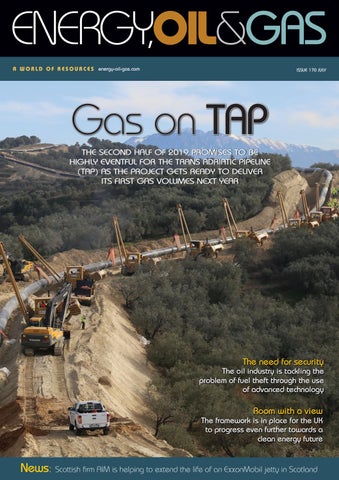
Gas on TAP The second half of 2019 promises to be highly eventful for The Trans Adriatic Pipeline (TAP) as the project gets ready to deliver its first gas volumes next year
The need for security
The oil industry is tackling the problem of fuel theft through the use of advanced technology
Room with a view
The framework is in place for the UK to progress even further towards a clean energy future
News: Scottish firm AIM is helping to extend the life of an ExxonMobil jetty in Scotland
Editor Editors Chairman Andrew Schofield Editor Libbie Hammond - libbie@schofieldpublishing.co.uk Assistant Editor Will Daynes Staff Writer Vladi Nikolov
...in this issue, we’ve really travelled the globe (metaphorically speaking) with contributors from Belgium, Finland, Spain, the USA and Columbia, to name a few
Art Editor Fleur Daniels Advertising Designer Fiona Jolliffe Managing Director Joe Woolsgrove Operations Director Philip Monument Operations Manager Natalie Griffiths Sales Mark Cawston Theresa McDonald Gary Silk Sam Surrell Web Sales web@schofieldpublishing.co.uk Exclusive Features Darren Jolliffe - djolliffe@schofieldpublishing.co.uk Independent Sales Dave King - dking@schofieldpublishing.co.uk Research Managers Ben Richell Kieran Shukri Editorial Researchers Wendy Russell Richard Saunders Office Manager/Advertisement Administrator Tracy Chynoweth Digital Subscriptions Iain Kidd - digital @schofieldpublishing.co.uk
© 2019 Schofield Publishing Limited all rights reserved 10 Cringleford Business Centre Intwood Road Cringleford Norwich NR4 6AU T: +44 (0) 1603 274130
Survive and thrive Welcome to issue 170 of Energy, Oil & Gas – can we really be halfway through 2019 already? Time sure is flying this year. As ever, I am delighted to be able to bring my readers stories of success from a wide range of different sectors, and in this issue, we’ve really travelled the globe (metaphorically speaking) with contributors from Belgium, Finland, Spain, the USA and Columbia, to name a few. And while it may be an understatement to say that market conditions are challenging, the companies we are speaking to are so positive in their approach, so willing to adapt and introduce innovation and so prepared to invest in the future, that it does spark a little confidence that while it’s not all smooth sailing ahead, the smart and diligent operators out there are doing their utmost to survive and thrive.
Energy, Oil & Gas Magazine
@EOG_magazine please note: The opinions expressed by contributors and advertisers within this publication do not necessarily coincide with those of the editor and publisher. Every reasonable effort is made to ensure that the information published is accurate, and correct at time of writing, but no legal responsibility for loss occasioned by the use of such information can be accepted by the publisher. All rights reserved. The contents of the magazine are strictly copyright, the property of Schofield Publishing, and may not be copied, stored in a retrieval system, or reproduced without the prior written permission of the publisher.
editor LIBBIE HAMMOND
ENERGY,oil&gas
energy-oil-gas.com
1
Regulars
4
Fuel
Hydrogen as a fuel has the potential to decarbonise the future. Prof. Emmanouil Kakaras discusses the possibilities it offers
8
Wind power
The importance of efficient electrical installation to the successful development of windfarm projects should not be underestimated
10 Olympus
To tackle complex inspection challenges, the latest generation of videoscopes is equipped with innovative features
4
12 Refining
Translating Vision 2050 into practice will require Europe’s refiners to rethink and rebuild their long-term strategies
16 Infrastructure
As fuel thieves get more sophisticated, the industry is turning to technologies to help them monitor their networks
19 Hempel
When Dolphin Energy needed a proven coating solution, it turned to Hempel’s Hempaline Defend 740 Vinyl Ester
20 Technology
8
To meet the skills challenge in oil and gas, businesses need to consider immersive competency solutions
24 News
Some of the recent developments within the oil and gas industry
26 Increasing efficiency
There is an exact science to maintaining maturing assets for the longer term – operators need specialist advice
28 Big oil
Middle Eastern oil companies have giant ambitions in petrochemicals, with plans to launch massive capacity in 2025
12
32 Renewables
There are several key considerations facing the renewable industry at the moment, including subsidies and ‘nimbyism’
34 Biofuel
How biodegradable waste could be used to reduce the United Kingdom’s dependence on foreign energy supplies
36 Regulation
Guest contributor Michael Reader-Harris takes a look at the evolution of flow measurement standards
28 2
ENERGY,oil&gas
energy-oil-gas.com
Contents
Profiles
38
44
48
38 Trans Adriatic Pipeline (TAP) 44 ABLE UK 48 Greenalia Group 52 Technip India 58 Cartagena Refinery 62 Georgia Renewable Power (GRP) 66 Total Antwerp Refinery 70 ORES 74 Tidewater Inc 78 Energy Drilling Company 82 Arcola Energy 86 Plexus plc 90 NEOT 94 DCN Diving ENERGY,oil&gas
energy-oil-gas.com
3
A different
option Prof. Emmanouil Kakaras discusses hydrogen’s potential to decarbonise the future
T
he world has reached a critical point in the race against global warming and carbon emitting sectors are failing to adopt renewables at the necessary rate. So much so that fossil fuels are still expected to account for around half of global electricity generation by 2040. Industries such as power, transport and heat acknowledge the need for a new approach, since these sectors have been very difficult to clean up through renewables. As a result, the decarbonising potential of hydrogen as a fuel source is being rediscovered. Hydrogen is clean, flexible and stable and belongs alongside the renewables and natural gas as an energy source of the future. This is because the only emission from using hydrogen is drinkable water. Hydrogen is already having a measurable impact in the decarbonisation of these industries, although at different levels of maturity. Transport is leading the way at present, but the power and heat industries are set to be radically transformed by the adoption of hydrogen.
1. Transport Today the transport industry is leading the way in hydrogen adoption and in doing so, is rapidly decarbonising. This is an important sector to become hydrogen reliant because it accounts for 45 per cent of CO2 emissions and 30 per cent of global energy demand. Admittedly, lithium-ion battery powered vehicles are currently leading the way in dercarbonising this industry, but hydrogen fuelled transport is also a reality. According to the International Energy Agency there are an estimated 8000 hydrogen fuel cell electric vehicles (FCEVs) on the world’s roads, with 4500 of these in the US (mainly California) and 2400 in Japan, followed by France and Germany. This existing demand is being supported by FCEV targets, with Japan’s being the most ambitious, aiming for 200,000 FCEVs by 2025 and 800,000 by 2030. However, the opportunities away from the roads should not be overlooked. In Germany, the world’s first hydrogen-powered trains are already running on a 100km route in the north of the country in 2018. These two trains have replaced diesel engines, with another 14 to begin calling at stations across the state of Lower Saxony by 2021. Germany is also building a 1MW electrolyser to generate 400kg of hydrogen per day for buses in the western city of Wuppertal.
4
ENERGY,oil&gas
energy-oil-gas.com
Fuel
ENERGY,oil&gas
energy-oil-gas.com
5
The UK meanwhile is considering hydrogen trains as a cost-effective alternative to overhead electrification, as it seeks to phase out diesel engines.
2. Power Today power is behind transport in terms of uptake of hydrogen and on the whole, is behind in the adoption of renewables, as fossil fuels are still expected to account for half of all global energy production by 2040. Hydrogen is flexible enough to be used in existing gas and coal-fired power plants, this ease of adoption is already proving to be crucial for the adoption of hydrogen. The success stories so far have been a result of traditional power plants being converted to burn hydrogen. One of which is Vattenfall’s Magnum power plant in the Netherlands, where Mitsubishi Hitachi Power Systems (MHPS) is working to turn the owner’s ‘Carbon-free Gas Power’ project into a reality. The objective is to convert one of the three combined cycle gas turbines to combust only hydrogen by 2025. Mitsubishi Hitachi Power Systems (MHPS) has already successfully tested the burning of a stable fuel mix of 30 per cent hydrogen with natural gas in a large-scale gas turbine, reducing its CO2 emissions by ten per cent.
6
ENERGY,oil&gas
energy-oil-gas.com
This project is part of a wider drive that in January 2019 saw Europe’s gas turbine industry launch a range of commitments towards the transition of gas power generation to renewable gas, such as hydrogen, in line with the EU’s 2050 goal of a climate neutral economy.
3. Heat Similarly to power, heat is an industry which accounts for a vast amount of energy use (79 per cent in the EU). Most of that energy comes from fossil fuels, with just 16 per cent coming from renewable sources. The heat sector has begun to wake up to and realise that hydrogen fuel is one answer to the decarbonisation of heat production. Most homes in the UK are heated by natural gas boilers and the government had been advised that switching to a combination of hydrogen and electric heating is the only way it can meet its own climate change targets. One solution being put forward by British engineers is a hydrogen heating network in the north of England that could decarbonise 14 per cent of UK heat by 2034. The proposed project would be the world’s largest CO2 reduction facility. Based in northeast England, it would use natural gas to create hydrogen, capturing the CO2 in depleted North
Fuel
Australia to invest heavily in its renewables to hydrogen production capacity, as it targets Japan as a key export market. This year’s G20 meeting in Japan offers other governments the chance to make similarly strong commitments to help kickstart hydrogen economies. In Europe, politics is taking steps in the right direction, with some specific schemes and funds, and the EU is discussing new funding opportunities for hydrogen within the next EU budget. The right policies and regulations will be crucial for the adoption of hydrogen across the private sector discussed. The precedent being set by the Japanese government for co-operation between the public and private sector needs to be replicated the world over if the world’s most carbon producing sectors are to be decarbonised through hydrogen. For a list of sources used in this article, contact the editor.
Sea oilfields. The resulting hydrogen would be piped via the existing gas transmission network to homes and businesses throughout the north of England, allowing their boilers to burn without emitting CO2. The project would build on existing smaller-scale UK initiatives, such as the HyDeploy scheme, which is blending 20 per cent hydrogen with natural gas to heat homes on Keele University campus. There is also an opportunity for businesses and communities to communally source their heat and power using technologies such as MHPS’ solid oxide fuel cells. These can use hydrogen to generate both power and heat and are already being used at university campuses in Japan. For existing demand across the transport, power and heat sectors to pave the way towards a hydrogen society, investment needs to be driven forward in hydrogen technologies, supply chain capacities and infrastructures. All of these are long-term investments, which will need a period of 20 years or more, requiring strong market signals from governments that they are willing to support the development of a hydrogen economy through policy and funding. Japan is leading the way in the world, setting clear targets with specific goals. It is prompting the likes of
Mitsubishi Heavy Industries Group Prof. Emmanouil Kakaras is SVP Power and Energy Solutions Business. Mitsubishi Heavy Industries Group (MHI), headquartered in Tokyo, is one of the world’s leading industrial firms, working across multiple sectors including energy, sustainability, aerospace, mobility and logistics. MHI applies big thinking solutions that move these sectors forward, delivering a lasting difference to customers and communities worldwide. As a company, it is passionate about finding new, simpler and sustainable ways to power cities, improve infrastructure, innovate manufacturing and connect people and businesses around the globe with ever-increasing speed and efficiency. For further information please visit: https://www.mhi.com/
ENERGY,oil&gas
energy-oil-gas.com
7
Getting
connected Tim McNeilly highlights the importance of efficient electrical installation to successful windfarm development
I
n his recent hard-hitting documentary, Climate Change: The Facts, David Attenborough discussed the important role that wind farms could play in helping the UK to meet global emissions targets over the coming years. In 2018, the proportion of UK electricity generated through offshore wind turbines was eight per cent, and ministers have recently set a target of increasing this to a third by 2030. However, with regions such as Scandinavia still leading the way when it comes to securing European investment, how can the UK renewables sector emulate their success and ensure that electrical installations are able to keep up with the demand for new developments? The Committee on Climate Change’s recommendation that the UK should adopt a target of ‘net-zero’ emissions by 2050 is likely to see attentions turning again to increasing numbers of windfarm developments. As part of its efforts to decarbonise the power generation industry, the UK can learn some important lessons from
8
ENERGY,oil&gas
energy-oil-gas.com
countries such as Norway, which is rapidly making a transition away from oil and gas-based methods of generation and focusing on renewable technologies. In addition to generating sufficient energy for domestic use, Norway looks set to make green power pay by launching new grid connections with central Europe, to sell production capacity to countries increasing renewable energy in their portfolios. In the UK, a prevailing resistance to new onshore wind farms has often made it difficult for developers to secure planning permission, forcing efforts to focus on offshore wind projects instead. While in the past, these have often proven too expensive to build without first securing significant subsidies, recent technological developments are now enabling developers to increase production hours and capacity. Innovations in design and engineering are producing larger and more powerful turbines, which are able to generate power for a greater number of homes and are more resistant to external conditions, keeping installation, maintenance and repair costs down. As
Wind power
approach, helping developers to minimise numbers of deliveries and, as a result, reduce the risk of cost overruns. Using an installer offering Electrical Balance of Plant (EBoP) applications can also help turbine installations to run more smoothly. Covering all stages of electrical installation, from planning and design to execution, these complete turnkey solutions allow investors to connect a number of disparate electrical systems, reducing the time needed for testing and commissioning activity.
Maximise profits
such, projects near UK coastlines are becoming a more attractive prospect for overseas investors.
Innovations such as modular substations could also help investors to drive efficiencies as the demand for renewable developments increases over the next few years. As well as optimising the use of available space on development sites, using robust solutions that last for the entire project lifecycle and allow testing to be handled by the main installer can help to avoid the potential disturbance associated with testing in factory conditions. Pressure is mounting for the UK to reduce emissions and emulate European power generation markets, by making a rapid transition to renewable technologies. With the demand for new wind farms undoubtedly set to climb in the years ahead, technological developments are now making them a more attractive prospect for investors. However, in order to ensure projects are delivered on time and on budget, it’s important to take all possible steps to optimise the electrical installation process. By choosing an electrical installer with a proven track record in connecting wind power developments, and taking advantage of complete turnkey solutions, investors can maximise the profitability of their developments while helping to support the UK’s sustainability drive.
Turnkey solutions In order to ensure that new turbines are connected quickly, to keep up with growing demand for wind farm developments, efficient electrical installation processes will be key. To reduce the risk of overruns and delays, a common-sense approach for developers is to divide project delivery into three main sections; turbines, infrastructure and electrification and maintenance. As well as enabling contractors to focus on their key area of expertise, this approach has the added benefit of improving cost-efficiency across the lifecycle of the project. Choosing an electrical installer with a proven track record across similar developments is also essential to keep projects on track and ensure production is able to begin on time. Choosing a contractor that also manufactures its own equipment can enable a more joined-up installation
I.C. Electrical Ltd Tim McNeilly is managing director of I.C. Electrical, part of VEO Group. I.C. Electrical Ltd is an electrical engineering contractor based centrally in the UK. It is capable of providing a complete in-house electrical engineering solution incorporating the design, build and installation of control panels, HV and LV electrical systems, communication and automation systems along with small power and lighting installations. For further information please visit: www.icelectrical.co.uk
ENERGY,oil&gas
energy-oil-gas.com
9
100% Pipe Elbow Coverage
Introducing the FlexoFORM™ Scanner Contours to curves Flexible probe and water-wedges provide constant coupling on elbows 4.5 in. OD and up Reduces prep time An encoder maps the surface, so reference lines are optional Smoother, faster scanning Magnetic wheels cling to pipe curves, requiring minimal effort High resolution data Up to 1 mm × 1 mm, facilitating analysis of indications and remaining wall thickness
www.olympus-ims.com/scanners/flexoform/ Olympus is a registered trademark and FlexoFORM is a trademark of Olympus Corporation.
Olympus
Looking ahead Remote Visual Inspection (RVI) is a key element of plant maintenance, preventing leaks or other accidents than can result in significant losses
P
lant shutdowns are expensive, which means that fast, efficient inspections that do not compromise on reliability are highly beneficial for plant profitability. Although other inspection technologies exist, RVI extends the reach of the human eye into areas that would otherwise be invisible or require dismantling to view, therefore RVI is the only method that provides instant true-tolife images for confident decision-making. Plants are interesting for RVI inspection due to the wide range of equipment that needs to be inspected. Each piece of plant equipment comes with its own specific inspection challenges. These challenges can relate to the shape of the component (small holes, tight spaces) or to its condition (damage, fouling). To tackle these complex inspection challenges, the latest generation of videoscopes is equipped with innovative features that are specifically designed to address these tasks. These videoscopes provide high return on investment due to faster inspections and better informed decision making.
CASE STUDY – In-service inspection of corrosion in trunnion supports A recent article from HSE in England and Wales raised a specific concern relating to the inspection of trunnions or trunnion supports. Trunnions are welded to the process pipe carrying oil, gas or chemicals in plant locations, power stations and oil and gas facilities and form the support structure for this network of pipes. There is a critical inspection requirement for trunnion reports, more critical following an HSE (Health and Safety Executive) report highlighting the condition of a number of inspected supports following failure due to corrosion. The Action required by the HSE at the time following Bulletin Number: HID1-2013 is as follows: “Operators of plant with pipework containing hazardous substances should ensure that their inspection regime includes suitable examination of supports. In particular, where tubular trunnions are installed with an end cap that prevents visual examination, other means should be employed to ensure the integrity of the system, where there is a possibility of moisture ingress. Note that permanent removal of the end cap is not recommended without further design work, as the cap may be required for additional stiffness.”
Historic inspection method and associated challenges Historically, based on this advice trunnion supports have been inspected using industrial radiography, a non-destructive inspection technique using radioactive isotopes that is both costly, time consuming and carries a number of critical safety challenges. Due to the nature of this type of inspection, there is generally a requirement to stop works at the specific plant location and evacuate personnel to a designated safety zone. Naturally, efforts have been made to look into new and innovative ways to inspect these trunnion supports.
A new method for inspection trunnion supports ‘in-service’ Remote visual inspection, by default, extends the reach of the human eye into areas otherwise unable to be seen without disassembly or sometimes destructive testing. As such this scenario is a truly ‘non-destructive’ technique where no disassembly or dismantling is required and inspections can take place in situ. During the trial, the access point for the videoscope was the weep holes found in the support structure of the trunnion. These weep-holes exist so as to allow pressure release during the high temperatures hit whilst welding. It is possible to pass a videoscope through this inspection port of 6mm or less and take both images to assess the condition, or to take measurements where necessary to map this corrosion if evident. A number of trunnion samples have been inspected in England and Scotland and in some trunnion samples, the level of corrosion was so high that it was deemed fruitless to take measurements. Equally, in other trunnion samples there was no evident corrosion and again, no measurements needed to be taken.
Conclusion and Olympus recommendation Regular trunnion inspections are a cost-effective way to ensure low downtime and potential catastrophic failure of these process pipe supports allowing operators to make informed decisions when minor faults are identified which left undetected would result in costly replacements. For more information on the equipment used, please visit: www.olympus-ims.com
ENERGY,oil&gas
energy-oil-gas.com
11
European Refining
2050
Stephen George discusses how to turn the vision into reality
E
urope’s refiners, through their industry organisation Fuels Europe, have set out their long-term ambitions in a new program called Vision 2050. The outlook sees Europe’s refiners staking a claim to remain at the centre of transport fuels supply, the petrochemicals industry, renewable fuels and energy - even as Europe’s Energy Union strategy mobilises a low-carbon, sustainable energy transition.
12
ENERGY,oil&gas
energy-oil-gas.com
While Europe doesn’t speak for the rest of the world, its aspirations for greenhouse gas reduction, technology leadership and renewables focus will help to define the global direction of travel in the decades ahead. Just as European standards for higher fuel quality have spread throughout much of the world, Europe’s future embrace of green technologies and sustainable practices will drive energy efficiency and emissions reduction to help the
Refining
world achieve its commitments under the 2015 Paris climate change agreement (COP21). Vision 2050 starts with the premise that Europe and the world will continue to rely upon liquid transport fuels for the foreseeable future – they are the most energy-dense, cost-effective and in some cases (e.g. aviation) the only practical way to maintain affordable mobility. Electric and hybrid cars – alternatively fuelled vehicles (AFVs) - will play a role in private transport, but they cannot meet the needs of the entire transport sector, much of which will continue to rely upon liquid fuels.
What does this mean for the refining industry? This longer-term dependence on refined products is not a radical view. The International Energy Agency’s (IEA) 2017 World Energy Outlook ‘current policy scenario’ also anticipates a world where oil demand continues to grow for at least another two decades, as population growth and economic development outpace efficiency gains, the uptake of AFVs and other new technology. If Europe isn’t ready to part with fossil fuels, Vision 2050 suggests that these fuels can be made greener by introducing more renewable material into the mix, and by using renewable energy to produce and distribute them. By lowering the fossil-fuel density of these fuels, they argue, a broader and more immediate impact on CO2 emissions can be realised than by waiting while new AFV technology matures and propagates around the world, which will take decades. The vision also calls for the EU to maintain technological leadership in this area, developing and commercialising new processes and technologies. New process technologies and digitalisation will develop and sustain new highly skilled jobs in many sectors across the EU. Vision 2050 asks for a technology-neutral playing field, letting economics separate winners and losers so long as results are achieved, and it calls on European politicians to deliver a long-term stable investment climate to give investors the confidence they need to make the big-ticket investments that will be needed to deliver this vision.
could see refiners using more renewable electricity and biogas instead of fossil hydrocarbons to power refining processes. The refinery of 2050 could be fuelled solely by renewable energy. A role also remains for increasing biofuels in the transport fuel mix. As technology continues to evolve, sustainability, land use challenges and the food-vs-fuel debate will be resolved. Drop-in versions of nextgeneration biofuels from waste, agricultural by-products and algae sources will become more commonplace. Petrochemicals will also be transformed by renewable feedstocks, plastic recycling technology, and a broader embrace of the circular economy. Developments in new engine technology will also drive demand for higher quality transport fuels that could in turn reduce overall fuel demand by further improving fuel economy. Technology improvements in cars and in traffic management are also expected to improve the efficiency of vehicle use, delivering more personal mobility with lower greenhouse gas emissions. Digitalisation will also drive continued efficiencies in energy optimisation, workforce upskilling and plant reliability. Some of these technologies are in their infancy today but will start delivering real benefits through improvements in predictive maintenance, reduced downtime, operating cost reduction, stable operations and on-spec products, achieving maximum economic value from capital investment. The skills base needed in the refinery of 2050 will be considerably broader than it is today. Alongside evolving AFV use and the development of other renewable energy, these new technologies are expected to lower Europe’s share of global carbon emissions from around ten per cent today to nearer six per cent by 2050, with a long-term aspiration of completely decarbonising Europe’s energy needs. As this transition is happening, it can also position European companies as global leaders in low carbon technology that can be exported to the rest of the world as it catches up with Europe.
Preparing for the future New technologies will shape the future Europe’s refiners are quick to agree that there are no ‘silver bullet’ technologies that will deliver all of the benefits in one package. It’s not that simple. Rather, a broad framework of technologies in the refinery setting will be managed at an asset-specific level to deliver significant greenhouse gas reductions. New technologies such as green hydrogen, which incorporates renewable hydrogen into conventional transport fuels, are useful in upgrading technologies to continue the trend away from heavy fuel oil use and to remove more pollutant sulphur from the fuel mix. In addition, renewable refinery fuel
Vision 2050 is a roadmap for a viable future for Europe’s refineries, but it is not a simple way forward. The vision is ambitious, as Fuels Europe is quick to acknowledge. Yet it is vital to Europe’s energy independence, the environment and the economy. Delivered successfully, these will become a benchmark for refiners in many other markets. It can be difficult, looking at your organisation, to know if you are ready for these challenges. Refiners should be well positioned to manage the complex and expensive challenges required by the energy transition. If the EU comes to the table and fosters the investment and regulatory climate needed
ENERGY,oil&gas
energy-oil-gas.com
13
to stay the course, Europe’s refiners will need to rise to that challenge and deliver the vision. This will require strategic insight, capital investment, technological evolution, organisational maturity, and Operational Excellence.
Turning Vision 2050 into reality To do this, refiners need to invest in robust technology solutions. Adopting an Operational Excellence framework integrates strategy, business processes, people and technology to address business, asset, organisation and applied technology challenges. Operational Excellence solutions are focused on delivering continuous improvement and sustainable competitive
14
ENERGY,oil&gas
energy-oil-gas.com
advantage through a program of discovering, delivering and sustaining operational benefits in all key areas of management control. Conducting a pre-investment analysis of new technology to ensure the new investment choices are robust and resilient will help manage the risks from adopting new technology. It may also identify if there are any synergies that can be realised with existing technologies. It is worth considering simulation software to simulate the impact of adopting new technologies and unconventional feedstocks both on refinery yield and financial performance. Refiners must also ensure that they are digitalisationready. To do so, refiners should not just look at the
Refining
new technologies they are putting in place but also their employees and their capability to cope with these new developments. The application of new digital technologies will change the way the organisation is managed, from remote control centres to operations, maintenance and contractor management. It is important to help guide the transition by delivering change management targeted at frontline employees to ensure they retain the right capabilities and develop the necessary future skills. Translating Vision 2050 into practice will require Europe’s refiners to rethink and rebuild their long-term strategies, along the way transforming their organisations into modern, flexible knowledge-based enterprises.
KBC – A Yokogawa Company Stephen George is Chief Economist – EMEA and APAC, KBC – A Yokogawa Company. KBC addresses challenges across upstream, midstream and downstream oil and gas, chemicals and power. Located in 22 principal offices around the world, KBC understands the unique situation of your business and can tailor advice and solutions that consider your specific market conditions, regulations, resource constraints and practices. For further information please visit: www.kbc.global
ENERGY,oil&gas
energy-oil-gas.com
15
The need for
security
16
ENERGY,oil&gas
energy-oil-gas.com
Infrastructure
The rise of pipeline theft and the prioritisation of protection. By Ian Deacon
A
cross Mexico City, it’s becoming a common sight to see scores of people gathering at gas stations, jerrycans to hand. Product is being diverted to tanker trucks under armed guard. The marines have been brought in to provide protection to pipelines and refineries. The country currently finds itself in the grip of a gasoline crisis. Fuel thieves have grown so prolific, and their siphoning methods so sophisticated, they they’ve forced the shutdowns of some of the nation’s biggest pipelines, setting off the shortages playing out at the fuel pump. In Mexico fuel theft is a business that is booming. The black market for stolen product is now estimated to be worth $3 billion per year. Criminal gangs often target pipelines in remote areas and sell it on cheaply to rural communities. On the other side of the border, in the US, a Government Accountability Office report revealed shortfalls in how the Transportation Security Administration protects the nation’s pipeline network. The audit found that the TSA’s guidelines on pipelines are not reflective of the latest best practices on physical or cyber security. The U.S. is home to some 2.7 million miles of pipelines. The sheer scale of such a network — criss-crossing borders, running through remote regions and taking in tough terrain — makes effective monitoring and policing a challenging problem to solve.
Strengthening security through technology Whether it’s to combat the product-theft epidemic in Mexico or address pipeline vulnerabilities in the US, the industry is turning to technologies to help them monitor their networks and meet security challenges. In the case of a potential threat or leak event, pipeline operators need technologies that provide them with an in-depth view into the state of their assets. They need access to reliable and actionable information that allows for real-time decision-making and a rapid rate of response. One of the most advanced technologies that can be deployed to measure third-party intrusion (TPI) and leak events is distributed acoustic sensing (DAS). This technology allows operators to monitor activity across a pipeline’s entire length, giving them access to unique insights that can inform and accelerate the decision-making process. It works by converting fibre optic cables, which run alongside a pipeline, into an ecosystem of highly-sensitive, individual vibrational sensors. By harnessing Fotech’s cutting-edge photonics, advanced artificial intelligence and edge computing, DAS can successfully detect, classify and inform on range of events and activities. It can identify, with clarity and confidence, the different types of disturbances that might impact a pipeline and provide operatives with specific alarms to accelerate the decision-making process. As a result, DAS-based pipeline intrusion detection systems (PIDS) are fast becoming crucial to global pipeline security strategies. This is because these systems provide protection to pipelines that are deployed in harsh environments, densely populated areas and remote locations that have often proved difficult to monitor and secure through traditional methods.
ENERGY,oil&gas
energy-oil-gas.com
17
Infrastructure
Indeed, traditional security technologies such as aerial surveillance, closed circuit television (CCTV) and ground radars, although still useful as part of a multilayered security solution, have significant limitations. Individually each technology does not have sufficient range to monitor the whole length of the pipeline. They are also relatively simple for criminals to work around as they are usually in sight. In contrast, fully-integrated DAS PIDS can cover the entire length of pipelines – giving a complete real-time view over potentially hundreds of kilometres of pipeline. Through the use of technology, operators can significantly strengthen their security measures. With PIDS in place, they have access to invaluable intelligence and key insights into the both the location and nature of a potential threat. When it comes to preparing a response — whether it’s a criminal gang attempting to tap a pipe, tunnelling in from afar, or an unexpected excavation activity taking place around the pipeline — operators can react with confidence, whether it be a serious leak event or a potential security threat. The insights and alerts that DAS can deliver can be monitored from one central control facility, allowing operators to optimise how they direct their incident responses and maximise the efficiency of how they use their other security resources.
Prioritising protection As oil and gas operators look to deal with intensifying threats to pipelines and refineries, smart technologies are
18
ENERGY,oil&gas
energy-oil-gas.com
becoming a necessity. As we’ve seen with the incidents of pipeline tapping and fuel theft in Mexico, the need for enhanced security has never been greater because the climate for operators has never been so challenging. When it comes to pipeline security, what the industry needs is responsive technology that allows it to meet evolving security threats and leak events. By being able to identify the fundamental elements that make up a potential leak or shape a security issue, Fotech’s DAS technology can give operators a much-needed boost in their efforts to protect pipelines and co-ordinate their responses when such incidents occur.
Fotech Solutions Ian Deacon is Sales & Operations Director at Fotech Solutions. Headquartered in the UK, Fotech Solutions develops Distributed Acoustic Sensor (DAS) solutions for the oil & gas, pipeline, security and smart city markets. Combining talent from the energy sector with leading-edge industrial photonics and technology expertise, Fotech generates unrivalled sensory data that solves business-critical challenges. Fotech’s unique DAS technology and services are changing expectations, optimising traditional processes and creating new opportunities in a range of industries. For further information please visit: www.fotech.com
Hempaline Defend, trusted in challenging environments At a glance Customer
Dolphin Energy Limited
About
Dolphin Energy Limited is a gas company that was established in 1999 by the Abu Dhabi government implementing the Dolphin gas project to process natural gas for the UAE and Oman
Coatings system
Hempaline Defend 740 Vinyl Ester
Total
15,000 litres
The challenge Dolphin Energy Limited needed a proven coating solution for the inside of their storage and process tanks to protect them from the corrosive wastewater contents. The protective coating needed to perform well in this aggressive environment, prolong the assets lifetime and maintain tank purity. This project complements previous efforts to modify the wastewater treatment unit. The aim of which was to enhance the quality and filtration of wastewater and prepare it for deep well injection. In addition, the project needed to be completed within a tight time scale and required on-site technical support to ensure its success. The solution We were delighted when our Hempaline Defend 740 Vinyl Ester was specified to line the storage and process tanks for this prestigious project, providing a long lasting, corrosion resistant coating solution. It took 15,000 litres of our high performance Hempaline Defend 740 lining to coat 18,000 square metres of internal tank. Our range of Hempaline Defend linings are proven to provide advanced protection against pH swings, high temperatures and abrasion, as well as a wide variety of chemicals and solvents. They are suitable for even the largest diameter storage tanks and are resistant to steam cleaning and other processes. To ensure the project was completed on time and to specification our renowned technical support team were on-site throughout. With rapid curing, our high performance linings will get your assets back in service quicker, often in as little as 24 hours. The Hempel Group Head Office Hempel A/S, Lundtoftegaardsvej 91, 2800 Kgs. Lyngby, Denmark T: +45 4593 3800 | E: hempaline@hempel.com | hempaline.hempel.com
ENERGY,oil&gas
energy-oil-gas.com
19
Immersive
competency Ensuring skills gaps don’t scupper growth
S
kills gaps continue to be the key problem for businesses in the oil and gas industry. Recent research by DNV GL shows confidence in the global oil and industry is high. Three quarters of the senior oil and gas professionals surveyed expect growth in the year ahead, and overall confidence is at levels last seen in 2011.
20
ENERGY,oil&gas
energy-oil-gas.com
As growth returns, however, concerns over skills gaps loom large, coming second only to competitive pressures in professionals’ lists of the barriers to growth. As the report noted, “For 2019, skills pressures are now firmly back on the agenda…” On the one hand, this is unsurprising. Over a decade ago, the World Petroleum Council Director General Dr
Technology
Pierce Riemer warned that the industry was on “the edge of a demographic cliff”. In the intervening years, the retiring baby boomers about which he worried have not got any younger. The eldest are now in their seventies. On the other hand, we do not live in a world with fewer people – far from it. In the US, millennials have
surpassed baby boomers as the largest generation in history. Together with the Generation Z workers following them, they will soon account for more than half the global workforce. It’s not primarily a question of people, but of skills. And it’s also a question of competing. As DNV GL’s research noted, skills gaps may be exacerbated by fewer
ENERGY,oil&gas
energy-oil-gas.com
21
young people joining the industry. Some are opting for green energy industries; others, particularly with the skills the digital oil field needs, are drawn to technology firms. Oil and gas has to work harder than ever to make itself an attractive proposition. The oil and gas industry does not have long to address the challenge. The Global Energy Talent Index (GETI) survey earlier this year found 40 per cent of oil and gas professionals felt they the industry was already in the midst of a skills crisis. A further 28 per cent expect a crisis to hit in the next five years. If businesses are to meet this challenge, immersive competency solutions are likely to be an increasing part of the answer. Augmented or virtual reality (AR or VR) training provides a powerful solution for capturing the expertise of the aging workforce and passing it on effectively and efficiently to younger workers.
22
ENERGY,oil&gas
energy-oil-gas.com
Practice makes perfect We’ve long recognised that hands-on learning is usually the most effective form of training. This is particularly true for millennials, who have a strong preference for active learning and experience, rather than typical classbased lectures, according to research. At the same time, oil and gas operators are, understandably, reluctant to let inexperienced trainees practice in live plants, where mistakes can cost lives. AR and VR training is an effective answer to this quandary. Headsets can either immerse users in a completely digital world (VR), such as a plant, or overlay graphics, such as an image of a device or equipment, on the real world (AR). Both provide opportunities for realistic practice of key and complex tasks, without any risks to safety. Crucially, immersive competency delivers on key requirements to meet the demands the change of
Technology
generations in the workplace is placing on the industry. Most importantly, it’s a fast, effective training method. Honeywell estimates the technology can reduce typical times to competency by a third: from six months to two. That’s important in three respects. First, it is efficient and enables businesses to make the most of the experienced workforce. Centrally located or remote experts can oversee the training of younger workers across the organisation with VR and AR learning modules delivered on demand, online. Second, it enables oil and gas businesses to cope with the speed of demographic transformation they face. According to a study by consultants Accenture Strategy, in 2015 baby boomers accounted for 19 per cent of the oil and gas workforce; by 2025 the figure is expected to be just seven per cent. Third, it also helps firms cope with the above average turnover in younger workers. Surveys show many millennials moving quickly from job to job. In one survey, close to half (44 per cent) were looking to leave their employer within two years. Reducing the time to competency, businesses can increase the period of productive work. In fact, though, the technology may not only help businesses cope with high staff turnover among younger workers; it may actually help reverse it, as well as enabling oil and gas businesses to compete for talent with other industries more effectively. The affinity of the younger generation for digital technologies is as well proven as it is obvious. These ‘digital natives’ rely on and enjoy technology in every
aspect of their lives. This makes the barriers to adoption among younger workers to immersive competency extremely low; a generation raised on 3D video gaming and basic AR apps and games such as the Pokémon Go has little problem getting to grips with these solutions. AR headsets such as Microsoft’s HoloLens just offer more sophisticated versions of technology they are already familiar with. More than this, however, these solutions – and others such as intelligent wearables that bring connectivity to the field – help to build the sort of digital workplaces that are attractive to millennials, and which they increasingly demand. If we can build these workplaces in the oil and gas industry, we will find the pool of available talent is more than enough to support the most optimistic expectations of for the future.
Honeywell Honeywell is a Fortune 100 software-industrial company that delivers industry specific solutions that include aerospace and automotive products and services; control technologies for buildings, homes, and industry; and performance materials globally. Its technologies help everything from aircraft, cars, homes and buildings, manufacturing plants, supply chains, and workers become more connected to make our world smarter, safer, and more sustainable. For further information please visit: www.honeywell.com
ENERGY,oil&gas
energy-oil-gas.com
23
In Brief Major milestone INNIO and Aggreko have reached a major milestone with the launch of a customised myPlant Asset Performance Management (APM) solution for real-time monitoring and diagnosis of Aggreko’s power fleet. The fleet comprises natural gas, heavy fuel oil, diesel, renewable and battery power assets. Complementing Aggreko’s capabilities, the myPlant APM solution delivers a cloudbased monitoring and diagnostics
$2bn investment
infrastructure, providing Aggreko with the ability to remotely monitor and manage performance of the connected reciprocating engine power plants. Aggreko is now able to gain the real-time intelligence needed across a larger percentage of its fleet.
Powering Poland Despite its modest progress in terms of solar energy, the Polish government and the country’s adoption of renewables has been praised for its contribution to what has been described as ‘an exceptional year’ for solar energy in the EU. Andrius Terskovas, Chief Business Development Officer at Sun Investment Group (SIG), a solar energy development and investment management company, noted that more can be done: “In recent years, we have seen Poland pivot towards a positive and sustainable renewable energy strategy after it introduced a CfD auction system. Based on the number of solar energy investments Poland is attracting from China, Scandinavia, and neighbouring Lithuania, we expect it to start contributing to Europe’s renewablebased future. However, having in mind Poland’s size and population, its strategy should be more ambitious, as it is trailing behind lagging behind other Germany, which has an installed capacity of 43 GW, and Italy with 20 GW.”
24
ENERGY,oil&gas
INEOS has signed a Memorandum of Understanding with Saudi Aramco and Total, France, to build three new plants as part of the Jubail 2 complex in The Kingdom of Saudi Arabia. A new state-of-the-art 425,000 tonne acrylonitrile plant, will use INEOS’ world leading technology and catalyst. It will be the first plant of its kind in the Middle East when it starts up 2025. Paul Overment CEO INEOS Nitriles said: “Global demand for acrylonitrile continues to grow ahead of GDP, to meet the demand for lighter, stronger, energy efficient materials such as ABS, composites and carbon fibre. This first investment in the Middle East consolidates our position as the market leader and shows a clear and ongoing commitment to meet our customers’ needs wherever they are in the world.” INEOS will also build a 400,000 tonne LinearAlphaOlefin (LAO) plant and associated worldscale PolyAlphaOlefin (PAO). These units will be the most energy efficient in the world when they begin production in 2025. Joe Walton, CEO INEOS Oligomers added: “INEOS Oligomers is one of the world’s leading merchant suppliers of LAO and PAO. The size and location of these new plants reinforces our commitment to keep pace with our LAO and PAO customers’ expanding requirements globally.” The location in The Kingdom of Saudi Arabia will give INEOS access to competitive raw materials and energy, with well invested infrastructure, to better serve customers directly in the Middle East and markets across Asia.
Jetty upgrade A Scottish firm has been awarded a major contract that will help extend the life of the ExxonMobil jetty facility at Braefoot Bay Marine Terminal in Fife. The tanker terminal exports liquefied petroleum gas to Europe and the USA after being produced at Fife Ethylene Plant (FEP), using feedstock from the North Sea. A team of six specialists from Asset Integrity Maintenance (AIM) have started working at the 233-metre long jetty for the first phase. This phase alone represents an investment of some 3000 man-hours. As part of the work, they will be using a cutting-edge temporary access structure, which will be suspended below the jetty and encloses the work area to ensure no environmental impact to the Firth of Forth below. AIM’s scope of work will focus on the refurbishment, repair and protection of the jetty’s steelwork coating and will use abrasive materials and a vapour blasting technique that are environmentally friendly. Blair McDonald, managing director at Asset Integrity Maintenance, said: “Our local teams will conduct this key upgrade project in a way that maintains the highest levels of environmental protection. When completed, it will ensure the safety and integrity of the jetty for years to come.”
energy-oil-gas.com
News Trusted supplier Sparrows Group has appointed Deladi Petroleum Services Sdn Bhd as its sole representative in Brunei. The new agreement creates a partnership to deliver a broad range of equipment and services supporting reliability and operational safety in the oil and gas industry. As part of the collaboration Deladi will have exclusive rights to supply Sparrows Original Equipment Manufacturer (OEM) parts and components in the country. This includes all crane brands that
The green choice
Sparrows hold intellectual property rights (IPR) for such as American
Orsted has launched two new greener gas products designed for businesses looking to take an extra step towards decarbonising their energy. Ørsted has been supplying its customers with 100% renewable electricity since 2017, and the supplier is now expanding its offering with the addition of biogas and carbon neutral gas options - designed to suit the differing requirements and budgets of UK businesses of all sizes. Orsted’s biogas product comes with guaranteed certificates of origin, so businesses can report near-zero emissions from their gas consumption in greenhouse gas (GHG) reporting, making a significant contribution to carbon reduction. For those businesses seeking a lower budget option, Ørsted can also provide a carbon neutral gas product. The carbon from a customers’ gas consumption is offset through investment in sustainable development projects, such as clean energy, water treatment and forest management projects. This helps to counteract any carbon emissions, provide social benefits to the surrounding communities and aid progress towards the Sustainable Development Goals. All projects are certified via The Gold Standard or the Verified Carbon Standard, which is important for auditing.
Aero, Houston System, Bucyrus Erie Marine, Weatherford and Energy cranes. Commenting on the deal, Stewart Mitchell, chief executive officer of Sparrows said: “There are over 65 cranes in operation across Brunei today which we hold the IPR for.
REAL COPY
This agreement assures quality
and safety to our customers and lets them know they can purchase genuine OEM parts with a certified warranty from a local supplier they can trust. “We have worked in Brunei for a number of years and have a successful track record delivering crane maintenance services, but
World’s most advanced
Deladi is an established brand and their extensive knowledge of the
Petal17, the latest Marine Breakaway Coupling (MBC) launched by global market leader Gall Thomson, has set new standards for lightness, precision and performance, to the extent that the company describes it as the most advanced protection against offshore oil spills in the world. Gall Thomson MBCs are designed to minimise risk of offshore oil spills due to tanker breakout of pressure surge during hose transfer operations. The Petal17 is the result of over 40 years of in-field experience and major capital investment from parent company Signum Technology. Petal17 is engineered with a range of innovative features that takes Petal Valve MBCs to a new benchmark of performance. CNC manufacturing of Petal Valves provides greater precision than previous manufacturing techniques. Petal17 also has a unique Petal Valve locking mechanism that delivers improved performance for those activations when adverse weather conditions and low pressure coincide. Following recommendations made by the Oil Companies International Marines Forum (OCIMF), Petal17 is pre-fitted with Unit Status Indicators. These enable visual inspection of MBC status without the need to remove the unit from the line. Across its range, the Petal17 is an average of 20 per cent lighter than the previous Gall Thomson MBC range – which was already the lightest on the market. Together with the Gall Thomson Ultrafloat, the Petal17 delivers positive buoyancy even on activation.
market will support us in growing the business in the country. Working with a trusted local partner ensures we can deliver equipment and services wherever demand exists.”
ENERGY,oil&gas
energy-oil-gas.com
25
Living longer in the
North Sea
Keeping mature assets fit for the future. By Scott Martin
T
he past year has marked a significant milestone in the North Sea’s history, with one of the world’s largest oil producers, Shell, celebrating 50 years of North Sea production and predicting a positive outlook for the next 50. This renewed positivity and optimism has been reaffirmed recently with the likes of Gannet E coming back online, Buzzard restarting output and production from new fields, including Garten and Clair. In January, Wood Mackenzie determined that drilling activity on the UK’s Continental Shelf was set to increase significantly over the next 12 months, following record lows due to the slump in crude oil prices, which delivered a heavy blow to the industry. According to them, the relatively unexplored waters off the west of Scotland will be where considerable interest is focused, tapping into opportunities which could yield highly valuable results. Put together, these promising milestones and predictions serve up a welcome boost to both production levels and the outlook for those working in the industry. But in order to sustain the next 50 years in the North Sea, it is imperative
26
ENERGY,oil&gas
energy-oil-gas.com
that we look at the need for ongoing investment in the oil and gas sector in order to support this extended life expectancy. Last year saw a ten-year high for new projects in the North Sea, resulting in an extra 140,000 barrels of oil a day. But given that we have extracted more than 50 per cent of available reserves to date it is just as important to look after the ageing assets that have served us so well to date, as it is to establish new ones. So where do the opportunities lie to ensure these assets are fit for the brighter future the industry is hopeful of? Innovation and technology are two key areas which will be integral to ongoing progress – areas which we are continuing to explore in order to breathe new life into ageing infrastructure. Our focus has been on optimising assets to ensure maximum productivity and reducing maintenance downtime. By providing innovative integrated work scopes and creating bespoke, fit for purpose engineered solutions, clients are benefiting from renewed levels of productivity from their original asset investments. Whilst ‘optimistic’ may well be the new buzz word when it comes to discussions around drilling in the North Sea, for
Increasing efficiency
those in charge of the purse strings, it remains a cautious time with streamlining and improving efficiencies staying put at the top of the financial agenda. It is our job to find and implement the solutions which will enable operational cost decisions to be taken. Oil & Gas UK also cautioned that the industry’s supply chain remains under pressure and that if the North Sea is to continue the upturn which kicked off last year, then further exploration and appraisal drilling needs to take place. While the industry looks to prolong production and attract additional investment to facilitate this, it is the role of existing assets that will determine how successful enhanced production is over the coming decades. If industry predictions materialise and the sector benefits from a bumper year, it is vital to have a working infrastructure in place. Again, innovation through the supply chain service delivery is where the greatest value can be found and over the last few years, we’ve seen clients increasingly seeking out cost efficient solutions to extending asset service life. It will not have gone unnoticed that the age profile of North Sea infrastructure is changing. More than 70 per cent of the world’s oil is based in mature fields, delivering around 59 million barrels per day (bpd). Managing ageing North Sea platforms is a growing issue, so life-cycle management and life-extension are of utmost importance to operators, specifically in the North Sea where more than half of assets have already gone beyond their initially conceived life expectancy. Looking back to 2015, the rising maintenance costs to companies through an ageing infrastructure were already being recognised, prompting the supply chain to respond to the economical, technological and strategic challenges ahead. Whilst back then, the industry was looking at the widespread decommissioning of platforms, we’re now seeing a considerable U-turn and a growing requirement to ensure existing infrastructure is fit for purpose. Ultimately, achieving optimum performance and minimum downtime is vital. Operators, and as a result their contractors, are under pressure to deliver quality repair, maintenance, and refurbishment work quickly, efficiently and above all else, safely. The move of the industry from generalists to specialists, primarily a result of the 2014 downturn, is one that has proven key to suppliers like ours, offering specific skilled products and services - and our service provision and expertise have adapted and diversified accordingly. Platforms in later life will continue to play an important role but the priority right now is that production is maximised, in a safe manner and at the lowest cost. This is an integral part of our own work, where we aim to provide services that add value and offer customers solutions that enable them to get on with their own day jobs, safe in the knowledge that their assets are being upgraded and restored to the highest working order.
With experience across the complete life cycle, we understand the increasingly challenging environments of oil and gas recovery and the need for safe, profitable operations. We have provided specialised solutions both on and offshore, with extensive experience in the North Sea. We have seen – and navigated - both the boom and the bust and this experience has enabled us to help our clients best manage their ageing assets. With production levels on the rise again, is imperative that these assets are optimised, helping to raise the industry back onto its sturdy sea legs once more. Just like modern medicine, there is an exact science to maintaining maturing assets for longer-term and it is important that operators have access to the right specialists, with the right knowledge, to ensure the best chances of extending the life expectancy of their investments.
Glacier Energy Services Scott Martin is Executive Chairman at Glacier Energy Services, a UK-based energy services group operating across the oil and gas, renewables and industrial sectors internationally. The company was formed in 2011 through the acquisitions of Roberts Pipeline Machining and Wellclad. The company grew through further acquisitions of Site Machining Services, Ross Offshore and Professional Testing Services in 2012, 2013 and 2014 respectively and now delivers specialist products, services and engineered solutions relating to heat exchangers, onsite machining, nondestructive testing and weld overlay for existing and new energy infrastructure, delivered either onsite or at its workshops. For further information please visit: www.glacier.co.uk
ENERGY,oil&gas
energy-oil-gas.com
27
Giant ambitions
Joseph Chang examines how Middle East ‘Big Oil’ is to boost THE global petrochemicals footprint
W
hile the US cracker wave on the back of the shale gas boom is getting much of the attention, big oil and gas players in the Middle East are lining up mega projects that could shift the landscape of global petrochemicals from 2025 and beyond. Driving this push from oil companies is the growing realisation that oil demand for transportation fuel will plateau with the electrification of vehicles and improving fuel efficiency. Thus, the future for hydrocarbons is not in gasoline and diesel, but in chemicals, where demand should continue to climb alongside GDP growth. And it’s clear that ‘Big Oil’ is no longer satisfied simply providing feedstock for the downstream chemical sector.
28
ENERGY,oil&gas
energy-oil-gas.com
ADNOC’S $45bn investment plan Abu Dhabi National Oil Company (ADNOC) wants to ‘stretch the dollar’ from the barrel of oil to the maximum through producing chemicals, said CEO Sultan Ahmed Al Jaber. ADNOC is embarking on a $45bn investment plan with a goal to more than triple petrochemicals capacity at its Ruwais site from a 2016 base of 4.5m tonnes/year to 14.4m tonnes/year by 2025, and adding new downstream product chains in construction chemicals, oilfield chemicals, surfactants and detergents. In February 2019, its 50/50 joint venture company Borouge awarded front-end engineering and design (FEED) contracts for the 4th phase of its expansion in Ruwais which will include a 1.8m tonne/year mixed feed cracker and add a
Big Oil
total of 3.3m tonnes/year of olefins and aromatics capacity. The cracker will be the first in the country to use mixed feeds. The feedstock slate will be ethane, butane and naphtha. “The Middle East is running out of cheap natural gas. All new projects are mixed feed, with a typical mix of about 35 per cent ethane, and 65 per cent propane, butane and naphtha which is not as advantaged as ethane,” said Hassan Ahmed, analyst at US-based investment research firm Alembic Global Advisors. While ADNOC and JV partner Borealis plan to finalise the downstream configuration within three months of the FEED contract awards, it should include polyethylene (PE) and polypropylene (PP).
Aramco's COTC and $100bn plan Saudi Aramco’s planned crude oil to chemicals (COTC) complex with SABIC in Yanbu, Saudi Arabia is perhaps the most watched project on the planet as it could have stunning implications for the petrochemicals sector. In late March, Aramco agreed to buy a 70 per cent stake in SABIC from the Public Investment Fund of Saudi Arabia in a $69.1bn deal, taking control and effectively merging the kingdom’s energy and chemical giants into an integrated, international powerhouse.
Featuring a budget of around $30bn and a process to convert 400,000 bbl/day of crude oil to 9m tonnes of chemicals and base oils, the Aramco/SABIC COTC mega complex is expected to start operations in 2025. The initial plan was to convert 45 per cent of each oil barrel to petrochemicals. However, Aramco aims to boost that figure significantly by advancing its proprietary process technology. Aramco believes it can convert between 60-70 per cent of the oil barrel into petrochemicals using this technology. Petrochemicals are averaging about 10-15 per cent of global refinery output, with wide differences between integrated complexes. “In recent years, refiners have increasingly raised their share of petrochemical output at the expense of traditional fuels. Some of the new refineries in China can convert up to 40 per cent,” according to Stefano Zehnder, vice president of consulting at ICIS. “In Saudi Arabia the original base concept is rapidly evolving. It’s clear Aramco is looking to scale up to commercial size its crude-to-chemicals technologies,” said Zehnder. “With the potential for further increase from the base 45 per cent yield, this points to even higher petrochemicals and base oils capacities than the 9m tonnes/year base. The
ENERGY,oil&gas
energy-oil-gas.com
29
final configuration will be a function of the desired balance between petrochemicals, base oil and fuel products,” he added. Ahmed from Alembic Global Advisors notes that crude oil-to-chemicals is all about “integration and trying to be more efficient both upstream and downstream”. That’s because “every new facility in the Middle East puts them higher on the cost curve”, a function of the mixed feedstock slate. Aramco plans to invest an eye popping $100bn in petrochemicals over the next ten years, CEO Amin Nasser said at the Gulf Petrochemicals Association (GPCA) annual meeting in Dubai in November 2018. In October 2018, Aramco and France-based Total signed a joint development agreement for the front-end engineering and design (FEED) of their planned joint venture petrochemicals complex in Jubail, Saudi Arabia. The $5bn project, slated for start-up in 2024, will comprise a mixed-feed (50 per cent ethane, 50 per cent refinery off-gases) cracker with 1.5m tonnes/year of ethylene capacity and downstream units. The petrochemical complex will be downstream of Aramco and Total’s joint venture SATORP refinery and the companies expect an additional $4bn in investments
30
ENERGY,oil&gas
energy-oil-gas.com
in petrochemicals and specialty chemicals capacity from third-party investors. Aramco is also in the process of merging with Saudi Arabia-based petrochemicals and polymers giant SABIC.
Mega projects worldwide Aramco and Abu Dhabi’s ADNOC are not only plowing investment dollars in their backyards but setting up mega complexes around the world. The most ambitious among these is the memorandum of understanding (MoU) signed in June 2018 between Aramco, ADNOC and a consortium of Indian oil companies (Indian Oil, Hindustan Petroleum, Bharat Petroleum) to build a $44bn refining and petrochemicals complex in India with 18m tonnes/year of petrochemicals capacity. Aramco and ADNOC would jointly own 50 per cent of the project, with the Indian consortium owning the other half. The Indian government expects construction to start in 2020 in Raigad, India with completion of the project by 2025. Alembic Global Advisors’ Ahmed cautions on raising expectations from MoUs. “The Crown Prince of Saudi Arabia went on a tour across Asia and many MoUs were signed. But MoUs sometimes don’t materialise. Until we
Big Oil
see steel in the ground, we typically don’t take them too seriously,” said Ahmed. China is another target for Middle East oil companies. In February 2019, Aramco signed an agreement with China’s NORINCO Group and Panjin Sincen to develop a $10bnplus fully integrated refining and petrochemical complex in Liaoning, China with start-up expected in 2024. The partners will create a new company, Huajin Aramco Petrochemical (Aramco 35 per cent, NORINCO 36 per cent, Panjin Sincen 29 per cent), as part of a project that will include a 300,000 bbl/day refinery with a 1.5m tonne/ year cracker and a 1.3 tonne/year paraxylene (PX) unit. Aramco will supply up to 70 per cent of the crude oil feedstock for the complex.
“The devil’s in the details in terms of what gets built, delayed and cancelled. We all know the game of companies throwing down big numbers to prevent competitors from overbuilding,” said Ahmed.
SABIC merger to bring projects And Aramco is inheriting two additional mega projects in its planned merger with SABIC. SABIC and China’s Fuhaichuang Petrochemical are planning to jointly build a petrochemical complex in Fujian, China, a source from Fuhaichuang said in late February. The project to be located at Gulei in Zhangzhou would include a 1.8m tonne/year cracker, a 600,000 tonne/ year propane dehydrogenation (PDH) unit and derivatives units, according to the Fuhaichuang source. An official deal has yet to be finalised. However, one SABIC mega project is already underway. On the US Gulf Coast, SABIC and ExxonMobil are building a 1.8m tonne/year ethane cracker in San Patricio County, Texas, with a monoethylene glycol (MEG) plant and two PE units downstream. Project completion is expected by the fourth quarter of 2021 and start-up in the first half of 2022. Beyond the potential merger between Aramco and SABIC, Middle East oil companies could seek to acquire Western petrochemical assets. Aramco acquired Germany-based LANXESS’ synthetic rubber business by buying out the latter’s 50 per cent stake in their ARLANXEO joint venture in December 2018, while SABIC took a nearly 25 per cent stake in Switzerland-based specialty chemicals and catalysts company Clariant in September 2018. Earlier major deals included SABIC’s acquisition of US-based GE Plastics in 2007 and Abu Dhabi’s IPIC (now Mubadala) buying Canada’s NOVA Chemicals in 2009. “They would be still be interested but we would not expect them to go too far from their comfort zone in olefins and polyolefins, and possibly in polyurethanes. We think they would look to the US rather than Europe,” said Ahmed from Alembic Global Advisors. It’s clear Middle East oil companies have giant ambitions in petrochemicals with plans to bring on massive amounts of capacity in 2025. However, it remains to be seen what projects actually start up and in what timeframe.
ICIS Chemicals Business Joseph Chang is Global Editor, ICIS Chemicals Business. Additional contribution also made by ICIS editors Nigel Davis, Nurluqman Suratman, Niall Swan and Fanny Zhang. ICIS is the world’s largest petrochemical market information provider with divisions spanning energy and fertilizers. With a global staff of more than 600 and more than 30 years’ experience in providing pricing intelligence and news, forecast data, market analytics and independent consulting to buyers, sellers and analysts, ICIS is fully committed to upholding the highest journalistic principles of verification, corroboration and authentication. For further information please visit: www.icis.com
ENERGY,oil&gas
energy-oil-gas.com
31
Room with a view Danielle Tile explains some of key considerations facing the renewable energy industry at present
I
n February, BP claimed that renewable energy will be the world’s main power source by 2040. So, as the UK strives to achieve its own clean power targets, the question remains as to why the nation appears to be lagging behind. Considering the realities of climate change, research has shown that most people support investment in wind and solar power, however in practice it can often be a case of ‘not in my backyard’. The EU Energy Directive in 2009 saw the UK Government commit to generating 15 per cent of its energy using renewable sources by 2020. While it’s widely-accepted that the country needs longer to deliver on its promise, the shared end-goal of a more sustainable future is a significant driver for continued growth in cleaner generation models.
The future looks bright Historically, one of the main barriers for the adoption of renewable technology was the upfront setup cost of clean energy vs. that of fossil fuels. However, in recent years, the initial outlay associated with utility-scale wind, solar and battery storage facilities has declined significantly. The falling price of equipment, co-location of
32
ENERGY,oil&gas
energy-oil-gas.com
technologies, and investments by wind farms to upgrade from nominal power outputs to a greater, more efficient generator, are all helping the sector to flourish. As the cost of the engineering equipment itself – such as photovoltaic panels and steel – is starting to come down, progress towards a cleaner future will inevitably continue. Although there’s no denying that England still has a way to go to match some of its EU cousins, Scotland and Wales are already ahead of the curve when it comes to embracing clean energy. The nature of our climate and successful adoption by our closest neighbours makes it abundantly clear the demand is there.
Changes to government subsidies The reduction in government subsidies has made the industry rethink how to encourage the growth of renewable technologies and sector implementation. In order to generate the required income for developers to take the step into an unsubsidised future, consideration must be given to the routes to market. By removing government-mandated support and introducing cross-subsidisation of subsidy-free schemes – where new projects co-locate with those already connected
Renewables
to the grid or battery storage sites – there’s a much clearer path towards achieving grid parity.
Community investments In England, renewable development applications must first be approved by the local communities – unlike in Wales or Scotland. As a result, developers work hard to create community cohesion around projects. Often, schemes which go ahead are backed by further investment directly into the community – through fixing buildings or landscaping parks – in order to compensate for any disruption caused to local residents. In addition, when working on a renewables project ourselves, Smith Brothers tries – wherever possible – to utilise local workmen on the site. Whether that’s through offering additional employment for labourers and farmhands, or paying land owners to use their property and outbuildings to store equipment and materials.
Green energy? Yes, but not in my back garden One problem the industry continues to face – which shows no sign of abating – is the notorious not-in-my-backyard culture, also known as ‘nimbyism’. The latest turbine technology means the vast structures are ghostly quiet and governed by strict planning regulations which keep them a good distance from the nearest dwelling. While objection can often be down to genuine concerns – such as disruption to local wildlife or unsuitable cable route proposals – more-often-than-not it comes down to visual impact. While many agree that a solar farm or group of turbines are more aesthetically pleasing than a nuclear or fossil-fuel power plant, objections from people complaining about changes to their view does have serious implications to the UK achieving its sustainability targets. Roy Harrison, owner at Roy Harrison Architects explained: “Of course, no one ‘owns’ the view from their living room window. However, most of the opposition to new developments – be it renewable energy infrastructure or otherwise – is the change in the visual landscape. “In my opinion, a wind turbine is quite a beautiful feature. Their sculpture-like design promotes sustainable energy in an elegant yet simplistic way – by depicting movement and energy – which is something the population needs to support in order to provide the best possible future for generations to come.” This is not the first time that ‘nimbyism’ has reared its head in the world of renewables, as Marcus Brew, managing director of Waste to Energy shredding specialist UNTHA UK explains. “For years, prospective resource projects have been met with resistance in the UK. Of course, planning concerns are sometimes understandable, and it is important that people can have their voice as new renewables infrastructure is
commissioned. But there have been many cases when the nimbyism largely stems from a lack of knowledge about the subject matter. “Some people may perceive state-of-the-art recycling facilities or Waste to Energy plants to be dealing with nothing other than ‘smelly rubbish’ for example, and there have been damning headlines about ‘dirty incineration’ too. But technologies have advanced which means many such facilities are in fact extremely clean. The industry has therefore had a job on its hands to better engage with communities so that they are armed with the facts, not misconceptions. It hasn’t been easy, and efforts must remain ongoing. “What I’m trying to say is that nimbyism is not a new problem and it’s not always down to what people can see out of their windows – sometimes they don’t want these projects anywhere near their homes! But with communication and dialogue, this can change. In some parts of continental Europe, Waste to Energy plants are at the heart of the community and something to be proud of!”
What’s next? The amount of wind bestowed on the UK makes it the ideal site for turbine-generated-power – you only need to consider the old windmills farmers utilised to grind their flour not so long ago. These traditional wooden structures supported a vital industry prior to the development of new, more efficient technology. In that same vein, renewable energy solutions offer a natural progression in our power resources as a nation and are replacing the old, inefficient coal plants which are having a detrimental effect on the atmosphere. Since 2009, the UK has decarbonised its electricity grid more than any other country. Although much of this is as a result of coal being replaced by gas – with only a modest contribution coming from the renewable energy sector – the framework is in place to progress to a cleaner future. Watch this space.
Smith Brothers Contracting Ltd Danielle Tile is business development manager at Smith Brothers Contracting Ltd. Smith Brothers Ltd is a large, turnkey electrical contractor with 20 years’ experience. The firm has worked on a vast portfolio of projects throughout the UK and overseas – both as an ICP and EPC contractor – and offers ongoing preventative maintenance, ensuring your equipment continues to run smoothly. For further information please visit: www.smithbrothersltd.co.uk
ENERGY,oil&gas
energy-oil-gas.com
33
The value of
waste
Devin Walker explains why landfills are not the end of the line for biodegradable waste and how instead it could be used to reduce the UK’s dependence on foreign energy supplieS
T
here is no such thing as ‘away’. When we throw anything away, it must go somewhere.” These are the wise words of Annie Leonard, executive director of Greenpeace, and they touch on one of the biggest issues of our time. The disposal of waste has huge environmental impacts and involves a myriad of processes. It’s estimated that up to 80 per cent of the contents of our bins could be recycled or composted. Currently, around 1.2 kilograms of municipal solid waste (MSW) is generated by each person every day. That’s the equivalent weight of 384 teabags and, what’s worse, reports published by the World Bank suggest that this figure is only set to increase. Forecasts predict that by 2025, each person will be accountable for 1.5 kilograms of waste per day.
34
ENERGY,oil&gas
energy-oil-gas.com
Many waste disposal and management facilities have a myopic approach to developing effective recycling and waste reduction programmes. In the UK, most food waste is still being buried in landfill sites, where it rots and releases the harmful greenhouse gas methane. While countries like Switzerland and The Netherlands are renowned for their recycling strategies, in the UK, Wales has been piloting recycling programmes for several years and the results are beginning to pay off. To date, figures show that 66 per cent of the country’s residents recycle their food waste. Now, we are seeing world leaders prioritising strategies to reduce waste and increase recycling targets. Countries in the EU, for example, are required to recycle at least 55 per cent of their MSW by 2025, with plans to increase
Biofuel
this by at least five per cent every five years following this. The legislation surrounding this, which was published in the official journal of the EU in June 2018, was welcomed by many. Among those welcoming the legislation was Piotr Barczak, waste policy officer at the European Environmental Bureau, who stated that: “After years of discussions, it is now time for EU countries to walk the talk on waste reduction. These laws are necessary to tackle some of the world’s most pressing issues such as pollution in our cities and environment.” In addition to the heaps of harmful waste mounting every day, the UK has become heavily dependent on imports of energy since the decline in the North Sea oil and gas production. In 2017 alone, the UK imported 47 million metric tons of crude oil and natural gas from countries like Algeria and Nigeria. Not only does this contribute to harmful emissions, but this also costs the country millions in transportation and contributes to harmful emissions.
Innovative process To meet energy demands, countries need to lower their dependence on imported fossil fuels but doing so also has its economic advantages. For example, by reducing dependency on fossil fuels, governments can safeguard their country against uncertain political climates and mitigate the chances of energy being used as a weapon in international conflicts. Slowly, we are seeing an increase in the percentage of energy coming from local renewable sources like wind and solar. However, locally-sourced energy still only accounts for nine per cent of the UK’s annual energy consumption. At Renovare Fuels, we believe more can be done with the waste that is currently being produced, which is not only friendlier to the environment but also offers economic value. Technology that can convert waste into liquid biofuel has existed for some years now, but is off-putting to many businesses. This is because the Fischer–Tropsch (F-T) process is often found to be energy intensive, which means it must be done on a large scale to be considered commercially viable. What we have created at Renovare is a process that can operate on the biogas created from waste, anaerobic digesters and sewage treatment facilities. This is because the technology efficiently recycles both mass and heat flows in a way that balances exothermic and endothermic reactions. By balancing these reactions, Renovare’s process requires no external energy input to function. This technology is incredibly valuable for businesses in the agricultural and wastewater sector. Here, the biodegradable by-products of other operations can be
converted to, and used on site as, a source of energy for future processes. With no external energy input required, the process remains carbon neutral.
Utilising resources The technology operates by combining the biogas, which incorporates both the methane and carbon dioxide elements, with a contaminant remover. The biogas is then cleaned and purified, before transferring to a reformer reactor where synthesis gas is produced. Finally, the substance is put through a F-T reactor to create clean liquid fuel, water and fuel gas. The use of alternative fuels considerably decreases harmful exhaust emissions like carbon dioxide, carbon monoxide and ozone-producing emissions. The benefit of the fuel produced by Renovare’s technology is that it can be used as a direct replacement for traditional fossil fuel derived petrol, diesel and jet fuel, without the need for blending. It is also fully compliant with the EU’s renewable energy directive sustainability criteria. In fact, the department for environment, food and rural affairs (DEFRA) reported that 31.8 million metric tons of biodegradable waste was produced in 2016. Based on this figure, at Renovare Fuels we believe our technology and the fuel it creates could displace over two billion litres of fossil fuels annually. This is 42 times more fuel than is currently being imported into the UK, and would equate to a reduction in greenhouse gas emissions of around five million tons per year. Biofuels like Renovare’s bring a new meaning to the old belief that one man’s rubbish is another person’s treasure. In this instance, it can not only fuel a car or an aeroplane, but because it can be created domestically, businesses can use their own resources instead of relying on imports. This can strengthen the local economy and reduce the number of harmful emissions in the atmosphere as a result.
Renovare Fuels Devin Walker is chief technical officer of Renovare Fuels. Renovare Fuels designs, manufactures and markets a new technology for converting biogas into liquid fuel. The chemical and physical properties of Renovare’s fuels are virtually identical to their fossil fuel derived analogues, allowing the biofuel to be used as a direct replacement for diesel without the need for engine design modifications. Renovare’s process can operate on biogas that is produced from landfills, anaerobic digesters and sewage treatment facilities. For further information please visit: www.renovare-fuels.co.uk
ENERGY,oil&gas
energy-oil-gas.com
35
Go with the flow Michael Reader-Harris takes a look at the evolution of flow measurement standards
F
low measurement standards in the oil and gas industry are essential in ensuring that revenue and tax are correct; their impact is particularly visible where losses are being determined from differences in meter readings. UK natural gas demand is around ÂŁ16 billion (â‚Ź20 billion) annually, and most of this is measured at some stage using the ISO standard for flow measurement using differential-pressure meters, ISO 5167: this standard and its predecessors have been revised over years to avoid both inaccuracy through inadequate specification and excessive cost through over-specification. Standards give consistency. By the development and adoption of standards, there is wider industrial acceptance of new technologies, and barriers to trade are lowered, transaction costs are reduced and the operation of markets is improved through the smooth flow of goods and services. Standards enable compliance to be demonstrated, provide confidence in product performance, and help to eliminate or reduce disputes between companies and across borders, hence saving costs and time. They help smaller firms by transferring technology from larger ones. 2018 was the 75th Anniversary of the first British flow measurement standard, BS1042:1943: that early one covered differential-pressure meters; ISO differentialpressure-meter standards followed. Standards covering a very wide range of other technologies have also been developed, for example ISO 2714 PD meters, ISO 2715
36
ENERGY,oil&gas
energy-oil-gas.com
Turbine meters, ISO 17089 Gas ultrasonic meters, ISO 10790 Coriolis meters and ISO 12242 Liquid ultrasonic meters. Standardisation is not only important for economic reasons; accurate measurement of discharges, of produced water, for instance, is important to ensure a cleaner environment. The key standards will in practice be revised as required, probably on a similar frequency to that for the differential pressure meter standards, which is roughly every 14 years. Where technology is moving faster, standards revision will be more frequent. For differential-pressure meters there are supporting documents for ISO 5167: ISO 2186 on impulse lines and several Technical Reports (TRs), e.g., ISO/ TR 9464 Guidelines for using ISO 5167, ISO/TR 12767 Differential-pressure meters departing from ISO 5167 and ISO/TR 15377 Differential-pressure meters beyond the scope of ISO 5167. New application areas for flow measurement require new standards. Wet-gas TRs have already been published: ISO/TR 11583 Using Venturi tubes or orifice plates to measure wet gas and ISO/TR 12748 Measuring wet natural gas. ISO/TR 21354 Multiphase flow measurement will be published this year. ISO standards are produced by more than 200 technical committees (TCs) and their subcommittees (SCs). The members of these committees are the national standards bodies (NSBs), e.g. BSI. A TC covers a specific technical
Regulation
area, and its SCs are appointed to concentrate on specific areas within the remit of the TC. Under an SC (or under the TC directly) there are Working Groups (WGs), whose members are individual experts nominated by the NSBs. Documents (standards or TRs) are developed in WGs, with Working Drafts (WDs) being circulated by the WG convenor to the WG members and commented on until the WG is ready to send a draft to ISO. A draft standard from the WG is now sent out as a CD (Committee Draft) to the NSBs. The NSBs’ comments are resolved and a DIS (Draft International Standard) is circulated to the NSBs. If the DIS is approved and no technical changes are introduced in the draft, the project goes straight to publication. However, if technical changes are introduced, an FDIS (Final Draft International Standard) is prepared and voted on; no technical changes can be introduced at this stage. If a TR (rather than a standard) is being prepared then ISO sends it out to the NSBs for a single vote. From the above, to participate in standards-making it is necessary to be involved in a national standards body; then you can be put on a WG and report back to the NSB; alternatively, you can comment on the CD, DIS and FDIS as part of the NSB. Two thirds of the ISO standards that include reference to fluid flow measurement are produced by four technical committees: TC 28 Petroleum products and lubricants, TC 30 Measurement of fluid flow in closed conduits, TC 113 Hydrometry, and TC 131 Fluid power systems. Many standards on natural gas properties are produced by TC 193 Natural gas. TC 30’s remit is to produce standards on flow measurement in pipes for general use. As a result, standards produced by ISO/TC 30 are referred to by many other technical committees, and work undertaken by TC 30 affects a wide range of industries. The author of this article had 15 years as the Chairman of ISO/TC 30, and is now Chairman of ISO/TC 30/SC 2 Differential Pressure Meters. To avoid duplication of ISO standards, the ideal arrangement between ISO/TC 30 and any other ISO TC is that a flow-measurement standard will be produced by TC 30, and standards from other TCs will refer to it, adding instructions for specific applications where required. This article is written to encourage participation in making standards. Standards are not infallible: they include engineering judgment where data are not available; continuous improvement is always desirable. Standards are of great importance: according to DTI Economics Paper No 12 of 2005 standards contributed to about 13 per cent of the increase in labour productivity over the period 1948-2002 and contribute £2.5 billion annually to the UK economy. It is also worth noting that participation in standards-making is an opportunity not only to share knowledge but also to gain it.
TÜV SÜD Group Michael Reader-Harris is Principal Consultant at TUV SUD NEL. TUV SUD NEL is a world-class provider of technical consultancy, research, testing and programme management services. Part of the TÜV SÜD Group, TUV SUD NEL is also a global centre of excellence for flow measurement and fluid flow systems and is the UK’s National Measurement Institute for Flow Measurement. For further information please visit: www.tuv-sud.co.uk TUV SUD NEL is a global centre of excellence for flow measurement and fluid flow systems and is the National Measurement Institute responsible for the UK’s National Flow Measurement Standards. As an international technology services organisation and provider of pipeline fluid management services to the global petroleum industry, the company has an impressive track record in the development, design and application of new technologies. TUV SUD NEL is a trading name of TUV SUD Ltd, a company of the TÜV SÜD Group, an international service organisation with more than 24,000 employees and over 1000 locations in around 50 countries. For further information please visit: www.tuvnel.com
ENERGY,oil&gas
energy-oil-gas.com
37
Contributing to Europe’s secure & diversified energy mix
Excitement is stirring across Europe as we fast approach 2020 – the year when the first gas deliveries to the continent via the Trans Adriatic Pipeline (TAP) will start. Recognised as a Project of Common Interest (PCI) by the European Commission and EU member states, the highly strategic energy project will see a 878km-long pipeline that will transport natural gas from the gigantic Shah Deniz II field in the Azerbaijani sector of the Caspian Sea to Europe. The TAP will connect with the Trans Anatolian Pipeline (TANAP) at
38
ENERGY,oil&gas
energy-oil-gas.com
the Turkish-Greek border in Kipoi and cross Greece, Albania, and the Adriatic Sea, before coming ashore in Southern Italy, offering a direct and cost-effective transportation route and opening up the vital Southern Gas Corridor, a 3500km-long gas value chain stretching from the Caspian Sea to Europe. “TAP’s routing can facilitate gas supply to several south-eastern European countries. Its landfall in Italy provides multiple opportunities for further transport of Caspian gas to the wider European markets. At a macro level,
PROFILE
Trans Adriatic Pipeline (TAP)
In one of our most recent highlights, we successfully completed financial close in December 2018, securing 3.9bn euros – the largest project finance agreed for a European infrastructure project in 2018
TAP will help Europe transition to a lowcarbon economy, diversify sources of supply, strengthen the continent’s gas competition and enhance its gas connectivity,” comments Luca Schieppati, Managing Director of TAP AG, the company responsible for the development of the pipeline. Indeed, in recent years, Europe’s energy mix has been evolving, with a steady decrease in the role of coal. It has been estimated that converting from coal-fired power plants to gas-fired installations today would enable
Europe to exceed its greenhouse gas emissions reduction target of 40 per cent by an additional five per cent by 2030. As the cleanest of fossil fuels, natural gas is the best energy commodity to partner with renewable energy, the latter’s development being vital for Europe’s transition towards a low-carbon economy. Furthermore, TAP-transported natural gas will contribute to the decarbonisation of the economies of South East Europe and the Western Balkans, in particular, where the energy sector is overly reliant on heavy fossil
Luca Schieppati
ENERGY,oil&gas
energy-oil-gas.com
39
PROFILE
fuels, coal and lignite. According to the European Commission’s Energy Union strategy, each member state should have access to at least three different sources of energy supply. As TAP will enable connection to key infrastructure, such as the Ionian Adriatic Pipeline (IAP) and the Interconnector Greece Bulgaria (IGB), these could bring a new source of gas to regional markets currently dependent on a single source and some which do not have access to gas at all. By bringing new gas volumes, the pipeline will also increase gas to gas competition, offering a more competitive environment for the industry and for end consumers in transport and home heating. In addition, it will enhance the interconnectivity of Europe’s gas infrastructure without burdening public finances. As of the end of May 2019, the project has been 88 per cent completed. Luca details: “Between Greece, Albania, and Italy, around 98 per cent of the pipes are already in the ground and reinstatement is more than 94 per cent completed. We expect 100 per cent of the pipes in Greece and Albania to be in the ground by the end of the year. In the meantime, completed segments of the pipeline are handed over for the commissioning phase of the project. “In one of our most recent highlights, we successfully completed financial close in December 2018, securing 3.9bn euros – the largest project finance agreed for a European infrastructure project in 2018,” he continues. “TAP has voluntarily committed to complying with environmental and social standards required by the international financial institutions. As such, all necessary assessments to substantiate this commitment have been undertaken and met by us.” Unsurprisingly, TAP has striven to make use of the best available technology throughout the
Trans Adriatic Pipeline (TAP)
project execution. In Luca’s words, nowhere has this been more evident than in the instances when the impact on the environment had to be as negligible as possible. “To give you an example, in Greece, we completed a 1820mlong horizontal directional drilling for the Axios river crossing, thus achieving a world-class engineering feat when it comes to such a large volume of directed bore pipe in one length. “We also realised the refurbishment of a 92m bridge in Albania, at the entrance to the town of Fier. As it was impossible to close the bridge for a complete replacement of the deck, we used a structural strengthening method that allowed road traffic to remain open. It is in Albania again where we are facing one of our greatest technical challenges,” Luca reveals. “We had to lay the pipeline at altitudes of 2100m in the Albanian mountains and so we are currently constructing a 34m deep and 400m long micro-tunnel to ensure the stability of the pipeline. “Then, in Italy, we built a 1.5km microtunnel for crossing the coastal strip. This enabled construction work to bypass the beach altogether and protect offshore and onshore areas, not affecting bathing, fishing and
The Hellenic Gas Transmission System Operator (DESFA) DESFA is the main operator of the National Natural Gas Transmission System (NNGS) in Greece, and is responsible for the management, operation and development of the National Natural Gas System and its interconnections. With almost 1500km of high-pressure pipelines, a compressor station – and a plan to have three more in the near future – and one of the biggest LNG terminals in the area, DESFA claims a technological knowledge that is unique in Greece. We, as a Transmission System Operator (TSO), aim to serve users in a safe, reliable and efficient way, while offering regulated services to NNGS users, as well as non-regulated services to other gas operators and market players. The TAP project is a game changer that will position Greece as an energy hub in Southern Europe. It will bring five million cubic meters of gas per day from the Caspian Sea to Greece and connect it with a market that it’s worth 75 billion cubic meters. We want to create synergies that are going to reduce the cost for Greek consumers. DESFA can play a significant role as a hub of technical and operational services in Greece and in the wider region, due to its competencies and skills. DESFA is also committed to taking initiatives to protect and enhance the natural environment and ecosystems, as a priority and key pillar of sustainable development. To that end, DESFA closely follows developments, European trends and international recognised methods that are expected to play a key role in innovative environmental practices, and implements all relevant environmental policies along with TAP for the protection and preservation of the environment.
ENERGY,oil&gas
energy-oil-gas.com
41
tourism activities. The underground tunnel was built by drilling a pit on land about 600m away from the beach and reached the sea at about 900m from the coast at a depth of approximately 25m. From there, it will be linked to the offshore section of the pipeline, which will be located on the seabed,” Luca explains. What the Managing Director has particularly been pleased with, however, is the project’s safety track record. “So far, we have worked more than 42 million man-hours and driven over 118 million kilometres without any major accident and with frequency rates being in line with the best industry levels. For TAP, safety is not just a priority, it is a shared value across the organisation. There is immense dedication and commitment among our staff and the various contractor and subcontractor companies involved in the project, and I would like to take the opportunity to thank them all for living our ‘safety first’ value every day.” Naturally, recruiting the right staff has been essential for TAP and Luca is clear that the company’s employees are fundamental to the success of the project and the operation of the pipeline. “We aim to identify, equip and engage the most qualified candidates and offer them a career opportunity at TAP,” he says. “We are currently seeking experienced and dedicated professionals who are committed to excellence and the highest HSE standards, and who are able to work together in a multinational environment. Since we believe that developing our workforce is crucial to the success of the project’s operation phase, we have also developed and implemented a range of training programmes touching upon the
42
ENERGY,oil&gas
energy-oil-gas.com
improvement of technical skills and the growth of management capabilities.” Throughout the timeline of the project, TAP has also gone to great lengths to support a variety of community projects. The company has invested over 37m euros so far in more than 230 projects across Greece, Albania, and Italy. “Among the key projects that we have implemented are the donation of over 50 utility vehicles to local authorities in Greece, as well as the construction and renovation of 20 playgrounds, and the establishment of the first human milk bank in the northern part of the country,” Luca reveals. “In Albania, we renovated eight schools and two kindergartens, and have also rehabilitated 58km of roads and bridges, which benefits over 200,000 people. As for Italy, we launched a master course in hospitality management and offered several small grants to NGOs operating in the areas of sports, culture, tourism, and social issues. We can see that these projects are improving the quality of life of thousands of people and we will continue implementing such initiatives in the upcoming months, hoping that our example will encourage other international investors to invest in these countries.” The second half of 2019 promises to be quite eventful for TAP, as the pipeline is getting ready to deliver its first gas volumes next year. On the technical side, the focus will fall on the safe completion of the onshore pipeline construction works before the pipeline and its facilities enter the precommissioning and commissioning phases. In parallel, the company is preparing for commercial operations as a transmission system operator (TSO) and an independent transmission operator (ITO), while also
PROFILE
securing a series of commercial licences to operate from the relevant authorities in the three host countries. TAP has also just launched a market test to allow natural gas shippers to express interest, and in a later phase, potentially secure access to new, long-term capacity, thereby enabling the future expansion of the pipeline capacity. “Our operations team is very busy at the moment, implementing the Operations Readiness Programme and building both the transportation services and the asset management processes, in order to be ready to operate efficiently and effectively,” Luca adds. “Additionally, the procurement process is well underway. A key objective for this year is to ensure the capability and readiness of all operations and maintenance providers, spares, tooling, and equipment ahead of the safe introduction of hydrocarbons into the TAP pipeline and adjacent facilities.” In conclusion, Luca extends his gratitude to all the political stakeholders who have thrown their weight behind the project and supported it throughout its implementation.
Trans Adriatic Pipeline (TAP)
“None of the progress we have achieved to date could have been made without the strong support of our host governments, shareholders and key international players, among which are relevant financial and regulatory authorities, EU institutions and the US Government. We are very grateful for their unwavering support and look forward to continuing our work together.”
All images ©Trans Adriatic Pipeline
Trans Adriatic Pipeline (TAP) www.tap-ag.com ............................................ Services: TAP project delivery
ENERGY,oil&gas
energy-oil-gas.com
43
Ready and able
44
ENERGY,oil&gas
energy-oil-gas.com
PROFILE
ABLE UK
Neil Etherington
By being entrepreneurial, well-resourced and decisive, ABLE UK has carved out a 50-plus year history as the UK’s market leading specialist in decommissioning and demolition, with a particular penchant for offshore structures. In more recent times, the company has also come to be a major player in the construction of offshore wind farms. The efforts of ABLE UK were first highlighted by Energy, Oil & Gas in the Spring of 2018, and catching up with Business Development Director Neil Etherington in June 2019, it is heartening to hear that the last 12 months has been a prosperous time for this multi-functional solutions provider to some of the world’s largest organisations. “There can be little doubt that the decommissioning sector in the North Sea is currently witnessing unprecedented levels of activity,” Neil states. “There is a regular flow of new enquiries coming into us, and, with some confidence, we expect to see this translate into firm orders that should provide regular work for into the next decade. “Meanwhile, from an offshore wind perspective, the sector has really entered its next, and most significant, phase of development. Buoyed by the fact that the cost of new offshore wind has fallen
The plan is to initially develop two adjacent offshore wind installation bases which would include c. 950m of new deep-water quays. The land falls within the area now owned and manged by the South Tees Development Corporation and we have received fantastic support from our area’s elected Mayor, Ben Houchen. We would hope that this first stage of development would be the catalyst to develop a Tees-based cluster, including manufacturing, to service the evergrowing needs of the sector
ENERGY,oil&gas
energy-oil-gas.com
45
energas Energas LTD is a major provider to the industrial gas market in the UK. Energas has been operating in the UK for over 59 years, and has the knowledge and expertise to deal with all types of industry sectors. Energas has been a continued proud supplier to ABLE UK now for many years and thanks to continued major investment in our Gateshead filling plant we have been able to continually cope with its ever-changing needs to maintain a constant supply of various products. Our local fleet of vehicles from our Middlesbrough and Gateshead depots can efficiently and swiftly service ABLE’s sites.
46
ENERGY,oil&gas
by 50 per cent since 2015, and by welcome refinements to Government policy, the sector’s confidence is high and the 2019 CfD auction is now well underway. The sector now has increased market visibility to move forwards and this will hopefully extend to seeing new UK-based manufacturing to support the 60 per cent local content for what is still – by some margin – the world’s largest market.” For Neil, there have been two stand out occurrences – both of which have taken place at the company’s ABLE Seaton Port (ASP) – that have defined the last year for ABLE UK. One was the successful execution of the Hornsea One foundation package installation, while the second was the completion of the recycling of the Shell Brent Delta platform. “The beginning of 2019 saw the 90th and final shipment of components to leave ASP destined for the 1200MW Hornsea Project One Offshore Wind Farm, which will become the world’s largest of its kind,” he details. “Working with Ørsted – the global leader in offshore wind development – and GeoSea – arguably the sector’s premier installation
energy-oil-gas.com
contractor – the project has encompassed around 45,000 man-hours,” Neil continues. “During this time, ABLE UK’s facility and onshore logistics support resulted in the safe transportation of no less than 550 components and supporting accessories. These included 168 Monopiles – the heaviest being 993 tonnes, and the longest at 71 metres and 147 transition pieces – each standing 28 metres tall.” In the case of the Shell Brent Delta platform, the recycling rate achieved by the company is approximately 98.5 per cent, and it now hopes to replicate its success with work that will commence shortly on the Shell Brent Bravo rig platform that arrived at ASP in June 2019. Standing 410 feet tall and 230 feet wide, and weighing around 25,000 tonnes, Brent Bravo is the second of the four Shell Brent platforms set to be decommissioned at ASP, and was transported from the north-east of Shetland by the Allseas Pioneering Spirit, one of the largest vessels ever built. Upon arrival, Brent Bravo was transferred to a 200-metre-long barge dubbed the Iron Lady for the final part of its journey to ASP’s Quay 6. The final manoeuver saw the platform ‘skidded’ on to the multimillion-pound demolition pad, which forms part of what is possibly the strongest quay in Europe, and one that ABLE UK has invested £28 million in to meet the requirements of the Brent platforms. “The Brent decommissioning project is the most significant of its type to date, and the fact that ABLE UK was selected against an initial longlist of 131 potential disposal yards demonstrates the reputation that we
PROFILE
have established through a long track record of working with the world’s major offshore energy companies,” Neil explains. “The Brent Bravo platform will provide a spectacular, albeit temporary, addition to the Teesside skyline while we undertake the decommissioning programme with the aim of recycling over 98 per cent of the structure within a 12-month period, with the Brent Alpha platform following shortly thereafter.” For the future, ABLE UK is also looking towards several other major contracts that it has successfully tendered for in recent months. These include a major decommissioning project that will involve the dismantlement, recycling and disposal of offshore natural gas platforms from the ExxonMobil Canada-operated Sable Offshore Energy Project (SOEP) off the coast of Nova Scotia, Canada. The project itself will involve the removal of seven platforms and their jackets using one of the biggest crane vessels in the world, the Heerema Thialf, with the components being transported to ASP in a series of barge movements, the first of which is scheduled to arrive in the second quarter of 2020. As for the company’s next major offshore wind contract, this will be the installation of the Mitsubishi Vestas turbine package (90 nacelles, 270 tower sections and blades) for Innogy’s Triton Knoll Wind Farm, which will start in September 2020. “The energy sector is very much front and centre of our future plans, and to that end, as we seek to further expand our footprint as we look forward to continuing to attract these activities to the Teesside area,” Neil proclaims.
To this end ABLE has started the process of securing planning permission for a new c. 250acre site at South Tees. Adds Neil: “The plan is to initially develop two adjacent offshore wind installation bases which would include c. 950m of new deep-water quays. The land falls within the area now owned and manged by the South Tees Development Corporation and we have received fantastic support from our area’s elected Mayor, Ben Houchen. We would hope that this first stage of development would be the catalyst to develop a Tees-based cluster, including manufacturing, to service the ever-growing needs of the sector. “ABLE UK is an entirely privately-owned business, very much in control of its own destiny, and has a long track record of investment in new facilities and of putting its money where its mouth is,” Neil concludes. “In the last six years or so, ABLE UK has invested more than £120 million – without recourse to external borrowing – and that investment is certainly delivering a return in terms of attracting new and sustainable business.”
ABLE UK
ABLE UK www.ableuk.com ............................................ Services: Wind energy and marine decommissioning activities
ENERGY,oil&gas
energy-oil-gas.com
47
Green new world Relying on more than 40 years of experience, Greenalia Group has recently undertaken one of Europe’s most important renewable energy projects, with regards to its sheer size and capacity, as well as the technology it will make use of. The Spanish company, known for its track record in sustainable energy generation, is currently
48
ENERGY,oil&gas
energy-oil-gas.com
developing the Curtis-Teixeiro biomass plant located in the Galician region of the Iberian country. “We are investing 135m euros in the construction of this revolutionary site where we are incorporating the latest technological and safety novelties,” Project Manager, Manuel Bueno says. “With its capacity of
PROFILE
Greenalia Group
EU’s objective to mitigate climate change by generating more energy from renewable sources. “As a company, we are convinced that an economic model based on clean and renewable energy is not only necessary, but, above all, possible,” Manuel insists. “To put it more metaphorically, we are working to transform the current energy model by introducing energy alternatives that do not mortgage people’s future.” Over the years, Greenalia has specialised in three renewable energy generation methods, these being wind, photovoltaic, and biomass. In each of the areas, the company is vertically-integrated, from the origin of the raw material to the production of electrical energy. It is divided into three business divisions, whose expertise has put Greenalia at the forefront of the forestry industry. “Through Greenfalia Forest – the main forests operator in Spain – we purchase forest raw material, biomass and wood, and supplies of forest products to produce electrical energy, biofuels, or paper pulp,” Manuel points out. “Then, Greenalia Logistics is the company in charge of our logistics activities. Having control over this area allows the group to be more competitive, when it comes to the commercialisation of our products outside our domestic market. Finally, of course, we have Greenalia Biomass, under which we run the Curtis-Teixeiro plant project.”
We currently manage circa 600,000t of wood per year for our clients, which generates waste wood that meets about 35 per cent of the CurtisTeixeiro plant’s needs. Biomass is one of the most important sources of renewable energy in the whole of Europe, also playing a key role in achieving the EU’s renewable energy targets
Biomass benefits
50 MW, it will be the second largest in Spain and will contribute to hitting the target set by the PANER (National Action Plan for Renewable Energies) to double the installed capacity for electricity generation by biomass plants to 1350 MW by 2020. On a continental scale, the operation of the Curtis-Teixeiro plant will also support the
Biomass has been at the heart of Greenalia’s activities for over four decades now, with the company capitalising on the fact that Spain is in the top three EU countries by forest area. “As all of our biomass projects take place in the main forest production areas of the Iberian Peninsula, we are able to obtain our resources at a very competitive price,” Manuel notes. “We currently manage circa 600,000t of wood per year for our clients, which generates waste wood that meets about 35 per cent of the Curtis-Teixeiro plant’s needs. Biomass is one of the most important sources of renewable energy in the whole of Europe, also playing a key role in achieving the EU’s renewable energy targets. In addition, we should not forget that biomass helps to keep forests clean and in good condition, reducing the risk of fires ENERGY,oil&gas
energy-oil-gas.com
49
breaking out. It also creates jobs and boosts economic growth in rural areas,” he reviews the benefits that biomass offers.
Advanced plant & equipment
Gardner Denver The Gardner Denver Industrials Group is a leading global provider of air compression and vacuum products. We offer turnkey project solutions to Engineering, Procurement and Construction (EPC) companies. We provide a complete solution based on design, project management, commissioning and start-up. At Gardner Denver, we know that every customer has unique requirements. Every machine can, therefore, be tailored to the particular needs of each customer, ensuring that we deliver equipment and solutions that fit the brief perfectly. Maximum flexibility in all project processes enables us to adapt to any customer requirement.
50
ENERGY,oil&gas
Going back to the Curtis-Teixeiro plant, it has become the first biomass project funded through a project finance framework, thus making Greenalia the first SME to issue a green bond in Europe. Manuel elaborates: “The project’s funding obtained the highest E1 rating by the evaluation agency Standard & Poor’s and Curtis-Teixeiro was named ‘Best European Biomass Project’ at the IJGlobal Awards in 2018. These accolades are especially important, because, even though Greenalia is still a medium-sized business, investors have demonstrated great confidence in us and our ability to deliver the project.” As it stands, the construction work at the Curtis-Teixeiro plant has already been 85 per cent completed, with the final phase due to finish in September. According to Greenalia’s plans, the facility should then
energy-oil-gas.com
be fully operational in Q1 2020. “We have made sure to equip the plant with the most advanced biomass technology available,” Manuel reveals. “To us, it was paramount to select the best suppliers. As a result, we are utilising Finish technology, which has an excellent reputation as being the most efficient in the market. Furthermore, it is worth mentioning that Curtis-Teixeiro is a dry refrigeration plant, which means that it consumes very little water and does not produce spills.”
Future plan Sharing his views on the future, Manuel does not conceal his ambition that one day 100 per cent of the energy people consume will be coming from renewable sources. “Green energies are here to stay, as the current energy model has clearly become obsolete. Greenalia wants to participate in the creation of a new reality where technology comes first and where renewable sources are the intelligent decision, both from economic and
PROFILE
Greenalia Group
environmental points of view. We can see that renewable energy is achieving parity in price and network performance and can contribute significantly to network stability, as new technologies have made it as competitive as fossil fuel-generated energy. “On a company level, Greenalia is aiming at becoming one of the most important organisations in Spain in terms of renewable energy within the next five years. We have designed a strategic plan that will allow us to become a key player in the sector and a reference point for PLCs for our performance and business development. Aptly, the plan is called #1-5-100, because we are looking to be generating one GW in five years and have an EBITDA of 100 million euros,” Manuel wraps up. Valmet Valmet is the leading global developer and supplier of process technologies, automation and services for the pulp, paper and energy industries. Valmet’s strong technology offering includes pulp mills, tissue, board and paper production lines, as well as power plants for bioenergy production. Our advanced services and automation solutions improve the reliability and performance of our customers’ processes, and enhance the effective utilisation of raw materials and energy. Valmet’s net sales in 2018 were approximately EUR 3.3 billion. Our more than 13,000 professionals around the world work close to our customers and are committed to moving our customers’ performance forward.
Greenalia Group www.greenalia.es ............................................ Services: Renewable energy generation
ENERGY,oil&gas
energy-oil-gas.com
51
The gold standard
Regular readers of Energy, Oil & Gas will no doubt be familiar with TechnipFMC. A global leader in subsea, onshore, offshore and surface technologies, the NYSE and Euronext Paris stock exchange
52
ENERGY,oil&gas
energy-oil-gas.com
listed organisation can today be found operating in no fewer than 48 countries, provides employment for more than 37,000 people, and achieved a full year revenue of $12.6 billion in 2018 alone.
PROFILE
TechnipFMC in India (Technip India) traces its activities in the country back to 1971, and since then its success has been driven by a team of dedicated experts who allow it to offer outstanding
Technip India
project management skills, state-of-theart technologies, strong procurement capabilities and access to a global network. Operating as a 100 per cent wholly owned entity, Technip India maintains a workforce ENERGY,oil&gas
energy-oil-gas.com
53
of more than 2700 men and women. A technology driven, environment and safety conscious engineering, procurement and construction (EPC) contractor, Technip India serves a range of sectors, including oil and gas – both upstream and downstream – as well as fertilisers, chemicals, pharmaceuticals, liquefied natural gas (LNG), metals and mining, and associated industries. Its offer stretches across the full life cycle of a project – from concept to commissioning – with services that include manufacturing, assembly and testing, conceptual design, installation, commissioning and start-up, project management and process technologies. To service its clients’ needs, Technip India has operating centres strategically located in Chennai, Delhi, Hyderabad and Mumbai. It also possesses a modular manufacturing yard in Dahej, in Gujarat state, which was officially inaugurated in January 2017. This best-in-class facility, which spans across approximately 150,000 square metres of waterfront on the West Coast of
54
ENERGY,oil&gas
energy-oil-gas.com
India, is dedicated to the manufacturing of proprietary equipment and was inspired by the country’s ‘Make in India’ initiative. The yard combines the company’s strengths in process technology, modularised engineering, and manufacturing and construction, and represents a culmination of its knowledge, skill and technology expertise covering a range of product lines. These include TechnipFMC-designed modular hydrogen plants, modular process plants and equipment using proprietary process technology and partnering with leading technology partners worldwide, fired heaters, reformers, ethylene furnaces, and proprietary special application burners. Commenting on the inauguration of the yard, back in 2017, Bhaskar Patel, Senior Vice President of the India Operating Center, said: “This event celebrates two years of effort put in by the site team to build a bestin-class yard where we will manufacture proprietary technology driven products and equipment. This will help our clients increase domestic production of petroleum products and minimise imports; thereby making India more self-reliant in the energy industry.” The event itself was attended by nearly 80 people including diplomats from the French Embassy in India, key clients, and leading contractors in India. TechnipFMC representatives included: Nello Uccelletti, President Onshore/Offshore; Massimo De Camillis, Senior Vice President Rome Operating Center; Christophe Virondaud, Vice President Business Development EMIA; and senior leaders of the Delhi, Mumbai and Chennai offices in India, as well as Sanjeev Karahallikar, General Manager in Hyderabad India. In conjunction with launching the new yard, Technip India also made it a priority to initiate a sustainable and integrated village development programme in the nearby village of Suva, and in other communities in the vicinity of the yard. In partnership with a dedicated corporate social responsibly agency – Seed – the focus of the programme is to improve education and skills development, healthcare facilities, to improve sanitation and cleanliness, build new infrastructure, and promote small business and livelihood opportunities for women. The above is one example of Technip India’s many corporate social responsibility
PROFILE
(CSR) driven efforts, and one that was specifically highlighted in 2018 when the company was declared at the winner of the ‘Golden Peacock Award for CSR’ at the twelfth annual Institute of Directors (IOD) International Conference on Corporate Social Responsibility. The Golden Peacock Awards are today widely regarded as being a benchmark of corporate excellence worldwide, and have been responsible for raising overall standards by recognising the achievements of the best performing organisations. Held in February 2018, in Bengaluru, the ceremony was held in the presence of a distinguished gathering of business leaders and participants, and speaking
Technip India
in the hours after being presented with the award, Bhaskar Patel declared: “We are honored to receive this prize, which highlights our long-term commitment towards the local community in Suva Village in Dahej, Gujarat, and at other states across India, with an aim to make education and healthcare affordable for all and improve infrastructure.” When we last featured Technip India within the pages of this magazine we spoke of how the company was upbeat regarding what it saw as the untapped potential within the region’s numerous energy sectors. As its efforts in Dahej should make clear, that optimism was – and remains – very well founded indeed.
STEELSTRONG Founded in 1982, STEELSTRONG today boasts a sprawling 792,000 square foot campus of valve manufacturing excellence. Year after year, we have fortified our strength in manufacturing any size or metallurgy of gate, globe and check valves, and complimented it with a diverse range of precision ball valves, be it fully welded, buried, metal seated, or lip seal, both manual and actuated. l Size range: ½” to 54” l Rating: 150 to 2500 l Metallurgy: Carbon Steel to Super Duplex As we spread our wings and flew overseas, we received instant recognition with prestigious approvals from PDO and ADNOC. STEELSTRONG… Commitment of STEEL…. STRONG on Ideology
Technip India www.technipfmc.com ............................................ Services: EPC contractor
ENERGY,oil&gas
energy-oil-gas.com
55
Clean fuel for national growth At the end of the 1990s, the Government of Colombia came to a realisation that the country needed to improve its refining capacity, and that the national and international fuel demand required more efficient and environmentallyfriendly products. A decision was made
58
ENERGY,oil&gas
energy-oil-gas.com
to expand and modernise the Cartagena Refinery, which led to its increased capacity of 150,000 barrels per day. “Based on sales, we were the seventh largest company in Colombia in 2018 and our contribution to the country’s fuels market was quite significant – we now have a 34 per
PROFILE
Cartagena Refinery
Walter Canova
cent share in diesel and 23 per cent share in gasoline. More important still, the fuels produced by our refinery are the cleanest in Colombia’s history. Our diesel has less than ten ppm sulphur content and as to the gasoline, it is between 50 and 60 ppm, which means that we meet and exceed the
most demanding national and international standards,” discusses Cartagena Refinery’s General Manager, Walter Canova. The refinery’s hydrocracking unit is indisputably the complex’s key facility. It has adopted state-of-the-art technology to convert heavy products, such as gas oils from the ENERGY,oil&gas
energy-oil-gas.com
59
For Cartagena Refinery, being under Ecopetrol’s wing represents the possibility of maximising the use of its refining assets and knowhow, generating efficiencies and logistics, operational, and cost synergies. What is more, we can take advantage of working within an integrated group that adheres to the highest international standards in our field
60
ENERGY,oil&gas
vacuum section of the crude oil unit and light cycle oil (LCO), into products with much higher commercial value. “Using hydrogen and catalysts, the plant removes the sulphur content to obtain clean products of high demand in the market, thus helping us increase our efficiency and profitability,” Walter points out. “Another key processing unit for the refinery is the delayed coker, which allows the conversion of crude oil’s heavy piece into high-value products and petroleum coke – a by-product that has been obtained for the first time in Colombia. It is a solid fuel of high calorific value that is used to generate electricity, as well as in the cement, steel, and aluminium industries. “Furthermore, the delayed petcoke plant produces fuel gas, liquefied petroleum gas (LPG), naphtha, and gas oils that, after moving through the diesel hydrocracking and hydrotreater units, produce cleaner fuels like gasoline and ultra-low sulphur diesel,” he continues. “I would also highlight the HF alkylation and butamer units, which are the first of their kind in Colombia, enabling the production of high-octane gasolines to complement the refinery’s portfolio. In addition, the aforementioned two diesel hydrotreater units for diesel production of less than ten parts per million of sulphur were designed in compliance with the highest safety and reliability standards, allowing an efficient operation.” Despite the recent major expansion of the
energy-oil-gas.com
refinery, more plans for the further increase of its capacity are being advanced at the moment. Walter reveals that an interconnection project regarding the crude unit of the original refinery is being developed. “If completed, the complex will experience a 30 per cent capacity expansion, providing us with the capability to process more than 200,000 barrels per day. The project must undergo three study phases, of which two have already been finished and, currently, technicians from our parent organisation – Ecopetrol, are carrying out financial and engineering feasibility studies to establish the schedule and investment costs.”
Emerging opportunities Having mentioned Ecopetrol, it is worth adding that Cartagena Refinery has been part of Colombia’s most important group since 1974. Walter explains the benefits the business sees from being a subsidiary of the country’s national oil company. “For Cartagena Refinery, being under Ecopetrol’s wing represents the possibility of maximising the use of its refining assets and know-how, generating efficiencies and logistics, operational, and cost synergies. What is more, we can take advantage of working within an integrated group that adheres to the highest international standards in our field.” Thanks to Cartagena Refinery, in 2018, Colombia saved more than $2 billion – a sum, which was otherwise going to be spent on importing fuels from abroad. This achievement is a clear indicator of the strategic importance of the refinery’s modernisation and Walter
PROFILE
hopes that it will continue to capitalise on the emerging opportunities in the coming years. “Under the MARPOL Annex VI legislation, maritime ships will have to use fuels with lower sulphur concentrations from 1 January 2020 and this is a change that puts us in a good position, because the ultra-low sulphur diesel we produce, will have a higher value in the international market. It will either be used as a replacement of the high-sulphur fuel oil or will be mixed with fuel oil to reduce the sulphur content of fuels consumed by vessels and help them meet the new requirements. “Our goal is to be a reference point in the refining industry of the Americas by achieving outstanding results against a range of KPIs
Cartagena Refinery
and ensuring that our operations are safe, reliable, and environmentally-friendly,” Walter declares. “We want to produce cleaner fuels and, ultimately, contribute to the improvement of the quality of life of Colombians, as well as of the nationals in the countries our products are exported to. To achieve this, we will direct our efforts towards strengthening the three key pillars of our business – safety, health, and environment; reliability; and efficiencies in margin and cost. We recognise these as the most important areas that will secure the longterm sustainability of the organisation, increase our profitability, and allow us to offer betterquality products to Colombia and the entire world,” he concludes.
Cartagena Refinery https://www.reficar.com.co https://www.ecopetrol.com.co/ wps/portal/web_es/ecopetrolweb ............................................ Services: Fuels production
ECOLAB Expanding your view on crude unit operations
...with exciting plans for new developments, upgrades and refinery expansions on the agenda, the business can be viewed as a leading light for not just Pakistan but for the wider energy industry
Refineries operate with a high degree of variability. The implementation of innovative, state-of-the-art analysers provide refinery operators with increased insight to respond to events in real-time, helping identify root causes of upsets that would otherwise go unseen. This increased awareness allows refiners to take more proactive measures to manage crude unit threats and allows for the safe processing of a more opportunistic crude slate. Nalco Champion 3D CRUDEFLEX approach provides an enhanced level of system assurance and a step change improvement in refiner’s ability to mitigate and manage specific threats on the crude unit. 3D CRUDEFLEX allows refiners to: • Maximise profits by minimising costs • Balance opportunity and risk • Manage risk with online monitoring and control • Respond to upsets as they happen • Eliminate variability and optimise performance
ENERGY,oil&gas
energy-oil-gas.com
61
Burning bright In Carey Davis’ words, America is definitely trending greener in its energy initiatives. While solar and wind are still the primary drivers of green energy, the Executive Vice President of Georgia Renewable Power (GRP) holds that these are not dispatchable like biomass, and the latter realisation is driving the launch of more and more biomass-to-energy initiatives. “Biomass is a fuel that makes sense in several situations. For example, all of the dead wood killed by beetles in California that create these terrible fires, needs to be taken care of and the best way to do that is to produce power,” Carey suggests. “The same goes for poultry litter and swine litter. Food production is only going to continue to increase and we need to have a plan to dispose of the waste. We believe that burning it and producing power is the best solution.”
62
ENERGY,oil&gas
energy-oil-gas.com
PROFILE
Georgia Renewable Power (GRP)
These plants are the largest investments ever made in these counties, therefore, the tax dollars will provide a big boost to their economies. During construction, we were keen on hiring local labourers and contractors, and this policy of filling the available positions with local people continues during operation. There are also multiple downstream jobs that include fuel supply chain, restaurants, and others, created simply because of the size of the plants
Madison County
ENERGY,oil&gas
energy-oil-gas.com
63
Franklin County
GRP was formed by Raymon Bean and David Shaffer in 2013 when the two acquired a 20-year power purchase agreement (PPA) from Duke Energy. Along with it, they received offtake agreements for poultry, biomass, and thermal renewable energy credits (RECs). Then, GRP purchased an existing coal-fired facility in Lumberton, North Carolina, and began to retrofit the plant.
“It was during this first phase of the Lumberton development that I first met Raymon and Dave as I was part of the company that was performing the retrofit, turning the plant into a biomass burner that included a percentage of poultry litter,” Carey remembers. He goes on, discussing the subsequent stages of the site’s evolution in greater detail: “Phase 2 included the CHP portion of the plant. We worked with Industrial Mechanical Inc. to design a belt dryer that could take the waste heat off of the cooling tower and dry wood. By doing this, we are now capturing thermal RECs associated with our PPA. “Then, the third phase, which is currently in its design and planning stage, will see us build a brand-new plant within the existing facility footprint that will be capable of burning 100 per cent poultry litter, thus creating a solution to the growing poultry litter concerns in the state of North Carolina. Finally, Phase 4 will entail the development of a pellet facility and the belt dryers from Phase 2 represent the first step to realising our pellet production ambitions. We are looking to add on to this process by creating a pellet division for overseas and domestic contracts,” Carey explains.
Exciting times Around the same time as the acquisition of the Lumberton plant, GRP also began purchasing biomass PPAs in the state of Georgia. The upshot of this activity was the securing of 116 MW of biomass with PPAs tied to Georgia Power. GRP then divided these by two to create two new PPAs, each worth 58 MW. These later became the company’s facilities in Madison County and Franklin County, respectively.
64
ENERGY,oil&gas
energy-oil-gas.com
PROFILE
“Both plants are almost 100 per cent ready, having already hit first fire. We will have synchronised to the grid by mid-June and will be commercially operational by the end of the month,” Carey discloses as we hold our conversation mere weeks before these plans materialise themselves. “Other than their overall size (they are of larger scale), we have implemented the same dryer technology that was created for Lumberton. What is different, however, is the purpose the dryer serves at Madison and Franklin. While it plays the role of a thermal REC generator at Lumberton, at the new facilities, we use it to dry incoming fuel, in order to improve moisture consistency and the plant heat rate. If our design basis holds true through testing, these two biomass plants will be the most efficient in the US,” he adds.
Expanding portfolio It is unquestionable that GRP’s Georgia plants will contribute to the energy diversification the state is aspiring for. What is more, their development has already brought patent economic benefits to the region and their future operation promises to position them as a key fixture within the local communities of Madison County and Franklin County. “These plants are the largest investments ever made in these counties, therefore, the tax dollars will provide a big boost to their economies,” Carey comments. “During construction, we were keen on hiring local labourers and contractors, and this policy of filling the available positions with local people continues during operation. There are also multiple downstream jobs that include fuel supply chain, restaurants, and others, created simply because of the size of the plants. We have also made a commitment to purchase county water and provided infrastructure upgrades for the county water systems, which has been to the advantage of everyone living there.” Having got off to a positive start to 2019, in which the company’s main focus fell on getting the Madison and Franklin facilities operational and preparing for the third phase of Lumberton’s development, GRP is aiming to continue in a similar vein in the second half of the year. The organisation is already considering its possibilities to add new facilities to its portfolio and to do this, it will continue to rely on the support of the multiple partners that have walked beside it during its journey so far. These include
Georgia Renewable Power (GRP)
engineers, suppliers, and contractors, as well as Veolia – the organisation that was selected to operate GRP’s plants last year. “We are also thankful to Duke Energy and Georgia Power for their willingness to provide viable PPAs to companies like GRP for the development of biomass projects, and we are hoping to see more large-scale utilities following this trend,” Carey maintains. “In five years’ time, we are planning to have a strong five years of operation for our three flagship projects, as well as two or three other developments we are working on right now. As mentioned earlier, we want to expand our business portfolio into markets like pellet production and export, and to continue changing the biomass landscape in the US, making it a reliable source of energy for consumers and one that helps decarbonise the grid,” he concludes.
ProcessBarron ProcessBarron is a leader in the design, manufacturing, installation, and maintenance of air, gas, materials and ash handling equipment for a variety of heavy industrial applications. Since its founding, ProcessBarron has increased its service and production capabilities through strategic acquisitions of reputable companies, including SouthernFieldEnvironmental Elements. A turnkey solutions provider, ProccessBarron is the best in the industry thanks to its quality products, proven reliability, and dedication to customer service. We are here 24/7/365 for you.
Georgia Renewable Power (GRP) ................................................................. Services: Developing biomass-to-energy and poultry litter-to-energy plants
ENERGY,oil&gas
energy-oil-gas.com
65
Where
integration is key
One of the seven, so-called, ‘Supermajor’ oil and gas companies in the world, Total is a globally recognised name in the oil & gas industry, with businesses covering the entire chain, from crude oil and natural gas exploration and production, to low carbon power generation, refining, petroleum product marketing and product trading and a major player in renewable energies. Among its many facilities, the Antwerp refining and petrochemicals complex (Total Antwerp) is Total’s largest integrated complex in Europe.
66
ENERGY,oil&gas
energy-oil-gas.com
Strategically located in the city’s port area, in the Antwerp-Rotterdam-Amsterdam (ARA) hub, the complex produces a range of petroleum products, including heavy fuel oil, gasoline, LPG, diesel and jet fuel, base chemicals and aromatic hydrocarbons, some of which are used to make high-density polyethylene. The site comprises Europe’s third-largest refinery – which processes approximately 338,000 barrels of oil per day – a petrochemical plant, and a facility that produces polymers, with a capacity of 1.1
PROFILE
million tonnes per year of ethylene. “The refinery itself started in 1951, initially on a small scale, producing around 30,000 barrels of oil per day,” begins Jacques Beuckelaers, Total Antwerp Refinery’s General Manager. “What followed in the subsequent decades were several waves of investment that helped the refinery to achieve a number of significant milestones, including the construction of its first and largest out of two ethylene plants in the middle of the refinery in the 1990s, in order to maximise
Total Antwerp Refinery
the facility’s synergies between its refining and petrochemicals activities. Other important investments throughout the last several decades have included the replacement of semi-regen reformers by a new catalytic reformer unit with continuous regeneration in the early 1990s, the building of an atmospheric residue desulfurization (ARDS) unit in 1994, and the construction of a new aromatic unit in 1998.” Jacques is familiar with the industry, and with Total itself, as he has been working in ENERGY,oil&gas
energy-oil-gas.com
67
The refinery and petrochemical industry as a whole has an extensive history of tackling and overcoming various challenges through the years, and with the amazing team of people we have around us here at Total Antwerp Refinery we don’t see any reason why we couldn’t develop further strategies that will lay the foundations for the next decades of our operations
the business for over 36 years. He began his career as a young engineer, has held a variety of positions and experienced living abroad at a number of key locations, including Leuna Refinery in Germany, Normandy platform in France, and Lindsey Oil Refinery in the UK. Today, he runs Total Antwerp, where his first goal includes leading 1700 employees – as well as many contractor-employed colleagues – on a growth curve that is defined by strong leadership, teamwork, high safety and reliability standards, and operational excellence. “As you can imagine, the larger the size of an asset, the bigger the challenges and complexities are when it comes to operating it successfully”, explains Jacques. “We have the chance to benefit from Belgium’s excellent education system, where flexibility, agility and dynamism is part of people’s DNA. The role that people play is a key ingredient to our success, especially within this competitive market. We work diligently to create an atmosphere of good communication and trust, in which our people can thrive.”
Billion euro investment Speaking about Jacques, it is also easy to notice his enthusiasm for the large investment programs that have been established over the last five years. He feels that those investments have edified Total Antwerp Refinery and Olefins as the best integrated platform in
68
ENERGY,oil&gas
energy-oil-gas.com
Europe. Arguably, the most eye catching of these programs was announced in 2013, when Total took the decision to invest more than €1 billion to upgrade the complex. The objective of this upgrade was to respond to the market demand for more light products that would meet the strictest environmental standards, to make the complex more flexible in order to use the most cost-effective feedstocks available, and further to increase the already strong synergies between refining and petrochemicals. “What began in 2013 as a series of studies and engineering concepts, was inaugurated in November 2017, and with it the landscape of the refinery has transformed dramatically,” states Jacques. “The upgrade consisted of three projects. First, the OPTARA (Optimisation of the ARA area) Project, involved the revamping of our ARDS (Atmospheric Residue DeSulfurization) unit, including the expansion in capacity of one of our trains and converting the other into a mild hydrocracker. At the same time, the ROG (Refinery Off-Gas) Project saw the construction of a unit to recover gases produced by the refinery in order to process those as a feedstock for petrochemicals, with the final purpose of replacing naphtha. Lastly, with the Ethane Project, we revamped one of the two steam crackers, and adapted our logistics to import 200,000 tonnes of ethane per year. This project also allows the steam
PROFILE
cracker to run on ethane, butane or naphtha, which means that advantaged feedstocks will account for over 50 per cent of total supply.”
Amazing team While the need to achieve consistent operational excellence and good utilization percentages represents the priority goals for Jacques and for all of the women and men of the Antwerp platform, he sees the issues of energy efficiency and sustainability becoming even more important in the longer term. As such, the refinery will have to continue to evolve. “We are working around the clock to improve our energy efficiency levels by at least one per cent per year,” he says. “We also want to play our part in future projects that will involve the use of innovative technology to capture carbon dioxide emissions in a technically economic and efficient way. “The refinery and petrochemical industry as a whole has an extensive history of tackling and overcoming various challenges through the years, and with the amazing team of people we have around us here at Total
Total Antwerp Refinery
Antwerp Refinery we don’t see any reason why we couldn’t develop further strategies that will lay the foundations for the next decades of our operations. Like any other business, we cannot afford to stand still, so we will ensure that we will remain on the front foot, and will stay agile and dynamic enough to face down challenges such as climate change, while developing products that our customers need and expect us to deliver.”
HCI HCI has been working for Total Refinery Antwerp over the past 30 years as a service provider for mainly catalyst handling and cleaning activities. For our services in 2018 we received the award as best contractor for the Antwerp refinery. Over these years our innovations for high pressure cleaning and catalyst unloading have proven their added value to the refinery and our other clients in the BeNeLux region. Safety and quality have been the main keystones in our business. HCI is a specialist in industrial cleaning, catalyst handling, waste transport and decoking (delayed coking) based in Antwerp, Belgium and Terneuzen, Netherlands.
Total Antwerp Refinery www.total.com ............................................ Products: Refining and petrochemicals platform
ENERGY,oil&gas
energy-oil-gas.com
69
PROFILE
ORES
Transformation and digitalisation Created in 2009, ORES is
Fernand Grifnée
ORES has already begun converting part of its own vehicle fleet to CNG and is positioning itself as a facilitator to help all stakeholders, whether public or private, who wish to install CNG stations 70
ENERGY,oil&gas
the first E&G distribution system operator in the region of Wallonia, which accounts for 55 per cent of Belgium’s territory. The company is operating in 75 per cent of all Walloon municipalities. “Our staff of approximately 2350 people, from managers to technicians and administrative staff, delivers services to customers in 200 municipalities and to the society at large,” explains ORES CEO, Fernand Grifnée. “We distribute energy to more than 1.3 million households and businesses, which accounts for more than 2.5 million people.” ORES is in charge of the daily operation of electricity, natural gas and municipal public lighting distribution grids, including interactions with other energy market players. “Our dispatching and control services oversee these distribution grids 24/7,” Fernand Grifnée continues. “We are responsible for reading the energy meters of our 1.3 million customers; this means lots of data, which we validate, manage and transfer to the appropriate energy suppliers under the strictest of confidentiality conditions. We also have emergency repair teams on duty day and night, 365 days a year, to repair breakdowns,
energy-oil-gas.com
technical failures, outages and gas leaks on the networks.” Being in charge of the electricity and gas distribution grids for respectively 199 and 112 municipalities, it goes without saying that a great deal of time, effort and capital goes into maintaining the infrastructure and enhancing its performance. “In 2018 alone, we invested 192 million euros in our electricity grids,” Fernand Grifnée reveals. “This include new connections, kiosk substations and stations, the burying of overhead lines, and the replacement, modernisation and digitisation of the grids themselves. These renovations have been motivated by the will to optimise operations and operational costs, and to further improve safety and environmental conditions.” When it comes to its natural gas activities, ORES invested in total 80 million euros in 2018. Most of these investments were for the replacement or refurbishment of pipes, connections or meters. The replacement of old cast-iron, PVC or fibrocement lowpressure networks is continuing, with more than 20 km being removed in 2018 and replaced by polyethylene pipes, which are better suited to the current usage and operational conditions. “ORES also
© Copyright 2018 Accenture. All rights reserved.
consulting
RE IMAGIN ING THE FUTURE UTILITY
See how we’re applying innovation and deep industry knowledge to real business challenges now at http://www.accenture.com/utilities
NEW APPLIED NOW Accenture_Utilities_Adverts_A4_02.indd 1
18/05/2018 11:26
Accenture The Accenture Utilities industry group brings deep industry knowledge, world-class capabilities, digital innovation and cutting-edge technology to utility organisations. We enable transformation for value and growth across the utility value chain by providing end-to-end services that combine industry expertise and assets to bring the best of Accenture to our clients. More specifically, our Transmission and Distribution Service portfolio deploys innovative business solutions to deliver the next generation of electricity, gas and water networks. Our experts help utilities organisations improve asset performance, reduce costs, optimise grid operations, and achieve the full value from advanced metering operations data and capabilities. Outcomes include optimised integration of distributed energy resources, increased asset performance, reliability and resiliency, reduced operations and maintenance costs, enhanced preparedness and response to cybersecurity threats, increased efficiency and productivity of field workers, improved outage management and restoration performance, as well as creating new revenue models and opportunities. Follow our latest thinking on https://www.accenture.com/us-en/ blogs/blogs-utilities-default
New.Applied.Now
72
ENERGY,oil&gas
pursues its policy aiming to maximise the use of existing natural gas networks, by promoting the advantages of gas as a cooking and heating energy. More than 10,000 new customers were gained over the last three years thanks to a specific marketing campaign,” Fernand Grifnée states.
Smart change Like many distribution system operators, ORES has been making a concerted effort in recent years to improve its systems through the widespread adoption of smart technology. The concept of the ‘smart grid’ entails communicative connection between all actors in the energy supply system, encompassing power generation, transmission, storage and distribution, through to consumption of electricity. The result is an integrated, ‘smartised’ energy grid that relies upon precise (big) data and innovative information technology to facilitate the energy transition. “ORES is integrating more and more IT and telecommunication systems into the grids in order to produce a more accurate, instantaneous view and control of the system. This involved the use of new tools for voltage adjustment, remote monitoring, remote metering and remote control, while relying on a suitably integrated IT and telecommunication base,” Fernand Grifnée says. “The transition to smart metering is also an important element in the implementation of smart grids, as the
energy-oil-gas.com
recording of energy consumption data can help ORES to better manage its networks. Smart meters could also help consumers to optimise their consumption, based on accurate information and new pricing concepts. Over the last few years, ORES has tested several smart metering systems.” Mid 2018, the Walloon government adopted framework legislation that changed the approach taken previously. From an earlier expected generalised deployment of smart meters for all customers in Wallonia as from 2020, the government rather chose a segmented approach (big residential consumers, prosumers, social customers, new connections…) as from 2023 and on a tenyear time frame. This led to a change in the strategy of ORES as regarding smart metering implementation. The company decided to switch from a power-line communication (G3 PLC-based) approach to a wirelessbased approach. ORES now harnesses this ten-year program in close collaboration with RESA, the other main DSO in Wallonia, and with a new focus. Smart meters will replace the existing meters over time and should empower concerned consumers to better manage their energy bill.
Improved customer service More than ever, consumers have come to expect fair pricing of energy distribution and a high-quality, tailored and fast service through both traditional and digital channels. In response to this demand ORES has been developing its digital offer by introducing new services. For example, interactive online forms and self-service portal for consumers asking connection to the grid, internet tools informing the customers on network outages, or instructional videos and blogs that provide practical advice on issues such as energy efficiency. The aim is definitely on better service and value for the customer.
PROFILE
As far as company social responsibility is concerned, Fernand Grifnée points out that as well as efforts in the areas of smart grids and smart metering as energy transition tools, the company will also play a role in the promotion of green mobility options, particularly the use of compressed natural gas (CNG) as a vehicle fuel. “CNG is not only eco-friendly, it is also based on mature technology and is already available across parts of the region through the distribution network. ORES has already begun converting part of its own vehicle fleet to CNG and is positioning itself as a facilitator to help all stakeholders, whether public or private, who wish to install CNG stations,” he states.
Transformation The energy transition process represents a major change in the electricity sector. The level of installed intermittent renewable capacity connected to the distribution grid increases. Locally-connected generation, storage facilities and flexible demand bring new opportunities – and risks – to distributors. “Within this context, and also to be able to answer to new customers’ needs,
ORES is transforming itself. We have set our roadmap in 2018 and are pursuing our transformation policy according to our 2019-2025 strategic business plan. It is focused on modernising our processes and systems in line with the best practice, so as to fully embrace the transition to a smarter grid and to a low carbon society. Our vision is one of responsibility: we want to facilitate energy and facilitate life for all citizens and stakeholders of the company,” Fernand Grifnée concludes.
ORES
ORES www.ores.be ............................................ Services: Electricity and natural gas distributor / Distribution system operator
ENERGY,oil&gas
energy-oil-gas.com
73
Turning the tide 74
ENERGY,oil&gas
energy-oil-gas.com
PROFILE
Tidewater Inc.
Founded in 1955, Tidewater is credited by many as being responsible for the creation of the ‘work boat’ industry and is recognised as being the pioneer behind the Offshore Service Vessel (OSV) market. The latter commendation comes as a result of its successful development of the world’s first purpose-built supply vessel, designed to support the offshore oil and gas industry, the Ebb Tide. Shortly after its founding, the company commenced international operations, and ever since it has grown organically and substantially through M&A globally, with its fleet working in more than 60 countries. In these, it provides supply and rig positioning vessel services in support of production and drilling operations for National Oil Companies (NOCs), Independent and International Oil Companies (IOCs). “Today, we operate in every major oil and gas region in the world, leveraging the reputation we have earned among our customers as one of the most trusted service providers when it comes to supporting offshore oil and gas exploration and production in emerging markets, as well as remote locations with limited infrastructure,” begins John Rynd, CEO of Tidewater.
ENERGY,oil&gas
energy-oil-gas.com
75
We entered 2019 on a strong financial and operational footing, with considerable opportunities for additional value creation as a result of exceeding our cost targets, incremental improvements in fleet utilisation, organic growth through vessel reactivations, and potential additional M&A
76
ENERGY,oil&gas
Tidewater’s fleet of Platform Supply Vessels (PSVs) are designed to carry a wide variety of cargo. These vessels can transport substantial amounts of fuel, water, drilling fluids, cement or mud in below-deck tanks, while their large, open decks can carry significant quantities of material, such as casing, drill pipe, tubing and deck cargo. Its other class of vessels – Anchor Handling Towing Supply (AHTS) vessels – are capable of positioning and mooring drilling rigs in virtually any location and water depth. With a range of power, sizes and capacities, these vessels are also well-suited for general offshore support services, drilling rig support functions and cargo transport assignments. “At present, we have around 165 active vessels, with the rest of our fleet stacked,” John states. “As the market continues to improve, we will reactivate the highestspecification, recent vintage tonnage from the stacked fleet, giving us the opportunity to grow organically using existing assets.” In July 2017, and in the wake of a wellpublicised industry downturn, Tidewater would emerge from restructuring with an
energy-oil-gas.com
even stronger balance sheet and substantial cash position, which allowed it to seek out additional opportunities for growth. Then, in November 2018, the company successfully completed a merger with one of its most respected peers, GulfMark Offshore, which itself had recently completed a restructuring process that left its balance sheet in excellence shape. “The merger with GulfMark positioned Tidewater as the largest OSV owner, and the most geographically diverse operator, in the world,” John details. “The all-equity combination has significantly scaled up our presence in key strategic markets, including the North Sea and the Gulf of Mexico, and we remain well-positioned to capitalise on growth opportunities as the rest of the OSV sector recovers. “Another key benefit of the merger was the opportunity for both companies to realise operational and cost synergies associated with running a larger fleet of vessels utilising an existing, broad geographical footprint. Within only a few short months of being a combined company, we have made swift and significant progress towards our targets, including reducing our duplicate shore base around the world. To date, five facilities have been consolidated, including our corporate headquarters in Houston, and looking forward, a larger global footprint, high-specification OSV fleet and a healthy balance sheet places us in a strong position to grow through asset acquisitions and additional corporate M&A.” While 2018 was another challenging year overall for the OSV sector, Tidewater did see improvements in activity across several regions. In the case of the North Sea, there was a notable improvement in activity, while the Middle East remained an active area for the company, albeit one that also continued to face constant rate pressure. Meanwhile, its fleet in Mexico was very well-utilised, and West Africa – which remains the largest part of its business – showed continued signs of growth, with Tidewater’s local vessel fleet expanding as a result. “We entered 2019 on a strong financial and operational footing, with considerable opportunities for additional value creation as a result of exceeding our cost targets, incremental improvements in fleet utilisation, organic growth through vessel reactivations, and potential additional M&A,” John says. “Much like our peers
PROFILE
Tidewater Inc.
in the drilling contractor sector, we have a constructive view of the offshore market as we progress through 2019. We may not have seen the last of the market volatility we have been experiencing for five or six years now, but we are hopeful that we will see it reduce, and we are confident that we have the stamina to withstand it where many of our peers have not. “While the market does develop, we will continue to create value through our mergerrelated synergies and maintaining safe, highquality operations for our clients globally. With all of the aforementioned benefits in place, Tidewater is clearly positioned to act swiftly to meet customer needs anywhere in the world, anytime in the cycle!” G Travel International LLC G Travel International LLC is a travel solutions company for the offshore oil and gas industry. Its vast experience across the Americas, Asia, Australia, Europe, the Middle East, India & Africa gives the company the ideal platform from which to design and deliver full, tailor-made, end-to-end travel solutions for international clients. G Travel International’s excellent knowledge of the industry gives it insight into the business and cultural differences across regions, and thanks to this expertise it has delivered solutions for local, regional and global travel programmes. It can also deliver fully customised client solutions and, together with partners it has created bespoke products that enabled its customers to directly improve their bottom line. Thanks to its approach, G Travel International is able to help the offshore industry to optimise both costs and processes.
Tidewater Inc. www.tdw.com ............................................ Services: The world’s largest fleet of Offshore Support Vessels
ENERGY,oil&gas
energy-oil-gas.com
77
The complete package
In March 2019, the privately -owned land drilling contractor, Energy Drilling Company (EDC) officially celebrated its 40th birthday. Based in Natchez, Mississippi, it was formed at a time when the shallow land drilling industry in and around the southern US states was struggling. Beginning life with a single rig, the company grew steadily, increasing its fleet and extending its reach into the states of Louisiana, Alabama, Arkansas and Texas, where it specialised in drilling wells
78
ENERGY,oil&gas
energy-oil-gas.com
on a turnkey, footage and daywork basis, predominantly on behalf of independent operators. Moving into the 21st century, EDC adopted more modern technology and found itself increasingly involved in a greater number of complex, high risk drilling operations. Today, it operates eight drilling rigs, including three trailer mounted mechanical rigs, one 1000 HP box on box mechanical rig, one 1000 HP box on box SCR electrical rig with a walking system and a top drive, one 1200 hp box
PROFILE
on box SCR electric rig with a top drive, one 1500 hp box on box SCR electrical rig with walking system and top drive and one 2000 hp box on box SCR/AC electrical rig with a walking system and top drive. Able to tackle shallow, vertical, and directional wells to double pipe setters and extended reach horizontal wells, all of the company’s rigs come equipped with digital instrumentation, satellite communications with real time capability, electronic data management and IADC reports.
Energy Drilling Company
For EDC’s General Manager, Jody Helbling, his introduction to the company came in 2003, but, as he explains to Energy, Oil & Gas, it was in 2014 – when he was made the company’s first partner from outside the founding families – that the most recent significant development in its history occurred. “At that time, the US land market was increasingly moving to horizontal drilling and it was clear that EDC needed to modernise in order to meet the changing demands of its clients. Our response was ENERGY,oil&gas
energy-oil-gas.com
79
Leveraging our combined experience – the Operations team has over 130 years in the business – we are able to offer a number of value added services and a complete package of offerings, from engineering to operations
80
ENERGY,oil&gas
to carry out upgrades to several of our rigs, placing the company back into the electrical rig arena, and introducing a walking, horizontal, high pressure rig capable of delivering services to the ‘factory drill’ market where clients are producing lots of wells rapidly. Then, in September 2018, we went on to unveil our 2000 HP rig, which is one of only a handful of 2000 hp highly specialised rigs currently operational in the company’s market area.”
Complete package The above-mentioned fleet of assets places EDC in a unique position, in that it finds itself in exclusive company for being able to drill virtually any depth of well on land in the US, whether said well requires a small, trailer mounted double rig or the efforts of its 2000
energy-oil-gas.com
HP triple rig. This flexibility and adaptability – together with the company’s long established model of providing excellent value for money to its clients – means that it can target work with industry players of all sizes. “Traditionally, we have worked with the smaller scale, often family-owned operators present in the US, of which there remains thousands in play today, which are typically looking for turnkey solutions,” Jody continues. “In recent years, we have also started to target work from the medium-sized entities in the market, which require help in developing their well portfolios, and in the last six months we have begun to reach out to the bigger players out there. This has coincided with the introduction of our 2000 HP rig, which allows us to drill targets at a depth which we previously could not tackle
PROFILE
– one well that we are currently active on reaches depths of 20,000 feet for example – and we are already seeing this capability open new doors for EDC.” Jody and his team’s face-to-face discussions with the larger operators currently active in the region are also being supported by a revamp of EDC’s website, an increased focus on communication through its social media and email channels, and various other activities designed to publicise the increased capabilities of the company. EDC is also keen to stress how its four decades of experience in the industry allows it to today provide complete drilling operations support to its clients. “Leveraging our combined experience – the Operations team has over 130 years in the business – we are able to offer a number of value added services and a complete package of offerings, from engineering to operations,” Jody adds. Although commodity prices have steadily increased in recent months, the US land market for oil and gas activities remains a challenging one, with operators becoming
Energy Drilling Company
more and more financially prudent, and working within their cash flows. In spite of this, EDC still sees opportunities for itself to expand its customer base, its geographic reach and the type of work it can carry out, hence its drive to make contact with as many potential clients as possible. When educating potential clients on the type of drilling contractor EDC is today, Jody and his team have every right to reflect upon the impressive transformation the company has made in the last few years in particular and, as he states, it is this that Jody finds a particular source of professional pride. “We have truly worked hard to transform the scope of EDC, especially since 2014, and that is something I am immensely proud of,” he declares. “As far as what drives me forward, it is all about the next steps we take, whether that be building bigger rigs, consolidating our fleet, or seeking external investment. Whatever direction we go in, I am determined that it leads to higher profits from which our employees can benefit and coincides with retaining the best environment for them to work in.”
McCartney Oil Company McCartney Oil Company is proud of its ongoing relationship with Energy Drilling Company. For decades, we have been a fullservice provider for its fuel and lubricant needs as they have become one of the premier drilling contractors in the region. We look forward to the continued growth and profitability of both our companies as we work together in the future.
Energy Drilling Company www.energydrilling.com ............................................ Services: Land drilling contractor
ENERGY,oil&gas
energy-oil-gas.com
81
Thinking clean “We are currently in a position where we can either spend the next 20 years playing around in R&D and retire, having achieved what, in our view, would be very little, or we can push really hard for the promotion of clean technology to drive a very tangible positive change across an entire society.” In one sentence, Dr Ben Todd – the visionary founder and CEO of Arcola Energy, outlines the ambitious, almost larger-than-life, task ahead of the systems engineering company and Tier 1 supplier, which specialises in hydrogen and fuel cell technologies. Formally founded in 2010, Arcola Energy has been running fuel cells since the installation of its first system in 2007; and has always focused on bridging the gap between the companies developing clean energy technologies and the end users wanting to put them into use. “I have been part of the
82
ENERGY,oil&gas
energy-oil-gas.com
fuel cell industry for about 20 years, first as a technology scholar looking at extracting hydrogen from diesel, and later in my PhD in Cambridge, working on the Rolls-Royce solid oxide fuel cell system, which is designed to be combined with a gas turbine,” Ben says. “After my PhD, working in consultancy, I saw for myself how difficult it was for a company to get its clean-tech product into the market. Technology companies would rely on generalist consulting firms to deploy their products, but often the products did not fit the application requirements and the consultancies did not have the relevant expertise to get the best from the technology. So, I decided I would set up my own business with the simple idea of being genuinely useful – neither seeking the glory of technology invention, nor aspiring to be high paid consultants, just relentlessly doing whatever it takes to get hydrogen and fuel cells into the market.”
PROFILE
Since day one of its existence, Arcola Energy has consciously been looking to foster long-term relationships with everyone the company was set to work with. “We are not backed by investors and do not take on unrelated commercial work, so in order to build the business, we had to develop strong partnerships within the industry, based on being immediately useful. We are proud to work with leading suppliers like Ballard, ITM Power, and BOC, as well as with Symbio FCell, who we represent in the UK. In fact, the Renault-approved Kangoo ZE H2 fitted with a Symbio hydrogen fuel cell is presently the only commercially available fuel cell electric commercial vehicle in the country,” Ben points out. He goes on to discuss the wide range of benefits hydrogen and fuel cell technologies offer: “A hydrogen fuel cell electric vehicle (FCEV) is similar to a battery electric
Arcola Energy
vehicle (BEV) – fuel cells and batteries are ‘sister’ electrochemical technologies. But the technology is more suited to bigger vehicles, to uses where you need to stay on the road longer before having to refill, and where you need the practicality of refuelling quickly. The greater range comes from the higher energy storage density of hydrogen fuel compared to batteries. Filling takes a just a few minutes from distributed hydrogen in the same way you fill your car with petrol. “Using this type of vehicle helps take the pressure on the electrical grid, too. If we were all to switch to BEVs the grid, particularly the local grid, would not cope. There is a long way to go yet, but we believe that using hydrogen as an energy vector, in parallel to electricity, will be extremely useful in the future. To give you an example, if you want to make several buses zero-emission, then converting them to battery electric is the simplest solution. However, if a whole depot of, say, 100 buses was to be turned into zero-emission, it can be very challenging to rely entirely on battery electric. This is where we can step up and reassure people that we can create and distribute hydrogen fuel as a viable, and complementary, alternative,” Ben explains. In recognition of the rapid ongoing expansion in both the BEV and FCEV markets, Arcola Energy recently acquired 15,000-square foot newly-built premises in Knowsley, Liverpool City Region, which will house the company’s manufacturing, installation, and maintenance facility. Ben comments: “The new site will allow us to build, install, and service hundreds, and soon thousands, of zero-emission vehicle powertrain systems, making us unique in this respect among Tier 1 suppliers in the UK. It is strategically located in an area where we have aspirations to grow the fleet of buses we are looking after, as we have now entered a partnership with Alexander Dennis – the world’s largest double-deck bus manufacturer – to produce and install hydrogen fuel cell systems for a new fleet of buses that will be deployed in Liverpool City Region. “Our in-house engineers collaborate closely with our vehicle partners’ engineers to put the whole package together, so that the bus is safe, compliant, easy to maintain, has the longest possible lifetime, and the lowest total cost of operation. I think it is important to clarify that our job is not to invent the latest hydrogen production method or fuel cell technology, but rather to do the critical power
Climate change is an enormous and very real issue, but it is difficult to get action on it. But we are seeing the development of massive awareness of topics like air pollution. People understand that if efforts are made to ensure cleaner air, the improvement will be noticed immediately and this is what will drive the market. Our job is to make sure that the solutions we develop to solve that airquality problem also provide a route to low carbon, so there is no compromise between the short and long-term aims
ENERGY,oil&gas
energy-oil-gas.com
83
Luxfer EOG Ad.pdf
C
M
Y
CM
MY
CY
CMY
K
1
29/04/2019
09:57
PROFILE
management system optimisation and vehicle integration details necessary to keep FCEVs on the road for as long as possible, driven by our goal of contributing to a zero-emission future,” he adds. Returning to the significance of Arcola Energy’s new facility, Ben also emphasises the new capability it enables - to be a single point of contact for both the OEM and the operator for vehicle maintenance. “We will be able to offer a holistic powertrain support within hours, because we are based 25 minutes away from the depot. What is crucial about the service, is that the moment there is an issue with a vehicle, someone with the same level of capability to design and develop it will be there to diagnose the problem and fix it. Our target is to achieve >98.5 per cent availability, with the aim that whenever the operator wants to use a particular vehicle, they will be able to do so with greater confidence than for an equivalent diesel vehicle.” In conclusion, Ben advocates passionately the wider deployment of any type of clean technology, particularly those that show a route to zero emissions, such as battery electric and fuel cell electric vehicles. This links the need for more cleaner transport to address air quality to the constantly growing concerns over climate change and out-ofcontrol CO2 emissions. “Climate change is an enormous and very real issue, but it is difficult to get action on it. But we are seeing the development of massive awareness of topics like air pollution. People understand that if efforts are made to ensure cleaner air, the improvement will be noticed immediately and this is what will drive the market. Our job is to make sure that the solutions we develop to solve that air-quality problem also provide a route to low carbon, so there is no compromise between the short and long-term aims. And that’s where hydrogen FCEVs sit alongside BEVs as part of the future fleet. “My view is that if we make the most of the opportunity, this can lead to concrete global benefits and we hope that, over time,
Arcola Energy
we will grow into a position that will enable us to turn the entire industry. Right now, our outlook is very positive. We have some significant contracts in place already and there are a lot more coming through. Even though we are still relatively small, we see a path to expanding into a huge company in a few years. The market will decide whether we will actually achieve that, but the ambition is there and we are determined to do everything in our power to have the impact we want to see on our environmental goals,” Ben concludes, reiterating his resolution to make clean technology the rule, rather than the exception, in the foreseeable future.
Luxfer Luxfer is proud to work with Arcola in the development of ground-breaking hydrogen systems that are leading the way in the delivery of zero emissions automotive and transport solutions. Hydrogen storage is often a key challenge facing OEMs and Luxfer has the innovative, market-leading expertise and experience that OEMs require to safely integrate systems within alternative fuel vehicles, including hydrogen powered buses. Luxfer is a global company, manufacturing products for a wide range of applications around the world. As well as creating hydrogen systems for buses, Luxfer works with OEMs to provide solutions that reduce emissions in other vehicles too: these include drones, trains, road sweepers, boats and refuge vehicles. Currently, more than 18,000 commercial vehicles in Europe are fitted with a Luxfer alternative fuel system and Luxfer will continue to work with OEMs around the world to evolve and deliver systems that meet their needs.
Arcola Energy https://www.arcolaenergy.com ............................................ Services: Systems engineering company and Tier 1 supplier specialised in hydrogen, fuel cells, and batteries
ENERGY,oil&gas
energy-oil-gas.com
85
Making a strategic move Above: A POS-GRIP® ‘HG’ Wellhead system installed offshore
86
ENERGY,oil&gas
The oil and gas industry has undergone substantive change in recent years, as any industry pundit will know. What can sometimes be less well documented are the major strategic changes that some companies within the sector have implemented to adapt, and in some cases, thrive. Take for example the efforts of Plexus, an established oil and gas engineering and service business, well known for its patented POS-GRIP® energy-oil-gas.com
Wellhead System, which has been used on more than 300 wells worldwide to date. Plexus’ POS-GRIP technology offers enhanced safety and operational features, time savings, and delivers a true metalto-metal gas-proof seal based on real and verifiable science. “Following the oil and gas price crash of 2015, our business underwent something of a transformation. This was led by the fact that at the time, we were completely
PROFILE
to the purchase of this business unit which was completed in February 2018. This transaction significantly enhanced the profile of Plexus and our proprietary technology.” Since then, Plexus has turned its attention towards opening up new markets, in particular the surface production wellhead and subsea sectors. “There have been a number of silver linings that have arisen from our arrangement with TechnipFMC, with one of the main ones being that it has allowed us to move away from serving a niche market sector measured in the hundreds of millions of dollars into a much larger global market measured in the billions,” Ben continues. “Importantly for Plexus, the world has been moving away from coal and oil, to natural gas as the emergent hydrocarbon of choice. At the same time, there is now a much greater focus on technology and performance requirements for a whole range of equipment, including production wellheads. This is driven by ever growing environmental concerns related to emissions and their impact on climate change. This has a direct impact on the approach to drilling for and supply of gas, as the containment of natural gas leaks and in particular methane, which is approximately 87 times more damaging to the environment to CO2 is crucial.” Plexus’ special POS-GRIP, HG® metalto-metal, seal technology is scientifically proven to be such a ‘gas proof’ solution for gas wellheads. ‘HG’ (Hot-Gas) seals consist of integral radiused seal bumps, that interact directly with the wellhead bore, minimising leak paths by eliminating the need for separate sealing components.
Plexus plc
With our products, what the end user gets is a completely rigid, secure seal solution which, if left undisturbed, we are willing to guarantee to be gas proof for the life of the field in question. This is a promise that few, if any, other companies can make
Below: POS-GRIP Cost Model – The Higher the Specification: The Lower the Relative Cost
focused on delivering POS-GRIP wellheads and equipment for high pressure/high temperature applications for the jack-up exploration rental market, which effectively came to a screeching halt,” explains Plexus’ founder and Chief Executive, Ben van Bilderbeek. “With a need to reinvent ourselves, we began to engage with one of our competitors, TechnipFMC, and after a number of months of them assessing our rental business and technology, they agreed ENERGY,oil&gas
energy-oil-gas.com
87
Below: POS-GRIP Technology Embraces ‘HST’ Requirements
A high amount of preload, delivered by external squeezing of the wellhead housing, achieves simultaneous horizontal actuation of multiple metal annular seals, which act over a long interface area to calibrated levels of stress, incorporating elements of Hertzian Stress Theory. Once energised, POS-GRIP load-rings eliminate axial movement at the seal interface, rendering POS-GRIP wellheads ‘gas-proof’ and ‘maintenance-free’, over the life-cycle of a well. The option to match materials at the seal interface can prevent bi-metallic corrosion, and the use of multiple seals allows management of chemical degradation. Designed to raise wellhead standards to the level of premium tubular couplings, POS-GRIP seals overcome the shortcomings associated with conventional sealing technologies, which often lead to the need for expensive life-cycle maintenance fixes, which themselves are not guaranteed to last for long. “With our products, what the end user gets is a completely rigid, secure seal solution which, if left undisturbed, we are willing to guarantee to be gas proof for the life of the field in question. This is a promise that few, if any, other companies can make,” Ben proclaims. “We are also confident that when it comes to any application where long life is critical – such as geothermal or gas storage, our POS-GRIP technology offers a better longterm solution than anything else available.” Plexus has also taken the opportunity to qualify its technology to a higher standard than that required by API, which is a move Plexus is confident will appeal to the major oil and gas operators that are under increasing pressure from a number of activists, including shareholders to adopt the highest of standards. “We are most definitely
POS-GRIP Open 88
ENERGY,oil&gas
energy-oil-gas.com
seeing a trend emerging where the industry is seeking out the best possible solutions for many of the higher profile projects in the pipeline,” Ben confirms. “As a result, Plexus is finding itself included in major tenders which puts it in competition with multibillion dollar oil services corporations, and that is not only an excellent barometer of the amazing technology we have at our disposal, but also gives us an excellent platform on which to penetrate the market further.” Another measure of the company’s progress came in early March 2019, when it announced that its Russian licensee Gusar – which has permission to manufacture and rent Plexus’ exploration wellhead equipment for jack-up exploration in Russia and the CIS region – had secured its first major contract to supply Plexus’ gas exploration equipment to Gazprom, the world’s largest gas company. “The contract covers the first year of a jackup exploration drilling campaign in the shallow water Kara Sea Shelf in the Arctic, an area of high environmental sensitivity,” Ben details. “We are very pleased that our technology has been proven to all parties to be the best for use in such an environment, and we believe that this is the least that the Arctic deserves in this regard! “We also know that Gazprom has plans for many more major projects beyond that involving Arctic shallow water drilling, and that they consume a huge amount of surface production wellheads. We are confident that this contract will prove to be a means of building even greater confidence between Gusar and Gazprom, forged on the superior technology that Plexus has developed, and that means the sky really is the limit as far as where this relationship could go.” Looking to the medium-to-long-term
POS-GRIP Closed
PROFILE
future, Ben has a strong desire to see the business trading as a strong, profitable entity within the next two-to-three years, supplying production wellhead equipment and in due course Christmas trees using POS-GRIP technology on a global scale. “We have already begun to make our mark on the industry, and we look forward to working with more and more companies that are seeking a different approach to metal sealing technology which is gas proof, maintenance free and guaranteed to perform throughout the total life cycle of a well,” Ben enthuses. “We believe we have some real magic to contribute when it comes to our technology, and we have designs on offering this technology across the board, whether it be for surface, subsea, shallow water or deep water applications in the years to come!”
Plexus plc
Left: JIP Developed Python Subsea Wellheads up to 20ksi
LEDINGHAM CHALMERS Scottish law firm Ledingham Chalmers has provided an unbroken service to the Plexus Holdings group since 1989, when Ben van Bilderbeek instructed the firm to incorporate the first Plexus company, and embarked on his mission to improve the safety and efficiency of drilling operations through the development of groundbreaking technology. Since then, Ledingham Chalmers has advised the group on a wide range of business matters – from joint ventures and corporate acquisitions to intellectual property and major contract issues – and continues to support Plexus in the promotion of its POS-GRIP® technology to the oil and gas sector.
Plexus plc www.plexusplc.com ............................................ Services: Engineering wellhead solutions
ENERGY,oil&gas
energy-oil-gas.com
89
Fuelling change
Being actively supported by its two owners – SOK (51 per cent) and St1 Nordic Oy (49 per cent), NEOT has been able to increase the volume of fuel solutions it delivers to the Nordic countries in the past few years. The supply company, headquartered in Helsinki, is a specialist in oil and bioproducts wholesale, whose turnover bordered the 5.5 billion-euro mark in 2018, as the business continues to implement its vision of becoming the most innovative and cost-efficient in the market. “The financial stability provided by our owners ensures that we face steady demand and allows us to be agile in our operations,” maintains NEOT’s Sustainability Director, Timo Huhtisaari. “We take pride in having a very smooth decision-making process, with everybody knowing who to ask for support. However, we are trying to let a decision
90
ENERGY,oil&gas
energy-oil-gas.com
emerge almost organically by trying to instil a ‘best argument wins’ mentality across the group. To us, this is the only way we can stay ahead of the competition – we have to encourage our people to look for the most effective solution, which creates hunger for development and keeps them interested and motivated. The most significant aspect of our company culture is that everybody realises that they have a key role to play and the responsibility they bear gives true purpose to their everyday work.”
Core capabilities Solidarity among members of staff also manifests itself on occasions when not everything goes according to plan. Timo explains: “It is important for our people to know that should they encounter a difficulty, they have to immediately raise their hand, so
PROFILE
serve their customers. “Our solutions find a variety of different applications – hundreds of thousands of Nordic homes and companies are heated by oil delivered by NEOT, but we also supply significant fuel amounts to be used in seagoing vessels and the aviation industry,” Timo points out. It is St1’s oil refinery in Gothenburg that is NEOT’s central hub when it comes to the business’ blending operations. There, all of the products are sourced and optimised before being sent out for distribution all over the Nordics. “We certainly benefit from the central location of the Gothenburg refinery and I think that, as a whole, our home markets are very well-positioned, enabling us to make efficient decisions upon the routes our vessels take. As a result, we can optimise their movement, in order to potentially deliver products to several terminals at one go, thus making our supply more flexible,” Timo discusses.
Sustainability dialogue
that we can try to sort things out together, as a team. Our desire is to solve problems, rather than find blame. “Furthermore, to give you a clearer picture of why the company is operating so well, I need to establish that we tend to focus only on our core capabilities and outsource all the functions we do not feel confident enough to carry out ourselves,” he adds. “A good example of this approach would be the partnership we have with Terntank Rederi for five time-chartered vessels used for transportation in the Baltic Sea. As a fairly small company, we are more than eager to develop solid and fruitful business relationships and putting these in place is a necessary condition for our future success.” Since owned by SOK and St1, NEOT tailor-makes its products to meet the two organisations’ demands and effectively
Moving onto his remit of action, he insists that, nowadays, it is almost impossible to justify the existence of a company if it does not demonstrate clear strategic focus on sustainability. “Today, you can either remain part of the problem, or become part of the solution. NEOT’s vision is that we should take an active role in facilitating the transition towards a more sustainable future. Led by this notion, we have started the integration of some of the UN Sustainable Development Goals into our operations and we hope to drive improvements to the areas we are targeting. “We aim to use liquefied natural gas (LNG) for bunkering whenever possible and we are also the first Finnish company to successfully test liquefied biogas (LBG),” Timo mentions some of the activities NEOT has undertaken in its shipping operations to advance its sustainability efforts. “There is no doubt that we will continue trying to find new ways of utilising renewable energy in our fleet. In recent years, we have also put efforts to taking human rights impacts more thoroughly into account in our operations. Having said that, it is crucial to raise awareness within the industry of the risks that could harm our supply chains.” He continues: “In my view, we have to start from somewhere and see if we can identify these risks and understand what can be done to prevent them. We need to be courageous and bravely take part in
NEOT
There is no doubt that we will continue trying to find new ways of utilising renewable energy in our fleet. In recent years, we have also put efforts to taking human rights impacts more thoroughly into account in our operations. Having said that, it is crucial to raise awareness within the industry of the risks that could harm our supply chains
ENERGY,oil&gas
energy-oil-gas.com
91
48
ENERGY,oil&gas
energy-oil-gas.com
PROFILE
NEOT
NEOT www.neot.fi/en/ ............................................ Services: Oil and bioproducts wholesale
the sustainability dialogue. Admittedly, the journey will be a long one and many times based on a trial and error approach, but we are willing to learn and keen on working with people whose expertise and knowledge are greater than ours. Positive change can be brought about only when everybody understands that there will always be someone with better understanding than theirs on a given topic. Accepting and embracing this fact is key to improvement.” Gazing into the remaining months of 2019 Timo describes the year as ‘interesting’, as he awaits legislation changes in Sweden regarding biofuels, with the latter being an integral part of NEOT’s supply. “Generally speaking, in the Nordics, we place strong emphasis on the development of climate policies and I can only hope that these will prove to everyone that they really make a difference and are worth replicating in other regions of the world,” Timo notes. “One of the areas we would like to see grow in importance on European level is binding CO2 and reducing it from the atmosphere. We feel that this topic has, more or less, been neglected by the EU so far. Other than that, in the long term, we want to continue fulfilling our main purpose, which is providing sustainable fuel solutions to our owners,” he concludes. ENERGY,oil&gas
energy-oil-gas.com
93
The pick of the bunch Above: Front View of DCN’s Hyperbaric Centre
94
ENERGY,oil&gas
Realising that most subsea contractors offer a similar service package, Patrick Feeleus, Manager Offshore of DCN Diving, felt that the company had to find a way to differentiate itself from the rest. As a result, the Dutch solutions provider started to expand its competence in the hyperbaric pipeline repair niche by investing in a dedicated hyperbaric test centre in 2014. “It is a facility that allows us to perform a variety of activities, such as simulation of hyperbaric welding environments at pressures of up to 200 metres, testing of equipment under pressure (e.g. subsea valves), welder coding, procedure qualification, and even training for divers and welders,” Patrick begins. “The centre is only the second of its kind in Europe and the decision to build it just for ourselves has continually paid off as we now have full control of our operations in the area. Furthermore, it enables us to be more competitive in our projects.” Another notable development for DCN that has helped the company to distinguish itself was the creation of its second welding habitat system last year. According to Patrick, alongside the hyperbaric testing centre, the habitat is a key element of the business’ offering, giving DCN a competitive edge over its peers. “In a sense, the new system is even more crucial, because it can be used in both shallow and deep zones, energy-oil-gas.com
sandy and muddy environments and is also allowing us to operate on pipes of different sizes. Traditionally, our competitors specialise in serving larger pipelines in deeper areas, but we are fully prepared to cover pipes as narrow as two-inch in diameter,” he discusses, adding that the Habitat 2.0 system is currently stationed in Singapore, whence it is deployed in projects in South East Asia, the UAE, and the Red Sea. There is no better way to illustrate DCN’s capabilities than taking a look at some of the works the company has completed in recent years. Patrick draws our attention to two particular projects, which he regards as veritable case studies demonstrating in full DCN’s skilfulness. “The more recent of the two was a hyperbaric pipeline repair for a client in Japan, where we had to work on a pipeline that was originally laid in 1969, meaning that we had to deal with a very challenging pipeline material. First of all, we performed the necessary procedures for weld qualification, during which phase, we discovered that due to the properties of the material, we had to employ an alternative welding process. Then, when the actual execution of the repair started, we mobilised a habitat on-site and sent a team to Japan, which completed the job in under 20 days. In fact, with this project, we helped our client establish new legislation, because prior to the programme, hyperbaric welding activities were not allowed in Japan.”
PROFILE
DCN Diving
Left: DCN’s Habitat in action in Tokyo Bay
In what Patrick considers an even more complicated project than the one he just presented, DCN did hyperbaric repair on a live pipeline in Jakarta in 2015. He elaborates: “The
customer could not shut down the pipeline, lest the supply of energy to the island country of Indonesia was disrupted. Consequently, we had to qualify a process, which had to involve
ENERGY,oil&gas
energy-oil-gas.com
95
PROFILE
DCN Diving
Right: DCN Diving in action in the Gulf of Mexico Bottom: DCN revamped premises
various contingencies to address potential leakages while we were welding. “I believe that this is the project that really put us in the spotlight of the whole subsea industry,” Patrick posits. “It was a scheme that really proved our fearlessness in pushing the boundaries and thinking outside the box. Many other contractors would have said: ‘Sorry, it is impossible to get this job done’, but not us. We are always looking to come up with truly innovative solutions to overcome complicated issues.” Being a family company (established in 1957 as Vriens Diving making it the oldest diving company in the Netherlands), DCN reinvests every penny it makes to continuously improve its proposition. “Projects in the hyperbaric repair niche market are less competitive and therefore allow us to run such operations with more healthy budgets than e.g. in the highly competitive IRM market segment and better margins give us more opportunities to grow the business,” Patrick explains. “Whether we build a new dive system, invest in the hyperbaric test centre and habitats, or invest in supporting, developing and empowering our staff such is all very instrumental to the type of service we wish to provide, the idea of constantly adding value to our offering is deeply rooted in the way we operate.” As an example, he reveals that, not long ago, DCN revamped its premises in Bergen op Zoom, in the south of the Netherlands – an undertaking that included an investment in new Work Shops, Storage Areas and a number of apartments where the company’s clients can now stay during their business trips. “We want to make the access to our facilities as convenient as possible for our customers and, in my opinion, providing them with accommodation enhances our overall proposition immensely.”
DCN Diving https://www.dcndiving.com ............................................ Services: Engineering, diving services, hyperbaric welding, ROV support, vessel supply, dry space creation, underwater concreting
96
ENERGY,oil&gas
energy-oil-gas.com
The period of active investment from DCN coincides nicely with the gradual increase of the number of projects in pipeline construction and installation all over the world. “Everyone is getting busier,” Patrick remarks. “We are working on several greenfield projects in the North Sea, but as a real global player, we see a lot of developments in the Gulf of Mexico, South East Asia, and the UAE, too.
“What we will really try to do in the future, is evolve from a project-executing contractor to a company that regularly sets up retainer agreements with operators based primarily in the North Sea,” he opens up on DCN’s business development vision. “When following the approach of tendering for separate contracts, there will inevitably be ups and downs in the amount of work we pick up. Therefore, we want to get in a position where we have our equipment and personnel on standby for our clients, guaranteeing swift and efficient response to any emerging issue. If we achieve that, it could be a game-changer for the company, because the fee our clients will be paying us, will allow us to invest further into our capabilities and take the business to a higher level,” Patrick concludes.
GENERATING PRODUCTIVITY IN THE FIELD OF ENERGY When you partner with Mazak you access our applications expertise and a range of machines capable of performing every task, from oil and gas drill pipes requiring long boring, through to power generation rotor shafts and impellers. Mazak, the machines of choice of the energy sector. For more information visit: www.mazakeu.co.uk/energy
Yamazaki Mazak UK Ltd Badgeworth Drive, Worcester Worcestershire, WR4 9NF, UK T: +44 (0) 1905 755 755 F: +44 (0) 1905 755 542 E: sales@mazak.co.uk W: www.mazakeu.co.uk