GEROME KAMROWSKI
The 1930s-2000s
THE MICHIGAN ART GALLERY
Gerome Kamrowski
Introduction Gerome Kamrowski’s early experiments with Surrealism continued to inform his work long after he left New York in 1946. Called “the most Surrealist of us all” by the painter Robert Motherwell,23 he remained intent on reaching beyond the waking state that the Surrealist poet André Breton described as “a phenomenon of interference.”4 Automatism allowed unconscious imagery to emerge through the act of painting, while his training in geometric abstraction continued to shape its composition. In Michigan, teaching and university support gave him room to extend those experiments into new materials and architectural space. The crisp contours and regular grids of his later paintings still admit the unforeseen associations he had first pursued through Surrealism.2,3,8,21,22
Gerome Kamrowski, 1942.
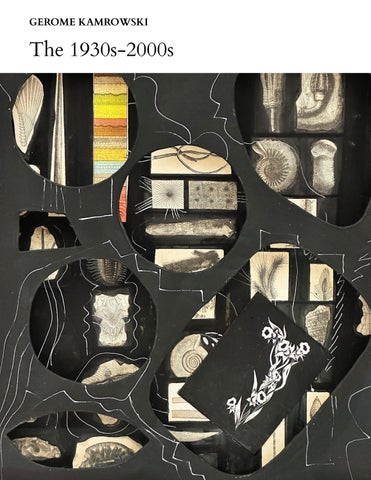
The Michigan Art Gallery at Schmidt’s Antiques Inc. Ypsilanti, Michigan · 2026 Opposite page. Detail of a collage of exhibition catalogs and announcements assembled by Gerome Kamrowski. 1
Surrealism and the Image
1. Love Line, 1938 Mixed media on board · 5½ × 8½ in.
Kamrowski’s early training moved among distinct approaches to modernism. Born in Minnesota in
exhibitions Cubism and Abstract Art and Fantastic
1914, he began at the St. Paul Art School in 1932
helped establish his lasting interest in geometric
under Cameron Booth and Leroy Turner, then
abstraction and Surrealism.1,2,22
studied at the New Bauhaus in Chicago. A Guggenheim fellowship, work with Hans
The multicolor line in Love Line (1938) joins
Art, Dada, Surrealism. These early encounters
Hofmann in Provincetown, and exhibiting with the American Abstract Artists by 1938 extended his
geometric precision to lyrical wandering, as though
education in construction and the picture plane. He
enigmatic course suggests the psychic life that
had encountered Surrealism before joining what
Kamrowski found difficult to reconcile with New
would become the New York School that worked with the European exiles. In his 1975 Gallery 2269
Bauhaus functionalism. He told Bouras, “It’s very
interview with the Chicago artist and critic Harry
emotional life. You know, like, you’re still a blind
Bouras, Kamrowski returned to the discoveries of his
swimmer at night.”1,2,10
youth. He recalled finding copies of the Surrealist journal Minotaure in a Minnesota bookstore and remembered the Museum of Modern Art’s
2
conscious of its own distinctive patterns. Its
hard to be functional about a psychic life or
Gerome Kamrowski
2. Turtle Movement, 1938 Gouache on board · 5½ × 8½ in.
3. Fishes, 1938 Gouache on board · 5½ × 6¾ in.
4. Figure in Darkness, 1938 Crayon on board · 10½ × 6½ in.
At the New Bauhaus, Kamrowski also encountered the biologist D’Arcy Wentworth Thompson’s book On Growth and Form (1917), which explained how forces within and around an organism shape its form.21,26 In the wonderfully animated Turtle Movement (1938), a dotted line connects the turtle to its teeming environment while dividing the field into geometric shapes. In Fishes (1938), eyes and dorsal curves identify creatures suspended within an interlocking pattern. The two paintings suggest organic
tessellations, each body’s contours shaped by the forms around it. Kamrowski later linked Thompson and the biologist Marston Bates to the interest in biological processes he shared with William Baziotes and Jimmy Ernst. The three painters used automatism to discover forms without a predetermined image.3,23 The narrow upright body in Figure in Darkness, also made that year, emerges from the same crayon strokes that form its surroundings. An incised face doubles as the taller figure’s torso, with neither image clearly dominant.
3
Gerome Kamrowski
5. Woodscape, 1940 Gouache on board · 9¼ × 14¼ in.
Woodscape (1940) places us within an engorged and invigorated forest. Bands of red, blue, and yellow swell around trunks and blossoms. The treetops unfurl in widening spirals, recalling Thompson’s account of growth in shells, where each earlier turn remains within the expanding form.26 Arbitrary color gives the landscape its Surrealist character, while open brushwork and roughened texture anticipate Abstract Expressionism. In June 1941, the Pinacotheca gallery gave Kamrowski an extensive early showing in New York, presenting sixteen works, including Woodscape, in First One Man Shows.6 These experiments with color and texture developed alongside his mural work in New York. In February 1940, Hofmann asked the
4
Federal Art Project to reconsider Kamrowski’s rejection for transfer to its mural project, calling him “one of the most promising artists in this country today.”37 His employment in the Works Progress Administration’s mural division, including work with Arshile Gorky on the World’s Fair murals, provided a livelihood and encouraged experiments with unfamiliar materials.1,3 He explored these possibilities with other New York painters. Francis Lee’s Tenth Street loft brought him together with William Baziotes, Roberto Matta, Peter Busa, Jackson Pollock, and Robert Motherwell. Kamrowski painted collaboratively with Baziotes, whom he remembered as “probably the catalyst of the whole group,” and made collage paintings with Busa.2,27
Gerome Kamrowski
7. Wanderlust, 1940 Ink and gouache on paper 23¾ × 16¼ in. (image)
6. Bird Man, 1940 Ink and gouache on paper · 24 × 18¼ in. (image)
In the winter of 1940–41, Baziotes brought quick-drying display lacquer to Kamrowski’s studio, where Kamrowski, Baziotes, and Jackson Pollock made paintings together on canvases laid on the floor. The lacquer fixed the paint almost as soon as it fell, preserving the gestures on the surface.21,22 The bodily imagery of Bird Man (1940) belongs to this period of shared experiment. A continuous line
of white gouache moves over black ink, drawing the crested head and long beaks into a hungry, searching motion. The exposed paper supplies a third tone. Swelling hollows and taut, ribbed curves give the landscape a sensual anatomy. Bouras described the early paintings as “nocturnal interiors that are interiors of the body as well as of the landscape.”2 The Flint Institute of Arts exhibited the drawing in its 2002 survey of Kamrowski’s works on paper.6
5
Gerome Kamrowski
8. Pink Figure, 1940 Ink and gouache on paper · 16 × 10½ in.
The winding enclosures of Wanderlust draw the eye deeper into these imagined bodily interiors. The vigor of Bird Man’s hungry reach becomes explicitly erotic in Pink Figure (1940), whose opened torso and raised hand invite contact. The reaching form in Untitled Ink Drawing #10 (1943) conveys a similar urgency. Kamrowski recalled the erotic charge that Surrealism brought into an American abstract culture still dominated by non-objective and constructivist painting. In his own imagery, tenderness mingles with aggression, sensory yearning sharpened by what he called “spikes for the sadistic parts.”2,3 Arms (1980) returns to this desire for contact four decades later. Broad, jointed bands of color reach inward from opposite sides, intertwining in an embrace.
6
9. Untitled Ink Drawing #10, 1943 Ink on paper · 11½ × 8½ in.
10. Arms, 1980 Acrylic on paper · 26 × 40 in.
Gerome Kamrowski
11. Automorphic Ostracized Eulogists, 1940 Casein and collage on wood panel 25 × 22 in. overall, in original artist frame
Collage gave these bodily associations the weight and texture of actual materials. Dada and Surrealist artists detached familiar images from their original settings, allowing new relations to emerge.22 Kamrowski’s studio recipes record experiments with egg, oil, and casein. Casein’s dry, matte finish unites the painted layers and attached fragments of Automorphic Ostracized Eulogists (1940), later shown at Hugo Gallery.6,24 These layers build a monument topped with jagged white shards, their outward thrust held in suspension. This arrested movement recalls Breton’s explosante-fixe, the conjunction of motion and repose.4 Smaller figures gather around it like satellites, drawn into the gravitational pull of its dense layering. The larger figure at the right remains
Hugo Gallery, New York, 1950. Installation view and exhibition brochure.
stoic and isolated. The world takes shape at different scales and from distinct beginnings. Kamrowski later described morphogenetics as “form beginnings” through automatic work, “almost like creating the world.”3 The title introduces another kind of ambiguity. Kamrowski said titles could “function on different layers,” sometimes combining words by chance.25 Such shifts in meaning serve his ambition “to break through and hit another element of reality.”2 Made in 1940, the collage supports Busa’s description of Kamrowski as “one of the first to practice automatic painting in this country.”5
7
Gerome Kamrowski
Gerome Kamrowski in his New York studio, circa 1940. 12. The Devil in Crystal, circa 1940s Ink and gouache on board · 8½ × 9¾ in.
In The Devil in Crystal (circa 1940s), translucent lobes stretch into fine projections. Rounded chambers gather within the longer contours of Untitled (3035) (1941). Their fluid anatomy recalls cytoplasmic streaming, the internal flow that extends and reshapes an amoeba’s body. Photographs of microorganisms, plant X-rays, and diffusion patterns were among the scientific images Kamrowski absorbed into his art.22 As lines stretch and washes pool, the drawing acquires the mobility of its imagined subject. The gesture both suggests an organism and records the act of making it, joining Surrealist imagery to the developing language of Abstract Expressionism.22 “Life imposes order,” his CHANCE sheet declares, calling the laws of chance “lively, vigorous, and human.”19
13. Untitled (3035), 1941 Ink on paper · 24 × 18 in. (image) 8
Gerome Kamrowski
14. Fossils, 1943 Shadowbox collage Paint, ink and printed paper assemblage · 16¼ × 15 in.
The shadowboxes give this invented natural history a physical setting. Kamrowski recalled making most of them during one summer in Woodstock, New York. Visits with Baziotes to the American Museum of Natural History gave him a model in its dioramas, whose “conviction” and “authority” he wanted for his own constructions.9 His shadowboxes appeared in the 1943 Exhibition of Collage at Peggy Guggenheim’s Art of This Century, while his drawings appeared in VVV, the wartime New York journal that sustained Surrealist art and writing.2,7,22,23
The cutaway face casts shadows into the interior of Fossils (1943), while painted details of the specimens appear on the face. The applied floral decoration rests over printed images of fossils. Nature serves as scientific evidence and decorative motif at once, a pairing that recalls the Surrealist artist Max Ernst’s description of collage as “the chance encounter of two distant realities on a plane that does not suit them.”34
9
Matter and Motion
15. Tribo, 1951 Oil on panel · 10 × 14 in.
16. Flood, 1955 Acrylic on canvas · 19 × 25 in. 10
In 1946, Kamrowski left New York to teach at the University of Michigan. Widowed and raising a young son, he settled in Ann Arbor, nearer his family in Minnesota.3,22 His work remained visible in New York through solo exhibitions at Mortimer Brandt (1946), Betty Parsons (1948), and Hugo Gallery (1950), and seven Whitney Annuals between 1946 and 1953.6,32 He also participated in 1947’s Bloodflames at Hugo Gallery and the International Exposition of Surrealism at Galerie Maeght in Paris.6,7 Introducing his 1950 exhibition at Galerie R. Creuze, Breton praised the sustained character of Kamrowski’s research and described his images as structures formed through bodily rhythms and the absorption and release of energy.7,21,23
Gerome Kamrowski
The exchange of energy Breton described finds a counterpart in Kamrowski’s conception of painting as “a kind of cosmic rhythm, rather than just a naturalistic object-figure-ground relationship.”3 His procedure notes give this idea a practical basis, calling for light and dark to be balanced across model and background. Shadows are supplied by a dark ground through thin paint, while lights are built up over it. “This will have a reality and a truth,” he writes.35 In Tribo (1951, p. 10), blue accents and pale flecks interrupt dense rose and orange, giving the surface a restless rhythm. In Flood (1955, p. 10), loose brushwork looks deliberately out of focus beside the exaggerated sharpness of impressed patterns. Broad pale arcs sweep around the jagged, almost skeletal interior of Tribute to Motown. The contrast gives the dense image a sense of vitality.
17. Tribute to Motown, 1956 Acrylic on board · 25½ × 19¾ in.
At the University of Michigan, Kamrowski taught the discipline of drawing he had learned from Hofmann and encouraged students to pursue their own experiments.1 His teaching files brought practical formulas and diagrams together with readings in psychology, natural science, architecture, and poetry. He described his role as that of a “cultural-dispersal agent,” making ideas and methods available without prescribing the appearance of a student’s work.3,10,17,18 His interest in living processes was also taking architectural form. Hylozoism gave philosophical expression to the sense of life within matter that animated his experiments.3,28
Gerome Kamrowski at his home in Ann Arbor, Michigan, 1950s. 11
Gerome Kamrowski
A typed excerpt from the Encyclopaedia Britannica in his papers describes material substances as “being in some sense alive and taking some active part in the development of being.”28 His class at Detroit’s Jewish Community Center brought artists with different ways of working together in the Hylozoist Group,12 while University of Michigan support enabled his experiments to expand to an architectural scale. “With the Rackham Grants, I played around with a lot of things that the New York painters couldn’t—for instance, the painted domes,” he recalled.3 Invitation to A Series of Paintings United in the Form of a Suspended Dome, Alexander Iolas Gallery, April 27, 1959. See note 11.
At Alexander Iolas Gallery in 1959, thirteen paintings were united in one of these suspended domes. An accompanying diagram names the facets for biological tissues, while individual titles refer to stars, Venus, gravity, nebulae, and cosmic change.11 The viewer could stand beneath these associations between living matter and the cosmos. Kamrowski wanted “something big like the ceilings of European cathedrals. In those you look up to heaven and you’re not seeing a void, you’re seeing something beautiful.”20
18. Untitled Triangle, 1960 Acrylic on canvas · 48 × 56 × 56 in. (sides) 12
Gerome Kamrowski
Gerome Kamrowski painting the Gallery Mayer installation, 1961, with Untitled Triangle at left. See note 14. Gerome Kamrowski beneath the dome panels, and cover of Paintings on the Surfaces of Domes and Space Grids (1961). See note 14.
Installation view, Paintings on the Surfaces of Domes and Space Grids (1961), showing Blue Triangle #5 at left. 19. Blue Triangle #5, 1960 Acrylic on canvas · 58 × 58 × 58 in. (sides)
Rackham support also enabled Paintings on the Surfaces of Domes and Space Grids, shown at New Gallery Mayer in New York and the University of Michigan Museum of Art in 1961. The accompanying installation view records the assembled triangular panels.14 Each triangle holds its own as a painting while becoming one facet of an overhead construction. Roughened paint, ribbed surfaces, and perforations give material variety to the geometric framework.14
The architect R. Buckminster Fuller compared geodesic structures to musical instruments, adaptable to the life they contain. He described Kamrowski’s use of the structure as “an instrument of his harmonic communication.”14 The triangles are among Kamrowski’s most explicitly cosmic works. Assembled overhead, their converging edges direct the eye ever upward, sustaining the searching gaze he associated with cathedral ceilings.20 13
Gerome Kamrowski
20. Untitled (3092Q), 1960 Enamel on paper · 18¾ × 24 in.
21. Untitled (3092V), 1960 Enamel on paper · 20 × 28 in.
22. Disembodied Motion, 1962 Acrylic on paper · 22½ × 34 in.
The exchange between gesture and material in the dome panels is equally active on paper. Enamel’s resistance holds the gestures of Untitled (3092Q) (1960) in ridges like sediment or a raked sand garden. Broad black strokes collide and overlap in Untitled (3092V). Curved bands meet angular blocks that check and redirect their momentum in Disembodied Motion (1962). 14
These clashes of direction detach movement from an identifiable body. His copy of Hofmann’s “Plastic Creation” states, “Movement and counter movement produce tension and tension produces rhythm.”29 The paint’s thickness and texture give these movements physical weight.3
Gerome Kamrowski
23. Blue Black, 1962 Acrylic on paper · 23 × 35 in.
Medium Notes, dated March 13, 1962. See note 13.
24. Green with Yellow, 1960 Acrylic and polyester on canvas · 19 × 14 in.
25. Orange Interaction, 1968 Acrylic and polyester on burlap · 30 × 22 in.
Kamrowski developed these material effects through his own paint mixtures. His Medium Notes describe acrylic resin binding pigment with sand, marble dust, crushed stone, and other aggregate.13 He explained his Hylozoist paintings as “using materials, physical materials, and letting them suggest a new world to you.”3 The built-up surface of Green with Yellow (1960) gives its terrain physical relief.
The fine lines of Orange Interaction (1968) gather into an irregular network across the woven burlap. In Blue Black (1962), dark overpaint leaves passages of lilac and yellow visible beneath, allowing the underpainting to act as light within the darker structure. This animation of the painted surface gives substance to his belief that art reflects “the subtle processes that underlie the natural world.”16 15
Gerome Kamrowski
26. Tree in Green, Ann Arbor, 1974 Acrylic on fabric · 24 × 36 in.
Kamrowski in his Ann Arbor Wind Menagerie.
27. Midsummer Night, 1973 Acrylic on canvas · 16 × 20 in.
16
These shifting relations between color and space open into landscape in Midsummer Night (1973) and Tree in Green, Ann Arbor (1974). Kamrowski remembered that the first time he saw Ann Arbor he “almost cried” because it looked like a “dream town.”18 Tree in Green, Ann Arbor keeps the tree legible while its arbitrary color flashes across the branches like pyrotechnic bursts of neural activity. In Midsummer Night, broken strokes and repeated pattern compress the intense activity and radiance of a Michigan summer into a darker expanse.
Gerome Kamrowski
28. Untitled, 1973 Lithograph on paper · 22 × 27 in. Chinese zodiac diagram, undated. See note 31.
30. Snake Space, 1977 Acrylic on a printed map · 24 × 36 in.
Wind brings another kind of movement to these landscapes. The turning forms of the untitled lithograph of 1973 open outward in Radial (1975), whose segmented arcs direct the eye around a center and into the surrounding field. The Chinese zodiac diagram in Kamrowski’s papers divides a cycle into successive positions around its yin-yang center.31 This cyclical order recurs in the rotating parts of the Wind Menagerie, his outdoor collection of wind-driven sculptures. Painted segments register a turn in Radial, while the wind works undergo an actual revolution.
29. Radial, 1975 Acrylic on canvas · 34 × 34 in.
Snake Space, detail.
Kamrowski worked on the windmills in fair weather and made paintings inspired by them on rainy days.15 This exchange between landscape and painting takes another form in Snake Space (1977), where arcs and angles spread across a printed map that wraps the canvas. Its geography and the painting’s psychic space meet on one physical surface. The title makes the implication playful. We may be the snakes.
17
Color and Perception
Gerome Kamrowski in his Winter Ann Arbor Studio, circa 1972.
31. Blue Quarter, 1980 Acrylic on paper · 24 × 36 in.
Kamrowski’s notes on painting call for treating value “the same as color,” describing “values that recede and project.”30 Blue Quarter (1980) gives these relations a concentrated force. Tonal shifts fold its blue planes into a dense mass, suspended in something like a vacuum. Openings in the ground do little to release that density. Orange had a particular place in Kamrowski’s life. He painted his tools a similar shade so they would remain visible in the green garden.40 In Burnt Orange Seams (1979), that familiar color acquires a symphonic breadth. The orange carries the sharpness of citrus, a tingle at the back of the jaw. Thin, broken passages of orange allow the underlying color to show through. Where the colors cross, they define the edges of overlapping planes. As in Love Line, precision sustains uncertainty. The title lets seams slip into seems, a small verbal turn within the painting’s sublime confusion, where familiar color and disorienting space remain inseparable. 32. Burnt Orange Seams, 1979 Acrylic on canvas · 30 × 24 in.
18
Gerome Kamrowski
33. Untitled Ink Drawing #3, 1940 Ink on paper · 8½ × 11½ in.
“GROWTH,” undated handwritten note (detail). See note 36.
34. Ink Drawing #18, 1941 Ink on paper · 8½ × 11 in.
36. Untitled (1138I), 1980 Acrylic on paper · 22½ × 34¾ in.
35. Untitled (679D), 1980 Acrylic on paper · 40 × 26 in.
Kamrowski’s GROWTH note joins metabolism to “structure” and “organization,” suggesting that form is sustained through change.36 Hofmann’s account of painting as “a process of metabolism,” in which “color transubstantiates into vital forces,”39 gives this idea a pictorial dimension. Pigment becomes the source of an imagined life. The early ink drawings’
branching lines and ribbed enclosures suggest organisms taking shape. In Untitled (679D) and Untitled (1138I) (both 1980), color assumes this generative role. Red courses through brown and black, while blue and green gather into faceted volumes. Metabolism describes this passage from inert material to felt energy.
19
Gerome Kamrowski
“Golden Cut,” undated sheet. See note 30.
37. Untitled (679B), 1980 Acrylic on paper · 26 × 40 in.
38. Untitled (679G), 1980 Acrylic on paper · 26 × 40 in.
39. Untitled (JT017), 1980s Acrylic on paper · 26 × 40 in.
Kamrowski’s experiments with hard-edge painting give his organic imagery a sharper structure. “The shape of an area of color makes drawing,” his notes explain.30 In Untitled (679B) (1980), crisp divisions turn the orange form into a sequence of winglike sections. Narrow bands carry the red arcs of Untitled (679G) (1980) and the blue-green planes
of Untitled (JT017) (1980s). The Golden Cut sheet relates unequal parts to a whole, an approach to proportion reflected here in the contrasts of width and scale.30 Each division gives the movement structure. Contours extending beyond the colored planes let it continue through the dark ground.
20
Gerome Kamrowski
40. Enclosed, 1961 Acrylic on paper · 22½ × 33 in. Reproduced on the University of Michigan’s 1999 exhibition card.33
41. Untitled (3095D), 1980s Acrylic on canvas paper · 18 × 24 in.
42. Hybrid, 1973 Acrylic impasto on Masonite · 23½ × 47½ in.
Growth also encounters resistance. In Enclosed (1961), pointed forms close around a blue center; Hybrid (1973) compresses a creature into a narrow rectangle. Pressure from the surrounding space shapes both images, recalling Thompson’s description of form as a “diagram of forces.”26
In Untitled (3095D) (1980s), that articulation becomes internal. Repeating arcs divide the body and limbs into intersecting sequences. Structure and animation develop together, giving form to the connection Kamrowski called “a psychological integration” of artistic and biological processes.3
21
Gerome Kamrowski
43. Untitled (1138B), 1984 Acrylic on paper · 20 × 32 in.
44. Screen Patterns, 1981 Lithograph on paper · 18 × 22 in.
Unsigned diagrams after Hans Hofmann’s Plastic Creation, dated March 18, 1959. From Kamrowski’s teaching and reading files. See note 10.
In the screen paintings, pattern gives creatures their structure without separating them from their surroundings. Evan Maurer, director of the University of Michigan Museum of Art, traced Kamrowski’s grids to metal screens, including radiator covers.17 In Screen Patterns (1981) and Untitled (1138B) (1984), their repeated openings allow several layers of color and contour to remain visible at once. This layered depth recalls the diagrams after Hofmann’s Plastic Creation
22
preserved in his teaching and reading files, where intersecting planes generate line and color establishes volume on a flat surface.10 Kamrowski later recalled the tension between Hofmann’s discipline of the picture plane and the experiments in chance and automatism he pursued with Baziotes. “Naturally I was caught between these two personalities,” he wrote in 1978.38 In these screens, measured intervals give shifting imagery a precise structure.
Gerome Kamrowski
45. Black Humoresque, 1981 Acrylic on paper · 20 × 30 in.
46. Untitled (NN041), 1980s Enamel on board · 22 × 30 in.
47. Untitled (281), 1984 Acrylic on paper · 26 × 40 in.
Changes in the mesh’s alignment make the surface of Black Humoresque (1981) seem to turn. The intersecting outlines of Untitled (281) (1984) and colored layers of Untitled (NN041) (1980s) likewise give the screen several spatial roles at once. A recognizable form can emerge from the pattern and
disappear into it as the eye moves across the painting. This shifting recognition invites the intuitive response Kamrowski described as “hitting people at the unconscious level where they don’t have barriers of resistance.”3
23
Gerome Kamrowski
Gerome Kamrowski, undated NOTES typescript, excerpt on simultaneous space. See note 16.
In his NOTES, Kamrowski described how sustained looking could reorganize the whole image. “The longer and closer one studies these singular surfaces the more evident the under design becomes, until it usurps the field of vision entirely.”16
48. Screen Patterns A3, 1980 Acrylic on canvas · 32 × 60 in.
24
In Screen Patterns A3 (1980), dots and mesh cross the white and blue contours, becoming skin within one passage and surrounding space in another. This “dialogue of simultaneous space”16 extends automatism into the act of looking, as a new association changes how previously seen marks are understood.
Gerome Kamrowski
49. Untitled, 1946 (edition 1996, 9/20) Etching on paper · plate 5 × 6 in.
50. Untitled, 1946 (edition 1996, 10/20) Etching on paper · plate 5 × 6 in.
51. Dark Angel, 2003 Mosaic · 12 × 18 in.
What emerges in the act of looking extends a process that began in the studio. In the two untitled etchings, tangled lines gather into creatures. Kamrowski made their plates in 1946, the year he moved to Ann Arbor.3,32 Nearly six decades later, in Dark Angel (2003), colored fragments give another invented body its substance. Made the year before his death, the mosaic carries forward his practice of discovering an image through the materials at hand. His recipes and diagrams supported that exploration,
while decisions about color, proportion, and placement developed what the materials suggested. He wanted that discovery to reach the viewer through feeling: “I hope my art puts people in a certain frame of mind, and that it isn’t just intellectual. I hope they feel a certain way, maybe happy. When you see the Grand Canyon or the ocean, you just feel a certain way. There are no labels for that.”18
25
Gerome Kamrowski
Biography Gerome Kamrowski (1914–2004) was a first-generation New York School artist whose work joined Surrealist imagery with geometric abstraction. Born in Warren, Minnesota, he entered the St. Paul School of Art in 1932 and studied at Chicago’s New Bauhaus in 1937. A fellowship enabled him to study with Hans Hofmann in Provincetown the following year. His early work combined Hofmann’s discipline of the picture plane with an interest in biology and unconscious imagery. After moving to New York, Kamrowski worked on WPA murals, including the World’s Fair project with Arshile Gorky, and joined the circle of William Baziotes, Peter Busa, Roberto Matta, Jackson Pollock, and Robert Motherwell. In the winter of 1940–41, he, Baziotes, and Pollock experimented with quick-drying lacquer on canvases laid on the floor. These experiments contributed to the development of Abstract Expressionism. Peter Busa later described Kamrowski as “one of the first to practice automatic painting in this country.” Kamrowski exhibited in First One Man Shows at The Pinacotheca in 1941 and the 1943 Exhibition of Collage at Peggy Guggenheim’s Art of This Century. His drawings appeared in the Surrealist journal VVV. Betty Parsons organized his 1946 exhibition at Mortimer Brandt Gallery. In 1947, he participated in Bloodflames in New York and the International
26
Exposition of Surrealism in Paris. André Breton introduced his 1950 exhibition at Galerie R. Creuze, praising “the quality and sustained character of his research.” Kamrowski joined the University of Michigan faculty in 1946 and taught until 1982. In Ann Arbor, his studio experiments and teaching drew on psychology, natural science, architecture, and poetry. He encouraged students to develop their own methods, describing himself as a “cultural-dispersal agent.” University support enabled him to extend painting into architectural space through suspended domes and space grids, exhibited in New York in 1959 and 1961. His classes at Detroit’s Jewish Community Center brought artists together in the Hylozoist Group. His own interest in hylozoism—the idea that matter participates in life—found practical expression in experiments with paint mixtures, textured surfaces, and constructed forms. In later decades, he developed the Wind Menagerie, an outdoor collection of wind-driven sculptures, alongside paintings built from sharply defined color and layered screen patterns. He continued experimenting with constructed surfaces and mosaic through his final years. The University of Michigan Museum of Art presented a retrospective in 1983 and The Worlds of Gerome Kamrowski: Surrealism and Beyond in 2003. He died in Ann Arbor in 2004.
Gerome Kamrowski
Selected exhibitions Solo and focused exhibitions 1941
First One Man Shows, The Pinacotheca, New York, NY
1986
G.R. N'Namdi Gallery, Detroit, MI
1987
Washburn Gallery, New York, NY
1988
Robert Kidd Gallery, Birmingham, MI
1989
Holland Area Arts Council, Holland, MI
1990
Detroit Focus Gallery, Detroit, MI
1990
Alice Simsar Gallery, Ann Arbor, MI
1991
Alice Simsar Gallery, Ann Arbor, MI
1993
Mott Community College, Flint, MI
1995
Washtenaw Community College, Ann Arbor, MI
1997
Jean Paul Slusser Gallery, University of Michigan, Ann Arbor, MI
1946
Mortimer Brandt Gallery, New York, NY
1948
Betty Parsons Gallery, New York, NY
1950
Galerie R. Creuze, Paris, France
1950
Hugo Gallery, New York, NY
1954
Saginaw Art Museum, Saginaw, MI
1956
Battle Creek Civic Art Center, Battle Creek, MI
1957
Galerie R. Creuze, Paris, France
1959
Alexander Iolas Gallery, New York, NY
1961
Gallery Mayer, New York, NY
1961
University of Michigan Museum of Art, Ann Arbor, MI
1999
East Quad Art Gallery, University of Michigan, Ann Arbor, MI
1966
The Scarab Club, Detroit, MI
1999
River Gallery, Chelsea, MI
1968
Flint Institute of Arts, Flint, MI
2002
1976
Gallery 2269, Chicago, IL
Leepa-Rattner Museum of Art, Tarpon Springs, FL
1978
Monique Knowlton Gallery, New York, NY
2003
University of Michigan Museum of Art, Ann Arbor, MI
1980
Dreyfuss Gallery, Ann Arbor, MI
2005
Weinstein Gallery, San Francisco, CA
1983
University of Michigan Museum of Art, Ann Arbor, MI
2006
Weinstein Gallery, San Francisco, CA
1985
C. Corcoran Gallery, Muskegon, MI
2019
The Michigan Art Gallery, Ypsilanti, MI
2024
Lincoln Glenn Gallery, New York, NY
Selected chronology based on Gerome Kamrowski Estate records.
27
Gerome Kamrowski
Source notes 1.
Dennis Barrie, oral history interview with Gerome Kamrowski, January 22, 1976, Archives of American Art, Smithsonian Institution, transcript, 3–6, 11; American Abstract Artists, exhibition handlist, March 1938.
9.
2.
Harry Bouras, interview with Gerome Kamrowski and Paul Wagoner, Gallery 2269, Chicago, 1975, parts 1–2, transcripts, Gerome Kamrowski Estate. Part 1, 0:02–2:42, 3:07–4:26, 5:28–6:41, 9:01–9:57, 11:11–13:49, 16:02–18:27, 24:22–24:46; part 2, 23:50–24:26.
3.
Evan M. Maurer and Jennifer L. Bayles, interview with Gerome Kamrowski, in Gerome Kamrowski: A Retrospective Exhibition (Ann Arbor: University of Michigan Museum of Art, 1983), 1–4; Maurer, introduction, v–vi; chronology, 5–8.
10. “An explanation of Hans Hofmanns Plastic Creation in Diagrams,” unsigned sheets dated March 18, 1959, 4–5; annotated excerpts from Albert Gleizes and Jean Metzinger, Du Cubisme (1912), chaps. IV–V, especially IV, 2. Kamrowski’s teaching and reading files, Gerome Kamrowski Estate.
4.
André Breton, “Manifesto of Surrealism” (1924), in Manifestoes of Surrealism, trans. Richard Seaver and Helen R. Lane (Ann Arbor: University of Michigan Press, 1969), 4–5, 12; Mad Love, trans. Mary Ann Caws (Lincoln: University of Nebraska Press, 1987), chap. 1.
5.
6.
7.
8.
28
Sidney Simon, “Concerning the Beginnings of the New York School, 1939–1943: An Interview with Peter Busa and Matta,” December 1966, Art International 11, no. 6 (Summer 1967): 17–20; reprinted in Ellen G. Landau, ed., Reading Abstract Expressionism: Context and Critique (New Haven: Yale University Press, 2005), 263–75. The Pinacotheca, First One Man Shows: Gerome Kamrowski and Basil Cimino, June 1941, handlist, Kamrowski no. 2; Hugo Gallery, exhibition announcement, May 8–27, 1950; A Retrospective Exhibition (1983), cat. 6, 26. Gerome Kamrowski Estate, exhibition records and verso label for Automorphic Ostracized Eulogists; exhibition information for Bird Man. André Breton, introduction to Peintures de Kamrowski (Paris: Galerie R. Creuze, 1950), English translation, Gerome Kamrowski Estate; A Retrospective Exhibition (1983), chronology, 5–8. Gerome Kamrowski, Whitney Museum of American Art artist questionnaire, January 17, 1979, and accompanying form for Emotional Seasons, Gerome Kamrowski Estate.
John Yau, “From an Interview: Gerome Kamrowski and John Yau,” in Gerome Kamrowski: A Memorial (New York: Washburn Gallery, October 28–December 23, 2004), unpaginated.
11. Alexander Iolas Gallery, press release, April 20, 1959, and diagram for A Series of Paintings United in the Form of a Suspended Dome, opening April 27, 1959, Solomon R. Guggenheim Museum Archives, A0008, box 643807, folder 13; exhibition invitation, Gerome Kamrowski Estate. 12. “Gerome Kamrowski and the Detroit Jewish Community Center”; Gerome Kamrowski and the Hylozoist Group, Ohio University Gallery announcement, October 27–November 15. Gerome Kamrowski Estate. 13. Gerome Kamrowski, Medium Notes, dated March 13, 1962, Gerome Kamrowski Estate. 14. Paintings on the Surfaces of Domes and Space Grids (Ann Arbor: Avatar Press for New Gallery Mayer, 1961), unpaginated; Gallery Mayer invitation, January 24–February 11, 1961; R. Buckminster Fuller to Gerome Kamrowski, September 24, 1960. Gerome Kamrowski Estate. 15. Maurer and Bayles, interview, 4; Franklin Rosemont, “Earth Storm,” in Gerome Kamrowski: Then & Now (Chicago: Gallery 2269, May 1976), unpaginated; “Artist’s Outdoor Sculptures Being Exhibited,” Ann Arbor News, May 18, 1976. 16. Gerome Kamrowski, NOTES — Kamrowski, undated typescript, Gerome Kamrowski Estate. 17. Evan M. Maurer, “Gerome Kamrowski,” in Moderns in Mind: Gerome Kamrowski, Lee Mullican, Gordon Onslow-Ford (New York: Artists Space, 1986), 7–13; Susan Wyatt, “Acknowledgments,” 3–4; Dan Cameron, “Surrealism Now & Then: The Dissipation of Origin,” 32–35. Maurer, foreword to Gerome Kamrowski, Volume 2: 1958 to 2002, Abstract Expressionism and Beyond (San Francisco: Weinstein Gallery, 2006).
Gerome Kamrowski
Source notes 18. Gerome Kamrowski, as told to Anne Martino, “The Master—Still at Work,” in Nicholas Delbanco, ed., Ann Arbor (W)rites: A Community Memoir (Ann Arbor: Ann Arbor District Library, 2004), 69–70.
28. Gerome Kamrowski, “HYLOZOISM,” undated typescript, lecture and working papers, sheet 7, Gerome Kamrowski Estate; “Hylozoism,” Encyclopaedia Britannica, 11th ed. (1911).
19. Gerome Kamrowski, “CHANCE,” undated handwritten sheet, Gerome Kamrowski Estate.
29. Hans Hofmann, “Plastic Creation,” trans. Ludwig Sander, The League Magazine, Art Students League, New York (Winter 1932–33), typescript copy, 6. Gerome Kamrowski Estate.
20. Gerome Kamrowski, statement in Gerome Kamrowski, Volume 2: 1958 to 2002, Abstract Expressionism and Beyond (San Francisco: Weinstein Gallery, 2006), 20. 21. Martica Sawin, “‘The Third Man,’ or Automatism American Style,” Art Journal 47, no. 3 (Fall 1988): 181–86. 22. Martica Sawin, foreword to Gerome Kamrowski, Volume 1: 1940 to 1965, Abstract Surrealism into Abstract Expressionism (San Francisco: Weinstein Gallery, 2005); Museum of Modern Art, “Large Retrospective Exhibition of Collages by Modern Europeans and Americans,” press release, September 1948, 2; Metropolitan Museum of Art, VVV, collection record 100.51 V98. 23. Martica Sawin, “Gerome Kamrowski: ‘The Most Surrealist of Us All,’” Arts Magazine (December 1987): 74–77. 24. Museum of Fine Arts, Boston, “Casein paint,” Conservation and Art Materials Encyclopedia Online (CAMEO); Gerome Kamrowski, undated handwritten recipes for egg, oil, and casein mixtures, Gerome Kamrowski Estate. 25. Gerome Kamrowski, statement on titles, in A Retrospective Exhibition (1983), 20. 26. D’Arcy Wentworth Thompson, On Growth and Form (Cambridge: Cambridge University Press, 1917), chap. 1; 54–55, 496–516, 612–14, 637–43; chap. 17, figs. 373–377. On Kamrowski’s encounter with the book at the New Bauhaus, see Sawin, “‘The Third Man,’” 183. 27. Gerome Kamrowski, undated handwritten outline beginning “Francis Lee’s loft,” lecture and working papers, sheet 20, Gerome Kamrowski Estate.
30. Gerome Kamrowski, undated studio and teaching sheets, Page 9, Page 12 Value, and Page 11 Golden Cut, Gerome Kamrowski Estate. 31. Chinese zodiac diagram, undated, Gerome Kamrowski Estate. 32. Whitney Museum of American Art, collection records for Etched plate for Untitled (1946), accession nos. 97.30.1 and 97.30.2, whitney.org/collection/works/11268 and /11269; artist exhibition record, whitney.org/artists/669. 33. University of Michigan, Residential College, East Quad Art Gallery, invitation to Gerome Kamrowski: A Visual Journey, 1940s, 1960s, 1980s, 2000, September 17–October 11, 1999, Gerome Kamrowski Estate. 34. Max Ernst (1936), quoted in the Menil Collection, Untitled (ca. 1920), menil.org/collection/objects/3483-untitled. 35. Gerome Kamrowski, “PROCEDURE,” undated typescript, Gerome Kamrowski Estate. 36. Gerome Kamrowski, “GROWTH,” undated handwritten note, Page 1 Notes, Gerome Kamrowski Estate. 37. Hans Hofmann to Audrey McMahon, February 29, 1940, Gerome Kamrowski Estate. 38. Gerome Kamrowski, reminiscence of Hans Hofmann, typescript signed September 25, 1978, on letterhead dated October 3, 1978, 3, 6; handwritten manuscript, September 25, 1978, 7–8, 17. Gerome Kamrowski Estate. 39. Hans Hofmann, “The Color Problem in Pure Painting, Its Creative Origin,” Arts & Architecture 73, no. 2 (February 1956), 14. 40. Kamrowski’s orange-painted tools, examined by the author.
29
Gerome Kamrowski
List of Works Dimensions are in inches, height × width unless otherwise indicated; framed sizes follow. Artwork information follows records supplied by the Gerome Kamrowski Estate and The Michigan Art Gallery.
1. Love Line, 1938 Mixed media on board · 5½ × 8½ in. Framed 11¾ × 14¾ in. · p. 2
10. Arms, 1980 Acrylic on paper · 26 × 40 in. Framed 34¼ × 48¼ in. · p. 6
2. Turtle Movement, 1938 Gouache on board · 5½ × 8½ in. Framed 11¾ × 14¾ in. · p. 3
11. Automorphic Ostracized Eulogists, 1940 Casein and collage on wood panel 17½ × 15 in. (image) Original artist-made frame · 25 × 22 in. · p. 7
3. Fishes, 1938 Gouache on board · 5½ × 6¾ in. Framed 11¾ × 13 in. · p. 3
12. The Devil in Crystal, circa 1940s Ink and gouache on board · 8½ × 9¾ in. Framed 18 × 22 in. · p. 8
4. Figure in Darkness, 1938 Crayon on board · 10½ × 6½ in. Framed 17 × 13 in. · p. 3
13. Untitled (3035), 1941 Ink on paper · 24 × 18 in. (image) Framed 35¼ × 29½ in. · p. 8
5. Woodscape, 1940 Gouache on board · 9¼ × 14¼ in. Framed 14 × 19 in. · p. 4
14. Fossils, 1943 Shadowbox collage Paint, ink and printed paper assemblage Image 16¼ × 15 in. Framed 17¼ × 16 in. · p. 9
6. Bird Man, 1940 Ink and gouache on paper · 24 × 18¼ in. (image) Framed 35½ × 29½ in. · p. 5 7. Wanderlust, 1940 Ink and gouache on paper · 23¾ × 16¼ in. (image) Framed 35 × 27½ in. · p. 5 8. Pink Figure, 1940 Ink and gouache on paper · 16 × 10½ in. Framed 23¾ × 18¾ in. · p. 6 9. Untitled Ink Drawing #10, 1943 Ink on paper · 11½ × 8½ in. Framed 22 × 18 in. · p. 6
30
15. Tribo, 1951 Oil on panel · 10 × 14 in. Framed 12¾ × 16¾ in. · p. 10 16. Flood, 1955 Acrylic on canvas · 19 × 25 in. Framed 24 × 30 in. · p. 10 17. Tribute to Motown, 1956 Acrylic on board · 25½ × 19¾ in. Framed 32½ × 27½ in. · p. 11
Gerome Kamrowski
List of Works Dimensions are in inches, height × width unless otherwise indicated; framed sizes follow.
18. Untitled Triangle, 1960 Acrylic on canvas · 48 × 56 × 56 in. (sides) Unframed · p. 12
27. Midsummer Night, 1973 Acrylic on canvas · 16 × 20 in. Framed 21½ × 25½ in. · p. 16
19. Blue Triangle #5, 1960 Acrylic on canvas · 58 × 58 × 58 in. (sides) Unframed · p. 13
28. Untitled, 1973 Lithograph on paper · 22 × 27 in. Framed 30¼ × 35 in. · p. 17
20. Untitled (3092Q), 1960 Enamel on paper · 18¾ × 24 in. Framed 26¾ × 32 in. · p. 14
29. Radial, 1975 Acrylic on canvas · 34 × 34 in. Framed 34½ × 34½ in. · p. 17
21. Untitled (3092V), 1960 Enamel on paper · 20 × 28 in. Framed 29 × 35 in. · p. 14
30. Snake Space, 1977 Acrylic on a printed map · 24 × 36 in. Framed 28½ × 40½ in. · p. 17
22. Disembodied Motion, 1962 Acrylic on paper · 22½ × 34 in. Framed 29½ × 40½ in. · p. 14
31. Blue Quarter, 1980 Acrylic on paper · 24 × 36 in. Framed 30 × 42 in. · p. 18
23. Blue Black, 1962 Acrylic on paper · 23 × 35 in. Framed 31¼ × 42¼ in. · p. 15
32. Burnt Orange Seams, 1979 Acrylic on canvas · 30 × 24 in. Framed 34½ × 28½ in. · p. 18
24. Green with Yellow, 1960 Acrylic and polyester on canvas · 19 × 14 in. Framed 24¼ × 18¾ in. · p. 15
33. Untitled Ink Drawing #3, 1940 Ink on paper · 8½ × 11½ in. Framed 15¾ × 18¾ in. · p. 19
25. Orange Interaction, 1968 Acrylic and polyester on burlap · 30 × 22 in. Framed 37 × 29 in. · p. 15
34. Ink Drawing #18, 1941 Ink on paper · 8½ × 11 in. Framed 15¾ × 18½ in. · p. 19
26. Tree in Green, Ann Arbor, 1974 Acrylic on fabric · 24 × 36 in. Framed 25 × 37 in. · p. 16
31
Gerome Kamrowski
List of Works Dimensions are in inches, height × width unless otherwise indicated; framed sizes follow.
35. Untitled (679D), 1980 Acrylic on paper · 40 × 26 in. Framed 48¼ × 34 in. · p. 19
44. Screen Patterns, 1981 Lithograph on paper · 18 × 22 in. Framed 22½ × 27 in. · p. 22
36. Untitled (1138I), 1980 Acrylic on paper · 22½ × 34¾ in. Framed 29½ × 42 in. · p. 19
45. Black Humoresque, 1981 Acrylic on paper · 20 × 30 in. Framed 29 × 39 in. · p. 23
37. Untitled (679B), 1980 Acrylic on paper · 26 × 40 in. Framed 34¼ × 48¼ in. · p. 20
46. Untitled (NN041), 1980s Enamel on board · 22 × 30 in. Framed 30 × 38 in. · p. 23
38. Untitled (679G), 1980 Acrylic on paper · 26 × 40 in. Framed 34¼ × 48¼ in. · p. 20
47. Untitled (281), 1984 Acrylic on paper · 26 × 40 in. Framed 34¼ × 48¼ in. · p. 23
39. Untitled (JT017), 1980s Acrylic on paper · 26 × 40 in. Framed 34¼ × 48¼ in. · p. 20
48. Screen Patterns A3, 1980 Acrylic on canvas · 32 × 60 in. Unframed · p. 24
40. Enclosed, 1961 Acrylic on paper · 22½ × 33 in. Framed 28¾ × 40½ in. · p. 21
49. Untitled, 1946 (edition 1996, 9/20) Etching on paper · plate 5 × 6 in. Framed 13 × 14 in. · p. 25
41. Untitled (3095D), 1980s Acrylic on canvas paper · 18 × 24 in. Framed 26 × 32 in. · p. 21
50. Untitled, 1946 (edition 1996, 10/20) Etching on paper · plate 5 × 6 in. Framed 13 × 14 in. · p. 25
42. Hybrid, 1973 Acrylic impasto on Masonite · 23½ × 47½ in. Framed 31 × 55 in. · p. 21
51. Dark Angel, 2003 Mosaic · 12 × 18 in. Framed 15¼ × 19¼ in. · p. 25
43. Untitled (1138B), 1984 Acrylic on paper · 20 × 32 in. Framed 28¼ × 40¼ in. · p. 22
32
Gerome Kamrowski
Catalog
Essay by Elizabeth O’Connell, Art Gallery Director The Michigan Art Gallery at Schmidt’s Antiques Inc. Ypsilanti, Michigan · 2026 With thanks to the Gerome Kamrowski Estate and Sean Tucker for their support of this exhibition. Artworks supplied through the Gerome Kamrowski Estate and The Michigan Art Gallery. Archival photographs and documents courtesy of the Gerome Kamrowski Estate.
Documentary illustrations P. 1. Gerome Kamrowski, 1942. Photograph reproduced in A Retrospective Exhibition (1983). P. 7. Installation view and exhibition brochure, Hugo Gallery, New York, 1950. P. 8. Gerome Kamrowski in his New York studio, circa 1940. P. 11. Gerome Kamrowski at his home in Ann Arbor, Michigan, 1950s. P. 12. Alexander Iolas Gallery invitation, April 27, 1959, for A Series of Paintings United in the Form of a Suspended Dome. See note 11. P. 13. Gerome Kamrowski beneath the dome panels; cover and installation view from Paintings on the Surfaces of Domes and Space Grids (1961). Kamrowski painting the Gallery Mayer installation, 1961, with Untitled Triangle at left. See note 14.
P. 16. Wind Menagerie. P. 17. Chinese zodiac diagram, undated. See note 31. Detail of Snake Space. P. 18. Gerome Kamrowski in his Winter Ann Arbor Studio, circa 1972. P. 19. Gerome Kamrowski, “GROWTH,” undated handwritten note (detail), Page 1 Notes. See note 36. P. 20. Gerome Kamrowski, “Golden Cut,” undated, Page 11 Golden Cut. See note 30. P. 22. Unsigned diagrams after Hans Hofmann’s Plastic Creation, March 18, 1959. From Kamrowski’s teaching and reading files. See note 10. P. 24. Gerome Kamrowski, NOTES — Kamrowski, undated typescript (excerpt). See note 16.
P. 15. Gerome Kamrowski, Medium Notes, March 13, 1962. See note 13. Inside front cover. Detail of a collage of exhibition catalogs and announcements assembled by Gerome Kamrowski.
33
The Michigan Art Gallery at Schmidt’s Antiques 5138 West Michigan Avenue Ypsilanti, Michigan, 48197 www.michiganartgallery.com