Vol. 6, Issue 1
Winter/Spring 2019
‘Round the Reserve
Friends of Schmeeckle Schmeeckle Reserve
Reserve
2419 North Point Drive, Stevens Point, Wisconsin 54481
www.uwsp.edu/schmeeckle
friendsofschmeeckle@gmail.com
715-346-4992
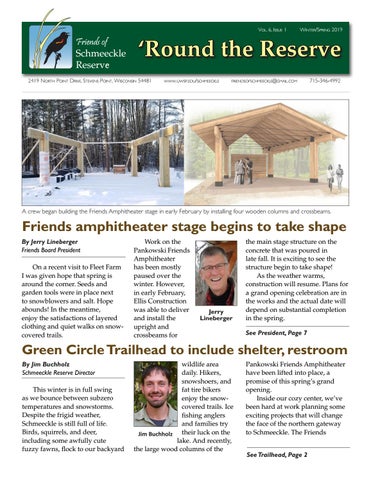
A crew began building the Friends Amphitheater stage in early February by installing four wooden columns and crossbeams.
Friends amphitheater stage begins to take shape By Jerry Lineberger Friends Board President On a recent visit to Fleet Farm I was given hope that spring is around the corner. Seeds and garden tools were in place next to snowblowers and salt. Hope abounds! In the meantime, enjoy the satisfactions of layered clothing and quiet walks on snowcovered trails.
Work on the Pankowski Friends Amphitheater has been mostly paused over the winter. However, in early February, Ellis Construction was able to deliver and install the upright and crossbeams for
Jerry Lineberger
the main stage structure on the concrete that was poured in late fall. It is exciting to see the structure begin to take shape! As the weather warms, construction will resume. Plans for a grand opening celebration are in the works and the actual date will depend on substantial completion in the spring. See President, Page 7
Green Circle Trailhead to include shelter, restroom By Jim Buchholz Schmeeckle Reserve Director This winter is in full swing as we bounce between subzero temperatures and snowstorms. Despite the frigid weather, Schmeeckle is still full of life. Birds, squirrels, and deer, including some awfully cute fuzzy fawns, flock to our backyard
wildlife area daily. Hikers, snowshoers, and fat tire bikers enjoy the snowcovered trails. Ice fishing anglers and families try Jim Buchholz their luck on the lake. And recently, the large wood columns of the
Pankowski Friends Amphitheater have been lifted into place, a promise of this spring’s grand opening. Inside our cozy center, we’ve been hard at work planning some exciting projects that will change the face of the northern gateway to Schmeeckle. The Friends See Trailhead, Page 2
Rendering by Alliiance Friends of Schmeeckle Board of Directors president
Jerry Lineberger UWSP, Retired Treasurer Rick Rothman UWSP, Retired Secretary Barbara Dixson UWSP, Retired Student Representative Leah Egan, DeForest Nisha Fernando UWSP Kim Fisher Walczak Center for Dentistry and Orthodontics, Retired
The Green Circle Trailhead, slated for construction this year, will include a 50-person shelter named in honor of Roy Menzel, a founder of the Green Circle Trail, and his wife, Margaret.
Michael Gross UWSP, Retired
Trailhead, From Page 1
Bernard Hlavac Sentry Insurance, Retired
amphitheater project is part of a larger site development plan that will serve as an activity hub for outdoor recreation and education in Stevens Point. The next phase, which begins this spring, is the Green Circle Trailhead project. This exciting development has several components:
Christine Koeller UWSP Jackie Meyers Stevens Point Area YMCA Mike Orella UWSP, Retired Nancy Ross Indiana University, Retired Timothy Taschwer TKE Educational Foundation, Retired Chris Thompson Ascension St. Michael’s Hospital Ron Zimmerman Schmeeckle Reserve, Retired Advisory Council Bill Berry E. John Buzza Alan Engebretson Alan Haney John Jury Dan Marx Jim Rogers Dan Sivek
2
1. A beautiful open-air shelter will be built across the trail from the amphitheater. It will be named the Menzel Pavilion after Roy Menzel, a founder of the Green Circle Trail, and his wife, Margaret. The shelter will feature seating for about 50 people and a double-sided stone fireplace. 2. An all-season modern restroom building will be constructed near the existing parking lot. The restroom will have two all-gender lockable rooms and will be available even when the visitor center is closed. 3. An overflow parking lot will be added east of the existing lot to handle the anticipated increase in vehicle traffic. This will be built
to minimize disturbance to the landscape, incorporating retention ponds with native vegetation and a permeable gravel surface. The initial stage of the Green Circle Trailhead will cost about $740,000. Half of this amount is being supported by a Knowles-Nelson Stewardship Grant through the Wisconsin DNR, which was submitted by Portage County. The John Noel family has contributed $250,000 toward the Menzel Pavilion. The rest of the funding has come from a diversity of generous donors, including the Friends of Schmeeckle Reserve. Per the terms of the DNR grant, Portage County will serve as the fiscal agent for the project and coordinate its construction, working hand-in-hand with Schmeeckle staff. The Rettler Corporation has been hired to develop plans and bidding documents. Construction on the trailhead will begin in May. We are still seeking donors to support the trailhead project, including a unique entry plaza and kiosk off the main parking lot. For more information, visit www.uwsp.edu/schmeeckle and click on “Current Projects.” Friends of Schmeeckle Reserve
Proposed Site Plan for Green Circle Trailhead Project
3
Winter/Spring 2019
Schmeeckle Reserve Spring 2019 Family Nature Programs Under the Ice* Saturday, March 2, 1-2 p.m. Lake Joanis has a unique ecological history. During winter, the underwater community is completely hidden. Take a peek under the ice! *Meet at the corner of Maria Dr. and Michigan Ave. Legends of the Forest Thursday, March 14, 5-6 p.m. Stories link us to the past. Go back in time on this storytelling stroll and recreate forest folk tales and legends. Born to Be Wild Tuesday, March 26, 6-7 p.m. Spring is a time for new life. Discover how baby animals survive and what to do if you find one in the wild. Croon over adorable baby animals! Birds on Stilts Saturday, March 30, 1-2 p.m. From exploitation to conservation, the story of cranes and herons is full of highs and lows. Our flight through history will uncover the hardships of these birds that walk on stilts! Watch Your Step! Sunday, March 31, 1-2 p.m. Where do they come from? Where do they go? Tracks and scat tell the story of an animal’s day. Join a hike to identify animal signs and become a wildlife tracker in Schmeeckle. Hungry Hibernators Saturday, April 6, 1-2 p.m. Wisconsin’s finest hibernators are thawing from a harsh winter. Discover how these cunning creatures conquered nature’s arctic clutch! Stopping the Spread Sunday, April 7, 1-2 p.m. Discover techniques to keep invasive plants under wraps through a fun game. We’ll explore ways you can stop their spread while still enjoying your favorite recreational activities. 4
Family Nature Programs Programs are presented by university students in environmental education and interpretation. Each program features hands-on activities that involve all ages. Snacks are provided. No registration required. * All programs meet at the Schmeeckle Visitor Center unless otherwise noted. = Dress for the weather!
Building Stevens Point Tuesday, April 9, 6-7 p.m. Follow timber pioneer George Stevens through the birth of Stevens Point. Discover the life of river rats and how their work influenced our city.
Curious Corvids Saturday, April 27, 1-2 p.m. Crows and jays are often considered a nuisance, but they are actually clever and family-oriented. Explore how nature’s detectives are just like us.
Words From the Woods Thursday, April 11, 6-7 p.m. Who knew animals had so much to say? Even without words, many animals can communicate with each other and us. Uncover the mystery of animal languages!
Writing on our Walls* Sunday, April 28, 1-2 p.m. What do Stevens Point and ancient Egypt have in common? People write their history on the walls of buildings! Explore the downtown murals and design your own mini-mural. *Meet at the 1001 Main St. library entrance.
Playing in Nature Sunday, April 14, 1-2 p.m. Nature acts as a playground for kids and an escape for adults. Bring the whole family to try activities that get everyone outside. Discover the fun and benefits of the outdoors. Fire: Friend or Foe Tuesday, April 16, 6-7 p.m. Wildfires burn all year in parts of the country, including Wisconsin. Walk through the Zimmerman Prairie, dress up like a wildland firefighter, and explore our relationship to fire. R4: Reduce, Reuse, Recycle, Repurpose Tuesday, April 23, 6-7 p.m. Where does our waste end up? Take a deeper look at Portage County waste management and find ways to reduce our impact and save money.
Backyard Grocery Store Tuesday, May 7, 6-7 p.m. Join an exploration of Wisconsin native plants often viewed as backyard weeds. Some of these unwanted plants have medicinal values and some just make tasty additions to a salad. Fox Tales Thursday, May 9, 6-7 p.m. Red and gray foxes have a cultural history of their own. Explore tales about these elusive species as we look back on their Wisconsin history. Bold Badgers Sunday, May 12, 1-2 p.m. Badgers are fierce and strong-willed creatures. Dig up the dirt on these spirited animals and why they make Wisconsin “The Badger State.”
Friends of Schmeeckle Reserve
Schmeeckle Reserve Spring 2019 Family Nature Programs Preschool Discovery Programs
New
These programs are for children ages 3 to 6 with a parent or guardian. Programs begin at the visitor center and will go outside, weather permitting. Snacks are provided. Registration not required.
!
Our Deer Friends! Friday, March 8, 10:30-11:30 a.m. Explore this common animal of Schmeeckle through songs and games, then play the part by creating your own antlers.
Hoppy Toddlers Friday, April 19, 10:30-11:30 a.m. Jump into the world of frogs and toads with lots of “toad-ly” awesome activities, crafts, songs, and games!
Spring Senses of Schmeeckle Friday, March 15, 10:30-11:30 a.m. Nature is waking up from its winter slumber! Stretch your senses on a hike around the halfmile Trail of Reflections.
Bugs in our Backyard Friday, May 10, 10:30-11:30 a.m. Discover backyard bugs that glide about, glow in the dark, and buzz around flowers.
Trees for Tots Friday, April 5, 10:30-11:30 a.m. Discover the magic of trees and how we use them everyday. We’ll make music, craft our own trees, and play a game to see who lives in a tree.
Rambunctious Reptiles Friday, May 17, 10:30-11:30 a.m. Crawl into the lives of turtles, snakes, and other amazing reptiles at Schmeeckle. Sing, craft, and play the reptile way!
Spring Candlelight Hike Festival Friday, May 3, 7-9:30 p.m. Arrive and leave when you like! A donation of $2/person or $5/family supports future events. Programs: “Builders of Schmeeckle” Two different programs presented at 7:30 and 8:30 p.m. at the Pankowski Friends Amphitheater. Virtual Schmeeckle: Can the animals help two kids find the resources they need to escape a virtual Schmeeckle? (Minecraft-themed!) Master Builder Beaver: What happens to Schmeeckle after a clever beaver builds his masterwork? (Lego-themed!) Other events all evening: Walk torch-lit trails Craft Zone and fork-lifting snacks Passport Stations to hone building skills Construction-inspired gifts at gift shop
Winners honored in Friends Writing, Art & Photography Contest Winners in the fifth annual Friends of Schmeeckle Writing, Art, and Photography Contest were honored at a reception in December. Winners present were, from left, Angelica Alger, Aleisha J. Muras, Josie Dietrich, Heidi Osborne, Taryn King, Elisabeth O. Melk, and Dianne Houlihan. Not present were Cindy Van Vreede, Cindy Bowen, and Nicole Kivela. To see all of the 2018 contest entries, visit www.uwsp.edu/schmeeckle and click on “Friends of Schmeeckle” and then “Arts Contest.” Winter/Spring 2019
5
How to photograph ‘always magical’ Schmeeckle By Barbara Dixson Friends Newsletter Editor
Photos courtesy of Bob Mosier
Twenty years on, 20 years off, 20 years on: that charts Bob Mosier’s relationship with photography. As a boy, Bob was drawn by the beauty of nature and the possibility of representing it, a process that seemed natural with a camera and intriguing in the basement darkroom. The gap decades came when his own boys were young. Then the 21st century opened “a whole new world” with digital photography. Suddenly, it was possible to get focused close-ups of the “incredibly beautiful” patterns and colors of the birds of central Wisconsin and Bob Mosier southwest Florida. These days, while he still delights in capturing a moment in the life of a bird, and though he clearly can’t resist portraits and action shots of his four grandchildren, Bob most often photographs landscapes, and in particular, the boardwalks, marshes, and lake of Schmeeckle Reserve. One of the first and hardest things to learn in becoming a photographer is to see like a camera, Bob explains. The human eye can easily focus on what it wants to see, omitting those distracting bright flashes and the twigs apparently emerging from the subject’s right ear, but the camera records every blemish. 6
Notice how the mother duck and her four ducklings enter the picture from the bottom right, with plenty of room to sail into the reflection of the rising sun.
Early on, Bob took lots of pictures, but when he came back to them, they didn’t look a thing like what he’d seen. Bob’s UW-Stevens Point professional photographer friends Tom Charlesworth and Doug Moore took an interest in Bob’s photographs, pointing out what parts worked, where a potentially beautiful photograph in fact had two competing images in it, and ways he could strengthen a picture by simplifying it. His camera club friends were equally direct and helpful. The process of growth has proved gradual and steady, with practice, critiques, reflection, workshops taken and given, books read, photography exhibits visited, and more practice. The many years of practice and reflection—what every photographer needs—have led Bob to some guidelines for good photographs.
Lighting “Light makes the picture!” The default light Bob chooses, the light that is most likely to lead to a beautiful, evocative photograph, is dawn light. Once the sun is up, odds are you’ll get too much contrast, or those irritating random bright spots. But just before the sun rises, everything is clear, the wind is not blowing, and the lake reflects the picture’s images and colors. Dusk light provides similar effects, while “fog is like a giant diffuser shining down.” Most of all, though, light needs to be interesting, so front lighting can bring out the details in a bird’s feathers, side lighting can provide shadows, and back lighting can create luminescence for leaves or animals, along with rim lighting.
Friends of Schmeeckle Reserve
Composition Make your image elegantly simple and clearly purposeful, Bob advises. Some things to consider: • As you ponder how many of those trees, rocks, or kids to include, remember that 3s, 5s, and 7s are inherently more interesting than 2s or 4s. • Ask yourself, “What am I trying to say? Is there a center of interest? Is there a secondary area that will bring the eye back around?” • For people, birds, animals, and some patterns, “If you think you’re close, get closer!”—especially if using the camera on your phone. • Create implied movement. You might accomplish this with an interesting bit in the foreground, a middle ground to involve the eye, and a background that brings the eye back to the focus. Or you might use diagonals, curves, or S lines to keep the eye moving through the picture. If you have a child running or a bird flying, “leave space for them to run into the picture.” Bob’s photos on these pages demonstrate these guidelines in practice—guidelines learned from years of practice and reflection, a process available to every photographer, Bob points out. Schmeeckle fans benefit from Bob’s work, as he freely shares his work with the Reserve. As for photos in his home, he displays only a few. That’s because whenever he brings a new one to his
President, From Page 1 At our most recent Friends Board meeting we updated our bylaws, which were first created five years ago (exciting, I know!). One of the changes was the addition of a vice president position to the board. If you have interest in joining the board or wish to nominate someone for future board membership, please let me know! The Friends Board Advancement Committee is busy working on new ideas for membership outreach and programming. This includes recruiting new members and communicating renewal information to continuing members.
Winter/Spring 2019
Mist lights up the reflections of the ponds and boardwalks of the Moses Creek restoration. This photograph brings the dominant image of the boardwalk in on a diagonal, with a distant curve to keep the eye in motion. wife, Mary, her first question is “Where’s this going to go?” For a photograph to be honored with a place on the wall, space, lighting, and surrounding colors must be just right. And that’s just fine with Bob. He takes pleasure in going back to his computer, looking at his photos again and again, and sometimes playing with the possibilities offered by Photoshop. Bob has taken many photos beside the lake at Schmeeckle, but each time the lighting changes, and “I’ll see something I’ve never seen before—a big beautiful set of clouds will come in, or early morning and there’ll be fog. Every time I see a picture through the camera, it’s new. It just fills my heart. It’s always magical, it never gets old.”
In the director’s column in this newsletter, Jim Buchholz describes the work that has been done over the winter to make the Green Circle Trailhead a reality. This will be a very exciting addition to the Reserve, with a gathering area shelter and accessible public restrooms. Your generosity and care for all that Schmeeckle contributes to our community is appreciated every day. Without your support we would be unable to continue to provide the programs and facilities we have grown to love. In these days when so many decisions seem to be out of our control, it is good to know that we make a difference locally by supporting resources we value. Thank you for being a Friend!
7
Student learning takes flight with squirrel research By Barbara Dixson Friends Newsletter Editor Awed delight: that’s the feeling of holding a flying squirrel in your hands. The UW-Stevens Point students who work on The Wildlife Society’s flying squirrel research project in Schmeeckle Reserve devote their September and early October afternoons and evenings to searching for these tiny creatures. This year’s student co-leaders, Miranda Myli and Jacob Hewitt, led their teams of volunteers into the woods five nights a week: 6 p.m., open and bait the 40 traps on two grids; 10 p.m., return, check every trap and close the empty ones; and with the rare and exciting find of a trap occupied by a flying squirrel (not a mouse greedy for the delicious peanut butter/ oats/bacon grease confection), process the squirrel and record the data. Processing the squirrel means first taking it out of the trap and putting it in a bag to calm it, then sedating it with a whiff of an inhalant anesthetic. Next, the student researchers weigh and measure the squirrel, save a fecal sample (considerately left in the trap or bag, most often), and finally, using a special tool resembling a tweezers/pliers combination, attach a metal ear tag with a three-digit identifying number. And then it’s time to release the squirrel. On her first time out as a freshman volunteer, Miranda recalls, the freed squirrel startled them all by gliding right off the co-leader’s hand. This year, the first squirrel of the season climbed a snag and then perched there, looking down on its captors. With their “skin flaps and their giant eyes,” Miranda smiled, “they are the picture of cuteness.” UW-Stevens Point wildlife professor Shelli Dubay advises the student flying squirrel research Dr. Shelli project. Walk into Shelli’s office and Dubay you’ll have the chance to examine the fecal samples she has on her desk and to test in your own hands the weight of a taxidermied flying squirrel vs. a sturdier red squirrel. Shelli did her doctoral work on northern flying squirrels and
8
UW-Stevens Point student Miranda Myli, right, and Dr. Shelli Dubay’s daughter Maeve hold a trapped flying squirrel in Schmeeckle Reserve. Myli is co-leader of a long-running squirrel research project for the student chapter of The Wildlife Society.
Research Update brings expertise and passion to this long-term inquiry. Students have done remarkable work! In 2004, then-student Jon Pauli wondered if a parasite common among populations of flying squirrels in the lower Midwest could have spread this far north. Yes was the answer, leading to a publication in The Journal of Wildlife Diseases and providing an early step towards a professorship at UW Madison. This year’s group is looking at flying squirrel population levels. Whereas Schmeeckle once had both northern and southern flying squirrels, no northerns have been observed for a number of years. Why? Shelli speculates that the causes include those parasites, which, it turns out, tend to kill the northern variety but are tolerated by the southern; the fact that the southern squirrels are aggressive; and climate change. These small creatures thrive only in a narrow range of temperatures. They weigh 50-100 grams.
Friends of Schmeeckle Reserve
Surprisingly, they don’t hibernate but are active year-round, making it through our cold winters by huddling in groups, by caching food, and by virtue of fairly slow metabolisms. In fall 2018, only two flying squirrels were trapped, and so in the year ahead, students will both trap the squirrels and check their nest boxes for a more complete count. The flying squirrel project is the first active Wildlife Society research project each academic year, and both Miranda and Jacob were drawn in by this early opportunity. The experience has proved transformative for both of them. Jacob explains that when he first worked with the project, he was a wildlife ecology major but did not yet have a clear sense of direction. This project, along with the wild bird project that Jacob and Miranda also co-lead, helped each of them realize their calling to study populations, habitat, and dynamics: to become researchers. What’s more, the student researchers love the work itself. Walking around Schmeeckle at 10 o’clock at night! How cool is that? Miranda has always loved the woods 24/7, but as co-leader, she’s
enjoyed the chance to initiate spooked freshmen to their very first experience of the woods at night. Some fall in love with it, while others realize that such hands-on work is not for them—also a useful outcome. Miranda and Jacob see that they’ve grown in many ways as they’ve worked on the flying squirrel project. Time management is essential: those long September evenings in Schmeeckle do not preclude the necessity of a full load of demanding classes. What’s more, the real life experience of leadership includes a great deal of work behind the scenes, organizing people, putting schedules together, and taking responsibility for equipment. So, for example, before the fall trapping season even began, they spent many hours laying out grids and putting up boards for traps. “You reap what you sow,” Miranda observes: the better the preparation, the better chance of a useful research outcome. Both Jacob and Miranda have honed their skills at teamwork
and have become confident as they’ve taught and guided volunteers. This work, they explain, puts your skills to the test in a safe and supported environment. Such a test is ideal for further career preparation. This experience, Jacob feels sure, helped him be chosen for a position last summer working on prairie dog research in central Montana. Both students plan to go on to graduate study, excited by the prospect of journeying further into the research territories that call to them. Not many of us are aware of flying squirrels around us as we walk the trails and boardwalks of Schmeeckle Reserve—all the more reason we should not overlook them as we make decisions about their habitats. As Miranda put it, “keep the little guys in mind.” Both students feel so much gratitude for the existence of the Reserve and its dedication to the animal populations within it. “Schmeeckle is the reason I came to Point,” Miranda commented. Jacob added, “Thank you for letting students do this research and share their passion with others.”
Welcome Your New and Continuing Friends! New Members: A special welcome to the following members who have joined the Friends: Barb Alm Suellen Bergh Gene and Nancy Kemmeter Matthew Kovalaske Joe Passineau Steve and Anne Treankler Noah and Andrea Zimmerman Winter/Spring 2019
Renewing Members: Thank you to the following members who have renewed their Friends membership: Paul C. and Patti Adamski Bill Berry and Nick Schultz Joseph R. Clark John Egan Leah Egan Alan Haney Dave Hillier
Ron and Linda Kappell Rick Lindner Bridget O’Brien Sol Sepsenwol Paul Skawinski Guy and Mary Stewart Claudia Trimarco
9
Hello, Friends! Last month, it was so cold that school closed for four days. Every morning my dad, Jim, filled the bird feeders in our front yard and at Schmeeckle. Watching birds was a fun thing to do on cold days when I couldn’t go outside. I’ve been using the Birds of Wisconsin book by Stan Tekiela to practice my bird identification. It’s a great book for kids because it has large photos of each bird and is organized by color. There’s a checklist in the back where you can keep track of the new birds you see. I asked Dad, “Why do you give birds extra food when it’s cold?” He explained that small animals get colder faster than bigger ones. Birds use a lot of energy to stay warm. The colder it is, the more energy they need. Birds get energy from the same place people do—from food! So, if it’s extra cold, birds need to eat extra food. My mom’s favorite bird is the Black-capped Chickadee. We watch them swoop into a feeder, grab a sunflower seed, and then fly to a branch and break open the shell to get the seed out. Chickadees like to eat sunflower seeds and suet because these foods have a lot of fat in them. Foods that are high in fat help birds stay warmer longer.
A Black-capped Chickadee perches on a branch near the feeders. 10
Schmeeckle Kids Ambassador Walden Buchholz uses binoculars to watch a Black-capped Chickadee at a feeder in the Schmeeckle Visitor Center bird viewing area. The viewing area features rocking chairs, binoculars, bird identification guides, and a kids’ area.
Chickadees have to more than double their percent of body fat each day in order to survive cold nights. At night, they lower their body temperatures and shiver to stay alive. By morning, they have very little energy left and must quickly find food to survive the next day. Some days are so cold we are told not to go outside for very long because we could get frostbite. So why don’t birds get frostbite? One way they keep warm is by puffing up their feathers to trap air next to their bodies, like when we wear a winter coat. The trapped air gets warm from their body heat and protects them. Birds can protect the parts of their bodies that don’t have feathers, like their legs and feet, by crouching down and covering them with their feathers. They also turn their heads and tuck their beaks under their shoulder feathers when they sleep. If you want to watch some birds on a cold day, visit the bird viewing area in the Schmeeckle Visitor Center. There are lots of feeders and binoculars you can use. We also have some fun new bird blocks at the kids table! Friends of Schmeeckle Reserve
Friends partner with Audubon to enhance birding area By Sunshine Buchholz Browse Shop Volunteer Manager
The bird viewing area also attracts larger wildlife!
The bird viewing area in the Schmeeckle Visitor Center is on the verge of becoming even better! The Friends of Schmeeckle is working with the Aldo Leopold Audubon Society to enhance bird viewing opportunities, improve wildlife habitat, and provide public programs. The local Audubon chapter is fundraising for: • Backyard Habitat Restoration: native bird-friendly trees/ shrubs, moving water feature. • Program Supplies: spotting scope, binoculars, ID books. • Indoor Viewing Area Resources: posters, hands-on activities for kids. • Technology Exhibit: Interactive bird ID kiosk, livestreaming online bird cam. The fundraising goal is $5,000, with at least half of the funds to be generated this spring. This will allow us to begin upgrading the bird area prior to spring migration.
Free Birding Programs Join us for exciting family bird programs led by local Audubon experts this spring at Schmeeckle. The first hour mixer allows you to learn birding basics, participate in crafts/activities, and enjoy free refreshments. The second hour is a guided birding hike suitable for children. See the box below for dates and topics.
Thank You, Donors!
The weather and wildlife
Junior Audubon Bird Programs
New
!
The target age is 6-12 years old but all ages are welcome. Registration not required. Binoculars and ID books will be available to borrow. Free coffee and cocoa/juice and snacks will be provided. Registration not required. Dates & Themes Saturday, April 6, 9-11 a.m. – Bird Adaptations Saturday, April 20, 9-11 a.m. – Migration Saturday, May 11, 9-11 a.m. – Moms and nests Saturday, June 1, 9-11 a.m. – Orioles 9-10 a.m. – Mixer with an Audubon birding expert: basic birding and ID techniques, Q&A about types of feeders and birdhouses, self-guided crafts and activities. 10-11 a.m. – Guided family-friendly birding hike on Schmeeckle trails. Winter/Spring 2019
(darn squirrels!) take a toll on our feeders, so we needed some replacements and upgrades this winter. Thanks to a donation from the Thompson family with matching funds from Schmeeckle Reserve, we purchased three squirrel-proof feeders for the bird viewing area. Additional donations from Barb DeWeerd allowed us to add feeders to the roof overhang so birds can be seen up-close and personal. Two squirrel feeders were donated along with seed and corn from Lowe’s and anonymous donors, so we can provide our furry friends their own food supply. We appreciate every donation that makes this volunteer-run birding area a success! To make a donation, send to either the Friends of Schmeeckle Reserve or the Aldo Leopold Audubon Society, specifying it is for the bird viewing area. For more information about the Aldo Leopold Audubon Society, visit www.aldoleopoldaudubon.org 11
Parting View: A gift for the amphitheater The Friends received a $10,000 grant ($2,500 a year over four years) from the Community Parks Improvement Committee for the Pankowski Friends Amphitheater. The CPIC presented the gift at the Sentry Classic tournament in December. Pictured are, front from left, Friends board members Mike Orella and Tim Taschwer, and back from left, Schmeeckle Outreach Coordinator Megan Espe, board treasurer Rick Rothman, Tim Roman of the parks committee, and Schmeeckle Reserve Director Jim Buchholz. To see a full list of amphitheater donors, visit www.uwsp.edu/ schmeeckle and click on “Current Projects.�
ADDRESS LABEL 2419 North Point Drive Stevens Point WI 54481
Friends of Schmeeckle Reserve