panorama
Summer 2026
Marvels of Moths Page 4
Milwaukee's Summer Raptors Page 5
Pond Life Page 8
WELCOME HELEN BOOMSMA Executive Director
Summer has arrived, bringing vibrance to our trails, movement to our ponds, and long days that invite us to immerse ourselves in the natural world. During this sunny season, visitors can enjoy the Center’s warm evenings with open hours extended to 8 pm Monday through Thursday. We hope the articles in this issue of Panorama will further enrich your outdoor experiences. Learn about the wildflowers blooming each summer month, and their interdependence with native animal collaborators, from hummingbirds to butterflies and bees. Speaking of winged wonders, discover the diverse beauty and ecological importance of moths, whose quiet role in pollination and food webs supports healthy habitats. This issue also offers insights into observing wildlife throughout the season. Our Summer Guide to Milwaukee’s Raptors highlights the powerful hunters of the sky that can be found across the region’s neighborhoods, natural areas, and waterways. At the Center’s ponds, a closer look at aquatic macroinvertebrates reveals how these tiny creatures help sustain ecosystems and provide important clues about water quality. You will also read about the South Ravine Bridge and Staircase, an important part of our trail system and immersive educational programming. As this structure nears the end of its functional life, rebuilding it will help preserve access to one of Schlitz Audubon’s most ecologically rich areas and ensure this living classroom remains available. The Center is bustling with summer activity, with plenty of opportunities to join the fun! Our Summer Sound Waves Concert Series continues Monday evenings through the end of July, bringing live local music to our picturesque Pavilion. The Nature's Palette exhibition is also on show in our second floor gallery through the end of August, featuring local artists who celebrate the enduring connection between art and nature through paintings of landscapes, forests, waterways, wildflowers, and more. Looking ahead, see our raptor ambassadors and learn about their wild cousins at the Wisconsin State Fair We Energies Energy Park from August 6-16. Plus, Flight Night returns on Thursday, September 17, with remarkable encounters with our resident birds of prey and delicious craft brews. Whether you join us for a concert, explore the art exhibit, meet our raptors, attend a program, or simply spend time on the trails, let’s make the most of this lively season together.
BOARD OF DIRECTORS Officers Evan Kirkstein President Joseph A. Camilli Treasurer Carrie Nichols Secretary John Schaub VP-Governance Barbie Brennan Nelson VP-Development Directors Thomas Bausch Jane Bell Kathryn Cutinello Molly Jante Alexandra Stankiewicz Krems Jonathan T. Luljak Benjamin T. Pavlik Jeff Rusinow Past Presidents John H. Kopmeier, Jr. Philip R. Smith Dennis L. Fisher Terrence K. Knudsen Thomas J. McCutcheon Thomas B. Fitzgerald Randolph H. Dean Stephen F. Geimer Thomas J. Drought David K. Hoover John S. McGregor Margarete R. Harvey Timothy J. Gerend John Grunau Aliah Berman Shane Delsman Director Emeritus Dorothy K. Vallier (1910-2013) CREDITS FOR PANORAMA
Welcome New Board Members
Director of Marketing & Visitor Experience Nancy Quinn
Kathryn Cutinello | Johnson Controls Molly Jante | Northwestern Mutual
Creative Lead Zoe Finney
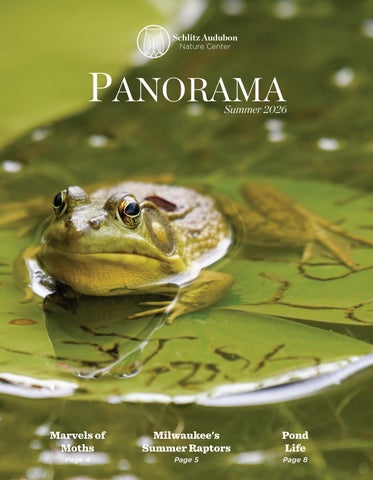
Front cover: Green Frog
Admission
FREE admission to Members Adult: $10 | Youth: $7 (ages 3 — 17) 2 and Under: Free | Military: $7
Summer Hours
Monday-Thursday | 8:30am-8:00pm Friday-Sunday | 8:30am-5:00pm
1111 East Brown Deer Road | Milwaukee, WI 414-352-2880 | www.schlitzaudubon.org 2
Marketing & Communications Specialist Anna Ostermeier
Summer 2026 | www.schlitzaudubon.org
Schlitz Audubon is an independent, locally supported partner of the National Audubon Society.
SEASONAL SIGHTINGS
Wildflowers & Winged Collaborators
Rattlesnake Master
ANNA OSTERMEIER Marketing & Communications Specialist Summer at the Center features a parade of blooms, each with its own animal partners. From nectar-rich flowers that fuel pollinators to host plants that support entire life cycles, these relationships are happening all around us on the trails. JULY In early to mid-summer, red columbine adds a splash of color to our Pavilion gardens and Feeder Grove. Its nodding, bell-shaped flowers are pinkish red on the outside with partially hidden yellow petals and dangling golden, pollen-bearing anthers. Watch patiently and you may see a Ruby-throated Hummingbird darting in. These petite, zippy birds are drawn to the flower’s bright red color and sugary nectar which is particularly rich in amino acids—perfect for their high-energy lifestyle. Out in the sunny prairies of our Gateway and West Meadows Trails, rattlesnake master stands tall with globe-like clusters of tiny greenish-white flowers surrounded by spiky bracts. A wide variety of insects visit, including soldier beetles and monarch butterflies. Adult monarchs sip nectar to power their long migrations, while the plant benefits from pollination. This reciprocal relationship keeps both species thriving. AUGUST By late summer, the large yellow flowers of the compass plant unfurl in those same prairies, their stalks reaching up to ten feet tall. The plant’s expansive leaves often align north-south to avoid direct heat from the sun, giving it its name. Among its many visitors, ranging from butterflies to wasps, is the common eastern bumblebee. This plump, fuzzy pollinator is especially efficient,
transferring pollen quickly as it moves between flowers. In the sandy prairie just west of our Visitor Center, hoary vervain sends up spears of tightly packed blue-violet flowers. These blooms open gradually from the bottom up. On the leaves, you might find the early stages of the common buckeye butterfly. Females lay miniscule pale green eggs which hatch into caterpillars that feed on its leaves and stem. They gradually gain the energy needed to transform and grow their adult wings, boasting six distinctive eyespots. SEPTEMBER As the season turns, New England aster brightens our Central Wetlands Trail with clusters of purple-pink rays surrounding golden centers. These late blooms are vital to insects preparing for migration. The intricately orange and black patterned pearl crescent butterfly depends on asters for both nectar and as a host plant, especially the second late-season broods. In wetter prairie areas, white turtlehead produces distinctive white flowers shaped like a turtle’s head, true to its name. These blooms require strong, sizeable pollinators like the endangered rusty patched bumblebee. Large enough to force open the flower’s lips, it pollinates the plant in pursuit of the nectar, creating a more accessible entry-point for future visitors. While exploring the trails this summer, see if you can spot these blooms and their partners in action. Each interaction is a small but vital thread in a larger web of life—and noticing them brings a deeper appreciation for this vibrant, interconnected world.
Summer 2026 | www.schlitzaudubon.org
3
EDUCATION
The Marvels of Mot hs Snowberry Clearwing
ANNA OSTERMEIER Marketing & Communications Specialist As daylight fades, the delicate wings of moths begin to stir. Though butterflies tend to capture our attention more, moths are no less diverse, beautiful, and ecologically important. Worldwide, scientists have identified more than 150,000 species of moths, including about 1,280 documented in Wisconsin.
wider brown bands predict a milder winter. Interestingly, they are the only fuzzy caterpillars one can safely touch; the bristly hairs of other caterpillars cause rashes. Adults are soft shades of orange, cream, and brown with scattered faint dark spots and are commonly found in prairies, roadsides, and even your own backyard.
Moths have a few signature traits that differentiate them from butterflies. Many species have fuzzy bodies and feathery antennae that help them detect scents and pheromones in the dark. Most are nocturnal, though some fly during the day or at dusk. Compared to butterflies’ slender bodies, moths are often stout and furry, storing energy from their caterpillar stage to fuel adult life.
Perhaps the most spectacular is the luna moth. With pale green wings, dramatic curling hindwings, and a wingspan reaching 4.5 inches, these moths appear otherworldly. Adults don’t have a mouth or digestive tract, so only live for a week to fulfill the reproduction necessary to carry on their species.
Like their daytime cousins, moths undergo complete metamorphosis in four stages: egg, larva, pupa, and adult. Adults lay eggs on their preferred host plants to ensure the newly hatched caterpillars have an immediate food source. Caterpillars molt several times as they grow before spinning silk cocoons using specialized glands. Inside the cocoon, they transform into winged adults. Depending on the species, adult moths may live only a week or survive for several months. One remarkable species found at the Center is the snowberry clearwing. Sometimes mistaken for a tiny hummingbird or large bee, this moth sports mostly clear wings with reddish-brown borders and an olive-gold and black body. It thrives in meadows, shrubby areas, and forest edges, sipping nectar from flowers like bee balm. The native tiger moth, better known in its caterpillar form as the woolly bear, is often spotted on the Center’s ample goldenrod. This fuzzy black-and-brown striped caterpillar has inspired the folk legend that
4
Beyond their ethereal characteristics, moths play an essential role in healthy ecosystems. They pollinate flowers that are open after sunset like common evening primrose, wild bergamot, and white boneset. Their caterpillars provide protein-rich food for birds, bats, frogs, and other wildlife. Some species also break down decaying plant matter, returning nutrients to the soil. Due to their sensitivity to pollution and habitat loss, surveying moths helps reveal when conservation intervention is needed. You can support our local moths by planting native plants, avoiding pesticides, and reducing nighttime outdoor lighting. Citizen science projects also make a difference. During National Moth Week each July, volunteers across the country document moth populations. Closer to home, the Milwaukee Public Museum coordinates moth surveys through their Wisconsin Statewide Community Science Project (WSCS). Observing moths up close quickly reveals that nighttime ecosystems are every bit as fascinating as those seen during the day!
Summer 2026 | www.schlitzaudubon.org
FEATURE
A Summer Guide to Milwaukee’s Raptors CHEYENNE SMITH Raptor Educator
American Kestrel
S
ummertime in Milwaukee can be idyllic, particularly if you take advantage of the city’s many green spaces. From the sprawling lakefront to a confluence of thriving rivers and over 15,000 acres of parks, it’s no wonder Milwaukee County is recognized for its natural beauty. These spaces are shared not only by Milwaukee’s human residents, but a surprisingly diverse array of native raptors. Most raptors spend our warmest season rearing recently fledged chicks, learning the ropes of survival, or staying cool in the sometimes sweltering Wisconsin heat. Regardless of where you go to enjoy a sunny day, you are bound to encounter one of these charismatic predators. Summer 2026 | www.schlitzaudubon.org
5
FEATURE
Cooper's Hawk in the Milwaukee River
PARKS & NATURAL AREAS On a Sunday morning stroll through the ravine forests of Schlitz Audubon or Lake Park, you may catch a flash of grey and white bolting through the trees— a small hawk with a long, banded tail. Perhaps it darts over the Visitor Center or perches near Lion Bridges at the park, a feathered prize in its talons. Often mistaken for Red-tailed Hawks or falcons, Cooper’s Hawks are becoming increasingly common in cities. These slender hawks are adapted for hunting in structurally complex habitats, and urban environments can offer similar complexity with the added benefit of abundant small prey birds. Learning how to hunt can be a clumsy challenge for the newly fledged chicks. Luckily, parents continue to provide food for up to seven weeks after their young have left the nest. You may observe siblings perching together through the summer, mimicking their parents, or even attempting to cooperatively hunt. While attending one of the Center’s popular Owl Prowls or enjoying the quiet after an evening of live music at Humboldt Park, you may find yourself audience to a different kind of chorus: the highpitched whinny of an Eastern Screech Owl. With one of the broadest ecological niches of any owl, these crepuscular 6
creatures are surprisingly common in wooded lots and urban parks. Their secretive nature and excellent camouflage mean we simply don’t see them as often as we hear their twilight serenades. Densely feathered owls avoid summer’s heat by keeping their movements minimal during the day, perching beneath foliage nearest a tree trunk, or remaining out of sight entirely in a comfortable cavity. If they get too warm, they may begin “gular fluttering” by rapidly moving their throat muscles to cycle hot air out of their mouth, much like the panting of a dog. LOCAL WATERWAYS The city’s waterways provide a refreshing reprieve from the heat for raptors. Some take a quick bath, sitting with wings and feathers puffed out to increase evaporative cooling. Others take their time standing in ankle-deep water, letting the heat flow from their feet into the cool water. As you hike or kayak down the Milwaukee River, past Estabrook or Riverside Park, keep an eye out for Milwaukee’s Summer 2026 | www.schlitzaudubon.org
Juvenile Cooper's Hawk practicing hunting
growing Bald Eagle population. With the Center’s proximity to the river, you may also spot these striking raptors during your next visit. Though reaching full size at three months, first-year Bald Eagles appear dark brown from head to toe. After fledging around late June to early July, they increasingly hunt independently using skills developed by observing their parents and through trial-and-error. This means you may see a juvenile eagle scavenging along the shoreline or diving into the water only to come up empty-taloned. Along the trails at County Grounds, you may be lucky enough to spot a resident of the nearby Menomonee River Parkway— an even more experienced fisher: the Osprey. While Bald Eagles skim the water’s surface for fish, Osprey dive fully in, often submerging their bodies completely.
Eastern Screech Owl
ing excursions. Be sure to keep an eye on the southeastern habitats you travel through—raptors are everywhere! Red-tailed Hawks can be seen perched off the highway; their upright posture, white belly, and belt of dark feathers are helpful traits to look for. As you drive through rural Wisconsin and its rich farmland, watch for one of the smallest, most colorful raptors: the American Kestrel. These petite falcons thrive in grasslands and open agricultural areas. Their summertime diet shifts almost entirely to insects like grasshoppers, cicadas, and dragonflies, an ample food source for their chicks. About the size of a robin, they perch on fence posts and powerlines as they bob their heads and pump their tails—a behavior unique to this species. Another lesser-known raptor also prowls these grassy habitats: the Northern Harrier. These small, slender raptors have a wingspan of three to four feet. The wind carries their buoyant bodies as they fly low and forage over tall grasses. With a facial disc similar to that of an owl, they rely heavily on auditory cues to capture small mammals like field mice and voles.
Northern Harrier
These sizable birds have a similar wingspan to the Bald Eagle, but a prominent M-shape to their outstretched wings, a dark patch of feathers at the wrists, and a white underbelly. Osprey pairs spend most of the summer raising young before departing in August for an impressive journey as far south as Chile. Atop a platform nest of sticks, the female uses her wings to shade her chicks from the hot sun while the male delivers a diet of almost exclusively fish. From your panorama view of the city at Lakeshore State Park, pull out your binoculars and you may observe a Peregrine Falcon diving from the U.S. Bank Center. In Southeastern Wisconsin, where we have few bluffs, the tallest buildings of our skyline provide ideal nesting sites for these energetic raptors. Soon after fledging, young falcons spend their first few weeks building the stamina, coordination, and agility needed for hunting other birds. Adults stop bringing food directly to the nest and begin turning mealtime into a lesson. They fly past with prey to
Red-tailed Hawk
entice their hungry young into pursuit or drop food for the juveniles to catch midair, helping them develop diving and snatching skills. Milwaukee is a major hub for Wisconsin’s growing Peregrine Falcon population, with over 465 chicks hatched since 1992 thanks to conservation efforts by We Energies. As summer reaches its end, the Lake Michigan shoreline becomes a bustling superhighway for migrating birds. In September, while the air is still warm and circulating, watch for Broad-winged Hawks soaring overhead along the shorelines of Schlitz Audubon, Doctor’s Park, or Bradford Beach. Though secretive throughout most of the year, during migration they form enormous flocks known as “kettles” and utilize warm air thermals to carry them south. Climb the Center’s Observation Tower for a better look at these and other migrating raptors. BEYOND MILWAUKEE For many of us, summer weekends offer the opportunity for day trips or campSummer 2026 | www.schlitzaudubon.org
If your ideal summer weekend is camping with friends and family, listen for Red-shouldered Hawks in densely forested habitats, such as those of the Kettle Moraine. Despite their elusive nature, they are one of the noisiest raptors, uttering a repetitive, high-pitched "kee-aah" call. Their cries can be heard for miles, especially in woodlands or near marshy areas, where they defend their territory. Should you wake in the night to a riotous duet of cackles and “who cooks for you calls,” stay awake a little longer to enjoy the midnight conversation of a Barred Owl pair. This species occupies an almost identical ecological niche to the Red-shouldered Hawk—however, one species is primarily active during the day while the other prefers nighttime. Southeastern Wisconsin is home to many raptor species, and the landscapes found at the Center offer excellent summer habitat for these birds to roam, feed their families, and learn how to survive. Schlitz Audubon is grateful to be part of Milwaukee’s thriving network of green spaces and waterways that provide an enriching summer experience for our community’s residents, human and wildlife alike. 7
EDUCATION
Fairy Shrimp
ANNA OSTERMEIER Marketing & Communications Specialist
8
The Center’s ponds are brimming with activity, more than you might realize! If you peer into the water, you’ll see a living mosaic in motion: tiny specks darting in jerky bursts, threadlike bodies wriggling in S-shapes, beetles tracing wild circles, and alien-looking forms clinging to mucky sticks. Together they create a fascinating choreography across and below the water’s surface. These organisms, called aquatic macroinvertebrates, aren’t just mesmerizing to watch—they also offer scientific insights into the health of the entire pond ecosystem.
Crustaceans bring a different set of shapes and movements. Scuds, also known as amphipods, are small and shrimp-like, often seen swimming on their sides in quick, twitchy motions. Daphnia, also aptly named “water fleas,” are even smaller, bouncing through the water with jerky movements powered by their antennae. Among the pond’s most enchanting residents, fairy shrimp swim by waving their delicate, gill-like legs as if strumming a harp. Remarkably, their eggs can remain dormant for decades, sometimes up to a century, waiting for the right conditions to hatch.
Aquatic macroinvertebrates are water-dwelling animals without backbones that are large enough to see with the naked eye. Instead of internal skeletons, they rely on exoskeletons made of chitin for structure and protection. Though incredibly diverse, the macroinvertebrates in the Center’s ponds can be grouped into three main categories: insects, crustaceans, and mollusks.
Mollusks draw less attention with their slower, sometimes very minimal movements. Fingernail clams, named for their tiny size, use their hard shells attached by strong muscles for protection as they filter water for food. Also in this group, the pouch snail crawls upside down on the water’s surface, gathering air into its shell for breathing underwater.
Insects in their various forms make up a large portion of pond life. Many spend their early life stages underwater before emerging as winged adults. As master builders, caddisfly larvae construct protective, tube-like cases around themselves from pebbles or plant debris: a perfectly camouflaged shelter. Dragonfly nymphs are fierce predators that live in the water for two years, growing larger and more formidable before breaking out of their exoskeleton and taking to the skies. They use their extendable lower jaw to snatch up unsuspecting prey. Another hunter of the pond, the predacious diving beetle eats tadpoles and even fairy shrimp in its larval form. As adults, they dive with an air bubble tucked beneath their outer wings like a tiny scuba tank.
Beyond their captivating behaviors, macroinvertebrates help signal water quality. Scientists and land managers use them as bio-indicators: species that are highly sensitive to environmental stressors such as pollution or sudden shifts in temperature caused by climate change. Some species, like caddisfly larvae and daphnia, require clean, well-oxygenated water to survive. Their presence suggests a particularly healthy ecosystem. An intervention may be needed if only highly pollution tolerant species are in a water body. Macroinvertebrates’ abundance, varied sensitivity, and ease of collection make them excellent early detectors of ecosystem degradation. Sampling macroinvertebrates can be surprisingly simple, though a
Summer 2026 | www.schlitzaudubon.org
little messy. Using a strainer, bucket, spoon, and identification guide, researchers and citizen scientists gently scoop through the pond, swishing water and mud to capture these small, wriggling critters. Once collected and identified, an overall water quality rating is calculated using a well-researched formula with inputs based on each species’ abundance and established pollution sensitivity score. Importantly, this data doesn’t stand alone. It complements other measures like water chemistry testing, turbidity (clarity) assessments, and plant and wildlife surveys. Together, these approaches create a more complete understanding of the ecosystem. Macroinvertebrates are also an es-
sential building block of the pond’s food web. They provide nourishment for frogs, turtles, ducks, fish, and mammals like muskrats. Even within their own category, they form a layered food chain: smaller species like insect larvae and worms are eaten by larger ones like crayfish, which in turn become prey for birds such as Great Blue Herons. Without a thriving community of macroinvertebrates, the entire pond ecosystem would collapse. Next time you visit our ponds, lay on the boardwalk and observe the water. Watch for the quick flick of a scud, the drifting glide of a larva, or the sudden dart of a tiny predator. With a little focus, you can identify some of these remarkable creatures for yourself.
Caddisfly Larvae
Salamander Eggs
Summer 2026 | www.schlitzaudubon.org
9
DEVELOPMENT
A Structure with Lasting Impact MADDIE MUELLER
Grants and Community Partnership Specialist Since 2007, the Woodland Loop Bridge and Staircase has fulfilled Schlitz Audubon’s mission of environmental education, conservation, and providing access to nature. Far more than just a physical structure, the staircase and bridge provide a gateway into one of the most ecologically and educationally significant areas of our 185-acre nature preserve. By traversing the 70 steps into and out of the ravine, visitors find themselves in a wilder, quieter section of the Center, home to Solitude Marsh, sugar maple beech forest habitat, and dramatic views.
After nearly 20 years of continuous use and exposure to the elements, the bridge and staircase are now showing significant signs of decline. Natural wear and tear, compounded by historic flooding in 2025, has accelerated structural deterioration. While the staircase remains open, it is approaching the end of its functional life. Without timely repair and rehabilitation, access and educational opportunities risk being compromised or lost — impacting both public use and Schlitz Audubon’s ability to deliver high-quality programs.
The structure has welcomed tens of thousands of visitors across the South Ravine over the past two decades. Students on school field trips, educators leading outdoor lessons, conservationists, families, and lifelong learners have all benefited from access into the ravine and beyond into the Woodland Loop.
AN OPPORTUNITY TO CREATE A LEGACY
More than just an access point to key portions of Schlitz Audubon’s trail system, the staircase allows for exploration of the South Ravine itself, a geological highlight and critical refuge for native plants and wildlife. Visitors safely descend into this unique landscape and experience its seasonal richness firsthand — from winter wrens sheltering in the ravine to the ongoing regeneration of hickory, red oak, and sugar maples. At its center is a 25’ x 10’ teaching platform that offers a rare, stream-level perspective into the ravine — the ultimate living classroom. This space has supported countless hands-on learning experiences, allowing students and visitors to observe wildlife, forest succession, hydrology, and seasonal changes in real time. 10
We are honored to present the Woodland Loop Bridge and Staircase Project as a chance to leave an enduring legacy at Schlitz Audubon. A donor-supported rebuilding of this important structure would preserve the Center’s original vision, while updating the staircase and teaching platform with durable, weather-resistant planking. At the ground level, a foundation of rock will reinforce the structural support system, better equipping the bridge and staircase to withstand significant rainfall events. With your support, we can ensure that the Woodland Loop Bridge and Staircase continues as a gateway to discovery, learning, and conservation for tens of thousands of future visitors. If you are interested in learning more about this unique opportunity, please contact Executive Director Helen Boomsma at hmboomsma@schlitzaudubon.org or (414) 352-2880 x226.
Summer 2026 | www.schlitzaudubon.org
DEVELOPMENT In Memory Of Bonnie Behee-Semler Robert Amich Cyndie Chiuminatto Chloe Chiuminatto John Christiansen Rebecca Pikofsky Mary Cofta Anonymous (2) Joanne and Gary Backhaus Pat Cofta and Carolynne Shurna Sloane Isabelle Faber Allene and Chuck Faber Grace Haraway Anonymous Robert Abilez Robert and RoxAnne Baumann Mario Dzemidzic Jennifer Evans Dana and Neil Glasstein Jay and Kimberly Gullickson Jennifer and Brian Haraway Madeline Haraway Ann-Elise Henzl Tammy Kaiser Michelle and Andrej Karaffa John and Julie Karnes Tracia Luther Julianne Maggiore Kathy Mead Lucy and Michael Mercado Melinda and Andrew Mitchell Rich and Sharon Moore Mark and Susan Mowers Ted and Sandy Noll North Shore Congregational Church Mike and Pam Olson Carol and John Plankenhorn Scott and Maureen Riemer
Jonathan and Beth Sawant Marylyn and Eliot Scheuer Carol Story Jeffrey Teplin and Susan Engler Nick and Nora Trivunovich Steven Werlein Mary Pat Wilson Steve Hoffman William and Barbara Hunt Matson Holbrook Hauske-Read Family John McGregor Anonymous (2) Barbara and Stephen Becker Buffy and Steve Duback Peter Hitler Mary and Ted Kellner Beezie Madden Mueller Communications LLC Joe and Kathy Patton Diane M. Race John and Nancy Snyder Margy Stratton and Greg Norman Lisa Trost Willard and Mary Walker Tim Wallis and Patty Blommer Sunny and Sandy Williams Yolanda Melkonian Nancy Melkonian Werner Scherr Geri G. and Marvin B. Olson Edwin P. Wiley Ted Wiley Keith Williams Kristy and Joseph Trouy
In Honor Of James and Susan Alling Diane Abe Susan Bell Joni Bell Steve Bergquist Barbara Hamm Sandy Manning Michael and Jennifer Opitz Myra VanUxem Anonymous Kathleen and Richard Brehmer Michael and Anne Marie Bula Kevin and Pat Campau Mary Fitzgerald Lori Gendelman Ed and Doris Heiser Linda and Larry Janczak Christel Maass and Terry Rindt Sandra Manning Barbara A. Meyer Nancy and Robert Notley Margaret O'Brien-Bremer and James Bremer Michael and Jennifer Opitz John and Debbie Pearce Nancy Quinn Lisa Trost
Raptor & Animal Sponsorships
Athena – Barn Owl In honor of Brittany Jensterle Marissa Jensterle Baron von Screech – Eastern Screech Owl Richard and Meredith Lincoln Gimli – Eastern Screech Owl Richard and Meredith Lincoln Andy Tisdel Saxon – American Kestrel In honor of "The Other Football" Fantasy Football Champion Deanie Vallone Willow – Northern Saw-whet Owl Anonymous
Wedding Ceremony Trees Kelty Norton and Conor Johnson Brandon and Mikaela Schneiberg
Honorary Trees In memory of Cecilia Mae Courtney Marquette Friends
Emerson – Common Snapping Turtle In memory of Grace Haraway Aidan Gehlert
Gifts were received: 1/1/2026 – 3/31/2026
SOURCES FOR PANORAMA WILDFLOWERS & WINGED COLLABORATORS
THE MARVELS OF MOTHS
A SUMMER GUIDE TO MILWAUKEE'S RAPTORS
MINNESOTA WILDFLOWERS minnesotawildflowers.info
BUTTERFLIES OF THE MIDWEST FIELD GUIDE Jaret C. Daniels, May 2023
BIRDS OF THE WORLD – CORNELL LAB OF ORNITHOLOGY birdsoftheworld.org
US FOREST SERVICE / USDA fs.usda.gov
CHECKLIST OF WISCONSIN MOTHS wisentsoc.org
POND LIFE UP CLOSE
NORTH CAROLINA STATE EXTENSION PLANT GARDENER TOOLBOX plants.ces.ncsu.edu
MOTHS: THE FORGOTTEN POLLINATORS extension.psu.edu/moths-the-forgotten-pollinators
BACKYARD ECOLOGY backyardecology.net STAFF CONTRIBUTIONS Jim Thielke, Environmental Educator
STAFF CONTRIBUTIONS AJ Grill, Associate Director of Education
MOTHS OF WISCONSIN FIELD GUIDE greatlakesmoths.org BUTTERFLIES AND MOTHS OF NORTH AMERICA butterfliesandmoths.org STAFF CONTRIBUTIONS Alison Schrad, Environmental Educator Melanie Ziolecki, Environmental Educator
Summer 2026 | www.schlitzaudubon.org
11
Schlitz Audubon Nature Center 1111 East Brown Deer Road Milwaukee, Wisconsin 53217
SUMMER 2026 PANORAMA
U.S. Postage
PAID
Milwaukee, WI Permit No. 4168