panorama
Fall 2026
Owls of the Forest Page 3
Wisconsin Bats Page 5
Green Darners Page 8
WELCOME HELEN BOOMSMA Executive Director
Autumn is transforming the landscape, painting our prairies in gold and bronze as our forest canopies become a collage of blazing scarlet, orange, and yellow. This fleeting season of bounty and transition invites us to slow down and savor every nostalgic moment, from the sound of leaves crunching underfoot to the sight of southbound birds overhead. We hope the articles in this issue of Panorama enrich your fall nature experiences. Our seasonal sightings piece offers insights into Wisconsin’s owls and where to witness them, from the Eastern Screech Owl nestled in a tree hollow of our Central Wetlands Loop to the formidable Great Horned Owl patrolling the Woodland Loop. Read the feature article to learn what we have in common with bats, where these unique mammals spend their winter, and what makes them indispensable to our ecosystems. Then, turn your attention to a third winged wonder — the green darner dragonfly — to discover their impressive life cycle and multi-generational migration that spans continents. Intentional land stewardship is key to supporting these valuable native species. Our Creating a Wildlife Friendly Fall Yard guide provides tips for turning your outdoor space into a refuge for birds and insects, whether they’re refueling on their migration journey or seeking shelter through winter. Finally, read about the Shared Waters, Shared Future Stormwater Management Initiative,, a collaboration with the Village of Bayside that expands wetland habitat while protecting nearby neighborhoods from flooding. Experience the magic of this scenic season firsthand through our fall programs for all ages, including festive events, themed guided hikes, hands-on workshops, and wellness experiences! Join us for Species Spooktacular on October 18 to learn about nature’s misunderstood creatures, meet live animal ambassadors, vote on costumed taxidermy animals, play games, and more. Plus, prepare for unforgettable encounters with our owls, hawks, falcons, and eagles at Xtreme Raptor Day on November 7! Our annual center-wide raptor festival includes plenty of fun activities and crafts, and even an opportunity to get your picture taken with one of the Raptors of Schlitz Audubon. Looking ahead, celebrate the holidays during our Illuminated Hikes on December 11 and 17, and January 2, as you decorate a paper lantern, stroll gently lit trails, and warm up by a bonfire with hot chocolate. While visiting, browse our shops in the Great Hall for thoughtful gifts and resources to expand nature learning. Upstairs in our Mezzanine Art Gallery, view The Art of Ney Tait Fraser & Judith Huf exhibit through December 29, showcasing stunning collections by two Milwaukee-based artists inspired by North Shore wildlife and habitats. Whether you join us for a program, explore the gallery, or simply wander the trails beneath the falling leaves, we look forward to welcoming you at the Center as we embrace this beautiful season of transition!
FREE admission for Members Adult & Teens: $12 Seniors 65+ & Military: $10 Youth 3-12: $8 | 2 and Under: Free 2
Officers Evan Kirkstein President Joseph A. Camilli Treasurer Carrie Nichols Secretary John Schaub VP-Governance Barbie Brennan Nelson VP-Development Directors Thomas Bausch Jane Bell Kathryn Cutinello Molly Jante Alexandra Stankiewicz Krems Jonathan T. Luljak Jeff Rusinow Past Presidents John H. Kopmeier, Jr. Philip R. Smith Dennis L. Fisher Terrence K. Knudsen Thomas J. McCutcheon Thomas B. Fitzgerald Randolph H. Dean Stephen F. Geimer Thomas J. Drought David K. Hoover John S. McGregor Margarete R. Harvey Timothy J. Gerend John Grunau Aliah Berman Shane Delsman Benjamin T. Pavlik Director Emeritus Dorothy K. Vallier (1910-2013)
CREDITS FOR PANORAMA Director of Marketing & Visitor Experience Nancy Quinn Creative Lead Zoe Finney Marketing & Communications Specialist Anna Ostermeier
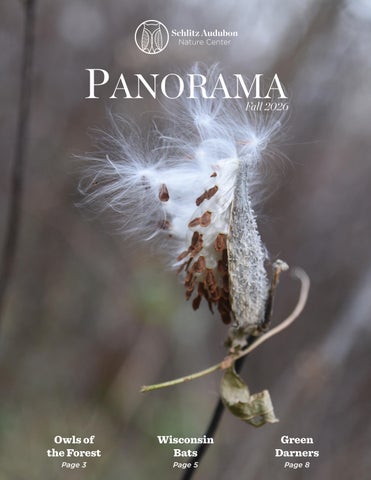
Front cover: Common Milkweed seed pod in autumn.
Admission
BOARD OF DIRECTORS
Hours
Monday-Sunday | 8:30am-5:00pm 1111 East Brown Deer Road | Milwaukee, WI 414-352-2880 | schlitzaudubon.org Fall 2026 | schlitzaudubon.org
Schlitz Audubon is an independent, locally supported partner of the National Audubon Society.
SEASONAL SIGHTINGS
OWLS
Masters of the Quiet Forest
Eastern Screech Owl
LINDSAY FOCHT Raptor Program & Animal Ambassador Director The changing colors of leaves in our forests signal a larger change; the landscape is preparing for its winter hibernation. While many of our local birds depart for their annual migration south, this season sparks increased activity of a strong and stealthy group of raptors: owls. SMALL BUT MIGHTY Standing at a mere six inches, Northern Saw-whet Owls make more frequent appearances during the autumn months as they migrate south from Canada and Northern Wisconsin. On quiet hikes along Turtle Trail, you can occasionally hear the soft 'hoo' of a saw-whet as these tiny hunters rest and refuel on our grounds before continuing their journey. Only slightly larger at eight inches tall, the Eastern Screech Owl is more often seen and heard along our trails. Unlike the saw-whet, screech owls sport feather tufts on their heads and can appear in two different colors: gray or red. Walking through the Central Wetlands Loop, carefully examine the cavities higher up in trees and you may discover one of these little owls tightly nestled inside, snoozing in the morning sun. SKILLED AND STRONG The medium-sized Barred Owl lives around wetlands and marshes. Though you may not see these secretive owls, their hoots can occasionally be heard in the West Meadows. As pairs begin defending their nesting territories in De-
cember, you may catch this distinguished "who cooks for you" call. Like screech owls, these birds of prey nest in tree cavities and require older growth forest stands with holes large enough to hold up to three offspring. Perhaps the most formidable, nicknamed the "tiger of the sky," is the Great Horned Owl. Residing in forests, farm fields, and even neighborhoods, they are the most frequently encountered owl species in Wisconsin. They hold the title of "strongest owl" with a grip strength eight times stronger than a human, taking down prey like squirrels, rabbits, and even animals as large as skunks. Their low "hoo hoo hoo" call can often be heard through the Woodland Loop down to Solitude Marsh. NORTHERN VISITORS From November through March, owls from northern latitudes find temporary homes further south. Here in the Milwaukee area, winter birders have spotted Short Eared, Long Eared, and even Snowy Owls. As competition for food gets tougher up north, they visit Central and Southern Wisconsin in search of food, such as small rodents, in our fields and at our lakefront. As lush greenery shifts to vibrant autumn hues and finally to the subdued tones of winter, nature invites us to find relief in this calmer season. Grab your coziest attire and binoculars to enjoy quiet discoveries in the forests at Schlitz Audubon—you never know "hoo" you might hear or see!
Fall 2026 | schlitzaudubon.org
3
EDUCATION
g n i t Crea fe i l d l i aW y l d n Frie d r a Y Fall American Goldfinch eating aster seeds
FIETHONG (FIE) THAO Restoration Ecologist Autumn offers plenty of opportunities to support Wisconsin wildlife through actions you can take in your own outdoor spaces. As fall migratory birds rest and refuel for their next journey and insects search for shelter to enter diapause—a period of suspended growth due to lower temperatures and limited food—your yard can become a vital refuge. In the face of declining animal populations driven by habitat loss, decreased foraging sites, and climate change, local efforts make a meaningful difference for our wild neighbors and visitors.
PLANT NATIVE SPECIES
Adding a diverse mix of native plants provides essential food sources for late-season insects, migrating birds, and overwintering animals. You can plant until the first frost or until the ground freezes. As the season progresses, many sumA moth on goldenrod in autumn. mer-blooming plants set seeds; incorporating late-blooming varieties like asters (New England, calico, and aromatic) and goldenrods (Ohio, stiff, and showy) supports foraging insects, including bees, moths, and monarch butterflies. Seed-heavy plants such as coneflowers (gray-headed, purple, and pale purple), ironweed, and switchgrass offer vital energy for birds like Dark-Eyed Juncos, White-breasted Nuthatches, and Black-Capped Chickadees as they endure the harsh cold of our winters. These additions not only enhance your yard’s beauty but also invite more nature into your space for discovery and enjoyment. 4
SKIP THE PESTICIDES
While it may be tempting to use herbicides, fungicides, and insecticides to achieve a pristine lawn or reduce mosquitoes during the warmer months, these chemicals carry hidden risks for both wildlife and human health. Common insecticides like neonicotinoids, pyrethrin, and pyrethroids often fail to target pests effectively while harming pollinator insects, birds, and pets. Research links human exposure to these substances with increased risks of cancer, neurological disorders, reproductive issues, and organ damage. A safer, eco-friendly alternative for managing backyard mosquitoes, while they're still around, is the mosquito bucket. This low-cost method targets larvae before they mature and requires only basic materials. Online guides can help you set one up easily, offering a practical solution that protects both your family and the ecosystem.
LEAVE FLOWER HEADS STANDING & LEAVES ON THE GROUND
Think of your late autumn garden not as a project to be cleared, but as an important winter sanctuary for local wildlife. Standing stems serve as cozy nurseries for native solitary bees and other larvae, and seed-filled flower heads offer nutritious forage when other food is scarce. Dried standing plants and their seeds also provide habitat and food for overwintering birds such as American Goldfinch and Northern Cardinal as well as winter migratory birds such as Brown Creepers and American Tree Sparrows. Fallen leaf litter provides crucial habitat for overwintering rodents and insects like fireflies and woolly bear caterpillars. By embracing these simple practices, you can transform your yard into a resilient ecosystem that thrives through the changing seasons.
Fall 2026 | schlitzaudubon.org
FEATURE
PHOTO BY MERLIN TUTTLE Hoary Bat
Uncovering the Remarkable Lives of Wisconsin’s Bats ANNA OSTERMEIER Marketing & Communications Specialist
Fall 2026 | schlitzaudubon.org
5
FEATURE
PHOTO BY MERLIN TUTTLE Tri-colored bat hibernating
While bats are often the subject of vampiric lore and spooky stigmas, the realities of biology and ecology tell a very different, equally fascinating, story. In fact, we share more in common with these animals than you might think. As fellow mammals, they are warm-blooded, covered in hair, and nourish their young with milk. Far from being rare oddities, bats comprise 20% of mammals worldwide—totaling roughly 1,400 species! Yet for all these shared traits, bats possess one evolutionary marvel unmatched by any other mammal: the ability to sustain true flight. The skeletal structure of each wing is akin to our own hands, with five elongated fingers that they can move independently. Their fingers are connected by a thin and flexible membrane called the patagium. These unique wings allow them to achieve incredible control in the air; maneuvers like hovering in place, flying backwards, diving, and rolling serve them well in catching insects and escaping predators. Their thumbs have even adapted into hooks along the wing’s edge, aiding in climbing and handling food, while hanging upside down allows these skilled aerialists to launch into flight at a moment’s notice. Wisconsin is home to eight bat species, all of which have been documented across Schlitz Audubon Nature Center’s extensive grounds. All members of the Vespertilionidae family, they are divided into tree bats and cave bats—a distinction that hints at where they spend their winters. Our native cave bats include the little brown, big brown, tricolored, and northern long-eared, while our state’s tree bats are the silver-haired, eastern red, hoary, and evening. Beyond this broad grouping, these species vary significantly in appearance, reproduction, habitat preference, and vocalizations. 6
All of Wisconsin's bats provide an array of ecological and human benefits thanks to their diet: insects. These small mammals have massive appetites, with a single bat capable of consuming thousands of wasps, moths, flies, and beetles every night. They are major predators of mosquitoes, which spread diseases like the West Nile Virus. By suppressing mosquito populations, bats directly reduce the risk of transmission to both humans and birds. They are also allies to farmers and forests, preying on crop pests like cucumber beetles and green stink bugs, as well as the invasive emerald ash borer, which devastates ash tree populations. As climate change creates more favorable conditions for mosquitoes and stresses agricultural systems, bats are important partners in climate adaptation. Echolocation, paired with their agile flight, allows bats to pinpoint and capture their airborne prey with remarkable precision. While they are not blind, this ability helps them more effectively navigate and hunt at night—essential activities of their nocturnal lifestyle. Each species makes a signature ultrasonic clicking or buzzing noise typically above the range of human hearing. These sound waves strike nearby objects and insects, bouncing back to the bat’s sensitive ears. By detecting minute differences in the timing of these echoes, bats mentally map the distance, size, and direction of their surroundings. They increase their vocalizations when they need finer details, helping them snag their next meal. Bats are most active during our warmer months, from April through early October, when bugs are abundant and water is readily available. They live in a variety of habitats; some prefer open grasslands, while others, such as the northern long-eared
Fall 2026 | schlitzaudubon.org
sumes. Tree bats, on the other hand, travel much further to southern states, or even as far south as Mexico (in the case of the hoary bat), where insects still buzz and flutter. If food availability or temperature dips, they may briefly enter torpor in tree cavities or under leaf litter to conserve their limited energy. Sadly, over half of Wisconsin’s bat species are at risk. Big brown, little brown, northern long-eared, and tricolored bats are all listed as State Threatened; notably, the northern long-eared and tricolored bats are categorized as U.S. Endangered and U.S. Proposed Endangered, respectively. The silver-haired bat is designated as State Special Concern. Habitat loss and insecticide use threaten all species, while white-nose syndrome (WNS), a fungal disease that reached Wisconsin in 2014, has caused dramatic declines among cave-dwelling species. Bats are particularly vulnerable to rapid population declines due to their slow reproduction rates, with most giving birth to only one pup per year. Research is key to informing actions that government agencies, organizations, and individuals can take to protect and restore bat populations. Schlitz Audubon partners with the Wisconsin DNR and U.S. Fish & Wildlife Service on their bat conservation programs to establish baseline population, location, and behavioral data from right here on our grounds.
PHOTO BY MERLIN TUTTLE Silver-haired bat roosting
bat, favor forests. Regardless of their specific niche, all species share two essential needs: water—whether in streams, lakes, or ponds—and shelter for roosting, which can range from trees and rock crevices to man-made structures.
The WDNR-led Wisconsin Bat Program (WBP) tracks state bat populations through acoustic surveys and summer roost counts, both supported by a dedicated volunteer network. Schlitz Audubon contributes to this effort by documenting which species roost on our lakeside property. From June through July, staff walk a consistent trail route with an acoustic device, recording ultrasonic bat calls and their locations. We submit this data to the WBP team, who generate a cohesive species map, enriching their statewide data collection while offering Center staff insights into our resident bats. For example, 2026 data revealed our first ever documentation of an evening bat on the Schlitz Audubon property!
At the Center, our Conservation Team intentionally manages the land to meet these needs. To support the insect population, the team plants plenty of native species that produce nectar from spring through fall. They also maintain open water in our ponds by removing invasive plants and thinning dense growth—vital for both insect reproduction and bat hydration, as bats need about seven feet of clear space to dive for a drink. Furthermore, recognizing that trees are the primary roosting spots for Wisconsin’s bats, the team leaves approximately 20% of dead trees (snags) standing whenever tree removal is required for restoration projects.
Complementary to the WBP effort and with support from the U.S. Fish & Wildlife Service, our Conservation Team monitors bats in our Hardwood Swamp restoration areas from spring through fall using passive acoustic recorder boxes mounted in trees. The devices collect nightly data on bat presence and absence, allowing us to track trends over time as the full impacts of our restoration work emerge. While it’s too soon to determine definitive results, our goal is to boost bat populations, particularly that of the northern long-eared, through habitat enhancements.
As summer turns to fall and insects dwindle, bat species follow different avenues of survival: hibernation, migration, or both. Cave bats may migrate only a short distance to seek refuge in local caves and abandoned mines, where temperatures stay relatively consistent compared to freezing aboveground winter landscapes. There, they settle in—alone or in clusters—to begin their hibernation. They slip into torpor, a state where slowed metabolism, heartbeat, and breath allow them to ration their fat stores until spring feeding re-
There’s much we can do individually and collectively to support these astounding, ecologically vital flying mammals. Bat Week, held at the end of each October, is an excellent opportunity to celebrate and educate about the importance of bats. You can take your action a step further by joining the WBP as a citizen scientist, building and installing a bat house, or planting native plants in your yard that attract calorie-rich insects like beetles and moths. Together, we can help Wisconsin’s bat populations rebound—and even thrive!
Fall 2026 | schlitzaudubon.org
7
EDUCATION
d e n o T l e w e J
s r le e v Tra m
g & Co
ketin IER Mar E M R STE ANNA O
list s specia
tion munica
Green darner dragonfly
On a late summer stroll along a slow-moving stream or small pond, you may spot a shimmering insect zipping past at startling speed. As it pauses to rest on a blade of grass and bask in the sun’s warm rays, you marvel at its iridescent wings spread wide and flat atop its large body of vibrant green and blue. A black bullseye marking in front of its enormous, green-tinted compound eyes gives a clue to its family. This is one of Wisconsin’s largest dragonflies: the spectacular green darner (Anax junius). While both sexes share signature green hues, females can be distinguished by their greenish-red thorax and brown abdomen, contrasting with the male’s vivid lime-green thorax and pale blue abdomen. To fully appreciate the green darner, you must first meet its kin. The name “darner” likely traces back to old European folklore labeling them the “devil’s darning needles,” perhaps inspired by their needle-like tails and how they slice through the air in stitching-like motions to capture their prey with deadly accuracy. Though these powerful insects of the family Aeschnidae can be found globally, you may encounter several relatives of the green darner locally: the variable 8
darner adorned by thin blue stripes across its abdomen or the blue-eyed darner distinguished by its brown and blue abdomen accompanied by a striking azure face. Here in Southeastern Wisconsin, green darners typically appear as early as midApril and stay through September, the first and most enduring dragonfly species of our warmer months. In spring, they frequent the Center’s Maple Grove as well as Teal Pond, Dragonfly Pond, and Turtle Pond. By summer and early fall, they grace all our ponds, though preferring those without fish, which are voracious predators of dragonflies in both their nymph (larvae) and adult forms. As a result, you may observe fewer dragonflies flitting around the lily pads of Mystery Lake compared to our other ponds. The presence of dragonflies in aquatic habitats ties directly to their life cycle— in fact, green darners spend most of their lives underwater! Like all dragonflies, they undergo three developmental stages: egg, nymph, and adult. Mating begins in flight, with the male grasping the female behind her head using specialized claspers at the tip of his abdomen, formFall 2026 | schlitzaudubon.org
ing a tandem pair. Together, they land on plants near the water’s edge, where the female dips her abdomen below the surface to pierce stems or sediment with her ovipositor, carefully inserting eggs into the protective tissue. Once eggs mature, the nymphs hatch and live underwater for either a single season or up to three years, sometimes molting over a dozen times as they grow. The speed of their development depends on the length of days (known as photoperiod) and the temperatures they're exposed to as eggs and early nymphs. Migratory populations experience accelerated development over a single season while resident populations develop more slowly, entering diapause as nymphs during the colder months until warm weather returns. When ready to metamorphosize, they crawl onto supports like above-water plant stems or rocks and shed their exoskeleton one final time to emerge as winged adults. This adult phase is remarkably brief, lasting only six to eight weeks—inviting us to appreciate the ephemeral sight of these impressive aerial dancers all the more. Perhaps the most awe-inspiring aspect
Male & female green darner
of the green darner is its multi-generational migration. Two decades of data collection by experts and citizen scientists reveal that populations journey up to 1,500 miles across Canada, the United States, and Mexico over three generations: the first ventures north in the spring, the second goes south in the fall, the third stays in the southern part of their range over winter, and the cycle restarts. Migration bolsters their resilience as a species because it spreads their reproductive efforts across many distant water bodies, ensuring that pockets of their population survive even if others are impacted by drought, predation, and
Perhaps the most aweinspiring aspect of the green darner is its multi-generational migration. . . Populations journey up to 1,500 miles across Canada, the United States, and Mexico over three generations.
high competition. Findings suggest that temperature thresholds each season trigger migration, among other potential factors still unknown. Researchers emphasize that many mysteries remain when it comes to insect migration, including what their precise migration routes are along the coasts and through the Midwest. As we watch green darners zig zag and swoop over our ponds and marshes during their short adult lives, the secrets of where they came from and where they will go only add to their magic.
Fall 2026 | schlitzaudubon.org
9
DEVELOPMENT In Memory Of Judith Anhalt Anonymous Bill and Nancy Kochanik Bonnie Behee-Semler Robert Amich Elizabeth (Beep) Benson Donald and Jill Miller Jeffery "Beaver" Frechette The Manke Family Amy Gehweiler Nancy Meeks Keith and Patti Tietyen Grace Haraway Karry Hill Sora
Expanding Wetlands through Village Partnership ANNA OSTERMEIER Marketing & Communications Specialist Schlitz Audubon is excited to be partnering provide stopover habitat for migrating wawith the Village of Bayside on the Shared terfowl. Higher levels will also create nursery Waters, Shared Future Stormwater Manage- habitat for Blue-winged Teals in the summer ment Initiative. This project, in conjunction months. Meanwhile, the marsh will offer refuge with work taking place at the Shul, will reduce for secretive birds, including Soras, rails, and stormwater flowing from Brown Deer Road American Bitterns. Dense native plants and into Indian Creek, the Milwaukee River, and small open water pools will provide cover and ultimately Lake Michigan, by expanding the insect foraging areas for diverse bird species. Center's wetland habitat. Increasingly frequent extreme rain events are challenging our The restored pond and marsh will also serve regional stormwater systems. This collabora- as outdoor classrooms where learners can tion addresses that issue while supporting both observe how different birds use varying habour own conservation goals and, importantly, itat types. Visitors can compare waterfowl the well-being of the Bayside community. By using deeper pond habitat with marsh birds thoughtfully managing water on our property, relying on shallow water and thick vegetation. we reduce pressure on nearby infrastructure Moreover, the sites will demonstrate how land and prevent neighborhood flooding, while also managers can change water levels to support enhancing habitat, supporting wildlife, and cre- wildlife, reduce invasive species, and respond ating new educational opportunities. to seasonal changes.
10
The project focuses on capturing and then gradually releasing stormwater that falls on a 33-acre section of our property through a series of improvements primarily in the West Meadows. The project team is installing control structures in three areas: the first protects an existing seasonal wetland, the second expands a permanent waterfowl pond, and the third creates a new marsh habitat. The latter two structures allow Conservation Staff to manage water levels for different species and seasons.
During construction, the northern loop of the West Meadows trail is closed. Once the project is completed, we will reroute this section to connect visitors more directly with the pond and marsh habitats, including small foot bridges across overflow areas.
At the pond, lower water levels will create mud flats for foraging ducks while higher levels will
Learn more at schlitzaudubon.org/conservation!
This project is a powerful example of how thoughtful collaboration can benefit both the people and wildlife that rely on ecologically healthy and resilient habitats.
Fall 2026 | schlitzaudubon.org
Paul M. Hauer Mark Hauer Gerri Leinberger Plumbing Mechanical Sheet Metal Contractors Alliance Inc. John McGregor Anonymous (2) Susie Apple David and Suzy Boerke Deanna Braeger Diane and Ed Braza Connie Burghardt Margaret Crowley Randy Dean The Easom Family Susan and David Ells Mark and Heather Erlandson Ryan and Brooke Fetherston Marcia and Tom Flanagan Lee Fratantuno Kurt and Rosemary Glaisner Emily A. Hart Hauske Family Foundation, Inc. James and Mary Hughes Mark and Susan Irgens Irgens Development Partners, LLC Caroline Jankowski Diane and Robert Jenkins Susie Kasten Larry and Judy Moon Kristin and Chuck Severson Cardi and Ken Smith James and Joan Stone Fred Stratton Susie and Graham Taylor Stacy and Susan Terris Betsy Trimble and Family Jay and Madonna Williams James and Patricia Wood Helen Patton Karen Dimberg Tina Tolkacz Infor Talent Science LeAnn Marie Vance Pam and Steve Bednarczyk James L. Whittet, III Larry and Judy Moon
DEVELOPMENT In Honor Of Barbara Becker Ann Becker and David Muschler
Glory – Bald Eagle In memory of Mitch Lewis Bonnie Lewis
Carrie Becker Barbara and Stephen Becker
In memory of Larry Tradup Susan Lamborn
David D. Becker Barbara J. Becker
In honor of Isabela Bergold Toshiko Taychert
Jane Bell Bob and Cato Schley David Dorn Dorn Family Charitable Fund
In honor of Craig Kuhlenbeck Tracy and Mike Bernhardt Tina, Jim, Sara, and Nathan Desing Tiffany and Matt Pahs
Al Hentzen Mary and James Connelly
In honor of Scott Rolfs Robert and Nancy Fetherston
Bob Larsen and Jan Jensen Anita Fleisch
In honor of Alan Wagner Alan and Stephanie Wagner
Sarah Starrett Winston and Margaret Hollister
Raptor & Animal Sponsorships Emerson – Common Snapping Turtle In memory of Grace Haraway Aidan Gehlert Harley – Spiny Softshell Turtle Wendy Hazlett Athena – Barn Owl In honor of Aoife Miller David Szostak and Katie Kaenkumchorn IA Ventures Atlas – Red-shouldered Hawk Lorette Russenberger
In honor of Klaus Winkler Donna Winkler
In memory of Kristy Wesson Arlene and Phil Wesson
Wedding Ceremony Trees
In honor of Gabriela Bergold Toshiko Taychert
In honor of Hailey Lichey and Matthew Kante Andrew and Sarah Lichey
In honor of Mirren, Elliot, and Simon Edelman Irv Edelman and Maggie Smith In honor of Anne Fetherston Robert and Nancy Fetherston In honor of Seraphina Gonzalez Lula Tolbert In honor of Ray Roy Jessica Ollman In honor of Curt Schultz Dan Donovan and Amy Schultz
Anonymous Richard and Meredith Lincoln Chris Osiecki Lori Wiegel
Kathleen and Richard Brehmer Robert Druker Patricia Kugel Jennifer and Christopher Lipski Jeff Ogren and Annie Lincoln
Loki – American Crow In memory of Arleen J. Klug Jeffrey Klug
Willow – Northern Saw-whet Owl Nathan Eisner
IA Ventures
General Raptor Support In Honor of Aoife Miller Jillian Holschuh and Garrett Holmes Jordan Siebert
Sky Walker – Red-tailed Hawk Patrick McGinn Valkyrie – Bald Eagle In memory of Kenneith Auxier Ashley Spink In memory of Arthur L. Corirossi Linda Gazerwitz
In honor of Abigail Strebig and Joseph Webb Michelle Webb Leslie Cadillac and Mark Greaves Semeeha Hassan and Cooper Lair Lindsay Leonard and Jon Brunsman Tiana Lutze and Mary Kate Messing Marty Palmasani and Ruthey Schultz
Gifts were received: 4/1/2026 – 6/30/2026
SOURCES FOR PANORAMA CREATING A WILDLIFE FRIENDLY FALL YARD MANAGEMENT OF INVASIVE PLANTS IN THE WESTERN USA invasiveplantswesternusa.org/impacts-of-pesticides-onwildlife.html
UNCOVERING THE REMARKABLE LIVES OF WISCONSIN’S BATS INSTITUTE OF ENVIRONMENTAL RESEARCH & EDUCATION iere.org/what-are-5-adaptations-of-a-bat
POLLINATOR PARTNERSHIP pollinator.org/blog/archived/late-season-lifelines
WILDLIFE ECOLOGY & DAMAGE MANAGEMENT wildlifedamage.cals.wisc.edu/
XERCES SOCIETY FOR INVERTEBRATE CONSERVATION xerces.org
WISCONSIN DNR dnr.wisconsin.gov/topic/WildlifeHabitat/Bats dnr.wisconsin.gov/topic/EndangeredResources/batFAQs STAFF CONTRIBUTIONS Cassie Rincon, Environmental Educator Drew Shuster, Director of Conservation & Land Management
Fall 2026 | schlitzaudubon.org
JEWEL-TONED TRAVELLERS DRAGONFLIES OF NORTH AMERICA Ed Lam, October 2024 DRAGONFLIES OF THE NORTH WOODS Kurt Mead, August 2022 DRAGONFLIES & DAMSELFLIES: A FOLDING POCKET GUIDE James R. Kavanagh, March 2009 TRACKING DRAGONS: STABLE ISOTOPES REVEAL THE ANNUAL CYCLE OF A LONG-DISTANCE MIGRATORY INSECT Michael T. Hallworth, December 2018 STAFF CONTRIBUTIONS Alison Schrad, Environmental Educator Melanie Ziolecki, Environmental Educator
11
Schlitz Audubon Nature Center 1111 East Brown Deer Road Milwaukee, Wisconsin 53217
FALL 2026 PANORAMA
U.S. Postage
PAID
Milwaukee, WI Permit No. 4168