Material separation systems

Page 1

Technology

Flue Gas Cleaning

MATERIAL SEPARATION USING AIR: CLASSIFIER SYSTEMS FOR A VARIETY OF APPLICATIONS If the components that must be separated have different densities, particle sizes or particle shapes, and consequently different settling speeds in air, classifier systems that use air to achieve material separation lend themselves to the sorting process.

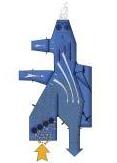
Scheuch first turned its attention to the topic of airstream sorting some 10 years ago and developed the SWSF fibre classifier (SWSF = Scheuch-Wind-Sichter für Fasern) for use in the production of MDF board. Its job is to clas-

tions and ensures the high quality of the MDF sheets, which is especially important in the case of thin sheets. In this system, the fibres are loaded into the classifying room and are subsequently captured by a lateral stream of air that is directed upwards. A second stream of air from below counteracts the downward movement of the fibres and builds a curtain of air. Only those particles with a settling speed higher than that of the rising air stream fall downward. These coarse materials would have caused quality problems during the MDF production process. The fibres themselves — with a lower settling speed — are carried away by the air stream and removed via the classifier’s discharge opening. Scheuch has installed nearly 100 of these plants since 1995 — 75% of which have been installed in Europe. Scheuch offers two proven classifier versions for classifying materials in the recycling sector

specific heavy materials (the heavy fraction) settle downward, whereby the air velocity employed is used to define the materials that are to be discharged. The light fraction (e.g., foil, paper, fibres, wires, etc.) is carried up and away by the air stream.
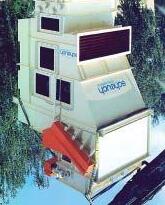
PROVEN DUST FILTRATION FOR BIOMASS-FIRED HEATING AND CHP PLANTS

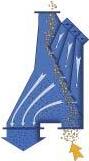
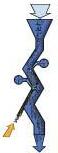
For applications involving the classification of finer materials, where more precise separation is required, Scheuch implemented the principle of up-current classification in a zigzag classifier. Because of the zigzag shape of the upcurrent ductwork, the coarse material that slides down the slanted walls is repeatedly fed diagonally through the air stream and “reclassified”. The circulating air currents that build in the corners of the ductwork also provide for good dispersing of the feed material and cause additional re-classifying effects.

In the last 10 years, Scheuch has installed 250 Type SEF dry electrostatic precipitators, a fact that underscores the reliability of our separators and confirms the satisfaction of our customers with this technology. Meanwhile, dust removal units of this type now leave our plant in Aurolzmünster at the rate of nearly one unit per week.

Scheuch developed the cascading classifier especially for applications requiring the removal of filler material in the gravel and crushed stone industries. In this method, the separation process takes place in two stages: The sand classifier is fed from above with material, which then flows downward over several cascades. The air required for the classification process is drawn in from below and is then blown crossflow and at high speeds through the material by the cascades, which function here as nozzles. This creates high shearing forces that separate ultra-fine grains from coarse grains. It is important for subsequent gravity separation to achieve a uniform up-current flow. In this process, coarse-grained material falls down and out of the classifier, while ultra-fine material is carried upward by the air stream and then out of the classifier for separation in a dedusting plant.

All of Scheuch’s classifier versions at a glance: 1

Fibre classifier SWSF for MDF board production 2

1

sify and remove from amongst the fibres such coarse materials as fibre balls and clumps, or foreign matter such as metal or rubber particles. This eliminates material-related malfunc-

scheuch emissionen

6

2

3

(e.g., building rubble and waste). One of these, the fall shaft classifier — also called an upcurrent classifier — is used to classify coarse materials. In this variant, compact, coarse and
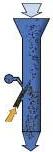
Fall shaft classifier

3

Zigzag classifier for material classification

4

Cascaded classifier for removing filler material

4

Scheuch sand classifiers offer outstanding separation performance with adjustable filler removal, e.g., from 25% filler proportion to about 5 percent.

Electrostatic precipitators for small boiler plants Responding to customer requests, Scheuch has expanded its lineup of compact electrostatic precipitators. Boiler plants with rated outputs starting at circa 400 kW can now also be dedusted using a dry electrostatic precipitator without having to sacrifice reliability and convenience during inspection and maintenance work.

Increase in applications using system combinations Equipment combinations that use an electrostatic precipitator with an integrated multicyclone for dust removal continue to gain popularity because of their undeniable advantages (operating safety, space requirements, maintenance, etc.). In addition to many compact installations, large-scale power plants are also making increased use of our equipment com-

binations. One good example is the wood industry’s Holzindustrie Pfeifer, where a filter and ERCS unit were installed in 2002 and 2003. Now, Pfeifer has installed a two-field electrostatic precipitator with integrated multicyclone in its recently erected biomass-fired CHP plant (26 MW rated thermal output). In operation since September 2004, this equipment combination reduces dust levels to < 10mg/Nm3dry.

New Orders / New Markets An environmentally friendly, biomass-fired combined heating and power plant (CHP) that is also energy- and resource-friendly is currently being built at the site of a heating plant operated by IWV in Ilmenau, Germany. The new building for the plant is home to a BERTSCH biomass-fired boiler plant with a tapped condensation steam turbine and a steam/hot water heat exchanger. BERTSCH has commissioned Scheuch to deliver and assemble a flue gas cleaning plant based on the principle of dry sorption. Because the plant uses wood fuel from the classes AI, AII, and AIII, the technology used must comply with the strict emission guidelines of 17. BlmSchV. On the one hand, heat created by the plant and tapped from the turbine will be used to supply the long-distance heating network operated by IWV. On the other, the plant will also generate electrical energy that will be fed to the public power grid under conditions determined by the EEG. Because it will be fired by biomass, this planned CHP plant and its use of renewable energy sources does more than just contribute to a reduction in the greenhouse gas CO2. It also helps conserve our planet’s limited fossil fuel reserves by coupling the production of

power and heat. ANDRITZ AG is to deliver a sewage sludge drying and incineration plant for a location in Eferding/Upper Austria and has commissioned Austrian Energy & Environment to supply a flue gas cleaning plant based on the TURBOSORP® process. Scheuch will provide the fabric filter and all mechanical components and will carry out their assembly. Startup for the plant is scheduled for 2004/2005. Scheuch has been commissioned by VA TECH ELIN EBG to erect a cleaning plant for flue gases resulting from the thermal combustion of residual waste at the Mayr-Meinhof cardboard plant in Hirschwang/Lower Austria. This IMPULSE bag filter plant has been designed to use the dry sorption process to remove dust and precipitate harmful acidic gases/heavy metals and PCDD/F. It consists of a pre-separation cyclone, filter, induced draft fan, additive supply system and residual waste disposal system. The technology achieves high precipitation rates while simultaneously using simple process technology. Commissioning of the plant is planned for February 2005. Biomasse-Kraftwerk Fechenheim (BKF), a joint venture of MAINOVA AG and WISA GmbH, is building a biomass-fired power plant on the

property of ALLESSA Chemie GmbH in Frankfurt-Fechenheim. The new CHP plant produces steam for its operator, ALLESSA Chemie GmbH, and electricity for the municipal power network. At the same time, it provides for local thermal incineration and appropriate disposal of used wood and wood scraps. General contractor for the plant is MAB Anlagenbau Germany GmbH, a subsidiary of MAB located in Munich. Scheuch is to deliver and assemble a complete flue gas cleaning plant based on the dry sorption process to ensure the plant’s compliance with the emission limits of 17. BlmSchV. The plant will have a rated thermal output of 44 MW and will convert 105,000 tons of wood and green cuttings annually to produce circa 94,000 MWh of steam and circa 70,000 MWh of electricity. The biomass-fired CHP will not only be equipped with an extremely robust and mature technology that permits — in contrast to other plants —the use of coarse fuel. It will also meet the most stringent environmental standards. In addition, this combined CHP plant promises to distinguish itself through an outstanding overall level of efficiency.

emissionen 19 scheuch


Turn static files into dynamic content formats.

Create a flipbook
Material separation systems by Scheuch - Issuu