BENEFITS FILTERED OUT PROGRESS THROUGH INNOVATION
Scheuch GmbH Weierfing 68 4971 Aurolzmünster Austria Phone +43 / 7752 / 905 – 0 Fax +43 / 7752 / 905 – 65000 E-Mail office@scheuch.com Web www.scheuch.com
BENEFITS AT A GLANCE ▪ Assured compliance with the most stringent limit values Minimum pollutant concentrations in clean gas mean that future requirements or more stringent statutory regulations can also reliably be met. ▪ High flexibility Even variable operating conditions are possible thanks to a high level of flexibility with respect to volumetric flows, temperatures and pollutant concentrations. ▪ Low operating costs Due to low additive consumption and small amounts of residual material, operating costs can be reduced to a minimum. ▪ Maximum system availability Process design in conjunction with high quality demands ensures maximum system availability for the customer. ▪ Minimum maintenance costs Maintenance can be kept to a minimum thanks to the rugged nature of the components used.
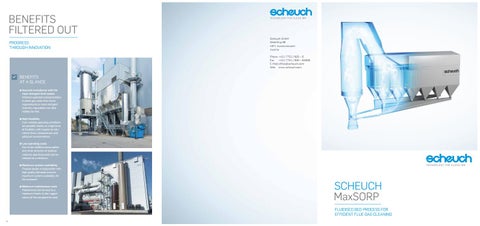
SCHEUCH MaxSORP FLUIDISED BED PROCESS FOR EFFICIENT FLUE GAS CLEANING
5
MAXSORP TECHNOLOGY PRODUCT INNOVATION FROM SCHEUCH
8 The MaxSORP process is based on the principle of conditioned dry sorption and was developed specifically for the high-efficiency separation of acidic gas components such as SO2, SO3, HF and HCl, as well as for the separation of dioxins/furans and heavy metals. 1
The main benefit of this technology is that it consumes just small amounts of input materials (e.g. hydrated lime and activated carbon, also known as additives) while also complying with the most stringent emissions regulations and ensuring maximum system availability. The high recirculation rate combined with intensive gas/solid contact in the reactor ensures a minimum stoichiometry and maximum utilisation of the input materials. This enables operating costs to be reduced to a minimum.
The MaxSORP reactor was devised with optimum gas/solid contact in mind and verified during its development using CFD SIMULATION. 1 5
The process is extremely flexible as it allows for highly fluctuating volumetric flow rates, temperatures and pollutant concentrations. It therefore offers the necessary flexibility for production processes in ferrous and non-ferrous metallurgy, such as sinter plants, as well as across the entire waste-to-energy sector.
3
2
7
6
The lime-based additive used to separate ACIDIC GAS COMPONENTS is supplied by truck and stored temporarily in the silo. It is dispensed based on the concentrations of pollutants in order to ensure minimum consumption.
4
6
3
At the entry to the reactor, the gas is accelerated through a VENTURI NOZZLE in order to disperse the discharged additives and recirculate them into the gas flow. As a result of this, the flow speed in the reactor is reduced to ensure the dwell time necessary for separation and make sure that the components are mixed together well.
The patented EMC FILTER TECHNOLOGY enables bags of over 10Â m in length to be cleaned gently and effectively at a low cleaning pressure. With this process, the active filter area remains unchanged and the filter differential pressure is kept stable.
7
2 The WATER INJECTION process integrated in the reactor enables the optimum temperature and gas humidity for the process to be set, meaning that there is no need for an additional quench system upstream of the reactor.
The Scheuch IMPULS CLEANING SYSTEM with twin nozzles ensures uniform cleaning throughout the entire length of the filter bags, also allowing for minimum compressed air consumption.
8
In order to separate DIOXINS, FURANS AND HEAVY METALS, activated carbon or activated lignite HOK is used, which is also stored in a silo.
2
4 5
By RECIRCULATING the dust and unused additive separated in the filter (typically using air slides), the amount of input materials needed is dramatically reduced, as these were not fully utilized during the system’s first cycle. With the MaxSORP process, a solids concentration of up to 1000 g/m3 is achieved in the reactor, significantly increasing the surface contact of the individual additive particles.
The fully REACTED INPUT MATERIALS AND DUST are conveyed to the residual material silo and stored there until they are collected by truck. Transportation to the silo can take place either pneumatically or mechanically, subject to requirements.
3
4