Advancing Integration Across Health Procurement & Supply Chains
A Case Study Series
Evidence and guidance for advancing integration across health procurement and supply chains
May 2026
Reader note
This paper is intended for the global health supply chain community to help align strategy, inform investment decisions, support integration efforts, and strengthen coordination across partners. It also serves as a practical resource for in-country public health leaders, policymakers, and supply chain stakeholders responsible for designing, financing, governing and implementing health supply networks.
This paper is designed as a companion to the Transforming Health Procurement and Supply Chains paper (September 2025), which sets out a vision for integrated, sustainable health supply networks. This paper follows the vision. It provides evidence, analysis, and guidance on the progress of integration in practice, drawing on real-world examples from across health supply networks. Together, the two papers offer a coherent framework and next steps to support countries and partners in strengthening integrated health supply networks.
Readers are encouraged to use this paper as a practical resource to inform planning and action. The sections and case studies can be reviewed selectively, based on what is most relevant to your context and priorities. It may not apply equally to all stakeholders.
Authorship and Acknowledgement
This case study series was developed by the Supply Chain Funders' Forum and the Integration Taskforce: a group of supply chain representatives and experts committed to advancing integrated, sustainable health supply chain networks that improve access to quality products, promote equity, and strengthen resilience.
We extend a special thank you to the national stakeholders and development partners who contributed these case studies. Their insight and collaboration in developing and refining these examples has ensured they reflect practical integration approaches, country experience and the potential to strengthen health supply chain performance.
Acronyms & Abbreviations
3PL Third-Party Logistics Provider
4PL Fourth-Party Logistics Provider
AIDS Acquired Immunodeficiency Syndrome
AI Artificial Intelligence
AOP Annual Operational Plan
API Application Programming Interface
ARV Antiretroviral
BUQ Bottom-Up Quantification
CCSWG Contraceptive Commodity Security Working Group
CEWG Country Engagement Working Group
CHA Community Health Assistant
CHP Community Health Promoter
CHPS Community Health Planning and Services
CHU4UHC Community Health Units for Universal Health Coverage
CHW Community Health Worker
cLMIS Contraceptive Logistics Management Information System
CMAM Central de Medicamentos e Artigos Médicos [Central Medical Store, Mozambique]
CSIR Council for Scientific and Industrial Research [South Africa]
DCH Division of Community Health [Kenya]
DHPT Department of Health Products and Technologies [Kenya]
DPS Direção Provincial de Saúde [Provincial Health Directorate, Mozambique]
DQA Data Quality Assessment
eBUQ Electronic Bottom-Up Quantification
eCHIS Electronic Community Health Information System [Kenya]
ECR Electronic Client Record [Pakistan]
eLMIS Electronic Logistics Management Information System
ENSPHCDA Enugu State Primary Healthcare Development Agency [Nigeria]
EPI Expanded Programme on Immunization
FMCG Fast-Moving Consumer Goods
GHI Global Health Institution
GhiLMIS Ghana Integrated Logistics Management Information System
GHS Ghana Health Service
GHSC-PSM Global Health Supply Chain Program – Procurement and Supply Management
HIV Human Immunodeficiency Virus
HPT Health Products and Technologies
HR Human Resources
IDMIS Infectious Disease Management Information System [Pakistan]
IFP Instalasi Farmasi Pusat [Central Pharmacy Warehouse, Indonesia]
ISG Interagency Supply Chain Group
KEMSA Kenya Medical Supplies Authority
KES Kenyan Shilling
KFA Kamus Farmasi dan Alat Kesehatan [Pharmaceutical and Medical Device Dictionary, Indonesia]
KPI Key Performance Indicator
LGA Local Government Area
LHW-MIS Lady Health Worker Management Information System [Pakistan]
LMD Last Mile Distribution
LMIS Logistics Management Information System
MHSRC Ministry of National Health Services, Regulation and Coordination [Pakistan]
MOH Ministry of Health
MSD Medical Stores Department [Tanzania]
MSI Master Facility Index [Indonesia]
NDoH National Department of Health [South Africa]
NHI National Health Insurance [South Africa]
NPSU National Pharmaceutical Services Unit
OSM Outcome-Segment-Model
PEPFAR President’s Emergency Plan for AIDS Relief
PHC Primary Health Care
PHCDA Primary Healthcare Development Agency
PPE Personal Protective Equipment
PSE Private Sector Engagement
RFP Request for Proposals
RLS Redesigned Logistics System [Tanzania]
RMS Regional Medical Store
SC4CHW Supply Chain for Community Health Workers
SCFF Supply Chain Funders’ Forum
SCLF Supply Chain Leaders Forum
SELV Sistema Electrónico de Logística de Vacinas [Electronic Vaccine Logistics System, Mozambique]
SKU Stock Keeping Unit
SLA Service-Level Agreement
SMILE System for Monitoring Immunization and Logistics Electronically
SOP Standard Operating Procedure
SSDM Supplies, Stores and Drug Management Division [Ghana]
SVS Stock Visibility System [South Africa]
TB Tuberculosis
TSS Target Software Standards
UNDP United Nations Development Programme
UNFPA United Nations Population Fund
USAID United States Agency for International Development
VAN Visibility and Analytics Network [South Africa]
1. Problem Statement
Why vertical models emerged.
Today's health procurement and supply chains were primarily built to serve disease-specific programs: HIV, malaria, tuberculosis, and immunization. They reflect how each program was financed and by whom, and the required accountability. Donors were responsible for demonstrating results against specific targets, while governments were responsible for reporting on programmatic delivery.
Purpose-built, program-specific supply chains offered the fastest way to deliver results. Stockout rates for HIV commodities fell. Vaccine coverage expanded to populations never reliably served before.
Those results, however, reinforced a structural pattern of fragmentation. Programs that successfully met their targets had limited incentive to merge with other delivery models or systems; doing so could jeopardize performance and add risk. Similarly, donors had no incentive to pool funding with partners, especially where donors lacked direct oversight of implementation and results.
In Côte d’Ivoire, program managers withheld logistics data from a shared platform because the prevailing accountability framework rewarded program-level results rather than system-wide visibility.
Under these conditions, fragmentation emerged as a rational outcome of the incentive structure and operating model. Governments, GHIs, donors, and the private sector fulfilled roles often in silos or in parallel within this model.
Governments
• Manage funding flows and report on program delivery.
• Often, central medical stores manage commodities per program.
• In devolved systems, subnational entities hold constitutional supply chain authority; national frameworks cannot compel compliance.
• Finance vertical programs under disease-specific conditions.
• Maintain separate procurement rules, reporting cycles, and information systems.
• GHIs and bilateral donors operate parallel architectures within the same countries.
• Fill delivery gaps the public system cannot cover.
• 4PLs/3PLs operate on donor-funded routes; private pharmacies stock where official channels fail.
• Participation is transactional, with no structural connection to the public system.
Figure 1. The current landscape: legacy stakeholder roles.
GHIs and Donors
Private Sector
Governments report on program-specific indicators. GHIs and donors measure attribution against their own mandates. The private sector participates where market signals make it viable. The fiscal authority that controls supply chain budgets and the program authority that depends on them are rarely the same actor.1
How this affects supply chain performance and health outcomes.
Parallel systems – among many other realities – produce predictable challenges in supply chain functions. Tanzania's forecasting and planning capability was inconsistent and inaccurate before integrating an automated bottom-up quantification (eBUQ) approach. Procurement follows the same logic: fragmented donor procurement systems reduce volume consolidation and foreclose economies of scale.
Mozambique’s initial attempt to procure 3PL delivery services attracted limited interest; routes were too fragmented and payment terms too uncertain to be commercially viable. In Ghana, parallel routes serviced the same facilities, and clinical staff routinely left patient care to collect supplies themselves.
The underlying enablers of health supply chains have been equally fragmented: financing earmarked by program area, governance that rewards program results, and siloed digital systems. Pressure for a more integrated approach has intensified. Health systems must now serve larger populations, in more constrained fiscal environments, with higher expectations, using infrastructure designed for a different era.
Throughout this report, we focus on the role of three stakeholder groups and the actions they can take to advance integration across health supply chains:
• Governments and in-country actors – responsible for setting national priorities, establishing governance and regulatory frameworks, and leading the design and stewardship of integrated supply chain systems. Governments also have a role in enabling the private sector to operate more effectively and efficiently – by setting clear regulatory pathways, addressing barriers to commercial viability, and creating predictable conditions for partnership.
• Global Health Institutions (GHIs) – provide financing, technical assistance, and coordination mechanisms that can enable countries to test, implement, and scale integrated supply chain approaches.
• Private sector partners – contribute operational expertise, technology, logistics capabilities, and data insights that can improve performance and support sustainable delivery models.
1 Note: the SCFF position paper distinguishes Governments from National Pharmaceutical Services Units (NPSUs) as separate actors with distinct orchestration roles.
2. Proposed Solution
Defining integration, its value, and what form it should take.
The Supply Chain Funders’ Forum (SCFF), the Interagency Supply Chain Group (ISG), and the Supply Chain Leaders Forum (SCLF) convene global funders and leaders across health supply networks. They collectively recognized the need for change in these networks –toward those that are sustainable, digitally intelligent, capable of delivering results, adaptable, and resilient.
The three stakeholder groups set out to offer a revised definition of integration and to source, select, analyze, and co-develop in-country case studies that capture examples of health supply chain integration.
Integration is an intentional approach to improving performance outcomes within a particular supply chain segment2 . It can be applied across health programs, functions, products, and geographies to drive operational efficiency, cost effectiveness, and support a whole-of-market strategy that strengthens health systems. Its success is measured by long-term financial sustainability and the ability to be locally stewarded and implemented at scale.
The definition offered here allows for flexibility in the form integration could or should take across unique contexts and stakeholders.
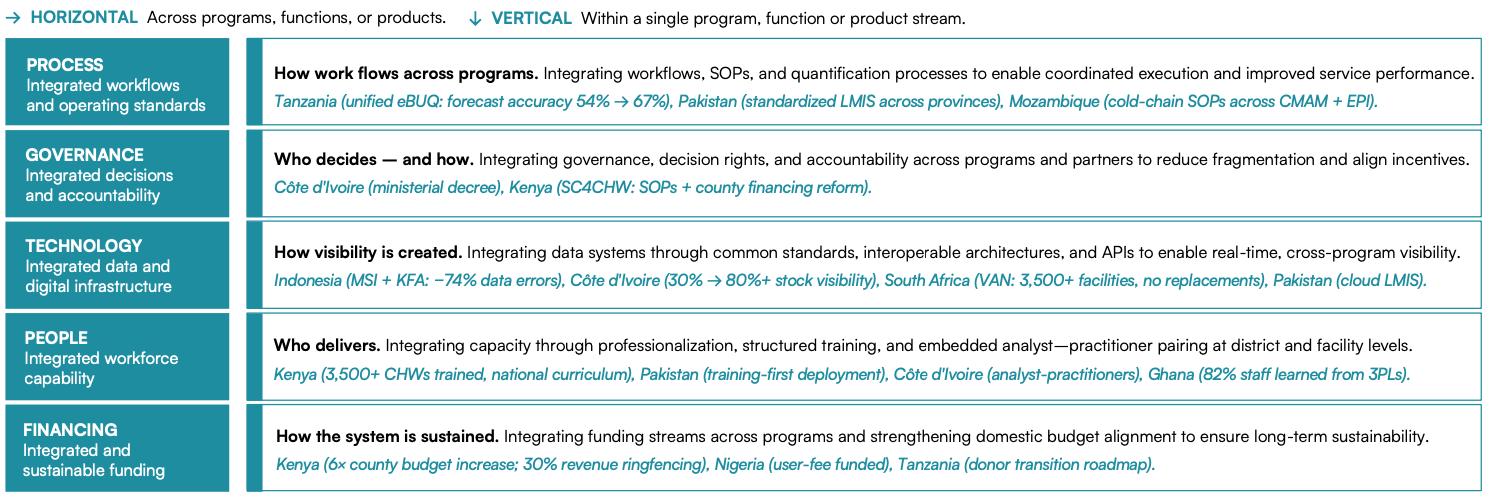
Drawing on a broad review of global operating architecture, alongside the case study evidence, the Taskforce identified five distinct types of integration. It is common to see multiple types of integration used in parallel to achieve desired performance outcomes.
2. Types of Integration.
2 Performance improvements include, but are not limited to, efficiency, reliability, cost, resilience, and service levels across the end-to-end supply chain.
Figure
“Vertical” in this report refers to disease-program, function or product specificity, not supply chain ownership depth in the traditional sense. The integration being described is what industry may recognize as platform-level coordination across previously fragmented delivery systems.
The following integration types are also relevant but not explicitly referenced in the case studies.
• Planning/operational coordination integration is considered within process integration and enabled through technology integration.
• Market/supplier integration is considered within process integration.
Pooled procurement, coordinated tendering, integrated supplier framework agreement examples were limited across case studies.3
Segmentation in health supply chains, and why it is critical to integration.
Health procurement and supply chain performance is typically classified as: overserved, underserved, and/or aligned. The goal is a state of “alignment” in which performance outcomes match requirements. By applying principles of segmentation (within the health sector), stakeholders can better allocate resources where they generate the most value. Most supply chain systems operate effectively with two to five segments. This range allows differentiated service models where necessary while maintaining operational simplicity.
Segmentation in a health supply chain context means grouping products, channels, and populations by their distinct requirements, then designing differentiated service levels for each group.
Historically, segmentation in healthcare procurement and supply chains has focused on geography and product type. Segments can be further defined by function (such as storage, distribution, or procurement) and by delivery channel (for example, facility level, community distribution, or specialized programs).
Effective segmentation is anchored in client needs and operational realities. Segments should reflect where meaningful differences in service requirements exist, such as demand patterns, service expectations, product characteristics, or delivery constraints, with clear performance outcomes.
Segmentation and integration are complementary. Integration is applied selectively to segments where shared infrastructure creates economies of scale, not uniformly across every function.
3 This report does not seek to capture wholescale integration of current program areas or donor investments, or private sector efforts, and recognizes additional integration efforts may be taking place outside of the types defined for the purposes of this report.
The approach to outcome-driven integration.
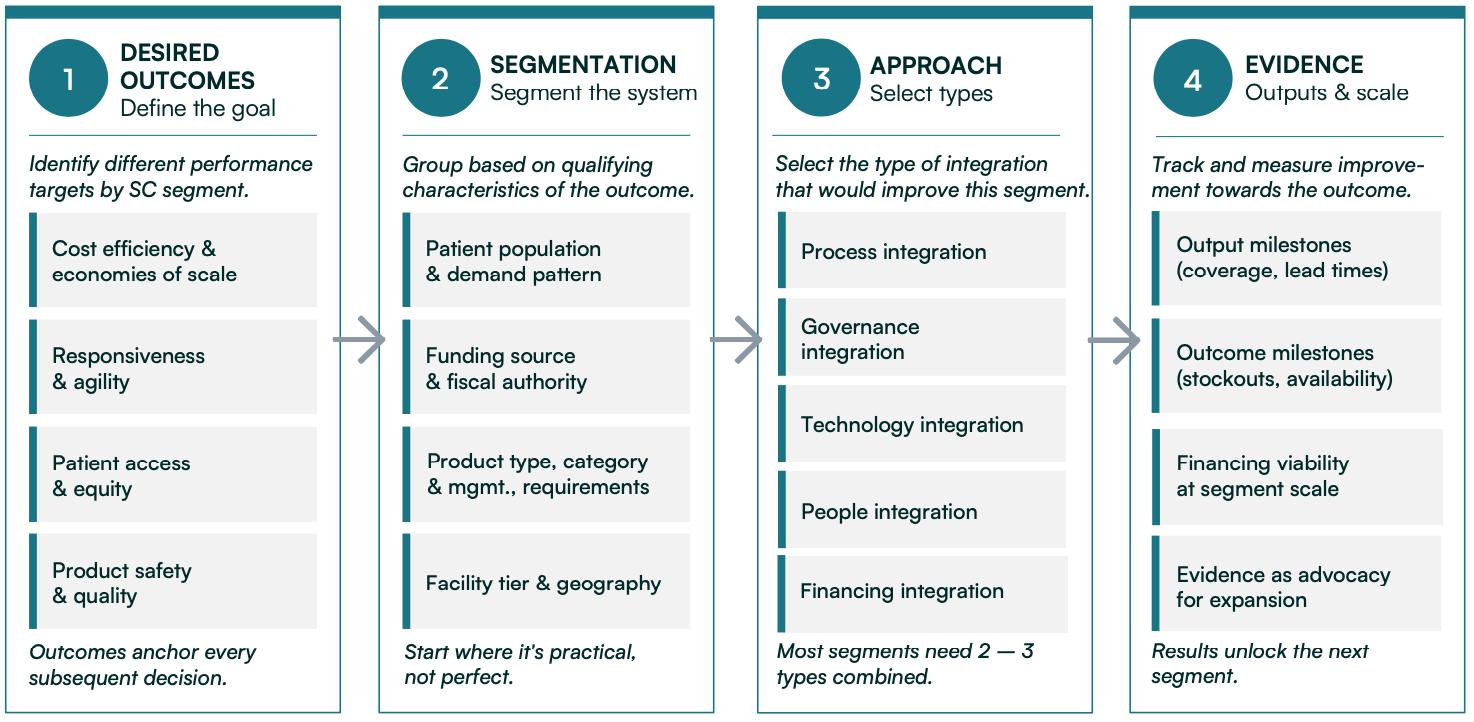
Figure 3 below, informed by Gartner's Outcome-Segment-Model (OSM) framework, offers a stepwise approach to GHIs embarking on, or advising on, health supply chain integration. It is a structured starting point – stakeholders should then decide their goals, segments, and integration efforts based on their health system architecture, fiscal environment, and the political economy of reform.
Figure 3. Sequencing outcome-driven integration.
Commercial logistics, FMCG, agriculture, and other industries have already demonstrated improved performance outcomes, including efficiency, by taking an intentional approach to integration.
Unilever’s “Perfect Store” initiative in emerging markets segmented the retail landscape by outlet type and SKU velocity. High-turnover products were replenished using a different logic than slower-moving items, allowing distributors to prioritize availability where demand was strongest. This differentiated approach reduced stockouts and improved shelf availability, contributing to a 4.5% increase in revenue.
Walmart’s Retail Link, launched in 1991, represents a governance innovation in supply chain integration. By sharing real-time point-of-sale data with more than 60,000 suppliers, Walmart shifted the system from a push model to a demand-driven pull model. Suppliers could see sales data directly and adjust replenishment, accordingly, improving responsiveness and reducing inventory inefficiencies across the network.
ITC’s e-Choupal initiative addressed inefficiencies in India’s agricultural supply chains, where smallholder farmers relied on exploitative intermediaries. ITC redesigned the system by identifying what each node of the supply chain required to function effectively – price transparency, quality grading, and access to scientific farming practices – and built the digital and physical infrastructure to support it. As a result, farmer incomes increased by an average of 2.5%, while ITC gained a more reliable, quality-assured source of agricultural supply.
3. Findings from the Case Studies Series
In 2025, the SCFF and ISG convened an Integration Taskforce of public health supply chain leaders, NGOs, private sector actors, and technical practitioners to define integration, document use cases and develop actionable guidance for different supply chain stakeholders.
The Taskforce reviewed 25 case studies outlining varying efforts to progress integration in health procurement and supply chains. The Taskforce selected a shortlist of 9 case studies for inclusion in this report, based on four criteria (see box).
Selection Criteria
– Case Studies:
• Geographic applicability.
• Program maturity.
• Evidence of quantitative and qualitative outputs.
• Alignment with identified integration priorities and types.
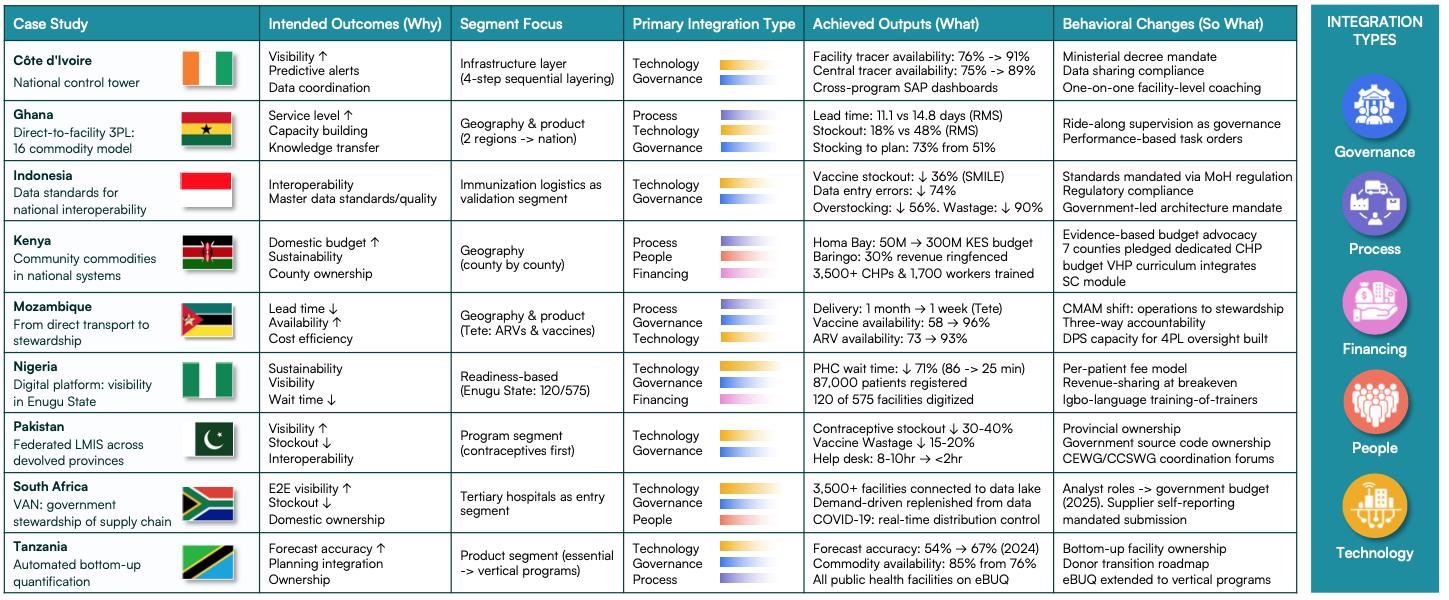
SUMMARY OVERVIEW: Case Study Categorization and Impact Progress
The 9 case studies span sub-Saharan Africa and Asia, cover the 5 integration types, and represent different stages of implementation, from early pilots to nationally scaled models over several years. The full case studies are included at the back of this report for reference.
4. Case Study Categorization and Impact Progress.
Figure
What the evidence shows4
Operating models have advanced more quickly than financing models.
While integration efforts are improving coordination, efficiency, and system performance, the underlying financing structures often remain fragmented, short-term, or tied to programspecific funding. This limits their ability to move from pilot implementation to sustained system-wide adoption.
Government budget alignment. In most cases, integration approaches were not documented against the domestic budget line that would ultimately need to finance them. As a result, there was no clear pathway for governments to absorb these costs once external support ended. There is only one case study in this portfolio where evidence was presented directly to the budget authorities. In Homa Bay County, Kenya, audit data provided key funding gaps and led to a sixfold increase in commodity budgets.
Private sector commercial viability. Private sector operators cannot sustain participation without payment reliability, consolidated demand, and viable route economics. Mozambique’s redesigned model addressed this barrier to partnership directly – they provided evidence of the unit economics and break-even data needed to design a commercially sustainable 3PL contract from domestic resources. The redesigned RFP attracted viable bidders, and the Tete pilot demonstrated proof of concept: vaccine availability improved from 58% to 96%, ARV availability from 73% to 93%, and delivery lead times fell from one month to one week in some districts. By 2019, outsourced delivery had scaled nationally to cover all CMAMmanaged (Central de Medicamentos e Artigos Médicos/ Central Medical Store) commodities, supported by a dedicated budget line for outsourced transportation and a CMAM role that had shifted from direct transport management to contract stewardship.
Alternative financing models. Nigeria’s Elephant-OS operates on a per-patient user fee model, without direct operational funding from government or donors. While the model demonstrates an innovative, alternative financing approach, its commercial viability will need another few years to be determined
4 Quantitative and qualitative outputs cannot be causally linked with the integration approach. Figures should be read as directional evidence of progress.
Digital technology serves as the primary entry point for integration.
Integration efforts in health supply chains often begin with digital technology platforms, which provide the foundation for shared data visibility and system coordination.
6 of the 9 examples center on electronic logistics management information systems (eLMIS) and digital platform development. Indonesia established national master data standards and scaled the System for Monitoring Immunization and Logistics Electronically (SMILE) as part of a national SATUSEHAT ("One Health") ecosystem solution. Pakistan also built a national interoperability platform on standardized data definitions, with government ownership and stepwise rollout by segment. Côte d’Ivoire and South Africa added aggregation layers over existing program-specific eLMIS solutions, connecting platforms rather than replacing them. All approaches produced measurable outputs, yet none resolved the gap between visibility and operational performance on their own.
Across the case studies, digital investments have consistently improved supply chain visibility and created shared data platforms across previously fragmented systems. However, translating this visibility into integrated decision-making and improved performance remains a challenge. Actions such as redistribution, procurement adjustments, and resource allocation depend on evidence reaching the actors who control operational and budgetary decisions. Without these links to governance and financing, digital integration improves information flow but does not fully translate into coordinated system performance.
Scaling rarely occurs through uniform system-wide reforms. In every case where integration took hold, it started in a single, bounded segment – establishing operational evidence and addressing issues before expanding.
Pakistan validated the national eLMIS with contraceptives before expanding to vaccines and infectious disease products. Mozambique piloted 3PL delivery with antiretrovirals (ARVs) and vaccines in Tete province before national rollout. In each case, the evidence from the segment-led approaches enabled the next phase of integration. Notably, however, the 9 cases did not include clear segmentation by patient population or demand pattern.
Where segmentation guided implementation, integration efforts demonstrated measurable performance improvements and built confidence among decision-makers. These early results created the operational evidence needed to expand the model to additional segments. In contrast, attempts to scale without clear segmentation often struggle to align decision-making.
Private sector participation remains inconsistent and uncertain.
Private sector participation in this portfolio is inconsistent. Policy ambiguity, fragmented procurement, and unreliable payment all reduce the commercial case for engagement. The private sector has the potential to contribute operational capabilities and efficiency.
Two case studies, Ghana and Mozambique, focus on piloting and scaling distribution through private sector, third-party logistics (3PL) providers. Mozambique’s initial 3PL procurement attracted no viable bids; however, a redesigned model with consolidated routes, three-way contracts, and reliable payments improved commercial viability. Ghana expanded its 3PL network nationwide but did not establish a contract-transfer pathway – when the Global Fund support ends, several regions may lack a domestic last-mile delivery budget to sustain operator engagement.
Where engagement with the private sector has occurred, it has often been project-based or donor-supported rather than embedded within long-term national supply chain strategies. Clearer governance frameworks, predictable financing mechanisms, and well-defined roles will be necessary to enable private sector actors to contribute reliably to health procurement and supply chain systems.
Governance is the critical determinant of successful integration.
Governance emerged as a determinant of whether investments generated lasting system performance improvements or remained isolated interventions.
Investments in infrastructure and digital platforms often create new capabilities. The ability to maintain and use these capabilities depends on clear governance arrangements. Decision rights, accountability mechanisms, and coordination structures shaped how they were managed and integrated into routine system operations.
Mozambique’s early pilots stalled due to unclear roles, which were later clarified by champions and technical working groups ahead of scaling the technology. In Côte d’Ivoire, program managers withheld logistics data until a ministerial decree mandated disclosure. Where governance frameworks were clearly defined, stakeholders were able to coordinate decisions, maintain shared assets, and adapt investments as system needs evolved.
4. Guidance for Implementation
Guidance for supply chain stakeholders is structured in three layers: before, during, and after integration activities. Together, the three layers address the conditions that must exist for successful integration: the design choices that determine what gets built, the operational requirements that determine the critical implementation steps, and the sustainability considerations that determine whether results hold. A fourth layer focuses on technology integration, given the prevalence of integrated digital platforms and solutions.
Layer 1: Pre-Conditions
Define the government's stewardship role
Map what segmented chains and systems cost to operate
Audit utilization of existing systems before investing in new ones.
Define governance before deploying technology.
Design the financing model alongside the operating model, not after it.
Layer 2: Design
Start in a defined segment, prove the approach, then expand
Consolidate demand across programs before PSE
Design contracts that embed accountability on both (or multiple) sides.
Address barriers that make private participation unviable.
Layer 3: Implementation
Embed training capacity in the operating model.
Layer 4: Tech Foundations
Establish master data standards early.
Embed analyst capacity in the operating model, not in partner contracts
Direct performance data at budget authorities, not just program managers.
Transfer contract management to the government progressively.
Select the integration approach based on what the segment requires.
Assess local infrastructure realities before selecting a solution.
Develop a costed business case before committing to a technological solution.
Plan implementation across systems, data, processes, and people.
Train before deployment, and fund support as a sustained phase.
Figure 5. Summary of guidance layers.
Layer 1: Before deployment, establish the conditions
Motivated by Findings 2, 3, and 4: financing models should be designed in tandem with operating models, with governance structures funded and embedded into system design.
Define the government's stewardship role. Systems designed primarily around implementing partner execution, without a clear pathway for government stewardship, rarely succeed. Where integration has been successful, governments have been explicit about what functions they retain and what they delegate.
Strategic authority should remain with the government, e.g., setting performance expectations and managing performance against them, defining accountability structures, retaining final decision rights on procurement and delivery standards. Operational functions can be delivered through third parties and partners under clearly defined contracts.
Progress toward a stewardship role can take different forms. Governments may delegate operational services through structured contracts or partnerships, provided these arrangements include clear roles, accountability mechanisms, and defined transition points. Over time, this approach allows governments to maintain strategic control while drawing on external capabilities to support service delivery.
Map what segmented supply chains and systems cost to operate. Without this baseline, integration efforts cannot identify duplication, estimate costs and savings, or build a credible case for budget advocacy.
Governments should commission cost mapping before integration design begins, capturing both operating and capital costs across key system components, e.g., per delivery route, per digital system, and per facility served. This provides the evidence needed to evaluate integration options and inform budget planning.
GHIs should reinforce this practice by requiring grantees to document existing system costs alongside the projected costs of proposed integration models as a condition of grant approval.
Audit utilization of existing systems before investing in new ones. Layering new systems on top of existing or underused ones does not resolve why earlier systems failed to deliver value.
Before procuring or designing new solutions, diagnose clearly what broke the last system. Identify whether the constraint is technical, behavioral, or structural: how existing tools are being used, what is blocking adoption, and whether the problem lies in technology, processes, incentives, or governance.
Once these underlying issues are understood, additional systems or investments can be considered. This approach keeps integration efforts focused on strengthening system performance rather than adding further complexity.
Define governance before deploying technology. Document decision rights across each segment: who holds authority for operational, financial, and performance decisions. Establish standard operating procedures for shared processes across organizations.
Change management should be treated as a parallel workstream to technical implementation, ensuring that stakeholders understand new roles, incentives, and processes. Champions and coordination forums are essential to align actors and turn fragmented delivery arrangements into a coordinated network. Governance design should be resourced and planned like any other reform effort, with dedicated budget lines, clear accountability structures, and sequenced milestones.
Design the financing model alongside the operating model, not after it. Identify the domestic budget line (and other investment and financing mechanisms) that will support operating costs before any segment is expanded. Integration efforts should not be scaled without a clearly defined and costed financing pathway.
GHIs should avoid funding new operating models unless there is an agreed plan for sustaining recurrent costs over time. Where traditional public financing is insufficient, innovative co-financing approaches may be required (e.g., commodity markups, facility revenue ringfencing, blended transition funding). These mechanisms often require coordination across GHIs. Private sector partners can support this by sharing cost-to-serve data: unit economics, route costs, and breakeven volumes.
Layer 2: During design, decisions that determine what is built
Motivated by Findings 2, 3, and 4 described in Section 3: designing systems based on clear segmentation, implementing a fully costed digital architecture, and actively engaging the private sector.
Start in a defined segment, prove the approach, then expand. Segment-level results enable integration approaches to scale. The evidence that enables scale is demonstrated performance, not a plan.
Segmentation should be deliberate, and evidence based. It should go beyond distinctions such as product category or geography to reflect where service requirements differ; what clients need, where demand patterns diverge, and what point-of-care requirements are needed.
The key question is whether a single approach can effectively serve multiple populations, or whether differentiated service models are required. Segments should be clearly defined and
operationally grounded. If a segmentation cannot guide a procurement or staffing decision, it needs to be simplified.
Consolidate demand across programs before engaging the private sector. Without aggregate demand, private sector participation remains project-dependent, regardless of contract quality. Route economics depend on volume; volume requires cross-program coordination.
GHIs should aggregate demand across funded programs to create viable route volumes and reduce transaction costs through shared RFP frameworks and contract templates, while governments should aggregate commodity volumes across programs before procurement.
Design contracts that embed accountability on both (or multiple) sides. Third-party contracts should be performance-based, with measurable service-level agreements (SLAs), defined roles, and payment linked to compliance. Ambiguity around responsibilities is the most common source of early implementation failure.
Contracts should also require 3PL providers to submit delivery assets and operational data into national information systems as a condition of service. Private sector partners should build on open-source standards and define the pathways and APIs so that data produced flows into the national system from day one.
Address barriers that make private sector participation commercially unviable. Payment reliability, financing risk, and access to working capital determine whether a viable commercial market exists.
GHIs can advance engagement and play a key role in de-risking participation. This includes investing in shared RFP frameworks, contract management templates, and payment reliability mechanisms, such as escrow arrangements or advance payment facilities, when domestic payment systems are slow.
Governments should assess whether the commercial conditions required for private sector participation are in place before launching procurement, rather than discovering constraints after the first round of bids fails.
Layer 3: Through implementation, what must be sustained for results to hold
Motivated by Findings 1 and 5 described in Section 3: at the transition end, operating models must be scaled alongside the workforce, financing mechanisms, and transfer of contract stewardship.
Embed training capacity in the operating model. Training and capacity building should continue beyond the initial go-live phase to reinforce adoption and maintain capability across the network.
Ongoing support mechanisms, such as helpdesk support and peer learning channels, are essential to sustain system use and resolve operational issues as they arise. They require their own budget line. GHIs should fund these capabilities as an integral component of platform and solution investments.
Embed analyst capacity in the operating model, not in partner contracts. Pairing analysts with practitioners helps translate data infrastructure into operational decisions. For this capacity to survive beyond the grant, it must be costed against a government budget line from the design stage.
GHIs should fund analysts, trainers, and helpdesks as part of the platform investment. Where domestic budgets cannot absorb these roles, governments should negotiate a phased transition plan to gradually transfer partner-funded roles to government financing before programs close.
Direct performance data at budget authorities, not just program managers. Performance data drives resource allocation only when it reaches budget authorities, not just program managers. Evidence on system performance must therefore be directed to the institutions that control fiscal allocations.
GHIs should require performance findings to go to fiscal authorities and fund supply chain audits as standard grant-making components.
Transfer contract management to the government progressively, with defined milestones. Governments cannot steward systems they cannot see. The transfer of knowledge and authority must be defined as a milestone sequence at the contract design stage. GHIs should require all supply chain investments to name the domestic budget pathway and milestone sequence for transition from the outset. Where sustained financing is expected from the government, the contract should also define milestones for the progressive transfer of responsibility to the government.
Joint field supervision (government staff accompanying private operators using standardized checklists) can build operational knowledge incrementally rather than focusing on learning during a single handover at the end of a contract. Private sector partners should also share cost structures, breakeven points, and service performance data with government counterparts to support informed oversight and long-term system stewardship.
Layer 4. Beneath all layers: establish the data and digital foundations
Motivated by Finding 2 and 4 described in Section 3; digital solutions should align to the operational problem and infrastructure, prioritizing interoperability and sustained implementation support
Select the integration approach based on what the segment requires. Different digital approaches serve different integration objectives. An interoperability platform is appropriate
where the goal is system-wide data exchange. An aggregation layer is better suited where existing systems are functioning but lack cross-program visibility. A facility-level solution starts at the point of care and works upward, using transaction data to drive replenishment and inform upstream planning.
Each approach carries distinct institutional requirements, cost structures, and "failure" modes. For this reason, GHIs should avoid prescribing a specific technological approach in grant design before the government has defined the purpose of the segment and the operational problem the technology is intended to solve.
Assess local infrastructure realities before selecting a solution. Offline functionality and minimal hardware requirements are not optional features in low-connectivity settings; they become solution selection criteria.
Private sector operators should adapt their operating models to subnational regulatory frameworks and logistical realities rather than requiring governments to standardize systems or processes to meet platform requirements.
Develop a costed business case before committing to a technological solution. Weigh implementation costs (capital, operational, training, ongoing support) against quantified performance outcomes.
A business case that presents costs without benefits, or benefits without costs, cannot support procurement decisions or sustain budget advocacy. GHIs should therefore fund comprehensive business case development as a standard condition of grant support.
Plan implementation across systems, data, processes, and people. Technology change rarely fails for technical reasons alone. Governance structures, data workflows, processes, and organizational roles must be redesigned alongside the system, so it performs as designed, not just as deployed.
Change management should be treated as a parallel workstream, with its own timeline, budget, and accountability. At the contracting stage, stakeholders should also confirm platform ownership, hosting arrangements, and long-term continuity obligations.
Establish master data standards. Creating aligned master indices and definitions across data standards is critical for future interoperability and sustainable governance. This includes location master lists, product catalogues, and data-sharing protocols aligned with GS1's supply chain standards and Target Software Standards (TSS).
Prioritize connecting existing systems before considering replacements. Interoperability helps protect prior investments, reduces institutional resistance, and can be implemented more quickly than building new platforms. When new digital systems are introduced without integration within existing architecture, they risk duplicating capabilities and weakening system coherence.
GHIs that fund standalone eLMIS deployments outside interoperable frameworks can inadvertently undermine earlier investments. To avoid this, interoperability and compliance
with standards such as GS1 and TSS v3 should be established as conditions of digital health funding and system development.
Train before deployment, and fund support as a sustained phase. Sequence training ahead of system rollout in every jurisdiction using a cascaded model: national super-users first, followed by regional trainers, and finally, facility-level end users. Helpdesk support and peer-learning channels should be made available throughout deployment.
GHIs should fund training as a planned implementation phase with its own timeline and budget, and deliverables. Training and capacity building are what enable systems to be adopted and used effectively in practice.
The four layers above translate into concrete, time-bound actions. The table below consolidates the most critical steps for each stakeholder group governments, GHIs, and the private sector organized by the five action areas that cut across all layers. These are not sequential phases; many actions should be initiated in parallel and revisited as integration progresses.
Summary of actionable next steps for priority stakeholders.
Action Area Governments
Data standards and approach selection
Business case and infrastructure
Establish master data standards (GS1, TSS v3) before any system connection. Define segment purpose before specifying technology approach.
Make interoperability and GS1/TSS v3 compliance conditions of digital health funding. Do not specify technology approach before government has defined segment purpose.
Build on open standards with documented APIs. Define national platform connection pathway at contract stage.
Implementation planning and training
Commission costed business cases weighing implementation costs against quantified performance outcomes. Assess infrastructure realities before procurement.
Fund change management as a parallel workstream with its own milestone sequence. Embed training into rollout planning of deployment.
Fund business case development as a standard grant condition. Require performance outcomes to be quantified alongside costs.
Fund change management and training as planned grant phases, not absorbed within system implementation costs.
Publish cost and performance data so business cases reflect real unit economics.
Adapt operating models to subnational infrastructure realities.
Commit to training support through go live
Demand consolidation and contracts
Private sector de-risking (incl. insurance)
Aggregate commodity volumes across programs before 3PL procurement. Ensure government procurement teams understand and can manage contract provisions.
Assess whether commercial conditions for participation exist before issuing RFP. Work with insurers to facilitate group coverage for local operators.
Aggregate demand across funded programs through shared RFP frameworks. Require 3PLs to feed data into national systems as a contractual obligation.
Commit to multi-year structural engagement. Build on open standards with documented APIs.
Fund escrow, advance payment, and group insurance mechanisms to address payment reliability and operational risk for smaller operators.
Share route profitability and cost-to-serve data. Engage with GHIfacilitated insurance arrangements where they reduce participation risk.
5. Conclusion
9 countries demonstrated that outcome-driven integration can be effective in real-world settings. Mozambique expanded national 3PL coverage from one province. Indonesia achieved interoperability across hundreds of systems. Kenya used supply chain audit data to increase county commodity budgets sixfold. These are not pilots requiring further validation; they are proven models ready for replication.
The transition from donor-supported systems to domestically sustained networks has started. Countries that act now, while financing structures and institutional relationships remain flexible, will shape the next generation of health supply networks.
For country supply chain leaders: Clearly define the authority the government retains and which it delegates. Map operating costs of health procurement and supply chains to domestic budget lines before the next grant cycle closes. Use performance data such as stockout rates, cost comparisons, and audit findings to build a compelling budget case for finance ministries. Countries in this portfolio that mobilized domestic resources did not wait for a favorable political moment; they created one using evidence.
For GHIs and donors: The design of each organization’s funding model will determine its sustainability. The role of funders is shifting from program financing to transition partnership. Financing should be aligned to support integration and long-term transition. Governance should be funded as a distinct investment, with dedicated budget lines and clear milestones. Continued investment in digital interoperability will be critical. Structural barriers to private sector participation should also be addressed before issuing the next RFP.
For the private sector: The public health supply chain market is seeking long-term structural partners. Organizations that share cost-to-serve data, commit to multi-year engagement, and provide delivery data to national systems as a contractual standard will be best positioned to help design integrated networks.
This guidance reflects what 9 countries have implemented - and, in some cases, struggled to sustain. Start where you are. Validate at the segment level. Let results inform the next stage.
The future of health supply networks will be shaped by the investment decisions made over the next two to three years. The evidence supports action.
The question is: who moves first?
Case Study Series
Côte d’Ivoire Case Study
A national logistics Control Tower for integrated data management and utilization.
Summary: Côte d'Ivoire's Ministry of Health Directorate of Pharmaceutical Activities (Direction de l'Activité Pharmaceutique - DAP), with technical support from USAID (via John Snow, Inc.), the Global Fund, and Project Last Mile, established a national logistics Control Tower: a centralized platform consolidating supply chain data and making it available for analysis and supply chain decision-making at all levels.
Focus area: Digital systems and eLMIS, supply chain planning.
Problem statement and desired outcomes. Côte d'Ivoire had been strengthening its eLMIS for several years, but fragmentation persisted. Many programs ran duplicate eLMIS instances; others had none. There was no standardization on data use or item naming. Visibility into available data was limited and data quality was often poor. No mechanism existed for crossprogram logistics data reporting or coordinated decision-making. National quantification relied on incomplete data, driving a cycle of emergency procurements and high product waste due to expirations. In 2015, the MOH began a phased approach to reverse this, with a desired outcome of building end-to-end supply chain visibility and shifting from reactive crisis management to proactive planning.
Approach: segmentation and integration. Rather than integrating one health program at a time, Côte d’Ivoire sequenced its infrastructure layer. In 2015, the DAP, with technical support from USAID via John Snow, Inc, developed eSIGL, Côte d'Ivoire's national adaptation of OpenLMIS, as a standardized eLMIS. This created the critical prerequisite for integration: a common system through which the Control Tower could aggregate and act on shared data.
Côte d'Ivoire then formally established the National Commission for the Coordination of Drug Supplies (CNCAM) as its governance and coordination mechanism. CNCAM was designed with two integrated layers: a single cross-program commission providing whole-system supply chain oversight, sitting above program-specific structures for HIV, malaria, and immunization. The cross-program layer has legal authority to mandate data sharing and enforce integrated supply decisions across all programs; the program-specific structures ensure vertical program stakeholders retain defined roles and data contributions within the coordinated framework.
The Control Tower was introduced in 2018, formalizing practices that the CNCAM had already been developing: the use of eSIGL data to coordinate stock decisions across programs. It consolidated supply chain data from all programs into a single platform.
Its components include standardized and integrated data-sharing protocols; analysis and visualization tools, including dashboards; helpdesks and other support functions; standard governance mechanisms; and an Early Warning System (Système d’Alerte Précoce - SAP) for stockouts and overstocking. The CNCAM serves as the primary client for Control Tower outputs, meeting monthly to act on urgent SAP alerts and semiannually to review overall supply chain performance.
mSupply, a new eLMIS for electronic stock management and reporting, was launched in 2018 with support from VillageReach. The mSupply eLMIS aggregates data via APIs with Master Data Management and standardized data definitions. The rollout required equipping facilities with hardware, establishing API integration with DHIS2 to triangulate logistics data with health outcome data, and updating national standard operating procedures for integrated logistics management. By 2025, it had replaced eSIGL and was fully deployed to the last-mile or First-Contact Health Facilities (Établissements de Santé de Premier Contact - ESPC).
The Control Tower could now track the entire journey of a pharmaceutical product.
Key tools and methodologies.
API-based multi-source data aggregation. The Control Tower was built to read from existing systems rather than replace them. mSupply and eSIGL instances continue to operate as national eLMIS platforms; the Control Tower aggregates their data via APIs. The critical enablers were Master Data Management (MDM) and standardized data definitions.
Early Warning System (Système d’Alerte Précoce, SAP). A discrete decision-support tool embedded within the Control Tower. SAP monitors stock levels against defined thresholds and generates five alert categories. Responses are coordinated through a protocol involving regional and departmental health directors.
Project Last Mile coaching model. This was a public-private partnership involving USAID, the Global Fund, and Coca-Cola to deliver one-on-one coaching directly to pharmacy technicians and managers on four competencies: mSupply for digital tracking and order submission; physical storeroom organization; consumption-based order forecasting; and responsive action on SAP alerts.
Evidence of progress. Tracer product basket availability, measured from 2020 (Control Tower implementation) to 2025: facility level improved from 76% to 91%; central level from 75% to 89%. Before the Control Tower, managers struggled to obtain this type of data at all.
The Control Tower has enabled evidence-based decision-making at all supply chain levels, including routine replenishment and long-term forecasting and budgeting. Program-level gains are visible: by 2023, 97% of the estimated 380,000 people living with HIV in Côte d’Ivoire were on treatment, with 83% achieving viral suppression, supported by a reliable antiretroviral supply chain.
For additional information email: hello@funders-forum.org
Ghana Case Study
Direct-to-facility delivery through contracted 3PLs: a 16-commodity national distribution model.
Summary: The Ghana Health Services (GHS)' Supplies, Stores and Drug Management Division (SSDM), with the USAID Global Health Supply Chain Program – Procurement and Supply Management (GHSC-PSM), launched a last mile distribution (LMD) approach that leveraged existing supply chain functions - including the Ghana Integrated Logistics Management Information System (GhiLMIS) - to bring transport, ordering and accountability under a single logistics model, a single ordering platform, and a single accountability mechanism. This is primarily process integration, focused on redesigning how supply chain functions operate end-to-end, and restructuring transport operations through 3PLs operating under Task Orders and performance-based accountability.
Integration type: Process (primary); technology and governance (secondary).
Focus area: Transport and last mile, public-private integration, supply chain planning.
Problem statement and desired outcomes. Clinical staff at Service Delivery Points (including hospitals, health centers and Community Health Planning and Services (CHPS) compounds and health centers) routinely left patient care duties to travel to the Regional Medical Stores (RMS) to collect supplies. Most regions had fragmented, inefficient, and costly last-mile distribution from RMS to facilities. In 2017, Ghana launched a 3PL distribution approach to deliver health commodities directly to facilities on a fixed schedule, with the dual aims of streamlining RMS operations and improving service to facilities. The intended benefits were broader than stockout reduction alone: optimized delivery routes, stronger accountability through Proof of Delivery, freeing clinical staff from collection trips, integrated delivery of all commodities (rather than siloed program-specific drops), and measurable improvements in commodity availability at facility level.
Approach: segmentation and integration. Rollout followed a deliberate sequence, segmented by geography and commodity type. The 2017 pilots in the Eastern and Northern Regions focused on nationally managed HIV, malaria, and reproductive health products, essential medicines and non-medical supplies. The system ran on a three-party structure: Chemonics International (via US Government GHSC-PSM) managed contract administration and delivery planning; the RMSs handled order processing, commodity order consolidation, 3PLs executed transportation and dispatch was jointly managed by the RMSs and 3PLs.
The pilots tested and refined three features of the approach: facility ordering via the GhiLMIS, coordinated and improved workflows at the RMS level, and delivery loops. The pilots helped validate the route-planning logic for the model – including facility groupings, stop sequencing, and the level of route coverage required for each delivery loop.
RMS-3PL coordination workflows governed how the two parties handed off responsibility at dispatch: Facilities submit orders; RMS consolidates orders and submits volumes to Chemonics; Chemonics prepares task orders and submits them to 3PLs; RMS and 3PL coordinate the order processing, picking and packing; 3PL delivers to facilities and submits PODs to Chemonics for payment (copy of POD submitted to RMS). GhiLMIS-based facility ordering required each health facility to submit electronic requisitions through the platform. In September 2019, as part of efforts to support sustainability, all regions committed to an incremental transition to using own resources, with varying targets, following the conclusion of donor support. However, there were challenges in meeting these targets, primarily due to the COVID-19 pandemics and other systemic constraints.
In the second phase, expansion prioritized regions based on leadership commitment and RMS preparedness. Geographic diversity produced further adaptations. In Bono East, Western North, and parts of Oti and Eastern, where road access was unreliable, Zipline drone deliveries were scaled up for emergency orders and fragile commodities.
A continuous feedback mechanism was built into the design from the onset: regular stakeholder forums, regional supply chain technical working groups, and WhatsApp coordination channels surfaced operational issues that were then used to refine vendor contracts, redesign routes, and adjust warehousing practices. The scope of products was also defined upfront, with all program commodities (HIV, malaria, reproductive health), essential medicines, and non-medical consumables included from the start of the model. By 2023, all regions were covered, and the formal product list had grown to more than 16 essential medicine categories. By 2025, the 3PL delivery approach served over 7,000 public health facilities.
Critical success factors. Five factors enabled the model to take hold and scale: (i) deployment of digital tools, anchored by GhiLMIS; (ii) improved governance structures and coordination – regional supply chain technical working groups, WhatsApp coordination platforms, and regular review meetings; (iii) a phased implementation approach that segmented rollout by region and commodity; (iv) sustained advocacy and stakeholder engagement to secure leadership commitment in each region; and (v) robust accountability mechanisms, including Proof of Delivery validation prior to 3PL payment and ongoing performance tracking. Together, these factors made it possible to operationalize the process integration described above.
Key tools and methodologies.
Phased implementation approach. The LMD model was implemented incrementally, beginning with pilot regions before nationwide scale-up. The phased approach enabled testing and refinement of workflows, route planning, coordination mechanisms, and operational procedures prior to expansion.
Use of third-party logistics providers (3PLs). Private-sector logistics providers were contracted to distribute integrated health commodities from Regional Medical Stores (RMSs) directly to Service Delivery Points (SDPs). This reduced the burden on facility staff, improved delivery efficiency, and leveraged private-sector logistics expertise and operational capacity.
Digital requisitioning and order processing through GhiLMIS. GhiLMIS supported electronic requisitioning, order processing, commodity visibility, and coordination between facilities, RMSs, and 3PL providers.
Standardized delivery processes and tools. Standard operating procedures, Proof of Delivery (POD) forms, discrepancy reporting tools, volume templates, and structured delivery schedules were used to strengthen accountability, standardize processes, and improve visibility across the distribution cycle.
Integrated delivery routing and planning. Shared transport routing and coordinated delivery loops enabled the integrated distribution of commodities across health programs, reducing duplication and improving delivery efficiency.
Performance monitoring and accountability systems. Delivery performance was monitored using standardized indicators, POD validation, routine supervision, and regular review meetings to ensure compliance with agreed service levels and continuous operational improvement.
Evidence of progress. Stockout rates under 3PL delivery were 18%, compared with 48% for comparable RMS delivery; stocking according to plan across ten tracer commodities reached 73%, up from 51%. The 2025 national assessment, covering 11 RMSs, 67 District Health Directorates, and 237 health facilities, found 3PL delivery averaging 11.1 days of lead time, compared with 14.8 for RMS vehicles. All RMS respondents attributed improved service delivery to the 3PL approach. As noted in the Integration Report, Ghana’s model demonstrates how process integration can be delivered at national scale through 3PLs; the experience also highlights the importance of an explicit domestic financing pathway, given the partial domestic-funding transition affected by COVID-19 and other systemic pressures.
For additional information email: hello@funders-forum.org
Indonesia Case Study
Health supply network interoperability for supply chain visibility and performance.
Summary: Indonesia's Ministry of Health (MOH), through its Health Technology and Digital Transformation team (TTDK) established national master data standards for health facilities and pharmaceutical products. UNDP supported vaccine distribution and logistics at the provincial, district (kabupaten) and puskesmas levels. The aim was to enable technological integration across hundreds of fragmented digital systems nationwide to improve supply chain visibility and performance.
Focus area: Digital systems and eLMIS, immunization, supply chain (primary).
Problem statement and desired outcomes. Indonesia has over 270 million people across more than 17,000 islands. Health workers in primary care facilities operated between 30 and 70 different applications and systems. The government had limited visibility into stock levels, product movement, or consumption across the archipelago. Without common codes for facilities, products, or medical devices, data could not be exchanged across programs. Forecasting was reactive, and stockouts or wastage often went undetected until facilities reported shortages. The desired outcome was to establish technical conditions for system interoperability and provide planners and procurement managers with the visibility needed for reliable, evidence-based decisions.
Approach: segmentation and integration. In 2021, Indonesia’s MOH published a Blueprint for Digital Health Transformation that established a national roadmap for integrating the country’s fragmented digital health systems. SATUSEHAT (“One Health”) was launched in 2022 as the primary vehicle for that strategy, with formal institutionalization through MoH regulations following the COVID-19 pandemic. The design worked backwards: start from national objectives, then map what each phase required institutionally, technically, and in terms of partner alignment.
The SATUSEHAT Platform and mobile application were the first systems deployed, providing the core infrastructure for national health data exchange. Core operational systems include SATUSEHAT SDMK, which integrates national healthcare workforce data, and SATUSEHAT Data and Indonesiaku, providing analytics and citizen-facing health information. The platform could only aggregate and exchange data if every facility and product carried a shared identifier. The Master Facility Index (MSI) and the Pharmaceutical and Medical Device Dictionary (KFA), both developed by the MoH’s TTDK team, serve as the foundational layer that makes this possible: the MSI assigns unique, information-neutral codes to every entity in the health ecosystem, while the KFA standardizes product codes. KFA is publicly accessible via browser and APIs and is the prerequisite for product-level interoperability. Before MSI and KFA, every system used different identifiers for the same facility and the same product.
As a second phase, Indonesia used the System for Monitoring Immunization and Logistics Electronically (SMILE) as a segmented strategy to validate the interoperability architecture
before extending it to the broader supply chain. Immunization logistics offered a bounded, high-stakes domain with measurable outcomes, had an active implementing partner (UNDP), and existing political momentum from COVID-19. Because every facility and product had standardized codes, SMILE could exchange data with other systems. It provided the evidence base and political justification for the expansion to SATUSEHAT Logistik.
In 2024, Indonesia launched another platform within the SATUSEHAT ecosystem: the national SATUSEHAT Logistik supply chain platform and its Central Pharmacy Warehouse (IFP) module. This extended the interoperability model to track stock and distribution of pharmaceuticals and medical devices. The IFP connects to the government procurement portal for pharmaceutical procurement management.
Key tools and methodologies.
Regulatory mandate for adoption. Voluntary compliance fails in health data interoperability. Indonesia resolved this at the foundational layer by issuing MoH regulations mandating MSI facility codes and KFA product codes across all actors in the health ecosystem.
Data standards as an integration prerequisite. The sequencing decision was a consequential design choice. Previous integration attempts had failed because systems used different codes for the same facilities and products, making data exchange technically impossible regardless of platform connectivity.
API-layer integration without system replacement The approach connected existing systems through APIs rather than replacing preserved existing institutional investments. This kept the architecture additive: new systems joined by adopting common identifiers and exposing APIs.
Phased deployment with structured implementation support. The MOH provided strong leadership across phases, and implementation was supported by classroom and eLearning training modules, 24/7 help desks, user guides, and WhatsApp-based coordination groups for real-time issue resolution.
Evidence of progress. The MOH and UNDP reported a 36% reduction in vaccine stockouts, a 56% reduction in overstocking, a 74% reduction in data entry errors, and an over 90% reduction in vaccine wastage across the national SMILE rollout. Under the national CKG (Cek Kesehatan Gratis/free Health Screening) program, the SATUSEHAT platform records up to 550,000 patient visits daily through CKG service delivery; from September 2022 to November 2024, it captured 9,057,234 medication prescriptions and 6,375,360 medication dispenses across 2,198 facilities. The IFP module provides real-time stock visibility (including lot-level data) across central, provincial, and district warehouses; supply chain outcome data at the national scale is not yet available. As the Integration Report highlights, Indonesia’s approach- establishing master data standards first, then verifying interoperability through a bounded segment (SMILE), before extending to the broader supply chain- is one of the clearest examples in the case study series of technology integration being sequenced behind a deliberate segmentation strategy.
For additional information email: hello@funders-forum.org
Kenya Case Study
Embedding community health commodities in national supply systems and county financing.
Summary: Kenya’s Ministry of Health (MOH), in collaboration with VillageReach and Lwala Community Alliance, integrated community health commodities into national supply chain systems, policies, and county budget lines for the first time highlighting how to bring structure, accountability and visibility together into the last mile of the supply chain.
Integration type: Process (primary); governance, people and financing (secondary).
Focus area: Funding and investment, community health, supply chain planning, capabilities/HR.
Problem statement and desired outcomes. Kenya's MOH formalized the role of Community Health Workers (CHWs) in primary health care delivery, but community-level commodities remained excluded from national supply chain forecasting, procurement, and distribution planning. The Division of Community Health (DCH), which owned the CHW program; the Department of Health Products and Technologies (DHPT), which owned supply chain planning; and the Kenya Medical Supplies Authority (KEMSA), the national procurement body, all worked independently. In 2022, the Ministry and VillageReach began implementing the Supply Chain for Community Health Workers (SC4CHW) approach with the goal of reducing CHW stockout rates, improving commodity availability at the community level, and establishing reliable resupply cycles integrating community health commodities into routine government planning, procurement, and financing for the first time.
Approach: segmentation and integration. The 2022 pilot was geographically segmented and focused on Migori County. Lwala Community Alliance was already working with the government-defined CHW commodity set. In Migori, VillageReach and Lwala ran a baseline audit documenting stockout rates, unmet demand, and gaps in forecasting, storage, and resupply. Findings fed the design of a supply chain module for the national community health information system (eCHIS) and county budget advocacy efforts. Expansion is following county by county Homa Bay, Baringo, Meru, Kwale, and Turkana using the same methodology each time. Kenya’s devolved structure meant policy updates, SOPs, and strategic plans had to be negotiated separately in each county, stretching the effort across three years. The team was simultaneously planning to work at national level via Council of Governors and leverage digital platforms for peer-to-peer learning across counties to extend adoption of the new SOPs across Kenya’s 47 counties.
Alongside this, VillageReach and the MOH co-developed a training module on Community Health Products and Technology Management. It was integrated into the national CHW curriculum and Community Health Worker Supervisors (CHAs) were trained to mentor CHWs
on stock management; the eCHIS supply chain module is advancing toward integration with national systems (eLMIS and KHIS) for end-to-end national visibility.
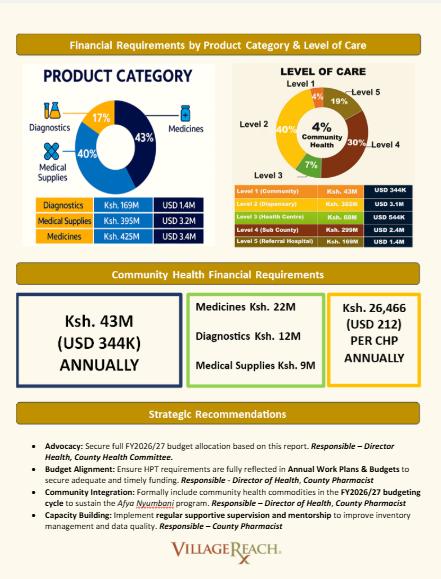
County quantification exercises, completed in three of six counties (Baringo, Kwale, and Turkana) and developed jointly with county governments, were used in budget advocacy. The findings were taken directly to county budget committees, the authorities with actual allocation power. VillageReach, alongside other stakeholders, launched a parallel national effort to reclassify key community health items as Level 1 on the essential medicines list. Without that classification, county finance committees had no budget line to direct funds to community-level commodities.
The approach also included ongoing national-level coordination and advocacy for CHWs, to institutionalize integration of the last-mile supply chain. VillageReach and Lwala Community Alliance joined the Community Health Units for Universal Health Coverage ( CHU4UHC) a national coalition of CHW partners with direct influence within the Ministry of Health as dedicated supply chain members. This advanced coordination among the DCH, DHPT, and KEMSA and eventually led the MOH to embed a supply chain component into the $100M+ CHU4UHC investment case. Funding from this investment enabled VillageReach to develop strategic supply chain plans for Migori, Homa Bay, and Baringo.
In late February, the MOH and VillageReach convened a National SOP Workshop on community commodities, bringing together stakeholders from DCH, DHPT, and county teams - including pharmacists, community focal persons, and lab coordinators. The workshop marked a significant step forward, with strong cross-level participation and alignment. Key outputs included a Community HPT policy, a set of Community HPT SOPs for the community health workforce - particularly CHPs and CHAs covering routine activities - and practical job aids to support commodity management at the community level.
The development of a specific national policy for CHW commodities; 1) provides key processrelated guidance on how last mile supply chains should function 2) enhances stakeholder accountability for CHW supply availability and 3) represents a key milestone toward the sustainable integration of CHW commodities into the national supply chain.
Key tools and methodologies.
Quantification tools & advocacy This work follows a two-pronged approach. First, it involves conducting the full quantification exercise and producing a detailed technical report of the results, including commodity needs at the community level. Second, developing a high-level, user-friendly summary to support advocacy for funding - featuring clear visuals and specific funding requests to government on the allocation of funds for commodities.
VillageReach is working with KEMSA and InSupply to update existing quantification tools to add community-level commodities, so that future quantifications all will incorporate the CHW commodity forecasting.
eCHIS supply chain module. Community supply chain functionality co-designed with end users within Kenya's existing community health information system. Piloted in Migori; advancing toward national operationalization.
CHW Supply Chain Training Module National CHP curriculum component covering community health products and technology management. Supports institutionalization of supply chain capacity building for CHWs and their supervisors. Updated digital version being created for Kenya's MoH Academy.
Evidence of progress. Homa Bay County increased commodity investment from 50M to 300M KES for Level 3 facilities and below, directly attributable to audit evidence presented to budget committees. In Kwale County, quantification analysis led to a tangible funding increase, with the Minister of Health, Chief Officer, and finance team agreeing to raise the allocation from 395M to 594M KES. Baringo and Migori ringfenced 30% of facility revenue for commodities. County Community Health Supply Chain Strategic Plans were completed for three counties. The CHP training module was integrated into the national curriculum, with over 3,500 CHWs and 1,700 healthcare workers trained across six counties. National Policy, SOPs, and job aids for CHW commodities produced and validated with stakeholders; institutionalizing CHW commodity management. For additional information email: hello@funders-forum.org
Mozambique Case Study
Outsourcing last-mile delivery – from direct transport management to national stewardship.
Summary: Mozambique's Central Medical Stores (Central de Medicamentos e Artigos Médicos - CMAM) and Provincial Health Directorate (Direção Provincial de Saúde - DPS) piloted and scaled an outsourced last-mile delivery model, contracting private-sector logistics providers to distribute essential medicines and vaccines. This required transitioning the CMAM role from direct transport operations to stewardship.
Integration type: Process (primary); governance, technology (secondary).
Focus area: Supply chain planning, transport and last mile, public-private integration.
Problem statement and desired outcomes. Last-mile delivery, including planning, transport, and funding, was fragmented across vertical programs. Mozambique had no single privatesector provider capable of covering the national geography with cold-chain capacity. The CMAM also lacked the management infrastructure to coordinate multiple provincial 3PLs directly. The desired outcome of the integration effort was to increase commodity availability, reduce lead times, and lower delivery costs through a structured model.
Approach: segmentation and integration. In 2015, Mozambique launched a provincial 3PL pilot, with CMAM and the DPS managing the transport provider directly. The approach was segmented by product category (vaccines and ARVs) and geography (Tete); the goal was to prove the feasibility of integrated delivery across those segments by outsourcing transport to private logistics providers and coordinating across previously vertical programs.
VillageReach assisted the government in designing and issuing a request for proposals (RFP) to identify 3PL partners. The initial RFP generated limited interest. Local transporters had general transport experience. However, they lacked cold chain capacity and were worried about payment reliability and fragmented demand volumes. The RFP was revised, with VillageReach support, and the Tete DPS successfully selected an initial 3PL for the pilot. Early assumptions that integration required a single provider or a uniform approach across all commodities proved unfounded.
The CMAM and Tete DPS appointed champions and convened existing Technical Working Groups to resolve these misconceptions, which also surfaced coordination gaps between CMAM, the Programa Alargado de Vacinação (EPI), and the DPS that needed to be addressed before the model could advance.
The 3PL model proved successful during the pilot phase and was gradually expanded nationally. As the system grew, CMAM faced increasing complexity managing multiple provincial transport providers directly. This led to the transition to a 4PL coordination model. CMAM's direct management of multiple provincial contracts would have fragmented
accountability, driven up transaction costs, and exceeded available capacity. A nationally standardized system also required a single performance dashboard, route optimization across provinces, consistent SOP enforcement, and consolidated reporting into Mozambique’s customized, open-source Electronic Vaccine Logistics System (Sistema Electrónico de Logística de Vacinas - SELV). By 2019, outsourced delivery covered all CMAM-managed commodities nationwide, supported by a dedicated budget.
Key tools and methodologies.
The Transport Services Solutions Toolkit. The toolkit supported capacity building and helped shift CMAM and DPS from operators to stewards. At the CMAM and DPS levels, training covered 3PL/4PL accountability structures, KPI monitoring, invoice validation linked to SOP compliance, and escalation procedures. DPS staff were trained in data analytics and oversight of 4PL performance. For 3PL providers, training covered cold-chain handling, structured record-keeping, and performance reporting.
Three-way contract. The agreement defined roles for shared accountability: CMAM as the steward, 3PL as the executor, and VillageReach as the technical support and monitor. All three parties jointly reviewed performance issues. Payment was linked to SOP compliance. When problems arose, all three parties had an agreed path for resolving them.
Data collection and eLMIS. The contract required 3PLs to collect stock-on-hand and cold-chain asset data at each delivery point using standardized paper or digital forms. The 4PL consolidated and validated that data before government data clerks entered it into the SELV dashboard.
Evidence of progress. In the Tete pilot, vaccine availability improved from 58% to 96% and ARV availability from 73% to 93%, while delivery lead times in some districts fell from one month to one week. The more durable change was institutional: CMAM transitioned from direct transport management to contract stewardship, DPS staff strengthened their capacity to monitor 4PL performance and interpret supply data, and a dedicated CMAM budget was established for outsourced transportation. As the model evolved from a two-program pilot to a national multi-commodity system, outsourced transport costs increased by approximately 30%. However, the increase reflected deliberate system expansion including nationwide geographic coverage, integration of additional commodities, more frequent deliveries, and the introduction of a 4PL coordination function rather than reduced efficiency, enabling a more reliable and scalable national distribution model. For additional information email hello@funders-forum.org
Nigeria Case Study
A unified digital platform for improved visibility and planning of last-mile service delivery and management in Enugu State.
Summary: The Enugu State Ministry of Health and State Primary Healthcare Development Agency (ENSPHCDA), in partnership with technology provider Elephant Healthcare, deployed a unified digital platform across public health facilities. The primary integration was technology: replacing paper-based, siloed facility operations with integrated point-of-care data capture within a single platform.
Integration type: Technology (primary); governance and financing (secondary).
Focus area: Digital systems and eLMIS, supply chain planning, public-private integration.
Problem statement and desired outcomes. Paper-based records across Enugu State’s 575 public health facilities created siloed data, duplicated effort, and unreliable information for planning. Without real-time visibility into facility operations, patient volumes, service delivery, and stock levels, procurement and resupply decisions were reactive. Financing was also a structural constraint: government budgets were insufficient for large-scale technology deployment. In 2024, ENSPHCDA and Elephant Healthcare launched a partnership to increase visibility and improve planning and decision-making across health commodities.
Approach: segmentation and integration. The approach included a consistent, stepwise deployment process, initially piloted at 21 facilities and gradually expanded to 120 facilities across the state. Facility selection was not uniform across all Local Government Areas (LGAs). The first step was a formal needs assessment, which determined each facility’s readiness for digitization based on two criteria: secure physical infrastructure (stable buildings with functional doors and windows) and sufficient patient volume to justify deployment. This readiness-based segmentation informed which facilities were featured in the pilot phase and scaling phase, and in what sequence.
The next step was deploying the Elephant-OS platform and enabling data aggregation. Elephant provided reliable internet access through collaboration with internet service providers. Each facility received four to five tablet devices, enabling live data capturing across clinics, inventory, and financial transactions. These devices also support digital patient identity via the eHealth card, enabling records to be seamlessly linked across facilities. A key feature of the approach is that supply chain data is not captured separately in a dedicated logistics module. Instead, it is embedded within clinical workflows, strengthening supply chain visibility.
As coverage increased, dashboards were built by Elephant to provide the state primary healthcare development agency with centralized visibility to support planning, monitor outbreaks, and improve operational decision-making. Facilities were added incrementally
using a replicable template: the same hardware package, onboarding steps, and training modules.
Key tools and methodologies.
Facility readiness assessment. The state’s long-term goal is to digitize all 575 public facilities; the readiness framework determines which facilities are ready for each subsequent phase. Minimum requirements for inclusion include stable power (grid, solar, or generator, provided by the state), reliable internet access at a minimum of 100 kb/s (provided by Elephant through internet service provider partnerships), and secure building infrastructure.
Innovative financing model. The eHealth card (digital patient identity) linked to an Electronic Health Record enabled continuity of care across facilities. The financing model was built on a per-patient annual fee of N700 ($0.47) for the eHealth card, rather than on capital grants. Fees were collected at facilities, remitted to the state, and shared between Enugu State and Elephant Healthcare. Elephant's revenue share covers operational costs at breakeven, including staffing, software hosting, internet access, and smart cards; device purchases and training costs are funded separately by Elephant.
Training-of-trainers model. Community engagement on patient fees was conducted to demonstrate the value of digitized records and ease early resistance. An Igbo-language training-of-trainers model placed digital health champions at each facility, building internal peer-to-peer capacity. Health facilities received ongoing support from the Elephant team as required.
Evidence of progress. In the first year (2024), 120 of 575 state facilities (21%) were digitized, over 87,000 patients were registered, and approximately 450 health workers were trained. Reported outcomes include a 71% reduction in PHC waiting times (from 86 to under 25 minutes) and an 83% reduction in registration time (from approximately 60 to under 10 minutes). ENSPHCDA also saw improved real-time stock visibility, fewer stockouts, strengthened predictive planning at the PHCDA Medical Store, and better prescribing through automated alerts for underused medicines.5 Alongside the 2024 roll-out in Enugu, the Elephant-OS solution has also been deployed in five additional states (Bayelsa, Cross River, Kaduna, Ondo, and Niger).
For additional information email hello@funders-forum.org
5 All results are self-reported by ENSPHCDA.
Pakistan Case Study
National supply chain visibility across devolved provinces: a federated LMIS architecture.
Summary: Pakistan's Ministry of National Health Services, Regulation and Coordination (MHSRC), with United Nations Population Fund (UNFPA) support, established a centralized national LMIS within a constitutionally devolved system. This is primarily technology integration: an open-source, interoperable platform with a single national data repository and decentralized provincial user management.
Focus area: Digital systems and eLMIS, supply chain planning, immunization.
Problem statement and desired outcomes. Pakistan's health supply chain operates across provinces with populations ranging from 14 million to 127 million. Following the 18th Constitutional Amendment, federal oversight over health was significantly curtailed. There was limited central visibility into commodity availability, stockout data could not be aggregated nationally, and provincial fragmentation hindered efficiency and coordinated planning. The core problem was governance: securing provincial participation without requiring federal control. Beginning in 2009, the MHSRC, with UNFPA support, developed a federated LMIS architecture capable of aggregating data nationally while allowing provinces to retain autonomy. The desired outcome was to enable national visibility over commodity availability and supply planning across provinces that independently manage planning, storage, reporting, and financing.
Approach: segmentation and integration. The first phase, in 2011, used an existing desktop Warehouse Management System at the Central Warehouse in Karachi to launch a web-based Logistics Management Information System (LMIS). Pakistan validated the approach in one bounded domain before extending it. The pilot focused on the contraceptives segment in 19 districts. By 2012, the cLMIS system had expanded to approximately 160 districts nationwide, covering all provinces.
In 2013, cLMIS was scaled to a national platform hosted by the National Telecom Corporation. The architecture combined a single national data repository with decentralized provincial user management. It was deliberately designed so provinces could control their own access and data entry, reducing the need for central support and building ownership without federal mandates. The architecture also integrated the Lady Health Worker Management Information System (LHW-MIS) within the national LMIS layer. Both cLMIS and LHW-MIS retained their own data entry workflows, users, and structures, while contributing selected logistics and consumption indicators. Offline mobile functionality was built into the system from the start. Each program’s LMIS generates automated, consumption-based requisitions at the facility level. In 2014, the same federated design was applied to create the
EPI LMIS for vaccines. The same interoperability layer later enabled the launch of the Infectious Disease Management Information System (IDMIS) in 2018, extending visibility to TB, HIV, and malaria commodities.
Key tools and methodologies.
National supply chain training curriculum. Pakistan deployed a standardized curriculum covering LMIS utilization, reporting compliance, and data-driven decision-making. Delivery followed a cascade model (national to provincial levels), using government master trainers and partners. A dedicated LMIS User Manual supported data entry at the facility level. The curriculum is now under review for formal government endorsement.
Program coordination forums. The Country Engagement Working Group (CEWG) and the Contraceptive Commodity Security Working Group (CCSWG) provided structured coordination and guided design and scale-up. They monitor LMIS performance and manage cross-program technical decisions. The forums kept implementation on track across a multi-phase rollout.
Government source code ownership and service-level agreements. The MHSRC retained ownership of the LMIS source code and controlled the national data repository. Formal service-level agreements govern vendor relationships. Internal government technical capacity was built alongside the system.
Evidence of progress. Contraceptive stockout rates at service delivery points fell by 30 –40%. Automated LMIS-based requisitions reduced manual order lead times and improved processing efficiency; in pilot districts using the Electronic Client Record (ECR), improved commodity availability directly supported progress on reproductive health targets. Improved real-time vaccine stock visibility reduced wastage from expiry and cold chain failures by 15 – 20%. IDMIS provided near-real-time visibility of TB, HIV, and malaria commodities, reducing manual reporting burdens and enabling faster identification of stock imbalances. Decentralized user management lowered the central help desk burden from 8 – 10 hours to under 2 hours per month.
For additional information email hello@funders-forum.org
South Africa Case Study
The Visibility and Analytics Network (VAN) – government as active steward of national medicine supply chain intelligence.
Summary: South Africa’s National Department of Health (NDoH) took the position that government, not suppliers, should maintain independent visibility into the availability of medicines across the public health system. The Visibility and Analytics Network (VAN) framework was how NDoH acted on that position: connecting over 3,500 facilities, mandating supplier data submission, and building the analytical capacity to turn visibility into decisions. The technology, a government-owned data lake, connected facility systems and near-real-time analytics, and gave that thinking operational form.
Integration type: Technology (primary); governance and people (secondary).
Focus area: Digital Systems and eLMIS, Public Private integration (primary); HSS Funding & Investment (secondary).
Problem statement and desired outcomes. By the mid-2010s, South Africa faced persistent stockouts of essential medicines despite significant investment in procurement. The HIV program maintained strong availability through dedicated management, but supply chains for other essential medicines operated in silos, each depending on supplier self-reporting for stock data and lacking independent verification of facility-level availability. The result was overstock in some facilities and shortages in others. Public concern mounted, and the National Health Insurance (NHI) reform agenda increased pressure for a government-led, data-driven approach to address the availability of medicine. In 2017, the NDoH used the VAN approach to achieve greater visibility and timely availability of essential medicines nationwide.
Approach: segmentation and integration. The VAN’s logic was integration before procurement: connect what exists, mandate what’s missing, build the capacity to use what’s visible. That logic had four expressions: policy, process, technology, and people. Mapped against the Integration report’s five integration types, the VAN is led by technology integration (the data lake and analytics layer), with governance (the policy expression, including supplier compliance mandates) and people integration (the analyst-practitioner pairing model) as the supporting types. Each was necessary; without any of them, the approach faltered. The VAN was grounded in the national health strategy and the Minister of Health’s political commitment and was framed by the NHI reform agenda. The Global Fund and USAID provided early support for supply chain visibility work, including initial infrastructure for a national surveillance system.
The technology integration effort relied on existing solutions. RxSolution is a governmentowned, government-designed stock management system. The Stock Visibility System (SVS) provided mobile data reporting from primary healthcare facilities. A centralized data lake
hosted at the Council for Scientific and Industrial Research (CSIR) aggregated data via APIs from RxSolution, SVS, and other facility systems. The National Surveillance Centre sat atop the analytics layer, using Tableau dashboards to provide near-real-time visibility into medicine availability and supply risks across the network. Integration happened at the data layer via simple tools such as shared cloud platforms and structured Excel spreadsheets.
In 2017, NDoH launched a pilot with a segmented focus on tertiary hospitals. Facility-level reporting flowed in parallel rather than through a hospital-to-clinic hierarchy: clinics reported stock levels directly through SVS, while RxSolution captured stock data from hospitals and other facilities. Both data streams were consolidated in the central data lake and surfaced through dashboards, giving NDoH a single, network-wide view of availability. Provinces were offered RxSolution as a free stock management tool. Program managers who had operated with prior autonomy pushed back; NDoH conducted structured engagement with each provincial government, presenting the vision and demonstrating early results. Ministry leadership intervened to address resistance from disease program managers.
Before the VAN, NDoH was not actively managing suppliers beyond ARVs. Each supplier self-reported delivery and availability data. The VAN replaced self-disclosure with contractually mandated submission. Domestic pharmaceutical suppliers resisted initially; they were accustomed to less rigorous oversight. International suppliers adapted more quickly. Resistance fell when suppliers recognized that the system improved payment processing through three-way matching, gave better demand forecasting, and accelerated issue resolution. COVID-19 served as a catalyst: NDoH used the crisis to enforce data-sharing and reporting requirements as operational necessities, updating contracts and SOPs in ways that proved durable beyond the emergency.
NDoH recruited multidisciplinary teams pairing data analysts with supply chain practitioners. The analysts understood data structures, querying, and dashboard interpretation; the practitioners knew which decisions the data needed to inform. These roles were initially funded by PEPFAR through implementing partners. When donor funding ended in 2025, NDoH re-hired the roles using government budget, completing a transition from donordependent to government-sustained analytical capacity. District-level capacity gaps, a persistent challenge during the early rollout, were addressed through structured training and supervision, building provincial and district competencies that the analytical model required.
Key tools and methodologies.
Analyst-practitioner pairing model. Data analysts paired with supply chain practitioners. The pairing translated visibility data into coordinated decisions. Contractual supplier compliance model. Replaced supplier self-reporting with contractually mandated data submission across all suppliers. Three-way matching made compliance self-reinforcing by improving supplier payment processing. COVID-19 accelerated and durably embedded the requirements.
Evidence of progress. NDoH can now track product movement from procurement through facility-level dispensing across 3,500+ clinics. Demand-driven replenishment, informed by facility-level consumption data, reduced essential medicine stockouts at the primary healthcare level. Integrated planning reduced duplicate orders and expired stock through better rotation and enabled procurement decisions based on actual consumption rather than historical estimates.
During COVID-19, the VAN enabled real-time distribution decisions for vaccines, PPE, and testing commodities while maintaining continuity of essential medicines; NDoH assumed operational control over supply chains previously managed by implementing partners. The more durable achievement is institutional: NDoH now holds independent visibility into its own supply chain, no longer dependent on implementing partners for the data it needs to govern medicine availability.
For additional information email hello@funders-forum.org
Tanzania Case Study
Integrating national supply planning: automated bottom-up quantification transition from vertical forecasting.
Summary: Tanzania's Ministry of Health, with support from SolDevelo and the USAID Global Health Supply Chain (GHSC) program, deployed an automated bottom-up quantification (eBUQ) tool within the national OpenLMIS-based eLMIS. The eBUQ tool enabled each facility to generate its own consumption-based demand forecast, which was aggregated into a unified national supply plan.
Integration type: Technology (primary); governance and process (secondary).
Focus area: Digital systems and eLMIS, supply chain planning, financing.
Problem statement and desired outcomes. Health commodity planning was conducted through vertical programs, each with its own tools, timelines, and forecasting processes. Central or program-level teams estimated what facilities needed rather than asking them. The result was persistent misalignment: chronic stockouts, delivery delays, and expired commodities that accumulated because they were ordered in response to the wrong demand signal. Tanzania's Universal Health Insurance rollout created new demand for coordinated facility-grounded planning at scale. Declining and inconsistent donor financing compounded the urgency. In 2019, the MoH moved to reverse the direction of forecasting using the eBUQ tool with the desired outcome of reducing stockouts, wastage and ensuring timely delivery.
Approach: segmentation and integration. Tanzania's MOH and key partners implemented three parallel interventions for successful segmentation and technology integration: (1) aligning governance rules, financing flows, and data systems across vertical programs; (2) automating the eBUQ module within OpenLMIS as the unifying planning platform; and (3) building quantification capacity at all facility levels.
The approach began with a pilot phase with a deliberate segmentation focus on essential health commodities. Facility-level consumption data was more reliable for these commodities than for vertical program products, and the forecasting logic was less contentious. In 2019, data collection began manually in Excel. The goal was to build the quantification process and behavior change at the facility level before automating. From the 2019 Excel baseline, the tool was built in deliberate stages as capacity and data quality improved: in 2022, semiautomation introduced district-level verification at scale. From June to October 2023, software development firm SolDevelo worked alongside the USAID GHSC Program to build the automated eBUQ module within Tanzania's OpenLMIS architecture. The eBUQ inverts the flow of demand information.
Each facility generates its own consumption-based demand estimate, which is consolidated into a report for verification, then aggregated at the district and regional levels into the national supply plan. Each facility reviews 200 – 1,000 items, depending on facility type; cost forecasting is included. This phase accelerated aggregation across all facility levels.
Furthermore, to improve data quality and reduce review times for these items, an analytical tool has been integrated within the eBUQ. This allows both the facility and reviewers at various levels to quickly identify issues in the BUQ Forecast. The tool highlights duplicates, missing priority items, items with excessively high quantities, and the total forecast cost by level. As a result, this analytical tool significantly improves forecast accuracy.
Also in 2023, the MOH launched phase two: eBUQ deployment for vertical program commodities (HIV/AIDS, tuberculosis, malaria, reproductive health), each with its own forecasting tool. Results for Development's Pneumonia Program provided technical support for the commodity-by-commodity readiness assessments. A transition roadmap was formally submitted to the Chief Pharmacist in April 2024.
Key tools and methodologies.
Transition roadmap. The roadmap tool is a structured assessment and negotiation process, supported by Results for Development's Pneumonia Program, for sequencing vertical program commodities into the BUQ model. Each program was assessed against specific readiness criteria: number of commodities, forecasting methodology, degree of crossprogram overlap, and alignment of donor and government planning cycles. The roadmap addressed the complexity of multi-year donor funding commitments and cycles often misaligned with the government planning cycle.
Data Quality Assessments (DQA). The DQA is a structured mentorship and data validation methodology. It is deployed through the redesigned logistics system (RLS) to address data quality failures. The DQA involves facility-level review of submitted forecasts against consumption logic, identification of systematic errors, and direct mentorship of staff on quantification methodology, distinct from software operation.
Evidence of progress. All public health facilities use the eBUQ tool for quantification. Facilities submit forecasts to National Quantification Team (NQT) which then submits the National Forecast to the Medical Stores Department (MSD) on schedule each January. Forecast accuracy improved from 54% in the pre-automation period to 67% in 2024 and 71% in 2025. Priority health commodity availability reached 85% in 2024, up nine percentage points from 76% in 2023. At the MSD level, commodity availability reached 64%, up from 57% in 2023, against a target of 85%; the order fill rate stands at 64%, with a target of 90% by June 2026. Nearly 2,700 healthcare workers have been trained.
The following three-stage integration roadmap is underway: (1) upgrade the analytical tool to support Vertical Program assumptions, including patient data and program targets; (2) integrate data sources with the BUQ tool, ensuring visibility for users; and (3) implement a predictive analytics model, including machine learning for advanced forecasting.
For additional information email hello@funders-forum.org
Annex: Emerging Examples of Integration
The Taskforce identified three early-stage examples of programs advancing integration across global and country-level health supply networks. These do not yet have the documented implementation evidence to be full case studies. They represent approaches the field should be watching.
Example 1: Progressing safe, segmented cold chain integration.
The World Health Organization (WHO) and key United Nations (UN) stakeholders have jointly endorsed a statement on integrating cold chain systems for health commodities. A WHO-led analysis found that only 20% of essential medicines require cold-chain logistics, and temperature requirements often differ markedly from those of the standard vaccine cold chain. The WHO advocates strategic segmentation, matching products to appropriate supply chains, and cautions against integration without accounting for unintended consequences, particularly the risk that integrating ambient and cold-chain commodities into a single system could compromise vaccine integrity or mask stockouts in either stream. This analysis carries direct implications for the 9 case studies in this series. Countries considering cold chain integration should read the WHO segmentation guidance before initiating cold chain reform.
Example 2: UNICEF nutrition supply chain integration.
The United Nations Children’s Fund (UNICEF) is advancing work on integrating nutrition commodities into broader health supply chain systems. Nutrition commodities have historically been managed through separate supply channels. This has created parallel planning, procurement, and distribution functions that fragment resources and complicate coordination with essential medicines and vaccine systems. UNICEF’s work addresses both technical integration (shared data systems, harmonized forecasting) and governance (clarifying roles across nutrition, health, and supply chain actors at the country level).
Example 3: VillageReach laboratory commodities integration.
VillageReach is advancing efforts to integrate laboratory commodities into national health supply chain systems. Laboratory consumables and reagents have typically been procured, stored, and distributed through channels separate from those for essential medicines and vaccine supply chains, creating redundant infrastructure and limiting visibility. VillageReach’s approach examines the conditions under which laboratory commodities can be incorporated into national supply chains – without disrupting the specialized cold-chain and handling requirements of some laboratory products.