SUMMER 2026 ISSUE
YOUR STUDENT. YOUR CHOICE.
IN THIS ISSUE
Phones in the Classroom
A Parent's Guide to the Phone Debate and What it Really Reveals About Learning
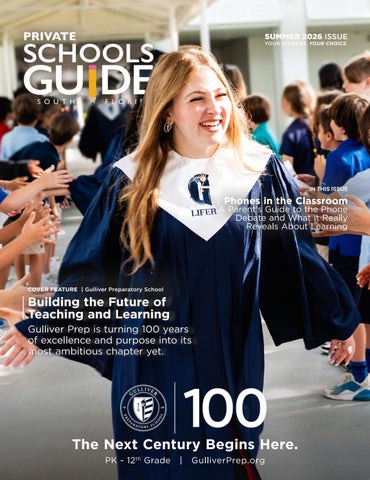
COVER FEATURE | Gulliver Preparatory School
Building the Future of Teaching and Learning Gulliver Prep is turning 100 years of excellence and purpose into its most ambitious chapter yet.
The Next Century Begins Here. PK - 12th Grade
|
GulliverPrep.org
D E E P LY
HARD
F U L LY T H E P OW E R O F B A L A N C E Education should do more than prepare a student for a career; it must build a human for life. At Palmer Trinity School, we champion the entire individual by igniting the mind, body, and spirit. This is where students think deeply within a culture of intellectual inquiry, play hard across our athletic and creative landscapes, and live fully as ethical leaders. We refuse to compromise on a single pillar because raising the trailblazers of tomorrow requires nurturing their full potential today.
Call 305.969.4208 to schedule your tour today!
PALMERTRINITY.ORG
The Joy of Discovery Unlock your child’s love of learning at our four scenic campuses
PALMETTO BAY CAMPUS Toddler & Preschool Program (AGES 11/2 - 6)
OLD CUTLER ROAD CAMPUS Toddler & Preschool Program (AGES 2 - 6)
RED ROAD CAMPUS Preschool Program (AGES 3 - 6)
LUDLAM ROAD CAMPUS Elementary Program (GRADES 1 - 5)
305.665.6274 alexandermontessori.com FREE shuttle bus from our Red Road location to all of our campuses.
Alexander Montessori School does not discriminate on the basis of race, nationality, or ethnic origin. DCF licenses C11MD1411, C11MD1215
INSIDE THIS ISSUE SUMMER 2026
FROM THE
EDITOR
Elizabeth Rivas
ON THE COVER Gulliver Preparatory School Gulliver Prep has spent a century delivering on its promise of excellence, helping every student reach their full potential. Now, on its 100th anniversary, it's doubling down. The Next 100, Gulliver's centennial campaign, is funding stronger teaching, deeper student support, and new campus spaces to match its ambitious and bold next chapter.
FEATURES 4 GULLIVER PREP
The Next 100: A Century of Excellence and Just Getting Started
8 PHONES IN CLASSROOMS The Real Question Behind the Debate: How Kids Learn
20 REDEFINING RESILIENCE Rethinking what Strength Looks Like
27 FEATURED SCHOOLS Directory of Premier Private Schools in South Florida
Welcome back! Whether you're returning to a familiar hallway or still searching for the right one, we're glad you're here. The blank page of a new school year brings a world of opportunities, and with it, a world of decisions. Every choice about a child's education and future carries real weight. I hope to meet you in that moment and offer this issue as a starting point to help make those decisions a little clearer.
40 THE INVISIBLE CURRICULUM The Bonds that Shape how Kids Learn
PRIVATE SCHOOLS INSIDE COVERS
Palmer Trinity School
Alexander Montessori School 3 Gulliver Preparatory School 6 Miami Learning Experience 6 Miami Country Day School 7 Riviera Schools 13 KLA Schools 14 Rambam Day School 14 Westminster Christian School 15 Westbridge Academy 16 The Cushman School 16 Christ Fellowship School 17 Kendall Christian School 18 Westwood Christian School 22 Florida Christian School 23 Conchita Espinosa Academy 24 Scheck Hillel Community School 24 The Growing Place School 25 KLA Academy 26 Belen Jesuit Preparatory 37 North Broward Preparatory School 38 Westminster Academy 38 Summit-Questa Montessori School 39 Sheridan Hills Christian School 44 St. Thomas Aquinas High School 47 St. Mark's Episcopal School PBG 48 Oxbridge Academy 49 Woodlands Academy of The Sacred Heart BACK COVER
2 | PSG
Our Lady of Lourdes Academy
As we start the new school year, we're returning to the conversation around resilience, not as a catchphrase, but as what it actually looks like when a student faces a hard test, a tough year, or moments of self-doubt. We also look at what support systems in schools look like and why they matter as much as academics. Congratulations to Gulliver Prep on its centennial milestone! There's something especially inspiring about a school reaching 100 years with its eyes fixed on the future. What stands out most isn't its rich history, but its commitment to what's next. A reminder that the strongest schools honor their past by investing in the generations to come. As you start this new school year, we wish your family growth, discovery, and success. If you're still searching for the right fit, we hope this issue helps guide the way. Happy Back to School!
VOLUME 18 ISSUE 2 EDITOR-IN-CHIEF Elizabeth Rivas MANAGING EDITOR Ren Mercer CONTRIBUTORS Editorial Team Valeska Rodriguez R MEDIA PUBLISHING, INC. P.O. Box 881554, Port St. Lucie, FL 34988 (786)346-3048 yourstudentyourchoice.com This publication may use AI tools to assist with content creation, editing, or design, with all material reviewed by our editorial team. Private Schools Guide of South Florida is published by R Media Publishing, Inc. (RPM) and is distributed free of charge throughout South Florida. All rights reserved. Copying any of the contents of these publication without the expressed permission of R Media Publishing, Inc., is prohibited.
For a century, Gulliver has been an integral part of Miami’s story, shaping the hearts and minds of the leaders, innovators, and changemakers who define our city. As we celebrate our Centennial, we take pride in our deep roots and our role in Miami’s vibrant growth. From our historic past to the next 100 years of world-class teaching and future-ready learning, we remain committed to inspiring the generations who call this community home.
next100.gulliverprep.org
Gulliver Preparatory Marks Centennial Year With $100 Million Philanthropic Campaign and Bold Vision For STEAM Education Gulliver Preparatory School is proud to celebrate its Centennial year, marking 100 years since its founding in 1926 and honoring a legacy of educational excellence that has shaped generations of students and communities around the world. For a century, Gulliver’s mission has remained steadfast: to create an academic community devoted to educational excellence, with a personal touch, that fulfills each student’s potential. From its earliest classrooms to its modern campuses today, the school has prepared students not only to achieve academically but to grow into thoughtful, capable individuals who contribute meaningfully to society. “At Gulliver, we believe success is measured not only by what our students achieve, but by who they become,” said Simon Hess, President of Gulliver Preparatory School. “We empower students to think, create, and grow into their greatness so they can step confidently into the future.” This Centennial year also marks the launch of The Next 100: The Centennial Campaign for Gulliver, the school’s most ambitious philanthropic initiative to date. Building on earlier investments in campus transformation, the campaign aims to raise $100 million by 2030 to advance teaching and learning, strengthen student well-being, and invest in the people, programs, and places that will define the next era of education at Gulliver. Hess added, “Gulliver has always reflected the city it calls home — ambitious, diverse, and oriented toward the future. As Miami emerges as a global center for business, culture, and innovation, we are growing alongside it and shaping the city’s next generation of leaders.” Key initiatives of The Next 100 include investments in recruiting and supporting exceptional educators, expanding innovative academic programs, supporting thriving students, and constructing new facilities such as the STEM Commons and Arts + Innovation Center. Together, these buildings will form the STEAM Complex, a dynamic, integrated environment for science, technology, engineering, arts, and creative problemsolving, cementing Gulliver to emerge as a national leader in STEAM education. Founded by Arthur Gulliver and later transformed by visionary educator Marian C. Krutulis, Gulliver has grown alongside a rapidly changing world while remaining anchored in its founding purpose. Over the past 100 years, more than 20,000 students have been educated at Gulliver, many of whom have gone on to become leaders across industries and civic life in South Florida and around the globe. As Gulliver enters its second century, the school remains grounded in its founding mission while expanding its impact, preparing students not only to succeed in a changing world, but to shape it with purpose.
About Gulliver Preparatory School Gulliver Preparatory School is a 501(c)(3) private, non-profit, independent, coeducational, nonsectarian day school with the mission to create an academic community devoted to educational excellence, with a personal touch, that fulfills each student’s potential. Founded in 1926, today Gulliver Prep serves more than 2,200 students in grades PK-12 with over 500 faculty and staff, representing more than 50 countries and cultures. As one of the largest and most diverse independent schools in the nation, Gulliver continues to attract families seeking a rigorous, future-ready education grounded in both academic excellence and character development.
gulliverprep.org
The place for special needs QUALITY • AFFORDABLE • INNOVATIVE
At MLE, individuals with special needs, ages 5 to adulthood, are seen, heard, and empowered. Every student or adult who walks through our doors finds a place of warmth, encouragement, and growth. Here, friendships are formed, independence is nurtured, and joy is found in everyday milestones.
For Students
mleschool.org • info@mleschool.org • 305-275-5900 5651 SW 82nd Avenue Road. Miami. FL 33143
6 | PSG
At Riviera, we believe in limitless potential. Here, your child is more than a student.
They’re a thinker, a problem-solver, a creator, a leader in the making. We challenge them to go deeper — to ask better questions, act with integrity, and step into every opportunity with confidence.
Riviera graduates don’t just dream big —they deliver.
A snapshot of the past five graduating classes.
Our graduates earn admission to top colleges and universities across the U.S. and around the world — including Columbia, Stanford, Duke, UCLA, NYU, and McGill — reflecting the depth, rigor, and ambition of a Riviera education. Beyond limits. Beyond expectations.
Go beyond with Riviera Schools.
100% COLLEGE ENROLLMENT
97,000+ HOURS OF COMMUNITY SERVICE
Over $48 Million SCHOLARSHIPS AWARDS
Day School
Preparatory School
PK3 - 5th Grade
6th - 12th Grade
Artful Integration THE POWER OF ARTS IN EDUCATION
8 | PSG
A Parent's Guide to the
Classroom Phone Debate Phones are changing the conversation around learning and the research is more divided than ever. So where do parents go from here?
T
here was a time when the biggest classroom distraction was passing a note. Maybe folding it into one of those tiny paper footballs. Or, on an especially brave day, writing “Do you like me? Check yes or no,” then watching it pass from kid to kid, praying no one opened it and turned your private crush into a public roasting. But those days are gone, replaced by a glowing temptation we ironically call a phone. A phone is no longer just a way to call someone. It's a television, a video game console, a camera, a social status scoreboard, and a tiny escape hatch from any uncomfortable feeling. That's a lot for anyone to manage, let alone a twelve-year-old trying to learn linear equations. Remove the temptation, or teach kids to handle it. That's exactly where the two sides of this debate split. That is why schools are rethinking what role phones and other devices should play during the school day. Some are moving toward phone-free classrooms. Others are trying to teach students how to use technology more intentionally and responsibly. At first, those sound like opposite approaches. One takes the device away. The other tries to teach students how to live with it. But underneath, both are dealing with the same problem: school is trying to compete with a level of distraction it was never built for.
Why Schools Are Going Phone-Free The argument for phone-free classrooms is pretty easy to understand. Phones compete with almost everything school is supposed to do. They pull attention away from teachers. They make it harder for students to focus. They can turn lunch, which used to be messy and loud and socially awkward in useful ways, into a table full of kids silently scrolling next to each other. Even when students are not actively using their phones, the phone is still there. There might be a message. Someone might have posted something. A friend might be mad. A group chat might be exploding. Something more exciting might be happening somewhere else, and the student knows they could check it in two seconds. That matters because learning is not just about receiving information. If it were, school would just be an extremely expensive way to tell children to Google things. Real learning is slower. It asks students to sit with confusion, reread a paragraph, listen to a classmate, solve a problem after the first attempt fails, and survive the awkward silence after a teacher asks a question no one wants to answer. It requires patience,
PSG |
9
focus, memory, conversation, and the ability to stay with something even after it stops being immediately rewarding. Phones make that harder because they offer an instant exit. Bored? Scroll. Lonely? Text. Confused? Search. Embarrassed? Disappear into screen. Waiting for your brain to form an original thought? Don’t worry, your phone has already offered six new ones, plus a smoothie recipe and a raccoon video. This is why phone-free policies can feel less like punishment and more like protection. They are not just about catching students texting under the desk. They are about creating a school day where students have space to be fully present.
Why Schools Are Choosing Mindful Tech The other side of the debate is not completely unreasonable. Technology is not going away. Students are growing up in a world shaped by digital communication, artificial intelligence, and tools that will likely be part of their future workplaces. Simply removing devices from school does not automatically teach students how to manage them once they leave. That is why some educators argue for mindful technology use instead of total restriction. Their point is not that students should be scrolling through TikTok during history class. It is that schools may have a responsibility to help students understand when technology is useful, when it is distracting, and how to use it with intention. In this view, the classroom becomes a place to practice judgment. Students might learn when a device helps them research, create, collaborate, or access support, and when it gets in the way of deeper thinking. Instead of treating technology as either a miracle or a monster, schools can teach students to ask better questions: Why am I picking this up? Is it helping me learn? Is it helping me avoid something difficult? Do I know how to put it away? That kind of self-awareness matters too. A student who never practices managing technology may
struggle later when no adult is collecting phones at the door. At some point, young people have to learn how to live in a digital world without being completely ruled by it. So the point of mindful tech use is not that phones belong everywhere. It is that students need guidance in learning how to handle the tools they will inevitably encounter.
The Real Debate The debate often gets framed as “phones or no phones,” but that may be too simple. The deeper question is: What do we believe learning should look like? If learning is mostly about focus, deep reading, conversation, and the ability to sit with hard things, then phone-free classrooms make a lot of sense. They protect attention before it has to fight for survival. They give students a break from the pressure to be constantly available. They create space for boredom, and boredom is not always a bad thing. Sometimes boredom is the little waiting room where thinking finally shows up.
free policy usually points to a learning environment built around focus, discussion, reading, and faceto-face interaction. That only works, though, if the school also has a real plan for emergencies and for parents to reach their kids when it matters. A mindful-tech approach points to something different. It's the belief that responsible use and self-control need to be practiced, so kids learn to use a phone as a tool that adds to learning, not one that pulls them away from it. Both of these ideas make sense, and both come with a catch. The case for going phone-free is backed by real evidence: kids who are on their phones all the time tend to focus less and connect less with the people around them. But no school can fully control what happens once the bell rings and everyone walks out the door. The case for teaching tech habits directly makes sense too.
But if learning is also about preparing students for the world they are actually entering, then schools cannot ignore technology completely. Students will need to know how to evaluate information, understand AI, and recognize when a device is shaping their behavior. Those skills do not appear magically just because a child owns a phone. Both visions have a point. One is trying to protect the conditions for learning. The other is trying to prepare students for reality. The challenge is that schools have to decide which goal matters most during the school day.
What Parents Should Be Asking This is where parents come in. Instead of just reacting to a school's phone policy, it helps to ask what that policy actually says about the school. A phonePSG |
11
Phones aren't going anywhere, so maybe kids need practice managing them now, with adults nearby, instead of being handed total freedom for the first time at eighteen. But teenagers are still learning self-control, and a classroom full of unlocked phones can test that in ways a school may not be ready for. Neither side is entirely right. And there's probably no single answer that fits every child. A sixth grader needs different rules than a high school senior. A kid with a medical condition might need a phone nearby at all times. Some families want school to be one of the last phone-free places their child has. Other families think learning to use a phone responsibly is something kids should practice early, while someone is still watching, not something they figure out alone later. That's why it helps to look past the slogan, whichever way it points. "Phone-free" doesn't automatically mean a school has thought it through. A strict rule still needs a real plan for emergencies, medical needs, and getting a message to your kid. Without that, it's just a rule, not a philosophy. And "we're phone-friendly" doesn't automatically mean forward-thinking either. A school that lets phones stay out with no real boundaries may just be leaving kids to fight one of the most distracting inventions ever made, on their own, and calling it freedom.
12 | PSG
So the better question isn't "Does this school allow phones?" It's "What does this school protect during the day, and what is it asking my child to practice?" That gets much closer to what parents are actually choosing. Not just a rule in a handbook, but the habits that day quietly builds. Some families will land on a phone-free school. Others will land on one that teaches phone habits directly, as a skill worth learning early. Both can be a good choice, and both can also be done badly. What matters most is knowing what you want that school day to protect, and checking whether the school has really built something to back it up, not just a slogan. Kids will need to know how to use technology. But they'll also need to think clearly, listen well, and pay attention in a world that never stops trying to grab it. That's really the heart of it. The research itself is split, and parents don't need to pick a side in the big phone debate. They can start much smaller, at home, with one simple question. What do I want learning to actually look like for my child?" It's a simple question, but it's the one that actually matters. That answer won't show up on a school's website or in its handbook. But once a parent knows it, every tour, every policy, every conversation with a teacher starts to make a lot more sense. �
PRESCHOOL – GRADE 12
The Westminster Difference Empowering Learners. Inspiring Lives. Preparing Hearts.
Westminster students are bright and inquisitive, engaged with their communities, and growing in their faith. Learn how a Westminster education will inspire your child’s future.
To learn more, visit: www.wcsmiami.org Admission: 305-233-4027 • admission@wcsmiami.org 14 | PSG
JOY SPARKS VICTORY.
16 | PSG
CUSHMANSCHOOL.ORG
PSG |
17
REDEFINING
RESILIENCE
WHAT ARE WE REALLY ASKING OF KIDS?
L
et's start by being clear about what this isn't. This isn't a case for letting kids sidestep difficulty. High expectations, hard work, and real accountability aren't up for debate, kids should be pushed, asked to sit with discomfort, and do things that don't come easy. They need the ability to face hard things and grow through them, not just get past them. Here's the real question, though: does the word we use for that, resilience, still give kids useful direction when things get hard, or is it quietly asking them to absorb everything without distinguishing what the moment actually calls for.
WHEN A WORD TAKES ON TOO MUCH For a long time, resilience meant something fairly specific: the ability to recover from real stress, a loss, a failure, a setback that mattered. Somewhere along the way, the word overextended to cover almost anything uncomfortable. A hard test. A heavy week. A friendship going through a rough patch. All of it gets filed under the same expectation: push through, don't complain, come out stronger.
20 | PSG
No parent or school is wrong to want that and that overextension isn't malicious. Actually, it usually comes from a good place, a desire to prepare kids for a world that most likely won't go easy on them. But when the same word covers a skinned knee and a genuine crisis, it stops giving kids useful information about which situations call for pushing through and which call for finding support. Everything starts to look like something to just push through and get over.
A JUDGMENT CALL RATHER THAN A RULE Two easy paths tend to show up here, and neither one actually works. One simply keeps things as they've always been: expect kids to tough it out, treat struggle as character-building by default, and worry that anything else produces fragility. The other is to swing hard in the opposite direction: smooth out every obstacle, intervene at the first sign of discomfort, and treat stress itself as the enemy.
Neither one actually does right by a kid's emotional wellness. The first can teach them to suppress rather than process what they're feeling. The second can leave them without the tools they'll need for the moments when no one's there to catch them. The better path sits somewhere in the middle, and it's really just about paying attention. The real question is simple: does this child have what they need to work through this on their own, or do they need someone to step in? The answer changes with the situation, the age, and the kid in front of you. There's no single rule for it. It's a judgment call, made again and again and again.
WHAT THAT LOOKS LIKE IN PRACTICE Naming the difference between discomfort and harm. Not every hard feeling needs to be fixed. A student nervous about a presentation is having a normal, useful kind of discomfort. A student who's overwhelmed to the point of shutting down is signaling something different. Learning to tell these apart, in the moment, matters more
than applying one blanket response to both.
Letting kids sit with a problem before solving it for them. Struggle has real value when a child has enough support to actually work through it, rather than just absorb it. That might mean asking questions instead of giving answers, or waiting a beat before jumping in. Treating emotional regulation as a skill, not a personality trait. Some kids come by steadiness more naturally than others. That's not a reason to expect less of the ones who don't, it's a reason to teach the underlying skills directly: naming a feeling, noticing it early, having a plan for what to do with it. Looking at the ask first, before looking at the child. Before deciding a child needs to be more resilient, it's worth asking whether the workload, schedule, or situation itself is asking too much. Sometimes the answer is yes, and that's on the adults to fix, not something a child should have to just push through. Making room for both encouragement and honesty. A kid who's told to push through everything can learn to stop mentioning when something's actually wrong. A kid who's protected from everything can struggle later when no one's there to soften the landing. The steadier path involves being honest that something is hard, while still expecting them to move through it with support close by.
WHAT SCHOOLS ARE ASKING INSTEAD A number of schools are starting to name this shift out loud. Instead of asking how to build more resilience, they're asking a more useful question: what exactly are we asking kids to push through, and is that actually reasonable? In practice, that looks like schools taking a hard look at their own demands, whether the homework load fits the age group, whether the day leaves any real room to reset between activities, and whether a student's stress is something they need to learn to manage, or a signal that something upstream needs to change first. It's a subtle shift, but it moves some of the weight
PSG |
21
off the child and onto the adults designing the environment around them, which is closer to how child development research has always framed growth: kids build capability within the right conditions, not in spite of the wrong ones. Some educators are even leaning on a different word for this: capacity, instead of resilience. Capacity isn't about gritting through discomfort. It's about how much a person can genuinely hold at any given moment, and how that grows with the right support, rest, connection, and skills. A sense of control, rather than shrinking under pressure with no outlet. It doesn't suggest a child failed if they struggled. It just describes where they are right now. That distinction matters for parents too. "Build resilience" can sound like an instruction aimed squarely at the kid. "Build capacity" reads more like something the school, the child, and home are building.
WHERE THIS LEAVES PARENTS
None of this is an argument against resilience. It's an argument for being more precise about what we mean by it, and more attentive to the difference between preparing a child for difficulty and simply expecting
22 | PSG
them to absorb more of it. The goal was never to raise kids who don't struggle. It's to raise kids who know how to move through struggle without losing themselves in it, and who have people paying close enough attention to know the difference between a moment to push through and a moment that calls for a hand.
Inspiring children to be well-rounded, creative, and kind human beings.
™ ESPINOSA ACADEMY
CEA provides a dynamic, intimate and nurturing environment that helps students grow into confident human beings with curious minds, healthy bodies, and strong civic, spiritual, and cultural values. Through its demanding academic program, Conservatory of the Arts, athletic division, and mastery program, students are challenged and inspired to grow as passionate thinkers and doers who make an impact on their communities. Each child is seen and respected as an individual, keeping the spirit of love and respect that is the trademark of CEA and The Espinosa Method™.
l o o h c s a n a more th
EDUCATIN
• SINCE 1933 N E R D IL H GC
OS
THE ESPIN
S
TH GRADE
• K3 - 8 A METHOD
CALL US AT 305-227-1149 12975 SW 6TH STREET, MIAMI, FL 33184
ROOTED IN VALUES. FOCUSED ON THE FUTURE. Scheck Hillel Community School 18 months - Grade 12 19000 NE 25th Avenue, North Miami Beach, FL 33180 | 305.931.2831 | ehillel.org
Growing Faith, Hearts and Minds since 1963
OUR MISSION TGPS is committed to providing an inclusive, faith-based education for children ages 1 through 5th Grade, preparing them for entrance into diverse community middle school programs, and cultivating a community of spiritual, compassionate, creative, and thriving world citizens.
24 | PSG
WHY TGPS? Empowering Student-Centered Education S.T.R.E.A.M. Project-Based Learning Faith-Based Values Community Collaboration Award-Winning Environmental Studies Exceptional Extracurricular Courses
Learn more about TGPS! 536 Coral Way Coral Gables, FL, 33134 305-446-0846
Toddlers (Ages 1 to 2)
Preschool (Ages 3 to 4)
Elementary (K - 5th Grade)
DCF license #C11MD0470
26 | PSG
SUMMER 2026
PSG |
27
7 23
7
FEATURED PRIVATE SCHOOLS
MIAMI-DADE COUNTY
8
7 3 3
7
17
2
11 5 5
25
6 22
21
9 15
12
7
13
1
26
10
7
14
18
4 10
27
10
20
16
16
4 1 1
7
24 19
1
9
ALEXANDER MONTESSORI SCHOOL INDEPENDENT / NON-SECTARIAN 1.
Alexander Montessori School w
2.
Conchita Espinosa Academy
3.
The Cushman School w
4.
Gulliver Prep
5.
Highpoint Academy w
6.
KLA Academy
7.
KLA Schools
8.
Miami Country Day School w
9.
Ransom Everglades
10. Riviera Schools
FAITH-BASED SCHOOLS 11.
Belen Jesuit Preparatory School
12. Christopher Columbus High School w 13. Florida Christian School 14. The Growing Place School w 15. Immaculata-La Salle High School 16. Kendall Christian School 17.
Palmetto Bay Campus Preschool 18 mos. - 6 years 17800 Old Cutler Road Miami FL 33157 (305) 969-1814 Old Cutler Road Campus Preschool 2 - 6 years 14400 Old Cutler Road Miami FL 33158 (305) 233-4540 Ludlam Road Campus Elementary 6 - 12 years 14850 SW 67th Avenue Miami FL 33158 (305) 235-3995 Red Road Campus Preschool 3 - 6 years 6050 SW 57th Avenue Miami FL 33143 (305) 665-6274
MONTESSORI SCHOOL
19. Palmer Trinity School w 20. Rambam Day School w
23. Scheck Hillel Community School w 24. Westminster Christian School w
Upper School Campus 9th - 12th Grade 6575 North Kendall Drive Pinecrest, FL 33156 (305) 666-7937
www.gulliverprep.org
INDEPENDENT COLLEGE PREP
HIGHPOINT ACADEMY PK2 - 8th Grade Main Campus 12101 SW 34th Street Miami, FL 33175 (305) 552-0202
18. Our Lady of Lourdes Academy
22. St. Philip's Episcopal School w
Marian C. Krutulis PK-8 Campus PK - 8th Grade 12595 Red Road Coral Gables, FL 33156 (305) 665-3593
www.alexandermontessori.com
Miami Christian School
21. St. Brendan High School w
GULLIVER PREP
CONCHITA ESPINOSA ACADEMY PK3 - 8th Grade 12975 SW 6th Street Miami, FL 33184 (305) 227-1149
Coral Way Campus 9850 SW 24th Street Miami, FL 33165 (305) 552-0208
www.highpointacademy.com
25. Westwood Christian School
www.conchitaespinosa.com
ALTERNATIVE/SPECIALIZED
INDEPENDENT PRIVATE SCHOOL
BILINGUAL PRIVATE SCHOOL
THE CUSHMAN SCHOOL PK2 - 12th Grade
KLA ACADEMY 3 Months - 5th Grade
592 NE 60th Street Miami, FL 33137 (305) 757-1966
375 SW 15th Road Miami, FL 33129 (305) 377-0391
www.cushmanschool.org
klaacademy.org
INDEPENDENT COLLEGE PREP
REGGIO EMILIA INSPIRED PRIVATE SCHOOL
26. Miami Learning Experience School 27. Westbridge Academy (Christian)
w Indicates a school that offers minor support for students with mild learning difficulties/differences
KLA SCHOOLS KLA Schools of Aventura 12 Months - 5 years 20301 Biscayne Blvd. Aventura, FL 33180 (305) 931-2322
MIAMI COUNTRY DAY SCHOOL PK - 12th Grade 601 NE 107th Street Miami, FL 33161 (305) 779-7230 www.miamicountryday.org INDEPENDENT DAY SCHOOL
CHRISTOPHER COLUMBUS HIGH SCHOOL All-boys 9th - 12th Grade
30000 SW 87th Ave Miami, FL 33165 (305) 223-5650 x2256 www.columbushs.com ROMAN CATHOLIC COLLEGE PREP
KLA Schools of Coral Gables 3 Months - 5 years 4573 Ponce De Leon Blvd. Coral Gables, FL 33146 (305) 668-0552
KLA Schools of Doral 12 Months - 5 years (offers VPK) 10400 NW 33rd Street #100 Miami, FL 33172
RANSOM EVERGLADES SCHOOL Middle School Campus 6th - 8th Grade 2045 South Bayshore Drive Coconut Grove, FL 33133 (305) 250-6850 Upper School Campus 9th - 12th Grade 3575 Main Highway Coconut Grove, FL 33133 (305) 460-8800
www.ransomeverglades.org KLA Schools of North Bay Village 3 Months - 5 years 7800 Hispanola Avenue North Bay Village, FL 33141 (305) 865-2678
FLORIDA CHRISTIAN SCHOOL PreK 2 - 12th Grade 4200 SW 89 Ave Miami, FL 33165 (305) 226-8152 www.floridachristian.org
COLLEGE PREPARATORY DAY SCHOOL CHRISTIAN COLLEGE PREP
RIVIERA SCHOOLS
KLA Schools of North Miami Beach 3 Months - 5 years (Offers VPK) 13702 Biscayne Blvd. North Miami Beach, FL 33181 (305) 697-8018
KLA Schools of Palmetto Bay 3 Months - 5 years 14875 S. Dixie Highway, Unit B Miami, FL 33176 (305) 233-0130
KLA Schools of West Kendall 3 Months - 5 years (Offers VPK/SR) 8950 SW 137th Avenue Miami, FL 33186 (305) 387-2480
Riviera Day School PK - 5th Grade 6800 Nervia Street Coral Gables, FL 33146 (305) 666-1856 Riviera Preparatory School 6th - 12th Grade 9775 SW 87th Avenue Miami, FL 33176 (786) 300-0300
www.rivieraschools.com
THE GROWING PLACE SCHOOL Preschool - Elementary Toddlers - 5th Grade 536 Coral Way Coral Gables, FL 33134 305-446-0846 thegrowingplace.school CHRISTIAN SCHOOL
DAY SCHOOL AND COLLEGE PREP
BELEN JESUIT PREPARATORY All-boys 6th - 12th Grade
IMMACULATA-LA SALLE HIGH SCHOOL 9th - 12th Grade
500 SW 127th Avenue Miami, FL 33184 (305) 223-8600
3601 South Miami Avenue Miami, FL 33133 (305) 854-2334
www.klaschools.com
www.belenjesuit.org
REGGIO EMILIA INSPIRED PRIVATE SCHOOL
CATHOLIC COLLEGE PREPARATORY
www.ilsroyals.com CATHOLIC HIGH SCHOOL
KENDALL CHRISTIAN SCHOOL PK1- 6th Grade Grades 7-8 Coming Soon
RAMBAM DAY SCHOOL
WESTMINSTER CHRISTIAN SCHOOL
5950 N. Kendall Drive Pinecrest, FL 33156 (305) 666-6628
6855 SW 152 Street Palmetto Bay, FL 33157 (305) 233-2030
www.tbam.org/rambam
www.wcsmiami.org
CHRISTIAN SCHOOL
JEWISH DAY SCHOOL
CHRISTIAN PRIVATE SCHOOL
MIAMI CHRISTIAN SCHOOL PK - 12th Grade
ST. BRENDAN HIGH SCHOOL 9th - 12th Grade
WESTWOOD CHRISTIAN SCHOOL
200 NW 109 Avenue Miami, FL 33172 (305) 221-7754
2950 SW 87th Ave Miami, FL 33165 (305) 223-5181
5801 SW 120th Ave Miami, FL 33183 (305) 274-3380
www.miamichristian.org
www.stbrendanhigh.org
CHRISTIAN PRIVATE SCHOOL
CATHOLIC HIGH SCHOOL
CHRISTIAN PRIVATE SCHOOL
OUR LADY OF LOURDES ACADEMY All-girls 9th - 12th Grade
ST. PHILIP'S EPISCOPAL SCHOOL PK3 - 5th Grade
MIAMI LEARNING EXPERIENCE K - 12th & Adult Continuing Education
5525 SW 84 Street Miami, FL 33143 (305) 667-1623
1121 Andalusia Avenue Coral Gables, FL 33134 (305) 444-6366
5651 SW 82nd Ave Road Miami Fl 33143 (305) 275-5900
www.stphilips.org
www.mleschool.org
CATHOLIC HIGH SCHOOL
INDEPENDENT EPISCOPAL SCHOOL
SPECIAL EDUCATION
PALMER TRINITY SCHOOL 6th - 12th Grade
SCHECK HILLEL COMMUNITY SCHOOL 18 Months - 12th Grade
WESTBRIDGE ACADEMY 2nd - 5th Grade
7900 SW 176th Street Miami, FL 33157 (305) 251-2230
19000 NE 25th Ave North Miami Beach, FL 33180 (305) 931-2831
7701 SW 98 Street Miami, FL 33156 (305) 432-1727
www.palmertrinity.org
eHillel.org
www.westbridgemiami.org
EPISCOPAL COLLEGE PREP
JEWISH COLLEGE PREP
LANGUAGE-BASED LEARNING CHALLENGES
8485 SW 112 Street Miami, FL 33156 (305) 271-3723
www.kendallchristian.com
www.olla.org
18 Months - 5th Grade
PreK 3 - 12th Grade
PreK 2 - 12th Grade
www.westwoodchristian.org
FEATURED PRIVATE SCHOOLS
BROWARD COUNTY
2 1
INDEPENDENT / NON-SECTARIAN 1. 2.
KLA Schools North Broward Preparatory School
3. NSU University School w 4. Pine Crest School 5.
Summit Questa Montessori School w
FAITH-BASED SCHOOLS 6. Beth Emet School 7. Parkway Christian School
4
8. Posnack - Hochberg Lower School w 9. Posnack School w 10. Sheridan Hills Christian School w
12 1
11. St. Thomas Aquinas High School w 12. Westminster Academy w
11
7 3 6 9
5 10
1
8
w Indicates a school that offers minor support for students with mild learning difficulties/differences
KLA SCHOOLS KLA Schools of Pembroke Pines 3 Months - 5 Years (Offers VPK) 18055 NW 8th Street Pembroke Pines, FL 33029 (954) 443-6168 KLA Schools of Fort Lauderdale 3 Months - 5 years 2857 E. Oakland Park Blvd. Fort Lauderdale, FL 33306 (954) 530-1960
SUMMIT-QUESTA MONTESSORI SCHOOL
Toddler - Middle School
POSNACK SCHOOL Junior K - 12th Grade
5451 SW 64th Avenue Davie, FL 33314 (954) 584-3466
5810 S. Pine Island Road Davie, FL 33328 (954) 583-6100
www.summitquesta.com
www.posnackschool.org
MONTESSORI SCHOOL
JEWISH DAY SCHOOL
KLA Schools of Coconut Creek 3 Months - Kindergarten (Offers VPK) 6310 N State Road 7 Coconut Creek, FL 33073 (954) 571-8019
www.klaschools.com REGGIO EMILIA INSPIRED PRIVATE SCHOOL
NORTH BROWARD PREP SCHOOL Early Childhood PK3 – Grade 12
BETH EMET SCHOOL
Kindergarten - 8th Grade
SHERIDAN HILLS CHRISTIAN SCHOOL Pre-K - 12th Grade
4807 South Flamingo Road Cooper City, FL 33330 (954) 680-1882
3751 Sheridan Street Hollywood, FL 33021 (954) 966-7995
www.bethemetschool.org
www.shcssharks.com
JEWISH ELEMENTARY AND MIDDLE SCHOOL
CLASSICAL CHRISTIAN SCHOOL
7600 Lyons Road Coconut Creek, FL 33073 (954) 621-2746 www.nbps.org NORD ANGLIA EDUCATION SCHOOL
PARKWAY CHRISTIAN SCHOOL PreK 2 - 8th Grade
NSU UNIVERSITY SCHOOL
Preschool (starting at 18 months) – 12th
3375 SW 75 Ave Davie, FL 33314 (954) 262-4506
1200 S. Flamingo Road Davie, FL 33325 (954) 424-6425 www.pcs-fl.net
ST. THOMAS AQUINAS HIGH SCHOOL 9th - 12th Grade 2801 SW 12 Street Fort Lauderdale, FL 33312 (954) 581-0700 www.aquinas-sta.org
CHRISTIAN PRESCHOOL - MIDDLE SCHOOL
CATHOLIC COLLEGE PREP HIGH SCHOOL
HOCHBERG LOWER SCHOOL K - 5th Grade
WESTMINSTER ACADEMY PK2 – 12th Grade
412 SW 11th Street Hallandale Beach, FL 33009 (954) 299-3600
5601 North Federal Highway Fort Lauderdale, FL 33308 (954) 771-4600
www.posnackschool.org
www.wa.edu
JEWISH DAY SCHOOL
CHRISTIAN COLLEGE PREP
www.uschool.nova.edu INDEPENDENT COLLEGE PREP
PINE CREST SCHOOL PK4 – 12th Grade 1501 NE 62nd Street Fort Lauderdale, FL 33334 (954) 492-4100 www.pinecrest.edu INDEPENDENT COLLEGE PREP
2
9 6
FEATURED PRIVATE SCHOOLS
3 3
PALM BEACH COUNTY 5
8
12
11
INDEPENDENT / NON-SECTARIAN 1. 2. 3. 4.
KLA Schools Oxbridge Academy w Palm Beach Day Academy w Pine Crest School
5.
The Greene School 1
FAITH - BASED/RELIGIOUS 6. Cardinal Newman High School w 7. Donna Klein Jewish Academy 8. Meyer Preparatory w 9. Rosarian Academy w 10. Spanish River Christian School 11. St. Mark's Episcopal School w
1
2
9 6
ALTERNATIVE/SPECIALIZED
5
12. Atlantis Academy Palm Beach
w Indicates a school that offers support for students with minor learning difficulties/differences not exceptionalities.
12
10
4 7
3
1
1
3
KLA SCHOOLS KLA Schools of Boynton Beach 3 Months - 5 years (Offers VPK) 1601 N Congress Avenue Boynton Beach, FL 33426 (561) 735-1042 KLA Schools of Lake Worth 6 weeks - 5 years (Offers VPK) 4945 Via Bari Lake Worth, FL 33463 (561) 432-9559
THE GREENE SCHOOL
ROSARIAN ACADEMY
2001 South Dixie Highway West Palm Beach, FL 33401 (561) 293-2888
807 North Flagler Drive West Palm Beach, FL 33401 (561) 832-5131
www.thegreeneschool.com
www.rosarian.org
INDEPENDENT COLLEGE PREP
INDEPENDENT COED CATHOLIC SCHOOL
CARDINAL NEWMAN HIGH SCHOOL 9th - 12th Grade
SPANISH RIVER CHRISTIAN SCHOOL PK3 – 8th Grade
512 Spencer Drive West Palm Beach, FL 33409 (561) 683-6266
2400 Yamato Road Boca Raton, FL 33431 (561) 994-5006
www.cardinalnewman.com
spanishriverchristianschool.com
CATHOLIC COLLEGE PREP
PRESBYTERIAN PRIVATE SCHOOL
DONNA KLEIN JEWISH ACADEMY K - 12th Grade
ST. MARK'S EPISCOPAL SCHOOL PK2 - 8th Grade
9701 Donna Klein Boulevard Boca Raton, FL 33428 (561) 852-3300
3395 Burns Road Palm Beach Gardens, FL 33410 (561)622-1504
www.dkja.net
www.stmarkspbg.org
JEWISH COMMUNITY DAY SCHOOL
EPISCOPAL SCHOOL
ARTHUR I. MEYER JEWISH PREPARATORY SCHOOL Junior K - 8th
ATLANTIS ACADEMY PALM BEACH
PreK – 12th Grade
12 Months – 8th Grade
www.klaschools.com REGGIO EMILIA INSPIRED PRIVATE SCHOOL
OXBRIDGE ACADEMY
Middle School 6th – 8th Grade High School 9th-12th 3151 N. Military Trail West Palm Beach, FL 33409 (561) 972-9826 www.oapb.org INDEPENDENT COLLEGE PREP
PALM BEACH DAY ACADEMY Lower School PK-2 - 3rd Grade 1901 South Flagler Drive West Palm Beach, FL 33401 (561) 832-8815 Upper School 4th - 8th Grade 241 Seaview Ave Palm Beach, FL 33480 (561) 655-1188
www.pbday.org INDEPENDENT PRIVATE SCHOOL
PINE CREST SCHOOL PK4 – 8th Grade
2700 St Andrews Blvd Boca Raton, FL 33434 (561) 852-2800 www.pinecrest.edu INDEPENDENT COLLEGE PREP
5225 Hood Road Palm Beach Gardens, FL 33418 (561) 686-6520 www.meyerprep.org
JEWISH COLLEGE PREP
K - 12th Grade
1950 Prairie Road West Palm Beach, FL 33406 (561) 642-3100 www.AtlantisAcademy.com
SPECIAL EDUCATION
FEATURED PRIVATE SCHOOLS
BOARDING & DISTANCE
LEARNING
BOARDING, VIRTUAL & STUDY ABROAD OPPORTUNITIES 1. Dwight Global Online School 2. Cushman Virtual 3. Westminster Christian Online 4. Woodlands Academy
4 3
DWIGHT GLOBAL ONLINE SCHOOL
WESTMINSTER CHRISTIAN ONLINE
6th - 12th
6th - 12th
Global Network of International Baccalaureate World Schools with Virtual Classrooms and Campuses in New York, London, Shanghai, Seoul, Dubai, and soon Hanoi
Westminster Christian Online is ideal for families who want a self-paced, Christ-centered, academically rigorous education for grades 6-12.
(212) 724-2420 Flagship Campus: New York, NY
(305) 233-4027 Flagship Campus: Miami, FL
www.dwight.global
www.wcsmiami.org
PRIVATE DAY SCHOOL • BOARDING • ONLINE SCHOOL
CHRISTIAN PRIVATE SCHOOL
CUSHMAN VIRTUAL
WOODLANDS ACADEMY
6th - 12th
OF THE SACRED HEART 9th - 12th
A personalized and flexible world-class education and college preparatory experience with flexible scheduling and unique opportunities.
An Independent Catholic college preparatory day and boarding school in Lake Forest, Illinois for young women.
(305) 757-1966 Flagship Campus: Miami, FL
(847) 234-4300 Flagship Campus: Lake Forest, IL
www.cushmanvirtual.org
www.woodlandsacademy.org
INDEPENDENT COLLEGE PREP
CATHOLIC COLLEGE PREP • ALL-GIRLS • BOARDING
DISCOVER YOUR PASSIONS
JOIN THE THE THRIVING THRIVING SCHOOL SCHOOL COMMUNITY JOIN COMMUNITY AT AT BROWARD PREPARATORY PREPARATORY SCHOOL NORTH BROWARD SCHOOL NORTH NBPS inspires students to discover their passions and build the
NBPS inspires students to discover their passions and build the confidence to to pursue pursue them. them. Through Through innovative confidence innovative academics, academics, enriching arts and athletics, and a globally focused enriching arts and athletics, and a globally focused education, education, students explore their interests while reaching their students explore their interests while reaching their full full potential. potential. Within a vibrant, supportive community, every student is Within a vibrant, supportive community, every student is known, known, valued, and and empowered empowered to to thrive. thrive. valued,
Scan here here to to inquire inquire now Scan now or or call call 954-247-0011 for for more more information information 954-247-0011
PSG |
37
DISCOVER WHAT SETS US APART At Westminster Academy, your preschool through high school student will be known, challenged, and loved in a Christ-centered community. Here, faith shapes learning as students prepare for college through rigorous academics, competitive athletics, award-winning fine arts, and meaningful relationships. Join us at Open House and see how WA partners with you to shape your teen’s heart, mind, and future. Visit wa.edu/admissions or call 954.815.0131 to learn more.
Save the date for our Fall Open House
Wednesday, November 4, at 6:30 p.m. 2026-07 Half Page Private School Guide Ad.indd 1
38 | PSG
7/10/26 2:01 PM
THE
INVISIBLE CURRICULUM Every school has two curriculums. One is printed in the course catalog. The other is unwritten—but it's every bit as formative.
R
esearchers call this the invisible curriculum. It lives in the advisory program that gives every stu-
dent one adult who knows them by name and by story. It lives in the guidance counselor who bridges the gap between a hard week at home and a hard week in class. It lives in the mentoring relationships that form around shared interests, and in the unstructured time that research shows restores the attention and emotional regulation students need to learn. The schools that get this right understand that these systems are not supplemental. They are the primary delivery mechanism for some of the most important learning a child will do. Ask a school what makes it special, and you will often hear the same words: community, belonging, the whole child. Those words can start to sound interchangeable after the tenth brochure. But behind them sits a real and fairly well-studied question. Does the way a school structures relationships and reflection actually change how kids learn, or is it just good marketing?
40 | PSG
The honest answer is mixed, and that's worth saying up front. Not everything schools build into the day earns its place. Advisory periods, for instance, are common, but not every school sees the same results from them. Other pieces of the invisible curriculum tell a different story. A student's sense of connection to caring adults, and unstructured time to move and reset, are two of the most well-documented factors in how kids learn. Knowing which is which changes what you should actually ask on a tour, or across the table from an admissions director.
Connection first, structure second The single most consistent finding across years of
care about them, both as people and as learners. That sense of being known is linked to higher grades and test scores, better attendance, and higher graduation rates. It also functions as a protective buffer. Teens who feel connected to their school report better mental health, less emotional distress, and lower rates of substance use and risk behavior, even when they are dealing with real challenges outside of school. A 2023 study following more than 3,000 youth found that a sense of connection to school made a measurable difference even for kids who'd faced violence or social deprivation early in life. Connection does not erase hardship, but it appears to change how kids carry it.
research is this: kids who feel that adults and peers at
You'll see that idea show up again and again. Advisory,
school genuinely care about them, not just their grades,
counseling, movement, rituals, transitions — each is, at
do better in nearly every way that matters. Researchers
its core, a different vehicle for building the same thing:
call this school connectedness, and the CDC defines it
a student who feels genuinely known.
as students believing that the adults and peers at school
42 | PSG
Advisory: a relationship, not a period Most private schools run some form of advisory program. These programs run as small groups of students meeting regularly with one staff member who gets to know each student individually and tracks their academic progress while staying alert to social or emotional shifts. When it works, it is one of the clearest expressions of the invisible curriculum in action.
asking for help is part of belonging. That reaching out is not just accepted but expected. Connectedness research ties that kind of trust to lower rates of emotional distress and risk behavior, and to kids who don't wait until they're in crisis to ask for help.
Movement, recess, and unstructured time If advisory and counseling show the payoff of intentional design, the research on movement and unstructured play shows something even more foundational,
In a 2010 survey titled Secondary School Advisors as
and this may be the best-supported claim in this arti-
Mentors and Secondary Attachment Figures, about
cle. The American Academy of Pediatrics, in a clinical
40 percent of students said their advisor had become
report reaffirmed in January 2025, states that develop-
someone they genuinely leaned on, not just academ-
mentally appropriate play with peers builds self-reg-
ically, but emotionally. Those students were more
ulation, executive function, and social-emotional
engaged with school and did better, both in their
skills in ways that structured academic instruction
grades and in how well they adjusted, than classmates
cannot replicate.
who never formed that kind of bond. That's advisory working like it's supposed to. And the schools showing the best results aren't treating advisory as just another period on the schedule. They've built it into a bigger habit of actually paying attention to students.
Counselors and therapists: the backbone of feeling supported School connectedness research consistently shows that mental health support and academic perfor-
A 2021 study in the Journal of School Health, run through Playworks, found that high-quality recess produced significant improvements in executive functioning, emotional self-control, resilience, and positive classroom behavior. Researchers defined resilience specifically as the ability to recover from mistakes and adapt to change and that ability is exactly what every approach and system in this article is working towards.
mance are part of the same system. National CDC survey data found school connectedness was associated with better mental health in the prior 30 days across nearly every group of students measured, with strong effects on emotional resilience and reduced anxiety and depression. A school investing in accessible, wellstaffed counseling isn't just building a safety net. It's reinforcing something bigger here. It's teaching students that
PSG |
43
44 | PSG
Where that movement happens matters too. Recess in natural, green environments produced a measurably larger boost in sustained attention afterward than recess in built environments, in both morning and afternoon breaks. Schools that prioritize green space aren't making an aesthetic choice. They're supporting attention in a way that shows up in the very next class period.
The rituals and touchpoints that tie it together Advisory, mentoring, and counseling do the heavy lifting, but a handful of smaller structures reinforce all of it. Advisory-linked community service or capstone projects give the advisor relationship somewhere to go. A 2011 review pooling data from 62 service-learning studies involving nearly 12,000 students found significant improvements across five areas, including attitudes toward school and academic performance, with the strongest results tied to programs built around structured reflection and real community involvement. When a capstone is anchored to an ongoing advisor relationship, it gives that bond a shared purpose beyond the weekly check-in. Transition programs punch well above their brief timeline. Research on student belonging consistently points to the first weeks in a new school as a formative window, one where early patterns of feeling connected can shape engagement for years. A strong transition program, whether a multi-day orientation or a structured buddy system, is often a school's first real chance to put its version of the hidden curriculum into practice. Faculty office hours and an open-door culture extend advisory's logic past the scheduled block. The same Education Northwest findings that shape strong advisory programs apply here: personalization has to live outside the designated period to really work. A faculty culture where students feel comfortable dropping by unscheduled is one of the clearest signals that a school's warmth isn't confined to a single program on the calendar.
Chapel, assembly, and all-school gathering time build a different kind of connection: shared identity rather than one-on-one relationship. These recurring rituals give an entire community a common rhythm, reinforcing that a student belongs to something specific, not just an institution they attend.
SEL: the most tested piece of the puzzle
What this means for families The research is clear: these systems, done well, are among the most valuable things a school offers. A few questions can help you see how deep that commitment runs. Ask how personalization shows up outside advisory. The strongest programs are backed
If any part of the modern support-system model has been
by a school culture where that same warmth
tested at scale, it's structured social-emotional learning,
carries into regular classes and conversations.
or SEL — the explicit teaching of skills like self-regulation, empathy, and decision-making. A landmark 2011 meta-analysis by Joseph Durlak and colleagues reviewed 213 programs involving more than 270,000 students
Ask how mentors are matched and trained, since intentional matching is what separates good mentoring from great mentoring.
from kindergarten through high school. Compared with
Ask about counseling staffing and accessibility,
students who didn't receive SEL programming, partici-
a direct signal of the broader climate of care
pants showed significant gains in social and emotional
running through the school.
skills, attitudes toward school, and behavior, plus an 11-percentile-point gain in academic achievement.
Notice how much unstructured time is protected in the schedule. Recess and free play
A follow-up 2023 analysis confirmed the pattern held
are doing real cognitive and emotional work,
across newer programs, with the strongest results com-
especially outdoors.
ing from programs that were sequenced, active, focused, and explicitly taught. It's the same lesson that shows up in every section of this article: when schools build these systems with care, the research backs them up.
Connection that outlasts the school years The relationships built through advisory and mentoring aren't just a school-year feature. The Harvard Study of Adult Development, the longest-running study of its kind, has tracked the same people for more than 80 years and found that the quality of a person's relationships is the single strongest predictor of long-term happiness and health, outweighing wealth, IQ , or fame. Schools that build strong advisory and mentoring relationships are helping students practice exactly the skill that the longest study of adult wellbeing on record says matters most.
46 | PSG
Ask what a new student's first two weeks look like, and whether faculty are genuinely accessible beyond scheduled hours. Resilience doesn't come from a single program on a school's profile. It comes from the combined experience of being truly known by adults who notice when something's off, having space to move, breathe and find their footing again, and being gently taught how to carry the heavy, inner work of growing up. The schools doing this well aren't necessarily the ones with the longest list of offerings and accolades. They're the ones treating each piece as something built with intention and care — because the research shows that care is exactly what makes it work.
S. M’ E S
PK2 - 8th Grade
SCHEDULE A TOUR Palm Beach Gardens
|
561.622.1504
|
stmarkspbg.org
Oxbridge Academy LEAD WITH KINDNESS, ACT WITH COURAGE
An independent, co-educational school for grades 6-��. Accepting the Florida Family Empowerment Scholarship (FES-EO). West Palm Beach, FL | www.oapb.org | �6�.���.�8�6