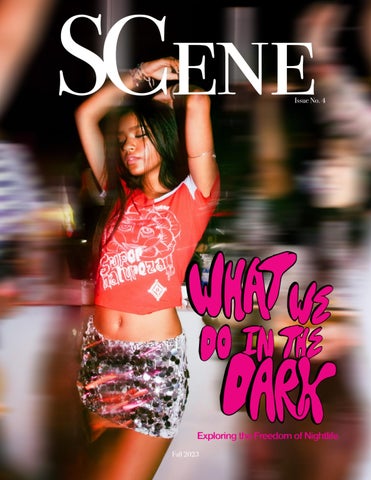
Issue No. 4
Exploring the Freedom of Nightlife Fall 2023
1
Issue No. 4 | Fall 2023
EDITOR-IN-CHIEF | Julia Zara CO-CREATIVE DIRECTOR + SOCIAL MEDIA MANAGER | Kassydi Rone CO-CREATIVE DIRECTOR + VIDEO PRODUCTION MANAGER | Asha Oommen CHIEF FINANCIAL ADVISOR | Kayla Rocha DIRECTOR OF WRITING | Kendall Bradwell DIRECTOR OF PHOTOGRAPHY | Pili Marco DIRECTOR OF DESIGN | Kathryn Aurelio DIRECTOR OF MULTIMEDIA | Kayla Li WRITING COPY EDITOR | Sullivan Barthel Laurie Carrillo Alexis Lara Anthony Slade Izzy Ster Kylee Warden PHOTOGRAPHY Maddy Brown Kayden-Harmony Greenstein Lili Pape DESIGN Solana Espino Carlee Nixon MULTIMEDIA Jazmyne Aquino Francesca Cappello Megan Chan Kayla Cunningham Elizabeth Griesser Smriti Marar Daishalyn Satcher GUEST CONTRIBUTORS Christin Albertus Vivaan Kabir Amy Pham Thomas Pham 2
TALENT + CREW Hanah Abualhaj Nicole Bednar Christian Bipat Rigel Broeren Christian Bryan Lilly Casiraghi Alice Chiang Olivia VG Clarke Zoey Contractor Tijon Dembo Arya Desai Rokya Diaby Jensen Dylan Moorea Eldon-Everts Avery Goodman Kaitlyn Hajj Sam Huntsman Ethan Holder Martina Ibrichimova Aastha Jani Dom Jocas Christian Johnson Mia Gabrielle Juni Assia Khader Jessica Khatib Irene Kim Sultanthegiant Kainoa Martinez Allie Merchant Moray
Jamilah Muhammad Sarah Wangari Mwangi Tamilore Odunsi Sam Pozen Amber Rastian Ahaan Rao Danté Rose TJ Roszko Lakshmi Sajith Anjali Sareen Jalen Short Mia Sun Aaron Wilson Rui Zhang
Table of Contents 4-5 | Letter from the Editor + Creative Directors 8 | In the dayglow: Facing the moonlit blunders of a night out Kylee Warden
We’ve all had our fair share of drunken mistakes.
20 | Holding Each Other’s Hair Back Izzy Ster
For girls at a party, the bathroom is a safe haven.
32 | Driver’s Education: I’m Forgetting Fear on the Freeways Alexis Lara
We may cruise through college, but finding our way in the darkness isn’t always so simple.
42 | From Dusk Till Don Kendall Bradwell
Students navigate their identities like they navigate their closets; from day to night, they have the freedom to change.
56 | A Toast to Predictable Parties Julia Zara
Let’s raise a drink to every party, like, ever.
66 | Where are the Lesbians?! Anthony Slade
Special thank you to Sean at Stud Country, Club Bahia.
78 | Morning Qualms
Pili Marco + Kayden-Harmony Greenstein Things got a little out of hand last night.
88 | The After-Party Playlist Daishalyn Satcher
A career in the music industry doesn’t happen overnight.
100 | Spin that Record, Baby Laurie Carrillo
It’s time to bust a move.
116 | Behind the SCenes
What’s a party without the party planners? Get an exclusive look into the making of Issue No. 4.
3
I
t feels almost antithetical to discuss parties from the perspective of a natural homebody. I must admit that the entirety of sophomore year, I went out one time. There’s something comforting about staying at home on a Friday night, snuggled up alone in a twinsize bed with some light reading. I guess what’s so alluring about a night out is all the ways in which this comfort is upended. Whereas home is cozy, warm and predictable, awaiting us in the darkness is an explosion of sights and sounds and colors, a tempting mixture of possibilities that’s as sweet and dangerous as mystery punch. At night, the city spins with excitement and rowdiness. Anyone, anywhere, can be an entirely different person. Yet, as we bound into nightfall, the real question is not just “What We Do in the Dark.” It’s whether we get lost in that darkness, or find our way back to ourselves at the end of the night. This unpredictable, blurry labyrinth is exactly what SCene’s fourth issue emulates. A deliberate attempt to completely diverge from the feathery softness of spring 2023’s “Universal Language,” fall 2023’s “What We Do in the Dark” gives SCene a certain edge, one that twists and turns from one house to the next like a party hopper who’s just trying to find a good time. There’s grit and risk infused with the brazen spirit of 4
youthful rebellion, commanding attention like a teenager dripping with cherry red Revlon box-dye. For many students, the darkness is where we run to when the day is over. Introvert or not, we are constantly presented with choices in the dark, like savory appetizers on a silver platter. Whether that’s retreating into house parties thrown by random strangers, pushing through crowded concerts in the quad, shivering in line outside the 901, or dancing with roommates in our apartments after class, there’s literally a million ways we could spend the night, especially in a city like Los Angeles. And for our SCeners (coining a new phrase, please help it catch on) and their interviewees, the night is where we come out to play. With a roster as spontaneous as this — line dancing at queer nightclubs, night driving down the 110, shaking a** at bars in Cabo — you’re definitely in for some good fun. I extend a heartfelt thank you to the SCene team for embracing this issue with so much spunk, creativity and a sense of community. I know that even with the play that came with this issue, there was also a whole lot of work, whether that was driving to Burbank with models, holding lights over your head for six hours straight, or doing “research” at parties on 30th. Every moment spent with each of you was a party in and of itself. I’d also like to thank our faculty advisors for your honesty and
expertise. For your guidance, I’m truly grateful. And, as always, thank you to our interviewees, models, actors and crew for entrusting SCene with your stories. You could have spent your nights with anyone else. Thank you for choosing to spend them with SCene. I’d also like to note that in the interest of the students involved, all models and actors are visual (not literal) representations of our theme. Finally, to our readers. The night may be unpredictable, but your support never wavers. So, wherever you choose to read this issue — scrolling through it to look busy at an awkward kickback or digesting it alone in your apartment — I hope this collection prompts you to question why we yearn for hot weekend nights. Do we hide amongst humming bodies in a crowded room? Or do we relish in the opportunity to reveal ourselves in the shadows? Whatever your answer is, stay safe out there. And, you know what? Have a good time.
EDITOR-IN-CHIEF
P
ity or surprise. Coke or cocktail. House or venue. Whatever the emotion, wherever the occasion, the bottom line is: A party can be involved. But whether you’re solo-jamming to an imagined tour setlist in the mirror or screaming Spotify’s top hits on a very public, *very real* elevated surface, we’d be willing to bet on the fact that nighttime has fallen (because, well, casinos are also a prime after hours activity). So, when daylight-cast shadows finally stop trailing behind and meld into step with us, what else is it that we do in the dark? Why do we wait to reveal these parts of ourselves? And is that wait worth it? Issue No. 4 explores all of these questions and more, unveiling glimpses of the perils and promises alike that college nightlife offers. Because when the clock strikes 12:00 a.m., forget the glass slipper. We’ll take whatever shoe fits our midnight motives. Sorry, Cinderella. Maybe your dirt-crusted Chucks find more comfort in a crowd of strangers than with your own thoughts. Maybe your cowboy boots get their wild night out after a regularly scheduled game day, turning
you into some sort of a line dancing machine. Or maybe, just maybe, you saved your new pair of UGGs from getting soaked by the kid who thinks it’s hilarious to blast beer from the upstairs balcony. And let’s not forget the change of pace that identity factors in. You’ll walk a little quicker past the bouncer with your I.D. from a state you can’t name the capital of, or your tiny top’s debut will be so shocking that your classmates from this morning couldn’t recognize you if they tried. No matter what route you take in this choose-your-own-adventure ritual — wholesome or borderline worrisome — you’re bound to end the night with debrief-able memories. This semester, SCene invites you to indulge in narratives that invoke those same feelings of nostalgia, chaos, exploration and perhaps even a little bit of embarrassment… but hey, that just makes for a good story, right? Well, we don’t want to be the hosts with a toast that goes on a little too long. Sit back, grab a drink of your choice and live vicariously through a montage of the many experiences a night out can bring.
+ CO-CREATIVE DIRECTORS
5
General Disclaimer.
6
SCene Magazine believes in the principles of journalistic transparency, integrity and awareness. Hence, in an attempt to minimize harm and increase transparency, SCene Magazine recognizes that all images in this magazine, unless otherwise stated, are staged photoshoots. Our team works tirelessly throughout the semester to pitch, storyboard, cast, shoot and edit these photoshoots. In-depth conversations have been shared about the content, stories and meanings captured in the following images. Besides one photographer’s visit to a nightclub, where consent agreements were also signed by participating members, all images were taken in the context of models posing in editorial photoshoots, complete with professional lighting, costume design, creative direction and modeling. Meanwhile, all people involved in the making of this magazine, from being photographed to being interviewed, were made aware of their participation. Please note all photo captions found in the corners of this issue, which help to further describe our images. Arming consumers with these tools, SCene Magazine believes in the responsibility of the press to increase media literacy in readers. SCene Magazine is a publication dedicated to telling stories about the unique student experience. Parties are very real, very pertinent aspects of that experience. U set the SCene. We tell your stories.
7
in the dayglow facing the moonlit blunders of a night out
written by kylee warden photographed by julia zara In frame: Asha Oommen ‘25 poses as a mere representation. She is not the same person as the interviewee.
8
T
he sun pierces through the tiniest sliver of the broken blinds in your apartment on Ellendale as a reminder of your splitting headache. Your glittery Space Cowboy eyeshadow from last night is hanging on for dear life, and your phone has been dead for hours, no doubt brimming with messages from your friends wondering if you made it back home after the party. As you roll over to seize a few more minutes of sleep before the reality of your hangover sets in — your eyes shoot open. The morning sunlight reminds you nothing can stay in the dark forever: You must confront the wild, crazy, over-the-top embarrassing thing you did when “just one more shot!” turned into a story that makes your cheeks flush a deep shade of cardinal. The pounding in your head is like a fervent knock demanding you answer the door and face reality. Not only did last night’s cheap tequila shooters increase your cortisol levels and heart rate, making you more prone to deep anxiety the morning after, but they might have also encouraged you to drunk-call your ex. And vomit on the guy you were “sort of” seeing. And jump off the back of a golf cart, leaving you with a gnarly bruise as evidence of a night well-lived. These are the stories we live with — and learn from — after a night of partying, drinking and excess. How do we learn to embrace these stories as a natural part of our coming-of-age narrative and not let the shame keep us under our covers forever? First, let’s rewind. 9
Valentina Bellini can tell you a thing or two about a wild night out, so much so that her name is a pseudonym — a play on a drink just as bubbly and captivating as she. She’s Italian-born, where the legal drinking age is just 18 years old. Upon coming to USC, she took the “work hard, play hard” attitude of the Trojans as Bible. She went out nearly six nights a week, whether for sorority events, after parties in Beverly Hills mansions or just catching a buzz on the Row. Valentina is the life of the party, and she wears the title like a badge of honor. A self-described “attention whore,” Valentina pulls out all the stops on the dance floor: “I will always do [the worm] when I go out,” she says. “On the club floor, on the frat floor. It’s disgusting, but I just can’t help myself because I’m very good at it. I could do it backwards and forwards on my hands. Backflip into it. It’s like my party trick.” Her typical haunts away from campus include exclusive West Hollywood clubs like Bootsy Bellows, Poppy and Nightingale Plaza. Admission to all three is by invitation and bottle service only — not a problem for Valentina, whose fun-loving persona and alluring posh accent help her charm her way into just about anywhere. She’s met dozens of celebrities and influencers this way, including the cast of the reality real estate show “Selling Sunset” and rapper Desiigner, who once left her with a kiss on the cheek as a brazen parting gift after he performed on stage. Now at USC, she’s cut her carousing down to a cool Wednesday-through-Saturday-night bender. “I’ve definitely taken a bit of a chill pill from my freshman year. I went a bit crazy,” she says. But her stories will live on forever, archived both in her memory and in classic 21st-century style: Video evidence. One of her more memorable and mortifying tales takes us to Cabo San Lucas during spring break of 2023. Cabo is a popular destination for college students, particularly those in panhellenic communities. Valentina, along with what seemed like the entirety of Frat Row, soaked up the Mexican sun (and tequila) for four days straight. 10
the morning sunlight reminds you nothing can stay in the dark forever.
IN THE DAYGLOW | Kylee Warden
Oommen is a cinema and media studies major.
11
How do we learn to embrace these stories as a natural part of our coming-of-age narrative and not let the shame keep us under our covers forever?
12
IN THE DAYGLOW | Kylee Warden
It went about as well as you’d expect.
“I don’t think I can return to the country. I think I’m banned from the country,” she says, transporting herself back to a scene that played out just south of the border.
Valentina can’t say no to a little competition. After demolishing her challengers in a beachside push-up contest, she sought a new title: Champion of the lap dance competition (which would prove to be the first of many). And so, armed with a strapless bikini and enough Don Julio in her system to last a lifetime, Valentina climbed the Mango Deck club stage to claim her crown. The crowd erupted in chants of “USC! USC! USC!” as Valentina cleared the competition by miles. “I’m pulling out all the tricks,” she says. “I’m doing the splits over his head.” It isn’t until she turned back around to face the crowd that she realized her blunder. That strapless bikini — amid an impassioned twerking battle — had slipped down, revealing all to the hundreds of people in attendance, as well as the cameraman who casted the scene onto the bar TVs, in case anyone missed the live show. “I was recognized in the streets of Cabo,” she says. “I also can’t drink tequila now.” Most importantly, “I also won.” But when the adrenaline — and alcohol — of a night spent letting loose fades, it’s easy to be swallowed whole with embarrassment.
13
Writer Kylee Warden ‘24 is a journalism major with a minor in global communication from Reno, NV.
14
IN THE DAYGLOW | Kylee Warden
15
When asked how she gets up the morning after a blurred night, Valentina admits it’s not easy. “I just don’t really want to see anyone that I was with the night before,” she says, adding, “Forget about me for 24 hours, and then we’ll have a fresh slate.” For her, the night is full of endless possibilities, but the morning after can be a ruthless confrontation. So, what’s Valentina’s best tip for facing what she did in the dark, in the light? “I feel like it’s good to speak to someone who’s unconnected to everything,” she says. When she feels anxious or bashful after a night of drinking, she reaches for the phone to call her friends back home in Europe. “They reassure me.” She says talking to other people who live outside of her SoCal social sphere puts everything into perspective: Your alcohol-induced faux pas on the grimy club floor and the (seven) slurred voicemails sent to a bygone fling are fleeting and trivial when you zoom out, she suggests. “Even if you texted an ex and was like ‘Oh my god I love you, I miss you,’ that’s awful, but it’s okay,” she says. “It’s not the end of the world.” If Valentina, a girl with a treasure trove of drunken misadventures, can brush off the blunders and head right back into the night, then surely we can, too. From the rash to the humiliating, we’re responsible for the choices we make beneath neon strobe lights, on elevated surfaces and atop the occasional mechanical bull. But as long as everyone gets home safe at the end of the night, instead of looking back on our missteps with shame, let’s embrace them as the spirit of our youth. “In 10 years,” Valentina says, “I’m gonna look back on it and be like, ‘I was an icon.’” Take it from her: Those enticing salt-rimmed mistakes make even better stories.
16
... instead of looking back on our missteps with shame, let’s embrace them as the spirit of our youth.
IN THE DAYGLOW | Kylee Warden
17
in the dayglow in the dayglow in the dayglow in the dayglow in the dayglow in the dayglow in the dayglow in the dayglow in the dayglow in the dayglow 18
Hailing from Frisco, TX, Oommen models as if it were the morning after a night out.
Take it from her: Those enticing salt-rimmed mistakes make even better stories.
19
Holding Each Other's Hair Back
20
On left: Lilly Casiraghi ‘25 is a theatre major from Wilton, CT. A fun fact about her is that she has the same last name as the royal family of Monaco.
Written by Izzy Ster Photographed by Lili Pape Designed by Solana Espino
21
I
’ll admit it: I was terrified of parties. I still am. You mean I’m expected to Uber to a secondary location, walk on suspiciously sticky floors, locate a lukewarm seltzer, let some unwanted boy breathe down my neck, and dance to a sh*tty Spotify playlist someone haphazardly made 20 minutes prior to the self-proclaimed “rager”? And don’t even get me started on the small talk I’m supposed to engage in with people I met briefly freshman year, or that one kid I sat next to in my Science GE so I look less alone. Even when I’m in a crowded room, full of buzzing bodies and commanding conversations, it becomes so very simple to slip into a vast state of loneliness, feeling like a stranger in my own body. Yet, in light of my campaigns for a chill night in, it appeared being up for a fun night out was more socially acceptable. I stumbled my way through pre-games, smiled through conversations I hope I looked present in and used far too much glitter on my eyelids. I tried to dance carelessly, even when
every movement of my limbs was mapped out in my head. I flirted with people for the sake of making someone else smile. I hid in the back of mirror selfies, hoping to go unnoticed on a ran22
dom person’s Snapchat story. Of course, like any good introvert, once at a party, I would promptly excuse myself to the bathroom. There are very few experiences that perfectly encapsulate what “girlhood” really is, and no, it’s not rewatching “Barbie” for the fifth time or carefully painting pink lipgloss on your lips every few seconds. There’s a reason girls excuse themselves to the bathroom in packs, because what awaits is not unlike the scene in “Charlie and the Chocolate Factory” where Charlie experiences “Pure Imagination” in a sugar-gilded world. Instead of chocolate, a rank bathroom – obviously lacking toilet paper and only offering shaving cream as hand soap – is a safe haven for girls. It’s the holy land for the divine feminine to meet a stranger and listen to them give you more compliments than you’ve ever received, all in the span of five short minutes.
Because, duh! You should also realize just how pretty you are, and how sparkly your eyes are, and how cute and life-changing that Brandy Melville top you’re wearing is, and how amazing you
HOLDING EACH OTHER’S HAIR BACK | Izzy Ster
23
On left: Kaitlyn Hajj ‘26 is an exploratory major from Los Angeles, CA. She can sing.
24
HOLDING EACH OTHER’S HAIR BACK | Izzy Ster
are, and how amazing all of your friends are, and how amazing this night is. And when you slip out of that glittery safe haven and shimmy your way back out into the real world, into that sweaty house party where you can maybe pinpoint only two other people you know, you seem to yearn for the linoleum wonderland waiting for you in the bathroom. After being thrown back into the belly of the beast, away from fledgling conversations with your new bestest friends in the entire world (“Oh my GOD how did we go this long without meeting each other?”), it becomes entirely clear where you want to return. The best party is in the smallest room in the house, with the smallest group of people, talking about the biggest topics of the evening. Because being a Being a woman is holdwoman is hyping each ing another woman’s other up in the bathroom. It’s comforting hair back to pull trig and a complete stranger forging a lifelong friendwhen she’s reduced ship just seconds after to teary shambles on a violently disgust- you wipe chunky mystery ing floor. It’s holding punch from her lips. one another’s hands like preschoolers as you blindly navigate the darkness of a bustling party. Being a woman is holding another woman’s hair back to pull trig and forging a lifelong friendship just seconds after you wipe chunky mystery punch from her lips.
25
Writer Izzy Ster ‘25 is a screenwriting major with a comedy minor from San Diego, CA.
26
In mirror: Rokya Diaby ‘26 is communication major from New York City, NY. She can crochet.
HOLDING EACH OTHER’S HAIR BACK | Izzy Ster
27
28
Disregard the fleeting nature of this experience and comprehend the importance of this interaction. Isn’t it beautiful we can meet someone and quickly bond over this shitty party, or that creepy guy, or how we both feel bloated in our Urban Outfitters dresses? In those few moments, whether it’s in a porcelain palace interrupted by intermittent hiccups, a tangle of women carefully caressing another’s hair back into a makeshift ponytail, or sitting on the curb outside a random Victorian house in the early hours of the morning, a person you met only mere moments ago seems to know you so well. This girl, this drunken angel conjured up from a festive dream, sees you, breaks down walls and makes you unable to hide from her like you have so often hid from yourself. Isn’t that a truly beautiful experience?
29
Holding Each Other's Hair Back 30
31
Writer Alexis Lara ‘25 is a journalism major with a sports business and management minor from La Cañada, CA.
In frame: The models pose as artistic representations of navigating identity in college. The use of blue and red lighting is a symbol of the distinction between youth and adulthood. No real cigarettes were smoked on set, and they were only used as artistic props.
32
DRIVER’S EDUCATION
I’M FORGETTING FEAR ON THE FREEWAYS Written by Alexis Lara Photographed by Pili Marco DeSIGNED BY SOLANA ESPINO
33
A
fter a long day, there’s nothing worse than the commute home. Los Angeles has a particularly bad reputation for its traffic — your foot spends more time on the break than the gas, and you can be in the car for hours without ever going very far. If you’ve lived here long enough, you’re no stranger to being stuck in a car. While I believe that truly being a local is finding peace in the driver’s seat, I am also not here to romanticize the frustration of traffic. I am here, however, to bask in the glory of late night drives. When the sun stops beating down on the 110, sometimes the only thing I want to do is return to the car. When I got my license almost four years ago, the freeway was my biggest fear. Cars on the freeway move fast, faster than I was comfortable with. Even if I didn’t feel ready, I knew I needed to keep up. The road has now become a place to settle my nerves and find peace in the wandering. But I’ll never forget that it used to be something I feared. What if my car broke down? What if I got a flat tire? Most of all, I never wanted to drive alone. I didn’t trust myself to get out of a bad situation on my own. I still don’t. Like driving to a new place without directions, I hated getting lost — and left behind. The more miles I spent behind the wheel, the easier each got. Somewhere in between, I stopped being scared, and I relished being on the road. It wasn’t one big moment that I stopped being scared of driving, but a series of smaller ones. All I needed was a little time to get comfortable. Tonight, I’m leading my friends to Dally, my black Jeep. She has always taken me wherever I need to go. Dally is not graceful and delicate: She is untamed and durable. I am protected looking through her foggy windshield, fortified behind her car doors. With empty coffee cups littering the floor, sweatshirts or beach towels hanging over every seat and the smell of coconut air freshener
34
Rui Zhang ‘26 is an East Asian Languages and Cultures and Communication major from Pleasanton, CA. She was a girl scout for eight years. The cigarette in frame is not being smoked.
35
On left: Lakshmi Sajith ‘26 is design major from Pleasanton, CA. She is a registered yoga instructor.
36
DRIVER’S EDUCATION | Alexis Lara
wafting through the air, I think Dally is charmingly chaotic (but others might call her messy). Everyone retreats to their unassigned-assigned seats. At first, the only sounds in the car are a window rolling down and the click of a seatbelt. Then I plug in my phone and hand it to my right. Song names are shouted I thought I could at the passenger princess until change everything everything from Pitbull to Ed but the hollow Sheeran makes its way into the queue. There is a momentary shell of my appearpause at the red light outside ance, and still no my parking garage. With a one would know I flash of green, we’re off. Drivwas lost. ing along Figueroa, my worries release with the familiar sights of South Central. I see the electric blue of the Felix Chevrolet lighting up the intersection. I see the CVS, where people always linger outside. I see the Starbucks alit with fluorescent lights to keep the late night studiers awake. I see the liquor store nestled between Spudnuts and Pot of Cha. I see freshmen waiting for a Shryft after buying handles of Titos and Pink Whitney. I see all of these places differently than I used to. As a freshman, my perspective on nightlife mirrored my thoughts on driving. I thought the kids with the fake IDs were taking full advantage of college; they were the ones ahead of me in the fast lane. I always desired a fake, suffocated by the feeling of being trapped in the slow lane. I wanted to take charge of who I was, grab the wheel and be someone better — I thought a fake was the only way to do that. Give me a new address, a new name. With a fake, I thought I could change everything but the hollow shell of my appearance, and still no one would know I was lost. Like the flow of traffic, I wanted to keep up with my friends.
37
I wanted to follow them on every adventure, every night out, even if it meant my own identity got left behind. I’ve spent a lot of time roaming the confusing L.A. roads behind the wheel — I’ve spent even more time roaming around campus. And on every journey, I’ve learned that I will survive college if I live like I drive. The more traffic there is, the less likely someone will let me in the lane; now I understand that waiting for my turn isn’t always enough. Sometimes I’ll miss my exit, but I’ll never reverse the car in the middle of the street to take the road I had passed. I won’t question the streets that I have never driven on. I won’t regret any decisions I have made, because there’s always another way to get to my end destination. Most importantly, I’ve learned that the late night drive destinations are never exceptional. My friends and I are just looking for excuses to wander. College is the same. I don’t always need to have a specific destination. Even in the darkness, I will keep my foot on the gas, and I’ll find my way. Whoever is along for the late night drive will, too. I take comfort in the fact that this is where I’m supposed to be. I’m nestled in my car, driving in L.A. at night, wandering the freeways, knowing I can never leave L.A. but always pretending like I will.
38
DRIVER’S EDUCATION | Alexis Lara
39
40
DRIVER’S EDUCATION I won’t question the streets that I have never driven on. I won’t regret any decisions I have made, because there’s always another way to get to my end destination.
41
WRITTEN BY KENDALL BRADWELL PHOTOGRAPHED BY VIVAAN KABIR
42
In frame: The models in this photoshoot are not the interviewees in the piece.
FROM DUSK TILL DON | Kendall Bradwell
43
Writer Kendall Bradwell ‘25 is a business of cinematic arts major from Upper Marlboro, MD.
44
FROM DUSK TILL DON | Kendall Bradwell
A few blocks over, at the Kappa Kappa Gamma gym, is Moorea Eldon-Everts. Her style can be described in one word: Elegant. After her morning workout, the senior from Seattle, Washington changes into an ensemble that is sharp, classy and feminine. “I love wearing dresses that make me feel empowered,” she explains. Today, she’s wearing a long, flowy zebra print dress, coupled with her favorite gold rings and necklaces. Unlike some of the other early morning 7:30 a.m. Trojans on campus, Moorea’s daytime fashion is As the sun rises over South Central Los Angeles, intentional. Every day, she wants to feel confident, the loud noises of honking cars permeate the city. comfortable, and timeless, and her clothes purposely Keurig coffee makers everywhere gurgle to life. And reflect that. a blaring alarm sounding off means Rigel Broeren is Elsewhere, Jamilah Muhammad, known to her friends wide awake. as Jam, loves Y2K fashion with a modern spin. Citing As the junior from Huntsville, Alabama prepares films such as “13 Going on 30” as her inspiration, to go to work, he trades in his pajamas for an outfit the senior from Nashville, Tennessee styles her hair with his signature streetwear flair. Fresh from the dry this morning in two low buns, while adorning herself cleaners are his tan cargo pants, which he pairs with in chunky gold jewelry. Her look is finished off with his fitted cap, black jacket, and white grapha scoop neck black top ic tee. Rigel’s style is rule breaking: He’s not cargo pants, mixIn the light of day, and afraid to mix his work-wear trousers with a ing streetwear elements exams, assignments with a “chic, feminine more relaxed pair of Jordans. To him, there are no set rules in fashion. Even in the workforce, and office hours rule flair.” Rigel is unafraid to show the world who he is how students dress — a through his style. By noon, a whirlwind
casual, unceremonious of students flock across As he and the first few students wander onto air soaks up our per- McCarthy Quad — flashcampus, we get a glimpse of the morning peres of green Goyard sonalities at the University of Southern Cali- sonalities like a fuzzy totes, pre-dirted Goldfornia, where students’ fashion choices reflect oversized sweater. en Goose sneakers, who they choose to be in the daylight. One boy Quiksilver beach tees skates down McClintock on his way to a calcuand the iconic red USC crewneck sweater are evilus lecture, dressed in a long-sleeved white shirt and dence that fashion can take on any form. Any inspiblack basketball shorts: Today, he’s laid-back and ration. Any price. sporty. Another girl is headed to work, donning a green floral dress with a cream cardigan: This morning, she’s bright and perky. A third student is unhap- In the light of day, exams, assignments and office py to be awake so early in the morning: They’re tired hours rule how students dress — a casual, uncereand drained. They’re wearing the same thing they monious air soaks up our personalities like a fuzzy went to sleep in — a ratty old t-shirt and gray sweat- oversized sweater. pants — but they wouldn’t be caught dead without But as the sun sets and falls below the horizon, so do their favorite silver hoop earrings. our walls.
45
From left: Dom Jocas ‘25 is an arts, technology and the business of innovation major from Canton, OH. Ahaan Rao ‘25 is a business administration major from Bangalore, India.
46
FROM DUSK TILL DON | Kendall Bradwell
Jocas is an aspiring polygot, and Rao can speak six languages.
47
9:00 p.m. The color of the sky changes from a soft peach, to a soothing lilac, and finally, to black. Street lamp posts begin to blinker on, illuminating the now pitch-black void. Somewhere on 28th Street, house music blares from an unbelievably large stereo. Dressed to the nines in their shiny bustiers and movie star makeup, a group of giggling girls dodge Shryfts inching their way down 28th. Their looks are chic. Eye-catching. Flawless. They descend upon the most talked-about themed party of the month; the line pools out the door, but the fashion-forward girls are able to walk right in. Among them, surprisingly, is Jam, who does not see herself as a party animal. “I honestly did way too much partying my first year here,” she admits. “I’m usually not on that [anymore] because I’m very tired. My weeks are busy.” Tonight, however, she’s having the time of her life. She trades in her baggy daytime pants for a dress that’s sleek, bodycon and figure-flattering. Her change of clothes is, in her own words, empowering: “[It embraces] my womanhood and [proves] to myself that sexy comes in all different sizes.” As a tall, slender girl, Jam gets to fully appreciate her shape with her party time wear. “[Nighttime fashion] helps me embrace my body size when, in my culture, my frame isn’t celebrated as much.”
48
Assia Khader ‘25 is an applied and computational mathematics major from Jordan and Lebanon.
FROM DUSK TILL DON | Kendall Bradwell
49
But as the sun sets and falls below the horizon, so do our walls.
Zoey Contractor ‘25 is a philosophy, politics and economics major from Mumbai, India. She’s trying to dive with whales.
50
FROM DUSK TILL DON | Kendall Bradwell
51
As Jam and her friends go deeper into the house and the music grows in volume, they’re finally able to let their hair down. The stress about upcoming midterms, internship applications and that awkward situationship melts from their memories as they dance the night away to their favorite songs. Even though some of them have no idea how to dance, they don’t care how silly they may look — at this moment, they are free. They have each other, and they feel at home in the skin they’re in. Most of all, they know they look good, their glittering clothes acting as a layer of armor.
you’re “supposed” to wear can build one’s walls up, rather than tear them down. Somewhere amongst the crowd, Moorea is here, chatting with her sorority sisters. She’s wearing an outfit that is the polar opposite of what she wore 12 hours ago — swapping out her beloved flowy silhouettes for a dress that’s short and form-fitting. “The attire [at this party] was expected to be more in line with a club atmosphere, which isn’t my usual choice,” she says.
While her outfit fits in with the expectations of the night, she still feels like a fish out of water. “On one hand, there was a sense of camaraderie and exciteFor Jam, nighttime wear is freeing. When dawn turns ment in getting ready with my sorority sisters, and I into dusk, she’s able to let loose, celebrate herself was looking forward to the party,” Moorea says. and find pride in her appearance. “However, I couldn’t help but feel a bit like I wasn’t But freedom is relative. fully expressing my authentic self,” she confesses. For Rigel, freedom at night means the ability to chill She’s definitely not alone. There will always be moout. The work day is done, his ments when a so-called friend classes are finished, and now, he you a “What the hell are But in the shadows shoots can take in the world around him. you wearing?” glare before you When it comes to his go-to party of parties, should we leave the house. There will always outfit, he doesn’t think much about choose to be ourselves, be people who order a new outfit how sexy he looks or feels when he with same-day shipping on Amaor who others expect us goes out: “I think for guys, it’s a bit zon Prime, because they feel the to be? different, and they don’t have any party clothes they have aren’t “cool pressures of sex appeal.” enough” compared to everyone else’s. Because of this, he doesn’t feel the need to change much in comparison to his daytime ensemble. In the nighttime, it can feel easy and comfortable to mimic the styles of those around you. Maybe it feels “I think [I would wear] more black and white, and safer to blend in, instead of wearing things you know then splashier jewelry,” he explains. that will make you stand out. He swears by his black sunglasses not only to protect him from photography, but also to allow him to people-watch unnoticed. “The only time it’s bad is if you’re out like, a really small or low key function,” he says. “And it’s like, why does this person have sunglasses on in the living room?”
But in the shadows of parties, should we choose to be ourselves, or who others expect us to be?
“While there’s undoubtedly pressure to conform, it’s equally important to honor your unique fashion sense and comfort,” Moorea says. Looking back on her party experience, she no longer feels pressured For others, nightlife may feel even more restrictive to bend to others’ expectations. She puts herself and than everyday wear. While some find parties to be a her freedom first. “Ultimately, fashion should be a release from the pressures of the day, abiding by what tool for self-expression and empowerment, rather than a source of oppression.” 52
Jam concurs: “If I don’t feel empowered, I’m not wearing it, period.” While these three business administration majors have distinct styles from one another, they all have the same perspective: Show up in a way that makes you happy. Find a style that is uniquely your own. What if you don’t know where to start? “I think it’s about finding pieces that just speak to you,” Rigel says. Whether it’s a meaningful piece of jewelry or a favorite leather bomber jacket, find what has sentiment in your closet, and build your outfits around that. Hopefully, as you learn to discard other’s opinions of yourself and embrace the style that makes you, you, you can wake up and try again. There will be the dawn of a new day.
53
54
FROM DUSK TILL DON | Kendall Bradwell
Hopefully, as you learn to discard other’s opinions of yourself and embrace the style that makes you, you, you can wake up and try again.
55
A TOAST TO PREDICTABLE PARTIES Written by Julia Zara Illustrated and designed by Carlee Nixon
56
57
58
A TOAST TO PREDICATBLE PARTIES | Illustrated by Carlee Nixon
A
rtificial fog lurks through the crowd. It envelops me in yet another muggy, unwanted embrace, like the frat boy-turned bouncer, bouncer-turned DJ gave me at the front door. Fists robotically pump in the air, turning us into a herd of those lanky car lot inflatable balloon men. Click click click. Tin tabs on seltzer cans pop open. Black cherry! Strawberry lemonade! Grapefruit! Orange limeade citrus passionfruit dragon berry sour mango sweet watermelon vodka lime rum coke soda pop martini Mike’s hard candy bliss extravaganza! Fruity bubbles fizz onto ratty Nike Air Forces that make a rickety elevated surface feel that much more like a stage.
And when I step through the open doors of a house that looks exactly like the one I had just left, it takes practically nothing to convince me that yes — this is where it will all happen. This is where I’ll search for an attractive face in the sea of humming nobodies and find exactly what I’m looking for, like digging into a bag of jacks and pulling out the bouncy ball. Despite the droning predictability of a night out at USC – I Shryft, I Venmo, I dance, I leave — I never fail to cave into that tingling feeling before a night out. I can’t ignore the fleeting anticipation. Even when I decide to stay in for the night, excitement flees with my roommates as they dash out the apartment.
And when I step through the open doors of a house that looks exactly like the one I had just left, it takes practically “Don’t have too much nothing to convince me fun,” I call after them. I dissociate into the regular cycle of They giggle and call that yes, this place is “Bitch I Go to USC,” “Rack City,” and me grandma, but we all “Dancing Queen,” allowing myself to where it will all happen. know they’ll be back bemelt into a horde of partying 20-yearolds. I dance — and I mean dance (sorry, Mom). I pull out all my moves, well, all four of them but still, it prompts some rando to ask how much I’ve had to drink. She’s surprised when I say, “None,” but little does she know that being the sober friend is kinda my thing. A tap on my shoulder. “Let’s leave,” says my friend Anna above the music. She suggests that we party hop, reciting a Greek alphabet soup of parties that are also happening tonight. Even though I don’t speak Greek, I can’t help but say, “Sure.” This self-assured confidence that we will find more fun is almost comical. Prancing into another house, bouncing to another playlist (with the same songs), waiting in line for another porta-potty — the search for a better time is almost mechanical. I complain that it’s getting late, but when the sticky boy manning the haphazard table tells me to scan his Venmo and pay him 50 million dollars to enter his empty party, of course I oblige.
fore midnight.
Even so, armed with the knowledge that this weekend will be just like the last, we college students bolt into the darkness of the night. I used to find myself wondering why. Are we bored of being left behind? Tired after a long week? Afraid of our own thoughts when we’re left alone? It’s only when I stopped asking questions that I finally understood. As college students, we’re situated in a unique, beautiful, intricate, messy, over-the-top yet completely hum drum time in our lives. Here, our mistakes don’t need to make or break us. Here, we don’t need to have it all figured out. Here, our lives don’t need to be neatly wrapped, packed and tied with a little bow. Frankly, as long as there’s protective bubble wrap, we’ll be good to go. This revelation was contrary to everything I believed. As an overthinker and a perfectionist (a brutal combination), I used to think myself better than my peers
59
for choosing to stay in and do homework on a Wednesday night. But as I stand on the cusp of my twenties, the voice that said going out equaled immaturity has faded away. The nights I spent admonishing myself for staying in, or kicking myself for going out, eventually became just another weekend. When I made the active effort to claw my way out of my own head, the draining predictability of a night out became not just bearable, but fun. The fear of missing out if I stayed in — and the fear of not having a good time if I went out — stopped waging a war in my brain. The anxiety that I used to pack alongside my lip gloss in a mini shoulder bag was finally left at home.
Are we bored of being left behind? Tired after a long week? Afraid of our own thoughts when we’ARE left alone? When I stopped criminalizing the idea of a night out, I finally leaned into my youth. And I stopped hating myself for it, too. I mean, I’m just a girl! I want to dance with a stranger. I want to meet someone new. I want someone to compliment my hair. And I want to justify a DoorDash purchase because my roommates have the drunchies for 40 McDonald’s nuggets.
60
A TOAST TO PREDICATBLE PARTIES | Illustrated by Carlee Nixon
61
62
A TOAST TO PREDICATBLE PARTIES | Illustrated by Carlee Nixon
I want a lot of things from a night out, and that’s okay. Searching for more in the masses, I’m eager to find if there’s something out there, an inexplicable blur of possibility reserved just for me. I’d credit this to a simple gut feeling, but maybe it’s just the 40 McNuggets doing their thing down there... The naivety and delusion that accompanies being young and in college doesn’t need to be disdained. There’s something wonderful in being a little hopeful, even when life seems so obviously predictable. After all, I’d much rather be motivated by hope than fear. For some, fun comes with a bout of “liquid courage.” But for me, the soberness of reality fizzles away when I’m intoxicated by a genuine excitement for life. So let’s toast to all the things I’m bound to do next weekend: Venmo yet another sticky boy to get into his party, request yet another Lyft to go somewhere else, kill time waiting in line for yet another bathroom to... well, you know. But hold the shot for my drink. When it comes to pouring a swig of hope, I have a heavy hand.
Cheers!
63
64
A TOAST TO PREDICTABLE PARTIES But hold the shot for my drink. When it comes to pouring a swig of hope, I have a heavy hand.
65
written by anthony slade photographed by maddy brown designed by kathryn aurelio
I’M CALLING OUT L.A.’S GAY BARS 66
In frame: Stud Country, Club Bahia, a 21+ nightclub where these images were taken, is home to a vibrant queer community comprised of various sexualities. Those pictured and at the club are not generalized to all be lesbian.
67
Anjali Sareen ‘25 is a design major from Bangor, PA. A fun fact about her is that she pole dances. SCene followed her on a night out at Stud Country, Club Bahia
68
WHERE ARE THE LESBIANS?! | Anthony Slade
“
h my God, there’s gay guys everywhere!” I exclaimed as I stepped out of a $50 Uber onto the stunning queer strip of West Hollywood. It was my first time in WeHo, I was freshly 21 — and there really were gay guys… everywhere. I looked around with a sparkle in my eyes, one that I could only compare to the sensation of wandering through Six Flags and seeing the roller coasters that I’d soon be riding. Upon entering the first bar, I was greeted by Lady Gaga and Beyonce’s “Telephone,” a $20 drink and a dance floor filled with more gay guys than there are people in the entire state of Wyoming.
“protection.” “I’ve been groped at WeHo more times than I can count,” Jani says. “There’s this culture where people think it’s okay because they aren’t straight men.” So much for a safe space.
“We’re always here, and we deserve to have spaces that are always here as well.”
At the time, this was thrilling. I mean, in my high school class, which consisted of over 600 students, there were two gay guys — and I wasn’t even one of them (I was “straight” at the time). For so long, I had been fantasizing about moving to Los Angeles, where I could finally be around other queer people. I couldn’t wait to find a safe space that wasn’t the infamous high school Gay-Straight Alliance. And after enduring years of frat parties, tailgating and, somehow worst of all, 18+ clubs, I finally made it to the LGBTQ+ mecca of L.A.: WeHo.
Jani points out an interesting dichotomy: So empowered by finding their own community, some WeHo gay guys have made these spaces unsafe for other queer people.
But surely, WeHo isn’t the only destination for queer nightlife in L.A., right? Well, that’s true. Yet everywhere else seems to have Gay Guy Syndrome as well. And as of right now, there are just two lesbian bars in the city, and a handful of “lesbian nights” at other gay bars. “I mean, we are not popping up in and out of existence,” says senior environmental science major Jensen Dylan, who identifies as genderqueer and opted not to use his last name. “We’re always here, and we deserve to have spaces that are always here as well.”
I mean, LGBTQ+ is a lot of letters — and the only thing I could see was (say it with me) gay guys. Where are the lesbians? The trans people? The non-binary slayers? Aastha Jani, a senior communication and gender studies major, is wondering the same thing.
Hunting has scoured the L.A. nightlife scene for spaces with adequate lesbian and trans representation, but has rarely been satisfied. One event, a trans-centered rave called Ostbahnhof, boasted a crowd of gender non-conforming ravers and hooked their attention. But when they went, it seemed like other people heard about it too — it was infested with cis gay guys. Even spaces dedicated to trans people seemed dominated by a mostly cis audience.
“When I moved here, I thought it was going to be a utopia of expression,” they say. “But, it feels like a very exclusionary space.”
“It’s confusing and frustrating,” Dylan says. “I feel entitled to a space that I find out somebody else feels more entitled to.”
In Dubai, where Jani lived for nearly 15 years, queerness is a crime. Like me, they were looking forward to diving into the LGBTQ+ friendly spaces in L.A., but what they found were spaces that seemed to only cater to the G. In fact, as a non-cis person of color, Jani says they only truly felt safe when attending WeHo bars with their gay male friends as
One night, they had just been through a breakup, they were lonely and vulnerable, and they were sick of partying with gay guys. The only answer, of course, was lesbian karaoke night at Tramp Stamp Granny’s. At one point, they found themselves in the iconic position of being hyped up in the restroom by a handful of compassionate lesbians. But in a
But something wasn’t right.
69
THE IN 70
“L” LGBTQ 71
moment, everything changed. The voice of a gay guy singing “Let It Go” (one of the gay guyest songs) came booming from the speakers. “I almost lost my sh*t in that bathroom,” Dylan says. “Because I was already sad. And then I was like, gay men have this space too? This is literally lesbian karaoke!” It’s not all bad, though. In response to the gay guy-ification of queer spaces, more diverse bars have sprouted up. Echo Park’s Club Bahia is tapping into the unlikely synergy between western dancing and queer people through its “Stud Country” nights. The club hosts queer line dancing twice a week, boasting a large, committed following that (shocker) consists of more than just twinks. “If you go to Stud Country, you’ll see all kinds of people from across the, LGBTQ+ acronym,” Ben Ginsburg, line dancer and participant at Stud Country, says. “All different kinds of backgrounds and ages and ethnicities — it’s a really interesting cross section of people who are there to dance.” Even Jani has found communities that better reflect their identity. As a committee member of Satrang, an L.A. organization that serves the South Asian LGBTQ+ community, Jani has organized events in an effort to build spaces that didn’t exist when they moved here. “Finally, community spaces are starting to 72
WHERE ARE THE LESBIANS?! | Anthony Slade
A space that “honors the rich history of LGBTQ cowboy culture,” Stud Country teaches line dancing at Club Bahia on Sunset Boulevard.
73
These images were not staged. They were taken real-time during the line dancing festivities.
74
WHERE ARE THE LESBIANS?! | Anthony Slade
uplift minority queer people,” Jani says. But that’s not to say gay guys are the worst. I mean, I’m a gay guy, and I think we can be really fun! But in our collective attempt to achieve the gay utopia that is the stereotypical gay bar, we have left our queer siblings behind. Gay guys need to look at their behavior, the makeup of their social circles, and try to make space for the other letters of the alphabet mafia — because frankly, if it weren’t for them, we wouldn’t have queer spaces at all. That’s right. Our favorite WeHo bars wouldn’t be so crop-top friendly if it weren’t for our trans siblings, like Marsha P. Johnson and Sylvia Rivera, whose involvement at the Stonewall Inn over 50 years ago changed the entire trajectory of the queer liberation movement — and, it happened at a queer bar of all places. Nightlife is sacred, especially for queer people. L, G, B, T and Q are scarlet letters in the daytime. Genderqueer people are scrutinized for every aspect of their expression when operating in their heteronormative day to day. Every decision, each article of clothing, any waver in vocal tone can put a queer person in a dangerous situation. Ideally, queer bars should be a space for queer people to exist, without fear, without having to think about their own identity in relation to everyone else. But gay greed has stolen these safe spaces. Not every bar needs to be a sea of mostly naked gay men looking to get action on the dance floor. So, it’s up to us to make room. Yes, there should be spaces for gay guys like me to listen to bad 2000s pop music, wear mesh shirts and do poppers, but there also needs to be spaces for lesbians and trans people to do their thing. And when that thing is lesbian karaoke,
LET THE
SING! 75
Writer Anthony Slade ‘24 is a journalism major from Chicago, IL.
76
... it’s up to us to make room.
77
MORNING 78
This is a staged photoshoot. No alcohol was consumed on set. These visuals are purely representational and only serve artistic purposes. These captions work to minimize harm and increase transparency.
PHOTOGRAPHED BY PILI MARCO & KAYDEN-HARMONY GREENSTEIN DESIGNED BY KATHRYN AURELIO79
Sarah Wangari Mwangi ‘24 is an acting major from Seattle, WA. Her favorite film is an old screwball comedy made in 1934.
80
MORNING QUALMS | Pili Marco + Kayden-Harmony Greenstein
81
82
MORNING QUALMS | Pili Marco + Kayden-Harmony Greenstein
Mwangi transports us to a scene through these posed images.
83
This is a staged photoshoot.
84
MORNING QUALMS | Pili Marco + Kayden-Harmony Greenstein
GOODNIGHT.
85
This is a staged photoshoot.
GOOD MORNING.
86
MORNING MORNING MORNING MORNING MORNING MORNING MORNING MORNING 87
THE AFTER-PARTY PLAYLIST By Daishalyn Satcher Photographed by Megan Chan
88
Welcome back to The Daish Diaries, in association with SCene Magazine. Magazine. In this series, The After-Party Playlist, we’ll get to know two musicians on campus. We go to parties. We see them perform under flashing lights while we remain in the darkness, captivated by their stage presences. Who are they when they’re not under the spotlight? Tune in to hear us unpack their stories on this edition of: The Daish Diaries… After Hours.
These conversations have been clipped. Head over to @SCene Magazine on Spotify for the full podcast.
89
L
et’s start with your origin story. Where did your love for music begin? MORAY: I would say half of that was from growing up doing musical theatre, and the other half was Chicago’s 103.5 KISS FM. The first songs I remember hearing on the radio were Lady Gaga, Rihanna and Beyonce.
but also about songwriting as a career and what your life is going to look like after college. I would say they’re doing a great job of setting us up. And then of course, there’s the pop performance class, which is the flagship class of our major, where we’re learning how to perform. We’re put into bands each quarter, and each week we perform three songs.
What pivoted to make you want to create your own music?
What was your first performance here at USC?
Even when I was nine, I wanted to be a pop star. But I actually started creating or writing songs in sixth grade — that were obviously just not it. Then I started learning how to produce on GarageBand in seventh or eighth grade. And then by June, my junior year of high school, I released my very first song.
My friends and I would throw these apartment shows literally the first, second week of freshman year. People would file into our friend’s Gateway apartment, and we [had] a chair and DJ booth, and I performed there. So that was technically my first USC performance.
At USC, do you feel like you’re growing every year, and they’re giving you the correct tools [to succeed]? I’m part of the popular music program, which is like a four year pop star boot camp. They have us in all different types of classes. Especially the first two years, they front load you with a bunch of music theory. But then in contrast to that, I would say my favorite class right now is songwriting. It is a creative space where we’re not only learning about songwriting techniques,
90
Everyone kind of brings a different piece of the puzzle, and when you plug everyone’s strengths together, it becomes really beautiful. Music is a universal experience that people like to enjoy. Because it’s so accessible, a lot of people try their hands at it. Would you say it was hard to be taken seriously? Yes, 100%. Especially when I was starting out in high school, walking around like, “Hey, I’m releasing this song.” As a gay man, I feel like we just don’t get taken seriously, as compared to a straight man. I’ve had experiences where people want to equate being a performing, dancing, musician who wears makeup at his performances to being a drag queen. I’m not a drag queen. I’m a pop star. So, I would say, yes, for some experiences, I feel like if I was not queer, I would have been taken a little bit
Scan to listen to the full conversation.
MORAY.mp4
91
Josh Grossman ‘26 is a pop music major from Wilmette, IL. He once “dropped it low” for the Ziegler family onstage.
92
THE AFTER-PARTY PLAYLIST | Daishalyn Satcher
more seriously. But being at USC has definitely been thought] I needed to start blowing up on TikTok, to an overall super amazing environment to be pursuing start doing this and that. But I had this wonderful conthis in. versation with my vocal coach here, Jeffrey Allen, and he helped me realize these four years in college are Were your parents always supportive of you com- the only four years you’re going to get to just learn. ing here to study? I think I’m going to just focus on these four years, learning and taking in They’re the best ever. They’ve always beas much as I can. Then lieved in my creativity and pushed me to whatever happens, go further with it. happens when I graduate. I’m trying to trust Creativity here is mixed with technique the process right now. when we’re studying the arts. It is not just like, you walk in and start singing. What would you say your biggest mesOh my gosh, we work just as hard as the sage is that you wish Marshall baddies. I mean, it’s not the to give to people who same work. I’m not sitting in a library listen to your music? for hours at night, but am I sitting in the practice room for hours doing music theI want to be the artory and running songs 50 times? Yes. ist for the young gay teens who I didn’t Would you say that had a hand in how have growing up. To Moray was created? be able to hear those stories that I was goSo, my full name is Joshua Moray Grossing through, through man. I grew up being like, why is my midan artist’s perspective, dle name not Thomas or Jake? would have been a game changer for me. Because it had a bigger I’m lucky to have had purpose. Troye Sivan and Sam Smith, and so many Yeah, 100%. [Moray] just rolls off the more amazing queer tongue. Also, my grandma, Mimi, who I love so dear- artists, but there’s not enough. I really hope to be ly, that’s her grandfather’s first name. So, I wanted that person I wish I had growing up. I also want to be to pay a little homage to my grandma because she’s someone who people can listen to, let go, have fun always been so supportive of me. and feel less alone.
“I’m coming to the world as an artist, and this is my opportunity to be unapologetically myself... I’m going to just focus on these four years, learning and taking in as much as I can.”
The way you market yourself, from what I’ve seen, Where do we tune in? How do we stay connected? you already can tell that there’s an IT factor. How would you say that you were able to find that or I am definitely working on a project right now. You channel that? can look forward to a little bit more of a vulnerable, stripped back side, which is something that I have not As much as it seems like I have confidence, this is really done before. I would say I’ve been vulnerable me. You know, I’ve gone through a lot. I’m coming in my music, but this is definitely a new level. Follow to the world as an artist, and this is my opportunity me on Spotify [and] Apple Music. Subscribe on Youto be unapologetically myself. There’s no reason why Tube. All those are Moray. On Instagram I’m I should be hiding or concealing any parts of myself. @joshmoray. I think that’s where that comes out. Going through the whole freshman experience at this program, [I
93
Scan to listen to the full conversation.
SULTANTHEGIANT.mp4
94
W
here did your love for music begin? Has it always been the plan? SULTANTHEGIANT: I feel like my love for music began probably in my mom’s car. My mom used to always play a lot of oldies, like Marvin Gaye, Afrobeat, Fela Kuti, Michael Jackson, Tupac and gospel music. So I always had a good sense of what good music sounded like.
What age did music come into the picture? Music was always around me. Art was always around me. My sister is an artist; she’s also a psychiatrist. Growing up in a first gen household, there’s only so far you can stretch. One of us has to pick one thing, the other one is going to have to satisfy the parents. So I learned those skills from her, like at least earlier from musicals. Also, my mom was a really good singer, [and] my friend was a SoundCloud rapper. He no longer makes music, but he wanted me to sing on something of his, and I did. Ever since then, I kept recording music and doing it consistently. [But] I didn’t start taking music seriously until I graduated high school. So it’s a community thing, a product of the environment? I’d say so, yeah. The moment I switched my major, it was a done deal. What was your first time performing here? Before school had even started, I sang at one of the welcome weeks for the freshmen. How did you get that gig? I started recording at the YOUmedia library in Chicago. If anyone’s from Chicago, you know what I’m talking about. So, I did a festival when I was in high school. That was my first first gig, and then I started doing gigs, here and there. My first performance at SC, I wouldn’t even call it a gig because it was just so impromptu. It was move-in week, and school had not started. There was a live band that was playing karaoke, and they said, ‘Just pick a song that we know how to play.’ So, I said, “Can you play ‘Perfect’ by Ed Sheeran?” And I sang [it]. That was my first performance here.
95
I feel like a lot of people knew you as the person who would go up and perform, especially in our year. That’s crazy — the amount of confidence that you had. You moved across the country for college. It was the first week. You didn’t know anyone.
and a student artist, right? Do you want to break [out of] USC as your foundation? What is your perspective on that?
If you’re going to break through the USC crowd, you will. So that’s one thing on its own, [but] people know me in general in Los Angeles who are not I try not to think about it too much. People talk about from USC, which is a blessing that I’m so grateful you for, like, 15 minutes, and then they move on, un- for. But at the same time, I feel like it’s harmful as an less you actually leave a lasting impression on them. artist to be like, I want to break away from the founFreshman year, I had no ties. dation. Those foundation people Like, I didn’t care. So, during are actual people, you know? One the first week, I printed out a does not disturb the other. If anyton of flyers with my face on it thing, they’re in communication and the QR code of my song. with each other. People who are Then people started to recogfrom USC come to my shows, and nize me in public after. supporting me does not stop other people from doing it. How would they react? I got this really good advice from They’d be like, “Oh, you’re that someone last night. He was like, guy.” I wish the music was bet“What do you want to be seen as?” ter at that point. You know, it seems really simple, but it’s true. When people look at Well, you know, it’s a jourme, [I want to be] seen as someone ney. It has to be an evolution who you may not understand. But of sorts. I’m being as genuine to myself as I am right now. I change, sure. But Got to be. Then, I did a perforthis is me, genuinely. mance at Ground Zero with my boy Jackson. Then, after that Which is very beautiful. All show, I got put on Cup of Troy. right. So what can we look out for? A very USC origin for the start of your L.A. career. My song dropped in November, so you should check that out. That Yeah. Randomly, though. one’s going to be a fun time. [I’ve got] other things in the works, so stalk my Instagram, @sultanthegiant. There’s a big difference between being an artist
“When people look at me, [I want to be] seen as someone who you may not understand. But I’m being as genuine to myself as I am right now. I change, sure. But this is me, genuinely.”
96
Sultan Lugboso ‘25 is a music industry major from Chicago, IL. His dog’s name is Chrome.
THE AFTER-PARTY PLAYLIST | Daishalyn Satcher
97
THE AFTER-PARTY PLAYLIST “I really hope to be that person I wish I had growing up. I also want to be someone who people can listen to, let go, have fun and feel less alone.”
98
THE AFTER-PARTY PLAYLIST | Daishalyn Satcher
99
Spin that Record, Bab Written by Laurie Carrillo Photographed by Maddy Brown & Lili Pape 100
Photographers Maddy Brown ‘25 and Lili Pape ‘27 took dancers to the top of Grand Central Market. Two of the dancers pictured are not interviewed in the piece.
by 101
HIP-HO In frame: Ethan Holder ‘25 is a musical theatre major from Indianapolis, IN. He makes music.
102
OP
is not meant to be taught. This was one of the first things that I was told about the style I’ve been dancing since my freshman year of high school. A style I very much “taught” myself. When I began to educate myself on hip-hop — not just how to do it, but how it came to be — I learned that hip-hop truly wasn’t meant to be performed at all.
have come and gone,” Rose says. “What they were doing in the ‘70s in New York has come to define it.”
Meanwhile, the movements that accompany hip-hop far predate the 1970s, drawing from American jazz and funk styles as well as African dance. All these influences culminated into a distinct dance form, best This isn’t a style meant for spectators to gawk at, enjoyed at social functions. where dancers adorn themselves with makeup and costumes and put on a show for other people’s enjoyment. This is a style that was born out of community, where the social element was just as important as the movement itself.
Today, 50 years since its inception, hip-hop is performed on stages at concerts, competitions and showcases. Anyone with a phone and a TikTok account can learn a 25-second choreography and post it for the whole internet to see. But no matter how The term “hip-hop” emerged in 1973 when a girl commercialized it’s become, the best way to dance is named Cindy Campbell threw a party in the Bronx, in the context of the people around you: Cyphers and New York. Her brother Clive, now widely known as parties, where the pressure of memorizing choreogDJ Kool Herc, began spinning tracks at the function hosted in their apartment. Emcees and breakdancers raphy isn’t holding you back from smeezing across at the party rounded out the scene, laying a frame- the dance floor. work for what would be known as “hip-hop.”
Danté Rose, a lecturer at the USC Glorya Kaufman School of Dance, says the elements of hip-hop are manifestations of Black American culture, developed by youth expressing their cultural identity in the most freeing way they could.
At USC, dancing doesn’t come so naturally. Our social scenes aren’t bustling with movement the way the Campbell siblings’ apartment was on that fateful evening in 1973. Last weekend I went to a party, and it was about as far from that as possible. It was Friday night, and campus had come alive in a
“It’s Black cultural art, unique as opposed to other forms of Black cultural expression in America that way only darkness invites.
103
Party-throwers made last-minute runs to Trojan Liquor. Partygoers sifted through their closets in search of forgotten cowboy hats to really sell the country theme. Before hitting the streets, people pressed against their mirrors with eyeliner in hand, desperately trying to get the left eye to match the right. As pre-games commenced, the hosts whipped out handles of vodka (or tequila if they’re strong like that) from their kitchen cabinets, and others connected to JBL speakers to play “Hotel Room Service.” The night was young, and anticipation pooled in my gut. The promise of a good time with all my friends at the end of a hard week pulled me forward. I always feel it before a night out, and maybe you do, too: The excitement and expectation that comes right before you head out the door to lose yourself in a crowd, body moving every which way to the beat of the music. Or at least that’s always the idea.
This is a style that was born out of community, where the social element was just as important as the movement itself.
That night, like so many other nights, I found myself in the middle of an unmoving crowd. People around me held seltzers and phones, scrolling on the weather app while standing in the middle of the room. The music was too loud and ricocheted off the walls around me. Even amongst this explosion of sound, there were more attempts at out-of-place conversations than there were at dancing.
Colored lighting washed over us, along with a momentary sense of relief as a familiar face waltzed up to me, a classmate from my law class. “Hey, Laurie, have you started on our midterm paper yet?” “No,” I replied. “Me neither,” he yelled above the music — “Just Wanna Rock,” to be exact. 104
In frame: Hanah Abualhaj ‘24 is a communication major from Fremont, CA. She danced at the 2022 Super Bowl halftime show.
105
Writer Laurie Carrillo ‘25 is a journalism major from Houston, TX.
106
SPIN THAT RECORD, BABY | Laurie Carrillo
We stared at each other for a beat. With nothing else to add, he moved on. Everyone in the room swayed, talked, scrolled. The music was there, identifiable lyrics and beats, almost begging for people to move along to it. And yet no one did. Someone to my right opened Duolingo just before midnight. The stillness was contagious. In an environment where dance is meant to thrive, it felt wrong to move to the music. When your friend group consists of dancers like mine, it can be easy to ignore the stagnancy and make our own party in the middle of the room. This just wasn’t one of those times. So we left. Dance-less parties, 1. Laurie and friends, 0. Christian Johnson, an acting MFA student, doesn’t give up so easily. He’s been dancing since he was 8 years old, starting with hip-hop and then branching out to jazz, ballet and majorette. For him, hip-hop has always been a form of expression. “Dance was freedom for me,” Johnson says. “It was the first talent I recognized I had. No one could take it away from me.”
107
In frame: Christian Johnson is an acting MFA student from the Mississippi Delta, MS.
108
SPIN THAT RECORD, BABY | Laurie Carrillo
109
110
SPIN THAT RECORD, BABY | Laurie Carrillo
Dance played the same role in Amber Rastian’s life. A master’s student in product development engineering, Rastian started dancing at age 2. Throughout her life, she’s explored almost every style possible, from tap to contemporary to hip-hop.
et’s first headlining show in L.A. A devout lover of her single “On My Mama,” Johnson danced up a storm in his balcony seat while other concert-goers recorded, sang and vibed to the music. No one had as much energy as he did, he says, but his moves proved to be infectious. People he had never met before started to Her love for dance began waning as she dedicated groove with him. her time to competitions, an environment that puts community in the back seat and pits dancers against “It’s not about how good or bad you are,” Johnson one another instead of fostering connection. It stifles says. “Just move. You’re at a party, not an audition. individuality, Rastian says, perpetuating the idea that Just be yourself, let your personality show through there’s a “right” and “wrong” way to dance. your movement.” “You have to look like everybody else, have the same Fifty years is a long time. Hip-hop culture has movement as everyone else,” Rastian says. “It takes changed from when the term was first adopted, inaway the artistry and the unique aspects of dance.” cluding the music we dance to, where we dance, and who’s dancing. But one thing hasn’t changed: How it There’s no single explanation, at least none that I unites people, building community without needing can give, for why people aren’t dancing anymore. Do the exchange of words. they find it uncool? Are parties in this city becoming networking events without the nametags and with “It’s like a seed. You never know how it’s going to way more alcohol? The phenomenon extends beyond grow but the foundation for community starts there,” the frats and house parties at USC and into off-cam- Johnson says. pus nightlife. Rastian finds that clubs and bars in the city hardly ever have an active dance floor, but that’s In the environment where hip-hop was born, a party never stopped her from breaking isn’t a party without dancing. Every out into movement in the middle of pillar of hip-hop is built off of one anThe Victorian, a nightlife hot spot other until they are so intertwined; it in Santa Monica. doesn’t feel quite right to enjoy one on its own. The emcees improvised “I’m not there for everyone else, off the tracks the DJs manipulated. I’m there to have fun,” Rastian Breakdancers freestyled to the music says, adding, “I’m not going to they created together. The harmony contain my energy because I don’t between these elements makes hipwant people to judge me.” hop culture come alive and ignites everyone in its vicinity. That’s my Fear of judgment could be the metric for a good party: How much I driving factor for non-dancers, can dance to the music. Johnson suggests. I’ve heard it a lot myself: “I have no rhythm,” or, “I can’t dance.” People at parties seem afraid to dance “wrong,” Many people believe they aren’t good enough to even look awkward or take up too much space. Rose, who try. But to Johnson, dance is a catalyzer, not an inhib- teaches Introduction to Hip-Hop, says it’s time to itor, at parties. strip the art form down to its basic elements.
“It’s like a seed. You never know how it’s going to grow but the foundation for community starts there.”
“Dance adds life to a party. It’s an amplifier,” he says. “We have become culturally and socially pro“The alcohol, the music, they’ll be there, but moving grammed to think that dancing is something that your body is so much more electrifying.” exceptional people do, instead of it being a human thing that humans do,” Rose says. In October, Johnson and a friend descended upon The Fonda Theatre in Hollywood for Victoria Mon- We need to deprogram ourselves and return to the
111
idea that people dance because they are people, not because they are dancers. Whether you came out of the womb dancing or have never counted a beat of music in your life, you deserve a spot on the dance floor. Let’s make parties feel alive again, where dance — not awkward small talk — can thrive. Take up space. Let your body speak for you. And move.
112
113
114
Spin that Record, Baby “We have become culturally and socially programmed to think that dancing is something that exceptional people do, instead of it being a human thing that humans do.”
115
116
BEHIND THE SCENES AN EXCLUSIVE LOOK INTO OUR CREATIVE PROCESS... DESIGNED BY CARLEE NIXON
117
118
119
SCene Magazine Statement on the Use of A THIS IS THE ORIGINAL PHOTO.
This is a staged image, taken during a traditional editorial photoshoot, complete with professional lighting, cameras, costume design, creative direction and modeling.
120
Artificial Intelligence THIS IS THE GENERATED PHOTO.
SCene Magazine believes in the principles of journalistic transparency, integrity and awareness. With the rise of artificial intelligence in the creative and academic spheres, our magazine thought it would be interesting to test the capability of generative AI — or artificial intelligence software that’s capable of generating media using input data — in this cover image. We used Adobe Photoshop Beta and input the commands “expand background, put students in a party crowd,” and “put neon lights.” We also used a non-AI photoshop tool to motion blur the party setting. The student you see in the middle is real. This was the only instance that artificial intelligence was used in this magazine, and it came at the decision of the editor-in-chief to teach both consumers and the SCene team about the scope and impact of artificial intelligence. Be wary of what you see online. If this tool is used, SCene believes full disclosure is necessary to protect the honor, trustworthiness and morals of the journalistic profession. Generative AI was used to set the scene. But real, honest humans told these stories. Amidst a changing technological landscape, that is always our mission.
121
122
ISSUE NO. 4 TEAM FALL 2023 123
124
125
Follow us on Instagram @sceneusc
126