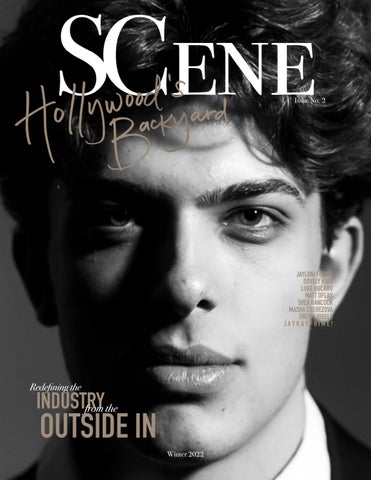
Issue No. 2
JAYLONI FISHER DOVELY KING LUKE BUCARO MATT OFLAS SHEA HANCOCK MASHA CHEREZOVA DREW LIDDELL JAYKAYPRIME!
Redefining the
INDUSTRY from the
OUTSIDE IN
Winter 2022
1
Issue No. 2 | Winter 2022
4-5 | Letter from the Editor + Creative Directors 6 | I Dream in Black & Chrome Kendall Bradwell
Multihyphenates JayLoni Fisher & Dovely King blaze a trail for Black creatives in a frontier that once made no space for them.
22 | Hollywood’s Playground Via McBride
Despite coming from a past far removed from Hollywood, Luke Bucaro builds his own future — having fun while he’s at it.
34 | Constellations in a City of Stars Julia Zara
Shea Hancock dances her way to success, but she’s not stepping alone.
46 | The Sky is Blue & Limitless Matt Oflas
Letters to himself, past and present.
58 | A God Amongst Angels Andrea Arcia
Who do we worship in the City of Angels? Who are we leaving behind?
68 | The Backup Plan Daishalyn Satcher
Masha Cherezova, Drew Liddell and J A Y K A Y P R I M E ! talk reluctance and risk in the country’s most prominent school for entertainment.
90 | Behind the SCenes
An exclusive look into our creative process.
2
EDITOR-IN-CHIEF | Julia Zara CO-CREATIVE DIRECTOR + SOCIAL MEDIA MANAGER | Kassydi Rone CO-CREATIVE DIRECTOR + VIDEO PRODUCTION MANAGER | Asha Oommen DIRECTOR OF WRITING | Via McBride DIRECTOR OF DESIGN | Kathryn Aurelio CO-DIRECTORS OF MULTIMEDIA | Benjamin Turnquest + Sama Shah DIRECTOR OF FUNDRAISING + EVENTS | Aadhya Sivakumar WRITING Andrea Arcia Kendall Bradwell Talent Self-Reflection: Matt Oflas PHOTOGRAPHY Victoria Onajobi Guest Member: Marissa Ding MULTIMEDIA Jazmyne Aquino Daishalyn Satcher Guest Member/Cover By: Zach Shenouda DESIGN Anna Fang Erica Garay FUNDRAISING + EVENTS Kayla Rocha TALENT Funmi Aderele Luke Bucaro Masha Cherezova Arya Desai JayLoni Fisher JT Garcia Shea Hancock Ryann Jacobson Alizée Jacquinet Holley Johnson Dovely King Drew Liddell Semaj Murphy JAYKAYPRIME! Maya Sta. Ana Sophie Warshauer 3
T
he magnanimous crimson curtains of the Norris Cinema Theatre pull back to reveal the name of this week’s Theatrical Film Symposium screening. In large red letters screams the word Babylon, written and directed by Damien Chazelle. Scored by Justin Hurwitz. I practically faint in my seat. How fitting for this to be the chosen film to watch in class, just days before the launch of SCene Issue No. 2. The theme itself took inspiration from Hurwitz, who scored La La Land, the first soundtrack I ever purchased. For much of my 8th grade year, I was humming “City of Stars” everywhere I went: I don’t care if I know Just where I will go ‘Cause all that I need’s this crazy feeling What a crazy feeling, indeed, to now live in the heart of L.A., surrounded by 44,000 other dream chasers. Thousands of other USC students who came to La La Land to realize a passion, to be discovered, to make a change — and as Chazelle writes in Babylon — “to be a part of something bigger than yourself.” Walking around USC often feels like being a part of this “something bigger.” With its proximity to the industry, one can’t help but feel like a small fish in a big pond. The Film Symposium inspired this theme in more ways than one. It was actually during the very first class session that I heard USC described as “Hollywood’s Backyard,” so, no,
4
SCene can’t take credit for coining the phrase. But it was this initial planting that decided the theme for Issue No. 2: Hollywood’s Backyard… Redefining the Industry from the Outside In. Hollywood’s Backyard is the deciding place where students stand on the cusp of who they are and who they want to become, like neighbors peeking over a white picket fence. It’s where dreams are unearthed and buried, where dream chasers stare at their futures, hoping — craving — for the chance to revolutionize an industry with their unique identities. The purpose of this issue is to show those 44,000 dreamers that they don’t need to sit around and wait for their futures to come walking through the back gate. What they’re doing right now is absolutely worthy of being shared, and perhaps even more impressive. From dancers to actors to directors, the winter 2022 edition of SCene Magazine has it all, and I am beyond proud of our team for seeing this vision through while also mitigating the growth of the magazine itself. Something that I believe truly reflects the nature of “Hollywood’s Backyard” is the nature of our productions. Every single piece of content created for this magazine was shot on campus. No studios, no outside locations. Campus-centered artistry, which speaks to the outstanding ingenuity of our team. We don’t need to rely on the lures of Hollywood to potray our stories just
yet. Instead, we are taking control of the environment we’re placed in — the backyard — where our imagination can run wild. That being said, to our hard working SCene members, thank you for constantly innovating. You catalyzed a massive growth of SCene’s social presence through top-notch productions, posts and podcasts; inventive design and animation; dedicated photography; growing events; and humanistic writing. It’s only up from here. To those included between these 98 pages, thank you for trusting SCene with your essence, your person. I’m inspired by passionate students like you every single day, and I hope you know that this is just the beginning. While I can’t wait to see who you become, I’m even prouder to have witnessed your stardom now. Instead of peering through to the other side, I hope this issue invites you to look inwards at the spectacular potential you house inside. Until the day comes when I see your names flashing across the Norris screen, I’ll be opening this issue to know and admire your greatness. Welcome to Hollywood’s Backyard, where everyone is invited to look inside.
EDITOR-IN-CHIEF
T
he Hollywood sign is Los Angeles’ North Star. It’s the reference point known to keep people moving in pursuit of their dreams. And no matter where we turn, it’s always looking right at us. But what happens the closer we get to it? Perhaps we should feel infinitely smaller next to those massive white letters; fifty feet in comparison to our mere five or six. A jarring representation of how much bigger our desires can feel than our realities in this city. Well, that is until we realize that a landmark is just as it seems — something that establishes our location, reminds us of where we are. But it’s not the why we’re here. Because we didn’t come to USC just to stare at or stand near the Hollywood sign. We came to change the industry that it represents. And we do so in a space that challenges and encourages us all in the same footstep: Hollywood’s Backyard. Issue No. 2 is a reminder to seize and share the intangible characteristics of our origin stories as young creatives. The birth of an idea, the excitement of the creative process,
the inevitable taste of failure, the fleeting satisfaction of success, the constant search for self — these are all formative experiences that shape our navigation of the industry from the outside in. And much unlike those nine famous letters sprawled over the hills, the hope that we represent is not a fixed vision. Each time that we undergo metamorphosis in our art forms, the horizon surrounding the hills broadens its scope. Each time that we undergo metamorphosis in our art forms, we grow a little bit taller in comparison to the Hollywood sign. Until, finally, we hold it in the palm of the same hands we use to fuel our every passion. As you prepare to delve into the stories of several talented individuals, we hope that you find a piece of yourself in each one of them, sharing a newfound confidence that there is more than enough space in the industry for all of us. And in the event that there wasn’t? Sharing a newfound confidence in knowing that you can create your own seat at the table wherever you see fit.
CO-CREATIVE DIRECTORS
5
I DREAM in BLACK and CHROME Exploring the Future of Black Art & Identity
6
From left: JayLoni Fisher ‘25 and Dovely King ‘25 stand atop the School of Cinematic Arts, adorned in outfits that reflect both the youthful fervor and regal elegance of Black filmmakers.
7
S
8
ince its inception, Hollywood promised to be the space for opportunists: any starry-eyed individual with a dream could pursue it, soaring to unimaginable heights. For almost two centuries, however, this promise had a glaring caveat: success was only available to people adhering to America’s image of beauty — fit and white. For many, especially African Americans, finding success in entertainment seemed to be impossible. Prominent representation on screen was rife with racist stereotypes to appease a white audience. Black people behind the screen were almost unheard of. In this new age of Hollywood, the stars are closer to reach for everyone, not just a select few. With unprecedented access to new forms of entertainment, Black talent and opportunity know no bounds. Now, Black creators are finally having their voices seen and heard, achieving astronomical success. Juggernauts like Issa Rae, Quinta Brunson and Robin Thede are inventing new ways to tell Black stories, and there’s so much more room for us to explore. But what defines success in the modern age? Is it the awards you win? The notoriety you achieve? For sophomore JayLoni Fisher, success isn’t determined by parameters initially established for white-only audiences. To him, being prosperous in Hollywood is an internal process that no amount of golden statuettes could define. Finding purpose and meaning in his craft is what allows him to thrive and designing an equitable Black experience is what drives him. “Having grown up in L.A. and seeing a lot of injustices and inequities in the world, I feel like it’s only right to articulate that [in my work],” he says. How does JayLoni work towards that goal? It depends on the day. The media arts & practice major is a multihyphenate: you can find him singing, filming, acting and producing — sometimes simultaneously. “I would describe myself as a nomad,” he explains. “My values are something that feel more fixed, but the medium to which I express myself — I can never stick to just one.” Film and T.V. production sophomore Dovely King, known to her friends as Dove, is pursuing the same goal through filmmaking. For the past five years, the L.A. native has been creating films that are just like her: confident and authentic. “I’m not shying away from very bold topics people would rather not talk about,” she says. “I want to create things that someone sees, and they’re like, ‘Oh my gosh, did she just say that?’” This is evident in her short
Dove is a T.V. Production major from Los Angeles, CA. She aims to tackle bold topics in her work, often saying what others won’t.
I DREAM IN BLACK AND CHROME | Kendall Bradwell
9
JayLoni is a media arts and practice major from South Central L.A., CA. He works to amplify Black voices in his work.
10
This is evident in her short film, Hard to Say, where Dove tackles the difficulty of speaking up about housing insecurity. When a teacher asks the protagonist what’s troubling her, we are transported into her consciousness: in an endless black void with roaring white noise, she frantically stuffs her belongings in a small backpack. When we cut back to reality, the protagonist finds her courage, saying, “I don’t know where I’m gonna sleep tonight.” Through mixing the abstract with a clear message, she blazes a trail in an industry that wasn’t initially built for storytellers like her. Our society tends to ignore the homelessness crisis, but Dove’s unflinching narrative choices make it impossible for us to look away. Dove first began burning bright in her high “I would describe myself as school’s film program. She describes discovering cinema as a liberating experience: “At a nomad,” he explains. “My that moment, I was going through a lot. I was values are something that feel homeless, and it seemed as if I had no control over my life. Film was a place where I could more fixed, but the medium to create my own world and escape…I could ac- which I express myself — I can tually have a voice in a time where I felt like never stick to just one.” I didn’t have one. After that, I didn’t know what else I could possibly do besides film.” For JayLoni, performing in community musicals as a child naturally transitioned into making music of his own. “Music began as something I enjoy for myself. I didn’t necessarily think about, ‘How could I market this?’ or ‘How can I sell this or make this a product?’” To him, it’s important to maintain personal integrity while sharing his gifts with others. He proved this late last semester when he performed at GearFest, the annual concert hosted by the Black Student Assembly and USC’s Creative Experience. While JayLoni enjoyed the rush of performing original music for an audience, GearFest motivated him through a difficult point in his academic career. “It’s what got me out of bed. And that was something that I was like, ‘You know what? I’m not letting this get past me.’ It was an opportunity to reclaim my sense of joy, my sense of me.” And thus, two stars were born. But these innovators aren’t just making art to serve others — they’re also creating to find their voices. Dove is well on her way to becoming an auteur: “I’m trying to build that style, that voice, [so that] when you see my films, you say, ‘Oh, Dove did that. That’s a Dovely King film,’” she says. “I love to play with lighting, which evokes emotion. I like showing visually what someone is feeling on the inside. At the same time, I want my work to feel real, and I want to put people in the moment.” JayLoni’s research process for his music and films involves discovering his own definition of masculinity. Although he grew up on ‘90s R&B, he’s recently been exploring hip-hop, which he initially associated with the toxic masculinity some of the men in his life expressed. Now, he’s reclaiming this music and using it to find a manhood that feels authentic to him as a Black queer creator. By navigating this in his personal life, he’ll tell multifaceted, layered stories that shed light on Black queer life and love.
11
Although JayLoni and Dove are discovering their identities for their own satisfaction, people outside of their universe are starting to take notice. In 2021, JayLoni worked in Atlanta as a visual effects assistant on the set of Black Panther: Wakanda Forever. “I had a blast,” he reminisces. “I was living alone for the first time in my life, in a city I’ve never visited before.” During his life-changing summer, he was mesmerized by how much his fellow creatives poured into him. “When you have different minds with different expertise, the world has so much more dimension.” As for his reaction to seeing his name on the silver screen? He was in awe. “I didn’t really understand how everything was going to fall into line. But, y’know, all I could do is bring 100% to my job and trust the process. Trust in my team.” Dove’s work is gaining national attention, too. This fall, Hard to Say was accepted into the Boston-based Scout Film Festival, which is dedicated to uplifting filmmakers under age 24. This is her first independent venture to get picked up on the festival route, and she gushes about this groundbreaking achievement: “This is my baby. I got very vulnerable making this film, and [Scout] gave me a boost of confidence. I was having a lot of imposter syndrome, and seeing someone pick it up and think it was nice made me excited.” The two stars have proven that Black Hollywood is in good hands. So, what’s next for them? According to JayLoni, the possibilities are as expansive as space itself. No matter what stories he decides to make, or how he does it, he knows the importance of his art. No earthly barrier will stand in his way of sharing them. “Every day, I get up and try again. The sh*t that feels impossible, I’ve already done. I could name all the reasons I shouldn’t be where I am today, but I’m here.” Inspired by her mentors at the British Academy of Film and Television Arts, Dove dreams of starting her own nonprofit that would inspire Black and Brown kids to develop their artistic skills. “BAFTA continues to push me to not think small — you gotta be thinking big.” In the not-so-distant future, Dove envisions herself “having Black people on [her] sets, hiring Black people and teaching Black people” to reach new heights. Forget just shattering a glass ceiling. She’s ready to hurdle through an entire galaxy of opportunity. 12
WITH UNPRECEDENT ACCESS TO NE FORMS OF ENTERTAINME BLACK TALENT AND OPPORTUNITY
NTED EW
ENT,
Y
I DREAM IN BLACK AND CHROME | Kendall Bradwell
JayLoni moved to Atlanta this summer to work as a visual effects assistant on the set of Black Panther: Wakanda Forever. His friends and family recount pride in seeing his hard work pay off.
13
Dovely and JayLoni represent a new wave of young Hollywood, combining their creative powers to build a bold industry that includes — and highights — Black cinema.
14
JayLoni shares a similar outlook: “I want to get into the business of creating worlds with my peers,” he explains. “That’s what I’m trying to do while I’m here at USC. That’s why I’m involved.” In the worlds he’ll create, meaningful representation will be at the forefront. “When I imagine Black representation, I’m imagining myself, but I know I’m not the only one being left out. I plan on collaborating with the people around me so we can all be seen.”
15
D 16
I DREAM IN BLACK AND CHROME | Kendall Bradwell
Dovely has a deep love for closet organization videos and wants to start her own organizing side hustle.
D 1. Who are your biggest inspirations in the film industry right now? My biggest inspirations would have to be Ava DuVernay, Lena Waithe, Gina Prince-Bythewood, Jordan Peele, Tyler Perry, Viola Davis, Ryan Coogler…it’s a long list, honestly. 2. Do you have a dream project you’d one day like to create? My dream project is to produce, direct, write and act in my own television show that has an all-Black crew from all different backgrounds.
3. What makes you an innovator? My ability to adapt in tough situations and make it work for my greater good, without falling under pressure.
4. How do you express your creativity outside of film? I really love to express my creativity through fashion! Whatever I’m feeling, I really enjoy reflecting that in my outfits. I really love trying new things — with bold creative colors and different styles of hair (I switch up my hair a lot).
o v e ly
KING
5. Give us your most unpopular film opinion/hot take. Unpopular opinion: Thor: Love and Thunder was kinda good!
17
J
1. How would you describe your music to someone who’s never heard it before? I would describe my music as an attempt at expressing myself honestly and freely. Or an effort at emulating the sonic aesthetics that made me fall in love with music. 2. Where’s your favorite place to go when you want to get those creative juices flowing? I’ve produced my best work from within the four walls of my dorm room. Community is important, but I feel like it’s important to have opportunities to be alone, to reflect. I find that when I give myself opportunities to be vulnerable or curious, I create my best work. 3. What’s one art form you haven’t explored yet that you’re curious about? I would say dance. I feel like movement to rhythm is such a powerful and versatile means of expression, and I’m curious to know more about it. I’m hella stiff, but I might bust a move on occasion. 4. How do you explore Black art/expression on campus? I would say my primary outlet for expression and community amongst Black artists is Creative Experience. Together, we comprise an immensely talented group of visual and performing artists. Naturally we’re all curious to explore the ways in which we might be able to collaborate for the purpose of creating relevant and engaging media. 5. Give us your most unpopular film opinion/hot take. Black classics are enough to make a child fall in love with cinema.
ayLoni
18
FISHER
I DREAM IN BLACK AND CHROME | Kendall Bradwell
JayLoni can fall asleep literally anywhere. He once got trapped in a bathroom below the deck of a ship and slept on top of the sink until someone came to break the lock on the door.
19
20
21
I DREAM IN BLACK & CHROME
W
hen we get older, we outgrow our cr like we outgrow our shoe size. We victims of conformity before we und what the word means. We shrink and until we take up the amount of space that others s reframing our dreams and passions to be logical, rea safe. But that’s just the way adulthood is. Realism responsibility we’re told to carry as we get older.
But who decided that as we grow older, we grow wiser? When we take a look around at the young adults shrinking the vastness of their passions to fit the mold of standard adulthood stability, it’s starting to feel like maybe children are actually the smart ones. Maybe we just use their optimism as an excuse to hide our fear of taking chances, of pursuing what we’re actually passionate about. Students at USC beg to differ, choosing to pursue an industry where nothing is guaranteed, despite residing in a city that constantly shouts at its youth, “THERE’S NOT ENOUGH SPACE FOR YOU HERE!” We took the leap, got into the school, and now that we’re here, we have the opportunity to prove those doubtful voices wrong.
22
reativity become derstand d shrink, see fit — alistic… is the
Hollywood’s PLAYGROUND Luke Bucaro ‘25 is an acting for stage, screen and new media major from Huntley, Illinois. He reads “Rabbit Hole” at the Gould School of Law, mimicking a young actor in the backyard of “Hollywood’s House.”
23
Yet, we can’t completely deny that sometimes that use this side hustle to purchase plane tickets to visit same taste of youthful fervor slips off our lips as we him at school. make our way through college. Suddenly, conversa“At first, I got super overwhelmed being in L.A. tions get that sour taste of realism again: the talent, because, well, my dad cleans carpets and my mom’s the money, the transactional friendships. Our idea a teacher. And I’m so proud of them, but it’s just of a career shifts from doing what we love to all the such a different upbringing than people here. But my things we’ll get if we succeed. Or all the things we’ll thought process is always that hard work will surpass lose if we fail. anything else,” he shares. Our passion for creating stories that entertain and There is no doubt that Luke has done his part to move people gets trapped in “Hollywood’s House” keep his passion alive since that core childhood mem— a mysterious mansion with locked doors and shut ory, and he certainly doesn’t let money dictate his windows. A utopia where all our wildest dreams creative endeavors. He works as a Resident Assistant come true, or a prison where they become distorted. and spends his summers helping out with his dad’s And while others are stuck hoping for a chance carpet company. When Luke realized in high school to be discovered through the peephole, Luke Bucaro that he wasn’t quite ready to audition for the highly — a sophomore pursuing a bachelor’s of fine arts in competitive college acting programs, he spent every acting for stage, screen and new media — has already spare moment of the summer working at a restaurant built his own playground in the backyard. Making his to afford private acting lessons. Luke is not handown fun and creating his own future. ed opportunity by any means, and unlike others in “To keep it a buck fifty, I don’t give a f**k his industry, he about the industry. I didn’t fall in love with this “But my thought process is doesn’t let that art form to see my name in flashing lights.” always that hard work will hold him back. Looking me straight in the eyes, Luke darLuke wasn’t alsurpass anything else,” he ingly tells it like it is. In his mere year and a half ways dead set on at USC, he has certainly proven that he is not acting, though. shares. here to “make it” in Hollywood. He is here to It wasn’t until a master the craft of acting. No amount of noise can T-ball game in second grade — when he found out the distract Luke from doing what he loves. And perhaps hard way that wearing a sports cup might have been it’s because his wild imagination and contagious joy helpful in preventing an injury you know where — were crafted in a tiny, suburban town in Illinois called that he discovered his love for entertainment. After Huntley. getting hit by the ball, Luke yelled across the field to Though it may be small, there is no shortage of his mom, “I told you I needed my cup!” Watching all space to breathe and time to think in Huntley. Luke’s the parents on the sidelines crack up, Luke realized home backs into a horse farm, surrounded by row af- he liked to make people laugh. And so it began. ter row of cornfields. Monday nights were reserved Luke does whatever makes him happy and doesn’t for his grandma’s house, where they’d watch movies think twice about it. “I would say I’m a person that together (after he mowed her lawn and ate the meal thinks with my gut and emotions rather than facts and she cooked especially for him, of course). When logic, which is a thrill because I live life like a roller they’d exhausted every movie on her Xfinity account, coaster…but then it also gets me into a lot of trouLuke and his grandma began taking trips to Redbox ble,” he laughs. Luke lives like the younger version of to rent out DVDs. “That was a really formative expeall of us did. We used to dream big, take bold chances rience for me,” he recounts, smiling to himself. Coming from humble beginnings, life in Los An- and enjoy the ride without always worrying about the geles is a little different for him…but it’s what makes consequences. These traits don’t make Luke immaLuke, Luke. He proudly gushes over his mother and ture or naive. In fact, when it comes to acting, they’re his father, who run a business making outdoor house what make him thrive. When Luke got to USC, his goal was to act in any decorations right from their garage. “They would come home from working all day, and one would way he could, and 26+ student short films later, ask cook dinner for the family while the other would be any SCA student, and I can assure you they know the out in the garage cutting, tracing and painting the name Luke Bucaro. On top of the many short films wood and stuff like that,” Luke explains. His parents and music videos he’s starred in, Luke played the 24
Luke wears brown overalls that call to mind his youth, where rows of cornfields backed his home in Huntley.
HOLLYWOOD’S PLAYGROUND | Via McBride
25
Luke’s playful personality contrasts the seriousness and pressure associated with adulthood in Hollywood.
26
HOLLYWOOD’S PLAYGROUND | Via McBride
lead in “Dog Sees God” (an SDA senior-level production) and also recently signed with a highly respected management company for actors called Montage Management. These opportunities were earned, not given. For Luke, sometimes opportunities are created, too. After coming off the high of acting in “Dog Sees God,” he didn’t receive callbacks for any of the SDA shows he auditioned for this fall. For some actors, rejection would make them doubt their capability as an artist. Not Luke. He decided that if nobody would give him a chance to act, he’d make his own. Jumping off the deep end, he resolved to produce and star in his own play, “Rabbit Hole.”
27
This is what makes Luke great. He doesn’t let the pressure of Hollywood hold him back, but he isn’t ignorant of its challenges either. “This path isn’t for the faint of heart,” Luke acknowledges. “So I would honestly say if I could see myself doing anything [else], I would do that. But I just don’t. I love [acting] too much.” Not even Hollywood’s House can scare him away. The duality of his youthful spirit and mature wisdom is a perspective that most of us don’t acquire until we’re older. Luke is no disillusioned child. He knows acting is hard. And yet Luke lives like the younger he has made more art in the past year version of all of us did. We and a half than he has his entire life. “I think we have to get rid of [the used to dream big, take bold idea that] just because you want to be chances and enjoy the ride in Hollywood, it means you have to be without always worrying a millionaire and be super famous and super rich. Because I feel like that type about the consequences. of capitalistic mindset of always wanting to get to the top and sacrificing [everything] to get there is really detrimental,” Luke said. “I’m really trying to just keep the mindset of, we’re storytellers. We’re going to keep on telling stories for people.” This may sound too good to be true. But when you shut out all the noise, it really is as simple as that. So while most of us obsess over Hollywood’s House, spending our whole careers searching for the key to unlock the door, Luke will be in the backyard — jumping from the highest swing. And he’s bound to land somewhere great.
28
Luke poses in Founder’s Park with an effortless James Dean cool.
29
L
Luke is deathly allergic to bees, which he discovered after getting stung on the tongue.
Luke’s photoshoot is reminiscent of an effortless James Dean cool.
30
HOLLYWOOD’S PLAYGROUND | Via McBride
L
1. Wh Viola Dat actor in t he ind avis. ustry d o you 2. Wh look u a t ’ s p to th your f This o avorit e mos ne’s w t right e mov eird bu i now? e t , r i i f you h ght no 3. Wh a w a v t i e t ’s Mar o Shake are three riage S ne? that as w o r tory. ds tha s. t e n comp 4. In t ass you h r e e words Rivetin r taste , in mu g, con sic? fusing describe yo u a r colle nd fan 5. Wh tastic. ge exp erienc you? at is some e so fa thing People r. that y o a r u e t a I’m pr hink p etty av lways like “L eople erage u falsely in my n ke, you’re assum so nice icenes e abou !” But s. t I’m re ally no t. I thi nk
BUCA
RO
uk e
31
32
33
HOLLYWOOD’S PLAYGROUND
CONSTELLATIONS in the
CITY of STARS
T
here’s just something about Los Angeles that makes it irresistible. Artists and musicians, dancers and dreamers, we flock towards this city like moths to a lamp because we can’t resist the pull of that certain something: that which lives within the confines of Hollywood. In this blessed and cursed City of Stars — the La La Land of our dreams — lies the motivator and anti-hero of us optimists. It drives us. It breaks us. It is us. Passion. Passion lies at the heart of any city, spinning through the darkness until each dreamer is practically teeming with that blazing glow. Passion makes us laugh. Passion makes us cry. Passion makes us create. And for Shea Hancock, passion makes her dance.
34
Except not in the way that’s all too often associated with the entertainment industry. Cutthroat shows like Dance Moms and Backstage undermine the collaborative nature of dance itself, twisting passion into competition. Dance does not pin one spirit against the other. For Shea, dance is a fusion of the human spirit, especially at the USC Glorya Kaufman School of Dance. “I grew up doing competitions and conventions,” Shea says, “and so there was always a sense of competitiveness among everybody, and it was very tense.” She’s an expressive speaker. Her fingers bend and elongate with each statement — almost as if her hands can’t resist moving to the cadence of her own words. “But coming to Kaufman,” she continues, “I feel like that was stripped away. We all realized that we’re here for a reason. We’re all here because everyone’s incredibly talented.” She takes pride in “the Kaufman family,” where an Passion lies at the heart intense closeness between of any city, spinning her fellow dancers virtually through the darkness extinguishes any tendenuntil each dreamer is cies to compete. Kaufman operates on what they call practically teeming with a “new movement,” she that blazing glow. explains, where admissions officers don’t predetermine the types of dancers they need before they begin the selection process. This diversifies their small class of about 100 students, where there’s so much versatility that collaboration trumps competition. “I hated competing,” Shea reminisces. “You would go on stage. You would perform your solos. And then you get your scores back later, and your score may not be what you necessarily felt or what you thought you should receive, which then makes you not trust your instincts. I feel like with art, especially dance, how you feel in the moment should be how you feel, period.” This hyperawareness of feeling runs through Kaufman like a river, separating it from the isolationist ideals of Hollywood. The nature of competition isn’t entirely foreign to Shea, but L.A. certainly is. She grew up in the city of Stockton, an historic town that sits comfortably in the California Central Valley. As daughters of Northern California, we share a mutual understanding of memories that
35
36
characterize the valley: the I-80 highway that runs ual’s rise to stardom, Shea proves that true ambition through fields of sunflowers, the cozy urban sprawl is not about how high she can fly. It’s about how deep of the Capitol, the sardine-like traffic that congests she can go. pathways to the Bay. Stockton is home to her family “I always talk about how dance is a way to express and her younger brother’s best friends: Stockton is the emotions that are hard to express verbally,” Shea stable, sturdy, consistent. L.A. is explains, cupping her hands over none of these things, but the city’s “...when I watch a dance her heart and then protruding unpredictability is just like improv: them outwards, as if she were givthat I am absolutely en- ing a gift. “The emotions that are fluid and spontaneous. Despite her current practice of thralled with…I can tell easy to express verbally are happidance in L.A., the earliest memothere’s something that ness or sadness, or these very basery Shea has of her major is rooted line emotions. [But] the emotions in her hometown. “My very first they’re pulling from rath- that are easiest to dance about are day of dance class, I remember I er than something that the ones that are so deep down. In walked into the studio, and it was they’re putting on.” a way, it can get very intimate,” she a ballet class. My mom had signed continues, “like, if you’re watching me up because we would watch So someone and there’s no audio, and You Think You Can Dance together. And at the time, you’re watching them cry, you see how their body reI was born pigeon-toed,” she recounts, gesturing toacts. I feel like dancing is kind of a reflection of that.” wards her feet. “I used to play soccer, and I would trip In Hollywood, success is equated with tough, rugover my feet when I ran because my feet were turned ged individualism. Here, one’s competitor’s see vulin. So I went in, I took the ballet class, and I loved it.” nerability as susceptibility, even weakness. After all, This was the origin of Shea’s passion, the gleaming it’s easier to outrank someone who’s easily comproorb that fires through each plié and axel turn. Since mised. But Shea’s vulnerability exposes a new truth then, that passion has been virtually irrefutable. From ballet to jazz to hip hop, Shea has spent about six to us: we must stop defining the notion of success by the high-strung idea of self-reliance. hours a day dancing for the past 13 years. “Growing In this City of Stars, it’s time to stop counting stars up, everyone used to ask me like, ‘Oh, you want to be a professional dancer? But what’s your backup plan?’ and start stringing together constellations. One star is not meant to stand alone; it’s perpetually connectAnd I was always like, ‘There is no backup plan,’” she ed to a million others, until the whole night sky is says, explaining that after college, her goal is to sign with an agency to book commercial jobs. “Dance is teeming with bright and fiery clusters of talent. After all, nobody names just single stars; it’s groups like what I want to do.” Orion’s Belt and the Big Dipper that we search for This resolute determination is a feature that’s not uncommon in the City of Stars. Here, everyone has at night. In other words, success is not a solo. It’s group something they want to prove, a dream they hope to choreography. An individual must take the first step, see come to fruition. But I’d argue that ambition is not the same as achievement. You see, the corner- but the next must be taken by someone else. A dancstone of ambition is passion, while achievement feeds er initiates her grand jeté as she leaps into the air, off competition. In Shea’s experience, ambition pro- but when she lands, she must fall into the arms of another. She trusts that her partner will catch her as pels her forward while achievement holds her back. she outstretches her arms towards the sky, reaching Shea extends her hands, saying, “I love when I can watch someone do what they love, and they’re towards every burning possibility that can be found not acting. Like when I watch a dance that I am ab- with each turn. 1, 2, 3…1, 2, 3. She pushes energy against energy, kickstarting a mesh of tangled movesolutely enthralled with…I can tell there’s something that they’re pulling from rather than something that ments until finally, she’s twirling. She’s dancing, and she’s doing it alongside her group. Dance is a perforthey’re putting on.” That “something” she describes mance of intimacy and closeness that relies on each here is passion: the intense blaze that catalyzes the moving body to be impactful. Such is success. optimists of Los Angeles. Living in L.A. often feels like a survival of the fitUltimately, in a city that takes pride in the individtest, a game where every man fends for himself.
Shea Hancock ‘25 is a dance major from Stockton, CA. She is pictured glowing with the passion that winds through Los Angeles, the City of Stars.
CONSTELLATIONS IN THE CITY OF STARS | Julia Zara
37
But if we reframe the journey to success as if it were a dance, not a competition, we come to realize that maybe we can’t do it all alone. Ambition is grounded in raw, full-hearted trust. This conviction comes when we tear down the walls surrounding our passion, allowing others to step inside. Only by reaching outwards can we be lifted up, entrusting others to guide us far beyond where we could take ourselves alone. Even the passionate Mia and Sebastian questioned this city in the acclaimed La La Land: City of stars Are you shining just for me? The answer is, no. L.A. – this grand metropolis of dreamers and doers, this place of passion – shines for all of us. We just need to learn how to share the stage, because there’s room for everybody to dance in the City of Stars.
38
Shea finds that connection and vulnerability are crucial to the art of dance.
SUCCESS IS NOT A SOLO. IT’S
39
Shea reaches for the stars, outstretching her hands towards endless possibility. Shot in an apartment in the McMorrow Residential College.
40
CONSTELLATIONS IN THE CITY OF STARS | Julia Zara
Shea’s spirit animal is a purple butterfly. She flutters her wings with a delicate and wistful beauty, lightly bouncing atop the cityscapes of L.A.
41
Shea opens the studios at Kaufman, and her mornings often begin at 7 a.m..
42
CONSTELLATIONS IN THE CITY OF STARS | Julia Zara
S
S
h ea
HANCOCK
1. What’s your favorite song to dance to? Oh, that is such a hard question. Anything that, like, feels super good. My comfort artists are James Blake, Bon Iver, and Nina Simone right now. 2. If L.A. were a dance, what category would it fall under? I’m going to say jazz, but like foxy jazz specifically. It’s like a style. It’s not its own form, but yeah, it’s really foxy. 3. Similarly, if your personality were a dance, what category would it fall under? Probably musical theatre. I just think I have a very big theatrical personality. 4. Is there a piece of choreography that has really resonated with you? Let’s see. My senior solo I loved so much. It was a choreographer that I had met earlier, and in the midst of her choreographing it, we found out we have the same birthday, and all this random stuff of our lives was lining up. And I was just like, this is meant to be. 5. You’re heading to Kaufman. What’s going in your dance bag? Always my ballet shoes, my water bottle for sure, some Advil. The essentials: Biofreeze, my inhaler, some extra hair ties [and] usually a snack. My go-to snack recently has just been Honey Nut Cheerios straight up. 43
44
45
CONSTELLATIONS IN THE CITY OF STARS
Matt Oflas ‘23 is a film and television production major from San Ramon, CA. Coming from the Bay Area, he recalls attending a high school dominated by the Asian American community.
46
The SKY is BLUE
and LIMITLESS Written by Matt Oflas Photographed by Julia Zara
EXT. THE SUBURBS - DAY A young kid (16) lays on the grass, looking up at a bright blue sky full of clouds. Around him, an idyllic suburban neighborhood, the only world he’s ever known. He stares at the clouds and dreams. EXT. FILM SET - DAY The same kid (21), now much older, looks into a camera, pointing directions at actors and crew. It’s a full blown film set. Stress. Chaos. A whirlwind of emotions. In a brief moment of relief, he looks up at the clouds and remembers when he used to dream.
47
Matt was born in the Philippines, often weaving themes of Asian/ Asian American identity throughout his projects.
48
THE SKY IS BLUE AND LIMITLESS | Matt Oflas
A LETTER TO MYSELF 5 YEARS AGO. “Dear Matt, Do you still look at the clouds? Life is so busy now and I’m often caught up in the chaos of the business: meeting after meeting, script after script, 12 hour shooting days, the warm blur of faces that I see around campus, the beautiful community that I’ve found, and the discord that surrounds it. There’s so much going on in front of me now that I forget to look up. Two years from now, you’ll be getting into your dream school. A year after that, you’ll find yourself on campus and you’ll find a community of dreamers like you, Asian American filmmakers who saw the same sky that you used to dream in. You’ll find yourself in class and you’ll learn, realize the injustices that our community has faced, how our dreams have been caged and broken, chewed up and spat out by an industry that has historically looked down on people like us. From typecasting roles that perpetuate negative stereotypes, to ambiguous ethnic casting and straight up whitewashing, the Asian American identity is a long way from achieving the celebration it deserves on the screen. This is all stuff that you can already feel, but once you get here, you’ll realize just how crushing the reality of it all is. There will be moments of hope, times in the industry where you’ll feel seen (you’ve already felt it in the theater, when you laughed and cried to Crazy Rich Asians with your friends). You’ll watch The Farewell, then Minari, Everything Everywhere All At Once. You’ll be filled with hope and joy, followed immediately by an overwhelming sense of doubt. It took miracles and a mountain of talent for those films to succeed - what makes you think you can do it too? The industry is a huge wave that threatens to swallow up your hopes and dreams. You will constantly face the impossible. All you can do is tackle it head on. Be ready. Best, Matt” 49
Matt was recently chosen to direct a CTPR 480 film. Four students are selected to direct each semester.
50
THE SKY IS BLUE AND LIMITLESS | Matt Oflas
Matt fixes his crown in “Hollywood’s Backyard.”
51
EXT. THE SUBURBS - DAY Fresh grass blows in the wind. The sky is blue and limitless. A LETTER TO MYSELF 5 YEARS FROM NOW. “Dear Matt, Do you still look up at the clouds? Because when I do, I see the life that you’re describing. Isn’t that all we ever dreamed of? In AP Literature today, I presented my final project - a video essay for our favorite film, Fruitvale Station (is it still yours?). I proclaimed my dream to the class: I was going to L.A. to become a filmmaker. I’m sure I have a couple of years until I can really comprehend the elusive and overwhelming “industry” of your letter. But as I look up at the sky, I’m certain in this: all we have are our dreams. Even now, just 5 years into the future, you have so much more than I could have ever asked for. You’re surrounded by talent and genius, peers who push you and inspire you to be a better filmmaker, who will always have your back in whatever project you take on. You have a community of Asian American filmmakers like us (I can’t believe we’re not alone!) and you have each other to keep your dreams alive. Don’t take it for granted. This is everything we dreamed of. I can’t even imagine every detail of your life now, how busy it must be. I’m excited to find out. Until then, the only thing I can offer is a reminder. Remember to look up. The sky is still the same. It’s blue and it’s limitless. It’s ours for the taking. Best, Matt.”
52
THE SKY IS BLUE AND LIMITLESS | Matt Oflas
Matt sits on a bench in the grassy area behind the Marshall School of Business. He is an avid houseplant lover, as he has seven in his room.
53
Matt is king of the hill in “Hollywood’s Backyard,” taking control of his career. Through all of it, he reminds himself to pause and look up at the sky.
54
55
56
57
THE SKY IS BLUE & LIMITLESS
From left: Funmi Aderele ‘26, Arya Desai ‘24, and Alizée Jacquinet ‘25 depict the complexities of being the “main character” in L.A., posing in Taper Hall.
58
A GOD AMONGST ANGELS | Andrea Arcia
A GOD
ANGELS
amongst
M
y story begins in New York City,
or the so-called City of Gods, where a cinematic experience awaits beyond every crosswalk, metro ride and lively cafe. Thinking back to my time as a full-time New Yorker, my upbringing felt like music. Its bustling atmosphere, the spontaneity of meeting new people by the hour, stumbling upon gorgeous sights with the turn of a block — it all made me worship the city. But most importantly, I was worshipped in return. No matter where I went, the city would follow. Even in crowds of strangers where no one knew my name, there was an abiding energy about NYC that made it nearly impossible to not feel like “the main character” — a sensation larger than life itself. In spite of how overly romanticized the Big Apple is on social media (Spoiler Alert: New York can be as dirty as it is beautiful), its glory actually comes from its access to people from varying backgrounds with divergent success stories. As a first-generation Venezuelan exploring uncharted territory for the first time, exposure to such diversity gave me the unique insight that the possibilities for my life are boundless. So if there is one thing New York taught me, it’s that we have the world at our fingertips. 59
For a while this understanding was enough to uplift me, giving me the confidence to dream without restraint — but it is also what pushed me to leave and chase those dreams relentlessly, even if that meant moving across the country on my own at the ripe age of 18. So, with my heart set on discovering the endless possibilities ahead, I poured my heart and soul into an application that would forever alter the course of my life. With an acceptance letter and a full ride from the University of Southern California, I danced around my living room speaking a new reality into the universe: “I made it!” And that was that. Pa ck in g
60
my bags, I dauntlessly ventured onto my next journey, abandoning the past version of myself and my dear city for the next best thing, the City of Angels. Besides the culture shock that came with jumping from one coast to another, within days of moving to Los Angeles I found myself with no resources, no connections and no hopes of making it in a world unknown. In a city filled to the brim with star-studded names, suddenly, needing people to know my own became a requirement. For the first time in my life, lost amongst a crowd in a way that was no longer
cinematic, I found myself wondering if I had flown too close to the sun. After all, what was a god in a city of angels? On the outskirts of Hollywood, I realized a cruel distinction between the two cities on opposite coasts. New York is where dreams are celebrated and gods are made, but Los Angeles is where
ambitions become a liability. Where dreams either thrive or wither away. Where you are taunted by the idea of soaring into the sky with victory, but in constant danger of becoming a fallen angel instead. It was a rude awakening. Being the “main character” was no longer an individual endeavor, but an idolatry that needed to be validated by the industry itself. And all of a sudden, drowning in a pool of celestial artists on campus (many with verified checks alongside their names), I’d never felt like more of a nobody in my life. Who could blame me?
On left: Funmi is a health and human sciences major from Milwaukee, WI. She has a self-proclaimed obsession with sunglasses.
61
At USC, it seems that competition amongst talent is inescapable, especially when the inevitable “What’s your major?” question quickly transforms into, “So, what have you been working on?” No matter how hard I tried to cling onto the godly main character persona that had been gradually fading away since my move, it was to no avail. There would always be someone else with more going on, and countless people beating me in the race to break into the ruthless industry in our backyard. And even though I wanted to love and support my fellow artists and peers on our journey to success, many of us uprooted our entire lives, not just to stand alongside stars, but to become one. The irony was undeniable. Success was finally within my reach — yet, plagued with the belief that we were all fighting for a single spot on center stage, it had never felt so far away. With my sights set on the elusive writing industry, not only did my social media handles suddenly become a marker of my credentials, but so did my follower count, the people in my Being the “main charsocial network acter” was no longer an and the projects I had under wraps. individual endeavor, but I was only as rel- an idolatry that needed to evant as the peobe validated by the ple I knew and industry itself. the work I was doing — which as a freshman in a new city, was zilch. With the added factor of highlight reels glorifying everyone’s best moments, comparing myself to others became a fulltime endeavor, followed by merciless insecurity and self-doubt. But through it all, the need to embody the image of a main character with “a lot going on” persisted, not just to advance my career, but to prove that despite my reality, I was living the dream. To show everyone back home that “I made it.” That all my hard work and sacrifices were worth it. That I was living my best life. Even if I wasn’t. Even if I’d never felt more lost. And in the midst of it all, it became unclear when I was trying to embody my art and when I was becoming something I was not. In this fight against becoming a fallen angel, surely I’m not alone. Even though we’ve all made it into a prestigious university, we are constantly reminded the job isn’t 62
On right: Alizée is a theatre major with an acting emphasis and a minor in public relations. She is from Barcelona, Spain, and she’s convinced that David Bowie is her soulmate.
63
done as we walk around a campus filled with celebri- During our transition into “the real world,” it’s natties, nepotism babies and successful peers already in ural to not quite be where we want to be, but we arthe industry. Still, there is a single truth that keeps us en’t where we used to be either, and that is progress going despite the multitude of obstacles in our path: worth recognizing. Our ambition is our strength, not making it would mean failure, and we did not fly and our courage to pursue those ambitions has gotall the way here to fail. So we must ask ourselves: is ten us this far. But to make our dreams a reality we all of this worth it? Is maintaining a “main character” must also unforgivingly believe in ourselves — a feat persona really the only way to break into the Holly- that only comes by mastering gratitude, both inwards wood industry and prove to everyone back home that and outwards. we made it? Or have we lost track The only hope we have of breaking into of what made us fall in love with ...all the idolized main an industry crowded with exceptioncreating art in the first place? Most characters in Holly- al figures is to let our passion drive us. importantly, is this process preTo look at others not with envy, but venting us from becoming the best wood are no more than for inspiration. We must learn to work version of ourselves — of becoming actors and actresses on our character the same way we work creatives worthy of being heard? towards our dreams, celebrate the little When it comes down to it, all hired to portray the wins along the way, and resist the urge the idolized main characters in complexities of regular to compare ourselves to others, because Hollywood are no more than achuman beings. in truth, center stage does not exist. tors and actresses hired to portray This serves as a tremendous liberty. So the complexities of regular human beings on the big screen. And while we all love a good main character, next time you find yourself overwhelmed with the exthe protagonists we admire offscreen share a multi- pectations to “make it big,” remind yourself that in tude of red carpets with countless others in the field. Hollywood’s Backyard, nothing makes you stand out Meaning that, despite the highly embellished trends more than embracing your authenticity. And if you online, there is no such thing as being the main char- are reading this from back home, this is my first pubacter. Life isn’t that simple, and part of reaching our lished piece. So although it hasn’t been the glorious true potential as artists comes with embracing that process I imagined, I guess I am making it, after all, New York! And I’m loving every minute of it. fact.
64
A GOD AMONGST ANGELS | Andrea Arcia
On left: Arya is a double major in theatre and journalism from Burbank, CA. She started ballet in her 20s.
65
66
67
A GOD AMONGST ANGELS
The BACKUP PLAN
From left: Masha Cherezova ‘24, Drew Liddell ‘25, and J A Y K A Y P R I M E ! ‘23 assemble in the McMorrow Residential College. All photos from this spread were taken in an apartment, with the crew having reassembled furniture to create studio space.
68
EVERYONE COMES TO SCHOOL WITH A PLAN, BUT THE REAL QUESTION IS, Whether it be a passion that you are hesitant to pursue or what seems like the second-best sensible option, students tend to keep a plan lurking on the backburner. In these podcast episodes, those plans will be brought to light. USC students are in a unique position. We are placed in the geographical heart of the entertainment industry while also being in the most exciting and transformative time of our lives. The industry is close enough to touch, but is there an indestructible bubble surrounding this dream? Host Daishalyn Satcher naviagates the complexities of “The Backup Plan” in an array of three conversations, featuring the talented Masha Cherezova, Drew Liddell and J A Y K A Y P R I M E !. Through this deep dive into the split desires of USC students who have a practical major and minor in the arts, Daishalyn seeks answers to the questions: Are these backup plans attainable? And is it up to the individual to gain the courage to pop it? 69
70
71
MASHA CHEREZOVA
THE BACKUP PLAN
D
aishalyn Satcher: Hello, everyone, and welcome back to the second radio episode of The Daish Diaries for SCene Magazine. U set the SCene, we tell your stories. For our second issue, we will be uncovering the secrets of “Hollywood’s Backyard.” This is The Backup Plan: A Series. Hi, I’m your host, Daishalyn Satcher. And I’m sitting here with the amazing Masha, would you like to introduce yourself? Masha Cherezova: Yes, my name is Masha Cherezova. I’m a student at USC. I’m actually a business major here. But yeah, I guess I’m more interested in the arts than in actual business.
Masha: But like for other things, obviously what’s great about being in college is the opportunities. So for my dance minor, I’m actually able to take things that I’ve never had the ability to take classes on, for example, choreography and composition. I’ve always been really interested, and I just didn’t know how to start. I think there’s a plus in both, definitely seeing it in real time. Like how it’s supposed to be done in the real world. In a real theater it is an amazing experience, but it’s a little bit frightening because they’re already big choreographers, and you are just starting out. You need the space and the time and the people to experiment with. So I think that’s when USC comes into place. It’s like experimenting and being able to find yourself for at least the beginning of the journey. I feel like our whole lives, we’re trying to find ourselves.
Daish: What do you think is more valuable to you, experience in the actual field or experience in the classroom? Because you’re not here for dance, you’ve done it in the real world already. Daish: It’s a never ending story. It really is. This whole finding yourself thing gets tiring. Masha: Real world, definitely the real world experience. You can’t replace it as many Masha: It’s magnified with the times as you do it in the classroom “It’s like experimenting arts because that’s what defines or like in a bubble setting that’s you. and being able to find closed off. It’s just not going to be it. So that’s why I was hesitant to yourself for at least the Daish: It’s more of an experience go into a dance program at a colrather than just a show. lege. In the ballet world, it’s not beginning of the journey. going to sound that great, but it I feel like our whole lives, Masha: Something about L.A. is looked down upon and it’s like, culture is doing it differently. we’re trying to find ‘Oh, you’re just wasting your ourselves.” time. Oh, that means you weren’t Daish: So this next question, I good enough to get into a compadon’t know if you’ve ever played ny right away.’ I do feel like for ballet, you don’t really the Game of Life, but there is this certain section in need a higher education. You kind of just need to go the game: the safe route versus the risky road. What in and get better and do class every day. Get into the would you categorize your journey as: the safe route theater culture because that is a huge thing that I had or the risky road? never had going to Russia. Things were done way differently than I had expected. I didn’t know the pro- Masha: I guess it was the risky road. But I don’t feel cess. You kind of had to learn, who do I look like or that way at times. I really don’t know what helped me dance the most like? Who’s already casted? So that if get through it. I don’t know how it was possible that anything happens, I get put in their place or for the I got into a pretty established theater in Russia benext set of shows they might replace me. So you kind cause it really only takes one open door to get into of have to think ahead. I was there during the COVID the ballet world. You’ve got one job. That means you times, so people were getting COVID left and right, and you had to be ready to be put in. So I got into have a resume, you have a background, we can trust shows a lot faster. They’re like, ‘Okay, we need an- you, you can go in, and other people will take you. You go higher. But getting through, breaking into other swan for Swan Lake. Masha, go in.’ that one door is the hardest. I don’t know how crazy I Daish: I feel like everything that you just said, you had to be to think that it would come true because being a ballet dancer like it takes a lot. You have to have can’t really learn any of that in a classroom setting. 72
Masha is a business administration major with minors in dance and communication design. She is from Laguna Niguel, CA. Her favorite book is The Portrait of Dorian Gray.
THE BACKUP PLAN | Daishalyn Satcher
73
the right body. You have to have the right mentality, physicality, determination, everything. Not many people have that, and somehow I feel like I manifested it. And so, yeah, I feel like that was very risky to do. In my head, it was just completely normal. I would have stayed at the theater for as long as I could. Really. I don’t know. I guess life would have turned out a lot different because really with ballet you don’t have a higher education. So what do you do after? Daish: What is your Hollywood dream? What would the ideal combination of all these things be for you? Masha: One Hollywood dream would be to work in a more contemporary dance company, either as an assistant or first as an assistant choreographer. So I can see the process, how their mind works, how shows get together, because they work a lot with also the lighting, the costumes. I find that really fascinating. How to set the stage, the composition. Daish: Set the scene, if you will.
74
Masha: Yeah. Because I just, I love that. I also would collaborate with other artists and just have one of those nights of art. Daish: It sounds like you’re trying to move other people. Not necessarily just make money out of an exhibition. Masha: Yeah. I think that’s what changed because ballet and anything in the classical art form, it’s very strict. Something about it is a bit immature, if you’re doing it because you’re just so engrossed in the perfection of it. It’s a competitive mindset. So you don’t really see the nuances of life and maturing in that way...you don’t see the gray areas because classical is very black and white. So I think that’s what I was missing a lot. Daish: To bring it back to the business major, but also the dance minor. What’s the common theme that you see? Masha: Like the dance part, that was more for myself, and now business it’s moreso, ‘How can I help others?’ It’s my time to create and have a voice in it. Because being a dancer, you have a small voice. Daish: It’s not necessarily that you said no to ballet or said no to business. You just found a way to kind of connect the two. It’s more of a continuation of dance if anything.
75
76
77
DREW LIDDELL
THE BACKUP PLAN
D
aishalyn Satcher: I’m sitting here with the one and only Drew Liddell. So if you would like to introduce yourself.
Drew Liddell: What’s up, guys? I’m Drew. I’m happy to be here. I’m a sophomore here studying business administration at USC. I want to get minors in both music industry and legal studies for different reasons. But I love music. I’ve always loved music. And so I want to make sure that’s a part of my life for as long as I can keep it there. Daish: What would you say is more valuable to you, experience in the field or experience in the classroom? Drew: I feel like most of my life I would have definitely said experience in the field. But I think being a business major here, one of the things I’m really grateful about for Marshall is that it’s a very hands-on school in the sense that you’re not sitting in a classroom taking notes to learn about this stuff. You’re actually doing it, and you’re practicing. I think Marshall wants to make sure every student who graduates from there has a job lined up for them within like six months to a year after graduation. And so I think they do a really good job of facilitating opportunities and environments for that. Daish: Would you say that USC is a good enough school for the arts to serve as a foundation for a promising creative career? Drew: Absolutely. And I almost feel like you have to involve yourself in the arts in order to have a promising and successful career. I think it’s important for us as individuals to diversify what we are interested in and passionate about. And I think just for wellbeing and mental health’s sake, everyone needs some sort of artistic escape. For me, I think music’s been that this past year, and I think one of the reasons why I feel like I’m in such a good place in life is because I’ve been able to devote time and energy into music. Something outside of my career goal that is a career trajectory I can just enjoy and know I’m doing purely for me.
78
Daish: Would you say that you had music in mind when you came to USC or was it something that just came to you?
Drew: I don’t think I had music in mind when I came to USC, and I don’t even know if I had a good picture of what USC was before I came. I like to tell people that USC became my dream school after I already got here. I feel like the pieces aligned perfectly, because I came here and like I said, the creativity kind of took a hold of me. I never really planned to come to a school in L.A. or engage with the arts in that way. Daish: Would you categorize your life as so far, the safe route or the risky road in terms of the Game of Life? Drew: I would say pretty safe right now and not necessarily by design. I’ve had a “I like to tell people that USC lot of positive trajectory in my became my dream school after life recently that I already got here. I feel like I feel like I kind of can breathe the pieces aligned perfectly, and relax a lit- because I came here and like I tle. This has said, the creativity kind of took not been true a hold of me.” for my whole life, but I’m at a point where I kind of know what my future is going to loosely look like. Daish: How long have you wanted to do business or how long have you known? Drew: It really started my first year of high school. I took a marketing class and that quickly became my favorite class. I was naturally drawn to it even though it was an elective, because it was interesting. One thing I like about business is that it’s so versatile, and I consider myself to be a relatively versatile individual. I involve myself in as many different things as possible. I think business gives you the flexibility and leeway to not only support yourself financially, but also do something you’re interested in. I think business gives you a lot of flexibility to find that perfect match between success in the business world and in the work world, and also like success personally in fulfillment and what you are passionate about. Daish: What is your Hollywood Dream?
Drew is a business administration major with a minor in legal studies from Renton, WA. He is also working towards a music industry minor.
THE BACKUP PLAN | Daishalyn Satcher
79
Drew: I would love to stay in consulting and be able to explore how it can mesh what I’m passionate about. I would love to do music consulting and go into companies like Spotify or record labels and help them run their businesses better. One of my dream jobs, of all dream jobs, would be to be a music supervisor, which is the person that chooses what song goes there or what artists are going to be involved in a T.V. show. The show Insecure taught me that that would be the coolest dream job in the world. One thing I love about Insecure is the music that they choose. I would love to create content that would make someone interested in another element of a show that is not necessarily the focal point. Daish: There’s a lot of interesting and very talented people here. Do you ever feel intimidated? Drew: I don’t necessarily have dreams of releasing things or doing this as a career. So I think in that sense, it kind of takes the pressure off me. I’ve had plenty of hobbies in my life that when it starts becoming a commitment, it loses its charm. I think I saw that with sports growing up. When it turned into...you have to do it , it just unmotivates me. Music has no expectations for me and no kind of strings attached.
Dre in a wi s
80
ew will be participating a consulting internship ith PwC this upcoming summer, further establishing his passion for business.
It’s purely something that I do for fun, and I’m confident in it. I know I’m doing this just for my enjoyment. I’m not doing it for anyone else. I’m not doing it for anything else. I’m just doing it because I enjoy making music, and I feel the urge to create. And so I kind of think that no strings attached helps me not compare myself to others and feel intimidated. But everyone around me is making the most impressive stuff in the world. So I’m constantly impressed. Daish: Would you say that there is a common theme between your major and minor that speaks to who you are, but in a different way? Drew: Well, I think the three of them together, my major and two minors, speak to my versatility. There’s ways to fuse all three of them together, but the ways I want to use them are very different. So obviously we have my major in business administration which kind of seems like my career platform and what I’ll have to market myself forward as. Then, I had come into college wanting to go into a legal studies minor because part of me had dreams of being a lawyer, but the older I
got, the more I saw that it was just more reading and writing. I don’t know if I can put myself through that for the rest of my life. I still really want to get my legal studies minor because...I want to be as involved and educated on the world as I can be. For my music industry...[at first] I would never see it as a career choice for me...and then that quickly changed to, okay, well maybe I could see a little career in this...whether that be working for a company like Spotify or doing business at a record label or so. I can definitely see music involved in my career somehow. Definitely more than legal studies. Daish: The best careers probably come out of this [fusion] of passions because it’s what makes you different. Drew: It’s individualized and specific to yourself. I think it’s important to have things you look forward to in education to keep us motivated.
81
82
83
JAYKAYPRIME!
THE BACKUP PLAN
D
aishalyn Satcher: I’m sitting here with the digging into the history of a place and learning how amazingly talented J A Y K A Y P R I M E ! If to advocate for people. So I took that on, especially you’d like to introduce yourself. because my family’s from Ghana. I knew that one day I would want to go there and be able to help with the J A Y K A Y P R I M E !: Hey, my name is J A Y K A Y organizations that exist there, and just develop their P R I M E !. I’m a senior here at USC studying NGOs practices for social good. My freshman year, I took and social change. I minor in music and dance, and on a music production minor because I had always I’m super excited to be releasing my debut project been making music like singing and writing, but I this winter. wanted to be able to control the sound. Daish: If your life had a movie trailer, what are some Daish: Would you say that USC is a good enough of the things that it might include? school for the arts to serve as a foundation for a promising creative career? J A Y K A Y P R I M E !: My movie trailer would be me moving a lot, and now I feel like that would be the J A Y K A Y P R I M E !: I really think USC is a brilmost accurate introduction to who I am as a person liant place to be for an artist. It’s one of the most and what I’ve been through. And also that a lot of reassuring environments as an artist, despite being those moves were like driving a long drive. Yeah, I incredibly intimidating, especially if you’re not a was born in Minnesota, so we drove to Ohio, we drove major. I think at the same time, it’s so inspiring to to New York, and I flew to California for school. But constantly see so much creativity around you and in there’d be a lot of packing and a the communities of these art schools. lot of unpacking in that trailer. “The true respect I can I think once you find your people, it starts to make a lot more sense where show for all that came Daish: So I guess on the first day you fit into that as a career. At first it that you stepped foot on campus, before me by taking didn’t make sense because I just felt what were you supposed to be do- those risks and assum- like an outsider, but by being able to ing? What did you think you were have the freedom, I started to find so ing that something going to do? many different avenues to express is going to come and my creativity. J A Y K A Y P R I M E !: So I came catch me under it when here to study psychology and Daish: Do you think that you’re takI do fail.” sociology. I was a double major ing the safe route or the risky road in with a double minor in French life? and education. I feel like I was trying to make up for the fact that I felt like what I was studying wasn’t J A Y K A Y P R I M E !: So, I took the risky road and that rigorous and important. My parents are African the risky road was rocky. But I think, you know, for and they just want me to be a doctor or a lawyer or me it never made sense to just do what made sense, whatever. I felt like by studying psych and sociology, if that makes sense. Deconstructing my idea of what you get that internal /external thing of how people was necessary for me. I always stuck with where my work. I wanted to do education reform and go into gut told me to go. So if that was picking up the proschooling, maybe school counseling, stuff like that. I duction class...dropping this major and dropping that thought that if I balance it all, no one can tell me that minor, I didn’t think for two seconds about it. I knew I’m not good enough or I’m not smart or not accom- that I was going to be happier the more time I spent plished. Thanksgiving break my freshman year, I was creating what I wanted to create. I always knew the here at the dorms, and I thought, something’s got to safe option was going to be there, especially coming give. I found this major, and I felt like it was a better from a background...where I had such a strong edumix of things for me. It allowed me to still take class- cational foundation. I think to my parents, as much es like sociology and anthropology, but I could take as they want me to take that safe route, I also realized that look toward the future, creating programs...that that they’ve created a life for me that they will never will actually help people. I really liked how the pro- understand. They’ve given me the opportunity for gram emphasizes not being a band-aid solution, but freedoms that they never had. The true respect I can 84
J A Y K A Y P R I M E ! is an NGOs and social change major with minors in music production and dance from The Bronx, NY.
THE BACKUP PLAN | Daishalyn Satcher
85
JAYKAYPRIME! doesn’t just sing, dance and fight for equitable social change. They also act, as they got their first acting role this semester.
86
“...I DO THIS TO ALLOW PEOPLE THAT AVENUE... OR THAT OUTLET TO EXPRESS THEIR EMOTIONS AND TO SEE THEIR
”
show for all that came before me [is] by taking those risks and assuming that something is going to come and catch me under it when I do fail. It’s become a game of life. Like, how risky can we get? Daish: What would you say your ultimate Hollywood dream is? J A Y K A Y P R I M E !: I just got off my world tour, okay? And we went to Africa. As many places as possible in Africa. My world tour just finished. My movie is actually on its way out, so I’m doing the press run for that, you know what I mean? I’m really tired, but I have a vacation on the horizon. So, you know, while I wait for that vacation to come on its way, and I actually am deciding, ‘Why don’t I stop for a few rows on Broadway?’ Daish: Would you say that there’s a common theme between your major and minor that speaks to who you are, but just in different forms?
J A Y K A Y P R I M E !: I think it all comes down
to imagination. Like NGOs and social change. It’s all about, ‘Okay, what do I see that the government’s not doing? What problems are they creating and no one else is solving?’ That’s the same thing as art. Art is looking around at this world we have and trying to make some sense of it and trying to make it better for whatever reason, for whoever, even if just for the self, you know. I look at art as an act of service because I know how many people don’t get the chance to express their creativity. In society, creativity is so stifled, a lot of times you have to choose to do it professionally in order to be able to make time for it at all. A lot of people don’t see themselves as creative. So I do this to allow people that avenue...or that outlet to express their emotions and to see their stories being told. My music is all about motivation and bringing people to show up for themselves in the best way. I make this art to speak those messages just like I believe in that future, which is why I would work on a certain type of organization or be a part of a certain type of system to address a problem.
87
88
89
THE BACKUP PLAN
BEHIND
SCEN Just like the movie magic of Hollywood, everything in this magazine began with an idea and was completed with a process. A long one at that. At SCene, we relish in the timelessness of perpetual innovation, making art and telling stories across platforms.
Want to be a member of our team? Well, we want you, too. Be on the lookout for ways to join us as we embark on our mission to capture the rarity that comes with being a USC student in the heart of Los Angeles. U Set the SCene. We tell your stories.
90
THE
NES. 91
92
93
94
95
ISSUE NO.
96
. 2 TEAM
97
98
FOLLOW US ON INSTAGRAM @sceneusc