SPAN NEWS OCTOBER 2026
SCEGGS PROFESSIONAL ALUMNI NETWORK
SHARING KNOWLEDGE
WELCOME TO SPAN NEWS OCTOBER 2026 Every two years, SCEGGS hosts an Old Girls’ Careers evening. Our Old Girls return to the School to share the knowledge, insights and experiences they have gained throughout their professional journeys with the next generation of SCEGGS girls. In May, more than 50 Old Girls from a diverse range of industries, from AI to zoology, shared their advice and perspectives with hundreds of current girls and their parents. In this issue, we are proud to feature a handful of these inspiring women, celebrating their stories, careers and contributions to their respective fields. A SCEGGS education has always proudly focused on preparing our girls for the world of tomorrow and this includes building a lifelong supportive community for every girl who passes through the School. It is events like the Old Girls’ Career Evening that highlight the enduring strength of the SCEGGS community, where Old Girls and current students continue to learn from and inspire one another across generations. We hope you enjoy this special issue of SPAN News and the remarkable stories of these six women. We would love to hear from others in the SCEGGS community who are keen to share their career story or learn more about SPAN. Please contact Tina Mavritsakis at span@sceggs.nsw.edu.au or on 02 9332 1133. ACKNOWLEDGEMENT OF COUNTRY SCEGGS Darlinghurst is built on the land of the Gadigal People of the Eora Nation. As we share knowledge, teaching and learning practices within this school, we pay respect to the longstanding and continuing histories, cultures and knowledges of Aboriginal and Torres Strait Islander Peoples.
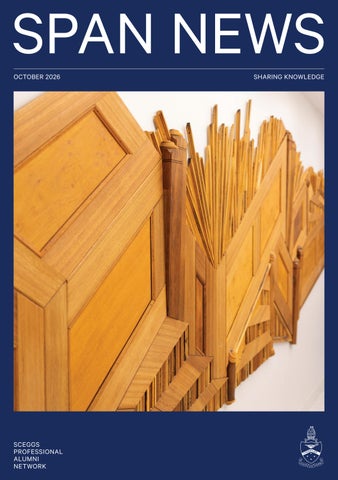
EDITOR Tina Mavritsakis FEATURE WRITER Julia Hasche COVER PHOTO Chris Gleisner Pictured on our front cover is one of the two artworks commissioned for Wilkinson House, which was officially opened earlier this year. This Is What an Education Sounds Like by Ashley Eriksmoen, reconfigures the reclaimed timber balustrades (framed panels, posts, handrails and trim moulding) from the original Wilkinson House staircase. In its new form, the staircase remains an active participant in the SCEGGS story, ethically extending the life of the materials already in use and continuing to be a part of the community’s lived experience. Find out more about this artwork on the Wilkinson House Artworks page on the SCEGGS website.
IN THIS ISSUE
ALL’S FAIR IN ART AND BUSINESS
04
INDIA FORD (2017)
MAKING TECHNOLOGY PERSONAL
08
CHARLOTTE HARRIS (2018)
THE JOURNEY TO CEO
12
EILEEN KOO (CHUNG 1985)
FROM PUBLISHING TO PRESCRIPTIONS
16
ALANA LESSI (1999)
A CAREER IN MOTION
20
NIKKI SCOTT (CARTER 1999)
SOLD ON REAL ESTATE
24
HANNAH TATAM (2001)
2026 OLD GIRLS’ CAREERS EVENING
28
ALL’S FAIR IN ART AND BUSINESS INDIA FORD (2017)
4
India FORD (2017) combines creativity with strategy as Fair Manager of Sydney Contemporary, Australasia’s leading commercial art fair. Working with galleries from across Australia and around the world, she oversees the delivery of one of the region’s most significant arts events while championing meaningful engagement with contemporary art.
What first sparked your interest in the arts, and when did you realise you wanted to build a career in this field? I grew up in a family that was passionate about the arts. Weekends were often spent being coaxed along to galleries, museums and theatre performances, or learning instruments. Over time, those interests became my own. For a long time, though, I saw the arts as something that added value and excitement to life, rather than something in which you could build a career. At school, there was plenty of advice for students wanting to work in medicine, law, science or business, but early on, I never really considered that the arts could be a profession. When I was finishing Year 12 at SCEGGS, hankering for a change of scene, I researched universities overseas. Like many people who weren’t quite sure what they wanted to do, I assumed business or economics was the sensible, versatile choice. But when it came time to write the application essay, I drew a complete blank. I found myself secondguessing everything, wondering what little 18-year-old me really had to say about the global economy that hadn’t already been said. Then, while browsing degree options in the UK, I discovered that Art History existed as a university degree. On a whim, I wrote the application essay and finished the entire thing ALL’S FAIR IN ART AND BUSINESS
in about an hour. It was the first time I felt I had something to say that I genuinely believed in, rather than something I thought I should be saying. I haven’t really looked back since. When you find something you genuinely care about, you naturally work harder at it than you ever would in a career you feel you should pursue. Can you tell us a little about your role as Fair Manager of Sydney Contemporary? What does a typical day look like? My role is a slightly strange one because our team works year-round for one week of the year. People often ask me, “So what do you do for the rest of the year?”, unaware of the extensive planning, co-ordination and problem-solving that occurs long before the first guest passes through the door. I understand why people ask this. Before working in events myself, I never fully appreciated the level of detail, planning and logistics required to produce something of this scale. The reality is that every artwork, wall, light, sign, activation and visitor experience has been planned, budgeted, designed, transported and installed through months of collaborating behind the scenes. For those unfamiliar with art fairs, Sydney Contemporary brings together leading galleries from across Australasia and beyond for a week of exhibitions, art sales, talks, performances and public programs. 5
Most of my year falls into three stages. First, we drum up interest among the galleries to participate in the next Fair, while also reflecting on the previous one and planning any improvements. Then, we move into the development phase. I work with galleries on artist presentations, refining floor plans, co-ordinating logistics and building the public program. Finally, we get to the Fair week itself, where all the pieces come together and the art fair becomes a reality.
While I enjoyed visual arts and music, I never had that instinctive drive to create work myself or develop a practice as an artist or curator. Instead, I was interested in everything ‘behind the artwork’: the ideas behind an exhibition, how people connected with art, and what allowed those ideas to reach an audience. I was drawn to the bigger picture of how the industry worked, how creative ideas were developed and realised, and how I could contribute to the sustainability of an industry I loved.
There are equally glamorous and decidedly unglamorous aspects of the job, both of which I genuinely enjoy. I’ve been fortunate to travel to Singapore and New Zealand to work on other art fairs and learn from different teams. On other days, I’m deep into spreadsheets, tracking budgets, managing timelines, or solving logistical problems.
Many of the skills I have today grew in confidence through experience: saying yes to opportunities I was mildly capable of doing, being honest about what I didn’t know and putting in the work to understand them properly. I’ve also been incredibly lucky to develop those skills alongside a team of incredibly intelligent and generous women who have challenged me, trusted me and shared their knowledge so openly.
Then, for one week in September, everything comes to life. It’s long days, early mornings and late nights, with thousands of visitors moving through the Fair. The week can feel like a month, but it is incredibly rewarding to watch something you’ve spent months planning become a space where people discover new artists, engage in conversation and leave inspired. Then, on Monday morning, we start planning the next one. Your career combines creativity with strategy, logistics and large-scale project management. Was this blend of skills something you were looking for, or did you discover it as your career evolved? I can’t say that I set out knowing that logistics or project management would become my strengths. At least, I didn’t have the language to describe them that way at first. What I did know was that I could appreciate and understand art more than I could make it.
6
How do you balance supporting artists’ creative vision with the commercial realities of running a major international art fair? It’s often argued that commerce and creativity are at odds. I think they’re deeply connected and mutually dependent. Artists deserve to make a living, and a sustainable industry allows great, ambitious work to continue being made. Fine art is different to many industries because every artwork represents an individual artist’s perspective and creative practice. That unique value shouldn’t be lost in pursuit of commercial gain alone. At the same time, without healthy commercial support, the ecosystem becomes unsustainable. Working in a passion industry is interesting because very few people are there purely for commercial reasons. Most people genuinely care about contributing something meaningful,
SPAN NEWS - OCTOBER 2026
whether they’re artists, gallerists, collectors or arts workers. Part of our role is balancing these priorities to ensure the Fair remains creatively ambitious, meaningful and financially sustainable. The arts industry is constantly evolving. What trends or changes are you most excited about, particularly in the contemporary art world? We’re experiencing a fundamental shift in the way people are engaging with and collecting art today. Younger generations are at the forefront of this change, driven by broader cultural, technological and economic shifts that are challenging traditional models within the industry. Artists and galleries are finding new ways to connect with audiences, with traditional pathways into the art world becoming less defined. The idea of what it means to collect art is also expanding, with people building collections around wider personal interests, often blurring boundaries between fine art, fashion, design and technology. When you look at the history of art, in many ways, it is a visual archive of humanity itself. Artists have always responded to the world around them and given lasting form to what it meant to be human in their time. As we’re living through a period of significant cultural and technological change, it will be fascinating to reflect on how artists and the industry responded to this moment. There have been moments like this before, but I think this period will be remembered as a particularly transformative moment for how art is created, shared and valued. What advice would you give to a reader who is interested in a niche career in Australia’s cultural and creative industries?
ALL’S FAIR IN ART AND BUSINESS
India’s team installing one of the large-scale installations
My main piece of advice would be to invest your energy into making genuine connections with people. Niche careers in the arts are hard to look for sometimes; they often find you through the people you meet. Talk to as many people as you can. Ask someone working in the industry if they’ll have a coffee with you. Ask them about their career, what they love, what they don’t, and what they wish they’d known when they started. Then, when you’re finished, pay for the coffee, and ask if they can introduce you to two more people. One piece of advice I was given during one of these coffees has stayed with me ever since: don’t expect to start by solving the world’s problems. Start by sweeping the floors. Work hard, stay curious, say yes to opportunities and learn as much as you can. The best part of working in the industry is that you’ll spend your career meeting fascinating people from all walks of life – intelligent, wacky, creative, and diverse people. Somewhere amongst those conversations, you’ll start to find your own place in the industry.
7
MAKING TECHNOLOGY PERSONAL CHARLOTTE HARRIS (2018)
8
Charlotte HARRIS (2018) has built a diverse marketing career spanning aviation, retail and technology. Now a Product Marketing Manager at Google for Platforms & Devices, she combines strategic thinking with a passion for fostering community and championing initiatives that support inclusion and empower women across the organisation. Can you tell us about your role as a Product Marketing Manager for Platforms and Devices at Google? What does a typical day involve? My role is all about bridging the gap between innovative technology and the everyday consumer experience. As a global company, a typical day usually involves a mix of early morning or late afternoon syncs with our global and regional teams, ensuring our local market strategies align with broader product launch guidelines. I also work closely with key retail partners to negotiate marketing investments and build channel strategies that bring our hardware to life in stores and online. My favourite part of my day is centred around building relationships. Whether it is a quick coffee catch-up with cross-functional partners or aligning with team members, direct and frequent communication is what drives successful campaigns here. Marketing is truly a team sport, and staying connected with the people behind the projects makes the work both collaborative and incredibly rewarding. You’ve worked across retail, aviation and technology. How has experiencing different industries shaped you as a marketer? Navigating these varied sectors has given me a front-row seat to how different business
MAKING TECHNOLOGY PERSONAL
models operate, helping me discover what truly energises me as a marketer. Each industry brought its own unique learning curve; working in aviation and retail has taught me how to navigate complex regulatory environments, manage high-stakes brand reputations, and build deep, multi-layered retail partnerships. At the same time, moving across diverse disciplines like communications, public relations, growth marketing, and product marketing all contribute to building a versatile, adaptable toolkit. Today, landing in the fast-paced tech space feels like a great culmination of those experiences, as I get to apply every lesson learned along the way. Experiencing an array of industries early in my career has encouraged me to stay curious, challenge my assumptions, and realise that great storytelling and genuine connection transcend industries in this discipline. What attracted you to a career in marketing, and did you always know this was the path you wanted to pursue? I began my university studies in Arts, majoring in politics and international relations, before realising that the content of the courses wasn’t aligned with what I was hoping for. Growing up, I was always intrigued by marketing because a few family friends worked in the field and hearing them speak about their work sounded so dynamic and diverse. That lingering curiosity 9
The Annual APMM Academy, (specialised marketing training program, in New York)
eventually led me to pivot to a commerce degree with a major in marketing, which turned out to be a great fit. As a people-oriented person, what continues to draw me to this career is its core focus on human behaviour: deeply understanding who your consumer is, what drives them, and how to connect with them authentically. It has been a reminder that you don’t need to know your exact career destination right after high school, as taking different turns along the way can lead you somewhere unexpected yet wonderful! Google is one of the world’s most recognised brands. What has surprised you most about working there? The sheer scale and variety of products and teams operating under the Google umbrella were unexpected! It is incredible to see how many distinct functions fit within a single office, spanning everything from YouTube and Search to Google Cloud, Pixel hardware, and 10
cutting-edge AI like Gemini. Beyond the impressive diversity of products, what has stood out to me is the company’s genuine focus on its people. It is a workplace filled with exceptionally bright, passionate and kind individuals who prioritise building real connections. That collaborative, welcoming culture makes it easy to build lasting friendships, making coming into the office every day that much more fun. You’ve been involved with Google’s Women@ committee. Why is building an inclusive workplace and strong company culture important to you? Being part of the Women@ committee is one of the most fulfilling aspects of my Google experience because of my strong belief that a company’s culture is its greatest asset. For an organisation to truly innovate and succeed, every person needs to feel seen, valued and empowered to bring their authentic self to work. Building an inclusive environment SPAN NEWS - OCTOBER 2026
“ The sheer scale and variety of products and teams operating under the Google umbrella were unexpected! It is incredible to see how many distinct functions fit within a single office...” isn’t just about fostering diversity on paper; it is about creating meaningful networks, mentorship opportunities and spaces where everyone can thrive and lead with confidence. As someone who thrives on human connection, contributing to a community that actively shapes a supportive workplace helps turn a great job into a place where people truly feel they belong. What skills do you think are becoming increasingly important for young people who are interested in careers in marketing or technology? In fast-evolving fields like marketing and tech, technical skills can always be taught on the job, but having a mindset driven by curiosity is what can truly set you apart. With technology evolving rapidly, being eager to experiment, ask questions and continuously learn is key. I would encourage young professionals to start playing with emerging tools, especially AI, early on – whether that means using it to brainstorm ideas, automate small tasks or simply explore different platforms and abilities. Beyond curiosity, strong interpersonal skills like empathy, storytelling and adaptability are becoming more critical than ever. Technology and platforms will always change, but the ability to translate complex ideas into clear narratives and connect with people will always remain in high demand.
MAKING TECHNOLOGY PERSONAL
Looking back, were there any experiences at SCEGGS that helped prepare you for your career or gave you confidence to pursue new opportunities? The breadth of opportunities available at SCEGGS played a huge role in shaping my approach to both life and career. Being exposed to such a wide variety of subjects and co-curricular activities, combined with the support of incredible teachers and mentors, instilled in me a genuine, lifelong love of learning. Having space to try new things and push outside my comfort zone also sparked a growth mindset, teaching me early on to view challenges as exciting opportunities to learn, rather than as obstacles. This foundation gave me the confidence to take risks, pivot when needed, and step into new industries with curiosity and resilience. The belief that you can always adapt, grow and build new skills is something that started in the classroom at SCEGGS and continues to guide me in my career.
11
12
THE JOURNEY TO CEO EILEEN KOO (CHUNG 1985)
As Senior Vice President and Chief Executive Officer of AllianceBernstein (AB), Eileen Koo (CHUNG 1985) has built an impressive global career in financial services, spanning leadership roles across Sydney, Hong Kong and China. Her expertise in risk, compliance and executive leadership has shaped her journey to leading the Australian business. Can you tell us a little about your journey into the financial services industry and what led you to that career path?
Looking back, were there any unexpected moments or opportunities that shaped the direction of your career?
As with many people, I fell into my career in risk management and compliance.
Many! Years ago, I interviewed at Perpetual Trustees – just for interview practice – I didn’t think I’d get the role. I ended up getting the job as a Manager in their Corporate Trustees Division. Back then, compliance wasn’t a huge thing, and I think the hiring manager was impressed that I had done ‘compliance’ in my previous role! It was at Perpetual that I truly learnt about the world of regulatory risk, compliance and governance, and how to manage teams.
After school I completed a commerce degree at UNSW – but maths wasn’t my thing, so I tacked Information Systems onto my Accounting major. My first job was as a graduate trainee with QANTAS in their IT subsidiary. Turns out, programming wasn’t my thing either, although I loved the analysis part of the work. I eventually ended up at AMP in their funds operations area: a great training ground for so many people in financial services! I worked my way through and ended up with a fancy title in my last role there – Investment Tax Compliance Accountant. THE JOURNEY TO CEO
I had great managers and a wonderful team that allowed me to make mistakes and learn from them. To this day, a couple of my managers have turned into long term mentors 13
and some of my ex-colleagues remain close friends or are peers in the industry. You spent many years working in risk management and compliance. What did you enjoy about that and why are they so important today? Behind physical and mental health, I view financial health as an important part of our wellbeing. We dedicate a significant portion of our lives juggling home finances and aiming to achieve financial stability, enabling us to enjoy the rewards of our efforts to secure a comfortable retirement. In financial services, risk management and compliance play vital roles in ensuring that firms operate with the highest ethical standards, integrity and sound business practices to protect client investments and retirement savings. Besides the office of the CEO, these functions are one of the few areas where you get to roll up your sleeves and work across the business. I’ve loved the challenge of helping businesses enter new markets, deliver new products, digest regulations, adapt to emerging risks and finding solutions to all types of issues. I’ve learnt there are many ways to skin a cat and that things are rarely black or white. What does a typical day look like for you as CEO of AllianceBernstein Australia? So far, it’s been one big learning curve! Driven by compulsory superannuation, Australia is the world’s fourth largest pension market today and we are expected to move to second place within the next decade. As a result of the Banking Royal Commission, the industry has undergone huge change over
14
the past seven years and will continue to do so in the medium term. As CEO, I’m responsible for the bottom line for AB in Australia, but it’s so much more than that. We are a firm that services large institutions, such as superannuation funds, government and semi-government entities and insurance companies, as well as the financial adviser market. I work closely with the firm’s leadership team to decide and set strategy and communicate this to the local and offshore teams and management. Importantly, our people are our greatest asset so ensuring everyone is on board and working towards the same purpose is vital. There’s no real typical day. Of course, there are the periodic boards, committees, and financial and regulatory reporting. I support managers to ensure sales and marketing strategies are sound and executed, projects are delivered, and communications are open. We have strategy days and product launches as well as investment managers and senior management visits from offshore, all of which need to be carefully managed. Our firm is small in Australia – just under 40 people across the Sydney and Melbourne offices. I’m committed to actively listening, celebrating milestones, and leading our team to success in this market. What qualities do you think are most important for leaders in financial services today? Empathy and EQ are key qualities. Understanding what drives you and your people and the ability to harness these emotions to achieve good outcomes. Equally important is leading by example and setting the tone from the top.
SPAN NEWS - OCTOBER 2026
Ringing of the bell to celebrate AB ETF’s fourth anniversary
What excites you most about the future of the industry? The world of AI is exciting, scary and full of possibilities. From creating avatars to help with servicing and marketing to research and implementation to helping to create frameworks for speeches, reports and presentations, it is a game changer – not just for financial services but for nearly every industry. What advice would you give to recent graduates considering a career in finance? Firstly, there’s a lot of truth to the saying that “luck is when preparation meets opportunity”. There’re so many hurdles to getting that first job but just like any career you choose, there are many paths to getting to that destination. Continuous learning is invaluable. Even with mistakes, we learn what to avoid for next time and each of these nuggets set us up for when an opportunity comes along.
THE JOURNEY EDDIE JAKU TO CEO
Secondly, and personally, it takes a lot of courage to put yourself out there and to have the confidence to put your hand up. I always remember our school motto – let your light shine – no matter what you choose to do in life. There are no truer words than those in today’s world where we still need to close the gap on gender bias. What advice would you give to young professionals about investing in their own learning and skill development throughout their careers? I found I have never stopped learning! Whether it’s from work, technical skills, colleagues, new methodologies and so on, or from softer skills such as interacting with different cultures and gaining new perspectives.
15
FROM PUBLISHING TO PRESCRIPTIONS ALANA LESSI (1999)
16
After changing careers to pursue medicine, Dr Alana LESSI (1999) found her calling in general practice. Drawn to the profession by a love of practical problem-solving and meaningful patient relationships, she now enjoys the diversity of general practice and encourages others to embrace life’s uncertainties. You came into medicine mid-career; can you tell us about why you had a change in career path and what inspired you to become a doctor? I really enjoyed my job in publishing, but I couldn’t find a stepping stone to the next level. At interviews I felt between junior and senior roles and on a few occasions, I was asked who had written my application, which I found both baffling and offensive. And, having studied both sciences and arts, I missed the excitement of science. I spent several months thinking about what I should or could take as my next step. I had never wanted to return to study, I was ready to work. I wanted to combine scientific and communication concepts, I wanted to not be always in an office, and I wanted to do something useful – not just for the employer, but in the bigger scheme of things. I applied for all sorts of things, but I couldn’t find a way to combine these ambitions through a workplace or job listings. I thought about architecture and teaching and I thought about returning to the Science Communications master’s program I had previously received a scholarship for and turned down. Then one day the idea of medicine just dropped into my head after a night out at The Basement (just jazz back then). It arrived fully crystallised when I wasn’t expecting it. My subconscious must have been working away at the problem. I would accept I had to FROM PUBLISHING TO PRESCRIPTIONS
do some sort of study to change paths, and I would do medicine and become a GP. And I started the process the next day. Many of my friends from SCEGGS have also had shifts away from their degree subject – it seems to be a feature of our generation. Sarah NEILL studied law and now runs the sports-focused production company Hustle Media; Jenny KALDOR started in corporate law and then then took the path of academia and subsequently switched to a leading role in health policy; Eleni MASTROCOSTAS studied psychology and is in an executive management unit in the university sector. You went on to complete further training in obstetrics and gynaecology and now have interests in women’s health, paediatrics, and family planning. What motivated that decision, and what do you enjoy most about those types of care? I had always intended to become a GP, yet in my junior doctor training I was at a facility that didn’t include paediatric or women’s health as an option for rotations. So, I had to seek out these specialty areas as they are inevitably a core part of GP, especially if you are female. I was not competent in these areas and I feared them. But I couldn’t avoid them – so best to conquer fear with knowledge. Working at the Royal Hospital for Women was one of the most 17
April 2020, catching some mask-free time and catching up with colleagues but….at a distance
demanding jobs I have ever had. Physically, it was extremely tiring; mentally, there was a lot of new information and a very different approach to standard junior doctor tasks, such as totally different rules and requirements for basic fluid replacement; and emotionally, it was absolutely a rollercoaster between sky-high and rock-bottom situations within a shift. Medicine is constantly evolving. How do you stay current with new research and developments? This is a great challenge for everyone in health. It took me some years working as a GP to understand that the best way is to accept that this is both an impossible task and a task that becomes increasingly rewarding as time goes on. The shift is in understanding that the aim is not to update all the knowledge in your head and rely on that, but to know where you are up to versus best practice guidelines and treatment options, and to know where to look for the details you need in the moment. Furthermore, new and cutting edge is not always 18
what’s needed. This is a useful approach to information in the digital age – you can get as much information as you want, but is it relevant? In the context of General Practice, patients are not coming in to be part of an experimental trial, they are coming for a solution to a problem. That solution, for their situation and the context of their daily life, might be in a novel new treatment option or it might be in a tried and tested solution where the outcome is predictable. What’s something people might be surprised to learn about being a GP? Many times, people present requesting a referral to a particular specialist and seem surprised that I can provide a set of treatment options for them to choose. Some people feel more confident checking in with a specialist too, and others are pleased to save the extra trip and expense. I think people don’t really stop to think that the doctors who choose to specialise in General Practice have done just as much medicine as anyone else. It’s just in a different context, and that doesn’t take away the years of experience. SPAN NEWS - OCTOBER 2026
“ Analytical thinking is hands down the number one skill that I value most from SCEGGS. It made my first year of university much easier than I had expected.” Looking back, what qualities developed during your school years have been most valuable throughout your career? Analytical thinking is hands down the number one skill that I value most from SCEGGS. It made my first year of university much easier than I had expected. It made me open to thinking about different career pathways and thinking through why I wasn’t enjoying my previous life in publishing. It helps me drill down to the essential elements of the many complex situations I work on daily. As a GP, medical knowledge is just one part of the problem-solving toolkit. Equally important are the patient’s personality, motivations, understanding of the world, financial circumstances, social context, and occupation. The list goes on. Without considering these factors I can come up with a medical solution, but I can’t come up with a viable plan. Understanding what a barrier or a blessing in each aspect of a person’s life may be requires on-the-spot analysis and application of the findings. Ultimately, these are the plans that are likely to motivate healthy choices. What’s one thing you wish every person knew about looking after their health? Fancy tests, treatments and accessories are interesting, but only useful in very specific circumstances, not across populations. Health will always come back to the basics: eat whole foods, learn to cook, move your body, prioritise good relationships and do these things every day. Doing everything ‘perfectly’ according to wellness EDDIE PUBLISHING FROM JAKU TO PRESCRIPTIONS
trends for one month a year might make you feel great at the end of the month but ultimately it is unlikely to do anything beyond that. Life and health are made up of what we do every day. What advice would you give a SCEGGS girl considering a career in medicine as they begin exploring the profession? Think about why you are interested and then find out which parts of medicine prioritise that aspect of the profession. For example, I wanted to have more variety and people interaction in my work. This would not suit a subspeciality pathologist or surgeon. We all have an experience of going to the doctor, but there are likely many parts of the medical profession that you may not have heard of. Also, I would recommend tackling each area of study with as much depth as possible. It is all relevant in a medical career. The three things to take from school are: the ability to learn; the ability to be confident enough to be responsible for any ideas or advice you give; and the ability to be aware of and accepting of what you don’t know. There is great value in both knowing an answer and also in not knowing and rationalising your thoughts towards a possible answer that can be checked. There is no value, and likely danger, in making something up because it ‘sounds good’. In medicine you need confidence in both your knowledge and your ability to sort the wheat from the chaff. You need those analytical skills!
19
A CAREER IN MOTION NIKKI SCOTT (CARTER 1999)
20
After beginning her career in Exercise Science, Nikki Scott (CARTER 1999) followed her passion for understanding the human body by becoming a phyisotherapist. Now with additional expertise in pilates and women’s health, she is dedicated to helping people improve their wellbeing while balancing family life with raising the next generation of SCEGGS girls. You originally studied Health and Sports Science before completing a Master of Physiotherapy. What inspired you to continue your studies and specialise in physiotherapy?
You’ve continued to expand your expertise through further training, including pilates and women’s health. Why is lifelong learning so important in your profession (or to you)?
I have always been passionate about living a healthy lifestyle which is what led me to Health and Sports Science. However, there weren’t many exercise physiologists when I needed to do the practical component of my degree in 2002 (now they are everywhere!), and I ended up at Prince of Wales Hospital spending a lot of time with physiotherapists in the Spinal Cord Unit.
Healthcare is one of those fields that is continually changing and adapting based on our knowledge, experience and research. Annually, physiotherapists are required to complete a minimum of 20 hours of continuing education to stay up to date. It’s also important to learn different approaches and techniques so you have more treatment options to draw on when approaching someone’s recovery.
Most patients were young male adults who had been in car accidents but despite this, the gymnasium was always full of positive energy and laughter. It made me realise that a part of your enjoyment of your career is who you are working with and if these physiotherapists were anything to go by then I wanted to be working with people like them. That experience was a big part of what motivated me to continue my studies and pursue a career in physiotherapy.
For me, lifelong learning is about remaining curious and continuing to develop as a clinician so that I can offer my patients the best possible care.
A CAREER IN MOTION
“ For me, lifelong learning is about remaining curious and continuing to develop as a clinician so that I can offer my patients the best possible care.”
21
Your work helps people recover from injury, manage pain and improve their quality of life. What do you find most rewarding about working with patients? The human connections that you make with people when getting people ‘back on track’ are one of the most rewarding aspects of this job for me. As a physiotherapist you are often the health professional that spends the most time with your patient and therefore you often have the greatest opportunity to guide and support that person towards recovery. How has your understanding of movement and exercise influenced your own lifestyle and wellbeing? When you sit in lectures and engage in tutorials for six years, learning about every aspect of the human condition that is changed for the better with a healthy lifestyle and the number
of medical conditions that can be prevented simply by making good lifestyle choices, it is difficult to not be ‘on board’. My understanding of movement and exercise has made me more conscious of the importance of looking after my own health, not just through exercise but through the broader lifestyle choices that support wellbeing. I think it is also important to set a good example for both my patients and my family. Life gets busy, but I know that when I prioritise movement and exercise, I feel better physically and mentally. Looking back, were there any experiences at SCEGGS that helped shape your interest in health, science or helping others? Yes! At school I was able to engage in a wide range of sports which helped me to foster my passion for wellbeing, health and fitness. SCEGGS also does a great job of allowing kids across multiple year groups to work together and help each other out, whether it be House
Working with a patient to improve his thoracic mobility and core control through Pilates
22
SPAN NEWS - OCTOBER 2026
Volunteering in Malawi
plays or engaging in sporting events. I also came back for a little while after school and helped coach cross-country running at SCEGGS while I was studying at UNSW. What advice would you give to students who are considering a career in physiotherapy or the broader allied health professions? Physiotherapy, like many of the allied health professionals, offers a vast scope of practice and can afford you an array of opportunities. Some exciting opportunities I have had include volunteering in Malawi and working as a locum physiotherapist in Derby, Western Australia. I have many relatives who are also physiotherapists and they have had completely different experiences again, like travelling around the world working with Cirque du Soleil. You can practise physiotherapy in hospitals, private practice, on sporting fields or be involved in research. You really can pick your office!
A CAREER IN MOTION
How do you balance a busy professional career with family life, and what have those experiences taught you about resilience and wellbeing? I am fortunate enough to have a job working in private practice, which affords me some flexibility to shift my schedule around the kids when necessary. I have three girls, aged 8, 11 and 13 all with busy co-curricular schedules themselves. As they say, it takes a village to raise a child, and I am fortunate to have an extensive one. My experience as a working mum has taught me that resilience is often about accepting that you are not always going to find the perfect balance and that it is a continual work in progress! Having the ability to adapt and the flexibility to change your workflow when needed helps. When you are stretched in multiple directions looking after your wellbeing is even more important. Wellbeing for me is achieved by finding time to exercise and spending time connecting with family and friends. If you are not in a good space yourself, it is difficult to have the energy to care for others. 23
SOLD ON REAL ESTATE HANNAH TATAM (2001)
24
Although she initially studied education, Hannah TATAM (2001) discovered her passion for the property industry while working part-time at university. Today, she is an award-winning property manager whose people-first approach and industry expertise have earned her a respected reputation in real estate. Can you tell us about your role at Warwick Williams Real Estate? What does a typical day as a property manager involve and what are some of the skills needed? One of the best things about my role is how incredibly diverse it is. An ‘average’ day could involve an inspection anywhere in Sydney (sometimes as far out as the Hawkesbury!), problem-solving repairs, finalising lease agreements, and managing vacate inspections. We constantly juggle tasks like negotiating with strata agents, reviewing rental rates, ensuring legislative compliance, overseeing renovations, and of course, handling the never-ending churn of maintenance. A good property manager must be practical, highly organised, and rely on strong systems to ensure nothing falls through the cracks. We are also expected to have substantial knowledge across multiple fields. This includes a comprehensive understanding of the Residential Tenancies Act, construction and building basics, insurance policies, the Privacy Act, and strata legislation. The list grows every day, but above all, you need to be an excellent communicator capable of negotiating between parties who often have opposing objectives. The role is so much more than the public perception of collecting rent and sorting maintenance.
SOLD ON REAL ESTATE
You discovered your passion for real estate while working part-time during your university studies in Arts and Secondary Education. Why did you pursue a career that was different from the one you had originally envisioned? Like many school leavers, I didn’t entirely know what I wanted to do, but I knew I enjoyed working with kids, so teaching felt like a great path. Seeing my friends have such clear aspirations to become lawyers or engineers was a bit daunting. To be honest, I don’t think I ever would have considered property if I hadn’t accidentally fallen into it! After leaving SCEGGS in 2001, I took a gap year and spent six months travelling through London, Europe, and the USA, where I worked as a summer camp counsellor at a special needs camp in the Pocono Mountains. Upon my return, I needed a job to fill the gap before starting at UNSW and heard a local agent needed admin support. I made the call, was interviewed a few hours later and started work the next day. It was a tiny boutique agency in Balmain consisting of just the Licensee and myself, so I was immediately exposed to everything from Sales to Property Management, as well as the realities of running a small business. I had always loved attending Saturday auctions with my dad to see what properties were selling for (a habit I continue today), so I found myself thoroughly enjoying the role.
25
My employer – who happened to be a former primary school teacher herself – generously paid for my real estate certificate course and let me complete it during business hours. This allowed me to support myself financially throughout university, and I eventually managed my schedule to fit a full-time Bachelor of Arts/Bachelor of Education (Secondary) into three days, and work into another three. By my third year, I realised I was enjoying my role at the agency more than teaching; I was so close in age to the high school kids I was working with, and I probably lacked a bit of confidence. Despite having an open offer for a full-time real estate role whenever I wanted it, I saw immense value in finishing my degree – ‘Managing the Classroom Environment’ was a course where skills absolutely transfer. Knowing I would walk away with a degree and a near-guaranteed job pushed me to complete my fourth and final year, eventually graduating with Honours. Property management is often described as being fast-paced and people-focused. What do you enjoy most about the role? I’ve always been someone who craves variety, so a role where I am in and out of the office – and required to use my organisational, analytical, and practical skills – is a perfect fit for me. I particularly enjoy problem-solving. That might mean giving a tenant some quick troubleshooting tips before arranging a trade, making legislation work for my clients, or resolving a complex repair issue that involves body corporates, neighbours, trades, and tenants. Repairs and maintenance are a large part of my role; getting things fixed quickly not only demonstrates to tenants that they are valued, but also ensures the property is well-maintained for the owner. A small leak can easily become a major flood if you don’t act fast, and the pace of the job really comes from having to quickly pivot based on the calls that come in. 26
At the end of the day, I am trusted with the care of millions of dollars’ worth of property, but I am also responsible for the spaces where tenants build their lives, raise families and make memories. It is a privilege to hold this role, and I thoroughly enjoy developing genuine relationships that go beyond just ‘doing my job’. The job certainly can have its slow, more routine days of rental reviews, chasing ongoing maintenance, and inspection scheduling, but on others I’m dealing with emergencies. I’ve had whole apartments go up in flames, sewage flood through homes, and sadly I’ve even had to call the police due to a deceased tenant. These situations require more than just practical execution – they demand genuine compassion, empathy and a calm head. What are some of the biggest challenges people might not realise come with managing properties and supporting clients? I think the biggest challenge for property managers is navigating growing pressure and expectations in an industry where the rules are constantly changing. Landlords expect their property managers to be experts in all things property – from complex tenancy legislation and tax depreciation to maintenance, legal compliance, and financial oversight – even though most of this is not covered in our course or continued professional development topics. Balancing those expectations while still delivering exceptional service is a daily challenge and one that requires experience. We also live in an ‘on demand’ world where expectations don’t always align with reality. A tap that starts dripping at 3pm on a Friday afternoon simply might not be fixable within an hour. Because of this, property managers often become the metaphorical punching bags, caught between tenants who want immediate SPAN NEWS - OCTOBER 2026
results and landlords who want the most affordable solution – there is a lot of pressure. We are frequently on the receiving end of emotional outbursts, and the media’s negative portrayal of agents as untrustworthy doesn’t help. This public perception heavily impacts the industry, particularly those who are new to the role. During the COVID-19 years of 2020 and 2021, NSW lost approximately 33% and then 24% of its property managers. The east coast rain events of 2022 took out another 23%. Aggression, client abuse, and mental health strain were cited as the major drivers behind these numbers, causing our industry to lose decades of invaluable experience to other fields. How has the real estate industry changed since you began your career, and what trends do you think will shape its future? The real estate industry has changed substantially in the 24-plus years I’ve worked in it. When I first started, we were advertising properties in the physical shop window and publishing minimum-word classifieds in the Saturday edition of the Sydney Morning Herald – the section that eventually became Domain. Today, properties are professionally photographed, often virtually styled, and promoted internationally with virtual tours, detailed floorplans, and the capacity for tenants to apply straight from their couch. Leases are signed electronically on smartphones rather than in conference rooms, and maintenance work orders are accompanied by photos and videos rather than being sent as grainy faxes.
not want to interact with a bot. They want a human who understands good customer service, maintains a strong and up-to-date knowledge base, and is solutions driven. NSW has also seen two massive waves of legislative reform in the last decade, covering dozens of specific regulatory updates, with even more to come. Changes have been so frequent that even the most experienced property managers must constantly double-check the legislation to ensure complete compliance. Navigating today’s rental industry is more complex than ever, driven by tightening laws and highly educated tenants. Consequently, I think we will see many private landlords who previously ‘made do’ with self-managing either leave the sector entirely or turn to real estate experts to protect their investments. What advice would you give to students or young professionals who discover that their career interests have changed from what they originally studied? My parents always told me that if you enjoy what you do for a living, you’ll never work a day in your life – and I think that is excellent advice. If you can find a way to follow your interests and turn them into a career, then that job can become a true passion, and you’re bound to be successful in whatever role you pursue. Don’t worry if your aspirations don’t sound glamorous or newspaper-worthy to others. The reality is that most people I know have pivoted from their original plans at some point. Life is simply too short not to enjoy five out of your seven days a week.
While technology has completely transformed our daily operations, at its core, real estate remains a customer service role. AI is creeping in everywhere and we see it daily in the emails we receive, and it often cites incorrect information. Despite the rise of AI, people ultimately do SOLD ON REAL ESTATE
27
2026 OLD GIRLS’ CAREERS EVENING
28
SUPPORTING THE NEXT GENERATION OF FEMALE LEADERS From one generation to the next, more than 150 current students and their parents engaged with our Old Girl community at the 2026 Old Girls’ Careers Evening. The event was a warm and energetic occasion, helping our students broaden their understanding of life beyond school. While this event happens every two years, there are other ways you can help shape the path of SCEGGS’ young women. If you can support a Years 10–12 student with a work placement or come to school for a Lunchtime Career Conversation, we would love to hear from you! Please contact our Careers Adviser Andrea Pinnock at andreapinnock@sceggs.nsw.edu.au
2026 OLD GIRLS’ CAREERS EVENING
29
30
SPAN NEWS - OCTOBER 2026
SCEGGS PROFESSIONAL ALUMNI NETWORK