Curriculum Handbook 2023


This curriculum handbook contains information on all courses, programmes and qualifications offered at St Cuthbert’s from Year 7-13. The courses offered are outlined with a brief description of the course, assessment methods, any additional costs and recommended prior achievement levels. Information on all courses and qualifications is grouped according to year levels (7-10) and then, by NCEA (Year 11–13) and International Baccalaureate (IB) Diploma (Year 12 and 13) qualifications. This information is accurate at the time of publication but might change as a result of staffing requirements or other circumstances.
Planning for courses in 2023 is very important as students move through the school and eventually beyond St Cuthbert’s to tertiary education. We believe that students should consider their interests, loves and abilities to help them choose their pathways.
From Year 7–10 students experience many different subjects so that they can develop literacy, numeracy, technological and social, emotional skills. Specifically, students in Year 7 and 8 complete a wide range of core subjects including Languages. At Year 9 and 10 the choices are expanded upon to provide students with opportunities to expand their horizons. Arts and performing arts programmes are developed and technological experiences are widened.
At St Cuthbert’s we offer acceleration and enrichment opportunities for multi-level study for some students. Other students need additional support so special programmes are provided for them. These programmes are available for students across Year 7-13. They could include students studying courses well above their year level; being involved in enrichment programmes or receiving one-on-one help to improve literacy or numeracy.
At Year 11 (NCEA Level 1) we recommend that students maintain a broad range of subjects with an appropriate level of challenge. This might mean that students study subjects that give them breadth (and depth) to their learning and help them experience a wide range of opportunities as well as developing skills. Students study six academic subjects, as well as participating in the HUB programme and the health and wellbeing programmes offered at the school.
In Year 12 and 13, students will either continue with NCEA or do IB. These decisions are personal for each student and advice and guidance is available for every student to ensure they choose the qualifications pathway best suited to their personality, skill level and interests.
The HUB programme runs in Year 11–13 ensuring students experience aspects of university information, women’s health, global citizenship, health and wellbeing and preparation for life beyond school, values and service, philosophy, careers and study skills.
NZQA scholarships may be taken from Year 12 on either pathway

Advice is available for students choosing their courses during Term 3. Students and their parents are advised to discuss their ideas and suggested programmes with any of the following people – all of whom will be able to help with decision making
• Head of Careers, Mrs Rhonda Vink (rhonda.vink@stcuthberts.school.nz)
• Deans of Houses
There will be a number of opportunities available for students and parents to hear more about options over Term 3.
In the first four weeks of term there are a series of information sessions for students where Heads of Faculties will give a brief overview about courses to students. These talks are held in school time and give students a hint of what is on offer for the following year.
There is a follow-up evening when parents and students can hear from teachers about the courses that are on offer and ask specific questions.
In addition, students can come to talk with the Careers Staff in a drop in programme during the school day – parents are welcome to attend these short meetings to discuss courses for the following year. Students will be sent information about available times and can book appointments to take up these opportunities.
We hope that this handbook will start you thinking about the various avenues open to students in 2023 and beyond.
What are my skills, talents, abilities and interests?
What subjects am I genuinely interested in?
THINK
Which subjects have I succeeded in previously?
How do I make the right choices?
Which subjects will I need for my future?
Where will each subject lead?
Who can be a sounding board to check I am on the right track?
YOUR
Decisions made now need to be the subjects you really want to do
Choosing your subjects:
These are some important things to think about when choosing your subjects:
• Consider your abilities – could you do well in these subjects?
• Are you interested in the material being taught in the subject area?
• Will your choices provide you with a range of opportunities so you can study at tertiary institutes? Will there be any career implications?
• Talk it over with others
• Is the decision yours?
We encourage you to make your selection at your earliest opportunity as some subjects will reach full capacity and you may be asked to choose an alternative option. This will be emailed to all current and prospective students on Wednesday 24 August 2022.
Please Note:
Senior students who are new to a course at Year 11, 12 or 13 or do not meet recommended prior achievement levels must obtain the permission of the Head of Faculty to take that particular course.
Every effort will be made to enable you to take the subject you wish but not every combination can be guaranteed. Some subjects may not be offered if numbers opting for them are too small.
Any students entering selections after Monday 5th September 2022 may find that some courses are full and that an alternative must be chosen. The same will apply to any student who wishes to change subjects. This will be possible only if courses are not full and the new choices fit the option blocks.
French
Spanish
(Level 1)
1)
1)
1)
1)
2)
year course)
year course)
year course)
year course)
year course)
year course)
Health and Physical Education Health and Physical Education
Wellbeing - includes physical fitness, health, careers and Religious Education IB Sports, Exercise and Health Science are not offered at St Cuthbert's
Physical Education (Level 1)
• Students must complete a course in Health and Physical Education until the end of Year 10.
• The Wellbeing programme is a non-assessed course of Health and Physical Education - compulsory for all Year 11 students.
Building Learning Power, values and service, philosophy, global citizenship, financial literacy, careers and study skills
Religious Education, Study Skills, Careers and Future Focus
Future Focus, Study Skills, Financial Literacy, Values and Philosophy, Mind and Body
Future Focus, Financial Literacy, Values and Philosophy, Mind and Body
Future Focus, Financial Literacy, Values and Philosophy, Mind and Body

English
English English
English (Level 1)
Writing for Publication (Level 1)
English (Level 2)
Visual English (Level 2)
English Literature and Writing (Level 2)
English Literature (Level 3)
Visual English (Level 3)
English Literature and Writing (Level 3)
Film and Media (Level 2)
Students must complete a course in English until the end of Level 2. Mathematics
English
English for Academic Purposes (Level 3) Not recommended
Film and Media (Level 3) Media Studies
Mathematics (Level 1)
Mathematics
Mathematics
Mathematical Studies (Level 1)
Mathematics (Level 1)
Mathematics (Level 2)
Mathematics with Calculus or Statistics (Level 2)
Mathematical Studies (Level 2)
Mathematics - Calculus OR Statistics and Modelling (Level 3)
Students must complete a course in Mathematics until the end of Level 1.
Mathematics –Calculus and/ or Statistics and Modelling (Level 3)
OR Mathematicas both Calculus and Statistics (Level 3)
Calculus or Statistics and Modelling
Mathematical Studies (Level 3) Not recommended
Mathematics - Calculus OR Statistics and Modelling (Level 3)
Calculus OR Statistics and Modelling
7 and 8
Science Science
Production Science (Level 1)
Core Science (Level 1)
Combined Sciences (Level 1)
Production Science (Level 2)
Biology (Level 2)
Chemistry (Level 2)
Physics (Level 2)
Production Science (Level 3)
Horticultural Science
Biology (Level 3) Biology
Chemistry (Level 3) Chemistry
Physics (Level 3) Physics
Students must complete a course in Science until the end of Level 1. Students choose ONE of Production Science, Core Science or Combined Sciences. Some students can choose to do 11SCP in consultation with the Academic Director.
7 and 8
Social Studies Social Studies Geography (Level 1)
History (Level 1)
Geography (Level 2) Geography (Level 3) Geography
History (Level 2)
Classical Studies (Level 2)
History (Level 3) History
Classical Studies (Level 3)
Classical Studies
Health and Physical Education Health and Physical Education
Wellbeing - includes physical fitness, health, careers and Religious Education (compulsory) Physical Education (Level 1)
Education (Level 2)
• Students must complete a course in Physical Education until the end of Year 10.
Education (Level 3)
• The Wellbeing programme is a non-assessed course of Health and Physical Education compulsory for all Year 11 students.
(Level 1)
(Level 1)
Latin
Spanish Spanish
(Level 1)
(Level 1)
(Level 2)
(Level 2)
(Level 2)
(Level 2)
(Level 3)
(Level 3)
(Level 3)
(Level 3)
te Reo Māori te Reo Māori te Reo Māori te Reo Māori (Level 1) te Reo Māori (Level 2) te Reo Māori (Level 3) te Reo Māori
• Year 7 students will study te Reo Māori for a full year and Chinese, French, Latin and Spanish for a term each.
• Year 8 students will study te Reo Māori for a full year and TWO languages out of Chinese, French, Latin and Spanish for two terms each.
• Year 9 and 10 students will choose one or two languages to study out of the five languages offered. They will study each chosen language for the full year.
• A separate standalone Year 10 Language and Culture course is open to students who are unable to take one of the other compulsory Year 10 Language courses – whether because they have transferred from ESOL or PELS or because they have only joined the College in Year 10 and do not have the necessary language background or because it is untenable for them to continue in their Year 9 language for other reasons at the discretion of the HOF.
7 - 8
Technology Taught in two semesters.
● Food and Nutrition
● Digital Creativity
Technology Taught in four term rotations.
● Food and Nutrition
● Computer Science
● Digital Design
● Textiles
7 and 8
Technology (compulsory)
Textile Technology (full year option)
Computer Science (NEW Full year option for 2023)
Design & Visual Communications (full year option)
Technology
Textile Technology (Level 1)
Textile Technology (Level 2)
Textile Technology (Level 3)
Digital Technology (Level 1)
Design & Visual Communications (Level 1)
9 and 10
Art Art (full year course)
Art (half year course)
Music Music (full year course)
Music (half year course)
Drama Drama (full year course)
Drama (half year course)
Dance Dance (full year course)
Dance (half year course)
Art (Level 1)
Digital Technology (Level 2)
Design & Visual Communications (Level 2)
Digital Technology (Level 3)
Design & Visual Communications (Level 3)
Art (Level 2)
Design (Level 2)
Photography (Level 2)
Art History (Level 2)
Music (Level 1) Music (Level 2)
Drama (Level 1)
Drama (Level 2)
Dance (Level 1)
Dance (Level 2)
Painting (Level 3)
Printmaking (Level 3)
Design (Level 3)
Photography (Level 3)
Art History (Level 3)
Music (Level 3)
Drama (Level 3)
Dance (Level 3)
• At Year 9 and 10 students MUST choose TWO of the above Arts courses for half a year each.
• Students may choose ONE full year Arts course at Year 9 and 10.
Technology (Scholarship)
Design & Visual Communications (Scholarship)
Painting
Printmaking
Design
Photography
Art History
Music
Drama
Dance
Business and Personal Finance (full year option) Business Innovation and Enterprise (full year option)
Building Learning Power, values and service, philosophy, global citizenship, financial literacy, careers and study skills
Religious Education, Study Skills, Careers, Future Focus
(Level 1)
(Level 1)
(Level 1)
Future Focus, Study Skills, Financial Literacy, Values and Philosophy, Mind and Body
(Level 3)
(Level 3)
Future Focus, Financial Literacy, Values and Philosophy, Mind and Body
Future Focus, Financial Literacy, Values and Philosophy, Mind and Body

In Year 7–10 students enjoy a wide range of experiences including compulsory core classes such as English and Mathematics. They take courses in Technology (Computer Science, Digital Design, Food, Product, Textiles and DVC); Arts (Art, Dance, Drama and Music) and Languages.
Core Mathematics, Science, English, Social Sciences, Physical Education.
Technology Rotation Food and Nutrition, Digital Creativity.
All students will study the core subjects. Some students will be invited into an accelerated Mathematics programme.
All students will study technology and will spend a semester on each subject.
Worldviews A specialised programme encompassing philosohy, ethics, worldviews and more.
Language Rotation Art, Music, Drama, Dance, Business Studies or a second language.
Creative Rotation Art, Music, Drama, Dance.
Year 8 Curriculum
Core Mathematics, Science, English, Social Sciences, Physical Education.
Technology Rotation E-Textiles, Product Design
All students will study creative arts and spend a term on each.
All students will study the core subjects. Some students will be invited into an accelerated Mathematics programme.
All students will study technology and will spend a semester on each subject.
Worldviews A specialised programme encompassing philosohy, ethics, worldviews and more.
Language Rotation Art, Music, Drama, Dance, Business Studies or a second language.
Creative Rotation Art, Music, Drama, Dance.
All students will study creative arts and spend a term on each.
Year 9 Curriculum
Core Mathematics, Science, English, Social Sciences, Physical Education.
Technology Rotation
Computer Science, Food & Nutrition, Textiles, Digital Design.
All students will study the core subjects. Some students will be invited into an accelerated Mathematics programme.
All students will study technology and will spend a term on each subject.
Worldviews A specialised programme encompassing philosohy, ethics, worldviews and more.
In addition to these compulsory subjects, students will choose two additional full year option subjects, one of which must be a second language. They will also choose two half year options from the Arts and two Technology options.
Full Year Language Te Reo Māori, French, Spanish, Latin, Chinese for second language learners, Chinese for heritage speakers, ESOL, PELS.
Full Year Option Art, Music, Drama, Dance, Business Studies or a second language.
Half Year Options in the Arts Art, Music, Drama, Dance
Year 10 Curriculum
Core Mathematics, Science, English, Social Sciences, Physical Education.
All students will study the core subjects Some students will be invited into an accelerated mathematics programme.
Worldviews A specialised programme encompassing philosophy, ethics, worldviews and more.
In addition to their core subjects students will have the option of choosing two full year options, two half year options from the arts and two technology options. For any language option, you must have taken the language you are studying in Year 9.
Full Year Option Dance, ESOL, French, PELS, Latin, Textiles technology, Chinese, Te Reo Māori ,Computer Science, Design and Visual Communications, Spanish, Digital technology, Art, Music, Drama, Business Studies.
Technology Rotation Food & Nutrition, Digital Design, Computer Science, Textiles, DVC.
Half Year
Options in the Arts Art, Music, Drama, Dance.
All Year 9 and 10 students will be charged $60 for access to all subjects on Education Perfect
English is the study, use and enjoyment of the English language and its literature, communicated orally, visually, and in writing, for a range of purposes and audiences and in a variety of text forms. Learning English encompasses learning the language, learning through the language, and learning about the language.
Understanding, using and creating oral, written, and visual texts of increasing complexity is at the heart of English teaching and learning. By engaging with text-based activities, students become increasingly skilled and sophisticated speakers and listeners, writers and readers, presenters and viewers.
NZ curriculum document
Students entering Year 7 encounter the demands of a greater breadth and depth of content across the curriculum.
Students will gain an increased understanding of:
• Purpose and audience – text structures
• Ideas within, across and beyond texts
• How language features are used for effect within and across texts
• How to communicate ideas on a range of topics
During the year students will:
• Develop an understanding of the grammar and conventions of English
• Begin to respond critically to, and to think critically about, the conventions of a range of texts, including both fiction and non-fiction
• Explore language through the writing and reading of poetic and transactional texts
• Develop a love of reading and become proficient users of a broad range of information resources –students will keep an electronic reading log
• Understand the importance of communication skills with a focus on developing confidence in the use of voice, delivering speeches and listening
Students entering Year 8 will consolidate and build on their knowledge and skills across the curriculum.
Students will:
• Be exposed to a variety of written texts, build on their knowledge of written language features and apply close reading skills
• Practise different styles of writing and how to communicate clearly. Grammar, spelling, punctuation and sentence construction will be studied
• Develop verbal communication skills through discussion, speech making and listening
• Study visual language features and explore how these are used to create meaning in static and moving images
• Continue to develop their personal reading with regular library times and an electronic reading log
In Year 9 students should be able to engage with and enjoy language in all its varieties; understand, respond to and use oral, written and visual language in a range of contexts.
Students will:
• Read a variety of written texts: novels, short stories, poetry, drama and non-fiction. Close reading will help them to think critically and explore language. They will learn how to use the library more effectively.
• Practise both formal and creative writing and work towards developing clear communication skills. Grammar, spelling, punctuation and sentence construction are important and will be studied.
• Contribute to discussion, take part in speech and drama, learn to listen more effectively
• Study aspects of the media such as film, television and magazines, and explore how visual features are used to create meaning in static images such as advertisements and posters
Assessment:
Assessment will include:
• Creative writing
• Formal writing
• Deliver a speech in a formal situation
• Two written examinations
• Reading portfolio
Students will develop the skills gained in Year 9. A particular focus is understanding, responding to and using oral, written and visual language in a range of contexts. More formal study of literary genres will include: short stories, non-fiction, novels, poetry, and drama, but the emphasis will be on wide reading.
Students will develop essay related skills for use in formal writing and literature analysis, as well as more formal speech-making skills. They will study a feature film in detail.
Assessment:
Assessment will include:
• Creative writing
• Formal writing
• Deliver a spoken word poetry performance
• Two written examinations
• Reading portfolio
Mathematics is a core subject and is compulsory for all students. In Year 7-10, students are beginning to use the tools of mathematics – including words, symbols, diagrams, physical models and technology to present their ideas. Student learning and delivery of content is targeted at an appropriate level. In addition there is the opportunity for carefully selected students to pursue accelerated progression, if necessary.
The skills, concepts and understandings of the content strands of Number and Algebra, Geometry and Measurement, and Statistics are developed at the appropriate level for each student. The aim is to ensure the girls are numerate, have opportunities to be innovative in solving problems and making decisions, and are able to communicate their findings effectively.
A major emphasis is the teaching of mathematics as a sense making process. This is facilitated through developing understanding and encouraging the students to make informed decisions as to what is the most efficient and appropriate strategy to solve mathematical problems.
The Number framework is used to develop students’ knowledge and strategies. Strong knowledge ensures students can broaden their strategy base. Using more advanced strategies helps students to develop their number knowledge.
Financial literacy provides the context in some number and algebra units. Problem solving is taught throughout the year and students participate in the Otago Problem Solving Challenge. The Australasian Problem Solving Mathematics Olympiad is offered as part of the Mathematics Extension Programme. Education Perfect is used as a homestudy tool to reinforce the in-class programme.
Assessment:
Topic Tests or Activities as appropriate.
The skills, concepts and understandings of the content strands of Number and Algebra, Geometry and Measurement, and Statistics are further developed at the appropriate level for each student. Problem solving and communicating mathematical ideas using logic and reasoning remain a key focus in Year 8.
The aim in Year 8 is for all students to be operating at stage eight (level 4 of the Curriculum). Students are grouped based on pre-test data using a range of assessments and supported with PAT data.
Programmes encourage individual and collaborative problem solving as the girls become more articulate in their communication of mathematical ideas and formalise concepts. The Australian Mathematics Competition and Otago Junior Maths are offered as part of the mathematics extension programme. Education Perfect continues to be used as a home study tool to ensure students get the additional support they need as they become more independent learners.
Assessment:
Topic Tests or Activities as appropriate.
Concept progression is further developed through a range of skills and activities. A problem solving approach is used to develop understanding in Mathematics and Statistics. Numeracy strategies enhance thinking and form a strong link between strands. An emphasis on maintaining and developing skills is balanced with practical applications, investigations and problem solving. Students learn to think mathematically, to reason and to communicate mathematical ideas clearly.
Assessment:
• Internal test on each topic
• Two written internal examinations
Concept progression continues to be developed through a range of skills and activities. A problem solving approach is used to develop understanding in Mathematics and Statistics. Trigonometry, Quadratic Algebra and Graphs and Statistics. Numeracy strategies are used to encourage fluent skill. Problem solving, developing logic and reasoning and communicating mathematical ideas unify the course and enhance mathematical thinking. Mathematical investigations are used to prepare students for solving unfamiliar problems.
Assessment:
• Internal test on each topic
• Two written internal examinations
Approximate Costs: Education Perfect $25 for Years 7, 8, 9 and 10. Workbooks Year 7, 8 and 10 – $20 ; Year 9 Workbook/Textbook $47.
The aim of Health and Physical Education is to foster attitudes and values that endorse healthenhancing practices. The four concepts underpinning the programme are health and wellbeing, attitudes and values, understanding a socio-ecological perspective (relationships and beliefs within family, community and society) and finally a health promotion perspective.
Students are encouraged to develop a positive attitude towards lifelong physical activity as well as gaining knowledge and the personal and interpersonal skills needed for maintaining wellbeing of themselves, of other people, and of society through learning in health-related and movement contexts.
Physical Education at Year 7 will help equip students for participation in many physical activities, sports and pursuits through the development of motor skills. This course is also designed to extend the interpersonal skills needed to positively interact with others.
The underlying theme is respect for others. Students will develop observational skills to improve their ability to give feedback and take responsibility for their learning.
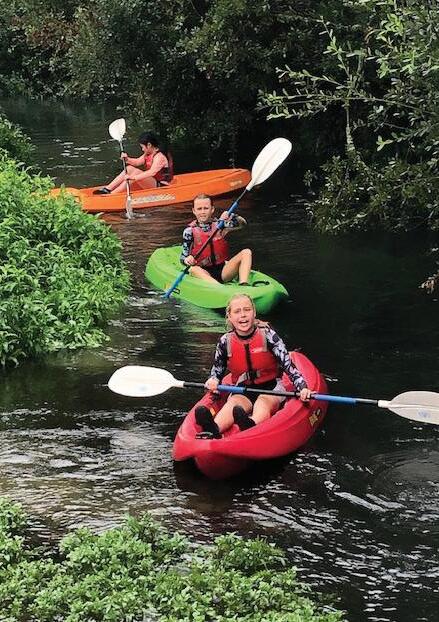
Learning contexts include orienteering, creation of warm-ups, fitness, aquatics, gymnastics, athletics, striking games, turbo touch and traditional games.
Health Education at Year 7 is divided into four units:
• Belonging: Students will cover a range of topics including personal identity, self- efficacy, feelings and cybersafety. The aim is not only to gain a sense of belonging, but also to contribute to St Cuthbert’s community in a positive and confident manner.
• Tipu Ora: Students will gain an understanding of growth, development and changes that occur to our bodies during puberty. It will also provide a foundation for values and attitudes to be expressed in a well-informed manner.
• Life Education (Keeping a balance): Students will identify stressors in their lives and establish strategies to maintain a balanced lifestyle. This unit will be taught in a collaborative manner by outside providers and HPE teachers.
• Gratitude: Students will build on the foundation set in the Resilience Project. This will promote long term practice and mindfulness by understanding how gratitude can have physical and psychological effects on ourselves.
Physical Education at Year 8 will help students to enhance a range of skills and they will learn to apply decision making in an appropriate manner. This course is also designed to foster team building, inclusiveness and effective decision making. ‘The thinking player’ is the underlying theme for this year. Students move into more complex situations where strategy is important so that team decision making becomes a key factor for success.
Learning contexts include fitness, athletics, miniolympics, basketball, cricket, football, badminton, aquatics and self defence.
Health Education is divided into three units:
• Whanaungatanga: Students will unpack characteristics that help maintain a healthy friendship. It will focus on accepting others / diversity and the impacts of online bullying.
• Sexuality: Building on from ‘Tipu ora’, students will revisit changes during puberty, however, greater emphasis will be put on emotional growth such as considering rights & responsibilities and agencies that provide support.
• Life Education (The Great Brain Robbery): Students will explore how a range of substances impact the brain with a specific focus on an adolescent brain. This unit will be taught in a collaborative manner by outside providers and HPE teachers.
Health and Physical Education at Year 9 has a focus on Hauora, teamwork and challenge.
Physical Education is divided into three units:
• Together Everyone Achieves More (T.E.A.M): Students will participate in a range of team sports including netball, touch rugby, ultimate frisbee and volleyball. In doing so, they will be given the opportunity to take responsibility & use initiative and relate to others.
• Sport Science: Students will enhance their knowledge in a range of concepts whilst they train and participate in the annual Y9 Aquathon event. Concepts include (but are not limited to) effective warm-ups & cool-downs, methods of training, principles of training, heart rate training zones and goal setting.
• Accept the Challenge: students will build on personal strengths to increase their confidence and ability in gymnastics and an Aquathon event.
Health Education is divided into four units:
• Well-being: Students will be given the opportunity to further explore and increase their understanding of Hauora and associated models.
• Challenging Assumptions: Students will use a critical lens to explore social norms, labels, and sexual identity.
• Taha Hinengaro: Students will gain knowledge about depression and anxiety. Using different tools and resources, they will also explore ways to overcome feeling down.
• Responsible behaviours: Students will gain knowledge about the effects and impacts of alcohol, drug and vaping use.
Health and Physical Education at Year 10 has a focus on preparing students to take personal and collective responsibility.
Physical Education is divided into five units:
• Adventure Challenge: Students will increase competence, confidence and cooperation during water safety, team building and challenge activities in the lead up to and after Kahunui.
• The Strategic Player: Students will devise offensive and defensive strategies to improve play in badminton, lacrosse and other invasion games.
• Dance Across the Ages: Students will apply interpersonal skills when choreographing a creative dance sequence.
• Sport Science: Students will participate and reflect on taster sessions that focus on various Sport Science concepts and gain an insight into NCEA Sport & Exercise Science (formally NCEA Physical Education).
• Disabilities: Students will gain awareness about a range of learning and physical disabilities. In doing so, students will consider adaptations they can make to be more inclusive.
Health Education is divided into three units:
• Relationships: Students will explore healthy relationships and debunk perceptions that are based on fantasy such as pornography and social media norms.
• Sexual Health & Safety: Students will gain an awareness and an understanding of common contraceptive methods used in New Zealand. Knowledge about Sexualty Transmitted Infections will also frame this unit.
• Making Informed Choices: Students will apply decision making and consider consequences for various topics that may lead to addiction. The topics of focus will include social media, drugs and alcohol.

7
Students are made to feel welcome and gain confidence within their class groups and explore how they can participate practically in the life of a community which has By Love Serve as its guiding principle. Year 7 classes explore the idea of a world view and what that is. The main focus areas at this level are Diversity is Strength and Celebrations Around the World. Students learn to question and to listen with open minds and respect.
8
Year 8 students are invited to think through their ideas critically, and to articulate concepts and understandings clearly. They build upon Year 7 as they learn about Human Rights; Diversity; Conflict and Peace Building; Social Justice, Interconnectedness, and Sustainability.
9 and 10
Year 9 classes will be taught once a week in core classes. The course is divided by Term into four areas of learning – Philosophy, Worldview Enquiry, Wellness, and Spiritual Worldview. Year 10 classes take Worldviews for one Term, with five lessons per fortnight. Building on a progression of thinking, Year 10 learn about the Protestant Reformation, The Enlightenment, and do an individual enquiry on the ideas of a designated philosopher. The aim of these course is to:
• Encourage critical and caring thinking about issues that affect students in this changing world
• Help students understand the world around us
• Provide ways for students to cope with the challenges that life, inevitably, throws at us
• Prepare students for life beyond the school
• Develop philosophical enquiry skills
• Equip students with the tools they need to live a productive and fulfilling life
• Encourage students to think widely about ethical issues
• Develop empathy with others
• Develop leadership skills

Science is an important subject that leads on to a diverse range of career paths. Students are exposed to a wide range of topics, which aim to give a broad understanding and knowledge of the world around them. Students acquire different skills through enquiry that give them the confidence to understand and communicate effectively using correct scientific terminology. This prepares them for aspects of Biology, Chemistry and Physics.
Science aims to develop students’ scientific knowledge and understanding of the world around them. Students are given learning experiences that stimulate curiosity and excitement, both inside and outside the Science laboratory.
Specialist science teachers aim to give the students the confidence and ability to question science ideas and workout solutions to problems.
Students cover a wide range of topics from the four strands of the National Curriculum including Chemistry, Cosmology, Biodiversity, Geology, Sound and microbes. They also have the opportunity to visit Chelsea Sugar Factory.
All Year 7 and 8 students have the opportunity to explore their own interest within the science context by completing science badges. All science lessons are taught in a science laboratory.
Year 8 students develop problem-solving skills and undertake an open-ended investigation as part of a Science Fair project. This may also be submitted for a Bronze CREST Award.
The course aims to develop the students’ knowledge and understanding of a range of scientific concepts. It also develops scientific attitudes and investigative skills that will lead to a better understanding of their everyday world.
The topics covered at this level include: Plants, Human Body Systems, Energy, Light, Astronomy, Atomic Structure, Chemical Reactions and Metals.
Year 9 students will expand their learning with a trip to the Stardome Observatory.
The course aims to develop the students’ knowledge and understanding of a range of scientific concepts. It also develops scientific attitudes and investigative skills that lead students to a better understanding of their everyday world.
The topics covered at this level are Human Body Systems, Force and Motion, Geology, Electricity, Acids and Bases, Genetics and Organic Chemistry. In addition, while the students are at Kahunui the focus of their Science studies will be in the field of Ecology and Astronomy.
Students may choose to participate in the Science Fair which could contribute to their silver CREST.
Assessment:
• Two written internal examinations
• Topic tests

Social Studies is about how societies work and how people can participate as critical, active, informed and responsible citizens. Topics are drawn from New Zealand and around the world, from the past, present and future. Through the exploration of these topics Social Studies helps students develop knowledge, ideas and skills that will enable them to better understand, participate in, and contribute to communities as well as allowing students to critically engage with societal issues. Students will also explore the bicultural nature of New Zealand society that derives from the Treaty of Waitangi, learn about the economic world and develop understandings about different values and perspectives.
The Social Studies programme aims to enable students to participate in a changing society and to become critical, confident, informed and responsible citizens as they explore how societies operate.
Themes across the year groups are:
• Year 7: Belonging
• Year 8: Responding to Change
• Year 9: Stand up and be counted
• Year 10: Globalisation
Year 7 And 8
At Years 7 and 8 Social Studies contributes to students understanding of:
• How people make decisions about access to resources
• How different groups of people make and implement rules and laws
• How people remember and record information in different ways
• How cultural practices vary but reflect different purposes
• How early Polynesian migrations to NZ have continuing significance for tangata whenua and communities
The Year 7 Social Studies programme aims to develop students’ knowledge and understanding of different cultures, societies and environments, in Tāmaki Makaurau.
A focus in Year 8 is developing students’ awareness of current events and issues affecting Aotearoa.
Students in Year 7 and 8 will look at an ancient civilization in their courses. This might include Ancient Greek or Incan societies.
At Years 9 and 10 Social Studies contributes to students understanding of:
• Te Tiriti o Waitangi and the rights and responsibilities of a bicultural partnership
• How early British migrations to New Zealand have continuing significance for tangata whenua and communities
• How events have different causes and effects
• Their role in the economy and how economic decisions affect individuals and communities
In Year 9, the Social Studies programme aims to develop students’ knowledge and understanding of different cultures, societies and environments from around the Pacific Rim including Asia, Australia and the Americas.
A focus in Year 10 is developing students’ awareness of global current events and issues affecting us all.
Field trips and guest speakers’ visits to the school are an important part of the Social Studies programme across all levels. Students will take part when appropriate.
Students are assessed through a range of different class-based activities including both individual and group tasks. These assess a range of skills and knowledge.
Technology supports and develops creative design thinking through the exploration of new products, systems, software, and tools developed through the specialist areas of Computer Science, Digital Design, Food and Nutrition, Textiles Technology and Design & Visual Communication (DVC).
The aim of Technology education is for students to develop a broad technological and visual literacy – to gain skills, knowledge, and understanding that will enable them to thoughtfully use, critique, and contribute to the technological developments that shape our lives.
Technology students will develop:
• a broad understanding of how technological outcomes function
• outcomes that meet the needs of different contexts, using applied knowledge and skills
• critical evaluation skills when reflecting on others and their own designs/solutions
• the ability to respond to a rapidly changing technological world
• transferable aptitudes for jobs which do not yet exist

The units each semester will include:
In this new course, students will develop algorithmic thinking skills and an understanding of the computer science principles that underpin digital technologies. Students focus on the unplugged exploration of data (binary), design a Virtual Reality environment in Co-Spaces to showcase their imaginations, build and code robots to meet the criteria for a robotics challenge.
Food and Nutrition focuses on different methods of preparation, covering a wide variety of basic skills and techniques that will be useful for future culinary endeavours.
In Year 8 Technology, students will creatively explore and experiment with product design approaches, the use of materials, electronics, practical workshop skills, and conceptual thinking methods to solve problems.
The units each semester will include;
Product design: Students will develop their own jewellery collection, learn a range of techniques in modelling, laser-cutting, lost wax casting, resin and metal fabrication to create quality outcomes.
E-Textiles; Students will create soft material products that will utilise a range of electronic additions, including lights, sound, and touch sensors. Students will investigate basic circuits, electronic components, microcontrollers and programming concepts, while integrating their learning into an interactive toy.
Food and
Students will develop their kitchen awareness and cooking skills in preparation for their time at Kahunui in Year 10. They will demonstrate acquisition of these skills through the making of a range of recipes suitable for use both onsite and offsite whilst at Kahunui.
Students will create a calico tote bag using some of the faculty’s new technologies, such as Digital sublimation printing to achieve unique and vibrant designs. Students will learn the importance of procedures, when preparing to use new technologies, to establish the acquisition of new skills.
In this new introductory course, students will explore 2D animation techniques and design through digitally created outcomes. Students will gain an understanding of digital drawing and practical skills in the specialist area of motion graphics. By using industry-standard tools from the Adobe suite and a range of digital hardware, students will create a portfolio of illustrative works that highlight their foundational design and digital application knowledge.
Students will build on their computational thinking concepts and learn to use Adobe Photoshop to create and edit images for use in a mobile phone app. Students investigate digital content creation and the importance of observing, respecting usage rights of existing content and of collectives, such as Creative Commons. Through the app creation process they will develop wireframes and programming skills that will produce a simple, fully functional, mobile game app.

This is a half year course that provides a good foundation to Senior Technology Programmes. Students will select two of the following term options:
In this course, students learn to apply design thinking. They develop an awareness of three-dimensional design by using drawing, modelling, and digital modes/ experiences to conceptualise and present ideas.
Units will include:
● An introduction to visual communication and principles of design.
● Spatial design: where students work in design teams to develop a ‘pop-up retail’ outcome, using digital modelling and laser-cutting techniques to produce a polished architectural model.
This course explores the concept of reducing food waste created by individuals, families, the food industry and consumer stores e.g. large supermarket chains. Students will consider the possibilities of re-purposing this waste in a healthy and creative way. through the making of a range of recipes that demonstrate best use of this wasted food.
This course introduces students to Website Development in which they learn how to create a multi-page website using HTML and CSS markup languages. They will be required to conduct research on an topical issue of their choice and present it in a professional, persuasive and aesthetically pleasing manner.
In this course, students will be introduced to the dynamic world of digital storytelling. This will include exploring 3D sculpting and fabrication, animation, the use of digital media production techniques and visual effects. Students will be given creative tasks and a project to develop their digital narrative using high production values for their selected audience.
In this course students will create their own zero waste patterns using the Decode system. They will then make their own pair of tie-dyed shorts. This unit has a strong emphasis on modelling, with students learning a range of prototyping techniques using paper and 1:2 scale toiles before embarking on the creation of their full-size garment.
*If you have chosen one of the full year Technology options below, then you must select two different courses for your compulsory Technology term options.
During the year, students will develop their creativity, learn about the practice of designing (ideation and developing ideas) and use a variety of drawing, modelling and digital communication techniques. This subject starts at Year 10 and carries through to Year 13 and provides an excellent basis for tertiary studies in the fields of Architecture, Landscape, Product and Graphic design.
Students will be given a variety of creative tasks and design briefs throughout the year based around areas such as Product design, interior design, and landscape architecture. For each project they will need to solve design problems through exploration of divergent ideas, then developing into a unique and innovative solution, presented using digital tools or laser-cutting techniques. Students will explore contemporary practice and meaningful design issues that are relevant to society with a specific focus on the utilisation of sustainable design principles.
The full year course of Textiles Technology is the ideal option for students who are thinking of taking Textiles at Year 11, or who really want to develop their design and construction skills to explore the subject more thoroughly. Unlike the one term course, students have time to really push the creativity of their ideas, produce higher quality outcomes, and reinforce their theoretical knowledge in a variety of practical settings.
Units include;
• Basic skill development – master the simple skills to produce quality clothing
• Leisurewear – gain understanding of knit materials through the construction of a sweatshirt
• Draping – learn to drape a simple bodice pattern directly on a mannequin
• Colour Challenge – the major project of the year – create a head-to-toe monotone outfit in teams, utilising all your skills and creativity picked up during the year.
This is a fun and practical subject that caters to all learning styles. Students are expected to provide their own materials for the Leisure Wear unit. All other materials and resources will be provided.
Computer Science is about extending their understanding of computer science principles which govern how computers work, learning core programming concepts and designing quality, fit-forpurpose digital outcomes.
Units could include;
• Computational Thinking – Computer Science and Computational Thinking concepts
• Website Development – Develop a multi-page website using HTML and CSS markup languages
• 2D Game Development – Design a character in Adobe Photoshop for a 2D game platform
• Robotics – Build and program Robots for a set Robotic Challenge
Languages are an integral part of the programme offered at Year 7-10.
In Year 7, students will study te reo Māori for the whole year and four other languages, one per term. These languages are Chinese, French, Latin and Spanish.
In Year 8, students will continue to study te reo Māori for the whole year. They will choose two of the languages studied in Year 7 and they will study them for two terms each. The languages are Chinese, French, Latin, and Spanish.
In Year 9, students will study at least one language for the entire year. They can choose two languages. The languages offered from Year 9 onwards are Chinese, French, Latin, Spanish and te reo Māori. They may continue their Year 8 language, or they may begin a
new language or languages.
In Year 10, students may continue the language or languages that they studied in Year 9. Languages cannot be started at Year 10 without the equivalent Year 9 knowledge. Students with significant prior language knowledge will be assessed to determine the appropriate course and level at the discretion of the HOS and HOF.
Some students will be asked to join the Pōhutukawa Learning Support class (PELS) or the English for speakers of other languages (ESOL) instead of studying a language if they need additional support in core curriculum areas.

The topics include classroom language, numbers, introducing myself, basic characters and culture activities. By the end of the course students will be able to recognise some basic characters and culture activities. By the end of the course students will be able to recognise some basic Chinese characters, communicate simply with people in Mandarin such as greeting others and introducing themselves. They will be able to use and respond to simple classroom language, use numbers. Social-cultural aspects such as festivals are an integral part of the course.
Cost: Education Perfect $25.
The Year 8 course is the continuation of the Year 7 course. We will continue to focus on communication and learn some basic Chinese characters. The course will cover topics such as animals, family and food and drink. By the end of the course, the students will be able to communicate in simple Mandarin about themselves. Socio-cultural aspects such as Chinese festivals and customs around family and food are also part of this course.
Cost: Education Perfect $25.
The emphasis of this course is on basic characters and communication. By the end of the course students will be able to recognise some basic characters, communicate simply with people in Chinese, such as greeting others, introducing themselves, talk about their family, hobbies, school life and food and drink. They will also be able to use and respond to classroom instructions in Chinese. Sociocultural aspects, such as family values, food customs and festivals are an integral part of the course.
Assessment:
Internal assessment:
• Common tests assessing each of the four language skills
• One written internal examination
Recommended prior achievement level: This course is open to all students irresctive of what languages were studied in Year 8. Remember that a language cannot be started at Year 10 without the equivalent Year 9 knowledge.
Students with significant prior language knowledge will be assessed to determine the appropriate course and level at the discretion of the HOS and HOF.
The course is open to students who are fluent in speaking and listening but have no or little knowledge of reading and writing. The topics covered in this course will be the same as Year 9 Chinese, however, with a focus on reading and writing.
Assessment:
Internal assessment:
• Common tests assessing each of the four language skills
• One written internal examination at the end of the year
Recommended prior achievement level: Students will be assessed to determine the appropriate course and level at the discretion of the HOS and HOF.
This course is for those who have studied Chinese in Year 9. Students will develop the acquisition of listening and speaking skills begun in Year 9, as well as the ability to read and write accurately. Topics include holidays, hometown, daily routine, shopping and travel in China.
Assessment:
Internal assessment:
• Common tests assessing each of the four language skills
• One written internal examination
Recommended prior achievement level: Students must have studied this subject at Year 9 or the equivalent level. Otherwise entry to the course will be granted at the discretion of the HOS and HOF.
Students with significant prior language knowledge will be assessed to determine the appropriate course and level at the discretion of the HOS and HOF.
In Year 7, all students will spend one term learning French. They will learn to talk about themselves, name, age, where they live, their birthday and their siblings. The language taught will include greetings, numbers up to 60, colours, the alphabet and days of the week and months of the year. They will also acquire some classroom language. They will be working at Level 1 of the New Zealand curriculum.
Cost:
Education Perfect $25.
Students in Year 8 French will be following a half year course which builds on the language studied in Year 7. They will focus on developing their language skills (listening, speaking, reading and writing) in the context of familiar situations. By the end of the Year 8 course, they will be able to communicate in French about themselves, their family, friends and pets.
They will also be able to talk about their likes and dislikes (colours, animals, leisure activities and food).
They will learn about aspects of the cultures of French-speaking countries which are linked to the language topics (e.g. Food, housing, sports and music).
Cost:
Education Perfect $25.
Level 3 and 4 of the New Zealand Curriculum are covered in Year 9 French. Topics include describing people and what they are wearing, describing your school, giving and following directions, describing your town and planning outings, making holiday plans, talking about food and drink and talking about sport and hobbies.
Cultural topics covered in the course are aspects of life in France and other French speaking countries related to the language topics. This course continues to develop the four essential language skills of listening, speaking, reading and writing.
Assessment:
Two common tests in the four language skills (listening, speaking, reading and writing).
Recommended prior achievement level: This course is open to all students irrespective of what languages were studied in Year 8. Remember that a language cannot be started at Year 10 without the equivalent Year 9 knowledge.
Students with significant prior language knowledge will be assessed to determine the appropriate course and level at the discretion of the HOS and HOF.
Cost:
Studio 1 Workbook $8 Active Learn subscription $12
This course is a continuation of Year 9 French, with the emphasis still on the acquisition of listening and speaking skills as well as the ability to read and write accurately in French. The topics cover situations such as leisure activities, the cinema, holidays, what to do when on holiday in Paris, your own identity and regional identity in France, describing your home, food, meals and eating out and talent shows.
Cultural content is linked to the language topics plus extra topics including the French-speaking world and the French Revolution.
Internal assessment includes common tests in some of the four language skills (listening, speaking, reading and writing) towards the end of each module. There are also two internal examinations, which test the four skills.
Recommended prior achievement level:
Students must have studied this subject at Year 9 or equivalent level. Otherwise entry to the course will be granted at the discretion of the HOS and HOF.
Students with significant prior language knowledge will be assessed to determine the appropriate course and level at the discretion of the HOS and HOF.
Cost:
Studio 1 Workbook $8 Active Learn subscription $12

Latin is the language of the ancient Romans. The study of Latin introduces you to the history of western civilisation and the origins of English. Students will learn about not just the language but also the life and civilisation of the Romans.
This course offers an introduction to the language and life of the Romans. Students will study:
• the Latin language, including its basic structure and vocabulary
• the life and customs of the Romans, including mythology
• the use of Latin in the modern world, including Harry Potter
• the contribution of Latin to other languages
Cost:
Education Perfect $25.
The Year 8 Latin course will develop in more detail the language and culture introduced in Year 7. Students will develop their ability to read simple sentences in Latin through learning a wider range of vocabulary and grammar. They will also expand their repertoire of English vocabulary by examining more closely the contribution of Latin words to the English language. An appreciation of Roman society and culture will complement their study of the language. Students will discover all about life in ancient Pompeii, including the design of houses, daily routine, dinner parties and food, plus the buried town of Pompeii itself.
Cost:
Education Perfect $25.
The Year 9 Latin course follows a semi-factual life story of a real ancient citizen called Caecilius in Pompeii and the adventures of his household before the eruption of Mount Vesuvius.
In following this life story, students will:
• learn to read and translate Latin
• understand the grammatical function of how language works
• meet a wide range of Latin words
• discover the connections between Latin and other languages including English
In addition to the study of the Latin language, students will also be introduced to life in the time of the Romans.
They will learn about aspects of their society such as:
• gladiators
• slavery
• education
• the destruction of Pompeii
• daily life
Latin is a subject for those interested in the origins of their own language and for those wanting to explore the fascinating world of ancient Rome.
This subject will continue to be offered as part of the NCEA and IB qualification through to Year 13 level.
Assessment:
Four topic tests and end-of-year examination.
Recommended prior achievement level:
This course is open to all students irrespective of what languages were studied in Year 8. Remember that a language cannot be started at Year 10 without the equivalent Year 9 knowledge.
Students wth significant prior language knowledge will be assessed to determine the appropriate course and level at the discretion of the HOS and HOF.
Cost:
Latin Grammar Workbook $5.
The Year 10 Latin course consolidates and extends knowledge of Latin acquired in Year 9. It allows students to deepen their understanding of the language and the fascinating culture of the Roman Empire. Students continue the journey of Quintus as he escapes the destruction of Pompeii and travels to Britain and Egypt.
In reading the stories of his adventures, students will:
• revise and expand their knowledge of Latin grammar and vocabulary
• further develop their skills in reading and translating Latin
• acquire a deeper understanding of the NCEA and IB relationship between Latin and English
As well as studying the language, students continue to explore the vibrant life of the ancient Romans in different parts of their empire, particularly in Egypt and Britain.
Topics include:
• glassmaking
• Egyptian mythology
• hieroglyphs
• seven wonders of the world
• medicine
• religion
• magic
This is a course for those wanting to deepen their knowledge of the language and life of the ancient Roman empire.
This subject will continue to be offered as part of the qualification through to Year 13 level.
Assessment:
Four topic tests and end-of-year examination.
Recommended prior achievement level: Students must have studied this subject at Year 9 or the equivalent level. Otherwise entry to the course will be granted at the discretion of the HOS and HOF.
Students with significant prior language knowledge will be assessed to determine the appropriate course and level at the discretion of the HOS and HOF.
Cost:
Latin Grammar Workbook $5.

All Year 7 students will have the opportunity to do a one-term course in Spanish. The empahsis is on communication of simple ideas, and by the end of the course, students will be able to present themselves.
Students will also be introduced to some aspects of the varied and exciting Hispanic cultures in the world today.
Cost:
Education Perfect $25.
Students in Year 8 Spanish will be following a half year course which builds on the language studied in Year 7. They will focus on developing their language skills (listening, speaking, reading and writing), so that by the end of the Year 8 course, they will be able to communicate in Spanish about themselves, their family, friends and pets. They will also be able to talk about their likes and dislikes. They will learn how to order a drink in a café and about some aspects of the cultures of Spanish-speaking countries.
Cost:
Education Perfect $25.
In this course students are taught to understand simple spoken Spanish in everyday situations and are encouraged to begin to communicate confidently. They learn to share information about themselves, their families and their homes and through role play and creative work, they also begin to acquire the language skills necessary for a visit to a Spanishspeaking country.
Students are introduced to some aspects of the many varied and exciting Hispanic cultures in the world today, including music, dance and film.
Assessment:
• Two oral assessments in the form of a presentation and a role play
• Two written examinations
Recommended prior achievement level:
This course is open to all students irrespective of what languages were studied in Year 8. Remember that a language cannot be started at Year 10 without the equivalent Year 9 knowledge.
Students with significant prior language knowledge will be assessed to determine the appropriate course and level at the discretion of the HOS and HOF.
Cost:
Viva 1 Online and Workbook $20.
This course encourages an awareness and understanding of present-day life in Spanish-speaking countries and continues to develop the acquisition of listening and speaking skills begun in Year 9, as well as the ability to read and write accurately. Students continue to learn how to communicate confidently. The focus this year is on the transactional language required to travel in a Spanish-speaking country.
There is a wide range of topics, which include holidays, shopping and markets, food and festive occasions.
Assessment:
• Two oral assessments in the form of a talk and conversation
• Two written examinations
Recommended prior achievement level:
Students must have studied this subject at Year 9 or the equivalent level. Otherwise entry to the course will be granted at the discretion of the HOS and HOF.
Students with significant prior language knowledge will be assessed to determine the appropriate course and level at the discretion of the HOS and HOF.
Cost:
Viva 2 Online and Workbook $20.

The Year seven te reo Māori course is a fun and creative introduction to the Māori language, which includes foundational topics such as pronunciation, numbers, colours, modes of transport, describing ourselves, whānau, pepeha and conversational basics. Students learn via a wide range of activities including waiata (song), karakia (prayers/incantations), crafts, games and writing & performing scripts. The topics explored also links to content students are learning in other subjects, enriching the depth of learning across the curriculum.
This course flows on from what the students have learned across the course of Year 7. Students will build on their linguistic skills and cultural competency which is intrinsically connected to our environment here in Aotearoa. We will learning of in pepeha and mihi (the language of acknowledgement) as well as learn about family, everyday language, whakataukī (proverbs), kīwaha (colloquialisms) and recreation. We will continue to support students with their pronunciation as needed. In this course students have the opportunity to expand their connection to the Māori world view in a fun, interactive and creative way.
Students elevate their ability to understand and communicate in te reo Māori through speaking, listening, reading writing, singing and play. Topics include whānau (family) whakapapa (genealogy), Matariki (Māori New Year), recreational activities, as well as the essentials for conversation and everyday life. Students are also introduced to some aspects of Māori life, both traditional and contemporary.
Assessment:
• Internal assessment – including assignments that test the four essential skills (listening, speaking, reading and writing)
• Two internal examinations aligned to reading and writing strands.
Recommended prior achievement Level
This course is open to all students irrespective of what languages were studied in Year 8. Remember that a language cannot be started at Year 10 without the equivalent Year 9 knowledge. Students with significant prior language knowledge will be assessed to determine the appropriate course and level at the discretion of the HOS and HOF.
Flowing on from students' learning in Year 9, this course helps students develop further their ability to speak and write about topics of interest to teenagers. These include arranging to go to the movies, telephone conversations, sports and leisure activities, descriptions of people and food. Students gain an extensive vocabulary and become familiar with structures suitable for everyday communication.
Assessment:
Internal assessment include assignments that test the four essential skills (listening, speaking, reading and writing) which usually occur after each unit of work. There are two internal written exams.
Recommended prior achievement Level
Students must have studied this subject at Year 9 or the equivalent level. Otherwise entry to the course will be granted at the discretion of the HOS and HOF. Students with significant prior language knowledge will be assessed to determine the appropriate course and level at the discretion of the HOS and HOF.
These courses are designed to provide support and assistance to students who may need specialised help with aspects of the core curriculum.
In Year 7, there is a specific focus on supporting students to develop their personal organisation. These skills are essential for students to thrive at St Cuthbert’s. Students in the Year 7 PELS programme receive additional literacy support, which is specific to their needs. While literacy development remains the focal point of the PELS programme, students are also given support for their core curriculum classes. This includes support with studying for and completing assessments.
This is an invitation only course as students do not participate in the Year 7 languages programme other than Te Reo.
Assessment:
• Internal assessment
• No examinations are held in this subject
Recommended prior achievement Level
Participation is by invitation only. However, some students will be required to take this course.
This course is an extension of the programme offered at Year 7. In Year 8, the focus on developing skills and capabilities for success across the curriculum continues. There is a greater emphasis on developing independence and self-management. Students continue to receive support to ensure they experience more success in core curriculum subjects.
This is an invitation only course as students do not participate in the Year 7 languages programme other than Te Reo.
Assessment:
• Internal assessment
• No examinations are held in this subject
Recommended prior achievement Level
Participation is by invitation only. However, some students will be required to take this course.
This course is an extension of the programme offered at Year 8. The support continues to be subject specific. Learning taking place in core subjects will be reinforced to help students achieve in their mainstream classes. There is an emphasis on developing writing skills, reading widely and developing knowledge and understanding of scientific and mathematical concepts. Time will be spent preparing for exams prior to each examination period.
Assessment:
• Internal assessment
• No examinations are held in this subject
Recommended prior achievement level:
Participation is by invitation only. However, some students will be required to take this course.
This course is an extension of the programme offered in Year 9. The support continues to be subject specific as learning taking place in core subjects will be reinforced to help students experience greater success in their mainstream classes. The course structure is similar in that the pattern of wide reading, essay writing and literature analysis continues, as well as the provision of additional assistance with Science and Mathematics. Included is an emphasis on developing student’s organisation, time management and study skills. Time will be spent preparing for exams prior to each examination period.
Assessment:
• Internal assessment
• No examinations are held in this subject
Recommended prior achievement level:
Recommended prior achievement level:
Participation is by invitation only. However, some students will be required to take this course.
(for invited students only)
This course is designed to provide support and assistance to non-native English speakers. There is an emphasis on academic reading, writing, listening, speaking and vocabulary skills across the curriculum to help students to succeed in their mainstream classes.
Participation is by invitation only and some students will be required to take this course. Students will be advised upon enrolment if this is the case.
The Performing Arts (Dance, Drama and Music) are a compulsory part of the Year 7 and 8 programme.
In Year 9 and 10 students can choose to complete a full year option course or they can choose to do a semester course (half year) in Dance, Drama and Music.
Art is a compulsory part of the Year 7 and 8 programme. In Year 9 and 10 students can choose to complete a full year option course or they can choose to do a semester course (half year) in Art.
Learning about the arts stimulates creative action and response by engaging the senses, imagination, thinking, and feelings. The study of drama and theatre encourages discovery through experimentation, the taking of risks and the presentation of ideas to others. It results in the development of both theatre and life skills; the building of confidence, creativity and working collaboratively.
This course introduces students to improvisation, devised drama and scripted performance. Through collaborative processes students will learn to create dramatic scenarios with others. They will begin to learn how to apply the elements, conventions and techniques of drama within archetypes, melodrama and scripted performance. This work aims to develop the skills of leadership, teamwork, communication and confident performance for each student. The semester includes a performance of a scripted play where each student takes on an acting role in a class drama.
This course further develops the student’s command of collaborative improvisation and devised drama and scripted performance. Using a range of vocal techniques, the students will explore and present a classic poem. They will extend their application of the elements, conventions, and techniques of drama to recreate Myths and Legends. The semester includes a scripted performance about the effects of bullying and the benefits of inclusive behaviour, which culminates in a class performance.
This is a practical course with a focus on performing and theatre production. Through the process of exploring how actors are storytellers, the students will explore the world of the theatre and will:
• learn to improvise using theatresport techniques
• devise work from a provocation
• work with scripts from different theatre styles and periods
• perform a one-act play for an audience
Viewing professional theatre is an important part of this course and the cost is approximately $50.00.
This course is a core offering that runs for two terms. At this level the focus is on developing expressive skills and confidence in performing. Students will work co-operatively and will collaborate together on activities such as:
• working with a published script
• improvising scenes based on an idea
• devising their own drama using conventions
• exploring the theatre forms such as Greek theatre
This is a practical course for keen performers and with the focus on developing skills, creating original work and theatre production.
Through the process of exploring drama and the world of the theatre the students will:
• Devise work from a provocation
• Work with scripts from different theatre styles and periods
• Be introduced to theatre technology
• Explore acting for camera and the audition process
• Perform in a production
Viewing professional theatre is an important part of this course and the cost is approximately $70.00.
Drama is a core offering that provides practical experience in both drama and theatre. It is a performance course that is intended to give students experiences of creating, interpreting and appreciating theatre. Works such as Shaun Tan’s The Arrival or The Lost Thing and selected Shakespearean speeches are the texts used in the course. The focus is on building the students’ expressive skills and creating performances from the students’ own world. Through experiential learning the students explore the concepts of drama and how these create meaning in performance.
• Work with scripts from different theatre styles and periods
• Be introduced to theatre technology
• Explore acting for camera and the audition process
Dance explores movement as both a discapline and a form of artistic expression. The course utilises a range of dance styles to challenge all students. Students are exposed to professional practices, holding pieces in repertoire and developing rehearsal discIpline.
Students experience the art of developing their own choreography to communicate meaning, social commentary, raise questions and explore depth of perceptive thought.
All courses aim at developing:
• Creativity – the ability to respond to challenging situations and to seek new solutions
• Confidence – the ability to act and react positively to situations and people
• Collaboration – the ability to work skillfully with others on a shared event
• Communication – the expression of complex ideas with clarity and skill
• Compassion – the ability to think from another’s point of view, to show empathy
• Critical thinking – the selection and evaluation of evidence to guide informed decision making
• Culture – the exploration of difference and unity, to understand historical and current contexts
Students will explore, select and combine the elements of dance in a range of movement styles through various performance contexts. They will then work independently and collaborate with peers to develop movement sequences, contributing to large class projects. Students will also identify and record their responses to performance, developing an understanding of dance in other cultures.
Students will develop movement vocabularies and present dance for specific purposes responding to their own and others’ dance. Students will explore choreographic devices to give form and meaning to their dance ideas. Students will also identify and record their responses to performance, comparing and contrasting dances from a past and present cultures.
At this level, the focus is on developing skill and understanding of dance elements in a range of dance styles. Students will explore through technique classes and then perform in Ballet, Contemporary, Hip Hop, Cultural and Jazz styles. Students will work individually, in pairs and in groups to select
and use elements of dance to create meaningful choreography. Students will then study a dance genre of their choice and present their findings through practical presentation. Students will also explore aspects of dance history and develop an understanding of the body through safe dance practices. Attending a professional dance production is an optional part of this course and the cost is approximately $30.00.
The students will explore and perform in Ballet, Hip Hop and Jazz dance styles. They will explore choreographic devices and structures through solo and duet choreography and will collaborate to produce a group Jazz performance. Students will study the History of Ballet and present their findings through a range of tasks. They will begin to review professional dance performance to deepen their understanding of the elements of dance.
This course will focus on developing technique and ensemble skills in Ballet, Contemporary, Hip Hop, Cultural and Jazz styles. Students will choreograph individually, in pairs and in groups to select and use elements of dance to communicate ideas to the audience. They will study Modern Dance history, focusing on a Modern Dance pioneer of their choice and present their findings through a range of tasks. Students will show understanding of safe dance practices through the development of a warm-up, strengthening and stretching programme. They will review professional performance to develop an understanding of choreographic intention. Attending professional dance productions is an optional part of this course and the cost is approximately $50.00.
At this level, the focus is on developing practical performance skills in Hip Hop, Contemporary, and Jazz styles. They will explore aspects of Modern Dance history and then study a Modern Dance pioneer of their choice, presenting their findings through a range of tasks. They will then develop a solo dance to demonstrate understanding of choreographic devices and structures. Students will also demonstrate an understanding of safe dance practices through the development of an exercise and stretching programme.

The core Music programme is intended to give students musical experience through which they can explore and deepen their understanding of musical elements. The course is strongly influenced by the pedagogies of Kodaly and Orff.
Practical classroom experiences address all Arts Curriculum strands in order to develop:
• Confidence and the healthy use of each student’s unique singing voice
• Aural, music reading/writing, part singing and group music-making skills
• Practical skills with classroom Orff instruments (xylophones, marimbas)
• Awareness of form (often through movement), timbre and recognition of patterning
• Creating/composition skills
Micro musicology units taught in the course may include study of chant, the instruments of the orchestra, Mozart’s opera 'The Magic Flute' and graphic notation group vocal composition. Term 4 also includes work in preparation for the annual Carol Service.
The Year 7 core programme also has a compulsory practical element in the form of a year level band, string group or vocal skills class. This is assessed and further supports the work done in co-curricular ensembles.
The core Music programme is intended to give students musical experience through which they can explore and deepen their understanding of musical elements. The course is strongly influenced by the pedagogies of Kodaly and Orff.
Practical classroom experiences address all Arts Curriculum strands in order to develop:
• Confidence and the healthy use of each student’s unique singing voice
• Aural, music reading/writing, part singing and group music-making skills
• Practical skills and improvisation using classroom Orff instruments (mallet percussion), ukelele
• Awareness of form (often through movement), timbre and recognition of patterning
Creating/composition skills, digital compositionGarageband, editing, improvisation, sequencing and recording
Micro musicology units taught in the course may include study of chant, the instruments of the orchestra and composition.
Term 4 also includes work in preparation for the annual Carol Service.
The Year 8 core programme is enriched in the Co-curricular Music programme by Honours Band, Black Watch Strings and Song Squad.
The Year 9 Music course focuses on developing musical skills through a variety of stimulating challenges including songwriting, performance, musicianship and musical history. The class attends several live performances such as ballet, international musical theatre, opera and orchestra.
Units of work include:
• Rock Music
• The Blues
• Romantic Music
• Musical Theatre
• Jazz
Rock Music is an opportunity for students to work and perform in a self-created music group. In this class, students rehearse as a member of a rock band. They develop musical skills through learning and performing songs of their choice.
Students gain first hand experience on a range of instruments including:
• vocals
• guitar
• bass guitar
• drum kit
• keyboard
There is an emphasis on fun and teamwork through the challenge of creating live music.
Live performances and ongoing assessment of participation and engagement will be the basis of assessment.
Making and experiencing music to deeper levels is at the heart of Year 10 Music. Students develop their musical skills through Song and Instrumental Writing, Research, Solo and Group Performance, Theory and Listening and Aural Skills. Popular, classical and world music traditions are explored and students attend live concerts as the basis for the study of the music. As always, playing music is the basis for learning music.
Students who have participated in Year 9 Rock Music and are now keen to formalise their learning are invited to join this class. These students are encouraged to begin lessons on their chosen instrument/voice sooner rather than later to ensure they have the practical and theoretical skills to succeed in this course.
Year 9 Music (full year option) students are wellprepared for entrance to this course. Year 10 Music is open to any other Year 10 student who has experience in instrumental playing and/or choral work on the approval of the Head of Music. Private tuition on an instrument or voice is required and participation in at least one College musical group is expected. Students in this class are given priority to attend various concerts, which become available. Costs vary, but attendance is optional.
Urban and Digital Music offers an opportunity for students to explore contemporary performance and creative skills including:
• Rock Band performance
• Songwriting
• Beat looping, mixing/DJing/scratching
• Electronic music production
The course prepares students to take Level 1-3 music, specialising in contemporary musical styles. It has particular value for students who are interested in pursing careers in IT, multi-media, marketing and the performing arts. The programme has a technology focus and students will use software for creative and recording purposes. Musicianship and notation will be integrated as part of the course.
The half year course encourages students to express their ideas about different themes and subject matter, while experimenting with digital technology, learning interesting new methods of painting, and exploring relief printing techniques. InYear 8 students continue to build on their strengths, while looking at different artists ways of working, to further their understanding of art in today's world.
Students will explore:
• Personal interpretations and ideas when making art works
• New techniques to improve and appreciate the inportance of drawing
• Be inpired by artist's work and methods
Units of work taught across both year levels:
• Mixed media relief printing, focussing on the natural world
• Colour and design in paint explored in 'Pacifica' inspired still life
• Pop Art painting of everyday objects and items we love to wear
• An approach to sculpture with surprise materials
This broad, practical course for students who want to learn more about ways of making art using new materials and contemporary techniques. Expanding skills in drawing and knowledge of other artists allows for inspiration, learning and personal invention..
Students will:
• Appreciate the place artists and cultural contexts have in constructing art works
• Learn appropriate processes and explore new techniques
• Enjoy developing creative ideas and interpreting subject matter
Units include:
• Drawing with a variety of media, including, pencil, charcoal, pen, ink, and pastel
• Developing painting styles for landscape and still life subject matter
• Exploring a miniature world in photography
• Colour reduction woodcuts based on portraiture
• Mystery sculpture
• Trip to Art Gallery to support a unit of work
This half year course covers a range of activities in a short legth of time. Students continue to develop understanding of art-making processes and techniques, approaching different subject matter, with an emphasis on using drawing to create unique, complex compositions for painting, printmaking, and a mixed media sculpture unit..
Students will:
• Develop personal interpretations of subject matter through drawing
• Appreciate contexts and the influence of artists’ work
• Use new media and techniques with confidence Units include:
• Expressive drawing and painting of ‘Birthday Party’ themed subject matter
• Woodcut printing using botanical subject matter
• Construct a Surrealist plant and contribute to a group installation
This is a full year course, that challenges students and expands their knowledge of what art can be and what art can be made from. The idea of repurposing, reusing and reinventing underpins the practical work and development of ideas, while also being inspired by artists, culture, and contemporary art practices.
Students will:
• Appreciate the place artists and cultural contexts have in constructing art works
• Learn appropriate processes and explore new techniques while considering the sustainability of materials
• Take risks, embrace challenges, and enjoy developing individual interpretations of conceptual subject matter
Units include:
• The Light box – a repurposing construction of photographic slides
• An Architectural build – sustainable design in a hostile environment
• Fantastical World – surrealist inspired Intaglio print
• Beyond the ‘Selfie’ – portrait reinvention
• Multi-media Painting – beyond the portrait
• Recycle Chandelier – the plastic fantastic
• Diary of an Artist
This course enables students to gain knowledge and skill in preparation for both NCEA and IB Visual Arts programmes.
This course allows students to continue making art, developing skills and confidence in drawing towards related units in painting, intaglio printmaking and design. Complexity of compositional arrangements, usig digital processes, extend possibilities in related wet and dry media.
Students will:
• Develop personal interpretations of subject matter through different drawing approaches
• Appreciate contexts and the influence of artists work
• Use new media and techniques with confidence and skill
Units include:
• Constructing and composing from drawing using digital methods, resulting in paiting outcomes
• Using drawings from nature towards intaglio printmaking
• Design an illustrated narrative
Business is about how individuals and groups of people organise, plan and act to create goods and services to satisfy customers. Business is influenced by, and impacts on, the cultural, ethical, environmental, political and economic conditions of the day. Central to the study of business are the issues around globalisation, enterprise, citizenship and sustainability.
Studying business enables students to develop an appreciation of the issues that challenge businesses and stakeholders, and creates the opportunity to understand the place of business as an integral part of society and the economy.
Personal finance involves increasing students’ knowledge about money matters.
Experience-based learning is at the heart of Business and Personal Finance and students will develop financial capability as well as skills such as problemsolving, co-operation, decision-making, negotiation and communication. Ethics and values underline the decisions students make and the actions they take. The syllabus places a large emphasis on the combining of ideas and skills being taught with the values of fair dealing, honesty, integrity and consideration for others.
The focus in Year 9 is at an individual level and topics studied include:
• Economic concepts such as choice, scarcity, exchange and values
• An introduction to business structures and reasons you would start a business
• Goals of a business, including the quadruple bottom line
• Personal finance such as income, saving and spending, credit and debt, and budgeting
• Consumer law such as rights and obligations, the Consumer Guarantees Act and the Fair Trading Act
• Entrepreneurship and innovation
• Creative thinking
Experience-based learning is at the heart of Business, Innovation and Enterprise, and students will develop financial capability as well as skills such as problemsolving, co-operation, decision-making, negotiation and communication.
There are eight modules during the year, two of which are practical, and group based. Students sit their examination in two out of the three modules in the mid-year examinations and two out of three modules in the end-of-year examinations. It is expected that the students will not complete the module in the examinations that they missed whilst they were at Kahunui.
Topics include:
• Producers, Resources and Production
• Consumer Choice and Demand
• Marketing
• Accounting for Small Businesses
• Personal Financial Management
• Our Economy
• Market Day
• Dragon's Den

Kahunui is our remote campus where every student spends 26 days in Year 10. It is a key part of Knowledge Rich School and Global Citizenship strategic framework, where the Kahunui curriculum enhances the classroom learning.
The Kahunui Programme provides a life skills programme, in an outdoor context, to enable girls to really know themselves, and to equip them with the strategies to successfully manage life's opportunities and challenges.
The core principles underpinning the programme are about supporting the girls to feel a deep connection to the land, the community, and to each other, providing them with the understanding that they are a part of something bigger than themselves, thereby developing their inner self-confidence, resilience and independence.
The Kahunui programme is designed to challenge and extend each student, focussing on developing the qualities needed to work with and lead others in daily life. These principles are also an integral part of our Global Citizenship teaching at St Cuthbert's, and our focus on developing ell-rounded young women.

All students at the school complete Level 1 NCEA and choose to either continue with NCEA (Year 12 and 13) or do the IB Diploma (Year 12 and 13).
At Year 11 the qualification is the National Certificate of Educational Achievement – Level 1. In most subjects there will be a combination of internally and externally assessed Achievement Standards. Each Achievement Standard has a credit value. A full year’s course in each subject is worth between 1824 credits. For a student to be awarded NCEA Level 1 they must achieve 80 credits. Students will be able to attain Achieved, Achieved with Merit or Achieved with Excellence in each Achievement Standard.
For most subjects in NCEA Level 2 there will be a combination of intern and external assessment.
For a student to be awarded NCEA Level 2 they must achieve 80 credits, 60 of which must be from Level 2 standards.
At Year 13 the qualification is the National Certificate of Educational Achievement – Level 3. In most subjects there will be a combination of internally and externally assessed Achievement Standards.
Achievement of NCEA Level 3:
60 credits at Level 3, plus 20 credits at Level 2 or above. Students must gain 14 credits from any of three approved subjects (below).
For University Entrance students MUST gain the following:
Numeracy
10 credits from Level 1 or above from specified achievement standards.
Literacy
Five credits in reading and five credits in writing at Level 2 and above from specific standards.
Accounting, Agriculture and Horticulture, Biology, Business Studies, Calculus, Chemistry, Chinese, Classical Studies, Dance, Design (Practical Art), Design and Visual Communication (DVC), Digital Technologies, Drama, Economics, English, Film and Media, French, Geography, History, History of Art, Latin, Mathematics, Music Studies, Painting (Practical Art), Photography (Practical Art), Physical Education, Physics, Printmaking (Practical Art), Spanish, Statistics, Textiles Technology, Te Reo Māori.
Endorsement of certificates
NCEA certificates can be gained with endorsement at Merit and Excellence levels. Students will require 50 credits at Excellence level to gain NCEA Level 1, 2 or 3 certificates endorsed with Excellence, and 50 credits at Merit (or Merit and Excellence), to gain NCEA Level 1, 2 or 3 certificates endorsed with Merit.
These credits may be gained over more than one year.
Credits at a higher level may count towards the endorsement of a certificate at a lower level.
Strengths in individual subjects are acknowledged with course endorsement at Excellence, Merit or Achieved. Students must gain 14 or more credits at Excellence level for endorsement for Excellence or 14 or more credits at Excellence or Merit level for endorsement at Merit or 14 credits at Achieved or higher for endorsement with Achieved.
At least three of these credits must be from externally assessed standards and three from internally assessed standards.
All credits must be achieved in the same year.
In Year 11, students take a core programme of:
• English (English with Writing or English)
• Health and Wellbeing - this course encompasses Health, Physical Education, Careers and Religious Education (6 periods in 10 days)
• Mathematics
• Science (one of four options)
All students will take part in the HUB programme (2 periods in 10 days). This course at Year 11 includes: aspects of values and philosophy, global citizenship, careers, financial literacy, study skills and self development sessions.
In addition, students may choose three other subjects from:
• Accounting
• Art
• Business Studies
• Chinese
• Dance
• Digital Technology
• Design and Visual Communication
• Drama
• Economics
• English for Speakers of Other Languages (restricted entry course)
• French
• Geography
• History
• Latin
• Music
• Pōhutukawa Enriched Learning Support (PELS) (restricted entry course)
• Physical Education
• Spanish
• Textiles Technology
• Te Reo Māori
In selecting their Year 11 courses, students must also think ahead to Year 12 and 13 or to make sure that they keep their career options open.
In Year 12, students take six subjects, one of which must be English. All students must complete a course in Level 2 English.
There are three options for English available at this level (students must choose one): English Literature and Writing, English Literature or Visual English.
A wide range of other subjects are offered. These include:
• Accounting
• Art
• Art History
• Biology
• Business Studies
• Chemistry
• Chinese
• Classical Studies
• Dance
• Design
• Design and Visual Communication
• Digital Technology
• Drama
• Economics
• English for Speakers of Other Languages (restricted entry course)
• Film and Media Studies
• French
• Geography
• History
• Latin
• Music
• Mathematics (a range of options)
• Pōhutukawa Enriched Learning Support PELS (restricted entry course)
• Photography
• Physics
• Physical Education
• Production Science
• Spanish
• Textiles Technology
• Te Reo Māori
All students will take part in the HUB course (2 periods a week). This course at Year 12 includes: aspects of values and philosophy, global citizenship, financial literacy, future sessions (careers and tertiary study) and mind/body sessions.
In Year 13, students take five subjects. No subjects are compulsory.
A wide range of other subjects are offered. These include:
• Accounting
• Art History
• Biology
• Business Studies
• Chemistry
• Chinese
• Classical Studies
• Dance
• Design
• Design and Visual Communication
• Digital Technology
• Drama
• Economics
• English (a range of options)
• Film and Media Studies
• French
• Geography
• History
• Latin
• Music
• Mathematics (a range of options)
• Painting
• Photography
• Physics
• Physical Education
• Printmaking
• Production Science
• Spanish
• Textiles Technology
• Te Reo Māori
Specialisation is common at Year 12 and 13 and students should consider carefully the course requirements for their proposed careers or tertiary studies before making their course choices.
Students are advised to discuss option choices with their families, the Head of Careers or their House Dean to ensure they make considered choices.
This part of the handbook, is organised firstly, alphabetically by subject and then by Level 1 – 3.
Course Outline:
One period per week, HUB delivers a whole approach to learning for students that promotes self-development and well-being. Prioritising well-being seeks to bring balance to the demands of assessment driven learning. Careers forms a significant component to HUB with future focused higher educational and careers seminars and workshops.
The aim of this course is to:
• Encourage critical and caring thinking about issues that affect students in this changing world
• Help students understand the world around us
• Provide ways for students to cope with the challenges that life, inevitably, throws at us
• Prepare students for life beyond the College –career development and university planning
• Develop excellent communication skills
• Encourage students to maintain a healthy body and mind
• Equip students with the tools they need to live a productive and fulfilling life
• Develop financial literacy and capability amongst students
• Develop useful study skills so students are able to achieve success in all that they do
• Develop successful and safe digital citizens
• Encourage students to think widely about ethical issues
• Develop empathy with others
• Develop leadership skills


Course outline:
The study of Accounting gives students the tools to make real life financial decisions in a constantly changing and uncertain world. Students will develop the knowledge and skills necessary to:
• Prepare and maintain financial records
• Manage financial affairs
• Contribute to the wider community
The internal assessments cover a wide range of skills such as managing inventory, using accounting software, processing and preparing statements as well as analysing a company listed on the stock exchange. The external standards cover statements, analysis, decision making and touch on management accounting with break-even analysis and cash budgets. The courses coverage includes accounting for the special needs of sole traders, partnerships, companies and community organisations.
Assessment:
Recommended prior achievement level:
This course is open to all students.
Students will gain knowledge, skills and experience to:
• Manage the financial affairs of individuals, whanau and local small entities, including community organisations
• Make use of appropriate communication tools and skills to process, report and interpret financial information for individuals, whanau and local small entities, including community organisations
Cost:
Workbooks and revision resources are provided through the Commerce Department at cost and will be charged to your College account at the start of the year.

Level 2
Students will gain knowledge, skills and experience to:
• Manage the financial affairs of local or regional small or medium entities that operate accounting subsystems.
Assessment:
• Make use of appropriate communication tools, such as XERO, to process, report and interpret information for small or medium entities
Recommended prior achievement level:
Previous study of NCEA Accounting Level 1.
Cost:
Workbooks and revision resources are provided through the Commerce Department at cost and will be charged to your College account at the start of the year.
Level 3
Accounting at Level 3 further develops the principles of accounting by examining the unique features of accounting for companies and partnerships.
The course covers the following areas:
• Processing transactions and preparation of financial statements for partnerships and companies
• Decision making including break even graphing and cash budgets
• Job costing: calculating the cost of producing a
Assessment:
good/providing a service as it flows through the production process
• Analysing a listed company annual report using ratios and percentages to explain the operations and trends.
• Preparing a report to recommend whether an investor should buy shares in the company
The course is designed to prepare students for a business degree, where in many cases Accounting is a compulsory first year subject.
Recommended prior achievement level:
Achieved grades attained in three standards of Accounting at Level 2.
Cost:
Workbooks and revision resources are provided through the Commerce Department and will be charged to your College account at the start of the year.
This course is the foundation for all senior specialist Art programmes. At this level, study is broad-based, covering Drawing, Painting, Printmaking and Photographic processes. Students are encouraged to respond independently to thematically linked areas of study. They will develop practical skills enabling them to explore, analyse and resolve problems in the Visual Arts.
Assessment:
(1.2)
drawing methods and skills for recording information using wet and dry media
(1.3) Use drawing conventions to develop work in more than one field of practice
Produce a body of work informed by established practice, which develops ideas, using a range of media
Recommended prior achievement level:
This course is open to all students although previous study of Art at Years 9 and 10 is recommended.
There are extension workshops which are offered in Term 2 and 3 after school.
The combination of technique, practice and theory develops sound, creative, critical and lateral thinking skills.
Cost:
Materials are required for this course. Specialised materials are also available through the Art Department shop at cost and will be charged by account.
Level 2
At Level 2, students work on completely individualised programmes.
Level 2 practical Art is a broad-based subject including Drawing, Painting and Printmaking. Students study and apply the underpinning procedures and processes within these disciplines. They relate their studio practice to that of an established artist or genre
Assessment:
Recommended prior achievement level:
Achieved or better in all Level One Visual Arts
Achievement Standards or at the discretion of the HOF.
Cost:
Materials are required for this course. Specialised materials are also available through the Art Department shop at cost and will be charged by account.
and engage in critical evaluation.
Students will select two internal and one external standard from the table below, providing 20 credits in total.
The course is a foundation for any specialist Visual Arts subject at Level 3, Scholarship and/or tertiary level.
Other Visual Art Courses for Level 2 and 3:
Other Visual Art courses for Level 2 and 3 can be found under Design, Painting, Photography and Printmaking.
Art History is a subject that seeks to understand different cultures and ideas through the study and analysis of art as a means of communication. We exist in an environment that is filled with the artifacts of human history, architecture, painting, and sculpture. Art History offers the tools to recognise and to understand these forms. It encourages humanity and sympathy by teaching about other individuals and societies through their visual expression. Art History provides intellectual confidence gained through learning how to recognise, order, and interpret facts. It trains us to think and write clearly and to read carefully.
This course introduces students to a visual language and set of skills to read art works and relate their making to historical, social and cultural contexts that gave rise to the works. The main topic of study is 19th century French Painting, Sculpture and Architecture from the French Revolution to Post Impressionism.
Assessment:
Themes explored include:
• Political and cultural change
• Depictions of women and men
• Leisure and entertainment
• Modern life
Further study in the classroom will be supported by visits to art galleries and art sites when and where possible.
Recommended prior achievement
This course is open to all students.
extension trips may be offered on weekends for art events that occur during the year.
Art History examines art within its social and historical contents. Students will learn to recognise artists and styles while exploring the way in which art is made and valued. Students will be given an overview of key artistic developments leading up to a major study in Modern Art and Post-Modernist Art, including USA and New Zealand from 1950.
Topics covered:
• Abstract Expressionism
• Pop Art
• Modernism in New Zealand Art
• Women’s Movement and Feminist Art
Art History knowledge enhances many subjects including English, Classical Studies, Media Studies, History, Visual Art and Photography and encourages analytical thought, creative expression, effective research and communication skills.
Assessment:
Recommended prior achievement level:
This course is open to all students. Cost:
Optional extension trips may be offered on weekends for art events that occur during the year.
Biology is the scientific study of living things. Biologists and students studying biology seek evidence to explain the nature of living things, and to understand where and how life is evolving, how evolution links life processes and ecology, and the impact that humans have on all forms of life.
Through learning in Biology, students discover that life involves interactions at all levels of organisation: cells interact with their environment and with each other, so do organs, organisms and ecosystems. No living thing exists in isolation from its environment.
The Year 12 and 13 course Biology programmes are based on three main themes of life processes, ecology and evolution.
Students will learn the language of biology as well as experience the practical and experimental nature of this subject.
Level 2
This year you will
• Understand organisms’ life processes at the cellular level
• Understand that DNA and the environment interact in gene expression
• Be able to explain how the interaction between ecological factors and natural selection leads to
Assessment:
Recommended prior achievement level:
Achieved or higher in 14 credits of Level 1 Science standards.
The Biology course is not just designed for students wishing to be biologists. It helps students gain a variety of skills including:
• Logical thinking
• Research skills
• Communication Level 1 (see Science)
genetic change within populations
• Explore ecological distribution patterns and explain possible causes for these patterns
• Analyse the biological validity of information presented to the public
• Carry out a practical investigation in a biology context
Approximately
for a Biology workbook. $20 for Education perfect
Level 3
This course builds on the work covered in Level 2 Biology. It aims to:
• extend students’ understanding of Biology
• investigate the various ways plants and animals respond to their external environment
• understand the complex systems in animals using a systems approach so that this understanding may be applied to a novel situation in a resource-based examination question
Assessment:
understanding of the responses of plants and animals to their external environment
• understand evolutionary processes leading to speciation
• understand new ideas and historical evidence of the biological and cultural evolution of the human species
• understand human manipulations of genetic transfer and its biological implications
• integrate biological knowledge to develop informed response to a socio-scientific issue
Recommended prior achievement level:
Achieved or higher in 14 credits of Level 2 Biology standards.
Cost: Approximately $30.00 for a Biology Workbook.
The study of business is about how individuals and groups of people organise, plan, and act to create and develop goods and services to satisfy customers.
Business is influenced by, and impacts on, the cultural, ethical, environmental, political, and economic conditions of the day. Issues such as sustainability, citizenship, enterprise, and globalisation are central to both business and the study of business.
The knowledge and skills gained in business studies, and exposure to enterprise culture, can help shape
Students will gain knowledge, skills, and experience to:
• Understand how, as a result of internal and external factors, small business owners make operational decisions that have consequences for the success of their business.
• Plan, carry out, and then review a one-off business activity, basing recommendations for the future on market feedback.
The learning objectives are explored within the context of a small-to-medium business with up to 20 employees, of local or community significance (or focus), and connected to students’ lives; for example, a local farm, tourist operator, retail outlet, franchise, or early childcare centre.
Contexts will allow students to:
• demonstrate their understanding of the internal features of a small business and the external factors
“creative, energetic, and enterprising” young people who will contribute to New Zealand’s economic future.
In business studies, students develop their understanding of business theory and practices in a range of relevant contexts, through experiential as well as theoretical approaches to learning.
influencing their success
• demonstrate their understanding of the marketing mix to the development a new or existing product
• demonstrate their understanding of aspects of the human resource process
• develop and carry out a business plan for a productbased business, within a safe environment such as a classroom/akomanga or department/tari/faculty
Māori concepts that relate to this learning objective include:
• tikanga
• putake
• turanga
• kaitiakitanga
• rangatiratanga
Field trips are an integral part of Business. In 2021 there will be a day trip within the Auckland region. Assessment:
Recommended prior achievement level: This course is open to all students.
Students will gain knowledge, skills, and experience to:
• explore how and why medium - large businesses in New Zealand make operational decisions in response to internal and external factors
The learning objectives are explored within the context of medium and large businesses of more than 20 employees, of regional or national significance, and connected to students’ lives; for example, listed company, retail company with multiple outlets, school, local government, large corporate, or bank.
Contexts will allow students to:
• demonstrate their understanding of the internal operations of a large business
• demonstrate their understanding of how a large business responds to external factors
• conduct market research for a new or existing product
• demonstrate understanding of future proofing to ensure business viability
• demonstrate understanding of cash flow forecasting for a business
Field trips are an integral part of Business. In 2021 there will be day trips within the North Island.
Māori concepts that relate to this achievement standard include:
• tikanga
• putake
• turanga
• kaitiakitanga
• rangatiratanga
Field trips are an integral part of Business. In 2021 there will be day trips within the North Island.
Students will gain knowledge, skills and experience to:
• analyse how and why New Zealand businesses operating in global markets make operational and strategic decisions in response to interacting internal and external factors
• plan, take to market, review and then refine an innovative, sustainable business activity; analyse the activity and its market place
The learning objectives are explored within the context of a New Zealand registered business connected to students’ lives operating in global markets(exporters, importers, New Zealand owned multinationals). The business can be small, medium, or large, but should operate in the global market; for example, a New Zealand fashion designer, a web company, an inernational transport company, dairy company, or an airline company.
Assessment:
Recommended prior achievement level: This course is open to all students, although previous study of Business at NCEA Level 1 or 2 is an advantage.
Please note:
Both internal assessments are based on running your own business over the year, which involves a significant portion of group work.
Contexts will allow students to:
• demonstrate heir understanding of the internal operations of a business that operates in a global context
• demonstrate their understanding of how a business that operates in a global context responds strategically to external factors
• develop a marketing plan for a new or existing product
• carry out an innovative and sustainable business activity
• thoroughly develop a business pitch to highlight the innovative aspects of the activity and present the business case
• engage in consultation with specialist advisors in relation to the innovative, sustainable and ethical aspects of the business activity
• comprehensively evaluate the business activity against desired economic, social, cultural (including ethical) andenvironmental outcomes using an analytical tool such as the quadruple bottom line
Students will gain knowledge, skills and experience to:
• analyse how and why New Zealand businesses operating in global markets make operational and strategic decisions in response to interacting internal and external factors
The learning objectives are explored within the context of a New Zealand registered business connected to students’ lives operating in global markets(exporters, importers, New Zealand owned multinationals). The business can be small, medium, or large, but should operate in the global market; for example, a New Zealand fashion designer, a web company, an inernational transport company, dairy company, or an airline company.
Contexts will allow students to:
• demonstrate heir understanding of the internal operations of a business that operates in a global context
• demonstrate their understanding of how a business that operates in a global context responds strategically to external factors
• develop a marketing plan for a new or existing product
• carry out an innovative and sustainable business activity
• engage in consultation with specialist advisors in relation to the innovative, sustainable and ethical aspects of the business activity
• comprehensively evaluate the business activity against desired economic, social, cultural (including ethical) andenvironmental outcomes using an analytical tool such as the quadruple bottom line
Chemistry develops an understanding of the theories that allow us to explain the behaviour of the materials that make up our world – including new materials in the areas of nanotechnology (e.g. carbon fibres), pharmaceuticals (e.g. anti-cancer drugs) and revolutionary new structural materials (e.g. Kevlar).
A knowledge of chemistry is also necessary to understand every day issues such as climate change, genetic modification, forensic evidence and to be able to evaluate the risks associated with a range of chemicals – both naturally occurring and synthetic. Chemistry is often called the central science as chemical principles underpin both the physical environment in which we live aswell as all biological
(see Science)
Students who intend to continue Chemistry at Year 13 and beyond are expected to take this course, but it is also appropriate for those who are interested in becoming scientifically literate citizens.
This course develops knowledge of the properties and reactions of chemical substances and includes the following topics:
• Redox Reactions
Recommended prior achievement level: Merit or better in at least eight credits of Level 1 Chemistry Achievement Standards from the Year 11 Standard Science and/or Combined Science course.
systems. Chemistry is an integral component of many tertiary courses such as medicine, engineering, biochemistry and food technology.
Because of the spiral nature of the curriculum, where understanding is based on concepts developed in previous years, chemistry is not a subject that should be picked up later.
• Quantitative Analysis
• Atomic Structure and Bonding
• Energy Changes and Equilibrium
• Acid-Base Reactions
• Organic Chemistry
Practical work is an important and integral component of the course and includes an investigation into the concentration of a substance present in a consumer product.
This course expands and extends the understanding of fundamental chemical concepts introduced in Level 2 Chemistry.
It is designed to provide the understanding necessary for those who intend to undertake tertiary level studies in a wide range of disciplines requiring chemistry, such as medicine and engineering.
Assessment:
However, it also provides an opportunity to discuss the importance and impact of chemistry on everyday life.
Practical work continues to be an important and integral component of the course and includes Electrochemistry and Spectroscopic methods.
Recommended prior achievement level: Merit or better in at least 12 credits of Level 2 Chemistry Achievement Standards. Cost: Level 3 Laboratory Manual and course notes $25.
This is a continuation of the Year 10 course. Students learn to write and talk about a range of topics including: family, friends and relationships, their city and their country, leisure activities, holidays and school exchange, cultural activities such as music
Assessment:
AS90868 (1.1)
AS90869 (1.2)
AS90870 (1.3)
AS90871 (1.4)
Demonstrate understanding of a variety of spoken Chinese texts on areas of most immediate relevance
Give a spoken presentation in Chinese that communicates a personal response
Interact using spoken Chinese to communicate personal information, ideas and opinions in different situations
Demonstrate understanding of a variety of Chinese texts on areas of most immediate relevance
Recommended prior achievement level:
Students must have studied this subject at Year 10 or the equivalent level. Otherwise entry to the course will be granted at the discretion of the HOS and HOF.
Students with significant prior language knowledge will be assessed to determine the appropriate course and level at the discretion of the HOS and HOF.
and films, future plans for holidays. Development of reading and listening comprehension skills continues. Internal assessment activities include a speech and portfolio of interactions.
Cost:
Education Perfect $20.
This course aims to deepen students’ awareness and understanding of the lives and culture of China, and to foster independent learning and a desire for further language learning. In addition to revising and extending the work covered in previous levels, students will further develop all language skills with the emphasis on the communication use of language. Increased vocabulary and more grammatical structures are introduced so students can achieve
Assessment:
(2 3) Interact using spoken Chinese to share information and justify ideas and opinions in different situations
(2.4) Demonstrate understanding of a variety of written and/or visual Chinese text(s) on familiar matters
AS91112 (2 5)
Recommended prior achievement level:
Students must have achieved 14 credits in Level 1 Chinese.
Students with significant prior language knowledge will be assessed to determine the appropriate course and level at the discretion of the HOS and HOF.
more complex tasks such as discussing plans and expressing feelings and opinions.
Topics studied include:
• Spring Festival
• Part-time job
• Health and life style
• Exchange students
Cost:
Education Perfect $20.
This course continues to develop the student’s ability to communicate in Chinese by continued practice of the essential language skills. Students study a range of topics which include the Chinese Festival, future plans, media and technology and exchange stdents. Students will also study literary works and are encouraged to read extensively on their own. Internal assessment activities include a portfolio of interactions and a portfolio of written work. Reading Comprehension skills and Listening Comprehension skills are assessed externally.
Assessment:
understanding of a variety of extended written and/or visual Chinese texts
Write a variety of text types in clear Chinese to co-explore and justify varied ideas and perspectives
Recommended prior achievement level:
Students must have achieved 19 credits in Level 2 Chinese.
Students with significant prior language knowledge will be assessed to determine the appropriate course and level at the discretion of the HOS and HOF.
Perfect $20.

Classical Studies is the study of aspects of the ancient Greek and Roman civilisations, including its mythology, literature, art, architecture, archaeology, religion, philosophy, history and society. The Year 12 and 13 Classical Studies courses offer a fascinating insight into the ancient world which provided the foundation of western civilisation as well as some of the most famous examples of artistic, creative and intellectual endeavours. The study of this subject deepens the minds of students and enriches their thinking while developing skills in independent reflection and critical analysis.
This course serves as an introduction to the classical Greek world by studying topics of wide appeal and particular importance. We examine some of the most celebrated works of western literature and art as well as the rich world of classical mythology and history.
The Level 2 topics include:
• Mythology: the famous gods, heroes and mythological stories of the classical world plus the legendary Trojan War
• Literature: Greek tragedy, stage plays dramatising the dreadful fate of Oedipus and his family
• Art and Architecture: the buildings of the Acropolis in Athens and the sculpture of the ancient Greek world from its early beginnings and development over time
• History: the Golden Age of classical Athens – the pinnacle of its civilisation
Recommended prior achievement level: This course is open to all students.
Level 3
This course centres on the ancient Roman empire which spread at its height from Britain to North Africa and Asia Minor through a series of conquests and expansion. It is a time full of fascinating individuals who contributed to the drama of the political world, as well as the development of some of the most famous and enduring works of art, architecture and literature which have left a profound mark on our own modern world.
The Year 13 course focuses on the following three topics:
Assessment:
Recommended prior achievement level: This course is open to all students.
• History: the life and times of Augustus, the first Roman emperor who brought peace and prosperity to the empire after years of instability and infighting
• Art and Architecture: the buildings and sculpture from around the Roman empire including the famous Colosseum and Pantheon as well as other works of particular significance
• Literature: selections from the Aeneid, a national epic of Rome which tells the famous story of the founding of the Roman people
Dance explores movement as both a discipline and a form of artistic expression. The course utilises a range of dance styles to challenge all students. Students are exposed to professional practices and developing rehearsal discipline.
Students experience the art of developing their own choreography to communicate meaning, social commentary, raise questions and explore depth of perceptive thought.
All courses aim at developing
• Creativity – the ability to respond to challenging situations and to seek new solutions
• Confidence – the ability to act and react positively to situations and people
In this practical course students will explore, select and apply the elements of dance in multiple dance styles, through both performance and composition. Students will explore cultural or social dance, contemporary, and hip hop and work individually, in pairs and in groups to compose dance sequences. Students will also perform in an ensemble jazz dance piece.
• Collaboration – the ability to work skillfully with others on a shared event
• Communication – the expression of complex ideas with clarity and skill
• Compassion – the ability to think from another’s point of view, to show empathy
• Critical thinking – the selection and evaluation of evidence to guide informed decision making
• Culture – the exploration of difference and unity, to understand historical and current contexts
Viewing live performance is important to developing analytical skills essential for the external examination and in assisting students with the development of their own choreography. Students will have the option to attend a minimum of four professional performances from a mixture of New Zealand and international companies.
Recommended
In this practical course students will explore dance as a form of artistic expression and communication through composition and performance. Students will experience professional practice by learning and retaining in repertoire a collection of three contemporary dance pieces. They will also perform a cultural or social dance and a musical theatre jazz dance. Students will then choreograph a solo dance to
Assessment:
express an idea and communicate meaning. Viewing live performance is important to developing analytical skills essential for the external examination and assist students with the development of their own choreography. Students will have the option to attend a minimum of four professional performances from a mixture of New Zealand and international companies.
Recommended prior achievement level: This course is open to all students.
Optional professional performance tickets $100.00 (total). Jazz shoes $75.00 (approx.).
In this practical course students will refine their performance and choreographic skills in a range of contexts. Students will show diversity and dexterity through retaining and performing a repertoire of contrasting dances. They will perform a solo or duet and work in collaboration with the teacher to develop an original group performance. Students will also produce a dance to realise a concept through choreography and design elements.
Assessment:
Recommended prior achievement level: This course is open to all students.
(approx.).
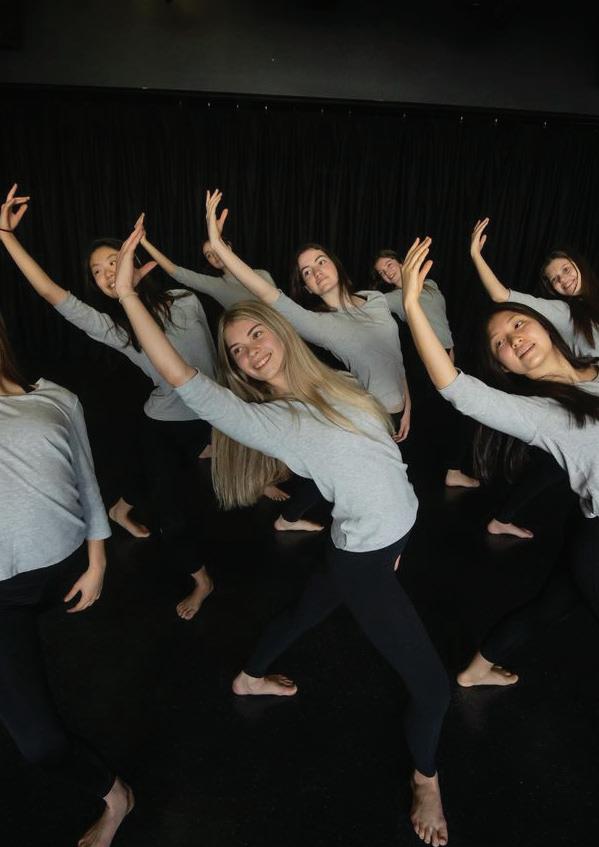

Design is a specialist Visual Arts subject. This is a practical course enabling students to develop an awareness of design concepts through research, documentation and creative problem solving.
Students explore their chosen brief using the design process. They develop skill and understanding
Assessment:
through research of established and contemporary practise, the creation and manipulation of imagery and the application of typography.
Students draw with a range of media, a camera and using Photoshop.
Recommended prior achievement level:
Achieved or better in Level 1 Visual Arts Achievement Standards or at the discretion of the HOF.
Cost:
Materials are required for this course. Specialised materials are also available through the Art Department shop at cost and will be charged by account.
Optional workshops taken by visiting artists/lecturers will be offered at a cost of $30 per day.
Design is a specialist Visual Arts subject. Through a range of tasks students will show an understanding of the processes, procedures, materials and techniques used in design. The aim of the study at this level is for students to develop an understanding of the problem solving process and to apply and extend this knowledge within their own practice. Students will define their own brief, refine the problem and communicate solutions through drawing, models
Assessment:
Recommended prior achievement level:
Achieved or better in Level 2 Visual Arts Achievement Standards or at the discretion of the HOF.
Cost:
Students will attend tutorials given by a visiting tutor in Illustrator and InDesign. Cost will be $30 per tutorial.
and finished art work. Briefs are issue-based rather than discipline-focused and consider social, political or environmental concerns. There are two internal Achievement Standards that develop skills using Adobe Photoshop, Illustrator and InDesign. The external Achievement Standard encourages students to extend their ideas independently in a personalised programme.
Materials are required for this course. Please refer to the College stationery list. Specialised materials are also available through the Art Department shop at cost and will be charged by account. Students will be required to cover printing costs. Optional weekend workshops taken by visiting artists/lecturers will be offered at the cost of $30 per day.
•
Design and Visual Communication provides students with a variety of three-dimensional design, drawing and digital experiences to assist in developing problem solving strategies, in contexts such as architecture, interiors, product and exhibition design. By developing visual skills, understanding of fundamental design principles and heritage, students will discover how to give form, purpose and expression to their creative ideas.
This course involves extending core design knowledge, detailed drawing skills and digital tools. Students will explore and refine design ideas in response to a brief informed by designer models, using creative strategies and visual techniques to aid a design thinking narrative. The use of visual communication and digital presentation skills is integral for effective designing.
The topics covered by this course include:
• Fundamental skills in Visual Communication
• Spatial Design: Students will use inspiration from a class trip to Brickbay, to assist in the design of a Coastal Retreat
• Product Design: Students will develop a stylish perfume bottle using sketching, rendering and CAD techniques
• Design presentation: Students create final design renderings and learn to use Adobe InDesign to produce a polished promotion of their design outcome.
This course builds on the design thinking and visual techniques established in Level 1. During the year, students will undertake two design projects requiring the use of specialist spatial and product design knowledge, independent project management and detailed visual communication techniques. Students will be encouraged to be creative in their design exploration, challenge and refine their own design practice and present their solutions digitally with flair.
The topics covered by this course include:
• Architectural Design: Students will design a site-specific Matiatia Coastal Pavilion
• Product Design: Students will use sketching and digital fabrication techniques to develop and make a flat-pack scultural lighting product, inspired by a selected design movement or era
• Presentation Design: Students will design and produce a presentation of one of their outcomes above. Skills taught will include layout and composition techniques and use of Adobe applications.
• Personal printing for course work – managed by students.
• A specialist DVC kit is required for this course: refer to the College stationery list
• Sketchp Pro software for digital modeling: $92, 00 per year
Class trip to Waiheke Island
This course extends knowledge and skills established in Level 1 and 2, applying these to more individualised projects from a variety of three-dimensional design contexts. Well-articulated communication of ideas and design thinking through experimentation and refined visual techniques are key aspects to the
subject at this level. Students will compile a design portfolio that will show that they have creatively worked through a human-centred design process and will provide appropriate material for entry applications to design related courses such as Architecture, Industrial, Landscape and Spatial design.
Cost:
• Personal printing for course work – managed by students.
• A specialist DVC kit is required for this course: refer to the College stationery list
• Sketchp Pro software for digital modeling: $92, 00 per year
• Class trip to Waiheke Island approximate cost $70.00
This course requires students to undertake technological practice in order to develop and implement digital technology based solutions. Students will develop a basic understanding of digital media and computer science concepts. These will be further explored during the design and production process. Key to this course is planning, researching, producing and evaluating their project. They will acquire industry standard skills in a variety of software packages and develop skills while exploring programming contexts. This course caters for a variety of learning styles through a range of classroom
Assessment:
(this is an indication of the probable standards, these are awaiting final confirmation and release by the Ministry of Education)
activities including written, verbal and visual communication, creative thinking, problem solving and collaborative learning.
At this level the tasks are open-ended and students may develop skills in the following areas:
• Project management and planning
• Creativity and problem solving
• Design and programming
• Multimedia content creation
• Web based solutions
Recommended prior achievement level: This course is open to all students.
Cost:
Personal printing for course work – managed by students.
Optional workshops may be offered at the cost of between $25.00 – $85.00 per session – this will be charged to your daughter's account.
Subscription to online course content at a cost of $40 per person.
Possible two-day trip, approximate cost $650.00 (biannually).
This course requires students to undertake technological practice in order to develop and implement a digital technology based solution. Students will develop an understanding of digital media and computer science concepts. These will be explored during the design and production process as applied to their own creative project. Key to this course is planning, researching, producing and evaluating the outcome to address a need or opportunity.
Students will research contemporary trends inthe outcome. Working within this context they will interact with real stakeholders and must consider their needs and feedback during the development process. This course
Assessment:
(this is an indication of the probable standards, these are awaiting final confirmation and release by the Ministry of Education)
caters for a variety of learning styles through a range of classroom activities including written, verbal and visual communication, creative thinking, problem solving and collaborative learning.
At this level the tasks are more individualised and can be open ended.
Students may develop skills in the following areas:
• Project management and planning
• Creativity and problem solving
• Design and programming
• Web-based solutions
• Multmedia Content Creation
Recommended prior achievement level:
This course is open to all students. Previous study in a Technology area would be of benefit in understanding the technological process, but is not essential.
Cost:
Personal printing for course work – managed by students.
Optional workshops may be offered at the cost of between $25.00 – $85.00 per session – this will be charged to your daughter's account.
Subscription to online course content at a cost of $40 per person.
Possible two day trip, approximate cost $650.00 (biannually).
This course requires students to undertake technological practice in order to develop and implement a digital technology-based solution. Students will engage in the process of developing a brief, solution design, production and evaluation.
Students will research a context ; they will identify their own issue on which to focus and work with specific stakeholders to solve a problem by creating a technological solution.
This course caters for a variety of learning styles through a range of classroom activities including
Assessment:
(a selection of the following standards dependent on the student’s chosen context and project) Recommended
It is recommended that you have studies Year 12 Digital Technology.
written, verbal and visual communication, creative thinking, problem solving and collaborative learning. At this level the tasks are open-ended and students are able to specialise in an area of technological innovation that is of personal interest.
Students may develop skills in the following areas:
• Ideation and innovation
• Project management and planning
• Creativity and problem solving
• Product design and prototyping
• Programming
Personal printing for course work – managed by students.
Optional workshops may be offered at the cost of between $25.00 - $85.00 per session – this will be charged to your daughter's account.
Subscription to online course content at a cost of $40 per person.
Possible two day trip, approximate cost $650.00 (biannually).

Learning in, through, and about the arts stimulates creative action and response by engaging the senses, imagination, thinking, and feelings. The study of drama and theatre encourages discovery through experimentation, the taking of risks and the presentation of ideas to others. It results in the development of both theatre and life skills; the building of confidence, creativity and working collaboratively.
This is a practical course where the students will select and use elements, techniques, conventions and technologies in a range of performances.
As part of the assessment the students will:
• Explore expressive techniques by performing a scene from a play
Assessment:
• Work in a small group to devise a drama
• Explore a theatre form
• Perform a major production
• There is also one external Achievement Standard that is assessed in a written examination at the end of the year.
Recommended prior achievement level: This course is open to all students.
Cost:
Viewing professional theatre is an important part of this course and the cost is approximately $150.00.
In this course students will explore expressive techniques, a theatre form, devise performances and perform in a production.
For the assessments, students will:
• Refine their application of expressive techniques in a performance of scripted drama
Assessment:
• Explore Brecht’s theories of performance in a scene from a play
• Create and perform a devised drama
• Play a role in a major production
• There is also one external Achievement Standard that is assessed in a written examination at the end of the year
Recommended prior achievement level:
This course is open to all students.
Cost:
Viewing professional theatre is an integral part of this course and the cost is approximately $150.00.
In this course there are three internal Achievement Standards which all involve performances that need to demonstrate a high level of skill. Individual performances take more precedence at this level although there are still opportunities to perform in
Assessment:
pairs or a group of three actors. There is also a major production. There is one external Achievement Standard that is assessed in a written examination at the end of the year.
Recommended prior achievement level:
This course is open to all students.
Cost
Viewing professional theatre is an integral part of this course and the cost is approximately $150.00.

This introductory course aims to help learners to:
• Identify situations of scarcity and explain how scarcity leads to choices that have opportunity costs
• Use demand theory to explain consumer choices
• Investigate producers’ decisions about production
• Link supply theory to explain producer choices
• Apply the supply and demand model to demonstrate how the choices of consumers, producers, and government
• affect society
• Understand the role of government in the economy and the choices to be made for an issue where affected groups have different viewpoints The course consistently refers to real-life situations and current events. Students have the opportunity to investigate how theory applies to local economic activity through two internally assessed projects.
Recommended prior achievement level: This course is open to all students.
This course aims to help learners to:
• Investigate macroeconomic concepts and models
• Identify and explain the causes of contemporary economic issues (e.g. inflation, international trade, economic growth and unemployment)
Assessment:
Recommended prior achievement level:
This course is open to all students, although previous study of Economics at NCEA Level 1 is an advantage.
• Explain the effects of macroeconomic issues on various groups in New Zealand society Students process, analyse and extrapolate statistical data relating to contemporary economic issues in an internally assessed project.
This course aims to help learners:
• Use microeconomic concepts (e.g. marginal utility, demand and supply curves, elasticity, or deadweight losses) to illustrate the efficiency of markets
• Use microeconomic concepts (e.g. marginal cost and revenue, profit maximisation, normal profits, perfect competition, monopoly, or allocative efficiency) to derive the levels of profit, output and
Assessment:
Recommended prior achievement level:
Previous study of NCEA Level 1 or Level 2 Economics.
efficiency of different market structures
• Analyse the New Zealand economy using macroeconomic models (e.g. aggregate supply and demand)in relation to domestic and international influences
• Assess appropriateness/impact of government policies that relate to stabilisation and/or economic development
English is the study, use, and enjoyment of the English language and its literature, communicated orally, visually, and in writing, for a range of purposes and audiences and in a variety of text forms. Learning English encompasses learning the language, learning through the language, and learning about the language.
Understanding, using, and creating oral, written, and visual texts of increasing complexity is at the heart of English teaching and learning. By engaging with text-based activities, students become increasingly skilled and sophisticated speakers and listeners, writers and readers, presenters and viewers.
NZ curriculum document
Level 1
The four main areas of work are Reading Skills, Response to Texts, Writing and Production Skills. Response to texts includes a study of short
Assessment:
Through the year the students are also encouraged to develop their abilities in oral work through taking part in class discussion and speeches.
story, novel, poetry, and film; writing involves the development of skills in formal writing; and the production unit consists of an oral presentation.
This English class covers the same areas of literature, language and assessment as Level 1 English, but with the addition of creative writing and wider writing opportunities.
The literature and response to texts focus on the power of stories and contemporary issues.
There is an optional production standard available to create a short film or PSA linked to an area of study. Assessment:
(1.1) Show understanding of specified aspect(s) of studied written text(s), with supporting evidence
Show understanding of specified aspect(s) of studied visual or oral text(s), with supporting evidence
understanding of specified aspect(s) of unfamiliar written texts through close reading,
In Year 12 students have three different options to cater for the interests and aspirations of individual students. Students can select from one of the following:
In this course, language, literature and writing will be emphasised. A Shakespeare play, short written texts, and a feature length film will be studied. The internal
Assessment:
• A – English
• B – Visual English
• C – English Literature and Writing
assessment includes creative writing, formal writing and analyzing connections across texts.
The focus of this course is supporting students to gain their Level 2 Literacy requiements. Level 2 Visual English is recommended for students who find English challenging and prefer a slower pace of learning.
Assessments indude:
• Close viewing film
• Essay writing
• Reading and responding to a variety of texts
A strong focus on Aotearoa and Pacific texts enrich the learning in this course.
of
C. LITERATURE AND WRITING
This course combines academic English with additional opportunities to write and publish, and to engage with current issues in our world. There will be a strong focus on creative, media and literary writing, and exploring novels, poetry, short stories, media stories and a feature film.
Central to this class is reading widely, learning the craft of writing and developing a portfolio of original writing. Internal assessment includes creative and
Assessment:
media writing, a special research study, plus several optional standards such as a TED talk, close reading of unfamiliar text and an essay analysing connections across texts.
Extension workshops with writers and journalists, trips to Auckland Writers’ Festival and Art Gallery, and opportunities to work on a collaborative publication, will be integral to the course.
Recommended prior achievement level: This course is open to all students.
Cost: N/A
In Year 13 students have three different options to cater for the interests and aspirations of individual students. Students can select from one of the following:
In this course, language, literature and writing will be emphasised. A Shakespeare play, short written texts, and a feature length film will be studied. The internal
Assessment:
(3.9) Respond critically to significant aspects of visual and/or oral texts through close reading supported by evidence
• A – English Literature
• B – Visual English
• C – English Literature and Writing
• D – English for Academic Purposes
assessment includes creative writing, formal writing and analysing connections across texts.
The focus of this course is on visual literacy. Short texts and a feature length film will be studied. The internal assessment includes the close reading of a visual text, the production of a visual text, a report about connections between texts, and an oral presentation. The focus of this course is allowing
Assessment:
students to explore aspects of humanity through a film lens.
Assessments: Students will complete close viewing of a film, connections across film, creation of a visual text and oral presentation.
This course has a wide literature as well as a strong writing focus. It is intended for students who are keen to continue studying literature and academic English, and who also want to continue writing and publishing, perhaps working on an individual writing project.
Students will study a novel, play, short stories, poetry, a range of media stories and a feature film. The internal
Assessment (class assessment):
assessments include developing a portfolio of original writing, a critical text essay, presenting a seminar or writing workshop, plus optional writing standards. Extension workshops with creative writers and journalists, trips to Auckland Writers’ Festival and Art Gallery, and opportunities to work on a collaborative publication will be integral to the course.
(Restricted entry course)
This course is designed to provide personalised support and assistance to non-native English speakers at Year 11. There is an emphasis on
Assessment:
Recommended prior achievement level: Participation is by invitation only and some students will be required to take this course. Students will be advised upon enrolment.
This course is designed to provide support and assistance to non-native English speakers at Year 12. There is an emphasis on academic reading, writing, listening, speaking and vocabulary skills across the curriculum to help students to succeed in their mainstream classes.
academic reading, writing, listening, speaking and vocabulary skills across the curriculum to help students to succeed in their mainstream classes.
Assessment: Class Assessment
Recommended prior achievement level: Participation is by invitation only and some students will be required to take this course. Students will be advised upon enrolment.
Studying the media provides a framework to access, analyse, evaluate and create messages in a variety of forms. As citizens of the world, we need to actively be able to decode the messages presented to us in the media and understand the different interpretations that messages can have.
Media Studies is also about the active exploration, analysis, creation, and enjoyment of the media and its products. It is essentially a balance between academic writing and hands-on production experience using industry-level cutting-edge technology.
Film and Media Studies examines the dynamic role of the media in society and how the media constructs messages about individuals, communities, and cultures. This course develops students’ critical understanding of the mass media which is a core component in shaping their understanding of the world and gaining media literacy.
It is also about learning high-level industry standard production skills to create media texts through a 10 week project where students design, plan and produce their own music video to a professional standard. All training using DSLR cameras and Adobe Editing programme is provided on the course.
Skills and knowledge developed in this course are relevant in many other subject areas and areas of employment. It is essentially a balance between academic writing and hands-on production experience.
The course content and knowledge will be enhanced and extended through workshops with resident
Assessment:
Filmmakers in Residence and notable successful directors and screenwriters.
Key components of the Film and Media course are:
• Film Genre: Students will study a selection of independent and studio films and television series to examine changes over time of the female protagonist from a damsel in distress to a powerful agent of change
• Narrrative: How are texts constructed? Students will examine how different types of film texts are created through conflict, setting, characterisation and structure
• Video Killed the Radio Star: Students will design and plan a concept for a music video
• Lights! Camera! Action! Students will plan, script and produce your own short film production
• Write Now: Students will learn the art of adaptation by writing your own short film script using industry standard software and learning the secrets of great screenwriters.
Film and Media Studies examines the dynamic role of the media in society. This course builds on, and extends, the Level 2 Film and Media course - but is also able to be taken without prior experience.
The course content and knowledge will be enhanced and extended through workshops with resident Filmmakers in Residence and notable successful directors, screenwriters and acting coaches.
The key components of Film and Media will be examined through the following areas:
• Lights! Camera! Action: Students will plan, script and produce their own short film production
• A short course on scriptwriting for film that teaches students how to effectively structure and develop a short film script to production level.
• Speculative fiction: an indepth story of how our films explorethe zeitgerst of our times and address issues of power and patriachy in our society
Assessment:
This is a continuation of the Year 10 course. Students learn to write and talk about a range of topics including: family, friends and relationships, their city and their country, leisure activities, healthy living, holidas and school exchanges, festivals, cultural
Assessment:
activities such as music, festivals and films, future plans for study and career. Development of reading and listening comprehension skills continues. Internal assessment activities include a speech, conversation portfolio and portfolio of written work.
Demonstrate understanding of a variety of spoken texts in French on areas of most immediate relevance
AS90879 Give a spoken presentation in French that communicates a personal response
Demonstrate understanding of a variety of French texts on areas of most immediate relevance
Recommended prior achievement level:
Students must have studied this subject at Year 10 or the equivalent level. Otherwise entry to the course will be granted at the discretion of the HOS and HOF.
Students with significant prior language will be assessed to determine the appropriate course and level at the discretion of the HOS and HOF.
Cost:
Studio 2 Workbook $8. Active Learn subscription $20.
The course aims to deepen students’ awareness and understanding of the lives and culture of Frenchspeaking people, and to foster independent learning and a desire for further language learning. In addition to revising and extending the work covered in previous levels, students will further develop all language skills and the emphasis on the communicative use of language continues. Increased vocabulary and more grammatical structures are introduced so students can achieve more complex tasks such as discussing plans and expressing feelings and opinions.
Topics studied include:
Assessment:
Recommended prior achievement level:
Stuents must have achieved 19 credits. Students with significant prior language knowledge will be assessed to determine the appropriate course and level at the discretion of the HOS and HOF.
• Young People – relationships, rights and responsibilities
• Healthy Lifestyles
• Education and Career Options
• The Influence of the Media
• Popular Culture - film, music and fashion
Internal assessment activities include include an oral presentation, and a portfolio of written work.
External assessments include Reading Comprehension and Listening Comprehension (optional).
Cost:
Education Perfect $20.
Students will study a range of spoken, written and/ or visual French texts and explore and justify varied perspectives through a variety of oral and written tasks.
Themes include France today, the environment, politics, education, the world of work. Students
Assessment:
Recommended prior achievement level:
Students must have achieved 19 credits.
Students with significant prior language knowledge will be assessed to determine the appropriate course and level at the discretion of the HOS and HOF.
will also study literary works and a film and are encouraged to read extensively on their own.
Internal assessment activities include a portfolio of interactions and a portfolio of written work. Reading Comprehension skills and Listening Comprehension skills (optional) are assessed externally.
Cost:
Education Perfect $20.
The main aim of Geography is to help students make sense of the world around them. Geography helps us to better understand people, places and environments, and the positive or negative interactions between them. Students will have opportunities to explore how people's activities can have detrimental effects on natural environments and how natural processes could also affect people. In senior geography, students will be inspired to make informed judgements for a sustainable future at a local, national and/or global scale.
There are two themes involved in the Year 11 Geography which encompass both physical and human geography.
THEME 1: “How prepared are you?”
Students will learn about the processes leading to natural events and hazards such as the 2010 & 2011 Earthquakes that occured in Christchurch which tragically killed 185 people. They will learn about what is needed to reduce the impacts of such events which we are very prone to in New Zealand. Students will also learn about how prepared people are and ways to avoid seeing such a significant and tragic event again such as the importance of quake-safing homes and the governmental warning systems in place. The course
Assessment:
includes a field trip to Christchurch to support your learning of this topic and hear from those who were present the day of the devastating quake.
THEME 2: “Will it Last?”
Students will learn the effects of climate change on people and the environment and how humans are causing this phenomena. This includes an in-depth exploration of the impacts of deforestation in the Amazon on medicinal plants, native tribes and animals will reinforce the importance of sustainability if the world wants to have a sustainable future.
Field trips are an integral and compulsory part of Geography. There will be a 3 day overnight field trip to Christchurch.

Level 2
There are two key themes to this year's course connected to physical geography and human geography respectivel
THEME 1: “The processes which led to the formation of the TVC”
• Tongariro is New Zealand’s oldest heritage site. The region encompasses volcanic cones and craters that were formed by eruptions from at least 12 vents. Volcanic activity in the zone started about 2 million years ago and continues today. These extend from Mt Ruapehu to White Island in the Bay of Plenty, collectively as the Taupō Volcanic Zone. The Pacific and Indian-Australian plate boundary is responsible for the existence of the volcanoes of Tongariro. Students will learn about the processes which led to its formation, and the positive and negative interaction people can have in this natural phenomena which continually shape it. The learning will be supported by a trip to the region, where they will become familiar with altitudinal zonation through a research investigation which takes them to different areas of the region.
THEME 2: “Equality and Inequality - why is there a gap?”
• Students will be exploring why there are extreme levels of inequality in different regions of the world; from enforced segregation in the past of ethnic groups in Johannesburg to why the culture of Hip Hopspread globally to communities experiencingmajor social issues of poverty, corruption, racism, inequity in food and water resources, and lack of housing. We will explore how these social issues are manifested in underdeveloped regions and increasing the inequality gap and leading to high crime rates. Students will explore how the poor governance of these countries can further increase the level of disparity withiun and between nations.
• Additionally, students will explore the contemporary issue of development of marine reserves. Overfishing has led to a 90% global reduction of fish, a natural resource particularly vital for feeding the poor who live a subsistence lifestyle. Something needs to be done about it.
Field trips are an integral and compulsory part of Geography. There will be one 3 day overnight field trip to the Tongariro Volcanic Zone (TVC) region.
There are three themes to this year's course.
THEME 1: “Covid 19 pandemic - why did it get so bad?”
We all felt the burden of the global coronavirus pandemic, but did we really? Students will learn about the extent of this disease across the world and how it could have been prevented when the first whistle blowers were told to keep quiet. This unit will enable exploration of which countries were most vulnerable and what factors and processes led to this. They will also understand that other issue such as inequality and human trafficking have only worsened as a result of this pandemic.
THEME 2: “The processes of tourism in Queenstown, the good, the bad and the ugly”
Queenstwon, New Zealand’s adventure capital. Did you know it all started from the 1860’s Gold rush? Students will learn about the development of tourism in Queenstown over the last 150 years and how attractions have changed from scenery walks to extreme adventure tourism. In doing so, students will explore the positive and negative impacts of tourism on the locals both socially and economically, as well as tourists themselves. In addition to learning of its history, students will investigate whether tourist operators are employing the New Zealand Tourism
Sustainability Commitment which incorporates 12 Business Commitments that individual businesses can achieve which cover the areas of tourists, community, economic and environment through research to take place on a field trip to the region. These goals are set to be recognised by all tourist facilities in 2025 - are they doing enough?
THEME 3: “The illegal trade of people”
Human trafficking is the fastest growing form of organised crime, with at least one person being trafficked across international borders every minute. Thats the equivalent of five commercial jets full every day. For criminals involved, it is worth more then $50 billion US a year. That's more than Microsoft makes, and twice the turnover of Coca Cola. Victims are generally found in desperate and vulnerable situations and are easy targets for traffickers. These situations include homeless individuals, runaway teens, displaced homemakers, refugees, and drug addicts. Some parents sometimes sell their children for as little as $40 each, out of ignorance, desperation, and poverty. How can we reduce this ever growing social issue?
Field trips are an integral and compulsory part of Geography. There will be one 3 day overnight field trip to Queenstown.
Recommended prior achievement level: This course is open to all students.
Cost: Workbook costs $20.00. School Trip: Approximately $650.00.
History provides a framework of knowledge that gives an understanding of New Zealand society and an insight into the social, economic and political issues shaping the world in the twentieth century. There is emphasis on the part individuals and groups have played in past events and a focus on how perspectives on an issue may differ. This subject enhances thinking, reasoning and analytical skills as well as developing specialist inquiry, interpretation and communication skills. History helps students to become global citizens.
The Level 1 History theme is War and Peace and focuses on the following topics:
• The impact of the First World War on New Zealand
• The aggression of Japan and their involvement in World War II
• Hitler’s rise to power and life in Nazi Germany
• Black Civil Rights protest movements in the USA in the 1950s and 1960s
Field trips include a trip to the Auckland War Memorial Museum.
Recommended prior achievement level: This course is open to all students.
Cost: History Workbooks $20.00.
The theme of the course is Revolutionaries, Rebels and the Reviled through the study of some of the following topics:
• Revolution in Russia 1853 -1953
• Protest in New Zealand
Assessment:
• The Leadership of Mao Zedong 1919 –1976
• New Zealand Women get the vote Field trips could include a trip to the Howick Historical Village and Highwic House, and the Auckland War Memorial Museum.
Recommended prior achievement level: This course is open to all students.
Cost: History Workbooks $20.00.
The Divide is the theme of the Year 13 course. The theme will be taught through the study of the following topics:
• Cultural Collision – The Early Contact Period in New Zealand
Assessment:
• The Holocaust
• Catastrophe or Independence – the creation of Israel
• The Treaty of Waitangi / Te Tiriti o Waitangi
Field trips could include a trip to the Bay of Islands.
Recommended prior achievement level:
This course is open to all students.
Cost:
History workbooks $20.00.
Field trip to the Bay of Islands approximately $300.

The senior Latin courses focus primarily on the incredibly vibrant and vast range of literature written by the Romans which is timeless in its appeal and universal in its themes. Their literature included everything from grand epic poetry about the origins of the Roman people to intimately personal poetry between lovers, from sharp-witted satire about life in the city of Rome to plays about the famous stories from their mythological past. These courses allow students the chance to appreciate the artistry and creativity of these works in their original language while at the same time engaging in debate and discussion about their literary merit. Students will enhance their skills in critical thinking and literary analysis as well as improve their own skill in writing eloquently in English.
The study of Latin in Year 11 allows students for the first time to read authentic Latin literature written approximately two thousand years ago. The selection of poetry studied tells the story of Orpheus, the greatest musician in classical mythology, who travels to the depths of the underworld to rescue his wife Eurydice following her death. It is a story of trial and tribulation, temptation and trust, with a surprisingly modern resonance in today’s world. In addition to
Assessment:
Recommended prior achievement level:
Students must have studied this subject at Year 10 or the equivalent level. Otherwise entry to the course will be granted at the discretion of the HOS and HOF.
Students with significant prior language knowledge will be assessed to determine the appropriate course and level at the discretion of the HOS and HOF.
the study of literature, students also revise all the vocabulary and grammatical structures introduced in Years 9 and 10, as well as learn more complex language features. This knowledge allows students to develop their skills in reading and comprehension, as well as complete a project on the contribution of the Latin language to English. A vocabulary list is made available to students in the external examination.
Cost: Grammar and Literature Workbooks $10.
This course provides the opportunity for students to read about Lucretia whose death brought about the downfall of thge Roman Republic. In the second half of the year we will read love poetry by Catullus, a personal and passionate account of his relationships.
Assessment:
Recommended prior achievement level:
Students must have achieved 17 credits in Latin. Students with significant prior language knowledge will be assessed to determine the appropriate course and level at the discretion of the HOS and HOF.
The course is supported throughout the year by a systematic revision of linguistic skills as well as regular practice of translation and comprehension.
Cost: Grammar and Literature Workbooks $10.
This course provides the opportunity for students to read about Lucretia whose death brought about the downfall of thge Roman Republic. In the second half of the year we will read love poetry by Catullus, a personal and passionate account of his relationships.
Assessment:
Recommended prior achievement level:
Students must have achieved 17 credits in Latin. Students with significant prior language knowledge will be assessed to determine the appropriate course and level at the discretion of the HOS and HOF.
The course is supported throughout the year by a systematic revision of linguistic skills as well as regular practice of translation and comprehension.
Cost:
Grammar and Literature Workbooks $10.
Mathematics is a subject that encourages reasoning, conjecture and problem solving as well as perseverance. Students learn to use the tools of mathematics – including words, symbols, diagrams, physical models and technology to present and defend their ideas.
In Year 11 all students are required to undertake a mathematics course as part of their learning programme. Two different options are available to cater for the needs and aspirations of students.
If you find Mathematics challenging in Year 10, this is the course for you. It will increase your confidence and skills, you will gain recognised NCEA credits and you will be able to meet numeracy requirements for NCEA. All standards contribute to numeracy for NCEA
Students select either
• A – Mathematical Studies
• B – Mathematics
Level 1. 11MASN progresses to 12MASN and 13MASN. 13MASN enables students to proceed to tertiary statistics study because it offers only recognised standards from the Statistics and Modelling course and meets tertiary statistics prerequisites.
Recommended prior achievement level:
After discussion with Year 10 Mathematics teacher and Head of Faculty.
Cost:
Workbooks $15.00, Electronic textbook $18.00, Education Perfect onine subscription $20.00.
B
Students’ mathematical knowledge and skills are extended through problem solving and applications in all curriculum strands. The course builds on previous years and provides a sound basis for further academic
Assessment:
study. While fluent skills are vital, there is significant emphasis on communicating mathematical ideas and applying mathematical models to real situations.
The in-school Geometry and Trigonometry test which is used for entry to Level 2.
Recommended prior achievement level: After discussion with Year 10 Mathematics teacher and Head of Faculty.
Cost:
Workbooks $23.00, Electronic textbook $18.00, Education Perfect online subscription $20.00.
In Year 12 students have three different options to cater for the interests and aspirations of individual students. Students can select from one of the following:
If you are working at Achievement level in Year 11 and find Mathematics challenging, but would like to continue with Mathematics and Statistics, this is the course for you. This course leads to 13MASN, which
Assessment:
Recommended prior achievement level:
Achieved or better in at least three standards in Level 1 Mathematics.
• A – Mathematical Studies
• B – Mathematics (Statistics and Modelling)
• C – Mathematics (Calculus)
enables students to proceed to tertiary statistics study as it offers only recognised standards from the Statistics and Modelling course.
Cost:
Workbook $5.00, Electronic textbook $18.00. Education Perfect online Subscription $20.00.
This is an academic course that requires competency in algebraic skills and fluency in Statistics. It establishes the basis for tertiary study in Mathematics and Statistics. Using mathematics to model practical situations is a unifying theme. It is designed for students who intend to study Statistics at Level 3.
Assessment:
Recommended prior achievement level: Merit or better in Algebra Year 11 test and 1.12 Chance & Data and Achieved in all others. If you do not meet the prerequisites you must discuss your with the Head of Faculty.
There is one standard (Calculus) in common with Mathematics (Calculus). This is to provide a basis for students who may wish to study the 13 Mathematics course in the following year instead of proceeding to 13 Statistics and Modelling.
Cost:
This is an academic course that requires fluency in algebraic skills. It establishes the basis for tertiary study in Mathematics and Statistics and is recommended for students who intend to study
Assessment:
Recommended prior achievement level: Merit or better in Algebra 1.2 and 1.3 Tables and Graphs and achieved in all others. If you do not meet the prerequisites you must discuss your course with the Head of Faculty.
Calculus at Level 3 or accelerated students who will study IBSL or IBHL. Using mathematics to model practical situations is a unifying theme.
Cost:
Workbooks $23.00, Electronic textbook $18.00, Education Perfect online Subscription $20.00.
In Year 13 students have four different options available to meet individual interests and aspirations. Students can select from the following:
• A – Mathematical Studies
• B – Calculus
This course at Level 3 is designed to foster a sense of personal achievement and to meet tertiary statistics prerequisites. Two internally assessed and one externally assessed Achievement Standards are common to both 13MASN and 13MSTN, the Statistics
Assessment:
Recommended prior achievement level:
This course is open to all students but 12MASN is recommended.
• C – Statistics and Modelling
• D – Mathematics
Note: Students can choose to take both from Calculus and Statistics and Modelling.
and Modelling course. In addition there are three more internally assessed Achievement Standards. The externally assessed standard will be taught in Term 4, immediately before the external examinations. Graphic calculators and computers are used extensively.
Cost:
Workbooks $20.00, Education Perfect online subscription $20.00.
This is an academic course for students with a major interest in pure mathematics, computer science, the physical sciences, engineering, economics and any field where mathematical analysis is a valuable
Assessment:
Recommended prior achievement level: Merit or better in 2.2, 2.6 and 2.7 Mathematics Achievement Standards. If you do not meet the prerequisites, you must discuss your course with the Head of Faculty.
tool. Students should have strong algebra skills from Year 2, as these are essential for progress in all the Achievement Standards.
Cost: Workbooks $24.00, Electronic Textbook $18.00, Education Perfect online subscription $20.00.
This course provides the statistical background needed for tertiary study in statistics, biological and social sciences, medicine, business and any field where data collection/analysis are important.
All learning is set in practical contexts; students develop
Assessment:
Recommended prior achievement level:
Merit or better in at least two of 2.10 or 2.12 and 3.9 Mathematics Achievement Standards. Students who do not meet the prerequisites must discuss their course with the Head of Faculty.
skills in using statistics to reach valid conclusions and critique statistical reports in the media.
Spreadsheet skills will be learned, along with the understandings needed to be a statistically literate member of society.
Cost:
Workbooks $18.00, Electronic Textbook $18.00, Education Perfect online subscription $20.00.
This course provides for study of both Calculus and Statistics and Modelling. It is designed to prepare students for compulsory Stage 1 Mathematics papers at tertiary level in both areas and leave options open for the future.
Assessment:
Recommended prior achievement level:
Merit or better in at least two of 2.2, 2.6, 2.7, and 2.12 Mathematics Achievement Standards. Students who do not meet the prerequisites must discuss their course with the Head of Faculty.
Students develop skills in using statistics to reach valid conclusions and critique statistical reports in the media. In calculus the techniques of differentiation are studied. This course will allow students to study for scholarship Statistics and Modelling.
Cost:
Workbooks $18.00, Electronic Textbook $18.00, Education Perfect online subscription $20.00.
Music is a unique subject where ideas and emotions are communicated in sound. Music enables students to develop highly-desirable skills in areas such as self-management, team work, problem solving, and communication; all of which makes them an attractive prospective for potential employers. This is a cutting edge course which blends contemporary developments with traditional music trends. Studying music allows us to understand other cultures and places in an intimate way. We learn about the connections between music, composers, society and ideas. Music study encourages us to pursue the highest standards for ourselves.
Level 1
This course covers a wide range of musical skills from performing (both solo and group) and composing (writing your own music), to gaining general musical knowledge (learning about musical styles), to using theory (reading and responding to written music) and aural skills (listening and responding).
The Musical Knowledge standard includes a study of two music works.
Assessment:
Recommended prior achievement level:
The course is also open to any student who is involved in music making and has basic reading skills. Private tuition on an instrument/voice is required and participation in at least one College musical group is expected. Year 10 Music is recommended.
Experienced musicians can sit all standards offered, but there is flexibility and choice if you feel you are not strong in some areas. All students enter Solo and/ or Group Perform, Compose, Materials of Music and Music Works. Students may opt out of the external aural standard. Students must enter at least four of the six standards offered.
Cost:
Students in this class are given priority to attend various concerts and shows. Costs vary and attendance is optional.
This course covers a wide range of musical skills from solo performance on a first, and second instrument, song writing and composing, to gaining general musical knowledge, to applying theory and aural skills and investigating a New Zealand musical topic. Your group performance could be a Rockquest band, a chamber group or another performance group.
Assessment:
Recommended prior achievement level:
The course is open to students who are involved in music making and have secure reading skills. Private tuition on an instrument or voice is required and participation in at least one College musical group is expected.
Some standards will be compulsory, others will be optional. Students are expected to take at least five of the standards offered.
The Musical Knowledge standard includes an in depth study of two music works
Cost:
Students in this class are given priority to attend various concerts and shows. Costs vary and attendance is optional.
This course can be tailored to suit students who have interest and skills in music but have not taken it before. Students create their own course from the standards
below. The Musical Knowledge standard includes an in depth study of The Planets by Holst.
Recommended prior achievement level:
Open to all students. Those who have not completed Level 1 or Level 2 Music are welcome to join this course. Private tuition on an instrument or voice is required for those entering the performance standard and participation in at least one College musical group is expected from all participants.
Students in this class are given priority to attend various concerts and shows which become available. Costs vary and attendance is optional.
The primary aim of this course is to support students who are enrolled in five NCEA Level 1 subjects to achieve their credits in these subjects and to achieve their NCEA literacy credits.
There is a focus on improving students’ literacy levels by developing their close reading and essay skills by providing additional assistance with the work the students complete in their regular English classes.
Assessment:
Throughout the year students are encouraged to read widely and there is a personal reading internal assessment. There is a strong emphasis on promoting positive wellbeing, increasing personal responsibility for learning and developing study skills. Students are provided with extra time and support to complete class work in other subjects.
The primary aim of this course is to support students who are enrolled in five NCEA Level 2 subjects to achieve their credits in these subjects.
To this end, students are provided with extra time and support to complete class work and assessments. Senior secondary trained teachers across core
Assessment:
No examinations are held in this subject.
subjects are timetabled to monitor and support this class. This is dependent on the timetable and the availability of teachers and is planned on an annual basis. There is a strong emphasis on increasing personal responsibility for learning and developing useful study skills.

Painting is a specialist Visual Arts subject. The aim of this course of study is for students to develop an understanding of painting procedures and practices, and to apply and extend this knowledge within their own studio practice.
The two internal standards are Drawing Studies within Painting (presented in a flip file) and are the foundation for the next standard. The third standard is concerned with students applying their experience and understanding of creative processes and procedures
Assessment:
Recommended prior achievement level:
Achieved or better in all Level 2 Visual Arts Achievement Standards or at the discretion of the Head of Department.
to produce a cohesive body of paintings (presented on three A1 boards). Students will use research of established and contemporary practice to extend and develop a systematic approach to learning in Painting.
Students will demonstrate the development, clarification and resolution of ideas, along with painterly and pictorial concerns. The methodology and independent focus of this course is similar to tertiary study. The course involves at least one weekend workshop given by a visiting artist.
Cost:
Materials are required for this course. Specialised materials are also available through the Art Department shop at cost and will be charged by account. Optional workshops taken by visiting artists/ lecturers will be offered at the cost of $30.00 per day.
Photography is a specialist Visual Arts subject. This is a mostly practical course that enables the student to develop an understanding of photographic concepts and develop technical skills, including using digital SLR and mirrorless cameras, studio lighting and Photoshop.
Assessment:
Recommended prior achievement level:
Achieved or better in all Level 1 Visual Arts Achievement Standards or at the discretion of the Head of Department.
There is also a focus on research of established and contemporary photographers to inform ideas and thinking. Students are encouraged to work independently and have the opportunity to investigate a range of genres throughout the year.
Cost:
Materials are required for this course. Please refer to the stationery list on myCollege. Specialised materials are also available through the Art Department shop at cost and will be charged by account. Students will attend a one day Adobe Photoshop course run by a visiting tutor. The cost will be approximately $30.00.
Students wishing to have their AS 2.4 printed and pasted commercially can do so but only after consultation with staff.
The cost of $80 would need to be met by the student and would be charged to the Term 4 student account.
Photography is a specialist Visual Arts subject. Over the course of the year students develop their own individual programme and thematic direction with two internals forming the foundation for their final folio and Scholarship (if applicable).
Students will build photographic technical skills including digital SLR and mirrorless camera technique,
Assessment:
studio lighting and image editing in Adobe Photoshop. Research of established and contemporary photographic practice is used by students to develop critical thinking and to extend their own ideas and creativity.
Students have the opportunity to attend at least one weekend workshop with a visiting artist.
Recommended prior achievement level:
Achieved or better in Level 2 Visual Arts Achievement Standards or at the discretion of the Head of Department.
Cost:
Materials are required for this course. Please refer to the school stationery list on myCollege. Specialised materials are also available through the Art Department shop at cost and will be charged by account. Optional weekend workshops taken by visiting artists/lecturers will be offered at the cost of $30.00 per day.
Students wishing to have their AS 3.4 printed and pasted commercially can do so but only after consultation with staff.
The cost of $120 would need to be met by the student and would be charged to the Term 4 student account.
Sport and Exercise Science is a subject with variety. It is 100% internally assessed for all three NCEA levels. The content covers biophysical and sociocultural aspects associated with practical contexts. The nature of the course enables a student studying Sport and Exercise Science to be reflective and adaptable. Another crucial element is a student’s ability to apply theoretical knowledge to personal experiences in some form of practical context. In doing so, students are better able to grasp ideas from listening, reading, seeing and doing. By Year 13, students are in a position to focus on and fully explore an area of interest, looking at it from multiple perspectives through a process of critical thinking. Critical thinking is a valuable skill that transfers into many other subjects and goes hand in hand with University degrees and career pathways, particularly but not exclusively, within the health industry.
The broad theme for the year is ‘Experiential Learning’. Student learning is reinforced through ongoing reflections about practical experiences. Study at this level involves:
• Participating in and reflecting upon a range of physical activities including futsal, turbo touch, boxing and yoga.
• Applying biophysical knowledge (anatomy, biomechanics and exercise physiology) to a physical context of their choice.
Assessment:
• Performing to nationally developed standards in badminton and tchoukball.
• Applying interpersonal and leadership skills in a group through a sports education model.
• Applying safe behaviours to rock climbing and paddle boarding.
The broad theme for the year is ‘Focus on Leadership’. Students are given the opportunity to take on a variety of roles. Personal experience in each module will develop a foundation of knowledge, which can be transferred into leadership situations involving others. Study at this level involves:
• Applying biophysical knowledge (anatomy, biomechanics, exercise physiology, skill learning
Assessment:
application
Recommended prior achievement level:
This course is open to all students who completed Level 1 Physical Education or at the discretion of the HOF of Health and Physical Education.
and sport psychology) to trampolining and training for the ‘Tough Girl Challenge’.
• Performing to nationally developed standards in trampolining, ‘Tough Girl Challenge’ and swimming.
• Reflecting on and applying leadership and safety management strategies prior to and during a three day outdoor education camp.
Cost:
Workbooks are required for this course. Please refer to the stationery list on My College. Camp expenses are approximately $400.00.
The broad theme for the year is ‘Me and Society’. This involves thinking critically about how a wide range of societal factors impact upon practical experiences that are on trend, fun and varied. Much of the learning is personalised. Study at this level involves:
• Evaluating personal physical activity experiences and participating in a range physical activities / recreational experiences in order to continue to be active in the future.
Assessment:
Recommended prior achievement level:
This course is open to all students who completed Level 2 Physical Education at the discretion of the HOF Health and Physical Education.
• Evaluating a muscular conditioning programme that is reflective of personal goals and associated with a visit to the AUT Millennium Institute.
• Performing to nationally developed standard in a chosen activity at the discretion of the teacher.
• Analysing a range of safety management issues associated with whitewater rafting.
• Examining contemporary leadership principles prior to and during an expedition around Auckland City.
Cost:
An overnight camp is approximately $250.00.
Physics is known as the fundamental science. It is the investigation of how the universe works and involves the study of everything from the very small, (photons, quarks and leptons) to the really big (black holes, stars, and galaxies) and everything in between.
Physics is about matter and energy, and that’s really all there is (or so we think).
The Physics course is not just designed for students wishing to be physicists. It helps students gain a variety of skills including:
• Logical thinking
• Problem solving
• Communication as well as gaining a better appreciation of the beauty
Level 1
(see Science)
of the physical world from rainbows to lightning.
We emphasise the practical and experimental nature of physics and stress the understanding of concepts rather than rote learning.
Some of our students go on to do degrees in Physics (Nano-technology, Medical Physics, Laser Physics, etc.)
Physics is also a required or recommended course in university degrees including Engineering, Medicine, Architecture, Veterinary, and Food Technology.

The Level 2 physics course builds on the concepts studied in year 11 physics with some new topics including Nuclear Physics. In this course you will find out:
• How the eye produces images.
• How light waves can interfere to produce darkness.
Assessment:
Recommended prior achievement level:
Students entering this course should have reached Merit level in the three Physics external standards in Level 1.
• How nuclear radiation is used in medicine.
• The best angle to throw a ball.
• How you can make electricity with a skipping rope. Students should have a reasonable ability in Mathematics.
Cost:
Course books $25.00.
The Level 3 Physics course builds on the concepts studied in Year 12 Physics with some new topics including Quantum Physics and Relativity.
In this course you will find out:
• Why musical instruments sound different.
• How rainbow glasses work.
• Why moving clocks run slow.
• Why you don't fall off at the top of a roller coaster.
• Why you can get an electric shock from a camera.
• How the charging pad for a cell phone works. Students should have a reasonable ability in Mathematics.
Practical work is an essential part of Physics and this is emphasised on a field trip to Rainbow's End. Assessment:
Recommended prior achievement level:
Students entering this course should have reached Merit level in two of the three external Level 2 Physics standards.
Printmaking is a specialist Visual Arts subject. The aim of this course of study is for students to develop an understanding of printmaking procedures and practices, and to apply and extend this knowledge within their own studio practice.
The two internal standards are Drawing Studies within Printmaking (presented in a flip file) and are the foundation for the next standard. The third standard is concerned with students applying their experience and understanding of creative processes and procedures within Printmaking in the production of a cohesive body of original work (presented on three
Assessment:
Recommended prior achievement level:
Achieved or better in all Level 2 Visual Arts Achievement Standards or at the discretion of the Head of Department.
A1 boards). Students will use research of established and contemporary practice to extend and develop a systematic approach to learning in printmaking.
Students, through a range of tasks (research, drawing, annotation, sequential studies, small works and finished prints), will demonstrate the development, clarification and resolution of ideas always with print processes and pictorial concerns. The methodology and independent focus of this course is similar to tertiary study. The course involves at least one weekend workshop held by a visiting artist.
Cost:
Materials are required for this course. Specialised materials are also available through the Art Department shop at cost and will be charged by account. Optional workshops taken by visiting artists/ lecturers will be offered at the cost of $30.00 per day.
Production science is an integrated subject bringing in aspects of biology, business, the environment and agriculture/horticulture. Students will look at ways in which New Zealand produces and markets primary products now and in the future. Production science looks at the science behind how we produce and process our primary products. Students will gain an understanding of New Zealand’s role in feeding the world.
Students will also understand the industries that drive New Zealand’s economy and have a greater understanding of the processes behind how products
(see Science)
The Level 2 programme of Production Science builds on the Level 1 programme using skills and knowledge gained to carry out investigations and research. The programme moves on from being a purely science based course and starts to look at how value is added to primary products and how this is marketed to consumers.
• We investigate how environmental factors affect growth in microorganisms and plants.
move from the farm to the table. The course is mainly internally based.
Recommended prior achievement level: This course is open to all students.
• We examine the potential uses of new organisms and how these organisms could be marketed
• We look at the debate surrounding organic farming
• We also examine the environmental impact of wine production
There will be two field trips in 2020. A visit to the Villa Maria Vineyard and an organic farm and a visit to the Mystery Creek Fieldays.
The Level 3 programme of Production Science looks at the demands made by consumers and how these impact decisions made by growers and producers. We will also look at how producers and processers add value to their products.
• Students will carry out an investigation looking at attributes of apples and mandarins and what producers and processors do to ensure their products satisfy these attributes
• Students will look at how market forces affect the supply and demand of our primary products
• Students also look at the impact on the environment by our production systems, such as by our dairy industry
• Students will examine the potential impacts of climate change on agriculture and our economy There will be two field trips in 2021.
A visit to Matakana to visit Oob Organic Berries, Puhoi Valley Cheese Company, Zeffer Cider and Safari Biltong and a visit to the Mystery Creek Fieldays.
Recommended prior achievement level: This course is open to all students.
In Year 11 all students are required to undertake a Science course as part of their learning programme. Different possibilities are available to cater for the interests and career aspirations of individual students.
Students will select one of the following:
• A – Core Science
Core Science provides students with a basic understanding of science principles that are important in their everyday lives. This course includes a selection of standards from the fields of Biology, Chemistry and Physics. It includes units in Genetics, Acids and Bases, Mammals as Consumers and Mechanics. There is one internal assessment task, which involves a practical Chemistry investigation.
• B – Production Science
• C – Combined Sciences (two option lines)
• D – Chemistry and Physics (only) – one option line –at the discretion of the HOD Science
• E – Biology (only) – one option line at the discretion of the HOF Science
Core Science is recommended for students who wish to undertake a Science course that keeps some options open for further study in the sciences at Year 12 (Biology & Production Science) and beyond, but is not recommended for students who plan to continue in Chemistry or Physics.
Cost:
$35.00 for work books and course notes.
Production science is an integrated subject bringing in aspects of biology, business, the environment and horticulture. Students will look at ways in which New Zealand produces and markets primary products now and in the future. Production science looks at the science behind how we produce and process our primary products. Students will understand New Zealand’s role in feeding the world, now and in the future.
Students will also understand the industries that drive New Zealand’s economy and have a greater understanding of the processes behind how products move from the farm to the table.
Production Science is recommended for students who have an interest in Biology, Horticulture, Environmental Science and/or who find the mathematical aspect of science challenging.
Recommended prior achievement level: This course is open to all students.
Cost: $30.00 for work books and course notes.
The Combined Sciences course includes a wider range of topics from the fields of Biology, Chemistry and Physics. Students completing the Combined Sciences course will develop a greater breadth and depth of understanding of scientific concepts and will be prepared for Year 12 courses in Biology, Chemistry and Physics. The Combined Sciences courses are structured to include the following topics:
• Course A (11SCBN) includes units in Genetics, Plants, Mammals as Consumers, Mechanics as well as a Chemistry investigation internal.
• Course B (11SCPN) includes units in Electricity/ Magnetism, Light/Waves, Acids/Bases, Organic Chemistry and Chemical Reactions. It also includes a Level 2 Chemistry internal practical assessment and a Level 1 Physics internal practical investigation. If you are intending on continuing Biology, Chemistry or Physics at Year 12, then it is highly recommended that you undertake the combined sciences course, but note that choosing this pathway will use up one of your options.
At the discretion of the HOF, there is a possibility that a student may be considered to undertake the 11SCPN course or the 11SCBN course by itself.
Cost:
Combined Sciences (both 11SCPN and 11SCBN): $60 for lab manuals, workbooks and course notes.
For further information on Level 2 and 3 Sciences or IB sciences – refer to Biology, Chemistry, Environmental Systems and Societies (IB only), Production Science and Physics.
This course continues to encourage an awareness and understanding of present-day life in Spanishspeaking countries and continues to develop the student’s skills in an international language. Students will improve their ability to understand written and spoken Spanish and will gain confidence in speaking
Assessment:
Interact using spoken Spanish to communicate personal information, ideas and opinions in different situations.
Recommended prior achievement level:
Students must have studied this subject in Year 10 or the equivalent level. Otherwise entry to the course will be granted at the discretion of the HOS and HOF.
Students with significant prior language knowledge will be assessed to determine the appropriate course and level at the discretion of the HOS and HOF.
and writing the language. Students gain an extensive vocabulary and structures suitable for everyday communication. There is a wide range of topics, which develops an appreciation of some of the differences between New Zealand and Spain. These include travel and tourism, regional cuisine and fiestas.
Cost: Viva Online and Workbook $20.
This course aims to deepen students’ awareness and understanding of the lives of Spanish-speaking people, with particular reference to present-day Spain. Students are encouraged to communicate confidently in Spanish. They are taught to understand spoken
Assessment:
A selection of four standards; two internaland two external
and written language and to express their own ideas in conversation and writing. Their appreciation of the many varied and exciting Hispanic cultures continues to be developed through a range of topics including a region in Spain, art, and film.
Recommended prior achievement level:
Students must have achieved 19 Level 1 credits in this subject.
Students with significant prior language knowledge will be assessed to determine the appropriate course and level at the discretion of the HOS and HOF.
Cost:
Education Perfect $20.
This course continues to develop the student’s ability to communicate confidently in Spanish by continued practice of the essential language skills. Students study a range of topics which include the
A selection of four standards; two internal and two external
environment, and leisure and tourism in a Spanishspeaking country. They build on their understanding of Hispanic cultures through literature and film.
a variety of text types in clear
Recommended prior achievement level:
Students must have achieved 19 Level 2 credits.
Students with significant prior language knowledge will be assessed to determine the appropriate course and level at the discretion of the HOS and HOF.
Cost:
Education Perfect $20.
Te reo Māori is the indigenous living language of this country. Through learning te reo Māori, students are able to connect with Aotearoa in a new way and be part of our country’s evolving bilingual future. Students learn skills to understand and communicate in te reo Māori, as well as insight into the important values and practices that endure today. Students learn through a wide range of activities including conversation, reading, writing, waiata (song), karakia (prayers/incantations), pūrākau (traditional narratives), play, traditional crafts and more.
Studying te reo Māori prepares students to engage with the traditional and contemporary indigenous contexts within our ever-changing society, in a fun and engaging way.
This course prepares students to confidently communicate about topics related to their own lives and experiences of the world. Topics include:
• Tōku whānau: Talking about one’s family
• Pūrongo: Giving a report on an event
•
Assessment:
1.5
1.3 AS91087
1.4:
Korero kia whakamahi i te reo o tōna ao. This
Māori.
Waihanga tuhinga auaha i te reo o tōna ao
This standard involves producing crafted pieces of writing on a creative topic from their own experience.
Pānui kia mōhio ki te reo o tōna ao.
This standard involves reading a text in te reo Māori and answering questions.
Tuhi i te reo o tōna ao.
This standard requires the student to write an essay on a topic from their own experience.
Recommended prior achievement level:
Students must have studied this subject at Year 10 or the equivalent level. Otherwise entry to the course will be granted at the discretion of the HOS or HOF.
Students with significant prior language knowledge
• Haerenga: Creating a conversation about going on on a trip
• Tohutao: Sharing a special recipe and speaking about the food’s significance.
There may be the opportunity to visit a marae and/ or attend cultural events such as theatre as relevant opportunites arise.
will be assessed to determine the appropriate course and level at the discretion of the HOS and HOF.
Cost:
Possible marae trip $150.
This course builds on from Level 1 and includes the following topics:
• Tangata Rongonui: Talking about someone famous
• Hokinga Mahara: Giving a recollection about a past event
Assessment:
2.2
AS91285
2.5
AS91288
Whakarongo kia mōhio ki te reo o te ao torotoro.
This standard involves listening to a text read aloud in te reo Māori and answering questions.
Korero kia whakamahi i te reo o te ao torotoro.
This standard involves preparing and giving a spoken presentation in te reo Māori. 2
Waihanga tuhinga auaha i te reo o te ao torotoro.
This standard involves producing crafted pieces of writing on a creative topic from the exploratory world.
Pānui kia mōhio ki te reo o tōna ao torotoro.
2.3: AS91286
2.4: AS91287
This standard requires the student to answer questions regarding selected texts from the exploratory world.
Tuhi i te reo o te ao torotoro.
This standard requires the student to write a formal essay on a topic from the exploratory world.
Recommended prior achievement level:
Students must have achieved 24 level 1 credits in te reo Māori.
Students with significant prior language knowledge will be assessed to determine the appropriate course and level at the discretion of the HOS and HOF.
• Mōteatea: Exploring a traditional song
• Pūrākau: Retelling an indigenous myth or legend
Possible visit of a local Marae.
Cost:
Possible marae trip $150.
Level 3
This course builds on from Level 1 and 2 and includes the following topics:
• Rautaki Reo: Investigating a language revitalisation strategy
Assessment:
3.1 AS91650
Whakarongo kia mōhio ki te reo o te a o whānui. This standard involves listening to a text read aloud in te reo Māori and answering questions.
3.2 AS91651
3.5 AS91654
Korero kia whakamahi i te reo o te ao whānui. This standard involves preparing and giving a spoken presentation in te reo Māori.
Waihanga tuhinga auaha i te reo o te ao whānui. This standard involves producing crafted pieces of writing on a creative topic from the exploratory world.
3.3 AS91653
3.4: AS91653
Pānui kia mōhio ki te reo Māori o te ao whānui. This standard requires the student to answer questions regarding selected text from the exploratory world.
Tuhi i te reo o te ao whānui.
This achievement standard requires the student to write a formal essay on a topic from the exploratory world.
Recommended prior achievement level:
Students must have achieved 24 level 2 credits in te reo Māori.
Students with significant prior language knowledge will be assessed to determine the appropriate course and level at the discretion of the HOS and HOF.
• Take Rangatahi: Discussing an issue to do with youth
• Wawata: Identifying one’s dreams and aspirations for the future
• Taupatupatu: Debating a relevant topic
Cost: Possible marae trip $150.

Textiles technology plays a vital role in meeting our basic human needs for clothing and shelter. As such it is an integral component of the modern school curriculum. Textiles Technology is a creative subject aimed at meeting needs and opportunities through the development of soft material products. Knowledge, skills, and resources are combined to help solve practical problems. All senior Textiles Technology courses are designed to explore current topics and issues within the fashion industry while allowing creative freedom and development of key practical skills. A technology subject is the perfect place to develop transferable skills such as project management, research, critical thinking, planning and problem solving.
The focus of Level 1 Textiles Technology is to build the basic concepts and skills required for the development of a textile product. Students are introduced to design, patternmaking, and construction, as well as laser cutting and digital textile printing to create unique solutions and expand CAD skills. This subject has a balance of theory and practical work, and caters for a variety of learning styles. Creative thinking and problem solving are at the heart of Textiles Technology. Students complete two large projects; The first project (AS 91096 and 91058) has a practical, manufacturing slant to it with
students learning to pattern-make and construct a skirt. There is a strong focus on basic pattern adaptation techniques, how to fit a garment to a person, as well as a wide range of construction skills for a variety of scenarios. In the second project students get to explore the design process more, in their design and make of a knit top which will be paired with the skirt. Both pieces will be inspired by an era from the 50's to the 00's and the analysis of this era will form the basis of the written External report (in place of an examination). Assessment:
Cost:
Personal printing for course work – managed by students.
Students are expected to source their own materials for the construction of their final outcomes.
Possible two day trip, approximate cost $650.00. (Biannually)
Please also refer to the stationery list on MyCollege.
In Year 12 Textiles Technology students learn about some of the issues that impact the fashion industry today as the second most polluting industry. Students select an area of the fashion lifecycle where they can intervene, and design and make an innovative solution to this very real problem. Past student outcomes have ranged from a dress made from bridal offcuts, to a duffle bag made from upcycled high-tech sail cloth. At this level, tasks are open-ended and students
Assessment:
Implement advanced procedures using textile material to make a specified product with special features (Construction and Mechanical Technologies)
understanding of sustainability in design.
Recommended prior achievement level:
Students must have studied Textiles Technology at Level 1. Students who don't meet this prerequisite may seek permission from the Head of Subject Textiles.
will develop skills in advanced patternmaking and construction, fashion illustration, material analysis, project management, and much more. There are no formal examinations in this subject.
Students are also encouraged to enter the 'walk the Line' competition – an opprtunity to have their work displayed at Air New Zealand Fashion Week.
Cost:
Personal printing for course work – managed by students.
Students are expected to source their own materials for the construction of their final outcomes.
Possible two day trip, approximate cost $650.00 (biannually)
Year 13 Textiles is a highly independent course and has been designed to provide a gateway to tertiary level design courses. Students begin by learning about the concept of good design, and judgement criteria used to critique the design of an outcome in modern society. Students go on to identify an authentic need or opportunity within the fashion industry which becomes their design brief for a major project. Contexts can range anywhere
Assessment:
Recommended prior achievement level:
Students must have studied this subject at Level 2.
Scholarship:
Scholarship Technology is also available to students who have a strong project, and show promise across the wider Technology curriculum.
from sportswear using smart fibres, to adaptive clothing for disabilities, to renewable fashion. Each student will have an independent project that they feel passionate about, but all will use technological theory and practical skills in their work. Students will develop skills in complex pattern alterations and construction, design analysis and critique, and testing and evaluation procedures.
Cost:
Personal printing for course work – managed by students.
Students are expected to source their own materials for the construction of their final outcomes.
Possible two day trip, approximate cost $650.00 (biannually)
The IB Diploma is a two year course for students in Year 12 and 13. Like NCEA the IB Diploma is recognised in New Zealand and overseas to gain entry into university. Diploma students take six subjects (across six distinct groups).
The International Baccalaureate Organisation requires an annual fee for schools and students to register for the IB Diploma.
IB students in the past have paid individually for the use of on-line curriculum and examination revision tools to assist them with their studies.
From 2023, these costs will be covered in a one-off annual fee of $500. This extra fee will cover:
• Registration with the International Baccalaureate organisation
• IBDP administration costs through ManageBac, including all resources for subject lessons, subject revision through the OSC app, Extended Essay resources, Theory of Knowledge resources, and CAS administration. This application is available only to IBDP students and is a sole IB resource and administration package ideally suited to the provision of IB requirements.
• The provision of IB examination invigilators (these are covered by NZQA for NCEA exams).
• This fee is additional to and does not include:
• Normal school fees
• Examination fees (in the second year of the programme)
There is no partial refund for students changing from IB to NCEA part-way through the IB Diploma course
Students must write a 4000 word Extended Essay, complete a course in Theory of Knowledge (TOK) and participate in a number of Creativity, Action and Service projects (CAS).
A key feature of the IB programme is that it encourages a well-rounded education including study from a range of different subject groups which include:
1. Language
2. Language Aquisition
3. Individuals and Societies
4. Experimental Sciences
5. Mathematics and Computer Science
6. The Arts
Continued over���
A variety of subject selection options are available with the following requirements:
• Six subjects must be selected
• One Group 1 Language is required
• One Group 2 Language is required, unless two Group 1 are selected
• One Group 5 is required
• Group 6 is optional, and if not selected, a second subject can be selected from Groups 1 - 4
• For Groups 3 and 4, generally one of each is selected, although there are other options regarding ESS (environmental systems and societies) which could count for either Group, or both
• All Diploma courses are completed over two years. Most courses are offered at both Higher Level and Standard Level
• Three subjects are studied in depth at Higher Level and three at Standard Level, which require a lesser degree of specialisation
• Students will decide which subjects they will study at a Higher Level at the end of the second term in Year 12
• Students studying the IB Diploma Programme are also eligible to sit the New Zealand Scholarship examinations in both Year 12 and 13 in some subjects over the two years and involves both student initiated and school initiated projects and activities.
The Theory of Knowledge course is a central component of the International Baccalaureate Diploma. The aim of the course is to develop the student’s potential as an inquirer, developing adults who will engage actively with the various forms of knowledge found throughout the IB programme. TOK encourages critical thinking about knowledge itself. Throughout the course, students will enhance their awareness of what they consider facts, beliefs and/ or opinion and the various ways that they come by this knowledge. Students are encouraged to think about the strengths and limitations of different ways of knowing, which include reason, emotion, sense perception and language, when analysing different areas of knowledge (natural sciences, human sciences, history, art, ethics and mathematics).
TOK Assessment Requirements:
• Internal – exhibition
• External – 1600 word essay
Creativity, Action and Service (CAS)
Creativity, Action and Service (CAS) is an integral part of the Diploma Programme. CAS involves experiential learning which challenges the student and balances the rigour of the academic programme. It runs for 18 months over the two years and involves both student initiated and school initiated projects and activities. Students need to be involved in a variety of activities for all three areas of CAS as well as completing a long term project.
CAS Assessment Requirements:
• Internal – at least 60 reflections over 18 months
Extended Essay (EE)
In the Extended Essay students conduct original research and investigate a topic of special interest for one of their subjects. They must write an essay of 4,000 words. This programme involves 40 hours of private study over two years. Students are allocated a supervisor to mentor them through the programme.
EE Assessment Requirements:
• External – 4000 word essay (40 marks)
• Completion of reflection form ERPPF
Students in IB will also participate in the HUB programme
The HUB programme is a five-year programme for every student in the Senior School. This course is delivered each week to every student.
At Year 11-13, students will participate in HUB in cohort groups. These years will focus on maintaining healthy minds and bodies; recognising different ways of seeing the world through guest speakers on ethics and philosophy; developing financially literate citizens; preparing for future careers and life beyond the school; creating successful study habits; relaxation techniques and preparing students for leadership in the school and beyond.
HUB at St Cuthbert’s draws together UNESCO’s five pillars of learning, in an enrichment programme that promotes self-development, wellbeing, and human flourishing. It is about equipping people with the knowledge, skills, and values to be responsible citizens of the world.
The HUB programme includes a range of learning experiences around
• wellbeing– Ethics, Worldviews, Global Citizenship, religious education.
• Careers
• Financial Literacy
• Active Sessions
UNESCO’s Pillars of Learning
• Learning to Know;
• Learning to Do:
• Learning to Live Together;
• Learning to Be; and
• Learning to Transform Oneself and Society

Level:
HL or SL
Course outline:
Literature will be studied in mother tongue Chinese. This is a course that promotes respect for literary heritage of the students’ home language and provides an opportunity for students to continue to develop oral and written skills in their mother tongue.
This literature course introduces the critical study
and interpretation of written texts from a wide range of literary genres.
Over the two years, the number of texts studied will be nine at Standard Level and 13 at Higher Level. Assessment:
Recommended prior achievement level:
All students will be assessed in terms of their level and suitability for this course according to IB regulations at the judgement of the HOS and HOF. In general, students will be expected to have a high degree of fluency in all four language skills and an understanding of Chinese cultural history.
Level:
HL or SL
Course outline:
The English programme aims to encourage a personal appreciation of literature and develop an understanding of the techniques involved in literary criticism. Students will be introduced to a range of
Assessment:
literary works of different periods, genres, styles and contexts. Over the two years, the number of texts studied is likely to be nine at Standard Level and 13 at Higher Level.
Recommended prior achievement level: 18 credits in Level 1 English with merit grades in at least two of the externally assessed Achievement Standards.
Scholarship:
Students completing this IB course will have to complete additional study to cover the examination material should they wish to present for the NZQA Scholarship examinations. This may involve timetabled tutorials or students working independently. All students considering Scholarship must discuss this individually with the HOF.
Cost: $70.00

Level:
HL only
Course outline:
English B is only available to students studying it as a second language AND studying a language other than English in Group 1.
English is offered at Standard Level and Higher Level. Students continue to explore and develop their use of the English language through a variety of stimulating topics and texts to gain a deeper understanding of the language.
The focus on cultural awareness in an international context and a wide range of language activities in a variety of registers will help students reach the
Assessment:
highest proficiency possible in the language.
The syllabus for both HL and SL includes five core topics (Identities, Experiences, Social Organisation, Human Ingenuity and Sharing the Planet) .
HL students will be examining more challenging material in a wider range of registers and will also study two works of literature.
All students will be assessed in terms of their level and suitability for this course according to IB regulations at the judgement of the HOS and HOF.
Level:
HL or SL
Course outline:
Chinese B is offered at Standard Level and Higher Level. Students continue to explore and develop their use of the Chinese language through a variety of stimulating topics and texts to gain a deeper understanding of the language. The focus
Assessment:
Recommended prior achievement level:
All students will be assessed in terms of their level and suitability for this course according to IB regulations at the judgement of the HOS and HOF. In general, students will be expected to have achieved Excellence grades in all standards in NCEA Level 1, as well as have the ability to write independently and accurately.
on cultural awareness in an international context and a wide range of language activities in a variety of registers will help students reach the highest proficiency possible in the language.
Level: SL only
Course outline:
This course is designed to provide students with the skills to communicate successfully in an environment where French is spoken. It will allow the students to expand their awareness of the world and foster respect for cultural diversity. The students will engage in reading, writing, listening and speaking activities in French within a culturally appropriate context. The course fosters intercultural understanding and global engagement.
Assessment
Recommended prior achievement level:
This is a language acquisition course designed for students with no prior experience of French or those with very limited exposure to the language. Students must not have done French in the preceding two years.
All students will be assessed in terms of their level and suitability for this course according to IB regulations at the judgement of the HOS and HOF.
The Ab Initio French course is organised into five themes:
• Identities
• Experiences
• Human ingenuity
• Social organisation
• Sharing the planet
Cost: Panorama Workbook $20.
Level:
HL and SL
Course outline:
French B is offered at Standard Level and High Level. Students continue to explore and develop their use of the French language through a variety of stimulating topics and texts to gain a deeper understanding of the language.
The focus on cultural awareness in an international context and a wide range of language activities in a variety of registers will help students reach the highest proficiency possible in the language.
Assessment:
Recommended prior achievement level: Merit or Excellence endorsement in NCEA Level 1.
All students will be assessed in terms of their level and suitability for this course according to IB regulations at the judgement of the HOS and HOF.
The syllabus for both HL and SL includes three core topics (communication and media, global issues and social relationships) and a selection of option topics (customs and traditions, cultural diversity, health, leisure, and science and technology).
HL students will be examining more challenging material in a wider range of registers and will also study two works of literature.
Cost:
Education Perfect $20.
Level:
HL or SL
Course outline:
This course provides an opportunity for students to study Latin literature in depth and detail as well as develop their skills in translation. It is divided into three main components:
• Paper 1: Translation as taken from Ovid’s Metamorphoses, an epic poem of mythological stories from the classical world.
• Paper 2: Literature focusing on epic poetry and love poetry with a focus on its meaning and literary merit.
• Internal Assessment: Research on any aspect of the classical world as decided by the student. The study of these three components is supported by regular revision of vocabulary and grammatical structures. By the end of the course, students will have developed skills in critical thinking and close analysis as well as an appreciation for the wider value of Latin literature.
Level: HL or SL
Course outline:
This course provides an opportunity for students to study Latin literature in depth and detail and to develop their skills in translation, comprehension, and critical analysis. It is divided into three main components for SL students, with an additional, fourth element for HL students.
• Translation, reading comprehension, and critical analysis of a range of Latin texts in both poetry and prose.
• Literature focusing on epic poetry and Roman history with a focus on meaning, contexts, and literary appreciation.
Assessment:
• Internal Assessment: Research on any aspect of the classical world as decided by the student.
• Composition (HL only): The writing of an original 100-word composition in Latin, together with an explanatory commentary on the composition. The study of these components is supported by regular revision of vocabulary and grammatical structures. By the end of the course, students will have developed skills in critical thinking and close analysis as well as an appreciation of the wider value of Latin literature.
Recommended prior achievement level: Merit or Excellence endorsement in NCEA Level 1.
Cost: Grammar and Literature Workbooks $10.
Level:
HL or SL
Course outline:
This programme gives students the opportunity to reach a high level of proficiency in one of the most widely-spoken languages in the world. Students will gain a greater awareness of Hispanic cultures, as well as advancing their linguistic skills. Students will learn to express themselves with greater fluency and accuracy, both orally and on paper.
Assessment:
Recommended prior achievement level: Merit or Excellence endorsement in NCEA Level 1 is recommended for IB entry.
All students will be assessed in terms of their level and suitability for this course according to IB regulations at the judgement of the HOS and HOF.
The focus is on learning about Spain and Latin America in a geographical, historical, social and cultural context. HL students will have the opportunity to study literary texts during both years of the course, and all students will learn how to manipulate texts in Spanish, and will deal with a broad range of themes, including media, the environment, art and architecture and film.
Education Perfect $20.
Level: HL or SL
Course outline:
The Business Management course is designed to develop students’ knowledge and understanding of business management theories, as well as their ability to apply a range of tools and techniques. Students learn to analyse, discuss and evaluate business activities at local, national and international levels. The course covers a range of organizations from all sectors, as well as the sociocultural and economic contexts in which those organisations operate.
The course encourages the appreciation of ethical concerns at both a local and global level. It aims to
develop relevant and transferable skills, including the ability to: think critically; make ethically sound and well-informed decisions; appreciate the pace, nature and significance of change; think strategically; and undertake long term planning, analysis and evaluation. The course also develops subject-specific skills, such as financial analysis.
The course covers Business Organisations and Environment, Human Resource Management, Finance and Accounts, Marketing and Operations Management.
Recommended prior achievement level:
This course is open to all students, Level 1 Business or Accounting recommended.
Please refer to the stationery list on myCollege. Workbooks and revision resources are also available through the Commerce Department at cost and will be charged to account.
Level: HL or
Course outline:
This course aims to enable learners to evaluate the economic world in which they live, apply economic concepts to real-world problems and participate effectively as economic decision-makers in the local, national and global context. Microeconomic and macroeconomic models are used to analyse allocation problems faced by consumers, producers, governments, financial institutions and international organisations. There is a strong emphasis upon internationalism. The economic development unit
Assessment:
analyses developing economies and critically evaluates the relationship that the developed economies have with them. Students have the opportunity to investigate how theory applies to current economic events through three internally assessed commentaries. IB Economics provides a good foundation for economics, business management, marketing and other related courses at university.
Recommended prior achievement level:
This course is open to all students, Level 1 Economics recommended.
Cost:
Please refer to the stationery list on myCollege. Workbooks and revision resources are also available through the Commerce Department at cost and will be charged to account.
Level: SL only
Course outline:
The main purpose of this course is to provide students with a coherent perspective of the interrelationships between environmental systems and societies. Environmental issues are both global and local in their extent and this course reflects that. The course emphasises that we all live on one planet Earth, yet use much more than one Earth’s worth of resources. This is obviously not sustainable. This course is designed as a broad survey of the relationship between science, society and the natural worlds. The course aims to improve our understanding of how scientists
conduct their work. Environmental issues affecting the globe will be covered – such as climate change, water scarcity and population growth – and the consequential pressure on the planet. The course is both practical and classroom based with emphasis in students gaining first-hand understanding of the environment through classroom work, laboratory work as well as field work. Students will also learn from visiting speakers who will be invited in to talk with the students about issues that concern people in the local area and globally. This course is also offered in Group 4.
Paper 2: Two sections:
Section A, sudents will be provided with a range of data in a variety of forms relating to a specific study. Students are required to make reasoned and balanced judgement by analysing this data. Section B asks students to answer two structured essay questions.
This course is open to all students.
Level:
HL or SL
Course outline:
This course enables students to make informed judgements about a range of contemporary human and environmental issues such as urbanisation, population growth, climate change and environmental quality.
Geographic perspectives—global change
• Population distribution—changing population
• Global climate—vulnerability and resilience
• Global resource consumption and security
Geographic perspectives—global interactions
• Power, places and networks
• Human development and diversity
• Global risks and resilience
Assessment:
Geographic themes—seven options
Two options are studied at SL, and three at HL (chosen from the list below)
• Extreme Environments
• Leisure, tourism and sport
• Food and health
• Urban Environments
The course has a compulsory field work component.
Recommended prior achievement level: This course is open to all students. Cost: School trip.
Level: HL or SL
Course outline:
The History course provides students with the opportunity to study individuals and societies in a range of historical contexts through exploring political, economic and social issues and developments. The two year course is broken up chronologically covering the time period 1871
- 1976. The central focus of the Standard Level and Higher Level courses is the cause, course and consequences of the First and Second World Wars and the study of personalities such as Hitler, Mussolini and Mao. There will also be case studies of, the Spanish Civil War and the Chinese Civil War.
Recommended prior achievement level: Merit/Excellence grades gained in Level 1 achievement standards in this subject or in English particularly in essay writing.
Cost: History workbooks $40.00.
Level:
HL or SL
Course outline:
Why study Psychology?
Psychology is all around you and touches on every aspect of your life! Who you are now, how you will be in the future, how you interact with family, friends, and strangers; these are all things that psychology can help you better understand.
The course aims to develop an awareness of how research can be applied to better understand human behaviour and the associated ethical parameters associated with such an inquiry. Students learn to understand the biological, cognitive and sociocultural influences on human behaviour. The key core topics are associated with the analysis of psychological models at the biological, cognitive and sociocultural level.
The Biological approach attributes physiological
Assessment:
explanations to a behavior. They look at brain structures, levels of neurotransmitters and hormones, genetics and evolution.
The Cognitive Approach looks at the way we mentally see the world. Instead of focusing on brain structures, they look at the actual mental processes like memory or schemas.
The Socio-cultural Approach examines how our environment and culture play a part in our behaviour.
The Psychology course is not just designed for students wishing to be psychologists. It helps students gain a variety of skills including:
• Communication
• Critical thinking
• Research skills
Level:
HL or SL
Course outline:
This course looks at the study of life, the interactions between organisms and their environment, the nature of cells, chemicals and systems that are important to life and how species change over time. The main topics covered include
Assessment:
Cells, the Chemistry of Life, Genetics, Ecology and Conservation, Evolution and Biodiversity, Human and Animal Physiology, Metabolism and Plant Biology.
Recommended prior achievement level: Success in NCEA Level 1 Biology Achievement Standards. Cost: $80.00 in Year 12 for online textbook and course notes.
Level:
HL or SL
Course outline:
Chemistry is an experimental science that combines academic study with the acquisition of practical and investigational skills. Topics include Measurement and Data Processing, Quantitative Chemistry, Atomic Structure, Periodicity, Bonding, Energetics, Kinetics, Acids and Bases, Equilibrium, Oxidation and Reduction, Organic Chemistry and one optional topic chosen from Biochemistry
or Medicinal Chemistry. This course includes an internal assessment component based on a student selected extended investigation.
At the end of Year 12 all students will be required to complete an interdisciplinary activity which contributes to their internal assessment mark.
Recommended prior achievement level:
Success at Merit level or higher in NCEA Level 1 Chemistry Achievement Standards. Combined Science course at Year 11 is highly recommended. Skills in problem solving and quanitative mathematics, with and without using the calculator, are required.
Cost:
$30.00 each year for lab manual/course notes.
Level: SL
Course outline:
Design Technology aims to develop internationallyminded people whose enhanced understanding of design and the technological world can facilitate our shared guardianship of the planet and create a better world. The creative tension between theory and practice is what characterises design technology within the sciences subject group.
Inquiry and problem-solving are at the heart of the subject. Design Technology requires the use of the DP design cycle as a tool, which provides the methodology used to structure the inquiry and analysis of problems, the development of feasible
Assessment:
Recommended prior achievement level:
Success at Merit level or higher in NCEA Level 1 Design and Visual Communication Achievement Standards. Or come to speak with the technology department if you are interested.
solutions, and the testing and evaluation of the solution.
DP design technology DP design technology achieves a high level of design literacy by enabling students to develop critical-thinking and design skills, which they can apply in a practical context. While designing may take various forms, it will involve the selective application of knowledge within an ethical framework.
A well-planned design programme enables students to develop not only practical skills but also strategies for creative and critical thinking.
Cost:
Personal printing for course work – managed by students.
Optional workshops may be offered at the cost of $85.00 per session.
Possible two days in Wellington, approximate cost $650.00.
Level: SL only
Course outline:
The main purpose of this course is to provide students with a coherent perspective of the interrelationships between environmental systems and societies. Environmental issues are both global and local in their extent and this course reflects that. The course emphasises that we all live on one planet Earth, yet use much more than one Earth’s worth of resources. This is obviously not sustainable. This course is designed as a broad survey of the relationship between science, society and the natural worlds. The course aims to improve our understanding of how scientists conduct their
work. Environmental issues affecting the globe will be covered – such as climate change, water scarcity and population growth – and the consequential pressure on the planet. The course is both practical and classroom based with emphasis in students gaining first-hand understanding of the environment through classroom work, laboratory work as well as field work. Students will also learn from visiting speakers who will be invited in to talk with the students about issues that concern people in the local area and globally. This course is also offered in Group 3.
Paper 2: Two sections:
Section A, sudents will be provided with a range of data in a variety of forms relating to a specific study. Students are required to make reasoned and balanced judgement by analysing this data. Section B asks students to answer two structured essay questions.
Level:
HL or SL
Course outline:
This course will enable students to develop an understanding of the physical world and the concepts that explain it. You will gain experimental skills and scientific knowledge relating to a range of
Assessment:
Recommended prior achievement level: Students entering this course should have reached Merit level in the three external Physics Level 1 standards.
physics content areas including Mechanics, Waves, Thermal Physics, Electromagnetism, and Atomic and Nuclear Physics.
for workbook.
In IB all students are required to undertake a Mathematics course as part of their learning programme. There are two courses beginning in 2020, both taught at Higher Level (HL) and Standard Level (SL):
Level:
HL and SL
Course outline:
Students who choose Mathematics: analysis and approaches at SL or HL should be comfortable in the manipulation of algebraic expressions and enjoy the recognition of patterns and understand the mathematical generalisation of these patterns. Students who wish to take Mathematics: analysis and approaches at HL will have strong algebraic
Assessment:
Recommended prior achievement level:
For SL: Merit level or better in NCEA Level 1 Algebra and Tables, Equations and Graphs Achievement Standards.
For HL: as for SL plus it is desirable that students have completed further study in Mathematics such as NCEA Level 2 to Merit and Excellence level.
skills and the ability to understand simple proof. They will be students who enjoy spending time with problems and get pleasure and satisfaction from solving challenging problems. It is for students interested in Mathematics, Engineering, Physical Sciences and some Economics.
Level: HL and SL
Course outline:
Students who choose Mathematics: applications and interpretation at SL or HL should enjoy seeing mathematics used in real-world contexts and to solve real-world problems. This course emphasises the meaning of mathematics in context by focusing on topics that are often used as applications or in mathematical modelling. To give this understanding a firm base, this course also includes topics that are traditionally part of a pre-university Mathematics course such as Calculus and Statistics. Mathematics: applications and interpretation will develop mathematical thinking, often in the context of a
Assessment:
Recommended prior achievement level:
For SL: Merit level or better in NCEA Level 1 Algebra and Tables, Equations and Graphs Achievement Standards.
For HL: as for SL plus it is desirable that students have completed further study in Mathematics such as NCEA Level 2 to Merit and Excellence level.
practical problem and using technology to justify conjectures. Students who wish to take Mathematics: applications and interpretation at higher level will have good algebraic skills and experience of solving real-world problems. They will be students who get pleasure and satisfaction when exploring challenging problems and who are comfortable to undertake this exploration using technology. The course is for students interested in Social Sciences, Natural Sciences, Medicine, Statistics, Business, Engineering, some Economics, Psychology and Design.
Level:
HL and SL
Course outline:
The course focus is on creativity, innovation and theoretical analysis. Film is both a powerful communication medium and an art form. The Diploma Programme film course aims to develop students’ skills so that they become adept in both interpreting and making film texts.
In this course you will:
• Develop creativity and innovation through collaboration with others in the creation of film projects
• Examine film as an art form, including explore the evolution of film across time and culture.
• Examine the roles and portrayals of women in film.
• Compare and contrast filmmakers, their films and their various cultural contexts in order to further the understanding of particular areas of film focus
Assessment:
Recommended prior achievement level: This course is open to all students.
Level:
HL and SL
Course outline:
HL Music will interest the specialist music student with an interest in solo performance (a recital of approximately 20 minutes, 25%) AND composition (three contrasting compositions, 25%).
SL Music will appeal to many sorts of musicians with a requirement for one of:
Group Perform (two public performances: any large or small ensemble is acceptable)
OR Solo Perform (one solo recital of approximately 15 minutes)
OR Composition (two contrasting pieces: 5 to 15 minutes in total, 50%)
Both the HL and SL student complete a musical links investigation and an examination covering the two set works, world music, pop/jazz and Western art music.
Recommended prior achievement level:
Higher Level (HL): Level 1 NCEA Music with an endorsement with merit. Completion of NCEA Level 1 Music will prepare students well for success in Music HL. Students who have not completed this prerequisite may be allowed to enter the course should their level of musicianship be of an exceptionally high standard. This will be at the discretion of the Director of Music.
Cost:
Students choosing Solo Performing or Group Performing must be taking private instrumental/ voice tuition.
Standard Level (SL): Completion of NCEA Level 1 Music will prepare students well for success in Music SL. Students who have not completed NCEA Level 1 but are active and involved musicians may be admitted at the discretion of the Director of Music.

Level:
HL and SL
Course outline:
IB Theatre is a practical subject that encourages discovery through experimentation, the taking of risks and the presentation of ideas to others. It results in the development of both theatre and life skills; the building of confidence, creativity and working collaboratively.
The IB theatre course is a multifaceted theatremaking course of study. It gives students the opportunity to make theatre as creators, designers, directors and performers. It emphasises the importance of working both individually and collaboratively as part of an ensemble. It offers the opportunity to engage actively in the creative
Assessment:
process, transforming ideas into action as inquisitive and productive artists.
Students experience the course from contrasting artistic perspectives. They learn to apply research and theory to inform and to contextualise their work. The theatre course encourages students to appreciate that through the processes of researching, creating, preparing, presenting and critically reflecting on theatre - as participants and audience members - they gain a richer understanding of themselves, their community and the world.
Recommended prior achievement level:
This course is open to all students.
Cost:
Viewing professional theatre is an integral part of this course and the cost is approximately $100.00. Attending weekend workshops is also an important part of this programme and it is estimated that the cost for these opportunities would be approximately $100.00.
Level: HL and SL
Course outline:
Visual Arts has both practical (Exhibition) and theoretical (Comparative Study and Process Portfolio) components. The two year course will provide students with opportunities to explore the diverse contexts of art from personal, historical, social, cultural and contemporary perspectives, instigating the basis from which to launch their individual exploration of the visual world. In the first year of this course practical work is broad-based allowing students to explore Drawing, Painting, Printmaking, Sculpture and Moving Image. Students
Assessment:
will be encouraged to develop skills in no fewer than three disciplines in preparation for the exhibition at the end of the second year.
Students will explore ideas both visually and in a written form in an art journal. The two external components of this course (Comparative Study and Process Portfolio) will be taught throughout the two year period. The internally assessed component (exhibition) will be produced in the second year of this course.
Recommended prior achievement level: Level 1 NCEA in Visual Arts or at the discretion of the HOD.
Cost:
Materials are required for this course. Please refer to the stationery list on myCollege. Specialised materials are also available through the Art Department shop at cost and will be charged by account. Optional weekend workshops taken by visiting artists/lecturers will be offered at a cost of $30 a day.
Scholarship
Scholarship is offered in a range of subjects. Students may enter for one or more Scholarship examinations.
St Cuthbert’s has a process to manage and assist students entering for the Scholarship examinations. Students are asked to indicate their definite interest in Scholarship on their option form. Students will be given advice on this from staff. Scholarship classes for most subjects are timetabled approximately one period per week, outside of class time.
Both IB and NCEA students are eligible for the St Cuthbert’s Dux award. Selection of the Dux is based on a student achieving top grades and placings across her subjects, including New Zealand Scholarship. Processes are in place to ensure that there is equal opportunity for students from either qualification to be awarded Dux.
Results from school practice examinations for Scholarship will contribute towards the selection process. Scholarship results gained in the previous year will not be eligible for consideration. Where applicable, university results from the first semester of the current year will also be considered. The Senior Leadership Team may review these criteria from time to time.

Course outline:
The Scholarship student in Accounting will be one who is able to demonstrate extension knowledge of the topics covered at Level 2 and 3 as well as an awareness of broader accounting issues.
Course outline:
Art History Scholarship requires students to make sophisticated connections between ideas and viewpoints about art and artists across wide cultural contexts. Students should be able to make independent reflections and extrapolate fluently their understanding and insights about the questions we ask about art in our lives. The examination can be based on Level 3 content, but students are encouraged
Course outline:
Biology Scholarship is an examination that requires students to analyse biological contexts using ecological, genetic, and evolutionary concepts. They will integrate their biological knowledge from Level 2 and 3 Biology into their essay.
Scholarship students are expected to demonstrate high level critical thinking, abstraction and generalisation, and to integrate, synthesise and apply knowledge, skills, understanding and ideas to complex situations.
Scholarship students must be prepared to regularly complete additional reading, extra assignments and attend weekly tutorial classes. These may have to be before school depending on the student’s option choice.
Recommended prior achievement level: At least two Achievement Standards at Excellence level in the Level 2 Accounting course.
to research works of their own interest and expand knowledge from visits to galleries and art events.
Recommended prior achievement level: This course is open to all students.
Cost:
Optional extension weekend trips may be offered for art events. Students can attend at their own expense.
Recommended prior achievement level:
• NCEA students - at least two Achievement Standards at Excellence level in the Level 2 Biology external examinations.
• IB students - at least two Achievement Standards at Excellence in the Level 1 Biology external examinations.
• Examination - the Scholarship course will involve considerable extra work and reading in your own time as the NZQA syllabus is considerably different from the IB one.
• It is recommended that IB students enter Scholarship in Year 12.
Course outline:
Students must be able to think innovatively and use a combination of techniques and concepts to solve complex problems in unfamiliar contexts.
The course requires a high level of critical thinking, logical development and clarity communicating ideas. It builds on what must be already very sound algebra and calculus skills. Students must also have the ability to generalise situations and be confident expressing abstract ideas symbolically.
All students considering Calculus Scholarship must discuss this individually with the HOD.
Course outline:
Scholarship students will need to demonstrate the ability to integrate and apply chemical knowledge, principles and skills to a range of novel situations. Scholarship students must be prepared to regularly complete additional reading, extra assignments and attend weekly tutorial classes.
All students considering Scholarship must discuss this individually with their Chemistry teacher and/or the Head of Chemistry.
Recommended prior practical achievement level:
Students must take the Level 3 NCEA Chemistry course or Higher Level IB Chemistry. As the IB curriculum differs from the Scholarship syllabus, IB students will need to take personal responsibility for
Recommended prior practical achievement level:
NCEA - must be studying or have already studied NCEA Level 3 Calculus. At least 4 Excellence grades in Year 12 (Level 2) or Year 13 (Level 3) Mathematics which must include Algebra and Calculus.
Year 13 IB ideally studying Higher Level Mathematics – plus at least 75% in both Paper 1 and Paper 2 in Year 12 IB EOY Mathematics examination.
Year 12 IB ideally studying Higher Level Mathematics plus 4 excellence grades prior from Level 2 Mathematics (as above).
learning some concepts to an NCEA level, prior to attending Scholarship classes on that topic area.
Entry to the Scholarship teaching programme will be at the discretion of the Head of Chemistry, but will be guided by the following criteria:
• For students currently taking NCEA Level 2 Chemistry – at least two Excellence grades in the Level 2 Chemistry external Achievement Standards and/or a GPA of 75% or higher in the Term 4 school Chemistry Exam is expected.
• For IB students, an overall weighted mark of 75% or higher in the Term 4 school exam is expected.
Cost:
Scholarship workbook $25.00.
Course outline:
Scholarship Chinese is an examination that is designed to test the student’s ability to effectively communicate with perception and insight and create meaning in Chinese and English. The topics are often on issues such as the differences of Chinese and Western cultures, the way to look at your own culture, language and social problems. Students are required to use a wide variety of complex structures and vocabulary that will be integrated into a synthesised response. The course will cover a range of activities to develop essay writing skills, to help students learn how to assemble ideas in a logical, clear, concise and
Course outline:
The student will use their knowledge of Classical Studies to demonstrate their ability to think critically about the ideas and values of the classical world. They will communicate their understanding through the use of primary and secondary source evidence in a range of integrated contexts, which may include history, literature, philosophy, architecture and / or art. The course demands high levels of content knowledge, deep levels of critical analysis and a willingness to develop original ideas beyond the Level 3 course. This must be communicated in an articulate and eloquent style of writing which develops a logical sequence of ideas and a clarity of thought. Students must be committed to working independently outside class and contributing to discussions during class.
coherent manner. Students will learn how to develop a fully integrated, fluent discussion and argument through analysis and evaluation, independent reflection and extrapolation.
Recommended prior achievement level: Students must be able to evaluate critically, develop an argument and communicate ideas effectively in an illustrated essay format.
Students must have at least six years study of the language, be able to read Chinese newspaper and literature reasonably fluently and master certain idioms.
Assessment:
The examination will have two sections. In the first section, students will select two topics out of Augustus, Roman Art & Architecture and Virgil’s Aeneid. For each topic they will answer one of the two questions. In the second section, students select one topic out of Roman culture and identity or Roman conflict. For their selected topic, students will be required to analyse and interpret unfamiliar sources of evidence such as extracts and images.
Recommended prior achievement level:
• Students must be studying the Level 3 course.
• If students take Level 2 Classical Studies, at least 18 credits at Merit or Excellence level in this course.
• If students do not take Level 2 Classical Studies, at least 18 credits at Merit or Excellence level in English.
Course outline:
All students considering Scholarship must discuss this individually with the dance teacher. Scholarship students use wide knowledge, experience and critical analysis of dance processes and theories to justify and evaluate their own choreography and performance. The assessment is a written portfolio developed throughout the course of a year.
Recommended prior practical achievement level:
Level 2 Dance or two years’ dance experience.
Course outline:
The Visual Arts Scholarship is intended for the highest achieving art students in their final year of secondary school. Scholarship is a distinct qualification, and for this reason assessment of Scholarship is separate from assessment of Level 3 Achievement Standards. Scholarship requires candidates to complete a separate body of work as well as that produced for Level 3 Achievement Standards for NCEA.
The body of work required for Scholarship is a selection of workbook extracts showing the proposal, plan or framework for a three panel folio. This folio must have been submitted also for NCEA Achievement Standard 3.4 and only students of the highest calibre will be encouraged to apply for the Visual Arts Scholarship. Students are expected to present an individually conceived and driven proposal with evidence that they have applied analytical, critical and reflective processes in the generation of their own original work. The methodology and independent focus of study at this level is similar to tertiary.
Recommended prior achievement level: Students must be taking Level 3 Dance. If students currently take Level 2 Dance in 2023, students must gain Excellence grades in 2.7 (Dance) and/or Excellence in the practice Term 4 examination.
If students currently do not take Level 2 Dance in 2021, students must gain Excellence grades in 2.7 and/or 2.4 (English).
Cost:
N/A
The Design Scholarship programme is delivered in a weekly after school and/or lunchtime slot. In addition to this we offer a number of specialist workshops and an introductory cross-discipline workshop. These workshops give students an opportunity to discuss their work, one on one, with experts and practitioners.
Recommended prior achievement level:
• Students must take NCEA Level 3 Design Achievement Standard 3.4 in the year they are attempting Scholarship. This 14 credit externally assessed folio [A1 X 3] must be submitted along with their eight page A3 Scholarship flip-file presentation.
• It is not possible to sit Visual Arts Scholarship Standard from the IB programme.
• It is expected any student attempting Scholarship should have successfully studied Visual Arts in either NCEA or IB in Year 11 and 12.
Course outline:
A Scholarship student in Drama will use wide knowledge, experience and critical analysis of drama processes, texts and theories to perfrom and justify challenging and highly imaginative drama works presented as a portfolio of three solo performances. The first is to be supported by an oral introductory analysis, the second by an extended oral response to an impromptu question and the third by an oral explanation and justification. All are to be recorded on the scheduled examination date under controlled conditions. At least one oral statement
Course outline:
The Scholarship student in Economics will be one who is able to communicate a sophisticated economic analysis in a contemporary New Zealand context. They will also demonstrate an awareness of economics in a broader context and independent thought.
The course will cover strategies for approaching the various sections of the Scholarship Economics examination.
Course outline:
The Scholarship student in English will be one who is able to demonstrate extensive knowledge of texts and methods used in crafting them, respond critically with mature ideas and reflect independently and sustain coherent, substantiated and engaging argument.
The course will cover strategies for approaching the three sections of the Scholarship English examination, as well as reading and studying additional written and visual texts.
should demonstrate an awareness of New Zealand theatre practice.
Recommended prior achievement level:
All students considering scholarship must discuss this with the Head of Drama.
It is expected the student would have Excellence grades gained in Level 2 Achievement Standards and be taking either the Level 3 NCEA Drama or HL IB Theatre.
Recommended prior achievement level:
• Excellence for at least one of 2.2 or 2.3 (externals) or equivalent in Year 12 IB.
• All students considering Scholarship must discuss this individually with the Head of Subject.
Recommended prior practical achievement level:
• Excellence for both 2.4 and 2.7 (the internals).
• Merit in at least two of the three externals or at the HOD discretion.
• All students considering Scholarship must discuss this individually with the Head of Faculty and/or with their teacher.
Course outline:
The Scholarship examination will be based on the course of study for Level 3. Scholarship students must be able to demonstrate a comprehensive understanding of media theory and practice through the analysis of texts, processes and issues. They must be able to work independently and read and view widely.
Course outline:
Scholarship French is an examination that is designed to test the students’ ability to demonstrate their understanding of spoken and written texts through written and spoken responses. Students will demonstrate high level analytical skills and critical thinking through logical and clear responses, using complex and accurate language fluently.
The course will include a range of activities to develop analytical and critical thinking skills as well as developing language skills, based of texts and discussions on world issues.
Students will need to show a commitment to the course in terms of attendance and completion of tasks. Students are encouraged to read extensively on their own.
Recommended prior achievement level:
• Students must take the Level 3 course Film and Media in 2023 or IB at the discretion of the Head of Subject.
Assessment:
A 2 hour external written examination which includes a written response in French to a spoken text in French and a written response in English to a written text in French. Following the written tasks, students will have 10 minutes to prepare an oral response of 3-4 minutes in French to a question linked to one of the texts from the written examination.
Recommended prior practical achievement level:
For NCEA students: Excellence grades in all NCEA Level 2 Achievement standards, enrolment in optional 3.1 Listening standard.
For IB students: at the discretion of the HOS Senior French, with achievement over 80% in Year 12 IB Term 4 examination and in Term 4 oral assessment.
Course outline:
Scholarship Geography is an examination that is designed to test student’s ability to demonstrate their understanding of a range of geographic perspectives and understandings about a geographic issue or problem. These are often “big picture” issues such as pollution, climate change, migration and water scarcity. Students are required to use their geographic knowledge, skills, ideas, and understanding to support their answers.
The course will cover a range of activities to develop critical thinking skills, to help students learn how to analyse new situations and to extrapolate into the future to solve problems facing the world. Students will learn how to develop a fully integrated, fluent discussion and argument in relation to a geographic context. The geographic context is generally indicated at the end of the year.
Course outline:
The Scholarship History examination assesses the ability of students to convey their own independent argument about an historical idea or theme in an extended piece of writing. The theme changes each year. Previous themes include war, the significance of history, the importance of different interpretations and turning points. Students will use examples from their history course to write about the theme. The examination requires students to interpret sources and use key ides from those sources to build their argument. They must also judge sources and critique the writing of historians.
The Scholarship History course will teach students how to approach questions, analyse and judge sources, develop an argument and to incorporate evidence effectively into a written response.
Recommended prior achievement level: Students must be able to evaluate critically, develop an argument and communicate ideas effectively in an illustrated essay format.
Students must take the Level 2 or Level 3 course in 2023 or take IB Geography.
If students currently take Level 2 Geography in 2022, students must gain Excellence grades in 2.7 and 2.2 and/or and one excellence in Geography in the practice Term 4 examinations.
If students currently do not take Level 2 Geography in 2022, students must gain Excellence grades in 2.7 and 2.4 (English) and/or and at least one merit or better in the practice Term 4 examinations (English).
IB Geography – at the discretion and in consultation with the Head of Geography but includes Level one endorsed with Excellence. Level 1 English endorsed with Excellence.
Our lessons will be focused on the 2023 theme but will draw on examples covered in Year 12 and Year 13 History. Students will be expected to discuss ideas in order to develop the depth of understanding required at this level.
Recommended prior achievement level:
Students must take the Level 3 course in 2023. Level 2 students can only take Scholarship History if they gain Excellence grades in 2.1, 2.2, 2.4 and 2.5.
Level 2 students not taking History cannot take Scholarship History IB History at the discretion and in consultation with the Head of History.
Course outline:
This course demands a strong knowledge and understanding of Latin grammar and vocabulary to produce a fluent English translation of challenging Latin prose and poetry. In addition, the student will be expected to engage in deep levels of critical thinking and sophisticated analysis of the literature in terms of language, style, literary techniques, metrical effects and / or content.
Course outline:
The Visual Arts Scholarship Performance Standard is intended for the highest achieving art students in their final year of secondary school. Scholarship is a distinct qualification, and for this reason assessment of Scholarship is separate from assessment of Level 3 Achievement Standards. The Scholarship Standard requires candidates to complete a separate body of work as well as that produced for Level 3 Achievement Standards for NCEA.
The body of work required for the Scholarship Standard is a selection of workbook extracts showing the proposal, plan or framework for a three panel folio. This folio must have been submitted also for NCEA Achievement Standard 3.4 and only students of the highest calibre will be encouraged to apply for the Visual Arts Scholarship. Students are expected to present an individually conceived and driven proposal with evidence that they have applied analytical, critical and reflective processes in the generation of their own original work. The methodology and independent focus of study at this level is similar to tertiary.
Assessment:
There will be one passage of prose and one passage of poetry by Virgil. Each passage has one question requiring translation and one question requiring literary analysis. An introduction to each passage is given in English.
Recommended prior achievement level:
At least 3 standards achieved at Excellence in Level 2 Latin.
For IB students, at least 30/35 in Paper 1 of the Term 4 Year 12 IB school examination.
The Painting Scholarship programme is delivered in a weekly after school and/or lunchtime slot. In addition to this we offer a number of specialist workshops and an introductory cross-discipline workshop. These workshops give students an opportunity to discuss their work, one on one, with experts and practitioners.
Recommended prior achievement level:
Students must take NCEA Level 3 Painting Achievement Standard 3.4 in the year they are attempting Scholarship. This 14 credit externally assessed folio [A1 X 3] must be submitted along with their 8 page A3 Scholarship flip-file presentation.
It is not possible to sit Visual Arts Scholarship Standard from the IB programme or Level 2.
It is expected any student attempting Scholarship should have successfully studied Visual Arts in either NCEA or IB in Year 11 and 12.
Course outline:
The Visual Arts Scholarship Performance Standard is intended for the highest achieving Art students in their final year of secondary school. Scholarship is a distinct qualification, and for this reason assessment of Scholarship is separate from assessment of Level 3 Achievement Standards. The Scholarship Standard requires candidates to complete a separate body of work as well as that produced for Level 3 Achievement Standards for NCEA.
The body of work required for the Scholarship Standard is a selection of workbook extracts showing the proposal, plan or framework for a three panel folio. This folio must have been submitted also for NCEA Achievement Standard 3.4 and only students of the highest calibre will be encouraged to apply for the Visual Arts Scholarship. Students are expected to present an individually conceived and driven proposal with evidence that they have applied analytical, critical and reflective processes in the generation of their own original work. The methodology and independent focus of study at this level is similar to tertiary.
Course outline:
Assessment for Scholarship Physical Education will be in the form of a report. Candidates will self-select a suitable topic from provided research articles to produce the report. The report will be a critical analysis and evaluation of an aspect or aspects drawn from the Health and Physical Education curriculum at Level 8 and will be supported by an organised collection of evidence.
Scholarship Physical Education candidates are expected to use knowledge of physical education to critically evaluate information related to physical activity. Candidates are expected to demonstrate high level understanding and ideas through the application of biophysical principles and socio-cultural factors drawn from their own learning experiences in, through and about, human body movement. Candidates are expected to demonstrate high-level critical thinking, abstraction and generalisation, and to integrate and synthesise ideas into the critical examination of their topic.
The Photography Scholarship programme is delivered in a weekly after school and/or lunchtime slot. In addition to this we offer a number of specialist workshops and an introductory cross-discipline workshop. These workshops give students an opportunity to discuss their work, one on one, with experts and practitioners.
Recommended prior practical achievement level:
Recommended prior Achievement level – Scholarship Photography
Students must take NCEA Level 3 Photography Achievement Standard 3.4 in the year they are attempting Scholarship. This 14 credit externally assessed folio [A1 X 3] must be submitted along with their 8 page A3 Scholarship flip-file presentation.
It is not possible to sit Visual Arts Scholarship Standard from the IB programme.
It is expected any student attempting Scholarship should have successfully studied Visual Arts in NCEA in Year 12.
The course will help students to think critically, gather research on their topic, develop a structure for the report, apply knowledge, skills and understanding and integrate their own experiences into the report. The course will prepare students so they are able to write concise and meaningful paragraphs with logical development and convincing communication of ideas.
Recommended prior practical achievement level:
Students should be taking NCEA Level 3 Physical Education concurrently. Students should have attained Excellence in all Level 2 Physical Education internally assessed standards with the exception of the performance standard AS91330 (PE2.4).
Other students may take Scholarship Physical Education at the discretion of the Head of Faculty of Health and Physical Education.

Course outline:
The Physics Scholarship examination is based on the Level 2 and Level 3 courses. The content is similar to the higher level IB course.
Scholarship students are expected to demonstrate high level critical thinking, abstraction and generalisation, and to integrate, synthesise and apply knowledge, skills, understanding and ideas to complex situations.
Scholarship students must be prepared to regularly
Course outline:
The Visual Arts Scholarship Performance Standard is intended for the highest achieving art students in their final year of secondary school. Scholarship is a distinct qualification, and for this reason assessment of Scholarship is separate from assessment of Level 3 Achievement Standards. The Scholarship Standard requires candidates to complete a separate body of work as well as that produced for Level 3 Achievement Standards for NCEA.
The body of work required for the Scholarship Standard is a selection of workbook extracts showing the proposal, plan or framework for a three panel folio. This folio must have been submitted also for NCEA Achievement Standard 3.4 and only students of the highest calibre will be encouraged to apply for the Visual Arts Scholarship. Students are expected to present an individually conceived and driven proposal with evidence that they have applied analytical, critical and reflective processes in the generation of their own original work. The methodology and independent focus of study at this level is similar to tertiary.
Course outline:
The Scholarship Spanish course is designed to test the student’s ability to demonstrate understanding of spoken and written texts through written and spoken responses. The course focuses on material that stimulates knowledge and encourages critical thinking.
Assessment:
A two-hour written external examination which comprises a written response in Spanish to a spoken
complete extra assignments and attend weekly tutorial classes before school.
Recommended prior achievement level: NCEA students – at least two Achievement Standards at Excellence level in the Level 2 Physics external examinations.
IB students – students should achieve over 70% in the Year 12 school IB Physics examination.
The Printmaking Scholarship programme is delivered in a weekly after school and/or lunchtime slot. In addition to this we offer a number of specialist workshops and an introductory cross-discipline workshop. These workshops give students an opportunity to discuss their work, one on one, with experts and practitioners.
Recommended prior practical achievement level:
Students must take NCEA Level 3 Printmaking Achievement Standard 3.4 in the year they are attempting Scholarship. This 14 credit externally assessed folio [A1 X 3] must be submitted along with their 8 page A3 Scholarship flip-file presentation.
It is not possible to sit Visual Arts Scholarship Standard from the IB programme or Level 2.
It is expected any student attempting Scholarship should have successfully studied Visual Arts in either NCEA or IB in Year 11 and 12.
text in Spanish and a written response in English to a written text in Spanish. Following the written tasks students prepare an oral response to a question based on the material in the written examination.
Recommended prior practical achievement level:
For NCEA students: Endorsements with Excellence at Level 2.
For IB students: at the discretion of the Head of Subject.
Course outline:
Scholarship Statistics candidates are expected to demonstrate high-level critical thinking, abstraction and generalisation, and to integrate, synthesise and apply knowledge, skills, understanding and ideas to complex situations.
The student will use knowledge of statistics to apply statistical and probability concepts and methods to complex problems in contexts which may be unfamiliar, interpret and, where appropriate, make inferences and clearly communicate concepts and findings.
The course will cover a range of activities to help students to interpret graphs and models in order to write concise and meaningful statistical reports
Course outline:
The Scholarship te reo Māori course includes engaging with contemporary and traditional literature, current events and metaphorical language.
Course outline:
using time series and bivariate data. In addition it will develop critical thinking skills and abstract reasoning to enable students to read and explain statistical outputs.
Recommended prior practical achievement level:
Students should be taking NCEA Level 3 Statistics concurrently or have completed the NCEA L3 Statistics course in a previous year.
Students should have attained at least a Merit in the externally assessed AS 91267 Apply Probability Methods in Solving Problems standard.
It is not advisable for IB students to take Scholarship Statistics.
Recommended prior practical achievement level:
Students must have achieved 24 level 3 credits in Te Reo Māori.
Students from all Technology subjects are eligible to sit Scholarship in Technology. However they must discuss this individually with the Head of Faculty Technology. Students will be required to demonstrate a high level of synthesis, integration and critical reflection on a range of technological experiences, relating to their major project(s) in one or more technological areas.
Recommended prior practical achievement level:
At least Merit in Level 2 Technology standard report submission is recommended. Students new to Technology in Year 13 are still eligible to sit Scholarship at the discretion of the Technology teacher and Head of Faculty Technology.
Course outline:
Students who enter Scholarship are required to demonstrate a higher level of critical and creative design thinking. The student will demonstrate extensive skills and knowledge in spatial or product design that is expressed visually, applying presentation techniques and principles.
To gain NCEA certificates, students must reach a set total number of credits, made up from Achievement Standards, Unit Standards or a mixture of both. This is similar to the way university degrees are awarded.
NCEA can be awarded at Level 1, 2 or 3.
NCEA Level 1 Certificate
Students must earn at least 80 credits.
NCEA Level 2 Certificate
Students must earn 60 credits at Level 2 or higher, plus 20 other credits from any other level.
NCEA Level 3 Certificate
Students must earn 60 credits at Level 3, plus 20 other credits at Level 2 or above.
Students can gain NCEA certificates endorsed with Merit or Excellence according ot the number of these grades they attain overall.
School leavers are able to build on their NCEA at polytechnics, universities, wananga, colleges of education and private training institutions. NCEA is used for University Entrance selection and to limited entry courses at the tertiary level.
1. Is NCEA accepted at overseas universities?
Yes. Students from St Cuthbert’s have been accepted at leading international universities such as Yale, Duke, Brown and the University of Edinburgh.
2. Do students with NCEA get acceptance to limited entry university courses?
Yes.
3. Does NCEA report failure?
The Record of Achievement does not record not achieved results or standard not assessed grades. The Result Notice available from mid to late January will record all results, including not achieved, for both external and internal standards.
4. Does NCEA recognise high achievement?
Achievement across all courses is recognised with certificates at all levels endorsed with Excellence and Merit (as well as achieved or not achieved). The endorsements serve many purposes: they will motivate students and provide universities and employers with clear, concise benchmarks. The Scholarship level provides recognition of very high achievement.
5. Is internal assessment as rigorous as external assessment in NCEA?
Changes to the processes by which internally assessed standards are moderated means that three times as many samples of student work will be moderated. External moderation of internally assessed standards ensures that schools across the country are assessing in a fair and valid way.
The IB Diploma programme is a two-year course of study for students aged 16 - 19 leading to final examinations and an internationally recognised qualification. It provides a compromise between early specialisation preferred in some national systems and the greater breadth found in others.
The programme emphasises the importance of high academic standards, the international nature of knowledge, critical thinking, active citizenship and cultural understanding. It encourages students to become active, compassionate and lifelong learners who understand that other people, with their differences, can also be right.
The IB Diploma programme is suitable for students who are highly motivated, well organised, interested in developing their thinking skills and have a dedicated approach to study. It is accessible to average or above average students who possess these attributes while at the same time enables gifted students to demonstrate their talents.
In New Zealand IB schools, students complete NCEA Level 1 in Year 11 and then choose either to continue on the NCEA pathway at Level 2 or begin the two-year IB diploma programme.
Students study six subjects, complete an Extended Essay, follow a Theory of Knowledge course and participate in Creativity, Action and Service.
Normally three of the six subjects are studied at higher level (HL), equivalent to 240 teaching hours over the two years. The remaining three subjects are studied at standard level (SL), equivalent to 150 teaching hours over the two years. Many of the HL courses are at a similar standard to first year university courses.
Students must choose one subject from each group. Note: instead of a Group 6 subject, a candidate may select an additional subject from Groups 1 - 4.
Classroom teachers and IB examiners work in partnership to ensure that students have ample opportunity to demonstrate what they have learned and that they are able to communicate this. A variety of assessment methods is used to acknowledge both the content and the process of academic achievement and to take into account differing learning styles and cultural patterns.
The three main components of assessment:
1. External examinations which are externally marked and each marker is moderated by a mark/remark method.
Group 1: Languages A1
Group 2: Learned Language
Group 3: Individuals and Societies
Group 4: Experimental Sciences
Group 5: Mathematics
Group 6: The Arts
English HL/SL Chinese HL/SL
French HL/SL
Spanish HL/SL
Latin HL/SL
French Ab Initio
English HL Chinese HL/SL
Business Management HL/SL
Economics HL/SL
Geography HL/SL
History HL/SL
Environmental Systems and Societies SL
Psychology HL/SL
Biology HL/SL
Chemistry HL/SL
Design Technology SL
Physics HL/SL
Environmental Systems and Societies SL
Mathematics Analysis and Applications
HL/SL
Mathematics Applications and Interpretation HL/SL
Visual Arts HL/SL
Music HL/SL
Theatre Arts HL/SL
2. Tasks which are internally supervised with the guidance of the teacher over a period of time but marked by external examiners.
3. Internal assessment where the candidate’s work is marked by the teacher with this marking being subjected to external moderation.
Almost all courses have an internally assessed component.
Specialised forms of assessment are used in subjects such as visual arts, music and foreign languages. Examinations tend to form the basis of the assessment for most courses because of their high levels of objectivity and reliability. Internally assessed work usually counts for a minimum of 20% and maximum of 50% of the final grade in a subject.
The grading system used by IBO is criterion based, rather than norm referenced. This means there is no fixed percentage of each grade.
Each examined subject is graded on a scale of one (minimum) to seven (maximum). Generally each assessment component is awarded marks. The total of the component marks are used to award the subject grade.
In order to be awarded the IB Diploma a student must meet defined standards and conditions, including a minimum total of 24 points and the satisfactory completion of the three diploma requirements: Theory of Knowledge, the Extended Essay and Creativity, Action and Service activities.
The maximum score of 45 includes three points for the combination of the Extended Essay and work in Theory of Knowledge.
1. Will students still be able to do NCEA in Year 12 and 13?
Most New Zealand schools offering the IB Diploma programme also offer NCEA at Levels 2 and 3. Students complete Year 11 NCEA and then choose the qualification pathway most suited to their needs. At the end of Year 12 it is possible to change from the Diploma programme to NCEA if the course is proving difficult. This does not happen often. It is not possible to move into the Diploma course at the beginning of Year 13.
2. Why does St Cuthbert’s offer this qualification?
The investigation of the IB qualification formed part of the qualifications pathway review that the school undertook in 2009-2010. The International Baccalaureate qualification was chosen because it strongly supports our goal for our teaching and learning programmes: to develop students into successful, autonomous, independent learners who are able to think critically, caringly and creatively. In addition to this, its philosophy aligns closely with the values and beliefs articulated in our school Compass. With increasing numbers of our students seeking entrance to international universities we must ensure that we offer a world class education - one that embodies the multidimensional nature of the school and its
mission, which is to create remarkable futures for our young women. Hence as part of this commitment, there is a need to make sure that the qualifications we are offering are the right ones for the school. This means ensuring that they address the identified needs of providing classroom programmes that open tertiary doors and enable our girls to thrive in the global society in which they live.
3. What will it cost?
As mentioned on page 175 a fee of $500 is charged to each student selecting the IB Diploma. This is charged in Term 2 of Year 12. Registration fees for the IB examinations are about NZ $900 depending on the exchange rate. This is charged to the student’s account in Term 2 of Year 13. A fee of $150 per candidate is also charged for examination paper courier costs. This is charged in Term 3 of Year 13.
4. What is ab initio?
This is an international languages course where the student has had little or no previous experience of the language.
At the school, French is offered as the ab initio languages. To be eligible to enter the ab initio course, students must not have studied the languages after the end of Year 9. All students will be assessed in terms of their level and suitability for this course according to IB regulations at the judgement of the HOS and HOF.
5. What subjects that the school currently offers are not included in the IB qualification?
Accounting, Art History, Classical Studies, Media Studies, Physical Education and Te Reo are not offered in IB.
6. What happens if my daughter decides the Diploma programme is not for her?
Students studying for the IB Diploma are able to opt into the NCEA qualification at any time during Year 12. The school has a strong pastoral guidance system which supports all students in making the most appropriate decisions about assessment and qualifications. Any student who does not complete the full IB Diploma course will receive a letter stating that she has attempted part of the qualification.
The New Zealand Qualifications Award Scholarship is a monetary award to recognise the very top scholars throughout the country. It is a challenging and rigorous examination with only 3% of those entered for NCEA Level 3 gaining the award.
This assessment extends the best secondary students and enables the top scholars throughout the country to be identified and acknowledged. Students are expected to synthesise and integrate concepts, and to apply higher-level thinking based on in-school and independent learning. Scholarship is an award and as such does not generate credits towards NCEA.
Both NCEA and IB students can sit the NZ Scholarship examinations. All students who gain a Scholarship will receive a monetary award.
The Scholarship awards are:
• Prime Minister’s Award for Academic Excellence: The top student in New Zealand in the Scholarship examinations
• Premier Award: The very top five to ten scholars who achieve Outstanding Scholarships in three subjects – $10,000 each year for three years. The number of recipients for this award is restricted
• Outstanding Scholar Award: The next top 40-60 candidates who achieve three Scholarship subjects with at least two Outstanding performances or more than three Scholarships with at least one at Outstanding – $5,000 each year for three years
• Scholarship Award: For those students who achieve Scholarship standards in three or more subjects – $2,000 each year for three years
• Top Subject Scholar Award: The top subject achiever in each Scholarship subject – $2,000 each year for three years
• Single Subject Award: Candidates who achieve the Scholarship standard in up to two subjects – a one-off payment of $500 per subject
To be eligible for these awards candidates must sit all Scholarship examinations in the same year. To receive these financial awards students must be enrolled in tertiary study in New Zealand in the years they receive monetary awards and maintain a ‘B’ average. Foreign fee paying students are not eligible for the financial awards. There is no compassionate consideration provision for the Scholarship examinations.
Level 2 and 3 students are encouraged to consider Scholarship in subjects they are attaining all Excellence credits in.
Scholarship candidates at St Cuthbert’s attend Scholarship tutorials and are expected to have a high level of commitment to their study and be prepared to complete additional work beyond these timetabled classes. Scholarship demands that students synthesise and integrate concepts and apply a higher-level thinking than that required at Level 3 of the NCEA. They must be self-directed and take responsibility for their learning.

NCEA
Numeracy:
10 credits from Level 1 or above from specified achievement standards or three specific numeracy unit standards.
Literacy:
Five credits in reading and five credits in writing at Level 2 and above from specific standards.
Level 3:
Achievement of NCEA Level 3: 60 credits at Level 3, plus 20 credits at Level 2 or above. Students must gain 14 credits from each of three approved subjects.
Approved Subjects:
Accounting, Agriculture and Horticulture, Biology, Business Studies, Calculus, Chemistry, Chinese, Classical Studies, Construction and Mechanical Technologies, Cook Islands Māori, Dance, Design (Practical Art), Design and Visual Communication, Digital Technologies, Drama, Earth and Space Science, Economics, Education for Sustainability, English, Film and Media, French, Geography, German, Health Education, History, History of Art, Home Economics, Indonesian, Japanese, Korean, Latin, Mathematics, Music Studies, Painting (Practical Art), Photography (Practical Art), Physical Education, Physics, Printmaking (Practical Art), Processing Technologies, Religious Studies, Samoan, Science, Sculpture (Practical Art), Spanish, Social Studies, Statistics, Technology, Textiles Technology, te reo Māori, te reo Rangatira, Tongan.
A student will gain University Entrance if they are awarded the full International Baccalaureate Diploma with a minimum of 24 points.
To gain admission to a degree course at a New Zealand University
1. You must meet the University Entrance Standard.
2. You may be required to attain a “rank score” to gain entrance to most universities.
3. You may need to meet other requirements, depending on the degree you intend to study. For example, you may be required to study certain subjects while at school and gain a specific number of credits in these subjects, have an interview or complete a portfolio, audition or CV. Students need to visit relevant tertiary websites to check selection criteria. Hard copies of prospectuses are also available from the Careers Centre.
4. Discretionary Entrance refers to the entry standard required of Year 12 (NCEA Level 2) applicants to university. Discretionary Entrance for students studying IB is on a case by case basis.Contact University Liaison Staff.
The University of Auckland has introduced an academic English language requirement for entry into all undergraduate programmes. This applies to all domestic students and
International students who are applying on the basis of a New Zealand secondary school qualification. In addition to the University Entrance literacy standard, students will require:
NCEA: A minimum of 17 credits in English in Level 2 and/or Level 3.
IB: International Baccalaureate Diploma with 26 points.
If students do not meet this requirement but otherwise qualify for admission, you can meet the Academic English Language requirement by passing an academic English language course at the University of Auckland in their first year of study.
Calculating your rank score using NCEA results
Your NCEA rank score is calculated using your best 80 credits at Level 3 from up to five approved subjects. You will gain four points for each Excellence credit, three points for each Merit credit and two points for each achieved credit. You cannot include more than 24 credits from any one subject.
NCEA and IB: Entry to
Students wishing to apply for overseas universities (whether as New Zealand citizens or citizens of other countries) need to check entrance criteria very carefully. The responsibility lies with the student, but Mrs Rhonda Vink (Head of Careers) and Mrs Issy Coleman (Careers Counsellor) are happy to assist with research. The IB Diploma and NCEA Level 3 qualification are both recognised by all New Zealand and overseas universities.
NCEA and IB: Entry to
Applications for university residential college and tertiary scholarships for IB candidates are based on a provisional predicted grade. This grade is generated from data for all IB internal assessments and IB College examination results. The predicted grade is confidential and cannot be released to the student.
Tertiary websites www.careers.govt.nz www.nzqa.govt.nz

Making decisions about which subjects to take and plans for future tertiary training and career pathways can be challenging. The staff in our Careers Department are available to assist girls as they move through the Senior School and into the world beyond.
One of the key components to making good decisions involves knowing yourself well. Identification of your strengths, personality type, values and positive life experiences help build selfawareness.
Exploration of possible opportunities is also essential. Our career mentoring and guest speaker programme will provide the chance for girls to meet professionals who are working in areas that they are interested in.
Career education will also support girls’ development, facilitating learning about future opportunities and providing tools and information to equip girls as they make decisions about the future.
Individual careers appointments for all students in Year 13.
Careers Department presentation on university applications for NZ and overseas, tertiary scholarships, halls of residence applications, financing tertiary study (within HUB).
Year 13 Making decisions and taking action
Year 12
Exploring options
Year 11
Year 10
Developing selfawareness and exposure to opportunities
Building the foundation
University presentations - NZ and overseas. University course planning workshops for NZ universities.
Career mentoring programme.
Support with tertiary scholarship applications.
Individual careers appointments for all students in Year 12.
Career mentoring programme.
HUB Careers assemblies and Careers Evening. Presentations about university life and future career pathways.
Career education programme (15 lessons) - personal portfolio development, exploration projects, tertiary study research, curriculum pathways information and subject selection.
Guest Career speaker assemblies and HUB Careers Evening.
Career education programme - the future world of work, career assessments, career research, subject selection.
The University of Auckland https://cdn.auckland.ac.nz/assets/auckland/study/programmes-and-courses/undergraduatestudy-options/information-for-careers-advisers/Subject%20Guide202023%20FINAL.pdf
The University of Otago https://www.otago.ac.nz/future-students/otago654586.pdf
Matrix of IB prerequisite subjects for university 2022 https://myCollege.stcuthberts.school.nz/send.php?id=122291
Individual career appointments are available for students in Year 12 and 13 with either Mrs Rhonda Vink or Ms Issy Coleman. Year 12 students will be invited to an interview from the beginning of Term 2. They can, however, also email Careersadmin@stcuthberts.school.nz to make an appointment. Year 13 students can book their own appointments using the online booking system. Parents are welcome to attend these appointments.
Mrs Rhonda Vink, Mr Buino Vink, Mrs Issy Coleman, Mrs Jo Palmer or Mr Tom Curtis.
Location of Careers team
We are located in the Beattie Centre.
Mrs Rhonda Vink Head of Careers
DDI 520 8267 9:11 AM
rhonda.vink@stcuthberts.school.nz
In Term 3, shorter subject selection appointments for students in Year 10–12 are available with either
