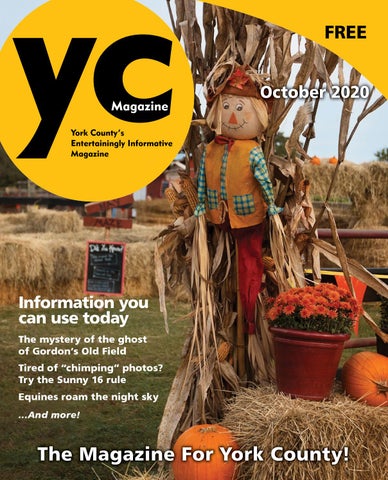
FREE October 2020
Information you can use today The mystery of the ghost of Gordon’s Old Field Tired of “chimping” photos? Try the Sunny 16 rule Equines roam the night sky …And more!
The Magazine For York County!
yc magazine... York County’s Entertainingly Informative Magazine
October 2020
Possibilities A View From The Keyboard By Pam Henson
Volume 17, Issue 10 YC Magazine is an entertainingly informative monthly magazine distributed throughout York County, South Carolina. © 2020 Pluto Publishing LLC Publisher ..... Pam Henson Design................ SC Biz News Editor ..... Jim Tatum Graphic Designer ..... Nicole Haggard For Advertising call Andrea Mounts at 704-817-1346 or email amounts@mecktimes.com All rights reserved. YC Magazine may not be reproduced in part or in whole in any form, format, or media without the permission of YC Magazine. The opinions expressed in YC Magazine are not necessarily the opinions of the publisher or staff of YC Magazine or Pluto Publishing LLC.
Letters to the Editor are welcome. Must include name, phone number, and email address. Email to YCeditorial@scbiznews.com. We are unable to respond to letters without an email address.
PAGE 2
Bags and satchels like this one accompanied many adventurers on their travels and hold tales of their own. Throughout history, there are variations on their name and what was carried inside, but they were typically small, one-strap bags used by frontiersmen, mountain men, sailors, and soldiers. You might have heard terms such as haversack or ditty bags. Being mobile and needing to carry necessary supplies on their person, these bags were handy items that could be stuffed with various essential gadgets for life way back when. Some basic tools and resources included a compass; knife; matchbox; emergency ration; needle and thread; clothing; candle stub; and something called “punkie dope,” which was a homemade insect repellant back in the 1800s. It’s fun to occasionally look anew at things we take for granted today and compare with items of historical significance
C o l u m n i s t s
T
his YC Magazine issue is our first in print form since April. During COVID-19 stay-at-home orders and local business closures, we had to find a creative solution to continue publishing the magazine, so electronic flip-page issues with hyperlinks have been posted on the YC Magazine Facebook page in the interim. If you missed any, check ‘em out! It’s easy to overlook things, even when they’re right in front of you. I was looking through my library shelf recently and ran across a small, worn-leather bag that I hadn’t looked at in a while. It was made by a local artisan crafter that Bill previously featured in one of YC Magazine’s artist profiles. A Revolutionary War reenactor, this friend made historically accurate, leather “possibles bags” to display and sell. My bag contains jars for three items that were considered essentials back then as well as today — salt, pepper, and sugar.
that are long forgotten. That’s one of the reasons it’s fun to explore antique shops and flea markets. It reawakens an appreciation for what’s right in front of us. What was important to daily life back in the 1800s, for example, is very different than what we deem important today. Household items that we use every day without much thought reduced those time-consuming chores from the days of our grandparents, allowing us to choose what we want to focus on, both mentally and physically. Now, with easy transportation both locally and globally, instantaneous information, simple purchasing methods, and the “Swiss Army Knife” of communication — smartphones — our basic necessities are already taken care of. So, with elemental needs already met, we can search out life’s meanings. It’s interesting to observe trends of what people care about. Product purchases and entertainment topics attest to that.
Every smartphone gives its owner the possibility of becoming the next trending video on YouTube. YouTube is quite an interesting phenomenon — not only in its breadth of global reach and topics, but also in its quantitative measurement of a video’s number of viewers. Just like a salesperson or a company tracks sales and expenses, measurements help guide potential growth. With fall upon us, when was the last time you checked your own key metrics for growth? And when was the last time you thought about what is really important to you, what motivates you, and what is possible? A good coach would also ask what concrete steps can you instigate to help you reach your goals? Maybe it’s time to pull out those old “possibles bags” and retool them for the 21st century. What’s in your bag of possibilities? yc
YC Magazine Columnists: Dr. Kelly Baete.................................. Animal Health Mike Baker........................................ Photography Beth Covington................................. Connections Beth Crosby....................................... Wordsmithing Dr. Steve Fields................................. Nature Angela P. Forbes............................... Nutrition & Food Safety Chris Fox.......................................... Arts Todd Harrell..................................... Disc Golf Laurie Helms................................... Parks and Recreation Carole Holmberg.............................. Astronomy Grady Johnson.................................. Cocktails Tim Jones......................................... Music Zach Lemhouse................................. History Dr. Robert Lesslie............................. Health Stuart Lord........................................ Track Talk Deb Pittman......................................Aging Pluto.................................................. Furry Philosopher Lauren Paige Powell.........................Dog’s Life Mollie Rose....................................... Service Nancy Sambets................................. Photo Gallery Cameron Shook................................ The Great Outdoors Paul Thompson................................. Horticulture Dr. Kevin Wickes.............................. Psychology Stacy Williams.................................. Library
About the cover: A jaunty scarecrow
watches over a York County farm yard. (Photo/Jan Todd)
yc magazine... York County’s Entertainingly Informative Magazine
School is Back, Where Is Your Child Going After wards?
October 2020
Creekside
Pharmacy Darlene Gardiner, R.Ph.
803-684-9096
1007 Creekside Medical Drive York, SC
s is t h e M a r t ia l A r t e r ! Be s t An s w √ Life-Lesson Activities √ Higher Self-Esteem √ New Friendships √ Self-Defense √ Respect
9 weeks for
$99 w/ FREE Uniform
(non-members only)
Pak’s Tae Kwon Do 1027 Cranford St. Rock Hill, SC 29732 (803) 327-9000 www.Pakstkd.com
• Still OPEN for business 9AM-6PM Monday-Friday Saturday 9AM-1:30PM • Drive-Up window only • 24-hour drop box • Free Local Delivery • Friendly prescription assistance to synchronize your refills • Complete line of OTC products- Special Ordering available. Select products are Buy 1 Get Second one 50% off • We accept most insurances • Fast Response
To us, it’s personal. Locally owned & operated.
Part of YOUR COMMUNITY!
CONTENTS column
Aging...............................32 Animal Health ............... 30 Arts..................................26 Astronomy ......................16 Cocktails......................... 18 Connections ....................21 Disc Golf..........................14 Dog’s Life........................34 Great Outdoors...............27 Health............................... 9 History ............................. 6 Horticulture ....................10 Library ........................... 33 Moon Phases .................. 35 Music...............................12 Nature...............................8 Nutrition ........................ 29 Parks and Recreation.....28 Photo Gallery..................24
Your Ad Here!!!
list
Photography .................. 20 Pluto-ism ..........................5 Psychology ...................... 17 Service ............................22 Track Talk .......................19 Wordsmithing ................ 23
Knowledge is POWER. Become powerful TODAY! Read YC Magazine and Power Up! If you would like to see a specific topic covered by one of our columnists, email us at YCeditorial@scbiznews.com
This space could be yours to promote your business, event or non-profit. Advertise with YC Magazine Contact Andrea Mounts (803) 638-0366 PAGE 3
October 2020
yc magazine... York County’s Entertainingly Informative Magazine
Yes!
YOU can have a beautiful smile... It’s just a phone call away!
Family Cauthen
Dental Care Lewis J. Cauthen, DMD
Fear Reduction Program • Sedation Dentistry 35 Years of Experience Patient-Friendly TOOTHACHE Relief Flexible Payment Options Appointments Available for Emergency Visits
89
$
An exam, X-rays & smile consu ltation (Value $17 9)
Mercury-free tooth-colored fillings, Crowns & Bridges, Partial & Full Dentures, and Extractions
803-684-9220
1015 Creekside Medical Drive • York, SC • www.cauthendental.com
Ready to move? Let me help!
Jill Woodall Jill.woodall@allentate.com 704-258-6205 Licensed in SC & NC PAGE 4
yc magazine... York County’s Entertainingly Informative Magazine
October 2020
Pluto’s Corner
Deep Dog Thoughts By Pluto
“If you’re uncomfortable around my dog, I’m happy to lock you in the other room when you come over.” – Author unknown
Depositphotos.com
Editor’s note: If you have some pet-related wisdom to share with other readers, please email your submission for consideration to YCeditorial@scbiznews.com. PAGE 5
yc magazine... York County’s Entertainingly Informative Magazine
October 2020
History
York County’s Yesteryears By Zach Lemhouse
The Ghost of Gordon’s Old Field
O
n Clark’s Fork of Bullock’s Creek in present-day York County, there is a tract of land which was once known as “Gordon’s Old Place.” On this land was a large open field, skirted by a forest, and bisected by a road. Many members of the Bullock’s Creek community refused to travel this road at night because they might encounter the Ghost of Gordon’s Old Field. Those who witnessed the apparition typically did not remain in the field long enough to get a decent look. Most “put whip to their horses or flight in their heels” and moved swiftly to the wooded area that skirted the field. It was reported that the wood was the “limit of the ghost’s walk” and as frightened travelers “drew near the shadows of the friendly forest,” the ghostly apparition would vanish. One fearless resident of Bullocks Creek, Sheriff Adam Meek, once boasted that
PAGE 6
Dr. Maurice A. Moore’s column in the Yorkville Enquirer (“Scraps of Local History: Reminiscences of York,” Yorkville Enquirer, January 31, 1884) he not only stood his ground against the spirit, but he also conversed with it. Adam Meek was born around 1760 in Cecil County, Md. He moved to
Charles Town, S.C. and, at the age of fifteen, enlisted in South Carolina’s Second Regiment. In 1777, he married Nancy Agnes “Ann” Byers, a native
of Augusta, Virginia. After the fall of Charles Town in 1780, Meek and his wife took up residence near the mouth of Bullock’s Creek in present-day York County, where he enlisted in the militia under Col. William Bratton. During the American Revolution, Lieutenant Meek fought at the battles of Briar Creek, Rocky Mount, Hanging Rock, Fishing Creek, Fish Dam Ford, Blackcock’s Plantation, Biggin Church, and Eutaw Springs. After the Revolution, Adam Meek served as one of the first sheriffs of York District. Sheriff Meek was known as a man of “great integrity, fearless in the discharge of his duty and particularly distinguished for his sound common sense.” Considering the Sheriff’s impeccable reputation, the claim of his ghostly encounter is made even more interesting. One night, one of Adam Meek’s neighbors was traveling along the haunted road through Gordon’s Old Field and was approached by the spectral apparition. After hearing of the ghostly encounter, Sheriff Meek inquired as to what the ghost had said. The faint-hearted witness replied, “I never stopped to let it get near enough to hear a word from it.” Meek responded, “If ever I see it, I will talk with it.” Shortly after the conversation with his neighbor, Adam Meek had his chance. One evening, the sheriff was detained at work and left for home at an uncommonly late hour. The quickest route home was through the haunted old field. As he reached the middle of the
yc magazine... York County’s Entertainingly Informative Magazine
October 2020
1825 Mills Atlas map of York County showing Clark’s Fork of Bullock’s Creek (Courtesy of the Culture and Heritage Museums of York County) field, he claimed that he saw the ghost approach and, unlike his neighbors, he stopped his horse and allowed the specter to sidle up to him. According to Meek, the two talked at length as they traversed nearly 200 yards to the edge of the forest, at which point the ghost vanished. However, whenever he recounted this tale, the sheriff always refused to disclose what he and the ghost had discussed. When pressed for the subject of their conversation, Meek always replied “perhaps later.” Several weeks after the incident
in the old field, Adam Meek left his wife and children without a word and mysteriously disappeared for nearly two months. Upon his return, he refused to tell anyone where he had gone. Rightfully concerned for her husband’s safety, Ann demanded an explanation for his absence, to which Adam replied “I cannot tell you now - I may before I die, but that is not certain. This I can tell you, the ghost at Gordon’s Old Field will never be seen again.” Indeed, the ghost of Gordon’s Old Field has not been reported in the Bullock’s Creek
community since. Prior to his death on January 26, 1807, Adam Meek told the tale of his ghostly encounter to his brother, James. In his will, he left a “tract of land lying on Clark’s Fork known by the name of Gordon’s Old Place” to his daughter Margaret, a tract of land that was once the location of a barren field haunted by a very talkative ghost. James Meek eventually told the story to Dr. Maurice A. Moore of Yorkville. Dr. Moore published the story in an 1870 issue of Yorkville Enquirer in his column entitled “Scraps of Local History: Reminiscences of York.” Unfortunately, Adam Meek died before revealing any details of his conversation with the ghost, where he had gone, or what he had done during his mysterious two-month absence. All that remain are the facts of Adam Meek’s will and Dr. Moore’s reminiscences. yc Zach Lemhouse is the resident historian for the Culture and Heritage Museums of York County and the Director of the Southern Revolutionary War Institute. If you have any questions or suggestions for future article topics you can reach Zach at ZacharyLemhouse@gmail.com
Creekside
Pharmacy Darlene Gardiner, R.Ph.
803-684-9096
1007 Creekside Medical Drive York, SC
To us, it’s personal. Locally owned & operated.
Part of YOUR COMMUNITY! • Still OPEN for business 9AM-6PM Monday-Friday Saturday 9AM-1:30PM • Drive-Up window only • 24-hour drop box • Free Local Delivery • Friendly prescription assistance to synchronize your refills • Complete line of OTC products- Special Ordering available. Select products are Buy 1 Get Second one 50% off • We accept most insurances • Fast Response
PAGE 7
yc magazine... York County’s Entertainingly Informative Magazine
October 2020
Nature The Naturalist’s Journal By Dr. Steve Fields
Signs of autumn “Autumn, the year’s last, loveliest smile.” – William Cullen Bryant
N
ow that autumn is officially here, we can finally breathe a sigh of relief from the sweltering days of summer. The cooler, less humid weather really puts me in the mood for fall, truly my favorite time of the year. Likewise, our resident flora and fauna have already been preparing for autumn. Take our native trees, for example. They spend most of the spring and summer taking in the abundant sunshine and (sometimes not so abundant) moisture. Typically, autumn brings cooler temperatures, but it always brings shorter days. Less light during the day means less time for plants to conduct photosynthesis. By winter, there is also less moisture available to plants because groundwater can freeze. The tree’s tactic is to shut down the leaves
Leaves are not the only bright colors of autumn. The bold orange and black coloration of the monarch butterfly (left) serves as a warning to birds. A distasteful milkweed toxin that is ingested by the caterpillar (right) remains in the body as the larva transforms into the adult butterfly. (photos/Steve Fields) and get rid of them. After all, those broad, flat leaves, when exposed to the colder, sunny days of fall and winter could give off more water than the tree could recoup from the soil. As the flow of water and nutrients to the leaves is restricted, the green
Norman Hege Jewelers Serving Rock Hill For 69 Years
We would like to congratulate Theodore and Athena Cathcart on their wedding. Thank you for choosing Norman Hege Jewelers. Free Watch All Batteries for ders – First Respon 3 it Lim
Food Lion Plaza
327-7850
143 Herlong Avenue Rock Hill, SC
Beginning September 8 Monday-Friday 10am-4pm Closed Saturday and Sunday.
PAGE 8
pigment chlorophyll fades and exposes other pigments in the leaves: bright orange and yellow to red and purple – the colors of autumn. Eventually, the leaves fall and become part of a mulch that is recycled back into the soil. The buds of next year’s leaves are already present, but they are tightly packaged and protected from the elements. Such trees that shed their leaves annually are known as deciduous trees. This is but one adaptation to deal with less available moisture in the colder months. Evergreen trees employ a different strategy. Rather than having broad, flat leaves, evergreens typically have leaves that are modified into long, thin needles with a waxy coating. This is another means of reducing water loss from the leaves and protecting against the damaging effects of the cold. The insects also know that change is in the air. You may noticed a number of monarch butterflies this year. While most butterflies spend the winter in an earlier stage (egg or pupa) of the life cycle, adult monarchs actually migrate to Mexico. The instinct to migrate is so strong that you can observe that foraging monarchs have a decidedly southward direction as they move from flower to flower in late autumn. Migration is not the only extreme adaptation of the monarch butterfly. Both the caterpillar and adult stages are brightly colored. The bold stripes of the larva and bright orange and black patterns of the winged adult serve to warn predators, particularly birds, of a toxin in their bodies. Monarch caterpillars feed on milkweed plants, which are rich in a very bitter-tasting toxin. The toxin not only resides in the tissues of the caterpillar, but also remains even after the larva changes into a pupa and finally an adult. The purpose of the toxin is not to kill
a potential predator, but to teach a valuable lesson. If a bird eats a monarch caterpillar or adult, within minutes the bird becomes violently sick and regurgitates the prey. While it is unlikely that the monarch will survive this event, it is equally unlikely that the bird will eat another monarch, as the bold colors and patterns become etched in the bird’s memory and serve as a reminder not to repeat the experience. Regardless of any distasteful experiences with monarch butterflies, birds change their behavior in other ways during autumn. No longer do the songs of multiple species fill the treetops. That only served to stake out territories and attract mates. But since the breeding season is over, there is no reason for a bird to draw attention to itself, especially when predators are in the area. Additionally, males molt out of their bright, colorful feathers and into more conservative plumage to take on a less conspicuous existence. Now it becomes more difficult to distinguish the males and females of some species. What’s more, many species of warblers are on their fall migration routes. Most of them can only be identified as a dull green blur as they pass through the area. True, most people look to cooler weather and changing leaves for clues to autumn. My list, it seems, is just a little bit longer. When I see migrating monarchs, regurgitating robins, and wily warblers with perplexing plumage, I know my favorite time of year is here. yc Dr. Steven E. Fields is the curator of natural history for the Culture and Heritage Museums and an adjunct instructor of biology at Winthrop University and York Technical College. You can contact “Dr. Steve” at 803-909-7216 or email stevefields@ chmuseums.org.
yc magazine... York County’s Entertainingly Informative Magazine
October 2020
Health The Doctor’s Corner By Robert D. Lesslie, MD, MPH
Answers to your Covid-19 questions
J
ust last week we watched as two tropical storms headed toward Texas, Louisiana, and other states. One would become a Category 4 hurricane and cause major damage to part of our country. This fall, we’re going to face another two storms that threaten all of us: Covid-19 and whatever variety of flu that makes its way to our shores. I want to thank our readers for taking the time to submit questions about our current pandemic. I won’t be able to handle them all here, but I intend to address each one. Please keep them coming! Meanwhile, here’s an update on the issue of anti-hypertensive medications and their impact on a coronavirus infection. This had to do with the ACE inhibitors (Lisinopril, Benazepril) and the ARBS (losartan and others). At first, we were told they increased the chances of contracting Covid-19 and having a much worse outcome. That scared everybody, including physicians. Then, we learned that
the drugs don’t have a negative impact regarding Covid-19. They don’t increase your risk of getting the infection, and they don’t cause a bad outcome. In fact, a new study of 28,000 people indicates these drugs reduce bad outcomes in those taking them by as much as 33%. This is important for those who take these medications, as well as for all of us as we try to assimilate the information and research we receive daily. There are many questions about this virus, and as always, time seems to be the arbiter of truth. Now for those questions. Do you think it’s pronounced COvid like “covert” or CUvid like “covers”? Personally, I think it’s the second due to lack of an E to make it a hard O, but my kids keep telling me that I’m wrong. Please help. I thought I’d be brave and tackle the toughest question first. I’m afraid your kids are correct. It’s pronounced COvid, like cosign or cozy. No help from Webster, so I’m sticking with that.
Just how accurate are the test results? This is a critical question, since our epidemiology depends upon it. Who has the infection? Who doesn’t? First, we must consider the two “diagnostic” tests: the rapid antigen tests and the PCR “send-out” study. The rapid test has an accuracy of around 80%, with few false positives and up to 20% false negatives. If it’s positive, you’ve got the virus. If the test is negative, there’s still a 20% chance that you could be infected. This is a nasal swab, and should be a little uncomfortable to obtain an adequate sample. (Saliva tests are in the works and may soon replace the swab.) The results should be back in about half an hour. The PCR (send out) is much more accurate and should be done if the rapid is negative and the circumstances require absolutely knowing the possibility of infection. It may take up to five days to be returned. With either test, the time from exposure to testing is important. Current guidelines indicate
Compassion, Comfort & Care For Our Community Servicing Families in York, Chester, and Lancaster Counties • • • • •
On Call Support 24/7 Pain Management Respite Care Custom Care Plan Home Visits
Injury & illness care • Medical Exams House Calls • Vaccinations Spiritual Care • Bereavement Services
eight days as the best interval. Antibody tests check for antibodies to the coronavirus. It won’t tell you whether you have an active infection or whether you’re immune to the Covid-19 virus. There are other coronaviruses out there, and this test can produce more questions than answers. It’s place in our fight against this virus has yet to be determined. Is the flu vaccine going to incorporate Covid-19 vaccine without our knowledge? Not sure I’m getting the flu vaccine. Don’t know who to trust. I share your concern about a lot of what’s out there regarding the coronavirus. But I’m not concerned about “Big Brother” slipping us the Covid-19 vaccine unawares. That won’t happen. Nonetheless, it’s important to get the flu vaccine each year. This year may be especially important. And it’s a good time to remind each of us over the age of 60 to be sure we’re up to date with our pneumonia vaccinations. This infection is preventable and is a real killer. Are doctors in South Carolina treating Covid-19 patients with hydroxychloroquine, and if not, why? Currently, there is no substantial evidence that it makes any difference in the treatment of this infection. There are no studies that support its use. Lots of anecdotal reports, but nothing that can be substantiated. Regarding its use here in Rock Hill, I don’t know of anyone who is using this medication. If they are, and they have evidence to support it, I’d like to see what they’ve got. yc Dr Lesslie’s Angels in the ER is available at bookstores and on the internet. For more information check out RobertLesslie.com.
803-325-CARE
Advanced
Chiropractic Solutions, P.A. Protecting & Enhancing Your Wellness
Rock Hill, SC 980-0556
803-326-3384
York, SC 628-6800
www.riverviewcares.com Hospice Admissions Available 24/7
Jude Konow
PAGE 9
yc magazine... York County’s Entertainingly Informative Magazine
October 2020
Horticulture
Growing York County By Paul Thompson
Kale is a headless cabbage
Ornamental Kale ( photo/Paul Thompson)
T
he cole crops, Brassica oleracea, all have a common lineage, and the plants that started it all were the primitive kale and collards that were grown by the Greeks and Romans. Kale is the Scottish word derived from the Roman name of the plant, coles. The distinct lines of cabbage, broccoli, Brussels sprouts, kohlrabi, and cauliflower were all developed from kale-like ancestors. Kale has come to the forefront in the last decade as the ultimate leafy-green health food which is both nutritious and high in fiber. Kale can be used as a vegetable, an ornamental, or better yet, both. Although the typical ornamental kale that you might by in a garden center is edible, it does not have the flavor of the culinary kales, but many of these are also highly ornamental in their color and texture. Kale is used in stir-fries, soups, winter salads, and even made into tasty chips (more on that later). Of course, we Southerners have known this about collards for a long time, but collards have not seen the same popularity PAGE 10
nation-wide as has Kale. Maybe it is because there are so many varieties of kale. And many of these associated with different Asian, Middle Eastern, Mediterranean, and European cultures. Cornell University has a website which lists 52 culinary varieties here: www.gardening.cornell.edu/ homegardening/. Kale is one of our most cold hardy vegetables and can be grown and harvested through the winter months here in South Carolina. The flavor is enhanced after the first frost, and the leaves are hardy to 20 degrees F. Even if the leaves get scorched, the plants will send out new leaves during warm spells. It can be direct sown in the garden in August and September, or can be put in as transplants and will grow well when temperatures stay above 50 degrees F. Kale will survive into the summer months, but the leaves become strong and tough with the heat. Kale needs plenty of sun, at least six hours. It also needs soils that are fertile and well-drained. It responds well to regu-
lar watering. It can be grown in the vegetable garden, in raised beds, in containers, or an addition to the winter landscape as an edible ornamental. Seed should be sowed ¼ to ½ inch deep and spaced 12 to 18 inches apart depending on the variety you are growing. Seeds will germinate with soil
Red Russian Kale (photo/ Paul Thompson)
temperatures between 40 and 85 degrees. With that being said, you can also grow baby kale for salads very densely and sow new seeds every few weeks for a continuous harvest of tender baby greens. Unless you are growing baby kale, the older, lower leaves are continuously harvested leaving the new growth alone except for occasional harvesting of young leaves for salad. A few of the more common varieties are described below. Tuscan Kale – also called lacinato, palm tree, dinosaur or Tuscano kale, is a beautiful blue green variety with narrow, straplike puckered leaves. The leaves grow very upright and therefore stay relatively free of dirt making rinsing easy. It is a very popular Italian variety used in soups and stews, and is frequently recommended as one of the best for making kale chips. The color, texture and growth habit are dramatic, and will combine well with yellow or blue pansies in a container garden. Red Russian Kale – actually a different species which is not a true kale, but is grown and treated as such. It has broad, lobed leaves with red veins and leaf stalks. A very popular and tender kale used in stirfries or salads. Redbor – a vigorous hybrid kale with ruffled, deep maroon leaves. Can grow four to five feet tall in a good year. Used as a salad green and in stir-fries. A frost sweetens the leaves and they darken to nearly black. Vates Blue Curled – a very popular northern variety because of its cold-hardiness, this kale performs well here as well. Blue-green and ruffled leaves with a fine texture on plants that grow to 18 inches tall. As with all curled kales, it is hard to rinse
yc magazine... York County’s Entertainingly Informative Magazine leaves. Used for stir-fries, salads and chips. Winterbor – similar to Vates, but with bright green new leaves that turn blue with age and slightly less curly. It is slow to bolt (flower) in the spring allowing for a longer harvest. Walking Cane Kale – aka Jersey Cabbage, Jersey Kale, and tree collards; a very old novelty plant that was an important food and livestock forage. Additionally the tall stalks could be harvested, dried, and turned into durable walking sticks or canes. This is an heirloom that was brought from Europe and has been used for hundreds of years. This plant is perennial. I noted earlier that I would talk about kale chips. I grew several varieties of kale a few years ago. I grew Tuscan, Red Russian, and a Winterbor type that was just labeled as green curly kale at the garden center. I also bought a few of an unlabeled maroon-leaved variety with smooth, lobed leaves that I later discovered was a variety of Chinese mustard green called Red Rain. I perused the internet looking for directions on making kale chips, and after seeing many of the tips for keys to success were using low heat in the oven and very little olive oil. This is the recipe I cobbled together after making them several times. Ingredients: Kale – about 10 to 12 leaves Olive Oil – 1 tsp
October 2020
Garlic powder – 1 tsp Salt – ½ tsp Oregano – 1 tsp dried or 1 tbsp fresh Parchment paper Directions: Remove the middle oven rack and cover it with parchment paper. Preheat the oven to 200 degrees. Wash kale and pat dry or dry in salad spinner, remove the midribs of the leaves and tear kale into chip-sized pieces placing them in a large bowl or large plastic bag. Add the olive oil and toss in the bowl with your hands or gently knead the sealed bag until the oil is well distributed. Add dry ingredients and toss well. Spread the kale out on the parchment so there is minimum overlap. Place the rack in the middle of the oven and cook for 20 minutes. (I ended up adjusting this to 210 degrees for 21 minutes with my oven). Remove from the oven and let cool for a few minutes. The chips easily come loose when you lift and bend the paper. They will keep well for about a week in a sealed plastic bag. Folks seem to like them, and they don’t leave any behind. They are certainly a great way to get kids to try something new and nutritious. And by the way, the red rain mustard makes great “kale” chips too. yc Paul Thompson is a Horticulture Agent with the Clemson Extension Service. Contact him at (803) 684-9919, ext. 112.
Curly green kale (photo/Paul Thompson)
Redbor kale (photo/Regina P. Bracey, Louisiana State University)
Get ready for the lawn wars!
Red rain mustard kale (photo/Paul Thompson)
NEW!
PRO-TURN Series
Prices starting as low as $5,999 BOYD TIRE & APPLIANCE 803-222-3231 • 110 N. Main Street • Clover, SC 803-684-3587 •124 S. Congress Street • York, SC
Tuscan kale (photo/Paul Thompson)
Monday-Friday 8am-5:30pm •Saturday 8am-1pm
PAGE 11
yc magazine... York County’s Entertainingly Informative Magazine
October 2020
Music
Tuning In To York County By Tim Jones
Musical presidents
A famous photo of Harry S. Truman playing the piano in the Washington Press Club canteen, joined by actress Lauren Bacall (photo/public domain)
N
ovember 3 is the day we select a new President. Or an old President, however the election comes out and however you look at it. Since 74-year-old Donald Trump and 77-yearold Joe Biden are the two main candidates in the upcoming election, it’s pretty safe to say we will be electing an old President either way. I’m not picking on them; I’m pretty old myself. But what if we elected presidents based on musical prowess? How would Trump and Biden fare if we judged them based on their ability to sing and/or play an instrument? Well ... not too good! There seems to be no available information that Trump, or PAGE 12
Biden, has ever demonstrated any musical ability. There have been presidents with talent, though, so in honor of the election, this month’s column is dedicated to presidential music makers -- which presidents played which instruments. One of the best Presidential musical stories involves 33rd President Harry Truman. A photograph that still surfaces from time to time is an image of Harry Truman seated at the piano while a leggy Lauren Bacall is posed seductively atop the piano. By most accounts, Harry loved to play the piano, and if there was a piano in the room, Harry just had to tickle the keys a bit. The year was 1945, and Truman, then
the vice-president, had made his way to a piano in the Washington Press Club’s canteen for servicemen. Harry was playing “The Missouri Waltz,” a tune from his home state, when the 20-year-old Bacall decided to become part of the act by climbing on board the piano and writhing seductively while the vice-president played. Harry had nothing to do with Bacall’s impulsive and unsolicited participation, but a photographer who was present snapped a few photographs of the proceedings. The pictures quickly made the rounds, and Harry did not fare well in the court of public opinion with what was in those days considered an undignified pho-
tograph for a man of his position. Truman’s wife, Bess, was said to have been particularly displeased and gave him a hard time about the whole incident. Poor Harry just wanted to play a little piano. Harry maintained his enthusiasm for the piano, though, managing to find his way to the keyboard most any time one was handy. “The Missouri Waltz” remained his favorite piece to perform. Maybe it reminded Harry of his home state. Or maybe it reminded Harry of the time... Said to be one of the most accomplished Presidential musicians was 37th President Richard Nixon, an excellent accordion and piano player. Nixon appeared on the Jack
yc magazine... York County’s Entertainingly Informative Magazine
October 2020
Left, statue of President John Tyler holding his beloved violin and bow (photo/PresidentsUSA.net); right, President Richard M. Nixon playing the piano on the stage at the Grand Ole Opry (photo/National Archives). Paar program in 1963, playing a piece he had written himself, “Richard Nixon Piano Concerto Number 1.” In the midst of the Watergate crisis in 1974, Nixon accompanied famed singer Pearl Bailey at a White House performance. Also that year, Nixon helped the Grand Old Opry open a new performance hall by playing “God Bless America.” Since it was his wife’s birthday, Nixon also played and sang “Happy Birthday” to Pat Nixon and sang and dedicated “My Wild Irish Rose” to her. Here are a few more presidential musicians and their instruments: Thomas Jefferson (3rd President) – Jefferson was said to have practiced three hours a day on the violin. He also played cello and clavichord. Jefferson is quoted as saying, “Music is the passion of my soul.” John Quincy Adams (6th President) – Studied flute at Harvard in the 1780’s, but by his own admission may not have been very good at it. His quote: “I am extremely fond of music, and by dint of great pains, have learnt very badly to play the flute.” I don’t know. Harvard is not known for producing slouches in any field. Perhaps Adams was just being humble in assessing his own talent. Andrew Jackson (7th President) – Jackson and wife Rachel were both said to be adept at guitar and banjo. Poplar trees that lined the entrance to their home, the Hermitage in Nashville, were planted in
the shape of a guitar, and the Jacksons were known to host many hootenannies a century or so before Nashville became the country music capital of the world. Jackson and 11th President James K. Polk are our closest “proximity presidents,” as both were born just across the borders of York County. John Tyler (10th President) – Another would-be musician who had to settle for being president, Tyler had at one time hoped to be a professional violinist. Tyler is said to have been so fond of music that when Rapid City, South Dakota erected a statue of him as part of its “City of Presidents” project, which pays homage to all of our U.S. presidents, the statue depicted Tyler holding his beloved violin and bow. Abraham Lincoln (16th President) Lincoln is said to have dabbled a bit on harmonica and jaw harp. Lincoln preferred folk tunes. Ironically, it was said that Lincoln’s favorite song was “Dixie.” Chester A. Arthur (21st President) – Arthur and Andrew Jackson are the only Presidents to play the banjo. Or the only two to have admitted to playing the banjo. (A little joke at banjo players’ expense there. And yes, I play the banjo myself!) Woodrow Wilson (28th President) – Wilson played violin, and sang in his college glee club at Davidson College, another “just across the YC border” connection. Wilson is reported to have enjoyed music
very much and is quoted as saying at the height of World War I, “Music, now more than ever, is a national need.” Warren G. Harding (29th President) – Scandals that rocked Harding’s Presidency tend to relegate Harding to a ranking as one of our worst Presidents, but Harding was undoubtedly one of our most versatile - if not best - presidential musicians. At one point, Harding claimed that he could play every instrument except the slide trombone and the E-flat cornet. Harding was president during the Roaring ’20’s, and he was known for throwing wild parties at the White House. The birth of rock and roll is said to be in the 1950’s, but Harding partied liked a rock star some 35 years before
rock stars came on the scene. Calvin Coolidge (30th President) – Said to be a very quiet man, Coolidge played the harmonica. Very quietly, one would imagine. Franklin Roosevelt (32nd President) – FDR is said to have played piano and organ, though not very often. He also sang in his school choir as a boy. As many people of his era did, FDR loved cowboy songs. Ronald Reagan (40th President)- Reagan was known to play a little harmonica every now and then. Bill Clinton (42nd President)- In high school, Clinton was first chair in the Arkansas all-state band, and even considered a career in music. In 1992, Clinton famously blew his saxophone on the stage of The Arsenio Hall Show. Barack Obama (44th President)- Obama did a pretty mean Al Green imitation, even singing a line or two of “Let’s Stay Together” at a fundraiser in 2012 and clips of his brief performance became an internet sensation, racking up millions of views. Even the best musicians took note, and later that year at a White House performance, blues legend Buddy Guy called Obama to the stage to sing along with an all-star group that included Guy, B.B. King, and Mick Jagger. Wow! Obama sang the blues classic, “Sweet Home Chicago.” It was said that he nailed it. Ulysses S. Grant (18th President) – Grant was saved for last because Grant has a special distinction. Grant may have been the greatest Presidential non-musician. Grant played no instrument and is said to have hated music. His quote says it all: “I know two songs. One is ‘Yankee Doodle,’ and the other one is not.” While apparently there is no musician candidate in the upcoming election, please remember to cast your ballot Tuesday, Nov. 3. yc Tim Jones is owner of Woody’s Music in Rock Hill and co-owner of Woody’s Music in Tega Cay. Tim grew up in Sharon and was a Green Dragon at the old York High School.
PAGE 13
yc magazine... York County’s Entertainingly Informative Magazine
October 2020
Disc Golf
Turn And Fade By Todd Harrell
Losing Choco Taco
The author and his best buddy, Choco Taco (photo/Todd Harrell).
I
n the 16 years I had my dog Choco Taco, I only lost him (for a significant amount of time) twice. They are both interesting stories, but since this column is about disc golf, the time I lost him on a disc golf course seems most appropriate. Home sweet Seneca Back in 2006, Choco and I were living in the town of Seneca, S.C., which was, and probably continues to be, most known for its proximity to Clemson. However, Seneca was the first in the immediate area to install a disc golf course, so that kept Choco and I in town. Newly carved from the Shaver Recreation Center woods, the course was tight, quite rough, and difficult to play. However, that didn’t stop Choco and me. It was our personal playground. Once there I would let him off the leash. Though Choco, who was three-years-old at the time, was eager to come, he wasn’t too interested in watching me play disc golf, so he’d often wander off for a few holes, sniffing and solving doggie mysteries, while I navigated the densely wooded holes. His absence never bothered me, because he’d PAGE 14
regularly check back during my round and we always seemed to meet back up before I finished. A little bit about Choco With tall legs and a sleek black coat, Choco was a handsome fella. The Springfield, Mo., Humane Society shelter where I got him had labeled him a lab-hound mix. But after seeing photos of German Shorthaired Pointers, I always thought that was his closer lineage. Plus, German Shorthaired Pointer sounded cooler, anyway. I’d always wanted a big dog. And, at about 60 pounds, he was that. He was athletic and had this regal air about him, especially when his sniffer caught something good in the breeze. However, he’d still tolerate my hugs, and would humor me when I put clothes on him. I remember him biting only one person (Unfortunately, it happened to be my elderly Aunt Edith, who posed no threat to Choco, but I’ll chalk it up to a case of mistaken identity on Choco’s part). Though he was a tad anxious at times, like his owner, and would brazenly steal baked goods (also like his owner) he was as good
of a dog as anyone could ask for. Just an ordinary round That day we started our disc golf round later in the afternoon than usual and clouds were rolling in. But the chance of rain hadn’t bothered me. Like I said, the course was quite wooded, so I expected the tree cover to keep us from getting too wet if it rained moderately. I let him off the leash and for much of the round things were normal, with me struggling to shoot par and him wandering away then popping back in as usual. Choco was still wandering after hole five when it started to rain, first lightly, then increasing in intensity until it was pouring. The dark clouds I had noticed before were now directly overhead and made the sunset sky appear like night. No 18 holes today With my clothes soaking up the rain, I decided it was best to stop my round and start looking for Choco. First, I looked up and down the hole I was on and when I found nothing, I scoured the next. But no Choco. I continued further down the
course getting wetter by the second, but still nothing. I even ventured off the park property into the neighboring woods but nothing there either. Worry started creeping in. I called him over and over, hoping to hear some sort of Choco noise, be it his low, loud, protective bark or even his higher pitched, excited yelping. Nothing. A little bit about me Choco was the first dog I got as an adult and my first pet in several years. We had dogs growing up, but they never developed into inside dogs (meaning none of us kids stepped up to housetrain them so that meant they were outside dogs). I’d always wanted an inside dog, so by the time I reached adulthood I wanted another crack at it. Through my dog-less college years, I had decided that dog would be a chocolate lab named Choco Taco. The name Choco Taco, which many have inquired about over the years, is not in homage to the popular ice cream treat of the same name. I’m not sure if I’ve ever eaten one, to tell the truth. However, my subconscious probably did pilfer the name from the good people at Klondike, makers of the Choco Taco -- and I’m okay with that. After college and living with a bunch of friends in Springfield, Mo., I figured it was time. Though the plan had been to find a chocolate lab, Springfield Humane Society was low on stock, so I was considering something they had a bunch of: border collies. But at my next Humane Society visit I totally forgot about border collies when I saw the jet-black colored, nine-week-old Iab/hound mix. Though he wasn’t a chocolate lab and he looked fairly pathetic, with his mopey eyes and flea nest remnants still stuck to his fur, there was no question that this little guy was going to be my dog. I adopted him that day and the name Choco Taco (Chocolate Taco for formal occasions) fit like a glove. Still no Choco Back at the rain-soaked course, I was really starting to worry. Ten minutes of searching had brought nothing. I was soaked and I couldn’t see much of anything. I searched a few more holes and went back to the parking lot without Choco. The thought of not finding him was becoming louder and louder. It was hard to accept. Not Choco, my main companion – the furry guy that would back his rear end up to me when he wanted a scratch.
yc magazine... York County’s Entertainingly Informative Magazine I decided to drive my vehicle around the neighboring area to see if I could find him. Nothing. Nothing, either, when I went back to the disc golf course. By then, the rain had stopped, but it was full on dark. I walked several holes calling him and no Choco. Had to leave him there The course was pitch black except for the faint orange-yellow light from the parking lot light poles. I wasn’t going to find him that night. That much was clear to see, but still quite hard to accept. Leaving my boy, my first son, my friend that had fended off loneliness since I adopted him, seemed like abandonment. But I was tired, wet, and out of hope, so I climbed back in my car without him – the dog that liked to stand behind me in the backseat panting right behind my ear – and headed for home. I don’t think I slept much that night. I’m sure I worried, non-stop, if he was hurt or if I’d ever see him again. Choco the Cubs fan Up until then, Choco and I hadn’t spent many nights apart. The only other time I had been away from him was when I went on a holiday cruise and left him with my mom. I remember Choco, who was a puppy at the time, was given a puppy-sized Cubs jersey before I left for the trip. It was an adorable gift that fit him perfect, but when I returned a handful of days later, he’d grown so much it was now a doggie
October 2020
muscle shirt. One last shot When dawn broke the next morning it was easy to get up. “Choco, where are you?” was all I could think of. It was Sunday. The sun wasn’t completely up yet, but the rain and the clouds were gone. I wasn’t sure what I’d find at the course, but at least I would be able to see better. I took my normal route to the disc golf course, Wells Highway to South Oak Street and was met with empty streets. It was so early not even the early churchgoers had gotten up yet. I was still a good ways away from the Shaver Recreation Center turnin street, when I saw a black dog right in the middle of South Oak Street. “Nah, that couldn’t be him,” I thought, knowing how far away from the disc golf course I was. But as I looked closer I began to wonder. “Choco?” I stopped my car in the middle of the street 40 or 50 feet from the dog. His ears were back, and his gait was noticeably hunched-over. He looked scared and confused. Was he looking for me? I got out of the car. I was in the middle of the street but I didn’t care, because that was my boy. That was Choco trying to find his way back to me as best he could. I crouched down close to the pavement, to seem less threatening and called his name loud and with the emotion of almost losing
him for good. He saw me, not sure at first, but he quickly recognized my voice and galloped over to me, smiling in his Choco way, as if to say, “There you are.” I lost Choco again last summer This summer marks one year since Choco died. The last few months before I put him down, he could barely walk across our kitchen without help. He was thin, frail and his once dark as night coat had turned mostly white on his face. His days and nights were mostly filled sleeping on our couch. The backyard, once his area to actively patrol, was now the place I had to often carry him to use the bathroom. It was tough to watch my once sleek and agile friend so humbled and so close to death. Death, which once seemed so far away, was suddenly here. Choco was my constant friend It’s hard to think of my life after college without Choco. With an exception of a month when I left Choco with my Springfield, Mo., friends for a Kentucky reporting job (which I now realize was a mistake to leave him behind), Choco was by my side for 16 years – practically all of my early adult life. During those early years of adulthood, Choco’s companionship was a great comfort when life seemed confusing and occasionally scary. He was there in the front seat sitting next me as I set out for new jobs
A New Vision In Service 803-329-1132
774 Corporate Boulevard, Suite 106 • Rock Hill, SC
www.OutlookFlooring.com
and new towns and sitting in that same seat as we headed back to my mom’s home base when those jobs didn’t work out. He was there during heartache and disappointment and worry that I’d never get it together and be happy. But luckily, he was also there later in life when I got things on track. He was there when I found my wife and her feisty Boston terrier Suzy Q. He was also there when we had our son. I still remember seeing a picture of Choco sniffing our infant’s rear as if he were sizing up a new roommate. Ol’ Choc Whenever I think of him nowadays I kind of tear up and say “Ol’ Choc” to myself. I miss him. I miss hugging him and picking up and holding him like a baby despite his muffled protests. I miss the highpitched noise he’d make when he’d yawn. I miss the wet nose that he’d gently press against my arm when he needed to go outside in the morning. But I was lucky. I got 16 years with an incredible dog. So, when I think back about that time I lost him in Seneca, with so much time yet to share with me, I’m grateful he went looking for me on South Oak Street that early Sunday morning. My life was better for it. yc Todd Harrell plays disc golf, among other things.
Need new Carpe
Call to us ask how 803-329-1132 or v FREE in-home consultation / Monthly specials
Need Financing?
Visit our website for additional information! FREE in-home consultation/ Monthly specials/Design Center.
PAGE 15
yc magazine... York County’s Entertainingly Informative Magazine
October 2020
Astronomy
Looking Up
By Carole Holmberg
Equines roam the night sky
A
n equine is defined as a horse, a donkey, or a zebra. There is at least one representative of each of these animals in the night sky. There are several mythological creatures that are part equine. The constellation of Pegasus the Flying Horse belongs in this group. How about Monoceros the Unicorn? Maybe. Sometimes unicorns look horselike and sometimes they are more goat-like. In every case, each has a large single horn in the middle of its forehead, as the word “Monoceros” means “one horn.” Also part equine are centaurs, a half-human and half-animal creature with the body of a horse and the torso and head of a man. Two constellations, Sagittarius the Archer and Centaurus fit this category. There is a constellation, Equileus, which does represent an actual horse. “Equileus” in Latin means “little horse” or “foal.” It is a small constellation. In fact, it is the second smallest of all 88 constellations, dwarfed only by Crux the Southern Cross. It was one of the ancient constellations recorded by Ptolemy in the second century. I have heard that it is sometimes called the “first horse” because it rises right before Pegasus in the night sky. Despite its ancient history, Equileus isn’t a bright constellation. Look for it between the easier constellations of Pegasus and Delphinus. When school groups visit the planetarium, I like to show them a constellation that at least comes close to their school’s mascot. Sometimes, I don’t have any luck – the Pirates, for example, or the Tigers. I use Equileus as a mascot for Colts and Stallions. I tell them it is as close as I can come. There are several other horse references in the sky, such as the Horsehead Nebula.
No Worries! Live
Solid.
Boney Insurance and Farmers Mutual Insurance Company have been serving Western York County since 1892. Our business was founded around customer service and quality, starting a long-lasting tradition that has been carried on for five generations of family.
Wendy Clinton
Will Mitchell
Jesse VanVoorhis
Brook Quinn
AUTO HOME LIFE BUSINESS
Call to see what one of our agents can do for you. 684-4402 • 14 East Liberty Street • York, SC
www.BoneyInsurance.com
PAGE 16
This stunning image of the Horsehead Nebula was taken by Mark Stanford Sr. of Rock Hill in February. The bright star to the center left is Alnitak, one of the stars in Orion’s belt. It is an example of a dark area of dust inside of a large interstellar cloud of molecular hydrogen. Its dark appearance is caused by the dust blocking the light of the stars behind it. It resembles more of a seahorse head to me. For all its photogenic appeal, it’s smaller in angular size than you would think. I’ve never actually seen it with my own eyes. The Horsehead is located in the constellation Orion, just below Alnitak, the leftmost star that forms his belt. The Dark Horse Nebula is large enough to be easily visible in the summer evening sky, if your skies are unusually dark. It is occasionally also known as the Prancing Horse Nebula. On a clear moonless night, particularly in summer, if you are in an area, with no light pollution, look up at the Milky Way. If your sky is dark enough, you might be able to see a dark band flowing along it’s center, where the interstellar material is particularly thick. The Dark Horse
is in the constellation of Ophiuchus, near where it meets Sagittarius in the sky. One needs to use some imagination to picture a dark silhouette of a horse there. The back legs and tail portion of the horse is also known as the Pipe Nebula. Then there’s Mizar and Alcor, the double star that occupies the middle position of the handle of the Big Dipper. Look at the handle and, if your eyes are good, you should be able to make out two stars there, close together. They are sometimes called the horse and rider. Through a telescope the brighter star, Mizar, shows itself as two stars also. Using spectroscopic techniques, the entire Mizar-Alcor complex reveals itself as six stars, as each of those three stars is also a binary star. All six stars are believed to be gravitationally bound to each other. Donkeys and zebras are also equines, remember, and there are two donkeys in
the sky, stars located in the constellation of Cancer. Their common names are Asellus Borealis, the northern donkey, and. Asellus Australis, the southern donkey. Between them, at the center of the constellation, is an open cluster of stars, the Beehive Cluster. The Beehive was known in Greek and Roman times as Praesepe, a word that means manger, and represented the manger out of which the two donkeys are feeding. Zebras? There are none in the sky if we restrict ourselves to Greek mythology but in South African lore the three stars of Orion’s belt represent three zebras. yc Carole Holmberg is the Planetarium Manager at the Museum of York County. She gives planetarium shows each Tuesday – Saturday at 3:30 p.m., with additional shows on Saturdays and school holidays. Ms. Holmberg can be reached at CHolmberg@chmuseums.org.
yc magazine... York County’s Entertainingly Informative Magazine
October 2020
Psychology
Working Within
By Dr. Kevin Wickes, LPC, NCC, CEAP
Inner strength and peace
A
nd the journey continues… COVID-19, the upcoming presidential election, and life’s event. As we’re reminded by 9/11, COVID-19 will forever change our lives. Dr. Francis Shapiro (created EMDR- Eye Movement Desensitization and Reprocessing) believes there are five to 10 past memories that shape our lives. What memories have shaped yours? I am reminded by clients, memories of their hurt/pain, abuses, trauma, relationships, separation/divorce, etc. shape who we are, what we are, and what we’re becoming. As you may be reading, these are often negative memories. Positive memories can shape you; however, often the negative memories can and may define you. With all the past conflicts, abuses, memories, etc., how can you have inner strength and peace? Too often, we allow our negative memories to shape us into depression, anxieties, substance abuse/ addiction, relational problems, and other mental health related challenges. You have read the quote, “Whatever does not kill me makes me stronger.” Is that really true? Sometimes. It depends on how you manage/cope with your past – and no one individual does this the same way. There are ways we have learned to cope/manage the negative events/memories in our lives. Oddly, we often mimic our parents in how they learned to cope (often identified as generational transmission). At times, I have clients who come in seeking “happiness.” Unfortunately, being “happy” is often defined as “when all the circumstances or events are going my way.” However, what if you could define/ reframe the events, memories, conflicts, etc. by “inner strength and peace?” In my quiet time, I have been reading Streams in the Desert and it has helped in reframing the way I approach life. The readings convey how to handle memories, events, and other negative things in our lives by “Trouble Teaches,” “Free Through Suffering,” and “Perfection of Suffering.” No matter what you’re going through, there is a way to cope/manage life and past events in a way that strengthens you and bring about peace. I am who I am because of what has shaped me. I am able to choose how memories, experiences, etc. can impact or influence me. Yes, you can be passive (allow conditions to define you) or be active by perceiving (reframe/reappraise) them in a
different context (the meaning/purpose). I am reminded over and over, no matter how negative life has been, it has brought me to this point in my life. Fighting or wishing the past away will often be ineffective. What if you learned that the past memories/experiences can be your strength (vs your weakness) and accepting them being instrumental may bring about peace? I have learned my life experiences (positives and negatives), 17-plus years of teaching, and 10 years plus of practicing the discipline of counseling, all (and I mean all) have prepared me for this very day – working/counseling with those who are on similar journey and I can/will connect and relate to help. Thus, how to have inner strength and peace — change your mind to a place where you view your life as strength to gain peace, and maybe you’ll achieve “joy.” I know I have readers who are questioning at this moment… if it was that simple, I would be doing it. I concur; however, this process is
called life’s journey and through it all, what would be the purpose if it was that simple? Life is all it has to offer, good/bad, negatives/positives, and we can choose what path or journey we want to take. You can either choose or allow life to choose it for you. The freedom is knowing you have a choice, no matter what circumstances life offers. The book, Man’s Search for Meaning, by Victor Frankl, is a true testament on how your choice is not what is happening on the outside of you, but what you can choose inside (your thoughts). I am a true believer that life is perceived (your thoughts) — nothing is “real”— it is perceived. Yes, the sensation of life’s experiences is real; however, how we perceive or interpret it is our choice, the power of thought.
Some lasting quotes:
“When life takes the wind out of your sails, it is to test you at the oars.” – Robert Breault
“The fastest way to become the master of your thoughts and emotions is through challenging situations. If your life is going along fairly smoothly, there are not the same opportunities that enable you to strengthen your power and become the master of your thoughts and emotions. You see, even challenges are beautiful opportunities in disguise.” – Rhonda Byrne “If ‘what doesn’t kill you makes you stronger,’ how do you explain zombies?” – Bob Saget Inner strength and peace are a choice in you. yc Dr. Kevin Wickes, LPC, NCC, CEAP, is a seasoned, licensed, and certified counselor and professor of Integrative Counseling Services, LLC. Contact him at 843-647-1162 or dr.kwickes@gmail.
Depositphotos.com
PAGE 17
yc magazine... York County’s Entertainingly Informative Magazine
October 2020
Cocktails
Open Source Mixology By Grady Johnson
Glassware makes a good drink great
L
ast month we played with ice. Now it’s time to obsess over glassware. If you want to keep your cocktail craft at the highest level possible, don’t mess it up with the wrong glass. Of course, if you’re camping or tailgating, anything will do. But in your home bar, pay close attention to the glasses you use. The cocktail that has earned its own glass is probably the best illustration. Would you serve a martini in a beer mug? Before we explore the different types of glasses, it’s worth noting that how a glass feels in your hand is pretty important to the overall cocktail experience. Don’t try to second-guess what your guests might like. Use your own tastes. It’s your home bar and it should reflect your personality. Again, I’ll use the martini glass as a good illustration since it’s likely you’ve held a variety of them and there are hundreds of styles to choose from. Next time you’re out shopping, handle several kinds of martini glasses and you’ll likely hone in on what suits your tastes best. Disregard the artwork and other design features and focus on size, weight, balance and thickness. This will likely give you a pretty good idea of where your tastes run when choosing other types of glass-
es needed for your bar. One other hint – when purchasing glassware for your bar, don’t just buy a set of different sized drinking glasses. Put a little thought into it and buy barware that suits the cocktails you plan to serve.
Rocks
The rocks glass is the building block of your set-up. With the exception of a martini, you could get by serving darn near everything else in a good quality rocks glass. They come in two sizes – single and double, with the double holding, well, twice as much. I’m an advocate of both sizes. The singles are naturally going to suit those guests who like their whiskeys et cetera served neat. They also work great for a variety of mixed drinks including those you normally wouldn’t consider putting in a rocks glass, like margaritas. I use the doubles for recipes that have a lot of ingredients and need to be diluted with ice. These “big” drinks have enough alcohol and ingredients to sit for a while and generally hold their flavor without tasting too weak. The Rum Barrel recipe from the famous Mai Kai in Fort Lauderdale is a good example of a drink that holds up well over ice. You probably had better sip that potent creation slowly. Or you could
drink it fast - as long as you have your name, home address and Uber account pinned to your lapel.
Old Fashioned
I really like these. They’re similar to small rocks glasses, but slightly tapered at the base so they fit nicely in the hand. If you’re on a budget and have to choose between the small rocks and the old fashioned, it all comes down to hand feel. So, if you already have some small rocks glasses you love, move on. But if you serve Old Fashioneds, you just need the “right” glasses. So, get some. Be happy. Case closed.
Collins
You can really get into some deep philosophical discussions with mixology nerds about a Collins glass versus a highball glass. If you’re at a craft cocktail bar and trying to cook up some clever small talk with the barkeep, just bring it up and you’ll see what I mean. I’m going with Collins. The Collins tend to be taller and narrower which to me is more elegant. In addition, most of the recipes I serve in them usually do best with a straw. A straw stands up nicely in a Collins glass while it looks like it’s slumping uninterestedly in a highball. (A quick side note: paper straws have improved a lot since you were
Recipe Daiquiri - 2 oz. Probitas white rum - 1 oz. freshly squeezed lemon juice - 1 oz. simple syrup (dissolve 1 teaspoon of cane sugar in 1 oz. water) Put all ingredients into a cocktail shaker with ice and shake it like a crazy person. Strain into a chilled coupe and serve Bow to applause.
Depositphotos.com
PAGE 18
a kid. Good quality examples are almost as good as plastic and are way better for the planet.) When shopping, consider the size of your ice. I’ve seen some pretty narrow Collins glasses that made me wonder if a normal ice cube would even fit. They sure looked cool, though.
Coupe (Imagine miniature margarita glasses)
If you’re serving daiquiris or other fruit drinks that are shaken in a cocktail shaker and then strained into the glass, you gotta have these. They really make the drink look special. A generation or so ago, they used to be the thing. So, if you’re into the retro look, antique shops are loaded with some really nice ones. Last week, I was over at a neighbor’s house making daiquiris and she pulled out some coupes handed down from her grandmother. When we served them, there were lots of oohs and aahs from the other guests. Sure, we could have served them in a small rocks glass, but who doesn’t love being a crowd pleaser?
Tiki Mugs
I saved my favorite for last because, well, I adore collecting tiki mugs. Nothing sets off a tropical drink like a tiki mug. They just check all the boxes for me. Whimsical, collectible, retro, hand feel, you name it. Best of all, they don’t have to match. That’s the point. They’re kitsch you’ve picked up over the years or stuff you’ve binge bought online at 3 a.m. I’ve found plenty of them for less than a dollar at thrift stores and spent some serious coin for rare ones. It’s definitely an acquired taste and if you like them, I feel sorry for you because, like me, pretty soon you’ll run out of room to store them and have to choose which ones to give away. Sob. Sniffle. Sob. I spent several decades in open disdain of daiquiris. They were something we made in a blender out of limeade and vodka during my misspent youth and I always associated them with those days. However, I recently read Beachbum Berry’s wonderful Potions of the Caribbean in which he described the origins of the daiquiri. Turns out, the only thing that separates a daiquiri from spiked lemonade is the choice of rum. Old style, white rum distilled in a pot still (as opposed to the more common column still) is the key. I shopped and tasted until I found the right one. yc Grady Johnson is an award-winning competitive mixologist based in South Carolina.
yc magazine... York County’s Entertainingly Informative Magazine
October 2020
Track Talk
The Local Racing Scene By Stuart Lord
Kayden Outlaw: Continuing a family tradition “I have the best teachers in the world - my family.” His much older brother, a ripe old 16-year-old, is also a very accomplished driver, with one of his favorite Victory lane pictures being “both our cars in Victory Lane at the same time on the same night celebrating with mom, dad and my little sister.” While Kayden is staying at Lancaster Speedway, Seth ventures out to tracks such as Carolina Speedway, Cherokee Speedway, and Friendship Speedway. Seth was also a product of Go Karts in his early days. Another driver, part of the family, is Bubba Sutton, owner of Woodshed Race Cars & Bodies in York, a huge supporter of the Outlaw family of racers. Sutton, who is Kayden’s uncle, “reminds me so much of when I was young. It’s great watching him grow into not only a very good driver, but he’s a clean driver and a really great kid.” Other York family members are spread out in the area and are all huge fans of the Outlaw racing clan.
H
ow many of us remember our early school days, say, around the 6th Grade? I can still picture myself pulling the braided hair of the girl sitting in front of me in class. Or returning home and going for a bike ride or starting that dreaded homework I hated so much. One thing I do remember, like it was yesterday, is hearing race cars in the distance on a Saturday night, from a track just a few miles away as the crow flies. For Kayden Outlaw, this 11-year-old might have those same things I had going - girls, a little baseball with friends, you know, things kids might still do. However, in his world, it’s an I phone, fast food, trips to the mall. But there’s one big difference between his life and my early years listening to those race cars: he’s one of the top race car drivers at Lancaster Speedway, in a division called Pure Stocks. Wait, here’s a kid, only 11 years old, racing one of the fastest half-mile dirt tracks in the South? Yup - and winning. Let’s start this story over. Kayden was born into a racing family, he’s a fourth-generation racer. His great-grandfather and his grandfather were drivers. Here’s the best part - his dad, Michael, still drives in the same division as Kayden. And Kayden’s brother, Seth, also runs at Lancaster, in the Thunder Bomber
Left, Kayden Outlaw in Victory Lane; above, a pair of Outlaw cars in Victory Lane. Division. Talk about a family that loves and breathes racing, that’s the Outlaw family. The youngest Outlaw actually started like so many other kids around here, in Go Karts. However, that venture only lasted one year. His first love, at age six, was baseball. And, he was very good at it, playing on a traveling team. Taking off from racing for a few years, Kayden excelled in ball until the call of racing once again lured him back into the family sport. In 2020, he got behind the wheel of his brother’s former car and the rest is becoming history for this young and outstanding driver. Did I say he’s not competing against kids his own age? The division has not only his dad behind him on the track, but many other adults, many of whom he beats on a regular basis or is running right with them. So how is that working out? “I have the respect of many of the other drivers,” Kayden said. “Some will offer advice, while other don’t really like getting beat by a kid.” Currently driving a full-size Chevy Monte Carlo with an eight-cylinder engine, this is not a class for total beginners, but that didn’t stop Kayden. “I didn’t want to drive a small four-cylinder car,” he said. “My dad thought if I wanted to race, I should take over my brother’s full-size car, as it’s a lot safer to learn to drive.” Learn? How does this kid learn so fast?
All the cars raced by the Outlaws are owned by the family and everyone works on them to keep the cars running in top condition. Of course, like everyone else in the sport, they also depend on sponsorship, and Kayden is no exception. Sponsorship help comes from United Fork Lift, Langley Collision, Wood Shed Race Cars and Bodies, and his mom’s Melania Outlaw & Associates Real Estate. The final question I had for Kayden was, where do you want to go from here? “I want to get into Sprint Car racing.” When I told him I had interviewed a very young Jeff Gordon in his Rookie year in Busch, and said Jeff was also a Sprint car driver early in his career, Kayden didn’t say a thing; he just smiled. I know where this kid is headed. yc Stu Lord is a former NASCAR track manager, writer and talk show host living in York. His email address is relichunting@gmail.com.
SAFE DIGGING IS EVERY ZOMBIE’S RESPONSIBILITY
know what’s below, call before you dig
the danger that lurks underground Avoid a hair-raising haunting by calling
before you dig.
Have underground utilities located before you dig... It’s a FREE service & it’s the LAW
York County Natural Gas SC811.com website
SC811 toll-free: mobile app 888-721-7877
A U T H O R I T Y
ycnga.com PAGE 19
yc magazine... York County’s Entertainingly Informative Magazine
October 2020
Photography View Finder By Mike Baker
Look Ma, no hands
Three examples shot by the author utilizing monochrome film and the Sunny 16 rule. (photos/Mike Baker)
B
ack at the dawn of digital photography, digital photographers were responsible for the creation of a new term, “chimping.” The term chimping, often used as a derogatory term, describes how digital photographers look at the LCD screen after each shot, all the while doing their best chimpanzee imitation saying, “ooh, ooh, ooh!” There’s nothing inherently wrong with chimping. Who doesn’t appreciate being able to check the accuracy of a photo immediately after it’s captured? I certainly spend time chimping. But there are downsides to chimping. Photographers often miss shots because their eyes are down reviewing images rather than viewing the scene unfolding in front of them. Shots are also missed because photographers are not experienced at quickly reading, for themselves, the lighting conditions around them. They must take PAGE 20
photo after photo, dialing in each shot, little by little, until they’re satisfied with the pic; a sometimes slow process. As soon as the light changes, back to chimping and adjusting. Chimping can be due to a lack of confidence in that we are getting the shot right and we feel the need to check each and every frame. Last month, as an exercise, I suggested switching our cameras to their black and white capture mode in order to, somewhat, simulate the experience of photographing with traditional black and white film. Seeing in monochrome breaks down the light and shadows. Monochrome helps you see the strength or weakness of a photo subject. Rendering a scene into black and white only, one begins to think more of the direction and intensity of light, and you begin to realize how important shadows are to an image. The exercise of shooting only in black and white was also an exercise to learn the econ-
omy of film photography in which a film photographer strives to capture the scene in as few frames as possible. After positive feedback from those who tried this practice, I offer up another film photography practice exercise designed to instill confidence, help reduce chimping, and make us faster at establishing a desired exposure. With traditional film photography, there is no chimping! We either get it right in the camera or we get it wrong in the camera; no do-overs. The exercise I’m suggesting is to photograph with the camera’s LCD screen turned off or covered up. The whole point being NOT to see the image that was captured until you’re back home reviewing the images. You will need to be in manual mode for this exercise and you need to either turn off the camera’s light meter or ignore the light meter altogether. Instead of depending on the light meter or chimping and ad-
justing each shot, you will need to use the Sunny 16 Rule for estimating the daylight exposure. The Sunny 16 rule says that, on a sunny day with an aperture of f16 and a shutter speed set to the reciprocal of the ISO setting, a subject in bright sunlight should be properly exposed. Let’s break that down. On a sunny day using an aperture of f16, ISO100 and a shutter speed 1/100, a brightly lit subject should be properly exposed. Whatever your ISO setting, the shutter speed needs to match that setting. If shooting at ISO200, the shutter speed would need to be 1/200, if it’s ISO400, the shutter speed needs to be 1/400, and so forth. What if the day is overcast and not bright? You open up the aperture to let in more light; just go to an aperture of f8. Really overcast? Set the aperture to f5.6. If you’re in shade, set the aperture to f4. This exercise is about you reading the light and making your own decision specifically for the exposure settings. Mirrorless camera users with electronic viewfinders need to switch to the optical viewfinder, if you have one, or you’ll just have to be on your honor that you’re making adjustments according to the Sunny 16 Rule, rather than chimping in the viewfinder. I have very much oversimplified the Sunny 16 Rule. With a Google search, you’ll find exhaustive explanations and videos teaching the technique and I highly recommended that you check out those resources. The Sunny 16 Rule is a jumping off point for gaining skill in reading the light for exposure settings. While “Sunny” is in the name of this rule, when the rule is learned, it can be applied to most any available light situation. Practicing this rule is easy enough, no special subject required, just head outside with your camera. And, if you do it often enough, you’ll find yourself looking around, judging the light and figuring out camera settings even when you don’t have a camera with you. When you get the hang of it, it’s like riding a bicycle with no hands…Look, Ma; no chimping! yc Mike Baker is an awarding-winning photographer whose work has been published by national and regional publications. Mike is an Artist in Residence at the Arts Council of York County and a member of NPS (Nikon Professional Services). Mike can be reached at mike@mbakerphotographic.com.
yc magazine... York County’s Entertainingly Informative Magazine
October 2020
Connections Helping Hands By Beth Covington
Finding joy in dark times
Depositphotos.com
W
ith this awesome cold front that just breezed through, I’m finally beginning to feel some festive autumnal vibes. Which means my favorite holiday is just around the corner – Christmas! I know, I know, many of you don’t want to hear about Christmas this early, but seriously, aren’t you ready to see the back of 2020 and move into a new year? I know I am. 2020 has been a Beast. But I fully realize Christmas can’t happen until Halloween and Thanksgiving come and go. Halloween - eh, I can do without. Well, I do like Halloween candy and seeing little kids dressed up, but outside of that, the rest can go by the wayside. Thanksgiving, however, I have grown to appreciate. Especially after a very long and exhausting election process (that at the time of writing this hasn’t even fully started but you just know it’s going to be a doozy). Thanksgiving brings those people I love the most together over delicious food. And it is a holiday that focuses on slowing down and appreciating all the blessings you’ve received over the past year. So, go ahead; toss out the sarcastic comments about 2020, and “what blessings through all this drama,” etc etc. I did the same thing, initially. And, truth be told, 2020 has been rough, and not just around the edges but pretty much all the way through. However, if you’ll think back to the beginning of this year, prior to COVID and masks and social distancing, when we were all still naïve and innocent to such things, I chose my One Little Word for the year. Do you remember that? Coming off a very sad and hard 2019, when I switch my One Little Word to “pray,” I decided to double back to that year’s orig-
inal word, “joyous,” and adopt it for 2020. Ok, so with complete honesty, I haven’t done much with “joyous.” It probably wasn’t the best choice of words for me this year not necessarily due to COVID but I just wasn’t in the mindset to be joyous. However, after six months of missing dining out with friends and banning myself from entering my family members’ houses, wearing sweat-inducing masks and learning the term “Social Distancing,” I am actually feeling more joyous than I have in such a long time. Bizarre, I know. I’ve said several times this year already that your attitude isn’t determined by the outside influences, but by your inner decision to be positive through the dark times. So maybe being denied certain things is making me appreciate them so much more. The first time I hugged my niece after social distancing for several months, I cried. I cried just thinking about the act of getting to hug her and then when I finally was able to wrap my arms around that skinny little body of hers. I’ve spent more time outside eating in nature with my family than I have in all of my life combined. And, it’s been great. Rainy days pretty much destroy our plans, but it’s ok. We cherish the meals together like we haven’t before. And, I’ve had more quiet time alone to just rest than I normally have. Resting is a good thing; I believe it is restorative. I may just sleep, read, watch Netflix, talk on the phone; I do whatever in my very quiet house. And, it’s great – nice, quiet down time to replenish my energy to face another day of masks and sanitizer. And one last thing to be thankful for this Thanksgiving: the health of my family. Even though some of us have been working through the entire ordeal, we’ve remained healthy. My heart and prayers goes out to those who have struggled or lost loved ones due to any reason this year. It becomes very hard to see joy when you are grieving and stressed. If you have struggled, I hope 2021 brings you peace, strength, and joy like you could never anticipate. Dark days, dark times, makes us appreciate the light. No one wants to experience them, but they have a purpose, so give thanks for them all the same. So, have I been successful with my One Little Word this year? I’m not sure I’d go that far, but I think I’m getting there. I went through phases that had to be en-
dured, and now I’m seeing sparks of joy that have been missing for a while now. I’m definitely ready to pack 2020 up and send it on its way! And, I’m eagerly anticipating 2021, a new beginning, and a new word to
apply to my life.
yc
Beth Covington is a life-long York County resident with a passion for nice people and ranch dressing. Contact her at beth.covington@gmail.com.
South Carolina Lawyers Weekly will host the thirteenth annual Leadership in Law awards event in 2021 to recognize South Carolina lawyers who are going above and beyond within their career and community. We accept nominations from anyone who would like to nominate an influential leader who has achieved success in his or her law practice, made contributions to society and had an impact on the legal profession. Nominees should be licensed attorneys practicing law in South Carolina.
NOMINATE A LEADER TODAY! Visit: sclawyersweekly.com/south-carolinaleadership-in-law-nominations/ Nominations close December 28, 2020
INTERESTED IN BEING A SPONSOR?
Contact Andrea Mounts for more information at 704.817.1346 or amounts@sclawyersweekly.com
In partnership with
PAGE 21
yc magazine... York County’s Entertainingly Informative Magazine
October 2020
Service A Helping Hand for the Community By Mollie Rose
The state of philanthropy This year nonprofits, like many other organizations, have faced extraordinary challenges. Specifically, the COVID-19 pandemic has cut into nonprofits’ resources while increasing the demand for their services. Experiencing financial pressures brought about as a result of the COVID-19 pandemic, many organizations in the nonprofit sector are feeling particularly squeezed as they work to provide support and services to what is already an expanding client population. At the same time, revenues from services have dried up and charitable giving has declined. Every nonprofit leader has had to respond to the pandemic and take tough steps to help their organization survive. The Charities Aid Foundation of America conducted a survey of nearly 550 nonprofits between March 24-26, 2020. The report, The Voice of Charities Facing COVID-19 Worldwide (11 pages, PDF), found that 96.5% of respondents reported negative impacts related to the virus.
Among those who reported negative impacts, 67.9% reported a drop in contributions; 63% said travel restrictions disrupted contact with clients, donors, and recipients; 56.4% reported issues with client relations; 48.6% had disruptions to staffing, and disruptions in operations affected 37.6%. Additionally, 34% reported increased costs as a negative impact related to the coronavirus. Among all respondents, a decline in revenue is also a concern; 41.2% anticipate a drop of at least 21 percent in revenue over the next twelve months, while 18.2% expect to see a decline between 16 percent and 20 percent of their revenue, and 11.6% of respondents anticipate a decline of between 11 percent and 15 percent; only 2.6% of all respondents expect to see an increase in revenue in the next year United Way of York County is not immune to the pressures other nonprofits are facing. We are seeing an increase in the need for assistance across the community. Fam-
ilies are struggling to make ends meet due to reduced or lost wages because of COVID related cutbacks. The results of the pandemic have shown us that the need to help families become financially stable is vital for our community to thrive. The more financially secure a family is, the easier they can manage and recover from setbacks. Why Give to UWYC It is important to remember that in times of crisis, the work non-profits do every day is even more essential to the community. Without experiencing poverty, it is difficult to understand. Today in York County, at least 13,000 working families with at least one worker live below the federal poverty level. They are your neighbors, coworkers, fellow parishioners, and your child’s school friends. Kelly’s story, like so many others, is the reason why we have chosen to pursue our Bold Goal. Kelly is the single mom of two boys, working all day and attending school
COZY. COMFORTABLE. CONVENIENT. INE OR ONL3)323-5315 N O S R -PE nt (80 SHOP IN r an appointme
TRADITIONAL
les fo Call Sa
CONTEMPORARY
965 W Main Street, Rock Hill, SC Lobby Hours by Appointment Monday-Friday 9:00am-4:00pm
CALL SALES:
(803)323-5315 BROWSE ONLINE:
ycnga.com
0% FINANCING FOR QUALIFIED HOMEOWNERS — PUT IT ON YOUR GAS BILL... ASK US HOW!
PAGE 22
INTEREST-FREE FINANCING AVAILABLE
Depositphotos.com
at night. She is the working poor. She is the individual in the poverty simulation trying to figure out how to put gas in the car, food on the table, and insulin in the fridge. She has had her utilities disconnected and borrowed money from family. It’s hard to work all day and still struggle financially. Kelly commutes to and from work, works all day, cuts the grass, and hauls off the trash. She does the laundry, the dishes, and household cleaning. She shops for groceries, pays the bills, and prepares the meals. She is tired. Kelly has realized that while juggling the many responsibilities, she can’t move from surviving to thriving without furthering her education. Since starting the process of earning her master’s degree in social work, so many doors have been opened. Kelly earned a new job since completing her summer internship with the organization. The position of intake specialist has afforded her the opportunity to network with so many others in the field of social work and has shown Kelly that she is not alone in her personal struggle. By obtaining a higher level of education, Kelly found a better paying position, making a difference in the life of her family as they move from surviving to thriving! Kelly’s story is an example of why United Way of York County is investing in programs centered around workforce development and financial literacy. We know that by addressing these root causes, we can raise working families to a level of self-sufficiency. Because the need for community members like Kelly and her family is at an alltime high the United Way of York County is pursuing innovative engagement and fundraising opportunities to ensure we are able to help meet the need of our community. Please visit our website, www.unitedwayofyc.org, to learn more about how you can engage with UWYC and join us in meeting the needs of our community. yc Mollie Rose is the Marketing and Communications Director for United Way of York County, SC. Contact her at mrose@unitedwayofyc.org.
yc magazine... York County’s Entertainingly Informative Magazine
October 2020
Wordsmithing
Articulate Creativity By Beth Crosby
Five great options for faster, better writing I am to myself. If you find yourself meeting the demands of others but not taking care of your health and goals, this tracker is for YOU. Alicia also offers a time blocking sheet to help writers dedicate actions to specific days so the flow of writing, editing, and other tasks aren’t interrupted. To these products free of charge, email me.
5. Engage a writing coach
W
Depositphotos.com
riting isn’t always easy. If you rely on your emotions to feel like writing, you won’t write much. When you write only because you feel like it, you’re like a doomed pupa in a chrysalis. Butterflies released before they escape on their own don’t have the strength to fly. To become strong, successful writers, you have to struggle through rewriting and learning. The options below can help you improve your writing faster than trudging toward your goal alone. These have been in person meetings, but now they are also available online or via phone.
You might also text your partner daily with your writing time or word count, whichever you choose. If you don’t hear from her, send a reminder with your own count.
1. Support your writing partner
3. Participate in writing groups
Writing with someone else helps you enjoy writing as a “get to” instead of a “have to.” If you made plans and didn’t feel like going, but went anyway, did you enjoy the time spent with friends? You might have even lost track of time. If you enjoy writing, you “get to” decide you will make the best use of limited time with a partner. If you need someone to hold you accountable, get a writing partner. You can support each other in writing regularly and bolstering each other when one of you doesn’t feel like writing, questions her abilities, or suffers from a setback. Schedule a regular time to write. You might want to write together at the same table, by practicing social distancing in the same location, or via phone or Zoom. Writing with someone who works in the same genre is helpful but not required. You will likely consult each other for ideas and feedback.
2. Write on schedule, no matter what
Author Natalie Goldberg tells in her book, Writing Down the Bones, of setting a time to meet regularly with a friend. They mutually agreed on a time to write every week at a coffee shop. Neither backed out for convenience, because they didn’t RSVP. That way, when Goldberg or her writing partner arrived alone, she still spent time writing as scheduled. These groups benefit writers in the same way that writing partners do, but groups allow for more inspiration and insight. If one person is absent, you still have others to bring energy to the writing session. By talking about goals and challenges before the group starts writing, people might choose to partner for a session or collaborate on a project. Some groups start with a general greeting and immediately write. If individuals prefer, they can share what they wrote for feedback at the end of the session.
Writing coaches offer many services to entrepreneurs, writers, and authors. One benefit I offer is accountability and support during a specific writing session. We establish long-term goals, then every two weeks briefly discuss the client’s goals, challenges, and deadlines on a phone call then hang up. The client writes for the remainder of the hour and can call me if trouble or questions arises during that time. I call the client back five minutes before time is up to discuss her writing session. We ad-
dress concerns and set goals for continued writing during the next two weeks and confirm our appointment two weeks later. This is especially helpful to writers who experience difficulty committing to writing, need support to get going, or want help meeting deadlines. Implementing one or more of these action steps is sure to help you write better and more often. Which do you lean toward? Join The Writers Circle Facebook Group at http://www.facebook.com/groups/TheWritersCircleGroup free of charge to meet other writers, learn tips, and gain input from members and professionals. yc Beth Crosby is a freelance editor and writing coach. She works with individuals, publishers, and businesses. Contact her at Beth@EditorBeth.com.
Take advantage of 24/7 digital access! You’ll never have to wait to access the latest legal news, opinion digests, and legal resources. A digital access account is included with your print subscription to South Carolina Lawyers Weekly.
4. Commit with a habit tracker
Local business coach Alicia Byers is a proponent of systems and structures to set and achieve goals. She offers a habit tracker for professionals and a time blocking form specifically for writers. The habit tracker includes several lines to record habits and track those habits for several days. My experience is that I am more accountable to the tracker I look at daily than
Register your email to get full, behind-the-paywall access at sclawyersweekly.com PAGE 23
yc magazine... York County’s Entertainingly Informative Magazine
October 2020
Photo Gallery York County Scrapbook Prepared by Nancy Sambets, Director of Archives
Modes of transportation
W
hether shipping goods or engaging in leisure activities, each opportunity offers various modes of transportation. From man powered to motorized vehicles there are many choices available today that our ancestors would recognize. Specialized types of transportation evolved to suit the needs of both adults and children for pleasure, sports, and work. Enjoy these fun examples of York County residents with their various modes of transportation. yc
Nancy Sambets is the Director of Archives at the Historical Center of York County in York. She has a master’s degree in museum studies from the University of South Carolina and has been employed as an archivist with the Culture & Heritage Museums since 2001. Contact her at nsambets@chmuseums.org or 803-818-6766.
Robert Macon Sifford (18771955) of Clover, on right, and a friend pose with bicycles in this image taken c. 1895. (All photos courtesy of the Historical Center of York County, S.C.)
Undated photo postcard of a man, identified as Edward Moore Whisnant (18901959) of Clover, and his dog sitting in a horsedrawn buggy.
Undated photograph of brothers Samuel Macon Sifford (18971946) and James Potts Sifford (1899-1981) sitting in a fancy baby carriage used as a prop by photographer J.L. Rutledge.
PAGE 24
yc magazine... York County’s Entertainingly Informative Magazine
October 2020
This photograph of an unidentified man sitting in the driver’s seat of a 1953 Buick belonged to Mrs. Mary Anne Hall Jr. (1925-2011).
An unidentified man drives a horse-drawn wagon loaded with cotton in this image taken in Sharon c. 1940.
Two employees of A.V. Dedmon Trucking, Inc. of Shelby, NC stand next to their large moving truck in this image taken c. 1955.
This photograph of two unidentified children with their Radio Special wagon taken c. 1955 belonged to Ed Fewell (1902-1991) and his wife Dora Harrington Fewell (19081982), both of Rock Hill.
PAGE 25
yc magazine... York County’s Entertainingly Informative Magazine
October 2020
Arts
The Cultural Scene By Chris Fox
Catching up with Katherine Kesey and Kindle. What draws me to poetry is the idea of absolute literary freedom but still needing specificity. I think of it as a challenge to be able to articulate precisely what I want people to hear, and yet, because of the nature of the medium, I can still be as nonsensical and allusionary as I want. This is also the case for visual art, but sometimes I imagine producing something in paint and other times I think in terms of words. August Birthday, in particular, was something I imagined in my head as quick and fragmented sentences, so that’s how it got produced.
What themes/ideas/images do you explore in your poetry?
Katherine Kesey in her studio.(All photos/Alexis Howard)
I
met Katherine Kesey a few years ago. Though I’ve known her primarily as a visual artist, she has just released a book of poems, so I thought I’d catch up with her to talk about her art and her new book.
Tell us about yourself and how you got into art:
I’ve been creating for as long as I can remember. I remember, as a kid, arguing with my brother about the correct way to draw a sunset. I’ve always felt it was natural for me to create and draw and be artistic, but what made me stick with it as a hobby and eventually turn it into a career is that at some point I realized not only did I like it, but I was also good at it. I drew a still life of dried flowers in the fourth grade and I looked at it and thought, “I did that?” That was the moment something clicked. Not only was drawing fun and satisfying for myself, but I suddenly realized it was possible to make other people understand what I made. Then I studied Graphic Communications at Clemson and graduated in 2018. I worked in graphic design for about a year until ultimately making the switch to being a full-time studio artist last Fall. Now, I work full-time in a studio in South End (at C3 Lab). My main goal right now is being
PAGE 26
an exhibiting artist and getting gallery representation.
How have you seen your work grow and develop over the years?
I’d say it’s really slow and mostly the same for long periods of time, and then something will happen, something will click, and everything is totally different all at once. Then the cycle starts over again. When I was in high school, I had an art professor named Ms. Mountain. One day, I looked at her and was just like, “Do I have to blend this pencil? Can I just leave this mark the way it is?” And she said, “Sure.” She told me I didn’t have to do anything. That was the first evolution for me - the idea that if the way I’m doing something isn’t exciting, I can do it differently. Most recently, I took a painting workshop with Alyssa Monks, and that blew my mind. Until then, I’d been making it up on how to paint, but she taught technique and craftsmanship in a way that revolutionized how my paintings develop and ultimately how they end up looking. You have a poetry book that just came out. As someone who has been primarily a visual artist, what drew you to poetry? I do! August Birthday — a book of 15 poems which I just released on Amazon
Like my visual work, I combine a lot of fragmented, iterative, or layered bits. I like the idea of strings tying things together allusions — so I end up subtly repeating myself a lot. August Birthday, despite being stand-alone poems, has these characters - “you and he and brother and me,” who appear in different places throughout. Thematically, the collection is pretty broad, touching on things from family, control, and womanhood to relationships and self-exploration. The idea is to use these really personal, and specific, moments or thoughts to describe the emotional nuance of trying to belong and to understand. It’s like coming of age emotionally.
What are you working on now?
August Birthday is the most recent writing project I’ve had, though I also have a literary nonfiction essay I’ve been submitting to literary journals online. In the visual art realm, I’m prepping for an exhibition at the Arts Council next summer together
Artist Katherine Kesey at work in her studio.
The artist and her palette. with Michael Sorrow, and I am always working on new paintings. Currently, I have an ongoing series involving buildings, skies, and street trash which I am pitching to galleries, trying to get representation.
Who are the artists that make you want to create?
New York painter, Alyssa Monks, who I took the painting workshop with. Marvin Espy is a brilliant and kind Charlotte artist also working at C3 Lab with me, Jennifer Willoughby’s poetry book Beautiful Zero, and Lidia Yuknavitch because of her writing and honesty (and because one time she met and worked with Ken Kesey, who I am distantly related to).
Where can we find you online?
I’ve got a website where you can see my portfolio, purchase work, schedule a studio visit, and find a link to August Birthday on Amazon: www.katherinekesey.com Instagram is always a great option to see what’s new — find me @katherinekesey yc
Chris Fox is the Campus Director for Friday Arts Project, an arts non-profit in Rock Hill. He’s a writer and illustrator and you can find him on Instagram @chrisfoxonline
yc magazine... York County’s Entertainingly Informative Magazine
yc The Great Outdoors October 2020
Go Play Outside By Cameron Shook
Getting lost is easier to do than you think
Above, hiking, especially in remote areas, requires awareness of surroundings. Never leave the trail. (photos/Cameron Shook)
W
alking down a trail for the first time, your head constantly turning to see the beauty that surrounds you, it’s easy to just follow your feet in the dirt path with its occasional rocks and pebbles. The thick fir tree forest obscures the view most of the time, but you occasionally get glimpses of the mountain ridge hovering above you. As you keep walking along, you suddenly realize you’re not sure where exactly you are; you were supposed to be heading to a meadow, but what you originally thought was the trail just peters out into nothing. As you try to retrace your steps, you suddenly realize there are many drainages converging in the depression you’d been walking in and you’re not sure which one you’d taken. This was just supposed to be a quick sunset hike on an easy trail, so you don’t have a map, your phone is at 5% battery with no service, and the sun is going behind the ridge above you in an hour. That crisp fall air and rustling of leaves suddenly feel much more ominous now that you’re — as much as it terrifies you to say — lost. Getting lost is something that, like winning the lottery or seeing Bigfoot, happens to other people. Whether through familiarity or preparation, I’ve always told myself, “it can’t happen to me.” I can read a map and use a compass, I take note of landmarks every few hundred yards to try and orient myself in case I need to backtrack, yet, I’m embarrassed to say I got lost in one of the most heavily trafficked trail networks in all of York County. It was a lower-case L “lost”; at no point was I in danger, or scared, or even that concerned. Just a simple misreading of two trail junctions that were very close together meant the left-
hand trail I took turned an easy three-mile hike into nearly eight miles. The error was discovered within a mile or so, but the kid I was hauling in a backpack was asleep and the people I was with were game, so we just soldiered on and did a much bigger loop than anticipated. Those extra five miles gave me some time to think about what it would be like to be really lost; capital “L” Lost. It was a topic I’ve recently begun delving into a little deeper and found it was far more common, and horrifying, than I expected. The first book I picked up, Cold Vanish by Jon Billman, discusses just how many people go missing in our national forests and parks, many of them without a trace or explanation, and how a shocking number are never found. A little less sensational than others I’ll touch on shortly, it follows the case of Jacob Gray, who left a bicycle and gear beside the road in Olympic National Park and then vanished. It follows the case, illustrating how departmental jurisdictions and personalities can limit and hinder a search, the limitations of how thoroughly a search can be conducted, the constant grief of family members searching for answers, and how so much effort is directed simply by conjecture. Not to spoil the book, but the original thoughts of what happened to Jacob Gray turned out to be completely wrong. Through Cold Vanish, Billman introduces other cases which run the gamut from murderers to hermits evading discovery. He constantly references a popular series of books and documentaries called Missing 411, by David Paulides, that covers much of the same topic. I will start by saying that Mr. Paulides has done excellent research on more than 1,200 cases of people going
missing in our national parks and forests. He establishes commonalities he finds across those cases which make sense: bad weather just prior to or after the person going missing, illness or disability, proximity to water, etc. He highlights just how bizarre and unnerving these disappearances can be, and I appreciate the factual depiction of the events as they are known to have happened, but, once he begins speculating, I can only laugh. There is a thread of conspiracy, an orchestrated cover-up by rangers, wildlife officers, even the FBI, to try and not hurt tourism in the parks, that runs through many of his cases. He also frequently brings up Bigfoot and shapeshifting invisible monsters — oh, I forgot to mention, he also has several published books about his research of Sasquatch. While I can’t verify, or take very seriously, his speculations on some of these cases, I do appreciate his cataloging several incidents that drive home the point of how even the most experienced can make a wrong choice that results in them never coming home. How do you prevent this from happening to you? First, always let someone know where you’re going, what trails youplan to hike, when you should return, and a plan to alert authorities if they don’t hear from you. Cell phones have made this easier than ever; I snap a photo of the trail map I’m using, trace the route I plan to take in a photo editor, and text it to my brother with the message: “If you don’t hear from me by 8 p.m. tonight, call me. If I don’t answer, contact the authorities.” I also send a photo of my boot soles; that simple detail might help discern if the trail they’re following is yours. Pack a map, compass, and,
if you have one, a GPS; most smartphones can function as simple GPS units even if there’s no cell service. At bare minimum, a reflective emergency blanket can help keep you warm as well as be used for signaling. Matches or lighters go a long way, especially when paired with fire starting cubes. Ensuring you have a fair supply of water, water treatment, and snacks is never a wasted effort. The other half of the equation is making educated decisions to not make a bad situation worse. For example, not wearing proper clothing, or getting wet with no dry clothes, can lead to hypothermia. Hypothermia is probably the most dangerous condition because it affects every decision you make. One symptom is medically classified as “stupidity” — and it’s accurate. It’s not uncommon to find hypothermia victims naked, frozen to death, because even though freezing, something in the hypothermic condition convinces them to remove all their clothes. If you’re going off trail, make sure you still have a planned route that you’ve notified someone of. Don’t take unnecessary risks jumping down boulders or wading flooded creeks or rivers. And, if you find yourself truly lost, swallow your pride and stay put until the professionals find you. There’s an odd phenomenon of bodies of the missing appearing in places previously searched; one possible explanation is they were wandering in circles and missed search crews who’d cleared an area and then moved on. After taking that wrong turn and reading up on all these cases, I’ve decided it’s time to invest in a personal locator beacon so I can press a button and send an SOS signal for someone to come save me. A rescue can be an expensive way to meet your local search and rescue team, so I’ll probably spring for insurance coverage that hopefully offsets some of the costs. A little preparation and a willingness to swallow your pride can go a long way to prevent that panic-inducing feeling of being lost. yc Cameron Shook is an avid outdoors enthusiast who has more outdoor experience than most people twice his age. Cameron is also an avid photographer whose images have been seen in YC Magazine for several years. You can contact Cameron through camshuck@gmail.com. You can locate other columns and comments by Cam at www.shookscamphere.com or follow him on Instagram @shookscamphere. PAGE 27
yc Parks & Recreation October 2020
yc magazine... York County’s Entertainingly Informative Magazine
Get Off the Couch!
Recreation Departments: Clover Parks & Recreation: 803-222-9493; cloversc.org Fort Mill Parks & Recreation: 803-547-2273; fortmillsc.gov Rock Hill Parks, Recreation & Tourism: 803-329-5620; cityofrockhill.com/prt
By Laurie Helms
Tega Cay Parks & Recreation: 803-548-3516; tegacaysc.org
Move it!
York Parks & Recreation: 803-648-3742; yorksc.gov
• Being in nature can improve your mood. • Having access to parks can increase physical activity and combat obesity. • Parks and their health benefits can be enjoyed by anyone regardless of who you are and where you come from. • Contact with nature through parks improves all people’s physical, mental and spiritual health. • Parks foster social connections which are vital to community cohesion and contribute to social well-being. • For children, parks foster active play, which is associated with physical, cognitive, and social benefits. • For adolescents, parks improve mental and social health during what is often a challenging time of life. • Park use is linked to physical and mental health benefits among adults, especially older adults. • In addition, parks are accessible and available. They offer a great low-cost alternative to gyms or purchasing home exercise equipment. Some people feel intimidated when using a gym, but not so much when using a park.
Bringing it Inside
The Cherry Park trail in Rock Hill is a great place to get out and enjoy the outdoors. (photo/city of Rock Hill)
I
enjoy walking, whether in my neighborhood or in a park. Fall is my favorite time of year because the crunch of leaves and the beautiful colors enhance the experience. It’s a great group activity for after the holiday meal, too. Add to it the opportunity to see wildlife and plants up close and personal — and it’s all free. We are lucky in York County to have so many wonderful parks with paved and natural walking surfaces. Many are handicapped accessible and can also accommodate runners, cyclists and our furry, four-legged friends. The website for your local parks and recreation department can provide you with locations of trails. The trails at Riverwalk are operated and PAGE 28
maintained by the Rock Hill Parks, Recreation and Tourism Department and are part of the Rock Hill Trails and Greenways system. In Fort Mill, the Anne Springs Close Greenway offers a trail system of 40-plus miles that continues to grow. All trails are available for hiking, with some also available for horseback riding and others for mountain biking. There is a daily usage fee for those who are not a member of the Greenway. I could continue to list more fantastic trails in our area, but a great resource, not just for York County but for the entire state is www.sctrails.net. There’s a trail finder feature where you can search by city or county and get trail descriptions with
length, level of difficulty, etc. You can even create a list of your favorite trails! Additionally, some of our York County trails are part of the Carolina Thread Trail, the regional network of connected greenways, trails and blueways that reaches 15 counties in North and South Carolina. Their website, www.carolinathreadtrail. org, is another good resource.
Enjoying the Outdoors
There are, of course, many benefits to walking and just being outside. With COVID-19 still a reality as 2020 draws to a close, it’s worth reviewing this information. The National Park Service (NPS) provides these eight reasons to get outdoors and enjoy a park:
When it’s too cold to enjoy walking outside, we look to indoor options so we can keep moving. Shopping malls, gymnasiums and indoor walking tracks are a good alternative for getting in some laps. Check your local parks and recreation department which may have open hours at recreation centers and gyms. Some may offer group programs, like Rock Hill’s OWLS (Older Wiser Loving Seniors) where organized walks are scheduled -- and during the cold months, they are likely to be indoors! A new option in Rock Hill, if you haven’t discovered it yet, is to walk on the track inside the new Rock Hill Sports and Event Center downtown. The facility is located at 326 Technology Center Way. Use of the track is free when the facility is open unless an event or tournament is scheduled. Learn more at www.rockhilleventcenter.com. What better way is there to get off the couch and get moving? Just go take a wal k! yc Laurie Helms is the Marketing Coordinator for the city of Rock Hill Parks, Recreation and Tourism Department. She can be reached at laurie. helms@cityofrockhill.com.
yc Nutrition & Food Safety
yc magazine... York County’s Entertainingly Informative Magazine
October 2020
Your Food, Your Kitchen, And You
Orange is the new green
O
ne sign I have been noticing over the past few years that fall is upon us is the many pumpkin-flavored foods and beverages everywhere – from coffee and coffee creamer to cereals, beer, pop tarts, doughnuts, candy, etc. By the way, notice how much of these foods are “convenience” or “junk” foods and are often loaded with sugar, fat and calories. Meanwhile, we have all heard we need to eat our greens. Include something green in each meal. Kale, spinach and other dark greens have been popular vegetables for several years; they are abundant at farm stands and grocery stores, and every nutrition website touts their health benefits. While certainly true, some people have grown tired of hearing about — and eating — these greens and seek an alternative. Look no further than your local pumpkin (and squash) patch! And anyway, while we enjoy showing off those pumpkins for fall décor, wouldn’t it be fun to create something scrumptious with pumpkin and squash? I always encourage consuming a diet including a variety of fruits and vegetables. But honestly, until the past couple of years, I just never considered eating pumpkin. When I was growing up, I would turn my nose up to the only source of pumpkin around – pumpkin pie (as I looked for something with chocolate in it). But nowadays, you can just about try anything. Like leafy greens, pumpkin is low in calories and high in fiber. It is a great source of vitamin A, potassium and antioxidants as well as a good source of magnesium and vitamin C. Related to the pumpkin and similarly delicious, butternut squash is sometimes called butternut pumpkin. Its orange flesh is even higher than either pumpkin or leafy greens in fiber, vitamin A, potassium and magnesium. What do these nutrients mean to you? They mean improved eye health and vision, heart health and blood pressure, cancer protection, immune system function, exercise recovery and even fertility. There are many ways to eat pumpkin beyond pie, and it is easy to get caught up in the explosion of pumpkin-flavored foods (such as pumpkin lattes, cookies, muffins, breads, ice cream and even chips). Be careful to not get fooled into buying foods processed with excess fats, sugars and sodium. The best pumpkin products are those
that incorporate it into healthful combinations; pumpkin yogurt, mole, salsa, ravioli, whole-grain crackers and whole-grain cereal are a few good products on the market. If you like pumpkin-spiced drinks, try pumpkin tea or a pumpkin latte without, or with less, whipped cream and sugar.
Pie pumpkins
Another great way to enjoy pumpkin is to cook and bake your own dishes. Butternut squash can usually be used interchangeably in recipes that call for pumpkin, giving you lots of options. At the store or market, choose fresh “pie pumpkins,” which are typically small and have sweet flesh. Pumpkins used for jack-o-lanterns are usually not eaten since the flesh is bland and stringy, although their seeds are great for roasting and contain lots of fiber and flavor.
By Angela P. Forbes, MS, RDN, LD
To enjoy butternut squash as an alternative, choose one that has an even cream or beige color and is firm and heavy for its size. If you are like me and want a shortcut for weeknights, get ready-to-use products: That means plain canned pumpkin (not pumpkin pie filling) or frozen plain butternut squash. Both taste great in a variety of healthful recipes. Here are some ways to use them: • muffins and bread, using wholewheat pastry flour • chili with black beans and tomatoes • ravioli with homemade tomato sauce • mousse with nonfat Greek yogurt • baked into macaroni and cheese • mixed into a vegetable soup You can find a variety of healthful recipes online at eatingwell.com, cookinglight. com or nutritioncenter.colostate.edu. En-
joy these orange gems, along with a variety of other colors on your plate. This article was adapted from Colorado State University’s Melissa Wdowik, PhD, RDN, FAND, who is an assistant professor at Colorado State University in the Department of Food Science and Human Nutrition, and director of the Kendall Reagan Nutrition Center Extension System https://extension.colostate.edu/topic-areas/nutrition-food-safety-health/ State Extension Services share information for public education and use. yc Angela P. Forbes, MS, RDN, LD, is the Regional Food Safety and Nutrition Agent at the Clemson University - Cooperative Extension Service offices in York. She strives to bring practical and useful information that is researched-based to the citizens of South Carolina. You can reach her at 803-385-6181.
Depositphotos.com PAGE 29
yc Animal Health October 2020
yc magazine... York County’s Entertainingly Informative Magazine
Living With Animals By Kelly Baete, DVM
October is Adopt a Shelter Pet Month
Puppy Hugs are the best. (photos/Baxter Veterinary Clinic) PAGE 30
W
ith more time at home because of the coronavirus, many Americans are thinking about pet ownership. Pets offer unconditional love and faithful companionship. Studies show that pet owners live more active lifestyles with lower blood pressure and anxiety levels. October is nationally recognized as “Adopt a Shelter Pet Month.” If pet ownership is something that you have been considering, this may be a great time to meet your new best friend. Before adopting a pet, there are a few important things to consider: Think about your “normal” schedule and lifestyle. Do you typically work long hours or travel frequently? If you do, a cat could make a great companion because they are low maintenance and independent. Remember, just because you are working from home NOW does not mean that you will be in the future. Puppies require a lot of attention and consistency for successful obedience and potty training. If you are thinking of getting a puppy, the extra time at home could be just what you need. Doggy daycare provides a good solution for young active pups if your schedule changes. Remember, separation anxiety is a real thing! Even if you plan to be home all of the time, you need to prepare your pet to be comfortable on their own if your schedule changes at some point in their lifetime. Pets can be expensive. Before adopting a pet, consider what the monthly and yearly expenses will be for food, toys, bedding and equipment, daycare or boarding, grooming, health care, training, etc. Are these expenditures something you will be able to afford for the lifetime of that pet? As a rule, puppies, kittens, and older pets typically incur the most expenses. Certain breeds are more “high risk” for health conditions than others. Pet insurance can offer an affordable way to offset unexpected health care expenses. While pets adopted from a shelter are considerably more affordable than a pet purchased from a breeder, no pet is ever “free.” When considering adopting a pet, think about where life will take you in the next 20 years. Depending on the breed or species, some pets can live into their late teens and twenties. Some birds and reptiles have lifespans that rival humans. Maybe you plan on having children, moving to a differ-
yc magazine... York County’s Entertainingly Informative Magazine
October 2020
yc
The author, Dr. Kelly Baete, and Chloe. ent country, going back to school, or having a career that will require you to travel; all of these factors will greatly impact the fate of the animal in your care. Although none of us can predict the future, keep in mind that when you adopt a pet, you are committing to caring and providing for that animal for their entire life. When choosing a pet, think carefully about your lifestyle, personality, and future goals. These factors will strongly de-
termine the success of the relationship that you have with your pet. If you are a low maintenance person, then a dog that requires grooming appointments every 4-6 weeks may not be the right choice. If you work full time and live in a small apartment, then you might think twice about adopting a large breed puppy. Pets should not be “gifted” to a friend or child, and they are not impulse buys. If you are not sure what pet is right for your family, consider
It’s important to commit to keeping our furry friends healthy and happy.
fostering. Fostering helps animal shelters and rescue groups save more animals by providing them with temporary homes. When you find the perfect fit, there is no shame in “foster failure.” As a veterinarian, keeping pets healthy and happy is my job. As an animal lover and welfare advocate, keeping pets out of the shelter is my passion. The statistics for pet euthanasia in our region are staggering. Responsible pet ownership, spay/neuter programs, and adopting vs shopping can help us fight the pet overpopulation epidemic. Pets are living beings that require emotional, financial, and time commitments. In return, they will be your best friend and snuggle buddy, a friend that always listens, and the one who is always happiest to see you. To learn more about pet adoption or fostering in our area, check out the Humane Society of York County https://humanesocietyofyorkcounty.org/ or Halfway There Rescue https://www.halfwaythererescue. com/. yc Dr. Kelly Baete is founder and co-owner of Baxter Veterinary Clinic in Tega Cay. She met her husband, Dr. James Doyle, in veterinary school at Purdue University and they live in Fort Mill with their 2 children, 2 dogs, and a cat. Professionally, Dr. Baete enjoys internal medicine, small exotic mammals, ophthalmology, and animal behavior. In her free time she enjoys reading, riding horses, walking her dogs at the ASC Greenway, and spending time with family and friends.
Wine Made In The True Small Batch Craftsman Style.
803-327-6622
www.CatsPawWinery.com For a Unique Tasting Experience!
York County’s only Winery “Visit for a Tasting…Stay for a Bottle.”
18 Varieties • Whites & Reds Tasting Room 1567 Fayrene Road • Rock Hill, SC Open Thursday-Saturday 12p-8p PAGE 31
yc Aging
yc magazine... York County’s Entertainingly Informative Magazine
October 2020
Successfully Senior By Deb Pittman
October 1 is International Day of Older Persons
I
nternational Day of Older Persons highlights the challenges facing older persons: financial security, access to healthcare and long-term care, age discrimination, and poverty. Catawba Area Agency on Aging encourages all Americans to honor their elders, to find ways to address their needs, and to work together to reinforce the bonds that unite families and communities throughout the year.
Older Americans Act services make it easier for older Americans to remain in their own homes and communities.
In March, President Trump signed HR4334, reauthorizing the Older American Act of 2020 into law. Since 1965, the OAA, as amended, and the recently reauthorized OAA of 2020, has provided services to Americans over the age of 60. Funds for the OAA services are distributed by Congress annually, on a formula basis, to states based on
elderly population, providing each state minimum funding levels are maintained. Funds, provided via grants, require matching funds from state and local entities. These entities operate under the framework of the OAA and are referred to as the National Aging Network. The OAA establishes an effective interrelationship between the federal government, state unit on aging, and local area agency on aging. In 1992, the S.C. State Unit on Aging designated the CCatawaba AAA as the regional focal point for aging in Chester, Lancaster, Union, and York counties. In the Catawba region, the aging network is made up of the Administration for Community Living, S.C. Office on Aging, and Catawba AAA. The OAA charges area agencies on aging with being leaders for aging issues on behalf of older persons and people with disabilities. Area agencies on aging
Aging & Disability Resource Center • • •
Family Caregiver Support Program Long Term Care Options Medicare Counseling Extra Help Programs
• • •
Medication Management Fraud Prevention Information, Referral & Assistance
Chester, Lancaster, Union, York Counties (803) 329-9670 1-800-662-8330 www.Catawba-Aging.com 2051 Ebenezer Road, Rock Hill, SC 29732
PAGE 32
• Serve as the resource connection for seniors, adults with disabilities, caregivers, families, and professionals • Create choices in how and where people receive long-term care • Advocate for systemic change that improves the lives of older adults and saves taxpayers money • Provide training, technical assistance and contract monitoring to ensure that quality services are provided to those most in need The OAA was designed to provide services to all older persons over the age of 60. Unfortunately,because of a lack of funding, services are targeted toward individuals having the greatest economic and/or social need. Economic need means inadequate income. Social need can include people who are frail and homebound, have severe disabilities, are institutionalized, live in disadvantaged areas, suffer from cognitive impairment, have language barriers, are members of a minority group or live in rural and underserved areas. Today, the Catawba Area Agency on Aging (Catawba AAA) is a private non-profit agency that seeks to assist the more than 68,649 older persons in the Catawba region to lead independent, meaningful and dignified lives in their own homes and communities for as long as possible. As the designated regional focal point on aging, the Catawba AAA carries many functions related to funding, advocacy, planning, coordination, program development, information sharing, technical assistance, monitoring, and evaluation — all designed to lead to the development or enhancement of a comprehensive, coordinated service delivery system in the region. The primary core of OAA services funded by Catawba AAA are transportation, group dining, home delivered meals, home care and health promotion. The following arte services and resources available to senior citizens in the community. The Catawba AAA works closely with federal, state, and local organizations to provide vital services to the elderly living in York, Chester, Lancaster, and Union counties. Catawba AAA provides the following OAA Title III services in the Catawba Region:
Caregiver Assistance (Title III-E)
Family caregivers caring for an older adult (60 years of age or older) or persons age 55 years of age or older caring for a relative’s child (under 19 years old) receive supportive
services including assessment, information, limited financial assistance and respite.
Information and Assistance (Title III-B)
Individuals, caregivers, and professionals receive information about or access to services and opportunities available in their communities.
Legal (Title III-B)
Services including legal advice, counseling and representation by an attorney are available to persons age 60 and older.
Ombudsman (Title III-B)
If you suspect abuse or neglect in a longterm care facility located in Chester, Lancaster, Union, or York counties, call the Catawba AAA Long-Term Care Ombudsman. Long-term care facility residents and caregivers receive information about services and benefits and/or investigation and resolution of complaints made by or on behalf of the resident.
Aging Services Assessment
Catawba AAA assesses older adults living in Chester, Lancaster, Union, and York counties for home delivered meals services and/ or homemaker (chore) services. For more info, call 803-329-9670 or 800-662-8330.
Medicare Open Enrollment Reminder!
Medicare beneficiaries currently using Advantage or Drug coverage can make changes for 2021 from Oct. 15 to Dec. 7. Once Medicare Open Enrollment begins, beneficiaries can use the Medicare.gov plan finder to compare 2021 advantage or drug plan options. Call Katie Rollins for assistance comparing 2021 coverage options. Second Harvest Mobile Pantry remaining 2020 sites: • Oct. 30, Hermon Presbyterian Church, 107 Heckle Blvd., Rock Hill • Nov. 13, Faith Presbyterian Church, 7520 Charlotte Hwy., Indian Land • Nov. 30, Pleasant Grove Baptist Church, 1875 Ridge Rd., Clover • Dec. 14, Jerusalem Baptist Church, 435 Farris Rd., Clover • Dec. 30, Green Pond UMC, 983 Bethel St., Clover yc More information about aging and issues important to senior citizens is available at www.aging. sc.gov or by calling Deb Pittman at 803-329-9670
yc magazine... York County’s Entertainingly Informative Magazine
yc Your Library October 2020
Check It Out
Celebrating the Friends of the Library
T
he York County Library will be celebrating its Friends of the Library group as part of the 15th annual celebration of National Friends of Libraries Week, Oct. 18-24, 2020. Celebrating 45 years of service, the Friends of the York County Library began in 1975 to support the York County Library system through fundraising and advocacy. Currently, 285 community members contribute annually to the Friends of the Library group. The non-profit organization provides funding for non-budgeted library projects, programs, and other needs such as the Summer Learning and Winter Reading Challenges, the Patchwork Tales Storytelling Festival, Bucks for Books campaign, and a one-time donation for a sprinter van. Friends’ activities, including the operation of Friends Books on Main, branch book sales, and sorting room activities halted in mid-March when all York County Library branches closed to the public due to the statewide quarantine. Prior to the quarantine, nearly 50 contributors actively volunteered their time to assist the group with fundraising efforts to support the York County Library through branch sales and specialty sales at Friends Books on Main,
located at 206 East Main Street in Rock Hill. Although the store is closed until further notice, volunteers are eager to reopen the store just as soon as it is safe to do so. Would you like to support your local library? Consider joining the FYCL through an annual membership. For more information, visit friends.yclibrary.org. If you have any suggestions for the Friends’ volunteer organization, please email Friends’ president Terry Plumb (terry.plumb@gmail. com). For bookstore reopening plans and special announcements, visit facebook. com/friendsoftheyorkcountylibrary.
Get Ready for School with YCL
It’s a new school year for York County and we are all in this together. YCL is your free connection to books, story times, homework help, genealogy, local history, digital content, and so much more. At YCL, we are not just another public library. We are #YourCommunityLink. Get ready with these York County Library resources for parents, teachers, and students of all ages: • Online Learning - Get homework help from a live tutor and other learning tools for any age on computer skills, crafts, languages, literacy, and more. Visit yclibrary.org/online-learning for
more information. • Virtual Programming - Watch weekly videos from YCL staff via YouTube and Facebook for storytimes, book readings, crafts, and tutorials. Join the fun with our virtual events and programs by visiting, Facebook.com/yorkcountylibrary or YouTube.com/yorkcountylibrary. • Research Tools - Access a wealth of resources that includes encyclopedias, newspapers, magazines, journals, and more. Visit yclibrary.org/all-resources for research help and more. • Virtual Library - Access our newest resources and learning tools, and even movies, TV, music, audio/e-books, and magazines 24/7 with a York County Library card. • Internet Access - Connect to free WiFi access and check out mobile hotspots at each YCL location. Visit yclibrary. org/hotspots for more information. • York County Library Card - Library cards are free to anyone who lives, works, or owns property in York County. Visit yclibrary.org/library-cards to sign-up for a library card.
New Outreach Services
• Public Library CONNECT – This new service connects K-12 students in the Clover and Fort Mill school districts to our OverDrive digital collection. Students install the free Sora reading app and connect to YCL with their student ID. EBook and audiobook titles are filtered for maturity level. Download the Sora app through the App Store, Google Play or at soraapp.com. • Dial-a-Story - This new service is an alternative to face-to-face story times. YCL staff members will record content for adults, teens, and children to listen to from anywhere using a landline or cellular device. Content will be updated weekly beginning in November and will include stories, songs, poetry, jokes and riddles, history tidbits, trivia, and more. Dial-a-Story is available 24/7 by calling 803-620-8585.
Let’s Stick Together
While we cannot all be together, we can
By Stacy Williams
stick together. Help complete the York County Library’s #StickTogether Sticker board online until Oct. 24. Participants can join this program online by adding 10 virtual stickers per day. The image is a mystery, so we need the community’s help to fill in the squares. Visit yclibrary.org and click on the ‘StickTogether’ link.
New Curbside Service Hours
All York County Library locations are now open for limited curbside services. Anyone with a YCL card can check out items and place them on hold. This includes books, audiobooks, DVDs, ILLs, and HotSpots. Please call your nearest YCL location during curbside service hours to notify staff before returning Book Club Kits and Kinder Kits. Outside book drops remain open, and items will be quarantined for 96 hours. Notifications of overdue items will be made during this time, and overdue fees will be waived once items are checked in. If you received a temporary eCard, please call your local YCL branch to have your eCard converted into a regular Library card. Patrons can place book holds using the online catalog (https://sclends.lib. sc.us/eg/opac/home) or can call their local library branch for help. Email notifications will be sent when the item placed on hold is ready for pickup. ‘Make & Take’ activities will also be available for pickup during curbside hours. If patrons have reader’s advisory, reference, genealogy, technical assistance, or general questions, they can call the main number at any YCL location.
New Curbside Pick-Up & Phone Service Hours:
Fort Mill: 11 a.m. – 3 p.m. Monday - Friday; 11 a.m. – 2 p.m. Saturday Rock Hill: 11 a.m. – 5 p.m. Monday - Friday; 11 a.m. – 2 p.m. Saturday Clover, Lake Wylie, & York: 11 a.m. – 5 p.m. Monday - Friday yc Stacy Williams is the Marketing Manager of the York County Library. She may be contacted by email at stacy.williams@yclibrary.org. York County Libraries are located in Fort Mill, Clover, York, Lake Wylie and Rock Hill. PAGE 33
yc
yc magazine... York County’s Entertainingly Informative Magazine
October 2020
A Dog’s Life Pawprints On Our Heart By Lauren Paige Powell
The value of mental stimulation owner, you will know which your dog values the most as a reward. Dogs need mental stimulation, they need to be challenged, they need to think. You can toss some of their kibble out in the grass and have your dog “find it.” A dogs sense of smell is thought to be 100,000 times better than a humans. The canine brain has forty times as much of its brain devoted to smell as do humans. This in return, stimulates the brain. I encourage my clients to use cubed, baked sweet potatoes as treats as a healthy alternative. I do believe that every dog should have a specified job around the house. For instance, I taught our dog to bring me anything I dropped on the ground, and how to put her toys back in her basket, to let me know when my babies needed a diaper change, to flush the birds out of our garden. My dog is food motivated and she aims to please, so she’s a delight to work with. I have some clients’ dogs that can help load the dishwasher, deliver a cold beer out of the fridge and go back and shut the fridge door. I have some clients’ dogs who help dig holes for a landscaping company and collect branches.
Dogs need a job – just like people do. depositphotos.com
I
NT
RA
L CA
S ANIMAL H ROLINA OSP ITA L,L LC
CE
t’s no secret that this pandemic has rocked our entire world It has affected us all in unfathomable ways. It has broken some of us down, yet it has brought so many of us closer. Animals are
We are open 8a-6p M-F and 8a-2p Sat.
Offering curbside service only.
We treat your pets
like family Dr. Robin LePardo
803-985-2224
2360 Celanese Road • Rock Hill, SC CentralCarolinasAnimalHospital.com PAGE 34
the first to feel this shift in energy. I have mentioned in my previous articles that a dog’s nose is their most dominant sense. Hence why then can smell and detect cancer, specific scents, drugs, and COVID, just to name a few. You never want to underestimate the influence and power of smell through a dog’s nose. This global pandemic has kept us all inside and quarantined. As I mentioned before, we all spent a little more time together as a family. I have some clients who have fostered and rescued dogs during this difficult time, I have some who had just gotten a puppy before the pandemic hit. Regardless of the age or situation of the dog, every dog, and human, needs mental stimulation. Our brain is designed to think and experience emotion, which is the foundation of intelligence. A dog has the same needs. A human can enrich himself and sign up for classes, read a book, pick up a new hobby, venture out, hike on the trails, the list is
endless. Now, from a dog’s point of view, it’s a bit different. All those options are not endless. Dogs get bored just like we do. I hear all the time from my clients, “I took my dog for two walks and he’s still so full of energy” or “I threw the ball for an hour with him in the backyard; I don’t get why he’s not tired.” Well, that’s great physical exercise, but your dog needs mental exercise. Walking and throwing a ball is a mindless activity. Instead, try mixing it up. On your walk, have your dog sit at every other mailbox. At every third mailbox, work on obedience. You could feed your dog’s breakfast or dinner on his walks and have him work for his food. Depending on the breed/breeds of dog you may have, you most likely have a dog that would prefer to work and please you. Most dogs aim to please or are motivated by great rewards, such as high-value treats, a favorite toy, or love and affection. As their
Some signs that your dog may need some mental stimulation are destruction of furniture, household items, personal items, unwanted behaviors such as unsettling, barking at everything, digging holes, to name a few. Doggy Daycare is also an incredible option for some dogs, such as Laurel Oaks in Tega Cay. Most offer halfday and full day sessions and it’s a great way for your dog to socialize properly in a safe setting with constant supervision. Your dog just wants to be a part of the family, so include her. Bring her to Home Depot or Lowes with you. Take her on the boat with you (make sure she has a lifevest) or a great hike the next time you go. Again, with all those distractions surrounding you, it would be a great time to work on obedience training to strengthen your connection and communication with your dog. A tired dog is a happy dog and a happy dog is a good dog. yc Lauren Paige Powell is a canine behavioral specialist and the owner/operator of Gallop and Growl. For more information visit www.GallopAndGrowl.com.
yc magazine... York County’s Entertainingly Informative Magazine
October 2020
October 2020
FULL MOON 5:06 p.m., Oct. 1 LAST QUARTER 8:41 p.m., Oct. 9 NEW MOON 3:32 p.m., Oct. 16 FIRST QUARTER 9:24 a.m., Oct. 23 FULL MOON 5:06 p.m., Oct. 31
PAGE 35
October 2020
yc magazine... York County’s Entertainingly Informative Magazine