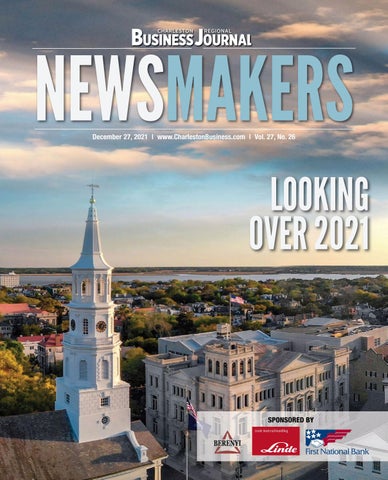
NEWSMAKERS December 27, 2021 | www.CharlestonBusiness.com | Vol. 27, No. 26
LOOKING OVER 2021
SPONSORED BY
TRUSTED. WORLDWIDE.
NOW MADE IN CHARLESTON, SC
Contact your local dealer, IPW Lift Techs today! Visit
lindeforklifts.com/ipw
LOWCOUNTRY NEWSROOM Executive Editor - Andy Owens
W
aowens@scbiznews.com • 843.849.3142 Editor, Custom Publishing Division Steve McDaniel smcdaniel@scbiznews.com • 843.849.3123 Staff Writer - Teri Errico Griffis tgriffis@scbiznews.com • 843.849.3144 Research Specialist - Paige Wills pwills@scbiznews.com • 843.849.3125
Andy Owens Executive Editor
News Editor - Alexandria Ng ang@scbiznews.com • 843.849.3124 Digital Editor - Rob Lyle rlyle@scbiznews.com • 843.849.3119 MIDLANDS NEWSROOM Editor - Melinda Waldrop mwaldrop@scbiznews.com • 803.726.7542 UPSTATE NEWSROOM Editor - Ross Norton rnorton@scbiznews.com • 864.720.1222 Associate Editor, Custom Publishing Division
NOT THE BEST OR WORST
hen we started out 2021, we had high hopes for a year that would handedly outshine 2020. Expectations didn’t even have to be too high to top the lows of the prior 12 months. Alas, we’re about to turn the calendar and start another trip round the sun, and we still haven’t gotten back to pre-pandemic levels, normalcy, socialization — yet we’re not doing that bad overall. The latest numbers from Daniel Island economist Steve Slifter in his annual forecast indicate that we’ve been living through a strong economy for the past 12 months with more positive numbers on the horizon. Demand continues to be strong in several sectors, including retail, commercial real estate, homebuilding, project development and others that provide the products and services for those areas of business. And while we can’t hire enough people to do the work, a lot of people are working either for companies or for themselves
as reflected by a low unemployment rate across the region and South Carolina. In the following pages, you’ll see a selection of the stories that defined 2021 in the Charleston area. Some articles tackle things that didn’t go quite to plan, and others highlight people and businesses that surprised themselves by coming up with innovative solutions to complex problems. None of us are doing business the way we imagined we would be prior to the pandemic, but Charleston and South Carolina continue to be great places to be in business. Thanks for reading Newsmakers. And a special thank you to our partners and advertisers who helped us publish this summary of a year that reminds us the path to progress isn’t always smooth... but it’s always interesting. Stay tuned, Andy Owens Executive Editor
Jim Tatum jtatum@scbiznews.com • 864.720.2269 Staff Writer - Molly Hulsey mhulsey@scbiznews.com • 864.720.1223 LOWCOUNTRY ACCOUNT EXECUTIVES Account Executive Amanda Alford aalford@bridgetowermedia.com • 843.849.3109 Group Publisher - Rick Jenkins
ABOUT THE COVER S R E K NEWSMA December 27,
lestonBus 2021 | www.Char
27, No. 26 iness.com | Vol.
LOOKING OVER 2021
The Four Corners of Law is one of the iconic spots for tourists and residents to take photos and gather. The intersection of Meeting Street and Broad Street includes St. Michael’s Episcopal Church, Charleston City Hall, Charleston County Courthouse and the federal courthouse.
rjenkins@scbiznews.com • 864.720.1224
OUR SPONSORS
Director of Advertising - Robert Reilly rreilly@scbiznews.com • 843.849.3107 Events Account Executive - Melissa Tomberg
SPONSORED BY
mtomberg@scbiznews.com • 864.720.1220 Events Manager - Kim McManus kmcmanus@scbiznews.com • 843.849.3116
SUBSCRIPTION INFORMATION
Accounting - Linda Burnette ar@bridgetowermedia.com • 704.247.2900 Subscription Services service@bridgetowermedia.com • 877.615.9536 CUSTOM MEDIA DIVISION Director of Business Development Mark Wright mwright@scbiznews.com • 843.849.3143 Director of Research Operations Ryan Wilcox rwilcox@bridgetowermedia.com • 843.849.3117
Charleston Regional Business Journal (USPS 18822) is published biweekly, 27 times per year, including one special issue in February, by SC Biz News. P.O. Box 446, Charleston, SC 29402. Periodicals postage paid at Charleston, SC. Mailing address: 1802 Dayton St., Suite 101, North Charleston, SC 29405. Postmaster: Send address changes to: Subscription Services PO Box 1051 Williamsport, PA 17703-9940
Annual subscribers receive 27 issues of the Business Journal including The Book of Lists and Newsmakers, plus four special supplements: Profiles in Business, Event Planning Guide, Market Facts, and Giving. One year (27 issues) for $57.95; two years (54 issues) for $92.95; three years (81 issues) for $ 129.95. Subscribe, renew, change your address or pay your invoice by credit card online at www.charlestonbusiness.com or call 843-849-3116.
NWS Company LLC A portfolio company of BridgeTower Media
The entire contents of this newspaper are copyright by NWS Company LLC with all rights reserved. Any reproduction or use of the content within this publication without permission is prohibited. SCBIZ and South Carolina’s Media Engine for Economic Growth are registered in the U.S. Patent and Trademark Office.
NEWSMAKERS 2021
From the 11.29.21 issue
Volvo readies for next stage of development in Ridgeville By Teri Errico Griffis tgriffis@scbiznews.com
V
olvo Cars’ Ridgeville plant is ready to ramp up production with a major hiring push, but finding the right talent as the company expands has been an ongoing challenge. When Volvo established its Lowcountry operations in 2015, the company looked to South Carolina as a robust manufacturing economy with experienced laborers. However, with a 3% unemployment rate at the time, majority of the experienced individuals were already employed, Berkeley County Economic Development Director Kristen Lanier said. Growing a new skilled workforce from the ground up has been a diligent process for the company, but both Volvo and the state are commited to making it work. Volvo Car Charleston Plant Manager David Stenström spoke about the company’s progress to a crowd of Berkeley County Chamber of Commerce members Nov. 19 at Trident Technical College. Stenström shared that he is optimistic that the labor challenges are short-term given South Carolina’s training solutions. Volvo’s Ridgeville plant produced 26,500 S60 sedans in 2020. (Photo/Provided) When one teacher off-the-cuff asked if Stenström would be willing to collaborate with facturing careers in K-12. U.S. and European markets. educators to find instructors for manufacturing The efforts to hire in-state are what sparked As a global company, the Swedish autoclasses, and also to help generate awareness in ManuFirst, a manufacturing training program local K-12 schools, the plant manager didn’t hes- motive manufacturer has two plant concepts: Volvo helped create curriculum for. Program produce 30 jobs an hour or 60 jobs. Sweden and itate to say yes, even if he doesn’t quite have the completion equals one year of manufacturing Belgium manufacture 60 cars an hour, which “how to” solution yet. experience. To-date, Berkeley County has paid accumulates to 300,000 cars a year. The goal for “I’m not worried that we will not find the the still up-and-coming U.S. and China plants is more than $400,000 in scholarships to county competence in the schools, especially with the residents to provide ManuFirst training, Lanier to reach 30 a day as soon as possible, Stenström universities,” he said. said. A strong talent pool will be needed for years said. The Charleston Regional Development Joining Volvo in 1995, Stenström relocated to come as Volvo works toward its production Alliance is another organization that works to capacity of 150,000 vehicles annually. Still ramp- to the U.S. from China in January 2021 to helm support Volvo, particularly bringing suppliers the South Carolina plant. He’s still getting used ing up to its goal, Ridgeville produced 26,500 to the cultural changes, particularly in the work- closer. David Ginn, CRDA president and CEO, vehicles from the S60 luxury sedan line in 2020, said it’s a dance of timing where production vola year plagued with pandemic-related and supply force. In China, employees worked 11-hour shifts, umes and investment level have to meet. chain challenges. Ginn said the CRDA has worked collectively six days a week and commonly sought overtime. Moving forward, Volvo’s ambitions are to with suppliers for years, but until the volumes Here in the U.S., especially in the Lowcountry, electrify 50% of the company’s fleet, with the are such that they can justify investment, they quality of life is sometimes prioritized over remainder coming from hybrid models. That might not come. “And these OEMs, they don’t work, Stenström thinks. means, on top of manufacturing the gas and South Carolina organizations are doing their want to ask the companies to come, because if hybrid versions of the S60, zRidgeville facility they fail then they’re liable to them potentially,” will produce two additional electric vehicle lines: best to bridge the labor gap and train workers, through technical colleges, trade schools, certifi- he said. the unnamed next generation XC90 and the Under Stenström’s lead, Volvo has seen an Polestar 3. The vehicles will primarily be sold in cation programs and planting the seed for manu-
OTHER NEWSMAKERS Super athlete Michael Jordan and actor Chris Pratt donated to Lowcountry Food Bank. The Avengers star fundraised for Feeding America through his Feed They Neighbor campaign, while Air Jordan donated proceeds from his ESPN docuseries, “The Last Dance,” to Feeding America and its food banks throughout the Carolinas and Chicago. “In these challenging times and in a year of unimaginable difficulty due to Covid-19, it’s more important than ever to pause and give thanks,” Jordan said. As a University of North Carolina grad, Air Jordan loves the Carolinas. (Photo/Provided)
4 Charleston Regional Business Journal | Newsmakers
increase in localization of suppliers, but ideally he’d like to see 90% of all materials used at the plant be produced in North America. “For me, you need to produce where you sell, but you also need to source where you produce,” Stenström said. Ginn likened the supplier situation to the Mercedes-Benz Vans plant in Ladson, where the company originally invested $40 million in Sprinter Van assembly. Vehicles were manufactured in Dusseldorf, disassembled and shipped to the U.S. South Carolina then reassembled the vehicles to reduce importing costs. Mercedes-Benz promised to invest another $500 million into an original equipment manufacturing facility once the plant reached volume, and true to its word, the company upped its commitment a decade later. “The same with Volvo,” Ginn said. “As sales grow, suppliers will feel comfortable coming.” Once there, the next step will be identifying key players that need to come to South Carolina. Battery producers for the electric vehicles are priority for Stenström. Currently, batteries are shipped from China to the U.S., which costs hundreds of millions of dollars. Manufacturing batteries nearby would not only be significantly cheaper, but less of a transport risk. Delivery also could shrink to a day or two. “You will see a lot of conversations in the future, talking localization from a headquarters point of view,” he said. To round out preparation on a county level, Lanier said Berkeley County needs to repopulate its warehouse product with sites that are ready for those suppliers. “The coronavirus actually expedited a lot of the real estate absorption that we saw last year,” she said of Berkeley County’s 3 million square feet of industrial space. “A lot of our premium spots along I-26, those speculative buildings were queuing up for Volvo suppliers that were taken down for distribution warehouses, and now we find ourselves trying to replenish and identify new spots for when Volvo suppliers do start coming.” Stenström has no doubts that Ridgeville will reach its goals. CRBJ
NEWSMAKERS 2021
From the 09.20.21 Issue
Soft skills help keep employees on the job By Teri Errico Griffis tgriffis@scbiznews.com
D
illon Lesniewski majored in history at Clemson University. He never expected the skills he learned to transfer to a successful career at a tech company, but after nearly five years of promotions, he is now a product owner at BoomTown, a real estate software company in Charleston. Lesniewski said people often judged his course of study, assuming he’d work at a museum or something artistic and unstable. But history is an underrated major, he said. During his four undergraduate years, he researched, wrote, debated, memorized and questioned in ways that translated well into the professional world. So what if he didn’t know the technology? Lesniewski knew he had the skillset to learn it, and that is what set him above the rest of the candidate pool — even those with relevant occupational skills. “People try to make a big deal that I didn’t study software, that I can’t code a website or build an API, but I don’t need to know everything,” Lesniewski said. “I just need to know what brings me to the table and recognize my own strengths, like interpersonal skills, patience and empathy. Those are what earned my seat there.” More and more, workforce experts are finding that soft skills have become critical indicators of individuals who can not only attain employment, but retain it. Technology companies like BoomTown and Blackbaud on Daniel Island know occupational skills can be taught, but flexibility, problem solving and whether an employee brings kindness and passion to their daily role cannot, said Stephanie Walker, Blackbaud’s vice president of talent acquisition “Organizations have grown to recognize that soft skills and higher emotional intelligence lead to greater success,” Walker said. “It’s not just about completing the task.” Monica Mutter, Blackbaud senior director for leadership and culture, said the focus starts in the interview process and whether the candidate can tell a story. “We ask candidates to describe how they’ve
don’t, and it’s important to recognize what you’re there for, versus what others are there for,” Lesniewski said. “I can put myself in the shoes of a 65-year-old real estate agent way better than our developers can. I know how to make a decision and how clients will react.” After years of pushing occupational training, and with 97,000 vacant positions statewide, South Carolina, too, is shifting its focus more equally toward soft skills. This summer, the S.C. Department of Employment and Workforce started a certification program to recognize six essential soft skills in the workforce: communication, digital literacy, problem solving, professionalism, teamwork and time management. Workers can self-lead or attend an instructional training to earn the S.C. Essential Soft Skills Certificate, said Michelle Paczynski, assistant executive director for DEW. Unlike other classes that people can attend and check off as completed, with the Essential Soft Skills training, attendees are assessed and must score at a specific level to earn the certificate, which companies Blackbaud employees volunteer at a food pantry. (Photo/Provided) throughout the state are starting to recognize. I knew that would translate to someone who handled different situations in the past and to “In a place where many companies still don’t share more about themselves and their interest,” could hold a conversation well with clients,” he know a year from now where they will be and said. Mutter said. “We look at how they articulate how they are going to operate, soft skills have Of a pair of candidates Lesniewski hired, that. It’s our chance to get to know the candidate become front and center for a candidate to be one came from a strong customer support back- considered for employment opportunities,” beyond the resume.” ground, but lacked interpersonal skills, while the Paczynski said. “To us, soft skills are the behavRegardless of the candidate’s background, other transitioned from food and beverage but Walker listens for whether someone is passionioral skills that are transferrable to most posiwas extremely congenial. The team expected the tions and are indicators of whether a candidate ate about helping customers or not, if they’re candidate with hard skills to flourish, but instead, could succeed with a company.” creative and work well with teammates or if she quit within a year. they’re goal-oriented. The pandemic has changed the workforce Never underestimate the power of a simple “These types of soft skills are paramount to landscape indefinitely — Blackbaud has since conversation, Lesniewski said. Even when he’s ensuring that the candidate is a good match for gone to a remote-first approach. As such, virtual making lunch in the office kitchen, talking to Blackbaud, and vice versa, that Blackbaud is a and hybrid workers must be able to adapt to someone about their dog or weekend plans, it’s good match for the candidate,” she said. ever-changing operating procedures. work. He’s building personal connections with Prior to his product owner role, Lesniews“At Boomtown, we had a successful employcoworkers. Those relationships not only make ki worked in BoomTown’s customer service ee come from a fashion background. The previhis work life more meaningful, but they create department and eventually became a team lead, ous support manager was an art history major,” a support system when he needs help. Now he’s hiring often for the constantly rotating team. Lesniewski said. “I don’t think what makes someno longer a random name in an email, but a con- one good is where they came from, but rather He ascribed to the same process of candidate nection that someone trusts. The same goes for evaluation. who they are as a person.” CRBJ conversations with clients. “If conversation flowed easily, whether a “The things that I bring to the table, others person was talking about their life or their skills, Reach Teri Errico Griffis at 843-849-3144.
OTHER NEWSMAKERS The College of Charleston Department of Athletics is getting a $14 million makeover at the Patriots Point Athletic Complex in Mount Pleasant. Improvements include updates to the baseball stadium, doubling capacity to more than 3,000, and to the tennis complex. The baseball team’s new, all-purpose field house will include a locker room for 45 players, training facility, team meeting and video room, an outdoor patio and club room for donors and VIP guests and more. The new tennis complex will feature a lounge area and porch with an outdoor kitchen and fire pit. (Rendering/McMillan Pazdan Smith Architecture)
6 Charleston Regional Business Journal | Newsmakers
Meet your future at the Lowcountry’s only Christian university. In addition to obtaining a solid background in communication, critical thinking, and reasoning – skills employers desire – choose a program in high demand such as financial management, business analytics, engineering, nursing, cybersecurity, computer science, education, and much more. 100% of new, entering freshmen are awarded an academic scholarship. CSU awarded more than $76 million in financial aid during the last academic year. A 13-to-1 ratio of students-to-faculty means small class sizes and a chance to interact directly with your professors. CSU is on America’s 100 Best College Buys, America’s Best Christian Colleges, and U.S. News Best Colleges lists. If you prefer an Online program, CSU offers one of the best in the country, according to U.S. News: No. 21 in online bachelor’s programs, No. 13 in online bachelor’s programs for veterans. Experience the thrill of game day with Buccaneer athletics, playing at the NCAA Division 1 level, while enjoying the advantages of a small university.
INTEGRATING FAITH IN LEARNING, LEADING, AND SERVING Learn more at charlestonsouthern.edu or call 843-863-7050 CH A R LE S TO N SO U TH E R N U N IV E R S IT Y
C S U N IV
CH A R LE S TO N SO U TH E R N
NEWSMAKERS 2021
From the 07.26.21 Issue
Boat sales surge as shortages delay deliveries By Teri Errico Griffis tgriffis@scbiznews.com
Falcon Boats in Newberry is South Carolina’s only bass boat builder. (Photo/Provided)
W
ith the pandemic forcing people to find isolating, outdoor activities, boat sales have skyrocketed over the last two years across South Carolina. Sportsman Boats in Summerville is producing nearly 400% more units compared to pre-pandemic levels, and the manufacturer is still struggling to keep up with soaring demand. “With COVID, everyone could safely be on the water, be with their family, be outside,” said Katie Barrow, the company’s marketing coordinator. “Boat sales exploded… It’s been shocking.” A few years ago, the company could complete two boats a day and keep up with orders. Now they’re up to eight, and sales haven’t stopped. The accelerated interest in outdoor activities combined with labor and supply chain shortages and shipping delays over the last year have pushed South Carolina’s $5 billion boating industry to its brink. Manufacturers can’t keep up with staggering spikes in demand, and companies have even begun trading supplies with one another to help get product out the door.
When parts of Texas froze over in February, the cold crippled one of the country’s largest resin resources — a critical element to building boats. Barrow said Sportsman, which manufactures center-console family fishing boats, called competing companies to trade excess resin for foam, engines and other urgently needed items. “Any item on a boat, there’s been a shortage of this year,” she said. Falcon Bass Boats in Newberry, even with a niche market as a two-seater fishing boat, has shared a similar experience as they record alltime high sales. “The reality is the boat industry, we’re good people. We like each other, we get along with each other,” said Falcon’s director of marketing Lisa Waller. “So yes, we make those phone calls to share the things that we have in order to help everyone to get boats out the door.” Like every other industry, Sportsman and Falcon had no idea what to expect when the country shut down in March 2020. Both companies kept on employees with pay while they waited, and Sportsman has since been desperate-
ly hiring to keep up. “Supply chain issues have been huge, huge barriers and disruptions for us,” Waller said. “If we had every access to everything we needed when we needed it, we would definitely be far, far ahead of where we were last year.” On average, a Falcon boat takes nine days to build from start to finish, with five-to-six sent out the door each week. But near-complete boats have been sitting, waiting for UPS and FedEx to deliver final pieces, Waller said. Lee Falls, a sales professional at Palmetto Boat Sales in Charleston, said in his 20 years in the business, he’s never seen a demand for boats this high with people coming in every single day ready to buy something. Tim Long, general manager of Long’s Marine Center, is seeing similar activity in Anderson. “Anything having to do with the outdoors, there’s a high demand for it now,” Long said. “It’s not just boats. Trucks, RVs, motorcycles, jet skis, ATV, everything, anything that’s got to do with outside, everybody’s in short supply of.”
OTHER NEWSMAKERS In Robert Jordan’s Wheel of Time fantasy novels, several main characters come from a place called The Two Rivers, and if you think that’s a euphemism for the Ashley and the Cooper, you’d be right. Jordan, whose series of books launched as an Amazon original production this year, was really Jim Rigney, Charleston resident and Citadel graduate who weaved a tale while living between the actual two rivers. The Citadel keeps The Wheel of Time in the Rare Books Room in the Daniel Library on Campus. (Photo/The Citadel)
8 Charleston Regional Business Journal | Newsmakers
Prior to March 2020, new boat orders took between eight and 12 weeks to fulfill, Falls said, but six months is a more reasonable timeframe these days. “Motors are anywhere from four months to a year depending on the brand and horsepower you’re looking at. Even boat trailers are two months out,” Long said. In typical times, every boat the companies plan to manufacture is claimed as a slot for a dealer to sell. In these demanding times, Barrow and Waller said slots are bought before the boat is even built, making almost every product a custom order. Waller recently posted an unfinished Falcon boat on Instagram and received dozens of dings that day asking if the vessel was available for purchase and where. “The boat was in production and hadn’t even left Falcon, and already people were clamoring for it,” she said. Barrow foresees this trend continuing for the next year at least. The National Marine Manufacturers Association reports the Palmetto State already has more than half a million registered boats and ranks seventh in the U.S. in boat ownership, with one in 10 South Carolinians owning a boat. “I think an interesting part of COVID was people realizing what’s important to them, so because our boats are built for families, that trend is going to stay strong,” Barrow said. Since its opening in 2011, the Summerville company has grown to 350 employee and more still needed. Barrow sees hiring as an opportunity for Sportsman, when so many other companies have had to lay off employees. “It was just very scary to watch an uncertain time where people worried they might get laid off, they might not find another job,” she said. “And then for this company to say ‘We’re hiring. Please come apply here,’ it was really neat. I mean, it saved me. It’s just such an opportunity to be a company who is able to offer more jobs for the Charleston area.” CRBJ Molly Hulsey contributed to this report.
8 Licensed Professional Surveyors • 17 Survey Crews Latest Trimble Robotics and GPS • LEED AP Professional Staff Charleston County “SBE” Certified • 3D Laser Scanning • Power Generation • ALTA/NSPS Land Title Survey • Boundary • Construction Staking • Dock Permits • Residential
Charleston | Georgetown
• Commercial • Aviation • Topographical • Landfills
8 43.554.7777 | www.plssc.com
NEWSMAKERS 2021
From the 04.19.21 Issue
Leatherman Terminal expected to drive SC business By Teri Errico Griffis tgriffis@scbiznews.com
The Yorktown Express was the first ship to call on the HLT in April. (Photo/Kim McManus)
C
completion of Phase One of the Hugh K. Leatherman Terminal happened at the exact moment the industry needed it, said Barbara Melvin, COO of the S.C. Ports Authority. “In life sometimes you don’t hit the timing well but in this instance, we are really bringing this infrastructure online, not only when we need it, but when the industry really needs it,” she said. After permitting for the terminal began in 2003, SCPA President and CEO Jim Newsome said it was heartening to see the first phase come together in April. “Fortunately, we have been growing above our forecast in the last 10 years so we were able to adjust when to bring the Leatherman Terminal online,” he said. That the HLT opened this year is monumental not only for the state, but for the country, which Newsome said hasn’t seen a new terminal built since 2009. With the port recording record volumes almost monthly throughout 2021, the Port of Charleston is almost at capacity, creating
an even more urgent need for the HLT. Without the Leatherman Terminal, the SCPA in entirety would have capacity for 2.8 million TEUS — an industry measurement equivalent to a 20-foot container. “If you look at our capacity today, we need this. We need the extra cranes, extra lift machines, extra storage capacity,” he said. Phase One of the HLT’s three phases adds 700,000 TEUs of capacity, and by full build-out will be able to handle 2.4 million — as much as the Wando Welch Terminal. The goal is to eventually move four weekly services over to the HLT, relieving about 30% of container volume from Wando Welch. As part of the 286-acre project, Phase One equipment includes five ship-to-shore cranes that at 169-feet high are some of the tallest on the East Coast. The cranes also have an outreach of 228 feet, allowing the Leatherman Terminal to service ships as big as 20,000 TEUs. “We’ve been saying really since the day I got here, this is going to be a big-ship industry. I
think it’s emerged in a way that even none of us could have imagined,” Newsome said. “So this infrastructure is very much responsive to that. Everything we’ve done is responsive to that.” Additional SCPA projects for 2021 include refurbishment of the Wando Welch Terminal, expansion of Inland Port Greer and the Charleston Harbor Deepening Project. To allow the massive, post-Panamax ships to arrive at HLT without having to ride the tides, the Army Corps of Engineers has been dredging the harbor for years to bring it to adepth of 52 feet — a record for any East Coast port. Fully built out, the Hugh K. Leatherman Terminal will have cost nearly $2 billion, funded primarily through revenue bonds, the port said. “We’ve borrowed a lot of money, but we knew we needed to do that. We planned for that and we’re well within our planning target,” Newsome said. In March, the Port of Charleston reported record cargo numbers, and Newsome said 2021 could potentially bring about the largest operat-
OTHER NEWSMAKERS In May, Breeze Airways launched out of Charleston International Airport with $39 flights to 11 markets, seven of which have never been offered from the Lowcountry. The airline was founded by David Neeleman, co-founder of JetBlue. “For the leisure traveler this means more direct connections to wonderful locations at unbelievable fares. And for business travelers, it opens up new markets,” Elliott Summey, Charleston International Airport CEO said. It could be said that David Neeleman, co-founder of Breeze Airways and JetBlue, has a favorite color for his planes. (Photo/Provided)
10 Charleston Regional Business Journal | Newsmakers
ing cash flow in the history of the port. “We need all that to continue to invest,” he said. “That’s really the name of the game. All of our operating cash flow goes into reinvestment of facilities.” Raising a capital investment of the HTL’s size was one of the most complex aspects of the project for Newsome, but he thinks the multipliers will make the investment worth it. “A terminal like this is a magnet for distribution businesses and manufacturing businesses,” he said. “I think the balance of that has shifted a little bit from distribution to manufacturing.” The terminal also creates jobs that fill the residential real estate market, Melvin said. “You can just literally trace the trickledown economics of an investment of this magnitude,” she said. With so much work on the waterfront, Newsome added that this terminal will allow a lot more staff growth because the SCPA is not automating. The choice was obvious, he said, given the great workforce in Charleston. Newsome and Melvin credit much of the HLT’s success to the workers. The engineering team delivered a billion-dollar project on time and under budget while project managers helped coordinate every aspect of the Hugh K. Leatherman Terminal’s development. Everyone’s role is essential at the SPCA, Newsome and Melvin said, whether a heavy lift maintenance worker, security, IT staff or facilities maintenance. “Everyone had something to do with it… You don’t do anything as individuals here. Everybody is involved,” Newsome said. More than a thousand contractors put their footprints on the terminal and Melvin said it was a privilege to stand at the port on opening day on behalf of the 10,000 peole in the maritime industry who contributed. “I can’t even put into words what this team has done…. All those people whose names you won’t know, but whose faces and skill are going to be what makes this terminal work so well and really solidify our position in as one of the top 10 ports in the U.S.,” Melvin said. CRBJ
NEWSMAKERS 2021
From the 05.31.21 Issue
Pro golf, tennis add millions in revenue to economy By Teri Errico Griffis tgriffis@scbiznews.com
Phil Mickelson celebrates winning the 2021 PGA Championship in May on Kiawah Island. (Photo/Darren Carroll/PGA of America)
P
hil Mickelson’s performance at The Ocean Course in late May won the 50-year-old pro his sixth major and the PGA Championship trophy. But the big winner might have been South Carolina’s economy. The largest event to take place in-person in South Carolina since the global pandemic ground the world’s economy to a halt, the PGA Championship is expected to bring millions directly into the Charleston region and signify that things are getting back to normal. Over time, professional sports events have become critically important to local and statewide finances as hundreds of millions of dollars pour into towns and cities through job creation, tourism and global exposure. Even with pandemic restrictions in place, the PGA showed millions of people that South Carolina was moving forward. Kiawah Island Golf Resort President Roger Warren called the publicity “priceless.” The state has grown beyond its historically minor league and college sports persona, beyond
its status as only a recreational golf destination with its more than 350 courses and hundreds of year-round events. In a time where fewer fans were attending events and people aren’t traveling as much, South Carolina will be showcased to more than half a billion households worldwide. “I think that we as an industry here in South Carolina, specifically in Charleston and Kiawah, on our own, we couldn’t pay for the amount of quality exposure we get through the TV,” Warren said. Without a global pandemic causing chaos, the state typically plays host each year to three events by NASCAR, PGA Tour and Women’s Tennis Association. The attractions provide nearly $200 million in combined annual economic activity. So far in 2021, the state has doubled its event tally with the PGA Championship, PGA Tour and WTA calling on South Carolina to host three additional tournaments. In April, the Tennis Channel and WTA
Media broadcasted the Volvo Car Open and MUSC Women’s Health Open tennis tournaments on Daniel Island to more than 170 countries. In May, CBS, ESPN, the Golf Channel and other broadcast, cable and digital media platforms will air coverage of the 2021 PGA Championship to more than 175 countries. On average, the PGA Championship media value generates more than $100 million for the host site and region, according to the organization. “This allows us to play with some of the larger states that we haven’t been able to before because we are a small state still, but we have a lot to offer from the mountains to the sea, and golf is a big part of that,” said Duane Parrish, director of S.C. Parks, Recreation and Tourism. While the limited fan attendance will likely lower the what-could-have-been 2021 impact, the exposure is still desperately needed for a state that relies on tourism. “What we’re still going to see is people coming in and going to restaurants, using accommoda-
tions, heads in beds, so to speak,” said PGA Championship Director Ryan Ogle. “So there’ll still be a direct impact to the region.” WTA Chairman and CEO Steve Simon said both the staff and players’ cherish their time each spring in Charleston because of the city’s “A+” hospitality and professionalism. “The hospitality that’s provided and the warmth and everything else that comes with it just makes it a very special experience,” he said. “And we know that a lot of our players think Charleston’s one of their favorite stops of the year.” In the last two years, South Carolina has announced more than $23.5 billion in new investments that have created almost 46,000 jobs through various industries statewide. Gov. Henry McMaster believes that the state’s growing professional sports industry further develops economic opportunities that will benefit South Carolina for years to come. “This is great progress, and I expect that we will be seeing ourselves on television and in advertisements in sports channels wall-to-wall during the entire time of those three months,” the governor said. And those impacts go beyond the weeklong hotel stays and live action. Warren said that in 2012, after the PGA Championship wrapped up, the Lowcountry experienced a trickle-down effect for months. “Our businesses jumped from August 2012 to 2013, and we had a very significant exposure in our business,” he said. “Everyone felt it. So I feel there is some anticipation. That’s what I’m excited about.” Defending PGA Champion Collin Morikawa was equally excited talking about the tournament during an April visit to The Ocean Course at Kiawah Island. He said the May event was a “big star” on his calendar. “We’re peaking at a good time, and we’re really looking forward to this kind of next few months of golf because there’s a lot of good golf to be played,” he said. CRBJ Reach Teri Errico Griffis at 843-849-3144.
OTHER NEWSMAKERS Charleston billionaire businessman and philanthropist Benjamin Navarro added the luxury downtown hotel Charleston Place to his list of assets. His family office, Beemok Capital, acquired the hotel from Belmond, an international hospitality and leisure brand with a presence in 22 countries. This investment serves as the flagship asset for Beemok Hospitality, Beemok Capital’s new vertical focused on seeking out hotel, restaurant and entertainment assets across the Southeast. Signature bronze horse statues greet visitors at Charleston Place on Meeting Street. The Charleston hotel is being sold to Beemok Capital, which is owned by billionaire Benjamin Navarro. (Photo/Andy Owens)
Newsmakers | Charleston Regional Business Journal
11
NEWSMAKERS 2021
From the 06.28.21 Issue
Wheels up! CSU aeronautics program flight takes off By Teri Errico Griffis tgriffis@scbiznews.com
A
year ago, Harrison Hunt had his career mapped out as precisely as a flight pattern. He would study engineering at Charleston Southern University on his track to becoming a pilot. After graduation, he’d pay for flight school and join the Air Force before potentially flying commercial. The training would take years. Just as Hunt began his freshman year at CSU, the school launched the state’s first collegiate aviation program. The future pilot immediately transferred majors to the professional pilot program, bringing him that much closer to his future in only four years. This May, he made history as CSU’s first aeronautics student to perform a solo flight in a Diamond DA-20 aircraft . “I was like, this is what I want to do. I want to be a pilot. So I might as well do it now in college,” Hunt said. Hunt’s fast track to a job is not only significant for him, but for the aviation industry. Boeing predicts a global drop in demand of 41,000 pilots and 30,000 technicians in its 2020-2039 Pilot and Technician Outlook. CSU hoped it could attract interest from maybe a dozen students for fall 2021, but by June already had 31 have made deposits to enroll, with another four student transferring into the program. Col. CJ Will, founding chair of CSU’s Aeronautics Department, said 15 more were on the waiting list. “They’re all transferring into our programs because they want to come to Charleston,” Will said. Leading up to the program’s approval, CSU taught a private pilot course in the previous fall and spring semesters and flight safety in the spring, which led to Hunt’s solo flight. As part of a student’s certification, they are required to take two exams per Federal Aviation Authority standards: a written exam and a practical, also known as a check ride. CSU provides the ground training, preparing students for the FAA written exams through accredited college classes. The college then partnered with Craft, a local flight training and simulation school, to
CSU aeronautics student Harrison Hunt practices for a solo flight. (Photo/Teri Errico Griffis) manage flight training. Craft has locations at Charleston International Airport and Summerville Airport, and provides the certified flight instructors and aircrafts. Co-owner Amanda Aldea said Craft prioritizes training for CSU students and has formal reporting procedures for CSU. “It’s an administrative exercise in making sure the student meets what the FAA prescribes as their requirements, including a certain number of hours, flown solo, at night, cross country,” Will said. That’s in addition to a student’s regular college courses. But Hunt couldn’t love the rigors of the program more, calling himself a hopeless flying addict. CSU’s inaugural year has gone well from an administrative end as the first two semesters allowed CSU and Craft to work out the kinks financially and logistically. “We’ve basically tested the process and the system that need to be in place, because in the
fall we’re going to have 30 students show up,” Will said. “We want to make sure the curriculum was solid… and parts were in place to make sure that the students had the resources they need to succeed. And we’ve been able to do that.” Overall, graduates will earn their private pilot, instrument, commercial, multi-engine and certified flight instructor certificates and ratings, and more than 250 hours of flight time. To be hired by airlines, the FAA requires that a pilot have 1,500 total flight hours. Through CSU’s program, students can be hired at 1,000 hours of total flight time, reducing the time between graduation and being hired by up to two years. “Some may even finish (their hours) by the time we hand them their diploma and go directly to the airlines and start accruing seniority more quickly, get upgrades more quickly and get hired by the major airlines more quickly,” Will said. With travel picking back up, airlines are clamoring to fill pilot shortages and four of
OTHER NEWSMAKERS Kiawah Island saw record home sales as people all over flocked to the beaches and seclusion of the island community. This year also added a first with plans for a 62+ community, Seafields at Kiawah Island. Kiawah Life Plan Village Inc. closed on a 9-acre site from Kiawah Partners for the $180 million. Big Rock Partners, a national developer of luxury senior living who will develop the project, broke ground in September. Construction began on Seafields Sept. 15 with a ground-breaking event. (Photo/Patrick O’Brien)
12 Charleston Regional Business Journal | Newsmakers
Aldea’s certified flight instructors were recruited to work. “This is a good thing,” she said. “We train our CFIs up. They get their hours with us, and we know that’s the ultimate goal for them, to go on.” When the CSU program launched a year ago, Will was uncertain what the pilot shortage and pandemic-related travel disruptions would mean for airlines. Most in the industry thought there would be a two- to three-year lapse in aviation demand and that pilots wouldn’t be retiring immediately, Will said. “We’re already snapping back with the demand,” he said. “That V recovery from the airline industry is a very real thing.” So is program growth. If CSU continues to see numbers even similar to initial interest the program is going to need a lot more space. Aviation students split time studying at both the CSU campus and Craft facilities. Will’s threeyear goal is to find an all-inclusive facility, possibly 10,000 square feet, to expand the program. The site would include a CSU hangar, classroom and briefing space, storage and a maintenance area. Will has been actively looking with the county, state and FAA, particularly in Summerville and Moncks Corner, but space is limited, he said. “This is going to be one of the principles of the program as we grow,” he said. “The last thing I want is to have 30 students this year and 12 the next because we can’t accept them with facility limitations and space.” With more room to grow, CSU will not only train pilots, but future maintainers, engineers and leaders. Combined with Trident Technical College’s aviation maintenance program, graduates could ideally feed into Boeing, Lockheed Martin and more regional businesses. Growth is imminent and the college’s success is only breeding more and more interest. “We will become a center of gravity in aviation, not just educationally, but from a business and a government standpoint, too,” Will said. CRBJ
Reach Teri Errico Griffis at 843-849-3144
TRUSTED. WORLDWIDE.
NOW MADE IN CHARLESTON, SC CLEAR OVERHEAD GUARD Provides the operator with zero obstructions Substantially increases operator confidence Facilitates on-boarding
LOWEST STEP HEIGHT
MULTI-FUNCTION CONTROL HANDLE
Ergonomically designed with a low workspace entry point, allowing smoother transitions on and off the platform Low step height decreases trips and falls Keeps operators more productive and less fatigued with less strenuous movements
- Stationary handle allows for solid 4-point stance - Thumb tiller for travel, reduces wrist movements - Keeps operators feeling attached to the truck at all times
UNIQUE CLAMP DESIGN Automatically clamps and centers pallets Fits any stringer, ranging from 1-5 inches Eliminates the need for standardized pallet or workarounds
Contact your local dealer, IPW Lift Techs today! Visit
lindeforklifts.com/ipw
NEWSMAKERS 2021
From the 11.01.21 Issue
S.C. Ports Authority names new CEO as Newsome steps down By Teri Errico Griffis tgriffis@scbiznews.com partnership and visionary leadership sets S.C. Ports up for continued success.” Since she began working with the SCPA in 1998, Melvin has served in a number of roles, including as senior vice president of operations and terminals in 2015. As COO since 2018, Melvin oversees the port’s daily operations and major infrastructure projects. “I am grateful and I am ready,” Melvin said. “With the guidance of our Board, the skill and talent of our team, the solid experience within our maritime community, and the support of elected, business and community leaders, S.C. Ports will achieve enhanced growth benefitting the state, region and nation. To our customers, we thank you, and please know that with additional opportunity, we will earn prosperity together.” With the opening of the Hugh K. Leatherman Terminal, the Charleston Harbor Deepening almost complete and the announcement of her new role, Melvin has had a memorable 2021. In March, she was also named Woman of the Year by the S.C. Manufacturers Alliance. As one of the only women serving as COO of a U.S. port, Melvin said at the time it was one of the most emotional awards of her career. The future CEO saw the recognition not only as an earned award, but as a calling to encourage more women into the fields of transS.C. Ports Authority COO Barbara Melvin is set to replace Jim Newsome as CEO and President in July. (Photo/Provided) portation, engineering and manufacturing. “I am looking forward to the day when there bution center, our handling of record-breaking of S.C. Ports when he joined in 2009, assuring fter 13 years, Jim Newsome will be stepping volumes during a global pandemic, and the open- are not awards recognizing women in their field S.C. Ports continues to flourish as a top 10 U.S. down as CEO and President of the S.C. because it will no longer be notable, but rather ing of Leatherman Terminal, the first container Ports Authority, and COO Barbara Melvin, container port. Under his great leadership, we there will be awards that recognize women pureterminal to open in the U.S. since 2009.” will step in to the role making history as not only have seen significant growth at the port and at ly for their work and contributions,” Melvin said. During Newsome’s time with the SCPA, he port-dependent businesses around the state.” the first female CEO of SCPA, but of a top 10 As the soon-to-be first CEO of a top 10 U.S. Newsome, who was inducted into the Inter- has grown the port’s cargo base, overseen the U.S. operating container port. port, Melvin is already living up to her words. The announcement came at the 2021 State of national Maritime Hall of Fame on Oct. 5, said it doubling of cargo volumes over a decade and “I have always said it is great people who led key infrastructure projects, in particular the the Ports on Oct. 18 after the board unanimously has been an honor to serve as the CEO of South make a great port, and we are fortunate to have Charleston Harbor Deepening Project that will Carolina’s major port, and he will continue approved the leadership change earlier in the the best maritime community and team at S.C. allow the SCPA to welcome some of the largest day. Melvin, who has served with the port for 24 to serve as an executive advisor following his Ports. It is truly a great sign of success to name a ships traveling to the East Coast. years, will transition as the sixth leader on July 1, retirement. Even with Newsome’s large shoes, Stern has successor within your own team,” Newsome said. “We have worked together to cultivate a following Newsome’s anticipated retirement the highly competitive, world-class port that contin- no doubt that Melvin will continue to build upon “Barbara Melvin will continue to build on our day before. success, ensuring a very bright future for S.C. the port’s success over the last decade. ues to grow above the market,” Newsome said. “Jim Newsome has truly made a significant Ports and for South Carolina.” CRBJ “It is not often that two impressive leadand lasting impact on South Carolina’s economy “This past year has been one of my proudest as ers work so well together over many years to we have achieved major successes, including and supply chain,” S.C. Ports Board Chairman achieve a shared vision,” he said. “Their great Bill Stern said. “He led a major turnaround effort Walmart investing in a near-port import distriReach Teri Errico Griffis at 843-849-3144.
A
OTHER NEWSMAKERS Google greeted the summer travel season with its Complete Google guide to summer 2021 that suggested the top 10 trending vacation spots in the U.S. based on Google search data. Mount Pleasant came in at No. 4, and Google highlighted three hidden gem restaurants based on data from Google Maps, including The Pickled Palate, Pattaya Thai Restaurant and The Shellmore. A sunset view overlooking Shem Creek. (Photo/Kim McManus)
14 Charleston Regional Business Journal | Newsmakers
NEWSMAKERS 2021
From the 05.03.21 Issue
Upper King climbs back from pandemic vacancies By Teri Errico Griffis tgriffis@scbiznews.com
Charleston’s King Street bounced back from a pandemic lull with more than 30 businesses opening as of early 2021. (Photo/Provided)
D
owntown Charleston’s favorite street is as resilient as ever with occupancy on Upper King now higher than it was in fall 2019. In March, Charleston performed an occupancy update, comparing the current market year-over-year. In total, occupancy rose seven percentage points to 87% as more than 30 businesses, including Insomnia Cookies and Ethos, have opened on King Street since the pandemic started in March 2020. For Middle King Street, which is Calhoun Street to Market Street, and Lower King Street, which is Market to Broad Streets, those areas also have stabilized over the last few months, Charleston Director of Business & Neighborhood Services Division Meg Thompson said. Moving forward, the city is no longer seeing the decrease in occupancy initially spurred by pandemic. “What we tried to do was put things in perspective — it’s not just King Street that is going through this, every major shopping district in the country is,” Thompson said. “When I talked
to other cities about where we’re at and what we’re seeing, they’re seeing pretty similar things and they’re honestly a little bit jealous of how well we’re doing.” Thompson started in her role a little more than five years ago, when King Street was at a high occupancy point. She admitted the early pandemic numbers caused a little panic at first, but fer more tenured colleagues reassured her that King Street has always had a cyclical nature. In summer 2020, the street had a high of 63 vacancies. Since then, the numbers have been coming down with 53 vacancies as of winter 2021, Thompson said. Agent and Broker at Keller Williams Realty Charleston in Mount Pleasant Josh Schaap said he too is seeing very positive signs. “You can walk down the street, and your eye may be drawn to the for sale and lease signs, but what you’re not seeing are the blisters on my heels from doing three tenant tours a day every other day because demand is back,” he said. Schaap, who has been in the industry for 15
years, added that he has letters of intent to lease various King Street properties, and people are coming from all over the country, particularly lockdown states, to look at real estate. Clients in particular include chefs who are looking to relocate to cities with fewer restrictions for hospitality and more street space. “Make no mistake about it — there is corona fallout for sure,” he said. “But we went down in a deep trough, and now we’re finally climbing out.” Schaap predicts that around the corner there’ll be a healthy mix of national fashion and apparel stores, soft goods retail, spas, Pilates and yoga studios, and service-oriented retail that will rejuvenate Charleston’s famous street. On Upper King, Thompson said local property owners have put in a lot of work to keep their tenants or bring in new ones. “The trend historically is development has moved north up the street,” Thompson said. “Of the three, Upper King is kind of the newest area, so it makes sense that since it was already
OTHER NEWSMAKERS The International African-American Museum saw donations from the NFL, Mackenzie Scott and Sony. The Tokyo-based company gifted the IAAM $1.7 million in products to support the Atlantic Worlds Gallery and other aspects of the Charleston museum. “Diversity is built into Sony’s DNA… and this donation translates that vision into action,” President of Sony Corp. of America Mark Khalil said. The International African-American Museum is set to open in 2022. (Rendering/Provided)
16 Charleston Regional Business Journal | Newsmakers
developing and in transition that it would keep doing that.” Several national stores have pulled out of leasing some of Middle King’s bigger spaces, but the area is going strong, enhanced by the Shop Middle King initiative. Local businesses like Croghan’s Jewel Box, M. Dumas & Sons, Shoes on King and more banned together early in the pandemic to promote each other on social media. Of the current businesses on King Street, local business inhabit 73% of Upper King Street, 68% of Lower King and 40% of Middle King. “A lot of national chains shrunk back during the pandemic, but they were honestly doing that prior to the pandemic as retail was changing and online shopping was blowing up,” Thompson said. Schapp reiterated that the pandemic exposed the cracks that already existed with a lot of the older chains, such as J. Crew, Talbots and Joseph A. Banks that were in debt. What he expects to see around the corner is the same line of retail, but new clients that are trending more popular. Additionally, national brands like Untuckit still want a storefront, but are leaning toward smaller spaces where clients can come in, see and feel the product and try it on — and then go online to view a larger selection and buy from the convenience of home. “A lot of what I think, I hope, will start bringing people back to King Street and Main Streets around the country is that people want the experience,” Thompson said. “They want to go in and do something and be with other people. I think there is always going to be a draw to having a Main Street district no matter what’s going on with online shopping.” The return of tourists this summer, along with College of Charleston students in the fall, will further play a part in bringing more life to King Street, Thompson said. “That kind of consistent customer base who’s going to go out for lunch or on the weekends will really help keep the street active throughout the year,” Thompson said. CRBJ Reach Teri Errico Griffis at 843-849-3144.
NEWSMAKERS 2021
From the 03.22.21 Issue
Lights, Camera, Attraction
Film industry offers jobs, tourism, worldwide exposure for Palmetto State By Teri Errico Griffis tgriffis@scbiznews.com
employee raises, and of course COVID changed things,” Parrish said. As studios wrap up projects they postponed in 2020 and prepare for productions slated for 2022, they’re looking to whatever states still has incentive money, said Senior Vice President, Production and Incentives for HBO/Warner Media Jay Roewe. “I think it’s a unique year for people and a unique opportunity if South Carolina were to increase their incentives. More production will come to South Carolina,” Roewe said. “There’s no question in my mind.” Given HBO’s success filming in South Carolina, Roewe said the premium channel is invested in the incentive budget growing not only because the rebates save money, but because they help grow business throughout the state. “Studios create jobs and put people to work. When we bring a film production to [a state], we touch so many aspects of the economy from hotel and restaurants and food to construction, caterers, truck drivers, security,” Roewe said. HBO film crews set up a shot for The Righteous Gemstones with actor Danny McBride. The popular show filmed its second season in the Charleston area. (Photo/Fred Norris, HBO) Since 2005, film and television productions in South Carolina have generated $338 million s Ray Kinsella wanders his corn fields in the between 2012 and 2019, according to the Caroli- $181 million per fiscal year. in in-state spending and resulted in more than Once Netflix finishes filming its Lowcoun1989 film Field of Dreams, he hears, “If you na Film Alliance. That’s equivalent to the cost to 272,150 hotel nights and 35,736 state hires, try-heavy TV series Outer Banks and HBO build of Volvo Cars’ Berkeley County plant that build it, he will come.” according to the Carolina Film Alliance. wraps up The Righteous Gemstones with Danny produces 100,000 vehicles a year. He turns to place the voice, which floats Across the border in Georgia, the 234 film McBride, South Carolina’s budget is depleted, Incoming projects for 2021 will increase as from Greenville native “Shoeless” Joe Jackson, and television productions that filmed there state location scout Linda Lee said. In fact, the nationwide production companies like HBO and but Kinsella stands alone. fund is about $3 million short of the total it owes during fiscal year 2020 spent $2.2 billion in the Netflix explode out of the pandemic with double His gut tells him to build “it,” and he must state, according to the Georgia Department of back to the studios. the content, catching up on all projects. decide between playing it safe and giving it up Economic Development. S.C. Department of Parks, Recreation and South Carolina will miss out on the opportuor going all in. The risk is high, but the outcome While South Carolina productions still have nities, however, with only $16 million to lure in Tourism Director Duane Parrish said South could be life-changing. to pull in crew from North Carolina and Georgia Carolina’s small budget is caught in the middle film projects each year. South Carolina faces the same quandary, to round out projects, Roewe said the talent here South Carolina is one of more than 30 states between states with no incentives and poweronly the voices are less a whisper and more a is “level-A” and handle HBO’s high expectations houses like Georgia, which has gone all in with that offers incentives to studios to film in-state. shout from the rooftops assuring if the state and demand for its crews. invests more in the movie industry, the business Some like the Carolinas offer cash rebates, while full infrastructure, studios and upwards of $700 If it weren’t for the ability to use in-state million annually in tax credits. others, like Atlanta, offer tax credits. will come. workers, studios would have to fly in crew, put Parrish also believes part of the reason Productions earn cash back when they spend Since 2019, studios reached out to film 44 them up in hotels and give them a per diem. that the film industry hasn’t received any more a minimum of $1 million in the Palmetto State television and motion pictures in the Palmetto “We are very big fans of South Carolina,” money since the incentive program’s inception in — be it through crew, extras, actors or vendors. State, but walked away because South Carolina the early 2000s is that the state tends to prioritize Roewe said. “Working with the Film Commission The system offers a 20% return on out-of-state had neither the incentive money nor the infrahas been a very positive experience to us, along money for other projects. structure to support their business, the S.C. Film wages, 25% on out-of-state suppliers, 25% on with discovering the talented crews there.” CRBJ “We have had some years in legislature in-state wages and 30% on in-state supplies. Commission said. where there’s been additional money, but typIn comparison to the Palmetto State, North Those missed opportunities amounted ically you hear a lot about teacher’s pay, state Carolina offers $31 million and Louisiana about to roughly half a billion dollars in state spend Reach Teri Errico Griffis at 843-849-3144.
A
OTHER NEWSMAKERS Credit One Bank committed to a multi-year title sponsorship with Charleston Tennis LLC, serving as the new title sponsor of the Women’s Tennis Association 500 tennis tournament, as well as the stadium located at the LTP Daniel Island tennis center. On a yearly basis, this tournament brings in about 90,000 spectators and generates about $30 million for the Charleston region. Credit One Stadium is set to debut with renovations in early April 2022. ( (Photo/Provided)
18 Charleston Regional Business Journal | Newsmakers
Scott Adams, CCIM
Blair Belk, CCIM
Johnny Bevon, CCIM
Alan Bolduc, CCIM
scott@adamswilsondevelopment.com
blair.belk@belklucy.com
Brent Case, CCIM
Gary Catterton, CCIM
bcase@cbcatlantic.com
gacatterton@ccim.net
Adams & Wilson Development 843-216-9990
Coldwell Banker Commercial Atlantic 843-725-6255
Belk/Lucy 843-709-9292
Catterton General, LLC 843-766-1600
Simons R. Johnson, CCIM
Mary Ann Kanters, CCIM
simons.johnson@bridge-commercial.com
maryann@ascend-real-estate.com
Bridge Commercial 843-557-4047
Richard Morse, CCIM
Palmetto Commercial Properties, LLC 843-577-2550 richard.morse@pcpsc.com
Shea Robbins, CCIM Carolina One Real Estate 843-217-0530 srobbins@carolinaone.com
Elyse Welch, CCIM Carolina Retail Experts 404-358-4259
Elyse@carolinaretailexerts.com
Ascend Real Estate 843-608-8252
Agent Group Realty 843-478-5859
Trad Dyches, CCIM
Chris Fraser, CCIM
Kelley Glenn, CCIM
Trad.dyches@pcpsc.com
chris.fraser@avisonyoung.com
Joe Keenan, CCIM joe.keenan@pcpsc.com
Palmetto Commercial Properties, LLC 843-577-2550
Palmetto Commercial Properties, LLC 843-577-2550
jowens@naicharleston.com
mrose@cbcatlantic.com
George Wilson, CCIM
Adams & Wilson Development 843-216-9990
george@adamswilsondevelopment.com
charles.carmody@cbre.com
alan.bolduc@avisonyoung.com
john@cre.expert
Mike Rose, CCIM
eddie.buxton@pcpsc.com
johnny@bevonre.com
Jack Owens, CCIM
Coldwell Banker Commercial Atlantic 843-224-1533
Charles S. Carmody, CCIM
Palmetto Commercial Properties, LLC 843-478-0346
John Orr, CCIM
Carolina Retail Experts 843-801-6900
J. Edward Buxton, CCIM
Avison Young 843-860-9566
NAI Charleston 843-696-7653
Avison Young 843-725-7200
Lee & Associates Charleston 843-696-5533
Miles Martschink, CCIM
David Maybank, III, CCIM
Michael G. McFall, CCIM
miles@cctre.com
Dmaybank3@maybankproperties.com
mmcfall@maybankproperties.com
Jenna Philipp, CCIM
Robert Pratt, CCIM
jenna.philipp@pcpsc.com
robert@robertpratt.com
CCT Real Estate Services 843-414-4078
Bryan Perrucci, CCIM
Southeastern Management Group, Inc. 843-343-1921 perrucci@semgsc.com
KelleyGlenn@CCIM.Net
Maybank Properties 843-720-9201
Palmetto Commercial Properties 843-259-8724
Gerry Schauer, CCIM
Will Sherrod, CCIM
tsadler@sadlergroup.net
gerry.schauer@avisonyoung.com
wsherrod@naicharleston.com
Avison Young 843-364-2055
Chad Yonce, CCIM
Cameron Yost, CCIM
yonce@semgsc.com
cyost@lee-associates.com
Southeastern Management Group, Inc. 843-343-1923
Discover why only 5% of all commercial real estate professionals hold the elite CCIM designation.
Pete Harper, CCIM
SC Chapter President The RMR Group 706-202-4327
Thomas Sadler, CCIM
Sadler Group of Charleston LLC 843-766-0261
CBRE, Inc. 843-577-1155
Lee & Associates, LLC 843-203-1105
NAI Charleston 843-364-3796
pharper@lee-associates.com
Maybank Properties 843-740-9202
Re/Max Pro Realty 843-576-2705
Drew Showfety, CCIM
Palmetto Commercial Properties 336-253-6386 drew.showfety@pcpsc.com
Jeff Yurfest, CCIM
The Shopping Center Group 843-532-8706 jeff.yurfest@tscg.com
CALL YOUR LOCAL CCIM.
NEWSMAKERS 2021
From the 11.15.21 Issue
Paint supply drying up under pandemic push By Alexandria Ng ang@scbiznews.com
asking for or to even stock up for a little more than immediate demand. For Waylon Cain, owner of West Ashley True Value in Charleston, his crew of eight employees are working hard to meet orders, for paint and for other hardware requests that come into the store as well. “I spent four nights past midnight here,” As customers find more time and resources for home renovations, the demand for paint has increased, sparking a shortage for materials nationwide. Cain said, adding that as a small business, “I can’t (Photos/Teri Errico Griffis) compete with the big buys with employees. I don’t when they themselves have run out, he said. “I can call my rep and say we need 30-40 have the night crew to do it for me.” hen the pandemic quarantine period kept “It’s never been more critical in my time in gallons of paint, so she’ll get on the phone, and Because West Ashley True Value functions millions of people looking at the interior paint, and what I mean by that is there’s a lot we’ll start looking around, but now I’ve got to as an independent store, Cain buys from multiple of their homes, renovations around the of problem-solving that our local sales reps are vendors. Costs have gone up, but he’s tried his house that would normally be placed on the back drive from Columbia to Aiken or Rock Hill or Camden, or just go to four different stores just to doing all over the country, and certainly in South best to keep prices low for customers. burner finally had their moment in the sun. Carolina to help ensure that our franchisees and round it up,” Brooks said. “Generally speaking, “We’re trying our best for finding smart More than a year later, renovations remain our customers have all the product that they we can find the paint, it’s just a lot of time in ways to purchase,” Cain said. “Our goal is to keep strong as lingering effects of the pandemic have need,” Rychley said. order to get there.” the community. This is my neighborhood; I take popularized the work-from-home model, in Rychley said the company is up 40% on client care of it.” Since Sherwin Williams, partner of 360 addition to other reasons as to why Americans inquiry leads and paint estimates. This paralPainting, has been charging a 15-20% uptick for Cain said he is learning as he goes about may find themselves with more time and funds lels national numbers as international industry materials, that same price raise had to be passed maintaining that balance in keeping customers to allocate to home-office upgrades. market research company The Freedonia Group happy and mitigating rising costs. Cain said he on to the customer, Brooks said. Across the country, paint suppliers are reports a 39% national spike in home renovation spends about $300-$500 a week at Lowe’s or Brooks said that hasn’t deterred patronage, struggling to keep up with increased demand as activity in 2020. Consumers surveyed credited Home Depot, which he said generates him little products fly off the shelves with more customers though. “The products have been harder to get these home improvement projects with changes recently, but since the pandemic, we’ve seen profit at the price that he charges, but at least he taking on residential and commercial projects, associated with the pandemic. good business,” he said. has that inventory on hand when it’s needed. and South Carolina is not the exception. Despite increased efforts to refill rapidly Dave Rychley, president of 360 Painting, “Things are going up so much in cost that Jimmy Brooks is the owner of the 360 Paintmy previous retail price is below the actual cost ing Columbia franchise, part of a national brand agrees that lead times in obtaining products have emptying store shelves, Rychley said 360 Painting is already fortunate to have a partnership gone up. Whereas customers could’ve picked of my product, and unfortunately, I’m finding with 133 locations across 40 states and D.C. and relationship with national brand Sherwin up product orders or had them delivered with a out the hard way, but I’m trying my best,” Cain For Brooks, a customer placing an order Williams. For smaller companies who don’t have said. CRBJ 24-hour turnaround in the past, it can now take could mean a slew of follow-up phone calls to this kind of support, it can be even more difficult up to two weeks as providers must more freother stores to see if they have the specific paint to find the necessary products that customers are quently contact other vendors to confirm stock in inventory. Reach Alexandria Ng at 843-849-3124.
W
OTHER NEWSMAKERS Okra Medical perfected its formula for destroying addictive controlled substances, rendering them 100% nonretrievable and irreversible. This product, called SafeMedWaste, is the only solution in the nation with verified Drug Enforcement Administration licensed lab results. Besides incineration, it is the only tested way to completely break down controlled pharmaceutical substances so that they cannot be reused by humans or animals. Okra Medical’s SafeMedWaste comes in large containers to help law enforcement and medical facilities dispose of commonly abused drugs and controlled substance on-site and in larger quantities. (Photo/Provided)
20 Charleston Regional Business Journal | Newsmakers
NEWSMAKERS 2021
From the 09.06.21 Issue
Camp Hall plans mixed-use park near Volvo plant By Alexandria Ng ang@scbiznews.com
The Avian Pavilion encourages visitors to focus on features of nature. (Photo/Provided)
T
here are currently about 1,500 employees working at the Volvo manufacturing plant in Ridgeville. If they want to step away for a quick lunch or run errands after work, most have to travel at least 20 minutes out for basic conveniences. Especially during a timed break, that commute adds up. But soon, workers’ will have food and retail options just down their street with the new Camp Hall Village Center, a master-planned community located in the heart of the industrial commerce park and adjacent to the Volvo plant in Berkeley County. In early August, developer Santee Cooper selected commercial real estate firm Lee & Associates to lead the sale of retail parcels at the village center. Lee & Associates will facilitate the request for proposal process to secure developers and tenants. While nothing is set in stone yet as they enter the final round of approvals, Lee & Associates have confirmed that multiple busi-
nesses have already expressed their interest. “This is going to become a small industrial town, so we’ve approached this as, what do small industrial towns have, and what do they need from the standpoint of services?” Lee & Associates President Wade Allen said. Those services will be made up of a collection of small businesses and conveniences meant to help connect the workforce to the needs of everyday life. Future plans for this complex include access to Wi-Fi, food options, a convenience store, health care, dry cleaning, gas and electric-vehicle charging, banking, a fitness center and fire station. “We’ve done a lot of research, and we actually did a labor study with MAU (Workforce Solutions), and what came out of that were employees telling us that they want better worklife balance and amenities nearby,” said Nicole Aiello, a spokesperson for Santee Cooper. “We’re building all these things where employees can get together and have that time to recharge,
and that can actually increase the retention for employment.” Lee & Associates also sees this as an way to help retain and attract talent to the region. “It’s an opportunity for us to actually provide something that will attract major users to Berkeley County and the state, and that’s why we were hired to do this because we fully understand that this is going to be an amenity for not just Volvo and their employees, but their suppliers and for a few other large users,” said Justin Ross, a broker with Lee & Associates. “The village center is going to be a gathering place – everything that you would want in a town or a city, you got it all in one spot.” Of the total 6,800 acres of Camp Hall commerce park, about 100 acres will be allocated for the village center specifically. Construction is currently taking place, with plans to near completion in fourth quarter 2021. For businesses considering moving into the area, possible incentives could include fee-
in-lieu-of-taxes agreements through Berkeley County, as well as closing grants from Santee Cooper, Berkeley Electric and the S.C. Power Team. The Department of Commerce might provide incentives of their own as well, Aiello said. Once the industry park is to capacity, businesses will be part of a community that is anticipated to bring 15,000 jobs, 4,000 of which are already committed. “As you’ve seen already with Volvo Car USA, they have provided a number of new and high-paying jobs, they have new employees coming to the area on a regular basis, and all of that really is going to help spur the economy in the area,” Aiello said. “So we believe with Camp Hall, as it builds out and more industries come, we’re going to see that trend intensify, so for a rural area in South Carolina to be able to get this type of industry and bring people in to not only work there, but spend money in their neighborhoods, is going to be a great asset to South Carolina and to the economy,” she said. In addition to storefronts, restaurants and businesses, the overall design concept of the village center includes an emphasis on nature. Preserved land will make up 2,650 acres, while freshwater wetlands will take up 1,265 acres. Amenities will also include an event lawn and park, playfield and nature trails for exercise and gathering. The village center is going to be an area where patrons can park and walk, Aiello said. The goal is to have a walkable community that highlights nature as it permeates the built industrial environment around it. “What we’re doing here is pretty unique in that, I don’t think you’d think of industrial parks as having a gathering place and kind of a cool vibe,” Ross said. “I don’t think you see that anywhere else, so we’re making sure we get the right mix and selecting the right tenants to be successful in creating amenities for the employees and the surrounding community.” CRBJ Reach Alexandria Ng at 843-849-3124.
OTHER NEWSMAKERS Ashley Reese founded the S.C. Health and Fitness Association to connect members, regulate standards and represent the industry on a lawmaking level. The association is open to all health and fitness professionals, including business owners, personal trainers, dieticians and physical therapists. The need for such an organization came out of the pandemic, when many fitness facilities lost revenue and had to drop employees and storefronts. Ashley Reese, founder of S.C. Health and Fitness Association, speaks to the crowd at the group’s launch event on April 30. Forty people showed up for the group fitness class, which Reese said he hopes to host once a month. (Photo/Ethan Schneider)
Newsmakers | Charleston Regional Business Journal
21
NEWSMAKERS 2021
From the 08.09.21 Issue
Closing the gender gap in construction engineering By Teri Errico Griffis tgriffis@scbiznews.com
S
ofie Collins isn’t easily intimidated, having grown up with 19 brothers. Frampton Construction’s safety manager has been in the industry for 30 years, working in both labor and management. But she credits her success to decades of hands-on experience and the people who pushed her to go to school and learn about safety. Collins’ story isn’t the same for everyone. Today, less than 14% of construction engineers are women, according to Deloitte information clearinghouse Data USA. But if more women are to enter the engineering field, particularly the construction sector, education about available opportunities has to start at a young age, said Keaton Green, vice president of Frampton Construction. Green grew up moving concrete block and rebar on job sites with Frampton. As his interest grew, the company offered support and mentorship, leading Green to study construction, finance and management Clemson University. He said the industry needs to do a better job providing more inclusive internships and education and awareness. “For females right now, what do they do on a summer job? It’s not like they’re going into construction,” he said. As a whole, only 11% of girls tend to pursue a career in science, technology, engineering and math compared to 36% of boys, an analysis by Junior Achievement found. Whittling down even further, only nine of Frampton’s 52 employees in the Lowcountry are women. Green thinks lingering stereotypes that the industry is dirty and unprofessional perpetuate the lopsided numbers. “If you go back to kind of what construction used to be, it used to be a lot of hands-on activity, a lot of steel, concrete, a lot of stuff that requires physical activity,” he said. “And it still is. But a lot about what Frampton does is construction management. I think the question is more so, why are females not pouring into the management side?”
Construction companies across the Lowcountry are making a conscious effort to increase and support their female staff. (Photo/Teri Errico Griffis) Frampton is making a conscious effort to increase its female staff with not only individuals who fit the culture, but workers who add to it and add value to the company. Collins admits she has been fortunate to find a supportive crew of female colleagues throughout her career, some she has mentored and some have mentored her. She noted with labor shortages, she is seeing more women enter the construction workforce now, primarily through attend vocational schools. “I worked labor. From there, I went to welding for a while,” she said. “It’s a good thing I had mentors. I met a good bunch of people that mentored me to go into safety.” Collins and Green both think experience is the best form of education. Collins might be a minority in the field as a woman, but she earned
her place through confidence, experience and education. “I’ve helped a lot of contractors from Charleston to Columbia to Virginia that were lacking on safety,” Collins said. “I’ve taken time to help them grow, and they respect that.” Looking to the future, Green and his Frampton colleagues are making an effort to engage and educate younger generations about how the industry can be innovative, fun and rewarding. “You go to a Clemson University or Appalachia State and there’s 40 people in a construction major, and maybe two of them are female,” he said. “From the recruiting aspect from where we are today, you have to look at the pipeline coming in. There’s not a huge pipeline of women.” Green added that there are a lot of opportunities for women in the field, whether on
OTHER NEWSMAKERS Rhett Outten, owner of Croghan’s Jewel Box, rallied a group of Middle King Street shops together to fight the pandemic. Dubbed “Miki,” they cross-promote their businesses with social media, events and referrals. “We had to do something. Nobody was coming to save us,” Outten said. Shops include M. Dumas & Sons, Hampden, Grady Ervin & Co., M. P. Demetre Jewelers, Shoes on King, Jordan Lash Charleston, Jackson Davenport, Palm Avenue and Finicky Filly. Middle King Street encompasses more localized, small businesses than other parts of the street. (Photo/Provided)
22 Charleston Regional Business Journal | Newsmakers
the ground, working with technology, building information modeling, design and advocating for municipalities and acquiring permits. She said the industry is exciting for problem solvers. Mary Martinich, landscape architect and team leader with Seamon Whiteside, knows firsthand the uphill battle women face in the industry. That includes the lack of female role models who can mentor young women and support them amidst the adversity. “If you don’t see someone who looks like you in a leadership role or who’s been at a company for 25 years, then you don’t see yourself as being that person and you don’t have anyone to look up to,” she said. Gender bias can also be prevalent in the construction world, Martinich said. In her experience, female leaders are often scrutinized and stereotyped for being passionate and requiring a direct approach to build the trust that comes without question for men. She has had several experiences where she was shot down by a client, only to ask a male colleague to follow-up with the same idea and have his identical suggestion be accepted immediately. “This happens so much,” she said. “One thing I wish I knew was how do you get people to trust what you’re saying? … There’s not a lot of training that goes along with how to play in a man’s world.” Martinich understands clients may not intend to be biased, and maybe she is more aware of it happening as the recipient, but even so, she feels these situations happen far too often. With only 30% female employees, Seamon Whiteside initiated a women’s support group in July for staff members to get together, share experiences and offer support. “One thing we’ve done is we have everyone’s picture on the website so you can look and see what the makeup of that firm is like,” Martinich said. “When I’m searching for a job, personally, I want to see who’s in a leadership position. It will speak volumes to me about a company if there are no women in a leadership role.” CRBJ
NEWSMAKERS 2021
From the 11.15.21 Issue
Capacity, demand drive flow of furniture to Charleston By Teri Errico Griffis tgriffis@scbiznews.com
Y
ears ago, when Micah Mallace walked through a warehouse at holiday time, he watched as container after container arrived filled with hover boards — a popular self-balancing scooter that burst onto the scene that holiday. Retailers were preparing for an inundation of orders. “What predicts the next explosive thing, I think, 100% is our buying habits. We’re a consumption-driven economy,” the senior vice president of marketing and sales for the S.C. Ports Authority said. For much of the pandemic, retail goods have been on the rise as consumers, hesitant of traveling and venturing out of the house, shopped online for a flow of tangible items shipped to their doors in brown, cardboard boxes. But it seems shopping habits also have accelerated the sector of furniture and home furnishings as the fastest-growing commodity in Charleston and the country. Year-over year, the U.S. has experienced a 50% increase in furniture imports, with Charleston rising 55%, according to Port Import/Export Reporting Service data. “What we’re seeing is amazing,” Mallace said. “Furniture volumes into Charleston and then into the U.S. were on a tear pre-pandemic. They were already going like crazy. And then the pandemic accelerated that beyond our wildest dreams.” The exploding market has forced companies to rethink where they set up production, with limited space available to relocate. By 2025, warehouse demands are projected to be upward of 330 million square feet. Historically, decisions have been based on the bottom dollar, centered on where should a company locate to make the most of its money, Mallace said. “Today, cost is secondary. This is probably the first time we’ve seen in 30 years when capacity is primary,” he said, adding that retailers are questioning: Where is port capacity? Where is labor capacity? Can distributors still have access to their goods if they relocate and ship them out with ease?
Mallace said the SCPA checks all those boxes with added cargo capacity at the Hugh K. Leatherman Terminal, skilled labor, predictability and efficiency. Mallace said it’s no coincidence that two large furniture retailers just snatched up warehouse space in the same location in the Charleston region, at the same time. Twin Star Home, an omnichannel designer and manufacturer of indoor and outdoor living products, and Sagebrook Home, a California-based home décor company, are the final tenants for the Charleston Trade Center in Summerville. Construction is scheduled to wrap in December at Red Bay Road. Twin Star Home will occupy the largest space, taking up more than 1 million square feet, while Sagebrook Home will establish its first East Coast distribution center in a neighboring 430,000-square-foot building. The Trade Center is a joint venture between Singerman Real Estate and The Keith Corp., the project developers. JLL Managing Director Lee Allen and Executive Vice President Kevin Coats are handling marketing and leasing efforts for the campus on behalf of the developer. “These furniture distribution centers build on Charleston’s centrality to the furniture and home goods segment,” SCPA President and CEO Jim Newsome said. TKC and SRE broke ground on the Charleston Trade Center in 2016, and have since put $205 million into the project and created more than 1,000 jobs. “We had confidence in the macro trends we’d been hearing about for quite a while, from the Panama Canal expansion to the port deepening and all of the port’s various investments,” Allen said. “Obviously there’s a lot of growth in the Southeast and nationally. Industrial is as hot as it’s ever been. But it’s still a big investment, and we’re thrilled about the outcome.” The project, which totals 230 acres, is 73% larger than the second-biggest speculative building in the Charleston area, Allen said. He always intended the 1-million-square foot building to be leased to one tenant, but
The Charleston Trade Center in Summerville has leased space to furniture companies. (Photo/Provided) what kind of business that might be was a huge unknown. In the end, there were more interested parties than space, offering JLL the ability to pick the right tenants. Twin Star and Sagebrook were both ready to move fast. “If anyone’s gone on the internet and tried to order furniture, they know how long the
OTHER NEWSMAKERS Charleston LDC rebranded as the Climb Fund and will now expand its reach to serve businesses across the state. The organization was also given $3.5 million for new grants and low-cost loans through a combination of three awards from Wells Fargo Bank’s Open For Business Fund, the U.S. Department of Agriculture’s Intermediary Relending Program, and the U.S. Department of Treasury’s CDFI Rapid Response Program. Charleston Mayor John Tecklenburg speaks to the crowd at the Climb Fund’s July 1 press conference, where leaders announced the nonprofit’s name change and expansion. (Photo/Alexandria Ng)
24 Charleston Regional Business Journal | Newsmakers
backlog is,” Allen said. “So you see an industry that has supply challenges during the pandemic and both tenants knew they needed the space, wanted to make a commitment and did what it took to get the deal done expeditiously.” CRBJ Reach Teri Errico Griffis at 843-849-3144.
Light Industrial • General Labor • Logistics
M&M STAFFING 843-873-9727 705 Old Trolley Rd Summerville, SC 29485
NEWSMAKERS 2021
From the 05.03.21 Issue
Lowcountry surgeon hopes to model opportunities By Teri Errico Griffis tgriffis@scbiznews.com
Dr. Shasta Henderson is one of only a handful of Black female orthopedic surgeons in the country. (Photo/Provided)
D
r. Shasta Henderson is a force. Of the nearly 20,000 orthopedic surgeons in the U.S., only 6.5% are women and around 2% are Black, with Black, female surgeons making up less than 1%, according to reports by the American Academy of Orthopedic Surgeons and Yale School of Medicine, respectively. Henderson is the 10th Black female orthopedic trauma surgeon to enter the industry in the U.S. and she works at Trident Health in North Charleston. “It’s 2021. Who knew?” she said. Excited, not deterred by this statistic, the surgeon is working to bridge the gap with both women and minorities, hoping when they see her, they see opportunities for themselves in the field. “I always find great joy in the shock and awe of when I walk in the room and say, ‘Hey, I’m Dr. Henderson, and I’m an orthopedic surgeon,’” she said. “Sometimes I’m met with a look of surprise, and I welcome that. It’s good. It’s a change that’s
happening in the world, that’s happening here.” Growing up with both her parents working in the health care field, Henderson felt destined to follow in their footsteps. Her mother worked on the administrative side and ran several federally qualified health care centers, while her father was a gastroenterologist. Henderson remembers spending weekends as a little girl making rounds with her father, and was impacted by the way he was always there for patients in times of need. A Division I college basketball career at Barnard College of Columbia University and a sports injury led Henderson to orthopedics. She was impressed with how involved her doctors were and how they literally and figuratively helped patients back on their feet. After graduation, Henderson moved to Winston-Salem, N.C., where she attended Wake Forest School of Medicine. It was there she fell in love with fracture care, the “bread and butter of ortho care,” as she put it. Orthopedics was the best way for her to work with her hands and intervene on the worst days of patients’ lives.
“No two fractures are the same and every case presents its own unique complexities, but also opportunities for fixation,” she said. “It’s a very artistic puzzle that you can piece back together and mend with plates and screws, getting people back to function and doing what they love.” Henderson later completed her orthopedic residency at Yale New Haven Hospital in Connecticut and then her fellowship at Penn State University. A little over a year ago, she arrived at Trident Health to work in trauma. The opportunity to work in North Charleston, a community she described as a little bit disenfranchised, was what attracted her most to the job. While in the Lowcountry, Henderson has enjoyed integrating herself in the community not only medically, but socially. She understands the importance of her visibility as a Black, female surgeon and her role in modeling that anyone can work in the medical field. Many of the people she’s met haven’t experienced a pattern of finishing high school, gradu-
OTHER NEWSMAKERS The S.C. Aquarium saved the turtles. After riding the tides of the pandemic, the aquarium raised more than $1.6 million thanks to donors big and small, corporate and personal. The funds allowed the aquarium to continue operating its Sea Turtle Care Center. Howlite is one of the turtles the S.C. Aquarium has cared for this year. (Photo/Provided)
26 Charleston Regional Business Journal | Newsmakers
ating college and working through a profession, she said. “When you don’t see something, you don’t know it’s a possibility for you,” she said. “Representation is super, super important.” As part of her social justice work, Henderson helped create a mentoring program at Wake Forest to increase minority medical school retention. The Pipeline pairs up first-year medical students with more senior undergraduates to shepherd them along the way, help navigate classes and identify pitfalls that have caused past students to fall off track. Locally, Henderson is working proactively with Black communities to break pervasive vaccine hesitancy and increase vaccine access, especially for those at risk or off the beaten path. She’s also striving to build up the communities’ trust in health care. To get there, she’s been collaborating with Closing the Gap in health care, founded by Dr. Thaddeus Bell, a family practice physician in North Charleston. The nonprofit organization provides health and literacy information throughout the state via outlets like radio, barber shop and beauty shop talks, church functions other educational seminars. Henderson also is partnering with Medical University of South Carolina to develop a trauma program that decreases recidivism and works with the social determinants of health. Those include whether a patient has family support, a high school or professional degree and financial support as they recover, or if there’s someone who can help get them to appointments. “You can always look at something one of two ways: ‘Oh gosh, this is disappointing, and I can’t believe this is a fact,’ or ‘Wow, this is an opportunity,’” she said. “This gives me a platform and an opportunity to speak out and try and encourage others that may be interested to come along. It’s is not only a possibility, it’s an actuality. This is a realistic dream. This could be you and there are plenty of resources if you’re interested.” CRBJ Reach Teri Errico Griffis at 843-849-3144.
Make a name with the only name that matters—SIOR® The Society of Industrial and Office REALTORS® Specialists in Industrial and Office Real Estate
www.siorcarolinas.com
Thomas Boulware
Robert A. Caldwell
SIOR NAI Charleston 843-270-9124
SIOR Caldwell Commercial, LLC 843-367-7000
E. David Grubbs, Jr
Simons Johnson
SIOR NAI Charleston 843-814-6111
SIOR, MCR, CCIM Bridge Commercial 843-557-4047
Frank W. Norvell
SIOR Norvell Real Estate Group, LLC 843-579-0055
Charles S. Carmody SIOR, CCIM CBRE, Inc. 843-514-1111
Ed Kercher
SIOR Cushman & Wakefield l Thalhimer 843-724-0104 Ed.kercher@thalhimer.com
Chip Shealy
SIOR CBRE, Inc. 843-367-6053
Mark Erickson
SIOR Colliers International 404-226-5829
Michael G. McFall
SIOR, CCIM Maybank Properties, LLC 843-740-9202
Tim Raber
SIOR CBRE, Inc. 843-972-3220
EXPECT MORE!
Peter S. Fennelly
SIOR, MCR Bridge Commercial 843-425-0186
Hagood Morrison, II SIOR Bridge Commercial 843 -830-9108
Mike White
SIOR Charleston Industrial 843-377-8383
More space lease/sold More transactions closed • More transaction dollar volume
NEWSMAKERS 2021
From the 09.20.21 Issue
Shows go on with vaccine, testing mandates in place By Teri Errico Griffis tgriffis@scbiznews.com
Band members rehearse for Charleston Stage’s “Bright Star” production, its first play of the season. (Photo/Teri Errico Griffis)
W
hen Charleston Gaillard Center surveyed its audience to find out what would bring patrons back to the theater, Lissa Frenkel, president and CEO, said that 94% of respondents said they’d be more inclined to purchase tickets if vaccinations or testing were required, in addition to a mask policy. The Gaillard instituted a mandate and saw a bump in ticket sales almost immediately. Charleston Stage saw a similar spike after requiring vaccines and tests for its season-opener September production. With so much opposition to mandates, Frenkel said she was surprised by the response. “That 94% was really indicative that folks were really feeling in order to come to these artistic presentations, they had to have some verification that it was a population that was safe,” she said. Theaters around Charleston have had a difficult year with sales falling further as COVID-19’s delta variant has resurged and patrons have been required to wear masks to performances. In August, The Gaillard — which hosts both
shows and events — instituted socially distanced seating and mask mandates, per city guidelines since the building is owned by Charleston. There was some pushback, Frenkel said, but nothing too crazy. Yet sales just weren’t where she wanted them to be. With vaccine/test mandates in place for months now, the organization is booking to capacity. “The institution was hit pretty hard, but the staff was creative in how to keep The Gaillard front of mind with programs,” she said. “Artgoers seem to be pretty united. They want to see the arts remain open.” To maintain the safest environment, staff and actors are being tested once a week. Charleston Stage is following a parallel protocol with the help of Roper St. Francis. After shutting down in March 2020 and postponing “Bright Star,” the theater was ready to re-open on Labor Day after 18 months, but COVID-19 struck again. A cast member, who tested negative on a Monday was found positive on a Thursday. Soon
after, nearly a dozen actors and staff members all tested positive, including founder and producing art director Julian Wiles, who had been vaccinated. Everyone who tested positive had been vaccinated, he said. The show was pushed back a week. Since then, just like Charleston Gaillard Center and Charleston Music Hall, the theater instituted both a mask mandate and proof of vaccination or negative COVID test in the last 72 hours. The process has become a national standard, adopted by Broadway, the Metropolitan Opera and Carnegie Hall. “The delay of Bright Star really hit home on the importance of these protocols,” Wiles said. When the pandemic hit in March, Charleston Stage quickly downsized, furloughing 19 staff members. Ten stayed on and accepted salary reductions until the theater stabilized. Wiles said most of the staff has returned at this point. While not producing isn’t costing the theater as much money to operate, Charleston Stage lost 70% of its income offering refunds or rainchecks during the shutdown.
OTHER NEWSMAKERS There’s a ringing in North Charleston, but it isn’t holiday bells. T-Mobile expanded its North Charleston operations with a $10.2 million investment in its Customer Experience Center on Rivers Avenue. The 44,350-square-foot expansion could create 540 jobs. “T-Mobile is customer obsessed, and we are so excited that the Charleston community will continue to play a huge role in helping us show even more customers our Un-carrier love,” Executive Vice President of Customer Care Callie Field said. With its expansion, T-Mobile will bring its full-time employee count in the area to 1,540. (Photos/Provided)
28 Charleston Regional Business Journal | Newsmakers
To plan for the 2020-2021 season, the theater has to budget based on what income won’t be coming in. Right now, Wiles said he’s not restricting the number of guests, but Charleston stage isn’t filling up the house yet either. What has helped the organization stay afloat, Wiles said, were two rounds of Paycheck Protection Program loans and American Rescue Plan funding. Both Charleston Stage and The Gaillard also received Shuttered Venue Operator Grants, the executives said. Wiles also credited generous donors, especially those who didn’t ask for refunds. In 2020, Charleston Stage received more donations than it ever had during a typical year. Wiles founded Charleston Theater 44 years ago, and said he wasn’t ready to lose it all. For Theatre 99, a small improvisation theater on Meeting Street, closing down during the pandemic wasn’t an option, no matter how hard it was to sustain operations, co-owner Brandy Sullivan said. “The pandemic has been constantly impacting us and last year was awful,” she said. “But there was no plan B.” Like all non-essential businesses, the theater temporarily closed its doors at the start of the pandemic. Come summer, Sullivan convinced some company members to put on online shows, but it wasn’t the same without the heavy audience participation Theatre 99 relies on. In October, Sullivan, who co-owns the theater with her husband Sean, re-opened, to 15 or 20 people, spread out and with masks. “We hobbled along through that, and we’ve been doing that the whole time,” she said. “We had to make money because the rent was due.” Sullivan knew someday she’d have to make a “big ask” of fans, maybe because Theatre 99 had to move or had an emergency. “But when COVID hit, it was time,” she said. “And the support felt wonderful during the dark, time… The whole last year was one of the saddest times for us, but it was heartwarming to be a part of Theatre 99.” The owner was overwhelmed at the kindness bestowed upon her business. Even a one-time donation of $25 was felt throughout. CRBJ
NEWSMAKERS 2021
From the 05.17.21 Issue
Charleston Tech Center opens flagship location at almost full capacity By Jenny Peterson Contributing Writer
The center rises above Morrison Drive in Charleston. (Photo/Paul Eric Rich – Huckleberry)
T
he 92,000 square-foot Charleston Tech Center, the flagship location of the Charleston Digital Corridor, opened its doors at 997 Morrison Drive just one month ago and is already buzzing with tech startups and businesses. Almost all of the 33 flexible office spaces at the new flagship location are nearly occupied, with just eight offices available. Working side by side in stunning glass offices are Aspetto, an IT defense tech firm working on bullet resistant clothing; Casa, a tech firm that provides a safe place to store bitcoin and Zeriscope, which hopes to add life-changing tech for healthcare including linking rural EMS units with experts to assess patients on the way to the hospital to determine optimal transfer plans. The entire building was developed to serve the exclusive needs of tech companies, with
conference rooms and “touchdown desks” in semi-private nooks. Offices are configured for 1-15 people. Larger spaces on additional floors are available and retail and dining options are planned for the first floor. Ernest Andrade, founder and Director of the Charleston Digital Corridor, is the charismatic leader and face of the public-private partnership that supports Charleston’s tech community. The Charleston Digital Corridor is the anchor tenant at the Morrison Drive building. While working as the City of Charleston’s director of business development, Andrade said he convinced former Mayor Joe Riley of the vision to invest in spaces specifically for tech companies and startups. The first two spaces opened along Calhoun Street and East Bay Streets in what was then a unique arrangement
of flexible co-working spaces for the tech industry. “In 2000, if you were in tech, every investor was heading for the exit with Y2K coming and I’m telling the mayor there’s never been a better time to form a tech commission,” Andrade said. “In 2010, we got two spaces downtown as incubator space. Due to the economic crisis at the time in housing, we were able to jump in and develop the incubator for pennies on the dollar.” While the corridor initially focused on tech, biosciences, green initiatives and life sciences, the Charleston Digital Corridor is now solely focused on tech. “We honed in on pure tech based on strategy, input, feedback and success rate,” Andrade said. “We were using public funds to help fund these projects and my obligation was to be very respectful of the fact that there were public dollars in play.” Andrade retired from the city in 2015 after more than two decades in order to take on the role of executive director for the Charleston Digital Corridor full-time. “I have deep roots and relationships with the city, which is very helpful when you are building a project like the Tech Center. I’m in contact with city several times a week. They don’t have the (manpower) to handle this (niche) in-house, so the next best thing was to partner with the economic development department,” he said. “This is not a traditional incubator; the mission of the Charleston Digital Corridor is three-fold—to raise capital, create opportunities for employment and create a diverse economy in Charleston.” The first locations for the Charleston Digital Corridor have now been retired, with two new locations opening over the last year—the Morri-
son Avenue Flagship and another at WestEdge downtown on Lockwood Drive. Several original tech tenants followed to the new locations. “These locations would not have been successful without public participation, the state of South Carolina, Charleston County and the City of Charleston,” Andrade said. “Even though the lion’s share of the financing the project was private, many levels of governments and incentives played into this Morrison Avenue building, including that it’s located in a federal government opportunity zone.” Andrade said what makes the Charleston Digital Corridor stand apart from other co-working spaces is his deep knowledge of the tech community’s needs. “If you are looking for talent, space, capital and like-minded people around tech, I can be a creative to help your enterprise,” Andrade said. “Tell me what you need and let me help you get it– whether startups need legal advice, help with contracts, trademarks, hiring or promotion.” The flexibility of space at the flagships and pricing is attractive to nimble startups as well as the community of like-minded entrepreneurs in the same building. Andrade said many are relocating from other cities. Support services aren’t limited to flagship location tenants; Andrade said anyone in the tech industry in Charleston can call on the Charleston Digital Corridor for help and support. “If someone is in their garage doing a startup, we are happy to talk to them. We will make the time to support micro-enterprises as much as we welcome big companies,” Andrade said. The COVID-19 pandemic didn’t affect the timeline of the Morrison Avenue location opening—it actually accelerated it, Andrade said. The future forecast is bright. “A lot of remote workforce options and smaller teams were well under way and the pandemic just accelerated it,” Andrade said. “If you look at WestEdge, it was brought online in April 2020 and as of May of this year, it’s 100 percent occupied.” CRBJ
OTHER NEWSMAKERS Netflix series Outer Banks was the streaming service’s No. 1 show following its second season release on July 30. The drama, which follows five teens on the hunt to find lost treasure, was filmed primarily in Charleston and the Bahamas. Netflix just renewed the show for a third season. Actors Rudy Pankow, Madison Bailey, Chase Stokes and Jonathan Daviss film a scene on James Island. (Photo/Provided)
Newsmakers | Charleston Regional Business Journal
29
NEWSMAKERS 2021
From the 08.09.21 Issue
Johns Island indoor saltwater farm growing ‘stevia for salt’ By Alexandria Ng ang@scbiznews.com just have to be a problem; it can be a resource,” Norton said. “The reason why this plant has been so widely funded and researched over the last
Heron Farms grows sea beans using an indoor saltwater system. (Photos/Alexandria Ng)
T
he call came in with a three-day lead time — a client in Maryland had run out of product and needed 50% of their usual order delivered to them by 5 a.m. Monday. With no other way to fulfill this last-minute order, the small team of 12 at Heron Farms decided that one of them would have to make the nine-hour drive from Charleston to Baltimore with a refrigerated truck, loaded with the urgently requested cargo — sea beans. Sea beans, a nutrient-packed succulent usually found in saltwater marshes, are seeing a growing demand as they gain recognition, especially in the retail and restaurant world. Johns Island-based Heron Farms, the world’s first indoor saltwater farm, is capitalizing on the cultivation of this plant, while combating the environmental impacts of seawater rise. The highly salt-tolerant plant from which sea beans grow manages its natural environment by storing salt inside of its cells. This storage results in the vegetable’s bright, salty flavor. Heron Farms wants to market this as a healthier salt alternative, as opposed to more than 90% of salts sold across the world that were found to contain microplastics, according to a
2018 study from the Environmental Science & Technology scientific journal. The highest levels were found in sea salts. “We want to be like the Stevia for salt,” said JB Joseph, COO of Heron Farms. “We want to produce a viable salt alternative, and since they aren’t able to absorb microplastics, they are the purest form of sea salt that you can get. They also have a ton of nutrients in them; they’re like a borderline superfood.” According to Heron Farms’ March lab report based off lower salinity levels than which they’re currently using, a 100-gram sample contained 22.7 calories. Generally, sea beans contain high levels of iron and calcium, with more vitamin A than kale and more magnesium than avocados. “It’s like plant-based salt; it’s healthier than table salt,” said Sam Norton, founder and CEO of Heron Farms. “Sea beans are a cousin of beets or spinach, and it shares a lot of their health properties.” Norton grew up on Isle of Palms. He, like many others living on the coast, recognized the growing issue of seawater intrusion and regional flooding. “What motivates me is that seawater doesn’t
decade is that we’re realizing that 90% of the saltwater on the planet is actually usable for agriculture if we domesticate these types of plants called halophytes.” Heron Farms uses seawater with a salinity of 30 parts per 1,000 — a little less salty than the Atlantic Ocean. This water runs through the pipes of the automated indoor hydroponic system, which lets them control growing factors year-round, Norton said. Plants are watered at the same time every day, imitating the tides, but on an expedited schedule. All seawater comes from Bull Bays Saltworks, from which Heron Farms picks up about 750 gallons each week. “We’re taking ocean water, which you can’t drink, and repacking it into a healthy plant-based form,” Norton said. “It’s like biting into a little bit of healthy seawater.” Given the indoor setting, Heron Farms uses LED light fixtures that mimic optimal growing conditions to maximize yield. Salinity levels, types of seed and water cycles are still being adjusted to test germination rates, Norton noted. The sea beans have an average seven-week seed-to-harvest growth cycle, and the farm produces about a few thousand pounds per year,
OTHER NEWSMAKERS The new culinary village at Riverfront Park in North Charleston will launch in 2022 with additional stage areas for musical guests and culinary demonstrations. A separately ticketed event called NightCap will also be introduced in this space, where largerscale musical performances will take place. The new location offers about 10 acres of usable land, whereas the former location at Marion Square only had about 2.5 acres. Riverfront Park gives the festival more room for social distancing and for the festival to grow, organizers said. (Photo/Alexandria Ng)
30 Charleston Regional Business Journal | Newsmakers
Norton said. These plants are gathered in 1-ounce or 1-pound packages and distributed for restaurant use or to be included in home meal delivery kits. Restaurants in Charleston like The Obstinate Daughter, Jack Rabbit Filly and 167 Raw have used sea beans on their menus, serving them as garnishes, sauces and flavorings. Grocery stores like Publix, Harris Teeter and Whole Foods have also expressed interest in stocking sea beans on shelves, and produce delivery services like Blue Apron and Imperfect Foods have discussed including products in their boxes. “Chefs are our main way of rolling this out to people, but our biggest customers are grocery box delivery services,” Norton said. “Now that we’re seeing very large companies throughout the U.S. getting on board and buying our product is a big sign.” Heron Farms sells its 1-ounce package for about $2.59. Prices are in negotiation with these larger companies, Norton said. The company has also partnered with Charleston kombucha company Dalai Sofia by adding the Heron Farms logo to its drink packaging. For every co-branded product sold, Heron Farms will replant one square foot of salt marsh, which has decreased over the years because of dredging and coastal development. Going forth, plans include expanding locations into the West Coast, as well as introducing more products once the sea bean has been perfected. From a one-person operation to a team that’s raking in about 70 applications for open positions and growing in demand every day, Heron Farms has grown to a point where they expect to break even before the original goal date. “I think now, we’re more sales-oriented and timely and ready for our next round of investment,” Norton said. CRBJ Reach Alexandria Ng at 843-849-3124.
NEWSMAKERS 2021
From the 05.17.21 Issue
Industrial space demand outweighs supply across Charleston region By Teri Errico Griffis tgriffis@scbiznews.com
Triad is a Class-A commercial flex industrial space in North Charleston. (Photo/Teri Errico Griffis)
C
ompanies around the country are clamoring for industrial space in Charleston, but the demand far outweighs the area’s current supply. As of early May, the vacancy rate was under 5%, which signals that Charleston needs more space, and fast, said Milton Thomas, managing principal at Lee & Associates. He believes the S.C. Ports Authority’s leadership and the $220 million Walmart import distribution center in Ridgeville are paving the way for the growth. “I think with Walmart locating here, that has triggered a lot of interest from other large businesses,” Thomas said. Manufacturing, distribution and ecommerce companies are actively looking for buildings within 30 miles of major economic drivers, including the Port of Charleston. Speculative buildings range anywhere from 50,000 square feet 1 million. A lot of that interest is coming from companies in New York and New Jersey,
Thomas said. “They’re looking at Charleston as an option to either relocate, expand or move a large percentage of their current operations and headquarters to,” he said. Lease and income tax rates in the tri-state region are nearly three times what they are in South Carolina, which only makes the Lowcountry region that much more appealing, along with the state’s right to work law and low wage rates. “I think you have a lot of people saying let’s move South where everything is a little less expensive and easier to do business,” Thomas said. “All that kind of adds up to why we’re seeing more and more activity.” Several speculative projects are currently underway in Charleston. Thomas explained that most companies are looking within a 90 to 100day window and therefore buildings need to be on the ground for anyone to consider leasing space. One major development project set to be
OTHER NEWSMAKERS The Charleston RiverDogs won their first minor league baseball title in franchise history when they defeated North Carolina’s Down East Wood Ducks in the Low-A East Championship Series. The RiverDogs won 6-2 in the September game. The RiverDogs’ win was nearly a century in the making.(Photo/Charleston RiverDogs)
32 Charleston Regional Business Journal | Newsmakers
completed this year is the 1 million-square foot building within the Charleston Trade Center. Keith Corp. has been developing the building, and four adjacent smaller ones, in Summerville. The company acquired the property in January 2016 as a build-to-suit project for a single large user, Managing Partner of Industrial Development Alan Lewis said. Having locked in steel prices, combined with the opening of the Hugh K. Leatherman Terminal and Savannah’s industrial real estate success, Keith Corp. realized the timing was the perfect time to begin the Trade Center project, Lewis said. “There has been a lot of spec development in Savannah in that size range, but there’s never been one done in Charleston,” he said. The Class-A industrial campus includes 2.9 million square feet beside the Nexton Parkway interchange and Lewis thinks this could be the start of a handful similar buildings — but not much else without more available land. Developers would have to travel further upstate or closer to Inland Ports Greer and Dillon. One real estate development company making its first venture into the Charleston County market is Pennsylvania-based Hardy World LLC. “Charleston is such a thriving and economic prosperous place that companies want to relocate to,” Vice President of Operations Taylor Hardy said. “Taxes are good there, it’s very business friendly and very pro-development. They make it easy for companies and incentivize companies that want to relocate there.” The company is in the midst of constructing Triad, a Class-A commercial flex industrial space at 8439 Palmetto Commerce Parkway in North Charleston. Upon delivery this year, the building
will offer 5,125 to 46,950 square feet available for lease through Lee & Associates. Hardy is eager to invest in Lowcountry growth and prefers to cater to smaller flex space users, which she feels are underserved in the region. “We saw great void in the market and really an opportunity for us to have a competitive edge,” she said Hardy’s father, Joe, established the redevelopment company in 2017. For the last 60 years, his name has also been synonymous with founding 84 Lumber, which has almost 250 operations, including Mount Pleasant and Summerville. Hardy graduated last year from Cornell University with a major in hospitality and a minor in real estate development. She’s traveled to 40 countries to help her company become geographically diverse. “All we know is to go where there’s opportunity,” she said. “And why not? If you have the resources, you should poise yourself and pick the best market to really invest projects in.” Hardy World is seeking out land close to big manufacturers: Boeing, Bosch, Volvo. Triad is strategically situated near the Mercedes-Benz Sprinter Van facility. “We want to cater to tech RND type of last-mile distribution warehouses, where they only want to occupy or need to occupy 5,000 to 10,000 square foot bays, and not commit to 25,000 square feet to operate efficiently,” she said. Hardy forecasts where the company wants to be next, and most recently Hardy World closed on another piece of property alongside Indigo Fields and Bosch on Dorchester Road. The project has been dubbed Indigo, and Hardy World plans to develop a 30,043 squarefoot flex commercial and industrial building. “I’ve always been fascinated by different key graphic areas and really transforming and revitalizing a place from a vision to seeing it become a reality,” she said. CRBJ Reach Teri Errico Griffis at 843-849-3144.
654 St. Andrews Blvd | Charleston, SC 29407 | 843.225.0406 www.jmusselmanconstruction.com OFFICES | MEDICAL | RETAIL | HISTORICAL
NEWSMAKERS 2021
From the 06.28.21 Issue
SC logistics leaders reflect on industry’s post-pandemic future By Alexandria Ng ang@scbiznews.com
The trucking industry is facing a labor shortage as there aren’t enough new drivers to meet increased demand. (Photo/File)
F
ran Watson has seen a lot as a truck driver since the late 1970s. But he’s never had to sit at a dead stop in traffic for 4 1/2 hours like he had to one day recently. As e-commerce surged during the height of the pandemic, the logistics industry was deliverance, bringing goods and products to those who were shut away at home without access to the outside world. But Watson noticed that things were changing, especially as he sat in traffic, and wondered if South Carolina was prepared to sustain a growing logistics scene as the world emerged from the pandemic. “It used to be once in a while, but now it’s every day you’re sitting in a backup,” Watson said. “So we can’t get to our customers on time, and that’s in the last 10 years that I’ve seen a lot of change in that the traffic is just tremendous.” According to Rick Todd, president and CEO
of the S.C. Trucking Association, these delays are a major contributor to drivers leaving the industry and not being replaced fast enough, resulting in an industry-wide driver shortage. “What we’ve learned from the truckers’ perspective is just inefficiencies in the intermodal transportation system, whether that’s at the rail yards or at the ports,” Todd said. “Just getting into and out of those facilities considering highway congestion and port terminal delays has caused a lot of drivers to be frustrated because they can’t make enough turns to make a profit.” Though some drivers are paid by the hour or by load, others are based on mileage. With traffic congestion, drivers are unable to move, unable to deliver, and unable to get paid. However, Todd said he has seen more companies switch to hourly pay or a minimum-pay guarantee in recent trends. With 82% of total manufactured tonnage
being transported by trucks in the state, the need for drivers is acute. But the age gap in the workforce cannot keep up, Todd said, as half of drivers with a commercial driver’s license are 50 years old and up and nearing retirement, and the minimum age to operate a commercial vehicle across state lines is 21, as dictated by federal law. To address this shortage, companies have increased salaries, and as a result, service rates. These changes are likely to remain in the long term, Todd said, but the need for drivers is still severe. “None of these facilities were designed for the kind of volumes we’re seeing right now, and it’s created a great strain,” Todd said. “We hope that when we get back to a sense of normalcy, supply catches up with the demand because right now, the supply chain is really out of whack.” Jamie Taylor, director of sales and marketing at Premier Logistics Solutions, also noted the
OTHER NEWSMAKERS The holidays came to South Carolina early this year as locals lined up around the Raising Cane’s building in North Charleston to get their favorite chicken fingers served to them by Chevy Chase. In true form for the National Lampoon’s Christmas Vacation star, he asked to jump behind the counter to serve up some laughs and fast-food orders both at the drive-thru and at the counter. Chevy Chase surprised restaurant-goers at the North Charleston Raising Cane’s in December. (Photo/Provided)
34 Charleston Regional Business Journal | Newsmakers
disruption in supply chain on the warehousing side. When the pandemic started, importers found that many of their warehouses and facilities were full, closed or over-capacity. There was a sense of urgency in finding homes for containers as shippers were changing the models in which their supply chains were handled, Taylor said. Fortunately, that opened opportunities for Premier Logistics. “We’ve seen a lot of shippers that desperately need to get containers off the port because they’ve got limited free time or limited truck capacity, so we’ve seen a lot of transloading cross dock opportunities, whereas before the pandemic, a lot of containers would come in and would be direct drayed to shippers or to clients,” Taylor said. “There’s been an uptick in business in relation to projects where customers’ warehouses are full or don’t have the capacity to handle cargo, so they’re needing us for limited or short-term warehouse space,” he said However, labor is lacking here too. Hiring sufficient manpower to unload containers and operate forklifts has been a struggle as other manufacturers in the area are also offering competitive pay, Taylor said. “We have so much work, we just don’t have enough labor to handle it,” Taylor said. “So I think that’s going to be another tremendous challenge, just sustaining the amount of labor needed to handle logistics and in our industry.” At the ports, the maritime industry is coming back from a period when ocean carriers took vessels out of circulation during the pandemic, limiting shippers’ capacity in terms of ocean freight. “A lot more work has to be done from all aspects, so we can’t stop, and we need to crank it up,” Todd said. “Being a growing and attractive state is a good thing, but with that, we have to be more forward-looking because now we’re playing catch-up.” CRBJ Reach Alexandria Ng at 843-849-3124.
Corporate and Sports Awards ~ CUSTOM DESIGNED AWARDS ~ ACRYLICS • GLASS • PLAQUES TROPHIES • SCULPTURES GIFTWARE • BRONZE CASTINGS ADVERTISING SPECIALTIES
Visit our Showroom in Mt. Pleasant, SC
Your business has goals. We have the tools to achieve them.
Comprehensive financial solutions for businesses of all sizes. You’ve got a vision for your business. As a leader in helping companies of all sizes grow, FNB can help you achieve it. You’ll find a wide range of flexible financing and leasing options to fund your growth, powerful tools to optimize cash flow and risk management solutions to protect your business. But we also provide interest rate risk management solutions, international banking products and services, and access to the capital markets to address your more complex needs.
Expand Your Business | Maximize Cash Flow | Expand Internationally | Manage Risk Care for Your Employees | Combat Fraud | Manage Interest Rate Risk | Gain Efficiencies
Member FDIC | NYSE: FNB
Let’s get started. Schedule an appointment at fnb-online.com.