Cities Mean
BUSINESS A P U B L I C AT I O N O F T H E M U N I C I PA L AS S O C I AT I O N O F S O U T H C A R O L I NA
The journey and the destination Cities and towns are finding new ways to make transportation more fun.
ISSUE 1
|
2018
CONTENTS
5 Fun trips rev up downtowns By Megan Sexton
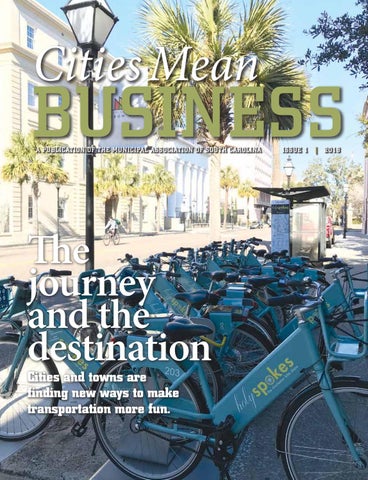
Cover Photo: One of the several bike share stations on the peninsula of Charleston. Photo: Andrew Sprague
BUSINESS A publication of Municipal Association of South Carolina
8 Opera houses change with their towns
10 Cities embrace, enhance their blueways
By Amy Edgar
By Amy Edgar
1411 Gervais St., P.O. Box 12109 Columbia, SC 29211 803.799.9574 mail@masc.sc www.masc.sc @muniassnsc Wayne George Executive Director, Municipal Association of SC
12 City museums draw visitors, stir pride
Reba Campbell Deputy Executive Director, Municipal Association of SC Contributing writers Amy Edgar Megan Sexton
Published by
FEATURES
Cities Mean
By Megan Sexton
DEPARTMENTS 4
Letter from the Editor
15 Hometown Snapshot
By Reba Hull Campbell
www.scbiznews.com A publication for the Municipal Association of South Carolina
@MuniAssnSC | Cities Mean BUSINESS 3
Letter from the
EDITOR
While safe neighborhoods, clean water and timely trash pickup may be what people think of first when asked about city services, there’s a lot more to that story. Cities also provide many amenities that support a positive quality of life that attracts residents and businesses alike. Cultural and recreational amenities are what help make our 271 cities and towns unique. This issue of Cities Means Business takes a look at how cities of all sizes are leveraging their distinctive assets to benefit residents and tourists. Several cities are seeing an uptick in unique downtown transportation to move people to fun or bring the fun to people. Find out how rickshaws, pedal-powered trolleys and unique Reba Hull Campbell
Editor and Deputy Executive Director, Municipal Association of SC
biking activities are seeing success in Charleston, Columbia, Moncks Corner and James Island. Opera houses were common in Southern cities and towns in the late 1800s and early 1900s as performers found welcoming audiences on their treks down the eastern seaboard. Today, many cities have restored their opera houses to meet diverse local needs from community gathering places to year-round performance venues. Learn how city officials in Clio, Sumter and Newberry are making the most of these historical gems to promote economic development, tourism and community spirit. Every city has a story to tell, and local museums create hometown pride while also providing an economic boost to help share cities’ history and culture. Read about how Greenwood, Seneca and Williston use their unique assets to tell a story that appeals to locals and visitors alike. Cities all over the world have long built commerce around waterfront amenities. That’s increasingly true in South Carolina as cities are taking advantage of what public access to nearby rivers and lakes means to the local economy. Learn about what North Augusta, Ware Shoals, Pacolet and Calhoun Falls are doing to expand residents’ and visitors’ access to their rivers and lakes. We have a wealth of cultural and natural assets in cities of all sizes. Enjoy reading more about them!
Reba Hull Campbell rcampbell@masc.sc
Editor
4 Cities Mean BUSINESS | @MuniAssnSC
A publication for the Municipal Association of South Carolina
FUN TRIPS REV UP DOWNTOWNS By Megan Sexton
When it comes to downtown transportation, sometimes the journey is the fun part.
A publication for the Municipal Association of South Carolina
@MuniAssnSC | Cities Mean BUSINESS 5
FEATURE STORY
A
s several South Carolina cities
visitors who get tired of walking and want
have shown, fun ways of getting
to cruise around the city instead.
around can also boost downtown
business. Rickshaws pulled by bikes, horse-drawn
“It’s a fun, unique and eco-friendly way to ride around downtown,” said Mattew
Lawson said the five carriage com-
Koleske, co-owner of the SC Pedal Parlor.
panies run year-round and employ 138
“It’s a different way to do a pub crawl — a
people with an annual economic impact
different way rather than a party bus.” While the party-on-wheels moves by the
carriages, electric scooters or pedal-powered
of $19 million. The carriage industry has
trolleys all offer visitors a chance to get from
long been regulated, while the city got
power of its riders — there is no drinking
place to place while experiencing downtown
involved with regulating pedicabs more
allowed onboard — a driver is provided
from a different perspective.
recently, as more companies moved into
who steers and leads the tour.
“When we can get people out of their
“It’s something new, cool and different
the market. “Many alternative modes of transporta-
to do. It’s something fun to see, and it puts a
Lawson, vice president for business develop-
tion are beneficial for any community. But
smile on people’s faces when we go by. There
ment at the Charleston Area Convention and
transportation infrastructure is going to be
are dozens of people taking pictures of us,
Visitors Bureau.
different, depending on the community,” he
and they’re always smiling. It’s also stimu-
“The more options, the better.”
said. “What works in Charleston may not
lating the economy and spreading money
In the City of Charleston, visitors can
make sense in Columbia or Bennettsville or
around to local businesses,” Koleske said.
cars, it’s helpful for everyone,” said J. Perrin
hop into a pedicab — a rickshaw pulled
Koleske said the restaurant managers
someplace else in the state.”
by a three-wheeled bike — or climb into a horse-drawn carriage, offering the quintessential way to tour the historic district. “An association or corporate group may be in town, and they want a ride to a hotel
love when the riders stop in for a drink and
‘They’re always smiling’
a snack before they hop back on the Pedal
Columbia is home to the SC Pedal Par-
Parlor, with some bars offering specials for
lor, a “bike” that looks more like a bar pow-
customers. He estimates the Pedal Parlor
ered by up to 16 people who pedal it.
has generated $100,000 in local revenue in
or restaurant or some other venue. The car-
Columbia’s pub-crawl-on-wheels tours
riages are a unique and atmospheric way to
the Main Street and Vista districts, stopping
get from Point A to Point B, and people ab-
at two to four restaurants and bars, making
tertainment districts, finding fun ways
solutely love it,” Lawson said. The pedicabs
it popular for birthday parties, corporate
to get to all of them is easier with bright,
hold only a couple of people but appeal to
events or just a night on the town.
colorful buses like the Soda Cap Connector
6 Cities Mean BUSINESS | @MuniAssnSC
the last 18 months or so. In a city with distinct downtown en-
A publication for the Municipal Association of South Carolina
FEATURE STORY
SC Pedal Parlor in Columbia lets participants power their vehicle to bars and restaurants downtown. Photo: SC Pedal Parlor.
and bright green, three-wheeled scooters,
a way to give residents and visitors a taste
known as Zapps. The electric cycles are
of the unexpected. It, too, involves pedaling
“And when they come to Moncks Corner for a day of trail riding, they are
rented through an app on smart phones and and generating local vibrancy.
certainly going to stop at our local restau-
can be picked up and dropped off at dozens
rants to refuel or refresh with a cold drink,”
of locations around Columbia. “The scooters are an innovative way
Moncks Corner partnered with Santee Cooper to open a highly technical, five-mile mountain biking trail. The town put up sig-
said Lord. Sometimes the fun starts when the ve-
(to move people around), and Columbia
nage and trail markers and works with vol-
was one of the first cities in the country to
unteers to maintain the course. Mountain
On James Island, the nonprofit Smalls
embrace that, and city staff worked hard to
biking is not something you find a lot of in
Music Lab, a bus filled with musical instru-
establish areas to park the scooters,” said
the Lowcountry, so it attracts a lot of people
ments, spreads the love of music through-
Matt Kennell, president and CEO of the
from the area.
out the area. Much like a bookmobile but
Center City Partnership in Columbia. “It makes getting there half the fun,” said Kennell. The “fun factor” is a big part of the strategy. “The Soda Cap Connector is a brightly decaled vehicle. There’s free wifi. Inside, it’s
“Tourism-related economic develop-
hicle rumbles to a stop.
stocked with keyboards, guitars and percus-
ment is all about finding what makes you
sion instruments, the mobile musical class-
unique,” said Jeff Lord, town administrator
room is a regular at community events, said
of Moncks Corner.
Ashley R. Kellahan, the town administrator.
“What do you have that others do not? For a community in the Lowcountry, hav-
“It’s a very engaging mobile unit that really makes the atmosphere at events more
like going back to an old Beatles album; that ing a large greenspace with a 50-foot eleva-
lively. Anytime you add music to an event
goes to the fun factor,” Kennell said. “It’s a
tion change is just one of many things that
you draw a larger crowd. When it’s music
way to enjoy getting around downtown and
makes Moncks Corner unique. It is some-
that kids can help create, it adds another
the different districts around Columbia.”
thing we can offer closer to home for the
level of community and spirit,” Kellahan
many outdoor adventure enthusiasts who
said. “It’s definitely a draw. Our town hall is
live in the Charleston metro area that enjoy
in a shopping center with two restaurants.
mountain biking.”
When we have events in the evening, it
Local vibrancy While pedaling a trolley to a bar in downtown Columbia may draw surprised
He said the town sees visitors from far-
draws people and they can go to the restau-
glances from the automobile-driving public, ther away who come for a bike ride as part
rants. And we’re increasing our hospitality
the Town of Moncks Corner has also found
tax revenue.”
of their trip to the Charleston area.
A publication for the Municipal Association of South Carolina
•
@MuniAssnSC | Cities Mean BUSINESS 7
FEATURE STORY
OPERA HOUSES CHANGE WITH THEIR TOWNS
The Sumter Opera House attracts tourists and enriches residents’ lives. Photo: City of Sumter.
By Amy Edgar
T
Changes over the decades
heater companies traveling between
gramming to enrich the lives of the residents
New York City and Miami used
of Clio and surrounding areas. O.P.E.R.A.
to stop at the Town of Clio’s opera
stands for Organizing, People, Empowering
1881. It hosted touring companies of New
Resourceful Achievers.
York plays, minstrel and variety shows, sing-
house to give performances, attracting crowds from neighboring South Carolina
“The history behind the ownership is
The Newberry Opera House was built in
ers and speakers, magicians, mind readers,
towns. Today, many decades later, the
significant,” said Kinney, explaining that a
Edens Opera House now draws in the
former resident of the town, Sally Calhoun,
town’s residents, serving as an unofficial
donated the building to the organization in
rium became a community gathering space
community center.
2013. She took a special interest in a first-
for meetings, dances or commencements.
grade class from Clio Elementary School and
When silent movies and then traditional
era House in about 1910, it contained stores,
provided educational and program support
movies became popular, the Opera House
offices and an auditorium, according to its
for 12 years. She also sought to pay for the
became a movie theater in the 1920s. It
1979 National Register of Historic Places
college education after the students com-
closed in 1952, and a few years later, there
nomination form.
pleted high school, said Kinney.
was talk of tearing the building down. The
When Jefferson D. Edens Sr. built the Op-
While it’s no longer drawing perform-
Opera houses have had a presence in
and boxing matches. When it didn’t offer shows, the audito-
Newberry Historical Society stepped in to
ers from both ends of the East Coast, Edens
American cities and towns for more than
preserve the Opera House, and it was placed
Opera House today has stayed true to its
200 years.
on the National Register of Historic Places
mixed-use identity. It houses an auto parts
In the 1800s, small towns began build-
in 1970.
retailer, a variety market supply store, a low-
ing their own opera houses as a way to
power community radio station, a Medicaid
attract visitors and entertainers. Over the
1990s, adding 10,000 square feet to the origi-
services provider for children, a church and
years, cultural changes and the advent of
nal building to create a modern theatrical
two youth organizations.
movies led to the decline of many opera
production facility. Today, the opera house
houses. A few, such as Clio’s Edens Opera
seats 426 and boasts state of the art lighting
the building, said Clio Mayor Joe Kinney,
House, still grace small towns in South
and sound systems.
A nonprofit called Clio O.P.E.R.A owns
The Opera House was renovated in the
the nonprofit board’s immediate past chair-
Carolina, where local leaders have em-
man, who said the organization provides
braced their storied buildings and fit them
stored opera house has been a catalyst for
community service projects and special pro-
into their downtown visions.
an economic and artistic revitalization in
8 Cities Mean BUSINESS | @MuniAssnSC
City Manager Matt DeWitt said the re-
A publication for the Municipal Association of South Carolina
FEATURE STORY
The Edens Opera House in Clio houses youth development groups, a church and an auto parts store. Photo: Town of Clio.
The Newberry Opera House has driven cultural and economic development for decades. Photo: City of Newberry.
Newberry. The Opera House attracts private
tional economy. (The study was conducted by
tional systems, civic organizations, corporate
investment through sustained quality en-
Mandala Research for the U.S. Cultural and
sponsors and individual renters, said Seth Re-
tertainment and community engagement. It
Heritage Tourism Marketing Council, in con-
imer, cultural manager for the City of Sumter.
also has an engaged board of directors who
junction with the U.S. Department of Com-
have a passion for the city and talk directly
merce. Heritage Travel Inc., a subsidiary of The
that assists investors with getting their mes-
with investors, DeWitt said.
National Trust for Historic Preservation, was
sage out in an engaging way,” Reimer said.
the lead sponsor of the study.)
“The Sumter Opera House, now present-
“The organization strives to fulfill the mission of cultural and economic develop-
The Sumter Opera House is another site
“We are creating a vibrant community
ing local, regional and national acts, builds
ment through the window of the arts,” he
with a colorful history. Built in 1895, the build-
a powerful presence and allows investors
said. “This is done by attracting quality arts
ing has served not only as an opera house, but
another ‘stage’ in which to reach customers
programming that includes all the com-
also as a music academy, movie theater, city of-
and entertain prospective and current cli-
munity and demonstrating its commitment
fices, barber shop, jail and even a meat market.
ents. There is evidence that it helps increase
time and time again.”
In 1982, the Opera House closed its doors after
name recognition and offer networking op-
46 years as a movie theater.
portunities to develop new business.”
DeWitt said the Opera House brings roughly 100,000 people to downtown New-
The City of Sumter purchased the build-
By presenting 14 acts in the 2016-2017
berry each year for performances, tours,
ing in 1984 with an eye toward gaining of-
season, the Sumter Opera House had an
educational seminars and meetings. It also
fice space and attracting visitors downtown.
economic impact of as much as $750,000,
supports tourism in the Midlands.
Careful renovations to restore the Opera
considering its 70 total events and more than
“By quality entertainment and tours, the
House to its former beauty, including the art
21,000 attendees, Reimer said. Patrons at the
Opera House supports the city with extra dol-
deco gold leaf by French restoration artists,
Opera House spend money on meals, re-
lars not only to the city, but also local business-
were completed in 1987. These renovations
freshments, souvenirs, gifts, transportation,
es through increased revenue,” DeWitt said.
were the first steps in an ongoing movement
lodging and other miscellaneous items.
These efforts pay off. According to the National Trust for Historic Preservation, a 2009 study found that 78 percent of all U.S.
toward downtown revitalization and historic preservation in the City of Sumter. Today, the Opera House still houses Sum-
The City of Sumter strives to be a destination worthy of travel and visitation, and the Opera House supports that goal, Reimer said.
leisure travelers participate in cultural or
ter City Hall and City Council’s chambers.
heritage activities.
The 550-seat theater hosts a variety of local,
ing that vision by stimulating economic de-
regional and national talent, free perfor-
velopment and tourism growth while enrich-
mances by local groups, and many gradua-
ing the cultural lives of Sumter residents,” he
tion ceremonies.
said. “The Sumter Opera House is creating
Economic contributions With cultural and heritage travelers spending an average of $994 per trip, they contribute more than $192 billion annually to the na-
The Sumter Opera House attracts private investment through collaboration with educa-
A publication for the Municipal Association of South Carolina
“The Sumter Opera House is spearhead-
an environment that blends backgrounds, ethnicities and cultures.”
•
@MuniAssnSC | Cities Mean BUSINESS 9
FEATURE STORY Saluda River/Ware Shoals
CITIES EMBRACE, ENHANCE THEIR BLUEWAYS By Amy Edgar
F
rom moving sewer lines to add-
River. In the 1990s, the city did a study on
nity of Augusta, Georgia, which sits across
ing trails, South Carolina cities and
riverfront development and adopted the tag
the river, Jones said.
towns are recognizing — and maxi-
line “South Carolina’s Riverfront,” according
mizing — the appeal of their rivers. That means taking any number of steps, such as adding a boat launch, rerouting
As developments grew, the city retained
to Lark Jones, who recently retired as the
access to the riverfront because city leaders
city’s mayor.
believed public access would be key for fu-
In the mid-1990s, a private developer
ture successful development.
infrastructure, or securing an easement to
built a golf club and riverfront homes, which
open up public access and attract residents
sold for up to $1 million. This was the cata-
to provide public access to the river,” Jones said.
and visitors.
lyst that began to bring people into North
“It’s part of the public realm that our residents
Augusta and cultivate an identity for the city
own. When we develop these things, we want
as something other than a bedroom commu-
the residents to feel ownership.”
The City of North Augusta has worked for years to take advantage of the Savannah 10 Cities Mean BUSINESS | @MuniAssnSC
“The philosophy of the city has always been
A publication for the Municipal Association of South Carolina
FEATURE STORY The city had a greenway from a railsto-trails project and then added a 1-mile spur to the riverfront. The spur circles the Brick Pond Park, which is a 40-acre restored wetland, water treatment system and public nature park. Significant developments continue at the riverfront. Project Jackson is a mixed-used development that includes a new minorleague ballpark for the Augusta GreenJackets. A hotel, restaurants, shops, homes and condominiums all are underway near the riverfront. Other towns are investing in their riverfronts, as well. The Town of Ware Shoals succeeded in having its project to reroute a 40-year-old sewer line along the Saluda River included on the Greenwood County Penny Sales Tax Commission’s list of projects funded by the penny sales tax, which voters approved in 2016. This project addresses the dangers of possible pollution and contamination that come
Significant developments continue along the Savannah River in North Augusta.
“Providing public access to the river gives
Blue Hole Recreation Area offer boat ramps,
community members and individuals some-
playgrounds, picnic areas, and canoeing and
thing to do,” Meissner said.
kayak areas.
For years, there was no public access to
The West Carolina Pavilion on Lake Rus-
from having waste running through sewage
the Pacolet River, due in part to industrial
sell hosts musical and outdoor events, said
pipes along the river, said Town Administra-
sites located there. The town reached an
David Garner, Calhoun Falls town admin-
tor Heather Fields.
easement agreement with Lockhart Power,
istrator. The town works closely with the
which provides hydropower along the river,
Calhoun Falls Chamber of Commerce and
prove Pitts Park, which lies along the shoals
to create trails and allow public access to the
the Lake Russell Recreation and Tourism
and offers access to the river. Fields said the
water, Meissner said.
Coalition to plan and organize events and
In addition, the town is working to im-
town would like to clean up the park, add
The town has other projects in the works,
trash cans and restrooms, and make it handi-
including a new traffic circle in front of Pa-
capped accessible.
draw people to the area, he said. In the future, Garner said they hope to
colet Town Hall, and improvements, such
establish a rails-to-trails project accessible
The river is part of the Heritage Cor-
as benches, to the park area and river walk.
from downtown Calhoun Falls, which would
ridor, and signage there points to the kayak
An old building known as the Cloth Room,
be a regional recreational trail linking the
launch and access to fishing, Fields said.
which is a remnant of the textile mill, is un-
two counties of Abbeville and McCormick.
The park is a true gem of the community,
dergoing renovations to become a commu-
she said.
nity events center that will spur revitalization
the Savannah River Basin offer an oasis from
efforts by the river. Eventually, Meissner said,
the fast pace of daily life. When cities em-
they hope to expand the trails, add a bridge,
brace and enhance the rivers and waterways
increase signage and expand a fishing pier.
that make them unique, they can increase
“On any given day, we have hundreds of people in the park,” she said.
Reaching an agreement Scores of people visit the Pacolet River Paddling Trail, and the Town of Pacolet has
The activities around Lake Russell and
economic development while providing
‘Get connected to nature’ The Town of Calhoun Falls, located in
healthy spaces for citizens to enjoy the outdoors.
been working on other improvements to
the Savannah River Basin, provides numer-
“We want to get people disconnected
draw visitors to the riverfront area, according
ous recreational activities for residents and
from technology for a while and get con-
to Mayor Michael Meissner.
visitors. Calhoun Falls State Park and the
nected to nature,” Garner said.
A publication for the Municipal Association of South Carolina
•
@MuniAssnSC | Cities Mean BUSINESS 11
FEATURE STORY
CITY MUSEUMS DRAW VISITORS, STIR PRIDE By Megan Sexton
The “Carolina” executive car is part of the Greenwood Historic Railroad Center collection.The restoration budget is a public-private partnership that includes grants from the S.C. National Heritage Corridor, City of Greenwood and private contributions. Photo: City of Greenwood.
E
very town has a story to tell. And whether that story is one of history, science, agriculture, trans-
A ‘must stop’
is critical. Both museums were ‘must stops’
One such museum is the Greenwood Museum and its nonprofit subsidiary, the
portation or any other topic, there may be
Railroad Historical Center. The museum fea-
no better way to tell it — to both residents
tures three floors awith 20,000 square feet of
and tourists — than with a local museum.
hands-on exhibits.
Scores of museums dot South Carolina’s
for the Aug. 21 solar eclipse.” The Greenwood Museum, like many in towns around the state, started out small. Opening in 1970 with one room in the old armory, it eventually took over the entire
Permanent displays include a 1900s
building. In 1982, it moved to its own loca-
cities and towns, with exhibits that preserve,
replica of Main Street with interactive
tion on Main Street. In 2007, the museum
honor and explain local history and culture.
exhibits such as a cinema, general store,
closed for renovations that were paid for with
Museums provide everything from a source
blacksmith shop, classrooms and railroad
nearly $600,000 from the city’s hospitality tax
of hometown pride for a community to an
depot. It also displays gems, rocks and
and a $396,000 federal grant.
event venue that can mean an economic
minerals and native wildlife, along with
boost to a downtown. These museums can
annual summer exhibits.
The city has no day-to-day role in the museum’s staffing, but it does provide operations
improve quality of life and support the long-
“The museum plays a critical role in
term goals of cities, while local governments,
Greenwood’s history preservation and (tell-
owns the building and covers the monthly
in many instances, play a role in helping
ing) Greenwood’s story,” said City Manager
utility costs, while the City of Greenwood’s
start, staff or fund the museums.
Charlie Barrineau. “Economic development
hospitality tax funds are used to help pay for
12 Cities Mean BUSINESS | @MuniAssnSC
support, Barrineau said. Greenwood County
A publication for the Municipal Association of South Carolina
FEATURE STORY
Visitors tour the Bertha Lee Strickland Cultural Museum, which preserves African-American history. Photo: City of Seneca.
the museum – including making sure the
maintenance support, with about $35,511
museum can provide free admission. The
spent through August of this year. The rail-
if this small black community in Oconee
city also provides annual operations and
road center has plans for a new replica depot,
County could achieve that, there must be
maintenance support, budgeted at $66,667 in
modeled after the old Greenwood Main
a lot more to tell,” said Shelby Henderson,
2017. The museum must provide copies of its
Street Union Station, to sit next to the seven
the manager of what became the Bertha Lee
expenditures to receive reimbursements from
historic rail cars.
Strickland Cultural Museum.
hospitality tax funds. Nearby, the railroad center is home to a
Both the museum and the railroad center are rented for events.
locomotive and a collection of restored train cars. It is committed to collecting, preserving
“He was fascinated by that. He felt that
The city eventually purchased land for the museum, established a preservation group and hired Henderson to coordinate the
‘We have a wonderful story to tell’
Strickland project.
In the City of Seneca, the idea for a mu-
“The city didn’t have specific plans; they
seum celebrating African-American history
just knew they wanted to preserve the black
was born after City Administrator Greg Diet-
community’s history. They left it in my hands.
dollars to receive three grants for the rail-
terick learned about the often untold story of
I asked for permission to have a board of di-
road museum, totaling $250,000 from the
Oconee County’s black history, including the
rectors and the council approved that. It’s an
South Carolina National Heritage Corridor.
story of Seneca Junior College, an African-
amazing board of directors — all volunteers,
Greenwood also provides operation and
American school from 1899 to 1939.
all grassroots,” Henderson said.
and interpreting the railroad history of Greenwood and the surrounding communities. The city has leveraged hospitality tax
A publication for the Municipal Association of South Carolina
@MuniAssnSC | Cities Mean BUSINESS 13
FEATURE STORY
Trains of the Greenwood Historic Railroad Center collection. Photo: City of Greenwood.
The museum shares a back yard with the
Henderson said the museum is commit-
“The museum is a source of pride for the
city’s Lunney House Museum, and bears the
ted to improving education, preservation and
community and is impressive for such a small
name of the late Bertha Lee Strickland, a
quality of life. But it also plays an economic
town. It has very limited normal operation
Seneca resident who worked for the Lunney
development role for the city and the county.
hours due to lack of funding and full-time
family for 47 years, starting as a laundress at about the age of 13. “We have a wonderful story to tell. Strick-
employees. However, people can schedule it
How to draw people in
for private viewing and parties and often do,”
“No city in this country enjoys economic
Cook said. “The board also tries to have an
land is giving us a voice that will live well
development without diversity. It’s one of the
annual event to showcase the museum. They
beyond any of us. And generations to come
things that draws people in,” Henderson said.
have done this each of the last two years, and
will have that piece of the town’s history,”
“To educate everyone about black culture and
it has been quite successful.”
Henderson said. “For a small museum to be
black history is to show the value and the worth.
owned by a city that embraces it the way Sen-
Once you understand people, you accept more.”
scroft, said the museum is home to every-
In the Town of Williston, the town owns
thing from collections of photographs of
eca does is rare.”
One of those volunteers, Julia Raven-
the former school building that houses both
military veterans to a replica of a country
rectors which city council appointed. The city
the museum and the library. The museum uses
store to old farming tools, a nod to Wil-
fully funds the museum through its annual
the building at no cost, and the town pays for
liston’s history as one of the world’s largest
city budget and hospitality tax funds. Money
maintenance and utilities for both the museum
growers of asparagus.
from the hospitality tax was used to con-
and the library, said Kenny Cook, Williston’s
struct the building and supports free public
town administrator. The museum is run by a
their town, and they like to see things dis-
museum events and programming. The city’s
volunteer board. And while the town doesn’t
played. There’s a great admiration for it,” she
annual budget includes items for operational
get directly involved with the day-to-day opera-
said. “I think every town, if they can afford it,
expenses and staff professional development.
tions, it does assist with long-term plans.
should have a museum.”
The museum is guided by the board of di-
14 Cities Mean BUSINESS | @MuniAssnSC
“The people in this town are proud of
•
A publication for the Municipal Association of South Carolina
HOM ETOWN
SNAPSHOT
Photo/Licia Jackson
downtown ed Sept. 1 in ch n u la s u tor b T S o da ap Connec The COME C . a d d n o u S o e ar Th get ew way to routes that to offer a n of dedicated Columbia em st sy le p m cluding ector is a si tinations, in es d ia Cap Conn b m lu ice ajor Co ts. This serv eople to m d Five Poin an connects p ta is V e ng the ict, th treet Distr 6 p.m. Duri .m a. 0 1 the Main S urday from Tuesday-Sat is running are free. nths, rides first six mo