Supporting the recycling industry in S.C.
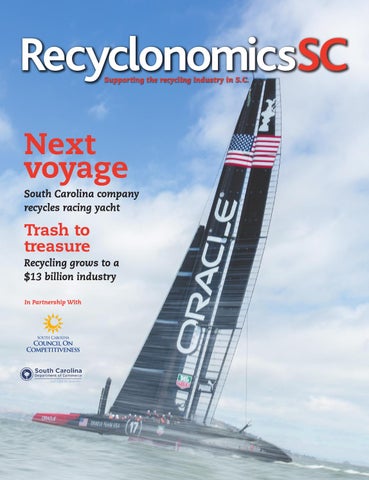
Next voyage South Carolina company recycles racing yacht
Trash to treasure Recycling grows to a $13 billion industry In Partnership With
www.RecyclonomicsSC.com
1
Contents
Cover and contents photos: © ORACLE TEAM USA, Photographer:Guilain GRENIER
4
Could recycling be the perfect industry?
5
Welcome from our partners
7
Upfront
8
smart Electronics Recycling electronics gives a jolt to the local economy
10 smart Economics The business of recycling
16 smart Materials Recycling businesses eye new recycling opportunities
13 smart Governments Local governments take recycling efforts beyond plastic bins 20
Profiles: Special Advertising Section
27
smart Companies A use for everything: More companies finding creative ways to recycle materials
30 smart Resources
• RecyclonomicsSC Members • Resources
www.RecyclonomicsSC.com
3
Could recycling be the perfect industry?
R
ecycling is the only waste management option that offers the opportunity to save money and earn revenue. The proof: in 2013, recycling became a $13 billion industry in South Carolina, nearly double the revenue from just
six years ago. We know that recycling helps save the environment by lessening the amount of trash that goes into landfills, but it also moves commerce by reusing commodities like plastic, metal, glass and other items into the marketplace. When done right, businesses can save money on landfill costs and even make money selling unwanted scrap. Making this happen requires a bit of effort for a business:
Jenny Peterson Editor
taking inventory of your waste stream to see if anything can be recycled, sorting things into designated bins and selling recyclables and working with reclamation companies. The best part is that almost everything is recyclable, and
with a growing economy in the state—especially the booming automotive industry—recyclers are now in high demand. The industry isn’t slowing down anytime soon. There are many resources to help individuals and businesses with recycling efforts, from municipalities providing larger recycling carts to public/partnerships. There are even local recycling businesses that do waste stream analyses for free. All of these entities work together to make recycling easy and convenient...and profitable.
Recycling Partnerships in S.C. RecyclonomicsSC is one of the statewide clusters made up of recycling businesses as well as industry who utilize recycled materials in their manufacturing process. RecyclonomicsSC’s mission is to expand and strengthen South Carolina’s recycling industry by establishing policy, building networks, promoting market
RecyclonomicsSC Magazine Editor - Jenny Peterson jpeterson@scbiznews.com Special Projects Editor - Licia Jackson ljackson@scbiznews.com Creative Director - Ryan Wilcox rwilcox@scbiznews.com Senior Graphic Designer - Jane Mattingly jmattingly@scbiznews.com Graphic Designer - Andrew Sprague asprague@scbiznews.com Account executives Account Executive - Mariana Hall mhall@scbiznews.com Senior Account Executive - Robert Reilly rreilly@scbiznews.com Account Executive - Bennett Parks bparks@scbiznews.com Contributing Writers Mike Fitts, Chris McCandlish President and Group Publisher - Grady Johnson gjohnson@scbiznews.com Vice President of Sales - Steve Fields sfields@scbiznews.com Director of Audience Development - Rick Jenkins rjenkins@scbiznews.com Event Manager - Kathy Allen kallen@scbiznews.com Audience Development & IT Manager - Kim McManus kmcmanus@scbiznews.com Audience Development Specialist - Jessica Smalley jsmalley@scbiznews.com Event Planner - Jacquelyn Fehler jfehler@scbiznews.com Accounting Manager - Vickie Deadmon vdeadmon@scbiznews.com
development and leveraging existing infrastructure. The Recycling Market Development Advisory Council (RMDAC) is a 14-member, Governor-appointed council focused on recycling. Managed by the South Carolina Department of Commerce, RMDAC works to improve rec ycling feedstock supply and addresses the market needs for new or emerging recyclable materials. Its mission is to support the economic growth of South Carolina’s recycling industry through building recycling markets, increasing material recovery and promoting the recycling value chain. The South Carolina Council on Competitiveness is a nonpartisan, businessled non-profit organization committed to advancing the long-term economic
The entire contents of this publication are c opyright by SC Business Publications LLC with all rights reserved. Any reproduction or use of the content within this p ublication without permission is prohibited. SCBIZ and South Carolina’s Media Engine for Economic Growth are registered in the U.S. Patent and Trademark Office.
Mailing address: 1439 Stuart Engals Blvd., Suite 200 Mount Pleasant, SC 29464 Phone: 843.849.3100 • Fax: 843.849.3122 www.scbiznews.com SC Business Publications LLC A portfolio company of Virginia Capital Partners LLC Frederick L. Russell Jr., Chairman
competitiveness of our state, industries, and citizens. Its work is accomplished through actionable research, support of industry clusters, and education and workforce development initiatives.
4
www.RecyclonomicsSC.com
Corporate & Commercial Publishing Division
Going green is good for business Keeping the recycling industry thriving in South Carolina
I
n South Carolina, green
is good for business. The state’s booming recycling
industry has doubled in the
T
he South Carolina Council on Competitiveness celebrated
last eight years – providing
its 10th anniversary in 2014.
a $13 billion impact annu-
The organization was founded
ally on the Palmetto State and boost-
by state industry leaders who
ing related jobs by 44 percent. These
shared one goal—to advance the
results are impressive alone, but when
long-term economic competitiveness of South Carolina.
looked at next to other comparable
While our partner organizations in economic development
economic engines in South Carolina
focus on recruiting industries to our
like aerospace, tourism and the military,
state, the Council on Competitiveness
the state’s green economy has a strong
strengthens and builds on those ef-
foothold here in South Carolina.
forts by addressing underlying factors
More and more, businesses all
Bobby Hitt
S.C. Secretary of Commerce
over the state are adopting a green
South Carolina. One critical component to the
state of mind, and finding that there is value in their trash. What might
Council’s work is actionable research.
be considered trash to one company
You will read in the pages to come
or a by-product of their process can be an essential element to a recycling process for another company. The strong and profitable connection between recycling and business can be seen in several of the state’s innovative and sustainable partnerships: •
causing industries to stay and grow in
about our partnership with the SC
Ann Marie Stieritz
Department of Commerce, the SC Department of Health and Environ-
President & CEO South Carolina’s Council on Competitiveness
mental Control and RecyclonomicsSC to update the economic impact study
In 2013, Boeing and MIT-RCF partnered to recycle
of the recycling industry. The impact
the 80-footlong Oracle Team USA racing yacht,
•
•
study is an important tool for recy-
which is made from carbon-fiber-reinforced plastic
cling business leaders and economic developers to market
composites. The boat’s materials are planned to be
the industry, understand trends and identify obstacles
repurposed into a mold for next-generation water-
to growth. This research enables the industry to develop
crafts, among other uses.
informed plans for continuing the upward trend that saw a
Recleim LLC and the South Carolina Association
doubling of the industry’s annual total economic impact in
of Heating and Air Conditioning Contractors have
the past eight years.
teamed up for a statewide initiative to help contrac-
The Council also advances the competitiveness of
tors find a convenient and environmentally-friendly
businesses in South Carolina by supporting industry
solution to recycle retired HVAC equipment.
clusters—a geographic concentration of related compa-
The Upstate BMW Plant has a longstanding partner-
nies, organizations and institutions. Clusters contribute
ship with Stree-Rike3 in Columbia, S.C. to collect
to the competitiveness of businesses because they create
plastics from its assembly process and turn them
an infrastructure that increases productivity. The Coun-
over to the whiffle ball manufacturer to produce
cil currently has direct support relationships with four
hard plastic training balls for baseball players.
industry clusters: RecyclonomicsSC, iTs|SC (insurance
Home to more than 500 recycling companies, the Palmetto
technology services), TDL Council (transportation, distri-
State is emerging as a national leader in the green economy.
bution, logistics) and South Carolina Aerospace. We not
Global brands like Johnson Controls and Sonoco, and smaller
only seek to see individual clusters thrive in their own
firms like Tomato Palms and Fisher Recycling, make up the
industry areas, but also facilitate opportunities for clus-
state’s impressive roster of recycling businesses, and the list
ters to collaborate where interests intersect for the overall
continues to grow. The Department of Commerce remains
benefit of the state.
committed to its support for this thriving industry that’s creating a sizeable contribution to our state’s economy.
See NEW CAROLINA, Page 6 www.RecyclonomicsSC.com
5
Recycling’s ‘ripple effect’ matters
G
oing green has countless benefits for the environment but have you ever stopped to think about the impact recycling has on our state’s economy?
Recycling is voluntary in South Carolina. With a current
recycling rate of 31.5 %, there is a long way to go to meet the state recycling goal of 40 %. But every bit helps. When you or the company that you work for chooses to recycle bottles, cans, cardboard boxes, plastic packaging, industrial plastic process scrap, glass, carpet, tires, electronics or appliances, it is truly like the impact of a pebble in the pond: those ripples of forward progress that recycling creates move through homes, workplaces and the
Tina Green Huskey
RecyclonomicsSC
community, impacting not only the environment but also the economy of our state. The ripple effect is the belief that
a single action has an effect over many different entities, both directly and indirectly. The closer you are to the “kerplunk,” the greater the impact may be, but those smaller, less noticeable ripples are just as important. The 2014 Recycling Economic Impact study update, commissioned by the S.C. Department of Commerce, S.C. Department of Health and Environmental Control, New Carolina and RecyclonomicsSC and written by economist Dr. Frank Hefner of the College of Charleston Department of Economics and Finance concludes that the concept that “recycling is beneficial for the environment is a virtually uncontested proposition. What is becoming increasingly
44 % increase in recycling employment from 2006 to 2014, with an average annual wage of $40,203 (vs. average wage in SC for all jobs of $38,700). These are quality jobs with family-supporting incomes. There is also a significant number of additional indirect jobs associated with vendors that supply support to the recycling industry. A gripping fact from the study is that if the recycling industry were to disappear tomorrow, over 54,000 jobs would disappear along with it. South Carolina is a leader in recycling jobs in the Southeast. We are home to cutting edge recyclers who turn carpet into car parts and carbon fiber into molded composites. In the coming year, RecyclonomicsSC will strive to stay on the crest by furthering education about recycling’s economic impact and increasing recycling opportunities for both our growing manufacturing sector and communities alike. With all that said, on behalf of the recycling industry, thank you for choosing to recycle. It is an investment that economically impacts real people with real families and real homes. And by the way, the recycling industry in SC has a huge appetite so we want to encourage everyone to landfill less, burn less and recycle more....it matters.
more obvious is that recycling contributes to the economic
Tina Green Huskey, Chair
health of the state’s economy.”
RecyclonomicsSC, an initiative of the
The outreaching waves of recycling have resulted in a
NEW CAROLINA, from page 5
South Carolina Recycling Council
company growth. The recycling industry in South Carolina truly has the potential to run the continuum from curbside
The Council is always looking ahead to emerging competitive opportunities for our state, and you will learn in
to aerospace. Through sustained collaboration among the private,
this publication about South Carolina’s emerging niche in
public, academic and non-profit sectors, the South Caro-
reclaiming and repurposing carbon fiber materials. This
lina Council on Competitiveness advances the economic
trend in advanced materials is supplemented by cut-
competitiveness of our state, its industries and its citizens.
ting edge work at our state’s research universities as well
Moving into our 11th year, we celebrate our successes and
as increasing opportunities for small- and medium-size
look forward to the opportunities and challenges ahead.
6
www.RecyclonomicsSC.com
Upfr nt Recycler collects SBA honors Nancy Ogburn, founder and president of Irmo recycling company Tomato Palms, has been honored as the 2014 S.C. Small Business Person of the Year.
The Store of Hope in Columbia
Ogburn received her award at the annual Salute to Small Business event pre-
takes items that may need a little
sented by the Small Business Administration earlier this year.
help and reconditions them into
Ogburn started Tomato Palms out of her home in 2008 after
one-of-a-kind gifts and furnish-
reading a newspaper article about a previously homeless man
ings. And along the way, the work
who had picked up discarded aluminum cans and sold them
helps young people who have
to recyclers so he’d have cash to pay his rent. Ogburn then got
traveled a bumpy road.
the idea to approach local businesses and ask them to donate
Nancy Ogburn
Find a repurposed gift at the Store of Hope
The store is a new youth-driv-
their empty cans so she could sell the cans to recyclers and
en enterprise program for the S.C.
use the profits to help the homeless. As it turned out business-
Department of Juvenile Justice, fo-
es were willing to help and also needed someone to collect
cused on providing job-readiness
other recyclables, Ogburn said.
training to young people in the
She started the company from her home using her Honda Pilot SUV to pick up
system. Among many hand-craft-
the recyclable materials. Today, her firm operates out of a 3,000-square-foot ware-
ed items for sale are older chairs,
house and office space and provides Midlands businesses with a range of recycling
benches and ottomans that have
services, from collection to sorting to monthly weight tracking of the recycled
been reupholstered for a new
materials.
look. The young entrepreneurs
Tomato Palms now serves 125 clients in four counties, has six employees and
also make wood Adirondack
three trucks. The company estimates it has saved more than 1.5 million pounds of
chairs and metal palmetto trees,
waste from being dumped in a landfill.
hand-carved pens and pencils
Ogburn, who began her training in the recycling industry through the S.C. De-
and sturdy fabric tote bags.
partment of Commerce’s Recycling Marketing Development Department, said she
The Store of Hope is at 3208
named her company after her two favorite plants, a tomato and a palm tree. She
Broad River Road, Columbia, and
joined the Recycling Industry Group, now known as the S.C. Recycling Council, in
is open Wednesday, Thursday and
2009.
Friday from 10 a.m. to 5:30 p.m.
“It is very humbling to be at this point in my life,” Ogburn said when accepting
and on the third Saturday of the
the award. She represented the state at the National Small Business Week celebra-
month from 10 a.m. to 2 p.m. For
tion in Washington, D.C.
information, call 803-896-4736.
Recycling as art This image of S.C. Commerce Secretary Bobby Hitt (see his photo on page 5), which hangs in the Department of Commerce offices, was made by artist Kirkland Smith. Smith is a classical painter who began creating contemporary assemblages using post-consumer materials as an evocative way to drive home the message of the importance of reducing, reusing and recycling. “We live in a disposable society and what we throw away says a lot about who we are, but what we choose to cherish and protect says even more in the end,” Smith says. (Used by permission of the artist) www.RecyclonomicsSC.com
7
smart Electronics
Recycling electronics gives a jolt to the local economy By Jenny Peterson
H
undreds of thousands of electronic devices are dis-
amount of electronics dropped off at the site. “Sometimes
carded each year in South Carolina as new prod-
we have two pickups every week, and we get a tractor
ucts hit the market. South Carolinians recycled
trailer once a month,” she said.
more than 11,500 tons of electronics last year alone, a 25
According to Richard Chesley, with the South Carolina
percent increase from 2012, according to the South Caro-
Department of Health and Environmental Control’s Office
lina Solid Waste Management’s 2013 Annual Report.
of Solid Waste Reduction and Recycling, governments must
Unwanted electronics – computers, printers, televi-
partner with certified responsible recyclers in
sions, DVD players, cell phones, etc. – comprise one
order to properly recycle items.
of the nation’s fastest-growing waste streams.
“You can’t just use anybody; local govern-
The problem? They are the slowest to break-
ments have to use a company that’s certified
down and deteriorate when sitting in landfills.
‘R-2’ standard of responsible recyclers,” he
Heavy metals, sealed batteries, electric
said.
cables, circuit boards and switches that
The law also requires computer, printer
make up these devices will remain intact
and television manufacturers to provide
for years in landfills. Many parts can even
their own recovery programs for desk-
create health hazards to the environment.
top, laptop, notebook and tablet
For the past four years, an important state-
computers, monitors, printers and
wide program has been in place to ad-
television sets.
dress this issue: E-scrap Recycling.
Most commonly, these recovery
Voted into law in 2010, E-scrap
programs encourage residents to
Recycling eliminates unwanted
bring these items back to the retail
electronics from ending up in a
store for recycling at no cost to the
landfill. The law makes it ille-
consumer. Other recovery programs
gal for residents to knowingly
can include mail-back programs, with
leave electronics by the side
retailers paying for shipping. Retail
of the road for garbage pickup;
manufacturers and local governments
instead, residents are required
pay for the collection, transportation
to bring these items to designated drop-off locations run by local governments. There, the
and recycling of these devices by law. While the motivation behind the law was for health
items can be sorted and recycled safely through a certified
and safety, the benefits of E-scrap recycling are far-reach-
recycler. Every municipality in the 46 South Carolina coun-
ing.
ties has a designated drop-off site for electronics. In Richland County, recycling coordinator Shirley Mims said a box truck comes weekly to haul away the large
8
www.RecyclonomicsSC.com
E-scrap recycling provides many business opportunities. Currently, there are 24 companies in South Carolina that are part of the e-scrap recycling industry, dedicated
smart Electornics to collecting unwanted electronics from companies and
public relations with Goodwill Upstate, said upstate Good-
local governments so that that the items are recycled
will stores accept televisions, computers, VCRs, radios, cell
properly.
phones and other electronics.
One of those companies is eCycleSecure, an electronics
“Believe it or not, people still buy VCRs,” she said. “We
recycling firm out of Charlotte, N.C. “We disassemble the raw-material components, separate it out and send it to the various markets,” said eCycleSecure owner Brett Rhinehardt. “From there, it goes to other markets – steel goes to steel markets, etc. We separate out the
also have people who buy a lot of them
By the numbers S.C. electronics recycling (in tons)
25%
Increase
lead and other harmful chemicals.”
11,560
and use them for parts.” She said TVs are the most popular electronic device brought into stores, especially during the holidays when people get newer devices as gifts. Goodwill in the upstate also partners
9,258
with Dell computers on a third-party
Rhinehardt said a major part of their
program called “Dell Reconnect.” It’s a
service is destroying sensitive informa-
nationwide program that either reuses,
tion on computers and laptops.
recycles or refurbishes computers and
“Information left on your computer is
puts them back in the marketplace.
2012
highly at risk if it’s not handled properly,” Rhinehardt said. “We remove all the data from all the computers we receive. We take circuit boards off—there’s no way
2013
Source: South Carolina Solid Waste Management Annual Report for Fiscal Year 2013
anyone is getting data off of that.” Another option for consumers who
Residents are encouraged to bring computers of all brands and in any condition to participating Goodwill sites, and Dell will either recycle or refurbish it. “That has been a very progressive and beneficial program,” Hardesty said. “Every-
have unwanted electronics is to bring them to a local
thing is recycled in a completely green manner and nothing
Goodwill store. Crystal Hardesty, director of marketing and
winds up in a landfill.”
www.RecyclonomicsSC.com
9
smart Economics
The business of recycling By Jenny Peterson
R
How recycling helps the bottom line
ecycling isn’t just good for the environment; it’s great for the economy.
Recycling is the only waste management option that of-
In South Carolina, recycling has a staggering $13
fers the opportunity to both save money and earn revenue.
billion dollar impact on the state’s economy, according to
In 2013, recycling in South Carolina kept more than 1.3
a study from Frank Hefner, professor of economics and
million tons of material out of landfills, allowing items
development at the College of Charleston.
that would have otherwise sat for years in a landfill to be
In just eight years, the industry has doubled its annual
turned into profits. Companies can avoid landfill fees and
total economic impact from $6.5 billion in 2006. About 500 re-
get tax credits by recycling — turning unwanted materials
cycling businesses now operate in the state,
into revenue.
and the industry provides more than 22,403 jobs—a 44 percent increase since 2006. According to Hefner’s 2014 S.C. Recycling Industry Economic Impact Study, recycling in South Carolina generates $2.7 billion in annual personal income and $329 million in state and local tax revenue each year. The study was commissioned by the S.C. Department of Commerce, RecyclonomicsSC and the S.C. Council on Competitiveness. “The results of this report are exciting for us at Commerce, because they further reinforce the correlation between recycling and business,” said South Carolina Commerce Secretary Bobby Hitt.“The fact that
In 2013, governments reported earning
Recycling in S.C., by the numbers 22,403
jobs attributable to recycling
54,121
total jobs impacted by recycling
44 percent
increase in recycling jobs since 2006
500+
recycling-related companies
more than $9 million in recyclable materials. “In the traditional solid waste program, a giant corporation has a dumpster out back and they pay a hauling fee. If you recycle, then someone may take it away for free or may even pay you for it,” said Brett Rhinehardt, owner of eCycleSecure, a Charlotte-based provider of electronics disposal. Success stories include Cooper Standard Automotive in Spartanburg, which found a vendor for its plastic waste that had previously been sent to a landfill. That diversion resulted in a $15,600 per year cost savings while keeping 200,000 pounds of
the green economy brings a $13 billion economic impact
material from a landfill. Fruit of the Loom in Summerville
to the state annually is significant on its own, but for that
reached 100 percent landfill free operations in 2012 and
impact to double over an eight-year period —- even in the
generates more than $60,000 from the sale of recyclables
midst of a challenging national economy — speaks to the
each year. For more success stories, visit www.scdhec.gov/
strength of the Palmetto State’s recycling infrastructure
smartbusiness/success
and growing recycling capacity.”
Materials that commonly generate the most profits include scrap metal, steel and plastics, Rhinehardt said.
10
www.RecyclonomicsSC.com
smart Economics Another type of material that may bring in revenues for businesses is cardboard and certain types of paper. Adding in the avoided disposal costs also can add in to the bottom line for businesses. With a booming automotive industry in the state, industrial plastics recyclers are in high demand. More plastics recycling companies are moving into tolling recycling, which means a company makes unwanted materials usable again through melting, pulverizing and grinding the product, and then sells it at a cost cheaper than new or raw materials. “Toll work is the newest thing. Companies want their own stuff back to reuse,� said Tina Huskey, recycling and waste specialist at Mumford Industries, Inc. a full-service recycling company out of Ninety-Six, S.C. Glenn Odom, vice president of raw material development
Pratt Recycling celebrated the grand opening of its new 72,000-squarefoot recycling facility in Rock Hill this summer. The facility processes residential and commercial recyclables. From left: Kurt Schmitz, Vice President and General Manager Pratt Recycling; Honorable Doug Echols, Mayor of Rock Hill; Myles Cohen, President Pratt Recycling and Jeff Bushardt, York County Chamber of Commerce. (Photo/Pratt Recycling)
munities — selling paper, metal, plastics, glass, textile, carpet
with Wellman Plastics in Johnsonville, said tolling services
and other materials — it provides a return on investment to
have increased dramatically over the past 10 years.Â
the region and keeps these materials in the value stream.�   Sunshine Recycling, a concrete and scrap metals collec-
Public-private partnerships a booming industry “Local governments are a sturdy force in the recycling in-
tion and processing firm based in Orangeburg, has been partnering with counties and companies to haul away
dustry,� said Secretary Hitt. “ When local governments invest
concrete from the demolition of bridges to repurpose into
in recycling and collect recyclables from within their com-
concrete used for future roads and parking lots.
SC is Just Right for Recycling 5HF\FOLQJ FDUSHW SURYLGHV PDWHULDO IRU FDU SDUWV HOHFWURQLFV KRPH LPSURYHPHQW DQG FRQVWUXFWLRQ LQGXVWULHV EXW
6RXWK &DUROLQD¡V UHF\FOHUV GR PXFK PRUH • Creates jobs •
• Fuels manufacturing • • Grows the local economy •
5HF\FOLQJLQ6& FRP www.RecyclonomicsSC.com
11
smart Economics The company has worked with Orangeburg County on recovering bridge materials, a concrete crushing project for
landfills are now being diverted and reused,” Rich said. “It makes a huge impact on our local economies.”
the Riverwalk in Rock Hill and a bridge near Fort Mill, just to name a few. Recycled concrete is graded specifically to use in
It’s
future South Carolina Department of Transportation projects.
up to the public to keep it going
While businesses are essential, they are only part of
“It’s a neat thing to see our technology take a bridge and
the recycling equation. Manufacturers of recycled-content
turn it into fresh gravel. And recycling concrete allows it to
products rely on a steady stream of recycled material from
be bought at a much cheaper rate, especially with govern-
commercial, institutional and industrial sources as well as
ments tightening their belts,” said Sunshine Recycling
residential recycling programs.
owner Joe Rich. He calls it a win-win for everyone involved. “Recycling partnerships with private industry and the
Small changes in recycling habits can make a big impact in both the environment and the economy.
public sector allow a city government to operate more efficiently,” Rich said.
According to the South Carolina Department of Commerce, more than 448,000 tons of easily recycled material
Wellman Plastics, which has a division solely dedicated
may have been disposed in landfills in 2013, which trans-
to carpet recycling, has formed partnerships with several
lates to about $60 million in lost potential revenue from the
counties to set up trailers in rural areas including Horry
sale of these materials. Many material recovery facilities in
and Union counties to recycle used carpet material, and
the state are operating at half capacity. More recycling hab-
counties avoid the hauling and landfill fees on those items.
its can mean more jobs and positive environmental savings. While recycling takes planning, many recycling compa-
Recycling gets creative
nies offer free evaluations of waste streams.
Entrepreneurs around the state are coming up with cre-
“South Carolina has developed a team approach to eco-
ative ways to bring new life to unwanted materials. Today,
nomic development. When we work together, we all win.
nearly everything is recyclable, allowing the industry to
The state’s robust recycling industry is a testament to the
make huge gains in growth.
success of our strategy,” said Hitt. “Our recycling markets
Green Roof Outfitters, in Charleston, manufactures
are hungry for materials, and Commerce continues to work
green roof modules from plastics and old carpet. GeoHay,
with public-private partnership groups like the Carolinas
in Inman, S.C. manufactures erosion control products from
Plastics Recycling Council and the S.C. Carpet Recovery
100 percent recycled carpet.
Coalition to help increase recycling levels in the state.”
Fisher Recycling, in North Carolina, is making counter-
“[Businesses] are moving towards zero-waste initia-
tops and landscape materials with recyclables. Many art-
tives as more and more companies find a way to pull it all
ists and designers upcycle recycled glass, fabric and other
together,” said Huskey of Mumford Industries. “They can
reusable items to make new products.
avoid landfills, avoid buying new materials. It’s a complete
“Because of new ideas, products that are formerly in
Most profitable recyclable items recovered materials prices (Southeast USA)
closed loop.”
2014 recycling related economic development announcements
Commodity......................................................................Value per ton
Company name County Investment Jobs
Aluminum Cans (Sorted, Baled, ¢lb, picked up).................................... $1,570 PET (Baled, ¢/lb, picked up).................................................................... $345 Steel Cans (Sorted, Densified, $/ton dropped off).................................... $115 Mixed Paper (Prices in US$ per short ton - Baled, F.O.B. seller’s dock)...................... $52.50 Cardboard (Prices in US$ per short ton - Baled, F.O.B. seller’s dock)...................... $97.50
12
www.RecyclonomicsSC.com
Oconee
$8,200,000
38
Dixie Poly-Drum Corporation
Hampton
$1,100,000
84
ACI Plastics South, LLC
Oconee
$4,100,000
25
Viva Recycling of South Carolina, LLC
Anderson
$6,900,000
14
CRR Carbon Resources Recovery SC LLC Anderson
$20,000,000
30
$2,100,000
50
packIQ, LLC (formerly Tech Source Inc.)
Amber Glass ($/ton del.)...................................................................... $22.50 Source: Region 6 SE United States Commodity Pricing Trends, RecyclingMarkets.net October2014
Greenfield Industries Inc.
Source: S.C. Department of Commerce
Anderson
A student learns the importance of recycling at a waste sort station. Through Charleston County Environmental Management’s partnership with Charleston County School District, 32 schools currently have food waste recycling programs, with plans to add more schools next school year. (Photo/Charleston County)
smart Governments
Local governments take recycling efforts beyond the plastic bin By Chris McCandlish
B
y now, most people have heard of the farm-to-table
It also has a partnership with the Charleston County
movement, a food philosophy that narrows the gap
school district, which collects food wastes from 32 elemen-
between the people who grow food and the people
tary school cafeterias.
who eat it. But for Christina Moskos, Charleston County’s recycling coordinator, that linear relationship is coming full circle. The county owns a 28-acre composting facility, the only facility in the state permitted to process food waste, and it
“Students learn why they need to separate food waste, and the importance of saving landfill space and conserving natural resources. It lets them see how they can have a small part in taking that process full circle,” Moskos said. The county facility composts 100% of incoming yard
accepts food waste from a variety of generators, including
waste with food waste brought in from local generators.
local restaurants, grocery stores, and colleges and universi-
Once compost is produced, the county sells it back to the
ties.
local community. www.RecyclonomicsSC.com
13
smart Governments
Charleston County’s finished compost is available for sale to the public for $2/bag or $10/loose ton. Inset: Food waste is tipped at Charleston County’s Bees Ferry Compost Facility (Photo/Charleston County)
“Whether it’s residents who use it or farmers who buy it by the ton and put it on their fields, it’s staying here, it’s staying local,” Moskos said. Under the county’s composting system, local farmers
cling tonnage and more than double participation. Richland County also began making the switch to single-stream two years ago, according to interim solid waste director Rudy Curtis. They are still in the process, and aim
will buy its product and use it on their fields to grow crops,
to convert all county households to the new system by
and sell the crops to local restaurants. Then, the restau-
February of 2015.
rants give the county their food waste from meals cooked
To get the word out, Curtis and coworkers Omah Mc-
with crops raised in soil enriched by the county’s compost.
Clinton and Justin Martin have turned to social media and
“It’s farm-to-table-to-compost,” Moskos said.
technology. The county filmed a music video featuring
As a result of the program, Charleston County is one of
McClinton singing and acting out the lyrics to songs about
the biggest producers of compost on the East Coast. Last year, the county’s composting facility processed about 3,600 tons of food waste that would otherwise be taking up landfill space and creating methane, and which wouldn’t be able to create sellable compost, according to Moskos. This summer, Charleston County finished converting 115,000 households from dual-stream to single-stream
recycling and the new rollcarts. “It was just an attention getter to get people to think more about recycling,” Curtis said. The video was posted to Youtube and Facebook and aired on the local county television network, and it had 10,000 views within days, Curtis said. Richland County also holds Richland Recycles Day once
recycling, replacing 15-gallon bins with a single 95-gallon
a year in May, an 11-hour recycling marathon that allows
rollcart. The switch allowed the county to double its recy-
residents to drive through the Fairgrounds parking lot and
14
www.RecyclonomicsSC.com
smart Governments
Phil D. Bin, Charleston County Environmental Management’s new mascot, encourages residents to recycle. (Photo/Charleston County)
drop off their recyclables. On that day, the county provides shredding services and takes electronics, latex paint, light bulbs, mattresses and hazardous waste, which are not accepted during the normal curbside recycling service. Curtis said electronics and latex paint are the most prevalent items on Richland Recycles Day because they are not accepted curbside, so many families save them all year for the special one-day event. The county handles around 1,100 to 1,200 vehicles and well over 100,000 pounds of recyclables and hazardous waste that day, he said. The county also brings fourth- and fifth-graders to the Ellison building at the fairgrounds on Richland Recycles Day for a learning center that runs from 9 a.m.-1 p.m. The nearly 300 students that participate get to learn composting and bake cookies in a solar oven, Curtis said. “We’ve had reports back from kids and teachers that it was the best trip they’ve ever been on,” Curtis said. Special programs aside, Curtis said that the biggest development in the state’s recycling programs has been the improved infrastructure and the number of opportunities available for recycling. “We’re providing an opportunity here for the folks to do what I think they’ve always wanted to do,” Curtis said. www.RecyclonomicsSC.com
15
smart Materials
Recycling businesses eye new recycling opportunities By Mike Fitts
N
ew laws and new materials are creating chal-
regulations went into effect this past summer, there was
lenges for two industries that reuse materials
not a permitting process in place that would let those fa-
that might not immediately come to mind when
cilities open, unless they were classified as experimental.
people think of recycling. For the recycling of organic materials including
The only one open in the state operates in the Charleston area. Several companies and even municipalities are
restaurant scraps, new laws are opening up new oppor-
looking into opening commercial composting facilities
tunities in South Carolina. Regulations issued this past
now that the regulations are ready, McMillan said.
summer are expected to allow the composting industry to create an infrastructure in the state. Entrepreneur Joseph McMillan has been building an organic material recycling company in the Upstate called Junk Matters, along with co-owner Kate Conner. The
New regulations may help McMillan’s company continue to grow. Junk Matters now has five employees, and he envisions a path to grow across the Upstate and the Southeast. To get there, more clients will have to get over their
company started as a student project at Wofford College
concerns over composting, what McMillan calls “the ick
in 2013.
factor.” Companies worry about a smell or mess from the
For organic materials, Junk Matters goes to area res-
on-site container collecting organic scraps. That’s not a
taurants, cafeterias and other businesses that produce
problem, though, McMillan said. The organic scraps are
a lot of organic scraps. Instead of letting them go into
kept in a plastic container with a biodegradable liner,
the trash, his company gathers them and takes them
and the containers are emptied frequently, he said. It’s
to a commercial site. After the material is composted, it
less of a mess or a burden to handle than using a regular
could come back to consumers’ gardens.
dumpster.
At the beginning, Junk Matters had to explain to
It also saves money for the company, he said. Less
potential customers what organic recycling could do for
waste in the dumpster saves costs in fewer visits to
them. “We don’t live in a culture where people had heard
empty the container and to dump it by a waste disposal
of organics collection,” McMillan said.
company.
Now more businesses are using Junk Matters to recycle their organic materials, but the Upstate has no major corporate composting facilities. Until the new
16
www.RecyclonomicsSC.com
Carpets: A new challenge The kind of carpet that consumers buy is changing,
smart Materials
Carpet Recovery in South Carolina 1,280
5 billion
3.5%
60%
Almost 100%
Number of
Pounds of carpet
Percentage that
Percentage
Percentage of
recycled carpet
workers in the
placed in the
carpet makes up
of the carpet
carpet that is
• Can be turned
carpet recovery
landfill every year
of the waste that
manufactured in
recyclable
and recycling
is placed in U.S.
the U.S. that is
resin to create
industry
landfills
made of nylon*
new products
Things to do with
back into plastic
• Can be converted to plastic resin to make new carpet • Can be used as *Nylon fibers have the highest economic value in the recycling process making them ideal
fuel to create
for turning into new products.
energy
and that means a change for the expanding carpet recycling sector, too. Traditionally, most carpets were made of nylon. Since the mid-1990s, more and more installers and consumers had been recycling the old carpets rather than letting them go to a landfill. One of the key users of recycled nylon has been the
That material, having already been recycled once, doesn’t have as much strength and integrity left as nylon does, and it cannot be put to the same uses. “The PET is the biggest challenge for us right now,” Odom said. That doesn’t mean that it is useless. Votaw said that he believes the market should move to using the shredded PET material as a fuel to be burned
automobile industry, according to Glenn Odom of Wellman
in commercial plants and cement kilns. Mixed into those
Plastics Recycling. In fact, the Ford Mustang is just one of
uses, it burns relatively cleanly. With that use, it can be
the cars that contain parts made of recycled nylon under
made to be cost-efficient, Votaw said, especially as emis-
the hood because the material is so heat-resistant, Odom
sions rules encourage cleaner-burning fuels. For any re-
said.
cycled material to work, Votaw said, “there’s got to be some
Now, most of the carpets being installed in homes are made of a plastic that already has been recycled, usually
way to offset the price of processing.” Votaw believes that the industry will work out recycling
from drink bottles, called PET. Making the carpets from
uses for the carpets made with PET. Carpets and mat-
that material saves the manufacturers considerable money,
tresses create problems in landfills because they expand
30 percent or more over nylon, said John Votaw, owner of
after being dumped, potentially destabilizing the landfill,
Southeastern Plastics Recovery in Mount Pleasant. Within
he said.
the next five years, 80 percent of the used carpet coming to recyclers is expected to be made from PET.
See MATERIALS, Page 19
www.RecyclonomicsSC.com
17
smart Materials
New ways to recycle carbon fiber Sometimes recycling involves something very small — a battery or pill bottle. And other times, it can be something much larger — like a racing yacht. About that yacht: Oracle Team USA, whose yachts have won the America’s Cup in 2003 and 2013, wanted to recycle the carbon fiber from the older yacht. They found the perfect partner in MIT-RCF, a South Carolina Research Authority company in Lake City. Carbon fiber’s popularity is soaring because of its light weight, flexibility and strength. But it is not an easy material to recycle. MIT-RCF has developed the process for breaking down carbon fiber so that it can be used to mold new parts. “We got into discussions with Oracle about using reclaimed fiber,” said Mark Housley, executive vice president of MIT-RCF and SCRA Launch zone manager. “They came back in four weeks and had found an application.” It turned out that the reclaimed carbon fiber could be used in the manufacture of new parts, even a new boat hull. The first thing made for Oracle from the recycled yacht was a pair of sunglasses, Housley said. But that’s just the beginning, as it has been used to make a mold for their next-generation watercraft.
Oracle Team USA approaches Alcatraz Island during the final race of America’s Cup with New Zealand on Sept. 25, 2013 in San Francisco. USA won the race in a historic comeback. (Photo/cdrin, Shutterstock.com)
MIT-RCF recycled the 2003 yacht’s hull and mast. When the 2013 yacht, known as AC 72, crashed in practice, pieces of it were recycled too. Boeing, a big player in the carbon fiber world, also sent some parts of the yacht to its carbon-fiber research partner, University of Nottingham in the United Kingdom. “Every bit of carbon fiber can be recycled,” Housley said. South Carolina is home to two of the top 10 carbon fiber manufacturers and now a major carbon fiber recycler. “We will be the only state where you make it here and you recycle it here.”
Oracle Team USA received the first ever REXC award for intelligent design and commercial integration of reclaimed carbon fiber from composites. Oracle Team USA ‘s Chris Sitzenstock receives the award from. Ambrose Schwallie, executive vice president of the South Carolina Research Authority. The matting for the framed award is made of recycled carbon fiber. Inset: Recycled sunglasses. (Photos/ MIT-RCF)
18
www.RecyclonomicsSC.com
smart Materials MATERIALS, from page 17
Turning this around involves both improving consumer awareness and making recycling easier. To change at-
One of the keys to increasing carpet recycling is for more consumers to realize that the old carpet can have new uses. Once the carpet and liner have been thrown to the curb, recycling use is unlikely, Votaw said. “Any value that it had is gone,” he said.
titudes, the committee is sharing the message that “Your Bottles Mean Jobs.” “It all goes back to jobs,” Zagorski said. The number of jobs involving plastics recycling in the Carolinas is growing. “It could make that (number) stronger when we increase what’s being collected,” said Leslie
Plastic bottles: Please send more Three out of four plastic bottles don’t get recycled in
Hatchell, recycling coordinator for York County. The committee brings together businesses and local
the Carolinas, and that’s a shame in two ways, said Steve
governments that are involved in recycling in the hope
Zagorski, co-chairman of the Carolinas Plastic Recycling
of increasing consumers’ use of the services. To Hatchell,
Council. That means more good materials take up landfill
making it simple for folks is key. Too many consumers are
space, and they are not available for use by the growing
confused about the different types of plastic or whether to
recycled materials industry in the state, said Zagorski, also
take lids off of containers (answer: you don’t have to). To
a vice president with recycler US Fibers.
simplify the message and encourage more recycling, York
The plastics in bottles are excellent for recycling into new things that consumers use, including automotive carpeting, but too many bottles are thrown away in the
County is telling citizens to recycle any “bottle, jugs and jars.” More efficient recycling services and making it easier for
Carolinas. Instead of recycling those bottles here, compa-
customers to take part are two ways to increase what the
nies import plastic recycled elsewhere or use new plastic,
region recycles, Hatchell said. “I feel like we’ve come a long
according to Zagorski.
way, but we still have a ways to go,” she said.
www.RecyclonomicsSC.com
19
20
www.RecyclonomicsSC.com
Special Advertising Section
Special Advertising Section
www.RecyclonomicsSC.com
21
22
www.RecyclonomicsSC.com
Special Advertising Section
Special Advertising Section
www.RecyclonomicsSC.com
23
24
www.RecyclonomicsSC.com
Special Advertising Section
Special Advertising Section
www.RecyclonomicsSC.com
25
Randy Blackston, vice president of operations for Glen Raven Custom Fabrics, surrounded by the fibers that go into Sunbrella fabrics. All waste fibers that occur during the manufacturing process are recycled or repurposed, including Glen Raven’s line of Renaissance fabrics that include 50 percent recycled content. (Photo/Glen Raven)
smart Companies
A use for everything More companies finding creative ways to recycle materials By Licia Jackson
A
s companies find that more and more of their waste products can be reused, they also discover that recycling is good for business. Not only does it save them
stories: What started as a life-cycle approach for its fabrics grew to a holistic environmental movement at Glen Raven’s plant
money, but it brings them new customers who actively seek
in Anderson. More than 50 years ago, the company developed
out companies who recycle. It’s win-win, and then some.
Sunbrella fabrics for outdoor use, made to have a longer use-
South Carolina is blessed to have companies such as Sonoco Recycling, Pratt Industries and ICE Recycling that help
ful life than most other outdoor fabrics. With expensive pigmented polymers used in manufactur-
other companies find a home for their recyclables. Our state
ing, “we looked at ways to recycle,” said Randy Blackston,
also has good corporate citizens that are leading the way in
vice president of operations. “We couldn’t afford to have high
achieving Zero Waste to Landfill status. Here are a few of their
waste.” Starting with recycling of fiber and cardboard, Glen Rawww.RecyclonomicsSC.com
27
smart Companies has already been achieved is the Greenville plant, which went from sending 450 tons per month to the landfill to sending nothing, said Scott Delorme, continuous improvement manager. The plant was honored by the S.C. Smart Business Recycling Program in 2012. Now IAC Group is working to make its Spartanburg plant landfill-free, Delorme said. The plant makes interior carpet and noise reduction parts and is looking for new outlets for waste carpet and nonwoven material. Ladd said IAC Group is using hemp, soy, corn and wheat husks and kenaf, a product similar to bamboo, in an effort to find materials that are strong but also lighter. “That equals fuel efficiency. Car companies are under pressure to make vehicles more fuel efficient,” he said. “That’s what the whole industry is doing.” Natural materials can be more easily recycled, and what does go to the landfill is biodegradable. In Graniteville, newcomer Recleim helps companies and contractors recycle tough items such as refrigerators, HVAC Natural fibers are used in a vehicle’s glove box manufactured by International Automotive Components Group. These materials are lighter and easier to recycle. (Photo/IAC Group)
units and vending machines. “We are recycling over 95
ven progressed to the point of being landfill-free at its domes-
fluorocarbons.”
tic operations and also at a new plant in China.
percent of these materials,” said Doug Huffer, president of Recleim. “In addition we destroy 99.99 percent of the chloroMost of the household appliances sold are replacements,
“We don’t have a dumpster on our property,” Blackston
and the dealers usually take away the old appliances to make
said. “There is a use for everything. You have to work hard to
sure they are properly recycled, Huffer said. Recleim has part-
find someone to use it.” The 1 million-square-foot Anderson
nerships with the dealers and also with apartment manage-
plant repurposes every single fiber and composts its food and
ment companies, hotels and municipalities to take care of old
landscaping waste. Much of its 180-acre site has been turned
appliances.
into forests, corn and soybean fields. The site is WAIT (Wildlife
As consumers become more aware of the need to take
and Industry Together) certified with bird feeders, bird baths
care of the environment, they want to deal with companies
and food plots.
that responsibly recycle, Huffer said. “This is really picking up
A new plant that opened a year ago in Burlington, N.C., where Glen Raven is headquartered, has never sent anything to the landfill.
steam.” Recleim recently announced a partnership with the S.C. Association of Heating and Air Conditioning Contractors.
When a customer does finally wear out a Sunbrella prod-
Recleim pays contractors for used HVAC systems and picks
uct, the fabric can be sent back to the Anderson plant where it
them up at no expense. The company will also provide a cer-
can be repurposed. Glen Raven’s Renaissance fabric line uses
tificate of destruction confirming that Recleim processes the
50 percent recycled materials.
unit according to all regulations. This saves HVAC contrac-
With International Automotive Components Group, the drive to be landfill-free is intertwined with the need to find
tors labor and costs of disposing of freon. The recycled items are broken down by Recleim into
natural materials to replace oil-based resins, said spokes-
their raw materials for resale. The market is good for the
man David Ladd. The resins are costly, and natural materials
steel, copper, aluminum, zinc and plastics that are left.
are better for the environment. IAC makes car interior parts
“Over 95 percent is sellable raw materials,” Huffer said.
— everything but the seat — including cockpit, door panels, flooring and headliners. The company is driving to make all 33 of its North American plants achieve zero waste status. One place where that
28
www.RecyclonomicsSC.com
In addition to recycling appliances and HVAC units, Recleim has recycled its building. It renovated the old Hickman Mill in Graniteville for its home. Zero waste to landfill has been a firm commitment for
smart Companies
Shown here is carbon fiber used to manufacture the 787 Dreamliner. (Photo/Boeing)
Russell Athletic brand ambassador and pro football wide receiver Pierre Garcon wears the CarbonTek shoulder pad system, with an exoskeleton made of 787 carbon fiber. He is shown inside a 787 Dreamliner carbon composite fuselage. (Photo/Russell Athletic)
pany implemented a program to repurpose metal, paper,
Stronger, lighter pads use excess fiber from Boeing’s Dreamliner
carbon fiber, safety vests and glasses, gloves, wood, card-
Russell Athletic, a maker of sports apparel since 1902, wanted to
board, soft plastic, mixed recyclables and organic waste.
create something entirely new when it designed the CarbonTek Shoulder
And it is committed to maintaining that status even as
Pad Exoskeleton for football players.
Boeing South Carolina for years now. In 2011, the com-
the company grows. To meet this goal, Boeing works with
“We wanted to revolutionize protection, so we scrapped the standard
such recycling and reuse suppliers as Charleston Steel
shoulder pad,” said Sarah Gholston, vice president of design and
and Metals, Iron Mountain, Nexeo and the Charleston
development at the company.
County Compost Program. To meet business and environmental goals, Boeing
The result is a two-part garment that is much lighter than old-style pads. The inner part is made of an automotive foam that absorbs and
looks for markets or companies that can use excess
spreads impact. The outer part is carbon fiber, incorporating excess
materials from its production. As carbon composites are
material from the production of Boeing’s 787 Dreamliner.
used in planes, the company looks for ways to make sure
The aircraft-grade carbon fiber provides flexibility, strength and
carbon fiber gets reused and recycled in aerospace, auto-
reduced weight, Gholston said. The fiber pad system also allows
motive and other products. A recent solution is a col-
increased range of motion and fits closer to the body.
laboration with Russell Athletic, which is using surplus
The CarbonTek pad system has been tested by players on the field for
787 carbon fiber from Boeing to make CarbonTek football
the past two years, Gholston said, with adjustments made along the way.
shoulder pads.
Dr. Richard Brandt of Sports Science did independent tests and found
Boeing is also a user of recycled materials, incorporating recycled aluminum and titanium into parts for airplanes. The material is collected from its own supply chain, recycled and then reused. Kaiser Aluminum has helped form a closed-loop scrap recycling program. Boeing is also working to use recycled carbon fiber in its aircraft. In coming months, the company will flight test an exterior wing access door make from recycled 787 carbon fiber.
that the pads significantly disperse the impact of a hit. Players echoed that finding, saying they did not feel a hard impact where they were hit. The system helps a player recover more quickly and perform better later in the game, according to Gholston. In addition, the CarbonTek pads are low-profile and fit more easily under today’s tighter jerseys, which are harder for opposing players to grab. The pads give 360-degree coverage and are antimicrobial. “This really will help athletes perform better,” Gholston said. “It’s always been our goal with our apparel, to help the athletes.” www.RecyclonomicsSC.com
29
smart Resources
Resources
MEMBERS • Adams Scrap Recycling LLC
RecyclonomicsSC www.recyclonomicsSC.com SC Department of Commerce www.sccommerce.com
• Alcoa Mt. Holly • Alfa Enterprises USA Inc. • Blue Ridge Packaging • BMW • Carolina Interior Demolition Specialties Inc. • Carolina Waste Solutions, Inc. • Cedar Green and Associates
SC Department of Commerce – Recycling Market Development Program www.recyclinginsc.com SC Department of Commerce Recycling Directory www.recyclinginsc.com/directory
• Davco Steel, Inc. • Divergent Energy • E-Z Products, LLC • Ever-Green Recycling • Expense Reduction Analysts • Fisher Recycling, LLC, Elizabeth Fisher • Impact Cleantech, Don Dubey
SC Recycling Market Development Advisory Council www.recyclinginsc.com/sites/default/files/all/ rmdac_members_2014.pdf SC Business Network sccommerce.com/south-carolina-businessnetwork
• Jim Self Center, Donna London • Kershaw County, Vic Carpenter • Kiln Direct Inc., Jeff Hobday • Leigh Fibers, Ron Rose • Michelin North America Inc., Dan Chuy • Mumford Industries, Inc., Tina Huskey, Bill Bruce • SC Council on Competitveness, Ann Marie Stieritz
Asphalt Rubber Technology Service www.ces.clemson.edu/arts Habitat for Humanity ReStores www.habitat.org/env/restores.aspx
SC Biomass Council www.scbiomass.org SC Carpet Recovery Coalition recyclinginsc.com/recycling-sc/carpet Carolina Plastics Recycling Council recyclinginsc.com/recycling-sc/plastics SC Clean Energy Business Alliance www.scceba.org State Trade and Export Program sccommerce.com/sites/default/ files/all/sccommerce/Documents/ Business%20Services/state_trade_ and_export_promotion_flyer.pdf SC Opportunities for Promoting Exports sccommerce.com/sites/ default/files/all/scope_ application_2013-2014.pdf SC Green Building Directory www.scgreenbuildingdirectory.org SC Sustainability Institute www.sustainabilityinstitutesc.org
Keep America Beautiful www.kab.org
U.S. Green Building Council – SC Chapter www.usgbcsc.org
Palmetto Pride www.palmettopride.org
Apprenticeship Carolina www.apprenticeshipcarolina.com
Solid Waste Association of North America – SC Palmetto Chapter www.scswana.org
RecycleMoreSC www.recyclemoresc.org/index.htm
• Nucor, Bryan Williamson • Palmetto Synthetics Inc., Bob Usher • Pratt Recycling • Resource Recycling Systems, Marty Seaman • Clean Harbors • SC Department of Commerce • Sonoco Recycling • Southeastern Plastics Recovery • Southpaw Marketing Group • Sustainable Midlands • Tomato Palms, LLC • United Resource Recovery Corp. (URRC) • US Fibers • VLS Recovery Services • WasteZero • York County Government
SC Department of Health and Environmental Control-Office of Solid Waste Reduction and Recycling www.scdhec.gov/HomeAndEnvironment/ Recycling/ SC Small Business Environmental Assistance Program www.scdhec.gov/HomeAndEnvironment/ BusinessesandCommunities-GoGreen/ SmartBusiness/SBEAP/ SC Energy Office www.energy.sc.gov
30
www.RecyclonomicsSC.com
Carolina Recycling Association cra.myecoville.com/home-7 Southeast Recycling Development Council www.serdc.org SC Biomass Council www.scbiomass.org SC Business One Stop www.scbos.com U.S. Environmental Protection Agency www.epa.gov