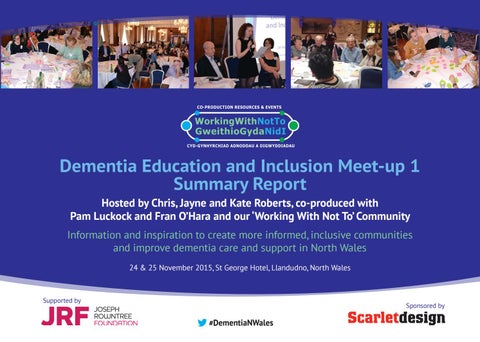
Dementia Education and Inclusion Meet-up 1 Summary Report Hosted by Chris, Jayne and Kate Roberts, co-produced with Pam Luckock and Fran O’Hara and our ‘Working With Not To’ Community Information and inspiration to create more informed, inclusive communities and improve dementia care and support in North Wales 24 & 25 November 2015, St George Hotel, Llandudno, North Wales
Supported by
Sponsored by
#DementiaNWales
CONTENTS • Contents and welcome by Fran O’Hara......................................................2 • Agenda.....................................................................................................................3 • Our main aims......................................................................................................4 DAY ONE • Pam Luckock’s presentation............................................................................5 • Weblinks for some of the presentation videos........................................6 • Chris Roberts ‘Education and Inclusion’.....................................................7 • Visual minutes map 1........................................................................................8 • Kate Roberts’ presentation..............................................................................9 • Jayne Roberts’ presentation.......................................................................... 10 • Visual minutes map 2..................................................................................... 11 • Group activity 1: ‘Using what we have’, asset-mapping dementia care and support in North Wales........................................... 12 • Group activity 2: Dementia Care Pathway, North Wales Identifying issues and gaps.......................................................................... 14 • Group activity 3: Participant-led Choice Sessions............................... 16 DAY TWO • Group activity 4: Dementia Care Pathway, North Wales themes...... 14 • Meet-up feedback: Conversations resulting in actions ................... 24 • Contact details for speakers, table hosts and the team.................... 25 • Exhibitions stands............................................................................................ 26 • Who came to our meet-up?.......................................................................... 29
2
Thanks to our community, speakers and sponsors for all their great support. Joseph Rowntree Foundation funding enabled us to review the data, create this report and print copies for each attendee. Also to commission John Popham to to video the meet-up and produce a meet-up overview video. We would have liked to hold a fully bilingual meet-up but had insufficient funding to do so.
Welcome to our summary report, created to share knowledge, learning and inspiration. Firstly we want to say a huge THANK YOU to everyone who came, supported and contributed - you created an amazing meet-up. This report is a summary of what we did, and how we did it. Hopefully inspiring people to have a go themselves, and do things in new ways. We have a lot more data that is in separate reports, as this one is already 32 pages! Email or phone us to talk more about these please. Its up-to-date, North Wales-specific information from people who use and deliver services, and we all want it to be used to bring real change. Pam and I worked with Chris, his family and our community to create a genuinely co-produced meet-up. We’re proud so many speakers were people with dementia, their carers and families, and able to be positive role models and authentic voices. 3 speakers on day 1 and 15% of our 95 attendees have dementia. It’s so important people who are experiencing dementia are given opportunities to take part and tell their stories. Many are in our overview video (https://youtu.be/ YYksqxrnmKw) with more videos on our youtube channel. We had no funding, and the paid ticket and stand fees enabled us to offer 50% of attendees free tickets. Real learning took place and 4 people were trained as Dementia Friends. Everyone took part in conversations as equals, providing us with invaluable insights and lived experience to create realistic and appropriate actions. If you would like to join our community please do contact us, we’d love to hear from you. Dementia North Wales Meet-up 2: 22 & 23 November 2016 - Please come, offer to speak/host a conversation, invite, share and/or sponsor! FRAN O’HARA & PAM LUCKOCK (‘FRAMELA’)
Directors, ‘Working With Not To’ Co-production Project
AGENDA DAY ONE
DAY ONE continued
9.30am Refreshments, exhibition viewing, quiet space time, Dewis
3.20pm
Break
3.40pm
Second participant choice session: choice of themed workshops, informal hosted table conversations, quiet space, exhibition, Dewis
10.00am Welcome, Chris, Jayne and Kate Roberts ‘Creating inclusive communities, a place for everyone - what matters to us’ Kate Swaffer, Chair, Dementia Alliance International Video presentation 10.30am Jeremy Hughes, CEO, Alzheimer’s Society UK ‘Dementia Friends’ 10.45am ‘Using what we have’ - Asset-mapping dementia care and support in North Wales. Group discussion activity 1 11.30am
Break
11.50am
Ruth Eley, TIDE ‘Dementia and Carers’
11.55am ‘Dementia care pathway - Identifying issues and gaps’ Group discussion activity 2 12.40am Prof. Bob Woods, Bangor University ‘Arts and Dementia’ 12.50pm Lunch, exhibition viewing, quiet space time, Dewis Agnes Houston ’Dementia and Sensory Loss’ 1.50pm 2.05pm
George Rook, patient activist ‘Imagine’
2.20pm First participant choice session: choice of themed workshops, informal hosted table conversations, quiet space, exhibition, Dewis
4.40pm Summing up Fran, Pam and Chris 5.00pm Feedback and end DAY TWO 9.30am Refreshments, exhibition viewing, quiet space time, Dewis 10.00am Welcome - Chris and Jayne Roberts ‘ ‘Creating change together’ 10.15am Multi-sector panel discussion representatives from health, social care, carers and people with dementia: Chris, Bob, Helen, Carol and Olwen ‘Current North Wales dementia care landscape’ 10.30am Reviewing the asset-map of dementia care and support in N Wales - developing recommendations for action group activity 11.20am Break 11.40am
‘ Dementia care pathway - Identifying issues & gaps’ Themes suggested by participants Participants suggest themes and host a table conversation and record the actions
1.00pm One action from the meet-up... Feedback from everyone on what they will do differently
3
A MEET-UP CO-PRODUCED WITH PEOPLE WITH DEMENTIA, THEIR FAMILIES & CARERS IN NORTH WALES 95 people over 1.5 days at the St George Hotel, an agenda designed around people with dementia’s needs, self-funded by ticket sales with 50% free tickets, cross-sector, short speeches, table conversations, additional signage and venue map, inclusive activities, 4 people trained as Dementia Friends, a quiet room, spaces and places to connect, free flowing refreshments, some tears, lots of laughs and honest, open conversations and real learning.
Working WithNotTo Gweithio GydaNidI
Co-produced with Pam Luckock and Fran O’Hara and our ‘Working With Not To’ Community
24 & 25 November ‘15, St George Hotel, Llandudno
FI
NA UP L DA AG T E EN D DA W I 19 TH .1 1 .1 5
Dementia Education and Inclusion Meet-up hosted by Chris, Jayne and Kate Roberts
Hotel Reception
#DementiaNWales
I’m trying to make a difference while I can - if I what can you all do :)” How much does it cost? • FREE places. Reserved for people with dementia and their families/carers and citizens who do not have funds. PAID tickets fees: - Day 1 ticket = £85.00 - Day 2 ticket = £35.00 - Day 1 & 2 ticket = £120.00 • Fees from the PAID tickets will be used to cover the FREE tickets - we are aiming for 50% free ticketed attendees. • If you’re able to sponsor places or part of the meet-up please let us know.
How can I book a place?
Wedgwood Suite
can do this,
- main room, this is where presentations and table sessions take place
Exhibition Space and Meet-up Participant Book We have an exhibition area where you can hire a space. The fee includes a ticket for 1 person plus a quarter page space in the meet-up book. This will be shared online during and post event. - 24 November 2015 - £285 incl. VAT
Venue Information The St George Hotel in Llandudno are working with us to make the meetup as accessible as possible. Quote ‘Dementia Education and Inclusion Meet-up’ when booking for reduced hotel room rates. Thanks to our community, speakers and sponsors for all their support:
How can I support you? Please share the meet-up, and the free tickets for people with dementia and carers, buy tickets, sponsor us, help out and come...
More information or to book please email: workingwithnotto@gmail.com
4
steps
Quiet Room - anyone can go in here
© Scarlet Design Int. Ltd. 2015
Email Fran at workingwithnotto@gmail. com All place bookings must be confirmed by us, we want as many citizens present as possible, and people from all sectors.
Men’s toilet
Disabled toilet
Drinks and biscuits here all day Lunch is served here
Conwy Suite
- visit the exhibition stands here - ‘Dementia Friends’ information session and the knitting session take place here - drinks and biscuits here all day
Women’s toilet
Dementia Education and Inclusion Meet-up
entia “I’m your average 53 year old man who cares about dem to be about awareness, but it has to be good quality awareness, it has g to touch us promoting education about dementia because it is startin t not a lot of ‘dementia’ bu hear the word s beginning to all. Everyone i e living with 50,000 peopl nd with over 8 folk actually understand it a bout it. You t least a little a eed to know a this illness in the UK we all n heimer’s, but see “I” have dementia, mixed dementia, vascular and Alz esn’t have with the emphasis that I may “have it” but it certainly do me! Power is knowledge, knowledge is power! Wales. I’m involved in lots of stuff Now it’s time to do something where I live, in North a limited window to do this in and now, things I hope will make a difference, I only have be a bad thing and must help, well I doing this in turn keeps my brain sharp which can’t think it does.
We really appreciate you coming to our meet-up and sharing what you know, we hope you enjoy it - thank you. If you need any help please ask someone from our team - there are lots of people with badges saying ‘Can I help you?’
Information and inspiration to create more informed, inclusive communities and improve dementia care and support in N. Wales
OUR MAIN AIMS: • To asset map the information, support and provision currently available for people with dementia, their carers and families. To collate the data into a research report. • To identify key issues for people with dementia, their carers and families and potential solutions. • To map a Dementia Care Pathway for North Wales, for the people with dementia, their carers and families. • To build a learning community and database, which we hope will lead to a North Wales Dementia network. Also, an action research group. • To train a group of people to become Dementia Friends. • To build the understanding and confidence of people with dementia, their carers and families to become more visible, vocal citizen voices, advocates and speakers. • To create a model design of a dementia friendly, inclusive event, and an agenda where everyone is included and can contribute. • To promote Dewis with a team, at the meet-up to input data and identify needs and gaps in North Wales. ‘Easy view’ map of the meet-up on front of the guide
PAM LUCKOCK’S PRESENTATION
WELCOME TO OUR MEET-UP What to expect - I’m delighted to offer you our fabulous programme. I believe it sets an important milestone in Wales, as an event that has been co-designed and will be co-delivered by People with Dementia and their families and carers. From the outset our aim has been to host an inclusive event, we’ve been on a journey of discovery as to what this means in the context of Dementia and we’re confident that we still have much to learn! Chris Jayne and I had a ‘Tweet-up’ about 18 months ago when we realised we lived close to each other in North Wales. I feel so fortunate to know them, their energy, resilience and love inspires me and many others. So… today will be about working together. We want you to experience how much can be achieved together, through the simple art of conversation. “Human conversation is the most ancient and easiest way to cultivate the conditions for change—personal change, community and organisational change, planetary change. If we can sit together and talk about what’s important to us, we begin to come alive.” ~ Margaret Wheatley To enable this to happen, each of you has an important role to play, we need you:
CREATING A HOSPITABLE SPACE: We hope you enjoy the comfort of this lovely hotel which provides us a very hospitable space for our conversations. I find that both the ‘FREDA’ and ‘The World Cafe’ principles help me think about the conditions for hosting conversations that matter… The FREDA Principles are Fairness, Respect, Equality, Dignity, Autonomy. We invite each of you to contribute your whole self, speak from the heart as well as the mind. Three things that matter to me today are that: 1. We enjoy our conversations 2. We have time to reflect throughout the day on what we’re learning 3. At the close of the meet-up we will have harvested an abundance of ideas information and actions I invite you to relax and enjoy the day, thank you. PAM LUCKOCK Director, ‘Working With Not To’ Co-production Project @luckockp
• to listen deeply • to contribute your thoughts, feelings, ideas and hopes • to support each other throughout the day, and be sensitive to the different requirements we each have • to respect each other, let’s slow down the pace and take care to enable everyone a space for their contribution.
5
VIDEOS OF SOME OF THE PRESENTATIONS
6
Our Meet-up 1 Overview Video https://youtu.be/YYksqxrnmKw
Pam Luckock https://youtu.be/YfEjp_zLwrg
Attendee ‘Who’s in the room’ intros https://youtu.be/h3Pc_W_FbTE
Chris, Jayne and Kate Roberts https://youtu.be/Po5DInxtCDg
Ruth Eley https://youtu.be/9b9lQF-0Do4
Agnes Houston https://youtu.be/ulfTpzXKTko
Jeremy Hughes https://youtu.be/zr4tfixkn6k
George Rook https://youtu.be/eoFF-L3TPkI
Summary ending of Meet-up 1 https://youtu.be/M14N4FjXmCk
CHRIS ROBERTS’ PRESENTATION: EDUCATION AND INCLUSION Day 1 introduction Hello and welcome. My name is Chris Roberts, I’m 54 and I’m living with mixed dementia, vascular and Alzheimer’s, I was diagnosed nearly three years ago. I can’t cross roads on my own, I’ve forgotten how to write and don’t always recognise my family and friends. I struggle with my sleep, balance and sometimes words. At diagnosis we felt very lost and alone but with support and understanding you can live along side this illness. There is no reason that the UK and in particular Wales shouldn’t become the first dementia friendly nation in the world. A place where “people with dementia feel understood, engaged, included and valued.” Creating a dementia friendly nation starts with all of us. We all have a role to play in helping people with dementia sustain their independence and dignity and sense of purpose in our community. By making small changes we can make a big difference. I’d like you all to think about how your organisation can be more dementia friendly? How you can make your community more dementia friendly? How you can become more dementia friendly? The growing number of people living with dementia will require a shift in how we respond to the needs of people with dementia in the community. There are currently 850,000 people living with dementia, 44,000 of them are under
65, 45,000 people with dementia are living here in Wales and with diagnosis rates at less than 50% these figures are likely to be much higher. Without a medical breakthrough this number is expected to grow and grow. So ‘creating’ a dementia friendly nation starts with all of us. The growing number of people living with dementia will require a shift in how we respond to the needs of people with dementia in the community, Today, dementia is the third leading cause of death and is expected to become the leading cause of death in the not too distant future. Over a million people are currently caring for a person with dementia, making it a disease that touches almost everyone. However, research shows that most of people still know very little about dementia and find the disease frightening. They have heard of the word but still don’t understand its meaning By encouraging people and the community to become dementia friendly and aware we can create places where people with dementia are understood, where they can feel involved and supported to live as independently as possible. Where they can continue to be part of their community and social network for as long as possible which must be a good thing for everyone. A dementia friendly society has to involve people with dementia as equal partners, they need to feel like they are able and empowered to make decisions about their lives.
People living with dementia should be included and involved and given choice and control over their day to day life. So they can live in their community, independently for as long as possible. The community and home care sectors should be the leaders of the dementia friendly approach. Clearly aged, community and home care providers as well as GPs, pharmacies and other health care professionals should all be leading the way to becoming dementia friendly. To change negative perceptions of dementia and embrace dementia friendly organisations and communities, to ensure we provide people living with dementia the best possible environment to live in and the best possible care available People with dementia are our grandparents, our parents, our partners, our brothers, our sisters, even our close friends. This is the face of dementia! Being Dementia Friendly should touch every aspect of daily life. To change negative perceptions of dementia and embrace dementia friendly organisations and communities. CHRIS ROBERTS Meet-up host, living with mixed dementia, Dementia Friends Champion, Alzheimer’s Society Ambassador, Join Dementia Research Champion.
@Mason4233
7
8
© SCARLET DESIGN INT. LTD 2016 MAPS:WWW.FRANOHARA.COM
Pam Luckock, and Chris, Jayne and Kate Roberts’ presentations Visual minutes map drawn by Fran O’Hara
KATE ROBERTS’ PRESENTATION Day 1 introduction
Hello, my name is Kate and I am 17 years old. I am the youngest of 5 children and a carer alongside my mum for my dad. I left sixth form in January as it wasn’t the right fit for me and I’m now doing an apprenticeship to gain qualifications in childcare. Dad is 54 now but was diagnosed a few years ago at 50. I was confused to begin with as I always thought it was an ‘old persons’ disease. My parents explained everything they could but I looked on the internet for more information. I found lots of scientific articles and many on dealing with grandparents. However, there were very few stories on young people whose parents were diagnosed. At the time we were all getting used to our new life, my brothers and sister lived elsewhere, and my other sister had a busy social life, so I turned to my friends for support. If a person’s parent was diagnosed with cancer (not implying that this is a lesser disease, only that people are more aware about it) people would be much more understanding, and there would be a lot more support from people. When I told my friends about my dad, all I got back was “Oh, are you alright?” and nothing more.
But what could I expect? I was as clueless as them on the disease. I decided to speak to the school support worker instead. I explained my situation and the reply I got was “Does he still remember you?” I said yes, and apparently that was okay then. When I started sixth form, I took health and social care. One part of the course was a presentation on a health problem. With my home life, I knew a fair amount about Alzheimer’s, and decided my target audience was 30-40 year olds. I explained that I was doing this to make people more aware of early onset, and that it can happen to anyone. My Health and Social care teacher told me I shouldn’t do this as people “can’t get it that young” and that I should change my target audience to the elderly as this would be more suitable.
Like his passion for motorbikes, his driving licence, and all the jobs that would once come so effortlessly to him. Alternatively, he still has his sense of humour! If anything ever happens, like putting things in the wrong places, or getting me fish fingers when I’ve asked for a packet of crisps?! We laugh together. He says when a diagnosis is given, it is the whole family that is diagnosed. It’s my dad’s journey, but we are passengers on this journey. My mum is my rock, but my dad, my dad is my hero. Thank you. KATE ROBERTS Citizen advocate, young carer and daughter of Chris and Jayne Roberts
My point is that young people should be educated about dementia as 1 in 3 of us will know someone diagnosed. However, it’s not only the pupils that need to be educated but the teachers as well. Dad is an amazing man, and he has had to give up so much because of his condition.
9
JAYNE ROBERTS’ PRESENTATION Day 1 introduction
And so our education started.
My family, and how proud am I.
We learned there were many different types of dementia. We learned there was a mass of research out there specific to dementia
Ours is not a sad story. It is too early for that. Our story is one of love, of despair when Chris, and the whole family, received his diagnosis. At that point we were given the famous welcome pack, a prescription for the second favourite dementia drug, that might, or might not help. Nobody could say. And we didn’t get the first choice drug because he had a co-morbidity. I thought he had emphysema, but once you are diagnosed with a dementia, then all other conditions, be they terminal or otherwise, come second. And after the despair, we realised our ignorance. Ignorance of what is to come, no-one told us that. Ignorance of what to do about it, no-one told us that, either. As Kate has said we turned to Dr Google. Fabulous resource, once you’ve learned how to sort the fact from the fiction, the ‘horror’ and the inevitability of that downward spiral into the obligatory pit of despair. And then our story turned into one of hope. Chris became involved in an online world of dementia empowerment. And this on-line world was, guess what? It was based in reality world! With the support of DEEP dementia engagement and empowerment Project, we attended conferences.
10
Of course research into the holy grail of a cure. Research into living well with dementia. Research into the arts and how that could and would benefit people living with the disease. Research into psycho social interventions, mindfulness, exercise, risk reduction etc. We learned that there was hope We learned so much more than we could find here or were offered here at home. And guess what? There were people with dementia walking and talking at these conferences. And speaking, too! We learned most of all that we didn’t have to go home and wait for the grim reaper, who would be preceded by all the demons of Milton’s Paradise Lost. That is not the inevitability. Now, don’t get me wrong, we are not wearing Pollyanna’s rose tinted glasses. We do understand the total brutality of what may, and often does transpire with this disease. But not yet. There is a beginning, and a middle, and later on there will be the late stage. We are somewhere near the middle, having missed most of the early stage because we were getting on with life!
But we are not yet near where, upon diagnosis, I categorised Chris. I disempowered and disabled him, out of love. And ignorance. I took over far more of what he could do, as I thought that’s what I was supposed to do! What we needed was education. We needed to know the facts, the treatments and the ways of managing the condition, and from that coping with what very quickly became our way of life. Our family has been so fortunate in that Chris is a pragmatist, a realist, and someone who sees the solution to a problem before it becomes a problem. Not everyone has that skill. And that is what we are asking for today. What is it you can bring to the table. What is it that you and your family need from the people who provide and commission services for you? What have been your issues? Today is your opportunity to say it from your perspective, to have your say and your voice heard. And these good people will make sure that what is discussed today, will be acted upon! Thank you. JAYNE ROBERTS Citizen advocate @JayneGoodrick
© SCARLET DESIGN INT. LTD 2016 MAPS:WWW.FRANOHARA.COM
Jeremy Hughes, Alzheimer’s Society UK and Ruth Eley, TIDE Carers, Bob Woods, Bangor University, Agnes Houston, George Rook Visual minutes map drawn by Fran O’Hara
11
GROUP ACTIVITY 1: USING WHAT WE HAVE – ASSET-MAPPING DEMENTIA CARE & SUPPORT IN NORTH WALES
Q1. Using what we have – asset-mapping dementia care and support in North Wales What care and support is there… AT diagnosis NOW? 1. For people with young/early onset dementia? (below 65) 2. For people aged over 65 with dementia? 3. For family and carers? What care and support is there… AFTER diagnosis NOW? 1. For people with young/early onset dementia? (below 65) 2. For people aged over 65 with dementia? 3. For family and carers?
Table Activity Process: Participants chose where they wanted to sit, we tried to have a mix of people at each table. At their tables participants added post-its to large pre-printed tablesheets with the questions on them. Post event all data from the 12 table templates has been collated into a separate report summary, with themes identified. 12
GROUP ACTIVITY 1: USING WHAT WE HAVE – ASSET-MAPPING DEMENTIA CARE & SUPPORT IN NORTH WALES
“Dementia RED information and awareness raising in primary care.” “Lost in Art Groups, all ages and carers”
“Young onset dementia specialist nurses - but not enough.”
“Find out about each person, what they like, what they dislike.”
13
GROUP ACTIVITY 2 - THE DEMENTIA PATHWAY IN NORTH WALES
Dementia Care Pathway - Identifying issues & gaps Question 1: Issues? Question 2: Gaps/Ideas? Participants wrote/drew/doodled their ideas on the sheet or post-its answering the question. Fran then invited each table to feedback one main point from each question.
14
GROUP ACTIVITY 2 - THE DEMENTIA CARE PATHWAY IN NORTH WALES - IDENTIFYING ISSUES & GAPS
Issues and Gaps/Ideas
Main Themes:
We have identified the main themes from the tablesheets and have the detailed information in a separate document. There were many overlapping areas, with people having a clear idea where the gaps and issues were, citing specific examples.
1. Awareness of dementia / knowledge of dementia
The issues are for everyone with and around the person with dementia, their family, carers and the people supporting them. Having all these people at the table (literally) enabled us to gain a ‘whole picture’ of what the pathway looks like now. To start identifying how and where improvements could be made.
“Lack of understanding by professionals of needs of LGBT individual.” “Working carers supporting people with dementia.”
2. Challenges with influencing commissioners, including people with dementia, citizen voices 3. Coordination of care by people providing it 4. Education and Training 5. Equality LGBT 6. Health conditions with dementia 7. Inadequate, poor or lack of services and support 8. Inclusive Communities and Spaces 9. Lack of right, and type of information, available 10. Listening to the people with dementia, their right to have their say and to live the life they choose 11. Positive stories and good models of practice
“Importance of other health conditions alongside dementia.”
“How do grassroots influence commissioners?”
12. Post diagnostic support for people with dementia, family/friends 13. Sensory, food and drink, eating 14. Staff and workplace 15. Stigma and attitudes to people with dementia 16. Transport and specific geographical challenges, including North Wales rural
“Provision of information and local support etc.”
17. Using technology 18. Specialist help for young carers
15
GROUP ACTIVITY 3 - SESSIONS RUN BY MEMBERS OF THE ‘WORKING WITH NOT TO’ COMMUNITY We invited offers to host table conversations from our community, people used this as an opportunity to test sessions, practice hosting and learn. Participants chose from a selection of 45 minute hosted table conversations in the main room, and sessions in the exhibition room, where 4 people undertook the Dementia Friends training. This was followed by a second set of hosted table conversations. At the end of each session tables fed back actions points. HOSTED TABLE CONVERSATIONS - SESSION 1 1. Supporting good quality of life in care settings, John Moore, My Home Life Cymru Programme Manager, Age Cymru 2. TIDE – Together In Dementia Everyday, Ruth Eley, Giving carers of people with dementia a collective voice 3. Dementia, well-being and the natural environment – Pam Luckock, ‘Working With Not To’ Co-production Project 4. Late diagnosis of dementia – Jayne Goodrick, carer and citizen activist 5. The Ageing Transgender Community and Dementia – Jenny Burgess, Positive Approach & Unique Transgender Network 6. Support for people with dementia and carers post diagnosis – George Rook, Chair, Shropshire Dementia Action Alliance and Citizen Activist. 7. Stimulating Research – A discussion on current and future research into the arts and dementia – Dr Catrin Hedd Jones and Kat Algar, Bangor University 8. Dementia and sensory loss – Agnes Houston, citizen activist with Donna Houston, carer During sessions 1 and 2 participants were able to attend two sessions in the Conwy Suite - exhibition room, or have informal conversations at separate tables and in the quiet room. 1. ‘Dementia Friends’ information session – led by the Alzheimer’s Society North Wales team at their stand.
16
HOSTED TABLE CONVERSATIONS - SESSION 2 1. Dementia and sensory loss – Agnes Houston, citizen activist with Donna Houston, carer 2. Stimulating Research – A discussion on current and future research into the arts and dementia – Dr Catrin Hedd Jones and Kat Algar, Bangor University 3. What does ‘post diagnostic care’ mean? – Dr Shibley Rahman 4. How can the Betsi Caldwaladr University Health Board create a realistic and sustainable way to engage with people with dementia and family carers across North Wales? Ruth Eley, TIDE 5. Young carers of people with Dementia – Kate Roberts a young carer & Suzy Webster, Carer & My Home Life Cymru Programme, Age Cymru 6. ‘Risky business, engaging with our natural environment’ How we can enable positive risk taking to benefit the health & well-being of people with dementia – Rachel Niblock, Dementia Adventure 7. Supporting good quality of life in care settings, John Moore, My Home Life Cymru Programme Manager, Age Cymru 8. The Ageing Transgender Community and Dementia – Jenny Burgess, Positive Approach & Unique Transgender Network 2. Circular knitting to make small projects, purposeful activities for people with dementia – Glenys Owen-Jones, Snowdonia Wool and carer People could also visit the stands for quieter conversations, and talk to the Dewis team and look for, and put data into, the website.
GROUP ACTIVITY 3 - SESSIONS RUN BY MEMBERS OF THE ‘WORKING WITH NOT TO’ COMMUNITY
17
GROUP ACTIVITY 3 - SESSIONS RUN BY MEMBERS OF THE ‘WORKING WITH NOT TO’ COMMUNITY 1.1 Supporting good quality of life in care settings, John Moore, My Home Life Cymru Programme Manager, Age Cymru - cancelled as John had to leave early 1.3 Dementia, well-being and the natural environment Pam Luckock, ‘Working With Not To’ Co-production Project and 2.6 ‘Risky business, engaging with our natural environment’ How we can enable positive risk taking to benefit the health and well-being of people with dementia – Rachel Niblock, Dementia Adventure 1. Liaise Open Event – Dementia Friendly Walk Leader Training – Positive Risk Taking 2. Inter-generational Walks – School Children and People With Dementia (PWD) 3. Links N.T. Natural Env. NPA’s • Mental Health foundation greening dementia • Walking schemes, Woodland activities, Inter-generational work • Dementia-friendly walks – training – dementia adventures • Keep Wales Tidy green flag award • NHS forest Porthmadog & Pwllheli • Emma Quaech • Luke Flintshire CC – commissioners – dementia friendly communities • Ramblers Association • Holidays – 10 mile walk • Eleri: craft based activities outdoors • John: ‘Dementia Adventures’ • Parks/gardens small and large
18
• • • • •
Open event in Wales, specifically how we can make this happen What do we know about the ‘ways to well-being’? Social prescribing via GPs Dementia inclusive walks, 1 or 2 days Access to historic buildings e.g open days Cadw
1.4 Late diagnosis of dementia Jayne Goodrick, carer and citizen activist • Doctor said “what do you expect at your age?!” • NHS Wales is fantastic (said by couple from England) • “I feel like I’m going mad” before diagnosis • Rehabilitation – most services don’t seem to offer the series of 07 speech therapist • Speech therapist: would like to intervene before problems because too severe • Difficult for professionals brought in late, earlier is far more useful • My fear of early diagnosis is neither one nor the other • Dementia is considered as “not a lot we can do” condition • Do not tell us it is old age senility • Supporter of person diagnosed must have offer of education and information • We agree early diagnosis with back up of correct rehab for PWD
GROUP ACTIVITY 3 - SESSIONS RUN BY MEMBERS OF THE ‘WORKING WITH NOT TO’ COMMUNITY 1.5 The Ageing Transgender Community and Dementia Jenny Burgess, Positive Approach & Unique Transgender Network • Involving family and ensure the chance to rewrite their narrative dependant on where people are in their ‘reality’ • Importance of lifestory work at diagnosis • Alzheimer’s society research – late stage dementia memory loss – not identifying themselves as their transgendered self • Transgender not having family support if they are diagnosed with dementia • Memory of process • Looking and seeing themselves as people they don’t know • To raise people’s awareness and knowledge – there is ‘some’ research happening • To start to link in with dementia related networks – increase awareness (may give people chance to disclose) • I would like to talk to Alzheimer’s Society re trans issues • Education of care staff • Recruitment - care needs to be taken • Commissioning – ensure plan is written 1.6 Support for people with dementia and carers post diagnosis George Rook, Chair, Shropshire Dementia Action Alliance and Citizen Activist. • “Talk to me about my life, and give me the support I need to keep living the life I choose” • A Dementia Advisor to be my first point of contact, available via email, text and phone during and out of hours. Help me with my life, my medical concerns, accompany me to meetings, etc. • Create a care and living plan WITH the people with dementia
• Offer support to the pwd family • Give the pwd the support they need, when they want it. 1.7 and 2.2 Stimulating Research – A discussion on current and future research into the arts and dementia Dr Catrin Hedd Jones and Kat Algar, Bangor University • Partnership between DSDC Wales and North Wales Alzheimer’s Society to share what each other are doing • Research awareness and create research champions • How can we sort out transport issues • Raise awareness of necessity to have reminders to attend appointments/activities (welfare officer) 1.8 Dementia and sensory loss Agnes Houston, citizen activist with Donna Houston, carer 1. Sharing our skills and ideas session 2. Talk To Us 3. Use Sensory Booklet (download here) for Training 4. Make, and have, a Sensory Pathway • Peer support • More information on condition at diagnosis • Regular touch with multidisciplinary team • Dementia Is More Than Memory, Sensory Pathways Peer Support (Education for Fire Service Carers, People with Dementia)
19
GROUP ACTIVITY 3 - SESSIONS RUN BY MEMBERS OF THE ‘WORKING WITH NOT TO’ COMMUNITY 2.3 What does ‘post diagnostic care’ mean? Dr Shibley Rahman • Relevant information with a clear pathway • Support with legal issues in a timely way • Person centred not a ‘one size fits all’ • Care co-ordinators • Care Co-ordination • Information for people with dementia + carer • Haphazard • Local differences • Target 2.5 Young carers of people with Dementia Kate Roberts a teenage carer, with Suzy Webster, Carer & My Home Life Cymru Programme, Age Cymru • Emotional support from the start – neutral person • Acknowledgement that it’s complicated • Internet support • Peer to peer support – age appropriate • Go in nature • Education and job support
20
2.4 How can the Betsi Caldwaladr University Health Board create a realistic and sustainable way to engage with people with dementia and family carers across North Wales? and 1.2 Together In Dementia Everyday, Giving carers of people with dementia a collective voice Ruth Eley, TIDE 1 Dementia advisors for all 2 Need signposting throughout journey and investment In groups and activities 3 Need education about dementia post diagnosis – carer and people with dementia separately 4 Physical activities which are fun • Signposting – to what? Invest to save VCS Flint roadways • Dementia advisors and coaches – one named contact • Dr Amir Hannan Haughton practice access to records, Manchester • Lack of speech therapy access early on (capacity?) • Help people to live well • Need living plans • Make it easy to get the information you need – bring it together • Physical exercise and activity - fun • Preparation immediately after diagnosis and peer support • Diets/nutrition – eating well/fluids • Social network • Education post diagnosis • Need living plans and less variation across community • DEWIS: providing social activities, NHS Direct Wales: resource mapping
DAY 2 GROUP ACTIVITY 1 - MAPPING THE DEMENTIA CARE PATHWAY IN NORTH WALES
21
DAY 2 GROUP ACTIVITY 2 - DEMENTIA CARE PATHWAY IN NORTH WALES THEMES
PANEL DISCUSSION Chris Roberts, Bob Woods, Helen Duffy, Carol Jones, Dr Olwen Williams ACTIVITY 1: MAPPING THE DEMENTIA CARE PATHWAY Due to the volume and detail of the information collected in the first activity, we have created a separate report. ACTIVITY 2: DEMENTIA CARE PATHWAY THEMES DISCUSSION In ‘open space’ style the group were asked to identify themes they would like to discuss in table groups - focusing on the Dementia Care Pathway, identifying issues and gaps and actions. Participants then chose one of 4 themes to discuss moved to the themed table of their choice. THEME 2: Improve Dementia care and support in North Wales by… THEME 3: Recognising the importance of sensory loss and management. Where? How? When? THEME 4: Education for EVERYONE on dementia. Different types of dementia - everyone: carers, people with dementia, GP’s etc THEME 5: “Nothing about us without us” including (REALLY including) people with dementia in EVERYTHING THEME 2: Improve Dementia care and support in North Wales by… 1. Dementia specific counselling for people with dementia and their carers and families 2. Alzheimer’s society CRISP 3. Guilt on both sides 4. At what point do you tell people the information?
22
5. Coping with caring - grief and loss based BETSI services 6. Dementia UK hotline specialist nurses 7. Calling for a consistent offer 8. Admiral nurse model 9. After my caring role finished, I did not know where to go 10. We are waiting for… The inevitable 11. Understanding of communication difficulties if person with dementia - needed in counselling THEME 3: R ecognising the importance of sensory loss and management. Where? How? When? 12. One page factsheet to pin in someone’s home 13. Aware of changes in eating habits, tastes and smell 14. Check the environment for noise, heat, light, distractions 15. Phases’ of dementia not stages as dementia is variable, you can improve on aspects 16. Speech therapy in dementia pathway at start 17. Audiology re: hyperacusis, who diagnosis? 18. Coping for carers - Crossroads 19. Get Occupational Therapy to assess the environment, home etc. 20. In (Theme 3) dementia managements, have an equal section on sensory issues - ask the right questions 21. Through educating 22. Including dentists in the pathway as person with dementia may not be able to show they have pain/ toothache
DAY 2 GROUP ACTIVITY 2 - DEMENTIA CARE PATHWAY IN NORTH WALES THEMES
THEME 4: Education for EVERYONE on dementia. The different types of dementia. Everyone: carers, people with dementia, GP’s etc.
6. Acceptance. Inspire. Attitudes. Avoid jargon.
1. Opening up of care homes to public (Christmas/Summer Fayres etc.)
8. Digital inclusion: Social media - twitter, Facebook, other, ‘zoom’ conferences, webinars, peer support networks
2. Social Care - need to have mandatory training on dementia units. Care Council for Wales! 3. More Dementia Friends and Champions - encourage more businesses to become dementia friendly 4. Health promoting schools - include information about dementia - to children and young people whose parents or grandparents have dementia 5. Join the dots 6. Educate hospital staff with internal training days - accredited training! All staff, not just doctors, nurses etc.
7. Taking the info to the people - Festivals, ‘Doris and Ivor’ example
9. Dementia - recognise as a disability 10. Ask question - How to include? Where? When? Go to where people are. Normalise dementia 11. Play, creative, tokenism 12. Dementia Diaries: Dementia & Gender (JRF Joseph Rowntree Foundation), podcast, language, deep, used as an information resource 13. Support - go to quality of listening 14. Appropriate forum - rights based, environment
7. Training manual created two years ago WANHIPH, where is it?
15. Recruit via peer support - empowering
8. GP1 - website to flag up what needs to be addressed
16. How to include - Where? When? So how do we ‘include’?
THEME 5: “ Nothing about us without us” including (REALLY including) people with dementia in everything 1. Payment = valuing time / experience / expertise = equal footing 2. Encouraging and nurturing. Start small. 3. Get the environment right, difference between including and inclusive 4. Ask how you’d like to take part? Home, social media etc. 5. How much listening is taking place?
17. Go to ‘where’ people are lacking in employment 18. Use whatever’s there: local chapel. Co-op, Londis (supermarket) etc., library, rural, societies. Use chapel societies to engage 19. Including children in care homes activity e.g.Scouts 20. Recognise dementia as a disability 21. Give people time: cards to show slow down 22. Lack of understanding - diagnosis = disable themselves 23. Advisory group - need at least 2-3, the right mix. Support nurturing, encouragement, someone with them invite in pairs, peers support, scouts badge dementia, (people)
23
FEEDBACK: CONVERSATIONS RESULTING IN ACTIONS - ‘WHAT’S ONE ACTION OR LEARNING FROM THE MEET-UP?’ • “Dementia is more than ‘just’ memory…I’ve learnt an awful lot about the sensory issues. As an action, when we are assessing someone, we certainly need to be looking ‘around’ the issue of food refusal and not just assuming it’s the memory that they’ve ‘forgotten’ to eat. It’s actually asking questions like “What does it taste like?” “Does it have a funny smell?” “Is it cooked the way you like it?”… So I’ve had lots of tips”
• “I’ve found the last two days totally inspiring talking to everyone here. One solid action that I made with colleagues in the Alzheimer’s society was that we were going to have an informal partnership to share with each other what we’re doing so that the research gets out there to staff, volunteers and people they interact with and similarly services, so that’s one action that’s going forward already.”
• “I’ve really enjoyed the last two days, even after being in the Health Service for 40 years, I’ve learnt so much in the last 2 days. The educating (others) part is something I’m going to take back with me and working with Health Carers, Nurses, wards and people in the community, I think there’s an awful lot on the education of people with dementia for people to understand and what I’ve learned is the impact that sensory loss has on has on dementia patients.”
• “I’ve gained so much and it’s really difficult to put in to words. So two things, I really want this to carry on, so please, let’s not stop here and getting access to and including more people who are maybe more difficult to ‘get hold of’ for whatever the reasons, rurality, language or culture – I’d like to dig under the skin of that a bit in future.”
• “It’s been a great 2 days and what I’m going to take away from it is that you go to conferences over the years and it always seems to be the professionals giving the talks. But the brilliant thing about this meet up is that of the talks yesterday, 5 people talking, 2 or 3 of them were people with dementia as well as professionals. I think that’s important for any conference in the future.” • “I’ve had a great two days. What I’ve learned is that it’s so important to interact with people who have dementia and to speak to people as there’s only so much you can learn from a book or a lecture. My undergraduate education, all I learned was about what happens to the brain, not who people are, what happens to them and what we can do for them,” • “I’m absolutely determined to sort out these dementia connections. The things that’s going to stay with me is Kate’s talk yesterday and when she said “my mother is my rock, but my father is my hero”… I thought that was just brilliant!” • “I’ve really enjoyed today, which had been interesting to connect with other people. Book of you is great and sometimes can be quite solitary so to be with other people and to get some ideas which hopefully we can take forward, would be fantastic.”
24
• “I’ve learned so much, and its shown me again, how much more I need to learn and I think I’m taking home a lot, I’ve got lots of links (with others) to work on. I’m ‘stealing’ from Agnes and thinking, start small and I’m taking from Neil and I’m going to go to the local Chapel – chat to people, get out what we can do and also what people want.” • “I think I’ve been humbled. I think that the experience of hearing people’s stories is the thing that drives you and what I’d like is for you to hold me to account, in making sure that I try and deliver some of what you’ve said in the last couple of days. “ • “What came out for me was Hope – I got tremendous hope from today. I was inspired by John and Richard. Honest communication, we sat here and we spoke to people like Bob (has dementia), we sat down and spoke as human beings about our issues, asking for help and listening. The honest communication was the ‘WOW’ factor.”
“You all remind me that I’m not on my own, it’s fantastic.” Chris Roberts
CONTACT DETAILS
SPEAKERS CHRIS ROBERTS @mason4233
Living with mixed dementia, Dementia Friends Champion, Alzheimer’s Society Ambassador, Join Dementia Research Champion, Board Member Dementia Alliance International. w: www.mason4233.wordpress.com Co-hosting with his wife and daughter JAYNE & KATE ROBERTS @jaynegoodrick
JEREMY HUGHES @JeremyHughesAlz
CEO of Alzheimer’s Society UK. Campaigner for people with dementia. Believes social action can change society for better. e: Jeremy.Hughes@alzheimers.org.uk
GEORGE ROOK @george_rook
Living well with mixed dementia. Promoting patient involvement and co-design. Influencer for change in healthcare. Chair Shropshire Dementia Action Alliance and a Dementia Friends Champion. e: Georgerook51@gmail.com
PROF. BOB WOODS
AGNES HOUSTON @agnes_houston
GLENYS OWEN - JONES
Diagnosed at 57 with Early Onset Alzheimer’s Dementia. Active member of the Scottish Dementia Working Group. Campaigning for best practice/improving lives of people with dementia in Scotland and abroad. e: agneshouston@hotmail.com
Snowdonia Wool e: glenys@snowdoniawool.co.uk
KATE SWAFFER @KateSwaffer
SHIBLEY RAHMEN @dr_shibley
SUZY WEBSTER @suzysopenheart
My Home Life Cymru, Age Cymru, e: suzy.webster@agecymru.org.uk
Chair/co-founder Dementia Alliance International, Alzheimer’s Disease Int. Board member. A humanitarian, advocate for people with dementia, author, int. speaker, living beyond younger onset dementia diagnosis. w: www.kateswaffer.com
e: legalaware1213@gmail.com
HOSTED TABLE CONVERSATIONS
WORKING WITH NOT TO @workingwithnot2
Bangor University. Co-Director, Dementia Services Development Centre Wales:
DR CATRIN HEDD JONES @CatrinHedd e: c.h.jones@bangor.ac.uk
& KAT ALGAR @Kat_Algar e: k.algar@bangor.ac.uk
Professor of Clinical Psychology of the Elderly at Bangor University. Co-Director, Dementia Services Development Centre Wales. e: b.woods@bangor.ac.uk
JENNY BURGESS @JennyBurgess12 Positive Approach & Unique Transgender Network e: jenny.positiveapproach@gmail.com
RUTH ELEY @tide_carers www.tide.uk.net Ruth Eley is a founder Director and vicechair of the Life Story Network. She delivers training in the use of life story work to improve relationship centred care for vulnerable people. e: ruth.eley202@btinternet.com
DEEP e: Niblock@myid.org.uk @DementiaVoices
RACHEL NIBLOCK @RachelNiblock
Dementia Adventure @DementiaAdv
DR OLWEN WILLIAMS @OlwenOlwen
BCUHB, NHS Wales e: Olwen.Williams@wales.nhs.uk
TEAM
Working With Not To’ Co-production Project e: workingwithnotto@gmail.com w: www.WorkingWithNotTo.com
PAM LUCKOCK @luckockp
Director, ‘Working With Not To’ Co-production Project, Board member Wales Co-Production Network e: pam.luckock@btinternet.com
FRAN O’HARA @fran_ohara
Director, ‘Working With Not To’ Co-production Project & Scarlet Design Int. Ltd. e: ohara@scarletdesign.com
JOHN POPHAM @johnpopham
Director, John Popham, Digital Storyteller e: john.popham@johnpopham.com
e: info@dementiaadventure.co.uk
25
EXHIBITION SPACE STANDS
SCARLET DESIGN INTERNATIONAL LTD Fran O’Hara, with a core team and expert consultants, delivers facilitation, training, design, strategic planning and events. Our expertise lies in real leadership and innovation. We create inclusive, effective and engaging communication tools. We work in three main areas: 1. Development of, and facilitation at, events and conferences, from creating ‘live‘ visual minutes to event design and delivery. 2. Training and coaching in visual facilitation, strategic planning and thinking and engagement. 3. Graphic design, communications, social media and print. e: enquiries@scarletdesign.com tw: @fran_ohara @scarletdesigngr w: www.franohara.com CO-PRODUCTION RESOURCES & EVENTS
WorkingWithNotTo GweithioGydaNidI CYD-GYNHYRCHIAD ADNODDAU A DIGWYDDIADAU
‘WORKING WITH NOT TO’ CO - PRODUCTION PROJECT ( WWNT )
In June 2013 Pam Luckock and Fran O’Hara set up the ‘Working With Not To’ Co-Production project. We work across Wales to grow co-production from ‘grassroots up’. Through the co-design and delivery of regular co-production ‘meet-ups’ in Wales, training, facilitation and speaking. With our learning community of 800+ people, we co-produce all our work, valuing people’s voices and expertise and working to make these visible. We provide a full event service, from the planning the event, sourcing speakers and
26
workshops and materials design - to hosting the event programme online, invites, production of database, delivery of event, including social media, post event feedback and reports. e: workingwithnotto@gmail.com tw: @workingwithnot2 w: www.workingwithnotto.com
RMD – MEMORY MAT TERS RMD – Memory Matters believes that the Arts can significantly help EVERYONE affected by dementia to live well. We offer a range of creative services, training and support, for people living with dementia and their carers across the North West. We provide a variety of services specialising imagination and reminiscence. We have a range of exciting volunteer programs – please get in touch! We are always looking to partner with other organisations as we feel this is how we can truly reduce the stigma and raise awareness of dementia. Please contact us! Donna Redgrave e: donnaredgrave@rmd-memorymatters.co.uk t: 07794204242 w: www.rmd-memorymatters.co.uk
TIDE Tide, ‘together in dementia everyday’, is an involvement network that recognises family carers of people with dementia are experts by experience, experts that can play a significant role in supporting other carers, influencing policy and shaping improved responsive local commissioned services. The network, which follows on from the excellent legacy of the DAA Carers Call to Action, will
EXHIBITION SPACE STANDS
provide a development programme which has been designed by carers to pass on the necessary skills and confidence to other carers finding themselves in a similar situation, so they too can influence and represent their peers. e: carers@tide.uk.net
t: 0151 237 2669
Contact: Brian Davies, CSSIW e: Brian.davies@wales.gsi.gov.uk 0300 062 5186 www.cssiw.org.uk
FLINTSHIRE COUNTY COUNCIL
tw: @tide_carers
CARE AND SOCIAL SERVICES INSPECTORATE WALES ( CSSIW ) CSSIW are responsible for inspecting social care and social services to make sure that they are safe for the people who use them. We will be providing information for people attending about dementia care services, and our work in North Wales. We are responsible for inspecting social care and social services to make sure they are safe for the people who use them. We are the regulator for social care and social services in Wales, from child minders and nurseries to homes for older people. We aim to: • Provide independent assurance about the quality and availability of social care in Wales • Safeguard adults and children, making sure that their rights are protected; • Improve Care by encouraging and promoting improvements in the safety, quality and availability of social care services • Inform policy, standards and provide independent professional advice to the people developing policy, the public and social care sector.
We will showcasing the work that is underway in Flintshire Towns for Dementia Friendly Communities. The Dementia Friendly Communities programme focuses on improving inclusion and quality of life for people living with dementia. Alzheimer’s Society’s five year strategy includes a key ambition to work with people affected by dementia and key partners to define and develop dementia-friendly communities. We want to create dementia-friendly communities across the country. In these communities: • People will be aware of and understand more about dementia. • People with dementia and their carers will be encouraged to seek help and support. • People with dementia will feel included in their community, be more independent and have more choice and control over their lives. The Prime Minister’s challenge on dementia also includes an ambition to create communities that are working to help people live well with dementia. Luke Pickering Jones e: Luke.pickering-jones@flintshire.gov.uk t: 01352702655 w: www.flintshire.gov.uk
27
EXHIBITION SPACE STANDS
JOIN DEMENTIA RESEARCH
ALZHEIMER’S SOCIETY NORTH WALES
Specialist services for people with dementia
Alzheimer’s Society is the UK’s leading support and research charity, providing information, advice and support to people with dementia, their families and carers. We are committed to putting you at the heart of everything that we do, and our services are continually informed by our growing understanding of dementia and what you need to live well after diagnosis. Get in touch with us today.
Join Dementia Research (JDR) is a place to register your interest in participating in dementia research. Anyone, with or without dementia, can register as a volunteer or sign-up for someone else, providing that you have their consent. Help us beat dementia and sign up today! To find out more, please visit the website: www.joindementiaresearch. nihr.ac.uk, call one of the helplines on 0300 111 5111 or 0300 222 1122, or pick up one of our leaflets during the day. We are also looking for more JDR Champions for Wales to join Chris Roberts in promoting JDR. For more information, please contact Kat Algar on k.algar@bangor.ac.uk .
Our North Wales Regional office telephone number is: 01248 671137 e: nwa@alzheimers.org.uk
DEWIS CYMRU
The website will be rolled out across Wales during 2016, resulting in Dewis Cymru becoming the natural choice for citizens to find information and advice that will assist them to take more control of their lives through having a better understanding of the choice of resources available in their area.
Dementia Services Development Centre (DSDC) Wales, Bangor University combines high-quality research with practice development. DSDC Wales also provides training for staff working in dementia care and consultancy and advice relating to the development of dementia services. Its current research portfolio includes projects funded by Research Councils and Welsh Government as well as charities such as the Alzheimer’s Society. DSDC Wales is led by Professor Bob Woods whose considerable research experience ranges across care settings and includes a variety of research outputs that have directly resulted in changes in evidence-based practice and policy.
Visit: www.dewis.wales and www.dewis.cymru Contact for further information: jenna.redfern@wlga.gov.uk
For more information, please visit our website: www.dsdc.bangor. ac.uk or contact us on 01248 383719 or dsdc@bangor.ac.uk.
Dewis Cymru is a Social Care and Wellbeing website for the Welsh citizen. It provides information and advice on National themes, plus a directory of services, which continues to be populated with resource information from across North Wales.
28
DEMENTIA SERVICES DEVELOPMENT CENTRE ( DSDC ) WALES
WHO CAME TO OUR MEET- UP? PEOPLE FROM DIFFERENT SECTORS & FROM ACROSS THE UK FIRST NAME
SURNAME
JOB TITLE
COMPANY
Kate
Schwaffer
Citizen voice
Kate Swaffer & Dementia Alliance International
M
M Roberts
Citizen voice
St Davids Care Home
D
D Banny
Citizen voice
St Davids Care Home
A
Sayer
Citizen voice
St Davids Care Home
A
Sayer
Citizen voice
St Davids Care Home
OS
Jones
Citizen voice
St Davids Care Home
D
Jackson
Citizen voice
St Davids Care Home
S
Wilks
Citizen voice
St Davids Care Home
Ruth
Waltho
Manager
St Davids Care Home
Katherine
Algar
Research Project Support Officer
Bangor University
Steve
Baker
North Wales Directory of Services Lead
Social Services Improvement Agency
Jacky
Baldini
Operations Manager
Alzheimer’s Society N Wales
Kathy
Barham
Director
Book of You CIC
Chris
Bexon
Citizen voice
Paul
Bexon
Citizen voice
Paul
Brownbill
PhD Student Researcher
University of South Wales
Jenny
Burgess
Director
Positive Approach
Neil
Bryson
Director
Book of You CIC
Jackie
Clayton
Technical and Rehabilitation Officer
Deaf Awareness and Communication trainer, N Wales Deaf Assoc.
Hannah
Wilson
Signer & Interpreter (for Jackie Clayton)
N Wales Deaf Assoc.
Julie
Walker
Signer & Interpreter (for Jackie Clayton)
N Wales Deaf Assoc.
Daisy
Cole
Director of Wellbeing and Empowerment
Older People's Commissioner for Wales
Brian
Davies
Senior Inspector
Care and Social Services Inspectorate Wales (CSSIW)
Teresa
Davies
Citizen voice
Kim
Dawson
Reg Manager
Chapel House Dementia Resource Community
Helen
Duffy
Mental Health & LD
Betsi Cadwaladr University Health Board
Ruth
Eley
Vice-chair
Life Story network/TIDE Carers
Denise
Ellis
Clinical Lead Dietician: dementia, mental health
BCUHB
Kath
Fleet
Development Officer
Flintshire County Council
29
WHO CAME TO OUR MEET- UP? PEOPLE FROM DIFFERENT SECTORS & FROM ACROSS THE UK
30
FIRST NAME
SURNAME
JOB TITLE
COMPANY
Valerie
Gannon
With Teresa Davies
Fran
Graham
Development Officer
Flintshire County Council
Clare
Harris
DementiaGo Champion
Gwynedd Council
Catrin
Hedd Jones
Research Officer, Dementia and Imagination. Dementia Services Development Centre (DSDC)
Bangor University
Ceri
Hodgkison
Dementia UK
Hayley
Horton
Engagement and Participation Officer
Donna
Houston
Carer
Agnes
Houston
Scottish Dementia Working Group
Jeremy
Hughes
CEO
Alzheimer’s Society UK
Lowri
Hughes
Student
Bangor University
Joan
Humphries
Citizen voice
Keith
Humphries
Citizen voice
Carol
Jones
Citizen voice
John
Jones
Citizen voice
Ann
Jones Roberts
Speech and Language Therapist
BUC NHS
Rakesh
Kumar
Clinical Specialist Rehabilitation-West (Care of the Elderly, Community & Mental Health)
Gwynedd Hospital, Bangor BCUHB
Louise
Langhar
TIDE
Together in Dementia Everyday
J
Loughlin
Citizen voice
Pamela
Luckock
Co-Director
Working With Not To
Matt
Makin
Medical Director
Betsi Cadwaladr University Health Board (BCUHB)
Richard
Markey
Citizen voice
Margaret
Markey
Citizen voice
Eleri
Miles
Carer and citizen voice
John
Moore
My Home Life Cymru Manager
Age Cymru
Vanessa
Morris
Supporting J Loughlin
HCSW LLys Dyfrig, BCUHB - Mental Health & Learning Disabilities
Rachel
Niblock
Project Leader
Dementia Adventure / DEEP
Fran
O'Hara
Director
Working With Not To & Scarlet Design Int. Ltd..
Laura
O'Philbin
Student
Bangor University
Alzheimer’s Society N Wales
WHO CAME TO OUR MEET- UP? PEOPLE FROM DIFFERENT SECTORS & FROM ACROSS THE UK FIRST NAME
SURNAME
JOB TITLE
COMPANY
Glenys
Owen-Jones
Owner
Snowdonia Wool Ltd
Colleen
Pear
Citizen Voice
Les
Pear
Citizen Voice
Bev
Perkins
Advocacy Manager
Alzheimer's Society
Luke
Pickering-Jones
Planning and Development Officer
Flintshire County Council
John
Popham
Digital Storyteller
John Popham
Emma
Quaeck
Exercise Referral Coordinator
Gwynedd Council
Shibley
Rahman
Researches Dementia, Queens Scholar
BPP Law School
Kath
Rawlins
Citizen voice
Eric
Rawlins
Citizen voice
Donna
Redgrave
Artistic Director
RMD, Memory Matters
Chris
Roberts
Host
Dementia Education & Inclusion Meet-up
Jayne
Roberts
Host
Dementia Education & Inclusion Meet-up
Kate
Roberts
Host
Dementia Education & Inclusion Meet-up
Denise
Roberts
Service Manager
Alzheimer's Society
George
Rook
Patient activist
Chair, Shropshire Dementia Action Alliance.
Roger
Rowett
Director
Taith Ltd
Susan
Thomas
Health Promotion Library
Public Health Wales
Isabel
Vander
Volunteer & Citizen Voice
Working With Not To' Co-Production Project
Suzy
Webster
Carer & My Home Life Cymru
My Home Life Cymru
Gwenllian
Wilkinson
Speech and language Therapist
BUC NHS
Olwen
Williams
Consultant Physician Genitourinary Medicine/ Future Hospitals
Betsi Cadwaladr University Health Board (BCUHB)
Steve
Williams
Project Manager
DEWIS Cymru
Bob
Woods
Dementia Services Development Centre (DSDC)
Bangor University
Suzanne
Worthington
Clinical Specialist Speech and Language Therapist
Wrexham Maelor Hospital
31
“I had such a wonderful time at the last meet-up with you all. I am so looking forward to meet-up 2. I felt so well after the last one, it was better than medicine. Peer support, being fully included, being listened to with action as well - FAB!” Agnes Houston MBE, Scottish Dementia Working Group. Person living with early onset dementia.
“I found the meet up inspiring, comforting, informative. I met people with similar and related interests and specialisms and shared knowledge and experiences. It was a wonderfully comforting, friendly, supportive community to be in, and that has stayed with me since. I have used the learning from the meet up in my dementia work. It’s given me the confidence in myself and my knowledge of dementia, knowing others think and feel the same, and knowing what they’re doing, to do more, say more, in Shropshire and nationally.” George Rook, Chair - Shropshire Dementia Action Alliance. Person living with early onset dementia.
This summary report is part of a set of communication materials created to share the experiences, learnings and actions from our ‘Working With Not To’ North Wales Dementia Meet-up 1. You can view our meet-up video here: https://youtu.be/YYksqxrnmKw For more information email us at WorkingWithNotTo@gmail.com, visit our website www.WorkingWithNotTo.com, or follow us on twitter @WorkingWithNot2 and #DementiaNWales. Please join our mailing list to find out about our work and future events.
Dementia Education and Inclusion Meet-up 2
22 & 23 November 2016 at the St George Hotel, Llandudno, North Wales. #DementiaNWales © Scarlet Design International Limited 2016