/
OUR IMPACT:
TOWARDS A SCAR FREE WORLD
1
2/
THE SCAR FREE FOUNDATION: OUR IMPACT
MAKING AN IMPACT SINCE 1999 Since we were established in 1999, we have overseen a £50+ million programme of life changing medical research. We work with leading clinicians and researchers from world-class institutions across the UK to achieve our ultimate aim: scar free healing within a generation. Behind every scar is a story and we put the people living with scarring at the heart of all that we do.
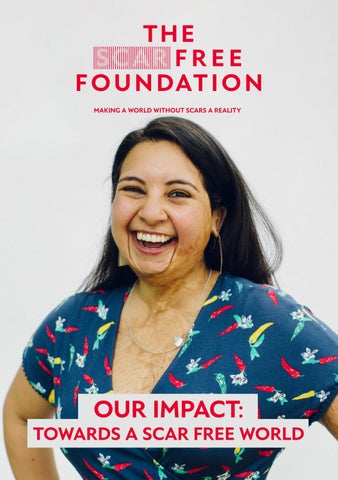
On the cover: Scar Free Ambassador and Board of Trustees’ member Dr Hemani Modasia
/
1999
Healing Foundation established
2005
2012
The Scar Free Foundation Centre for Burns Research, Birmingham opened
2013
The Scar Free Foundation Cleft Gene Bank and Cohort Study at The University of Bristol began recruiting
2018
The Scar Free Foundation Centre for Conflict Wound Research opened in Birmingham and Bristol
2021
The Scar Free Foundation/ Health and Care Research Wales Programme of Regenerative Medicine opened at Swansea University
The Healing Foundation Centre opened at the University of Manchester
2012
The Scar Free Foundation Centre for Children’s Burns Research opened at the universities of Bristol, Bath and Cardiff
2016
Launched the new research strategy centred on scar free healing and rebranded as The Scar Free Foundation
2020
The Scar Free Foundation Programme of Wound Healing Research opened at The University of Bristol
3
4/
THE SCAR FREE FOUNDATION: OUR IMPACT
OUR APPROACH TO RESEARCH Our approach is networked and collaborative: we bring together leading scientists, engineers, clinicians and patients from the UK. By accessing the unique research resource of the NHS, we focus on funding projects with clear potential for clinical impact that will ultimately improve care and bring us closer to scar free healing. We are also harnessing the power of our combined scientific strengths in pathway biology, comparative biology and human genetics together with those in bioengineering and physical sciences to achieve our aim of a world without scarring.
BUILDING RESEARCH CAPACITY Our dedicated programme to support the next generation of researchers has invested in over 100 capacity-building Fellowships, PhD Studentships and Student Elective Awards within fields relevant to scar free healing. Former Fellows and Elective recipients have gone on to become clinical and academic leaders: Dr Adam Reid, Senior Clinical Lecturer in plastic and reconstructive surgery at the University of Manchester, was awarded a fellowship in 2013. This funded a trainee plastic surgeon and a PhD student to research how fat derived stem cells could alleviate volume loss and scarring following reconstructive surgery. Adam is now a member of our Research Council and oversees a busy research team within his unit. While treating survivors of the Manchester Arena bombing in 2017, Adam saw first-hand the enormous physical and psychological impacts of scarring on both children and adults. More recently Professor Joseph Hardwicke, a former Research Fellow, has joined our Research Council and Miss Alice Lee, Scar Free Foundation Elective recipient continues her training as a core plastic surgery trainee, is a steering group member of an international burns research project, and Trainee lead of two international research projects in burns and skin surgery.
“As a surgeon, scarring is always front of mind. At the moment there are more factors outside our control than within it to minimise scarring – and that’s the challenge that The Scar Free Foundation is helping to solve.” Dr Adam Reid, University of Manchester
“The model of providing initial funding which then leads to further funding from multiple sources is highly successful.” Dr Amber Young, University of Bristol
/
Our strategy of providing initial funding to establish vital research programmes has led to additional grants in every area. Funding from host universities, the Wellcome Trust and the Medical Research Council means we have leveraged long-term support for our research. Since 1999, our investment has more than trebled through support from other sources.
ENABLING NEW DISCOVERIES WITH FUNDAMENTAL SCIENTIFIC RESEARCH
£10 million
programme to advance the understanding of wound healing and tissue regeneration
“We need psychosocial research alongside clinical research, so that we can understand how to best support those who experience difficulties as a consequence of an altered appearance.” Professor Diana Harcourt, University of the West of England
Led by Professor Enrique Amaya, our Centre at the University of Manchester represented a 10-year, £10 million programme to advance the understanding of wound healing and tissue regeneration. It grew from just one Professor and a Secretary in 2004 to four labs and 45 full time employees in 2015. The Centre’s research focused on the mechanisms of wound healing and tissue regeneration in animals that heal without scars, including fruit flies and frogs. The Centre has trained eight post-doctoral fellows, 17 post-graduate students and 20 undergraduates, producing over 45 research papers. A key discovery was the identification of the molecule produced when certain tadpoles regenerate their tails. This will impact the development of treatments to speed up wound healing in humans.
IMPROVING OUTCOMES FOR PATIENTS THROUGH CLINICAL RESEARCH Burns research has always been central to our work. In 2012 we established two major centres for burns research in Birmingham and Bristol. These investments delivered projects that focused on delivering new clinical interventions to understand and reduce the impact of burn injuries, as well as an evidence- based major public information campaign around hot scald prevention in children. Building on this work, in 2018 we launched the UK Burns Research Network supported by The VTCT Foundation, to deliver a programme of work aimed at better understanding patient relevant outcomes in burns and explore the genetic clues that lie behind good and bad scarring in children affected by burns.
5
6/
THE SCAR FREE FOUNDATION: OUR IMPACT
Now a global leader in burns research, the Foundation has helped to develop the groundbreaking SPACE smart dressing that detects bacteria in burn wounds, changing colour for immediate visual diagnosis. This will avoid the overuse of antibiotics and the need for painful dressing changes to check for infection. Patient reported outcome measures We have collected data from over 860 adults, young people and parents of children with burns to inform clinical and psychological treatments across the NHS and future research. This study is part of an ongoing programme of research that has involved more than 1,500 people over the past five years. Core outcome set for burns
Working with patients from the UK’s 14 Burns Centres and clinicians from 75 countries Right: Young Ambassador Elizabeth
Working with patients from the UK’s 14 Burns Centres and clinicians from 75 countries, the University of Bristol team have recently gained international consensus to identify the seven most important outcomes that all clinicians and researchers should assess following burn injuries in adults and children. Clinical decision making can now be even better informed from a stronger evidence base. Predicting infection People with a major burn are at high risk of sepsis and other fatal infections, and early diagnosis is currently difficult. By tracking 150 patients with serious burns over the course of one year, the University of Birmingham discovered three markers in the blood, which together can, with great accuracy, predict sepsis on the day of injury. Following our funding, the research team has now gained further support for this important project. Birmingham Objective Scar Scale (BOSS) The BOSS study was undertaken to see how reliable the readings from different scar measurement tools are and to develop a score for the objective scar measurement tools. Our initial funding has led to further funding for BOSS II which is taking place with patients in Birmingham and Swansea. This data will form an important basis for future scar therapy research.
ELIZABETH’S STORY
/
Elizabeth likes swimming, gymnastics, dancing and trampolining. Elizabeth was burned in a house fire when she was six months old. “What the Scar Free Foundation can do is move medical treatments forward massively through research and funding so that children like Elizabeth can benefit and do things they wouldn’t normally be able to do.” Liam, Elizabeth’s father
7
8/
THE SCAR FREE FOUNDATION: OUR IMPACT
USING LARGE SCALE DNA ANALYSIS The Scar Free Foundation Cleft Gene Bank & Cohort Study (also known as The Cleft Collective) Cleft lip and/or palate is the most common facial birth defect, occurring in approximately one in 700 live births in the UK. A cleft can significantly impact feeding, speech development, appearance, hearing and other aspects of a child’s growth. Since 2012, we have worked with an expert team led by Professor Jonathan Sandy at the University of Bristol to establish the first large scale cleft gene bank in the world. The study has collected over 10,000 biological samples from children born with a cleft and their parents, along with demographic, lifestyle and psychological data. After building up this vast bank of samples, the team at The Cleft Collective plan to analyse the genetic data to further our understanding of the causes of cleft. The Scar Free Foundation was delighted to additionally fund a groundbreaking genotyping study, which enabled scientists to compare the DNA of children born with cleft along with their mothers and compare them with the DNA of 11,000 mothers and children who did not have cleft. Through the latest DNA chip technology, the Bristol team were able to generate data on 600,000 genetic variants on these DNA samples across different chromosomes. The aim was to achieve a better understanding of both genetic and non-genetic factors to help inform future preventative measures. The Cleft Gene Bank and Cohort Study has provided unprecedented genetic and environmental insights into cleft and has enormous impact for wider scar free healing research, as it provides a valuable model to study the numerous and complex variables that affect scarring.
ABI’S STORY
“10 years of support from The Scar Free Foundation has enabled us to establish this groundbreaking gene bank and analyse the role of the family’s DNA through the genotyping study – which is the first of its kind in the world. This gives us valuable data on preventative measures - improving patient outcomes in the future.” Professor Sarah Lewis, University of Bristol Right: Our Young Ambassadors l to r: Delilah, Elizabeth, Emily and Abi
/
Abi was born with a cleft palate. At just six months old she had surgery to repair it. Although her scarring is internal, she has endured invasive surgery and assessments, as well as frequent visits to specialists which will continue into her teenage years. She couldn’t hear clearly for three years, which impacted on her speech and early school life. “When people talk about cleft, they think scarring on the lips. They forget the scarring both in the mouth and the personal scar of what the operations, hospital visits and the impact of just being ‘different’ has. This is why it’s so important for us to tell our story, to ensure our voice is listened to and impacts clinical work taking place now. The Foundation realises it’s not only the clinical evidence but the personal experience and the personal evidence that is essential.” Mum, Emergency Department paediatric nurse and Scar Free Ambassador Anna
9
10 /
THE SCAR FREE FOUNDATION: OUR IMPACT
WORKING TO ADVANCE THE RECOVERY AND REHABILITATION OF VETERANS The Scar Free Foundation Centre for Conflict Wound Research The Scar Free Foundation Centre for Conflict Wound Research is a groundbreaking national facility, undertaking pioneering research to help advance the recovery and rehabilitation of wounded servicemen and women and of civilians injured in terrorist incidents. Led by Professor Naiem Moiemen, we work in partnership with The CASEVAC Club, the injured ‘unexpected survivors’ from the Iraq and Afghanistan conflicts, who continue to serve by using their experiences to improve the outcomes for future conflict survivors.
We work in partnership with The CASEVAC Club, the injured ‘unexpected survivors’ from the Iraq and Afghanistan conflicts, who continue to serve by using their experiences to improve the outcomes for future conflict survivors.
1. Smart dressings for the battlefield The Centre is conducting the first-in-human clinical trial of a new battle-ready dressing that actively prevents scar formation. Clinical trials started in Autumn 2022 and, if successful, this product will help to improve the quality of life for military and civilian patients injured in ways that would normally result in debilitating scarring. 2. Treating historic scarring with lasers The clinical trial - which assesses the effectiveness of laser therapy to break down scar tissue from burn and blast injuries and restore lost function - began in November 2019. 3. Reducing the psychological impact of scarring for veterans The first major programme of research to understand the support needs of veterans who live with an altered appearance following a conflict related injury was carried out by the Centre for Appearance Research at the University of the West of England. The team worked with men and women who have been seriously wounded during their deployment. Researchers are developing tailored support materials so they and their families can better adjust to life with a visible difference.
SIMON’S STORY
/
We have had a proud history of working with veterans – not least with our Lead Ambassador Simon Weston CBE who has supported us since we started. Simon, a familiar face to many, was badly burned all over his face and body during the Falklands War. “As people with scarring, our contribution is as valuable as all the clinicians and the researchers. The Scar Free Foundation has such a great vision. There’s a heck of a lot of work to do. We need to have something in place to minimise scarring and eventually eradicate it. To end up with a scar free world, wouldn’t it be wonderful?”
11
12 /
THE SCAR FREE FOUNDATION: OUR IMPACT
“Wounded veterans have many unanswered questions about their long-term health and this pioneering research will help answer these questions. It will be really exciting if the scientists discover that there are proven interventions to lessen the impact of our injuries and reverse any ‘biological ageing’. This is an amazing investment in both our future and that of severely injured civilians.” Dave Henson MBE, Ph.D. Co-Founder, The CASEVAC Club (pictured with other members of The CASEVAC Club: l-r: Dave Henson, Josh Boggi, David Wiseman (co-founder), Simon Harmer, Karl Hinett, Craig Winspear)
/
13
14 /
THE SCAR FREE FOUNDATION: OUR IMPACT
4. Pilot projects We are always interested in finding new ways to achieve our goal of scar free healing. We regularly commission pilot projects with partner universities to explore innovative solutions to existing problems – including reversing accelerated ageing amongst military trauma survivors and the treatment of acute conflict wounds. Assessing and reversing the ‘biological’ ageing process of Armed Forces veterans with traumatic injury Led by Professor Janet Lord, the 15-month research study at The Scar Free Foundation Centre for Conflict Wound Research in Birmingham seeks to improve the wellbeing of military trauma survivors and inform future treatments for both veteran and civilian patients. Major traumatic injury and resulting scarring can lead to accelerated ‘biological’ ageing with premature incidences of age-related cancers, heart disease, dementia and death. More than 6,000 members of the British Armed Forces have been seriously injured or scarred in recent military conflict* and the study will take data from 100 military trauma survivors – and a matched control group of 50 non-injured veterans - to assess the true impact of military trauma on people’s ‘biological age’ and long-term wellbeing. This will then lead to a scientifically approved programme of rehabilitation to prevent premature ageing and related diseases, subsequently improving recovery and life-long physical wellbeing. Developing technology to treat conflict wounds Successful immediate treatment of conflict wounds is important and determines survival chances. In conflict wounds, haemorrhage is the leading cause of death, closely followed by infection. Dr Choon Hwai Yap and colleagues at Imperial College are developing technology with great promise
“We are committed to achieving scar free healing within a generation.” Professor Naiem Moiemen, Queen Elizabeth Hospital, Birmingham
/
of addressing both. They discovered a new nanofibrous material design that has excellent wound bandage properties. It can withstand high blood pressure without wetting, enabling it to avoid high blood loss when pressed on the wound, and it causes blood to clot quickly upon contact to stop bleeding. The team is researching ways to design and prototype conflict wound medical devices, including bandages for severe skin wounds and filler sponges for deep gunshot wounds. This technology can reduce casualties from conflict wounds and terrorist attacks by stopping bleeding fast.
15
16 /
THE SCAR FREE FOUNDATION: OUR IMPACT
/
The research team will identify genetic differences and investigate the genetic make-up of scarring by drawing on DNA data from large groups of people. Below: Dr Beck Richardson with zebrafish at The University of Bristol
IDENTIFYING THE GENES THAT CAUSE SCARRING Our world-leading Programme of Wound Healing Research at the University of Bristol, led by Professor Paul Martin, Nic Timpson and Dr Beck Richardson, is a five-year £1.5 million study to identify the gene(s) that causes scarring and inform future treatments. Scarring affects over 20 million people in the UK and this study combines large scale population health data with model organism studies to analyse the role that genes play in wound repair and scar formation. The research team will identify genetic differences and investigate the genetic make-up of scarring by drawing on DNA data from large groups of people including people with BCG vaccination scarring, children with cleft lip surgery, women with Caesarean section scarring and patients with internal lung scarring. This data will be combined with scientific studies focusing on the translucent zebrafish, using live imaging and genetic analysis to model wound healing and scar formation.
17
BIOPRINTING HUMAN CARTILAGE FOR FACIAL RECONSTRUCTION The Scar Free Foundation/Health & Care Research Wales Programme of Facial Reconstruction & Regeneration Research at Swansea University is a £2.5million+ study led by Professor Iain Whitaker, that aims to revolutionise surgeons’ ability to reconstruct nose and ear cartilage in patients affected by facial difference. The three-year programme will have a global impact – advancing 3D bioprinting of cartilage for facial reconstruction and examining how facial scarring affects mental health; by analysing data from the world’s largest cohort of people living with this visible difference. One in 100 people in the UK have a significant facial difference, and this can have a profound effect on the mental health of patients. The team are using human cells and plant-based materials to 3D bio-print cartilage - such as ears and noses - for the future treatment of people in the UK and across the world who are either born without body parts or live with facial scarring as a result of burns, trauma or cancer. The team is also conducting the world’s largest study of people living with facial scars to assess the psychosocial impacts on patients - in terms of experiences of anxiety or depression so that effective healthcare strategies can be developed and appropriately targeted.
Above: Professor Iain Whitaker and research team at Swansea University
One in 100 people in the UK have a significant facial difference, and this can have a profound effect on the mental health of patients.
/
WORKING WITH OUR PATRON TO RAISE AWARENESS OF SCARRING We are grateful to have the support of HRH The Countess of Wessex as our patron, who regularly visits our Research Centres to hear first-hand about our clinical and scientific advances and meets our Ambassadors to listen to their experience of living with scarring, helping to raise public awareness and ignite media interest in our mission to achieve scar free healing within a generation.
Our patron, HRH The Countess of Wessex meets members of The CASEVAC Club at The Scar Free Centre for Conflict Wound Research
Her Royal Highness hosted our Young Ambassadors and their families, along with CEO Brendan Eley and Amanda McKechnie from The Scar Free Foundation, for afternoon tea
19
“Science is only of value if it helps to improve the human condition – and our great British scientists have scarring firmly in their sights. Scars are born out of accidents, injuries and a huge number of illnesses and we know that scarring can have a long term emotional and physical impact on people.
PROFESSOR SIR BRUCE KEOGH
Chairman, The Scar Free Foundation
This Impact Report demonstrates that through our life changing research, only made possible by the wonderful generosity of our donors, we can reduce the pain and suffering caused by scarring and achieve scar free healing within a generation for the millions of people living with scarring in the UK and across the world.”
The Scar Free Foundation The Royal College of Surgeons of England, 38 - 43 Lincoln’s Inn Fields, London, WC2A 3PE T: 020 3958 5800 E: info@scarfree.org.uk W: www.scarfree.org.uk @scarfreeworld @scarfreeworld facebook.com/ScarFreeWorld/ the scar free foundation Registered Charity Number 1078666 | Registered Company number 03831398