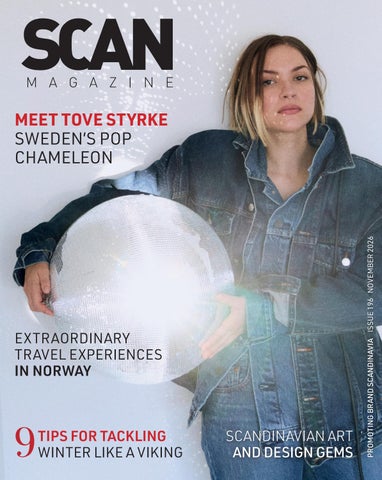
SCAN M A G A Z I N E
EXTRAORDINARY TRAVEL EXPERIENCES IN NORWAY
9
TIPS FOR TACKLING WINTER LIKE A VIKING
SCANDINAVIAN ART AND DESIGN GEMS
PROMOTING BRAND SCANDINAVIA ISSUE 196 NOVEMBER 2026
MEET TOVE STYRKE SWEDEN’S POP CHAMELEON
DAVID-ANDERSEN.NO
Scan Magazine
|
Editor’s Note
Editor’s Note Dear reader, The wind is picking up, the mornings are beginning to bite, and you may already have found yourself rummaging through the drawer of woolly accessories for something to stop your fingers going numb. In other words, winter is on its way, and it is time to start thinking about how to make it a season not merely to endure, but to enjoy.
tle colour and inspiration, but you will find plenty of that in our special theme on art from Denmark.
In this issue, we look at how to do just that. In our design section, we explore a selection of Scandinavian brands offering everything from interiors that will make spending a little more time indoors feel like no hardship, to creative paper weaving that will keep both hands and mind busy, and barefoot shoes designed to keep your feet strong and warm.
As always, we also bring you a host of exciting places to visit, memorable experiences to discover and delicious places to eat. So take off those gloves, settle somewhere warm and start turning the pages.
Our special features take on winter more directly, exploring some of the survival techniques employed by the experts – Scandinavians who have been dealing with long, dark and bitterly cold winters for generations. One method not included there is turning to art for a lit-
Signe Hansen, Editor
Of course, a good song and an engaging story can also lift the spirits on a cold winter day, and this month’s cover feature offers both. Swedish pop phenomenon Tove Styrke talks to Malin Norman about life, music, biodynamic gardening and political rebellion – and about finding her own way through it all.
We hope you enjoy reading this issue of Scan Magazine as much as we enjoyed making it.
SCAN M A G A Z I N E
43
November 2026
|
Issue 196
|
3
Scan Magazine
|
Contents
Photo: Frida Marklund
In this issue COVER FEATURE 6
Tove Styrke – music, rebellion and a new way of living This month, we meet Swedish pop chameleon Tove Styrke. In conversation with Malin Norman, she reflects on parenthood and music, biodynamic gardening and political rebellion – and on finding her own way through it all.
DESIGN 12
Paper weaving, barefoot shoes and Scandinavian Christmas From sophisticated paper weaving kits and barefoot shoes to interiors that elevate form over function, this month’s Design pages bring together a varied selection of Danish, Swedish and Finnish brands. We also present our latest Fashion Diary and a selection of irresistible Scandinavian Christmas decorations in We Love This.
FOOD AND DRINK 28
Seasonal flavours, beer blending and Nordic restaurants Our regular food and beer columns return with tips on blending your own beer and making delicious plant-based pâté. Alongside it, we present a selection of distinct restaurants from Finland and Norway. From stunning views and local delicacies above Gudbrandsdalen in Norway to a plant-based gem in Helsinki, these pages offer plenty of reasons to head indoors and enjoy something good to eat.
SPECIAL THEMES 34
Unique travel experiences in Norway Norway offers no shortage of memorable experiences, and in this special theme we explore a selection of distinctive ways to experience the country – from a marathon in Svalbard to a floating sauna in Bergen.
40
Art from Denmark Our second special theme turns to Denmark’s art scene. We meet a selection of inspiring Danish artists and studios whose work and stories bring colour, character and different perspectives to the darker months. A must-read for art collectors and budding artists alike.
4
|
Issue 196
|
November 2026
6
Scan Magazine
60
|
Contents
Gifts from Norway From hand-blown recycled glass and Norwegian wool to traditional bunads and accessories, this gift guide celebrates craftsmanship with a distinctly Norwegian character. Discover thoughtful pieces made with quality materials, respect for tradition and an emphasis on creating something made to last.
SPECIAL FEATURES 38
Hands2Ocean – diving for junk in Stockholm Beneath Stockholm’s waterways lie bicycles, scooters, bottles and other discarded objects. In this feature, Xander Brett joins Hands2Ocean as volunteers recover rubbish from the water while helping to educate younger generations about marine ecosystems and the effects of littering.
52
Get through winter the Scandinavian way Who better to ask about getting through a long, dark winter than Scandinavians? This light-hearted special feature explores some of the habits and techniques that help turn the coldest season into one to enjoy rather than simply endure.
CULTURE 84
Culture – events, music, illustration and TV Where to go and what to experience this month? Our Culture Calendar rounds up arts and cultural events across the Nordics, music columnist Karl Batterbee brings you his latest Nordic music picks, and illustrator Maria Smedstad ponders why Brits might be better at prepping than Swedes. Meanwhile, film and TV columnist Anders Lorenzen dives into the world of Janus Metz, the Danish director behind the Netflix hit Unabomber.
BEST OF THE MONTH
74
66 68 70 72 73 76 78 80 82
Design Studio Festival Artist Getaway Hotel Experience Museum International museum International hotel November 2026
|
Issue 196
|
5
Scan Magazine
Cover Feature
|
|
Tove Styrke
Tove Styrke: On musical creativity, political rebellion and biodynamic gardening To be released on 6 November, Tove Styrke’s fifth solo album, I thought this story wasn’t about me, is perhaps her most personal yet. It reveals another side to the pop powerhouse – a side that in a way is more honest, confident and true to herself. Scan Magazine catches up with Styrke about her inspiration and becoming a parent, her newly formed political rock band, and her reconnection with nature. By Malin Norman
Photo: Peter Fredriksson
6
|
Issue 196
|
November 2026
Scan Magazine
|
Cover Feature
|
Tove Styrke
Photo: Martin Axéll
November 2026
|
Issue 196
|
7
Scan Magazine
Cover Feature
|
|
Photo: Frida Marklund
8
|
Issue 196
|
November 2026
Tove Styrke
Scan Magazine
Swedish singer-songwriter Tove Styrke is probably best known for hits such as Sway, Say My Name and Borderline. The popstar, who rose to fame after participating in Idol back in 2009, is just about to release her fifth solo album. We are curious to hear more about the inspiration for what she refers to as an indie movie soundtrack-like album, and why she decided to change the title mid-way through.
The introspective album tells the story of feeling alone and isolated, yearning for belonging while living in the middle of a city, and is intended to be listened to in the right order, from start to finish. In fact, what Styrke had in mind was something like a soundtrack from an indie movie, taking the listener on a journey – from dusk to dawn. She explains: “It’s a metaphor for life itself; the inner world versus the outer world, and a need for connec-
|
Cover Feature
|
Tove Styrke
tion. The music on the album is dynamic with soft transitions; it grows in intensity, then holds back. There’s pause and room to reload.” Six singles have been released, one of which is Me/You (always and forever) that tells the story of the lifelong relationship you have with yourself. “You might be your own worst enemy and the last one looking out for you,” says Styrke. “But through all
First intended to be called The Afterparty, Styrke eventually realised that the album title was too perfect – it did not match what was actually happening in her life. “Everything evolves, like life itself,” she says. “You always have to check back in and make sure that you’re staying true to the original idea. As it happens, I finished this album with a clearer mind than I had at the start. And this is also why I changed the title, so that it reflects a more personal journey. I thought that the story wasn’t about me, but I realised that it’s all me.” Since her previous album, released four years ago, Styrke and her partner Sanna Sikborn Erixon have become parents – a lifechanging event that no doubt has also influenced her music. “I’ve been struggling with self-image, acceptance and facing my own weaknesses,” she says. “But what I’ve come to realise in the past few years is that creativity is like an untameable beast. These days, I’m much more intuitive, have less judgement and feel less fear – my creativity is more fluid when I don’t analyse too much. My new album revealed its true nature to me during this process, which has been quite transformative.” Like a soundtrack to an indie movie Styrke draws inspiration from classic electronic music and artists ranging from Kraftwerk and Laurie Anderson to Boards of Canada, Suicide, LCD Soundsystem and Jon Hopkins, as well as Adrianne Lenker and Alex Cameron. Every sound on the album was recorded live in the room or created using analogue machines – no samples were used, just a distinct sonic palette of synthesisers from the 1970s and 1980s, live drums and electric bass.
For a chance to see Året Var, the band has five gigs planned in December – in Malmö, Gothenburg and Stockholm – and more in the pipeline for 2027. Photo: Peter Fredriksson
November 2026
|
Issue 196
|
9
Scan Magazine
|
Cover Feature
|
Tove Styrke
has started training as a biodynamic gardener. Perhaps this is a step closer to her northern roots (Styrke was born in Umeå, in northern Sweden). “Yes, I think it’s a way of remembering my childhood. I love nature and being in the forest. My paradise is a pine forest,” she smiles. This connection to nature can also be seen in the new album. “Nowadays, people talk a lot about man versus nature, but we’re all part of nature. We’re part of an ecosystem and just need to find a way to exist in it. There’s something fantastic about working with living materials, like gardening, as a contrast to being only in my head when writing music.”
think. This also means that there’s nothing to distract me when I create my music.”
As if a solo album and a calling as a gardener were not enough, Styrke has also released an album with newly formed band Året Var (meaning the year was) together with her partner, musician Sanna Sikborn Erixon. Inspired by the progg music movement of the 1960s and 1970s, the rock band reflects on society today and the debut album, Året var 2026, was released a week before the Swedish election.
On 20 November, Styrke will play her only show this year at Värmeverket in Stockholm. “The first live show for the album will take place just two underground stops from where I live,” says Styrke. “The evening gig, which happens to be the day after my birthday, is going to be quite special.”
“We make music from our own point of view about what we see in society today, especially in Sweden. There’s a lot to cry and to laugh about, and we try to do both with this music,” reflects Styrke. “We’re not asking you to think like us, we’re asking you to care. Caring is the most rebellious act in a cold world.”
For the one-night-only concert, Styrke has handpicked the venue to fit the music. The album is written with a story arc, and she wants the live experience to reflect that. “I’ve chosen a space that allows for a more focused way of listening, while still having the ability to keep things playful and real,” says the artist. “Also, I want to break the distance between the stage and the audience – so that we can be in this moment together.”
In a world filled with uncertainty, Styrke has found a way to create and express herself meaningfully, and her approach feels both confident and honest. “I do this for my own sake and because I have to,” she adds. “I only have my brain, my heart and my creativity.”
Photo: Frida Marklund
the ups and downs, you were the one who pulled yourself through. I hope you’ll blast it on a road somewhere, wind in your hair and all the windows down.” Sunflower, released in July, is like a long embrace. Probably the fastest song Styrke has ever written, it came about in one evening. Performed at the immensely popular Swedish TV programme Allsång på Skansen just after its release, the song is a declaration of love. “It’s about loving somebody in a way where you can’t choose to walk away,” says Styrke. ”I didn’t even understand what it was about until much later, when my partner and co-parent heard it and said, ‘Oh, how beautiful. You wrote a song for our daughter.’” One-night-only show at Värmeverket With her honest approach and atmospheric sound, the response from the fans has been fantastic. Some even say that Styrke is sounding more like herself than ever before. “Yes, I think it’s true that I’m more in tune with myself now. It seems that I’ve come to a point in my life when I honestly don’t really care what others 10
|
Issue 196
|
November 2026
Biodynamic gardener and new progg band Styrke’s music is influenced by her life as a parent, but also by a sense of reconnection with nature. Since her last album, she
Tove Styrke’s new solo album, I thought this story wasn’t about me, will be released on 6 November, 2026.
Follow Tove Styrke Instagram: @ToveStyrke YouTube: @ToveStyrke
think bigger. meet better.
Lindner Hotels gives ideas room to grow. With its “DENKQUARTIER”, the Lindner Hotels & Resorts makes conferences and events simpler, more flexible, and more personalized. Lindner Hotels & Resorts’ MICE concept combines modern meeting spaces with a clear commitment to quality: a straightforward booking process, fast and reliable planning, personal points of contact, and a “DENKQUARTIER” expert who supports event organizers before, during, and after the event. Give every meeting, conference and event the space it needs. And the quality it deserves.
FURTHER INFORMATION AT lindnerhotels.com/en/denkquartier
ENQUIRE NOW WITHOUT OBLIGATION +49 171 5302 105 | events@lindnerhotels.com
Scan Magazine
|
Design
|
Fashion Diary
Fashion Diary With November’s rich yet muted colours, this is the perfect time to reach for neutral, earthy tones – brown, chocolate, umber and mocha. Add some deep green or red accessories for a pop of colour, along with warm gold jewellery to keep the palette rich and flattering against the coming cold. As the weather wanes, these pieces will address comfort and warmth, but also elegance and style as you stroll through the city or head to the nearest coffee shop on your lunch break. By Celina Tran
|
Press photos
Norwegian knitwear is tied to the country’s rural and naval history, its rugged and at times relentless weather, but also the wearer’s identity. Over centuries, knitted jumpers developed both to protect against the elements and to express a sense of place and identity – something the O.A.D team wants its knitwear to encapsulate. Knitted from 100 per cent Norwegian wool, the brown Nord no. 1 crew neck is a unisex jumper inspired from Norwegian patterns. It has that natural texture of traditional knitwear while remaining soft, making it the perfect key piece in your day-to-day outfits. Nord no. 1, EUR 500 www.oad1868.com
Timelessly cool, there’s nothing that catches the eye quite like an aviator jacket, particularly a leather one. Arket’s take on the piece is made from supple land leather, and continues the tradition of warmth and protection. It draws on the classic jacket’s detailing with a detachable shearling collar, angled welt pockets as well as a concealed zip fastening, and over years of wear, the leather will undoubtedly develop its own patina. Leather aviator jacket, EUR 699 www.arket.com
12
|
Issue 196
|
November 2026
Crafted in a jeans style with denim finish and details, these loose-fitted Per pants mix office formal with the urban contemporary shape. Though loose around the legs, they fall and shape the hip and waist in a flattering way, and are a fashion dabbler’s dream – they can be paired with practically any top! Worn with a long wool coat, natural knit jumper or vest, and a pair of dark loafers, they become particularly autumnal. Per pants, EUR 177.50 www.mkdtstudio.com
Scan Magazine
|
Design
|
Fashion Diary
When the autumnal weather is particularly colourful, this gorgeous, mocha-tinged coat will serve well against the red and yellowing leaves. Don’t be intimidated by its light look; the jacket is made from a double-woven wool and cashmere blend and features side pockets to keep your digits warm. It has an oversized look and relaxed, dropped shoulder, yet looks unbelievably chic. Short jacket in mocha, EUR 595 www.softgoat.no
Made to outlast passing fads, Merete Dèhn’s designs focus on high-quality fabrics and encapsulate the simple timelessness of Scandinavian design and fashion. Indeed, the Philippa Poncho might be the very definition of timeless. Made from an organic alpaca-cotton blend, it’s the perfect piece to bring when the office gets just a little bit too chilly. Throw it over a long satin dress, skirt, or the business chic Baroniet trousers above, and you’ll have an elegant yet cosy look for date nights too. Philippa poncho in light beige, NOK 2,499 www.dehndesign.no
The Barionet trousers from Oleana can be paired with the Barony jacket, but stand comfortably on their own too. Cut in a straight fit with long, clean lines, these refined merino wool trousers will keep you warm, but also comfortable and stylish as you move through your day-to-day errands. Their name pays homage to the historic 17th century Rosendal Barony, set beside the Hardangerfjord. Barionet trousers in burnt umber, EUR 475 www.oleana.no
November 2026
|
Issue 196
|
13
When form takes the lead Scandinavian design is often defined by lightness, restraint and the idea that function should lead. Copenhagen-based Formarkivet pushes against that hierarchy. Its furniture is still made to be lived with, but form is given room to speak first: rounded aluminium volumes, upholstered silhouettes and architectural lines that sit almost like sculptures in a room. The result is recognisably Nordic, yet deliberately more expressive and cosmopolitan. By Signe Hansen
|
Photos: Formarkivet
Founded in 2023 by Cathrine and Christian Rudolph, the couple behind SOFACOMPANY, Formarkivet builds on years of experience in the furniture industry while taking their design ambitions in a new direction. Their aim was to connect craftsmanship with a more contemporary, international expression, drawing on Christian’s experience in brand development and Cathrine’s strong aesthetic instinct and eye for detail. “There’s a strong focus on good materials, texture and a sculptural language,” says Sjur Lien, head of brand and marketing. “Rather than letting function sit highest in the hierarchy, we want the 14
|
Issue 196
|
November 2026
Cathrine and Christian Rudolph, the couple behind Formarkivet.
form and volume of a product to have a clear presence. A chair inevitably has to work as a chair, but can also hold its own as an object in the room.” From its showroom in Copenhagen’s Nordhavn district, the small in-house team is gradually expanding that design language across furniture, lighting, textiles and home fragrance, as Formarkivet establishes a growing presence in international markets. From shared instinct to design house For Cathrine and Christian Rudolph, Formarkivet grew from years of working together and learning where their different strengths meet. Christian tends towards strategy and the broader picture, while Cathrine often begins with the visual instinct before the design team helps refine the idea. “We’ve both grown to appreciate the importance of slowing down and going deeply into each design,” the founders
Scan Magazine
explain. “From the beginning, the vision was to create furniture that could last for generations, rather than follow passing trends.” The Cubio series captures that process. Its starting point came towards the end of the pandemic, when Cathrine noticed the sculptural furniture in classic films from the 1980s. The first sketch developed into a family of stools and tables with rounded, oversized forms, but took more than a year to perfect. Today, Cubio sits at the heart of the collection. A family of forms Across the range, the pieces vary considerably. Cubio is broad and solid, often rendered in raw aluminium that develops its own patina, while the Ferra chair is more architectural, with a slender steel or oak frame. The upholstered Ion series draws on ancient Greek Ionic architecture, translating classical references into soft, substantial seating, while the Aglow lamp appears broad from the front and unexpectedly flat from the side.
|
Danish Design
|
Formarkivet
try, comfort and a detail that gives each object its own identity. Function is still carefully resolved, Lien stresses, from the angle of a chair back to the amount of foam in a seat and the feel of a textile against the skin. The aim is to give form greater freedom without sacrificing use.
deal of wisdom in reducing a design to its essence and making solid constructions and comfort that last. But perhaps because we come from Danish design culture, we also feel a need to break free. Looking south, especially to Italy, opens up a more playful approach to form.”
Looking beyond functionalism
For Formarkivet, the departure is less a rejection of Scandinavian design than a change in emphasis. Function remains essential, but it shares the stage with emotion, volume and visual presence. As Cathrine and Christian Rudolph put it, the ambition is to offer “a new perspective on Danish design” – one that brings tradition into dialogue with a broader, more expressive design world.
That balance places Formarkivet in an interesting relationship with Scandinavian design heritage. The brand draws on the region’s lessons in reduction, construction and durability, but does not treat functionalism as a rulebook. Instead, the team looks outward as well as back. “It’s difficult not to be inspired by the design culture we’ve been part of all our lives,” says Torp Hansen. “There’s a great Copenhagen Contemporary has selected Formarkivet’s Cubio series for its shop display alongside an exhibition by Japanese architect Kengo Kuma, reflecting the brand’s close connection to art, sculpture and architecture.
www.formarkivet.com Instagram: @formarkivet Inspired by the warm atmosphere of the Balearic Islands, Formarkivet’s Marmacén home scent collection combines oud, benzoin and rose across scented candles, reed diffusers, room spray and hand wash.
“Good materials, a sculptural language and interesting details are what characterise our designs,” says designer Tim Torp Hansen. “We want them to stand out and make an impression, but without shouting. We believe that restraint is what gives them a long aesthetic life.” Rather than repeating one silhouette, Formarkivet works with shared principles: material presence, clear geomeNovember 2026
|
Issue 196
|
15
Left: The Plum-Coloured Woven Sphere is available at ARoS Museum Shop, Aarhus. Photo: Betina Fleron. Right: The Christian IV Christmas Heart is available at Rosenborg Castle, the National Museum of Denmark, Kronborg Castle, the Round Tower and Koldinghus Castle. Photo: Betina Fleron.
Weaving tradition into the future A woven paper heart is one of Scandinavia’s most recognisable Christmas decorations, but for PaperMatrix it is also a starting point. Founded by architect Anna Schepper and chemical engineer Lene Schepper, the Danish motherand-daughter team combines a deeply rooted Nordic craft with geometry and contemporary design, turning flat sheets of paper into hearts, spheres, balloons and other three-dimensional forms.
“More and more people tell us how much they enjoy the feel of the kits,” says Anna Schepper. “I think there is something increasingly valuable about working with your hands and creating something physical rather than spending more time on a screen.”
By Signe Hansen
Open the slim paperboard box containing PaperMatrix’s Flower Heart, and the appeal is immediate. Sparkling pink glitter paper brings childlike delight, rich red velvet adds a grown-up sense of luxury, and rose-coloured silk paper feels light and delicate. Folding and weaving the contrasting surfaces together creates not only a three-dimensional Christmas flower heart but also a satisfying sense of creative achievement. 16
|
Issue 196
|
November 2026
Having begun as a family experiment, PaperMatrix has since grown into a fulltime business with kits developed and produced in Hjørring and designs sold through museums and design retailers across Denmark. From Christmas tree to 3D geometry
Photo: Iben Parum
Long before PaperMatrix had a name, paper weaving was part of the Scheppers’ family life. Anna remembers a childhood Christmas tree decorated with around 100
Scan Magazine
The following year, the pair explored whether the same principles could create a closed, three-dimensional form. Anna’s background as an architect specialising in complex geometry provided the answer, and their first woven sphere opened new possibilities. Soon, they created a woven hot-air balloon that attracted remarkable online attention.
For several years, Schepper continued working as an architect while developing new models, but eventually the ideas took up so much of her attention that she decided to follow them full time. Paper ready for weaving Behind PaperMatrix’s intricate forms lies considerable geometry. Each pattern is carefully developed, and the individual pieces are cut and prepared in Hjørring before being assembled into kits. Yet the creative process does not end when the pattern has been designed. It simply
Danish Design
|
PaperMatrix
audience. “There really isn’t one type of customer,” says Schepper. “We have beginners and very experienced weavers. Some are people who love design, while others are drawn to the playful constructions of Lego. Paper weaving sits somewhere between the two.”
woven hearts, many in forms her mother had devised herself. In 2010, Lene started a blog devoted to paper weaving and began sharing patterns and ideas.
“When we put the balloon on my mother’s website, it completely exploded,” Schepper recalls. “Suddenly a design I had made was getting around 20,000 views a day. There was something fascinating about seeing how something so simple could become so big.”
|
Tradition with somewhere to go
changes hands. Once a kit reaches the maker, the pieces invite them to become part of the process themselves. Bringing them together requires concentration, curiosity and a love of making, while offering the pleasure of discovering how flat pieces of paper gradually transform into intricate three-dimensional forms. The kits range from simple designs to more demanding constructions, with familiar hearts sitting alongside spheres, stars, cones and balloons. A recent Christian IV Christmas heart, developed especially for Rosenborg Castle, draws inspiration from the king’s patterned cap, exploring how its crowns and curved lines can be transformed into the geometry of paper weaving. That combination of design, problem-solving and making attracts a broad
The woven Christmas heart has deep roots in Denmark, with the oldest surviving example associated with Hans Christian Andersen. For generations, weaving hearts has been part of Christmas in homes and schools, while related traditions are also found in Sweden and Norway. For Schepper, respecting that history does not mean reproducing it unchanged. The simplicity remains – paper folded and interwoven by hand – but new geometry, materials and three-dimensional forms keep pushing the technique forward. “I’m not really interested in what Christmas hearts used to be. I’m interested in what they can become in the future,” says Schepper. “There’s a past, and we use that past to create the future. The interesting question is: how far can paper weaving go?” www.papermatrix-shop.com Facebook: PaperMatrix Instagram: @papermatrix
PaperMatrix was founded by the mother-daughter duo Lene and Anna Schepper. Photo: Betina Fleron
Photo: Betina Fleron
Photo: Iben Parum
November 2026
|
Issue 196
|
17
A Scandinavian rethink of barefoot footwear Soft, flexible and shaped to let feet spread naturally, Gogsig began with one mother searching for a first shoe for her toddler. Today, the Danish brand designs barefoot footwear for children and women, combining foot-shaped comfort with contemporary Scandinavian design. Founders Helle Gøgsig Andersen and Maria Dauerbjerg Hansen hope to make natural movement an everyday option for the whole family. By Signe Hansen
|
“I was looking for his very first pair of shoes, and I simply couldn’t find any18
|
Issue 196
|
November 2026
From one pair to a shared project
thing flexible enough,” Andersen recalls. “I wanted something his feet could fit into comfortably while still allowing them to move naturally.”
Hansen had been part of the story long before formally joining the company. Andersen often used her as a sounding board, and the problem felt familiar. “When Helle first told me about the idea, it immediately made sense because I had experienced the same thing with my daughter,” Hansen says.
Today, Andersen co-owns Gogsig with former colleague and fellow mother Maria Dauerbjerg Hansen. What began as a solution to one child’s hard-to-fit feet now spans children’s sizes 19 to 35 and a growing women’s range – part of a wider
Neither came from footwear, so Andersen read extensively about children’s movement, sought input from physiotherapists and worked with a footwear consultant in London before approaching manufacturers. After numerous rejections, she even-
Photos: Gogsig
When Helle Gøgsig Andersen began looking for the first pair of shoes for her one-year-old son, his soft, broad toddler feet proved surprisingly difficult to fit. Many of the shoes she found were either too narrow or far more rigid than she wanted for a child who had only recently learned to walk.
ambition to create barefoot footwear for different stages of family life.
Scan Magazine
tually found an experienced footwear manufacturer in Portugal willing to work with a new brand.
|
Danish Design
|
Gogsig Barefoot Shoes
Founders of Gogsig, Helle Gøgsig Andersen (r) and Maria Dauerbjerg Hansen (l).
“When you arrive as a complete startup and say, ‘I would like to make a shoe,’ many factories simply say no,” she explains. “I went through a lot of them before finding someone in Portugal who would work with me.” The result is that each pair is now handsewn in Portugal, with an emphasis on flexible construction, carefully selected materials and experienced shoemaking. Natural rubber is used for the thin soles, while LWG-certified leather is used in all leather shoes. Today, Gogsig is very much a shared project, with Andersen and Hansen combining different strengths around a common ambition: to make barefoot footwear a natural choice for more families. Both remain closely involved across the business, including responding directly to customers’ questions. A different take on barefoot design At the centre of Gogsig’s footwear are the defining characteristics of barefoot shoes: a flat sole without an elevated heel, a broad, foot-shaped toe box and a thin, flexible sole. According to Andersen, the aim is to protect the foot while inter-
fering as little as possible with natural movement. “For us, the purpose of the shoe is really to protect against sharp objects and keep the foot warm and dry,” she explains. “If the foot is allowed to move and work naturally, we believe it has the best chance of maintaining its natural strength as the child grows.” That emphasis on natural movement is matched by an equally strong focus on appearance. Gogsig works with modern Scandinavian aesthetics, colours, materials and details, challenging the idea that barefoot footwear has to look markedly different from other contemporary shoes.
Colours and playful finishes give the children’s styles a lighter, more expressive look, while the women’s range applies the same barefoot principles to more grownup designs without changing the footshaped construction underneath. From first steps to the whole family The broader philosophy still begins with what happens after a child has learned to walk. Having developed balance and movement barefoot, Andersen and Hansen question why that freedom should immediately disappear inside a rigid shoe when the child heads outside to run, climb and play. Using the feedback they receive from customers, the founders now want to carry that thinking beyond childhood. “One of the things that make Gogsig special is that we don’t just develop and sell shoes; we have a close relationship with our customers, listen to their experiences and use that feedback to improve our products,” explains Hansen. With the women’s collection established and ambitions to expand further, Gogsig is developing from a solution for first steps into footwear for different stages of life. Their aim is to show that freedom of movement, comfort and considered design can sit together – and to make barefoot footwear a natural choice for the whole family. www.gogsig.dk Facebook: gogsig.net Instagram: @gogsig_barfodssko November 2026
|
Issue 196
|
19
Scan Magazine
|
Finnish Design
|
Tiriteijaa Studio
Looking out to the open sea, painted in Helsinki, Finland.
The painting Stripes on the Rug, by Teija Kosenius.
Like a friend who sees you, from Kosenius’ series on old houses.
A visit to Tiriteijaa Studio and the colourful world of Finnish painter Teija Kosenius In the cosy city of Riihimäki, Finland, Teija Kosenius welcomes visitors to her vibrant art studio. Whether guests are interested in ordering a custom painting, looking for a finished work to take home, or simply curious about the life of a working artist, Kosenius delights in showing them around and explaining why painting is so meaningful to her. By Molly McPharlin
|
Photos: Juho Haavisto
“I’ve always been drawing, but I started painting in my twenties after receiving a set of oil paints,” says Kosenius. “I have a need to paint, and my style is quite fast paced. I paint every day and prolifically to improve my craft.” Currently, she paints with acrylics, often combining them with pastels, gesso and acrylic ink. Kosenius focuses on interiors, old houses and children, fascinated with themes of vulnerability, humanity and home. “My interior paintings usually depict celebrations and time spent with loved ones,” she says. “These are a bit like fairy tales for adults. For example, old houses in cityscapes, with their slightly askew walls and window frames, remind us of our humanity. Life is always imperfect and that’s where the beauty lies.” Kosenius paints on commission as well. “These revolve around similar themes,” she says. “I also paint interiors, allowing the client to specify the size, colour pal20
|
Issue 196
|
November 2026
Nothing but fair weather, painted in Ruissalo, Turku.
with works purchased directly from her as well as through exhibitions in Finland, Germany and Sweden. Over the years, she has also worked to establish her place in the Finnish art scene, while increasingly looking beyond Finland for new opportunities. “My painting style is unique and recognisable, and people love my work,” she says. “I’m also looking for more exhibition spaces abroad.” A visit to Kosenius’ studio is colourful and bright, a contrast to the street outside. “People are interested in experiencing the place where I paint and get my ideas. I use colour quite boldly,” she says. “And I don’t sketch my paintings. They emerge in the moment.” www.tiriteijaa.fi Facebook: Tiriteijaa Instagram: @teijakosenius_art
ette, and the view of the room depicted. My interiors and cityscapes share a certain sense of wobbliness in their perspective. Many people say it’s like looking at the world through antique glass.” Kosenius’s paintings now hang in homes across Europe, North America and Asia,
A portrait of the artist Teija Kosenius in her studio. Photo: Hanna Tarkiainen
A PLACE WHERE TIME SLOWS DOWN, TURNING EVERY MOMENT INTO A STORY WORTH LIVING.
At Port Royal Villas & Spa, luxury is more than just an experience —it is a state of tranquility, harmony, and refined hospitality. Every moment here is designed to help you escape the ordinary and embrace a world of comfort, elegance, and effortless relaxation. As a 5-star adults-only beachfront resort in Rhodes, we offer an exclusive retreat where privacy, serenity, and tailored luxury define every stay.
Versatility and elegance – redefining Finnish wood design Upea Puu, roughly translated as magnificent or majestic tree, combines Finnish design, technology and the natural allure of Finnish wood to create versatile, stunningly crafted pieces that integrate seamlessly into the home. Its collection celebrates the individuality, functionality and simple beauty that wood brings to everyday objects. By Molly McPharlin
|
Phtos: Petri Selkäinaho
Founder Petri Selkäinaho spent more than two decades working in technology, digital development and AI before focusing on a passion that had remained constant throughout his life – wood and woodworking. “I’ve always made things from wood,” says Petri. “Over time, I began developing my own products. My inspiration comes from many places – na22
|
Issue 196
|
November 2026
ture, people, culture, but also ordinary everyday situations. I find myself asking the same question I asked throughout my professional life: could this familiar thing work better, differently, or in more than one way?” For Petri, wood itself is also a source of inspiration and creativity. “It’s technical-
ly fascinating but also very human,” he says. “No two pieces are exactly alike. You need to understand and respect the material rather than simply impose a form on it.” Finnish design, he adds, places similar emphasis on functionality, clarity and longevity. “There’s a certain restraint. An object doesn’t need unnecessary decoration if its material and purpose are strong enough.” The connection between design and technology Upea Puu combines natural materials and classic design with modern digital tools and prototyping. Digital technology allows the development process to move
Scan Magazine
quickly, taking an idea from a sketch into two- or three-dimensional design and then to a physical prototype. “Sometimes the first real object can exist only a couple of hours after the original idea,” says Petri. “That speed is valuable creatively, but it also allows us to react quickly to customer needs and experiment without long development cycles.” Elegant simplicity and versatility That willingness to experiment also shapes how Petri thinks about function. Rather than assigning an object a single purpose, he prefers designs that can adapt to different homes and situations. “Homes, situations and people are different. If an object is designed intelligently, it can adapt rather than dictate,” he says. “A wooden tray can be used for serving, but it can also organise small objects or remain visible as part of the interior. For example, our Siro table started as a bedside table, but its rotating surface allows it to also work as a side table, occasional table or compact coffee table.” For Petri, that versatility is also closely connected to sustainability. “One way of making consumption more sensible is not simply to make more things, but to make good objects that people want to keep and can continue finding uses for. That’s why three words are important to Upea Puu: beautiful, practical and versatile.” The same thinking appears throughout the collection. Onni is a small wooden
Finland’s vast forests are a source of inspiration for Upea Puu.
tray in the shape of a four-leaf clover, designed for serving, organising or simply remaining on display as an object in the home. Its name means happiness or good fortune in Finnish. The larger Sisu bench, meanwhile, points towards where Petri hopes to take the company. “It demonstrates where Upea Puu can go: from smaller wooden objects into more substantial design solutions for the home, while retaining the same philosophy.” The importance of nature Finnish nature and the country’s forests remain central to Upea Puu. “There’s something special about the forest here,” says Petri. “You can exercise, gather berries and mushrooms, observe wildlife or simply be quiet. The forest is a place to slow down, relax and breathe.” That closeness to the landscape is reflected in the way Petri works with wood. “I want wood to remain recognisably wood. Grain, tone and natural variation are not defects to hide; they’re part of an object’s identity. Function and aesthetics should support each other. That balance is perhaps the essence of
|
Finnish Design
|
Upea Puu | Trissixty
Petri Selkäinaho, founder of Upea Puu.
Upea Puu: naturally beautiful, genuinely practical.” An international future Alongside its online store, Upea Puu is represented at Kankurin Tupa at Helsinki Airport and OMA Puoti in the city, as well as at design exhibitions and events including Habitare, Helsinki’s leading furniture, design and interiors event. “Going forward, I would like to collaborate with partners who understand the thinking behind our products,” says Petri. “Selected design and interior stores, museum and gallery shops, potentially hospitality and interior-design partners in Finland and internationally. I would like to build a coherent collection of objects that have a reason to exist – and eventually have someone in Helsinki, London or Tokyo recognise something Finnish in Upea Puu without needing a Finnish flag attached to it.” The ambition is deliberately selective. “The goal is not to be everywhere,” Petri says. “It’s to be in the right places.” www.upeapuu.fi Instagram: @upeapuu
November 2026
|
Issue 196
|
23
Scan Magazine
Design
|
|
We Love This
We Love This – Scandinavian Christmas decorations Why settle for a few anonymous baubles when Christmas gives you permission to decorate almost everything in sight? Scandinavian designers certainly seem to agree. This year’s festive favourites include gold-plated ornaments, storybook scenes, glass birds, seasonal textiles and even a bauble you have to make yourself. Because when Christmas arrives, even Scandinavians seem happy to forget all about minimalism. By Signe Hansen
|
Press photos
Christmas Jumper Monkey – Kay Bojesen The Kay Bojesen monkey is already a familiar sight in Danish homes, so of course it needs a Christmas outfit. This version wears a red festive jumper patterned with red and white hearts, turning the 1951 design classic into a seasonal character without losing its familiar expression. And for those who prefer a more traditional look, a small red-andwhite Santa cap is also available for the wooden figures. Price, small: DKK 999.95 www.rosendahl.com Woven paper heart – PaperMatrix PaperMatrix takes one of Scandinavia’s most familiar Christmas crafts – woven paper decorations – and pushes it into three dimensions. Founded by mother-and-daughter team Lene and Anna Schepper, the Danish company creates kits that transform carefully prepared pieces of paper into intricate hearts, spheres and other forms. The Koldinghus Heart makes a beautiful Christmas decoration, but part of its charm is the pleasure of making the decoration yourself. Price (two hearts): DKK 149 www.papermatrix-shop.com
Dompap glass figures – Hadeland Glassverk Few sights say Nordic winter quite like a red-breasted bullfinch against bare branches and snow. Norwegian Hadeland Glassverk captures the motif in a pair of small red glass birds designed by Maud Gjeruldsen Bugge. Inspired by the Nordic winter, they work as Christmas decorations but are understated enough to remain on a windowsill or shelf long after the tree has gone. Price: NOK 499 www.hadeland.com
24
|
Issue 196
|
November 2026
Scan Magazine
|
Design
|
We Love This
Karen Blixen Christmas Car – Rosendahl Christmas in Scandinavia is, above all, about family time – and for many, that begins with the journey home. Ole Kortzau’s small gold-plated Christmas Car turns that familiar anticipation into a decoration. Part of Danish Rosendahl’s Karen Blixen Christmas series, it is a simple nod to packed cars, winter roads and finally arriving where Christmas is waiting. Price: DKK 159.95 www.rosendahl.com
Elsa Beskow Christmas Tree Ornament – Design House Stockholm Ornamentia Cushion – Bloomingville Scandinavians have long understood the transformative power of swapping a few cushions when the seasons change, and Christmas is no exception. Bloomingville’s Ornamentia cushion brings bauble motifs to the sofa in red, green and blue against a beige background, finished with red piping. Made from cotton and measuring 50 by 35 centimetres, it gives the room a festive update without requiring a complete December makeover. Price: DKK 299 www.bloomingville.com
Few illustrators evoke Swedish childhood quite like Elsa Beskow. Here, Catharina Kippel brings her storybook world onto feather-light ornaments made from lacquered paper, with the Dance/Christmas Tree/Ski Slope version combining three wintry scenes in one decoration. It is nostalgic without feeling old-fashioned and adds a distinctly Swedish note to the tree. Price: EUR 17.41 www.designhousestockholm.com
2026 Ornament Set – Georg Jensen For many Scandinavian families, Georg Jensen’s annual Christmas decorations are as much about collecting as decorating. New designs arrive every year, allowing the collection to grow gradually over time. The 2026 series takes its inspiration from the music of Christmas, with this trio combining traditional festive motifs with 18-carat gold-plated brass and deep red ribbons. They also solve that perennial December problem: what to buy the grandmother who already has everything. Price: DKK 649 www.georgjensen.com
November 2026
|
Issue 196
|
25
Cellvane line.
QKoreanCosmetics: A Norwegian success story with big ambitions Focused on quality, innovation, and personal relationships with its customers, QKoreanCosmetics (QKC), operated by Nordic-Cosmetics AS, has grown from an ambitious Norwegian start-up into one of the country’s most distinctive K-beauty businesses. Five years after the family-run company was founded, QKC is celebrating its strongest year yet – while taking its first major steps into the wider Nordic market through its expansion into Sweden. By Maria Sødal Vole 26
|
Issue 196
| |
Photos: QKoreanCosmetics November 2026
When Alexandra Matei Amundsen and Robin Amundsen started QKC in 2021, they had big ambitions. Five years on, the company they built from scratch – without external investors – has developed far beyond an online skincare store. 2026 has been an exceptional year for QKC. In April, QKoreanCosmetics won Fastest Growing Business 2026 at the HER Awards. “Winning the award was a huge milestone for us,” Alexandra says. “It was such a proud, joyful moment – being recognised for everything we’ve worked so hard for over the last few years was a magical feeling.”
Scan Magazine
While the products are natural and gentle, their efficacy is well-proven. QKC values connecting customers with the products that will be best suited to their needs and skincare goals and creates complimentary skincare routines specifically tailored to each customer. A community built around trust
Founders Alexandra Matei Amundsen and Robin Amundsen
In August, they celebrated the fifth anniversary of their business. “It was a really special moment, looking back on our journey and how incredible it has been – the joys, the challenges and everything in between,” says Alexandra. “My husband and I have built this business from the ground without any investors. We’ve stayed true to our goals and values every step of the way, and we’re proud of that.” A trusted Korean partner
QKC has a large following on social media, where customers often share product reviews and experiences with others. “We couldn’t be happier with the community we’ve created and love the fact that so many people enjoy our products and want to be part of our journey,” Alexandra says. “We value fostering a supportive community and believe our customers like to see the people behind the brand – that personal touch is something a lot of big brands are missing.”
|
Lifestyle
|
QKorean Cosmetics
these days to be worrying and as a company, we believe investing in ourselves and our content is well worth the effort.” Following QKC’s expansion into Sweden, Alexandra and Robin are now focused on building the same trust, loyalty, and sense of community in a new market. “When we started, we had big ambitions, and it’s incredibly emotional to see some of those dreams becoming reality,” says Alexandra. “Sweden feels like the beginning of a new chapter for us, and we’re genuinely excited to see where the journey takes us next.”
The QKC team is intentional about its online presence and values engaging with customers and followers in a thoughtful and human-focused way. From investing in high-quality product photography to building meaningful connections with the community and delivering attentive, personalised customer service, the brand believes in doing things properly.
The next chapter brings new ambitions and opportunities, and exciting things are ahead for the family-run business. As the brand grows, staying true to its identity and the values that have shaped the company so far is essential to its founders. “We’re proud of how far we’ve come, but at the same time we feel like we’re only getting started. We’ve never lost sight of how lucky we are to do something we’re so passionate about,” Alexandra says. “And no matter how much the company grows, every single order still matters to us – because behind every order is a person who has chosen to trust QKC.”
“It’s important to us to have a real and authentic voice across our channels,” says Alexandra. “We find the overreliance on AI
www.qkoreancosmetics.no Facebook: QKoreanCosmetics.no Instagram: @qkoreancosmetics.no
Central to the team’s philosophy is investing in quality at every stage. Behind QKC’s most innovative skincare lines stands HLB Global/HLB Life & Healthcare – a Korean partner with a strong focus on research, product development, and advanced formulations. This relationship has become an important part of QKC’s identity and the way the company approaches skincare. “We’re extremely selective about who we work with,” says Alexandra. “For us, it’s not enough that a product looks good or follows a trend. We need to trust the people, the research, and the quality behind it. HLB gives us that confidence. Their expertise and innovative approach are major reasons why we feel so confident in the products we recommend to our customers.”
HER Awards.
The Elisha Coy line.
November 2026
|
Issue 196
|
27
Scan Magazine
|
Food and Drink
|
Beer Column
Can you blend your own beer? Yes, of course you can!
By Malin Norman
Blending beer is not new, breweries have been doing it for ages. But to blend two different beers into your own glass, perhaps feels a bit…mischievous? Don’t worry, brewers and beer judges are doing it too. Try it, you might find your own perfect blend. Back in 2015, I attended a beer conference in Brussels. One of the sessions was hosted by De Brabandere Brewery. In the audience, we were given three different oak-aged Petrus Sour Beers – Aged Pale, Aged Red and Oud Bruin – and four empty glasses. The presenter told us to first try the beers separately, and then to make our own perfect blend. “But…can we really do that, is it even allowed?” I thought to myself. Yes, indeed it was allowed, and it was a lot of fun. My beer blending skills peaked that day, and have remained dormant until this year. I’ve noticed that some of my beer colleagues are happily blending beers, without giving it an extra thought. For instance, when exploring the beer scene after judging a competition in the US, one of my friends had one overly hopped beer and another one that was not hoppy enough, and simply poured them together. “Can you do that?” I asked in surprise. “Of course you can,” he said and smiled broadly.
Photo: Malin Norman
28
|
Issue 196
|
And a few weeks ago, when judging in Asia, my table had a smoothie-like beer with the taste of strawberry, banana and coconut – not too sweet, just fresh. When finished with the scoring, a fellow judge poured some coffee-flavoured stout into that beer and voilà, the result was stunning. When blending beers, you might end up with something quite spectacular. I’m not a fan of pumpkin beers as I find them too sweet and somewhat cloying, in fact this is probably my least favourite style. But not long ago, I saw that someone blended a pumpkin beer with a Rauchbier, as in a smoked beer. I haven’t tried it yet, but perhaps it’s not such a bad idea? One beer that is surprisingly tasty is a ready-made specialty mixed-fermentation dark beer in collaboration between Brouwerij Timmermans in Belgium and Guinness in Ireland. Their Lambic & Stout combines roasted barley and acidity with delicious
Photo: Adolfo Félix on Unsplash
November 2026
Malin Norman is a Certified Cicerone®, a certified beer sommelier, a BJCP certified beer judge, and a member of the British Guild of Beer Writers.
dark chocolate, oak and cherry notes. If you get the chance, try it and be amazed. Instead of organising your usual bottle share with your mates, next time how about doing a beer blending session instead – and play brewmasters for a while?
Scan Magazine
Mushroom pâté
|
Food and Drink
|
Food Column
By Katharina Kjeldgaard
This mushroom pâté is one of those recipes I love making for both everyday lunches and special occasions. The mushrooms bring plenty of umami while walnuts, rosemary, thyme and nutmeg add warmth and depth. I like serving it on bread, as part of a lunch spread or with small dishes for sharing. It tastes great both warm and cold and works especially well for festive tables at Christmas or Easter. Serving tip: Make the pâté a few hours ahead and let it rest in the fridge before serving. This gives the flavours time to develop and come together even more. Amount: 1 mushroom pâté Time: 40-60 minutes Ingredients:: 100 g walnuts 2 tbsp olive oil 1 onion 4 cloves of garlic 400 g brown mushrooms 1 leek
1 tsp ground black pepper 2 tsp dried rosemary 1 tsp nutmeg 1 tsp dried thyme 1 tsp salt 1 tsp Dijon mustard
Instructions: Roughly chop the walnuts and toast them in a dry frying pan for a few minutes until lightly golden. Transfer to a plate and leave to cool while you prepare the rest of the recipe. Heat the olive oil in a frying pan over medium heat. Finely chop the onion and garlic, then add them to the pan. Next, prepare the remaining vegetables and add them to the pan as you go. Since everything will be blended later, there is no need to chop them too perfectly. Clean the mushrooms, then finely chop them and add them to the pan. I know mushrooms are often said to be better wiped clean rather than washed, but I usually give them a quick rinse because as this is faster. Just make sure to dry them well afterwards. Finely chop the leek and add that to the pan too. Add the ground black pepper, rosemary, nutmeg, thyme, salt and mustard. Cook for around 20–30 minutes, stirring occasionally, until the vegetables are soft and most of the moisture has cooked away. Preheat the oven to 200°C (conventional oven). Before blending, set aside a couple of spoonfuls of the mushroom mixture for garnish. Transfer the cooked vegetables and toasted walnuts to a food processor, or blend with an immersion blender, until the mixture is creamy and smooth. Using slightly damp hands, shape the mixture and place it on a baking tray lined with baking paper. Bake for around 20 minutes, until warmed through and lightly golden on top. Finish with the reserved mushroom mixture or a few fresh herbs on top.
Katharina Kjeldgaard is a Danish food blogger, influencer and cookbook author from Copenhagen. Her blog is one of the most-read vegetarian food blogs in Denmark, always focused on locally sourced ingredients, full of delicious recipes and never boring. She has three little kids and loves going to markets, being in nature – and cooking with all kinds of vegetables and legumes. Blog: beetrootbakery.dk Instagram: @Beetrootbakery
November 2026
|
Issue 196
|
29
Scan Magazine
|
Food and Drink
|
Restaurant Nokka, Finland
Restaurant Nokka is located in a former warehouse in the atmospheric district of Katajanokka, overlooking the bay.
Wild nature on a plate: The philosophy of Restaurant Nokka In a country proud of its culinary traditions and local produce, and home to many exceptional restaurants, Nokka in Helsinki still manages to stand out. Founded in 2002 as one of the original farm-to-table restaurants, Nokka’s mission is to create sublime dishes that place Finnish ingredients at the centre of its cooking. By Molly McPharlin
|
Photos: @foodbymikko
Housed in a cosy 19th century former warehouse overlooking the water in the historically important neighbourhood of Katajanokka, Nokka is a destination to experience Finnish nature and the changing seasons on a plate. “For over two decades, Nokka has followed a simple philosophy,” says Terhi Vitikka, the manager of Nokka. “A good meal is created from high-quality ingredients and a genuine respect for our food and its producers.” Since 2010, Ari Ruoho has run Nokka’s kitchen. With experience cooking in both Finland and internationally, and a skilled hunter himself, Ruoho believes that the strength of Finnish food can be found in its environment and local farmers. At the same time, Vitikka ensures that this level of detail and care is found throughout 30
|
Issue 196
|
November 2026
the whole dining experience. “It’s important that guests come to the restaurant to celebrate a special moment, spend an evening with friends, and enjoy good food,” says Vitikka.
ducers. “When we know our producers, we can discuss the quality of raw materials, develop products together, and support Finnish food production and its expertise,” says Vitikka. This approach is one reason why Nokka received the MICHELIN Guide Green Star for sustainability in 2024.
There is a buzz about Finnish culture and Finnish ingredients. “We’re happy that Finland, seasonal thinking, and local production are a part of the restaurant conversation and proud that we’ve contributed to that,” says Vitikka. “Internationally, there’s a strong interest in Finnish food. Local produce such as wild fish, game, mushrooms, berries, and foraged herbs and plants give us the opportunity to build dishes that speak of the country and the season.”
Nokka offers set menus and à la carte dishes. These include a plant-forward Menu Green and a Taste of Nokka menu, which changes seasonally. Autumn and winter are especially fascinating seasons for Finnish ingredients. In autumn, Nokka features game, mushrooms, berries, and root vegetables. As winter approaches, flavours gain depth, and slow-cooked dishes, rich broths, and preserved food are highlighted. “Our cooking is built around available ingredients,” explains Ruoho. “Our goal is to highlight the best of the season while ensuring variety, balance, and an element of surprise.”
For Nokka, this also means maintaining a close relationship with small-scale pro-
www.nokkahelsinki.fi Instagram: @Nokkahelsinki
Scan Magazine
|
Food and Drink
|
Restaurant Magu, Finland
Photo: Andrew Taylor
Intentional, inspiring and inviting Celebrating its eight anniversary this year, restaurant Magu Helsinki continues its mission to use what grows in nature, to experiment, to expand the palate, and to inspire. This is one of Helsinki’s best-kept secrets.
Ahead of Christmas, the Be More Plant Christmas box brings the botanical world home for the holidays.
By Malin Norman
”Our widely popular box has been sold out yearly since 2021,” says Moya. Designed for gifting or for keeping, the box is a carefully selected collection of products that reflect the same philosophy as the restaurant: Finnish ingredients, thoughtful technique, nothing superfluous. A small piece of the Magu universe, wrapped up and ready to share.
|
Photos: Robert Lindström
Restaurant Magu Helsinki opened in 2018 with a straightforward but uncommon conviction: that plant-based cooking deserved the same attention, technique and ambition as any other kind of dining. Not as a niche offer for vegans, but as a genuine proposition for anyone who cares about what they eat. A destination of its own kind. Since its opening, that conviction has deepened. The location in Korkeavuorenkatu is a space that feels like your grandparents’ house, filled with collected treasures, warm and unhurried, with inhouse-made preserves lining the shelves. Head chef Felipe Moya’s cooking has developed with the Finnish seasons, building a language of fermentation, preservation, and local sourcing that is entirely its own. What began as a plant-forward restaurant has become one of Helsinki’s most quietly respected dining destinations, with a loyal guest base and a kitchen that treats autumn
mushrooms and summer peas with equal seriousness. “Most guests arrive curious, and almost all of them come back,” says Moya. “What surprises people most is the depth – the sense that every element on the plate has been thought through, not assembled. Guests consistently use one word: genuine. About the staff, about the food, about the feeling of the evening.” Moya’s menus are built around what the soil and the seasons actually produce. Plants are treated with care, transformed and plated creatively — geometric shapes, stacked layers, short playful dish names that invite guests to discover the ingredients by taste rather than description. Magu has never chased trends, instead it has built something more lasting that shows what plants should taste like: bold, creative, and full of personality. Familiar enough to feel like home, impossible to replicate anywhere else.
www.maguhelsinki.fi Facebook: Magu Helsinki Instagram: @maguhelsinki Photo: Magu Helsinki
The Be More Plant Christmas box is available on Magu’s website maguhelsinki.fi for EUR 158 (EUR 109 until 19 December).
November 2026
|
Issue 196
|
31
Scan Magazine
|
Food and Drink
|
Hildr, Norway
Taste the North A beloved fixture on Tromsø’s culinary scene, Hildr is an intimate family-run restaurant with a seasonal menu celebrating the best of local ingredients. Set in a historic building and featuring a charming library bar, the unique venue is known for its warm, welcoming atmosphere and fantastic food. By Maria Sødal Vole
|
Photos: Hildr
Boasting an excellent location in one of Tromsø’s oldest streets, Hildr is one of the city’s best-loved eateries. The building dates all the way back to 1833, and the restaurant’s homey, eclectic decor pays homage to its colourful history. But while the relaxed atmosphere is a major draw for guests, the food is the true star of the show. The team is committed to making the most of the high-quality natural ingredients and unique flavours found across the Arctic region. Hildr’s seasonal menus are built on the best of local produce, and the team grows and forages many of the ingredients. “Making the most of the incredible produce in the area is important to us – our food should be as local as possible,” says Gabriela Carlehed Jacobsen, who runs Hildr with her husband Marius. The winter season is always a highlight at Hildr. Alongside the carefully crafted winter menu based on seasonal flavours, the team creates an exclusive three32
|
Issue 196
|
November 2026
course dining experience with a separate menu for New Year’s Eve. These dinners are popular and this year, the second floor of Hildr’s historic building will be open for dining to ensure double capacity. Booking in advance is recommended as spaces sell out quickly. Hildr will continue serving its famous à la carte menu throughout the winter season. In summer, the restaurant will focus on private parties and events, while the Hildr kiosk will continue serving its much-loved fried chicken. Exciting changes are ahead for 2027. The team behind Hildr also runs the neighbouring burger and retro games venue Burgr, which is moving to a larger space on Tromsø’s main street, Storgata. In its space next door to Hildr, new restaurant Tröst is set to open in spring 2027. With an omakase-style menu, it will carry forward Hildr’s passion for local ingredients, excellent food and a warm, welcoming atmosphere.
In English, the name sounds like trust and in Swedish and Norwegian, the word means comfort or consolation. “Tröst has a double meaning that feels like a great fit for us,” Gabriela says. “We want our guests to trust us to create great culinary experiences, and to find comfort and community in good food, good drinks, and good company.” www.hildr.no Facebook: Hildr Instagram: @hildrrestaurant
Scan Magazine
|
Food and Drink
|
Restaurant Slakteriet, Norway
An evening above the valley High above the Gudbrandsdalen valley, where forest meets mountain plateau, a culinary destination is quietly making its mark. Since late 2023, Slakteriet Restaurant has been turning heads for its distinctive blend of Nordic intimacy and elevated gastronomy. By Celina Tran
|
Photos: Gustavo Ribiero
By the late afternoon, a stillness begins to settle over Øyerfjellet. The last skiers make their way home, the tracks grow quiet, and the winter light fades across the mountain plateau. At Pellestova Hotell, located 980 metres above sea level, rosy-cheeked guests return from the cold outdoors with tired legs and a powdered landscape still fresh in their minds. Yet for some, the experience has only just begun. Only a few steps from the hotel lies Slakteriet Restaurant, slakteriet referring to the butchery beneath. “While the name reflects the working butchery below, upstairs guests discover an intimate fine-dining experience where firelight, craftsmanship and the surrounding mountain landscape come together,” says marketing manager Madara Sleija. Upon arrival, guests are welcomed and invited to settle beside the fireplace, letting their shoulders drop before being shown into the dining room. From here, broad windows frame the surrounding
Winter view. Photo: Madara Sleija
landscape, while the open kitchen offers a glimpse of the precision behind each course.
And of course, the butchery itself is also an essential part of the experience. “Our connection to the region means that we process all the game in our own butchery, giving the chefs a close understanding of the ingredients they prepare.” At Slakteriet, the destination and the dining experience cannot be separated. Beyond the windows lies the landscape that inspires the kitchen, while beneath the restaurant, the craft begins at its source. The journey up the mountain is not merely the way to dinner, but where your culinary odyssey begins. www.pellestova.no/matogdrikke/ slakteriet/ Facebook: Slakteriet Pellestova Instagram: @restaurant.slakteriet
Head chef Ruben Martínez and his team create tasting menus guided by the seasons and the landscape around them. Ingredients from the mountains and nearby producers meet flavours from the sea, creating a journey between Norway’s coast and highlands. Guests choose between six and ten courses, then place themselves in the hands of the kitchen as each serving reveals another part of the story. November 2026
|
Issue 196
|
33
L WAY E lT AV OR ia R c e T NN E Sp U SI Q I CE N U IEN ER P EX e:
m he
Arctic marathons at the world’s edge In one of the northernmost inhabited locations, Svalbard Turn was established in 1930 as a beloved local sporting institution. Nearly a century later, it remains a cornerstone of the community through fitness, wellness, fellowship and, of course, its iconic biannual marathons. By Celina Tran
|
Photos: Ragnhild-Utne
Just over 1,000 kilometres from the North Pole, Svalbard Turn has turned the glaciers and wind-swept landscape of the Arctic into a thriving community built around sport and endurance. In addition to the local community, the adventurous spirit of the club’s marathons and events attracts participants from all over the world.
choose between 42- and 21-kilometre routes through pure northern nature, surrounded by sweeping snow-covered views that make it feel as though they are skiing at the end of the world. “There will also be volunteers and polar bear guards along the way, allowing you to get as close to nature and wildlife as possible while staying safe,” Johannessen says.
As Svalbard Turn approaches its centenary, there is no better time to take the leap and join its April skiing marathon. Svalbard skimaraton is the largest single event on Svalbard, offering participants an opportunity to experience Arctic nature and wildlife in its rawest form. “We invite locals and visitors alike to join us at the end of April as participants, volunteers or spectators, in celebrating and preserving the sporting spirit of Svalbard,” says manager Elisabeth Leinan Johannessen.
Run beneath the midnight sun
With Arctic foxes, reindeer and eiders among the local wildlife, participants can 34
|
Issue 196
|
November 2026
Washed in sunlight, summer in Svalbard sees the world’s northernmost running event, the Spitsbergen Marathon. Whether you want to run 10, 21 or 42 kilometres, the track winds along the roads in and around Longyearbyen, giving runners an immersive taste of the wild and wonderful north. Do not let the weather intimidate you; early summer conditions are surprisingly welcoming. By then, the snow has mostly melted, and the route – though tough – is well maintained and worth the effort.
“Spitsberg Marathon is more than just a marathon,” says Johannessen. “It’s a celebration of life in the Arctic.” And a celebration it is. Alongside local and international spectators and volunteers cheering you on, the route comes with its own cast of onlookers, including soaring seabirds, reindeer and other Arctic wildlife. Regardless of whether you are a runner chasing the high or more of an observer, all proceeds pour back into the club’s programmes for children and youth, allowing the next generation of Arctic adventurers to continue the tradition. www.svalbardturn.no www.spitsbergenmarathon.no
Scan Magazine
|
Special Theme
|
Unique Travel Experiences in Norway
Bergen’s very own authentic sauna experience For the longest time, Norwegian saunas were limited to gyms, swimming pools, and private cabins. Over the last few years, however, the country has seen a surge in demand for that real Nordic sauna experience – out in nature, surrounded by vast, cold lakes and great sights. By Celina Tran
|
Sightseers or visitors at Gamlehaugen Castle, for example, can pop straight from a tour into the aptly named Kongen, the King, sauna right next-door.
Photos: Heitbergen
Before Veronica Eikemo Pedersen started Heit Bergen, the city and its surrounding areas could not possibly have known what a precedent the sauna provider would set. “I had my first ever floating sauna experience in Oslo in 2020 and was instantly captivated,” Pedersen recalls. “I knew that I wanted to bring this to Bergen.” Only a year later, Heit Bergen Sauna became the very first commercial floating sauna concept to operate in Bergen. Today, the brand has three locations across Bergen, the biggest one being in Sandviken and featuring three saunas, cold plunge, and hot outdoor showers. The Heit Bergen experience is rooted in an age-old Nordic practice: alternating between intense heat and icy dips in the sea. Inside the saunas, temperatures reach between 75 and 90 degrees Celsius. Guests pour water over heated stones to create bursts of steam before plunging into the fjord outside, a refreshing con-
trast that locals enjoy year-round. “Our floating saunas all have panoramic windows, so even in the middle of the city, you feel immersed in Bergen’s mountains and fjords.” “We’re very excited about our newest addition to Heit Laksevåg, a location in the middle of an area once dominated by the old shipyard industry,” Pedersen continues. From December 2026, this location will also include a woodfired hot tub on a floating dock, which users will be able to book privately in addition to the sauna or hot tub. “Here, you’ll find both a wood-fired sauna and an electric one, allowing you to choose the experience that suits you best. There’s also a hot-water outdoor shower, which is perfect for a nice, comfortable cool-down between sauna sessions.”
Regardless of the location you choose, all the Heit Bergen saunas give access to open and peaceful nature. With more experience than any other operator around, you are guaranteed a relaxing, high-quality experience. Why not steal away a weekend in Bergen, where you can go for a refreshing fjord swim, then kick back, relax, and just exist for a moment? www.heitbergen.no Facebook: Heit Bergen Sauna Instagram: @heitbergensauna
All locations are accessible and evenly spread throughout the city, allowing you to hop from one experience to another. November 2026
|
Issue 196
|
35
Scan Magazine
|
Special Theme
|
Unique Travel Experiences in Norway
Where the curtain never falls on a good night out On Oslo’s Aker Brygge waterfront, comedy theatre Latter has turned a night out into a complete experience: dinner, drinks and first-rate entertainment under one roof. By Celina Tran
|
Photos: Aksel Rustad
When the Norwegian autumn arrives, staying in is tempting. Yet a few steps from the water, Latter’s lights promise something better – one visit is usually enough to convince anyone. “While we’re best known for our many great shows, everyone’s welcome to Latter, with or without a ticket to a performance,” says general manager Magnhild Kleven. “In addition to our shows, we also have a fantastic restaurant and five bars, including a brand-new cocktail bar called SMIL, where you can enjoy amazing drinks.” Latter keeps it simple for businesses, friend groups, couples and families: a long dinner, a show, and a final drink to send everyone home happy. Beyond the public shows, Latter opens its doors to conferences, meetings and private cel36
|
Issue 196
|
November 2026
ebrations. “There’s a range of spaces to pick from; from smaller spaces where you can host meetings, to the largest main stage that seats 500 people in amphitheatre-style seating,” says Kleven. “As we’re a theatre, state-of-the-art technology can of course be expected, covering all the necessities of a professional business event or conference.” The building, too, adds its own character: once a working boat-building yard, it has
been reimagined in the spirit of the grand French playhouses, with chandeliers, floral details and rich leather and velvet – the perfect atmosphere to get ideas flowing. From confirmations and birthday parties to full-scale corporate events, there is a space for every occasion. “In addition to providing the space, we can also help tailor and provide everything needed, including a host, entertainment, in-house technicians and the food.” At Latter, the goal is to continue raising the standard of the tailored experience it has created, not only through its performances but across every part of a visit. Staff and comedians alike see Latter as a second home, and that same sense of care extends to visitors too. “And just like in any home, we welcome each guest with a smile and bid them farewell at the door when they leave, hopefully gleeful and wide-mouthed.” www.latter.no Facebook: Latter Instagram: @latteroslo
The Invisible Room Behind the walls lies a space no one sees. The air gap between our modules is the invisible masterpiece of craftsmanship. It absorbs footstep noise, dampens voices and swallows sound. SINTEF has measured the results: Sound Classes A and B. Your neighbour’s life remains your neighbour’s business. We build steel apartments where quiet is not a promise. It is engineered into every single wall.
Modular construction with short build times and high standards Our solution consists of flexible steel modules enclosed in a building envelope that minimizes climate impact and energy use. From a cleared site to move-in-ready apartments in under six months. This is modular construction in practice: 20-foot modules produced in a factory, transported to the construction site and assembled into a complete apartment complex. Documented results for acoustics, energy and fire safety.
Get in touch:
We build homes that are ready when you need them. Contact us to learn more about how modular construction can fit your next project.
nordic
smart house nordicsmar thouse.no
Assorted rubbish removed from the waters of Stockholm.
Pulling together – the volunteers diving for junk in Stockholm Stockholm’s waterways hold secrets beneath the surface. Tonnes of discarded items (everything from bicycles and scooters to bottles and silverware) line the bottom of Lake Mälaren and the seabed of the archipelago. However, under the management of Hands2Ocean, volunteers meet regularly to recover trash as fast as it is deposited. By Xander Brett
|
Photos: Lars G Karlsson, PRODUCEDby AB Stockholm
A non-profit association founded about eight years ago by Fredrik Johansson and the Främja organisation, Hands2Ocean was known initially as Rena Mälaren (clean Lake Mälaren) but changed its name as the scope expanded. It organises gatherings each week at which anyone is welcome to assist a team of divers as they remove whatever lurks in the waters of a particular location. Participation is free, though donations are welcome. From one-timers to regulars, hundreds of helpers have rolled up their sleeves over the years. When I joined a dive in Gustavsberg, representatives of Värmdö 38
|
Issue 196
|
November 2026
Skärgård Rotaryklubb were also present, while more than 20 Grade 7 pupils on a school trip made up the land-based volunteer team. The dive formed part of the Havsresan scheme, which teaches school students about marine ecosystems and the threats posed by rubbish, overfishing and eutrophication. Once washing machines cleaned clothes, now they sully waters Mist is clearing and divers are donning gear when I am greeted by Göran Wallmo of Hands2Ocean near the organisation’s banners. At about 9:05am, the students arrive. A demonstration follows, during which it is explained how ropes will be
Fredrik Johansson, Hands2Ocean’s founder.
used for communication between the students on land and divers underwater. The pupils, who listen attentively, are then split into groups and the divers plunge into the harbour. Carrying nets for the collection of small items, the divers, who must agree to a list of requirements, use torches to maintain good visibility. Often, they can be seen moving below the surface. Otherwise, we rely on bubbles to determine their whereabouts. Either way, it is not long before their nets are full and ready to be heaved out, with larger items pulled towards the pontoons by rope and wheeled away on a trolley.
Scan Magazine
Fishing gear, golf balls, plates and the inside of a washing machine are among the items recovered between the moorings in Gustavsberg. Pupils readily empty bottles of gunk, before adding them to a haul that, when totted up with rubbish collected by another group of students in the same spot, surpasses 250 kilos. That is below the weight of what has been dragged up at other dives but, of course, it is not a bad thing – the more rubbish collected, the more frustrating the feeling. Why use the sea if you could take a walk to a rubbish bin instead? Education to avoid littering Hands2Ocean’s work is as much about preventing trash entering the water in the first place as it is about pulling it up later. A teacher on the trip says that pupils are given a lesson on dangers to marine life, as well as learning materials, to complement their discoveries on the dive. It is not lost on organisers that students may discuss their experience with parents and grandparents, and three generations of the same family are thereby educated in one go. “I’ve been working with schools all my life, including as a special education teacher,” says project leader Annika Cripps, who helps run Hands2Ocean’s educational outreach. “I really wanted this job because it’s fantastic to see students feel clever while doing something practical. This combines theory and activity.” Cripps adds that Hands2Ocean tries to find diving sites close to participating schools. “Sometimes they take a bus, but it was a short walk for today’s students and we recently dived in Bromma at a location that the school group could walk to,” she explains.
prime minister stopped by earlier this year and British politician-turned-presenter Michael Portillo lent support while he was filming a travel show. In fact, celebrity chef Paul Svensson is one of the organisation’s regulars. He is among the divers taking part on this particular day. “I do this both to help out and to practice my diving skills,” Svensson explains as an underwater drone gives land dwellers a diver’s eye view. “It’s a good combination of pleasure and doing good. I’ve been involved for a few years. It was a small group when I started but has become a huge organisation with many divers. There’s plenty of awareness now, and I think that’s because it’s so visual when we do dives in the city, and people see us and what we’ve collected.” Sven Rudberg, a Rotary Club representative in a fluorescent yellow gilet, tells me about Rotary International’s involvement in initiatives that seek cures for what he calls a multi sickness afflicting the Baltic Sea. There is, for example, a network of Rotary and Rotaract Baltic Sea Ambassadors to spread awareness, as well as a cross-border Baltic Sea Regional Action Network of Rotarians (BASRAN). “Our project called Save the Baltic Sea helps push decision makers forward at EU, national and local levels,” says Rudberg. “We’ve quite a big Rotary Club here on Värmdö island and a good relationship with the community. Many people are worried about the current situation because the Baltic Sea is so useful to us, including for sailing and swimming. Our goals are extensive, such as creating wetlands, and we’re talking to landowners to help them progress.”
|
Special Feature
|
Hands2Ocean
Taking in tourists The Rotary schemes suggest Hands2Ocean is not alone, either in its overarching mission or in its efforts to remove waste from waterways. The GreenKayak initiative, for example, allows volunteers to hire kayaks free of charge in warm months, so long as they collect waste while they paddle and share their experience on social media. Launched in Denmark almost a decade ago, and known initially as Miljøkajakken, the scheme has now spread to several nearby countries with the aim of engaging locals and visitors alike. “Most people at our dives come from the area in which they’re taking place, but sometimes tourists looking for activities find us on the internet,” Göran Wallmo says of Hands2Ocean’s gatherings. “We’ve also had university students from Canada and Australia helping us. Most of our volunteers pop up once or twice, but there are a few regular Hands2Ocean supporters.” According to Wallmo, batteries, tyres and electric scooters are among the most harmful items recovered from the water and are therefore priorities for removal. Batteries have been dumped in the sea for decades, but electric scooters are relatively recent inventions. That they are dredged up so frequently is proof, perhaps, that education, even of younger generations, remains incomplete. However, students such as those in Gustavsberg can help change attitudes and ensure that the tide turns for good. www.hands2ocean.com Facebook: Hands2Ocean Instagram: @hands2ocean
Based in Stockholm, Hands2Ocean organises dives across Sweden and neighbouring countries, with locations often suggested by volunteers and local contacts before Johansson makes the final call. Assistance from a culinary celebrity Hands2Ocean has attracted plenty of publicity and a few famous faces. Sweden’s
Silver found lurking beneath the surface.
Oskar Kilhborg, a diver in action.
November 2026
|
Issue 196
|
39
lT
ia ec
h
Sp
AR
e:
em
OM R TF
NM E D
K AR
KROGH – Art of Being: Where feeling finds form Malene Krogh paints to make room for what words cannot always hold. Trained as a psychotherapist and coach, the North Jutland artist works intuitively with colour, texture and movement. Her work is rooted in presence, intuition and the human experience, exploring how colour, texture and movement can give form to feelings that words cannot always express.
Over the past four years, art has grown into an increasingly important part of Krogh’s professional life, alongside her continued involvement in the nursery and kindergarten she co-founded.
By Signe Hansen
When words were no longer enough
|
Photos: KROGH – Art of Being
Krogh did not return to painting with the intention of becoming an artist. In 2022, her family was going through one of the most difficult periods of their lives, leaving her with a sense of helplessness and loss of control. At the same time, they were preparing to move into a new home. On the way back from looking for art for its empty walls, her daughter suggested she simply paint something herself. 40
|
Issue 196
|
November 2026
Krogh found an old canvas and began. Hours disappeared, and emotions that had resisted analysis and conversation began to settle through colour and movement. “I realised that I had to get out of my head, into my body and be present in the moment,” she says. “There were feelings I couldn’t put into words or talk my way through, but somehow they found a place through painting.”
As a psychotherapist and coach, Krogh was familiar with reflection and conversation, yet during the family crisis she discovered that thinking had its limits. “At the canvas, something else happened. I could stop analysing and simply be in the colours, movements and materials. Painting didn’t remove what had happened, but it gave me somewhere to be with it,” she says. “In the midst of helplessness, I discovered the power to create.”
Scan Magazine
Rather than beginning with a fixed image, Krogh now follows colour, structure and instinct. “I might know which colours are pulling me or which technique I want to try,” she explains. “But then I take my head out of it and see what happens.”
|
Art from Denmark
“For me, the artwork can become a third thing between two people,” she says. “You don’t have to begin with the vulnerable part of your own story. You can begin with the painting, and sometimes that opens a much more personal conversation.”
Krogh works primarily with acrylic paint, often thinning it so it can be poured, and combines it with ink, textured media and different tools. The interaction between the materials creates cracks, grooves and unexpected patterns.
One such commission, Landscape of Memories, was created for a woman who had lost her husband and wanted a work connected to their shared life, grandchildren and a much-loved summer house. “I try to understand the person, the emotions and the story behind the painting,” says Krogh. “Then I let their story, rather than mine, guide the work.”
Special Theme
versations about grief, love, fear, hope and change can begin.
Letting the work find its own way
Commissioned works add another dimension. Before beginning, Krogh talks with the client, drawing on her coaching background to move beyond colour and style towards the feelings and memories the work should hold.
|
Each artwork is accompanied by its own reflection text, inviting viewers to look beyond the canvas and consider what the work awakens in them. Rather than offering an interpretation, the text opens a space for personal reflection. Art as a meeting place That response is central to the philosophy behind KROGH – Art of Being. Krogh does not want viewers to arrive at one correct interpretation. Instead, she wants the work to create a pause from which con-
After closing her gallery in Blokhus, Krogh is now creating a new studio and gallery at her home near Aabybro. Looking ahead, she hopes to develop Art & Garden from 2027, bringing together paintings, sculptures, garden art and nature in a setting where visitors can slow down, experience the art and allow conversations to unfold naturally. The name Art of Being returns to the lesson Krogh found at the canvas in 2022. “I don’t paint to escape life,” she says. “I paint to be more present in it. For me, that’s what the art is really about – getting out of the head, being curious and daring to stay with what is.” www.kroghartofbeing.dk Facebook: KroghArtofBeing Instagram: @krogh_art_of_being
November 2026
|
Issue 196
|
41
From scientist to artist
Abstract landscape painting, acrylic on canvas, H = 60 W = 80 cm.
When Jimmy Bak transitioned from a successful career in molecular spectroscopy to becoming a full-time artist, it was a drastic change from standardised methods to the endless possibilities on a blank canvas. Yet, the connection to his scientific past remains: light, colour, materials and their interaction continue to be a central part of his fascination with painting. By Miriam Gradel
|
Photos: Jimmy Bak
For Bak, to create a painting is to conduct a near-endless exploration of colour. In Denmark, as the seasons shift the position of the sun, the sky changes a thousand times over. There are not two days where colour, light and vegetation are the same. To capture this means letting go of control, something the scientist-turned-artist describes as liberating. “Some days, the Danish sky resembles that of the Mediterranean,” he says. “Other times, the sun hangs low on the horizon. Then there are times like now [read: October] when the sun pours in through the window in the evening, and it’s neither 42
|
Issue 196
|
November 2026
a winter light nor a summer light. There’s no formula for capturing it.” A study of sky and horizon At a time in life where most might consider slowing down, Bak instead shifted gear. As a scientist, he has spent decades studying the interaction of light and matter, using his knowledge of ultraviolet light for disinfection to build more than one successful MedTech business. Taking a leap of faith, he moved the business to the sidelines, set up an atelier at home and began painting full-time. Today, he is looking at the sky. Years spent researching the absorption of light
Under the artist alias Artbybak, Jimmy Bak continues to explore light, colour and matter – an extension of his life-long career in molecular spectroscopy.
Scan Magazine
has nonetheless had “an enormous influence on my work,” he says. Colours have priority, making up a major aspect of his practice, and he is “especially fascinated with how colours come to be; both on a chemical level, but also regarding where colour is absorbed.” In many ways, painting is an extension of Bak’s scientific exploration. For the observer of his work too, an endless exploration of colour and contrast takes place. This is most evident in his conceptual series, The Horizon Project, an ongoing investigation into spectral and spatial dynamics. Here, sky and landscape compliment and contrast each other in colourful harmonies. His pieces capture both the structured and the atmospheric. His only constants are the dimensions of his work surface and his choice of where the horizontal line goes. The rest is an open-ended exploration of endless possibilities. “According to my mood, the landscape will change,” he explains. What could start as a
|
Special Theme
|
Art from Denmark
Winter Time, Zeeland: acrylic on canvas, H50 x W65
sunny landscape might change the following day. Oftentimes, he leaves and returns to a piece, stretching the process over several days. A touch of yellow in the clouds might inspire a new work. If the temperature changes, turquoise and green might sneak its way into the painting.
Horizon No. 4: Acrylics, water-soluble structural crayons and charcoal on masonite. Sealed with archival, nonyellowing, UV and dust-resistant varnish. H61 x W122.
Refining the craft Throughout all his work, Bak presents an undeniable love of colour. “Of course, there’s a feeling [to what I paint], winter is different from summer after all,” he says. “But I’m probably more observant of the scientific effect and the opportunity to create some exciting and thrilling colour combinations.” Shifting from science to art has not been without its difficulties though. “It’s a huge challenge to start painting,” he admits. “You’re suddenly standing in front of this big, blank canvas and the question, what now? There’s freedom; but you need to be prepared to face the white surface and have the courage to put the first brushstroke.”
Horizon No. 6: acrylics, water-soluble structural crayons and charcoal on masonite. Sealed with archival, nonyellowing, UV and dust-resistant varnish. H61 x W122.
For sales, commissions and inquiries: www.artbybak.com artbybak@gmail.com LinkedIn: /in/jimmybak/
November 2026
|
Issue 196
|
43
Raw nature and female strength on canvas Raw seas, shifting skies and female figures emerge from Nina Augustinussen’s canvases with a strong emotional charge. Working between abstraction and figuration, the Næstved-based artist draws on the wild, unpredictable nature of her childhood memories in the Faroe Islands, while returning again and again to women as symbols of courage and resilience. By Signe Hansen
|
Photos: Nina Augustinussen
Although Augustinussen grew up in Denmark, her Faroese father gave her a close connection to the Faroe Islands, where the family spent time every year during her childhood. The memories remain with her, not as landscapes copied onto canvas, but as something more instinctive: the sea, changing skies and the feeling of nature in constant motion. “I don’t paint a particular place, but I’ve always been fascinated by the sea,” she explains. “People sometimes ask whether a painting is inspired by the west coast of Jutland. It isn’t, but I think my memories from the Faroe Islands have influenced me unconsciously.” 44
|
Issue 196
|
November 2026
That connection is particularly visible in her more abstract works, where skies, waves and shifting colour can hold both wildness and calm. Alongside them, her figurative paintings introduce another recurring force: the female body, often seen from behind and stripped back to a symbolic silhouette, calm, strong and resilient. From fabric to canvas Working creatively with her hands long predates Augustinussen’s life as an exhibiting artist. She has always drawn, filling the margins of school notes with dresses and small sketches, before going on to work in clothing design and spending many years in the bridalwear industry. For years, painting remained something private. She painted at home, sometimes together with her three sons, without thinking much about showing the results. That changed around 2019, when a simple
Scan Magazine
comment from her sister gave the work a new direction. “She asked me why I didn’t make an Instagram profile and show people what I was doing,” Augustinussen recalls. “I had never really thought about it. I was just painting.” Soon, invitations to exhibit followed through social media and word of mouth. There are parallels, she says, between the two creative worlds. Presenting paintings at an exhibition can feel just as vulnerable as showing a bridal collection. “You have to say: this is me, this is my style, and this is what I can do. People can take it or leave it. It’s incredibly vulnerable, but also great fun.” Strength, texture and intuition Today, Augustinussen moves freely between abstract and figurative work, primarily using oil and acrylic on canvas. Her abstract pieces can begin with colour, music or simply a feeling, and are often built through layers, broad brushwork and textured surfaces. Sometimes she works entirely with brushes; at other times an unexpected material – even a piece of discarded plastic – becomes a tool if it creates the right effect. Her figurative paintings are often worked more directly with brushes and fingers. The women that appear in these works carry a deliberate message. “For me,
|
Special Theme
|
Art from Denmark
they’re symbols of women and women’s strength,” she says. “Life can be hard, and you can choose to give in, or you can act. I’m drawn to the woman who gets back up, stands up for herself and makes herself stronger. I hope that can inspire other women too.” That mix of control and unpredictability is also rooted in her background. Working with expensive silk and lace once demanded precision; painting allows more risk. “Sometimes, when I start to change a work, put on more paint, my husband will ask: how do you dare? But if I know it isn’t finished, something has to happen. I have to trust my instinct that taking that risk will make it better.” Making room for wildness Putting the work into the world has required the same willingness to take risks. That openness is central to Augustinussen’s wider view of art. Her paintings are rooted in feeling, intuition and the raw, unpredictable beauty she finds in nature. As she puts it: “Art should contain a touch of wildness. For me, painting is not simply a creative process, but a source of immersion, inner calm and freedom.” Augustinussen now works from her gallery and studio in central Næstved, where visitors can see the paintings by appointment, and her works have reached buyers
and exhibitions across Denmark. What matters to her is that the relationship with a painting does not end when it leaves the studio. “I hope people keep looking at it and discovering something new,” she says. “Once it leaves my gallery or studio, it becomes their story.” www.ninaaugustinussen.com Instagram: @n.augustinussen.art
Upcoming Exhibition Kvinder & Kunst 21- 22 November, Royal stage, Hillerød
November 2026
|
Issue 196
|
45
Henriette Birch Studio on Falkonér Allé, Frederiksberg, serves as a hub for creativity and gallery space for Henriette Birch Strøm’s original artwork. Photo: Sisse Stroyer
Finding a language and community in colour “Colours have always been my true language,” says Henriette Birch Strøm. After more than two decades working professionally in interior and spatial design, she has turned fully to visual art, drawing inspiration from nature, her intuition, and lived experience. From her Frederiksberg studio, which serves as both a working atelier and a gallery, Henriette now brings art together with intuitive workshops and creative retreats, with a heartfelt focus on presence, well-being and community.
into words. “I hope my work can encourage people to be more themselves and to make space for emotions they might not normally allow themselves to explore,” she says.
By Signe Hansen
For many years, Henriette’s creative energy was channelled into the structured world of spatial design, working with large-scale interior concepts after graduating from the Danish Design School in 1999. However, a profound shift occurred in 2021, when a period of intense life changes and stress made her stop and reevaluate her path.
|
Photos: Henriette Birch Strøm
At Henriette Birch Studio on Falkonér Allé, a colourful gallery space at the front leads into a vibrant working studio in the back. Expressive paintings hang on the gallery walls, welcoming art collectors and visitors, while colour charts, canvases and jars of paint line the workshop space, which regularly hosts creative gatherings. Henriette, who trained as an emotion-focused therapist alongside her design career, sees a profound connection between colours and our inner world. This therapeutic background informs her artistic practice, where she uses art to explore emotions that are difficult to put 46
|
Issue 196
|
November 2026
From structures to creative freedom
Following this pivotal turning point, she packed six large canvases into her car in the summer of 2022 and travelled to the island of Møn. It was here, surrounded by nature, that she began painting again in earnest—not for a client or a specific concept, but for herself.
Scan Magazine
|
Special Theme
|
Art from Denmark
Photo: Sisse Stroyer
“Colours have always given me a feeling of calm and helped me find a way to express things that words cannot reach. At that time, I felt as though I was painting myself back to life, stepping into a completely new chapter of creative freedom,” she reflects.
inspiration. The deep blue-green tones often find their way onto the canvas, balanced by sudden bursts of vivid orange and pink. “The colours come from somewhere deep inside,” she says. “It’s about capturing a mood or an emotion rather than something decided intellectually.”
Following colour and instinct
Across many of her paintings, small, delicate drawn figures appear among the vibrant layers of colour—characters, or souls, moving through the work. Drawn with a fine line towards the end of the process, these figures manifest the story of the painting and have become a beautiful, recurring signature in her otherwise fluid and changeable practice.
Today, Henriette´s works intuitively, letting mood, memory and instinct shape her palette rather than starting with a fixed plan. Her paintings are primarily acrylic, and the artistic expression shifts beautifully from one series to another. The ocean and the elements of nature are recurring and powerful sources of
Art, workshops and retreats: creating space for others As painting and showing her artwork have taken on a central role in Henriette’s own life, she has felt a strong call to share this liberating process with others through her popular workshops. These sessions are not about teaching conventional, rigid techniques; instead, they encourage participants to experiment, let go of control, and trust what appears on the canvas. “You don’t come to Henriette Birch Studio to learn how to paint a perfect picture,” Henriette explains. “You come to learn how to connect with yourself through creativity.” Sessions often begin with a guided meditation before participants move to the easels. Looking ahead, Henriette is expanding this vision through creative retreats in Piemonte, Italy, combining art with yoga, quiet mornings, and time for reflection. Her dream is for Henriette Birch Studio to grow into a permanent, vibrant creative community – a space dedicated to helping everyone unlock their own creative resources for personal transformation and authenticity, allowing people to simply come together, breathe, and create. www.henriettebirchstudio.dk Facebook: Henriette Birch Studio Instagram: @henriette_birch_studio November 2026
|
Issue 196
|
47
Where the light reaches Working with depth and perception, Naja Duarte, 58, takes the simplest things – a garden, a flower, an afternoon sunset – and makes them the centrepieces of our existence. We’re forced to pay attention, explore the details and be reminded of what is important. By Miriam Gradel
|
Photos: Naja Duarte
You only know the true value of light once you have encountered darkness. It is a truth that has followed Naja Duarte throughout her life and is now cementing itself in her work as an artist. From her childhood spent in Greenland, where the summer sun rarely sets and the winter nights are endlessly long, to quiet moments spent in her garden on Zealand, Duarte knows it to be true that “where there is light, there is life.” That is the message which emanates from her art. Drawing inspiration from nature, Duarte manifests moods and 48
|
Issue 196
|
November 2026
places that exist somewhere in the space between dream and reality. Her floating landscapes are shown with such realism that you almost believe these magical destinations to actually exist somewhere up in the clouds. Here, the days are long and relaxed. “I like to create worlds where the viewer can find a moment of calm,” says Duarte. “A place where imagination is allowed, and where you can almost sit down, breathe and let your thoughts drift.” It is never just a garden or a house, but a perfect harmony between human living and nature. Sometimes, the scene is set in the late afternoon. Other times, it is spring sunlight that enters through the windows and casts a golden reflection on the floor. A lifelong love affair with art
Artist Naja Duarte.
From her early memories, creativity has played a central role in Duarte’s life.
Scan Magazine
Originally trained as a ceramicist, Duarte spent many years running her own business, selling both commercial designs and unique art pieces. One day, however, the passion for clay had been exhausted. When the creative energy once again started simmering through her fingers, it was not porcelain but a paintbrush that found its way to her hands. Today, Duarte spends almost all waking hours capturing the day’s never-ending symphony between light and shadow. Years of business stress have been replaced with the enveloping calm of her dreamy landscapes, manifestations of inner peace and mystical environments. Having experienced difficult periods in life, when death came very close, Duarte has developed a deep awareness of the value of the small moments in life. As both a motif and symbolic force, nature is the ultimate source of inspiration for her work. “When I enter my garden and see how the light dances across a flower petal, or when a shadow turns almost blue or purple, or how the light shining through the petal alters the shadow of the stamen…it almost gives me goosebumps,” says Duarte. From the germinating seed to everything blossoming, but also when flowers wither and decay, “all of it reminds me of the cycle of life,” she says. Perhaps this is why her flower and garden pieces are so up-close and personal.
|
Special Theme
|
Art from Denmark
A front-row view of nature in full bloom. Poppies, honeysuckles and alliums curtsy, bend and pose for the artist, transforming the otherwise contemporary garden landscapes into surreal portraits – each flower acting as the protagonist of a story we are yet to be told. Defining and capturing beauty The depth of perception plays an important role in Duarte’s ability to inspire a mood. Working primarily with acrylics, she develops her paintings layer by layer, often arriving at the final motif in the process. Her choice of tools varies from brushes, spatulas and airbrush to more experimental items such as plastic cards and branches. All of this enables her to accomplish an effect similar to that of macro photography. Certain elements stand sharp and full of detail while others are blurred out, creating landscapes that are both seemingly still and full of life. Even when Duarte paints actual portraits, depth, light and nature set the tone. Fascinated by notions of beauty and fertility, Duarte primarily captures women’s faces in her portraits. Like her flowers, Duarte’s women embody elegance, power and dignity, whether young or old. Elegant, sometimes delicate, yet full of dignity, each bears a striking resemblance to her personified flowers. “Faces are extremely fascinating,” notes Duarte. “We consist of the same elements,
yet we’re so different.” The more mature women in her series tell a particularly important story. “Older and more mature women are also beautiful and powerful, despite what society might think or say. The light doesn’t fade simply because we go through menopause. There’s power and lots of confidence, and that’s what I want to show,” says Duarte. www.najaduarte.dk Facebook: najaduarte.dk Instagram: @najaduarte For direct contact, sales or commissions: Mobile: + 45 5152 7529 E-mail: naja_duarte@hotmail.com
November 2026
|
Issue 196
|
49
Scan Magazine
Special Theme
|
|
Art from Denmark
Photo: Morten Svane
A celebration of maximalism After more than a decade in the fashion industry, Copenhagen-based artist Stine Regild has in recent years chosen to follow a long-held dream and focus fully on her art. Working with collage and sculpture, she creates layered, abstract compositions in which geometric forms, texture and vintage frames meet. Through layers and contrasts, her work bridges the planned and the spontaneous, creating a maximalist celebration of both the ancient and the modern. By Signe Hansen
|
Photos: Ellen Regild
Antique and vintage frames, geometric shapes and tactile surfaces give Regild’s works a sense of history and material presence. The frames are not chosen simply because they are old; their profiles, lines, tones and textures often become the starting point for a composition. “Sometimes a frame speaks to me because of a particular line or structure,” she explains. “I might immediately see that a certain shape or colour would work with it. It’s often the graphic quality that sets something in motion.” That instinctive way of composing has roots in childhood. With a textile designer for a mother, Regild grew up surrounded by creativity, paper and colour, and remembers cutting shapes and ar50
|
Issue 196
|
November 2026
ranging them from an early age. Trained as a graphic designer, she later spent many years in the fashion industry, while
the desire to make art remained in the background. Six years ago, she decided to give that desire proper space. She set up her studio and began working with art every day, initially focusing on collage before sculpture gradually became more important. The two now develop side by side. “I might work flat with a collage and suddenly want to see it in three dimensions,” she says. “I need both ways of working because they give something to each other.” For Regild, the shift has brought certainty rather than regret. “I haven’t regretted it for a second. It feels like what I’ve always dreamed of – being able to make my own work and develop my own expression.” That decision is finding an audience too, with interest coming not only from Denmark but also from countries like France and Italy, where Regild’s celebration of maximalism is finding a natural audience. www.stineregild.com Instagram: @stineregild
Built on experience. Made to last. Since 1955, Bråtens has made wool products for Norwegian conditions. Trusted by the Armed Forces, explorers, farmers and workers across the country, we create products shaped by generations of use.
Bråtens | Norway | bratens.no
Bråtens Zip 1 699,Svalbard Woolsocks Grey 299,-
Scan Magazine
|
Special Feature
|
Get Through Winter the Scandinavian Way
Get through winter the Scandinavian way When winter clamps down on Scandinavia, bringing icy winds, stubborn darkness and temperatures better suited to the contents of your freezer than the human body, a last-minute flight south might be tempting. But before emptying this year’s savings on sunshine and cocktails, consider the Scandinavian alternative: dress properly, get moving, light a ridiculous number of candles, and learn to make friends with the darkness. By Signe Hansen
Winter in Trondheim. Photo: Explore Trøndelag/ Ellen Homstad
52
|
Issue 196
|
November 2026
Scan Magazine
|
Special Feature
|
Get Through Winter the Scandinavian Way
When the days shorten, the wind starts to bite, and you find yourself getting up hours before the sun does, winter can begin to feel less like a season and more like a test of character. Fortunately, Scandinavians have had plenty of practice. With parts of the region plunged into near-complete darkness and temperatures regularly dropping well below freezing, generations have worked up a handy set of survival tactics to get through winter. We take a look at nine of them. 1. There is no bad weather, only bad clothing Any Scandinavian kid moaning about being cold will have heard this retort from their parents – and have learned its truth. Take a walk down a Norwegian shopping street, and you will recognise this too. In fact, you could be forgiven for thinking the entire population is preparing to cross Greenland. Outdoor shops are everywhere, packed with woollen base layers, down jackets, and waterproof shells. The basic rule is simple: winter becomes considerably less offensive when your toes are warm, the wind cannot get through your jacket, and you can actually feel your fingers. 2. Rain, snow or wind, we still go out Once the clothing is sorted, Scandinavians do something that can seem faintly unreasonable to outsiders: young or old, they go outside anyway. In Norway, hiking and skiing remain part of everyday life,
Enjoying winter in Tromsø in proper winter wear. Photo: Christine Baglo/Visitnorway.com
even when temperatures drop well below zero and families disappear into the forests with skis and thermos flasks. In Denmark, skis are usually replaced by bicycles. Come January, Copenhagen cyclists are still whizzing through sleet and headwinds, wrapped in scarves and waterproofs and looking only marginally more miserable than they did in November. Of course, Scandinavians have had this culture fed to them from the get-go, with nursery schools all over the region taking pride in not letting the weather dictate outdoor time. Come rain or snow, kids down to the age of two are bundled into
snowsuits and sent out to play. For novices, getting out of a warm house might take some negotiation, but the reward comes quickly: flushed cheeks, blood pumping, lungs full of cold air and enough of a post-exercise lift to forget about the sun loungers, if only for a moment. 3. If in doubt, get into freezing water As if going outside in winter was not enough, a growing number of Scandinavians take the idea one step further and get into the sea. Cold-water swimming has become a familiar sight across the region, with swimmers breaking ice, climbing down frosty ladders and voluntarily lowering themselves into water most sensible people would regard as an emergency.
Outdoor winter activities in Trondheim. Photo: Explore Trøndelag/Marius Rua/Buckethaus.
Winter swimmer in Dalarna, Sweden. Photo: Julius Aspman, imagebank.sweden.se
November 2026
|
Issue 196
|
53
Photo: Explore Trøndelag/Marius Rua/Buckethaus
The difficult part, unsurprisingly, is getting in. Even seasoned winter swimmers will admit that standing half-dressed on a freezing harbour front can make the sofa at home seem like an exceptionally good life choice. But then comes the reward. Once back on dry land, the skin tingles, the blood gets moving and the mind has a habit of feeling considerably clearer than it did five minutes earlier. And, because Scandinavians are not completely unreasonable, the swim is often followed by a sauna.
and somebody to complain about the weather with, and winter immediately becomes more manageable. 5. And then there are the sweet treats Of course, coffee rarely comes alone. Cinnamon buns, cardamom buns, pastries and chocolate have an uncanny ability to appear beside it; in fact, all
kinds of sweet treats occupy an almost sacred place in Scandinavian culture. From salty liquorice and expensive handmade chocolates to brightly coloured supermarket pick-and-mix, Scandinavians are not snobbish when sugar is involved. Denmark and Sweden are among the European countries with particularly high
4. Coffee helps – quite a lot Fortunately, all that outdoor activity comes with an excellent reward: a cup of steaming coffee. Whether it is Swedish fika, Danish hygge or simply turning up at somebody’s house at exactly the right time, coffee is rarely far away from Scandinavian social life. Norway is among the world’s biggest coffee-drinking nations, while Sweden and Denmark also rank in the top ten. Add a warm kitchen 54
|
Issue 196
|
November 2026
The Coast Coffee Roastery 2 at Lovund island in Helgeland. Photo: Christine Baglo/Visitnorway.com
Scan Magazine
|
Special Feature
Swedes are among the top consumers of coffee and sweets in the world. Photo: Lieselotte van der Meijs/imagebank.sweden.se
consumption of sugar confectionery, so all those bracing walks may not be the only thing lifting the mood. 6. Good lighting changes everything When darkness starts creeping in during the afternoon, good lighting becomes less an interior-design detail and more a survival strategy. Perhaps it is no coincidence that the region responsible for some of the world’s
most famous lamps is also unusually particular about how a room is lit. Harsh overhead lighting is often replaced by smaller pools of warm light from table lamps, pendants, and, if in doubt, add candles – lots and lots of candles. 7. Make something with your hands And when you have been outside, drunk the coffee, eaten the bun, survived the swim and lit every candle within reach, it is time to get out the needles. Knitting
|
Get Through Winter the Scandinavian Way
Photo: dreamstime.com
has long been part of Scandinavian life, but in recent years it has enjoyed a fresh surge in popularity alongside crochet, sewing, ceramics, painting and other handicrafts. The attraction is easy to understand – you can combine it with many of the winter mood boosters above, and creative work is guaranteed to leave you feeling more restored and rested than the alternative of scrolling on your
Knitting in Sweden. Photo: Melker Dahlstrand/imagebank.sweden.se
November 2026
|
Issue 196
|
55
Scan Magazine
|
Special Feature
|
Get Through Winter the Scandinavian Way
rest assured that does not make you less of a Viking. Scandinavians are not immune to winter fatigue. By February, conversations are full of complaints about darkness, cold and how long it is until spring. But that does not stop people cycling to work, meeting friends, going skiing, lighting the candles, and carrying on. Perhaps that is the real trick: not pretending winter is always wonderful but facing it head on. And if all that fails, the more than a million Danes, Norwegians and Swedes who escape to the Canary Islands each year offer one final Scandinavian winter survival tip: head for the sun; after all, even the Vikings went to Spain.
Photo: dreamstime.com
phone for last-minute getaways. Another bonus is the creative satisfaction of putting a homemade Christmas present under the tree. 8. Make a ritual of your TV series By December, Scandinavians bring out one of their better weapons against the dark: something to look forward to every day. Chocolate and gift calendars are everywhere, but the real speciality is the television julekalender, with a new episode from 1 to 24 December. What began as children’s programming has also spawned plenty of adult versions, particularly in Denmark, often packed with satire, absurdity and jokes that would send younger viewers straight to bed. Often watched together, the calendars become a shared December ritual – and provide something to talk about at work the next day other than the freezing weather. If subtitles are hard to find, a Scandinavian Christmas series such as Home for Christmas makes a perfectly respectable substitute. Resisting the urge to binge it is up to you. 9. Make friends with winter – or not None of these tricks will make February feel like June. The wind will still blow, the pavements will still freeze and, depending on how far north you are, the sun may remain more theoretical than visible. But 56
|
Issue 196
|
November 2026
Alpine skiing in Oppdal, Norway. Photo: Explore Trøndelag/Terje Rakke
Scan Magazine
|
Top Experiences in Iceland
|
Hrunalaug Hot Spring
Where Iceland’s hot-spring magic still feels wild Tucked into the quiet countryside of South Iceland, Hrunalaug offers a hot-spring experience that feels genuinely untouched. Historic, intimate and surrounded by open landscape, its three pools invite visitors to slow down and experience Icelandic nature in its most peaceful, authentic form. By Nane Steinhoff
|
Photos: Hrunalaug Hot Spring
“There’s a sense of peace and connection with untouched nature that makes the visit truly unique and unforgettable,” says Guðrún Eiríksdóttir, CEO and owner of Hrunalaug Hot Spring. And that feeling is perhaps the greatest reason to visit. Unlike Iceland’s larger, purpose-built spas, Hrunalaug remains closely connected to the land around it. There are no prominent buildings or light pollution to distract from the experience. Instead, visitors can soak beneath changing skies, surrounded by fields, mountains and fresh country air. In winter, snow and rising steam can transform the pools into something resembling a fairy tale. After dark, the Northern Lights may even provide the ultimate natural backdrop. The spring’s history is equally compelling. Listed on Iceland’s National Register of Historic Places, Hrunalaug has
served local people for generations. Its three pools each tell a different chapter of that story. The oldest, named Laundry, dates back to 1890 and was once used for washing clothes and bathing after a day’s work. Sheep, built in 1935, was traditionally used by farmers to bathe their sheep, while the newest pool, Tourists, was added in 2023. Together, they create a place where the past remains part of the present. “Hrunalaug is small, peaceful and closely connected to the surrounding landscape,” Eiríksdóttir says.
The experience is also refreshingly natural. Rather than drawing from a high-temperature geothermal source, Hrunalaug’s crystal-clear spring water is warmed as it flows over hot rock, creating a gentle bathing experience throughout the year. “Visitors don’t need to worry about their jewellery turning black or their skin becoming dry,” Eiríksdóttir explains. A new changing facility, opened in 2026, adds comfort without compromising the setting, with lockers, showers and toilets built into a cave-like space beneath the hillside. For travellers exploring South Iceland, Hrunalaug offers a chance to pause and experience the country as it has been enjoyed for generations. After all, as Eiríksdóttir puts it: “Wellness in Iceland is not only about treatments or luxury. It’s about spending time outdoors, enjoying the fresh air, slowing down and connecting with nature.” www.hrunalaug.is Facebook: Hrunalaug Hot Spring Instagram: @hrunalaug Email: info@hrunalaug.is November 2026
|
Issue 196
|
57
Enjoy the luxury of doing nothing Silence and solitude are the main attractions in Dalir, a region in West Iceland. Here, rolling hills meet the sea and wildlife is abundant. To fully experience the beauty of the landscape, stay in one of the cosy mirrored cabins at Mystic Light Lodge – for an experience you will never forget. By Malin Norman
|
Photos: Mystic Light Lodge
Mystic Light Lodge started with a dream of a peaceful and quiet life by the sea in Iceland. Originally from Switzerland, founders Esther and Pierre Mischler fell in love with the rugged nature – with endless peace and vastness. “Our first trip together was to Iceland, and it was such an amazing experience in this incredibly beautiful nature,” says the couple. “We returned regularly, sometimes several times a year, and eventually wondered whether we should buy a holiday home for ourselves.” Combined with a desire for a career change at home, the couple realised that what they actually wanted was to do something new, and not necessarily in 58
|
Issue 196
|
Switzerland. “We were attracted by the idea of living somewhere completely different from the place we knew. At some point, the idea of moving to Iceland and renting out holiday homes was born.”
November 2026
When searching for a suitable location, they came across the Ljárskogaströnd property. “This beautiful piece of land by the fjord Hvammsfjördur, right by the sea and surrounded by nature, captivated us,” they say. “We were overjoyed when we were able to purchase a part of the property. So, we packed our bags in Switzerland and moved to the nearest village Búðardalur, to start working on our cabins.” The merging of nature and cabin As of spring last year, Mystic Light Lodge offers an extraordinary stay that also matches perfectly with nature. “Renting out holiday homes in Iceland gave us the opportunity to create something of our own; to work independently, to be crea-
Scan Magazine
|
Top Experiences in Iceland
|
Mystic Light Lodge
cle overhead, and countless other bird species inhabit the region. Even the elusive Arctic fox has made its home here,” says the couple. “It’s a great place to watch the weather transform the scenery. Just follow the rhythm of the tides and breathe in the scent of wild nature.”
tive, to give people a great experience, to earn a living, and to live in a wonderful place,” they say. The couple picked the name because light is present everywhere in Iceland, and especially on this land. “Sunrise, sunset, blue and golden hour, Midnight Sun and Northern Lights. Someone who knows the area well told us that the light at the beach Ljárskogaströnd is mystical, which is why we chose this name.” Esther and Pierre wanted nature to surround the cabins, in a way to almost creeps inside, and for nature and cabin to merge together. “That’s why the cabins are made of the natural material wood and the windows are mirrored so that the world around it is reflected,” they explain. “The huge glass windows mean that nothing visually separates you from the outside, creating the feeling of being in the middle of nature.”
Rolling hills and abundant wildlife Mystic Light Lodge is located in the Dalir region in West Iceland, about two hours from Reykjavík and ideally situated between the Snæfellsnes Peninsula and the Westfjords. In Dalir, silence and solitude are the main attractions. The cabins are perfect for seeing the Northern Lights in winter, thanks to the huge skylight and no light pollution. Outside the floor-to-ceiling windows, rolling hills meet the sea and wildlife is abundant. It is an ever-changing natural spectacle. “Seals can be spotted along the coast, white-tailed eagles often cir-
Dalir is also deeply rooted in Icelandic history, with records reaching back to the settlement era of the ninth and tenth centuries and countless sagas are connected to its landscapes. The small village Búðardalur is the service centre of Dalir; it offers essential supplies, restaurants and cafés, a new swimming pool and Vínlandssetur, a small museum dedicated to the fascinating stories of the area’s historical heroes. “Mystic Light Lodge is a great starting point for adventures in the area, such as exploring the diverse attractions of the Snæfellsnes Peninsula, or immersing yourself in the picturesque landscapes of the Westfjords. Horseback riding is also an option, as well as joining a whale and bird-watching tour,” Esther and Pierre add. “Or, you can just come and enjoy the luxury of doing nothing.” www.mysticlightlodge.com/en Facebook: Mystic Light Lodge Instagram: @mystic_light_lodge
Above all, the goal is to offer guests an unforgettable experience – something that lets them forget about everyday life and that they can bring back home. The interior design needed be cosy and soothing, but also functional. “We wanted to create a place where guests would feel comfortable and lulled from the very first moment, and cut off from the problems of everyday life. No thoughts about work, tasks or plans, just the chance to breathe deeply and enjoy nature.” November 2026
|
Issue 196
|
59
AY h RW lT O a i ec EN Sp D UI G FT GI e:
em
A glass with a past
Photo: House of Ikigai
An empty jam jar rarely gets a second glance. At Studio Sirkel, it becomes the starting point for something worth keeping. Norway’s only glass workshop working exclusively with 100 per cent recycled household glass packaging brings an ancient craft into the conversation about how we use the resources around us.
the way someone looks at an empty jar. Once its potential becomes tangible, taking the time to put it in the right container feels more meaningful.
By Andri Papanicolas
Making the value visible
In the furnace, the distinctions disappear. A bottle that once held apple juice and a jar scraped clean of jam become part of the same molten mass. Glassblower Heidi Skofsrud gathers it onto her blowpipe and begins to work, turning material discarded in kitchens across Norway into a new vessel. “There’s a lot of history in the material itself,” she says. “It gives an extra dimension.”
again and again, changing shape and purpose along the way.
For Skofsrud, that history is personal. She likes to imagine that the glass she works with might contain a fragment of a soft-drink bottle from her own childhood birthday party. Glass can return
Studio Sirkel is part of Sirkel, the non-profit organisation responsible for recycling all glass packaging collected from Norwegian households. For Skofsrud, showing that journey can change
60
|
Issue 196
|
November 2026
The transformation is at the heart of Studio Sirkel. Based in Fredrikstad, the workshop makes the possibilities of recycled glass visible through objects people can hold, use and admire. Some have found their way onto the tables of Michelin-starred restaurants.
The idea began with a restaurant. Oslo’s Restaurant Rest built its approach around ingredients that would otherwise have been discarded. A collaboration involving Sirkel, designers and glassblowers extended that thinking to its tableware, using recycled packaging glass. Sirkel’s marketing and communications manager, Gunhild Solberg, saw the potential to take the message further. Around the same time, Skofsrud moved to Fredrikstad after completing her training at Hadeland Glassverk. She wanted to work with recycled glass, and their shared ambitions became the starting point for Studio Sirkel.
Scan Magazine
Its purpose is to encourage a greater understanding of recycling and the material itself. The objects become a way of explaining something that can otherwise feel distant: what happens after the recycling container is emptied.
At around 1,150 degrees Celsius, the molten glass has a consistency she
Photo: Per Tore Molvær
|
Gift Guide Norway
A shared responsibility Keeping that resource in circulation also requires knowing what belongs in the recycling container. Glass packaging means bottles and jars; drinking glasses, crystal and other glass objects belong elsewhere.
Learning the material’s rhythm
The challenge, she explains, is its formulation. Designed for rapid industrial production, packaging glass cools relatively quickly. Glass made specifically for handworking stays malleable for longer. Skofsrud had to learn to work with that different rhythm.
Special Theme
“It takes the time it takes,” she says. “If you start stressing, things go wrong.” Once finished, the piece cools slowly overnight in an annealing oven, releasing internal stresses. Something that arrived as broken packaging leaves as a handmade object.
Glass packaging collected from across Norway reaches Sirkel’s sorting facility in Fredrikstad, where the glass is separated by colour. Most of it is sent to factories to make new glass packaging: a recycled jam jar may become another jar or an apple cider bottle. A small portion makes its way to the studio’s furnace. Here, Skofsrud explores what the material can become in a craftsperson’s hands.
Working with packaging glass required her to question what she had been taught. She had heard that it was difficult to use for glassblowing, yet knew factories were already remelting it. Why should it be impossible to work with by hand?
|
Photo: House of Ikigai
compares to honey. She gathers it by rotating her blowpipe, then shapes it through breath, tools and movement. Understanding temperature matters as much as blowing: if inflating the glass requires force, it needs reheating. “You can guide the glass, but you can’t force it,” she says. That exchange lends the process its quiet fascination. Visitors fall silent as they watch. For Skofsrud, the work means becoming absorbed in the material’s movements and learning how to guide them.
Their different compositions can interfere with recycling, and crystal may contain lead. Correct sorting helps maintain the quality needed for new food and drink packaging. Skofsrud sees the studio’s material as a collaboration involving the whole country. Every household that sorts its bottles and jars contributes to what she can make. Somewhere in a finished vessel might be a trace of a childhood celebration or a long-forgotten breakfast. Its previous owners will never know, but their small everyday actions have made its next life possible. www.sirkel.no Facebook: Studio Sirkel Instagram: @studio.sirkel
Heidi Skofsrud and Gunhild Røsten Solberg. Photo: Per Tore Molvær
November 2026
|
Issue 196
|
61
Scan Magazine
|
Special Theme
|
Gift Guide Norway
Bunadbutikken – a piece of living history The Norwegian bunad is not just a folk costume worn for all of life’s special occasions – it is a piece of living history. At Bunadbutikken, every bunad tells its own story. Each is carefully crafted using time-honoured techniques and specialised knowledge, rooted in tradition while allowing customers to add a personal touch. By Maria Sødal Vole
|
Photos: Bunadbutikken
For centuries, the bunad has been an important symbol of Norwegian culture and identity. Across the country, there are around 450 regional bunads, all with distinctive customs and traditions related to colours, decoration and accompanying jewellery, known as bunadsølv. Often passed down for generations, the bunad tradition represents a unique cultural heritage – in fact, it was added to UNESCO’s Intangible Cultural Heritage list in recognition of its significance. Located in the peaceful village of Os on the west coast of Norway, Bunadbutikken is proud to produce a varied assortment of beautiful bunads, handmade and custom-fitted according to the traditional methods. The shop has an old-world charm reflecting the proud heritage at the heart of the business. With a carefully chosen Rococo-inspired interior and vintage touches, it is no wonder that cus62
|
Issue 196
|
a special thing to be a part of,” Bergesen says. “One of the most joyful and rewarding parts of my work is to see the pride and joy on these young ladies’ faces when they try on their bunad for the first time.”
November 2026
tomers often comment on what a cosy and welcoming space it is. Bunadbutikken’s close-knit team is committed to quality above all else, and hand-sewing is an important part of the process of crafting a bunad. “The knowledge and techniques we use have been passed down through generations. We want to preserve these proud traditions and keep the good, old-fashioned craftsmanship alive,” says manager Catrine Bergesen. A bunad is a big investment intended to last a lifetime. Often made for girls for confirmation, it is designed to allow for easy alterations later in life. The process of making it is long and laborious. It is, therefore, important that the wearer is happy with their bunad, and they have several choices to make related to fabrics, embroidery, colours and more. “It’s such
While Bergesen is passionate about championing long-standing bunad traditions, she also believes in allowing for these traditions to evolve with the times. “Sharing our expertise and preserving traditional practices is important to us, but we also value each customer’s desire to make their bunad their own,” she says. www.shop.bunadbutikken.net Facebook: Bunadbutikken As Instagram: @bunadbutikken
Scan Magazine Photo: Rauma Collection
Photo: Rauma Collection
|
Special Theme
|
Gift Guide Norway
Photo: Rauma Ullvarefabrikk
Wrapped in Norwegian warmth A wool jumper can carry more than warmth. From Norwegian sheep to the finished garment, Rauma Collection brings together local materials and generations of knowledge at its factory in Romsdalen. This Christmas, its knitwear offers a little piece of Norway to wear long after the decorations come down. By Andri Papanicolas
Between mountains and fjord on Norway’s west coast, Rauma Ullvarefabrikk has spun Norwegian wool since 1927. The business began with three employees and simple machinery in a riverside boathouse. Today, the family-owned company employs more than 60 people, combining modern technology with an understanding of wool passed down through generations. Its ready-to-wear brand, Rauma Collection, keeps the journey from fibre to finished garment close to home. Wool from Norwegian farms is carded, spun and dyed at the factory, where the garments are also knitted and finished. The company describes itself as the only producer in Norway carrying out this entire process under one roof. “When you give someone a garment from Rauma Collection, you’re giving them Norwegian wool, Norwegian craftsmanship and generations of knowledge,” says project manager Lise Fredrikke Smedsrød Engdahl.
That heritage takes two forms. The Heritage Collection draws on the factory’s pattern archives and Norway’s knitting traditions, with familiar designs including Marius and Islender. Launched this autumn, the Nordic Collection explores a simpler expression, with clean lines and textured knits made for everyday wardrobes. Several designs take their names from mountains, rivers and landscapes in Romsdalen.
The intention is for these pieces to become familiar favourites, brought out year after year and perhaps eventually passed on. “For us, heritage is something to be used, not something that should stand still,” says Engdahl. With Norwegian materials and production rooted in Romsdalen, each garment carries a connection to the place it comes from, ready to become part of someone else’s everyday life. www.raumacollection.no Facebook: Raumacollection Instagram: @raumacollection
Norwegian wool brings durability, natural elasticity and warmth without unnecessary weight. The Nordic Collection uses Norwegian lambswool, lightly felted after knitting to create a softer, slightly fluffy surface while retaining the fibre’s natural qualities. For someone who prefers understated knitwear, the Nordre jumper offers a clean silhouette. Finnan adds a high neck, broad ribbing and a roomier fit, while the long Verma scarf makes a versatile choice for winter days.
Photo: Rauma Ullvarefabrikk
November 2026
|
Issue 196
|
63
Scan Magazine
|
Swedish Skincare
|
ALL I AM Beauty
Co-founders Karin Svensson and Jessica Dersén.
Your best friend in the beauty jungle With years of industry experience and heaps of passion, the founders of ALL I AM Beauty have taken the brand on an incredible journey. Only a few years since it appeared on the beauty scene, the brand has gained a fantastic fanbase around the world, been praised by fashion magazines and won multiple awards. By Malin Norman
|
Photos: ALL I AM Beauty
Together, Jessica Dersén and Karin Svensson have more than 25 years of experience in the beauty industry. The duo met at Åhléns and Kicks, where they were responsible for assortment and profitability in the Nordics. They also collaborated with Zlatan Ibrahimović and created his popular fragrances together with a prestigious French perfume house. During the pandemic, back in 2021, they founded their own beauty brand, ALL I AM Beauty, together with serial entrepreneur Amanda Schulman. “All our combined knowledge in beauty has resulted in ALL I AM,” says Svensson. “Our vision is to be a woman’s best friend in the beauty jungle – to offer products that make everyday life as wonderful as the party. The key is to have a carefully selected range, high quality and a focus on the customer.” 64
|
Issue 196
|
November 2026
Once launched, ALL I AM Beauty became an immediate success and has since grown steadily. In addition to sales through its own channels, the brand is now available at NK, Kicks and Lyko, among others. Many of the products have won awards, such as the Everyday Perfection Mascara and the Perfect Eye Pencil that have been named the best on the market. “We’re passionate about female entrepreneurship and, therefore,
both our management team and ownership group consist exclusively of women,” says Dersén. Do the founders have a favourite amongst the products in the ALL I AM Beauty range? “It’s a hard choice, as we only produce products that we love ourselves,” says Svensson. “But if we had to choose, it would be our awardwinning mascara, our pencils, the touchup palette and the lip gloss. And last but not least, our iconic fragrance White Flower Bliss.” www.alliambeauty.com Facebook: ALL I AM Beauty Instagram: @alliambeauty
Scan Magazine
Photo: Maiken Staak
|
International Design
|
Kelpman Textile
Photo: Ken Oja
Sustainable design, made with love Inspired by the colourful, homespun wool shawls of her grandmother, Mare Kelpman’s designs have gained a broad fanbase in Estonia and beyond. Kelpman Textile’s collection includes high-quality, timeless home and fashion accessories – in limited edition, made to last.
quantities are produced to correspond to demand and the textiles are not transported in large quantities using shipping containers,” she explains.
By Malin Norman
Kelpman Textile’s own studio shop is located in Tallinn’s Telliskivi Creative City, a popular destination that is also home to Fotografiska and other galleries, and lots of other exciting attractions. Designs by Kelpman Textile are also available in selected design and museum shops, as well as the brand’s own web shop.
Kelpman Textile is a creative textile and fashion brand based in Tallinn, Estonia. Founded in 2012, Mare Kelpman initially showcased her creations at small trade fairs and design markets abroad. “It gave me an understanding of their uniqueness, value and pricing,” she says. “And it was a wonderful surprise to discover that we had many fans right here in Estonia, too.” Inspiration for one of the first scarf collections came from the founders’ grandmother. “She used to wear colourful, homespun wool shawls while working outdoors in winter,” explains Mare. “As a tribute to my grandmother, and to wool itself, I wanted to weave my own version. This is how my Bullerby shawl series was born.” To her surprise, the shawl became popular overnight – especially among young people – and she found herself weaving them over and over again. The brand’s aim is not so much to produce fashion items, but to create comfortable
and warm clothing suited for a northern climate. Textiles are 100 per cent natural, produced in Estonia as well as Finland and Latvia, with materials sourced only in Europe, and designs are available in different colour combinations. Kelpman Textile places value on local production and true craftsmanship – to promote the declining domestic textile industry. “I value traditions and age-old skills, applying them in a fresh and modern context,” says Mare. “Textile production is much like bread-making – the starter culture must be carefully nurtured. My work is guided by the principle of product longevity; I prefer creating timeless items from durable materials that can be enjoyed for many years to come.” The designer oversees the entire production process and weaves the fabrics on industrial Dornier machines, without the use of chemical preparations. “The ecological footprint is minimal, since the
www.kelpmantextile.com Facebook: Kelpman Textile Instagram: @kelpmantextile
Photo: Terje Talpsepp
November 2026
|
Issue 196
|
65
Design Studio of the Month, Sweden
Freedom of choice, comfort and quality A good bed is about recovery and quality of life. This simple realisation is behind Pass of Sweden, a bed company that prioritises customer’s individual needs. Its beds provide the right support and comfort – for better sleep, many years to come. By Malin Norman
|
Photos: Pass of Sweden
Michael Viberg founded bed manufacturer KungSängen back in 1998 and eventually sold the company in 2012. He started Pass of Sweden the same year. “After selling Kungsängen, I wanted to go back to basics,” says Viberg. “I wanted to build a bed company where the customers’ individual needs were at the centre and where freedom of choice, comfort and quality were the starting points. That’s where Pass of Sweden was born.” What Viberg realised was that many customers were asking for a more personal and unique experience than the market could offer. His idea was to create beds that combine freedom of choice, high 66
|
Issue 196
|
November 2026
comfort, thoughtful design and quality materials – ultimately to offer people better sleep.
Since the start, Pass of Sweden has grown steadily and has received a fantastic response from customers who appreciate both the comfort and craftsmanship behind the products. “It’s gratifying to see how many customers recommend us, because a good bed is fundamentally about something very important, namely recovery and quality of life,” says the founder. Beds with the right support The idea is to combine the help and functionality normally found in nursing beds with a modern and appealing design, so that you can have a beautiful bed in your home without having to compromise on accessibility and comfort.
Michael Viberg.
“What sets us apart is our focus on ensuring that each bed provides the right support and comfort for many years to come,” says Viberg. “We offer an unusually wide selection of firmness and comfort op-
Scan Magazine
tions, which gives us great opportunities to create more individual solutions for each customer.” Pass of Sweden combines quality materials with thoughtful constructions and a design and textile range that suits modern homes. “For us, it’s important that the customer can create a bed that feels personal, both in terms of comfort and appearance. We also place great importance on personal advice: buying a bed is a big investment and we want to help each customer find the right solution based on their needs. It’s not just about selling a bed, but about improving people’s sleep.” Comfort, quality and design Viberg is an entrepreneur at heart and feels most comfortable on the factory floor, close to the products and development, rather than behind a desk in the office. And his drive to develop new solutions is still as strong; he is continuously working on new patents, where design and function always go hand in hand.
His latest project is a prototype of an adjustable bed with a built-in lift function that will make everyday life easier for older people at home. For the autumn and winter season, Viberg highlights the new bed Atlas. “This is a model that we’re very proud of and which has been developed to meet the high demands that today’s customers place on comfort, quality and design.” The founder also recommends the Soft Fusion mattress topper, which has been highly appreciated by customers. It combines the best of two worlds: Talalay natural latex provides ventilation, elasticity and rapid recovery, while memory foam moulds to the body and relieves pressure points. The combination provides both compliance and support in a way that many customers really appreciate. A better sleep experience This autumn, Pass of Sweden is kicking off its e-commerce. “Our business model
|
Design Studio of the Month
|
Sweden
is based on the customer being able to try the bed out properly and find their personal preference. That’s why we’ve spent a lot of time developing a configurator that helps the customer build their bed in modules and find the right level of comfort, even digitally.” Looking ahead, Viberg predicts that more people will be prioritising health, recovery and sleep as an important part of their well-being. “It’s a development that I strongly believe in. I also believe that the future of bed purchases will be much more personal, where the customer will want to be able to influence comfort, materials and design based on their own needs to a greater extent. We want to continue to be the obvious choice for customers looking for a high-quality bed and a better sleep experience.” www.passofsweden.se Facebook: Pass of Sweden Instagram: @passofsweden
November 2026
|
Issue 196
|
67
Festival of the Month, Norway
Tromsø International Film Festival: An Arctic cinema adventure
Blue room screening. Photo:Andie Szatmári
In the Norwegian Arctic, January sees the world draped in a deep, inky darkness, but that does not stop thousands of cinephiles from all over the world from flocking up north for one of Scandinavia’s largest film festivals.
what would become Tromsø International Film Festival.
By Celina Tran
Being located in the Arctic circle means that, come January, Tromsø will not have seen sunlight for nearly two months. While that might sound intense to some, it provides the perfect conditions for creating a unique and inclusive TIFF cinema experience.
While most might see the absence of sunlight as a dreary thing, the crew at Tromsø International Film Festival (TIFF) gather to turn this into one large, lit-up spectacle. For an entire week in January, Tromsø is transformed into a bustling scene of film lovers, filmmakers, students, locals, and international guests. Cafés and restaurants brim with lively discussions, while the city itself becomes a stage for surprising cinematic encounters. “People go straight from cinema to cinema – it’s intense, social and magical,” says festival and programme director, Lisa Hoen. While TIFF has welcomed more than 100,000 visitors annually through yearround screenings and events the last few years, it did not start out that way. 68
|
Issue 196
|
November 2026
The festival began in 1991, when local film enthusiasts and the Tromsø cinema team sought to broaden the Norwegian film landscape. At the time, film distribution was dominated by American titles, something this motley crew of cinephiles wanted to change. Aiming to bring audiences stories from the rest of the world, they planted the seed for Photo: Jamie Michael Bivard
Northern lights and movie nights
As part of the festival programme, films illuminate Tromsø’s central square from morning to night, creating a communal Arctic experience. In between screenings, festival-goers may catch the Northern Lights dancing overhead. “To us, TIFF is as much about community as it is about cinema. We prioritise accessibility and inclusion,” stresses Hoen. All films are subtitled in English, making the festival available to any movie lover. Over the years, TIFF has become the most important meeting place for the film industry in the northern region, foster-
Scan Magazine
|
Festival of the Month
|
Norway
ing Arctic film collaborations and serving as a bridge within the Barents area. “Over the last few years, we’ve also been working with the local youth to create a space for them at the festival. A team of young curators between 15 and 19 come together to shape a programme made for other young people,” says Hoen. This year in particular, the coming-ofage experience stretches across the festival’s stratosphere, with French film director Céline Sciamma gracing the stage. Known for films like Water Lilies (2007), Tomboy (2011), Girlhood (2014), and the modern cult classic Portrait of a Lady on Fire (2019), Sciamma is celebrated for her sensitive approach to the cinematic bildungsroman and intimate take on queer experiences. She will be hosting a masterclass at TIFF. As always, the festival is elevated by its fantastic cine-concerts. Music also continues to play an important role through the 2027 collaboration with Dina Konradsen and different Finnish and Swedish artists, all working together to create an experience rooted in a fusion of electronic and traditional folk music from the Barents region. A cinematic reflection of the real world As a part of its lifelong mission to show films that challenge, provoke, inspire and offer new cultural perspectives, TIFF’s annual programme includes international premieres, Norwegian premieres, and curated thematic sections.
Photo: Jacob DeHoop
Culinary screening. Photo: Mats Gangvik
Films from the north presentation. Photo: Magdalena Wojtas
With the rise of artificial intelligence, Hoen explains that the festival wishes to encourage conversations about authenticity and truth. “These days, it can be difficult to differentiate between what’s real and what’s false, and we want to open the floor for these conversations.” Furthermore, given its geographical and historical context, TIFF has always maintained a strong focus towards the East. “As always, we’ll be featuring films from Ukrainian and Baltic cinema, as well as trying our very best to find independent voices from Russia. It’s important for us to view films that reflect the real world, while also giving a platform to voices that are often suppressed.” One of TIFF’s signature identities lies in Films from the North – a programme dedicated to stories from the Arctic region, including Sámi films and works from the Nordics, Alaska, Greenland, and the wider circumpolar area. “It gives audiences a real sense of what’s happening in the arctic,” says Hoen. “2027 is par-
ticularly important as Pathfinder by Nils Gaup – the first full-length film in Sàmi – celebrates 40 years. We’ll be celebrating Sámi cinema through a carefully curated selection of screenings.” For those seeking cinematic adrenaline, the beloved Overdrive section delivers eccentric delights: wild horror, twisted comedies, and boundary-pushing genre films that electrify late-night audiences. Regardless of your current relationship with the industry, TIFF aims to show people the magic of cinema, as well as gives international guests the chance to experience world-class films, Arctic culture, and natural wonders all at once. www.tiff.no Facebook: Tromsø International Film Festival Instagram: @tromsofilmfest Festival dates: 18–24 January, 2027
Outdoor screening. Photo: Sebastian Wilches
November 2026
|
Issue 196
|
69
Scan Magazine
Artist of the Month
|
|
Sweden
Skogsgral, bronze and hair.
Marie Holmgren in her studio.
Hårknutar, aluminium.
Artist of the Month, Sweden
With a fascination for trees and humans Based in Gothenburg, artist Marie Holmgren is intrigued by nature and humans. More specifically, she explores growth rings on trees and human hair. At the beginning of November, you can see some of Holmgren’s works at Låma Galleri and Medicinhistoriska museet. By Malin Norman
|
Photos: Maja Kristin Nylander
With a foundation in painting, including a Master’s degree from Valand Academy of Art & Design, Holmgren has expanded her practice toward sculptural works and installations. Her design language is organic, often traced back to nature. In her series of tree portraits, she explores the growth rings of trees and what they can tell us. “Trees are fascinating,” she says. “The way a single tree can stand in the middle of a clearing, as a unit by itself. I was keen to find out what trees have been exposed to, so that’s why I turned to growth rings in my art.” Working three-dimensionally, she creates models in wax and then casts them in bronze or aluminium – both objects and reliefs. Several of Holmgren’s sculptural works depict human hair: braids or tassels reminiscent of winding branches or waterfalls. They tell individual stories, 70
|
Issue 196
|
November 2026
just like her tree portraits. “Hair is intriguing, in the same way as trees, as it tells so much about what has occurred in our life; periods of strength, periods of sadness and loss. It’s part of who we are.” The artist is currently combining the two and working under the theme growth rings and hair. “It’s incredibly exciting,” she smiles. “In a way, it also brings science and art closer together. By working with my hands, I’m trying to understand and illustrate who we are.” Over the years, Holmgren’s work has been displayed at numerous venues, including Gothenburg Museum of Art and Eskilstuna Art Museum, as well as galleries across the Nordic region such as the Cable Factory in Helsinki and Kunsthal Charlottenborg in Copenhagen. She has also completed many public art commis-
sions for hospitals, schools, senior residencies, and more. From time to time, she works collaboratively in artistic constellations, such as Sällskapet de Åtta (The Society of the Eight), with performances, seminars, and themed exhibitions. The group is currently showing ROND at Medicinhistoriska museet (Museum of the History of Medicine), with works inspired by the museum’s collections, until 6 November. “The group meets once a month to review and discuss each other’s progress. It’s such an exciting way to work – scary and thrilling at the same time.” www.marieholmgren.se Instagram: @marieholmgren Two ongoing exhibitions: ROND at Medicinhistoriska museet, Göteborg, until 6 November, 2026 www.vgregion.se/medicinhistoriska Sammanflätat at Låma Galleri, Västra Frölunda, until 8 November, 2026 www.lamagalleri.se
A front door that’s smarter than it looks. BEAUTIFUL OUTSIDE. SMART INSIDE. The smart lock is built into the door itself at the factory — nothing added on, nothing visible from outside. You choose how you want to unlock the door: with a regular key, a keypad, an app or a fingerprint.
harmonie.no/smart
Scan Magazine
|
Getaway of the Month
|
Finland
The Ihmemaa, or Wonderland, cottages are made from hand-hewn Finnish old-growth pine.
Getaway of the Month, Finland
Hibernate in northern Finland in an idyllic wooden cabin Experience the cosy, quiet autumn and winter months in an authentic Finnish cottage, set near the wild natural beauty of the Kiiminkijoki River in northern Finland, just 25 kilometres from the vibrant city of Oulu. Liisa Rehu’s wooden cabins combine traditional and modern touches, making them ideal for a getaway during the darkest part of the year or a candle-filled Christmas holiday. By Molly McPharlin
|
Photos: Liisa Rehu
Rehu’s Ihmemaa, or Wonderland, cottages stand on land that has been in her family since the 1960s, before Rehu herself was born. “In 2017, we realised that the Oulu region lacked nature-based accommodation suitable for international guests,” says Rehu. “It had been our dream to build cabins on our family’s property. Architect Heikki Kaikkonen created his designs, and in 2022 the first building was complete and ready for use.” Both cottages are made from traditional, hand-hewn logs from old-growth Finnish pine which are matched with contemporary architecture. They offer an escape from urban city life. “Guests can enjoy the silence, peace, and clean air,” says Rehu. “It’s also an area free from light pollution at night.” Autumn brings the vibrant colours of ruska, or fall foliage, while winter offers pure, clean snow. With heat pumps 72
|
Issue 196
|
November 2026
and underfloor heating, the cabins are built for year-round use. “You can light a fire in the fireplace or heat up the sauna. After dark, you can step outside to see if the Northern Lights are visible,” says Rehu. From the cabin, it is easy to head out for a walk along the snow-ploughed roads, where traffic is rare. With Oulu just a short drive away, visitors can also enjoy the attractions of city life. From delicious cuisine to artisanal boutiques, Oulu offers everything one could wish for in a small city. “Oulu has theatre, concerts, the market hall, and ice hockey games,” says Rehu. “It’s a dynamic, lively place, even in colder months.” Maintained cross-country ski tracks can be found nearby at Honkimaa in Kiiminki and at the Pylkönaho ski centre in Ylikiiminki. The cabins are equipped with
snowshoes, poles, a kick sled, and a sled for those interested in trying out other winter sports as well. The Ihmemaa cabins offer a peaceful place to unwind at any time of year. They can accommodate groups of up to twelve people, including children. As Rehu says; “Nature always looks different here, and the Finnish weather is always changing. The rush of everyday life fades away; the surroundings soothe the mind, and the clean air promotes well-being.” www.kynsilehdonmatkailu.fi Contact: info@kynsilehdonmatkailu.fi
Scan Magazine
|
Hotel of the Month
|
Norway
Hotel of the Month, Norway
Stay at the birthplace of great Norwegian art For almost 130 years, a hotel in Jernbanegata has welcomed travellers, painters and pilgrims into the heart of Lillehammer. After a full renovation, Hotel Breiseth is once again the town’s most characterful address: art on every wall, a crackling fireplace and a rooftop view stretching from the 1994 Olympic ski jump down to Lake Mjøsa. By Celina Tran
|
tion, a reception and bar in one. Otherwise, why not hit the gym and the sauna, enjoy a glass of wine in the courtyard, visit the rooftop terrace, or the fireplace-lit Salon.
Photos: Raisfoto
When Thora Breiseth opened her doors in 1897, the railway had only just reached Lillehammer. She stood on the steps and took in whoever arrived: commercial travellers, tourists and, crucially, artists.
rooms under the eaves to queen and twin rooms, roomier king rooms, junior suites and two signature spaces: the Tower Suite and Thorvald’s Atelier. Art hangs in every room.
Outside, the Lillehammer Art Museum and Hvelvet restaurant sit directly across the street, with Maihaugen, Hafjell and miles of trails close by. “I’d recommend visiting the pedestrian street, which is undoubtedly one of Norway’s most charming,” says Seglem.
“The Lillehammer painters – Fredrik Collett, Thorvald Erichsen, Einar Sandberg, Alf Lundeby, Henrik Sørensen and Kristen Holbø – made the hotel their hub,” says hotel director Annette Seglem. “They gathered here in winter and discussed the latest trends on the scene. We also know that Nobel Prize-winning author Sigrid Undset stayed with us.”
“It’s the art on the walls and the feeling of something unique and authentic,” Seglem says. “In the renovation, we tried to unite the warm and homely with a sense of history and modern comfort. A portrait of Thora hangs in the hall and welcomes you, just as she did 130 years ago.”
In 2027, as Lillehammer turns 200 and Breiseth celebrates its 130th anniversary, the aim is to be the best hotel in Lillehammer. “Why not come and judge for yourself?” says Seglem.
Days begin with a generous breakfast and end with a local beer at the barcep-
www.hotelbreiseth.no Facebook: First Hotel Breiseth Instagram: @hotel.breiseth
In 1913, Breiseth added a new corner wing designed by architect Heinrich Jürgensen, and the hotel became the first in Lillehammer to have running water and central heating. That ambition still sets the tone. The 69 rooms, renovated in 2025, run from snug seven-square-metre loft November 2026
|
Issue 196
|
73
Hotel of the Month, Norway
A mountain hideaway to call your own Perched above Hemsedal, Skarsnuten Mountain Resort & Spa combines the facilities of a modern resort with the intimacy of a private mountain home. Here, guests can leave the outside world behind and experience the Norwegian mountains at their own pace. By Andri Papanicolas
At 1,002 metres above sea level, Skarsnuten sits on the edge of a mountain shelf overlooking sharp peaks, deep valleys and changing skies. There are no busy streets or neighbouring restaurants competing for attention. Once guests 74
|
Issue 196
|
November 2026
arrive, everything they need is gathered under one roof. Guests meet familiar faces over breakfast, in the spa and by the bar. For weddings and private celebrations, it can feel
as though the entire retreat belongs to one group. “Because everything is gathered here, all the guests stay together,” says general manager Robert Norman. “It becomes almost like one large private cabin in the mountains.” Norman came to Hemsedal from Stockholm around 30 years ago, drawn by the possibility of working while skiing. Compared with the gentler contours of the Swedish mountains, the landscape made an immediate impression. “The moun-
Scan Magazine
tains here felt much more Alpine,” he recalls. “It was an eye-opening experience.” Norman has now been part of Skarsnuten for almost two decades, watching it evolve from a small hotel with 37 rooms into an 88-room resort. It offers two restaurants, bars, a cinema, spa facilities and ski rental, while retaining its boutique character. “We want it to feel more personal than a large hotel, while still offering all the facilities of a resort,” Norman explains. Nordic warmth in the mountains Skarsnuten’s development has happened gradually. When 51 rooms were added, the original 37 were renovated too, creating a cohesive experience throughout the hotel. “We never wanted to grow too quickly,” Norman says. “The idea has been to build stone by stone and develop over time.” The next stage is to strengthen the Nordic thread running through the interiors, cuisine and spa. Natural materials, candlelight and an unhurried atmosphere will give the resort a recognisable identity. “It should have books and a lower resting heart rate,” says Norman. Nature is already the defining feature. Floor-to-ceiling windows frame the landscape throughout the hotel. Whether covered in snow, glowing with autumn colours or disappearing into cloud, the
|
Hotel of the Month
|
Norway
mountains become part of the interior. “Each window should feel like its own picture or painting, changing with the seasons,” Norman says. “You’re inside, but it can almost feel as though you’re outside in nature.”
For a different dining experience, Miru serves Japanese flavours with a Nordic twist in a room with 45 seats. Its name means to see in Japanese, a reference to the mountain panorama accompanying the meal.
Nowhere else you need to be
The spa continues the connection between comfort and nature. Alongside pools, saunas and treatments, guests can join yoga, mobility sessions and sauna rituals using scent, music and heat. The changing landscape outside remains central to the experience.
Skarsnuten is designed for guests who want to spend the day outdoors before returning to warmth, food and rest. In winter, a dedicated lift and ski-in, skiout access connect the hotel directly to Hemsedal’s ski area. Dog sledding, snowshoeing and ice climbing offer other ways to explore. During the warmer months, guests can hike, cycle, play golf or fish, setting out directly from the hotel. Local experiences also include moose safaris and entering the Hemsila River in a wetsuit and mask to observe trout below the surface. Afterwards, guests can return in their slippers, warm up in the spa or settle into a chair with a drink as the light changes over the valley. There is no need to head back out in search of the next experience. Food forms another part of this selfcontained world. Lynx, the main restaurant, is developing a stronger Nordic identity, with dishes inspired by ingredients and flavours from across the region. The intimate gin corner provides a natural gathering place after a day outdoors.
For Norman, Skarsnuten’s greatest strength may also be the hardest to capture. Photographs show the view, but not quite the feeling of standing on the edge of the mountain, removed from everyday life. “We often hear that it’s even more spectacular than people expected,” he says. “It’s difficult to show the true scale in a photograph. You have to come here and experience it.” High above Hemsedal, Skarsnuten offers both adventure and permission to stop: a place to ski, hike and explore, but also to light a candle, open a book and watch the weather move across the mountains – as though the entire retreat was, for a little while, your own. www.skarsnutenhotel.no Facebook: skarsnuten Instagram: @skarsnuten
November 2026
|
Issue 196
|
75
Experience of the Month, Sweden
Exclusive wilderness at Lakita Lodge A new wilderness experience awaits in Swedish Lapland. Lakita Lodge is a small-scale luxury wilderness lodge created for families, couples and private groups seeking a deeply personal Lapland experience, far from mass tourism. By Malin Norman
|
Photos: Lakita Lodge
Set on more than 600 hectares of private land bordered by nature reserves, Lakita Lodge opens onto a vast landscape of forests, lakes and trails. Away from tourism, guests will experience the solitude and freedom of the true North. During a stay, you can expect remote wilderness, exceptional sled-dog heritage and privately guided adventures, complemented by premium comfort and Nordic cuisine. “Remoteness is the 76
|
Issue 196
|
November 2026
ultimate luxury,” says Julie Travadon Coutelier, who runs Lakita Lodge together with husband Raphaël Coutelier. “Here, nature begins at the doorstep. Trails lead into the deep wilderness, where you’ll experience awe, silence and privacy – you can spend the whole day travelling through the landscape without meeting another person.” Opening in December 2026, Lakita Lodge brings together a lifetime of passion for adventure, wilderness, sled dogs and the North with decades of professional experience in strategy and luxury. Long before opening the lodge, the couple has shared the same dream: to invite others to experience the remote
Scan Magazine
North and make them feel in a way that only such places can.
What the lodge offers is intentionally intimate and deliberately small-scale. Opening with just two suites, the family plans to add two private wilderness chalets the following winter. “The limited number of guests preserves intimacy and personal attention,” says Julie. “Our experience is designed for travellers who value privacy, character and meaningful experiences.”
The family organises all the experiences, which are tailor-made to the guests’ preferences. “We look to each party’s interests, confidence and appetite for adventure when shaping the programme,” says Julie. “Everything can be adapted as the day unfolds: route, pace and duration. Guests will be able to immerse themselves in Swedish Lapland at a rhythm that feels right for them.”
Experience of the Month
|
Sweden
the trails with the dogs as well as the knowledge and care behind a sled team, and the close relationship with the dogs. “The dogs are high-end athletes but they’re also family,” ensures Julie. “Each has its own personality and place in the pack. When guests come to stay, they’ll get to know the dogs too.”
Adventures shaped around you
All-inclusive stays await, including airport pickup, full board fine cuisine, all experiences, gear, spa access and a little something that cannot be described, only lived. The accommodation is spacious, with natural materials and carefully considered interiors. Thoughtful service extends from the lodge itself to time spent in the wilderness, and after a day of dog sledding and snowmobiling, the wellness area will work wonders with its small indoor pool, outdoor wood-fired sauna, and treatment room.
|
The sense of responsibility carries through how the family builds, how they source, how they guide, and how they care for the dogs. Menu designed by Michelin-starred chef
The dogs: a living family heritage Sled dogs and racing have shaped this family’s life for two generations and the on-site kennel is at the heart of Lakita Lodge. Julie’s mother, Isabelle Travadon, is somewhat of a long-distance mushing legend – a dog sledding world champion competing in races such as the demanding Iditarod and Yukon Quest – and she will no doubt bring remarkable stories to the lodge. “My mum will share her experience with guests through guiding and storytelling, when she’s not out racing of course,” smiles Julie. Isabelle has been passing down the passion to her daughter, who was born among huskies. At Lakita Lodge, the family shares the joy of being on
The surrounding landscape also provides inspiration for the dining experience. The Nordic-inspired menu is designed by Michelin-starred chef Benjamin Breton, and delivered with local produce and ingredients harvested on the land. “We want the landscape to find its way onto the plate,” adds Julie. “We harvest as much as possible from our land and the surrounding areas – lingonberries, blueberries, cloudberries, mushrooms, fish, moose, and so on. Dining is a highlight of the stay, from meals in the wilderness to evenings at the lodge.” At Lakita Lodge, guests are sure to feel wonderfully looked after wherever they are: settling into their suite, returning from the trail, or stopping for lunch deep in the wilderness. www.lakitalodge.com Instagram: @lakitalodge
November 2026
|
Issue 196
|
77
Museum of the Month, Norway
I will have that on ice, please! Welcome to Norsk Bremuseum & Ullveit-Moe Centre for Climate Knowledge, where visitors can touch ancient ice, travel through five billion years of climate history and discover how glaciers have shaped Norway, and how rapidly they are now changing. By Celina Tran
|
Photos: Falkeblikk AS
In the small village of Fjærland, where steep mountains meet Sognefjord and branches of mainland Europe’s largest glacier descend towards the valley, Norsk Bremuseum & Ulltveit-Moe Centre for Climate Knowledge turns science into an experience for the whole family.
wider audience, so both adults and children can learn how glaciers behave and how they have helped shape the landscape we see in Norway today.” Aabø previously participated in JOSTICE, a research project that meas-
“We’re an interactive museum for the whole family, offering knowledge about glaciers and climate in a new and exciting way,” says Solveig Farmen Aabø, nature guide and head of exhibitions. “We want to be the world’s best glacier museum.” “We try to make subjects that can feel unfamiliar and difficult accessible to a 78
|
Issue 196
|
November 2026
ured the glacier’s thickness. Its data has since been transformed into an interactive museum model, revealing the ice cap’s present extent and depth, together with possible futures under medium- and high-emission scenarios. “In this way, we try to communicate the consequences of global warming to our visitors,” she says. Visitors to the museum also explore the subject on a more immediate level through experiences using real glacial ice collected from the nearby Supphellebreen. “Here, adults and children alike get the chance to touch ice that’s several thousand years old and discover how it differs from ordinary ice.” A museum born by the ice
Photo: Pål Kielland
The museum’s story began in May 1987, during celebrations marking a century since local pioneer Mikkel Mundal start-
Scan Magazine
|
Museum of the Month
|
Norway
ed working as a glacier guide. At the historic Hotel Mundal, his descendants, siblings Olav Orheim and Marit Orheim Mauritzen, discussed creating an exhibition in his honour. Although that particular plan never materialised, the idea of a natural-science centre in Fjærland had taken root. The idea became a place where visitors could easily understand how glaciers form and shape the land. Norsk Bremuseum was founded on 30 October 1989 by organisations including the Norwegian Trekking Association, the International Glaciological Society, universities and leading Norwegian research institutions, and Queen Sonja laid its foundation stone in October 1990 and officially opened the museum on 31 May 1991. Its striking building, designed by acclaimed Norwegian architect Sverre Fehn, is itself a reason to visit. Set on a glacial delta, it appears as part of a vast natural room, with the valley floor beneath it and mountain slopes rising like walls. Inside, the greatest crowd-pleaser is a panoramic film about Jostedalsbreen and its national park. “Many visitors have come up to us after the screening, completely overwhelmed by the fantastic film they’ve just seen,” says Aabø. “It’s simply a must. You’ll be completely swept away.” Climate in change – From past to future “Our main purpose as a museum is to collect, create and share knowledge
Photo: Gaute D. Bøyum
about glaciers and climate,” says Aabø. Its upgraded exhibition, Climate in Change – From Past to Future, carries visitors from the formation of Earth’s atmosphere five billion years ago through naturally warmer and colder periods, before arriving at the moment when human activity began to alter the climate. “In the second half, you can see the consequences and challenges people will face, but you also learn that a better future is possible if we change our habits.” Keeping the story current requires close collaboration with researchers in Norway and abroad, like Norwegian Water Resources and Energy Directorate, with whom the museum measures glacier fronts at the end of each melting season. Photographs taken from the same position year after year create a visual record of
change. “Here at the museum, we’ve been taking measurements of Jostedalsbreen since 1992 in order to get an overview of how much it melts every year.” The institution also works to reduce its own environmental impact. Certified through Norway’s Eco-Lighthouse scheme since 2019, it introduces annual measures to lower emissions and improve energy efficiency. Water-saving taps have reduced consumption by 20 per cent, while thicker, more efficient windows are now being installed. “It’s the small actions that together make the difference.” www.bremuseum.no Facebook: Norsk Bremuseum & UlltveitMoe senter for klimaviten Instagram: @norskbremuseum
November 2026
|
Issue 196
|
79
International Hotel of the Month, Latvia
Winter at the Baltics’ only international luxury five-star hotel When winter settles over Riga, the Latvian capital gets ready for Christmas. Lights shimmer across Dome Square, the scent of mulled wine and tasty bakes drifts through the Old Town, and cobbled streets glow beneath the festive decorations. At the centre of it all, Grand Hotel Kempinski Riga turns a city break into a celebration of Baltic Christmas magic. By Nane Steinhoff
|
Photos: Aksels Roberts Zirnis
There are few better ways to get acquainted with Riga than on foot. From the cobbled streets and historic churches of the UNESCO-listed Old Town to the city’s celebrated Art Nouveau architecture, much of the Latvian capital unfolds within easy walking distance. Across from the National Opera House 80
|
Issue 196
|
November 2026
Photo: Ingus Bajars
and surrounded by centuries of history, Grand Hotel Kempinski Riga places guests at the centre of it all. As the only international luxury five-star hotel in the Baltics, the hotel’s appeal goes far beyond its address. “What truly sets us apart isn’t a rating. It’s the way our team anticipates rather than simply responds to what a guest needs,” says general manager Carmen Mauthner. This attention to detail is especially evident in the festive period, leading up to Christmas and New Year’s Eve. “The festive season brings a particular magic to Riga, and Grand Hotel Kempinski Riga is the ideal place to cele-
Scan Magazine
Latvian ‘pirts’ sauna ritual.
brate with family, friends and loved ones,” says Mauthner. Just steps from the hotel, Riga’s beloved Christmas market transforms Dome Square into a winter scene of twinkling lights and seasonal treats. Beyond Dome Square, guests can explore the city’s medieval centre, Art Nouveau architecture, extensive parks, tree-lined canals and the Daugava riverside, while galleries, live music and contemporary cultural events keep the city vibrant throughout the year. Riga’s Hanseatic heritage and position on the Baltic Sea add further character. Back at Grand Hotel Kempinski Riga, the atmosphere is one of understated, modern elegance. The interiors balance the building’s historic character with contemporary elements, using rich materials, curated art and architectural details that echo Riga’s heritage. Rooms and suites are spacious and calm retreats. “Thoughtful lighting, fine fabrics and bespoke furnishings create an atmosphere that feels both indulgent and genuinely
Kempinski The Spa, pool. Photo: Ingus Bajars
comfortable,” says Mauthner. It is the ideal setting to retreat to after an afternoon spent browsing the Christmas market or exploring the city’s winter streets. Effortless indulgence The hotel itself celebrates the winter holidays with special dining menus, signature drinks and festive events. A Christmas tree lighting ceremony marks the beginning of the season, while Amber Restaurant provides an inviting setting for seasonal meals with family and friends. Mornings at the hotel begin with madeto-order dishes and a seasonal buffet of local and international specialities. Later in the day, the lobby lounge offers elegant afternoon teas. As evening arrives, the focus shifts upwards to Stage22 Bar & Restaurant. The rooftop establishment combines panoramic views across Riga with an acclaimed wine programme, signature cocktails and a Michelin-recognised Asian fusion menu. “Culinary discovery is at the heart of the Grand Hotel Kem-
|
International Hotel of the Month
|
Latvia
Stage22 Bar & Restaurant.
pinski Riga experience, spanning every hour of the day,” says Mauthner. For a quieter evening, the Cigar Lounge pairs prime and limited-edition cigars with an elite selection of whisky and rum, while Kempinski The Spa provides a tranquil counterpoint to the bustle of the festive season. A 24-hour in-room dining menu means that guests can also retreat entirely into the comfort of their room. Then, as Christmas gives way to New Year, the celebrations culminate on the rooftop as Stage22 hosts a glittering Moulin Rouge-themed dinner and celebration, bringing an appropriate finale to the festive season. “Whether guests are savouring a warm drink at the market or toasting the new year from the rooftop, the Christmas season here is one of tradition, celebration and effortless indulgence,” concludes Mauthner. www.kempinski.com/en/ grand-hotel-kempinski-riga
Photo: Ingus Bajars
Photo: Ingus Bajars
Christmas Tree Lighting Ceremony.
November 2026
|
Issue 196
|
81
Scan Magazine
International Museum of the Month
|
How to Feel Real at MO Museum.
|
Lithuania
Exhibition view. Pakui Hardware, Thrivers (2019)
Exhibition view. Nam June Paik, Internet Dream (1994)
International Museum of the Month, Lithuania
Art meets technology at MO Museum A drone searches for a four-leaf clover. A robot makes soap bubbles. At MO Museum in Vilnius, Lithuania, these playful encounters lead to a bigger question: what does it mean to feel real in a world shaped by technology? The new international exhibition How to Feel Real. Art, Technology and Us brings together pioneering international media artists and Lithuanian artists to explore how screens, algorithms and machines influence our lives and our sense of self. By Signe Hansen
|
Photos: Domas Rimeika
Organised in collaboration with ZKM | Center for Art and Media Karlsruhe, the exhibition is curated by Marius Armonas, Jurij Dobriakov, Eglė Rindzevičiūtė and Philipp Ziegler. It brings landmark works from ZKM’s collection into dialogue with Lithuanian art, tracing a changing relationship with technology from early responses to computers and the internet to contemporary explorations of artificial intelligence. “Technology changes not only how we work, communicate and create, but also how we experience reality, as more and more of our lives are mediated by screens, algorithms, networks and data. This exhibition is therefore, first and foremost, about the human being,” says MO museum cirector Milda Ivanauskienė. Visitors encounter these ideas through works that invite them to participate, observe and reconsider familiar experiences. In Sputniko!’s video Drone in Search for a Four-Leaf Clover (2023), a drone 82
|
Issue 196
|
November 2026
equipped with image recognition technology takes over the patient search for a symbol of good fortune. But if a machine can find one in an instant, do we lose the pleasure of looking? In Soap Opera (2019) by the Swiss duo AATB, an industrial robotic arm repeats precise movements to make bubbles, each fragile and unpredictable. The exhibition also examines how technology can shape power, identity and our ability to make choices. Among the exhibition’s landmark works is Kate Crawford and Vladan Joler’s Calculating Empires (2023), also on view this year at New York’s MoMA. This expansive visual mapping of technology and power across five centuries reveals how today’s digital systems are rooted in much longer histories of control, colonial expansion and exploitation. Works by pioneering figures from the ZKM collection, including Nam June Paik, Lynn Hershman Leeson, Christa Sommerer and
Laurent Mignonneau, meet those of internationally recognised Lithuanian artists such as Emilija Škarnulytė, Julijonas Urbonas and the duo Pakui Hardware. Presented alongside emerging Lithuanian artists, these names bring different generations and artistic perspectives into dialogue, exploring how technology shapes both our experience of the world and our understanding of ourselves. The exhibition’s title comes from a work by Lithuanian artist Robertas Narkus. It sounds both like a question and a set of instructions, although no simple formula for feeling real emerges. Instead, visitors are invited to consider the possibilities and unease that technology brings, and to discover how art can help us reflect on what it means to be human today. www.mo.lt Instagram: @momuziejus Facebook: MO Muziejus TikTok: @momuziejus
How to Feel Real. Art, Technology and Us On display until 29 August, 2027 MO Museum Pylimo str. 17, LT-01141 Vilnius, Lithuania Hours: Wednesday–Monday 10am–8pm
WILD · HAND-HARVESTED · FROM FINLAND
Clean. Nordic. Clinically proven. REDNESS RELIEF SERUM · RESULTS AFTER 42 DAYS*
−57% less visible redness*
Not farmed. Not imported. We hand-harvest wild bladderwrack from the Bothnian Sea, Finland's cleanest sea area, and refine it in our own laboratory on the Finnish coast into Fucus DuoActive® and Fucus Fusion®. Then we test the finished products on real, sensitive skin under dermatological supervision.
Before
After 42 days*
Before
After 28 days**
BLADDERWRACK EYE CREAM · RESULTS AFTER 28 DAYS**
−37% −35% −29% puffiness
dark under-eye circles
wrinkle depth
*Redness Relief Serum: clinically tested under dermatological supervision, Eurofins 2026, 42-day use period, 32 participants. **Bladderwrack Eye Cream: clinical study under dermatological and ophthalmological supervision, Eurofins 2026, 28-day use period, 22 participants aged 45–70.
saarentaikaskincare.com Green dermocosmetics from Finland · As featured in Luxury Prêt à Porter (Italy) and EuroTribune (France) · Over 1.1 million products sold
Scan Magazine
|
Culture
|
Columns
New sounds for November
By Karl Batterbee
Three albums’ worth of new music for you this month; from the laidback to the loud to the legendary! She released her debut single over ten years ago in 2015, but despite a slew of singles and well-received EPs since then, Molly Hammar is only getting around to releasing her debut album now. Objectively one of the best vocalists Sweden has produced this century, it’s a delight to finally hear that voice play out over an entire album. Livsvittne and its long overdue arrival are a result of Molly finding songwriting synergy with composer Peter Kvint, and the pair have developed a sound that makes the album feel timeless. This is a record to lay back and luxuriate to. For a debut album at the other end of the sound spectrum, we head to Iceland, where newcomer Alaska1987 has just released her first LP 1987. Listeners are treated to a
veritable Reykjavík rave-up as the exciting new artist takes us on a 33-minute spin through Icelandic language hyper-pop. The singles that led to the album have proven to be immensely popular in Iceland and there are a handful of other acts of the same genre enjoying popularity over there right now. Chuck it on and discover what all the fuss is about. Finally, we have another album to hit play on, though this is no debut… Swedish superstar Tove Lo is back with her latest opus, ESTRUS. A beat-backed rollercoaster through her inimitable brand of storytelling. Two particular highlights on the album are tracks which surprisingly haven’t been released as singles (so far!). If you’ve yet to hear die for my art with a lonely heart and
are we on a break, remedy that right away – and head to the Culture Calendar at the end of this issue to check out her Nordic tour dates this month. www.scandipop.co.uk
Monthly Illustration
Prepping
By Maria Smedstad
In the UK, we’ve been told to do some basic preparation for possible emergencies, such as a power outage or a storm. Suggestions for items to stock up on include foods that can be eaten cold, but without compromising on British values. Tinned custard, for example, is at the top of the list. We’ve been asked to consider how we’d live without electricity and water, which has led me to an unexpected realisation. I’ve been here before. Except at the time, we didn’t call it an emergency. It was just the summer holidays. Many Swedish families, just like mine, had access to a holiday house. This sounds like a luxury, except the houses in question had none. They were ramshackle workers’ cottages in the middle of nowhere, often lacking any facilities. Our water was drawn from a rusty pump in the yard (perfectly 84
|
Issue 196
|
November 2026
one thing that the Swedes do not: the incurably optimistic sense of togetherness.
safe, allegedly…), the toilet was a sheet of wood suspended above a steel drum, and we cooked on a barbecue on the lawn. Now, I know this setup won’t be available to someone living in a flat in central Cardiff, or even in a terraced house with a garden in Brighton. Placing a steel drum with some wood above it in the middle of your lavender border is likely to raise some eyebrows. Likewise, trying to dig through that spade-breaking British clay soil for water seems quite hopeless. But the Brits have
Nothing brings Brits together as much as a crisis. They’re used to hardship. Their houses have had terrible heating and plumbing for centuries. So they’ll be ready. Some might even say that a Brit sharing a tin of custard in a dark, damp room is a Brit at their very best. Maria Smedstad moved to the UK from Sweden in 1994. She received a degree in Illustration in 2001, before settling in the capital as a freelance cartoonist, creating the autobiographical cartoon Em. Maria writes a column on the trials and tribulations of life as a Swede in the UK.
Scan Magazine
Janus Metz. Photo: JLV Festival Ambulante via Flickr
|
Culture
|
Film and TV Column
Photo: Netflix
Janus Metz – the Danish director behind Netflix’s hit Unabomber You may have enjoyed the Netflix chart-topping English-language film Unabomber and not known the huge Danish influence in it. While the historical film, based closely on actual events, features a US cast, it is directed by Danish director Janus Metz.
But it was not until 2017 that he made his fictional feature film debut with Borg vs McEnroe, which was selected as the opening film of the Toronto Film Festival.
By Anders Lorenzen
The film tells the story of a team trying to catch the notorious US domestic terrorist nicknamed the Unabomber, whose real name was Ted Kaczynski.
Unabomber indirectly asks whether his treatment and psychological abuse during his university years contributed to his radicalisation.
In the period between 1978 and 1995, Kaczynski, a mathematics prodigy, murdered three people and injured 23 others in a nationwide mail bombing campaign against those he believed to be advancing modern technology and the destruction of the natural environment.
Who is Janus Metz? When talking about Nordic let alone Danish film directors, Metz is not the first name that comes to mind. So who is the director who came to the position of directing top Hollywood A-listers in this chart-topping film?
The story of the Unabomber is not a new story in popular culture, with several films and TV series having been produced since his capture in 1995. But the storyline in Metz’s film takes a different approach, split between the division in the team trying to catch him and following his journey at university from a mathematical genius to his radicalisation.
Metz first made a name for himself when he directed the controversial documentary film Armadillo, which was released in 2010, winning the Grand Prix of the Cannes Film Festival, earning him Scandinavian as well as international recognition. The film caused widespread debate about Danish soldiers’ conduct in Afghanistan.
Unabomber is available for streaming on Netflix. Armadillo can be rented online via the BFI Player. Borg vs McEnroe can be rented on Curzon Film.
Anders Lorenzen is a Danish blogger and film and TV enthusiast living in London.
November 2026
|
Issue 196
|
85
Scan Magazine
|
Culture
|
Calendar
Before they head off to the US for a string of shows, Swedish duo Icona Pop have three Nordic dates pencilled in for November. Photo: Press image
Scandinavian Culture Calendar: November 2026 Not everybody wants to retreat indoors in November! This month we’ve got a festival showcasing global cinema, a festival for getting acquainted with the coolest sounds out there, and a first-of-its-kind festival celebrating a lessercelebrated genre of literature. There’s also a limited theatre run to fit in, plus some internationally acclaimed Nordic popstars returning to Scandinavian audiences. Here’s Scan Magazine’s pick of what’s happening in November. By Karl Batterbee 86
|
Issue 196
|
November 2026
Scan Magazine
|
Culture
|
Calendar
Following a career-changing 2025, in which he took his native Norway to the Grand Final of the Eurovision Song Contest, Kyle Alessandro is heading out on a tour of Europe to meet his new fans. Photo: Press image
ing, Iceland Airwaves now attracts thousands of visitors from around the world, who come in search of some fresh audio dynamite and an adventure at the edge of the Arctic Circle. Highlights of the 2026 programme include Shygirl, The Streets and a very-special concert from Daði Freyr & The Iceland Symphony Orchestra. Various locations across Reykjavík www.icelandairwaves.is
Kyle Alessandro (5 and 12 November) Norwegian popstar Kyle Alessandro kicked off his European tour this autumn and will arrive in Finland and Sweden on 5 and 12 November respectively, with dates in his native Norway to follow in February. Following his breakthrough year in 2025,
Kyle has just released his debut album AURA and this is his first-ever headline tour, to play it to fans across Europe. Already renowned for his energetic live performances, for the tour Kyle’s promised a show that will take the emotional world and visual universe of the album to new heights. After one of the most transformative years of his life, Kyle, who is just 20 years old, is getting out there to meet the fans that made it happen for him. Helsinki (5 November), Stockholm (12) www.kylealessandro.com
Icona Pop (6 – 13 November) After dates in Gothenburg, Lund and Oslo in October, Sweden’s own Icona Pop – Caroline Hjelt and Aino Jawo – are playing three more Nordic shows this month. The
Iceland Airwaves (4 – 8 November) Iceland Airwaves is an immersive, multi-genre music festival held across a multitude of venues in the country’s capital, Reykjavík. Every year this critically-acclaimed and highly-fashionable festival showcases hundreds of acts ranging from established international talent to the country’s rich melting pot of domestic rising stars. Starting out as a one-off gig in an aeroplane hangar back in 1999, with only five bands perform-
One of the music-festival calendar’s coolest events of the year is Iceland Airwaves, back with another stellar lineup this November. Photo: Briet @ Art Museum
November 2026
|
Issue 196
|
87
Scan Magazine
|
Culture
|
Calendar
The Lady in Black (until 21 November) Newly arrived in Sweden’s capital is a play not to be missed if you’re a fan of Gothic horror production. The Lady in Black (Damen i Svart) is a story of revenge, love and grief, set in the mid-19th century. It follows a young lawyer, Arthur Falk, who travels north to settle a will from an estate. Once at the house, he notices that he is not alone; someone else is there… It’s the Lady in Black! The new production of the play, at Stockholm’s Ormteatern, is directed by Susanna Forsberg and based on the famous book by British author Susan Hill. Ormteatern, Stockholm www.ormteatern.se
Stockholm International Film Festival (11 – 22 November) Whether you want to be moved, inspired or simply escape into another world (or two!) for a little while, Stockholm International Film Festival has proven time and time again that it’s the ideal remedy! Since its inception, cinema-goers have come to rely upon a packed programme that features everything from glamorous Red-Carpet premieres, exclusive screenings and award-winning festival favourites to live and in-person talks with directors and actors. This year’s acquisitions include the first Swedish showing of the acclaimed American political thriller-comedy Wild First Nine, the first Afghan rom-com There Are No Good Men and La Gradiva – a French debut film in the running for this year’s Bronze Horse prize. Various cinemas across Stockholm www.stockholmfilmfestival.se
Tove Lo – ESTRUS (19 November) A new stage adaptation of the classic novel has arrived in Stockholm until the end of the month. Photo: Press image
tour celebrates their freshly-released album RITUAL, which marks a new chapter for the duo after some time away. For the comeback tour, the pair have promised to serve up their signature blend of club sounds, lyrics about friendship, motherhood and self-discovery – and, of course, 88
|
Issue 196
|
November 2026
all the energy that has made them one of Sweden’s biggest pop exports in history. Following the Nordic dates, they’ll head to the US to continue the tour. Norrköping (6 November), Stockholm (7), Copenhagen (13) www.iconapop.com
Few artists have changed the playing field of modern pop as much as Tove Lo in the past decade. With an almost diary-like approach and an unfiltered openness about sex, addiction, vulnerability and destructiveness, she has become both a global pop star and an obvious reference point for the generation of artists who have come after her. In September, her new album ESTRUS was released, and in October, Tove commenced her tour to accompany it. In November, she stops by
Scan Magazine
|
Culture
|
Calendar
Having just released her ESTRUS album, global pop superstar Tove Lo is heading out on the road to promote it, including three dates across Scandinavia. Photo: Press image
Acclaimed American political thriller-comedy Wild Horse Nine will have its Swedish premiere when it opens the 2026 Stockholm International Film Festival. Photo: Press image
three Nordic capital cities, including the Swedish artist’s biggest-ever homecoming concert in Avicii Arena. Copenhagen (16 November), Oslo (17), Stockholm (19) www.tove-lo.com
Travel Literature Festival (21 November)
Wild Horse Nine. Photo: Press image
There are festivals for fiction, non-fiction, poetry, crime and children’s and young adult literature. But until now, there has been a severe lack of any festival with travel narratives in the spotlight. Norway’s Travel Literature Festival aims to change that. The festival wants to cheer a little louder for the books and authors who open up the world and interpret it for us. And at their small but boundless festival, visitors will meet several who do just that. This year’s programme offers up meetings with African travel writers Noo Saro-Wiwa and TétéMichel Kpomassie and panel discussions with some exciting newcomers in the genre. Headlining the festival will be Michael Palin, whose travel programmes and books from around the world have been reaching international audiences for several decades. Cosmopolite Scene, Oslo www.cosmopolite.no November 2026
|
Issue 196
|
89
Scan Magazine
Culture
|
|
Calendar
Renowned actor, TV host and travel author Michael Palin will headline Norway’s Travel Literature Festival, which aims to shine a light on the books that open up the world and interpret it for us. Photo: Victoria Jone / PA
Scan Magazine
Editor
Malin Norman
To Subscribe
Issue 196
Signe Hansen
Maria Smedstad
scanmagazine.co.uk/subscribe
Maria Sødal-Vole
Scan Magazine Ltd
Copy-editor
Miriam Gradel
3rd floor, News Building, 3 London
Malin Norman
Molly McPharlin
Bridge Street, London SE1 9SG,
Nane Steinhoff
United Kingdom
Graphic Designer
Signe Hansen
www.scanclientpublishing.com
Mercedes Moulia
Xander Brett
info@scanmagazine.co.uk
Cover Photo
Sales & Key Account Managers
Frida Marklund
Emma Fabritius Nørregaard
© All rights reserved. Material
Mette Tonnessen
contained in this publication may
Veronica Rafteseth
not be reproduced, in whole or in
November 2026 Published 11.2026 ISSN 1757-9589 Published by
www.scanmagazine.co.uk
Scan Client Publishing Print H2Print Contributors
part, without prior permission of
Executive Editor
Anders Lorenzen
Thomas Winther
Andri Papanicolas
Advertising
Scan Magazine Ltd.
Celina Tran
marketing@scanmagazine.co.uk
Scan Magazine® is a registered
Creative Director
Karl Batterbee
Mads E. Petersen
Katharina Kjeldgaard
trademark of Scan Magazine Ltd. This magazine contains advertorials/promotional articles
90
|
Issue 196
|
November 2026
Oulu
See northern Finland in a different light
AUTUMN & WINTER HIGHLIGHTS THE KUUTAR GARDEN 18 SEPTEMBER – 30 NOVEMBER 2026 A large-scale immersive artwork by Danish artist Jakob Kudsk Steensen exploring botanical afterlife beneath Oulu city centre, inside an underground car park and civil defence shelter. TIIMA – A NEW MUSEUM & SCIENCE CENTRE OULU’S BRAND NEW MUSEUM Science, art and history meet under one roof at Oulu’s new museum and science centre.
As autumn turns to winter, the European Capital of Culture 2026 enters its most atmospheric season. IN OULU, Finland, the darker months are illuminated by art, science and technology. Experience the Northern Lights through both science and storytelling, step inside immersive digital worlds, discover the roots of Finnish metal music and see distant galaxies brought to life through music and astrophotography. Located just below the Arctic Circle, Oulu combines ambitious contemporary culture with the landscapes, darkness and extraordinary light of the North. Reach Oulu by direct flight from Helsinki in one hour or Riga in just 1.5 hours, or travel north by train from Helsinki in around 5.5 hours.
AURORA REVELARE – THE DANCING COLORS OF THE SKY Experience the magic of the Northern Lights through science and northern stories. METALLIKAUSI (METAL ERA) The exhibition immerses you in the dark, cold roots of northern metal music, a global phenomenon that emerged from Finland’s North in the 1980s. LUMO ART & TECH 13–22 NOVEMBER 2026 A ten-day international festival transforming Oulu with light art, sound art and digital experiences where art and technology meet. BEYOND THE SKY 19–21 NOVEMBER 2026 Journey into the cosmos as Oulu Sinfonia, music by Lauri Porra and Jukka-Pekka Metsävainio’s extraordinary astrophotography bring distant nebulae within reach. SNOWBALL MUSICAL 4–19 DECEMBER 2026 Oulu’s European Capital of Culture year culminates in the world premiere of a new family Christmas musical set in the enchanting land of the Northern Lights. Performed in Finnish with English and Swedish subtitles.
See Oulu in a different light. See the full programme and start planning your journey.
oulu2026.eu
doing nothing
THE LU XURY OF
This is slow travel at its best. Mystic Light Lodge is your chance to experience undisturbed peace, quiet wonders and unlimited inspiration in Iceland. The cosy mirror cabins are located between Snæfellsnes and the Westfjords, just a few hours’ drive from Reykjavík and Keflavík Airport. For information and bookings, see www.mysticlightlodge.com