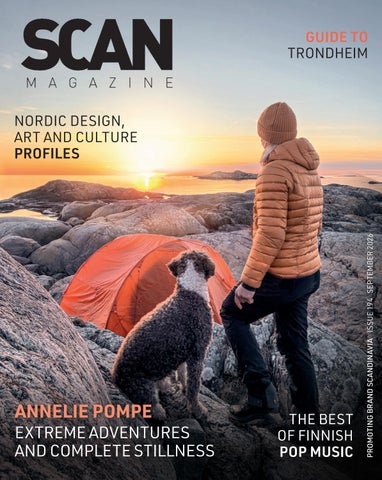
GUIDE TO TRONDHEIM
ANNELIE POMPE
EXTREME ADVENTURES AND COMPLETE STILLNESS
THE BEST OF FINNISH POP MUSIC
PROMOTING BRAND SCANDINAVIA ISSUE 194 SEPTEMBER 2026
NORDIC DESIGN, ART AND CULTURE PROFILES
TRADITION SPUN INTO
WOOL
Faroese knitwear since 1949. At Snældan, the last of the remaining spinning mills in the Faroe Islands, everything is made in one place – from wool to finished products. Three generations of design inspired by traditional Faroese knitting patterns, available in Snældan’s shops in Strendur and Tórshavn, and in the web shop.
www.snaldan.fo
Scan Magazine
|
Editor’s Note
Editor’s Note Dear reader, This month’s cover star is relentless in her pursuits; she has climbed Mount Everest, set the world record in freediving, and just attained her helicopter commercial pilot licence. Swedish adventurer Annelie Pompe is not only seeking extreme adventures though, she is also appreciating the complete stillness under the surface. During our chat, I was impressed by her presence, self-awareness and sense of calm. Don’t miss this interview! We have another not-to-be-missed feature in store for you. Our music columnist Karl Batterbee dives into Finnish pop and discovers a thriving music industry that births new talent annually, such as Finland’s answer to Justin Bieber and the girl behind the most played song on Finnish radio last year. You will also get Karl’s recommendations for the best tunes from the country’s hottest acts right now. From adrenaline kicks and upbeat tracks to shaky legs. When finalising this issue of the magazine, I found myself in the middle of unexpected seismic activity in southern Spain. My first unsettling
earthquake experience inspired this month’s beer column. You never know where ideas might pop up. For me, they often come when I judge beer competitions, when I travel of course, and when I discover a new place by foot with a good song or an interesting podcast in my headphones. This time, it happened when I chatted to a local about the tremors of the Earth. Perhaps we can provide you with new ideas in our September issue, for instance with the many design, art and culture profiles featured. Our Stockholm city guide has a playful and colourful touch, and the guide to Trondheim includes unexpected dining experiences and sweet delights. And as always, we highlight upcoming events to check out in Scandinavia. I hope you find some inspiration in our September issue!
Malin Norman, Editor
SCAN M A G A Z I N E
28
September 2026
|
Issue 194
|
3
Scan Magazine
|
Contents
In this issue DESIGN 6
Hermit habits and timeless staples On our Design pages, we look at timeless staples, elevated fabrics and versatile silhouettes for our wardrobe, and home décor to go with hermit habits and earthy tones of autumn.
COVER FEATURE 32
Annelie Pompe: extreme adventures and complete stillness Swedish adventurer Annelie Pompe has climbed Mount Everest and set the world record in freediving. We find out how she keeps calm and focused when it matters, and get some tips for incorporating more outdoor adventures in our lives.
LIFESTYLE AND FOOD 40
Beluga lentil patties and earthquake beer This month, food columnist Katharina Kjeldgaard serves up a vegetarian take on frikadeller; Beluga lentil patties – crisp on the outside, soft on the inside. And beer expert Malin Norman has strange beers on her mind, from sausage-flavoured brews to earthquake beer.
SPECIAL THEMES 42
Guide to Trondheim Tucked away in the heart of Trondheim, Visit Bjørn offers a dining experience that feels like being welcomed into someone’s home. The cosy neighbourhood café SweetGate lures you in with irresistible aromas, whilst Frøya Havfiskecamp is nothing but a fishing paradise.
48
City Guide Special – Stockholm Sweden’s capital tempts with playful colours and patterns at Rino Design Sthlm. Stockholm-based L’Usine Bleue offers a modern wardrobe around the enduring qualities of French workwear and, last but not least, Glenn Miller Café has an impressive programme of modern jazz concerts.
4
|
Issue 194
|
September 2026
32
Scan Magazine
|
Contents
SPECIAL FEATURE 54
Suomi sounds: get your fix of Finland’s finest The Nordic region has earned a reputation for exporting more than its fair share of pop music to the rest of the world. But Finland’s music scene is often overshadowed by its Nordic neighbours. Karl Batterbee dives into the best of Finnish pop right now.
SPECIAL THEMES 62
Made in Finland In this section we explore personalised jewellery design, products that make you feel a bit closer to Finland, a brand that blends cool Nordic style with vibrant design, and one of the most forwardthinking online fashion shops in the region.
66
Interior design and architecture spotlight In September, we shine a light on Estonian interior design and architecture, including a studio that creates warm, modern-classic interiors shaped around those who call them home, and a multi-generational practice working across architecture, interior architecture, urban planning and public space.
CULTURE 90
The best new events, film and music in Scandinavia In this month’s Culture Calendar, Karl Batterbee highlights fresh finds in the music world, film enthusiast Anders Lorenzen checks out a FaroeseIcelandic vampire film, and illustrator Maria Smedstad is in the mood for revenge.
BEST OF THE MONTH
78
70 74 79 80 84 86
Artist Museum Hotel Destination Restaurant International Holiday Experience September 2026
|
Issue 194
|
5
Scan Magazine
Design
|
|
Fashion Diary
Fashion Diary As summer eases into early autumn, September is all about a wardrobe that works harder with less. Think timeless staples, elevated fabrics and versatile silhouettes that can easily move from lecture rooms or office hours to evening plans. With a few well-chosen accessories, these are the pieces you will reach for on repeat throughout the seasons to come. By Celina Tran
|
Few shoes capture classic style quite like the penny loafer, and with autumn here, there is no better time to get your hands on a pair! Morjas’ handcrafted black calf-leather version is both refined and simple. Designed with a classic Goodyear welt construction, they are made to age beautifully, making them a smart investment for any capsule wardrobe that values longevity over trends. The Penny loafer in black calf, EUR 350 www.morjas.com
Press photos
With the unpredictable September weather, the overshirt remains one of early autumn’s most practical layers. Made from substantial cotton twill, this understated piece works equally well over a t-shirt during warm afternoons or layered beneath a coat as temperatures drop. A combination of clean lines and thoughtful detailing means it will remain a wardrobe favourite season after season, and nothing says timeless like this gorgeous blue. Patch pocket sturdy twill overshirt, EUR 119 www.adaysmarch.com
Every capsule wardrobe needs at least one pair of jeans that will defy the ages, and these from ARKET might be it. They feature a loose, full-length silhouette in non-stretch cotton that feels contemporary yet classic. Mist wide jeans in dark blue, USD 129 www.arket.com
6
|
Issue 194
|
September 2026
While September may only hint at colder weather, investing in outerwear early is never a bad idea. This double-breasted wool coat is a classic, with a relaxed silhouette that works for all occasions. Double-breasted wool long coat, EUR 299 www.cos.com
Scan Magazine
|
Design
|
Fashion Diary
Every capsule wardrobe needs at least one luxurious staple, and ARKET’s silk satin shirt is exactly that. The fluid drape and subtle sheen can instantly elevate denim or tailored trousers, while the relaxed resort collar keeps the overall look feeling easy rather than formal. Button up for the office, wear loose over a camisole in the evening, and add gold jewellery for that little ‘je ne sais quois’. Silk satin shirt in dark blue, USD 129 www.arket.com
ATP Atelier’s versatile Desana slingbacks transition seamlessly from desk to dinner, earning their rightful place in every wardrobe. Handmade in Italy from soft chrome-free leather, the elegant mid heel is comfortable enough for everyday wear while adding just the right amount of polish. Desana nappa slingbacks in walnut, EUR 400 www.atpatelier.com
Nothing beats the feeling of finding the perfect pair of jeans. Cut with a relaxed flare leg and made of 100 per cent cotton denim, Bik Bok’s Becca jeans are the cool girl trousers. Wear them with a simple tank while the weather is still mild, then switch to a crisp shirt or lightweight knit as the days cool down. They are the very foundation of the beloved ’jeans and a nice top’ formula. Becca wide jeans 584, NOK 599 www.bikbok.com
This year, the paperboy cap makes a quiet return, lending even the simplest outfit a sense of effortless, Parisian sophistication. Gina Tricot’s six-panel version pairs beautifully with an all-black ensemble, oversized tailoring, or a classic wool coat later in the season. Paperboy cap, EUR 19.99 www.ginatricot.com
September 2026
|
Issue 194
|
7
Scan Magazine
Design
|
|
We Love This
We Love This: September 2026 With September’s cooling weather and the yellowing of leaves, we abandon our adventurous summer selves for returning hermit habits. As home once again becomes our favourite place to be, why not introduce some interior pieces and décor to go with the earthy tones of autumn? By Celina Tran
|
Press photos
When we think about decor and interior design, it’s easy to think about frames but to forget the very images that fill them. This silkscreen printed poster by Finnish artist Kustaa Saksi depicts a hillside and a single zebra patterned tree against the skyline. The zebra pattern has been associated with Artek since the 1930s, and as a celebration of the Finnish brand’s 75 years in 2010, the poster references nature and natural materials – both important to Artek. Artek 75 anniversary poster by Kustaa Saksi (2010), EUR 119 from andlight.com www.artek.fi
Described as a masterpiece of Danish design, the EggTM chair designed by Arne Jacobeen is the perfect lounge chair. As the colder season draws near, it’s of the utmost importance to have a chair for reading and relaxation. The shape of the EggTM lounge chair is great for folding yourself into after a long day, not to mention that its sleek, warm leather can elevate any room, whether it’s your classic Scandi living room or a Georgian-styled sitting space. EggTM lounge chair in Grace/walnut, EUR 12,999 www.fritzhansen.com Nothing screams September cosiness like candles, and these creamy white, scalloped pillar candles are no exception. Depending on the vibe you’re going for, you can treat the white candles as a base to match with a range of other different colours. A Danish design favourite not only in Scandinavia, but across Europe, Søstrene Grene are the very definition of ‘hygge’. With warm, rich tones and a relaxing atmosphere, their labyrinth-like shops are the ideal place to source your affordable autumn décor. Pillar candle in white, EUR 6.58 www.sostrenegrene.com
8
|
Issue 194
|
September 2026
Scan Magazine
|
Design
|
We Love This
The Sine vase from Norwegian Hadeland Glassverk features a natural and elegant flowy shape and is perfect for long-stemmed dried flowers and bouquets of all sizes. Because the glass is mouth blown, each piece is entirely unique with its own soft, organic lines, shape and colours. Sine vase in cocoa, EUR 185.95 www.hadeland.com
Japandi, a combination of the minimalist Nordic lines and Japanese forms and materials, is an increasingly popular style of interior design, and it’s easy to see why with Frandsen’s Kiku table lamp. Inspired by the traditional Japanese Samurai hats, the Kiku family are made of linen strings and stainless steel, offering a different approach to something so mundane as lamps. Put in a space with wood textures, this is a natural centrepiece without being too flashy. Kiku table lamp, EUR 379 www.frandsen.com
A funky piece you might not even consider at first glance, this piece of industrial wall art adds personality and character to any wall. Hang it among your posters, shelves or lamps for a bit of urban texture. Wall Art, HDFaha in antique brown, EUR 69.95 www.housedoctor.com
September 2026
|
Issue 194
|
9
Palpably human – the Scandinavian design house defined by curiosity and tactility What began as a creative blog in 2007 has grown into Fine Little Day, an internationally recognised Scandinavian design brand with a distinctive visual identity and a philosophy rooted in creativity, curiosity and a more fulfilling everyday life. By Nina Bressler
|
Photos: Fine Little Day
Founded by designer and photographer Elisabeth Dunker, Fine Little Day started as a personal space for exploring ideas, images and creativity. At a time when blogging was becoming a powerful platform for independent creatives, Elisabeth’s blog quickly attracted an audience far beyond Sweden. She began creating posters for her readers, turning a personal creative practice into a small business. In 2011, Fine Little Day entered a new phase as Elisabeth began working together with her course colleague, 10
|
Issue 194
|
September 2026
Ulrika E. Engberg. Since then, the brand has developed organically, expanding its collections while staying true to the artistic expression that made it recognisable from the beginning. Rather than following trends or looking too closely at what others in the industry are doing, the brand has always focused on developing its own visual language. Inconsistent consistency
Ulrika E. Engberg and Elisabeth Dunker.
Fine Little Day is not defined through a single aesthetic. Engberg, managing director and co-founder, describes their approach as ‘inconsistent consistency.’ “Our collections provide a recognisable style that leaves room for variation, experimentation and surprise. The human hand is always present. Brushstrokes, irregularities and small imperfections are
Scan Magazine
|
Design Profile
|
Fine Little Day
deliberately allowed to remain visible. Patterns should feel as though they have been made by someone, rather than produced by a machine,” Engberg continues.
proved especially powerful across larger textile surfaces. Following the first collection, further collaborations are now in development.
given, and they use organic textiles as far as possible, with production taking place in Sweden, as well as in Latvia, Lithuania and India.
Fine Little Day contains products designed for everyday life. From posters, vases, tablecloths, napkins, trays to jewellery and a section dedicated for gifting, each item has been made with an emphasis on playfulness and the human touch. There is a clear connection to Scandinavian design, but the brand takes a more personal and expressive approach to the tradition. The goal is not perfection but rather authenticity and character.
These partnerships are an important part of Fine Little Day’s philosophy, and one of many reasons they have installed their own award for emerging artists. The Fine Little Day Art Award not only includes a prize of 25,000 SEK to the winner, but also provides a unique opportunity for the artist to exhibit in front of a diverse audience, in showrooms linked to the Fine Little Day shop outside Gothenburg. “We want to give artists space to work in their own way, to allow different creative voices more opportunities and a space to shape their work and artistic identity,” says Engberg.
A destination for the full experience
Textiles are an increasingly important part of the range. The brand works with lengths of fabric, interior textiles and kitchen textiles, giving customers the opportunity not only to buy finished products but also to bring them home and create something themselves. A space for artistic collaborations Collaborations with artists are an essential part of their collections, for vibrant perspectives on everyday objects. One notable collaboration is with Stockholm-based artist Evelina Kroon, whose distinctive geometric paintings have been translated into textiles. Her work, characterised by grids and subtle variations in colour and form, has
Scandinavian design, the sustainable way Sustainability is deeply embedded in the company’s DNA. “Sustainable practices have been engrained into our practice ever since we studied design together, and the principles have remained an essential part of our thinking ever since,” says Engberg. Sustainability goes beyond environmental considerations, but also involves quality, longevity and the human perspective: products should be made to last, not just physically but also emotionally. High-quality materials are a
Since 2015, the brand has been based in a former early 20th century spinning mill in the Swedish countryside, Spinneriet in Lindome, which is just outside of Gothenburg. The site has developed into a destination with a shop, restaurants, a gelateria and other businesses, offering visitors the opportunity to experience the full Fine Little Day collection all in one place. As the founders are looking ahead, a holistic approach to everyday life, with its material reality in combination with human health, is taking shape. “We’ve always been interested in how design, creativity and the home can enrich everyday life. Now, we want to start looking at other aspects that affect wellness,” says Engberg. Part of this exercise consists of a book written by Dunker about her personal journey with health, exercise and well-being, following her experience of menopause and the process of rebuilding her physical and mental strength. After that? Let curiosity, playfulness and creativity lead the way. www.finelittleday.com Instagram: @finelittleday
Evelina Kroon, one of the designers working with Fine Little Day.
September 2026
|
Issue 194
|
11
Restoring the value and craft of wool Wool is not just a material; it is part of a culture, a territory and a community. The Cobo family in Mota del Cuervo has been working with wool for over a century – shearing, washing and spinning. Through WoolDreamers, the family manufactures yarn for knitting, whilst Wool4Life is where they create finished wool textiles. Two paths, the same origin.
WoolDreamers was born in Mota del Cuervo, in the Spanish region CastillaLa Mancha, where the craft of working with wool has a long heritage. “Here, we work with wool not as a product, but as a responsibility,” says Ramón Cobo, managing director. “We haven’t invented a new trade. We’re simply carrying on a very old one.”
12
|
Issue 194
|
September 2026
Knowledge passed down through generations The wool industry has a rich heritage in Spain. In fact, it was considered a high-value material in the 18th century and much of the country’s culture, economy and history was built on wool – it was the white gold of Spain.
By Malin Norman
The Cobo family has been working with wool for generations – preparing the highest quality yarn, with respect for the material and the craft. As expressed by Ramón: “Deep down, the work remains much the same: receiving the wool, learning how to read it, and guiding it from the
moment it arrives from the fields until it’s ready to continue its journey.”
Photos on this page: WoolDreamers
The first reference to the Cobo family working with wool dates back to 1923, when Ramón’s grandfather Julián, along with an uncle of his, worked in a wool blanket workshop. His children helped in the workshop and two of them, Ramón’s father and a brother, decided to continue with the trade. At that time, wool was collected in carts and washed in places such as the Saona River, near Mota del Cuervo. Wool was an integral part of daily life and the landscape. In 1984, Ramón’s father built a wool wash-
Scan Magazine
|
Design Profile
|
WoolDreamers + Wool4Life
ing facility with his brother – one of very few still standing today.
clothing and interior décor such as rugs, blankets, cushions and garments.
Over time, the relationship with wool changed, transformed and was resumed. “The wool industry changed; when tractors were introduced, when synthetic fibres entered the market, and when wool was no longer considered a high-value product but instead an animal biproduct,” says Ramón. “Our family had to adapt. We had to find new customers, invest in new machines, and so on, in order to survive.”
In the design studio, wool sets the pace. Here, collections are not produced according to the pace of the industry, but rather according to the rhythm of the material and the craft. With Wool4Life, the team also partners with local shepherds. “The shepherds do amazing work, striving for a better life. For them and for us, this is not just yarn or a blanket, it’s so much more – it’s a life project.”
Restoring the value of Spanish wool Started six years ago, WoolDreamers is a family-led initiative built on generations of knowledge. WoolDreamers works alongside farmers and shepherds, with native sheep breeds, and through the sorting, washing, carding and spinning of the fibre. The purpose is to restore the value of Spanish wool, support the local communities behind it and build a more transparent and meaningful wool industry. Starting with two families of shepherds, WoolDreamers now partners with more than 30 families in the area. Sustainability is crucial and the family has identified four pillars: the social aspect and supporting the local community, the ecological aspect and working only with natural materials, the economical
aspect because “you cannot be green if your numbers are red,” as expressed by Ramón, and lastly the cultural aspect, to promote the heritage and culture. Wool4Life, a natural extension of wool Wool4life is the creative and contemporary expression of WoolDreamers. The textile design studio was born a couple of years ago as a natural extension of working with wool. “Wool has a large number of possibilities. This is just a continuation of our work with the same values and the same material,” says Ramón. While Wooldreamers manufactures yarn for knitting, Wool4Life creates finished wool products, including
Anything produced by Wool4Life is made to last. “The garments reflect a way of being in the world. They don’t follow seasons or trends; they are classic, timeless and well-made wool products,” adds Ramón. “These are 100 per cent wool pieces, made with respect together with artisans – always listening to the material, the territory and the craft.” wooldreamers.com Instagram: @wooldreamers wool4.life Instagram: @wool4.life WoolDreamers organises guided tours on selected dates throughout the year, where visitors can discover the entire wool process. In the showroom, it is also possible to see and purchase WoolDreamers products.
Photos on this page: Wool4Life
September 2026
|
Issue 194
|
13
Healing through knitting – one stitch at a time With yarn running through the hands and attention held by the rhythmic creation of patterns, knitting can foster both calm and focus. For Thea Vesterby, that combination became transformative. After a successful digital career, impressive sporting achievements – and severe stress, she found healing in knitting. Now dedicated to her business, VesterbyCrea, she is releasing her second knitting book, Maske for maske, this month. By Signe Hansen
|
For much of her adult life, Vesterby was accustomed to moving fast. She entered the digital industry when the internet was still new in Denmark and spent more than two decades helping global companies navigate an increasingly digital world. Outside work, her drive found an outlet in marathon and Ironman training. Her life revolved around ambition, discipline and the next goal – until her body and mind could no longer keep pace.
14
|
Issue 194
|
September 2026
Two stitches and a new direction With her capacity for work and concentration badly affected, Vesterby needed something that could quiet her system while still engaging her mind. In 2019, her adult twin daughters suggested that she learn to knit, just as her mother had done for most of her life. When her mother taught her, something changed.
Photos: Victor Low Sørensen
Within several years, Vesterby was hit by stress three times. The final episode was severe enough to change the direction of her life and forced her to reconsider a career she had once found deeply exciting. “My old career was about
creating something on a screen that was basically old the next day,” she says. “There was very little you could point to and say, ‘I made that.’”
“When I started knitting, I could physically feel something waking up in my brain again,” she recalls. “My thoughts were focused on the knitting, and at the same time there was a physical calm. It helped me start using my head again.”
Having been forced to slow down by stress, Thea Vesterby took up knitting and founded VesterbyCrea. Photo: Thea Vesterby
What began as part of her recovery gradually developed into designing, and then into VesterbyCrea. By August 2023, the business had grown enough for Vesterby to leave consulting behind and commit
Scan Magazine
to it full-time. Today, VesterbyCrea offers patterns for sweaters, cardigans and accessories in several languages, while workshops and talks allow her to share the experience behind the designs. Her first knitting book, Strik i Struktur, followed in 2024, and her new book, Maske for maske, takes the connection between knitting, concentration and mental restoration further. A book built around meditative knitting Rather than designing pieces in plain stocking stitch, Vesterby consistently works with structure, cables or colour work – patterns that demand enough attention to hold the mind in the present. “All my designs contain structure or colorwork – something you have to think about, but which can also bring you into a meditative flow,” she explains.
|
Design Profile
|
VesterbyCrea
designers becoming close friends as well as valued colleagues. Spreading and strengthening that sense of possibility and community has increasingly become part of the mission of VesterbyCrea. “Knitting is more than fashion and more than a piece of craft,” she says. “I want to put words to how much it can mean to us. The meditative side of knitting is the focus of this book because it is my own personal story.” Publication: Maske for maske, September 2026. Published in Danish and German. www.vesterbycrea.dk Facebook: VesterbyCrea Instagram: @vesterbycrea
In her book Maske for maske, Vesterby focuses on the meditative and restorative effect of knitting.
That idea is at the heart of Maske for maske, which brings together 18 projects – nine previously released designs and nine created for the book. Developed over around seven months, the collection explores different structures and techniques while using the concentration required by a pattern as part of the experience. “That is what knitting does for me,” says Vesterby. “You come down a gear, let the hours pass and process something through your hands.” Having spent her childhood in Switzerland, Vesterby, a native German speaker, is publishing the book in both Danish and German. More than a piece of craft As Vesterby began giving talks and workshops, she discovered how strongly her story resonated with others. Women would approach her afterwards, sometimes in tears, and tell her that knitting had helped them through difficult periods too. The encounters reinforced her belief that knitting offers something beyond the finished garment. Moreover, coming from what she describes as the hard consulting industry, Vesterby found a striking contrast in knitting. “The community simply opened up and invited me in,” she says, with fellow September 2026
|
Issue 194
|
15
Scan Magazine
Design Profile
|
|
Kristin Urup Design
Where geometry meets creativity Defined by clean geometry, minimalism and meticulous precision, Kristin Urup’s jewellery has a distinctive simplicity. Every piece is handmade by the Danish designer, whose work balances carefully considered proportions with the freedom to experiment. From necklaces and earrings, her jewellery shows how even the simplest forms can offer endless possibilities. By Heidi Kokborg
|
Photos: Kristin Urup Design
Kristin Urup was just 13 years old when she began experimenting with silver wire and creating her own jewellery. Soon afterwards, an aunt took several pairs of her earrings to Iceland to sell and, shortly after, Kristin was earning money from her one-of-a-kind jewellery made from silver wire and glass beads from India. Although jewellery was already a significant part of her life, Urup chose to study architecture. The education developed an understanding of form and structure that sits naturally alongside the geometric language of her jewellery. After years of combining jewellery with architectural work, she made jewellery her full-time profession in 2012. Every item that leaves Urup’s studio is handmade. “I make every single piece myself. The process is important because you suddenly see something new while you have it in your hands. You turn 16
|
Issue 194
|
September 2026
it slightly, and another idea can emerge from what you are already working on,” explains Urup. Her aesthetic is minimalist and stringent, with simple, geometric and often three-dimensional forms. Yet creating that apparent simplicity demands considerable discipline. Individual components are carefully measured and weighed to ensure the proportions are exactly as Kristin intends. That same precision carries through to her rings, which are made individually to fit their wearer. Existing stones can also find new life in her designs, including stones taken from inherited jewellery and incorporated into a new piece. Urup’s jewellery has travelled far beyond Denmark. In 2017 Urup was invited by Bryna Pump to bring 65 pieces to New York, joining around 50 participants from across the world for the event MAD,
at the Museum of Arts and Design in NY. Today, her work can also be found at Galerie MiniMasterpiece in Paris, while exhibitions remain an important part of her practice. Over the years, she has exhibited in numerous settings, including the National Bank of Denmark. For Urup, the appeal ultimately lies in creating something individual: jewellery that is carefully made by hand rather than mass-produced. Those wishing to see her jewellery in person can find Kristin at selected markets in Copenhagen throughout the year. Otherwise, pieces can be purchased by contacting her directly via email. www.kristinurup.dk Facebook: Kristin Urup Design. Instagram: @kristinurupdesign Email: mail@kristinurup.dk
Giving shape to the unseen In the ceramic universe of Stine Stenfatt West, heavy emotions sit alongside tenderness, anatomical beauty and small moments of playfulness. Her figurative sculptures give physical form to feelings otherwise difficult to express, while lighter animal pieces and model studies offer a deliberate counterpoint. Alongside her own work, West teaches clay croquis workshops, inviting others to discover how gesture and character can emerge through clay. By Signe Hansen
|
Photos: Mads Stenfatt
As a mother of two, West’s work often explores the joys and challenges of motherhood, with a lot of her works translating emotions that many might recognise but find difficult to vocalise into figurines. “Sometimes I’m inspired by a particular situation or feeling – perhaps a sense of powerlessness, worry, or the difficult process of accepting that life may not unfold as expected – and then I try to give it an image by making a figure,” she explains. “Sometimes there’s humour or irony in it too.” The more serious pieces are balanced by quieter model studies, affectionate mother-and-child figures and goofy animals, 18
|
Issue 194
|
September 2026
allowing West to move between emotional intensity and something more instinctive and playful. In recent years, this increasingly focused body of work has also begun reaching a wider audience, with West selected for juried exhibitions in Roskilde and Hvidovre in 2025 and 2026. From physics to sculpture Although West’s exhibiting career is relatively new, working with clay is anything but. From the age of nine, she spent around a decade learning from classically trained sculptor Jeanette Brønsted, first on children’s courses and later modelling the human body from life. “It was very focused on sculpture, so I learnt a lot about anatomy and technique – how to build a piece so it’s stable, how to hollow it out and how to make sure it survives the firing,” she says. Professionally, however, West followed another path. Trained as a physicist, she went on to work at the University of Copenhagen, and for many years ceramics
Scan Magazine
|
Art Profile
|
Stine Stenfatt West – Keramik
remained a smaller part of a life shaped by work and family. “I’ve had a long period where art was on a low flame,” she says. “But in recent years, I’ve become much more focused on making work that feels more serious and has something to say.” Capturing a body in clay At the centre of West’s practice is the human figure, whether shaped into emotionally charged sculptures, commissioned pieces or quick studies made from a live model. Recently, she has also begun creating life-size clay busts, extending her interest in anatomy and expression into a more detailed form that captures the likeness of each person. Some sculptures are made to order, shaped around the point a client has reached in life. One recent commission portrayed a woman after a divorce – seated, self-contained and strong, with a raku-fired surface adding an organic, unpredictable quality. That unpredictability has become an important part of West’s work. In raku firing, pieces are removed from the kiln while extremely hot and treated with materials that create cracked and irregular surfaces. “There’s something about giving up control and trusting that it will turn out well,” she says. “Sometimes it does, and sometimes it doesn’t, and that fits quite well with some of the themes in my work.” Alongside her own practice, West also invites others to discover the joy of
Stine Stenfatt West working on a life-size clay portrait.
working in clay through her Clay Croquis workshops. Beginners and experienced artists alike take part, with West guiding them through both observation and the practical techniques needed to make a figure hold together. When the right work finds the right person For West, the most emotionally specific sculptures often create the strongest reactions, yet they are not necessarily the easiest pieces to sell. “The pieces with a very specific story have to find the person they really speak to,” West explains. “People may immediately recognise the feeling, but taking it home is a bigger step. The lighter, more decorative pieces are easier in that sense.”
Yet when that connection does occur, it is precisely the specificity of the sculpture that gives it meaning. Rather than offering an uncomplicated decorative object, West’s more personal works leave space for viewers to bring their own experiences to the figure – and perhaps recognise something they have struggled to put into words. “I think both sides are me,” she says. “After I’ve made something that I’ve put a lot of emotion and soul into, it can be good to make something that’s simply beautiful or playful. I move back and forth between the two.” stenfatt.com Instagram: @sculpturebystine
Photos: Stine Stenfatt West
September 2026
|
Issue 194
|
19
Scan Magazine
Art Profile
|
|
Rikke Darling
Rikke Darling working on her characteristic botanical paintings at Geranium.
Toward the Horizon.
Copenhagen’s three-Michelin-starred Restaurant Geranium is among the venues decorated with Darling’s murals.
Beyond the Visible.
Rikke Darling – the art of living nature Rooted in biology and shaped by the patterns of the natural world, Rikke Darling’s art moves between botanical forms, abstraction and science, exploring how humans remain inseparable from nature. From original paintings and hand-painted vases to expansive murals, her distinctive work has found its way into homes, hospitals and public spaces – including the triple Michelin-starred restaurant Geranium. By Signe Hansen
|
Photos: Rikke Darling
In Darling’s work, branching forms, cellular structures and botanical shapes weave into fluid compositions, creating images that feel at once familiar and abstract. “I’ve always been drawn to the places where things connect – where a cell structure echoes a forest canopy, or where a botanical form finds its way into an architectural space. That’s where my art begins,” says Darling. Based in Copenhagen, with a studio and gallery on Østerbro, Darling has worked as a visual artist for more than two decades, following an earlier education in fashion design and illustration. Today, her practice spans paintings, murals and artistic objects, while her membership of the international SciArt Initiative 20
|
Issue 194
|
September 2026
reflects her interest in the meeting point between art, biology and science. The unique composition of her work has also led to appreciation within the healthcare industry, and her work is found at several of Denmark’s major hospitals, where the healing and uplifting effect of nature and art has a true impact. The relationship between art and its surroundings becomes especially tangible in Darling’s murals. At Geranium, edible wild plants from the Danish landscape wind lightly across walls and the ceiling alongside insects, complementing the restaurant’s Nordic interior while reflecting the natural balance behind the food we eat. Her hand-painted vases ex-
tend the same visual language into three dimensions, allowing the artwork to become part of everyday life. “I’m fascinated by the structures, repetitions, textures and interconnected systems found in nature – from botanical forms and organic patterns to rocks, moss, flowing water and the changing landscapes of the north,” says Darling. “For me, nature is not simply something to depict. It’s a source of patterns, moods and ideas that I translate into my own visual language.” www.rikkedarling.com Instagram: @artistrikkedarling
Scan Magazine
|
Art Profile
|
SUM Keramik
Photo: Per Bille
Shaping the possibilities of clay Curiosity, form and a deep respect for craftsmanship shape the work of ceramic artist Susanne Moeskjær. Through SUM Keramik, she creates one-of-a-kind sculptures that explore the possibilities of clay. Inspired by everything from stones and natural materials to bones and machine parts, her forms leave space for imagination and individual interpretation. By Heidi Kokborg
|
Photos: SUM Keramik
Moeskjær has worked with ceramics since her teens and graduated from Kolding School of Design in 1997. The Danish ceramicist primarily creates unique pieces rather than repeating the same forms. Curiosity about a particular technique or idea develops into a small series, allowing her to explore it from different angles before moving on.
Organic forms meet stringent lines that cut through the works, creating contrast and inviting different interpretations. Moeskjær is fascinated by clay itself: soft and pliable before becoming fragile as it dries, then hard and enduring through firing. Humans have worked with it for millennia, yet its possibilities continue to fascinate her.
Her works are hand-built, with form always taking the lead. Glaze complements the work rather than defining it, creating a balance between form and decoration. “For me, it’s the form itself that gives the highlight,” says Moeskjær.
Her process requires a sense of calm, time and immersion. Moeskjær turns and examines each sculpture until the forms work together and feel resolved from every angle. “When I get the feeling that the sculpture is finally there, it gives a little high,” explains Moeskjær.
Ideas can emerge from almost anywhere. Moeskjær has explored the patterns and surfaces of stones, but is equally intrigued by bones or machine parts. “I like trying the impossible and stretching the material to see what it can actually do,” she explains.
Moeskjær works from a historic five-storey townhouse from 1910 in Ry, Denmark, with her workshop in the basement and a gallery at street level. The gallery brings together works from different exhibitions and projects, revealing the recurring
thread in her practice. Increasingly, she is also creating larger works assembled from individual ceramic components for walls. “I hope that my pieces will stay with people for many years and continue to bring them joy. You can return to a sculpture again and again and discover something new in it over time,” Moeskjær says. This autumn, her work can be experienced at OMVENDT, Hinnerup Library, from 31 October to 16 November, Kunst og Kirker in Slagelse 7–8 November, and ProKK’s SØNDERJYSK KAFFEBORD at Haderslev Kunstforening 7–13 November 2026. www.sumdesign.dk Instagram: @sumkeramik
Susanne Moeskjær. Photo: Per Bille
September 2026
|
Issue 194
|
21
The 100-year-old concert hall that never sleeps
Photo: Yanan Li
Home to the Royal Stockholm Philharmonic Orchestra, the blue concert hall is one of Stockholm’s most recognisable landmarks. Konserthuset Stockholm is always buzzing and this autumn sees a busy jubilee programme with international stars such as Icelandic pianist Víkingur Ólafsson, Seong-Jin Cho from South Korea, the 100-year-old French-American composer Betsy Jolas and, of course, the Nobel Prize Award Ceremony.
ing the neoclassical building an iconic Stockholm landmark – a coelin blue chosen in the 1920s by architect Ivar Tengbom and artist Isaac Grünewald.
By Malin Norman
The renowned Royal Stockholm Philharmonic Orchestra gives around 100 concerts annually, with 105 world-class musicians employed. Chief conductor is the prize-winning American Ryan Bancroft, who began his tenure in 2023. “Ryan Bancroft is a warm and inclusive musician, who really manages to capture both orchestra and audience in the music,” says Rydén. “He embarks on his fourth season with a large number of productions – he has become a firm favourite with our audiences!
The Royal Stockholm Philharmonic Orchestra was founded in 1902 and Konserthuset Stockholm has been its home since 1926. The concert hall is one of Stockholm’s most recognisable landmarks, hosting over 200 concerts per year, including orchestral and chamber music, jazz and world music. “This is the blue building that never sleeps,” smiles Susanne Rydén, executive director and CEO. “At Konserthuset Stockholm, we have a packed programme with activities almost every day of the year. We provide music for all ages, starting with classical music for babies 22
|
Issue 194
|
September 2026
up to 12 months. You can enjoy music here with us throughout your life!” In celebration of the building’s 100th anniversary, a major renovation of the blue façade has restored its beautiful colour. The blue shade has contributed to mak-
Photo: Yanan Li
Ryan Bancroft, Víkingur Ólafsson and Betsy Jolas
The busy autumn programme has plenty more in the pipeline. For instance, Icelandic pianist Víkingur Ólafsson opens the popular piano series on 13 September
Scan Magazine
Víkingur Ólafsson. Photo: Nadja Sjöström
Culture Profile
|
Konserthuset Stockholm
Photo: Yanan Li
and, later on, the orchestra will be visited by, among others, Italian pianist Beatrice Rana and the superb Seong-Jin Cho from South Korea, among others.
formers including three major highlights: Cécile McLorin Salvant, Wynton Marsalis with the Jazz at Lincoln Center Orchestra and pianist Hiromi,” reveals Rydén.
Swedish soprano Christina Nilsson is making waves too, and will return to Konserthuset Stockholm several times this season, as will violinist Janine Jansen. Many are also anticipating Tomas Ledin to brighten up the autumn darkness, as too will the fascinating 100-year-old French-American composer Betsy Jolas, who is the focus of this year’s international composers’ festival.
House of splendour, for prestigious award ceremonies
“Our concert series Blue House Jazz is also celebrating its anniversary and, this autumn, we welcome several great per-
|
Konserthuset Stockholm’s festive atmosphere provides a fantastic backdrop for big events. In fact, it was originally also built with the Nobel Prize Award Ceremony in mind, as explained by Rydén: “The Nobel Prize has been presented here on 10 December every year since 1926, apart from during World War II and the pandemic. A highlight is the Nobel Prize Concert, a classical music concert of the highest
international standard, arranged every year by Nobel Prize Outreach in cooperation with Konserthuset Stockholm. The concert is part of the official Nobel Week programme and held in honour of the current year’s Nobel Laureates. While music is at the core, simply entering the building is like stepping inside a living art and design museum, and many visitors enjoy the guided tours, learning about life backstage. For those travelling to Stockholm with children, it is also worth checking out what is happening here. Family Saturday is particularly popular, with tickets usually selling out quickly. Rydén adds: “At Konserthuset Stockholm, we want to offer something for all ages – to feed the curiosity.” www.konserthuset.se Facebook: Konserthuset Stockholm Instagram: @konserthusetstockholm
Free streaming service Konserthuset Play primarily features recorded concerts by the Royal Stockholm Philharmonic Orchestra, but also much more from the venue’s broader offering, such as jazz, chamber music and concerts for children. World-class performances are available to stream for free anywhere in the world at konserthuset.se/en/play Ryan Bancroft. Photo: Nadja Sjöström
September 2026
|
Issue 194
|
23
proHemsedal: Welcome to Norway’s very own Alps! While Hemsedal’s sights and sounds are a must-see, the prospect of booking lift passes, finding a cabin, planning meals and much more can make the planning process seem daunting. With proHemsedal’s personal service and tailored experience, however, all you have to do is show up! By Celina Tran
Photo: Kalle Hägglund / Hemsedal.com
Arriving in the mountains should feel like an escape. The journey winds through forests and valleys, the air gets colder and clearer, and suddenly the peaks of Hemsedal rise around you. Here, the scenery naturally does much of the work, but for proHemsedal, creating a memorable mountain holiday means taking care of everything else, too. Founded by Andreas Tangberg and Astrid Elisabeth Kihle Jordan, proHemsedal has developed a distinctive approach to mountain hospitality, combining premium accommodation with the personal attention of a local concierge. “It started with us wanting to offer rental cabins and apartments with that little extra,” explains Tangberg, co-founder and manager. “You 24
|
Issue 194
|
September 2026
Astrid and Andreas. Photo: Steinar Bleken
Scan Magazine
|
Real Estate Profile
|
proHemsedal
arrive to a cabin where the beds are made, the fridge is filled, your lift passes are already on the counter and, if you like, a chef will come and prepare dinner for you.” It is a deceptively simple concept, but one that changes the character of a mountain holiday. Instead of spending the first evening shopping for groceries, making beds and figuring out where everything is, guests can arrive, unpack and immediately kick back and settle into their surroundings. A concierge on the mountain Hemsedal has earned its reputation as one of Norway’s premier mountain destinations. In winter, skiers and snowboarders are drawn to its varied terrain, while cross-country trails stretch into quieter parts of the landscape. Yet the destination’s appeal increasingly extends far beyond the ski season. For proHemsedal, that has created an opportunity to offer something broader
than traditional holiday accommodation. “We’ve focused on unique, high-end units that sometimes haven’t been on the rental market before,” says Tangberg. “What we offer is a kind of concierge service in the mountains, with personal follow-ups throughout the stay.”
The company’s portfolio now includes a selection of distinctive cabins and apartments, from contemporary mountain homes to larger properties designed for families and groups. Many combine natural materials and modern Scandinavian interiors with features such as fireplac-
Photo: Kalle Hägglund / Hemsedal.com
September 2026
|
Issue 194
|
25
Scan Magazine
|
Real Estate Profile
|
proHemsedal
likewise be built around the landscape, creating events that feel distinctly connected to Hemsedal rather than simply transplanted into it. Hemsedal: a year-round destination While winter remains a cornerstone of Hemsedal’s appeal, the warmer months reveal an entirely different side of the valley. When the snow disappears, hiking trails lead into the high mountains, cyclists explore the surrounding roads and paths, and rivers and lakes become destinations in their own right. Fishing, canoeing, climbing and other outdoor activities are all other ways of experiencing the landscape. “Summer and autumn are just as spectacular,” says Tangberg. “You don’t have to do a demanding hike to get a fantastic view. It really is an eldorado in all seasons.”
Photo: Kalle Hägglund / Hemsedal.com
es, saunas, terraces and hot tubs, while large windows bring the surrounding landscape indoors. Because location is key, a family seeking an active week filled with skiing and outdoor adventure might be offered properties with convenient access to a ski centre, while a couple preferring long mornings, private dining and a quiet walk through the mountains might seek a secluded destination surrounded by nature. No matter what you have in mind, proHemsedal ensures that you are taken care of. And the service does not end there. The company works with a network of local suppliers and activity providers, allowing guests to arrange everything from private chefs and wellness treatments to outdoor adventures, restaurant reservations and transportation. “We’re always available, and will be so before, during and after your stay,” confirms Tangberg. That continuity is central to the company’s approach. Local knowledge means that guests can receive recommendations based on what they actually want 26
|
Issue 194
|
September 2026
to do, rather than a generic list of tourist attractions. It also means that proHemsedal can create more complex stays for groups and businesses. Corporate retreats can combine meetings with skiing, hiking, mountain biking, team activities and shared meals. Private celebrations, weddings and milestone occasions can
For families, the summer season brings opportunities to combine adventure with slower days in nature. For couples and groups, the longer days create space for everything from mountain excursions to relaxed evenings overlooking the valley. And looking forwards, proHemsedal is exploring new types of accommodation and experiences that bring together architecture, nature, comfort and local character. This includes developing a growing property-management operation, work-
Scan Magazine
|
Real Estate Profile
|
proHemsedal
ing with owners who want their homes professionally presented, maintained and marketed to discerning guests. “For visitors, this creates a more consistent level of quality. For owners, it provides the reassurance of having a local team looking after their property and guests.” And for Hemsedal, it contributes to the destination’s continued evolution. It goes without saying that the Scandinavian Alps themselves are extraordinary. proHemsedal’s role, however, is to make experiencing them feel effortless. “Our ambition is always to exceed expectations,” says Tangberg. “Whether you’re a family on your annual ski holiday, a couple celebrating a special occasion, or a company looking to strengthen bonds, we want Hemsedal to feel personal, surprising and unforgettable.” www.prohemsedal.com Facebook: proHemsedal Instagram: @prohemsedal Photo: Nils-Erik Bjørholt / Hemsedal.com
September 2026
|
Issue 194
|
27
Where industrial heritage meets vibrant artisan culture The charming village Mathildedal, in the southern archipelago of Salo in Finland, is known for its historic ironworks. The village has maintained its community spirit and is now a vibrant hub with local crafts, delicious food and exciting cultural activities. And with the sea on one side and a lake and a national park on the other, there are plenty of outdoor activities awaiting visitors, too. By Malin Norman
|
Photos: Visit Mathildedal
“Thanks to the Gustafsson family, our unique ironworks village is kept alive for future generations,” says Järvinen. “When visiting, you will see that Mathildedal has maintained its history and identity, but it’s also a beautiful and relaxing destination that oozes creativity. Visitors appreciate the idyllic, unspoilt setting and the warm, genuine atmosphere.”
Mathildedal lives and breathes ironworks history and creativity. The ironworks was founded in 1852 by entrepreneur Viktor Bremer. The village developed and grew around the ironworks, with a real sense of community. “It was not just a workplace, it was a way of life,” says Hanna-Mari Järvinen, who oversees marketing for the Mathildedal entrepreneurs’ association. “Even though the ironworks closed a long time ago, it’s still at the heart of the village and the entrepreneurial spirit is palpable.” With the goal of preserving the historical cultural landscape, Tuula and Harri Gustafsson purchased the historic industrial site in 2003 – restoring and repurposing 28
|
Issue 194
|
September 2026
the old brick buildings. Walking through Mathildedal, considered one of Finland’s best preserved ironworks villages, you will experience the rustic beauty but also a thriving community with many local businesses, such as design boutiques and cafés, who continue to shape village life.
History intertwined with nature
Bistro Bruket. Photo: Silva Kaverinen
Nature is also ever-present in Mathildedal. On one side of the village awaits the coast with a small guest harbour and fabulous sea views, and on the other side is Lake Matildanjärvi and Teijo National Park. The village’s identity is
Scan Magazine
very much intertwined with nature; the stream and waterwheels as well as the surrounding forests and even the charcoal all played a vital role in the growth of the ironworks. Nowadays, visitors can appreciate the setting and enjoy the lush nature. “In Mathildedal, everything is within easy reach,” says Järvinen. “Walking around the village, along the long oak-tree alley and past the old ironworks buildings, you will experience our peaceful lifestyle.” But visitors will also find a wide range of outdoors activities waiting around the corner, with opportunities aplenty to explore the wonders of Finnish nature. Teijo National Park offers excellent hiking and cycling trails in stunning natural surroundings. Visitors can also rent bicycles, fat bikes, kayaks, rowing boats, and stand-up paddleboards. Swimming and fishing are possible both in Lake Matilda and at sea, with guided fishing trips available, too. And the village also hosts yoga classes at various locations, including the park, the beach and on the pier of Mathildan Marina. For golfers, a beautiful golf course also runs along the sea. Sauna is an important
|
Destination Profile
|
Mathildedal
Photo: Sander Vill
part of Finnish culture, all year round, and Mathildedal has several public saunas available. In the winter months, cold-water swimming is an experience to enjoy, and there are opportunities for downhill skiing nearby. For families with children, Järvinen recommends exploring the village at a child’s pace. On the Ant Trail in Teijo National Park, they can learn everything there is
to know about ants. The little ones also love the village’s own playground, and there is adventure mini golf in Mathildedal Central Park. A group of alpacas also call Mathildedal home in summer, taken care of by volunteers from the village. “One of Mathildedal’s strengths is that there are a range of options for every visitor,” Järvinen says. “Regardless of age and interests, we have something to keep you entertained.”
Restaurant Terho. Photo: Silva Kaverinen
September 2026
|
Issue 194
|
29
Scan Magazine
|
Destination Profile
|
Mathildedal
Photo: Mathildan Marina
For those interested in trying their hand at foraging, companies such as Hotel & Café Mathildedal organise guided trips in the region’s forests throughout summer and autumn, where visitors can pick lingonberries, blueberries and a Finnish favourite, chantarelles. Celebrating local artisans and delicacies As part of its vibrant community life, Mathildedal has several small independent businesses and local artisans. For instance, you will find locally produced food and ingredients at Lähiruoka Puhti, and stylish home décor and interior design at the Dock Helsinki store. Attic Shop Vinttipuoti offers a unique selection of handicrafts, art, and locally produced food, while handmade brushes and baskets can be found at Kaarnalaiva. At Ruukin Kehräämö, you will find highquality alpaca knitwear. The product range also includes home décor items, alpaca yarns, and natural cosmetics. Clothes made entirely in Finland are available at Aate Clothing, a boutique run by Maija Nuppula and Miina Launiainen. “Every step of the process takes place in Finland, and every maker is personally known to them,” says Järvinen. 30
|
Issue 194
|
September 2026
Hungry visitors are in for a treat too, as Mathildedal is known for its authentic culinary experiences based on local and seasonal ingredients such as fish, game, vegetables and berries. You can devour seaside delicacies at Mathildan Marina, while at Bistro Bruket you can enjoy delicious charcoal-smoked specialties. The homely Restaurant Terho has mouth-watering stone-baked pizzas on offer, and also organises live music in its backyard. Then, there are special treats aplenty, including the famous cinnamon buns, to tempt visitors at Café Mathildedal. “We also have our own brewery, which offers guided tours,” says Järvinen.
Photo: Mathildan Marina
From Ironworks Day to Pumpkin Weeks There is something happening in Mathildedal all year round. Festivals throughout the year offer fun for visitors and locals alike. Ruukkipäivä, or the Ironworks Day, takes place in mid-May every year, celebrating the industrial heritage of the village with local arts and crafts on offer, as well as regional food. In summer, the village hosts openair theatre performances, live music and various other cultural events. If visiting in autumn, do not miss the Pumpkin Weeks in Salo, as well as Mathildedal’s Ghost Festival and the
Scan Magazine
Halloween celebrations in October. This includes a pop-up Ghost Museum set up inside the old ironworks, as well as a ghost walk. “The whole village gets involved,” says Järvinen. “Everything is transformed into a spooky autumnal town!” In November, a traditional Christmas market is held in the village. A stay in Mathildedal can also be easily combined with a visit to Kemiönsaari and, in particular, to Högsåra, a small island with a restaurant. There is also the spa, restaurant and harbour to look forward to in Kasnäs. In Salo, two must-sees are Wiurila Manor and Veturtalli Art Museum. A chance to escape in the relaxed village This is a great destination for day trips as well as overnight stays, where you can escape the hustle and bustle of the city and leave the everyday routines at home. For couples, staying at Hotel Mathildedal, Mathildan Marina or Boutique Hotel Matri House is ideal, whilst for families, Mathilda Villas cottages or Meri-Ruukki holiday village ensure a comfortable stay. Mathildedal is also
ideal for business trips, with packages available for corporate and conference guests.
|
Destination Profile
|
Mathildedal
Photo: Nina Kaverinen
Clearly, Mathildedal is a village of many possibilities with a fantastic entrepreneurial spirit, many activities to choose from, a wide range of accommodation options, a rich cultural heritage of arts and crafts, and delicious local food. The village is situated just 140 kilometres from Finland’s capital, Helsinki, and is easily accessible by car, bus or boat. www.visitmathildedal.fi/en Facebook: visitmathildedal Instagram: @visitmathildedal
The village has its own magazine, Mathildedal Life. Through its online magazine, you can get a glimpse of what life is like in a small historic ironworks village, as well as get to know its residents and entrepreneurs. www.mathildedallife.fi/en
September 2026
|
Issue 194
|
31
Scan Magazine
32
|
|
Issue 194
Cover Feature
|
|
September 2026
Annelie Pompe
Scan Magazine
|
Cover Feature
|
Annelie Pompe
Annelie Pompe: Extreme adventures and complete stillness Professional adventurer Annelie Pompe is relentless in her pursuits. With a love for high peaks and the deep sea, she has climbed Mount Everest and set the world record in freediving. The fearless Swede is also a helicopter pilot and a motivational speaker, and she is currently challenging herself with an intensive military training course. Scan Magazine finds out more about this free spirit and her undeniable mental strength – keeping calm and focused when it really matters. By Malin Norman
|
Photos: Annelie Pompe
September 2026
|
Issue 194
|
33
Scan Magazine
|
Cover Feature
|
Annelie Pompe
When we chat to Annelie Pompe, she is on her houseboat in the beautiful Gothenburg archipelago. Her faithful companion, the dog named Doglas, is sitting beside her on the sofa. Pompe is just about to embark on her next adventure, yet another challenge to add to the already long list, but more on that later. First, we want to know more about why she is so drawn to the highest peaks and the deepest sea. “Growing up along the Swedish west coast, I was spending a lot of time in nature and close to the sea,” says Pompe. “My dad was a diver, so it never seemed strange to me when people explored what was hiding under the surface. Quite the opposite, it intrigued me.” After achieving her own scuba diving certificate, Pompe trained as a freediver – and a life as an elite athlete started. In 2010, she broke the world record for women in 34
|
Issue 194
|
September 2026
variable weight freediving, with a dive down to 126 metres with a single breath. “The feeling under the surface is so different, it’s completely still,” she says. “In one way, freediving is an extreme sport, but the strain is actually more mental; it
goes against your body’s natural reaction to hold your breath for so long, up to five minutes. This might sound short, yet it feels like an eternity.” But the mountains also attracted this free spirit from early on. “Since the age of ten, I was fascinated by the mountains and set my eyes on the highest peaks. When I told my parents I wanted to climb Mount Everest, they just said to start climbing and see how high I could get.” Deal, she started sport climbing and little by little reached higher peaks. Pompe climbed Mount Everest in 2011, as the first Swedish woman to summit from the remote north side, within a year of breaking the world record in freediving. “It was such an incredible feeling, to be alone at the top of the world’s highest mountain. I still think about this every day – it will be a part of me for the rest of my life,” she en-
Scan Magazine
|
Cover Feature
|
Annelie Pompe
Pompe’s three tips for incorporating more outdoor activities into your life: Outdoor adventures don’t need to be complicated. Explore your local forest, go hiking, take your dog, your family or just yourself. Make it easy to get out! If everything is packed and ready, you have no excuses. Camping in nature slows everything down. You hear the waves, feel the weather change and fall asleep surrounded by the outdoors instead of walls and screens. This is why I love tent life and outdoor adventures.
September 2026
|
Issue 194
|
35
Scan Magazine
|
Cover Feature
|
Annelie Pompe
thuses. “But to be honest, it also put a lot of physical strain on my body. During that expedition, I lost 11 kilos and it took me almost two years to recover.” The Blue Mind and mental strength After Mount Everest, Pompe completed the Seven Summits – the highest peaks on each of the seven continents – in 2016. When asked what drives her, she is quick to respond: “It’s a combination of things: the sense of freedom, to challenge myself, and to experience nature up close.” She continues; “Freedom is probably one of the most important things in my life.” During our chat, we stumble upon the Blue Mind theory, which is the positive effect that water has on our well-being, focus and stress levels. “It’s been proven by researchers that being by the water can shift our nervous system within seconds,” the adventurer says. “For me, the ocean has been a teacher, a playground, a workplace and a home. It has challenged me, humbled me and reminded me to breathe.” Our conversation then naturally steers back to freediving, and Pompe reflects on the mental strength needed under the
36
|
Issue 194
|
September 2026
Scan Magazine
|
Cover Feature
|
Annelie Pompe
surface: “It’s not just about holding your breath for as long as possible. It’s about finding your inner calm, learning to use your body and mind smartly, and feeling more at home in the water.” Apart from her own athletic and outdoor endeavours, Pompe is a breathwork instructor and personal trainer. For her, adventure is more about mindset and mental toughness. “The most useful thing I’ve learned isn’t actually how to climb or freedive. It’s how to stay put when things get uncomfortable, to be brave when you’re scared, to use your breath as a tool and to practice focus under pressure.” An extreme form of curiosity In July, Pompe got her helicopter commercial pilot licence (CPL), after five years of studying, training, making mistakes, learning and trying again. “People only see the certificate. They don’t see the thousands of hours of theory, the training flights, the self-doubt, the checklists and all the tiny steps that
slowly add up to something bigger,” she says. In addition to her CPL, Pompe is also working as a flight instructor. “It’s fantastic to fly by yourself. If you have the chance, get a flight lesson and feel that sense of freedom as you lift off. Nothing beats it.”
When talking to Scan Magazine, she is just about to embark on a six-week intensive military training course organised by Hemvärnet (The Home Guard), which is part of the Swedish Armed Forces. “Training as a soldier is a way of giving back to the country I love. I’ve
September 2026
|
Issue 194
|
37
Scan Magazine
|
Cover Feature
|
Annelie Pompe
travelled the world and seen many exotic countries, but Sweden is the most beautiful place of them all,” she says. “During the military training, 190 people will take part of which only ten are women. By doing this, I also want to inspire others to give it a go.” More adventures are on the horizon. In October, Pompe will guide a small group to Mount Everest Base Camp, together with Trygga Resor. “It’s a real adventure. Long days of hiking, thin air, weather that changes quickly and views that almost feel unreal,” she says. “But also evenings in teahouses, Sherpa hospitality and that special feeling that life becomes very simple up there: walk, breathe, eat, sleep and repeat.” In addition to working with her guided tours, courses and inspirational talks, 38
|
Issue 194
|
September 2026
Pompe’s days are filled with time in nature and activities such as kayaking, climbing and mountain biking. This adventurer’s lifestyle is perhaps unconventional, as aside from her expeditions she lives on a houseboat with Doglas, her four-legged companion. “With a houseboat, there’s always something that needs to be fixed, it never stops,” she smiles. “That’s a challenge too!” Clearly, Pompe gets bored if she is not being challenged – something she calls an extreme form of curiosity. For her, it is not always about getting adrenaline kicks though, it is more about stepping outside her comfort zone and learning something new. “Sometimes a challenge can be physical, sometimes mental, sometimes logistical, sometimes emotional and sometimes all of these.” She adds; “If something excites you,
there’s no point in hesitating as you only risk talking yourself out of it. Be brave and just do it.” Follow Annelie on Instagram: @annelieadventures Pompe’s Gothenburg recommendation: On the island of Björkö, you will find what I love about archipelago hiking: the contrasts between forest and sea, narrow paths, cliffs and views that make it difficult not to take a little detour. Follow the Yellow Trail for the most variety and swimming spots, and if you have time extend the hike out over the cliffs to the north. Björkö is just a short ferry ride away from Lilla Varholmen, with shorter queues than to Öckerö. Perfect as a day trip from Gothenburg, save it for the next hiking day!
So far, Annelie Pompe has published five books: Vandring Kring Göteborg (Hiking around Gothenburg). A book with hiking tours, running tours and stroller walks with a focus on nature experiences. Tankar under ytan (Thoughts below the surface). Chronicles and short texts about nature, freediving, presence and finding peace below the surface. Inre lugn (Inner calm), An adventurer’s guide to inner peace through mental training, mindfulness and better breathing. Otroligt högt och extremt djupt (Incredibly high and extremely deep). Here, Pompe recounts her amazing adventures around the world, including climbing Mount Everest. Naturnära äventyr (Adventures close to nature). About small and large adventures in the Nordic environment, such as forest bathing.
Scan Magazine
|
Food and Drink
|
Beer Column
Sausage beer, dog beer and earthquake beer – it’s a thing!
By Malin Norman
Perhaps not many beers are earth-shattering, but some are certainly weird – and essential. From curry sausages to four-legged friends and tremors of the Earth, this is what’s on my beery mind right now. When meeting beer colleagues from around the world, I sometimes hear of strange beers. For instance, one friend told me about a beer that upon pouring was pulled through a chamber with sausages, for added flavour. And actually, during a competition I had the chance to try a currywurst beer, as in a beer made with curry sausages. Yes, it was delicious!
and then beers. Arriving in Granada one evening, the first tremor hit within the hour. Later that night I woke up by what felt like a train driving through the bedroom – it was a 5.2 magnitude full-on earthquake. And then just days later, a relatively big earthquake made itself noticed, followed by another one, a third one, and even a fourth one within a couple of hours.
Have you heard of dog beer? This is another strange and also not new phenomenon in the beer world. Not long ago, a beer friend told me that she was going to host a dog beer tasting. This reminded me of a beer writer who dedicated a podcast episode to four-legged friends finding the best dog beer. For sensitive readers, dog beers obviously don’t contain alcohol (or dogs), they’re just nutritious, vitamin-rich beverages for dogs.
With shaky legs, I decided to go for a walk – as movement has a tendency to stop thoughts from spiralling. I happened to start chatting with a local guy, as you do, who explained that earth tremors are common in this area. “What you need to do is stay calm, move your body, have something to eat, and go for a beer,” he said. At that exact time, a friend living near Granada texted, “make sure to go for a beer.”
And recently, I experienced my first earthquake beers. Well, my first earthquake,
Photo: Yanhao Fang
40
|
Issue 194
|
September 2026
“Fine, I’ll go for a beer then,” I thought to myself. Perhaps it’s the locals’ version of having a cup of tea when things get turbu-
Malin Norman is a Certified Cicerone®, a certified beer sommelier, a BJCP certified beer judge, and a member of the British Guild of Beer Writers.
lent. The beer was good, and even better was chatting with the staff and the other customers. A big plus: in Granada, you always get something to eat with your beer. If in luck, these small dishes are so good, or perhaps you had so many beers, you don’t even need to go out for dinner later.
Scan Magazine
|
Food and Drink
|
Food Column
Beluga lentil patties These beluga lentil patties are my vegetarian take on frikadeller, the classic pan-fried meatballs found across Nordic home cooking. By Katharina Kjeldgaard
Beluga lentils give them a satisfying texture and a rich, earthy flavour, while smoked paprika, cumin, mustard and fresh parsley add warmth and depth. They are crisp and golden on the outside, yet soft in the centre. I like to serve them with boiled potatoes, seasonal vegetables and a creamy sauce, but they are just as good in sandwiches, salads or lunchboxes. Amount: 21 patties Easy to make Time: 1 hour INGREDIENTS: 165 g uncooked beluga lentils 1 vegetable stock cube 1 small onion 4 garlic cloves 10 g fresh parsley 2 tsp onion powder 2 tsp smoked paprika 1 tsp ground cumin
½ tsp sea salt 1 tsp ground black pepper 35 g fine rolled oats 55 g plain flour 2 eggs 2 tsp soy sauce 1 tbsp tomato paste 2 tsp dijon mustard neutral-flavoured oil
INSTRUCTIONS: 1. Cook the lentils according to the packet instructions, usually for around 20 minutes. Add the vegetable stock cube to the cooking water. 2. Meanwhile, finely chop the onion and garlic and place them in a large bowl. Roughly chop the parsley and add to the bowl. Add all the remaining ingredients. 3. Drain the lentils and add them to the bowl. Mix everything thoroughly, then briefly blend the mixture with a hand blender. It should retain some texture while still holding together. 4. Leave the mixture to rest for at least 20 minutes. This will make it easier to shape. 5. Shape the mixture into patties approximately the size of a golf ball. The mixture can be slightly crumbly to work with, but lightly wetting your hands will help. 6. Heat some oil in a large frying pan over medium heat. Fry the patties for approximately 5 minutes on each side. They are ready when they have developed a firm, golden crust.
Katharina Kjeldgaard is a Danish food blogger, influencer and cookbook author from Copenhagen. Her blog is one of the most-read vegetarian food blogs in Denmark, always focused on locally sourced ingredients, full of delicious recipes and never boring. She has three little kids and loves going to markets, being in nature – and cooking with all kinds of vegetables and legumes. Blog: beetrootbakery.dk Instagram: @Beetrootbakery
September 2026
|
Issue 194
|
41
e:
TO IM E ID HE U G ND O TR lT
ia ec
Sp
m he
Feeling famished? Pop over to Bjørn’s place! For all its glitz and glamour, fine dining can at times feel a bit intimidating, if not stuffy. Still, when you go out to eat, you should not have to choose between comfort and quality. Well, at Visit Bjørn, you don’t have to! By Celina Tran 42
|
|
Issue 194
Photos: Visit Bjørn |
September 2026
There are restaurants where dinner is the main event, and then there is Visit Bjørn, where the meal is only one part of the story. Tucked away in the heart of Trondheim, musician Bjørn Fjeldvær and
Scan Magazine
|
Special Theme
|
Guide to Trondheim
Mette and Bjørn.
ries and the unmistakable spirit of the Norwegian coast. From mum’s comfort recipes to five-course meals Fjeldvær grew up on a small farm on Hitra, an island two hours west of Trondheim. In these idyllic seaside and rural settings, he was exposed to an array of organic flavours from an early age, a seed which would lay dormant until later in life. Fjeldvær grew up to become a musician, and later, he met his wife, the ceramic artist Mette.
his wife, Mette, have created an evening dining experience that feels less like a conventional restaurant visit and more like being welcomed into someone’s home – think food, music, ceramics, sto-
Years of marriage and three children later, the couple decided to pack up their lives and take off on a journey around the globe… as street musicians! “The experience did something to us, both as a family and as individuals. We lived cheaply
– often in the homes of friends we met – and got to know many new and interesting people, as well as ways of living,” says Fjeldvær. “When we came home, we held concerts and presentations about our journey, and after a while opened a restaurant on Hitra with food and music.” The restaurant was in fact started in their little wooden house in Ila, where Fjeldvær brought flavours from his own childhood to the table. “I made local food using recipes passed down from my mother and grandmother, told stories around the dining table and performed live music in the living room. Mette made the ceramic pieces on which I served the food,” he says. The response was greater than anticipated. With the music, stories and food September 2026
|
Issue 194
|
43
Scan Magazine
|
Special Theme
|
Guide to Trondheim
receiving a hot reception, Mette began to think that there were rather too many guests in the house. “I think the neighbours thought so too,” Fjeldvær muses. “In 2024, we moved Visit Bjørn to a bigger and older wooden house in Trondheim city centre. At first, we ran it on our own, but it became popular rather quickly, so we had to expand our team with four more.” Despite its popularity, Visit Bjørn remains deliberately intimate. Guests book in advance and everyone is served the same five-course menu, with adjustments made for allergies and dietary preferences. Even at the new location, the food continues to connect the restaurant with Bjørn’s upbringing. Most of the ingredients are sourced locally, reflecting his connection to Hitra and the wider Trøndelag region. Visit Bjørn is also a proud host of the European Region of Gastronomy, an initiative celebrating the area’s food culture and producers. “Even though this is not fine dining, we make 44
|
Issue 194
|
September 2026
food with flavours that go straight to the hearts of our guests.” Island hop with every bite An evening at Visit Bjørn begins with food from the islands where Bjørn grew up. Smoked salmon and trout from Hitra and Frøya are served alongside freshly baked bread made with ingredients from
Fjellværøya. The opening courses establish the character of the meal: familiar ingredients, carefully prepared, with the emphasis on flavour and provenance rather than technical display. The centrepiece is bacalao, which Bjørn considers the restaurant’s signature dish. Two versions are served: a red, tomato-based bacalao based on his grandmother’s recipe and a white, creamy version that he developed himself. They arrive with an assortment of accompaniments drawing on the food traditions of the islands, Røros and the Mediterranean. Rather than being presented as a single composed plate, the meal is deliberately generous, allowing guests to serve themselves and decide how much of each accompaniment they want. “Bacalao is our signature dish, and we’ve had many guests tell us they’ve never eaten better bacalao!” The meal continues with a Mediterranean-inspired course of fried meatballs, olives, pesto, aioli and homemade bread.
Scan Magazine
|
Special Theme
|
Guide to Trondheim
The combination brings together the Norwegian ingredients and traditions that define much of Bjørn’s cooking with flavours associated with his travels and the wider world. Dessert brings another personal story to the table. The final course is a ‘royal dessert’ inspired by the couple’s meeting with King Harald and Queen Sonja aboard the Royal Yacht. Between courses, Bjørn’s musical background becomes part of the evening. He performs and tells stories, while Mette’s ceramics and the character of the old wooden house provide the setting. “Both Mette and I put the guest first, and it probably shows that we love what we do, and that we enjoy ourselves every day at work.” So, the next time you are looking for a new, relaxed culinary experience, why not pop over to Trondheim and pay Bjørn a visit? www.visitbjorn.com Facebook: Visit Bjørn Instagram: @visitbjorn
September 2026
|
Issue 194
|
45
Scan Magazine
|
Special Theme
|
Guide to Trondheim
Indulge in generations of goodness with SweetGate! In the heart of Trondheim, a cosy neighbourhood café lures you in with the irresistible aroma of freshly baked waffles, rich chocolate, delicious crêpes and an incredibly warm atmosphere. A family business with roots stretching back generations, SweetGate welcomes every customer like an old friend. By Celina Tran
|
Photos: SweetGate
While SweetGate first opened its doors in Trondheim in 2019, the story behind the café began more than a century earlier. Stretching back to 1890 in the Middle East, the Albizreh family’s ancestors set out on a confectionary odyssey, crafting chocolates, marzipan, dried fruits and delicate confections. Five generations later, the family made a brave decision to cross seas and establish a new life in an icy new land, and once here, they wanted to bring a piece of their joyful sweet making heritage to the streets of Trondheim. “It’s always been a part of the family tradition to make sweets, so we wanted to continue that,” says manager Ahmad Nour Albizreh. SweetGate started modestly, offering handmade macarons, chocolates and cupcakes. Since then, the menu has grown to include a selection of local favourites, like exciting waffle and crêpe variants, speciality drinks and beautifully decorated cakes and pastries. “When we curate our counters and menus, we fo46
|
Issue 194
|
September 2026
cus on making things that people genuinely want to eat, as well as something that will leave an impression,” Albizreh explains. “While we have the traditional, homegrown favourites, we also have different alternatives, such as bubble waffles and trendy sweets like Dubai chocolate or unique, fruit-shaped cakes.” In addition to cakes, they are known for their delicious ice creams, which include scoops, soft serve and other popular ice cream dishes. Everything is prepared both for the café counter and for customers who wish to take a little bit of sweetness home with them. Whether looking for something light and fun to brighten your day, or in need of custom-made celebration cakes and decorative chocolates for special occasions, the café stretches itself to accommodate. “We want the customers who come in to feel like they’re a part of our family, which is why we try our best to establish a good and accommodating atmosphere,” says Albizreh.
Looking ahead, the SweetGate family plans to expand the menu and introduce savoury lunch dishes and filled crêpes alongside the café’s growing selection of sweet treats. But despite new ideas and evolving tastes, they remain committed to sharing generations of craftsmanship, hospitality and genuine care. “Visitors should feel like guests rather than customers, so when you’re stopping by for a morning coffee, meeting friends over dessert, or bringing children for an afternoon treat, we’re always down for a friendly chat!” www.sweetgate.no Facebook: SweetGate Norge Instagram: @sweetgatenorge Visit SweetGate Jomfrugata 6, 7011 Trondheim, Norway
Scan Magazine
|
Special Theme
|
Guide to Trondheim/Trøndelag
A slice of fishing paradise The Norwegian coastline offers a wealth of adventures to even the most blasé of travellers, whether land locked or out at sea. But for those with a particular interest in deep-sea fishing or angling, it’s best to look to the island of Frøya. By Celina Tran
|
Photos: Frøya Havfiskecamp
Despite being near the Arctic circle, Frøyahavet archipelago is situated by the gulf stream, thus enjoying relatively mild temperatures year-round. This unique location means that there is an array of rich and varied aquatic life, with over 30 species of fish – making Frøya a goldmine for fishing fanatics and beginners alike!
and bathrooms. “We also have 30 rental boats and a service dock, as well as freezing and cold-storage capacity near the cabins for visitors who want to store their catch throughout their stay,” says owner and manager Håkon Vikaskag.
For visitors to the island, Frøya Havfiskecamp at the very northern tip has become the go-to spot. With both cabins and boats for hire, the camp is the perfect retreat, whether you are a business on a team-building mission or just someone who needs a break from the hustle and bustle of the city.
While Frøya Havfiskecamp is a fishing paradise, there are also plenty of other adventures to be had. The coastal landscape provides magnificent hiking trails and scenery, as well as the opportunity to catch a glimpse of wild animals. “Sea eagles are quite common, and while you’re out on the boats, you can also spot porpoises, orca whales and other whale species.”
With the introduction of the first cabin over 30 years ago, Frøya Havfiskecamp began as a hobby to help visitors in the area. Today, the site has ten large cabins and a number of smaller ones, all of which are fully equipped with kitchens
Vikaskag notes that Norwegian scenery and fishing opportunities has led to tourism expanding exponentially. While this is exciting, he worries about the continuous official restrictions. Despite Menon Economics only attributing 0.5 per cent of the
total Norwegian fishing catch to tourism, the Directories of Fisheries has assumed that the industry is responsible for the significantly reduced stock, rather than overfishing by commercial industries. “Once, you were able to take 25 kilos of fish out of the country. Next year, that’s down to 10 kilos,” he says. “The fear is that the business won’t be viable in the future.” As he continues to create valuable and unique experiences for visitors, Vikaskag wants to speak out from his tip of the island – not only to save his own local slice of paradise, but for the sake of local fishing tourism businesses all over. www.storfisk.no
September 2026
|
Issue 194
|
47
L IA C h PE M lT S a i L ec DE HO I Sp U CK G O T Y ST I C – e:
em
A playful world of colours and patterns Rino Design Sthlm makes clothes that stand out. Its colourful designs are sure to bring a sense of joy to any wardrobe and may even have people stop you on the street – asking what designer you are wearing. The fashion brand is opening up its new store in Stockholm this month – be sure to add this to your list of unmissable spots.
verse. “For me, it starts with the fabric,” says the designer. “It’s all about colours, patterns and combining them in new and unexpected ways.”
By Malin Norman
The designs are playful, perhaps some would say brave. And for sure, they spread joy. “What we’re wearing affects how we’re feeling. I see that women often struggle to find their own style. Here, I have customers saying that finding Rino was like coming home,” says Carina. “Often, I get stopped in the street by strangers giving me compliments, sayings things like ‘you light up the street with that colour’ – isn’t that amazing?”
|
Photos: Atilla
Started in 2007 from a desire to make clothes with a bit more personality, Rino Design Sthlm quickly became a go-to for women who are not scared of being seen. “At that time, I had the feeling that most people in Sweden dressed in the same way,” says founder Carina Rino Lindgren. “I wanted to make something more fun and playful, with colourful designs.” Inspired by Nordic textile design from the 1960s and 1970s, Carina designed clothes in limited editions made from recycled retro textiles. Then, instead of searching for the next vintage textile, Carina started doing something else: she created her own. Today, Rino´s patterns are created from scratch. Flowers, geometrical shapes and colours become her very own textile uni48
|
Issue 194
|
September 2026
Limited-edition garments that bring joy Nothing by Rino Design Sthlm is mass produced, and nothing is randomly put together; quite the opposite, the utmost care is ensured in every step of the process. Instead of releasing seasonal collections, Rino introduces new designs as and when they are ready. “For us, freedom is important,” Carina stresses. “We only do things that we love.”
Scan Magazine
|
Special Theme
|
City Guide Special – Stockholm
to another location on the same street – now it can be found on Bondegatan 16. As expected, this is a colourful playground for those who love colour, both women and men. “In our shop, you’ll find clothes that no one else is wearing,” smiles the founder. “The fabrics and garments are all designed by Rino. Whether looking for knitwear with a retro feel, a summer dress with colourful patterns, or a garment that actually makes you smile, you can find it here.” rino.se Facebook: Rino Design Sthlm Instagram: @rino.se “By designing in Stockholm and making the garments in small volumes in Balticum, we have control over the quality, the material and the working conditions,” says Carina. “Our clothes are meant to be worn, loved and last for a long time.”
Founder Carina Rino Lindgren and her partner, aka Praktikanten (the Intern).
Certain designs have become something of a signature for the brand and return year after year. Solblomma (Sunflower) and Tulpan (Tulip) were some of the first Rino patterns and still exist in different colour combinations. Other hits include the Rockklänning (inspired by the traditional Swedish städrock, an old housewife chore dress), and the much-anticipated corduroy coats. The Rino Design Sthlm range includes women’s fashion as well as a few accessories, and in 2024 the designer’s partner joined the business and introduced a few garments for men. “We have a close relationship with our customers. Almost every Saturday, we’re live on our social media channels. I try on new garments and combinations and my partner, aka Praktikanten (the Intern), fools around. It’s all very warm and personal.” New shop on Bondegatan 16 In 2024, the brand opened a shop in SoFo on Södermalm, a neighbourhood in Stockholm known for its small independent shops, crafts and vintage. At the end of August, Rino Design Sthlm moved September 2026
|
Issue 194
|
49
Keeping the French craftsmanship alive From traditional French fishing jackets to moleskin trousers and meticulously reworked garments, L’Usine Bleue is building a modern wardrobe around the enduring qualities of French workwear. With roots in Normandy and a belief in quality over quantity, the Stockholm-based brand brings together forgotten craftsmanship, contemporary design and clothing made to last. By Nina Bressler
|
Photos: L’Usine Bleue
Scan Magazine caught up with the founder, Vincent Tallec, just as he was heading out for a week-long sailing trip around the Stockholm Archipelago. Tallec, born French with roots in Normandy, moved to Sweden in 1995 and worked in advertising and marketing before turning his main passion into a business. “I grew up in Normandy and was surrounded by a tradition of practical clothing made for fishermen, carpenters, farmers and other trades,” begins Tallec, owner and founder of L’Usine Bleue. “After moving to Stockholm, I realised just how hard it was to find these items. 50
|
Issue 194
|
September 2026
The brands that create the original, French workman wear were either very small and hard to find or didn’t sell in my area. I decided to take it upon myself to change this.” Six years later, the result is an online presence and physical store unlike many others. More than just a shop The Stockholm store is central to the experience of the brand. It brings together carefully selected clothing, shoes, bags and accessories from small brands, alongside L’Usine Bleue’s own collections. Every item is handpicked and tested before it becomes part of the assortment, with a team that knows the stories behind the garments. “The store has become a destination in its own right, attracting Stockholm residents as well as visitors from around the world,” says Tallec. “Tourists often discover it while researching independent
Scan Magazine
|
Special Theme
|
City Guide Special – Stockholm
shops in Stockholm, and French visitors in particular have become an important part of the audience. Social media has helped the brand reach a large international community, with many videos going viral.”
ton fabric with a soft surface that is exceptionally hard-wearing. Traditionally used in workwear, it can even be waxed to provide additional protection and is robust enough for demanding outdoor environments.
Despite its popularity, L’Usine Bleue remains intentionally small. There are no immediate plans to open another store or expand through a network of retailers. “We keep our focus on the direct relationship between the brand and its customers, which is an essential part of our philosophy. Staff don’t push people to buy, but rather ask: what do you actually need?” Tallec continues.
The brand also works with cotton, wool, linen and hemp linen, among other traditional materials. The fabrics are not chosen because they are fashionable, but because they have proven themselves over generations.
A living history of workwear French workwear has a rich visual and practical history. Different professions once had their own characteristic garments: caps for chimney sweeps, carpenter’s trousers, shirts for bricklayers, fisherman’s clothing and sailor’s caps. These pieces were not designed to follow fashion, but created for a specific purpose and to protect the person wearing them from weather, tools and demanding working conditions. Many of the garments we now consider classics have their origins in this tradition. The overshirt, for example, evolved from workwear, while carpenter’s trousers and jackets have influenced contemporary wardrobes around the
world. Old garments and patterns are researched, reinterpreted and adapted for modern life. “We can’t afford to buy rubbish” Quality is not just a marketing slogan, but an integral part of the business rooted in family history. “My grandmother often said: ‘we can’t afford to buy rubbish.’ The meaning was simple: buying something well-made may cost more initially, but it should last far longer. That’s why timeless design and quality material matters,” Tallec says. To maintain this quality, the right materials play an essential role. Moleskin is one example: a dense, tightly woven cot-
Investing in what lasts Limited production, sometimes only 50 pieces of a particular jacket, give the garments an individual identity. The clothes are designed with an understanding of where they come from, but also with an eye on how they will be worn in the future. As Tallec gets ready to sail through the last stretch of Swedish summer, we ask him for a quick lesson in dressing for the sea. “It goes without saying: a stripey top – our Breton Gitane Blue, for example, a fisherman wool sweater paired with our Le Glazik fisherman smock. Add the Sailor Wool Cap, a pair of shorts or our Moleskin Work Pants depending on the weather. And lastly, évidemment, always keep a bottle of Champagne for when you bump into friends.” www.lusinebleue.com Instagram: @lusinebleue
September 2026
|
Issue 194
|
51
Scan Magazine
Special Theme
|
|
City Guide Special – Stockholm
Stockholm’s biggest and smallest jazz club Open six evenings per week, Glenn Miller Café in Stockholm has an impressive range of modern jazz concerts. In addition to fantastic professional performers, the jazz club offers French-inspired cuisine and an intimate atmosphere. When in Stockholm, be sure not to miss this gem. By Malin Norman
|
Photos: Glenn Miller Café
Glenn Miller Café combines live jazz, French food and an intimate atmosphere – bang in the centre of Stockholm. It’s been described as the biggest jazz club in town, though that’s more because of its extensive programme of concerts; it could also be called the smallest, due to its size. Many customers say that it feels like coming to a jazz club in New York. The venue is only 30 square metres, with small tables and a space reserved for a band. On the walls, you will see photos of jazz legends and musicians who have played at the jazz club. “The musicians are right where the audience is sitting. We always say that you’re sitting right in the middle of the music, and everyone can see the performers,” says Kerstin Sterner. She runs Glenn Miller Café with her husband Ulf, a jazz musician who took over the jazz club in 1999. The jazz café is open six evenings per week and has an impressive programme 52
|
Issue 194
|
Glenn Miller Café will participate and will stay open every day during the festival. Sterner admits; “Sometimes, I jokingly say that our jazz festival at Glenn Miller Café runs all year round.”
September 2026
with modern jazz concerts. On Mondays, Glenn Miller Café hosts Classic Extended. “On Mondays, anything can happen,” says Sterner. “We have everything from opera to piano and violin, from folk music to classic jazz and flamenco. Regardless of day of the week, we have fantastic musicians who perform.” The menu at Glenn Miller Café is inspired by French cuisine, with delicacies such as Bouillabaisse, Ratatouille and no less than six types of Moules Frites. Of course, desserts are on the menu too, for anyone with a sweet tooth – how about a tasty Crème Brulée? “Dinner guests are more than welcome, but we do remind people that conversations should be limited during the concerts,” says Sterner. If you happen to be in Stockholm in October, Stockholm Jazz Festival is a must. Scandinavia’s biggest jazz festival, with more than 250 concerts in Stockholm, takes place 9-18 October. As always,
www.glennmillercafe.se Facebook: Glenn Miller Café Instagram: @cafeglennmiller
Opening hours: Monday-Saturday, 6pm to midnight Sunday, closed Tables should be booked via the website, as the venue fills up quickly. However, it is also possible to drop in and watch concerts from the bar, if there is room.
by Arnfinn Strømmevold and Bertil Reithaug director Tomas A. Glans
A PLAY BASED ON HISTORIC EVENTS
When 10.000 Swedish soldiers went to qonquer Norway July 21–31 2027
Slegghaugan Røros, Norway
Design: Form til fjells. Photo: Atle Auran
Get your tickets at elden-roros.no
Scan Magazine
|
Special Feature
|
Photo: Antti Henrik
54
|
Issue 194
|
September 2026
Finnish Pop Music
Scan Magazine
|
Special Feature
|
Finnish Pop Music
Suomi sounds: Get your fix of Finland’s finest The Nordic region has rightfully earned a reputation for exporting more than its fair share of pop music to the rest of the world. But one country’s music scene that is often overshadowed by that of its Nordic neighbours is Finland. By Karl Batterbee
That is not to say that the famously downto-earth Finnish folk would be in any way bothered by not having a spotlight shone on their music industry. The Finnish pop scene is objectively insular; on any given day you can check out the Daily Top 50 chart on Spotify Finland and see that the entire list is almost exclusively made up of Finnish artists singing in the Finnish language. It is a commitment to homegrown talent that you just do not see in any other Nordic nation. And that is really quite admirable. Minttu A relative newcomer on the scene, Minttu made her debut in 2025 with a string of catchy pop tunes before going stratospheric in the first week of January this year thanks to the release of Everest. The song is a textbook example of why Minttu has proved to be so popular; it’s got a melody that packs all the might of Everest itself! In May, Minttu released her debut album Maailma On Mun, which shot straight to number 1 in Finland. If you are a fan of Tate McRae’s style of pop, then imagine that paired with the inimitable art of Nordic melody writing. Yep, Minttu is that good. Listen to: Kaikki On Mahollist
Finnish radio mirrors the pattern seen on streaming. Rather than force-feed its listeners the homogenised hits that the rest of the world is passively consuming, it amplifies the voices of its own musicians. This has resulted in a thriving music industry that births big volumes of new talent annually. By not having to compete with many international popstars, Finnish artists are plentiful and popular. And in recent years in particular, the pop genre has shot into something of an imperial phase, quality wise. Scan Magazine profiles some of the artists behind the new crop of hits, so that you can welcome some fresh Finnish favourites onto your playlists. September 2026
|
Issue 194
|
55
Scan Magazine
|
Special Feature
|
Finnish Pop Music
Photo: Felix Bardy and Aaron Sirainen
Erika Vikman There are not many artists who can lay claim to tearing up the Eurovision Song Contest stage two years in a row, but then there are not many artists like Erika Vikman. The queen of camp whipped audiences into a frenzy while performing ICH KOMME at the 2025 Contest by climbing atop a giant microphone prop that then rocketed across the Eurovision stage in a flurry of fireworks. The impact was so great, Erika was invited to the 2026 Grand Final to perform a medley of Contest classics with other Eurovision icons (including her fellow Finns Lordi), cementing her place in the pop history books. To capitalise on her newfound notoriety across the globe, Erika is now releasing music in English. Her lyrics playfully court controversy with something of an ecclesiastical edge, with biblical-themed bops such as FATHER (I Will Never Confess) and Adam & Steve. Listen to: Ruoska
56
|
Issue 194
|
September 2026
Scan Magazine
|
Special Feature
|
Finnish Pop Music
Photo: Ada Pakarinen
Benjamin Personality goes a long way in pop music, and this chap has got bags of it to go around! Despite still being in his 20s, Benjamin has been releasing music for over a decade now, understandably exploring various styles and sounds along the way. But in recent years he has landed on something that really fits: Big! Gay! Pop! The buoyant Benjamin has found his footing with high-energy hits paired with outrageously over-the-top lyrics. Tongue firmly in cheek, those songs have found a huge audience, too. On his recent summer tour of Finland, he proved just how astute he is; dressing himself and his dancers in zeitgeist-straddling ice-hockey apparel, Heated Rivalry style! Listen to: Tommi (Seksipommi)
September 2026
|
Issue 194
|
57
Scan Magazine
Special Feature
|
|
Finnish Pop Music
Photo: Press image
Isac Elliot There is no one doing it quite like Isac Elliot. Billed as Finland’s answer to Justin Bieber when he released his debut single in 2013 (aged just 12), he has been able to make the transition from child star to superstar rather seamlessly. Now, he is a pioneering force in Finnish trap music; a status that was cemented earlier this year with the release of his sixth album Mansion Music, his most blockbuster LP to date. On it, he sings of flying by private jet and staying at the Four Seasons, amongst other more down-to-earth sentiments, of course. But in the case of Isac Elliot, it never sounds crass… That boy has earned those trips! Just this summer, Isac made Finnish music history by being the first artist to have 11 consecutive Spotify Finland Number 1s, including ten within the space of a year. The sky is the limit for him, seemingly. And he is not getting there in economy class! Listen to: Reissumies
58
|
Issue 194
|
September 2026
Robin Packalen Throughout a 14-year career, Robin Packalen has maintained his position as being one of Finland’s most successful artists. His music has been streamed just shy of over 600 million times on streaming services, and five of his seven studio albums have debuted at Number 1 on Finland’s official album chart. Robin has also received numerous accolades throughout his career, including four Emma Awards and one MTV EMA Award. Currently, the artist is dividing his time between opening the latest chapter of his solo career in Finland and touring the world as a live vocalist with the Norwegian superstar DJ Alan Walker. For the former, he has followed up a bunch of catchy pop tracks in Finnish with Running Through My Head, a rock-fuelled reinterpretation of t.A.T.u’s seminal All The Things She Said. Listen to: Tuut Tuut Tuut Photo: Juha Mustonen
Scan Magazine
|
Special Feature
|
Finnish Pop Music
Nelli Matula This is the girl behind the most played song on Finnish radio in 2025. Hitaammin Hautaan was the hit in question and it ended up being her biggest to date, bypassing even the streaming numbers of her breakthrough from 2016, Lemmikki. Ten years on and Nelli has earned the reputation of being the showgirl of Finnish pop, and it is not just because of her fondness for feathers! Her shows are all-encompassing entertainment affairs that allow her to show off her dancing abilities just as much as her vocal prowess. Following her phenomenal 2025, Nelli is now working on her third album. Listen to: Mun Vuoro Luovuttaa
60
|
Issue 194
|
September 2026
Photo: Press image
Scan Magazine
|
Special Feature
|
Finnish Pop Music
Photo: Vilma Norokorpi
KUUMAA These boys are currently riding the heady wave of album number five and showing no signs of slowing down just yet. The trio, who started out making a more indie-flavoured brand of electronica, did not take long before grabbing the attention of Finnish radio and, subsequently, its listeners. In total, KUUMAA have picked up seven Emma Award wins, the Finnish equivalent of the Grammys. The breakout batch of hits from their 2023 album, Hyvikset ja Pahikset, really sent the band into overdrive. Demand for their music, as well as the live shows to promote it, has been such that the group has released a new album every year since! In November, the boys will celebrate their tenth anniversary as a group with a huge show at the Finnish capital’s largest venue, Veikkaus Arena. Listen to: Valoa Varten
Want more? Check out these Finnish favourites released in 2026: Aliisa Syrjä – Sen Piti Olla Minä Ida – 112 OLGA – Shotit Roosa – Kultakehykset Vesta – Helmi Norae – Hit Me Baby… Kaija Koo – Latu On Auki Linda Lampenius x Pete Parkkonen – Liekinheitin
September 2026
|
Issue 194
|
61
D
e:
lT
ia
c pe
S
M
E AD
m he
IN
N LA
N
FI
Crafting custom jewellery across generations Since 1947, Narsakka has been a labour of love for a whole family. After learning his craft from Finnish master goldsmiths, Helge Narsakka established his own workshop, beginning a legacy of exquisite gold and diamond jewellery that has continued for four generations. Today, the Narsakka workshop is located in the charming city of Hämeenlinna, where the family continues to design and create fine jewellery. The Narsakka boutique is a destination for anyone wishing to discover a broad and varied collection of gold and precious stone jewellery. By Molly McPharlin
|
Photos: Kultasepät Narsakka
Passed down through the family, Helge trained his three sons, Osmo, Timo and Kai, in the goldsmith profession. Two of them spent time in Sweden exploring the world of diamond jewellery. In Sweden, Osmo developed into a highly skilled diamond setter and designer. After returning to Finland, he passed his knowledge to his son, Thomas. “Today, the fourth generation of our family are already working in the business,” says 62
|
Issue 194
|
September 2026
Thomas Narsakka, CEO of the company and a goldsmith himself. The importance of a highly specialised craft “One of our greatest strengths is the diversity of our design team,” says Thomas. “We have several designers, each with a distinctive point of view. We can create almost any piece of jewellery to order – from bold, one-of-a-kind statement piec-
es to small and deeply personal memorial jewels. To us, every piece and every story behind it are equally important.” Narsakka particularly values patience, concentration, precision, perseverance and a genuine desire to keep developing one’s skills. “A good goldsmith is willing to learn new techniques while also respecting traditional craftsmanship, precious materials and the beauty of fine gemstones,” says Thomas. Personalised jewellery design Narsakka primarily specialises in diamond jewellery. Its Festive Diamond Collection brings together striking jewellery design, with engagement and wedding rings at its heart – symbols of love and commitment between two people. “Our collection spans a wide range of styles,
Scan Magazine
Customers are also enchanted by the idea of a shared theme connecting a couple’s rings, even when the rings are not identical. “Collections such as our new NOX line and the popular Routa collection offer coordinated yet individual designs for both partners. It’s important to us that our jewellery can bring together two people’s stories and symbolise their unique bond,” says Thomas. Ethical and sustainable The natural diamonds that Narsakka uses in its collections mainly come from De Beers in South Africa. “We use carefully selected, conflict-free diamonds that meet the requirements of the Kimberley Process – the global initiative created in 2003 to stop the trade of conflict
Special Theme
|
Made in Finland
without losing its quality. This allows an already valuable material to remains in circulation while reducing the need for newly mined gold. “Old jewellery inherited from a mother or grandmother can also be redesigned for a new wearer; the material takes on a new form, while the story it carries can continue from one generation to the next.”
from timeless classics and contemporary designs to pieces inspired by Finnish nature,” reveals Thomas. At the moment, one of the company’s best-loved designs is Auréa, named as Finland’s Most Beautiful Ring in 2025. It was designed by a member of the fourth generation, Elias Narsakka, Thomas’ son. “This makes the achievement especially meaningful to us.” Designed around the competition’s theme of light, the ring is styled to look fluid and continuous, like a warm ray of light wrapping around your finger.
|
Photo: Joel Narsakka
diamonds,” says Thomas. “We work with trusted diamond suppliers who have partnered with our family for many years and who select stones to meet our exacting quality standards.” Alongside natural diamonds, laboratory-grown diamonds are also used. These are created in controlled conditions that replicate natural processes and have the same chemical, physical and optical properties as natural diamonds. “This allows the customer to choose the option that best reflects their preferences and values.” All gold jewellery manufactured by Narsakka is made from 100 per cent recycled gold. “Gold is one of the most highly valued precious metals,” says Thomas. “Its warm colour, beautiful lustre and exceptional workability have fascinated people for thousands of years.” Gold can be melted, refined and shaped repeatedly
The timelessness of Finnish design Narsakka’s flagship showroom welcomes customers in a personal and unhurried setting. “Our aim is to help each person find a piece of jewellery that feels completely right for them and that can celebrate one of life’s meaningful moments,” says the CEO. In the future, Narsakka plans to expand its partnerships throughout the Nordic region and to make its jewellery increasingly available to international customers. Thomas adds; “I believe Nordic, and particularly Finnish, jewellery design has a great deal to offer. It’s wonderful to see that Finnish jewellery created decades ago still attracts collectors and enthusiasts around the world. This speaks to the timelessness and distinctive character of our design tradition.” www.narsakka.com Facebook: Kultasepät Narsakka Instagram: @kultasepatnarsakka
September 2026
|
Issue 194
|
63
Scan Magazine
|
Special Theme
|
Made in Finland
Blending cool Nordic style with classic, vibrant design Desigual, the iconic Spanish fashion line, is storming the market in the Nordics and looking for retailers, local shops and department stores in Scandinavia to collaborate with. After more than 30 years in the industry, Desigual’s strength is its eternity. Its new collection combines classic aesthetics whilst embracing the clean lines of modern Nordic style. The combination is a stunning blend, bringing personality, joy and colour to clothing. By Molly McPharlin
|
Photos: Desigual
The autumn and winter 2026 collection includes statements that successfully combine fashion with practicality, such as padded jackets that consider the cold Northern climate. Desigual’s flexible, patterned and striking jersey dresses are also timeless pieces suitable for both the Barcelona beach boulevard and Helsinki’s city centre. In addition to colours and patterns, the collection highlights a more minimalist approach, with black and white tone-on-tone embroidery. Standing out for its distinctive identity, in recent years Desigual has undergone a significant evolution, remaining true to its creativity and its celebration of individuality while introducing collections that are fresher, more contemporary and increasingly aspirational. This approach resonates with Nordic consum64
|
Issue 194
|
September 2026
ers, who are known for a strong sense of personal style and appreciation for distinctive design. Sustainability has become a central pillar of Desigual, too. Approximately 70 per cent of its garments are now produced us-
ing more sustainable materials. Desigual sources 100 per cent of its cotton from sustainable origins, including organic, recycled and Better Cotton-certified sources, and all artificial fibres are derived from renewable wood. In addition, Desigual actively participates in industry initiatives focused on advancing sustainability within the textile sector. To meet customers wherever they choose to shop, Desigual maintains a strong presence in both retail stores, e-commerce and multi-brand retailers. This extensive network allows consumers to engage with Desigual across multiple touchpoints, creating a seamless shopping experience. Desigual believes that clothing has other functions, such as showing off your personality, expressing your emotions and influencing your mood – what could be more comfortable than clothing that makes you happy? Do you want to become a retailer for Desigual in Scandinavia? Contact: Instagram: @lulemode B2B Email: info@lulemode.fi
Scan Magazine
|
Special Theme
|
Made in Finland
Nystad Sauna Company elevates your sauna Finland’s sauna culture has a deep connection with nature and is a cherished moment for people to relax both body and mind. With its quiet, relaxing scents and bathing products, Nystad Sauna Company wants customers to feel a little bit closer to Finland, wherever they live. By Molly McPharlin
|
Photos: Anu Kuikka
Nystad Sauna Company’s products are ethical, plastic-free and made in Finland. “We strive to create luxury with a conscience,” says Tanja Harilainen, sauna therapist and CEO of the company. “Our products are pure herbal powders stored in biodegradable bags. The raw materials for all sauna scents are hand-picked at the right time to ensure they are at their best. They are not just scents; they boost the benefits of the sauna.” In Finland, sauna culture plays a traditional role within society. “Saunas are part of everyday life and connected to celebration,” says Harilainen. “Finnish sauna bathing includes a steam bath, which moisturises the skin and warms the body. Our products are
made for this element of the sauna. Customer favourites are Birch, Birch & Lavender and Birch & Peppermint, one of my favourites, which refreshes and grounds you. I also love Birch & Rose, a very feminine scent.” There is seasonal flexibility within Finnish sauna use. In summer, cottage and beach saunas are popular, and swimming and sauna time are normally combined. During winter, saunas are used at home or near the sea after plunging in ice water. But even without a private sauna, many excellent public saunas are available. “There are wonderful saunas all over Finland,” says Harilainen. “And Finnish sauna culture is enjoyed far beyond our borders. SaunaAtlas.com is a global
sauna platform, helping people discover new places to experience the benefits of the sauna. Wherever you enjoy your sauna, Nystad Sauna Company products aim to bring a piece of Finnish nature and well-being into your life.” www.nystadsauna.fi Facebook: Nystad Sauna Company Instagram: @nystadsauna
Playful fashion and sustainable sensibility
By Molly McPharlin
Originally a one-woman show in a small collective workshop in Helsinki, Finland, Mioona has become one of the most forward-thinking online fashion shops in the region. Focusing on local design, European craftwork and traditional handicraft from countries across Africa and Europe, Mioona thrives on unexpected fashion combinations and sustainable raw materials with a mission to shake up modern urban design. The creation of Oona Ritari, Mioona brings an exciting clash of rich traditions, bold patterns and fearless colour combinations to the Nordic scene. A former dancer and hair stylist in the Finnish fashion and TV industries, Ritari is heavily inspired by her years living and working in Cuba and East Africa. She believes that fashion does not have to be serious but should be fundamentally comfortable. “At Mioona, we know how the body moves, how a heel on a shoe needs to be engineered for perfect posture and ultimate comfort. If you want to blend in with everyone else, please look elsewhere.” Mioona strives to construct a high-quality, timeless collection that makes no compromises in materials or manufacturing methods. “In our shoes, we use stitched construction rather than
The El Doble bag, fashioned after traditional saddlebags, allows for comfort, style, and practicality. Photo: Kirka Sainio
glued soles, and wood for heels instead of plastic,” says Ritari. “Despite these details, Mioona remains affordable for the average income. I want to create the kind of products I would love to find in a store myself.” These include items such as the El Doble, a double bag that is both striking and practical, and Mioona’s Nile Perch fish skin leather trainers, using fish skin harvested as a byproduct from a popular fish on the Ugandan side of Lake Victoria. Ritari thinks it’s these elements that make Mioona so special. “Fashion should be joyful, colourful and fun,” she says. “Life is too short to only wear black.”
An El Doble bag paired with a bright cherry red coat looks stunning in an urban setting and allows for carrying a multitude of goods. Photo: Anna Itkonen
www.mioona.fi Facebook: Mioona Instagram: @mioonadesign September 2026
|
Issue 194
|
65
e:
N IG E S ia DE TUR ec p R S IO TEC HT R E HI LIG T IN ARC OT & SP lT
m he
Where Tallinn’s architectural past and future meet Set between Tallinn’s harbour and Old Town, the Estonian Museum of Architecture invites visitors to step inside a former limestone salt storage, where Estonia’s built environment is brought vividly to life. Across four floors, the museum connects architecture, history and urban change, making it an essential stop for culturally curious travellers. By Nane Steinhoff
|
Photos: Martin Siplane
Founded by Estonian architectural historians Krista Kodres, Mart Kalm and Karin Hallas-Murula, the museum has been rooted in architectural research from the outset. Its mission has always been to collect, study and share new knowledge about Estonia’s architectural heritage with both specialists and the wider public. Housed in the atmospheric Rotermann salt storage, the Estonian Museum of Architecture has become a living story of Estonia itself: a country whose changing political, social and cultural life can be read through its streets, public spaces and landmark structures. For Karen Jagodin, director of the Estonian Museum of Architecture, this is precisely what makes the museum compelling for international visitors. “What is interesting for visitors is precisely how 66
|
Issue 194
|
September 2026
the different historical periods, from the 20th century up to today, come through in spatial decisions and in our architectural heritage.” The museum’s permanent exhibition traces the work of professional Estonian architects from the early 20th century through the 50-year Soviet occupation and into renewed independence after 1991. Models and archival materials reveal how a young nation used modern architecture to express ambition, how Soviet occupation reshaped the built environment, and how contemporary architects continue to respond to new urban questions. Yet the experience is not only historical. The building itself is part of the attraction, as Jagodin notes: “The historic Rotermann salt storage adds so much
character to a museum visit and to the experience of seeing the exhibitions.” Today, that once-industrial area has become one of Tallinn’s most dynamic districts, where restored heritage, contemporary architecture, cafés, restaurants and cultural spaces sit side by side. Visitors can explore two floors of changing temporary exhibitions alongside two permanent displays. These range from architectural research and critical ideas to immersive, sensory spaces suitable for families and curious minds of all ages. As Jagodin explains: “There’s always something new and interesting in the building. It’s worth checking out the temporary exhibitions programme, as we put on up to six temporary exhibitions a year.” Easy to reach from the port of Tallinn, the Old Town and the city centre, the Estonian Museum of Architecture offers a distinctive way to understand the capital: not only through what can be seen today, but through the layers of design, memory and imagination that continue to shape it. www.arhitektuurimuuseum.ee/eng
Scan Magazine
|
Special Theme
|
Interior Design & Architecture Spotlight
Everyone deserves a beautiful home Timeless beauty, emotion and a sense of home are closely intertwined in the work of Estonian interior designer Heidy Kallion. Through Studio Ellendia, she creates warm, modern-classic interiors shaped around those who call them home. Natural materials, thoughtful lighting and carefully considered details come together in spaces designed to feel cosy and supportive. By Heidi Kokborg
|
Photos: Toomas Lõokene
Creating beautiful spaces has interested Kallion since childhood. Today, that instinct forms the foundation of Studio Ellendia and an approach in which beauty and well-being are closely connected. “I believe that beauty creates balance and anchors good emotions. It allows us to breathe more freely and feel a sense of support and well-being,” says Kallion. Central to her work is a modern-classic aesthetic. Kallion is drawn to the permanence of classical design, balancing it with contemporary lines and lighting. Natural stone, wood, glass and natural-fibre fabrics feature prominently, chosen for their beauty and longevity. Yet how a space feels is just as important as its appearance. “My signature has always been cosiness and a sense of homeliness,” says Kallion. Rather than imposing the same aesthetic on every client, Kallion begins by listening. She considers her clients’ identity, everyday life, dreams and what they
need from their surroundings. She then translates those emotions into an environment that reflects and supports them. Small details matter. Fresh flowers and elegant candles in the evening are among Kallion’s own favourites. Her full-service projects carry that attention through to completion, as she puts it, “right up until a sprig of flowers are placed in a vase.”
construction, designing the interiors, exterior, garden and terraces. Raised roof trusses created greater spaciousness in the living area, while carefully positioned skylights brought daylight exactly where she envisioned it. Currently, she is also involved in the renovation of a 300-yearold manor house, where honouring and protecting the building’s history and character is central to the process. Ultimately, beauty for Kallion is inseparable from how a space makes us feel: “What matters is that everyone feels good and cared for. Everyone deserves a beautiful home.” www.ellendia.ee
For Kallion, creating that sense of home begins long before furniture and flowers enter a room. “Interior designers are often approached too late in the process, when important structural decisions have already been made and are difficult to change,” she explains. Lighting is particularly important, and Kallion prefers several layers of light, allowing a space to adapt to different moods, needs and times of day. The project Vestika Home demonstrates the value of early involvement. Kallion worked on the private home throughout
Heidy Kallion. Photo: Kätlin Liidemaa
September 2026
|
Issue 194
|
67
Marienholm. Photo: Tõnu Tunnel
3+1 architects: Designers of honest architecture Over more than three decades, 3+1 has developed from a small studio into a multigenerational practice working across architecture, interior architecture, urban planning and public space. By Malin Norman
Based in Tallinn, 3+1 architects are designers of honest architecture. Their way of working is highly collaborative. Architecture, interiors, landscape and public space are considered as parts of one whole, and ideas are developed through discussion within the office and together with partners. “We don’t try to apply the same architectural language to every project,” explains Karin Harkmaa, architect at 3+1. “Instead, each solution grows from its users, surroundings and the particular qualities of the place.” The approach is classical yet suited for a modern lifestyle. “For us, it’s about consistency: staying curious, being open to 68
|
Issue 194
|
September 2026
new ideas, materials and technologies, and maintaining the same level of care from the first concept to the smallest detail,” adds Harkmaa. “After more than 30 years, every project still begins with essentially the same question: what is the right solution for this particular place?”
day use,” says Ilmar Valdur, architect. “Here, architecture meets landscape architecture and city planning. It’s a beautiful modern construction that fits well in the old landscape.” Another of the firm’s projects is Marienholm in Haapsalu, a new residential district in an exceptional coastal landscape. As explained by Valdur, the commercial development combines apart-
Estonia’s identity and coastal landscape One of 3+1 architects’ celebrated projects is Tallinn Song Festival Grounds. This is considered one of Estonia’s most important cultural landmarks and a powerful symbol of national identity. “Our work here focuses on renewing the area with great respect for its heritage while improving the public space and its every-
Tallinn Song Festival Grounds. Photo: 3+1 architects
Scan Magazine
|
Special Theme
institution and high-quality contemporary architecture to Estonia’s eastern border city. “The building looks simple but it’s quite complex and controversial,” says Kaasik. “It includes a rapid response unit, a school with seminar rooms, as well as accommodation. In one way, it’s very open, yet also very private.” Narva. Photo: Tõnu Tunnel
Narva. Photo: Tõnu Tunnel
ment buildings, public and semi-public spaces and close connections to the sea to create a coherent living environment. “In a way, this is a bit like an Astrid Lindgren world,” smiles the architect. “We’ve managed to incorporate 360-degree views and hidden away things like unattractive parking spaces.”
Human questions in architecture One of the main challenges for architecture, according to 3+1, will be finding a better balance between environmental responsibility, economic reality and architectural quality. “Sustainability increasingly means more than energy efficiency,” says Harkmaa. “We need to design buildings that last, can adapt over time and use materials intelligently. Renovation and transformation of existing buildings will become increasingly important, while timber construction, pre-
|
Interior Design & Architecture Spotlight
fabrication and new digital tools continue to create new possibilities.” Artificial intelligence is also changing the way in which architects work. “For us, technology remains a tool rather than a goal,” adds Harkmaa. “Architecture still deals with very human questions: how a place feels, how people meet, how daylight enters a room, how materials age and how a building becomes part of its surroundings.” www.threeplusone.ee Facebook: 3+1 architects LinkedIn: 3+1 architects
SIURU. Photo: 3+1 architects
Cultural centre and academy of security SIURU – Tartu Downtown Cultural Centre is the winning proposal for Tartu’s new downtown cultural centre. The ambitious project brings together culture, public spaces, a park and the riverfront – significantly changing the second-largest city in Estonia. “Conceived as a landscape-like building, SIURU forms a new cultural heart for Tartu – a hybrid construction including a museum, a cinema and commercial spaces – while connecting the city centre more closely with the Emajõgi River,” explains architect Markus Kaasik At the time of completion, the Estonian Academy of Security Sciences in Narva was the largest timber building in the Baltics. Its location in Narva is equally significant, bringing an ambitious state
SIURU. Photo: 3+1 architects
September 2026
|
Issue 194
|
69
Les Deux Arbres, Bois de Boulogne, Paris.
70
|
Issue 194
|
September 2026
Scan Magazine
|
Artist of the Month
|
Sweden
La Concorde, Falsterbo Open Air Museum, Sweden.
Artist of the Month, Sweden
Gudmar Olovson – a life in sculpture One of the most prominent sculptors of the 20th century, Gudmar Olovson spent nearly six decades in Paris where he developed his free, figurative approach. Olovson’s monumental works can be seen in collections and public spaces worldwide, most notably in France and Sweden, and now also in the UK.
to participate, even so modestly, in the preservation, defence and portrayal of the tradition of free figurative sculpture and of its craftmanship,” the siblings add.
By Malin Norman
Beauty of the human body
|
Photos: Gudmar Olovson Estate, Erik Fägerwall, Treasure House Fair
Born in Sweden in 1936, Gudmar Olovson’s artistic endeavours began at the Royal Academy of Arts in Stockholm. In 1959, he moved to Paris and collaborated with a number of independent sculptors, including Jean Carton. Jean was a founding member of Le Groupe des Neuf, who defended figurative and non-academic sculpture in a world that was dominated in the 1960s and ‘70s by abstract and politicised art. Olovson sculpted in the French tradition and his free work is celebrated for its elegance, balance and realistic presence. Renowned for capturing the likeness
of global iconoclasts, he has sculpted portraits for an elite roster of monarchs, presidents and religious leaders, including HRH Carl XVI Gustaf, HRH Crown Princess Victoria of Sweden, Charles III, Charles de Gaulle and Pope John Paul II. Since the artist’s passing in 2017, the Gudmar Olovson Estate has archived and catalogued all his works. “Our purpose is to preserve, exhibit and manage the work of Gudmar Olovson and to spread further knowledge about our father’s art and legacy,” says Magnus Olovson, who runs the Gudmar Olovson Estate together with his sister Susanne. “We see it as our duty
In Paris, Olovson made a name for himself as a figurative sculptor, honouring the ancient lost-wax bronze process. His legacy includes an extensive collection of drawings, lithographs, etchings and aquatints. A regular participant in the Paris Art Salons in the 1960s, ‘70s and ‘80s, he also headlined numerous solo exhibitions across cultural capitals, including Paris, New York and Stockholm. The estate successfully exhibited monumental bronzes by Olovson at Treasure House Art Fair in London in 2025 and 2026. Les Deux Arbres now resides in a top private UK collection. Olovson collaborated with sculptors Jean Carton, Paul Cornet, Jean Osouf and September 2026
|
Issue 194
|
71
Scan Magazine
|
Artist of the Month
|
Sweden Le Poulain, private collections, France and Sweden. Photo: Bukowskis
HRH Carl XVI Gustaf, King of Sweden.
Gunnar Nilsson, who all had a significant influence on the artist’s development. With his passion for French Gothic art, the cathedrals and the early Renaissance, Olovson’s sculptures reflect a view of life and creation seen through the human body and its interpretation. The Swedish sculptor was an enthusiastic admirer of the works of Edgar Degas, Aristide Maillol, and, of course, Auguste Rodin. Even though he remained in France, he did so without abandoning his Nordic roots, while surrounding himself with skilled craftsmen and foundries to ensure that the finished works matched his ideals. Garden of Love and celebrities In 1964, Olovson was commissioned to sculpt a bronze portrait of iconic Swedish actress Ingrid Bergman. A marble version can be found at the Royal Dramatic Theatre in Stockholm, and is also on public display in Fjällbacka, where she spent many summers, as well as at the National Portrait Gallery in Gripsholm Castle. This spring saw the unveiling of Ingrid Bergman’s portrait by Olovson at the Swedish Film Institute in Stockholm. The event celebrated the bronze bust and also highlighted the personal relationship between the actress, the sculptor and their families. 72
|
Issue 194
|
September 2026
Olovson’s monumental sculptures are held in both private and public institutions throughout Europe, America, Asia and Africa. Many of his works can be seen at Falsterbo Open Air Museum in southern Sweden and Bois de Boulogne in Paris, where Les Deux Arbres (Two Trees) stands as a symbol of love, unity and friendship between France and Sweden. In 2019, a sculpture park was installed at Château de Cheverny in the Loire Valley in France. Here, half a million visitors annually get to admire the permanent display of six monumental Les Deux Arbres, Treasure House Fair, London, 2025.
bronzes by Olovson in the famous castle’s park, the Garden of Love. Two of the sculptor’s most famous works, La Concorde (Concord) and Le Poulain (The Foal), will be exhibited in London 2026-27, while a documentary of Olovson’s life and work is currently under production for Swedish and international TV. Clearly, a lot is happening around the renowned Swedish sculptor, who was often referred to as a true Renaissance man. www.gudmar.net Facebook: Gudmar Olovson Estate Instagram: @gudmarolovson La Concorde (1969) is among Olovson’s most evocative tributes to movement and harmony. The young woman’s slender, streamlined form echoes the dynamism of the supersonic aircraft with the same name. Le Poulain (2006) was conceived when a patron asked Olovson to create a portrait of her foal. The sculpture captures the foal’s innocence and vitality, reflecting Olovson’s fascination with naturalism and emotion. Les Deux Arbres (1964) was created after Olovson witnessed a couple in the park Bois de Boulogne in Paris, tenderly embracing while hardly touching one another.
SOUTHERN NORWAY YOUR GATEWAY TO GET AWAY For many European travellers, Southern Norway is the closest gateway to Norway. Here, coast, charming towns, mountains and culture are never far apart. Discover contemporary art, literary history, historic lighthouses, railway adventures, unique places to stay and living traditions – all connected by short distances and a slower, quieter pace.
SCAN TO EXPLORE
Photo: Marvin Kuhr
The entrance to Helsinki Taidehalli in the neighbourhood Töölö.
Museum of the Month, Finland
The staircase in the iconic building that houses Helsinki Taidehalli.
Finland’s elegant and transformative exhibition space A rich haven of leading museums and gallery spaces, Finland’s capital Helsinki is home to Taidehalli, a multipurpose exhibition space that has held some of the most exciting art shows in the country. From Tom of Finland to Niki de Saint Phalle and David Hockney, Helsinki Taidehalli showcases groundbreaking Finnish and international art in an iconic early 20th century building that is a must-see for anyone visiting the city. By Molly McPharlin
|
Photos: Helsinki Taidehalli
Opened in 1928, Taidehalli was the answer to a debate that spanned almost 30 years in Finland at the beginning of the 20th century – where and how should contemporary art be displayed in the country’s capital? After various proposals for buildings and locations, Helsinki’s artists proposed the construction of a gallery in the central district of Töölö, now a protected heritage site with special architectural and cultural significance. Built by Jarl Eklund and Hilding Ekelund and a prime example 1920s Nordic neo-classicism, the gallery’s mission was to become 74
|
Issue 194
|
September 2026
Other ceramic works can also be found in the gallery shop.
a centre for both Finnish and international art, design and architecture. “This is not a museum,” says Nina Toppila, Taidehalli’s director. “Taidehalli is owned by a private foundation that is backed by various art and artist organisations. Unlike traditional museums and galleries, we don’t have a collection; it’s a space for changing exhibitions – something in between a museum and an art gallery. There’s nothing quite like it in the art scene in Finland.” Groundbreaking exhibitions Taidehalli organises between five to seven exhibitions per year. These consist mainly of modern art, design, contemporary art and architecture, from both public and private collections. “We mostly exhibit Finnish art and design, but strive to present international art as well,” says
Scan Magazine
The multimedia artist Alia Ali. Photo: Päivi Niemi
Toppila. “We cooperate with different art foundations, museums and associations when producing our exhibitions. Our motto is, ‘cheeky, joyful and warm.’ This is how we approach both our audience and our exhibitions; we strive to present innovative, thoughtful art and artists to raise discussion and encourage new ways of thinking through art.” Approaching its 100th anniversary, Taidehalli is planning a series of celebrations and special exhibitions. In the runup to 2028, Taidehalli is preparing its gallery space for In Light of…, the work of Yemeni-Bosnian-US multimedia artist Alia Ali. It will be her first solo exhibition in the Nordic region, open from August until 1 November this year. The exhibition takes place in collaboration with the Helsinki Festival, an annual city-wide celebration of art, theatre, music and cinema, which is held from 18 August to 5 September. Toppila says; “The immersive experience will celebrate collectivity, connectivity and the movement of ideas across cultures and geographies. And in November, we open an extensive retrospective of Finnish sculptor and pop artist Jiri Geller’s work, which is also going to be exciting and thought-provoking.” Helsinki Taidehalli arranges guided tours, school visits, workshops and discussions to coincide with its exhibitions. “We do tours in three languages and organise concerts and performances, and every
|
Museum of the Month
|
Finland
A selection from the new body of work by Alia Ali featuring costumes inspired by Yemeni ceremonial dress in her exhibition In Light of…
year we take part in local events such as Night of the Arts and Helsinki Day,” says Toppila. “It’s a good idea to check out our website and find out what’s going on.”
sophisticated forms, and Sali, a relaxed café with a cosy atmosphere and an excellent salmon soup, a Finnish favourite at lunchtime.
A creative shop and exquisite Finnish cuisine
Helsinki is in many ways a hidden gem when it comes to art, and visitors from the Nordics and around the world regularly rave about the culture and creativity in the city. Everything is at a walkable distance and there are numerous museums and galleries to visit, including Helsinki Art Museum HAM, Amos Rex, Kiasma and, of course, Taidehalli; all within close proximity to each other. Toppila concludes: “Helsinki is a wonderful city with lots of art, culture and design to explore!”
Taidehalli is also home to an excellent gallery shop, stocked with merchandise related to exhibitions, art books and art works made by contemporary artists and craftspeople. “We sell jewellery and other products from local Finnish artisans,” Toppila says. “The museum shop focuses on locally-made, unusual high-quality products. Customers can also be assured that whatever they’re buying has been sustainably produced.” Restaurant Finnjävel is also on site, with two establishments: Salonki, a more formal restaurant with traditional Finnish fare taking on contemporary,
www.taidehalli.fi Instagram: @taidehalli_helsinki Facebook: Taidehalli www.helsinkifestival.fi
A painting from In Light of… by Alia Ali.
September 2026
|
Issue 194
|
75
Museum of the Month, Norway
The stories of the North Northern Norway has long captured the imagination through its extraordinary landscapes. Towering mountains, deep fjords, the Northern Lights and the Midnight Sun have become symbols recognised around the world. Yet a place is shaped by more than its scenery – it is also shaped by the people who have lived there, the cultures that have evolved over generations and the stories that continue to define its identity. By Thea Johansen
At Nordnorsk Kunstmuseum, those stories are told through art. Home to more than 2,200 works spanning four centuries, the museum offers a journey through Northern Norway’s cultural heritage, while also inviting visitors to see the region from new perspectives.
76
|
Issue 194
|
September 2026
leading cultural institutions. But preserving an important collection is only part of its mission. Högkvist sees the museum as a place where history is continually revisited through contemporary eyes – where overlooked stories are brought forward, different perspectives meet, and visitors are encouraged to reflect on what shapes both individual and collective identity. For many international visitors, that means discovering Northern Norway beyond the familiar images of dramatic nature. “Through art, you meet the people, the stories and the questions that shape the region today.” Högkvist explains.
Rather than presenting a single narrative, it embraces the many voices, histories and identities that make up the North. “For us, there isn’t just one identity, there are many identities. And art helps us explore them,” says museum director Stina Högkvist. With locations in Tromsø and Bodø, Nordnorsk Kunstmuseum is one of the region’s
Melanie Bonajo, When the body says yes. Photo: Multiple Bylines
History through new perspectives
Outi Pieski. Photo: Nordnorsk Kunstmuseum
The museum’s collection offers a window into centuries of life in the North. It tells stories of landscapes and livelihoods, but also of migration, resilience, indigenous cultures and the people whose contributions have not always found their place in traditional historical narratives. For the museum, preserving cultural heritage is
Scan Magazine
|
Museum of the Month
|
Norway
everything from Pride celebrations to creative workshops and late-night cultural gatherings into the museum.
Britta Marakatt Labba, Historjá. Photo: Nordnorsk Kunstmuseum
For Högkvist, the museum should be a place where everyone feels welcome, regardless of their knowledge of art. Visitors do not need to arrive with all the answers. Sometimes the most meaningful encounters come from simply being curious. “Yes, we are a museum – but not a mausoleum.”
not simply about looking backwards. It is about continually finding new ways to understand the past. That philosophy is evident before visitors even step inside the museum.
riences,” Högkvist explains. “Northern Norway has always had remarkable artists. Perhaps the difference today is that the rest of the world is finally beginning to discover them.”
Stretching across the façade is Anders Sunna’s monumental portrait of Margrethe Kitti, the Sámi craftswoman who sewed the winter clothing worn during Roald Amundsen’s Gjøa expedition. Positioned directly opposite Amundsen’s statue in Tromsø, the artwork creates a quiet dialogue between two figures whose roles in history have not always been remembered equally. “I like that connection,” says Högkvist. “It reminds us that great historical achievements are rarely created by one person alone.”
Making space for new voices
Inside, visitors encounter artists including Peder Balke, whose dramatic paintings capture the atmosphere of the Arctic landscape, alongside internationally recognised Sámi artists such as Britta Marakatt-Labba and Outi Pieski. Together with works by Anna-Eva Bergman and many others, the collection reveals both the diversity of artistic expression in Northern Norway and the enduring relationship between art, identity and place.
For Högkvist, making the museum accessible is about more than encouraging people to visit. It is about creating a place where everyone feels that the stories being told also belong to them. In Tromsø, the museum’s ground floor has been developed together with Sámi artist and architect Joar Nango around the travelling library Girjegumpi, creating a flexible public space for concerts, discussions, festivals and community events. In Bodø, collaborations with local organisations have brought
That philosophy is reflected throughout the museum, from its exhibitions to its public programme, encouraging people to experience art as something living and accessible. Ultimately, Högkvist hopes visitors leave with more than an appreciation of individual artworks. “If we can spark curiosity, create new perspectives and help more people feel ownership of the art and the stories it tells, then we’ve succeeded.” In a region often celebrated for its extraordinary landscapes, Nordnorsk Kunstmuseum reminds visitors that its greatest heritage is found just as much in its people, cultures and shared memories. Through art, the museum continues to preserve those stories while ensuring they remain part of an ongoing conversation for future generations. For Högkvist, that is ultimately what the museum is all about. “The museum is not just a place for art. It is a place for people.” nnkm.no Instagram: @nordnorskkunstmuseum
Dan Mariner, gaybar. Photo: Multiple Bylines
These perspectives are also attracting a vaster audience. “We’re seeing increasing international interest in Sámi art, indigenous perspectives and Arctic expeSeptember 2026
|
Issue 194
|
77
Scan Magazine
Museum of the Month
|
|
Denmark Depicting Emperor Tiberius in a light pink cloak from the imperial dye palette was “a legitimisation of his power and status, especially in a society where far from everyone could read or write,” says Cecilie Brøns, senior researcher, Ny Carlsberg Glyptotek. Photo: Glyptoteket
The Water Mother by Kai Nielsen, positioned in Dahlerup’s lush Winter Garden.
Museum of the Month, Denmark
An oasis for art, architecture and human history Nudity, elaborate hairstyles and pink garments... This Copenhagen museum is putting on the world’s first extensive exhibition tackling fashion in ancient Rome. By Miriam Gradel
|
Photos: Ana Cecilia González
Ny Carlsberg Glyptotek, one of the world’s leading institutions for polychromy research, is putting on its largest exhibition yet. Commencing 1 October, the museum is lifting the veil on more than a decade’s research uncovering ancient colour palettes and power. The Power of Fashion in the Roman Empire will display Glyptoteket’s vast collection of ancient sculptures in a new light, granting evidence to the role that clothes, colour schemes, hairstyles, jewellery and makeup held as symbols of power in antiquity. According to senior researcher and curator of the exhibition, Cecilie Brøns, “textiles and clothing represented an enormous value in ancient Rome, completely opposite to the affordability of fast fashion today.” Contrary to popular belief, “a large variation of colours and pigments were used,” says Brøns – whose latest re78
|
Issue 194
|
September 2026
search indicates pink to be one of the main stars of the show. By showcasing the vast differences in colour schemes and hairstyles, the exhibition invites visitors to explore power and masculinity through a contemporary lens. Perfume stations co-developed with the Danish skin care brand Karameju will reveal the highly sought after scents of the elite. And via soundscapes, visitors can ingest gossip celebrating or ridiculing fashion choices at the time. A haven for art and history, Glyptoteket houses some 10,000 pieces spanning 6,000 years of human history. Visitors can enjoy permanent installations that include Egyptian mummies, Palmyrene funeral portraits (the largest collection outside of Syria), Greek and Roman sculpture, some of Paul Gauguin’s finest works, and 150 years of Danish and French art. In addition, the museum’s impressive ar-
chitecture invites visitors to take in the Copenhagen skyline from the roof, gear down under the Winter Garden’s Victorian dome, or enjoy classical concerts in the Roman-inspired Central Hall. From January 2028, the museum will undergo a renovation to “preserve the buildings and make better conditions for visitors and the art pieces,” says press and communications officer, Christine Løkkebø. On the other side, the museum will reopen as a future-proof and strengthened version of Jacobsen’s vision to create “an oasis and temple of beauty for all citizens.” www.glyptoteket.dk Facebook: Glyptoteket Instagram: @glyptoteket About the museum: Created from the private collection of brewer Carl Jacobsen, and open to the public since 1897. Today, Glyptoteket is also a research institution. The museum buildings represent nearly 200 years of Danish architecture.
Scan Magazine
|
Hotel of the Month
|
Sweden
Hotel of the Month, Sweden
A cosy urban oasis in the heart of Malmö Right in the middle of Malmö is where you will find one of Sweden’s most stylish boutique hotels. The urban oasis has cosy rooms, a fabulous Mediterraneaninspired restaurant and a lush lobby bar, as well as an intimate cocktail bar, too. And at MJ’S, business meetings are anything but boring, with some truly creative meeting spaces on offer. By Malin Norman
|
Photos: MJ’S Hotel
MJ’S is not just any hotel. The vibe is bold, boutique and non-corporate. Otherwise ordinary meetings and conferences are turned into something fun and unforgettable. “The creative meeting spaces fuel fresh thinking,” says Marielle Eriksson, revenue manager. “You can come for a day conference, stay the night to keep the creative juices flowing over dinner, or go all in and take over the entire hotel – we call it the whole shebang.” At MJ’S, anything is possible. “We’re yes-sayers,” smiles Eriksson. “Dull activities are a no-no. Instead, wine tastings and cocktail samplings lighten the mood, strengthen bonds and leave the team with memories to cherish.” Two chambres séparées are great for private parties too, including birthday celebrations, hen dos and baby showers.
The hotel’s interior is chic, with lush colours and patterns, feathers and palm trees – creating a vibrant yet welcoming atmosphere. The lobby bar is open every day and serves seasonally crafted cocktails. And the revamped Lillies Cocktail Bar is discretely hidden away at the back of the hotel – like a speakeasy in New York – if you know, you know.
In MJ’S restaurant, which seats up to 150 guests in the glass-roofed courtyard, top-notch culinary experiences enhance meetings and gatherings further. The playful Mediterranean-inspired menu tempts foodies with rich and familiar flavours, plus some unexpected surprises. “The Culinary Farm just outside Malmö grows some of the produce served, so the menu follows what is fresh right now – seasonal, thoughtful and close to home,” Eriksson adds. This year, MJ’S has been awarded twice by Falstaff: it has been named Best Value Hotel at Falstaff Hotel Guide Nordics and received two forks at Falstaff Restaurant & Bistro Guide Nordics. www.mjs.life Instagram: @mjshotel MJ’S is located in the heart of Malmö and just 30 minutes from Copenhagen Airport. MJ’S Hotel, Bar & Restaurant Mäster Johansgatan 13 211 21 Malmö, Sweden
September 2026
|
Issue 194
|
79
Destination of the Month, Sweden
Pushing the boundaries for glass Kosta is a must-visit destination in southern Sweden. Its historic glassworks are rooted in Scandinavian design tradition, craftsmanship and quality. Scan Magazine meets Lena Bergström, the celebrated designer who has created incredible glass art here for almost 30 years. By Malin Norman
80
|
Issue 194
|
September 2026
Photos: Orrefors Kosta Boda
premium products designed by talented glass artists.
In the deep forests of Småland lies the small community of Kosta, in the heart of what is called the Glass Kingdom. Here, glass has been made for generations. In 1742, Kosta Glasbruk, now called Kosta Boda, was founded here by two of Charles XII’s generals, Koskull and Staël von Holstein. And since 1898, Orrefors has made fantastic glassware, also nearby in Småland. These days, the two historic glassworks are joined under the same owner. Glass has been made here for generations and to this day, the craft lives on – with modern design and world-class creativity. Rooted in Scandinavian design tradition, sustainable quality and innovation, these two glassworks offer
|
Designer who sees the material’s soul Award-winning Swedish designer and glass artist Lena Bergström has designed glass for Orrefors and Kosta Boda for almost three decades. She is behind, among other things, the best-selling designs Carat and Squeeze, favourites in many homes.
Lena Bergström. Photo: Emma Möllerberg
Raised in Umeå, Bergström’s northern roots and her love of natural materials such as glass, birch, linen and wool shape her design language. Her art is characterised by organic shapes, elegant play of light and colour, as well as sophisticated textures and patterns.
Scan Magazine
|
Destination of the Month
|
Sweden
Squeeze vases, design by Lena Bergström for Orrefors.
Kosta Boda Art Gallery, Universe by Lena.
Inspired by fashion and textile design, architecture and nature, Bergström’s designs have a way of merging tradition, craftsmanship and innovation. In a way, she is pushing the boundaries of what can be done. “When designing, I work intuitively,” she says. “I start with an idea and see where the material takes me.” An example is the vase Squeeze, which was born by chance. “A mistake in the production caused dents in the glass; however, the squeezed indentations break
the symmetry and hold the flowers together better – like a vase should.” Based in Stockholm, Bergström designs collections for Kosta Boda and Orrefors, in close collaboration with the glass makers. Her art and designs are also exhibited in galleries and museums around the world. For instance, last year she had a solo exhibition Supernova at Vessel Gallery in London, a gallery that Bergström has collaborated with for many years. She
Lena Bergström and Verkstad 12, ahead of a glass show.
September 2026
|
Issue 194
|
81
Scan Magazine
|
Destination of the Month
|
Sweden
is also represented at the National Museum in Stockholm, the Röhsska Museum in Gothenburg and the Victoria & Albert Museum in London, among others.
Kosta Boda Art Hotel, Planets. Design by Lena Bergström.
Bergström’s glass art at Kosta Boda Art Hotel and Kosta Boda Art Gallery Until 27 September, Kosta Boda Art Gallery will show her solo exhibition Universe by Lena. Here, you will be taken on a journey through the designer’s own universe of glass, with new works and well-known favourites. Each work carries its own story of light, energy and beauty. At the centre is the Supernova series, a continuation on her famous Planets. When visiting Kosta, you will also be able to see Bergström’s glass art at Kosta Boda Art Hotel. A tribute to Swedish glass art, the colourful design hotel is decorated by Kosta Boda’s designers. Opened in 2009, the hotel is a showroom for glass – and everything you see is for sale. Four new rooms at the hotel have been designed by Bergström: the sparkling superior room Carat, with speciallydesigned prism tiles and spectacular Kosta Boda Art Hotel, Open Landscape Dawn. Design by Lena Bergström.
82
|
Issue 194
|
September 2026
chandelier, and the stylish rooms Planets, Open Landscape Dawn and Open Landscape Dusk. They all have a warm atmosphere where soft colours and subdued lighting interact to create a sense of calm and reflection. “Nature has always been important to me,” says Bergström. “In the meeting between nature and urban, organic and sharp, fields of tension arise that characterise my design.”
At Kosta Boda Art Hotel, Bergström’s interior magic becomes part of the overall experience – material, light and form interact to create an environment beyond the ordinary, seen for instance in the light fixtures in the hotel restaurant’s atrium. All glass is mouth-blown at Kosta Glassworks, which gives each object a unique character and a clear connection to the local craftsmanship.
Scan Magazine
|
Destination of the Month
|
Sweden
Spa at Kosta Boda Art Hotel. Photo: Destination Kosta
Glassworks, glass bar and more Also make sure to visit Kosta Glasbruk, Sweden’s oldest operating glassworks. “Here, you can experience the Kosta Boda and Orrefors glass production process up close,” says Bergström. “The glass is mouth-blown or cast into a mould, then cooled and polished. Some glass objects are also painted in the painting studio.” The glassworks is open every day of the week, with possibilities to go on a guided tour or try your hand at glassblowing. There is much more to discover in Kosta. You can enjoy a drink in the Glass Bar – an underwater world in glass – have coffee at the bakery, try Småland’s largest ice cream, locally brewed beer or Kosta’s own gin. In the surrounding nature, there are plenty of opportunities for fishing, hiking, mountain biking adventures and safari tours among deer, bison and wild boar. Kosta is a place where history meets the future – with world-class glass art, fun activities and beautiful nature in perfect harmony. www.lenabergstrom.se www.destinationkosta.se www.orrefors.se
Carat candlestick, design by Lena Bergstsröm for Orrefors.
A selection of upcoming events in Kosta: 5 September, Kosta Outlet 20th anniversary In celebration of its 20th anniversary, Kosta Outlet offers fun competitions, music performances and a great atmosphere. 12 September, Eat & Go - Taste Kosta Discover exciting flavours and new places. Visit six different restaurants, including the magical Glasbaren at Kosta Boda Art Hotel. 19 September, Historic cabin herring evening Journey back to the heyday of glassworks and experience one of the Kingdom of Crystal’s most beloved traditions. 19 September, VIP Kingdom of Glass
Universe by Lena, Kosta Boda Art Gallery 15 November 2025 to 27 September 2026 Lena Bergström has celebrated triumphs around the world with her glass works for Orrefors and Kosta Boda. This exhibition takes visitors on an enchanting journey through Bergström’s universe in the spirit of glass.
A journey through history, glass and gastronomy. Stay at Kosta Boda Art Hotel, experience a guided tour of Sweden’s oldest glassworks and enjoy a traditional cabin herring evening. 3 October, Kosta Wine & Food Festival, Craft Arena A day filled with exhibitors, wine tastings, and much more. This is a festival for those who appreciate the good things in life!
September 2026
|
Issue 194
|
83
Scan Magazine
|
Restaurant of the Month
|
Norway
Restaurant of the Month, Norway
Oslo’s most revered Italian has expanded Campo de’ Fiori, the Italian eatery in Josephines gate, has become an institution for Oslo-dwellers; a place to find authentic Italian food and great wine in a convivial and warm setting. By Eva-Kristin U. Pedersen
|
Photos: Campo de’ Fiori
Since April last year, residents of the Gimle area in Frogner – one of Oslo’s most sought-after neighbourhoods – have had their own local version of the successful Italian restaurant. Or rather, they have two. In Bygdøy Allé, one of Oslo’s most elegant streets, Osteria Campo and Norum Grill opened last year. The man behind them is Fabio Pezzoli, one of Campo de Fiori’s owners. Community rebellion This time, however, Pezzoli can thank the neighbours for being able to open at all. “There have been many different restaurants here over the past 20 years. The owner of the building wanted to give the 84
|
Issue 194
|
September 2026
property to a supermarket, but the neighbours rebelled, forcing him to change plans, and he asked me to take over,” Pezzoli explains. He and his associates immediately jumped at the idea and now, a year later, Osteria Campo and Norum Grill are a reality. “Osteria Campo is inspired by Campo de’ Fiori, both in terms of the menu and when it comes to the design. Norum Grill, on the other hand, is a French-inspired brasserie with Italian and South American dishes too,” Pezzoli explains, adding that although located next to each other, the two restaurants have separate kitchens.
Scan Magazine
|
Restaurant of the Month
|
Norway
The common denominator for both restaurants, however, is quality, in terms of the ingredients and the care with which they are prepared, as well as the accompanying wine. “We have a wine cellar with more than 3,000 different wine labels,” Pezzoli highlights. Norwegian ingredients, Italian know-how As at Campo de’ Fiori, many of the ingredients are sourced in Norway. “Norway gives you the opportunity to buy really high-quality produce locally,” Pezzoli points out, referring not only to the world-famous Norwegian seafood, but also the milk – which is used to make Italian cheese. “I’m collaborating with a cheesemaker from Apulia who makes mozzarella and burrata at his laboratory in Oslo, and it’s excellent. Sometimes he even comes and makes the cheese in the actual restaurant in front of the guests,” Pezzoli says. Rigatoni alla Vaccinara Pezzoli’s Norwegian-Italian fusion expands into other areas, with some of his chefs now Norwegian. Many of them worked part-time at Campo de’ Fiori during their studies, and Pezzoli says it was important to him to be able to offer them the possibility of full-time employment after graduation. “They are very good, and it’s important to us to know that we have qualified staff in the kitchen, staff that know how to handle food, that make sure the kitchen is clean and organised – that’s also a part of our job,” Pezzoli underlines.
Pezzoli, who is Roman of birth, still puts much emphasis on Roman dishes in his restaurants; guests can enjoy quintessential Roman dishes like the Amatriciana or the Rigatoni alla Vaccinara – a traditional Roman dish made with ox tail and cocoa. “We’ve had it as dish of the day at Campo de’ Fiori for a while, and people are loving it,” Pezzoli says, smiling.
their efforts have paid off: the new restaurants are fully booked every evening.
At Osteria Campo, on the other hand, one of the big hits has been the spaghetti with tomato, capers, olives and scampi from Northern Norway – another example of how Italian cooking tradition and Norwegian ingredients can form a winning team.
And as for himself, he says that dividing his time between three restaurants is tiring but manageable. “It’s tiring at times, but the satisfaction in seeing how guests enjoy the food and the place compensates for all the work we’ve put in,” he says.
A terrace for long summer evenings
www.camposteria.no Facebook: osteria.campo Instagram: @osteriacampo
The customers seem to agree. After a year in business, Pezzoli is happy to say that
Pezzoli explains that he and his team are now working on the terrace – though already open, he wants to make sure the outdoor setting is as beautiful and inviting as possible when the bright Norwegian summer evenings arrive.
September 2026
|
Issue 194
|
85
Kurro Nature Spa is set in a stunning natural landscape by Lake Peipus in eastern Estonia. Photo: Kurro Nature Spa
International Holiday Experience of the Month, Estonia
Slow down to the rhythm of nature Set beside Lake Peipus and surrounded by the pine forests of eastern Estonia, Kurro Nature Spa has been created as a retreat where time is shaped less by schedules and more by nature, rest and the changing seasons. Opened on 17 August, the new retreat brings together nature, spa rituals, seasonal food and family-friendly experiences, inviting guests to spend their stay walking, resting, eating well and reconnecting with the landscape.
Seven saunas offer different levels of heat, while an entire floor is dedicated to wellness treatments in 12 treatment rooms. The quieter sauna areas are reserved for guests aged 16 and over, while the pool and relaxation areas welcome families. Tennis and padel courts, yoga, meditation and seasonal activities provide further ways to spend the day without turning the stay into a programme to complete.
By Signe Hansen
The idea of slowing down runs through Kurro, from its nearly three kilometres of forest trails to the layout of its 1,500-square-metre spa. Rather than filling the wellness area with attractions, the spa has been designed with space between experiences, including places to read, drink herbal tea and simply sit. “In Estonia, a spa weekend can easily become something you rush through – one sauna, then the next, then dinner and breakfast – and by Sunday you arrive 86
|
Issue 194
|
September 2026
home more tired than when you left,” says sales and marketing manager Kulla Kroon. “At Kurro, we’re trying to create a place for slowing down. That’s why we have a two-night minimum at weekends.”
Food shaped by nature and heritage Kurro’s spa is designed to give guests the time and space to restore and recharge. Photo: Tõnu Tunnel
The same unhurried approach extends to Kurro Resto, where the menu is built around what is available from nearby farmers, fishermen, hunters and for-
Scan Magazine
|
International Holiday Experience of the Month
|
Estonia
agers. Fish from Lake Peipus, game, forest mushrooms, berries, herbs and local vegetables connect the restaurant closely to the surrounding landscape and food traditions of the region. Instead of an extensive à la carte menu, the kitchen follows the seasons, preserving part of each harvest for later through fermenting, pickling and curing. These methods are deeply rooted in Estonian food culture, where generations have preserved the abundance of the short northern summer to carry its flavours through the long winter.
The vast Alutaguse forest begins right on the spa’s doorstep. Photo: Tõnu Tunnel
That local connection continues through guided forest journeys, foraging, birdwatching and fishing with local fishermen. The forest itself adds another seasonal layer, with blueberries and lingonberries in summer and mushrooms as autumn arrives.
tions can run wild here if we give them the canvas.” To further outdoor adventures, guided activities encourage children to explore the surroundings in their own way, including learning about animals from the traces they leave behind.
A retreat for all
A different pace
Although quietness is central to the concept, Kurro was not designed as an adults-only retreat. Separate spa zones mean children can enjoy the pool and relaxation areas, while adults seeking stillness have access to quieter spaces. Moreover, carefully designed family rooms include bunk beds and hand-painted forest scenes, while separate playrooms cater to different age groups.
That desire to connect guests with the surrounding region extends beyond the landscape itself, with around 70 per cent of the team recruited locally. Residents, guides, farmers and foragers have embraced the chance to introduce visitors to the landscape and the knowledge rooted in it.
“We haven’t abandoned families,” says Kroon. “The idea is to bring children back into nature as well. I think their imagina-
personal homecoming. After living in Tallinn, she has returned to the region where she grew up. For her, Kurro is also an opportunity to share a slower pace of life, a pace defined by the forests, sandy shores and ageless traditions “The experiences at Kurro aren’t there simply to fill a schedule, but to help people reconnect with nature and perhaps with themselves. More than anything, I hope guests leave with the feeling that, for a little while, life moved at the pace it was always meant to.” www.kurrospa.ee
“It has been amazing to see how the locals have taken us in,” says Kroon. “There’s a real sense of pride in this area and in being able to share it with others. For Kroon, the project has also meant a
Facts Location: Uusküla, eastern Estonia, beside Lake Peipus Accommodation: 96 rooms, including family rooms and suites Spa: approx. 1,500 square metres, seven saunas, 25-metre pool and 12 treatment rooms Activities: forest trails, foraging, fishing, birdwatching, yoga, meditation, tennis and padel Families: dedicated pool and relaxation areas, age-specific playrooms and guided nature activities
Kurro Nature Spa appears as a cluster of volumes in a small forest settlement. Photo: Tõnu Tunnel
Access: Tallinn Airport is approximately two hours away by car and Tartu Airport around one hour. Airport transfers are available, and Kurro can also be reached by public bus
September 2026
|
Issue 194
|
87
Scan Magazine
|
Business Column
|
The Investment Playbook
A Finnish growth case on the radar: Systematic analysis of Enento Group (Enento) In a volatile stock market, discipline is often the dividing line between success and failure. Having a clearly defined strategy – and executing it consistently on every single trade – is essential. Over the years at MyStockScanner, we have refined our investment approach into what we call the 3-Point Playbook. By Hans-Henrik Nielsen, MyStockScanner.com
The strategy is built around three non-negotiable questions that a stock must answer with a decisive ‘yes’ before earning a spot in our portfolio: 1. Is it a high-quality company? (Fundamental data) 2. Is there attractive upside potential? (Valuation) 3. Is the timing optimal? (Technical momentum) Below, I walk through a current case study on the Finnish company Enento Group. Point 1 – Is it a quality company?
88
|
Issue 194
|
September 2026
Point 1 – Is Enento a quality company? When we evaluate quality, we remove gut feeling and let the data speak. We look for companies with a solid track record and positive future outlooks. Enento scores somewhat low on our quality score at 41 out of a possible 100. This is because earnings per share (EPS) have been slightly declining in recent years. However, the trend now appears to have reversed, leading to strong growth. Revenue is also growing, and both return and free cash flow are increasing nicely. All key metrics indicate that we are dealing with a reasonably high-quality stock.
Point 2 – Is there good potential in the stock? Quality alone is not enough; the price must also be right. We use our proprietary ValueChart to look 1–2 years into the future. Here, we weigh analysts’ expected earnings against the historical multiples (P/E ratios) that the market was previously willing to pay for the stock. For Enento, analysts expect an earnings per share (EPS) of 1.22 in 1.5 years. We have set the P/E values slightly on the lower side relative to historical scores. This gives the following potential upside scenarios:
Scan Magazine
|
Business Column
|
The Investment Playbook
Point 2 – Does it have a good upside?
Disclaimer: Investment involves risk. Past performance is not indicative of future results. Consult with a financial advisor before making investment decisions.
• Bear case: +32.7% • Standard case: +60% • Bull case: +98.8%
Point 3 – Is NOW a good time to buy?
These scenarios are set based on Price/ Earnings ratios ranging from 15.6 up to 26, which is very conservative when looking at the stock’s history. While past returns are never a guarantee, the range indicates an asymmetrical risk/ reward profile with substantial upside. There is no guarantee that these returns will materialize, but they indicate a good, solid case with strong upside potential. Point 3 – Is the timing optimal? Even the best stock can sit flat for years if the market is looking the other way. That is why we only buy into stocks exhibiting an established uptrend. Enento is currently in a fine initial uptrend, with the price breaking up through the long moving averages. Our two MTI indicators at the bottom have both turned green, and the MTX indicator in the background behind the price is also green. This indicates very favorable odds for a continued move higher. A final factor we look at is our proprietary StockMap. Here, we see that Enento is picking up good momentum moving into the blue zone, which shows that it is outperforming the overall market. Conclusion As of this writing, Enento meets our criteria for quality, potential and timing.
Of course, this can change quickly, but we find it to be an exciting candidate – though we would like to see a slight pullback before a potential purchase. We currently hold the stock in our model portfolio – a portfolio that generated a return of 34.5% in 2025 alone by strictly following this exact 3-PointPlaybook model. 3 other Scandinavian stocks at MyStockScanner • Norway: Bakkafrost • Sweden: Idun Industrier • Denmark: Carlsberg
About the author Hans-Henrik Nielsen Co-owner of MyStockScanner. Together with British Fintech expert Liam Flavelle, he developed the analytical tool 3-PointPlaybook. The tool is available to private investors via a membership. Hans-Henrik has been trading stocks since 1987 and has spent the last 15 years teaching thousands of private investors how to achieve stable returns with peace of mind using a solid strategy and a good tool. In 2025, the 3-PointPlaybook Model Portfolio on MyStockScanner generated a return of 34.48%.
September 2026
|
Issue 194
|
89
Scan Magazine
|
Culture
|
Columns
Soundtrack your September with Scandipop! From superstar collabs to emerging talents, here are your fresh finds for the month. At the start of the summer, Zara Larsson invited Robyn to record a new version of her ode to ‘no, you hang up’ romantic babble on the phone, Puss Puss. Now, Robyn has returned the favour by asking Zara to record a duet version of her own tribute to phone romance, Talk To Me. This is a whole new level of Scandipop genius that could only be unlocked by such a pairing of two titans of the genre. And both songs deserve prime space on your playlists. Puss puss, allihopa! Robyn fans will also be enamoured by the new tune from Sweden’s Violet Days – Everything’s Coming Up Roses. Much like its title sake, this is an absolute stunner of a song that continues to bloom, blossom and surprise throughout its duration. Nordic electronica at its euphoric finest, I’ve been finding that repeat listens are rewarded
By Karl Batterbee
with new gems to uncover within the production every time. And there have been a lot of repeat listens. After the extremely promising debut single 112 arrived with bells and whistles aplenty from Ida, the Finnish artist has more than lived up to that promise with the follow-up. Väärä Nainen had already been used in over 20,000 TikTok videos ahead of it coming out in mid-August. Then, following its release, it shot straight to Number 1 on Spotify Finland, with just shy of 300,000 streams on that platform alone – the third-highest first-day total for a Finnish song ever! Finally, two more superstars of Swedish pop have reunited for a brand-new song together after their huge Number 1 Lost & Found. If the new single Victor Leksell and Molly
Sandén, Tänk Om, doesn’t hit all of your feels on listen alone, then check out their supercute music video for it, which takes us right back to the glory days of The Office! www.scandipop.co.uk
Monthly Illustration
Revenge
By Maria Smedstad
“There’s an important thing happening soon,” I announced to my parents shortly after starting school in the UK. “I don’t know what it is, but it has four letters.” The thing in question was my GCSEs, and I had to pick my subjects in a hurry. I chose history over geography, which seemed like a good idea until I turned up at the history classroom. “You can sit there,” the teacher announced, “but there’s no point participating. You’ve missed too much, so you’ll fail the exam.” I wasn’t sure what to make of this. It didn’t sound fair, but perhaps she was right? Some time later, however, I watched in horror as she made one of my classmates wipe acne-covering makeup from her face, her cheeks flaming with shame. So I decided that this teacher was indeed awful and got set on revenge. I would prove her wrong! The British Agricultural Revolution of the 18th century may have been as foreign to 90
|
Issue 194
|
September 2026
B, which may not have been an A, but was a great deal better than a fail. I think of this teacher occasionally. I don’t know if I was her first foreign student, but I’m sure I wasn’t her last. Perhaps she gave the next one more of a chance. Or maybe she carried on exercising her revenge on the students, who no doubt made her life a misery. How much fun can it be to teach insolent teenagers about turnips, after all?
me as the correct colour of ink for underlining headings (red, apparently). But this would not be the case for much longer! I read every book I could find on the Norfolk four-course system and horse-drawn seed drills, which honestly wasn’t much fun, but did the trick. I sat the exam and received a
Maria Smedstad moved to the UK from Sweden in 1994. She received a degree in Illustration in 2001, before settling in the capital as a freelance cartoonist, creating the autobiographical cartoon Em. Maria writes a column on the trials and tribulations of life as a Swede in the UK.
Scan Magazine
|
Culture
|
Film and TV Column
Egor Venned and Pilou Asbæk in No Rest for the Wicked. Photo: SF Studios Christian Geisnæs
Nordic vampires on film You may think you’ve seen and heard it all, but the Nordic film industry continues to surprise. For this month’s column, we’re focusing on what is, at least by Nordic standards, a rather unusual film. Released in Denmark this month is something as unusual as a Faroese-Icelandic vampire film. The film bears an English title No Rest for the Wicked, a well-known international catchphrase, and comes as the second feature film from Danish director Kasper Kalle following his 2018 period drama Christian IV. The film is set in the Faroe Islands in 1862, and the plot is built upon the forbidden love between a young fisherman and a foreign whaler, with a vampire twist thrown into it. Filmed on location in the Faroe Islands, it features a Nordic A-list cast headed up by Danish actor Pilou Asbæk and the Icelandic actor Johannes Haukur Johannesson. Haukur Johannesson is a multi-talented actor who has mastered four languag-
es. In addition to his Icelandic mother tongue, plus Danish and English, he also speaks Faroese fluently, which was may well have been key in him landing this role. He has appeared in top Nordic as well as international productions, from Succession to Vikings: Valhalla.
By Anders Lorenzen
As is usual with Nordic productions, it is a result of cross-country collaboration efforts. No Rest for the Wicked is produced by Sweden’s SF Studios and received support from the Danish Film Institute, the Faroese Film Institute, the Faroese Ministry of Culture, the Nordic Film & TV Fund, Eurimages, Betri-Stuðul, and Creative Europe MEDIA.
No Rest for the Wicked explores a diverse variety of themes, including LGBT issues, the pressures of faith, family and community. It has already picked up a couple of awards: the Cheval Noir Award for Best Directing and the Outstanding Performance Award given to Kalle and Asbæk, respectively. The stylistic film blends its reworking of vampire mythology through a queer lens combined with gothic romance and elements of folk horror.
Anders Lorenzen is a Danish blogger and film and TV enthusiast living in London.
September 2026
|
Issue 194
|
91
Scan Magazine
|
Culture
|
Calendar
Scandinavian Culture Calendar: September 2026 It’s a month in which you’ve got international film festivals, affordable art fairs and one-off free entry to exciting spaces. Plus, there are some top-level names in music to head out and see live. This September has plenty to satiate your cultural cravings with! By Karl Batterbee
Sweden’s Fanny Avonne is just one of the many artists confirmed for by:Larm in Norway in September. Photo: Press image
92 | Issue 194 | September 2026
Scan Magazine
|
September 2026
Culture
|
|
Calendar
Issue 194
|
93
Artist of the Year Ramón embarks on a tour of his native Norway in September. Photo: Maria Sanni
Ramón – The Ramuelo Tour (3 – 18 September) Ramón has been one of the strongest voices on the Norwegian music scene since his major breakthrough with ok jeg lover in 2022. In recent years, he has been critically lauded, with several prestigious nominations and awards from both Spellemann and P3 Gull. And in 2024, he was named Artist of the Year at P3 Gull, the same year he sold out Oslo Spektrum. Now, together with his band and dancers, the artist is embarking on a brand-new tour of Norway. The audience will be invited into Ramón’s ‘vacation house’, where they are promised a taste of a real Ramuelo summer, lasting well into September. Oslo (3, 4, 5 September), Bergen (11), Trondheim (18) www.ramonofficial.com 94
|
Issue 194
|
September 2026
Kengo Kuma/KKAA, Earth | Tree, 2026 Installation view at Copenhagen Contemporary, one of the spaces included in K7 WEEK. Photo: Jacopo La Forgia
Scan Magazine
|
Culture
|
Calendar
K7 WEEK (7 – 13 September) At the end of summer every year, young people aged between 18 and 27 get free access to more than 200 museums, theatres and exhibition spaces across the city of Copenhagen, by downloading the K7 card. The aim of K7 WEEK is to introduce more of today’s youth to cultural life and to increase awareness of the country’s spaces and venues – thereby helping to secure their audiences and visitors in the future. It’s a popular initiative that reached record traction in 2025, so this year’s event is set to be bigger and better than ever. Copenhagen, Denmark www.k7k7.dk
by:Larm (10 – 12 September) The 29th edition of by:Larm is happening in Oslo this month. During the festival’s three days, over 350 concerts are arranged on 15 different stages throughout the Norwegian capital, as well as talks in everything from churches to rock clubs. The festival prides itself on its focus on new and emerging artists who are on the verge of big success in their homelands and internationally. As a result, this is always one to swing by if you like to keep ahead of the trends! Oslo, Norway www.bylarm.no
Love & Anarchy Film Festival plays out across some of Helsinki’s most atmospheric cinemas, annually. Photo: Nadya Danilova
Love & Anarchy Film Festival (17 – 27 September) Finland’s capital hosts the annual Helsinki International Film Festival – known as the Love & Anarchy festival – this September, bringing the most anticipated, award-winning, acclaimed and talkedabout film favorites to Helsinki’s most atmospheric cinemas. Devoted to amplifying diverse voices, the festival treats its audience with the bravest, boundary breaking and visually stunning films from all over the world. Film buffs are invited from near and far to come together for the festival’s 39th edition to experience a range of emotions in the comfortable embrace of cinema. You’re bound to find plenty to suit your tastes, and quite likely to have those tastes expanded, too. Helsinki, Finland www.hiff.fi
Outi Rehn at the Opening Gala. Photo: Alejandro Ramirez
September 2026
|
Issue 194
|
95
Scan Magazine
|
Culture
|
Calendar
The Affordable Art Fair. Photo: Almicheal Fraay
A$AP Rocky – The Don’t Be Dumb Tour (18 – 21 September) A$AP Rocky brings the Don’t Be Dumb world tour to Copenhagen, Oslo and Stockholm this month. The dates support his current album of the same name and mark his first major world tour in many years. The artist, entrepreneur, actor and fashion icon has taken the world by storm since his breakthrough in 2011. Since then, Rocky has amassed over 25 billion streams globally, and continued to dominate both the entertainment and fashion industries. This tour will be the very first chance his fans have to see songs from the new album performed live, and the setlist also includes his most crowd-pleasing hits, too. Copenhagen (18 September), Oslo (20), Stockholm (21) www.asaprocky.com
Affordable Art Fair Stockholm (30 September – 4 October)
A$AP Rocky takes his world tour to Denmark, Norway and Sweden in September. Photo: Press image
96
|
Issue 194
|
September 2026
Affordable Art Fair Stockholm is returning to Nacka Strand for 2026 under the theme of art and well-being. For its 14th edition, the fair will bring together Swedish and international galleries with the goal of making contemporary art more accessible. Visitors will have the opportunity to discover and purchase art in the price range of 900 to 90,000 SEK, as well as meet both artists and gallery owners on site. Whether you’re a seasoned collector, or looking for your first limited-edition print, the fair is the perfect place to learn more about art and refine your taste. So, mark your diary and prepare to discover new and exciting art from around the world! Nacka, Sweden www.affordableartfair.com
Scan Magazine
The Peacock in the Garden (from 24 September) Friendship, inspiration and the joys of togetherness… That was Dutch painter Mathias Withoos’ (1627–1703) experience of joining the Bentvueghels group. Young, enthusiastic Dutch artists
travelled to Rome and formed their own community that bubbled over with exuberance, and which had art at its centre. This new exhibition at Helsinki’s Sinebrychoff Art Museum shows the works of Mathias Withoos and the Bentvueghels artists’ group. The group includ-
|
Culture
|
Calendar
ed, among others, Caspar van Wittel (1653–1736), Jan Both (1618–1652) and Cornelis van Poelenburgh (1594– 1667), whose works will be on display here until January. Helsinki, Finland www.sinebrychoffintaidemuseo.fi
Mathias Withoos (1627–1703): Peacocks in a Garden with a View of Rome, 1659. Private Collection. Photo: Hans Withoos
September 2026
|
Issue 194
|
97
Scan Magazine
Culture
|
|
Calendar
The Affordable Art Fair returns to Sweden for its 14th edition, and is something for both seasoned collectors and those starting out in the world of art appreciation. Photo: Almicheal Fraay
Scan Magazine
Copy-editor
Nina Bressler
Scan Magazine Ltd
Issue 194
Karl Batterbee
Signe Hansen
3rd floor, News Building, 3 London
Thea Johansen
Bridge Street, London SE1 9SG,
September 2026 Graphic Designer
United Kingdom Sales & Key Account Managers
www.scanclientpublishing.com
Emma Fabritius Nørregaard
info@scanmagazine.co.uk
Cover Photo
Mette Tonnessen
www.scanmagazine.co.uk
Annelie Pompe
Veronica Rafteseth
Contributors
Advertising
contained in this publication may
Anders Lorenzen
marketing@scanmagazine.co.uk
not be reproduced, in whole or in
H2Print
Celina Tran
Mercedes Moulia
Published 09.2026 ISSN 1757-9589 Published by Scan Client Publishing
© All rights reserved. Material
part, without prior permission of
Hans-Henrik Nielsen
To Subscribe
Scan Magazine Ltd.
Executive Editor
Heidi Kokborg
scanmagazine.co.uk/subscribe
Scan Magazine® is a registered
Thomas Winther
Karl Batterbee
trademark of Scan Magazine Ltd.
Katharina Kjeldgaard Creative Director
Malin Norman
This magazine contains
Mads E. Petersen
Maria Smedstad
advertorials/promotional articles
Miriam Gradel
98
Editor
Molly McPharlin
Malin Norman
Nane Steinhoff
|
Issue 194
|
September 2026
Discover the best seafood from Norway
Restaurant Knowledge center Salmon shop
Open every day from 11:30 to 22:00. Free admission to the knowledge center. For table booking in the restaurant, visit thesalmon.com Strandpromenaden 11, Tjuvholmen, Oslo