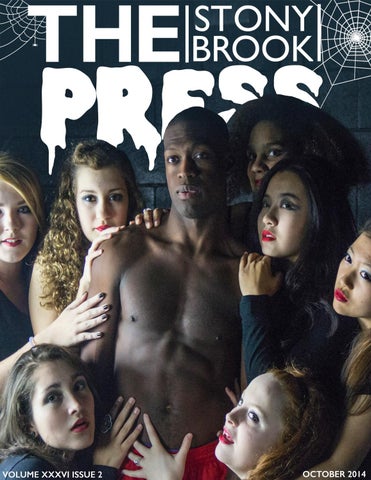
PRESS
VOLUME XXXVI ISSUE 2
OCTOBER 2014
EDITORIAL Thanks for picking up the latest issue of The Stony
Brook Press! We hope everyone is enjoying what we’ve done with the thing. It might be interesting to some of our readers to note that, as of this administration, there are absolutely no active members of a previous electoral board on our staff, which as you can imagine has created a very jarring transition. But it’s left us newbies with plenty of freedom to overhaul the operation. So far our ambitions have proven fruitful. But, while our staff is enthusiastic and works hard, we still have homework.
So we need your help! Next on our agenda is a total overhaul of sbpress. com. The Stony Brook Press is looking to form a team of programmers and web developers to help rebuild and maintain our website. Do it for your portfolio, do it for experience, do it for fun, do it because you’ll get to work with some of the (objectively) raddest motherfuckers on campus. That’s right. You too could be a rad motherfucker and
member of The Stony Brook Press. So come on down. Love, The Editors
CONTENTS
FEATURES
06 08 10 11
ROCKY HORROR The upcoming student production of the Rocky Horror Picture Show is set to fright up the stage.
STONY BROOK VOTES Profile the students whose efforts made the upcoming congressional debate on campus possible.
WEED University police have been handing out referrals for marijuana offenses
LETTERS FROM THE FRONT Published for the first time here. The Stony Brook Press came into possesion of these private correspon-
SPORTS
NEWS EBOLA SO FAR
01
RICHARD LEAKEY VIA ANGELINA
02
NEW FRAT ON CAMPUS
03
JOURNALISM LEGENDS SPEAK
04
SB FOOTBALL - MIDSEASON REPORT
21
NFL
22
OPINION
CULTURE MY LIFE FOR SMASH
12
NO PHONE, NO FUN
23
REFLECTION ON TWIN
14
AFRICAN SLUM PROBLEMS
24
RIVERS CUOMO IS SORRY
15
SEXUAL SCRIPTING DRUGZZZ - MIDTERMS EDITION
16 17
FASHION - OSCAR DE LA RENTA
18
NEW YORK COMIC CON 2014
19 20
ENTER YIK YAK
The Stony Brook Press is looking for Web Developers AND Designers!!
01010100 01101000 01100101 IF You have/want experience with 00100000 HTML, CSS, Javascript, &01100001 PHP OR 01100111 01100101 You’re interested in sharpening00100000 your skills OR 01101111 01100110 00100000 Adding awesome projects to your resume AND 01101101 01100001 Meeting some of the most awesome01100110 people on campus 01100001 01101100 01100001 THEN Shoot us an email at editors@sbpress.com 00100000 01101001 01110011 OR Come to our office during campus lifetime 00100000 01110101 01110000 (or whenever, we’ll be here) in the Basement of Union - Room 060! 01101111 the01101110 00100000 01110101 01110011 00101110 HACK THE PLANET !! 01010100 01101000 01100101 0 0 1 0 0 0 0 0 0 1 1 0 0 0 0 1 01100111 01100101 00100000
1 1
0
0 0 1 1
NEWS
A Treacherous Epidemic at Hand RANDY WASZYNSKI The deadly Ebola virus, which has become an epidemic in northwest Africa, has spread — and fast. “This is not an African disease,” said Gayle Smith, senior director at the U.S. National Security Council, which works alongside national security advisors and cabinet officials to aid the president regarding national security and foreign policy. “This is a virus that is a threat to all humanity.” The Ebola outbreak originated in Guinea, and it quickly spread to the neighboring Sierra Leone and Liberia. Seventeen cases of the Ebola virus thus far have been treated outside of Africa: 9 in Europe and the other 8 in the United States. A viral disease derived from wild animals, Ebola can be transmitted from human to human and has a mortality rate of 50 to 90 percent depending on location and sufficiency of treatment, according to the World Health Organization (WHO). Although there are two current candidates for a vaccine, the virus has no licensed treatment. There are two waves of symptoms of increasing severity, and humans are only contagious once the sequence has begun, according to WHO. The first wave, which occurs between two days and three weeks after contraction, consists of fever, fatigue, headache, muscle pain and a sore throat. The following wave contains vomiting, diarrhea, skin rash, impaired kidney and liver function and possibly bleeding — internal and external. There have been 5,006 laboratory-confirmed cases of the virus and 4,493 total deaths, according to the U.S. Centers for Disease Control and Prevention. This Ebola outbreak has significantly surmounted any other in history. The next highest infected tally was around 400, according to Dr. Bruce Aylward, WHO's assistant director-general for emergency operations. Until recently, Ebola had exclusively affected African countries. The first cases were cited simultaneously in 1976 in Sudan (South Sudan, currently) and Zaire (currently known as the Democratic Republic of the Congo), according to the WHO. A Spanish nursing assistant was infected in Spain when a priest coming from Sierra Leone was exposed to the virus. He was brought back to Carlos III Hospital in Madrid. The priest was serving as part of a medical team in Sierra Leone. He died soon after his arrival in Spain. This was the first of the three diagnoses in Spain. Thomas Duncan, 42 and a Liberian citizen, was the first Ebola patient diagnosed in the United States. He was pronounced dead on Oct. 8 at Texas Health Presbyterian Hospital in Dallas. A United Airlines employee anonymously leaked Duncan’s travel itinerary. Departing on Sept. 18 from Monrovia, Liberia, his trip to the United States included two layovers: one in Brussels and the other at Dulles International Airport in Washington D.C. Duncan arrived at Dallas/Fort Worth National Airport on Sept. 20. Duncan was cleared before he boarded his flight with no symptoms — meaning that it’s not possible for him to have
exposed anyone to the Ebola virus while flying. On Sept. 25, five days after his arrival in Dallas, his symptoms first arose. But he wasn’t admitted for care until Sept. 28, and five Dallas students, who attend four different campuses, came into contact with Duncan within this vulnerable time period. The students are now being treated at home after being quarantined, and their parents have been ensured counseling options for their children, according to the Dallas Independent School District. Two nurses providing care for Duncan, while in Dallas, have contracted the disease. Amber Vinson, one of the two nurses, boarded a commercial flight in Cleveland to Dallas a day before she went to Emory University Hospital in Atlanta for symptoms. The CDC reported that she had a temperature of 99.5 degrees when boarding the plane. Although it is 0.9 degrees below the fever threshold (100.4 degrees). Dr. Tom Frieden, the CDC’s director, expressed discontent that, given the circumstance, the course of events was neither prevented nor avoided voluntarily. “She should not have been on that plane,” Dr. Frieden said. Officials are not completely certain whether the other 132 passengers could have possibly contracted the virus. Out of precaution, Frontier Airlines, which operated this particular flight, announced that the aircraft’s entirety was sanitized twice. Afterwards, the vehicle returned to its daily uses. The CDC, alongside epidemiologists at Virginia Tech’s estimate that up to 1.4 million people could be infected by Jan. 20 if effective treatment options are not implemented before then. However Nigeria, a country 1,250 miles east of the original outbreak, has maneuvered around the idea of treatment for Ebola. After a previous outbreak in Nigeria, the virus was contained with a stringent quarantine. With the current mortality rate, Nigeria did not dare risk infecting others. The U.S. CDC is sending researchers to Lagos to study Nigeria’s successful take on the situation — because the nation was marked Ebola-free on October 8, according to USA Today. “There is still a window of opportunity to tamp it down, but that window is closing,” said Dr. Frieden. He said that a missed opportunity is not an option.“We really have to act now,” he added.
01
We’re Finally Famous! Demi Guo
S
ave for an appearance Wednesday night to lecture on access to water and energy, Stony Brook professor Richard E. Leakey has been quiet about being the subject of Angelina Jolie’s new film, the biopic aptly named Africa. Perhaps he wants the movie to speak for itself. Perhaps he wants it to speak for him. For a man who, at the age of 30, had already been featured on the cover of TIME magazine, it has been a lifetime of working for his homeland Kenya and fighting the ivory trade. His finest hour may have been in 1989, when at the side of his president Daniel arap Moi, he set 12 tons of elephant tusks ablaze to serve a message to the world: to destroy one of the most iconic animals in the world, as his longtime friend Lawrence B. Martin, Ph.D. put it, for expendable objects like piano keys and chess pieces is a disgrace. “Richard’s excited,” said Martin, director of Stony Brook’s Turkana Basin Institute. After the fire, he explained, the African elephant’s poaching rate fell from thousands to less than 20 a year. But it has risen again, and the elephants are now killed faster than they are being born. His and Leakey’s profound hope, he said, will be that the film would relay the same message conveyed through flames and ashes years ago. This time he hopes to aim for the core: to eliminate the practice for good, internationally and domestically. The market should be stopped within Africa. Martin himself expressed hopes that Africa would put the economically-suffering Kenya back on the map as a tourism destination, especially in the wake of a fear of terrorism and fear of the Ebola crisis, which he said is as far between Kenya and the stricken West African countries as Disney World and Alaska. Unlike South Africa, he said, there are no parks, but an astonishingly beautiful stretch of land where the wildlife is truly wild. That is where the Turkana Basin Institute, founded by Leakey, sits in the middle of a desert by a lake, the nearest big city hours away.
“It’s such a rewarding experience,” said Melina Seabrook, a student studying there now. With the Skype line crackling in effort to connect over the Atlantic, Jason E. Lewis, Research Assistant Professor and pending director of the Institute’s Origins Field School, mused from his room in Nairobi that “Angie would probably take some artistic license,” but that the movie would take from Leakey’s 2001 memoir, Wildlife Wars: My Fight to Save Africa’s National Treasures, thus focusing on Leakey’s activism over his archeological and paleontological work. An example of which is his team’s finding of Turkana Boy, a near-complete skeleton from 1.6 million years ago.“Indiana Jones has done enough to show archeology,” he said. A “quite close” friend of the Leakeys, having had dinners with them and going to France to see Meave Leakey, Richard’s wife, received an award last month, he is rereading the book to prepare for the movie. The book was published on September 11, 2001, so it did not get much attention, said Martin, but the movie would make up for it. As for who should play Leakey, Lewis could only imagine. “I haven’t figured it out yet,” he said. “The closest I got was Daniel Craig, but that’s not a good choice at all.” It is still too early to know anything for certain about the movie, which will be script by Forrest Gump screenwriter Eric Roth. Though the Turkana Base Institute was alerted months ahead, Jolie and the producing company, Skydance Productions, have stayed mostly quiet on what is to come, other than expressing an effort to touch the “heart of Africa,” as has Leakey, who declined to comment.
A NEW SLICE OF SB GREEK LIFE’S PI(E) Randall Waszynski
Pi Kappa Phi, a national fraternity that originated in 1904 at the College of Charleston in South Carolina, is in the process of extending its reach of influence to Stony Brook University. “We got officially installed as an associate chapter by the national fraternity,” said Josh Weinstein, the president of the chapter here at Stony Brook. The organization will be recognized as a “full and functioning” chapter by nationals for the fall semester of 2015, according to Weinstein. Weinstein, a sophomore majoring in chemical engineering, and five of his friends trekked to Binghamton University to visit his older brother. Weinstein’s brother is the president of the Pi Kappa Phi chapter at Binghamton, and that’s when the younger Weinstein and his crew started thinking about organizing their own chapter at their school. They saw how much fun the Binghamton brothers were having. “The idea was floating around in all our heads,” said Weinstein. “So we called up the national organization” of the fraternity. The original six “Founding Fathers” extended the offering to their friends around campus for networking purposes. Two people from the national organization set up a stand during campus lifetime, and “a few people, here and there,” approached them and said to sign them up to create further awareness for the chapter. “We’re signing up new members soon,” expanding past the approximate 40 current members, said Weinstein. He estimated that there would be 45 brothers by the end of the semester. The group’s paramount goal, for the time being, is cementing a sense of brotherhood. The way most chapters go about this is a pledge process because experience together binds pledge brothers and active brothers alike — one aspect amongst several similar ones. However, since this chapter is new to the university, establishing brotherhood calls for a different process. The goals correlate across both fashions of processes. The first semester of pledging will begin in the fall semester of 2015, Weinstein said. In terms of benefiting campus community, the fraternity plans to host events centralized around aiding the special needs community. Pi Kappa Phi is the only national fraternity that runs its own philanthropy,
called The Ability Experience (previously known as Push America), according to Nick Gallagher, 19, the chapter’s “Ability Chair.” The chapter plans to host a Crohn’s and Colitis disease walk on Oct. 19 to start the chapter on the right foot. Furthermore, the group has the ambition to boost the enthusiasm toward Greek life at Stony Brook. Given his position for the chapter, Gallagher, a sophomore studying engineering science, said the “big goal is inclusion and involvement.” Members of the chapter touched upon the thought that they feel Greek life here at Stony Brook is not as communally involved as it could be. “It seems like it’s almost dead on campus,” said Weinstein. Eric Shalyutin, 20, the secretary for the Stony Brook chapter, destines for Pi Kappa Phi to reshape the community’s portrayal of Greek life. “They always look inward for solutions,” Shalyutin said, referring to the other recognized fraternities and sororities here at Stony Brook. “A goal of ours is to look outward for planning events, contributing to the campus community as much as we can.” Expressing discontent toward the campus’ Greek life, David Jefferson, age 20, the chapter’s treasurer and a junior with no declared major, agrees with Shalyutin regarding how the community will view Pi Kappa Phi on campus. “What entices us to do this is doing something that we haven’t seen elsewhere on campus,” Jefferson said. Shalyutin, a junior majoring in political science, also said that only 3 percent of Stony Brook students are involved in Greek life, which is a fraction compared to other universities’ numbers. “We want to be social — not antisocial,” he said. “We want to drive the community’s interest toward Greek life in the right direction,” he said. Although the group mentions a myriad of goals, the idea is to tackle each and every one in a sufficient manner. There are drastically different possible outcomes for how the campus community will react to the university’s newest fraternity and for how Pi Kappa Phi portrays itself as a fraternity to the community. “We want to add our flavor to the plate,” Weinstein said. And it’s the community’s taste buds that matter to improve interest toward Greek life here at Stony Brook.
“What entices us to do this is doing something that we haven’t seen elsewhere on campus.”
03
Woodward
On the Future of Journalism Charlie Spitzner Carl Bernstein and Bob Woodward. Charles Bernstein and Rob Woodsomething. Among journalists, these guys are pretty much the cream of the crop. The Apex. The King of the Hill. The Menagerie. The Trojan Horse. The journaliest journalists to ever journalist a journal. Such men, such burly and charismatic men they are, only they could have busted one of the biggest scandals in American history wide open from eye hole to opposite-side ear hole on the cryptic skull that is our nation’s past. Their work consists of volumes; their skills nigh untouchable; perhaps the singlemost famous name in journalism that is actually two people. Friends, let me explain what this means to you. Let me share my reasons why everyone on campus (besides Taylor Knoedl) should be thoroughly invested in, what at least appears to be, two old white dudes shootin’ the shit on a ten dollar stage under a few rotisserie chicken lamps. How many times have you thought to yourself “why is there no justice in this world?” How many times will I have to itch that itch before the itch finally leaves? Why do the bad guys get away? Why did God let grandma pass? I understand these questions, really I do, and have taken them into consideration regarding the importance of this event. Pragmatic. Put your ear up to the wall. No, really. I’ll wait. Put the magazine down and put your ear up to the wall. Now listen. Listen to this wall. Do you hear that? The structure of our institution of learning is fixated on the backs of dozens, hundreds, thousands,
“... the single most famous name in journalism that is actually two people.”
“MILLIONS”
04
&
perhaps MILLIONS of workers and regulations. I’m aware that this is a large, overwhelming number to some, but a lot has passed through these facilities over the course of its history. Charles Woodward and Carl Bernstein are directly related to the building blocks of our university, our very way of life regarding this campus. Imagine that we’re all just ants, just teeny tiny little ants crawling all over Long Island, too and fro like the busiest of bees. Only we’re not bees. We’re ants. And as ants, we walk a great distance for our eusocial bodies. We cross a Lawrence of Arabia style desert almost every day of our lives, but have yet to realize what our combined steps are amounting to. It’s funny in a twistedly tragic, almost sad way. All falls down and reforms into order. It is our human way, our nature and the burden of our intelligence. The lesser minds of chimps and dogs and felines and insects have no concepts of philosophy, as they will never ponder their deaths, nor of faith, for they live as moving actions and exist inside the outside of self, nor even of the reasons why their jaws clamp shut to fulfill their basic biological functions. In their maladjustment, there is a shimmer and sparkle. A shimmer and sparkle to be snuffed and hidden. Hidden from sight, smell and touch. To be released and shot down into the burning of the undersea, lost in the New Atlantis, subsequently found and then lost again. All in a moment; all in an instant.
“We’re ants.”
Vanished. This. This is what I imagine Woodward and Bernstein was like.
“...lost in the New Atlantis ...”
&
Bernstein
What it was Actually Like Ian Schafer
Bob Woodward and Carl Bernstein, Pulitzer Prize winners whose reporting for the Washington Post uncovered the abuse of power which led to Nixon’s 1974 presidential resignation, joined Stony Brook University President Samuel Stanley to discuss the future of journalism as well as the past and present of White House relations with the press. “The news business is going through a convulsion,” Woodward said to an audience of approximately 1,000 that filled the Staller Center’s primary theater. Woodward, currently the associate editor of the Washington Post, recalled that in the 1970’s, “we had two to three weeks to work on a story,” leaving more room for “factual, patient reporting.” Bernstein, who is presently a Visiting Presidential Professor at Stony Brook, compared this to the “24/7 drum beat,” that he said affects the present of not only the industry, but the public. “At the time of Watergate, the country became responsive to the best obtainable version of the truth,” said Bernstein. “It is very doubtful to me now, that there is anything like the same proportion of citizens who are open to the best obtainable version of the truth when so many of our readers and viewers are not looking at real news.” Woodward said, “People think if they’ve seen a tweet, they know what is going on.” But the two were not without optimism for the future of reporting. “My hope is, as we move to new platforms, that the standards of the best of the past are going to be grafted on to these new mechanisms,” Woodward said. Bernstein asked, in light of recent focus on the National Security Agency’s data-gathering activities, “what Nixon could have done,” with these mechanisms and how they might be abused by the government. The two compared NSA data collection through the decades to a
“How do you balance peoples’ rights and be sure the technological ability is not abused?”
vacuum cleaner. “Now, it’s like there’s a vacuum in every house,” said Woodward. “And the vacuum cleaner has become more sophisticated.” Bernstein continued. “How do you balance peoples’ rights and be sure the technological ability is not abused? Bernstein said. “That’s why we need oversight.” But Bernstein said there is more difficulty now for journalists reporting politics at the Federal level than ever before. “Each successive White House since the Nixon presidency has tried harder than the previous one to manage the news and it’s become less and less transparent,” said Bernstein. In the Obama presidency, you have something very different from his predecessors, and that is: decisions approved at the top levels of the justice department to go after reporters’ sources,” said Bernstein, citing the case of Jim Risen, who in 2006 exposed international wire-tapping by the NSA while working for the New York Times, and was subpoenaed for his sources by the Bush administration. According to a report by the New York Times, Risen may be subpoenaed again by the Obama administration within weeks. “The first amendment means everything in this country,” Bernstein said. “It’s freedom of speech and freedom of the press.” Bernstein described his ideal relationship between the press and the presidency as one where the government will “bend over backwards so far to make sure that reporters are not intimidated, and that there is an atmosphere in which they know they can go about getting their stories so that the people of this country can know what’s going on.” But these tactics “are meant to be intimidating,” Bernstein said. “It’s a statement of principle that does not do justice to the meaning of the first amendment,” said Bernstein. “It’s a mistake by the administration,” Woodward said.
“The first amendment means everything in this country.”
05
STONY BROOK TIME WARP Jon Winkler
I
t’s a quiet Friday night at Stony Brook University, but there’s some serious energy coming from the Union Basement. In room 032A, members of Pocket Theatre are in loose clothing, using tea and caffeine for energy and are stretching to pop music. While this may seem like the early part of a yoga exercise, it’s actually a warm-up for another long night of intense rehearsals for the performers. The loose clothes are temporary, because come show time the clothing will consist of fishnet stockings, high heels and sharp outfits when Pocket Theatre brings The Rocky Horror Picture Show to Stony Brook University on Halloween and November 1st at the LDS Center. Now this could have been another reenactment of the classic movie-musical, but Pocket Theatre
06
is adding a twist to the presentation of the show to leave their own mark on it. To match the dinner theatre environment, the show will be presented in a burlesque style, combining multiple versions of the stage shows and backed by the music of the film. 21-year old theatre major Elizabeth Beckett, who’s directing the show, said the new style of the show and all around process of directing has been “amazing,” and something more suited for the show itself. “We put our own spin on the show because it’s fun to make it our own,” said Beckett while looking at her energetic and jovial cast. “The burlesque theme fits with dinner theatre show, but it’s also sexy. It’s about sex and takes place in, almost like a brothel house.”
FEATURES Beckett makes reference to one of the show’s songs, “Touch-A, Touch-A, Touch Me” as a prime example of Rocky Horror’s sexuality. She notes the tone, strong dancers, and theme of sexual awakening, which is common in burlesque shows. This is Beckett’s first time directing a show, though she has done short films previously. Pocket Theatre performs multiple shows every year, but Beckett herself brought up the idea of putting on Rocky Horror after mentioning the idea to Pocket Theatre’s president, 21-year old theatre major Chris Stratis. Stratis, who also serves as a producer for the show, loved the idea of Rocky Horror for the show’s “cult classic” status and its “socially non-conforming” display. All of this is going on as the performers are led during dance practice. Everyone is close together, sharing jokes and laughing as they’re instructed to do a kick ball change, which mostly involves footwork. Each individual part of the dance is broken down and focused on, making sure each movement of the performers is perfect. The performers understand the commitment needed for the show, while some of them aren’t even theatre majors. They may not have the major, but they have the commitment with daily rehearsals—Friday’s lasting for five hours. Even with long hours and constant physical work, the actors of the production are a tight group and understand the importance of each other. Meghan Ames, Kayla Figetakis, and Ashlyn Libert are all actors on the show. Ames, a 21-year old senior playing the role of Janet, realizes that everyone in the cast is “pretty essential because everyone moves the plot along.” Even the ensemble, called “phantoms,” are crucial. 20-year old junior, Figetakis, playing the role of Magenta, said that “all the personalities of the actors bring new stuff to the stage,” especially when everyone comes together. In fact, according to Libert, a 20-year old senior playing Columbia, the combined energy and personalities of the actors are all “molded into new characters.” The floor of the Union room 032A is lined with blue tape, outlining a large rectangle with numbers on it. This is actually the measured size and length of the stage at the LDS Center used to practice the positions for the actors since they have not yet rehearsed on stage yet. While not having access to the stage yet is difficult, the tape outline helps. As the cast manages to stay within the lines throughout their numbers that go at a fast pace. Director Beckett is extremely proud of the actors and how quickly they’ve embodied their roles and been able to work the stage. At the start of rehearsals,
each individual actor was given time to work on their own character. Once that was accomplished, the group came together and clicked as a team. David Bonderoff, a 21-year old theatre arts major playing the role of Dr. Frank-N-Furter revels at the opportunity for this show because he likes how the show is known for “freaking people out.” “I like things that get people out of their comfort zones,” said Bonderoff. “I’ve done my job if my performance and the show gets people out of their comfort zones. I’ve never done anything like this before” As far as what is going to make the show memorable, Bonderoff believes it’s the actors themselves. “The actors make it believable. Everyone is talented and we all have faith in them. Their work makes everything real.” Considering the commitment, the energy and the enjoyment radiating off of the actors—that certainly seems to be the case.
Tickets are $10 for students, $20 for general admission. $15 and $20 for included dinner. Tickets can be purchased at the SAC Box Office.
07
STONY BROOK VOTES Lauren Klein and Jessica Covello
It
began with a debate. Stony Brook University students Dan Smith and James Alrassi frequently debate about their own political ideology, and while they might fall on different ends of the political spectrum, they both agree that it’s time to include the university in the conversation. With the university in mind, Smith and Alrassi, with the assistance of fellow student Sarah Twarog, created Stony Brook Votes, a student activism group whose ultimate goal is to increase student voter awareness, participation and become more engaged in the democratic process. It’s first act was organizing a debate between congressional candidates Tim Bishop (Democrat) and Lee Zeldin (Republican) at the Staller Center on October 27 at 6 p.m., which will also be broadcasted live by FiOS News 1. “The goal of the voting drive is to get more students to vote in the congressional midterm elections,” said Smith, a senior history major and Fulbright scholar applicant. “A lot of students probably
08
don’t know that there are elections in November, [the goal is] to increase voter awareness, increase voter participation and for people to be more engaged in the democratic process and that’s the idea I first had in the summer when I came up with this and having the debate was one way of kind of giving this whole thing legitimacy.” It was debates between Smith and Alrassi on their differing political ideologies that ultimately led them to pushing the university into holding a congressional debate. “The debates helped open up insights on both sides of the political argument that would otherwise have not have been learned if just left to our own accords,” said Alrassi, the Executive Vice President of the Undergraduate Student Government at SBU, junior history major and international studies and chemistry minor. “With this in mind, we thought it was imperative that the students be part of similar process before making decisions on votes.”
Alrassi and Smith both felt that it was time for the university to play a more crucial role in the local political community. The plan was to get the university to host a debate for New York’s First Congressional District’s candidates and show the student body that it’s not enough to be educated on the issues, but to participate in seeing them through. The idea was first put in motion when Smith and Alrassi recruited fellow senior history major Sarah Twarog, who is also the Chief Justice of the Judiciary at USG, to help spread the word through social media. Twarog, who is currently a social media assistant for The Guardian Life Insurance Company of America, became a part of Smith and Alrassi’s plan. “We’re hoping that social media will have a profound effect on student turnout of the debate,” said Twarog. “College communities particularly rely on Facebook as a way of promoting events, and use the creation of groups to communicate to niche audiences.” Smith first contacted SBU’s President Samuel L. Stanley Jr.’s office at the end of August. After meeting with Chief Deputy to the President, Edward Summers, Smith got in contact with FiOS. He was able to get them to agree to an exclusive live broadcast of the debate and snag Richard French, host of “Richard French Live”, an Emmy Award winning news talk show which airs on FiOS channel six. This debate is a way for students to become educated on how they, and the university, are affected by local, state and federal legislations. It will cover issues like the future of student financial aid, as well as the Long Island environment, job creation in New York and Obamacare. All are hot button issues which affect students before they become tax paying citizens, but student voter turnout over the last two years was bleak. In 2012, when President Barack
Obama was up for reelection, Stony Brook University had 13,519 students registered to vote, according to a report conducted by CIRCLE (Center for Information and Research on Civic Learning and Engagement). Only 7,968 of those students actually voted. “Let’s say 2,000 students vote,” said Smith. “That potentially swings the election.” Smith spent three months organizing the debate and creating Stony Brook Votes, which took not just time, but patience and a lot of phone calls. “He began it from the ground up,” explained Twarog. “[He] has invested countless time and effort into coordinating not only the initiative, but the on-campus debate, and is the forefront of what the initiative stands for and intends to communicate to the community.” Smith underlined the importance of educating students about democracy. “Getting the student body of Stony Brook to be more concerned about democracy and about the election, that will allow our voice to be heard, and I think that’s a good thing,” said Smith.
09
‘High’ Marijuna Student Activity Leading to Referral, Not Arrest
Stephanie Schieda
S
ince October 1st, 4/9, of Stony Brook University’s Police activity are marijuana referrals, according to The Statesman. Stony Brook students, who have received them, have verified that UPD issued referrals for violations involving less than 25 grams of marijuana. Stony Brook University’s Police Department complies with New York State’s marijuana decriminalization law, according to a 2014 Annual Security and Fire Report and student accounts with the UPD. New York State’s Fairness and Equity Act of 1977 intended to eliminate the criminal misdemeanor charge for those possessing up to 25 grams of marijuana and issue a violation and fine, equivalent to a parking ticket, to the person. However there is a loophole in the law. For those arrested with “private” possession of marijuana, it is a violation. For those arrested with “public” possession of marijuana, it is a criminal misdemeanor. How do police utilize this loophole? They simply ask you to empty your pockets and your possession becomes public. In 2013, there were 23 drug arrests and 284 drug referrals. This was an obvious decline in arrest from 2012 with 53 drug arrests, and 2011 with 73 drug arrests. However, referrals remained pretty consistent from 2012 with 293 drug referrals, and in 2011 with 382 drug referrals, according to the 2014 Annual Security and Fire Report. UPD was not available for comment on what percentage of these arrests and referrals were marijuana related, however Eric Olsen, Assistant Chief of Police at Stony Brook stated, “Marijuana is the most common illegal substance we deal with on campus.” Konald Cupp, a Stony Brook student, has received two marijuana referrals. Both incidents involved smoking marijuana on campus in the dormitories, where UPD was called to the room. In both incidents the police confiscated the marijuana, but did not arrest the students because it was
10
less than 25 grams. Cupp had a meeting with the Residence Hall Director for both incidents, and later submitted a onepage paper on “why marijuana is a negative aspect of society,” according to Cupp. “In the meeting with the RHD, I took the blame for the weed because only one person has to be written up, even though we were all smoking,” Cupp said. After three write-ups, which can be issued for a variety of infractions of dormitory rules, a student loses housing privileges for a year, which can be reclaimed after the year. No fines are issued with write-ups. Eric Shalyutin, who also received a marijuana referral from UPD, said he was smoking on a fire escape with four others when UPD arrived. UPD confiscated their bong and marijuana, but did not arrest any of the students. Shalyutin also had a meeting with his RHD, where he took total blame for the incident and was the only student who received a write-up. He also had to write a one-page essay about the negative effects of marijuana on society. “I was pretty mad the university forced me to state its opinion on the effect of marijuana on society,” Shalyutin explained, “many states are accepting this drug for its medicinal and recreational purposes within society, which is something I agree with, and shouldn’t have had to abandon that belief because I live in a state where it isn’t legal yet.” Assistant Chief Olsen said, “If a student is caught possessing or using a small amount of marijuana, the student will always be referred to Student Affairs and may also be arrested or issued a summons. For all other drugs or a large amount of marijuana the student will always be arrested and referred.” A drug referral is processed at the university level, most commonly through the Office of Community Standards, according to Assistant Chief Olsen, however an arrest is processed through Suffolk County Criminal Court.
Memoirs from HvZ
15
CULTURE
I quit my job, my girlfriend left me, so I go to a bar and my pal hands me a Nintendo 3DS. We play Smash Bros. I come from a nest of friends where one of us has a Wii, there are two Gamecube controllers between everyone and all of our Melee’s have gone missing. But we each have a Nintendo 64 and mad controllers. This isn’t to say I didn’t grow up with Melee. I did. But it didn’t stick around during those mid-college crisis years where you just needed some drugs and a cop-out. I needed a game to fall in love with so I started going steady with Smash 64. There is this humble flow to the first Super Smash Bros title. The game plays in this linear fashion where you’re not overwhelmed by real-life-fighting stimulator effects you would find in Melee or Brawl (fucking tripping? REALLY?). It felt like I was actually playing a game instead of hanging out in high-speed, epileptic sword fights with flying falcon punches on Big Blue. Smash 64 was definitely a little derky, though. Smash 64 is quality, but the year is 2014. It’s an old game now. On the other hand, Smash Bros 3DS is the god-damn bomb-diggity. Smash 64 got old because of those aforementioned derk qualities. I’d have to rotate 64 with Melee and maybe going outside or something dumb like that. But 12
with Smash 3DS, you don’t need to do anything else in your life. You’ve got smash runs, classic 4-player matches of you-vs.-coms, friends or fucking anybody because the 3DS has WiFi. Hell, I can even play with my friends online (how easily do we forget Brawl’s random-only online play). I can now play a social video game and never have to see my friends ever again. It’s awesome. Smash Bros on the go brings the fight to everywhere because anyone in their right mind has a 3DS with Smash Bros on it. I ponder at the time where your squad had to stand facing one another in a little 2 x 2 foot squares with those dingley little system-links— playing some half-assed Mario Kart while breathing in one another’s spit moisture. Nintendo has made the handheld continue the legacy of the world’s greatest fighting game ever in the world, ever. Literally name one game better than Smash. You can’t. The game holds awkward at first because A (smash), B (special) and Y/X (jump) are slightly rotated from the N64 controller. On N64, B would be on the left side of a four-point circle, and A is at the bottom. With 3DS, the A is the right point of the same four-point circle chart, and B is at the bottom. The handling is pretty much the same for the 3DS and Gamecube controller. So I had to be even more of a baller
to master this game, unlike those who played Melee all the time. And if you’re hard-of-seeing or a wuss that can’t handle tiny 3DS screens, when Smash for Wii U is released, you can rig up your 3DS to that and play on the big screen. It’s just one small step before we have Smash Bros holograms in the eventual technological fate of humankind’s peak of ingenuity; Smash 4DS. There are no motion-sickness inducing Melee speeds. No trip and float dumb fucking Brawl. And you’re not bound by the derk of 90’s 64-bit. Through my life in Smash, I held down my boy Link real tight. In Smash 3DS, I kept to those Hylian roots. And entangled in those roots is my arch-nemesis: Captain Falcon (long story (Captain Falcon’s a bitch)). I spawned in game zoomed in on Link and the first thing I think is: “WHERE THE HELL IS CAPTAIN FALCON?!?” Then the time countdown reaches start and the camera zooms out, there he is, flying his Falcon-foot at me. You roll with the R trigger, and grab with the L. So I dodge a Falcon-foot and then get grabbed. He tosses me to the other side of the map we’re fighting on: Green Hill Zone (which has the piercing tone of the soundtrack on point). I run back at him and hold A to give him the ol’ sliding-sword attack. Then something crazy happens. I do a running-jump sword slash. That’s new. What. Fuck. That’s cool. I think importantly enough to cite in this review. Anyways long-story-short; I beat the fuck out of
Captain Falcon and win every game. That’s because I’m the man. What I think the secret ingredient to making Smash 3DS the best Smash title (and any other title) is the smoothness, especially the way you can control the rise-and-fall of your jumps. Instead of jumping in fear of the so-common fate of missing your landing and going of crashing off the map, you fall with precision for land. The jumping in Smash 3DS is so smooth it makes me feel like Miles Davis. Cameron Trentalange, Co-President of SVA Versus; a video game tournament club at the School of Visual Arts says, “every character has been rebalanced, even if slightly, from Brawl.” Though it is hard to determine if there is any character who reigns supreme over all others, there so-far doesn’t seem to be any character who is clearly broken. “With Brawl, it was pretty evident who was on top since the beginning,” Cameron indicates. Smash Bros is a perfectionist industry fueled by hype at this point. This is all directly related to Smash 3DS. There’s a moving-train fight map (Spirit Tracks), ten-million Zelda songs, fuckin’ Fierce Diety Link costume (Majora’s Mask), and some cool stuff from other Nintendo games, too. (Sumia costume Lucina!!!) It also managed to make the once dreaded mobile-maps (ie: Icicle Mountain, Mushroomy Kingdom) to be super-fun chase fights. I don’t mean to brag but I can kite like ten Captain Falcons across Golden Planes. All in all, Smash Bros 3DS gets 1,000 out of 5 stars.
X 50
/
OUT OF FIVE 13
Pa
lm
e r?
There is no way to talk about Twin Peaks without sounding either bizarre or completely confused. Twin Peaks is about the mysterious murder of the town’s homecoming queen Laura Palmer. The nice, quiet northwestern town shows its hellmouth underbelly once the investigation into the murder begins and some really strange, unexplainable things happen. Created by Mark Frost and David Lynch (yes, that David Lynch), Twin Peaks wasn’t just a television show about a serial killer in a small town in the 1990s. Nope, it was weird; lovably weird. The show followed an investigation into the murder of Laura Palmer (Sheryl Lee) spearheaded by FBI Special Agent Dale Cooper (Kyle MacLachlan), who doesn’t seem like much at first. He marvels at the trees (which are Douglas firs if you’re wondering) and gushes over the greatest apple pie he has ever had. But most importantly, his amazement and love for coffee knows no bounds (he likes it “black as midnight on a moonless night.”). Cooper isn’t a fool, though. He’s smart and clever and with the aid of Sheriff Harry S. Truman (Michael Ontkean) and the sheriff’s department, the investigation cracks open the mysteries of Twin Peaks. Twin Peaks is filled with great characters that bring the show to life with their wit and cynicism. The show is creative in that it’s also not creative (don’t get me started on Log Lady, she’s my favorite, just ask the log). It’s dark and funny and captures the early 1990s in a unique way. Unfortunately, the show was canceled after two seasons. Luckily it has developed a cult following and, thanks to Netflix, the Twin Peaks love has spread. Showtime has recently announced that Twin Peaks will be back in 2016. Twin Peaks isn’t everyone’s cup of coffee, but damn it’s a fine one.
a L d e l l i W ho k
18
18
a r u
W
Rivers Cuomo is Sorry “Everything Will Be Alright In The End” Album Review Jon Winkler
What was the first line of Weezer’s first single of new music in 4 years? “I’m sorry guys, I didn’t realize that I needed you so much.” This is a surprising admittance from someone who has been giving the middle finger to his fans for the past fifteen years. The “middle finger,” according to the fans, is not remaking the sound found on Weezer’s self-titled debut released twenty years ago (commonly referred to as The Blue Album). Since then, Cuomo and his band of nerds have seemingly been running from that sound with likes of the angry Pinkerton, the embarrassing Raditude, the boring Hurley and the underrated Make Believe. Now, twenty years since their debut, Weezer is finally realizing something fans have been trying to tell them all along. Weezer needs to sound like Weezer, not Weezer in the twenty-first century. Whether it be by accident or on purpose, Cuomo has seen the light and is rewarding us all. Produced by Ric Ocasek, lead singer of The Cars and producer of The Blue Album, Weezer’s new record has guitars turned up, air-guitar worthy solos, and Cuomo’s lyrics of full geeky honesty. In many ways, Everything Will Be Alright In The End is a sort-of sequel to The Blue Album. “Back to the Shack” has similar themes to Blue Album classic “Say It Ain’t So.” Cuomo has made nice with his estranged dad (with “Foolish Father”) and would rather “raise some hell” in obscurity than get a new audience. “Eulogy For A Rock Band” is a nerdy rock tribute to a band of the past in similar fashion to “In The Garage” mixed with “Heart Songs” from 2008’s The Red Album. It seems like Weezer has left desires for mainstream attention behind, as evidence by the excellent “I’ve Had It Up To Here,” with lines like “don’t need the whole wide world to love me, don’t wanna win the race/ don’t need my music to be less well known than my face.” If that’s not a gospel for all bands to follow, it’s hard to find another one. Cuomo also leaves space for some new tweaks to the Weezer sound. “Go Away,” co-written and co-sung by Best Coast’s Bethany Cosentino, has Cuomo being the most sincere he’s been in a long time, only to be shot down by the girl he loves. The songs here have chugging guitars produced kick under Cuomo’s hummable melodies and choruses, which are the catchiest and most consistent he’s ever written (see “Cleopatra” and “Da Vinci”). Cuomo isn’t trying to be the cool hipster he’s been posing as for the past two Weezer albums. He’s back to being awkward, sincere and proud of being a Buddy Holly look-alike that can shred like Ace Frehley. Cuomo still throws in bits of weird on the record. After all, this may be the only rock record that turns the story of Paul Revere into a fist-pumping rock anthem (“The British Are Coming”). The last three tracks are part of “The Futurescope Trilogy,” but it’s really just three separate guitar solos for Weezer to go out in a blaze of glory. Everything Will Be Alright In The End is a win for Weezer and their fans, as well as liberation for Weezer after years in chart-baiting embarrassment and relief for fans who have tried to defend Weezer’s relevance in conversation. Not only is this Weezer’s best work since their heyday, but it’s the most fun one can have with a record this year. So come on back to the Weezer team, because all is forgiven. Final Verdict: 4.5 out of 5 stars Essential Tracks: “Back To The Shack,” “Go Away,” “I’ve Had It Up To Here,” “Cleopatra,” “Da Vinci”
15
ASK A SEMI-PROFESSIONAL PERVERT: SEXUAL SCRIPTING DAKOTA JORDAN
Sexual Assault Awareness Week, or SAAW, is coming up fast, and that means talking about sexual assault and consent. Consent is the difference between sex and rape or assault. The goal here is to make sure all partners are happy and safe every time it’s sexy time. However, how to get from meeting someone to Consent talking about what is or isn’t ok in the is the bedroom/bathroom/ difference whichever place between sex you like to bone is not always clear for and rape or some people. Sexual assault.” scripting is a way to understand sexual encounters as social interactions, they are learned behaviors. For a lot of people, sexual scripting goes something like: Person A makes a move on Person B, and keeps going further until Person B says “no”... or doesn’t. It works, sort of. The problem with this model is that it isn’t based on real communication, and it isn’t the best way to have sex. Asking questions leads to better sex. Consider this scenario: Person A wants to have sex with Person B, so Person A puts their arm around B,
“
leans in, and kisses them. B is… ok with this. But then A goes to grab B’s breast. B is not feeling it. B would rather have their ass grabbed, since they’re breasts a re a bit sore that day. But since A doesn’t ask, A just grabs, B only winces and decides they aren’t in the mood anymore. Everyone goes back to their dorm sad and alone. Instead, try this version: A slides up to B and says “Hey, you look really cute right now, can I kiss you?” B agrees, smooching happens. Then A leans in and whispers in B’s ear “I want to grab your tits right now, how does that sound?” B responds, “Well actually I would much rather you grab my ass. Also, I have a latex allergy, but I have some condoms in the drawer next to the bed”. Booty grabbing and condom usage all around and both A and B are satisfied and happy. Sounds better, right? Communication is key. Active consent is what’s best for everyone. If you want to learn more about consent culture, sexual scripting and sexual assault, keep an eye out for the Sexual Assault Awareness Week events coming soon. Also, if you see something or something happens to you, contact the campus police at (631) 632-3333.
Have more questions about sex, consent culture or relationships?
Email me at semiproperv@gmail.com
20 16
DRUGZZZ Amphetamines are nothing new to a campus community full of achieving students. Known for saving students from their debilitating ADHD right before midterms, Adderall, a combination of both dextroamphetamine and the weaker levoamphetamine, is likely the most common of amphetamine salts you’ll run into on campus. Methamphetamine, if you’re Mr. White. While you might think Adderall will help you on those midterms, there are some things you should know before popping a pill. For those of you choosing to try Adderall the first time, get to know your proper dose. Like other substances, everybody has a different natural tolerance and everybody responds to drugs differently. It’s best to start off with the lowest dose you can find until you understand how this affects you. Some signs that you may have taken too much include a rapid heartbeat, chest pain, confusion and other potentially dangerous symptoms. Additionally, it’s common that people might not believe that the drug is kicking in due to its extended comeup time. If you find yourself in this situation and aren’t experienced in your proper dose, I strongly recommend against redosing, as it might then become too strong. In this case, simply continue with your studies and plan around that dosage for your next use. Now for you other readers who lack a need for medicinal amphetamines, but have some experience, it’s important to take note of the frequency, dosage and your own bodily state on Adderall. Because amphetamines work on the dopaminergic system of the brain, commonly cited as the pleasure center, the drug is easily abusable. You should treat it as such and give yourself time in between sessions to not only decrease tolerance, but to prevent neurotoxicity from repeated use. It’s also important to keep in mind that you will likely have no appetite or desire to drink fluids, so it’s an important point to force yourself to eat a few hours into studying and to stay hydrated as Adderall may make you sweat. Outside of a study session, adderall has additional constraints to be wary of. When using the drug to enjoy a night out, be sure to exclude or limit your intake of other substances. Mixing the stimulant with a depressant such as alcohol has been known to put stress on the heart and nervous system as both drugs have a push and pull effect on the body. It is easier to overdose on either substance in this scenario due to their
opposing effects, giving the illusion that the user is less intoxicated than they believe. Mixing this stimulant with another stimulant is also a dangerous combination. This scenario might be more apparent when ingesting pill forms of ecstasy, but the combination of adderall with cocaine or MDMA is likely to exacerbate the effects of both drugs on your system. Addiction is something to be concerned about with amphetamines. While less addictive than its methylated cousin, methamphetamine, Adderall has the potential to be psychologically addictive with frequent use. Potential abusers might come to seek out the euphoria at higher doses with the confidence it appears to offer, or the work ethic and comfort that it delivers to ambitious students. Of these, perhaps only the last is worthy of significant determent. Using Adderall instead of your own abilities to study is likely (although not surely) to backfire and prevent you from developing more efficient study skills. In a worst case scenario, it’s possible to feel that the drug becomes necessary to work and concentrate, leading to a chronic dependence on it. As much as it may help for these maddening midterms, Adderall is better suited for those that need the assistance for clinically diagnosed ADHD or narcolepsy. In the more familiar attention disorder, patients are unable to focus on a particular task as they are more susceptible to external distractions. In narcolepsy, individuals are unable to regulate their sleep cycle and experience excess daytime sleepiness that is comparable to severe sleep deprivation for non-narcoleptics. Amphetamine acts in both these disorders by increasing lower than typical levels of dopamine in one’s system. Dopamine, besides also being one of the pleasure neurotransmitters in the brain, regulates behavior, sleep cycles in the hypothalamus, and attention, while also inhibiting distractions.
Thank you for poppin’, Ms. Token & Lipman 17
Oscar de la Renta, Fashion Extraordinaire and Legend, Dies at 82 Lauren Klein
L
egendary fashion designer, Oscar de la Renta, died on Monday, October 20 at his home in Kent, Connecticut. He was 82.
Twitter and Instagram. The designer had been battling cancer for eight years “RIP Oscar. Class act” tweeted Laura Brown, executive editor of Harper’s BAZAAR.
Mr. de la Renta’s wife, Annette de la Renta, confirmed his death was due to complications of cancer. He was diagnosed in 2006.
It’s true; Mr. de la Renta was the full package. He was a designer through the ages. Born in Santo Domingo, Dominican Republic on July 22, 1932, his career began in the Spain in the 1950s with an apprenticeship Cristóbal Balenciaga. He moved from Spain to Paris to work for couture house, Lanvin. It wasn’t until 1963, that Mr. de la Renta expressed his interest in establishing his own ready-to-wear line when he moved to work at Arden, at the suggestion of legendary editor-inchief of Vogue, Diana Vreeland. At Arden, Mr. de la Renta was able to develop his ready-to-wear line and in 1965, his label, Oscar de la Renta launched.
For over 50 years, he dressed everyone from celebrities like Amy Adams, Anne Hathaway and Sarah Jessica Parker, to First Ladies such as Jacqueline Kennedy Onassis, Laura Bush and Hillary Clinton. Most recently, Mr. de la Renta designed the ivory tulle and lace gown for Amal Alamuddin’s wedding to George Clooney in Venice, Italy this past September. Mr. de la Renta was famous for creating silk-taffeta and chiffon gowns with an essence of feminism and elegance. If Cinderella were real, she would have worn Oscar de la Renta to the ball. News of Mr. de la Renta’s death shook the fashion world late Monday night as the news broke through 18
Mr. de la Renta, while delivering a multitude of iconic designs, also developed a reputation as a true gentleman. His words of wisdom ring true. “Fashion is about dressing according to what’s fashionable. Style is about being yourself.”
les rgi nU evi yK sb oto Ph no
era
ob ia S
ric Pat y k ic
yR to b o h P
oto
Ph hah
S ay
J by
New York Comic Con is the biggest gathering of nerds, geeks and dweebs on the East Coast. It was a great way for everyone involved to meet artists, play new games, and get some much needed exercise. As I walked mile after mile of the Javits Center floor, I saw vendors selling their wares, artists signing books, and lonely celebrities staring at their phones. If you are even remotely connected to modern culture, you can find a place at Comic Con. There is a heavy emphasis on comic books but movies, TV Shows, and even professional wrestling get a place here. There’s always something to do. Panels, signings, and events run throughout the whole weekend. On top of that, you see some of the most incredible cosplays as you walk around. People dressed as characters from the obscurest of obscure animes to the latest Hollywood hogwash.
NYCC 2014 In Pictures Jay Shah
19
Yik Yak : Talk That Smack By Rebekah Sherry
ads come and fads go. They usually don’t stick F around for too long. Angry Birds, Temple Run, Flappy Bird, Farmville and Candy Crush have all lived through their fifteen minutes of fame before fading into oblivion. Sure, fads are short lived and superficial. It’s true they take away from time that would probably be better spent doing literally anything else, and your friends will most likely make fun of you for being so mainstream (until they also get sucked into the whirlpool tsunami that is Candy Crush, I mean have you not played that game? You don’t understand until you play it). But despite all of these obvious imperfections, we have to hand them one thing: fads are hella fun while they last and Yik Yak, has quickly become one such fad. Yik Yak is the latest addition to the arsenal of social apps on student smartphones. Launched in 2013, it is a kind of anonymous Twitter. Its success has everything to do with location, location, location. The basic idea is users can post whatever they’re thinking or have observed, posts are anonymous and only other users within a 10-mile radius can see these posts and up or down vote them. The more active you are on the app: regularly posting, frequently voting, and receiving up votes the higher your “yakarma” will be. The more down votes you have on posts the lower your yakarma will be. There is a common belief that a high yakarma score is associated with a low GPA. What the 23-year-old creators of Yik Yak, Brook Buffington (with a name like that it has to be good) and Tyler Droll, hoped to create was an easy, anonymous way for college students to share thoughts and ideas that only their fellow college students could read and relate to. These remarks are supposed to be witty, relevant, and above all, entertaining. Of course, as is the case with all social media, Yik Yak is not perfect. As with any outlet that allows young people to share their ideas, there are the immature and petty comments. In fact these inane remarks have proven to be quite a problem across the country (especially in high schools where we all know the less developed frontal cortexes of that population lead to some real stupid stuff). Down voted by soccer moms hopped up on Dunkin’ lattes as “the latest tool in cyber bullying,” Yik Yak has come under some serious fire. Buffington and Droll both support their work by reminding the public that Yik Yak is meant for college students (aka those infinitely more mature and worldly than the underdeveloped Neanderthals that are high schoolers). A lot of work has been done to block Yik Yak from high school campuses, 20
and many students have been arrested for posting death threats, or bullying through the app. In their defense Yik Yak does work surprisingly well on college campuses and Stony Brook is no exception. Here are a few gems pulled from Stony Brook’s “All-time greatest yaks section.” I wish I could give these good people credit, but the anonymity thing makes that kind of impossible. New
Hot
A black freshman asked me if there’s a colored printer in the library. Dude, it’s 2014 you can use whatever printer you want.
90
Asserting dominance over my roommate by only referring to him as his ID number.
97
A white girl saw her shadow today, which means six more weeks of pumpkin spice lattes.
85
Fire in the math building they must have tried dividing by zero.
100
Can something other than wolfie-net secure go down on me?
99
Of course not every yak can be as genius as these, and at night you might catch a glimpse of the dark side of Stony Brook’s Yik Yak; poor thirsty people begging for company, a blowjob or just telling the whole world how depressed and sad they are because they have no friends. It’s not a pretty site— in fact I would advise avoiding Yik Yak altogether between 11:00 p.m. and 7:00 a.m. You will thank me later. Despite these minor faults, Yik Yak is altogether a good download. It will entertain you during those boring lectures and add to your reserve of procrastination tools. It’s a cool idea, even if it is a fad. So come with us to the dark side, and join the Yakkers.
SPORTS
Stony Brook Football: Mid-Season Report Card Jael Henry After a disappointing campaign in their inaugural season in the Colonial Athletic Association. The Stony Brook Seawolves hoped that the 2014 season would be one of redemption. A slow start to the season created some doubt, but a three game winning streak (4-4, 3-1 CAA). The Seawolves look like contenders again. The QB Dilemma Training camp for Stony Brook football was highlighted by the quarterback battle between junior Conor Bednarski and senior John Kinder, but neither quarterbacks have been making any highlight reel plays this season. The offense has looked weak at times due to Stony Brook’s ability to get the passing game going. John Kinder won the starting job heading into the season because of his dual threat play-making ability, but he struggled both passing and running the ball in his four starts this season. Kinder is 25 for 48 passing for 356 yards with three interceptions and one touchdown, and has -18 yards rushing on 30 carries. Kinder’s struggling opened up an opportunity for Conor Bednarski, who took it. Despite his struggling, he looked like the better of the two quarterbacks. Kinder has seen action in all seven games for the Seawolves, and has started the last four. Bednarski completed 55 of his 107 pass attempts this season with 658 yards passing to go along with his four touchdowns and four interceptions. They’re not eye popping numbers, but the offense has played better with Bednarski under center. The Seawolves are 3-1 in his four starts.
THE RISE OF STACEY BEDELL The shining star of Stony Brook’s offense has been sophomore running back Stacey Bedell. Bedell, who transferred from the University of Massachusetts after playing two seasons, appears to be the Seawolves’ answer to replacing former Stony Brook star running back Miguel Maysonet. Bedell’s career has already taken shape even with four games left in the regular season. In his six starts this season, he leads the Seawolves with 697 yards rushing on 128 carries, averaging 5.4 yards per rush and five touchdowns - all career highs. The Seawolves offense has always depended
on their ability to run the ball, and Bedell brings the big play ability and consistency that they’ve been lacking in the post-Maysonet era. Bedell has scored at least one touchdown in each of his last five games and rushed for over 100 yards in five of his last six starts.
DEFENSE WINS GAMES Despite a breakout year by Bedell, the biggest impact for Stony Brook football is the incredible defense, led by seniors Christian Ricard and Davonte Anderson. Christian Ricard, the Stony Brook captain, is having a career year. Prior to this weekends win at Elon, the senior had 51-recorded tackles on the season, a career high in tackles for loss with 14.5 and a career high in sacks with six. Davonte Anderson, who was redshirted last season due to injury, picked up from where he left off two seasons ago. Anderson was a second team All-Big South selection two years ago with six interceptions and nine pass breakups that year. He currently lends the Stony Brook secondary with three interceptions in three straight games. All four of the Seawolves wins have been defensive efforts. In all four wins, Stony Brook defense has held its opponents to seven or fewer points, leaving its last three opponents scoreless in the second half. The Seawolves are heading to No. 5 New Hampshire (5-1) on Saturday Oct. 25th hoping to extend their winning streak to four games, get to above .500 for the first time this season and ride that momentum to the end of the season.
O BO
P
21
Stony Brook Basketball: Sabre Proctor Q&A Joseph Brennan
Seawolves basketball senior forward Sabre Proctor gave me a few minutes of her time and spoke about the upcoming season. Sabre’s gearing up for her final season at Stony Brook, and she’s excited about the prospects of the team this year. Coming off her best collegiate season where she was named a first-team all-America East Selection by averaging 14.4 points per game, and 5.7 rebounds per game, Sabre comes into the 2014-15 season ready to lead the Seawolves, and improve on their 24-9 (13-3) record from last year with new coach Caroline McCombs at the helm. SBP: How do you feel going into your senior year? SP: I’m very excited, playing in this new environment, and the fans that are ready to support us this season. There’s a lot of goals that we have set that are very achievable, and I’m ready for those tasks and to get those things done. SBP: Speaking of the environment, how do you feel about Stony Brook Arena? SP: I think it’s great. It’s crazy because when I first
got here we had none of this. We didn’t have the rec center, we didn’t have the arena, and it’s different, it gives you a different environment, and I think the environment has a lot to do with performance. I think it’s going to be great, and a lot of fans are going to come out and support us. SBP: How do you plan on building off your success from last year? SP: It’s hard because I feel like you have a lot of pressure on you, because a lot of people are looking at you to do great things, and at the same time you can’t think about it, you just have to work hard. You have to be confident, and you can’t think about too much what the people are saying, you really just got to go out there and play. SBP: Has Coach McCombs done anything differently with you guys this offseason? SP: She’s great. With coming in on such short notice and the little time we’ve had with her. She emphasis our defense and emphasis us being great teammates to one another. I’m looking forward to the season with her being our head coach. SBP: What does Sabre do when she’s not on the court? SP: I’m a very calm and cool person. I like to go out and have fun sometimes, you could catch me at a couple of student events. I also do hair on the side, a lot of people probably didn’t know that. I’m also into fashion and travel. SBP: Do you feel like the girls are going to be leaning on you this year, and are you ready to take that on? SP: Yeah. Just as much as they lean on me, I lean on them, it’s a two way street. Being a leader on the team, with my fellow teammate Jess[ica] [Ogunnorin], as far as leadership roles, I feel like we’ve done a great job. I think the girls also have done a great job with following us and taking our lead and trusting us. SBP: Do you have a prediction for this year? SP: I don’t want to speak too much on predictions because I don’t want to jinx myself, but as long as we stay focused, prepare, and work hard, I think there’s great things that can happen out of this Women’s program.
OPINION
Living Life Beyond the Screen Lauren Klein
O
ne of the worst, yet best things happened to me at a concert last week: my phone died. I didn’t realize how annoying it was to have a phone attached to my hand during any and all cool things that I experienced. My life behind a screen began last year when I boarded a plane for Florence, Italy and traveled around Europe for a semester. I was constantly taking pictures of things that I saw. I actually had a panic attack while at the Van Gogh museum in Amsterdam, because I was terrified that I wasn’t taking enough pictures of everything, which is ridiculous. I should have been more worried about not experiencing the beauty of the cities I was visiting. Now, a year later I completely regret not living life beyond my iPhone. Last week I saw Bastille at Radio City Music Hall for one of my friend’s birthdays and it wasn’t until we reached Penn Station that my friends and I realized that none of us brought a phone charger and we each had about 50 percent battery left. We were
screwed. How the hell were we going to figure out where to go to dinner, or what time train we should take back to Stony Brook? We decided to do something unheard of in the 21st century: we shut off our phones. At the concert we turned on our phones just to check train times and that’s when my phone screamed at me that it was low on battery. I got a few pictures of the concert in before it died and then something weird happened; I actually paid attention to the stage rather than my screen. I noticed that everyone around me was watching the concert through their iPhone cameras while I actually enjoyed the concert. It was stress-free and I actually had fun. Ever since then I’ve made a more conscious effort to not whip out my phone to document everything that I see, but to live in it instead. Next time you go to a concert or a museum, turn off your phone and soak it all in because living in the moment feels so much better than getting over fifty likes on Instagram.
Slums of Africa: Beyond Ebola Kevin Urgiles
E
bola is serious. You’ve probably heard all about how the virus has successfully traversed the Atlantic Ocean and made its way to the United States by now. Even if you don’t keep up with the news, chances are you have come across an Ebola joke or maybe even read up on Ebola conspiracy theories after Chris Brown tweeted about how it might be a mechanism for population control. The point is that American media outlets are so heavily saturated with Ebola news, facts and opinions that it is hard for someone to be completely oblivious to the topic. Unfortunately, Ebola coverage won’t last forever, and its impact on the African continent will soon fade from daily conversation as other newsworthy events begin to take priority. The problem here is not that Ebola exposure will undoubtedly decline, but that other factors, which have plagued the the African populous for longer, have never even made it into the news conscience of the average news consumer. These issues, like overcrowded housing and poor availability of resources, are generally the result of African urbanization. Urbanization itself is not bad, but it requires a level of industrialization that can support rural migrants with new jobs, places to live and other basic commodities. However, some cities in Africa like Nairobi, Kenya became inhabited prematurely with a great number of people who hoped to escape conflict, natural disasters and other predicaments and instead found themselves displaced in conditions falling below typical poverty standards. As these conditions get worse and the population rises, there starts the inevitable formation of slums.
24
There is a drastic drop in basic human rights available to those living in the slums, even when compared with the typical poor. In slums surrounding Nairobi, these rights are often denied to people by the government, resulting in scenarios where one toilet is shared by 500 people, kids are playing and eating near gutters overflowing with human waste, and water becomes a difficult, if not impossible, resource to access. Edo Kim, CEO of The Supply (an organization that aims to give slum dwellers a voice through education), has made it his mission to raise awareness regarding another slum related problem: education. While promoting his nonprofit organization on a tour, Kim made a stop at Stony Brook University where he spoke to me about why he decided to be a voice for the slum population, and why higher education is one of the biggest resources denied to them. Kim made it clear that the youth in slums are not satisfied with their given conditions and exhibit “a bright vibrancy to excel while helping their community prosper.” The problem with their goal is not their lack of drive but simply the conditions they were born into. It is hard for slum students in Kenya, such as Paul Soi, to excel academically when a police officer locks them out of a national exam unless they bribe him with 20,000 Kenyan shillings, or $250, and their parents only make an average of $40 a month. Exploitation of slum students like Soi combined with government apathy leads to a lower number of students
receiving a higher education. Still, there is an even greater number of students who cannot finish secondary school because such schools are not provided by the government along with functional sewer systems, stable electricity, and health clinics to aid infectious diseases that prosper in overcrowded, unsanitary environments like slums. The Supply tries to change this by providing low cost secondary schools that not only incorporate the fundamentals of Western education but also emphasize a curriculum designed to teach students their basic human rights and community leadership skills. By doing so they hope that future generations of educated youth in slums will become self-reliant and push for change. The problem, however, is that it is impossible to be completely self-reliant and government involvement must take place for this transition from slums to hospitable locations to go smoothly.
It is impossible to summarize detrimental issues in African slums into an easily digestible narrative. Their conditions are ever changing. Maybe they change so fast that media outlets cannot keep up with its pace well enough to give it five minutes of broadcast time, or consistent updates via social media outlets. That is actually the biggest problem with all of this; people need to start talking about things that actually matter. But things that matter are established by how much media coverage it gets, and the African slum crisis is not getting nearly enough attention. Perhaps CNN and FOX News will report about slums during the 2016 Summer Olympics in Brazil where a “social cleansing� of slum inhabitants is sure to provoke protests. But waiting that long to care about severe social inequality that continues to haunt 70 percent of Africa’s urban population will never amount to anything.
How can we be sure that government involvement will lead to improved slum conditions? One must only look at the situation in Morocco where the Cities Without Slums campaign has helped over 1.5 million people through the cooperation of the government and private sectors, such as Addoha, to build low-cost housing in better sanitized locations. This is not to say that Morocco does not have its fair amount of lingering problems, but by taking initiative instead of destroying slums and hoping that they will go away, governments of other African cities can also begin to deal with this crisis. A crisis that, according to UN-Habits, is estimated to triple from the current 1 billion population mark by 2050.
24 25
STAFF PICKS We love these Halloween movies and you should too.
Lauren Klein Hocus Pocus and Halloweentown: Don’t tell me they’re not really Halloween movies because they are. Ian Schafer The Thing (1982): John Carpenter’s science-fiction horror classic is so claustrophobic, and the practical effects hold up so well, that it manages to make a mundane blood test one of the most stressful scenes ever filmed. Maggy Kilroy Monsters inc Boo? Sara Connor Secret Window (2004): A creepy thriller AND Johnny Depp? 10/10 do recommend. Jon Winkler A Nightmare On Elm Street: Freddy Krueger was the scariest/coolest slasher villain and he always had a sense of humor. Jesse Griffith An American Werewolf In London (1981): Humorous, gory and full of visual and make-up effects which still hold up 33 years later. 10/10 Taylor Knoedl Black Death: Sean Bean dies at the end. I mean… *spoiler alert* Jakub Juszczyk The Shining: Do I need to explain why? Josh Stavrakoglou Halloween: Because nothing is a Halloween as a movie called Halloween. No you say? Wrong. Sean Fischer WNUF Halloween Special: While more cheesy than scary, this 2013 indie release about a local news station’s live seance is noteworthy for how creatively it uses the found footage format to create an engrossing and fun atmosphere.
Jay Shah Men in Black: I was scarred for life by Tommy Lee Jones’ face Charlie Spitzner Day of the Dead: The “of the Dead” that nobody remembers, which sucks because it’s actually really good. A few great characters to latch onto (Frankenstein, Rhodes) and a fuckin’ MESSY final act that leapfrogs ever-so smoothly off of the setup provided by the relatively clean and sanitary first hour. “Booooo!” I hear someone cry from the ether. “I want blood! Non-stop action! I require constant stimulation!” Pllllbbbtthhh. Sit down, earn your gore, and enjoy a great fuckin’ movie. Holly Lavelli From Dusk Till Dawn: Quentin Tarantino and George Clooney find themselves in Mexico, trapped in a bar run entirely by a coven of scary-ass vampires. Oh and Salma Hayek is there for like 20 seconds. 20 awesome seconds. Kyle Barr Alien: The brand is so recognizable, so it is hard to see it as the true things of horror it was and continues to be. The movie sets up the Alien as its namesake, something truly otherworldly and horrific to the human mind. John Fischer - Former Staff Halloween: Brutal, scary, sadistic Evan Von Ghouldaper - Former Staff Mad Monster Party: A movie that literally combines everything you love about Boris Karloff with everything you love about Rudolph the Red Nosed Reindeer. Daniel James - Former Staff The Room: An intense romantic thriller that will leave you breathless and questioning your own relationships Samuel Liebrand - Former Staff Ninja Turtles (2014) : EWWWW OMG those things are GROSS AND they’re talking and wasting PIZZA KILL THEM OMG WHERE ARE THE GOOD GUYS IN THIS MOVIE?
STONY BROOK EXECUTIVE EDITOR MANAGING EDITOR ASSOCIATE EDITOR BUSINESS MANAGER PRODUCTION MANAGER ART DIRECTOR NEWS EDITOR FEATURES EDITOR CULTURE EDITOR SPORTS EDITOR OPINION EDITOR WEB EDITOR “PHOTO EDITOR” COPY EDITOR MINISTER OF ARCHIVES OMBUDSMAN
IAN SCHAFER MAGGY KILROY JULIANNE MOSHER CHARLIE SPITZNER TAYLOR KNOEDL HOLLY LAVELLI DAINE TAYLOR RICKY SOBERANO LAUREN KLEIN JAEL HENRY SEAN FISCHER JAY SHAH TOM “JOHNSON” BETTY LO KEVIN URGILES NICK BATSON
STAFF INTERNS:
Demi Guo Tsvetan Panov Josh Stavrakoglou Randy Waszynski Jon Winkler
Kyle Barr Josh Blake Joseph Brennan Erin Dwyer Jesse A. Griffith Marina Hara Dakota Jordan
Jakub Juszczyk Jasmine Wibisono Adam Klein You Jake Latreille Chris Priore Jean-Luc Salam Lisa Setyon-Ortenzio Rebekah Sherry
The Stony Brook Press is published monthly during the academic year and twice during summer session by The Stony Brook Press, a student-run non-profit organization funded by the Student Activity Fee. The opinions expressed in letters, articles and viewpoints do not necessarily reflect those of The Stony Brook Press as a whole. Advertising policy does not necessarily reflect editorial policy. Staff meetings are held Wednesdays at 1:00 p.m. First copy free. For additional copies contact the Business Manager.
The Stony Brook Press Suites 060&061 Student Union SUNY at Stony Brook Stony Brook, NY 11794-3200 Email: editors@sbpress.com
“DON’T DREAM IT. BE IT.” 32