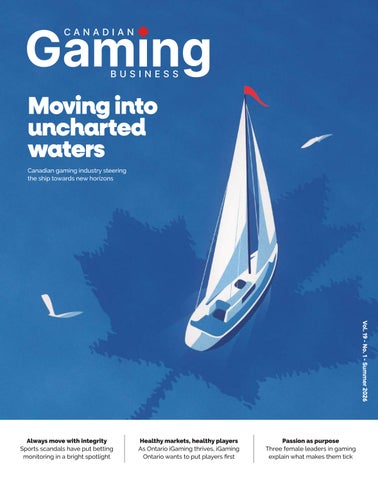
Canadian gaming industry steering the ship towards new horizons
Always move with integrity
Sports scandals have put betting monitoring in a bright spotlight
Healthy markets, healthy players
As Ontario iGaming thrives, iGaming Ontario wants to put players first
Passion as purpose
Three female leaders in gaming explain what makes them tick
WORLDS THROUGH GAMING
June 9–11, 2026
Broward County Convention Center Fort Lauderdale, Florida
10,000 DELEGATES
400+ EXHIBITORS
250 SPEAKERS
EDITOR’S NOTE
The Canadian gaming industry is arguably at a pivotal moment, for many reasons.
This latest edition of Canadian Gaming Business magazine comes to you soon after Ontario’s regulated iGaming market celebrated its fourth birthday. It also hits shelves as Alberta gears up to launch its own commercial online gaming market, as topics such as sporting integrity and betting advertising bubble up to the surface, and as all stakeholders ponder what the next chapter may hold.
For this issue, timed to coincide with the first SBC Summit Canada under its
new name, we dug into some of these big issues and spoke to a range of industry leaders about how they are charting the path forward. With a strong responsible gambling focus throughout, we touch on everything from social media’s advertising problem to question marks over credit cards and skill gaming machines. Read on to also learn why the Connor McDavid effect isn’t just felt on the Edmonton ice.
Featuring interviews and insights from leaders at the Canadian Gaming Association, iGaming Ontario, the Alberta iGaming Corporation, Integrity Compliance 360, BetMGM,
Kambi, Playtech, Paysafe, and more, we hope you find plenty to keep you engaged and entertained.
Who knows where things will be by the time our next issue comes out?
The only certainty is that there will be plenty more to talk about. This industry never stands still nor would we want it to.
Tom Nightingale
The Canadian Gaming Business Magazine is brought to you by SBC - Sports Betting Community.
Editor
Tom Nightingale
Editorial Team
Andrew McCarron, Martyn Elliott, Craig Davies, Ted Orme-Claye, Conor Porter, Fernando Noodt, Justin Byers, Ana Maria Menezes, Rachael Kennedy, Kieran O’Connor
Sales Team
Rasmus Sojmark, John Cook, Alyona Gromova, Conall McCabe, Jan Kowalczyk, Bob McFarland, Craig Brown, Ed Young, Camilla Scott, Annabel Selvadurai
Creative Lead | Design & Layout
Jessica Camilleri
Cover Story
The Alberta advantage
The second provincial commercial iGaming launch will be seminal moment for Canadian gaming
Setting a global standard
Paul Burns highlights why Canada is a country that other markets want to emulate
20 16
Why integrity is so integral
IC360’s Ilkim Hincer discusses the work Canada has done, and why there is further to go
Protection & preservation
iGO CEO Joseph Hillier on centralized selfexclusion and the next step in player welfare
26 30
Social media’s unhealthy fixation
The CGA’s Amanda Brewer breaks down the persistent issue that won’t go away
Riding the McDavid effect
BetMGM is a case study in why the right ambassador can benefit all
Borrowed money, regulated markets
Canadian gaming and credit cards go hand-in-hand. Is that a problem?
Stepping up to the plate
Why OLG and Kambi launched a new sportsbook for a new era
A new fighter in the ring
Ontario’s market has all sorts of operators, but someone different is coming
Live dealer: A winning hand
Bringing the Las Vegas casino floor to the Ontario gaming app
Using your passion as purpose
For these three women, gaming isn’t a job — it’s a way of life
License to skill
Skill gaming machines: games, gambling, or one great grey area?
All material is strictly copyrighted and all rights are reserved. No part of this publication may be reproduced in whole or in part without the written permission of Sports Betting Community Ltd. Although every effort has been made to ensure the accuracy of the information contained in this publication, Sports Betting Community Ltd cannot be held responsible for any errors it may contain. Sports Betting Community Ltd cannot be held responsible for the loss or damage of any material, solicited or unsolicited. The views of the publication are not necessarily the views of Sports Betting Community Ltd or those of the advertisers.
Produced and published by Sports Betting Community Ltd: Registered address: SBC, 2nd floor, 212 New Kings Road, London SW6 4NZ Tel: +44 (0) 161 367 1250. Email: sales@sbcgaming.com. Web: www.sbcgaming.com For daily news relating to the Canadian sports betting, casino and lottery business, please visit CanadianGamingBusiness.com.
Responsible gambling in Canada: Setting a global standard
Stakeholders have established a comprehensive system of protections that many international jurisdictions seek to emulate.
WORDS BY PAUL BURNS
The regulated gaming industry in Canada is recognized for its advanced, accountable, and player-centric framework. Stakeholders have established a comprehensive system of protections that many international jurisdictions now seek to emulate. It is crucial to consistently and collectively articulate this narrative with clarity and conviction.
Current policy discussions often hinge on incomplete data, selective reporting, and insufficient differentiation between the regulated sector and unregulated offshore markets. Our imperative is to shape this conversation by proactively highlighting the industry’s demonstrated innovations and achievements:
• Canada was among the earliest nations to incorporate responsible gaming requirements directly into its regulatory frameworks as essential operational standards rather than optional enhancements.
• Long-standing elements of the Canadian model include provincial self-exclusion programs, player spending controls, mandatory RG messaging, and structured treatment referral pathways.
• Ontario’s open iGaming initiative has shown that a well-designed competitive marketplace encourages legal channelization without increasing harm. Approximately 84% of online gaming activity occurs within licensed, regulated channels.
• Canada’s regulatory approach is extensively reviewed by authorities across Europe, AsiaPacific, and Latin America as an exemplar of safe and
sustainable market structuring. The European Gaming and Betting Association (EGBA) has specifically cited the Ontario model as a benchmark.
The primary lesson from the Canadian experience is clear: effective player protection requires providing a secure, competitive, and thoroughly regulated environment.
Still, we find ourselves at a pivotal moment. Despite these achievements, journalists, politicians, and researchers often overlook the industry’s efforts to enhance product safety, provide support for those in need, and prevent access to individuals who should not participate.
Supporters of Bill S-211 — a private member’s bill calling for federal intervention in gaming advertising, despite a 1985 agreement that prohibited such action — compare its approach to restrictions on alcohol and cannabis advertising. This comparison falls short in one vital respect: the digital accessibility of online gaming sets it apart.
When alcohol advertising is banned, someone seeking a beer cannot simply obtain one from an unregulated global supplier with a couple of clicks. However, any Canadian wishing to place a bet can easily do so through numerous offshore platforms that lack any player protections.
History shows that prohibiting alcohol did not prevent consumption; similarly, restricting gambling advertisements will not curb betting activity. Instead, such measures will merely reduce the visibility of safe, regulated, and accountable options.
The six RG guiding principles
In 2024, every CGA member aligned on six core foundational principles that now govern how the industry approaches responsible gaming:
SHARED RESPONSIBILITY
Responsible gaming is a collective commitment. No operator, regulator, or government can do this alone — and no single actor should have to.
STRONG CULTURE OF PLAYER PROTECTION
Player safety is embedded in business operations at every level — not delegated to a compliance department but owned by the entire organization.
RESPONSIBILITY TO INFORM
Players have the right to clear, accessible, honest information about the risks of gambling and the tools available to them.
EDUCATION, SUPPORT AND SERVICES
Robust resources — from self-assessment tools to treatment referrals — must be available to every player who needs them.
PROTECTING HIGHER-RISK PLAYERS
The industry has a special obligation to proactively identify and reach players who may be at greater risk — not to wait until they ask for help.
INNOVATION AND IMPROVEMENT
The standard we hold today is not the ceiling. We commit to ongoing enhancement of player protections as technology, research, and best practices evolve.
Alongside that, the CGA’s Code for Responsible Gaming Advertising — developed in partnership with the industry and administered by Ad Standards — took effect on Jan. 1, 2026. It is the most comprehensive industry-led advertising code for gaming in Canada’s history.
Effective player protection requires
providing a secure, competitive, and thoroughly regulated environment
• Truthful and transparent advertising: All claims must be accurate, verifiable, and free of misleading representations.
• Social responsibility and good taste: Advertising may not exploit vulnerable populations or use irresponsible social narratives.
• Adult audience protections: Strict restrictions on advertising near schools, on campuses, and in any contexts where the audience is predominantly underage.
• Mandatory RG statements: Every ad in every medium must include a clear, conspicuous responsible gaming message with a referral to provincial treatment resources.
• Inducement restrictions: Bonus offers and promotional inducements are prohibited from general advertising. They can only be communicated directly to verified adult players who have actively opted in.
• Influencer accountability: Social media influencers must clearly disclose material connections to gaming brands and are subject to the same standards as direct advertising.
• Independent enforcement: Ad Standards adjudicates complaints against both the CGA Code and the Canadian Code of Advertising Standards — providing genuine third-party accountability.
The industry encourages open, fact-driven conversations about making gambling safer. It’s important to start by recognizing the facts. We disagree with anyone who claims the industry isn’t taking action to protect customers and operate responsibly.
Canada is recognized as a global leader in responsible gambling research, treatment, and education, and we are prepared to set the world standard.
THE ALBERTA ADVANTAGE
Canada’s second commercial online gambling province is walking in Ontario’s footsteps, but intent on marching to its own beat.
WORDS BY TOM NIGHTINGALE
April 4, 2022, and July 13, 2026, are separated by 1,561 days. A lot can happen during that time.
Four years, three months, and nine days after Ontario became the first Canadian province to launch a regulated, commercial online sports betting and casino market, Alberta will follow in its footsteps this summer.
In that intervening period, Ontario has blossomed, and then some. With around 50 licensed operators, it has shown that competition can thrive; with more than $4bn in operator revenue and $800m in tax revenue from iGaming in 2025 alone, it has shown the money that can be made; and with a reputed channelization rate in the ballpark of 90%, it has shown how effectively the grey market can be narrowed.
Not everything in Ontario iGaming is perfect, nor will it be in Alberta. But as a proof of concept for other provinces, Ontario has blazed a trail.
Where you lead, I will follow
Alberta will do things differently, of course. The comparative nuances of the two provinces make exact comparisons difficult, and not wholly useful. It has less than onethird the population of Ontario, which will contribute to lower iGaming activity and revenue than Ontario, but it also has a significantly lower average age, lower taxes, and higher GDP growth.
The second regulated iGaming province’s biggest advantage, though, may be that it can learn from the first.
“The consultation process with Ontario has been tremendous,” says Dan Keene, the CEO of the Alberta iGaming Corporation (AiGC). “They set the template. We’re blessed to have them to work with and learn from. They’ve been incredibly gracious in terms of their support and their advice.
“Of course, we’ve got a mandate that our minister has appropriately put in place in terms of how Alberta needs to do it, but we wouldn’t be in the position we’re in today without where Ontario has already been.”
Alberta has taken much from the Ontario playbook, from allowing both sports betting and casino gaming to an open-market licensing approach regarding a ballpark tax rate, to similar restrictions on advertising and much more.
The biggest way it wants to replicate the province to the east, though, is by curbing the grey market. Most estimates suggest that at least 70% — and possibly significantly more — of
online gambling activity in Alberta is currently done through unapproved operators.
“Ontario has done a tremendous job in channelizing the market,” Keene acknowledges. “That is at the heart of what we’re attempting to do. We’re not here to grow iGaming; we’re here to channelize existing iGaming into the legal market, with all of the measures around security, player security, integrity and responsible gaming.”
To that end, July 13 is also the date by which all active grey-market operators currently in Alberta, barring some deadline-extending exceptions, must end all unregulated play.
Our launch is not a one-anddone – it’s going to be an ongoing consultation, because the industry is fluid and gaming changes all the time
Now the work begins
Keene leads the AiGC, which will be the conduct-and-manage agency in Alberta, similar to the role iGaming Ontario plays. He transitioned into that role from his long-running job as VP of Gaming at Alberta Gaming, Liquor and Cannabis (AGLC), the crown corporation that operates the Play Alberta iGaming platform and will also serve as the new commercial market’s regulator.
After Minister Dale Nally’s Bill 48, the Alberta iGaming Act, paved the legal pathway for the province to launch in July, Keene was charged with helping to lead the ramp-up and help get the AiGC on its feet. Since he was appointed as AiGC interim CEO in January, the work has been ceaseless.
“It’s exciting,” he smiles. “There’s been no shortage of things to work on. We’re in the middle of recruitment for C-level positions and from there we’ve got to hire more folks, set up a website and location, get the brand and the corporate design set up.
“Above all, it’s about working with industry to get an operating agreement and all of our policies in place that will guide all of our activity as conduct-and-manage for iGaming in Alberta. We’re a partner in what is going to happen here. As operators succeed and flourish, so does AiGC.”
Uniquely Albertan
Building a market that’s right for Alberta is key. That permeates everything from operators’ tailored offerings to the way the marketing speaks to the provincial population, to some core foundational aspects of the market.
That required diverging slightly from the Ontario path.
Nally’s Bill 48 included a specific commitment to launching a centralized self-exclusion system from day one of the market, something Ontario did not have through its first four years.
There are other wrinkles, too. AGLC announced in March a blanket ban on betting on political events; in contrast, in 2025, gambling on the Canadian federal election was a popular ‘novelty’ wagering category in Ontario’s market. And Alberta seems more open to retail sportsbooks in casinos and stadiums than Ontario was.
In terms of tax, Alberta has broadly mimicked Ontario’s 20%. But before applying that 80-20 split, Alberta will take small-percentage deductions and put that revenue towards First Nations communities and social responsibility initiatives like gambling addiction support, making the effective tax on operators more like 22%.
Alberta Minister Dale Nally
Ontario set the template – we’re blessed to have them to work with and learn from
“In Alberta, you don’t need to pay for treatment for opioid or alcohol addiction,” Nally says. “Gambling addiction is going to be no different. So, we allocated 1% of gross gaming revenue to be used towards that.
“We’re also taking 2% and giving it to First Nations communities. We have said all along that one of the best ways to promote economic reconciliation is to help First Nations benefit from the economic prosperity this province offers.”
The ministry and the Indigenous nations themselves will determine how that 2% GGR cut is distributed.
As for the financial benefit Alberta could reap, the province’s budget projects $75m in tax revenue for the 2026-27 fiscal year, up to $109 million in 2028-29. Those are likely low-ball estimations, as they proved to be in Ontario. Investment bank Citizens believes that, in terms of gross gaming revenue, Alberta could be worth around US$700m annually at maturity, which would make it one of the larger North American markets.
You never stop learning
This may sound like a tired cliché, but one other important thing that Alberta’s gaming leaders have learned from Ontario is that, well, you never stop learning. Just as in Ontario, tweaks to the recipe will be needed.
AiGC interim CEO Dan Keene
Nally referenced this before Bill 48 even passed, stressing that his legislation deliberately did not include too many specifics to allow for more nimble regulatory adjustments down the line.
“If we had written those rules into legislation, it would be like putting them in granite; by putting them in regulation, it’s more like Jell-O,” he analogizes. “It’s easier to course-correct if we get one wrong or if things change five years from now and we need to do it differently.
“We think we got a pretty good balance, and we did follow a lot of lessons learned from Ontario’s success and embraced some of their best practices, but we’re going to continue to listen to Albertans and the industry.”
“Our launch is not a one-and-done,” adds Keene. “We’re not going to have our operating agreement and policies and cut the ribbon and say, ‘cool, call us in three years!’ It’s going to be an ongoing consultation, because the industry is fluid. Gaming changes all the time. It’s on us to be flexible and in tune with everything. That’s what will bring real success.”
IC360’s Ilkim Hincer on what Canada has got right, and what more needs to be done.
anada is a sports-mad nation. Hockey is a national religion, the Toronto Blue Jays brought the entire country together in 2025, basketball has a strong following, and the NFL, CFL and soccer all have their place, to name but a few.
This enthusiasm for sports has paid off well for the regulated sports betting industry in Ontario. And with Alberta joining its province to the east in launching a regulated market, the same can reasonably be expected there.
With the emergence of new betting markets and expansion of the industry, challenges always come. The conversation around sports integrity is constant, and it reached fever pitch in 2025. For integrity monitoring and compliance firm Integrity Compliance 360, it’s a way of life.
“The broader conversation goes to what this means for our society as a whole and what this means for sport as a whole,” says Ilkim Hincer, IC360’s President of Canadian Operations & Managing Director of Global Advisory Strategy.
Hincer joined IC360 in October 2025, three-and-a-half-years after Ontario opened its iGaming market and months after Alberta gave the final approval for its own market launch.
Prior to IC360, Hincer worked as a lawyer for over 30 years, with around two-thirds of that time spent in iGaming. His career has included spells at the
British Columbia Lottery Corporation, Penn National Gaming (now PENN Entertainment), Hard Rock International, and a stint as Chair of the Canadian Gaming Association (CGA).
Hincer notes that the way the industry has approached integrity has been ‘fragmented’, though stakeholders have taken the sometimes harsh lessons on board.
“It’s being addressed now, in part because of the learnings of the Ontario launch,” he says. He also cites the establishment of a nationwide safe sports mandate under Sports Integrity Canada, previously the Canadian Centre for Ethics in Sports, as a key moment.
This is nothing new
Ontario has benefited from examples from elsewhere, including the U.S., where most states have embraced regulating sports betting in their own way since the 2018 repeal of PASPA. But Hincer stresses that the province’s own experience of gaming, both before and after regulation, has also paid off.
“One of the things to remember with Ontario is that although it launched this model in 2022, there has been a very robust gaming in Canada for some time,” Hincer notes. “There was a two-pronged approach; the crown corporation monopoly model where they regulate gaming including online gaming, and then the unregulated market, the grey market.
Why integrity is so integral...
WORDS BY TED ORME-CLAYE
“There was a very robust market for at least 15 years in Canada and in Ontario. It’s not like what we see today was created from scratch. We’ve had many years to address integrity issues and compliance issues, albeit in the land-based space and the crown corporation space.”
Four years on from the launch of Ontario’s market, the province’s iGaming channelization rate is approaching 90%. This is a stat that significantly more mature markets in Europe would be jealous of.
But it doesn’t mean that everything is peachy when it comes to integrity. For Hincer, the fact that Canada has not yet signed up to the Convention on the Manipulation of Sports Competitions, the Macolin Convention, is an oversight.
Although a Council of Europe initiative, the Convention can be ratified by non-European nationsAustralia being one example. Hincer
holds the Convention and its principles in high regard, and feels that Canada should too.
“The Macolin Convention is a tremendous tool for looking at this issue globally, and whether Canada should join the convention is a big area of discussion,” he suggests. “I think it would be a big benefit.”
Is the AGCO tightening up?
As with every market, sports integrity always comes with an element of controversy around it, particularly when regulations are breached and unsavoury headlines are made.
The notorious case involving former Toronto Raptors player Jontay Porter is the case-in-point example. An investigation found that Porter had manipulated his own performances in multiple games and supplied insider information to known bettors. He became the first NBA player to be
banned for life for involvement in a sports betting scandal.
The Alcohol and Gaming Commission of Ontario (AGCO) subsequently moved to suspend one Ontario-licensed operator, PointsBet, in February 2026 for alleged violations related to bets on Porter. As of the time of writing, PointsBet was appealing the five-day suspension.
While he won’t comment on specific examples, Hincer does not believe that the AGCO has necessarily become more strict in its approach to integrity matters. Perhaps it’s just that the spotlight has started to shine more brightly.
“The laws haven’t changed, the standards haven’t changed,” he says. “There have been confusions and there have been clarifications. There have been communications with stakeholders, and the CGA has a role in that.
There are broad criminal code provisions which deal with it, but actual legislation may be needed
“I think it’s more of a recognition that active enforcement is needed and that sports integrity is a part of the fabric of Canadian life. Sport is in Canadians’ DNA. But one can forget that sports integrity isn’t always as obvious as match fixing - it could be athlete harassment, insider information. As these things evolve, the AGCO and others’ approach needs to evolve.”
A harmonized future?
The regulatory picture in Canada remains fragmented between provinces, and probably will for some time. When it comes to sports integrity, fragmentation transcends the provincial level and reaches the federal level.
Hincer points out that Canada does not have any specific national legislation that deals with issues like match manipulation.
“There are broad criminal code provisions which deal with it, but actual legislation may be needed. Australia is looking at this, and the UK has some already. We could do with some too.”
Regardless, Hincer sees the gradual rollout of regulated sports betting across other Canadian provinces as ‘inevitable’. Access to mobile technology, consumer expectations, and the reality of grey markets already in place make further rollouts highly likely.
If and when that happens, it will require the same robustness seen in Ontario, where operators are required to partner with an independent integrity monitor like IC360. Alberta has committed to the same mandate and a stringent
approach would be demanded in other provinces, Hincer adds.
“When you look at integrity, conversations go back to the first principle of opening up markets - how do you protect the end users? You protect them by having regulations, by bringing them under the umbrella of the regulated market, and making sure the operators comply with all the rules and regulations.
“If we don’t think this activity is happening across the country, we’d be fools. If there were a national database upholding the integrity of gaming, that would be great.”
No weak links
As sports betting grows in prominence and accessibility, the convergence between sports and gaming continues to accelerate. Integrity should already be a top priority for the industry, Hincer emphasizes, and it requires everyone pulling in the same direction.
“I’ve had the benefit of seeing multiple perspectives over the past 20 years,” Hincer reflects.
“It’s critical to realize that this ecosystem is so interconnected. And one of the key pillars of making sure integrity is connected is education for all involved. What is match manipulation? What is integrity? How do the dots connect across the ecosystem?
“It’s making sure we all work together - law enforcement, operators, leagues. These are no insular issues. It’s not one stakeholder or another who will solve this problem. It needs all of us.”
PROTECTION PRESERVATION
Joseph Hillier explains how iGaming Ontario and its partners are steering the industry towards a safer future.
WORDS BY TOM NIGHTINGALE
Joseph Hillier has not yet been in the top job at iGaming Ontario for a year. But in the world of online gaming, time flies.
Back in April 2022, when Ontario became the first Canadian province to launch regulated commercial iGaming, Hillier was halfway through a four-year spell as Chief of Staff to Ontario Attorney General Doug Downey.
“One of the first files to hit my desk in that office was the development of a private sector-driven iGaming market,” he recalls. “And so, it’s been pretty near and dear to my heart since then.”
From there, his career path took him in 2024 to the role of Chief Strategy Officer at the provincial gambling regulator, the Alcohol and Gaming Commission of Ontario (AGCO). Now, he is the man leading the standalone conduct-andmanage agency, iGO, in its latest chapter.
“This is a bit of a full-circle moment for me,” Hillier adds. “I’m really excited about what comes next, and the role that I get to play in that.”
Already so well-versed in Ontario gaming, Hillier’s initial months as iGO leader encompassed, among other things, meeting with personnel at the majority of Ontario’s operators in person. That’s no mean feat, given there are around 50 of them.
“What’s struck me is how excited they continue to be about embracing the Ontario market and really leaning into accountability around responsible gaming and regulatory compliance,” he notes. “I can’t say that was surprising, but of course it was validating.”
With roughly $9bn of wagering activity and $350m-plus in gross gaming revenue every month, almost 50 licensed operators and 1.3 million active player accounts, Ontario has established itself as one of the biggest and most lucrative online gambling markets in North America. Certainly, the most competitive in terms of the number of options available.
Healthy markets need healthy players, and healthy players need a healthy market
BetGuard lets players opt out from all regulated online gambling in Ontario. Itʼs their decision and itʼs both simple and secure.
So much of our success story is our player base, and we have an accountability to protect them
Now, as that market moves into its fifth year, it’s about what comes next. Speaking to Hillier leaves no doubt what the central piece of that puzzle is, as far as he’s concerned: protecting players in meaningful ways.
“Some of the numbers you shared there really do speak to the fact that the not-sosecret recipe for our success in Ontario is that it’s a diverse, competitive offering that we’ve got right,” Hillier notes.
“But I think as much as we’ve become a bit of a household name, we’re still on that maturity curve. Healthy markets need healthy players, and healthy players need healthy markets. A conversation I have with operators all the time, and what is clearly one of their big priorities, is that if they don’t have a sustainable player base, it’s not success.”
Standing on BetGuard
Speak to most stakeholders in Ontario iGaming and they’ll tell you that responsible gaming and player protection have always been paramount focuses. From the AGCO’s regulations to iGO’s management, operators’ own initiatives, the work of organizations like the Canadian Gaming Association and the Responsible Gambling Council, and everyone in between, creating a genuinely healthy place to do business is a shared goal.
But moving things forward also requires looking back critically. What could be done better?
iGO recently recruited Hillier’s former AGCO colleague Ben Valido in the new role of Chief Responsible Gaming Officer. “This is really about putting principles into action and looking at strategic opportunities to leverage our relationships and resources to support our operators and our players,” Hillier explains. “Ben will oversee that work, developing a deep and substantive strategy for iGO on RG moving forward.
“We want to ensure that we’re not taking our success for granted. So much of our success story is our player base, and we have an accountability to protect them.”
Another major piece of the puzzle is BetGuard, iGO’s long-awaited centralized self-exclusion system. Developed in partnership with Integrity Compliance 360 and DataWorks through a years-long process, the tool will allow Ontario players to opt out from all online gaming platforms (including Ontario Lottery and Gaming as well as all iGO-contracted sites) through one frictionless process.
Frankly, this is something that some stakeholders have been wanting
for some time as an important component of a modern online gambling safety system. Hillier doesn’t shy away from that.
“I think there’s a recognition that we’re overdue for this system,” he acknowledges. “I’ve been at a few conferences recently where centralized self-exclusion has been widely recognized as a really critical tool in the responsible gambling space.
“BetGuard is an exciting development for our market. It’s a pretty sophisticated piece of technology that will let players opt out from all operators across the province in a very streamlined, lowtime-intensive way. We’ve got great vendor partners with DataWorks and IC360, I’m quite confident in the look and feel of it. It means players can make those informed choices and have those tools literally at their fingertips. It’ll be ubiquitous and accessible. And that’s where you’re going to see the substantive impact.”
All-around commitment
BetGuard was in the final test stage at the time of the most recent conversation with Hillier. Part of that process was more conversations, making sure that the centralized self-exclusion system works with each operator’s own systems and technological requirements.
“A lot of operators have two- to threeyear plans on tech,” Hillier notes. “We know the data and technology situations of one operator can differ very significantly from another. We’ve really tried to take that direct one-on-one approach to engagement to ensure we know what works and what doesn’t.
“Rationally, ensuring that all of the operators are participating in this program is critical. Ultimately, if we don’t have all the operators included, we don’t have a ‘centralized’ self-exclusion program, right? That’s critical. As players continue to trust us in the regulated market, we need to step up to ensure that we offer them as many responsible gambling tools as we can offer, and all the ones they need. And our centralized self-exclusion system is a key cornerstone of that.”
Centralized self-exclusion will also be a core component of Alberta’s iGaming market when that launches in July. It was deemed so important that it was cited in the province’s Legislative Assembly during discussions of Bill 48.
Could Ontario and Alberta connect their two systems, creating an interprovincial opt-out tool?
“Once Alberta is up and running and its systems are fully in place, I think we’ll both be in a much better position to understand those linkage opportunities,” Hillier says. “As we see how Alberta evolves and as we continue to engage with them on a whole host of things, we’ll look for those opportunities as soon as they’re available.”
In the meantime, Hillier and iGO will continue to work to provide Ontarians with the healthiest experience possible.
“One of the key pillars and focus areas of this organization will always be responsible gaming, and that’s a whole host of things, right? That’s player safety, player confidence, it’s tools like BetGuard. But there are also education opportunities, engagement opportunities.
“It’s a bit of a unique opportunity that we as iGO have in Canada’s quirky gaming market dynamic. As a conduct-andmanager, we get to play this neat role in between operators and government and get a bit more deeply ingrained in things like responsible gaming.
“The market continues to mature and progress and evolve so rapidly. So must we.”
Social media’s fixation with illegal casinosonline
Amanda Brewer, SVP of Policy & Communications for the Canadian Gaming Association, asks whether revenue or player protection is more important to Meta.
Canada has historically operated as a grey market for offshore online gaming. Conservative estimates indicate that Canadians have participated in online gambling for nearly two decades. While the exact amount of money exiting the country in this manner remains under debate, it is widely acknowledged as substantial — in the millions of dollars.
Ontario pioneered the introduction of regulatory standards to license and oversee this activity. Recognizing the importance of provider and consumer choice, the Alcohol and Gaming Commission of Ontario (AGCO) understood that it could not feasibly restrict products that had been available without limitation for many years. As a result, Ontario established an open, multi-product market.
Equally vital, however, was the prioritization of player protection measures.
Prior to regulation, there was no assurance that operators were effectively screening customers to prevent underage or vulnerable individuals from opening accounts. Game integrity was not guaranteed, nor was the security of funds, and responsible gaming tools were probably unavailable.
Given the prevalence of online gambling, Ontario’s decision to regulate was prudent and responsible. The advent of regulation brought with it increased advertising; for the first time in four decades, residents were exposed to advertisements beyond those from lottery corporations. Advertising
is a privilege afforded by licensing and serves as the primary means by which the public identifies regulated operators.
Channelization is a key metric, representing the migration of players from unregulated (grey market) websites to legal, regulated platforms. By 2025, Ontario achieved a channelization rate of approximately 84%, effectively transitioning most users to a safe and taxable environment. Before regulation, up to 70% of online gambling occurred on unregulated sites.
Nonetheless, a notable portion of participants still use platforms lacking Ontario’s comprehensive player protections. This is exacerbated by Meta’s lackadaisical approach to enforcement.
My Instagram feed is now flooded with sponsored ads for real money operators based offshore
Where’s the logic?
iGaming Ontario provides a current list of all licensed operators. Ideally, prospective players would consult this list before creating an account. However, many are persuaded by sponsored posts on Meta channels Instagram and Facebook.
As a result, numerous Ontarians struggle to differentiate between regulated operators and unlicensed platforms.
Meta allows users to select categories of interest to them. Included alongside books and cosmetics is a category called “real money gaming”. You might assume that category would geolocate advertisements — especially since
I’m in Ontario’s regulated market — and require proof of licensing or IP ownership before publishing posts. That seems logical, doesn’t it?
But that’s not the case.
For the past four years, land-based casinos across Canada have been targeted by scammers who use images of their venues to direct users to offshore online platforms. As a result, my Instagram feed is now flooded with sponsored ads for real money operators based offshore, none of whom hold licenses in Ontario.
Even the Canadian Gaming Association is being fraudulently represented (with a micro adjustment as “Canada Gaming Association”) as a platform for Pickering Resort &
Casino, a land-based venue operated by Great Canadian Entertainment that in reality has no online presence.
With these operators, there are no Know Your Customer (KYC) requirements, which typically involve verification of identity, employment, salary, location, and source of funds. Additionally, some operators utilize virtual private networks (VPNs) to bypass geolocation protocols.
Investigations and leaked internal documents in 2026 revealed the extent of Meta’s earnings from “high-risk” or illegal advertising.
Although Meta does not specifically track illegal gambling as a separate revenue stream, its internal evaluations present a clear depiction of the issue.
Casinos across Canada have been targeted by scammers who use images of their venues
Leaked reports from 2024-2025 indicate that Meta estimated that around 10% of its yearly revenue, equating to about $16bn, is generated by advertisements for scams and banned products such as illegal online casinos.
On average, Meta’s platforms are said to display roughly 15 billion suspicious ads each day.
Inability or unwillingness?
Meanwhile, the gaming industry is under scrutiny from senators and several federal ministers who have expressed regret over their prior support for Bill C-218, legislation that enabled singleevent sports betting across provinces. Bill S-211, now advancing to committee in May, aims to reintroduce federal oversight of provincial gaming rights — potentially duplicating regulatory efforts seen in jurisdictions such as Ontario and, soon, Alberta.
Organizations like Ad Standards Canada, thinkTV, and the Responsible Gambling Council are already engaged in robust regulatory activities. Even some lawmakers who generally support gaming initiatives feel obliged to endorse Bill S-211, viewing it as a necessary step. Media commentary remains critical of industry practices, with increasing calls for a comprehensive advertising ban akin to those imposed on alcohol and cannabis products.
Consumer protections are effective only if individuals participate on regulated platforms, and advertising plays a crucial role in informing consumers about which operators are officially regulated.
Dr. Kahlil Simeon-Rose, drawing on his recent research into channelization and online gambling regulation, contends that licensed operators should be permitted to advertise through
mainstream channels. This provides a competitive advantage over offshore operators, who continue to risk enforcement actions.
Prohibiting advertising would likely eliminate this advantage without curbing the visibility of offshore operators, who maintain exposure through affiliates, social media, and search engines.
With advertising facing multiple threats, including malicious offshore operators, each broadcaster must remain alert, and Meta should address its own issues.
During a speech at ICE in January 2026, Tim Miller, Executive Director of the United Kingdom’s Gambling Commission (UKGC), accused Meta of ignoring illegal gambling sites that advertise on Facebook and Instagram.
Miller described Meta’s platforms as “effectively a window into criminality”. Although Meta’s rules require gambling companies to be licensed in the countries where they advertise, Miller alleges the tech giant isn’t enforcing these requirements. “If we can find them, then so can Meta: they simply choose not to look.”
The UKGC is intensifying its crackdown on illegal gambling operators who target local consumers but evade regulations. The UK has removed hundreds of thousands of websites linked to unlicensed operators and issued cease-and-desist notices, yet the challenge persists as operators constantly change tactics.
Ads for illegal gambling impact vulnerable individuals and benefit “criminals and con artists,” Miller stated. Unlicensed operators do not pay taxes, and consumers are at greater risk of fraud. According to Miller, Meta suggested the
UKGC use artificial intelligence tools to identify and report illegal ads, promising to remove them once notified.
But Miller questioned Meta’s willingness to act.
“I would be very surprised if Meta, as one of the world’s largest tech companies, is incapable of proactively using their own keyword facility to prevent the advertising of illegal gambling. It could leave you with the impression they are quite happy to turn a blind eye and continue taking money from criminals and scammers until someone shouts about it.”
A failed partner?
In Ontario, there is currently no indication that Meta is actively enforcing its proof-of-license requirements.
By transferring responsibility to regulators or individuals to report fraudulent accounts, Meta avoids direct accountability and permits scammers and other bad actors to target unsuspecting customers, including vulnerable groups who should not be exposed to these advertisements.
This underscores the necessity for reforming the Criminal Code to enhance protections for participants and to further safeguard the markets that provincial governments have sought to make more secure.
In 2026, technology is available to geolocate ads and block operators lacking valid licenses or IP verification. Ontario has worked diligently to establish standards and create a safety net for responsible gambling. Meta’s efforts fall short, earning them a failing grade as a partner in this industry.
We have a problem with Meta. And we invite them to do better.
RIDING THE MCDAVID EFFECT
How BetMGM has leaned on Canadian star power to make a real responsible gambling difference.
WORDS BY JUSTIN BYERS
BetMGM’s name carries a lot of weight. So does its choice of partners.
The operator has provided Canadians with access to online sports betting and casino since the company solidified its footprint in Ontario in 2022, its first expansion to an international market outside the United States.
As Ontario expects and demands from its online sportsbooks and casinos, BetMGM continues to serve customers with access to a range of responsible gambling resources and tools. Unlike many competitors, the brand has recruited some bona fide Canadian star power to showcase the company’s commitment to player protection.
Enter Edmonton Oilers captain and Canadian hockey icon Connor McDavid.
‘Authenticity and cultural credibility’
The Entain and MGM Resorts International joint venture recently unveiled its latest new responsible gambling campaign, Mullet Over,
designed to connect with customers and sports fans across Canada and beyond.
The puck-themed campaign promotes BetMGM’s suite of responsible gambling tools and leverages the talents of two high-profile brand ambassadors. Featuring three-time Hart Memorial Trophy winner McDavid, Mullet Over also enlists the talents of actor and former Montreal Canadiens left wing Terry Ryan to bring the campaign to life.
“From the start, our goal was to deliver responsible gambling information in a way people would genuinely pay attention to—and to meet fans where they are,” says BetMGM Director of Responsible Gambling Richard Taylor. “Connor McDavid and Terry Ryan were natural partners for this campaign because they bring authenticity and cultural credibility.
“The public listens to people they know and admire, and as a three-time Hart Memorial Trophy winner and one of the most recognizable athletes in hockey, Connor has a unique ability to make sure an important message truly lands.”
Ryan also brings his own flavor to BetMGM’s responsible gambling efforts as a brand ambassador that bridges the gap between entertainment and player protection.
“Ryan complements McDavid’s credibility with his own presence and personality within hockey culture,” notes Taylor. “As a former NHL player turned actor, he brings humor, relatability, and a deep connection to the sport’s traditions—including the unmistakable hockey mullet at the heart of the commercial’s concept.
“Together, their dynamic allowed us to deliver a responsible gambling message that feels memorable,
culturally grounded and genuinely entertaining, without diluting the seriousness behind it.”
Know your audience
BetMGM has an all-star roster of brand ambassadors, from actors Jamie Foxx and Jon Hamm to New York Yankees hero Derek Jeter and hockey’s original ‘Great One’ Wayne Gretzky. This is a brand that recognizes the benefits of using renowned figures inside and outside sports and gaming when looking for a marketing power play.
In Ontario, specifically, gambling regulations restrict the use of athletes to
responsible gambling messaging only, and Alberta will follow the same policy.
As Taylor explains it, BetMGM understands that its existence as an operator is simply not enough to ensure that its players and potential customers are aware of its responsible gambling resources. Star power lends a weight to the messaging that can help drive home the point.
“Responsible gambling messaging only works if people actually notice it,” reflects Taylor. “We’re asking players to pause, reflect and make intentional choices. The creative must be compelling enough to capture their attention and deliver a clear, memorable takeaway.
Connor McDavid (left) and Terry Ryan in BetMGM’s ‘Mullet Over’ campaign
“That’s why using ambassadors, recognizable talent and humor is so effective for responsible gambling. When familiar personalities deliver responsible gambling messages with the same creative quality, production value and visibility as any other campaign, those messages are far more likely to break through. It’s not a compromise; it’s a prerequisite for effectiveness.”
The Chosen One
Gretzky might be ‘the Great One’ but for BetMGM, McDavid has risen to the top as ‘the Chosen One.’
McDavid became a brand ambassador for BetMGM in 2022, the first active athlete from North America’s four major professional
sports leagues to rep an online sportsbook and casino. After finding initial success with the Oilers man as a centrepiece, the operator has built its team around him.
Taylor recalls how the initial responsible gambling push BetMGM deployed in 2024 featuring McDavid yielded encouraging results.
“That campaign contributed to a 38% year-over-year increase in the use of deposit limits and a 55% increase in the use of stake limits at BetMGM,” reflects Taylor. “Those are measurable shifts in behavior — not just impressions or clicks. They show that when responsible gambling campaigns are visible and compelling, they can drive real, positive change.”
When responsible gambling campaigns are visible and compelling, they can drive real, positive change
ICRG intends to use the investment to fund a three-year, peer-reviewed research study into player behavior, analyzing player decision-making across various demographics of bettors in North America.
BetMGM and MGM Resorts will use the study to improve the execution of their responsible gambling strategies.
“Responsible gambling isn’t a separate track for BetMGM; it’s embedded across the company,” Taylor says. “BetMGM is committed to continuing to highlight the importance of the tools that help players stay in control and have a positive, sustainable experience.”
Alberta: Feels like home
Given its short lifespan, BetMGM has yet to quantify the impact of Mullet Over, but the company is optimistic that the campaign will provide the operator with similar if not improved results.
A team effort
One man doesn’t make a team, of course, even when that man is Connor McDavid.
BetMGM and its co-parent, MGM Resorts, continue to invest in responsible gambling initiatives. MGM Resorts is also leveraging BetMGM’s Mullet Over campaign to provide responsible gambling messaging at its portfolio of properties, and earlier this year the companies committed to investing more than $1m in the initiatives in 2026.
A portion of the investment is allocated toward funding to support research by the International Center for Responsible Gaming (ICRG). The
While all of this is happening, BetMGM is looking ahead to what Alberta’s commercial sports betting is offering.
The operator has been signing up Albertans for pre-registration process for months, ahead of the province’s debut as an open market. Like all online gaming brands that take part in Alberta, BetMGM will need to adhere to a key requirement set by the Alberta iGaming Corporation (AiGC) and the Ontario-based Responsible Gambling Council (RGC): attain the RG Check accreditation. RG Check is an independent responsible gambling program powered by the RGC. The program evaluates the marketing practices, governance and player protection standards of licensed online casino and sports betting platforms.
“We’re committed to providing a best-in-class gambling experience that is fun and sustainable,” says Taylor. “That means sharing with Albertans the many advantages that we have
to offer as an operator. Highlighting a focus on responsible gambling is at the core of who BetMGM is and what BetMGM does.”
Ontario is North America’s most saturated and competitive online gambling market across both sports betting and casino. Competition in Alberta will be fierce, too, but BetMGM CEO Adam Greenblatt has said he expects BetMGM’s Ontario presence and company-wide growth in 2025 to ensure a fast-paced start in what will be Canada’s second regulated iGaming province.
In McDavid, perhaps Alberta’s most beloved adopted son and certainly one of its most bankable stars, BetMGM will feel it has an MVP on board already to make the difference.
Sticking to the game plan
In the meantime, BetMGM continues to bolster its responsible gambling efforts in Canada through campaigns that appeal to regular bettors, occasional players, and sports fans across the country.
As online gambling arrives in earnest in Alberta, continues to boom in Ontario, and grows elsewhere across the country, Taylor stresses that advocating for responsible gambling in meaningful and impactful fashion is the real game-winner.
“As legal sports betting becomes a part of the entertainment landscape, responsible gambling can’t sit quietly on the sidelines,” Taylor notes. “It needs to be delivered with the same clarity, confidence and creativity as every other message competing for a viewer’s attention. That’s why BetMGM will keep leaning into humor, fresh creative ideas and recognizable ambassadors.”
CHANGING WINDS
A spree of First Nations casino acquisitions suggests Indigenous gaming may be entering a new era.
WORDS BY TOM NIGHTINGALE
The Canadian gaming industry is full of all sorts of storylines if you know where to look. One of the biggest may still be flying under the radar.
A First Nations brick-andmortar casino ownership movement has gathered pace in this country. Most pronounced in British Columbia and Alberta, things are changing fast as First Nations from coast to coast turn to commercial gaming ownership as a way of generating their own revenues, reaffirming their sovereignty, and safeguarding their future.
One of the biggest characters in this story has been Snuneymuxw First Nation.
The Vancouver Island nation, whose name is the etymological root of the present-day name of the city of Nanaimo, has bought five separate B.C. casinos from casino corporation Great Canadian Entertainment since June 2024. Those acquisitions range from Casino Nanaimo on its own historic lands to renowned Greater Vancouver properties like River Rock Casino Resort and Great Canadian Casino Vancouver.
Snuneymuxw Chief Mike Wyse and Ian Simpson, CEO of the First Nation’s economic development arm Petroglyph Development Group, say the acquisitions are a concerted effort to maximize the nation’s
economic self-determination and long-term prosperity.
Simpson told Canadian Gaming Business last year after the first two deals, for Casino Nanaimo and Elements Casino Victoria, were announced, that Snuneymuxw held “a strong desire” to move into casino ownership for decades before the Great Canadian opportunities emerged in 2024.
Casino Nanaimo was the first priority on the agenda. As part of the deal, the land on which the casino is located, a part of the Snuneymuxw xwsol’lexwel village, was returned to the First Nation.
“It’s important to the nation for us to be reacquiring these sites by whatever means necessary,” Simpson said of that acquisition. “In this transaction, we’re paying market value for land that was taken from us, which is bittersweet, but we’re really happy to have it brought back to us.”
Setting the trend
Simpson also predicted that more Indigenous nations could follow the lead of Snuneymuxw’s early acquisitions.
“Other nations in B.C. and even across Canada can follow that same path that we’ve gone down to acquire these gaming assets for the benefit of their own
nations,” Simpson said. “I’m quite confident we’ll see that in the not-too-distant future.”
Since he made those comments 18 months ago, things have developed significantly.
Not only has Snuneymuxw agreed to buy three more casinos from Great Canadian, but the coast-to-coast operator has sold facilities to three other B.C. First Nations: the casino operations at Hastings Racecourse & Casino to the Tsleil-Waututh Nation, Elements Casino Chilliwack to the Ts’elxwéyeqw Tribe, and Elements Casino Surrey at Fraser Downs to the Semiahmoo First Nation.
As with Snuneymuxw, each of those First Nations cited a desire to strengthen their communities and their self-determination through gaming ventures, as well as to decrease their reliance on federal government funding. Those sales have cut Great Canadian’s B.C. portfolio down from nine casinos to just one, the Chances Dawson Creek location near the border with Alberta.
Purely Canadian partners
Speaking of Alberta, things are changing there, too.
As the province gears up to open its iGaming market, major First Nations casino deals have altered Alberta’s brick-andmortar gaming landscape.
We’re looking to diversify our revenue streams, not only in different industries but also geographically
At the end of 2024, Indigenous Gaming Partners (IGP), a group of five rural Nova Scotia First Nations working with casino company Sonco Gaming, bought the casino operating assets of Edmonton-based Pure Canadian Gaming. That gave IGP control of four provincial casinos: Pure Casino Edmonton, Pure Casino Yellowhead, Pure Casino Calgary and Pure Casino Lethbridge.
Then, in late March, IGP-owned Pure acquired another Alberta multi-casino operator, Gamehost Inc., taking over a portfolio that includes Deerfoot Inn & Casino in southeast Calgary, Rivers Casino and Entertainment Centre in Fort McMurray and Great Northern Casino in Grand Prairie, as well as multiple hotels. Pure Canadian will then sell the casinos’ physical properties to VICI Properties for around $200m and lease them back from the company through long-term agreements.
Like Snuneymuxw, IGP says it is focused on developing a portfolio of casinos through strategic acquisitions, with a mission to create meaningful economic opportunities for Indigenous communities.
IGP Chairman Michael Peters is CEO of Glooscap Ventures, the business arm of one of the First Nations that comprises the group.
“We’re always looking to find ways to generate our own source revenue for our communities instead of relying on government funding,” Peters told Canadian Gaming Business at the time of the initial Pure acquisition. “We’re looking to diversify our revenue streams, not only in different industries but also geographically. These acquisitions allow us to enter the gaming industry at scale, creating new opportunities for growth and meaningful benefits for our communities.”
To that point, Peters’ Glooscap First Nation generated more than $600,000 in six months between acquiring the initial slate of Pure Canadian Gaming casinos and the end of the 2024-25 fiscal year, money that the nation is putting towards community and infrastructure services like housing and healthcare.
A new chapter
Now, with five B.C. casinos and seven Alberta casinos, respectively, Snuneymuxw and IGP-owned Pure have quickly become two of the largest Indigenous casino operators in Canada. They are the headliners of this developing story, but other characters may well emerge in the coming months and years.
“First Nations from coast to coast are extremely well-positioned to enter into the gaming industry,” Anthony Novac, President of IGP partner Sonco Gaming, told Canadian Gaming Business last year. “There’s interest, there’s access to capital, there’s expertise. Gaming opportunities are attractive, and they’re also viable.”
As federal lawmakers continue to debate the idea of strengthening and codifying First Nations’ jurisdiction over gambling on their lands via the proposed Act to Amend the Criminal Code and the Indian Act, forwardthinking groups like Snuneymuxw First Nation and Indigenous Gaming Partners are charting a course for others to follow and writing the next chapter in the Canadian gaming story.
Borrowed money, regulated markets
Canada’s quiet divergence on credit cards in online gambling.
WORDS BY RACHAEL KENNEDY
When U.S. Senator Elizabeth Warren took to X earlier this year to denounce what she called a “$10 junk fee just to fund a $20 bet”, she was not merely chastizing payment processors. Warren was signalling that the politics of how gamblers move their money is shifting, and payment rails – once the plumbing of the industry – are becoming a stage for public scrutiny.
South of the border, it feels like a movement is happening. FanDuel and DraftKings have ended credit-card deposits for their sportsbooks across the U.S. and many states either already restrict their use for some forms of gambling or are considering doing so. What began as a gripe about fees has morphed into a debate about whether gambling with borrowed money should exist at all.
Canada remains unmoved. Ontario’s regulated iGaming market permits credit cards without fuss, and research suggests they remain among the most popular ways for Canadians to fund their betting accounts.
In a world where other jurisdictions including parts of Europe are tightening the screws, Canada’s permissiveness stands out. Is this regulatory pragmatism, or a sign that Canada is drifting out of step with an emerging global consensus?
Permissiveness built on familiarity
Provincial regulators like the Alcohol and Gaming Commission of Ontario (AGCO) and Alberta Gaming, Liquor and Cannabis have taken a relatively straightforward view: credit cards are one payment method among many, and not inherently riskier than the alternatives.
While both agencies permit credit card deposits on Play Alberta, they continue to monitor developments elsewhere.
“While Play Alberta allows deposits through credit cards, we are always exploring other jurisdictions –domestically and abroad – to establish industry best trends and if they would be appropriate in the province,” says the AGLC’s Karin Campbell. She stresses that other safeguards, such as deposit and loss limits, remain central to promoting healthy gambling habits.
Cards offer what regulators and operators like; mature infrastructure, predictable fraud controls, and a consumer base that already uses them for everything from groceries to tax payments. For operators, they reduce friction. For consumers, they provide convenience – and, in some cases, loyalty rewards that make deposits feel like a two-for-one transaction.
Canadian bettors, for their part, tend to stick with what they know.
“Beyond online sports betting, credit cards have long been Canadian consumers’ go-to payment method for e-commerce,” says Greg Kirstein, GM of iGaming for North America at Paysafe.
This familiarity is reflected in Paysafe’s data, with 54% of consumers listing a credit card as a payment preference compared to 42% for debit cards. Interac and digital wallets also play their roles, but credit cards remain firmly embedded in the mix.
“Considering credit cards’ popularity for e-commerce, when Ontario launched its private sports betting market in 2022 and placed no restrictions on cards, it was unsurprising that we saw the same trend for gambling,” says Kirstein.
“Credit cards continue to be the top payment method in Ontario, with 50% of online sports bettors including them as a preference in our 2026 iGaming research.”
Yet the international mood is shifting, and Canada’s comfort with credit-funded gambling increasingly looks like an outlier.
The American rethink
Most U.S. states that have already banned credit cards for sports betting did so citing concerns about debt-fuelled gambling.
But the more interesting development is the industry’s own recalibration.
FanDuel and DraftKings have not waited for lawmakers, pre-emptively moving in response to political pressure and fee scrutiny.
The American debate blends two anxieties. One is the populist anger over opaque fees, an easy target for politicians keen to show they are protecting consumers. The other is the more technocratic concern that gambling with borrowed money may exacerbate harm.
Credit cards, unlike debit or bank transfers, introduce the possibility of revolving debt. That makes them an obvious pressure point for policymakers. But banning a payment method does not eliminate demand; it merely shifts it elsewhere.
Lessons from Europe
Europe offers a preview of where such debates can lead. The UK Gambling Commission banned credit cards
Credit cards continue to be the top payment method in Ontario, with 50% of online sports bettors including them as a preference
for gambling in 2020 after research suggested that credit-funded play correlated with higher markers of harm. Other European markets have taken varied approaches, from outright prohibitions to affordability checks and deposit monitoring.
“In markets like the UK, which banned credit cards for iGaming from 2020, and Massachusetts, which launched its market in 2022 with the same restriction, bettors certainly shifted towards other payment methods,” says Paysafe’s Kirstein. “Our 2026 iGaming research revealed that 53% of UK players list a debit card as a preference compared to an international benchmark of 39%.”
Kirstein notes that an “overwhelming majority” of players won’t avoid wagering if credit cards aren’t an option – they’ll use an alternative, whether that’s their debit card, a digital wallet or a local payment method.
But the common thread is that once gambling regulation is framed as a public-health issue, credit cards become difficult to defend. They are a visible symbol of risk, even if not always the riskiest instrument in practice.
Canada has not yet reached this stage of discourse. But the global direction of travel suggests they may have to, eventually.
Does banning credit actually reduce harm?
The intuitive answer to this question is yes: restricting access to borrowed funds should reduce the risk of debt accumulation. But payment behaviour rarely follows neat logic.
To Kirstein’s point, when one rail is blocked, consumers migrate to others. Debit cards, e-wallets and instant bank transfers can all facilitate rapid deposits. In some cases, alternative credit products – such as buy-now-pay-later services – may be even less transparent.
There is also the risk of displacement to unregulated or offshore operators. If restrictions feel heavy-handed, a minority of players may seek out less regulated channels.
The AGCO says its framework focuses on behavioural indicators rather than payment rails in isolation.
“We require operators to use multiple data sources to monitor and assess their players for signs of potential harm and provide assistance to those at risk,” says a spokesperson for the commission. “That means looking at spending patterns, time indicators, and the use of higher-risk or multiple payment methods.”
In the same vein, AGLC’s Campbell says the variety of responsible gambling tools and resources are the regulator’s “first response to player protections”. Regardless of funding method, she notes, deposit increases are not immediate on Play Alberta, with a 24-hour waiting period before the new threshold takes effect.
We are always exploring other jurisdictions – domestically and abroad – to establish industry best trends
Operationally, credit cards are not necessarily the highest-risk option. They come with established fraud analytics and dispute processes. Operators understand the chargeback landscape well. The question is not whether credit cards are safe, but whether they are politically sustainable.
Paysafe’s Kirstein says most transactions proceed without incident. However, he notes that cards carry distinct risk characteristics, including broader dispute rights with more robust consumer-protection rules. This, he says, can lead to higher dispute and chargeback exposure for operators.
“There tends to be a slightly higher incidence of fraud with credit cards compared to debit, whether that’s through stolen cards or so-called ‘friendly fraud’, where a chargeback is attempted by a bettor after a loss,” he says.
Campbell says AGLC has layered compliance controls in place to mitigate those risks.
“[There are] multiple compliance and risk mitigation tools in place to prevent credit card fraud and abuse, including name verification, shared credit cards and multiple declined transactions in a 12-hour period.”
Canada’s crossroads
Even at four years old, Ontario’s iGaming market is still young. Regulators have prioritized channelization and responsible gambling frameworks built around behavioural monitoring rather than blunt prohibitions. Within that architecture, credit cards are treated as one rail among many.
Ontario operators “tend to balance credit cards’ popularity among customers with their slightly higher risk,” says Kirstein. “As a result, savvy sportsbooks’ cashiers invariably include Interac e-transfer, digital wallets, eCash and local payment methods, as options alongside credit cards.”
But optics matter. As scrutiny of both gambling and consumer debt intensifies globally, the symbolism of gambling on credit may become harder to defend. ESG -minded investors, cross-border operators and payments providers are already attuned to the shifting winds.
For policymakers, the decision will hinge on evidence: Do credit-funded deposits correlate with higher harm indicators in Canada? Would restrictions meaningfully change outcomes, or merely redirect behaviour? And how would a ban affect channelization of play?
Provincial regulators maintain watchful eyes.
“We continuously evaluate our Standards using evidence and data –including from other jurisdictions – to ensure our regulatory framework reflects emerging risks and best supports public protection,” says the AGCO.
A question that will not stay hypothetical
For Canadian operators, even if legal, accepting credit cards may soon look out of step with international norms.
Canada is not reckless for allowing credit cards in regulated gambling. Its model emphasizes oversight, transparency and intervention tools rather than paternalistic bans. But the global conversation is moving, and Canada will not be able to ignore it indefinitely.
The eventual answer may not be binary. Enhanced monitoring, clearer fee disclosure or differentiated limits could offer a middle path. But the days when payment methods were mere technical infrastructure are over. They have become proxies for regulatory philosophy.
Canada’s current stance reflects pragmatism. Whether it remains so will depend on how the politics of borrowed money – and the politics of gambling – continue to evolve.
Stepping up to the plate
Kambi’s overhaul of PROLINE sportsbook marks watershed moment for OLG.
WORDS BY FERNANDO NOODT
For Ontario Lottery and Gaming Corporation (OLG), it was time for a change. Enter Kambi.
At the end of January, OLG launched the new version of its sportsbook after Kambi took over as the crown corporation’s omnichannel sports betting platform provider from La Française des Jeux’s FDJ Gaming Solutions.
The new PROLINE and digital PROLINE+ product launched online and across 10,000 retail locations in the province using Kambi’s turnkey sportsbook, in what the company’s CEO Werner Becher called “a major undertaking and a fantastic achievement by everyone involved.”
It gives Kambi a firmer strategic foothold in one of the world’s most competitive regulated markets, and it’s also a clear signal of how Ontario’s governmental operator is evolving to compete in an increasingly crowded digital sports betting landscape.
Natural teammates
As both parties tell Canadian Gaming Business, it feels like a perfect fit.
“It created a natural opportunity for us to align with an operator whose ambitions and strengths closely match our own,” says Kambi’s Chief Commercial Officer Sarah Robertson. “OLG operates one of the largest retail sportsbook networks on the continent, and the ability to support both retail and online channels is a core area of Kambi’s expertise.”
Though it is Swedish by heritage and maintains a strong European focus in regulated markets much older than Ontario’s, Kambi also has a long-established presence in North America, where it powers many
leading operators with its turnkey sportsbook or its OddsFeed+ betting odds technology.
The chance to do the same for Ontario’s longest-running regulated online sportsbook was too good to pass up.
Our customers desire a personalized, localized offering and nothing made that clearer than the fandom around the Toronto Blue Jays during their World Series run
“Ontario is clearly a very competitive market, but OLG’s unique ability to seamlessly integrate digital and retail experiences gives players a cohesive environment that few competitors can match,” adds Robertson. “We saw an organization ready to elevate its sportsbook with greater choice, more flexibility and a smoother, more intuitive experience across both retail and online. That’s exactly where Kambi shines.”
OLG’s unique ability to seamlessly integrate digital and retail experiences gives players a cohesive environment that few competitors can match
A whole new ballgame
With great business comes great responsibility. Kambi is now contracted to work with OLG until 2032, and the partners will push to maintain and build upon a leading position in the province.
On the digital side of things, PROLINE+ competes with dozens of licensed online sportsbooks in Ontario. Giving bettors what they want is vital, and the move to Kambi’s flagship turnkey solution made an immediate difference, says OLG.
“It gives players more of what they asked for – a better playing experience with more choice and more ways to
play,” explains OLG’s Senior Director of iSports Greg Sindall. “We heard the feedback of our player base and all the work was guided by our player feedback.”
That comprises a more intuitive user experience across all platforms and a major expansion of the betting options, including more leagues and many more markets in categories such as player props and same game-parlay options.
Sindall described Kambi’s approach as flexible, noting that the company worked with the lottery to tailor its offering to the preferences of PROLINE players.
“Our learnings re-emphasized our customers’ desire for a personalized, localized offering and nothing made that clearer than the fandom around the Toronto Blue Jays during their World Series run,” he adds. “Kambi’s flexible platform is going to help us lean into that further in the future.”
Robertson, too, says this is only the beginning, as Kambi will continue working closely with OLG “to continue enhancing their sportsbook offering with additional market depth, expanded personalisation and further localisation.”
In addition to the expanded offering, she sees the omnichannel nature of the product as a decisive edge in Ontario’s competitive landscape.
“Kambi’s technology strengthens OLG’s retail advantage by creating a cohesive, integrated experience across in-store and online channels,” Robertson adds. “Players can move seamlessly between both environments, with consistent markets, pricing and user experience.”
A power hitter?
Sindall said that the enhanced Kambi-powered product “repositions
PROLINE in the competitive landscape”. That echoes comments made by representatives from both companies last year. The hope is that the move to Kambi’s technology can improve PROLINE’s standing in the crowded Ontario market.
“With a sportsbook of Kambi’s quality, combined with OLG’s local market knowledge and reputation, OLG can grow its online market share,” Becher said on an earnings call in early 2025, after the collaboration was first announced.
While OLG looks to not only keep pace with the commercial brand-name competitors, Kambi is still looking for more growth opportunities. Robertson, a Canadian, describes Canada as an exciting market for the company.
“With 98% of our revenue coming from regulated jurisdictions, we’ve long had a strategic focus on markets where compliance and integrity are front and centre,” she adds. “As our success with OLG shows, Kambi is well-positioned to support other provincial lotteries as and when the opportunity arises with a proven, scalable compliance-ready sportsbook solution.”
Ultimately, in Ontario, the KambiOLG partnership is indicative of where the provincial market sits right now, early in its fifth year of business. OLG has managed its transition from regulated market monopolist to one option in a sea of options for Ontarians. As regulated markets mature, competition intensifies, and innovations continue, all operators must continue to evolve to remain relevant.
OLG is seeking to do more than keep pace; with Kambi on board, it may have redefined what a crown corporation-run sportsbook can achieve in a modern, omnichannel environment. Can it lead to OLG capturing greater market share in one of the world’s most dynamic betting landscapes? Only time will tell.
A NEW FIGHTER IN THE RING
Streaming giant DAZN wants to rewrite the Ontario betting playbook.
WORDS BY KIERAN O’CONNOR
Ontario’s regulated iGaming market is crowded, with nearly 50 operators ranging from European gaming operators to U.S. giants to locally focused, made-in-Canada brands. But one of the next expected to enter the field has a different kind of gravitational pull.
In January, DAZN secured Alcohol and Gaming Commission of Ontario (AGCO) approval to launch DAZN Bet in the province, setting the stage for the sports streaming giant’s first foray into North America’s regulated betting market.
New entrants often stride into online gambling markets like a fresh challenger in a title fight. They are briefly intriguing, briefly dangerous, and often flat on the canvas by round three.
Ontario’s online betting sector is different. While some upstarts have fallen down, the fact that most competitors large or small have gone the distance suggests that the province is a place where most can do battle.
DAZN Bet will enter with something no other challenger has brought to the ring: a global sports streaming platform already embedded in the daily habits of millions. It is this strategy which prompted Shay Segev, Chief Executive Officer of DAZN Group, to call the company a “different beast” during his remarks at ICE earlier this year.
The streaming-first strategy
“The convergence of sports media and betting is the future,” said Segev at DAZN Bet’s initial European launch nearly four years ago.
It is this vision which may partly explain why the company chose Ontario as its first North American settlement.
While DAZN Bet is new to the province, the platform is far from an untested experiment. In Canada, DAZN has established itself as a go-to destination for live sports, holding streaming rights for sports leagues and events including the NFL, all UEFA soccer competitions, major boxing events and LIV Golf.
The audiences it has amassed through broadcasting this array of sports provide a natural foundation for its betting offering, a tactic it has successfully employed in Europe. In Italy, for example, where soccer is a near-religion, DAZN has secured the majority of rights to the country’s top-flight league Serie A.
“Italy is clearly a big core market for DAZN,” Segev said. “The Italian market is a €5bn online gaming and betting industry.” DAZN’s position there allows the company to integrate streaming and betting in a way traditional operators cannot.
He elaborated with a direct example of the strategy at ICE in January 2026.
“If you’re an Italian who likes sport, you like football, right? And they can only watch it on DAZN, so they should be able to bet on DAZN. So this is where we’re going with that.”
Segev added this approach sets DAZN apart from conventional sportsbooks. “In a way, we are almost a little bit of a different beast in the standard of online betting companies, because we’re coming in as a broadcaster.”
The aim is to build a more social, contextual betting experience that complements viewing rather than interrupts it
The Spotify of sports meets the betting market
DAZN has stressed that betting is the final piece in a vision the company has been building for years. The platform has grown into a destination for fans who want to watch, follow, and feel part of the action, and adding betting on top of that creates an extra layer.
Segev summed up the philosophy at ICE earlier this year.
“We don’t want to create just another betting site. When you go to DAZN, you go because you like sports. If you want to bet, it’s completely optional.”
In-play odds appear alongside live streams, statistics, highlights, and social features, giving fans the choice to interact with the game without leaving the platform or breaking the rhythm of the broadcast.
The goal is not to push wagers but to deepen engagement, making every match feel richer and more immediate, and turning the screen into a place where fans can experience sport in multiple dimensions at once.
“If you think about sport, you want to watch live content, you want to watch news, you want to get pictures, you want real-time stats, you want communities and social – everything in one destination,” Segev added. “We’re building the global daily destination of a global platform for sport fans.”
While enhancing fan engagement plays a big part in the motivation, the financial logic can’t be pushed aside. DAZN has invested heavily in rights and
acquisitions, and betting offers a way to monetize the audiences already tuned in, creating a global platform for sport fans which mirrors the convenience and ubiquity of Spotify, as Segev has noted in the past.
“The aim is to build a more social, contextual betting experience that complements viewing rather than interrupts it,” he said at ICE.
Ontario: A place to grow
Sports media companies entering the betting space is not an entirely new phenomenon in North America. Canadian brand theScore parlayed its sports history into a successful online sportsbook and casino in Ontario, and its owner PENN Entertainment tried hard to make ESPN a roaring success in the U.S. before pivoting to theScore Bet down south.
In Ontario, DAZN will face a relatively straightforward licensing process, a large and competitive market, and a place where it already has a strong digital sports streaming presence. It likely sees the province as the perfect stage for the company to test its integrated streaming-and-betting model.
American audiences have seen fragments of this approach, from first ESPN Bet and now DraftKings weaving odds into ESPN broadcasts to FanDuel pairing its sportsbook with a live channel to Genius Sports’ BetVision service. But no one has yet truly delivered a unified, global watch-and-bet platform to the market.
Ontario is where DAZN intends to prove it can be done.
SCAN HERE for more info on
Live dealer: A WINNING HAND
Playtech Live & MGM Resorts leaders explain what goes into delivering a compelling live casino localization.
WORDS BY CONOR PORTER
How localization is delivered to customers can make or break the success of an operator’s online casino, no matter what market in the world is being targeted. Customizing the growing live dealer vertical plays a big factor in acquisition and retention rates for operators globally.
That certainly applies to MGM Resorts International as it broadcasts Playtech Live’s live studio product from its casino floors on the Las Vegas Strip to iGaming players in Ontario.
Several different components come into play with such a broadcast offering to engage with customers, explain Kevin Kilminster, Chief
Product Innovation Officer at Playtech Live, and Vik Shrestha, Vice President of Online Gaming at MGM Resorts. That extends from the look, feel and sounds coming from the casino floor to the games available in an operator’s content library, and everything in between.
“It goes without saying that the relevant tone of voice and the sound of voice are going to be extremely important to Ontario,” notes Kilminster. “Most of the offerings that we go into Ontario with have been defined by regulation, and we always work within that regulation. That usually is one of the biggest challenges: to see how the regulations can be set up and what we can do within them.”
The right products for the right audience
Playtech and MGM teamed up to launch “Live from Vegas” in mid-2024, broadcasting multiple live dealer table games from MGM-owned casinos. Together, the partners launched a co-developed MGM Live studio at the MGM Grand in 2025 specifically to livestream traditional casino games exclusively to select international markets, including Ontario.
In a market like that province, where iCasino is 85% of online gaming activity and a multi-billiondollar industry, knowing how to customize and connect is key. Localization must always be top of mind, he says, stresses Playtech’s
because the same titles are not popular in every market globally.
“There’s no denying that for the Ontario market, something that sounds closer to home is always going to resonate better than someone who’s on the other side of the world.
“When we’re looking at content for Ontario, especially when we’re working with the guys at MGM, we’re making sure that the games that go in there can work. If we had filled the whole studio with Sic Bo, it might not have hit the mark in Ontario. We always try to make sure, especially with strategic partnerships, that what we’re building in there not only speaks the right language but plays the right way as well.
Kilminster.
“Naturally, the guys have got partners in the Ontario market, so that’s helped because we can actually have direct feedback. But we knew that it was always going to be better positioned than building another table in Latvia because it just feels like home.”
Building off that ‘feels like home’ point, Kilminster adds that Vegas being in a similar timezone as Ontario helps logistically, adding to the city’s global recognition as the world’s casino gaming capital, which already gives it strong cachet with players in the Canadian province.
“It’s going to connect better to that market more than any of the other
markets because of its relevancy,” he acknowledges. “But you still need very careful thinking to make sure that the content matches the language.”
The omnichannel opportunity
This relevancy works for MGM Resorts as well, especially from an omnichannel perspective, as it builds the connection between the player in Ontario and the casino itself on the Vegas Strip.
Offering players a range of impactful online games is one thing; making them feel like they’re on the casino floor from home or on the go is another.
“Typically, from a land-based casino perspective, you have one to three touchpoints with the customer making a trip into Vegas,” Shrestha says. “Digital allows us to have content that has digital touchpoints, 365 days a year from a content perspective, but also from the gaming perspective.
“The key thing is that it keeps Vegas top of mind. If the player comes back to Vegas, they might have an affinity more towards ‘hey, let me go check out that glass box studio’, ‘let me go take a selfie in front of it’, ‘let me go stay at an MGM property’.
“It’s about more touchpoints with the customer. That’s really the omnichannel strategy around it from our perspective.”
There’s no denying that for the Ontario market, something that sounds closer to home is always going to resonate better than someone who’s on the other side of the world
Alberta will be new, unique ground
Ontario has been the proving ground in Canada. When Alberta becomes the second Canadian province regulating iGaming for commercial operators in July, operators and suppliers alike will look at their offerings in Ontario to determine what lessons they can take for their services in the western province.
Kilminster has a simple message for gambling companies thinking about entering the new regulated market: Be prepared.
“Regulated markets have a wonderful way of changing from their original creation to their actual launch execution,” he reflects. “Brazil, which launched in January 2025, is a fantastic example of that.
“We need to make sure as content providers that we come in with the best possible selection that we can and be prepared for anything that might change along the way, because it can and it will. Even when Ontario was created, there were lots of twists and turns along the way.
“It’s just so, so important to keep your eye on the ball. Regulations tend to have a way of evolving over time more than what you think is what it will be today. We’ve started the process and are doing full evaluations to make sure we can be as best positioned and prepared so that the players can consume that content. There might need to be some changes in our thinking.”
Kilminster knows that while Alberta might have some similarities with Ontario in terms of
composition, offering, and design, that doesn’t mean operators and suppliers can take a hands-off approach and simply replicate what they are already doing elsewhere in Canada.
From an operator’s perspective, too, Shrestha stresses that providing a personal Alberta feel will play a significant role in the success of operations in the region.
“Since we have a small number of staff, roughly about 100 folks, we’re able to feed them Alberta trivia and cues that they can consume much faster and we can roll it out much faster,” he says. “It’s one of the benefits of having a smaller operation. We can personalize the product a little bit from a purely live dealer interaction perspective.”
A change is gonna come
Ultimately, even though the expectation is that Alberta has a hungry iGaming audience ready and waiting for regulation, Kilminster emphasizes that it may not all be smooth sailing. Having the ability to be agile and flexible to anything that changes is vital.
“The most important thing I’ve learned with regulation is to expect the unexpected,” he says. “Be prepared for every eventuality that could be thrown at you and just come in as best as you can to give these guys the best concept they expect to get.
“That’s the key learning from my experience with regulation. Just be prepared for the unknown because it could all change in a second.”
Charlene Nielson
From gemstones to gaming
Using your passion as purpose
Three Canadian gaming leaders show how unexpected beginnings shaped careers built on connection, purpose, and community.
WORDS BY ANA MARIA MENEZES
emology, wine, and swimming have more to do with gambling than you might think.
That became clear during a series of interviews with three women who, combined, have more than 100 years’ worth of experience in the workforce. All three started far from gaming but ended up in the same place: Taking care of their community through the industry.
Wine, set, go
Why did she put that she loves wine and gemology on her profile?
That was the first thought sparked by searching for Charlene Nielson, Director of Product Management at the British Columbia Lottery Corporation.
It’s a passion, yes, but also one of the biggest aces in her pocket. Having a passion that takes you away from boxy offices and long meetings is much needed, and it led her to connect with her peers at work.
“When you’re studying wine or gemstones, there’s a very analytical approach,” she says. “They’re also very creative, especially if you think about jewellery. That translates to gaming; there’s an analysis to how you structure games and create your prize structures. And then there’s the creative piece in how you’re going to market those games and design the look. The skill set is transferable, at least in my case.”
With over 20 years of experience in the lottery world, Nielson sure knows how player engagement has changed. With lottery, casino, and iGaming divisions, BCLC followed a smart path to expand its business.
“It’s interesting because lotteries have been around a lot longer than our
other business verticals,” notes Nielson. “Lottery has a wide distribution. We sell it in retail, in casinos, online, we sell it in hospitality bars and pubs and whatnot. It’s a strategic advantage for us. We have a strong player base that we can cross-promote to our other verticals in casino or sports.”
Nielson also highlights three aspects needed to thrive in an industry that has gone through so many changes.
First of all, empowerment. “Giiving employees the tools that they need to do their jobs.”
Secondly, authentic leadership. “People can read through if you are not being honest and authentic.”
Thirdly, acting with integrity.
“That’s a strength I learned from my dad,” Nielsen acknowledges. “That’s how he treated people. For all the fathers who are in professions out there, I hope they know: Don’t ever underestimate how powerful that dynamic [between father and daughter] can be, especially if you are — as in my case, and for a lot of other women — in an industry that is male-dominated.”
Working for your community
When first asked for an interview, there was only one subject that Heather Bauersfeld, Chair of the Kahnawake Gaming Commission, wanted to talk about: “The rights of Indigenous people to participate in gaming.”
“We’re exercising our right to selfregulation and self-determination,” says Bauersfeld. “In other areas of Canada, the provincial government regulates and has authority over gaming, and in cases where there is gaming on territories or on reserves, they have to partner
I would say that there’s a parallel between jewellery and gaming
with the province. We don’t consider ourselves to be provincial or federal. We are unique, and we should have the same rights as the provinces to have a gaming industry.”
Bauersfeld is working to try to establish a national gaming association for First Nations. “We are in the very early stages,” she says. SBC Summit Canada is the place where many of these conversations will happen again.
Though she is fighting for the longterm gaming rights of First Nations, Bauersfeld was actually planning to retire before taking on the role of chairperson at the commission.
“I told my children I wanted to retire at age 50, but I’m going to be 66 this year, and I’m still working. No matter what I say to anybody — my friends, my family — they don’t believe me when I tell them I’m retiring!” Bauersfeld says with laughter. “I just enjoy working, I enjoy being able to contribute to a purpose. I love to see success.”
Besides taking great pride in her work, Bauersfeld says that being a mom taught her how to be a good professional. “I am a mom of three, and when they were much younger, I worked all the time. Never took leave or time off. Back when I was having my children, we didn’t get long-term parental leave. [That taught me] patience and being able to be organized. It’s been a long time since.”
After starting at a radio station in her community and then helping entrepreneurs secure funding before moving into the gaming industry, these days, Bauersfeld celebrates a working life that keeps on giving.
“I’ve had a very long, very rewarding career,” she reflects. “And I’ve been very successful. I’m very proud of that.”
Swimming instructor goes bookie
Shelley White couldn’t wait to turn 16 so that she could work as a lifeguard and swimming instructor at the YMCA. “I was hired on the spot — I was absolutely gobsmacked!” she recalls, laughing.
“I remember one little boy in particular. He was very bright, on the autism spectrum, and his goal was to swim the length of the 25-metre pool. It
was my goal to give him the confidence to do that. I remember to this day the joy of him and his family when he made it. There was also a doctor in our community in his 60s who wanted to learn how to dive. He had the same joy as the young boy when he did it.”
White didn’t find herself in the iGaming world until 2017, when she was hired as CEO of the Responsible Gambling Council. But every step in her career had shared characteristics, from teaching swimming to serving as a board member of iGaming Ontario.
“Whether it’s work or in my personal life, being able to facilitate that pride
Heather Bauersfeld
Being able to facilitate that pride and joy of accomplishing something is what moves me
and joy of being able to accomplish something is what moves me. The common thread is that, whether it’s responsible gambling or helping individuals living in poverty move toward self-reliance, these are all very complex societal issues we are trying to solve.”
White loved being around people and working to help them since she was a young woman working at the YMCA in the 1980s and 1990s. She says she was lucky enough to be surrounded by people who believed in the same purpose as she did. She undersood the vision of the YMCA — running a nonprofit like a business — and how to be an empathetic
leader. That mindset led the organization to embrace the LGBTQIAP+ community as early as the 1980s, when it implemented policy changes to foster a safe space for trans people.
That same mentality guided White throughout her personal and professional life. And it’s precisely what made her decide to get into the iGaming industry.
“Before accepting the job, I had to think: how does gambling align with my values? Problematic gambling is a mental health issue! It’s about promoting safer gambling or player protection, but also respecting and caring for individuals who have gambling addictions, much
like the founder of the RGC, Tibor Barsony himself.”
Now retired, White reflects on what makes her proud of her career in iGaming. “It’s the normalization of player protection and safer gambling. Now, at conferences like SBC Summit Canada, there are dedicated player protection zones and rooms are filled with people who attend to learn about this.”
The link between gemology, wine, swimming, and gaming is connection — not only connecting with people, but also with ourselves. That might be one of the best lessons this industry can teach us.
Shelley White
LICENCE TO SKILL
Skill-gaming machines remain a point of contention in Canada. How has Ontario approached the products?
WORDS BY JACK TADMAN
It is in all stakeholders’ interests to carry lessons forward to establish a framework for addressing skill-gaming machines that is appropriately collaborative and deterrence-focused
Skill-gaming machines have the look and feel of slot machines. But the gameplay mechanics are designed such that the games are considered games of skill, which are distinct from gambling under the Criminal Code. We’re talking about the physical cabinets you sometimes see in locations like bars, restaurants, and convenience stores.
Ontario is one of two provinces (along with British Columbia) that do not have video lottery terminals in licensed establishments. Due to the lack of competition with slot machines and video lottery terminals, placing a skill-gaming machine in a licensed establishment is a high-value proposition
There have been two notable skillgaming products available in bars and restaurants – “GotSkill?” provided by Pong Marketing and Promotions Inc. (later “Play for Fun” and “SBG”) and “Prime Skill” provided by Prime Skill Games. The Ontario regulator, the Alcohol and Gaming Commission of Ontario (AGCO), has taken markedly different approaches to each product.
GotSkill?: 10 years and counting
Like a slot machine, GotSkill? has reels that spin to reveal prizes. Unlike a slot machine, a player is given information about the amount of the potential next win of the machine. Using that information, the player chooses whether to play. If they do so, the game proceeds through two stages.
The first stage is known as the “amusement phase,” where reels are presented to a player. If the potential win is not zero, the animation reveals a winning line combination or scatter pay. The second stage is known as the “skill task,” which consists of a cursor moving back and forth at a constant speed. Once
the player presses the “stop” button, the closer the cursor is to the middle when it stops, the greater the percentage, up to 110% of the player’s win during the amusement phase.
The outcome of the skill task depends entirely on the player’s hand-eye coordination. The player’s “actual win” is the amount won during the amusement phase multiplied by the percentage value obtained on the skill task.
GotSkill? and the AGCO: 9 years and counting
The AGCO’s scrutiny of GotSkill goes back a long way.
On Oct. 20, 2017, the regulator released an Information Bulletin stating that (i) the parties had resolved to ask the Superior Court of Ontario to hear the application as to whether GotSkill? was legal; and (ii) the AGCO would not take regulatory action against a licensee who hosted such a game in their licensed establishment until a decision had been given by the court. Based on the court’s decision, the AGCO would either direct licence holders to remove the machines from their premises without consequence or allow licence holders to host the game.
On Sept. 4, 2018, the Ontario Superior Court of Justice determined that GotSkill? was a game of skill, because a player who continuously obtained 110 percent on the skill task, and played through an entire run of tickets (1000 plays), would win more than they lost, and, therefore, the GotSkill? machine cannot defeat the ability of a player to obtain favourable results.
The AGCO appealed this decision and released two more Information Bulletins advising licensees of the appeal and confirming that GotSkill?
machines were still permitted in licensed establishments.
Almost a year later, on Aug. 8, 2019, the Ontario Court of Appeal overturned the Superior Court of Justice Decision and determined that GotSkill? was a game of mixed chance and skill (and thus not allowed to be provided in licensed establishments without AGCO approval). Although the next prize amount was known, the chance present in GotSkill? was that the “ordinary player” chose to spend money for the chance to obtain something of greater value the time after the next prize amount.
Following the Court of Appeal decision, the AGCO released two more Information Bulletins (i) notifying licensees of the decision by the Ontario Court of Appeal finding that GotSkill? was gambling, and (ii) advising licensees that they had until Sept. 3, 2019, to remove GotSkill? from their establishments. After two years, GotSkill? machines would finally be removed from licensed establishments.
Except that the same Information Bulletin advising of the removal date also informed licensees that “the developer of the GotSkill? game had made certain modifications to the game following the Court of Appeal’s decision” and that liquor licence holders who chose to permit the operation of the modified game on their premises did so at their own risk.
SBG modified the game to address the concerns raised by the Court of Appeal in the following ways: (i) instead of only the next possible win being viewable, the next five potential wins were viewable; (ii) the terms and conditions were updated to reference the ability of players to see the next five potential wins; and (iii) players could practice the skill-bar task on zerovalue tickets.
On April 19, 2023, the AGCO released an Information Bulletin notifying licensees that an independent testing laboratory had assessed GotSkill? as a game of mixed chance and skill, and that licensees had until May 15, 2023, to remove GotSkill? from their establishments. After nearly six years, GotSkill? machines would finally be removed from licensed establishments.
Except (once again) they weren’t. In an Information Bulletin dated May 8, 2023, the AGCO informed licensees that SBG had filed an Application for Judicial Review with the Ontario Superior Court of Justice, and that the AGCO’s order to remove GotSkill? would be put on hold.
On Aug. 28, 2025, the Ontario Superior Court of Justice found that GotSkill? was a game of mixed chance and skill despite the changes made by SBG. SBG applied to the Ontario Court of Appeal for a stay of the declaratory judgment. On October 8, 2025, the court dismissed the appeal but ordered an expedited hearing from the Ontario Superior Court of Justice. The appeal date was January 9, 2026.
Prime skill: not given the same (mixed) chance (and skill)
Compare the GotSkill? saga to a more recent approach taken by the AGCO against Prime Skill Games. Prime Skill Games’ skill-gaming machines look like slot machines, except that the result of each game can be known to a player by successfully solving a mathematical equation. A player can see up to 1,000 results in advance by solving equations. Further, there is always a winning play available to players, which is discoverable by solving equations for each game and game play amount. Prime Skill was available in bars, restaurants, and convenience stores.
Unlike with GotSkill?, where the AGCO let the courts decide the legal status of the games (and allowed the games to be played in licensed establishments until a decision was reached),
the AGCO’s in-house testing lab assessed Prime Skill and determined that Prime Skill was a game of mixed chance and skill.
Since Prime Skill Games is not registered with the AGCO, the regulator has no authority over its activities. Therefore, the AGCO focused on licensees (bars and restaurants are liquor licensees, convenience stores may be lottery and potentially liquor licensees) that placed Prime Skill in their locations.
On July 17, 2025, the AGCO put out a news release announcing that it had taken steps to revoke the lottery seller registrations of retailers in the Greater Toronto Area that were “found to be offering unapproved electronic gaming machines under the Prime Skill brand”.
The AGCO conducted enforcement actions on locations with Prime Skill’s games, issuing 42 Notices of Non-Compliance and 11 Notices of Proposal to Revoke. A Proposal to Revoke means that the AGCO will no longer allow an establishment to serve alcohol, or, in the case of convenience stores, to sell lottery products and alcohol.
By Sept. 26, 2025, the AGCO had put out a news release announcing that more than 50 “Prime Slots” machines had been removed from liquor-licensed and lottery retail establishments.
Where are they now?
Prime Skill has stated that it intends to provide the legality of its machines and the integrity of its operations “through every available means, whether through legal documentation, expert analysis or, if necessary, before the courts.” It has filed a Notice of Application with the Ontario Superior Court of Justice, and a case conference is scheduled for May 29, 2026.
Eleven businesses are facing the removal of alcohol and lottery services due to having Prime Skill games at their location.
Skill-gaming machines are the physical cabinets you sometimes see in locations like bars, restaurants, and convenience stores
The AGCO’s decision to issue notices to revoke, instead of, for example, providing licensees with an opportunity to remove machines, prioritized deterrence over the commercial well-being of the restaurants, bars, and lottery retailers, who were likely under the impression that the games in their establishments were games of skill and, therefore, legal. At GME Law, we are not aware of any licensees facing consequences due to hosting GotSkill? games.
The AGCO’s approach with SBG was collaborative, and it resulted in the availability of GotSkill? games for approximately nine years after the initial Information Bulletin. The AGCO’s approach with Prime Skill was punitive - sanctioning
licensees who had Prime Skill in their locations. Looking at how the GotSkill? matter played out, it’s reasonable to assume that the regulator wanted to avoid another nine-year bout of tangling with skill-gaming operators in the courts.
Regardless, it is in all stakeholders’ interests to carry the lessons from GotSkill? and Prime Skill forward to establish a framework for addressing skill-gaming machines that is appropriately collaborative and deterrence-focused.
Jack Tadman is Principal at GME Law in Toronto. A version of this article originally appeared in International Masters of Gaming Law’s IMGL Magazine.
Hookingengagement player
Izabela Slodkowska-Popiel, Wazdan’s Head of Account Management for North America and Latin America, explains why Fisherman’s Luck signals a new wave for fishing slots.
Fishing-themed slots remain one of the most reliable categories in iGaming. Their enduring appeal lies in a simple but thrilling formula — a familiar setting, intuitive mechanics and the inherent excitement of collecting and upgrading values. For operators, they represent a low-risk, high-engagement category that consistently delivers across player demographics.
Wazdan’s March 2026 release, Fisherman’s Luck, is a timely example of how this well-established theme can still evolve. Early performance indicators point to an impressive launch, reinforcing the idea that while the fishing genre is mature, it is far from saturated, provided innovation is applied in the right areas.
Blending familiarity with creativity
At its core, Fisherman’s Luck embraces the recognizable maritime
setting that players expect. This familiarity is particularly relevant in markets such as Canada, where outdoor lifestyles and fishing culture are widely embedded, but the title’s design ensures it resonates far beyond any single geography.
Instead of relying purely on theme, Wazdan has focused on layering mechanics that deepen engagement and extend session value.
Central to this is the introduction of the Gainer mechanic, which acts as the engine of progression throughout the game. Gainer symbols remain active for up to 10 spins, collecting all cash and jackpot values that land beneath them.
This creates a persistent sense of momentum, with players able to track the growth of potential rewards over time rather than relying on isolated win events. When combined with multipliers ranging from 2x to 10x, the mechanic introduces meaningful
volatility spikes that can significantly enhance payout potential.
Complementing this is the Cash Out feature, which adds a new tactical layer to base gameplay. Triggered via symbols landing on the top row alongside Gainer icons, it initiates a respin sequence where collected values can be locked in and accumulated further.
This mechanic not only increases player agency, but also reinforces the ‘collection’ dynamic that has historically made fishing slots so compelling.
The bonus structure builds on these foundations. During free spins, Gainer symbols remain locked in place, ensuring continuity and sustained engagement.
Additional modifiers, such as Gain Booster and the Gain to Infinity feature, further extend their lifespan, allowing for prolonged accumulation phases.
Even the most familiar concepts can still deliver — provided they are executed with precision and supported by a forward-thinking content strategy
This design approach aligns with a broader industry trend — moving away from short, high-impact bonus rounds towards features that maintain engagement over longer periods.
Prioritizing operator demands
From an operator’s perspective, this is particularly valuable. Games that can sustain player attention without relying solely on high-frequency bonuses tend to deliver stronger retention metrics and more stable revenue curves.
Wazdan has also retained its suite of customization tools, including Chance Level and Volatility Levels, which allow players to tailor the experience to their preferences. These features have become a hallmark of the studio’s portfolio, offering operators a flexible product that can appeal to a wider range of player profiles without requiring multiple game variants.
Importantly, Fisherman’s Luck™ is not positioned as a standalone release.
Wazdan has already expanded and refreshed the title with the launch of an Easter-themed version. This approach reflects a growing emphasis on postlaunch content strategies, where successful games are treated as evolving products rather than oneoff releases. For operators, this opens up additional promotional opportunities and extends the lifecycle of a proven performer.
Forward thinking
The timing of the launch also aligns with Wazdan’s broader
market strategy, including its entry into Alberta.
The combination of a culturally resonant theme and adaptable gameplay mechanics positions Fisherman’s Luck well for regulated environments, where player familiarity and compliance-friendly features are key considerations.
Ultimately, the success of fishing slots comes down to their ability to balance simplicity with excitement. Players understand the objective — collect values, trigger features and chase bigger rewards — but the best titles introduce enough innovation to keep the experience fresh.
Fisherman’s Luck achieves this by refining the core loop rather than reinventing it, using mechanics like Gainer and Cash Out to add depth without sacrificing accessibility.
For operators evaluating new content, the game represents a strong example of a ‘safe innovation’ strategy, building on a proven theme while introducing features that meaningfully enhance engagement. Its early performance, combined with a clear roadmap for future updates, suggests it has the potential to become a long-term asset within slot portfolios.
In a market where differentiation is increasingly difficult, Fisherman’s Luck demonstrates that even the most familiar concepts can still deliver — provided they are executed with precision and supported by a forwardthinking content strategy.
A Canadian casino cornerstone
Making a lasting impression on Canadian online casino players is no mean feat, explains Greentube Commercial Director David Bolas.
Canada has become one of Greentube’s most important growth markets globally, and we are now firmly established as a leading supplier within the regulated landscape.
In Ontario, we are live with a broad mix of major operators including BetMGM, bet365, FanDuel and DraftKings, alongside several other strong regional brands. That breadth of distribution has been critical in building both visibility and sustained performance in what is an extremely competitive environment.
Beyond Ontario, we have longstanding relationships with provincial operators in British Columbia, Manitoba, Quebec and Saskatchewan, where our content has been live for many years. That combination of heritage partnerships and new regulated market successes has ensured Canada consistently ranks among our top three growth markets worldwide.
Standing out from the Ontario crowd
Ontario’s launch in April 2022 marked a defining moment for regulated iGaming in North America. In just a few years, it has evolved into one of the most competitive and commercially vibrant markets globally, with dozens of
licensed operators and a sophisticated and highly engaged player base.
The speed of growth in operator numbers, wagering volume and platform participation has been impressive, but equally notable is the regulatory clarity and structure that underpins it. That framework has allowed suppliers like Greentube to invest with confidence.
Strategically, Ontario is pivotal to our North American ambitions. Success here is about proving performance in one of the most scrutinized and competitive regulated markets in the world. Strong positioning in Ontario strengthens our broader US and Canadian expansion strategy.
Competition in Ontario is intense, so differentiation comes down to portfolio depth, brand recognition and long-term player engagement rather than shortterm launches.
We bring a balanced mix of proven classics such as Thunder Cash™ and the Diamond Cash™ series, alongside more contemporary titles, including the Piggy Prizes™ and Starlight Jackpots™ franchises. These brands have built strong global followings over time and have translated particularly well to North American audiences.
The combination of recognizable IP and mechanics and strategic operator alignment allows us to cut through
Distribution strategy is equally important. By partnering with major international brands such as bet365 and BetMGM, as well as strong localized operators like Betty Gaming, we ensure our content reaches distinct player segments across multiple platforms.
Connecting with Canada’s casino consumer
Canadian players prefer high-quality, welldesigned slot experiences with transparent mechanics, strong feature depth and trusted brand provenance.
We see a particular appetite for games that combine familiar formats with engaging bonus structures and progressive-style mechanics. At the same time, operating within regulated provincial frameworks means players also place significant trust in more certified content.
Our portfolio strategy reflects this dual expectation. We combine established, recognizable franchises with carefully localized new releases, ensuring we appeal to players who favour classic gameplay and those seeking more contemporary, feature-rich experiences.
Ultimately, it is the combination of recognizable IP and mechanics and strategic operator alignment that allows us to cut through in such a crowded marketplace.
Operating within regulated markets also reinforces player confidence; something we consider fundamental to long-term success in Canada.
Responsible gaming is embedded into our global operating model on all fronts. In Canada, we work closely with provincial regulators such
as the AGCO, GPEB and AGLC to ensure full compliance with localized requirements. Canadian provinces have some of the most robust consumer protection frameworks globally, and we actively align our standards with those expectations.
From game design through to certification and launch, responsible gaming considerations are integrated at every stage. While regulatory nuances differ market to market, the underlying principle remains constant - sustainable, transparent entertainment built within clearly defined consumer protection standards.
That consistency is central to maintaining trust with both regulators and players across all regulated jurisdictions in which we operate.
The Alberta inflection point
Looking ahead, while Ontario goes from strength to strength, Alberta represents the next major inflection point for regulated iGaming in Canada.
With legislation now passed and a framework being developed, the province is clearly positioning itself to follow Ontario’s competitive model. From our perspective, that presents both opportunity and responsibility.
We are preparing to enter the market alongside key existing partners while also exploring new commercial relationships. Having navigated Ontario’s launch successfully, we believe we are well-positioned to contribute meaningfully to Alberta’s rollout.
If implemented effectively, Alberta could further strengthen Canada’s status as one of the most attractive regulated iGaming regions globally.