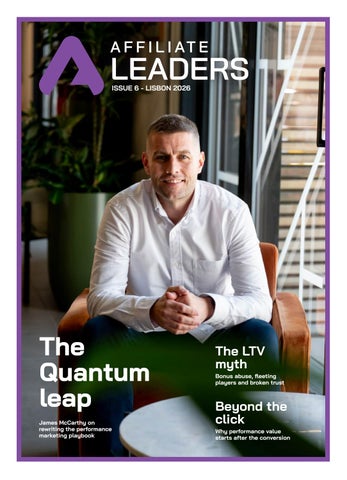
ISSUE 6 - LISBON 2026
The Quantum leap
James McCarthy on rewriting the performance marketing playbook
The LTV myth
Bonus abuse, fleeting players and broken trust
Beyond the click
Why performance value starts after the conversion
The leading source of news, insight and expert analysis across North America’s betting and gaming industry. SBC Americas delivers regional coverage, market intelligence and in-depth reporting on regulation, operators, prediction markets and more.
The leading Spanish-language source for news, insight and expert analysis across Latin America’s betting and gaming industry. SBC Noticias delivers regional coverage, regulatory updates and indepth reporting on operators, markets and emerging opportunities.
The premier Portuguese-language resource for news, analysis and expert commentary on Brazil’s fast-evolving betting and gaming market. SBC Notícias Brasil provides local insight, regulatory coverage and trusted reporting on the operators and trends shaping the industry.
The home of news and expert insight on the global payments industry. Payment Expert provides expert coverage on everything from the rapid-growing crypto sector to the fast-moving fintech space.
The daily podcast from the SBC Media editorial team that covers the biggest news, stories and talking points across the entire industry, every region, every vertical.
EDITOR’S NOTE
The revolution continues
I
t’s been the talking point all year to the point it’s starting to sound like a cliché – the affiliate marketing industry is going through a period of seismic change. It’s evolving like never before and we’re really starting to see how marketers are now adapting. In our cover feature, I speak to Quantum’s chief marketing officer, James McCarthy, about how the company has rebranded, restructured and repositioned itself so it can expand its offering to sectors outside of igaming. He talks about bringing their technology operations in-house to offer greater control and flexibility; the media group’s recent acquisition of digital rewards brands; and what this all means going forward. Speaking of change, Fernando Noodt Molins speaks to Catena Media’s Pierre Cadena on why it’s no longer about the click, the value is in what happens after. Cadena argues the industry’s obsessions with FTDs has always been somewhat misplaced. It’s no longer about vanity metrics like clicks and impressions – it’s about incrementality and multi-touch attribution. Lifetime value is also another model affiliates and operators have become obsessed with in recent years.
While it can be a good measure of success, we dive deep into whether changing player behaviour, bonus abuse and wavering operator-affiliate relationships could be threatening the player lifetime value model. But that’s not the only thing to consider. In this fragmented landscape, Ted Menmuir notes that performance marketers are moving away from reporting historical figures and towards predictive analysis. It means being able to understand whether a player will generate value using data signals and then targeting them accordingly. It’s no longer about spending the most, it’s about making campaigns work harder across multiple touch points. It’s clear things are changing and this edition of Affiliate Leaders looks to tap into the variety of ways this is manifesting. At the rate things are evolving, I’m sure by the time the next issue comes out in 2027, we will be seeing glimpses of what the new era of affiliate marketing looks like. Enjoy the read. Sincerely, Jyoti Rambhai
AffiliateLeaders.com
3
CONTENTS
Affiliate Leaders is brought to you by SBC - Sports Betting Community. Editor Jyoti Rambhai jyoti.rambhai@sbcgaming.com Editorial team Andrew McCarron, Martyn Elliott, Ellen Jennings-Trace, Ted Menmuir, Ted Orme-Claye, Joe Streeter, Lucia Gando, Leonardo Biazzi, Tom Nightingale, Adam Candee, Charlie Horner, Christian Lee, Justin Byers, Erin Gallagher Sales team Rasmus Sojmark, John Cook, Alyona Gromova, Conall McCabe, Jan Kowalczyk, Bob McFarland, Craig Brown, Ed Young, Camilla Scott Creative lead/design & layout Jessica Camilleri
08
Exposing the lifetime value myth Player behaviour, bonus abuse and lost trust threaten the LTV model
All material is strictly copyrighted and all rights are reserved. No part of this publication may be reproduced in whole or in part without the written permission of Sports Betting Community Ltd. Although every effort has been made to ensure the accuracy of the information contained in this publication, Sports Betting Community Ltd cannot be held responsible for any errors it may contain. Sports Betting Community Ltd cannot be held responsible for the loss or damage of any material, solicited or unsolicited. The views of the publication are not necessarily the views of Sports Betting Community Ltd or those of the advertisers. Produced and published by Sports Betting Community Ltd: Registered address: SBC, 2nd floor, 212 New Kings Road, London SW6 4NZ Tel: +44 (0) 161 367 1250. Email: sales@ sbcgaming.com. Web: www.sbcgaming.com For all the latest developments in the Affiliate Leaders community, please visit AffiliateLeaders.com
4
Lisbon 2026
16
Quantum’s leap into e-commerce James McCarthy on rebranding and repositioning the company
20
Riding the AI waves in marketing What igaming brands must consider to avoid sinking
24
Moving margins in a post-click era How the affiliate value now starts after conversion
30
Navigating Google’s black box Anthony Fletcher on AI and the measurement dilemma
34
Affiliate voices
38
Tapping into esports
42
Affiliate anatomy: BetMGM’s Sarah Sabo
16
Affiliate Leaders asked marketers worldwide how they are adapting to search’s rapidly changing landscape.
Rise in mobile, events and esports betting offers advertising opportunities
24
How affiliate drivers in retail are coming to igaming
46
Efficiency as the new measurement
46
Why campaign architecture is vital to success in the 50% era
54
From clicks to credibility Why building trust is now an affiliate’s biggest advantage
58
Predictions market beyond boarders
64
A look at the state of the sector as it expands out of the US
64
Moving away from AI content factories How marketers are generating AI avatars and influencers
AffiliateLeaders.com
5
OP-ED
The real reason affiliate partners keep getting shortchanged Rosalyn Berrisford, from Awin, discusses one of the biggest challenges that has been plaguing marketers for years – measurement
“
Most measurement models still only recognise the transaction at the journey’s end
6
Lisbon 2026
OP-ED
T
here’s a word that’s constantly used in affiliate marketing and means something different each time: measurement. Some mean last-click attribution, others multi-touch modelling. And still others define it as whatever their tracking platform reports by default. None of them are wrong. But the fact that we can’t agree on a shared definition is our industry’s biggest problem, and one that we’ve been living with for years. The tools to track a customer journey already exist. What’s missing is agreement on how to use them, and that’s costing real people, real money. The cost of inconsistent definitions Two publishers can do equally valuable work and get paid wildly different amounts for it. The difference isn’t the work. It’s whose measurement model they got judged against. Fair attribution shouldn’t depend on which client you happen to be working with. Yet today it does. Take a single campaign. Under last click, a publisher who introduced ten thousand people to a product gets nothing, as someone else’s link happened to close the sale. Under a multi-touch model, that same publisher might be the single biggest driver of the result. Same campaign, same data, but two completely different verdicts on whether it worked. Multiply that across every brand relationship that a publisher has, and you see why so many partners feel like they’re judged by a different rulebook every time. This also makes it basically impossible to know what’s really working. A campaign might look like a failure under one model, and like a winner under another. Without a common baseline, everyone ends up arguing about different things and nobody solves anything. AI has made it harder to ignore Consumers no longer discover products the way they did even two years ago. AI-driven search and recommendation tools are now a significant part of the path to purchase, showing products, comparing options and shaping decisions long before anyone clicks a tracked link.
That changes what attribution needs to be. A creator or publisher who gets a brand featured in an AIgenerated recommendation, or who builds the kind of trust and content depth that AI systems draw on when answering a query, is doing real commercial work. But most measurement models still only recognise the transaction at the journey’s end. Meanwhile, factors like influence, recommendation and brand exposure earlier in that journey go largely uncredited. We built these attribution models for a straight-line journey. But people don’t shop like that anymore. Until we catch up, the partners doing some of the most valuable work in the funnel will still go unrecognised. All because our tracking was never built to see them. There’s a risk here too. If partners only get rewarded for the activity that legacy measurement recognises, we’re steering them toward whatever gets credited instead of whatever really moves the customer. That’s a disconnect between what partners get paid to do and what drives outcomes for the business. What a fix looks like The tools are already here. What’s held the industry back is education, resourcing and alignment – brand teams who’ve never trained on what good measurement looks like and agencies making the same case one client at a time without a shared standard to point to. Fixing that begins with a blueprint the whole industry can work from. It’s a coordination problem. And coordination problems don’t get solved by one brand doing the right thing quietly on its own, they get solved by shared standards. The affiliate industry needs an agreed minimum bar for fair tracking and attribution, one that brands, networks and partners all sign up to rather than each side making its own call. In practice, that means: • Agree a common definition of measurement across the industry; • Expand attribution to credit influence and discovery beyond the final click, including what AI-
driven search now contributes; Invest in training and resourcing so brand teams can put good measurement into practice, not just default to whatever their platform gives them; and • Get brands, networks and agencies aligned behind one standard, rather than each side making its own case. This isn’t something that one brand or network can fix alone. It needs the trade associations, major platforms and standards bodies that already work across the industry to set the bar and get brands to commit publicly. That’s less about writing new rules and more about taking what already works in parts of the industry and making it the standard everywhere. Consistency is the whole ask here. Agree the standard, then hold to it. Until we fix this, the best partners get paid like the worst ones, and the smaller players with the least leverage pay the highest price for it. Affiliate marketing works. It’s time the way we measure it caught up.
•
Rosalyn Berrisford is the regional managing director at Awin
AffiliateLeaders.com
7
DEEP DIVE
Slay the dragon 2026 sees the myth of lifetime value exposed
Changes in player behaviour, bonus abuse and wavering operator-affiliate relationships threaten the credibility of the player lifetime model Words by - CHRISTIAN LEE -
L
et’s begin with some provocation… the economics of modern gambling have been built on a fallacy. This author is no antagonist and understands this is no new phenomenon, just a very human dynamic. Nations, civilisations, markets and economies have been shaped by the fallacies the public chooses to believe in. The Roman Empire was not founded by two twins raised by a wolf, just as Isaac Newton almost certainly never discovered gravity due to an apple falling on his head. This is not just attributed to ancient folklore, as the 2000s dot-com bubble convinced investors that growth alone was
8
Lisbon 2026
a sustainable business model – a lesson many in tech believe has yet to be learnt. Put simply, anyone can be partial to inheriting a comforting illusion, and why should it be any different for online gambling? Case in point, the concept of player lifetime value (LTV). A value put on paper with the credence that every acquired customer represents a stable revenue stream whose future output can be modelled with confidence. Unquestioned, leadership has promoted LTV as the commercial principle to build igaming business’ upon, the uncontested truth that dictates the terms of budgets, partnerships, supplier arrangements, media or marketing deals and investor expectations.
DEEP DIVE
As such, for 20 years and more, LTV has been an enduring fallacy for gambling, but in 2026 the market and its economic realities have caught up with the falsehood. The reality is exposed to its bare bones as igaming enters its ‘50% era’ in France, Germany, the Netherlands, Poland and the UK, which has seen higher taxes, compliance costs and regulatory demands halve the cake of income. Thinner operating margins, reduced cash generation and mounting pressure on balance sheets mean leadership and investors now prioritise cost controls and the preservation of bottom-line profits. This is a condition that has hit marketing teams the hardest in 2026, so
it’s time to let go of the LTV myth for the better of everyone’s sanity. It’s the circle of life At the heart of the issue is that player behaviour has fundamentally changed over the past 20 years, reflecting igaming as a mature online market. The initial enterprise period of igaming witnessed in the early 2000s was followed by the wild expansion of new brands entering markets that applied relentless incentives to acquire customers via bonuses, promotions, high CPA and revshare rewards. The impact still lingers today to the detriment of the brands that survived the cut-throat period.
AffiliateLeaders.com
9
The home of global iGaming industry news. Leading coverage on Europe, Asia, Africa and beyond.
JOIN THE EXPERTS
DEEP DIVE
“Early churn is simply a reality of today’s igaming landscape. Many players sign up with no intention of becoming long-term customers,” admits Esko Rissanen, director of revenue for Gentoo Media. Martyn Hannah, co-founder and chief executive of Comparasino, further notes this focus on bonuses as a welcome tool has only hurt affiliates in the long run and attracted the type of players that will eventually harm their returns through LTV agreements. He says: “Historically, a first-time deposit was an open-ended investment. But today, it’s an increasingly finite event. Net gaming revenue used to grow reliably over a player’s lifetime, but now it front-loads heavily in the first 30 to 60 days before dropping off a cliff.” The data backs up Hannah’s unflattering assertion. According to Smartico, day one retention sits at 30%, falling to 8% after a week. At 30 days, retention sits at between 2% and 20% for operators.
including light-touch affordability checks, enhanced KYC and verification delays. “If we send a player who is primed and ready to spin a slot, making them jump through so many hoops kills their impulse intent.” While it can be easy for operators to point the finger squarely at the constraints they are forced to work in, the burden falls on marketing and affiliate teams to attract the type of customers that are likely to stick around for the long haul and return a healthy LTV. Rissanen acknowledges that not all acquisition channels are made equal, and different avenues often return very different results. He says: “We see significant differences in churn and lifetime value across acquisition channels, markets, and operators. Looking at overall averages can be misleading, as different channels naturally attract distinct player types and behaviours. “Higher churn is expected from lowerintent acquisition channels, which naturally pulls down the average LTV.“ At the same time, though, operators are also not all made equal. Rissanen outlines the same channels can return very different results for churn and conversions. However, affiliates routinely bear the brunt of complaints from lagging operators. “Frankly, I think blaming affiliates is just the easiest escape during a monthly marketing meeting,” says Rissanen. “We see a number of operators to whom we have sent leads that consistently fail to convert into NDCs. This causes the most significant financial harm to us, while simultaneously representing a massive opportunity cost for the operator.” This is backed up by Hannah, who says he often sees examples of operators using ‘generic offers’ that bear little relevance to a player’s actual interests. “If a player signs up explicitly to play high-volatility slots from a specific studio, sending them live casino promotions won’t extend their lifetime – if anything, it’ll cause frustration that might ultimately lead them to play elsewhere,” he adds.
RETENTION RATES
Given that customer acquisition can cost an online casino brand between $250 and $500 per user, these statistics make for particularly sober reading for marketing departments across the industry. On top of greater taxes and higher costs, regulatory shifts across key markets are further increasing friction on campaigns to deliver returns. Hannah explains: “It comes down to the journey from click to deposit being choked with necessary, but heavy regulatory hurdles,
AffiliateLeaders.com
11
DEEP DIVE
The bonus conundrum Yet one of the unique threats to the LTV model remains the high exposure of igaming brands to bonus abuse – a matter that has persisted in the evolution of online gambling. Thwarting any loyalty, ‘bonus hunters’ jump from one operator to the next in a bid to exploit the promotional campaigns of operators without ever establishing longterm play on one site. Bonus abuse remains a costly symptom on bottom lines. These players will look to exploit loopholes in the terms and conditions of bonuses to take advantage of promotions or incentives for ordinary players. Bonus abuse fraud now accounts for 63.8% of all fraud in the igaming sector, according to Sumsub’s 2025 iGaming Fraud report, costing operators between 10% and 20% of their total annual revenue. Hannah says: “Multi-accounters create an artificial spike in FTD (first time deposits) metrics but deliver zero long-term value. They systematically extract the bonus value, trigger high administrative and compliance costs for the operator and then leave behind a dead account, driving down average LTV to near zero in some cases.” The situation can be even more dire for affiliates as they have “very little recourse”,
adds Rissanen, when an operator chooses to ban a player for suspected fraudulent play, cutting off that user’s LTV. He says: “We at Gentoo fully support the exclusion of fraudulent players. However, there is very little recourse if an operator states that players have been excluded due to multi-accounting or self-exclusion. In my experience, if the percentage of players excluded for these reasons crosses a certain threshold, the situation becomes highly suspicious.”
“
Multi-accounters create an artificial spike in FTD metrics but deliver zero longterm value 12
Lisbon 2026
“
It comes down to the journey from click to deposit being choked with necessary, but heavy regulatory hurdles, including light-touch affordability checks, enhanced KYC and verification delays
To tackle this issue, it’s about moving away from aggregate lists that are sorted by the size of the welcome offer, says Hannah, as this acts as a ‘beacon for bonus hunters”. Meanwhile, highlighting casinos with low or no wagering, as well as introducing intent filters, creates a layer of ‘good friction’ that works for casual players while deterring multi-accounters looking for quick tracking links. If the LTV model can continue to offer any utility, operators must find a way for bonus offers to work for them while clamping down on actual abusers. How this is done, in many ways, is the billion-dollar question as the marketing of online gambling has become a race to the bottom on price and sign-up incentives. Players have come to expect bonuses as the main incentive for signing up or switching from one platform to another, and perhaps operators at this point have no option but to accept that a percentage of their marketing spend will be frittered away
DEEP DIVE
on players that are only there to abuse the system for their own gain. Future fix The concept of LTV sits on rocky ground shaken by player behaviour, acquisition costs and regulatory changes, but is there an alternative on offer? For both Rissanen and Hannah, the key is a model that combines LTV, cost per acquisition (CPA), hybrid models and fixed fees. Hannah says: “Affiliates should advocate for tiered CPA structures that award the quality of their alignment (such as matching a player perfectly to the right brands) rather than relying on long-tail revenue share that operators can easily dilute through administration fees.” He also points to the fact that affiliates gather priceless data on player preferences throughout the customer journey, and this intelligence can be leveraged to provide value. He adds: “Knowing exactly what percentage of users are searching for ‘no wagering requirements’ over ‘instant bank transfers’ is incredibly valuable market intelligence for operators and B2B partners.” Though Rissanen says this range of financial models ensures “financial predictability” and acts as an “essential hedge against poor operator performance”, he believes that revenue share will remain the “bedrock for true growth”. “In the end, building real player value should be in the best interest of both parties, as a high net gaming revenue benefits the operator and directly translates to higher revenue share for the affiliate,” adds Rissanen. “At Gentoo, we maintain a clear understanding of the value we expect from different market and channel combinations, and we prioritise working with partners who consistently meet or exceed those expectations.” Towards healthier relationships Keeping the LTV model alive has to be a key priority for stakeholders across the industry, as a thriving sector is typified by repeat customers and long-term user health. However, it’s clear the model is on life support at this moment in time. If a solution is to be found, there are some bridges that need to be strengthened between the two parties.
AffiliateLeaders.com
13
DEEP DIVE
“
The high click-toFTD drop-off is a symptom of a broken search and discovery model
Due to the current issues facing LTV, operators have started to ‘unbundle’ net gaming revenue (NGR) and introduce admin fees, payment processing deductions and bonus costs that diminish payouts for affiliates. This has led to Gentoo being forced to use alternative methods to “separate the wheat from the chaff”. “There is no industry standard for how NGR is calculated. We actively use alternative metrics – such as GGR (gross gaming revenue) and player deposits – to calculate casino hold,” Rissanen notes. “We are also utilising proprietary business intelligence tools to spot sudden fee hikes, allowing us to challenge them on a day’s notice. We are constantly benchmarking operators against the market standard, and if something seems off, we address the issue to get to the root cause. Such as, what is the reason for lower revenue? Is it higher admin fees, PSP deductions, bonus costs, etc.” Like many others, Gentoo is also being forced to contend with operators stripping affiliates of historical revshare players due to inactivity clauses, further harming the lifetime earnings of a player in this era of shorter player lifespans. Rissanen reveals the affiliate, in some instances, is being forced to reactivate accounts that are viewed as dormant by large operators in order to secure payments
14
Lisbon 2026
for those accounts, a situation he describes as “absurd”. He adds: “We are also seeing instances where cutoff dates are introduced to existing revenue-share deals: for example, lowering the revenue-share percentage for players acquired four years ago. This is a massive problem for us, as retroactive changes make revenue forecasting impossible and erode trust in an already low-trust industry.” Slaying the dragon If the LTV model is to have a place, repairing the operator-affiliate relationship must be a major priority for the future prosperity of both parties. Hannah also emphasises that, from an affiliate perspective, there must be a focus on quality rather than quantity, given that up to 70% of players never progress past their initial FTD to become consistent depositors. He points to Comparasino’s use of a recommendation engine and member zone to deliver matches that will lead to high click-to-FTD rates. He says: “An affiliate sending 100 highly qualified, preference-matched FTDs will generate vastly superior NGR over 12 months than 1,000 traffic-binning clicks seeking a generic free spins bonus. “The high click-to-FTD drop-off is a symptom of a broken search and discovery model. When you shift the focus to user preferences (payment methods, minimum deposits, bonus types, payout speeds, wagering requirements, etc) before they click through, the traffic arriving at the operator has a significantly higher intent to actually deposit.” As such, the observations made by Rissanen and Hannah simply circle back to the reality of the dissection of LTV as a trusted value As costs and conditions tighten for all marketing stakeholders, there needs to be a redefining of what LTV really is to reflect the real economics and costs of what igaming marketing encounters on a day-to-day basis. Some may look at the evidence and say it’s time to put an end to the fallacy, but LTV may still have a place for affiliates and operators that understand how to cultivate a loyal player in a market that rewards anything but.
COVER STORY
Pointing the iGaming engine to other verticals 16
Lisbon 2026
COVER STORY
James McCarthy talks about Quantum’s journey from rebranding through to acquiring new businesses as it expands into other verticals Words by - JYOTI RAMBHAI -
W
hen James McCarthy joined Quantum (previously QiH Group) a year ago as the chief marketing officer, he bought more than just an operator’s playbook from his time at LiveScore and Betfair. He brought a front-row seat to where affiliate marketing was heading. It’s becoming a bit of a cliché to say this industry is going through a seismic evolution, but it is true. For years, the traditional affiliate space has relied on straightforward traffic acquisition through tailored SEO and content marketing strategies. But the game today requires a more agency-level approach with media buying capabilities across multiple channels, proprietary data stacks and even to some degree, working across different verticals. Quantum’s rebrand from QiH Group at the end of last year is a clear representation of how traditional affiliate marketing companies in igaming are repositioning themselves. McCarthy makes clear to me they no longer see themselves as a standard affiliate, but a “tech-led media business”. “At the centre of the rebrand was evolution, not reinvention. It wasn’t about rejecting our history – QiH has more than a decade of success. The new brand was to elevate what already existed,” explains McCarthy. “The ‘q’ in QiH always stood for quantum, so it was bringing that out to the forefront. The company’s heritage has always been data-led… quantum being a unit of measurement. We wanted that to be at the centre of the business.” Cashing in on e-commerce For more than a decade, Quantum has built an “engine that turns paid media into high intent customers”. While that engine was built with igaming in mind, it’s now apparent it can be “pointed to other verticals”, he adds. Quantum is diversifying its remit, expanding into verticals such as e-commerce.
In June, the company acquired two digital rewards brands – Cashback and JoinCustard. Cashback.co.uk is an established cashback platform with hundreds of thousands of customers. Users can complete tasks such as surveys, enter competitions, and sign up for free trials or brand offers. Similarly, JoinCustard, a digital rewards firm launched in 2024, focuses on online earnings for completing games, surveys, and shopping with brands. The acquisitions are part of Quantum’s move beyond the affiliate marketing sector and into direct-to-consumer reward products. This extends its reach from a data-led performance-first approach into consumer platforms that can run alongside the platform using the existing infrastructure to help scale the products. McCarthy believes the success Quantum has had in a cutthroat igaming scene, equips the firm to explore other sectors, and the “early signs are encouraging”. “Gaming is one of the more challenging verticals when it comes to digital marketing,” he says. “It’s hyper-competitive, there’s more regulatory considerations… but that’s not to be complacent. “We are under no illusion that it requires work to expand into another vertical. A lot of our success has been predicated on the investment in data and tech – both in terms of people and infrastructure. “It’s about making data accessible at scale and being able to leverage that in your decision-making.” Leveraging in-house capabilities This is in part why the London-based company transitioned its technology operations from outsourced partners to a full in-house team as part of the rebrand and restructure. By “Owning and understanding your own tech allows for greater control and flexibility”, he says, which can then be “customised”, which can then be “customised”, he highlights.
AffiliateLeaders.com
17
COVER STORY
“
The igaming affiliate vertical has a history of operators who are incredibly strong on the organic side and being over reliant on one particular channel
It’s also one of the ways McCarthy hopes the adtech can stand out among its competitors outside of igaming. It’s about “understanding our consumers, how they behave and interact and factoring that into our marketing strategy”, alongside “the tech, the data and infrastructure we’ve built to generate success in these new verticals”, he explains. McCarthy is aware that his team are new to media buying, the different content formats or CRM strategies required for capturing consumer intent in wider verticals. But he’s confident they’ll “learn through experience”, after all, “there was a point in time where we would’ve known very little about igaming”.
18
Lisbon 2026
“We’re not going to know everything about every vertical,” he admits, which is why Quantum now has its very own experimentation team within marketing. “There’s an element of experimentation and investment that’s required to generate data, which enables you to learn faster. We believe in that a lot and it is something that will underpin what we do in understanding something as granular as ‘how does one funnel translate to another in various sectors’,” he says. But it’s not just about experimenting across the marketing funnel. Quantum also has its own in-house creative team, who are leveraging AI to produce assets at a “fraction of the time” compared to previously. “There’s more of a premium being placed on the creative in your marketing now,” McCarthy, who prior to joining Quantum, had always worked more on the digital marketing side, points out. “Not that long ago, a lot of value was being placed on budget and biddings, which is still important, but so is having the right signals within the marketing platforms. “Advertising platforms are becoming more and more reliant on a variety of creatives – they need that diversity to fuel their marketing campaigns and AI has been great in enabling us to do that,” he boasts, but adds he’s sceptical about using the technology to automate and manage campaigns. “While we use AI to draw insights quicker than we previously could, we definitely still like to have individuals monitoring the campaigns.” Using AI is great, but having humans at the heart is even more important in this privacy-first era, says McCarthy, noting “people have the right to privacy”, so you have to “justify what you do track”. Although Google halted its cookie deprecation rollout, more and more consumers are opting out of tracking. Therefore, the pool of data and signals traditionally used by advertisers through cookies is getting shallow. “This presents challenges in attribution, in what you can feed back to the market and the platforms that inform your bidding,” he explains. “Some of this stuff may have been just considered good hygiene, but it’s becoming more and more important.
COVER STORY
“The igaming affiliate vertical has a history of operators who are incredibly strong on the organic side and being over reliant on one particular channel. But what we’ve seen over the past 12-13 months is that it can present challenges in itself, so there is a real need for diversification.” Diversification and growth Quantum is not the first firm with roots in igaming that has repositioned themselves. Gambling Group.com recently rebranded to Grandstand, while GiG Media became Gentoo in 2024. Meanwhile firms like Better Collective, Catena Media and Raketech have kept their respective company names, but repositioned themselves as media groups or tech-driven platforms that offer agency-level services across media for igaming, sports publishing, data and esports. For Quantum, the rebrand, the team restructuring and the acquisitions are all part of its expansion journey as it navigates both chartered and unchartered waters. And that journey shows no signs of slowing. “Growth is very much the objective,” beams McCarthy, and igaming still “maintains a high level of importance” for that. “But we’ve also seen how an asset purchase can shorten our time to revenue in new verticals.” Quantum has got a taste of another slice of pie and it now wants more. The company is keen to diversify while also expanding its igaming arm into other markets. But the challenge for the firm now is balance. “We’ve got a template now that shows us how the buy angle could work for us to grow fast and boost our revenues,” explains McCarthy. “But there’s always a trade off that needs to be understood when it comes to buying versus building… and maybe I’m showing a bit of bias here on the buyside as it’s something we’ve had success at recently and I do want to continue to explore.”
AffiliateLeaders.com
19
BOARDROOM BREAKDOWN
AI forces marketing leaders
to swim in a new ocean 20
Lisbon 2026
BOARDROOM BREAKDOWN
Ted Menmuir examines the reality of riding the AI waves in marketing and what igaming brands must consider to avoid sinking
W
here do we begin? Because this is bigger than marketing. Heck, it’s bigger than online gambling, commerce, entertainment, retail, travel and finance combined. Artificial intelligence (AI) is big because its use across businesses is popular, so I wouldn’t say it is outgrowing what contains it, more so it is growing because of its usefulness commercially. The $800bn being invested by US big tech giants in AI processing alone tells you this is far more than another “generational shift” in business and beyond any of Silicon Valley’s easy pabulum. It is simply here and with a far more profound effect than anyone could have imagined. But how are marketing teams and executives in the igaming sector beginning to engage in AI as a strategic capability, one which is transforming how organisations and leadership approach a core business discipline? And where does one fundamentally begin? Let’s be clear: we have not been here before. Yes, marketing and online gambling have lived through paradigm shifts before – from online, mobile and social media. But no shift has carried the opportunities, risks and liabilities that AI now presents. Those who have lived through every marketing cycle know that only marginal lessons can be applied from those previous revolutions. They changed how we reach customers; AI is changing how businesses’ operate, think, decide and execute. The above reality becomes even more trifling when AI collides with the nuances of an industry such as online gambling, where customer engagement sits alongside intense regulatory scrutiny and ever-evolving compliance obligations. Let’s reflect, did we ever have to worry about the blowback when transitioning to mobile marketing or social media in quite the same way (regardless of any current fallout)? There was no time to ponder, we simply grabbed the wetsuits and rode those tidal waves. Yet AI is a completely different ocean, with an entirely new ecosystem. One cannot help but
feel for today’s marketing directors, because no generation has ever had to navigate elements quite like these… and it feels like many will be taken by the undertow. Into the starting grid “Yes it’s scary, but can we all stop making assumptions and just accept it,” states Roxana Dinescu, head of marketing strategy at Super Technologies, the group behind multinational betting firm Superbet. Dinescu’s frank remark should be observed as she has been hired by Super Technologies as part of its €1.3bn transformation under private equity giant Blackstone. The former Betano executive will lead AI transformation projects for Super to fulfil the mandate to becoming Central Europe’s highest-valued gambling powerhouse. The standardisation of AI beyond its current utility carries profound implications, as Dinescu reflects: “Once every operator has access to the same AI capabilities, AI itself ceases to be a competitive advantage.” AI will likely be used as another corporate utility like cloud computing or CRM software. The competitive question therefore shifts away from who has AI, towards who is executing with AI in the most optimal manner. Dinescu warns operators to “never confuse technology with differentiation”. “We should consider AI as a tool for the company, but not as a differentiator for operators. Eventually, all of us are or will be using AI in our day-to-day operational systems. What will actually make the difference between brands is strategy driven by humans.” To explain her stance, Dinescu uses her love of Formula-1 (F1) as an analogy: “Imagine AI is the engine of the car and every team has exactly the same engine. “What wins championships isn’t the engine, it’s the team, it’s the strategy and it’s the decisions they make. That’s exactly how I see AI in marketing.”
AffiliateLeaders.com
21
BOARDROOM BREAKDOWN
The igaming industry has spent the past two years obsessing over prompts, copilots and content generation, yet the next competitive battleground may prove remarkably familiar. Far from advocating autonomous marketing departments, those at the coalface of marketing leadership argue that AI should amplify human creativity. Dinescu challenges executives to ask a question that receives remarkably little attention in today’s debate: “The question is no longer when to use AI. It’s when should we actually stop using AI? When is AI relevant, and when is it no longer relevant for customers?” It is perhaps the strongest reminder that efficiency alone does not build enduring brands. Consumers still buy trust, authenticity and emotional connection. Madlen Silagava, head of digital marketing at BetLive, reinforces that argument from a performance marketing perspective, recognising the reality of executing igaming campaigns. “AI has become invaluable for creative testing, campaign optimisation and analysing historical performance, but benefits are only accountable if marketers first understand the customer. “The main goal is to learn user behaviour first, because AI can replace many things, but it cannot replace the user itself. Learning what users want even before they realise it themselves – is still the key.” As operators take their place on the starting grid of AI, the initial lesson is that AI
22
Lisbon 2026
can’t replace the human voice or ingenuity. It should remove or minimise repetitive work, reaping the rewards of spending more time exercising judgement, creativity and strategic thinking. Specialised agents Current developments and investment demonstrate how quickly AI’s role inside marketing departments is evolving. Only a year ago, the utility of AI was focused on generating copy or creating advertising visuals. Yet, intelligence is taking shape as leadership wants AI to analyse campaign performance, identify consumer patterns, optimise media buying, and forecast customer engagement to improve ROI. The above dynamics are essential to Silagava leading BetLive campaigns on a greater demand for cost control at an operator seeking to become a leading challenger sportsbook in European markets. Expanding into new markets, BetLive now feeds years of advertising performance into AI systems, allowing the technology to identify common characteristics behind its highestperforming campaigns. “We collect our ads, together with their visuals and performance data, feed them into AI tools and allow the models to identify patterns between our best-performing campaigns. Those insights become the foundation for our next campaigns.” Armed with new data, Silagava has sanctioned BetLive to invest in building-out AI agents “capable of supporting
entire marketing operating systems from campaign briefing and insight gathering to planning future creative strategies”. She adds: “Tomorrow’s marketing departments are unlikely to consist simply of marketers asking ChatGPT to write advertisements.” Instead, they will oversee networks of specialised AI agents capable of analysing performance, recommending strategies, planning campaigns and coordinating workflows while humans remain responsible for commercial judgement and brand direction. “Some operators will embrace largely autonomous campaign execution. Others will use AI primarily as a strategic tool to launch campaigns. Either approach represents a fundamental departure from traditional marketing operations.” Governance is the ultimate control If marketing represented the opportunity, the governance of AI will emerge as the industry’s defining challenge. For gambling, AI governance is rapidly becoming less of an IT discussion and more of a leadership responsibility on the ethics of gambling marketing – and a discussion that Lasha Jojua, head of AI and innovation at Flutter Entertainment (central and eastern Europe) urgently calls for. Jojua warns audiences not to understate this liability, noting that introducing AI resources into a regulated organisation requires far more than deploying technology.
“
BOARDROOM BREAKDOWN
Technology is only one part. You also have people, processes and governance, and all of these need to be aligned
“Technology is only one part. You also have people, processes and governance, and all of these need to be aligned. We’re building responsible AI frameworks, analysing risk tiers, understanding where AI should and shouldn’t operate, and ensuring visibility over how these systems behave.” The executive draws an important distinction between enterprise AI and the growing risk of “shadow AI” employees unknowingly exposing sensitive company information through consumer AI tools. “When integrating AI with critical systems, organisations must think carefully about whether those systems are enterprise-approved or simply shadow AI. Access, permissions and security must be managed for AI agents in exactly the same way they are managed for employees.” Jojua does not want the role of AI doomsayer, but is a strong advocate for operators to ensure the marketing and AI utilisation is governed by “humanin-the-loop decision-making” and should be the “defining principle of AI” within regulated gambling. Silagava shares a similar view, adding: “We should not manipulate our customers. We should not use their financial or emotional states to improve our profit. Beyond being ethical, it’s also bad for business because if we lose their trust, it’s a short-term game.” For an industry that has spent decades regulating products, advertising and customer interactions, the next challenge is arguably more complex: governing intelligent systems before they begin making decisions on behalf of both operators and consumers. AI is the perfect storm that will test the credentials of a modern marketing team, but we’re still in the middle of deep ocean waters – it’s unclear where the shoreline is just yet.
Ted Menmuir
AffiliateLeaders.com
23
FEATURE
Moving margins: Why affiliate value starts after the click
Fernando Noodt Molins speaks to Catena Media’s Pierre Cadena on what the new era of affiliate marketing looks like in igaming
O
ver nearly two decades, first-time depositors (FTD) have ruled affiliate marketing in igaming. How that metric performed shaped the industry’s economics. Competition revolved around how affiliates generated more clicks, more registrations and, ultimately, more FTDs, while operators rewarded acquisition volume above almost everything else. But as artificial intelligence AI transforms digital marketing, mature regulated markets become more competitive and operators shift towards hybrid and revenue-share agreements, the definition of success is beginning to change. Today, the industry’s most forward-looking affiliates are asking a different question. Instead of, ‘how many players can we send?’, they are asking, ‘how valuable are the players we keep?’. That shift represents what could become the industry’s post-click era. Pierre Cadena, chief operating officer at Catena Media, argues the industry’s obsession with FTDs was always somewhat misplaced.
24
Lisbon 2026
“The FTD was never the product,” he says. “It was the receipt.” For years, first deposits became the industry’s preferred performance metric, because they were easy to measure. But as operators’ focus shifts to long-term profitability, the weaknesses of that model have become apparent. Operators across mature markets have become more selective about the traffic they purchase. Rather than rewarding affiliates simply for generating deposits, they increasingly want players who continue wagering months after registration and ultimately generate sustainable net gaming revenue (NGR). That changes the affiliate business fundamentally. “When you’re paid on NGR, you’re no longer selling a click,” Cadena explains. “You’re taking a position on a player.” Instead of chasing as many conversions as possible, affiliates are pushed to match the right customer with the right operator, leading to a reduced churn and increased player lifetime value.
The wider digital marketing industry has already begun making a similar transition. Brands have moved away from vanity metrics, and no longer care about impressions or clicks. Now, they seek customer lifetime value, incrementality and multi-touch attribution. The road goes far beyond the first click Perhaps the biggest consequence of this shift is the affiliate journey no longer ends when a player clicks an operator link. Historically, affiliates effectively handed the customer over. Everything after registration belonged to the operator. Today, instead of acting purely as acquisition channels, many affiliates are experimenting with loyalty programmes, private communities, personalised newsletters, Telegram and WhatsApp groups, Discord servers, exclusive competitions and educational content that keeps players engaged long after they register. Cadena believes many companies misunderstand what community actually means.
“
FEATURE
“
The FTD was never the product. It was the receipt
Pierre Cadena, Catena Media
AffiliateLeaders.com
25
POSITION YOUR BRAND ON THE
LEADING INDUSTRY NEWS SITE IN BRAZIL PREMIUM NEWS COVERAGE AND HIGH-END FEATURES. TELL YOUR STORY IN BRAZIL WITH SBC.
SBCNOTICIAS.COM
The role of AI Like everything else, AI is also transforming the way affiliates work in the igaming industry. While it makes it much easier to create content with it, Cadena believes that is only part of the process. “I believe there are two AI stories,” he says. The first involves production. Generative AI dramatically reduces the cost of creating articles, comparison pages and landing pages. While this improves efficiency, it also lowers barriers to entry and makes mass-produced content increasingly commoditised. “Everyone can do it, which means the marginal value of massproduced content falls to roughly what it costs to produce. That’s a problem for content as a commodity, not for genuinely good publishing, which is getting rarer and therefore more valuable,” Cadena explains. As search engines continue prioritising expertise, originality and genuine user value, simply publishing more pages is unlikely to provide a lasting competitive advantage. The second story is considerably more interesting. Rather than creating content, AI becomes a decision engine.
“AI can be used to value demand, price it, route it, and, in the moment, determine where a user is most valuable. That’s where the margin goes. I see affiliates investing heavily in the first story,” he adds. “AI won’t replace affiliates. It will replace the part of affiliation that was always a commodity, and it will expose anyone who had only that.” The industry has a ‘trust problem’ If affiliates are expected to optimise for retention and lifetime value, they need access to far richer data than traditional CPA models provide. Cadena argues the problem isn’t a lack of technology. It’s trust. “We don’t have a data problem,” he says. “We have a trust problem with a data-shaped symptom.” Operators hold most of the information affiliates need to evaluate long-term player quality. Affiliates, meanwhile, often have limited visibility into what happens after registration. The result is familiar across the industry: two businesses analysing the same player through different dashboards and reaching different conclusions. “Solve that, and the intelligence layer becomes the interesting part – valuing a player, pricing them, deciding where they’re worth the most,” he assures. “But that is the second problem, not the first. Trust determines whether data moves at all; intelligence determines what it’s worth once it does.” Rather than building ever more sophisticated attribution models, Cadena believes the industry first needs measurement frameworks that both operators and affiliates trust equally. Only then can AI truly optimise player value across partnerships. Leading affiliates of tomorrow While there have been a lot of changes to how affiliation works, none of this suggests that SEO or CPA are set to disappear. Organic search remains one of the industry’s most valuable acquisition channels, while CPA will continue playing a significant role in many markets, particularly in North America.
“
“
“Everyone says community,” he comments. “What’s often meant is a Telegram channel that offers get pushed into.” For him, the real question is much simpler: “The honest test of a postclick strategy is whether you still have a relationship with the player after the redirect fires.” Catena Media itself has started building around that philosophy through PlayPerks – a loyalty programme designed to give players a reason to return to the affiliate brand rather than disappearing permanently into the operator ecosystem. The principle mirrors broader changes happening across digital media. Publishers are increasingly investing in newsletters, memberships, podcasts and owned communities because they reduce dependence on third-party algorithms while strengthening direct relationships with audiences.
FEATURE
We have a trust problem with a datashaped symptom
But all of this is no longer a differentiator. It is quickly turning into the foundation for igaming affiliates, pushing them into new frontiers as marketers. According to Cadena, tomorrow’s leading affiliates will excel in three areas: understanding player value before acquisition, dynamically allocating traffic across operators, and maintaining diversified audiences that are not overly dependent on any single platform, channel or commercial model. Perhaps most importantly, they will continue owning the customer relationship after the click. The post-click era is therefore not simply about replacing CPA with revenue share or adding a Telegram channel alongside a website. It represents a broader shift in how affiliate businesses create value. For years, competitive advantage came from generating more traffic. Increasingly, it will come from understanding which players matter most, maintaining relationships with them for longer and using data, AI and trust to maximise value throughout the entire customer journey.
AffiliateLeaders.com
27
MAP
MAPPED
Top 5 upcoming regulations in Europe that marketers need to know
ACROSS THE EU
ACROSS THE EU
iGaming / e-commerce / fintech EU Single AML Rulebook (Reg 2024/1624)
E-commerce / tech / marketing EU AI Act enforcement (ad transparency)
Regulation explained: Replaces fragmented national rules with a single, directly applicable EU anti-money laundering framework requiring enhanced due diligence.
Regulation explained: Mandates clear labelling for AI-generated marketing content and restricts manipulative algorithmic user profiling.
Marketer risk: High sign-up drop-off; onboarding friction increases as frictionless deposit hooks are restricted by mandatory identity checks.
Marketer risk: Heavy fines for undisclosed AI marketing, limits on hyper-targeted retargeting algorithms, and mandatory consent for automated profiling.
IRELAND
UNITED KINGDOM
iGaming / sports betting Ireland Gambling Regulation Act (GRAI)
Sports / sports betting Premier League gambling shirt ban
Regulation explained: Establishes the GRAI regulator and imposes a strict 5.30am to 9pm broadcast ad watershed, plus opt-in requirements for social ads.
Regulation explained: Enforces the phase-out of gambling branding from the front of matchday shirts starting in the 2026/27 season.
Marketer risk: Near-total elimination of daytime broadcast ad inventory and severe limits on organic and paid social reach without prior opt-in.
28
Lisbon 2026
Marketer risk: Forces sportsbooks to pivot away from prime front-of-shirt real estate into pitch-side digital boards, sleeve slots, and content-led campaigns.
MAP
FINLAND iGaming / sports betting Finland Gambling Reform Act Regulation explained: Ends the state monopoly (Veikkaus) in favour of an open licensing framework, opening application windows in 2026. Marketer risk: Opens a major new market, but bans influencer marketing, direct marketing without active consent, and aggressive bonus mechanics.
AffiliateLeaders.com
29
INTERVIEW
Google is a very black box Words by - ELLEN JENNINGS-TRACE -
Advertisers have long been at the mercy of a few dominant networks and platforms – but none are quite so unilateral in their power as Google
A
staggering 80% of Google’s revenue comes from its advertising arm, equating to roughly $150bn a year. The tech giant has dominated search marketing since it launched Adwords – now Google Ads – in 2000. Statcounter data shows Google still holds 90% of the
30
Lisbon 2026
global search market. But with the rise of AI chatbots and social media platforms, new ways of discovery are emerging, creating a fragmented search landscape. It begs the question, could Google’s dominance be challenged? Affiliate Leaders spoke to Ashley Fletcher, chief marketing officer
at Adthena – a search intelligence platform – to discuss exactly how the marketing and affiliate landscape is evolving. “At the moment, there’s a huge shift [in where] people are starting their journey,” explains Fletcher. “LLMs and AI advertising is undoubtedly transforming the way
“
that consumers search and discover new products – but Google still holds commanding power over the market.” Users are increasingly starting their journey in LLMs like ChatGPT rather than traditional search engines – which means the customer journey is happening within one unified ecosystem. “The general impact on CTR (click-through rates) would be on higher funnel queries,” he says. He gives the example, if someone is researching, ‘what the best top 10 gambling sites with welcome discount codes are, then the content appears behind the ads – so “mapping user journeys is becoming more difficult for advertisers”. “From the ChatGPT perspective, you probably want to run ads [there] if that’s where people are hanging out and starting their journeys, then pick up all of that on Google as well,” Fletcher explains. Transforming journeys OpenAI introduced ads into ChatGPT in February 2026, and despite a slow start, advertisers are experimenting with the platform. Fletcher explains: “The rate in which ChatGPT has run out their ads platform is hugely impressive, which goes to show there’s a market for this.” According to Adthena’s research; ChatGPT, Google AI Mode, and Google AI Overviews have four billion combined monthly touchpoints – and AI Overview ads grew by 278% from Q1 to Q2 in the US, Australia, and Asia-Pacific.
INTERVIEW
[Advertisers] always have to put up with a market leader like Google working with their own metrics that they create
Brands and advertisers need to be hyper-aware of the changing customer journey, Fletcher says, and how the different platforms facilitating this can change the brand outcome. AI platforms can offer an active and engaged audience with purchasing intent. “The beauty of it is, if you’re ready for an ad and the timing is right – it will be a premium experience in exchange for an advertiser.” There’s rumours that Gemini may soon feature ads, despite previous insistence this wouldn’t happen. But it could be a sign advertisers believe in the potential of advertising within LLMs (or, just that AI stakeholders need to finally see some return on their investments). “People are enjoying those lower CPCs (cost per click), which is what we’re hearing – a stark contrast to the saturated Google market, where people are just frustrated with ever increasing CPCs.” The measurement dilemma With Google’s sophisticated ad infrastructure and AI features, it can offer a practical and well-established ecosystem – whereas other platforms are still in the development process. “It’s going to take a seismic shift in devices, behaviours, and things like that [for AI to challenge Google]. Google has got a massive advantage with their devices and their Chrome browser. A lot of people start their journey there.” This rising popularity of alternative ad platforms and ecosystems leaves marketers vulnerable to inconsistencies in
measurements – with traditional metrics not necessarily translating into success across such a wide range of platforms. “[Advertisers] always have to put up with a market leader like Google working with their own metrics that they create. So, like with AI Max, it’s an incredibly compelling proposition, right? You plug in one ad, and we’ll get it everywhere.” But, that’s not necessarily what marketers want. A blind trust in an AI ad platform removes vital control for brands and advertisers, who often look for specific feedback, and performance measurements so they can fine-tune their campaigns to best suit their goals. “Advertisers and humans that are sticking around through this massive transition with AI will push for knowledge on that, no matter what. I don’t think we’re in the realm of ‘I’m just going to load it up with all my ad budget, and you just spend it and get great returns,’” Fletcher argues. AI ad platforms are not a silver bullet for advertisers, and they can’t fully automate the ad process in their current form – but the minimal infrastructure can be a way for brands truly measure their basic functions. “If you look at where ChatGPT Ads Manager started out, [with] incredibly basic auction mechanics, which is refreshing to see – they’re not trying to reinvent the wheel and do other stuff like that. It’s like; I put this money in, I want this money out. Brilliant, like everyone understands it. Whereas Google is a very black box.”
AffiliateLeaders.com
31
HEADER
32
Lisbon 2026
“
Advertisers and humans that are sticking around through this massive transition with AI will push for knowledge
INTERVIEW
Its Performance Max (PMax) is an AI-driven Google Ads campaign type, which lets advertisers run ads across all of its channels, including search, YouTube, display, discover, Gmail, and Maps – all from a single setup. This has traditionally been a pay-off for advertisers, who have to accept a level of secrecy and opacity in order to take advantage of the performance and efficiency gains that PMax can offer. Shifting sands Google recently trialled two features in PMax that signalled a move towards greater flexibility for advertisers, even in AI. These features allow marketers to exclude inventory from third-party search partners and Google Display Network from campaigns. While Google has reiterated this is a pilot with a very limited group of advertisers, it does outline an appetite among advertisers to get more specific controls. A spokesperson for the tech giant told Affiliate Leaders: “This is a pilot launched with a limited group
of advertisers. At the same time, our North Star has been empowering advertisers with clear visibility and new ways to confidently steer PMax campaigns. As our AI capabilities evolve, we remain dedicated to providing the tools needed to help drive real business outcomes.” Google’s PMax has traditionally been a trade-off for marketers, who have to accept a distinct lack of visibility and adjustments in order to take advantage of the increased efficiency it can bring. The increasing pressure on marketers to explain, evidence, control, and justify where each and every ad dollar is spent, has made the lack of transparency a point of contention – but the tide is changing as marketers demand more oversight. As advertising develops within LLMs and as their ecosystems evolve, it’s likely toolmakers and ad platforms will include more personalisation and flexibility to their platforms – giving advertisers more control over their campaign distribution, and giving them better insight into their performance.
er
y
hle
As
tch Fle
AffiliateLeaders.com
a
en
dth ,A
33
AFFILIATE VOICES
Search is becoming unpredictable Search is facing its biggest evolution since its inception in the early 2000s. Affiliate marketing, which for so long has relied on traditional SEO practices, now faces a very fragmented landscape. To gauge how marketers around the world are responding to this change, Affiliate Leaders asked:
With Google’s ongoing search changes and rising ad costs squeezing margins, what are you prioritising? Are you building closed-loop first-party data assets (like apps and messaging communities), or are you doubling down on localised paid media arbitrage?
JESPER SØGAARD, Co-chief executive and co-founder, Better Collective “We don’t see it as an either-or choice. The direction is clear: we are building stronger, direct relationships with our audiences through our brands, products, communities and first-party data, reducing our dependence on any single distribution channel. “At the same time, paid media remains an important part of our business, particularly in markets where our data, local expertise and technology enable us to invest efficiently. “Ultimately, our priority is diversification: owning more of the audience relationship while using technology and data to make every acquisition channel more effective.”
34
Lisbon 2026
AFFILIATE VOICES
WILLIAN LOPES, Founder, AFFiGaming
DAN ODA, Commercial director, SuperAfiliados
“Today, our priority is building proprietary assets and closed ecosystems. We rely less on third-party platforms and more on creating communities where the affiliate evolves from a mere traffic generator into the primary point of contact with the player.
“Localised paid media isn’t a flawed affiliate strategy – it just needs proper positioning. Rather than relying on paid traffic as your sole conversion engine, treat it as a precision instrument to fuel the top of your funnel.
“The community becomes the hub for acquisition, relationship management, retention, and reactivation, enabling direct, personalised communication. This generates first-party data, reduces reliance on Google’s fluctuations and rising paid media costs, and significantly boosts campaign efficiency. “In practice, this model enhances the user experience, raises the average transaction value, increases LTV, and strengthens the affiliate’s brand as a long-term asset. Whoever controls the community controls the relationship, and whoever controls the relationship builds operations that are more predictable, profitable, and sustainable.”
“The hybrid affiliate strategy uses hypertargeted paid media (such as Meta Ads or Google local services) to instantly capture high-intent regional demand at a predictable CPA. Once affiliates secure that first touchpoint, the focus must shift to ecosystem lock-in. Drive users into your owned channels via app downloads, VIP communities, or exclusive partner offers to maximise lifetime value (LTV). “By blending fast paid acquisition with highretention publisher infrastructure, networks and partners reduce long-term CAC and transform one-off conversions into scalable, recurring revenue.”
AffiliateLeaders.com
35
AFFILIATE VOICES
GURPRIYA SAPRA, Head of marketing, Covers
PIERRE CADENA, Chief operating officer, Catena Media
“Both, but the allocation is shifting fast. Paid media and SEO remain critical top-of-funnel drivers, it’s how the majority of our audience discovers us. What’s changed is that we’ve stopped treating it as the whole strategy.
“That framing is a false binary. Both options still assume you’re renting distribution from someone else.
“Our key investment now is in first-party assets, a dedicated Covers app launching this year, alongside expanded CRM and lifecycle infrastructure designed to reduce our dependence on any single channel’s pricing model or algorithm shifts. “Paid media drives discovery, owned channels are what convert that discovery into long-term value. Given the pace of change in the ad landscape, we’d rather build the asset we control.”
“Paid arbitrage is a tactic – it works until the auction re-prices. First-party assets matter, but a community that only grows via one acquisition channel is still a single point of failure. “Our priority is resilience: driving every property below 35-40% dependence on any single demand source, and the operational ability to shift across search, social, email, and partners faster than the market moves against us. “Affiliate publishing isn’t dying. The version of it that only publishes is.”
CALLUM RICHES, Head of strategy, Receptional “AI Overviews are eating organic clicks, CPCs on paid search keep climbing, and the arbitrage math that used to work is thinner every quarter. Chasing cheaper geos and languages buys time, not a fix. “What we’re actually prioritising for clients is owned channels that don’t get taxed by Google or Meta on every touchpoint. Apps, CRM, loyalty, messaging. Acquire the player once through paid, then keep them without paying rent on every message after.”
36
Lisbon 2026
AFFILIATE VOICES
MARK MCGUINNESS, Fractional chief marketing officer, CreateFuture
ANDREW GARVEN, Head of affiliate marketing, Bet99
“Google’s changes hurt anyone whose model rests on borrowed traffic, which includes a lot of affiliates. If your whole business is built on your rankings and your paid strategy, you risk being one algorithm update from a very bad quarter.
“That’s a great question, and I don’t think it’s an either/or decision. Paid media remains an important acquisition tool, but the goal is to make it more efficient over time.
“First-party data is what will make an affiliate indispensable rather than interchangeable to an operator. That leaves those building their own audiences in the safest position. Owned communities, email lists, apps, direct messaging are assets that won’t vanish when a SERP changes. “Paid does still have a place. A well-run localised campaign or a media buy will always find margin, but I’d treat it as tactical, not foundational. “So, the question doesn’t come down to paid versus owned. It’s whether you’ll still have an audience to sell when the cheap traffic channel dries up.”
“Search is becoming less predictable, AI is changing how people discover brands, and acquisition costs continue to rise. Paid media is still an effective acquisition channel, but to keep it efficient, you need strong retention programmes behind it. “Every betting moment should be an opportunity to strengthen our relationship with existing 99ers or welcome new ones into the community. As that community grows, we’re able to rely more on our owned channels to engage and retain customers, making every acquisition dollar work harder. “The objective isn’t to replace paid media, it’s to build a multi-channel acquisition strategy that improves efficiency, lowers acquisition costs over time, and creates stronger, direct relationships with our customers.”
AffiliateLeaders.com
37
FEATURE
Esports:
The untapped potential for advertisers The rise in events, mobile and the legalisation of e-sports betting has seen this sector grow rapidly over the past few years, making it a huge opportunity for brands to reach highly engaged audiences Words by - ELLEN JENNINGS-TRACE -
38
Lisbon 2026
S
ports marketing has seen enormous success in recent years thanks to the growing shift to digital, the rise in athletes as creators and an exploding interest in women’s sport. The global sports advertising market was valued at $62.3bn in 2025 and is projected to reach $118.7bn by 2034, according to Dataintelo. Within that, there is another subcategory that is also showing signs of growth – esports. Research and Markets data shows the esports market was valued at $1.97bn in 2023, and is forecast to reach $5.18bn by 2029, rising at a compound annual growth rate (CAGR) of 17.48%. Key elements driving this growth include augmented reality (AR) and virtual reality (VR) tech, which is offering immersive, interactive experiences; the rise of mobile and streaming platforms; and events – which make this a potential goldmine for marketers. Events are primarily digital-first and video-game focused – data from esports Insider revealed that peak viewership reached almost seven million for League of Legends World Championships in 2024 (excluding China). The competition was only established in 2011, which shows it has grown exponentially. Esports is no longer just an accessible pastime for young children and teenagers, but an industry in itself. Demand Sage research identified 52% of US esports audiences are aged between 18-34, with the average watcher being 26. Total esports viewership sits at around 640 million in 2026 and is projected to reach up to 925 million by 2030. There are around 318 million core fans and 322 million casual viewers – with 80% identifying themselves as active gamers.
“
FEATURE
Esports betting is one of the fastestgrowing segments of the global regulated gambling industry
Engaged audiences The esports industry thrives on digital interactivity – and mobile viewership is crucial to the explosive growth of sector. Mobile lowered the barrier to entry for both players and spectators, and opened up the audience to demographics traditionally excluded from PC-focused esports. While traditional sports have particularly well established broadcasting rights and infrastructure, esports enjoys a strong presence on social media and streaming platforms, adding to the accessibility for young fans. Twitch holds 71% of total esports streaming hours, and YouTube gaming held 13.2 billion total gaming hours watched in Q3 of 2025, according to SQ Magazine. Audience participation and player collaboration is a big part of the industry with 80% of co-stream viewers participating in Twitch chat or a comment section for live streams. SQ Magazine data also showed co-streaming increases viewership by 28% during major tournaments.
AffiliateLeaders.com
39
FEATURE
USD$ (bn)
1.25
ESPORTS AD REVENUE FORECAST
1.26
1.21 1.20 1.16 1.15 1.11 1.10
1.06 2025
2026
2027
2028
2029
Source: Statista Market Insights, 2025
Traditional sports do have higher viewership, but esports is breaking records year-on-year (YoY) with a young, highly engaged audience who will follow their favourite players and teams. Unfortunately however, what esports cannot count on, is stability. While traditional sports enjoy well established fan bases and consistent audiences, esports has to fight for viewers, often with clippable or short-form video moments. Ritambhara Tripathi, writer for TalkEsports explains: “Financial success increasingly correlates with audience scale rather than contribution to competitive development or infrastructural growth. For smaller teams, analysts, and research-oriented creators producing high-quality content, the structural disadvantage is evident. Depth does not scale as quickly as spectacle. “Audience consumption patterns shape capital allocation. Platforms amplify content that maximises engagement and watch time. Brands invest where attention aggregates. Creators optimise output according to algorithmic performance indicators.” Reaching audiences 24/7 Esports enjoyed a serious boost in 2020 and 2021 as Covid-19 shut down traditional sports and events. Return on investment (ROI) has been a challenge for advertisers. Franchise fees between 2017 and 2020 for Overwatch League hit between $20m and $60m – but by 2023, the league shut down, suffering major losses across the industry.
40
Lisbon 2026
Sponsorship is a crucial element to esports, it makes up roughly 60 to 65% of total esports-specific revenue according to esports Tower research. Sponsorships brought in $726m for global esports revenue in 2024, and around $1bn in 2025 – showing clear development as the industry grows. Adidas alone invested between €500,000 and €800,000 as the official esports World Cup partner, and PepsiCo sponsored €4m as a strategic partner. For the esports World Cup itself, sponsorships exceeded €50m. The total industry revenue has reached over $5bn, with regions like Saudi gaming and esports projected to add SAR50bn ($13.3bn) to GDP by 2030 to their economies, SQ research reveals. The reason that esports enjoys such success with sponsorships is because it runs 24 hours a day. Teams are able to stream their practice sessions, and players often have their own personal channels they use to promote themselves, their team, and the tournament. While a football team or tennis player may compete between 10-20 times per year, an esports team will generate sponsor exposure through multiple different channels, platforms, time zones, and creators – who already have experience in building their digital audience and interacting with their highly engaged audiences. However, brands must be particularly careful about the placement of their sponsorships. Esports players are not typically media trained in the way that traditional sports stars are – and the existing sponsorship deals often have a reputation for being a little on the distasteful side.
FEATURE
“Sponsoring an esports team also means playing on the same field as sports betting and crypto currency companies,” explains Antoine Faure, which is still a high-risk industry. “This is a major obstacle for some who rightly believe that it could damage their credibility,” he wrote for the Consultancy Group. Traditional sports have an established ecosystem and media standards, but esports still has to catchup. As the industry matures, sponsorships will bring in increased scrutiny on teams and players, which should help protect brand identity. “Professionalisation is accelerating with the emergence of franchised leagues inspired by major traditional American sports leagues, providing reassuring structural stability for investors. Long-term contracts are becoming more common, reflecting brands’ growing confidence in the sector’s sustainability,” adds Faure. Esports betting on the rise Esports betting holds a lot of similarities to traditional sports betting and is also growing at a rapid rate. This sub-sector was valued at $12.66bn in 2025 and projected to surpass $20bn by 2030 at a CAGR of 11.1%, according
to Research and Markets’ E-Sports Betting Market 2026 report. Alongside an increase in popularity and the growth of events, the success of esports betting has been largely driven by regulatory changes with more markets legalising it; the growth of mobile betting apps; and the adoption of AI-predictive tools. Josh Joliffe, senior vice president of betting and gaming at Genius Sports, says: “Esports betting is one of the fastest-growing segments of the global regulated gambling industry, driven by increasing fan engagement, year-round competitions, and a digitally native audience.” Over 55% of esports betting activity is concentrated in three major titles, League of Legends, CS:GO, and Dota 2, Business Research Insights reveals, and the market is concentrated on 120 licensed operators in 35 regulated jurisdictions. “For operators, it represents a significant acquisition opportunity, but success depends on balancing growth with responsible marketing, robust age-targeting, and compliance with market-specific advertising regulations,” explains Joliffe. Bettors are primarily young, with 63% aged 21-34. There are over 9,000 esports events with betting
markets in regulated states, with 41% of esports bets placed on live or inplay betting markets. Asia-Pacific viewers make up 34% of betting participation, followed by Europe (30%), North America (18%), and Latin America (10%). The five biggest operators control 46% of licensed platforms, and the industry is growing quickly. With the global esports audience surpassing 640 million viewers in 2024, and 43% frequent watchers, engaging with one or more tournaments per month – 62% of viewers will place their bets simultaneously during live matches. “What the industry needs now is the infrastructure to engage these audiences responsibly combining premium media, live data and programmatic activation to turn growth into sustainable, compliant engagement,” Joliffe says. Esports is establishing itself as a more organised and professional industry, despite suffering a bump in the road since the days of the pandemic. It is recovering and developing into a secure and stable infrastructure. Just as sports marketing is seeing an influx in adspend, esports is not far behind. After all, both are spaces where advertisers can tap into highly engaged audiences.
ESPORTS FORCAST VALUE
ESPORTS MARKET VALUE
Source: Research and Markets, 2026
AffiliateLeaders.com
41
AFFILIATE ANATOMY
S 42
The retail and iGaming convergence Sarah Sabo explains why it won’t be long before the igaming industry soon adopts the affiliate drivers seen within retail such as loyalty networks and BNPL apps Words by - JYOTI RAMBHAI -
A
s the affiliate marketing landscape matures, generic top ten lists and bonus code pages are losing efficiency. Higher conversions rates tend to now come from utility, rich media and localised content – essentially a broader performance marketing strategy. But the one thing that remains consistent is “strong partnerships”, Sarah Sabo, director of affiliate marketing at BetMGM, tells me. Sabo has spent nearly 20 years working in affiliate and performance marketing across travel, wellness, tech, and for the past seven years, betting. “Working across industries has taught me that while channels and technology constantly evolve, strong partnerships, transparency, and a focus on long-term value never go out of style.” It’s why she is “absolutely prioritising partners who bring
Lisbon 2026
more than traditional SEO traffic” at BetMGM. “SEO is still valuable, especially when it comes from high-quality publishers with real authority, but relying on search rankings alone is becoming riskier as AI overviews and changing discovery behaviour reshape how users find information.” Sabo says. “For us, the strongest partners are the ones with a brand approach similar to ours: a robust product, a clear point of view, and a direct relationship with their audience. That could be an app-first community, newsletter, social/influencer audience, podcast, video content, betting tools, or a publisher that has built real brand trust over time. “What matters most is that the affiliate is not just chasing keywords, but actually creating something
users come back to because it is useful and credible.” Moving beyond traffic referrals That’s something other verticals outside of igaming moved on from a while ago, she points out. Sectors like retail and travel are far more advanced with personalisation and utility-driven experiences – although they’ve had more years to evolve compared to the igaming and sports betting industry in the US. “Many affiliate programmes in those industries have moved beyond simply referring traffic and are focused on helping consumers make better decisions through tools, recommendations, and tailored experiences,” explains Sabo. “In igaming, we’re starting to see progress, but I think there’s still a tonne of room for more product-led innovation.”
sasrahbo Who is
a
AFFILIATE ANATOMY
Job: Director, affiliate marketing, BetMGM Grew up: Providence, Rhode Island, US First marketing job: 2008, affiliate marketing co-ordinator, AffiliateFuture Biggest inspirations: Derek Jeter (aka ‘the captain’, US baseball player); Adam Greenblatt (CEO BetMGM); her parents Hardest truth learnt: Staying resilient and positive, focusing on what you can control as sometimes you can do everything right and still not get the desired outcome The non-negotiable: Transparency Bad habit: A terrible morning person Hobbies: Travel, play with her dogs, cooking, trying new restaurants and bars Favourite band/ artist: Talking Heads (anything from 1980s) Office blips: Known to extend office happy hours… “networking is important” Affiliate marketing today: Relationships drive results
AffiliateLeaders.com
43
“
AFFILIATE ANATOMY
Ultimately, affiliates need to invest in channels they own, rather than relying exclusively on rented traffic from search engines
For example, big retailers and e-commerce giants are great at offering consumers dynamic, personalised affiliate offers. “The affiliates that will win long-term are the ones building useful tools, deeper integrations, and personalised experiences that add value throughout the customer journey, not just at the point of acquisition,” she says. Mainstream retail brands use loyalty networks, cardlinked offer platforms, and buy now pay later (BNPL) apps as major affiliate drivers. Sabo believes that over time, there will be convergence between these non-endemic consumer ecosystems, especially as sports betting becomes more mainstream, it will create “more opportunities to integrate”. “The technology exists,” she says. “But regulatory and compliance requirements make personalisation much more complex in igaming than in traditional e-commerce. That being said, the future is clearly more personalised.” In order to achieve that, the industry needs to “move away from onesize-fits-all promotions”
44
Lisbon 2026
and towards more “relevant, individualised experiences”, she adds. Creating ‘legendary experiences’ So what does that mean in practice? When I asked Sabo to rank her top five marketing channels that she thinks will yield the best growth for the brand in the next 12-18 months, she quite rightly pointed out that nowadays, this would be a “struggle”. That’s because each marketing channel is an “important part of the mix and they work together to drive growth”. “Rarely does one channel succeed in isolation,” she explains. “But if there’s one trend I’d call out, it’s the growing importance of channels that have a direct relationship with their audience, whether that’s affiliates, creators, podcasts, newsletters, social communities or apps. “As search behaviour evolves, owning an engaged audience becomes even more valuable.” One of the biggest waves seen in sports that has got advertisers talking is fandom – reaching fans beyond just the minutes on
the pitch or court. Fandom has migrated to YouTube, Twitch, podcasts and even short-form videos on TikTok and Instagram. This “requires a more flexible commercial model than traditional affiliate websites, because they’re often driving influence and engagements, not just last-click conversions”, Sabo notes. “Operators can help accelerate that shift by supporting diversified business models through revshare, hybrid deals, sponsorships and deeper product integrations. But ultimately, affiliates need to invest in channels they own, rather than relying exclusively on rented traffic from search engines.” At the end of the day, to create “legendary experiences” for brands, affiliates need to create “meaningful relationships with customers”, says Sabo, whose goal is to “help shape the future of affiliate marketing”. “It’s an industry that’s constantly evolving, which is what has kept it exciting for me over the last two decades. I still feel like we’re just getting started.”
FEATURE
Stress test:
Why campaign architecture is vital in the 50% era Efficiency is the new measurement of success over adspend – a difficult reality for igaming marketing teams to confront Words by - TED MENMUIR -
T
he first quarter of 2026 has seen the gaming leadership ring the bells of corporate change and transformation earlier than had previously been anticipated. The move is understandable as industry incumbents, regardless of whether they are listed PLCs, mid-tier or challenger operators, find little comfort in adjusting to higher taxation, thinner margins and tightening balance sheets in the socalled 50% era. The terminology bluntly captures the challenge facing operators, particularly those exposed to Western Europe’s highest-taxed markets including the Netherlands, UK, France, Germany and Poland. The question is no longer simply how to acquire customers, but how to continue acquiring profitable players when acquisition costs continue to climb and return thresholds have fundamentally shifted. For years, performance marketing rewarded scale. Operators with the
46
Lisbon 2026
largest acquisition budgets could outspend rivals, dominate media inventory and accept inefficiencies that smaller competitors could not afford. The economics of that model are rapidly changing with many companies scaling back on marketing budgets as part of their initial transformation plans. The reality of this points to a shift from volume to efficiency on campaign returns as marketing teams are asked to redefine the path to customer profitability under the phrase of ‘doing more with less’. Fragmentation ‘starves the algorithm’ Ivan Ravovoy, gaming industry lead at AppsFlyer, believes many operators are instinctively looking in the wrong place. Rather than beginning with budget reductions, he argues, the first exercise should be to redesign campaign architecture. “Under pressure, the first move is structural, not budgetary. Consolidate
campaigns within each source instead of scattering budgets across dozens of small ones. “Fragmented campaigns starve the algorithm of the volume it needs to learn, so fewer, larger campaigns per source mean a denser signal and faster optimisation toward ROAS or predictive ROAS.” The recommendation reflects how digital advertising has evolved. Machine learning platforms increasingly reward campaign density over campaign complexity. Splitting spend across multiple audiences, creatives and budget pools weakens optimisation because algorithms simply receive less meaningful data. For Ravovoy, campaign consolidation is only half of the equation: “Consolidate the structure you already have. Diversify the surface area deliberately, not by accident.” His point is not that operators should become more conservative. Rather, efficiency should provide
FEATURE
the basis for any expansion. If campaign architecture determines efficiency, measurement determines profitability. The shift to predictive analysis Perhaps the most profound change taking place inside performance marketing is the industry’s move away from reporting historical returns towards predicting future ones. “The whole discipline has shifted from measuring ROAS to predicting it. Today, machine learning models can analyse a customer’s behaviour on day one or day three and forecast what that cohort is likely to generate over the next 12 months. The distinction is significant. Historical ROAS explains what marketing achieved yesterday. Predictive modelling influences where tomorrow’s marketing budget should be deployed. “Instead of waiting months to discover whether an acquisition was profitable, operators can estimate lifetime value almost immediately
and feed those predictions back into advertising platforms. That means campaigns optimise towards customers who are expected to deliver sustainable returns, rather than simply those who converted most cheaply last week,” he explains. In an environment where customer acquisition costs continue to rise, operators cannot afford to wait six or 12 months before understanding whether a player has generated value. Earlier signals allow marketing platforms to pursue customers with greater long-term potential rather than those who simply produce the cheapest initial conversion. Yet if the ‘50% era’ feels unprecedented to gambling executives, Jeroen Bruyland believes the industry is arriving at a challenge that other high risk sectors solved years ago. As head of commercial at Fast Track, Bruyland works with a portfolio of more than 200 licensed igaming brands across regulated jurisdictions, giving him one of the industry’s broadest views of how operators are adapting customer acquisition, engagement and retention strategies.
AffiliateLeaders.com
47
FEATURE
His conclusion is straightforward: “iGaming, has been living a transition for a while. It’s a mature market where growth has slowed, and the operators who kept growing anyway didn’t do it by spending more.” AI-accelerated creative testing instead of guesswork, predictive value modelling instead of gut instinct, real diversification across sources and markets instead of concentration in one or two, and a hard pivot toward retention over raw acquisition. “iGaming is moving from a growthat-all-costs mindset to one centred on efficiency and profitability. That’s a transition the wider gaming sector has already experienced.”
“
The comparison with mobile gaming is instructive. Faced with slowing growth, rising acquisition costs and increasing competition, successful gaming companies did not simply increase marketing budgets. They invested in better decision-making. Most importantly, operators accepted that retaining profitable customers generated stronger returns than continually replacing them with increasingly expensive acquisitions. This concluding point may provide the defining commercial lesson of this traumatic decade. During periods of economic uncertainty, businesses often become obsessed with finding the
next customer. Yet the economics increasingly favour protecting the customers already acquired. For businesses confronting rising taxation and tighter operating margins, that shift is becoming less a marketing choice than a financial necessity. Whether executives ultimately embrace the ‘50% era’ phase, it matters less than what it represents. The operators emerging strongest from this period are unlikely to be those spending the most, but those capable of making every campaign work harder – a blunt point, that is the industry’s stress test. It has only just begun.
iGaming is moving from a growth-atall-costs mindset to one centred on efficiency and profitability. That’s a transition the wider gaming sector has already experienced
48
Lisbon 2026
A N A LY S I S
Sports sponsorship is ‘not what it used to be’ The role of clubs, athletes and content as sports marketing growth continues to surge Words by - LOUIS THOMPSETT -
B
rands still evaluate football clubs as media buys and expect returns inside 12 months. But that’s a “common misconception” and the industry is “not what it used to be”, say panellists at SBC Summit Tbilisi 2026. Sports sponsorship is a big part of sports marketing and in today’s world, it is more than just a brand name on a shirt. The global sports sponsorship market was valued at $91.7bn in 2025, according to Fortune Business Insights.
AffiliateLeaders.com
49
ANALYSIS
“
A football player is not just an athlete. He’s an influencer, he’s a streamer, he’s a blogger, he’s a model
It is projected to grow to $99.7bn in 2026 and hit more than $181bn by 2024. Europe dominates with more than a third (34.52%) of the global sports sponsorship market in 2025. Growth has been dominated by the increased coverage of sports and international tournaments in the media and across digital streaming platforms. Add to that, a rise in women’s sport has garnered more investment by brands.
50
Lisbon 2026
Despite the rise, brands are still misjudging sponsorship because they price clubs like advertising inventory, says Levy Andratchnikov, co-founder of Milan and Monacobased agency Munegu. Andratchnikov, who co-founded Munegu Sport this year after commercial roles at clubs including Bayern Munich, AS Monaco and Wolverhampton Wanderers, says: “The common misconception when brands
are making decisions is that they evaluate football clubs as a media buy. “They look at the numbers, they look at the following, and they think the viewership or the fan base is X, so my ROI should be Y. A football club today is not comparable to buying a TV ad, an Instagram ad or a billboard. It is a huge platform that, if utilised correctly, can bring a lot of returns.” Players themselves have become media channels, he adds. “A football
“
ANALYSIS
If Jay-Z wears your shirt to a concert, you’re getting visibility. If a player scores a good goal and reposts it to his personal Instagram account with 50 million followers, you’re getting visibility player is not just an athlete. He’s an influencer, he’s a streamer, he’s a blogger, he’s a model. When you sponsor a club or an athlete, you’re not just getting the visibility of the pitch – you’re getting everything outside of that.” Clubs now stage events with no direct link to sport, Andratchnikov says, citing AC Milan’s activity around fashion and design weeks, which gives partners access beyond 90 minutes of playing time. Sponsorship signing is not activating Sponsorship is divided into five types: team or club, athlete, events, venue and others. Fortune Business Insights data shows that the team or club segment dominates the sponsorship market with a 41.46% share in 2026. That’s partly because teams or clubs will have a greater number of matches over the course of a season compared to an individual athlete, thus maximising brand visibility. The report also states the athlete category is expected to grow significantly over the next eight years. However, the biggest challenge here is activation. Andratchnikov says there are still issues with closing activation deals and executing them – it remains the biggest failure point. “Bringing a partnership to life and activating it is just as important, if not more important, than signing the deal and announcing it.” Clubs with large commercial portfolios split the work between a sales team and a partnerships team, he adds, “because selling and activating are two different arts”.
Inexperienced sponsors “put money behind the deal, wait one season, then knock on your door and say: where’s my ROI?” he says, adding that contract assets such as hospitality go unused. “Whether you’re hosting clients, or running a competition where winners go to the stadium and meet the players, that can give birth to other business relationships that you cannot assign a value to,” Andratchnikov points out. Gheorghe Cristian Dragos, founder of the Sports Business Academy, who was also on the panel with Andratchnikov, explains that budgets are sometimes built on unrealistic timeframes, as often those “buying rights in sports expect them to deliver in 12 months”. “This is a misconception. If you want to create a good relationship with the fans, you need at least three to five years.” He advises brands to delay rather than sign unprepared at a cost to his own business. “I told them: if you are not prepared to take this sponsorship, please wait, and maybe next year we will work together. Otherwise you can do a lot of damage – to the budget, to the brand and to the relationship.” Andratchnikov adds concentration beats scale and “it’s better to make the most out of fewer deals than to spread spending across the board”. The biggest rights holders are not automatically the right fit, he says, recalling his time at AS Monaco. “It wasn’t the most followed club or the most watched club. But being in a principality with the highest number of high-net-worth individuals per square metre in the world, for luxury
watch brands that’s a better club to choose than one with hundreds of millions of followers.”
Shirts, boards and cooling breaks Dragos believes perimeter advertising still produces the largest measured exposure numbers. “The main asset in a sponsorship is the LED,” he says. “When you measure, the big numbers come from the perimeter.” But LED delivers reach, not shared values, he cautions, which come from deeper partnership work. Andratchnikov adds that front-ofshirt deals carry reach clubs cannot contract for. “Any time anybody around the world buys that shirt and takes a picture in it for their personal Instagram, you’re getting visibility. “If Jay-Z wears your shirt to a concert, you’re getting visibility. If a player scores a good goal and reposts it to his personal Instagram account with 50 million followers, you’re getting visibility. These are things a club cannot guarantee.” He recalled Atlético Madrid’s film-studio shirt deal, under which the front-of-shirt branding changed with each new cinema release, producing jerseys carrying titles such as Spider-Man. “I’m not even an Atlético fan, and I still remember this,” he says. While logos on the front of shirts – or sleeve – and in-venue signage offers broad reach, it does not necessarily translate into culture. There’s a convergence between venue, clubs or teams and athletes happening and content is fast becoming the main currency in sponsorship.
AffiliateLeaders.com
51
TECH STACK AUDIT
Tech stack audit
DENISE CORNELISSEN Head of product marketing, RTB House
During her career as an all-round marketer, Cornelissen has continually expanded her knowledge across marketing, brand management, consumer marketing, and digital commerce. Outside of her work at RTB House, she has developed her diverse set of skills by working for classical FMCG companies such as Kellogg’s, Henkel, and Dior, as well as platforms such as Facebook.
52
Lisbon 2026
TECH STACK AUDIT
//1.
Similarweb
//2.
Asana
//3.
Figma
//4.
HubSpot
//5.
Gemini
Why: The best thing about this tool is that it provides us with real data, removing the need to rely on assumptions or gut feelings. It cuts through the noise to ensure we are making relevant strategic decisions.
What is it: This tool provides real-world market intelligence, providing a reality check on what similar businesses to ours are doing. Similarweb shows where site traffic comes from, allowing us to compare and measure impact and then derive benchmarks for future success. In addition, it allows our team to spot trends before they become obvious, all through easy-to-consume visual insights, making the process as simple and streamlined as possible.
Why: Honestly, I wouldn’t function without it – especially in big, cross-team projects with many tasks, phases and deadlines. It works like a great archive when I am looking for something from the past, and it is very simple and functional.
What it is: Figma makes working with the design team feel streamlined, ensuring the teams can collaborate on how important messaging shows up visually. It allows the user to provide clear feedback, removing any need for endless back-and-forth.
Why: This tool makes aligning product, marketing, and design simple. This means that from the early stages of the project, intentions are clear, so ‘this isn’t what I meant’ style moments are avoidable.
Why: The key benefit of HubSpot is that it lets users see what’s actually converting, rather than just what seems to work on paper.
Why: While there is much debate about using AI in the workplace, it cannot be denied that it saves time and provides additional clarity, especially at the early “messy thinking” stage.
What it is: Quite frankly, Asana keeps my tasks from turning into complete chaos. It ensures that everyone knows what they own and their deadlines, making crossteam work genuinely manageable.
What it is: HubSpot provides a full view of what’s happening across the funnel. It allows marketing and sales teams to remain on the same page throughout campaigns, making the lifecycle far simpler to manage.
What it is: It is no secret that we live in a world filled with AI tools, and Gemini is my go-to chat interface. It helps me to ‘think faster’ when I’m stuck on positioning or messaging, simplifying my processes. Rather than opening 20 tabs, I can quickly complete research deep dives, and I’ll have my answer before I know it!
The event survival essential Why: Bringing physical things to an event is usually a hassle, so I am taking with me as little as possible!
AN OPEN AND CURIOUS MIND
What’s most pivotal at an event is being in the moment and having an open mind. You never know who you run into, and any conversation can turn into something far bigger when you stay curious. Instead of focusing on speaking to the right people or having the right conversation, just get chatting and see where it leads. Events are a great source of inspiration, and that can come from different sources. If you choose not to follow the script of meeting the ‘right’ people, more unexpected things can happen.
AffiliateLeaders.com
53
FEATURE
From clicks to credibility: Is trust now an affiliate’s greatest advantage?
Erin Gallagher examines what the affiliate 2.0 model could look like in a rapidly changing marketing landscape
F
or much of the last decade, there is one simple strategy that has shaped the affiliate landscape: generate more traffic, drive more clicks and deliver more first-time deposits. It’s a tried and tested method, and one that has particularly flourished during the rapid expansion of regulated sports betting across North America, where new state launches fuelled aggressive customer acquisition strategies and affiliates became indispensable growth partners for operators racing to establish market share. However, now that more states are embracing sports betting and igaming legislation, the landscape is beginning to change. As customer acquisition costs continue to rise and artificial intelligence influences how bettors discover information online, sportsbooks and casinos are increasingly looking beyond the top of the funnel. Instead, focus is shifting towards player quality, retention and lifetime value, prompting a broader reassessment of what successful affiliate partnerships should look like. Those themes were central to the discussions during this year’s SBC Summit Americas, where speakers on the panel, entitled ‘Beyond the link: Redefining affiliate growth through emerging channels’, shared
54
Lisbon 2026
their insights on the new verticals shaping affiliate marketing. While the discussion touched on TikTok, YouTube, newsletters and community platforms, the conversation ultimately revealed something far more significant: the future of affiliate marketing is becoming less about who can generate the most traffic and more about who can build the strongest relationships. Has traditional affiliate marketing reached the end of the road? More traditional strategies such as SEO, comparison sites and editorial content all continue to play an important role in customer acquisition. However, affiliates are now increasingly turning their attention towards communities, mobile applications, newsletters and creator-led content designed to keep players engaged long after they have registered for a betting account. Moving beyond the traditional and into more ‘community-focused’ engagement strategies is something Calvin Konya, cofounder and chief executive of Linemate, describes as being a shift from affiliate 1.0 to a newer, affiliate 2.0 model. Affiliate 1.0, he shares, would include the big-name affiliates such as Better Collective, Catena Media and Grandstand (formerly Gambling.com), among others.
“
FEATURE
There’s a redefinition right now. You have the infrastructure, the compliance and the size of the traditional affiliate 1.0, and then you have the affiliate 2.0 that’s really focused on user psychology
AffiliateLeaders.com
55
FEATURE
“
Any platform, whether you’re on YouTube, X or an email newsletter, you don’t necessarily own that channel. The proximity to your audience is still quite some distance
“
56
Lisbon 2026
“They have really mastered the infrastructure and compliance side of things; they were first to market in an environment that had a lot of new state openings,” Konya explains. “SEO was at the basis of much of their player volume that was coming through to their sites. That focus continued for years.” On the other side, the Affiliate 2.0 model places a heavier emphasis on community building by creating content hubs, or mobile apps, centred around a particular sport, team or niche. Konya continues: “I think there’s a redefinition right now. You have the infrastructure, the compliance and the size of the traditional affiliate 1.0, and then you have the affiliate 2.0 that’s really focused on user psychology – they have these apps that are now trying to essentially redefine that affiliate term and bridge that gap between the new and the traditional.” The commercial logic behind that shift from large-scale, traditional affiliate to something more niche, but community focused, is undoubtedly a logical one. Evan Kirkham, co-founder and chief executive of Outlier, explains how sportsbook priorities have evolved considerably: “A few years ago, affiliates were most interested in FTDs (first-time deposits); they were just trying to grab land. What they’re trying to do now is increase gross gaming revenue per user. “I actually think the team that matters now is the VIP team [...and] the lifecycle marketing team.” Affiliate marketing has, arguably, brought about a significant shift in the gaming landscape: acquisition remains essential, but it is no longer the sole measure of value. Operators are increasingly searching for players who stay, redeposit and engage consistently over time, creating opportunities for affiliates capable of influencing behaviour beyond the first transaction. An affiliate’s ability to educate, engage and retain users becomes commercially significant in ways that may have not been as obvious during the industry’s rapid expansion phase.
FEATURE
Community is a new competitive advantage Throughout the discussion, panellists repeatedly returned to one concept: community. Rather than functioning purely as referral businesses, the next generation of affiliates will simply be marketers building ecosystems where sports bettors return daily for content, education and interaction. Whether through apps, Discord servers, Telegram groups, YouTube channels or newsletters, the objective is increasingly to create destinations where bettors can find, enjoy and engage with content, rather than simply pathways to an operator. Konya’s depiction of 1.0 versus 2.0 is indicative of a broader evolution that is taking place across the digital marketing landscape. Businesses built around owned audiences have become inherently more resilient than those dependent on third-party platforms or search algorithms. The same principle increasingly applies to affiliate marketing. Unlike traffic, trust and community cannot be bought through higher search rankings or larger advertising budgets. It is earned over time through consistent value, reliable information and authentic interaction. That distinction, Konya adds, may ultimately be what separates tomorrow’s affiliates from yesterday’s. Compliance as a commercial differentiator As affiliates move beyond transactional relationships and begin positioning themselves as trusted performance marketers or media brands, credibility inevitably becomes one of their greatest competitive advantages. Throughout the discussion, it was evident that communities are built on confidence, and confidence depends on transparency, consistency and responsible communication. James White, chief operating officer and co-founder of HotTakes, explains that his business was designed around helping users understand sports betting before encouraging them to wager. “With the new era of affiliates, we didn’t really know where to start when it came to SEO and PPC channels. We were seeing first-hand that the demographic of young adults weren’t really converting when using those traditional 1.0 methods. In our mind, the important question was: ‘how do you engage people more towards a community and a shared goal?’ “From there, then you look at how you actually want them to wager. How can you
foster that wagering activity more naturally and organically?” Owning the relationship As search behaviour continues to evolve, AI-generated search summaries are reducing click-through rates, while consumers increasingly discover content through social media, creators and recommendation engines rather than traditional search alone. For affiliates, the sole reliance on SEO is becoming increasingly risky. Instead, more brands are building interconnected ecosystems where each marketing channel reinforces another. A short-form video introduces a new audience, longer-form content builds authority, newsletters encourage repeat engagement while community platforms deepen relationships. Caleb Dykema, chief executive of Vault Network, argues the challenge many affiliates face is reducing the distance between the content creators and their audiences. “Any platform, whether you’re on YouTube, X or an email newsletter, you don’t necessarily own that channel. The proximity to your audience is still quite some distance. I would say that proximity to a TikTok user is much further away – it’s so much easier to follow someone on TikTok while swiping versus somebody that subscribes to your YouTube channel. That trust level they have with you is so much closer, right? “If that YouTuber can get their audience to subscribe to their Discord channel or Telegram group, where they’re sharing bets and tips, that’s where community building works really well.” A shifting landscape The most successful affiliates of the next decade are unlikely to be defined solely by where they rank on Google or how efficiently they convert first-time depositors. They will also be recognised for the strength of their brands, player loyalty and their relationship with operators and bettors. That’s not to say that traffic will no longer matter. It most certainly will. But as North America’s regulated betting market continues to mature, neither metric tells the full story. But in an industry where operators are prioritising retention, regulators are demanding greater accountability and bettors have more choice than ever before – credibility is becoming every bit as valuable as conversion.
AffiliateLeaders.com
57
FEATURE
The prediction markets debate Breaking down the fragmented US compliance and regulations as the sector continues to grow Words by - JUSTIN BYERS -
58
Lisbon 2026
FEATURE
M
“
Prediction markets have characteristics of gaming, finance, and exchanges, but they are ultimately their own category
odern prediction markets are not a new phenomenon in American culture. The financial products date back to the launch of the Iowa Electronic Markets (IEM) by the University of Iowa ahead of the US presidential election in 1988. The IEM was launched as a research tool to provide voter interest estimates for a major US election. Since then, the products have provided consumers with the opportunity to trade markets on the outcome of events tied to economics, politics, pop culture, and sports under the regulation of the Commodity Futures Trading Commission (CFTC). The CFTC emerged as the guiding light for prediction markets in 2004, with HedgeStreet, being the first company to receive approval for registration with the agency as a derivatives clearing organisation. The Commodity Futures Modernization Act of 2000 paved the way for HedgeStreet to expand prediction market trading in the US under the CFTC’s purview, as it creates an operational structure for trading while limiting the scope of direct government intervention in the regulation of futures and options trading. In 2026, direct government intervention in the prediction market sector is a hot topic, as sports event contracts drive legal and regulatory conversations. Key government and regulatory stakeholders have been pushing back against the products due to their similarity to gambling and the lack of wagering licences held by prediction markets firms like Kalshi and Polymarket. Meanwhile, the CFTC argues its federal authority over prediction markets. “We can debate the issue of regulation and we can have that thorough discussion. But it [prediction market trading] is regulated and there is a regulator,” Brandt Iden, vice president of government affairs at Fanatics Betting and Gaming, said during a panel discussion about the regulation of prediction markets during SBC Summit Americas 2026. “It’s a product that is going to continue to evolve and more guardrails will come over time.” How does the CFTC regulate prediction markets in the US? Opponents of prediction markets offering sports event contracts are responding to the growing popularity of the products by requesting or taking enforcement action. “The biggest challenge [for prediction markets] right now is extreme market uncertainty,” Travis Geiger, cofounder, WagerWire, tells Affiliate Leaders. “Companies are trying to build in a category where the regulatory framework is still being defined, with multiple legal battles, competing interpretations, and ongoing questions around how prediction markets should be classified and regulated.” The CFTC allows prediction markets to offer event contracts after completing a registration process facilitated by the National Futures Association (NFA). Companies seeking CFTC registration can apply under several categories – such as introducing brokers or futures commission merchants – that allow them to enter the US prediction market space as market makers, intermediaries, or market managers.
AffiliateLeaders.com
59
SCAN HERE
for more info on this exciting game
“
FEATURE
“Prediction markets have characteristics of gaming, finance, and exchanges, but they are ultimately their own category,” argues Geiger. US state regulators and officials take action The CFTC’s registration process, along with the ability for prediction markets to offer new markets through self-certification, allows it to deliver event contracts tied to sports without online wagering licences issued by state gaming regulators. In response, gaming regulators in several states sent cease-anddesist orders to event contract providers including Crypto.com, Kalshi, Polymarket, and Robinhood, to prevent the companies from offering sports event contracts in their respective states. The cease-and-desist orders issued by gaming regulators proved to be ineffective, with the prediction market gambling debate reaching state and federal courtrooms. CFTC chair Michael Selig has been advocating for continued federal regulation of the financial products. The legal proceedings have had a drastic impact on how prediction markets operate in the US, with the CFTC also intervening in several lawsuits over the legality of sports event contracts. The CFTC has filed amicus briefs in support of several prediction markets. Meanwhile, prediction markets and state officials are going back and forth, filing preemptive and reactive lawsuits that are impacting the delivery of sports event contracts. Major prediction market exits Nevada Most notably, Kalshi agreed in July 2026 to shutter operations in Nevada after reaching an agreement with the state’s gaming control board. The deal was reached after Nevada residents and visitors were able to access Kalshi’s event contracts within state borders, despite a district court issuing a preliminary injunction against the firm to block access to sports, election, and entertainmentrelated event contracts. Despite the injunction, Kalshi admitted to accepting trades in
Nevada on prohibited markets, leading to its agreement with the NGCB to no longer operate in the state. Meanwhile, Polymarket is also facing a potential shutdown in Michigan after a federal judge denied the company’s motion for a preliminary injunction against state officials. Polymarket had taken steps to preemptively sue Michigan’s attorney general, after it saw Kalshi taken to court by state authorities over its sports event contracts. Kalshi and Polymarket have ongoing legal proceedings in more than five US jurisdictions. The influx of cease-and-desist, court orders, and active court cases combine to create a complex regulatory structure for prediction markets that continues to develop in the US.
Prediction markets will be a global phenomenon, and we’re building the infrastructure
Prediction market moves beyond the US The complex and uncertain landscape of the prediction market space is providing markets outside the US with the opportunity to embrace companies based in the country. Wire Markets, the prediction market platform operated by sports betting marketplace giant WagerWire, applied for landmark approval in June 2026 to operate in Gibraltar under the purview of the British Overseas Territory. The company eyed Gibraltar for a prediction market launch as the territory became the first jurisdiction in the world to establish a regulatory regime designed specifically for prediction markets earlier this year. The territory’s regulatory framework covers contract approvals, compliance procedures, integrity standards and anti-money laundering rules. “That is one of the reasons we believe taking a global approach is so important. Operating within a purposebuilt framework like Gibraltar’s gives us the regulatory clarity needed to build responsibly while different jurisdictions continue to determine their own approach,” says Geiger. Geiger and Wire Markets expect other jurisdictions outside of Gibraltar to also embrace the idea of establishing a single regulatory framework for prediction markets. Gibraltar’s storied
history as a regulated commercial gaming market legitimises the territory’s new and innovative regulatory approach to prediction markets and event contract trading. “We believe Gibraltar will become to prediction markets what it has historically been to online gaming: a trusted, globally recognised hub for innovation, regulation, and responsible growth,” adds Geiger. The prediction market sector in the US continues to take shape and is poised for change as federal, state, and local governments continue to discuss how to approach event contracts as the products continue to attract consumers, while also stirring debate. “We [Wire Markets] believe the future of prediction markets will be defined beyond technology. It will be defined by culture, engagement, and distribution,” says Geiger. “Prediction markets will be a global phenomenon, and we’re building the infrastructure.” Prediction markets must continue to leverage technology to innovate in a competitive and growing market while also ensuring consumers are engaged with safe and fair platforms. “The next generation of marketplaces won’t just be built on trading infrastructure, they’ll be built around communities,” adds Geiger.
AffiliateLeaders.com
61
MASTERCLASS
Masterclass:
Supercell
Following the launch of Snap’s playable ads, Supercell – the mobile game development company behind Clash Royale, Brawls Stars and Hay Day – tested the interactive format in a campaign across the US. Words by - JYOTI RAMBHAI -
THE CHALLENGE Supercell wanted to expand the promotion of its multi-player video game, Clash Royal. Its primary goal was to drive highquality installs and improve return on adspend (ROAS). At the same time, the company wanted to ensure it maintained an interactive, engaging and seamless ad experience for users throughout the process.
THE STRATEGY The Finnish company already had a long-standing partnership with Snapchat, and the platform’s new playable ads format provided an opportunity to run a campaign and test the capabilities. In fact, it was one of the first advertisers to do so. Supercell A/B tested the new ad format for its US app install campaign between July and September last year, with its business as usual strategy. The games developer launched interactive playable creatives, which enabled Snapchat users to trial snippets of the game before installing it on their devices. The aim was to see if Supercell could achieve a better cost-per-install (CPI) and higher ROAS by delivering an engaging experience.
MASTERCLASS
LEADERS TAKE
Supercell’s strategy was a low-friction experience can outperformed traditional banner ads by allowing users to interact with the product immediately. In turn, this reduced user acquisition costs.
THE RESULT
Supercell’s playable campaign was considered a success. The new ad format delivered a 19% higher ROAS and 37% lower CPI. It actually proved to be a complimentary creative strategy to its BAU campaigns. Terry Koh, performance marketing specialist at Supercell, said: “We want users to experience our games in ways beyond what video can often show, our playable ads on Snapchat let them jump in and feel the gameplay firsthand, creating a more immersive true to game experience while improving UA KPIs.”
Gamified ads have fast become a new trend in advertising. If it all runs smoothly, it can significantly increase engagement rates and that’s because users want an experience that is interactive, rewarding and not disruptive. Much of the feedback suggests consumers who spend five minutes playing a branded mini-game are more likely to develop a stronger connection with that company than someone who scrolls past a banner ad in seconds. Social media platforms like Snapchat are influencing the rise of playable ad formats. Viral challenges, streaks systems and the ability to share scores is becoming increasingly popular. And this case study is a sign of what can be achieved when advertisers lean into more gamified experiences.
AffiliateLeaders.com
63
FEATURE
If you’re going to use AI, use it properly Ted Orme-Claye examines how marketers are moving away from using AI as a content factory tool and instead embedding it into their workflows
64
Lisbon 2026
FEATURE
Y
ou know it, we know it, operators and affiliates know it, and the consumer knows it - AI is here
to stay. Whether people like AI’s output or not, there is a bigger, more environmental concern – the oceans of water needed to power the technology and the impact this has on the day-to-day life for both businesses and consumers is undeniable. For many affiliate marketing businesses, their relationship with AI got off to a tricky start. The technology’s impact on Google search results from 2024 onwards has been grounding for many. For one thing, AI tools like ChatGPT are gaining ground as an alternative search engine, with over 2.5 billion prompts per day. And although Google remains the most widely used engine, according to research by Semrush, as much as 60% of searches on the platform in the US now end without a single click thanks to AI answers. Widespread use of AI-generated content also found itself getting penalised by Google search, but not everyone saw it this way, and affiliate marketers adjusted quickly. Years of progress As Michael Behr, director of AI at Oddschecker – owner FairPlay Spots Media (FPSM) – puts it, Google “went after low quality content, not specifically AI content”. “What took the biggest hits were massproduced copy, irrelevant of whether it was drafted by a person or a machine,” Behr says. “The response has mostly been to raise the quality bar and stop just pumping out volume for the sake of it. ”The bigger thing now is less about penalties and more about traffic shifting to AI answer engines. People are clearly getting ready for it, trying to be the source that AI pulls from, rather than just the page ranking, but this is all playing out very quickly.” Affiliate marketers were quick to make use of AI, and have been quick to adapt to its challenges. Lessons have been learnt not just in the betting industry, but across the broader marketing spectrum, with learnings taken on from sector-to-sector. The use of AI in e-commerce affiliate marketing has been widely noted, with use cases being SEO optimisation and user journey personalisation. Betting affiliates have taken these tasks in their stride.
André Machado, chief commercial officer (CCO) at Clever Advertising, a performance marketing agency, reflects the way affiliates use AI has gone from “exploratory phase to a full operational standard across performance marketing”. In Clever Advertising’s case, the firm has seen the use of AI LLMs transform from producing basic SEO copy and translations to building media buying, video creation and display creative pipelines within the space of two years. “We’re generating AI avatars and virtual influencers to anchor video campaigns and skippable ads on Meta, well beyond static text,” he says. “In igaming affiliation, where speed to market, creative fatigue, and localised messaging are constant battles, AI has reshaped how fast we can deploy and test high-converting campaigns worldwide.” Machado explains there has been a “massive” jump in the quality of AI products over the past 12 months. AI tools and AI assisted tools have gone from being “positive prototypes” to “exnterprise-grade assets”. For example, generating high-converting video display crates is a process that used to require days of editing and commitment from multi-person production teams. This is no longer the case, Machado argues. “We can now iterate variations, tweaking local language hooks, backgrounds, and CTAs (call to action), in a matter of minutes,” he says. “Language models now handle local nuances, sports terminology, and regional slang much better, which is essential when targeting localised betting markets.” Getting the job done So, what are the main use cases? An obvious area is content generation, but for affiliates in the betting space, there is more to it than this. Odds generation is a specific area some may want to use automated models for. This, of course, is not always the domain of the affiliate, with operator trading teams the main authorities when it comes to odds generation. At FPSM, Behr notes that “from what I can tell, the books still price with their own statistical and trading models, not generative AI”. “I’d be suprised if that changed soon. A live price has to move in a fraction of a second and be auditable, and language models are too slow and too unpredictable for that. Where AI does matter for us is forecasting,” he continues.
AffiliateLeaders.com
65
FEATURE
“
We’re generating AI avatars and virtual influencers to anchor video campaigns and skippable ads on Meta, well beyond static text
“We run our own AI models, custom neural networks, to predict probabilities and outcomes and find value against the market. That is genuinely AI, just a completely different kind from a chatbot, and people mix the two up all the time.” Clever Advertising’s Machado has a slightly different viewpoint, however. In his view, AI has “completely transformed” risk management and pricing efficiency for bookmakers, in turn putting affiliates in a stronger position. “Rather than relying solely on static historical models or manual trader adjustments during live events, modern AI processes sub-second data streams, such as player biometric changes, weather factors, in-game momentum shifts, and micro-betting volumes.” By improving pricing accuracy, affiliates are able to ingest live odds feeds, which can then be rendered directly inside display creatives. For the end user, this creates a real-time highly accurate price embedded within an ad. Where from here? Beyond pricing and content creation, for affiliate marketers in igaming and other industries lies predictive analysis, and campaign optimisation.
66
Lisbon 2026
Data is critical for this task, and if there’s anything AI is good for, it’s sifting through data. Clever Advertising’s Machado cites AI’s reliability for multivariate testing, rapid budget allocation, partner recognition across datasets, and adeptness at evaluating early engagement signals, as key advantages. An example, Machado tells Affiliate Leaders, would be using AI analysis for “identifying that an AI-generated video influencer on Meta outperforms static banner ads for a specific demographic in Latin America, for instance”. “It eliminates guesswork in channel selection and drastically shortens testing cycles for app install campaigns,” he says. “It is definitely the direction we want to go.” And finally, personalisation. Aside from content generation and the different considerations this requires, this is perhaps the most discussed AI use case when it comes to marketing. For sports affiliates, using LLMs note of someone’s sporting interests, a favourite team for instance, is an obvious use case. As with all examples of AI implementation, it’s still not cut and paste. As Behr puts it, personalisation “isn’t necessarily linked to language model deployment”. “It can be very reliable if you build it out correctly,” he says. “It comes down to context, and that depends on how much you actually know about the customer and whether you feed the right information into the model. “Reacting to someone’s favourite team needs more than a chatbot, and if the data is clean enough, it doesn’t need much handholding. People matter more when it comes to enforcing guardrails, brand rules, and compliance requirements which are clearly critical within this industry.” AI as been a talking point in betting, gaming, and affiliate marketing since the late 2010s. And even with all the advancements the technology has made over the past two years or so in particular, the key lessons and pieces of advice remain the same. The tech’s use cases are numerous, but the way you use it needs to be with care. As FairPlay and Clever Advertising both note, Google punished poorly rendered AI content, but not AI content in general. The same principle applies to personalisation, predictive analysis, and odds generation – if you’re going to use it, you’d better make sure you use it right.
NEUTRAL. TRUSTED. NEWS-LED.
THE HOME OF DIGITAL MARKETING CONTENT.
GET THE LATEST NEWS, INSIGHTS AND FEATURES STRAIGHT TO YOUR INBOX BY SUBSCRIBING TO THE NEWSLETTER. AFFILIATELEADERS.COM