
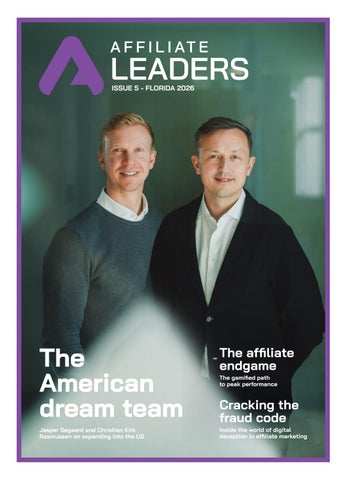
Jesper Søgaard and Christian Kirk Rasmussen on expanding into the

















































































Delegates













































Speakers












800 Exhibitors






















Delegates
Speakers
800 Exhibitors




The affiliate marketing landscape is evolving at an unprecedented rate and that’s exactly what this edition of Affiliate Leaders explores. From the impact of the latest M&A deals to embracing new marketing strategies, we’ve got it covered.
In our cover feature, we speak to Better Collective’s founders Jesper Søgaard and Christian Kirk Rasmussen on the challenges they’ve experienced as they expand to the US. Last year was arguably a tough year for the firm, which saw its earnings decline. The pair admit to many “sleepless nights” as they slowed down parts of the business, rebalanced, and navigated economic and industry headwinds.
On the M&A front, Ted Menmuir analyses what Genius Sports’ acquisition of Legend means and how it compares to its competitor, Sportsradar. He discusses how the two sports data and technology companies have moved downstream to the customer funnel and are now giant marketing media groups.
Sticking with the M&A theme, we also have a feature that examines how the affiliate landscape is consolidating. Established players are acquiring smaller
traditional sites, data platforms and entire portfolios – they are repositioning themselves as adtechs and marketing agencies. While this evolution reflects a natural maturation of the industry, it also raises the question of whether smaller affiliates can survive in this new ecosystem?
Affiliate marketing can no longer be just a silo channel. We’re seeing gaming and sportsbetting marketers adopt social media, influencer and even gamification as a way to drive engagement. In fact, we’re seeing lines between gaming, e-commerce and financial services blurring – something which Ted Orme-Claye explores in his analysis.
Finally, we have introduced some new regular features, including an interview series called ‘Affiliate anatomy’, a fun tech stack audit, and a marketing masterclass looking at success stories and lessons learnt. If you want to get involved in any of them, please do get in touch!
In the meantime, enjoy the read.
Sincerely,
Jyoti Rambhai
Affiliate Leaders is brought to you by SBC - Sports Betting Community.
Editor
Jyoti Rambhai jyoti.rambhai@sbcgaming.com
Editorial team
Andrew McCarron, Martyn Elliott, Ellen Jennings-Trace, Ted Menmuir, Ted OrmeClaye, Joe Streeter, Rachael Kennedy, Lucia Gando, Leonardo Biazzi, Tom Nightingale, Adam Candee, Charlie Horner, Christian Lee, Justin Byers, Erin Gallagher
Sales team
Rasmus Sojmark, John Cook, Alyona Gromova, Conall McCabe, Jan Kowalczyk, Bob McFarland, Craig Brown, Ed Young, Camilla Scott
Creative lead/design & layout
Jessica Camilleri
Why affiliate marketing remains one of the most vulnerable channels
Jesper Søgaard and Christian Kirk Rasmussen on expanding into the US
Ted Menmuir on the long-fought battle between the adtechs could reshape sports betting
How gamification is key to winning the conversion gaming
Clements talks trust, compliance and modern challenges for affiliates

How key stakeholders are exploring new marketing opportunities
iGaming affiliates at a crossroad
The shift from traffic acquisition to tech, data and other revenue streams
The death of the silo
How social media is informing data and shaping wider audience engagement
Is the rise in this channel making traditional affiliates redundant?
Betting meets the checkout line
Ted Orme-Claye on how the lines between sectors are blurring
SEO is a ‘rental strategy’
Affiliates need to retire the old playbook and start building a brand

For all the latest developments in the Affiliate Leaders community, please visit AffiliateLeaders.com 30 42 38 46 52 59


All material is strictly copyrighted and all rights are reserved. No part of this publication may be reproduced in whole or in part without the written permission of Sports Betting Community Ltd. Although every effort has been made to ensure the accuracy of the information contained in this publication, Sports Betting Community Ltd cannot be held responsible for any errors it may contain. Sports Betting Community Ltd cannot be held responsible for the loss or damage of any material, solicited or unsolicited. The views of the publication are not necessarily the views of Sports Betting Community Ltd or those of the advertisers.
Produced and published by Sports Betting Community Ltd: Registered address: SBC, 2nd floor, 212 New Kings Road, London SW6 4NZ Tel: +44 (0) 161 367 1250. Email: sales@sbcgaming.com. Web: www.sbcgaming.com
Comparasino’s Araminta Hannah explains why the future of player acquisition lies in moving beyond the search bar and into mainstream brand-building.
You’re reading this just weeks after one of the most defining moments in the history of the UK’s regulated online casino market.
The shift to 40% remote gaming duty (RGD) marks a new era for operators and affiliates alike.
For comparison sites like Comparasino, the old ‘quantity-over-quality’ model – relying purely on the shifting sands of SEO – is effectively dead in the water.
In this high-tax environment, it’s no longer enough to be a middleman, we must become
household-name consumer brands. And to achieve that, we have to move beyond the search bar and into mainstream consciousness.
This is the strategy behind our decision to break the fourth wall and launch a broad-scale TV campaign with ITVX – the UK’s leading commercial broadcaster.
Solving the trust deficit in search
To become a household name, you must build a high degree of consumer trust – something that’s difficult to achieve through SEO and search engine results pages (SERPs) alone.
Why? Because the SERPs are currently a minefield. They’re cluttered with ‘rented authority’ media sites hosting casino content, parasite SEO and, more dangerously, unlicensed brands.
This creates a chaotic environment where it’s nearly impossible for the average consumer to distinguish a reputable site like Comparasino, which exclusively features UKGC-licensed online casinos, from one pushing unregulated operators.
Launching a campaign with a broadcaster like ITVX acts as a high-level validator. It isn’t just about the massive reach or the new demographics we can engage, but also the exchange of trust that occurs by being a TV advertiser with a goldstandard broadcaster.
For instance, our creative must pass through the stringent Clearcast process, and consumers are subconsciously aware that ITV doesn’t run ads for just any brand.
Players are more cynical than ever, but seeing Comparasino on the big screen provides a psychological safety net that a position in the SERPs simply can’t replicate.
The strategic shift from clicks to context
Why did we opt for broadcast video-ondemand (BVOD) over traditional linear TV? The answer lies in the evolution from buying clicks to buying context.
In the traditional affiliate model, we chase the click – a high-intent but often fleeting moment in a crowded search results page. In contrast, BVOD is always on and allows for precision targeting across ITVX’s flagship titles.
This puts our brand in front of our core audience when they are most engaged. Appearing alongside trending shows like I’m A Celebrity… Get Me Out of Here South Africa creates a powerful halo effect.
This is where context beats a standard click: if a gold-standard
broadcaster like ITVX trusts Comparasino enough to feature it alongside its most valuable IP, that trust is implicitly transferred to the viewer. We aren’t just a link on a page, we’re a verified partner in their entertainment experience.
However, capturing that attention is only the first step. We convert that highcontext awareness into action via our proprietary recommendation engine.
Instead of presenting the player with another generic top 10 list, we allow them to filter the market based on their personal preferences for everything from specific payment methods and wagering requirements to payout speeds.
By combining the trust of the big screen with the utility of our technology, we move the player from a passive viewer to a sophisticated user who is perfectly matched with a UKGC-licensed brand, which in turn delivers incredibly strong sign-up and engagement results for our partners.
The economic reality of delivering value in a 40% tax world
This shift is more than just a branding exercise, it’s a response to an economic necessity. With the RGD increase squeezing operator margins to the limit, the industry can no longer afford the luxury of low-intent, ‘bonushungry’ traffic.
By combining brand-led advertising with our recommendation engine, we deliver pre-qualified players at scale. These players aren’t just hunting for the largest headline bonus, they’re looking for a specific, high-quality experience.
When they land at a casino via Comparasino, they arrive with the confidence the brand aligns with their personal preferences, leading to higher retention and better LTV for our partners.
We take this commitment to quality a step further with our member zone. This ecosystem allows players to lock in their personalised matches, which we then update in real-time as we onboard new brands.
‘quantity-overquality’ model – relying purely on the shifting sands of SEO – is effectively dead in the water “
The old
This moves us away from the traditional, ‘one-and-done’ model of SEO-driven comparison. Instead of a single referral, we’re building a long-term discovery platform where one acquired player can find multiple brands over their lifetime.
The new gold standard
The next few years will see a decisive ‘flight to quality’. Players will gravitate toward brands and platforms that offer transparency and trust, and operators will gravitate towards affiliates that offer sustainable margins.
The future of the UK casino comparison market belongs to those who possess the courage to invest in their own brand equity. By moving onto the big screen with ITVX, Comparasino is not only advertising, but also professionalising the sector and setting a new gold standard for the modern affiliate era.
Araminta Hannah is the co-founder of Comparasino
As affiliate fraud becomes more sophisticated, brands are losing more than just their margins. Affiliate Leaders exposes the cracks in the channel and the AI-powered threats lurking within.
Words by - JYOTI RAMBHAI -
The digital advertising ecosystem has reached a critical juncture where the scalability of performance marketing (particularly affiliate) has become inextricably linked to increasingly sophisticated fraud.
Affiliate marketing remains one of the fastest-growing acquisition channels; currently valued at $18.5bn and projected to reach $31.7bn globally by 2031, according to Hostinger, an AI-powered tech and website hosting company.
As marketing budgets tightened, spend has moved towards partner-driven acquisitions, with retail and e-commerce, travel, sports betting, igaming and financial services among the most mature sectors. And for good reason: affiliate marketing offers scalable reach, pay-forperformance models and diverse ecosystems.
North America dominates, contributing to more than 40% of the total revenue, with the US being the largest affiliate marketing hub, expected to reach $16bn by 2028.










Source: Hostinger, 2026

Despite its growth, affiliate marketing remains one of the most vulnerable channels to fraud. Inconsistencies in compliance and tracking has created loopholes, which in high-commission verticals such as sports betting, the economic incentives for fraudulent actors has never been greater.
Analysis by Juniper Research estimates digital ad fraud is costing advertisers more than $100bn annually, and affiliates are one of the most exposed marketing channels. That is because the pay-for-performance model compensates third-party publishers for driving clicks, leads or sales and fraudsters manipulate these tracking and attribution systems to claim the commissions for themselves.
Unlike other digital ad fraud, which tends to centre on manufacturing junk volume, affiliate fraud is distinguished by scammers being able to hide within legitimate customer journeys and steal attribution from genuine conversions.
When it comes to the scale of the issue, Erez Noham, vice president of products at Partnerize, an affiliate platform, says it can vary in cost from several thousands of dollars to even hundreds of thousands of dollars – “one fraudulent partner can create a lot of damage”.
Figures from Fraudlogix’s 2026 State of Ad Fraud report, which analysed 105.7 billion ad impressions collected throughout 2025, shows there was a 20.64% global invalid traffic rate (IVT). It also estimated that $37bn of adspend was at risk in the US.
Fraudlogix, a fraud prevention platform, also noted there were more than 30 million fraudulent IPSs in its pre-bid blocklist, updated hourly. Desktop traffic carried a 27.03% IVT rate, with proxy and VPN traffic being the most common fraud vectors.
AI and bot sophistication is also increasing year-on-year, which is making fraud detection more challenging.
Types of affiliate fraud
Click fraud is one of the most basic forms of affiliate fraud and targets cost-per-click (CPC) campaigns. It involves artificially inflating or generating clicks on affiliate links often usings bots or scripts.
John Wright, co-founder of software and marketing firm StatsDrone, says in igaming, this can occur when an affiliate negotiates a high CPA deal with an operator.
“The operator tests the traffic in one week or month and after the affiliate thinks the operator isn’t looking, they add them to their no deposit bonus pages and drive more FTDs [first time deposits] that are lower player values for the result.”
Wright goes on to add: “I’ve also heard something similar where affiliates can tell an operator brand top positions in many GEOs [markets]. When the operator isn’t looking, that affiliate has either resold those positions to someone else or simply not had them on the negotiated places assuming the affiliate manager isn’t checking 24/7.”
While click fraud does impact affiliates, there are three other types of fraud Noham sees his “clients fighting against”: ad hijacking, trademark bidding and cookie stuffing and attribution hijacking.
Ad hijacking is essentially content scraping or copycat ads on search engines. It is a “deceptive practice” where fraudsters run ads that masquerade as the brand itself or mimic legitimate partners, he explains.
When a user clicks these duplicate ads, they are forcefully redirected through the scammers’ affiliate tracking links before landing on the brand’s actual website.
“This type of fraud has been around for many years and easy to understand, because it’s very visual,” Noham adds. “You search for something on Google, you see an ad and you can check who is behind it.”
Then there is trademark or brand bidding fraud, which also uses distinct tactics to manipulate search engine results and capitalise on brand equity. Brand bidding is where scammers bid on merchant’s branded keywords to intercept high-intent organic traffic, such as ‘best running shoes’. This often violates affiliate agreements, but isn’t necessarily illegal.
While trademark bidding fraud is a legal violation, where unauthorised parties use protected trademarks in ads to impersonate brands, steal traffic and siphon commissions. For example, a fraudster may bid on the phrase ‘Nike shoes’ as it “captures users who were already actively searching for the brand”, Noham explains. The result: “Brands end up paying a commission for a customer they would’ve likely acquired organically or via their own paid search efforts.”

20.64%

$37bn

30+ million

27.3% across 105.7 billion impressions annually due to IVT in Fraudlogix pre-bid blocklist the highest-risk device


“


It doesn’t matter if it’s gaming, retail or fashion, the mechanism of fraud is almost always the same




For the frauds listed, Wright says it’s relatively simple to detect – brands and operators need to inspect the data including the “traffic and registrations”.
Noham agrees adding: “It doesn’t matter if it’s gaming, retail or fashion, the mechanism of fraud is almost always the same. Therefore, you just need to catch the mechanism, not the specific hardware or malware being used.”
However, cookie stuffing and attribution hijacking are more “sophisticated forms of affiliate fraud and in order for brands and platforms to detect it, you can’t look only at your data”, he says.
Cookie stuffing and attribution hijacking
Both cookie stuffing and attribution hijacking exploit browser extensions, but their operational intent and timing differ profoundly.
Cookie stuffing is a “speculative, top-of-funnel tactic” where fraudsters indiscriminately drop
affiliate cookies onto a users’ browser without them ever clicking an affiliate link.
“It is typically executed via hidden iframes, background scripts, or invisible pop-ups,” Noham explains. “The goal is to establish a presence ‘just in case’ the user eventually converts, even though the affiliate had no real influence on the purchasing decision.”
In short, cookie stuffing steals attribution from legitimate affiliates and costs merchants money for conversions. Shawn Hogan, who made millions from eBay in affiliate commissions in 2010, used this type of fraud.
Attribution hacking, conversely, is an active, bottom-of-funnel interception that targets a user who already has the intent to buy. Right before the conversion occurs, software – typically a browser extension, redirect or malware – injects or overwrites the affiliate tracking data.
Bot traffic is being used in so many ways that it’s hard to keep up

“This effectively steals the attribution credit from the organic, direct, or legitimate affiliate channel that actually drove the sale,” continues Noham.
To detect this type of fraud, “you have to look at the journey data of the users, because that’s where you pretty much see the attribution”. Up until recently, many companies didn’t have this data or were unaware of how to best use it, he admits.
“But now, I see more and more platforms taking active steps in order to prevent it. Google has started picking up on this kind of malicious extension. [So] we are actually seeing a nice decrease.”
Is AI accentuating the issue?
AI is no longer just a tool for marketers to develop, optimise and streamline campaigns; it is a force multiplier which allows fraudsters to
automate and create personas that can bypass traditional security layers with human-like precision.
“Bot traffic is being used in so many ways that it’s hard to keep up. For example, it’s a great way to influence rankings in Google,” Wright says.
For igaming affiliates, Wright believes “bots could possibly have access to real money accounts”, but it is up to the operator to detect. “Bots themselves don’t cause the problems,” he adds, highlighting it is the actions of bad actors.
The consequences of falling victim to affiliate fraud extend beyond the direct financial losses such as draining marketing budgets, lost products and chargeback fees. There is also wasted resources, corrupted data and misguided strategy, and the cost of inaction by marketers could even lead to damaging brand reputation and eroding trust in affiliate marketing.
But the rise of AI and LLMs like ChatGPT, Claude and Gemini may not be a bad thing. Noham believes it is not a localised threat, “it is primarily a broader cybersecurity mechanism utilised to gain unauthorised access or control over a device”.
For affiliates, the focus should be on content. LLMs are automatically pulling in more content to answer user queries. The new tech tools, coupled with the fact consumer journeys are changing – there are fewer clicks – means this content is starting to influence total conversions.
As a result, “a lot of bad partners will disappear”, claims Noham.
And regarding zero-click customer journeys, “there are no novel vulnerabilities beyond standard attribution hijacking”, he adds. “Therefore, it does not represent a new or unique risk vector for the affiliate space.
While AI could help shut down a portion of the affiliate fraud taking place, Wright believes that affiliates need to self-regulate to some extent to tackle the issue.
“I talk to a lot of people in affiliate marketing (not just in igaming) and there doesn’t seem to be a consensus on how this will get fixed other than by large networks and affiliate programmes leading the way. First by banning networks that abuse the system,” he says,
The affiliate marketing landscape is evolving rapidly. The problems affiliates faced 10 years ago are very different to now. Over the past few years, affiliates should have been moving towards becoming more data-driven, Wright says. And it is this which could help tackle affiliate fraud.
“There are new data tools hitting the market that give them [affiliates] the answers and insights without having to build their own reports. I believe the analytics space is already in a transformation where the end products are more done-for-you services.
“It isn’t just building 20 dashboards that do things, but it’s also alerting you to the insights and key actions you have to take. The new role of affiliate management today will be a bit more on relationship building and when it comes to fraud, they simply have to take action,” he concludes.







Last year saw Better Collective’s growth status interrupted. A situation founders Jesper Søgaard and Christian Kirk Rasmussen have vowed to correct regardless of generational headwinds and in the face of new competition.
Words by - TED MENMUIR -
Itry to not make it personal,” states Jesper Søgaard, co-founder and jointchief executive of Better Collective, an igaming media network. Yet founding partner and co-chief executive officer Christian Kirk Rasmussen interjects, “no…it is definitely personal for me”.
How can it not be? Søgaard and Rasmussen have dedicated 20 years and their entire professional lives in the development of Better Collective as the pioneering firm of igaming and sports betting media.
Founded in 2004, Better Collective is recognised as a Copenhagen-based technology company and industry champion, which developed a proprietary network of affiliate and media sites that delivered mass audiences to igaming partners.
While its status remains undisputed, it has been tested in the past two years due to shifting generational headwinds. Yet there is no retreat by Søgaard and Rasmussen, who mark 2026 as a return to growth in which transformative changes define the next era for Better Collective.
With speed and precision
“Looking back at the past two years, they are definitely not my favourite,” Rasmussen admits. “We’ve had to navigate headwinds, slow down parts of the business, and rebalance after a long period of hyper-growth.”
Both founders admit to “many sleepless nights” in how to strategise and reengineer Better Collective to mitigate new headwinds impacting all market make-ups.
Søgaard retorts: “The entire sector is under difficult challenges. But our mindset
has been to be simply realistic, take and implement actions, but don’t close your eyes to the situation.”
Being candid on realities, Søgaard reflects on Better Collective’s first imperative transformation to change the commercial model of its US network, due to the winddown of the “sugar rush dollar CPA deals”.
Søgaard led the project over two years. He reflects: “We’ve always believed short-term opportunities should not define our longterm strategy.
“The US CPA environment created an artificial growth curve for the industry. Moving back to revenue share was a necessary correction which aligns value with performance, retention and product quality. That’s where we want to play, and that’s where we believe the strongest companies will win.”
Beginning in 2024, the correction of its US commercial model forced a deeper recalibration of Better Collective’s organisation – the era of hyperexpansion needed to be followed by more disciplined controls.
Last year (2025) was arguably its most difficult year in business for Better Collective. A year of tough adjustments and depressed margins, which saw the media company net its first EBITDA decline to €100m (-10%) in corporate history.
“For a company that has grown year after year, seeing that earnings decline is never comfortable,” Rasmussen reflects. “But it forces you to look deeper at the fundamentals of your business – what drives value, what needs to change, and how you build something that is stronger over time.”
“
Markets like the US and Brazil didn’t just evolve – they changed their underlying economics almost overnight

In response, Better Collective deployed a €50m cost-saving programme, coupled with a full review of its media portfolio and operational structure – decisions that Søgaard says were driven by prudence, caution and a need to protect the company’s long-term manoeuvrability.
“It was clear that we had to take decisive action,” Søgaard explains. “The objective was not just to reduce costs, but to reshape how we operate – becoming more product-focused, more integrated, and ultimately more efficient on a global scale. These are changes we likely needed to make at some point, the market simply accelerated that process.”
The outcome is a leaner and more cohesive organisation. Better Collective has moved beyond the excesses of the growth cycle and is now structurally positioned to compete on sustainability, product depth and audience engagement.
Yet as the leader of the igaming media space, Better Collective found itself under intensified scrutiny. The group’s rapid ascent was in part fuelled by headline M&A deals, including the €180m acquisition of Playmaker Capital in 2024; and the $240m purchase of The Action Network in 2022.
The new assets had set a new benchmark of growth in the igaming media space that would prove difficult to sustain under shifting market conditions.
Those acquisitions were designed to anchor Better Collective’s expansion across North and South America, positioning the company at the centre of high-growth markets, particularly Brazil. However, as regulatory realities began to reshape these regions in 2025, the company was forced into a more reactive stance.
“We had to play the hand we were dealt,” Søgaard remarks. “Markets like the US and Brazil didn’t just evolve – they changed their underlying economics almost overnight.
“Regulation tightened, taxation increased, and operator strategies became far more selective. When those fundamentals shift, you cannot continue with the same playbook. You have to adapt quickly, even if that means stepping back from the growth trajectory you initially planned, to ensure that what you are building is sustainable for the long term.”
During a challenging period of transition in 2025, the pair chose to balance integration of its major acquisitions with a broader industry slowdown, applying a dual pressure to both its operating model and investor expectations.
Transitions aside, Better Collective remains firmly in the eye of the storm in 2026, as the market recalibrates to a new set of realities – higher taxation across key markets including the UK, Brazil and the Netherlands, combined with a broader deterioration in macroeconomic conditions that few operators or media networks can escape.
It has moved to provide its ‘back to growth’ FY2026 guidance of 10–18% EBITDA growth with a target of €110m–€120m. The target is locked alongside a longer-term ambition of achieving EBITDA margins of 35% by 2027–2028.
Søgaard and Rasmussen acknowledge “many elements are uncontrollable” in the current climate. However, their comeback is set against a new wave of industry disruption – the rise of prediction markets in the US.
“Prediction markets are evolving within a different regulatory framework, but the overlap with our industry is quite clear,” Søgaard notes. “For us, it’s about understanding how that evolves and ensuring that we can adapt our products and content to remain relevant for users.”
Questioned on whether Better Collective will re-configure its US network for prediction audiences, Rasmussen says: “There is a lot of discussion around prediction markets right now. But at the core, it comes down to user engagement. If the product is good and the experience is strong, users will adopt it… that’s where we see an opportunity to play a role.”
Tech and data heavyweights, Genius Sports and Sportradar, are expanding aggressively in the igaming media this year. Attention is drawn to Genius Sports recent $1.2bn acquisition of US publisher Legend Media.
The price tag alone has drawn scrutiny, framed as a high-stakes gamble by Genius Sports to break into a cutthroat media environment. Yet for Søgaard, it serves as validation rather than threat.
He explains: “We see the entry of major data providers like Genius Sports and Sportradar into the media and affiliate space as confirmation of the strategy we pioneered at Better Collective. It proves that owning the audience is now a key currency in our industry.
“We welcome this competition because it drives market maturity. Our focus remains on our brands – building authentic communities, strengthening loyalty, and advancing our adtech infrastructure to convert audiences into high-value customers.”
There is no hiding from reality: competition is intensifying, margins are tightening, and execution risks have never been higher. For Søgaard and Rasmussen this next phase was never going to be anything but personal.

Seeing earnings decline is never comfortable, [...] but it forces you to look deeper at the fundamentals of your business “

The long-fought battle of sports data and technology giants Genius Sports and Sportradar moves downstream to the ‘customer funnel’, forcing the pricing dynamics of media and marketing to dramatically change.
Words by - TED MENMUIR -
To date, the fierce rivalry of Genius Sports and Sportradar has primarily played-out in the boundaries of sports betting and the supply of exclusive partnerships for clients of a multi-billion sector.
These giants are rarely discussed in separate circles as every contract victory from exclusive league data rights, technology partnerships and IPs has been analysed as a test of their credentials… Yet in 2026 the rivalry is entering a new phase.
Via mergers and acquisitions (M&A) both organisations are moving closer
to the consumer funnel and beyond the igaming ecosystem. Leadership recognises that diversification of the PLCs must expand beyond the boundaries of igaming.
No inch will be given on the vision to control the engagement of sports fans by which Genius Sports and Sportsradar seek to become architects of sports media.
The transformation is led by Genius Sports’ $1.2bn acquisition of Legend Media, to secure the digital portfolio that includes Covers.com, Casino.org and Casino Guru. Heavily scrutinised
by analysts, the deal represents the largest bet placed by Genius to launch its new media and marketing unit.
Sportradar, by contrast, is pursuing a more incremental strategy, building its own affiliate and media footprint after acquiring the off-cut properties of XLMedia in 2023 for a sharply discounted valuation of roughly $30m.
The question facing investors and the wider media industry is whether these moves will reshape how sports betting audiences are acquired and what price will be paid on more sophisticated channels.

For affiliates the dial has begun to change. A disruptive decade marked by algorithm changes, sees the majority of affiliates discover that the traditional model can no longer rely solely on search rankings or betting content.
In this uncertainty, Genius Sports and Sportradar seek to deliver a new proposition. Rather than treating affiliates as traffic pipelines, the two data giants see them as intelligence platforms capable of capturing behavioural signals from sports fans in real time.
The methodology sits at the heart of Genius Sports’ acquisition of Legend Media. Chief executive Mark Locke framed the deal not as a media purchase, but as the acquisition of a participation layer that sits between sports data infrastructure and the moment of transaction.
“When people describe Legend as just an affiliate business, they miss the structural shift taking place in sports media,” Locke wrote to shareholders explaining the highrisk deal.
“What we have acquired is an environment where millions of sports fans return repeatedly to participate around live sport and gaming experiences. Those interactions generate intent signals that are far more valuable than simple traffic.”
Locke argues that the economics of digital sports media are shifting from attention to participation. “Attention is watching a match,” he wrote. “Intent is deciding to act. The platforms that understand that transition – and can model it in real time – will ultimately control the most valuable moment in the sports ecosystem.
“When sports fans engage with match hubs, simulations or betting-related tools, they generate behavioural data that can be analysed and monetised.”
These signals allow companies to improve customer acquisition efficiency, increase player lifetime value, optimise advertising performance and build predictive behavioural models.
Locke views the big pitch for affiliate networks is to “transform into data engines capable of identifying when a sports fan is most likely to act”.
Sportradar is pursuing a similar vision through its marketing technology and engagement products. Its advertising platforms, live-streaming services and fan engagement tools are designed to capture behavioural insights during sporting events and translate them into targeted acquisition campaigns.
When sports fans engage with match hubs, simulations or bettingrelated tools, they generate behavioural data that can be analysed and monetised

Addressing investors, Sportradar’s chief executive Carsten Koerl, described the opportunity as the convergence of fan engagement and wagering behaviour.

audience intelligence will eventually create a closed-loop ecosystem on all dynamics of viewers’ intent – a desire with much more value than a click or a view.
McTernan, lead analyst of Needham Co. “Genius Sports and Sportradar compete on data infrastructure and that gives them far greater leverage in pricing and performance of the market.
“We know sports fans and their behaviour better than anyone because of the data we collect,” Koerl said during the company’s recent investor call. “When you combine live content, data visualisation, engagement tools and betting opportunities in the same experience, you dramatically increase conversion.”
Koerl framed the strategy as an evolution of Sportradar’s role within the sports ecosystem. “Sports betting has historically been the acquisition channel,” he said.
“But if you connect that channel with live content, streaming and engagement products, you create a 360-degree ecosystem where the fan journey – from watching sport to placing a wager – happens inside the same environment.”
Both leaders underline that the combination of sports data with
Scaling up their media and marketing units, Genius Sports and Sportradar can leverage sports data rights with the largest proprietary datasets on professional sports… a position no affiliate can match.
As architects, both companies will aim to entrench their existing relationship with tier-1 operators as marketing becomes the next discipline of integrated platforms. A privileged position will allow Genius Sports and Sportradar to set the price of marketing at a premium, underpinned by promises of higher conversion rates and predictive targeting driven by behavioural data.
Industry analysts believe this marks a structural shift for igaming incumbents and their marketing campaigns.
“Traditional affiliates compete on SEO and editorial reach,” notes Bernard
“In this emerging hierarchy, the benchmark for value is changing. Search visibility becomes secondary. Proprietary data becomes the currency and ultimately, the pricing mechanism.
“The implications are significant. Operators could face rising acquisition costs, with pricing increasingly tied to data-driven outcomes rather than volume. Smaller affiliates risk consolidation, while the largest platforms strengthen their negotiating position across both media and betting ecosystems.”
For now, Genius Sports and Sportradar remain inseparable, but their parallel moves will disrupt the foundations of affiliate marketing. As data becomes the currency of acquisition, traditional SEO affiliates will be consolidated, while tech-led incumbents will consolidate power across all disciplines.

The home of global iGaming industry news. Leading coverage on Europe, Asia, Africa and beyond.






Turning storefronts into live gamified experiences to drive return visits has been a cornerstone for operators, but now other verticals are taking note.
Words by - CHRISTIAN LEE -

Gamification has shifted from the preserve of the entertainment industry to a cornerstone of marketing throughout e-commerce. Driven by the neverending competition for a consumer’s attention, companies have turned a simple purchase into a journey of discovery.
Whether it’s earning experience points toward discounts or spinning a wheel to see if you can earn the delicious reward of a free bakery item at your local supermarket, the shopping experience has fundamentally changed.
This shift, Mark Stanley, chief product and technology officer at Shopware, tells Affiliate Leaders, is a direct consequence of learning from industries such as gaming, where stakeholders have understood since the dawn of the sector that “engagement drives conversion more reliably than discoverability”.
“What’s changed is structural. Platforms have begun embedding interaction and progression mechanics into the purchase journey itself, not layering them on top. Operators now design storefronts the way live-service games design experiences, with content drops, time-limited events, and reward loops that create habitual return visits,” he says.
“These mechanics are borrowed from behavioural psychology, specifically variable reward schedules, and they work because they convert passive customers into active participants with a stake in continuity. A streak turns a single transaction into a commitment. A login reward turns habit into identity.”
Looking back at the history of marketing, the sector has constantly evolved and been
forced to redesign its strategies based on changes in technology.
In the beginning, mass marketing relied upon TV commercials, magazine ads and billboards. Meanwhile, direct marketing emerged as personal emails and mobile devices became more common, allowing marketers to refine a scattergun approach into something much more targeted.
The ‘phygital’ experience
Now, as digital marketing has become the norm, gamification has become a key part of tapping into the preferences of customers – the socalled phygital experience.
“The convergence of physical and digital has accelerated this further. A player who earns a skin, unlocks a merch drop, or accesses a bundle through in-game progression is living through a commerce experience that didn’t exist five years ago. That’s not loyalty points. That’s live-service monetisation applied to retail,” adds Stanley.
As data from the Product Marketing Alliance shows, 60% of consumers are more likely to purchase from a brand that includes a gamified experience, while companies experience a 50% uptick in return visitors, driven by such experiences creating habit-forming loops.
Although not strictly rooted in e-commerce, the language-learning app Duolingo has mastered the art of keeping learners coming back through streaks, which users wear as a badge of honour.
A cursory glance at the app’s social media feeds will see a slew of users begging for Duolingo to reinstate their streak so they can continue their journey with the app.
“Mechanics like streaks and daily login rewards encourage recurring behaviour by tapping into a customer’s natural desire for accomplishment and consistency,” explains Attila Kecsmar, chief executive of Antavo, who notes that the gamification market is expected to reach $48.72bn by 2029.
“These features create a sense of routine and reward customers for their loyalty and engagement. Daily activities and challenges motivate customers to participate regularly, fostering a stronger connection with the brand and promoting repeat interactions.”
Take the case of KFC. While the fast food giant’s app is ostensibly designed to allow customers to order ahead of visiting a restaurant, it also has an arcade feature built in, which offers the chance to win prizes ranging from free wings to full meals.
According to Kecsmar, KFC’s latest game, Pinballer, has driven a 61% increase in plays. Meanwhile, a quarter of its customers say they buy KFC more frequently since using the rewards arcade.
As with every aspect of marketing, however, this strategy can only continue to bear fruit if the rewards offered to customers are hyperpersonalised to their needs.
Stanley says: “The mechanics only hold if personalisation and segmentation are doing the work behind them. That’s what converts the frequency mechanic into actual revenue.
“The commercial implication is straightforward: frequency precedes spend. A customer who returns daily, even without purchasing, becomes more monetisable over time because they’re in the ecosystem.”
The hunt for zero-party data
Given this is the case, gamification has the inherent advantage of
allowing companies to collect customer data through mechanics such as quizzes.
In this current climate, where consumers are becoming increasingly hesitant to share data, the use of activations such as quizzes offers an easy path to collecting vital information regarding a customer’s vital statistics and preferences.
Kecsmar says: “Quizzes and style quests are highly engaging tools for profiling customers. They allow brands to collect zero-party data in a fun and interactive way. By presenting customers with curated selections of images or questions, brands can gather valuable insights into preferences and behaviours. This data enables better segmentation and personalisation, helping brands tailor their messaging and rewards to individual customer needs.”
He points to the success of Victoria’s Secret’s PINK Nation app – a loyalty programme that largely targets college-aged students in the US through the offering of memberonly offers, which has over two million active users.
Through the app, which offers style guides, polls and voting features, the lingerie brand is able to gather valuable customer information that can shape future offers and marketing campaigns while also increasing engagement and website visits.
“Passive browsing tells you what someone looked at. A quiz tells you what they’re trying to solve,” adds Stanley.
“That distinction matters for segmentation. When a user declares their playstyle or aesthetic preferences, you can serve commerce experiences that feel curated rather than algorithmic. The difference between ‘here’s what’s popular’ and ‘here’s what’s right for you’ is significant in both conversion and perceived brand value.”
The ethical dilemma
Like in the gambling industry, the rise of gamification in e-commerce has also raised questions over the ethics of such practices.
Is there a danger that the term ‘shopaholic’ will take on a much more sinister meaning if consumers feel beholden to fulfilling objectives to keep streaks alive or gain experience points?
While shopping addiction, known as compulsive buying disorder, is recognised in a similar vein to problem gambling by addiction treatment specialists, excessive gamification tactics may only serve to exacerbate these problems.
The key to balancing these concerns, says Stanley, is to avoid using mechanics that exploit anxiety or create the feeling of urgency through implying artificial scarcity. These tactics, while creating short-term conversion, will only serve to harm the long-term trust of the consumer.
Stanley continues: “For commerce, the practical test is whether the mechanic serves the customer’s intent or subverts it. A bundle that saves a regular buyer money is a reward. A countdown timer on a nonscarce item is a pressure tactic.
“A practical starting point for retailers is an internal audit of every urgency or scarcity mechanic in use. If the constraint isn’t real, remove it. Customers increasingly recognise the patterns, and the trust cost of getting caught outweighs any short-term conversion gain. Platforms that get this right will have significantly lower churn.”
Prioritising ethical design is essential, agrees Kecsmar, who emphasises that creating mechanics that exploit addictive behaviours or pressure customers into excessive spending should be avoided at all costs.

“Instead, the focus should be on fostering positive engagement and offering meaningful rewards that align with customer values and wellbeing,” he adds.
The future is gaming
But what is the future direction of travel for the sector? As spending on gamification only appears to be increasing, companies will be searching out newer and even more novel ways to engage customers and keep them coming back for more.
Although many people bemoan the fact there is now a need to have an app for every aspect of life, a brand having its own platform that consumers can engage with is now considered an essential cornerstone of the customer journey.
In addition, the rise of AI is also heightening the personalisation
Gamification is no longer just about engagement; it’s becoming a tool for data collection
capabilities of marketers, meaning that consumers are becoming more expectant of receiving incentives highly attuned to their preferences.
“AI’s impact will be most significant in two areas,” explains Stanley. “First, real-time personalisation at scale, serving dynamically adapted storefronts based on behavioural signals rather than static segment profiles.
“Second, dynamic offer construction, where bundles and drops are assembled in response to individual patterns rather than broadcast to entire cohorts. The operators who lead this won’t be the ones applying gamification as a feature. They’ll be the ones building commerce as an experiential layer, where discovery, identity, and transaction are genuinely unified. The competitive gap between those two approaches is only going to widen.”
For Kecsmar, the clear advantage is rooted in data collection, as gamification creates a “clear value exchange” between the customer and brand, allowing the former to receive more relevant experiences, while the latter gains actionable data to improve targeting and communication.
“Gamification is no longer just about engagement; it is becoming a critical tool for data collection in a privacyfirst world,” he concludes.
“As third-party cookies phase out, brands must rely on zero-party data, information that customers willingly share. Gamified profiling plays a key role here, transforming data collection into an interactive experience. Through quizzes, preference-based inputs, and visual choices, brands can gather highquality insights while maintaining user engagement and trust.”
Impact.com’s Anthony Clements on compliance and the modern challenges of running a partner programme
Words by - JYOTI RAMBHAI -
The growth of affiliate marketing, as we know it, has been underpinned by substantial growth in digital media: in Google, its advertising products and more recently, Meta ads. But for Anthony Clements, it was the “entrepreneurialism” of the industry that made him want to stay in the industry for 20 years.
“When I started in 2006, it would’ve been very easy to jump into the sexier digital ad channels,” Clements tells Affiliate Leaders “Back then, things were accelerating fast, but the entrepreneurialism of our industry always interested me.”
Clements has worked for some of the biggest affiliate companies in marketing, including Awin, Adtraction and now impact.com, where he is the UK country manager. Over the course of his career, he believes affiliate marketing has become a mainstream channel for many brands.
He says: “When I first started, we used to look at the IMRG top 30 brand list and you’d see just a few brands doing affiliate or partner marketing… and now you look through that list and they’re all doing it.”
The latest data from Newsmedia, a directto-consumer growth agency, found affiliate programmes now account for 16% of total digital marketing spend globally. This number is projected to exceed $17bn in 2026.
Since 2018, spend in the channel has grown by 10% year-on-year, with the average brand investing approximately $20-50,000 annually in affiliate programme management.
While it is still a “relatively small” and “niche” portion of spend in the grand scheme of things, “anyone looking to acquire customers, acquire an audience online, needs to be doing an affiliate marketing programme”, explains Clements. “It’s come a long way in 20 years – a relatively short span of time in the course of the wider industry.”
Just as the affiliate industry has grown, so has the compliance oversight. Some of the fundamentals such as no pay-perclick (PPC) and brand bidding have become stricter. With the launch of Google Ads and as affiliate marketing began to mature in the early 2000s, the rules emerged primarily to protect the merchants’ advertising budgets.
“At the forefront of compliance, brands want trust in the digital advertising they do. And that’s not specific to affiliates – you could talk about Google Ads and Meta Ads in the same breath,” says Clements. “I saw a stat at the end of last year, which said that around 10% of all Meta spend is generated from fake impressions.”

Age: 44
Job: UK country manager, Impact.com
Grew up: London, UK
Year entered affiliates: 2006
Biggest inspirations: Adam Ross, chief executive officer of Awin (in early career); and Mark Walters, former chief executive officer of Awin
Hardest truth learnt: Learning to deal with everybody individually as a young manager
The non-negotiable: Spend at least 50% of your time dealing with customers as they keep you ‘grounded’
Professional failure: Trying to win brands that didn’t want to work in affiliates or unable to keep them in the affiliate ecosystem
Bad habit: Drinking roughly eight cups of coffee a day
Outside of work: Plays golf and socialises with affiliate friends
Office blips: Connecting his Spotify to the work speakers and then explaining to staff who Stevie Wonder is.
Summarising affiliate marketing: It has become ‘mainstream’

But trust is even more important in affiliate marketing, because at its core, it’s about “building a trusted partnership” and knowing where the traffic and audience is coming from can affect a brand’s ability to scale.
Artificial intelligence (AI) has been somewhat of a double-edged sword for affiliate marketing, particularly when it comes to compliance. Similar to the struggles Meta and Google have had, there are issues with bots generating fake impressions and clicks on ads, which Clements admits, “we can do more from that perspective”.
However, he also believes “the affiliate industry is relatively resistant because our transactionbased marketing model is harder to fake, which will ultimately make the customer experience better and more trustworthy”.
And essentially, the “positives of AI outweigh the challenges”. It presents better opportunities for building compliance, intelligence and monitoring tools. But who should the burden of compliance sit with – the brands, agencies or the affiliate platforms?
For Clements, compliance is not a burden, but something that is an important part of an affiliate’s role. He says: “We want to make it effortless for all parties. But it’ll be very interesting to watch this space, as I think compliance right now will look different in two or three years down the line. AI is going to change both the tool set we use to monitor non-compliant activity and the type of noncompliant activity we look for.”
Currently, Clements explains, compliance monitoring is keyword and website driven, primarily looking at who is bidding on those keywords and what content those web pages feature. For example, a finance advertiser would want to look at how big the annual percentage rate (APR) is on loans and where it is positioned.
The transparency dilemma
The other type of monitoring is based around where the traffic is coming from. However, the lack of transparency around this is something that keeps Clements up at night.
“If you’re running a partnership programme with a large number of partners and you see the performance and sales listed in your platform, I would always challenge the brands as they go through that,” he adds. “I would ask how are those partners working with
“
There have been partners that traditionally have not been transparent about where they are getting the traffic from
you, do you know where they are promoting you, where does that audience live? There have been partners that traditionally have not been transparent about where they are getting the traffic from.”
It’s why, if he could mandate anything within affiliate marketing, this would be it – every partner, network and sub-network to have an identifier so there is 100% visibility on where traffic is coming from.
This, Clements says, is one of the “modern challenges” of running a partner programme. “Understanding the creator platforms, websites, video content, large language models (LLMs) as well as Google search, as it’s all going to play a big role in where traffic comes from in the next couple of years.”
In Europe, there is another layer of compliance when it comes to the privacy laws and GDPR. In a privacy-first era, there is technology for brands to use deterministic data that do not rely on third-party cookies to understand the audience and the transactions that might be relevant for partners.
“But Europe is in an interesting place right now,” Clements believes. “The European economy wants to grow, but it’s difficult to dovetail growth with protection of online privacy. European law has been heavily focused on online privacy for the consumer, it will be interesting if it continues to accelerate or if it slows down.”
While that is one for the regulators, it is something for affiliates to watch, especially as more than 42% of marketers increased their budgets for this channel in 2026 and a further 29% plan to double it in the next two years, according to Newsmedia.
The heritage news portal of the SBC Media portfolio, providing daily insights and opinion on all segments of the European sports betting industry.
The premier destination for betting industry news in the USA, Covering the sports betting, and online and offline casino industries across the 50 states.
The leading Spanish-language portal covering news from the betting and gaming industry, across Latin America, North America and Spain.
From the heart of one of the fastest growing markets in the world, providing industry-leading coverage of the Brazilian and global betting industries, in Portuguese.
A news portal covering the latest developments from Eastern Europe and Central Asia, delivered by an expert local editorial team.
The leading source of betting and gaming industry news covering Canada and global stories with Canadian interest.

With major affiliate marketing companies adapting to differing state laws, Justin Byers explores how affiliates are identifying new opportunities in a fragmented market.
The global commercial igaming industry is undergoing a significant shift in how companies acquire and retain customers. This change is affecting how gambling brands and key stakeholders in affiliate marketing implement their strategies in a rapidly evolving industry.
In the US, the varying state-by-state regulatory standards create challenges for gaming product developers navigating the market. Affiliates in gaming are also facing challenges, resulting in exits, consolidation and changes to how products are advertised.
“The two biggest challenges are fragmentation and regulation, which are directly related. The US is a patchwork of states, each with different rules and authorities focusing on responsible gambling and market-specific compliance,”
Alan Bruce, chief operating officer at The Unit, tells Affiliate Leaders
“This means delivering in North America on the whole is a multi-faceted and complicated affair.”
The Unit provides design and software development solutions for the sports betting and igaming industry with clients in Europe, North America, South America, Asia and Africa.The Ireland-based company operates globally through in-house marketing efforts and partnerships with affiliate brands in gaming.
“The affiliate marketing space has helped to make The Unit more visible,” says Bruce.
“With modern affiliates looking more towards progressive technology and different vehicles to drive acquisition, The Unit has become instrumental in helping companies embrace technology to drive the affiliate programs forward.”
Operational changes for major affiliates
Affiliate marketing allows gaming suppliers, developers and operators to deliver their products to new audiences, but industry challenges are also impacting profits. Some of the largest companies in the
Advertising rules now shape not only how betting companies market themselves, but also how they structure offers, messaging, partnerships, and even product journeys “
affiliate space have made operational changes as the online sports betting and casino operators adhere to market changes while aiming for profitability.
In 2025, Catena Media underwent its fourth round of layoffs in two years, reducing the company’s salary spending by around $5.5m. At its peak, Catena Media had a workforce of more than 450 employees. In 2026, its workforce is less than 150 people.
Catena initiated the layoffs amid unfavourable quarterly financial results.
The US is a patchwork of states, each with different rules and authorities focusing on responsible gambling and market-specific compliance “ “
Meanwhile, Better Collective underwent a restructuring in 2025 after a round of layoffs the year prior, following lower-thanexpected full-year revenue results. The affiliate leader also deployed a co-CEO leadership model and shuttered its region-based model for operations.
XLMedia entirely exited the US affiliate space by selling its North American domains to European sports data and content aggregator Sportradar in a deal valued at $30m. It also sold its European and Canadian assets to Gambling.com Group.
Affiliates are responding by teaming up to navigate industry challenges. BetConstruct provides an affiliate ecosystem that connects operators to affiliates around the world. The ecosystem leverages artificial intelligence to identify potential operator and affiliate partners.
Affiliates prepare to explore new opportunities
Key stakeholders in gaming and affiliate marketing are continuing to find new and innovative ways to deliver their services and solutions to new clients and customers.
“We are embracing a new era of betting and gaming, and we are moving with the times. More and more of this industry is moving on-chain and decentralised, so we are doing a lot in the crypto, tokenisation, and NFT space,” adds Bruce. “We also continue to work with some of the major platforms in the industry to provide bespoke solutions and frameworks for our partners.”
Prediction markets are also poised to continue being an integral part of the gaming industry, with affiliates exploring the space as a new opportunity to generate additional revenue.
Better Collective began rolling out prediction market-focused products in 2026 amid the proliferation of
the emerging vertical in markets throughout the US. The digital sports media company is investing in editorial hubs to keep key stakeholders up-to-date on the latest developments in the sector, while also meeting the demand from its audience.
Catena Media is also exploring investments in the prediction market space.
Affiliates in gaming will continue to diversify their businesses and may also look outside the industry to bolster their reach. Gambling.com Group is taking that approach after acquiring online booking platform Spotlight.Vegas in a deal that could fetch up to $30m based on performance benchmarks through 2027.
The ticketing platform allows users to purchase tickets for shows and attractions across Las Vegas. It also provides hotel booking services in Sin City. The Gambling.com property is projected to generate $8m in the financial year 2026.
The transaction marks a new strategy for Gambling.com after its recent acquisition spree of gambling-related brands that included OddsJam parent company Odds Holdings in 2025.
Gambling.com also wants to leverage its sports data services to grow its business. Its data services provide expansion opportunities as Gambling.com seeks to increase its coverage of different sports and leagues to serve partners in the US and outside North America.
Affiliates and gambling brands are also finding opportunities in events, with the 2026 FIFA World Cup on the horizon, a 39-day tournament taking place across Canada, Mexico and the US. FIFA expects the tournament to attract more than 3.5 million fans, providing a unique opportunity for gaming brands and affiliates to market their products.




says Bruce. “We are building some smart retention tools aimed at driving up sales in relation to the tournament and keeping players engaged with products.”
According to data provided by WARC Media, the World Cup will inject approximately $10.5bn into the ad market in Q2. The estimate mirrors 2022’s iteration of the competition.
Gambling brands and affiliates are poised to take advantage of a World Cup on North American soil amid several proposals to change how gambling ads are delivered.

complaints by parents. This looks to impose a curfew for gambling ads to be aired between 10.30pm and 6am, to minimise exposure to minors.
“We believe it’s good to be regulated and to establish responsible gaming measures at the national level,” says Codere chief executive Aviv Sher. “It’s such a large country that we need to update the regulations, which date back to 1948.”
Meanwhile, lawmakers in Colorado considered a bill that bans daytime TV and in-game gambling ads.
“Children are more likely to watch television during daytime hours, and sporting events draw a large mixed-age audience,” reads a note in the bill’s text.
“Advertising during daytime and live sporting events is therefore difficult to avoid for sports fans, including minors and adults at an elevated risk.”
Bruce concludes: “Although not directly affecting The Unit, we are very much aware of this. Advertising rules now shape not only how betting companies market themselves, but also how they structure offers, messaging, partnerships, and even product journeys.”


The affiliate landscape is changing. What was once a straightforward marketing channel has become a much more complex part of an omnichannel strategy. To get a global perspective on how things are shifting, Affiliate Leaders asked the following question.
In a world of AI-generated content slop, is an anonymous affiliate site still a viable business model in 2026, or is a face/ brand now mandatory for trust?


RAPHAEL ROSSI, Operator manager, Fomento

“Low-quality AI-generated content and anonymous sites still work, but they’re less effective since the regulation in Brazil because it lacks credibility.
“When you add a face and you have a stand in an expo, you will reach more people, for sure. Your results will be much better in this current scenario in Brazil. It’s getting more and more difficult to work in a ‘black’ (clandestine) way, like using AI and not exposing yourself, and not showing your face.”


MATTHEW SHOWELL, Chief executive officer, Snap call media
“In 2026, anonymous affiliate websites are a losing bet, and it’s going to get worse. Recent Google updates hit igaming affiliates hard, and many big players lost significant rankings and traffic. What happened? The game has changed because Google isn’t just a search engine anymore. It’s an answer engine hungry for original data to feed its own AI Overviews and LLMs.
“This shift toward information gain means your visibility in search is now tied to what you can provide that a bot can’t scrape. You need boots on the ground: humans doing actual research and offering real expert insights and opinions.
“A strong human element in your content production process is crucial, and your brand’s human-led process must be front and centre. Success in the gambling affiliate niche now requires showing your work and proving you aren’t just another faceless site regurgitating AI slop.”




FEARGAL BYRNE, Director, Tentenseven (A sister brand of The Unit)
“Anonymous sites can still work if they become a brand. Credibility is key: brand mentions, citations, growing social accounts, and content that is more insightful than competing AI-generated material all matter. An author’s history across social media, including LinkedIn, conference talks or presentations, and citations, adds credibility, so there is value in putting a real face to on-page content.
“Smaller affiliates should take a page from the bigger players in the space and focus on brand building. With the amount of zero-click searches, affiliates have to lean more into paid placement or hybrid models, and for these to work at scale, they must drive conversions through brand-led strategies and a portfolio of owned media. It’s only the beginning; affiliates must adapt because strategies that may still be working today are likely to become ineffective in the very near future. Reputation and credibility signals are the key moving forward.”


JAVIER TRONCOSO, Chief executive and co-founder, InsightPlay.ai
“I don’t think anonymous affiliate sites are dead, but it’s clearly harder than before.
“Content alone doesn’t give you an edge anymore, and relying only on SEO feels fragile with how often search keeps changing. It also can’t just be a technical play to catch clicks. The audience is more digitally educated now and spots low value content fast.
“What matters more is having something real behind it, whether that’s product, data, or a strong point of view. That’s also why we’re seeing affiliates move toward building or acquiring media brands, to own the audience, not just the traffic.”



MICHEL SILVA,
Head of affiliates, Betpass
“Nowadays, post-regulation in Brazil, to not have your brand or face displayed, causes a bit of trauma in the market, because of the ‘black’ (clandestine) days.
“So, affiliates, people who work in the industry, and even players, get afraid of entering a site to gamble or to convert, if they’re not obeying the regulation. Players get scared of not getting their money back or to have to deal with bad customer service.
“Nowadays it’s very important to show your brand, to make a very good branding, and offer security to both the affiliate and the players, so they can get involved in that market.”
ELAINE GARDINER, Managing Director, TAG Media
“I think consumers are getting wiser to AI-generated content, making a purchase decision from a face or brand you could trust was always a strong acquisition and retention strategy, but with the rise of AI-slop, authenticity and trust matter more than ever for keeping ahead of the game.
“As soon as a user spots AI-generated slop, the trust is gone straight away. For some people, even the sight of an em dash within written content will have them closing the tab and finding another option straight away.”
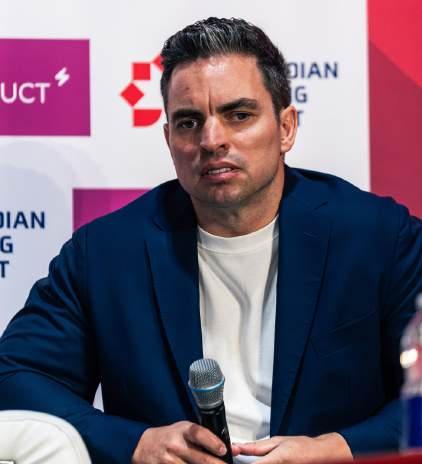
ANDREW GARVEN,
Head of affiliates, BET99
“Anonymous can still work, but only if it’s built on real proof. And it can’t feel anonymous. Users still need a reason to trust you.
“Regulation has reset the bar in igaming. It’s no longer a grey-market category, and users now expect the same standards they get in financial services, travel, or dining categories where affiliates have shifted from anonymous lists to creator-led commerce.
“If a page feels generic, users assume the content is too. The affiliates still competing today have real people behind them, not just writing content, but showing up off-site and shaping the conversation. Rankings drive discovery. They don’t guarantee conversion. They’re just one step in the user journey.
“Conversion now happens across channels: social (creator-led), communities (Discord, Telegram), and owned audiences (email, push). If users can’t validate you beyond your site, they won’t trust you. That’s the reality: consumers have endless choice, and trust is built through identity, interaction, and consistency.
“Anonymous, proof-driven brands can still compete but they’re doing it the hard way.”


MIKE SADICARIO, EVP enterprise media and retail partnerships, Equativ
“An anonymous affiliate site can still be viable in 2026, but anonymity is no longer enough to sustain the model. The market is becoming less tolerant of inventory that adds little value for users, advertisers, or the wider open web.
“In a world of AI-generated content and tighter scrutiny on quality, sustainability, and wasted spend, the affiliate businesses that endure will be the ones that operate like credible publishers or trusted creators. To the modern consumer, these roles are often synonymous; in fact, a creator frequently holds higher credibility than a legacy publisher because of the direct, personal relationship they’ve built.
“The real dividing line now is not ‘faceless’ versus ‘personality-led’, but low-accountability inventory versus media businesses that can prove their value. The winners will be those who provide transparent practices and trusted environments for brands, moving beyond mere clicks to become a genuine bridge of authority for the consumer.”

Erin Gallagher examines the M&A landscape and the shift from traffic acquisition to technology, data and diversified revenue streams.
The igaming affiliate space has always been competitive, but in recent years it has taken on an entirely different shape as a sustained wave of mergers and acquisitions (M&A) continues to reshape the landscape. With more established players acquiring smaller sites, data platforms and entire portfolios, the
battle for market share is playing out right in front of our eyes.
For some, this shift towards consolidation reflects the natural evolution of a maturing industry. But for others, it raises a more pressing question: is there still room for smaller affiliates to survive?
Speaking to Christoffer Grönlund, chief executive officer and founder of MindBoogie Marketing, and Elad Barzilai, co-founder of Leverage, a more nuanced picture of the affiliate landscape is beginning to emerge. While consolidation is accelerating at the top end of the market, both executives point towards a broader
structural shift that is redefining how affiliates compete, scale and position themselves in an increasingly complex environment.
At first glance, the current trend of M&A is not entirely new. We’ve seen it in both the sports betting and igaming spaces – from big-name mergers such as Ladbrokes Coral, to FanDuel being acquired by Flutter Entertainment – so it seems about time this trend made its way into the affiliate space.
As Grönlund explains, consolidation has long been part of the affiliate playbook, particularly in markets where early movers sought to dominate search visibility and strengthen their position with operators. However, what has changed in recent years is not the act of consolidation itself, but the nature of what is being acquired, and why.
He says: “We have seen this before. If you go back to the 2010s, companies like XL Media were already consolidating assets in markets like Finland to dominate SEO and gain leverage over operators.
“What might be different now is that things are more sophisticated, and where the value sits. Deals like Gambling.com Group acquiring OddsJam, reportedly valued at up to $160m, show that affiliates are no longer just buying traffic, they’re buying technology, data, and revenue streams.
“So, I don’t think it’s just consolidation for the sake of it, it’s more of a
We’re moving from an SEO-driven affiliate model to a data-driven model
structural shift we are seeing, plenty to keep the SWOT ninjas busy.”
The focus has instead shifted away from simply acquiring traffic towards securing deeper capabilities – be it technology, data infrastructure, or even diversified revenue streams.
Grönlund adds: “We’re moving from an SEO-driven affiliate model to a data-driven model. Once you see that shift, it becomes clear this is about owning the entire value chain. In the more regulated and competitive environment we are seeing now that combination becomes very powerful, and you want to be holding all the aces.”
Buying growth, not building it
For Barzilai, the reasons behind the recent shift towards M&A in the affiliate space are down to two main factors: speed and efficiency. With newly regulated markets beginning to emerge – such as the United States, Brazil and parts of Africa –competition is hotting up among operators and affiliates. In other words, the rush for market share is underway.
However, building that presence organically is difficult. As Barzilai explains, very few markets can still be considered untapped, and developing sites with authority and trusted ecosystems requires significant time and investment.
The solution? Acquiring an existing asset. For many brands, this is the most practical route, offering entry into the fast lane for establishing your presence in a new market.
External pressures are also shaping this behaviour. Increased scrutiny from platforms such as Google across both SEO and paid channels has made it harder for smaller affiliates to maintain profitability. As margins tighten, many are faced with a decision between continued investment and exit, with acquisition emerging as an attractive option for those unable to compete at scale.
“No market is a completely blue ocean,” Barzilai says. “At the same time, creating sites with authority, seniority and trusted ecosystems takes a lot of time and resources. Operators and big affiliates alike understand that when entering a market, it’s better to buy rather than to create from scratch.
“We see Google hitting affiliate sites from every direction: SEO, PPC, among others. Smaller affiliates are finding it hard to be profitable, which makes them want to sell.”
The rise of a ‘super league’
As consolidation continues, the emergence of a ‘super league’ of big-name affiliates is becoming more prominent. But according to Grönlund, this shift towards an industry comprising of only a handful of brands is well underway.
“The top affiliates today operate more like media houses or even tech companies than traditional affiliates,” he says. “They have the capital, infrastructure and data capabilities to keep scaling. Groups like Gambling. com, Gentoo, and others have the capital, infrastructure and data capabilities to keep making moves and scaling up.
“But we’ve also seen this before. Large affiliate groups tend to become more focused on process over time, which affects speed. That opens up space for small, agile and hungry entrepreneurs to win in niches, whether that’s new markets, new channels, or faster content creation. ‘The riches are in the niches’, as they say.”
Barzilai echoes this view. For him, this concentration of power is particularly visible within regulated markets and across mainstream acquisition channels such as Google and Facebook.
In these environments, the cost of acquiring traffic and maintaining compliance has risen to a level that effectively limits participation to those with significant resources.
This shift has redefined the barriers to entry. Grönlund argues that technology now plays as significant a role as regulation in determining competitiveness, with data infrastructure and real-time capabilities becoming essential components of success.
Barzilai goes one step further by suggesting that while regulatory challenges can often be navigated with the right expertise, competing on technology and data is far more difficult, with the gap between large and small players continuing to widen.
“Arguably it might be a more durable moat than regulation,” he says. “It’s harder to compete on tech and data, and that gap grows every year. At the same time, I would argue that AI is also proving that development costs can be lower, which might play in the opposite direction, and will allow small affiliates to develop faster and cheaper. So maybe not?”
For smaller affiliates, these developments present a slightly more complex operating environment. Rising compliance costs, increasing competition and a growing reliance on major platforms have all contributed to tighter margins.
At the same time, expectations around investment in tracking, analytics and optimisation tools continue to increase, placing an additional strain on resources.
Barzilai acknowledged that these pressures are forcing some smaller affiliates to reconsider their position. Where profitability becomes difficult to sustain, the option to sell becomes more appealing, particularly in a market where larger players are actively seeking acquisitions.
But for those that don’t end up being acquired, we may see a new approach begin to emerge: a shift towards the grey or black market.
Barzilai continues: “It’ll be naive to say that smaller affiliates are going to disappear. Rather, I believe they will find their positioning: blackhat tactics, Telegram channels, specific knowledge markets like Southeast Asia. The fact they are not in the front does not mean they do not exist, and definitely does not mean they are going anywhere.”
This approach of focusing on alternative, niche markets allows smaller affiliates to remain competitive in areas where speed, creativity and local knowledge can outweigh scale.
“Smaller affiliates won’t compete head-on,” Grönlund adds. “But they will keep winning in pockets where speed, creativity, and risk-taking matter. We are constantly evolving and there will always be new gaps to fill. So, I don’t think smaller affiliates will disappear, they just have to be much more specialised in what they bring to the table. Any company can be up for grabs now, no matter the size. It’s more about positioning.”
One of the more nuanced implications of consolidation lies in its impact on innovation. Larger organisations tend to bring greater structure, stronger compliance frameworks and more consistent processes, all of which contribute to how the industry as a
Affiliates are no longer just buying traffic, they’re buying technology, data, and revenue streams
whole continues to mature. However, this increased scale can also lead to reduced agility, particularly as decisionmaking becomes more complex.
Grönlund notes that many of the industry’s most innovative approaches have historically come from smaller affiliates willing to experiment with new strategies and enter less established markets.
“I like the nostalgia of the good old days, but it is surely interesting how the industry has evolved over time. I would say it cuts both ways,” Grönlund tells Affiliate Leaders
“On one hand, larger and financially stronger affiliates tend to bring more structure, better compliance, and higher standards, partly because they have to. But at the same time, a lot of innovation historically has come from smaller and hungry affiliates leveraging new SEO strategies, and markets.
“If compliance and overall costs push those players out, you risk losing that force of innovation and experimentation.”
He continues: “I think consolidation is probably inevitable. But the industry needs to make sure it doesn’t kill the entrepreneurial side that made affiliate marketing what it is today.”
For Barzilai, however, this story is much more nuanced. If we want to look at how consolidation might impact the industry going forward, we need to also consider how affiliates compete in unregulated and grey markets.
“It’s good for the industry that in regulated markets – like the US, the UK and some countries in Europe – if big, regulated, compliant companies play a legitimate part. It ‘cleans’ up the industry, allows fair game and competition and, of course, ensures that players are safe(r).
“However, pretending this is where the industry ends is just turning a blind eye. Small affiliates that can’t afford legal overhead will continue operating in unregulated markets, or in black areas within the regulated ones. And if anything, it makes them more innovative in their approach.”
Evolution, not extinction
The question of whether consolidation is forcing smaller affiliates out of the market does not have a simple answer. There is clear evidence the traditional model of running a small, SEO-focused affiliate business with limited resources is becoming less of the norm.
However, this does not equate to the disappearance of smaller affiliates altogether. Whether this trend of M&A continues in 2026 remains to be seen.
But for some affiliates, their time in igaming may be reaching its final chapter, as industries such as fintech and crypto begin to go through the motions of market maturation. And for Barzilai, the skills learnt in igaming can be easily transferred to other sectors.
He says: “Affiliates have a lot of great abilities in a super competitive industry: whether it’s SEO, PPC, social media marketing, building sites and understanding user conversion and behaviour, and different markets and audiences.
“Taking this set of abilities to less competitive, or otherwise growing industries can prove to be a successful move – if done correctly. While it’s hard to compete with the turnover of the igaming industry, opportunities are out there, and if these are closing down in one way, why not go another?”
For other affiliates, these last few months may not mean the end of promoting casinos or sportsbooks. However, the alarm bells to consider diversifying revenue streams may be getting louder – especially in light of new regulations, legislative challenges and changes to Google algorithms.
As Grönlund puts it: “I don’t think serious affiliates will ever leave igaming, but the smart ones are expanding beyond to reduce risk and build stable revenue streams. No one wants to end up with all eggs in one basket.
“To be a bit blunt: we’re not seeing the end of affiliates, we’re seeing the end of amateur affiliates.”
Words by - ELLEN JENNINGS-TRACE -
Social interactions are fuelling marketing and advertising teams across industries, to the extent that social strategy now shapes wider audience engagement.
There was a time when social teams were not prioritised and were often among the smallest teams. Luckily, that’s no longer the case, explains Amanda Elliott, organic social lead at Buddy Media.
“Social has become such an important driver of results across the board now, and that’s why teams working so separately isn’t appropriate anymore. It doesn’t serve anyone to not understand the power of social and the audiences on there.”
But what is the real difference between a traditional Google search and social search? It depends on the platform, as regular social media users will recognise, no matter which platform you’re searching, the community network providing the results is the differentiator.
“As someone that regularly uses social search even outside of work, a big difference is that you’re getting user-generated responses. Whether that’s just from a consumer or an
influencer, and that does build an element of trust,” Elliott explains.
It’s not quite as simple as just building a wide reach. Social platforms are designed around quick content, and tiny exposure times. An ad which reaches millions of social users who scroll past in an instant is much less valuable than a targeted social campaign.
Google search may provide a more precise answer, says Elliott, as campaigns on TikTok are “more possibility than a definite” at the moment of social search. “We ideate with the aim of content getting into that organic search. But a paid ad for example is a way we know that it will reach the relevant audience.”
Other industry professionals report similar considerations for social strategy. Paula Bacariza Perez, general manager of data partnerships at The Trade Desk said during a panel at Advertising Week Europe: “We all know that it takes time for a message to go into your long-term memory, and yet we see the vast majority of spending in industry on platforms that have tiny, tiny exposure time because they are designed to quickly

scroll through content or jump from one to the other.”
This is why deliberate and intentional strategy is so important with social – and why first-party data is at the forefront for teams. Social is no longer just a fun way to go viral, but has become a way for organisations to leverage first-party data for meaningful engagement.
“It’s a strategic necessity now,” says Elliott. Thomas Ives, co-founder at RAAS Labs, agrees adding “we’re changing the way we consume media”.
“It’s rapidly changing at the minute, and the funnel has kind of become a little bit blurred,” he says. “Relevance can do a great job of long-term brand awareness. If you do it in the right environments, at the right moments, when someone’s actually shown they’re willing to engage with your brand, that brand awareness message can also be doing a performance job.”
But, social strategy requires caution. Brand protection is not a simple task in the modern era – especially given the fast-paced nature of social media, and the alleged failure of social media brands to protect users, instead using harmful content to fuel engagement.

On platforms like TikTok and Meta, you can’t fully control what your
content sits next to “
Amanda Elliott
It’s rapidly changing at the minute, and the funnel has kind of become a little bit blurred

Damage limitation
There are ways to mitigate these risks, Elliott explains. “Really capitalising on influencers and the creator economy is a big one for us and our clients. It heavily distributes reach so the brands we work with can get into multiple conversations and niches online.
“Investing in paid media and search is also really important – ensuring that the right people are getting the right information from brands they want to see.”
This isn’t just about personal preferences, but often a matter of safety. A study by the Gambling Commission, Young People and Gambling (2024), shows the majority of children (62%) aged between 11 and 17 reported having seen gambling ads online, with half (49%) of these being on social media.
It’s not just rogue ads, either. Around 70% of teens reported seeing real-life violence on social media, a Youth Endowment Fund study, Children, violence and vulnerability (2024), revealed.
No matter how well-crafted and welltargeted your social content strategy
is, you are vulnerable to negative perceptions just by being shown in proximity to harmful content online.
“On platforms like TikTok and Meta, you can’t fully control what your content sits next to, so it’s really about being a lot more intentional with how you show up,” explains Elliott. “Being selective about who you partner with and which communities you’re in is definitely important, but so is utilising exclusion lists and placement controls”
Authentic content, authentic audience
Research by the Human Defense Platform shows that automated traffic is growing eight times faster than human traffic, yearon-year, and the reliability of self-identification is becoming a concern. This isn’t just a cybersecurity concern, it also calls the validity of first-party data into question. So can you rely on it?
“You can,” Elliott responds, “but not blindly anymore. The numbers don’t always tell the truth anymore. It needs interpretation and careful filtering.”
Unfortunately, bots don’t just stop at viewing your content. AI is now being used in content creation more than ever, flooding the internet with cheap, massproduced creative and muddying the water for brands and advertisers. Organic reach is no longer just about competing with other brands, Elliott explains, it’s also about competing with AI and bots.
“One thing I have noticed is the world is getting really savvy when it comes to bots. They’re rife on TikTok at the moment, and almost always the human commenters are responding to the bot comments calling them out, asking what they’re speaking about. This still poses a huge challenge, because where do we find the real interactions? Where do we find the resources to have people constantly deleting these posts?”
There are ways to combat this, though. One way, is to ensure your brand is “present in the comments section and has that feel of a human on the other side is”, she says, adding people are more aware and resistant to AIgenerated content than they have been previously. Therefore, building a story and an authentic connection with your audience helps to cut through the noise.
PREMIUM NEWS COVERAGE AND HIGH-END FEATURES. TELL YOUR STORY IN BRAZIL WITH SBC.
SCAN HERE TO ADVERTISE WITH US
Affiliates still using traditional SEO and AI-driven content could be consigned to the history books as iGaming operators move towards other marketing channels.
Words by - CHARLIE HORNER -
Influencers are big business, and the creator economy is only getting larger by the year. In 2025, the influencer marketing sector was estimated to be worth $32.5bn, up 35% year-onyear (YoY), according to Influencer Marketing Hub.
Brands are looking towards influencers in order to spread their message and onboard new users. Nowhere is this shift more apparent than in the global igaming sector.
Sports betting and online casino brands have been utilising influencers, from streamers to Instagram stars, to promote their brands and secure first time depositors on their sites across many saturated and competitive global markets.
The UK Gambling Commission’s 2025 Young People and Gambling report found 16% of young people – defined as being between 11-17 years old – had followed gambling-related content on
social media or streaming platforms. Of those, 31% had been exposed to gambling advertising from influencers, creators or streamers they follow.
Though this study focused on those who cannot legally gamble, it is indicative of the rise of influencers and how they have become ingrained in igaming.
Operators can spend up to millions of dollars each year on influencer marketing, but as regulations tighten and profit margins shrink in the wake of tax hikes, brand awareness and visibility are no longer the be all and end all. Operators demand a return on investment from their influencer deals.
“Influencer marketing for igaming brands has definitely moved from mostly brand awareness campaigns to more performance-oriented and structured campaigns,” says Nadia Bubbenikova, chief business officer at Famesters, an influencer marketing agency for igaming brands.


“All of those collaborations are built around the metrics and around achieving the results that the brands have in their minds even before approaching the influencer. They don’t just sit and hope for the best, but they know exactly what they’re interested in, and the market also reacts to that.”
Famesters recently published a comprehensive report into influencer marketing in igaming, which found over 30% of operators spend at least a third (35%) of their marketing budgets on influencers and 42% of new sportsbook sign-ups come via influencer campaigns.
“More and more brands have in-house influencer departments who are responsible directly for reaching out to the influencers and making those deals happen,” Bubbenikova adds.
Why are influencers hot property?
Influencer marketing hasn’t become such a huge part of the digital economy and the igaming sector spontaneously. It reflects societal changes and evolving consumer demands.
Ultimately, younger generations of consumers inherently trust influencers and are more likely to act on their recommendations compared to faceless websites or social media.
Speaking during an SBC Affiliate Digital Day session, GameLounge’s vice president of global operations, Keith Geary, outlined there has been an over 50% YoY increase in the number of casino-related streamers and an over 100% increase in influencers willing to promote gambling products.

“It’s a push to you, rather than a pull. I think it’s really important to know how many users will be acquired by scrolling through Instagram. It’s a complete shift in the way users have been acquired,” he said.
Tapio Penttilä, a consultant at igaming operator Betsson, agrees the trust factor is huge for brands adopting influencers.
He notes: “Users are not loyal towards our brand, necessarily. First and foremost their loyalty goes towards the content creator or the streamer.”
Bubbenikova also agrees with the consensus, but notes there is a secondary reason consumers trust influencers – one which creates both positive and negative connotations.
“The majority of people believe that if an influencer is ready to put their career at risk promoting a brand, then they must have done their due diligence and checked the brand, to make sure it’s safe and not scamming users.”
If users value authentic human personalities and influencers are the driving force behind first-time depositors in igaming, then what happens to traditional affiliates? A staple of the industry, odds comparison sites and casino


review platforms could soon be swept under this revolution of human connection.
Bubbenikova’s suggestion operators are growing influencer relationships teams mirrors the typical affiliate management function that most operators of a certain size will run only adds to the fear that affiliates might be running out of road. But is this necessarily the case?
No, she states, primarily because affiliates are catching up and are working with influencers too.
“The majority of them still use affiliates who provide influencer marketing at some point,” she explains. “I wouldn’t say that it is necessarily only one or another because from what I’m seeing right now it’s actually more of a mix.”
Yet, it increasingly feels as though it will only be those affiliates who keep in tune with these evolving user demands who will survive and thrive moving forward. Those stuck in the traditional SEO keyword era, or those utilising stale AI-driven content, could be consigned to the history books.
Over the last two years, Google has been clamping down on AIdriven content through a series of updates.
Following a major core update in 2024 aiming to reduce spam and unhelpful content, Google reported there was 45% less low-quality, unoriginal content in search results. Still, that hasn’t stopped alleged parasite SEO networks from emerging in the last few years. Even in the wake of unproven allegations of genuine writers being replaced by AI content, it reinforces the notion users cannot trust what they are reading on some websites in the igaming vertical.
In this environment, it is easy to see how the traditional affiliate playbook is shifting towards authentic human personalities through influencers.
Is smaller better?
In some ways, it might be better to refer to influencers as micro-affiliates. Perhaps they have management, or an agency, but fundamentally a oneman-band is generating hundreds, if not thousands of first-time deposits through streaming.
On Kick, there are streamers in their droves playing slots and encouraging their viewers to sign up to their partner casino with codes for bonuses and tracking purposes. Those demonstrations, the on-screen moments of big jackpot wins shared with the viewers reveal the streamers’ personality, creating a genuine connection with the audience.
Users are not loyal towards our brand [...] their loyalty goes towards the content creator or the streamer



Those who are slots enthusiasts are more likely to be enticed by those experiences than a simple landing page. That notion would extend to any industry –demonstrations and community are a far more valuable tools in 2026 than simple comparisons.
But with so many streamers in the ether, and operators having large-scale budgets, a choice needs to be made about who becomes a long-term brand ambassador, rather than just a short-term partner.
Famesters research suggests micro-influencers –those who have between 10,000 and 100,000 followers – are more impactful than those with one-million-plus followers. It implies micro and nano-influencers now drive roughly 67% of new sportsbook sign-ups.
“The majority of the budgets that we handle are mostly continuous deals,” Famesters Bubbenikova says. “We have, for example, a set of 30 influencers or streamers that we offer to a brand. Out of those, maybe 15-20 will turn out interesting for the brand in terms of performance [and] let’s say five-to-seven will be really the top performing creators. The majority of the budgets are built around those top performing ones.”
Acquisition is certainly a huge part of this puzzle, but operators who are focused on profit and loss know CPAs are costly and acquisition is a hugely expensive task. For profitable operators, retention is the aim.
That is where the community-driven aspect of microinfluencers can become particularly useful. If players feel welcome in a community, they are more likely to return.
Brands are increasingly focused on the performance of their influencer campaigns, and the entire lifetime value of a player will be in the spotlight much more than simply the number of new sign-ups.
As Bubbenikova notes: “We will be looking at more detailed and developed understanding of the market by these influencers, and because of that, I think brands will be mostly interested in those who change with the market, who can easily adapt to new trends.”
And as Penttilä puts it, brands need to focus on providing players with great experiences if they are to return again and again; influencers can be a core part of that moving forward.
“Our job is to find the right balance between what we are looking for to communicate our brand and its tone of voice and how we can fit and merge that together in a way that is entertaining for the user who’s actually consuming the content,” he says.
iGaming / Sports Alberta iGaming Act
Regulation explained: Transitions Alberta from a lottery monopoly to an open, regulated market similar to Ontario’s competitive landscape.
Marketer risk: ‘Inducement’ ad restrictions (prohibiting bonus-led public advertising).
Social casinos Sweepstakes Bans
Regulation explained: Reclassifies ‘dual-currency’ sweepstakes models as illegal gambling, effectively outlawing platforms that use ‘sweeps coins’.
Marketer risk: Complete loss of market access in major, high-revenue states.
iGaming / Sports Law 14.790/2023
Regulation explained: Establishes a federal licensing framework, requiring fixed-fee payments and strict technical standards for all operators.
Marketer risk: Ad bans at public events; mandatory licensing costs; and compliance.
Sports Betting W-2G
$2k Rule
Regulation explained: Lowers the threshold for automatic IRS (Internal Revenue Service) reporting of winnings to $2,000 and restricts how much loss can be deducted from winnings.
Marketer risk: High churn due to ‘phantom income’ tax burdens on casual and pro users.
E-commerce / iGaming VAT and anti money laundering (AML) updates
Regulation explained: Implements value-added taxes on digital bets and mandates rigorous identity verification to prevent money laundering.
Marketer risk: Increased friction in the user onboarding funnel and higher cost per acquisition.
From embedding finance to the rise of the prediction markets, Ted Orme-Claye, SBC News editor, examines how the lines between sectors are blurring.
Cross-over from sector-tosector are commonplace for modern-day businesses, and if any two industries have a knock-on effect on those that surround them, it’s finance and technology.
Embedded finance – the incorporation of financial services and fintech-style products into non-financial ones – has made its mark across multiple industries. Why should the betting and gaming sector be any different?
Betting is more susceptible to the influence of financial services and fintech than others. The principles of trading on stocks, shares, futures and options can be broadly applied to the principle of placing a bet on a winning horse, a boxer’s knockout punch, or the chances of cards falling in the right order – even if the regulations and terminology associated with each sector are vastly different.
The past year has seen the lines between gaming and finance blur arguably to the greatest extent ever with prediction platforms like Kalshi, Polymarket, FanDuel Predicts and DraftKings Predictions being pushed to the forefront.
However, for those with a background in the liquidity-based betting exchange scene, this is nothing new. Jason Trost, founder and chief executive of Smarkets, tells Affiliate Leaders the firm’s product was “directly inspired by financial markets”.
“Rather than relying on traditional bookmakers setting odds, it allows prices to emerge dynamically through supply and demand, much like equities or commodities trading,” he says.
“Concepts such as liquidity, spread, and market efficiency, borrowed from finance, are now fundamental to how betting markets function. On a behavioural level, we’ve also seen a shift in how sophisticated users engage with betting.
“Many now approach it through a trading lens, using strategies rooted in arbitrage, hedging, and quantitative modelling. This mirrors the evolution seen in electronic trading, where data, speed, and pricing accuracy are key competitive advantages.”
Not a one-way street
Countless industries outside of betting have embraced embedded finance. A plethora of retailers now

have their own digital wallets, for example, Starbucks allows users to pay in-store, earn rewards, and use a specific brand card.
E-commerce in general is an area which consistently stands out for innovation and outside-the-box thinking. Shopify’s main endeavour in this area is the Shopify Balance – a money management account that can be used across its multinational retail and online point-of-sale network.
However, it’s not just elements from financial services. Gamification has become a huge trend across various industries with some in fintech embracing it and entertainment style elements – an uno reverso on the abovementioned trend.
Revolut has embraced communication across areas such as the gamified loyalty programme RevPoints, a rethinking of the traditional cashback system which utilises points collection instead.
The London-based fintech also uses leaderboards, where users track retail points. This links to their third form of gamification, competitions, prize draws and raffles, with prizes often being cash winnings or event tickets, among other things.
The point I’m making here is the transfer of ideas, knowledge, experience and product innovation is always occurring from sector-tosector. The recent developments in the betting space show that financial input is only going to get stronger.
In betting’s case, the exchange mentioned above is the most classic example of financial services being rolled into sports betting. Other tech innovations stand out too though.

Entain’s Ennovate innovation hub back in 2022 experimented with non-fungible tokens (NFTs) and virtual reality, backed by £100m in investment. DraftKings also operated an NFT exchange between 2021-2024, albeit with some legal issues.
Smarkets’ Trost expects tech and fintech to continue leaving their mark on betting. “You would expect that we’ll see greater use of automation, more sophisticated data-driven pricing, and
tools that give users improved control over risk and execution,” he says.
“User experience is key too and more and more recreational bettors are becoming accustomed to using recreational trading products. So features like deeper order books, more advanced charting, and better risk management controls.
“This makes markets more transparent and gives users greater control over their positions.”





E-commerce in general is an area which consistently stands out for innovation and outside-thebox thinking

Prediction markets are not a fundamentally new concept. At its core, it’s hard to draw a distinction between a predictions platform and a betting exchange, except maybe the range of markets covered – you won’t find markets covering Bitcoin’s price or a geopolitical development on Betfair, but you may find it on Polymarket.
What is innovative about predictions is the marketing of it as a new form of financial services, allowing users to speculate on real world events, whether this be the outcome of an election, a company’s share price, or the World Cup final.
This has allowed companies to tap into a user base bookmakers may not have been performing as well in. Studies in the US by Truist show that prediction platform customers are often college educated, higher earning individuals who closely follow current affairs and market developments.
Ted Orme-Claye
Aside from direct marketing, if we look at the incorporation of financial services elements into betting more generally, there is the data element to consider. Regulatory stakeholders like the UK’s Gambling Commission have long called on bookmakers to learn from financial services around data sharing, chiefly in a player protection context.
Data can also be used to inform marketing. At Advertising Week Europe, Tom Binns, managing director of Boohoo. com, talked about the firm’s work with PayPal Ads in a discussion with the latter’s senior director, Harry Stokes.
“We have a huge amount of data within the business about our customers, our product, what works for us, what resonates with our customers,” he said. “It’s about how we intelligently use that data within those platforms to make sure that we are featuring as high up of that funnel as we can.”
For Binns, this is how Boohoo.com integrated those data sets to push
“the most relevant products” to customers for a personalised shopping experience.
From the betting side, Smarkets has no interest in getting involved in predictions. The firm clearly sees a financial services-style future for betting, and better quality data allowed it to “understand user behaviour in far more detail than previously”, Trost highlights.
“That enables more relevant, timely marketing and a much deeper level of personalisation end-to-end. From a marketing perspective, activity across all channels should feed back into the product.
“The most effective brands aren’t just ploughing loads of volume into the top of the funnel, they’re working to shape a better overall user experience in order to improve monetisation; using insights from campaigns and customer engagement to refine UX, and features.”
JACOB HARTUNG
Senior director of product and design, Gentoo Media
As senior director of product and design, Hartung’s day-to-day involves steering product strategy for one of the leading affiliate agencies in the igaming sector, ensuring platforms aren’t just functional, but market-leading in a highly competitive landscape.
He describes his leadership philosophy as “rooted in data-driven decision-making and rigorous experimentation” – and this is reflected in his tech stack. His tech stack is designed to monitor, assess, and push performance across his verticals.

What it is: A leading business intelligence platform for visual data analysis and reporting.
What it is: A comprehensive SEO toolset used for backlink analysis, keyword research, and competitive audits.
Why: In a multi-brand affiliate environment, performance starts with data visibility. Tableau translates millions of data points into a clear narrative, allowing me to see which brands are overperforming and where the market is shifting. It’s the primary tool I use to report performance to the board and justify where we should invest our next product design efforts. With AI and automation layered in, insights become more actionable.
Why: Once the business goals are set, we need to ensure visibility. Ahrefs is our competitive ‘radar’, helping us monitor our share of voice and identify high-intent keywords. It ensures our products remain the top choice for players in a landscape where organic search rankings are the lifeblood of the affiliate model.
What it is: A user behaviour analytics tool that captures how real people interact with your site through heatmaps and session recordings.
What it is: A collaborative interface design tool, significantly enhanced by Google Stitch for AI-powered UI generation. (integrated with Google Stitch)
Why: Understanding the ‘why’ behind the traffic is critical. Clarity gives us deep insights into user friction – like rage clicks or confusing navigation – without heavy data sampling. It allows my team to identify exactly where a user’s journey breaks down, ensuring we prioritise design fixes that have the highest impact on our conversion rates.
Why: This is where we solve the friction points identified in Clarity. The connection to Google Stitch has redefined our speed; we use AI to ideate and generate high-fidelity UI components, which we then ‘stitch’ directly into Figma. It bridges the gap between raw ideation and production-ready design, moving us from concept to prototype in minutes.
(Visual Website Optimiser) and AI
What it is: An enterprise-grade experimentation platform used for A/B testing and conversion rate optimisation.
Why: By combining VWO with our suite of AI codegeneration tools, we’ve achieved a tenfold increase in speed in our experimentation flow. This allows us to move from hypothesis to live test at lightning speed, drastically improving our time-to-market and loss-prevention capabilities. It has transformed our development cycle, turning ‘what if’ into ‘proven results’ almost instantly.
Why: I’m often jumping between my laptop, tablet, and phone. Traditional chargers are bulky and slow. A tiny GaN charger allows me to fast charge all three devices simultaneously from a single outlet in a media lounge or hotel lobby. It ensures that if I have a 15-minute window between sessions, I can get back to 80% power and stay fully operational.

Listen every day on Spotify, Apple Podcasts, Youtube, or wherever you get your podcasts.

Affiliate marketing in iGaming has remained consistent for more than a decade, but the rise of AI and LLMs is is forcing affiliates to adapt.
Words by - JOE STREETER -
While new tools enter and evolve the market, the direction of travel remains the same for those with an inside view on AI engagement for affiliates.
AI chatbots like ChatGPT, Claude and Perplexity have somewhat raised the bar for engagement with AI, but it’s the increasing adoption of the tech that is really fuelling a new era.
Justin Deaville, former actor and now managing director of Receptional, has worked in SEO for
about 20 years, and over the past 15 years the direction has changed little. The SEO playbook has largely remained the same.
He continues: “What’s exciting now is the emergence of a new channel driven by LLMs, which works differently and changes the rules. Usage is growing rapidly – UK data [by Ofcom] shows ChatGPT usage increased fivefold last year, and research from Bain suggests people under 45 now use LLMs as much as Google.”
The consequences of this are that target audiences are already active on these platforms, which means affiliates need to think more about LLMs.
According to Deaville: “There’s also a gap: people use ChatGPT but aren’t actively trying to influence its outputs. We’ve been researching how brands are perceived by LLMs by asking them structured questions and analysing responses across platforms like ChatGPT and Gemini. The results differ from traditional SEO rankings –some brands perform better in LLMs than in search engines.”
Comparasino co-founder and chief operating officer, Araminta Hannah echoes this sentiment that the strategy for the igaming affiliate has “remained constant”.
She says: “We focus on creating unique, insightful content produced by genuine online casino experts. AI
chatbots aim to cite the most trusted and reliable sources on the web. By focusing our efforts on providing accurate, transparent information that helps users make informed choices, we naturally position ourselves to be cited by major AI platforms, even if that isn’t our primary goal.”
Click-throughs still relevant
The goalposts are, however, shifting when it comes to AI engagement and ROI for affiliates. AI has evolved and elevated the online journey and user experience of web platforms significantly.
Appearing in AI answers has become a key opportunity for platforms to reach audiences in a new and effective way, however, Deaville details clicks remain the target priority.
He adds: “Driving users to your website allows you to build brand familiarity,

capture data, and enable remarketing. That said, being cited as a source is valuable as a secondary outcome. The strategy is to structure content and calls to action so users are encouraged to click through while also being visible in AI-generated answers.”
Laying out the strategy for success employed by casino affiliates, Hannah outlines the importance of optimising to rank among the top 1% of information providers for any given search term.
She explains they invest heavily in ensuring every page is accurate, upto-date, expert-written and, crucially, directly answers the user’s query.
“It’s vital to understand user intent – players aren’t just looking for information about new online casinos, they’re looking for a place to play. While AI can summarise a list, it can’t yet replicate the depth of a true, productled comparison service,” adds Hannah.
“If you’re renewing your car insurance, you want a comprehensive comparison, not just a single AI recommendation. The same applies to online casinos. This is why affiliates must move beyond static top 10 lists and offer genuine comparison capabilities.”
Both agree the click-through era is not dead, even though it is being underpinned by the fact scrolling is happening at a significantly reduced rate.
AI Overviews appear in about one-third of searches, and click-through rates are roughly one-third to half of what they used to be in those cases. Fewer users scroll and click because their queries are answered directly, but clicks and conversions still happen – just at a lower volume.
A new era of search
While AI has changed the user experience in many ways, the strategy and the overall goal of igaming affiliates should remain the same.
According to Hannah, ensuring the player experience is at the forefront of focus is crucial. She says: “A modern online casino comparison site shouldn’t be optimising its core web vitals for Google or AI, it should be doing it for the user. In the current climate, a fast, seamless, mobile-first site is non-negotiable.
“At Comparasino, we invest heavily in our proprietary tech stack to ensure our tools are lightning-fast across all devices. We aren’t just ticking a box for a crawler, we’re delivering the frictionless experience that modern players demand.”
Deaville adds: “Site speed has always mattered for user experience and SEO. Humans are impatient, and slow sites lead to drop-offs. That principle still applies. AI crawlers may have constraints, but fundamentally, performance has always been important and remains so. It’s not a new barrier – just a continuation of existing best practices.”
The industry is moving into a new era, should igaming searches continue to shift towards a zero-click era, a plan B will be required for many affiliates.
Deaville emphasises that “affiliates need to rethink their marketing strategy because the landscape has changed. It’s not just affiliates –everyone [all marketers] must adapt”.
Relying exclusively on SEO is a rental strategy, but building a brand is a buying strategy. Google can shuffle its SERPs at will, but it can’t take away your direct brand searches “ “
“Traditionally, affiliates relied heavily on SEO and specific types of content. But LLM-based search involves more complex, conversational queries. For example, instead of short keywords, users ask multi-part questions combining predictions and odds.
“This shift means content needs to evolve, combining deeper analysis and multiple intents in one place. Strong, authoritative sites with recognised brands will be recommended more often by LLMs.”
Meanwhile, Hannah states that plan B needs to be plan A and the time for reliance on rented traffic is over.
“Relying exclusively on SEO is a rental strategy, but building a brand is a buying strategy. Google can shuffle its SERPs at will, but it can’t take away your direct brand searches.”
Words by - ELLEN JENNINGS-TRACE -
LESSONS LEARNT
“One of the biggest takeaways was how important it is to define success differently in a retail lottery environment. You’re not going to get a clean line to conversion, so you have to be comfortable leaning into engagement as a proxy,” says Rice.
“We also reinforced that full-funnel only works if each piece has a clear job. OTT/CTV and video did the heavy lifting on awareness, but they only worked because we had rich media and dynamic display ready to capture that interest and move people closer to action.
“Another lesson was around localisation. The more we leaned into dynamic creative, the better the overall metrics were. It’s one of the clearest ways to make a statewide campaign feel relevant at the individual level.
“On the planning side, we learnt that statewide balance in Nebraska had to be proactive. If we just mirrored population density, the campaign would skew toward urban areas and potentially miss rural players. Building in that rural/urban balance from the start forced us to be more disciplined with budget allocation and ultimately gave the campaign more consistency across the state,” he concludes.
The Nebraska Lottery faced a complex challenge of connecting digital media exposure to real-world consumer behaviour, especially given that ticket purchases happen in retail locations, making it impossible for advertisers to track online conversions or sales attributions.
This meant campaigns relied on viewability and completion rate metrics, which aren’t enough to get a clear insight into consumer intent.
“Since Nebraska Lottery sales happen in-store, we had to guide performance measurement toward engagement-based metrics, such as site actions and video completion, even though the final transaction is offline,” says Corey Rice, director of strategy for KORTX, a Detroit-based agency.
“Our strategic approach focused on balancing the full-funnel. We needed to maximise upperfunnel scale through OTT/CTV [over-the-top/ connected TV] and online video, while also ensuring we gave players a way to engage.”
The strategic pivot had a clear and profound impact on the campaign. From just a month-long campaign, the Nebraska Lottery generated over 227,000 site interactions and strong customer interest.
“Defining success for the Nebraska Lottery meant rethinking how digital is measured for a retail product,” explains Kortx co-founder and chief revenue officer, Chris Rowell. “Instead of forcing conversion metrics that don’t reflect how people actually buy, the focus shifted to understanding audiences, crafting relevant messaging, and leveraging digital channels to drive intent across the broader media mix.”
The success enjoyed by the campaign outlines the broader strategic strength in tailored digital tactics which meet customers where they are and engage with how they actually discover, interact, and ultimately, play.
The KORTX team recommended shifting the primary KPI’s of the campaign away from media delivery measurements and into site actions with more meaningful customer engagement.
“That’s where rich media and dynamic display came in, helping create engagement without sacrificing efficiency,” explains Rice.
KORTX moved beyond focusing exclusively on how ads were served, instead measuring how users interacted with the Nebraska Lottery website after ad exposure.
Key engagement indicators included:
• Website visits;
• Cash blast promotion landing page views;
• MVP Club loyalty sign-ups;
• Retailer search activity.
“Another nuanced piece was geography. It would’ve been easy to let the campaign naturally heavy-up in urban areas, but that doesn’t reflect how the lottery actually operates. We intentionally kept the investment balanced between rural and urban markets, which ultimately gave the Nebraska Lottery better statewide coverage.”
This enabled the team to capture and analyse meaningful engagement signals, even with limited tagging infrastructure on the site.
“This campaign served as a starting point for this approach. Moving forward, we will continue to refine our tactics. Expanding site tagging is also essential to gain a clearer view of user interactions and the path to purchase,” adds Megan Gordon, account manager at KORTX.


With the World Cup kicking off across the US, Mexico and Canada, Daniel Jurilj, the head of sales at bwise Media, discusses what operators can do to maximise campaigns.
When bwise Media published its World Cup activation guide for SBC News in March, the tournament was still a planning problem. Operators had time to negotiate inventory, build creative, get compliance sign-off, run tests. That phase is over.
The 2026 FIFA World Cup kicks off on 11 June at Estadio Azteca in Mexico City, and the conversation has now shifted entirely. The brands that followed the advice in that March piece are in a strong position. Those that didn’t now need a different kind of guidance.
What the prepared brands did between January and April
Early movers get rewarded, and that has proven true time and again. The operators and brands that acted on that advice spent the first quarter of 2026 doing three things: locking in premium inventory before CPMs climbed, establishing publisher partnerships with high-intent
football audiences, and building the creative and compliance infrastructure to activate at pace.
For igaming operators, the groundwork that mattered most was regulatory preparedness. bwise Media spent much of 2025 and early 2026 helping partners navigate that complexity – most notably in Brazil, where operators have been adapting to revised advertising restrictions and new compliance requirements while preparing for what is expected to be a landmark year of growth.
The brands that built their adtech integrations, locked in publisher exclusives, and tested their creative formats before April are the ones that will be able to move quickly when the group stage begins.
What the next five weeks demand
For everyone else, and even for those who prepared well, here is what the next five weeks demand.
During a World Cup, an ad sitting inside a live match update carries a fundamentally different quality of attention than one served in a general sports context


The biggest misconception is that you need a huge budget to participate, but you do need to invest enough to cut through meaningfully


Focus on match-day rhythms, not tournament-wide reach. The tournament stretches across weeks, cities, kick-off windows, fan rituals, and daily conversation – which gives brands more room to win with useful content, local relevance, and repeatable offers than with one flashy campaign that burns out in a day. This means leaning into in-play and same-day formats tied to specific fixtures, rather than generic brand presence.
Use contextual inventory over broad programmatic. bwise Media’s approach has always been built on direct publisher relationships in high-intent environments: live score apps, football news platforms, fan communities. Custom adtech solutions enabling interactive and contextually relevant ad formats have proven to go far beyond standard placements, and that edge becomes more pronounced when overall noise levels spike.
During a World Cup, an ad sitting inside a live match update carries a fundamentally different quality of attention than one served in a general sports context.
Localise aggressively across the three host nations. With 16 host cities spread across the United States, Canada and Mexico, there is no single World Cup audience. Brands that have taken months, or in some cases years, of preparation have landed on approaches that tailor activations down to the local level, homing in on specific host cities and changing creative based on markets.
For operators with exposure across North America and LATAM, this is not optional. An Argentina fan in Miami and a Canada fan in Toronto are in fundamentally different emotional states on match day. Treat them that way.
Double down on interactive formats which don’t rely
on promotions. In markets like Brazil, where bonusled advertising has been restricted, the operators who built engagement through product-quality formats like bet builders embedded in ad creatives, AI-driven prediction tools, real-time odds widgets, are better placed now than those who relied on offers. Those tools convert on intent, not incentive, which is exactly what a World Cup environment provides in abundance.
Prepare for traffic spikes, not just audience peaks. A highprofile group stage match can compress weeks of normal user activity into 90 minutes. Operators who haven’t stresstested their stacks against simultaneous demand across multiple jurisdictions will find out the hard way. The campaign itself is only half the equation.
If your World Cup strategy isn’t already built, the honest advice is: don’t try to do everything. A focused, well-executed activation tied to two or three key matches will perform better than a scrambled attempt to be everywhere. Pick your markets, pick your moments, and concentrate your budget where intent is highest.
The biggest misconception is that you need a huge budget to participate, but you do need to invest enough to cut through meaningfully. A scattered approach at low spend will be invisible next to the wellestablished brands.
The brands that took bwise Media’s March advice seriously are already in the game. For everyone else, the window hasn’t closed entirely, but it’s closing fast, and the plays available now are different ones.
Daniel Jurilj is head of sales at bwise Media
15–16 July 2026
Grand
29 September–1 October 2026
Feira Internacional de Lisboa, Lisbon
2–4 March 2027
Riocentro, Rio de Janeiro
20–22 April 2027
RAI Amsterdam