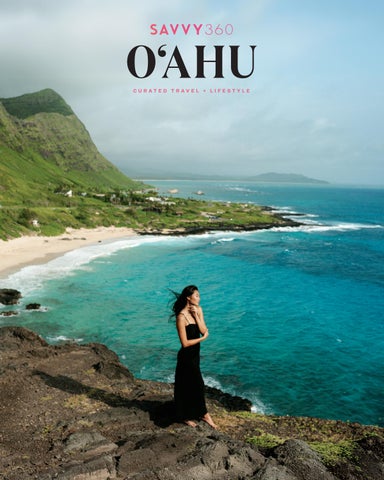
T H E IS L AN D O F
O‘A HU C U RAT E D T RAV E L + L I F EST Y L E
Fashion. Dining. Culture.
I Ka Pō Me Ke Ao from day to night
FROM SUN UP TO SUN DOWN, THERE’S MAGIC AROUND EVERY CORNER. Hermès | Miu Miu | Bottega Veneta | Harry Winston | Fendi | Saint Laurent | Tiffany & Co. | Ferragamo Moncler | KITH | Stüssy | RIMOWA | Island Snow | Kahala | Dean & DeLuca | Island Vintage Wine Bar Doraku Sushi | Noi Thai Cuisine | Restaurant Suntory | P.F. Chang’s | The Cheesecake Factory | Tim Ho Wan TsuruTonTan Udon Noodle | Wolfgang’s Steakhouse | Partial Listing RoyalHawaiianCenter.com • @RoyalHwnCtr • Waikīkī • Open Daily • 808.922.2299 • 1 Hour Free Parking
Plan your perfect trip. SAVVY 36 0.co m
SCAN TO DOWNLOAD THE MOBILE APP
Apple and the Apple Logo are registered trademarks of Apple inc. Google Play and the Google Play logo are trademarks of Google LLC.
Contents
28
KING KALĀKAUA
2
8
Local Vibe
16
Shop Local
22
Aloha O‘ahu
28
Ho‘oulu Lāhui
34
Ea Mai ‘Eiwa
Rubbah slippah … first planting … wai nīoi … return flight
Discover local brands around the island
Getting familiar with The Gathering Place
How King David Kalākaua turned hula, diplomacy, and a global vision into a renaissance for his people
A Hilo ‘ohana brings hula, design, and ancestral knowledge to Bishop Museum
34
PATTERNS OF PRACTICE
SPECTACULAR WAVES & DESIGNER FAVES C A N A D A G O O S E | C E L I N E | D I O R | M A I S O N M A R G I E L A | M A R C J A C O B S | PA N E R A I | Z E G N A
3 5 0 + S T O R E S & R E S TA U R A N T S AT T H E H E A R T O F T H E PA C I F I C ALAMOANACENTER.COM
Contents
56
40
Main Characters
46
Elemental Expression
50
Coastal Kuleana
56
Going Mauka
66
Still Cultivated
74
Shelf Life
80
Full Circle
86
Open Secret
92
What We Love Now
97
Experience O‘ahu
URBAN HIKES
80 HOT SPOT
Cover Photography IJFKE RIDGLEY
4
The Wonderful, Whimsical World of Kris Goto
How Hanai Works founder Scott Viloria turns metal and wood into furniture to last a lifetime
A yearlong effort to heal Hawai‘i’s coasts
Minutes from downtown Honolulu, a network of trails threads valleys, ridgelines, and overlooks you can enter and leave in a morning
The only reconstructed heiau in the ahupua‘a of Waikīkī anchors a working landscape hidden inside residential Mānoa
Local independent bookstores where O‘ahu’s stories, voices, and communities line the shelves
Chef Alan Wong returns to the island’s fine-dining stage with a new address, a storied legacy, and the same flavors Hawai‘i loves
In Chinatown, Waikīkī, and Kaimukī, three hidden bars built around a record collection, a father’s memory, and a shelf of old books
More epicurean finds around the island
Start planning your trip with our curated guides
Visit our O‘ahu Locations Ala Moana Center | International Market Place | Hilton Hawaiian Village | Hale‘iwa Maui Divers Jewelry Design House | Pearl Harbor | Dole Plantation | Honolulu Airport O‘AHU | M AUI | BIG ISL AND | K AUA‘I | M AUIDIVER S.COM
Contents SEE + DO | 99
GOLF | 117
BEACHES | 121
A R Y EAT + DRINK | 131
S O RT O‘ A H U AT K O OLI NA
d through exclusive experiences om land excursions to sea adventures, SHOP + STYLE | 143 Ko Olina has created one-of-a-kind ing culture and breathtaking natural
GET THE SAVVY360 APP
MASTHEAD KEVIN GEIGER DANIEL DUVAL MUN SOK GEIGER MICHELLE LACOUR KRYSTAL KAKIMOTO NATALIE SCHACK IJFKE RIDGLEY
DIGITAL
ISLAND LIVING | 157 Sunrise Yoga
SAVVY360 APP on THE APP STORE/GOOGLE PLAY SAVVY360.COM
Ocean Lawn
CONTACT
MAPS | 161
Golf Ko Olina Golf Club
Lunch & Libations Poolside at La Hiki
TRAVELOGUE | 169 W I T H US 6
ore details
FOR COMMENTS OR QUESTIONS, EMAIL US MAGAZINE@SAVVY360.COM
Private Speedboat Experience Pacific Ocean
©2026 SAVVY360, LLC. ALL RIGHTS RESERVED. Contents of Savvy360 O‘ahu are protected by copyright and no part of this publication may be reproduced or distributed in any form without the prior written permission of the publisher. Savvy360 assumes no liability for the products or services advertised herein. DESIGNED AND PRINTED IN THE UNITED STATES OF AMERICA Apple and the Apple Logo are registered trademarks of Apple inc. Google Play and the Google Play logo are trademarks of Google LLC.
Every bite brings you back. WAIKIKI LOCATIONS Hilton Hawaiian Village Hyatt Regency Waikiki International Market Place Outrigger Waikiki Beach Resort
Royal Hawaiian Center Waikiki Beach Mariott Waikiki Beach Walk® Waikiki Shopping Plaza
honolulucookie.com
LOCAL VIBE
Rubbah Slippah Some call them thongs, sandals, or flip-flops. In Hawai‘i they are slippers, slippahs, or rubbah slippahs — the footwear of choice for most locals, and the subject of firm opinions, since anything with a backstrap or a raised heel is a sandal rather than a slipper. One of the best-known local brands is, aptly, called Locals. The association traveled far enough that Brazilians call them sandálias havaianas, Hawaiian sandals, and in India and Pakistan they are hawai chappal, chappal being Hindi and Urdu for slippers. Slippers came to Hawai‘i with Japanese plantation laborers, who arrived wearing zori and geta, and the rubber version took hold after World War II, by which time Hawaiians had long gone mostly barefoot, using ti-leaf sandals when they needed to cross lava. Island Slipper has been making them by hand on O‘ahu since 1946. Take your footwear off before entering someone’s home. For locals it is automatic, and for everyone else the signs above the door do the reminding: Mahalo for removing your slippahs. The custom came out of plantation-era Hawaiian, Chinese, and Japanese households alike, a sign of respect to the host and a way of keeping the floors clean. Just be sure you no take mo’ bettah slippahs when you leave.
8
EATING HOUSE 1849 by Chef Roy Yamaguchi STRIPSTEAK by Chef Michael Mina HERRINGBONE KONA COFFEE PURVEYORS KUHIO AVE FOOD HALL MITSUWA A Japanese Marketplace MOANI WAIKIKI Island Bistro & Bar LILIHA BAKERY SHOREFYRE SKYBOX TAPHOUSE
Scan to learn more about our restaurant line-up.
YOUR ISLAND
DINING DESTINATION Home to Waikīkī’s largest collection of restaurants, International Market Place features open-air dining and extraordinary eateries from award-winning chefs like Michael Mina and Roy Yamaguchi. Delight in globally-inspired culinary flavors and discover the finest poke, indulge in sizzling cuts of premium steak, enjoy line caught seafood, savor local flavors and do it all in the heart of Waikīkī.
Kalākaua Avenue | ShopInternationalMarketPlace. com
LOCAL VIBE
First Planting The leaves come first — deeply lobed, as long as three feet, broad enough to shade a doorway — and beneath them hang the heavy green globes of ‘ulu (breadfruit), the fruit Hawaiians long called the staff of life. One mo‘olelo (traditional account) holds that ‘ulu reached these islands in the twelfth century, when the navigator Kaha‘i a Ho‘okamali‘i carried a tree from Samoa or Tahiti and planted it near Kualoa, on O‘ahu’s windward coast. Other accounts place the earliest plantings in ‘Ewa and Ko‘olaupoko, while another tells of the god Kū, who during a famine buried himself and rose again as an ‘ulu tree so that his family might eat. Hawaiians baked ‘ulu in an imu (earth oven), boiled it, dried it for storage, or pounded it into poi. The bark dressed skin wounds, and the sticky sap worked as birdlime, catching birds whose feathers went into ceremonial featherwork. A mature fruit can weigh up to 10 pounds, and the trees still stand between 1,000 and 2,000 feet on every main island, though ‘ulu grows readily from the shoreline up. Now it is coming back, boiled into curries, fried in butter, baked into bread, folded into dips, and milled into flour, in a state that imports most of what it eats. Find it at farmers markets and on menus across O‘ahu, where it turns up tasting more like a potato than like bread. 10
MAU I OAHU KAUAI
HAWAII BLUEGINGER.COM
LOCAL VIBE
Wai Nīoi The bush is knee-high and easy to walk past until the peppers ripen, and then it is unmistakable: small, bullet-shaped fruit turning from green through orange to bright red along the same branch. This is nīoi, the Hawaiian chili pepper, which grows year-round in the islands and turns up in enough backyards that plenty of families keep one by the back steps. Most of what they pick ends up in a bottle. That bottle holds wai nīoi (chili pepper water), and the English name is a straight translation of the Hawaiian. At its simplest it is nīoi, salt, and water, though crushed garlic, ginger, or a splash of rice wine vinegar often go in as well, and no two households make it quite the same way. It pours like water. The pepper arrived comparatively recently, thought to have reached Hawai‘i around 1815 through the Honolulu gardens of Don Francisco de Paula Marín, the Spanish adviser to Kamehameha I. Hawaiians named it nīoi and used it in water as a treatment for the skin, and it turns up now in Portuguese piri piri and Japanese pickles alike. At a local-style restaurant it sits on the table beside the shoyu, and locals dash it over beef stew, Hawaiian barbecue, kālua pig, poke, and poi, or pour a little into a side dish to sip between bites. Go past the ketchup and the Tabasco. A few drops are enough to start with.
12
LOCAL VIBE
Return Flight Nēnē, the Hawaiian goose, is named for the soft honking it makes, a low two-note sound that carries across open ground. It is endemic to these islands, descended from a Canada goose ancestor that arrived about 500,000 years ago and stayed. Half a million years of isolation reshaped it: the toes carry reduced webbing, an adaptation to the rocky lava flows where the bird walks and nests, and unlike other waterfowl it mates on land. It breeds from August to April, the longest breeding season of any goose, and the female incubates one to five eggs for about 30 days in the cover of low brush while the male keeps watch for mongoose. There were once perhaps 25,000 of them, and by the 1950s there were about 30. Captive breeding brought nēnē back to Hawai‘i Island, Maui, Kaua‘i, and Moloka‘i, though not to O‘ahu, where they had been absent since the 1700s. Then, in 2014, a pair turned up at James Campbell National Wildlife Refuge in Kahuku and nested there, and no one had released them. They had come on their own. Nēnē remain rare on this island, and a sighting is never promised. The refuge is closed through breeding and fledging season, and opens for free guided tours on Saturday mornings from October through the end of February.
14
com
SHOP LOCAL
Beauty Routine Honolulu-born makeup artist Lynn Yee’s long career in the beauty industry laid the groundwork for Tofu Skin Method, her simple but effective skin-care line. “As a makeup artist, I was constantly trying new products and I needed something I could use no matter what to soothe and moisturize my skin,” says Yee, who has sensitive, eczema-prone skin. “I noticed skin care was confusing or too daunting for a lot of my friends and clients.” She was taught from a young age by her Chinese grandmother that skin care was a priority and a lifestyle. “It’s something consistent that we do every day and encompasses topical products, what we eat, what we wear, and how we feel,” says Yee. “It is a mindfulness for ourselves.” During the pandemic, when she could not take on makeup clients, Yee launched Tofu Skin Method. Inspired by her grandmother’s ritual, the core line consists of three products: Balancing Cleanser, which leaves skin clean but also moisturized; Restoring Hydrosol, which tones and hydrates with plants such as ‘ōlena (turmeric) sourced from ‘Ōlena Farms; and Nourishing Oil Elixir, a cold-pressed oil to lock in hydration. “Tofu Skin Method is very simple, transparent, and gentle,” she explains. “We only have essential products that are suitable for all skin types — very straightforward and you can use it every day. We care about the health of your skin.” —IJfke Ridgley tofuskinmethod.com
16
Our Waterfall collection comes in several styles and sizes and is available in 14K Yellow, White or Rose Gold.
An incomparable collection of Hawaiian and Island lifestyle jewelry O‘A O‘AHU ‘ HU ‘A Ala Moana Center • Outrigger Waikiki on Kalakaua Avenue Waikiki Beach Walk • Hilton Hawaiian Village • Polynesian Cultural Center MAUI • KAUA‘I • BIG ISLAND OF HAWAI‘I NaHoku.com
•
1-800-260-3912
HAWAII’S BEST People’s Choice Awards The Star-Advertiser 2014 – 2024
SHOP LOCAL
Fired Petals Maile Bingham’s vibrant floral jewelry, Mai Mai Made, has caught the eye of the islands’ most fashionable set. Working in Fimo polymer clay, Bingham combines bright colors and shapes them into tropical flowers like hibiscus, plumeria, and anthurium. The blooms are oven-baked at a low temperature until hardened and durable, then transformed into striking earrings and necklaces, some coated in an extra resin layer for sheen. Bingham’s mother used to make a batch of play dough on the stove before leaving for work, so the Maui-born designer grew up with the hand-brain coordination to shape clay. Later, she was looking for a creative outlet after taking up painting and decided to return to polymer clay. Blending colors seamlessly opened up the medium for her. “Color, manipulated correctly, is very emotional and it’s been wonderful to connect with so many people through such an art,” she says. “Some customers recognize the plumeria from their grandma’s yard or the flowers on the beach at their wedding day.” Local Hawai‘i style inspires her too, along with the nature of the islands. “The way we wear color and shape is so fundamental to personal identity,” says Bingham. “In Hawai‘i, we love fashion and it continues to inspire me to create cohesive pieces that pair well.” —IJfke Ridgley Mai Mai Made; maimaimade.com 18
Fashion. Dining. Culture.
I Ka Pō Me Ke Ao from day to night
FROM SUN UP TO SUN DOWN, THERE’S MAGIC AROUND EVERY CORNER. Hermès | Miu Miu | Bottega Veneta | Harry Winston | Fendi | Saint Laurent | Tiffany & Co. | Ferragamo Moncler | KITH | Stüssy | RIMOWA | Island Snow | Kahala | Dean & DeLuca | Island Vintage Wine Bar Doraku Sushi | Noi Thai Cuisine | Restaurant Suntory | P.F. Chang’s | The Cheesecake Factory | Tim Ho Wan TsuruTonTan Udon Noodle | Wolfgang’s Steakhouse | Partial Listing RoyalHawaiianCenter.com • @RoyalHwnCtr • Waikīkī • Open Daily • 808.922.2299 • 1 Hour Free Parking
MINDFUL TRAVELER
SHARE ALOHA Please travel with respect, compassion, and patience. Be mindful of your hosts as you enjoy your time on O‘ahu and consider giving back during your stay. Discover opportunities at savvy360.com
20
Image by IJfke Ridgley
21
ALOHA
O‘AHU
22
PHOTO COURTESY: IJFKE RIDGLEY
Despite being the third-largest island in the Hawaiian chain, O‘ahu tops the charts for many other reasons. Nearly two-thirds of the state’s population calls the island home, earning the island the nickname “The Gathering Place” and attracting locals and visitors with its various offerings. So come and discover the many wonders of the island of O‘ahu.
North Shore O‘ahu’s North Shore spans the north-facing expanse of the coastal area between Ka‘ena in the west and Kahana Bay in the east. Known as the surfing mecca of the world, the North Shore draws the sport’s top competitors each December. But the surf is not the only draw pulling people to the North Shore. Ka‘ena Point, on the western tip of the North Shore, is one of the most secluded parts of the island. Driving east, you will pass through Mokulē‘ia, home to Dillingham Airfield, a popular spot for skydivers to depart from. Continuing east will be the quiet town of Waialua, a residential area with hidden treasures to be found like Waialua Sugar Mill, home to a roster of local vendors, and Pa‘ala‘a Kai Bakery, where people line up to purchase their Snow Puffies. The neighboring town is the sleepy surf area of Hale‘iwa, which is sprinkled with local coffee shops, art galleries, surf shops, and food trucks. One muststop along the way is at Hale‘iwa Store Lots, home to Matsumoto Shave Ice. After departing Hale‘iwa, witness breathtaking beaches before coming upon the towns of Waimea and Pūpūkea, home to the world-famous Waimea Bay, Banzai Pipeline, and Sunset Beach. The topmost part of the island is home to Turtle Bay and its luxury hotel and two award-winning golf courses. As you continue along Farrington Highway, you will be taken through the residential towns of Kahuku and Lā‘ie, home to the Polynesian Cultural Center. After leaving Lā‘ie, you will pass through the smaller residential areas of Hau‘ula and Punalu‘u before entering the serene Kahana Bay, a popular fishing and camping site.
Windward Coast Lush, green and fertile are three words often used to describe O‘ahu’s Windward Coast. Spanning from Ka‘a‘awa in the north to Makapu‘u in the south, the area is shaped by gentle trade winds and passing showers blowing from the ocean. Starting in the tiny town of Ka‘a‘awa you will pass through a mostly residential area before coming upon the area of Kualoa and Kualoa Ranch, a hub of activity with its range of tours, sea adventures, and ziplining experiences. As you continue along Kamehameha Highway, you will enter the rural areas of Waikāne and Waiāhole. Many will pass through this area without a second thought but those in the know will be sure to stop at Waiāhole Poi Factory to experience authentic Hawaiian food. In ‘Āhuimanu you will pass the Valley of the Temples Memorial Park, just off Kahekili Highway. At the back of the valley, you will find Byodo-In Temple, a nonpracticing Buddhist temple that welcomes guests to walk the tranquil grounds and feed the many koi. Immediately after leaving ‘Āhuimanu, you will find yourself in Kāne‘ohe, one of the two commercial areas on the Windward Coast. The area is a blend of residential subdivisions and commercial centers with a large attraction being Windward Mall, an indoor mall with more than 100 stores. The neighboring town to Kāne‘ohe is Kailua, another one of the commercial centers for the Windward side and home to some of the most sought-after coastlines on the island, walkable shopping centers and bistros. Once you head out from Kailua, hop onto Kalaniana‘ole Highway for a drive through the countryside of Waimānalo. To end your tour of the Windward Coast, enjoy views of the coastline until you reach Makapu‘u Point.
23
24
South Shore O‘ahu’s Southern Shore spans from Makapu‘u in the east to the Daniel K. Inouye International Airport in the west. Despite being a small area of land the South Shore packs in many sites synonymous with the island of O‘ahu. The range of activities — from outdoor adventures to luxury experiences and the island’s nightlife — makes the South Shore a place many people want to be. The South Shore starts in Hawai‘i Kai, a town centered around a marina and home to many wellknown outdoor activities including Sea Life Park, Makapu‘u Point Lighthouse, Hanauma Bay, and the Koko Crater Railroad Trail. Continue along Kalaniana‘ole Highway and through the residential towns of Kuli‘ou‘ou and ‘Āina Haina where you will find yourself on the H-1 Freeway that will carry you through the South Shore. You will first enter the Waialae-Kahala region and one of the towns you will want to explore is Kaimukī, an eclectic neighborhood of colorful bistros and niche shops. From there, head towards the ocean and the Diamond Head-Kapahulu region. Here you will find many spots popular with visitors including the Diamond Head hike, Saturday Farmers Market at KCC, and Kapahulu Avenue where you will find Leonard’s Malasadas. Kapahulu Avenue will lead you to Waikīkī, the hub of island tourism. The area is known for its two-mile stretch of beaches, numerous shopping centers, an array of restaurants, and shows, all within walking distance. Waikīkī will lead you past Ala Moana Shopping Center, the largest open-air shopping center in the world as you come upon the historic district of Honolulu. Here, you will find spots like ‘Iolani Palace, Hawaiian Mission Houses and Kawaiaha‘o Church. Bordering the historic district, you will travel through downtown Honolulu, Chinatown and the art district before coming upon the Kalihi-Palama area which is home to Foster Botanical Gardens and Bishop Museum. The towns of Moanalua and Salt Lake round out the Southern Shore, which ends at Daniel K. Inouye International Airport.
25
Central O‘ahu Central O‘ahu encompasses the fertile valley between the Ko‘olau and Wai‘anae Mountain Ranges. Affectionately known as the “Heart of O‘ahu,” the area was home to sugar and pineapple plantations. Today, many O‘ahu residents call Central O‘ahu home. After departing Honolulu and the South Shore, you can continue along the H-1 freeway and enter ‘Aiea, a large subdivision and home to the popular ‘Aiea Loop Trail, a moderate hike good for people of all ages and dog friendly. The next town is Pearl City, a former site of many rice paddies and now home to the USS Arizona Memorial, a resting place for the 1,102 of the 1,177 sailors and Marines killed on the USS Arizona on December 7, 1941. Once you pass through Pearl City, you have the option to veer north to the H-2 freeway or continue along the H-1. If you opt to drive north along the H-2, you will first pass through Mililani, a satellite city built to meet the demand for O‘ahu’s housing needs. Farther north, you will find the small, historic town of Wahiawā, which boasts attractions like the Wahiawā Botanical Garden and Dole Plantation. If you continue along the H-1 freeway, the next major town you will hit is Waipahu, a former sugar plantation. Along with drawing visitors for their momand-pop restaurants, Waipahu is also home to Hawai‘i’s Plantation Village, an outdoor museum of historic homes and gardens that tell the story of Hawai‘i’s plantation past. Continuing along the H-1, you will enter ‘Ewa, another former plantation town and home of white sand beaches and ocean tours that take participants swimming with turtles or scuba diving.
26
Leeward Coast O‘ahu’s Leeward Coast is largely undiscovered by many visitors. The sunny, dry landscape makes it a perfect area to spend long days on the beach. For those willing to drive to this part of the island, there are many off-thebeaten-path activities to find. One of the first towns you will pass through is Kapolei, another planned community nicknamed the “second city.” The area is home to two major resorts, the Four Seasons Resort O‘ahu and Disney’s Aulani Resort, as well as lū‘au shows, watersports, and shopping outlets. Continuing along the H-1 freeway, you will pass through Makakilo, home of the Wet ‘n’ Wild Hawai‘i waterpark that spans 29 acres with many rides and attractions. After passing Makakilo, the freeway will end taking you back to Farrington Highway. Nānākuli and Mā‘ili, the next two towns you will pass through, remain largely residential and dotted with an occasional superette or bakery. Many will venture to Mā‘ili to take part in the “Pink Pillbox” hike, also known as Pu‘u O Hulu Trail. The ride to the next town bestows visitors with stunning ocean views and multiple opportunities to pull over at one of the many beach parks such as Ulehawa, Mā‘ili Point, and Mā‘ili Beach Park. The next major town is Wai‘anae, another heavily residential area and home of Pōka‘ī Bay and Tamura Super Market, which opened in the 1920s and serves the Leeward community. The last town you will pass through is Mākaha, a place with little development and known for its surfing waves. At the end of Mākaha, you may see cars parked at the Ka‘ena Point Trailhead, which will connect hikers with the Ka‘ena Point State Park on the North Shore of the island. Despite being only 30 miles across and 44 miles in length, the island of O‘ahu packs in a variety of attractions, outdoor activities, historical sites, and luxury accommodations to meet the needs of any traveler.
27
HO‘OULU LĀHUI How King David Kalākaua turned hula, diplomacy, and a global vision into a renaissance for his people words KRYSTAL KAKIMOTO images BISHOP MUSEUM ARCHIVES
K
nown affectionately as the “Merrie Monarch,” King David Kalākaua is often remembered for the warmth and pageantry of his court. Yet his reign marked a decisive turning point in Hawaiian history. He ignited the first Hawaiian renaissance and reclaimed traditions that had been pushed to the margins, or sometimes even banned. Through the revival of hula, chant, and ceremony, Kalākaua wielded culture to strengthen national identity while asserting the legitimacy of his own rule on a global scale. The image of the festive king endures, but so does his legacy as a sovereign determined to restore the spirit of his people and project it to the world. Born November 16, 1836, David La‘amea Kamanakapu‘u Māhinulani Nāla‘ia‘ehuokalani Lumialani Kalākaua entered the world in a humble hale pili (grass hut) at the base of Punchbowl Crater in Honolulu. He was the second son of Caesar Kaluaiku Kapa‘akea and Analea Keohokālole, both high-ranking ali‘i (Hawaiian nobility), whose lineage traced back to the revered 18th-century ruler Keawe‘īkekahiali‘iokamoku. His ancestry carried further weight with both parents descended from two of the five royal counselors of Kamehameha I.
28
King David Kalākaua, 1875 29
Queen Kapi‘olani, ca. 1887; (opposite) Robert Louis Stevenson, Princess Lili‘uokalani, and King Kalākaua at a lū‘au, 1889
Given the name Kalākaua, which translates to “The Day of Battle,” the infant was entrusted through the Hawaiian tradition of hānai (informal adoption) to High Chiefess Ha‘aheo Kaniu and her husband, Keaweamahi Kinimaka. He was taken to Lahaina, then the kingdom’s capital, to be raised within the royal court of Kamehameha III. At the age of four, Kalākaua returned to O‘ahu for his education, entering the prestigious Chiefs’ Children’s School. Founded by Kamehameha III, the Chiefs’ Children’s School was reserved for children whom the king had formally declared eligible for the throne of the Hawaiian Kingdom. There, under the instruction of American missionaries Amos Starr Cooke and his wife, Juliette Montague Cooke, students received
30
a Western-style education that emphasized reading, writing, arithmetic, geography, and history. Kalākaua excelled in both English and ‘ōlelo Hawai‘i (Hawaiian language) but was most remembered for his wit and humor. The Cookes retired in 1850, when Kalākaua was just 14 years old. He continued his studies at Joseph Watt’s English School at Kawaiaha‘o Church, but illness soon forced his return to Lahaina, where he recovered under his mother’s care. In early adulthood, Kalākaua pursued legal education under Charles Coffin Harris and later received military training under the Prussian officer, Major Francis Funk. These experiences, grounded in governance and discipline, would later inform his approach to leadership during his reign. Kalākaua’s early adulthood was defined by service and the steady accumulation of responsibility. In 1852, he was appointed aidede-camp to Alexander Liholiho, then a young prince who would later ascend the throne as Kamehameha IV. He was soon commissioned a brevet captain in the kingdom’s military and also served as first lieutenant in his father’s militia of 240 men, gaining practical experience in leadership and command. During this period, he formed a close friendship with Lot Kapuāiwa, later Kamehameha V, and accompanied the prince on a two-month tour of British Columbia and California. The journey offered Kalākaua a broader view of the world beyond the islands, an experience that would later shape his outlook as both a diplomat and monarch. His ascent through the ranks of the Hawaiian Kingdom’s government was steady and deliberate. Under Kamehameha IV, Kalākaua was appointed to the Privy Council of State, followed by service as the Postmaster General and later as the King’s Chamberlain. He served
as the King’s Chamberlain until 1869, when he resigned to complete his legal studies. After his admission to the Hawaiian bar, he joined the government as a clerk in the Land Office, where he remained until his path led him to the throne. While Kalākaua’s public career advanced, his personal life was unfolding with equal complexity. He was briefly engaged to Princess Victoria Kamāmalu, sister of Kamehameha IV and Kamehameha V. However, the engagement was dissolved when she renewed her betrothal with her cousin, William Charles Lunalilo. Kalākaua later found lasting affection with Kapi‘olani, a young widow and descendant of King Kaumuali‘i of Kaua‘i. At the time, she served as lady-in-waiting to Queen Emma and nurse to Prince Albert, placing her within the intimate circles of the royal court. The two were married on December 19, 1863, in a quiet ceremony that nonetheless drew public criticism for taking place during the official mourning period following the death of Kamehameha IV. For nearly a decade, the couple lived not in spectacle but in service. Kalākaua worked quietly in his role as a land clerk, learning the intricate
mechanics of governance from the ground up, while Kapi‘olani moved through the community with purpose, taking on roles in charities. Together, they embodied a partnership rooted in duty, a prelude to a far larger stage to come. A turning point in Kalākaua’s life came in 1872 with the sudden passing of his friend, Kamehameha V. On his deathbed, the king summoned Princess Bernice Pauahi Bishop to succeed him, but she declined the throne. The kingdom then held an election that pitted the charismatic and liberal William Charles Lunalilo against Kalākaua. In a landslide victory, Lunalilo was elected to the throne. Yet even in defeat, Kalākaua remained central to the political fabric, serving as a colonel in the king’s military and maintaining an active presence in court. Fate, however, proved relentless. Within months of Lunalilo ascending the throne, his health collapsed, and he, too, passed away without naming an heir. The kingdom was in turmoil as two individuals emerged as leading candidates for the throne. On the ballot were Dowager Queen Emma, wife of Kamehameha IV, and Kalākaua, who pledged to rule in strict accordance with
31
“Chart of the World” belonging to King Kalākaua of Hawai‘i, 1886
the constitution. On February 12, 1874, legislators cast their votes, electing Kalākaua as their next monarch in a 39 to 6 vote. The decision ignited unrest and riots at the Honolulu Courthouse, which left legislators injured and the nation shaken. In response to this, a hastily arranged inauguration was set for the following day. In deliberate response to the turbulence, Kalākaua and Queen Kapi‘olani immediately embarked on a three-month journey across the islands. They carried Kalākaua’s motto, Ho‘oulu Lāhui, to grow the nation. Through his campaign of presence, rather than proclamation, he met with people face-to-face and sought to unify the fractured kingdom. He was, in every sense, a modern ruler, what we might now call a Renaissance man, blending tradition with forward-thinking ambition. In 1880, he launched the Education of Hawaiian Youths Abroad program, sending Native Hawaiian students around the globe to Italy, England, Scotland, China, and Japan to study medicine, law, military science, and languages. The mandate was clear: after their
32
studies were completed, return home and build a stronger Hawai‘i. Economically, he proved equally astute. The Reciprocity Treaty of 1875, which he helped secure, opened American markets to Hawaiian goods dutyfree. The results were staggering. Exports surged from $1.8 million in 1874 to $13.3 million by 1890 and transformed the kingdom’s financial footing. Kalākaua understood that power was also perception. In 1881, he embarked on an unprecedented 281-day circumnavigation of the globe, the first by any reigning monarch. Traveling without security, alongside ordinary passengers, he moved through Japan, China, Southeast Asia, Egypt, Italy, Britain, Germany, and Austria with curiosity and intent. He met world leaders, including Pope Leo XIII, and negotiated for labor agreements that would reshape Hawai‘i’s workforce. Critics dismissed the journey as indulgent; history would prove otherwise. Within four years, Chinese labor had tripled, and the first Japanese contract workers arrived in Hawai‘i in 1885. The journey also left him inspired. Returning
King Kalākaua and Queen Kapi‘olani (foreground) at ‘Iolani Palace, 1882
home, Kalākaua envisioned a palace that would signal Hawai‘i’s place among modern nations. ‘Iolani Palace rose from that vision, an American Florentine masterpiece completed in 1882 at a cost of over $340,000. It was more than architecture; it was assertion. Equipped with electric lighting, installed in 1886 after Kalākaua encountered Thomas Edison’s inventions abroad, the palace illuminated Honolulu years before even the White House. Inside, the palace reflected a ruler equally fascinated by progress and possibility. Telephones, indoor plumbing, and even Kalākaua’s own inventive sketches and designs for torpedo-proof vessels and maritime inventions hinted at a mind constantly reaching forward. Yet for all his modernity, Kalākaua remained deeply rooted in culture. In 1883, he staged a coronation worthy of the global courts he had visited with two weeks of regattas, balls, and ceremony. But its most profound act was not imported from Europe; it was reclaimed from within with performances of hula on the lawns of ‘Iolani Palace.
Ho‘opa‘a (chanters) and ‘ōlapa (dancers) were allowed to perform their art in public after the practice had been suppressed. It was a cultural renaissance, deliberate and defiant. Today, that legacy endures every April in the annual week-long Merrie Monarch Festival, a celebration named in his honor. It echoes his belief that “hula is the language of the heart, therefore the heartbeat of the Hawaiian people.” Kalākaua’s story is not one of a king who simply ruled; it is of a man who reimagined what a monarch could be. A global traveler who never lost sight of home. A patron of tradition who championed innovation. A sovereign who governed not just with authority but with vision. And in the glow of ‘Iolani Palace, in the swell of a hula dance, in the enduring notes of “Hawai‘i Pono‘ī,” the national anthem of the Hawaiian Kingdom and today the state song, with lyrics written in 1874 by Kalākaua and music composed by Henri Berger, his presence still lingers. Not as a relic of the past, but a reminder of what it means to lead a nation into its future while fiercely honoring its soul.
33
EA MAI ‘EIWA A Hilo ‘ohana brings hula, design, and ancestral knowledge to Bishop Museum words KRYSTAL KAKIMOTO
34
U
nveiled in April 2026 at Bernice Pauahi Bishop Museum, Ea Mai ‘Eiwa: Patterns of Practice is a powerful, multigenerational exhibition grounded in the artistry and discipline of hula. The show brings together the work and legacy of Nālani Kanaka‘ole (1946–2026), alongside visionary designer Sig Zane, and their son, Kūha‘o‘īmaikalani Zane. Blending disciplines, the exhibition reflects the decades of practice this Hilo-based ‘ohana (family) has devoted to their disciplines with each member honing distinct talents while contributing to a shared creative lineage. Here, hula, visual media, and historical collections converge in a dynamic expression of culture, memory, and mastery. Discussions for the exhibition began in June 2024 when Kanaka‘ole, Sig Zane, and Kūha‘o‘īmaikalani visited the ethnological collections at Bishop Museum. The artists had, over the years, drawn upon cultural artifacts from this collection to inform their own creative practices.
Sarah Kuaiwa, PhD, Bishop Museum curator for Hawai‘i and Pacific Cultural Resources and co-curator of this exhibition, emphasizes the central role these ethnological holdings played in shaping the exhibition’s vision. “Recognizing these historic connections between the museum and the artists’ reverence for mea kupuna (cultural objects) as representatives of Native Hawaiian design theory and production was the catalyst for this exhibition,” she shares. The title of the exhibition draws from Kūha‘imoana, a chant recounting the migration of nine shark deities from Kahiki, their ancestral homeland, to Hawai‘i. The artists interpret the meaning of “Ea Mai ‘Eiwa” as “structures of nine” or “here are the nine,” a reference to the nine shark gods and their journey, during which they carried with them cultural practices, worldviews, and systems for sustaining a healthy ‘āina (land). These nine structures underscore the strength and resilience of ancestral stories, offering both insight and inspiration for the present day.
35
The exhibition emerged through a deeply collaborative process, shaped by close dialogue between co-curators Kuaiwa and Kumu Hula Kau‘i Kanaka‘ole, who is also Nālani Kanaka‘ole’s niece, participating artists, and exhibition designer DeAnne Kennedy. Guided by the artistic direction and choreography of Nālani Kanaka‘ole — the Hilo-born daughter of Luka and Edith Kanaka‘ole and the fifth in a direct line of kumu hula within a family whose hālau (hula group) spanned eight generations — and brought to life alongside Sig Zane’s photography and textile design and the graphic works of Kūha‘o‘īmaikalani, the project unfolded as an immersive, layered experience that bridges disciplines and generations. For co-curator Kuaiwa, collaboration was not simply a method but a guiding principle. “Conversations were constant, not only with the artists but also with Kumu Hula Huihui Kanahele-Mossman and the ‘ōlapa (dancers) from Kanaka‘ole’s hālau, Hālau o Kekuhi, as well as staff members of Sig Zane Designs,” she explains. “Various Bishop Museum staff members worked collaboratively with partners in these two organizations to help coordinate 36
critical movement and logistics of loan objects, fact-checking, and confirming provenance information.” The exhibition opens with Holo Mai Pele, a seminal work that the artists identify as foundational to their creative and research practices. Premiering on Maui in 1995, the ambitious stage production was conceived by sisters Kumu Hula Pualani Kanaka‘ole Kanahele and Nālani Kanaka‘ole. Originally staged as a three-hour theatrical performance, it was later adapted into a one-hour public television special, expanding its reach to a wider audience. Memorabilia and ephemera from this groundbreaking production are presented alongside Kūha‘imoana, Kanaka‘ole’s striking kite installation, and her final large-scale work created before her passing in January 2026. Also featured are works by Sig Zane, one of Hawai‘i’s most celebrated artists and the husband of Kanaka‘ole. Born and raised on O‘ahu, Zane relocated to Hilo in the early 1970s to attend college. Over time, he gained acclaim as a surfer, fisherman, hula dancer, and designer. In 1985, Zane and his wife launched his clothing line,
37
38
bringing the inspiration of nature, dance, and ritual to life through his shirts. Within the exhibition, new and archival sketches and rubylith artworks created by Zane from 1990 to the present are on display, situated alongside specimens from Bishop Museum’s botany department, tying the past collection to the present. For the past two decades, Kūha‘o‘īmaikalani, the couple’s son, has worked with his father at Sig Zane Designs. After attending the Fashion Institute of Design & Merchandising in Los Angeles, he returned to the islands and now serves as the company’s CEO and creative director. He has expanded the company’s reach while maintaining its deep cultural foundations, including the opening of a second location in Honolulu, and, through his leadership, Sig Zane Designs continues to grow both as a design house and a platform for storytelling rooted in place. In collaboration with Kau‘i Kanaka‘ole, Kuaiwa worked to select objects from Bishop Museum’s Ethnology Collection that resonate with the exhibition’s themes. “After discussing the ceremonial elements of hula, including their ‘ahu (altar) and their styles and evolutions of costuming, Kau‘i and I selected pieces with similar connections to the artists’ design theories,” Kuaiwa notes. “For example, ‘ohe kāpala (bamboo stamps) from the museum’s collection were chosen not only for their design and intricacy but because the artists understood ‘ohe kāpala as the basis of Native Hawaiian graphic design and as
a mode of storytelling.” Furthering the lineage of artistry, the co-curators paired the museum’s ‘ohe kāpala with a new ‘ohe kāpala designed by Kanaka‘ole and her student, Kehau Kaula. Additional works on view include archival hula ‘a‘ahu (garments) and implements designed by Kanaka‘ole and crafted by students of Hālau o Kekuhi; family photographs from the Kanaka‘ole ‘ohana; and significant cultural objects from the museum’s collection, such as 19th-century kapa (barkcloth), as well as ‘awa (kava) cups and kānoa (‘awa bowls) associated with ali‘i (Hawaiian nobility). Bridging the historic and contemporary, Ea Mai ‘Eiwa resists notions that the past is distant or fixed. Instead, it reveals ‘ike kupuna (ancestral knowledge) as a living force that continues to inform, challenge, and inspire creative practice in the present. Through its interwoven narratives of hula, design, and material culture, the exhibition illuminates a dynamic, symbiotic relationship between generations, where tradition is not preserved in stasis but carried forward — an affirmation that the past and present exist in constant dialogue, shaping one another in enduring ways. Ea Mai ‘Eiwa is on view through September 20, 2026; Bernice Pauahi Bishop Museum, 1525 Bernice Street, Honolulu; (808) 847-3511; open daily, 9 a.m.–5 p.m. (Closed Thanksgiving, Christmas Eve, Christmas Day, and New Year’s Day); bishopmuseum.org
39
40
MAIN CHARACTERS The Wonderful, Whimsical World of Kris Goto words NATALIE SCHACK
I
f you’ve seen a Kris Goto piece, you remember it. There’s something unforgettable about the dreaminess of it, the whimsy, the magical realism. There’s an almost eerie element to her dreamscape pen-and-ink creations, but also an almost childlike wonder. You’ll find moments of explosive joyfulness, but also the calm quietude of an otherworldly serenity. Among them all, though, is a shared inscrutability, a mystery. After all, Goto doesn’t want to tell people what her artwork means. In fact, she’d rather they decide for themselves. The Honolulu-based artist intentionally keeps many of her titles open to interpretation, inviting viewers to bring their own experiences to each piece instead of searching for a “correct” answer. It’s a philosophy that runs through everything she creates, from her intricate drawings to the large-scale murals you’ll find splashed across walls in Hawai‘i and beyond. To Goto, her role is simply to inspire. The viewer takes it the rest of the way. In one piece, two bikini-clad figures disappear into a giant Spam musubi, massive grains of rice tumbling around their legs as their heads vanish beneath an oversized slab of Spam wrapped in nori. Are they slipping into another dimension? Diving headfirst into the comfort of a favorite local snack? Indulging in the ultimate kanak attack? In another, divers in full wetsuits and snorkeling gear are tucked among a sprawling field of brilliant green kalo (taro) leaves, like tiny figues hidden in a Hawaiian-themed I Spy. Are they searching for the beach? Looking for one another after getting lost among the winding rows? Or are they simply exploring another fantastical world that exists only within Goto’s imagination?
41
42
artists: trust your own instincts. While technical skills can be taught, originality comes from giving yourself permission to create without constantly seeking validation. Drawing wasn’t simply a hobby; it was how she naturally understood the world, a practice that continued into adulthood. And for years, Goto balanced art with a traditional job while selling work at local art fairs. Then, in 2017, she made the leap and became a full-time artist. The transition wasn’t sparked by a dramatic breakthrough but by an unexpected conversation. Someone pointed out that she wasn’t treating her own artwork as something valuable. She was giving it away, treating it lightly, as if she didn’t fully appreciate what she had created. The comment forced her to rethink her relationship with her work. If she wanted others to see her art as meaningful, she realized she had to start treating it that way herself. She became more intentional, building her brand, reaching out to galleries and businesses, and actively pursuing opportunities instead of waiting for them to appear. That decision transformed not only her career but also the scale of her work. Today, her murals appear throughout Hawai‘i and internationally,
PHOTO COURTESY: ELYSE BUTLER
The questions are, of course, part of the experience. Goto isn’t interested in providing definitive answers. Instead, she creates space for viewers to become participants, allowing curiosity and imagination to complete each work in ways that are deeply personal. That openness isn’t just about the finished artwork. It’s also the guiding principle behind Goto’s own creative journey, one that has been shaped by curiosity and selfbelief. Born in Kagoshima, Japan, Goto spent her childhood in Hong Kong before moving to New Zealand and eventually settling in Hawai‘i in 2006. The experience of growing up across cultures gave her an expansive visual vocabulary, though art itself was always the constant. Her belief that creativity can’t be defined by someone else took root early. She still remembers receiving criticism from a teacher whose complaint was that Goto had displayed a lack of creativity in her assignment. Goto challenged the comment, questioning who had the authority to decide what did or didn’t qualify as creativity. The experience reinforced a belief she still holds today: creativity isn’t a paradigm another person gets to define. The exchange stayed with her. Years later, it has become a belief she hopes to pass on to other
43
44
while collaborations with businesses and community organizations have introduced her playful visual language to audiences far beyond the gallery. And her artistic style has evolved alongside her life. Early pieces often reflected her love of surfing and, as she says, a more “emo” aesthetic, frequently rendered in black and white with tightly framed female figures at their center. They possessed a quieter, more introspective mood. Over time, however, Hawai‘i itself began finding its way into the work. As a child, Goto dreamed of becoming a manga artist, and traces of that influence remain visible throughout her work today. It isn’t simply the meticulous black-and-white linework or the stylized figures that recall manga, but the way she constructs visual narratives. She often refers to her subjects as “main characters,” approaching paintings less as isolated images than as moments within a larger story waiting to unfold. That storytelling instinct is perhaps most evident in A Place You Can Find Your Own Rainbow (2026), a series that follows a young woman named Eve as she journeys across Hawai‘i searching for “her rainbow,” only to discover that what allowed her to belong had been within her all along. It’s a gentle meditation on belonging and self-discovery, a reminder that the things we spend our lives searching for are sometimes already part of us. The longer Goto lived in the islands, the more color crept onto the page. Tropical plants, oversized fruit, schools of fish, and rolling waves expanded beyond decorative details to become the subjects themselves. Rather than isolating a central character, many newer works immerse people within lush environments that celebrate the richness of island life. The message feels especially fitting coming from Goto herself. Just as Eve discovers the rainbow was never something to be found elsewhere, Goto’s own artistic journey has been about rediscovering the creative confidence she believes children
possess naturally before self-doubt takes hold. The shift mirrors changing priorities. While surfing once inspired much of her work, her attention has increasingly turned toward the environment surrounding it: the landscapes, plants, and ocean ecosystems that shape everyday life in Hawai‘i. Her work still carries the playful surrealism that has become her signature. Fish swim through unexpected spaces. Umbrellas drift across impossible scenes. Familiar objects appear enlarged or slightly transformed, bending reality just enough to encourage viewers to pause and look again. There’s often an undercurrent of mystery, but never heaviness. Instead, the work balances whimsy with detail, inviting wonder without insisting on a single interpretation. That sense of possibility is exactly what Goto hopes audiences leave with. Just as she doesn’t want viewers searching for one definitive meaning in her paintings, she doesn’t want emerging artists believing there’s only one correct way to create. She knows how easy it is for confidence to erode over time, to begin questioning instincts that once felt effortless. Her own career has become evidence that creative growth often comes not from finding answers but from becoming comfortable with uncertainty. Today, Goto’s murals and illustrations continue to transform ordinary walls and everyday objects into dreamlike worlds filled with movement, color, and quiet humor. Interwoven throughout the intricate lines, vibrant patterns, and surreal imagery is an invitation to play: to pause, look closer, and discover something uniquely your own. In many ways, her work encourages viewers to reconnect with the sense of wonder and creative confidence that comes so naturally in childhood. For Goto, granting that freedom may be the most creative act of all. Perhaps that’s why her paintings linger long after you’ve walked away — not because they offer answers, but because they remind us what it feels like to imagine without needing permission.
45
ELEMENTAL EXPRESSION How Hanai Works founder Scott Viloria turns metal and wood into furniture to last a lifetime words & images IJFKE RIDGLEY
46
W
ood and metal fabricator Scott Viloria, the brains and brawn behind Hanai Works (hanaiworks.com), welcomes me at his workshop in an industrial park in Wahiawā. Oversized machines, tables, and tools help to create his line of sleek and minimalist furniture and home décor. While his work may appear simple in concept, it is often difficult in execution, and it always highlights the materials. Large slabs of imported walnut rest against the wall, acclimating to Hawai‘i’s temperature and humidity before being formed into striking dining tables and cabinets, custom-made for private clients or high-end design firms. Smaller pieces of locally sourced ‘ōhi‘a lehua (native Hawaiian hardwood) and lychee — the latter a gnarled stump donated by a local grandmother from the yard of the house she lived in — await transformation. For Viloria, the materials themselves — the shape, size, and grain of the wood and type of metal — speak to what a piece can become. Inspiration comes from many sources. A material he’d like to incorporate. Current and past artists’ work. How the piece’s ultimate location affects its design. How his grandfather might have built it. “I guess that’s
how my brain is wired. It’s kind of all over the place, and then I get fixated on certain things, and I just kind of run with where this design takes me,” he explains. “It’s more like the practice of sculpture than it is the practice of exactly how I want to build a piece.” Viloria admires artists who are unbothered by trends. “I try to stay in my lane, as far as what is true to me and what is timeless.” He strives to create pieces that can be passed down generation to generation and still be relevant. A pile of oddly shaped offcuts in his studio holds the remnants that Viloria can’t seem to throw away, wood that doesn’t yet fit into a project but is inherently beautiful. Some of these odds and ends have found a literal home in Viloria’s latest personal project. Behind him on a workbench stands the front door to his own home — an old plantation house in Hale‘iwa that once belonged to his grandparents — crafted from shapes of leftover wood pieced together like a quilt. The door is representative of his design sensibility, which Viloria describes as “elemental.” His work is minimalist, but well detailed. “I am true to the materials with an attempt to be as simple as possible. Not in trying to be effortless, but rather to
47
not be overworked or fussy,” he explains. “As far as design or construction, I want it to look like it has been there or is going to be there forever.” He has undertaken the renovation of his historic home with his wife, Amanda Chenoweth, an interior designer and his partner in Hanai Works. The duo met in architecture school in Seattle, where Viloria was raised, and they returned to Hawai‘i, where the rest of his family lives. Viloria originally got into metalwork when he was younger, riding motorcycles and repairing cars, and this naturally led into fabrication of metal for furniture. From there he picked up woodworking, and he has continued to work on these projects for the last 15 years. Working as an architect and for general contractors gave him the expertise and contacts needed to pursue Hanai Works as a full-time business three years ago. Viloria made a name for himself with high-end clients attracted to his modern designs along with his focus on sustainability. He tends to avoid exotic woods as the way they are sourced is often questionable, and uses local materials as much as possible, sourcing from contacts on Hawai‘i Island and even from Albizia Project, his neighbors in Wahiawā. “There’s a lot of variety that is locally available, and there are really good suppliers,” he says. “The people that I source my materials from I can trust in that way. I know that they’re harvesting, and they’re actually
48
foresting as well, so they’re repopulating.” While Viloria is focused on sustainability in his design practices, hyperlocal materials don’t always serve that goal. Smaller pieces can be sourced from Hawai‘i, but the larger local slabs have to come from trees that have fallen because they are injured or diseased, as old and large trees like koa are now incredibly rare. He therefore turns to trustworthy mainland sources for bigger pieces. “I think my priority is doing as little damage to these material sources as possible, because truthfully there are a lot of walnut species that grow really fast, they grow really large and they’re in an abundance that they can be regrown in somebody’s lifetime, as opposed to farming these very beautiful trees that are like unicorns now.” As for his metalwork, Viloria likes to work with brass, stainless steel, and copper. On top of the machining and welding, he applies a range of patinas, blackening, and etching into the metals to add a painterly quality. Recently, he has been focusing on metal casting, from custom hardware to larger sculptural elements that become significant parts of the furniture. As a furniture builder, Viloria strives to invest in his materials and make something truly exceptional. “I think processes are always evolving, as far as how to properly build furniture, but also what’s possible, and how I’m able to express that.”
49
COASTAL KULEANA A yearlong effort to heal Hawai‘i’s coasts story KRYSTAL KAKIMOTO
50
A
cross the pae ‘āina (Hawaiian archipelago), the rhythm of the shoreline is taking center stage in honor of Governor Josh Green’s proclamation naming 2026 the Year of Our Coastal Kuleana. Known in ‘ōlelo Hawai‘i (Hawaiian language) as Makahiki Kuleana Kahakai, this yearlong initiative invites residents and visitors to rediscover the islands through their edges, where the land meets the sea, and responsibility meets connection. Throughout the year, a vibrant lineup of festivals, volunteer days, cultural workshops, and educational programs is unfolding across the islands. Led by the Department of Land and Natural Resources (DLNR), in partnership with numerous nonprofit organizations, these efforts transform the idea of kuleana (responsibility) into action. Whether restoring native coastal plants, learning traditional fishing practices, or simply gaining a deeper understanding of fragile
marine habitats, participants are encouraged to engage with Hawai‘i’s shorelines in meaningful, lasting ways. Stretching more than 1,000 miles, Hawai‘i’s coastline is a living mosaic of ecosystems ranging from sunlit beaches and brackish wetlands to rugged lava shores and thriving reef systems just offshore. These kahakai (shorelines) are more than just scenic backdrops; they are dynamic and life-sustaining environments that support both biodiversity and community. In the traditional ahupua‘a (land division) system, which extends from mountain peak to ocean depth, the coast serves as a vital link that ensures resources are managed holistically and sustainably. But the importance of the shoreline in Hawai‘i runs deeper than ecology. For generations, coastal areas have held profound cultural and spiritual meaning. Heiau (temples) were often constructed along the water’s edge, and certain
51
places were revered as leina, points of departure where souls were believed to journey into the next realm. These spaces carry stories, memory, and identity, anchoring communities to both place and ancestry. At the same time, Hawai‘i’s coasts serve as guardians. They absorb the force of the Pacific Ocean, shielding inland communities and agricultural lands from storm surges, erosion, and tsunamis. In an era of rising seas and changing climates, their role has never been more critical. Yet, despite their significance, these coastal zones are under increasing pressure. Sea level rise, chronic erosion, saltwater intrusion into coastal groundwater, and sewage leaching from cesspools into nearshore waters are reshaping the very edges of the islands. The impacts ripple outward through a tightly woven, symbiotic system. As coastal lands and waters degrade, so too do the species that depend on them. Seabirds such as mōlī (Laysan albatross) rely on sandy shorelines for nesting. Honu (green sea turtles) graze on algae in shallow reefs and return to beaches to rest and lay their eggs. Even nalo meli maoli, the native Hawaiian yellowfaced bee, lives along the shores and serves as an important pollinator of native plants. Each species reflects the health of the shoreline, and each is vulnerable to its decline.
52
Perhaps nowhere else is the decline of coastal areas more evident than beneath the surface. Hawai‘i’s coral reefs, long celebrated for their biodiversity and cultural importance, have experienced dramatic losses in recent decades. According to the DLNR, some reefs have lost up to 50 percent of their live coral, largely due to climate-driven marine heat waves that trigger widespread coral bleaching. Local stressors, including pollution, sediment runoff, and coastal development, compound the damage, making recovery increasingly difficult. Another persistent challenge in reef restoration has been the fragile life of juvenile corals. Even when larvae successfully settle, few survive to adulthood due to predation, smothering from algae, or being swept away by waves. To address this issue, scientists at the Hawai‘i Institute of Marine Biology (HIMB) are rethinking how to rebuild reefs from the ground up. Their solution includes innovative 3D-printed ceramic structures designed to shelter and protect juvenile corals during their most vulnerable stage. “We were drawn to 3D printing because it allows us to rapidly create different restoration designs using a range of ceramics, fire them in kilns, and deploy them on the reef,” explains Dr. Joshua Madin, principal investigator at the Marine Conservation Innovation Group and co-author of the study.
53
54
Madin and his colleagues tested their designs in Kāne‘ohe Bay, deploying small, spiral-shaped shelters known as “helix recesses” across two reef sites. By tracking coral settlement and survival, the team discovered that this design significantly outperformed others. “We have shown that our design attracts 80 times more coral babies than controls and 50 times more than natural reef,” explains Madin. Equally promising is the potential to scale this approach, and Madin believes HIMB’s solution is the most scalable for coral restoration for several reasons. “First, we are only adding passive designs made of ceramic materials to the environment, which can be integrated into coastline infrastructure like breakwaters, bridges, erosion controls, ports, and so on, at very large scales with marginal added cost. Second, we are not harvesting and growing corals in a nursery; we are utilizing an unlimited natural resource: the trillions of coral larvae spawned every year on coral reefs that disperse at large scales,” says Madin. While scientific innovation offers hope offshore, the responsibility for coastal stewardship extends to everyday choices on land and at sea. The DLNR
encourages residents and visitors alike to practice pono (responsible) actions when interacting with coastal environments. That can be as simple as avoiding contact with coral reefs, staying aware of fins while snorkeling, choosing reef-safe sunscreen, and returning overturned rocks to their original positions. On land, it means recognizing that everything flows downstream: removing trash from beaches and waterways, limiting the use of harmful chemicals, and never introducing nonnative species into Hawai‘i’s delicate ecosystems. Ultimately, the future of Hawai‘i’s coastlines rests on a collective effort — scientific breakthroughs, cultural knowledge, and the everyday acts that mālama (care for) the shoreline. To recognize its role as provider, protector, and connector is to invest not only in coral reefs and sandy shores, but in the resilience of entire island ecosystems and the communities they sustain. Visit dlnr.hawaii.gov/coasts for more information on Year of Our Coastal Kuleana Learn more about Dr. Madin’s research at himb.hawaii. edu/marine-conservation-innovation-group-designs
55
GOING MAUKA Minutes from downtown Honolulu, a network of trails threads valleys, ridgelines, and overlooks you can enter and leave in a morning
56
words NATALIE SCHACK images CHRIS BERINGER
One moment you’re sipping coffee in Kaimukī or lingering over brunch in Kaka‘ako. Fifteen minutes later, you’re crossing a stream beneath a canopy of towering bamboo. By afternoon, you could be standing atop a ridgeline overlooking Diamond Head before heading back into town for dinner. In Honolulu, the edge between urban life and wilderness is remarkably thin. Nature and city sit so closely together you can hop between them as easily as taking the next exit. It’s a rhythm that surprises even longtime residents. While best-known hikes like Diamond Head and Koko Crater attract much of the attention, they’re only a small part of O‘ahu’s hiking story. Threaded through the mountains above Honolulu is one of the island’s great outdoor treasures: the Honolulu Mauka Trail System. Most visitors experience only a small piece of it on the popular Mānoa Falls Trail, but beyond the waterfall lies a network of 18 trails stretching across Mānoa, Makiki, Nu‘uanu, Pauoa, and Tantalus, mixed and matched into countless combinations. Some connect directly through the forest. Others are linked by scenic roads like Round Top Drive and Tantalus Drive, where one trail quietly ends and another begins just a short walk over the pavement. The system is part of Hawai‘i’s statewide Nā Ala Hele Trail and Access Program, established in the late 1980s to preserve, maintain, and expand public access to trails throughout the islands. But many of the routes themselves are much older than the program that cares for them. Long before there were hiking trails, pathways like these connected communities from mauka (toward the mountain) to makai (toward the ocean), carrying families, farmers, and travelers through the mountains. In 1892, Queen Lili‘uokalani signed the Highways Act, declaring that public roads and trails would remain public rights-of-way, helping preserve access to many historic routes that hikers still enjoy today.
The beauty of the Honolulu Mauka Trail System isn’t simply that it offers great hikes. It’s that it functions as a network. Rather than choosing a single destination, hikers can build routes that combine valleys, ridgelines, and overlooks in nearly endless variations. Within a relatively small corner of O‘ahu, you’ll find rocky mountain streams, towering ironwood groves, bamboo forests, native plants, restored lo‘i (irrigated taro terrace), panoramic lookouts, and a quiet rainforest that feels a world away from downtown Honolulu. Perhaps nowhere else in Hawai‘i is the relationship between city and wilderness so immediate, where trailheads are next-door neighbors to residential homes, and the heart of the city is only a few minutes’ drive away. In a city celebrated for its beaches, the mountains remain one of its greatest luxuries: wild enough to feel like an escape, yet close enough to become part of everyday life.
57
58
JUDD TRAIL Distance: 1.2 miles Elevation Gain: 177 feet Difficulty: Moderate Parking: Limited roadside parking along Nu‘uanu Pali Drive. Exercise caution crossing the road, and never leave valuables visible. Trailheads like these are notorious for car break-ins. Bathrooms: No Dog-Friendly: Yes, for dogs comfortable with stream crossings. What to Bring: Mosquito spray (and swimsuits, if you’re planning to take a dip in the Jackass Ginger Pool). There’s a stream crossing when you first enter, so shoes that can get wet are a smart addition. Trail Connections: Nu‘uanu Trail, Pauoa Flats Trail, Mānoa Cliffs Trail If there’s a perfect introduction to the Honolulu Mauka Trail System, this is it. For many locals, the destination isn’t the trail at all; it’s Jackass Ginger Pool. Older accounts knew it as Kahuailanawai, the site of tranquil water. Just a short walk from the trailhead, the freshwater swimming hole has long been a favorite place to cool off on a warm afternoon. On any given weekend, you’ll find families, groups of friends, and teenagers arriving in slippers and swimsuits, spreading towels across the rocks and taking turns splashing beneath the tiny cascades that tumble into the pool below. If you’ve never swum in a mountain pool, it’s a completely different experience from the ocean. The water is cool, clear, and startlingly fresh, a welcome contrast to a morning spent in the saltwater. The pool alone is worth the visit. But don’t stop there. Continue around the rest of the loop, and Judd Trail reveals another side of the valley. The path winds beneath ironwoods and towering bamboo before disappearing into dense rainforest, where tangled roots, moss-covered rocks, and birdsong quickly replace any reminder that you’re only minutes from downtown Honolulu. The only obstacle is also part of the fun: crossing Nu‘uanu Stream. Most days, careful footing across a series of rocks will keep your shoes dry. After heavy rain, though, the water can rise enough to turn the crossing into a more adventurous wade. Either way, it’s a fitting welcome to one of Honolulu’s most accessible stretches of rainforest. Most visitors return to the parking lot after completing the loop. But for hikers who want to keep exploring, the trail offers another possibility. Along the mauka side of the loop, the Nu‘uanu Trail branches uphill toward Pauoa Flats, where one rainforest walk can become an entirely different adventure through the larger Honolulu Mauka Trail System.
59
MAKIKI LOOP TRAIL (Kānealole, Makiki Valley, and Maunalaha Trails) Distance: 3.1 miles Elevation Gain: 997 feet Difficulty: Moderate Parking: Makiki Forest Recreation Area Bathrooms: Yes Dog-Friendly: Yes What to Bring: Water, sturdy shoes, and a camera. Trail Connections: Kānealole Trail, Maunalaha Trail, Makiki Valley Trail, Moleka Trail, Pu‘u ‘Ualaka‘a (via Round Top Drive) Where Judd feels wild, Makiki feels approachable. There’s a reason this easy-to-access trail is so popular among hikers, especially locals: dedicated parking, a clear, well-maintained trail, and a genuine workout. It is also one of the few mountain trails that boasts a bathroom, as well as a water fountain with a bottle refill station. Both are rare finds at a trailhead. Known simply as “Makiki Loop” to most hikers, the route is a collection of interconnected trails, including Kānealole, Makiki Valley, and Maunalaha, woven together into one of Honolulu’s most popular rainforest hikes. It’s the Honolulu Mauka Trail System in miniature, where many of the island’s best adventures aren’t confined to a single trail, but unfold across a network of routes that invite hikers to keep exploring. Getting to the trailhead requires a short hike of its own. From the parking lot, follow the signs onto 60
the connector trail rather than the access road; it winds around the Hawai‘i Nature Center and drops you at picnic tables and a boot scrub station next to the bathrooms. From there, a bridge takes you over the babbling stream, and the forest immediately immerses you. Small interpretive signs identify native and introduced trees that many hikers would otherwise pass without a second glance. A restored lo‘i sits quietly beside the trail, while native plantings and educational displays transform portions of the hike into something resembling an open-air botanical garden. A modest waterfall spills alongside the path, and sturdy bridges take you over the water at several other points. It’s one of the few places where you can come for exercise and leave having learned something about the landscape itself. The trail is also one of the best examples of how interconnected the system really is. From the main loop, side trails branch across Makiki Valley in multiple directions. Reach Round Top Drive, and you’re not finished; you’re simply standing at another crossroads. Walk across the road, and Pu‘u ‘Ualaka‘a offers sweeping city views. Continue farther and you’ll find trailheads leading toward Moleka, Mānoa Cliffs, and Pauoa. That’s part of Makiki’s charm. You don’t have to hike it the same way twice.
61
MĀNOA CLIFFS TRAIL Distance: 4.3 miles Elevation Gain: 1,341 feet Difficulty: Moderate Parking: Small roadside lot along Round Top Drive Bathrooms: No Dog-Friendly: Yes What to Bring: Water, bug spray, and a light jacket if rain is in the forecast. Trail Connections: Moleka Trail, Pauoa Flats Trail, Pu‘u ‘Ōhi‘a Trail Of these three hikes, Mānoa Cliffs is by far the quietest. If you’re hoping to trade crowds for birdsong and spend a morning forest bathing in peace, this is the place to do it. Even getting there feels like part of the experience. Round Top Drive climbs steadily into the mountains until, almost unexpectedly, you’ve left the city behind before taking a single step on the trail. From the trailhead, the forest feels different. Where many of Honolulu’s rainforest hikes surround you with dense walls of vegetation, Mānoa Cliffs seems to draw your gaze upward. Towering trees stretch overhead, their delicate canopies filtering the light into shifting shades of green. If you’re lucky enough to visit during a light mist of rain, you’ll find that the entire forest seems to glow,
62
transforming into something that feels closer to a fairy tale than a city park. Soon, the trail rises over a staircase of tangled roots that will leave your legs feeling the climb. The route winds through strawberry guava, and if you’re hiking during fruiting season, you’ll likely spot bright red berries scattered among the branches. Those who know what they’re looking for may even recognize edible wood sorrel tucked beside the trail, with its bright, lemony flavor, or clusters of pink peppercorns growing nearby. Much of the trail hugs the contours of Mānoa Valley, wrapping around narrow spurs that seem to float above the neighborhoods below. Every so often, the forest parts, revealing views across the valley toward the Ko‘olau Mountains and the ocean beyond. One of the trail’s quietest surprises is a solitary wooden bench perched along one of those overlooks — a simple place to catch your breath and appreciate just how removed you feel from the city. At the end of the trail, you’ll come to a metal conservation gate that forms part of a fenced watershed designed to keep invasive wild pigs out of the native forest. Be sure to latch it securely behind you. It’s a small gesture, but one that helps protect the very landscape that draws you here.
63
BUILD YOUR OWN ADVENTURE That may be the real pleasure of the Honolulu Mauka Trail System: there is no single “right” way to experience it. You can spend an hour splashing through streams on Judd Trail before heading back into town for lunch. Or devote an entire morning to linking Makiki, Moleka, and Mānoa Cliffs into one long rainforest traverse. One trail naturally leads to another, and another after that, making it easy to customize a hike to match your schedule, your fitness level, or your curiosity. That’s a rarity in Hawai‘i, where many hikes are designed around a single destination like a waterfall, a summit, or a lookout. Here, the journey is more fluid. Scenic roads become connectors. Neighborhood streets bridge one valley to the next. Every return visit offers another route to try, another forest to wander, or another overlook waiting just beyond the next junction. In a city known around the world for its beaches, it’s easy to overlook what’s happening just above the skyline. Yet within minutes of downtown cocktail bars, museums, and surf breaks lies a remarkably accessible network of mountain trails where history, conservation, and adventure intersect. It’s a place where ancient pathways still shape modern recreation, where public access remains a priority, and where the next hike rarely ends where you expect it to. Perhaps that’s the real magic of the Honolulu Mauka Trail System. Not just that it offers dozens of great hikes, but that it encourages you to keep walking long after you’ve found one.
64
65
66
STILL CULTIVATED The only reconstructed heiau in the ahupua‘a of Waikīkī anchors a working landscape hidden inside residential Mānoa words NATALIE SCHACK images CHRIS BERINGER
A
few steps beyond busy Mānoa Road, the neighborhood begins to disappear. Or rather, it gives way to a face of itself that most people never see, one that reaches back centuries. Tucked among the homes of residential Mānoa, the 3.5acre Mānoa Heritage Center is, in many ways, a “living classroom,” one devoted to the valley’s cultural and natural history. Anchored by Kūka‘ō‘ō Heiau, an ancient Hawaiian agricultural temple, and Kūali‘i, the Cooke family’s historic 1911 home, the property brings together native gardens, archaeological sites, educational spaces, and stories that reveal a valley that looked remarkably different long before it became the leafy neighborhood it is today.
67
History aside, it is also simply a fine place to spend an afternoon. Towering trees shade winding garden paths while vines climb overhead. Native and culturally important plants fill carefully tended beds. Throughout the year, schoolchildren, teachers, and community groups use the property as an outdoor classroom. On one recent morning, volunteers greeted visitors at the entrance while a group of educators spread out across the lawn with sketchbooks and watercolor palettes, each quietly painting a different corner of the landscape beneath the trees. The center itself grew from the vision of Sam and Mary Cooke, who established Mānoa Heritage Center in 1996. Rather than preserving the property as a private estate, the couple spent decades working alongside archaeologists, botanists, and cultural practitioners to restore Kūka‘ō‘ō Heiau, remove invasive species from the grounds, and cultivate gardens filled with native and canoe plants. Their goal was not simply to protect the site, but to create a place where Hawai‘i’s cultural and environmental history could be experienced firsthand. That mission feels especially fitting here because the story of Mānoa Heritage Center begins long before the Cookes. Centuries ago, this valley looked nothing like the neighborhood visitors know today. Long before homes climbed the hillsides and traffic flowed along Mānoa Road, much of the valley was under cultivation, earning a reputation as a breadbasket of the ahupua‘a (land division) of Waikīkī. At the heart of that agricultural landscape stood Kūka‘ō‘ō Heiau. Unlike the massive war temples that often capture the imagination, Kūka‘ō‘ō is modest in scale. It is believed to have served the farmers who
68
cultivated the valley, centered on harvests and the seasons. After decades of neglect, the heiau was carefully reconstructed using archaeological evidence and the original stones, once again becoming the heart of the property. Today it is the only reconstructed heiau in the ahupua‘a of Waikīkī, hidden behind homes and shaded by mature trees. Its significance lies in what it reveals about everyday life in old Mānoa. Standing beside its stone terraces, surrounded by gardens instead of fields, a visitor needs only a little imagination to picture another Mānoa altogether, one where cultivated terraces stretched toward the Ko‘olau Range and daily life revolved around the rhythms of planting and harvest. The gardens reinforce that connection between past and present. A recently planted patch of ‘akoko (endemic Hawaiian spurge) sends fresh green shoots through the soil. Nearby, a broad terrace that only days earlier had been covered with sweet potatoes now sits bare after the harvest. Throughout the property, plants are continually propagated, harvested, and replanted. Fruit and vegetables grown on the grounds are often placed in baskets near the education hall for visitors to take home. Rather than feeling like a carefully staged historical display, the gardens remain a working landscape. Endemic species grow alongside canoe plants (the crops, medicines, and useful plants early Polynesian voyagers carried across the Pacific). Together they tell the story of how the islands were settled and sustained, transforming the gardens into something of a growing archive where botany, culture, and history become inseparable. Each season subtly reshapes the grounds, just as generations of cultivation have done before.
69
70
71
72
Near the center of the lawn, a mock orange tree hangs heavy with fruit, planted because it was one of Mary Cooke’s favorites. Beyond the historic home lies perhaps the property’s most unexpected corner: a white garden inspired by the Cookes’ travels through Europe. Every plant was selected for its white blossoms, creating a moon garden meant to glow on moonlit evenings, when pale flowers catch and reflect the light. A retreat made for lingering beneath the stars. The layers of history continue with Kūali‘i. Built in 1911, the home became the repository for the Cookes’ extensive collection of Hawaiiana, including artwork, books, and historical objects gathered over decades. Following Mary Cooke’s death in 2022, plans are underway to transform the residence into a historic house museum. When it opens, visitors will be able to experience the Cookes’ remarkable collection in the setting for which it was assembled. Elsewhere, reminders of Sam Cooke’s passion for preservation appear in quieter ways. Beneath the broad canopy of a hau (native lowland hibiscus), its sprawling limbs supported overhead by an intricate framework of steel, rests a stone board for kōnane (traditional Hawaiian strategy game). Recovered years ago and added to the property, it is one more artifact woven naturally into the landscape rather than separated from it. That sense of stewardship is visible everywhere. Volunteers tend garden beds, clear pathways, and care for a landscape that is never quite finished. Education remains central to the center’s mission. Thousands of students, teachers, and community members visit each year for place-based programs exploring Native Hawaiian culture, botany, archaeology, and the natural history of Mānoa Valley. Rather than learning from exhibits behind glass, participants encounter those lessons
outdoors, walking among canoe plants, standing beside the heiau, and observing how the landscape itself continues to change from season to season. Outside the gates, Mānoa continues much as it always has. Cars roll along Mānoa Road, neighbors walk their dogs, and students make their way home from class. Inside, a different rhythm quietly unfolds. Gardens are tended, crops are harvested, volunteers return week after week. Somewhere, new shoots are already pushing through the soil, ready to become part of the next harvest, and another chapter in the long story of Mānoa Valley. Planning a Visit Mānoa Heritage Center is open to the public by reservation only through docent-led tours, limited to 10 guests per time slot. Lasting 60 to 90 minutes, the outdoor walking tour explores the property’s native and canoe plant gardens, offers sweeping views across Mānoa Valley, and includes visits to Kūka‘ō‘ō Heiau as well as the grounds surrounding Kūali‘i, the Cooke family’s 1911 Tudor-style home. (Kūali‘i is not yet open to the public.) Tours are offered on select weekday afternoons and one Saturday morning each month, with advance reservations required. Admission is $25 for adults, $15 for Hawai‘i residents and National Trust for Historic Preservation members (with valid ID), and $10 for Hawai‘i educators. Students under 18 are free, and guests who arrive by bicycle receive 50 percent off. Because the experience takes place entirely outdoors along uneven garden paths, comfortable walking shoes, sun protection, and a reusable water bottle are recommended. Japanese-language tours are available with advance notice. 2856 O‘ahu Avenue, Honolulu; (808) 988-1287; manoaheritagecenter.org
73
SHELF LIFE Local independent bookstores where O‘ahu’s stories, voices, and communities line the shelves
story KRYSTAL KAKIMOTO images IJFKE RIDGLEY
T
here is no better way to slow down on O‘ahu than by slipping into one of the island’s independent bookstores. Inside, the air hums with quiet possibility, where every shelf reveals a new voice or a forgotten classic waiting to be discovered. But these bookstores are more than just literary escapes; they are reflections of the communities that have shaped them. Each one tells its own story of local authors and artisans, of cultural roots, and creative resilience. So let the curated shelves guide you through O‘ahu’s literary landscape, and you will come away with more than just a good book; you will carry with you a more profound sense of the island itself.
74
75
BOOKENDS Tucked away in a lively strip mall near the heart of Kailua town sits BookEnds, a cozy haven that is every bibliophile’s dream. Step inside and you are instantly enveloped by the comforting chaos of floor-to-ceiling stacks — books on shelves, books piled on tables, even books spilling onto the floor. Every inch of space is devoted to stories, offering browsers an irresistible invitation to linger and explore. The collection spans both new and used books, covering a wide range of genres including fiction, nonfiction, mystery, romance, Hawaiiana, and more. Opened in 1998 by Pat Banning, known for her passion for everything related to books, BookEnds has become a beloved fixture on O‘ahu’s literary landscape. Beyond its impressive selection, the shop delights customers with an eclectic mix of treasures, including children’s toys, journals, pens, cards, games, and other delightful finds that you didn’t know you needed until you saw them. BookEnds; 600 Kailua Road, Suite 126, Kailua; (808) 261-1996; bookendskailua.com; open Monday–Saturday 9 a.m.–8 p.m., and Sunday 9 a.m.–5 p.m.
76
DA SHOP: BOOKS + CURIOSITIES Nestled in the vibrant neighborhood of Kaimukī, da Shop stands as both a neighborhood gathering space and a celebration of Hawai‘i’s storytelling culture. Created in 2018 by Bess Press, the beloved local publisher, da Shop was envisioned as a bookstore that would bring the community together to explore ideas, share stories, and discover local voices in the books it carries. Though modest in size, da Shop feels expansive in spirit. Its artfully arranged shelves overflow with a curated mix of titles, including works by Hawai‘i authors and local publishers, alongside national bestsellers, lush cookbooks, design tomes, and bright children’s books. Cardstock signs highlighting staff picks add a personal touch to the store, transforming each recommendation into a quiet conversation between reader and bookseller. Beyond the books, da Shop also serves as a community hub hosting readings, workshops, and events to foster dialogue and creativity. Whether you are a lifelong reader or simply looking to slow down and browse, da Shop offers a welcoming space to reconnect with the joy of discovery and the shared language of storytelling. da Shop: books + curiosities; 3565 Harding Avenue, Honolulu; (808) 421-9460; dashophnl.com; open Wednesday–Sunday 10 a.m.–4 p.m.
77
NATIVE BOOKS HAWAI‘I For the most comprehensive selection of Hawaiian and Pacific titles in Hawai‘i, head to Native Books Hawai‘i, a cornerstone of Honolulu’s Chinatown Arts District. Founded in 1990 by Maile Meyer, a Kanaka Maoli (Indigenous Hawaiian) community advocate, publisher, and entrepreneur, the bookstore was established to uplift Indigenous voices and deepen the understanding of Hawai‘i and the Pacific through literature. Inside, shelves brim with works that span culture, history, language, and art, each told through the lens of Oceania. You will find treasured classics like ‘Ōlelo No‘eau, Mary Kawena Pukui’s seminal collection of Hawaiian proverbs, alongside titles like Hawaii’s Story by Hawaii’s Queen, written by Queen Lili‘uokalani during her imprisonment following the overthrow of the Hawaiian Kingdom. Every title offers a powerful glimpse into the islands’ cultural, political, and social landscapes. The store also features a delightful keiki (children) section filled with illustrated books that teach the Hawaiian alphabet, counting, and cultural values. Knowledgeable staff are always ready with thoughtful recommendations, helping customers find books that educate, inspire, and connect them more deeply with Hawai‘i. Native Books Hawai‘i; 1164 Nu‘uanu Avenue, Honolulu; (808) 548-5554; nativebookshawaii. org; open Tuesday–Saturday 9:30 a.m.–5:30 p.m., and Sunday 11 a.m.–4 p.m.
78
SKULL-FACE BOOKS & VINYL At a glance, the name Skull-Face Books & Vinyl might make you think that you have stumbled upon a curiosity shop. Its windows are filled with skeletons, sculptures, and the kind of macabre displays that stop passersby in their tracks. But with a closer look, you will see what lies beyond the spectacle, winding shelves packed with books waiting to be discovered. Founded by husband-and-wife duo Josh Spencer and Jenna Hipp Spencer, this cool little shop is a haven for the bold and offbeat. With a carefully curated collection of “deep, dark, and weird” books and records that define the space, the offerings are a natural extension of Josh’s legacy as the founder of The Last Bookstore in Los Angeles. Every title on the shelves has been handpicked to reflect the edges of imagination and inquiry, spanning genres such as modern fiction, fantasy, science fiction, true crime, horror, art, and more. The shelves themselves, crafted by Josh’s father, twist and turn through the store like a labyrinth, pulling visitors deeper into its spell. Here, readers can wander through the fringes of society and, perhaps, the strange corners of their own minds. Skull-Face Books & Vinyl; 1148 Bethel Street, Honolulu; @skullfacehawaii on Instagram; open Tuesday–Thursday 11 a.m.–6 p.m., and Friday–Saturday 11 a.m.–10 p.m. O‘ahu’s independent bookstores are more than just places to buy books. They are vibrant hubs in the community that celebrate local voices, foster connections, and keep the island’s literary spirit alive. From cozy neighborhood shelves to eclectic corners that invite discovery, these shops remind us of the power of stories to unite people.
79
HOT SPOT
FULL CIRCLE Chef Alan Wong returns to the island’s fine-dining stage with a new address, a storied legacy, and the same flavors Hawai‘i loves words KRYSTAL KAKIMOTO
80
F
ew restaurant names in Hawai‘i evoke the deep nostalgia, unwavering devotion, and genuine reverence that Alan Wong’s does. For decades, the celebrated chef’s flagship restaurant was not merely a dining destination; it was a place where families celebrated milestones, where friendships deepened over shared meals, and where lasting island memories took shape. Long before farm-to-table became a global movement, Wong was championing local producers and elevating the flavors of Hawai‘i, earning accolades including a 1996 James Beard Award for Best Chef in the Northwest and Hawai‘i region and creating the menu for the first lū‘au ever held at the White House. As a founding force behind the Hawai‘i Regional Cuisine movement, he helped redefine how the world viewed the islands’ flavors. When the original Alan Wong’s on King Street closed in 2020, it felt like the end of a defining chapter in Hawai‘i dining. The loss was felt by generations of loyal patrons who watched the chef transform local ingredients into cuisine that was both unmistakably Hawai‘i and globally influential. Today, that story enters a new and exciting chapter at The Kāhala Hotel & Resort. The partnership
unites two of Hawai‘i’s most beloved names, bringing Wong’s signature dishes to one of the islands’ most storied destinations. For longtime devotees, the experience is a welcome return to flavors that have endured for decades. For first-time guests, it offers an introduction to one of Hawai‘i’s most influential culinary voices. Set within the resort’s signature fine-dining restaurant, the space commands sweeping ocean views from every table. Yet despite the dramatic setting, the room feels remarkably personal. Wong trains his staff to greet guests with the same warmth and ease he brings to the floor, so the experience reads as welcoming, not just refined. Although he serves as a consultant to the restaurant, Wong remains a constant presence, often spending evenings on the floor alongside his team. His hands-on approach is central to the culture he is building. “I am trying to create a culture from the inside out,” Wong says. “Part of that strategy is being present and working with the staff, to lead by example. I believe the success of any business comes down to its people. When you invest time in them and teach them, they become successful, and so does the business.”
81
That philosophy extends to the menu, where the dishes are distinctly Wong’s own creations. Realized in collaboration with Chef de Cuisine Spencer Yamanaka and a skilled kitchen team, the offerings draw flavors from the multicultural influences that shaped his upbringing as the son of a Japanese mother, a Filipino stepfather, and a Chinese grandfather, as well as a lifetime spent in Hawai‘i. “When you grow up in Hawai‘i, going to potlucks and hibachi barbecues, and then combine that with French culinary training, it naturally becomes East-West,” he explains. “It’s like chop suey (a Chinese stir-fry of meat and vegetables served over rice), a little bit of this and a little bit of that.” For Wong, the menu is more than a collection of recipes; it is a culinary narrative of Hawai‘i itself. Each dish reflects the island’s layered history and the generations of immigrants whose traditions continue to define local cuisine. “The Chinese arrived first to work on the plantations,” Wong says. “Then came the Portuguese, Puerto Ricans, Japanese, and Filipinos. If you really want to understand what a place eats and how it eats, you have to understand who influenced it.” He points to the profound demographic and cultural shifts that followed the arrival of immigrant laborers throughout the islands. Along
82
with their skills and traditions, they brought ingredients, cooking techniques, and family recipes that have become woven into Hawai‘i’s identity. “When you are eating the food of modern Hawai‘i,” he says, “you are tasting the many ethnic influences that have shaped the islands over generations.” The result represents not a single culture but a convergence of many. Through Wong’s menu, that story unfolds one course at a time. Guests can begin their meal with one of Wong’s most iconic creations, the Whole Tomato Salad. Set atop a dressing made of li hing mui (Chinese preserved plum) and ume (Japanese plum), the dish features a perfectly vine-ripened tomato alongside a fan of sliced cucumbers. Chilled and refreshing, the salad delivers a vibrant balance of sweet, tart, and savory flavors, awakening the palate for the courses to come. Another perennial favorite is “Da Bag,” a theatrical presentation that marries French techniques with island flavors. Drawing inspiration from the classic en papillote method, clams and kālua (cooked in an underground oven) pig are sealed inside a foil pouch, allowing the steam and aromatics to infuse the ingredients as they cook. The dish arrives tableside intact, before a ceremonial puncture of the foil releases a fragrant
83
84
cloud of steam. Beneath it all, tender seafood sits in a rich broth infused with the smoky essence of the pork, creating a dish that is captivating as much to watch as it is to eat. Drawing equally from Hawai‘i’s fertile landscapes and surrounding waters, Wong’s entrées celebrate the island’s abundance with dishes that are hearty, deeply flavorful, and designed for sharing. Among the standouts are the Twice Cooked Kalbi Style Short Ribs, one of Wong’s signature creations. Slowbraised until fork-tender, the rich marbled beef is finished with a glossy gochujang (Korean chili paste) glaze that balances sweet heat with piquant depth. Honey sesame roasted carrots provide a subtle sweetness that complements the dish’s bold flavors. Seafood, naturally, plays a starring role throughout the menu. The Steamed ‘Ōpakapaka showcases the pristine quality of Hawai‘i’s waters by pairing the delicate pink snapper with shrimp pork hash, gingered vegetables, and a fragrant truffle nage. Equally compelling is a Sesame Crusted Seared ‘Ahi, where the buttery richness of the tuna is complemented by the flavorful karashi mustard sauce. The restaurant’s dessert program is every bit as enchanting as its savory offerings, thanks to Executive Pastry Chef Miya Nakashima, whose creations balance technical precision with a sense of whimsy. Standouts include the Waialua Chocolate Crunch Bars, paired with Niçoise olive cacao nib relish and bourbon diplomat cream, as well as “The Coconut,” an enduring favorite carried over from Alan Wong’s original restaurant. The latter features haupia (coconut pudding) sorbet encased in a chocolate shell sculpted to resemble a coconut, a playful nod to nostalgia and local tradition. Throughout the dessert menu, island-grown ingredients remain front and center, transformed into dishes that feel both rooted and imaginative. To accompany the sweets, guests can explore a selection of estate-grown Hawaiian coffees, offering yet another expression of the island’s agricultural richness and providing a fitting finale to the meal. For now, Wong is intentionally limiting
reservations, allowing the restaurant and his team time and space to grow deliberately. But he hints at what may lie ahead, including intimate wine dinners, evolving menus, and new opportunities to deepen the restaurant’s connection to guests. Like the chef himself, the restaurant remains in motion, evolving while remaining firmly anchored to the values that have defined Wong’s career for decades. As he reflects on this latest chapter, Wong remains focused on a mission that extends far beyond the dining room. Throughout his career, he has challenged conventional notions of the cuisine of Hawai‘i, advocating instead for a deeper understanding of the island’s agricultural abundance, cultural diversity, and culinary sophistication. “What’s the world’s perception of what Hawai‘i is and what we eat?” he asks. “It’s sort of a joke, but people around the world think that we put pineapples on pizzas and burgers and call it ‘Hawaiian Pizza.’ In reality, we might eat pineapples for breakfast. I want people to see what we grow here, what we produce, and the dishes that reflect our multiethnic culture. I’m doing my small part in that. When you read our menu, you see local farmers and businesses reflected on the menu, and that we support local.” It is a philosophy that has guided Wong for much of his career, but one that feels especially resonant today. In an era in which authenticity is often reduced to a marketing term, his work serves as a reminder that a true sense of place is built through relationships with farmers, producers, communities, and traditions. At his newest restaurant, every dish becomes part of a larger story about Hawai‘i: not the version imagined from afar, but the one lived every day by the people who call the islands home. And as Wong looks ahead, his greatest legacy may not be a single restaurant or recipe, but the broader understanding he has helped cultivate one meal at a time. Alan Wong’s at The Kāhala Hotel & Resort; 5000 Kāhala Avenue, Honolulu; (808) 739-8760; dinner Tuesday–Saturday 5 p.m.–10 p.m.; kahalaresort.com/dining/alan-wongs
85
OPEN SECRET In Chinatown, Waikīkī, and Kaimukī, three hidden bars built around a record collection, a father’s memory, and a shelf of old books words NATALIE SCHACK
86
S
peakeasies are having a moment. In Honolulu, it seems like there are always new ones popping up, and the creative minds behind them continue to surprise us with their innovative concepts and wonderfully artistic approaches to storytelling through space and menu. Whether it’s an urban, artsy space behind an unassuming juice machine, or a hotel suite turned moody, sensuous watering hole, the speakeasy has become a fixture in the city. While the Prohibition-era concept has evolved far beyond hidden passwords and secret entrances, Honolulu’s latest crop of hidden bars still trades on the same irresistible idea: discovery, and the absolute thrill of finding a place not everyone knows about, of knowing a different world exists just beyond an unmarked door. Some of today’s most ambitious speakeasies, however, are about more than secrecy. Increasingly, Honolulu’s hidden bars are becoming immersive spaces built around a particular mood, memory, or obsession. Some celebrate music. Others draw inspiration from
literature. A few look backward, creating intimate rooms that feel deliberately removed from the polished modernity outside their walls. Together, they represent a new generation of themed cocktail destinations, places where finding the entrance is only the beginning of the story. And if you’re looking for a story, what better place to start than Chinatown, one of the few neighborhoods on the island that still wears its history on its sleeve, er, facade? Everywhere you look, there’s evidence of the people and periods that came before. There are countless threads on these gritty streets, but this bar’s thread starts with a record collection. Set apart from the usual bustle of Hotel Street, EP Bar occupies a modest brick building on Pauahi Street that feels as though it has been standing quietly in place for decades. Peek through the windows and you may wonder if you’ve arrived at the wrong spot. The front room appears almost empty. But head toward the back and it reveals itself. 87
While many bars are built around energy and spectacle, EP Bar cultivates something altogether different. People aren’t shouting over music or squeezing shoulder to shoulder around a crowded bar. They’re listening. Hanging out. Settling in. There is a calmness to the room that feels increasingly rare. Anyone who has wandered into one of Tokyo’s tiny listening bars may recognize the feeling. Not because EP is trying to replicate them exactly, but because it captures a similar spirit. The intimacy, for instance, or the way a compact room somehow feels expansive once you’re inside. The ability to cram an extraordinary amount of personality into a relatively small footprint. Most cocktail bars build their identity around illuminated shelves of liquor bottles. EP has those too, including a deep bench of whiskey. But the bottles are dwarfed by the true centerpiece: records. Hence the name. An EP is an extended play, the record that runs longer than a single and shorter than a full album.
88
Stacks upon stacks of vinyl fill cube shelving from floor to ceiling, climbing the walls and framing the room. In one corner, selections spin throughout the evening, creating a soundtrack that feels every bit as important as the drinks themselves. The Japanese influence extends beyond the music. Highballs headline the menu, but these aren’t simple whisky-and-soda pours. The house EP Highball brightens Japanese whisky with yuzu and lemongrass, while the Umai Highball incorporates ume shrub for a drink that finishes with a surprising snap of salinity. Like the room itself, they’re thoughtful, restrained, and quietly memorable. Perhaps that’s what makes EP Bar work so well. Rather than feeling themed in a manufactured way, it feels personal. Like stepping into someone else’s carefully cultivated obsession with records, music, and good drinks. The result is one of Honolulu’s most singular hidden rooms — and proof that sometimes the best nights begin with following the music.
From Chinatown, the search continues in Waikīkī. And RM 38 doesn’t reveal itself easily. To find it, you must first pass through the sort of spaces that define modern Waikīkī: a fluorescentlit lobby, a front desk, an aloha shirt shop, and the polished commercial corridors that have become increasingly common throughout the neighborhood. Then, suddenly, a neon pawnshop sign appears, glowing like a relic from another era. You’ll find yourself in a small front room, filled with retro curios and collected oddments that evoke the feeling of an old pawnshop. The effect is playful without tipping into kitsch, creating the sense that you’ve stumbled onto something hidden amid the machinery of contemporary Waikīkī. Outside, after all, sits Lewers Street, one of Waikīkī’s most modern corridors, a landscape of smooth stone, new construction, and visitors moving from one attraction to the next. Waikīkī has been reinvented countless times, each new
version polishing away another layer of what came before. All of which makes RM 38’s backward glance feel that much more deliberate. Named for legendary restaurateur Rocky Aoki, who was born in 1938, RM 38 serves as owner Kevin Aoki’s tribute to his father and to the places and eras that inspired him. Leather booths create intimate pockets for conversation. Vintage tropical wallpaper wraps the room in warm patterns of palms and foliage. Artwork and collected objects draw inspiration from old Hawai‘i and Southeast Asia, creating an interior that feels assembled over decades rather than designed all at once. A cigar selection reinforces the old-world lounge atmosphere. Hidden behind a neon sign and tucked away from the crowds outside, RM 38 offers a version of Waikīkī that feels slower, more intimate, and more personal than the one most visitors encounter. In a neighborhood defined by reinvention, RM 38 finds its identity in memory.
89
90
Together, they represent a new generation of themed cocktail destinations, places where finding the entrance is only the beginning of the story.
Memory takes another form in Kaimukī. At first glance, Vintage Books wears its theme openly. Books line the shelves. Books sit stacked on tables. Books fill the corners. Behind the glass storefront, the venue resembles a cozy neighborhood bookstore. Then the back door opens. What appears to be a single room unfolds into a surprisingly expansive collection of interconnected spaces. Deep lounge seating invites long conversations. A communal table encourages groups to gather. Hidden corners and tucked-away nooks create the sense that there is always another room waiting to be discovered. As at any good speakeasy, the reveal is part of the experience. Yet the books themselves may be the venue’s most impressive detail. Look closely and it becomes clear these aren’t simply decorative props ordered in bulk to support a concept. Many of the titles are deeply local. Worn and loved, they’re the sort of books that feel as though they came from an old auntie’s bookshelf or a family library that has quietly accumulated stories for generations. For longtime Hawai‘i residents, some may even feel familiar, books discovered and rediscovered during hanabata days, pulled from shelves and flipped through again and again. That attention to detail is what gives Vintage Books more soul than your average bar. There is something especially comforting about the collision of nostalgia and modernity here. The literary theme never feels forced because it is rooted in real objects carrying real histories. The result is a room that feels lived in rather than decorated. The kitchen and bar follow a similar philosophy.
Prohibition-inspired cocktails arrive with contemporary flourishes. Globally influenced dishes draw from local flavors. Menus evolve alongside changing themes and storylines, reinforcing the sense that this is less a restaurant than an unfolding narrative. It rewards curiosity. Every room, every shelf, and every corner offers something new to discover. And that, in the end, is what connects all three of these destinations. The appeal of a speakeasy has never been the hidden door itself. It’s what waits on the other side. At EP Bar, you find a soundtrack. At RM 38, another era. At Vintage Books, a story. Each creates a world distinct from the city around it, transforming an ordinary night out into something a little more memorable. In Honolulu’s evolving cocktail scene, that’s the new definition of a great speakeasy: not simply a place that’s hard to find, but one worth finding. EP Bar; 1150 Nu‘uanu Avenue, Unit A, Honolulu; enter on Pauahi Street; (808) 753-9720; open Monday 6 p.m.–11 p.m., Tuesday–Saturday 5 p.m.–11 p.m., closed Sunday; epbar.co RM 38 at The Imperial Hawaii Resort; 205 Lewers Street, Honolulu; open Sunday–Wednesday 5 p.m.– midnight, Thursday–Saturday 5 p.m.–1 a.m.; ring the hotel bell after 11 p.m.; rm38hawaii.com Vintage Books; 3660 Wai‘alae Avenue, Suite 101, Honolulu; (808) 736-4917; open Sunday–Thursday 4 p.m.–11 p.m., Friday–Saturday 4 p.m.–midnight, brunch Saturday–Sunday 10 a.m.–2 p.m.; vintagebookshawaii.com
91
WHAT WE LOVE NOW
Mise en Place On the ground floor of SALT at Our Kaka‘ako, in the storefront that once housed Hank’s Haute Dogs, dinner unfolds as an elegant parade of artistry. Paris.Hawai‘i marks a remarkable transformation, replacing casual comfort with Frenchinspired fine dining and impeccable design. Chef Yuya Yamanaka’s seasonal prix fixe menu is a thoughtful dialogue between classical French technique and Hawai‘i’s land and sea, translating local ingredients into refined, expressive dishes. Trained in Paris, the 2026 James Beard Award semifinalist also crafts business-class meals for Japan Airlines.
92
The menu is reimagined every two months, with individual dishes occasionally changing based on the season and the availability of the freshest ingredients. The result rewards repeat visits, offering something new while remaining rooted in Chef Yamanaka’s distinctive culinary philosophy. With its intimate, counter-only seating, Paris.Hawai‘i blurs the line between kitchen and dining room. Guests have a front-row seat to the creative process, watching each course come together before it arrives at the counter like the next piece in a carefully curated exhibition. With gracious, attentive service that is both polished and genuinely warm, the evening feels choreographed without ever losing its sense of hospitality. The restaurant’s understated interior mirrors the simplicity of each composed plate. Dark, spare, and quietly luxurious, the space recedes so each course can come forward. Against that backdrop arrive vibrant colors, sculptural plating, handmade ceramics, and bold island flavors. Every dish resembles an artist’s palette, each composition balancing visual drama with technical precision. More than a meal, Paris.Hawai‘i is an immersive study in craftsmanship. Cuisine, design, and hospitality work in concert, creating an experience where every course feels intentional and every detail invites diners to slow down, observe, and savor the artistry as much as the food itself. —Natalie Schack Paris.Hawai‘i at SALT at Our Kaka‘ako; 324 Coral Street, Suite 101/102, Honolulu; dinner Wednesday–Monday 5 p.m.–10 p.m.; parishawaii.com
93
WHAT WE LOVE NOW
Liquid Terroir Buzzing with creative energy, Pono Potions transforms everyday drinks into vivid expressions of island flavor with its house-made syrups crafted from locally sourced ingredients. Founded in 2019 by chef and mixologist Peter Hessler and partner Michael Cabagbag, the brand is built on a simple idea: bottle Hawai‘i’s flavors at their most vibrant. All its syrups are free of artificial flavors, colors, and preservatives, which allows the brightness of the local ingredients to shine through. Standout syrups include the Moloka‘i Hibiscus Grenadine, steeped with dried hibiscus blossoms for a bright, floralfruit intensity, and the Maika‘i Macadamia Nut Orgeat, a rich blend of roasted macadamia nuts, raw turbinado sugar, and sea salt that adds depth to cocktails and baked goods. At their flagship location, Pō‘ai by Pono Potions, you can sip through their lineup of syrups added to a menu of espresso drinks, tea, and zero-proof cocktails. Seasonal releases, like Pikake Lychee and festive Peppermint, keep the lineup fresh and enticing year-round. At Pono Potions, a visit is not just about the drink in hand; it is about the discovery of unexpected flavor pairings and the reimagining of Hawai‘i’s ingredients. —Krystal Kakimoto Pono Potions; 1119 Smith Street, Honolulu; open Sunday–Monday 8 a.m.–2 p.m., Tuesday–Saturday 7:30 a.m.–4 p.m.; ponopotions.com
94
Plant Powered “The ocean was our playground, our teacher, and in many ways our babysitter growing up,” says surfer and model Malia Murphey, who, together with her childhood friend, photographer Brooke Berry, founded popular North Shore eatery Raised by the Waves. “We wanted to create something that honored the lifestyle and values that shaped us. The name reflects that connection and our belief that the healthy ocean lifestyle has the power to bring people together.” Both Murphey and Berry grew up on the North Shore and come from a long line of watermen. After years of traveling and eating at plant-forward cafés around the world, they realized their own community was missing something similar. They opened the café in 2018, operating out of a charming, plantation-style storefront in the Kahuku Sugar Mill. The café is locally owned, entirely plant-based, and plastic-free. Murphey was vegan when the café opened, and that shaped its early direction, but she insists that “our goal has never been to tell people how they should eat, but rather to inspire healthier choices and show how nourishing, flavorful, and healing plant-based foods can be.” The café works with island farmers and producers to include locally grown and organic ingredients whenever possible. Items such as the Sunrise Waffle, Spicy Poke Bowl, and Seamoss Shakes are among the favorites, while the nutrientdense Aloha Bowl features its signature Seed Cheeze, a family recipe and the original inspiration behind many of the menu items. “Life on the North Shore revolves around nature, community, and connection, and that’s exactly what inspires everything we do at Raised by the Waves,” says Murphey. “We wanted to prove that healthy food can be exciting, healing, delicious, and deeply connected to our local community.” —IJfke Ridgley Raised by the Waves; 56-565 Kamehameha Highway, Kahuku; open daily, 7:30 a.m.–5 p.m.; raisedbythewaves.com
95
PLAN YOUR PERFECT TRIP Download the Savvy360 app and get more out of your O‘ahu experience.
Scan to get the SAVVY360 app
SAVVY360.com
EXPERIENCE THE ISLAND OF O‘AHU 99
SEE + DO
117
GOLF
121
BEACHES
131
EAT + DRINK
143
SHOP + STYLE
157
ISLAND LIVING
161
MAPS
169
TRAVELOGUE
97
SEE + DO 100 HULA AT THE HEART OF THE PACIFIC hula show 100 HĀNAIAKAMALAMA cultural site 101 O‘AHU GRAND CIRCLE ISLAND TOUR island tour 102 KA‘IWA RIDGE (LANIKAI PILLBOX) TRAIL hiking trail 103 ‘EHUKAI PILLBOX TRAIL hiking trail 104 LYON ARBORETUM & TRAIL hiking & sightseeing 105 PU‘U O HULU (PINK PILLBOX) TRAIL hiking trail 106 LĀ‘IE FALLS TRAIL hiking 107 MĀNOA FALLS hiking 108 NU‘UANU PALI LOOKOUT sightseeing 109 KA‘ENA POINT STATE PARK hiking 110 ‘IOLANI PALACE museum & cultural experience 111 BISHOP MUSEUM museum & cultural experience 112 PEARL HARBOR national memorial & historic site 113 LĒ‘AHI (DIAMOND HEAD) state monument & sightseeing 114 ULUPŌ HEIAU STATE HISTORIC SITE cultural site 115 PU‘U O MAHUKA HEIAU cultural site
Snap the QR code to download the Savvy360 app to plan your trip. More at Savvy360.com
99
Hula at the Heart of the Pacific HULA SHOW in HONOLULU
Closely located to Waikīkī, Ala Moana Center has remained Hawai‘i’s central gathering place for residents and visitors to explore, experience, and connect since 1959. More than a premier shopping and dining destination, it is a vibrant cultural hub offering over 800 performances and events each year to give guests a taste of Hawai‘i’s diverse cultural traditions. For decades, Centerstage has been a platform for entertainers from Hawai‘i and throughout the world to perform at Ala Moana Center. Guests can enjoy the complimentary daily hula show at Centerstage featuring both kahiko (traditional) and ‘auana (modern) hula beautifully accompanied with soothing melodies of live Hawaiian music. This 3 p.m. daily hula performance offers an authentic and memorable cultural experience in the heart of Honolulu. Enjoy live music, hula shows, and cultural performances year-round at Ala Moana Center. Located in Ala Moana Center (808) 955-9517 • AlaMoanaCenter.com 1450 Ala Moana Blvd., Honolulu (Map C, PG 165)
Hānaiakamalama
100
Discover the hidden gem of Hānaiakamalama, located in the picturesque Nu‘uanu Valley, just a short drive from Honolulu. This secluded summer retreat was once home to Queen Emma, King Kamehameha IV and their son, Prince Albert. Hānaiakamalama, which means "house of divine guidance" in Hawaiian, is now a museum listed on the National Historic Registry and offers visitors a unique insight into the life of the royal family. Explore the collection of Queen Emma's personal belongings, as well as royal antiques, furnishings and memorabilia. After visiting the museum, make sure to take a scenic drive up the Pali Highway to enjoy the breathtaking views from the Nu‘uanu Pali Lookout. Immerse yourself in the rich history and cultural heritage of Hawai‘i at the Hānaiakamalama.
(808) 595-3167 DaughtersOfHawaii.org/queen-emma-summer-palace 2913 Pali Hwy, Honolulu (Map A, PG 163)
CREDIT: ERIC BVD-ADOBE STOCK
SEE + DO | EXPERIENCES
CULTURAL SITE in HONOLULU
O‘ahu Grand Circle Island Tour ISLAND TOUR on O‘AHU
Polynesian Adventure Tours (808) 833-3000 • PolyAd.com 2965 N. Nimitz Hwy., Honolulu
› ADMISSION TO BYODO-IN TEMPLE › VISIT HALE‘IWA TOWN › VISIT WAIMEA VALLEY & WATERFALL
SEE + DO | HIKING
Embark on this highly acclaimed tour and experience some of O‘ahu’s mustsee attractions. Your experienced driver guide will pick you up from Waikīkī in a deluxe tour vehicle, providing insightful commentary on O‘ahu’s natural and cultural landmarks. You’ll see Lē‘ahi, the famous volcanic crater, popularly known as Diamond Head. Cruise through Kāhala or Hawai‘i’s Beverly Hills to the rocky south shore past Hālona Blowhole. Enjoy wandering Waimea Valley, a haven for native Hawaiian flora and fauna. Stroll through the valley, up to the waterfall-fed pool, and take a refreshing dip, weather permitting. On the North Shore, O‘ahu’s surfing mecca, stop at the charming town of Hale‘iwa, filled with art galleries and boutiques. Dole Plantation’s delectable Dole Whip is a must after a fulfilling day of exploration. Concluding back in Honolulu, this unique tour ensures you absorb the island’s diverse beauty and highlights.
101
Ka‘iwa Ridge (Lanikai Pillbox) Trail HIKING TRAIL on the WINDWARD COAST
› A SHORT BUT CHALLENGING HIKE › HIKE UP EARLY TO CATCH SUNRISE
SEE + DO | EXPERIENCES
› ALWAYS HIKE RESPONSIBLY
102
Hidden within a residential neighborhood on O‘ahu’s East Side is the trailhead for the Lanikai Pillbox Trail — one of the most popular pillbox hikes on the island that offers sweeping views of Kailua and the Ko‘olau Range. This short, 1.6-mile, out-and-back hike takes about 1.5 hours along a moderately challenging trail. The trailhead begins mauka on Ka‘elepulu Drive, marked by a small dusty clearing. The opening stretch is steep and demanding, but the climb soon settles into a ridgeline path with sweeping coastal vistas. With no guardrails and loose terrain in places, steady footing and caution are essential. Within 30 minutes, you will reach the first pillbox at 565 feet, overlooking the Nā Mokulua, Kailua Beach, and Lanikai’s turquoise shoreline. A short continuation leads to the second pillbox at 613 feet. Built in 1943, these WWII-era structures now serve as front-row seats to sunrise — when the trail is at its most magical. The Lanikai Pillbox Trailhead is located off Ka‘elepulu Drive in Kailua, directly across from the Mid-Pacific Country Club
‘Ehukai Pillbox Trail HIKING TRAIL on the NORTH SHORE
To access the ‘Ehukai Pillbox Trail, head to the public park just outside the Sunset Beach Neighborhood Park in Hale‘iwa
› A FAMILY-FRIENDLY HIKE › EASY ACCESS ON THE NORTH SHORE › ALWAYS HIKE RESPONSIBLY
SEE + DO | EXPERIENCES
Set above O‘ahu’s legendary North Shore, the ‘Ehukai Pillbox Trail delivers frontrow views of ‘Ehukai Beach and the powerful breaks of Banzai Pipeline. This family-friendly 2.3-mile loop takes about 90 minutes and offers varied terrain with a moderate workout. The trail begins at the public park near Sunset Beach Elementary, where parking and restrooms make for an easy start. A shaded, rocky path leads through ironwood trees before the incline begins. Hikers can choose between carved stairs or rope-assisted climbs up steeper sections. At the first plateau, a simple wooden table offers a natural pause before reaching the first pillbox, marked by its iconic peace-sign graffiti. A short continuation brings you to the second pillbox — quieter, breezier, and an ideal spot to take pictures and watch the surf roll in.
103
Lyon Arboretum & Trail HIKING & SIGHTSEEING in HONOLULU
› OPEN MONDAY-FRIDAY 9AM-3PM › A MODERATE HIKE
SEE + DO | EXPERIENCES
› GREAT FOR KIDS
104
A series of excellent trails at Harold L. Lyon Arboretum takes you up to a waterfall in the back of the valley, through gardens of exotic tropical flora — and around charming garden features like a gazebo and arbor. But honestly, the arboretum is so much more than a hike. There’s so much to explore at this University of Hawai‘irun garden and many picturesque vistas. While this hilly spot gives you a grand view of expansive lawns and groves of countless trees, the trail incline remains relatively flat, which makes for more of a stroll than a hike. Bring the kids and set them free to roam. Visit the lily pond, Buddha statue, ethnobotanical garden, greenhouse and more. Reservations are required and limited at the arboretum — head to their website to reserve your spot.
(808) 988-0456 • Mānoa.Hawaii.edu/lyon 3860 Mānoa Rd., Honolulu (Map A, PG 162)
Pu‘u O Hulu (Pink Pillbox) Trail HIKING TRAIL on the WEST SIDE
Take H-1 west to Nānākuli, turn right on Kaukama Rd., trailhead will be on your right after the ninth lightpole. (Map A, PG 162)
› SCENIC WEST O‘AHU LOCATION › THE PILLBOX WAS PAINTED PINK IN SUPPORT OF BREAST CANCER AWARENESS
SEE + DO | EXPERIENCES
Along O‘ahu’s sunny West Side, this short but rewarding trek takes hikers through a complex of pillboxes constructed in 1923. The 1.6-mile, out-and-back hike takes about one hour to complete, culminating in spectacular views of the deep blue sea and Wai‘anae Coast. The trailhead to this hike is accessed between the towns of Nānākuli and Mā‘ili, along the right-hand side of Kaukama Road. Once you secure a parking stall, head to a break in the mountainside where there is a well-worn, dusty path. This trail climbs the side of the mountain, taking hikers along a series of switchbacks. After a while, the path changes into a ridge trail that runs parallel to the coastline. At the top of the hike, you will see a series of pillboxes connected via underground tunnels that are not accessible to the public. At the summit, known as Pu‘u O Hulu, you will find the famous “Pink Pillbox.” Pu‘u O Hulu was used as an artillery pillbox. Being located in a sunny place on the island, it is accessible year-round. While enjoyable at any time of the day, this hike is especially popular as a sunset hike.
105
Lā‘ie Falls Trail HIKING on WINDWARD COAST
› PERMIT REQUIRED › BEAUTIFUL VIEWS ALONG THE WAY
SEE + DO | SIGHTS
› BRING PLENTY OF WATER
106
Taking you through rugged terrain and lush ridges, the culmination of this 7-mile out-and-back hike is the picture-perfect waterfall that tumbles over multiple tiers of rocks. While hiking to Lā‘ie Falls will take you approximately 4 hours to complete, the rewards along the way will brighten the hearts of avid hikers. To get to the trailhead of the Lā‘ie Falls hike, park at Lā‘ie Park and walk about half a mile along Poohali Street. At the end of the hike, you will come upon the beautiful, multi-tiered waterfall that empties into a serene, bluish-green pond below. While some hikers venture into the pond to cool down, caution is advised, especially for those with open cuts or wounds. This is one of the hikes on the island that does require a permit, but you can easily get one by completing the Hawaii Reserves, Inc. form and submitting it to their offices (hrihelp.com/hiking-camping). This trail can get muddy and is considered a challenging route. Located near Lā‘ie Park Poohaili St. near Kamehameha Hwy., Lā‘ie (Map A, PG 162
Mānoa Falls HIKING in HONOLULU
Nā Ala Hele Trail & Access Program (808) 973-9778 • HawaiiTrails.hawaii.gov End of Mānoa Rd., Mānoa (Map A, PG 162)
› NO PARKING AT MĀNOA FALLS › NEARBY PARKING AT PARADISE PARK › OPEN DAILY 6AM-6PM (PARKING AT 8AM)
SEE + DO | SIGHTS
This hike near town offers dramatic rainforest scenery and lush surroundings. The trail to Mānoa Falls is a 1.6-mile roundtrip, gaining about 800 feet in elevation, so be prepared for a bit of a trek. While it's not an expert-level challenge, it’s more than just a stroll — expect to break a sweat as you make your way through a dense jungle with towering trees and ferns lining the trail. The reward at the end is a stunning 150-foot waterfall cascading into a serene pool. Swimming at the base is strongly discouraged. Rockfall from the valley walls closed the trail for two years, and like all fresh water in Hawai‘i, the pool carries a leptospirosis risk for anyone with an open cut. Though the trail can get crowded, especially on weekends, it’s a fantastic way to experience the raw beauty of Honolulu’s rainforests. And the best part? Mānoa Falls is just a short drive from downtown and Waikīkī, offering a perfect nature escape close to the city's vibrant dining, shopping, and nightlife.
107
Nu‘uanu Pali Lookout SIGHTSEEING on the WINDWARD COAST
› OPEN DAILY FROM 6AM-6PM › IMMERSE YOURSELF IN HISTORY & TAKE
SEE + DO | EXPERIENCES
IN THE AMAZING VIEWS OF O‘AHU
108
A short drive up the Pali Highway from downtown Honolulu, Nu‘uanu Pali Lookout offers stunning views of the Ko‘olau cliffs and Windward Coast. The drive up the Pali Highway takes you through lush forests to a stone terrace in the Ko‘olau Range 1,200 feet above the O‘ahu coastline, with panoramic views of Kāne‘ohe, Kailua, Coconut Island, and more. After admiring the views, continue through the Pali Tunnels to Windward O‘ahu and choose between visiting the beach town of Kailua or O‘ahu's North Shore. The Pali Lookout is also a site of historical significance, as it was the site of King Kamehameha I's victory in the Battle of Nu‘uanu. Expect strong winds but enjoy the breathtaking views of the Windward Coast. Open daily, 6 a.m.–6 p.m. Non-resident parking fee of $7 per vehicle. (808) 587-0300 dlnr.hawaii.gov/dsp/parks/oahu/nuuanu-pali-state-wayside Nu‘uanu Pali Dr, Kāne‘ohe (Map A, PG 163)
Ka‘ena Point State Park HIKING on the NORTH SHORE & WEST SIDE
(808) 587-0300 dlnr.hawaii.gov/dsp/parks/oahu/kaena-point-state-park Farrington Hwy, Mokulē‘ia and Keawa‘ula (Map A, PG162 )
› HOT & DRY WITH LITTLE SHADE › BRING YOUR OWN DRINKING WATER › OPEN DAILY, 6AM–7PM
SEE + DO | EXPERIENCES
At the island’s westernmost tip, Ka‘ena Point feels disconnected from the pace and pattern of the rest of O‘ahu. There is no bustling highway, no streetlights, no rush — only sun, wind, sea, and a stillness that feels almost cosmic. Reaching it requires effort. The point is accessible only on foot or by mountain bike, about 2.5 miles one way from either trailhead. From Mokulē‘ia on the North Shore, the trail runs flat and sunny across sand dunes. From Keawa‘ula on the West Side, dry cliffs tower on one side while tidepools and bouldered beaches stretch out on the other; that section has been closed for storm repairs, so check current status before setting out. Both end at a 59-acre reserve ringed by a predator-proof fence, where shearwaters burrow, albatrosses nest on open ground, and you might spot a monk seal hauled out on the sand. It is not just the end of the road. It is something else entirely.
109
‘Iolani Palace
Credit: Richie Chan-stock.adobe.com
MUSEUM & CULTURAL EXPERIENCE in HONOLULU
› SPECIALTY, GUIDED & SELF-LED TOURS › IMMERSE YOURSELF IN THE RICH
SEE + DO | EXPERIENCES
HISTORY OF HAWAI‘I
110
‘Iolani Palace in downtown Honolulu is the only official state residence of royalty in the U.S. and a national historic landmark. Built in 1882, it was the residence of the last two monarchs of the Hawaiian Kingdom, King Kalākaua and Queen Lili‘uokalani. This American Florentine-style palace features a koa staircase, royal portraits and a rich interior. The palace fell into disrepair after the overthrow of the Hawaiian monarchy and was eventually renovated and opened to the public in 1978. Visitors can take guided or self-guided audio tours of the palace to learn about its rich history and see its throne room, living quarters, and royal regalia. The palace is also located in the center of a vital area that is worth exploring, with historical sites, museums and financial and arts districts nearby. Tour options vary based on the day of the week and the time.
(808) 522-0822 • IolaniPalace.org 364 S. King St., Honolulu (Map C, PG 165)
Bishop Museum MUSEUM & CULTURAL EXPERIENCE in HONOLULU
Located near downtown Honolulu in Kalihi (808) 847-3511 • BishopMuseum.org 1525 Bernice St., Honolulu (Map A, PG 162)
› CHECK THEIR SITE FOR UPCOMING EVENTS › DISCOVER THE HISTORY, CULTURE & NATURAL ENVIRONMENT OF HAWAI‘I
SEE + DO | EXPERIENCES
Immerse yourself in Hawai‘i’s rich culture and heritage at the premier natural and cultural history museum in the state. Located in the Kalihi district of Honolulu, Bernice Pauahi Bishop Museum inspires the community and visitors through the exploration, celebration, and perpetuation of the extraordinary history, culture and environment of Hawai‘i and the Pacific. The museum was founded in 1889 by Charles Reed Bishop in memory of his wife Bernice Pauahi Bishop, a royal descendant of King Kamehameha I. Today, the museum houses over 25 million historical, cultural, and natural treasures, is an educational center for the community and widely regarded as the leading institution for Hawaiian and Pacific collections. Explore and engage with Hawai‘i’s living culture, unwind with your ‘ohana, and activate your mind at Bishop Museum. Open daily, 9 a.m.–5 p.m., except on Thanksgiving and Christmas.
111
Pearl Harbor NATIONAL MEMORIAL & HISTORICAL SITE in CENTRAL O‘AHU
› OPEN DAILY FROM 7AM-5PM › PARKING FEE OF $7 PER VEHICLE
SEE + DO | SIGHTS
› AVIATION MUSEUM ON FORD ISLAND
112
On December 7, 1941, a surprise air attack by the Japanese at Pearl Harbor plunged the United States into World War II and claimed thousands of lives. At Pearl Harbor, visitors can immerse themselves several historic sites that make up the National Memorial. The Pearl Harbor Visitor Center is the gateway to the USS Arizona Memorial, USS Oklahoma Memorial and USS Utah Memorial, among others. The USS Arizona Memorial is a place of somber beauty and reflection, and the final resting place for over 900 sailors and Marines. Pearl Harbor is also home to the Pearl Harbor Aviation Museum, where you can tour two historic World War II hangars and ascend the historic Ford Island Control Tower. Reserve a time slot in advance for the boat tour to the USS Arizona Memorial, which is free.
(808) 422-3399 • NPS.gov/perl 1 Arizona Memorial Place, Honolulu (Map A, PG 162)
Lē‘ahi (Diamond Head) STATE MONUMENT & SIGHTSEEING in HONOLULU
Located just south of Waikīkī (808) 954-8759 • PacificHistoryParks.org/Diamond-Head-State-Monument Diamond Head Rd. at 18th Ave., Honolulu (Map A, PG 163)
› RESERVATIONS FOR NON-RESIDENTS › CHECK IN AT VISITOR CENTER, OPENDAILY FROM 6AM-6PM, LAST ENTRY 4:30PM
SEE + DO | SIGHTS
The iconic silhouette of Diamond Head State Monument can be found along the Honolulu skyline, just beyond Waikīkī. This 760-foot tuff crater is a famous Hawaiian landmark and is known as Lē‘ahi in Hawaiian, meaning the "brow of the tuna." British sailors in the 19th century mistook calcite crystals on its slopes for diamonds and called it Diamond Head; the Hawaiian name, Lē‘ahi, is far older. The crater has a rich history, including being used as a military lookout in the early 1900s and becoming a National Natural Landmark in 1968. Today, it is a popular hiking destination offering breathtaking views of Waikīkī and the south shore of O‘ahu. The hike is moderately challenging and includes two sets of stairs, tunnels, and old military bunkers. The Diamond Head State Monument is open daily from 6 a.m. to 6 p.m. with a $10 admission fee per vehicle and $5 per pedestrian.
113
Ulupō Heiau State Historic Site CULTURAL SITE on the WINDWARD COAST
› NO ENTRANCE FEE › OPEN MON-FRI 7AM-7PM, SAT 8AM-3PM
SEE + DO | SIGHTS
› PARK CLOSED ON SUNDAYS
114
An exciting and historic destination located in Kailua, this site is home to one of the best-preserved Hawaiian temple complexes, making it a must-visit for history enthusiasts. As you explore the temple grounds, you'll be transported back in time to ancient Hawai‘i and learn about the unique cultural and spiritual practices of the Hawaiian people. The heiau (temple), which was used for religious ceremonies and offerings, is surrounded by lush vegetation and breathtaking views of the landscape. Not only will you discover the rich history of this special place, but you'll also be able to enjoy a variety of outdoor activities, such as hiking, picnicking, and bird watching. Whether you're a local resident or visiting from abroad, Ulupō Heiau State Historic Site is an unforgettable experience that you won't want to miss.
(808) 587-0300 • dlnr.hawaii.gov/dsp/parks/oahu/ulupo-heiau-state-historic-site 1200 Kailua Rd., Kailua (Map A, PG 162)
Pu‘u o Mahuka Heiau CULTURAL SITE on NORTH SHORE
(808) 587-0300 dlnr.hawaii.gov/dsp/parks/oahu/puu-o-mahuka-heiau-state-historic-site 59-818 Kamehameha Hwy., Hale‘iwa (Map A, PG 162)
› NO ENTRANCE FEE › OPEN DAILY FROM 8AM-5PM › AMAZING VIEWS OF WAIMEA VALLEY
SEE + DO | SIGHTS
Pu‘u o Mahuka Heiau is the largest religious temple on O‘ahu, spanning nearly 2 acres. It played a significant role in the political, social, and religious system of Waimea Valley in the pre-contact period. Constructed in the 1600s and possibly expanded in the 1700s, it consisted of three walled enclosures with interior structures made of wood and thatch. The high priest Ka‘ōpulupulu oversaw the heiau (temple) in the 1770s during a time of political turmoil, and it may have served as a sacrificial temple. The heiau was used until 1819, when the traditional religion was abolished. Pu‘u o Mahuka Heiau offers a commanding view of Waimea Valley and the northern shoreline and was declared a National Historic Landmark in 1962 to preserve its importance to Hawaiian culture and history. Visitors are asked to observe the site from outside the walls to avoid damaging the structure.
115
DISCOVER PARADISE Savvy360.com
GOLF 118 HAWAII PRINCE GOLF CLUB golf course 119 PEARL AT KALAUAO golf course
Snap the QR code to download the Savvy360 app to plan your trip. More at Savvy360.com
117
Hawaii Prince Golf Club GOLF COURSE in CENTRAL O‘AHU
› PLAY AN ARNOLD PALMER/ED SEAY DESIGN › STUNNING VIEWS OF SURROUNDINGS
SEE + DO | GOLF
› THREE INTERCHANGEABLE NINES
118
Imagine yourself on 270 acres of natural beauty set on the sunniest side of O‘ahu. You will experience the island’s only golf course with three interchangeable nines, thoughtfully designed by Arnold Palmer and Ed Seay. With long fairways lined with white sandy bunkers and 10 strategically placed lakes, perfect for a day of challenging play on this unique course. Invest in your game with friendly and experienced golf professionals from Island Pacific Golf Academy or practice your tennis swing with lessons from USTA Hawaii Pacific. Whether before or after your game, relax at the Bird of Paradise Restaurant offering local favorites to please any palate and a long list of cold, refreshing beverages to quench your thirst. Best of all, guests of Prince Waikiki enjoy preferred rates. Experience their newly designed Par 3 course, perfect for a quick and scenic round.
(808) 944-4567 • HawaiiPrinceGolf.com 91-1200 Fort Weaver Rd., ‘Ewa Beach (Map A, PG 162)
Pearl at Kalauao GOLF COURSE in CENTRAL O‘AHU
(808) 487-2460 • PearlAtKalauao.com 98-535 Kaonohi St, ‘Aiea (Map A, PG 162)
› MONTHLY NIGHT MARKETS › RESTAURANT OPEN DAILY › JUNIOR GOLF PROGRAMS
SEE + DO | GOLF
Since 1967, Pearl at Kalauao has been a cherished part of O‘ahu’s golf community. Originally designed by Akira Sato, this 18-hole, par-72 course has long offered golfers both a challenge and breathtaking views of Pu‘uloa (Pearl Harbor) and the Wai‘anae Mountains. With its rolling tree-lined terrain, fast greens and few fairway bunkers and water hazards, Pearl at Kalauao is fun to play on repeat. Conveniently located only a 20-minute drive from Waikīkī, this public course honors the legacy of the land while creating an elevated experience that merges tradition with innovation. Recent renovations to the course and state-of-the-art facilities include premium paspalum greens and a revitalized experience that blends tradition with modern luxury. At the heart of these improvements is a commitment to responsible stewardship of the ‘āina (land) and honoring and integrating Hawaiian culture and the area’s rich history.
119
Please wear reef-safe sunscreen. Respect the ocean and sea life. Leave these beautiful places better than you found them.
BEACHES 122 ALA MOANA BEACH PARK honolulu 122 WAI‘ALAE BEACH PARK south shore 123 WAIKĪKĪ BEACH waikīkī 124 KAIMANA BEACH waikīkī 125 KEAWA‘ULA (YOKOHAMA) BEACH leeward coast 126 MOKULĒ‘IA BEACH north shore 126 HALE‘IWA BEACH PARK north shore 127 SUNSET BEACH north shore 128 ‘EHUKAI BEACH north shore 128 KAHANA BAY BEACH PARK windward coast 129 LANIKAI BEACH windward coast 130 KAILUA BEACH windward coast
Snap the QR code to download the Savvy360 app to plan your trip. More at Savvy360.com
121
Ala Moana Beach Park BEACH in HONOLULU
One of the most popular parks in Honolulu, Ala Moana Beach Park is a 100-acre, free public park located between downtown Honolulu and Waikīkī. The white sandy beach is slightly over half mile long with calm water and a shallow outer coral reef, making it ideal for swimming, stand-up-paddleboarding and snorkeling — where you can observe tropical fish, corals, and turtles. The far western end of the beach is a favorite with families, especially small children, with its calm, waistdeep water. For the surfing enthusiasts, head over to the south side of Ala Moana and paddle out past the reef to catch the swells coming in from the open ocean. Beach facilities include concession stands, shady trees, tennis courts, picnic tables, plenty of restrooms, outdoor showers, lifeguards on duty, barbecue grills, and a large parking lot. Located across the street from Ala Moana Center, a shopper’s dream come true with more than 350 shops and restaurants.
Located near Waikīkī 1201 Ala Moana Blvd., Honolulu (Map B, PG 164)
Wai‘alae Beach Park BEACH on the SOUTH SHORE
SEE + DO | BEACHES
This beautiful beach on O‘ahu’s south shore lies adjacent to The Kāhala Hotel & Resort, and about three miles from Waikīkī. The Wai‘alae Stream flows through the beach park and into the ocean, forming a wide channel through the reef and dividing the park into two sections with a stone bridge connecting them. Because coral and rocks from the protected reef offshore are interspersed with sand, both on the beach and in the water, it is recommended to wear water shoes when walking on the beach and entering the water. The shallow reef is not ideal for swimming or surfing. A well-known surf site named Razors is on the west side of the channel and a small man-made beach can be found at the east end of the beach.
122
Located near The Kāhala Hotel & Resort 4925 Kāhala Ave., Honolulu (Map A, PG 162)
Waikīkī Beach BEACH in WAIKĪKĪ
Located in the heart of Waikīkī Kalākaua Ave, Honolulu (Map B, PG 164)
› LIFEGUARDS ON DUTY › PARKING IN THE AREA IS LIMITED › ENDLESS AMENITIES NEARBY
SEE + DO | BEACHES
Located on the south shore of Honolulu, iconic Waikīkī Beach fronts O‘ahu’s main hotel and resort area, where you’ll find world-class shopping, dining, and entertainment. Once a playground for Hawaiian royalty and considered one of the most famous beaches in the world, it is composed of eight sections, each with its own activities, amenities and vibes. Waikīkī is also renowned for surfing and Hawaiian waterman Duke Kahanamoku, who was an Olympic gold medalist in swimming and taught visitors how to surf its waves. Today, his statue is located at Waikīkī Beach, and has become an iconic symbol of Hawai‘i’s surf culture. Views of the city skyline and Lē‘ahi (Diamond Head) are in the background with local attractions like Honolulu Zoo, Waikīkī Aquarium and Royal Hawaiian Center nearby.
123
Kaimana Beach BEACH in WAIKĪKĪ
› LIFEGUARDS ON DUTY › PARKING AVAILABLE
SEE + DO | BEACHES
› GRAB A BITE AT HAU TREE RESTAURANT
124
Also known as Sans Souci Beach (French for “without care”), this small, quiet beach is just south of the War Memorial Natatorium and fronts the boutique Kaimana Beach Hotel, with views of iconic Lē‘ahi (Diamond Head). This family-friendly south shore beach is wider than other beaches that make up the famous 2-mile stretch of Waikīkī Beach, and has calm, gentle waves that are ideal for snorkeling, swimming, fishing, boogie boarding, stand-up-paddle boarding, and kayaking. To the east of Kaimana is an access point for the popular surf spot Old Man’s. Keep an eye out for the occasional monk seal sunning on the beach and remember to keep your distance. Amenities include restrooms, showers, parking, and lifeguard on duty. Grab your morning coffee at nearby Kaimana Coffee Co.
Located fronting Kaimana Beach Hotel 2863 Kalākaua Ave., Honolulu (Map B, PG 164)
Keawa‘ula (Yokohama) Beach BEACH on LEEWARD COAST
Located near Ka‘ena Point End of Farrington Hwy. (Hwy 93), Wai‘anae (Map A, PG 162)
› LIFEGUARDS ON DUTY › HIKING NEARBY AT KA‘ENA POINT › NO SHADE, TAKE AN UMBRELLA
SEE + DO | BEACHES
Known by the locals as Yokohama Beach or Yokes, Keawa‘ula Beach is the last beach on the west shore before the road ends at Ka‘ena Point, which leads to the Ka‘ena Point Bird Sanctuary and the Ka‘ena Point Pillbox Bunker & Cave Trail. This beautiful remote beach is truly off the beaten path with turquoise water and is never crowded. The waves tend to get high, especially in winter, so it’s not ideal for swimming or snorkeling, but sunbathing and watching surfers, bodyboarders and the occasional dolphin in the distance are common pastimes. Lifeguards are on duty, so make sure to ask one about the water conditions. With the strong currents, high waves and rocky ocean bottom, it can be dangerous for the inexperienced. If you enjoy hiking, the Ka‘ena Point Trail offers a rigorous out-and-back hike with spectacular views of the ocean and Wai‘anae Mountain Range.
125
Mokulē‘ia Beach BEACH on NORTH SHORE
Located on O‘ahu’s North Shore between Waialua and Ka‘ena Point, Mokulē‘ia is a small, secluded oceanfront park with a long white sand beach and pristine, blue waters. The beach is the perfect place to get away from the crowds. Mokulē‘ia attracts surfers, snorkelers, spear fishermen, kiteboarders, and windsurfers, but is not a top attraction for swimmers due to the shallow reef. Winters have perfect wind conditions for kite and wind surfing, but there are also strong swells and rip currents that can be dangerous if you are inexperienced. Sunbathing is a favorite pastime on this secluded beach, but if you want some shade, there are plenty of trees to shield you from the sun’s rays. Keep an eye out for honu (sea turtles) swimming close to shore. Amenities include parking, picnic tables, outdoor showers, portable restrooms, and water fountains.
No lifeguards on duty Open daily, 7 a.m. - 7 p.m. 8568 Farrington Hwy, Waialua (Map A, PG 162)
Hale‘iwa Beach Park BEACH on NORTH SHORE
SEE + DO | BEACHES
Hale‘iwa Beach Park is in the small town of Hale‘iwa on the North Shore of O‘ahu and adjacent to the Hale‘iwa Boat Harbor with the beach located near the parking area and lifeguard tower. This spacious 19-acre park is fronted by a narrow sandy beach with calm waters perfect for stand-up-paddle boarding close to shore and surfing farther out. The park is dotted with large monkeypod trees for shade and popular activities include surfing, fishing, boating, kayaking, and scuba diving, and you may even see canoe paddlers training. Because of the rocky ocean bottom, this is not a popular swimming beach, but it offers beautiful views of Waialua Bay and a large grassy area for picnicking and people watching. Amenities include parking, restrooms, showers, picnic tables, and lifeguard on duty.
126
Lifeguards on duty 62-449 Kamehameha Hwy, Hale‘iwa (Map E, PG 166)
Sunset Beach BEACH on NORTH SHORE
Located just outside Hale‘iwa 59-104 Kamehameha Hwy., Pūpūkea (Map A, PG 162)
› LIFEGUARD ON DUTY 9AM-5:30PM › FREE PARKING NEARBY › BEWARE OF RIP CURRENTS
SEE + DO | BEACHES
This two-mile stretch of sand is known for big wave surfing during the winter season and is one of the three surf breaks where the famous Vans Triple Crown of Surfing has been held. While the beach is famous for surfing in winter (October– April), there are plenty of activities for non-surfers to enjoy, especially in the summer months. The calm waters in summer are ideal for swimming, snorkeling and bodyboarding. This beach is a great place to catch amazing sunsets. Amenities include restrooms, outdoor showers, picnic tables, shaded areas, free parking (across the street and beside the beach park), and a lifeguard on duty from 9 a.m.– 5:30 p.m. daily.
127
‘Ehukai Beach Park (Banzai Pipeline) BEACH on NORTH SHORE
‘Ehukai Beach Park is one of the most famous surf spots on O‘ahu’s North Shore, with daredevil surfers traveling from all over the world to take on waves reaching heights of more than 30 feet during surf season (October–April). Also known as the “Banzai Pipeline,” the massive, barreling waves seen in winter make it a wonderful place to watch adventurous surfers brave enough to ride them. Surfing contests are commonly held here, such as the Lexus Pipe Masters and Da Hui Backdoor Shootout. During the summer (May–September), the water is calmer and swimming is possible. It’s recommended to ask the lifeguards on duty if the water conditions are safe for swimming. This is the perfect beach for a day of sunning and a picnic under the canopy of trees lining the shore. Amenities include picnic tables, limited parking, showers, restrooms, and lifeguard on duty.
Lifeguard on duty 59-337 Ke Nui Rd, Hale‘iwa (Map A, PG 162)
Kahana Bay Beach Park
SEE + DO | BEACHES
BEACH on WINDWARD COAST
128
This small beach is one of the best-kept secrets and worth a stop if you are sightseeing on this side of the island. Surrounded by the majestic Ko‘olau Mountains, the crescent-shaped Kahana Bay Beach is great for kayaking (if you bring your own kayak), fishing, swimming and snorkeling (especially in summer on a cloudless day), paddleboarding and sunbathing. On the south end of Kahana Bay Beach Park is Huilua Fishpond, an ancient Hawaiian fishpond that is a National Historic Landmark and no longer in working condition but still worth visiting as it is one of the few remaining fishponds on the island that remained operational well into the 20th century and gives insight into Hawaiian aquaculture. Amenities include picnic tables, outdoor showers, restrooms, boat ramp, and parking.
dlnr.hawaii.gov/dsp/parks/oahu/ahupuaa-o-kahana-state-park/ 52-222 Kamehameha Hwy., Hau‘ula (Map A, PG 162)
Lanikai Beach BEACH on WINDWARD COAST
Located off Kawailoa Rd. Best to park at the lot at Kailua Beach along Kawailoa Road and walk along the shoreline toward Lanikai (Map G, PG 167)
› NO PUBLIC PARKING AREA › BEAUTIFUL WHITE SAND BEACH › NO LIFEGUARDS OR FACILITIES
SEE + DO | BEACHES
Ranked one of the best beaches in the world and one of the most beautiful on O‘ahu. Once part of a land area known as Ka‘ōhao and later named Lanikai (heavenly sea) by a developer, this beach offers mesmerizing and endless vistas of soft powdery white sand, clear azure water, and calm surf. Located in the town of Kailua, this beach is popular with local families and is an idyllic spot for swimming and relaxing. This isn’t an ideal spot for snorkeling, though, with its minimal reef patches. There is no public parking, but during the week, neighborhood parking is open and street parking is free. Because parking is scarce, it’s better to use Kailua Beach’s parking area, which is a short 10-minute walk away. From Lanikai, you can see Nā Mokulua in the distance. Known locally as “the Mokes,” these islets are protected seabird sanctuaries with access allowed only on Moku Nui, which is usually accessed by kayak or outrigger canoe.
129
Kailua Beach BEACH on WINDWARD COAST
› LIFEGUARDS ON DUTY › FACILITIES ON SITE
SEE + DO | BEACHES
› GREAT BEACH FOR WATER ACTIVITIES
130
Ranked as the second most beautiful beach on O‘ahu, Kailua Beach Park exemplifies the idyllic Hawai‘i beach with its turquoise blue ocean waters and pristine, soft, white sand stretching along the eastern shore of O‘ahu for 2.5 miles. Situated just north of Lanikai, Kailua Beach Park is one of the largest and prettiest beach parks on the island, and offers plenty of shade, restrooms, showers, picnic pavilions and tables, beach volleyball courts, barbecue pits, and lifeguards on duty. Because of the calm waters and small shore break, this beach is popular for activities such as boogie boarding, swimming, kayaking, stand-up-paddle boarding, kitesurfing and windsurfing. Each Fourth of July, the beach hosts a fireworks display.
Located on Kailua Rd. about 2 miles from Pali Hwy. in Kailua (Map G, PG 167)
EAT + DRINK 132 RUTH’S CHRIS STEAK HOUSE steak house 133 LONGHI’S italian, seafood + steak 134 MĀNALO LOUNGE asian + hawai‘i regional cuisine 135 MINA'S FISH HOUSE seafood 136 HAU TREE seafood + american cuisine 137 DECK. hawaiian + american cuisine 138 ALA MOANA CENTER variety 138 TANAKA KAHUKU SHRIMP seafood 139 SERA mediterranean cuisine 140 SINGSING THAI STREET FOOD island-inspired cuisine 141 GIOVANNI'S SHRIMP TRUCKS seafood 142 KAIMANA COFFEE CO. coffee shop + boutique 142 HELENA’S HAWAIIAN FOOD hawaiian cuisine
Snap the QR code to download the Savvy360 app to plan your trip. More at Savvy360.com
131
Ruth’s Chris Steak House STEAK HOUSE in WAIKĪKĪ & HONOLULU
› RESERVATIONS RECOMMENDED › HAPPY HOUR MENU
EAT + DRINK
› TWO O‘AHU LOCATIONS
132
Ruth’s Chris Steak House serves only the best steaks, selected from the top 2 percent of the country’s beef, broiled in 1,800-degree ovens designed by Ruth Fertel herself. The steaks are served sizzling on 500-degree plates, so every bite is hot and delicious. This New Orleans–inspired cuisine features the finest USDA Prime steaks, fresh island seafood, an award-winning wine list and a wide variety of appetizers, side dishes, and desserts, all served in a gracious environment with the warm hospitality you expect from Ruth’s Chris. An island favorite, Ruth’s Chris Steak House has garnered much acclaim by winning numerous prestigious awards. Just follow the sizzle to Ruth's Chris Steak House. Open daily at 4 p.m.
Waikīkī Beach Walk, 226 Lewers St., Waikīkī • (808) 440-7910 (Map B, PG 164) Waterfront Plaza, 500 Ala Moana Blvd., Honolulu • (808) 599-3860 (Map C, PG 165) RuthsChris.com
Longhi’s Ko Olina ITALIAN SEAFOOD & STEAKHOUSE in WEST O‘AHU
Located in Marriott’s Ko Olina Beach Club (808) 671-8887 • Longhis.com 92-161 Waipahe Pl., Kapolei (Map D, PG 166)
› OPEN DAILY › OUTDOOR SEATING › VALET & SELF PARKING AVAILABLE
EAT + DRINK
Celebrating 50 years of aloha! Longhi’s is a locally owned family restaurant serving award-winning Italian Mediterranean cuisine since 1976. Pioneers in the farm-totable movement, Longhi’s features the freshest and finest ingredients from Hawai‘i and around the world. Located in Marriott’s Ko Olina Beach Club in the beautiful Ko Olina resort, enjoy a spectacular open-air dining atmosphere amid breathtaking ocean views and Hawaiian sunsets. Longhi's serves prime steaks, fresh island fish, seafood, lobster, live clams, and mussels, as well as classic Italian veal, chicken, and pasta dishes. Longhi’s is also a must for brunch, featuring favorites like their world-famous Benedicts, Lemon Ricotta Blueberry Pancakes, Longhi Style Loco Moco, ground in-house prime burgers, specialty sandwiches, Crab Avocado Salad and more! As the Longhi family says, “Cook with Love, Eat with Passion.” Open daily for brunch from 8 a.m.-3 p.m., dinner from 4 p.m. - 9 p.m. and happy hour, Monday–Friday from 3 p.m.–5 p.m. (subject to change).
133
Mānalo Lounge ASIAN & HAWAI‘I REGIONAL CUISINE on the LEEWARD COAST
› AN AMAZING FUSION OF LOCAL HAWAIIAN & ASIAN FLAVORS
EAT + DRINK
› OPEN DAILY, 5–9PM
134
Four Seasons Resort O‘ahu at Ko Olina has launched its all-new Mānalo Lounge, named after the Hawaiian term for “sweet water.” Inspired by O‘ahu’s natural resources — where the fresh water of the mountains harmoniously merges with the salt water of the ocean — the cuisine pays homage to the mix of cultures found in Hawai‘i, as well as Asian and Pacific influences. The vibrant menu is composed of dishes featuring locally sourced and seasonal ingredients, with signature dishes that include Stone Pot Bibimbap, Steamed Bao and the Yakitori Trio. The lounge also boasts a selection of sushi and sashimi alongside an extensive Japanese whisky and sake selection. Standout cocktails include the Wagyu Old Fashioned, the Neko Neko, and the Matcha Aloha. Promoting a sense of community, the venue has a friendly atmosphere that encourages guests to “talk story” while enjoying their meal. No reservations are needed.
Located at Four Seasons Resort O‘ahu at Ko Olina (808) 679-0079 • FourSeasons.com/oahu/dining 92-1001 Olani St., Kapolei (Map D, PG 166)
Mina’s Fish House SEAFOOD on the LEEWARD COAST
Located at Four Seasons Resort O‘ahu at Ko Olina (808) 679-0079 • FourSeasons.com/oahu/dining 92-1001 Olani St., Kapolei (Map D, PG 166)
› A LINE-TO-TABLE DINING EXPERIENCE › PANORAMIC OCEAN VIEWS › OPEN DAILY FROM 3-11PM, DINNER 5-9PM
EAT + DRINK
For James Beard Award winner Chef Michael Mina, lackluster descriptors such as “flakey” and “white” weren’t going to cut it when a fish house boasting his name opened in the Four Seasons Resort O‘ahu at Ko Olina. And so, the natural solution: establishing the very first fish sommelier. With the Pacific Ocean as his backyard and a bounty of sea life at his fingertips, Chef Michael Mina granted Hawai‘i’s flourishing fish population with the storytelling each species deserves. Whether the story is straight up — char-broiled lobster direct from the Big Island — or nuanced — seared yellowfin paired with foie gras — this chic fish house levels up the typical seafood offerings our palates tend to anticipate. Surrounded by rattan, nautical rope and pristine turquoise waters, Mina’s modernizes the line-to-table experience with a contemporary homage to the traditional Hawaiian fish house of years past.
135
Hau Tree SEAFOOD & AMERICAN CUISINE in WAIKĪKĪ
› OPEN DAILY, 8AM–10PM › DINNER RESERVATIONS RECOMMENDED
EAT + DRINK
› OCEANFRONT SETTING AT KAIMANA BEACH
136
Hau Tree’s casual beach-centric menu offers Honolulu's best beachside brunch (Saturdays and Sundays), lunch and casual dinner offerings. Hau Tree is the perfect spot in Waikīkī to enjoy sunset cocktails by the sea. The Hau Tree cocktail menu is designed for the liquid traveler, whether visiting the hotel or just stopping in for a quick pau hana drink. There is a cocktail for every person, from the sometimes forgotten vodka soda fan to the nerdy cocktailian. The drinks are designed to excite and pique conversation with nods to the classics and reworks of some favorite beach cocktails.
Located in Kaimana Beach Hotel (808) 921-7066 • Kaimana.com 2863 Kalākaua Ave., Honolulu (Map B, PG 164)
DECK. HAWAIIAN & AMERICAN CUISINE in WAIKĪKĪ
Located at Queen Kapi‘olani Hotel (808) 556-2435 • DeckWaikiki.com 150 Kapahulu Ave., Honolulu (Map B, PG 164)
› OPEN DAILY, 6:30AM-11PM › GREAT VIEWS OF LĒ‘AHI (DIAMOND HEAD) & WAIKĪKĪ BEACH
EAT + DRINK
Situated on the third floor rooftop pool deck of the Queen Kapi‘olani Hotel, DECK. features panoramic views of the iconic Diamond Head, steps from world famous Waikīkī Beach. This open-air venue provides a stunning backdrop for the unique American–Pacific inspired menu, fresh handcrafted cocktails, locally brewed beers as well as a vast selection of wines. Incorporating a thoughtful selection of ingredients, DECK. keeps it fresh, utilizing locally sourced and sustainable ingredients wherever possible through partnerships with local farms, ranches, distilleries, and breweries to create a dining experience that is fully immersed in the beauty of Hawai‘i. Open daily serving breakfast, brunch, happy hour, and dinner.
137
Ala Moana Center DINING in HONOLULU
With more than 160 dining options, Ala Moana Center is Hawai‘i’s most diverse culinary destination featuring everything from quick bites to full-service restaurants. The Center brings together local favorites and global flavors to suit every taste. Makai Market Food Court offers a convenient selection of casual eateries, including local favorites like Fumi’s Kahuku Shrimp and Poke & Box, while Lānai @ Ala Moana Center features a curated mix of specialty vendors such as Mahaloha Burger and Ahi & Vegetable. Ho‘okipa Terrace is a lively gathering place with popular restaurants and bars like Mai Tai’s, Tanaka of Tokyo, Jade Dynasty and Texas de Brazil. After dark, shoppers can enjoy entertainment at Dave & Buster’s, Eve Ala Moana, and Lucky Strike Social. From daytime bites to latenight experiences, Ala Moana Center delivers a dynamic dining experience all in one place.
Located at Ala Moana Center (808) 955-9517 • AlaMoanaCenter.com 1450 Ala Moana Blvd., Honolulu (Map C, PG 165)
Tanaka Kahuku Shrimp SEAFOOD on the NORTH SHORE
EAT + DRINK
A beloved stop along O‘ahu’s North Shore, Tanaka Kahuku Shrimp is impossible to miss — its bright, playful facade and oversized shrimp sculptures marking the start of a meal that’s as memorable as its setting. This casual Kahuku favorite serves up the ocean’s bounty with unfussy charm, inviting diners to settle into its breezy, open-air space and savor flavors that are pure local comfort. The star, of course, is the butter-garlic shrimp: plump, tender, and bathed in an addictive, aromatic sauce that all but insists on an extra scoop of rice. Those seeking a kick will appreciate the spicy version, while the chicken katsu and shrimp tempura offer equally crowd-pleasing crunch. Walk-up, first-come-first-served service keeps the experience relaxed, and portions are generous enough to satisfy even the hungriest post-beach appetite. For visitors and locals alike, Tanaka Shrimp delivers a quintessential taste of North Shore soul.
138
(808) 691-9777 • TanakaKahukuShrimp.com 56-931 Kamehameha Hwy, Kahuku (Map A, PG 162)
SERA MEDITERRANEAN in HONOLULU
Located at Renaissance Honolulu Hotel & Spa (808) 450-3036 • SeraHonolulu.com 1390 Kapi‘olani Blvd., Honolulu (Map C, PG 165)
› BREAKFAST, LUNCH & DINNER DAILY › COMPLIMENTARY VALET & SELF-PARKING › HAPPY HOUR DAILY FROM 3-6PM
EAT + DRINK
At SERA, the best of Hawai‘i comes together with global culinary technique in a vibrant social dining experience inspired by modern Honolulu. Fresh island seafood, locally grown ingredients, handmade pastas, brick-oven pizzas, and bright coastal flavors create a menu designed for gathering, sharing, and discovery. Whether meeting colleagues for lunch, connecting over happy hour cocktails, or settling in for dinner with friends and family, every visit is an invitation to explore new flavors and meaningful connections. Complemented by handcrafted cocktails, microbrews, and thoughtfully selected wines, SERA reflects the diverse, welcoming spirit of Honolulu itself. Locally sourced and globally inspired, SERA is more than a restaurant. It is a gathering place where travelers and locals come together around the table.
139
SingSing Thai Street Food ISLAND-INSPIRED CUISINE in CHINATOWN
› OPEN TUESDAY–SUNDAY › RESERVATIONS RECOMMENDED
EAT + DRINK
› AUTHENTIC THAI CUISINE
140
SingSing Thai Street Food brings the soul of Thailand’s street kitchens to life, offering bold flavors, vibrant stories, and dishes made with heart. Rooted in tradition yet driven by creativity, SingSing celebrates authentic Thai cooking through fresh, locally sourced ingredients and time-honored techniques. Each plate reflects a deep respect for culture, community, and sustainability, crafted to be shared, savored, and remembered. From comforting classics to exciting streetstyle favorites, every bite invites guests on a flavorful journey that feels both familiar and adventurous, making SingSing a place you’ll want to return to again and again. Open Tuesday through Sunday for lunch and dinner. Reservations are recommended. Sunday and Tuesday, 11 a.m.–3 p.m. and 5 p.m.–10 p.m.; Wednesday–Saturday, 11 a.m–3 p.m. and 5 p.m.–10:30 p.m.
(808) 785-6463 • SingSingHawaii.com 1030 Smith St., Suite 6, Honolulu (Map C, PG 165)
Giovanni's Shrimp Trucks SEAFOOD in HONOLULU & NORTH SHORE
(808) 293-1839 • GiovannisShrimpTruck.com 56-505 Kamehameha Hwy, Kahuku (Map A, PG 163) 66-472 Kamehameha Hwy, Hale‘iwa (Map E, PG 166) 458 Keawe Street, 2nd floor of Hmart, Honolulu (Map C, PG 165)
› COVERED OUTDOOR SEATING › NEW HONOLULU LOCATION › TWO FOOD TRUCKS ON NORTH SHORE
EAT + DRINK
Born on O‘ahu’s legendary North Shore, Giovanni’s Shrimp Truck has become a pilgrimage site for food lovers seeking authentic Hawaiian plate lunch perfection. This graffiti-covered landmark serves up generous portions of garlic shrimp, spicy shrimp, and lemon-butter shrimp that have earned cult status among locals and visitors alike. The truck’s weathered exterior, adorned with countless signatures and messages from fans worldwide, tells the story of decades serving simple, spectacular seafood. Find the original locations in Kahuku and Hale‘iwa on the North Shore, where the ocean breeze enhances every bite. Now, Giovanni’s has brought its famous flavors to Honolulu, making these beloved plates more accessible to Waikīkī travelers. Don’t miss their popular garlic hot dog — a quirky menu standout that keeps customers coming back for more beachside comfort food.
141
Kaimana Coffee Co. COFFEE SHOP & BOUTIQUE in WAIKĪKĪ
Located just outside the lobby of the Kaimana Beach Hotel, Sunset Provisions is a new concept that celebrates the Waikīkī lifestyle. Locally sourced and curated with aloha, browse items from local artisans throughout the islands, while enjoying the best cup of coffee O‘ahu has to offer. Enjoy a selection of fresh pastries or light snacks alongside signature coffee drinks such as the Bombon Latte, a double espresso with house-made non-alcoholic rum caramel sauce and your choice of milk. Try something new with the Sparkling Espresso, a sugarcane-flavored espresso paired with sparkling water, or grab something from the Refreshers menu like the Tiki Tea with chai, sugarcane, and citrus after that early SUP session at Kaimana Beach.
Located at Sunset Provisions in Kaimana Beach Hotel (808) 921-7066 • kaimana.com 2863 Kalākaua Ave., Honolulu (Map B, PG 164)
Helena’s Hawaiian Food HAWAIIAN CUISINE in HONOLULU
EAT + DRINK
Tucked into a modest storefront on North School Street, Helena’s Hawaiian Food has been feeding Honolulu since 1946, when Helen Chock opened the restaurant on North King Street, serving the dishes that still define it. After nearly 55 years in that original space, Helena’s moved to its current home, where Chock's grandson, Craig Katsuyoshi, carries on the work. In 2000, the James Beard Foundation gave Helena's its Regional Classic Award, now known as America’s Classics — the honor it reserves for restaurants that have become fixtures of their communities. The menu has stayed much as it was: pipikaula short ribs, salted and semi-dried in the Hawaiian style, alongside kālua pig and lomi lomi salmon. A visit here is not just about the food on the plate; it is about a kitchen the same family has kept going ever since.
142
(808) 845-8044 • HelenasHawaiianFood.com 1240 N. School St., Honolulu (Map A, PG 162)
SHOP + STYLE 144 ROYAL HAWAIIAN CENTER shopping center 146 NA HOKU jewelry 146 SUNSET PROVISIONS boutique 147 INTERNATIONAL MARKET PLACE shopping center 148 OPAL FIELDS jewelry 150 MAUI DIVERS JEWELRY jewelry 152 BIG ISLAND CANDIES gift shop & confections 153 BLUE GINGER boutique & accessories 154 ALA MOANA CENTER shopping center 155 WYLAND GALLERIES art gallery
Snap the QR code to download the Savvy360 app to plan your trip. More at Savvy360.com
143
Royal Hawaiian Center SHOPPING CENTER in WAIKĪKĪ
› OPEN DAILY, 10AM-9PM › COMPLIMENTARY CULTURAL CLASSES
SHOP
AND ENTERTAINMENT
144
Located in the heart of Waikīkī on the iconic Kalākaua Avenue, Royal Hawaiian Center stands as a premier destination for shopping, dining, entertainment, and culture. Spanning over three city blocks, seamlessly connecting over 90 unique shops across four levels, visitors enjoy shopping at internationally renowned luxury brands and local boutiques featuring Hawai‘i-made products, as well as a diverse array of over 30 dining experiences. With a rich heritage spanning over four decades, Royal Hawaiian Center remains committed to showcasing the authentic spirit of Hawai‘i through cultural events and genuine hospitality. Enjoy free live entertainment at The Royal Grove, Waikīkī’s gathering place. From hula lessons and authentic Hawaiian performances to ‘ukulele lessons and classes just for keiki (children), Royal Hawaiian Center offers an exciting array of cultural activities and experiences throughout the year. (808) 922-2299 • RoyalHawaiianCenter.com 2201 Kalākaua Ave., Honolulu (Map B, PG 164)
145
SHOP
Na Hoku JEWELRY on O‘AHU
The essence of Hawaiian lifestyle and tradition has been captured in the Na Hoku collection of fine jewelry. Hawaiian for “stars,” Na Hoku also stands for incomparable quality and craftsmanship. At Na Hoku, you will find original pieces set with Tahitian pearls, diamonds, and colored gemstones, as well as collections by renowned designers such as Kabana®, Le Vian® and Effy®. Every piece of Hawaiian and Island lifestyle jewelry is designed to accent the individuality, taste, and style of the one who wears it, and will forever be a memento of a treasured time in the islands.
NaHoku.com • (800) 946-2100 Ala Moana Center Outrigger Waikīkī on Kalākaua Avenue Waikīkī Beach Walk Hilton Hawaiian Village Polynesian Cultural Center
Sunset Provisions BOUTIQUE in WAIKĪKĪ
SHOP
Stroll to the edge of Waikīkī for a chance to shop a thoughtfully curated collection of merchandise sourced from local creators, artisans and craftspeople. Friendly staff welcome you to the brightly lit showroom of Sunset Provisions at the Kaimana Beach Hotel where merchandise is artistically displayed, giving guests the space to browse without feeling overwhelmed. Vendors and merchandise are specifically chosen to complement life on the islands for the savvy traveler. For those spending the day at the beach or poolside, Sunset Provisions has a huge selection of bathing suits and bikinis paired with cute coverups, matching accessories and wide-brimmed sunhats to complete your look. To tie together your outfit, they also have an assortment of shoes, handbags and jewelry that feature locally sourced shells and gemstones. Stop by Sunset Provisions to check out their collection curated with aloha. Open daily, 6:30 a.m.–4 p.m.
146
Located at Kaimana Beach Hotel (808) 923-1555 • Sunset-Provisions.com 2863 Kalākaua Ave., Honolulu (Map B, PG 164)
International Market Place SHOPPING CENTER in WAIKĪKĪ
Located in the heart of Waikīkī (808) 921-0536 • ShopInternationalMarketPlace.com 2330 Kalākaua Ave., Honolulu (Map B, PG 164)
› EIGHT OPEN-AIR RESTAURANTS › TARGET NOW OPEN › LUXURY BOUTIQUES & LOCAL SHOPS
SHOP
Nestled in the heart of Waikīkī, the International Market Place is a premier shopping and dining destination. This open-air center blends Hawai‘i’s rich cultural heritage with modern luxury, offering a unique experience for visitors. With over 100 retailers, including high-end boutiques and local favorites, it caters to every taste and style. The center’s diverse dining options range from casual eateries to upscale restaurants, providing a variety of culinary delights. The iconic banyan tree and lush landscaping create a serene oasis amid the vibrant cityscape. Regular events and live entertainment enhance the lively atmosphere, making it a must-visit for tourists and locals alike. Discover the perfect blend of tradition and innovation at the International Market Place, where aloha spirit meets contemporary sophistication. Open daily, 10 a.m. to 9 p.m.
147
Opal Fields JEWELRY in WAIKĪKĪ
› OPEN DAILY, 10AM-9PM › REPAIR SERVICES
SHOP
› SAME DAY DELIVERY
148
Opal Fields is a trusted name in Hawai‘i’s fine jewelry landscape, renowned for exceptional opals, rare precious gemstones, and one-of-a-kind designs. Located in the heart of Waikīkī at the International Market Place, they welcome both local clientele and visitors from around the world seeking beauty, craftsmanship and expertise. Their team of American Gem Society–certified gemologists and awardwinning designers creates distinctive jewelry that blends timeless elegance with island-inspired artistry. From striking black opal masterpieces and brilliant diamond designs to celebrated collections by iconic Hawai‘i designer Denny Wong, every piece reflects uncompromising quality and refined detail. As a full-service American Gem Society jeweler, Opal Fields offers certified appraisals, insurance replacements, custom design, expert repairs and restoration, pearl restringing, and professional gemology services. Whether preserving a treasured heirloom or creating something entirely new, Opal Fields is where exceptional jewelry begins. Located in International Market Place (808) 949-3982 • OpalFields.com 2330 Kalākaua Ave., Suite 196, Honolulu (Map B, PG 164)
149
SHOP
Maui Divers Jewelry JEWELRY on O‘AHU
› ESTABLISHED IN 1959 › EXCLUSIVELY MADE IN HAWAI‘I
SHOP
› FOREVER GUARANTEE
150
Maui Divers began its journey in 1958 as an undersea exploration company. During an expedition in the Moloka‘i Channel, they made an incredible discovery: beds of black coral at depths of over 200 feet. Recognizing the potential for something truly remarkable, they polished these deep-sea corals, revealing their stunning luster. This significant find led to the establishment of Maui Divers Jewelry in 1959 and ultimately to the recognition of Hawaiian black coral as Hawai‘i’s state gem in 1987. Today, Maui Divers Jewelry proudly carries on its legacy, creating exclusive made-in-Hawai‘i keepsakes with quality craftsmanship, expert design, and a famous Forever Guarantee. With a long-standing commitment to customers and a promise to stand behind each piece, it's no wonder they continue to be loved and trusted. Visit a store across Hawai‘i or shop at MauiDivers.com to experience each signature creation. (808) 946-2929 • MauiDivers.com Ala Moana Center | Maui Divers Jewelry Design House (Map C, PG 165) International Market Place | Hilton Hawaiian Village (Map B, PG 164) Pearl Harbor | Dole Plantation | Hale‘iwa | Honolulu Airport (Map A, PG 162)
151
SHOP
Big Island Candies GIFT SHOP & CONFECTIONS in HONOLULU
› GIVE THE GIFT OF HAWAI‘I › FEATURING FRESH, LOCAL PRODUCTS
SHOP
› ONLY THE HIGHEST GRADE INGREDIENTS
152
For over 48 years, Big Island Candies has been creating mouthwatering treats. Stroll and shop for gifts, featuring an assortment of individually wrapped goodies in exquisite, limited-edition packaging that celebrates the joy of the seasons and the natural beauty of Hawai‘i. Their Chocolate Dipped Macadamia Nut Shortbread Cookies, brownies, and chocolates are world-renowned. All products are made with the finest quality ingredients. They also proudly feature 100 percent Kona coffee from farms on Hawai‘i Island. With so many innovative indulgences to choose from, their representatives are happy to answer questions about products and even make a few suggestions to help you find the right item. Come in and you’ll experience why Big Island Candies has been the go-to destination for Hawai‘i’s finest cookies, chocolates, and confections since 1977. Open daily, 10 a.m.–8 p.m. Located in Ala Moana Center (808) 946-9213 • bigislandcandies.com 1450 Ala Moana Blvd. #1230, Honolulu (Map C, PG 165)
Blue Ginger BOUTIQUE & ACCESSORIES in WAIKĪKĪ
› LIVE THE ALOHA LIFESTYLE › MATCHING FAMILY PRINTS › TIMELESS RESORTWEAR
blueginger.com (808) 924-7900 • Waikīkī Beach Walk, 227 Lewers St. #130, Honolulu (Map B, PG 164) (808) 913-0055 • International Marketplace, 2330 Kalākaua Ave. #195, Honolulu (Map B, PG 164)
SHOP
Live the aloha lifestyle in tropical resort wear from Blue Ginger. Perfect for any island occasion, Blue Ginger offers colorful, timeless resort wear sure to bring smiles and warm memories of the islands. Original batik prints inspired by the beauty of the Hawaiian Islands are available in comfortable clothing for all ages. A family run establishment, Blue Ginger has long been an island favorite with kama‘āina and visitors alike. With eight locations throughout the Hawaiian Islands, Blue Ginger has something for everyone, from the youngest keiki on up: Colorful sundresses, caftans, aloha shirts, accessories, and more. Celebrating 42 years of living the aloha lifestyle, these exclusive prints and fashions continue to delight multiple generations.
153
Ala Moana Center SHOPPING CENTER in HONOLULU
› OPEN DAILY, 10AM-8PM › 350+ STORES & RESTAURANTS
SHOP
› FREE DAILY ENTERTAINMENT
154
Located just minutes from Waikīkī, Ala Moana Center is the world’s largest openair shopping center and Hawai‘i’s premier retail destination. Home to more than 350 stores and restaurants, the Center offers a diverse mix of global luxury brands, leading contemporary retailers, and an extensive selection of local boutiques. Shoppers can discover globally recognized brands such as Dior, Loewe, and Louis Vuitton, alongside popular retailers like Alo Yoga, Uniqlo, and Zara. The Center also offers the largest collection of local businesses in Hawai‘i, with more than 100 local stores and restaurants, including MANAOLA, Big Island Candies, SoHa Living, and Mahina, showcasing island-inspired fashion, handcrafted goods, and local flavors. Ala Moana Center also offers a range of free entertainment experiences, including a daily hula show, community performances, a multimillion-dollar art collection, and a 20-foot climbing play area for kids that creates a dynamic and memorable experience for residents and visitors alike. (808) 955-9517 • AlaMoanaCenter.com 1450 Ala Moana Blvd., Honolulu (Map C, PG 165)
Wyland Galleries ART GALLERY on the NORTH SHORE
Located at North Shore Marketplace (808) 637-8729 • Wyland.com 66-250 Kamehameha Hwy, Hale‘iwa (Map E, PG 166)
› HISTORIC HALE‘IWA LOCATION › LARGE SELECTION OF WYLAND ARTWORK & SCULPTURE
SHOP
Step into a place where art, ocean, and legacy come together — welcome to the Wyland Galleries Hale‘iwa, a true North Shore gem that captures the spirit of Hawai‘i through the eyes of one of the world’s most celebrated marine life artists, Wyland. In 1988, Wyland launched his first gallery in Hawai‘i, in the historic surf town of Hale‘iwa, creating an ideal backdrop for showcasing his marine-life art to the world. Surrounded by a community rooted in ocean culture, the gallery became more than a place to view art; it became a living extension of his mission to celebrate and protect the ocean and marine life. Wyland immediately became part of the culture by sponsoring one of the famous Triple Crown of Surfing events in Hale‘iwa: The Wyland Hawaiian Pro. From the beginning until now, the Hale‘iwa gallery showcases one of the largest collections of Wyland’s original paintings, limited editions, and sculptures.
155
�fINDICH i
� , c o 11 e c t i o n
-----SINCE 1980-----
Fine Oriental Carpets & Hawaiian Rugs®
SERVICING ALL ISLANDS
Hawaiian rugs.com
Honolulu - Nimitz Hwy
Honolulu - Ward Ave
Maui
Kona
Na Lama Kukui
550 Ward Ave.
259 East Wakea Ave.
Kaloko Business Center V
(formerly the Gentry Pacific Design Center)
Honolulu, HI 96814
Kahului, HI 96732
73-5617 Maiau St.
560 N. Nimitz Hwy #101, Honolulu, HI 96817
808.596.7333
808.877.7200
Kailua-Kona, HI 96740
808.524.7769
Monday-Saturday:
Monday-Friday:
808.329.6500
Monday-Saturday: 9:30-5:30, closed Sunday
10-6, Sunday: 10-4
9:30-5:30 & by appointment
Monday-Sunday: 10-6
ISLAND LIVING 158 ANNE HOGAN PERRY | COMPASS REAL ESTATE realtor 159 INDICH COLLECTION fine rugs
Snap the QR code to download the Savvy360 app to plan your trip. More at Savvy360.com
157
Anne Hogan Perry REALTOR in HONOLULU
› HAWAI‘I'S LUXURY REAL ESTATE EXPERT › #1 BROKERAGE IN THE US, FOUR YEARS
ISLAND LIVING
IN A ROW
158
Anne Hogan Perry is a globally recognized real estate expert and one of Hawai‘i’s most trusted names in luxury real estate. Born and raised in the islands, Anne brings over 40 years of expertise and an unmatched local perspective to every client interaction. She’s one of the rare agents who has lived and sold homes across O‘ahu, Maui, Kaua‘i and Hawai‘i Island, offering insider knowledge on each island’s most desirable properties and lifestyle offerings. Whether you’re searching for sunset views, offshore breezes or the perfect surf break, Anne knows precisely where to take you. Her deep roots and genuine connection to Hawai‘i’s culture and community make her more than a real estate expert — she’s your guide to the island lifestyle. Let Anne Hogan Perry help you discover your perfect place in paradise — with the insight only someone deeply connected to the islands can offer. Making the extraordinary possible across the Hawaiian Islands and beyond. Located in Kahala Mall (808) 286-6474 • AnneHoganPerry.com 4211 Waialae Ave, Suite 100, Honolulu (Map A, PG 163)
Indich Collection FINE RUGS in HONOLULU
HawaiianRugs.com • indichcoll@aol.com (808) 524-7769 • 560 N. Nimitz Hwy., Honolulu (Map C, PG 165) (808) 596-7333 • 550 Ward Ave., Honolulu (Map C, PG 165)
› THESE HAWAIIAN HEIRLOOM RUGS ARE DESIGNED BY LOCAL ARTISTS › CREATE YOUR OWN CUSTOM RUG
ISLAND LIVING
Indich Collection's unique designs are inspired by the casual elegance of the island lifestyle. As designers and manufacturers of Hawaii Rugs®, Indich uses traditional oriental carpet-weaving techniques and materials to create some of the most artful rug designs found anywhere. Celebrating 45 years in Hawai‘i with the largest selection of area rugs in the Pacific Basin, and with their Custom Design Program, Indich offers clients virtually unlimited design, color, and size options. Traditional, contemporary, and tropical designs stir your imagination as you enter the "Art Under Foot" gallery. Free drop shipping island-wide and to the mainland with minimum purchase. Nimitz location open Monday to Saturday from 9:30 a.m.–5:30 p.m. and closed Sunday; Ward location open Monday– Saturday, 10 a.m.–6 p.m. and Sunday, 10 a.m.–4 p.m.
159
RAISE YOUR CONSCIOUSNESS. REDUCE YOUR IMPACT. We hope that you enjoy this very special place. Help us preserve its beauty as you explore with a heightened level of awareness, intention, and respect. Mahalo nui loa. Learn more at Savvy360.com
MAPS 162 164 165 166 166 167 167
ISLAND MAP O‘ahu, the Gathering Place WAIKĪKĪ Honolulu KAKA‘AKO & DOWNTOWN Honolulu KO OLINA Leeward Coast HALE‘IWA North Shore HAWAI‘I KAI East Honolulu KAILUA Windward Coast
161
MAP A
28
16
21 1
22
3 8
4 14
15 17
5 26
2 19 10 25 23 24 20
162
O‘AHU 1 ‘Ehukai Pillbox Trail 2 Pu‘u O Hulu (Pink Pillbox) Trail 3 Lā‘ie Falls Trail 4 Ka‘ena Point Trail - Mokulē‘ia Trailhead 5 Ka‘ena Point Trail - Keawa‘ula Trailhead 6 Hānaiakamalama 7 Lē‘ahi (Diamond Head) 8 Pu‘u o Mahuka Heiau 9 Ulupō Heiau State Historic Site 10 Pearl Harbor 11 Lyon Arboretum & Trail 12 Mānoa Falls 13 Wai‘alae Beach Park 14 Keawa‘ula (Yokohama) Beach 15 Mokulē‘ia Beach 16 ‘Ehukai Beach Park (Banzai Pipeline) 17 Kahana Bay Beach Park 18 Hanauma Bay 19 Pearl at Kalauao 20 Hawaii Prince Golf Course 21 Tanaka Kahuku Shrimp 22 Giovanni's Shrimp Truck 23 Helena's Hawaiian Food 24 Maui Divers Jewelry (HNL) 25 Maui Divers Jewelry (Pearl Harbor) 26 Maui Divers Jewelry (Dole Plantation) 27 The Kāhala Hotel & Resort 28 The Ritz-Carlton O‘ahu, Turtle Bay 29 Anne Hogan Perry / Compass 9
LEGEND SEE + DO 6
BEACHES
11 12
GOLF EAT + DRINK
29 13 7
27
18
SHOP STAY LIVE 163
MAP B
WAIKĪKĪ 1 2 3 4 5 6 7 7 8 9 10 11 12 13 14 15 15 16 16 17 18 18 18 19 20 21 22 23 24 25 26 27 28 29 30 31 32 33 34 35 36 37
23
Honolulu Zoo Waikīkī Aquarium Waikīkī Beach Kaimana Beach Ala Wai Golf Course House Without A Key Momosan Waikiki Morimoto Asia Waikiki Hau Tree DECK. Ruth's Chris Steak House Hy's Steak House Quiora Eating House 1849 by Roy Yamaguchi Gecko Girlz Royal Hawaiian Center Tiffany & Co. Louis Vuitton Maui Divers Sunset Provisions International Market Place Opal Fields Maui Divers Jewelry Maui Divers Jewelry (Hilton Hawaiian Village) Blue Ginger Halekulani Halepuna Waikīkī by Halekulani Hilton Hawaiian Village Kaimana Beach Hotel Queen Kapi‘olani Hotel The Laylow, Autograph Collection Sheraton Waikīkī Hyatt Regency Waikīkī Resort & Spa The Royal Hawaiian Wayfinder Alohilani Resort Vive Hotel Waikīkī Sheraton Princess Ka‘iulani Hyatt Centric Waikīkī Beach Hyatt Place Waikīkī Beach The Ritz-Carlton Residences Waikīkī Beach Moana Surfrider, A Westin Resort & Spa
16 19
20
12 36 10 6
20
21
16 15
22 27
34 29
26 18 13 33 30
37 28
3
32 11 7
31
5 33
25 1
9
2
17
4
24 8
164
14
MAP C
15
6
14
KAKA‘AKO + DOWNTOWN 5
2 7 12 9
17
16
18 13
4
3
20
1 2 3 4 5 6 7 8 9 10 10 10 10 10 10 11 12 13 13 14 15 16 17 18 19 20
Hawai‘i Convention Center ‘Iolani Palace Ala Moana Beach Park SERA Ruth's Chris Steak House SingSing Thai Street Food Moku Kitchen 100 Sails Restaurant & Bar Giovanni's Shrimp Truck Ala Moana Center Ben Bridge Timeworks Big Island Candies Louis Vuitton Maui Divers KoaWood Ranch Maui Divers Jewelry Design Center SALT at Our Kaka‘ako Ward Village Noa Noa Aloha Tower Marketplace Indich Collection (Nā Lama Kukui) Indich Collection (Ward) Kaka‘ako Farmers Market Whole Foods Market Prince Waikiki Renaissance Honolulu Hotel & Spa
10 11
8 19 1
165
MAP D
KO OLINA 1
1 2 3 3 3 4 5 6 6 6 6 7 8 9 10
Paradise Cove Ko Olina Golf Course Mānalo Lounge Mina's Fish House Noe Roy's® Ko Olina Longhi’s Ko Olina Center & Station Honolua Surf Co. Mahina Pineapples Boutique Four Seasons Resort O‘ahu at Ko Olina Aulani, A Disney Resort Beach Villas at Ko Olina Marriott’s Ko Olina Beach Club
6 3 7
2
8
4
9 5
10
MAP E
HALE‘IWA 1 2 3 4 5 6 7 8 9 10 11 12
Hale‘iwa Beach Park Giovanni's Shrimp Truck Hale‘iwa Bowls Hale‘iwa Seafood & Grill Jar'd Co. Jax Wood Fired Pizza Island Vintage Coffee Matsumoto Shave Ice Maui Divers Jewelry Wyland Galleries Surf N Sea Hawaiian Island Creations
11
11 3 9 1
8 7 4
6
12 10
5
2
166
MAP F
6 1
2
HAWAI‘I KAI 1 2 3 4 5 6 7 8 9 10
4 5
9 8 7
10
Sea Life Park Makapu‘u Point Lighthouse Hanauma Bay Sandy Beach Wawamalu Beach Park Makapu‘u Beach Park HanaPa‘a Market Kona Brewing Co. Roy's® Hawaii Kai Koko Marina Center
3 7
MAP G
KAILUA
7 9
1
5
2
10
8
6
4
3
1 2 3 4 5 6 7 8 9 10
The Bike Shop Kailua Beach Lanikai Beach GOEN Dining+Bar by Roy Yamaguchi Easy ’Cue Kailua Farmers Market Manoa Chocolate Hawaii BookEnds Oliver Men's Shop Nick Kuchar Art & Design Co.
167
EXPLORE PARADISE
Savvy360.com Image by IJfke Ridgley
TRAVELOGUE 170 NOTES + SKETCHES document your travel adventures, the places you visit, experiences you encounter, or something weird you saw at the pool. 172 ITINERARY PLANNER prefer to keep it analog? You can still get the most out of your trip and start planning your itinerary here, just grab a pen and do it old school. DOWNLOAD THE SAVVY360 APP This link will take you to the appropriate app store to install the app, where you can create a trip, start building your itinerary, collaborate with friends, and more …
169
O‘ahu
MY SKETCHES
170
O‘ahu
MY SKETCHES
171
O‘ahu
D AT E
MY TRIP
/ /
/ / BREAK FAST
pg #
D AT E
What do you want to do today?
M ORNING
LU NC H
AFTERNOON
DINNER
EV ENING
O‘ahu
D AT E
MY TRIP
D AT E
/ /
/ / BREAK FAST
M ORNING
LU NC H
AFTERNOON
DINNER
EV ENING
O‘ahu
D AT E
MY TRIP
/ /
/ / BREAK FAST
pg #
D AT E
What do you want to do today?
M ORNING
LU NC H
AFTERNOON
DINNER
EV ENING
O‘ahu
D AT E
MY TRIP
D AT E
/ /
/ / BREAK FAST
M ORNING
LU NC H
AFTERNOON
DINNER
EV ENING
PLAN YOUR PERFECT TRIP. Download the Savvy360 app and get more out of your O‘ahu experience. Scan to get the SAVVY360 app
SAVVY360.com
Apple and the Apple Logo are registered trademarks of Apple inc. Google Play and the Google Play logo are trademarks of Google LLC.
ULTIMATE POWER. ULTIMATE LUXURY. Are you one of the few who dare to go beyond? Meet the BMW XM—a vehicle that transcends ordinary notions of adrenaline and aesthetics. You’ve never held such force in your hands. The BMW 4.4 liter TwinPower Turbo engine is paired with a high-performance electric motor to put out a staggering 644 horsepower and 590 lb-ft of torque. Be extravagant and expressive. Set your legacy in motion by being one of the first to transcend all others. Build your own BMW XM and discover the edge of your world or contact a Client Advisor at bmwhawaii.com to learn more about the BMW XM. BMW. The Ultimate Driving Machine.®
BMW of Honolulu 777 Kapiolani Blvd Honolulu, Hawaii 96813 (808) 376-4815 @bmwofhonolulu