SoundBites ACTION FOR OUR REGION’S ENVIRONMENT
IN THIS ISSUE • • • •
Harvesting Eelgrass Seeds A Dream Takes Root Protecting the Nissequogue Plum Island's Future
Latest with Leah
Nature's First Line of Defense Among the beaches, marinas, and homes along the shores of Long Island Sound, it can be easy to overlook the salt marshes.
themselves up. And we’re removing obsolete dams to restore natural sediment transport that nourishes marshes.
But salt marshes are key to the future resilience of this region. Their grasses slow incoming waves before they reach shore, helping reduce erosion, while their dense root systems act like natural sponges, absorbing floodwaters before they reach our homes. The native plants also capture carbon, and the marshes provide essential habitat for shorebirds and nursery grounds for juvenile fish.
Meanwhile, our climate attorneys and advocates are strategically pushing for legislation at the federal and state levels to reduce the greenhouse gas emissions that cause climate change and fuel the extreme weather events that damage marshes. They are also advocating for new state resilience policies and the funding that supports on-the-ground project construction. Through reducing use of fossil fuels, increasing access to clean energy, and strengthening protections for marshlands, we can slow their continued loss and rebuild their potential.
Marshes are also special places where people connect with mother nature through kayaking, fishing, birding, or simply mindful gazing. And they are disappearing. Coastal developments have replaced acres of these grasses with buildings, paving, and lawns; dammed rivers don’t deliver the sediment marshes need for nutrients; and sea-level rise is drowning the plants, which thrive when only their roots are in salty water.
We are constructing healthier shorelines, protecting wildlife and communities, and creating a more resilient Long Island Sound. Join us by visiting savethesound.org/get-involved.
Save the Sound's Alexander Center for Ecological Action and our Henry L. & Grace Doherty Institute for Climate & Resilience are addressing these challenges through restoration and advocacy. Our team is constructing living shorelines by planting native marsh grasses and oyster reefs on higher ground—and exploring new technologies for spreading sand collected during dredging projects over existing marshes, so that the plants can literally raise
Leah Lopez President
Protecting the Nissequogue River Save the Sound seeks Environmental Impact Statement for proposed dam This summer, Save the Sound and five other environmental organizations filed a lawsuit challenging the Suffolk County Legislature’s decision not to complete an Environmental Impact Statement (EIS) for the dam it’s proposing to build in Blydenburgh County Park on the Nissequogue River. Since New Mill Pond Dam (also known as Stump Pond Dam) failed during an August 2024 storm, a two-mile stretch of the river has flowed freely, providing new habitat for native fish like brook trout and river herring and restoring the river’s natural floodplain. These changes are also reducing flood risks to neighboring communities by capturing and storing precipitation and runoff.
2 | SoundBites September 2026
The proposed dam would undo these ecological and resiliency benefits. “Damming a free-flowing stretch of river and destroying acres of wetlands and fish and wildlife habitat without completing an Environmental Impact Statement violates the County’s obligation under New York State’s Environmental Quality Review Act to consider the environmental consequences of its actions,” says Staff Attorney Dara Illowsky. Save the Sound, Seatuck Environmental Association, American Rivers, Four Harbors Audubon, Long Island Trout Unlimited, and Open Space Council await a response from the Legislature.
“Building the proposed dam would destroy newly restored floodplain and wetland habitat that wildlife is already using,” says Sara Cernadas-Martín, our director of New York ecological restoration programs. “An EIS ensures these impacts, including potential flooding upstream and downstream, are fully evaluated and compared with less damaging alternatives before a final decision is made.” The project is part of the Alexander Center for Ecological Action's work to restore rivers and improve fish passage. Scan the QR code for more details.
Staff aboard the Terry Backer II assess eelgrass growth off Duck Island in Westbrook, Connecticut.
178% More Eelgrass Around Duck Island A three-year restoration experiment is showing promising results Between the outstretched arms of Duck Island’s two rock jetties—one nearly due north, the other to the west—an eelgrass restoration experiment is succeeding. Just under the Sound’s surface, there’s nearly three times as much eelgrass as there was just a few years ago, thanks to our ongoing partnership with Connecticut College, Remote Ecologist, and Rob Vasiluth from SAVE Environmental. For three years, we’ve been supplementing Duck Island’s existing eelgrass meadow using Rob’s SEAS method—Seeds of Eelgrass Attached to Shellfish. This innovative twist on biomimicry involves scuba-diving to harvest eelgrass seeds from the Sound over the summer; gluing them to live clams’ shells and dropping the clams in the shallow waters along the jetties in the fall; and allowing the clams to burrow into the Sound floor as they naturally do, planting the seeds in the process. Roughly 53,000 seed-carrying clams have been plunked into the water there so far. “We’re at the point now where we feel confident that this method works,” says Bill Lucey, our Long Island Soundkeeper, after a recent scuba dive to assess the meadows. Other impacts are starting to become noticeable too. Divers reported that the over-nutrified sea bottom is changing, becoming firmer as more excess carbon is being absorbed by the growing meadow.
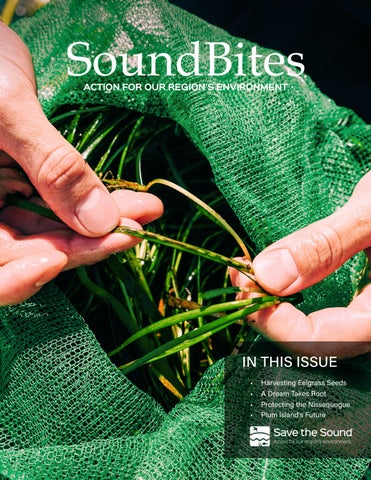
Published September 2026 by Save the Sound. All rights reserved. Articles in this newsletter may be reprinted with permission • info@savethesound.org Cover Photo: Eelgrass seeds collected from Long Island Sound for restoration efforts Contributors: Killian Duborg, Josh Garskof, Laura McMillan, David Seigerman, Anne Urkawich, Amanda VanDine, and Amy Wu.
Eelgrass seeds are collected from healthy eelgrass beds on the floor of the Sound and will be used during volunteer seed-gluing events this fall. © Brian Nevins / 11th Hour Racing
Volunteer gluing sessions will continue this fall at the Cedar Island Marina Research Laboratory in Clinton, Connecticut. But the work will also roll on in a new direction, as the team pilots another attachment technique that may increase the yield even more. Some of the clams will carry seeds attached with small squares of wet spring-roll wrappers. Like postage stamps, the biodegradable wrappers stick to the shells and hold the seeds in place until the clams can deliver them to the sea floor.
>
VOLUNTEER WITH US at savethesound.org/volunteer
SoundBites September 2026 | 3
Jamal’s Dream Takes Root Inspired by a love of gardening, Jamal Roman found new skills and possibilities through Save the Sound's green infrastructure training Jamal Roman dreams of running a farm filled with vegetables, fruit, and chickens. For now, he's starting in his backyard, hoping to one day grow it into a livelihood. The dream is rooted in a love of nature and food, partly inspired by the agricultural traditions of his family's West Indian and Southern U.S. heritage.
in a Save the Sound green infrastructure maintenance program this summer. The training was a partnership with EMERGE Connecticut, a New Haven-based nonprofit that provides support and new opportunities to formerly incarcerated individuals, including job training and career pathways.
Growing up in New York's Little Jamaica, Jamal loved cooking shows and admired Gordon Ramsay and Anthony Bourdain, whose emphasis on fresh ingredients fueled an interest in growing food from the ground up.
In the classroom, participants learned about stormwater, bioswales, rain gardens, invasive plants, and native species through our project, supported by the Long Island Sound Community Impact Fund. Next, they went into the field in the Fair Haven section of New Haven for lessons on bioswale and rain garden planting and stewardship.
"They'd always go into the garden, pick vegetables, and cook with them," says the West Haven resident. What finally inspired Jamal, 44, to start his own garden, though, was participating 4 | SoundBites September 2026
Then the group used their new skills to install part of a rain garden at the Alice
Peck Learning Center in the Town of Hamden. Lys Gant, our green infrastructure project manager, taught the fundamentals of botany, including how to identify native and invasive plants. “Folks will hopefully walk away with a familiarity on how to maintain green stormwater infrastructure of all shapes and sizes to ensure proper functionality, and how to identify and remove invasive species,” Gant says. “The way that I saw it was a win-win,” says Reinaldo Cruz III, co-executive director of EMERGE Connecticut, noting that it opens job and career pathways for participants. “The bigger dream is for some of the participants, especially those exploring entrepreneurship, to build their own
businesses or take on landscaping as a side hustle. With this kind of knowledge, you’re a better landscaper.” For Jamal, the training provided an “appreciation and treatment of the sustenance that we mainly need. I didn’t realize water went through so many trials and tribulations before we get it.” He’s now set on completing a hydroponic garden and on applying what he’s learned to pursue his own enterprise.
“The program gave me food for thought and a much better appreciation for my clarity of water. Now I have the blueprint," Jamal says. "I'm going to incorporate what I learned into my own garden."
Top Left & Center: Jamal Roman, left, and fellow EMERGE Connecticut participants conduct species inventories and collect data with the Sound School on Long Island Sound. Lower Left: EMERGE Connecticut participants take part in a learning session on stormwater management, bioswales, rain gardens, and green infrastructure. Top Right: A newly installed rain garden at the Alice Peck Learning Center in the Town of Hamden helps manage stormwater runoff. Lower Right: Alex Rodriguez, our environmental justice specialist, leads a learning session in Fair Haven, Connecticut.
SoundBites September 2026 | 5
A New Chapter for Plum Island? With Suffolk County pursuing ownership, Plum Island could finally have a future dedicated to conservation and environmental protection On September 14, 1899, the State of New York ceded Plum Island to the federal government to be used, as reported the next day by The New York Times, “as a portion of the defense of New York Harbor.” Now, 127 years later, we are potentially in the final months of the federal government’s mission on Plum Island. And for the first time in more than a century and a quarter, there appears to be a path forward for permanent preservation of this 822-acre island off Long Island’s North Fork. Back in July, Suffolk County Executive Ed Romaine announced his interest in the County gaining ownership of Plum Island once the federal government issues its
• Suffolk County must continue its due diligence; it’s pursuing New York State funding needed to create a business and operational plan for the island.
Report of Surplus Property. “Our goal,” he said in a statement, “is to ensure Plum Island remains protected forever.” That happens to be Save the Sound’s goal as well, and the goal of our partners within the Preserve Plum Island Coalition we’ve been leading for 15 years. And our work continues. Before the federal General Services Administration (GSA) can issue its report: • The Department of Homeland Security must issue a Report of Excess after concluding its work at the Plum Island Animal Disease Center. At that point, other federal agencies can express interest in the island, though we know of none expected to do so.
But sometime in 2027, we expect the GSA will release its report at which point Suffolk County can raise its hand, officially expressing its interest in taking ownership of Plum Island. Meanwhile, we will continue working with the County on its plan for preserving Plum Island as a center for conservation, scientific research, education, and carefully managed public access, and keeping our Save the Sound community updated on these long-awaited promising developments.
Plum Island is home to Southern New England’s largest seal haulout, where seals leave the water to rest and reproduce. Photo credit: Bob Lorenz
Donor Spotlight: Bennett Weitz From summer intern to Sound supporter “You don’t need to understand the whole ocean to make a difference; you just need to pay attention to the water near you.”
water from the shoreline and tested its clarity, salinity, acidity, and dissolved oxygen, turning the docks into outdoor classrooms.
That’s the message Bennett Weitz hopes other young people will carry with them. A third-year Environmental Science and Geography student at Binghamton University, Weitz joined Save the Sound as our education outreach summer intern for our partnership with the Junior Sailing Association.
The experience also gave Weitz a closer look at the Sound’s challenges. He encountered brown tides that kept sailors out of the water and collected samples through our Bacteria Monitoring Program that showed bacteria levels 10 times the safe limit for swimming. Those experiences inspired him to make a gift supporting efforts to protect and restore the Sound.
On the shores of 14 yacht clubs along the Western Long Island Sound, Weitz led 32 hands-on environmental science sessions for more than 500 students. His subject was a 450-million-yearold survivor: the horseshoe crab. The ancient creature became his “anchor” for lessons about water quality, climate change, and the importance of protecting the Sound. Students collected 6 | SoundBites September 2026
“The young sailors I was teaching give me hope for the future of Long Island Sound,” Weitz says. “Everyone should be able to enjoy nature safely, and these confident kids have what it takes to be the next generation of Sound Advocates we need.”
Voices for the Environment Thirteen young people are gaining the skills to create change in their communities This summer gave us a glimpse into what the future could look like, with prolonged heat waves; orange, unbreathable air; and flash flooding and power outages from intense storms. Keeping our families safe during extreme weather is a growing conversation in many households. And helping lead the conversation are two new cohorts of Environmental Health Ambassadors who graduated from our eight-week training program and are now environmental advocates for their communities. The Environmental Health Ambassador program, run by Save the Sound with partners Khalipha and Common Ground High School, brought together 13 high schoolers across New York and Connecticut to build skills in community organizing and environmental stewardship for their neighborhoods. Over the course of the program, the young people learned about human rights, the U.S. Constitution, the history of the environmental justice movement, and how to advocate for change through civic participation. The program also included hands-on stewardship opportunities in Mamaroneck, New York, and New Haven, Connecticut. "Completion of the Environmental Health Ambassador program has reinforced my career choice later on in life," says Phillip White, recent graduate of the program. "I now know how to go about fighting for the environment I and my loved ones care about and where to find others who are just as passionate about doing so as I am." As climate change continues to shape our world, young leaders like Phillip will be crucial to initiating the solutions-oriented conversations we need to keep our region safe and healthy for everyone who calls it home.
Upcoming Events
with Save the Sound
Documentary Screening: River Restoration & Climate Resilience Thursday, September 24 | 6 p.m. The Bronx, New York
Understanding Our Water Quality through QuickDrops: Learn What’s Possible Thursday, October 15 | 12 p.m. Free Webinar
2026 Long Island Sound Report Card: Take a Deep Dive into the Latest Bay Grades Tuesday, October 20 | 12 p.m. Free Webinar
Save the Sound’s Annual Meeting & Reception Thursday, October 22 | 5:30 p.m. Riverside Yacht Club, Greenwich, CT
Sunset Soiree Saturday, October 24 | 6 p.m. Northport Yacht Club, NY
>
Register and learn more at savethesound.org/events
SoundBites September 2026 | 7
127 Church St, 2nd Floor New Haven, CT 06510 savethesound.org 203-787-0646
Non-Profit U.S. Postage
PAID
Permit No. 403 New Haven, CT
Tip from the Team: Now Is the Time to Plant Watersheds Manager Nicole Davis Whenever possible, Nicole Davis schedules Save the Sound’s rain garden and bioswale plantings for September or October. “Fall is the best time to plant perennials, shrubs, and trees,” says Nicole, who runs our green infrastructure program. “The soil is warm, even as the air temperatures are cooling, rain is plentiful, weeds are dying back, and the roots will have a chance to establish themselves before the next hot summer.” She recommends the same timing for home gardeners. “Even if the options at the nursery this late in the season look a little scruffy, they’ll be happier and healthier next spring than if you wait to buy and plant then,” she says. “And they’re probably on sale too.”