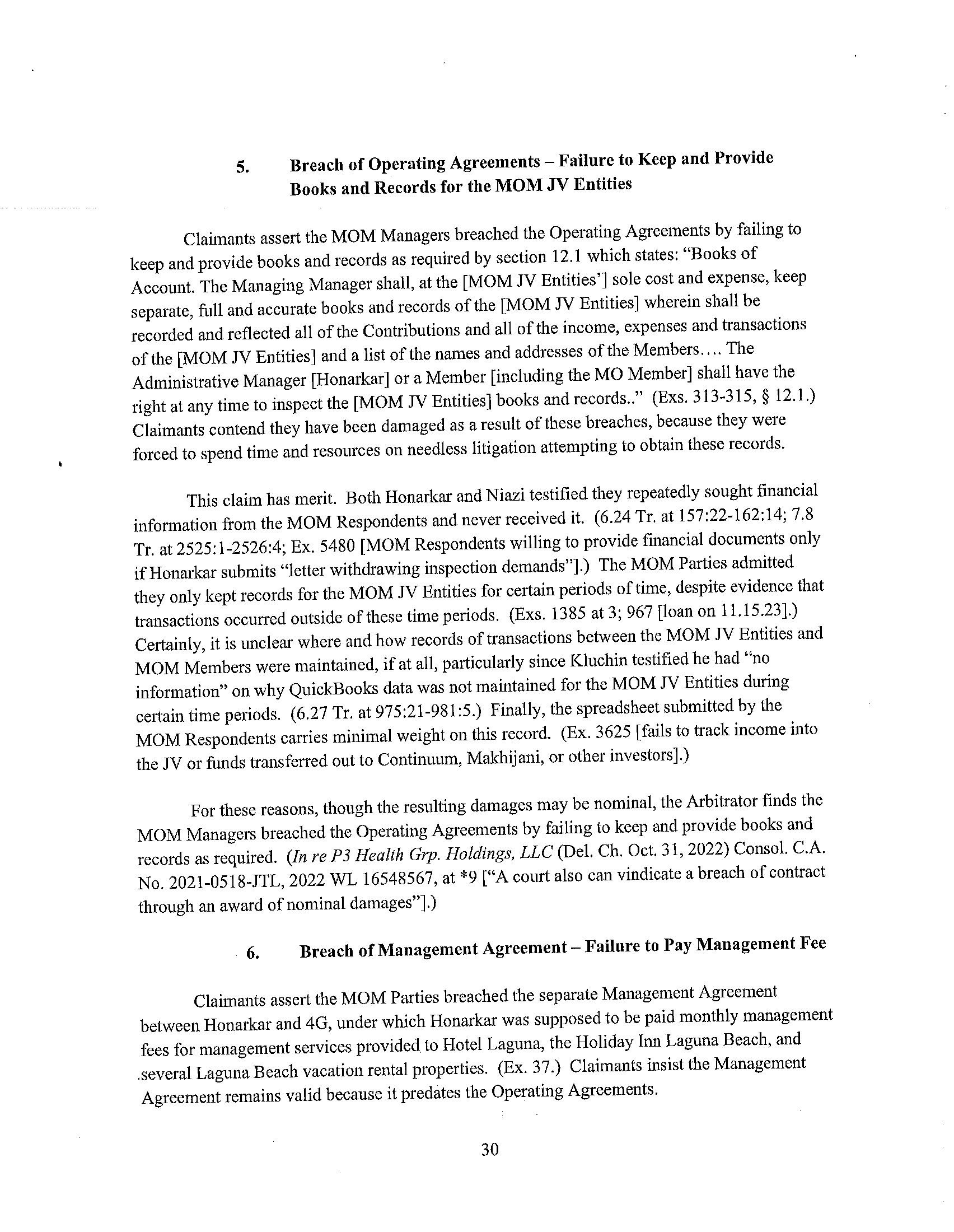
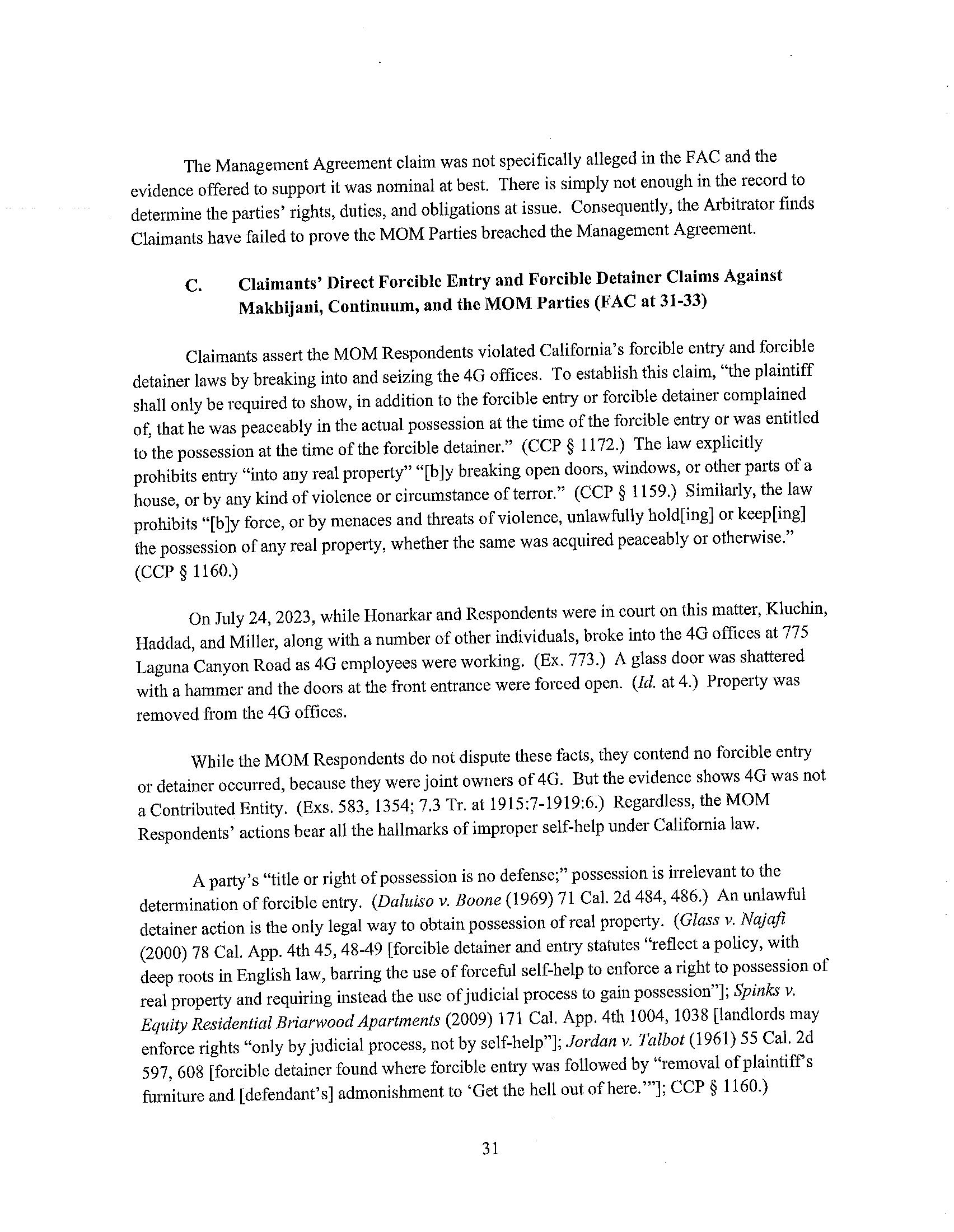
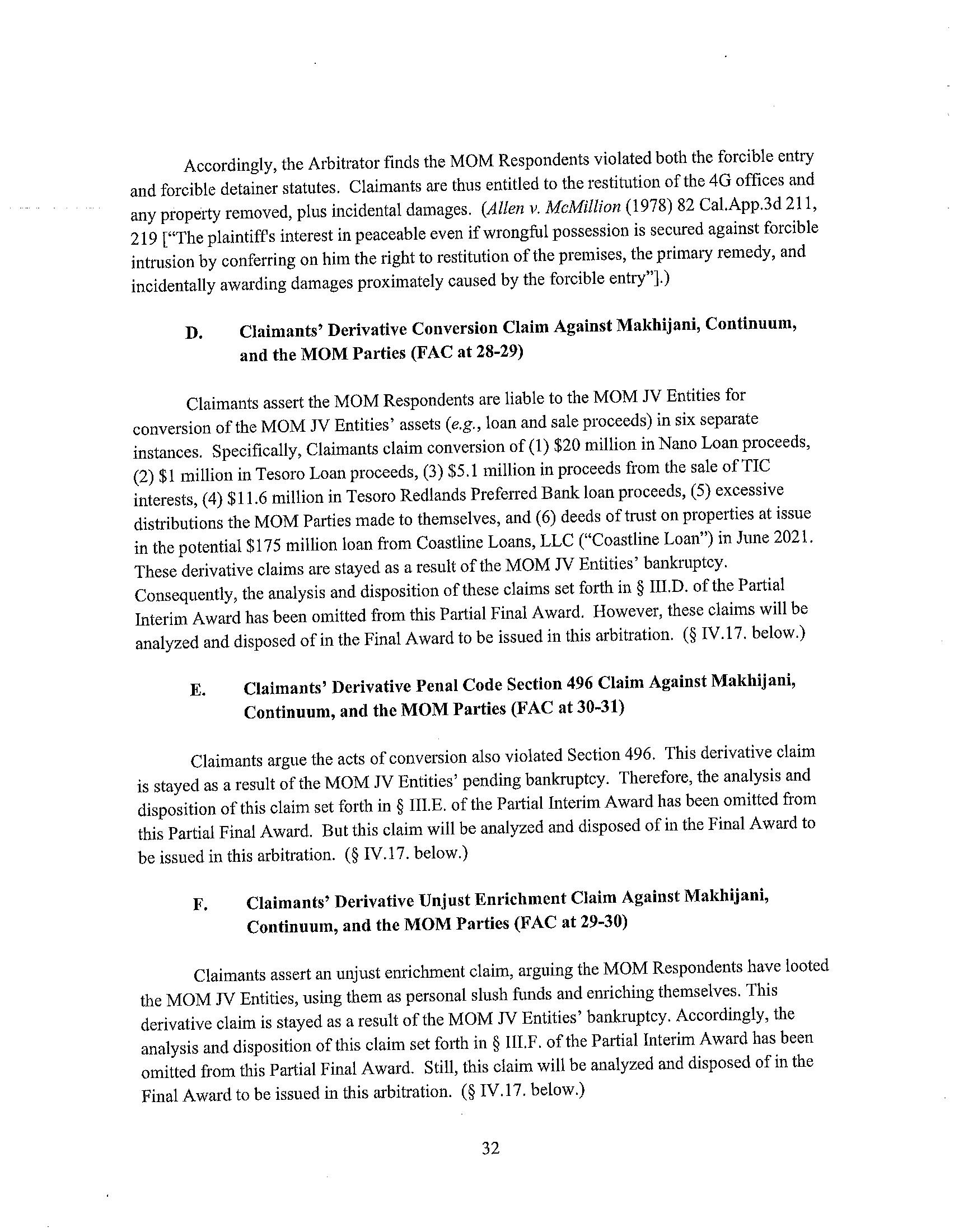
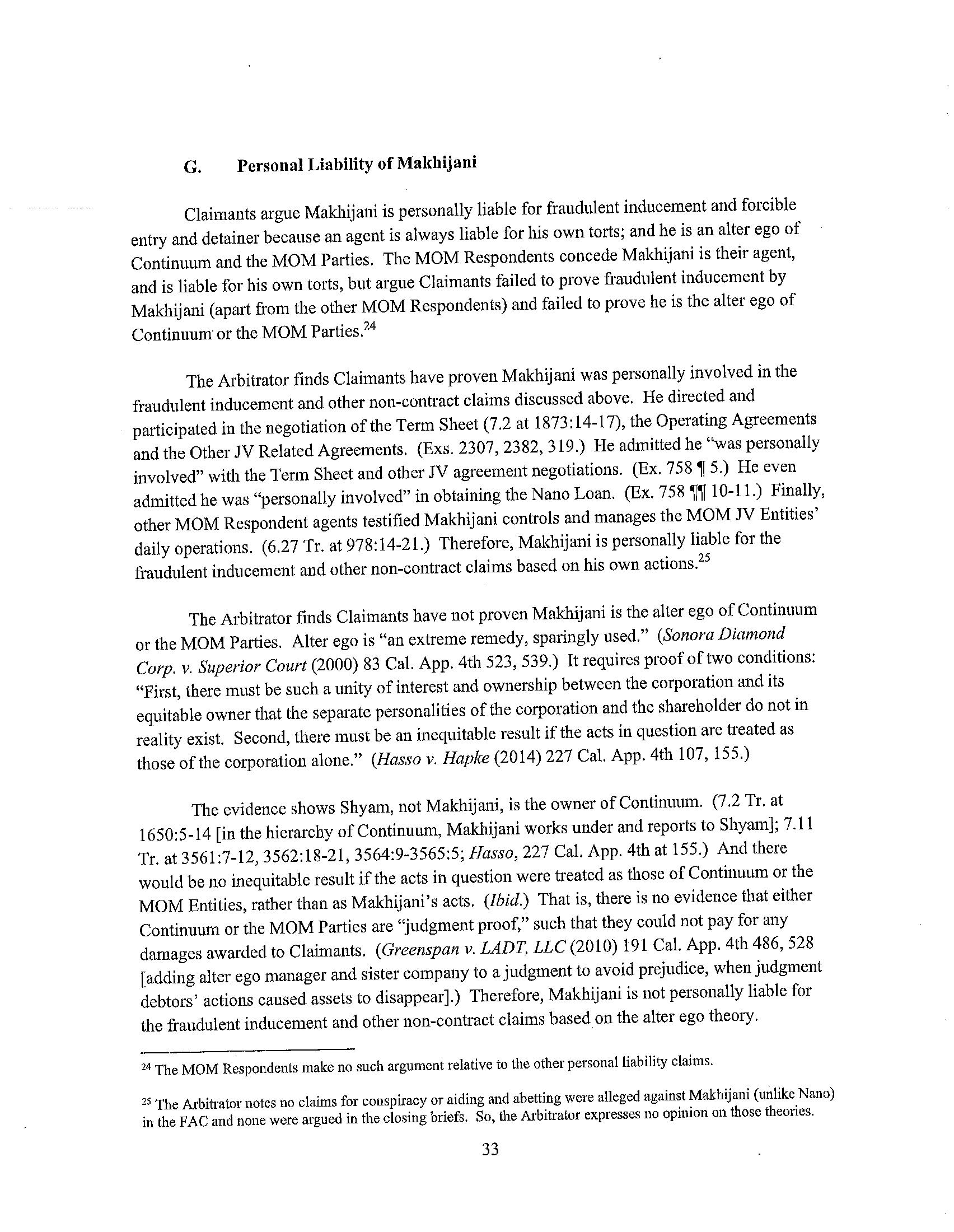
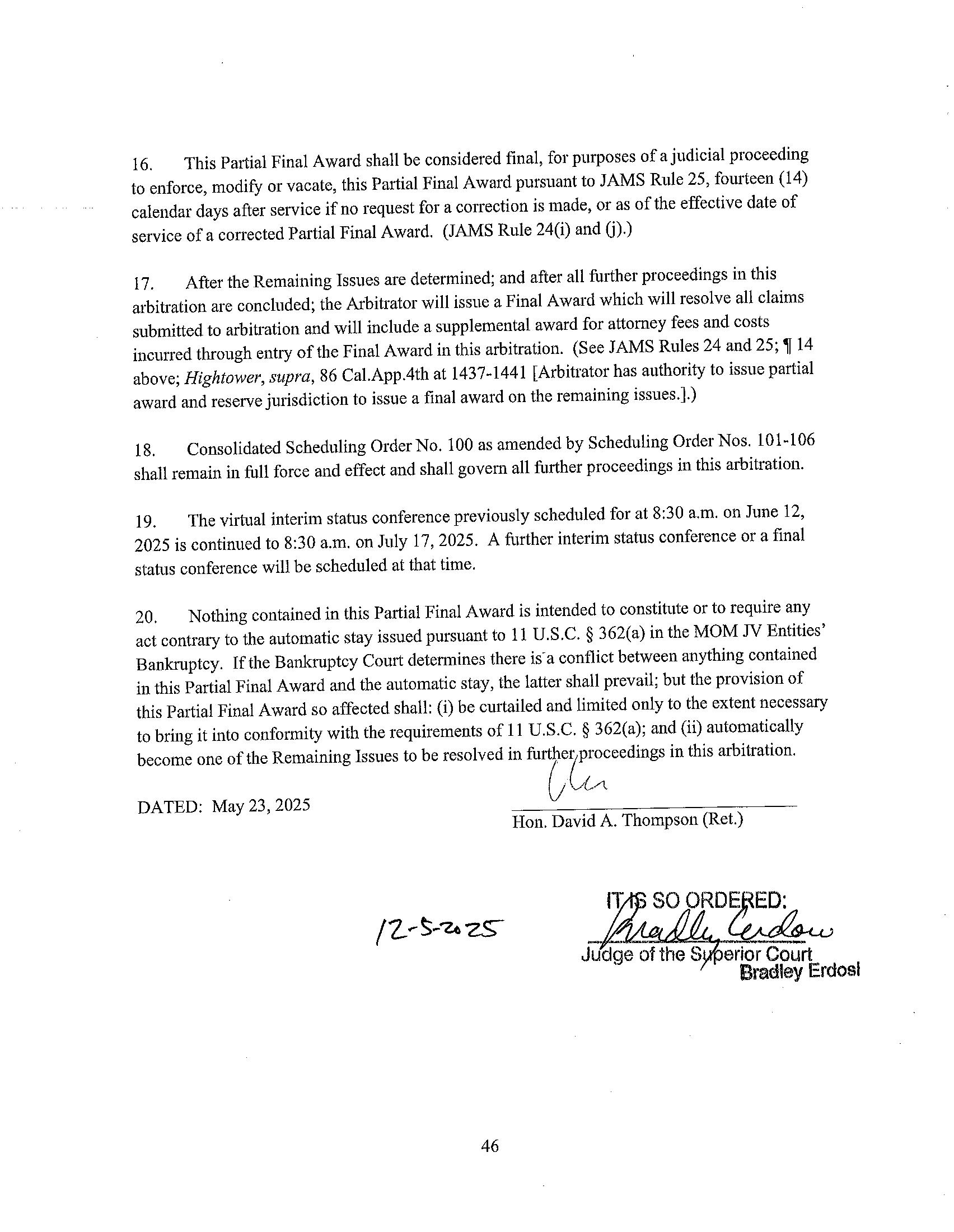
TO THE HONORABLE COURT AND ALL PARTIES AND THEIR ATTORNEYS OF RECORD:
PLEASE TAKE NOTICE THAT on July 27, 2026, in Department C27 of the abovetitled Orange County Superior Court, located at 700 Civic Center Drive West, Santa Ana, California 92701, at 2:00 p.m. or as soon thereafter as the matter may be heard, Petitioners and claimants/cross-respondents Mohammad Honarkar and 4G Wireless, Inc. (collectively, “Petitioners”) hereby petition this Court for an Order confirming Arbitrator Hon. David A. Thompson’s (Ret.) May 12, 2026 Final Award (the “Final Award”) in the JAMS arbitration proceeding entitled Mohammad Honarkar, et al. v. Mahender Makhijani, et al., Ref. No. 5220003126, consolidated with Ref. No. 5200001122 (the “Arbitration”), and for entry of judgment in Petitioners’ favor against respondents and cross-claimants Mahender Makhijani; Continuum Analytics, Inc.; MOM AS Investor Group LLC; MOM BS Investor Group LLC; MOM CA Investor Group LLC; MOM AS Manager LLC; MOM BS Manager LLC; and MOM CA Manager LLC (collectively, the “MOM Respondents”), in conformity with the May 12, 2026 Final Award (attached hereto as Exhibit A) and in accordance with California Code of Civil Procedure section 1285, et seq., and for such further relief as this Court may deem just and proper.
This Petition is based on the allegations set forth in the Petition, the Final Award, the May 23, 2025 Partial Final Award (attached hereto as Exhibit B), the attached Exhibits, and upon such oral and documentary evidence and argument as may be presented in response to any submissions by the MOM Respondents and at the hearing on this Petition.
DATED: May 27, 2026
HALPERN MAY YBARRA GELBERG LLP
AARON M. MAY
JOSEPH J. YBARRA
By: AARON M. MAY
Attorneys for Plaintiffs MOHAMMAD HONARKAR and 4G WIRELESS, INC.
PETITION TO CONFIRM ARBITRATION AWARD AND ENTER JUDGMENT
Petitioners and claimants/cross-respondents Mohammad Honarkar and 4G Wireless, Inc. (collectively, “Petitioners”) hereby petition this Court for an Order confirming Arbitrator Hon. David A. Thompson’s (Ret.) May 12, 2026 Final Award (the “Final Award”) in the JAMS arbitration proceeding entitled Mohammad Honarkar, et al. v. Mahender Makhijani, et al., Ref. No. 5220003126, consolidated with Ref No. 5200001122 (the “Arbitration”), and for entry of judgment in Petitioners’ favor against respondents and cross-claimants Mahender Makhijani; Continuum Analytics, Inc.; MOM AS Investor Group LLC; MOM BS Investor Group LLC; MOM CA Investor Group LLC; MOM AS Manag er LLC; MOM BS Manager LLC; and MOM CA Manager LLC (collectively, the “MOM Respondents”), in conformity with the Final Award (attached hereto as Exhibit A) and in accordance with California Code of Civil Procedure section 1285, et seq., and for such further relief as this Court may deem just and proper.
The Final Award resolves all issues submitted to arbitration, and affixes the damages owed to Petitioners. Previously, the Arbitrator issued a Partial Final Award, affixing liability (attached hereto as Exhibit B). This Court issued an Order confirming the Partial Final Award on October 20, 2025 (attached hereto as Exhibit J) On December 5, 2026, the Court entered a Judgment confirming the Partial Final Award (attached hereto as Exhibit K). After that Judgment was entered, and prior to the issuance of the Final Award, Petitioners reached a settlement with Nano Banc and dismissed them from the arbitration proceeding.
In support, Petitioners allege as follows:
1. This Petition requests that the Court confirm an arbitration award conducted according to a written agreement between the parties that is subject to California Code of Civil Procedure section 1285, et seq
THE PARTIES
2. Petitioner Mohammad Honarkar is a California resident. Mr. Honarkar, either directly or indirectly through 4G Wireless, Inc., is a member of each of the following limited
liability companies: MOM AS Investco, LLC; MOM BS Investco, LLC; and MOM CA Investco, LLC (collectively, the “MOM LLCs” or “Nominal Claimants”). 1
3. Petitioner 4G Wireless, Inc. (d/b/a 4G Ventures) is a California corporation, with its principal place of business located in Laguna Beach, California. Pursuant to a letter agreement dated July 14, 2022, 4G Wireless, Inc. is a member in each of the MOM LLCs.
4. Respondent Mahender Makhijani is a California resident, and is an agent of respondent Continuum Analytics, Inc.
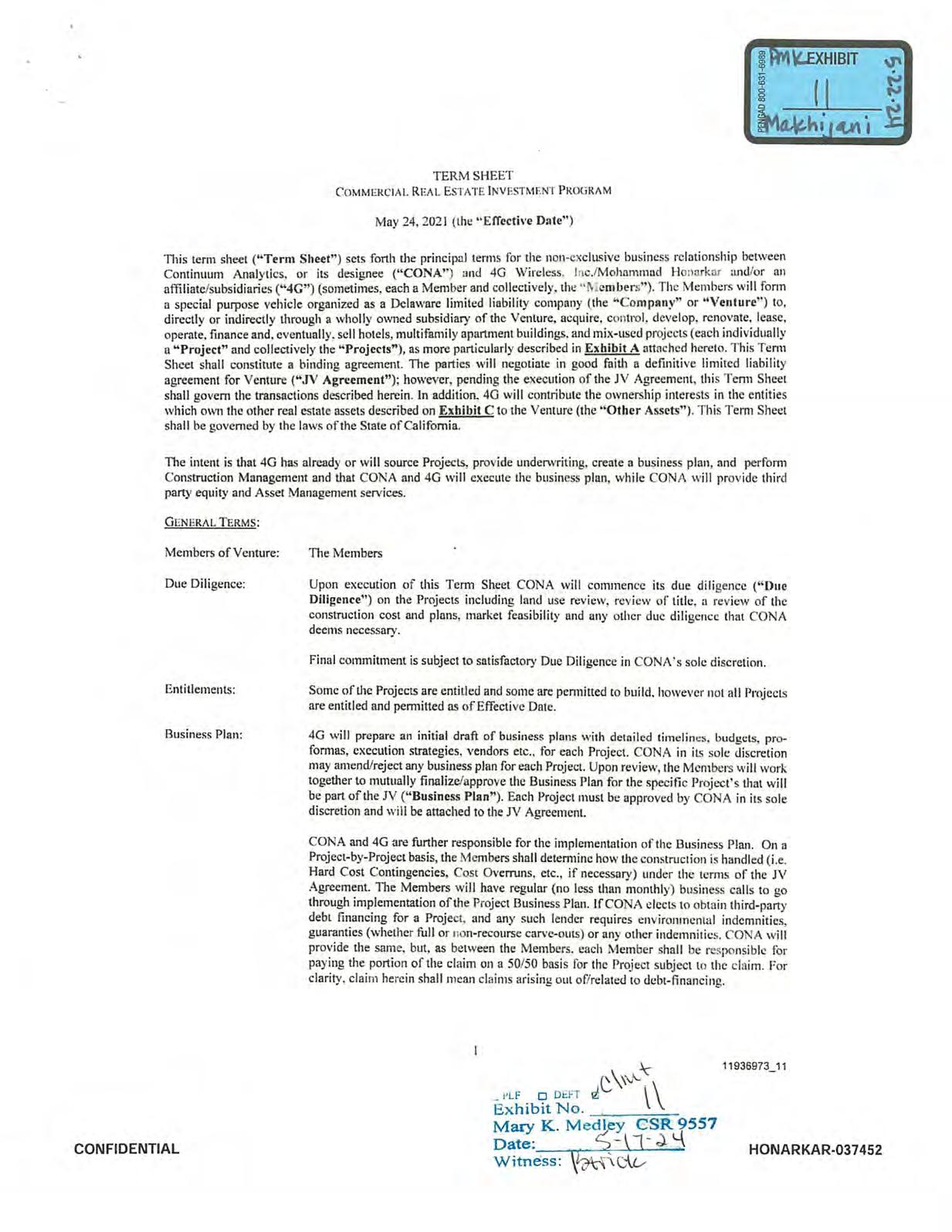
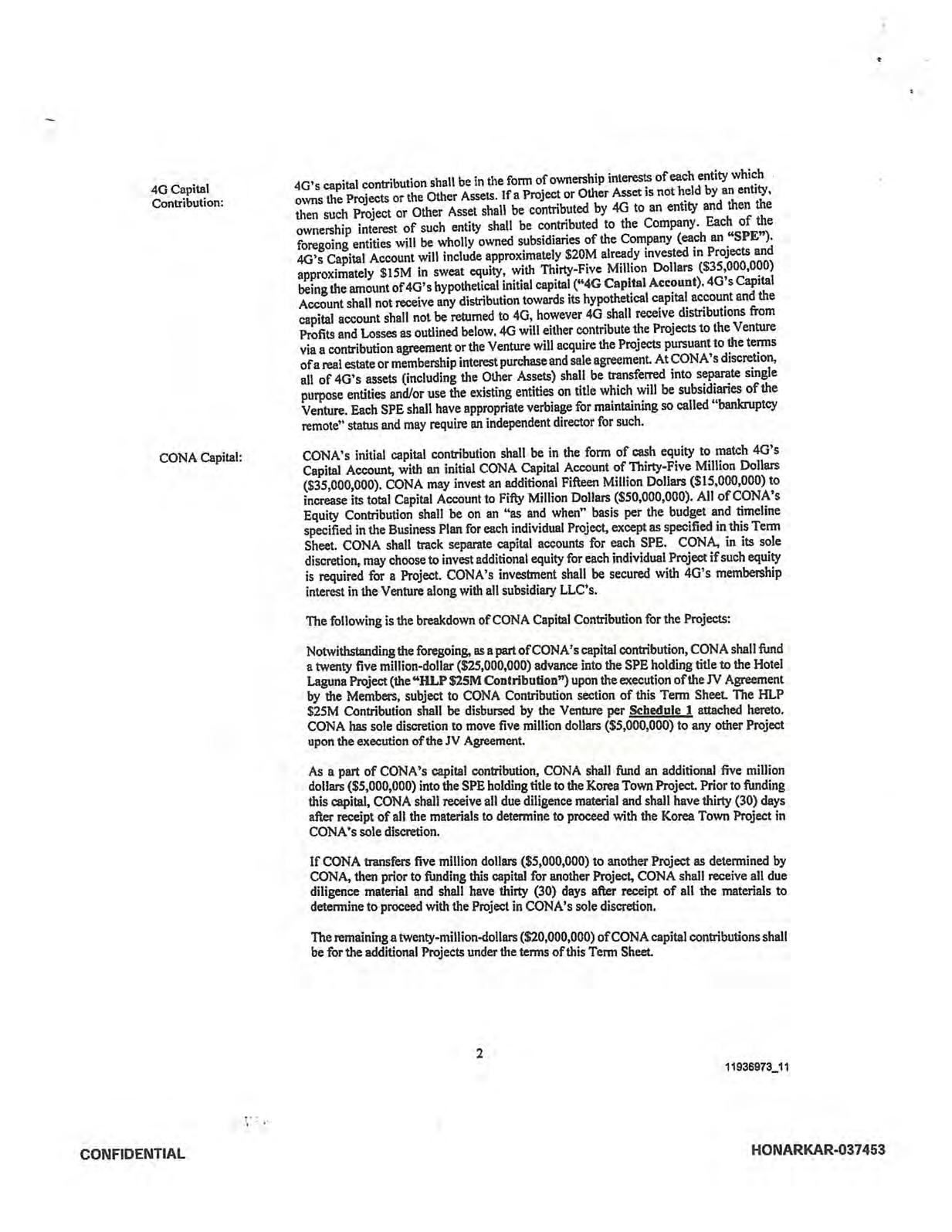
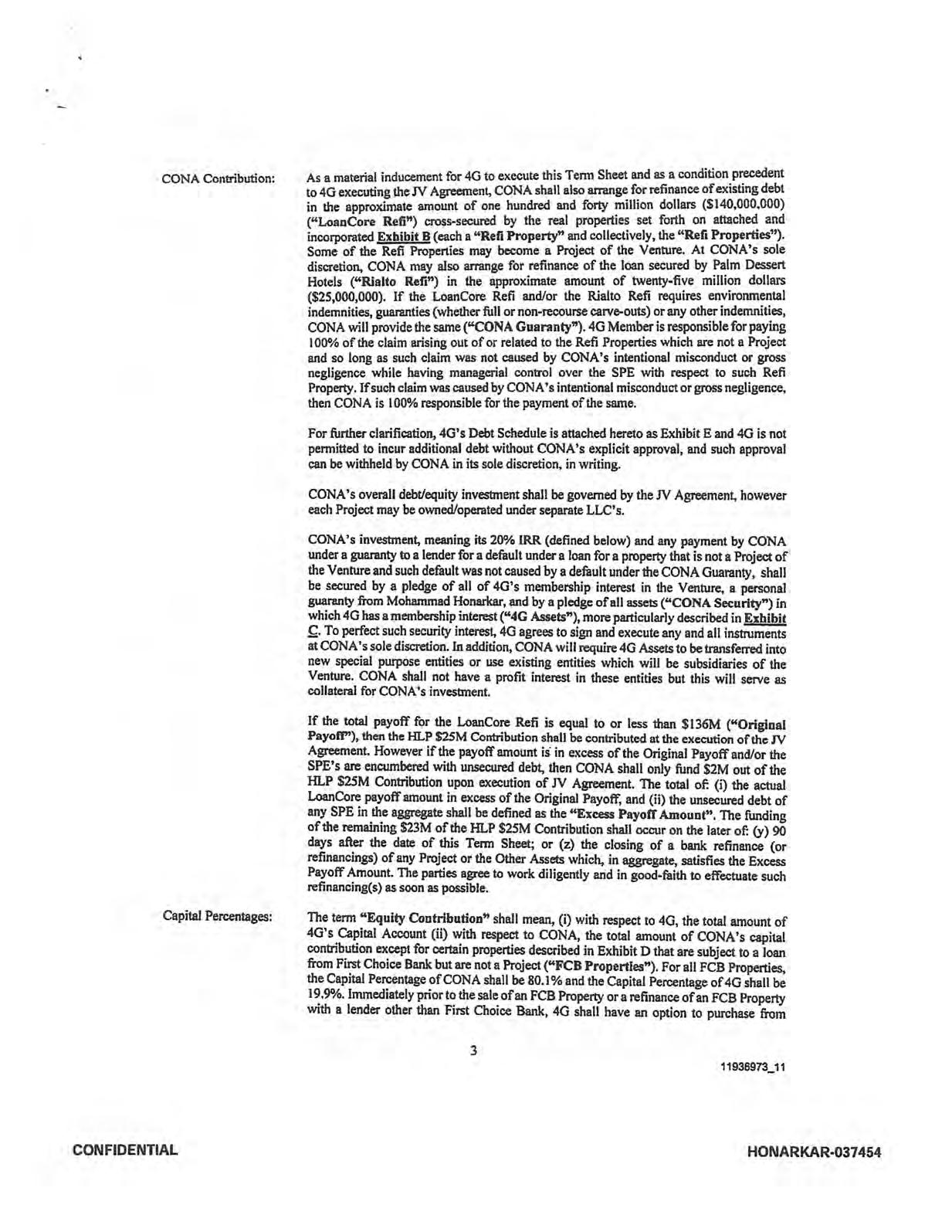
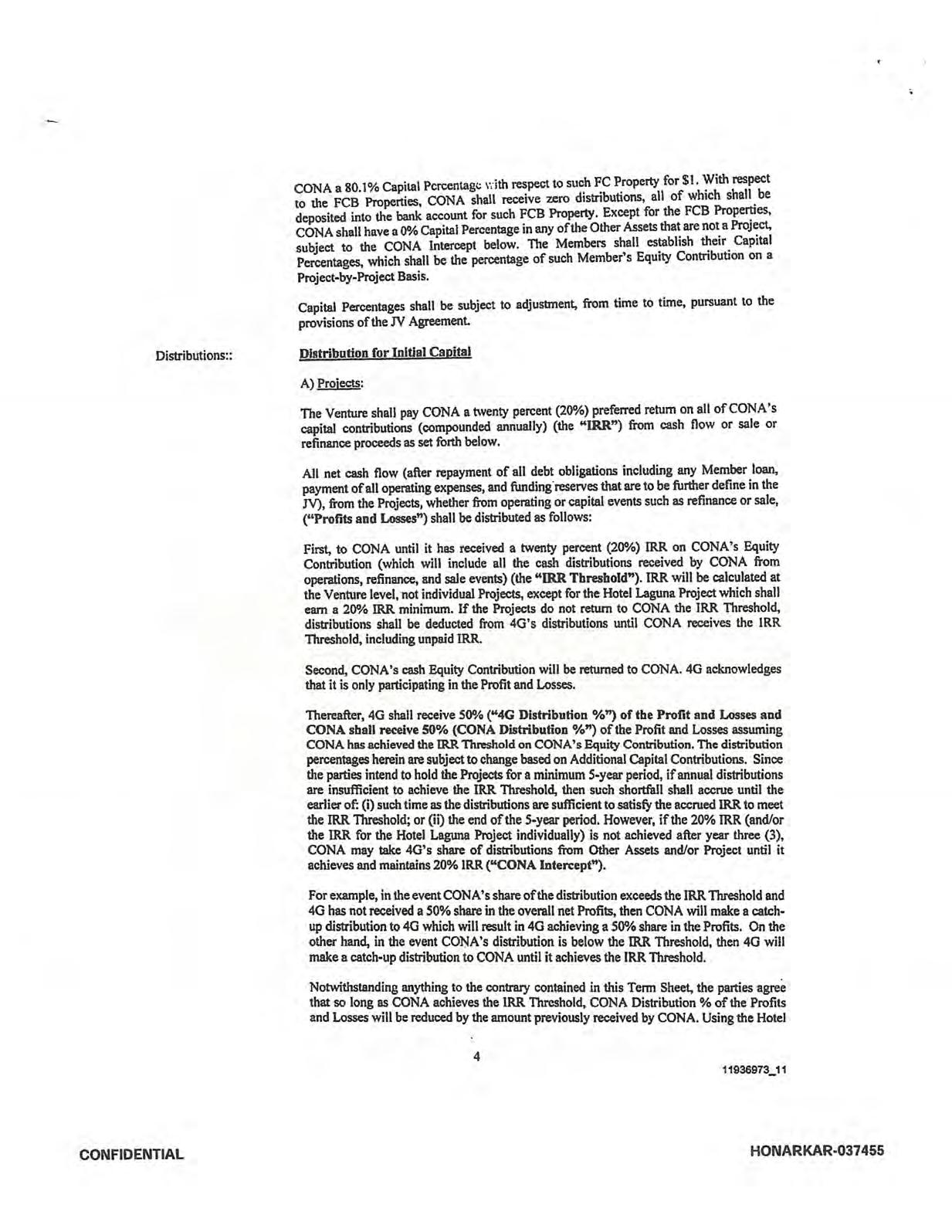
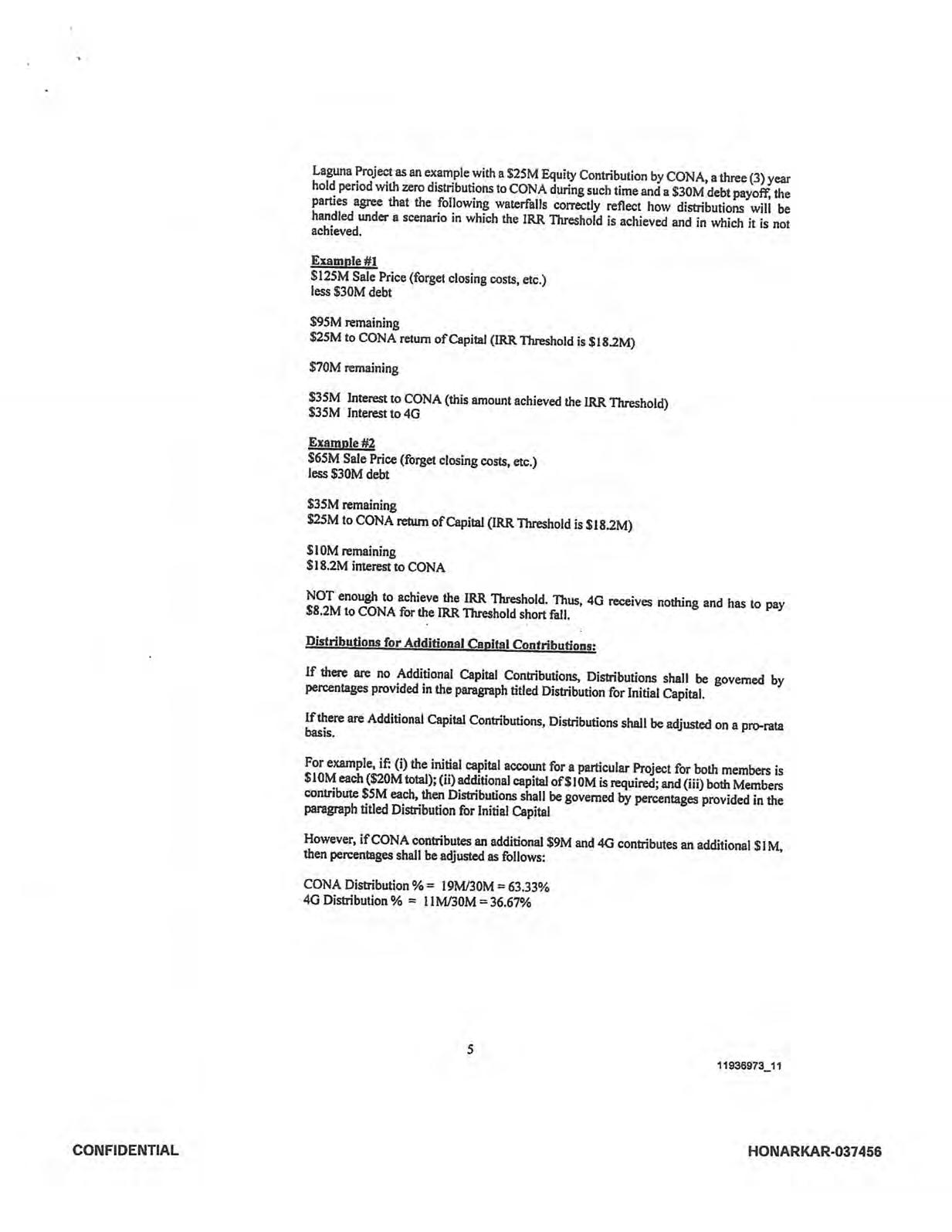
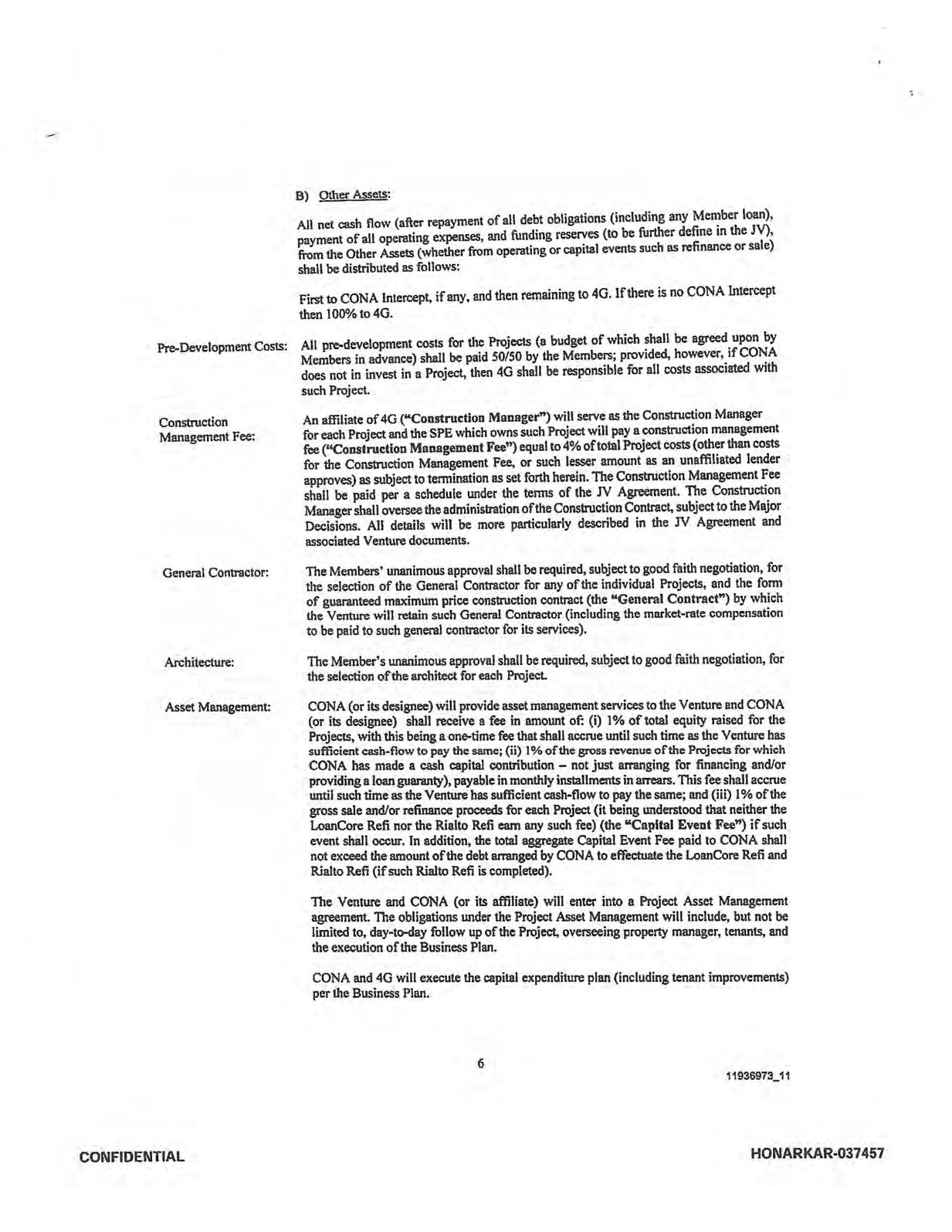
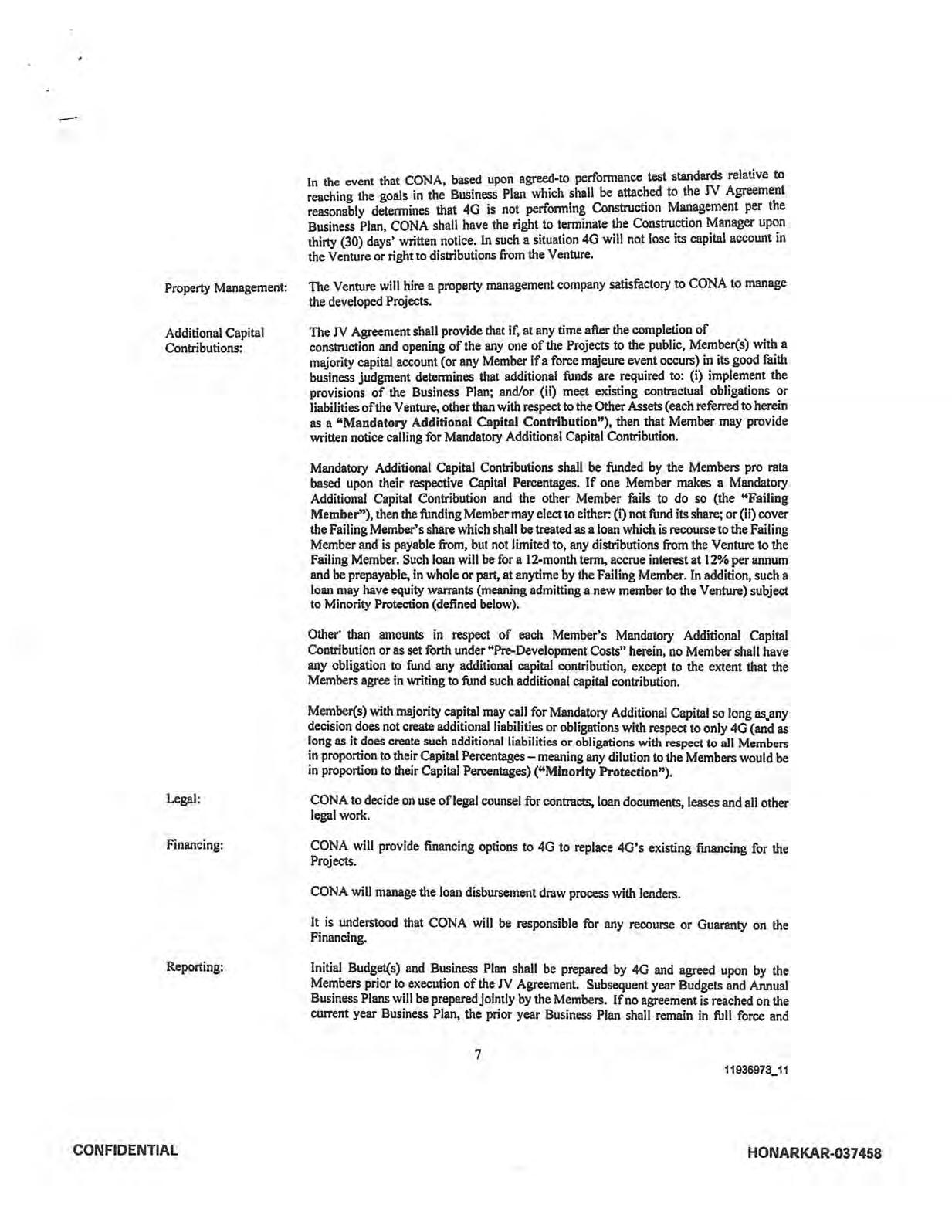
5. Respondent Continuum Analytics, Inc. (“Continuum”) is a California corporation with its principal place of business in Newport Beach, California. Continuum is party to a May 24, 2021 binding term sheet with 4G Wireless, Inc., an entity owned by Mr. Honarkar, which was the predecessor contract to the operating agreements of the MOM LLCs.
6. Respondent MOM AS Investor Group LLC is a Delaware limited liability company, with its principal place of business in Orange County, California, and is authorized to do business, and is doing business, in California.
7. Respondent MOM BS Investor Group LLC is a Delaware limited liability company, with its principal place of business in Orange County, California, and is authorized to do business, and is doing business, in California.
8. Respondent MOM CA Investor Group LLC is a Delaware limited liability company, with its principal place of business in Orange County, California, and is authorized to do business, and is doing business, in California.
9. Respondent MOM AS Manager LLC is a Delaware limited liability company with its principal place of business in Orange County, California.
10. Respondent MOM BS Manager LLC is a Delaware limited liability company with its principal place of business in Orange County, California.
1 Though not relevant to this Petition, each of the MOM LLCs is a Delaware limited liability company doing business in California. On February 28, 2025, each of the MOM LLCs filed for Chapter 11 bankruptcy. On August 18, 2025, the Court dismissed those bankruptcy petitions.
11. Respondent MOM CA Manager LLC is a Delaware limited liability company with its principal place of business in Orange County, California.
12. Former respondent Nano Banc is a California corporation with its principal place of business in Irvine, California. Petitioners entered into a settlement with Nano Banc and dismissed the claims they were pursuing in arbitration against Nano Banc before the entry of the Final Award.
JURISDICTION AND VENUE
13. Jurisdiction is proper in this Court under California Code of Civil Procedure sections 1286 because the Arbitration took place in Orange and Los Angeles Counties. Moreover, the underlying arbitration agreements between the parties provide for the place of arbitration to be in Irvine, California.
14. Further, respondents MOM AS Investor Group LLC, MOM BS Investor Group LLC, and MOM CA Investor Group LLC, sued petitioner Mr. Honarkar in Orange County Superior Court via action initiated on May 3, 2023 (Case No. 30-2023-01322886 -CU -OR-CJC). By its Minute Order of September 25, 2023, the Court in that action ordered that dispute against Mr. Honarkar be arbitrated pursuant to an arbitration provision present in the operating agreements for the MOM LLCs, attached hereto as Exhibits C-E (the “Operating Agreements”). The Court also ordered that issues relating to arbitrability be submitted to and resolved by the arbitrator. In addition, the Arbitrator determined that Petitioners’ claims were arbitrable as against all Respondents, and the Court has previously confirmed that ruling in connection with the confirmation of the Partial Final Award, and entered judgment thereon. Exhibit I; Exhibit J at 4; Exhibit K.
15. Venue is proper in Orange County, California, according to California Code of Civil Procedure sections 1292 and 1292.2, because the Arbitration took place in Orange and Los Angeles Counties, and because the underlying arbitration agreements between the parties were to be performed in Orange County, California. Moreover, Petitioners’ and Respondents’ residences and places of business are all in Orange County, California.
BACKGROUND FACTS
16. The Partial Final Award sets forth the relevant background and arbitration agreements between the parties Exhibit B at 5-15. This Court has already confirmed the Partial Final Award, and entered judgment thereon. Exhibits J-K. As a result, the Arbitrator’s findings within the Partial Final Award are binding. See Exhibit J (Order Confirming Partial Final Award) at 7 (the Arbitrator’s findings are “not subject to review by this Court.”) (citing Moncharsh v. Heily & Blase, 3 Cal.4th 1, 11 (1992) (“More specifically, courts will not review the validity of the arbitrator’s reasoning”; “it is the general rule that, with narrow exceptions, an arbitrator’s decision cannot be reviewed for errors of fact or law.”)); see also Cal. Civ. Proc. Code § 1287.4 (“If an award is confirmed, judgment shall be entered in conformity therewith. The judgment so entered has the same force and effect as, and is subject to all the provisions of law relating to, a judgment in a civil action of the same jurisdictional classification; and it may be enforced like any other judgment of the court in which it is entered.”).
17. “This is a real estate joint venture dispute centered on fraud and breach of contract claims. The joint venture [] comprises a portfolio of commercial properties that were previously owned by [Petitioners] and are now owned by the [MOM LLCs].” Exhibit B (Partial Final Award) at 3.
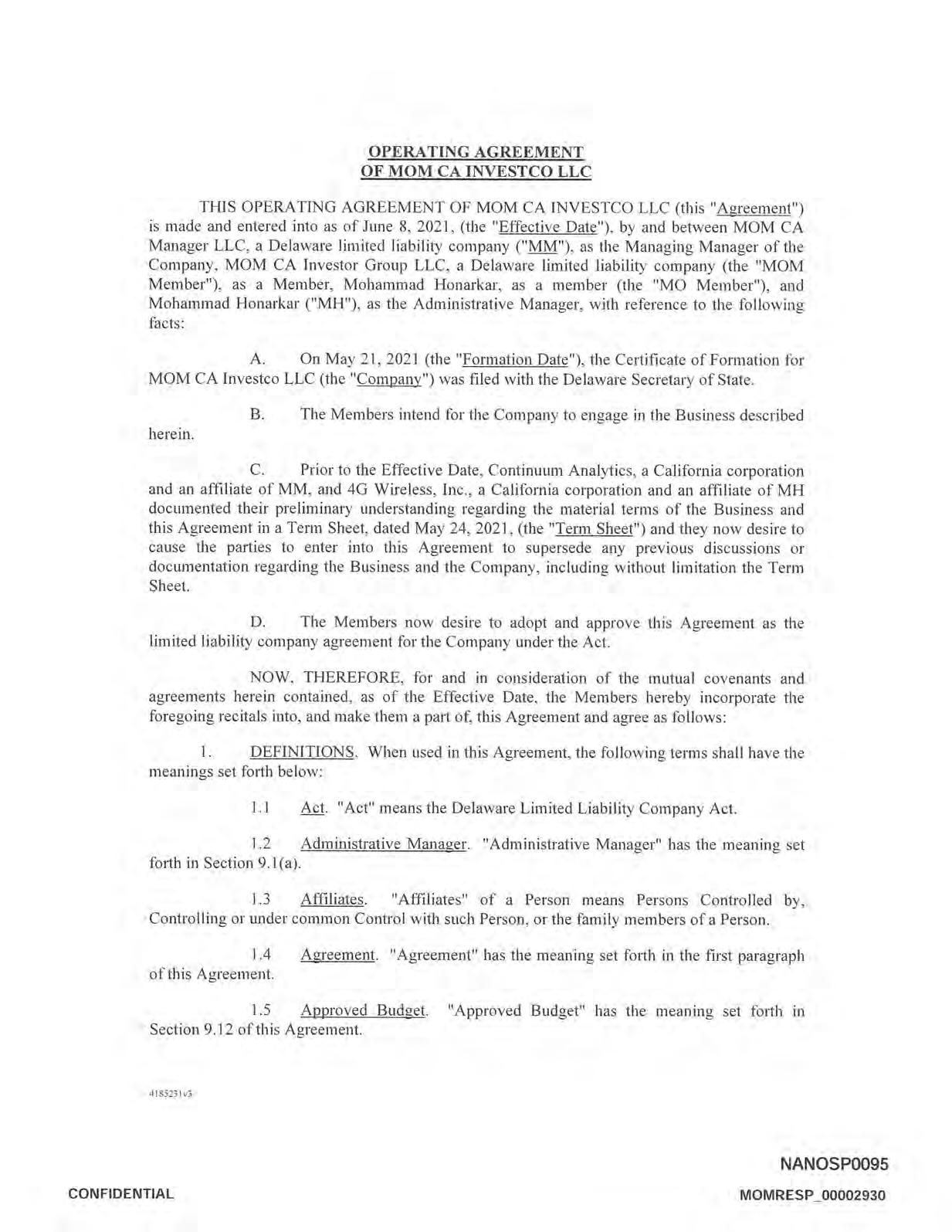
18. The MOM LLCs’ Operating Agreements are substantially similar, and each contains an identical mandatory arbitration clause that applies to claims between the parties other than requests for injunctive relief:
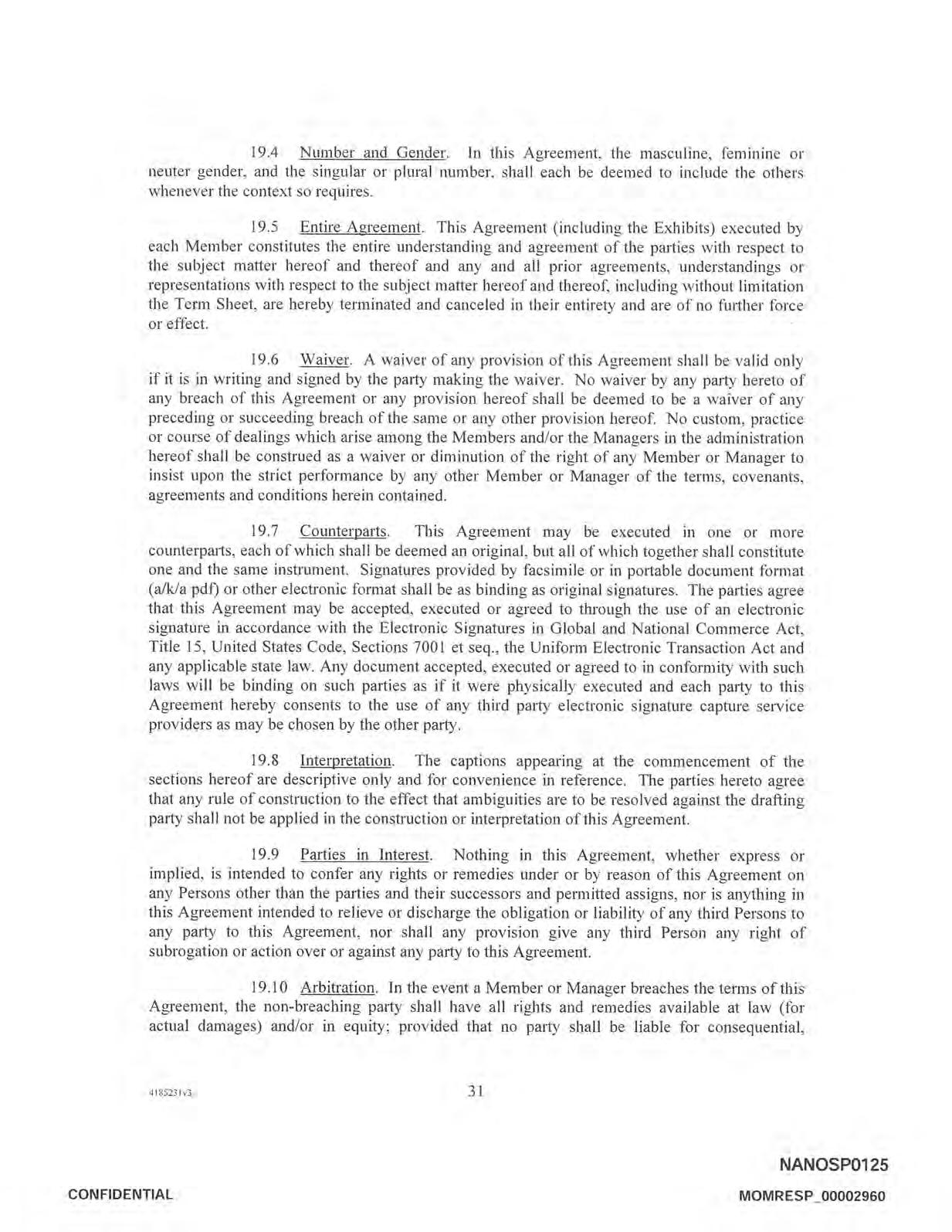
19.10 Arbitration. In the event a Member or Manager breaches the terms of this Agreement, the non-breaching party shall have all rights and remedies available at law (for actual damages) and/or in equity; provided that no party shall be liable for consequential, punitive or special damages. Any dispute, controversy or claim arising out of or relating to this Agreement (other than claims for injunctive or equitable relief), including, but not limited to, the interpretation, breach or termination thereof (including whether the claims asserted are arbitrable), shall be referred to and finally determined by arbitration in accordance with the expedited arbitration rules of Judicial Arbitration and Mediation Services, Inc. (“JAMS”) or such other rules as the parties may agree upon. Such arbitration shall be conducted by a single independent arbitrator. The parties to the arbitration shall within five (5) Business Days mutually agree on a single independent arbitrator. If they are
unable to agree on an independent person within such five (5) Business Day period, the arbitrator shall be appointed by JAMS in accordance with its rules. Any arbitrator shall be either (A) a retired judge or (B) an attorney with at least twenty (20) years of litigation experience. The place of arbitration shall be Irvine, California. Any award rendered therein shall be final and binding on each and all of the parties thereto and their personal representatives and judgment may be entered thereon in any court of competent jurisdiction. The arbitrator may, in the award, allocate all or part of the costs of the arbitration, including the fees of the arbitrator, and may award attorneys’ fees and costs to the prevailing party. Discovery in accordance with California law shall be permitted. Except as may be required by law, neither a party nor the arbitrator may disclose the existence, content or results of any arbitration hereunder without the prior written consent of the parties.
See Exhibits C-E § 19.10 (emphasis added). Respondents MOM AS Investor Group LLC, MOM BS Investor Group LLC, MOM CA Investor Group LLC, MOM AS Manager LLC, MOM BS Manager LLC, and MOM CA Manager LLC are each a party and signatory to one of the Operating Agreements (and respondents Mahender Makhijani and Continuum are third-party beneficiaries of the Operating Agreements).
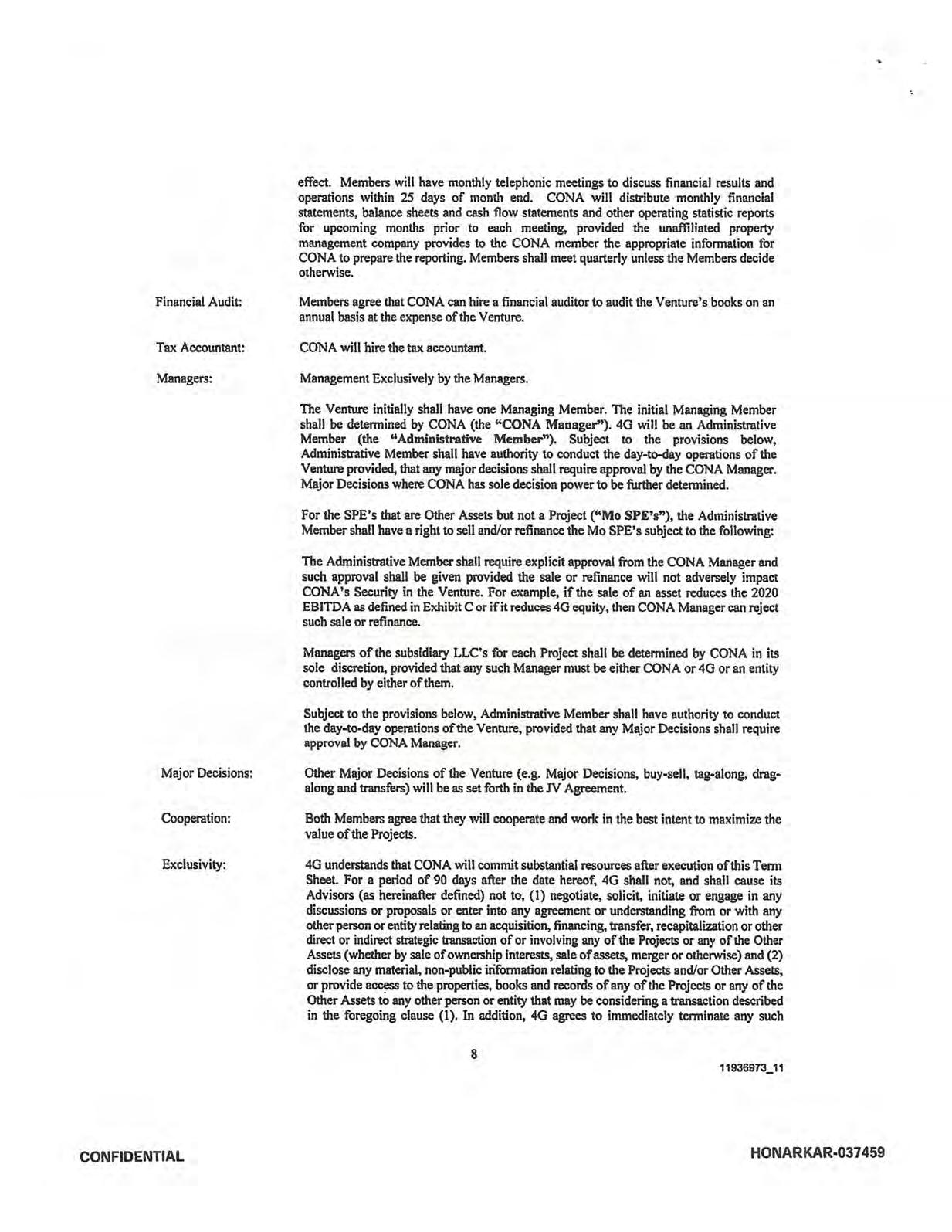
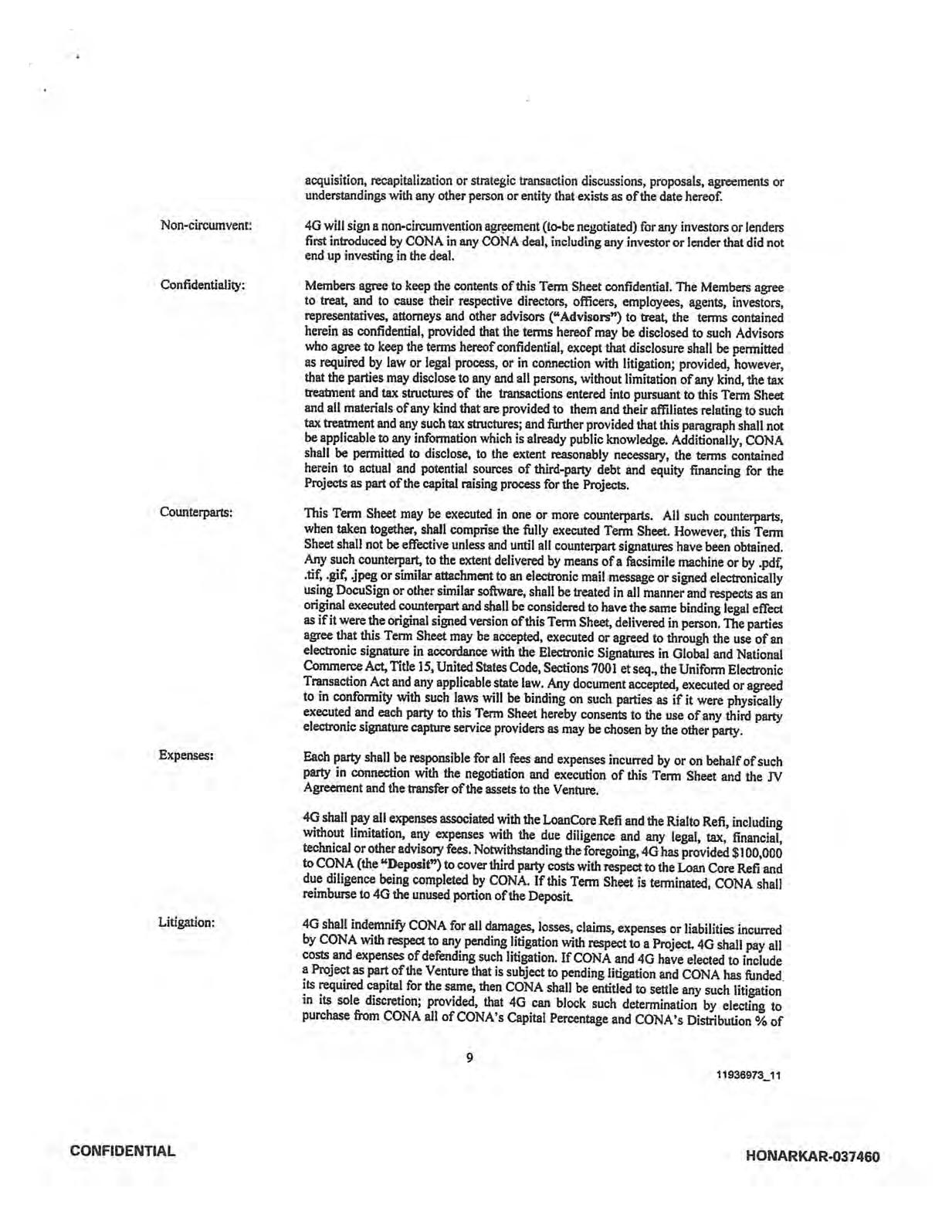
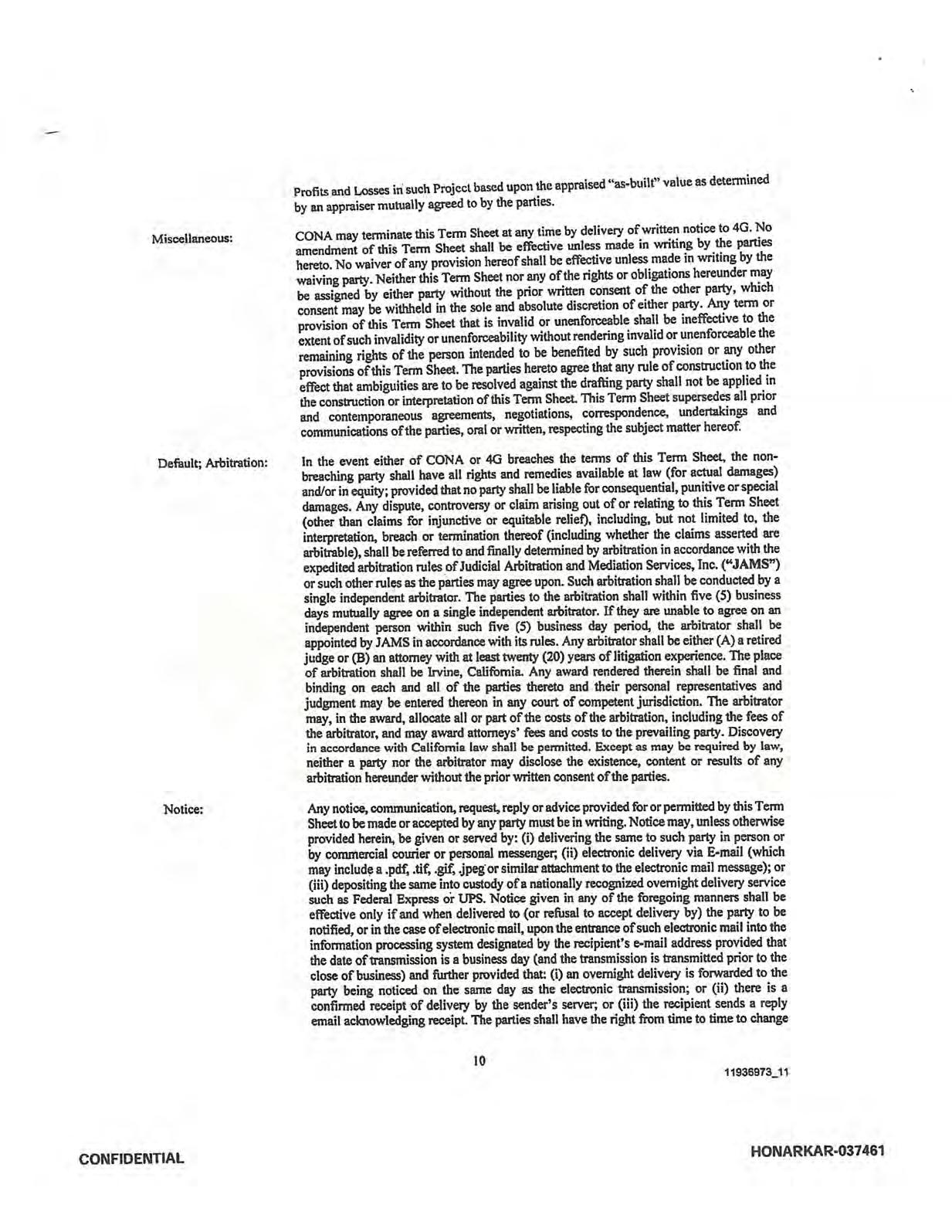
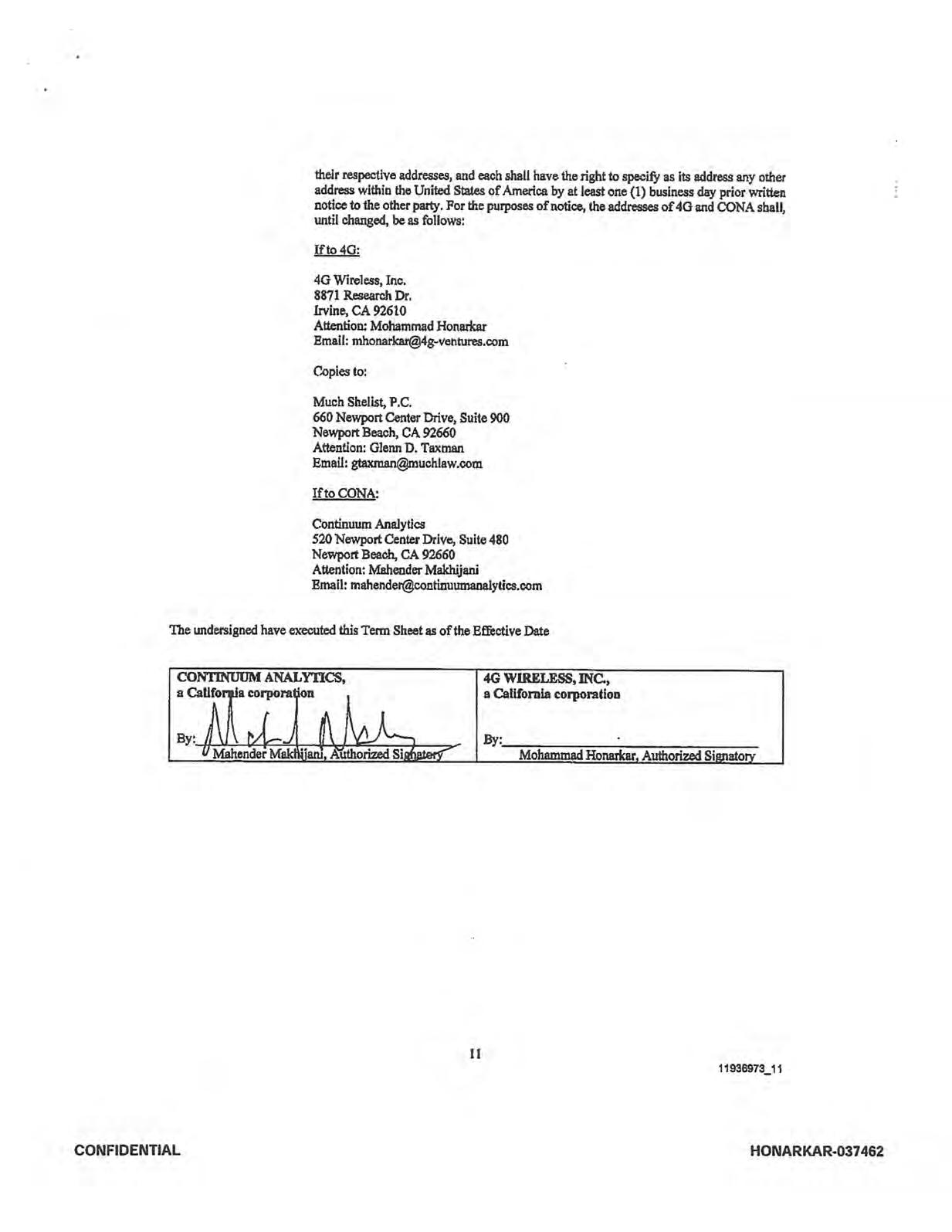
19. The May 24, 2021 binding term sheet, as to which respondent Continuum Analytics, Inc. is a party and signatory (and respondent Mahender Makhijani is an agent of Continuum), contains an identical arbitration clause. See Exhibit F at 10 (Default; Arbitration).
20. Petitioners entered into an arbitration agreement with former respondent Nano Banc on October 11, 2023, according to which:
The Parties agree that the Dispute shall be submitted to and finally determined by binding arbitration in accordance with the Comprehensive Arbitration Rules and Procedures of Judicial Arbitration and Mediation Services, Inc. (“JAMS”), including the Expedited Procedures set forth therein. The Parties agree that they shall attempt to consolidate the arbitration of the Dispute with the Pending Arbitration, in which Arbitrator Justice David Thompson is presiding. In the event that consolidation does not occur, then this agreement is null and void. Any award rendered as to the Dispute shall be final and binding on each and all of the parties thereto and their personal representatives, and judgment may be entered thereon in any court of competent jurisdiction. Discovery in accordance with California law shall be permitted in the arbitration, so long as consistent with the limitations set forth in JAMS’s Comprehensive Rules and the Expedited Procedures therein.
See Exhibit G § 2 (Agreement to Arbitrate).
21. On April 25, 2023, and pursuant to the arbitration provisions in the Operating Agreements and the Term Sheet, Mr. Honarkar initiated arbitration with JAMS, Case No. 5220003126 against respondents Mahender Makhijani; Continuum Analytics, Inc.; MOM AS Investor Group LLC; MOM BS Investor Group LLC; MOM CA Investor Group LLC; MOM AS Manager LLC; MOM BS Manager LLC; MOM CA Manager LLC. Along with 4G Wireless, Inc., Mr. Honarkar filed a First Amended Statement of Claim in Arbitration, which also asserted claims against former respondent Nano Banc, pursuant to the arbitration agreement with Nano Banc, on October 13, 2013.
22. On May 3, 2023, respondent MOM CA Investor Group LLC initiated Orange County Superior Court Case No. 30-2023-01322886-CU -OR-CJC against Mr. Honarkar (the “Orange County Lawsuit”). An amended complaint was filed on June 6, 2023, listing respondents MOM AS Investor Group LLC and MOM BS Investor Group LLC, as well as the MOM LLCs, as plaintiffs, asserting all of the same claims as respondent MOM CA Investor Group LLC.
23. On August 3, 2023, and in accordance with its Commercial Arbitration Rules, JAMS appointed the Honorable David A. Thompson (Ret.) as arbitrator in the Arbitration. Hon. David Thompson (the “Arbitrator”) served as a California Court of Appeal Justice for nine years and as a Superior Court Judge in Orange County Superior Court for 15 years.
24. On September 25, 2023, the Court in the Orange County Lawsuit issued a minute order granting Mr. Honarkar’s Motion To Compel Arbitration And Stay Proceedings, ordering that the parties’ dispute be arbitrated and that issues relating to arbitrability be submitted to and resolved by the Arbitrator. A true and correct copy of that order is attached hereto as Exhibit H.
25. On September 28, 2023, respondents MOM AS Investor Group LLC, MOM BS Investor Group LLC, and MOM CA Investor Group LLC submitted a demand for arbitration with JAMS, Case No. 5200001122, against Mr. Honarkar. This arbitration, JAMS Case No. 5200001122, was consolidated with the arbitration initiated by Mr. Honarkar, JAMS Case No. 5220003126 (collectively, the “Arbitration”)
26. The MOM Respondents filed motions in the Arbitration disputing arbitrability. On January 3, 2024, following briefing and oral argument of the parties, the Arbitrator issued a ruling
denying those motions and ordering that the MOM Respondents arbitrate all claims asserted against them. Exhibit I
27. The parties conducted discovery, exchanging documents in addition to written interrogatories and requests for admission, and took depositions in the Arbitration.
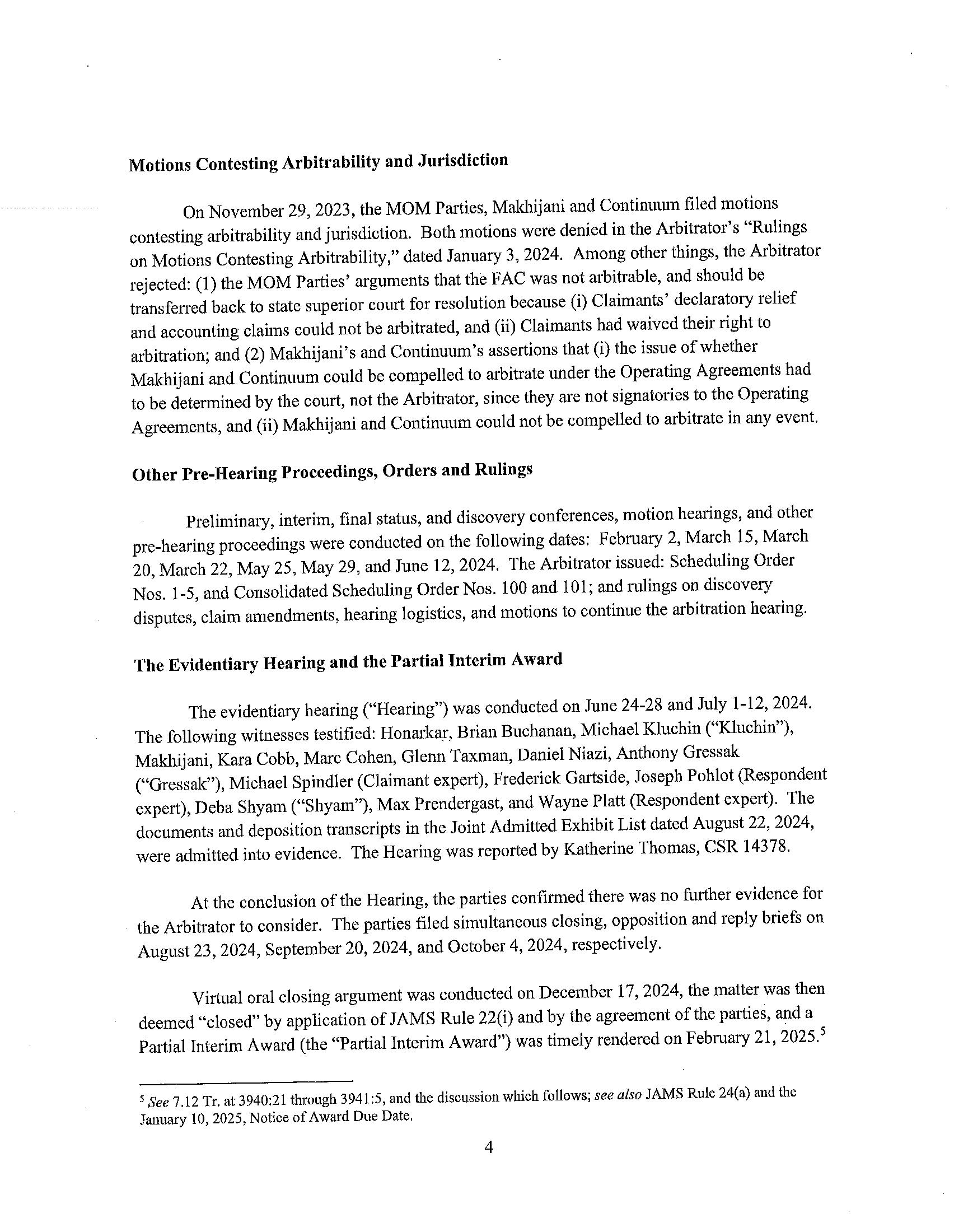
28. The Arbitrator heard the parties’ evidence as to the liability for their respective claims at an evidentiary hearing conducted on June 24-28 and July 1-3, 5, 8-12, 2024. After the hearing, the parties confirmed that there was no further evidence for the Arbitrator to consider. The Arbitrator then received simultaneous closing, opposition, and reply briefing from the parties, and heard oral closing argument on December 17, 2024.
29. On May 23, 2025, the Arbitrator’s Partial Final Award was served on the parties, which established liability but reserved certain issues (largely related to damages) for subsequent determination. Exhibit B at 45 ¶ 15.
30. On May 30, 2025, the MOM Respondents filed a request for correction of the Partial Final Award, which Petitioners opposed. On June 6, 2025, the Arbitrator denied that request.
31. On June 18, 2025, Petitioners filed a motion in this Court to confirm the Partial Final Award. That same day, the MOM Respondents and former respondent Nano Banc moved to vacate the Partial Final Award. The Court then received opposition and reply briefing from the parties on the petitions to confirm and vacate the Partial Final Award. Oral argument was held on October 13, 2026.
32. On October 20, 2025, this Court issued an Order confirming the Partial Final Award. A true and correct copy of that Order is attached hereto as Exhibit J. On December 5, 2025, this Court entered judgment in favor of Petitioners and against the MOM Respondents and former respondent Nano Banc. A true and correct copy of that Judgment is attached hereto as Exhibit K. The judgment further dismissed with prejudice all claims asserted by respondent MOM AS Investor Group LLC, MOM BS Investor Group LLC, MOM CA Investor Group LLC. Id. The judgment further awarded Petitioners attorney’s fees and costs, in accordance with the Partial Final Award. Id.
33. The Arbitrator heard the parties’ evidence as to damages at an evidentiary hearing conducted on January 26-28, 2026. The Arbitrator then received closing, opposition, and reply briefing from the parties. The Arbitrator deemed the matter closed as of March 13, 2026, when the final briefing was submitted.
34. In May 2026, Claimants and Nano Banc reached a settlement agreement resolving all claims against Nano Banc. On May 11, 2026, Petitioners filed with JAMS a request for dismissal as to Nano Banc only, which the JAMS clerk signed and entered that same day.
35. On May 12, 2026, the Arbitrator’s Final Award was served on the parties. See Exhibit A As stated in the Final Award, “This Final Award, together with the Partial Interim Award and the Partial Final Award, resolves all claims submitted to arbitration. Claims not expressly granted are denied. Arguments not discussed are either unnecessary to this Final Award or have been considered and rejected.” Exhibit A at 44 ¶ 16. 2
36. The Final Award was made in accordance with the terms and conditions of the written agreement to arbitrate and is in all respects proper and subject to confirmation because it determined all questions submitted to arbitration that were necessary in order to determine the controversy. See C.C.P. § 1283.4
37. Petitioners are entitled to an order confirming the Final Award, according to Code of Civil Procedure section 1285, and to have judgment entered in conformity therewith, pursuant to Code of Civil Procedure section 1287.4
2 Prior to the issuance of the Partial Final Award, the Arbitrator rejected all counter claims asserted in the Arbitration against Petitioners. See Exhibit A at 19, & Ex. A (Partial Interim Award) at 44, 48 ¶ 12 In the Partial Final Award, the Arbitrator expressly denied the counter claims asserted by respondents MOM AS Investor Group LLC, MOM BS Investor Group LLC, and MOM CA Investor Group LLC. Exhibit B at 44 ¶ 12. Because of then-pending bankruptcy petitions, to the degree the same claims were asserted by the MOM LLCs, those claims were stayed. Id. The bankruptcy petitions were subsequently dismissed, supra n. 1, and, in the Final Award, the Arbitrator denied all claims not expressly granted, including the counter claims asserted by the MOM LLCs against Petitioners. Exhibit A at 19, 44 ¶ 16
LEGAL STANDARD
38. According to the California Arbitration Act, confirmation of an arbitration award is mandatory unless a timely petition to correct or vacate the award is made: If a petition or response under this chapter is duly served and filed, the court shall confirm the award as made, whether rendered in this state or another state, unless in accordance with this chapter it corrects the award and confirms it as corrected, vacates the award or dismisses the proceedings.
C.C.P. § 1286 (emphasis added); see also Weinberg v. Safeco Ins. Co., 114 Cal. App. 4th 1075, 1083-84 (2004) (“A party who fails to timely file a petition to vacate under section [1286.2] may not thereafter attack that award by other means on grounds which would have supported an order to vacate.”) (quoting Louise Gardens of Encino Homeowners Ass’n, Inc. v. Truck Ins. Exch., 82 Cal. App. 4th 648, 659 (2000)).
39. A party seeking to request that an arbitration award be corrected or vacated must ordinarily serve such a request within 100 days of receiving service of the award. C.C.P. § 1288.2 Where a petition to confirm an award is filed within that 100-day period, a party seeking to vacate or correct the award must instead seek such relief within the 10-day period for responses to the petition. C.C.P. § 1290.6; DeMello v. Souza, 36 Cal. App. 3d 79, 83 (1973) (“When the party petitions the court to confirm the award before the expiration of the 100-day period, respondent may seek vacation or correction of the award by way of response only if he serves and files his response within 10 days after the service of the petition.”) (citing C.C.P. § 1290.6).
ARGUMENT
A. This Petition Satisfies The Requirements To Confirm An Arbitration Award.
40. “Any party to an arbitration in which an award has been made may petition the court to confirm, correct or vacate the award.” C.C.P. § 1285. Such a petition “shall name as respondents all parties to the arbitration and may name as respondents any other persons bound by the arbitration award.” Id. Per Code of Civil Procedure section 1285.4, a petition to confirm arbitration shall:
(a) Set forth the substance of or have attached a copy of the agreement to arbitrate unless the petitioner denies the existence of such an agreement.
(b) Set forth the names of the arbitrators.
(c) Set forth or have attached a copy of the award and the written opinion of the arbitrators, if any.
C.C.P. § 1285.4. Mr. Honarkar and 4G Wireless, Inc.’s Petition satisfies all of these requirements.
41. First, as this Court has already determined, Petitioners and the MOM Respondents all are subject to written agreements to arbitrate via the Operating Agreements and the Term Sheet.
See Exhibits C-F The Court overseeing the Orange County Lawsuit ordered the parties in that case “to submit all claims (except for the injunctive relief claims) to arbitration for the arbitrator to determine which issues must be decided by arbitration, and then for the arbitrator to decide those issues.” Exhibit H (9/25/2023 Minute Order) at 5. The Arbitrator also affirmed each of the parties’ written agreements to arbitrate, and the arbitrability of the parties’ claims, per written disposition dated January 3, 2024, attached as Exhibit I.
42. In confirming the Partial Final Award, the Court already determined that Petitioners and the MOM Respondents are subject to valid arbitration agreements, and that the claims were arbitrable. See Exhibit J (Order Confirming Partial Final Award) at 2, 4. The Court subsequently entered Judgment in conformity with the Order confirming the Partial Final Award. Exhibit K (Judgment) That judgment is binding here. Cal. Civ. Proc. Code § 1287.4 (“If an award is confirmed, judgment shall be entered in conformity therewith. The judgment so entered has the same force and effect as, and is subject to all the provisions of law relating to, a judgment in a civil action of the same jurisdictional classification; and it may be enforced like any other judgment of the court in which it is entered.”).
43. Second, as set forth in this Petition, the Arbitrator the Hon. David A. Thompson (Ret.) conducted an evidentiary hearing on June 24-28 and July 1-3, 5, 8-12, 2024, with a subsequent evidentiary hearing as to damages on January 26-28, 2026. Thereafter, the Arbitrator received extensive post-hearing briefs from the parties.
44. Third, a copy of the Arbitrator’s Final Award, which includes the Arbitrator’s written opinion and which the Arbitrator issued on May 12, 2026 is attached hereto as Exhibit A. A copy of the May 23, 2025 Partial Final Award, which has already been confirmed by this Court, is attached as Exhibit B; see also Exhibits J-K.
B. The Court Should Confirm The Final Arbitration Award.
45. In resolving a motion to confirm an arbitration award, “every presumption favors the arbitrator’s award,” and neither questions of law nor fact are subject to review. Lehto v. Underground Constr. Co., 69 Cal. App. 3d 933, 939-40 (1977); see also Thibodeau v. Crum, 4 Cal. App. 4th 749, 759-60 (1992) (“‘Once a valid award is made by the arbitrator, it is conclusive on matters of fact and law and all matters in the award are thereafter res judicata.’”) (quoting Lehto, 69 Cal. App. 3d at 939). “The merits of the controversy between the parties are not subject to judicial review,” O’Malley v. Petroleum Maint. Co., 48 Cal. 2d 107, 110-11 (1957), and “courts will not review the validity of the arbitrator’s reasoning” nor may a court “review the sufficiency of the evidence supporting an arbitrator’s award.” Moncharsh, 3 Cal. 4th at 11. In short: “[t]he arbitrator’s decision should be the end, not the beginning, of the dispute.” Id. at 10.
46. Because of the strong public policy favoring arbitration as a speedy and relatively inexpensive method of dispute resolution, judicial review of arbitration awards is restricted to the grounds for vacation or correction enumerated in Code of Civil Procedure sections 1286.2 and 1286.6. See Moncharsh, 3 Cal. 4th at 27-28. Although none of the grounds for vacating the arbitrator’s award are remotely present, to the extent the MOM Respondents claim otherwise they will bear the burden of establishing facts to support such alleged grounds. E.g., Royal Alliance Assocs., Inc. v. Liebhaber, 2 Cal. App. 5th 1092, 1106 (2016) (“The party seeking to vacate an arbitration award bears the burden of establishing that one of the six grounds listed in section 1286.2 applies and that the party was prejudiced by the arbitrator’s error.”).
47. Based on arguments made in Arbitration, and the very limited set of potential grounds upon which a court is permitted to vacate an arbitration award, Petitioners anticipate that the MOM Respondents will try to argue that the Arbitrator was in some way biased against them. The MOM Respondents already made similar arguments in connection with the Partial Final
Award, and the Court already rejected those arguments as meritless. Exhibit J at 11-12 (Order confirming Partial Final Award). Once again, there is no evidence supporting such a claim, and the MOM Respondents cannot come remotely close to meeting the applicable legal standard See, e.g., Evans v. Centerstone Dev. Co., 134 Cal. App. 4th 151, 163 (2005) (“The party claiming bias bears the burden of establishing facts supporting its position. . . . “) (quoting Reed v. Mut. Serv. Corp., 106 Cal. App. 4th 1359, 1370-71 (2003)); Luster v. Collins, 15 Cal. App. 4th 1338, 1345 (1993) (“To support a claim of bias, a party must demonstrate the arbitrator had an interest in the subject matter of the arbitration or a preexisting business or social relationship with one of the parties which would color the arbitrator’s judgment.”) (citing Banwait v. Hernandez, 205 Cal. App. 3d 823, 826-29 (1988)).
C. The Arbitrator’s Final Award Is Subject To Confirmation By This Court.
48. The Final Award is the Arbitrator’s final determination as to all issues submitted to arbitration. Previously, the Partial Final Award resolved liability, including as to the cross-claims asserted against Petitioners (which were rejected). Exhibit B at 45. That Partial Final Award has already been confirmed by this Court, and Judgment has already been entered thereon. Exhibits J, K
49. Now, all outstanding issues, including damages, have been fully and finally resolved in the Final Award. Exhibit A at 44 ¶ 16 (“This Final Award, together with the Partial Interim Award and the Partial Final Award, resolves all claims submitted to arbitration. Claims not expressly granted are denied. Arguments not discussed are either unnecessary to this Final Award or have been considered and rejected.”) (citation omitted). Accordingly, the Final Award is subject to confirmation. See Hightower v. Superior Court, 86 Cal. App. 4th 1415 (2001) (holding that incrementally issued awards are subject to confirmation); see also, e.g., Roehl v. Ritchie, 147 Cal. App. 4th 338, 352 (2007) (affirming second arbitration award in the same matter after earlier confirmation of a first award); VVA-Two, LLC v. Impact Dev. Grp., LLC, 48 Cal. App. 5th 985, 999-1000 (2020) (“[T]he award provides a complete but potentially incremental remedy tailored to address a challenging situation.”); compare with Kaiser Found. Health Plan, Inc. v. Super. Ct., 13 Cal. App. 5th 1125,1129-30 (2017) (“Partial Final Award” did not quality as an
“Award” under C.C.P. § 1283.4 where it only decided threshold issue of arbitrability and nothing more, and expressly failed to resolve all liability questions on all causes of action in the dispute).
D. The Court Should Enter Judgment In Favor Of Petitioners.
50. If the arbitration award is confirmed, “judgment shall be entered in conformity therewith.” C.C.P. § 1287.4; see also Ajida Techs., Inc. v. Roos Instruments, Inc., 87 Cal. App. 4th 534, 549 (2001) (“a judgment confirming an arbitration award is enforceable in the same manner as any other judgment in a civil action”). Accordingly, the Court should enter judgment in favor of Petitioners.
PRAYER FOR RELIEF
WHEREFORE, Petitioners pray for the following relief:
1. That the Court enter an order confirming the Final Award;
2. That the Court award Petitioners their costs of suit; and
3. That the Court enter judgment in favor of Petitioners and against the MOM Respondents in accordance with the [Proposed] Judgment submitted herewith.
DATED: May 27, 2026
HALPERN MAY YBARRA GELBERG LLP AARON M. MAY JOSEPH J. YBARRA By: AARON M. MAY
Attorneys for Plaintiffs MOHAMMAD HONARKAR and 4G WIRELESS, INC.
EXHIBIT A
JAMS ARBITRATION
No. 5220003126 (Consolidated with JAMS Case No. 5200001122)
Mohammad Honarkar and 4G Wireless, Inc., individually and on behalf of MOM AS Investco LLC, MOM BS Investco LLC, and MOM CA Investco LLC, Claimants and Derivative Claimants, v.
Mahender Makhijani; Continuum Analytics, Inc.; MOM AS Investor Group LLC; MOM BS Investor Group LLC; MOM CA Investor Group LLC; MOM AS Manager LLC; MOM BS Manager LLC; and MOM CA Manager LLC, Respondents, and,
MOM AS Investco LLC, MOM BS Investco LLC, and MOM CA Investco LLC, Nominal Respondents.
FINAL AWARD
Consolidated case:
MOM AS Investco LLC, MOM BS Investco LLC, MOM CA Investco LLC, MOM AS Investor Group LLC, MOM BS Investor Group LLC, and MOM CA Investor Group LLC, Claimants, v.
Mohammad Honarkar, Respondent.
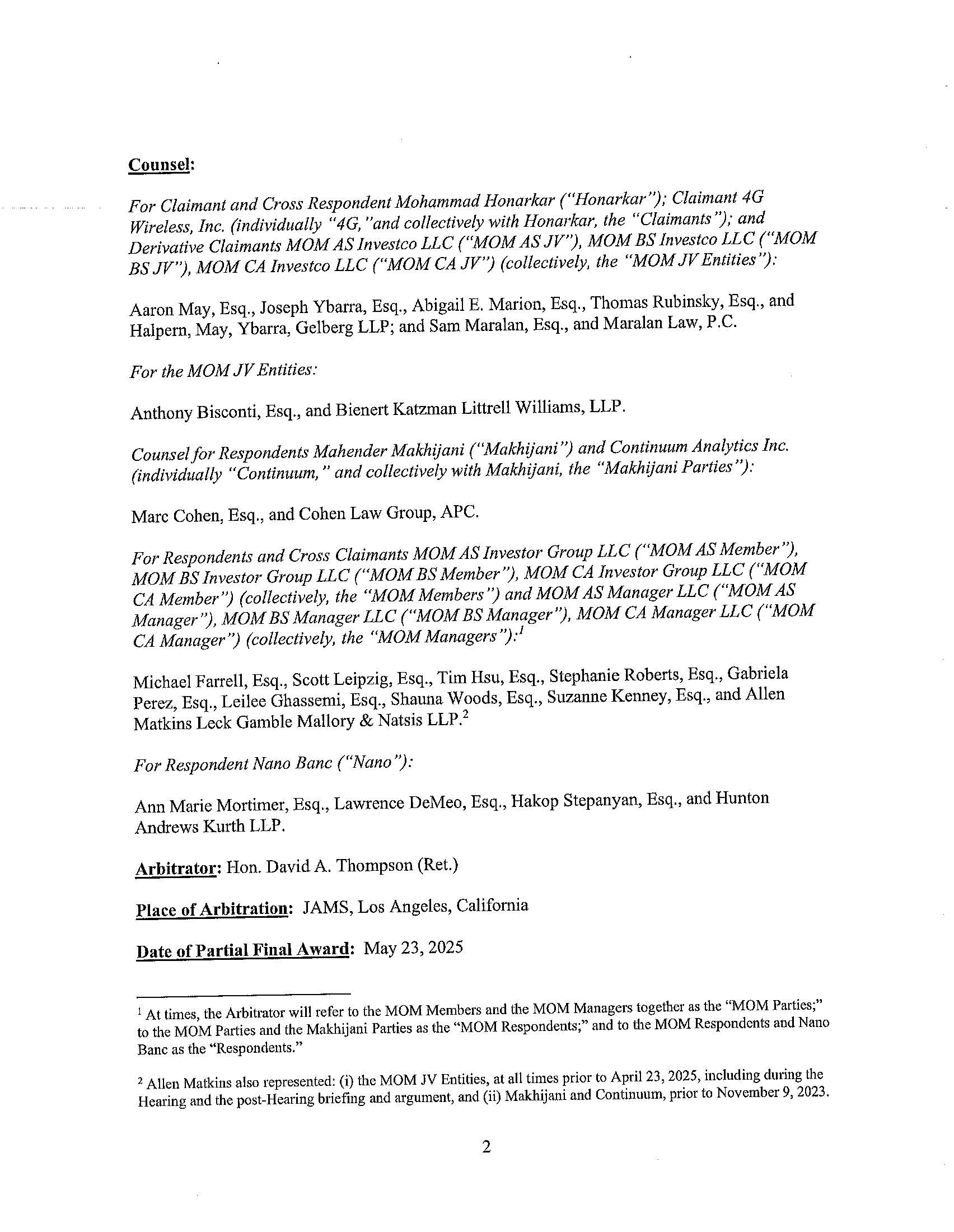
Counsel:
For Claimant and Cross Respondent Mohammad Honarkar (“Honarkar”); Claimant 4G Wireless, Inc. (individually “4G,”and collectively with Honarkar, the “Claimants” or the “Honarkar Parties”); and Derivative Claimants MOM AS Investco LLC (“MOM AS JV”), MOM BS Investco LLC (“MOM BS JV”), MOM CA Investco LLC (“MOM CA JV”) (collectively, the “MOM JV Entities” or the “MOM Investco LLCs”):
Aaron May, Esq., Joseph Ybarra, Esq., Abigail E. Marion, Esq., Thomas Rubinsky, Esq., and Halpern, May, Ybarra, Gelberg LLP; and Sam Maralan, Esq., and Maralan Law, P.C.
For Respondents Mahender Makhijani (“Makhijani”) and Continuum Analytics Inc. (individually “Continuum, ” and collectively with Makhijani, the “Makhijani Parties”):
Larry A. Rothstein, Esq., and Law Offices of Larry A Rothstein 1
For Respondents and Cross Claimants MOM AS Investor Group LLC (“MOM AS Member”), MOM BS Investor Group LLC (“MOM BS Member”), MOM CA Investor Group LLC (“MOM CA Member”) (collectively, the “MOM Members”) and MOM AS Manager LLC (“MOM AS Manager”), MOM BS Manager LLC (“MOM BS Manager”), MOM CA Manager LLC (“MOM CA Manager”) (collectively, the “MOM Managers, ” and collectively with the MOM Members, the “MOM Parties”):2
Brandon Q. Tran, Esq., and Dhillon Law Group, Inc.3
Arbitrator: Hon. David A. Thompson (Ret.)
Place of Arbitration: JAMS, Los Angeles, California
Date of Partial Interim Award: February 21, 2025
Date of Partial Final Award: May 23, 2025
1 Prior to November 11, 2025 the Makhijani Parties were represented by Marc Cohen, Esq., and Cohen Law Group.
2 At times, the Arbitrator will refer to the Makhijani Parties and the MOM Parties collectively as the “MOM Respondents” or the “Respondents.” Nano Banc (“Nano”) is no longer a party to this arbitration. (See § I.E below.)
3 Prior to December 29, 2025, the MOM Parties were represented by Michael Farrell, Esq., Scott Leipzig, Esq., Tim Hsu, Esq., Stephanie Roberts, Esq., Gabriela Perez, Esq., Leilee Ghassemi, Esq., Shauna Woods, Esq., Suzanne Kenney, Esq., and Allen Matkins Leck Gamble Mallory & Natsis LLP. Allen Matkins also represented: (i) the MOM JV Entities, prior to April 23, 2025, and (ii) the Makhijani Parties, prior to November 9, 2023.
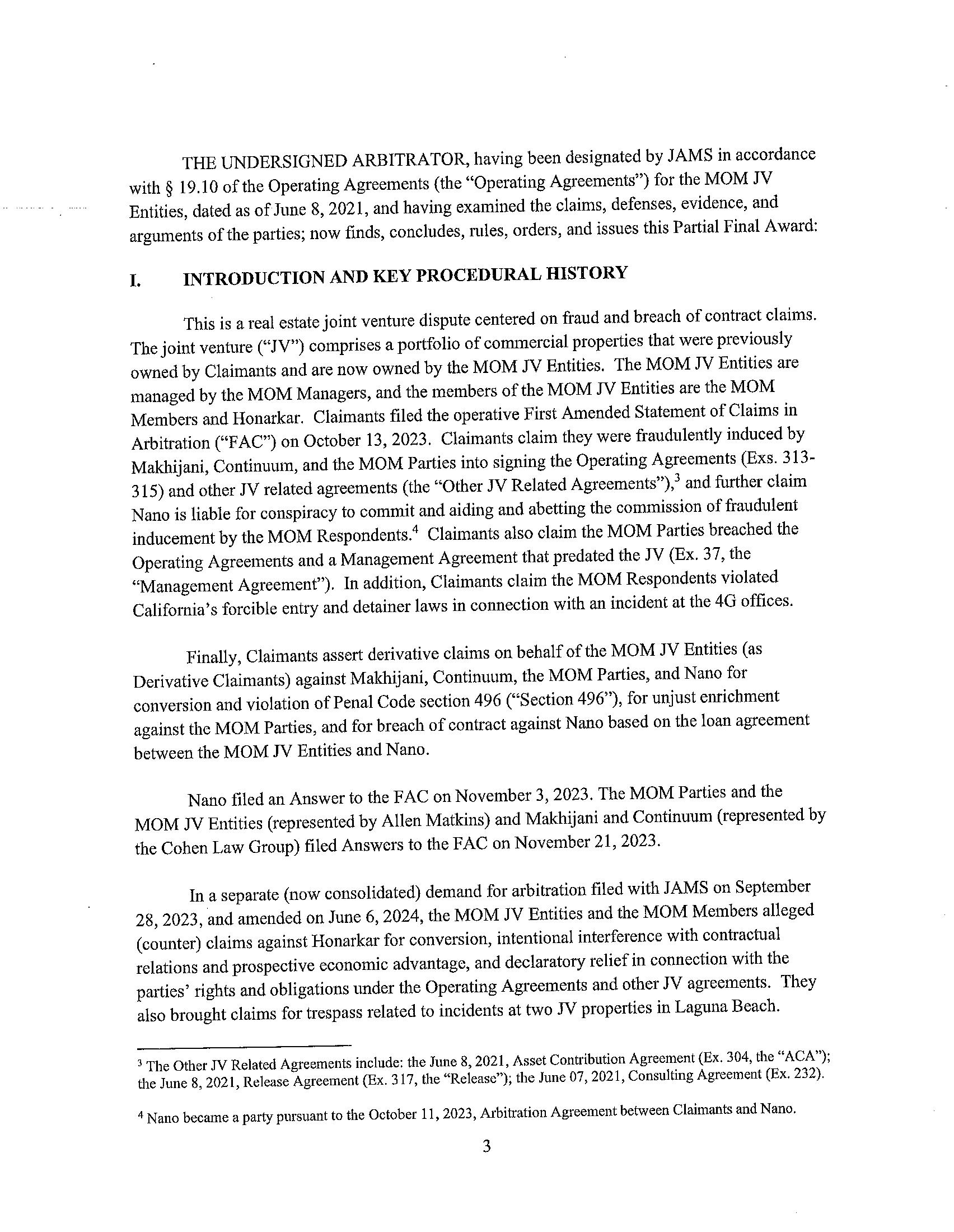
THE UNDERSIGNED ARBITRATOR, having been designated by JAMS in accordance with § 19.10 of the Operating Agreements (the “Operating Agreements”)for the MOM JV Entities, dated as of June 8, 2021, and having examined the claims, defenses, evidence, and arguments of the parties; and having issued a Partial Interim Award and a Partial Final Award, now finds, concludes, rules, orders, and issues this Final Award: 4
I. INTRODUCTION AND FURTHER PROCEDURAL HISTORY
This Final Award resolves all the issues remaining (the “Remaining Issues”) following the Partial Interim Award (also referred to herein as the “PIA”) and Partial Final Award (also referred to herein as the “PFA”), starting with a summary of the further procedural history
A. Partial Interim Award and Bankruptcy Proceedings
On February 21, 2025, the Arbitrator issued the Partial Interim Award attached as Exhibit A and made a part hereof. The Partial Interim Award found, concluded, ruled and ordered:
(1) Claimants had proven their fraudulent inducement claim against Makhijani, Continuum and the MOM Members; and Claimants were therefore entitled to elect the alternative remedies of either compensatory damages, or rescission with restitution and consequential damages, all in amounts to be determined. (PIA §§ III.A, III.G, and III.N.1.)
(2) Claimants had proven their breach of contract (Operating Agreement) claims against the MOM Members and the MOM Managers; and Claimants were therefore entitled to the alternative remedies of compensatory damages or rescission with restitution and consequential damages, all in amounts to be determined. (PIA §§ III.B.1-B.5 and III.N.2.)
(3) Claimants had not proven their breach of contract (Management Agreement) claim against the MOM Members and the MOM Managers. (PIA § III.B.6.)
(4) Claimants had proven their forcible entry and forcible detainer claims against Makhijani, Continuum and the MOM Parties; and Claimants were therefore entitled to restitution of the subject premises (775 Laguna Canyon Road) and incidental damages in amounts to be determined. (PIA §§ III.C and III.G.)
(5) Claimants had proven their derivative conversion claim against Makhijani, Continuum, the MOM Parties and Nano; and the MOM JV Entities (as Derivative Claimants) were therefore entitled to recover compensatory damages in amounts to be determined. (PIA §§ III.D, III.G and III.I.)
4 Capitalized terms used but not defined herein shall have the meaning ascribed thereto in the Partial Interim Award.
(6) Claimants had proven their derivative Section 496 claim against Makhijani, Continuum, the MOM Parties, and Nano; and the MOM JV Entities (as Derivative Claimants) were therefore entitled to recover compensatory damages in amounts to be determined. (PIA §§ III.E, III.G, and III.I.)
(7) Claimants had proven their derivative unjust enrichment claim against Makhijani, Continuum, and the MOM Parties; and the MOM JV Entities (as Derivative Claimants) were therefore entitled to recover compensatory damages in amounts to be determined. (PIA §§ III.F and III.G.)
(8) Claimants had proven their conspiracy to commit fraudulent inducement and aiding and abetting fraudulent inducement claims against Nano; and Claimants were therefore entitled to the alternative remedies of compensatory damages, or rescission with restitution and consequential damages, all in amounts to be determined. (PIA §§ III.A and III.H.)
(9) Claimants had not proven their derivative breach of contract claim against Nano. (PIA § III.J.)
(10) Claimants had proven their accounting claim against the MOM Parties; Claimants were therefore entitled to the accounting requested; and the accounting would be the subject of further proceedings in this arbitration. (PIA § III.K.)
(11) Claimants had proven their declaratory relief claim against the MOM Parties; and Claimants were therefore awarded the declaratory relief requested. (PIA § III.L.)
(12) The MOM Respondents had not proven any of their (counter) claims against Honarkar (including trespass, conversion, Section 496, intentional interference with contractual relations and prospective economic advantage, declaratory or injunctive relief). (PIA § III.M.)
(13) All amounts of restitution, consequential damages, compensatory damages, incidental damages, punitive damages and interest (if any) to be awarded to Claimants would be determined in further proceedings in this arbitration.
(14) Claimants were entitled to recover from the MOM Respondents attorney fees and costs, in amounts to be determined. (PIA § III.N.5; JAMS Rule 24(f) and 24(g).)
(15) The Partial Interim Award was not subject to judicial review pursuant to the CAA (CCP §§ 1284, 1285) or the FAA (9 U.S.C. §§ 9, 10) or any other law, and the Arbitrator reserved jurisdiction over all claims submitted to arbitration until a Partial Final Award issued.
(16) The Partial Interim Award, together with the determinations regarding the amounts of attorney fees and costs to be awarded, would be embodied in a Partial Final Award.
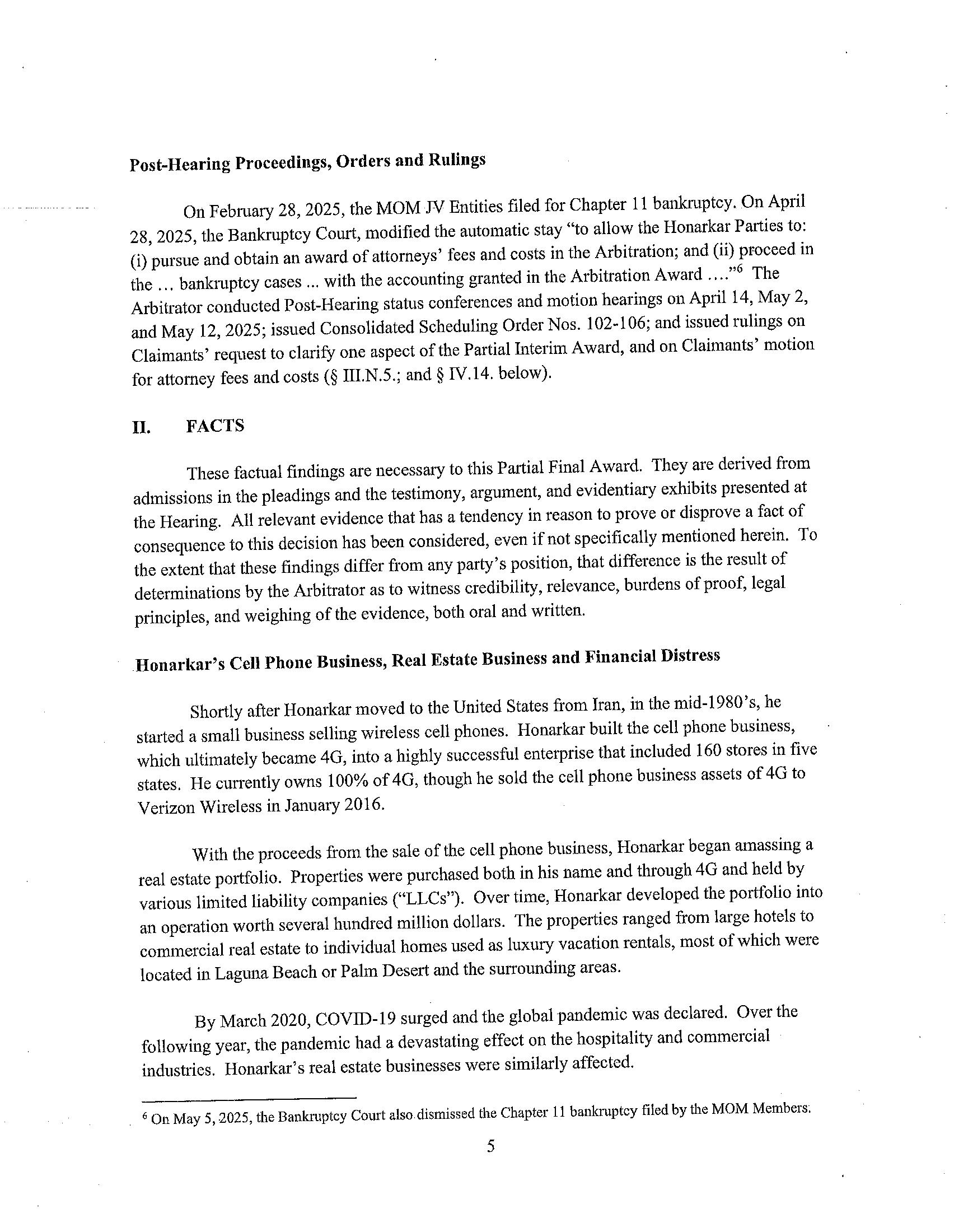
In response to the Partial Interim Award, on February 28, 2025, the MOM Parties and the Makhijani Parties caused the MOM JV Entities to file voluntary Chapter 11 Bankruptcy petitions, on the grounds their liabilities were greater than their assets (3.7.25 Notice of Bankruptcy Petition and Automatic Stay; 1.26.26 Tr. at 53:12-54:20 [Miller]; 1.26.26 at 123:22126:11 [Makhijani] )
On March 10, 2025, the MOM Parties and the Makhijani Parties caused nineteen of the MOM JV Entities’ single purpose entity subsidiaries (the “MOM SPEs”) to file voluntary Chapter 11 Bankruptcy petitions on the same grounds. (3.31.25 Notice of Subsidiary Bankruptcy Petitions and Automatic Stay; Exs. 6188, 6189, 6190.)
Based upon the automatic stay resulting from these voluntary bankruptcy petitions, the MOM Parties and the Makhijani Parties argued all further arbitration proceedings must be halted. The Arbitrator rejected these arguments and ordered the briefing on Claimants’ application for attorney fees and costs and other arbitration proceedings to continue as previously scheduled. (3.10.25 Amended Scheduling Order No. 102.)
On March 17, 2025, the MOM Parties and the Makhijani Parties caused the MOM Members to file voluntary Chapter 11 Bankruptcy petitions. (3.17.25 Notice of MOM Investor Group’s Bankruptcy Petition and Automatic Stay.)
On March 24, 2025, JAMS issued a partial administrative stay as to the MOM JV Entities and the MOM Members only, pending further order of the court in the bankruptcy proceedings. (3.24.25 Notice of Partial Administrative Stay; 3.29.25 Scheduling Order No. 103.)
On April 7, 2025, the MOM Parties filed their informal letter brief addressing the structure and timing of the further proceedings related to the accounting which stated in part:
“Respondents’ counsel of record in this Arbitration further understand that Claimants Honarkar and 4G Wireless, Inc. … are in discussions with certain of the Respondents in bankruptcy to coordinate an accounting process to be determined in the bankruptcy proceedings, which would obviate any need to address an accounting in this Arbitration. The parties are close to reaching a stipulation for the accounting to be conducted under the instruction and supervision of the Bankruptcy Court, which will avoid any potential implications for a stay violation. Makhijani and Continuum have also made clear they are agreeable to submitting this process to the Bankruptcy Court for the accounting, and the Arbitration proceedings should [] thus be stayed to allow for that process to complete.
“Accordingly, Respondents request the Arbitrator and JAMS stay any further proceedings pertaining to the accounting contemplated in the Interim Partial Award. Respondents further request the Arbitrator and JAMS place the entire Arbitration on administrative stay as any further proceedings will implicate violations of the automatic stay. Respondents understand the Arbitrat[or] has previously determined the matter may proceed notwithstanding the bankruptcy filings but any such action, including authorization to proceed with an accounting as contemplated, must cease as they directly violate the automatic stay….”
On April 28, 2025, the bankruptcy court modified the automatic stay to permit Claimants to: “(i) pursue and obtain an award of attorneys’ fees and costs in the Arbitration; and (ii) proceed in the … bankruptcy cases with the accounting granted in the [Partial Interim] Award in accordance with protocols to be agreed upon by the parties to the Arbitration or otherwise entered by this Court.” (5.1.25 MOM Parties informal letter brief, Ex. A.) On May 5, 2025, the bankruptcy court dismissed the MOM Members’ bankruptcy petitions. (5 5 25 Order Dismissing Chapter 11 Cases (D. Del. 25-10510).) Thus, the bankruptcy stay did not preclude further proceedings in this arbitration.
On May 12, 2025, the Arbitrator clarified the Partial Interim Award “was intended to and did in fact determine the Declaratory Relief Entities (including Terra Laguna Beach, Inc.) are not now and never have been owned by the MOM JV Entities.” (5.12.25 Ruling on Request for Clarification and Scheduling Order No. 106.)
On May 23, 2025, the Arbitrator ruled: (A) Claimants were entitled to recover their attorney fees and costs; (B) Claimants’ lodestar attorney fees were reasonable; (C) Claimants were entitled to a 1.5 multiplier; and (D) Claimants’ costs were reasonable. (5.23.35 Ruling on Motion for Attorney Fees and Costs.) The Arbitrator awarded Claimants $8,303,510.25 in attorney fees ($5,535,673.50 x 1.5), plus $893,916.06 in costs, for a total of $9,197,426.31. (Ibid.) The Arbitrator specifically found: (i) the MOM Respondents “employed litigation strategies that led to delays and additional costs in the discovery process and a significant extension of the arbitration Hearing itself[;]” (ii) the MOM Respondents “cut [Claimants] out of any income generated by the JV for nearly two years[;]” and (iii) “[t]hese actions were designed, at least in part, to prevent Claimants from being able to litigate this case.” (Id. at 8, 10.)
B. Partial Final Award, Accounting Proceedings and Sanctions
On May 23, 2025, the Arbitrator issued the Partial Final Award and it is no longer subject to JAMS jurisdiction. (JAMS Rule 24(k).) The Orange County Superior Court confirmed the Partial Final Award on October 20, 2025, and entered it as a judgment on December 5, 2025. (OCSC Case No. 30-2023-01323759.)5
5 A Notice of Appeal was filed on December 22, 2025. (Case No. G066358.)
The Partial Final Award embodied the non-stayed portions of the Partial Interim Award and once more found, concluded, ruled and ordered:
(1) Claimants had proven their direct claims for: fraudulent inducement against the Makhijani Parties and the MOM Members, breach of contract (Operating Agreements) against the MOM Parties, and conspiracy to commit and aiding and abetting fraudulent inducement claims against Nano; and Claimants were therefore entitled to the alternative remedies of compensatory damages, or rescission with restitution and consequential damages, all in amounts to be determined;
(2) Claimants had proven their forcible entry and forcible detainer claims against Makhijani, Continuum and the MOM Parties; and Claimants were therefore entitled to restitution of the subject premises (775 Laguna Canyon Road) and incidental damages in amounts to be determined;
(3) Claimants had proven their accounting claim against the MOM Parties; Claimants were therefore entitled to the accounting requested; and the accounting would be the subject of further proceedings in this arbitration;
(4) Claimants had proven their declaratory relief claim against the MOM Parties; and Claimants were therefore awarded the declaratory relief requested; and
(5) All amounts of restitution, consequential damages, compensatory damages, incidental damages, punitive damages and interest (if any) to be awarded to Claimants would be determined in further proceedings in this arbitration.
The Partial Final Award also found, concluded, ruled and ordered:
(1) Claimants’ derivative claims (conversion against Makhijani, Continuum, the MOM Parties, and Nano; Section 496 against Makhijani, Continuum, the MOM Parties, and Nano; unjust enrichment against Makhijani, Continuum, and the MOM Parties; and breach of contract against Nano) were stayed because of the then pending MOM JV Entities’ bankruptcy but would be analyzed and disposed of in the Final Award; and
(2) To the extent the MOM JV Entities had asserted derivative (counter) claims against Honarkar (trespass, conversion, Section 496, intentional interference with contractual relations and prospective economic advantage, declaratory or injunctive relief), those claims were also stayed because of their bankruptcy but would be analyzed and disposed of in the Final Award.
The Partial Final Award awarded Claimants $9,197,426 in attorney fees and costs.
Thus, the Partial Final Award resolved all claims submitted to arbitration, except for the Remaining Issues to be resolved in further proceedings, which included: “(i) the claims stayed as a result of the MOM JV Entities’ bankruptcy; (ii) the accounting; and (iii) the determination of the amounts of restitution, damages, interest, attorney fees and costs to be awarded.” Moreover, the Arbitrator again expressly reserved jurisdiction to determine all aspects of the Remaining Issues. (See JAMS Rule 24; Hightower v. Superior Court (2001) 86 Cal.App.4th 1415, 1437.)
Finally, the Partial Final Award provided: “After the Remaining Issues are determined; and after all further proceedings in this arbitration are concluded; the Arbitrator will issue a Final Award which will resolve all claims submitted to arbitration and will include a supplemental award for attorney fees and costs incurred through entry of the Final Award in this arbitration.” (See Hightower, supra, 86 Cal.App.4th at 1437-1441 [Arbitrator has authority to issue partial award and reserve jurisdiction to issue a final award on the remaining issues.].)
Regarding the accounting, the Partial Final Award explained the MOM Respondents defrauded Claimants into creating the joint venture, imposed “hundreds of millions of dollars” of encumbrances on joint venture assets, and engaged in a multitude of other bad acts. (PFA at 26.) Because the MOM Respondents “active[ly] conceal[ed]” their financial information from Claimants, an accounting was necessary to determine the precise amounts of damages suffered by Claimants. (Id. at 39.) The MOM Respondents’ “fail[ure] to fulfill [their] obligations” to provide financial information as mandated by the MOM JV Entities’ Operating Agreements, Judge Chalfant’s orders in the Books and Records litigation in Los Angeles Superior Court, and the Arbitrator’s orders here, all meant “Claimants ha[d] no way to determine the full scope of [the] MOM Respondents’ misconduct and the resulting damages.” (Id. at 38-39.)
On August 18, 2025, the bankruptcy court granted Claimants’ motion to dismiss the bankruptcy petitions of the MOM JV Entities and the MOM SPEs. (5.12.25 Scheduling Order No. 106.) It is noteworthy that during the pendency of the bankruptcy cases, Makhijani instructed the Restructuring Officer (Mark Shinderman, whom the MOM Parties and the Makhijani Parties appointed), to “sell all [the JV properties] by September [2025].” (1.28.26 Tr. at 779:19-780:10 [Honarkar]; Ex. 6189 at 016 [(bankruptcy filing signed by Shinderman].)
The end of the bankruptcy proceedings ended any prospect of conducting the accounting under the supervision of the Bankruptcy Court. So, the further proceedings continued in this arbitration to resolve all the Remaining Issues, including the accounting.
After extensive briefing and multiple status conferences concerning the accounting, on September 5, 2025, the Arbitrator entered an order (the “Accounting Order”) setting forth an accounting protocol. (9.5.25 Order Re Accounting.) The Accounting Order established the scope of the accounting and required the parties to produce relevant documents by September 19, 2025.
At 6:42 p.m. on September 19, 2025, the last day to produce documents under the Accounting Order, the MOM Respondents instead filed a letter stating: “Due to unforeseen circumstances [they] were advised by third party counsel that compliance with sections 2-4 of the Arbitrator’s Order, which requires the production of additional documents not previously produced, would violate certain Constitutional privileges and other procedural rules.”
On September 23, 2025, Claimants requested that the Arbitrator issue an Order to Show Cause (“OSC”) to the MOM Respondents as to why issue, evidentiary, and monetary sanctions should not be imposed, given their refusal to produce documents for the accounting, in violation of the Accounting Order. On September 24, 2025, the Arbitrator issued an OSC which set a briefing schedule and a hearing. (9.24.25 Order to Show Cause Re Sanctions.)
The MOM Respondents then produced some documents, but after full briefing and three OSC hearings, on November 4, 2025, the Arbitrator issued an Amended Order Re Sanctions which found: (1) “The MOM Respondents have not demonstrated good cause for their failure to produce the documents on September 19, 2025, as required by the Accounting Order. That failure was willful and deliberate – another demonstration of their longstanding pattern and practice of refusing to produce financial information as required[;]” and (2) “The MOM Respondents (other than Makhijani) have no Fifth Amendment rights, and Makhijani has not specifically invoked his Fifth Amendment rights.” The Arbitrator ruled and ordered as follows:
“A. Evidentiary Sanctions. Claimants requested an order, ‘preclud[ing] MOM Respondents from offering any evidence or argument relating to the various items delineated as the scope of the [Accounting Order].’ … This request is GRANTED IN PART - the MOM Respondents shall be precluded from offering into evidence any documents within the scope of the Accounting Order which they failed to produce before October 24, 2025.
“B. Adverse Inferences. Claimants requested an order, ‘impos[ing] sanctions in the form of adverse inferences in the accounting and the remedies phase… [and] in determining damages and other remedies, the accountant and Arbitrator should fill in any gaps in the records by drawing inferences against MOM Respondents.’ … This request is taken under SUBMISSIONand will be ruled upon after the Accounting is concluded.
“C. Issue Sanctions As To Offsets. Claimants requested an order, ‘impos[ing] issue sanctions in the form of finding there are no offsets to the ultimate damages award.’ … This request is taken under SUBMISSION - and will be ruled upon after the Accounting is concluded
“D. Monetary Sanctions. Claimants requested an order, imposing ‘[m]onetary sanctions … on both MOM Respondents and their counsel.’ … This request is GRANTED - the MOM Respondents and their counsel, shall pay Claimants … $100,563 as a monetary sanction….”
Even so, the accounting completion deadline passed on November 11, 2025, and the MOM Respondents never produced all the documents required by the Accounting Order.
On November 12, 2025, Claimants requested “an order from the Arbitrator finding that the accounting ‘cannot be completed in a timely manner, primarily due to MOM Respondents’ willful obstruction of the process, and on that basis concluding the accounting process.” Claimants also requested “an order setting a schedule for resolution of all remaining damages issues, including punitive damages, as soon as possible.”
On November 14, 2025, the Arbitrator issued an Order re Concluding Accounting that: (a) advised the parties the Arbitrator intended to ask the Accountant for additional information clarifying if and when the accounting could be completed; and (b) stated “[a]lternatively, by noon on November 17, 2025, Claimants may file a written notice of their election to abandon the accounting claim on which they prevailed in the Partial Final Award, in which case the Accounting will be deemed to be concluded for all purposes.”
On November 17, 2025, Claimants notified the Arbitrator and counsel: “Claimants … elect to abandon the completion of the accounting, which was awarded to Claimants pursuant to prevailing on their claim for an accounting. (See 11.14.2025 Order Re Concluding Accounting at ¶ 3.) Claimants make this election for the reasons previously articulated in prior submissions and at prior hearings, including that the MOM Respondents’ willful failure to comply with orders and timely produce all records needed for the accounting and their efforts to delay and obstruct this proceeding have made it impossible to perform an accounting, especially on a timely basis, and that the delay the MOM Respondents have caused has severely harmed and prejudiced Claimants and further delay will result in additional harm, given that the MOM and Makhijani Parties’ failure to produce necessary records rendered the accounting impossible.”
On December 24, 2025, the Arbitrator issued a Supplemental Order re Sanctions for Accounting Order Violations, which confirmed the accounting was deemed concluded (11.4.25 Amended Order re Sanctions at 3, fn. 2) and expressly found: (1) “The MOM Respondents have not demonstrated good cause for their failure to produce the documents on September 19, 2025, as required by the Accounting Order. That failure was willful and deliberate – another demonstration of their longstanding pattern and practice of refusing to produce financial information as required[;]” (2) “The MOM Respondents’ repeated, willful, and deliberate failures to comply with my orders, including the Accounting Order, made it impossible to complete the Accounting in a timely manner (if at all), and Claimants were harmed by the delay[;]” and (3) “The MOM Respondents (other than Makhijani) have no Fifth Amendment rights, and Makhijani has never actually invoked his Fifth Amendment rights. (Braswell v. United States (1988) 487 U.S. 99; Avant! Corp. v. Super. Ct. (2000) 79 Cal. App. 4th 876; Siry Inv., L.P. v. Farkhondehpour (2020) 45 Cal. App. 5th 1098, 1125.)”
The Arbitrator therefore awarded additional non-monetary sanctions (ruling on the two requests previously taken under submission pending conclusion of the accounting) as follows:
“A. Evidentiary Sanctions. Claimants requested an order, ‘preclud[ing] MOM Respondents from offering any evidence or argument relating to the various items delineated as the scope of the [Accounting Order].’ … This request is further GRANTED as follows:
“
(a) The MOM Respondents shall be PRECLUDED from offering any evidence or argument the evidence is insufficient to support Claimants’ damage claims (see Biles v. Exxon Mobil Corp. (2004) 124 Cal. App. 4th 1315, 1327; Reales Inv., LLC v. Johnson (2020) 55 Cal. App. 5th 463, 472-474); and
“
(b) The MOM Respondents shall be PRECLUDED from offering any additional evidence to prove their offset claims.
“B. Adverse Inferences. Claimants requested an order, ‘impos[ing] sanctions in the form of adverse inferences in … in determining damages and other remedies, … and Arbitrator should fill in any gaps in the records by drawing inferences against MOM Respondents.’ … This request is GRANTED as follows – Arbitrator finds the MOM Respondents willfully suppressed evidence relating to damages and remedies and infers for all purposes the evidence they suppressed is unfavorable to them. (See CACI 204; Karlsson v. Ford Motor Co. (2006) 140 Cal. App. 4th 1202, 1224.).”
C. Punitive Damages Discovery and Further Sanctions
On November 10, 2025, Claimants requested an order from the Arbitrator requiring all Respondents to produce specified punitive damages discovery. The parties then filed letter briefs in support of and opposition to this request, and the Arbitrator conducted a hearing on it.
On November 17, 2025, the Arbitrator issued an Amended Order re Punitive Damages Discovery which found, ruled, and ordered as follows:
“1. While Civil Code section 3295 may not strictly apply to this arbitration, it is a useful guide, particularly since the JAMS Rules are silent on punitive damages discovery.
“2. As relevant here, because liability for punitive damages has been established, section 3295 authorizes discovery of: (a) the profits the Respondents have gained by virtue of the wrongful course of conduct of the nature and type shown by the evidence, and (b) the financial condition of the Respondents. In addition, the Respondents may be required to identify documents in their possession which are relevant and admissible for these purposes.
“3. Consequently, by 5 pm on November 24, 2025, Respondents (other than Nano) shall (a) PRODUCE to Claimants, the following documents for the last 4 years (the time period of the joint venture), all of their (i) tax returns, (ii) balance sheets, (iii) profit/loss statements, and (iv) records showing distributions to owners, officers, directors, and affiliates; and (b) IDENTIFY the witnesses employed by … each Respondent who would be most competent to testify regarding those documents, the profits the Respondents have gained by virtue of the wrongful course of conduct found in the Partial Interim Award, and the financial condition of the Respondents.
“4. Nano shall not be required to produce any additional documents at this time.
“5. All objections to the foregoing discovery which were asserted prior to the November 14, 2025, hearing are OVERRULED.
“6. All objections to the foregoing discovery which could have been but were not asserted prior to the November 14, 2025, hearing are deemed WAIVED.”
The Makhijani Parties failed to produce the discovery as ordered on November 24, 2025
On December 1, 2025, Claimants filed subpoenas seeking production of documents from nonparty tax preparers. The MOM Respondents filed objections, and on December 10, 2025, the Arbitrator overruled the objections. (12.10.25 Ruling on Objections.)
On December 11, 2025, Claimants requested that the Arbitrator issue an OSC to the Makhijani Respondents as to why issue, evidentiary, and monetary sanctions should not be imposed, for their failure to produce punitive damages discovery, in violation of the Arbitrator’s November 17 Order that all Respondents produce such discovery on or before November 24. On December 13, 2025, the Arbitrator issued an OSC which set a briefing schedule and a hearing. (12.13.25 Order to Show Cause Re Sanctions [Punitive Damages Discovery].)
After full briefing and a hearing, on December 24, 2025, the Arbitrator issued an Order re Sanctions for Punitive Damages Discovery Violations which found, ruled, and ordered:
“1. The Makhijani Respondents failed to produce on November 24, 2025, all documents required by the Punitive Damages Order. As with their prior failures to produce documents and comply with discovery orders, this failure was willful and deliberate – yet another demonstration of their longstanding pattern and practice of refusing to produce financial information. Arbitrator has previously issued sanctions against the Makhijani Respondents for their disobedience of discovery orders but those sanctions have not changed their behavior. Further, [their] selective disclosure of extremely limited financial information appears targeted at reducing the ultimate punitive damages award by artificially lowering their apparent net worth.
“2. The Makhijani Respondents’ tax returns are not protected by the tax return privilege for at least two reasons. First, the Makhijani Respondents failed to timely raise the privilege prior to the issuance of the Punitive Damages Order, and thus the privilege was WAIVED. Second, even if it had been timely asserted, the privilege must yield, given the punitive damages award and the Makhijani Respondents’ well documented pattern of actively concealing any relevant financial information. (Weingarten v. Superior Ct. (2002) 102 Cal. App. 4th 268; see also Supplemental Order Re Sanctions For Accounting Order Violations of even date herewith.)
“3. The Makhijani Respondents’ financial documents are not protected by the Fifth Amendment. As Arbitrator has previously explained entities like Continuum have no Fifth Amendment rights. (1.27.25 Order Re Sanctions (citing Braswell v. United States (1988) 487 U.S. 99; Avant! Corp. v. Super. Ct. (2000) 79 Cal. App. 4th 876). Makhijani himself has never actually or properly asserted the Fifth Amendment privilege and certainly did not do so by the required deadline. Even if timely asserted, the Fifth Amendment is a testimonial privilege, and would not provide any basis to redact his tax returns, as he claimed. (United States v. Bright (9th Cir. 2010) 596 F.3d 683, 692; In Re Grand Jury Subpoena (9th Cir. 2025) 127 F.4th 139.)
“4. The Motion is therefore GRANTED and sanctions are awarded as follows:
“A. Evidentiary Sanctions. Claimants requested an order ‘preclud[ing] the Makhijani Respondents from offering evidence or argument that Claimants have not met their burden to show that Makhijani and Continuum’s financial condition is sufficient to support the award of punitive damages.’ This request is GRANTED.
“B. Adverse Inference. Claimants requested an order ‘impos[ing] sanctions in the form of adverse inferences in calculating punitive damages[.]’ This request is GRANTEDArbitrator finds the Makhijani Respondents intentionally suppressed available evidence of their net worth and finances and infers for all purposes the evidence they suppressed is unfavorable to them. (Evid. Code § 413; Karlsson v. Ford Motor Co. (2006) 140 Cal. App. 4th 1202.)
“C. Issue Sanctions. Claimants requested an order ‘impos[ing] issue sanctions in the form of finding that the Makhijani Respondents have prevented and frustrated Claimants’ ability to determine [their] financial condition and thus the Makhijani Respondents’ net worth or financial condition need not be considered as a factor in awarding punitive damages, because any attempt to prove their net worth or financial condition would be futile … [g]iven the Makhijani Respondents’ yearslong refusal to provide financial information, their already proven financial fraud on Claimants, and their refusal to provide the punitive damages discovery mandated by the Arbitrator, Claimants have no means of determining the Makhijani Respondents’ true financial condition.’ This request is GRANTED. (See Mike Davidov Co. v. Issod (2000) 78 Cal. App. 4th 597, 609; Green v. Laibco, LLC (2011) 192 Cal. App. 4th 441.)
“D. Monetary Sanctions. Claimants requested an order imposing ‘monetary sanctions … against the Makhijani Respondents and their counsel’ including at least $32,562.50 in attorney’s fees …, as well as any JAMS fees incurred in addressing the OSC. This request is GRANTED IN PART as follows – the Makhijani Respondents (but not their counsel), shall pay Claimants’ Motion related attorney fees in the amount of $32,562.50, as a monetary sanction, within fifteen (15) days after the date of this Order. This request is DENIED without prejudice with respect to JAMS fees which may be sought as part of the Final Award.”
The Makhijani Parties intentionally violated the December 24, 2025, Order Re Sanctions for Punitive Damages Discovery Violations, because they never paid the monetary sanctions. (1.26.26 Tr. at 117:7-118:2 [Makhijani testified he had no explanation as to why].)
D. Further Arbitration Hearing
The further arbitration hearing (the “Further Hearing”) regarding the Remaining Issues was conducted on December 26, 27 and 28, 2026. The following witnesses testified: Jason Miller, Mahender Makhijani, Kara Cobb, Deba Shyam, Danelle Thomsen; Andrew Stupin, Lance Miller, Bhajneet Singh Malik, Banayotis Haddad, Mohammad Honarkar, Mary Lynn Lenz, and Tony Chang.6 The exhibits offered into evidence were admitted or refused as stated on the record and listed in Exhibit A to the Joint Admitted Exhibit List for Evidentiary Hearing dated February 10, 2026; provided, however, objections to exhibits listed as “disputed” and not previously ruled on are overruled and such exhibits are now admitted into evidence. Testimony and exhibits admitted at the prior arbitration hearing also constituted evidence in the Further Hearing. After the Further Hearing the parties filed extensive closing argument briefing according to the schedule the parties agreed on the record. (1.28.26 Tr. 973:5-975:25.) The Arbitrator then exercised discretion and determined not to entertain further oral argument.
E. Nano Dismissal
On May 7, 2026, counsel for Nano posted to JAMS Access a message that stated:
“Nano Banc, Mr. Honarkar, and 4G Wireless (the ‘Settling Parties’) write to inform you that they have reached a settlement. Accordingly, we jointly request that no judgment or final award be entered against Nano at this time. In the event the settlement is not fully consummated, the Settling Parties may request the Arbitrator to enter an award with respect to the Settling Parties at that time. If the settlement is fully consummated, the Settling Parties will so inform the Arbitrator and request dismissal at that time.”
6 The Further Hearing was reported by Lucy Carrillo-Grubbs, CSR No. 6766 (Day 1); Sarah MacDevitt, CSR No. 14175 (Day 2); and Mary Ann Scanlan, CSR No. 8875 (Day 3).
On May 8, 2026, Nano filed a “Notice of Settlement of Entire Case as to Respondent Nano Banc Only.” On May 11, 2026, Claimants filed a “Request for Dismissal” that asked JAMS to dismiss “all causes of action with prejudice as to Nano Banc only.” That same day JAMS entered the dismissal as requested. Thus, Nano is no longer a party to this arbitration.
II. FURTHER FACTS
The further factual findings set out here and in the analysis that follows, together with the factual findings in the Partial Interim Award incorporated herein, are those that the Arbitrator has deemed necessary to resolve the Remaining Issues. They are derived from the evidence presented. All relevant evidence that has a tendency in reason to prove or disprove a fact of consequence to this Final Award has been considered, even if it is not specifically mentioned. To the extent these factual findings differ from any party’s position, that difference is the result of the Arbitrator’s careful evaluation of the evidence and the Arbitrator’s determinations regarding witness credibility, relevance, burdens of proof, and legal principles.
After the Partial Interim Award and Partial Final Award were issued, Honarkar intended to elect the rescission remedy and recover the properties and SPE interests he contributed to the joint venture, together with restitution and consequential damages to be determined following the accounting. But the MOM Respondents embarked on a course of action designed to prevent that from ever happening. In fact, Makhijani told Honarkar, “I will destroy every one of [the properties] before you can put your hand on them.” (1.27.27 Tr. at 599:14-600:4 [(Honarkar].)
True to form, Makhijani then developed and directed a campaign to make sure Honarkar never recovered anything. Exploiting their control of the joint venture, the MOM Parties and the Makhijani Parties continued to collect rent and income on the joint venture properties but stopped making loan and lease payments or paying taxes. These actions caused loan and lease defaults, foreclosures, evictions, and receiverships. By the time of the Further Hearing most of the joint venture properties had been foreclosed upon and the few remaining properties were in active foreclosure proceedings and/or bank-imposed receiverships.
The undisputed evidence at the Further Hearing demonstrated there were essentially no JV properties or property interests left for Honarkar to recover. For example, in “late 2024” the MOM Parties and the Makhijani Parties stopped servicing the debts on joint venture properties and prompted a wave of foreclosures. (See 1.26.26 Tr. at 128:16-24 [Makhijani].) Similarly, in the period of “May 2024 through February 2025,” they made no rent payments for the Hotel Laguna or Cliff Village, which lead to eviction proceedings for both and a receiver for Hotel Laguna. (Exs. 6153, 6175, 6181, 6184, 6203; 1.27.26 Tr. at 414:16-417:11 [Lance Miller, Hotel Laguna receiver]; 1.27.26 Tr. at 611:19- 612:13 [Honarkar re loss of Cliff Village ground lease].)
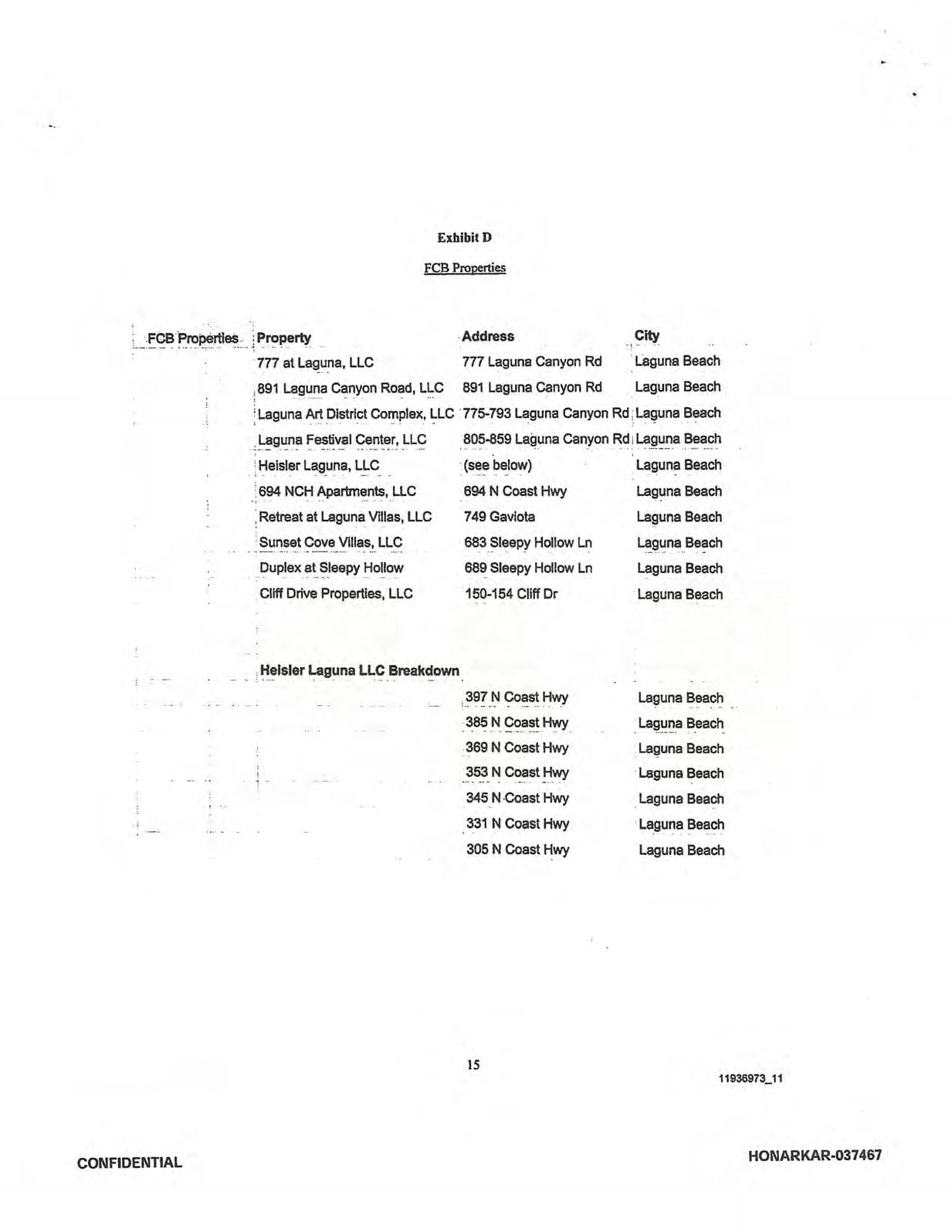
At the time of the Further Hearing almost all the joint venture properties had been foreclosed upon at values less than the debts owed; including: 689 Sleepy Hollow (Exs. 6161, 6137); 106 W. Pennsylvania (Exs. 6148, 6140); 4110 West 3rd (Exs. 6146, 6202); 314 S. Harvard (Exs. 6146, 6202); 2711 Pacific Coast Hwy. (Exs. 6152, 6141); 305, 331, 345, 353, 369, 385, 397 N. Coast Hwy. (Exs. 6155, 6131); 683 Sleepy Hollow (Exs. 6160, 6136); 729 Ocean Front (Exs. 6162, 6138); 150 Cliff and 151 & 153 Cedar (Exs. 6163, 6139); 891 Laguna Canyon (Exs. 6157, 6133); 22446 Laguna Canyon (Exs. 6156, 6132); 775 & 793 Laguna Canyon (Exs. 6159, 6135); 805-849 Laguna Canyon (Exs. 6158, 6134). (See also Exs. 6206-6208.) Further, the Cliff Village ground lease had been terminated for nonpayment, and the few remaining joint venture properties were in active foreclosure proceedings, with the debt on the properties exceeding any remaining equity. These included 694 N Coast Hwy, (Ex. 6166); 425, 541 S. Coast Hwy. (Exs. 6149, 6173, 6188, 6181, 6184); 696 S. Coast Hwy. (Exs. 6204, 6165, 6189); 690 S. Coast Hwy. (Exs. 6205, 6165, 6190); 521, 535, 577, 605, 623 S Coast Hwy (Exs. 6153, 6175, 6203). (See also 1.27.26 Tr. at 412:8-414:15, 416:23-417:11 [receiver Miller, no money is likely to return to equity holders following foreclosure on Hotel Laguna, Laguna HI and Laguna HW]; 1.27.26 Tr. at 611:19- 612:13 [Honarkar re loss of Cliff Village ground lease].)
Several of the foreclosed loans had been imposed on the joint venture properties by the MOM Respondents themselves, without Honarkar’s knowledge or consent. For example, the Masters Building property was foreclosed on for a loan obtained by the MOM Parties and the Makhijani Parties, without Honarkar’s knowledge or consent. (Exs. 6152, 6141 [foreclosure by PMF Reit on the Masters Building LLC under a deed executed by Deba Shyam]; 6.24.24 Tr. at 253:8-17 [Honarkar testifying he did not know about or approve that loan].) Similarly, Laguna HI and Laguna HW were being foreclosed on for a loan obtained from Wilshire Quinn, again without Honarkar’s knowledge or consent. (Exs. 6204, 6205; 6.24.24 Tr. at 253:18-254:1.)
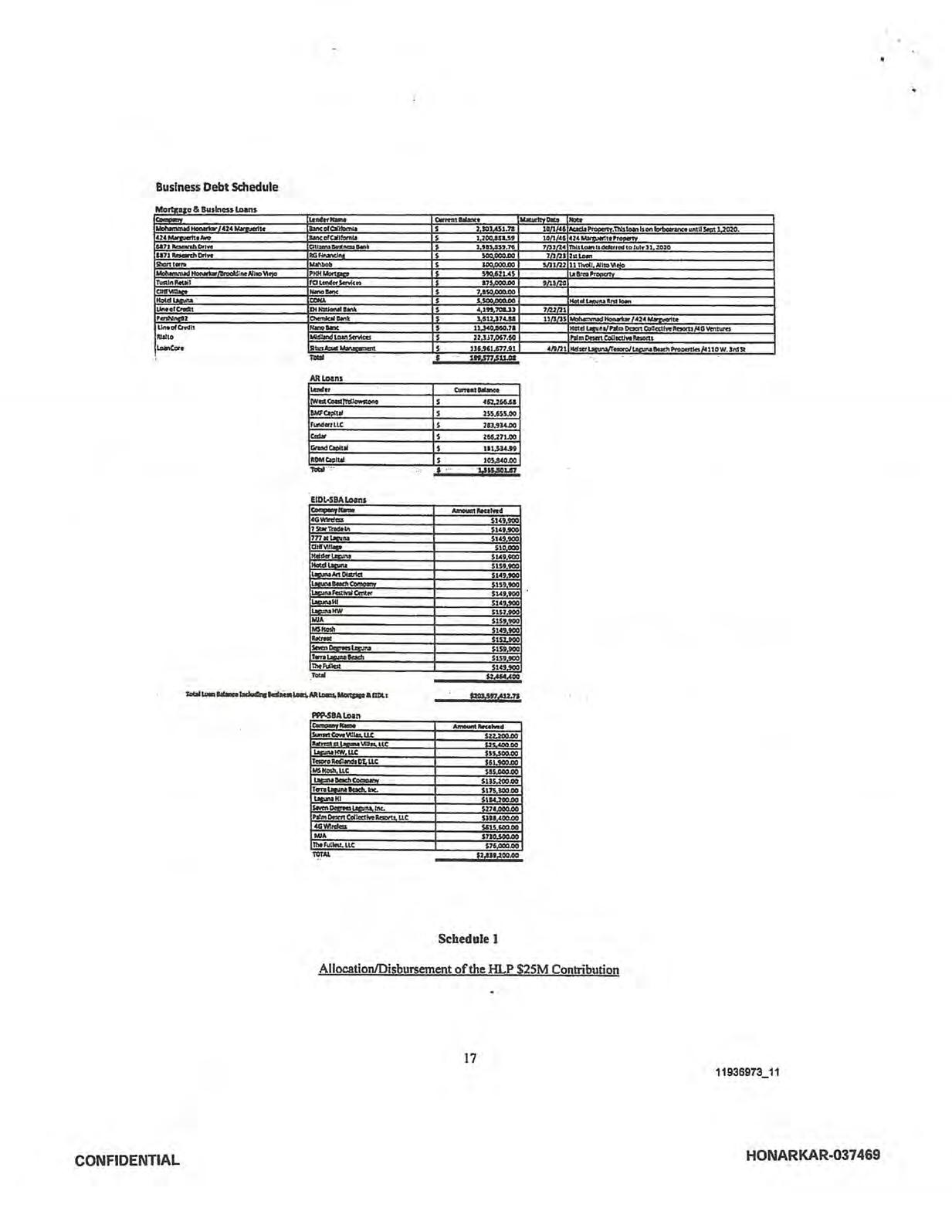
Thus, the MOM Parties and the Makhijani Parties not only defrauded Claimants at the outset, but they also used the joint venture properties to obtain hundreds of millions of dollars in loan proceeds and did not repay those loans. So, the joint venture ultimately lost those properties. In addition, several properties were sold, with no evidence the sale proceeds went to the joint venture rather than the MOM Parties or the Makhijani Parties. These properties were: 18410 Irvine (Ex. 5008); 689 S. Coast Hwy. (Ex. 6000); 154 Cliff (Ex. 6042); 8871 Research (Ex. 6038 [not contributed to the joint venture]). (See also 1.27.26 Tr. at 600:13-606:20 [Honarkar].)
All told, the properties and property interests owned by the joint venture were a complete loss. The MOM Parties and the Makhijani Parties admitted no assets remained in the joint venture. (1.26.26 at 55:24-57:12, 63:21-65:8 [Jason Miller - no properties remained in MOM BS JV or MOM AS JV]; 1.26.26 at 130:18-134:3 [Makhijani - unaware of any assets remaining in MOM AS JV or MOM CA JV]; 1.26.26 at 221:22-223:17 [Shyam - same as to MOM CA JV] )
In sum, the MOM Respondents destroyed the real estate portfolio Honarkar contributed.
Also, after the Partial Interim Award was issued and before the Further Hearing was conducted, the Makhijani Parties designed and implemented a plan to limit their liability to Claimants by restructuring the fraudulent $20 million Nano Loan.7 (1.28.26 Tr. at 497:17-498:17 [Lenz]; 1.27.26 Tr. at 525:6-10, 553:17- 562:13 [Thomsen].) When the Nano Loan matured, the MOM Parties did not pay it off, despite the purported promises that they would do so. (1.27.26 at 553:17-557:1 [Thomsen].) Instead, Gerald Marcil (a founding Nano shareholder) obtained a “new” loan from Nano, used it to pay off the Nano Loan, and Nano reconveyed deeds of trust encumbering the joint venture properties. (1.27.26 at 553:17-571:13 [Thomsen]; Ex. 8011.)
The Makhijani Parties and their affiliates (the “Continuum Affiliates”) also devised and executed a plan to render Nano judgment proof. Before the Partial Interim Award was rendered, Nano loaned roughly $200 million to the Continuum Affiliates, including Cantor Group, Deba Shyam and Vibranium LLC, Gerald Marcil and the Pacifica Garden Apartments, Andrew Stupin, Coastline 901 LLC, Pro Temecula Town Center, Bhajneet Malik, and others. (1.26.26 Tr. at 257259, 268-270 [Thomsen].) This is particularly noteworthy, because the individual Continuum Affiliates - Shyam, Marcil, Stupin, and Malik - are also founding shareholders of Nano.
Shortly after the Partial Interim Award was rendered, the Continuum Affiliates stopped making payments on about $130 million of these loans. (1.26.26 Tr. at 258 [Thomsen –“I'm going to say second quarter 2025”].) That Nano eventually filed at least ten lawsuits against the Continuum Affiliates does not alter the inescapable conclusion – this unprecedented and coordinated non-payment campaign placed Nano on the brink of regulatory-mandated liquidation. (1.27.26 Tr. at 489-490, 514-515 [Thomsen]; Ex. 8057 [Thomsen Decl. at ¶¶ 5-6].)
III. FURTHER ANALYSIS
The Remaining Issues to be resolved in this Final Award fall into three categories: “(i) the [derivative] claims stayed as a result of the MOM JV Entities’ bankruptcy; (ii) the accounting; and (iii) the determination of the amounts of … damages, interest, attorney fees and costs to be awarded.” (PFA at 45, ¶ 15.) “The parties bear the burden of proof on their respective claims and defenses by a preponderance of the evidence, except for the punitive damages claim, which requires clear and convincing evidence. (Civ. Code § 3294.)” (PIA at 15; PFA at 15.) And the MOM Respondents have the burden of proving by a preponderance of the evidence their right to any offsets. (PIA at 45; PFA at 42.)
7 Recall that with respect to the Claimants’ derivative damages claims, the Partial Interim Award found: “Nano is only responsible for $21 million of the total …. Also, Respondents may only be liable for the $20 million Nano Loan to the extent the MOM JV Entities remain as the borrowers, their properties are encumbered by the Nano deeds of trust, and their subsidiary LLC membership interests are pledged as security.” (PIA at 45, italics added.)
A. Claims Stayed as a Result of the MOM JV Entities’ Bankruptcy
The Partial Interim Award included an analysis of the MOM JV Entities’ derivative claims but that analysis was omitted from the Partial Final Award due to the bankruptcy stay. The bankruptcy has since been dismissed so that analysis is included again here.8
1. Derivative Conversion Claim Against Makhijani, Continuum, and the MOM Parties (PIA § III.D; FAC at 28-29)
Claimants assert the MOM Respondents are liable to the MOM JV Entities for conversion of the MOM JV Entities’ assets (e.g., loan and sale proceeds) in six separate instances. Specifically, Claimants claim conversion of (1) $20 million in Nano Loan proceeds, (2) $1 million in Tesoro Loan proceeds, (3) $5.1 million in proceeds from the sale of TIC interests, (4) $11.6 million in Tesoro Redlands Preferred Bank loan proceeds, (5) excessive distributions the MOM Parties made to themselves, and (6) deeds of trust on properties at issue in the potential $175 million loan from Coastline Loans, LLC (“Coastline Loan”) in June 2021.
California law provides, “Conversion is the wrongful exercise of dominion over the property of another. The elements of a conversion claim are: (1) the plaintiff’s ownership or right to possession of the property; (2) the defendant’s conversion by a wrongful act or disposition of property rights; and (3) damages.” (Lee v. Hanley (2015) 61 Cal. 4th 1225, 1240.) It may be claimed for personal property and sums of money. (PCO, Inc. v. Christensen, Miller, Fink, Jacobs, Glaser, Weil & Shapiro, LLP (2007) 150 Cal. App. 4th 384, 396.)
“It is not necessary that there be a manual taking of the property; it is only necessary to show an assumption of control or ownership over the property, or that the alleged converter has applied the property to his own use.” (Plummer v. Day/Eisenberg LLP (2010) 184 Cal. App. 4th 38, 50.) Conversion is a strict liability tort and “requires only that the defendant have intentionally done the act depriving the plaintiff of his or her rightful possession.” (Voris v. Lampert (2019) 7 Cal. 5th 1141, 1158.)
“If a defendant is authorized to make a specific use of a plaintiff’s property, use in excess of that authorized may subject the defendant to liability for conversion, if such use seriously violates another’s right to control the use of the property.’” (Duke v. Superior Court (2017) 18 Cal. App. 5th 490, 506.) And finally, “the plaintiff need show only that he was entitled to possession at the time of conversion; the fact that plaintiff regained possession of the converted property does not prevent him from suing for damages for conversion.” (Enter. Leasing Corp. v. Shugart Corp. (1991) 231 Cal. App. 3d 737, 748.)
8 The MOM JV Entities’ derivative conversion and Section 496 claims against Nano (PIA § III.I,; FAC at 28-29, 3031) are not analyzed here because those claims have been dismissed and Nano is no longer a party to this arbitration.
The MOM Respondents argue Claimants cannot establish liability for conversion because they have failed to prove the dollar amounts of the damages suffered. No such proof is required. To establish liability, Claimants need only prove injury, particularly where an accounting would be required to ascertain the full scope of damages. (Lueter v. State (2002) 94 Cal. App. 4th 1285, 1302-03 [in distinguishing between “injury” and “damages,” court found “[t]o recover in tort, the plaintiff must prove the fact of proximately caused injury with reasonable certainty,” where damages are “the monetary sum…awarded as compensation for the injury”].) To the extent the MOM Respondents insist their “infusion” of funds to the MOM JV Entities negates their liability for conversion, the Arbitrator notes there was no reliable evidence presented to support this assertion, outside of the MOM Respondents’ self-serving testimony. These infusions (if any) would have been addressed as offsets in the accounting.
As to the $20 million Nano Loan, the proceeds were transferred to Continuum, rather than to the MOM JV Entities, the borrowers who had the right to possess those proceeds. (Exs. 239, 308.) That those proceeds appear to have been used to help pay off the LoanCore Loan or that the MOM JV Entities may have gotten a portion of those proceeds later is irrelevant to the conversion claim. The Arbitrator finds proof of conversion of those proceeds.
As to the $1 million Tesoro Loan, the proceeds borrowed from Nano did not go to the borrower, Tesoro Redlands, or even to the MOM JV Entities; instead, they went to Enrico Arvielo, an investor in one of the MOM Members, who had demanded his investment back. (Exs. 411, 405, 409; 6.27.24 Tr. at 953:17-957:3.) Because Tesoro Redlands was an asset of an Other Owned LLC/Subsidiary of the MOM JV Entities, the MOM JV Entities had the right to possess those loan proceeds. The Arbitrator finds proof of conversion of those proceeds.
As to the sale of TIC interests, Claimants take issue with the $1 million TIC interest in Hotel Laguna, LLC sold to Jaachak and a $4.1 million TIC interest in property owned by Laguna HI, LLC,9 both of which are subsidiaries of the MOM CA JV. The MOM JV Entities did not receive distributions or proceeds from these sales, as the funds from both TIC sales were immediately utilized to purchase membership interests in the MOM CA Member. (6.27.24 Tr. at 990:18-996:19; 7.2.24 Tr. at 1765:13-1767:20.) The MOM CA JV, as the seller of those TIC interests, certainly had the right to possess those TIC sale proceeds. In addition, those TIC sales potentially exposed the MOM CA JV to federal tax liability. (Ex. 709, ¶ 15 [Makhijani declaration, stating these TIC sales were “made solely for purposes of making accommodations to the various investors, so they could take advantage of 1031 exchanges and tax benefits…[i]t was always intended that these transfers would be temporary”].) Hence, the Arbitrator finds proof of conversion of those proceeds.
9 The Arbitrator found the $4.1 million TIC sale was an unauthorized transaction under the Operating Agreements and was not converted into a “Project” the MOM Respondents could sell without Honarkar’s written consent, all for the reasons discussed in the Partial Interim Award. (PIA § III.B 3.)
As to the $11.6 million in Tesoro Redlands Preferred Bank refinance loan proceeds, at least $8.8 million went directly to a Continuum bank account from the Tesoro Redlands bank account on March 1, 2022. (Exs. 541.) An additional $2.8 million held back in escrow went into the Continuum bank account four months later. (Ex. 2894; 7.2.24 Tr. at 1528:5-1531:19.) Thus, the evidence shows a significant portion of the proceeds from the refinance ultimately went to Continuum, rather than to the MOM JV Entity with the right to possess those proceeds. The Arbitrator finds proof of conversion of at least a portion of those proceeds.
As to distributions made by the MOM Parties to themselves, Claimants rely on the Operating Agreements to argue the MOM Parties are entitled to a priority return based only on their actual Contribution. (Exs. 313-315, §§ 9.4, 8 [waterfall provision dictating ratio of distributions].) According to Claimants, the MOM Respondents made priority distributions to themselves based on a $10 million Contribution, although they only contributed $6.1 million. (Ex. 308 [“Remainder of Deposit to Continuum” at $3.9 million]; Ex. 1509 [MOM Respondents’ damages schedules]; 7.9.24 Tr. at 3021:25-3023:7, 3034:14-3035:12; 7.11.24 Tr. at 3430:73432:19.) The Arbitrator finds proof of conversion of at least some portion of these distributions.
As to the Coastline Loan deeds of trust, the MOM Parties executed those instruments on behalf of the subsidiary LLCs and thus encumbered assets of the MOM JV Entities. (Ex. 310.) Coastline is owned and controlled by Andrew Stupin, one of Nano’s founding shareholders and a repeat Makhijani investor, who also gave his initials to MOM AS JV. (6.27.24 Tr. at 964:12-14.) Though no proceeds from this loan were ever paid to the JV, many of the deeds of trust are still outstanding. (Id. at 964:15-966:15.) The MOM Respondents argued “pending litigation” prevented the removal of the Coastline Loan deeds of trust but no evidence was presented to support this position. In fact, some of the deeds of trust had been reconveyed before the 2024 arbitration hearing. And the MOM Respondents offered no explanation as to why some of the deeds of trust could be reconveyed but not others.
Therefore, the Arbitrator finds the MOM Respondents converted these assets based on the encumbrances placed on them to secure the unfunded Coastline Loan. The exact amount of these conversions would have been revealed by the accounting.
2. Derivative Section 496 Claim Against Makhijani, Continuum, and the MOM Parties (PIA § III.E; FAC at 30-31)
Claimants argue the acts of conversion also violated Section 496, which provides, “[e]very person who buys or receives any property that has been stolen or that has been obtained in any manner constituting theft or extortion, knowing the property to be so stolen or obtained, or who conceals, sells, withholds, or aids in concealing, selling, or withholding any property from the owner, knowing the property to be so stolen or obtained.”
The elements of a Section 496 claim are that “(i) property was stolen or obtained in a manner constituting theft, (ii) the defendant knew the property was so stolen or obtained, and (iii) the defendant received or had possession of the stolen property.” (Switzer v. Wood (2019) 35 Cal. App. 5th 116, 126.) Claims can be asserted against the “principal in the actual theft of the property.” (§ 496(a).) The language of Section 496 also “covers fraudulent diversion of partnership funds.” (Siry Inv., L.P. v. Farkhondehpour (2022) 13 Cal. 5th 333, 361.)
The evidence supports finding the MOM Respondents improperly utilized funds that should have been earmarked for the JV to benefit themselves; for example, the circumstances surrounding the Nano Loan, repayment of their investor Enrico Arvielo, and TIC sales to benefit the MOM Members. And they did so by actively concealing their actions from Claimants. (See PIA § III.A ) (Grouse River Outfitters, Ltd. v. Oracle Corp. (9th Cir. 2021) 848 F. Appx 238, 242 [“because the district court held that Grouse River had adequately pleaded its fraud claims, it follows that Grouse River adequately pleaded [the elements of Section 496 claims]”].). Moreover, there was insufficient evidence that any of these funds were ever returned to the MOM JV Entities. Hence, the Arbitrator finds the MOM Respondents violated Section 496.
3. Derivative Unjust Enrichment Claim Against Makhijani, Continuum, and the MOM Parties (PIA § III.F; FAC at 29-30)
Claimants assert an unjust enrichment claim, arguing the MOM Respondents have looted the MOM JV Entities, using them as personal slush funds and enriching themselves without any benefit to the JV, all while exposing the MOM JV Entities to substantial risk. To prove this claim, Claimants must show “receipt of a benefit and unjust retention of the benefit at the expense of another.” (Lectrodryer v. Seoulbank (2000) 77 Cal.App.4th 723, 726; Pro. Tax Appeal v. Kennedy-Wilson Holdings, Inc. (2018) 29 Cal. App. 5th 230, 238.) The Arbitrator finds the MOM Respondents are liable for unjust enrichment, for the same reasons discussed in the conversion and Section 496 claims. (§§ III.A.1 and III.A.2 above; PIA §§ III.D and E.)
B. Accounting
Claimants proved their accounting claim against the MOM Parties and were thus entitled to have the requested accounting conducted as part of the further proceedings in this arbitration. (PIA § III.K; PFA § III.K.) But Claimants were forced to abandon the accounting and it was deemed concluded because the MOM Parties and the Makhijani Parties refused to produce the necessary records in defiance of the Arbitrator’s orders, all as described above. (§ III.B above.) Once more, that refusal was willful and deliberate – another demonstration of their longstanding pattern and practice of refusing to produce financial information Therefore, the Arbitrator was forced to impose the issue, evidence, inference, and monetary sanctions detailed above. (Ibid.)
C. Determination of Damages
The Partial Interim Award and the Partial Final Award ordered all amounts of damages “to be awarded to Claimants shall be determined in further proceedings in this arbitration.” (PIA at 48, ¶ 13; PFA at 45, ¶ 13.) Because Claimants elected to affirm (not rescind) and retain the benefits of the Operating Agreements, the Other JV Related Agreements, and the Term Sheet, they are entitled to direct and derivative compensatory damages, treble damages, and punitive damages. (PIA § III.N.2; PFA § III.N.2.) Each category of damages will be analyzed in turn.
At the beginning, it must be re-emphasized that the accounting was particularly warranted here because the MOM Parties had full control of the MOM JV Entities and had excluded Claimants altogether after Spring 2023 (Ex. 677; 7.12.24 Tr. 3850:12-3851:5; 6.25.24 Tr. at 459:20-23.) Once more, absent the accounting Claimants had no way to determine the full scope of the MOM Respondents’ misconduct and the exact amount of damages caused But again, “[t]he MOM Respondents’ repeated, willful, and deliberate failures to comply with my orders, including the Accounting Order, made it impossible to complete the Accounting[.]” (12.24.25 Supplemental Order re Sanctions for Accounting Order Violations.) Therefore, the MOM Respondents are now precluded from arguing the evidence is insufficient to support Claimants’ damage claims; and the Arbitrator will infer for all purposes that the evidence the MOM Respondents willfully suppressed is unfavorable to them. (Ibid.)
1. Compensatory Damages – Direct Claims
Claimants are entitled to recover direct compensatory damages on their claims for fraud in the inducement, breach of the Operating Agreements, and forcible entry and detainer. (PIA §§ III.A, III.B and III.C; PFA §§ III.A, III.B and III.C.) Because there is overlap between the damages recoverable on these claims, the Arbitrator will focus on the claim with the broadest measure of damages – the fraud claim – except to the extent the other claims offer damages not available on the fraud claim. In general, “[f]or the breach of an obligation not arising from contract, the measure of damages, … is the amount which will compensate for all the detriment proximately caused thereby, whether it could have been anticipated or not.” (Civ. Code § 3333.)
Claimants seek $351,339,050 in direct compensatory damages from the MOM Respondents, comprised of: (a) $315,671,131 for the net fair market value (FMV) of the property portfolio that Claimants contributed to the joint venture; (b) $28,785,961 for the personal guarantees on loans and ground leases Honarkar executed; (c) $6,483,325 for the income generated by Terra Laguna, a restaurant not contributed to the joint venture and wrongfully taken by the MOM Respondents in 2023; and (d) $398,633 for the damages resulting from the MOM Respondents’ forcible entry and detainer of the 4G offices. The Arbitrator finds the MOM Respondents are liable for $326,083,734 in direct compensatory damages as follows
a. Property Portfolio Loss
Again, the undisputed evidence adduced at the Further Hearing demonstrated the entire portfolio of properties and SPE interests Claimants contributed to the joint venture were lost. Plus, the MOM Respondents themselves admitted no assets remained in the MOM JV Entities. (1.26.26 Tr. at 55:24-57:12, 63:21-65:8 [Jason Miller - no properties remained in MOM BS JV or MOM AS JV]; 1.26.26 Tr. at 130:18-134:3 [Makhijani - unaware of any assets remaining in MOM AS JV or MOM CA JV]; 1.26.26 Tr. at 221:22-223:17 [Shyam - same for MOM CA JV].)
Claimants (not the MOM JV Entities or the SPEs) are entitled to compensatory damages for the value of the property portfolio lost due to the MOM Respondents’ actions. ‘“Tort damages are awarded to fully compensate the victim for all the injury suffered. [Citation.] There is no fixed rule for the measure of tort damages under Civil Code section 3333. The measure that most appropriately compensates the injured party for the loss sustained should be adopted.’ [Citation.] ‘[T]he damages awarded must be in an amount that would compensate [Claimants] for all harm or loss caused ….’” (Strebel v. Brenlar Investments, Inc. (2006) 135 Cal. App. 4th 740, 749.) That loss is equal to the difference between the FMV of the property portfolio Claimants contributed to the joint venture, and the outstanding debts secured thereby
The FMV standard has been codified in California as “the highest price on the date of valuation that would be agreed to by a seller … and a buyer … each dealing with the other with full knowledge of all the uses and purposes for which the property is reasonable adaptable and available.” (Code Civ. Proc. § 1263.320(a); Greif v. Sanin (2022) 74 Cal. App. 5th 412, 443; see also Rutter Practice Group, Particular Types of Evidence, Cal. Prac. Guide Civ. Trials & Ev. Ch. 8B-B [courts have wide discretion in assessing property value].)
Applying these principles here, the Arbitrator finds Claimants proved by a preponderance of the evidence that the FMV of the property portfolio they were fraudulently induced to contribute to the joint venture was $483,570,000 on June 8, 2021, as detailed in Schedule 1 attached to and made a part hereof. These FMV assessments are based on contemporaneous documents maintained by the MOM Parties, the Makhijani Parties, and the joint venture tax preparers (Exs. 1356, 6018 at 1, 6020 at 3; 1.26.26 Tr. at 167:9-174:13); actual subsequent property sales by the joint venture (Exs. 5008, 6000, 6038, 6042); and Honarkar’s own FMV opinions (1.27.26 Tr. at 630:23-633:15). With respect to the latter, California has long given special deference to property owner opinions on the value of property and property interests. (Evid. Code § 813; 1 Witkin, Cal. Evid. (6th ed. 2025), Opinion Evid. § 109, Opinions of Expert or Owner.) Besides, Honarkar was no ordinary property owner. He was the largest owner of real property in Laguna Beach, intimately familiar with the local real estate market, and closely connected to the leading local real estate brokers. (1.27.26 Tr. at 632:9-19; 1.28.26 at 687:22688:7.) For these reasons, the Arbitrator has given Honarkar’s FMV opinions added weight
Actual subsequent sales by the joint venture and tax values reported to the joint venture tax preparers corroborate Honarkar’s FMV opinions. Four properties (18410 Irvine Blvd., 689 S. Coast Hwy., 8871 Research Dr., and 154 Cliff Drive) were sold by the joint venture within the first year of operation, and Honarkar’s FMV opinions reflect those actual sale prices. (Exs. 5008, 6000, 6038, and 6042.) The remaining properties’ values were compiled and reported to BPM, the joint venture’s tax preparers. (Exs. 1356, 6018 at 1, 6020 and 3, 1.26.26 Tr. at 167:95 174:8 (Cobb).) That compilation underestimated the value of two properties. 8871 Research Drive was valued at $3.8 million (Exs. 1356, 6018 at 001, 6020 and 003) but sold in May 2022 for $4.46 million (Ex. 6038). And 18410 Irvine Boulevard was valued at $2.4 million but sold for $2.5 million. (Exs. 1356, 5008 at 10, 1.27.26 Tr. at 600:23-602:3 [Honarkar].)
Later offers to purchase other joint venture properties further substantiate Honarkar’s FMV opinions. For example, 106 W Pennsylvania Avenue was valued at $70,500,000, but in February 2022, the joint venture received an unsolicited written and signed offer to purchase this property for $67,680,000. (Ex. 527; see also 1.28.26 Tr. at 807:6-809:1 [Honarkar].) That the joint venture would receive an offer, without even listing the property for sale, at an amount nearly identical to Honarkar’s FMV opinion is a strong indication of the reasonableness of that opinion What’s more, when that offer was received, Makhijani rejected it and told Honarkar “this property [was] worth over $80 million” far more than the $70,500,000 estimated by Claimants. (1.28.26 Tr. at 800:5-801:14 [Honarkar].)
Similarly, the assets owned by Hotel Laguna LLC (primarily the 99-year ground lease of the land on which the Hotel Laguna sits) were valued at $100 million in 2021. But the MOM Respondents represented those assets are worth at least this much and maybe five times more, in their sworn bankruptcy filings filed in 2025. (Ex. 6188 at 4.) Further, during the operation of the joint venture, Honarkar was contacted by a potential buyer interested in purchasing the Hotel Laguna with the rooms completed for $120 million. At that time, Makhijani told Honarkar the Hotel Laguna was worth at least $160 million with the rooms completed, (1.27.26 Tr. at 632:20633:15 [Honarkar].) So Makhijani rejected the $120 million offer.
None of the arguments the MOM Respondents advance in opposition to Claimants’ $483,570,000 property portfolio FMV assessment are persuasive. For example, their claim that Claimants’ FMV assessment is uncorroborated is simply untrue, as demonstrated above. Too, the MOM Respondents’ reliance on Sargon Enterprises, Inc. v. Univ. of Southern California (2012) 55 Cal. 4th 747 is misplaced. That seminal case concerns a trial court’s gatekeeping function in relation to the admissibility of expert lost profit opinion testimony under Evidence Code sections 801 and 802. (Id. at 771-772.) But Claimants offered no such expert opinion testimony in the Further Hearing. Besides, strict conformity with the rules of evidence is not required here (JAMS Rule 22(d).) Instead, “[t]he Arbitrator shall consider evidence that he or she finds relevant and material to the dispute, giving the evidence such weight as is appropriate.” (Ibid.)
The MOM Respondents’ arguments based on the strict foundation requirements of Evidence Code sections 814 and 822 miss the mark for the same reasons, and for the additional reason that section 822 only applies in eminent domain or inverse condemnation proceedings. And, in any event, to the extent the MOM Respondents argue Claimants should have used “stronger and more satisfactory evidence,” it was their own willful and deliberate decision to withhold financial information that prevented the production and introduction of that evidence. So, they are now precluded from arguing that the evidence Claimants proffered is insufficient
The MOM Respondents also argue Claimant’s FMV assessment is an “unreasonable, hindsight reconstruction” (MOM Resp. Post-Hearing Br. at 38) because it ignores the fact that as of June 2021 the properties were heavily leveraged, in default, subject to court-appointed receiverships, and facing imminent foreclosure sales by a senior lender. They also point out lender communications showed the properties were “cash flow challenged” and that Honarkar’s “personal values [were] too high.” (Ex. 36.) But again, because they thwarted the accounting that would have shed light on these facts, the Arbitrator infers the evidence the MOM Respondents willfully suppressed was unfavorable to them
In short, the MOM Respondents criticize but offer no reasonable alternatives to Claimants’ $483,570,000 property portfolio FMV. They just argue Claimants got it wrong, and those arguments are unavailing. Therefore, the Arbitrator adopts the only reasonable FMV offered in evidence. Under these circumstances, relying on the Honarkar FMV opinions, and the contemporaneous FMV evidence outlined above, is both necessary and sufficient.
Turning to the debts secured by the property portfolio at the time Claimants were fraudulently induced to enter into the joint venture, Claimants assert a total of $167,898,869, which includes: (1) $8,000,000 on the Cliff Village LLC properties, (2) $18,000,000 on the Hotel Laguna property, and (3) $141,898,869 on the remaining properties owed to DIG.10 The MOM Respondents contend other categories of payments listed in the escrow closing statement should be considered debt, including $4.43 million for IRS tax obligations and $667,000 for Laguna Beach transient occupancy tax arrears. But there is no evidence that those tax obligations were secured by a lien on any of the joint venture properties (though the accounting could have provided such evidence) and, in fact, the MOM Respondents conceded these obligations were Honarkar’s personal liabilities, as was his marital dissolution judgment. (MOM Resp. PostHearing Br. at 7:2-5.) Accordingly, based on the evidence in the record, the Arbitrator finds the debt on the property portfolio was $167,898,869, as asserted by Claimants.
10 Claimants subtracted $2,802,199 from the DIG debt for sums they argue are not and should not be included as debt on the property portfolio, such as “foreclosure costs” relating to the June 2021 closing and paid to escrow to consummate the fraudulent transaction, the MOM Respondents’ attorney’s fees, and an “exit fee.” (Ex. 308.) The MOM Respondents did not address these contentions and thus, any argument these costs should be characterized as debt secured by the joint venture properties was waived.
Once again, the Arbitrator finds none of the MOM Respondents’ arguments in support of a contrary conclusion persuasive. Here too the Arbitrator invokes the evidentiary sanctions imposed on the MOM Respondents, fills in any evidentiary gaps by drawing adverse inferences against them, and infers the evidence they suppressed is unfavorable to them. (12.24.25 Supplemental Order re Sanctions for Accounting Order Violations.)
In sum, the Arbitrator finds Claimants are entitled to compensatory damages for the net value of the property portfolio lost in the amount of $315,671,131, which amount is equal to the difference between the $483,570,000 FMV of the property portfolio as of June 8, 2021, and the $167,898,869 in then outstanding debts secured thereby.
b. Loan Guarantees and Ground Lease Payments
Claimants also seek compensatory damages of $28,785,961 for personal guarantees on loans and ground leases secured by portfolio properties but lost due to the MOM Respondents’ actions, including: (1) approximately $8 million outstanding on a $10 million loan from Nano secured by Cliff Village LLC properties and personally guaranteed by Honarkar (Exs. 6047, 6054, 6174, 6153, 6175, 6203); (2) $17,255,316 outstanding on a loan from Coastline Santa Monica Investments, LLC (“Coastline SM”)11 secured by joint venture properties and personally guaranteed by Honarkar (Ex. 6039); and (3) $3,530,645 in ground lease payments for Hotel Laguna, which were paid by the landlord’s use of the security deposit provided by Honarkar prior to the joint venture (Exs. 6179, 6184, 6181; 1.27.26 Tr. at 615:7-619:12). Claimants argue the MOM Respondents are seeking a discount on their fraud damages liability through “the backdoor invocation of these personal guarantees.” (Cl.’s Opening Post-Hrg. Br., at 23.)
The personal guarantee on the $10 million Nano loan to Cliff Village LLC is a debt to a party in this case and it was incurred as part of the MOM Respondents’ fraudulent scheme. Nano’s witnesses testified Nano would not forgive this loan and would hold Honarkar responsible. (1.26.26 Tr. at 273:2-11; 1.28.26 Tr. at 923:1-20, 924:6-13.) This loan was made and funded prior to the formation of the joint venture, and it was secured by some of the portfolio properties which have now been lost to foreclosure because of the MOM Respondents’ wrongful conduct.
11 Neither Stupin nor Coastline SM are parties to this arbitration. Stupin is the sole owner and member of MOM AS Investor Group, LLC (aka MOM AS Member), one of two owners and members of MOM CA Investor Group, LLC, (aka MOM CA Member), and an investor in both Continuum and Nano. (Exs. 6072 at 70, 6029 at 10; 6.26.24 Tr. at 797:24-798:14.) Stupin’s testimony suggests that he was unaware of the existence of Coastline SM (despite the similarities in nomenclature to his other entities) or the Coastline SM loan secured by the joint venture properties, and it appears that Makhijani and the other MOM Respondents used this entity to obtain funds as part of the fraudulent joint venture scheme they perpetrated. (1.27.26 Tr. at 366:4-369:12; Exs. 6039 [note signed by Shyam, Haddad, Miller and listing Coastline SM as lender at Continuum’s address]; 6315 [Secretary of State filing for Coastline SM using Stupin’s address].) And it is curious Stupin testified he deferred to Continuum in selecting personal counsel to represent him during his testimony in this proceeding. (1.27.26 Tr. at 355:1-11.)
Similarly, the $17.26 million Coastline SM loan was entered into by the MOM Respondents as a part of their fraudulent scheme, and for all practical purposes, is a debt owed to one of the parties in this case. In fact, Coastline SM is currently suing Honarkar to collect on this personal guarantee and given Stupin’s testimony he was unaware that this entity even existed, it is unclear who is prosecuting this lawsuit. (Ex. 6311.)
Still, Honarkar has not yet suffered any out-of-pocket financial loss on either of those personal guarantees. They remain contingent liabilities, which are not yet compensable damages. (Green Wood Indus. Co. v. Forceman Internat. Dev. Grp., Inc. (2007) 156 Cal. App. 4th 766, 776 [“[T]he existence of a mere liability is not necessarily the equivalent of actual damage. This is because the fact of damage is inherently uncertain in such circumstances.”].) And awarding damages for these personal guarantees could result in a windfall to Claimants. Consequently, no damages for the Nano and Coastline SM personal guarantees are awarded at this time 12
The amounts utilized for the Hotel Laguna ground lease payments are a different matter. They were taken directly from the security deposit Honarkar provided. There is no evidence to the contrary. Plus, the MOM Respondents’ fraudulent conduct has already caused the loss of the ground lease and the security deposit. Thus, the Arbitrator finds Claimants are entitled to compensatory damages for the $3,530,645 paid from the ground lease security deposit.
c. Terra Laguna Income
Claimants seek $6,483,325 in compensatory damages from the MOM Respondents for income generated by Terra Laguna for three years (2023-2025) of the joint venture. The MOM Respondents argue this claim improperly seeks lost income based on gross revenue rather than net profits. (See Resort Video, Ltd. v. Laser Video, Inc. (1995) 35 Cal. App. 4th 1679, 1700 [net profits are revenues minus labor/materials/rents/all expenses, plus interest of capital employed to generate revenues].) The MOM Respondents also contend these damages are not reasonable or certain because they do not account for Terra Laguna’s operating expenses.
As a starting point, the Arbitrator notes Terra Laguna was never contributed to the joint venture.13 (PFA at 40, ¶ 4.) Instead, “during the night of June 30, 2023 and the early morning of July 1, 2023, a group of armed individuals and other agents working on behalf of Continuum and Makhijani entered and took physical control of Terra.” (PFA at 14.) And, through the date of the Further Hearing, the MOM Respondents refused to return control of Terra Laguna to Claimants and refused to produce its complete books and records. (1.27.26 Tr. at 622:8-626:21.)
12 These personal guarantees may however be subject to cancellation under Civil Code section 3412.
13 Because Terra Laguna was never a joint venture property, to the extent the MOM Respondents argue double recovery based on the property portfolio loss and the Terra Laguna income loss, the argument is a non-starter.
Although the Accounting Order required the MOM Respondents to produce complete Terra Laguna financial statements including income statements and operating expenses, they refused to do so. (9.5.25 Order Re Accounting at 3-4, ¶4(A).) So, the MOM Respondents cannot complain Claimants failed to perform a lost profits analysis. Here again the MOM Respondents are barred from arguing the evidence is insufficient. Any gaps are filled by adverse inferences, and the Arbitrator infers the evidence the MOM Respondents suppressed is unfavorable to them.
The available evidence proved Terra Laguna owed more than $100,000 in back rent, that the MOM Respondents intentionally left unpaid. (Id.; Ex. 6194.) In addition, Terra Laguna’s bank accounts were being garnished by tax authorities for the MOM Respondents’ failure to pay about $400,000 in sales and use taxes. (1.27.26 Tr. at 622:8-626:21; Exs. 6197-6199.) The partial Quickbook files the MOM Respondents produced showed that Terra Laguna generated $2,228,448 in 2023 income and $2,093,768 in 2024 income.14 (Exs. 6195, 6196.) Because the MOM Respondents refused to produce any 2025 income information, Claimants averaged the 2023 and 2024 income and estimated the 2025 income at $2,161,108. This was reasonable.
For these reasons, the Arbitrator finds Claimants are entitled to recover $6,483,325 in damages from the MOM Respondents for Terra Laguna income in 2023, 2024, and 2025
d. 4G Office Forcible Entry and Detainer
Claimants seek $398,633 in damages from the MOM Respondents for their forcible entry and detainer of the 4G’s offices, including: (1) $323,633 for the cost of renting alternative office space from August 2023 through December 2024; and (2) $75,000 for the cost of items lost or destroyed during the takeover (e.g., furniture, computers and other technical equipment, personal belongings and family heirlooms).15 These claims are well founded.
The MOM Respondents argue Claimants applied the wrong measure of damages for alternative rent under California law, because wrongful eviction damages are generally measured by the value of the term, less the rent reserved in the lease plus reasonable removal expenses. (See Stoiber v. Honeychuck (1980) 101 Cal. App. 2d 903, 926 (“Stoiber”) [explaining “rent differential”].) The MOM Respondents also argue the list of missing property is impermissible speculation because it is based on Honarkar’s memory, rather than purchase receipts, depreciation schedules, photographs, or expert corroboration. These arguments lack merit.
14 The MOM Respondents cite Exhibit 7005 to support their argument Terra Laguna’s cash flow was negative But Exhibit 7005 was never offered or admitted into evidence. (1.28.26 Tr. at 714:16-717:4.)
15 Claimants include these damages in their calculation of compensatory damages. But technically the PIA and PFA characterized this category as “incidental damages.” (PIA § III.C, at 32; PIA at 47, ¶ 4; PFA § III.C at 32; PIA at 44, ¶ 4; both citing Allen v. McMillion (1978) 82 Cal.App.3d 211, 219.) The parties did not raise the issue in their briefs and it appears to be a distinction without a difference, at least on the facts presented here. (Id. at 219.)
As to the alternative rent damages sought, the Arbitrator notes the 4G entity was never contributed to the joint venture. (PFA at 40, ¶ 4.) The 4G offices were located at 775 Laguna Canyon Road, which was owned by a joint venture SPE, but there is no evidence 4G was required to pay rent to occupy this space. (1.28.26 Tr. at 778:25-779:14.) However, 4G was required to pay rent for the alternative space because it was forcibly removed from its offices by the MOM Respondents. (1.27.26 Tr. at 626:2-630:18; Ex. 6040.)
Thus, as a direct result of the MOM Respondents’ wrongful conduct, 4G was forced to pay rent for alternative office space. The damages are recoverable because they “are necessary to compensate the tenant for the detriment proximately caused by the eviction[.]” (Stoiber, supra, 101 Cal. App. 2d 903 at 926.) It follows the MOM Respondents are liable for the $323,633 in alternative rent paid by 4G.
As to the lost or destroyed property damages, “[t]he owner of personal property who is familiar with its original cost and use is qualified to testify regarding its value.” (People v. Coleman (1963) 222 Cal. App. 2d 358, 361.) Claimants estimated the cost of these items based on an inventory they put together from memory. (Ex. 6041.) And the MOM Respondents are precluded from arguing this evidence is insufficient. Besides, to the date of the Further Hearing, the MOM Respondents had not returned any of the items taken from the 4G offices. (1.27.26 Tr. at 626:25-630:18.) It was not until after the receiver was appointed in November 2025 that Honarkar was even able to return to the 4G offices. (Id.) Under these circumstances, the MOM Respondents are liable for the $75,000 in damages for lost or destroyed property.
To sum up, the Arbitrator finds Claimants are entitled to recover $398,633 in damages from the MOM Respondents for their forcible entry and detainer of the 4G offices.
2. Compensatory Damages – Derivative Claims
The MOM JV Entities (as derivative claimants) are entitled to compensatory damages on their derivative conversion, Section 496, and unjust enrichment claims. (§§ III.A.1 - III.A.3 above; PIA §§ III.D - III.G and III.I.) The MOM JV Entities seek a total of $292,305,585 on these derivative claims. The Arbitrator finds the MOM Respondents are liable for $117,305,584 in compensatory damages on these derivative claims, for the reasons explained below.
a. Nano and Tesoro Loan Proceeds
The MOM Respondents are liable for conversion of loan proceeds. (§ III.A 1 above; PIA § III.D.) The MOM JV Entities seek derivative compensatory damages from the MOM Respondents for the $20,000,000 Nano Loan proceeds; for the $1,000,000 Tesoro Loan proceeds; and for the $11,665,409 Tesoro Redlands Preferred Bank refinancing loan proceeds.
The MOM Respondents argue none of these damages should be awarded to the MOM JV Entities because these loan proceeds were utilized to refinance existing debts on the joint venture properties generally and on the Tesoro property specifically; and the MOM JV Entities were benefited, not harmed. The Arbitrator rejects this argument for the following reasons.
“The detriment caused by the wrongful conversion of personal property is presumed to be … [t]he value of the property at the time of the conversion, with the interest from that time….” (Civ. Code § 3336.) “The presumption … cannot be repelled, in favor of one whose possession was wrongful from the beginning, by his subsequent application of the property to the benefit of the owner, without his consent.” (Civ. Code § 3337.) “Consequently, the effect of section 3337 is to prevent mitigation when property is stolen from the plaintiff and subsequently applied to his benefit.” (Dakota Gardens Apartment Invs. B v. Pudwill (1977) 75 Cal. App. 3d 346, 352.)
Thus, the MOM Respondents’ argument that the converted funds were eventually used to pay down the prior debts of the MOM JV Entities does not negate liability for their conversion Besides, there is no reliable factual basis to support this argument. As discussed in the PIA and PFA, no evidence was presented by the MOM Respondents to show these loan funds were in fact utilized to pay off existing debts nor do the MOM Respondents cite to any such proof in their post-hearing damages brief.16
Had the MOM Respondents produced the documents needed for the accounting, these loan funds would have been traced. But they did not produce them. So, the Arbitrator infers the documents the MOM Respondents withheld were adverse to them.
Nano presented evidence the deeds of trust securing the $20 million Nano Loan and the $1 million Tesoro loan were reconveyed to the MOM JV Entities. (§ II above at 17; Exs. 7001, 8000-8005.) But there is no evidence the SPE membership interests pledged to secure the $20 million Nano Loan were ever released.
Further, while Nano presented evidence that the MOM CA Investor Group paid off the $1 million Tesoro loan, there is no evidence of the source of the funds or whether those were joint venture funds. (1.27.26 Tr. at 591:8-593:6.)
Thus, the Arbitrator finds the MOM Respondents have not rebutted the Section 3336 presumption and are liable for $21,000,000 in derivative damages for the Nano Loan proceeds and $11,665,409 in derivative damages for the Tesoro Redlands refinancing loan proceeds.
16 Regarding the Tesoro Redlands refinancing loan proceeds, the total was $39 million. (Ex. 3623.) The MOM JV Entities seek only the amounts diverted into a Continuum bank account. (PIA at 34.) Even if there were evidence to support the MOM Respondents’ position the funds were used to extinguish debt on the property portfolio, the Tesoro refinance took place in 2022, well after the DIG loan was paid off in June 2021. (PIA at 34; PFA at 13.)
b. Nano Loan Interest
The MOM JV Entities also seek $3,798,980 in derivative compensatory damages from the MOM Respondents for interest charged to the MOM JV Entities on the $20 million Nano Loan from June 2021 through June 2024. (Ex. 1006 at 16, 26-27, 32-33; Ex. 1509 at 1-2, 8-9; 7.9.24 Tr. at 3078:25-3079:9.) They argue Continuum paid these interest payments and, in any event, the interest represents the standard cost of capital, because the proceeds of the $20 million Nano Loan were used to pay down the DIG/LoanCore loan. (Exs. 1042, 3410, 5529 at 7.)
The MOM Respondents point to two exhibits that show interest payments being made from a Continuum bank account, but the evidence shows joint venture funds were also deposited into that same bank account. (1.28.26 Tr. at 904:18-906:6.) And there is no evidence the funds used to make those interest payments were Continuum funds, rather than joint venture funds. The accounting would have addressed these issues but absent the accounting the Arbitrator infers the accounting documents the MOM Respondents withheld would have been adverse to them
Therefore, the Arbitrator finds the MOM Respondents are liable for $3,798,980 in derivative damages for interest charged to the MOM JV Entities on the $20 million Nano Loan
c. TIC Interest Sale Proceeds
The MOM Respondents are liable for conversion of the TIC interest sale proceeds. (§ III.A.1 above; PIA § III.D.) The MOM JV Entities seek $5,102,695 in derivative compensatory damages from the MOM Respondents for the TIC interest sale proceeds.
The MOM Respondents argue the TIC interests had no economic effect on the MOM JV Entities, because the ownership interests were returned. But again, there is no evidence the TIC interest sale proceeds were properly transferred to the MOM JV Entities or distributed to the MOM Members pursuant to the Operating Agreements. (PIA §§ III.B.2 and III.D.)
Once again, the accounting would have shed light on these issues but without the accounting, the Arbitrator infers the accounting documents the MOM Respondents withheld would have been adverse to them. So, the Arbitrator finds the MOM Respondents are liable for $5,102,695 in derivative damages for the TIC interest sale proceeds
d. Refund From Joint Venture Escrow Closing
The MOM JV Entities seek $3,996,395 in derivative compensatory damages from the MOM Respondents for the “refund” from the June 2021 joint venture escrow closing. The MOM Respondents are liable for at least a portion of this amount. (§ III.A 1 above; PIA § III.D.)
Continuum deposited $10 million in escrow but was immediately refunded $3,996,395. (Ex. 308; PFA § III.A at 16, fn.15.) There is no evidence the refund was returned to the MOM JV Entities. Absent an accounting for these funds, the Arbitrator infers the accounting documents withheld by the MOM Respondents would be adverse to them. Thus, the Arbitrator finds the MOM Respondents are liable for $3,996,395 in derivative damages for the escrow refund.
e. Other Joint Venture Loan Proceeds
The MOM JV Entities seek $1,334,498 in derivative compensatory damages from the MOM Respondents for conversion of other joint venture loan proceeds. According to Claimants’ expert Spindler, these were the only other specific joint venture loan proceeds that could be traced without the full joint venture books and records, although the MOM Respondents took out loans secured by joint venture properties totaling over $136 million. (Ex. 1006 at 13-14.)
In opposition to this claim and several others, the MOM Respondents rely on their expert Pohlot’s reports and they assert an offset for over $99 million for payments supposedly made by Continuum on behalf of the joint venture between 2021 and the present. (Exs. 5529, 5530.) But the Pohlot reports were based heavily on information provided to Pohlot by Makhijani, and the Arbitrator determined Makhijani was not credible at all “based on basic witness credibility considerations.” (PIA at 18; PFA at 18.) Also, Pohlot listed hundreds of supposed payments by Continuum without referencing any corresponding exhibits or Bates numbers reflecting those payments. Most importantly, Pohlot failed to trace any of these payments to determine if they were made with Continuum funds instead of joint venture funds. For these reasons, the Arbitrator finds the MOM Respondents have failed to sustain their burden of proof as to any claimed offset.
All these issues would have been addressed in the accounting, and the Arbitrator again infers the accounting documents the MOM Respondents withheld would have been adverse to them. Hence, the Arbitrator finds the MOM Respondents are liable for $1,334,498 in derivative damages for the other loans obtained by the MOM JV Entities and identified in Spindler’s report.
f.
Property Tax Late Fees and Penalties
The MOM JV Entities seek $568,297 in derivative compensatory damages from the MOM Respondents for property tax late fees and penalties. They contend the MOM Respondents failed to timely pay the required property taxes, thereby forcing the MOM JV Entities to incur late fees and penalties from June 2021 through May 2024 in the amount of $382,508. (Ex. 1006 at 14-15, 17, 22, 26, 37; 7.9.24 Tr. at 3030:11-3031:1.) The MOM JV Entities further contend the MOM Respondents stopped paying all joint venture bills after the Partial Interim Award. Thus, they rely on a monthly average of the known late fees and penalties to estimate late fees and penalties from June 2024 through November 2025 in the amount of $185,789.
The MOM Respondents argue the post-May 2024 calculation is based on pure speculation without any proof of causation. The MOM Respondents also argue this amount overlaps with the MOM JV Entities’ damages for “stolen operating income,” as property tax penalties are part of the operating cash flow and are not separate damages. The Arbitrator rejects these arguments.
Makhijani testified the MOM JV Entities had stopped making property tax payments for a long time, not just in 2024. (1.26.26 Tr. at 128:16-129:3.) Though the MOM Respondents suggest these payments stopped because the joint venture did not have the requisite cash flow, there was no accounting to show this suggestion is true.17 Nor were any documents produced by the MOM Respondents to enable a more exact calculation of property tax damages after May 2024. As the MOM JV Entities point out, the MOM Respondents’ wrongful conduct caused serious financial distress on the joint venture that would have been alleviated had they properly accounted for the joint venture funds, rather than converting those funds for their own benefit.
The Arbitrator also rejects the MOM Respondents’ argument these damages constitute a double recovery. The late fees and penalties were assessed because of the MOM Respondents’ wrongful conduct and cannot be characterized as legitimate business expenses. They are separate from any joint venture operating income loss The Arbitrator thus finds the MOM Respondents are liable for $568,297 in derivative damages for property tax late fees and penalties.
g.
Attorney Fees Charged To The Joint Venture
The MOM JV Entities seek $7,640,100 in derivative compensatory damages from the MOM Respondents for attorney fees the MOM Respondents incurred in connection with this arbitration and charged to the MOM JV Entities. Spindler examined these attorney fees.
Spindler determined the MOM Respondents charged $3,696,823 to the MOM JV Entities between March 2023 and June 2024 for legal services from Allen Matkins, Buchalter, and G&B Law. (Ex. 1509 at 2; 7.9.24 Tr. at 3019:7-21.) Using a monthly average and considering the litigation that took place after June 2024, they estimate the MOM Respondents charged an additional $3,943,277 in attorney fees to the MOM JV Entities through November 2025.
Not taking issue with the amount, the MOM Respondents instead argue the attorney fees at issue were incurred in a separate action concerning the Newport Crossing joint venture property, not this arbitration. The MOM Respondents also argue the payment of legal defense fees for managers, directors, or officers of an entity is standard corporate practice and allowable under California law. (Corp. Code § 17704.08.) The Arbitrator disagrees with these arguments.
17 The available evidence does suggest the MOM JV Entities continued to pay principal and interest on unauthorized Affiliate loan transactions with Cantor Group IV LLC and Cantor Group V LLC. (PIA at 29; PFA at 29.)
As relevant here, Corporations Code section 17704.08 contemplates (1) the mandatory reimbursement of legal fees for managers or members of a limited liability company (“LLC”), who have complied with their fiduciary duties under section 17704.09 and (2) the discretionary reimbursement of legal fees for managers, directors, or officers acting on behalf of that LLC.
The MOM Respondents’ reliance on this statute is misplaced for three reasons. First, the Operating Agreements are governed by Delaware law. (Exs. 313-315, § 19.1.) Second, the statute authorizes reimbursement, not advance payment. Third, the MOM Respondents have not complied with their fiduciary duties, they committed fraud! It follows the MOM Respondents were not entitled to reimbursement of their legal fees from the MOM JV Entities.
The available evidence shows Allen Matkins, counsel and co-counsel for the MOM Respondents from early 2023 until early 2026, billed $2,671,236 for attorney fees through June 2024. (Ex. 1509 at 2.) And Kluchin testified the MOM Respondents charged the MOM JV Entities for attorney fees billed by Buchalter and G&B Law in connection with their dispute with Honarkar. (7.1.24 Tr. at 1598:12-1602:2.) Regardless, the MOM Respondents were ordered but refused to produce the actual bills for the accounting The MOM Respondents are therefore precluded from arguing the evidence is insufficient to support the attorney fee damage claims; and the Arbitrator has inferred the evidence they willfully suppressed is unfavorable to them
The Arbitrator finds these legal fee estimates are reasonable and reliable, and thus the MOM Respondents are liable for $7,640,100 in attorney fees charged to the MOM JV Entities.
h. Joint Venture Operating Income
The MOM JV Entities seek $62,199,210 in derivative compensatory damages from the MOM Respondents for conversion of the MOM JV Entities’ operating income. (§ III.A.1 above; PIA § III.D; see FAC at 28-29, ¶¶ 93, 96 [“revenues from business operations”].)
The MOM JV Entities generated $16,586,455 in 2023 net income, based on gross income of $34,348,098 and expenses of $17,761,642. (Ex. 823 at 5.) Because the MOM Respondents never produced all the documents needed for the accounting, the MOM JV Entities extrapolated the 2023 net income and applied it to the period beginning in June 2021, when they were formed, and ending in March 2025, when they declared bankruptcy. The result is a total of $62,188,210 in net operating income that the MOM JV Entities aver was stolen by the MOM Respondents.
The MOM Respondents argue this derivative compensatory joint venture operating income claim, when taken together with the direct compensatory loss of property portfolio claim, violates the general prohibition against double recovery. (Tavaglione v. Billings (1993) 4 Cal.4th 1150, 1158 (Tavaglione) ) The Arbitrator is not persuaded.
Claimants are entitled to direct damages for the net FMV of the property portfolio they contributed to the joint venture based on the MOM Respondents’ fraudulent inducement, which was subsequently lost. And the MOM JV Entities are entitled to derivative damages for all lost profits generated by the joint venture, which they converted and took for themselves. These are two separate and distinct claims and they resulted in two separate and distinct damages. (Cf. Hollywood Garden, LLC v. Li (March 25, 2024, B3220030 [nonpub. opn.].)
The MOM Respondents oppose this conclusion citing a case involving a “breach of an agreement to convey an estate in real property” claim and a statutory measure of damages which is vastly different from the fraudulent inducement and conversion tort claims and tort measures of damages at issue here. (Stevens Grp. Fund IV v. Sobrato Dev. Co. (1991) 1 Cal. App. 4th 886, 892-893, discussing Civ. Code § 3306; compare Civ. Code § 3333.) Besides, “Stevens Group Fund IV did not hold that lost profits – from rents or otherwise – were not recoverable…in an appropriate case.” (Greenwich S.F., LLC v. Wong (2010) 190 Cal. App. 4th 739, 755.)
The MOM Respondents also point to Pohlot’s expert report, insist the available evidence shows the joint venture property portfolio was distressed, not income-producing, and they were “injecting and paying funds on behalf of the JV, not stealing them.” (Resp.’s Post-Hrg. Response Br. at 60-62 (italics in original); Exs. 2909, 7005.) Taking this position, the MOM Respondents maintain there is no “distinct net depletion to the JV” and thus, no proof of stolen proceeds. (Id. at 61 (italics in original).) This argument is a rerun of the offset claim rejected above.
Again, the Pohlot reports claiming payments made on behalf of the joint venture by the MOM Respondents are not reliable, because they rely heavily on information from Makhijani and fail to show whether the payments came from MOM Respondent funds or joint venture funds. And again, had an accounting been performed, these questions could have been answered. So, the Arbitrator infers the documents the MOM Respondents withheld were adverse to them.
In total, the Arbitrator finds the MOM JV Entities are entitled to recover $62,199,210 in derivative compensatory damages from the MOM Respondents for joint venture operating income the MOM Respondents took for themselves. These are “separate items of compensable damages … shown by distinct and independent evidence” and the MOM JV Entities “are entitled to recover the entire amount of [their] damages.” (Tavaglione, supra, 4 Cal. 4th at 1159.)
i. Coastline Loan
The MOM Respondents are liable for conversion based on the deeds of trust placed on the MOM JV Entities’ properties to secure the Coastline Loan. (§ III.A 1 above; PIA § III.D.)
The MOM JV Entities seek $175,000,000 in derivative compensatory damages on this claim, even though the Coastline Loan was never funded and some of the deeds of trust were reconveyed. They argue they are still obligated on the Coastline Loan agreement and note.
The MOM Respondents argue the MOM JV Entities are not entitled to damages based on the deeds of trust, because the Coastline Loan was never funded. The MOM Respondents further argue the proper remedies are quiet title, cancellation, or declaratory relief against Coastline.
The Arbitrator agrees with the MOM Respondents. The MOM JV Entities have not proven any compensable loss based solely on the encumbrances of the deeds of trust. Hence, the Arbitrator finds they are not entitled to derivative damages for the Coastline Loan conversion.
3. Treble Damages – Derivative Claims
The MOM JV Entities seek treble damages under Section 496 on the derivative compensatory damage claims discussed above, except the property tax late fees and penalties
The MOM Respondents argue the MOM JV Entities failed to prove any actual damages on the Section 496 violations, and they insist the MOM JV Entities must elect between treble damages and punitive damages to avoid unconstitutional duplication. These arguments fall short.
The MOM Respondents are liable for all acts of conversion that also violated Section 496. (§ III.A.2 above; PIA § III.E.) This liability adheres because they “improperly utilized funds that should have been earmarked for the JV to benefit themselves.” (§ III.A.2 at 21 above; PIA at 35.) And the MOM JV Entities proved they suffered actual damages as a result.
So, Section 496 treble damages are mandatory. Switzer v. Wood (2019) 35 Cal. App. 5th 116, 132. They are not a form of punitive damages. (See T Mobile US, Inc. v. WCO Spectrum LLC, No. CV 23-4347-DMG (Ex), 2024 WL 6888623, at *9 (C.D. Cal. Oct. 22, 2024).)
Plus, the MOM Respondents have not cited any authority to support their election and duplication arguments.
In consequence, the Arbitrator finds the MOM Respondents are liable for treble damages on the derivative damages award, but only for acts of conversion that also violated Section 496. The $568,297 claim for property tax late fees and penalties is not subject to trebling because it was neither pleaded nor proven to be an act of conversion or a violation of Section 496.
All told, the MOM Respondents are liable for treble derivative damages in the amount of $233,474,574 (2 x (117,305,584 – 568,297)).
4. Direct Payment of Derivative Damages
Claimants seek an order that the derivative damages award be paid directly to Claimants, rather than to the MOM JV Entities. Claimants understandably take this position, as a matter of equity, arguing that paying the derivative damages to the MOM JV Entities is like handing the money back to the MOM Respondents, who still control the joint venture and have already converted joint venture funds and defrauded Claimants out of hundreds of millions of dollars. Claimants’ concern is legitimate. Lance Miller, the current court-appointed receiver for Hotel Laguna and 14 West, testified monies from Hotel Laguna bank accounts were transferred to third parties, in violation of the receivership order and related stay. (1.27.26 Tr. at 411:8-413:3, 418:4417:7.) The Hotel Laguna bank accounts were controlled by the V Group, a Continuum affiliate. (Ibid.) And the monies were never returned, despite repeated requests. (Ibid.)
The MOM Respondents argue paying the derivative damages to Claimants would violate California law, which forbids payment of entity-level damages to an individual member. They also point out there are still independent third-party creditors who are entitled to payment from the MOM JV Entities. Respondents suggest the way to prevent further misappropriation from the MOM JV Entities and to protect the derivative damages award is to use an escrow account, a constructive trust, a receiver or other neutral fiduciary, or other similar measures.
The Arbitrator agrees with the MOM Respondents.
California law establishes a strict demarcation between direct and derivative claims. (See, e.g. Jones v. H.F. Ahmanson & Co. (1969) 1 Cal. 3d 93, 106; PacLink Communications Int’l, Inc. v. Superior Court (2001) 90 Cal. App. 4th 958, 964.) Because the gravamen of a derivative claim is injury to the entity, any recovery from derivative claims belongs solely to the entity. (Schuster v. Gardner (2005) 127 Cal. App. 4th 305, 311-312.)
It is true some courts have held that equitable distributions to shareholders or members of entities may be appropriate in derivative actions under certain limited circumstances. (See, e.g., Rankin v. Frebank Co. (1975) 47 Cal. App. 3d 75, 96 (“Rankin”); see also Goldstein v. Denner (Del. Ch. June 2, 2022) No. CV 2020-1061-JTL, 2022 WL 1797224, at *17, fn.16, 17 [some jurisdictions support investor-level recovery on an entity-level claim “where the defendants are insiders who misappropriated corporate property such that an entity-level recovery would return the property to the wrongdoer’s control [or] where an entity-level recovery would benefit ‘guilty’ stockholders, but an investor-level recovery could be more narrowly tailored to benefit only ‘innocent’ stockholders”].) Still, any such equitable distribution must “safeguard the interests of creditors while protecting the interests of shareholders.” (Rankin, 47 Cal. App. 3d at 96.)
Claimants argue any liabilities owed to creditors of the MOM JV Entities are the result of actions taken by the MOM Respondents without Honarkar’s knowledge or consent, which ultimately caused the complete loss of the property portfolio. Claimants also point out many of the “creditors,” like the Cantor Group and Coastline entities, are owned and controlled by the MOM Respondents or their agents and affiliates, like Shyam, Marcil, Stupin, and Singh.
But the evidence does not show that these affiliate loans constitute the entire universe of the MOM JV Entities remaining creditor liabilities. Of course, it is impossible to determine what liabilities remain because the MOM Respondents refused to provide the information necessary to complete the accounting. Nevertheless, legitimate creditors of the MOM JV Entities are entitled to be paid, and property and other taxes must be paid too. Finally, because Claimants elected to affirm rather than rescind the Operating Agreements, they are bound by the provisions which may require allocation and distribution of the derivative damages awarded to the Members of the MOM JV Entities, including Claimants and the MOM Respondents. (Exs. 313, 314, 315 at § 8.)
For these reasons, the Arbitrator finds the derivative damages award must be paid to the MOM JV Entities. But the Arbitrator agrees the MOM Respondents must never be allowed to misappropriate the derivative damages award. While the Arbitrator cannot appoint a receiver (Marsch v. Williams (1994) 23 Cal. App. 4th 238), one is necessary to place the derivative damages award in “safe hands” because the MOM Respondents still have control of the MOM JV Entities. Claimants’ interests in the derivative damages award are more than “probable” and the MOM Respondents’ conduct prior to, during, and after this arbitration proves the derivative damages awarded to the MOM JV Entities are surely “in danger of being lost, removed, or materially injured.” (CCP § 564, subd. (b)(1).) Therefore, a receiver is “necessary to preserve the [MOM JV Entities’] property [and] the rights of [Claimants].” (CCP § 564, subd. (b)(9).)
7. Punitive Damages
Claimants are entitled to recover punitive damages from the MOM Respondents, because they have been found guilty by clear and convincing evidence of malice, oppression, and fraud as defined in Civil Code section 3294(c)(1), (c)(2) and (c)(3). (PIA § III.I.4; PFA § III.I.4.) 18 Claimants seek punitive damages against the MOM Respondents in an amount at least three or at most nine times the amount of the direct compensatory damages awarded, but not in connection with their derivative claims.
18 No arguments were asserted during the Further Hearing or in the MOM Respondents’ post-hearing briefs regarding the punitive damage prohibitions in the Operating Agreements. (Exs. 313, 314, 315 at § 19.10.) Perhaps this is because the Arbitrator addressed the issue in the 6-6-25 Ruling on the MOM Respondents’ Request for Correction of the PFA as follows: “4. Regarding the purported ‘specific findings made in excess of the Arbitrator’s authority’… (a) The punitive and consequential damages prohibitions in Section 19.10 of the Operating Agreements were asserted for the first time in the Request [for Correction], after years of litigation. So, they may have been waived. And, in any event, these prohibitions are likely unlawful under California law. (Civ. Code § 1668.)”
As a threshold matter, it must be repeated the Makhijani Parties (also referred to here as the “Makhijani Respondents”) “prevented and frustrated Claimants’ ability to determine [their] financial condition[.]” (12.24.25 Order re Sanctions for Punitive Damages Discovery Order Violations.) “[T]hus the Makhijani Respondents’ net worth or financial condition need not be considered as a factor in awarding punitive damages, because any attempt to prove their net worth or financial condition would be futile … [g]iven the Makhijani Respondents’ yearslong refusal to provide financial information, their already proven financial fraud on Claimants, and their refusal to provide the punitive damages discovery mandated by the Arbitrator, Claimants have no means of determining the Makhijani Respondents’ true financial condition.” (Ibid.) The Makhijani Respondents are also precluded “from offering evidence or argument that Claimants have not met their burden to show that Makhijani and Continuum’s financial condition is sufficient to support the award of punitive damages.” (Ibid.) And finally, because “the Makhijani Respondents intentionally suppressed available evidence of their net worth and finances [the Arbitrator] infers for all purposes the evidence they suppressed is unfavorable to them.” (Ibid.)
“The essential question in determining a punitive damages award is whether the amount of the award substantially serves the societal interest in punishing the wrongdoer and deterring similar misconduct. In answering the question, courts consider (1) the reprehensibility of the defendant’s conduct, (2) the relationship between the punitive damage award and the harm done, and (3) the amount of the punitive damage award in proportion to the defendant’s wealth.” (Cnty. of San Bernardino v. Walsh (2007) 158 Cal. App. 4th 533, 545-546.) While the Supreme Court has determined that a punitive damages award of more than 4:1 might be “close to the line of constitutional impropriety,” there is no bright line ratio that one cannot exceed. (State Farm Mut. Auto. Ins. Co. v. Campbell (2003) 538 U.S. 408, 425; see also BMW of North Am., Inc. v. Gore (1996) 517 U.S. 559.) Conversely, “[w]hen compensatory damages are substantial, then a lesser ratio, perhaps only equal to compensatory damages, can reach the outermost limit of the due process guarantee.” (State Farm, 538 U.S. at 425; see also Roby v. McKesson Corp. (2009) 47 Cal. 4th 686, 719 However, an arbitrator’s award of punitive damages is arguably not constrained by due process limitations. (Shahanian v. Cedars-Sinai Medical Center (2011) 194 Cal. App. 4th 987, 1005-1008.)
Recognizing these principles, the Arbitrator finds a punitive damages award of two times the amount of the direct compensatory damages awarded (2:1) is reasonable, fits squarely within the limits of due process, and will adequately serve to punish and deter here The reprehensibility of the MOM Respondents’ conduct is self-evident and requires no further elucidation.
The Arbitrator expressly rejects all the MOM Respondents’ arguments for a contrary conclusion. They are frivolous on this record. Accordingly, the Arbitrator finds the MOM Respondents (that is the MOM Members, the MOM Managers, Makhijani and Continuum) are liable to Claimants for punitive damages in the amount of $652,167,468 (2 x 326,083,734).
D. Pre-Judgment Interest, Attorney Fees and Costs
1. Pre-judgment Interest
Claimants seek a total of $203,712,475 in pre-judgment interest, calculated at 7% on most of the direct compensatory damages and some of the derivative compensatory damages.
Pre-judgment interest is mandatory on contract claims under Civil Code section 3287(a) in some situations. Claimants are not entitled to pre-judgment interest under this statute because the damages on their contract claims were not “certain, or capable of being made certain by calculation, and … vested in the person upon a particular day[.]” (Civ. Code § 3287(a).)
Pre-judgment interest is discretionary under Civil Code section 3288, “in an action for the breach of an obligation not arising under contract, and in every case of oppression fraud, or malice[.]” The Arbitrator declines to award pre-judgment interest under this statute because the damages on their non-contract claims comprise diverse harms that occurred on diverse dates.
2. Attorney Fees and Costs
As already noted, the Arbitrator previously ruled: (A) Claimants were entitled to recover their attorney fees and costs; (B) Claimants’ lodestar attorney fees were reasonable; (C) Claimants were entitled to a 1.5 multiplier; and (D) Claimants’ costs were reasonable. (5.23.35 Ruling on Motion for Attorney Fees and Costs; § I.A above; PIA § III.I.5; PFA § III.I.5.)
The Arbitrator specifically found: (i) the MOM Respondents “employed litigation strategies that led to delays and additional costs in the discovery process and a significant extension of the arbitration Hearing itself[;]” (ii) the MOM Respondents “cut [Claimants] out of any income generated by the JV for nearly two years[;]” and (iii) “[t]hese actions were designed, at least in part, to prevent Claimants from being able to litigate this case.” (5.23.35 Ruling on Motion for Attorney Fees and Costs at 8, 10.)
Based on these rulings and findings, the Arbitrator awarded Claimants $8,303,510 in attorney fees (1.5 x 5,535,673), plus $893,916 in costs, for a total of $9,197,426. (5.23.35 Ruling on Motion for Attorney Fees and Costs at 12.) Thos findings and that award were included in the Partial Final Award and they are no longer subject to JAMS jurisdiction. (§ I.B above at 7.)
Claimants now seek a supplemental award of attorney fees and costs for work performed and costs incurred after the prior award date and before March 13, 2026, the date on which they filed their Reply Post-Hearing Brief re Damages. Claimants ask for a total of $2,858,919 in attorney fees, consisting of a lodestar of $1,905,946 with a 1.5 multiplier. Claimants also ask for $125,514 in costs, plus any additional JAMS fees charged to Claimants after March 13, 2026.
The Arbitrator reiterates and reaffirms the prior ruling that Claimants are entitled to recover their attorney fees and costs, for all the same reasons. (5.23.35 Ruling on Motion for Attorney Fees and Costs at 4-6.) Regarding the lodestar analysis, the Arbitrator applies the same relevant principles and again finds Claimants’ counsel are qualified, skilled and experienced trial lawyers in cases like this. (Id. at 7) They litigated multiple related matters in the Superior Court, in Bankruptcy Court, and with JAMS, including discovery disputes that led to the extraordinary non-monetary and monetary sanctions against the MOM Respondents and their counsel. They then conducted the Further Hearing and, as before, prepared extensive pre- and post-hearing briefing. For all these reasons, the Arbitrator again finds the hourly rates charged are well within reason. (See PLCM Group v. Drexler (2000) 22 Cal. 4th 1084, 1095 (PLCM).)
Further, the Arbitrator again finds the hours billed were justifiable and reasonable. This arbitration comprised a highly contentious dispute between multiple individuals and entities relating to their rights and obligations in a complicated commercial real estate joint venture. The Arbitrator also finds the MOM Respondents continued to employ litigation strategies that led to delays and additional costs, particularly with respect to their conduct in connection with the accounting ordered and punitive damages discovery. (See JAMS Rule 24(g) [the Arbitrator may consider failure to cooperate in discovery process that results in delay or additional costs].)
The Arbitrator rejects the MOM Respondents’ specific complaints such as (i) “inefficient, duplicative, and padded billing entries,” (ii) “top-heavy staffing, intra-firm conferencing, and cocounsel redundancy,” (iii) billing by HMYG partners at an “astronomical” rate of $1080 per hour and (iv) billing by Maralan Law because he merely “shadowed” the HMYG lawyers and charged for sitting in on proceedings, despite never making an appearance. The Arbitrator also exercises broad discretion and declines to allocate attorney fees between the claims and parties. (Hill v. Affirmed Housing Group (2014) 226 Cal. App. 4th 1192, 1197.) And the Arbitrator again finds the 1.5x multiplier on the attorney fees is appropriate against the MOM Respondents, for all the same reasons. (5.23.35 Ruling on Motion for Attorney Fees and Costs at 10-11.)
In sum, the Arbitrator finds the MOM Respondents are liable for Claimants’ supplemental attorney fees in the amount of $2,858,919 (1.5 x 1,905,946).
Regarding supplemental costs, the MOM Respondents contend e-discovery hosting fees are barred by statute and the exhibit costs were not reasonably necessary. But Code of Civil Procedure section 1033.5 and JAMS Rules 24(f) and (g) all provide discretion in determining what costs are reasonable. (See also Segal v. ASICA Am. Corp. (2022) 12 Cal. 5th 651, 667 [costs not mentioned in Section 1033.5(a) “are allowable in the trial court’s discretion under section 1033.5(c)(4).”].) Exercising discretion, the Arbitrator finds the $125,514 in costs Claimants seek are reasonable and recoverable, together with Claimants’ half of the $82,086 in JAMS fees charged after March 13, 2026 (Total $166,557 = 125,514 + (82,086/2).)
IV. CUMULATIVE SUMMARY OF CONCLUSIONS AND FINAL AWARD
1. Claimants proved their direct fraudulent inducement claim against Makhijani, Continuum and the MOM Members; and Claimants are therefore entitled to compensatory and punitive damages. (PIA §§ III.A, III.G, III.N.1 and III.N.4; PFA §§ III.A, III.G, III.N.1 and III.N.4.)
2. Claimants proved their direct breach of contract (Operating Agreement) claim against the MOM Parties (the MOM Members and the MOM Managers); and Claimants are therefore entitled to compensatory damages. (PIA §§ III.B.1-B.5 and III.N.2; PFA §§ III.B and III.N.2.)
3. Claimants did not prove their direct breach of contract (Management Agreement) claim against the MOM Parties. (PIA § III.B.6; PFA § III.B.6.)
4. Claimants proved their direct forcible entry and detainer claim against Makhijani, Continuum and the MOM Parties; and Claimants are therefore entitled to restitution of 775 Laguna Canyon Road and incidental damages. (PIA §§ III.C and III.G; PFA §§ III.C and III.G.)
5. The MOM JV Entities (as derivative claimants) proved their derivative conversion claim against Makhijani, Continuum, and the MOM Parties; and the MOM JV Entities are therefore entitled to compensatory damages. (§ III.A.1 above; PIA §§ III.D, and III.G.)
6. The MOM JV Entities proved their derivative Section 496 claim against Makhijani, Continuum, and the MOM Parties; and the MOM JV Entities are therefore entitled to compensatory and treble damages. (§§ III.A.2 and III.C.3 above; PIA §§ III.E, and III.G.)
7. The MOM JV Entities proved their derivative unjust enrichment claim against Makhijani, Continuum, and the MOM Parties; and the MOM JV Entities are therefore entitled to compensatory damages. (§ III.A.3 above; PIA §§ III.F and III.G.)
8. The MOM JV Entities’ derivative breach of contract claim based on the Nano Loan agreement is irrelevant because the Arbitrator determined Nano converted the Nano Loan proceeds by transferring them to Continuum, not the MOM JV Entities. (PIA § III.J.)
9. Claimants proved their accounting claim against the MOM Parties and were entitled to the requested accounting conducted as part of the further proceedings in this arbitration. (§ III.B above; PIA § III.K; PFA § III.K.) But Claimants were forced to abandon the accounting and it was deemed concluded because the MOM Parties and the Makhijani Parties refused to produce the necessary financial records in defiance of the Arbitrator’s orders (§ III.B above.)
10. Claimants proved their declaratory relief claim against the MOM Parties; and Claimants were awarded the declaratory relief requested. (PIA § III.L; PFA § III.L [reflecting the 5.12.25 Ruling on Request for Clarification which clarified “the Declaratory Relief Entities (including Terra Laguna Beach, Inc.) are not now and never have been owned by the MOM JV Entities.”].)
11. The MOM Members did not prove their direct or derivative (counter) claims against Honarkar (trespass, conversion, Section 496, interference with contractual relations and prospective economic advantage, declaratory or injunctive relief). (PIA § III.M; PFA § III.M.)
12. Claimants are awarded damages in the amount of $978,251,202 on their direct claims against the MOM Respondents (Makhijani, Continuum, the MOM Members and the MOM Managers) jointly and severally, which amount is comprised of $326,083,734 in compensatory damages (§ III.C.1 above), and $652,167,468 in punitive damages (§ III.C.5 above)
13 The MOM JV Entities (as derivative claimants) are awarded damages in the amount of $350,780,158 on their derivative claims against the MOM Respondents, jointly and severally, which amount is comprised of $117,305,584 in compensatory damages (§ III.C.2 above), and $233,474,574 in treble damages (§ III.C.3 above).
14. The Arbitrator recognizes an arbitrator cannot appoint a receiver but finds a receiver is “necessary” to preserve the property and rights of the MOM JV Entities and Claimants in and to the derivative damages awarded herein. (Code Civ. Proc. § 564, subd. (b)(9); § III.C.6 above).
15. Claimants are awarded supplemental attorney fees and supplemental costs: against the MOM Respondents, jointly and severally, in the amounts of $2,858,919 and $166,557, respectively. All these attorney fees and costs are awarded in addition to those in the Partial Final Award. (§ III.D.2 above; JAMS Rule 24(f) and (g).)
16. This Final Award, together with the Partial Interim Award and the Partial Final Award, resolves all claims submitted to arbitration. (See JAMS Rules 24 and 25; Hightower, supra, 86 Cal.App.4th at 1415.) Claims not expressly granted are denied. Arguments not discussed are either unnecessary to this Final Award or have been considered and rejected.
DATED: May 12, 2026
David A. Thompson (Ret.)
SCHEDULE 1 – PROPERTY PORTFOLIO FAIR MARKET VALUE
Property (address)
689 Sleepy Hollow Ln., Laguna Beach
Duplex at Sleepy Hollow, LLC
MOM CA Investco
$4,000,000 (Exs. 1356, 6018 at 001, 6020 at 003, 1.26.26 at 167:9174:13 [Cobb], 1.27.26 Tr. at 630:23-633:15 [Honarkar].)
106 W Pennsylvania Ave., Redlands
Tesoro Redlands DE, LLC
MOM CA Investco
4110 West 3rd Street, LosAngeles (308 S Harvard Blvd)
314 S Harvard Blvd, LosAngeles
4110 West 3rd Street DE, LLC
MOM CA Investco
$70,500,000 (Exs. 527, 1356, 6018 at 001, 6020 at 003, 1.26.26 at 167:9-174:13 [Cobb], 1.27.26 Tr. at 630:23-633:15 [Honarkar], 1.28.26 Tr. at 800:5-801:14, 807:6-809:1 [Honarkar].)
$20,000,000 (Exs. 1356, 6018 at 001, 6020 at 003, 1.26.26 at 167:9174:13 [Cobb], 1.27.26 Tr. at 630:23-633:15 [Honarkar], 1.28.26 Tr. at 799:3-800:4 [Honarkar].)
$3,000,000 (Exs. 1356, 6018 at 001, 6020 at 003, 1.26.26 at 167:9174:13 [Cobb], 1.27.26 Tr. at 630:23-633:15 [Honarkar], 1.28.26 Tr. at 799:3-800:4 [Honarkar].)
$17,500,000 (Exs. 1356, 6018 at 001, 6020 at 003, 1.26.26 at 167:9174:13 [Cobb], 1.27.26 Tr. at 630:23-633:15 [Honarkar].)
Heisler Laguna LLC MOMAS Investco
683 Sleepy Hollow Ln., Laguna Beach
Sunset Cove Villas LLC MOMAS Investco
$55,000,000 (Exs. 1356, 6018 at 001, 6020 at 003, 1.26.26 at 167:9174:13 [Cobb], 1.27.26 Tr. at 630:23-633:15 [Honarkar], 1.28.26 Tr. at 698:23-699:3, 799:3-800:4 [Honarkar].)
$28,000,000 (Exs. 1356, 6018 at 001, 6020 at 003, 1.26.26 at 167:9174:13 [Cobb], 1.27.26 Tr. at 630:23-633:15 [Honarkar].)
729 Ocean Front (Gaviota), Laguna Beach
150 Cliff Drive, and 151 & 153 Cedar Way, Laguna Beach
891 Laguna Canyon Rd., Laguna Beach
Retreat at Laguna Villas, LLC
MOMAS Investco
22446 & 777 Laguna Canyon Rd., Laguna Beach
Cliff Drive Properties DE, LLC
891 Laguna Canyon Road, LLC
777At Laguna, LLC
MOMAS Investco
MOM BS Investco
$12,000,000 (Exs. 1356, 6018 at 001, 6020 at 003, 1.26.26 at 167:9174:13 [Cobb], 1.27.26 Tr. at 630:23-633:15 [Honarkar].)
$9,100,000 (Exs. 1356, 6018 at 001, 6020 at 003, 1.26.26 at 167:9174:13 [Cobb], 1.27.26 Tr. at 630:23-633:15 [Honarkar].)
$65,000,000 (valued together) (Exs. 1356, 6018 at 001, 6020 at 003, 1.26.26 at 167:9-174:13 [Cobb], 1.27.26 Tr. at 630:23-633:15 [Honarkar], 1.28.26 Tr. at 698:23699:3, 799:3-800:4 [Honarkar].)
425 S. Coast Hwy., Laguna Beach; 541 S Coast Hwy, Laguna Beach
Hotel Laguna, LLC MOM CA Investco
$10,000,000 (Exs. 1356, 6018 at 001, 6020 at 003, 1.26.26 at 167:9174:13 [Cobb], 1.27.26 Tr. at 630:23-633:15 [Honarkar].)
$100,000,000 (Exs. 1356, 6018 at 001, 6020 at 003, 6188 [2025 bankruptcy filing estimating value at $100-$500 million], 1.26.26 at 167:9-174:13 [Cobb], 1.27.26 Tr. at 630:23-633:15 [Honarkar], 1.28.26 Tr. at 883:16-19 [Makhijani], 1.27.26 Tr. at 415:2-12 [Receiver Lance Miller], 1.27.26 Tr. at 632:20633:15 [Honarkar].)
696 S. Coast Hwy., Laguna Beach
690 S. Coast Hwy., Laguna Beach
Laguna HI, LLC (also known as 14 West Hotel)
Laguna HW, LLC (also known as 14 West Hotel)
MOM CA Investco
MOM CA Investco
521 S Coast Hwy; 535 S Coast Hwy; 577 S Coast Hwy; 605 S Coast Hwy; 623 S Coast Hwy
Cliff Village, LLC (retail portion of Hotel Laguna)
MOM CA Investco
18410 Irvine Blvd., Tustin Tustin Retail, LLC MOM CA Investco
689 S. Coast Hwy., Laguna Beach 689 S Coast Hwy, LLC MOM CA Investco
154 Cliff Drive
Cliff Drive Properties DE, LLC
MOMAS Investco
8871 Research Dr., Irvine 8871 Research Dr, LLC None (PFA at 40 – not contributed to the joint venture )
TOTAL
$39,000,000 (Exs. 1356, 6018 at 001, 6020 at 003, 6189 [2025 bankruptcy filing], 1.26.26 at 167:9174:13 [Cobb], 1.27.26 Tr. at 630:23-633:15 [Honarkar], 1.28.26 Tr. at 799:3-800:4 [Honarkar])
$14,000,000 (Exs. 1356, 6018 at 001, 6020 at 003, 1.26.26 at 167:9174:13 [Cobb], 1.27.26 Tr. at 630:23633:15 [Honarkar], 1.28.26 Tr. at 799:3-800:4 [Honarkar].)
$25,000,000 (Exs. 1356, 6018 at 001, 6020 at 003, 1.26.26 at 167:9174:13 [Cobb], 1.27.26 Tr. at 630:23-633:15 [Honarkar].)
$2,500,000 (Ex. 5008, 1.27.26 Tr. at 600:25-602:3 [Honarkar].)
$2,110,000 (Ex. 6000, 1.27.26 Tr. at 602:4-603:16 [Honarkar].)
$2,400,000 (Ex. 6042, 1.27.26 Tr. at 603:18-605:10 [Honarkar].)
$4,460,000 (Ex. 6038, 1.27.26 Tr. at 605:13-606:18 [Honarkar].)
Mohammad Honarkar and 4G Wireless, Inc., individually and on behalf of MOM AS Investco LLC, MOM BS Investco LLC, and MOM CA Investco LLC,
Claimants and Derivative Claimants, v.
Mahender Makhijani; Continuum Analytics, Inc.; MOM AS Investor Group LLC; MOM BS Investor Group LLC; MOM CA Investor Group LLC; MOM AS Manager LLC; MOM BS Manager LLC; MOM CA Manager LLC; and Nano Banc, Respondents, and,
MOM AS Investco LLC, MOM BS Investco LLC, and MOM CA Investco LLC,
Nominal Respondents.
___________________________________________
Consolidatedcase:
MOM AS Investco LLC, MOM BS Investco LLC, MOM CA Investco LLC, MOM AS Investor Group LLC, MOM BS Investor Group LLC, and MOM CA Investor Group LLC, Claimants, v.
Mohammad Honarkar, Respondent.
Counsel:
Aaron May, Esq., Joseph Ybarra, Esq., Abigail E. Marion, Esq., and Thomas Rubinsky, Esq.
HALPERN, MAY, YBARRA, GELBERG LLP
550 South Hope Street, Suite 2330
Los Angeles, California 90071
Telephone: (213) 402-1900 and Sam Maralan, Esq.
MARALAN LAW, P.C.
3080 Bristol Street, Suite 630
Costa Mesa, CA 92626
Telephone: (714) 641-0506
Counsel for Claimant and Cross Respondent Mohammad Honarkar (“Honarkar”); Claimant 4G Wireless, Inc. (individually “4G,”and collectively with Honarkar, the “Claimants”); and Derivative Claimants MOM AS Investco LLC (“MOM AS JV”), MOM BS Investco LLC (“MOM BS JV”), MOM CA Investco LLC (“MOM CA JV”) (collectively, the “MOM JV Entities”)
Marc Cohen, Esq.
COHEN LAW GROUP, APC
541 S. Spring Street, Suite 1208
Los Angeles, CA 90013
Telephone: (213) 223-7707
Counsel for Respondents Mahender Makhijani (“Makhijani”) and Continuum Analytics Inc. (“Continuum”)
Michael Farrell, Esq., Scott Leipzig, Esq., Tim Hsu, Esq., Stephanie Roberts, Esq., Gabriela Perez, Esq., Leilee Ghassemi, Esq., Shauna Woods, Esq., and Suzanne Kenney, Esq. ALLEN MATKINS LECK GAMBLE MALLORY & NATSIS LLP
865 South Figueroa St., Suite 2800
Los Angeles, CA 90017
Telephone: (213) 622-5555
Counsel for Respondents and Cross Claimants MOM AS Investor Group LLC (“MOM AS Member”), MOM BS Investor Group LLC (“MOM BS Member”), MOM CA Investor Group LLC (“MOM CA Member”) (collectively, the “MOM Members”) and MOM AS Manager LLC (“MOM AS Manager”), MOM BS Manager LLC (“MOM BS Manager”), MOM CA Manager LLC (“MOM CA Manager”) (collectively, the “MOM Managers”) and the MOM JV Entities1
1 At times, the Arbitrator will refer to the MOM Members and the MOM Managers as the “MOM Parties;” to the MOM Parties, Makhijani, and Continuum as the “MOM Respondents;” and to the MOM Respondents and Nano Banc as the “Respondents.” Allen Matkins also initially represented Makhijani and Continuum in this arbitration.
Ann Marie Mortimer, Esq., Lawrence DeMeo, Esq., and Hakop Stepanyan, Esq., HUNTON ANDREWS KURTH LLP
550 South Hope St., Suite 2000
Los Angeles, CA 90071
Telephone: (213) 532-2000
Counsel for Respondent Nano Banc (“Nano”)
Arbitrator:
Hon. David A. Thompson (Ret.) JAMS
5 Park Plaza, Suite 400 Irvine, CA 92614
Telephone: (714) 939-1300
PlaceofArbitration: LosAngeles,California
DateofAward: February21,2025
THE UNDERSIGNED ARBITRATOR, having been designated by JAMS in accordance with the Operating Agreements (the “Operating Agreements”) for the MOM JV Entities, dated as of June 8, 2021, and having examined the claims, defenses, evidence, and arguments of the parties, now finds, concludes, rules, orders, and issues this Partial Interim Award as follows:
I. INTRODUCTIONANDKEYPROCEDURALHISTORY
This is a real estate joint venture dispute centered on fraud and breach of contract claims. The joint venture (“JV”) comprises a portfolio of commercial properties that were previously owned by Claimants and are now owned by the MOM JV Entities. The MOM JV Entities are managed by the MOM Managers, and the members of the MOM JV Entities are the MOM Members and Honarkar. Claimants filed the operative First Amended Statement of Claims in Arbitration (“FAC”) on October 13, 2023. Claimants claim they were fraudulently induced by Makhijani, Continuum, and the MOM Parties into signing the Operating Agreements (Exs. 313315) and other JV related agreements (the “Other JV Related Agreements”),2 and further claim Nano is liable for conspiracy to commit and aiding and abetting the commission of fraudulent inducement by the MOM Respondents. Claimants also claim the MOM Parties breached the Operating Agreements and a Management Agreement that predated the JV (Ex. 37, the “Management Agreement”). In addition, Claimants claim the MOM Respondents violated California’s forcible entry and detainer laws in connection with an incident at the 4G offices.
2 The Other JV Related Agreements include: the June 8, 2021, Asset Contribution Agreement (Ex. 304, the “ACA”); the June 8, 2021, Release Agreement (Ex. 317, the “Release”); the June 07, 2021, Consulting Agreement (Ex. 232).
Finally, Claimants assert derivative claims on behalf of the MOM JV Entities (as Derivative Claimants) against Makhijani, Continuum, the MOM Parties, and Nano for conversion and violation of Penal Code section 496 (“Section 496”), for unjust enrichment against the MOM Parties, and for breach of contract against Nano based on the loan agreement between the MOM JV Entities and Nano.
Nano filed an Answer to the FAC on November 3, 2023. The MOM Parties and the MOM JV Entities (represented by Allen Matkins) and Makhijani and Continuum (represented by the Cohen Law Group) filed Answers to the FAC on November 21, 2023.
In a separate (now consolidated) demand for arbitration filed with JAMS on September 28, 2023, and amended on June 6, 2024, the MOM JV Entities and the MOM Members alleged (counter) claims against Honarkar for conversion, intentional interference with contractual relations and prospective economic advantage, and declaratory relief in connection with the parties’ rights and obligations under the Operating Agreements and other JV agreements. They also brought claims for trespass related to incidents at two JV properties in Laguna Beach.
On November 29, 2023, the MOM Respondents, Makhijani and Continuum filed Motions Contesting Arbitrability and Jurisdiction. Both motions were denied by the Arbitrator in the “Rulings on Motions Contesting Arbitrability” dated January 3, 2024.)
OtherPre-HearingProceedings,OrdersandRulings
Preliminary, interim, final status, and discovery conferences, motion hearings, and other pre-hearing proceedings were conducted on the following dates: February 2, March 15, March 20, March 22, May 25, May 29, and June 12, 2024. The Arbitrator issued Scheduling Order Nos. 1-5, and Consolidated Scheduling Order Nos. 100 and 101; and issued rulings on discovery disputes, claim amendments, hearing logistics, and motions to continue the arbitration hearing.
TheEvidentiaryHearing
The evidentiary hearing was conducted on June 24-28 and July 1-12, 2024. The following witnesses testified: Honarkar, Brian Buchanan, Michael Kluchin (“Kluchin”), Makhijani, Kara Cobb, Marc Cohen, Glenn Taxman, Daniel Niazi, Anthony Gressak (“Gressak”), Michael Spindler (Claimant expert), Frederick Gartside, Joseph Pohlot (Respondent expert), Deba Shyam (“Shyam”), Max Prendergast, and Wayne Platt (Respondent expert). The documents and deposition transcripts in the Joint Admitted Exhibit List dated August 22, 2024, were admitted into evidence. The Hearing was reported by Katherine Thomas, CSR 14378.
At the conclusion of the evidentiary hearing, the parties confirmed there was no further evidence for the Arbitrator to consider. The parties filed simultaneous closing briefs as to their respective affirmative claims on August 23, 2024. The parties filed opposition and reply briefs on September 20, 2024, and October 4, 2024, in that order.
Virtual oral closing argument was conducted on December 17, 2024, and the matter was deemed “closed” by application of JAMS Rule 22(i) and by the agreement of the parties.3 Consistent with that agreement, pursuant to JAMS Rule 24(a), and for “good cause,” the Arbitrator determined the award would be rendered on or before February 28, 2025. (Notice of Award Due Date, dated January 10, 2025.)
II. FACTS
These factual findings are necessary to this Partial Interim Award. They are derived from admissions in the pleadings and the testimony, argument, and evidentiary exhibits presented at the hearing. All relevant evidence that has a tendency in reason to prove or disprove a fact of consequence to this decision has been considered, even if not specifically mentioned herein. To the extent that these findings differ from any party’s position, that difference is the result of determinations by the Arbitrator as to witness credibility, relevance, burdens of proof, legal principles, and weighing of the evidence, both oral and written.
Shortly after Honarkar moved to the United States from Iran, in the mid-1980’s, he started a small business selling wireless cell phones. Honarkar built the cell phone business, which ultimately became 4G, into a highly successful enterprise that included 160 stores in five states. He currently owns 100% of 4G, though he sold the cell phone business assets of 4G to Verizon Wireless in January 2016.
With the proceeds from the sale of the cell phone business, Honarkar began amassing a real estate portfolio. Properties were purchased both in his name and through 4G and held by various limited liability companies (“LLCs”). Over time, Honarkar developed the portfolio into an operation worth several hundred million dollars. The properties ranged from large hotels to commercial real estate to individual homes used as luxury vacation rentals, most of which were located in Laguna Beach or Palm Desert and the surrounding areas.
By March 2020, COVID-19 surged and the global pandemic was declared. Over the following year, the pandemic had a devastating effect on the hospitality and commercial industries. Honarkar’s real estate businesses were similarly affected.
3 See 7.12 Tr. at 3940:21 through 3941:5, and the discussion which follows.
At that time, Honarkar was also involved in a contentious divorce. In July 2020, his former wife obtained the appointment of a receiver, Blake Alsbrook, to oversee Honarkar’s properties. (Ex. 3905.) In addition to the effects of the pandemic, Alsbrook reported the infrastructure, staff, and systems in place were “woefully inadequate” to profitably operate the properties in the portfolio. (Ex. 2008, ¶¶ 9(a), 9(b).) He also reported the accounting and tax practices were inadequate and corporate formalities were generally ignored, pointing out the “brazen” movement of funds after a special report on interference had been submitted to the court. (Id., ¶¶ 9(b), 71.) Most importantly, Alsbrook reported the “cash on hand was woefully insufficient to make the vast loan, payroll, creditor and settlement payments.” (Id., ¶ 9(b).) To resolve the dispute with his wife and to remove the receivership, Honarkar entered into a stipulated judgment to pay his former spouse $17.5 million on or before June 12, 2021. (Ex. 2107.) Alsbrook was discharged as receiver in late December 2020.
Around that time, a loan from LoanCore Capital to Honarkar (the “LoanCore Loan”) in the original principal amount of $195 million dollars was coming due. The LoanCore Loan was secured by, among other things, deeds of trust encumbering the majority of Honarkar’s real estate assets, as well as a personal guarantee. In December 2020, Honarkar failed to make a $136 million balloon payment when due, and the LoanCore Loan went into default.
In January 2021, at the request of LoanCore, a new receiver, Douglas Wilson, was appointed over the Honarkar properties that secured the LoanCore Loan. (Ex. 3716, at 10-11, 13-17.) LoanCore obtained the receiver on the basis that Honarkar had been diverting rents from the properties in which LoanCore asserted it had a security interest. (Ex. 3716, at 8-9, 15.) The receivership was to be in place until Honarkar refinanced and paid off the LoanCore Loan.
A few months after Wilson was appointed as receiver, DIG PFSS LBCP Holding Company LLC (“DIG”) purchased the LoanCore Loan. Honarkar and his team were concerned that DIG intended to foreclose on the properties that secured the LoanCore Loan. (Exs. 4085, at 182; 2411 at 4.) These concerns were legitimate. DIG immediately took action and foreclosure sales were scheduled to begin on June 15, 2021. (Id.)
During the first half of 2021, under considerable time pressure as a result of the DIG purchase of the LoanCore Loan, the pending foreclosures, and the payment due to his former wife, Honarkar sought funding from multiple sources, including Nano. As expected, it was challenging for Honarkar to obtain financing, given the extraordinary time pressures, dollar amounts and risks involved, together with the uncertainties created by the pandemic.
Honarkar had previously borrowed money from Nano and had an existing relationship with Gressak, Nano’s then-Chief Credit Officer (and later interim CEO). Gressak referred Honarkar to Makhijani at Continuum, an entity that acquires and manages distressed real estate assets for groups of investors. (Ex. 52.)
Both Makhijani and Continuum had established, long-standing, and deeply ingrained affiliations with Nano. Nano was founded by, among others, Continuum’s legal owner, Shyam, along with several of Continuum’s largest investors (Gerald Marcil, Andrew Stupin, and Bhajneet Singh Malik), all of whom provided millions in seed capital, remain shareholders in Nano, and have borrowed over $100 million from the bank. (Ex. 1000 at 181:18-190:6.)
Gressak, though no longer with Nano, remains a significant shareholder. (7.8 Tr. at 2609:22-25.)
Makhijani is one of Nano’s largest referral sources and is also involved in the bank’s management. (Ex. 1000 at 200:20-203:3.) The relationships between Makhijani, Continuum, Nano, and their employees and investors including Shyam are interwoven and overlapping.
Ultimately, Nano and Continuum became the sole solution for Honarkar’s financial difficulties. On May 19, 2021, Nano provided to Honarkar a letter of intent (“LOI”) for a $150 million loan to pay off the LoanCore Loan. (Ex. 106.) This loan was to be made by Nano and “participant banks” and be secured by deeds of trust on a number of Honarkar’s properties. Though Gressak was actively signaling otherwise, Daniel F. Patrick, Nano’s Person Most Knowledgeable (“PMK”) witness testified (via deposition admitted into evidence) Nano was incapable of extending that amount of financing to anyone. (Compare Exs. 139 [Gressak May 21 email to Honarkar: “We are aware of foreclosure sales starting June 15th on the properties and we can close prior to that date”], 211 [Gressak June 3 email to Honarkar et al., seeking update from Honarkar’s counsel: “[W]e are ready to fund man!!!], and 171 [email thread with Gressak, Makhijani, Honarkar et al. on “imminent” refinance with $150 million from Nano]; with Exs. 1000 at 40:9-41:6 [Patrick PMK testimony: $150 million is “well beyond the bank’s legal lending limit for a single loan”]; 7.8 Tr. at 2600:15-21 [Gressak testimony – “Q: And Nano Banc never would have approved Mr. Honarkar for a $150 million loan, correct? A: Correct”].)
During this time, Honarkar was also negotiating the JV terms with Makhijani and Continuum. Most interesting, on May 20, 2021, one day after Nano provided the $150 million LOI to Honarkar, Nano provided to Shyam an LOI for a $20 million loan (the “Nano Loan”) to the MOM JV Entities, entities that had not yet been formed, and the proceeds of the $20 million Nano Loan were to be used to help pay off the LoanCore Loan. (Ex. 130.) The $20 million Nano Loan was to be secured by an assignment of membership interests in 689 South Coast Hwy LLC, Laguna HI LLC, Laguna HW LLC, and The Masters Building LLC, and “abundance of caution” deeds of trusts encumbering properties held by these four subsidiary LLCs, all of which were then wholly owned by Claimants. (Id. at 2.) At that time there were no agreements between Honarkar and any of the MOM Respondents.
TheTermSheet
On May 24, 2021, just days after Nano issued the $20 million Nano Loan LOI to Shyam, Honarkar, 4G, and Continuum entered into the Term Sheet for the JV. (Ex. 148, the “Term Sheet”.) It was signed by Honarkar on behalf of 4G and by Makhijani on behalf of Continuum.
The Term Sheet contemplated an initial capital contribution of $35 million by Continuum, characterized as “cash equity,” in addition to Continuum’s obligation to secure refinancing to pay off the balance of the LoanCore Loan, then estimated at $140 million. (Ex. 148 at 2.) The initial contribution by Continuum was to be credited to two existing projects in Honarkar’s portfolio, Hotel Laguna, and a property in Los Angeles’ Koreatown, though both Honarkar and Kluchin, Director of Operations at Continuum, testified that half of the initial contribution ($17.5 million) was first intended to be used to pay off the stipulated judgment in favor of Honarkar’s former wife. (Id.; 6.24 Tr. at 108:11-109.4; 6.28 Tr. at 1214:6-15.)
In exchange, Claimants were obligated to contribute their interests in the subsidiary LLCs that held title to some of the properties in their portfolio. (Ex. 148 at 2, Exs. A and C.) The Term sheet was binding on Honarkar but not Continuum. (Ex. 148 at 8-10.) So, Continuum could terminate at any time, but Honarkar could not pursue other refinancing options.
Aside from the Hotel Laguna and Koreatown projects, Honarkar was entitled to sell and/or refinance the other real estate assets covered by the Term Sheet, subject to Continuum’s qualified consent rights. (Ex. 148 at 8 [Managers provision].) Further, assuming Continuum received a 20% preferred return on all of its capital contributions, Honarkar was entitled to the entirety of the sale proceeds of those other assets. (Id. at 4-6 [Distributions provision].)
TheDraftOperatingAgreements
Glenn Taxman, Honarkar’s transactional counsel, offered to provide initial drafts of the Operating Agreements, but Continuum’s lawyers took the lead instead. On May 28, 2021, Kluchin shared draft Operating Agreements, not with Honarkar but with First Choice Bank, one of the banks through which Continuum was seeking financing to pay off the LoanCore Loan. (Ex. 1479 [attachments include MOM Manager Operating Agreements].) Kluchin did not send Honarkar and Taxman draft Operating Agreements until June 2, 2021. (Ex. 191.)
Everyone agrees the JV document negotiation and drafting process was chaotic and frantic. Kluchin pressured Honarkar into signing early, before the documents were finalized. (E.g., Ex. 288 [Kluchin to Honarkar team – “We are in a mad rush to produce documents for the bank. We need signature blocks…tonight asap with the understanding the JV is not final until both attorneys…send final versions of the full agreements”]; Exs. 347, 352.)
There was a constant flurry of emails back and forth between the parties and their respective counsel, in which it was unclear whether comments from Honarkar’s side had been acknowledged and/or incorporated in existing drafts or if comments from Honarkar’s side had even been solicited. All of this confused the process further and caused additional delay. (Ex. 0217 at 2-3 [Taxman to Kluchin – “Why are you sending us a different JV Agreement now?...We are sticking with the prior document you sent to us for negotiating purposes…My partner is already 80% thru the other draft….[This] makes zero sense and it actually delays the process…I am going to run a redline of what [Kluchin] originally sent against this new document…”]; Ex. 2382 at 3 [Taxman to Continuum “Guys, time to cut to the chase here if we have any chance of getting to final documents. Please include your outside counsel on an email to us so we can deal directly with them. [Kluchin] playing middleman is slowing down the process and getting a redline of Document A vs. Document B is not helping the process’“].)
Admittedly, the process included “lots of moving targets.” (Ex. 217 at 3 [email from Makhijani to Taxman and Honarkar].) Many of the documents were approved piecemeal. The initial drafts of the Operating Agreements had blank or incomplete exhibits. (Compare Exs. 191 at 38-41; 276 at 14-18; 298 at 17-21, with Ex. 315 at 40-46.) Plus, Exhibit C to the draft Operating Agreements was supposed to list Honarkar’s “Other Owned LLC’s” to be contributed to the JV. (Ex. 315 at 43.) But Exhibit C was not finalized and sent to Honarkar and his team until after 11pm on June 7, 2021, the night before the JV formation and LoanCore refinancing closing date. (Ex. 2554.) To populate Exhibit C, Makhijani used a comprehensive list of entities owned by and affiliated with Honarkar’s businesses provided by Dan Niazi, 4G’s Chief Operating Officer, earlier that day, on June 7, 2021. (Ex. 1397.) According to Honarkar and Niazi, that list was provided only for the Continuum investor’s due diligence purposes, not as a final inventory of contributed entities. (6.24 Tr. at 128:25-131:25; 7.5 Tr. at 2467:17-2471:13.)
TheFinalOperatingAgreements
Because Continuum was unable to secure enough financing to pay off the LoanCore Loan, Makhijani proposed that Continuum reduce its initial contribution to $30 million, and use it to “close the gap,” despite Continuum’s $35 million initial contribution obligation in the Term Sheet. (Exs. 2411, 385; 6.24 Tr. at 139:7-141:6.) Honarkar testified these changes in the initial contribution terms prevented him from paying off his former spouse as agreed, and resulted in his loss of their former residence. (6.24 Tr. at 152:14-153:24.)
Still, the Operating Agreements were signed and the MOM JV Entities were formed on June 8, 2021. (Exs. 313 [MOM AS JV]; 314 [MOM BS JV]; 315 [MOM CA JV].) That same day, the parties also closed escrow on the LoanCore Loan refinancing. (Ex. 308.) The refinancing Escrow Closing Statement showed two separate wire transfers from Continuum to the escrow holder: one in the amount of $20 million and one in the amount of $10 million. (Id.)
The Operating Agreements are substantially similar and the pertinent provisions include:4
(1) The parties to the MOM CA JV Operating Agreement are the MOM CA Manager as the Managing Manager, the MOM CA Member as the MOM Member, and Honarkar as the MO Member and the Administrative Manager.5 (Ex. 315 at 6; §§ 9.1, 9.2, 9.3.) Honarkar signed for himself. Shyam signed as the Manager of the MOM CA Manager on behalf of both the MOM CA Manager and the MOM CA Member. (Ex. 315 at 38.)6
(2) The MOM CA JV Operating Agreement obligated the MOM CA Member to make a $30 million “Contribution” to be used “for the Hotel Laguna Project, which shall be disbursed as set forth on Exhibit B….” (Ex. 315 at § 6.1(c) [“Initial Contributions”].) Exhibit B in turn stated, “Fund shortfalls in the refinance of debt completed on or about the date hereof.” (Id. at Ex. B [Disbursement of Contribution for Hotel Laguna Project].) “Contribution” was defined as “money or property, or a promissory note or other binding obligation to contribute money or property” that a “Member contributes … as capital.” (Id. at § 1.19.) But loans by the MOM CA Member “shall not be considered Contributions for purposes of this Agreement.” (Id. at § 6.5.)
(3) The Operating Agreements required Honarkar to contribute certain LLCs he and 4G owned or controlled, defined as either “Subsidiaries/Other Owned LLCs” or “Projects.” (Ex. 315 at §§ 1.40, 1.48, 1.45, 6.1(a), Ex. C.) For the MOM CA JV, the only identified “Project” was the Hotel Laguna Project. (Id. at § 1.45.) Each of the other listed entities was a “Subsidiary/Other Owned LLC.” (Id. at Exs. C, D.) Makhijani and Continuum through the MOM Member had the discretion to make a capital contribution to a “Subsidiary/Other Owned LLC” property and convert it to a “Project” under the Operating Agreement. (Id. at § 6.1.)
(4) The Managing Member was not entitled to sell the assets of or ownership interests in the “Subsidiary/Other Owned LLCs” absent Honarkar’s prior written consent, unless Honarkar was in default, as defined. (Ex. 315 at §§ 9.3(b), 1.36.)
(5) Self-dealing transactions were prohibited without the written consent of both the Managing Manager and the Administrative Manager. (Ex. 315 at § 9.15.)
4 The Arbitrator will use the MOM CA JV Operating Agreement as the reference agreement. (Ex. 315.) The material terms of the MOM AS JV and MOM BS JV Operating Agreements are substantially similar.
5 On July 14, 2022, the parties executed a Letter Agreement (the “Letter Agreement”) amending the Operating Agreements to clarify that 4G was the MO Member of the MOM JV Entities, not Honarkar personally. (Ex. 583 at § 3 [“It was intended for 4G and not [Honarkar] to be the MO Member of the Companies. Accordingly, the Salient Documents shall be deemed amended so that the MO Member is 4G without any further action by the parties”].)
6 Similarly, Banayotis Haddad, a Continuum employee, signed the MOM AS JV Operating Agreement as the Manager of the MOM AS Manager on behalf of both the MOM AS Manager and the MOM AS Member. (Ex. 313 at 39.) And Jason Miller signed the MOM BS JV Operating Agreement as the Manager of the MOM BS Manager on behalf of the MOM BS Manager and the MOM BS Member. (Ex. 314 at 38.)
(6) The Managing Manager was required to keep “full and accurate books and records” for the MOM JV Entities, reflecting “all of the income, expenses and transactions.” (Ex. 315 at § 12.1.) The Managing Manager was also required to provide monthly and annual financial reports, including balance sheets, profit and loss statements, and tax returns. (Id. at § 12.2.)
That same day, Honarkar and the MOM Managers also executed the ACA, restructuring and contributing Honarkar’s and 4G’s membership interests in the Other Owned LLCs to the MOM JV Entities. (Ex. 304 at § 2.) The ACA specified certain entities (the “Held-Back LLCs”) were not subject to restructuring or contribution by Honarkar. (Id. at Ex. E.) But according to Honarkar, the Operating Agreements mistakenly list multiple properties as Other Owned LLCs.7 (E.g., Exs. 304, 315 at 43 [listing 4G itself and Modan LLC, which is owned by Niazi].8)
Once the Operating Agreements were executed, Continuum assumed control of the MOM JV Entities’ bank accounts, as well as the bank accounts of the Other Owned LLCs. Honarkar continued the day-to-day business operations of the Other Owned LLCs.
Continuum’sAllegedWrongdoinginOperatingtheJV
Less than one month after the MOM JV Entities were formed, on or around July 1, 2021, Continuum caused Tesoro Redlands DE LLC (“Tesoro Redlands”), an Other Owned LLC,9 to obtain a $1 million loan (the “Tesoro Loan”) from Nano. (Exs. 403, 409, 411.) That same day, one of the MOM investors, Enrico Arvielo, was repaid his $3 million investment in one of the MOM Members. (Ex. 405.) The Tesoro Loan was secured by a deed of trust encumbering real property owned by Tesoro Redlands, which was not recorded until March 2022. (Id.) When Honarkar’s staff received a monthly billing statement for the Tesoro Loan on September 23, 2021, an employee of Nano indicated it was “a billing error and not applicable to Tesoro.” (Ex. 2723.) Honarkar was not involved in or aware of the Tesoro Loan. (Ex. 488 [Tesoro Loan not included in list of JV loans sent to Honarkar in Dec. 2021]; 6.27 Tr. at 960:14-961:7.)
7 Notably, in September 2022 Kluchin sent a list of the “Contributed Entities” to an outside accounting firm to prepare the MOM JV Entities’ 2021 tax returns, but he did not include 4G, Modan LLC, BMV Apartments LLC, 7 Star Trade-In LLC, Marquis Marine LLC, Poppy and Seed LLC, The Fullest LLC, Pizza 90 Inc., Laguna Beach Company Inc., MJA Restaurants Inc., MS Nosh LLC, 331 N. Coast LLC, 331 North Coast Hwy. LLC, 2711 E. Coast Hwy. LLC, 113 Canyon Acres LLC, Terra Laguna Beach Inc., Seven Degrees Laguna Inc., Rancho San Joaquin Golf Course LLC, 14 West Coast LLC, Cliff Drive NB Properties LLC, Blue Lagoon Resort LLC, Buena Vida RSM LLC, Pershing82 LLC, or Brookline Aliso Viejo LLC. (Ex. 1354; 7.3 Tr. at 1915:7-1919:6.)
8 6.24 Tr. at 130:10-17; 7.5 Tr. at 2469:16-2470:1; Ex. 622 [Kluchin email to Nano – “Modan LLC account has nothing to do with Continuum or 4G. This account belongs only to Dan Niazi”].
9 Tesoro Redlands is owned by Tesoro Redlands LLC, an Other Owned LLC/Subsidiary of the MOM JV Entities. (Ex. 279 at 2; Ex. 315 at 43.)
In early 2022, Honarkar proposed a sale of Tesoro Redlands, intending to use the proceeds to pay off debts owed to Makhijani/Continuum and other obligations. (Exs. 527, 533.) Makhijani refused to consent to the sale and instead refinanced the Tesoro Loan with Preferred Bank. (Exs. 530, 531, 533.) Though Honarkar ultimately consented to the Preferred Bank refinancing on February 25, 2022, conditioned upon his ability to sell the property after the refinance, Makhijani and Shyam (on behalf of the MOM CA Manager and MOM CA Member) set up the refinance and signed the relevant documents on February 22, 2022, prior to Honarkar’s consent. (Exs. 529, 531, 533, 535.) Honarkar testified he was not informed where the refinance proceeds went and did not receive documentation relating to the refinance until over six months later. (Ex. 602 [email from Taxman on September 27, 2022 – “Mo has zero idea as to the amount of the refinance proceeds, the terms of the refinance loan and the use of the proceeds”].)
The evidence shows that when the Tesoro Redlands refinance with Preferred Bank closed on February 24, 2022, only some of the $39 million in proceeds were used to pay off existing debt. (Ex. 530.) Approximately $8.8 million was listed as a cash-out to the borrower, and $8.8 million was transferred directly into the Continuum bank account from the Tesoro Redlands bank account on March 1, 2022. (Ex. 541.) In addition, $2.8 million was held back by escrow and four months later transferred from the Tesoro Redlands bank account to the Continuum bank account. (Ex. 2894; 7.2 Tr. at 1528:5-1531:19.) It is unclear why these funds were transferred to Continuum or for what purpose they were ultimately used.
On April 10, 2022, the MOM Respondents sold a tenant-in-common (TIC) interest in Hotel Laguna, LLC for $1 million to Jaachak LLC (“Jaachak”), an entity owned and controlled by Continuum executive Jaspreet Singh Sethi. (Exs. 546, 549, 817; 6.27 Tr. at 983:19-990:17.)
The TIC sale was consummated without using an escrow. Marc Cohen’s client trust account was used instead because the trust company would not wire the sale proceeds to Continuum, which was not a party to the transaction. (Ex. 555 at 3-4; Ex. 558.) Upon receipt, Cohen sent the proceeds to Continuum. (Ex. 558; 7.5 Tr. at 2273:3-2280:14.) Both Honarkar and Niazi testified they were unaware of this transaction and did not receive any proceeds from it. In fact, the proceeds of the sale went directly to the MOM Members. (7.2 Tr. at 1766:6-1767:20 [Makhijani testimony that $1 million in TIC proceeds became Jaachak’s capital contribution to a MOM Member].)
According to Honarkar and his attorney, Taxman, lack of transparency was a common theme in dealing with the MOM Respondents. Even when Honarkar and his team requested information, it seemed the complete financial picture was rarely provided. Taxman testified “[e]very time we met, we asked for information; we asked for financials. It was promised; it was never given. It was – you felt like Charlie Brown trying to kick the ball and Lucy pulling it up.” (Tr. 7.5 at 2334:4-19.)
Also, Kluchin directed Nano to establish bank accounts for the LLCs contributed to the MOM JV Entities and to restrict access to Honarkar and his team. On October 29, 2021, Kluchin directed Nano to “set up a new The Masters Building, LLC [account]. Signers are [Shyam] and me. No one from 4G should be on this account. This is very important. [Honarkar], Chi Lu [4G’s Controller] – no one. Only [Shyam] and I….Again no one from 4G should see or be on this account.” (Ex. 473; Ex. 590 [September 2022 email from Kluchin to Nano – “Note DO NOT COPY CHI or anyone from 4g or laguna beach company on this email thread”].)
Honarkar’sAllegedDiscoveryoftheNanoLoan
The Nano Loan closed and funded on June 7, 2021, one day prior to the effective date of the Operating Agreements and thus one day prior to the formation of the MOM JV Entities, and on that date all of the JV properties and subsidiary LLCs were still wholly owned by Claimants. The $20 million Nano Loan proceeds were deposited in a Continuum bank account and then transferred to escrow that same day. (Ex. 240 [Memorandum to Nano Loan Committee“proceeds will need to be funded into a related DDA account (not owned by the Borrower) held at the Banc, Continuum Analytics…Nano Banc CCO, … Gressak, has spoken with the Borrower and has approved the funding of the account”]; Ex. 308 [June 8, 2021 escrow statement with two separate Continuum payments in the amount of $10 million and $20 million].)
In early 2023, Honarkar began exploring options to exit the JV. In seeking alternative financing, on February 9, 2023, Honarkar discovered a deed of trust on one of the MOM JV Entities’ properties, dated June 7, 2021, and securing the $20 million Nano Loan. (Ex. 656.) According to Honarkar, once he received the deed of trust, he ran title searches on the other properties in the MOM JV Entities. He then discovered the $30 million initial contribution the MOM Members were obligated to make under the Operating Agreements had been funded in part by the $20 million Nano Loan obtained in the name of the MOM JV Entities themselves; and further, that the Nano Loan was secured by assignments of the MOM JV Entities membership interests in the four subsidiary LLCs,10 and by deeds of trust encumbering properties owned by these subsidiary LLCs.11 (Ex. 239 at 78-82, 88-127; Exs. 234, 235, 236.)
On February 20, 2023, Honarkar sent a letter to Makhijani and Continuum, raising his concerns about several recorded instruments discovered as a result of the title searches, including deeds of trust relating to the Nano Loan, the Tesoro Loan, and loans from the Cantor Group V, and memoranda related to TIC transactions. (Ex. 659.) According to Honarkar, he received no response or further information pertaining to the issues raised in this letter.
10 These are 689 South Coast Hwy LLC, Laguna HI LLC, Laguna HW LLC, and The Masters Building LLC.
11 In these respects, the structure of the Nano Loan was similar to the structure of the loans from the other three lenders who participated in the LoanCore refinance (First Choice, Preferred, and Lone Oak).
On March 22, 2023, Honarkar’s then-counsel (Latham & Watkins LLP) sent a formal books and records demand for each of the MOM JV Entities, seeking basic financial and transactional documents pursuant to the Operating Agreements. (Exs. 661-663.) On April 3, 2023, Respondents indicated they would provide documentation related to the $20 million Nano Loan only if Honarkar provided “a letter withdrawing the inspection demands.” (Ex. 5480.)
Honarkar refused. And, on April 27, 2023, Honarkar filed a Petition to Compel Books and Records in Los Angeles Superior Court, which Respondents opposed. (Ex. 1377.) Ultimately, on November 9, 2023, Judge James C. Chalfant granted Honarkar’s Petition. (Id.)
Honarkar’sDemandforArbitration
On April 25, 2023, Honarkar filed his original Demand and Statement of Claim in this arbitration, seeking the recission of the Operating Agreements or, in the alternative, the appointment of a receiver over the MOM JV Entities, along with compensatory and punitive damages, a declaratory judgment regarding the Other Owned LLCs, and an injunction reinstating Honarkar as Administrative Manager to protect his ownership interests.
Almost immediately following Honarkar’s demand for books and records, on March 29, 2023, Makhijani, Continuum, and the MOM Parties utilized their power as Managing Managers and terminated Honarkar as the Administrative Manager of the MOM JV Entities. (Exs. 669671, 3018.) The letters terminating Honarkar were drafted and sent by Marc Cohen, Esq., current counsel for Makhijani and Continuum in this arbitration. (Id.)
Two days later, a group of armed individuals working on behalf of Continuum and Makhijani entered and took control of numerous JV properties, including the Hotel Laguna, a Holiday Inn Hotel in Laguna Beach, and several other vacation rentals. (Exs. 681, 1196, 1198.)
In early May 2023, Honarkar returned to the Hotel Laguna, and there was a confrontation between Makhijani, Kluchin, and the MOM Respondents’ agents. (Ex. 1165 [video of portion of incident, Makhijani stating “I’ll put 32 fucking guards here”]; Ex. 1160 [video of portion of incident].) Each side blames the other, but the only person arrested that day was Banayotis Haddad, a Continuum employee and the Manager of MOM AS Manager, who was charged with assault. (Ex. 1305; 6.24 Tr. at 202:3-21; 7.2 Tr. at 1800:4-9.)
Both Honarkar and Kluchin also testified that, during the night of June 30, 2023 and the early morning of July 1, 2023, a group of armed individuals and other agents working on behalf of Continuum and Makhijani entered and took physical control of Terra (a restaurant located at the Laguna Festival of the Arts and operated by Honarkar for years).
On the afternoon of July 24, 2023, while Honarkar and the MOM Respondents were appearing before Orange County Superior Court Judge David J. Hesseltine arguing motions for injunctive relief, Kluchin, Haddad, and Jason Miller, along with more than a dozen men dressed in black broke into the 4G corporate headquarters, where both 4G and Honarkar maintained offices, while Honarkar’s team was working. (Ex. 773 [police report].) A glass door located on the side of the building was shattered with a hammer to gain entry and the double doors at the front entrance were forced open. (Id. at 4; Ex. 1212.) Kluchin admitted he and his team broke into the offices. Video of the incident appears to show the MOM Respondents’ agents removing documents, banker’s boxes of hardcopy files labelled “LEGAL,” computer equipment, and other objects from the office, including employees’ personal effects. (Ex. 1158.)
On July 29, 2023, the MOM Respondents served eviction notices on Honarkar and both of his daughters at their residences, which were JV properties under the Operating Agreements. (Ex. 772 at 4-8.) In addition, Respondents initiated multiple eviction proceedings against tenants leasing other JV properties. According to Kluchin, these eviction notices and proceedings were instituted against those tenants for not paying rent directly to the MOM Respondents.
Also, during this time, the MOM Respondents hired mobile billboards to drive around Laguna Beach, displaying pictures of Honarkar with disparaging messages. One of the billboards included photos of police officer Jessie Schmidt (one of the officers present at the scene of the 4G offices break-in) and Shohreh Dupuis (city manager for the City of Laguna Beach), along with Honarkar’s photo and the word “CORRUPTION??” in large bold capital letters. (Ex. 11506.27 Tr. [Kluchin testimony – “Our PR consultant worked on this [billboard] and suggested it, and we approved it because we believe it to be true”].) According to the MOM Respondents’ testimony, they included Schmidt and Dupuis on the billboard because they felt Dupuis was “allow[ing] Mo [Honarkar] to get away with a lot [of] things that he probably shouldn’t have” (Kluchin, 6.27 Tr. at 1049:6-9) and the police were “not protecting our rights to manage the property” (Makhijani, 7.2 Tr. at 1811:2-21).
Additional facts are set out in the analysis and discussion that follows.
III. ANALYSIS
The fraud and other non-contractual claims are governed by California law. The claims for breach of the Operating Agreements are governed by Delaware law. (e.g., Ex. 315 at § 19.1.) The claim for breach of the Management Agreement is governed by California law. (Ex. 37 at § 13.4.) The parties bear the burden of proof on their respective claims and defenses by a preponderance of the evidence, except for the punitive damages claim, which requires clear and convincing evidence. (Civ. Code §3294.) The JAMS Comprehensive Arbitration Rules apply.
A. Claimants’DirectFraudulentInducementClaimAgainstMakhijani, ContinuumandtheMOMMembers(FACat22-23)
Claimants allege they were fraudulently induced by Makhijani, Continuum and the MOM Members (i.e., the MOM Respondents) into signing the Operating Agreements by the MOM Respondents’ promise to make a $30 million initial contribution. They assert the MOM Respondents had no intent to perform the promise when they made it, and it was not performed.
The MOM Respondents argue the promise was performed because the Operating Agreements allowed them to use the $20 million Nano Loan to fund part of the $30 million initial contribution obligation.12 They also insist Honarkar was informed about the Nano Loan and about commitments the MOM Members made to pay off the Nano Loan.
“Promissory fraud [aka fraudulent inducement] is a subspecies of fraud and deceit. A promise to do something necessarily implies the intention to perform; hence, where a promise is made without such intention, there is an implied misrepresentation of fact that may be actionable fraud. An action for promissory fraud may lie where a defendant fraudulently induces the plaintiff to enter into a contract.” (Engalla v. Permanente Medical Group, Inc. (1997) 15 Cal.4th 951, 973.)13 “[P]romissory fraud requires proof of (1) a promise made regarding a material fact without any intention of performing it; (2) the existence of the intent not to perform at the time the promise was made; (3) intent to deceive or induce the promisee to enter into a transaction; (4) reasonable reliance by the promisee; (5) nonperformance by the party making the promise; and (6) resulting damage to the promisee.” (Gruber v. Gruber (2020) 48 Cal. App. 5th 529, 540.)
1. InitialContributionPromise
It is undisputed the MOM Members promised to make the $30 million initial contribution to the MOM JV Entities. (Ex. 315, § 6.1 [MOM CA Operating Agreement]; Ex. 148 at 2 [Term Sheet].) The required form of the initial contribution is the crux of this dispute. The Arbitrator’s analysis will begin with the plain, unambiguous language of the Operating Agreements.
Recall the term “Contribution” is defined generally in the Operating Agreements as “any money or property, or a promissory note or other binding obligation to contribute money or property, or to render services as permitted by law, which a Member contributes to the Company as capital in that Member’s capacity as a Member pursuant to this Agreement.” (Ex. 315, § 1.19.) That defined term is used in connection with both Initial Contributions and Additional Contributions (compare Ex. 315, §§ 6.1 and 6.2) and throughout the Operating Agreements.
12 Continuum also deposited $10 million in escrow but $3.9 million of that was immediately refunded. (Ex. 308.)
13 For simplicity internal citations and quotation marks have been omitted from case quotations throughout.
The MOM CA JV Operating Agreement specifically states: “6.1 Initial Contributions. … [¶] (c) Concurrently with execution hereof, by all of the Members, the MOM [CA] Member shall make a Contribution of $30 million to the Company for the Hotel Laguna Project, which shall be disbursed as set forth on Exhibit B attached hereto.” (Ex. 315, § 6.1(c).) Exhibit B, titled “Disbursement of Contribution for Hotel Laguna Project,” states it shall be used to: “Fund shortfalls in the refinance of debt completed on or about the date hereof.” (Ex. 315 at Ex. B.)
Reading these sections together reveals the term “Contribution,” defined generally in Section 1.19, is also subject to the specific requirements of Section 6.1. (Kirkwood Knoll Maint. Corp. v. Warren (Del. Com. Pls. Apr. 21, 2016) C.A. No. CPU4-14-003607, 2017 WL 8999315 at *5.) Thus, the MOM Member’s $30 million initial Contribution had to be made June 8, 2021 (upon execution) in a form that could be disbursed to fund shortfalls in the LoanCore Loan refinance that same day. There is no other way to give meaning to both sections as required.
And the Nano Loan transaction itself did not satisfy the initial contribution obligation.
As a threshold matter, it appears the Nano Loan transaction was unauthorized and the Nano Loan documents are therefore invalid. This is true because on the day the Nano Loan closed and funded, June 7, 2021: (a) the putative Nano Loan borrowers – the MOM JV Entitiesdid not yet exist; (b) the Term Sheet was still in effect; (c) the JV properties and the membership interests in the subsidiary LLCs that owned them still belonged to Claimants; and (d) neither the MOM Managers, nor any other MOM Respondents, including Continuum, had any authority to encumber those properties or to assign those membership interests.
Even if the Nano Loan transaction was authorized and the Nano Loan documents are valid, the Nano Loan itself was not a “Contribution” by the “MOM CA Member” (MOM CA Investor Group LLC) to the “Company” (MOM CA Investco LLC) “as capital in that Member's capacity as a Member pursuant to this [Operating] Agreement.” (Ex. 315, §§ 1.19, 6.1.) In fact, the MOM CA Member was not even a party to the Nano Loan transaction. Besides, nothing in either the Term Sheet or the Operating Agreements authorized the MOM Members to make the initial contribution in the form of a loan from Nano to the MOM JV Entities secured by their own assets. In short, Makhijani and Continuum used Claimants’ assets to secure the Nano Loan, and used the Nano Loan proceeds to acquire an interest in and gain control of those same assets.
Perhaps recognizing the Nano Loan transaction itself did not satisfy the initial contribution obligation, the MOM Respondents argue it was satisfied because they made a binding oral promise the MOM Members (not the MOM JV Entities) would pay the Nano Loan; and that the oral promise was memorialized in a “Contribution Agreement” (Ex. 2433.) The substance of the promise was the MOM Members would “step in and pay” the Nano Loan upon “the earlier of the Maturity Date or any date on which [Nano] demands” payment. (Id. at 1.)
If the oral promise was made and if the Contribution Agreement is genuine, neither satisfied the initial contribution obligation, because neither obligated the MOM Members to make any payment on June 8, 2021. And any payment made or to be made after that date could not be used to fund shortfalls in the refinance of the LoanCore debt on that date.14 What’s more, even now the MOM JV Entities still owe Nano $20 million and the Nano Loan is still secured by the Nano Loan trust deeds and assignments of subsidiary LLC membership interests. So, the MOM JV entities are still at risk of losing their assets if the MOM Members fail to pay.
In any event, there is substantial reason to doubt the oral promise was made and the Contribution Agreement is genuine.
The MOM Respondents maintain the oral promise to pay the Nano Loan was made at inperson meetings with Honarkar before the JV was formed. Specifically, they note: Makhijani testified he informed Honarkar of this commitment (7.2 Tr. at 1897:3-1899:12; 7.3 Tr. 2018:242021:22); Kluchin testified it was explained to Honarkar during a meeting at the Corona del Mar restaurant (the “CdM Meeting”) that flexibility was needed and that it would be the MOM Members’ “binding obligation and promise to pay the loan” (6.28 Tr. at 1205:18 – 1507:7); Gressak testified “part of those discussions [at the CdM Meeting] was talking about how the MOM investors – with this [Nano] loan, and it would pay for the loan” (7.8 Tr. at 2548:13-16); Prendergast, a Nano employee, testified Honarkar was informed at the CdM Meeting the contribution would be made either in cash or through a loan (7.12 Tr. at 3714:14 – 3715:24.1); Prendergast testified about another meeting at the Montage (the “Montage Meeting”), where Honarkar was informed of the Nano Loan and that it would be used to refinance the LoanCore obligation (7.12 Tr. at 3716:16 – 3719:17); and finally, Kluchin and Gressak both testified there was also a meeting at Honarkar’s house on June 6, 2021 where the matter was discussed. (7.3 Tr. at 2018:24-2021:22; 6.27 Tr. at 1057:12-1059:4; 7.8 at 2550:18-2552:21.)
But the testimony about these meetings and the oral promise was not credible. Regarding the CDM Meeting, the witnesses contradicted each other in parts. For example, Makhijani, Kluchin, and Gressak insisted Makhijani drew a diagram of the Nano Loan on a napkin and described it to Honarkar. But Prendergast remembered only that the diagram related to dilution of the MOM Members’ capital percentages, an issue unrelated to the oral promise or the initial contribution. (7.12 Tr. at 3805:4-3808:12.) As for the Montage Meeting, no witness other than Prendergast even mentioned it. Plus, as the Arbitrator observed several times during the hearing, based on basic witness credibility considerations, Kluchin, Makhijani, and Gressak were just not credible. (CACI 107 [Witness Credibility]; 7.1 Tr. at 1572:15-19 [re Kluchin]; 7.8 Tr. at 2506:32507:22 [re Kluchin and Makhijani]; 7.8 Tr. at 2773:8-13 [re Gressak].)
14 For these same reasons, the Arbitrator rejects the MOM Respondents’ claim additional funds they “infused” into the JV after June 8, 2021, satisfied the initial contribution obligation. Besides, there is insufficient evidence in the record establishing the form or amount of these infusions, by whom they were made, or where funds came from.
These credibility findings about the oral promise testimony are buttressed by the Respondents’ pre-hearing verified discovery responses and deposition testimony. The initial interrogatory responses of Makhijani, Continuum, and Nano made only general statements that Honarkar was aware of the Nano Loan “through conversations with Responding Parties and Nano Banc.” (Ex. 950 at 004-005; Exs. 937 at 007, 949 at 007.) They made no mention of any specific conversations where the Nano Loan was disclosed to Honarkar. Later, Nano’s PMK deposition witness testified he was not aware of any written or oral communications with Honarkar about the Nano Loan. (Ex. 1000 at 93:21-94:11.) Still later, Makhijani made no mention of the CdM Meeting in his PMK deposition for Continuum. (Ex. 1009 at 39:25-40:10.) Then, less than a week before the hearing, Nano’s second supplemental interrogatory responses mentioned the CdM Meeting and the napkin diagram for the first time. (Ex. 1527.)
These credibility findings are also supported by the fact that there is no evidence of any written communications to Honarkar or his team at any time discussing the oral promise, nor are there any internal written communications between Honarkar and his team about the oral promise. Finally, Honarkar, Niazi, and Taxman all testified they were not aware of the Nano Loan until 2023. (6.24 Tr. at 169:22-178:14, 247:23-248:4 (Honarkar); 7.5 Tr. at 2301:4-2302:1 (Taxman), 2481:24-2483:14 (Niazi); 7.8 Tr. at 2526:5-2528:12 (Niazi); Exs. 656, 664, 659-63.)
In total, the weight of the evidence supports finding the oral promise was not made.
Turning to the Contribution Agreement, Kluchin testified he drafted it in “the morning of June 7, 2021.” (6.28 Tr. at 1208:14-21, 1208:14-1209:7; 7.1 Tr. at 1544:13-1547:21.) He also testified it “was printed out, so it was signed in the office,” “on June 7th” and was “signed in person and then scanned” the same day. (7.1 Tr. at 1544:13-16, 1548:18-1550:25.) Makhijani testified it was signed “mid-morning time on June 7” and that it was signed either using “a pen or a stamp.” (7.2 Tr. at 1699:22-1701:25; 7.1 Tr. at 1548:22-1551:9.) But their testimony about the existence, creation, and execution of the Contribution Agreement is not credible.
There is no contemporaneous evidence the Contribution Agreement existed as of June 7, 2021. There are no written communications (emails, texts, or memoranda) about it. (7.1 Tr. at 1544:13-16, 1554:15-1557:7.) The MOM Respondents admit they never shared it with Honarkar or Nano. (6.28 Tr. at 1208:14-1210:15; 7.1 Tr. at 1544:13-1554:22; 6.24 Tr. at 254:23-255:22.) And they did not assert it existed until July 2023, months after the litigation began.
At the hearing, when Claimants proffered a handwriting expert to testify the signatures on the Contribution Agreement were placed by electronic means, not by pen or stamp (7.7.24 Joint Letter), the MOM Respondents stipulated, contrary to Kluchin and Makhijani’s testimony about it being printed, signed, and scanned on June 7, 2021, “the signatures on the Contribution Agreement were placed onto the document by electronic means.” (7.12.24 Stipulation.)
The text of the Contribution Agreement also suggests it could not have existed and been signed in the mid-morning of June 7, as Kluchin and Makhijani testified, because Paragraph 2 refers to the final Operating Agreement’s definition of Contribution in “Section 1.19.” But on the morning of June 7, the draft Operating Agreements had the definition of “Contribution” in section 1.20—not section 1.19. (Ex. 1505 at 001, 023 [draft circulated at 12:58 p.m. on 6.7.21]; 7.10 Tr. at 3261:13-3263:5 [Gartside testified Exhibit 1505 was then-current draft].) Moreover, the definition of Contribution was not moved to section 1.19, until subsequent drafts exchanged later in the evening of June 7. (Exs. 282, 315 at 009, 313 at 009, 314 at 009.) The MOM Respondents’ explanation for all of this is based on speculation, not evidence.
Even if the Contribution Agreement was authentic, it was invalid. Claimants argue it violated the Affiliate Transaction restrictions under the Operating Agreements. (Ex. 315 at 027.) Perhaps. The Mom Respondents contend the Affiliate Transaction restrictions do not apply because the June 7 Contribution Agreement predates the June 8 Operating Agreements. But again, on June 7: (a) the MOM JV Entities – who are putative parties to and beneficiaries of the Contribution Agreement - did not exist; (b) the Term Sheet was still in effect; and (c) the Contribution Agreement promise was not “cash equity” as required by the Term Sheet.
All told, the Contribution Agreement did not satisfy the initial contribution obligation.
To the extent the MOM Respondents downplay the materiality of the initial contribution to Honarkar and his decision to enter into the JV, their position is untenable. At the outset, it was intended to immediately pay off the $17.5 million debt to Honarkar’s ex-wife and then fund the Hotel Laguna Project. When Continuum was unable to secure enough financing to pay off LoanCore, the initial contribution was also to be used to “close the gap” in the refinance. As the MOM Respondents recognized: “The cash needs of the contributed businesses were staggering at the outset of the joint venture, particularly given the financial troubles faced by Honarkar through his divorce, the subsequent foreclosure action brought by DIG, and the multiple receivers imposed over Honarkar’s assets.” (MOM Respondents’ Opposition brief at 36.)
For these reasons, Claimants proved the first element of their fraud claim.
2. IntentNottoPerform
Claimants argue the MOM Respondents never intended to make the initial contribution from their own pockets, but instead planned to saddle the MOM JV Entities with debt in order to fund the initial contribution obligation. Again, “[a] promise to do something necessarily implies the intention to perform; hence, where a promise is made without such intention, there is an implied misrepresentation of fact that may be actionable fraud.” (Engalla, supra, 15 Cal. 4th at 973.) And parol evidence is admissible to establish fraud. (Code Civ. Proc. (“CCP”) § 1856(g).)
The evidence surrounding the JV negotiations is particularly instructive on this issue. While negotiating the Term Sheet, the drafts proposed by Continuum defined the form of the initial contribution as “debt with equity warrants and/or equity,” whereas Honarkar’s team repeatedly struck any reference to debt and inserted the term “cash.” (Exs. 77 at 3; 84 at 13; 91 at 13; 92 at 17.) Obviously, Honarkar had no intention of allowing the MOM Respondents to saddle the JV Entities with debt to help fund the initial contribution. Eventually, the parties settled on the term “cash equity,” suggesting the MOM Respondents intended to mollify Honarkar by including the word “cash” but intending to use the Nano Loan proceeds anyway.15
That the Nano Loan closed and the proceeds were taken by Continuum the day before the Operating Agreements were finalized and executed, also suggests the MOM Respondents fully understood their promise to provide the initial contribution was false when made. Even more telling, on May 20, 2021, four days before the Term Sheet was signed and two weeks before the Operating Agreements were signed, Shyam signed the Nano Loan LOI, with the then-theoretical MOM JV Entities as the borrowers and Claimants’ assets as the collateral. (Ex. 130.) According to Kluchin, this loan idea was always Continuum’s plan. (6.27 Tr. at 850:17-852.11.)
These facts prove the MOM Respondents had no intention of providing the initial capital contribution without borrowing $20 million of it from Nano using Claimants’ assets.
3. IntenttoDeceiveandInduceReliance
Claimants argue the MOM Respondents’ intent to deceive Honarkar as to the form of the contribution is evidenced by their active concealment of the Nano Loan. “A fraudulent state of mind includes not only knowledge of falsity of the misrepresentation but also an intent to induce reliance on it.” (Engalla, supra, 15 Cal. 4th at 976.)
When the Nano Loan funded on June 7, 2021, Continuum requested that the proceeds be sent directly to a Continuum bank account at Nano “until the escrow company indicates that they will be ready to receive funds.” (Exs. 237, 240.) Because it was unusual to transfer the loan proceeds to any entity other than the borrower, Nano employee Brian Buchanan drafted a memorandum requesting permission from the Nano Loan Committee, which stated Gressak had “spoken with the Borrower and [] approved the funding of the account.” (Ex. 240.) And when the escrow closed on June 8, 2021, the escrow closing statement showed two transfers from Continuum – one for $10 million and one for $20 million. (Ex. 308.)
15 The MOM Respondents fail to explain how “cash equity” differs from “cash” or how a debt could be considered a “contribution.” (See, 6.26 Tr. at 806:5-7 [Kluchin cash equity “wouldn’t be a loan that has to convert to equity”].) And in the financial and real estate industries, the term “cash equity” is commonly used to describe the portion of an investment that can be easily converted into cash. See, https://www.investopedia.com/terms/c/cash-equity.asp
The MOM Respondents offer two explanations for these unusual transfers. First, they argue there were concerns the escrow would be delayed if the money came from the MOM JV Entities as borrowers on the Nano Loan, because the MOM JV Entities were not parties to the LoanCore payoff in the escrow holder’s files (a problem created by the MOM Respondents in the first instance). Second, they posit the Nano Loan proceeds were initially transferred to Continuum because they were being submitted as the MOM Members’ contribution and, as such, should be received through the MOM Members’ agent, Continuum.
But these explanations are not consistent with the reason provided to Nano at the time the Nano Loan funded – that the escrow holder was not ready to receive the funds. (Ex. 240.) Nor are they consistent with Kluchin’s testimony that the funds were transferred to a Continuum bank account because the MOM JV Entities did not have their own bank accounts set up. (6.27 Tr. at 868:15-871:4.) Regardless of the actual reason for Continuum’s receipt of the Nano Loan proceeds, the escrow statement offered no further explanation. It certainly did not disclose that the $20 million deposit was from the proceeds of the Nano Loan to the MOM JV Entities. And there is no evidence that Respondents conveyed any of these reasons to Honarkar or his team.
Aside from Nano, three other lenders participated in the LoanCore refinance – First Choice Bank, Lone Oak, and Preferred Bank. (Exs. 220-222.) On June 4, 2021, just days before the close of escrow, Kluchin sent copies of the loan documents for each of those three lenders to Honarkar and Taxman. (Id.) He did not send over copies of the loan documents for the Nano Loan, despite admitting he had them available. (6.27 Tr. at 886:5-889:12.) Kluchin also sent an email chain on June 6, 2021 to Honarkar and the escrow company, indicating there were only three lenders involved in the refinance. (Ex. 229 at 2.) Neither the body of the email nor the attachment mentions the Nano Loan. (Ex. 229.) And, when Honarkar requested a list of all outstanding loans on the MOM JV Entities’ assets in December 2021, the MOM Respondents sent a list from which the Nano Loan was conspicuously absent.16 (Ex. 716 at 3, ¶ 8; 22-24.)
Nano did not record the Nano Loan deeds of trust encumbering the MOM JV Entities’ properties until March 2022. (Exs. 234, 235, 236.) The recording was initiated by Marc Cohen, acting as counsel for Nano, on January 18, 2022 (Ex. 515), the same day Nano received an Order to Cease and Desist from the Federal Deposit Insurance Corporation.17 (Ex. 514.) Thus, the weight of the evidence suggests the MOM Respondents were hiding and intentionally omitting information about the Nano Loan in their communications with Honarkar.
16 This list also did not include the $1 million Tesoro Loan from Nano to Tesoro Redlands in July 2021.
17 The order required Nano to engage an independent third party to review extensions of credit to insiders, remediate extensions made “on preferential terms or presenting more than the normal risk of repayment or other unfavorable features,” and submit new procedures to “strengthen the Bank’s internal controls related to financial transactions between the Bank and senior executives, directors, and/or any entities which they control.” (Ex. 514, ¶¶ 5-8.)
Still, the MOM Respondents insist Honarkar and his team were aware of the Nano Loan based on a flurry of due diligence emails from Nano during the JV negotiations, as well as oral communications with Honarkar. As to the Nano emails, context matters. During the JV negotiations, on May 19, 2021, Nano provided Honarkar with the LOI for the $150 million loan from Nano and other “participant banks.” (Ex. 106.) The next day, on May 20, Nano provided Shyam with the $20 million Nano Loan LOI. (Ex. 130.) Remarkably, both LOI’s list the same Honarkar and 4G properties and subsidiary LLCs as collateral. (Exs. 106 at 1-2; 130 at 2.)
It is not surprising then that Honarkar and his team were receiving emails from Nano seeking due diligence on these properties. (Exs. 115 [May 19 email from Buchanan re underwriting]; 4017 [May 20 emails from Nano employee re certificates of insurance]; 40184020 [May 20 response emails from Honarkar’s team attaching requested documents]; 5517 [May 21 email, 4G employee requesting insurance certificates – “[w]e still have the current lender, that has not changed, the bank we are refinancing the loan portfolio with is Nano Banc (who might be syndicating the loan with other lenders). They need the current certificates no matter the lender”]; 5518; 2296.) But none of these emails referenced the Nano Loan or clarified that Nano was underwriting the Nano Loan.18 It is reasonable to believe Honarkar and his team assumed Nano was seeking documents for underwriting the $150 million loan or another outstanding Honarkar loan previously obtained from Nano (Ex. 123.) More importantly, Honarkar’s reaction to discovering one of the recorded Nano Loan trust deeds in 2023 is consistent with his claimed lack of knowledge of the Nano Loan before then. (Exs. 656, 659.)
As for oral communications, again, no credible evidence was presented that the Nano Loan was disclosed to Honarkar during the CdM Meeting, the Montage Meeting, or the June 6 meeting at Honarkar’s house. Rather, the weight of the evidence proves otherwise.
Respondents point to a perceived discrepancy in Honarkar’s testimony, suggesting he was aware $143 million in secured loans refinanced the LoanCore Loan. (6.25 Tr. at 351:9-14; Ex. 2637 at 2; Ex. 2582 (“144M payout of DiG [for LoanCore Loan refinance] with $143M of Loan”); Ex. 3934.) Respondents argue this proves Honarkar was aware of the Nano Loan, because $143 million was the total amount of loans including the $20 million Nano Loan. This argument is not persuasive. Again, the evidence shows Honarkar was not aware the $20 million Nano Loan had been obtained in the name of the MOM JV Entities, much less that it had been used to fund the MOM Members’ initial Contribution. Plus, Honarkar’s testimony is consistent with Nano and the other participating banks performing under the $150 million Nano LOI.
18 Though Respondents rely heavily on Buchanan’s testimony that Honarkar was fully informed of the Nano Loan, the Arbitrator points out Buchanan was in fact unaware of the $150 million Nano LOI, despite his signature being on the document. (Ex. 106; 6.26 Tr. at 566:13-567:25.) There were also other LOIs from Nano to Honarkar of which Buchanan was unaware. (6.26 Tr. at 563:11-566:12; 569:22-571:7, 575:19-577:11, 584:20-585:13; 6.28 Tr. at 1118:17-1119:5.) It is likely Buchanan and Honarkar were both focusing on different Nano loans when discussing due diligence, as it seems neither knew the Nano Loan existed.
Moreover, Honarkar had several other Nano loans, in addition to the LoanCore refinance loans, which could explain his conclusion there was a total of $143 million in loans. (Exs. 29 [Nano credit memo showing prior debts], 5501 [demonstrative]; 6.25 Tr. at 358:7-361:11.)
The MOM Respondents were aware of Honarkar’s position that the initial contribution should not be provided in the form of a debt. As explained above, the Nano Loan transaction itself did not satisfy the initial contribution obligation. Yet, the MOM Respondents obtained the Nano Loan, muddied the waters, omitted basic information from their communications with Honarkar that would have informed him of the Nano Loan and, given the timing, conflated due diligence on the $20 million Nano Loan with the $150 million Nano LOI and other Nano loans.
If, as the MOM Respondents insist, they informed Honarkar of the Nano Loan and the MOM Members’ promise to repay it, they provided no explanation for omitting the form of the initial contribution in their written communications with Honarkar. The evidence supports a finding the MOM Respondents intended to deceive Honarkar with respect to the Nano Loan.
4. ActualandReasonableReliance
Claimants must prove both actual and justifiable reliance or reasonable reliance. (Beckwith v. Dahl (2012) 205 Cal. App. 4th 1039, 1062-67.) “Actual reliance occurs when a misrepresentation is an immediate cause of a plaintiff’s conduct, which alters his legal relations, and when, absent such representation, he would not, in all reasonable probability, have entered into the contract or other transaction.” (Engalla, supra, 15 Cal. 4th at 976.) “It is not necessary that a plaintiff’s reliance upon the truth of the fraudulent misrepresentation be the sole or even the predominant or decisive factor in influencing his conduct. It is enough that the representation has played a substantial part, and so has been a substantial factor in influencing his decision.” (Id. at 976-77; Whiteley v. Philip Morris Inc. (2004) 117 Cal. App. 4th 635, 678 (same).)
“Moreover, a presumption, or at least an inference, of reliance arises wherever there is a showing that a misrepresentation was material. A misrepresentation is judged to be material if a reasonable man would attach importance to its existence or nonexistence in determining his choice of action in the transaction in question.” (Engalla, supra, 15 Cal. 4th at 977.)
Unquestionably, the $30 million initial contribution was material to Honarkar and his decision to enter into the JV, given his immediate needs for funds. And the evidence is certain Honarkar would not have agreed the initial contribution could be in the form of debt secured by the JV properties. (Exs. 77 at 3; 84 at 13; 91 at 13; 92 at 17; 6.24 Tr. at 150:24-151:7 [“That defeats the purpose. You’re not putting money, you know; how could you be a partner?”].) The exclusivity provision in the Term Sheet also limited Honarkar’s ability to pursue other options for financing prior to establishing the JV. (Ex. 148 at 8-9.)
So, the evidence shows the representations the MOM Respondents made about their initial contribution substantially influenced Honarkar’s decision to enter into the JV and sign the Operating Agreements. (Hoffman v. 162 N. Wolfe LLC (2014) 228 Cal. App. 4th 1178, 1193-94 [“Reliance can be proved in a fraudulent omission case by establishing that had the omitted information been disclosed, the plaintiff would have been aware of it and behaved differently”].)
Honarkar must also show his “actual reliance on the representation was justifiable, so that the cause of the damage was the defendant’s wrong and not the plaintiff’s fault.” (Beckwith, 205 Cal. App. 4th at 1066.) Justifiable reliance accounts for the particular “circumstances” of the plaintiff. (Whiteley, supra, 117 Cal. App. 4th at 684 [weighing, inter alia, plaintiff’s “lack of sophistication” and “the evidence that she was addicted to cigarettes” in determining whether her reliance on statements about effects of cigarette use was reasonable or justified].)
The MOM Respondents argue Honarkar could not have justifiably relied on their representations because he failed to read the final Operating Agreements before execution. However, whether a plaintiff “read the entire [contract] is not dispositive” of reliance where there is “ample evidence of fraud.” (Orozco v. WPV San Jose, LLC (2019) 36 Cal. App. 5th 375, 392.) Given the chaos surrounding the negotiation and due diligence processes and the frantic push to get the documents finalized, Honarkar was not provided “reasonable opportunity to know of the character or essential terms of the proposed contract[s].” (Rosenthal v. Great W. Fin. Sec. Corp. (1996) 14 Cal. 4th 394, 423; 6.25 Tr. at 336:14-25 [“every five minutes, there was a new version. As soon as you get one, then it kicks in another version”].) He relied on his counsel to assist him with the documents. (6.24 Tr. at 132:1-133:2; 6.25 Tr. at 337:1-19, 322:5-25.) And again, Kluchin pressured Honarkar to sign early, before the Operating Agreements were finalized. (Ex. 288 [“We are in a mad rush to produce documents for the bank. We need signature blocks…tonight asap”]; Exs. 347, 352.)
Based on the financial wherewithal and resources available to the MOM Respondents, specifically Makhijani and Continuum, it was reasonable for Honarkar to assume Continuum’s investors could and would follow through on their promises to fund the initial contribution. Honarkar was introduced to Makhijani by Gressak at Nano, a bank with which Honarkar already had an existing relationship and a “friend” in Gressak he trusted. (6.24 Tr. at 100:12-102:15; 6.25 Tr. at 501:2-24.) It is also important that many of the Continuum investors were also Nano shareholders and they had access to significant capital. (Ex. 1000 at 181:18-190:12.)
And finally, given the MOM Respondents’ intentional concealment of the Nano Loan, there was little Honarkar could have done to discover the initial contribution obligation was going to be made by encumbering the MOM JV Entities assets with debt. (Whiteley, supra, 117 Cal. App. 4th at 684 [“Negligence on the part of the plaintiff in failing to discover the falsity of a statement is no defense when the misrepresentation was intentional rather than negligent”].)
Based on the evidence in the record, the Arbitrator finds Claimants actually and justifiably relied on the MOM Respondents’ representations.
5. Nonperformance
As discussed (§ III.A.1. above), the MOM Respondents failed to provide the $30 million capital contribution as required. In addition, the MOM Respondents claimed the monthly payments on the Nano Loan as expenses of MOM JV Entities on at least two occasions (Exs. 574, 604; Exs. 2909, 5500 [Chi Lu, 4G’s Controller, questioning payments to Nano]; 6.27 Tr. at 903:18-20, 904:1-4; 7.1 Tr. 1491:7-1492:3.) The MOM Respondents contend these payment entries were made in error and subsequently reversed. (Exs. 2909, 3625.) The Arbitrator rejects these contentions as not supported by the evidence. The MOM Respondents also insist the MOM Members alone have made all the payments on the Nano Loan. (Ex. 5530 at 2; Exs. 3410, 1042.) But the evidence supporting this position is of limited value since, as of July 2022, the MOM Respondents had recorded the Nano Loan on the JV’s books and records as a long-term liability of the MOM JV Entities, and have provided no books and records since. (Ex. 507.) The fact remains - the MOM Respondents did not perform the promised capital contribution.
6. ResultingDamageandAlternativeRemedies
“To recover for fraud, a plaintiff must prove loss proximately caused by the defendant’s tortious conduct.” (Fladeboe v. Am. Isuzu Motors Inc. (2007) 150 Cal. App. 4th 42, 65.) The MOM Respondents contend Claimants have suffered no cognizable damages, as no MOM JV Entity funds were used to pay the Nano Loan. But again, the evidence shows: (1) the MOM Respondents’ misrepresentations in connection with their initial contribution played a substantial part in inducing Honarkar to enter into the JV and (2) the MOM Respondents then encumbered Claimants’ properties with the $20 million Nano Loan, along with hundreds of millions of dollars of additional encumbrances over the course of the JV. (Ex. 967.) These findings alone satisfy Claimants’ initial burden to prove the fact that they were damaged by the MOM Respondents’ conduct. (See also Exs. 1006 and 1509 [Spindler Reports].) Claimants are not required to prove the specific amount of their damages to perfect this claim, particularly since it would be impossible to quantify them without an accounting of the MOM JV Entities’ finances.
For these reasons, the Arbitrator finds Claimants are entitled to the alternative remedies of: (a) damages, the specific amount of which will be determined after the accounting is completed (§ III.K. below); or (b) rescission of the Operating Agreements, the Other JV Related Agreements, and the Term Sheet. (Chapman v. Skype Inc. (2013) 220 Cal. App. 4th 217, 234 [“A party alleging that she was fraudulently induced to enter into a contract may either rescind the contract, offer to restore any benefits received, and seek restitution or retain the benefits of the contract and seek damages for fraud]”); Civ. Code § 1692.)
B. Claimants’DirectBreachofContractClaimsAgainsttheMOMMembers andtheMOMManagers(FACat24-25)
Claimants allege the MOM Parties breached the Operating Agreements and the Management Agreement. (Exs. 313-315, 37.) Each will be discussed in turn.
1. ApplicableLawandElementsofContractClaims
Again, Delaware law applies to the claims for breach of the Operating Agreements (Exs. 313-315, § 19.1.), and California law applies to the claim for breach of the Management Agreement. (Ex. 37, § 13.4.) The elements of a breach of contract claim under Delaware law are substantially similar to those under California law. (Compare Humanigen, Inc. v. Savant Neglected Diseases, LLC (Del. Super. Ct. 2020) 238 A.3d 194, 202 with Rutherford Holdings, LLC v. Plaza Del Rey (2014) 223 Cal. App. 4th 221, 228.)
Claimants assert the MOM Parties breached the Operating Agreements by failing to provide the initial contribution. (Ex. 315, § 6.1.) The Arbitrator agrees for the reasons discussed at length in connection with the fraudulent inducement claim above (§ III.A.1.), and therefore finds Claimants proved this breach of contract claim.19 The Arbitrator further finds this breach was material and it resulted in a failure of consideration. (Level 4 Yoga, LLC v. CorePower Yoga, LLC, C.A. No. 2020-0249-JRS, 2022 WL 601862, at *27 (Del. Ch. Mar. 1, 2022) [under Delaware law, “a breach is material if it goes to the root or essence of the agreement between the parties, or touches the fundamental purpose of the contract and defeats the object of the parties in entering into the contract”]; Alchemy LTD LLC v. Fanchise League Co., C.A. No. 2021-0476LWW, 2023 WL 4670954, at *5 (Del. Ch. July 20, 2023) [“Failure of consideration occurs when the bargained-for consideration is not rendered by one of the parties”].)
Hence, as a separate and sufficient basis apart from fraud, the Arbitrator finds Claimants are entitled to the alternative remedies of: (a) damages, the specific amount of which will be determined after the accounting is completed; or (b) rescission of the Operating Agreements and the Other JV Related Agreements. (United Engineers & Constructors, Inc. v. Babcock & Wilcox Co., C.A. No. 12540, 1993 WL 50309, at *3 (Del. Ch. Feb. 11, 1993) [“The courts of this State, of course, can grant rescission for a number of reasons, e.g., … failure of consideration”].)
19 The MOM Respondents’ arguments to the contrary based upon the Release Agreement fail because: (i) by its own terms it does not apply to “claims for breach of any operating agreement…” (Ex. 317 at § 1(a)); and (ii) “[a] release obtained through fraud is invalid.” (Butler Am., LLC v. Aviation Assurance Co. (2020) 55 Cal. App. 5th 136, 144.)
Claimants assert the MOM Parties breached the Operating Agreements by causing Subsidiaries/Other Owned LLCs to engage in transactions, including the sale of TIC interests, without Honarkar’s knowledge or consent. (Exs. 313-315, § 9.3(b) [“Managing Member shall not be entitled to sell the ownership interests in an Other Owned LLC or the asset owned by an Other Owned LLC without the prior written consent of MH…”].) Again, the Arbitrator agrees.
In December 2022, the MOM Managers sold for $4.1 million a TIC interest in property owned by Laguna HI, LLC, a Subsidiary/Other Owned LLC owned by the MOM JV Entities. (Exs. 315 at 43; 632, 634, 645, 647.) Honarkar was not informed or aware of the transaction. (6.24 Tr. at 180:11-22, 254:12-19; 7.8 Tr. at 2539:20-2540:9.)
The MOM Parties do not dispute the application of Section 9.3 or claim Honarkar was aware of this TIC sale. Instead, they argue Laguna HI, LLC became a “Project” through the First Amendment to the Operating Agreements (the “First Amendment”) on June 30, 2021, such that Honarkar’s consent was unnecessary to sell the TIC interest. (Ex. 689 at 72, § 1(a).) Not so.
The Operating Agreements required the MOM Members to provide notice, make a Contribution, and agree on a development budget, in order to convert a Subsidiary/Other Owned LLC from a “Potential Project” to a “Project.” (Ex. 315, § 6.1(d).) Moreover, while the First Amendment allowed the MOM Members to designate Potential Projects as Projects without further action by the MOM Managers or Members, i.e., without Honarkar’s knowledge or consent, it did not change or remove the notice and contribution requirements of section 6.1(d). (Ex. 689 at 72, § 1(a); Ex. 591 [Sep. 2022 Taxman email, noting there have been no notices or contributions to convert assets to Projects under amended agreements].)
In this way, the Operating Agreements still obligated the MOM Members to seek Honarkar’s consent to recharacterize the asset. (Ex. 315, § 6.1(d).) Interpreting the interplay between the Operating Agreements and the First Amendment in any other way would negate the negotiated balance of power between the parties and lead to an absurd result, allowing the MOM Members to designate all properties as Projects as soon as the First Amendment was signed.
Further, there is no evidence, other than Makhijani’s uncorroborated, self-serving testimony, that the proceeds from the sale of this TIC interest in the MOM JV Entities’ assets were transferred to the MOM JV Entities or distributed to the MOM Members and MO Members as required by the waterfall provisions in the Operating Agreements. (Exs. 313-315, § 8.) Accordingly, the Arbitrator finds the MOM Parties breached the Operating Agreements by selling the TIC interest and that breach resulted in monetary damages to Claimants.
Claimants assert the MOM Parties breached the Operating Agreements by entering into “contribution agreements” with the Cantor Group and its related entities (“Cantor”), all of which are affiliates of Shyam. Claimants contend the MOM JV Entities’ assets are heavily encumbered with debt obligations, in part because of loans from Cantor, and they therefore have limited ability to obtain additional financing or liquidity.
The Operating Agreements plainly prohibit, without Honarkar’s prior written approval, “Affiliate” transactions by the MOM Parties; that is, transactions between the MOM JV Entities and the MOM Managers or the MOM Members and entities controlled by or under common control of the Managing Managers or MOM Members. (Exs. 313-315, §§ 9.15, 1.3, 1.17, 1.20.)
Cantor is surely an “Affiliate” of the MOM Managers or MOM Members. Cantor consists solely of Shyam; it has no employees and shares the Continuum offices. (7.12 Tr. at 3642:25-3643:8.)
Shyam is the founder, CEO, and owner of Continuum and the Managing Member of MOM CA Manager (as well as part of the investor group as a MOM Member). (7.12 Tr. at 3640:173641:8.) Kluchin also admitted Cantor was Continuum’s “affiliate” and testified he had explained that to Honarkar. (6.27 Tr. at 1086:4-19; 7.1 Tr. at 1567:24-1570:3.)
The evidence shows the MOM Parties caused the MOM JV Entities and some of the subsidiary LLCs to enter into “contribution agreements” regarding loans from Cantor Group IV LLC and Cantor Group V LLC, both Cantor affiliates. (Ex. 967 at 16-17; 6.27 Tr. at 1009:181010:7 [Kluchin testified all Cantor loans have an associated contribution agreement].) Shyam signed these contribution agreements as both the “borrower” and “lender.” (6.27 Tr. at 1002:41005:18.) They permit the conversion of the loans made by Cantor into equity in the MOM JV Entities at the option of the MOM Members, if the MOM JV Entities that borrowed the money perform well. (Ex. 469, § 4 [contribution provision].) But, if the MOM JV Entities do not perform well, then the MOM Parties can maintain the transaction as a loan, and require the MOM JV Entities to repay Cantor in full, with interest.20 However, there is no evidence the MOM Respondents ever received written consent from Honarkar, or even informed him of the existence of these loans from the Cantor affiliated entities. (6.27 Tr. at 1008:2-1009:3 [Kluchin – “Q:…[Y]ou did not seek written consent from Mr. Honarkar for the contribution agreements associated with those loans before they were entered, correct? A: Not that I recall”].)
For these reasons, the Arbitrator finds the MOM Parties breached the Operating Agreements by entering into unauthorized Affiliate transactions with Cantor; that breach resulted in monetary damages to Claimants, the amount of which will be determined after the accounting discussed below is completed; and the contribution agreements are likely invalid.
20 The Arbitrator notes this is a peculiar “heads I win, tails you lose” structure.
Claimants assert the MOM Managers breached the Operating Agreements by failing to keep and provide books and records as required by section 12.1 which states: “Books of Account. The Managing Manager shall, at the [MOM JV Entities’] sole cost and expense, keep separate, full and accurate books and records of the [MOM JV Entities] wherein shall be recorded and reflected all of the Contributions and all of the income, expenses and transactions of the [MOM JV Entities] and a list of the names and addresses of the Members…. The Administrative Manager [Honarkar] or a Member [including the MO Member] shall have the right at any time to inspect the [MOM JV Entities] books and records..” (Exs. 313-315, § 12.1.) Claimants contend they have been damaged as a result of these breaches, because they were forced to spend time and resources on needless litigation attempting to obtain these records.
This claim has merit. Both Honarkar and Niazi testified they repeatedly sought financial information from the MOM Respondents and never received it. (6.24 Tr. at 157:22-162:14; 7.8 Tr. at 2525:1-2526:4; Ex. 5480 [MOM Respondents willing to provide financial documents only if Honarkar submits “letter withdrawing inspection demands”].) The MOM Parties admitted they only kept records for the MOM JV Entities for certain periods of time, despite evidence that transactions occurred outside of these time periods. (Exs. 1385 at 3; 967 [loan on 11.15.23].)
Certainly, it is unclear where and how records of transactions between the MOM JV Entities and MOM Members were maintained, if at all, particularly since Kluchin testified he had “no information” on why QuickBooks data was not maintained for the MOM JV Entities during certain time periods. (6.27 Tr. at 975:21-981:5.) Finally, the spreadsheet submitted by the MOM Respondents carries minimal weight on this record. (Ex. 3625 [fails to track income into the JV or funds transferred out to Continuum, Makhijani, or other investors].)
For these reasons, though the resulting damages may be nominal, the Arbitrator finds the MOM Managers breached the Operating Agreements by failing to keep and provide books and records as required. (In re P3 Health Grp. Holdings, LLC (Del. Ch. Oct. 31, 2022) Consol. C.A. No. 2021-0518-JTL, 2022 WL 16548567, at *9 [“A court also can vindicate a breach of contract through an award of nominal damages”].)
Claimants assert the MOM Parties breached the separate Management Agreement between Honarkar and 4G, under which Honarkar was supposed to be paid monthly management fees for management services provided to Hotel Laguna, the Holiday Inn Laguna Beach, and several Laguna Beach vacation rental properties. (Ex. 37.) Claimants insist the Management Agreement remains valid because it predates the Operating Agreements.
The Management Agreement claim was not specifically alleged in the FAC and the evidence offered to support it was nominal at best. There is simply not enough in the record to determine the parties’ rights, duties, and obligations at issue. Consequently, the Arbitrator finds Claimants have failed to prove the MOM Parties breached the Management Agreement.
Claimants assert the MOM Respondents violated California’s forcible entry and forcible detainer laws by breaking into and seizing the 4G offices. To establish this claim, “the plaintiff shall only be required to show, in addition to the forcible entry or forcible detainer complained of, that he was peaceably in the actual possession at the time of the forcible entry or was entitled to the possession at the time of the forcible detainer.” (CCP § 1172.) The law explicitly prohibits entry “into any real property” “[b]y breaking open doors, windows, or other parts of a house, or by any kind of violence or circumstance of terror.” (CCP § 1159.) Similarly, the law prohibits “[b]y force, or by menaces and threats of violence, unlawfully hold[ing] or keep[ing] the possession of any real property, whether the same was acquired peaceably or otherwise.” (CCP § 1160.)
On July 24, 2023, while Honarkar and Respondents were in court on this matter, Kluchin, Haddad, and Miller, along with a number of other individuals, broke into the 4G offices at 775 Laguna Canyon Road as 4G employees were working. (Ex. 773.) A glass door was shattered with a hammer and the doors at the front entrance were forced open. (Id. at 4.) Property was removed from the 4G offices.
While the MOM Respondents do not dispute these facts, they contend no forcible entry or detainer occurred, because they were joint owners of 4G. But the evidence shows 4G was not a Contributed Entity. (Exs. 583, 1354; 7.3 Tr. at 1915:7-1919:6.) Regardless, the MOM Respondents’ actions bear all the hallmarks of improper self-help under California law.
A party’s “title or right of possession is no defense;” possession is irrelevant to the determination of forcible entry. (Daluiso v. Boone (1969) 71 Cal. 2d 484, 486.) An unlawful detainer action is the only legal way to obtain possession of real property. (Glass v. Najafi (2000) 78 Cal. App. 4th 45, 48-49 [forcible detainer and entry statutes “reflect a policy, with deep roots in English law, barring the use of forceful self-help to enforce a right to possession of real property and requiring instead the use of judicial process to gain possession”]; Spinks v. Equity Residential Briarwood Apartments (2009) 171 Cal. App. 4th 1004, 1038 [landlords may enforce rights “only by judicial process, not by self-help”]; Jordan v. Talbot (1961) 55 Cal. 2d 597, 608 [forcible detainer found where forcible entry was followed by “removal of plaintiff’s furniture and [defendant’s] admonishment to ‘Get the hell out of here.’”]; CCP § 1160.)
Accordingly, the Arbitrator finds the MOM Respondents violated both the forcible entry and forcible detainer statutes. Claimants are thus entitled to the restitution of the 4G offices and any property removed, plus incidental damages. (Allen v. McMillion (1978) 82 Cal.App.3d 211, 219 [“The plaintiff's interest in peaceable even if wrongful possession is secured against forcible intrusion by conferring on him the right to restitution of the premises, the primary remedy, and incidentally awarding damages proximately caused by the forcible entry”].)
D. Claimants’DerivativeConversionClaimAgainstMakhijani,Continuum, andtheMOMParties(FACat28-29)
Claimants assert the MOM Respondents are liable to the MOM JV Entities for conversion of the MOM JV Entities’ assets (e.g., loan and sale proceeds) in six separate instances. Specifically, Claimants claim conversion of (1) $20 million in Nano Loan proceeds, (2) $1 million in Tesoro Loan proceeds, (3) $5.1 million in proceeds from the sale of TIC interests, (4) $11.6 million in Tesoro Redlands Preferred Bank loan proceeds, (5) excessive distributions the MOM Parties made to themselves, and (6) deeds of trust on properties at issue in the potential $175 million loan from Coastline Loans, LLC (“Coastline Loan”) in June 2021.
California law provides, “Conversion is the wrongful exercise of dominion over the property of another. The elements of a conversion claim are: (1) the plaintiff’s ownership or right to possession of the property; (2) the defendant’s conversion by a wrongful act or disposition of property rights; and (3) damages.” (Lee v. Hanley (2015) 61 Cal. 4th 1225, 1240.) It may be claimed for personal property and sums of money. (PCO, Inc. v. Christensen, Miller, Fink, Jacobs, Glaser, Weil & Shapiro, LLP (2007) 150 Cal. App. 4th 384, 396.)
“It is not necessary that there be a manual taking of the property; it is only necessary to show an assumption of control or ownership over the property, or that the alleged converter has applied the property to his own use.” (Plummer v. Day/Eisenberg LLP (2010) 184 Cal. App. 4th 38, 50.) Conversion is a strict liability tort and “requires only that the defendant have intentionally done the act depriving the plaintiff of his or her rightful possession.” (Voris v. Lampert (2019) 7 Cal. 5th 1141, 1158.)
“If a defendant is authorized to make a specific use of a plaintiff’s property, use in excess of that authorized may subject the defendant to liability for conversion, if such use seriously violates another’s right to control the use of the property.’” (Duke v. Superior Court (2017) 18 Cal. App. 5th 490, 506.) And finally, “the plaintiff need show only that he was entitled to possession at the time of conversion; the fact that plaintiff regained possession of the converted property does not prevent him from suing for damages for conversion.” (Enter. Leasing Corp. v. Shugart Corp. (1991) 231 Cal. App. 3d 737, 748.)
The MOM Respondents argue Claimants cannot establish liability for conversion, because they have failed to prove the dollar amounts of the damages suffered. No such proof is required. To establish liability, Claimants need only prove injury, particularly where an accounting would be required to ascertain the full scope of damages. (Lueter v. State (2002) 94 Cal. App. 4th 1285, 1302-03 [in distinguishing between “injury” and “damages,” court found “[t]o recover in tort, the plaintiff must prove the fact of proximately caused injury with reasonable certainty,” where damages are “the monetary sum…awarded as compensation for the injury”].) To the extent the MOM Respondents insist their “infusion” of funds to the MOM JV Entities negates their liability for conversion, the Arbitrator notes there was no reliable evidence presented to support this assertion, outside of the MOM Respondents’ self-serving testimony. These infusions will be addressed as offsets in the accounting of the MOM JV Entities’ finances.
As to the $20 million Nano Loan, the proceeds were transferred to Continuum, rather than to the MOM JV Entities, the borrowers who had the right to possess those proceeds. (Exs. 239, 308.) That those proceeds appear to have been used to help pay off the LoanCore Loan or that the MOM JV Entities may have gotten a portion of those proceeds later is irrelevant to the conversion claim. The Arbitrator finds proof of conversion of those proceeds.
As to the $1 million Tesoro Loan, the proceeds borrowed from Nano did not go to the borrower, Tesoro Redlands, or even to the MOM JV Entities; instead, they went to Enrico Arvielo, an investor in one of the MOM Members, who had demanded his investment back. (Exs. 411, 405, 409; 6.27 Tr. at 953:17-957:3.) Because Tesoro Redlands was an asset of an Other Owned LLC/Subsidiary of the MOM JV Entities, the MOM JV Entities had the right to possess those loan proceeds. The Arbitrator finds proof of conversion of those proceeds.
As to the sale of TIC interests, Claimants take issue with the $1 million TIC interest in Hotel Laguna, LLC sold to Jaachak and a $4.1 million TIC interest in property owned by Laguna HI, LLC,21 both of which are subsidiaries of the MOM CA JV. The MOM JV Entities did not receive distributions or proceeds from these sales, as the funds from both TIC sales were immediately utilized to purchase membership interests in the MOM CA Member. (6.27 Tr. at 990:18-996:19; 7.2 Tr. at 1765:13-1767:20.) The MOM CA JV, as the seller of those TIC interests, certainly had the right to possess those TIC sale proceeds. In addition, those TIC sales potentially exposed the MOM CA JV to federal tax liability. (Ex. 709, ¶ 15 [Makhijani declaration, stating these TIC sales were “made solely for purposes of making accommodations to the various investors, so they could take advantage of 1031 exchanges and tax benefits…[i]t was always intended that these transfers would be temporary”].) Hence, the Arbitrator finds proof of conversion of those proceeds.
21 The Arbitrator has found the $4.1 million TIC sale was an unauthorized transaction under the Operating Agreements and was not converted into a “Project” the MOM Respondents could sell without Honarkar’s written consent, all for the reasons previously discussed in Section III.B.3. above.
As to the $11.6 million in Tesoro Redlands Preferred Bank refinance loan proceeds, at least $8.8 million went directly to a Continuum bank account from the Tesoro Redlands bank account on March 1, 2022. (Exs. 541.) An additional $2.8 million held back in escrow went into the Continuum bank account four months later. (Ex. 2894; 7.2 Tr. at 1528:5-1531:19.) Thus, the evidence shows a significant portion of the proceeds from the refinance ultimately went to Continuum, rather than to the MOM JV Entity which had the right to possess those proceeds. The Arbitrator finds proof of conversion of at least a portion of those proceeds.
As to distributions made by the MOM Parties to themselves, Claimants rely on the Operating Agreements to argue the MOM Parties are entitled to a priority return based only on their actual Contribution. (Exs. 313-315, §§ 9.4, 8 [waterfall provision dictating ratio of distributions].) According to Claimants, the MOM Respondents made priority distributions to themselves based on a $10 million Contribution, although they only contributed $6.1 million. (Ex. 308 [“Remainder of Deposit to Continuum” at $3.9 million]; Ex. 1509 [Respondents’ damages schedules]; 7.9 Tr. at 3021:25-3023:7, 3034:14-3035:12; 7.11 Tr. at 3430:7-3432:19.)
The Arbitrator finds proof of conversion of at least some portion of these distributions.
As to the Coastline Loan deeds of trust, the MOM Parties executed those instruments on behalf of the subsidiary LLCs and thus encumbered assets of the MOM JV Entities. (Ex. 310.) Coastline is owned and controlled by Andrew Stupin, one of Nano’s founding shareholders and a repeat Makhijani investor, who also gave his initials to MOM AS JV. (6.27 Tr. at 964:12-14.)
Though no proceeds from this loan were ever paid to the JV, many of the deeds of trust are still outstanding.22 (Id. at 964:15-966:15.) Therefore, the Arbitrator finds proof of conversion of those assets based on the encumbrances placed on them to secure the unfunded Coastline Loan.
The amount of the MOM Respondents’ conversions will be revealed by the accounting.
E. Claimants’DerivativePenalCodeSection496ClaimAgainstMakhijani, Continuum,andtheMOMParties(FACat30-31)
Claimants argue the acts of conversion also violated Section 496, which provides, “[e]very person who buys or receives any property that has been stolen or that has been obtained in any manner constituting theft or extortion, knowing the property to be so stolen or obtained, or who conceals, sells, withholds, or aids in concealing, selling, or withholding any property from the owner, knowing the property to be so stolen or obtained.”
22 The MOM Respondents argue “pending litigation” prevented the removal of the Coastline Loan deeds of trust but no evidence was presented to support this position. In fact, some but not all of the deeds of trust have been reconveyed. No explanation was offered as to why some could be reconveyed but not others.
The elements of a Section 496 claim are that “(i) property was stolen or obtained in a manner constituting theft, (ii) the defendant knew the property was so stolen or obtained, and (iii) the defendant received or had possession of the stolen property.” (Switzer v. Wood (2019) 35 Cal. App. 5th 116, 126.) Claims can be asserted against the “principal in the actual theft of the property.” (§ 496(a).) The language of Section 496 also “covers fraudulent diversion of partnership funds.” (Siry Inv., L.P. v. Farkhondehpour (2022) 13 Cal. 5th 333, 361.) However, unlike conversion, Section 496 requires criminal intent, where the “defendants acted not innocently or inadvertently, but with careful planning and deliberation.” (Id. at 362.)
The evidence supports a finding the MOM Respondents improperly utilized funds that should have been earmarked for the JV to benefit themselves; for example, the circumstances surrounding the Nano Loan, repayment of their investor Enrico Arvielo, and TIC sales to benefit the MOM Members. And they did so by actively concealing their actions from Claimants. (See § III.A. above.) (Grouse River Outfitters, Ltd. v. Oracle Corp. (9th Cir. 2021) 848 F. App’x 238, 242 [“because the district court held that Grouse River had adequately pleaded its fraud claims, it follows that Grouse River adequately pleaded [the elements of Section 496 claims]”].). Moreover, there was insufficient evidence that any of these funds were ever returned to the MOM JV Entities. Hence, the Arbitrator finds the MOM Respondents violated Section 496.
F. Claimants’DerivativeUnjustEnrichmentClaimAgainstMakhijani,
Continuum,andtheMOMParties(FACat29-30)
Claimants assert an unjust enrichment claim, arguing the MOM Respondents have looted the MOM JV Entities, using them as personal slush funds and enriching themselves without any benefit to the JV, all while exposing the MOM JV Entities to substantial risk. To prove this claim, Claimants must show “receipt of a benefit and unjust retention of the benefit at the expense of another.” (Lectrodryer v. Seoulbank (2000) 77 Cal.App.4th 723, 726; Pro. Tax Appeal v. Kennedy-Wilson Holdings, Inc. (2018) 29 Cal. App. 5th 230, 238.)
The Arbitrator finds the MOM Respondents are liable for unjust enrichment, for the reasons discussed in connection with the conversion and Section 496 claims discussed in Sections III.D. and E. above. But the full nature and extent to which the MOM Respondents unjustly enriched themselves cannot be determined without the accounting discussed below.
G. PersonalLiabilityofMakhijani
Claimants argue Makhijani is personally liable for fraudulent inducement, forcible entry and detainer, conversion, violation of Section 496, and unjust enrichment, because an agent is always liable for his own torts; and he is an alter ego of Continuum and the MOM Parties.
The MOM Respondents concede Makhijani is their agent, and is liable for his own torts, but argue Claimants failed to prove fraudulent inducement by Makhijani (apart from the other MOM Respondents) and failed to prove he is the alter ego of Continuum or the MOM Parties.23
The Arbitrator finds Claimants have proven Makhijani was personally involved in the fraudulent inducement and other non-contract claims discussed above. He directed and participated in the negotiation of the Term Sheet (7.2 at 1873:14-17), the Operating Agreements and the Other JV Related Agreements. (Exs. 2307, 2382, 319.) He admitted he “was personally involved” with the Term Sheet and other JV agreement negotiations. (Ex. 758 ¶ 5.) He even admitted he was “personally involved” in obtaining the Nano Loan. (Ex. 758 ¶¶ 10-11.)
Makhijani was also personally involved in the conversion claims involving: the $11.6 million in Tesoro Redlands Preferred Bank loan proceeds (Ex. 2836); the $5.1 million in proceeds from the sale of TIC interests (Ex. 722 ¶ 21); the Cantor affiliate transactions (7.2 Tr. at 1660:3-1661:16); and the excessive distributions the MOM Parties made to themselves (7.3 Tr. at 2135:3 2137:20). Finally, other MOM Respondent agents testified Makhijani controls and manages the MOM JV Entities’ daily operations. (6.27 Tr. at 978:14-21.) Therefore, Makhijani is personally liable for the fraudulent inducement and other non-contract claims based on his own actions.24
The Arbitrator finds Claimants have not proven Makhijani is the alter ego of Continuum or the MOM Parties. Alter ego is “an extreme remedy, sparingly used.” (Sonora Diamond Corp. v. Superior Court (2000) 83 Cal. App. 4th 523, 539.) It requires proof of two conditions: “First, there must be such a unity of interest and ownership between the corporation and its equitable owner that the separate personalities of the corporation and the shareholder do not in reality exist. Second, there must be an inequitable result if the acts in question are treated as those of the corporation alone.” (Hasso v. Hapke (2014) 227 Cal. App. 4th 107, 155.)
The evidence shows Shyam, not Makhijani, is the owner of Continuum. (7.2 Tr. at 1650:5-14 [in the hierarchy of Continuum, Makhijani works under and reports to Shyam]; 7.11 Tr. at 3561:7-12, 3562:18-21, 3564:9-3565:5; Hasso, 227 Cal. App. 4th at 155.) And there would be no inequitable result if the acts in question were treated as those of Continuum or the MOM Entities, rather than as Makhijani’s acts. (Ibid.) That is, there is no evidence that either Continuum or the MOM Parties are “judgment proof,” such that they could not pay for any damages awarded to Claimants. (Greenspan v. LADT, LLC (2010) 191 Cal. App. 4th 486, 528 [adding alter ego manager and sister company to a judgment to avoid prejudice, when judgment debtors’ actions caused assets to disappear].) Therefore, Makhijani is not personally liable for the fraudulent inducement and other non-contract claims based on the alter ego theory.
23 The MOM Respondents make no such argument relative to the other personal liability claims.
24 The Arbitrator notes no claims for conspiracy or aiding and abetting were alleged against Makhijani (unlike Nano) in the FAC and none were argued in the closing briefs. So, the Arbitrator expresses no opinion on those theories.
H. Claimants’ConspiracyandAiding/AbettingFraudulentInducementClaims AgainstNano(FACat33-37)
Claimants argue Nano is liable for the fraudulent inducement/promissory fraud discussed above (§ III.A.), because Nano conspired with and aided and abetted the MOM Respondents.
Conspiracy is “a form of vicarious liability by which one defendant can be held liable for the acts of another,” where all have “agreed to a common design to commit a wrong” that damages a plaintiff. (IIG Wireless, Inc. v. Yi (2018) 22 Cal. App. 5th 630, 652.) Each member of a conspiracy must have “acted in concert” and come to “a mutual understanding to accomplish a common and unlawful plan,” wherein one or more of them “committed an overt act to further” the plan. Id. The elements of the claim are: “(1) the formation and operation of the conspiracy, (2) wrongful conduct in furtherance of the conspiracy, and (3) damages arising from the wrongful conduct.” (AREI II Cases (2013) 216 Cal. App. 4th 1004, 1022.) Participation, cooperation, or unity of action in a conspiracy is typically proven by circumstantial evidence, including, “the nature of the act done, the relation of the parties, [and] the interests of the alleged conspirators.” (Rickley v. Goodfriend (2013) 212 Cal. App. 4th 1136, 1166.)
Liability for aiding and abetting an intentional tort may be imposed if the person “(a) knows the other’s conduct constitutes a breach of duty and gives substantial assistance or encouragement to the other to so act or (b) gives substantial assistance to the other in accomplishing a tortious result and the person’s own conduct, separately considered, constitutes a breach of duty to the third person.” (IIG Wireless, 22 Cal. App. 4th at 653-654.) “[I]t necessarily requires a defendant to reach a conscious decision to participate in tortious activity for the purpose of assisting another in performing a wrongful act.” (Id. at 654.) However, a person may be liable even in the absence of any independent duty to the plaintiff. (Nasrawi v. Buck Consultants LLC (2014) 231 Cal. App. 4th 328, 345.)
The evidence shows Nano gave substantial assistance to, and acted in concert with, the MOM Respondents in fraudulently inducing Claimants to enter into the JV.25 Gressak’s actions in particular indicate Nano and the MOM Respondents reached a “mutual understanding to accomplish a common and unlawful plan,” required for conspiracy.26 Nano knew of the MOM Respondents’ fraud, as required for aiding and abetting. (IIG Wireless, 13 Cal. 5th at 654.)
25 A bank is not immune simply by virtue of its role as a bank – liability can be found where, for example, a bank “allow[s] a person to deposit a check, payable to someone else, into a personal account, under circumstances that should have alerted the bank to the possibility of fraud.” (Casey v. U.S. Bank Nat’l Ass’n (2005) 127 Cal. App. 4th 1138, 1151, n.3.) The Arbitrator notes these circumstances are comparable to Nano’s diversion of the Nano Loan proceeds from the MOM JV Entities directly into a Continuum bank account.
26 The Arbitrator finds Gressak’s self-serving contrary testimony carried little weight, as it was not credible or consistent with the documentary evidence. Regardless, his testimony as to Nano’s obligations and responsibilities did not materially move the needle in either direction. The documents told the story.
As to Nano’s knowledge of and active participation in the fraud, Nano had an existing relationship with Honarkar, having issued him multiple loans prior to the JV negotiations, and Nano was aware Honarkar and 4G were the owners of the properties used to secure the Nano Loan. (Exs. 123; 130; 215 at 3-7, 16, 18-21.) Honarkar testified he sought out Gressak’s advice because he believed he and Gressak were friends, and he trusted Gressak when Gressak introduced him to Makhijani for purposes of discussing a potential JV with Makhijani’s investors. (Ex. 52; 6.24 Tr. at 100:12-102:15; 6.25 Tr. at 501:2-24.) Again, the ties and crossconnections between Nano, Continuum, and Makhijani run deep. (Ex. 1000 at 102:12-103:14, 181:18-190:6, 200:20-201:3; 6.26 Tr. at 587:24-588:22, 797:12-799:16.)
Against that background, Nano issued the $150 million LOI to Honarkar on May 19, 2021, for a loan to refinance (with other lenders) the LoanCore debt. (Ex. 106.) The $150 million Nano loan was to be secured by the same properties used to secure the $20 million Nano Loan. (Exs. 106, 130.) Though Nano now claims it did not have the capacity to make a $150 million loan, Gressak actively perpetuated the pretense in the days ahead of the “closing.” (Exs. 139, 211, 171; Ex. 1000 at 40:9-41:6; 6.26 Tr. at 606:20-607:16 [Buchanan – funding would have been “near impossible”].) Gressak was aware the MOM Respondents had misrepresented only three lenders would be involved in the LoanCore refinance (First Choice, Preferred, and Lone Oak). (Exs. 187, 229.) In fact, Nano used the $150 million LOI to gather information about Honarkar’s properties, failing to differentiate between the $150 million Nano LOI and the $20 million Nano Loan in their due diligence communications. (Exs. 4017-4020, 123.)
Simultaneously, Nano was working with Continuum/Makhijani/Shyam on the $20 million Nano Loan to the MOM JV Entities. On May 20, 2021, prior to the execution of the Term Sheet on May 24, 2021 (Ex. 148), Nano issued the Nano Loan LOI to Shyam, which contemplated securing the Nano Loan with properties Nano knew were owned by Claimants. (Exs. 130, 215.) Nano did not include Honarkar on any correspondence about the $20 million Nano Loan nor did it seek his consent to encumber the properties it knew belonged to him and 4G. Though Nano points to the Term Sheet as providing it authority to issue the Nano Loan to the MOM JV Entities, the Term Sheet does not mention the MOM JV Entities by name nor did they even exist before the Operating Agreements were signed on June 8, 2021.27
Nano knew the MOM Respondents intended to use the Nano Loan proceeds as their initial contribution to the JV because Makhijani told Gressak so before the Nano Loan LOI was even issued to Shyam. (7.8 Tr. at 2729:17-2730:6; 2549:5-2550:2.) But Nano never revealed the MOM Respondents’ intent as to the initial contribution in any written communications or documents that might have alerted Honarkar. (Id. at 2730:7-2731:13, 2734:6-2739:19.)
27 While Nano says its actions were similar to the other banks involved in the LoanCore refinance, it is important to note the other banks are on different footing as to their connections with Continuum and Makhijani. Also, Honarkar was aware of and consented to the other bank loans and related encumbrances on his properties. (Exs. 220-222.)
Internal records state Nano made the Nano Loan to “strengthen[] the Banc’s position of the history and relationship with sponsors of the joint-venture [i.e., Continuum and Makhijani].” (Ex. 215 at 4.) Gressak was “strongly advocating for this loan to get made” and “overrode opposition to it” from other bank officers, including Buchanan and the chief lending officer, who were concerned the loan was not secured and would be scrutinized by regulators. (6.26 Tr. at 573:15-577:11, 586:2-24, 588:15-589:23.)
Buchanan drafted the June 7, 2021 memo to the Nano Loan Committee to memorialize the unusual request for the loan proceeds to be transferred to an entity other than the borrower, placing the onus on Gressak. (Ex. 240; 6.26 Tr. at 593:8-597:3 [Buchanan was concerned about “direction that [Nano] had received, as well as the optics with this particular loan”]; Ex. 1000 [Nano PMK – “Q: Was the loan committee consulted about the change in disbursement? A: I don’t think so”].)
But the June 7, 2021 internal memo falsely stated the loan proceeds had to be placed in Continuum’s account because the MOM JV Entities had indicated the refinancing escrow was not open and could not receive transfers. (Ex. 240.) Both Makhijani and Shyam testified they never told Nano the refinancing escrow was not yet open. (7.3 Tr. at 2159:20-2164:11; 7.12 Tr. at 3685:10-3686:10.) And Nano obviously knew the refinancing escrow was open on June 7 – it wired $20 million from Continuum’s bank account to the refinancing escrow less than an hour after first depositing the funds in Continuum’s account. (Exs. 270, 272, 278 at 2.)
Nano closed and funded the $20 million Nano Loan on June 7, 2021, before the MOM JV Entities’ Operating Agreements were finalized and executed, meaning the MOM JV Entities did not exist on the date the Nano Loan was made to them. (Ex. 4104 at 4-5.) Nano also issued the Nano Loan based only on the signatures of Continuum employees, not Honarkar. (Ex. 239.)
Nano also placed the $20 million Nano Loan proceeds into a bank account belonging to Continuum, knowing Continuum was not the borrower and the assets used to secure the loan belonged to Honarkar and 4G. (Ex. 240 [“Gressak has spoken with the Borrower and has approved the funding of the account”].) Nano routed this money to the Continuum bank account at Shyam’s request, based on documents signed by Shyam, without verifying Shyam’s authority to effectuate the transfer to his own corporate account on behalf of the MOM JV Entities. (Exs. 237, 270; 7.12 Tr. at 3794:20-3799:6 [Prendergast – “[Gressak] just told me that, yes, Deba Shyam, by reviewing the term sheet, he has the authority…I just took [Gressak’s] word for it….”].) Shyam is not mentioned in the Term Sheet, the only JV document in existence at the time of the Nano Loan funding. (Ex. 148.) Nano also violated its own policy by failing to get a request in writing from all three of the MOM JV Entities as borrowers to reroute the funds from the approved use, since Shyam was the Manager of only the MOM CA Manager, not the MOM AS Manager or the MOM BS Manager. (Ex. 1000 at 139:10-15 [Nano PMK testimony].)
Nano then took security interests under the deeds of trust securing the Nano Loan, knowing they were Claimants’ properties, and did so without Honarkar’s consent. Nano only publicly recorded these deeds of trust after receiving a Cease and Desist Order from the Federal Reserve. (Exs. 234-236, 239 at 88-127, 515 at 6-47, 514 at 2; Ex. 4127 [Gressak – “these are nothing but AOC [abundance of caution] liens” and “I don’t need to be on this anymore”].)
Finally, Nano collected fees and interest on the Nano Loan, despite knowing of the MOM Respondents’ fraud. (Exs. 1087, 215, 389.) And after this action was filed, Nano obtained an indemnity from the MOM Respondents for Claimants’ claims that, inter alia, the Nano Loan was obtained without “the necessary consent from Mohammad Honarkar.” (Ex. 869, ¶ 19.)
Even after the JV was formed, Nano continued to assist the MOM Respondents by concealing material information from Honarkar. Nano issued the $1 million Tesoro Loan without Honarkar’s knowledge. Then, in response to a 4G employee’s question concerning receipt of a related monthly billing statement, Nano indicated it was “a billing error and not applicable to Tesoro.” (Ex. 2723.) Nano also complied with Kluchin’s instructions to conceal information from Honarkar and his team. (Ex. 473 [Kluchin - “No one from 4G should be on this account. This is very important…Only Deba and I”]; Ex. 590 [Kluchin – “DO NOT COPY CHI or anyone from 4g or laguna beach company on this email thread”].) Similarly, after the parties’ dispute erupted in February 2023, Nano assisted the MOM Respondents by restricting Honarkar’s access to all JV bank accounts, including those for 4G. (Ex. 677.)
Nano cites California’s economic loss rule and argues Claimants’ fraudulent inducement claim is barred. However, the California Supreme Court recently clarified, “[t]he doctrine only applies to bar tort recovery for negligently inflicted economic losses unaccompanied by physical or property damage under the limits recognized in Sheen.” (Rattagan v. Uber Techs., Inc. (2024) 17 Cal. 5th 1, 38; citing Sheen v. Wells Fargo Bank, N.A. (2022) 12 Cal. 5th 905, 922.) The economic loss rule does not apply to the intentional fraudulent inducement at issue here.
In summary, the record is replete with evidence Nano acted in concert with, and was aware of, the MOM Respondents’ fraudulent inducement. The Arbitrator therefore finds Nano jointly and severally liable with the MOM Respondents for conspiracy to commit and aiding and abetting the commission of the fraudulent inducement. As a consequence, the Arbitrator again finds Claimants are entitled to the alternative remedies of: (a) damages, the specific amount of which will be determined after an accounting is completed; or (b) rescission of the Operating Agreements, the Other JV Related Agreements, and the Term Sheet.28 (Chapman, 220 Cal. App. 4th at 234; Civ. Code § 1692.)
28 This finding may also constitute a basis for the MOM JV Entities to set aside the Nano Loan documents (including the loan agreement, the deeds of trust, and the subsidiary LLC membership interest assignments), in addition to their invalidity for lack of authority as discussed in § III.A.1. above.
I. Claimants’DerivativeConversionandPenalCodeSection496Claims AgainstNano(FACat28-29,30-31)
Claimants argue Nano is separately liable to the MOM JV Entities for conversion of the $20 million Nano Loan and the $1 million Tesoro Loan proceeds, which belonged, respectively, to the MOM JV Entities and Tesoro Redlands as the borrowers (Exs. 239, 411), because Nano knowingly and actively transferred the proceeds of those loans to others. (§ III.D. above.)
Claimants also argue Nano violated Section 496 because it concealed and withheld, and aided the MOM Respondents in concealing and withholding, the Nano and Tesoro Loan proceeds; and that the evidence shows Nano did so “not innocently or inadvertently, but with careful planning and deliberation.” (Siry, 13 Cal. 5th at 362.) The Arbitrator agrees.
So, Nano is liable to the MOM JV Entities for conversion and violation of Section 496.
J. Claimants’DerivativeBreachofContractClaimAgainstNano(FACat37)
Because the Arbitrator has determined Nano converted the Nano Loan proceeds by transferring them to Continuum, rather than to the MOM JV Entities, Claimants’ “alternative” breach of contract claim based on the Nano Loan agreement is irrelevant.
K. Claimants’AccountingClaimAgainsttheMOMParties(FACat26)
Claimants seek an accounting of the MOM JV Entities’ books and records by an independent third party, from the creation of the JV to the present. “An action for an accounting has two elements: (1) ‘that a relationship exists between the plaintiff and defendant that requires an accounting’ and (2) ‘that some balance is due the plaintiff that can only be ascertained by an accounting.’” (Sass v. Cohen (2020) 10 Cal. 5th 861, 869.)
Both prongs are satisfied here. First, the parties are in a business relationship with each other, as members and managers of the MOM JV Entities, responsible for owning and operating real estate assets worth hundreds of millions of dollars. Second, a balance is owed to Claimants that can only be ascertained by an accounting. The Operating Agreements required the MOM Parties to create and maintain adequate books and records for the MOM JV Entities, to provide regular financial reporting to Claimants, and to allow inspection of the complete books and records upon request; but they have failed to fulfill these obligations. (§ III.A.5. above; Ex. 313, 314, 315 §§ 12.1, 12.2; Ex. 1377, 6.24 Tr. at 250:1-254:1; Ex. 659; 7.8 Tr. at 2533:16-2539:19.)
As a result, none of the damages experts could make an accurate determination of the JV’s income, expenses, assets, or liabilities. (7.9 Tr. at 3008:6-3012:7, 3023:1-7.)
An accounting is particularly warranted here because, absent one, Claimants have no way to determine the full scope of the MOM Respondents’ misconduct and the resulting damages. The MOM Parties remain in full control of the MOM JV Entities, and have excluded Claimants since Spring 2023. (Ex. 677; 7.12 Tr. 3850:12-3851:5; 6.25 Tr. at 459:20-23.) Claimants thus have no way of knowing what the MOM Respondents have done in almost two years.29
The MOM Respondents’ arguments against an accounting are meritless. They claim neither Claimants nor the MOM JV Entities are owed any money, because: (a) there is no validity to any of Claimants’ claims; and (b) the undisputed evidence shows that, in addition to the initial $30 million capital contribution, the MOM Members advanced $89.5 million to the JV, $49.5 million of which remains outstanding. The Arbitrator rejects these arguments.
The Arbitrator has found the majority of Claimants’ claims are valid. Arbitrator also finds there is no reliable evidence establishing the fact or amount of the claimed “advances.”30 More broadly, due to Respondents’ active concealment, Claimants have been unable to verify the accuracy and completeness of the few financial records the MOM Respondents have provided. The accounting is also needed to verify the amount of the MOM Respondents’ claimed offsets.
Claimants have proven they are entitled to an accounting.
L. Claimants’DeclaratoryReliefClaimAgainsttheMOMParties(FACat27)
The parties have disputes as to their respective rights, duties, powers, and obligations under the Operating Agreements, and these disputes are generally amenable to declaratory relief. (CCP § 1060.) The Arbitrator finds Claimants are entitled to the declaratory relief they seek on the following specific issues and for the following reasons:
(1) The MOM Respondents fraudulently induced Claimants into entering into the Operating Agreements.
(2) On July 24, 2023, the MOM Respondents committed forcible entry and detainer at the 4G corporate offices. As a result, Claimants are entitled to immediate possession of the 4G offices. The MOM Respondents should be ordered to return all information and things removed from the 4G offices and to compensate Claimants for the value of any items lost or destroyed.
29 The MOM Respondents admitted their discovery responses were incomplete as to what loans they obtained related to JV properties, and that they routinely did not inform Honarkar about large financial decisions because they “didn’t think it was necessary.” (6.27 Tr. at 1008:2-17, 1012:14-16, 1071:19-1073:10; see also Exs. 967, 3623.)
30 The MOM Respondents and Nano also euphemistically refer to these “advances” as “infusions,” a term seemingly calculated to obfuscate whether they were Contributions or loans to the MOM JV Entities.
(3) Palm Desert Collective Resorts LLC, 424 Marguerite Ave. LLC, and 8871 Research Dr. LLC are “Held-Back LLCs” under the ACA and the Operating Agreements and thus, were never contributed to the MOM JV Entities. (Ex. 304 and Ex. E attached thereto; Exs. 313-315.)
(4) The following entities appear on Exhibit C of the Operating Agreements and ACA but were never intended by the parties to be Contributed Entities to the JV: 4G (Ex. 583 [Letter Agreement – 4G is the MO Member]), Modan LLC (majority owned by Niazi), BMV Apartments LLC, 7 Star Trade-In LLC, Marquis Marine LLC, Poppy and Seed LLC, The Fullest LLC, Pizza 90 Inc., Laguna Beach Company Inc., MJA Restaurants Inc., MS Nosh LLC, 331 N. Coast LLC, 331 North Coast Hwy. LLC, 2711 E. Coast Hwy. LLC, 113 Canyon Acres LLC, Terra Laguna Beach Inc., Seven Degrees Laguna Inc., Rancho San Joaquin Golf Course LLC, 14 West Coast LLC, Cliff Drive NB Properties LLC, Blue Lagoon Resort LLC, Buena Vida RSM LLC, Pershing82 LLC, and Brookline Aliso Viejo LLC. (Ex. 1354; 7.3 Tr. at 1915:7-1919:6.)
(5) The sole “Projects” as defined in the Operating Agreements and ACA are Hotel Laguna LLC and Newport Crossing (Aryabhata LLC). (Ex. 315, § 1.45; Ex. 689, § 1(a).)
As to issues (1) and (2), the Arbitrator has found in favor of Claimants on the fraudulent inducement, forcible entry, and forcible detainer claims. The Arbitrator has considered and rejected all of the MOM Respondents’ factual and legal arguments against these claims.
As to issue (3), the MOM Respondents make no reasoned argument to support their bare assertion that these “Held-Back LLCs” were intentionally contributed pursuant to the ACA.
As to issue (4), the parties make a host of legal and factual arguments, principally focused on 4G and Modan, and the proper interpretation of the Operating Agreements and the ACA. However, the applicable law and the weight of the evidence, including the admissible parol evidence,31 shows: 4G and Modan were not intended to be “Other Owned LLCs” under the Operating Agreements (Exs. 313-315, § 1.40 and Ex. C), nor were they intended to be “Contributed Assets” or “MOM CA LLCs” under the ACA (Ex. 304, §§ 1.40, 2(a) and Ex. C). The Letter Agreement (Ex. 583, ¶ 3) further supports these conclusions. And, at least as to 4G (a corporation, not an LLC), the opposite conclusions would mean 4G is both a Member and an asset of the MOM JV Entities. This interpretation would be absurd.
As to issue (5), the MOM Respondents make no argument in their briefs to support their claim it “fails for the reasons set forth above, section [*].” (Brackets and content in original.)
31 See Nw. Nat’l Ins. Co. v. Esmark, Inc. (Del 1996) 672 A.2d 41, 43 [courts may consider extrinsic evidence where there is an ambiguity in the contract] and Peden v. Gray (Del. 2005) 886 A.2d 1278, 2005 WL 2622746, at *2 [“parol evidence is admissible to resolve a contractual term that is ambiguous”]; see also Rosenfeld v. Abraham Joshua Heschel Day Sch., Inc. (2014) 226 Cal. App. 4th 886, 897 (same).
M. MOMRespondents’(Counter)ClaimsAgainstHonarkar
The MOM Respondents claim Honarkar is liable for trespass, conversion, violation of Section 496, intentional interference with contractual relations and prospective economic advantage, declaratory and injunctive relief.32 All of these claims depend on the existence and enforceability of the Operating Agreements and the Other JV related Agreements. But the Arbitrator has found Claimants may rescind these agreements for fraud in the inducement and failure of consideration. In any event, the MOM Respondents’ prior material breach of the Operating Agreements discharged Honarkar from any further duty to perform thereunder. (Level 4 Yoga, supra, at *27 [“Delaware law firmly supports the principle that a party to a contract is excused from performance if the other party is in material breach of his contractual obligations”]; see also Honarkar Response to MOM Respondents’ Demand, at 4-5, Twelfth Affirmative Defense.) It follows the MOM Respondents’ (counter) claims against Honarkar must fail.
Claimants are entitled to rescind the Operating Agreements, the Other JV Related Agreements, and the Term Sheet, all on account of Respondents’ fraud in the inducement. Claimants are also entitled to rescind the Operating Agreements and the Other JV Related Agreements, for the failure of consideration due to the failure to provide the initial contribution. (§§ III.A.6., III.B.2., III.G., and III.H. above.)
In cases like this, “When notice of rescission has not otherwise been given or an offer to restore the benefits received under the contract has not otherwise been made, the service of a pleading in an action or proceeding that seeks relief based on rescission shall be deemed to be such notice or offer or both.” (Cal. Civ. Code § 1691; Santa Clara Waste Water Co. v. Allied World National Assurance Co. (2017) 18 Cal. App. 5th 881, 888.)
“Rescission extinguishes the contract, terminates further liability, and restores the parties to their former positions by requiring them to return whatever consideration they have received. Thus, the relief given in rescission cases—restitution and in some cases consequential damages—puts the rescinding party in the status quo ante, returning him to his economic position before he entered the contract.” (Sharabianlou v. Karp (2010) 181 Cal. App. 4th 1133, 1145.)
32 These claims (except the Section 496 claim) were asserted in the demand filed by the MOM Respondents and the MOM JV Entities in the MOM Arbitration on September 27, 2023, together with Attachment 1 and the exhibits thereto, including the First Amended Complaint originally filed in OCSC Case No. 30-2023-01322886.
Where rescission is warranted, “[t]he aggrieved party shall be awarded complete relief, including restitution of benefits, if any, conferred by him as a result of the transaction and any consequential damages to which he is entitled.” (Civ. Code § 1692; Wong v. Stoler (2015) 237 Cal. App. 4th 1375, 1387–88, 1389–90.) Although in general each party must return the consideration they received, if “defendant has been guilty of fraudulent acts or conduct which have induced the agreement between him and the plaintiff,” courts “are not so much concerned with decreeing that defendant receive back the identical property with which he parted in the transaction, as they are in declaring that his nefarious practices shall result in no damage to the plaintiff.” (Wong, supra, 237 Cal. App. 4th at 1389.) And the defrauding party has the burden to prove any offsets to which they claim they are entitled. (McCoy v. West (1977) 70 Cal. App. 3d 295, 302-303; Gentry v. Kelley Kar Co. (1961) 193 Cal. App. 2d 324, 337; Grill v. Hunt (1992) 6 Cal. App. 4th 73, 79 [“The implicit rationale of these cases is that risk of any difficulty in proof should not inure to the benefit of the party responsible for the failure of the contract”].)
All told, if Claimants elect rescission, they will be entitled to restitution and consequential damages in amounts to be determined following the accounting, and Respondents will have the burden of proving their right to any offsets.
2. DamagesWithoutRescission
In the alternative, if Claimants elect to affirm and retain the benefits of the Operating Agreements, the Other JV Related Agreements, and the Term Sheet, then they will be entitled to recover damages for fraud in the inducement and breach of the Operating Agreements. (§§ III.A. and III.B. above.) While the fact of these damages is certain, and some amounts are known, the total amount will be determined following the accounting.
3. DerivativeDamages
With or without rescission, Claimants are entitled to recover damages from Respondents, for the derivative conversion, Section 496, and unjust enrichment claims on behalf of the MOM JV Entities. (§§ III.D., III.E., III.F. and III.I. above.) Spindler calculated Respondents’ actions caused at least $45,011,937 and at most $169,845,578 in damages to the MOM JV Entities themselves. (Exs. 1006, 1509; 7.9 Tr. at 3081:17-3082:1.) The Arbitrator will determine the amount of these damages (including any trebling) after the accounting is complete. The MOM Respondents are liable for the total, but Nano is only responsible for $21 million of the total ($20 million Nano Loan plus $1 million for the Tesoro Loan). (Exs. 1006, 1509; 7.9 Tr. at 3035:133036:14.) Also, Respondents may only be liable for the $20 million Nano Loan to the extent the MOM JV Entities remain as the borrowers, their properties are encumbered by the Nano deeds of trust, and their subsidiary LLC membership interests are pledged as security.
4. PunitiveDamages
To recover punitive damages Claimants must prove, by clear and convincing evidence, that Respondents have “been guilty of oppression, fraud, or malice….” (Civ. Code § 3294.) Claimants argue they have proven oppression, fraud, and malice. The MOM Respondents argue they have not proven oppression, fraud, or malice. The Arbitrator has found Claimants have proven, by clear and convincing evidence, that Respondents committed fraud in the inducement. (§ III.A. above.) On this basis alone, Claimants are entitled to punitive damages. (Civ. Code § 3294(c)(3).) The Arbitrator further finds, based upon the totality of the evidence, Claimants have proven, by clear and convincing evidence, that Respondents have been guilty of oppression and malice as those terms are defined in Civil Code section 3294(c)(1) and (c)(2). However, until the accounting is complete, the full nature and extent of Respondents’ wrongdoing, the damages Claimants have suffered as a result, and the other factors the Arbitrator will need to consider when awarding punitive damages cannot be determined. (See generally, 6 Witkin, Summary of California Law (11th ed. 2017) Torts, §§ 1727- 1785.) Therefore, the Arbitrator will determine the amount of punitive damages to be awarded after the accounting is complete.
5. AttorneyFees
As the prevailing parties in this arbitration, Claimants are entitled to recover their attorney fees, in an amount to be determined. (Ex. 313-315, § 17; Civ. Code § 1717; Hastings v. Matlock (1985) 171 Cal. App. 3d 826 [attorney fees proper when contract is rescinded for failure of consideration or for intentional misrepresentation]; Section 496(c); and 6 Del. C. § 18-1004.)
6. Interest
Claimants claims for pre and post-judgment interest will be resolved after the accounting is complete and the Arbitrator determines the amount of damages to be awarded.
7. Receiver
The MOM Respondents have had complete control of the JV since they excluded Honarkar in 2023. (Ex. 677; 6.25 Tr. at 459:20-23.) While the Arbitrator cannot appoint a receiver (Marsch v. Williams (1994) 23 Cal. App. 4th 238), one is necessary to place the JV in “safe hands” and to prevent the MOM Respondents from further dissipating the JV’s assets before the accounting is completed and this arbitration is concluded. Claimants’ interests in the JV’s assets are more than “probable” and the MOM Respondents conduct prior to and during this arbitration shows the JV’s assets are certainly “in danger of being lost, removed, or materially injured.” (CCP § 564, subd. (b)(1).) In addition, a receiver is “necessary to preserve the [JV’s] property [and] the rights of [Claimants].” (CCP § 564, subd. (b)(9).)
IV. SUMMARYOFCONCLUSIONSANDFURTHERPROCEEDINGS
1. Claimants have proven their fraudulent inducement claim against Makhijani, Continuum and the MOM Members; and Claimants are therefore entitled to elect the alternative remedies of either compensatory damages, or rescission with restitution and consequential damages, all in amounts to be determined. (§§ III.A., III.G., and III.N.1 .above; ¶ 13 below; FAC at 22-23.)
2. Claimants have proven their breach of contract (Operating Agreement) claims against the MOM Members and the MOM Managers; and Claimants are therefore entitled to the alternative remedies of compensatory damages or rescission with restitution and consequential damages, all in amounts to be determined. (§§ III.B.1.-B.5. and III.N.2. above; ¶ 13 below; FAC at 24-25.)
3. Claimants have not proven their breach of contract (Management Agreement) claim against the MOM Members and the MOM Managers. (§ III.B.6. above; not pleaded in FAC.)
4. Claimants have proven their forcible entry and forcible detainer claims against Makhijani, Continuum and the MOM Parties; and Claimants are therefore entitled to restitution of the subject premises (775 Laguna Canyon Road) and incidental damages in amounts to be determined. (§§ III.C. and III.G. above; ¶ 13 below; FAC at 31-33.)
5. Claimants have proven their derivative conversion claim against Makhijani, Continuum, the MOM Parties and Nano; and the MOM JV Entities (as Derivative Claimants) are therefore entitled to recover compensatory damages in amounts to be determined. (§§ III.D., III.G. and III.I. above; ¶ 13 below; FAC at 28-29.)
6. Claimants have proven their derivative Section 496 claim against Makhijani, Continuum, the MOM Parties, and Nano; and the MOM JV Entities (as Derivative Claimants) are therefore entitled to recover compensatory damages in amounts to be determined. (§§ III.E., III.G., and III.I. above; ¶ 13 below; FAC at 30-31.)
7. Claimants have proven their derivative unjust enrichment claim against Makhijani, Continuum, and the MOM Parties; and the MOM JV Entities (as Derivative Claimants) are therefore entitled to recover compensatory damages in amounts to be determined. (§§ III.F. and III.G. above; ¶ 13 below; FAC at 29-30.)
8. Claimants have proven their conspiracy to commit and aiding and abetting fraudulent inducement claims against Nano; and Claimants are therefore entitled to the alternative remedies of compensatory damages, or rescission with restitution and consequential damages, all in amounts to be determined. (§§ III.A. and III.H. above; ¶ 13 below; FAC at 33-37.)
9. Claimants have not proven their derivative breach of contract claim against Nano. (§ III.J. above; FAC at 37.)
10. Claimants have proven their accounting claim against the MOM Parties; Claimants are therefore entitled to the accounting requested; and the accounting shall be the subject of further proceedings in this arbitration. (§ III.K. above; ¶¶’s 16 and 17 below; FAC at 26.)
11. Claimants have proven their declaratory relief claim against the MOM Parties; and Claimants are therefore entitled to the declaratory relief requested. (§ III.L. above; FAC at 27.)
12. The MOM Respondents have not proven any of their (counter) claims against Honarkar (including trespass, conversion, Section 496, intentional interference with contractual relations and prospective economic advantage, declaratory or injunctive relief). (§ III.M. above.)
13. All amounts of restitution, consequential damages, compensatory damages, incidental damages, punitive damages and interest (if any) to be awarded to Claimants shall be determined in further proceedings in this arbitration. (¶¶’s 1, 2, and 4-8 above; and ¶¶’s 16 and 17 below.)
14. Claimants shall recover from Respondents attorney fees and costs, in amounts to be determined. (§ III.N.5. above; ¶¶’s 16 and 17 below; JAMS Rule 24(f) and 24(g).) Claimants shall file an application for fees and costs within 20 days after this Partial Interim Award is served. Respondents may file opposition within 10 days, and Claimants may file a reply within 5 days. The Arbitrator may rule on the application without conducting a hearing.
15. It is not intended this Partial Interim Award be subject to judicial review pursuant to the CAA (CCP §§ 1284, 1285) or the FAA (9 U.S.C. §§ 9, 10) or any other law, and the Arbitrator reserves jurisdiction over all claims submitted to arbitration until a Partial Final Award is issued.
16. This Partial Interim Award, together with the determinations regarding the amounts of attorney fees and costs to be awarded (¶ 14 above), shall be embodied in a Partial Final Award. It is intended the Partial Final Award will be subject to judicial review as to those issues finally determined therein, so the parties may return to the Superior Court and seek (i) confirmation of the Partial Final Award, and (ii) appointment of a receiver (§ III.N.7. above) to oversee the JV during the period in which the accounting and the further proceedings in this arbitration are conducted. The Arbitrator reserves jurisdiction to determine such additional issues as may arise between the parties, together with all issues not finally determined in the Partial Final Award, including those related in any way to the accounting and the determination of the amounts of restitution, damages, and interest to be awarded. (See JAMS Rules 24 and 25; Hightower v. Superior Court (2001) 86 Cal.App.4th 1415, 1437 [Arbitrator has the authority to issue a partial or interim award and to reserve jurisdiction to issue a final award on the remaining issues.].)
17. After the accounting has been completed and the amounts of restitution, damages, and interest to be awarded have been determined; after all further proceedings in this arbitration have been concluded; and after all issues not finally determined in the Partial Final Award have been resolved; the Arbitrator will issue a Final Award which will include a supplemental award for attorney fees, costs, and expenses incurred in this arbitration through entry of the Final Award. (See JAMS Rules 24 and 25; ¶ 14 above; Hightower, supra, 86 Cal.App.4th at 1437-1441.
18. Consolidated Scheduling Order No. 100 shall remain in full force and effect and shall govern all further proceedings in this arbitration.
19. A virtual interim status conference shall take place at 8:30 a.m. on April 14, 2025. A further interim status conference or a final status conference will be scheduled at that time.
DATED: February 21, 2025 ________________________________
Mohammad Honarkar and 4G Wireless, Inc., individually and on behalf of MOM AS Investco LLC, MOM BS Investco LLC, and MOM CA Investco LLC,
Claimants and Derivative Claimants, v.
Mahender Makhijani; Continuum Analytics, Inc.; MOM AS Investor Group LLC; MOM BS Investor Group LLC; MOM CA Investor Group LLC; MOM AS Manager LLC; MOM BS Manager LLC; MOM CA Manager LLC; and Nano Banc, Respondents, and,
MOM AS Investco LLC, MOM BS Investco LLC, and MOM CA Investco LLC, Nominal Respondents.
___________________________________________
Consolidatedcase:
MOM AS Investco LLC, MOM BS Investco LLC, MOM CA Investco LLC, MOM AS Investor Group LLC, MOM BS Investor Group LLC, and MOM CA Investor Group LLC, Claimants, v.
Mohammad Honarkar, Respondent.
Counsel:
For Claimant and Cross Respondent Mohammad Honarkar (“Honarkar”); Claimant 4G Wireless, Inc. (individually “4G,”and collectively with Honarkar, the “Claimants”); and Derivative Claimants MOM AS Investco LLC (“MOM AS JV”), MOM BS Investco LLC (“MOM BS JV”), MOM CA Investco LLC (“MOM CA JV”) (collectively, the “MOM JV Entities”):
Aaron May, Esq., Joseph Ybarra, Esq., Abigail E. Marion, Esq., Thomas Rubinsky, Esq., and Halpern, May, Ybarra, Gelberg LLP; and Sam Maralan, Esq., and Maralan Law, P.C.
For the MOM JV Entities:
Anthony Bisconti, Esq., and Bienert Katzman Littrell Williams, LLP.
Counsel for Respondents Mahender Makhijani (“Makhijani”) and Continuum Analytics Inc. (individually “Continuum,” and collectively with Makhijani, the “Makhijani Parties”):
Marc Cohen, Esq., and Cohen Law Group, APC.
For Respondents and Cross Claimants MOM AS Investor Group LLC (“MOM AS Member”), MOM BS Investor Group LLC (“MOM BS Member”), MOM CA Investor Group LLC (“MOM CA Member”) (collectively, the “MOM Members”) and MOM AS Manager LLC (“MOM AS Manager”), MOM BS Manager LLC (“MOM BS Manager”), MOM CA Manager LLC (“MOM CA Manager”) (collectively, the “MOM Managers”):1
Michael Farrell, Esq., Scott Leipzig, Esq., Tim Hsu, Esq., Stephanie Roberts, Esq., Gabriela Perez, Esq., Leilee Ghassemi, Esq., Shauna Woods, Esq., Suzanne Kenney, Esq., and Allen Matkins Leck Gamble Mallory & Natsis LLP.2
For Respondent Nano Banc (“Nano”):
Ann Marie Mortimer, Esq., Lawrence DeMeo, Esq., Hakop Stepanyan, Esq., and Hunton Andrews Kurth LLP.
Arbitrator: Hon. David A. Thompson (Ret.)
PlaceofArbitration: JAMS, Los Angeles, California
DateofPartialFinalAward: May 23, 2025
1 At times, the Arbitrator will refer to the MOM Members and the MOM Managers together as the “MOM Parties;” to the MOM Parties and the Makhijani Parties as the “MOM Respondents;” and to the MOM Respondents and Nano Banc as the “Respondents.”
2 Allen Matkins also represented: (i) the MOM JV Entities, at all times prior to April 23, 2025, including during the Hearing and the post-Hearing briefing and argument, and (ii) Makhijani and Continuum, prior to November 9, 2023.
THE UNDERSIGNED ARBITRATOR, having been designated by JAMS in accordance with § 19.10 of the Operating Agreements (the “Operating Agreements”) for the MOM JV Entities, dated as of June 8, 2021, and having examined the claims, defenses, evidence, and arguments of the parties; now finds, concludes, rules, orders, and issues this Partial Final Award:
I. INTRODUCTIONANDKEYPROCEDURALHISTORY
This is a real estate joint venture dispute centered on fraud and breach of contract claims. The joint venture (“JV”) comprises a portfolio of commercial properties that were previously owned by Claimants and are now owned by the MOM JV Entities. The MOM JV Entities are managed by the MOM Managers, and the members of the MOM JV Entities are the MOM Members and Honarkar. Claimants filed the operative First Amended Statement of Claims in Arbitration (“FAC”) on October 13, 2023. Claimants claim they were fraudulently induced by Makhijani, Continuum, and the MOM Parties into signing the Operating Agreements (Exs. 313315) and other JV related agreements (the “Other JV Related Agreements”),3 and further claim Nano is liable for conspiracy to commit and aiding and abetting the commission of fraudulent inducement by the MOM Respondents.4 Claimants also claim the MOM Parties breached the Operating Agreements and a Management Agreement that predated the JV (Ex. 37, the “Management Agreement”). In addition, Claimants claim the MOM Respondents violated California’s forcible entry and detainer laws in connection with an incident at the 4G offices.
Finally, Claimants assert derivative claims on behalf of the MOM JV Entities (as Derivative Claimants) against Makhijani, Continuum, the MOM Parties, and Nano for conversion and violation of Penal Code section 496 (“Section 496”), for unjust enrichment against the MOM Parties, and for breach of contract against Nano based on the loan agreement between the MOM JV Entities and Nano.
Nano filed an Answer to the FAC on November 3, 2023. The MOM Parties and the MOM JV Entities (represented by Allen Matkins) and Makhijani and Continuum (represented by the Cohen Law Group) filed Answers to the FAC on November 21, 2023.
In a separate (now consolidated) demand for arbitration filed with JAMS on September 28, 2023, and amended on June 6, 2024, the MOM JV Entities and the MOM Members alleged (counter) claims against Honarkar for conversion, intentional interference with contractual relations and prospective economic advantage, and declaratory relief in connection with the parties’ rights and obligations under the Operating Agreements and other JV agreements. They also brought claims for trespass related to incidents at two JV properties in Laguna Beach.
3 The Other JV Related Agreements include: the June 8, 2021, Asset Contribution Agreement (Ex. 304, the “ACA”); the June 8, 2021, Release Agreement (Ex. 317, the “Release”); the June 07, 2021, Consulting Agreement (Ex. 232).
4 Nano became a party pursuant to the October 11, 2023, Arbitration Agreement between Claimants and Nano.
MotionsContestingArbitrabilityandJurisdiction
On November 29, 2023, the MOM Parties, Makhijani and Continuum filed motions contesting arbitrability and jurisdiction. Both motions were denied in the Arbitrator’s “Rulings on Motions Contesting Arbitrability,” dated January 3, 2024. Among other things, the Arbitrator rejected: (1) the MOM Parties’ arguments that the FAC was not arbitrable, and should be transferred back to state superior court for resolution because (i) Claimants’ declaratory relief and accounting claims could not be arbitrated, and (ii) Claimants had waived their right to arbitration; and (2) Makhijani’s and Continuum’s assertions that (i) the issue of whether Makhijani and Continuum could be compelled to arbitrate under the Operating Agreements had to be determined by the court, not the Arbitrator, since they are not signatories to the Operating Agreements, and (ii) Makhijani and Continuum could not be compelled to arbitrate in any event.
OtherPre-HearingProceedings,OrdersandRulings
Preliminary, interim, final status, and discovery conferences, motion hearings, and other pre-hearing proceedings were conducted on the following dates: February 2, March 15, March 20, March 22, May 25, May 29, and June 12, 2024. The Arbitrator issued: Scheduling Order Nos. 1-5, and Consolidated Scheduling Order Nos. 100 and 101; and rulings on discovery disputes, claim amendments, hearing logistics, and motions to continue the arbitration hearing.
TheEvidentiaryHearingandthePartialInterimAward
The evidentiary hearing (“Hearing”) was conducted on June 24-28 and July 1-12, 2024. The following witnesses testified: Honarkar, Brian Buchanan, Michael Kluchin (“Kluchin”), Makhijani, Kara Cobb, Marc Cohen, Glenn Taxman, Daniel Niazi, Anthony Gressak (“Gressak”), Michael Spindler (Claimant expert), Frederick Gartside, Joseph Pohlot (Respondent expert), Deba Shyam (“Shyam”), Max Prendergast, and Wayne Platt (Respondent expert). The documents and deposition transcripts in the Joint Admitted Exhibit List dated August 22, 2024, were admitted into evidence. The Hearing was reported by Katherine Thomas, CSR 14378.
At the conclusion of the Hearing, the parties confirmed there was no further evidence for the Arbitrator to consider. The parties filed simultaneous closing, opposition and reply briefs on August 23, 2024, September 20, 2024, and October 4, 2024, respectively.
Virtual oral closing argument was conducted on December 17, 2024, the matter was then deemed “closed” by application of JAMS Rule 22(i) and by the agreement of the parties, and a Partial Interim Award (the “Partial Interim Award”) was timely rendered on February 21, 2025.5
5 See 7.12 Tr. at 3940:21 through 3941:5, and the discussion which follows; see also JAMS Rule 24(a) and the January 10, 2025, Notice of Award Due Date.
On February 28, 2025, the MOM JV Entities filed for Chapter 11 bankruptcy. On April 28, 2025, the Bankruptcy Court, modified the automatic stay “to allow the Honarkar Parties to: (i) pursue and obtain an award of attorneys’ fees and costs in the Arbitration; and (ii) proceed in the … bankruptcy cases ... with the accounting granted in the Arbitration Award ….”6 The Arbitrator conducted Post-Hearing status conferences and motion hearings on April 14, May 2, and May 12, 2025; issued Consolidated Scheduling Order Nos. 102-106; and issued rulings on Claimants’ request to clarify one aspect of the Partial Interim Award, and on Claimants’ motion for attorney fees and costs (§ III.N.5.; and § IV.14. below).
II. FACTS
These factual findings are necessary to this Partial Final Award. They are derived from admissions in the pleadings and the testimony, argument, and evidentiary exhibits presented at the Hearing. All relevant evidence that has a tendency in reason to prove or disprove a fact of consequence to this decision has been considered, even if not specifically mentioned herein. To the extent that these findings differ from any party’s position, that difference is the result of determinations by the Arbitrator as to witness credibility, relevance, burdens of proof, legal principles, and weighing of the evidence, both oral and written.
Shortly after Honarkar moved to the United States from Iran, in the mid-1980’s, he started a small business selling wireless cell phones. Honarkar built the cell phone business, which ultimately became 4G, into a highly successful enterprise that included 160 stores in five states. He currently owns 100% of 4G, though he sold the cell phone business assets of 4G to Verizon Wireless in January 2016.
With the proceeds from the sale of the cell phone business, Honarkar began amassing a real estate portfolio. Properties were purchased both in his name and through 4G and held by various limited liability companies (“LLCs”). Over time, Honarkar developed the portfolio into an operation worth several hundred million dollars. The properties ranged from large hotels to commercial real estate to individual homes used as luxury vacation rentals, most of which were located in Laguna Beach or Palm Desert and the surrounding areas.
By March 2020, COVID-19 surged and the global pandemic was declared. Over the following year, the pandemic had a devastating effect on the hospitality and commercial industries. Honarkar’s real estate businesses were similarly affected.
6 On May 5, 2025, the Bankruptcy Court also dismissed the Chapter 11 bankruptcy filed by the MOM Members.
At that time, Honarkar was also involved in a contentious divorce. In July 2020, his former wife obtained the appointment of a receiver, Blake Alsbrook, to oversee Honarkar’s properties. (Ex. 3905.) In addition to the effects of the pandemic, Alsbrook reported the infrastructure, staff, and systems in place were “woefully inadequate” to profitably operate the properties in the portfolio. (Ex. 2008, ¶¶ 9(a), 9(b).) He also reported the accounting and tax practices were inadequate and corporate formalities were generally ignored, pointing out the “brazen” movement of funds after a special report on interference had been submitted to the court. (Id., ¶¶ 9(b), 71.) Most importantly, Alsbrook reported the “cash on hand was woefully insufficient to make the vast loan, payroll, creditor and settlement payments.” (Id., ¶ 9(b).) To resolve the dispute with his wife and to remove the receivership, Honarkar entered into a stipulated judgment to pay his former spouse $17.5 million on or before June 12, 2021. (Ex. 2107.) Alsbrook was discharged as receiver in late December 2020.
Around that time, a loan from LoanCore Capital to Honarkar (the “LoanCore Loan”) in the original principal amount of $195 million dollars was coming due. The LoanCore Loan was secured by, among other things, deeds of trust encumbering the majority of Honarkar’s real estate assets, as well as a personal guarantee. In December 2020, Honarkar failed to make a $136 million balloon payment when due, and the LoanCore Loan went into default.
In January 2021, at the request of LoanCore, a new receiver, Douglas Wilson, was appointed over the Honarkar properties that secured the LoanCore Loan. (Ex. 3716, at 10-11, 13-17.) LoanCore obtained the receiver on the basis that Honarkar had been diverting rents from the properties in which LoanCore asserted it had a security interest. (Ex. 3716, at 8-9, 15.) The receivership was to be in place until Honarkar refinanced and paid off the LoanCore Loan.
A few months after Wilson was appointed as receiver, DIG PFSS LBCP Holding Company LLC (“DIG”) purchased the LoanCore Loan. Honarkar and his team were concerned that DIG intended to foreclose on the properties that secured the LoanCore Loan. (Exs. 4085, at 182; 2411 at 4.) These concerns were legitimate. DIG immediately acted and scheduled foreclosure sales to begin on June 15, 2021. (Id.)
During the first half of 2021, under considerable time pressure as a result of the DIG purchase of the LoanCore Loan, the pending foreclosures, and the payment due to his former wife, Honarkar sought funding from multiple sources, including Nano. As expected, it was challenging for Honarkar to obtain financing, given the extraordinary time pressures, dollar amounts and risks involved, together with the uncertainties created by the pandemic.
Honarkar had previously borrowed money from Nano and had an existing relationship with Gressak, Nano’s then-Chief Credit Officer (and later interim CEO). Gressak referred Honarkar to Makhijani at Continuum, an entity that acquires and manages distressed real estate assets for groups of investors. (Ex. 52.)
Both Makhijani and Continuum had established, long-standing, and deeply ingrained affiliations with Nano. Nano was founded by, among others, Continuum’s legal owner, Shyam, along with several of Continuum’s largest investors (Gerald Marcil, Andrew Stupin, and Bhajneet Singh Malik), all of whom provided millions in seed capital, remain shareholders in Nano, and have borrowed over $100 million from the bank. (Ex. 1000 at 181:18-190:6.)
Gressak, though no longer with Nano, remains a significant shareholder. (7.8 Tr. at 2609:22-25.)
Makhijani is one of Nano’s largest referral sources and is also involved in the bank’s management. (Ex. 1000 at 200:20-203:3.) The relationships between Makhijani, Continuum, Nano, and their employees and investors including Shyam are interwoven and overlapping.
Ultimately, Nano and Continuum became the sole solution for Honarkar’s financial difficulties. On May 19, 2021, Nano provided to Honarkar a letter of intent (“LOI”) for a $150 million loan to pay off the LoanCore Loan. (Ex. 106.) This loan was to be made by Nano and “participant banks” and be secured by deeds of trust on a number of Honarkar’s properties. Though Gressak was actively signaling otherwise, Daniel F. Patrick, Nano’s Person Most Knowledgeable (“PMK”) witness testified (via deposition admitted into evidence) Nano was incapable of extending that amount of financing to anyone. (Compare Exs. 139 [Gressak May 21 email to Honarkar: “We are aware of foreclosure sales starting June 15th on the properties and we can close prior to that date”], 211 [Gressak June 3 email to Honarkar et al., seeking update from Honarkar’s counsel: “[W]e are ready to fund man!!!], and 171 [email thread with Gressak, Makhijani, Honarkar et al. on “imminent” refinance with $150 million from Nano]; with Exs. 1000 at 40:9-41:6 [Patrick PMK testimony: $150 million is “well beyond the bank’s legal lending limit for a single loan”]; 7.8 Tr. at 2600:15-21 [Gressak testimony – “Q: And Nano Banc never would have approved Mr. Honarkar for a $150 million loan, correct? A: Correct”].)
During this time, Honarkar was also negotiating the JV terms with Makhijani and Continuum. Most interesting, on May 20, 2021, one day after Nano provided the $150 million LOI to Honarkar, Nano provided to Shyam an LOI for a $20 million loan (the “Nano Loan”) to the MOM JV Entities, entities that had not yet been formed, and the proceeds of the $20 million Nano Loan were to be used to help pay off the LoanCore Loan. (Ex. 130.) The $20 million Nano Loan was to be secured by an assignment of membership interests in 689 South Coast Hwy LLC, Laguna HI LLC, Laguna HW LLC, and The Masters Building LLC, and “abundance of caution” deeds of trusts encumbering properties held by these four subsidiary LLCs, all of which were then wholly owned by Claimants. (Id. at 2.) At that time there were no agreements between Honarkar and any of the MOM Parties.
TheTermSheet
On May 24, 2021, just days after Nano issued the $20 million Nano Loan LOI to Shyam, Honarkar, 4G, and Continuum entered into the Term Sheet for the JV. (Ex. 148, the “Term Sheet”.) It was signed by Honarkar on behalf of 4G and by Makhijani on behalf of Continuum.
The Term Sheet contemplated an initial capital contribution of $35 million by Continuum, characterized as “cash equity,” in addition to Continuum’s obligation to secure refinancing to pay off the balance of the LoanCore Loan, then estimated at $140 million. (Ex. 148 at 2.) The initial contribution by Continuum was to be credited to two existing projects in Honarkar’s portfolio, Hotel Laguna, and a property in Los Angeles’ Koreatown, though both Honarkar and Kluchin, Director of Operations at Continuum, testified that half of the initial contribution ($17.5 million) was first intended to be used to pay off the stipulated judgment in favor of Honarkar’s former wife. (Id.; 6.24 Tr. at 108:11-109.4; 6.28 Tr. at 1214:6-15.)
In exchange, Claimants were obligated to contribute their interests in the subsidiary LLCs that held title to some of the properties in their portfolio. (Ex. 148 at 2, Exs. A and C.) The Term sheet was binding on Honarkar but not Continuum. (Ex. 148 at 8-10.) So, Continuum could terminate at any time, but Honarkar could not pursue other refinancing options.
Aside from the Hotel Laguna and Koreatown projects, Honarkar was entitled to sell and/or refinance the other real estate assets covered by the Term Sheet, subject to Continuum’s qualified consent rights. (Ex. 148 at 8 [Managers provision].) Further, assuming Continuum received a 20% preferred return on all of its capital contributions, Honarkar was entitled to the entirety of the sale proceeds of those other assets. (Id. at 4-6 [Distributions provision].)
TheDraftOperatingAgreements
Glenn Taxman, Honarkar’s transactional counsel, offered to provide initial drafts of the Operating Agreements, but Continuum’s lawyers took the lead instead. On May 28, 2021, Kluchin shared draft Operating Agreements, not with Honarkar but with First Choice Bank, one of the banks through which Continuum was seeking financing to pay off the LoanCore Loan. (Ex. 1479 [attachments include MOM Manager Operating Agreements].) Kluchin did not send Honarkar and Taxman draft Operating Agreements until June 2, 2021. (Ex. 191.)
Everyone agrees the JV document negotiation and drafting process was chaotic and frantic. Kluchin pressured Honarkar into signing early, before the documents were finalized. (E.g., Ex. 288 [Kluchin to Honarkar team – “We are in a mad rush to produce documents for the bank. We need signature blocks…tonight asap with the understanding the JV is not final until both attorneys…send final versions of the full agreements”]; Exs. 347, 352.)
There was a constant flurry of emails back and forth between the parties and their respective counsel, in which it was unclear whether comments from Honarkar’s side had been acknowledged and/or incorporated in existing drafts or if comments from Honarkar’s side had even been solicited. All of this confused the process further and caused additional delay. (Ex. 0217 at 2-3 [Taxman to Kluchin – “Why are you sending us a different JV Agreement now?...We are sticking with the prior document you sent to us for negotiating purposes…My partner is already 80% thru the other draft….[This] makes zero sense and it actually delays the process…I am going to run a redline of what [Kluchin] originally sent against this new document…”]; Ex. 2382 at 3 [Taxman to Continuum “Guys, time to cut to the chase here if we have any chance of getting to final documents. Please include your outside counsel on an email to us so we can deal directly with them. [Kluchin] playing middleman is slowing down the process and getting a redline of Document A vs. Document B is not helping the process’“].)
Admittedly, the process included “lots of moving targets.” (Ex. 217 at 3 [email from Makhijani to Taxman and Honarkar].) Many of the documents were approved piecemeal. The initial drafts of the Operating Agreements had blank or incomplete exhibits. (Compare Exs. 191 at 38-41; 276 at 14-18; 298 at 17-21, with Ex. 315 at 40-46.) Plus, Exhibit C to the draft Operating Agreements was supposed to list Honarkar’s “Other Owned LLC’s” to be contributed to the JV. (Ex. 315 at 43.) But Exhibit C was not finalized and sent to Honarkar and his team until after 11pm on June 7, 2021, the night before the JV formation and LoanCore refinancing closing date. (Ex. 2554.) To populate Exhibit C, Makhijani used a comprehensive list of entities owned by and affiliated with Honarkar’s businesses provided by Dan Niazi, 4G’s Chief Operating Officer, earlier that day, on June 7, 2021. (Ex. 1397.) According to Honarkar and Niazi, that list was provided only for the Continuum investor’s due diligence purposes, not as a final inventory of contributed entities. (6.24 Tr. at 128:25-131:25; 7.5 Tr. at 2467:17-2471:13.)
TheFinalOperatingAgreements
Because Continuum was unable to secure enough financing to pay off the LoanCore Loan, Makhijani proposed that Continuum reduce its initial contribution to $30 million, and use it to “close the gap,” despite Continuum’s $35 million initial contribution obligation in the Term Sheet. (Exs. 2411, 385; 6.24 Tr. at 139:7-141:6.) Honarkar testified these changes in the initial contribution terms prevented him from paying off his former spouse as agreed, and resulted in his loss of their former residence. (6.24 Tr. at 152:14-153:24.)
Still, the Operating Agreements were signed and the MOM JV Entities were formed on June 8, 2021. (Exs. 313 [MOM AS JV]; 314 [MOM BS JV]; 315 [MOM CA JV].) That same day, the parties also closed escrow on the LoanCore Loan refinancing. (Ex. 308.) The refinancing Escrow Closing Statement showed two separate wire transfers from Continuum to the escrow holder: one in the amount of $20 million and one in the amount of $10 million. (Id.)
The Operating Agreements are substantially similar and the pertinent provisions include:7
(1) The parties to the MOM CA JV Operating Agreement are the MOM CA Manager as the Managing Manager, the MOM CA Member as the MOM Member, and Honarkar as the MO Member and the Administrative Manager.8 (Ex. 315 at 6; §§ 9.1, 9.2, 9.3.) Honarkar signed for himself. Shyam signed as the Manager of the MOM CA Manager on behalf of both the MOM CA Manager and the MOM CA Member. (Ex. 315 at 38.)9
(2) The MOM CA JV Operating Agreement obligated the MOM CA Member to make a $30 million “Contribution” to be used “for the Hotel Laguna Project, which shall be disbursed as set forth on Exhibit B….” (Ex. 315 at § 6.1(c) [“Initial Contributions”].) Exhibit B in turn stated, “Fund shortfalls in the refinance of debt completed on or about the date hereof.” (Id. at Ex. B [Disbursement of Contribution for Hotel Laguna Project].) “Contribution” was defined as “money or property, or a promissory note or other binding obligation to contribute money or property” that a “Member contributes … as capital.” (Id. at § 1.19.) But loans by the MOM CA Member “shall not be considered Contributions for purposes of this Agreement.” (Id. at § 6.5.)
(3) The Operating Agreements required Honarkar to contribute certain LLCs he and 4G owned or controlled, defined as either “Subsidiaries/Other Owned LLCs” or “Projects.” (Ex. 315 at §§ 1.40, 1.48, 1.45, 6.1(a), Ex. C.) For the MOM CA JV, the only identified “Project” was the Hotel Laguna Project. (Id. at § 1.45.) Each of the other listed entities was a “Subsidiary/Other Owned LLC.” (Id. at Exs. C, D.) Makhijani and Continuum through the MOM Member had the discretion to make a capital contribution to a “Subsidiary/Other Owned LLC” property and convert it to a “Project” under the Operating Agreement. (Id. at § 6.1.)
(4) The Managing Member was not entitled to sell the assets of or ownership interests in the “Subsidiary/Other Owned LLCs” absent Honarkar’s prior written consent, unless Honarkar was in default, as defined. (Ex. 315 at §§ 9.3(b), 1.36.)
(5) Self-dealing transactions were prohibited without the written consent of both the Managing Manager and the Administrative Manager. (Ex. 315 at § 9.15.)
7 The Arbitrator will use the MOM CA JV Operating Agreement as the reference agreement. (Ex. 315.) The material terms of the MOM AS JV and MOM BS JV Operating Agreements are substantially similar.
8 On July 14, 2022, the parties executed a Letter Agreement (the “Letter Agreement”) amending the Operating Agreements to clarify that 4G was the MO Member of the MOM JV Entities, not Honarkar personally. (Ex. 583 at § 3 [“It was intended for 4G and not [Honarkar] to be the MO Member of the Companies. Accordingly, the Salient Documents shall be deemed amended so that the MO Member is 4G without any further action by the parties”].)
9 Similarly, Banayotis Haddad, a Continuum employee, signed the MOM AS JV Operating Agreement as the Manager of the MOM AS Manager on behalf of both the MOM AS Manager and the MOM AS Member. (Ex. 313 at 39.) And Jason Miller signed the MOM BS JV Operating Agreement as the Manager of the MOM BS Manager on behalf of the MOM BS Manager and the MOM BS Member. (Ex. 314 at 38.)
(6) The Managing Manager was required to keep “full and accurate books and records” for the MOM JV Entities, reflecting “all of the income, expenses and transactions.” (Ex. 315 at § 12.1.) The Managing Manager was also required to provide monthly and annual financial reports, including balance sheets, profit and loss statements, and tax returns. (Id. at § 12.2.)
That same day, Honarkar and the MOM Managers also executed the ACA, restructuring and contributing Honarkar’s and 4G’s membership interests in the Other Owned LLCs to the MOM JV Entities. (Ex. 304 at § 2.) The ACA specified certain entities (the “Held-Back LLCs”) were not subject to restructuring or contribution by Honarkar. (Id. at Ex. E.) But according to Honarkar, the Operating Agreements mistakenly list multiple properties as Other Owned LLCs.10 (E.g., Exs. 304, 315 at 43 [listing 4G itself and Modan LLC, which is owned by Niazi].11)
Once the Operating Agreements were executed, Continuum assumed control of the MOM JV Entities’ bank accounts, as well as the bank accounts of the Other Owned LLCs. Honarkar continued the day-to-day business operations of the Other Owned LLCs.
Continuum’sAllegedWrongdoinginOperatingtheJV
Less than one month after the MOM JV Entities were formed, on or around July 1, 2021, Continuum caused Tesoro Redlands DE LLC (“Tesoro Redlands”), an Other Owned LLC,12 to obtain a $1 million loan (the “Tesoro Loan”) from Nano. (Exs. 403, 409, 411.) That same day, one of the MOM investors, Enrico Arvielo, was repaid his $3 million investment in one of the MOM Members. (Ex. 405.) The Tesoro Loan was secured by a deed of trust encumbering real property owned by Tesoro Redlands, which was not recorded until March 2022. (Id.) When Honarkar’s staff received a monthly billing statement for the Tesoro Loan on September 23, 2021, an employee of Nano indicated it was “a billing error and not applicable to Tesoro.” (Ex. 2723.) Honarkar was not involved in or aware of the Tesoro Loan. (Ex. 488 [Tesoro Loan not included in list of JV loans sent to Honarkar in Dec. 2021]; 6.27 Tr. at 960:14-961:7.)
10 Notably, in September 2022 Kluchin sent a list of the “Contributed Entities” to an outside accounting firm to prepare the MOM JV Entities’ 2021 tax returns, but he did not include 4G, Modan LLC, BMV Apartments LLC, 7 Star Trade-In LLC, Marquis Marine LLC, Poppy and Seed LLC, The Fullest LLC, Pizza 90 Inc., Laguna Beach Company Inc., MJA Restaurants Inc., MS Nosh LLC, 331 N. Coast LLC, 331 North Coast Hwy. LLC, 2711 E. Coast Hwy. LLC, 113 Canyon Acres LLC, Terra Laguna Beach Inc., Seven Degrees Laguna Inc., Rancho San Joaquin Golf Course LLC, 14 West Coast LLC, Cliff Drive NB Properties LLC, Blue Lagoon Resort LLC, Buena Vida RSM LLC, Pershing82 LLC, or Brookline Aliso Viejo LLC. (Ex. 1354; 7.3 Tr. at 1915:7-1919:6.)
11 6.24 Tr. at 130:10-17; 7.5 Tr. at 2469:16-2470:1; Ex. 622 [Kluchin email to Nano – “Modan LLC account has nothing to do with Continuum or 4G. This account belongs only to Dan Niazi”].
12 Tesoro Redlands is owned by Tesoro Redlands LLC, an Other Owned LLC/Subsidiary of the MOM JV Entities. (Ex. 279 at 2; Ex. 315 at 43.)
In early 2022, Honarkar proposed a sale of Tesoro Redlands, intending to use the proceeds to pay off debts owed to Makhijani/Continuum and other obligations. (Exs. 527, 533.) Makhijani refused to consent to the sale and instead refinanced the Tesoro Loan with Preferred Bank. (Exs. 530, 531, 533.) Though Honarkar ultimately consented to the Preferred Bank refinancing on February 25, 2022, conditioned upon his ability to sell the property after the refinance, Makhijani and Shyam (on behalf of the MOM CA Manager and MOM CA Member) set up the refinance and signed the relevant documents on February 22, 2022, prior to Honarkar’s consent. (Exs. 529, 531, 533, 535.) Honarkar testified he was not informed where the refinance proceeds went and did not receive documentation relating to the refinance until over six months later. (Ex. 602 [email from Taxman on September 27, 2022 – “Mo has zero idea as to the amount of the refinance proceeds, the terms of the refinance loan and the use of the proceeds”].)
The evidence shows that when the Tesoro Redlands refinance with Preferred Bank closed on February 24, 2022, only some of the $39 million in proceeds were used to pay off existing debt. (Ex. 530.) Approximately $8.8 million was listed as a cash-out to the borrower, and $8.8 million was transferred directly into the Continuum bank account from the Tesoro Redlands bank account on March 1, 2022. (Ex. 541.) In addition, $2.8 million was held back by escrow and four months later transferred from the Tesoro Redlands bank account to the Continuum bank account. (Ex. 2894; 7.2 Tr. at 1528:5-1531:19.) It is unclear why these funds were transferred to Continuum or for what purpose they were ultimately used.
On April 10, 2022, the MOM Respondents sold a tenant-in-common (TIC) interest in Hotel Laguna, LLC for $1 million to Jaachak LLC (“Jaachak”), an entity owned and controlled by Continuum executive Jaspreet Singh Sethi. (Exs. 546, 549, 817; 6.27 Tr. at 983:19-990:17.)
The TIC sale was consummated without using an escrow. Marc Cohen’s client trust account was used instead because the trust company would not wire the sale proceeds to Continuum, which was not a party to the transaction. (Ex. 555 at 3-4; Ex. 558.) Upon receipt, Cohen sent the proceeds to Continuum. (Ex. 558; 7.5 Tr. at 2273:3-2280:14.) Both Honarkar and Niazi testified they were unaware of this transaction and did not receive any proceeds from it. In fact, the proceeds of the sale went directly to the MOM Members. (7.2 Tr. at 1766:6-1767:20 [Makhijani testimony that $1 million in TIC proceeds became Jaachak’s capital contribution to a MOM Member].)
According to Honarkar and his attorney, Taxman, lack of transparency was a common theme in dealing with the MOM Respondents. Even when Honarkar and his team requested information, it seemed the complete financial picture was rarely provided. Taxman testified “[e]very time we met, we asked for information; we asked for financials. It was promised; it was never given. It was – you felt like Charlie Brown trying to kick the ball and Lucy pulling it up.” (Tr. 7.5 at 2334:4-19.)
Also, Kluchin directed Nano to establish bank accounts for the LLCs contributed to the MOM JV Entities and to restrict access to Honarkar and his team. On October 29, 2021, Kluchin directed Nano to “set up a new The Masters Building, LLC [account]. Signers are [Shyam] and me. No one from 4G should be on this account. This is very important. [Honarkar], Chi Lu [4G’s Controller] – no one. Only [Shyam] and I…. Again no one from 4G should see or be on this account.” (Ex. 473; Ex. 590 [September 2022 email from Kluchin to Nano – “Note DO NOT COPY CHI or anyone from 4g or laguna beach company on this email thread”].)
Honarkar’sAllegedDiscoveryoftheNanoLoan
The Nano Loan closed and funded on June 7, 2021, one day prior to the effective date of the Operating Agreements and thus one day prior to the formation of the MOM JV Entities, and on that date all of the JV properties and subsidiary LLCs were still wholly owned by Claimants. The $20 million Nano Loan proceeds were deposited in a Continuum bank account and then transferred to escrow that same day. (Ex. 240 [Memorandum to Nano Loan Committee“proceeds will need to be funded into a related DDA account (not owned by the Borrower) held at the Banc, Continuum Analytics…Nano Banc CCO, … Gressak, has spoken with the Borrower and has approved the funding of the account”]; Ex. 308 [June 8, 2021 escrow statement with two separate Continuum payments in the amount of $10 million and $20 million].)
In early 2023, Honarkar began exploring options to exit the JV. In seeking alternative financing, on February 9, 2023, Honarkar discovered a deed of trust on one of the MOM JV Entities’ properties, dated June 7, 2021, and securing the $20 million Nano Loan. (Ex. 656.) According to Honarkar, once he received the deed of trust, he ran title searches on the other properties in the MOM JV Entities. He then discovered the $30 million initial contribution the MOM Members were obligated to make under the Operating Agreements had been funded in part by the $20 million Nano Loan obtained in the name of the MOM JV Entities themselves; and further, that the Nano Loan was secured by assignments of the MOM JV Entities membership interests in the four subsidiary LLCs,13 and by deeds of trust encumbering properties owned by these subsidiary LLCs.14 (Ex. 239 at 78-82, 88-127; Exs. 234, 235, 236.)
On February 20, 2023, Honarkar sent a letter to Makhijani and Continuum, raising his concerns about several recorded instruments discovered as a result of the title searches, including deeds of trust relating to the Nano Loan, the Tesoro Loan, and loans from the Cantor Group V, and memoranda related to TIC transactions. (Ex. 659.) According to Honarkar, he received no response or further information pertaining to the issues raised in this letter.
13 These are 689 South Coast Hwy LLC, Laguna HI LLC, Laguna HW LLC, and The Masters Building LLC.
14 In these respects, the structure of the Nano Loan was similar to the structure of the loans from the other three lenders who participated in the LoanCore refinance (First Choice, Preferred, and Lone Oak).
On March 22, 2023, Honarkar’s then-counsel (Latham & Watkins LLP) sent a formal books and records demand for each of the MOM JV Entities, seeking basic financial and transactional documents pursuant to the Operating Agreements. (Exs. 661-663.) On April 3, 2023, Respondents indicated they would provide documentation related to the $20 million Nano Loan only if Honarkar provided “a letter withdrawing the inspection demands.” (Ex. 5480.)
Honarkar refused. And, on April 27, 2023, Honarkar filed a Petition to Compel Books and Records in Los Angeles Superior Court, which Respondents opposed. (Ex. 1377.) Ultimately, on November 9, 2023, Judge James C. Chalfant granted Honarkar’s Petition. (Id.)
Honarkar’sDemandforArbitration
On April 25, 2023, Honarkar filed his original Demand and Statement of Claim in this arbitration, seeking the recission of the Operating Agreements or, in the alternative, the appointment of a receiver over the MOM JV Entities, along with compensatory and punitive damages, a declaratory judgment regarding the Other Owned LLCs, and an injunction reinstating Honarkar as the Administrative Manager to protect his ownership interests.
Almost immediately following Honarkar’s demand for books and records, on March 29, 2023, Makhijani, Continuum, and the MOM Parties utilized their power as Managing Managers and terminated Honarkar as the Administrative Manager of the MOM JV Entities. (Exs. 669671, 3018.) The letters terminating Honarkar were drafted and sent by Marc Cohen, Esq., current counsel for Makhijani and Continuum in this arbitration. (Id.)
Two days later, a group of armed individuals working on behalf of Continuum and Makhijani entered and took control of numerous JV properties, including the Hotel Laguna, a Holiday Inn Hotel in Laguna Beach, and several other vacation rentals. (Exs. 681, 1196, 1198.)
In early May 2023, Honarkar returned to the Hotel Laguna, and there was a confrontation between Makhijani, Kluchin, and the MOM Respondents’ agents. (Ex. 1165 [video of portion of incident, Makhijani stating “I’ll put 32 fucking guards here”]; Ex. 1160 [video of portion of incident].) Each side blames the other, but the only person arrested that day was Banayotis Haddad, a Continuum employee and the Manager of MOM AS Manager, who was charged with assault. (Ex. 1305; 6.24 Tr. at 202:3-21; 7.2 Tr. at 1800:4-9.)
Both Honarkar and Kluchin also testified that, during the night of June 30, 2023 and the early morning of July 1, 2023, a group of armed individuals and other agents working on behalf of Continuum and Makhijani entered and took physical control of Terra (a restaurant located at the Laguna Festival of the Arts and operated by Honarkar for years).
On the afternoon of July 24, 2023, while Honarkar and the MOM Respondents were appearing before Orange County Superior Court Judge David J. Hesseltine arguing motions for injunctive relief, Kluchin, Haddad, and Jason Miller, along with more than a dozen men dressed in black broke into the 4G corporate headquarters, where both 4G and Honarkar maintained offices, while Honarkar’s team was working. (Ex. 773 [police report].) A glass door located on the side of the building was shattered with a hammer to gain entry and the double doors at the front entrance were forced open. (Id. at 4; Ex. 1212.) Kluchin admitted he and his team broke into the offices. Video of the incident appears to show the MOM Respondents’ agents removing documents, banker’s boxes of hardcopy files labelled “LEGAL,” computer equipment, and other objects from the office, including employees’ personal effects. (Ex. 1158.)
On July 29, 2023, the MOM Respondents served eviction notices on Honarkar and both of his daughters at their residences, which were JV properties under the Operating Agreements. (Ex. 772 at 4-8.) In addition, Respondents initiated multiple eviction proceedings against tenants leasing other JV properties. According to Kluchin, these eviction notices and proceedings were instituted against those tenants for not paying rent directly to the MOM Respondents.
Also, during this time, the MOM Respondents hired mobile billboards to drive around Laguna Beach, displaying pictures of Honarkar with disparaging messages. One of the billboards included photos of police officer Jessie Schmidt (one of the officers present at the scene of the 4G offices break-in) and Shohreh Dupuis (city manager for the City of Laguna Beach), along with Honarkar’s photo and the word “CORRUPTION??” in large bold capital letters. (Ex. 11506.27 Tr. [Kluchin testimony – “Our PR consultant worked on this [billboard] and suggested it, and we approved it because we believe it to be true”].) According to the MOM Respondents’ testimony, they included Schmidt and Dupuis on the billboard because they felt Dupuis was “allow[ing] Mo [Honarkar] to get away with a lot [of] things that he probably shouldn’t have” (Kluchin, 6.27 Tr. at 1049:6-9) and the police were “not protecting our rights to manage the property” (Makhijani, 7.2 Tr. at 1811:2-21).
Additional facts are set out in the analysis and discussion that follows.
III. ANALYSIS
The fraud and other non-contractual claims are governed by California law. The claims for breach of the Operating Agreements are governed by Delaware law. (e.g., Ex. 315 at § 19.1.) The claim for breach of the Management Agreement is governed by California law. (Ex. 37 at § 13.4.) The parties bear the burden of proof on their respective claims and defenses by a preponderance of the evidence, except for the punitive damages claim, which requires clear and convincing evidence. (Civ. Code §3294.) The JAMS Comprehensive Arbitration Rules apply.
A. Claimants’DirectFraudulentInducementClaimAgainstMakhijani, ContinuumandtheMOMMembers(FACat22-23)
Claimants allege they were fraudulently induced by Makhijani, Continuum and the MOM Members into signing the Operating Agreements by the MOM Respondents’ promise to make a $30 million initial contribution. They assert the MOM Respondents had no intent to perform the promise when they made it, and it was not performed.
The MOM Respondents argue the promise was performed because the Operating Agreements allowed them to use the $20 million Nano Loan to fund part of the $30 million initial contribution obligation.15 They also insist Honarkar was informed about the Nano Loan and about commitments the MOM Members made to pay off the Nano Loan.
“Promissory fraud [aka fraudulent inducement] is a subspecies of fraud and deceit. A promise to do something necessarily implies the intention to perform; hence, where a promise is made without such intention, there is an implied misrepresentation of fact that may be actionable fraud. An action for promissory fraud may lie where a defendant fraudulently induces the plaintiff to enter into a contract.” (Engalla v. Permanente Medical Group, Inc. (1997) 15 Cal.4th 951, 973.)16 “[P]romissory fraud requires proof of (1) a promise made regarding a material fact without any intention of performing it; (2) the existence of the intent not to perform at the time the promise was made; (3) intent to deceive or induce the promisee to enter into a transaction; (4) reasonable reliance by the promisee; (5) nonperformance by the party making the promise; and (6) resulting damage to the promisee.” (Gruber v. Gruber (2020) 48 Cal. App. 5th 529, 540.)
1. InitialContributionPromise
It is undisputed the MOM Members promised to make the $30 million initial contribution to the MOM JV Entities. (Ex. 315, § 6.1 [MOM CA Operating Agreement]; Ex. 148 at 2 [Term Sheet].) The required form of the initial contribution is the crux of this dispute. The Arbitrator’s analysis will begin with the plain, unambiguous language of the Operating Agreements.
Recall the term “Contribution” is defined generally in the Operating Agreements as “any money or property, or a promissory note or other binding obligation to contribute money or property, or to render services as permitted by law, which a Member contributes to the Company as capital in that Member’s capacity as a Member pursuant to this Agreement.” (Ex. 315, § 1.19.) That defined term is used in connection with both Initial Contributions and Additional Contributions (compare Ex. 315, §§ 6.1 and 6.2) and throughout the Operating Agreements.
15 Continuum also deposited $10 million in escrow but $3.9 million of that was immediately refunded. (Ex. 308.)
16 For simplicity internal citations and quotation marks have been omitted from case quotations throughout.
The MOM CA JV Operating Agreement specifically states: “6.1 Initial Contributions. … [¶] (c) Concurrently with execution hereof, by all of the Members, the MOM [CA] Member shall make a Contribution of $30 million to the Company for the Hotel Laguna Project, which shall be disbursed as set forth on Exhibit B attached hereto.” (Ex. 315, § 6.1(c).) Exhibit B, titled “Disbursement of Contribution for Hotel Laguna Project,” states it shall be used to: “Fund shortfalls in the refinance of debt completed on or about the date hereof.” (Ex. 315 at Ex. B.)
Reading these sections together reveals the term “Contribution,” defined generally in Section 1.19, is also subject to the specific requirements of Section 6.1. (Kirkwood Knoll Maint. Corp. v. Warren (Del. Com. Pls. Apr. 21, 2016) C.A. No. CPU4-14-003607, 2017 WL 8999315 at *5.) Thus, the MOM Member’s $30 million initial Contribution had to be made June 8, 2021 (upon execution) in a form that could be disbursed to fund shortfalls in the LoanCore Loan refinance that same day. There is no other way to give meaning to both sections as required.
And the Nano Loan transaction itself did not satisfy the initial contribution obligation.
As a threshold matter, it appears the Nano Loan transaction was unauthorized and the Nano Loan documents are therefore invalid. This is true because on the day the Nano Loan closed and funded, June 7, 2021: (a) the putative Nano Loan borrowers – the MOM JV Entitiesdid not yet exist; (b) the Term Sheet was still in effect; (c) the JV properties and the membership interests in the subsidiary LLCs that owned them still belonged to Claimants; and (d) neither the MOM Managers, nor any other MOM Respondents, including Continuum, had any authority to encumber those properties or to assign those membership interests.
Even if the Nano Loan transaction was authorized and the Nano Loan documents are valid, the Nano Loan itself was not a “Contribution” by the “MOM CA Member” (MOM CA Investor Group LLC) to the “Company” (MOM CA Investco LLC) “as capital in that Member's capacity as a Member pursuant to this [Operating] Agreement.” (Ex. 315, §§ 1.19, 6.1.) In fact, the MOM CA Member was not even a party to the Nano Loan transaction. Besides, nothing in either the Term Sheet or the Operating Agreements authorized the MOM Members to make the initial contribution in the form of a loan from Nano to the MOM JV Entities secured by their own assets. In short, Makhijani and Continuum used Claimants’ assets to secure the Nano Loan, and used the Nano Loan proceeds to acquire an interest in and gain control of those same assets.
Perhaps recognizing the Nano Loan transaction itself did not satisfy the initial contribution obligation, the MOM Respondents argue it was satisfied because they made a binding oral promise the MOM Members (not the MOM JV Entities) would pay the Nano Loan; and that the oral promise was memorialized in a “Contribution Agreement” (Ex. 2433.) The substance of the promise was the MOM Members would “step in and pay” the Nano Loan upon “the earlier of the Maturity Date or any date on which [Nano] demands” payment. (Id. at 1.)
If the oral promise was made and if the Contribution Agreement is genuine, neither satisfied the initial contribution obligation, because neither obligated the MOM Members to make any payment on June 8, 2021. And any payment made or to be made after that date could not be used to fund shortfalls in the refinance of the LoanCore debt on that date.17 What’s more, the MOM JV Entities still owed Nano $20 million and the Nano Loan was still secured by the Nano Loan trust deeds and assignments of subsidiary LLC membership interests. So, the MOM JV entities were still at risk of losing their assets if the MOM Members failed to pay.
In any event, there is substantial reason to doubt the oral promise was made and the Contribution Agreement is genuine.
The MOM Respondents maintain the oral promise to pay the Nano Loan was made at inperson meetings with Honarkar before the JV was formed. Specifically, they note: Makhijani testified he informed Honarkar of this commitment (7.2 Tr. at 1897:3-1899:12; 7.3 Tr. 2018:242021:22); Kluchin testified it was explained to Honarkar during a meeting at the Corona del Mar restaurant (the “CdM Meeting”) that flexibility was needed and that it would be the MOM Members’ “binding obligation and promise to pay the loan” (6.28 Tr. at 1205:18 – 1507:7); Gressak testified “part of those discussions [at the CdM Meeting] was talking about how the MOM investors – with this [Nano] loan, and it would pay for the loan” (7.8 Tr. at 2548:13-16); Prendergast, a Nano employee, testified Honarkar was informed at the CdM Meeting the contribution would be made either in cash or through a loan (7.12 Tr. at 3714:14 – 3715:24.1); Prendergast testified about another meeting at the Montage (the “Montage Meeting”), where Honarkar was informed of the Nano Loan and that it would be used to refinance the LoanCore obligation (7.12 Tr. at 3716:16 – 3719:17); and finally, Kluchin and Gressak both testified there was also a meeting at Honarkar’s house on June 6, 2021 where the matter was discussed. (7.3 Tr. at 2018:24-2021:22; 6.27 Tr. at 1057:12-1059:4; 7.8 at 2550:18-2552:21.)
But the testimony about these meetings and the oral promise was not credible. Regarding the CDM Meeting, the witnesses contradicted each other in parts. For example, Makhijani, Kluchin, and Gressak insisted Makhijani drew a diagram of the Nano Loan on a napkin and described it to Honarkar. But Prendergast remembered only that the diagram related to dilution of the MOM Members’ capital percentages, an issue unrelated to the oral promise or the initial contribution. (7.12 Tr. at 3805:4-3808:12.) As for the Montage Meeting, no witness other than Prendergast even mentioned it. Plus, as the Arbitrator observed several times during the Hearing, based on basic witness credibility considerations, Kluchin, Makhijani, and Gressak were just not credible. (CACI 107 [Witness Credibility]; 7.1 Tr. at 1572:15-19 [re Kluchin]; 7.8 Tr. at 2506:3-2507:22 [re Kluchin and Makhijani]; 7.8 Tr. at 2773:8-13 [re Gressak].)
17 For these same reasons, the Arbitrator rejects the MOM Respondents’ claim additional funds they “infused” into the JV after June 8, 2021, satisfied the initial contribution obligation. Besides, there is insufficient evidence in the record establishing the form or amount of these infusions, by whom they were made, or where funds came from.
These credibility findings about the oral promise testimony are buttressed by the Respondents’ pre-hearing verified discovery responses and deposition testimony. The initial interrogatory responses of Makhijani, Continuum, and Nano made only general statements that Honarkar was aware of the Nano Loan “through conversations with Responding Parties and Nano Banc.” (Ex. 950 at 004-005; Exs. 937 at 007, 949 at 007.) They made no mention of any specific conversations where the Nano Loan was disclosed to Honarkar. Later, Nano’s PMK deposition witness testified he was not aware of any written or oral communications with Honarkar about the Nano Loan. (Ex. 1000 at 93:21-94:11.) Still later, Makhijani made no mention of the CdM Meeting in his PMK deposition for Continuum. (Ex. 1009 at 39:25-40:10.) Then, less than a week before the Hearing, Nano’s second supplemental interrogatory responses mentioned the CdM Meeting and the napkin diagram for the first time. (Ex. 1527.)
These credibility findings are also supported by the fact that there is no evidence of any written communications to Honarkar or his team at any time discussing the oral promise, nor are there any internal written communications between Honarkar and his team about the oral promise. Finally, Honarkar, Niazi, and Taxman all testified they were not aware of the Nano Loan until 2023. (6.24 Tr. at 169:22-178:14, 247:23-248:4 (Honarkar); 7.5 Tr. at 2301:4-2302:1 (Taxman), 2481:24-2483:14 (Niazi); 7.8 Tr. at 2526:5-2528:12 (Niazi); Exs. 656, 664, 659-63.)
In total, the weight of the evidence supports finding the oral promise was not made.
Turning to the Contribution Agreement, Kluchin testified he drafted it in “the morning of June 7, 2021.” (6.28 Tr. at 1208:14-21, 1208:14-1209:7; 7.1 Tr. at 1544:13-1547:21.) He also testified it “was printed out, so it was signed in the office,” “on June 7th” and was “signed in person and then scanned” the same day. (7.1 Tr. at 1544:13-16, 1548:18-1550:25.) Makhijani testified it was signed “mid-morning time on June 7” and that it was signed either using “a pen or a stamp.” (7.2 Tr. at 1699:22-1701:25; 7.1 Tr. at 1548:22-1551:9.) But their testimony about the existence, creation, and execution of the Contribution Agreement is not credible.
There is no contemporaneous evidence the Contribution Agreement existed as of June 7, 2021. There are no written communications (emails, texts, or memoranda) about it. (7.1 Tr. at 1544:13-16, 1554:15-1557:7.) The MOM Respondents admit they never shared it with Honarkar or Nano. (6.28 Tr. at 1208:14-1210:15; 7.1 Tr. at 1544:13-1554:22; 6.24 Tr. at 254:23-255:22.) And they did not assert it existed until July 2023, months after the litigation began.
At the Hearing, when Claimants proffered a handwriting expert to testify the signatures on the Contribution Agreement were placed by electronic means, not by pen or stamp (7.7.24 Joint Letter), the MOM Respondents stipulated, contrary to Kluchin and Makhijani’s testimony about it being printed, signed, and scanned on June 7, 2021, “the signatures on the Contribution Agreement were placed onto the document by electronic means.” (7.12.24 Stipulation.)
The text of the Contribution Agreement also suggests it could not have existed and been signed in the mid-morning of June 7, as Kluchin and Makhijani testified, because Paragraph 2 refers to the final Operating Agreement’s definition of Contribution in “Section 1.19.” But on the morning of June 7, the draft Operating Agreements had the definition of “Contribution” in section 1.20—not section 1.19. (Ex. 1505 at 001, 023 [draft circulated at 12:58 p.m. on 6.7.21]; 7.10 Tr. at 3261:13-3263:5 [Gartside testified Exhibit 1505 was then-current draft].) Moreover, the definition of Contribution was not moved to section 1.19, until subsequent drafts exchanged later in the evening of June 7. (Exs. 282, 315 at 009, 313 at 009, 314 at 009.) The MOM Respondents’ explanation for all of this is based on speculation, not evidence.
Even if the Contribution Agreement was authentic, it was invalid. Claimants argue it violated the Affiliate Transaction restrictions under the Operating Agreements. (Ex. 315 at 027.) Perhaps. The Mom Respondents contend the Affiliate Transaction restrictions do not apply because the June 7 Contribution Agreement predates the June 8 Operating Agreements. But again, on June 7: (a) the MOM JV Entities – who are putative parties to and beneficiaries of the Contribution Agreement - did not exist; (b) the Term Sheet was still in effect; and (c) the Contribution Agreement promise was not “cash equity” as required by the Term Sheet.
All told, the Contribution Agreement did not satisfy the initial contribution obligation.
To the extent the MOM Respondents downplay the materiality of the initial contribution to Honarkar and his decision to enter into the JV, their position is untenable. At the outset, it was intended to immediately pay off the $17.5 million debt to Honarkar’s ex-wife and then fund the Hotel Laguna Project. When Continuum was unable to secure enough financing to pay off LoanCore, the initial contribution was also to be used to “close the gap” in the refinance. As the MOM Respondents recognized: “The cash needs of the contributed businesses were staggering at the outset of the joint venture, particularly given the financial troubles faced by Honarkar through his divorce, the subsequent foreclosure action brought by DIG, and the multiple receivers imposed over Honarkar’s assets.” (MOM Respondents’ Opposition brief at 36.)
For these reasons, Claimants proved the first element of their fraud claim.
2. IntentNottoPerform
Claimants argue the MOM Respondents never intended to make the initial contribution from their own pockets, but instead planned to saddle the MOM JV Entities with debt in order to fund the initial contribution obligation. Again, “[a] promise to do something necessarily implies the intention to perform; hence, where a promise is made without such intention, there is an implied misrepresentation of fact that may be actionable fraud.” (Engalla, supra, 15 Cal. 4th at 973.) And parol evidence is admissible to establish fraud. (Code Civ. Proc. (“CCP”) § 1856(g).)
The evidence surrounding the JV negotiations is particularly instructive on this issue. While negotiating the Term Sheet, the drafts proposed by Continuum defined the form of the initial contribution as “debt with equity warrants and/or equity,” whereas Honarkar’s team repeatedly struck any reference to debt and inserted the term “cash.” (Exs. 77 at 3; 84 at 13; 91 at 13; 92 at 17.) Obviously, Honarkar had no intention of allowing the MOM Respondents to saddle the JV Entities with debt to help fund the initial contribution. Eventually, the parties settled on the term “cash equity,” suggesting the MOM Respondents intended to mollify Honarkar by including the word “cash” but intending to use the Nano Loan proceeds anyway.18
That the Nano Loan closed and the proceeds were taken by Continuum the day before the Operating Agreements were finalized and executed, also suggests the MOM Respondents fully understood their promise to provide the initial contribution was false when made. Even more telling, on May 20, 2021, four days before the Term Sheet was signed and two weeks before the Operating Agreements were signed, Shyam signed the Nano Loan LOI, with the then-theoretical MOM JV Entities as the borrowers and Claimants’ assets as the collateral. (Ex. 130.) According to Kluchin, this loan idea was always Continuum’s plan. (6.27 Tr. at 850:17-852.11.)
These facts prove the MOM Respondents had no intention of providing the initial capital contribution without borrowing $20 million of it from Nano using Claimants’ assets.
3. IntenttoDeceiveandInduceReliance
Claimants argue the MOM Respondents’ intent to deceive Honarkar as to the form of the contribution is evidenced by their active concealment of the Nano Loan. “A fraudulent state of mind includes not only knowledge of falsity of the misrepresentation but also an intent to induce reliance on it.” (Engalla, supra, 15 Cal. 4th at 976.)
When the Nano Loan funded on June 7, 2021, Continuum requested that the proceeds be sent directly to a Continuum bank account at Nano “until the escrow company indicates that they will be ready to receive funds.” (Exs. 237, 240.) Because it was unusual to transfer the loan proceeds to any entity other than the borrower, Nano employee Brian Buchanan drafted a memorandum requesting permission from the Nano Loan Committee, which stated Gressak had “spoken with the Borrower and [] approved the funding of the account.” (Ex. 240.) And when the escrow closed on June 8, 2021, the escrow closing statement showed two transfers from Continuum – one for $10 million and one for $20 million. (Ex. 308.)
18 The MOM Respondents fail to explain how “cash equity” differs from “cash” or how a debt could be considered a “contribution.” (See, 6.26 Tr. at 806:5-7 [Kluchin cash equity “wouldn’t be a loan that has to convert to equity”].) And in the financial and real estate industries, the term “cash equity” is commonly used to describe the portion of an investment that can be easily converted into cash. See, https://www.investopedia.com/terms/c/cash-equity.asp
The MOM Respondents offer two explanations for these unusual transfers. First, they argue there were concerns the escrow would be delayed if the money came from the MOM JV Entities as borrowers on the Nano Loan, because the MOM JV Entities were not parties to the LoanCore payoff in the escrow holder’s files (a problem created by the MOM Respondents in the first instance). Second, they posit the Nano Loan proceeds were initially transferred to Continuum because they were being submitted as the MOM Members’ contribution and, as such, should be received through the MOM Members’ agent, Continuum.
But these explanations are not consistent with the reason provided to Nano at the time the Nano Loan funded – that the escrow holder was not ready to receive the funds. (Ex. 240.) Nor are they consistent with Kluchin’s testimony that the funds were transferred to a Continuum bank account because the MOM JV Entities did not have their own bank accounts set up. (6.27 Tr. at 868:15-871:4.) Regardless of the actual reason for Continuum’s receipt of the Nano Loan proceeds, the escrow statement offered no further explanation. It certainly did not disclose that the $20 million deposit was from the proceeds of the Nano Loan to the MOM JV Entities. And there is no evidence that Respondents conveyed any of these reasons to Honarkar or his team.
Aside from Nano, three other lenders participated in the LoanCore refinance – First Choice Bank, Lone Oak, and Preferred Bank. (Exs. 220-222.) On June 4, 2021, just days before the close of escrow, Kluchin sent copies of the loan documents for each of those three lenders to Honarkar and Taxman. (Id.) He did not send over copies of the loan documents for the Nano Loan, despite admitting he had them available. (6.27 Tr. at 886:5-889:12.) Kluchin also sent an email chain on June 6, 2021 to Honarkar and the escrow company, indicating there were only three lenders involved in the refinance. (Ex. 229 at 2.) Neither the body of the email nor the attachment mentions the Nano Loan. (Ex. 229.) And, when Honarkar requested a list of all outstanding loans on the MOM JV Entities’ assets in December 2021, the MOM Respondents sent a list from which the Nano Loan was conspicuously absent.19 (Ex. 716 at 3, ¶ 8; 22-24.)
Nano did not record the Nano Loan deeds of trust encumbering the MOM JV Entities’ properties until March 2022. (Exs. 234, 235, 236.) The recording was initiated by Marc Cohen, acting as counsel for Nano, on January 18, 2022 (Ex. 515), the same day Nano received an Order to Cease and Desist from the Federal Deposit Insurance Corporation.20 (Ex. 514.) Thus, the weight of the evidence suggests the MOM Respondents were hiding and intentionally omitting information about the Nano Loan in their communications with Honarkar.
19 This list also did not include the $1 million Tesoro Loan from Nano to Tesoro Redlands in July 2021.
20 The order required Nano to engage an independent third party to review extensions of credit to insiders, remediate extensions made “on preferential terms or presenting more than the normal risk of repayment or other unfavorable features,” and submit new procedures to “strengthen the Bank’s internal controls related to financial transactions between the Bank and senior executives, directors, and/or any entities which they control.” (Ex. 514, ¶¶ 5-8.)
Still, the MOM Respondents insist Honarkar and his team were aware of the Nano Loan based on a flurry of due diligence emails from Nano during the JV negotiations, as well as oral communications with Honarkar. As to the Nano emails, context matters. During the JV negotiations, on May 19, 2021, Nano provided Honarkar with the LOI for the $150 million loan from Nano and other “participant banks.” (Ex. 106.) The next day, on May 20, Nano provided Shyam with the $20 million Nano Loan LOI. (Ex. 130.) Remarkably, both LOI’s list the same Honarkar and 4G properties and subsidiary LLCs as collateral. (Exs. 106 at 1-2; 130 at 2.)
It is not surprising then that Honarkar and his team were receiving emails from Nano seeking due diligence on these properties. (Exs. 115 [May 19 email from Buchanan re underwriting]; 4017 [May 20 emails from Nano employee re certificates of insurance]; 40184020 [May 20 response emails from Honarkar’s team attaching requested documents]; 5517 [May 21 email, 4G employee requesting insurance certificates – “[w]e still have the current lender, that has not changed, the bank we are refinancing the loan portfolio with is Nano Banc (who might be syndicating the loan with other lenders). They need the current certificates no matter the lender”]; 5518; 2296.) But none of these emails referenced the Nano Loan or clarified that Nano was underwriting the Nano Loan.21 It is reasonable to believe Honarkar and his team assumed Nano was seeking documents for underwriting the $150 million loan or another outstanding Honarkar loan previously obtained from Nano (Ex. 123.) More importantly, Honarkar’s reaction to discovering one of the recorded Nano Loan trust deeds in 2023 is consistent with his claimed lack of knowledge of the Nano Loan before then. (Exs. 656, 659.)
As for oral communications, again, no credible evidence was presented that the Nano Loan was disclosed to Honarkar during the CdM Meeting, the Montage Meeting, or the June 6 meeting at Honarkar’s house. Rather, the weight of the evidence proves otherwise.
Respondents point to a perceived discrepancy in Honarkar’s testimony, suggesting he was aware $143 million in secured loans refinanced the LoanCore Loan. (6.25 Tr. at 351:9-14; Ex. 2637 at 2; Ex. 2582 (“144M payout of DiG [for LoanCore Loan refinance] with $143M of Loan”); Ex. 3934.) Respondents argue this proves Honarkar was aware of the Nano Loan, because $143 million was the total amount of loans including the $20 million Nano Loan. This argument is not persuasive. Again, the evidence shows Honarkar was not aware the $20 million Nano Loan had been obtained, much less that it had been used to fund the MOM Members’ initial Contribution. Plus, Honarkar’s testimony is consistent with Nano and the other participating banks performing under the $150 million Nano LOI.
21 Though Respondents rely heavily on Buchanan’s testimony that Honarkar was fully informed of the Nano Loan, the Arbitrator points out Buchanan was in fact unaware of the $150 million Nano LOI, despite his signature being on the document. (Ex. 106; 6.26 Tr. at 566:13-567:25.) There were also other LOIs from Nano to Honarkar of which Buchanan was unaware. (6.26 Tr. at 563:11-566:12; 569:22-571:7, 575:19-577:11, 584:20-585:13; 6.28 Tr. at 1118:17-1119:5.) It is likely Buchanan and Honarkar were both focusing on different Nano loans when discussing due diligence, as it seems neither knew the Nano Loan existed.
Moreover, Honarkar had several other Nano loans, in addition to the LoanCore refinance loans, which could explain his conclusion there was a total of $143 million in loans. (Exs. 29 [Nano credit memo showing prior debts], 5501 [demonstrative]; 6.25 Tr. at 358:7-361:11.)
The MOM Respondents were aware of Honarkar’s position that the initial contribution should not be provided in the form of a debt. As explained above, the Nano Loan transaction itself did not satisfy the initial contribution obligation. Yet, the MOM Respondents obtained the Nano Loan, muddied the waters, omitted basic information from their communications with Honarkar that would have informed him of the Nano Loan and, given the timing, conflated due diligence on the $20 million Nano Loan with the $150 million Nano LOI and other Nano loans.
If, as the MOM Respondents insist, they informed Honarkar of the Nano Loan and the MOM Members’ promise to repay it, they provided no explanation for omitting the form of the initial contribution in their written communications with Honarkar. The evidence supports a finding the MOM Respondents intended to deceive Honarkar with respect to the Nano Loan.
4. ActualandReasonableReliance
Claimants must prove both actual and justifiable reliance or reasonable reliance. (Beckwith v. Dahl (2012) 205 Cal. App. 4th 1039, 1062-67.) “Actual reliance occurs when a misrepresentation is an immediate cause of a plaintiff’s conduct, which alters his legal relations, and when, absent such representation, he would not, in all reasonable probability, have entered into the contract or other transaction.” (Engalla, supra, 15 Cal. 4th at 976.) “It is not necessary that a plaintiff’s reliance upon the truth of the fraudulent misrepresentation be the sole or even the predominant or decisive factor in influencing his conduct. It is enough that the representation has played a substantial part, and so has been a substantial factor in influencing his decision.” (Id. at 976-77; Whiteley v. Philip Morris Inc. (2004) 117 Cal. App. 4th 635, 678 (same).)
“Moreover, a presumption, or at least an inference, of reliance arises wherever there is a showing that a misrepresentation was material. A misrepresentation is judged to be material if a reasonable man would attach importance to its existence or nonexistence in determining his choice of action in the transaction in question.” (Engalla, supra, 15 Cal. 4th at 977.)
Unquestionably, the $30 million initial contribution was material to Honarkar and his decision to enter into the JV, given his immediate needs for funds. And the evidence is certain Honarkar would not have agreed the initial contribution could be in the form of debt secured by the JV properties. (Exs. 77 at 3; 84 at 13; 91 at 13; 92 at 17; 6.24 Tr. at 150:24-151:7 [“That defeats the purpose. You’re not putting money, you know; how could you be a partner?”].) The exclusivity provision in the Term Sheet also limited Honarkar’s ability to pursue other options for financing prior to establishing the JV. (Ex. 148 at 8-9.)
So, the evidence shows the representations the MOM Respondents made about their initial contribution substantially influenced Honarkar’s decision to enter into the JV and sign the Operating Agreements. (Hoffman v. 162 N. Wolfe LLC (2014) 228 Cal. App. 4th 1178, 1193-94 [“Reliance can be proved in a fraudulent omission case by establishing that had the omitted information been disclosed, the plaintiff would have been aware of it and behaved differently”].)
Honarkar must also show his “actual reliance on the representation was justifiable, so that the cause of the damage was the defendant’s wrong and not the plaintiff’s fault.” (Beckwith, 205 Cal. App. 4th at 1066.) Justifiable reliance accounts for the particular “circumstances” of the plaintiff. (Whiteley, supra, 117 Cal. App. 4th at 684 [weighing, inter alia, plaintiff’s “lack of sophistication” and “the evidence that she was addicted to cigarettes” in determining whether her reliance on statements about effects of cigarette use was reasonable or justified].)
The MOM Respondents argue Honarkar could not have justifiably relied on their representations because he failed to read the final Operating Agreements before execution. However, whether a plaintiff “read the entire [contract] is not dispositive” of reliance where there is “ample evidence of fraud.” (Orozco v. WPV San Jose, LLC (2019) 36 Cal. App. 5th 375, 392.) Given the chaos surrounding the negotiation and due diligence processes and the frantic push to get the documents finalized, Honarkar was not provided “reasonable opportunity to know of the character or essential terms of the proposed contract[s].” (Rosenthal v. Great W. Fin. Sec. Corp. (1996) 14 Cal. 4th 394, 423; 6.25 Tr. at 336:14-25 [“every five minutes, there was a new version. As soon as you get one, then it kicks in another version”].) He relied on his counsel to assist him with the documents. (6.24 Tr. at 132:1-133:2; 6.25 Tr. at 337:1-19, 322:5-25.) And again, Kluchin pressured Honarkar to sign early, before the Operating Agreements were finalized. (Ex. 288 [“We are in a mad rush to produce documents for the bank. We need signature blocks…tonight asap”]; Exs. 347, 352.)
Based on the financial wherewithal and resources available to the MOM Respondents, specifically Makhijani and Continuum, it was reasonable for Honarkar to assume Continuum’s investors could and would follow through on their promises to fund the initial contribution. Honarkar was introduced to Makhijani by Gressak at Nano, a bank with which Honarkar already had an existing relationship and a “friend” in Gressak he trusted. (6.24 Tr. at 100:12-102:15; 6.25 Tr. at 501:2-24.) It is also important that many of the Continuum investors were also Nano shareholders and they had access to significant capital. (Ex. 1000 at 181:18-190:12.)
And finally, given the MOM Respondents’ intentional concealment of the Nano Loan, there was little Honarkar could have done to discover the initial contribution obligation was going to be made by encumbering the MOM JV Entities assets with debt. (Whiteley, supra, 117 Cal. App. 4th at 684 [“Negligence on the part of the plaintiff in failing to discover the falsity of a statement is no defense when the misrepresentation was intentional rather than negligent”].)
Based on the evidence in the record, the Arbitrator finds Claimants actually and justifiably relied on the MOM Respondents’ representations.
5. Nonperformance
As discussed (§ III.A.1. above), the MOM Respondents failed to provide the $30 million capital contribution as required. In addition, the MOM Respondents claimed the monthly payments on the Nano Loan as expenses of MOM JV Entities on at least two occasions (Exs. 574, 604; Exs. 2909, 5500 [Chi Lu, 4G’s Controller, questioning payments to Nano]; 6.27 Tr. at 903:18-20, 904:1-4; 7.1 Tr. 1491:7-1492:3.) The MOM Respondents contend these payment entries were made in error and subsequently reversed. (Exs. 2909, 3625.) The Arbitrator rejects these contentions as not supported by the evidence. The MOM Respondents also insist the MOM Members alone have made all the payments on the Nano Loan. (Ex. 5530 at 2; Exs. 3410, 1042.) But the evidence supporting this position is of limited value since, as of July 2022, the MOM Respondents had recorded the Nano Loan on the JV’s books and records as a long-term liability of the MOM JV Entities, and have provided no books and records since. (Ex. 507.) The fact remains - the MOM Respondents did not perform the promised capital contribution.
6. ResultingDamageandAlternativeRemedies
“To recover for fraud, a plaintiff must prove loss proximately caused by the defendant’s tortious conduct.” (Fladeboe v. Am. Isuzu Motors Inc. (2007) 150 Cal. App. 4th 42, 65.) The MOM Respondents contend Claimants have suffered no cognizable damages, as no MOM JV Entity funds were used to pay the Nano Loan. But again, the evidence shows: (1) the MOM Respondents’ misrepresentations in connection with their initial contribution played a substantial part in inducing Honarkar to enter into the JV and (2) the MOM Respondents then encumbered Claimants’ properties with the $20 million Nano Loan, along with hundreds of millions of dollars of additional encumbrances over the course of the JV. (Ex. 967.) These findings alone satisfy Claimants’ initial burden to prove the fact that they were damaged by the MOM Respondents’ conduct. (See also Exs. 1006 and 1509 [Spindler Reports].) Claimants are not required to prove the specific amount of their damages to perfect this claim, particularly since it would be impossible to quantify them without an accounting of the MOM JV Entities’ finances.
For these reasons, the Arbitrator finds Claimants are entitled to the alternative remedies of: (a) damages, the specific amount of which will be determined after the accounting is completed (§ III.K. below); or (b) rescission of the Operating Agreements, the Other JV Related Agreements, and the Term Sheet. (Chapman v. Skype Inc. (2013) 220 Cal. App. 4th 217, 234 [“A party alleging that she was fraudulently induced to enter into a contract may either rescind the contract, offer to restore any benefits received, and seek restitution or retain the benefits of the contract and seek damages for fraud]”); Civ. Code § 1692.)
B. Claimants’DirectBreachofContractClaimsAgainsttheMOMMembers andtheMOMManagers(FACat24-25)
Claimants allege the MOM Parties breached the Operating Agreements and the Management Agreement. (Exs. 313-315, 37.) Each will be discussed in turn.
1. ApplicableLawandElementsofContractClaims
Again, Delaware law applies to the claims for breach of the Operating Agreements (Exs. 313-315, § 19.1.), and California law applies to the claim for breach of the Management Agreement. (Ex. 37, § 13.4.) The elements of a breach of contract claim under Delaware law are substantially similar to those under California law. (Compare Humanigen, Inc. v. Savant Neglected Diseases, LLC (Del. Super. Ct. 2020) 238 A.3d 194, 202 with Rutherford Holdings, LLC v. Plaza Del Rey (2014) 223 Cal. App. 4th 221, 228.)
Claimants assert the MOM Parties breached the Operating Agreements by failing to provide the initial contribution. (Ex. 315, § 6.1.) The Arbitrator agrees for the reasons discussed at length in connection with the fraudulent inducement claim above (§ III.A.1.), and therefore finds Claimants proved this breach of contract claim.22 The Arbitrator further finds this breach was material and it resulted in a failure of consideration. (Level 4 Yoga, LLC v. CorePower Yoga, LLC, C.A. No. 2020-0249-JRS, 2022 WL 601862, at *27 (Del. Ch. Mar. 1, 2022) [under Delaware law, “a breach is material if it goes to the root or essence of the agreement between the parties, or touches the fundamental purpose of the contract and defeats the object of the parties in entering into the contract”]; Alchemy LTD LLC v. Fanchise League Co., C.A. No. 2021-0476LWW, 2023 WL 4670954, at *5 (Del. Ch. July 20, 2023) [“Failure of consideration occurs when the bargained-for consideration is not rendered by one of the parties”].)
Hence, as a separate and sufficient basis apart from fraud, the Arbitrator finds Claimants are entitled to the alternative remedies of: (a) damages, the specific amount of which will be determined after the accounting is completed; or (b) rescission of the Operating Agreements and the Other JV Related Agreements. (United Engineers & Constructors, Inc. v. Babcock & Wilcox Co., C.A. No. 12540, 1993 WL 50309, at *3 (Del. Ch. Feb. 11, 1993) [“The courts of this State, of course, can grant rescission for a number of reasons, e.g., … failure of consideration”].)
22 The MOM Respondents’ arguments to the contrary based upon the Release Agreement fail because: (i) by its own terms it does not apply to “claims for breach of any operating agreement…” (Ex. 317 at § 1(a)); and (ii) “[a] release obtained through fraud is invalid.” (Butler Am., LLC v. Aviation Assurance Co. (2020) 55 Cal. App. 5th 136, 144.)
Claimants assert the MOM Parties breached the Operating Agreements by causing Subsidiaries/Other Owned LLCs to engage in transactions, including the sale of TIC interests, without Honarkar’s knowledge or consent. (Exs. 313-315, § 9.3(b) [“Managing Member shall not be entitled to sell the ownership interests in an Other Owned LLC or the asset owned by an Other Owned LLC without the prior written consent of MH…”].) Again, the Arbitrator agrees.
In December 2022, the MOM Managers sold for $4.1 million a TIC interest in property owned by Laguna HI, LLC, a Subsidiary/Other Owned LLC owned by the MOM JV Entities. (Exs. 315 at 43; 632, 634, 645, 647.) Honarkar was not informed or aware of the transaction. (6.24 Tr. at 180:11-22, 254:12-19; 7.8 Tr. at 2539:20-2540:9.)
The MOM Parties do not dispute the application of Section 9.3 or claim Honarkar was aware of this TIC sale. Instead, they argue Laguna HI, LLC became a “Project” through the First Amendment to the Operating Agreements (the “First Amendment”) on June 30, 2021, such that Honarkar’s consent was unnecessary to sell the TIC interest. (Ex. 689 at 72, § 1(a).) Not so.
The Operating Agreements required the MOM Members to provide notice, make a Contribution, and agree on a development budget, in order to convert a Subsidiary/Other Owned LLC from a “Potential Project” to a “Project.” (Ex. 315, § 6.1(d).) Moreover, while the First Amendment allowed the MOM Members to designate Potential Projects as Projects without further action by the MOM Managers or Members, i.e., without Honarkar’s knowledge or consent, it did not change or remove the notice and contribution requirements of section 6.1(d). (Ex. 689 at 72, § 1(a); Ex. 591 [Sep. 2022 Taxman email, noting there have been no notices or contributions to convert assets to Projects under amended agreements].)
In this way, the Operating Agreements still obligated the MOM Members to seek Honarkar’s consent to recharacterize the asset. (Ex. 315, § 6.1(d).) Interpreting the interplay between the Operating Agreements and the First Amendment in any other way would negate the negotiated balance of power between the parties and lead to an absurd result, allowing the MOM Members to designate all properties as Projects as soon as the First Amendment was signed.
Further, there is no evidence, other than Makhijani’s uncorroborated, self-serving testimony, that the proceeds from the sale of this TIC interest in the MOM JV Entities’ assets were transferred to the MOM JV Entities or distributed to the MOM Members and MO Members as required by the waterfall provisions in the Operating Agreements. (Exs. 313-315, § 8.) Accordingly, the Arbitrator finds the MOM Parties breached the Operating Agreements by selling the TIC interest and that breach resulted in monetary damages to Claimants.
Claimants assert the MOM Parties breached the Operating Agreements by entering into “contribution agreements” with the Cantor Group and its related entities (“Cantor”), all of which are affiliates of Shyam. Claimants contend the MOM JV Entities’ assets are heavily encumbered with debt obligations, in part because of loans from Cantor, and they therefore have limited ability to obtain additional financing or liquidity.
The Operating Agreements plainly prohibit, without Honarkar’s prior written approval, “Affiliate” transactions by the MOM Parties; that is, transactions between the MOM JV Entities and the MOM Managers or the MOM Members and entities controlled by or under common control of the Managing Managers or MOM Members. (Exs. 313-315, §§ 9.15, 1.3, 1.17, 1.20.)
Cantor is surely an “Affiliate” of the MOM Managers or MOM Members. Cantor consists solely of Shyam; it has no employees and shares the Continuum offices. (7.12 Tr. at 3642:25-3643:8.)
Shyam is the founder, CEO, and owner of Continuum and the Managing Member of MOM CA Manager (as well as part of the investor group as a MOM Member). (7.12 Tr. at 3640:173641:8.) Kluchin also admitted Cantor was Continuum’s “affiliate” and testified he had explained that to Honarkar. (6.27 Tr. at 1086:4-19; 7.1 Tr. at 1567:24-1570:3.)
The evidence shows the MOM Parties caused the MOM JV Entities and some of the subsidiary LLCs to enter into “contribution agreements” regarding loans from Cantor Group IV LLC and Cantor Group V LLC, both Cantor affiliates. (Ex. 967 at 16-17; 6.27 Tr. at 1009:181010:7 [Kluchin testified all Cantor loans have an associated contribution agreement].) Shyam signed these contribution agreements as both the “borrower” and “lender.” (6.27 Tr. at 1002:41005:18.) They permit the conversion of the loans made by Cantor into equity in the MOM JV Entities at the option of the MOM Members, if the MOM JV Entities that borrowed the money perform well. (Ex. 469, § 4 [contribution provision].) But if the MOM JV Entities do not perform well, then the MOM Parties can maintain the transaction as a loan, and require the MOM JV Entities to repay Cantor in full, with interest.23 However, there is no evidence the MOM Respondents ever received written consent from Honarkar, or even informed him of the existence of these loans from the Cantor affiliated entities. (6.27 Tr. at 1008:2-1009:3 [Kluchin – “Q:…[Y]ou did not seek written consent from Mr. Honarkar for the contribution agreements associated with those loans before they were entered, correct? A: Not that I recall”].)
For these reasons, the Arbitrator finds the MOM Parties breached the Operating Agreements by entering into unauthorized Affiliate transactions with Cantor; that breach resulted in monetary damages to Claimants, the amount of which will be determined after the accounting discussed below is completed; and the contribution agreements are likely invalid.
23 The Arbitrator notes this is a peculiar “heads I win, tails you lose” structure.
Claimants assert the MOM Managers breached the Operating Agreements by failing to keep and provide books and records as required by section 12.1 which states: “Books of Account. The Managing Manager shall, at the [MOM JV Entities’] sole cost and expense, keep separate, full and accurate books and records of the [MOM JV Entities] wherein shall be recorded and reflected all of the Contributions and all of the income, expenses and transactions of the [MOM JV Entities] and a list of the names and addresses of the Members…. The Administrative Manager [Honarkar] or a Member [including the MO Member] shall have the right at any time to inspect the [MOM JV Entities] books and records..” (Exs. 313-315, § 12.1.) Claimants contend they have been damaged as a result of these breaches, because they were forced to spend time and resources on needless litigation attempting to obtain these records.
This claim has merit. Both Honarkar and Niazi testified they repeatedly sought financial information from the MOM Respondents and never received it. (6.24 Tr. at 157:22-162:14; 7.8 Tr. at 2525:1-2526:4; Ex. 5480 [MOM Respondents willing to provide financial documents only if Honarkar submits “letter withdrawing inspection demands”].) The MOM Parties admitted they only kept records for the MOM JV Entities for certain periods of time, despite evidence that transactions occurred outside of these time periods. (Exs. 1385 at 3; 967 [loan on 11.15.23].)
Certainly, it is unclear where and how records of transactions between the MOM JV Entities and MOM Members were maintained, if at all, particularly since Kluchin testified he had “no information” on why QuickBooks data was not maintained for the MOM JV Entities during certain time periods. (6.27 Tr. at 975:21-981:5.) Finally, the spreadsheet submitted by the MOM Respondents carries minimal weight on this record. (Ex. 3625 [fails to track income into the JV or funds transferred out to Continuum, Makhijani, or other investors].)
For these reasons, though the resulting damages may be nominal, the Arbitrator finds the MOM Managers breached the Operating Agreements by failing to keep and provide books and records as required. (In re P3 Health Grp. Holdings, LLC (Del. Ch. Oct. 31, 2022) Consol. C.A. No. 2021-0518-JTL, 2022 WL 16548567, at *9 [“A court also can vindicate a breach of contract through an award of nominal damages”].)
Claimants assert the MOM Parties breached the separate Management Agreement between Honarkar and 4G, under which Honarkar was supposed to be paid monthly management fees for management services provided to Hotel Laguna, the Holiday Inn Laguna Beach, and several Laguna Beach vacation rental properties. (Ex. 37.) Claimants insist the Management Agreement remains valid because it predates the Operating Agreements.
The Management Agreement claim was not specifically alleged in the FAC and the evidence offered to support it was nominal at best. There is simply not enough in the record to determine the parties’ rights, duties, and obligations at issue. Consequently, the Arbitrator finds Claimants have failed to prove the MOM Parties breached the Management Agreement.
Claimants assert the MOM Respondents violated California’s forcible entry and forcible detainer laws by breaking into and seizing the 4G offices. To establish this claim, “the plaintiff shall only be required to show, in addition to the forcible entry or forcible detainer complained of, that he was peaceably in the actual possession at the time of the forcible entry or was entitled to the possession at the time of the forcible detainer.” (CCP § 1172.) The law explicitly prohibits entry “into any real property” “[b]y breaking open doors, windows, or other parts of a house, or by any kind of violence or circumstance of terror.” (CCP § 1159.) Similarly, the law prohibits “[b]y force, or by menaces and threats of violence, unlawfully hold[ing] or keep[ing] the possession of any real property, whether the same was acquired peaceably or otherwise.” (CCP § 1160.)
On July 24, 2023, while Honarkar and Respondents were in court on this matter, Kluchin, Haddad, and Miller, along with a number of other individuals, broke into the 4G offices at 775 Laguna Canyon Road as 4G employees were working. (Ex. 773.) A glass door was shattered with a hammer and the doors at the front entrance were forced open. (Id. at 4.) Property was removed from the 4G offices.
While the MOM Respondents do not dispute these facts, they contend no forcible entry or detainer occurred, because they were joint owners of 4G. But the evidence shows 4G was not a Contributed Entity. (Exs. 583, 1354; 7.3 Tr. at 1915:7-1919:6.) Regardless, the MOM Respondents’ actions bear all the hallmarks of improper self-help under California law.
A party’s “title or right of possession is no defense;” possession is irrelevant to the determination of forcible entry. (Daluiso v. Boone (1969) 71 Cal. 2d 484, 486.) An unlawful detainer action is the only legal way to obtain possession of real property. (Glass v. Najafi (2000) 78 Cal. App. 4th 45, 48-49 [forcible detainer and entry statutes “reflect a policy, with deep roots in English law, barring the use of forceful self-help to enforce a right to possession of real property and requiring instead the use of judicial process to gain possession”]; Spinks v. Equity Residential Briarwood Apartments (2009) 171 Cal. App. 4th 1004, 1038 [landlords may enforce rights “only by judicial process, not by self-help”]; Jordan v. Talbot (1961) 55 Cal. 2d 597, 608 [forcible detainer found where forcible entry was followed by “removal of plaintiff’s furniture and [defendant’s] admonishment to ‘Get the hell out of here.’”]; CCP § 1160.)
Accordingly, the Arbitrator finds the MOM Respondents violated both the forcible entry and forcible detainer statutes. Claimants are thus entitled to the restitution of the 4G offices and any property removed, plus incidental damages. (Allen v. McMillion (1978) 82 Cal.App.3d 211, 219 [“The plaintiff's interest in peaceable even if wrongful possession is secured against forcible intrusion by conferring on him the right to restitution of the premises, the primary remedy, and incidentally awarding damages proximately caused by the forcible entry”].)
D. Claimants’DerivativeConversionClaimAgainstMakhijani,Continuum, andtheMOMParties(FACat28-29)
Claimants assert the MOM Respondents are liable to the MOM JV Entities for conversion of the MOM JV Entities’ assets (e.g., loan and sale proceeds) in six separate instances. Specifically, Claimants claim conversion of (1) $20 million in Nano Loan proceeds, (2) $1 million in Tesoro Loan proceeds, (3) $5.1 million in proceeds from the sale of TIC interests, (4) $11.6 million in Tesoro Redlands Preferred Bank loan proceeds, (5) excessive distributions the MOM Parties made to themselves, and (6) deeds of trust on properties at issue in the potential $175 million loan from Coastline Loans, LLC (“Coastline Loan”) in June 2021. These derivative claims are stayed as a result of the MOM JV Entities’ bankruptcy. Consequently, the analysis and disposition of these claims set forth in § III.D. of the Partial Interim Award has been omitted from this Partial Final Award. However, these claims will be analyzed and disposed of in the Final Award to be issued in this arbitration. (§ IV.17. below.)
E. Claimants’DerivativePenalCodeSection496ClaimAgainstMakhijani, Continuum,andtheMOMParties(FACat30-31)
Claimants argue the acts of conversion also violated Section 496. This derivative claim is stayed as a result of the MOM JV Entities’ pending bankruptcy. Therefore, the analysis and disposition of this claim set forth in § III.E. of the Partial Interim Award has been omitted from this Partial Final Award. But this claim will be analyzed and disposed of in the Final Award to be issued in this arbitration. (§ IV.17. below.)
F. Claimants’DerivativeUnjustEnrichmentClaimAgainstMakhijani, Continuum,andtheMOMParties(FACat29-30)
Claimants assert an unjust enrichment claim, arguing the MOM Respondents have looted the MOM JV Entities, using them as personal slush funds and enriching themselves. This derivative claim is stayed as a result of the MOM JV Entities’ bankruptcy. Accordingly, the analysis and disposition of this claim set forth in § III.F. of the Partial Interim Award has been omitted from this Partial Final Award. Still, this claim will be analyzed and disposed of in the Final Award to be issued in this arbitration. (§ IV.17. below.)
G. PersonalLiabilityofMakhijani
Claimants argue Makhijani is personally liable for fraudulent inducement and forcible entry and detainer because an agent is always liable for his own torts; and he is an alter ego of Continuum and the MOM Parties. The MOM Respondents concede Makhijani is their agent, and is liable for his own torts, but argue Claimants failed to prove fraudulent inducement by Makhijani (apart from the other MOM Respondents) and failed to prove he is the alter ego of Continuum or the MOM Parties.24
The Arbitrator finds Claimants have proven Makhijani was personally involved in the fraudulent inducement and other non-contract claims discussed above. He directed and participated in the negotiation of the Term Sheet (7.2 at 1873:14-17), the Operating Agreements and the Other JV Related Agreements. (Exs. 2307, 2382, 319.) He admitted he “was personally involved” with the Term Sheet and other JV agreement negotiations. (Ex. 758 ¶ 5.) He even admitted he was “personally involved” in obtaining the Nano Loan. (Ex. 758 ¶¶ 10-11.) Finally, other MOM Respondent agents testified Makhijani controls and manages the MOM JV Entities’ daily operations. (6.27 Tr. at 978:14-21.) Therefore, Makhijani is personally liable for the fraudulent inducement and other non-contract claims based on his own actions.25
The Arbitrator finds Claimants have not proven Makhijani is the alter ego of Continuum or the MOM Parties. Alter ego is “an extreme remedy, sparingly used.” (Sonora Diamond Corp. v. Superior Court (2000) 83 Cal. App. 4th 523, 539.) It requires proof of two conditions: “First, there must be such a unity of interest and ownership between the corporation and its equitable owner that the separate personalities of the corporation and the shareholder do not in reality exist. Second, there must be an inequitable result if the acts in question are treated as those of the corporation alone.” (Hasso v. Hapke (2014) 227 Cal. App. 4th 107, 155.)
The evidence shows Shyam, not Makhijani, is the owner of Continuum. (7.2 Tr. at 1650:5-14 [in the hierarchy of Continuum, Makhijani works under and reports to Shyam]; 7.11 Tr. at 3561:7-12, 3562:18-21, 3564:9-3565:5; Hasso, 227 Cal. App. 4th at 155.) And there would be no inequitable result if the acts in question were treated as those of Continuum or the MOM Entities, rather than as Makhijani’s acts. (Ibid.) That is, there is no evidence that either Continuum or the MOM Parties are “judgment proof,” such that they could not pay for any damages awarded to Claimants. (Greenspan v. LADT, LLC (2010) 191 Cal. App. 4th 486, 528 [adding alter ego manager and sister company to a judgment to avoid prejudice, when judgment debtors’ actions caused assets to disappear].) Therefore, Makhijani is not personally liable for the fraudulent inducement and other non-contract claims based on the alter ego theory.
24 The MOM Respondents make no such argument relative to the other personal liability claims.
25 The Arbitrator notes no claims for conspiracy or aiding and abetting were alleged against Makhijani (unlike Nano) in the FAC and none were argued in the closing briefs. So, the Arbitrator expresses no opinion on those theories.
H. Claimants’ConspiracyandAiding/AbettingFraudulentInducementClaims AgainstNano(FACat33-37)
Claimants argue Nano is liable for the fraudulent inducement/promissory fraud discussed above (§ III.A.), because Nano conspired with and aided and abetted the MOM Respondents.
Conspiracy is “a form of vicarious liability by which one defendant can be held liable for the acts of another,” where all have “agreed to a common design to commit a wrong” that damages a plaintiff. (IIG Wireless, Inc. v. Yi (2018) 22 Cal. App. 5th 630, 652.) Each member of a conspiracy must have “acted in concert” and come to “a mutual understanding to accomplish a common and unlawful plan,” wherein one or more of them “committed an overt act to further” the plan. Id. The elements of the claim are: “(1) the formation and operation of the conspiracy, (2) wrongful conduct in furtherance of the conspiracy, and (3) damages arising from the wrongful conduct.” (AREI II Cases (2013) 216 Cal. App. 4th 1004, 1022.) Participation, cooperation, or unity of action in a conspiracy is typically proven by circumstantial evidence, including, “the nature of the act done, the relation of the parties, [and] the interests of the alleged conspirators.” (Rickley v. Goodfriend (2013) 212 Cal. App. 4th 1136, 1166.)
Liability for aiding and abetting an intentional tort may be imposed if the person “(a) knows the other’s conduct constitutes a breach of duty and gives substantial assistance or encouragement to the other to so act or (b) gives substantial assistance to the other in accomplishing a tortious result and the person’s own conduct, separately considered, constitutes a breach of duty to the third person.” (IIG Wireless, 22 Cal. App. 4th at 653-654.) “[I]t necessarily requires a defendant to reach a conscious decision to participate in tortious activity for the purpose of assisting another in performing a wrongful act.” (Id. at 654.) However, a person may be liable even in the absence of any independent duty to the plaintiff. (Nasrawi v. Buck Consultants LLC (2014) 231 Cal. App. 4th 328, 345.)
The evidence shows Nano gave substantial assistance to, and acted in concert with, the MOM Respondents in fraudulently inducing Claimants to enter into the JV.26 Gressak’s actions in particular indicate Nano and the MOM Respondents reached a “mutual understanding to accomplish a common and unlawful plan,” required for conspiracy.27 Nano knew of the MOM Respondents’ fraud, as required for aiding and abetting. (IIG Wireless, 13 Cal. 5th at 654.)
26 A bank is not immune simply by virtue of its role as a bank – liability can be found where, for example, a bank “allow[s] a person to deposit a check, payable to someone else, into a personal account, under circumstances that should have alerted the bank to the possibility of fraud.” (Casey v. U.S. Bank Nat’l Ass’n (2005) 127 Cal. App. 4th 1138, 1151, n.3.) The Arbitrator notes these circumstances are comparable to Nano’s diversion of the Nano Loan proceeds from the MOM JV Entities directly into a Continuum bank account.
27 The Arbitrator finds Gressak’s self-serving contrary testimony carried little weight, as it was not credible or consistent with the documentary evidence. Regardless, his testimony as to Nano’s obligations and responsibilities did not materially move the needle in either direction. The documents told the story.
As to Nano’s knowledge of and active participation in the fraud, Nano had an existing relationship with Honarkar, having issued him multiple loans prior to the JV negotiations, and Nano was aware Honarkar and 4G were the owners of the properties used to secure the Nano Loan. (Exs. 123; 130; 215 at 3-7, 16, 18-21.) Honarkar testified he sought out Gressak’s advice because he believed he and Gressak were friends, and he trusted Gressak when Gressak introduced him to Makhijani for purposes of discussing a potential JV with Makhijani’s investors. (Ex. 52; 6.24 Tr. at 100:12-102:15; 6.25 Tr. at 501:2-24.) Again, the ties and crossconnections between Nano, Continuum, and Makhijani run deep. (Ex. 1000 at 102:12-103:14, 181:18-190:6, 200:20-201:3; 6.26 Tr. at 587:24-588:22, 797:12-799:16.)
Against that background, Nano issued the $150 million LOI to Honarkar on May 19, 2021, for a loan to refinance (with other lenders) the LoanCore debt. (Ex. 106.) The $150 million Nano loan was to be secured by the same properties used to secure the $20 million Nano Loan. (Exs. 106, 130.) Though Nano now claims it did not have the capacity to make a $150 million loan, Gressak actively perpetuated the pretense in the days ahead of the “closing.” (Exs. 139, 211, 171; Ex. 1000 at 40:9-41:6; 6.26 Tr. at 606:20-607:16 [Buchanan – funding would have been “near impossible”].) Gressak was aware the MOM Respondents had misrepresented only three lenders would be involved in the LoanCore refinance (First Choice, Preferred, and Lone Oak). (Exs. 187, 229.) In fact, Nano used the $150 million LOI to gather information about Honarkar’s properties, failing to differentiate between the $150 million Nano LOI and the $20 million Nano Loan in their due diligence communications. (Exs. 4017-4020, 123.)
Simultaneously, Nano was working with Continuum/Makhijani/Shyam on the $20 million Nano Loan to the MOM JV Entities. On May 20, 2021, prior to the execution of the Term Sheet on May 24, 2021 (Ex. 148), Nano issued the Nano Loan LOI to Shyam, which contemplated securing the Nano Loan with properties Nano knew were owned by Claimants. (Exs. 130, 215.) Nano did not include Honarkar on any correspondence about the $20 million Nano Loan nor did it seek his consent to encumber the properties it knew belonged to him and 4G. Though Nano points to the Term Sheet as providing it authority to issue the Nano Loan to the MOM JV Entities, the Term Sheet does not mention the MOM JV Entities by name nor did they even exist before the Operating Agreements were signed on June 8, 2021.28
Nano knew the MOM Respondents intended to use the Nano Loan proceeds as their initial contribution to the JV because Makhijani told Gressak so before the Nano Loan LOI was even issued to Shyam. (7.8 Tr. at 2729:17-2730:6; 2549:5-2550:2.) But Nano never revealed the MOM Respondents’ intent as to the initial contribution in any written communications or documents that might have alerted Honarkar. (Id. at 2730:7-2731:13, 2734:6-2739:19.)
28 While Nano says its actions were similar to the other banks involved in the LoanCore refinance, it is important to note the other banks are on different footing as to their connections with Continuum and Makhijani. Also, Honarkar was aware of and consented to the other bank loans and related encumbrances on his properties. (Exs. 220-222.)
Internal records state Nano made the Nano Loan to “strengthen[] the Banc’s position of the history and relationship with sponsors of the joint-venture [i.e., Continuum and Makhijani].” (Ex. 215 at 4.) Gressak was “strongly advocating for this loan to get made” and “overrode opposition to it” from other bank officers, including Buchanan and the chief lending officer, who were concerned the loan was not secured and would be scrutinized by regulators. (6.26 Tr. at 573:15-577:11, 586:2-24, 588:15-589:23.)
Buchanan drafted the June 7, 2021 memo to the Nano Loan Committee to memorialize the unusual request for the loan proceeds to be transferred to an entity other than the borrower, placing the onus on Gressak. (Ex. 240; 6.26 Tr. at 593:8-597:3 [Buchanan was concerned about “direction that [Nano] had received, as well as the optics with this particular loan”]; Ex. 1000 [Nano PMK – “Q: Was the loan committee consulted about the change in disbursement? A: I don’t think so”].)
But the June 7, 2021 internal memo falsely stated the loan proceeds had to be placed in Continuum’s account because the MOM JV Entities had indicated the refinancing escrow was not open and could not receive transfers. (Ex. 240.) Both Makhijani and Shyam testified they never told Nano the refinancing escrow was not yet open. (7.3 Tr. at 2159:20-2164:11; 7.12 Tr. at 3685:10-3686:10.) And Nano obviously knew the refinancing escrow was open on June 7 – it wired $20 million from Continuum’s bank account to the refinancing escrow less than an hour after first depositing the funds in Continuum’s account. (Exs. 270, 272, 278 at 2.)
Nano closed and funded the $20 million Nano Loan on June 7, 2021, before the MOM JV Entities’ Operating Agreements were finalized and executed, meaning the MOM JV Entities did not exist on the date the Nano Loan was made to them. (Ex. 4104 at 4-5.) Nano also issued the Nano Loan based only on the signatures of Continuum employees, not Honarkar. (Ex. 239.)
Nano also placed the $20 million Nano Loan proceeds into a bank account belonging to Continuum, knowing Continuum was not the borrower and the assets used to secure the loan belonged to Honarkar and 4G. (Ex. 240 [“Gressak has spoken with the Borrower and has approved the funding of the account”].) Nano routed this money to the Continuum bank account at Shyam’s request, based on documents signed by Shyam, without verifying Shyam’s authority to effectuate the transfer to his own corporate account on behalf of the MOM JV Entities. (Exs. 237, 270; 7.12 Tr. at 3794:20-3799:6 [Prendergast – “[Gressak] just told me that, yes, Deba Shyam, by reviewing the term sheet, he has the authority…I just took [Gressak’s] word for it….”].) Shyam is not mentioned in the Term Sheet, the only JV document in existence at the time of the Nano Loan funding. (Ex. 148.) Nano also violated its own policy by failing to get a request in writing from all three of the MOM JV Entities as borrowers to reroute the funds from the approved use, since Shyam was the Manager of only the MOM CA Manager, not the MOM AS Manager or the MOM BS Manager. (Ex. 1000 at 139:10-15 [Nano PMK testimony].)
Nano then took security interests under the deeds of trust securing the Nano Loan, knowing they were Claimants’ properties, and did so without Honarkar’s consent. Nano only publicly recorded these deeds of trust after receiving a Cease and Desist Order from the Federal Reserve. (Exs. 234-236, 239 at 88-127, 515 at 6-47, 514 at 2; Ex. 4127 [Gressak – “these are nothing but AOC [abundance of caution] liens” and “I don’t need to be on this anymore”].)
Finally, Nano collected fees and interest on the Nano Loan, despite knowing of the MOM Respondents’ fraud. (Exs. 1087, 215, 389.) And after this action was filed, Nano obtained an indemnity from the MOM Respondents for Claimants’ claims that, inter alia, the Nano Loan was obtained without “the necessary consent from Mohammad Honarkar.” (Ex. 869, ¶ 19.)
Even after the JV was formed, Nano continued to assist the MOM Respondents by concealing material information from Honarkar. Nano issued the $1 million Tesoro Loan without Honarkar’s knowledge. Then, in response to a 4G employee’s question concerning receipt of a related monthly billing statement, Nano indicated it was “a billing error and not applicable to Tesoro.” (Ex. 2723.) Nano also complied with Kluchin’s instructions to conceal information from Honarkar and his team. (Ex. 473 [Kluchin - “No one from 4G should be on this account. This is very important…Only Deba and I”]; Ex. 590 [Kluchin – “DO NOT COPY CHI or anyone from 4g or laguna beach company on this email thread”].) Similarly, after the parties’ dispute erupted in February 2023, Nano assisted the MOM Respondents by restricting Honarkar’s access to all JV bank accounts, including those for 4G. (Ex. 677.)
Nano cites California’s economic loss rule and argues Claimants’ fraudulent inducement claim is barred. However, the California Supreme Court recently clarified, “[t]he doctrine only applies to bar tort recovery for negligently inflicted economic losses unaccompanied by physical or property damage under the limits recognized in Sheen.” (Rattagan v. Uber Techs., Inc. (2024) 17 Cal. 5th 1, 38; citing Sheen v. Wells Fargo Bank, N.A. (2022) 12 Cal. 5th 905, 922.) The economic loss rule does not apply to the intentional fraudulent inducement at issue here.
In summary, the record is replete with evidence Nano acted in concert with, and was aware of, the MOM Respondents’ fraudulent inducement. The Arbitrator therefore finds Nano jointly and severally liable with the MOM Respondents for conspiracy to commit and aiding and abetting the commission of the fraudulent inducement. As a consequence, the Arbitrator again finds Claimants are entitled to the alternative remedies of: (a) damages, the specific amount of which will be determined after an accounting is completed; or (b) rescission of the Operating Agreements, the Other JV Related Agreements, and the Term Sheet.29 (Chapman, 220 Cal. App. 4th at 234; Civ. Code § 1692.)
29 This finding may also constitute a basis for the MOM JV Entities to set aside the Nano Loan documents (including the loan agreement, the deeds of trust, and the subsidiary LLC membership interest assignments), in addition to their invalidity for lack of authority as discussed in § III.A.1. above.
I. Claimants’DerivativeConversionandPenalCodeSection496Claims AgainstNano(FACat28-29,30-31)
Claimants argue Nano is separately liable to the MOM JV Entities for conversion of the $20 million Nano Loan and the $1 million Tesoro Loan proceeds, which belonged, respectively, to the MOM JV Entities and Tesoro Redlands as the borrowers (Exs. 239, 411). Claimants also argue Nano violated Section 496 because it concealed and withheld, and aided the MOM Respondents in concealing and withholding, the Nano and Tesoro Loan proceeds. These derivative claims are stayed as a result of the MOM JV Entities’ bankruptcy. As a result, the analysis and disposition of these claims set forth in § III.I. of the Partial Interim Award has been omitted from this Partial Final Award. Nevertheless, these claims will be analyzed and disposed of in the Final Award to be issued in this arbitration. (§ IV.17. below.)
J. Claimants’DerivativeBreachofContractClaimAgainstNano(FACat37)
Claimants assert as an “alternative” that Nano breached the Nano Loan agreement by converting the Nano Loan proceeds and transferring them to Continuum, rather than to the MOM JV Entities. This derivative claim is stayed as a result of the MOM JV Entities’ bankruptcy. So, the analysis and disposition of this claim set forth in § III.J. of the Partial Interim Award has been omitted from this Partial Final Award. But this claim will be analyzed and disposed of in the Final Award to be issued in this arbitration. (§ IV.17. below.)
K. Claimants’AccountingClaimAgainsttheMOMParties(FACat26)
Claimants seek an accounting of the MOM JV Entities’ books and records by an independent third party, from the creation of the JV to the present. “An action for an accounting has two elements: (1) ‘that a relationship exists between the plaintiff and defendant that requires an accounting’ and (2) ‘that some balance is due the plaintiff that can only be ascertained by an accounting.’” (Sass v. Cohen (2020) 10 Cal. 5th 861, 869.)
Both prongs are satisfied here. First, the parties are in a business relationship with each other, as members and managers of the MOM JV Entities, responsible for owning and operating real estate assets worth hundreds of millions of dollars. Second, a balance is owed to Claimants that can only be ascertained by an accounting. The Operating Agreements required the MOM Parties to create and maintain adequate books and records for the MOM JV Entities, to provide regular financial reporting to Claimants, and to allow inspection of the complete books and records upon request; but they have failed to fulfill these obligations. (§ III.A.5. above; Ex. 313, 314, 315 §§ 12.1, 12.2; Ex. 1377, 6.24 Tr. at 250:1-254:1; Ex. 659; 7.8 Tr. at 2533:16-2539:19.)
As a result, none of the damages experts could make an accurate determination of the JV’s income, expenses, assets, or liabilities. (7.9 Tr. at 3008:6-3012:7, 3023:1-7.)
An accounting is particularly warranted here because, absent one, Claimants have no way to determine the full scope of the MOM Respondents’ misconduct and the resulting damages. The MOM Parties remain in full control of the MOM JV Entities, and have excluded Claimants since Spring 2023. (Ex. 677; 7.12 Tr. 3850:12-3851:5; 6.25 Tr. at 459:20-23.) Claimants thus have no way of knowing what the MOM Respondents have done in almost two years.30
The MOM Respondents’ arguments against an accounting are meritless. They claim neither Claimants nor the MOM JV Entities are owed any money, because: (a) there is no validity to any of Claimants’ claims; and (b) the undisputed evidence shows that, in addition to the initial $30 million capital contribution, the MOM Members advanced $89.5 million to the JV, $49.5 million of which remains outstanding. The Arbitrator rejects these arguments.
The Arbitrator has found the majority of Claimants’ claims are valid. Arbitrator also finds there is no reliable evidence establishing the fact or amount of the claimed “advances.”31 More broadly, due to Respondents’ active concealment, Claimants have been unable to verify the accuracy and completeness of the few financial records the MOM Respondents have provided. The accounting is also needed to verify the amount of the MOM Respondents’ claimed offsets.
Claimants have proven they are entitled to an accounting.
L. Claimants’DeclaratoryReliefClaimAgainsttheMOMParties(FACat27)
The parties have disputes as to their respective rights, duties, powers, and obligations under the Operating Agreements, and these disputes are generally amenable to declaratory relief. (CCP § 1060.) The Arbitrator finds Claimants are entitled to the declaratory relief they seek on the following specific issues and for the following reasons:
(1) The MOM Respondents fraudulently induced Claimants into entering into the Operating Agreements.
(2) On July 24, 2023, the MOM Respondents committed forcible entry and detainer at the 4G corporate offices. As a result, Claimants are entitled to immediate possession of the 4G offices. The MOM Respondents should be ordered to return all information and things removed from the 4G offices and to compensate Claimants for the value of any items lost or destroyed.
30 The MOM Respondents admitted their discovery responses were incomplete as to what loans they obtained related to JV properties, and that they routinely did not inform Honarkar about large financial decisions because they “didn’t think it was necessary.” (6.27 Tr. at 1008:2-17, 1012:14-16, 1071:19-1073:10; see also Exs. 967, 3623.)
31 The MOM Respondents and Nano also euphemistically refer to these “advances” as “infusions,” a term seemingly calculated to obfuscate whether they were Contributions or loans to the MOM JV Entities.
(3) Palm Desert Collective Resorts LLC, 424 Marguerite Ave. LLC, and 8871 Research Dr. LLC are “Held-Back LLCs” under the ACA and the Operating Agreements and thus, were never contributed to the MOM JV Entities. (Ex. 304 and Ex. E attached thereto; Exs. 313-315.)
(4) Although the following entities appear on Exhibit C of the Operating Agreements and ACA, they are not now and never have been owned by the MOM JV Entities: 4G (Ex. 583 [Letter Agreement – 4G is the MO Member]), Modan LLC (majority owned by Niazi), BMV Apartments LLC, 7 Star Trade-In LLC, Marquis Marine LLC, Poppy and Seed LLC, The Fullest LLC, Pizza 90 Inc., Laguna Beach Company Inc., MJA Restaurants Inc., MS Nosh LLC, 331 N. Coast LLC, 331 North Coast Hwy. LLC, 2711 E. Coast Hwy. LLC, 113 Canyon Acres LLC, Terra Laguna Beach Inc., Seven Degrees Laguna Inc., Rancho San Joaquin Golf Course LLC, 14 West Coast LLC, Cliff Drive NB Properties LLC, Blue Lagoon Resort LLC, Buena Vida RSM LLC, Pershing 82 LLC, and Brookline Aliso Viejo LLC. (Ex. 1354; 7.3 Tr. at 1915:7-1919:6.)
(5) The sole “Projects” as defined in the Operating Agreements and ACA are Hotel Laguna LLC and Newport Crossing (Aryabhata LLC). (Ex. 315, § 1.45; Ex. 689, § 1(a).)
As to issues (1) and (2), the Arbitrator has found in favor of Claimants on the fraudulent inducement, forcible entry, and forcible detainer claims. The Arbitrator has considered and rejected all of the MOM Respondents’ factual and legal arguments against these claims.
As to issue (3), the MOM Respondents make no reasoned argument to support their bare assertion that these “Held-Back LLCs” were intentionally contributed pursuant to the ACA.
As to issue (4), the parties make a host of legal and factual arguments, principally focused on 4G and Modan, and the proper interpretation of the Operating Agreements and the ACA. However, the applicable law and the weight of the evidence, including the admissible parol evidence,32 shows: 4G and Modan were not intended to be “Other Owned LLCs” under the Operating Agreements (Exs. 313-315, § 1.40 and Ex. C), nor were they intended to be “Contributed Assets” or “MOM CA LLCs” under the ACA (Ex. 304, §§ 1.40, 2(a) and Ex. C). The Letter Agreement (Ex. 583, ¶ 3) further supports these conclusions. And, at least as to 4G (a corporation, not an LLC), the opposite conclusions would mean 4G is both a Member and an asset of the MOM JV Entities. This interpretation would be absurd.
As to issue (5), the MOM Respondents make no argument in their briefs to support their claim it “fails for the reasons set forth above, section [*].” (Brackets and content in original.)
32 See Nw. Nat’l Ins. Co. v. Esmark, Inc. (Del 1996) 672 A.2d 41, 43 [courts may consider extrinsic evidence where there is an ambiguity in the contract] and Peden v. Gray (Del. 2005) 886 A.2d 1278, 2005 WL 2622746, at *2 [“parol evidence is admissible to resolve a contractual term that is ambiguous”]; see also Rosenfeld v. Abraham Joshua Heschel Day Sch., Inc. (2014) 226 Cal. App. 4th 886, 897 (same).
M. MOMMembers’(Counter)ClaimsAgainstHonarkar
The MOM Members claim Honarkar is liable for trespass, conversion, violation of Section 496, intentional interference with contractual relations and prospective economic advantage, declaratory and injunctive relief.33 All of these claims depend on the existence and enforceability of the Operating Agreements and the Other JV related Agreements. But the Arbitrator has found Claimants may rescind these agreements for fraud in the inducement and failure of consideration. In any event, the MOM Parties’ prior material breach of the Operating Agreements discharged Honarkar from any further duty to perform thereunder. (Level 4 Yoga, supra, at *27 [“Delaware law firmly supports the principle that a party to a contract is excused from performance if the other party is in material breach of his contractual obligations”]; see also Honarkar Response to MOM Respondents’ Demand, at 4-5, Twelfth Affirmative Defense.) It follows the MOM Parties’ claims against Honarkar must fail.
Claimants are entitled to rescind the Operating Agreements, the Other JV Related Agreements, and the Term Sheet, all on account of Respondents’ fraud in the inducement. Claimants are also entitled to rescind the Operating Agreements and the Other JV Related Agreements, for the failure of consideration due to the failure to provide the initial contribution. (§§ III.A.6., III.B.2., III.G., and III.H. above.)
In cases like this, “When notice of rescission has not otherwise been given or an offer to restore the benefits received under the contract has not otherwise been made, the service of a pleading in an action or proceeding that seeks relief based on rescission shall be deemed to be such notice or offer or both.” (Cal. Civ. Code § 1691; Santa Clara Waste Water Co. v. Allied World National Assurance Co. (2017) 18 Cal. App. 5th 881, 888.)
“Rescission extinguishes the contract, terminates further liability, and restores the parties to their former positions by requiring them to return whatever consideration they have received. Thus, the relief given in rescission cases—restitution and in some cases consequential damages—puts the rescinding party in the status quo ante, returning him to his economic position before he entered the contract.” (Sharabianlou v. Karp (2010) 181 Cal. App. 4th 1133, 1145.)
33 These claims (except the Section 496 claim) were asserted in the demand filed by the MOM Respondents and the MOM JV Entities in the MOM Arbitration on September 27, 2023, together with Attachment 1 and the exhibits thereto, including the First Amended Complaint originally filed in OCSC Case No. 30-2023-01322886. To the extent the MOM JV Entities assert these same claims, they are stayed as a result of their bankruptcy. But these claims will be analyzed and disposed of in the Final Award to be issued in this arbitration. (§ IV.17. below.)
Where rescission is warranted, “[t]he aggrieved party shall be awarded complete relief, including restitution of benefits, if any, conferred by him as a result of the transaction and any consequential damages to which he is entitled.” (Civ. Code § 1692; Wong v. Stoler (2015) 237 Cal. App. 4th 1375, 1387–88, 1389–90.) Although in general each party must return the consideration they received, if “defendant has been guilty of fraudulent acts or conduct which have induced the agreement between him and the plaintiff,” courts “are not so much concerned with decreeing that defendant receive back the identical property with which he parted in the transaction, as they are in declaring that his nefarious practices shall result in no damage to the plaintiff.” (Wong, supra, 237 Cal. App. 4th at 1389.) And the defrauding party has the burden to prove any offsets to which they claim they are entitled. (McCoy v. West (1977) 70 Cal. App. 3d 295, 302-303; Gentry v. Kelley Kar Co. (1961) 193 Cal. App. 2d 324, 337; Grill v. Hunt (1992) 6 Cal. App. 4th 73, 79 [“The implicit rationale of these cases is that risk of any difficulty in proof should not inure to the benefit of the party responsible for the failure of the contract”].)
All told, if Claimants elect rescission, they will be entitled to restitution and consequential damages in amounts to be determined following the accounting, and Respondents will have the burden of proving their right to any offsets.
2. DamagesWithoutRescission
In the alternative, if Claimants elect to affirm and retain the benefits of the Operating Agreements, the Other JV Related Agreements, and the Term Sheet, then they will be entitled to recover damages for fraud in the inducement and breach of the Operating Agreements. (§§ III.A. and III.B. above.) While the fact of these damages is certain, and some amounts are known, the total amount will be determined following the accounting.
3. DerivativeDamages
Claimants contend they are entitled to recover damages from Respondents, for the derivative conversion, Section 496, and unjust enrichment claims asserted on behalf of the MOM JV Entities (§§ III.D., III.E., III.F. and III.I. above), with or without rescission. Spindler calculated Respondents’ actions caused at least $45,011,937 and at most $169,845,578 in damages to the MOM JV Entities themselves. (Exs. 1006, 1509; 7.9 Tr. at 3081:17-3082:1.)
These derivative damages claims are stayed as a result of the MOM JV Entities’ bankruptcy. The analysis and disposition of these derivative damages claims set forth in § III.N.3. of the Partial Interim Award has therefore been omitted from this Partial Final Award. But these claims will be analyzed and disposed of in the Final Award to be issued in this arbitration. (§ IV.17. below.) At that time, the accounting will be completed and the Arbitrator will have determined the amount of these damages to be awarded (including any trebling).
4. PunitiveDamages
To recover punitive damages Claimants must prove, by clear and convincing evidence, that Respondents have “been guilty of oppression, fraud, or malice….” (Civ. Code § 3294.) Claimants argue they have proven oppression, fraud, and malice. The MOM Respondents argue they have not proven oppression, fraud, or malice. The Arbitrator has found Claimants have proven, by clear and convincing evidence, that Respondents committed fraud in the inducement. (§ III.A. above.) On this basis alone, Claimants are entitled to punitive damages. (Civ. Code § 3294(c)(3).) The Arbitrator further finds, based upon the totality of the evidence, Claimants have proven, by clear and convincing evidence, that Respondents have been guilty of oppression and malice as those terms are defined in Civil Code section 3294(c)(1) and (c)(2). However, until the accounting is complete, the full nature and extent of Respondents’ wrongdoing, the damages Claimants have suffered as a result, and the other factors the Arbitrator will need to consider when awarding punitive damages cannot be determined. (See generally, 6 Witkin, Summary of California Law (11th ed. 2017) Torts, §§ 1727- 1785.) Therefore, the Arbitrator will determine the amount of punitive damages to be awarded after the accounting is complete.
5. AttorneyFeesandCosts
As the prevailing parties, Claimants are awarded a total of $9,197,426.31 in attorney fees and costs. The MOM Parties and the Makhijani Parties are jointly and severally liable for the entire $9,197,426.31 total. But of the $9,197,426.31 total, Nano is jointly and severally liable (with the other Respondents) for only $5,229,185.14. (See Arbitrator’s Ruling on Motion for Attorney Fees and Costs dated and filed concurrently herewith; § IV.14. below; FAC at 38.)
6. Interest
Claimants claims for pre and post-judgment interest will be resolved in the Final Award after the accounting is completed and the amount of damages to be awarded is determined.
7. Receiver
Claimants request the appointment of a receiver on the grounds the MOM Respondents have had complete control of the JV since they excluded Honarkar in 2023. (FAC at 38; Ex. 677; 6.25 Tr. at 459:20-23.) They argue a receiver is necessary to place the JV in “safe hands” and to prevent the MOM Respondents from further dissipating the JV’s assets before the accounting is completed and this arbitration is concluded. Claimants’ request for a receiver is stayed as a result of the MOM JV Entities’ bankruptcy. The analysis and disposition of this request set forth in § III.N.5. of the Partial Interim Award has been omitted from this Partial Final Award but will be included in the Final Award in this arbitration. (§ IV.17. below.)
IV. SUMMARYOFCONCLUSIONSANDFURTHERPROCEEDINGS
1. Claimants have proven their fraudulent inducement claim against Makhijani, Continuum and the MOM Members; and Claimants are therefore entitled to elect the alternative remedies of either compensatory damages, or rescission with restitution and consequential damages, all in amounts to be determined. (§§ III.A., III.G., and III.N.1. above; ¶ 13 below; FAC at 22-23.)
2. Claimants have proven their breach of contract (Operating Agreement) claims against the MOM Parties; and Claimants are therefore entitled to the alternative remedies of compensatory damages or rescission with restitution and consequential damages, all in amounts to be determined. (§§ III.B. and III.N.2. above; ¶ 13 below; FAC at 24-25.)
3. Claimants have not proven their breach of contract (Management Agreement) claim against the MOM Parties. (§ III.B.6. above; not pleaded in FAC.)
4. Claimants have proven their forcible entry and forcible detainer claims against Makhijani, Continuum and the MOM Parties; and Claimants are therefore entitled to restitution of the subject premises (775 Laguna Canyon Road) and incidental damages in amounts to be determined. (§§ III.C. and III.G. above; ¶ 13 below; FAC at 31-33.)
5. Claimants derivative conversion claims against Makhijani, Continuum, the MOM Parties, and Nano (Partial Interim Award §§ III.D., III.G. and III.I.; ¶ 13 below; FAC at 28-29) are stayed as a result of the MOM JV Entities’ bankruptcy, but they will be analyzed and disposed of in the Final Award. (¶ 17 below.)
6. Claimants derivative Section 496 claims against Makhijani, Continuum, the MOM Parties, and Nano (Partial Interim Award §§ III.E., III.G., and III.I.; ¶ 13 below; FAC at 30-31) are stayed as a result of the MOM JV Entities’ bankruptcy, but they will be analyzed and disposed of in the Final Award. (¶ 17 below.)
7. Claimants derivative unjust enrichment claims against Makhijani, Continuum, and the MOM Parties (Partial Interim Award §§ III.F. and III.G.; ¶ 13 below; FAC at 29-30) are stayed as a result of the MOM JV Entities’ bankruptcy, but they will be analyzed and disposed of in the Final Award. (¶ 17 below.)
8. Claimants have proven their conspiracy to commit and aiding and abetting fraudulent inducement claims against Nano; and Claimants are therefore entitled to the alternative remedies of compensatory damages, or rescission with restitution and consequential damages, all in amounts to be determined. (§§ III.A. and III.H. above; ¶ 13 below; FAC at 33-37.)
9. Claimants derivative breach of contract claim against Nano (Partial Interim Award § III.J.; FAC at 37) is stayed as a result of the MOM JV Entities’ bankruptcy, but it will be analyzed and disposed of in the Final Award. (¶ 17 below.)
10. Claimants have proven their accounting claim against the MOM Parties; Claimants are therefore entitled to the accounting requested; and the accounting shall be the subject of further proceedings in this arbitration. (§ III.K. above; ¶¶’s 15 and 17 below; FAC at 26.) The further proceedings shall abide by the Bankruptcy Court order which modified the automatic stay and allowed Claimants to: “(ii) proceed in the above-captioned bankruptcy cases with the accounting granted in the [Partial Interim and now Partial Final] Arbitration Award in accordance with protocols to be agreed upon by the parties to the Arbitration or otherwise entered by this Court.”
11. Claimants have proven their declaratory relief claim against the MOM Parties; and Claimants are therefore entitled to the declaratory relief requested. (§ III.L. above; FAC at 27.)
12. The MOM Members have not proven their (counter) claims against Honarkar (trespass, conversion, Section 496, intentional interference with contractual relations and prospective economic advantage, declaratory or injunctive relief). (§ III.M. above.) To the extent the MOM JV Entities also assert these claims, they are stayed as a result of their bankruptcy, but they will be analyzed and disposed of in the Final Award. (¶ 17 below.)
13. All amounts of restitution, consequential damages, compensatory damages, incidental damages, punitive damages and interest (if any) to be awarded to Claimants shall be determined in further proceedings in this arbitration. (¶¶’s 1, 2, and 4-8 above; and ¶¶’s 15 and 17 below.)
14. Claimants are awarded a total of $9,197,426.31 in attorney fees and costs. The MOM Parties and the Makhijani Parties are jointly and severally liable for the entire $9,197,426.31 total; but of the $9,197,426.31 total, Nano is jointly and severally liable (with the other Respondents) for only $5,229,185.14. (§ III.N.5. above; JAMS Rule 24(f) and (g); FAC at 38.)
15. This Partial Final Award resolves all claims submitted to arbitration, with the exception of the issues (the “Remaining Issues”) to be resolved in further proceedings in this arbitration including: (i) the claims stayed as a result of the MOM JV Entities’ bankruptcy; (ii) the accounting; and (iii) the determination of the amounts of restitution, damages, interest, attorney fees and costs to be awarded. The Arbitrator reserves jurisdiction to determine all aspects of the Remaining Issues, together with such additional issues as may arise between the parties. It is intended this Partial Final Award will be subject to judicial review as to those issues finally determined herein, so Claimants may return to the Superior Court and seek to (i) confirm this Partial Final Award, and (ii) perfect their right to the accounting granted herein (§ III.K. above).
(See JAMS Rules 24 and 25; Hightower v. Superior Court (2001) 86 Cal.App.4th 1415, 1437.)
16. This Partial Final Award shall be considered final, for purposes of a judicial proceeding to enforce, modify or vacate, this Partial Final Award pursuant to JAMS Rule 25, fourteen (14) calendar days after service if no request for a correction is made, or as of the effective date of service of a corrected Partial Final Award. (JAMS Rule 24(i) and (j).)
17. After the Remaining Issues are determined; and after all further proceedings in this arbitration are concluded; the Arbitrator will issue a Final Award which will resolve all claims submitted to arbitration and will include a supplemental award for attorney fees and costs incurred through entry of the Final Award in this arbitration. (See JAMS Rules 24 and 25; ¶ 14 above; Hightower, supra, 86 Cal.App.4th at 1437-1441 [Arbitrator has authority to issue partial award and reserve jurisdiction to issue a final award on the remaining issues.].)
18. Consolidated Scheduling Order No. 100 as amended by Scheduling Order Nos. 101-106 shall remain in full force and effect and shall govern all further proceedings in this arbitration.
19. The virtual interim status conference previously scheduled for at 8:30 a.m. on June 12, 2025 is continued to 8:30 a.m. on July 17, 2025. A further interim status conference or a final status conference will be scheduled at that time.
20. Nothing contained in this Partial Final Award is intended to constitute or to require any act contrary to the automatic stay issued pursuant to 11 U.S.C. § 362(a) in the MOM JV Entities’ Bankruptcy. If the Bankruptcy Court determines there is a conflict between anything contained in this Partial Final Award and the automatic stay, the latter shall prevail; but the provision of this Partial Final Award so affected shall: (i) be curtailed and limited only to the extent necessary to bring it into conformity with the requirements of 11 U.S.C. § 362(a); and (ii) automatically become one of the Remaining Issues to be resolved in further proceedings in this arbitration.
DATED: May 23, 2025 ________________________________ Hon. David A. Thompson (Ret.)
EXHIBIT C
THE INTERESTS ACQUIRED PURSUANT TO THIS AGREEMENT HAVE NOT BEEN REGISTERED UNDER THE SECURITIES ACT OF 1933, AS AMENDED, AND MAY NOT BE SOLD, TRANSFERRED, PLEDGED OR HYPOTHECATED UNLESS THEY HAVE BEEN REGISTERED UNDER SAID ACT OR UNLESS REGISTRATION UNDER SAID ACT IS NOT REQUIRED. THERE ARE SUBSTANTIAL RESTRICTIONS ON TRANSFER CONTAINED IN THIS AGREEMENT.
OPERATING AGREEMENT OF MOM AS INVESTCO LLC
OPERATING AGREEMENT OF MOM AS INVESTCO LLC
THIS OPERATING AGREEMENT OF MOM AS INVESTCO LLC (this "Agreement") is made and entered into as of June 8, 2021, (the "Effective Date"), by and between MOM AS Manager LLC, a Delaware limited liability company ("MM"), as the Managing Manager of the Company, MOM AS Investor Group LLC, a Delaware limited liability company (the "MOM Member"), as a Member, Mohammad Honarkar, as a member (the "MO Member"), and Mohammad Honarkar ("MH"), as the Administrative Manager, with reference to the following facts:
A. On May 21, 2021 (the "Formation Date"), the Certificate of Formation for MOM AS Investco LLC (the "Company") was filed with the Delaware Secretary of State.
B. The Members intend for the Company to engage in the Business described herein.
C. Prior to the Effective Date, Continuum Analytics, a California corporation and an affiliate of MM, and 4G Wireless, Inc., a California corporation and an affiliate of MH documented their preliminary understanding regarding the material terms of the Business and this Agreement in a Term Sheet, dated May 24, 2021, (the "Term Sheet") and they now desire to cause the parties to enter into this Agreement to supersede any previous discussions or documentation regarding the Business and the Company, including without limitation the Term Sheet.
D. The Members now desire to adopt and approve this Agreement as the limited liability company agreement for the Company under the Act.
NOW, THEREFORE, for and in consideration of the mutual covenants and agreements herein contained, as of the Effective Date, the Members hereby incorporate the foregoing recitals into, and make them a part of, this Agreement and agree as follows:
1. DEFINITIONS. When used in this Agreement, the following terms shall have the meanings set forth below:
1.1 Act. "Act" means the Delaware Limited Liability Company Act.
1.2 Administrative Manager. "Administrative Manager" has the meaning set forth in Section 9.1(a)
1.3 Affiliates. "Affiliates" of a Person means Persons Controlled by, Controlling or under common Control with such Person, or the family members of a Person.
1.4 Agreement. "Agreement" has the meaning set forth in the first paragraph of this Agreement.
1.5 Approved Budget. "Approved Budget" has the meaning set forth in Section 9.12 of this Agreement.
1.6
Book Value. "Book Value" means for any asset the asset's adjusted basis for federal income tax purposes, except as follows:
(a) The initial Book Value of any asset contributed by a Member to the Company shall be the gross fair market value of such asset, as reasonably determined by the Tax Person
(b) The Book Values of all Company assets shall be adjusted to equal their respective gross fair market values, as reasonably determined by the Tax Person, as of the following times: (i) the acquisition of an additional interest in the Company by any new or existing Member in exchange for more than a de minimis capital contribution if the Tax Person reasonably determines that such adjustment is necessary or appropriate to reflect the relative economic interests of the Members in the Company; (ii) the distribution by the Company to a Member of more than a de minimis amount of Company property as consideration for an interest in the Company if the Tax Person reasonably determines that such adjustment is necessary or appropriate to reflect the relative economic interests of the Members in the Company; and (iii) the liquidation of the Company within the meaning of Regulation Section 1.704-1(b)(2)(ii)(g).
(c) The Book Value of any Company asset distributed to any Member shall be the gross fair market value of such asset on the date of distribution, as reasonably determined by the Tax Person
(d) The Book Values of Company assets shall be increased (or decreased) to reflect any adjustment to the adjusted basis of such assets pursuant to Code Section 734(b) or Code Section 743(b), but only to the extent that such adjustments are taken into account in determining Capital Accounts pursuant to Regulations Section 1.704-1(b)(2)(iv)(m); provided, however, that Book Values shall not be adjusted pursuant to this subsection to the extent the Tax Person determines that an adjustment pursuant to subsection (b) of this Section is necessary or appropriate in connection with a transaction that would otherwise result in an adjustment pursuant to this subsection.
(e) If the Book Value of an asset has been determined or adjusted pursuant to subsections (a), (b) or (d) of this Section, such Book Value shall thereafter be adjusted by the Book Depreciation (hereafter defined) taken into account with respect to such asset for purposes of computing Profits and Losses. "Book Depreciation" for any asset means for any fiscal year or other period an amount that bears the same ratio to the Book Value of that asset at the beginning of such fiscal year or other period as the federal income tax depreciation, amortization or other cost recovery deduction allowable for that asset for such year or other period bears to the adjusted tax basis of that asset at the beginning of such year or other period. If the federal income tax depreciation, amortization or other cost recovery deduction allowable for any asset for such year or other period is zero, then Book Depreciation for that asset shall be determined with reference to such beginning Book Value using any reasonable method selected by the Tax Person
1.7 Business Day. “Business Day” means any day other than Saturday, Sunday or any legal holiday observed in the State of California
1.8 Business Plan. "Business Plan" has the meaning set forth in Section 9.10(a) of this Agreement
1.9 Capital Account. "Capital Account" means an account established for each Member and determined in accordance with Section 1.704-1(b) of the Regulations. The Capital Accounts shall be adjusted in order to reflect allocations of depreciation, amortization, and gain and loss as computed for book purposes. Upon the Transfer of any Member's interest in the Company carried out in accordance with the terms of this Agreement, the Capital Account of the transferor Member shall carry over to the transferee Member.
1.10 Capital Percentage. "Capital Percentage" shall mean the percentages for the Members set forth on Exhibit A attached hereto.
1.11 Capital Transaction. "Capital Transaction" means a sale, refinance, exchange, transfer, assignment or other disposition of all or any portion of the assets of the Company or a Subsidiary.
1.12 Cash From Capital Transactions. "Cash From Capital Transactions" means the net proceeds received by the Company from a Capital Transaction that, in the sole discretion of the Managing Manager, are available for distribution to the Members after any loans made by a Member to the Company have been repaid, any expenses of the Company (including fees hereunder) have been paid, and a provision has been made for Cash Reserves Cash From Capital Transactions shall be measured separately for Projects, as a group, and the Other Owned LLCs, as a group, such that only the expenses, loans or Cash Reserves for the Projects shall be paid or reserved from proceeds of a Capital Transaction for a Project and only the expenses, loans or Cash Reserves for the Other Owned LLCs shall be paid or reserved from proceeds of a Capital Transaction for an Other Owned LLC
1.13 Cash From Operations. "Cash From Operations" means, for any period, such portion of the cash in the Company’s bank accounts that, in the sole discretion of the Managing Manager, is available for distribution to the Members after any loans made by a Member to the Company have been repaid, any expenses of the Company (including fees hereunder) have been paid, and a provision has been made for Cash Reserves. Cash From Operations shall be measured separately for Projects, as a group, and the Other Owned LLCs, as a group, such that only the expenses, loans or Cash Reserves for the Projects shall be paid or reserved from cash for the Projects and only the expenses, loans or Cash Reserves for the Other Owned LLCs shall be paid or reserved from cash for an Other Owned LLC. Cash From Operations shall not include the proceeds of Contributions or Cash From Capital Transactions.
1.14 Cash Reserves. "Cash Reserves" means such amounts as may be estimated by the Managing Manager for payment of costs, expenses and liabilities incident to the business of the Company and for which the cash to make such payments will not, in the reasonable discretion of the Managing Manager, be expected to be available to the Company at or about the time such payments are required to be made, and which therefore, in the reasonable discretion of the Managing Manager, require that cash be set aside periodically to make such payments
1.15 Certificate of Formation. "Certificate of Formation" means the written instrument filed with the Delaware Secretary of State for the purpose of forming the Company.
1.16 Code. "Code" means the Internal Revenue Code of 1986, as amended from time to time.
1.17 Company. "Company" shall have the meaning set forth in Recital A.
1.18 Company Minimum Gain. "Company Minimum Gain" means "partnership minimum gain," as defined in the Regulations promulgated under Section 704(b) of the Code.
1.19 Contribution. "Contribution" means any money or property, or a promissory note or other binding obligation to contribute money or property, or to render services as permitted by law, which a Member contributes to the Company as capital in that Member's capacity as a Member pursuant to this Agreement.
1.20 Control. "Control", "Controlled", and "Controlling" mean the possession, directly or indirectly, of the power to direct or cause the direction of the management and policies of a Person, whether through the ownership of voting securities, by contract or otherwise.
1.21 Development Budget. "Development Budget" has the meaning set forth in Section 9.10(e) of this Agreement.
1.22 Effective Date. "Effective Date" has the meaning set forth in the first paragraph of this Agreement.
1.23 First Choice LLC. "First Choice LLC" means the limited liability company set forth on Exhibit C attached hereto.
1.24 Fiscal Year. "Fiscal Year" means the calendar year.
1.25 Formation Date. "Formation Date" has the meaning set forth in the recitals to this Agreement.
1.26 GAAP. "GAAP" means United States generally accepted accounting principles.
1.27 Hotel Laguna Project. "Hotel Laguna Project" means Hotel Laguna, LLC (and Beach Club), Cliff Village, LLC and all real property owned by either of such limited liability companies (including the real property located at 421 S Coast Hwy and 425 S Coast Highway, Laguna Beach, CA)
1.28 Managers. "Managers" has the meaning set forth in Section 9.1(a).
1.29 Managing Manager. "Managing Manager" has the meaning set forth in Section 9.1(a)
1.30 Mandatory Additional Contributions. "Mandatory Additional Contributions" has the meaning set forth in Section 6.2(a).
1.31 Member or Members. "Member" or "Members" shall mean those Persons entering into this Agreement as a Member, as set forth in the first paragraph of this Agreement, and shall also include any other Person admitted to the Company as a Member in accordance with this Agreement, or a Person who has been admitted as a Member pursuant to applicable law.
1.32 Member Nonrecourse Debt. "Member Nonrecourse Debt" has the meaning ascribed to the term "partner nonrecourse debt" in Regulations Section 1.704-2(b)(4).
1.33 Member Nonrecourse Debt Minimum Gain. "Member Nonrecourse Debt Minimum Gain" means an amount, with respect each Member Nonrecourse Debt, equal to the Company Minimum Gain that would result if such Member Nonrecourse Debt were treated as a Nonrecourse Liability (as defined in Regulations Section 1.704-2(b)(3)), determined in accordance with Regulations Section 1.704-2(i)(3).
1.34 Member Nonrecourse Deductions. "Member Nonrecourse Deductions" means the Company deductions that are characterized as "partner nonrecourse deductions" pursuant to the Regulations promulgated under Section 704(b) of the Code.
1.35 Membership Interest. "Membership Interest" means the interest of a Member in the Company.
1.36 MH Default. "MH Default" means (a) a breach by MH or 4G Wireless, Inc., a California corporation ("4G"), of any of his or its representations, covenants or obligations under the Contribution Agreement, of even date herewith, among MH, 4G, the Company and the other parties named therein, including a failure to contribute the membership interests in a Heldback LLC (as defined in such Contribution Agreement) at the time required thereunder, or (b) a breach of any obligation of MH or the MO Member hereunder with respect to the Other Owned LLCs, (c) a receiver is appointed for any of the membership interests held by the MO Member or (d) a receiver is appointed for any of the Subsidiaries or assets contributed to the Company by the MO Member due to facts or circumstances related to the MO Member or any of its Affiliates; or (e) if MH fails to use best efforts to have his wife execute a stipulation on or after the date hereof which provides 90 days for MH to make the $20 million payment to her and a family court appoints a receiver for any of the membership interests held by the MO Member or any of the Subsidiaries or assets contributed to the Company by the MO Member; provided, however the matters in clauses (c) and (d) shall not be a MH Default if the receiver is appointed by family court and MH uses best efforts to have such receiver removed
1.37 MM Consent. "MM Consent" means the written consent of the Managing Manager in its sole discretion.
1.38 MOM CA Operating Agreement. "MOM CA Operating Agreement" means Operating Agreement for MOM CA Investco LLC, of even date herewith.
1.39 New Audit Procedures. "New Audit Procedures" has the meaning set forth in 9.6
1.40 Nonrecourse Deductions. "Nonrecourse Deductions" mean the Company deductions that are characterized as "nonrecourse deductions" pursuant to the Regulations promulgated under Section 704(b) of the Code.
1.41 Other Owned LLCs. "Other Owned LLCs" means the Subsidiaries, excluding any Subsidiary which becomes a Project pursuant to Section 9.10(h).
1.42 Participation Percentage. "Participation Percentage" means the percentages for the Members set forth on Exhibit A attached hereto.
1.43 Person. "Person" means an individual, partnership, limited partnership, corporation, trust, estate, association, limited liability company or other entity, whether foreign or domestic.
1.44 Priority Return "Priority Return" means, for the MOM Member, a cumulative return on the aggregate Unreturned Contributions of the MOM Member at a rate of 20% per annum (compounded); provided, however, with respect to the Hotel Laguna Project, "Priority Return" means a cumulative return on the Unreturned Contributions of the MOM Member made for Hotel Laguna Project at a rate of 20% per annum (compounded).
1.45 Profits and Losses. "Profit" and "Loss" means, for each taxable year of the Company (or other period for which Profit or Loss must be computed), the Company's taxable income or loss determined in accordance with Code Section 703(a), with the following adjustments:
(a) All items of income, gain, loss, deduction, or credit required to be stated separately pursuant to Code Section 703(a)(1) shall be included in computing taxable income or loss;
(b) Any tax-exempt income of the Company, not otherwise taken into account in computing Profit or Loss, shall be included in computing taxable income or loss;
(c) Any expenditures of the Company described in Code Section 705(a)(2)(B) (or treated as such pursuant to Regulation Section 1.704-1(b)(2)(iv)(1)) and not otherwise taken into account in computing Profit or Loss, shall be subtracted from taxable income or loss;
(d) In the event the Book Value of any Company asset is adjusted pursuant to Section 1.6(b), Section 1.6(d) or Section 1.6(e), the amount of such adjustment shall be treated as an item of gain (if the adjustment increases the Book Value of the asset) or an item of loss (if the adjustment decreases the Book Value of the asset) from the disposition of such asset and shall be taken into account for purposes of computing Profits or Losses;
(e) Gain or loss resulting from any disposition of property with respect to which gain or loss is recognized for federal income tax purposes shall be computed by
reference to the Book Value of the property disposed of, notwithstanding that the adjusted tax basis of such property differs from its Book Value;
(f) To the extent an adjustment to the adjusted tax basis of any Company asset pursuant to Code Section 734(b) is required, pursuant to Regulations Section 1.704(b)(2)(iv)(m)(4), to be taken into account in determining the Capital Account as a result of a distribution other than in liquidation of a Membership Interest in the Company, the amount of such adjustment shall be treated as an item of gain (if the adjustment increases the basis of the asset) or loss (if the adjustment decreases such basis) from the disposition of such asset and shall be taken into account for purposes of computing Profits or Losses;
(g) Any items which are specially allocated pursuant to Sections 7.2, 7.3, 7.6 and 7.7 hereof shall not be taken into account in computing Profits or Losses.
1.46 Project. "Project" means any Subsidiary which becomes a Project under Section 6.1(d) or 9.10(h).
1.47 Regulations. "Regulations" means the Income Tax Regulations promulgated under the Code, including Temporary and Proposed Regulations, as such Regulations may be amended from time to time, including corresponding provisions of succeeding Regulations.
1.48 Securities Act. "Securities Act" means the Securities Act of 1933, as amended.
1.49 Subsidiaries. "Subsidiaries" means the limited liability companies described on Exhibit B.
1.50 Tax Person. "Tax Person" means the Person designated as the "Tax Person" under Section 9.6
1.51 Term Sheet. "Term Sheet" has the meaning set forth in the recitals to this Agreement.
1.52 Transfer. "Transfer" means any encumbrance, gift, assignment, pledge, hypothecation, sale or other transfer of all or any portion of a Membership Interest.
1.53 Unreturned Contributions. “Unreturned Contributions” means, for the MOM Member the excess (if any) of (a) the aggregate Contributions made by such Member under the MOM CA Operating Agreement, the operating agreement for the First Choice LLC or hereunder (excluding Contributions made under Section 6.6 hereof or under Section 6.6 of the MOM CA Operating Agreement or the operating agreement for the First Choice LLC), over (b) the aggregate distributions to such Member pursuant to Sections 8.1(a)(ii), 8.1(b)(ii), 8.2(a)(ii) and 8.2(b)(ii) hereof and any distributions to the MOM Member under the MOM CA Operating Agreement or from the First Choice LLC (other than a distribution to pay the Priority Return or the priority return under the MOM CA Operating Agreement or the operating agreement for the First Choice LLC or a distribution made to return any capital contribution made by the MOM Member to the First Choice LLC or under the MOM CA Operating Agreement); provided,
however, with respect to the Hotel Laguna Project, "Unreturned Contributions" means the excess of (i) the Contributions of the MOM Member made for Hotel Laguna Project under the MOM CA Operating Agreement over (ii) the aggregate distributions to such Member pursuant to Sections 8.1(a)(ii) and 8.2(a)(ii) of the MOM CA Operating Agreement from cash attributable to the Hotel Laguna Project.
2. FORMATION OF
LIMITED LIABILITY COMPANY.
The Company has been formed by the filing of the Certificate of Formation with the Delaware Secretary of State pursuant to the provisions of the Act. To the extent anything contained in this Agreement modifies, supplements or otherwise affects any such right, liability or obligation arising under the Act, this Agreement shall supersede the Act to the extent not mandated thereby.
3. NAME AND PLACE OF BUSINESS.
3.1 Name. The name of the Company shall be MOM AS Investco LLC
3.2 Office; Agent for Service of Process. The name and address of the agent for service of process are as set forth in the Certificate of Formation The Managing Manager may change the registered office and the registered agent of the Company as the Managing Manager may deem appropriate. The Company shall maintain a principal place of business and office(s) at such place or places as the Managing Manager may from time to time designate.
4. PURPOSE. The purpose of the Company is to engage in (a) any activities with respect to the Subsidiaries (or the assets owned by the Subsidiaries) or the Projects and (b) any and all other activities permitted under the Act and approved by the Managers.
5. TERM OF COMPANY; RECORDINGS.
5.1 Term. The Company commenced as of the Formation Date and shall continue until dissolved, unless sooner terminated as herein provided or by operation of law.
5.2 Qualification. The Company shall file any documents with any other appropriate governmental agencies as may be required by applicable law. The Company shall qualify to do business in any other jurisdiction as may be required under the laws of such jurisdiction.
6. CONTRIBUTIONS AND LOANS
6.1 Initial Contributions
(a) The MO Member hereby is admitted as a Member with the rights in favor of the MO Member set forth herein and the Participation Percentages and Capital Percentages the MO Member set forth herein in exchange for the Contribution by the MO Member of the membership interests in the Subsidiaries and the Projects.
(b) The MOM Member hereby is admitted as a Member with a Membership Interest with the rights in favor of MOM Member set forth herein and the Participation Percentages and Capital Percentages for the MOM Member set forth herein.
(c) The MO Member shall be responsible for making Contributions to pay for any expense or liability of an Other Owned LLC to the extent such Other Owned LLC has insufficient cash to pay such expense or liability.
(d) MH shall provide to the MOM Member all information regarding Museum (Heisler Laguna, LLC) reasonably available to MH. Within 30 days after the MOM Member receives all due diligence materials which the MOM Member desires to review with respect to such project, the MOM Member shall provide written notice to MH as to whether the MOM Member desires to make a Contribution with respect to such project and to cause it to be a Project. If the MOM Member agrees to make a Contribution with respect to such Project, then the MOM Member shall make such Contribution in accordance with a timeline and budget established by MH and the MOM Member.
(e) Except as set forth in this Section 6 or Section 9.10, the Members shall not be required to make any additional Contributions or loans to the Company.
6.2
Additional Contributions
(a) With respect to Project which has been built or, for a Project to be developed, at any time after the completion of construction and opening of such Project to the public, if the MOM Member in its good faith business judgment determines that additional Contributions are required to: (i) implement the provisions of the Business Plan for such Project; and/or (ii) meet contractual obligations or liabilities of such Project, then the MOM Member may provide written notice to all Members calling for additional Contributions (the "Mandatory Additional Contributions"), which notice shall set forth the date on which such Contributions are due (which shall not be less than five Business Days after the date of such notice) Each Member shall make a Contribution equal to 50% of the aggregate Mandatory Additional Contributions being called.
(b) If a Member makes a Mandatory Additional Contribution and the other Member fails to do so (the “Failing Member”), then the funding Member may elect to either: (i) not fund its share; or (ii) cover the Failing Member’s share which shall be treated as a loan which is recourse to the Failing Member and is payable from, but not limited to, any distributions from the Company to the Failing Member. Such loan will be for a 12-month term, accrue interest at 12% per annum and be prepayable, in whole or part, at any time by the Failing Member. If there is a failing Member, the Company may admit a new Member for purposes of having the Contribution funded by the new Member, so long as the Participation Percentages and Capital Percentages with respect to the Projects provided to the new Member are consistent with the adjustment mechanism set forth on Exhibit A
(c) If all Members agree to make additional Contributions, then the Members shall make such additional Contributions at the times and in the amounts agreed upon by all of the Members.
(d) If the MO Member fails to make the Contributions required under Section 6.1(c), the MOM Member may elect to fund the shortfall to the Company which shall be treated as a recourse loan to the MO Member that is payable from, but not limited to, any
distributions from the Company to the MO Member (and a subsequent Contribution of the proceeds of such loan to the Company by the MO Member). Such loan will be for a 12-month term, accrue interest at 12% per annum and be prepayable, in whole or part, at any time by the MO Member. In lieu of providing the foregoing loan, the MOM Member may cause the Company to admit a new Member for purposes of having the Contribution funded, so long as the Participation Percentages and Capital Percentages with respect to the Other Owned LLCs provided to the new Member are consistent with the adjustment mechanism set forth on Exhibit A
6.3 Interest on Contributions. No interest shall be paid by the Company on any Contribution made by any Member to the Company.
6.4 Return of Contributions. Except as otherwise provided in this Agreement, no Member shall have the right to withdraw or reduce (or receive a return of ) such Member's Contribution, except as a result of dissolution. No Member shall have the right to demand or receive property other than cash in return for such Member's Contributions.
6.5 Loans By a Member. Loans by a Member to the Company shall not be considered Contributions for purposes of this Agreement, increase such Member's Capital Account or entitle such Member to any greater share of the Profits, Losses or distributions of the Company than such Member is otherwise entitled to under this Agreement. No loan shall be made by a Member to the Company unless approved by the Managing Manager.
6.6 Tax Withholding. If the Company is required to withhold or otherwise pay taxes with respect to the Profits, distributions or Membership Interests of a Member, the Managing Manager may require an additional Contribution (without adjustment to Membership Interests or interests in the distributions or allocations associated with such Member’s Membership Interests) of such Member in the amount of the required tax and/or the Company may withhold such taxes from any distribution to such Member.
6.7 Additional Membership Interests. The MOM Member, in its sole and absolute discretion, is hereby authorized to cause the Company from time to time to issue Membership Interests in one or more classes, or one or more series of any of such classes, with such designations, preferences and relative, participating, optional or other special rights, powers, and duties, including rights, powers, and duties senior to then existing Membership Interests, all as shall be determined by the MOM Member in its sole and absolute discretion subject to applicable law, including without limitation, (i) the allocations of items of Company income, gain, loss, deduction, and credit to such class or series of Membership Interests; (ii) the right of each such class or series of Membership Interests to share in Company distributions; and (iii) the rights of each such class or series of Membership Interests upon dissolution and liquidation of the Company; provided, however, the MOM Member shall not be entitled to cause the Company to issue additional Membership Interests which dilute existing Membership Interests disproportionately. In the event that the Company issues additional Membership Interests pursuant to this Section 6.7, the Managing Manager shall be entitled to amend this Agreement as it determines is necessary to reflect the issuance of such additional Membership Interests.
7. ALLOCATIONS.
7.1 Allocation of Profits and Losses. After giving effect to the special allocations set forth in Sections 7.2, 7.3, 7.6 and 7.7, Profits and Losses in respect of each Fiscal Year of the Company (and, in each case, each item of income, gain, loss, deduction and tax preference, required to be taken into account by the Members separately under Section 702(a) of the Code, which are included in the computation of such Profits and Losses for such year) shall be allocated to the Members in a manner such that the Capital Account of each Member is, as nearly as possible, equal (proportionately) to the excess of:
(a) the distributions that would be made to that Member pursuant to Section 8.2 if:
(i) the Company were dissolved, its affairs wound up and its assets sold for an amount of cash equal to their Book Values;
(ii) all liabilities of the Company were satisfied (limited with respect to each non-recourse liability to the Book Value of the assets securing such liability); and
(iii) the assets of the Company were distributed to the Members in accordance with Section 8.2 immediately after making such allocation; over
(b) the sum of (i) the Member’s respective share of Company Minimum Gain and Member Nonrecourse Debt Minimum Gain; and (ii) the amount, if any, that such Member is obligated (or deemed obligated) to contribute, in its capacity as a Member, to the Company, computed immediately prior to the hypothetical sale of assets described in Section 7.1(a).
7.2
Allocation of Nonrecourse Deductions. Nonrecourse Deductions for each Fiscal Year shall be allocated among the Members as determined by the Managing Manager in a manner consistent with the Code and Regulations.
7.3 Member Nonrecourse Deductions. Member Nonrecourse Deductions for each Fiscal Year shall be allocated as required by the Regulations promulgated under Section 704(b) of the Code.
7.4 704(c) Agreement. The Members agree that items attributable to contributed property shall be allocated as required by Section 704(c) of the Code.
7.5 Allocation of Tax Credits. Except as may otherwise be required by law, any tax credits to which the Company may be entitled shall be allocated among the Members as determined by the Managing Manager in a manner consistent with the Code and Regulations.
7.6 Qualified Income Offset. Except as provided in Section 7.7 of this Agreement, if any Member unexpectedly receives an adjustment, allocation or distribution described in Regulations Sections 1.704-1(b)(2)(ii)(d)(4), (5) or (6), items of income and gain shall be specially allocated to each such Member in an amount and manner sufficient to eliminate, to the extent required by the Regulations, any deficit in said Member's Capital
Account as quickly as possible. For purposes of this Section 7.6, the Member's Capital Account, as of the end of the relevant Fiscal Year, shall take into account the adjustments described in Regulations Sections 1.704-1(b)(2)(ii)(d)(4), (5) and (6), any amount of any deficit Capital Account balance which the Member is obligated to restore, and any amount of any deficit Capital Account balance which the Member is deemed obligated to restore pursuant to the Regulations promulgated under Section 704(b) of the Code.
7.7 Minimum Gain Chargeback. Prior to any allocation hereunder, if there is a net decrease in the Company Minimum Gain during a Company taxable year, each Member shall be allocated items of income and gain in accordance with the Regulations promulgated under Section 704(b) of the Code and its requirements for a "minimum gain chargeback." If there is a net decrease in minimum gain attributable to debt associated with Member Nonrecourse Deductions, income and gain shall be allocated to the Members in accordance with the Regulations.
7.8 Allocations of Tax Items. For federal income tax purposes, every item of income, gain, loss and deduction shall be allocated among the Members in accordance with the foregoing allocations. Whenever items of income or loss of the Company allocable hereunder consist of items of different character for tax purposes (i.e., ordinary income, long-term capital gain, depreciation recapture, interest expense, etc.) the items of income or loss of the Company allocable to each Member shall include, to the extent possible, its pro rata share of each such item; provided, however, in making allocations of depreciation recapture under Section 1245 or Section 1250 of the Code, or unrecaptured Section 1250 gain under Section 1(h) of the Code, principles consistent with those of Regulations Section 1.1245-1(e) shall be followed such that amounts treated as ordinary income shall be allocated first to the Member that was allocated the related ordinary deduction.
7.9 No Deficit Restoration Obligation. At no time during the term of the Company or upon dissolution and liquidation thereof shall a Member with a negative balance in its Capital Account have any obligation to the Company or the other Members to restore such negative balance, except as may be required by law or in respect of any negative balance resulting from a withdrawal of capital or dissolution in contravention of this Agreement.
8. DISTRIBUTIONS.
8.1 Distribution of Cash From Operations.
(a) Subject to Section 8.3, at the times determined by the Managing Manager, Cash From Operations for Projects shall be distributed as follows:
(i) First, to the MOM Member, until the MOM Member has received cumulative distributions pursuant to this clause (i) and Sections 8.1(b)(i), 8.2(a)(i) and 8.2(b)(i) and any distributions under the MOM CA Operating Agreement or from the First Choice LLC to pay the Priority Return for Contributions made hereunder for the Projects in an aggregate amount equal to such Member’s Priority Return for Contributions made hereunder for the Projects calculated for all Fiscal Years or portions thereof as of such time;
(ii) Next, to the MOM Member, until the Unreturned Contribution balance of the MOM Member for Contributions made hereunder for the Projects is reduced to zero;
(iii) Finally, the balance shall be distributed to the Members pro-rata based on the Participation Percentages of the Members for Projects; provided, however, if an MH Default has occurred, a distribution to the MO Member under this clause (iii) shall be reduced by any unpaid Priority Return for Contributions made by the MOM Member for an Other Owned LLC or under the operating agreement for the First Choice LLC or under the MOM CA Operating Agreement and the Unreturned Contribution balance of the MOM Member for Contributions made by the MOM Member for an Other Owned LLC or under the operating agreement for the First Choice LLC or under the MOM CA Operating Agreement and such reduction shall be distributed to the MOM Member.
(b) Subject to Section 8.3, at the times determined by the Managing Manager, Cash From Operations for Other Owned LLCs shall be distributed as follows:
(i) First, if there has been a MH Default or the third annual anniversary of the Effective Date has occurred, to the MOM Member, until the MOM Member has received cumulative distributions under this clause (i) and Sections 8.1(a)(i), 8.2(a)(i) and 8.2(b)(i) and any distributions under the MOM CA Operating Agreement or from the First Choice LLC to pay the Priority Return in an aggregate amount equal to such Member’s Priority Return calculated for all Fiscal Years or portions thereof as of such time;
(ii) Next, if there has been a MH Default or the third annual anniversary of the Effective Date has occurred, to the MOM Member, until the Unreturned Contribution balance of the MOM Member is reduced to zero;
(iii) Finally, the balance shall be distributed to the Members pro-rata based on the Participation Percentages of the Members for Other Owned LLCs.
8.2
Distributions of Cash From Capital Transactions
(a) Subject to Section 8.3, at the times determined by the Managing Manager, Cash From Capital Transactions for Projects shall be distributed/paid as follows:
(i) First, to the MOM Member, until the MOM Member has received cumulative distributions pursuant to this clause (i) and Sections 8.1(a)(i), 8.1(b)(i) and 8.2(b)(i) and any distributions under the MOM CA Operating Agreement or from the First Choice LLC to pay the Priority Return for Contributions made hereunder for the Projects in an aggregate amount equal to such Member’s Priority Return for Contributions made hereunder for the Projects calculated for all Fiscal Years or portions thereof as of such time;
(ii) Next, to the MOM Member, until the Unreturned Contribution balance for Contributions made under this Agreement by the MOM Member for the Projects is reduced to zero;
(iii) Next, if distributions from Other Owned LLCs were used to
reduce the Unreturned Contribution balance for Contributions made under this Agreement for the Projects by the MOM Member to zero, then to the MO Member in an amount equal to such distributions from the Other Owned LLCs; provided, however, if an MH Default has occurred, a distribution to the MO Member under this clause (iii) shall be reduced by any unpaid Priority Return for Contributions made by the MOM Member for an Other Owned LLC or under the MOM CA Operating Agreement or the operating agreement for the First Choice LLC and the Unreturned Contribution balance of the MOM Member for Contributions made by the MOM Member for an Other Owned LLC or under the MOM CA Operating Agreement or the operating agreement for the First Choice LLC and such reduction shall be distributed to the MOM Member;
(iv) Next, until the MO Member has received cumulative distributions pursuant this clause (iv) equal to $35,000,000, the balance shall be divided among the Members pro-rata based on the Capital Percentages of the Members, with the amount payable to the MOM Member being a fee to the MOM Member for services to the Company in connection with the Capital Transaction and the amount payable to the MO Member being a distribution; provided, however, 50% of the distributions made under Section 8.2(a)(i) to the MOM Member shall be deducted from the fee payable under this clause (iv) and added to the distributions to the MO Member and provided further, however, if an MH Default has occurred, a distribution to the MO Member under this clause (iv) shall be reduced by any unpaid Priority Return for Contributions made by the MOM Member for an Other Owned LLC or under the MOM CA Operating Agreement or the operating agreement for the First Choice LLC and the Unreturned Contribution balance of the MOM Member for Contributions made by the MOM Member for an Other Owned LLC or under the MOM CA Operating Agreement or the operating agreement for the First Choice LLC and such reduction shall be distributed to the MOM Member; and
(v) Finally, the balance shall be distributed to the Members pro-rata based on the Capital Percentages of the Members for Projects; provided, however, if the entire 50% of the distributions made under Section 8.2(a)(i) to the MOM Member is not deducted from the fee payable under Section 8.2(a)(iv), then the portion not deducted shall be deducted from the distributions to the MOM Member under this clause (v) and added to the distributions to the MO Member and provided further, however, if an MH Default has occurred, a distribution to the MO Member under this clause (v) shall be reduced by any unpaid Priority Return for Contributions made by the MOM Member for an Other Owned LLC or under the MOM CA Operating Agreement or the operating agreement for the First Choice LLC and the Unreturned Contribution balance of the MOM Member for Contributions made by the MOM Member for an Other Owned LLC or under the MOM CA Operating Agreement or the operating agreement for the First Choice LLC and such reduction shall be distributed to the MOM Member.
(b) Subject to Section 8.3, at the times determined by the Managing Manager, Cash From Capital Transactions for Other Owned LLCs shall be distributed/paid as follows:
(i) First, if there has been a MH Default or the fifth annual anniversary of the Effective Date has occurred, to the MOM Member, until the MOM Member
has received cumulative distributions pursuant to this clause (i) and Sections 8.1(a)(i), 8.1(b)(i) and 8.2(a)(i) and any distributions from a First Choice LLC in an aggregate amount equal to such Member’s Priority Return calculated for all Fiscal Years or portions thereof as of such time;
(ii) Next, if there has been a MH Default or the fifth annual anniversary of the Effective Date has occurred, to the MOM Member, until the Unreturned Contribution balance of the MOM Member is reduced to zero; and
(iii) Finally, the balance shall be distributed to the Members pro-rata based on the Capital Percentages of the Members for Other Owned LLCs.
8.3 Offset. If any amounts are owed to the Managing Manager or the MOM Member by the MO Member hereunder, the MO Member hereby authorizes the Managing Manager to pay such amounts from any distributions to be made to the MO Member hereunder. Such payment shall be deemed a distribution to the MO Member and then a payment by the MO Member to the Managing Manager or the MOM Member.
8.4 To Whom Distributions Are Made. Unless named in this Agreement or unless admitted as a Member as provided in this Agreement, no Person shall be considered a Member in the Company. Any distribution by the Company to the Person shown on the Company records as a Member, or to such Member's legal representatives, or to a named assignee of the right to receive distributions, shall acquit the Company and the Members of all liability to any other Person who may be interested in such distribution by reason of an assignment by a Member or for any other reason.
9. MANAGEMENT.
9.1 Managers
(a) Generally The Company shall be managed by a Person or Persons acting as a "manager" as that term is defined under the Act (each "Manager"). The Managers may be, but shall not be required to be, a Member. One Manager is designated as the managing Manager (the "Managing Manager"). There may be another Manager designated as the administrative Manager (the "Administrative Manager") and the other Manager is designated as the managing Manager (the "Managing Manager") The initial Managing Manager shall be MM, which shall hold the office of Managing Manager for an indefinite term unless and until MM resigns (in which event the MOM Member shall designate a replacement Managing Manager). The initial Administrative Manager shall be MH, which shall hold the office of Administrative Manager for an indefinite term unless and until MH resigns or is replaced or removed by the Managing Manager To the fullest extent permitted by law, the Members acknowledge and agree that no Member of the Company nor a Manager owes any fiduciary or other duties to the other Members, to the Managers or to the Company and all such duties are hereby waived by the Members, the Managers and the Company. Unless another standard is specifically provided in this Agreement, each party to this Agreement shall act reasonably with respect to the other parties in carrying out its responsibilities and exercising its rights set forth in this Agreement.
(b) Resignation A Manager may resign from its position as Manager at any time upon giving notice to the other Manager without liability resulting solely from such
resignation to the Company or any of its Members. Resignation shall not affect in any manner membership interest in the Company held by a Manager as a Member. Such resignation shall become effective as set forth in such notice. The Managing Manager shall have the sole authority to designate a replacement for a Manager which resigns (including a replacement for itself upon a resignation by it)
(c) Removal The Managing Manager shall not be subject to removal for any reason. The Managing Manager shall be entitled to remove the Administrative Manager at any time; upon such removal the Managing Manager shall have the sole discretion as to whether to appoint a substitute Administrative Manager.
9.2 Authority Delegated to Administrative Manager. The Administrative Manager shall only have the duties regarding day to day operations designated in writing to it by the Managing Manager.
9.3 General Powers of the Managing Manager.
(a) Other than duties delegated to the Administrative Manager pursuant to Section 9.2 and as set forth in Section 9.3(b), the Company’s business shall be managed by the Managing Manager and the Managing Manager shall be entitled to take all action on behalf of the Company. The Managing Manager shall be responsible for the management of the Company’s business and shall have all rights and powers generally conferred by law or necessary, advisable or consistent in connection therewith. Without limiting the generality of the foregoing, the Managing Manager shall have the sole power and authority (a) to take all action on behalf of the Company as the member of each Subsidiary, including, without limitation, the power to determine whether to sell, exchange or dispose of any ownership interests in, or property held by, any Subsidiary, (b) to retain legal counsel or accountants (including tax accountants), and (c) to manage all disbursements under any loan made to any Subsidiary or with respect to any Project
(b) With respect to the Other Owned LLCs and the assets owned by the Other Owned LLCs, the Managing Manager shall not be entitled to sell the ownership interests in an Other Owned LLC or the assets owned by an Other Owned LLC without the prior written consent of MH, except no consent is required if an MH Default has occurred or if the fifth anniversary of the Effective Date has occurred.
9.4 Other Payments. Other than the rights to distributions and the reimbursement of certain expenses as provided in this Agreement, no Member nor any of its Affiliates shall receive any compensation or other payment from the Company.
9.5 Members.
(a) Member Meetings. The Managing Manager may hold meetings of the Members at such place as the Managing Manager may determine or may at any time call for a vote without a meeting of the Members on matters on which they are entitled to vote as specifically provided in this Agreement. Written notice of a meeting or vote shall be given to the Members not less than ten (10) Business Days before the date of the meeting or vote. Each notice of meeting or vote, if any, shall contain a detailed statement of any resolution to be
adopted by the Members and any proposed amendment to the Agreement. A Member shall be entitled to vote at a meeting in person or by written proxy delivered to the Managing Manager prior to the meeting. Nothing in this Section 9.5 shall be deemed to give any Member the right to vote on any matters other than those specifically set forth in the other provisions of this Agreement.
(b) Action by Written Consent. The Managing Manager may allow the Members to take action without any meeting of the Members by written consent setting forth the action to be approved. The approval or consent of the Members required pursuant to this Agreement shall mean Member Consent unless specifically provided otherwise in this Agreement.
(c) No Authority of
Members to Act
on Behalf of the Company Unless authorized to do so by the Managing Manager in writing, no Member, agent, or employee of the Company shall have any power or authority to act on behalf of the Company, to bind the Company in any way, to execute any instrument on behalf of the Company or to render the Company liable in any way. Except as expressly set forth in this Agreement, no Member (other than a Member acting in the capacity of a Manager, having been delegated certain duties and responsibilities by the Managing Manager or as set forth herein, and only to the extent of such duties and responsibilities) shall have a right to participate in the control, operation, management or direction of the Company.
9.6 Tax Person. The Members acknowledge the recent passage of the BiPartisan Budget Act of 2015, H.R. 1314, which contains, among other things, revisions to the audit procedures for Persons treated as partnerships for U.S. federal income tax purposes (the "New Audit Procedures"). The New Audit Procedures generally are effective for federal tax returns filed for partnership tax years commencing after December 31, 2017. The Managing Manager shall serve as the "partnership representative" as that term is defined in Section 6223 of the Code (as in effect under the New Audit Procedures) (the "Tax Person"). If the Managing Manager is subsequently unable or unwilling to serve as the Tax Person, then another Person designated by the Managing Manager (and consented to by such Person) shall serve as the Tax Person. The Tax Person shall have all powers necessary and appropriate in connection with such role, including without limitation representing the Company in any tax audit, proceeding or dispute with the Internal Revenue Service or state or local tax authority, consenting to extending the statute of limitations for assessing tax against a Member and/or the Company attributable to a Company item, negotiating and entering into a settlement agreement, contesting any proposed adjustment of a Company item, the payment of any tax liability imposed by the New Audit Procedures or the allocation of such liability pursuant to the New Audit Procedures and any and all elections in connection therewith. Each Member shall be charged and shall indemnify the Company for the portion of any imputed underpayment paid by the Company attributable to such Member as determined by the Tax Person. This indemnity shall survive each Member's withdrawal as a Member of the Company, the sale of any Company assets and the dissolution of the Company. The Tax Person may make all tax elections and execute all waivers and consents for tax purposes on behalf of the Company
9.7 Execution of Documents
Each check, contract, deed, lease, promissory note, deed of trust, escrow instruction, bond, release or any other documents of any nature
whatsoever, in any way pertaining to the Company or on behalf of the Company, shall be signed by the Managing Manager or the Person or Persons designated from time to time by the Managing Manager. Each check, contract, deed, lease, promissory note, deed of trust, escrow instruction, bond, release or any other documents of any nature whatsoever, in any way pertaining to a Subsidiary or on behalf of a Subsidiary, shall be signed by the Person or Persons designated from time to time by the Managing Manager
9.8 Liability/Indemnification
(a) For purposes of this Agreement, "Indemnified Persons" means the Members, a Manager and each of their respective permitted successors, officers, directors, managers, members, partners, employees, agents and affiliates.
(b) No Indemnified Person shall be liable, responsible or accountable in damages or otherwise to the Company or to the Members for any acts performed within the scope of the authority conferred on such Indemnified Person by this Agreement, except for such Indemnified Person’s intentional fraud, willful misconduct, bad faith, or a material breach of this Agreement.
(c) The Company shall indemnify and hold harmless the Indemnified Persons from and against any and all losses, claims, demands, costs, damages, liabilities, expenses of any nature (including reasonable attorneys' fees and disbursements), judgments, fines, settlements and other amounts arising from any and all claims, demands, actions, suits or proceedings, whether civil, criminal, administrative or investigative, brought against, or threatened against, such Indemnified Person by reason of any act performed or omitted to be performed by such Member or Manager (or other Indemnified Person in his or her capacity with respect to the Member or Manager or the Company) in connection with the business of, or on behalf of, the Company or by reason of the fact such Indemnified Person was a Member, Manager (or other Indemnified Person in his or her capacity with respect to the Member or Manager or the Company), except for such Indemnified Person’s intentional fraud, willful misconduct, bad faith, or a material breach of this Agreement. Such indemnification shall be provided regardless of whether the Member or Manager continues to act as Member or Manager (or the other Indemnified Person continues to act in his or her capacity with respect to the Member or Manager or the Company) at the time any such liability or expense is paid or incurred.
(d) Expenses incurred by an Indemnified Person in defending any claim, demand, action, suit or proceeding subject to indemnification pursuant to this Section 9.8, shall from time to time, be advanced by the Company prior to the final disposition of such claim, demand, action, suit or proceeding upon receipt by the Company of an undertaking in a form satisfactory to the Company by or on behalf of the Indemnified Person to repay such amount if it shall be determined that such Person is not entitled to be indemnified under this Section 9.8.
(e) The indemnification provided by this Section 9.8 shall be in addition to any other rights to which the Indemnified Person may be entitled under any agreement, vote of the Members, as a matter of law or equity or otherwise and shall inure to the benefit of the heirs, successors, assigns and administrators of the Indemnified Person.
(f) The Company may purchase and maintain insurance, at the Company's expense, on behalf of the Indemnified Persons as the Managing Manager shall determine (but only as approved in an Approved Budget) against any liability that may be asserted against, or any expense that may be incurred by, such Persons in connection with the activities of the Company and/or the acts or omissions of such Persons regardless of whether the Company would have the power to indemnify such Persons against such liability under the provisions of this Agreement.
(g) Any indemnification under this Section 9.8 shall be satisfied solely out of the assets of the Company. No Member shall be subject to personal liability or required to provide any funds, or to cause any funds to be provided, to Company to satisfy any indemnification obligation of the Company under this Section 9.8
(h) Except as set forth in the Act, no Member shall be liable under a judgment, decree or order of a court, or in any other manner, for the debts, liabilities, or obligations of the Company; provided, however, nothing contained in this Section 9.8 shall limit the obligation of a Member to make Contributions required under this Agreement.
(i) Notwithstanding anything to the contrary in this Section 9.8, if any Manager or Member or its Affiliate enters into a separate agreement to provide services to the Company, then the rights (including rights to indemnification), liabilities and obligations of such Manager or Member or its Affiliate, in its capacity as service provider under such agreement, shall be governed by the terms and provisions of such service agreement, and the terms and provisions hereof shall not apply nor shall the Company be obligated to indemnify such Manager, Member or its Affiliate against any claims arising in connection with such agreements, unless and to the extent required by the terms of provisions thereof.
9.9
Other Business Ventures.
(a) MH shall not, directly or indirectly, engage in or possess any interest in other business ventures of any nature and description, independently or with others, that adversely affect the real estate projects owned by any Subsidiary or the Company.
(b) MM may engage in or possess an interest in other business ventures of every nature and description, independently or with others, and neither the Company, nor the other Members shall have, and each of them hereby expressly waives, relinquishes and renounces, any right by virtue of this Agreement in and to such independent ventures or to the income or profits derived therefrom. Moreover, MM shall not be obligated to present any particular investment opportunity to the Company, even if such opportunity is of a character which, if presented to the Company, could be taken by the Company, and MM shall have the right to take for its own account, for the account of other business entities of which it is an owner, or to recommend to others any such particular investment opportunity.
9.10 Projects
(a) The Administrative Manager shall prepare an initial business plan for each Project, including, without limitation, detailed timelines, budgets, pro-formas, execution strategies and proposed vendors. The Managing Manager, in its sole discretion, may
amend/reject any business plan proposed by the Administrative Manager for each Project. A business plan for a Project approved by the Managing Manager is referred to herein as the "Business Plan" for such Project.
(b) On a Project-by-Project basis, the Managing Manager shall determine how the construction is handled
(c) The Managers shall have regular (no less than monthly) business calls to discuss implementation of the Business Plan for each Project The Managing Manager will execute the capital expenditure plan (including tenant improvements) for each Project which is not under construction per the Business Plan for such Project.
(d) If the Managing Manager elects to obtain third-party debt financing for a Project, and any such lender requires environmental indemnities, guaranties (whether full or non-recourse carve-outs) or any other indemnities as part of such financing, the MOM Member will provide the same, but, as between the Members, each Member shall be responsible for paying the portion of any claim under such indemnities or guaranties on a 50/50 basis.
(e) The development budget for the development of any Project shall be determined by the Managers (the budget approved by the Managers is referred to herein as the "Development Budget"). All pre-development costs for a Project within the Development Budget shall be paid with Contributions by the Members on a 50/50 basis; provided, however, if the MOM Member determines not to invest in a Project, then such Project shall be deemed an Other Owned LLC and the MO Member shall make Contributions to pay all costs associated with such Project.
(f) The approval of both of the Managers shall be required, subject to good faith negotiation, for the selection of the general contractor for construction of any Project and the guaranteed maximum price construction contract with such general contractor for such construction (including the market-rate compensation to be paid to such general contractor for its services).
(g) The approval of both of the Managers shall be required, subject to good faith negotiation, for the selection of the architect for construction of any Project
(h) The MOM Member shall be entitled to determine to conduct rehabilitation or construction of property owned by an Other Owned LLC, in which event the Other Owned LLC shall become a Project.
9.11 Fees
(a) For each Project which is to be constructed, the Administrative Manager (or its designee) will receive a fee equal to 4% of total construction costs (excluding such fee) or such lesser amount as an unaffiliated lender requires (for each Project, the "Construction Management Fee"), in exchange for the Administrative Manager (or its designee) overseeing construction of such Project. Such fee shall be payable from funds provided for such construction and shall be paid pursuant to a schedule reasonably determined by the Managing Manager, subject to approval of any construction lender. In the event that the Managing
Manager reasonably determines that the Administrative Manager (or its designee) is not satisfying the performance standards relative to reaching the goals in the Business Plan for a Project, the Managing Manager shall have the right to terminate the services of the Administrative Manager (or its designee) with respect to overseeing construction of such Project upon thirty (30) days’ written notice. Upon such termination, the Administrative Manager and any designee thereof shall not be entitled to receive any unpaid portion of the Construction Management Fee. No termination under this clause (a) shall result in a loss of any capital account of the MO Member or a loss of any right of the MO Member to distributions hereunder.
(b) In exchange for asset management services to Company, the Managing Manager (or its designee) shall receive the following fees: (i) 1% of total equity raised for each Project, with this being a one-time fee that shall accrue until such time as the applicable Project has sufficient cash flow to pay the same as determined in the sole discretion of the Managing Manager (however, such fee shall not be paid prior to the third anniversary of the Effective Date unless an MH Default occurs); (ii) 1% of the gross revenue of each Project for which the MOM Member has made a Contribution payable in monthly installments in arrears; this fee shall accrue until such time as the applicable Project has sufficient cash flow to pay the same as determined in the sole discretion of the Managing Manager; and (iii) 1% of the gross sale and/or refinance proceeds for each Project payable at the closing of such sale or refinance; provided, however, the fee payable under this clause (iii) shall be subject to an aggregate cap of $160 million.
9.12 Operating Budgets For each Project that has been completed, no less than 30 days prior to the completion of each Fiscal Year, the Managers shall work in good faith to approve an operating budget for such Project for the next Fiscal Year. If the Managers cannot agree upon an operating budget for a Fiscal Year, then the operating budget for the current Fiscal Year shall continue in effect as the approved operating budget for the next Fiscal Year until the Managers approve a new operating budget. An operating budget approved hereunder shall be referred to herein as an "Approved Budget".
9.13 Special Indemnity. The MO Member shall indemnify the Managing Manager and the MOM Member for all damages, losses, claims, expenses or liabilities incurred by the Managing Manager and the MOM Member with respect to any litigation with respect to a Project pending on the date hereof. The MO Member shall pay all costs and expenses of defending such litigation; such payments shall not be deemed a loan or Contribution to the Company and the MO Member shall not be entitled to reimbursement from the Company or a Subsidiary for such costs and expenses If a Project is subject to pending litigation on the date hereof and the MOM Member has made a Contribution with respect to such Project, then the MOM Member shall be entitled to cause such litigation to be settled in its sole discretion; provided, that the Administrative Manager can block such settlement by purchasing (or causing the MO Member to purchase) from the MOM Member its indirect interest in such Project for a purchase price equal to the amount the MOM Member would receive under Section 8.2(a) hereof if such Project was sold for the appraised “as-built” value as determined by an appraiser mutually agreed to by the Managers and the proceeds thereof were distributed under Section 8.2(a) hereof and obtaining a full release of any guaranties or indemnities provided by MM, the MOM Member or any Affiliate of MM or the MOM Member under any financing for such Project (if such purchase occurs, then the Project shall become an Other Owned LLC)
9.14 Officers. The Managing Manager may, from time to time, appoint one or more persons to be officers of the Company. Unless the Managing Manager decides otherwise, if the title is one commonly used for officers of a business corporation formed under the Delaware General Corporation Law, the assignment of such title shall constitute the delegation to such person of the authorities and duties that are normally associated with that office, subject to the terms of this Agreement and any written employment agreement of such individual with the Company. No such appointment and no prescribed duties will reduce or dilute the power of the Managing Manager as set forth herein or at law. The Managing Manager may remove any officer from office with or without cause; provided, however, that no removal will impair the contract rights, if any, of the officer removed or of the Company or of any other Person. Any officer may resign at any time by giving written notice to the Managing Manager. Any resignation shall take effect at the date of the receipt of that notice or at any later time specified in that notice; and, unless otherwise specified in that notice, the acceptance of the resignation shall not be necessary to make it effective. Any resignation is without prejudice to the rights, if any, of the Company under any contract to which the officer is a party.
9.15 Affiliate Transaction No agreement between the Company, on the one hand, and the Administrative Manager, the MO Member or an Affiliate of the Administrative Manager or the MO Member, on the other hand, shall be effective unless approved in writing by the Managing Manager. No agreement between the Company, on the one hand, and the Managing Manager, the MOM Member or an Affiliate of the Managing Manager or MOM Member, on the other hand, shall be effective unless approved in writing by the Administrative Manager, except for an agreement expressly provided for herein.
10. RESTRICTIONS ON TRANSFER; NEW MEMBERS.
10.1 Limitations on Transfers.
(a) No Member shall for any reason, whether voluntarily, involuntarily or by operation of law, Transfer all or any of such Member's Membership Interest, nor shall any Member indirectly Transfer all of such Member’s Membership Interest through a transaction that results in a change in the Person(s) Controlling such Member, without MM Consent.
Notwithstanding the foregoing, the MOM Member shall not for any reason, whether voluntarily, involuntarily or by operation of law, Transfer all or any of such Member's Membership Interest (other than a Transfer to an Affiliate of the MOM Member), nor shall the MOM Member indirectly Transfer all of such Member’s Membership Interest through a transaction that results in a change in the Person(s) Controlling the MOM Member, without the prior written consent of MH (which shall not be unreasonably withheld, delayed or conditioned) ("MH Consent") except such MH Consent is not required if the manager of the MOM Member does not change in connection with such Transfer. Any Transfer not expressly permitted in this Agreement shall be null and void. Whether or not MM Consent or MH Consent is required for a Transfer, a transferee of a Membership Interest shall have the right to become a substitute Member only if (i) such Person executes an instrument satisfactory to the Managing Manager accepting and adopting the terms and provisions of this Agreement, and (ii) such Person pays any reasonable expenses in connection with his or her admission as a substitute Member. Neither the admission of a substitute Member nor any Transfer complying with Section 10 shall release the Member
who assigned the Membership Interest from any liability that such Member may have to the Company
(b) No Transfer of any Membership Interest may be made which (i) could cause a termination of the Company for federal income tax purposes; (ii) alone or in conjunction with any other Transfer, might adversely affect, or tend to affect adversely, the characterization of the Company as a partnership for federal income tax purposes; (iii) could result in the assets of the Company being considered by law to be assets of employee benefit plans and therefore subjecting those assets to the fiduciary standards of the Employee Retirement Income Security Act of 1974, as amended; or (iv) violates the Securities Act and any rules promulgated thereunder and any similar state ‘Blue Sky" laws. In addition, in no event may a Transfer occur which results in more than ninety-nine (99) beneficial owners of Membership Interests.
10.2 [reserved].
10.3 Drag Along Sale. If the MOM Member proposes to sell or transfer for value, directly or indirectly, to one or more purchasers all of its Membership Interests in an arm's length transaction, then the MOM Member shall have the option (the "Drag-Along Option") to require the other Members (individually a "Drag Member" and collectively the "Drag Members") to sell, to the prospective purchaser acquiring the Membership Interests held by the MOM Member, the Membership Interests held by each Drag Member. If the MOM Member exercises the Drag-Along Option, then (a) each of the Members shall receive an amount in respect of Membership Interests sold equal to the amount that such Member would have received in respect of such Membership Interests if the Drag-Along Sale Consideration was treated as Cash From Capital Transactions in a deemed sale of all of the assets of the Company and such Cash From Capital Transactions was distributed to the Members pursuant to Section 8.2 (after making allocations pursuant to Section 6 in respect of such deemed sale), and (b) the Members shall (i) be subject to the same terms and conditions of sale (including without limitation any deferred payments of the Drag-Along Sale Consideration) and (ii) execute such documents and take such actions as may be reasonably required to effect such sale. The Drag Along Option shall be exercisable by delivery of written notice to the Drag Members by the MOM Member. For purposes of this Section 10.3, "Drag-Along Sale Consideration" means the aggregate net purchase price (after payment of all transaction expenses) received from the purchaser(s) in the sale of the Membership Interests pursuant to this Section 10.3, excluding amounts relating to market employment arrangements.
10.4 Tag Along Sale If the MOM Member proposes to sell or transfer for value, directly or indirectly, to one or more purchasers all of its Membership Interests in an arm's length transaction, then the MO Member shall have the option (the "Tag-Along Option") to require the purchaser of such Membership Interests to purchase the Membership Interests held by the MO Member. If the MO Member exercises the Tag-Along Option, then (a) the MO Member shall receive an amount in respect of the Membership Interests sold by the MO Member equal to the amount that such Member would have received in respect of such Membership Interests if the Tag-Along Sale Consideration was treated as Cash From Capital Transactions in a deemed sale of all of the assets of the Company and such Cash From Capital Transactions was distributed to the Members pursuant to Section 8.2 (after making allocations pursuant to Section
6 in respect of such deemed sale), and (b) the Members shall (i) be subject to the same terms and conditions of sale (including without limitation any deferred payments of the Tag-Along Sale Consideration) and (ii) execute such documents and take such actions as may be reasonably required to effect such sale. The Tag-Along Option shall be exercisable by the MO Member by delivery of written notice to the MOM Member during the five Business Day period after the MO Member received written notice from the MOM Member of the terms and conditions of the proposed sale of the Membership Interests held by the MOM Member. For purposes of this Section 10.4, "Tag-Along Sale Consideration" means the aggregate net purchase price (after payment of all transaction expenses) received from the purchaser(s) in the sale of Membership Interests pursuant to this Section 10.4, excluding amounts relating to market employment arrangements, provided that such net purchase price shall be grossed-up (as determined by the MOM Member) to account for any Membership Interests not being purchased pursuant to this Section 10.4.
10.5 Buy-Out At any time after the fifth anniversary of the Effective Date, the MOM Member may propose to purchase the MOM Member's interest in any Project (each such Project, a “Buy-Out Project”) by delivering written notice of the MOM Member’s desire to purchase such Buy-Out Projects to the MO Members (the "Buy-Out Notice"). The MO Member shall have the right to accept the terms of purchase set forth in the Buy-Out Notice or request that the price for the purchase be established by the appraisal process set forth in this Section, in each case by delivery of written notice to the MOM Member within 15 days after delivery of the BuyOut Notice (the "Acceptance Period"). If the request set forth in the prior sentence (the "Appraisal Request") is not delivered within the Acceptance Period, then the MO Member shall be deemed to have accepted the terms of the purchase set forth in the Buy-Out Notice. If the Appraisal Request is delivered within the Acceptance Period, (a) promptly after such Appraisal Request is delivered, the MOM Member (on the one hand) and the MO Members (on the other hand) will each engage an independent appraiser to perform an appraisal of each Buy-Out Project for its highest and best use, (b) if the two appraisals for any one Buy-Out Project are within five percent (5%) of each other, then the value for that Buy-Out Project shall be the average of the two appraisals, (c) if the two appraisals for any one Buy-Out Project are not within five percent (5%) of each other, then (x) the two existing appraisers shall select a third independent appraiser to perform an appraisal of the Buy-Out Project for its highest and best use and (y) the value for that Buy-Out Project shall be the average of (i) the third appraisal and (ii) whichever of the first two appraisals is closest to the third appraisal and (d) the purchase price for the MO Member's interest in such Buy-Out Project shall be the portion of the Cash From Capital Transactions attributable to a sale of such Buy-Out Project at such value which the MO Member would receive under Section 8.2; provided, however, the MOM Member has no obligation to purchase the Membership Interests for such price, (e) if the MOM Member desires to purchase the Membership Interests held by the MO Member for the price established under the foregoing clause (d), the MOM Member shall deliver written notice to the MO Member within 60 days after the MOM Member delivers to the MO Member the calculation of the purchase price under the foregoing clause (d), and (f) if the MOM Member does not deliver written notice under the foregoing clause (e) within the 60 day period set forth therein, the MOM Member shall be deemed to have elected not to purchase the MO Member's interest in such BuyOut Project for such price. If the MO Member accepts or is deemed to have accepted the terms of the purchase set forth in the Buy-Out Notice, then the closing of the purchase of the MO Member's interest in such Buy-Out Project shall occur within 30 days after the end of the
Acceptance Period. If the Appraisal Request is delivered and the MOM Member elects to purchase the MO Member's interest in such Buy-Out Project for the price established under clause (d) of this subsection, then the closing of the purchase of the MO Member's interest in such Buy-Out Project shall occur within 30 days after the date on which the MOM Member delivers written notice of its election to purchase under clause (e) of this subsection. The transfer of the MO Member's interest in such Buy-Out Project shall be made pursuant to an assignment under which the MO Member represents he owns such interest free and clear of all security interests, lien, claim of ownership, right of first refusal or options of any kind and have the authority to sell interest without obtaining the consent or authorization from any Person or governmental authority.
10.6 No Dissolution. If a Member Transfers all or any part of its interests in the Company without complying with the provisions of this Agreement, such action shall not cause or constitute a dissolution of the Company.
10.7 New Members. No new Member may be admitted into the Company, and no Membership Interests may be issued, without MM Consent.
11. DISSOLUTION AND WINDING UP OF THE COMPANY
11.1 Dissolution of Company. The Company shall be dissolved upon the happening of any of the following events:
(a) MM Consent to dissolve;
(b) The sale or other disposition of all or substantially all of the assets of the Company;
(c) The termination of the Company pursuant to Section 5.1; or
(d) Entry of a judicial decree of dissolution pursuant to the Act.
11.2 Winding Up of the Company. Upon dissolution of the Company, the Managing Manager shall wind up the affairs and liquidate the assets of the Company in accordance with the provisions of this Section 11.2 and the Act. Profits, Losses, Nonrecourse Deductions, Member Nonrecourse Deductions and all other Company items shall be allocated until the liquidation is completed in the same ratio as such items were allocated prior thereto. The proceeds from liquidation of the Company when and as received by the Company shall be utilized, paid and distributed in the following order:
(a) First, to pay expenses of liquidation;
(b) Next, to pay the debts of the Company to third parties other than the Members;
(c) Next, to pay the debts of the Company owing to creditors who are Members;
(d) Next, to the establishment of any Cash Reserves which are reasonably determined to be necessary for contingent liabilities; and
(e) Thereafter, to the Members, in accordance with Section 8.2; provided, however, that the final Capital Account balances of each of the Members prior to the distribution contemplated by this Section 11.2(e), as determined by taking into account all Capital Account adjustments required by this Agreement, are intended to equal the amount that each Member will receive pursuant to Section 8.2. If, for any reason, the distributions pursuant to this Section 11.2(e) (in accordance with Section 8.2) do not result in the same distribution to each Member as would a distribution to the Members in accordance with their positive Capital Account balances upon liquidation of the Company, then the Profits and Losses of the Company and items thereof (including gross income and gross deduction) for the taxable year of the distribution contemplated by this Section 11.2(e) and, if necessary and agreed to by the Managing Manager in its sole discretion, for all prior taxable years for which amended federal tax returns can be filed, shall be revised or amended to the extent possible in order that the final Capital Account balance of each of the Members, prior to the distribution contemplated by this Section 11.2(e) (in accordance with Section 8.2) equals the amount that such Members will receive when the remaining proceeds available for distribution to the Members are distributed pursuant to Section 8.2.
11.3 Right To Receive Property. The Members shall have no right to demand or receive property other than cash in return for their Contributions.
12. BOOKS AND RECORDS; EXPENSES.
12.1 Books of Account. The Managing Manager shall, at the Company's sole cost and expense, keep separate, full and accurate books and records of the Company wherein shall be recorded and reflected all of the Contributions and all of the income, expenses and transactions of the Company and a list of the names and addresses of the Members in alphabetical order. The Administrative Manager or a Member shall have the right at any time to inspect the Company’s books and records
12.2 Accounting and Reports.
(a) Monthly and Annual Reports. The Managing Manager shall, at the Company's sole cost and expense, cause the following to be delivered to the Members on a monthly basis, provided the unaffiliated property management company provides to the Managing Manager the appropriate information for the Managing Manager to prepare applicable financial statement (each shall be prepared in accordance with GAAP, consistently applied, except the monthly financials shall not contain footnotes and shall be subject to normal year-end adjustments):
(i) A balance sheet for the Company as of the end of the month for each of the first 11 months in a Fiscal Year together with a profit and loss statement for the period then ended; and
(ii) For each Fiscal Year, a balance sheet for the Company as of the end of such Fiscal Year together with a profit and loss statement for the year then ended
(at the request of the MOM Member, such financial statements shall be audited by an accounting firm selected by the Managing Member)
The financial statements described in the foregoing clause (i) shall be delivered by the 25th day of the month following the last month in the period subject to such financial statements. The financial statements described in the foregoing clause (ii) shall be delivered by the March 31 after the end of the applicable Fiscal Year.
(b) Tax Returns The Managing Manager shall engage a firm of independent certified public accountants to review, or sign as preparer, all federal, state and local tax returns which the Company is required to file. The Managing Manager shall deliver to the Members copies of all federal, state and local income tax returns and information returns, if any, which the Company is required to file.
12.3 Banking. The funds of the Company shall be deposited into such account or accounts as are designated by the Managing Manager. All withdrawals of funds of the Company from bank accounts shall be made upon checks (or wire transfer authorizations) signed by the Managing Manager or the Person or Persons designated by the Managing Manager.
12.4 Expenses of Company All direct expenses incurred in connection with conducting the Company's Business shall be billed to and paid by the Company. If any such expense is paid directly by a Manager or any Affiliate of a Manager, such Person may be reimbursed for such direct expenses without interest
13. ADJUSTMENT OF BASIS ELECTION. In the event of a Transfer of any Membership Interests in the Company, or in the event of a distribution of the property of the Company to any Member hereto, the Managing Manager may, in its sole discretion, file an election in accordance with Section 754 of the Code and applicable Treasury Regulations to cause the basis of the Company's property to be adjusted for federal income tax purposes, as provided in Sections 734, 743 and 754 of the Code.
14. WAIVER OF ACTION FOR PARTITION. Each of the Members hereby irrevocably waives, during the term of the Company, any right such Member may have to maintain any action for partition with respect to any property of the Company.
15. AMENDMENTS
15.1 Member Consent Required. Subject to Section 15.2 and the rights of the Managing Manager pursuant to Section 6.7, amendments to this Agreement may be made only if approved by the Members (and a Manager, if the amendment affects any of the rights or obligations of such Manager).
15.2 No Member Consent Required. Notwithstanding any provision of this Agreement, the following amendments to this Agreement may be made by the Managing Manager without any approval of any other Member:
(a) To reflect assignments of Membership Interests and substitutions of Members that comply with Section 10; and
(b) To reflect Contributions by the Member.
16. NOTICES Any notice, communication, request, reply or advice provided for or permitted by this Agreement to be made or accepted by any party must be in writing. Notice may, unless otherwise provided herein, be given or served by: (i) delivering the same to such party in person or by commercial courier or personal messenger; (ii) electronic delivery via Email (which may include a .pdf, .tif, .gif, .jpeg or similar attachment to the electronic mail message); or (iii) depositing the same into custody of a nationally recognized overnight delivery service such as Federal Express or UPS. Notice given in any of the foregoing manners shall be effective only if and when delivered to (or refusal to accept delivery by) the party to be notified, or in the case of electronic mail, upon the entrance of such electronic mail into the information processing system designated by the recipient’s e-mail address provided that the date of transmission is a Business Day (and the transmission is transmitted prior to the close of business) and further provided that: (i) an overnight delivery is forwarded to the party being noticed on the same day as the electronic transmission; or (ii) there is a confirmed receipt of delivery by the sender’s server; or (iii) the recipient sends a reply email acknowledging receipt. The parties shall have the right from time to time to change their respective addresses, and each shall have the right to specify as its address any other address within the United States of America by at least one (1) Business Day prior written notice to the other party. For the purposes of notice, the addresses of the Managers and the Members, until changed, shall be as follows:
If to MH or the MO Member:
c/o 4G Wireless, Inc.
8871 Research Dr. Irvine, CA 92610
Attention: Mohammad Honarkar
Email: mhonarkar@4g-ventures.com
Copies to:
Much Shelist, P.C.
660 Newport Center Drive, Suite 900
Newport Beach, CA 92660
Attention: Glenn D. Taxman
Email: gtaxman@muchlaw.com
If to MM or the MOM Member:
c/o Continuum Analytics
520 Newport Center Drive, Suite 480
Newport Beach, CA 92660
Attention: Mahender Makhijani
Email: mahender@continuumanalytics.com
17. ATTORNEYS' FEES. Should any party hereto institute any arbitration, action or proceeding at law or in equity to enforce any provision hereof, including an action for declaratory relief or for damages by reason of an alleged breach of any provision of this Agreement, or otherwise in connection with this Agreement, or any provision hereof, the prevailing party shall be entitled to recover from the losing party or parties reasonable attorneys' fees and costs for services rendered to the prevailing party in such action or proceeding.
18. REPRESENTATIONS OF THE MEMBERS.
18.1 Representations of MM. MM hereby represents and warrants to MHI and the MO Member as follows:
(a) Binding Agreement. This Agreement constitutes the valid and binding agreement of MM and the MOM Member, enforceable against MM and the MOM Member in accordance with its terms, subject as to enforcement to bankruptcy, insolvency and other similar laws affecting the rights of creditors and to general principals of equity;
(b) Authority Each of MM and the MOM Member has been duly formed and is validly existing in good standing under the laws of the State of Delaware, with all requisite power and authority to enter into this Agreement, to carry out the provisions and conditions hereof and to perform all acts necessary or appropriate to consummate all of the transactions contemplated hereby and no further action by MM or the MOM Member is necessary to authorize the execution or delivery of this Agreement;
(c) Execution. This Agreement has been duly and validly executed and delivered by MM and the MOM Member; and
(d) Litigation. There is no action, suit or proceeding pending or, to MM's knowledge, threatened against MM and the MOM Member that questions the validity or enforceability of this Agreement
18.2 Representations of MH MH hereby represents and warrants to MM and the MOM Member as follows:
(a) Binding Agreement. This Agreement constitutes the valid and binding agreement of MH and the MO Member, enforceable against MH and the MO Member in accordance with its terms, subject as to enforcement to bankruptcy, insolvency and other similar laws affecting the rights of creditors and to general principals of equity;
(b) [reserved];
(c) Execution. This Agreement has been duly and validly executed and delivered by MH and the MO Member; and
(d) Litigation. There is no action, suit or proceeding pending or, to MH's knowledge, threatened against MH or the MO Member that questions the validity or enforceability of this Agreement
19. MISCELLANEOUS.
19.1 Applicable Law; Venue. This Agreement shall, in all respects, be governed by, and construed in accordance with, the laws of the State of Delaware, without regard to conflict of law principles. Subject only to the arbitration provisions set forth at Section 19.10 of this Agreement, the parties hereto hereby irrevocably submit to the exclusive jurisdiction of the state courts of the State of California in Los Angeles County or the United States District Court for the Central District of California, for the purposes of any lawsuit, action or other proceeding arising out of or based upon this Agreement and the subject matter hereof. The parties hereto, to the greatest extent permitted by applicable law, hereby irrevocably and unconditionally waive, and agree not to assert, by way of motion, as a defense, or otherwise, in any such lawsuit, action or other proceeding brought in the above-named courts or as provided in the arbitration provisions of this Agreement, any claim that it is not subject personally to the jurisdiction of such courts or arbitration tribunal, that its property is exempt or immune from attachment or execution, that the lawsuit, action or proceeding is brought in an inconvenient forum, that the venue of the lawsuit, action or proceeding is improper or that this Agreement may not be enforced in or by such court or tribunal. Final judgment against a party in any such lawsuit, action or proceeding shall be conclusive, and may be enforced in any other jurisdiction (x) by lawsuit, action or proceeding on the judgment, a certified or true copy of which shall be conclusive evidence of the fact and of the amount of the liability of the party as therein described or (y) in any other manner provided by or pursuant to the laws of such other jurisdiction.
19.2 Severability. Nothing contained herein shall be construed so as to require the commission of any act contrary to law, and wherever there is any conflict between any provisions contained herein and any present or future statute, law, ordinance or regulation contrary to which the parties have no legal right to contract, the latter shall prevail; but the provision of this Agreement which is affected shall be curtailed and limited only to the extent necessary to bring it within the requirements of the law.
19.3 Successors and Assigns. All of the terms and provisions contained herein shall inure to the benefit of and shall be binding upon the parties hereto and their successors and permitted assigns.
19.4 Number and Gender. In this Agreement, the masculine, feminine or neuter gender, and the singular or plural number, shall each be deemed to include the others whenever the context so requires.
19.5 Entire Agreement. This Agreement (including the Exhibits) executed by each Member constitutes the entire understanding and agreement of the parties with respect to the subject matter hereof and thereof and any and all prior agreements, understandings or representations with respect to the subject matter hereof and thereof, including without limitation the Term Sheet, are hereby terminated and canceled in their entirety and are of no further force or effect.
19.6 Waiver. A waiver of any provision of this Agreement shall be valid only if it is in writing and signed by the party making the waiver. No waiver by any party hereto of any breach of this Agreement or any provision hereof shall be deemed to be a waiver of any
preceding or succeeding breach of the same or any other provision hereof. No custom, practice or course of dealings which arise among the Members and/or the Managers in the administration hereof shall be construed as a waiver or diminution of the right of any Member or Manager to insist upon the strict performance by any other Member or Manager of the terms, covenants, agreements and conditions herein contained.
19.7 Counterparts. This Agreement may be executed in one or more counterparts, each of which shall be deemed an original, but all of which together shall constitute one and the same instrument. Signatures provided by facsimile or in portable document format (a/k/a pdf) or other electronic format shall be as binding as original signatures. The parties agree that this Agreement may be accepted, executed or agreed to through the use of an electronic signature in accordance with the Electronic Signatures in Global and National Commerce Act, Title 15, United States Code, Sections 7001 et seq., the Uniform Electronic Transaction Act and any applicable state law. Any document accepted, executed or agreed to in conformity with such laws will be binding on such parties as if it were physically executed and each party to this Agreement hereby consents to the use of any third party electronic signature capture service providers as may be chosen by the other party.
19.8 Interpretation. The captions appearing at the commencement of the sections hereof are descriptive only and for convenience in reference. The parties hereto agree that any rule of construction to the effect that ambiguities are to be resolved against the drafting party shall not be applied in the construction or interpretation of this Agreement.
19.9 Parties in Interest. Nothing in this Agreement, whether express or implied, is intended to confer any rights or remedies under or by reason of this Agreement on any Persons other than the parties and their successors and permitted assigns, nor is anything in this Agreement intended to relieve or discharge the obligation or liability of any third Persons to any party to this Agreement, nor shall any provision give any third Person any right of subrogation or action over or against any party to this Agreement.
19.10 Arbitration. In the event a Member or Manager breaches the terms of this Agreement, the non-breaching party shall have all rights and remedies available at law (for actual damages) and/or in equity; provided that no party shall be liable for consequential, punitive or special damages. Any dispute, controversy or claim arising out of or relating to this Agreement (other than claims for injunctive or equitable relief), including, but not limited to, the interpretation, breach or termination thereof (including whether the claims asserted are arbitrable), shall be referred to and finally determined by arbitration in accordance with the expedited arbitration rules of Judicial Arbitration and Mediation Services, Inc. (“JAMS”) or such other rules as the parties may agree upon. Such arbitration shall be conducted by a single independent arbitrator. The parties to the arbitration shall within five (5) Business Days mutually agree on a single independent arbitrator. If they are unable to agree on an independent person within such five (5) Business Day period, the arbitrator shall be appointed by JAMS in accordance with its rules. Any arbitrator shall be either (A) a retired judge or (B) an attorney with at least twenty (20) years of litigation experience. The place of arbitration shall be Irvine, California. Any award rendered therein shall be final and binding on each and all of the parties thereto and their personal representatives and judgment may be entered thereon in any court of competent jurisdiction. The arbitrator may, in the award, allocate all or part of the costs of the
arbitration, including the fees of the arbitrator, and may award attorneys’ fees and costs to the prevailing party. Discovery in accordance with California law shall be permitted. Except as may be required by law, neither a party nor the arbitrator may disclose the existence, content or results of any arbitration hereunder without the prior written consent of the parties.
19.11 Expenses. Each party shall be responsible for all fees and expenses incurred by or on behalf of such party in connection with the negotiation and execution of this Agreement and the transfer of interests in the Subsidiaries to the Company
19.12 Further Assurances. The MO Member shall take any and all action, and execute all documents necessary, to complete the assignment to the Company or a Subsidiary of any rights the MO Member has, directly or indirectly through another entity or entities, in and to the Projects.
19.13 Confidentiality. The Members and the Managers agree to keep the contents of this Agreement confidential; provided, however, the Members and Managers may disclose this agreement to their respective Affiliates and to the directors, officers, employees, agents, investors, representatives, attorneys, accountants and other advisors of a Member, a Manager or an Affiliate of a Member or a Manager and disclosure shall be permitted as required in connection with any financing or equity capital obtained or sought by the Company or any Subsidiary, by law (including in connection with any tax filing or audit), in accordance with legal process, or in connection with any dispute hereunder.
[SIGNATURES APPEAR ON THE FOLLOWING PAGE]
IN WITNESS WHEREOF, the undersigned have executed this Agreement as of the Effective Date.
MOM AS Investor Group LLC
By: MOM AS Manager, LLC, a Delaware limited liability company
By: Banayotis Rhaddad, Manager
MOM AS Manager LLC
By: Banayotis Rhaddad, Manager
et
“Mohammad Honarkar
IN WITNESS WHEREOF, the undersigned have executed this Agreement as of the Effective Date.
MOM AS Investor Group LLC
By: MOM AS Manager LLC, a Delaware limited liability company, Manager
By: ____________________________
Banayotis Haddad, Manager
MOM AS Manager LLC
By: ____________________________
Banayotis Haddad, Manager
Honarkar
Participation Percentages and Capital Percentages
The Participation Percentages of the Members for Projects are as follows:
MOM Member: 50%
MO Member: 50%
If all of the Members do not make Mandatory Additional Contributions pursuant to Section 6.2(a), then the Participation Percentage for each Member for the Projects shall be adjusted to equal the following expressed as a percentage: a fraction, the numerator which is (a) the sum of (i) 50% of the sum of the initial Contributions made by the Members for the Projects (other than pursuant to Section 6.2(a)), (ii) plus any Contributions made by such Member under Section 6.2(a), (iii) plus any loan made by such Member under Section 6.2(b) and the denominator of which is (b) the sum of the total initial Contributions made by the MOM Member for the Projects (other than pursuant to Section 6.2(a)), plus the Contributions made by the Members pursuant to Section 6.2(a) plus the loans made by Members pursuant to Section 6.2(b). The deemed Contribution made by a Member under Section 6.2(b) shall not be included in the calculation under the prior sentence.
The Participation Percentages of the Members for Other Owned LLCs are as follows:
MOM Member: 0%
MO Member: 100%
If MO Member does do not make the Contributions for an Other Owned LLC pursuant to Section 6.1(c) and the MOM Member makes a Contribution for an Other Owned LLC (or a loan pursuant to Section 6.2(d)), then the Participation Percentage for each Member for the Other Owned LLCs shall be adjusted to equal the Contributions made by such Member for the Other Owned LLCs plus any loan made by such Member under Section 6.2(d) divided by the total Contributions made by all Members for the Other Owned LLCs plus the loans made by the MOM Member pursuant to Section 6.2(d). The deemed Contribution made by a Member under Section 6.2(d) shall not be included in the calculation under the prior sentence. The initial Contributions made by the MOM Member as of the date hereof for the Other Owned LLCs are $14,835,000.
The Capital Percentages of the Members for Projects are as follows:
MOM Member: 80.1%
MO Member: 19.9%
If all of the Members do not make Mandatory Additional Contributions pursuant to Section 6.2(a), then the Capital Percentage for each Member for the Projects shall be adjusted to equal the following expressed as a percentage: a fraction, the numerator which is (a) the sum of (i) 50% of the sum of the initial Contributions made by the Members for the Projects (other than pursuant to Section 6.2(a)), (ii) plus any Contributions made by such Member under Section
6.2(a), (iii) plus any loan made by such Member under Section 6.2(b) and the denominator of which is (b) the sum of the total initial Contributions made by the MOM Member for the Projects (other than pursuant to Section 6.2(a)), plus the Contributions made by the Members pursuant to Section 6.2(a) plus the loans made by Members pursuant to Section 6.2(b); provided, however, the Capital Percentage of the MO Member may not ever exceed 19.9%. The deemed Contribution made by a Member under Section 6.2(b) shall not be included in the calculation under the prior sentence.
The Capital Percentages of the Members for Other Owned LLCs are as follows:
MOM Member: 80.1%
MO Member: 19.9%
If MO Member does do not make the Contributions for an Other Owned LLC pursuant to Section 6.1(c) and the MOM Member makes a Contribution for an Other Owned LLC (or a loan pursuant to Section 6.2(d)), then the Capital Percentage for each Member for the Other Owned LLCs shall be adjusted to equal the Contributions made by such Member for the Other Owned LLCs plus any loan made by such Member under Section 6.2(d) divided by the total Contributions made by all Members for the Other Owned LLCs plus the loans made by the MOM Member pursuant to Section 6.2(d); provided, however, the Capital Percentage of the MO Member may not ever exceed 19.9%. The deemed Contribution made by a Member under Section 6.2(d) shall not be included in the calculation under the prior sentence.
Retreat at Laguna Villas, LLC
Sunset Cove Villas, LLC
Duplex at Sleepy Hollow, LLC
Cliff Drive Properties DE, LLC
694 NCH Apartments, LLC
Heisler Laguna, LLC
Subsidiaries
MOM BS Investco LLC, a Delaware limited liability company.
FIRST AMENDMENT TO OPERATING AGREEMENT OF MOM_AS INVESTCO LLC
This First Amendment to Operating Agreement ofMOM AS Investco LLC (this “Amendment”) is made as of June 30, 2021, among MOM AS Manager LLC, a Delaware limited liability company, as the Managing Manager ofthe Company (as hereinafter defined) MOM AS Investor Group LLC, a Delaware limited liability company, as a member of the Company, and Mohammad Honarkar, as a member and Administrative Manager ofthe Company, with reference to the following facts:
A, MOM AS Investco LLC, a Delaware limited liability company (the “Company”) is governed by an Operating Agreement of the Company, dated as of as ofJune 8, 2021 (the “Agreement”),
B. The parties desire to amend the Agreement on the terms hereof.
NOW, THEREFORE, for good and valuable consideration, the receipt and sufficiency ofwhich are acknowledged, the parties agree as follows:
1, Amendment. The Agreement is amended as follows:
(a) The MOM Member may designate Museum (Heisler Laguna, LLC) as a Project at any time without any further action by the Managers or the Members.
(b) No later than August 31, 2021, the Administrative Manager shall prepare an initial business plan for Museum (Heisler Laguna, LLC), Ifthe Administrative Manager does not prepare an initial business plan for such project by August 31, 2021, then the Managing Manager shall be entitled to prepare a business plan for such project. The business plan for such project shall include the development budget for such project. The final business plan for any Project shall be determined by the Managing Manager in its sole discretion.
(c) The architect and general contractor for a Project shall be determined in the sole discretion ofthe Managing Manager after consultation with the Administrative Manager.
(d) The following definition is added to Section 1:
"MO Member Capital Credit” means the portion of the $35 million capital credit allocated to Projects hereunder by the MOM Member.
Section 6,2(a) is deleted and replaced with the following:
"(a) With respect to a Project, if the MOM Member in its good faith business judgment determines that additional Contributions are required any reason (including to pay any pre-development costs} then the MOM Member may provide written notice to all Members calling for additional Contributions (the 'Mandatory Additional Contributions’) which notice shall set forth the date on which such Contributions are due (which shall not be less than five Business Days after the date of such notice), Each
Member shall make a Contribution equal to 50% ofthe aggregate Mandatory Additional Contributions being called."
(f} The reference to "$35,000,000" in Section 8.2(aX iv) is deleted and replaced with "the MO Member Capital Credit".
(g) Section 9.10 (e) is deleted and replaced with '(e) [reserved]"
(h) Section 9.13 is deleted in its entirety and replaced with the following:
"9,13 Special Indemnity, The MO Member shall indemnify the Managing Manager and the MOM Member for all damages, losses, claims, expenses or liabilities incurred by the Managing Manager and the MOM Member with respect to (i) any litigation with respect to a Project pending, or arising out of facts or circumstances occurring, on or before June 30, 2021 specifically related to the Newport Crossing Project. The MO Member shall pay all costs and expenses of defending such litigation; such payments shall not be deemed a loan or Contribution to the Company and the MO Member shall not be entitled to reimbursement from the Company or a Subsidiary for such costs and expenses. Ifa Project is subject to (i) litigation pending, or (ii) arising out offacts or circumstances occurring, on or before June 30, 2021 specifically related to the Newport Crossing Project, then the MOM Member shall be entitled to cause such litigation to be settled in its sole discretion; provided, that the Administrative Manager can block such settlement by purchasing (or causing the MO Member to purchase) from the MOM Member its indirect interest in such Project for a purchase price equal to the amount the MOM Member would receive under Section 8.2(a) hereofif such Project was sold for the appraised “as-built” value as determined by an appraiser mutually agreed to by the Managers and the proceeds thereofwere distributed under Section hereof and obtaining a full release of any guaranties or indemnities provided by MM, the MOM Member or any Affiliate ofMM or the MOM Member under any financing for such Project (if such purchase occurs, then the Project shall become an Other Owned LLC),"
(i) Section 10.1(a) is amended to provide that the MO Consent is not required (i) if the person Controlling the manager of the MOM Member is the same person immediately before, and immediately after, the transaction involving a change in the Person(s) Controlling the MOM Member or (ii) with respect to a transfer ofthe MOM Member's Membership Interest to MOM CA Investor Group LLC, a Delaware limited liability company.
(i) Section 15.2 is deleted and replaced with the following:
"15.2 No Member Consent Required. Notwithstanding any provision ofthis Agreement, the following amendments to this Agreement may be made by the Managing Manager without any approval ofany other Member or Manager:
(a) To reflect assignments ofMembership Interests and substitutions ofMembers that comply with Section 10; and 4206791v3
(b) To reflect Contributions by the Member;
(c) Tocure any ambiguity, or correct or supplement any provision herein which may be inconsistent with any other provision herein or any provision ofrelevant law (including amendments to the allocations provided herein that may be appropriate in view of the regulations under Section 704 of the Code or otherwise to comply with relevant law) provided that any such ambiguity or inconsistency is resolved in a manner which the Board believes in good faith to be neutral or favorable to the Members or required by law;
(d) Tocorrect any printing, stenographic or clerical errors or omissions;
(ec) modification, deletion or addition of any provision to this Agreement which is necessary to maintain the status of the Company as a tax partnership under federal or state law; or
(f) To make any other provision with respect to matters or questions arising under this Agreement that will not be inconsistent with the provisions of this Agreement, in each case so long as the change does not materially and adversely affect a Member or a Manager and a Member or Manager does not object to such change in writing within ten (10) days ofbeing advised thereof in writing by the Managing Manager."
(k) The paragraph in Exhibit A which reads as follows:
"Ifall ofthe Members do not make Mandatory Additional Contributions pursuant to Section 6.2(a) then the Participation Percentage for each Member for the Projects shall be adjusted to equal the following expressed as a percentage: a fraction, the numerator which is (a) the sum of(i) 50% ofthe sum ofthe initial Contributions made by the Members for the Projects (other than pursuant to Section 6.2(a) (ii) plus any Contributions made by such Member under Section 6.2(a} (iii) plus any loan made by such Member under Section 6.2(b) and the denominator of which is (b) the sum ofthe total initial Contributions made by the MOM Member for the Projects (other than pursuant to Section plus the Contributions made by the Members pursuant to Section 6.2(a) plus the loans made by Members pursuant to Section 6.2(b). The deemed Contribution made by a Member under Section 6.2(b) shall not be included in the calculation under the prior sentence."
is deleted and replaced with the following:
"If all ofthe Members do not make Mandatory Additional Contributions pursuant to Section 6.2(a} then the Participation Percentage for each Member for the Projects shall be adjusted to equal the following expressed as a percentage: a fraction, the numerator which is (a) the sum of (i) 50% ofthe sum ofthe initial Contributions made by the Members for the Projects (other than pursuant to Section 6.2(a)) plus the MO Member Capital Credit, (ii) plus any Contributions made by such Member under Section 6.2(a) (iii) plus any loan made by such Member under Section 6.2(b) and the denominator of which is (b) the sum ofthe total Contributions made by the Members for the Projects (other than pursuant to Section 6.2(a), plus the Contributions made by the Members
pursuant to Section 6.2(a) plus the loans made by Members pursuant to Section 6.2(b) plus the MO Member Capital Credit. The deemed Contribution made by a Member under Section 6.2(b) shall not be included in the calculation under the prior sentence."
(1) The sentence in Exhibit A which reads "The initial Contributions made by the MOM Member as ofthe date hereoffor the Other Owned LLCs are $14,835,000." is deleted and changed to "The initial Contributions made by the MO Member as ofthe date hereof for the Other Owned LLCs are $14,835,000."
(m) The paragraph in Exhibit A which reads as follows:
"If all of the Members do not make Mandatory Additional Contributions pursuant to Section 6.2(a} then the Capital Percentage for each Member for the Projects shall be adjusted to equal the following expressed as a percentage: a fraction, the numerator which is (a) the sum of (i) 50% ofthe sum ofthe initial Contributions made by the Members for the Projects (other than pursuant to Section 6.2(a), (ii) plus any Contributions made by such Member under Section 6.2(a), (iii) plus any loan made by such Member under Section 6.2(b) and the denominator ofwhich is (b) the sum ofthe total initial Contributions made by the MOM Member for the Projects (other than pursuant to Section 6.2(a), plus the Contributions made by the Members pursuant to Section 6,2(a) plus the loans made by Members pursuant to Section 6.2(b); provided, however, the Capital Percentage of the MO Member may not ever exceed 19.9%, The deemed Contribution made by a Member under Section 6.2(b) shall not be included in the calculation under the prior sentence."
is deleted and replaced with the following:
"Ifall ofthe Members do not make Mandatory Additional Contributions pursuant to Section 6.2(a) then the Capital Percentage for each Member for the Projects shall be adjusted to equal the following expressed as a percentage: a fraction, the numerator which is (a) the sum of(i) 50% ofthe sum ofthe initial Contributions made by the Members for the Projects (other than pursuant to Section plus the MO Member Capital Credit, (ii) plus any Contributions made by such Member under Section (iii) plus any loan made by such Member under Section 6.2(b) and the denominator of which is (b) the sum ofthe total Contributions made by the Members for the Projects (other than pursuant to Section plus the Contributions made by the Members pursuant to Section 6.2(a) plus the loans made by Members pursuant to Section 6.2(b) plus the MO Member Capital Credit; provided, however, the Capital Percentage ofthe MO Member may not ever exceed 19.9%, The deemed Contribution made by a Member under Section 6.2(b) shall not be included in the calculation under the prior sentence."
2. Agreement in Full Force. Except as amended by this Amendment, the Agreement is unchanged and in full force and effect.
3. Facsimile/PDF; Counterparts. Each party hereto shall be authorized to rely upon the signatures ofall ofthe parties hereto on this Amendment which are delivered by facsimile or PDF as constituting a duly authorized, irrevocable, actual, current delivery ofthis Amendment
with original ink signatures of each party, This Amendment may be executed in counterparts, each ofwhich shall be deemed an original part and all of which together shall constitute a single agreement.
[Remainder ofpage intentionally left blank and signatures on next page]
IN WITNESS WHEREOF, the parties have executed this Amendment on the date first written above,
MOM AS Investor Group LLC
By: _MOMAS Manager, LLC, a Delaware limited liability company, Manager
By: — Banayotis Haddad,-Manager
MOM AS Manager LLC
Banayotis Haddad, Manager
Mohammad Honarkar
IN WITNESS WHEREOEF, the parties have executed this Amendment on the date first written above.
MOM AS Investor Group LLC
By: _MOM AS Manager, LLC, a Delaware limited liability company, Manager
By: Banayotis Haddad, Manager
MOM AS Manager LLC
By: Banayotis Haddad, Manager
Mohammad Honarkar
SECOND AMENDMENT TO OPERATING AGREEMENT OF MOM AS INVESTCO LLC; MOM BS INVESTCO LLC; MOM CA INVESTCO LLC
This Agreement (“Agreement”) is made as of August 26, 2021 (the “Effective Date”) by and among MOHAMMAD HONARKAR and MO Member (collectively, “MH”), MOM AS INVESTCO LLC, a Delawarelimitedliabilitycompany(the“ASCompany”),MOMASMANAGERLLC,aDelawarelimited liability company (“AS Manager”), MOM AS INVESTOR GROUP LLC, a Delaware limited liability company (“AS Investor”), MOM BS INVESTCO LLC, a Delaware limited liability company (the “BS Company”), MOM BS MANAGER LLC, a Delaware limited liability company (“BS Manager”), MOM BS INVESTOR GROUP LLC, a Delaware limited liability company (“BS Investor”), MOM CA INVESTCO LLC, a Delaware limited liability company, (the “CA Company”; together with the AS Company and the BS Company are sometimes collectively referred to as the “Companies”), MOM CA MANAGER LLC, a Delaware limited liability company (“CA Manager”), and MOM CA INVESTOR GROUP LLC, a Delaware limited liability company (“AS Investor”). The Companies, together with AS Manager,ASInvestor,BSManager,BSInvestor,CAManagerandCAInvestor aresometimescollectively referred to as the “Non-MH Parties.”
RECITALS
A. The AS Company is governed by an Operating Agreement of the AS Company, dated as of as of June 8, 2021, as amended by a First Amendment dated as of June 30, 2021 (collectively, the “AS Agreement”).
B. The BS Company is governed by an Operating Agreement of the BS Company, dated as of as of June 8, 2021, as amended by a First Amendment dated as of June 30, 2021 (collectively, the “BS Agreement”).
C. The CA Company is governed by an Operating Agreement of the CA Company, dated as of as of June 8, 2021, as amended by a First Amendment dated as of June 30, 2021 (collectively, the “CA Agreement”; together with the AS Agreement and the BS Agreement are sometimes collectively referred to as the “Operating Agreements”).
D. As of the Effective Date, various of the Other Owned LLCs and Subsidiaries are executing that certain Promissory Note (the “Note”) in the principal amount of Seventeen Million Two Hundred Fifty-Five Thousand Three Hundred Sixteen Dollars ($17,255,316.00) (the “Loan”) in favor of Coastline Santa Monica Investments, LLC. MH is providing a full guaranty of such Loan. All of the proceeds of the Loan are being used for the sole purpose of avoiding a claim made pursuant to a Judgment being made by the beneficiary of the Judgment against the Projects and real property owned by the Other Owned LLCs and Subsidiaries. Such a claim can be avoided by satisfying the Judgment and paying it in full.
E. The parties desire to amend the respective Operating Agreements.
AGREEMENT
NOW, THEREFORE, for good and valuable consideration, the receipt and sufficiency of which are acknowledged, the parties agree as follows:
1. Recitals; Defined Terms. The foregoing recitals are hereby incorporated herein by this specific reference. All capitalized terms used in this Agreement and not otherwise defined shall have the same definitions as are ascribed to them in the Operating Agreements.
2. Amendment: The Operating Agreements are amended by adding the following new Section 9.8(j):
“(j) For the MO Member and MH, Sections 9.8(b) and (c) of this Operating Agreement are modified to add “negligence” immediately after “bad faith”. In addition, the MO Member and MH, jointly and severally, shall indemnify and hold harmless MOM AS Investco LLC, a Delaware limited liability company, MOM AS Manager LLC, a Delaware limited liability company, MOM AS Investor Group LLC, a Delaware limited liability company, MOM BS Investco LLC, a Delaware limited liability company, MOMBSManagerLLC,aDelawarelimitedliabilitycompany,MOMBSInvestorGroupLLC,aDelaware limited liability company, MOM CA Investco LLC, a Delaware limited liability company, MOM CA Manager LLC, a Delaware limited liability company, and MOM CA Investor Group LLC, a Delaware limited liability company, and each of their respective permitted successors, officers, directors, managers, members, partners, employees, agents and affiliates (individually an “Indemnitee”) from and against any and all losses, claims, demands, costs, damages, liabilities, expenses of any nature (including reasonable attorneys’ fees and disbursements), judgments, fines, settlements and other amounts incurred by an Indemnitee relating to or arising from (i) any intentional fraud, willful misconduct, bad faith, negligence or material breach of this Agreement by the MO Member or MH, or (ii) any fact or circumstance first arising priortoJune8,2021,withrespect toanyProject or otherasset owneddirectlyorindirectlybytheCompany (including, without limitation, any asset owned by any of the Other Owned LLCs), or (iii) in the event that said property is sold then any fact or circumstance arising through the date of the sale including the execution of the required sale documents, except, with respect to this clause (iii) only, for any intentional fraud, willful misconduct, bad faith or material breach of this Agreement by any Indemnitee.”
3. Representations & Warranties by the Non-MH Parties. The Non-MH Parties will obtain a written consent from Preferred Bank to the Loan and provide such consent to MH within 90 days following the Effective Date. If the Non-MH Parties are unable to obtain written consent from Preferred Bank within said 90 days and a default under the loan documents is declared as a result of the Loan, then the Non-MH Parties shall refinance the Preferred Bank loan prior to foreclosure. In the event Lone Oak Fund LLC claims a default under its loan documents as a result of the Loan, then the Non-MH Parties shall refinance the Lone Oak loan prior to foreclosure. In the event of a breach by the Non-MH Parties of this Section 3, MH shall have any and all rights and remedies available to him at law and/or in equity.
4. Agreement in Full Force. Except as amended by this Agreement, each Operating Agreement is unchanged and in full force and effect.
5. Prevailing Party: If any action or proceeding is commenced by either party to enforce its rights or remedies under this Agreement (an “Action”), the prevailing party in such Action shall be entitled to recover its actual attorneys’ fees and court costs incurred therewith.
6. Facsimile/PDF; Counterparts. This Agreement may be executed in one or more counterparts. All such counterparts, when taken together, shall comprise the fully executed Agreement. Any such counterpart, to the extent delivered by means of a facsimile machine or by .pdf, .tif, .gif, .jpeg or similar attachment toanelectronicmailmessageorsignedelectronicallyusingDocuSignorothersimilar software, shall be treated in all manner and respects as an original executed counterpart and shall be considered to have the same binding legal effect as if it were the original signed version of this Agreement, delivered in person. This Agreement may be accepted, executed or agreed to through the use of an electronic signature in accordance withtheElectronic SignaturesinGlobal and NationalCommerceAct, Title 15, UnitedStates Code, Sections 7001 et seq., the Uniform Electronic Transaction Act and any applicable state law. Any document accepted, executed or agreed to in conformity with such laws will be binding on such parties as if it were physically executed.
[SIGNATURE PAGE FOLLOWS]
IN WITNESS WHEREOF, the parties have executed this Agreement as ofthe Effective Date.
MOM AS INVESTCO LLC
By: MOM AS Manager, LLC, Manager
By: Banayotis Haddad, Manager
MOM AS INVESTOR GROUP LLC
By: MOM AS Manager, LLC, Manager By: Banayotis Haddad, Manager
By: MOM CA Manager, LLC, Manager By: Deba Shyam, Manager
MOM CA INVESTOR GROUP LLC
By: MOM CA Manager, LLC, Manager By: Deba Shyam, Manager
MOM CA MANAGER LLC
By: Deba Shyam, Manager
EXHIBIT D
THE INTERESTS ACQUIRED PURSUANT TO THIS AGREEMENT HAVE NOT BEEN REGISTERED UNDER THE SECURITIES ACT OF 1933, AS AMENDED, AND MAY NOT BE SOLD, TRANSFERRED, PLEDGED OR HYPOTHECATED UNLESS THEY HAVE BEEN REGISTERED UNDER SAID ACT OR UNLESS REGISTRATION UNDER SAID ACT IS NOT REQUIRED. THERE ARE SUBSTANTIAL RESTRICTIONS ON TRANSFER CONTAINED IN THIS AGREEMENT.
OPERATING AGREEMENT OF
MOM BS INVESTCO LLC
OPERATING AGREEMENT OF MOM BS INVESTCO LLC
THIS OPERATING AGREEMENT OF MOM BS INVESTCO LLC (this "Agreement") is made and entered into as of June 8, 2021, (the "Effective Date"), by and between MOM BS Manager LLC, a Delaware limited liability company ("MM"), as the Managing Manager of the Company, MOM BS Investor Group LLC, a Delaware limited liability company (the "MOM Member"), as a Member, Mohammad Honarkar, as a member (the "MO Member"), and Mohammad Honarkar ("MH"), as the Administrative Manager, with reference to the following facts:
A. On May 21, 2021 (the "Formation Date"), the Certificate of Formation for MOM BS Investco LLC (the "Company") was filed with the Delaware Secretary of State.
B. The Members intend for the Company to engage in the Business described herein.
C. Prior to the Effective Date, Continuum Analytics, a California corporation and an affiliate of MM, and 4G Wireless, Inc., a California corporation and an affiliate of MH documented their preliminary understanding regarding the material terms of the Business and this Agreement in a Term Sheet, dated May 24, 2021, (the "Term Sheet") and they now desire to cause the parties to enter into this Agreement to supersede any previous discussions or documentation regarding the Business and the Company, including without limitation the Term Sheet.
D. The Members now desire to adopt and approve this Agreement as the limited liability company agreement for the Company under the Act.
NOW, THEREFORE, for and in consideration of the mutual covenants and agreements herein contained, as of the Effective Date, the Members hereby incorporate the foregoing recitals into, and make them a part of, this Agreement and agree as follows:
1. DEFINITIONS. When used in this Agreement, the following terms shall have the meanings set forth below:
1.1 Act. "Act" means the Delaware Limited Liability Company Act.
1.2 Administrative Manager. "Administrative Manager" has the meaning set forth in Section 9.1(a)
1.3 Affiliates. "Affiliates" of a Person means Persons Controlled by, Controlling or under common Control with such Person, or the family members of a Person.
1.4 Agreement. "Agreement" has the meaning set forth in the first paragraph of this Agreement.
1.5 Approved Budget. "Approved Budget" has the meaning set forth in Section 9.12 of this Agreement.
1.6
Book Value. "Book Value" means for any asset the asset's adjusted basis for federal income tax purposes, except as follows:
(a) The initial Book Value of any asset contributed by a Member to the Company shall be the gross fair market value of such asset, as reasonably determined by the Tax Person
(b) The Book Values of all Company assets shall be adjusted to equal their respective gross fair market values, as reasonably determined by the Tax Person, as of the following times: (i) the acquisition of an additional interest in the Company by any new or existing Member in exchange for more than a de minimis capital contribution if the Tax Person reasonably determines that such adjustment is necessary or appropriate to reflect the relative economic interests of the Members in the Company; (ii) the distribution by the Company to a Member of more than a de minimis amount of Company property as consideration for an interest in the Company if the Tax Person reasonably determines that such adjustment is necessary or appropriate to reflect the relative economic interests of the Members in the Company; and (iii) the liquidation of the Company within the meaning of Regulation Section 1.704-1(b)(2)(ii)(g).
(c) The Book Value of any Company asset distributed to any Member shall be the gross fair market value of such asset on the date of distribution, as reasonably determined by the Tax Person
(d) The Book Values of Company assets shall be increased (or decreased) to reflect any adjustment to the adjusted basis of such assets pursuant to Code Section 734(b) or Code Section 743(b), but only to the extent that such adjustments are taken into account in determining Capital Accounts pursuant to Regulations Section 1.704-1(b)(2)(iv)(m); provided, however, that Book Values shall not be adjusted pursuant to this subsection to the extent the Tax Person determines that an adjustment pursuant to subsection (b) of this Section is necessary or appropriate in connection with a transaction that would otherwise result in an adjustment pursuant to this subsection.
(e) If the Book Value of an asset has been determined or adjusted pursuant to subsections (a), (b) or (d) of this Section, such Book Value shall thereafter be adjusted by the Book Depreciation (hereafter defined) taken into account with respect to such asset for purposes of computing Profits and Losses. "Book Depreciation" for any asset means for any fiscal year or other period an amount that bears the same ratio to the Book Value of that asset at the beginning of such fiscal year or other period as the federal income tax depreciation, amortization or other cost recovery deduction allowable for that asset for such year or other period bears to the adjusted tax basis of that asset at the beginning of such year or other period. If the federal income tax depreciation, amortization or other cost recovery deduction allowable for any asset for such year or other period is zero, then Book Depreciation for that asset shall be determined with reference to such beginning Book Value using any reasonable method selected by the Tax Person
1.7 Business Day. “Business Day” means any day other than Saturday, Sunday or any legal holiday observed in the State of California
1.8 Business Plan. "Business Plan" has the meaning set forth in Section 9.10(a) of this Agreement
1.9 Capital Account. "Capital Account" means an account established for each Member and determined in accordance with Section 1.704-1(b) of the Regulations. The Capital Accounts shall be adjusted in order to reflect allocations of depreciation, amortization, and gain and loss as computed for book purposes. Upon the Transfer of any Member's interest in the Company carried out in accordance with the terms of this Agreement, the Capital Account of the transferor Member shall carry over to the transferee Member.
1.10 Capital Percentage. "Capital Percentage" shall mean the percentages for the Members set forth on Exhibit A attached hereto.
1.11 Capital Transaction. "Capital Transaction" means a sale, refinance, exchange, transfer, assignment or other disposition of all or any portion of the assets of the Company or a Subsidiary.
1.12 Cash From Capital Transactions. "Cash From Capital Transactions" means the net proceeds received by the Company from a Capital Transaction that, in the sole discretion of the Managing Manager, are available for distribution to the Members after any loans made by a Member to the Company have been repaid, any expenses of the Company (including fees hereunder) have been paid, and a provision has been made for Cash Reserves Cash From Capital Transactions shall be measured separately for Projects, as a group, and the Other Owned LLCs, as a group, such that only the expenses, loans or Cash Reserves for the Projects shall be paid or reserved from proceeds of a Capital Transaction for a Project and only the expenses, loans or Cash Reserves for the Other Owned LLCs shall be paid or reserved from proceeds of a Capital Transaction for an Other Owned LLC
1.13 Cash From Operations. "Cash From Operations" means, for any period, such portion of the cash in the Company’s bank accounts that, in the sole discretion of the Managing Manager, is available for distribution to the Members after any loans made by a Member to the Company have been repaid, any expenses of the Company (including fees hereunder) have been paid, and a provision has been made for Cash Reserves. Cash From Operations shall be measured separately for Projects, as a group, and the Other Owned LLCs, as a group, such that only the expenses, loans or Cash Reserves for the Projects shall be paid or reserved from cash for the Projects and only the expenses, loans or Cash Reserves for the Other Owned LLCs shall be paid or reserved from cash for an Other Owned LLC. Cash From Operations shall not include the proceeds of Contributions or Cash From Capital Transactions.
1.14 Cash Reserves. "Cash Reserves" means such amounts as may be estimated by the Managing Manager for payment of costs, expenses and liabilities incident to the business of the Company and for which the cash to make such payments will not, in the reasonable discretion of the Managing Manager, be expected to be available to the Company at or about the time such payments are required to be made, and which therefore, in the reasonable discretion of the Managing Manager, require that cash be set aside periodically to make such payments
1.15 Certificate of Formation. "Certificate of Formation" means the written instrument filed with the Delaware Secretary of State for the purpose of forming the Company.
1.16 Code. "Code" means the Internal Revenue Code of 1986, as amended from time to time.
1.17 Company. "Company" shall have the meaning set forth in Recital A.
1.18 Company Minimum Gain. "Company Minimum Gain" means "partnership minimum gain," as defined in the Regulations promulgated under Section 704(b) of the Code.
1.19 Contribution. "Contribution" means any money or property, or a promissory note or other binding obligation to contribute money or property, or to render services as permitted by law, which a Member contributes to the Company as capital in that Member's capacity as a Member pursuant to this Agreement.
1.20 Control. "Control", "Controlled", and "Controlling" mean the possession, directly or indirectly, of the power to direct or cause the direction of the management and policies of a Person, whether through the ownership of voting securities, by contract or otherwise.
1.21 Development Budget. "Development Budget" has the meaning set forth in Section 9.10(e) of this Agreement.
1.22 Effective Date. "Effective Date" has the meaning set forth in the first paragraph of this Agreement.
1.23 First Choice LLC. "First Choice LLC" means the limited liability company set forth on Exhibit C attached hereto.
1.24 Fiscal Year. "Fiscal Year" means the calendar year.
1.25 Formation Date. "Formation Date" has the meaning set forth in the recitals to this Agreement.
1.26 GAAP. "GAAP" means United States generally accepted accounting principles.
1.27 Hotel Laguna Project. "Hotel Laguna Project" means Hotel Laguna, LLC (and Beach Club), Cliff Village, LLC and all real property owned by either of such limited liability companies (including the real property located at 421 S Coast Hwy and 425 S Coast Highway, Laguna Beach, CA)
1.28 Managers. "Managers" has the meaning set forth in Section 9.1(a).
1.29 Managing Manager. "Managing Manager" has the meaning set forth in Section 9.1(a)
1.30 Mandatory Additional Contributions. "Mandatory Additional Contributions" has the meaning set forth in Section 6.2(a).
1.31 Member or Members. "Member" or "Members" shall mean those Persons entering into this Agreement as a Member, as set forth in the first paragraph of this Agreement, and shall also include any other Person admitted to the Company as a Member in accordance with this Agreement, or a Person who has been admitted as a Member pursuant to applicable law.
1.32 Member Nonrecourse Debt. "Member Nonrecourse Debt" has the meaning ascribed to the term "partner nonrecourse debt" in Regulations Section 1.704-2(b)(4).
1.33 Member Nonrecourse Debt Minimum Gain. "Member Nonrecourse Debt Minimum Gain" means an amount, with respect each Member Nonrecourse Debt, equal to the Company Minimum Gain that would result if such Member Nonrecourse Debt were treated as a Nonrecourse Liability (as defined in Regulations Section 1.704-2(b)(3)), determined in accordance with Regulations Section 1.704-2(i)(3).
1.34 Member Nonrecourse Deductions. "Member Nonrecourse Deductions" means the Company deductions that are characterized as "partner nonrecourse deductions" pursuant to the Regulations promulgated under Section 704(b) of the Code.
1.35 Membership Interest. "Membership Interest" means the interest of a Member in the Company.
1.36 MH Default. "MH Default" means (a) a breach by MH or 4G Wireless, Inc., a California corporation ("4G"), of any of his or its representations, covenants or obligations under the Contribution Agreement, of even date herewith, among MH, 4G, the Company and the other parties named therein, including a failure to contribute the membership interests in a Heldback LLC (as defined in such Contribution Agreement) at the time required thereunder, or (b) a breach of any obligation of MH or the MO Member hereunder with respect to the Other Owned LLCs, (c) a receiver is appointed for any of the membership interests held by the MO Member or (d) a receiver is appointed for any of the Subsidiaries or assets contributed to the Company by the MO Member due to facts or circumstances related to the MO Member or any of its Affiliates; or (e) if MH fails to use best efforts to have his wife execute a stipulation on or after the date hereof which provides 90 days for MH to make the $20 million payment to her and a family court appoints a receiver for any of the membership interests held by the MO Member or any of the Subsidiaries or assets contributed to the Company by the MO Member; provided, however the matters in clauses (c) and (d) shall not be a MH Default if the receiver is appointed by family court and MH uses best efforts to have such receiver removed
1.37 MM Consent. "MM Consent" means the written consent of the Managing Manager in its sole discretion.
1.38 MOM CA Operating Agreement. "MOM CA Operating Agreement" means Operating Agreement for MOM CA Investco LLC, of even date herewith.
1.39 New Audit Procedures. "New Audit Procedures" has the meaning set forth in 9.6
1.40 Nonrecourse Deductions. "Nonrecourse Deductions" mean the Company deductions that are characterized as "nonrecourse deductions" pursuant to the Regulations promulgated under Section 704(b) of the Code.
1.41 Other Owned LLCs. "Other Owned LLCs" means the Subsidiaries, excluding any Subsidiary which becomes a Project pursuant to Section 9.10(h).
1.42 Participation Percentage. "Participation Percentage" means the percentages for the Members set forth on Exhibit A attached hereto.
1.43 Person. "Person" means an individual, partnership, limited partnership, corporation, trust, estate, association, limited liability company or other entity, whether foreign or domestic.
1.44 Priority Return "Priority Return" means, for the MOM Member, a cumulative return on the aggregate Unreturned Contributions of the MOM Member at a rate of 20% per annum (compounded); provided, however, with respect to the Hotel Laguna Project, "Priority Return" means a cumulative return on the Unreturned Contributions of the MOM Member made for Hotel Laguna Project at a rate of 20% per annum (compounded).
1.45 Profits and Losses. "Profit" and "Loss" means, for each taxable year of the Company (or other period for which Profit or Loss must be computed), the Company's taxable income or loss determined in accordance with Code Section 703(a), with the following adjustments:
(a) All items of income, gain, loss, deduction, or credit required to be stated separately pursuant to Code Section 703(a)(1) shall be included in computing taxable income or loss;
(b) Any tax-exempt income of the Company, not otherwise taken into account in computing Profit or Loss, shall be included in computing taxable income or loss;
(c) Any expenditures of the Company described in Code Section 705(a)(2)(B) (or treated as such pursuant to Regulation Section 1.704-1(b)(2)(iv)(1)) and not otherwise taken into account in computing Profit or Loss, shall be subtracted from taxable income or loss;
(d) In the event the Book Value of any Company asset is adjusted pursuant to Section 1.6(b), Section 1.6(d) or Section 1.6(e), the amount of such adjustment shall be treated as an item of gain (if the adjustment increases the Book Value of the asset) or an item of loss (if the adjustment decreases the Book Value of the asset) from the disposition of such asset and shall be taken into account for purposes of computing Profits or Losses;
(e) Gain or loss resulting from any disposition of property with respect to which gain or loss is recognized for federal income tax purposes shall be computed by
reference to the Book Value of the property disposed of, notwithstanding that the adjusted tax basis of such property differs from its Book Value;
(f) To the extent an adjustment to the adjusted tax basis of any Company asset pursuant to Code Section 734(b) is required, pursuant to Regulations Section 1.704(b)(2)(iv)(m)(4), to be taken into account in determining the Capital Account as a result of a distribution other than in liquidation of a Membership Interest in the Company, the amount of such adjustment shall be treated as an item of gain (if the adjustment increases the basis of the asset) or loss (if the adjustment decreases such basis) from the disposition of such asset and shall be taken into account for purposes of computing Profits or Losses;
(g) Any items which are specially allocated pursuant to Sections 7.2, 7.3, 7.6 and 7.7 hereof shall not be taken into account in computing Profits or Losses.
1.46 Project. "Project" means any Subsidiary which becomes a Project under Section 6.1(d) or 9.10(h).
1.47 Regulations. "Regulations" means the Income Tax Regulations promulgated under the Code, including Temporary and Proposed Regulations, as such Regulations may be amended from time to time, including corresponding provisions of succeeding Regulations.
1.48 Securities Act. "Securities Act" means the Securities Act of 1933, as amended.
1.49 Subsidiaries. "Subsidiaries" means the limited liability companies described on Exhibit B.
1.50 Tax Person. "Tax Person" means the Person designated as the "Tax Person" under Section 9.6
1.51 Term Sheet. "Term Sheet" has the meaning set forth in the recitals to this Agreement.
1.52 Transfer. "Transfer" means any encumbrance, gift, assignment, pledge, hypothecation, sale or other transfer of all or any portion of a Membership Interest.
1.53 Unreturned Contributions. “Unreturned Contributions” means, for the MOM Member the excess (if any) of (a) the aggregate Contributions made by such Member under the MOM CA Operating Agreement, the operating agreement for the First Choice LLC or hereunder (excluding Contributions made under Section 6.6 hereof or under Section 6.6 of the MOM CA Operating Agreement or the operating agreement for the First Choice LLC), over (b) the aggregate distributions to such Member pursuant to Sections 8.1(a)(ii), 8.1(b)(ii), 8.2(a)(ii) and 8.2(b)(ii) hereof and any distributions to the MOM Member under the MOM CA Operating Agreement or from the First Choice LLC (other than a distribution to pay the Priority Return or the priority return under the MOM CA Operating Agreement or the operating agreement for the First Choice LLC or a distribution made to return any capital contribution made by the MOM Member to the First Choice LLC or under the MOM CA Operating Agreement); provided,
however, with respect to the Hotel Laguna Project, "Unreturned Contributions" means the excess of (i) the Contributions of the MOM Member made for Hotel Laguna Project under the MOM CA Operating Agreement over (ii) the aggregate distributions to such Member pursuant to Sections 8.1(a)(ii) and 8.2(a)(ii) of the MOM CA Operating Agreement from cash attributable to the Hotel Laguna Project.
2. FORMATION OF
LIMITED LIABILITY COMPANY.
The Company has been formed by the filing of the Certificate of Formation with the Delaware Secretary of State pursuant to the provisions of the Act. To the extent anything contained in this Agreement modifies, supplements or otherwise affects any such right, liability or obligation arising under the Act, this Agreement shall supersede the Act to the extent not mandated thereby.
3. NAME AND PLACE OF BUSINESS.
3.1 Name. The name of the Company shall be MOM BS Investco LLC
3.2 Office; Agent for Service of Process. The name and address of the agent for service of process are as set forth in the Certificate of Formation The Managing Manager may change the registered office and the registered agent of the Company as the Managing Manager may deem appropriate. The Company shall maintain a principal place of business and office(s) at such place or places as the Managing Manager may from time to time designate.
4. PURPOSE. The purpose of the Company is to engage in (a) any activities with respect to the Subsidiaries (or the assets owned by the Subsidiaries) or the Projects and (b) any and all other activities permitted under the Act and approved by the Managers.
5. TERM OF COMPANY; RECORDINGS.
5.1 Term. The Company commenced as of the Formation Date and shall continue until dissolved, unless sooner terminated as herein provided or by operation of law.
5.2 Qualification. The Company shall file any documents with any other appropriate governmental agencies as may be required by applicable law. The Company shall qualify to do business in any other jurisdiction as may be required under the laws of such jurisdiction.
6. CONTRIBUTIONS AND LOANS
6.1 Initial Contributions
(a) The MO Member hereby is admitted as a Member with the rights in favor of the MO Member set forth herein and the Participation Percentages and Capital Percentages the MO Member set forth herein in exchange for the Contribution by the MO Member of the membership interests in the Subsidiaries and the Projects.
(b) The MOM Member hereby is admitted as a Member with a Membership Interest with the rights in favor of MOM Member set forth herein and the Participation Percentages and Capital Percentages for the MOM Member set forth herein.
(c) The MO Member shall be responsible for making Contributions to pay for any expense or liability of an Other Owned LLC to the extent such Other Owned LLC has insufficient cash to pay such expense or liability.
(d) MH shall provide to the MOM Member all information regarding Laguna Canyon (Laguna Festival Center, LLC, 891 Laguna Canyon Road, LLC, 777 At Laguna, LLC and Laguna Arts District Complex, LLC) reasonably available to MH. Within 30 days after the MOM Member receives all due diligence materials which the MOM Member desires to review with respect to such project, the MOM Member shall provide written notice to MH as to whether the MOM Member desires to make a Contribution with respect to such project and to cause it to be a Project. If the MOM Member agrees to make a Contribution with respect to such Project, then the MOM Member shall make such Contribution in accordance with a timeline and budget established by MH and the MOM Member.
(e) Except as set forth in this Section 6 or Section 9.10, the Members shall not be required to make any additional Contributions or loans to the Company.
6.2 Additional Contributions.
(a) With respect to Project which has been built or, for a Project to be developed, at any time after the completion of construction and opening of such Project to the public, if the MOM Member in its good faith business judgment determines that additional Contributions are required to: (i) implement the provisions of the Business Plan for such Project; and/or (ii) meet contractual obligations or liabilities of such Project, then the MOM Member may provide written notice to all Members calling for additional Contributions (the "Mandatory Additional Contributions"), which notice shall set forth the date on which such Contributions are due (which shall not be less than five Business Days after the date of such notice). Each Member shall make a Contribution equal to 50% of the aggregate Mandatory Additional Contributions being called.
(b) If a Member makes a Mandatory Additional Contribution and the other Member fails to do so (the “Failing Member”), then the funding Member may elect to either: (i) not fund its share; or (ii) cover the Failing Member’s share which shall be treated as a loan which is recourse to the Failing Member and is payable from, but not limited to, any distributions from the Company to the Failing Member. Such loan will be for a 12-month term, accrue interest at 12% per annum and be prepayable, in whole or part, at any time by the Failing Member. If there is a failing Member, the Company may admit a new Member for purposes of having the Contribution funded by the new Member, so long as the Participation Percentages and Capital Percentages with respect to the Projects provided to the new Member are consistent with the adjustment mechanism set forth on Exhibit A.
(c) If all Members agree to make additional Contributions, then the Members shall make such additional Contributions at the times and in the amounts agreed upon by all of the Members.
(d) If the MO Member fails to make the Contributions required under Section 6.1(c), the MOM Member may elect to fund the shortfall to the Company which shall be
treated as a recourse loan to the MO Member that is payable from, but not limited to, any distributions from the Company to the MO Member (and a subsequent Contribution of the proceeds of such loan to the Company by the MO Member). Such loan will be for a 12-month term, accrue interest at 12% per annum and be prepayable, in whole or part, at any time by the MO Member. In lieu of providing the foregoing loan, the MOM Member may cause the Company to admit a new Member for purposes of having the Contribution funded, so long as the Participation Percentages and Capital Percentages with respect to the Other Owned LLCs provided to the new Member are consistent with the adjustment mechanism set forth on Exhibit A.
6.3 Interest on Contributions. No interest shall be paid by the Company on any Contribution made by any Member to the Company.
6.4 Return of Contributions. Except as otherwise provided in this Agreement, no Member shall have the right to withdraw or reduce (or receive a return of ) such Member's Contribution, except as a result of dissolution. No Member shall have the right to demand or receive property other than cash in return for such Member's Contributions.
6.5 Loans By a Member. Loans by a Member to the Company shall not be considered Contributions for purposes of this Agreement, increase such Member's Capital Account or entitle such Member to any greater share of the Profits, Losses or distributions of the Company than such Member is otherwise entitled to under this Agreement. No loan shall be made by a Member to the Company unless approved by the Managing Manager
6.6 Tax Withholding. If the Company is required to withhold or otherwise pay taxes with respect to the Profits, distributions or Membership Interests of a Member, the Managing Manager may require an additional Contribution (without adjustment to Membership Interests or interests in the distributions or allocations associated with such Member’s Membership Interests) of such Member in the amount of the required tax and/or the Company may withhold such taxes from any distribution to such Member.
6.7 Additional Membership Interests. The MOM Member, in its sole and absolute discretion, is hereby authorized to cause the Company from time to time to issue Membership Interests in one or more classes, or one or more series of any of such classes, with such designations, preferences and relative, participating, optional or other special rights, powers, and duties, including rights, powers, and duties senior to then existing Membership Interests, all as shall be determined by the MOM Member in its sole and absolute discretion subject to applicable law, including without limitation, (i) the allocations of items of Company income, gain, loss, deduction, and credit to such class or series of Membership Interests; (ii) the right of each such class or series of Membership Interests to share in Company distributions; and (iii) the rights of each such class or series of Membership Interests upon dissolution and liquidation of the Company; provided, however, the MOM Member shall not be entitled to cause the Company to issue additional Membership Interests which dilute existing Membership Interests disproportionately In the event that the Company issues additional Membership Interests pursuant to this Section 6.7, the Managing Manager shall be entitled to amend this Agreement as it determines is necessary to reflect the issuance of such additional Membership Interests
7. ALLOCATIONS.
7.1 Allocation of Profits and Losses. After giving effect to the special allocations set forth in Sections 7.2, 7.3, 7.6 and 7.7, Profits and Losses in respect of each Fiscal Year of the Company (and, in each case, each item of income, gain, loss, deduction and tax preference, required to be taken into account by the Members separately under Section 702(a) of the Code, which are included in the computation of such Profits and Losses for such year) shall be allocated to the Members in a manner such that the Capital Account of each Member is, as nearly as possible, equal (proportionately) to the excess of:
(a) the distributions that would be made to that Member pursuant to Section 8.2 if:
(i) the Company were dissolved, its affairs wound up and its assets sold for an amount of cash equal to their Book Values;
(ii) all liabilities of the Company were satisfied (limited with respect to each non-recourse liability to the Book Value of the assets securing such liability); and
(iii) the assets of the Company were distributed to the Members in accordance with Section 8.2 immediately after making such allocation; over
(b) the sum of (i) the Member’s respective share of Company Minimum Gain and Member Nonrecourse Debt Minimum Gain; and (ii) the amount, if any, that such Member is obligated (or deemed obligated) to contribute, in its capacity as a Member, to the Company, computed immediately prior to the hypothetical sale of assets described in Section 7.1(a).
7.2
Allocation of Nonrecourse Deductions. Nonrecourse Deductions for each Fiscal Year shall be allocated among the Members as determined by the Managing Manager in a manner consistent with the Code and Regulations.
7.3 Member Nonrecourse Deductions. Member Nonrecourse Deductions for each Fiscal Year shall be allocated as required by the Regulations promulgated under Section 704(b) of the Code.
7.4 704(c) Agreement. The Members agree that items attributable to contributed property shall be allocated as required by Section 704(c) of the Code.
7.5 Allocation of Tax Credits. Except as may otherwise be required by law, any tax credits to which the Company may be entitled shall be allocated among the Members as determined by the Managing Manager in a manner consistent with the Code and Regulations.
7.6 Qualified Income Offset. Except as provided in Section 7.7 of this Agreement, if any Member unexpectedly receives an adjustment, allocation or distribution described in Regulations Sections 1.704-1(b)(2)(ii)(d)(4), (5) or (6), items of income and gain shall be specially allocated to each such Member in an amount and manner sufficient to eliminate, to the extent required by the Regulations, any deficit in said Member's Capital
Account as quickly as possible. For purposes of this Section 7.6, the Member's Capital Account, as of the end of the relevant Fiscal Year, shall take into account the adjustments described in Regulations Sections 1.704-1(b)(2)(ii)(d)(4), (5) and (6), any amount of any deficit Capital Account balance which the Member is obligated to restore, and any amount of any deficit Capital Account balance which the Member is deemed obligated to restore pursuant to the Regulations promulgated under Section 704(b) of the Code.
7.7 Minimum Gain Chargeback. Prior to any allocation hereunder, if there is a net decrease in the Company Minimum Gain during a Company taxable year, each Member shall be allocated items of income and gain in accordance with the Regulations promulgated under Section 704(b) of the Code and its requirements for a "minimum gain chargeback." If there is a net decrease in minimum gain attributable to debt associated with Member Nonrecourse Deductions, income and gain shall be allocated to the Members in accordance with the Regulations.
7.8 Allocations of Tax Items. For federal income tax purposes, every item of income, gain, loss and deduction shall be allocated among the Members in accordance with the foregoing allocations. Whenever items of income or loss of the Company allocable hereunder consist of items of different character for tax purposes (i.e., ordinary income, long-term capital gain, depreciation recapture, interest expense, etc.) the items of income or loss of the Company allocable to each Member shall include, to the extent possible, its pro rata share of each such item; provided, however, in making allocations of depreciation recapture under Section 1245 or Section 1250 of the Code, or unrecaptured Section 1250 gain under Section 1(h) of the Code, principles consistent with those of Regulations Section 1.1245-1(e) shall be followed such that amounts treated as ordinary income shall be allocated first to the Member that was allocated the related ordinary deduction.
7.9 No Deficit Restoration Obligation. At no time during the term of the Company or upon dissolution and liquidation thereof shall a Member with a negative balance in its Capital Account have any obligation to the Company or the other Members to restore such negative balance, except as may be required by law or in respect of any negative balance resulting from a withdrawal of capital or dissolution in contravention of this Agreement.
8. DISTRIBUTIONS.
8.1 Distribution of Cash From Operations.
(a) Subject to Section 8.3, at the times determined by the Managing Manager, Cash From Operations for Projects shall be distributed as follows:
(i) First, to the MOM Member, until the MOM Member has received cumulative distributions pursuant to this clause (i) and Sections 8.1(b)(i), 8.2(a)(i) and 8.2(b)(i) and any distributions under the MOM CA Operating Agreement or from the First Choice LLC to pay the Priority Return for Contributions made hereunder for the Projects in an aggregate amount equal to such Member’s Priority Return for Contributions made hereunder for the Projects calculated for all Fiscal Years or portions thereof as of such time;
(ii) Next, to the MOM Member, until the Unreturned Contribution balance of the MOM Member for Contributions made hereunder for the Projects is reduced to zero;
(iii) Finally, the balance shall be distributed to the Members pro-rata based on the Participation Percentages of the Members for Projects; provided, however, if an MH Default has occurred, a distribution to the MO Member under this clause (iii) shall be reduced by any unpaid Priority Return for Contributions made by the MOM Member for an Other Owned LLC or under the operating agreement for the First Choice LLC or under the MOM CA Operating Agreement and the Unreturned Contribution balance of the MOM Member for Contributions made by the MOM Member for an Other Owned LLC or under the operating agreement for the First Choice LLC or under the MOM CA Operating Agreement and such reduction shall be distributed to the MOM Member.
(b) Subject to Section 8.3, at the times determined by the Managing Manager, Cash From Operations for Other Owned LLCs shall be distributed as follows:
(i) First, if there has been a MH Default or the third annual anniversary of the Effective Date has occurred, to the MOM Member, until the MOM Member has received cumulative distributions under this clause (i) and Sections 8.1(a)(i), 8.2(a)(i) and 8.2(b)(i) and any distributions under the MOM CA Operating Agreement or from the First Choice LLC to pay the Priority Return in an aggregate amount equal to such Member’s Priority Return calculated for all Fiscal Years or portions thereof as of such time;
(ii) Next, if there has been a MH Default or the third annual anniversary of the Effective Date has occurred, to the MOM Member, until the Unreturned Contribution balance of the MOM Member is reduced to zero;
(iii) Finally, the balance shall be distributed to the Members pro-rata based on the Participation Percentages of the Members for Other Owned LLCs.
8.2
Distributions of Cash From Capital Transactions
(a) Subject to Section 8.3, at the times determined by the Managing Manager, Cash From Capital Transactions for Projects shall be distributed/paid as follows:
(i) First, to the MOM Member, until the MOM Member has received cumulative distributions pursuant to this clause (i) and Sections 8.1(a)(i), 8.1(b)(i) and 8.2(b)(i) and any distributions under the MOM CA Operating Agreement or from the First Choice LLC to pay the Priority Return for Contributions made hereunder for the Projects in an aggregate amount equal to such Member’s Priority Return for Contributions made hereunder for the Projects calculated for all Fiscal Years or portions thereof as of such time;
(ii) Next, to the MOM Member, until the Unreturned Contribution balance for Contributions made under this Agreement by the MOM Member for the Projects is reduced to zero;
(iii) Next, if distributions from Other Owned LLCs were used to
reduce the Unreturned Contribution balance for Contributions made under this Agreement for the Projects by the MOM Member to zero, then to the MO Member in an amount equal to such distributions from the Other Owned LLCs; provided, however, if an MH Default has occurred, a distribution to the MO Member under this clause (iii) shall be reduced by any unpaid Priority Return for Contributions made by the MOM Member for an Other Owned LLC or under the MOM CA Operating Agreement or the operating agreement for the First Choice LLC and the Unreturned Contribution balance of the MOM Member for Contributions made by the MOM Member for an Other Owned LLC or under the MOM CA Operating Agreement or the operating agreement for the First Choice LLC and such reduction shall be distributed to the MOM Member;
(iv) Next, until the MO Member has received cumulative distributions pursuant this clause (iv) equal to $35,000,000, the balance shall be divided among the Members pro-rata based on the Capital Percentages of the Members, with the amount payable to the MOM Member being a fee to the MOM Member for services to the Company in connection with the Capital Transaction and the amount payable to the MO Member being a distribution; provided, however, 50% of the distributions made under Section 8.2(a)(i) to the MOM Member shall be deducted from the fee payable under this clause (iv) and added to the distributions to the MO Member and provided further, however, if an MH Default has occurred, a distribution to the MO Member under this clause (iv) shall be reduced by any unpaid Priority Return for Contributions made by the MOM Member for an Other Owned LLC or under the MOM CA Operating Agreement or the operating agreement for the First Choice LLC and the Unreturned Contribution balance of the MOM Member for Contributions made by the MOM Member for an Other Owned LLC or under the MOM CA Operating Agreement or the operating agreement for the First Choice LLC and such reduction shall be distributed to the MOM Member; and
(v) Finally, the balance shall be distributed to the Members pro-rata based on the Capital Percentages of the Members for Projects; provided, however, if the entire 50% of the distributions made under Section 8.2(a)(i) to the MOM Member is not deducted from the fee payable under Section 8.2(a)(iv), then the portion not deducted shall be deducted from the distributions to the MOM Member under this clause (v) and added to the distributions to the MO Member and provided further, however, if an MH Default has occurred, a distribution to the MO Member under this clause (v) shall be reduced by any unpaid Priority Return for Contributions made by the MOM Member for an Other Owned LLC or under the MOM CA Operating Agreement or the operating agreement for the First Choice LLC and the Unreturned Contribution balance of the MOM Member for Contributions made by the MOM Member for an Other Owned LLC or under the MOM CA Operating Agreement or the operating agreement for the First Choice LLC and such reduction shall be distributed to the MOM Member.
(b) Subject to Section 8.3, at the times determined by the Managing Manager, Cash From Capital Transactions for Other Owned LLCs shall be distributed/paid as follows:
(i) First, if there has been a MH Default or the fifth annual anniversary of the Effective Date has occurred, to the MOM Member, until the MOM Member
has received cumulative distributions pursuant to this clause (i) and Sections 8.1(a)(i), 8.1(b)(i) and 8.2(a)(i) and any distributions from a First Choice LLC in an aggregate amount equal to such Member’s Priority Return calculated for all Fiscal Years or portions thereof as of such time;
(ii) Next, if there has been a MH Default or the fifth annual anniversary of the Effective Date has occurred, to the MOM Member, until the Unreturned Contribution balance of the MOM Member is reduced to zero; and
(iii) Finally, the balance shall be distributed to the Members pro-rata based on the Capital Percentages of the Members for Other Owned LLCs.
8.3 Offset. If any amounts are owed to the Managing Manager or the MOM Member by the MO Member hereunder, the MO Member hereby authorizes the Managing Manager to pay such amounts from any distributions to be made to the MO Member hereunder. Such payment shall be deemed a distribution to the MO Member and then a payment by the MO Member to the Managing Manager or the MOM Member.
8.4 To Whom Distributions Are Made. Unless named in this Agreement or unless admitted as a Member as provided in this Agreement, no Person shall be considered a Member in the Company. Any distribution by the Company to the Person shown on the Company records as a Member, or to such Member's legal representatives, or to a named assignee of the right to receive distributions, shall acquit the Company and the Members of all liability to any other Person who may be interested in such distribution by reason of an assignment by a Member or for any other reason.
9. MANAGEMENT.
9.1 Managers
(a) Generally The Company shall be managed by a Person or Persons acting as a "manager" as that term is defined under the Act (each "Manager"). The Managers may be, but shall not be required to be, a Member. One Manager is designated as the managing Manager (the "Managing Manager"). There may be another Manager designated as the administrative Manager (the "Administrative Manager") and the other Manager is designated as the managing Manager (the "Managing Manager") The initial Managing Manager shall be MM, which shall hold the office of Managing Manager for an indefinite term unless and until MM resigns (in which event the MOM Member shall designate a replacement Managing Manager). The initial Administrative Manager shall be MH, which shall hold the office of Administrative Manager for an indefinite term unless and until MH resigns or is replaced or removed by the Managing Manager To the fullest extent permitted by law, the Members acknowledge and agree that no Member of the Company nor a Manager owes any fiduciary or other duties to the other Members, to the Managers or to the Company and all such duties are hereby waived by the Members, the Managers and the Company. Unless another standard is specifically provided in this Agreement, each party to this Agreement shall act reasonably with respect to the other parties in carrying out its responsibilities and exercising its rights set forth in this Agreement.
(b) Resignation A Manager may resign from its position as Manager at any time upon giving notice to the other Manager without liability resulting solely from such
resignation to the Company or any of its Members. Resignation shall not affect in any manner membership interest in the Company held by a Manager as a Member. Such resignation shall become effective as set forth in such notice. The Managing Manager shall have the sole authority to designate a replacement for a Manager which resigns (including a replacement for itself upon a resignation by it)
(c) Removal The Managing Manager shall not be subject to removal for any reason. The Managing Manager shall be entitled to remove the Administrative Manager at any time; upon such removal the Managing Manager shall have the sole discretion as to whether to appoint a substitute Administrative Manager.
9.2 Authority Delegated to Administrative Manager. The Administrative Manager shall only have the duties regarding day to day operations designated in writing to it by the Managing Manager.
9.3 General Powers of the Managing Manager.
(a) Other than duties delegated to the Administrative Manager pursuant to Section 9.2 and as set forth in Section 9.3(b), the Company’s business shall be managed by the Managing Manager and the Managing Manager shall be entitled to take all action on behalf of the Company. The Managing Manager shall be responsible for the management of the Company’s business and shall have all rights and powers generally conferred by law or necessary, advisable or consistent in connection therewith. Without limiting the generality of the foregoing, the Managing Manager shall have the sole power and authority (a) to take all action on behalf of the Company as the member of each Subsidiary, including, without limitation, the power to determine whether to sell, exchange or dispose of any ownership interests in, or property held by, any Subsidiary, (b) to retain legal counsel or accountants (including tax accountants), and (c) to manage all disbursements under any loan made to any Subsidiary or with respect to any Project
(b) With respect to the Other Owned LLCs and the assets owned by the Other Owned LLCs, the Managing Manager shall not be entitled to sell the ownership interests in an Other Owned LLC or the assets owned by an Other Owned LLC without the prior written consent of MH, except no consent is required if an MH Default has occurred or if the fifth anniversary of the Effective Date has occurred.
9.4 Other Payments. Other than the rights to distributions and the reimbursement of certain expenses as provided in this Agreement, no Member nor any of its Affiliates shall receive any compensation or other payment from the Company.
9.5 Members.
(a) Member Meetings. The Managing Manager may hold meetings of the Members at such place as the Managing Manager may determine or may at any time call for a vote without a meeting of the Members on matters on which they are entitled to vote as specifically provided in this Agreement. Written notice of a meeting or vote shall be given to the Members not less than ten (10) Business Days before the date of the meeting or vote. Each notice of meeting or vote, if any, shall contain a detailed statement of any resolution to be
adopted by the Members and any proposed amendment to the Agreement. A Member shall be entitled to vote at a meeting in person or by written proxy delivered to the Managing Manager prior to the meeting. Nothing in this Section 9.5 shall be deemed to give any Member the right to vote on any matters other than those specifically set forth in the other provisions of this Agreement.
(b) Action by Written Consent. The Managing Manager may allow the Members to take action without any meeting of the Members by written consent setting forth the action to be approved. The approval or consent of the Members required pursuant to this Agreement shall mean Member Consent unless specifically provided otherwise in this Agreement.
(c) No Authority of
Members to Act
on Behalf of the Company Unless authorized to do so by the Managing Manager in writing, no Member, agent, or employee of the Company shall have any power or authority to act on behalf of the Company, to bind the Company in any way, to execute any instrument on behalf of the Company or to render the Company liable in any way. Except as expressly set forth in this Agreement, no Member (other than a Member acting in the capacity of a Manager, having been delegated certain duties and responsibilities by the Managing Manager or as set forth herein, and only to the extent of such duties and responsibilities) shall have a right to participate in the control, operation, management or direction of the Company.
9.6 Tax Person. The Members acknowledge the recent passage of the BiPartisan Budget Act of 2015, H.R. 1314, which contains, among other things, revisions to the audit procedures for Persons treated as partnerships for U.S. federal income tax purposes (the "New Audit Procedures"). The New Audit Procedures generally are effective for federal tax returns filed for partnership tax years commencing after December 31, 2017. The Managing Manager shall serve as the "partnership representative" as that term is defined in Section 6223 of the Code (as in effect under the New Audit Procedures) (the "Tax Person"). If the Managing Manager is subsequently unable or unwilling to serve as the Tax Person, then another Person designated by the Managing Manager (and consented to by such Person) shall serve as the Tax Person. The Tax Person shall have all powers necessary and appropriate in connection with such role, including without limitation representing the Company in any tax audit, proceeding or dispute with the Internal Revenue Service or state or local tax authority, consenting to extending the statute of limitations for assessing tax against a Member and/or the Company attributable to a Company item, negotiating and entering into a settlement agreement, contesting any proposed adjustment of a Company item, the payment of any tax liability imposed by the New Audit Procedures or the allocation of such liability pursuant to the New Audit Procedures and any and all elections in connection therewith. Each Member shall be charged and shall indemnify the Company for the portion of any imputed underpayment paid by the Company attributable to such Member as determined by the Tax Person. This indemnity shall survive each Member's withdrawal as a Member of the Company, the sale of any Company assets and the dissolution of the Company. The Tax Person may make all tax elections and execute all waivers and consents for tax purposes on behalf of the Company
9.7 Execution of Documents. Each check, contract, deed, lease, promissory note, deed of trust, escrow instruction, bond, release or any other documents of any nature
whatsoever, in any way pertaining to the Company or on behalf of the Company, shall be signed by the Managing Manager or the Person or Persons designated from time to time by the Managing Manager. Each check, contract, deed, lease, promissory note, deed of trust, escrow instruction, bond, release or any other documents of any nature whatsoever, in any way pertaining to a Subsidiary or on behalf of a Subsidiary, shall be signed by the Person or Persons designated from time to time by the Managing Manager
9.8 Liability/Indemnification
(a) For purposes of this Agreement, "Indemnified Persons" means the Members, a Manager and each of their respective permitted successors, officers, directors, managers, members, partners, employees, agents and affiliates.
(b) No Indemnified Person shall be liable, responsible or accountable in damages or otherwise to the Company or to the Members for any acts performed within the scope of the authority conferred on such Indemnified Person by this Agreement, except for such Indemnified Person’s intentional fraud, willful misconduct, bad faith, or a material breach of this Agreement.
(c) The Company shall indemnify and hold harmless the Indemnified Persons from and against any and all losses, claims, demands, costs, damages, liabilities, expenses of any nature (including reasonable attorneys' fees and disbursements), judgments, fines, settlements and other amounts arising from any and all claims, demands, actions, suits or proceedings, whether civil, criminal, administrative or investigative, brought against, or threatened against, such Indemnified Person by reason of any act performed or omitted to be performed by such Member or Manager (or other Indemnified Person in his or her capacity with respect to the Member or Manager or the Company) in connection with the business of, or on behalf of, the Company or by reason of the fact such Indemnified Person was a Member, Manager (or other Indemnified Person in his or her capacity with respect to the Member or Manager or the Company), except for such Indemnified Person’s intentional fraud, willful misconduct, bad faith, or a material breach of this Agreement. Such indemnification shall be provided regardless of whether the Member or Manager continues to act as Member or Manager (or the other Indemnified Person continues to act in his or her capacity with respect to the Member or Manager or the Company) at the time any such liability or expense is paid or incurred.
(d) Expenses incurred by an Indemnified Person in defending any claim, demand, action, suit or proceeding subject to indemnification pursuant to this Section 9.8, shall from time to time, be advanced by the Company prior to the final disposition of such claim, demand, action, suit or proceeding upon receipt by the Company of an undertaking in a form satisfactory to the Company by or on behalf of the Indemnified Person to repay such amount if it shall be determined that such Person is not entitled to be indemnified under this Section 9.8.
(e) The indemnification provided by this Section 9.8 shall be in addition to any other rights to which the Indemnified Person may be entitled under any agreement, vote of the Members, as a matter of law or equity or otherwise and shall inure to the benefit of the heirs, successors, assigns and administrators of the Indemnified Person.
(f) The Company may purchase and maintain insurance, at the Company's expense, on behalf of the Indemnified Persons as the Managing Manager shall determine (but only as approved in an Approved Budget) against any liability that may be asserted against, or any expense that may be incurred by, such Persons in connection with the activities of the Company and/or the acts or omissions of such Persons regardless of whether the Company would have the power to indemnify such Persons against such liability under the provisions of this Agreement.
(g) Any indemnification under this Section 9.8 shall be satisfied solely out of the assets of the Company. No Member shall be subject to personal liability or required to provide any funds, or to cause any funds to be provided, to Company to satisfy any indemnification obligation of the Company under this Section 9.8
(h) Except as set forth in the Act, no Member shall be liable under a judgment, decree or order of a court, or in any other manner, for the debts, liabilities, or obligations of the Company; provided, however, nothing contained in this Section 9.8 shall limit the obligation of a Member to make Contributions required under this Agreement.
(i) Notwithstanding anything to the contrary in this Section 9.8, if any Manager or Member or its Affiliate enters into a separate agreement to provide services to the Company, then the rights (including rights to indemnification), liabilities and obligations of such Manager or Member or its Affiliate, in its capacity as service provider under such agreement, shall be governed by the terms and provisions of such service agreement, and the terms and provisions hereof shall not apply nor shall the Company be obligated to indemnify such Manager, Member or its Affiliate against any claims arising in connection with such agreements, unless and to the extent required by the terms of provisions thereof.
9.9
Other Business Ventures.
(a) MH shall not, directly or indirectly, engage in or possess any interest in other business ventures of any nature and description, independently or with others, that adversely affect the real estate projects owned by any Subsidiary or the Company.
(b) MM may engage in or possess an interest in other business ventures of every nature and description, independently or with others, and neither the Company, nor the other Members shall have, and each of them hereby expressly waives, relinquishes and renounces, any right by virtue of this Agreement in and to such independent ventures or to the income or profits derived therefrom. Moreover, MM shall not be obligated to present any particular investment opportunity to the Company, even if such opportunity is of a character which, if presented to the Company, could be taken by the Company, and MM shall have the right to take for its own account, for the account of other business entities of which it is an owner, or to recommend to others any such particular investment opportunity.
9.10 Projects
(a) The Administrative Manager shall prepare an initial business plan for each Project, including, without limitation, detailed timelines, budgets, pro-formas, execution strategies and proposed vendors. The Managing Manager, in its sole discretion, may
amend/reject any business plan proposed by the Administrative Manager for each Project. A business plan for a Project approved by the Managing Manager is referred to herein as the "Business Plan" for such Project.
(b) On a Project-by-Project basis, the Managing Manager shall determine how the construction is handled
(c) The Managers shall have regular (no less than monthly) business calls to discuss implementation of the Business Plan for each Project The Managing Manager will execute the capital expenditure plan (including tenant improvements) for each Project which is not under construction per the Business Plan for such Project.
(d) If the Managing Manager elects to obtain third-party debt financing for a Project, and any such lender requires environmental indemnities, guaranties (whether full or non-recourse carve-outs) or any other indemnities as part of such financing, the MOM Member will provide the same, but, as between the Members, each Member shall be responsible for paying the portion of any claim under such indemnities or guaranties on a 50/50 basis.
(e) The development budget for the development of any Project shall be determined by the Managers (the budget approved by the Managers is referred to herein as the "Development Budget"). All pre-development costs for a Project within the Development Budget shall be paid with Contributions by the Members on a 50/50 basis; provided, however, if the MOM Member determines not to invest in a Project, then such Project shall be deemed an Other Owned LLC and the MO Member shall make Contributions to pay all costs associated with such Project.
(f) The approval of both of the Managers shall be required, subject to good faith negotiation, for the selection of the general contractor for construction of any Project and the guaranteed maximum price construction contract with such general contractor for such construction (including the market-rate compensation to be paid to such general contractor for its services).
(g) The approval of both of the Managers shall be required, subject to good faith negotiation, for the selection of the architect for construction of any Project
(h) The MOM Member shall be entitled to determine to conduct rehabilitation or construction of property owned by an Other Owned LLC, in which event the Other Owned LLC shall become a Project.
9.11 Fees
(a) For each Project which is to be constructed, the Administrative Manager (or its designee) will receive a fee equal to 4% of total construction costs (excluding such fee) or such lesser amount as an unaffiliated lender requires (for each Project, the "Construction Management Fee"), in exchange for the Administrative Manager (or its designee) overseeing construction of such Project. Such fee shall be payable from funds provided for such construction and shall be paid pursuant to a schedule reasonably determined by the Managing Manager, subject to approval of any construction lender. In the event that the Managing
Manager reasonably determines that the Administrative Manager (or its designee) is not satisfying the performance standards relative to reaching the goals in the Business Plan for a Project, the Managing Manager shall have the right to terminate the services of the Administrative Manager (or its designee) with respect to overseeing construction of such Project upon thirty (30) days’ written notice. Upon such termination, the Administrative Manager and any designee thereof shall not be entitled to receive any unpaid portion of the Construction Management Fee. No termination under this clause (a) shall result in a loss of any capital account of the MO Member or a loss of any right of the MO Member to distributions hereunder.
(b) In exchange for asset management services to Company, the Managing Manager (or its designee) shall receive the following fees: (i) 1% of total equity raised for each Project, with this being a one-time fee that shall accrue until such time as the applicable Project has sufficient cash flow to pay the same as determined in the sole discretion of the Managing Manager (however, such fee shall not be paid prior to the third anniversary of the Effective Date unless an MH Default occurs); (ii) 1% of the gross revenue of each Project for which the MOM Member has made a Contribution payable in monthly installments in arrears; this fee shall accrue until such time as the applicable Project has sufficient cash flow to pay the same as determined in the sole discretion of the Managing Manager; and (iii) 1% of the gross sale and/or refinance proceeds for each Project payable at the closing of such sale or refinance; provided, however, the fee payable under this clause (iii) shall be subject to an aggregate cap of $160 million.
9.12 Operating Budgets For each Project that has been completed, no less than 30 days prior to the completion of each Fiscal Year, the Managers shall work in good faith to approve an operating budget for such Project for the next Fiscal Year. If the Managers cannot agree upon an operating budget for a Fiscal Year, then the operating budget for the current Fiscal Year shall continue in effect as the approved operating budget for the next Fiscal Year until the Managers approve a new operating budget. An operating budget approved hereunder shall be referred to herein as an "Approved Budget".
9.13 Special Indemnity. The MO Member shall indemnify the Managing Manager and the MOM Member for all damages, losses, claims, expenses or liabilities incurred by the Managing Manager and the MOM Member with respect to any litigation with respect to a Project pending on the date hereof. The MO Member shall pay all costs and expenses of defending such litigation; such payments shall not be deemed a loan or Contribution to the Company and the MO Member shall not be entitled to reimbursement from the Company or a Subsidiary for such costs and expenses If a Project is subject to pending litigation on the date hereof and the MOM Member has made a Contribution with respect to such Project, then the MOM Member shall be entitled to cause such litigation to be settled in its sole discretion; provided, that the Administrative Manager can block such settlement by purchasing (or causing the MO Member to purchase) from the MOM Member its indirect interest in such Project for a purchase price equal to the amount the MOM Member would receive under Section 8.2(a) hereof if such Project was sold for the appraised “as-built” value as determined by an appraiser mutually agreed to by the Managers and the proceeds thereof were distributed under Section 8.2(a) hereof and obtaining a full release of any guaranties or indemnities provided by MM, the MOM Member or any Affiliate of MM or the MOM Member under any financing for such Project (if such purchase occurs, then the Project shall become an Other Owned LLC)
9.14 Officers. The Managing Manager may, from time to time, appoint one or more persons to be officers of the Company. Unless the Managing Manager decides otherwise, if the title is one commonly used for officers of a business corporation formed under the Delaware General Corporation Law, the assignment of such title shall constitute the delegation to such person of the authorities and duties that are normally associated with that office, subject to the terms of this Agreement and any written employment agreement of such individual with the Company. No such appointment and no prescribed duties will reduce or dilute the power of the Managing Manager as set forth herein or at law. The Managing Manager may remove any officer from office with or without cause; provided, however, that no removal will impair the contract rights, if any, of the officer removed or of the Company or of any other Person. Any officer may resign at any time by giving written notice to the Managing Manager. Any resignation shall take effect at the date of the receipt of that notice or at any later time specified in that notice; and, unless otherwise specified in that notice, the acceptance of the resignation shall not be necessary to make it effective. Any resignation is without prejudice to the rights, if any, of the Company under any contract to which the officer is a party.
9.15 Affiliate Transaction No agreement between the Company, on the one hand, and the Administrative Manager, the MO Member or an Affiliate of the Administrative Manager or the MO Member, on the other hand, shall be effective unless approved in writing by the Managing Manager. No agreement between the Company, on the one hand, and the Managing Manager, the MOM Member or an Affiliate of the Managing Manager or MOM Member, on the other hand, shall be effective unless approved in writing by the Administrative Manager, except for an agreement expressly provided for herein.
10. RESTRICTIONS ON TRANSFER; NEW MEMBERS.
10.1 Limitations on Transfers.
(a) No Member shall for any reason, whether voluntarily, involuntarily or by operation of law, Transfer all or any of such Member's Membership Interest, nor shall any Member indirectly Transfer all of such Member’s Membership Interest through a transaction that results in a change in the Person(s) Controlling such Member, without MM Consent.
Notwithstanding the foregoing, the MOM Member shall not for any reason, whether voluntarily, involuntarily or by operation of law, Transfer all or any of such Member's Membership Interest (other than a Transfer to an Affiliate of the MOM Member), nor shall the MOM Member indirectly Transfer all of such Member’s Membership Interest through a transaction that results in a change in the Person(s) Controlling the MOM Member, without the prior written consent of MH (which shall not be unreasonably withheld, delayed or conditioned) ("MH Consent") except such MH Consent is not required if the manager of the MOM Member does not change in connection with such Transfer. Any Transfer not expressly permitted in this Agreement shall be null and void. Whether or not MM Consent or MH Consent is required for a Transfer, a transferee of a Membership Interest shall have the right to become a substitute Member only if (i) such Person executes an instrument satisfactory to the Managing Manager accepting and adopting the terms and provisions of this Agreement, and (ii) such Person pays any reasonable expenses in connection with his or her admission as a substitute Member. Neither the admission of a substitute Member nor any Transfer complying with Section 10 shall release the Member
who assigned the Membership Interest from any liability that such Member may have to the Company
(b) No Transfer of any Membership Interest may be made which (i) could cause a termination of the Company for federal income tax purposes; (ii) alone or in conjunction with any other Transfer, might adversely affect, or tend to affect adversely, the characterization of the Company as a partnership for federal income tax purposes; (iii) could result in the assets of the Company being considered by law to be assets of employee benefit plans and therefore subjecting those assets to the fiduciary standards of the Employee Retirement Income Security Act of 1974, as amended; or (iv) violates the Securities Act and any rules promulgated thereunder and any similar state ‘Blue Sky" laws. In addition, in no event may a Transfer occur which results in more than ninety-nine (99) beneficial owners of Membership Interests.
10.2 [reserved].
10.3 Drag Along Sale. If the MOM Member proposes to sell or transfer for value, directly or indirectly, to one or more purchasers all of its Membership Interests in an arm's length transaction, then the MOM Member shall have the option (the "Drag-Along Option") to require the other Members (individually a "Drag Member" and collectively the "Drag Members") to sell, to the prospective purchaser acquiring the Membership Interests held by the MOM Member, the Membership Interests held by each Drag Member. If the MOM Member exercises the Drag-Along Option, then (a) each of the Members shall receive an amount in respect of Membership Interests sold equal to the amount that such Member would have received in respect of such Membership Interests if the Drag-Along Sale Consideration was treated as Cash From Capital Transactions in a deemed sale of all of the assets of the Company and such Cash From Capital Transactions was distributed to the Members pursuant to Section 8.2 (after making allocations pursuant to Section 6 in respect of such deemed sale), and (b) the Members shall (i) be subject to the same terms and conditions of sale (including without limitation any deferred payments of the Drag-Along Sale Consideration) and (ii) execute such documents and take such actions as may be reasonably required to effect such sale. The Drag Along Option shall be exercisable by delivery of written notice to the Drag Members by the MOM Member. For purposes of this Section 10.3, "Drag-Along Sale Consideration" means the aggregate net purchase price (after payment of all transaction expenses) received from the purchaser(s) in the sale of the Membership Interests pursuant to this Section 10.3, excluding amounts relating to market employment arrangements.
10.4 Tag Along Sale If the MOM Member proposes to sell or transfer for value, directly or indirectly, to one or more purchasers all of its Membership Interests in an arm's length transaction, then the MO Member shall have the option (the "Tag-Along Option") to require the purchaser of such Membership Interests to purchase the Membership Interests held by the MO Member. If the MO Member exercises the Tag-Along Option, then (a) the MO Member shall receive an amount in respect of the Membership Interests sold by the MO Member equal to the amount that such Member would have received in respect of such Membership Interests if the Tag-Along Sale Consideration was treated as Cash From Capital Transactions in a deemed sale of all of the assets of the Company and such Cash From Capital Transactions was distributed to the Members pursuant to Section 8.2 (after making allocations pursuant to Section
6 in respect of such deemed sale), and (b) the Members shall (i) be subject to the same terms and conditions of sale (including without limitation any deferred payments of the Tag-Along Sale Consideration) and (ii) execute such documents and take such actions as may be reasonably required to effect such sale. The Tag-Along Option shall be exercisable by the MO Member by delivery of written notice to the MOM Member during the five Business Day period after the MO Member received written notice from the MOM Member of the terms and conditions of the proposed sale of the Membership Interests held by the MOM Member. For purposes of this Section 10.4, "Tag-Along Sale Consideration" means the aggregate net purchase price (after payment of all transaction expenses) received from the purchaser(s) in the sale of Membership Interests pursuant to this Section 10.4, excluding amounts relating to market employment arrangements, provided that such net purchase price shall be grossed-up (as determined by the MOM Member) to account for any Membership Interests not being purchased pursuant to this Section 10.4.
10.5 Buy-Out At any time after the fifth anniversary of the Effective Date, the MOM Member may propose to purchase the MOM Member's interest in any Project (each such Project, a “Buy-Out Project”) by delivering written notice of the MOM Member’s desire to purchase such Buy-Out Projects to the MO Members (the "Buy-Out Notice"). The MO Member shall have the right to accept the terms of purchase set forth in the Buy-Out Notice or request that the price for the purchase be established by the appraisal process set forth in this Section, in each case by delivery of written notice to the MOM Member within 15 days after delivery of the BuyOut Notice (the "Acceptance Period"). If the request set forth in the prior sentence (the "Appraisal Request") is not delivered within the Acceptance Period, then the MO Member shall be deemed to have accepted the terms of the purchase set forth in the Buy-Out Notice. If the Appraisal Request is delivered within the Acceptance Period, (a) promptly after such Appraisal Request is delivered, the MOM Member (on the one hand) and the MO Members (on the other hand) will each engage an independent appraiser to perform an appraisal of each Buy-Out Project for its highest and best use, (b) if the two appraisals for any one Buy-Out Project are within five percent (5%) of each other, then the value for that Buy-Out Project shall be the average of the two appraisals, (c) if the two appraisals for any one Buy-Out Project are not within five percent (5%) of each other, then (x) the two existing appraisers shall select a third independent appraiser to perform an appraisal of the Buy-Out Project for its highest and best use and (y) the value for that Buy-Out Project shall be the average of (i) the third appraisal and (ii) whichever of the first two appraisals is closest to the third appraisal and (d) the purchase price for the MO Member's interest in such Buy-Out Project shall be the portion of the Cash From Capital Transactions attributable to a sale of such Buy-Out Project at such value which the MO Member would receive under Section 8.2; provided, however, the MOM Member has no obligation to purchase the Membership Interests for such price, (e) if the MOM Member desires to purchase the Membership Interests held by the MO Member for the price established under the foregoing clause (d), the MOM Member shall deliver written notice to the MO Member within 60 days after the MOM Member delivers to the MO Member the calculation of the purchase price under the foregoing clause (d), and (f) if the MOM Member does not deliver written notice under the foregoing clause (e) within the 60 day period set forth therein, the MOM Member shall be deemed to have elected not to purchase the MO Member's interest in such BuyOut Project for such price. If the MO Member accepts or is deemed to have accepted the terms of the purchase set forth in the Buy-Out Notice, then the closing of the purchase of the MO Member's interest in such Buy-Out Project shall occur within 30 days after the end of the
Acceptance Period. If the Appraisal Request is delivered and the MOM Member elects to purchase the MO Member's interest in such Buy-Out Project for the price established under clause (d) of this subsection, then the closing of the purchase of the MO Member's interest in such Buy-Out Project shall occur within 30 days after the date on which the MOM Member delivers written notice of its election to purchase under clause (e) of this subsection. The transfer of the MO Member's interest in such Buy-Out Project shall be made pursuant to an assignment under which the MO Member represents he owns such interest free and clear of all security interests, lien, claim of ownership, right of first refusal or options of any kind and have the authority to sell interest without obtaining the consent or authorization from any Person or governmental authority.
10.6 No Dissolution. If a Member Transfers all or any part of its interests in the Company without complying with the provisions of this Agreement, such action shall not cause or constitute a dissolution of the Company.
10.7 New Members. No new Member may be admitted into the Company, and no Membership Interests may be issued, without MM Consent.
11. DISSOLUTION AND WINDING UP OF THE COMPANY
11.1 Dissolution of Company. The Company shall be dissolved upon the happening of any of the following events:
(a) MM Consent to dissolve;
(b) The sale or other disposition of all or substantially all of the assets of the Company;
(c) The termination of the Company pursuant to Section 5.1; or
(d) Entry of a judicial decree of dissolution pursuant to the Act.
11.2 Winding Up of the Company. Upon dissolution of the Company, the Managing Manager shall wind up the affairs and liquidate the assets of the Company in accordance with the provisions of this Section 11.2 and the Act. Profits, Losses, Nonrecourse Deductions, Member Nonrecourse Deductions and all other Company items shall be allocated until the liquidation is completed in the same ratio as such items were allocated prior thereto. The proceeds from liquidation of the Company when and as received by the Company shall be utilized, paid and distributed in the following order:
(a) First, to pay expenses of liquidation;
(b) Next, to pay the debts of the Company to third parties other than the Members;
(c) Next, to pay the debts of the Company owing to creditors who are Members;
(d) Next, to the establishment of any Cash Reserves which are reasonably determined to be necessary for contingent liabilities; and
(e) Thereafter, to the Members, in accordance with Section 8.2; provided, however, that the final Capital Account balances of each of the Members prior to the distribution contemplated by this Section 11.2(e), as determined by taking into account all Capital Account adjustments required by this Agreement, are intended to equal the amount that each Member will receive pursuant to Section 8.2. If, for any reason, the distributions pursuant to this Section 11.2(e) (in accordance with Section 8.2) do not result in the same distribution to each Member as would a distribution to the Members in accordance with their positive Capital Account balances upon liquidation of the Company, then the Profits and Losses of the Company and items thereof (including gross income and gross deduction) for the taxable year of the distribution contemplated by this Section 11.2(e) and, if necessary and agreed to by the Managing Manager in its sole discretion, for all prior taxable years for which amended federal tax returns can be filed, shall be revised or amended to the extent possible in order that the final Capital Account balance of each of the Members, prior to the distribution contemplated by this Section 11.2(e) (in accordance with Section 8.2) equals the amount that such Members will receive when the remaining proceeds available for distribution to the Members are distributed pursuant to Section 8.2.
11.3 Right To Receive Property. The Members shall have no right to demand or receive property other than cash in return for their Contributions.
12. BOOKS AND RECORDS; EXPENSES.
12.1 Books of Account. The Managing Manager shall, at the Company's sole cost and expense, keep separate, full and accurate books and records of the Company wherein shall be recorded and reflected all of the Contributions and all of the income, expenses and transactions of the Company and a list of the names and addresses of the Members in alphabetical order. The Administrative Manager or a Member shall have the right at any time to inspect the Company’s books and records
12.2 Accounting and Reports.
(a) Monthly and Annual Reports. The Managing Manager shall, at the Company's sole cost and expense, cause the following to be delivered to the Members on a monthly basis, provided the unaffiliated property management company provides to the Managing Manager the appropriate information for the Managing Manager to prepare applicable financial statement (each shall be prepared in accordance with GAAP, consistently applied, except the monthly financials shall not contain footnotes and shall be subject to normal year-end adjustments):
(i) A balance sheet for the Company as of the end of the month for each of the first 11 months in a Fiscal Year together with a profit and loss statement for the period then ended; and
(ii) For each Fiscal Year, a balance sheet for the Company as of the end of such Fiscal Year together with a profit and loss statement for the year then ended
(at the request of the MOM Member, such financial statements shall be audited by an accounting firm selected by the Managing Member)
The financial statements described in the foregoing clause (i) shall be delivered by the 25th day of the month following the last month in the period subject to such financial statements. The financial statements described in the foregoing clause (ii) shall be delivered by the March 31 after the end of the applicable Fiscal Year.
(b) Tax Returns The Managing Manager shall engage a firm of independent certified public accountants to review, or sign as preparer, all federal, state and local tax returns which the Company is required to file. The Managing Manager shall deliver to the Members copies of all federal, state and local income tax returns and information returns, if any, which the Company is required to file.
12.3 Banking. The funds of the Company shall be deposited into such account or accounts as are designated by the Managing Manager. All withdrawals of funds of the Company from bank accounts shall be made upon checks (or wire transfer authorizations) signed by the Managing Manager or the Person or Persons designated by the Managing Manager.
12.4 Expenses of Company All direct expenses incurred in connection with conducting the Company's Business shall be billed to and paid by the Company. If any such expense is paid directly by a Manager or any Affiliate of a Manager, such Person may be reimbursed for such direct expenses without interest
13. ADJUSTMENT OF BASIS ELECTION. In the event of a Transfer of any Membership Interests in the Company, or in the event of a distribution of the property of the Company to any Member hereto, the Managing Manager may, in its sole discretion, file an election in accordance with Section 754 of the Code and applicable Treasury Regulations to cause the basis of the Company's property to be adjusted for federal income tax purposes, as provided in Sections 734, 743 and 754 of the Code.
14. WAIVER OF ACTION FOR PARTITION. Each of the Members hereby irrevocably waives, during the term of the Company, any right such Member may have to maintain any action for partition with respect to any property of the Company.
15. AMENDMENTS
15.1 Member Consent Required. Subject to Section 15.2 and the rights of the Managing Manager pursuant to Section 6.7, amendments to this Agreement may be made only if approved by the Members (and a Manager, if the amendment affects any of the rights or obligations of such Manager).
15.2 No Member Consent Required. Notwithstanding any provision of this Agreement, the following amendments to this Agreement may be made by the Managing Manager without any approval of any other Member:
(a) To reflect assignments of Membership Interests and substitutions of Members that comply with Section 10; and
(b) To reflect Contributions by the Member.
16. NOTICES Any notice, communication, request, reply or advice provided for or permitted by this Agreement to be made or accepted by any party must be in writing. Notice may, unless otherwise provided herein, be given or served by: (i) delivering the same to such party in person or by commercial courier or personal messenger; (ii) electronic delivery via Email (which may include a .pdf, .tif, .gif, .jpeg or similar attachment to the electronic mail message); or (iii) depositing the same into custody of a nationally recognized overnight delivery service such as Federal Express or UPS. Notice given in any of the foregoing manners shall be effective only if and when delivered to (or refusal to accept delivery by) the party to be notified, or in the case of electronic mail, upon the entrance of such electronic mail into the information processing system designated by the recipient’s e-mail address provided that the date of transmission is a Business Day (and the transmission is transmitted prior to the close of business) and further provided that: (i) an overnight delivery is forwarded to the party being noticed on the same day as the electronic transmission; or (ii) there is a confirmed receipt of delivery by the sender’s server; or (iii) the recipient sends a reply email acknowledging receipt. The parties shall have the right from time to time to change their respective addresses, and each shall have the right to specify as its address any other address within the United States of America by at least one (1) Business Day prior written notice to the other party. For the purposes of notice, the addresses of the Managers and the Members, until changed, shall be as follows:
If to MH or the MO Member:
c/o 4G Wireless, Inc.
8871 Research Dr. Irvine, CA 92610
Attention: Mohammad Honarkar
Email: mhonarkar@4g-ventures.com
Copies to:
Much Shelist, P.C.
660 Newport Center Drive, Suite 900
Newport Beach, CA 92660
Attention: Glenn D. Taxman
Email: gtaxman@muchlaw.com
If to MM or the MOM Member:
c/o Continuum Analytics
520 Newport Center Drive, Suite 480
Newport Beach, CA 92660
Attention: Mahender Makhijani
Email: mahender@continuumanalytics.com
17. ATTORNEYS' FEES. Should any party hereto institute any arbitration, action or proceeding at law or in equity to enforce any provision hereof, including an action for declaratory relief or for damages by reason of an alleged breach of any provision of this Agreement, or otherwise in connection with this Agreement, or any provision hereof, the prevailing party shall be entitled to recover from the losing party or parties reasonable attorneys' fees and costs for services rendered to the prevailing party in such action or proceeding.
18. REPRESENTATIONS OF THE MEMBERS.
18.1 Representations of MM. MM hereby represents and warrants to MHI and the MO Member as follows:
(a) Binding Agreement. This Agreement constitutes the valid and binding agreement of MM and the MOM Member, enforceable against MM and the MOM Member in accordance with its terms, subject as to enforcement to bankruptcy, insolvency and other similar laws affecting the rights of creditors and to general principals of equity;
(b) Authority Each of MM and the MOM Member has been duly formed and is validly existing in good standing under the laws of the State of Delaware, with all requisite power and authority to enter into this Agreement, to carry out the provisions and conditions hereof and to perform all acts necessary or appropriate to consummate all of the transactions contemplated hereby and no further action by MM or the MOM Member is necessary to authorize the execution or delivery of this Agreement;
(c) Execution. This Agreement has been duly and validly executed and delivered by MM and the MOM Member; and
(d) Litigation. There is no action, suit or proceeding pending or, to MM's knowledge, threatened against MM and the MOM Member that questions the validity or enforceability of this Agreement
18.2 Representations of MH MH hereby represents and warrants to MM and the MOM Member as follows:
(a) Binding Agreement. This Agreement constitutes the valid and binding agreement of MH and the MO Member, enforceable against MH and the MO Member in accordance with its terms, subject as to enforcement to bankruptcy, insolvency and other similar laws affecting the rights of creditors and to general principals of equity;
(b) [reserved];
(c) Execution. This Agreement has been duly and validly executed and delivered by MH and the MO Member; and
(d) Litigation. There is no action, suit or proceeding pending or, to MH's knowledge, threatened against MH or the MO Member that questions the validity or enforceability of this Agreement
19. MISCELLANEOUS.
19.1 Applicable Law; Venue. This Agreement shall, in all respects, be governed by, and construed in accordance with, the laws of the State of Delaware, without regard to conflict of law principles. Subject only to the arbitration provisions set forth at Section 19.10 of this Agreement, the parties hereto hereby irrevocably submit to the exclusive jurisdiction of the state courts of the State of California in Los Angeles County or the United States District Court for the Central District of California, for the purposes of any lawsuit, action or other proceeding arising out of or based upon this Agreement and the subject matter hereof. The parties hereto, to the greatest extent permitted by applicable law, hereby irrevocably and unconditionally waive, and agree not to assert, by way of motion, as a defense, or otherwise, in any such lawsuit, action or other proceeding brought in the above-named courts or as provided in the arbitration provisions of this Agreement, any claim that it is not subject personally to the jurisdiction of such courts or arbitration tribunal, that its property is exempt or immune from attachment or execution, that the lawsuit, action or proceeding is brought in an inconvenient forum, that the venue of the lawsuit, action or proceeding is improper or that this Agreement may not be enforced in or by such court or tribunal. Final judgment against a party in any such lawsuit, action or proceeding shall be conclusive, and may be enforced in any other jurisdiction (x) by lawsuit, action or proceeding on the judgment, a certified or true copy of which shall be conclusive evidence of the fact and of the amount of the liability of the party as therein described or (y) in any other manner provided by or pursuant to the laws of such other jurisdiction.
19.2 Severability. Nothing contained herein shall be construed so as to require the commission of any act contrary to law, and wherever there is any conflict between any provisions contained herein and any present or future statute, law, ordinance or regulation contrary to which the parties have no legal right to contract, the latter shall prevail; but the provision of this Agreement which is affected shall be curtailed and limited only to the extent necessary to bring it within the requirements of the law.
19.3 Successors and Assigns. All of the terms and provisions contained herein shall inure to the benefit of and shall be binding upon the parties hereto and their successors and permitted assigns.
19.4 Number and Gender. In this Agreement, the masculine, feminine or neuter gender, and the singular or plural number, shall each be deemed to include the others whenever the context so requires.
19.5 Entire Agreement. This Agreement (including the Exhibits) executed by each Member constitutes the entire understanding and agreement of the parties with respect to the subject matter hereof and thereof and any and all prior agreements, understandings or representations with respect to the subject matter hereof and thereof, including without limitation the Term Sheet, are hereby terminated and canceled in their entirety and are of no further force or effect.
19.6 Waiver. A waiver of any provision of this Agreement shall be valid only if it is in writing and signed by the party making the waiver. No waiver by any party hereto of any breach of this Agreement or any provision hereof shall be deemed to be a waiver of any
preceding or succeeding breach of the same or any other provision hereof. No custom, practice or course of dealings which arise among the Members and/or the Managers in the administration hereof shall be construed as a waiver or diminution of the right of any Member or Manager to insist upon the strict performance by any other Member or Manager of the terms, covenants, agreements and conditions herein contained.
19.7 Counterparts. This Agreement may be executed in one or more counterparts, each of which shall be deemed an original, but all of which together shall constitute one and the same instrument. Signatures provided by facsimile or in portable document format (a/k/a pdf) or other electronic format shall be as binding as original signatures. The parties agree that this Agreement may be accepted, executed or agreed to through the use of an electronic signature in accordance with the Electronic Signatures in Global and National Commerce Act, Title 15, United States Code, Sections 7001 et seq., the Uniform Electronic Transaction Act and any applicable state law. Any document accepted, executed or agreed to in conformity with such laws will be binding on such parties as if it were physically executed and each party to this Agreement hereby consents to the use of any third party electronic signature capture service providers as may be chosen by the other party.
19.8 Interpretation. The captions appearing at the commencement of the sections hereof are descriptive only and for convenience in reference. The parties hereto agree that any rule of construction to the effect that ambiguities are to be resolved against the drafting party shall not be applied in the construction or interpretation of this Agreement.
19.9 Parties in Interest. Nothing in this Agreement, whether express or implied, is intended to confer any rights or remedies under or by reason of this Agreement on any Persons other than the parties and their successors and permitted assigns, nor is anything in this Agreement intended to relieve or discharge the obligation or liability of any third Persons to any party to this Agreement, nor shall any provision give any third Person any right of subrogation or action over or against any party to this Agreement.
19.10 Arbitration. In the event a Member or Manager breaches the terms of this Agreement, the non-breaching party shall have all rights and remedies available at law (for actual damages) and/or in equity; provided that no party shall be liable for consequential, punitive or special damages. Any dispute, controversy or claim arising out of or relating to this Agreement (other than claims for injunctive or equitable relief), including, but not limited to, the interpretation, breach or termination thereof (including whether the claims asserted are arbitrable), shall be referred to and finally determined by arbitration in accordance with the expedited arbitration rules of Judicial Arbitration and Mediation Services, Inc. (“JAMS”) or such other rules as the parties may agree upon. Such arbitration shall be conducted by a single independent arbitrator. The parties to the arbitration shall within five (5) Business Days mutually agree on a single independent arbitrator. If they are unable to agree on an independent person within such five (5) Business Day period, the arbitrator shall be appointed by JAMS in accordance with its rules. Any arbitrator shall be either (A) a retired judge or (B) an attorney with at least twenty (20) years of litigation experience. The place of arbitration shall be Irvine, California. Any award rendered therein shall be final and binding on each and all of the parties thereto and their personal representatives and judgment may be entered thereon in any court of competent jurisdiction. The arbitrator may, in the award, allocate all or part of the costs of the
arbitration, including the fees of the arbitrator, and may award attorneys’ fees and costs to the prevailing party. Discovery in accordance with California law shall be permitted. Except as may be required by law, neither a party nor the arbitrator may disclose the existence, content or results of any arbitration hereunder without the prior written consent of the parties.
19.11 Expenses. Each party shall be responsible for all fees and expenses incurred by or on behalf of such party in connection with the negotiation and execution of this Agreement and the transfer of interests in the Subsidiaries to the Company
19.12 Further Assurances. The MO Member shall take any and all action, and execute all documents necessary, to complete the assignment to the Company or a Subsidiary of any rights the MO Member has, directly or indirectly through another entity or entities, in and to the Projects.
19.13 Confidentiality. The Members and the Managers agree to keep the contents of this Agreement confidential; provided, however, the Members and Managers may disclose this agreement to their respective Affiliates and to the directors, officers, employees, agents, investors, representatives, attorneys, accountants and other advisors of a Member, a Manager or an Affiliate of a Member or a Manager and disclosure shall be permitted as required in connection with any financing or equity capital obtained or sought by the Company or any Subsidiary, by law (including in connection with any tax filing or audit), in accordance with legal process, or in connection with any dispute hereunder.
[SIGNATURES APPEAR ON THE FOLLOWING PAGE]
IN WITNESS WHEREOF, the undersigned have executed this Agreement as of the Effective Date.
By: ____________________________ Jason Miller, Manager
Honarkar
IN WITNESS WHEREOF, the undersigned have executed this Agreement as of the Effective Date.
MOM BS Investor Group LLC
By: _MOMBS Manager, LLC, a Delaware limited liability company
By: Jason Everett Miller, Manager
MOM BS Manager LLC
By: Jason Everett Miller, Manager af Mohammad Honarkar
Participation Percentages and Capital Percentages
The Participation Percentages of the Members for Projects are as follows:
MOM Member: 50%
MO Member: 50%
If all of the Members do not make Mandatory Additional Contributions pursuant to Section 6.2(a), then the Participation Percentage for each Member for the Projects shall be adjusted to equal the following expressed as a percentage: a fraction, the numerator which is (a) the sum of (i) 50% of the sum of the initial Contributions made by the Members for the Projects (other than pursuant to Section 6.2(a)), (ii) plus any Contributions made by such Member under Section 6.2(a), (iii) plus any loan made by such Member under Section 6.2(b) and the denominator of which is (b) the sum of the total initial Contributions made by the MOM Member for the Projects (other than pursuant to Section 6.2(a)), plus the Contributions made by the Members pursuant to Section 6.2(a) plus the loans made by Members pursuant to Section 6.2(b). The deemed Contribution made by a Member under Section 6.2(b) shall not be included in the calculation under the prior sentence.
The Participation Percentages of the Members for Other Owned LLCs are as follows:
MOM Member: 0%
MO Member: 100%
If MO Member does do not make the Contributions for an Other Owned LLC pursuant to Section 6.1(c) and the MOM Member makes a Contribution for an Other Owned LLC (or a loan pursuant to Section 6.2(d)), then the Participation Percentage for each Member for the Other Owned LLCs shall be adjusted to equal the Contributions made by such Member for the Other Owned LLCs plus any loan made by such Member under Section 6.2(d) divided by the total Contributions made by all Members for the Other Owned LLCs plus the loans made by the MOM Member pursuant to Section 6.2(d). The deemed Contribution made by a Member under Section 6.2(d) shall not be included in the calculation under the prior sentence. The initial Contributions made by the MOM Member as of the date hereof for the Other Owned LLCs are $7,400,000.
The Capital Percentages of the Members for Projects are as follows:
MOM Member: 80.1%
MO Member: 19.9%
If all of the Members do not make Mandatory Additional Contributions pursuant to Section 6.2(a), then the Capital Percentage for each Member for the Projects shall be adjusted to equal the following expressed as a percentage: a fraction, the numerator which is (a) the sum of (i) 50% of the sum of the initial Contributions made by the Members for the Projects (other than pursuant to Section 6.2(a)), (ii) plus any Contributions made by such Member under Section
6.2(a), (iii) plus any loan made by such Member under Section 6.2(b) and the denominator of which is (b) the sum of the total initial Contributions made by the MOM Member for the Projects (other than pursuant to Section 6.2(a)), plus the Contributions made by the Members pursuant to Section 6.2(a) plus the loans made by Members pursuant to Section 6.2(b); provided, however, the Capital Percentage of the MO Member may not ever exceed 19.9%. The deemed Contribution made by a Member under Section 6.2(b) shall not be included in the calculation under the prior sentence.
The Capital Percentages of the Members for Other Owned LLCs are as follows:
MOM Member: 80.1%
MO Member: 19.9%
If MO Member does do not make the Contributions for an Other Owned LLC pursuant to Section 6.1(c) and the MOM Member makes a Contribution for an Other Owned LLC (or a loan pursuant to Section 6.2(d)), then the Capital Percentage for each Member for the Other Owned LLCs shall be adjusted to equal the Contributions made by such Member for the Other Owned LLCs plus any loan made by such Member under Section 6.2(d) divided by the total Contributions made by all Members for the Other Owned LLCs plus the loans made by the MOM Member pursuant to Section 6.2(d); provided, however, the Capital Percentage of the MO Member may not ever exceed 19.9%. The deemed Contribution made by a Member under Section 6.2(d) shall not be included in the calculation under the prior sentence.
Laguna Festival Center, LLC
891 Laguna Canyon Road, LLC
777 At Laguna, LLC
Laguna Art District Complex, LLC
Exhibit B
Subsidiaries
MOM AS Investco LLC, a Delaware limited liability company.
FIRST AMENDMENT TO OPERATING AGREEMENT OF MOM BS INVESTCO LLC
This First Amendment to Operating Agreement ofMOM BS Investco LLC (this “Amendment”) is made as ofJune 30, 2021, among MOM BS Manager LLC, a Delaware limited liability company, as the Managing Manager ofthe Company (as hereinafter defined), MOM BS Investor Group LLC, a Delaware limited liability company, as a member ofthe Company, and Mohammad Honarkar, as a member and Administrative Manager ofthe Company, with reference to the following facts:
A, MOM BS Investco LLC, a Delaware limited liability company (the “Company”), is governed by an Operating Agreement ofthe Company, dated as of as of June 8, 2021 (the “Agreement”).
B. The parties desire to amend the Agreement on the terms hereof.
NOW, THEREFORE, for good and valuable consideration, the receipt and sufficiency of which are acknowledged, the parties agree as follows:
1. Amendment. The Agreement is amended as follows:
(a) The MOM Member may designate Laguna Canyon (Laguna Festival Center, LLC, 891 Laguna Canyon Road, LLC, 777 At Laguna, LLC and Laguna Arts District Complex, LLC) as a Project at any time without any further action by the Managers or the Members.
(b) No later than August 31, 2021, the Administrative Manager shall prepare an initial business plan for Laguna Canyon (Laguna Festival Center, LLC, 891 Laguna Canyon Road, LLC, 777 At Laguna, LLC and Laguna Arts District Complex, LLC). Ifthe Administrative Manager does not prepare an initial business plan for such project by August 31, 2021, then the Managing Manager shall be entitled to prepare a business plan for such project. The business plan for such project shall include the development budget for such project. The final business plan for any Project shall be determined by the Managing Manager in its sole discretion.
(c) The architect and general contractor for a Project shall be determined in the sole discretion ofthe Managing Manager after consultation with the Administrative Manager,
(d) The following definition is added to Section 1:
"MO Member Capital Credit" means the portion ofthe $35 million capital credit allocated to Projects hereunder by the MOM Member.
(e) Section 6.2(a) is deleted and replaced with the following:
"(a) With respect to a Project, ifthe MOM Member in its good faith business judgment determines that additional Contributions are required any reason (including to pay any pre-development costs), then the MOM Member may provide written notice to
all Members calling for additional Contributions (the ‘Mandatory Additional Contributions’), which notice shall set forth the date on which such Contributions are due (which shall not be less than five Business Days after the date ofsuch notice). Each Member shall make a Contribution equal to 50% ofthe aggregate Mandatory Additional Contributions being called."
(f) The reference to "$35,000,000" in Section 8.2(a)(iv) is deleted and replaced with "the MO Member Capital Credit".
(g) (h)
(i)
Section 9.10(e) is deleted and replaced with "(e) [reserved]"
Section 9,13 is deleted in its entirety and replaced with the following:
"9,13 Special Indemnity. The MO Member shall indemnify the Managing Manager and the MOM Member for all damages, losses, claims, expenses or liabilities incurred by the Managing Manager and the MOM Member with respect to (i) any litigation with respect to a Project pending, or(ii) arising out of facts or circumstances occurring, on or before June 30, 2021 specifically related to the Newport Crossing Project. The MO Member shall pay all costs and expenses of defending such litigation; such payments shall not be deemeda loan or Contribution to the Company and the MO Member shall not be entitled to reimbursement from the Company or a Subsidiary for such costs and expenses. Ifa Project is subject to (i) litigation pending, or (ii) arising out of facts or circumstances occurring, on or before June 30, 2021 specifically related to the Newport Crossing Project, then the MOM Member shall be entitled to cause such litigation to be settled in its sole discretion; provided, that the Administrative Manager can block such settlement by purchasing (or causing the MO Member to purchase) from the MOM Member its indirect interest in such Project for a purchase price equal to the amount the MOM Member would receive under Section 8.2(a) hereof ifsuch Project was sold for the appraised “as-built” value as determined by an appraiser mutually agreed to by the Managers and the proceeds thereofwere distributed under Section 8.2(a) hereof and obtaininga full release of any guaranties or indemnities provided by MM, the MOM Member or any Affiliate ofMM or the MOM Member under any financing for such Project (if such purchase occurs, then the Project shall become an Other Owned LLC)."
Section 10.1(a) is amended to provide that the MO Consent is not required (i) if the person Controlling the manager of the MOM Member is the same person immediately before, and immediately after, the transaction involving a change in the Person(s) Controlling the MOM Member or (ii) with respect to a transfer ofthe MOM Member's Membership Interest to MOM CA Investor Group LLC, a Delaware limited liability company.
Section 15.2 is deleted and replaced with the following:
"15.2 No Member Consent Required. Notwithstanding any provision ofthis Agreement, the following amendments to this Agreement may be made by the Managing Manager without any approval of any other Member or Manager:
(a)
To reflect assignments of Membership Interests and substitutions ofMembers that comply with Section 10; and
(b) To reflect Contributions by the Member;
To cure any ambiguity, or correct or supplement any provision herein which may be inconsistent with any other provision herein or any provision ofrelevant law (including amendments to the allocations provided herein that may be appropriate in view of the regulations under Section 704 ofthe Code or otherwise to comply with relevant law), provided that any such ambiguity or inconsistency is resolved in a manner which the Board believes in good faith to be neutral or favorable to the Members or required by law;
(d) To correct any printing, stenographic or clerical errors or omissions;
(e) A modification, deletion or addition of any provision to this Agreement which is necessary to maintain the status ofthe Company as a tax partnership under federal or state law; or
(f) To make any other provision with respect to matters or questions arising under this Agreement that will not be inconsistent with the provisions of this Agreement, in each case so long as the change does not materially and adversely affect a Member or a Manager and a Member or Manager does not object to such change in writing within ten (10) days ofbeing advised thereofin writing by the Managing Manager."
(k) The paragraph in Exhibit A which reads as follows:
"Tf all ofthe Members do not make Mandatory Additional Contributions pursuant to Section 6.2(a), then the Participation Percentage for each Member for the Projects shall be adjusted to equal the following expressed as a percentage: a fraction, the numerator which is (a) the sum of (i) 50% ofthe sum ofthe initial Contributions made by the Members for the Projects (other than pursuant to Section 6.2(a)), (ii) plus any Contributions made by such Member under Section 6.2(a), (iii) plus any loan made by such Member under Section 6.2(b) and the denominator ofwhich is (b) the sum of the total initial Contributions made by the MOM Member for the Projects (other than pursuant to Section 6.2(a)), plus the Contributions made by the Members pursuant to Section 6.2(a) plus the loans made by Members pursuant to Section 6.2(b). The deemed Contribution made by a Member under Section 6.2(b) shall not be included in the calculation under the prior sentence."
is deleted and replaced with the following:
"If all ofthe Members do not make Mandatory Additional Contributions pursuant to Section 6.2(a), then the Participation Percentage for each Member for the Projects shall be adjusted to equal the following expressed as a percentage: a fraction, the numerator which is (a) the sum of (i) 50% ofthe sum ofthe initial Contributions made by the Members for the Projects (other than pursuant to Section 6.2(a)) plus the MO Member
Capital Credit, (1i) plus any Contributions made by such Member under Section 6.2(a), (iii) plus any loan made by such Member under Section 6.2(b) and the denominator of which is (b) the sum ofthe total Contributions made by the Members for the Projects (other than pursuant to Section 6.2(a)), plus the Contributions made by the Members pursuant to Section 6.2(a), plus the loans made by Members pursuant to Section 6.2(b) plus the MO Member Capital Credit. The deemed Contribution made by a Member under Section 6.2(b) shall not be included in the calculation under the prior sentence."
(i) The sentence in Exhibit A which reads "The initial Contributions made by the MOM Member as of the date hereof for the Other Owned LLCs are $7,400,000." is deleted and changed to "The initial Contributions made by the MO Member as ofthe date hereof for the Other Owned LLCs are $7,400,000."
(m) The paragraph in Exhibit A which reads as follows:
"If all ofthe Members do not make Mandatory Additional Contributions pursuant to Section 6.2(a), then the Capital Percentage for each Member for the Projects shall be adjusted to equal the following expressed as a percentage: a fraction, the numerator which is (a) the sum of (i) 50% ofthe sum ofthe initial Contributions made by the Members for the Projects (other than pursuant to Section 6.2(a)), (ii) plus any Contributions made by such Member under Section 6.2(a), (iii) plus any loan made by such Member under Section 6.2(b) and the denominator ofwhich is (b) the sum of the total initial Contributions made by the MOM Member for the Projects (other than pursuant to Section 6.2(a)), plus the Contributions made by the Members pursuant to Section 6.2(a) plus the loans made by Members pursuant to Section 6.2(b); provided, however, the Capital Percentage ofthe MO Member may not ever exceed 19.9%. The deemed Contribution made by a Member under Section 6.2(b) shall not be included in the calculation under the prior sentence."
is deleted and replaced with the following:
"Ifall ofthe Members do not make Mandatory Additional Contributions pursuant to Section 6.2(a), then the Capital Percentage for each Member for the Projects shall be adjusted to equal the following expressed as a percentage: a fraction, the numerator which is (a) the sum of (i) 50% ofthe sum ofthe initial Contributions made by the Members for the Projects (other than pursuant to Section 6.2(a)) plus the MO Member Capital Credit, (ii) plus any Contributions made by such Member under Section 6.2(a), (iii) plus any loan made by such Member under Section 6.2(b) and the denominator of which is (b) the sum of the total Contributions made by the Members for the Projects (other than pursuant to Section 6.2(a)), plus the Contributions made by the Members pursuant to Section 6.2(a) plus the loans made by Members pursuant to Section plus the MO Member Capital Credit; provided, however, the Capital Percentage of the MO Member may not ever exceed 19.9%. The deemed Contribution made by a Member under Section 6.2(b) shall not be included in the calculation under the prior sentence."
2.
Agreementin Full Force, Except as amended by this Amendment, the Agreementis unchanged andin full force and effect. 4207007¥2
3, Facsimile/PDF; Counterparts. Each party hereto shall be authorized to rely upon the signatures of all ofthe parties hereto on this Amendment which are delivered by facsimile or PDF as constituting a duly authorized, irrevocable, actual, current delivery of this Amendment with original ink signatures of each party. This Amendment may be executed in counterparts, each ofwhich shall be deemed an original part and all ofwhich together shall constitute a single agreement.
[Remainder ofpage intentionally left blank and signatures on next page]
IN WITNESS WHEREOPF, the parties have executed this Amendment on the date first written above.
MOM BS Investor Group LLC
By: _MOMBS Manager, LLC, a Delaware limited liability company, Manager
By: {agon Miller, Manager
MOM BS Manager LLC
oy (eh— | Jason Miller, Manager
Mohammad Honarkar
IN WITNESS WHEREOF,the parties have executed this Amendment on the date first written above.
MOM BS Investor Group LLC
By: _MOMBS Manager, LLC, a Delaware limited liability company, Manager
By: Jason Miller, Manager
MOM BS Manager LLC
By: Jason Miller, Manager
Mohammad Honarkar
SECOND AMENDMENT TO OPERATING AGREEMENT OF MOM AS INVESTCO LLC; MOM BS INVESTCO LLC; MOM CA INVESTCO LLC
This Agreement (“Agreement”) is made as of August 26, 2021 (the “Effective Date”) by and among MOHAMMAD HONARKAR and MO Member (collectively, “MH”), MOM AS INVESTCO LLC, a Delawarelimitedliabilitycompany(the“ASCompany”),MOMASMANAGERLLC,aDelawarelimited liability company (“AS Manager”), MOM AS INVESTOR GROUP LLC, a Delaware limited liability company (“AS Investor”), MOM BS INVESTCO LLC, a Delaware limited liability company (the “BS Company”), MOM BS MANAGER LLC, a Delaware limited liability company (“BS Manager”), MOM BS INVESTOR GROUP LLC, a Delaware limited liability company (“BS Investor”), MOM CA INVESTCO LLC, a Delaware limited liability company, (the “CA Company”; together with the AS Company and the BS Company are sometimes collectively referred to as the “Companies”), MOM CA MANAGER LLC, a Delaware limited liability company (“CA Manager”), and MOM CA INVESTOR GROUP LLC, a Delaware limited liability company (“AS Investor”). The Companies, together with AS Manager,ASInvestor,BSManager,BSInvestor,CAManagerandCAInvestor aresometimescollectively referred to as the “Non-MH Parties.”
RECITALS
A. The AS Company is governed by an Operating Agreement of the AS Company, dated as of as of June 8, 2021, as amended by a First Amendment dated as of June 30, 2021 (collectively, the “AS Agreement”).
B. The BS Company is governed by an Operating Agreement of the BS Company, dated as of as of June 8, 2021, as amended by a First Amendment dated as of June 30, 2021 (collectively, the “BS Agreement”).
C. The CA Company is governed by an Operating Agreement of the CA Company, dated as of as of June 8, 2021, as amended by a First Amendment dated as of June 30, 2021 (collectively, the “CA Agreement”; together with the AS Agreement and the BS Agreement are sometimes collectively referred to as the “Operating Agreements”).
D. As of the Effective Date, various of the Other Owned LLCs and Subsidiaries are executing that certain Promissory Note (the “Note”) in the principal amount of Seventeen Million Two Hundred Fifty-Five Thousand Three Hundred Sixteen Dollars ($17,255,316.00) (the “Loan”) in favor of Coastline Santa Monica Investments, LLC. MH is providing a full guaranty of such Loan. All of the proceeds of the Loan are being used for the sole purpose of avoiding a claim made pursuant to a Judgment being made by the beneficiary of the Judgment against the Projects and real property owned by the Other Owned LLCs and Subsidiaries. Such a claim can be avoided by satisfying the Judgment and paying it in full.
E. The parties desire to amend the respective Operating Agreements.
AGREEMENT
NOW, THEREFORE, for good and valuable consideration, the receipt and sufficiency of which are acknowledged, the parties agree as follows:
1. Recitals; Defined Terms. The foregoing recitals are hereby incorporated herein by this specific reference. All capitalized terms used in this Agreement and not otherwise defined shall have the same definitions as are ascribed to them in the Operating Agreements.
2. Amendment: The Operating Agreements are amended by adding the following new Section 9.8(j):
“(j) For the MO Member and MH, Sections 9.8(b) and (c) of this Operating Agreement are modified to add “negligence” immediately after “bad faith”. In addition, the MO Member and MH, jointly and severally, shall indemnify and hold harmless MOM AS Investco LLC, a Delaware limited liability company, MOM AS Manager LLC, a Delaware limited liability company, MOM AS Investor Group LLC, a Delaware limited liability company, MOM BS Investco LLC, a Delaware limited liability company, MOMBSManagerLLC,aDelawarelimitedliabilitycompany,MOMBSInvestorGroupLLC,aDelaware limited liability company, MOM CA Investco LLC, a Delaware limited liability company, MOM CA Manager LLC, a Delaware limited liability company, and MOM CA Investor Group LLC, a Delaware limited liability company, and each of their respective permitted successors, officers, directors, managers, members, partners, employees, agents and affiliates (individually an “Indemnitee”) from and against any and all losses, claims, demands, costs, damages, liabilities, expenses of any nature (including reasonable attorneys’ fees and disbursements), judgments, fines, settlements and other amounts incurred by an Indemnitee relating to or arising from (i) any intentional fraud, willful misconduct, bad faith, negligence or material breach of this Agreement by the MO Member or MH, or (ii) any fact or circumstance first arising priortoJune8,2021,withrespect toanyProject or otherasset owneddirectlyorindirectlybytheCompany (including, without limitation, any asset owned by any of the Other Owned LLCs), or (iii) in the event that said property is sold then any fact or circumstance arising through the date of the sale including the execution of the required sale documents, except, with respect to this clause (iii) only, for any intentional fraud, willful misconduct, bad faith or material breach of this Agreement by any Indemnitee.”
3. Representations & Warranties by the Non-MH Parties. The Non-MH Parties will obtain a written consent from Preferred Bank to the Loan and provide such consent to MH within 90 days following the Effective Date. If the Non-MH Parties are unable to obtain written consent from Preferred Bank within said 90 days and a default under the loan documents is declared as a result of the Loan, then the Non-MH Parties shall refinance the Preferred Bank loan prior to foreclosure. In the event Lone Oak Fund LLC claims a default under its loan documents as a result of the Loan, then the Non-MH Parties shall refinance the Lone Oak loan prior to foreclosure. In the event of a breach by the Non-MH Parties of this Section 3, MH shall have any and all rights and remedies available to him at law and/or in equity.
4. Agreement in Full Force. Except as amended by this Agreement, each Operating Agreement is unchanged and in full force and effect.
5. Prevailing Party: If any action or proceeding is commenced by either party to enforce its rights or remedies under this Agreement (an “Action”), the prevailing party in such Action shall be entitled to recover its actual attorneys’ fees and court costs incurred therewith.
6. Facsimile/PDF; Counterparts. This Agreement may be executed in one or more counterparts. All such counterparts, when taken together, shall comprise the fully executed Agreement. Any such counterpart, to the extent delivered by means of a facsimile machine or by .pdf, .tif, .gif, .jpeg or similar attachment toanelectronicmailmessageorsignedelectronicallyusingDocuSignorothersimilar software, shall be treated in all manner and respects as an original executed counterpart and shall be considered to have the same binding legal effect as if it were the original signed version of this Agreement, delivered in person. This Agreement may be accepted, executed or agreed to through the use of an electronic signature in accordance withtheElectronic SignaturesinGlobal and NationalCommerceAct, Title 15, UnitedStates Code, Sections 7001 et seq., the Uniform Electronic Transaction Act and any applicable state law. Any document accepted, executed or agreed to in conformity with such laws will be binding on such parties as if it were physically executed.
[SIGNATURE PAGE FOLLOWS]
IN WITNESS WHEREOF, the parties have executed this Agreement as ofthe Effective Date.
MOM AS INVESTCO LLC
By: MOM AS Manager, LLC, Manager
By: Banayotis Haddad, Manager
MOM AS INVESTOR GROUP LLC
By: MOM AS Manager, LLC, Manager By: Banayotis Haddad, Manager
By: MOM CA Manager, LLC, Manager By: Deba Shyam, Manager
MOM CA INVESTOR GROUP LLC
By: MOM CA Manager, LLC, Manager By: Deba Shyam, Manager
MOM CA MANAGER LLC
By: Deba Shyam, Manager
EXHIBIT E
EXHIBIT F
EXHIBIT G
ARBITRATION AGREEMENT BY AND BETWEEN MOHAMMAD HONARKAR, 4G WIRELESS, INC., NANO FINANCIAL HOLDINGS, INC., AND NANO BANC
Section 1 – Definitions
The following terms have the meanings described to therein in this Agreement:
(a) “Claimants” means Mohammad Honarkar and 4G Wireless, Inc. both individual and derivatively on behalf of MOM AS Investco, LLC, MOM BS Investco, LLC, and MOM CA Investco, LLC (collectively the “MOM Entities”).
(b) “Nano Banc” means Nano Financial Holdings, Inc. and Nano Banc
(c) “Parties” means Claimants and Nano Banc.
(d) “Dispute” means Claimants’ claims against Nano Banc arising out of or related to the MOM Entities, as well as any defenses to such claims asserted by Nano Banc
(e) “Pending Arbitration” means the arbitration pending before JAMS entitled Honarkar, Mohammad vs. Makhijani, Mahender, et al. - JAMS Ref No. 5220003126.
Section 2 – Agreement to Arbitrate
The Parties agree that the Dispute shall be submitted to and finally determined by binding arbitration in accordance with the Comprehensive Arbitration Rules and Procedures of Judicial Arbitration and Mediation Services, Inc. (“JAMS”), including the Expedited Procedures set forth therein. The Parties agree that they shall attempt to consolidate the arbitration of the Dispute with the Pending Arbitration, in which Arbitrator Justice David Thompson is presiding. In the event that consolidation does not occur, then this agreement is null and void. Any award rendered as to the Dispute shall be final and binding on each and all of the parties thereto and their personal representatives, and judgment may be entered thereon in any court of competent jurisdiction. Discovery in accordance with California law shall be permitted in the arbitration, so long as consistent with the limitations set forth in JAMS’s Comprehensive Rules and the Expedited Procedures therein.
Claimants shall pay 50% of the fees and costs charged by JAMS and/or the Arbitrator (“Arbitration Costs”), and the other 50% shall be divided among the Respondents. If Nano Banc is dismissed or a judgment is entered as to Nano Banc, it shall have no continuing payment obligations in regards to the Arbitration Costs. The Arbitrator may, in the Final Award, allocate all or part of the Arbitration Costs, irrespective of which party paid those Arbitration Costs. Additionally, the Arbitrator may award attorneys’ fees and other costs of litigation to the prevailing party.
In the event the Arbitrator determines that all of the claims alleged against the Respondents in the Pending Arbitration are not arbitrable, any Party may elect, in its sole discretion, within fourteen (14) days of the entry of the order, to terminate the Pending Arbitration without prejudice to Claimants pursuing their claims against Nano Banc in court. If either Party terminates the Pending Arbitration, the Parties agree that the statute of limitations for all claims relating to the Dispute are tolled from the time of the signing of this Agreement to the date of the termination (“Tolling Period”)and Nano Banc agrees to not assert, and hereby waives, any defense,
Motion No. 1: Compel Arbitration and Stay Court Proceedings
As more fully explained below, the motion is GRANTED
Apetitiontocompelarbitrationmustallegeboth(1)a“writtenagreementtoarbitrate”thecontroversy, and(2)thatapartytothatagreement“refusestoarbitrate”thecontroversy.(CodeCiv.Proc.,§1281.2.) Thecourtshallgrantthepetitionunlessthepetitionerwaivedtherighttocompelarbitration,orother grounds exist for rescission of the agreement. ( Ibid.)
“Normally,thecourtdecidesthescopeandvalidityofanarbitrationagreement,includingwhetheritis unconscionable.[Citation.]Whentheparties‘clearlyandunmistakably’delegateissuesofarbitrabilityto thearbitrator,[however,]thearbitrator,notthecourt,decidessuchissuesasthescopeofthearbitration agreement.”(Chinv.AdvancedFreshConceptsFranchiseCorp. (2011)194Cal.App.4th704,709; Rodriguezv.Am.Techs.,Inc. (2006)136Cal.App.4th1110,1123[“Althoughthescopeofanarbitration clauseisgenerallyaquestionforjudicialdetermination,thepartiesmay,byclearandunmistakable agreement, elect to have the arbitrator, rather than the court, decide which grievances are arbitrable”].)
Here,theagreementtoarbitrateisfoundinthethreeOperatingAgreementsattachedtoHonarkar’s declaration.Theagreementshavethesamearbitrationprovisionandincludeadelegationclause. Specifically,theagreementsstate,“Anydispute,controversyorclaimarisingoutoforrelatingtothis Agreement(otherthanclaimsforinjunctiveorequitablerelief),including,butnotlimitedto,the interpretation,breachorterminationthereof(including whether the claims asserted are arbitrable), shall be referred to and finally determined by arbitration inaccordancewiththeexpeditedarbitrationrules ofJudicialArbitrationandMediationServices,Inc.(“JAMS”)orsuchotherrulesasthepartiesmayagree upon.”(HonarkarDec.,Exhs.A,B,Cat¶19.10.,emphasisadded;seealsoAssetContribution Agreement, Honarkar Dec., Exh. D at ¶ 6(g)(ii).)
extentthatexceptionremainsviable.Asmorefullyexplainedbelow,thecourtconcludesthedelegation clauserequiresallissuesPlaintiffsraiseinoppositiontothemotiontocompelarbitrationtobesubmitted to the arbitrator for final determination.
Kluchinargueshisclaimsforassaultandbatteryare“completelyunrelatedtotheOperatingAgreements” andthereforecannotbeorderedtoarbitrationbecausehewasnotasignatorytotheOperating AgreementsandhispositionasanemployeeofContinuumAnalytics,Inc.doesnotmakehimsubjectto thearbitrationprovision.ThetwocausesofactionallegedbyKluchinariseoutoftheincidentthattook placeonMay2,2023,atHotelLagunaandLagunaHolidayInn.KluchinallegesHonarkarthreatened himashewasattemptingtoenterthepropertyandthenmadeharmfulcontactwithhimtoremovehim fromtheproperty.(FACat¶¶84and88.)Kluchinassertshewasrightfullyonthepremisesbecausethe MOMEntitieshadrightfulpossession.(FACat¶40.)Honarkardisputesthisclaimandcontends resolutionoftherighttopossessionissues,andHonarkar’srighttoejectKluchin,likelywillinvolve resolutionoftheownership/managementissuesthatarethesubjectofdisputebetweentheMOM EntitiesandHonarkar.HonarkaralsoarguesKluchinwasactingastheMOMEntitiesagentandwithin the scope of that agency.
WhetherKluchin’sclaimsarecoveredbythearbitrationagreementisanissueforthearbitratortodecide pursuanttothedelegationprovision.Indeed,delegationprovisionsdelegatetothearbitratorallissues regardingthescopeofthearbitration,includingwhoissubjecttoarbitration.Totheextentthe“wholly groundless”exceptionremainsviable,thereexistsacolorable,goodfaithargumentKluchin’srolewith theMOMEntitiessubjectstheclaimsheallegestoarbitration.Thecourtdoesnotexpressanyopinion regardingthatultimateissue,butrather,simplyconcludesthatissueshouldbedecidedbythearbitrator pursuant to the delegation provision.
Moreover,assumingarguendoKluchin’sclaimsarenotsubjecttothedelegationprovision,thecourt nonethelessdeterminesitwouldbeappropriatetostayhisclaimspendingtheoutcomeofthearbitration betweenHonarkarandtheMOMEntitiesbecausethereisapossibilityofconflictingrulingsonacommon issueoflaworfact.CodeofCivilProceduresection1281.2(d)providesinpertinentpartasfollows:“Ifthe courtdeterminesthatapartytothearbitrationisalsoapartytolitigationinapendingcourtactionor specialproceedingwithathirdpartyassetforthundersubdivision(c)herein,thecourt...(3)mayorder arbitrationamongthepartieswhohaveagreedtoarbitrationandstaythependingcourtactionorspecial proceeding pending the outcome of the arbitration proceeding.”
PlaintiffsarguethearbitrationagreementshouldnotbeenforcedbecauseHonarkarwaivedhisrightto arbitration.Thisisanotherissuethatmustbesubmittedtothearbitratorpursuanttothedelegation provision and Plaintiffs failed to provide any argument to the contrary.
Nonetheless,assumingarguendothewaiverissueshouldbedecidedbythecourt,thecourtfindsthere hasbeennowaiver.Theleadingcaseonwhethertherighttoarbitratehasbeenwaivedis SaintAgnes MedicalCenter.v.PacifiCareofCalifornia (2003)31Cal.4th1187(SaintAgnes).“Thelawfavors arbitration,andwaiverwillnotbe‘lightlyinferred.’Thepartyclaimingtheotherwaivedtherightto arbitrate ‘bears a heavy burden of proof.’” ( Saint Agnes, supra, 31 Cal.4th at p. 1195.)
30-2023-01322886-CU-OR-CJC casemustbeexaminedincontext.’...Thequestionofprejudice,however,‘iscriticalinwaiver determinations.’” (Quach v. California Commerce Club, Inc. (2022) 78 Cal.App.5th 470, 477–478.)
Therehasbeenlittletonodelayinthisactionotherthanthatarisingfromtheimpactednatureofthe court’scalendar.HonarkarfiledthismotionsixweeksafterthePlaintifffiledthecomplaint.Theonly reasonHonarkardelayedthatlongisthatHonarkaropenedanarbitrationproceedingbeforePlaintiff evenfiledthiscaseandPlaintiff’swerecooperatingandproceedingwiththearbitrationupuntilMay30, 2023.OncePlaintiffschangedtheirmindandcommunicatedtheynolongerwerewillingtoparticipatein arbitrationHonarkarfiledthismotionwithin2weeks.Assuch,thecourtdoesnotfindanydelayon Honarkar’spart.Similarly,thismotionisnotmadeclosetothetrialdateinthatitwasfiledshortlyafter the case was commenced and no trial date has been set.
Plaintiffs’primaryargumentisHonarkarinvokedthelitigationmachinerybyengagingindiscoverysuch thathehaswaivedhisrighttoarbitrate.(Opp.at13:21.)Basedonareviewofthehistoryofthislitigation, however, the court finds the discovery was related to the injunctive relief claims.
TheMOMentitiesattachwrittendiscoveryservedbyHonarkaronMay8,2023,whichtheyassert constitutes450discoveryrequests.Thediscoveryisforminterrogatoriesandrequestsforproductionto Kluchinandforminterrogatories,requestsforadmissions,anddocumentrequeststotwooftheMOM Entities, for a total of eight sets of discovery.
ItisnotsurprisingHonarkarpropoundeddiscoverybecauseoneofthecentralissuesinthiscasehas beentherightofthepartiestoinjunctiverelief.TheMOMentitieshavetwicefiledmotionsforpreliminary injunctionandHonarkarhasfiledhisownmotionforapreliminaryinjunction.(And,ofcourse,therewere multiple ex parte hearings on requests for temporary restraining orders.)
Oneoftheissuescentraltoobtainingapreliminaryinjunctionisestablishingalikelihoodofsuccesson themerits.(Smithv.AdventistHealthSys./W. (2010)182Cal.App.4th729,749.)Intheextensivebriefs HonarkarsubmittedontheinjunctivereliefissuestherehasbeentherepeatedargumenttheMOM Entitiescannotestablishalikelihoodofsuccessonthemerits.Forexample,Honarkarhasarguedthe MOMEntitiescannotsuetoenforcethecontractsbecausetheydidnotperformtheirobligationsunder thecontracts.Asanadditionalexample,HonarkarrepeatedlyhasarguedtheMOMEntitiesareliablefor fraud in the inducement.
Further,Honarkar’sdiscoverywasinresponsetotheMOMEntities’actions.Forexample,theMOM Entitiessoughtinjunctivereliefimmediatelyuponfilingthecomplaintandthensoughtasecondorder furtherenjoiningHonarkar.Torespondtotheseclaims,itwouldbenaturaltoexpectHonarkartoconduct discovery.Thisdiscoverywouldnotonlyincludewrittendiscoverytothepartiesbutwouldalsoinclude thesubpoenatoNanoBankwhichHonarkarissued.Thisdiscoverynaturallyoverlapswithothercauses of action.
PlaintiffsalsopointtoHonarkartakingKluchin’sdeposition.ThistooisnotsurprisingbecauseintheFAC thePlaintiffsstateKluchinwasanagentfortheMOMEntities(FACat¶20),hesubmitteddeclarationsin supportoftherequestsforinjunctiverelief,andheappearstohavehadknowledgeoffactsregardingthe “likelihood of success on the merits” issue.
Accordingly,thecourtconcludes,basedonthe SaintAgnes factors,andapplicablecaselaw,aswellas theparties’briefs,Honarkarhasnotactedinconsistentlywithitsrighttocompelarbitrationandtherehas been no prejudice to Plaintiffs. No waiver occurred.
AsforPlaintiffs’suggestionthecourtshouldconsolidateallclaimsinthiscasewiththeclaimsassertedin therelatedcase.Thatrequestmaynotproperlybeassertedinanoppositionbrief,andPlaintiffsfailto cite any authority supporting the denial of this motion based on that request.
Basedontheaboveruling,thehearingsonthemotiontoquashtheNanoBanksubpoena,aswellasthe eightmotionstoquashfiledbyDefendant,arevacatedandthepartiesaredirectedtoschedulethe hearing with the Arbitrator pursuant to the Arbitrator’s rules and procedures.
Further,theCaseManagementConferencesetfor12/1/2023at9:30AMinDepartmentC23isvacated, as is the Motion for Order to Stay Proceedings set for 2/26/2024 at 2:00 PM in Department C23.
The Status Conference re: ADR is scheduled for 03/29/2024 at 09:30 AM in Department C23.
Honarkar’s counsel is ordered to give notice of this ruling.
DATE: 09/25/2023
DEPT: C23
MINUTEORDER
DATE: 09/25/2023
DEPT: C23
MINUTEORDER
EXHIBIT I
JAMS ARBITRATION
No. 5220003126
MOHAMMAD HONARKAR AND 4G WIRELESS, INC., INDIVIDUALLY AND ON BEHALF OF MOM AS INVESTCO, LLC, MOM BS INVESTCO, LLC, AND MOM CA INVESTCO, LLC, Claimants,
MAHENDER MAKHIJANI; CONTINUUM ANALYTICS, INC.; MOM AS INVESTOR GROUP, LLC; MOM BS INVESTOR GROUP, LLC; MOM CA INVESTOR GROUP, LLC; MOM CA MANAGER, LLC; MOM BS MANAGER, LLC; MOM AS MANAGER, LLC; AND NANO BANC, Respondents, and
MOM AS INVESTCO, LLC; MOM BS INVESTCO, LLC; AND MOM CA INVESTCO, LLC,
Nominal Respondents.
RULINGS ON MOTIONS CONTESTING ARBITRABILITY
INTRODUCTION
The parties to this arbitration are: Claimants (“Claimants”) Mohammad Honarkar (“Honarkar”) and 4G Wireless, Inc. (“4G”), individually and on behalf of nominal respondents MOM AS Investco, LLC, MOM BS Investco, LLC, and MOM CA Investco, LLC; Respondents MOM AS Investor Group, LLC, MOM BS Investor Group, LLC, MOM CA Investor Group, LLC, (the “MOM Members”); Respondents MOM AS Manager, LLC, MOM BS Manager, LLC, and MOM CA Manager, LLC, (the “MOM Managers”); Nominal Respondents MOM AS Investco, LLC, MOM BS Investco, LLC, and MOM CA Investco, LLC (the “MOM JV LLCs”); Respondents Mahender Makhijani (“Makhijani”) and Continuum Analytics, Inc., (“Continuum” and with Makhijani, the “Makhijani Respondents”); and Respondent Nano Banc (“Nano”).
On November 29, 2023, the MOM Members, the MOM Managers, and the MOM JVLLC’s (the “MOM Respondents”) filed a “Motion Contesting Arbitrability and Jurisdiction” (the “MOM Motion”), and the Makhijani Respondents filed a separate “Motion Contesting Arbitrability and Jurisdiction” (the “Makhijani Motion”).
On January 2, 2024, a virtual hearing was held on the MOM Motion and the Makhijani Motion (collectively, the “Motions”). Joseph Ybarra, Esq. and Sam Maralan, Esq., appeared on behalf of Claimants. Michael Farrell, Esq., appeared on behalf of the MOM Respondents. Marc Cohen, Esq. appeared on behalf of the Makhijani Respondents. Hakop Stepanyan, Esq. appeared on behalf of Nano.
Arbitrator, having carefully considered the pleadings and papers on file herein, along with the arguments of counsel at the Hearing, hereby DENIES the Motions, for the reasons explained below.
FACTSANDPROCEDURALHISTORY
At its core, this is a joint venture dispute between Claimants, on one hand, and the MOM Respondents and the Makhijani Respondents on the other, regarding the parties’ rights to own, control and operate several joint venture properties and businesses.
Honarkar is a real estate developer and entrepreneur based in Laguna Beach. Prior to the business relationships at issue here, Honarkar, through various companies, owned, controlled, and operated multiple properties and businesses, including hotels and rental units, throughout Southern California.
In Spring 2021, Honarkar was facing a cash crunch and sought an infusion of capital into his real estate portfolio. Honarkar attempted to secure a loan from Nano, a bank in Irvine with which Honarkar had done business. Nano referred Honarkar to Makhijani and his company Continuum, which invests in distressed real estate assets.
Honarkar and Makhijani, through their respective corporate entities, 4G and Continuum, agreed to form a new joint venture. The terms of the deal, memorialized in a binding term sheet (the “Term Sheet”), required Honarkar to contribute his ownership interests in the various companies that held title to his real estate assets. Continuum, in turn, was required to make certain capital and other financial contributions.
Honarkar and Makhijani finalized their joint venture through Operating Agreements (the “Operating Agreements”) for each of the MOM JV LLCs – all newly formed LLCs. Honarkar, the MOM Members, and the MOM Managers are all signatories to the Operating Agreements. Honarkar and the MOM Members are the members of the MOM JV LLCs. The MOM Managers are the “Managers” of the MOM JV LLCs, and Honarkar was originally the “Administrative Manager” but has since been removed.
The Operating Agreements for the MOM JV LLCs, are similar, and each contains an identical arbitration clause (the “OA Arbitration Clause”) that states in part as follows:
“19.10 Arbitration. In the event a Member or Manager breaches the terms of this Agreement, the non-breaching party shall have all rights and remedies available at law (for actual damages) and/or in equity; provided that no party shall be liable for consequential, punitive or special damages. Any dispute, controversy or claim arising out of or relating to this Agreement (other than claims for injunctive or equitable relief), including, but not limited to, the interpretation, breach or termination thereof (including whether the claims asserted are arbitrable), shall be referred to and finally determined by arbitration in accordance with the expedited arbitration rules of Judicial Arbitration and Mediation Services, Inc. (“JAMS”) or such other rules as the parties may agree upon. … Discovery in accordance with California law shall be permitted.”1
In Spring 2023, a dispute arose between the parties concerning their rights and obligations under the Term Sheet and the Operating Agreements, and the management and operation of the properties then owned by the MOM JV LLCs. On April 25, 2023, Honarkar initiated this arbitration by filing a Statement of Claim with JAMS, which has now been superseded by a First Amended Statement of Claim (the “Amended Claim”).
The Amended Claim contains the following causes of action: (1) fraudulent inducement of the Operating Agreements - Makhijani Respondents and MOM Members; (2) breach of the Operating Agreements – MOM Members and MOM Managers; (3) breach of the implied covenant in the Operating Agreements - MOM Members and MOM Managers: (4) accounting (Operating Agreements) - MOM Members and MOM Managers; (5) declaratory relief (Operating Agreements) - MOM Members and MOM Managers; (6) conversion - Makhijani Respondents, MOM Members, MOM Managers, and Nano: (7) unjust enrichment - Makhijani Respondents, MOM Members, and MOM Managers; (8) violation of Penal Code section 496 (larceny/receiving stolen property)Makhijani Respondents, MOM Members, MOM Managers, and Nano; (9) violation of Code of Civil Procedure (“CCP”) section 1159 (forcible entry) - Makhijani Respondents, MOM Members, and MOM Managers; (10) violation of CCP 1160 (forcible detainer)Makhijani Respondents, MOM Members, and MOM Managers; (11) conspiracy (fraudulent inducement) – Nano only; (12) aiding and abetting (fraudulent inducement) –Nano only; and (13) breach of contract (Nano Loan Agreement) – Nano only.
The Amended Claim seeks, among other things: (1) compensatory damages; (2) rescission of the Operating Agreements, on account of the Makhijani Respondents’ fraud in the inducement; (3) in the alternative, the appointment of a receiver over the MOM JV LLCs; (4) punitive damages; (5) treble damages; (6) an accounting of the Makhijani Respondents’ management of the MOM JV LLCs; (7) a declaratory judgment providing, inter alia, that under the Operating Agreements the Makhijani Respondents are not entitled to transfer, alienate, or encumber certain other assets; (8) a declaratory judgment that the Makhijani Respondents committed unlawful forcible entry and forcible detainer of the 4G corporate offices and that possession must be immediately returned to Claimants; and (9) an injunction requiring the Makhijani Respondents to reinstate Honarkar as Administrative Manager of the MOM JV LLCs and to refrain from taking any action to interfere with Honarkar’s membership interests in the MOM JV LLCs.
1 The Term Sheet contains an identical arbitration clause (the “Term Sheet Arbitration Clause”).
On May 3, 2023, Claimants filed a complaint against Respondents in OCSC Case No. 30-2023-01323759 (the “Honarkar Action”), seeking, inter alia, the appointment of a receiver over the MOM JV LLCs, and injunctive relief. At the same time, Claimants sought a stay of all other proceedings in the Honarkar Action in favor of this arbitration, pursuant to CCP section 1281.8(d). Claimants’ requests for appointment of a receiver and injunctive relief were ultimately denied and the Honarkar Action is now stayed.
Also on May 3, 2023, the MOM CA Respondents and their representative, Michael Kluchin, filed a complaint against Honarkar in OCSC Case No. 30-202301322886 (the “MOM Action”), seeking, among other things, injunctive relief against Honarkar. The MOM CA Respondents’ request for injunctive relief was granted in part, and Claimants motion to compel arbitration was granted (except as to injunctive relief). The MOM Action is now stayed and is the subject of a separate JAMS arbitration.
ANALYSISOFMOMMOTION
The MOM Motion asserts the Amended Claim is not arbitrable, and should “be transferred back to state superior court for resolution” because (1) Claimants’ declaratory relief and for accounting claims cannot be arbitrated, and (2) Claimants have waived their right to arbitration. I will discuss these arguments in turn.
1.DeclaratoryReliefandAccountingClaims
The Mom Respondents argue that because the OA Arbitration Clause specifically excludes claims for equitable relief, Claimants’ claims for declaratory relief and for an accounting cannot be heard by Arbitrator. (MOM Motion, pp. 10-11.) I disagree.
While declaratory relief actions are frequently characterized as being equitable, they are, “in fact, sui generis and may raise either legal or equitable issues.” (Veale v. Piercy (1962) 206 Cal.App.2d 557, 560.) The declaratory relief claims here are legal –not equitable – because they relate to the breach of contract claim and depend on the interpretation of the Operating Agreements. (Kaufman & Broad Building Co. v. City & Suburban Mortgage. Co. (1970) 10 Cal.App.3d 206, 215-216; see also City of Hollister v. Monterey Ins. Co. (2008) 165 Cal.App.4th 455, 481 [to the extent a proceeding requires the resolution of claims sounding in law rather than equity, it may be viewed as an action at law]; Gore v. Bingaman (1942) 20 Cal. 2d 118, 120 [to classify an action for declaratory relief as legal or equitable, the determination depends on the issues involved in the particular action]; and Entin v. Superior Court (2012) 208 Cal. App. 4th 770, 777 [the proper inquiry is whether the issues raised in the action are legal or equitable in nature]. None of the cases cited by the MOM Respondents support a contrary conclusion.
The MOM Respondents contend the accounting claim in this case is also equitable (MOM Motion, p. 10), but they offer no reasoned argument and cite no authorities in support of this contention. Therefore, it is waived. (Moulton Niguel Water Dist. v. Colombo (2003) 111 Cal.App.4th 1210, 1215 [Contentions are waived when a party fails to support them with reasoned argument and citations to authority.]
In any event, as the MOM Respondents elsewhere recognize the accounting claim here is not equitable. (MOM Motion, p. 8, lines 8-10.) This is so, because the accounting claim, like the declaratory relief claims, is related to the breach of contract claim. (Hafiz v. Greenpoint Mortg. Funding, Inc. (N.D. Cal. 2009) 652 F. Supp. 2d 1039, 1043; Duggall v. G.E. Capital Communications Services, Inc. (2000) 81 Cal.App.4th 81, 95; Janis v. California State Lottery Commission (1998) 68 Cal.App.4th 824, 833–834.)
So, the declaratory relief and accounting claims are arbitrable.
2.Waiver
The Mom Respondents argue Claimants have waived any right to arbitration by engaging in significant motion practice and taking substantial discovery in the MOM Action and the Honarkar Action. (MOM Motion, pp. 11-13.) I am not persuaded.
The Mom Respondents asserted essentially the same arguments in opposition to the motion to compel arbitration in the MOM Action. Judge Hesseltine analyzed these arguments. (Exhibit L to Ybarra Declaration - OCSC September 25, 2023, Minute Order, pp. 3-5.) I find his analysis persuasive and therefore adopt it as my own.
Plus, even if the Mom Respondents could demonstrate some prejudice due to the discovery taken by Claimants in the MOM Action or the Honarkar Action, that prejudice could be remedied by varying the JAMS Rule 16.2 discovery limits in this arbitration.
For these reasons, I find there has been no waiver.
ANALYSISOFMAKHIJANIMOTION
The Makhijani Motion asserts (1) the issue of whether the Makhijani Respondents can be compelled to arbitrate under the OA Arbitration Clause must be determined by the court, not Arbitrator, since they are not signatories to the Operating Agreements, and (2) the Makhijani Respondents cannot be compelled to arbitrate in any event. I will discuss these arguments in order.
“Although a nonsignatory can be compelled to arbitrate, California case law is clear that ‘an arbitrator has no power to determine the rights and obligations of one who is not a party to the arbitration agreement. [Citation.] The question of whether a nonsignatory is a party to an arbitration agreement is one for the trial court in the first instance.’” (Benaroya v. Willis (2018) 23 Cal.App.5th 462, 469 (Benaroya).)
“While the relevant JAMS rule [11(b)] permits an arbitrator to determine whom among signatories to an arbitration agreement are proper parties for the dispute to be arbitrated, the rule cannot (and does not) permit the arbitrator to determine whether a nonsignatory to the arbitration agreement can be compelled to arbitrate.” (Id. at p. 467.)
Even so, Claimants argue the Makhijani Respondents are judicially estopped “from now arguing that the Court, and not the Arbitrator, must determine whether the claims against them are subject to arbitration.” (Opposition, p. 9.) This argument is based on the following representations made and positions taken by the Makhijani Respondents in their limited opposition to Claimants’ motion to stay the Honarkar Action:
“During a September 28, 2023 status hearing in the Honarkar Arbitration, the arbitrator, the Hon. David A. Thompson (Ret.) was made aware of the Court’s September 25th ruling and stated that he would first resolve all issues of arbitrability in the Honarkar Arbitration. Id. ¶ 6. Thus, the question of the arbitrability of the claims in the Honarkar Arbitration has not yet been answered, and they may yet be litigated before this Court.”
“Accordingly,thisactionshouldbestayedpendingJudgeThompson’s determinationofarbitrability, and the order granting the motion to stay should reflect the possible determination of non-arbitrability. To find otherwise would essentially prevent a party from having their nonarbitrable claims heard in this Court until the resolution of the arbitration in its entirety.” (Exhibit J to Ybarra Declaration, pp. 3-4, emphasis added.)
Claimants also note Judge Hesseltine, in granting the motion to stay, relied on these representations made and positions taken, reasoning the Makhijani Respondents “do[] not dispute the propriety of a stay but request[] the stay only last ‘until such time that an arbitrator determines these claims are not arbitrable, or a resolution of the claims in arbitration, whichever comes first.’” (Exhibit M to Ybarra Declaration - OCSC October 30, 2023, Tentative Ruling [which became the final ruling].)
“Judicial estoppel is an equitable doctrine with some vagueness in its application. [Citation.] It is a doctrine invoked by courts in their discretion. [Citation.] However, ‘the doctrine should apply when: (1) the same party has taken two positions; (2) the positions were taken in judicial or quasi-judicial administrative proceedings; (3) the party was successful in asserting the first position (i.e., the tribunal adopted the position or accepted it as true); (4) the two positions are totally inconsistent; and (5) the first position was not taken as a result of ignorance, fraud, or mistake. [Citations.]’ [Citation.]” (International Engine Parts, Inc. v. Fedderson (1998) 64 Cal. App. 4th 345, 350.)
Applying these principles to the facts set out above, I conclude all five elements are present and the doctrine of judicial estoppel applies. The Makhijani Respondents arguments for a contrary conclusion miss the point because they pertain to equitable estoppel, not judicial estoppel.2 (Reply, p. 12.) The single case they cite is inapposite for the same reason. (JSM Tuscany, LLC v Superior Court (2011) 193 Cal.App.4th 1222, 1239 [“We are concerned with the doctrine of equitable estoppel. When a plaintiff brings a claim which relies on contract terms against a defendant, the plaintiff may be equitably estopped from repudiating the arbitration clause contained in that agreement.”].)
2 Equitable estoppel may bind a nonsignatory to an arbitration agreement when that party seeks to enforce or otherwise take advantage of any portion of the agreement while at the same seeking to avoid arbitration.
In sum, the Makhijani Respondents are judicially estopped from arguing the court, and not Arbitrator, must determine whether the claims against them are subject to arbitration. The Makhijani Respondents had the opportunity to argue before Judge Hesseltine that Arbitrator has no power to determine whether they can be compelled to arbitrate under the OA Arbitration Clause. But they didn’t. They took the opposite position instead—that Arbitrator should decide the issue. Having done so, they cannot reverse course now and insist Judge Hesseltine decide the issue. That they later “conducted further research specifically on these issues” is immaterial. (Reply, p. 9.)
2.Third-PartyBeneficiaryandAgency
‘“There are circumstances in which nonsignatories to an agreement containing an arbitration clause can be compelled to arbitrate under that agreement. As one authority has stated, there are six theories by which a nonsignatory may be bound to arbitrate: ‘(a) incorporation by reference; (b) assumption; (c) agency; (d) veil-piercing or alter ego; (e) estoppel; and (f) third-party beneficiary’ [citations].” (Benaroya, supra, 23 Cal.App.5th at p. 469.) The theories currently at issue here are third-party beneficiary and agency.
‘“A third party beneficiary is someone who may enforce a contract because the contract is made expressly for his benefit.’ [Citation.] ‘The test for determining whether a contract was made for the benefit of a third person is whether an intent to benefit a third person appears from the terms of the contract.”’ (Jensen v. U-Haul Co. of California (2017) 18 Cal.App.5th 295, 301.) Where the issue of whether a third party is an intended beneficiary can be answered by interpreting the contract as a whole in light of the uncontradicted evidence of the circumstances and negotiations of the parties in making the contract, the issue becomes one of law – not fact. (Ibid.)
Applying this test, Continuum and its agents are plainly a third-party beneficiaries of the Operating Agreements, despite the Makhijani Respondents’ conclusory arguments to the contrary. By the terms of the Operating Agreements, Continuum is “an affiliate” of the MOM Manager members of the MOM JV LLCs. (Operating Agreements, Recital C, p. 1.) As such, Continuum and Continuum’s agents are “Indemnified Persons” that are indemnified and maybe even insured by the MOM JV LLCs. (Operating Agreements, section 9.8, pp. 18-19.) These express, enforceable Operating Agreement terms evidence an unambiguous intent to benefit Continuum and its agents. Plus, it is not and cannot be disputed that Makhijani is an agent of Continuum.
The Makhijani Respondents can therefore be compelled under the OA Arbitration Clause to arbitrate the legal claims asserted against them in the Amended Claim.
3.TermSheetArbitrationClause
The Term Sheet Arbitration Clause provides a separate and sufficient basis for compelling the Makhijani Respondents to arbitrate the fraudulent inducement claim. The Term Sheet Arbitration Clause applies to, “Any dispute, controversy or claim arising out of or relating to this Term Sheet (other than claims for injunctive or equitable relief) ….”
The Term Sheet remained in effect until it was superseded by the Operating Agreements on June 8, 2021. The fraudulent inducement claim is a dispute arising out of or relating to the Term Sheet, because it is based on alleged wrongdoing by the Makhijani Respondents which occurred before June 8, 2021, while the Term Sheet was in effect.
Continuum is a party and signatory to the Term Sheet and again, Makhijani is an agent of Continuum. Consequently, the Makhijani Respondents can be compelled to arbitrate the fraudulent inducement claim under the Term Sheet Arbitration Clause.
4.OtherArguments
All written or oral arguments not discussed above are either unnecessary to my rulings or have been considered and rejected.
DISPOSITION
The MOM Motion is DENIED, and the MOM Respondents are ordered to arbitrate all claims against them in the Amended Claim (except as to injunctive relief). Likewise, the Makhijani Motion is DENIED, and the Makhijani Respondents are ordered to arbitrate all claims against them in the Amended Claim (except as to injunctive relief). The Case Manager shall serve these rulings on the parties.
CASE CATEGORY: Civil - UnlimitedCASETYPE:OtherRealProperty
EVENT ID/DOCUMENT ID: 74685010
EVENTTYPE: ChambersWork-SubmittedMatter
APPEARANCES
No appearances.
On October 13, 2025, the Court issued its tentative ruling on the following three matters:
1.ThepetitionofPlaintiffsMohammadHonarkarand4GWireless,Inc.foranorderconfirmingthe arbitrator’sPartialFinalAwardissuedon5/23/25andforentryofjudgmentinPlaintiffs’favoragainst respondents(defendantsandcross-claimants)MahenderMakhijani;ContinuumAnalytics,Inc.;MOMAS InvestorGroupLLC;MOMBSInvestorGroupLLC;MOMCAInvestorGroupLLC;MOMASManager LLC;MOMBSManagerLLC;MOMCAManagerLLC(collectivelythe“MOMParties”);andNanoBanc, in conformity with the Partial Final Award [ROA # 413];
2.ThepetitionoftheMOMPartiesforanordervacatingthePartialFinalAwardor,alternatively, correctingitbyremovingtheawardofpunitivedamagesandtheawardofrescindingtheTermSheet [ROA 399]; and
3. The petition of defendant Nano Banc for an order vacating the Partial Final Award [ROA #422].
Afterhearingargument,theCourttookthismatterundersubmission.TheCourtnowissuesthefinal ruling, as set forth below.
ThepetitionofplaintiffsMohammadHonarkarand4GWireless,Inc.foranorderconfirmingthe arbitrator’sPartialFinalAwardissuedon5/23/25andforentryofjudgmentinPlaintiffs’favoragainst respondents(defendantsandcross-claimants)MahenderMakhijani;ContinuumAnalytics,Inc.;MOMAS InvestorGroupLLC;MOMBSInvestorGroupLLC;MOMCAInvestorGroupLLC;MOMASManager LLC;MOMBSManagerLLC;MOMCAManagerLLC(collectivelythe“MOMParties”);andNanoBanc, in conformity with the Partial Final Award [ROA 413] is granted.
The petition of defendant Nano Banc for an order vacating the Partial Final Award [ROA 422] is denied.
DATE: 10/20/2025 DEPT: C27
MINUTEORDER
Plaintiffs’newevidenceonreplywasnotconsidered. Jayv.Mahaffey (2013)218Cal.App.4th 1522, 1537-38.Plaintiffs’evidentiaryobjectionstotwodeclarationssubmittedbytheMOMPartiesare overruledastonos.2and5;theyareotherwisesustained.Plaintiffs’evidentiaryobjectionstoNano Banc’s evidence are sustained.
Procedure for Correcting, Vacating, or Confirming an Arbitration Award
Apetitiontocorrectorvacateanarbitrationawardmustbeservedandfilednolaterthan100daysafter serviceofasignedcopyoftheawardonthepartyseekingtocorrecttheaward.CodeCiv.Proc.§ 1288.2.Apetitiontoconfirmanarbitrationawardmustbefiledwithinfouryearsfromthedateofservice ofasignedcopyofthearbitrationawarduponthepetitioner and atleast10daysafterserviceofthe award upon the petitioner. Code Civ. Proc. §§ 1288, 1288.4.
Allofthepetitions,whethertoconfirm,correctorvacate,weretimelyfiledastheywerefiledwithin35 days of when the Partial Final Award was served. Code Civ. Proc. § 1288.2.
A petition to confirm an arbitration award must (a) set forth the substance of or attach a copy of the arbitration agreement; (b) set forth the name of the arbitrators; and (c) set forth or attach a copy of the award and the written opinion of the arbitrators, if any. Code Civ. Proc. § 1285.4.
Uponpetition,unlessacourtvacatesanarbitrationawarditshallconfirmtheaward.CodeCiv.Proc.§ 1286.UnlessitvacatesanawardpursuanttoCodeCiv.Proc.§1286.2,thecourtshallcorrecttheaward andconfirmitascorrectedifthecourtdeterminesthat:(1)therewasanevidentmiscalculationoffigures oranevidentmistakeinthedescriptionofanyperson,thingorpropertyreferredtointheaward;(2)the arbitratorexceededhispowersbuttheawardmaybecorrectedwithoutaffectingthemeritsofthe decisionuponthecontroversysubmitted;or(3)theawardisimperfectinamannerofform,notaffecting the merits of the controversy. Code Civ. Proc. § 1286.6.
Finally,acourtshallvacateanarbitrationawardifitdeterminesanyofthefollowing:(1)theawardwas procuredbycorruption,fraud,orotherunduemeans;(2)therewascorruptioninanyofthearbitrators; (3) therightsofthepartyweresubstantiallyprejudicedbymisconductofaneutralarbitrator;(4)the arbitratorexceededhispowersandtheawardcannotbecorrectedwithoutaffectingthemeritsofthe decisionuponthecontroversysubmitted;(5)therightsofapartyweresubstantiallyprejudicedbythe refusalofthearbitratortopostponethehearinguponsufficientcauseorbythearbitrator’srefusaltohear evidencematerialtothecontroversy;or(6)thearbitratormakingtheawardeither:(a)failedtodisclosea ground for disqualification or (b) was subject to disqualification. Code Civ. Proc. § 1286.2(a).
Judicialreviewofbindingarbitrationawardsisgenerallylimitedtothestatutorygroundsforvacatingor correctinganaward. Moshonovv.Walsh (2000)22Cal.4th 771,775.Acourtmaynotvacateorcorrect anawardbecauseofthearbitrator’slegalorfactualerror,eveniftheerrorappearsonthefaceofthe award. Id. Inaddition,arbitratorsdonotexceedtheirpowerswithinthemeaningofsection1286.2(a)(4) merelybyrenderinganerroneousdecisiononalegalorfactualissue,solongastheissuewaswithinthe scope of the of the controversy submitted to the arbitrators. Id.
The Partial Final Award Is Subject to Correction or Confirmation
damages,interest,attorneyfeesandcoststobeawarded.TheArbitratorreservesjurisdictionto determineallaspectsoftheRemainingIssues,togetherwithsuchadditionalissuesasmayarise between the parties.” [Partial Final Award, ¶ 15.]
Thearbitratorspecificallynotedthe“PartialFinalAwardwillbesubjecttojudicialreviewastothose issuesfinallydeterminedherein,soClaimantsmayreturntotheSuperiorCourtandseekto(i)confirm thisPartialFinalAward,and(ii)perfecttheirrighttotheaccountinggrantedherein(§III.K.above).(See JAMS Rules 24 and 25; Hightower v. Superior Court (2001) 86 Cal.App.4th 1415, 1437.)” [ Id., ¶¶15-17.]
HavingfiledpetitionstovacateorcorrectinresponsetoPlaintiffs’petitiontoconfirm,theMOMParties andNanoBancarguethatthePartialFinalAwardisnotsubjecttoconfirmationbecauseitdoesnot resolve all theissues,citing KaiserFoundationHealthPlan,Inc.v.SuperiorCourt (2017)13Cal.App.5th 1125.
Partiesgenerallyhavebroadleewaytostructureanarbitrationastheyseefit,freefromstatutory constraints.Theymay,forexample,conductthearbitrationinphasesandaskthearbitrators,asKaiser andPrimedidhere,toissuephase-specific,interimawards.Parties’requestsforjudicialapprovalor disapprovalofarbitrationawardsare,however,subjecttostatutoryconstraintsthatlimitwhenandunder whatcircumstancescourtsmayreviewarbitrators’rulings.Thoserestrictionsdeprivetrialcourtsof jurisdiction to review an award that does not qualify as an award under section 1283.4
Kaiser Foundation Health Plan, Inc. v. Superior Court (2017) 13 Cal.App.5th 1125, 1131.
In Hightowerv.SuperiorCourt (2001)86Cal.App.4th 1415,thepartialfinalawardwasfoundfinalfor purposesofconfirmation.There,inastockbuy-selldisputebetweentwoshareholders,thearbitrator madea“partialfinalaward”givingtheofferingshareholdertheoptiontopurchasedesignatedshares withinaspecifiedtimeperiod.Thearbitratorreservedjurisdictiontoresolveanyremainingissueslikelyto arisefromimplementationoftheremedy.Apartialfinalawardwasimpliedlyauthorizedbytheparties' agreement.Abreachofthebuy-sellprovisionscouldberemediedonlybygivingtheinjuredpartythe opportunitytorestructurethepurchaseandrequiredthatthearbitratoradoptanincrementalaward process.Suchanawardissubjecttoconfirmationbythetrialcourtand,ifconfirmed,isappropriatefor incorporationintoaninterlocutoryjudgment.86Cal.App.4that1437-1441. SeealsoVVA-TWO,LLCv. ImpactDevelopmentGroup,LLC (2020).48Cal.App.5th985,995-996(findingpartialfinalawardthat contemplatedfurtherproceedingsforthepurposeofcalculatingthespecificamountofdamagesunder theaward,acalculationforwhichthearbitratorrequiredadditional,updatedinformation,wasfinaland subject to confirmation).
retainedjurisdictiontoaddressamountsofdamagesandfurtherissuesastheyripened,theCourtfinds that the award is final for purposes of correction, vacation, or confirmation.
This Court thus has jurisdiction to hear the petitions.
Jurisdiction over Makhijani
TheMOMPartiescontendthatMakhijanididnotsignanyagreementwithanarbitrationprovisioninhis personalcapacity,thushecouldnotbecompelledtoarbitration.TheyseektovacatethePartialFinal Award as to him on this basis.
ThearbitratoralsofoundthatContinuumanditsagentsarethirdpartybeneficiariesoftheMOMentities operatingagreements.“Athird-partybeneficiaryofacontractcangainnogreaterrightsunderthat contractthanthecontractingparties.(Zahnv.CanadianIndem.Co. (1976)57Cal.App.3d509,513,129 Cal.Rptr.286.)” Harrisv.SuperiorCourt (1986)188Cal.App.3d475,479(findingdoctorboundbythe arbitration agreement between the practice for which doctor worked and patient).
Thearbitratoralsofound,asaseparateandindependentground,thatthearbitrationprovisioninthe Term Sheet (signed by Makhijani as agent for Continuum) is binding on Makhijani. [ Id., 2051-52.] TheCourtfindsthatthearbitratordidnotexceedhisauthorityinfinding,andruling,thatMakhijaniwas requiredtoarbitratetheclaimsagainsthiminthisactionanditisnotabasistovacatethePartialFinal Award as to Makhijani.
(6) Anyprofessionalorsignificantpersonalrelationshiptheproposedneutralarbitratorortheir spouseor minorchildlivinginthehouseholdhasorhashadwithanypartytothearbitrationproceedingorlawyer for a party.
Code Civ. Proc., § 1281.9(a)(6).
AsnotedbyRespondents,EthicalStandardsforNeutralArbitratorsinContractualArbitration,Standard 7,providesthat“[a]proposedarbitratororarbitratormustdiscloseallmattersthatcouldcauseaperson awareofthefactsto reasonably entertainadoubtthatthearbitratorwouldbeabletobeimpartial, including,butnotlimitedto…(9)[a]nyotherprofessionalrelationshipnotalreadydisclosed…thatthe arbitrator…hasorhashad withapartyorlawyerforaparty[,and]…(15)[a]nyothermatterthat:(A) Mightcauseapersonawareofthefactstoreasonablyentertainadoubtthatthearbitratorwouldbeable to be impartial….” (Standard 7(d)). (bold added).
Here,evenacceptingRespondents’evidenceasadmissible(butseerulingsonevidentiaryobjections), theyhavenotshowntheexistenceofaprofessionalrelationshipthatrequireddisclosure.Whattheyhave shownisthatthearbitratorhadprofessionalcontactswithintheOrangeCountylegalcommunity,which isneithersurprisingnorsuspicious.Moreover,giventhattheattorneyinquestionwasnoteveninvolved in the arbitration proceedings, it is doubtful that there could be any requirement to disclose.
Only“significantorsubstantialbusinessrelationshipsbetweentheneutralarbitratorandapartyorhis representativemustbedisclosedtotheotherparty,toavoidtheappearanceofimpropriety,butordinary andinsubstantialbusinessdealingsdonotnecessarilyrequiredisclosure.... Becausearbitratorsare selectedfortheirfamiliaritywiththetypeofbusinessdisputeinvolved,theyarenotexpectedto be entirely without business contacts in the particular field , . . . .
CasdenParkLaBreaRetailLLCv.RossDressforLess,Inc. (2008)162Cal.App.4th468,476–477. See alsoLuce,Forward,Hamilton&Scripps,LLPv.Koch (2010)162Cal.App.4th720,734(“Thereisno disclosurerequirementwhen‘therehasbeensomecontactbetweenthearbitratorandcounsel, particularlywhenthecontactisslightorattenuated.’”),abrogatedonothergroundsbyHaworth,50Cal. 4th372; Benjamin,Weill&Mazerv.Kors (2011)195Cal.App.4th40,72(“Wearemindfulthat‘ordinary andinsubstantialbusinessdealings’arisingfromparticipationinthebusinessorlegalcommunitydonot necessarily require disclosure.”) (internal quote marks and citations omitted).
Thearbitratordidnotfailtodiscloseagroundfordisqualification.Thisisnotabasisforvacatingthe Partial Final Award.
AstheCaliforniaSupremeCourtexplainedin Moncharshv.Heily&Blase (1992)3Cal.4th1,10-11:“‘ [A]rbitrators, unlessspecificallyrequiredtoactinconformitywithrulesoflaw,maybasetheirdecision uponbroadprinciplesofjusticeandequity,andindoingsomayexpresslyorimpliedlyrejectaclaimthat a party might successfully have asserted in a judicial action.’”
Rescission of Term Sheet
BoththeMOMPartiesandNanoBanccontendthatthearbitratorexceedhisauthoritybyrescindingthe Term Sheet.
Aspartoftherealestatejointventuregivingrisetothisaction,HonarkarandContinuum(actingforthe investors)signedabindingTermSheetonMay24,2021toformajointventure(“TermSheet”).[COE, vol.4,Ex.16.]ThearbitratorfoundthatPlaintiffswerefraudulentlyinducedintoenteringintotheTerm SheetaswellastheOperatingAgreementandthusmayrescindallofthem.[PartialFinalAward (Plaintiffs’ Petition, Ex. A) at 16-26, 37, 41.]
TheMOMPartiesandNanoBancobjectthattheyhadnonoticethatrescissionoftheTermSheetwas anissueorpossibleresult.Accordingtothem,Plaintiffsdidnotgivenoticethattheysoughtrescissionof theTermSheetuntiltheirPost-Hearingbrief.[MOMPartiesMPA(ROA#393)at14;NanoPetition(ROA # 422) at 12-13.]
Thus,theycontend,the“priornotice”requiredbyJAMSrule9(a)wasnotgiven.JAMSRule9(a) providesasfollows:“Noclaim,remedy,counterclaimoraffirmativedefensewillbeconsideredbythe ArbitratorintheabsenceofsuchpriornoticetotheotherParties,unlesstheArbitratordeterminesthatno PartyhasbeenunfairlyprejudicedbysuchlackofformalnoticeorallPartiesagreethatsuch consideration is appropriate notwithstanding the lack of prior notice.”
Fortheirpart,PlaintiffsnotethatPlaintiffs’StatementofClaimincludedacatch-allprovisionrequesting“ [s]uch otherreliefastheArbitratordeemsjustandequitable.”[COE,vol.7,Ex.40at1325.]JAMSRule 24(c),whichprovidesthat“[t]heArbitratormaygrantanyremedyorreliefthatisjustandequitableand within the scope of the Parties’ Agreement.”
ThearbitratorconsideredTheMOMPartiesandNanoBancobjectionwhentheyfiledaRequestto Correct the Partial Final Award. He stated:
ItistruetheFACdidnotseekrescissionoftheTermSheet.ItisalsotrueClaimant’spost-hearingbrief soughtrescissionoftheTermSheet.(Claimant’sPost-HearingOpeningBrief,pp.66-67.)Hence, “ArbitratordeterminesthatnoPartyhasbeenunfairlyprejudicedbysuchlackofformalnotice….”(JAMS Rule 9(a).) And the evidence introduced at the hearing plainly warrants rescission of the Term Sheet.
ThisfindingisnotsubjecttoreviewbythisCourt. Moncharshv.Heily&Blase (1992)3Cal.4th1,11 (“More specifically,courtswillnotreviewthevalidityofthearbitrator'sreasoning”;“itisthegeneralrule that, with narrow exceptions, an arbitrator's decision cannot be reviewed for errors of fact or law.”).
Additionally,“Apartycannotwaituntilafteranawardismadetoclaimthatanissueexpresslypresented tothearbitratorfordecisionisbeyondhis[orher]authority.” J.C.GuryCo.v.NipponCarbideIndus. (USA) Inc. (2007) 152 Cal.App.4th 1300, 1302.
Thebottomlineisthattherecorddoesnotsupportthecontentionthatthearbitratorexceededhispowers by finding Plaintiffs’ were entitled to rescission of the Term Sheet as well as the Operating Agreement.
IntheeventaMemberorManagerbreachesthetermsofthisAgreement,thenon-breachingpartyshall haveallrightsandremediesavailableatlaw(foractualdamages)and/orinequity;providedthatnoparty shall be liable for consequential, punitive or special damages.
[COE, vol. 10, Exs. 54-56 at §19.10.]
Intheirbriefing,theMOMPartiesquoteaportionoftheabove--“Providedthatnopartyshallbeliable forconsequential,punitive,orspecialdamages.”–toarguethatthearbitrationagreementdoesnotgive the arbitrator power to award punitive damages.
Butwhentheentiresentenceisread,amorereasonableinterpretationisthatdamagesfor breachof contract actions, rather than for intentional torts such as fraud, are limited.
Totheextenttheparties’agreement did intendtolimitdamagesavailableforintentionaltorts,that provisionisunenforceableunderCivilCodesection1668:“Allcontractswhichhavefortheirobject, directlyorindirectly,toexemptanyonefromresponsibilityforhisownfraud,orwillfulinjurytotheperson or property of another, or violation of law, whether willful or negligent, are against the policy of the law.”
fromorrelatingtotherelationship[oftheparties],regardlessofwhethertheclaimunderwhichsuch damagesaresoughtisbaseduponbreachofwarranty,breachofcontract,negligence,tort,strictliability, statute,regulationoranyotherlegaltheoryorlaw,evenifeitherpartyhasbeenadvisedbytheotherof thepossibilityofsuchdamages.”17Cal.5th at708(boldadded).Theplaintiffsoughtpunitivedamages, among others. Id.
TheCaliforniaSupremeCourtfoundthisagreementexcludingdamagesavailableevenforintentional torts to be void and unenforceable in the face of Civil Code section 1668. 17 Cal.5 th at 718.
Importantly,readingsection1668toapplytolimitationsondamageseffectuatesitspurposeof safeguardingourtortsystem.(Castelo, supra,91Cal.App.5thatp.789,308Cal.Rptr.3d611[“The purposeofthestatuteistoprohibitpartiesfromgrantingthemselveslicensestocommitfuture aggravatedwrongs.”].)Asnoted,tortlawarisesfromsocialpolicy,imposingdutiesoneverycommunity memberfortheprotectionofeveryothercommunitymember.(§1708[“Everypersonisbound,without contract,toabstainfrominjuringthepersonorpropertyofanother”].)Althoughprivatepartieshavewide latitudetoformcontracts,thatlatitudeisboundedbythesebroadersocialpolicies.Andourtortsystem's concernwithvindicatingsocialpolicyisatitszenithwhenitcomestowillfulwrongs.Forexample, insurancecompaniesmaynotcontracttoprovidecoveragefor“willfultorts.”(J.C.PenneyCasualtyIns. Co.v.M.K. (1991)52Cal.3d1009,1021,278Cal.Rptr.64,804P.2d689[“Thepublicpolicyunderlying [Insurance Code]section533istodiscouragewillfultorts.”].)Similarly,permittingcontractsthatreduce accountabilityforwillfulharmwouldeffectivelyallowpartiestoputapriceonviolatingoursocialpolicy against such harm.
New England Country Foods, LLC v. VanLaw Food Products, Inc. (2025) 17 Cal.5th 703, 713, 718.
The arbitrator did not exceed his authority by awarding punitive damages.
Rights of a Party were Substantially Prejudiced by Refusal of the Arbitrator to Hear Evidence Tovacateanawardonthisground,themovingpartymustshowhisorherrightswere substantially prejudicedbythearbitrator'serroneousrefusaltopostponethehearingorhearevidence.(E.g.,key evidencecouldhavebeenobtainedifcontinuancegranted.) SeeBlattv.Farley (1990)226Cal.App.3d 621,626; UnitedStatesLifeIns.Co.v.SuperiorNat'lIns.Co.(9thCir.2010)591F3d1167,1171-1172, 1174(“showingofprejudiceisaprerequisitetoreliefbasedonanarbitrationpanel'sevidentiaryrulings”).
Heimlich v. Shivji (2019) 7 Cal.5th 350, 368, 369.
Forexample,in RoyalAllianceAssociates,Inc.v.Leibhaber (2016)2Cal.App.5th 1092,theAppellate Courtfoundthatthearbitrators“didnotaffordtoLeibhabertheopportunitytopresentevidenceorally, despiteextendingsuchanopportunitytoRoyalAlliance”,yet“theynonethelessreliedontheabsenceof suchevidencetosupporttheirruling,mentioningtheinadequacyofLiebhaber’spresentationatleastfour timesinthewrittenaward.”(Id.at1110.)TheAppellateCourtconcludedthehearingwasnotfairsince RoyalAlliancehadthe“unfetteredopportunitytobolsterthewrittenrecordbutdeniedLiebhaberevena limitedchancetodothesame.”(Id.at1110.)Assuch,theAppellateCourtfoundsubstantialprejudice within the meaning of CCP § 1286.2(a)(5) and that the arbitration award was properly vacated.
TheMOMPartiesandNanoBankassertsubstantialprejudicefromfailuretohearevidenceontwo separategrounds.TheMOMPartiesalsoobjectthatthearbitratorheldhearings,afterdenyingamotion to continue, when he knew one of their attorneys would be out of the country.
First,theycontendthatthearbitratorrefusedtohearmaterialevidenceinsofarasherefusedtoorder productionofcertainofPlaintiff4G’sQuickbooksdata,whichtheyassertwouldshowthatHonarkar askedtenantstopayhimdirectly,whichmoneyhethensenttosecretaccounts.[MOMPartiesMPA (ROA #393)at16-17.]AccordingtoPlaintiffs,theMOMPartiesfiledtheirmotiontocompelproductionof such documents after the cut-off for discovery motions. [Ybarra Decl., Ex. 23.]
Evenwithout4G’sQuickbooks,theMOMParties’experttestifiedtoapproximately$5,972,882being diverted this way. [Id. at 17:3-5.]
TheMOMPartiesdonotpresentanyevidenceofprejudiceotherthantheirspeculationaboutwhatthe Quickbooks data would have shown. Hall v. Superior Court (1993) 18 Cal.App.4th 427, 439.
TheCourtfindsthatthearbitratordidnotrefusetoconsidermaterialevidencetothesubstantial prejudice of the MOM Parties by failing to grant their motion to compel production of 4G’s Quickbooks.
Second,theMOMPartiesandNanoBanccontendtheywereprejudicedbythearbitratorignoring unethicalconductbyPlaintiffs’counsel.TheycontendthatAnthonyGressakwasacriticalwitnessonthe issueofwhatHonarkarknewaboutthe$20millioncontributiontothejointventurebycertainMOM PartiesinfactbeingintheformofaloanbyNanoBanc,whichknowledgeHonarkardenied.[See,e.g., MOM Parties’ MPA at 17.]
Asaninitialmatter,itisunclearhowdenialofastayleadstotheconclusionthatthearbitratorrefusedto hearevidence.Atbest,theMOMPartiesandNanoBancareaskingtheCourttoassumethatiftheyhad beengiventimetoinvestigatetheywouldhavediscoveredevidenceofconfidentialinformation improperlyobtainedand/ordisclosedbycounselandthatwouldhavechangedthearbitrator’s assessmentofGressak’stestimonyandthusthePartialFinalAward.Butthisisnothingmorethan speculation. Indeed, the arbitrator found otherwise:
TheArbitratorfindsGressak’sself-servingcontrarytestimonycarriedlittleweight,asitwasnotcredible orconsistentwiththedocumentaryevidence.Regardless,histestimonyastoNano’sobligationsand responsibilities did not materially move the needle in either direction. The documents told the story.
[Partial Final Award (Plaintiffs’ Petition Ex. A) 34, n.27.]
TheCourtfindsthatthearbitratordidnotrefusetoconsidermaterialevidencetothesubstantial prejudiceoftheMOMParticipantsandNanoBancbydenyingthemotiontostaythearbitrationto investigate the meeting of Plaintiffs’ counsel with Anthony Gressak.
Nor have the MOM Parties have shown any prejudice.
Award Was Procured by Undue Means
Forthisground,theMOMPartiesandNanoBancagainrelyontheirdescriptionofPlaintiffs’counsel’s cross-examinationofawitness,Gressak,andthearbitrator’srefusaloftheirrequestfordiscoveryanda separateproceedingtoinvestigatethescopeandimpactofthedisclosureofpotentiallyprivileged informationpurportedlyprovidedbyGressaktoPlaintiffs’counselduringanunrelatedmeetingand counsel’s alleged use of it to cross-examine Gressak.
“Unduemeans” meansbehaviorthatis“immoral,ifnotillegal…somethingwrong,accordingtothe standardsofmoralswhichthelawenforces.” A.G.Edwards&Sons,Inc.v.McCollough (9thCir.1992) 967F2d1401,1403-1404(findingexpartecommunicationbetweenonepartyarbitratorandneutral arbitratorwhileoutcomeofproceedingwasunderconsiderationconstituted“unduemeans”). Seealso NationalCas.Co.v.FirstStateIns.Group (1stCir.2005)430F3d492,499(“underhandedorconniving ways of procuring an award that are similar to corruption or fraud but do not precisely constitute either”).
Inanyevent,theMOMPartiesandNanoBanckhavenotshownthatthis causedtheaward tobegiven. TheyarguethatbecauseGressakwasshakenheappearedunsureandthatthiscausedthearbitratorto find him lacking in credibility, thus resulting in the award. This is speculation at best.
TheMOMPartiesandNanoBancalsocomplainthatHonarkaralsobroughtanotepadtothewitness standandconsulteditthroughouthistestimony,whichtheydescribeasallowingcoachingofthewitness, in contrast to the treatment of their own witnesses.
MR. LEIPZIG:
- Your Honor, the witness, I believe, is looking at notes on his pad and --
THE WITNESS:
- You can have this one. I sometimes forget the name of the banks.
- I'm just –
MR. MAY:
- Take it away; that's fine.
THE ARBITRATOR:
- What are you asking me to do about that?
MR. LEIPZIG:
- I'm asking you to have the witness testify, you know, properly from his recollection.
THE WITNESS:
- Sure.
THE ARBITRATOR:
- Okay
[Mortimer Decl.(ROA#420),Ex.4at691. Seealso Ex.10(theonepagenote).Note:COE,vol.1,Ex.3 contains the same discussion at arbitration re the note.]
Thisincidentwaslaterdiscussedamongthearbitratorandcounsel.[COE,vol.1.Ex.4at834-842.]The Courthasreadthetranscriptsofthisdiscussion.Simplyput,theCourtfindsnothingthatsuggeststhat thearbitratorwasallowingHonarkartogetawaywithanythingimproperordenyingtheMOMPartiesand Nano Banc any recourse.
Thebottomlineisthatthereisnothingaboutthearbitrator’s,counsels’,andHonarkar’sinteraction aroundHonarkar’suseofhisnotethatsupportsthenotionthatbyHonarkar’suseofthenoteduring testimony, Plaintiffs’ obtained the Partial Final award by undue means.
Asnotedabove,therulingsonPlaintiffs’evidentiaryobjectionsexcludemuchoftheLeipzigDeclaration reliedonbytheMOMPartiesandNanoBanc.Nonetheless,puttingthesepointsasideforsakeof argument,theCourtmaydecidewhichdescriptionitbelieves.TheCourtacceptsthedescriptionofthe conductofthearbitrator,aretiredjudicialofficerfromboththeOrangeCountySuperiorCourtandthe CaliforniaCourtofAppeal,assetforthintheYbarraDeclaration.Basedonthisconclusion,thereisno support to vacate the Partial Final Award on the basis of arbitrator misconduct.
Arbitrator’s Conduct Gave “Impression of Bias” Anarbitratorcreating“animpressionofbias”isnotastatutorygroundforvacatinganarbitrationaward.
DATE: 10/20/2025
Again,judicialreviewofbindingarbitrationawardsisgenerallylimitedtothestatutorygroundsfor vacating or correcting an award. Moshonov v. Walsh (2000) 22 Cal. 4th 771, 775.
Atoralargument,MOMPartiesargued,andreliedheavilyon FCMInvs.,LLCv.GrovePham,LLC (2023) 96Cal.App.5th545.Thatcaseisdistinguishableandnotanalogoustothefactsofthiscase.In FCMInvs.,LLC,thecasehingedonthecredibilityofawitnesswhothearbitratorfoundlackedcredibility. Infindingsuchwitnesslackedcredibility,thearbitratorarticulatedonlyonereason—thewitness’suseof an interpreter.
Asthepartiesseekingtovacatethearbitrationaward,theMOMPartiesandNanoBancbeartheburden toestablishareasonableimpressionofpossiblebiasofthearbitratorinthisinstance.Consideringthe totalityofthecircumstances,includingtheassertedgroundsaddressedelsewhere(treatmentof HonarkarandGressakaswitnesses;nondisclosure),theCourtdoesnotfindareasonableperson(i.e.,a disinterested,well-informed,thoughtfulmemberofthepublic)wouldform animpressionofpossiblebias onthepartofthearbitratorinthisunderlyingarbitration.(FCMInvs.,LLC,supra,96Cal.App.5th at 555.)
MOM Parties’ Request for Discovery
IntheiroppositiontoPlaintiffs’petitiontoconfirmthePartialFinalAward,theMOMPartiesaskfor discovery. [Opposition (ROA # 434) at 21:20-27.]
TheMOMPartiescitenoauthorityforsuchanorderandtheCodedoesnotprovideany.Asnoted previously,afteranarbitrationawardhasbeenissued,theCourt’spowersarelimitedtoconfirming, correcting, or vacating the award on the statutory grounds.
Soni v. SimpleLayers, Inc. (2019) 42 Cal.App.5th 1071, 1085.
The request for discovery is denied.
Conclusion
Foralloftheabovereasons,theCourtdeniestheMOMParties’petitiontovacateorcorrectthePartial FinalAwardandNanoBanc’spetitiontovacatetheaward.ItthereforegrantsPlaintiffs’petitionto confirm the Partial Final Award.
Plaintiffs are ordered to give notice.
DATE: 10/20/2025
MINUTEORDER
SUPERIOR COURT OF CALIFORNIA, COUNTY OF ORANGE
Central Justice Center
700 W. Civic Center Drive
Santa Ana, CA 92702
SHORT TITLE: Honarkar vs. Makhijani
CLERK'S CERTIFICATE OF MAILING/ELECTRONIC SERVICE CASE NUMBER: 30-2023-01323759-CU-OR-CJC
I certify that I am not a party to this cause. I certify that that the following document(s), Minute Order dated 10/20/25, was transmitted electronically by an Orange County Superior Court email server on October 20, 2025, at 3:26:51 PM PDT. The business mailing address is Orange County Superior Court, 700 Civic Center Dr. W, Santa Ana, California 92701. Pursuant to Code of Civil Procedure section 1013b, I electronically served the document(s) on the persons identified at the email addresses listed below:
ALLEN MATKINS LECK GAMBLE MALLORY & NATSIS LLP MFARRELL@ALLENMATKINS.COM
ALLEN MATKINS LECK GAMBLE MALLORY & NATSIS LLP SKENNEY@ALLENMATKINS.COM
ALLEN MATKINS LECK GAMBLE MALLORY & NATSIS LLP THSU@ALLENMATKINS.COM
HALPERN MAY YBARRA GELBERG LLP AARON.MAY@HALPERNMAY.COM
CLERK'S CERTIFICATE OF MAILING/ELECTRONIC SERVICE CASE NUMBER: 30-2023-01323759-CU-OR-CJC
I certify that I am not a party to this cause. I certify that that the following document(s), Judgment dated 12/05/25, was transmitted electronically by an Orange County Superior Court email server on December 10, 2025, at 3:18:34 PM PST. The business mailing address is Orange County Superior Court, 700 Civic Center Dr. W, Santa Ana, California 92701.
Pursuant to Code of Civil Procedure section 1013b, I electronically served the document(s) on the persons identified at the email addresses listed below:
ALLEN MATKINS LECK GAMBLE MALLORY & NATSIS LLP MFARRELL@ALLENMATKINS.COM
ALLEN MATKINS LECK GAMBLE MALLORY & NATSIS LLP SKENNEY@ALLENMATKINS.COM
ALLEN MATKINS LECK GAMBLE MALLORY & NATSIS LLP THSU@ALLENMATKINS.COM
HALPERN MAY YBARRA GELBERG LLP AARON.MAY@HALPERNMAY.COM
I am employed in the county of Los Angeles, State of California. I am over the age of 18 and not a party to the within action. My business address is: 550 South Hope Street, Suite 2330, Los Angeles, California 90071.
On May 27, 2026, I served the foregoing document described as:
on the interested parties in this action as follows:
Brandon Q. Tran, Esq. DHILLON LAW GROUP 4675 MacArthur Court, Suite 1410 Newport Beach, CA 92660
Tel: (949) 996-8754 btran@dhillonlaw.com
Ann Marie Mortimer, Esq. Hakop Stepanyan, Esq., HUNTON ANDREWS KURTH LLP 550 S. Hope Street, Suite 2000 Los Angeles, CA 90071
amortimer@HuntonAK.com hstepanyan@huntonak.com
Carleton Goss, Esq. HUNTON ANDREWS KURTH LLP 1445 Ross Avenue, Suite 3700 Dallas, TX 75202 cgoss@huntonak.com
Sam B. Maralan, Esq. MARALAN LAW, P.C. 3080 Bristol Street, Suite 630 Costa Mesa, CA 92626 sm@maralanlaw.com
Attorneys for Respondents MOM AS INVESTOR GROUP, LLC; MOM BS INVESTOR GROUP, LLC; MOM CA INVESTOR GROUP LLC; MOM CA MANAGER, LLC; MOM BS MANAGER, LLC; AND MOM AS MANAGER, LLC
Attorneys for Respondents MAHENDER MAKHIJANI and CONTINUUM ANALYTICS, INC.
Attorneys for Respondent Nano Banc
Attorneys for Respondent Nano Banc
Attorneys for Plaintiffs MOHAMMAD HONARKAR and 4G WIRELESS, INC.
David Robinson, Esq.
Eddie Jauregui, Esq.
Stacey Wang, Esq. HOLLAND & KNIGHT LLP
david.robinson@hklaw.com
eddie.jauregui@hklaw.com
stacey.wang@hklaw.com
JEREMY W. FAITH
16030 Ventura Boulevard, Suite 470 Encino, CA 91436
Telephone: (818) 705-2777
Facsimile: (818) 705-3777
Jeremy@MarguliesFaithLaw.com
Receiver, in pro per
[X] BY ELECTRONIC MAIL I caused the document to be sent from a Court approved Electronic Service Provider, One Legal, to the persons at the e-mail addresses listed above. I did not receive, within a reasonable time after the transmission, any electronic message or other indication that the transmission was unsuccessful.
Executed on May 27, 2026, at Acton, California.
[X] (State) I declare under penalty of perjury under the laws of the State of California that the above is true and correct.