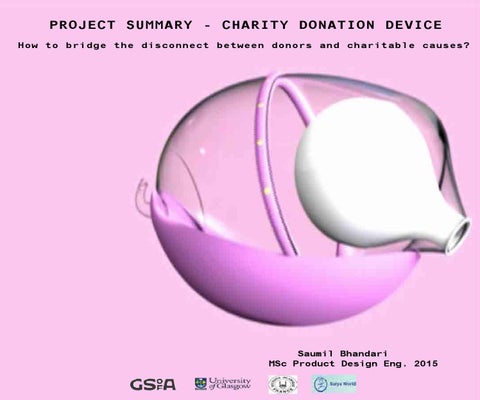
P R O J E C T S U M M A R Y - CHARITY DONATION DEV ICE How to bridge the disconnect between donors and charitable causes?
Saumil Bhandari MSc Product Design Eng. 2015
TABL E O F C O N T E N T S DISCOVER . . . .
Secondary Research Ethnographic Interviews Insights Concept Evaluation
DEFINE . . . . .
Interaction Framework Video Prototype of Initial Concept User Feedback Define 5Ws Concept Embodiment
DELIVER
DEVELOP , . . .
Concept Ideation Form Ideation User Testing Technical Embodiment
. . . . .
Product App Interaction User Journey Service Map
DISCOVER
SEC O N D A R Y R E S E A R C H
2014 Overall Giving Trends by Sector
Actions taken to improve the imapct of Social Media efforts
2014 Online Giving Trends
Overall Mobile Usage
"What is working for us is the customization of fundraising for audiences. " - Christine Bork, CureSearch "Nothing works more effectively than peer to peer fundraising and there is nor substitute for personal visit. " - Joe Montgomery, Darlington School
ETH N O G R A P H I C I N T E RVIEWS
.
AWARENESS
.
HUMAN BEHAVIOUR TO GIVING
Interviews with various donors with different personas were conducted. The questions asked were categorized into three broad categories namely "how does the donor get aware of a charity or a cause", "human behavior to giving" and "feedback received upon making a donation". Mapping the gathered data into categories allowed synthesis of the data for insights.
.
FEEDBACK
INS I G H T S
change Environment, in streets most people are occupied.
build Emotional Relationship between donor and charitable causes.
Intermediary Feedback by charity from time to time generates trust in donor on donation as a way of helping a cause.
the more Time people spend with the idea of donating to help the more they will donate and connect.
Shared Experience, people feel pleasure when their help is acknowledged by others.
asking for help too often or too much leads to Compassion Fatigue phenomenon among donors. This feels when donor feels guilty of not being able to help.
Magic Output, being part of something big induces pleasure because a small help from others can produce massive outcomes.
CON C E P T E V A L U A T I O N
Various "What-if" scenarios were ideated. These scenarios were then evaluated against the insights gathered earlier. Based on the "PUGH" evaluation matrix above the Home(c) living room scenario was chosen to go ahead with.
DEFINE
INT E R A C T I O N F R A M E W ORK
1. 2. 3. 4. 5.
Token of Value Initiation Processing Reaction Feedback
PRODUCT
TOKEN OF INITIATION VALUE
PROCESSING REACTION
FEEDBACK
E-Charity Box
Money
Drop Money
Transaction
Money reached
Charity updates
IPOD
Songs
Press Buttons
LED lights
Music playing
Itunes
Toaster
Bread
Press to latch
Hot grill
Bread toasts
Crunchy eating
With an emphasis on designing for new interactions, various existing products were analyzed for nature of interactions based on existing tangible interaction framework(11). A new interaction framework was designed to facilitate in further ideation for contextual innovative interactions with the charity donation device.
VID E O P R O T O T Y P E o f INITIAL CONCEPT
charity shop is at the high street
donor enters the charity shop
buys the charity donation device
activates the charity donation device
the device inflates & deflates as if breathing slowly
the device inflates & deflates as if breathing slowly
registers his debit card with the device
each time he drops a token to donate
he then sets the amount to be donated
the globe inside the device moves round while processing payment
He credits ÂŁ30 pounds on the device from his debit card
the globe inside the device moves round while processing payment
the globe shows the money reached the charity visually
reaches home
The ideation and low fidelity prototypes led to a product concept and a scenario. The concept was a charity donation device that the donor buys off a charity shop. The device permanently lives at donor's home. The donor donates electronically through the device towards the charity of his choice. He can later change the charity by configuring the device to his computer. This concept was communicated through a short video. The storyboad is visible on the left. The video was shown to various potenial donors for their feedback.
USE R F E E D B A C K
C omplexity of Interaction
Cost of Manufactu r i n g
Quentin Veuillet, Volunteer at Nepal Earthquake site, Secours Islamique Paris
"Charities these days are very organized. They strategically plan how the money should be spent. Why not just donate online instead of this physical device?" Tanguy Murthy Moselle, Volunteer, Surya-World
Why is such a device necessary when there already exist online donation links like paypal where you must click and donate? Craig Whittet, Head PDE, Glasgow School of Art
I can't see people going out and buying this device, to be honest. Its too complex.
Roy Shearer, Interaction design teacher, Glasgow School of Art
You should focus on just picking few aspects of this to show the concept. Having it all is crazy!
Andy Xiao, MDes Service Design, Glasgow School of Art
Why don't you lower the device complexity by giving data/information on computer or app?
Engaging with users through my prototypes led to various interesting insights. One of the most interesting fact I discovered was that charities oraganization these days operate like any professional bussiness. This involves paying thier employees competitive salaries. This approach has proven to be more efficent in the long term. For example, in a nepal earthquake situation all the big charities collaborate together facilitated by United Nations . An important insight that I drew was that in the whole ecosystem of charity-donor system, it is the donors who don't plan at all before giving. In other words, what is needed is a product that helps the donor plan his charity giving.
DEF I N E 5 W s
WHAT A product that is geared towards making the donor plan his charity giving. Through this product-service system the donor should be able to channelize his energy(money + time) in the most efficient way towards a single charity at a time.
WHO For the conscious donors. These donors have interest in tackling the problems of the world but inefficient and poor service give them no alternative but to continue living ignorantly. These donors need this product to enable them to have a deeper relationship with their kind alter ego.
WHERE This device resides at home in his living room. He also raises money passively while undergoing other money transactions elsewhere.
WHEN Anytime the donor wants. This is why it is at home reminding the donor of his charity giving.
WHY Although the donor can donate through internet anywhere, anytime there is found a lack of donor's relationship with the beneficiaries. This product establishes that connection.
CONC E P T E M B O D I M E N T
piggy bank
Raise money through collecting electronic change while conducting money transaction.
donation box
Donate to the chosen charity from collected money.
planned giving
A Donor who plans his charity giving for an efficient help towards a cause.
DEVELOP
CONC E P T I D E A T I O N
physical abstraction of concept
outer form ideation
donor interaction ideation two balloon concept
refined interaction with one balloon
FOR M I D E A T I O N
USE R T E S T I N G
A glass built prototype was tested on donors for interaction with the charity donation device. The balloon inside the glass built prototype inflated proportional to the blow and the volume of the balloon indicated the money donated. The blowing of balloon was achieved through a mechanical valve built into the glass form. In the original product this was to be achieved using a miniature electronic valve. In general the response of the overall interaction was overwhelming though concerns were raised over the hygiene of the donors blowing into the device.
TEC H N I C A L E M B O D I M E N T
7 4 9
5
6
8
1 3 2
1. Microcontroller 4. Electronic Valve 7. Button for valve
2. two AA Battery 5. Whistle 8. Silicon Cover
3. Pressure Sensor 6. LED strip 9. Balloon
DELIVER
PRO D U C T Collection
Donation
Planne d Giving
The amount of money that you collect into your charity account is shown through LED lights. The amount you donate towards the selected charity is shown through the volume of the balloon.
190 mm
232 mm
APP
An app that allows the donor to choose from a list of charities, track the progres of charity the donor is donating to and connect with other donors of the same charity around the world. The app talks with the physical product over wifi.
INT E R A C T I O N
The device simply lives with the donor in his home. Whenever he wishes to donate towards the selected charity he needs to blow the balloon inside the outer glass form.
USE R J O U R N E Y
SER V I C E M A P
FIN A L R E F L E C T I O N The three month long project was a self-initiated project with regular feedback sessions from GSA tutors. This project was a physical manifestation of my earlier research into exploring tangible interactions with everyday objects. The learned principles were applied in the context of charity donation system. I am satisfied that I was able guide a design process towards proposing a new interaction with charity donation device which not only is conceptual or speculative but also intuitive as my user feedback suggested. I would like to further develop a fully working prototype with more iterations on user testing . This was not feasible with only 3 month long project. Further, having experienced a design process with a conscious effort in designing for interactions, I would further like to extend my current practice.
Saumil Bhandari MSc Product Design Eng.
BIB L I O G R A P H Y 1. It ain't about what you give, It's about how you give it - Caroline Fiennes. 2. Charitable Giving Report, How Non-profit Fundraising Performed in 2014, Presented by Steve MacLaughlin, Director, Analytics, BLACKBAUD. 3. Applying behavioural insights to charity giving.: Charity Aid Foundation. 4. Giving, Well being and Behavioural science : Halpern. 5. Does price matter in charitable giving? Evidence from a large scale natural field experiment, American Economic Review. 6. Why do people give. The non-profit sector: A research handbook, Vesterlund.
7. Brother, can you spare a dime? Peer pressure in charitable solicitation, Journal of Public Economics, 95(7), 926-941, Meer(2011). 8. Ten Most Important Things You Can Know About Fundraising, Kim Klein.
9. Cash Collection guidelines 2015, St John Wales, Charity Number : 250523. 10. http://www.institute-of-fundraising.org.uk/library/onlinegiving/ Guide to choosing online platform for charities. 11. An Encompassing View on Tangible Interaction: A Framework - Eva Hornecker, Interact Lab, University of Sussex.
Thanks for reading. For more details contact saumil.bhandari@gmail.com Also, refer video of the project at www.saumilbhandari.com