©2023 Sauk County Historical Society
I
Student Book
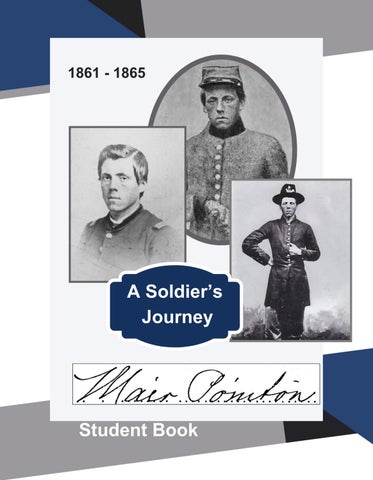
Mair Pointon: A Soldier’s Journey May 1861 - July 1865 Compiled by Beverly Vaillancourt, M.Ed
The Mair Pointon Video and accompanying Student Booklet are dedicated to the soldiers of the Iron Brigade. Yet today, the Iron Brigade remains a celebrated symbol of courage, resilience, and valor.
© Sauk County Historical Society 2023
This student booklet accompanies the video: Mair Pointon: A Soldier’s Journey
https://vimeo.com/874091736 Student Outcomes 1. 2. 3. 4.
to deepen knowledge of the Battles of Antietam, Gettysburg, and Spotsylvania to gain an understanding of the Civil War experience to learn about the contributions of American Indians to the Union Army to understand how moments of humanity occurred during grave times of inhumanity
Common Core Reading Standards in Literacy in History/Social Studies, Grades 9 - 10 Key Ideas and Details •
Cite specific textual evidence to support analysis of primary and secondary sources, attending to such features as the date and origin of the information.
•
Determine the central ideas or information of a primary or secondary source; provide an accurate summary of how key events or ideas develop over the course of the text
•
Analyze in detail a series of events described in a text; determine whether earlier events caused later ones or simply preceded them. ©2023 Sauk County Historical Society
Contents Background ����������������������������������������������������������������������������������������������������������������I The Iron Brigade ���������������������������������������������������������������������������������������������������������������������������������� I Battle of Antietam ������������������������������������������������������������������������������������������������������������������������������2 Battle of Gettysburg �����������������������������������������������������������������������������������������������������������������������10 Gettysburg Address, November 19, 1863 ����������������������������������������������������������������������������������14 Battle of the Wilderness ����������������������������������������������������������������������������������������������������������������16 Battle of Spotsylvania Courthouse ����������������������������������������������������������������������������������������������17
First Account ���������������������������������������������������������������������������������������������������������� 18 Hardship on the Homefront: The Ride of Her Life ��������������������������������������������������������������������18
Indigenous Soldiers in the Civil War ������������������������������������������������������������������� 19 Ely Samuel Parker ����������������������������������������������������������������������������������������������������������������������������20 Federal Policies and Conflict ��������������������������������������������������������������������������������������������������������21 Navaho Long Walk ��������������������������������������������������������������������������������������������������������������������������21 Inquiry �����������������������������������������������������������������������������������������������������������������������������������������������22
The Drummer Boys ����������������������������������������������������������������������������������������������� 23 John Clem ����������������������������������������������������������������������������������������������������������������������������������������23 George Inman, 12th Wisconsin Infantry �������������������������������������������������������������������������������������24
Battlefield Artists �������������������������������������������������������������������������������������������������� 27 Thomas Nast �����������������������������������������������������������������������������������������������������������������������������������27 Alfred Waud �������������������������������������������������������������������������������������������������������������������������������������28 Edwin Forbes �����������������������������������������������������������������������������������������������������������������������������������29 Photography �������������������������������������������������������������������������������������������������������������������������������������30
Essay Suggestions ������������������������������������������������������������������������������������������������ 31 Project-based Learning ���������������������������������������������������������������������������������������� 31 Mair Pointon: A Soldier’s Journey: Questions �������������������������������������������������� 32 Resources �������������������������������������������������������������������������������������������������������������� 33 ©2023 Sauk County Historical Society
To the Student Mair Pointon of Baraboo, Wisconsin, volunteered to serve in the 6th Wisconsin Infantry on May 10, 1861, as the Civil War unfolded. He served during the major battles of the war, receiving special dispatch assignments during the Battles of Antietam and Gettysburg. Throughout his letters home to his brother, he shared both the difficulty of battle and times of humanity where communication passed easily between Union and Confederate soldiers. As you read through the primary source documents in this student guide, consider the following questions: • • • • • • •
How did hope guide Mair Pointon through his war experience? Why did Mair Pointon re-enlist when he could have instead gone home? How would you characterize Mair Pointon’s war experience? What are three take-aways you gained from learning about the Battles of Antietam, Gettysburg, and Spotsylvnia? If you had to summarize the Civil War is three sentences, what would they be? What acts of humanity does Mair Pointon share? What is most significant about the contributions of American Indians during the Civil War?
Background The Iron Brigade The Iron Brigade was a renowned infantry brigade in the Union Army during the American Civil War. It gained its nickname, the “Iron Brigade,” for its steadfastness and valor in battle. The regiments that composed the Iron Brigade included the 2nd, 6th, and 7th Wisconsin Volunteer Infantry Regiments, the 19th Indiana, and the 24th Michigan. These regiments were known for their discipline, training, and combat effectiveness. The Iron Brigade was identified by its distinctive uniform, which included a black Hardee hat and a frock coat. Library of Congress
©2023 Sauk County Historical Society
I
Key engagements involving the Iron Brigade included: • • • •
•
Battle of Brawner’s Farm (Second Bull Run) - August 1862: The Iron Brigade played a crucial role in delaying Confederate forces during the Second Battle of Bull Run. Battle of Antietam - September 1862: The brigade fought near the “Bloody Lane” and suffered heavy casualties during the Battle of Antietam. Battle of Fredericksburg - December 1862: The Iron Brigade was not heavily engaged in this battle, but it played a role in the Union defeat. Battle of Gettysburg - July 1863: The Iron Brigade fought with distinction at Gettysburg, particularly on the first day, where it faced Confederate forces in the Railroad Cut and suffered significant casualties. Battle of the Wilderness and Battle of Spotsylvania Courthouse - May 1864: The Iron Brigade played a crucial role in these and other battles of the Overland Campaign.
Battle of Antietam The Battle of Antietam, also known as the Battle of Sharpsburg, was a pivotal engagement during the American Civil War. It took place on September 17, 1862, near Sharpsburg, Maryland. This battle is significant for several reasons: Bloodiest Day in American History: The Battle of Antietam is often referred to as the “bloodiest single day in American history.” Approximately 23,000 soldiers were killed, wounded, or missing by the end of the day. This high casualty count underscored the horrific battles and carnage that characterized the Civil War. The battle of Antietam was pivotol for several reasons. First it forced Lee to retreat to Virginia. Second it halted a momentum of Confederate victories and improved Union confidence after suffering a series of defeats. Third, and most importantly, the battle outcome prevented Great Britain and France from recognizing the Confederacy as an independent nation. It also gave President Abraham Lincoln the opportunity to issue the Emancipation Proclamation, which declared that slaves in Confederate-held territory would be set free on January 1, 1863. Following the Battle of Antietam, McClellan’s failure to pursue and aggressively follow up on the Confederate retreat allowed Lee’s army to escape relatively intact, diminishing the potential strategic gains of the Union victory. Critics argued that McClellan’s reluctance to pursue Lee’s army prevented the Union from achieving a more decisive outcome and potentially shortening the duration of the war. 2
©2023 Sauk County Historical Society
The Battle of Antietam had international ramifications. The British and French had been considering recognizing the Confederacy, but the Union victory at Antietam, coupled with Lincoln’s Emancipation Proclamation, made them reconsider. They did not extend diplomatic recognition to the Confederacy, which helped to isolate the Confederate government. The Battle of Antietam is notable for being one of the first major battles to be documented through photography by Alexander Gardner and other photographers.
Battle of Antietam, unidentified soldiers: Library of Congress Antietam, Maryland. Allan Pinkerton, President Lincoln, and Maj. Gen. John A. McClernand: Library of Congress
Signal tower overlooking Antietam Battlefield: Library of Congress
Antietam, Maryland. Lt. Col. Charles B. Norton at headquarters of Gen. Fitz-John Porter: Library of Congress
©2023 Sauk County Historical Society
3
Burnside’s Bridge
Antietam, Maryland. Battle at Burnside’s Bridge, Artist unknown, 1862: Library of Congress
Antietam, Maryland. Burnside’s Bridge Landmark: Library of Congress
Burnside’s Bridge is one of the most well-known landmarks associated with the Battle of Antietam. This bridge played a pivotal role in the battle and was named after Union General Ambrose Burnside, who led a key assault on the Confederate position there. The Burnside Bridge spanned Antietam Creek, a few miles south of the town of Sharpsburg, Maryland. It was a stone bridge that crossed the creek and was a vital transportation route in the area. During the Battle of Antietam, Union forces under General Burnside were tasked with capturing the bridge and breaking through the Confederate defensive lines. This was a crucial part of the Union strategy to gain access to the Confederate right flank and potentially cut off the Confederate retreat. The Confederate defenders, primarily the soldiers of General Robert Toombs, held a strong defensive position on the heights overlooking the bridge. They used stone walls and natural defenses to their advantage, making it difficult for the Union forces to cross. The Union forces attempted multiple assaults on the bridge throughout the day. Each time, they were met with heavy Confederate fire and suffered significant brutal losses.
4
©2023 Sauk County Historical Society
Finally, in the late afternoon, after several failed attempts and numerous casualties, Union troops managed to secure the bridge and gain a foothold on the other side of Antietam Creek. This allowed them to advance and put additional pressure on the Confederate lines. The site of Burnside Bridge saw a particularly high number of casualties during the battle. Historians wonder why Major General Ambrose Burnside did not choose to cross Antietam Creek at a different point beyond enemy range, avoiding the rifle aim of Confederate sharpshooters posted at the bridge. Later Burnside faced criticism for their handling of specific attacks during the battle of Antietam. Burnside’s delay in crossing Antietam Creek and launching a coordinated assault on the Confederate position at what became known as Burnside Bridge allowed Confederate forces to reinforce their defenses, resulting in heavy casualties for Union troops. The Burnside Bridge became a symbol of the brutal fighting and high human cost of the Battle of Antietam. Today, it is preserved as part of the Antietam National Battlefield.
Cornfield The Cornfield at Antietam consisted of approximately 20 acres of fully ripe corn. The Cornfield was a central part of the battlefield, and it played a critical role in the unfolding events of that fateful day. In the early morning hours of September 17, Confederate troops, under the command of General Stonewall Jackson, occupied the Cornfield and the adjacent East Woods. Their defensive position was fortified by wooden fences and stone walls, which provided natural cover. The Union Army, under General Joseph Hooker, launched a massive assault to dislodge the Confederates from the Cornfield. The fighting in and around the Cornfield was extremely intense and violent, with both sides suffering heavy casualties. The Cornfield changed hands multiple times throughout the morning and early afternoon as both Union and Confederate forces fought fiercely to gain control. The Cornfield was one of the bloodiest areas of the battle, with a tremendous loss of life. The standing cornstalks, dry from the late summer, caught fire during the battle, adding to the horror of the scene. By the end of the day, the field was said to be covered with the dead and wounded.
©2023 Sauk County Historical Society
5
Issued on January 1, 1863: Library of Congress
6
©2023 Sauk County Historical Society
January 1, 1863 The Emancipation Proclamation: A Transcription By the President of the United States of America: A Proclamation Whereas, on the twenty-second day of September, in the year of our Lord one thousand eight hundred and sixty-two, a proclamation was issued by the President of the United States, containing, among other things, the following, to wit: “That on the first day of January, in the year of our Lord one thousand eight hundred and sixty-three, all persons held as slaves within any State or designated part of a State, the people whereof shall then be in rebellion against the United States, shall be then, thenceforward, and forever free; and the Executive Government of the United States, including the military and naval authority thereof, will recognize and maintain the freedom of such persons, and will do no act or acts to repress such persons, or any of them, in any efforts they may make for their actual freedom. “That the Executive will, on the first day of January aforesaid, by proclamation, designate the States and parts of States, if any, in which the people thereof, respectively, shall then be in rebellion against the United States; and the fact that any State, or the people thereof, shall on that day be, in good faith, represented in the Congress of the United States by members chosen thereto at elections wherein a majority of the qualified voters of such State shall have participated, shall, in the absence of strong countervailing testimony, be deemed conclusive evidence that such State, and the people thereof, are not then in rebellion against the United States.” Now, therefore I, Abraham Lincoln, President of the United States, by virtue of the power in me vested as Commander-in-Chief, of the Army and Navy of the United States in time of actual armed rebellion against the authority and government of the United States, and as a fit and necessary war measure for suppressing said rebellion, do, on this first day of January, in the year of our Lord one thousand eight hundred and sixty-three, and in accordance with my purpose so to do publicly proclaimed for the full period of one hundred days, from the day first above mentioned, order and designate as the States and parts of States wherein the people thereof respectively, are this day in rebellion against the United States, the following, to wit: ©2023 Sauk County Historical Society
7
Arkansas, Texas, Louisiana, (except the Parishes of St. Bernard, Plaquemines, Jefferson, St. John, St. Charles, St. James Ascension, Assumption, Terrebonne, Lafourche, St. Mary, St. Martin, and Orleans, including the City of New Orleans) Mississippi, Alabama, Florida, Georgia, South Carolina, North Carolina, and Virginia, (except the forty-eight counties designated as West Virginia, and also the counties of Berkley, Accomac, Northampton, Elizabeth City, York, Princess Ann, and Norfolk, including the cities of Norfolk and Portsmouth[)], and which excepted parts, are for the present, left precisely as if this proclamation were not issued. And by virtue of the power, and for the purpose aforesaid, I do order and declare that all persons held as slaves within said designated States, and parts of States, are, and henceforward shall be free; and that the Executive government of the United States, including the military and naval authorities thereof, will recognize and maintain the freedom of said persons. And I hereby enjoin upon the people so declared to be free to abstain from all violence, unless in necessary self-defence; and I recommend to them that, in all cases when allowed, they labor faithfully for reasonable wages. And I further declare and make known, that such persons of suitable condition, will be received into the armed service of the United States to garrison forts, positions, stations, and other places, and to man vessels of all sorts in said service. And upon this act, sincerely believed to be an act of justice, warranted by the Constitution, upon military necessity, I invoke the considerate judgment of mankind, and the gracious favor of Almighty God. In witness whereof, I have hereunto set my hand and caused the seal of the United States to be affixed. Done at the City of Washington, this first day of January, in the year of our Lord one thousand eight hundred and sixty three, and of the Independence of the United States of America the eighty-seventh. By the President: ABRAHAM LINCOLN WILLIAM H. SEWARD, Secretary of State.
8
©2023 Sauk County Historical Society
Inquiry 1. When was the Emancipation Proclamation released? When did it take effect? 2. To whom did the words of the Emancipatioh Proclamation apply? 3. Why was this document of such great historical significance? 4. Did the Emancipation Proclamation apply to all states and regions? 5. Who was charged with ensuring that the will of President Lincoln would be enforced? 6. How did the Emancipation Proclamation impact the strength of the Union Army? 7. Why does President Lincoln mention that the act is “waranted by the Constitution”?
Drawing by Thomas Nast Harper’s Weekly, January 31, 1863
©2023 Sauk County Historical Society
9
Battle of Gettysburg The Battle of Gettysburg was a pivotal engagement during the American Civil War and took place from July 1 to 3, 1863, in and around the town of Gettysburg, Pennsylvania. It is one of the most well-known and significant battles of the war. Here are key details about the Battle of Gettysburg: Gettysburg, a small town in Pennsylvania, became the setting for the battle when the Confederate Army of Northern Virginia, commanded by General Robert E. Lee, clashed with the Union Army of the Potomac, led by General George G. Meade. The battle unfolded over three days, with distinct phases on each day. The first day featured intense fighting in the town and its surroundings, while the second day saw major clashes on the Union left and right flanks. The third day is famous for Pickett’s Charge, a massive and costly Confederate assault on the center of the Union line. The Battle of Gettysburg is considered a turning point in the Civil War. While it did not end the conflict, it, along with the surrenders of Vicksburg on June 4, 1863, and Port Hudson on July 9, 1863, marked decisive Union victores that ended General Lee’s invasion of the North in the eastern theater and ensured Union control of the Mississippi River in the western theater. Union success boosted Northern morale and further deterred foreign intervention in the war. The Battle of Gettysburg resulted in staggering casualties. It is estimated that there were over 50,000 casualties, including killed, wounded, and missing, making it one of the deadliest battles of the war. The first day of the Battle of Gettysburg is marked by the conflict at the Railroad Cut. The Railroad Cut was situated along the route of the advancing Confederate forces. As the battle unfolded, Union troops, including the 6th Wisconsin and 84th and 95th New York attacked from the south. The 2nd and 42nd Mississippi and 55th North Carolina took shelter in the railroad cut. The Union forces found firing on Confederate forces very difficult due to the steep sides of the embankment. The number of Union and Confederate soldiers killed and wounded was staggering (example: 160/450 of the 6th Wisconsin fell). Ultimately over 200 Confederate soldiers were captured when Union forces finally managed to gain the railroad cut. This proved to be a pivotal battle, setting the stage for what was to come next. 10
©2023 Sauk County Historical Society
On the second day, one of the most famous actions of the battle occurred at Little Round Top, a hill on the Union left flank. Union forces under General Joshua Lawrence Chamberlain successfully defended the position against Confederate attacks, preventing a potential breakthrough. On the third day of the battle, General Lee ordered an ill-fated frontal assault known as Pickett’s Charge. Approximately 12,500 Confederate soldiers advanced across an open field and were met with devastating fire from Union forces. The charge failed, resulting in heavy casualties and dealing a severe blow to the Confederate army. Following the Battle of Gettysburg, General Lee’s army retreated back to Virginia. The battle marked the beginning of the end for the Confederacy, and it shifted the momentum of the war in favor of the Union. President Abraham Lincoln delivered the Gettysburg Address during the dedication of the Soldiers’ National Cemetery at Gettysburg on November . In this brief but powerful speech, he emphasized the principles of liberty, equality, and the preservation of the Union. After the Confederate defeat at the Battle of Gettysburg from July 1 to 3, 1863, General Robert E. Lee’s Army of Northern Virginia faced the challenging task of retreating back to Confederate territory in Virginia. July 4: On the morning of July 4, as the Fourth of July celebrations were taking place in the United States, Lee began his retreat. He sent his wounded back to Virginia under a flag of truce to avoid further suffering. The retreat took place in the rain, which made the journey even more challenging for both sides. Union Pursuit: Union forces under General George G. Meade were aware of Lee’s retreat and pursued the Confederate army. However, the pursuit was slow and cautious, giving Lee’s forces the opportunity to gain distance. Crossing the Potomac River: By July 7, the Confederate army reached the Potomac River. The river was swollen due to heavy rains, making it difficult to cross. Lee’s engineers constructed makeshift bridges and managed to get the army across. The Union pursuit was cautious, and Union General Meade did not press the attack as aggressively as he might have. This gave Lee’s forces additional time to escape.
©2023 Sauk County Historical Society
11
Library of Congress
12
©2023 Sauk County Historical Society
Library of Congress
©2023 Sauk County Historical Society
13
Gettysburg Address, November 19, 1863 Four score and seven years ago our fathers brought forth, upon this continent, a new nation, conceived in Liberty, and dedicated to the proposition that all men are created equal. Now we are engaged in a great civil war, testing whether that nation, or any nation so conceived, and so dedicated, can long endure. We are met on a great battle-field of that war. We have come to dedicate a portion of that field, as a final resting place for those who here gave their lives, that that nation might live. It is altogether fitting and proper that we should do this. But, in a larger sense, we can not dedicate, we can not consecrate -- we can not hallow -- this ground. The brave men, living and dead, who struggled here, have consecrated it far above our poor power to add or detract. The world will little note, nor long remember what we say here, but it can never forget what they did here. It is for us the living, rather, to be dedicated here to the unfinished work which they who fought here, have, thus far, so nobly advanced. It is rather for us to be here dedicated to the great task remaining before us -- that from these honored dead we take increased devotion to that cause for which they gave the last full measure of devotion -- that we here highly resolve that these dead shall not have died in vain -- that this nation, under God, shall have a new birth of freedom -- and that government of the people, by the people, for the people, shall not perish from the earth.
Library of Congress
14
©2023 Sauk County Historical Society
Inquiry 1. Why do you think President Lincoln chose the dedication of the Gettysburg National Cemetery as the right event and location for the Gettysburg Address? 2. How long is four score and seven years? 3. Why was this speech so significant? 4. Which phrase or sentence from this address do you think is the most significant? Why? 5. Who was charged with ensuring that the will of President Lincoln would be enforced? 6. What do you think Lincoln meant by saying “that we here highly resolve that these dead shall not have died in vain...”? 7. The text states that as Lee’s forces retreated “The river was swollen due to heavy rains, making it difficult to cross. Lee’s engineers constructed makeshift bridges and managed to get the army across.” Consider this statement in relation to the effort required to retreat.
A section of the Gettysburg battlefield showing several state memorials dedicated to state regiments. photo by Beverly Vaillancourt, used with permission
©2023 Sauk County Historical Society
15
Battle of the Wilderness The Battle of the Wilderness was fought from May 5 to 7, 1864. It was one of the opening battles of Ulysses S. Grant’s Overland Campaign against Robert E. Lee’s Confederate Army of Northern Virginia. The battle took place in a heavily wooded and tangled region known as the Wilderness, in eastern Virginia. The battle began on May 5, 1864, when Union forces under General George G. Meade clashed with Lee’s Confederates. The Wilderness was a particularly brutal battle with heavy casualties on both sides. The thick underbrush made it difficult to see the enemy until they were closeby, resulting in intense, chaotic, and often deadly fighting. Despite the initial difficulties, Grant refused to retreat, marking a change in Union strategy. Previous Union commanders had often retreated after initial setbacks, but Grant was determined to press on. He famously stated, “I propose to fight it out on this line if it takes all summer.” The Battle of the Wilderness was extremely costly for both sides.The thick woods of the Wilderness limited the effectiveness of traditional military tactics, particularly the use of artillery and firearms. The dense foliage often dampened the noise of the musket and cannon fire, making it difficult for soldiers to hear and communicate over longer distances. This obscured the battlefield and contributed to the chaotic and disorganized nature of the fighting. Another critical aspect of the Battle of the Wilderness was the occurrence of wildfires. The dense woods, combined with the heavy smoke from gunpowder, led to fires breaking out during the battle. These wildfires added a new layer of danger and confusion to the already chaotic fighting. Soldiers often had to navigate through smoke and flames, and the injured were sometimes trapped in the burning underbrush. The fires exacerbated the overall suffering and disarray of the battle. The battle ended inconclusively, with neither side achieving a decisive victory. While Grant did not achieve the victory he sought, he demonstrated his willingness to fight, even in difficult conditions, and pressed on toward Richmond, a Confederate stronghold. Grant continued his campaign by moving southward towards Spotsylvania Court House. The subsequent battles in the Overland Campaign included Spotsylvania Court House, North Anna, and Cold Harbor.
16
©2023 Sauk County Historical Society
Battle of Spotsylvania Courthouse The Battle of Spotsylvania Court House was a significant engagement during Grant’s Overland Campaign. It took place from May 8 to May 21, 1864, and was a critical part of the Union Army’s attempt to capture the Confederate capital of Richmond, Virginia. The battle did not result in a clear-cut victory for either side. Instead, it was a brutal and inconclusive engagement characterized by intense and prolonged trench warfare. Union forces were trying to push deeper into Confederate territory, while Confederate forces were attempting to defend their positions and prevent the Union army from achieving its goals.
The Battle of Laurel Hill (May 8-9): The Union forces launched attacks on the Confederate lines at Laurel Hill, but the Confederates managed to hold their ground. The Battle of the Salient (May 10): The Union forces launched a massive attack on a bulge in the Confederate line known as the “Mule Shoe” or the “Bloody Angle.” After fierce hand-to-hand combat, the Confederate line was breached, but the Union was unable to capitalize on this initial success. Despite heavy losses, Grant continued to advance his army southward, demonstrating his determination to engage Lee’s forces. He sought to wear down the Confederate army, regain offensive momentum, and take Richmond. With great effort, Richmond was captured on April 3, 1965, significantly impacting Confederate military strategy and morale.
©2023 Sauk County Historical Society
17
First Account Hardship on the Homefront: The Ride of Her Life The following story was first told during an interview in 1838 by Mrs. Sallie Peacheater Manus, a member of the Cherokee Nation and supporter of the Union Army, as part of the Indian Pioneer History Project for Oklahoma. I was pushed along by a bunch of Confederate soldiers once to a spot to be shot....One of the officers recognized me and said, “Here, men, this war will not be won by killing the women. I want her released.” This officer was a preacher and a nearby neighbor who had joined the southern army. That is all that saved my life. Once I was warned by a [Confederate] soldier who had left his camp...that they [the Confederates] intended to raid my house early the next morning and take my ponies, money, food, clothing or anything they could find. I thanked the stranger...put my clothes on...took my bridles for my only little pony...I talked to him and said, “Pony Babe, you come here to me, You got to make your best run of your dear life. Our enemy is after us.” He seemed to understand my begging voice and submitted very quickly and I took him to the house and I fed him the last food I had...At daybreak I pinned $50.00 to my apron and got on my pony, just as I saw figures of some men coming. I spoke to Babe, “Hurry Babe.” He was such a tiny poiny that I could almost touch the ground with my feet. I heard the soldiers whoop and the race was on. I heard a few shots fired at me and Babe and I couldn’t tell whether I was gaining or losing for awhile, but Babe seemed to be just warming up to the race as we mounted first one hill and then another. I used instructions my father had given me years before as to what to do in a race of that kind. He had told me to never kick a horse with your heels but to use your voice by talking to your mount or using a small limb on the shoulder because kicking your mount only shortened the pony’s breath. Anyway I out ran my enemies. I ran from home to Park Hill, as about where Park Hill is located now, to a woman’s house I knew as being my friend, though she was a Confederate supporter. I jumped off my perspiring and panting horse, and fell on her porch. She ran out excited to death, and I muttered out my reason for my presence and she said, “Give me here that money. They won’t rob me for I am a Confederate.” I shoved her the money and sure enough we got by with it. Poor old Babe lay on the ground for two days unable to get around for being too sore to walk. source: https://okgenweb.net/pioneer/ohs/manussallie.htm 18
©2023 Sauk County Historical Society
Indigenous Soldiers in the Civil War
American Indian sharpshooters wounded at the Battle of the the Wilderness: Library of Congress
Some 20,000 American Indians from both Union and Confederate territories volunteered for military service. They served as soldiers, scouts, and guides, contributing their knowledge of the land and their skills in tracking and survival. For the Confederacy, American Indian soldiers were often utilized for local defense and guerrilla warfare. In the Union Army, American Indian soldiers were often integrated into other units or served as scouts. Ely Parker, a Seneca from New York, served as General Ulysses S. Grant’s military secretary and was present at the surrender at Appomattox Court House. Stand Watie, a Cherokee leader who initially supported the Union but later switched allegiance to the Confederacy, became the last Confederate general to surrender. The period following the war was marked by significant changes in United States government policies, including the forced removal of tribes from ancestral lands.
©2023 Sauk County Historical Society
19
General Ulysses S. Grant (center) staff: Brigadier General Ely Samuel Parker, Colonel Adam Badeau, Major Orville Elias Babcock, and Colonel Horace Porter, in uniform: Library of Congress
Ely Samuel Parker Ely Samuel Parker (1828-1895) was a prominent soldier of the Seneca tribe who played a significant role in American history during the 19th century. He is best known for his contributions during and after the American Civil War, as well as for his work in government service. Ely Parker was born in the Tonawanda Reservation, near what is now Buffalo, New York, in 1828. Parker attended local mission schools and later studied engineering at Yates Academy in New York. He worked as a civil engineer on various projects, including the construction of railroads and canals. When the Civil War broke out, Ely Parker sought to serve in the Union Army. His engineering background and military expertise led him to a commission as a captain. He later advanced to the rank of lieutenant colonel. He served as Grant’s military secretary during the final years of the Civil War and was present at the Confederate surrender at Appomattox Court House in 1865. He is particularly known for his role in transcribing the terms of surrender agreed upon between General Ulysses S. Grant and General Robert E. Lee at Appomattox Court House. After the Civil War, Parker served in various government positions, including as Commissioner of Indian Affairs under President Ulysses S. Grant. 20
©2023 Sauk County Historical Society
Federal Policies and Conflict The Great Plains of North America were home to several Plains Indian tribes, including the Lakota Sioux, Cheyenne, Arapaho, Comanche, and others. As settlers moved westward, they encroached on traditional Native American lands, leading to tensions and conflicts. The westward expansion of the United States, including the construction of railroads, mining, and settlement, disrupted the traditional way of life of Plains Indians and threatened their hunting grounds and resources. Prominent Native American leaders, such as Sitting Bull, Crazy Horse, and Red Cloud, emerged as leaders of resistance against U.S. expansion. They led their people in battles and negotiations to protect their lands and way of life. The Plains Indian Wars resulted in significant loss of life, dislocation of tribes, and the decline of the Plains Indian cultures. Many Native Americans were forced onto reservations, and the buffalo, a critical resource for Plains tribes, was nearly eradicated.
Navaho Long Walk The “Navajo Long Walk” is often referred to as the “Navajo Trail of Tears.” The Navajo, also known as the Diné, had inhabited the southwestern United States for centuries before the arrival of European settlers. They occupied a vast territory that included portions of Arizona, New Mexico, Utah, and Colorado. In the mid-1800s, as American settlers and the U.S. government sought to expand westward, conflicts between the Navajo and the U.S. military and settlers escalated. The U.S. government accused the Navajo of raiding settlements and launched punitive expeditions against them. In 1864, as part of a campaign to pacify the region, U.S. troops under the command of General James H. Carleton, and with the direction of Kit Carson, began a brutal campaign against the Navajo. They destroyed Navajo crops, orchards, homes, and livestock and waged a scorched-earth policy focused on starvation. Navajo of all ages were captured or killed. Those who remained were forced to march some 300 miles from their ancestral lands in Canyon de Chelly to a desolate internment camp at Fort Sumner in eastern New Mexico. It was marked by extreme hardship, suffering, and loss of life due to harsh conditions, the brutality of the soldiers, and the lack of resources. The conditions at Fort Sumner were deplorable. The Navajo were held in captivity, often in inadequate and overcrowded conditions. Their traditional way of life was disrupted. They endured food shortages, disease, and death for those who could not withstand the conditions. In 1868, the U.S. government signed the Treaty of Bosque Redondo, which allowed the Navajo to return to a portion of their traditional lands, now part of a self-governing Navajo Nation. ©2023 Sauk County Historical Society
21
Inquiry 1. Why were the Battles of the Wilderness and Spotsylvania Courthouse so significant for Grant’s Overland Campaign? 2. With all of the loss following Antietam, Gettysburg, The Wilderness, and other subsequent battles, why didn’t General Lee just concede defeat prior to Appomattox? 3. With all the forced removals and broken treaties prior to the Civil War, why do you think members of Indian Nations volunteered to serve in the Union Army? 4. With all the forced removals and broken treaties prior to the Civil War, why do you think members of Indian Nations served in the Confederate Army? 5. Who was charged with ensuring that the will of President Lincoln would be enforced? 6. What takeaway did you gain from the first person story told by Mrs. Sallie Peacheater Manus? 7. The text states, “Eventually Richmond was captured, significantly impacting Confederate military strategy and morale.” What do you infer from this statement?
Library of Congress
22
©2023 Sauk County Historical Society
Drummer Boys, by Edwin Forbes: Library of Congress
©2023 Sauk County Historical Society
23
Photos: Library of Congress
George Inman, 12th Wisconsin Infantry The following story, as told by George Inman to Merton Edwin Krug, was first published in the Reedsburg Free Press on August 30, 1928, and reprinted in The Marching 12th, compiled by historian William C. Schuette.
It was during the warm autumn days of September, 1861, that George Stevens, of Reedsburg, began recruiting a company of volunteers from the northwestern parts of Sauk County. “George Inman was but a boy of fifteen but he set his heart on going with the company,” wrote Krug. George was permitted to accompany the new recruits to Madison but was not allowed to go any further, primarily because of his age. To join the Union Army, a man had to be at least 18 years of age and have the permission of his parents. Col. Bryant of the 12th Regiment told Inman to go back home and “Wait a while.” Krug noted that, “The spirit, which can never be killed, and very seldom suppressed, was in his heart, the Union was calling him,” a trait which seemed all too common among the youth who wanted to join up and help their countrymen, “beat those Rebs.” 24
©2023 Sauk County Historical Society
But George Inman would not be dissuaded, even though his parents attempted to convince him to remain at home until he was older. So, when he decided he could wait no longer, he conceived a plan with a neighbor boy his own age, to run away and join the army. That day finally arrived in late December of 1861. One night he went to bed as usual, and waited until his parents were fast asleep. Getting up at 11:30 p.m., George slipped out of his upstairs bedroom window, and along with his buddy, took off for Madison to join the Union Army. The weather was undoubtedly cold, and we can assume that they probably walked most of the way, hitching buggy rides as the opportunity arose.
George Inman, age 15
Finally they reached Camp Randall where new recruits were encamped. They were allowed to train with the troops. After three days had passed, George’s father, Jack, showed up to try and induce George to return home. It was noted that his father was “heartbroken and his mother was heartbroken,” but the pleas went unheeded. George would not be dissuaded, he was going to join the army. Krug wrote, “Then, decided Jack Inman, if the boy must go, he would go to look after him. Accordingly, word reached Martha Inman that both her husband and her boy were in the army. After Jack Inman had been mustered into the army, he received word that 15-year-old George, had been rejected. “In his desperation, George went to Col. Bryant, and told him of his plight, saying that because his father was now in the ranks, it would not be fair to reject him. Accordingly, the Colonel took the matter under advisement. ‘We’ll fix that!’ he told George, ‘we’ll make you a drummer.’” Taking the place of a man from Boscobel who had been drafted, George received a bounty of $300 cash ($8,200 today), for enlisting and was allowed to join his home company... Company B of the Twelfth Regiment of Wisconsin along with all the other companies of the 12th, were duly mustered into the Union Army on January 11, 1862, and left Camp Randall for Ft. Leavenworth, Kansas, where they were assigned. There were 1,049 in number, the largest detachment leaving the state at that time. ©2023 Sauk County Historical Society
25
The regiment left camp and boarded the train near the front gate, headed for Chicago. Upon arrival the next morning, a soldier from Company E, Hosea W. Rood, wrote that, “Much of Chicago was out to see the sight...Right up front leading the way with other drummers and fifers was George Inman, beating out the marching cadence with his drum for the troops as they went off to war, not to the south where the war was raging, but westward, towards New Mexico...The New Mexico Campaign was a Civil War operation in which the Confederates invaded northern New Mexico Territory in an attempt to control the Southwest and the gold fields of Colorado and ports in California. This attempt lasted from February through April of 1862. The Confederates were ultimately defeated and driven out of the territory. Krug finishes his story with informaton gleaned from his interview with George Inman: “Then came the Grand Review in the city of Washington in May of 1865,” wrote Krug in his interview with George Inman. “The Review: it is fresh still in George Inman’s mind today. A parade from morning till night, tens of thousands marching on the streets. There had been a band stand erected at a good point of advantage, where a large number of musicians were assembled, among whom was a lad of scarce 19, who had entered the conflict in ’61 at the age of 15 and who now sat in the band stand, playing his drum for the endless train of humanity that filed by on that day of the Grand Review.” That drummer of course, was George Inman. George still recalled the face of President Andrew Johnson over seventy years later, who had succeeded President Lincoln after his death only a few months before. After the Grand Review, George Inman left with his company for Louisville, Kentucky, where he and his company B, mustered out July 16. They proceeded to Madison and on August 9, 1865, and headed for home. The Chicago Tribune wrote, “The 12th Wisconsin infantry regiment arrived at the Soldiers Rest [Chicago] last evening, partook of supper, were furnished with quarters for the night and breakfast this morning and have gone on to Madison, Wis., to be discharged from the services.” In conclusion, Krug wrote, “Mr. Inman finished his story with a feeling of gladness, for the joy of living those days that, when being lived, had not been quite so joyous, was a pleasure he had not had in years. He is very proud of his record (of which he has a right to be) and has never regretted having entered the army against the will of his parents.” Along with George Inman, his father, John, also returned home safely. For the complete story, see The Marching 12th by William C. Schutte. 26
©2023 Sauk County Historical Society
©2023 Sauk County Historical Society
27
Alfred Waud Alfred Waud was a British-born artist who worked as an illustrator for Harper’s Weekly. He produced many detailed sketches and drawings that provided a visual record of the Civil War, depicting scenes from the battlefield, military encampments, and the lives of soldiers.
images: Library of Congress
28
©2023 Sauk County Historical Society
Edwin Forbes Edwin Forbes was born on December 2, 1839, in New York City, New York. Forbes produced thousands of sketches during the Civil War, capturing a wide range of scenes and subjects. His work included depictions of battles, camp life, soldiers, and the overall experience of the war. His sketches and illustrations appeared in various publications, allowing the American public to gain a visual understanding of the war’s progress. Forbes’s work was highly regarded for its accuracy and attention to detail. Some of his most famous works included depictions of battles such as the Battle of Antietam and the Battle of Gettysburg. He often depicted soldiers in their daily routines, emphasizing the human aspect of war.
images: Library of Congress
©2023 Sauk County Historical Society
29
Photography Mathew Brady and his team of photographers, including Alexander Gardner, Timothy O’Sullivan, and others, played a pivotal role in documenting the American Civil War through photography. Mathew Brady is particularly renowned for his portraits of Civil War political and military leaders and for his extensive documentation of the war. Brady’s photographs were instrumental in bringing the reality of the Civil War to the American public. The images of battlefields, soldiers, and the aftermath of conflict were powerful, including often haunting images of solders’ deaths. The photographers humanized the war, providing a visual record of the soldiers, their living conditions, and the sacrifices they made.
Matthew Brady photographer: Abraham Lincoln, 1864.
Matthew Brady photographer: Petersburg 1864
Thomas Sullivan, photographer: 80th New York, 1863 images: Library of Congress
30
Alexander Gardner, photographer: Battlefield of Antietam Maryland, of Lincoln, Pinkerton & McClernand, 1862
©2023 Sauk County Historical Society
Essay Suggestions 1. Research Grant’s Overland Campaign. What was the purpose of the Overland Campaign? Why was Grant sometimes referred to as the “butcher” yet respected as an effective and resilient military leader? Is leadership just about who wins? What makes a good leader? How would you define leadershiip? Would you agree that Ulysses S. Grant was an effective leader? 2. Artwork and photography brought the Civil War to the homes of citizens as they appearred in Harper’s Weekly and in newspapers. Consider the artwork shown in the Mair Pointon: A Soldier’s Journey video and also shown in this student booklet. How might drawings and photography have impacted the war effort on the homefront? 3. Drummer boys were important troop elements during times of military engagements, as well as times before and after battles. Research the stories of drummer boys in the War. What role did they play? Why were they essential in battle? Was the role of the drummer boy different or the same for both the Union and Confederate armies? How old was the youngest drummer boy? How did he manage to enlist in the army when the age to enlist was 18? 4. The Wisconsin 12th Infantry was called the Marching 12th. How did they get this name and was it justified?
Project-based Learning Work with a team of 3 to 5 classmates to research a topic of your choice. Determine how the topic will be studied and presented. Who will manage the research? Who will design the presentation? Who will manage the research timeline and plan the presentation? Who will write the script for a media presentation or develop a paper to present? How will the presentation be evaluated? Begin by listing 5 ideas for research. As a team, determine which topic would be the most interesting to research and present. Then determine a timeline for your research and presentation. Be sure to meet as a team at particular times to share your progress and determine how best to present what you’ve discovered through your research. ©2023 Sauk County Historical Society
31
Mair Pointon: A Soldier’s Journey: Video Questions 1. The video points to a Soldier’s Journey of Courage and Shared Humanity? What is being highlighted and why? 2. What new learning from the video most surprised you? Why? 3. How would you characterize the battle scenes of Antietam, Gettysburg, and the Battle of Spotsylvania Courthouse? Explain your answer using with information from the video. 4. What motivated Mair Pointon and others to re-enlist in the army after experiencing such difficult battles and harsh living conditions? 5. What was the great battlefield surprise during the Appomattox campaign? 6. Explain the title of the video.
images: Library of Congress
32
©2023 Sauk County Historical Society
Resources Library of Congress Civil War Collection https://www.loc.gov/search/?in=&q=civil+war+collection&new=true Antietam National Battlefield https://www.nps.gov/anti/index.htm Gettysburg National Military Park https://www.nps.gov/gett/index.htm The Sauk County Historical Society Civil War Collection https://saukcountyhistory.org/voices-of-the-civil-war Wisconsin Historical Society https://www.wisconsinhistory.org/ Wisconsin Veterans Museum https://wisvetsmuseum.com/ Sutton, Robert K, and Latschar, (2020).John A. American Indians and the Civil War, Official National Park Service Handbook. Eastern National. Schoonover, Cal. (2020). Wisconsin at Antietam. History Press. Herdegen, Lance J. (2013). Those Damned Black Hats!: The Iron Brigade in the Gettysburg Campaign. Savas Beatie LLC.
For information about the Voices of the Civil War series, please email education@saukcountyhistory.org.
Note: Some text in this booklet was generated through ChatGPT and fact checked for accuracy.
©2023 Sauk County Historical Society
33
34
©2023 Sauk County Historical Society