What Lies Beneath
36
Violence, Interrupted
S P R I N G/S U M M E R 2 0 26
AFALL/WINTER Public 2015 28 Calling
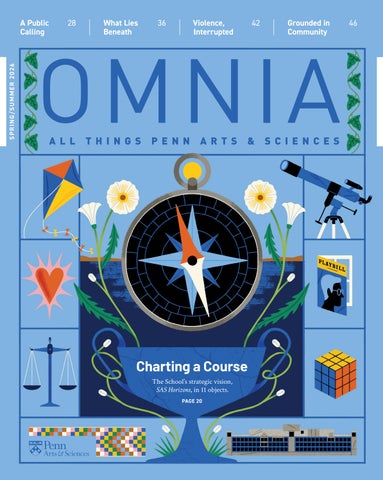
Charting a Course The School’s strategic vision, SAS Horizons, in 11 objects. PAGE 20
42
Grounded in Community
46
OMNIA | ALL THINGS PENN ARTS & SCIENCES
FEATURES
28 A Public Calling Four alums who work in local government
20
34
COVER STORY: Charting a Course
The (Nearly) Reverend Doctor Booker
The School’s new strategic vision, SAS Horizons: Pathways for a Changing World, in 11 objects
Vaughn A. Booker on religion and belief
36
42
46
What Lies Beneath
Violence, Interrupted
Grounded in Community
Scholars find an upside to looking down
A bi-coastal approach to fighting crime
The vital partnership Emilio Parrado forged
CONTENTS
SPRING/SUMMER SPRING/SUMMER 2026 2026
Omnia is published by the School of Arts & Sciences Office of Advancement
SECTIONS
EDITORIAL OFFICES School of Arts & Sciences University of Pennsylvania 3600 Market Street, Suite 300 Philadelphia, PA 19104-3284 P: 215-746-1232 F: 215-573-2096 E: omnia-penn@sas.upenn.edu MICHELE W. BERGER Editor EV CRUNDEN Staff Writer KRISTINA LINNEA GARCÍA Senior Staff Writer BLAKE COLE Contributor
4
10
16
SCHOOL NEWS
MOVERS & QUAKERS
OMNIA 101
’26 grads, SAS Commons, and more
A section dedicated to our alums
Three scholars discuss The Odyssey
18
52
57
LUSI KLIMENKO Senior Creative Director DREW NEALIS Senior Graphic Designer AMANDA WAREHIME Graphic Designer LORAINE TERRELL Executive Director of Communications CHANGE OF ADDRESS Alum: Visit MyPenn, the Penn alum community, at mypenn.upenn.edu. Non-alum: Email Development and Alumni Records at record@ben.dev. upenn.edu or call 215-898-8136. The University of Pennsylvania values diversity and seeks talented students, faculty, and staff from diverse backgrounds. The University of Pennsylvania does not discriminate on the basis of race, color, sex, sexual orientation, gender identity, religion, creed, national or ethnic origin, citizenship status, age, disability, veteran status, or any other legally protected class status in the administration of its admissions, financial aid, educational or athletic programs, or other University-administered programs or in its employment practices. Questions or complaints regarding this policy should be directed to the Executive Director of the Office of Equal Opportunity Programs, Sansom Place East, 3600 Chestnut Street, Suite 228, Philadelphia, PA 19104-6106; or 215-898-6993 (Voice) or 215-898-7803 (TDD).
Cover Illustration: MONTSE GALBANY
IN THE CLASSROOM
STUDENT SPOTLIGHT
AMPERSAND
A new path for first-years
Cassettes, climate ed, and more
Where perspectives intersect
58
62
64
FINDINGS
OFFICE ARTIFACTS
LAST LOOK
Notable faculty research and books
Jared Farmer’s keepsakes
A watercolor unseen for a century
A Year of Momentum
O
ver the past 10 months, I have experienced the full academic cycle of the School of Arts & Sciences in a new way, as dean. I have long known the School well, but this year has given me a broader perspective on the scope of our work and what a distinctive community we are.
What stands out most clearly is the sense of momentum across the School, grounded in a position of real strength. It is visible in the accomplishments of our faculty and students, in the vitality of our teaching and research, and in the depth of engagement. This spring, a remarkable range of faculty honors at every career stage affirmed that strength. Those accolades came alongside student achievements that include highly competitive fellowships and Penn’s top undergraduate prizes. At the same time, this has been a year of reflection and definition. Beginning in my first months as dean, I met with colleagues in each of our 28 departments and spoke with students, staff, and alumni across the country and internationally. These conversations asked some fundamental 2
questions: Who are we, at our best? What distinctive role do we play at Penn? And what can a place like Penn Arts & Sciences offer in a moment of rapid change? SAS Horizons: Pathways for a Changing World is our answer. As you will read in this issue, it reflects what we heard across our community: that we are defined by curiosity, discovery, and connection. Our fundamental principles call on us to engage one another and the world with empathy. We recognize that knowledge gains strength when it is shaped by multiple perspectives and grounded in a shared sense of purpose. Taken together, these concepts make up our institutional DNA, and they guide every direction we choose and every initiative we undertake. Grounded in this identity, we have begun to translate these principles into action. This spring, we announced SAS Commons, a new platform for interdisciplinary engagement, with Democracy and Knowledge as its inaugural theme. We have also established the SAS AI Advisory Group to help coordinate and advance our work in this rapidly evolving area.
And in April, our faculty approved a new undergraduate curriculum—an important milestone that reflects years of thoughtful collaboration across the School. Together, these efforts represent the first steps in carrying forward this vision and in building the momentum that will define what comes next. That is what gives me confidence as we look ahead. We are embarking on our journey from a foundation of excellence, guided by a shared understanding of who we are and what we can contribute. At a moment when higher education faces real challenges, that position allows us not only to respond, but to lead. As we close the academic year, I hope you share my pride in what we have achieved and my excitement about what we can do in the future.
Mark Trodden Dean and Thomas S. Gates, Jr. Professor of Physics & Astronomy
Shane Godfrey
OMNIA | ALL THINGS PENN ARTS & SCIENCES
DEAN’S MESSAGE
EDITOR’S NOTE
SPRING/SUMMER 2026
BEHIND THE COVER
Illustrated Clearly
A
t Omnia, we pride ourselves on not only telling engaging stories but presenting them in visually compelling ways. That’s why, as you flip through the Spring/Summer issue, you may notice things look a little different.
For one, we intentionally took a very visual approach to our cover feature, “Charting a Course,” (p. 20) about SAS Horizons: Pathways for a Changing World, using 11 objects to touch on aspects of this strategic vision—what Dean Mark Trodden describes as “a living plan” for the School. Each item is both part of the larger story and can stand alone, offering nearly a dozen spots to jump in and learn about Horizons. Similarly, “What Lies Beneath” (p. 36) beautifully conveys the discoveries Penn Arts & Sciences faculty are making as they look under and within, moving from just below the soil’s surface to deep in the ocean’s waters. We chose to go big (literally) in celebrating this year’s Penn Arts & Sciences graduates, sharing their excitement with a full-spread photo (pp. 4–5). And we took a comparable approach with our Insomnia content: In
Office Artifacts on pp. 62–63, for example, we highlight eight items History Department Chair Jared Farmer holds dear, personally and professionally, and our Last Look, spanning pages 64 and 65, showcases a watercolor hidden away for a century, exhibited now for the first time in the United States. Finally, we heard your requests for more visible alum content, and in that vein, we’ve moved our Movers & Quakers section to the front of the magazine. It still includes a short profile (p. 12), Penn at Work (p. 14), and Quaker Quotes (p. 10), along with photos from eight events this winter and spring. Plus, don’t miss our reconceptualized Findings section (starting on p. 58), which includes more faculty books and research than ever. Happy summer!
Michele W. Berger, Editor
Our cover feature this issue is all about the School’s new strategic vision, SAS Horizons, a story we opted to tell using objects. We asked our illustrator, Montse Galbany, to explain her creative process. “I wanted to immerse the reader in the universe of the strategic plan,” she says, “by creating a symmetrical and balanced composition in which each element has its place, yet all of them work together to form a whole.” –Lusi Klimenko, Senior Creative Director
Brooke Sietinsons
The pages of the Spring/Summer Omnia laid out before going to the printer. This issue we intentionally took a very visual approach. 3
SCHOOL NEWS
OMNIA | ALL THINGS PENN ARTS & SCIENCES
This year the School of Arts & Sciences conferred more than 2,500 degrees at three separate ceremonies. Emily Wilson, College for Women Class of 1963 Term Professor in the Humanities, and Cam Grey, Professor of Classical Studies, offered keynotes at the events for the Graduate Division and the College of Liberal & Professional Studies, respectively. On Franklin Field on May 17, the College of Arts & Sciences Class of 2026 (above) heard from Nancy Cordes, C’95, Chief White House Correspondent for CBS News, and student speaker Noah Milad, C’26. 4
SPRING/SUMMER 2026
SCHOOL NEWS
Lisa J. Godfrey
5
SCHOOL NEWS
SAS Commons Kicks Off This Summer In April, Penn Arts & Sciences announced SAS Commons, a new academic initiative that brings together students, faculty, and the public to examine complex and consequential topics across the full range of arts and sciences disciplines. Launching this summer, it will organize around a single, timely theme that rotates every two years, with the first theme—Democracy and Knowledge—led by inaugural director Sophia Rosenfeld, Walter H. Annenberg Professor of History. Through courses, symposia, workshops, and related initiatives, SAS Commons will create opportunities for sustained exchange across fields, fostering engagement with big questions. “Historically, the ‘commons’ is a space where people gather, a shared resource,” says Mark Trodden, Dean of the School of Arts & Sciences and Thomas S. Gates, Jr. Professor of Physics & Astronomy. “SAS Commons draws on that tradition while creating new opportunities for scholars, students, and the community to examine important questions together.” The initiative advances the goals of SAS Horizons, the School’s recently announced strategic vision, by creating new ways to share scholarly work and connect it to broader public conversation. As the nation approaches America 250, the inaugural theme of Democracy and Knowledge arrives at a timely moment, inviting reflection on the relationship between democratic life and the production of knowledge and educated citizens. –BLAKE COLE
New Curriculum for Class of 2031 and Beyond After two years of dialogue, review, and consensus building, faculty approved a new undergraduate curriculum for the College of Arts & Sciences in mid-April. The framework, which will start with the Class of 2031, comprises three parts. First, a new seminar-based program called Foundations will begin early in a student’s time at Penn. It will include courses called Kite and Key—on p. 18, read about the cohort that piloted the program this year—as well as an updated firstyear seminar and a writing seminar. Second, students will have more options to fulfill their general education requirements, taking any 12 courses in one division, 5 in a second, and 3 in the third, and will fulfill revamped language requirements along with a course in a new category called “Perspectives & Difference.” Finally, they will have a wider scope for electives, accounting for courses College students want to take that don’t fit into the framework’s other sections.
OMNIA | ALL THINGS PENN ARTS & SCIENCES
AI & Data Collaborative Launches This spring, the School of Arts & Sciences launched the AI & Data Collaborative, articulating its vision for integrating the use and study of artificial intelligence into research, teaching, and engagement. A new SAS AI Advisory Group made up of three faculty will lead the effort: Bhuvnesh Jain, Walter H. and Leonore C. Annenberg Professor in the Natural Sciences, Co-Director of the Data Driven Discovery Initiative, and Co-Chair of the University’s AI Council; Whitney Trettien, Associate Professor of English and Faculty Director of the Price Lab for Digital Humanities; and John Lapinski, Robert A. Fox Leadership Professor of Political Science, Faculty Director of the Robert A. Fox Leadership Program and Fels Institute of Government, and Director of the Penn Program on Opinion Research and Election Studies. SAS Horizons, released in February, solidified AI and data science as priority areas for the School. “These are fundamentally reshaping the parameters of culture and knowledge and are vital for both research and teaching,” says Mark Trodden, Dean of Penn Arts & Sciences and Thomas S. Gates, Jr. Professor of Physics & Astronomy. “Thanks to the strong foundation established by the Data Driven Discovery Initiative, the School is already at the forefront of this work. The new AI initiative, led by this fantastic team, will increase exposure for students and create new avenues of expertise.” –MICHELE W. BERGER
Peter Struck, Stephen A. Levin Family Dean of the College and Vartan Gregorian Professor of the Humanities, says he’s excited at the opportunities this will afford undergrads and the footing it will place the College on for the future. “We are in a challenging environment. We need to build public trust. This curriculum helps because it’s understandable and it’s legible,” Struck says. “We need to be ready to adapt our teaching to an AI-infused world, and this improves our ability to do that. And we need to address the patterns that funnel many of our students to just a handful of majors by engaging them—early and systematically—with the many ways of knowing embodied in our amazing College. We are really excited about the future.” –MICHELE W. BERGER 6
Learn more about these and other initiatives from the SAS Horizons: Pathways for a Changing World strategic vision.
SCHOOL NEWS
SPRING/SUMMER 2026 Alex Schein
The 2026 Stephen A. Levin Family Dean’s Forum saw Brendan O’Leary (left), Lauder Professor of Political Science, in conversation with Tom Nichols, Atlantic magazine staff writer and author of several books, including The Death of Expertise and Our Own Worst Enemy. The discussion touched on a wide range of subjects, from higher education to pop culture to the Constitution.
New CASI Director Named
A New Horizons Breakthrough Prize
Gareth Nellis, who joined Penn as Associate Professor of Political Science in January 2026, will become the new director of the Center for the Advanced Study of India (CASI), effective July 1. In that director position, he will also hold the Madan Lal Sobti Chair for the Study of Contemporary India.
Assistant Professor of Physics & Astronomy Mathew Madhavacheril is among a small cohort who received the New Horizons in Physics Prize, an early-career award funded by the Breakthrough Prize Foundation. The recognition, one of the highest in science, comes in honor of his work around advances in cosmic microwave background (CMB) and supernovae cosmology and includes a $100,000 prize.
Most recently, Nellis was an associate professor of political science at the University of California, San Diego. He specializes in comparative politics, South Asia, and intergroup relations, examining how democratic institutions accommodate social diversity and internal mobility. “We’re delighted to see Gareth take the helm of CASI, the first research institution of its kind in the United States and now in its fourth decade,” says Mark Trodden, Dean of Penn Arts & Sciences and Thomas S. Gates, Jr. Professor of Physics & Astronomy. “Gareth’s depth and breadth of experience in this area of scholarship will continue the Center’s crucial research on the politics, economy, and culture of modern India.”
Given annually, New Horizons recognizes exceptional achievements from junior researchers in physics. Madhavacheril’s work seeks to understand how the universe began, as well as its evolution over billions of years. His research probes questions around the nature of dark matter and dark energy, mysterious forces that respectively make up the bulk of the universe and seem to contribute to its expansion. As part of that work, Madhavacheril, who is a member of Penn’s Center for Particle Cosmology, was involved with the Atacama Cosmology Telescope project based in northern Chile, which focused on studying CMB, leftover radiation from when the universe was in its earliest stages. He now works with the Simons Observatory, a new telescope project in the same area co-directed by Mark Devlin, Reese W. Flower Professor of Astronomy and Astrophysics. “This is a tremendous honor and a testament to the extraordinary work Mathew has produced so early in his career,” says Marisa Kozlowski, Associate Dean for the Natural Sciences and Ponzy Lu Endowed Professor of Chemistry. “We look forward to seeing where his research takes him in the years ahead.” –EV CRUNDEN 7
Centering Indigenous Perspectives In consultation with eight Indigenous curators, Megan Kassabaum, Associate Professor of Anthropology, and Lucy Fowler Williams of the Penn Museum co-curated a new Native North America Gallery at the Penn Museum. With artifacts dating back more than 11,000 years, the gallery celebrates the political, religious, linguistic, and artistic self-determination of Native people across the country, all deeply informed by experts, says Kassabaum, who is also the Museum’s Weingarten Associate Curator. “We worked with our consulting curators on absolutely every aspect of this gallery.” Unveiled this past November, the 2,000-square-foot multisensory gallery includes more than 250 archaeological, historic, and contemporary items. With the United States celebrating its 250th year, Christopher Woods, Avalon Professor in the Humanities and Penn Museum Director, says the gallery amplifies “the importance of Indigenous values and communities that we know inhabited this land long before the nation was founded.” It can do so largely thanks to perspectives from experts associated with tribes
Indigenous experts associated with a range of tribal groups consulted on “absolutely every aspect” of the Native North America Gallery at the Penn Museum, which opened this past November.
including Pueblo, Muscogee, Cherokee, Alutiiq, Lingít, and Delaware groups. Among those is Joseph Aguilar, Gr’19, who earned his PhD from the Department of Anthropology and is today an archaeologist and San Ildefonso Pueblo Tribal Historic Preservation Board Member.
He says a critical part of the gallery is the empty case at its entrance, “a deliberate intervention—not an act of censorship [that] serves as a thoughtful prompt for visitors to reflect on the fraught relationship between museums and Indigenous communities.” –EV CRUNDEN
cause ALS, revealing disease mechanisms and therapeutic targets.”
“This prize underscores the importance of discovery-driven research and international collaboration,” the honorees noted in an announcement. “We hope our findings will open up new possibilities for understanding the causes of ALS. Inspired by this recognition, we will redouble our efforts to uncover the mechanisms of this devastating disease and to develop new strategies for effective therapies.”
Innovating to Treat ALS Nancy Bonini, Florence R.C. Murray Professor of Biology, and colleagues from Stanford University, the National Institute on Aging (NIA), VIB-UAntwerp Center for Molecular Neurology, and the Mayo Clinic, received the seventh annual Sean M. Healey International Prize for Innovation in ALS. The honor, given by The Sean M. Healey & AMG Center for ALS at Mass General Brigham, recognized the team’s discovery that “nucleotide-repeat expansions can 8
Specifically, Bonini and Aaron Gitler of Stanford discovered that repeat expansions in a gene called ataxin-2 can cause ALS, commonly known as Lou Gehrig’s disease. Their colleagues—Rosa Rademakers of Mayo and the NIA’s Bryan Traynor— independently identified the most common genetic cause of ALS and frontotemporal dementia as the hexanucleotide repeat expansion in a gene called C9ORF72.
Eric Sucar, University Communications
OMNIA | ALL THINGS PENN ARTS & SCIENCES
SCHOOL NEWS
SCHOOL NEWS
SPRING/SUMMER 2026
And the Honor Goes To… Penn Arts & Sciences and the University annually recognize faculty, lecturers, and graduate students for their exemplary teaching. This year, 21 people from 12 departments and programs received awards. At the University level:
Christian R. and Mary F. Lindback Award for Distinguished Teaching Kim Bowes, BFC Presidential Professor of Classical Studies Marsha Lester, Christopher H. Browne Distinguished Professor of Chemistry
Provost’s Award for Distinguished PhD Teaching and Mentoring Ivan Dmochowski, Alan MacDiarmid Term Professor of Chemistry
From Penn Arts & Sciences:
Ira H. Abrams Memorial Award for Distinguished Teaching Kim Bowes, BFC Presidential Professor of Classical Studies Joshua Klein, Edmund J. and Louise W. Kahn Endowed Term Professor of Physics and Astronomy
Dennis M. DeTurck Award for Innovation in Teaching Kevin M.F. Platt, Professor of Russian and East European Studies
Paul Sniegowski Award for Mentorship of Undergraduate Research Marc Meredith, Professor of Political Science
Dean’s Award for Distinguished Teaching by an Assistant Professor D. Brian Kim, Assistant Professor of Russian and East European Studies
Dean’s Award for Distinguished Teaching by Affiliated Faculty
Liberal & Professional Studies Award for Distinguished Teaching in Professional Graduate Programs Claire Robertson-Kraft, Faculty Co-Director, Executive MPA, Fels Institute of Government
Dean’s Award for Distinguished Teaching by Graduate Students
Valeriya Kamenova, Lecturer, International Relations
Andrew Burke, Music
Jane Dmochowski, Senior Lecturer, Earth & Environmental Science
Idil Çakmur, Philosophy Peter E. Diamond, English
Liberal & Professional Studies Award for Distinguished Teaching in Undergraduate and Post-Baccalaureate Programs
Saul Hilsenrath, Mathematics
Simon Tong, Senior Lecturer and Advisor, Organic Chemistry
Luca Garzino Demo, Philosophy Thomas Pattiz, Political Science Alvaro Pintado, Mathematics Gabrielle Roehr, Classical Studies Kyilah Terry, Political Science Ezekiel Vergara, Philosophy
MOVERS & QUAKERS
OMNIA | ALL THINGS PENN ARTS & SCIENCES
Inspired by Jane Fonda’s workout videos, aerobic dance exercise classes, offered by students in community rooms in the High Rises. They cost $1 or $2 each and had us jumping around to classics like “Eye of the Tiger” dressed in legwarmers and Flash Dancestyle sweatshirts. –SUZANNE BRING, C’87
What Was the Most Distinctive Trend When You Were on Campus? We asked, you answered. Alums share their memories, thoughts, and ideas with Omnia. PHOTOS COURTESY OF
UNIVERSITY ARCHIVES & THE DAILY PENNSYLVANIAN
10
Taping worn loafer soles to the rest of the shoe with athletic tape rather than get the shoe resoled. –JOSEPH DAMICO, C’67
MOVERS & QUAKERS
SPRING/SUMMER 2026
Long hair and scruffy beards. –JEFFREY BERG, C’71
Lyft launched in Philly in the winter of 2014–2015, and offered free rides for the first few weeks. It was an exceptionally snowy winter, and I remember how exclusive it felt to have a car pick you up and take you to class!
Streaking. It was happening everywhere. My parents mailed me a note saying they recognized my rear end in the group photo in The Daily Pennsylvanian.
The Rachel Haircut! So many of us in the Class of 1996 had that infamous, layered bob-ish hairstyle like Jennifer Aniston wore on the earlier seasons of Friends. –AMANDA GROSS-SIMON, C’96
–JIM TORNEY, C’77
–SUZETTE WANNINKHOF, C’16
Trends in the early ’80s ranged, but the birth of the cyber revolution was the most momentous. In my sophomore Intro to CSE class, we did our homework longhand, then reserved terminal time on the mainframe to test our programming. By my senior year, some of us had graduated to first-generation personal computers. When I typed my final thesis on a brand new Macintosh II, I sensed big changes impending.
The early days of Le Bus, when it really was a bus. It was parked on 34th St., easily accessed from Hill House. A real treat on Sunday mornings—those muffins! The early days, too, of the Magic Carpet parked at 36th and Spruce right at the foot of Williams. The perfect lunch for a French TA in 1986. –CYNTHIA GOLDFINE KAISER,
Weekends (and sometimes weekdays) at Smokey Joe’s, followed by cheesesteaks at Billy Bob’s. The occasional fine beverage at LT’s on Locust Walk. Late nights in Steinberg-Dietrich Hall. Working out at Hutch gym with the “smaller” football players. Watching the frenzy of classmates with Wall Street ambitions.
C’85, GR’87
–NADIR RAHMAN, C’90
The Magic Carpet Food Truck!
#magicmeatballsforever –VANESSA YEARICK, C’03
–DAN PASSAMANECK, C’86
11
SHORT POEMS, BIG FEELINGS A passion for poetry brought Robin Palley, C’72, to the Nick Virgilio Haiku Association. Today she runs the organization, which aims to use these short bursts of self-expression to inspire the young people of Camden. BY MICHELE W. BERGER 12
Brooke Sietinsons
OMNIA | ALL THINGS PENN ARTS & SCIENCES
MOVERS & QUAKERS
MOVERS & QUAKERS
SPRING/SUMMER 2026
H
aiku may not seem like an obvious way to work through childhood trauma, but Robin Palley, C’72, has seen it succeed. “In this short form,” says Palley, president of the Nick Virgilio Haiku Association (NVHA) & Writers House in Camden, New Jersey, “kids who are intimidated by big writing or who want to play with the visual photography of words are using it to see beauty in the everyday.” This isn’t the 5-7-5 haiku of your elementary school days, though, Palley says. It’s American haiku, which typically includes 14 syllables or less, split over three lines, expressing a moment keenly observed or felt. Alongside traditional haiku, which centers around themes of nature, American haiku— and student work in particular—veers more toward senryū, a form of poetry that focuses on human nature. One of the movement’s founders, Nick Virgilio, was a Camden poet, and the NVHA has been based in his hometown since the late 1980s. Palley—whose zigzagging career has seen her running a Paris art gallery, reporting for Philadelphia magazine, digitizing healthcare content, founding WebMD’s consumer portal, working for Big Brothers Big Sisters of America, and overseeing a team that found people with rare diseases on behalf of pharmaceutical companies—joined the organization in 2001. At the beginning, it was just an outlet for her poetry. “Haiku is like an exercise
in mindfulness, like having a digital audio recorder in my head,” she says. “I walk around observing my world and writing it down.” She recalls one she penned during that early time, jotted down on a random walk to work. Rittenhouse Square even the squirrels wear rich fur coats She finds the practice cathartic, something she shares with Virgilio, who used the poetry to get over his brother’s death. “We tend to walk around lost in the thoughts in our head. Haiku forces you to settle your thoughts and be present,” Palley says. “It’s the opposite of doom-scrolling. It’s looking at what you’re seeing and feeling it, experiencing it, capturing it, savoring it again later.” That’s why she and her NVHA colleagues feel strongly about the potential for haiku to inspire young people in Camden, historically among the poorest cities in the United States and with high rates of poverty. In the past few years, the organization has launched a pilot program in local schools to employ haiku to help students heal from trauma. The Writers House opened in 2018, and soon after began offering a regular late-night hang out for teens and twenty-somethings to mingle and write poetry based on a prompt. There are ginkgo walks in the Japanese tradition of walking in nature to inspire poetry, and a poetry contest,
Each year, students in grades 7 to 12 compete in the Nick Virgilio Haiku Association global scholarship contest. Robin Palley, C’72, shares a few memorable winners:
open to the public, that garners a hundred entries each week. Palley understands how powerful it can be for young people to have the time and space to express themselves in this way. She has loved poetry for as long as she can remember, a passion she fostered during her time at Penn, through writing she did on her own and through her coursework and professors. She even incorporated poetry into her major and her thesis, “Revolution in the Arts: A study of key changes in literature, art, and music across England, France, Russia, and Germany from 1880 to 1914.” “Long story short, the world was falling apart in the ’60s and I wanted to look at the last time the world fell apart,” says Palley, who comes from a “family tree filled with Penn grads,” including her parents, who met there as undergrads. “It was a very interdisciplinary education. It prepared me well for a career that’s very much been defined by my taking two seemingly unrelated subjects and sticking them together— which is what I’m doing with the poetry organization.” Until recently, she juggled this work alongside her full-time job, and she hadn’t intended to start a new career when she retired from her old one in early 2024. But she says she’ll continue doing it for as long as the students want the outlet for self-expression—even those who have just a few words to do it.
Dad home without the tumor
spring fever back To the chemo ward
divorce papers his signature in black sharpie
- BEN MILLER
- VLAD-SERGIU CIOBÎC
- TALIA GHOSE
13
OMNIA | ALL THINGS PENN ARTS & SCIENCES
MOVERS & QUAKERS
Penn Arts & Sciences at Work Penn Arts & Sciences at Work is a series that highlights College alums in their workplaces as they reflect on how and why their careers took shape. To see more, visit www.sas.upenn.edu/at-work
SANLIE AUYEUNG, C’15 Brooke Sietinsons
Principal Product Manager – Technical, Amazon LOS ANGELES, CA PHILOSOPHY, POLITICS, & ECONOMICS MAJOR CONSUMER PSYCHOLOGY MINOR
A
s a Principal Product Manager at Amazon, I lead new reorder programs and GenAI initiatives for the replenishment business of Amazon Stores. My team’s mission is to make shopping for everyday essentials convenient and affordable. In my role, I partner with engineers, designers, and teams across Amazon to deliver innovative customer experiences that drive loyalty and growth while helping customers save money.
I joined Amazon right after undergrad and even though I’ve been at one company since graduating, it feels like I’ve had multiple career changes, an MBA, and an MS all at once. I’ve been fortunate to have senior leaders who mentored me and guided me to opportunities and new challenges, often before I fully knew how to advocate for myself. One formative moment that stands out from my early career was being asked to write a business proposal that went directly to the CEO of Amazon Stores, which ended 14
up getting funded and launched. Years later, that proposal is now a billion-dollar business. I remain so proud that I rose to that challenge. Being given meaningful ownership early and consistently over time is a core reason I’ve continued to grow my career at Amazon. At Penn, I majored in philosophy, politics, & economics (PPE), and minored in consumer psychology. I went into Penn without a clear major or career path in mind, so I chose PPE to pursue as many of my curiosities as possible. That ended up being highly applicable to my career. It trained me to reason across disciplines, identify patterns, and connect dots between different concepts—skills I rely on daily. As a product manager, this has helped me bridge technology, business, and user experience and working cross-functionally has become second nature. Because much of my work also involves influencing large organizations and bringing clarity to ambiguity, the communication and writing skills
I developed at Penn, especially in my philosophy classes, remain critical. My advice to Penn students is to expose yourself to as many academic, professional, and life experiences as possible. Knowing what you don’t want is just as helpful as knowing what you do want, and I learned a ton through trial and error. Progress is rarely linear, and experimentation paired with reflection has been essential to my growth. Some of the most meaningful progress in my career has come from deliberately walking away from roles that looked good on paper but didn’t align with how I wanted to think or operate. My other piece of advice is to stay agile and learn continuously. Your future career may not exist yet. If it does, it will likely look very different in 5 or 10 years, which we’re already seeing with GenAI. Staying curious and keeping the student mentality long after Penn will only serve you well. –AS TOLD TO BEA HARLEY
SPRING/SUMMER 2026
Across the country, Penn Arts & Sciences alums gathered for film screenings, knitting lectures, conversations with students, and more.
Ben Talks Miami:
Art, Artifacts, & Society
with Jonathan Katz, Associate Professor of Practice, History of Art; Joshua Teplitsky, Joseph Meyerhoff Associate Professor of Modern Jewish History; and Emily Wilson, College for Women Class of 1963 Term Professor in the Humanities
Ev Crunden, Kyla Goodman, Ayana Hall, Brooke Sietinsons, Loraine Terrell
Meeting, Mentoring, Mingling
MOVERS & QUAKERS
Ben Talks NYC:
Art, Artifacts, & Society
with Zachary Lesser, Edward W. Kane Professor of English; Rahul Mukherjee, Dick Wolf Associate Professor of Television and New Media Studies; and Emily Wilson, College for Women Class of 1963 Term Professor in the Humanities
Science Café:
How Critical Minerals Are Driving the Future of Energy
with Eric Schelter, HirschmannMakineni Professor of Chemistry, and Karen Goldberg, Vagelos Professor in Energy Research
From Script to Screen with Hank Steinberg, C’91
Science Café:
Even a Physicist Can Learn to Knit
with Randall Kamien, Vicki and William Abrams Professor in the Natural Sciences
CAMS: Careers in Entrepreneurship
with Lance Stier, C’04, CEO, NC Custom, and Jennie Ripps, C’03, CEO and Founder, Owl’s Brew Tea
CAMS: Coffee Break
with Whitney Cummings, C’03
AI + Us
with Konrad Kording, Penn Integrates Knowledge Professor, and Bhuvnesh Jain, Walter H. and Leonore C. Annenberg Professor in the Natural Sciences 15
OMNIA | ALL THINGS PENN ARTS & SCIENCES
OMNIA 101
In July, a new adaptation of the famous poem hits the big screen. Three faculty discuss the enduring significance of Homer’s epic. BY BLAKE COLE
L
ike its protagonist, The Odyssey has made a heroic journey through history, influencing untold creatives and providing scholars with boundless material for dissecting and teaching. Composed in the 8th or 7th century BCE, the work is one of two ancient Greek epic poems attributed to
16
Homer. It details the journey of Odysseus, the legendary king of Ithaca, as he ventures back to his home following the Trojan War; its companion poem and predecessor, The Iliad, delves into the story of that war’s final year. To discuss the work’s enduring significance, we turned to three Penn
faculty who teach Homer in their classes: Emily Wilson, College for Women Class of 1963 Term Professor in the Humanities and acclaimed Odyssey and Iliad translator; Scott Francis, Associate Professor of French and Francophone, Italian, and Germanic Studies; and Sheila (Bridget) Murnaghan, Alfred Reginald Allen Memorial Professor of Greek.
Vanessa Lovegrove
THE ODYSSEY
OMNIA 101
SPRING/SUMMER 2026
What was your first exposure to The Odyssey? Murnaghan: I read it in high school, and what I mostly remember is getting bogged down in the second half, the extended account of how Odysseus infiltrates his household in disguise in order to reclaim it. This is ironic because, many years later, that part is what I ended up writing my dissertation about and that then became the basis for my first book. Francis: In ninth grade, we read the four books with all the famous monster encounters. My last two years as an undergrad, I got into classics more and did a lot of Virgil, including on my own, so I was experiencing Homer through one of his most important imitators. And then, in a core course my senior year of undergrad, we read The Iliad. Wilson: My first exposure, not directly to Homer, but to the story of The Odyssey, was when I was eight. My teachers didn’t want to do yet another nativity play, so they did The Odyssey and I got to play the goddess Athena. The performance made me realize that these stories—the “wandering books,” in particular—resonate with the ways that, as a child, you can feel powerful forces that you don’t fully understand. Why is The Odyssey significant to Western literature? Murnaghan: There is a definite historical lineage that goes from The Odyssey through what’s traditionally described as Western literature, but the work really gives you opportunities for a critical and anti-elitist vision of the Western literary tradition. This is partly played out in the idea of Odysseus being an aristocrat at the top of the social heap but also someone who takes on the identity of a poor beggar. Look at Ralph Ellison turning him into an “invisible man,” or what Joyce does by making him an extremely ordinary and somewhat marginal Dubliner. Odysseus has all the virtues of the heroes of The Iliad, but also
combines them with cleverness, guile, and trickery. Can you discuss the related classes you’re currently teaching? Murnaghan: My course is called The Odyssey and Its Afterlife, which explores works influenced by The Odyssey and its legacy. We look at classical receptions like the Aeneid, and post-classical works by Dante, Tennyson, Joyce, then also Derek Walcott, who has a staged version of The Odyssey, and chapters of Invisible Man. Each student must then find and report on a work that responds to The Odyssey. There’s an impressive range to what they find—there are rock operas and graphic novels—and I really encourage them to see the flexibility and multiple uses of The Odyssey.
I don’t think there’s just one way to reinvent The Odyssey; that’s part of why it’s been interesting to so many people for so long. In the end, if a new movie gets people curious about the ancient world, it’s a win. Francis: The first-year seminar I’m teaching is called The Fantastic Voyage from Homer to Science Fiction. The influence of Homer is so inescapable that you find it in places you sometimes wouldn’t expect. In the French novel La Planète des Singes, by Pierre Boulle (which was made into the famous movie Planet of the Apes), the main character is named Ulysse Mérou, Ulysse being the Latinized version of Odysseus and Mérou being Homère, the French name for Homer, kind of pronounced backwards. It’s Boulle’s very explicit nod to Homer. Wilson: I’m teaching a class on Greek and Roman Mythology, which includes a sequence on The Odyssey. We spend time talking about the echoes between
the more obviously “mythical” sequences—the “wandering books” in which Odysseus and his men encounter anthropophagic giants and various helpful and/or terrifying goddesses— and the poem’s more naturalistic second half. It’s fun to teach my own translation and talk to students about translation choices. Those translations have received wide acclaim. How did you approach them? Wilson: Most of the available contemporary English translations of The Odyssey were in free verse or prose— they didn’t have a regular meter. Also, many translations are much longer and often less fun to read than the original. Two of my priorities were to echo the original’s quick, fresh, thrilling pace, and to use traditional poetic meter. I hope listeners of the audiobook, or readers who read out loud, can tap into something like the oral experience of Homer in Antiquity. This summer will see the release of a big budget version of The Odyssey. What do you think? Francis: I’m excited. The only American Homeric adaptation that I deeply appreciated was Troy, and that’s more The Iliad. It takes a lot of liberties with the source material but also gets a lot right in terms of themes. Murnaghan: There are already a number of inventive film adaptations, including Godard’s Contempt and the Coen brothers’ O Brother, Where Art Thou? So, there is something of an interesting film history surrounding the work, which this film will contribute to. Wilson: I don’t think there’s just one way to reinvent The Odyssey; that’s part of why it’s been interesting to so many people for so long. In the end, if a new movie gets people curious about the ancient world, it’s a win. Blake Cole is Penn Arts & Sciences Director of Advancement Communications. 17
FIRST YEAR, REIMAGINED A new curriculum from the College of Arts & Sciences simplifies requirements and encourages students to explore across the liberal arts. BY LAUREN REBECCA THACKER
W
hen Lyba Sultan, C’29, was a senior in high school looking ahead to starting at Penn, she got an email about a new first-year curriculum offering called College Foundations. Sultan thought it sounded like a great way to fulfill requirements and to clear her schedule for more STEM courses in the future.
A year later, Sultan’s still passionate about the sciences—but something has shifted. “Taking the Kite and Key courses changed my perspective,” she says. After visits to art galleries and in-depth discussions with classmates that she calls “eye-opening,” Sultan is thinking about her classes not as a way to check a box on a list of requirements, but instead as a way to explore new interests. This kind of shift is part of what faculty envisioned when they designed the Foundations program, says Andi Johnson, Director of the First-Year Experience. “Faculty wondered 18
whether the College could construct requirements so students would have more time to explore areas they might be curious about,” she says. They landed on a four-course program that encourages students to explore the breadth and depth of the liberal arts. That includes the “Kite” course, focused on humanities and qualitative social sciences and the “Key” course, focused on quantitative social sciences and natural sciences. Both meet three times a week, including a small-group lab guided by advanced undergraduates. There’s also a writing seminar and a first-year seminar, the latter of which now includes a program aimed at training faculty and students to effectively facilitate difficult conversations. In the coming years, the number of first-year seminars will expand, and all students will take one—reinvigorating the focus on meaningful dialogue and building a shared community of inquiry.
Brooke Sietinsons
OMNIA | ALL THINGS PENN ARTS & SCIENCES
IN THE CLASSROOM
Kevin M. F. Platt, Professor of Russian and East European Studies, and Masao Sako, Arifa Hasan Ahmad and Nada Al Shoaibi Presidential Professor of Physics & Astronomy, are part of this year’s pilot, which enrolled 120 students. Next year, the program size will triple before expanding to all College first-years in the 2027–2028 academic year.
Brooke Sietinsons
SPRING/SUMMER 2026
IN THE CLASSROOM
So far, the experience has been enlightening and energizing, says Platt, who uses literary and philosophical texts, films, and museum visits in the Kite class to cover subjects ranging from how different societies define freedom to the complex, varied relationships between power, knowledge, and art.
I hope students will come away with a spirit of intellectual curiosity and adventure, with a greater sense of confidence in themselves and their choices, and a deep appreciation for community. “I’m deeply invested in doing something that can invigorate the intellectual community, that can help students navigate the possibilities that face them and give them the idea that university is a smorgasbord of opportunities to learn,” Platt says. “Exciting intellectual challenges await them.” Sako, who teaches Key, is quick to point out he doesn’t see the course as something like Intro to STEM, but as an extended exercise in quantitative thinking. “It’s a class on critical thinking,” he says. “It’s a little bit of probability and statistics, a little bit of data analysis, even some coding. We put them together to make sense of the world.” Because Kite and Key are meant to cover a vast range of topics, Platt and Sako—and all faculty involved—are teaching mostly outside of their own specializations. As the program grows, a criminologist or
The new curriculum includes a four-course program that encourages students to explore the breadth and the depth of the liberal arts: a first-year seminar, a writing seminar, the “Kite” course (at left), focused on humanities and qualitative social sciences, and the “Key” course (seen here), focused on quantitative social sciences and natural sciences.
political scientist might teach Key, while a literary scholar or art historian might teach Kite. Just two semesters into the new curriculum, it’s clear that students are responding and that the professors are meeting the educational moment head on. Platt and other Kite faculty, for example, are tweaking the balance of reading with other assignments, while Sako has found that students can better grasp ideas of probability and analysis when he makes the situation tangible. As an example, he brings up a dice game called Pig. Players take turns rolling with the goal of reaching 100. “At first, students think it’s completely random. But as they play, they realize there are strategies to maximize your chance of winning,” Sako explains. “I told them we could write a computer code to test their strategy. So we wrote a program together and tested different algorithms.” This type of exercise, he adds, helps students see that with the right tools, much in the world can be predictable. Eliav Zendehdel, C’29, had Platt’s course his first semester—an experience that
helped him narrow his focus after coming to Penn with a range of interests. “In Kite, every week we got a taste of different topics like philosophy, art, or anthropology,” Zendehdel says, adding that he now plans to major in philosophy, politics, & economics. He also appreciates how the class encouraged discussion and connection with his peers. “Not knowing anyone, it was really great to have a class where we went through the stuff together, where we got to learn what we thought about things. The class really allowed communitybuilding,” Zendehdel says. Platt and Sako count themselves among that community, saying they enjoy the challenge of designing completely new courses and the connection with students and fellow faculty members. “I hope students will come away with a spirit of intellectual curiosity and adventure,” Platt says, “with a greater sense of confidence in themselves and their choices, and a deep appreciation for community.” Lauren Rebecca Thacker is a higher-ed writer based in Providence, Rhode Island. 19
OMNIA | ALL THINGS PENN ARTS & SCIENCES
Charting a Course In February, Penn Arts & Sciences released SAS Horizons: Pathways for a Changing World. Through 11 objects, we highlight how this strategic vision will help the School navigate today’s challenging waters. By Michele W. Berger and Ev Crunden Illustrations by Montse Galbany
SPRING/SUMMER 2026
O
ut at sea, it can be difficult to know which direction to sail, especially when familiar waters become unexpectedly choppy. In those moments, even experienced sailors turn to GPS and nautical charts—trusted tools informed by years of insight and evolved from the earliest iterations of the compass and celestial navigation.
Mark Trodden, Dean of the School of Arts & Sciences and Thomas S. Gates, Jr. Professor of Physics & Astronomy, understands the need for navigational signposts in a moment of sweeping change for higher education and society. For eight months, he engaged deeply with faculty, students, staff, and alums about the role of the School, as well as opportunities and challenges of the current landscape. The result, released in February 2026, is SAS Horizons: Pathways for a Changing World, a strategic vision for Penn Arts & Sciences that purposefully defines who we are as a School and our guiding principles, as well as broad priorities and the routes to attain each. Trodden sees it as a jumping off point. “You don’t bring together an enormous community of talented, interesting, creative people and expect you will lay down an exact path for them to follow,” he says. “You articulate what’s great about what they do, capture common themes, and leverage resources to empower them. Where this plan takes us— building on this scaffolding—depends on what our faculty, staff, and students bring to life.” On the following pages, we present 11 objects that highlight the path Horizons charts to help Penn Arts & Sciences navigate today’s challenging waters.
21
01
When a compass works well, its magnetized needle rotates freely, changing course easily, yet holding steady once a direction is chosen. It’s a guide for forward movement. For Penn Arts & Sciences, that’s the intended role of Horizons, Trodden says. “It’s a very important framework. It articulates what we’ve heard from our community about their priorities right now, but it will also be a living plan as people move our work forward and we travel along new paths.” Horizons first defines who we are as Penn’s School of Arts & Sciences: A community that cultivates excellence and empathy and embraces a dynamic and uncertain world, but also one that unlocks brilliance and potential, all while placing our shared humanity at the center of our work to create a better future for all.
02
During the many conversations that Josephine Nock-Hee Park participated in as Horizons took shape, the humanities surfaced often. That was exciting to Park, who is Associate Dean for Arts and Letters and President’s Distinguished Professor of English. “It was really wonderful that it came up over and over—and not just by humanist faculty,” she says. “I felt like there was a School-wide interest in supporting the humanities, in making more of a space for them.” Spurred by such discussions, the future of the humanities became a priority in Horizons. “I was struck by the fact that it’s critical for us to strengthen what we do in the humanities and to better articulate the beauty, wonder, depth, and perhaps to a lesser extent, the utility of the humanities,” Trodden says. Part of this will entail creating a humanities hub, an intellectual gathering space for faculty and research across disciplines,
22
OMNIA | ALL THINGS PENN ARTS & SCIENCES
It also spells out several guiding principles. “Curiosity, that’s our drive,” says Peter Struck, Stephen A. Levin Family Dean of the College of Arts & Sciences and Vartan Gregorian Professor of Humanities. “Discovery is what comes from following our curiosity. Connection is our mode, a way to ensure that knowledge is effective, stands up from multiple perspectives, and enables us to see anew together.” The second half of Horizons—the heart of the plan—offers a trio of broad priorities that aim to affirm the School’s role as Penn’s intellectual core, cultivate very human traits like judgment and inquiry, and educate students for an ever-changing and complex world. Those will unfold via four pathways focused on teaching, research, connecting scholarship to society, and strategic areas like AI and climate.
allowing for deeper connections among humanists as well as with their social and natural sciences colleagues. Park has big ideas for what this looks like (though she promises not to overload already-full calendars). She wants to centralize and build on what exists at the School. This past semester, for example, she organized an event called Humanities Works, during which four humanities faculty gave lightning talks about their scholarship. This work is more important than ever, Park notes. “Humanists know we raise critical thinkers and think with nuance, but it seems like we haven’t done such a good job explaining that to society,” she says. “It’s our job to think about the human condition—human expression, human change, human practice, human systems of thought—and this is a moment when we need to rethink our collective condition.”
SPRING/SUMMER 2026
As a theoretical physicist, Trodden understands how to approach a challenge scientifically, and during conversations with colleagues and students in the lead-up to Horizons, he heard unique and exciting ideas for tackling the climate crisis, what he has previously described as a “massive, generational issue.” Through those same dialogues, it became clear just how broadly everyone across Penn Arts & Sciences is thinking about the climate challenge. “We bring a holistic approach to studying and understanding climate—something few other places can claim,” Trodden says. “We have expertise in fields ranging from climate science to population health and policy. We have many different ways of exploring climate change and
No longer the stuff of science fiction, artificial intelligence is firmly entrenched in what happens day to day at Penn Arts & Sciences. As co-director of Penn’s Data Driven Discovery Initiative (DDDI), Bhuvnesh Jain, Walter H. and Leonore C. Annenberg Professor in the Natural Sciences, has been thinking about AI—and how it connects with scholarship across the School—for years. He welcomed the opportunity to lead the new AI & Data Across SAS Collaborative with John Lapinksi, Robert A. Fox Leadership Professor of Political Science, and Whitney Trettien, Associate Professor of English. Building on the foundation DDDI has built the past five years, the new effort will bring together undergraduates and faculty, graduate students and postdocs to think about questions like how systems encode language, creativity, power, and values, or how individuals and societies shape and respond to emerging technologies.
03
understanding how we might ameliorate it but also in telling the climate story, its impact on people and places, on the economy and policy.”
Within Horizons, a climate-related priority establishes a School-wide framework for research, education, collaboration, and engagement. This will happen by leveraging established work like that being done at the decade-old Vagelos Institute for Energy Science and Technology led by Karen Goldberg, Vagelos Professor of Energy Research. It will also build on newer initiatives like Plant ARC. Run by Doris Wagner, DiMaura Professor of Biology, the Penn Plant Adaptability and Resilience Center is dedicated to addressing climate impacts on plant life and food security.
04
Prioritizing AI and data in Horizons, Trodden says, means coming at them from all angles. “You can’t think about AI without thinking about the ethics of AI,” he says, “and you can’t think about the ethics of AI without engaging with the expertise that comes from the humanities, for example.” This wellrounded approach, which expands the reach of related minors like Data Science & Analytics, aims to expose all undergraduates to these subjects, regardless of major.
“We’re all grappling with AI,” Jain says. “The ‘grappling’ means figuring out how to preserve our educational mission of teaching critical thinking in this age of increasingly pervasive AI. It means providing the best training and exposure to a rapidly evolving technology to faculty, students, and postdocs, and fostering cross-disciplinary interactions and collaborations enabled by AI. It’s a challenge and a tremendous opportunity.” 23
05
As the largest of Penn’s four undergraduate schools, the College of Arts & Sciences teaches thousands of students annually and College Dean Struck has big ideas for how that education will soon look.
College Foundations, one part of a reconceptualized curriculum, is already underway; in a pilot this year, 120 first-year students took courses known as Kite and Key (the former focused on humanities and qualitative social sciences, the latter on quantitative social sciences and natural sciences), along with a writing seminar and first-year seminar aimed at fostering dialogue. (For more about the program, see “First Year, Reimagined” on p. 18.) Next year, Foundations will expand to more than 300 students entering the College, then to all first-years in the 2027–2028 academic year.
06
Conceived in the ’70s to teach architecture students about threedimensional spaces, the Rubik’s cube has come to symbolize problem-solving and logic, that there are many potential ways to answer a single challenge as long as you keep twisting the rows until the colors line up. That’s much like Penn Arts & Sciences’ objective to educate students— from undergrads through lifelong learners—to navigate a complex and ever-changing landscape.
“The world is uncertain. It’s fast-changing. It’s dynamic in perhaps a way it’s never been before,” Trodden says. “The current moment we find ourselves in requires
24
OMNIA | ALL THINGS PENN ARTS & SCIENCES
“This is one way we’re rethinking what’s possible in undergrad education at Penn,” Struck says. “The idea is that from day one, students dig into broad questions about being human and understanding the world, to acculturate them to a community of inquiry and welcome them to join a conversation on the many ways we do that.” It’s part of a larger objective to nurture undergrads through a liberal arts education, according to Trodden. “A liberal arts education should be a way of expressing that we share this world,” he says, “that no matter where we come from, our backgrounds, our political leanings, surely we all want to learn and grow in a way that benefits the world.”
we think strategically but also be ready to take on challenges quickly and with purpose.” This includes a support structure for graduate students to ensure that, regardless of outside funding sources, their progress continues seamlessly and that they receive the tools they need to engage in robust thinking and cross-disciplinary collaborations long after they leave Penn. It also means expanding certificate offerings from the College of Liberal & Professional Studies (LPS), the oldest continuing education program in the Ivy League, in areas like climate, AI, and behavioral sciences.
SPRING/SUMMER 2026
07
SAS Commons is an integral Horizons component, an initiative that will carve out its own space for collaboration and knowledge exchange. On a rotating twoyear basis, the Commons will focus on a single complex and consequential topic, bolstered by events like public lectures and symposia. Sophia Rosenfeld, Walter H. Annenberg Professor of History, is the inaugural director and her focus is Democracy and Knowledge.
Broadly speaking, the intellectual collaboration brought about by SAS Commons will be among faculty and will connect to existing courses to encourage student engagement. Rosenfeld has also proposed creating an internal, interdisciplinary Society of Fellows for Public Knowledge, likely drawn from the School’s pre-existing postdocs; they would hold gatherings to discuss their research and how to interpret and present it for a public audience.
“I’d like to see us make a better case for the enormous contribution that the liberal arts make to American and global life, the way they introduce ideas that aren’t already in circulation,” Rosenfeld says, “the way they foster critical habits of mind and contribute to the kinds of thinking and knowledge production that improve lives—and not just in the practical sense but in this higher sense of creating democratic dispositions.”
All of this work will begin this summer, to coincide with the 250th anniversary of the United States. “How we translate what we do, how we think about what the university has to offer—like SAS Commons and our first theme of Democracy and Knowledge—that understanding is core to thinking about the production of knowledge,” says Park, Associate Dean for Arts and Letters, “and how we might transmit that knowledge for the social good.”
“One wonderful thing about a place like Penn and the School of Arts & Sciences is how much we engage with the world,” Trodden says. And despite mounting hurdles posed by the current moment, Trodden says that shouldn’t change. In fact, Penn Arts & Sciences will lean in, with a new School-wide organizing structure called Global Contexts.
conduct their work in those far-flung spots.
What does this look like? For one, it means rethinking how graduate students might conduct fieldwork, especially in places less accessible than in the past. It also entails highlighting the unifying threads among scholars who teach languages, those who study people and places around the globe, and those who
08
The Penn Development Research Initiative-DevLab@Penn is one example. Run by a team led by Guy Grossman, David M. Knott Professor of Global Politics and International Relations, and Erik Wibbels, Presidential Penn Compact Professor of Political Science, it focuses on areas like migration, environmental and land policies, and big data analytics. “Within the School of Arts & Sciences, we have many people across disciplines working globally and a lot of centers devoted to issues like these,” Trodden says. “We plan to find a way to bring together and showcase all the wonderful global work that we do.”
25
09
For months, an intensive mural project played out, the initiative a collaboration between the Asian American Studies Program (ASAM), the Center for Latin American and Latinx Studies, and local partners the Karen Community Association of Philadelphia and Centro de Cultura Arte Trabajo y Educación. Through “Migrating Lives,” students and community members alike have contributed individual canvases for one large mural, which collectively emphasizes how immigration has shaped Penn and Philadelphia. In the lead up to this project, “we’d been thinking about how our programs at Penn could collaborate, and how we could deepen connections alongside Penn’s community partnerships,” says ASAM co-director Fariha Khan. “We wanted to focus on migration while also celebrating
10
Since the mid-1950s, the corner of 33rd and Walnut Streets has been occupied by the David Rittenhouse Laboratory (DRL), home to Penn’s Math and Physics & Astronomy departments. “The year that DRL was opened saw the first mass inoculation against polio,” noted a 2019 Omnia piece about the building. “Dwight Eisenhower was president, and a gallon of gas cost 26 cents.” In the decades since, thousands of students have passed through DRL’s doors; countless breakthroughs have been thought up in its classrooms and offices. Soon, DRL will get a much-needed facelift and will undergo some new construction, and in the process, fulfill one part of Horizons’ priority to strengthen the School’s research ecosystem. (The other is the new Dean’s Horizons Fund,
26
OMNIA | ALL THINGS PENN ARTS & SCIENCES
the local communities we work with, and Philadelphia more broadly.” The initiative is one of many existing programs that enrich the School’s relationship with its surroundings, like the Crime and Justice Policy Lab, City Lab, and the Master of Applied Criminology and Police Leadership run out of LPS. Other efforts focus inwards: The SAS Community Forum, for example, will create spaces for informed dialogue and exchange, applying ethical and analytical rigor to pressing issues. At its core, Penn Arts & Sciences is a community—evolving internally, even as the School deepens relationships with the broader region. This emphasis, spelled out in Horizons, cements the tie between scholarship and solutions that benefit society, bringing together diverse voices to make meaningful change.
a “flexible resource to advance and accelerate scholarship across the social sciences, humanities, and natural sciences.”) The new 325,000-square-foot Physical Sciences Complex—still several years from breaking ground—will eventually be the largest-volume teaching facility on campus. It will still house Math and Physics & Astronomy, with the Department of Earth & Environmental Science also moving in. “Research like the kind poised to happen in the new complex has the potential to shape lives,” says Trodden. “It will give students, postdoctoral fellows, and faculty the literal and figurative space to conduct groundbreaking science in state-of-the-art labs and classrooms, leading to discoveries that could have real implications for everyday life.”
11
SPRING/SUMMER 2026
Horizons seeks to affirm Penn Arts & Sciences as Penn’s intellectual core, the beating heart of the University and home to fundamental fields of inquiry. Given the School’s breadth and depth, it is well-positioned to shape and advance priorities articulated in the University’s framework In Principle and Practice. “We’re trying to strategically emphasize areas that are important for us now and as we look to the future, and we’ve tried to align with known University priorities when appropriate,” Trodden says. “That’s important. We’re part of the University— we have our unique needs and priorities,
which we’ve articulated—but we all work together.”
It’s all with an eye toward meeting today’s greatest challenges head on, he says. “The School of Arts & Sciences is a truly wondrous place, bringing together the best and brightest, and what’s important now is to try to articulate that to people: ‘We may be facing challenges, but look at what we can do,’” he adds. “When there are challenges, we have a role to play in solving them. It’s important to be upbeat about the future. Our faculty and students are amazing—my optimism comes from them.”
Ev Crunden is a staff writer at Omnia magazine, where Michele W. Berger is editor.
KS L A T N E B ity Near You Coming to a
C
Don’t miss your chance to connect with fellow alums, hear from Dean Mark Trodden, and learn from a range of Penn Arts & Sciences faculty. SEPTEMBER
Washington, DC | Los Angeles | Bay Area
NOVEMBER
London | Geneva
Stay tuned for our 2027 tour stops!
Visit www.sas.upenn.edu/ben-talks for exact dates and additional cities.
OMNIA | ALL THINGS PENN ARTS & SCIENCES
A Public Calling For four Penn Arts & Sciences alums, working in local government has proved a rewarding vocation.
W
By Judy Hill
hen a late-January winter storm threatened two feet of snow across New England, Miles Taylor, C’22, a planner with the Massachusetts Bay Transportation Authority (MBTA), knew he had a busy few days ahead of him. Before the weather had even shifted, he and colleagues were already pondering snow detours for the hundreds of buses that crisscross metropolitan Boston.
Rather than being unusual, this was standard fare for Taylor. The same is true for other Penn Arts & Sciences alums in the public sector who do work that is stressful and demanding—but also meaningful. The everyday decisions these four alums make can affect millions of people and, on a good day, make lives run just a little more smoothly. “I love knowing that my work can impact people daily,” says Richard Cesar, C’10, an advisor and strategist to Los Angeles Mayor Karen Bass. “You can see the fruits of your labor.”
28
SPRING/SUMMER 2026
of M
Melissa Akie Wiley, G’10
She also will tell you she’s proud of, quite literally, the face she brings to her work. “It’s rare for a woman to be in executive leadership with such a visible facial disfigurement,” says Wiley, who was attacked by two pit bulls at age 5. “But a lot of folks in the community have kids with disabilities, and they’re proud to have a leader who also has a disability. I’m proud to be with those kids and to work on accessibility and disability initiatives.”
I was interested in what that fierce love does for a city and for public service. Wiley has been in her current role in Erie— a fast-growing town of 40,000 near Boulder and Denver—since 2021. On a typical day, she might look over a proposed home development project with the planning team or work with the police department on staffing or current cases. She might also grapple with water access issues. Being in Colorado’s high desert, “we spend a fair amount of time talking about water tanks and water infrastructure,” she says. Lately, advancements in artificial intelligence have demanded
her attention, too, as have plans to expand municipal facilities without overburdening taxpayers.
Akie Wiley elissa
Deputy Town Manager Erie, Colorado
Ask Melissa Akie Wiley what accomplishment she’s most proud of as deputy town manager for Erie, Colorado, and she might mention a number of things—like the paid parental leave for town employees, or the recent “top workplace” accolades from The Denver Post.
esy urt Co
Care for Community
Wiley was exposed to the public sector early on; her mother worked for the city of Boulder. “I always thought it was cool that she worked with police officers and firefighters and park rangers,” she says. “I also thought it was neat that wherever we went in Boulder, we knew everyone.” She chose Penn for graduate school, in part because Philadelphia seemed like a complex city where people felt a strong sense of place. “I was interested in what that fierce love does for a city and for public service,” she says. The curriculum was also closely tailored to the actual work of city government, including one class where students had to balance a municipal budget and another—the most impactful for Wiley—about public speaking. That’s because humanizing government, creating a good environment for city workers, and taking care of her community are all high on Wiley’s priority list. To do those, she says, you need to know how to talk to people. “We would be happier as humans if we focused more on our community, libraries, parks, local families that need our help.”
29
OMNIA | ALL THINGS PENN ARTS & SCIENCES
“A lot of what we’re doing is balancing those competing needs and figuring out how much space we need for regular cars, for parking and loading, for transit,” says Simpson, whose department sits within the city’s Office of Transportation. “Do we need a bus lane here or better bus stops? What about the cyclists? And ultimately, how does all this work for pedestrians and vulnerable users?”
Everything we work on makes a tangible impact on day-to-day lives. Simpson’s office focuses on project development early in the process. “We’ll take a street that we’ve gotten complaints about, or that the data show is dangerous,” he explains, “and we’ll sit down with community members,
30
Simpson
In a historic city like Philadelphia, cars, buses, pedestrians, and bicycles all compete for asphalt real estate, and the results can be chaotic. That’s where Andrew Simpson—and the multimodal planning team he manages— come in. Their goal is to find space for all these modes of transit and improve the urban experience of getting from point A to B.
ndrew
Complete Streets District Manager Philadelphia, Pennsylvania
of A
Andrew Simpson, C’17, G’18
esy urt Co
Solving the Urban Puzzle
elected officials, stakeholders, whoever is affected by that corridor, and work through how it needs to be improved. Then we’ll deliver a concept and a design that can go into engineering and ultimately into construction.” Simpson caught the urban planning bug his second year at Penn, when, “on a lark,” he took Intro to Transportation in Cities taught by Ariel Ben-Amos, C’03, G’09, GCP’09, an urban planner with the city. “That opened my eyes to planning as a field. I thought, ‘People do this for a job? This is great!’ And I was off to the races.” An internship in the office where Simpson currently works cemented his interest and led him to a master’s degree in city planning at Penn’s Weitzman School of Design. What has kept him in local government, why he’d recommend the work to anyone, are the endless opportunities to solve puzzles. “Everything we work on makes a tangible impact on day-to-day lives,” he says. “Getting those right and doing a good job makes a really big difference very quickly.”
SPRING/SUMMER 2026
esy urt Co
Looking out for LA
Senior Director of Federal Affairs and National Engagement, Office of Los Angeles Mayor Karen Bass Washington, D.C. Growing up in an immigrant household with Haitian parents, Richard Cesar was used to politics as part of dinner table conversation. “That made me think from an early age about how I wanted to use my skills to help people and make an impact,” he says. Now, representing Los Angeles Mayor Karen Bass in Washington, D.C., Cesar is doing just that. As a part of the mayor’s intergovernmental affairs team, he works to advance her agenda in the nation’s capital. On any given day, he explains, this could involve analyzing legislation that might hurt or benefit Los Angeles, pursuing federal funding, or solving regulatory or legislative problems.
It feels very rewarding to be able to help in an immediate way. He also manages the mayor’s leadership in national, D.C.-based organizations such as the U.S. Conference of Mayors. “For example, I helped bring more than 50 mayors from across the country to Washington, D.C. to push for federal action on homelessness,” explains Cesar. “That effort helped spur major federal policy changes, giving LA and other cities new tools to address [that challenge].” Cesar enjoys working in local government. “We’ll be in meetings on Monday about
chard Cesar o f Ri
Richard Cesar, C’10
something that happened on Saturday with a family or a community that we need to address,” he says. “It feels very rewarding to be able to help in an immediate way.” Though he eventually earned a law degree, Cesar says majoring in philosophy, politics, & economics at Penn gave him “exactly the kind of skills and knowledge for a career in government and politics because it’s so broad and interdisciplinary.” Regularly having to give his opinion in philosophy and political science classes, he adds, built up his self-assurance. “Working in government is fundamentally about solving problems,” he says. “There’s often not a single, clean answer, so you have to listen closely to people, bring your knowledge to the table, think creatively, and be willing to chart a path through uncertainty to get a solution.” Cesar remembers being particularly energized during his time at Penn by Barack Obama’s successful run for President. “He came to West Philadelphia for a rally, and it was so exciting. He motivated me to pay closer attention to what’s going on domestically and globally and to want to make a difference.” That carries through to his work today. “It gives me a lot of joy to be working for someone who consistently stands up for people,” he says.
31
OMNIA | ALL THINGS PENN ARTS & SCIENCES
Tackling Transit esy urt Co
Miles Taylor, C’22
Now a transportation planner with that same agency, Taylor never outgrew his childhood enthusiasm for all things transportation. He still spends his days thinking about buses—and occasionally subways—as he works with colleagues to create route schedules, ensure bus stops are accessible and appropriately spaced, and manage both planned and unplanned detours. “On the planned side,” he says, “we might hear about an event going on and need to figure out where the bus should go instead and then alert the operators and passengers. Sometimes we just hear about stuff last minute and have to scramble.”
Everyone’s making brand new connections because of the way we reorganized some of the buses.
32
aylor iles T
When Miles Taylor was 11 and living in Cambridge, Massachusetts, he collected all the paper bus schedules for the greater Boston area and set about memorizing the routes. He later made it a goal to ride every single bus in the MBTA system.
of M
Transportation Planner, MBTA Boston, Massachusetts network redesign that will yield a 25 percent service increase. With the first phase implemented, he says, “we vastly increased frequency on several routes, and the ridership growth has been so cool. Everyone’s making brand new connections because of the way we reorganized some of the buses.” Because his job is so specific, he says, the greatest value of his Penn degree was to round out and expand his education. “I learned a lot through urban studies classes about the history of cities and why they are laid out the way they are,” he says, “and it was rewarding to learn about this different side of what I was interested in.” Penn also gave him the opportunity to take relevant graduate classes, including a transportation course with City and Regional Planning Professor Erick Guerra, who is today Associate Dean for Research at Penn’s Weitzman School.
Working with limited resources can be tough, he says, especially in a city like Boston, where the transit system struggles to keep pace with the number of riders. “That’s the main challenge, wanting to improve everything but having to go slower because we don’t have infinite money.”
Taylor, who does not own a car, uses public transportation daily and shares his (often entertaining) observations about transit through his YouTube channel Miles in Transit. Recently, he posted about a journey he and a friend took from Mexico to Canada using only local transit. “You can go from one small town system to another, and they all connect to each other. It’s really impressive!”
Despite that, he finds the work rewarding, especially when he can make the daily commute easier for the public. Recently, he worked on a bus
Judy Hill is a writer and editor who covers a wide range of topics. Her last feature for Omnia was “Alternate Paths” for the Fall/Winter 2025 issue.
SPRING/SUMMER 2025 2026
Launching Potential, Fueling Discovery Every day at Penn Arts & Sciences, students and faculty are exploring new ideas, challenging assumptions, and advancing knowledge across disciplines. With your help, we can empower our learners and educators with the tools they need to anticipate change, adapt with confidence, and lead with purpose.
SUPPORT PENN ARTS & SCIENCES
Four ways to make a difference: ARTS & SCIENCES ANNUAL FUND
COLLEGE DEAN’S INNOVATION FUND
Provides vital, flexible support for financial aid, inspired teaching, and faculty research across the School.
Gives the dean critical resources to pursue emerging opportunities that enrich and deepen students’ learning and engagement.
GRADUATE FELLOWSHIP FUND
LIBERAL & PROFESSIONAL STUDIES FUND
Supports exceptional doctoral students whose inspired teaching and innovative ideas strengthen our School community and shape the future.
Expands access to a Penn education for non-traditional and professional students, making their ambitions a reality.
Make your gift today. Visit www.sas.upenn.edu/ag/sprmag or mail your check in the enclosed envelope.
FOR MORE INFORMATION,
visit www.sas.upenn.edu/annual-giving or contact jchandra@sas.upenn.edu or 215-746-8208. 33
OMNIA | ALL THINGS PENN ARTS & SCIENCES
The (Nearly) Reverend
DOCTOR BOOKER Vaughn A. Booker, Associate Professor of Africana Studies, investigates the history and diversity of 20th-century African American religions. By Kristina Linnea García Photo by Brooke Sietinsons
34
SPRING/SUMMER 2026
A
s a child, Vaughn Booker recalls asking his parents about all those letters in front of Rev. Dr. Martin Luther King, Jr.’s name. One set, they told him, meant that King was a minister, the other that he had a doctorate in some field of study. “I want both,” Booker responded. His parents laughed but offered encouragement.
memoir, for example, first-year students read testimonies from a range of voices: a Methodist preacher turned secular humanist; a disco singer who became an openly gay minister and AIDS activist; an eclectic Taoist member of the Wu-Tang Clan. Studying these texts, he says, is a way to expose undergraduates to a wide range of spiritual seekers.
Now the George E. Doty, Jr. & Lee Spelman Doty Presidential Associate Professor of Africana Studies, Booker has both, earning a Master of Divinity from Harvard and a doctorate in religion from Princeton. But he ultimately decided not to go into the ministry, more called by an academic approach to these subjects than “going through everything with [people], all the ups and downs— including burying them,” as his divinity school mentor, Rev. Charles G. Adams, warned he would need to do.
“Every generation has done this,” Booker adds. “If you go back to Martin Luther King, he used to argue with his father about religion and reason and the supernatural. Everyone, at a certain age, is trying to think about how they want to move through the rest of their life. Life is about journeying and taking certain things seriously and thinking about, ideally, how you want to transform the world.”
Today, Booker researches African American religious history with a focus on 20th-century African American religions. What he’s especially curious about is the intricacy of religion and spirituality. Or, as he puts it, “What does it actually mean to believe in something?” Part of this work means taking a closer look at assumptions. “There’s a Pew poll every year that says Black people are the most highly church-attending folks in the country,” Booker says. “But just being a church attendee doesn’t tell me anything about what you believe. So, the courses I offer, the research that I work on, is trying to get under the hood of all of those Black church affiliations and show that things are a little more complex.” Booker is particularly interested in the diversity of African American belief. His first book, Lift Every Voice and Swing: Black Musicians and Religious Culture in the Jazz Century, explored the role of jazz celebrities like Ella Fitzgerald and Duke Ellington as representatives of African American religion in the 20th century, arguing that Black religiosity often extended beyond the bounds of the Black church. A current book project shows how African Americans have confounded expectations of religious decline by documenting irreverent religious and spiritual orientations from Emancipation to the present. In the classroom, Booker incorporates similar themes. In his seminar about spiritual
I wouldn’t keep trying to dig up histories if I didn’t think there was hope in centering lives that we haven’t studied before. People need to keep doing this work. Sharing such lessons strikes a chord for Booker, who says that despite his enjoyment of the research, “teaching is the vocation.” Through this work, he has learned how to listen deeply and guide students through the complexity of their own ideas, lives, and upbringings, he says. And though Booker doesn’t do parishioner house calls, he does go through his students’ ups and downs alongside them—the pandemic, online learning, death, loss, and the formative questions of purpose and belief that burn in the souls of 18-to-22-year-olds. Booker reminds students that they’re not alone, that many generations before have questioned, doubted, and worried; fumbled, resented, and betrayed; found beauty, found hope, and carried on. “I wouldn’t keep trying to dig up histories if I didn’t think there was hope in centering lives that we haven’t studied before,” he says. “People need to keep doing this work.” Kristina Linnea García is a senior writer in Penn Arts & Sciences.
35
OMNIA | ALL THINGS PENN ARTS & SCIENCES
36
s e i L t a h W th
SPRING/SUMMER 2026
a e n e B
From uncovering ancient ways of life to addressing the pressing threat of climate change, scholars at Penn Arts & Sciences are finding an upside to looking down. By Ev Crunden Illustrations by Eoin Ryan
S
hipwrecks are sunken time capsules, the stuff of lore. Konstantinos Raptis, an underwater archaeologist and second year PhD student, dives deep to glimpse worlds that many of us can only imagine, of histories gone by and trade routes of the past.
But insights into ancient economies are only the beginning. In Greenland, climate scientist Leigh Stearns is studying the beds of fast-receding glaciers; thousands of miles away, archaeologist Brian Rose is digging deep in Turkey to uncover long-buried ways of life. Their shared objective: To understand the hidden tombs and frozen mysteries that lurk beneath our feet.
“People don’t often look below; we’re very focused on what we can easily see,” says Alain Plante, who studies how soil stores and cycles carbon. “And yet every time I show a student what’s going on underneath us, it’s like this lightbulb goes off. They see there’s a whole world there.” These Penn Arts & Sciences scholars are chasing answers to some of the deepest questions swirling around our vibrant and ever-changing planet. In doing so, they’re revealing hidden worlds that help us better understand our past, present, and future.
37
OMNIA | ALL THINGS PENN ARTS & SCIENCES Courtesy of Alain Plante
Within the Soil
F
or Plante, Professor of Earth & Environmental Science, research has always meant getting up close and personal with soil. Or, as he prefers, soils. “There’s a huge variety,” Plante explains. “In a teaspoon of soil, you have more microbes than people on Earth, tens of thousands of ‘species.’ Biologically, soil is the most diverse ecosystem on the planet.”
We’re very focused on what we can easily see. And yet every time I show a student what’s going on underneath us, it’s like this lightbulb goes off. They see there’s a whole world there. But gaps plague our understanding of how organic matter storage and cycling work within soil. “There’s this Leonardo DaVinci quote that basically goes, we know more about the movement of celestial bodies than about the soil underfoot,” Plante Professor of Earth & Environmental Science Alain Plante gives his students hands-on experience working with soil, a key factor in understanding how carbon is stored. 38
shares. “The reason I got into soils in the first place is probably that they’re the forgotten environmental medium.” Plante’s lab is trying to fill some of those metaphorical holes, scrutinizing soils like highly fertile “dark earth” in Ghana and Liberia, which contains pottery, charcoal, manure, and bone. Closer to home, the lab looks at how anthracite coal, leftover from coal mining, has accumulated in soil on the banks of the Schuylkill and Susquehanna Rivers. With every sample, Plante and his team learn more about carbon cycling and storage. Any findings they dig up— pun intended—could be key to improving sustainable agricultural practices, which ensure that food production doesn’t compromise the longterm fertility and quality of soils and other ecosystem services. For climate mitigation and adaptation, Plante says the stakes are even higher: “Is there a finite capacity for soils holding onto carbon? It’s a hotly debated question.” For now, seeking such answers keeps him digging in the dirt. “Soils are so complicated,” he notes, “and our existence depends on them.”
Courtesy of Brian Rose
SPRING/SUMMER 2026
Embedded in the Strata
B
rian Rose also stays close to the ground, working through distinct and parallel levels of soil and debris layers called strata. “You can dig through 4,000 years of history in the course of an excavation season,” says Rose, James B. Pritchard Professor of Archaeology and Curator-in-Charge for the Penn Museum’s Mediterranean Section.
For more than two decades, Rose co-directed excavations at Troy, an ancient city on Turkey’s western coast and famed in Greek mythology. In 2007, he became co-director (then later sole director, a role he still holds) of excavations at Gordion in Turkey, a key archaeological site for the Penn Museum since 1950. From around 950 – 550 BCE, Gordion served as the capital of the Phrygian kingdom, famed for rulers like Midas (and his golden touch). Rose typically spends the summer months at Gordion, now a UNESCO World Heritage Site, with a team of students and faculty from Penn and other institutions. Excavation days, which run five-and-a-half days a week,
begin around 5 a.m. and stretch until 7 p.m. Gordion is surrounded by 130 burial mounds, but even digging as deep as 46 feet over 75 years, Penn has uncovered fewer than 50 tombs. In 2025, Rose and colleagues unearthed one of their biggest discoveries to date: A 2,800-year-old royal tomb linked to the Dynasty of Midas. It was full of bronze vessels and iron tools, indicating the tomb may have housed a member of the royal family. “This was a cremation burial, which is really interesting,” Rose reflects. “It’s the only example we’ve seen like that from the 8th Century BCE.” Other findings—artifacts like pottery and furniture, along with pieces of armor and weapons—have been smaller but notable all the same. Rose says such discoveries reveal a lot to us about human nature: “Despite the advances in technology, we still see humans focused on war and defeating enemies. Archaeological discoveries often both express and compress the distance between Antiquity and the modern world.”
Digs at Gordion run throughout the summer, with students and faculty from Penn and other institutions working grueling hours to uncover mysteries buried within the area’s strata. 39
Courtesy of Konstantinos Raptis
OMNIA | ALL THINGS PENN ARTS & SCIENCES
Under the Surface
K
onstantinos Raptis explores shipwrecks from Late Antiquity. The second-year PhD student in the Art and Archaeology of the Mediterranean World program still marvels at the wonders he’s seen under the sea. “When you dive down, the world is frozen,” he says. “It’s a moment captured in time, everything just immortalized.” Born in Greece, Raptis found his passion for underwater archaeology while studying in Athens. “I’d started free diving for fun, but then I realized I could combine that with archaeology,” he says. It’s now key to Raptis’ work: With advisor Mantha Zarmakoupi, Morris Russell and Josephine Chidsey Williams Assistant Professor in Roman Architecture, Raptis studies trade and economy in the Mediterranean Sea during Late Antiquity, from roughly 250 to 750 CE. Crucial maritime routes carried vital commodities like olive oil, grain, and wine, connecting empires and forging an economic powerhouse.
To better understand trade and economics along the Mediterranean Sea during Late Antiquity, second-year PhD student Konstantinos Raptis dives deep into the ocean. Artifacts and shipwrecks remain preserved on the seafloor, offering a rare time capsule from a world long gone by. 40
Sometimes the team only surveys sites, which involves documenting the area, taking pictures deep underwater, and cataloguing what they find. More costly and involved are excavations, which can take years and involve significant extraction, with artifacts removed and relocated for museum preservation.
One of Raptis’ current projects is near the Fourni archipelago, a string of small Greek islands with 58 confirmed shipwrecks—the most ever found from Antiquity. That high number highlights the importance of the location as an eastern Mediterranean trade corridor after the foundation of New Rome in 330 CE. At 150 feet beneath the surface, Raptis’ site is one of the Mediterranean’s deepest, with divers only able to safely spend 20 minutes at a time at the bottom of the sea floor. “There’s no current, no movement. Everything is silent,” says Raptis. “There’s what we call ‘dust’ everywhere. It looks like snow. You’ll see a ship remaining exactly the way it collapsed.” Another project has Raptis doing survey work off the island of Delos, inspecting the remnants of a busy economic empire during the Hellenistic period. As with Fourni, this work is often underwater, but there’s also a land component, including understanding agrarian history and ancient commodities. Grasping those intricacies helps Raptis visualize a longgone system, along with its similarities and differences to the bustling modern world. “I get to see the land and the sea, the past and the present, all in one package,” he says. “Not many people can say that.”
Courtesy of Leigh Stearns
SPRING/SUMMER 2026
Beneath the Ice Sheets
W
hen Professor of Earth & Environmental Science Leigh Stearns first began her research more than 25 years ago, “ice sheets and glaciers were never headline news,” she says. These days, that’s changed dramatically given how much science has already shown climate change to be impacting the cryosphere, which encompasses all frozen water on Earth’s surface. Glaciers—enormous, dense, blue-tinged bodies of ice—are part of that, forming over centuries and moving slowly. They also hold almost three-quarters of the world’s freshwater. Stearns has spent nearly two decades studying Eastern Greenland’s Helheim Glacier, which is rapidly retreating as global temperatures spike, affecting sea level rise and water availability at lower latitudes. She uses radar imaging to reach bedrock more than 3,000 feet down. That depth helps Stearns scrutinize ice flow variability, to ideally improve sea level estimates and better understand how glaciers are changing. “Ice obviously doesn’t survive well in a warm environment, but the way it reacts is complex. And figuring out exactly what’s happening is hard,” she says. “The most exciting processes are occurring in places you can’t see.” Twenty years ago, Stearns accompanied her graduate research advisor on a helicopter, dropping down to quickly drill holes and place GPS receivers
on glaciers before hopping back. These days, technology has dramatically improved, providing data that cover broader areas more frequently. That means learning more about what makes glaciers, well, weird, says Stearns. Calving, for example, refers to the dramatic process of chunks tearing away and forming icebergs. It’s a natural process, but if calving rates speed up, the glacier retreats. Still, Helheim’s retreat pattern over the past two decades has been fairly unique; the ice flow at the terminus doesn’t accelerate before or after calving occurs, behavior that challenges what scientists have assumed about ice loss and sea level rise. That glacier “marches to its own beat,” Stearns says. “And that beat is likely tied to complicated processes at the glacier base.” Stearns is also eyeing the icebergs that break off from glaciers like Helheim and potentially cause havoc for shipping routes. “The narrative is that the Arctic is warmer and it’s going to be so much more accessible, but that’s not entirely true,” she says. “It’s also more unpredictable—more storms, dangerous ice in places you don’t expect.” Growing problems like these, Stearns adds, are part of what makes monitoring glaciers so important. “We need better data to make better predictions, but also to keep us safe.” Ev Crunden is a staff writer with Omnia magazine.
Along with colleagues, Leigh Stearns, Professor of Earth & Environmental Science, studies glaciers to better understand how they’re changing as the planet rapidly warms. Using radar imaging, the team can reach bedrock more than 3,000 feet down. 41
OMNIA | ALL THINGS PENN ARTS & SCIENCES
VIOLENCE Interrupted The new West Coast office of the Crime and Justice Policy Lab brings together Penn researchers and experienced violence-reduction practitioners, adding to the lab’s prior success in several large East Coast cities. By Laura Dattaro Illustrations by Melissa McFeeters
42
SPRING/SUMMER 2026
I
n 2023, Baltimore’s historically high homicide rate began to drop from more than 300 per year to 262, then 202, and in 2025, to 133—the lowest count since 1965. Behind the sudden shift was a program spearheaded by Penn’s Crime and Justice Policy Lab (CJP), run by Jerry Lee Professor of Criminology Anthony Braga and Executive Director Ben Struhl.
The lab, which identifies and addresses underlying causes of violence, was just getting off the ground at Penn when it brought its work to Baltimore in 2020. In the past six years, it’s seen successes there, as well as in Boston and Philadelphia, while producing landmark research on the most effective ways to reduce violence in cities around the world. So when two violence-reduction practitioners with a long history of working with lab leadership needed support in California, Braga and Struhl were ready.
We really care about engaging practitioners, policymakers, and community members to create positive change in a meaningful way, alongside generating rigorous scientific evidence.
Using money from city budgets and a state grant program, Reygan Cunningham and Vaughn Crandall, head of the California Partnership for Safe Communities (CPSC), had previously launched evidence-based strategies that reduced gun violence in cities including Oakland, Stockton, San Francisco, and Bakersfield. They sought assistance from Braga and Struhl to evaluate and demonstrate the calculable impact of this work— an effort that ultimately led to more money and a firearms and ammunition tax to fund and maintain a statewide violence intervention program.
This type of academia-city government partnership “is not just a recipe for sustainability at the local level,” Cunningham says. “It can also change what’s happening at the state level and even perhaps the national level.” In 2025 that collaboration became official when the Crime and Justice Policy Lab and the California Partnership for Safe Communities merged. The latter became CJP West, with Cunningham as its executive director and Crandall, the lab’s director of technical assistance. Braga says this partnership will allow CJP to reach out to more cities, particularly on the West Coast, as well as Mexico City. “We really care about engaging practitioners, policymakers, and community members to create positive change in a meaningful way, alongside generating rigorous scientific evidence,” Braga says. “We’re trying to bridge those different ways of thinking to create change.” 43
OMNIA | ALL THINGS PENN ARTS & SCIENCES
Improving Community, Reducing Violence About 20 years ago, a new type of academic institution called a policy lab began to emerge. It came out of a recognition that for research to be truly effective, academia needed better long-term relationships with governments and nonprofits. From that tradition, Braga and Struhl started the Crime and Justice Policy Lab at Northeastern University in 2018 and moved it to Penn in 2021. The goal was almost deceptively simple: Make cities safer. More specifically, they wanted to decrease crime and violence in cities without increasing arrests and ideally, by reducing them. In the process, any programs should also improve the relationship between local governments and the communities most exposed to violence. CJP developed a four-part process based off of decades of research into what’s sometimes called the Group Violence Reduction Strategy (GVRS). First, base every plan on real data about the city, not assumptions. Second, help the city enlist community leaders to send out a strong message that violence needs to stop. That’s accompanied by genuine opportunities for support and change—what CJP calls “relentless outreach and intensive mentorship”—for at-risk people so they feel comfortable engaging with programs. Finally, the criminal justice system should hold accountable people who continue to commit violence.
For research to be truly effective, academia needed better long-term relationships with governments and nonprofits.
Struhl says his perspectives on prevention were informed by conversations with incarcerated people who had committed homicide. He recalls one such person who expressed that when he was “on the outside,” he felt his only value was his ability to inflict violence. “How do you get that person into a program, into some sort of opportunity?” Struhl says. “As a city, one [way] is really being serious about this idea that violence is not an option, it is not valuable to you, and it does not provide value to anybody.” 44
In 2020, the lab partnered with Baltimore. The city had just elected a new, young mayor, Brandon Scott, whose campaign had focused on reducing gun violence. The homicide rate had stubbornly stayed at more than 300 per year since 2015, shortly after the police killing of Freddie Gray had led to massive public backlash and unrest. Struhl and Scott agreed that if Scott’s team followed a Baltimore-specific version of the GVRS plan, the rate would drop within 18 months. It was a risky statement, but Struhl felt confident about the lab’s research. In 2022, the mayor went ahead. By 2025, the rate was cut in half and then some. Following Scott’s reelection, CJP shifted its focus in Baltimore to helping the city expand and sustain the program.
Evidence is Key An essential component of CJP’s approach is basing programs on data analysis, not assumptions, stereotypes, or media narratives, Braga says. For example, many people, including city leaders, intuitively see crime as downstream of major systemic problems like poverty and lack of education. That view—which focuses on issues that can take decades and huge investments to solve—can paralyze someone hoping to address violence now.
SPRING/SUMMER 2026
Turns out, it’s also wrong: Evidence shows that crime can drive poverty and poor educational outcomes— and is not necessarily the downstream outcome of these conditions. Baltimore, for example, saw no increase in homicides during the peak pandemic years, when employment dropped and many children had little or no school access. When the lab presents those kinds of data to mayors, it often galvanizes them to address gun violence without getting overwhelmed by larger systemic problems, Struhl says. Another frequent error is attempting to reduce shootings by overly focusing on youth outreach, such as summer jobs programs. Those are positive for their own reasons, Cunningham says, but they don’t align with the reality that more than 90 percent of shooting and homicide victims and perpetrators are adults.
There’s a desire to improve cities from city leadership, but how you get there, that’s where there is a gap. We need to work with the facts.
Cunningham saw this disconnect in action as Public Safety Director for the City of Oakland before co-founding CPSC. Everyone assumed that juveniles drove the high homicide rate. But programs aimed at this group didn’t work; that’s in part because the average age of a homicide perpetrator there was 29—information that came directly from the partnership with CJP.
A lack of good data and effective implementation are a common problem for city employees, Cunningham says: They may have resources and motivation to address an issue like homicide or blight, but they don’t know where to look for evidence or how to use it in their programs, and academia often seems so far out of reach. “There’s a desire to improve cities from city leadership, but how you get there, that’s where there is a gap,” she adds. “We need to work with the facts so we can actually have a conversation and develop a real strategy.” CJP’s new West Coast office, for example, is now helping San Francisco evaluate its Violence Reduction Initiative, which is aimed at areas in the city with the highest rates of violence. An initial analysis showed that the program cut violence there in half. Work in Bakersfield and Oakland also continues, helping to counter a pandemiccentered spike in violence.
Does it Really Work? For Braga and Struhl, it’s important not to take a one-and-done approach to such efforts. That’s why the lab works closely with partners to make sure programs are implemented as planned— and then collects data on whether interventions worked. Once a program is up and running in a city, the lab doesn’t walk away, either, Braga says. Instead, the partners keep in touch to ensure police departments, outreach workers, and city employees have what they need to stay on task. Without such hands-on capacity building and close monitoring,
it’s difficult to know whether the work in a particular city failed— or succeeded—because of problems with the program itself, or because it wasn’t completed as designed. “By doing this partnership work, we’re able to position ourselves to do a much stronger evaluation and, in the end, create better science on the work of violence prevention,” Braga says. Evaluation is one of CJP’s 2026 priorities, Struhl adds. The lab is developing studies on solving shootings faster, using environmental designs such as planting trees or adding streetlights to reduce violence, and improving other public safety programs. The team also just completed a review of violence prevention programs like the Group Violence Reduction Strategy. The study looked at evaluations conducted in more than 50 cities in the United States, Australia, Brazil, Israel, Sweden, and the United Kingdom. In most cities, they found, the approach reduced violent crime without increasing arrests or moving the violence to other locations. “We see this as one of the most important areas of work we do,” Struhl says. “There are so few other things that have this demonstrated, evidence-based track record of reducing violence on a city level.” And now, thanks to the partnership with Cunningham, Crandall, and CJP West, the work has moved to both coasts and beyond. Laura Dattaro is a freelance science and health journalist based in New Jersey. She wrote the feature “When Data Science and Social Good Intersect” for the Spring/ Summer 2025 Omnia. 45
Brooke Sietinsons
46
OMNIA | ALL THINGS PENN ARTS & SCIENCES
SPRING/SUMMER 2026
Grounded in
Community Sociology Professor Emilio Parrado’s long-running work with a Norristown Latinx center highlights just how vital partnerships between Penn and local organizations have become. By Ev Crunden
47
OMNIA | ALL THINGS PENN ARTS & SCIENCES
W
hen Emilio Parrado began teaching a course on immigration 15 years ago, he knew community involvement and collaboration would be key—both for helping students grasp nuances and for deepening his own research. But Parrado had no idea that he would eventually be working closely with the Norristown-based Centro de Cultura Arte Trabajo y Educación (CCATE), a partnership that would branch off into an expansive, award-winning endeavor with lasting community benefits. This past December, Parrado and CCATE were jointly honored with the 2025 Provost/Netter Center Faculty-Community
48
Partnership Award for Navegando Juntes, an initiative bolstering Latinx education and understanding. Key to that is the course Parrado teaches called Latinos in the United States, offered through the Netter Center as an Academically Based Community Service (ABCS) course. Dating back to 2022, the partnership also offers much more, including a summer institute for high school students and an ongoing sociological study, all part of a larger ecosystem throughout Penn Arts & Sciences aimed at community engagement. “My whole career I’ve worked this way, looking for local opportunities,” says Parrado, Dorothy Swaine Thomas Professor of Sociology and Director of the
Population Studies Center. “It benefits Penn students and faculty doing research, but also the community.”
A Labor of Love How does a partnership like the one between Penn and CCATE come to be? According to Parrado, the answer is largely rooted in curiosity and determination. Originally from Argentina, Parrado has always been intrigued by immigration— both as a sociologist and as someone with lived experience. But when the future co-founding director of the Center for
Brooke Sietinsons
SPRING/SUMMER 2026
Latinos in the United States, taught by Emilio Parrado, Dorothy Swaine Thomas Professor of Sociology, connects Penn students with the Philadelphia area’s Latinx community. It is one of the Netter Center for Community Partnerships’ many Academically Based Community Service classes.
Latin American and Latinx Studies (CLALS) first arrived at Penn in 2008, he recalls the School didn’t have much by way of institutional structure for collaborating with or researching the Latinx community. Eager to rectify that, Parrado worked with colleagues—like eventual CLALS co-founding partner Tulia Falleti, Class of 1965 Endowed Term Professor of Political Science—to expand course options. Looking back, he recalls that he was already very intrigued by the Netter Center’s ABCS courses, which integrate academic research with hands-on service in the Philadelphia area. He liked the idea of encouraging students to interact with
Latinx culture while getting a better sense of the city around them.
These opportunities to engage with the community add another dimension to learning and development, as both students and people. What that interaction looked like would evolve over time, adapting to opportunities and changes within the Latinx community. Initially, Parrado collaborated with Johnny Irizarry, then the director of Penn’s Casa Latina, exposing students
to the long-established Puerto Rican community. Later, he collaborated with Casa Monarca, a grassroots community organization in South Philadelphia, to directly involve students in activities and research around the area’s emerging Mexican and Honduran communities. Then along came CCATE, at the time a relatively new organization in Norristown, where Penn already had connections and ongoing collaborations. “I got in touch, started refining ideas,” Parrado says. “I was curious about what would interest students.” From there, the course quickly evolved, as did the broader partnership, eventually 49
OMNIA | ALL THINGS PENN ARTS & SCIENCES
winning recognition from the Netter Center. The recent award’s accompanying prize money—$10,000—will help boost the work they can do, says Parrado. “Funding is always a challenge; there’s a lot of human capital involved with making this happen,” he explains. “This kind of support goes a long way.”
‘Another Dimension’ to Learning CCATE’s deeply fruitful collaboration with Parrado is largely centered around his course, Latinos in the United States, which emphasizes the economic and sociological aspects of Latin American immigration and assimilation, broadly covering everything from family patterns and structure to labor history and race’s role in shaping that narrative. That expansive lens is nonetheless rooted in Philadelphia and its surrounds. “These opportunities to engage with the community add another dimension to learning and development,” says Lupita Barrientos, who co-instructs the class and is working toward a PhD from Penn’s Graduate School of Education. “It becomes a wonderful opportunity to value different types of knowledge, as well as being an exercise in empathy-building.” Every week, students have a one-hour class on campus. They also commute an hour to Norristown—around 15 miles northwest of Philadelphia—where they typically spend a big chunk of time working on large-scale projects with high school students at CCATE. Prior examples include a mock career fair to boost resume writing and networking skills, a panel discussion with current undergraduates, and a mural collaboration. “Many Penn students take the class and they realize they like this kind of work,” says Parrado. “Maybe it even influences the careers they choose and the paths they follow.” Students past and present bear out that sentiment, calling the experience 50
profoundly meaningful. “I was mainly interested in it due to its Latino focus, since not a lot of classes outright identify with a Latino audience,” says Natalia Ramos Bellido, C’26. “I had been looking for classes that overlapped with topics around immigration.” A Latin American Studies and History of Art double major who uses both she and they pronouns, Bellido took the class in spring 2023. The experience was so positive that Bellido went on to volunteer for CCATE’s summer institute and work multiple times as a teaching assistant for both Parrado’s course and another CCATE-linked class, Diplomacy in the Americas, taught by CLALS Associate Director Catherine Bartch. “The relationship with CCATE,” Bellido says, “helps bring us down to earth and teaches us that everyone has something to offer, regardless of degree, background, education, you name it.”
Helping High Schoolers Succeed Parrado’s course is a key component of Navegando Juntes, but the initiative has expanded in recent years to include a newer summer High School Latinx Leadership Institute. The class has run since 2009, and the institute launched in 2022, both now a vital part of connecting Penn to Norristown. Unlike many areas, Norristown has what Parrado calls “a grounding point” in CCATE: An organization that serves as contact for resources, along with cultural, social, and economic assistance. CCATE’s focus is to advance the Latinx community through art and culture, along with training and education—something the center does through everything from photography circles to English language tutoring. Around 40 percent of Norristown’s high school students are Latinx, representing a significant amount of the city’s total teenage population. A growing number
of those students are also involved with CCATE, which inspired the launch of Navegando Juntes. The initiative seeks to give those young students a strong foundation as they mull college, while giving Penn undergraduates the opportunity to learn and collaborate on research.
We want to continue doing this work. I want to institutionalize it, make this research and these collaborations deeply intertwined with the School. The summer component runs for a week and provides academic and cultural preparation for high schoolers, many of whom will be first in their families to attend college. Parrado’s ABCS course meanwhile spans a semester, although its aims are similar. Divided into small groups, students in the course collaborate with CCATE high schoolers and their families to collect and analyze data, all to better understand local lived experiences. Those undergraduates later design and facilitate workshops aimed at demystifying university processes. “They’re learning more about college, getting exposure to higher education,” says Parrado of the high school students involved with the wider initiative. “It builds on a lot of the work we’ve done with CCATE, helping to break down these barriers.”
The Story of a Community In the backdrop of these efforts sits Parrado’s ongoing research about the sociological implications and trends surrounding immigration, in particular facets like health and family outcomes. To do this, he often turns to nearby surroundings. Prior to Penn, Parrado taught at Duke University, where he analyzed the formation and early evolution of Latinx neighborhoods in Durham, North
Ev Crunden
SPRING/SUMMER 2026
“Migrating Lives” is a collaborative mural effort between Penn’s Asian American Studies Program and the Center for Latin American and Latinx Studies, along with community partners the Karen Community Association of Philadelphia and Centro de Cultura Arte Trabajo y Educación (CCATE). Pictured above, Obed Arango, CCATE’s executive director, has worked closely with Parrado on several initiatives.
Carolina. His research in Philadelphia has broadly sought to better understand a specific immigrant experience within the area. That has meant data collection through carefully tailored surveys about their country of origin, living arrangements, and how they support themselves. Through his work with CCATE, Parrado has become even more immersed in these issues. Norristown’s thriving Latinx population has boomed in recent years, an uptick that he has noticed and monitored. “Dispersion has historically been a way to search for better socioeconomic opportunities,” Parrado explains, referencing the movement of people to other places. “And I’ve always been interested in understanding the role that it plays in immigration.” Support from the Population Studies Center has also bolstered efforts in Norristown, including funding student research about demographic shifts in and around the city. Parrado’s own work will eventually be part of a book about how Latinx dispersion in the U.S. has changed since the 1990s, reshaping the national landscape and altering places like Norristown. Though it’s only one spot in a massive country, Parrado sees it as part of a compelling story
unfolding in the Philadelphia area, one that speaks to broader trends playing out on a large scale.
A Lasting Legacy Along with the Netter Center award, Parrado and CCATE have also celebrated other milestones. Two students from the high school institute have since attended Penn, for example, where they continue to receive support from CCATE as they navigate college. Increasingly, Parrado himself is contemplating what comes next. He says his priority is to ensure that Penn’s relationships with groups like CCATE endure, regardless of who is at the helm. “We want to continue doing this work,” he says. “I want to institutionalize it, make this research and these collaborations deeply intertwined with the School.” Penn’s relationship with CCATE has also expanded considerably. Beginning in fall 2025, CLALS launched an interactive mural project alongside CCATE, Penn’s Asian American Studies program, and the Karen Community Association of Philadelphia. “Migrating Lives” invited
students, faculty, alums, community members, and anyone else interested to paint a personalized ode to immigration and identity on square canvases. Staff including Obed Arango, CCATE’s executive director, oversaw the process. Advising participants during a session in January, Arango suggested they think of “images that are meaningful and powerful to you, that tell your story,” leading to depictions of everything from cherry blossoms to the Cameroon flag. Though Parrado isn’t involved with “Migrating Lives,” he says the year-long project is an example of what he has always aspired to help make possible. “We used to have a gap at SAS, and one of my objectives was to address that,” he says, praising the “big collaboration” now playing out between the School and CCATE. He hopes that momentum continues— whether it’s helping young people find their footing in college, introducing Penn students to community service, or facilitating a meaningful mural project. “I’ve done many things at Penn,” he reflects. “But this has been one of the most rewarding.” Ev Crunden is a staff writer for Omnia magazine. 51
OMNIA | ALL THINGS PENN ARTS & SCIENCES
STUDENT SPOTLIGHT
Penn Grad Talks Winners Brooke Sietinsons
Each year for the past decade, 20 graduate students—from across the School’s humanities, social sciences, natural sciences, and professional master’s programs—have given short TED Talk–style presentations to audiences in person and online, all for a chance at $500 and bragging rights. Competition was fierce at the 2026 event, which took place at the end of March in the Perelman Center for Political Science and Economics. In the end, five students pulled out the win: Donald Moratz of political science, Pedro Jimenez Antenucci of chemistry, Alla Gutnikova of comparative literature and Russian and East European studies, Natalie Sabiston of environmental studies, and Kritika Jha of chemistry. They spoke about subjects from honeybees to “nano superheroes.” To watch their presentations and all the others, visit vimeo.com/channels/penngradtalks.
Courtesy of Florence Onyiuke
Rhodes Scholar Florence Onyiuke, C’26, is one of just 32 recipients nationwide of the prestigious award, which allows her to study at the University of Oxford following graduation. Florence Onyiuke, C’26, has received the highly prestigious Rhodes Scholarship, allowing her to study at the University of Oxford in England following her graduation. She is one of just 32 recipients from the United States out of around 100 honorees worldwide. Established in 1902, the scholarship funds tuition and a living stipend for between two and four years of graduate study at Oxford. Onyiuke plans to pursue a master’s degree in economic development, focusing on West Africa and
52
building on her undergraduate studies. She completed an international relations and business degree in the Huntsman Program, a dual-degree program between Penn Arts & Sciences and Wharton, along with a minor in Spanish. Nearly 3,000 U.S. students began the Rhodes process this year, according to the Rhodes Trust, with only 238 reaching the final stage. Onyiuke received assistance from Penn’s Center for Undergraduate Research and Fellowships throughout her own application process.
STUDENT SPOTLIGHT
SPRING/SUMMER 2026
Fifth-year psychology PhD student Mengting Fang is studying how brief pauses in the flow of information shape visual perception and decision-making.
we do. Specifically, she focuses on perceptual decisions, those that people make about things they see, from navigating traffic to forming brand preferences. In one of Fang’s lab-based experiments scrutinizing these decisions, subjects watch a sequence of white dots on a screen, then estimate the dots’ average location, offering the researchers clues into this decision-making process.
Fifth-year PhD student Mengting Fang has always been curious about human behavior. When she joined the lab of Professor of Psychology Alan Stocker, she thought she would research confirmation bias, but in looking at data for that work, however, she and Stocker noticed something unexpected: When visual cues flowing to the brain pause even briefly, the very next input— the evidence immediately following that break—carries greater weight in the decisions people make than those before the pause.
“Most research on this focuses on regular patterns, not thinking the brain is smart enough to adaptively adjust its resources moment by moment,” Fang says. “Realistically, visual evidence is coming at you in an irregular stream, and in our work, we consider that. We find that the brain is doing the dynamic adjustment, balancing between two competing goals of boosting performance and saving effort.” In other words, the brain is regulating which information it takes in and holds onto. It then weighs decision quality against cognitive effort.
Brain Freeze
“We couldn’t explain it in the moment,” Fang says. “But it did generate a new research project.” Fang began studying these blips, what are known as temporal perturbations, to better understand how we accumulate evidence and make choices, and what’s happening in the brain when
Understanding what’s happening in those moments could bolster tools and treatment options for people with autism or ailments that impede decision-making processes, Fang says. We’re not there yet, but there’s also potential for a simple but powerful outcome, she adds: “We think it can help people make better decisions.” –MICHELE W. BERGER
Edward Savaria
A Prestigious Postdoc As a Schmidt Fellow, Chemistry PhD student Colton Sheehan will work to develop a new method that allows doctors to visually quantify nerve growth. Colton Sheehan, a sixth-year PhD candidate in the lab of Thomas Mallouk, Vagelos Professor in Energy Research, was named a Schmidt Science Fellow—a prestigious honor given to “the next generation of science leaders, transcending disciplines and working to solve the world’s most pressing problems.” As one of just 32 young scientists selected this year, he’ll get to make an “interdisciplinary pivot” for his postdoctoral work, moving into research based in a field of study different from his PhD. For his doctoral research, Sheehan worked on the efficient conversion of solar energy into liquid fuels. As a Schmidt Fellow, he will move away from electrochemistry and into biomedical engineering, turning to the issue of nerve regeneration. Specifically, he hopes to develop a novel method that gives physicians a way to visually quantify nerve growth, which, if successful, could lead to better patient recovery tracking and new biological applications for electrical “smart” materials. “As a doctoral student, Colton exhibited superb skills and mastery of his field. It is tremendously exciting when graduate students have the space to grow, evolve, and build on the knowledge they have gained at Penn,” says Beth Wenger, Penn Arts & Sciences Associate Dean for Graduate Studies and Moritz and Josephine Berg Professor of History. “That’s the opportunity Colton has now, and we can’t wait to see where his innovation leads.” –MICHELE W. BERGER 53
Fourth-year music PhD student Kwame Ocran
In Defense of Cassettes (and Mariah Carey) Fourth-year music PhD student Kwame Ocran sees tapes as a way to combat the feverish pace of today’s music criticism. Fourth-year PhD student Kwame Ocran has always loved music. Growing up in the Bronx, he studied Billboard charts, watched music videos, and—above all— huddled next to a tape player experiencing the sounds that would come to shape his life’s trajectory. “My parents are Ghanaian, so we had a lot of Hi-Life and religious music in the house growing up,” he says. But there was also Whitney Houston, Janet Jackson, Paul Simon, and Luther Vandross. “I listened to a lot of R&B and popular music. I was also a huge fan of Christina Aguilera, Britney Spears, Jessica Simpson, Mandy Moore—the list goes on. Really, I’m just a big music fan.” Though he majored in philosophy and critical race and gender studies at the City University of New York’s Macaulay 54
Honors College, Ocran’s passion for music never waned. “I knew toward the end of undergrad that I wanted to pursue music in some way,” he recalls. “I have a great ear, but I couldn’t read music. I hadn’t taken any music classes, but I had this unbridled determination to somehow get involved.” Today, as a musicology doctoral student advised by Assistant Professor of Music Jasmine Henry, Ocran is on that path. When he came to Penn, his raison d’être was defending singer-songwriter Mariah Carey from critics. He initially went in that direction for his PhD. Ultimately, despite his love for Carey—or maybe because of it—he decided not to focus his research on a single artist but instead on a medium: the cassette tape.
“Today my main research question investigates how cassettes facilitate close connection between music makers and listeners because their material constraints and tactile experiences provide economic and social alternatives to digital streaming,” he says. “With analog modalities like tape, music appreciation, criticism, consumption, and culture feel different.” Ocran sees the throwback medium almost as the opposite of today’s hear-whatyou-want-when-you-want-it experience. To use tapes, he explains, people must inherently slow down and go through tactile button pushing. “My work looks at cassettes as a way of slowing the feverish pace of music criticism for artists like Mariah Carey and others,” he says. “With cassettes, you can really pay attention to the nuances of the music.” Through his scholarship, Ocran says he hopes to encourage a diversified listening diet—one that builds stronger bonds to music as a whole while paying homage to “the forces that created the products in the first place.” –MICHELE W. BERGER
Brooke Sietinsons
OMNIA | ALL THINGS PENN ARTS & SCIENCES
STUDENT SPOTLIGHT
STUDENT SPOTLIGHT
SPRING/SUMMER 2026
Pottery Progress
Climate Literacy
To simplify archaeological fieldwork, Benjamin Franklin scholar Gary Gao, C’28, W’28, turned to machine learning.
Ellery Spikes, C’29, advocates for climate education in K-12 schools.
Unearthing and classifying ancient pottery sherds—broken pieces of ceramic materials— can be painstakingly slow, a process that includes mapping archaeological sites; careful excavation using tiny, precise tools; and documenting and recording findings. But Gary Gao, C’28, W’28, had an idea to simplify how scientists in the field can catalogue what they find: machine learning. “Cataloguing sherds has historically been a manual process, and it can be very time consuming,” notes Gao, a Benjamin Franklin scholar studying computer science and business and a Penn Museum undergraduate researcher. “I’d applied machine learning to language translation in high school and thought a similar solution could apply here.” Machine learning is a subset of artificial intelligence that enables computers to learn patterns from data and, without being explicitly programmed at every step, make predictions or decisions with increasing accuracy. In 2025, Gao and colleagues at the Penn Museum decided to customize a machine learning program adapted from medical technology so it could analyze small, fragmented pottery sherds. Specifically, the team trained it to pick out the shapes of Gallic Terra Sigillata, a prominent type of bright red pottery widely used from 50 BCE – 180 CE in what is now France. The model was accurate in identifying when a sherd was Gallic Terra Sigillata 90 percent of the time— outperforming any previous AI model used for this purpose. “Our success is a solid proof of concept, one that affirms we can use artificial intelligence to make these processes even more efficient, and thereby allow archaeologists to focus on the bigger picture instead of painstaking classification,” says Gao, who believes machine learning will continue to provide better and more accurate results. “The most gratifying part of this project has been the opportunity to work in a real-world environment while laying the groundwork for what I eventually want to do professionally, which is apply technological advances to fields that have traditionally underutilized them.” –KATELYN SILVA
Ellery Spikes, C’29, has been a climate activist for six years, advocating for mandated climate education in New York’s K-12 schools through work with the National Wildlife Federation’s Climate and Resilience Education Task Force. Spikes, a politics, philosophy, & economics major, discusses why climate education matters, where it stands, and how Penn students might help. How much climate education do K-12 students generally receive? One to two hours a year, though that number is an average and it depends on the classroom. You may have a more involved science teacher, but there’s no obligation or mandate for teachers to provide climate education. I received none at all during my whole K-12 education in New York City. Is that at odds with what parents want? Overwhelmingly, yes. In fact, the Yale Program on Climate Change Communication found that 80 percent of Americans, particularly parents, want climate taught in schools. How is your National Wildlife Federation work attempting to move the needle? If climate education is not embedded in the curriculum, it won’t get taught. We’ve dedicated several years to advocating for legislation and lobbying New York’s Board of
Regents to make climate literacy a cornerstone of graduation requirements. On March 10, 2026, the Board officially approved a statewide mandate for cross-curricular K-12 climate education. This makes New York just the second state in the nation to require this level of integration. It won’t be a rewriting of the curriculum but an amendment to embed climate across subjects, from physical education teachers discussing how wildfire smoke exacerbates asthma to social studies classes exploring climate inequality. How can the average person help? I believe we overemphasize individual action at the expense of systems thinking. While recycling or biking is positive, those choices alone cannot meet the scale of the challenge. We’re at a point where systemic change is what’s truly required. As today’s students transition into the workforce, I encourage them to challenge their future employers and institutions to adopt systemic sustainability. If you work in AI, is your company working toward responsible energy consumption? How does your institution handle food sourcing? Is it supporting fast fashion? As Benjamin Franklin observed, an investment in knowledge pays the best interest—and today, climate knowledge is the key to driving systemic progress. –KATELYN SILVA 55
OMNIA | ALL THINGS PENN ARTS & SCIENCES
STUDENT SPOTLIGHT
Scholarly Excellence Penn Arts & Sciences named 20 undergraduate and graduate students as this year’s Dean’s Scholars, a recognition bestowed annually on students who exhibit exceptional academic performance and intellectual promise.
College of Arts & Sciences Naseebullah Andar, C’26, Mathematics, Economics, and Biochemistry
Glynn Marie Boltman, C’26, Political Science
Isaiah Richard Weir, C’25, Classical Studies
Graduate Division – Doctoral Programs
Nina Dilworth, C’26, Political Science and Economics
Ruiyao (Jojo) Zhu, C’26, G’26, Biochemistry and Biophysics, submatriculant in Chemistry
Kristina Ball Donnally, Art and Archaeology of the Mediterranean World
Griffin Elizabeth Pitt, C’26, Urban Studies and Environmental Studies Norah Rami, C’26, Political Science and English Amanda Renee Rodriguez, C’26, Art History and Latin American and Latinx Studies Colby Alan Snyder, C’26, ENG’26, Physics & Astronomy, and Chemical and Biomolecular Engineering
College of Liberal & Professional Studies – Undergraduate Program Carley Leedy, Bachelor of Applied Arts and Sciences
College of Liberal & Professional Studies – Professional Master’s Programs Sijie Chen, Master of Chemical Sciences, Organic Chemistry
Claire Elliot, C’17, Religious Studies Maya Moritz, Criminology Ankita Reddy, Anthropology Harrison Reiter, Chemistry Marc Alexander Ridgell, Africana Studies Ran Tao, Physics & Astronomy Ezekiel Vergara, Philosophy Zhiheng You, Economics
Take your passion to the next level A customized graduate degree for intellectual explorers Whether you’re preparing for a PhD, accelerating or changing your career, or focusing on a creative project, we work with you to make it happen. Our programs offer: • One-on-one advising • World-class faculty • Full- or part-time enrollment • Online, evening, and daytime courses • More than 50 academic subjects across disciplines Learn more about the Penn MLA:
www.upenn.edu/MLA
Make a gift to Penn LPS
SPRING/SUMMER 2026
AMPERSAND
WHERE PERSPECTIVES INTERSECT
Penn Arts & Sciences connects knowledge, learning, and discovery across and beyond disciplines. In Ampersand, we explore what’s possible when learning crosses boundaries and perspectives intersect. Scan the QR code to dive into stories about fellow alums and students and explore where your path fits. www.sas.upenn.edu/ampersand 57
OMNIA | ALL THINGS PENN ARTS & SCIENCES
FINDINGS
The Stories that Plague and Redeem Us In his new book Disasters of Biblical Proportions, Professor Steven Weitzman explores how people across millennia have reimagined the story of the Ten Plagues to make sense of their own lives and trauma. BY KATELYN SILVA
W
ater turned to blood, frogs, gnats, flies, livestock disease, boils, hail, locusts, darkness, death of the firstborn child.
The Ten Plagues from the Book of Exodus have captured the imagination for more than 2,500 years and their impact extends beyond the religious to the artistic, political, symbolic—even psychological. Now a new book from Steven Weitzman, Abraham M. Ellis Professor of Hebrew and Semitic Languages and Literature, titled Disasters of Biblical Proportions: The Ten Plagues Then, Now, and at the End of the World, explores how people across millennia have reimagined the story of these plagues to make sense of their own lives and trauma. Weitzman says the book was motivated by the onset of the COVID-19 epidemic in 2020 and its effect on how Jews retold the story of the Ten Plagues during Passover that year. For him, the project gained further urgency after the October 7, 2023, Hamas 58
attack on Israel and the subsequent conflict, which also reshaped how people retold the biblical story. “These tragedies reinforced an interest in the history of how people use the Ten Plagues story to make sense of disaster, injustice, and suffering, as well as to envision a way beyond catastrophe,” Weitzman says. The book is organized into 10 chapters, each focusing on an individual plague. For instance, chapter two takes on the plague of frogs and how people seem to consider the amphibians funny rather than ominous. In the 1956 Hollywood epic, The Ten Commandments, director Cecil B. DeMille removed the depiction of the frog plague altogether because test audiences found it hilarious. “That chapter explores different kinds of humor that people have projected onto the plagues and how they eventually became a source of amusement through Passover-related toys, games, and jokes,” Weitzman explains. The final chapter takes on the serious subject of deaths of Egypt’s firstborn. Weitzman traces how people’s recollection of
the 10th plague was shaped by different conceptions of redemption, Christian and Jewish, and the chapter concludes by exploring the plague’s role as a metaphor for the American Civil War, when he says it was used as a warning to end the sin of slavery before it was too late. Overall, Weitzman wanted the book to act as a testament to the power of storytelling to make sense of our existence— the good and the bad, the past, present, and future. “As humans, we tend to think in narrative. Stories let us express our feelings, fears, and hopes in ways that are so powerful that they get passed down through generations. They become part of the collective imagination,” Weitzman says. “My hope is that this book can show how storytelling can help turn difficult experiences into something redemptive and hopeful.” Katelyn Silva is a higher-education writer and owner of Silva Content Solutions in Providence. She wrote the feature “Cultural Curation” for the Fall/Winter 2025 Omnia.
FINDINGS
SPRING/SUMMER 2026
Faculty Bookshelf Recent books from Penn Arts & Sciences faculty.
Surviving Rome: The Economic Lives of the Ninety Percent KIM BOWES
After Rumi: The Mevlevis and Their World JAMAL J. ELIAS
The Mixed Marriage Project: A Memoir of Love, Race, and Family DOROTHY ROBERTS
Exorbitance: A Speculative Ethnography of Inheritance DEBORAH THOMAS
BFC Presidential Professor of Classical Studies
Walter H. Annenberg Professor in the Humanities
George A. Weiss University Professor of Law and Sociology
R. Jean Brownlee Term Professor
Climate by Proxy: A History of Scientific Reconstructions of the Past and Future
The Archaeology of Pastoralism, Mobility, and Society: Beyond the Grass Paradigm
Side Effects: The Social Ecology of Adverse Drug Reactions
Sex Isn’t Real: The Invention of an Incoherent Binary
MELISSA CHARENKO
EMILY HAMMER
Professor of Sociology, and Duy Do, Gr’20, Evernorth Research Institute
Assistant Professor of History & Sociology of Science
Associate Professor of Middle Eastern Languages & Cultures
JASON SCHNITTKER
BEANS VELOCCI
Assistant Professor of History & Sociology of Science
Illustrations by Nick Matej
59
OMNIA | ALL THINGS PENN ARTS & SCIENCES
FINDINGS
Flow Chart Using mini mazes built to watch how bacteria navigate the body’s currents, researchers in the Department of Physics & Astronomy are working to improve medical treatments and devices. BY LAURA DATTARO
E
scherichia coli, widely known as E. coli, can swim thousands of body lengths—akin to a person swimming half a mile—in just a few minutes. Thanks to long tails that always orient them in the flow’s direction, these gut bacteria can do this while moving against the body’s currents, enabling them to access places they don’t belong, causing disease. Bacteria in the upper respiratory system, for example, push against the system of tiny hairs that constantly move mucus upward to invade and colonize the lower lungs, leading to pneumonia.
But what if the body could thwart bacteria’s innate aptitude for swimming upstream? According to a study from biophysicist Arnold Mathijssen and colleagues, clever design of medical devices and new drugs could help. “If you change the shape of the channels, you can prevent this ability,” says Mathijssen, an assistant professor in the Department of Physics & Astronomy. “That means we can try to stop these invasion processes.” 60
Mathijssen began this work wanting to understand how bacteria infiltrate areas even when the flow is against them, in the hopes of learning how to block those pesky invaders. Instead of trying to track this process in the messy environment of the human body, Mathijssen and graduate student Ran Tao constructed tiny mazelike structures out of clear silicone, before pumping fluid through channels just 10 micrometers deep—about the width of one red blood cell. The team then placed E. coli at the beginning of the mazes and used a high-powered microscope to watch as they navigated the channels. The bacteria easily managed smooth edges but were discouraged by sharp corners. “This is really bad news for natural environments because most of those corners are rounded,” Tao says. Bacteria also moved successfully through narrow channels, where they could leverage the sides like Mario jumping back and forth between video game walls. And in a maze with a series of cavities, the bacteria
colonized the farthest one first, then taking advantage of the flow direction to more easily infiltrate downstream channels. Mathijssen says understanding the bacteria’s physiology is a step toward better protection against them. In the case of urinary tract infections (UTIs), for instance, their physiology reveals where bacteria could be populating: Symptoms at the bottom of the urinary tract likely mean bacteria have already made their way to the kidneys. Beyond that, to discourage bacteria from swimming—and minimizing the odds of a UTI in the first place—catheters could be designed with many sharp corners. Mathijssen is also investigating how antibiotics may inadvertently make bacteria better at navigating flows. “We need to understand the pathology itself,” Mathijssen says. “This gives direct insight into what’s happening.” Laura Dattaro is a freelance science and health journalist.
FINDINGS
SPRING/SUMMER 2026
Research Roundup Recent work from faculty across Penn Arts & Sciences. Blooming Cues
The Power of Camp
Why do some plants bloom quickly and all at once and others do so continuously over a long period of time, what’s known biologically as indeterminate blooming? In research published in Science, a team led by Doris Wagner, DiMaura Professor of Biology and Director of Penn’s Plant ARC, determined that a loop of two proteins—TFL1 and LFY—allows plants in this latter group to turn some tissues on and leave others off. According to Wagner, understanding what enables this continuous reproduction could have important implications for plants in changing growing seasons, with warmer temperatures that start earlier and last longer.
Summer camps often evoke nostalgia, moments of exploration and personal growth for young people. But can they help create cohesive, close-knit communities? It’s a question Gareth Nellis, Associate Professor of Political Science and Incoming Director of the Center for the Advanced Study of India, and colleagues set out to test. They randomly assigned more than 400 13- to 18-year-olds from West Bengal, India, to attend a two-week camp or, as part of a comparison group, a sports day after the study had ended. The results showed that participants who attended camp reported higher psychological well-being, exhibited less bias toward other identity groups, and expressed greater willingness to interact across traditional social group lines. One year later, campers maintained more than twice as many out-group friendships as non-campers. “Our findings,” the authors write in The Review of Economic Studies, “demonstrate that inclusive youth camps may be a powerful tool for bridging deep social divides.”
Examining the “Summer Slide” After summer vacation, students don’t perform as well academically. It’s known as the “summer slide,” and studies about it tend to look at test scores—but without considering when those tests were given, or sufficiently examining the role of socioeconomic status. A team including Associate Professor of Psychology Allyson Mackey, with colleagues from the Perelman School of Medicine and elsewhere, took a different approach, assessing the cognitive function of more than 23,000 school-age youth in the United States and Singapore. The researchers included cyclical time variation across the calendar year and compared those students to young adults. In Proceedings of the National Academy of Sciences, they published their findings: For school-age students but not adults, performance did, in fact, decrease following a return from an extended break, but the effect on youth cognition was markedly smaller than environmental factors like socioeconomic status.
Rolling, Rolling, Rolling Picture a snowball rolling down a hill: As it moves, it gains speed and more snow, getting larger as it goes. Hugo N. Ulloa, an assistant professor of Earth & Environmental Science, noticed something similar happening with rain drops on a slope. As they moved downward, they didn’t dissipate. Instead, they gathered particulates, forming a donut-like structure he and colleagues dubbed “sandballs.” The observation prompted a four-year study, in collaboration with a team that included Douglas Jerolmack, Edmund J. and Louise W. Kahn Endowed Term Professor and Professor of Mechanical Engineering and Applied Mechanics. The results, published in Proceedings of the National Academy of Sciences, show that these sandballs move up to 10 times more dirt than when one isn’t present, a finding with implications for erosion and agriculture.
Tracking Excessive Force Current methods police departments use to track excessive force often weigh every scenario equally, unable to account for different actions potentially required at one incident midday, in a one part of town, and a second at 2 a.m. in another. Greg Ridgeway, Rebecca W. Bushnell Professor of Criminology and co-director of Penn’s Data Driven Discovery Initiative, knew a better statistical model was possible, so he developed his own and made sure it considered these distinctions in an incident’s time and place. He then tested it with Seattle Police Department data. That work, published in the Journal of the American Statistical Association, showed, for example, that the model could effectively separate environmental risk factors from an officer’s risk. Ridgeway also discerned that flagging an officer as a “statistical outlier” didn’t necessarily point to direct problems with that person. It’s a new way to analyze excessive police force, Ridgeway says, one he hopes he can test with other police departments.
Illustrations by Nick Matej
61
OMNIA | ALL THINGS PENN ARTS & SCIENCES
INSOMNIA
Office Artifacts: JARED FARMER In his office on the third floor of College Hall, Farmer, Walter H. Annenberg Professor of History and Department Chair, surrounds himself with items that both animate his work and remind him of home. PHOTOGRAPHY BY
BROOKE SIETINSONS
J
ared Farmer’s office sits in the northeast corner of the third floor of College Hall. “You could call the space a cross between a family relic hall and a western Americana archive,” says Farmer, Walter H. Annenberg Professor of History and Department Chair. “It has geologic and organic reminders of where I’m from, the American West, which I study and teach.” In his own words, he describes the stories behind eight items that animate his work and remind him of home.
Lapel Pins Rock Collection These rocks are mostly from Utah and California. I’ve been collecting rocks since I was a young man. I would say most westerners collect rocks, and many take it to extremes! If you go to cemeteries in the Mountain West, you’ll find people’s entire rock collections on their graves— and maybe I’ll be one of those dead collectors someday. In the meantime, I keep them close. Each one has a story or memory. They help me stay grounded. 62
My paternal grandfather moved to LA and worked for the Food Machinery Corporation making industrial ice cream mixers. After each five years of employment, he would get one of these pins. The watch signifies 25 years on the job. I owned these before coming to Philadelphia, but I didn’t know what “FMC” meant. When I moved into this office with a view of the FMC Tower, I finally made the connection and my family trajectory hit me—from my grandfather working in a factory to me teaching in College Hall. I felt new gratitude and connection to this man I never knew well.
Ancient Bristlecone Snow Globe College Hall Plaque In a History Department closet, I found this metal plaque. It’s clearly from the 19th century, though written in ancient Greek. I did some research on it and the more I discovered, the more excited I became. I’m going to teach a whole class next year (Spring 2027) for history majors about what you can learn about the past and about historical methods studying this one artifact from College Hall. If you start here, where can you go? What paths will you follow?
This snow globe contains a model of an ancient tree in memoriam. This 5,000-year-old conifer goes by different names, including Prometheus. It’s a Great Basin bristlecone pine (Pinus longaeva) that lived in the Snake Range in eastern Nevada. The epilogue of my book Elderflora is an obituary for Prometheus. Some years ago, the artist Jeff Weiss gifted this snow globe to me. As someone who comes from the Great Basin, who studies bristlecone pines, and who wrote a whole book about ancient trees and people’s relationships to them, I was really touched.
INSOMNIA
SPRING/SUMMER 2026
Saddle Blanket Royal Select Typewriter This typewriter belonged to my mother’s father. I have memories of him using two fingers to type family letters. He lived with us. When he passed away, I was just shy of 13. He was an old man, nearly 100, and I was close to him. I was possessed with the idea of owning this typewriter, so, right after he died, I crept into his apartment and took it before the extended family could assemble. I’ve had it on or near my desk ever since.
This Navajo blanket was a gift to my parents from my mother’s parents, who had, in their retirement years, served a mission for The Church of Jesus Christ of Latter-day Saints in Arizona and New Mexico. They must have met an artisan and paid them to make this for my father, who had a collection of Navajo saddle blankets that belonged to his father, a former cowboy. This blanket hangs opposite a lithograph of the Grand Canyon that my paternal grandfather owned and loved. This arrangement connects me to both sets of grandparents— and to the American West.
Ceramic Sculptures Grandmother’s Diary This is one of 10 complete fiveyear diaries that belonged to my mother’s mother. She kept daily records for 50 years, the duration of her marriage, from 1933 until her death. My uncle transcribed the diaries as his COVID project and gave me the originals. I’m going to do a research project with them with the aid of software. I plan to use large language models in addition to more traditional machine reading. But AI can’t touch—and these diaries are wonderfully tactile artifacts.
I attended Utah State University and there, before I was a history major, I was an art major, and I thought I would emphasize in ceramics or photography. Someday, maybe after I stop being department chair or certainly after I’m retired, I will go back to doing art. I feel like there’s a maker in me that needs to get out. These sculptures (which I made) are a reminder that you live a long time and there are different life stages. Also, I just like things made of earth! I’m a historian who just as easily could have become a geographer, geomorphologist, or geologist. 63
OMNIA | ALL THINGS PENN ARTS & SCIENCES
64
LAST LOOK
SPRING/SUMMER 2026
I
Penn Museum
n the early 1920s, Penn Museum archaeologist Clarence Fisher excavated the necropolis of Dra Abu el-Naga, uncovering tombs dating back to the height of Ancient Egypt’s power and wealth from 1550 to 1070 BCE. Ahmed Yousef, an Egyptian artist and watercolorist, was hired to document the paintings adorning the ancient tomb chapels. Yousef recreated these works through vivid watercolors like the one seen here, where dreamy blue and orange hues depict a man and his wife as they venerate the goddess Hathor—in the form of a cow—protecting a statue of King Amenhotep I. Held in the archives for the past century, Yousef’s watercolors are on display for the first time in the United States in a Penn Museum exhibit created by Josef Wegner, curator of the Museum’s Egyptian Section, Professor of Egyptology, and Chair of the Department of Middle Eastern Languages & Cultures. PhD students Tamara Mkheidze and Emma Glenister assisted in the exhibit’s curation. “We wanted to showcase the collaboration between the archaeologist and the artist,” Wegner says, “as well as what the watercolors reveal about daily life for Ancient Egyptians.” At the museum, the paintings are joined by artifacts like amulets and statues from the same location and period, offering a glimpse into a world gone by. Taken together, Wegner adds, the items highlight art’s critical role within archaeology. –EV CRUNDEN
Non-Profit U.S. Postage
PAI D University of Pennsylvania School of Arts & Sciences 3600 Market Street, Suite 300 Philadelphia, PA 19104-3284 COLLEGE OF ARTS & SCIENCES GRADUATE DIVISION COLLEGE OF LIBERAL & PROFESSIONAL STUDIES Keep in touch with Penn Arts & Sciences through the Penn alum community, at mypenn.upenn.edu, and through LinkedIn at linkedin.com/company/pennsas.
Launching Potential. Fueling Discovery. Your support powers Penn Arts & Sciences students, faculty, and initiatives, ensuring they achieve their potential.
MAKE YOUR GIFT TODAY.
www.sas.upenn.edu/ag/sprmag
University of Pennsylvania