
High School Program Planning Guide 2023-24
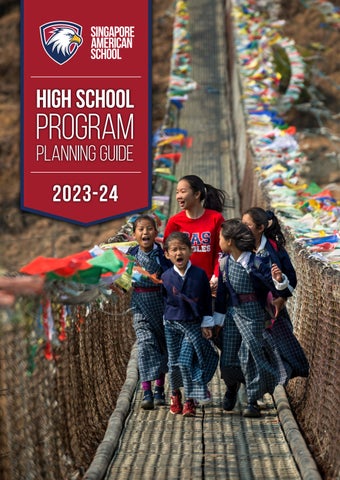
At Singapore American School, we believe that every student is unique. With access to over 180 collegepreparatory, support, and college-level courses, SAS students can pursue pathways that meet their diverse needs and interests. We are committed to assisting students with developing programs of study that meet their academic and college goals, lead to a healthy lifestyle, and afford ample opportunities for participation in meaningful activities. This guide provides information about the courses typically offered along with information on how to select and complete the online registration process.
This guide also contains information about the minimum SAS graduation requirements, the credits recommended by colleges, and the wide range of academic opportunities available at our school. As students begin choosing courses for next year and beyond, keep in mind that students will perform best when a program is selected that includes courses that are personally interesting and at an appropriate level of challenge.
Current SAS students are asked to carefully choose courses each spring for both semesters of the following school year. Students who are new to SAS will meet with a counselor to select courses after enrollment. All students and families are responsible for taking the time to fully understand what a course will cover, whether there are any prerequisites, and whether or not there are any expectations beyond what might be considered “normal” for a course, such as additional labs, rehearsals, research or readings.
All members of the SAS faculty are available to assist students and families as courses are selected for the next academic year. Please feel free to contact us. We look forward to another fantastic school year!
Nicole Veltzé, Principal
Email: nveltze@sas.edu.sg
Anthony Poullard, Deputy
Email: apoullard@sas.edu.sg
Lance Murgatroyd, Deputy
Email: lmurgatroyd@sas.edu.sg
Laura Mohl, Deputy
Email: lmohl@sas.edu.sg
English
Leaf Elhai
Email: lelhai@sas.edu.sg
Social Studies
Cassandra Summerton
Email: csummerton@sas.edu.sg
Mathematics
Emily Leipold
Email: eleipold@sas.edu.sg
Science
David Knuffke
Email: dknuffke@sas.edu.sg
World Languages
Laurence Ervedoza
Email: lervedoza@sas.edu.sg
Technology Electives Capstone
Jason Adkison
Email: jadkison@sas.edu.sg
Visual Arts
Barbara Harvey
Email: bharvey@sas.edu.sg
Performing Arts
Jay Londgren
Email: jlondgren@sas.edu.sg
Physical/Health Education
David Bond
Email: dbond@sas.edu.sg
Quest
Tom Flanagan
Email: tflanagan@sas.edu.sg
Learning Support
Ashley Quark
Email: aquark@sas.edu.sg
Educational Technology/GOA
Paul Welsh
Email: pwelsh@sas.edu.sg
Head of Advanced Studies
Tim Trainor
Email: ttrainor@sas.edu.sg
College Counseling
Tina Forbush
Email: tforbush@sas.edu.sg
Personal Academic Counseling
Carmine Filice
Email: cfilice@sas.edu.sg
Dean of Student Life
Chloé Thomas
Email: cthomas@sas.edu.sg
The 2023–24 school year will bring some changes to Singapore American School. We are excited to offer a few new courses and additional learning options for students. While details regarding many of these changes are included in other sections of this guide, the following are some of the highlights.
• Modern Philosophy (Social Studies Department)
The Social Studies department is excited to add a semester course offering for our grade 10-12 students. Modern Philosophy will afford students the chance to develop fundamental knowledge and skills to critically examine contemporary ethical and philosophical situations. Students will examine concepts such as logic, ethics, reality, and happiness to construct arguments and explore philosophical writings.
• AT Nonfiction and Rhetoric (English Department)
The English department is delighted to roll out this new advanced level course, aimed at students who enjoy reading and writing nonfiction texts (including speeches, narrative nonfiction, and argumentative essays). In AT Nonfiction and Rhetoric, students will explore contemporary issues and diversify their approaches to rhetoric. Students will work in editorial teams to publish a collection of essays, so the course requires a high level of independent writing skills and collaboration.
The Science department is looking forward to adding AT Science Computational Modeling & Simulation to our course offerings in 2023-24. The course is well positioned for any student looking to deepen their understanding of the ways in which computer-based models inform understanding in the sciences. The course will introduce students to mathematical methods and computational approaches using a variety of programming languages and platforms, such as VPython, Excel and Google sheets, MATLAB, and STELLA. Students will create visual representations of models, develop relationships between modeled components, gather data from hands-on activities, run simulations, and generate and analyze results. The course covers a wide range of application areas, including physics, astronomy, biology, chemistry, and more. The course is a semester-long elective, open to grades 10-12.
The Visual Arts department is thrilled to offer two new, semester-long advanced topics courses in 2023-24. These new courses afford students additional opportunities to delve deeper into the arts and fulfill their Catalyst graduation credit.
The new AT Visual Arts Collaborative Creation course is designed to allow students to explore and engage with art from their personal area of focus. Students will deepen their understanding of the visual arts process by working collaboratively with others toward the common goal of generating art for and within a community.
The new AT Visual Arts Catalyst course allows students the free choice to identify, select and explore artists, artworks, and cultural contexts that interest and motivate them. Students will decide what is relevant and useful for their own investigations and how to apply knowledge and understanding to transform ideas into art that is simultaneously thrilling, daunting, and important. This course fulfills the Catalyst credit requirement.
SAS continually engages in review and reflection of our various curriculum and programs. During the 2022-23 school year, schoolwide reviews of World Languages, College Counseling, and Technology, Computer Science, and Robotics (TCR) programming, were conducted. We formed student, faculty, and parent focus groups to support and strengthen this work, and to align our practices with our beliefs as a community.
Additionally, the Social Studies and Personal Academic Counseling departments continue to implement the recommendations from their deep-dive reviews last school year in 2021-22. These departments are engaged in targeted professional learning to ensure that our renewal recommendations are realized. Additionally, the Learning Support and Math departments both continue to delve deeper into the findings and action plans that resulted from curricular reviews in the 2020-21 school year. Teacher leaders, PLC Coaches, and specialists ensure that the outcomes of the review are realized for our school community Preschool-12 over the course of this school year.
We highlight these curricular reviews in our Program Planning Guide as the outcomes of this school year’s work may guide additional improvement efforts within our Social Studies, Personal Academic Counseling, Learning Support, Math, World Languages, College Counseling, and TCR departments.
Details:
*Social Studies : US citizens (not dual citizens) are required to earn one credit in U.S. History.
**Language : Two years of study of the same foreign language (e.g., Chinese, French, or Spanish at the Novice, Intermediate level) or an equivalent proficiency in another language is required.
***Minimum credits : The minimum credits listed above are the absolute minimum number required to earn an SAS diploma. Completing the minimum credits would not necessarily be sufficient for admission to university. Focus should be on the “Recommended for College” column.
Interim : - Students must participate in an Interim Semester course each year they are at SAS.
- One Interim service course (0.25 credit) is required.
Our high school follows a 4 day block schedule rotation. This means that students meet with each of their teachers every other day. Additionally, students meet with their advisory twice a week and each day they also have a lunch block.
Please select courses carefully! It is important for students to engage in thoughtful planning of which courses they would like to take in alignment with their four-year plan. To do this well, it is important for students and parents to learn about the variety of courses and work together with their counselor in the spring to solidify their next year’s course schedule for both semesters. Since returning SAS students have opportunities each spring to thoughtfully select and adjust their course requests, there should be minimal course changes at the start of each semester. Schedule changes should only be made for necessary reasons. Please note the additional facts related to schedule changes:
• Schedule change requests should primarily be for where there is an error (i.e. missing course, duplicate class) or a level misplacement.
• Changes are subject to availability in classes. For this reason, it is important that students choose courses in the spring that they intend to remain in for the entire school year.
• Seniors must list the courses for the entire senior year when they apply to most colleges. Should a change in a senior’s second semester courses be needed to be made, colleges must be notified of those changes. Should it appear that a student is moving to an easier load in the final semester, it can reduce the chances of admission. Seniors are advised to select their courses carefully for the entire school year and plan to remain in them.
• The Student Handbook has a full explanation of SAS drop/add policies.
Over the past three years, we have reviewed our process to request a prerequisite override for a course. Currently, in exceptional circumstances, students who do not meet a course grade or specific course prerequisite may approach their teachers and department chair for consideration of a prerequisite override. The criteria to consider and approve an override is established by the department and is noted in the respective section of the PPG.
Through our Advisory and House programs, we seek to ensure that every student is known, cared for, and advocated for; to make our big school feel small; to support students with solving real–world problems; to strengthen students’ sense of identity and belonging; and to recognize students’ individual learning experiences and talents.
Advisory serves as an essential component of our character education program. Every student who is enrolled at SAS is expected to participate in advisory and attendance is mandatory.
Each advisory is composed of approximately 10 to 12 students in the same grade who are assigned to a faculty advisor during their first year at SAS. In most cases, students will stay with the same advisor until they leave SAS. Advisory groups meet twice per week for 30 minutes. Each advisory is also assigned to a house that includes approximately ten advisories per grade level.
Advisory and house meetings focus on improving students’ interpersonal and intrapersonal skills, their cultural competence, and their character. These meetings are structured around the content and behaviors needed to best ensure the social/emotional health of all students; improve academic success; and prepare students for the inevitability of change in their lives, including the transitions to high school, college, and adulthood.
The Advisory program strives to create an atmosphere of trust where students feel safe to discuss a wide range of academic and personal matters in a setting that helps to balance the rigorous academic demands of the SAS experience.
Catalyst is a culminating experience in which students apply their academic knowledge to real situations that are personally applicable. This entails using different skills than are sometimes required in regular academic courses at SAS. Catalyst is deliberately designed for students of all abilities and interests, and it is customized for all students to experience and to take ownership in a successful project process. Further, grading is based on process and not product, so what students choose for their project is less important than how they conduct their work. The successful completion of the Catalyst Project is a graduation requirement. It ensures that every SAS graduate will leave our school having immersed themselves in a personalized, experiential, educational experience and that they will have developed skills that are essential for their future.
The Advanced Studies section within this guide will help to answer some of your questions about the variety of college level learning opportunities that SAS has to offer. We also encourage students to bring questions to their high school counselors. They will gladly help provide clarity and are eager to help any family to plan a course of study with their child.
To ensure students enroll in a balanced selection of courses, the school has capped the total number of Advanced Placement credits that a student may earn. Starting with the graduating class of 2021, students may earn up to seven (7.0) year–long–equivalent AP credits during their high school careers.
In 2023-24, we will offer a combined total of over 40 Advanced Placement (AP) and Advanced Topic (AT) courses within the Advanced Studies program.
It is possible for students who plan appropriately to take more than seven AP examinations - in some instances, as many as 15 AP examinations.
There are a number of AT courses that permit enrolled students to sit the associated AP exam:
• AT Environmental Science & Fieldwork (AP Environmental Science exam)
• AT Seminar (AP Seminar exam)
• AT Research & Catalyst (AP Research exam)
• AT English: Literature (AP English Literature exam)
We also offer two year-long credit AP courses that provide students access to two separate AP exams per course. These courses provide one credit and two exams:
• The AP Economics course offers both the AP Macroeconomics exam and the AP Microeconomics exam
• The AP Physics C course offers both the AP Physics C: Electricity & Magnetism exam and the AP Physics C: Mechanics exam
Finally, we offer two half-credit semester-long AP courses. Each of these semesters offers access to one exam per course:
• AP Government and Politics: Comparative
• AP Government and Politics: US
To receive the AP Capstone Diploma, students must successfully complete both AT Seminar and AT Research & Catalyst. In addition, they must earn a score of 3 or higher on both the AP Seminar and AP Research exams, and earn a score of 3 or higher on four additional AP exams of their choosing. A student will typically take AT Seminar in the sophomore or junior year, followed by AT Research & Catalyst. The AP Capstone Diploma is awarded by the College Board.
There are five ways that students can fulfill their Catalyst graduation requirement. These paths are described below and summarized in the table that follows. Regardless of the path chosen in completing their requirement, students will build skills that allow them to self-direct their learning and:
• receive explicit instruction and feedback on our learning aspirations;
• explore, innovate, encounter real-life challenges, learn from occasional failures or setbacks, devise solutions, and reflect deeply on who they are as learners;
• learn how to build professional networks and collaborate with mentors;
• manage time and take ownership to see a project through from start to finish;
• feel better prepared to be successful in college, careers, and civic life.
All five of the options below fill the Catalyst graduation requirement. There are some significant differences between them.
The Catalyst Project is a personalized course where students work with teachers who act as guides as students design, plan, and complete interest–based projects. Students focus on producing a meaningful outcome and are encouraged to dive deep into relevant content and knowledge. This course is for everyone – the program is built to inspire and assist students whether they already have a project idea or not. Optionally, the Catalyst Project can be extended into a second semester, or become a “hyper–Catalyst,” because the student’s project requires greater resources and time.
After successfully completing AT Seminar, most of our students enroll in the year-long AT Research & Catalyst. AT Research & Catalyst asks students to deeply explore an academic topic, problem, or issue of individual interest with the expectation of producing both a university level research paper and a meaningful Catalyst Project.
AT Performing Arts provides students with opportunities to create and engage with universitylevel performance experiences. Students working within one of the disciplines of Dance, Drama, Vocal or Instrumental Music will fulfill requirements specific to that discipline. Students apply for the program. The application process is as follows:
• students audition as per usual for higher- level performance groups.
• upon passing the audition, students submit a written application.
• applicants are vetted by a Performing Arts teacher panel. During the school year, AT Performing Arts students across disciplines meet weekly to conduct guided research, explore methodologies, develop performances, establish connections with artistic advisors, and engage in in-depth reflection
AT Visual Arts Catalyst students have the opportunity to dig deep into an area of passion specific to a discipline or combination of disciplines that excite and thrill them. By developing their work through ideation and experimentation, students create a body of work and have the opportunity to showcase and share at the conclusion of the course with the community.
Quest is an immersive program that supports students in pursuing their curiosity and passion. Instead of taking traditional courses, students earn up to six credits through interdisciplinary projects that are personalized to their interests. The year culminates with a junior or senior project thesis paper, thesis talk, and thesis defense; successful completion of which fulfills the Catalyst graduation requirement. Please refer to the Quest section of this planning guide for more information.Please see the next page for the prerequisites.
• Students earn their graduation requirement through this personalized course (one semester is the minimum requirement)
• Prerequisite: None. This course is accessible to everyone in their junior or senior year
• Note: Optionally, students may extend their Catalyst experience by taking the course for a second semester
• Students earn their Catalyst graduation requirement through this year-long AT course
• Prerequisite: Successful completion of AT Seminar
• Note: Students who successfully complete AT Seminar and AT Research & Catalyst are also eligible to earn the AP Capstone Diploma; a student must complete the full year in AT Research to satisfy the Catalyst graduation requirement
• Students earn their Catalyst graduation requirement through this year-long AT course
• Prerequisite: Enrolment in the program by application in senior year
• Note: Due to the essential, collaborative nature of AT Performing Arts, students must remain enrolled in this course for the full year in order to satisfy the Catalyst graduation requirement
• Students earn their graduation requirement through this personalized visual arts course
• Prerequisite: Studio Art, Ceramics 3 or ATVA Collaborative Creation
• Note: This is a semester-long course
Quest
• Students earn their Catalyst graduation requirement through their personalized participation in the Quest program
• Prerequisite: Enrolment to the Quest program via application in junior or senior year
• Note: Quest is an immersive program; students earn credits by pursuing interdisciplinary projects that are personalized to their interests
In high school, we hope to instill a sense of discovery and purpose throughout a student’s four-year experience. When students select courses, our goal is that students and families review the Program Planning Guide together. The Program Planning Guide ensures that families have the tools at hand to help students think about their four years of high school, engage in meaningful discussion around the courses of interest, and develop an understanding about where they are headed in their high school tenure. Our counselors will partner with students to work through their pathway planning to support their sense of discovery and purpose while in high school.
We believe it is helpful to think about planning the high school journey in manageable segments. Students in grade 8 and 9 should complete the first tab of the High School Pathways Planner, which will help students map out their 9th and 10th grade years. Students in grades 10 and 11 should fill out the second tab of the High School Pathways Planner. Additionally, if students feel ready to map out their full high school pathway, the third tab will help students look at all four years of high school.
For each grade level, students should plot the courses they may like to take, ensuring that they enroll for 7 credits each year to reach the minimum of 24 credits to fulfill the graduation requirements. In addition, as students map out possible courses, the Program Planning Guide can be used to check what courses may have prerequisites to plan for.
GRADE 9
GRADE 11 & 12 OPTIONS
SEMESTER 1 SEMESTER 2
Asian Literature: An East-West Perspective
GRADE 10 options
Literature & the Imagination (Sci Fi)
British Literature: The World of Shakespeare/ Contemporary American Literature *
World Literature (Myths & Monsters)
Creative Writing Satire
yearlong options
* Courses offered alternating years.
** All 9th grade students will be enrolled in Humanities 9.
The English curriculum focuses on the areas of reading, writing, speaking and listening, research, and language. Each area will be assessed in every English course in various ways, and students’ skills will be revisited and refined over the course of the four-year program. Students must take an English class every semester they attend SAS. All ninth-grade students will study English in Humanities 9, while tenth-grade students must take English 10 or American Studies. Upperclassmen may opt to take any of the following courses during the eleventh- and twelfth-grade years: AP English Language and Composition, AT English: Literature, AT English: Nonfiction and Rhetoric , AT English: Writing Workshop & Publication, or the Junior/Senior option courses. Please note that enrolling in some of these courses requires students to first meet stated prerequisites.
Beginning in 2023-24, all ninth-grade students will be enrolled in the Humanities 9 course to meet their English and Social Studies credit requirements.
ID: 41004 Grade: 9 Length: Year
Credit: English/World History (2)
Prerequisite: None
Humanities 9 is a year-long survey course that focuses on building a strong foundation of skills and empowering students to make meaningful connections across the English and Social Studies disciplines. Using an inquiry framework, Humanities 9 students will explore literature and world history from various cultural perspectives while learning to read analytically, write effectively, and speak and listen thoughtfully. Over the course of the year, students will write for a variety of purposes (to analyze, inform, reflect, convince, and narrate) and engage with a variety of texts (including novels, plays, poems, short stories, historical primary sources, oral histories, and artifacts). In strengthening their historical thinking skills, students will learn rigorous research methods and source evaluation skills, create compelling questions to guide their historical inquiries, analyze continuities and changes, and explore complex and interacting factors that have influenced the perspectives of people during different historical eras. Students will also practice and strengthen their discussion and presentation skills to build and share their understandings. Finally, they’ll refine their knowledge of grammar and vocabulary, honing the language tools they will use to express themselves purposefully and effectively. Humanities 9 will culminate in a student-led interdisciplinary project, giving students the opportunity to demonstrate their mastery of the inquiry cycle, explore a topic of interest, and create a product that reflects the thinking and communication skills they have built throughout the year.
ID: 41014 Grade: 10 Length: Year
Credit: English/US History (2)
Prerequisite: None
This course is a thematic study of the American experience through the lenses of history, economics, civics and literature, with a focus on skills development. Through the thematic units, students will explore critical issues, individuals, and turning points in the history of the United States of America. Students will analyze the extent to which ideologies, people, literature, and events developed and shaped both American history and its contemporary issues. Students will think critically and make thoughtful connections as they draw on a variety of resources to understand the American experience. This interdisciplinary course will meet every day, and students will earn both an English 10 and a U.S. History & Government credit. Throughout the year, students will develop their writing in a variety of genres (e.g., argument, narrative, analysis, synthesis), responding insightfully to both literature and history. They will also pursue course-related areas of interest for their research projects. Accordingly, students will critically read a variety of nonfiction, fiction, and poetry reflecting the American experience. In addition to their in-class reading, students will be encouraged to read widely outside of class in order to make connections and build their reading skills. The course will require participation in class discussions, collaborative work in small groups, and several presentations. Language usage and mechanics instruction will focus on students’ writing needs. Students will also continue to develop skills in visual literacy by critically viewing documentaries and films.
ID: 41013 Grade: 10 Length: Year
Credit: English
Prerequisite: None
English 10 is primarily a survey of American Literature in which students are asked to think critically and reflect on essential questions throughout the year: What are my values and where do they come from? How do the works we’ve read and the characters we’ve met cast a light on societies represented in the literature and reflect our own? Instruction and assignments are focused on improving all aspects of language: reading, writing, listening, and speaking. Students read a variety of classic and contemporary fiction, nonfiction, drama, and poetry, along with regular independent reading, with the goal of moving from comprehension into critical reading. The course emphasizes the discussion of literature to further students’ understanding of themes that surface through the reading. The writing of short essays is stressed through rhetorical and literary analyses and informative, narrative, and argumentative pieces, including a focus on revision. Instruction on language usage and mechanics focuses on students identifying and correcting problems evident in their writing and development of sophisticated sentence fluency.
The junior and senior options continue the development of skills and intensive study of literature of a college preparatory English sequence. These courses cover diverse bodies of literature from various periods and cultures. All of the courses develop writing, reading, viewing, speaking, listening, and technology skills. Please note that some options are offered on a two–year, rotating basis; see course descriptions for details.
Writing: Students will compose a variety of writing assignments, such as personal essays, literary analysis, compare and contrast essays, reviews, journal entries, and character sketches. They will be encouraged to develop an authentic voice and sense of audience. Students will revise pieces of writing, concentrating on content and organization, and edit to improve diction and mechanics. Students will participate in peer critiquing and editing.
Speaking and Listening: Students will speak in a variety of contexts: speeches and oral presentations, large and small group discussions, dramatic readings, and/or readers’ theater activities.
Reading and Viewing: Students will read and view a significant body of literature appropriate to the focus of the course.
Asian Literature: An East-West Perspective
ID: 41019 Grade: 11–12 Length: Semester
Credit: English
Prerequisite: None
This semester-long Asian Literature course gives students an opportunity to explore traditional and modern texts created and produced in Asia or by Asian authors abroad. The course includes a study of Singaporean literature; students will read and create narratives about the country in which they live. They will also apply a broader continental lens through multiple texts, including a compilation of retold myths from across the region paired with a selection of novels that they will read in smaller literature circles. These discussion texts will ask students to examine their culture viewpoints and pre-conceptions. They will conclude the semester by selecting a modern popular cultural text to research and analyze. This engaging inquiry project allows them to investigate Asian pop culture, their own media use and tastes, and Asia’s cultural impact on the modern world.
ID: 41042 Grade: 11–12 Length: Semester
Credit: English
Prerequisite: None
This semester-long course is designed for students who wish to explore creative writing, to develop an individual writing voice, and to learn first-hand how creative writers work. Using a workshop format, both in class and online, students will hone their collaboration skills as they survey specific forms of creative writing, develop a peer community of writers to critique and support each other, and create an individual portfolio of creative work. Students will have opportunities to submit their works to outside publications and share their work with the school community. While this course is not required for Advanced Topic Writing Workshop and Publication, it does serve as an excellent foundation and introduction to the creative writing process.
ID: 41011 Grade: 11–12 Length: Semester
Credit: English
Prerequisite: None
Through the reading and viewing of both classic and contemporary science fiction, students in this semester-long course will examine the philosophical (ethical), scientific, and political ideas developed in this genre. Key ideas include: the ethics of science and the responsibility of the scientist, the conflict between humans and technology, humans’ relationship to nature, the individual against society, humankind meeting alien species, social problems highlighted in science fiction literature and film, and how science fiction questions what it means to be human. Consequently students will examine/analyze and explore both written text and film via essays, close reading commentaries, and discussions. Students will also write their own science fiction stories. The variety of science fiction writers and directors studied includes (but is not limited to) H.G. Wells, Mary Shelley, Ray Bradbury, Robert Heinlein, Ridley Scott, and Denis Villeneuve.
British Literature: The World of Shakespeare
ID: 41006 Grade: 11–12 Length: Semester
Credit: English
Prerequisite: None
Note: Not offered in 2023-24. May be offered in 2024-2025
This semester-long course is designed for students who would like to read Shakespeare’s plays and poems closely, critically, and creatively. Students will develop close reading and viewing skills, explore Shakespeare’s language, and experiment with themes and literary features in critical and creative writing, discussion, and informal performance. Study will focus on craft, meaning, inquiry, and both individual and collaborative exploration of Shakespeare’s sonnets and plays (comedy, history, and tragedy).
ID: 41008 Grade: 11–12 Length: Semester
Credit: English
Prerequisite: None
Note: Offered in 2023-24. May not be offered in 2024-25
This semester-long course explores short stories, graphic novels, novels, nonfiction, poetry, and film from 1980 through the present. Students who want to glimpse into modern American culture and discuss controversial perspectives, voices, and values will enjoy this course. Skills practiced in the course include researched arguments, literary analysis responses, creative responses to reading, literature circle discussions, and presentations of critical lenses within a novel. The course culminates with a personalized research project that demonstrates the skills learned throughout the semester with a contemporary text.
Studies in Satire
ID: 41022 Grade: 11–12 Length: Semester
Credit: English
Prerequisite: None
This semester-long course is designed for students who wish to explore and analyze a variety of satire through the ages to examine how the genre works. Students will begin by exploring the basic concepts of satire as a literary genre. After establishing a critical lens through which to view satire, students will study a variety of satirical texts ranging from classical to more contemporary examples. The texts studied will include essays, short video clips, music, and full-length films. Throughout the semester, students will focus on developing the following skills: explanatory writing, presentation, argument writing, and close reading. Students will even get a chance to try their hand at writing their own satire. Overall, the course seeks to enhance students’ critical thinking skills by closely analyzing the criticisms inherent in works of satire.
ID: 41017 Grade: 11–12 Length: Semester
Credit: English
Prerequisite: None
Monsters and heroes are figures as old as literature itself; across world cultures and throughout history, humans have told stories about good and evil, epic quests, and grotesque creatures of nightmare. This course explores some of the most enduring mythical archetypes through ancient and modern literary texts. Through our reading, writing, and discussion, we will ask: What makes a myth? How do we define heroes and monsters? Good and evil? How does modern literature trouble traditional literary archetypes? And what do our monsters and heroes say about us? We will examine novels, epic stories, and films that feature classic and contemporary visions of heroes, witches, demons, ogres and perhaps the most frightening monster of all: humankind. Students should expect to work both independently and with peer groups to examine readings and explore ideas. The course will require development of skills in literary analysis, close reading of challenging texts, discussion and exploration of philosophical ideas connected to the literature, as well as research and presentation of information.
Reading, Writing, & Publishing in a Digital World
ID: 41025 Grade: 11–12 Length: Year
Credit: English
Prerequisite: None
In this year-long course, students will examine how digital media has reconstructed the ways we read, write, speak, and think. We now wield incredible power when publishing descriptions, expositions, arguments, and stories for a wide, often-online audience—and bear great personal responsibility while doing so. Essential questions for this course include “Why do we acquire and publish digital content?” and “Who is our audience?” To help investigate these questions and others, students will consider intellectual histories of media and will read and respond to classic and contemporary literature regarding how personal, social, and national narratives evolve through digital publication. Also, students will learn to read critically, evaluate, and write through lenses of digital mediation, exploring and engaging with an array of media genres and forms. In addition, throughout the year, students
will learn oral communication skills to be used in their published multimedia projects.
ID: 41028 Grade: 11–12 Length: Year
Credit: English
Prerequisite: A Semester I grade of B+ or higher in English 10/American Studies is required to select this course in 11th grade. Students with a Semester I grade of B in English 10/American Studies or a Semester I grade of A+ in the Humanities 9 English may seek an override which requires approval from their current English teacher, counselor, and English department chair. Note: This course has an additional grade point weighting of 0.5.
AP English Language & Composition is a universitylevel course in which students read and write for a variety of rhetorical purposes. Over the course of one year, students will learn skills of rhetorical analysis, argument, and argumentative synthesis. Students will study a variety of non-fiction texts of varying lengths and rhetorical situations from the last four centuries, as well as one dystopian novel, requiring students to respond to both current controversies and enduring philosophical questions. Please note that successful completion of the course requires a much greater effort and is significantly more demanding than English 10. Students best suited to this course are avid, proficient readers, attuned to current events, and interested in understanding the power of language to shape our identities, our perceptions, and our world. Students will be prepared for and will be strongly encouraged to sit for the AP exam in May.
ID: 41047 Grade: 11–12 Length: Year
Credit: English
Prerequisite: A Semester I grade of B+ or higher in English 10/ American Studies is required to select this course in 11th grade. To select this course in 12th grade, any English AP/AT course, or Semester I grade of B or higher in an 11th-grade English course is required. Rising grade 11 students with a Semester I grade of B in English 10/American Studies may seek an override which requires approval from their current English teacher, counselor, and English department chair.
Note: Students who have signed up will be required to submit a short video prior to the fall semester in order to remain in the course. This video serves to introduce you as a reader and creator. See your English teacher for details.
The Advanced Topic (AT) designation indicates a course is at university level, putting it at or above the level of a traditional Advanced Placement (AP) course. This course has an additional grade point weighting of 0.5.
AT English: Literature is for avid readers interested
in pursuing deeper and more creative ways to read. The course will build a critical reading community that discusses, questions, shares, and creates. There will also be opportunities to make choices and decisions about texts and assessments. The central question of the course is: How does engaging with a text through multiple modalities deepen understanding and relevance? Integral to the course are long-term reading and reinvention projects where students will respond to and reinvent a text through performance and other creative works. Students will also learn to interpret texts through conventional academic lenses; writing and revising to analyze, propose, and reflect. The course has a demanding reading, writing and creating workload, and is meant for students who are interested in challenging literary texts combined with a cognitive mentorship approach in which the teacher learns and creates alongside the students as a member of the reading community.
AT English: Nonfiction & Rhetoric
ID: 41048 Grade: 11–12 Length: Year
Credit: English
Prerequisite: In order to be admitted into this advanced course for juniors and seniors, students must submit a portfolio of expository and persuasive writing prior to February 16, 2023. This portfolio must demonstrate a passion for the subject, evidence of craft, knowledge of standard written English, evidence of close reading, and potential for growth. The portfolio will be assessed by a committee of English teachers, and applicants will be informed of their status prior to course registration. Please see your English teacher and the application form for more details.
Note: The Advanced Topic (AT) designation indicates a course is at university level, putting it at or above the level of a traditional Advanced Placement (AP) course. This course has an additional grade point weighting of 0.5.
AT Nonfiction and Rhetoric is a college level course that builds on the argumentation skills taught in AP English Language and Composition. In this course, students study topical issues of significance and their treatment in broader media, forming their own editorial teams who will work with professional writers to publish a variety of texts and speeches over the course of the year. Students will study the craft of other writers to diversify their own rhetorical approaches, and work to understand topics deeply, from multiple perspectives in order to interrogate their complexities. The course will end with students publishing a compilation of essays, which will be available to the SAS community. The course will have elements of discussion, speechwriting, performance, editorial writing, rhetorical analysis, and group work. Completion of AP English
Language and Composition or a background in rhetoric is highly encouraged for students taking this course, as the writing tasks require a high level of independence and peer collaboration. Students who have not completed AP English Language and Composition may be required to complete supplementary work early in the year to catch up on the necessary content and skills.
ID: 41046 Grade: 11–12 Length: Year
Credit: English
Prerequisite: In order to be admitted into this advanced course for juniors and seniors, students must submit a portfolio of creative writing pieces by February 16, 2023. This portfolio must demonstrate a passion for writing as well as evidence of craft, knowledge of standard written English, potential for growth, and pride in the work. The portfolio will be assessed by a committee of English teachers, and applicants will be informed of their status prior to course registration. Please see your English teacher and the application form for more details.
Note: The Advanced Topic (AT) designation indicates a course is at university level, putting it at or above the level of a traditional Advanced Placement (AP) course. This course has an additional grade point weighting of 0.5.
Designed for students who already have a regular writing practice in any creative genre and can demonstrate a passion for creative writing, this course is an inquiry into the world of writing and publication, culminating in publication of an anthology of works composed, edited, designed, and marketed by students. Students will learn creativity and collaboration skills as a backdrop to their focus on writing. Skills we develop include idea generation, giving and responding to peer feedback, intensive revision, and purposeful reflection. Students will have the choice to learn editing, design, marketing, or events planning on smaller teams. The course features workshops to improve drafting and editing skills, study and analysis of writing that focuses on process and audience, encounters with visiting local and international authors, and, if conditions allow, a writers’ retreat to encourage growth of relationships and community. The course demands rigorous independent work and responsibility to meet community expectations and deadlines.
* U.S. History credit
** Courses offered alternating years (see note section in course description)
*** All 9th grade students will be enrolled in Humanities 9. This program will provide an English credit and a Social Studies credit
Social Studies offerings are consistent with the SAS Learning Aspirations, and are designed to allow students to develop and demonstrate character, collaboration, communication, creativity, critical thinking, cultural competence, and core knowledge. Toward this end, courses are built around the College, Career, and Civic Life (C3) framework, a set of standards from the US National Council for the Social Studies (NCSS). Students will develop questions, apply disciplinary tools, evaluate evidence, and take action as they communicate conclusions. All ninth grade students will study world history in the Humanities 9 program. Tenth through twelfth grade students have a wide variety of choices in the disciplines of history, government, economics, business, geography, psychology, and philosophy, as well as the opportunity to take Advanced Studies courses in many of those disciplines. Credits earned in Social Studies fulfill the department specific minimum graduation requirements (except in the case of Business, Personal Finance and AT Entrepreneurship which serve as elective credit).
ID: 41004 Grade: 9 Length: Year
Credit: English/World History (2)
Prerequisite: None
Humanities 9 is a year-long survey course that focuses on building a strong foundation of skills and empowering students to make meaningful connections across the English and Social Studies disciplines.
Please refer to the full course description in the English section on Page 10
All U.S. citizens (not dual citizens) must earn one credit in U.S. History. The courses listed below meet this requirement.
ID: 41014 Grade: 10 Length: Year
Credit: English/US History (2)
Prerequisite: None
Note: American Studies is a combined double-block English 9 and US History & Government course. The course meets daily with the same teacher. Sophomores can either choose the double-block American Studies or choose English 10 and either US History & Government, AP U.S. History or any other social studies course.
Please refer to the full course description in the English section on Page 10.
ID: 42012 Grade: 10–12 Length: Year
Credit: US History
Prerequisite: None
U.S. History & Government enables students to make thoughtful judgments on issues of the past, present, and future. Students will analyze events in U.S. History for their significance and relevance to today. We will foster independent learning, and student voice and choice. The students will study the history of the United States as experienced by a variety of different groups of people, many of whom have been traditionally marginalized in the teaching of this course. Students will be assessed on the acquisition of core knowledge, their ability to apply knowledge, and the connections they make between material they learn and the United States today. Students will demonstrate their knowledge and skills in a number of different
ways, with inquiry projects playing a significant role in each quarter of the year.
ID: 42014 Grade: 10–12 Length: Semester
Credit: Social Studies
Prerequisite: None
Note: Will not be offered in 2023-24. May be offered in 2024-25.
This course provides an overview of the events and forces that have created the modern nation of Singapore, a country many of us call home. Using a variety of media, including graphic texts, students will consider the common cultural and historical background of Singapore, as well as the impact of geography, location, and people on its history. The role of foreign empires and colonial powers will be examined, along with the forces at work and the paths followed, on the road to independence. Emphasis will also be placed on Singapore today, including the perennial topics of race and trade. Students will examine modern Singaporean society, culture, economy, and politics through simulations, debates, independent research, interactive lectures, field trips, and visits from Singaporean writers and artists.
ID: 42025 Grade: 10–12 Length: Semester Credit: Social Studies
Prerequisite: None
Note: Will be offered in 2023-24. May not be offered in 2024-25.
Modern Philosophy will require students to examine concepts such as logic, ethics, reality, and happiness to construct arguments answering questions such as: “What are the questions, and who has the answers?”, “How are modern ethical dilemmas in current events ‘solved’ using ethics?”, “How are social justice movements such as justice in health care, justice in protest movements, and the problems of climate change considered using philosophical concepts?”, and “What makes us happy?” Students will read and analyze against the roots of philosophical thinking and then move to a study of multicultural philosophers’ engagement with life’s most interesting ethical dilemmas. Students will be asked to come prepared to have intellectual conversations, engage in inquiry and develop creative projects
to synthesize sources from media to experts. The purpose of Modern Philosophy is to provide students with the fundamental knowledge and skills necessary to critically examine contemporary ethical and philosophical situations. This course promotes independent thinking and encourages critical examinations of philosophical writings.
ID: 42024 Grade: 10–12 Length: Semester
Credit: Social Studies
Prerequisite: None
Note: Will not be offered in 2023-24. May be offered in 2024-25
This course has been developed to promote a cross-cultural understanding of the law. Students will compare the legal systems of the United States and Singapore. Law & Justice is intended to provide SAS students with the ability to understand the U.S. government, individual rights, laws and legal disputes, as well as those of our host country. Students will be encouraged to engage deeply with social policy guided by significant themes in jurisprudence and theories of justice, including individual liberty, privacy, democracy, and the relationship between the citizen and the state. We will accomplish this through case studies, and mock trials of landmark and contemporary conflicts. Students who take part in Law & Justice will discuss and write about current and controversial issues, engage in simulations of democratic practices, receive pertinent civic instruction, interact with experienced lawyers and jurists, and learn how to formulate arguments in support of policies they advocate. Students will gain a practical understanding of law and the legal system, historical and current controversies, and how this system might relate to their everyday lives.
ID: 42008 Grade: 10–12 Length: Semester
Credit: Social Studies
Prerequisite: None
Note: This course is not available for students who have already completed advanced studies in economics. Will be offered in 2023-24. May not be offered in 2024-25. Economics will provide students insight into ways people and nations function economically, i.e., how they make a living. Basic economic concepts including wealth, utility, capital, labor, supply and demand, profit and competition, production, distribution, exchange, consumption, and the factors affecting each area are studied. Monetary and fiscal policies are examined in the light of
contemporary economics, both national and international. Students will study major recessions to understand fiscal policy, the public debt, and ways banks create money.
ID: 42023 Grade: 10–12 Length: Semester
Credit: Social Studies
Prerequisite: None
Note: This course does not meet the NCAA Division I core course requirement for Social Studies. See counselor for details. Offered in 2023-24. May not be offered in 2024-25.
This course uses models from the disciplines of psychology and economics to encourage a logical, deductive approach to thinking, and to look at several different approaches to resolving conflicts. The major analytical models presented are derived from “game theory” and “behavioral economics”. These models are used to tackle issues and problems across the entire spectrum of the social sciences. The course is largely problem centered, applying game theory tactics and skills to hypothetical situations and to case studies that come from history, current world events, and the immediate world around us. Individual analysis, small group discussion, and class discussion are common formats. The final project will be a research paper applying Game Theory concepts to a ‘real life’ example.
ID: 46524 Grade: 10–12 Length: Semester
Credit: Elective
Prerequisite: None
Note: Will not be offered in 2023-24. May be offered in 2024-25.
This course will explore the world of modern business through project-based learning. The course will guide students through the essential activities of an enterprise, including finance and accounting, human resources, operations, and marketing. Students will become critical thinkers, analyzing, discussing, and solving realworld business case problems. Students also improve their written and oral communication skills in authentic settings when reporting their solutions to business cases. Students will polish their technology skills by authentically using computer skills as business people would: preparing presentations, calculating, preparing, and analyzing quantitative data in Excel, and creating marketing materials using image and video manipulation tools. The course is designed for those who would like a better understanding of the world of commerce or hope to one day join the business field.
ID: 46531 Grade: 10–12 Length: Semester
Credit: Elective
Prerequisite: None
Note: Offered in 2023-24. May not be offered in 202425.
Few high school and college graduates are financially literate when they first enter the workforce. This course gives students an advantage in the real world by developing their financial literacy. Students will learn that high salaries don’t guarantee future wealth unless earnings are properly managed. Students will learn to manage their money through responsible spending and investing habits. In this course students will track their own daily spending from the first day of the class and explore the merits of careful consumption and effective investing through a series of project-based discoveries.
ID: 42010 Grade: 10–12 Length: Semester
Credit: Social Studies
Prerequisite: None
Note: This course is not available for students who have already completed advanced studies in psychology. Offered in 2023-24. May not be offered in 2024-25
Psychology is the study of mental processes and behavior. It is a complex subject which draws on concepts, methods and understandings from a number of different disciplines. This requires a multidisciplinary approach and the use of a variety of research techniques whilst recognising that behavior is not a static phenomenon - it is adaptive, and as the world, societies and challenges facing societies change, so does behavior. Considering this, we will examine biological, cognitive, and sociocultural approaches to understanding behavior.
ID: 42036 Grade: 10–12 Length: Year
Credit: US History
Prerequisite: Semester I grade of B+ or higher in Humanities 9 social studies grade is required to select this course in grade 10.
Note: This course meets the U.S. History credit requirement for U.S. citizens (not dual citizens). This course has an additional grade point weighting of 0.5. This course provides students with an understanding of major themes in U.S. history, including American identity, economic and social life, political change and continuity, and the U.S. role in the world. The course is ideal for the student who has a real interest in history and who is prepared to work consistently and to go well beyond. Students are required to be internally motivated, to have good reading comprehension and analytical writing skills, to be well organized, and to be prepared to examine and think about different, often conflicting, interpretations of history. The course moves briskly, so students must be prepared to devote time daily to reading and note taking. There will be considerable inclass discussions based on assigned readings, as well as numerous interpretive essays. Students will be prepared for and strongly encouraged to sit for the AP exam in May.
ID: 42064 Grade: 10–12 Length: Year Credit: Social Studies
P rerequisite: Semester I grade of B+ or higher in Humanities 9 social studies grade is required to select this course in grade 10. Note: The Advanced Topic (AT) designation indicates a course is at university level, putting it at or above the level of a traditional Advanced Placement (AP) course. This course has an additional grade point weighting of 0.5.
This in-depth, focused history course fosters in students the skills that professional historians use in their practice. We begin with a brief introduction to historiography and schools of historical thought, where we will consider the scope, methods and tools, perspectives, and ethics involved in the study and creation of history. From this base, we will engage in three historical inquiries, becoming progressively more open to student choice and interest. Our first inquiry is a sourcework investigation that helps us to develop foundational skills and allows us to consider regional and local implications of history. Our second inquiry is a cross-regional exploration of a broad historical theme that develops skills
around analysis, evaluation and application of evidence. After building our skills, knowledge, and understanding as historians throughout the course, it’s time for our final inquiry - a historical investigation where each student selects their own topic of specialization, and generates their own contestable question for inquiry. Throughout this process, students will produce academic works, engage with professional historians, and publish our annual SAS History Journal.
AP U.S. Government & Politics
ID: 42035 Grade: 11–12 Length: Semester I
Credit: Social Studies
Prerequisite: None
Note: This course has an additional grade point weighting of 0.5.
AP U.S. Government and Politics provides a college-level, nonpartisan introduction to key political concepts, ideas, institutions, policies, interactions, roles, and behaviors that characterize the constitutional system and political culture of the United States. Students will study U.S. foundational documents, Supreme Court decisions, and other texts and visuals to gain an understanding of the relationships and interactions among political institutions, processes, and behaviors. They will also engage in current policy debates and electoral events, and will explore their political socialization and emerging ideology. This is usually a first semester course. Students will be prepared for and strongly encouraged to sit for the AP exam in May.
ID: 42031 Grade: 11–12 Length: Semester II
Credit: Social Studies
Prerequisite: None
Note: This course has an additional grade point weighting of 0.5.
AP Comparative Government and Politics introduces students to the rich diversity of political life globally. The course uses a case study approach to examine the political structures; policies; and political, economic, and social challenges of six selected countries: China, Iran, Mexico, Nigeria, Russia, and the United Kingdom. Students compare the effectiveness of approaches to many global issues by examining how different governments solve similar problems. In this discussion based course, they will read and interpret data, make comparisons and applications, and develop evidence-based arguments. Throughout we will explore current policy events in our six case studies and globally.
This is usually a second semester course. Students will be prepared for and strongly encouraged to sit for the AP exam in May.
ID: 42063 Grade: 10–12 Length: Year
Credit: Social Studies
P rerequisite: Semester I grade of B+ or higher in Humanities 9 social studies grade is required to select this course in grade 10.
Note: The Advanced Topic (AT) designation indicates a course is at university level, putting it at or above the level of a traditional Advanced Placement (AP) course. This course has an additional grade point weighting of 0.5.
Geography takes advantage of its unique position to examine relevant concepts and ideas from a wide variety of disciplines. This helps students develop an appreciation of, and a respect for, alternative approaches, viewpoints, and ideas. This course focuses on four major themes of human geography and ensures that students acquire elements of a variety of research and fieldwork methodologies. The AT Geography course embodies global and international awareness in several distinct ways. It examines key global issues and utilizes examples and detailed case studies at a variety of scales, from local to regional, and from national to international. This is an inquiry-based course that will involve fieldwork in a variety of locations in Singapore, as well as research projects on a variety of global locations and issues.
ID: 42060 Grade: 11–12 Length: Semester Credit: Social Studies
Prerequisite: None
Note: The Advanced Topic (AT) designation indicates a course is at university level, putting it at or above the level of a traditional Advanced Placement (AP) course. This course has an additional grade point weighting of 0.5.
Students will study urban development from a historical and a geographic perspective focusing on themes, trends, and challenges that have faced urban planners since the start of human urbanization. Students will engage in various interdisciplinary assignments and projects which demonstrate understanding of the key concepts, content, and skills associated with city design and analysis. Students will apply this knowledge to Singapore and look for themes and patterns related to various community stakeholders. Students will then focus on a theme of personal interest which will form the basis of a field work research paper/project. Themes could relate
to topics such as gentrification, green space, the negotiation between private and public interests, architecture, transportation, leisure and recreation, or government housing, and may focus on one specific location, such as their own neighborhood.
Following the fieldwork-based research, students will look at the main challenges and issues facing urban planners today around the world. The culminating summative project will be a research project which can take a variety of forms, but will address one of these issues. Students will also share a presentation which summarizes their research and findings. This course will involve research in the field, and will require students to visit sites in their own time, and be responsible for conducting that field research. All assessments for this course are inquiry/project-based, with no traditional ‘pencil-and-paper’ tests.
ID: 42045 Grade: 10–12 Length: Year
Credit: Social Studies
Prerequisite: Semester I grade of B+ or higher in Humanities 9 social studies grade is required to select this course in grade 10.
Note: This course has an additional grade point weighting of 0.5.
AP Economics is made up of two semester-length College Board AP courses - Macroeconomics and Microeconomics. Topics covered include basic concepts such as scarcity, trade-offs, and the functions of the economics system; the nature and function of product markets, including basic supply and demand theory, consumer choice theory, and pricing theory; the nature and function of factor markets, including theories of wage determination; measurement of economic performance using concepts such as gross domestic product, inflation, and unemployment; analysis of various schools of economic thought in relation to aggregate demand and aggregate supply; money and banking, including the tools of the central bank; and, finally, the usefulness of various government policies that can be applied to remedy the economic problems discussed throughout each semester. College Board offers both an AP Microeconomics and AP Macroeconomics exam. This course prepares students to take both exams in May. SAS offers two different versions of AP Economics, this course, where students proceed at the normal AP pace, and a self-paced AP Economics (42046). Students will be prepared for and strongly encouraged to sit for the AP exam in May.
ID: 42046 Grade: 11–12 Length: Year
Credit: Social Studies
Prerequisite: None.
Note: This course has an additional grade poi nt weighting of 0.5.
This “self-paced” AP Economics covers the same content as the more traditional AP Economics course (42045), but students have the flexibility to move faster than the normal pace of the class. Students may take assessments before the normal “due date” but may not fall behind. Students who sign up for this course will benefit from the flexibility to plan the timing of assessments themselves but should be self-directed and strong independent learners. Students will be prepared for and strongly encouraged to sit for the AP exam in May.
ID: 42061 Grade: 11–12 Length: Semester
Credit: Social Studies
Prerequisite: AP Economics; or a Semester I grade of A or higher in Economics.
Note: The Advanced Topic (AT) designation indicates a course is at university level, putting it at or above the level of a traditional Advanced Placement (AP) course. This course has an additional grade point weighting of 0.5.
This course is designed to offer students an opportunity to delve deeper into the international economy than our introductory courses allow. The focus of the course is globalization (international trade and economic development). Students use the conventional models learned in previous economics classes as well as the less conventional models of behavioral economics to study economic development and growth. All students will write a research paper and work on a development problem with a local social enterprise as culminating economics projects. The latter is optional and requires out of school work. The course requires rigorous study and emphasizes in-depth research.
ID: 46560 Grade: 10–12 Length: Semester
Credit: Elective
Prerequisite: Semester I grade of B+ or higher in Humanities 9 social studies grade is required to select this course in grade 10.
Note: The Advanced Topic (AT) designation indicates a course is at university level, putting it at or above the level of a traditional Advanced Placement (AP) course. This course has an additional grade point weighting of 0.5
Entrepreneurship provides real world, handson learning on what it’s like to actually start a company. The goal is to give students a framework to test the business model of a startup while creating all of the pressures and demands of the real world in an early stage start-up. They will learn marketing, finance, and other business disciplines, while also acquiring organizational skills such as time management and leadership development. The class is also a vehicle to develop character, intellect, and resilience in students. Students start the semester with an immediate immersion into the Lean Startup methodology adopted from University of California Berkeley and Design Thinking techniques from Stanford University. As students develop skills through working in the field, observing and interviewing to discover problems, and learning techniques for validating hypotheses, they learn by doing, through real world problems and collaborating with real entrepreneurs. Students work with carefully selected Singapore entrepreneurs, who present real and urgent business problems with hard deliverables and deadlines. Students learn processes including customer development, agile development, and rapid prototyping. Throughout the course, students will learn to problem solve, think critically, make well-informed decisions, communicate effectively, and engage in productive and successful team work. In the final portion of the course, students use everything they’ve learned about entrepreneurship and group work to launch their own startups. The course requires rigorous study and emphasizes in-depth research.
ID: 42062 Grade: 11–12 Length: Year
Credit: Social Studies
Prerequisite: None.
N ote: Students who have taken AP Psychology previously are not eligible to take this course. This course is aligned to the criteria for a Syracuse University psychology course (SUPA PSY 205). If students elect to earn Syracuse University credit by concurrently enrolling in SUPA PSY 205, they need to do so at the beginning of AT Psychology. Please note that there is a cost per Syracuse University credit hour that families must pay if students choose to concurrently enroll. For further information, please see the SUPA website (http://supa. syr.edu). To determine whether participation in this program is a fit for your long-term goals, please speak with your counselor.
The Advanced Topic (AT) designation indicates a course is at university level, putting it at or above the level of a traditional Advanced Placement (AP) course. This course has an additional grade point weighting of 0.5.
AT Psychology introduces students to the scientific study of human behavior and mental processes. Through examining basic theories, research discoveries, and the applied use of psychology, students will understand multiple perspectives demonstrating that, while psychology covers diverse topics they are not separate and distinct, rather they are integrated and together combine to give us the entire picture of human behavior, cognition, and emotion. Students will learn to access, critically read, and evaluate current research in the field of psychology and will conduct both individual and group research into a topic of interest, thus gaining a strong understanding of the psychological principles as applied to their lives and the world around them. They will complete the course with a strong foundation in scientific research methodology. Students in AT Psychology will have the option to take it as a dual-enrollment course with Syracuse University.
The mathematics curriculum is designed to meet the needs of students who have varying backgrounds, knowledge and skills, as well as diverse interests and career goals. The goals of the mathematics program are: to build mathematically-minded thinkers who find joy in productive struggle; to empower students to think critically, reason effectively, communicate clearly, and solve problems; to guide students toward a mastery of mathematics skills that lead to college success.
All students must earn two math credits in high school, one of which must be at the level of Geometry or higher. It is generally recommended that students take math for all four years of high school.
The math department embraces the use of technology, and therefore requires students to bring a CAS or non-CAS TI-Nspire calculator to each class. The CAS calculator is approved for use in the AP and SAT exams, and the non-CAS calculator is approved for use in the AP, SAT, and ACT exams.
The following math department policies and practices should also be noted:
1. When the prerequisites have been met, students in grades 10-12 are able to double-up on math credits (take two courses concurrently) except doubling up in Geometry and Algebra II/ Trigonometry. In this case, students must obtain a recommendation from the math department chair. Grade 9 students are not permitted to double up on math courses.
2. Students looking to accelerate their math sequence are able to take a validation exam in order to bypass the next course. Students must meet a minimum grade prerequisite in order to be permitted to take the validation exam. If they are able to demonstrate the requisite knowledge in the validation exam, they will be allowed to proceed to the next level course, but will not receive credit. The validation exam takes place the week before school officially starts for students, so families must plan proactively.
3. New students to SAS will be placed based on a prior school transcript review and where necessary, the results of a placement assessment administered following admission.
4. Students who fall below a prerequisite for a specific math class at the end of Semester I will be eligible to take their desired math class by earning the necessary grade prerequisite at the end of Semester II. Students who make the grade in Semester II should contact the math department chair and their counselor to request the schedule change.
ID: 43014 Grade: 9–12 Length: Year
Credit: Math
Prerequisite: Math 8+ plus approval from 8th-grade math teacher; or Semester I and Semester II grade of A or higher in Algebra I
This course is designed to serve highly motivated and highly capable math students who excelled in Math 8+ or in Algebra 1 and are looking to access the highest level math offerings at SAS. It is the first year of a two year sequence that covers key content from Geometry and Algebra II/Trigonometry. The course aims to cover a broad range of topics and will therefore be fast, high paced and rigorous. After successfully completing both Accelerated Math I and II, students will be able to enter AP Calculus. On transcripts this course is identified as being equivalent to an honors level course.
ID: 43015 Grade: 9–12 Length: Year
Credit: Math
Prerequisite: Semester I grade of B or higher in Accelerated Math I.
This course is the second year of the Accelerated Math I and II sequence. It is designed to serve highly motivated math students looking to access the highest level math offerings at SAS. It covers key content from Algebra II/Trigonometry and Pre-Calculus. The course aims to cover a broad range of topics and will therefore be fast paced and rigorous. After successfully completing both Accelerated Math I and II,
students will be able to enter AP Calculus. On transcripts this course is identified as being equivalent to an honors level course.
ID: 43003 Grade: 9–12 Length: Year
Credit: Math
Prerequisite: None
This is the standard high school Algebra I course designed for students who have mastered the basic mathematics skills and concepts of PreAlgebra. Algebra I students will learn about linear, quadratic, rational and exponential functions, systems of inequalities and equations, and statistical analysis. The approach used will emphasize problem solving, oral and written communication, and reasoning skills. This course is fully aligned with Common Core Standards.
ID: 43013 Grade: 9–12 Length: Year
Credit: Math
Prerequisite: Semester I grade of C or higher in Geometry.
Building on work with linear, quadratic, and exponential functions in Algebra 1, students in Algebra II/Trigonometry extend their repertoire of functions to include higher degree polynomials, logarithmic, absolute value, square-root, cuberoot, and trigonometric functions. Students will analyze these functions through several lenses: simplifying expressions, applying transformations, solving equations, and modeling. Graphing
calculators will be used to facilitate graphic solutions to application problems. This course is fully aligned to the Common Core.
ID: 43004 Grade: 9–12 Length: Year
Credit: Math
Prerequisite: Geometry plus current math teacher’s recommendation.
Note: This course is officially named Algebra II. It is only open to students who have a teacher recommendation. Most students would select Algebra II/Trig. This course will allow students to meet the minimum prescribed levels of Algebra required by most colleges. The course is designed to support students for whom the Algebra II/Trigonometry course is not a viable option. The course will focus on the development of the student’s conceptual understanding of the Algebra II topics including function theory, quadratic, polynomial, exponential & logarithmic functions, and probability. The approach used will emphasize problem solving, oral and written communication, and reasoning skills.
ID: 43016 Grade: 9–12 Length: Year
Credit: Math
Prerequisite: Successful completion of Geometry. This math course is designed for students who are interested in applying statistical models with real datasets.
The course will include applied examples of data collection, processing, representation, interpretation, analysis, and evaluation to provide students with hands-on experience and introduction to data science. Students will use a popular open source data science tool, the “R” open source statistical analysis and visualization system, to aid in data management, and use worldviews concepts to contextualize the analysis of the dataset. At the end of the course, students will have had the opportunity to gain insights on data through examples, discussions, and individual projects based on student interests.
ID: 43017 Grade: 9–12 Length: Year
Credit: Math
P rerequisite: Conceptual Algebra II; o r Algebra II/ Trigonometry.
This course is designed for the student who wants to continue on in mathematics and learn many real-life applications, but might not intend to pursue calculus level classes. Discrete Math students find that the topics covered in class are closely related with many things they do in other disciplines. Discrete Mathematics provides an introduction to a variety of contemporary topics that are useful in various fields such as business and social sciences, as well as the physical and computer sciences. The topics include use of graphs to model real life applications, election theory, fair division of assets, linear programming, logic, and applications of matrices, probability and statistics. Problem based projects will be included in the class.
ID: 43011 Grade: 9–12 Length: Year
Credit: Math
Prerequisite: Algebra I or Math 8+ plus approval from 8th-grade math teacher required.
This course is designed for students who have successfully completed Algebra I. Students deepen their understanding of geometric relationships, moving towards formal mathematical arguments. The course includes constructions, transformations, similarity, triangles, quadrilaterals, polygons, triangle trigonometry, circles, probability, and area and volume of two- and three-dimensional figures. Coordinates, problem solving, and other elements of algebra are prevalent. This course is fully aligned to Common Core standards.
ID: 43008 Grade: 9–12 Length: Year
Credit: Math
Prerequisite: Semester I grade of A or higher in Conceptual Algebra II; or a Semester I grade of C or higher in Algebra II/Trigonometry.
This course focuses on further developing students’ proficiency with algebra and probability, including a review of trigonometric functions, transformations, and an introduction to trigonometric identities. Students will extend their understanding of probability to include counting methods and probability distributions. Students are also introduced to the statistical analysis of the relationship between two sets of data. This course includes exploration of polynomials, rational, logarithmic, and exponential functions and provides students with a solid foundation to take AP Statistics, AT Post-Euclidean Geometry, AT Finite Math Modelling, and AP Calculus AB.
ID: 43021 Grade: 9–12 Length: Year
Credit: Math
Prerequisite: Semester I grade of B or higher in Algebra II/Trigonometry.
This course is a prerequisite for AP Calculus
BC. Typically, students will find this to be a fastpaced, more time-intensive and rigorous option than previous courses in the sequence. Students wishing to be successful in this course will need to adopt a mindset that is committed to conceptual understanding as they look to examine the common themes that link this discipline together. Topics include polynomial optimization, sequences and series, probability distributions, analytical trigonometry, polar relationships and conic sections, rational functions, logarithmic and exponential models, and parametric equations and vectors. On transcripts this course is identified as being equivalent to an honors level course.
AP Calculus AB
ID: 43026 Grade: 9–12 Length: Year
Credit: Math
Prerequisite: Semester 1 grade of B or higher in PreCalculus with Statistics. Semester 1 grade of C or higher in Pre-Calculus with Parametrics or Accelerated Math II. Note: This course has an additional grade poin t weighting of 0.5.
This course covers topics typically found in a firstsemester calculus course at universities in the USA. The course covers limits, continuity, differentiation and integration, and their applications. Success in this course requires a solid Pre-Calculus
background. Students will be prepared for and strongly encouraged to sit for the AP Calculus AB exam in May.
ID: 43032 Grade: 9–12 Length: Year
Credit: Math
Prerequisite: Semester 1 grade of B or higher in PreCalculus with Parametrics or in Accelerated Math II. Note: This course has an additional grade p oint weighting of 0.5.
This fast paced course covers topics usually found in the first two semesters of a first year calculus course at universities in the USA. The course covers all of the topics in AP Calculus AB: limits, continuity, differentiation and integration, and their applications. In addition, AP Calculus BC includes: new integration techniques, polar, parametric and vector calculus and sequences and series, including Taylor series. Students will be prepared for and strongly encouraged to sit for the AP BC Calculus exam in May.
ID: 43033 Grade: 9–12 Length: Semester I
Credit: Math
Prerequisite: Semester I grade of B or higher in AP Calculus AB.
Note: Designed for students who have completed AP Calculus AB. This course has an additional grade point weighting of 0.5.
This course is similar to a second semester calculus course in university and will review some topics from AP Calculus AB such as limits, continuity, differentiation and integration. In addition, this course will introduce new integration techniques, polar, parametric and vector calculus and sequences and series, including Taylor series. Students will be prepared for and strongly encouraged to sit for the AP BC Calculus exam in May.
ID: 43028 Grade: 9–12 Length: Year
Credit: Math
P rerequisite: Semester 1 grade of B+ or higher in Accelerated Math I, Algebra II/Trigonometry or Data Analytics; or a Semester I grade of B or higher in PreCalculus with Statistics; or a Semester 1 grade of C or higher in Pre-Calculus with Parametrics or Accelerated Math II.
Note: AP Statistics will receive an additional grade point weighting of 0.5.
The purpose of this course is to introduce students to the major concepts and tools for collecting, analyzing, and drawing conclusions from data.
The four major themes are exploring data to find patterns, planning a study, exploring random phenomena using probability and simulations, and statistical inference, including confidence intervals and hypothesis testing. Students will be prepared for and strongly encouraged to sit for the AP Statistics exam in May.
ID: 43042 Grade: 9–12 Length: Semester II
Credit: Math
Prerequisite: Semester 1 grade of A or higher in Accelerated Math I, Algebra II/Trigonometry; or a Semester I grade of B or higher in Pre-Calculus with Statistics; or a Semester 1 grade of C or higher in PreCalculus with Parametrics Accelerated Math II.
Note: The Advanced Topic (AT) designation indicates this course is at university level, putting it at or above the level of a traditional Advanced Placement (AP) course. Like an AP course, this course has an additional grade point weighting of 0.5.
This elective course is designed for students who seek high level applications of math to real life situations. Mathematics will be used to explain and analyze cryptography, networks, iterative processes, and scheduling. Mathematical models will be used based on matrices, modular algebra, and vertex-edge graphs. Project-based learning will be prevalent, involving real-world applications, such as bin-packing, transportation networks, encryption, and spanning trees.
ID: 43044 Grade: 9–12 Length: Semester
Credit: Math
Prerequisite: Semester I grade of A or higher in AP Calculus AB; or Completion of AP Calculus BC; or concurrent request with semester-long AP Calculus BC (Post-AB).
Note: The Advanced Topic (AT) designation indicates a course is at university level, putting it at or above the level of a traditional Advanced Placement (AP) course. This course has an additional grade point weighting of 0.5.
This course covers topics found in typical semesterlong linear algebra courses at universities. The course will focus on systems of linear equations and their applications, linear independence and dependence, linear transformations and their matrix representations, matrix algebra, characterizations of invertible matrices, determinants, vector spaces and subspaces, null and column spaces, and Eigenvalues and Eigenvectors. During the semester, students will do projects tied to real world applications, which may include; animation, computer graphics, animal carrying capacities, google page rankings, and transformations.
ID: 43043 Grade: 9–12 Length: Semester
Credit: Math
Prerequisite: Completion of AP Calculus BC; or concurrent request with semester-long AP Calculus BC (Post-AB).
Note: The Advanced Topic (AT) designation indicates this course is at university level, putting it at or above the level of a traditional Advanced Placement (AP) course. This course has an additional grade point weighting of 0.5.
This course covers topics found in typical semesterlong multivariable calculus courses at universities. The course will focus on multivariable calculus including visualizing and working with functions of several variables, vectors and vector-valued functions, differentiating functions of several variables, gradients, partial derivatives, and multiple integration of several variables. Students will complete a group project aligning their skills to real world physical models, while presenting their findings to a group of experts and finish the semester with an individual project that will connect multivariable calculus with new contexts.
ID: 43041 Grade: 9–12 Length: Semester I
Credit: Math
Prerequisite: Semester 1 grade of A or higher in Accelerated Math I, Algebra II/Trigonometry; or a Semester I grade of B or higher in Pre-Calculus with Statistics; or a Semester 1 grade of C or higher in Pre-Calculus with Parametrics or Accelerated Math II. Students must also have successfully completed a high school Geometry course or equivalent.Note: The Advanced Topic (AT) designation indicates a course is at university level, putting it at or above the level of a traditional Advanced Placement (AP) course. This course has an additional grade point weighting of 0.5.
This elective course is designed for students who seek further advanced study and applications beyond the Geometry course, involving concepts acquired in Algebra II/Trigonometry. Topics will include non-Euclidean geometries, further work with transformations and constructions, and higher level work with conic sections. Projectbased learning will be prevalent, involving realworld applications, such as the shapes of satellite dishes, origami, animation design, and the spherical geometry of the Earth.
CHEMISTRY OPTIONS: PHYSICS OPTIONS:
Notes:
* Denotes a semester-length course.
The goal of the Science Department is to develop scientifically literate individuals who understand and appreciate the interrelationships of science, technology, and society. Based on the Next Generation Science Standards (NGSS), science courses at SAS blend core ideas with science and engineering practices and cross-cutting concepts to support students in developing usable knowledge that can be applied across the science disciplines. All science courses incorporate technology-based laboratories (including graphical analysis software) and interactive resources.
All ninth graders must enroll in a biology course. Tenth graders must enroll in a physical science course. Nearly all SAS graduates complete three years of science, with most earning four or more science credits.
ID: 44005 Grade: 9–12 Length: Year
Credit: Life Science
Prerequisite: None
Biology is a full-year, college-preparatory curriculum based on the Next Generation Science Standards (NGSS). As the course centers on the study of the living world, it is of special relevance and accessibility to students. Students will learn to use and improve their science processing skills in order to solve problems. Laboratory and field based investigations will allow students to have first-hand experience with modern methods of analysis. There are five life science topics in high school as outlined by NGSS: Structure and Function; Inheritance and Variation of Traits; Matter and Energy in Organisms and Ecosystems; Interdependent Relationships in Ecosystems; Natural Selection and Evolution.
ID: 44008 Grade: 9–12 Length: Year
Credit: Life Science
Prerequisite: Approval from 8th-grade science teacher is required to select this course in grade 9.
Accelerated Biology is a full year, honors level course that follows the Next Generation Science Standards, is taught at a faster pace, and requires more critical reading and daily work than Biology. This course will be of particular interest to students who are passionate about science or may be interested in a science-related career. There are five life science topics in high school as outlined by NGSS: Structure and Function; Inheritance and Variation of Traits; Matter and Energy in Organisms and Ecosystems; Interdependent Relationships in Ecosystems; Natural Selection and Evolution. Laboratory and field based investigations will allow students to have first-hand experience with modern methods of analysis. Students enrolling in this course should be able to read at or above grade level and should have demonstrated high levels of achievement in previous science courses.
ID: 44010 Grade: 10–12 Length: Semester
Credit: Life Science
Prerequisite: The completion of a full-year Biology course.
This course is designed for students interested in learning the important principles behind the human body as it relates to each system within it. The course is designed with student input providing them an opportunity to learn topics of the human body they find most relevant. Opportunities will be provided for dissection and extending knowledge through analysis of disease on the body system. Prior knowledge of cell communication and physiology will be leveraged to gain a more thorough understanding of the integration of different body systems, while examining the impact of modern living on our physiology.
ID: 44016 Grade: 10–12 Length: Semester
Credit: Life Science
Prerequisite: The completion of a full-year Biology course.
Biotechnology is a hands-on course for students who are interested in learning new biological lab skills and their application. Students will be given choice in their learning, which can range from cheese-making to DNA fingerprinting or CRISPR. Student-designed investigations are emphasized as students are exposed to a variety of fields including microbiology, cell biology, genetics, and bioengineering. It is an excellent course for students who are considering careers in any biological science field, such as medicine, genetics, biomedical engineering, or biomedical research.
ID: 44022 Grade: 10–12 Length: Semester
Credit: Life Science
Prerequisite: Concurrent enrollment in Chemistry or Accelerated Chemistry is required to select this course in grade 10.
Environmental Science is a study of the interrelationships between man, other living things, and the environment. Students will study all of the components of our environment and their interactions and will seek to understand man’s impact on the environment and to discover ways by which we can minimize these impacts. Laboratory and field based investigations into some of these impacts will allow students to have first-hand experience with modern methods
of environmental quality analysis built around computer based probeware. Environmental Science is an applied science course in that it seeks to discover solutions to the most urgent problems facing human society today: the interrelated problems of population, resources, and pollution.
ID: 44017 Grade: 11–12 Length: Semester
Credit: Life Science
Prerequisite: None
In this course students will learn the real science behind the various laboratory techniques used when analyzing physical evidence from a crime scene. Students will be exposed to various academic fields including photography, mathematics, medicine, and entomology. Laboratory skills commensurate with basic forensic science procedure will be used to analyze topics as diverse as: fingerprints, DNA, blood, shoe, tire, hair & fiber evidence, autopsy, and time of death estimation. Students will also be asked to critically analyze forensic evidence in terms of scientific validity and how it can be used to combat systemic racism in criminal justice system.
ID: 44021 Grade: 10–12 Length: Semester
Credit: Life Science
Prerequisite: The completion of a full-year Biology course
This introductory course will explore the fundamentals of oceanography, the biology and diversity of marine organisms, and the patterns and processes that guide the ecological dynamics in various marine communities. The course will give students a general background in the taxonomy of marine organisms as well as the specific adaptations these organisms have evolved to survive in the ocean. Students will also be introduced to various marine ecosystems and the organisms that inhabit them. Laboratory and field based investigations will allow students to have first-hand experience with modern methods of analysis built around computer-based probeware.
ID: 44013 Grade: 11–12 Length: Semester
Credit: Life Science
Prerequisite: None
Zoology is a lab-based course that emphasizes the principles of animal biology and an account of the major types and groups of animals from single celled protozoans to vertebrates. The discussion of each animal type includes an account of its structure and bodily processes together with a summary of its habits and reproduction. Relations of animals to their natural environment and their importance to humans also receive consideration. The broader aspects of animal biology are studied; namely, anatomy, physiology (evolutionary relationships), and ecology.
ID: 44014 Grade: 10–12 Length: Year
Credit: Physical Science
Prerequisite: Completion of a full-year Biology or Physical Science course, plus completion of Algebra I or any higher level math course.
Chemistry is a full-year, college-preparatory curriculum based on the Next Generation Science Standards (NGSS). This course models the fundamental laws of chemistry, kinetic molecular theory, and atomic structure to make qualitative and quantitative representations and predictions about chemical processes. The core topics of chemistry as outlined in the NGSS include: (1) Matter and its interactions, (2) Forces and interactions, and (3) Energy. The first semester addresses student misconceptions of the particle model of matter in specific relation to conservation laws, the behavior of gases, and energy transfer. The second semester builds on these concepts and focuses on quantifying chemical reactions using masses, gases and solutions. The year concludes as we look deeper into acids, bases, and equilibrium. This course encourages problem-solving, inquiry and communication with an emphasis on graphs, diagrams, written explanations, and calculations.
ID: 44023 Grade: 10–12 Length: Year
Credit: Physical Science
P rerequisite: Completion of a full-year Biology or Physical Science course, plus completion of Algebra I or any higher level math course.
Accelerated Chemistry is a full-year, honors level course that is aligned to the Next Generation Science Standards (NGSS). Taught at a faster pace, it requires more daily work than Chemistry. This course will be of particular interest to those students who intend to pursue further science courses leading to a science-related career. The core topics of chemistry as outlined in the NGSS include: (1) Matter and its interactions, (2) Forces and interactions, and (3) Energy. Within this framework, additional depth in the Accelerated Chemistry curriculum is provided on the topics of stoichiometry, atomic theory and periodicity, chemical bonding and molecular geometry, thermodynamics, kinetics, equilibrium, and electrochemistry. Laboratory investigations will allow students to have first-hand experience with both traditional and modern methods of analysis built around computer based probeware.
ID: 44006 Grade: 10–12 Length: Year
Credit: Physical Science
Prerequisite: Completion of full-year Biology or Accelerated Biology.
Physical Science is a newly redesigned full-year, lab-based course intended to fuel a student’s love of science. This interdisciplinary, highly interactive course focuses on the fundamental concepts of chemistry, physics, and earth science. The structure of this course emphasizes projects, demonstrations, and experiments instead of traditional tests. Students will be actively involved with hands-on, experiential units driven by their interests. Potential topics could be the science of explosions or the study of interesting, but unexplained scientific phenomena.
ID: 44015 Grade: 10–12 Length: Year
Credit: Physical Science
Prerequisite: Concurrent enrollment in or completion of Geometry or Accelerated Math I or a higher-level mathematics course.
Physics is a full-year, college-preparatory curriculum based on the Next Generation Science Standards (NGSS). The major topics defined by the NGSS
for Physics are Forces and Interactions, Energy, and Waves and Electromagnetic Radiation. For each topic, students perform laboratory activities to discover or verify physical phenomena and solve problems with calculations. The laboratory activities help students improve their skill of engaging with arguments from evidence; solving problems with calculations helps students refine their skill of mathematical and computational thinking. At the end of each topic students perform a project to apply their knowledge and skills for the topic to an interesting situation, showing how physics explains the world.
ID: 44051 Grade: 10-12 Length: Year
Credit: Physical Science
Prerequisite: Concurrent enrollment in or completion of Algebra II/ Trigonometry, Accelerated Math II or a higher-level math course.
Note: The content in the course is aligned to the content found in the AP Physics 1 curriculum. Students enrolled in this course may choose to take the AP Physics 1 exam.
Accelerated Physics is a full-year, honors-level course based on the Next Generation Science Standards (NGSS). Taught at a deeper level than Physics, Accelerated Physics will be of particular interest to those students who intend to pursue further science courses. The major topics defined by the NGSS for Physics are Forces and Interactions, Energy, and Waves and Electromagnetic Radiation. These three topics can be organized into six sub-topics: Kinematics, Forces and Torque, Momentum, Energy, Waves, and Electricity and Magnetism; the ideas of rotation are embedded in each unit. For each sub-topic, students will perform hands-on or simulated laboratory activities, analyze data and draw conclusions from given data, solve problems using mathematical calculations, and perform a culminating project. The laboratory activities provide opportunities for students to improve their skills of asking questions, designing and carrying out experiments, and understanding the physical phenomena from the activity. When analyzing data and drawing conclusions from given data, students improve their skill of reasoning by engaging an argument from evidence. Solving problems with mathematical calculations helps students refine their skill of mathematical and computational thinking. Performing a culminating project allows students to apply their knowledge and skills for the sub-topic to an interesting situation in the world, connecting the situation to physics.
ID: 44027 Grade: 11–12 Length: Year
Credit: Life Science
Prerequisite: Completion of a full-year Biology course and one other full-year science course.
Recommended: Grade of B+ or higher full-year science courses, or a grade of B or higher in any Accelerated, AP or AT level science course.
N ote: This course has an additional grade poin t weighting of 0.5.
AP Biology is designed for students who are interested in higher studies in biological sciences, engineering, medicine, or related disciplines. This course will examine the four big biological ideas of Evolution, Energy, Information, and Interaction by looking at topics such as molecular and cellular biology, physiology of plants and animals, heredity, ecology, and evolution. While biological knowledge and concepts will be taught, students will approach the material from the perspective of science practices such as modeling, mathematical analysis, scientific questioning, experimental design and execution, data analysis and evaluation, and conceptual connections. Biological concepts will be examined through laboratory exercises that focus on inquiry and investigation. Throughout this course students will improve their capacities for problem solving and critical thinking, preparing them for further study in the biological sciences. Students will be prepared for and strongly encouraged to sit for the AP exam in May.
ID: 44031 Grade: 11–12 Length: Year
Credit: Physical Science
Prerequisite: Semester I or II grade of A or higher in Chemistry; or Semester I or II grade of B or higher in Accelerated Chemistry.
N ote: This course has an additional grade po int weighting of 0.5.
AP Chemistry is a rigorous, college-level course specifically intended for students who plan higher studies in science, engineering, or medicine. Topics studied include atoms and forces, kinetics, equilibrium, thermodynamics, quantum mechanics and periodicity, electrochemistry and gaseous behavior. Laboratory work involves careful measurements and applications of theory to explain and/or predict the behavior of chemical systems. Laboratory work will include both traditional and probeware-based experiences. The subject matter in this course is presented with an emphasis on both chemical calculations and the
conceptual foundation of chemical principles, so a strong mathematics background is imperative. Students will be expected to demonstrate the ability to read and comprehend sophisticated material from college level textbooks and journals and to summarize concepts. Students will be prepared for and strongly encouraged to sit for the AP exam in May.
ID: 44033 Grade: 11–12 Length: Year
Credit: Physical Science
Prerequisite: Completion of any level of full-year physics.
Recommended: Completion of Chemistry or Accelerated Chemistry prior to enrollment in this course.
Note: This course has an additional grade poi nt weighting of 0.5.
AP Physics 2 is equivalent to a second-semester college course in algebra-based physics. The course covers fluid mechanics, thermodynamics, electricity and magnetism, waves and optics, and modern (atomic, nuclear and quantum) physics. Similar to Physics, AT Computational Physics, AP Physics 1, this course will allow students to achieve an in-depth understanding of the above additional topics using hands-on explorations of physics content and inquirybased instructional strategies. In AP Physics 2, they will build on their existing understandings by using multiple representations of physical processes, solving multi-step problems, and designing investigations. The course is based on six Big Ideas, which encompasses core scientific principles, theories, and processes that cut across traditional boundaries and provide a broad way of thinking about the physical world. Students will be prepared for and strongly encouraged to sit for the AP exam in May.
ID: 44030 Grade: 11–12 Length: Year
Credit: Physical Science
Prerequisite: Completion of any level of full-year physics course AND completion of, or concurrent enrollment in AP Calculus AB or AP Calculus BC or any AT calculusbased course.
N ote: This course has an additional grade point weighting of 0.5.
AP Physics C is a set of two rigorous calculusbased physics courses for students planning on higher studies in science or engineering. The course covers topics from Mechanics and Electricity and Magnetism, providing students with the equivalent of an introductory college-
level physics course for science majors. As an integrated course, Mechanics and Electricity and Magnetism are covered each semester. The first semester begins with algebra-based Electricity and Magnetism, transitioning to calculus-based Mechanics. The second semester begins with calculus-based Mechanics, finishing with calculusbased Electricity and Magnetism. Students who are successful in this course will be prepared for and encouraged to sit for the AP Physics C: Mechanics and AP Physics C: Electricity and Magnetism examinations.
ID: 44036 Grade: 10–12 Length: Year
Credit: Life Science
Prerequisite: Completion of two, full-year science courses. A semester I grade of B+ or higher in Accelerated Biology plus concurrent enrollment in another full-year science course is required to select this course in grade 10.
Recommended: Completion of a full-year biology course and a full year chemistry course prior to enrollment with a Grade of B+ or higher in any general level science course, and a grade of B or higher in any Accelerated, AP or AT level science course.
Note: The AT designation indicates a course is at the university level, putting it at or above the level of a traditional Advanced Placement (AP) course. This course has an additional grade point weighting of 0.5.
This course offers an intensive, year-long inquiry into the integration of nature, society, economy, and wellness. Grounded in science, students in the class will explore a wide range of environmental issues both natural and human- made. It is designed for students who already have a solid grasp of biological and chemical sciences and can demonstrate a passion for examining solutions and alternatives for resolving, decreasing, and preventing environmental problems. Students will develop insights into global cultures in less and more economically developed societies and build empathy for myriad worldviews on hottopic issues. Mandatory fieldwork investigations will take students out of the classroom to Tioman Island in Malaysia to examine regional, terrestrial, and aquatic ecosystems. There is a cost associated with this mandatory fieldwork. Science and engineering practices will be applied through collaborative lab work and analysis of environmental quality, to determine ecosystem integrity. Students will be prepared to take the College Board AP Environmental Science exam.
ID: 44052 Grade: 10–12 Length: Semester
Credit: Physical Science
Prerequisite: Completion of or concurrent enrollment in any full-year physics course.
Recommended: It is recommended that prospective students have some prior computer programming experience.
Note: The AT designation indicates a course is at the university level, putting it at or above the level of a traditional Advanced Placement (AP) course. This course has an additional grade point weighting of 0.5.
Although only recently thought of as an emerging field of study, computational modeling and simulation has now become an integral aspect in solving scientific real-world problems. This course will provide an introduction to mathematical methods and computational approaches used to model complex science and engineering problems. The first part of the semester is dedicated to learning various computational methods using several programming languages/ platforms, such as VPython, Excel/Google sheets, MATLAB, and STELLA. Topics for this course include: modeling process and practices, system dynamics and models (eg. epidemiology modeling such as logistic growth/decay of diseases), physics models (ex. force and motion), numerical methods (Euler-Cromer), probabilistic and statistical modeling (ex. Monte Carlo simulations), and other mathematical techniques (matrices). With these tools, students will create visual representations of models, develop relationships between modeled components, run simulations, generate and analyze results. The last part of the semester is dedicated to the development of individualized, student-designed projects that model concepts from prior science and engineering courses utilizing tools and approaches learned to that point in the course. The course provides a wide variety of application areas such as physics, astronomy, biology, chemistry, economics, engineering, environmental science, finance, geology, medicine, psychology, and the social sciences.
The goal of the World Languages program is to establish an understanding of the respective cultures and to develop language proficiency through a focus on communicative ability - in other words, a focus on what students are able to do with the language: the student’s language proficiency. We believe that the primary purpose of learning another language is to develop the ability to communicate effectively in real-life contexts.
In order to achieve the performance targets, we designed multi-year courses to allow students to take the time they need to build greater confidence and consistency in their language ability, while experiencing new culturally-rich thematic units.
We offer instruction in three different languages: Chinese (Mandarin), French, and Spanish. The following World Languages department policies and practices should also be noted:
• Courses are taught in the target language beginning in all our Novice courses. *Mandarin, taught using simplified Chinese characters.
• Interpersonal listening and speaking skills are a key component of our program and are the primary focus in our courses. These skills are most important in the first stages of learning a language, with increasing attention given to the development and assessment of the interpretive skills (listening and reading), as well as presentational communication (speaking and writing) as students move up levels.
• Two years of study of the same foreign language or the equivalent (e.g., Chinese/French/Spanish: Novice, Intermediate) proficiency is the minimum SAS graduation requirement. Since most colleges and universities include language study as an admission requirement, students are advised to attain at least three years of language study.
• New students who have learned Chinese, French, or Spanish prior to SAS will be assessed for placement.
SAS is proud to offer the Seal of Biliteracy to students in the graduating classes of 2018 and beyond. The Seal of Biliteracy is an optional recognition that serves to certify attainment of biliteracy for graduating students and is awarded on high school diplomas. It is a formal statement of accomplishment and language proficiency, and as of October 1, 2020, high schools in 40 U.S. states offered a Seal of Biliteracy (http://sealofbiliteracy.org/).
At SAS, a Seal of Biliteracy is offered in the three languages that are taught here: Mandarin Chinese, French, and Spanish. In order to earn a Seal of Biliteracy at SAS, seniors must demonstrate a minimum of Intermediate High proficiency in all four skills: reading, writing, listening, and speaking. Proficiency will be determined using the STAMP assessment. Families are responsible for paying any costs associated with taking these assessments. Students in their senior year who are interested in pursuing the Seal of Biliteracy may submit an application to the SAS Director of World Languages.
ID: 45040 Spanish: Novice
ID: 45050 French: Novice
ID: 45060 Chinese: Novice
Grade: 9-12 Length: Year Credit: Language
This year-long course is for students who have little or no experience with the language. It provides them with the necessary skills to understand and create meaningful communication from early on in a supportive and rich environment. This course focuses on the development of listening and speaking through interpersonal communication, and the performance exit target is Novice High.
Novice High speakers can manage a number of uncomplicated communicative tasks in straightforward social situations. They can express personal meaning by relying heavily on learned phrases (memorized language) or recombinations of these, as well as respond to simple, direct questions or requests for information.
The skills of writing, plus interpretive listening and reading, are also integrated into the course to the extent that they foster the development of students’ communicative ability as appropriate to the performance target.
ID: 45041 Spanish: Intermediate
ID: 45042 Spanish: Intermediate II
ID: 45043 Spanish: Intermediate III
ID: 45051 French: Intermediate
ID: 45052 French: Intermediate II
ID: 45053 French: Intermediate III
ID: 45061 Chinese: Intermediate
ID: 45062 Chinese: Intermediate II
ID: 45063 Chinese: Intermediate III
Grade: 9–12 Length: Year Credit: Language
Prerequisite: Current teacher recommendation. This multi-year course is for students who have reached at least a Novice High level of performance in interpersonal listening and speaking. It is possible that students performing at the Novice Mid level could be considered for admission with teacher recommendation.
With differentiation and new culturally rich thematic units each year, teachers engage and support students at whichever stage they are in the proficiency building process. This course focuses on interpersonal listening and speaking, and the performance exit target is Intermediate Mid.
Intermediate Mid speakers are able to successfully handle a variety of uncomplicated communicative tasks in straightforward social situations. They can express their own thoughts and maintain conversations by asking and answering a variety of questions, allowing them to exchange information about family, home, daily activities, interests and personal preferences, as well as physical and social needs, such as food, shopping, and travel. This performance target is most commonly achieved over a period of two to three years.
The writing skills*, plus interpretive listening and reading, are also integrated into the course to the extent that they foster the development of students’ communicative ability as appropriate to the performance target.
*Intermediate Chinese courses will also include development and assessment of presentational speaking skills.
Intermediate High Courses
ID: 45044 Spanish: Intermediate High
ID: 45045 Spanish: Intermediate High II
ID: 45046 Spanish: Intermediate High III
ID: 45054 French: Intermediate High
ID: 45055 French: Intermediate High II
ID: 45056 French: Intermediate High III
ID: 45064 Chinese: Intermediate High
ID: 45065 Chinese: Intermediate High II
ID: 45066 Chinese: Intermediate High III
Grade: 9–12 Length: Year Credit: Language
Prerequisite: Current teacher recommendation. This multi-year course is for students who have reached an Intermediate Mid level of performance in interpersonal listening and speaking, or/and complete the 3 years of Intermediate level course.
With differentiation and new culturally rich thematic units each year, teachers engage and support students at whichever stage they are in the proficiency building process. While this course continues to emphasize interpersonal listening and speaking, interpretive listening and reading, and presentational writing, are more formally developed and assessed. For French and Spanish the performance exit target for each of these skills is Intermediate High. For Chinese, while the performance exit target is Intermediate High in listening and speaking, the exit target for reading and writing is Intermediate Mid.
Intermediate High speakers are able to successfully handle uncomplicated tasks and social situations requiring an exchange of information about
their school, recreation, particular interests, and areas of competence. They also demonstrate an increasing ability to express their own ideas about some topics beyond themselves (current events/ issues, matters of public and community interest), and to resolve problems they might encounter in their daily lives. They aim to narrate and describe in three major time frames - present, past, and future - and mostly in connected paragraphs. This performance target is most commonly achieved over a period of two to three years.
*Intermediate High Chinese courses will also include development and assessment of presentational speaking skills.
ID: 45047 Spanish: Advanced
ID: 45048 Spanish: Advanced II
ID: 45070 Chinese: Advanced
ID: 45071 Chinese: Advanced II
Grade: 9–12 Length: Year Credit: Language
Prerequisite: Current teacher recommendation. This multi-year course is for students who have reached an Intermediate High level of performance in interpersonal listening and speaking, interpretive listening and reading, and presentational writing.
The number II indicates the second year of language instruction and refers to the proficiency level targets that should be achieved at the end of the course. This structure will allow students the time generally needed to reach the proficiency level being targeted.
They should be able to express themselves orally and in writing in three major time frames - present, past, and future - and mostly in connected paragraphs. As well, they should be able to handle some topics beyond themselves (current events / issues, matters of public and community interest, also history and literature in the Chinese course). These courses focus on all modes of communication - interpersonal, presentational, and interpretive - and the performance target is at least Advanced Low for each.
Advanced speakers are able to handle a variety of communicative tasks. They are able to participate in most informal and some formal conversations, including some topics related to current events, and matters of public and community interest. Advanced Low writers can meet basic academic writing needs and compose texts of structured and extended length paragraph. Advanced
courses dive into history and culture of the target language.
On students’ transcripts, advanced courses are designated as being equivalent to an honors course, demonstrating fluency across the communicative modes.
ID: 45023 Grade: 9–12 Length: Year
Credit: Language
Prerequisite: Current teacher recommendation. Note: Grade 11 students who have completed at least one year in the Intermediate High course may select this course for grade 12 without a teacher recommendation. Students in grades 9 and 10 still require a teacher recommendation. This course has an additional grade point weighting of 0.5.
This AP course is comparable to a fourth semester college course in French. The course prepares students to demonstrate their level of French proficiency with a higher degree of accuracy and fluency across the three communicative modes: spoken and written interpersonal communication; audio, visual and audiovisual interpretive communication; and spoken and written presentational communication. Students will also hone their ability to comprehend and communicate in formal and informal contexts reflective of the richness of French Speaking countries language and cultures. The study of literature, visual arts, films, and media in their historical context, will also enable students to develop critical thinking skills and to express themselves in French with enhanced sophistication. Instructional materials and activities are carefully and strategically adapted from authentic sources to support the linguistic and cultural goals of the course. Students will be prepared for and strongly encouraged to sit for the AP exam in May.
ID: 45024 Grade: 9-12 Length: Year
Credit: Language
Prerequisite: Current teacher recommendation. Note: Grade 11 students who have completed at least one year in the Intermediate High course may select this course for grade 12 without a teacher recommendation. Students in grades 9 and 10 still require a teacher recommendation. This course has an additional grade point weighting of 0.5.
This AP course is comparable to a fourth semester college course in Spanish. The course prepares students to demonstrate their level of Spanish
proficiency with a higher degree of accuracy and fluency across the three communicative modes: spoken and written interpersonal communication; audio, visual, and audiovisual interpretive communication; and spoken and written presentational communication. Students will also hone their ability to comprehend and communicate in formal and informal contexts reflective of the richness of Hispanic language and cultures. Instructional materials and activities are carefully and strategically adapted from authentic sources to support the linguistic and cultural goals of the course. The study of literature, visual arts, films, and media in their historical context, will also enable students to develop critical thinking skills and to express themselves in Spanish with enhanced sophistication. Students will be prepared for and strongly encouraged to sit for the AP exam in May.
ID: 45025 Grade: 9–12 Length: Year
Credit: Language
Prerequisite: Current teacher recommendation.
Note: Grade 11 students who have completed at least one year in the Intermediate High course may select this course for grade 12 without a teacher recommendation. Students in grades 9 and 10 still require a teacher recommendation. This course has an additional grade point weighting of 0.5.
AP Chinese is designed to be comparable to fourth semester university courses in Mandarin Chinese. The course prepares students to demonstrate their level of Chinese proficiency across the three communicative modes (interpersonal, interpretive, and presentational) and the five goal areas (communication, cultures, connections, comparisons, and communities). Students are provided with ongoing and varied opportunities to further develop their proficiencies across the full range of language skills within a cultural frame of reference. Materials and activities are adapted from authentic sources to support the linguistic and cultural goals of the course. Both contemporary and historical Chinese culture are explored. Students will be prepared for and strongly encouraged to sit for the AP exam in May.
ID: 45049 Grade: 11-12 Length: Year
Credit: Language
Prerequisite: Demonstrated proficiency level of Advanced Low or higher.
Note: The Advanced Topic (AT) designation indicates a course is at university level, putting it at or above the level of a traditional Advanced Placement (AP) course. Like an AP course, this course has an additional grade point weighting of 0.5.
This inquiry-based course intends to provide students with the opportunity to develop and apply their Spanish language skills by studying selected eras of Hispano American history and Hispano American iconic figures. Additionally the use of Arts, Literature, and Cinema will provide a platform for analysing and exploring cultural viewpoints. The course seeks to build on language abilities, with a focus on cultural competency, textual and artistic analysis, and collaborative skills through project-based learning. The study of literature, visual arts, films, and media in their historical context, will also enable students to develop critical thinking skills and to express themselves in Spanish with enhanced sophistication.
ID: 45029 Grade: 10–12 Length: Year
Credit: Language
Prerequisite: Demonstrated proficiency levels of Advanced Low or higher in all four skills.
Note: The Advanced Topic (AT) designation indicates a course is at university level, putting it at or above the level of a traditional Advanced Placement (AP) course. Like an AP course, this course has an additional grade point weighting of 0.5.
This inquiry and project-based course will provide students with the opportunity to gain deeper understanding of the significance of key historical periods in Chinese history, while developing their advanced Chinese language proficiency. The course is also designed for students to identify their interests in specific areas of Chinese history and culture and delve into the process of researching, analysing, and reevaluating existing perceptions or stereotypes, to draw their own evidence-based conclusions of the significance of some historical phenomena. Students will be expected to complete a comprehensive project related to their own areas of interest each semester. The course will include an extended essay and oral presentation based on their research to demonstrate the final learning outcomes.
with a prerequisite.
Technology, Electives, and Capstone (TEC) courses prepare students for the real world. Students will develop critical thinking skills, often utilizing hands-on, project-based experiences in these courses. They will have opportunities to explore their own interests while blending core academic course knowledge and applications with authentic, creative demands. Please check the grade level requirements for each course. Some are only open to students in certain grades or those who have met specific prerequisites.
All students must complete the SAS Catalyst Project as a requirement for graduation. Please see the General Information section on page 3, for the various ways a student can fulfill this requirement.
ID: 44504 Grade: 9–12 Length: Semester
Credit: Elective
Prerequisite: None
This course provides an introduction to coding through visual app building. Students will learn about how to build Mobile Apps using MIT App inventor. In the process, students will learn about building basic apps, making visual games through using a canvas, using databases, and making HTTP requests across the internet. This hands-on course gives students the ability to create their own vision for an app. They will learn about debugging, designing algorithms, and modeling an app. This course will be taught at the introductory level, and requires no previous programming knowledge. Additionally, a specific kind of phone (Android or iOS) is not required to take this course. This course provides an introduction to the other computer science courses offered.
ID: 44518 Grade: 9–12 Length: Semester
Credit: Elective
Prerequisite: Concurrent enrollment/request in Geometry or higher level math class.
This course is for students with little or no prior programming experience and provides an introduction to computing fundamentals and concepts with text-based coding in the Python and Java programming language. Students will use programming to create graphics of their choice in a project-based and creative environment. Along the way, students learn to break down a problem into its parts (decomposition), model realistic situations (abstraction), and notice and fix problems in their code (debugging). This course is designed as an exciting and welcoming entry point for those who want to understand what computer science and programming are all about and how they relate to technology in the world we live in. This course concludes with a transition to Java to prepare students for AP Computer Science. Successful completion of the course with a B or higher fulfills the prerequisite for AP Computer Science.
ID: 44524 Grade: 10–12 Length: Semester
Credit: Elective
Prerequisite: None
This is a project-based course, where interdisciplinary teams design and rapidly prototype interactive virtual worlds through a series of game jams. In teams, designers will combine their mechanical skills in 2D art, 3D modeling, creative writing, programming, and sound design to conceive, develop, and construct compelling virtual environments. To realize their designs, students will use modeling tools, paint tools, sound processing and composition tools, and the Unity game engine. Existing and peer works will be interpreted and evaluated with the Mechanics-Dynamics-Aesthetics framework. Through a rapid prototyping process, students will create multiple products, receive and contribute critical feedback, and gain valuable experience with the interdisciplinary, collaborative skills essential for life in the 21st century. Students may repeat this course to build a wider or deeper portfolio of creative projects. Those who have previously taken the course are expected to have high levels of independence, play a leadership role on teams, explore a new discipline, and give peer feedback.
ID: 44501 Grade: 9–11 Length: Semester/Year
Credit: Elective
Prerequisite: None
Students explore a wide range of self-directed, hands-on learning experiences utilizing a range of tools and materials to create personally meaningful objects. They learn to use prototyping techniques and new technology including 3D-printing, laser cutting, vector character animation, microcontrollers, and basic programming to realize their ideas. As they tinker, they learn valuable skills and mindsets including resourcefulness, resilience, collaboration, and communication. The course is a good entry point into more specialized courses offered at the junior and senior level. Students may take the course a second time if they wish to expand the knowledge, skills, and projects that they began developing during their first semester experience.
ID: 44527 Grade: 10–12 Length: Semester
Credit: Elective
Prerequisite: None
Enjoy sketching, photography, or just tinkering with graphics? Have you ever considered designing your own graphics for social media or even your own font? Graphic design is an integral part of our daily life. From gum wrappers to infographics to the t-shirts people wear, designers create and communicate powerful messages. In this course, students will learn how to inform, persuade, and attract attention by creating and organizing the elements of typography, images, and white space. Classes are a dynamic mixture of instruction/production, lively discussion, computer work, and individual projects. Students will complete a variety of authentic projects that include but are not limited to the design of posters and infographics. They will gain a solid foundation in the use of Adobe Illustrator, Photoshop, and InDesign. This course is a complement to the Journalism and Yearbook courses.
ID: 46520 Grade: 9–12 Length: Semester
Credit: Elective
Prerequisite: None
In this course students will learn new skills and apply critical thinking to solve concrete problems. Important learning goals of the course are innovation, perseverance, teamwork, and communication. The course is divided into three main segments:
• VEX robots are approximately one cubic foot in size and are a great starting point for our robotics program. They will be used in an inclass Firefighter rescue competition. Students design, build, and drive robots to perform these real-world tasks.
• Fusion 360 is used to create our 3D designs. Fusion 360 is the tool of choice for manufacturing, machining, engineering, and industrial design experts. We employ Fusion 360 to model custom parts for our robots.
• Arduinos, an open-source electronics platform, and additional introductory electronics kits allow students to understand the basics of hardware/software interfacing.
Arduinos and their close relatives are at the heart of the hand phone, microwave oven, automobile, and airplanes. Using Arduinos leads to a basic understanding of the interaction between hardware and software.
ID: 46522/46529 Grade: 9–12 Length: Semester/Year
Credit: Elective
Prerequisite: None
This course applies learning in the areas of mechanics, electronics, CAD, robotics design, writing, art, and marketing. We will investigate criteria and constraints to integrated robotic solutions into Art, Entertainment, and Smart Living. Additionally, we will seek to develop solutions and use processes to optimize the results. While creative new solutions are valued there will be an emphasis on identifying the best solution to the problem. Which will involve research into how similar problems have been solved in the past. To add a sense of purpose, our class projects will be shared with an authentic audience. Successful students are those who excel at collaboration, innovation, and perseverance.
ID: 44012 Grade: 10–12 Length: Year
Credit: Elective
Prerequisite: None
Engineering Design will interest students who wish to understand the complementary roles of engineers and designers through a wide range of self-directed, hands-on learning experiences. Students learn to use prototyping techniques and new technologies including 3D-printing, laser and waterjet cutting, computer aided design (CAD), micro-controllers, and basic programming to solve a range of engineering and design challenges. Semester one includes units in mechanics, model making, sketching, CAD, and digital fabrication. These are interspersed with small open-ended challenges that develop the design skills needed to negotiate ambiguous problems. Semester two includes units in product design, robotics, and finishes with a collaborative project where students apply their skills to an authentic challenge to realize a solution of sufficient scale and complexity. The class is highly collaborative and there is a very explicit focus on developing skills and mindsets of self-directedness, resilience, collaboration, and communication.
Journalism: Yearbook
ID: 46401 Grade: 9–12 Length: Year
Credit: Elective
Prerequisite: None
Note: Limited enrollment. Priority will go to students who have completed a graphic design course or have equivalent knowledge.
Enjoy research, writing, photography, and/or layout design? Want to apply academic skills to real- world assignments? Ever dreamed of seeing your work in print? Then join the class that creates the Islander, the official photo journalistic publication covering a year in the life of SAS. This course is a dynamic mixture of hands-on instruction/ production, lively discussion, computer and camera work, individual and group projects and adrenaline-pumping deadlines. In addition to learning yearbook publishing skills, students will also develop a sense of time management, workplace ethics, and leadership finesse. Some after school and weekend hours are required to cover school events and meet deadlines. Because this course has limited enrollment and requires a certain number of students in each of the four grades, some students requesting the course may not be able to take it. This course may be repeated for credit. Those who repeat will be expected to take on leadership and mentorship roles.
ID: 48509/48510 Grade: 11–12 Length: Semester
Credit: Elective
Note: Completing this course is one of the ways in which a student may fulfill the Catalyst graduation requirement. The SAS Catalyst project provides guidance, resources, and flexible scheduling for students to explore interests and pursue passions. Teachers act as guides as students take ownership for their learning. The learning aspirations of communication, collaboration, critical thinking, and creativity are emphasized, developed, and assessed. As students design, plan, and conduct their projects, they focus on producing a tangible outcome and dive deep into relevant content and knowledge. Often, students experience real world learning and problem solving in authentic contexts (e.g., interviews, work study, scientific research, internships). Students will be taught how to employ the rich regional and global professional network, starting with working with a mentor from a respective field or profession.
The project scope is limited only by the student’s imagination. Students who have a strong interest in a particular project may complete the Catalyst project as a junior; this would be especially true for students who are planning a heavier senior course load.
ID: 44520 Grade: 10–12 Length: Year
Credit: Elective
Prerequisite: Semester grade of B or higher in Computer Science I and completion of Algebra 1. Students who do not meet these requirements but believe they can be successful in the course may speak with AP CS faculty and sit for an entrance test to determine readiness.
Recommended: Completion of Algebra II / Trigonometry course.
Note : This course has an additional grade point weighting of 0.5.
AP Computer Science is a full-year course designed to teach the fundamentals of programming with the Java programming language. It is designed as an accelerated first course in computer science or as a course for people who will major in other disciplines requiring significant involvement with computing. Logic, problem solving, math, algebraic expressions and comprehension skills along with a strong core GPA are good indicators of success. AP Computer Science emphasizes programming methodology with a concentration on problem solving, algorithm development, object oriented programming, and computational thinking principles. A large part of the course is built around the design, creation, and testing of computer programs or parts of programs that correctly solve a given problem. This year–long course is identical to a first semester programming course taught at most universities. Students are therefore expected to commit to a daily schedule of programming (approx 2 hours per week) and studying activities. Students will be prepared for and strongly encouraged to sit for the AP exam in May.
ID: 44540 Grade: 11–12 Length: Year
Credit: Elective
Prerequisite: Semester I grade of B or higher in AP Computer Science.
Note: The Advanced Topic (AT) designation indicates a course is at university level, putting it at or above the level of a traditional Advanced Placement (AP) course. This course has an additional grade point weighting of 0.5.
This course is a standard college course on algorithms and advanced data structures in an object-oriented environment. The sorting algorithms include selection, bubble, insertion, merge, and quick. The data structures include arrays, linked lists, stacks, queues, trees, sets, maps, and hashing. Additional topics include recursion, the Java Collections framework, Big-O analysis, Interfaces, abstract classes unit testing, APIs, Structured Query Language (SQL),and class design. The programming language is Java. Students taking this course should be independent and analytical thinkers able to spend a significant amount of time (approx 3 hrs per week) programming in Java outside of class.
AT Seminar
ID: 48520 Grade: 10–12 Length: Year
Credit: Elective
Prerequisite: Semester I grade of A or higher in Humanities 9 is required to select this course in grade 10. Semester 1 grade of B+ or higher in English 10/American Studies is required to select this course in grade 11. Note: AT Seminar requires independence, the ability to work with teams and groups, self-regulation, and time management to be successful. Please see the TEC department chair if you have questions. Like an AP course, this course has an additional grade point weighting of 0.5.
The AT Seminar course is an inquiry-driven course that engages students in cross-curricular conversations that explore real-world topics and issues from multiple perspectives. Students learn to collect and analyze information with accuracy and precision in order to craft and communicate evidence-based arguments both in writing and in presentations to a live audience. Students also work collaboratively; a willingness to be a team player is vital to this course as students will submit a team project to the College Board, which includes a team presentation given to a live audience. AT Seminar is year one of the AT Research & Catalyst program; merging the AT Seminar/AT Research program with the Catalyst project allows students to reflect on their passions and strengths while
they develop the skills that help them to think and write academically. Upon completion of the AT Seminar, students will be prepared for a research, performance, or innovation-based AT Research & Catalyst experience the following academic year. This course has fully adopted the AP Seminar curriculum, and therefore, students will be eligible to take the AP Seminar exam in preparation for earning the AP Capstone Diploma.
ID: 48515 Grade: 11–12 Length: Year
Credit: Elective
Prerequisite: Semester I grade of B or higher in AP Seminar or AT Seminar.
Note: Completing this course is one of the ways in which a student may fulfill the Catalyst graduation requirement. Like an AP course, this course has an additional grade point weighting of 0.5.
AT Research & Catalyst allows students to deeply explore an academic topic, problem, or issue of individual interest with the expectation of producing both a university level research paper and a meaningful Catalyst project. For example, students can dig deeper into a topic studied in an AP or AT course, work across academic areas on an interdisciplinary topic or study a new discipline of interest, perhaps one a student would like to study in college. The course begins with students developing a greater sense of self. As they explore their interests, students design, plan, and conduct qualitative and/or quantitative research and choose a methodology to address a potential research question. Ultimately, students hone in on a academic research question and work on an independent research project. Students utilize the learning aspiration as they document their processes and curate their scholarly work in a portfolio. In addition, students will be guided to operationalize their personal networks in order to establish mentorships and other forms of experiential network- based learning (collaborative research studies, internships, etc.). The course culminates in an academic paper of approximately 5000 words, an oral defense presentation of their research, and paper submission to an academic journal. This course has fully adopted the AP Research curriculum, and therefore, students will be eligible to take the AP Research exam in preparation for earning the AP Capstone Diploma.
Independent
ID: 49013 Grade: 11–12 Length: Semester
Credit: Elective
Prerequisite: Students will be required to provide an approved independent learning proposal and management plan before the course selection process ends or complete the application process in order to assist a college level course. Please see your college counselor for more information.
The Independent Study option is designed so that students can study a topic, learn in an area in which no course is available, or assist a college level course. It is also for students to pursue partnership experiences that are supported by SAS. Rising juniors and seniors should select six other SAS classes, with the independent study course as a seventh course. Students will earn a Pass or Fail score based on the student’s achievement in their learning targets. Successful completion would provide one-half credit per semester and be listed on the transcript as a P (Pass). The course is not included in the SAS GPA. In order to ensure that students benefit from the full academic program offered at SAS, independent study activity cannot be used to fulfill SAS subject area graduation requirements.
ID: 48600 (S1) / 48601 (S2) Grade: 11–12
Length: Semester and Year Credit: Elective Prerequisite: Students must meet and have their learning plan approved by the SAS GOA Site Director.
Global Online Academy (GOA) is a consortium of select independent schools from around the world. Through this program a limited number of SAS students work closely with globally distributed teachers and peers through online coursework. This personal and flexible online learning opportunity will challenge students to further develop cultural competence, global citizenship and communication skills. Students who would like to complete these individual learning options beyond SAS’s course offerings may choose to enroll in a one-semester or yearlong online course through GOA. Students interested in GOA courses should select the “GOA Online Course” option during the SAS online course request process in the spring. Once a GOA course is approved, the student is committed to completing the course. Unlike traditional SAS courses, GOA courses cannot be changed during the add/drop period at the beginning of a semester. In addition, students should note that collaboration with peers and teachers is an essential component of most GOA courses, and students will be expected to manage collaboration and communication across time zones. The SAS GOA Site Director will contact students to assist them through the process of GOA course registration.
Eligible students may complete a maximum of one credit per year through GOA, with the GOA course replacing one of the six or seven courses that a student would ordinarily take during the academic year. Students are encouraged to select a course that allows them to follow their interests and passions and goes beyond the options available at SAS. Credits earned through GOA are used to fulfill the minimum number of SAS elective credits required for graduation, but do not fulfill department specific minimum requirements (except in the case of the World Language options). While students are encouraged to enhance their learning through other learning opportunities and report details on university applications, only GOA courses will be listed on the SAS transcript.
Only those GOA courses listed below are available for SAS students. For more complete information on the length of each course, full course descriptions, and which semester the course is offered, please consult the GOA online course catalog at https://globalonlineacademy. org/student-program/student-courses
Architecture - In this course students will explore the architecture, engineering, and construction of some of the most important buildings from human history. Students will be encouraged to build models of elements of these structures to better understand the construction and engineering behind their design.
Arts Entrepreneurship - In this course, aspiring visual artists, designers, filmmakers, musicians, and other creatives will learn how to find success in the dynamic fields of their choosing. Students will learn about arts careers and organizations by attending virtual events and interviewing art practitioners, entrepreneurs, and administrators.
Data Visualization - This course trains students to collect, organize, interpret, and communicate massive amounts of information.
Computer Science II: Analyzing Data with Python - Composed of a series of “game jams,” the course asks students to solve problems and create content, developing the design and technical skills necessary to build their own games.
Cyber Security - This course explores the fundamentals of and vulnerabilities in the design of computers, networks, and the internet.
Game Theory - Do you play games? Ever wonder if you’re using “the right” strategy? What makes one strategy better than another? In this course, we’ll explore a branch of mathematics known as game theory, which answers these questions and many more
Problem Solving with Engineering and Design - This course investigates various topics in science, technology, computer programming, engineering, and mathematics using a series of
projects and problems that are both meaningful and relevant to the students’ lives.
Introduction to Artificial Intelligence -
Explore the history of research into artificial general intelligence and the subsequent focus on the subfields of narrow AI: Neural networks, Machine Learning and Expert Systems, Deep Learning, Natural Language Processing, and Machine Vision and Facial Recognition. Students will learn how AI training datasets cause bias and focus on the ethics and principles of responsible AI: fairness, transparency and explainability, human-centeredness, and privacy and security.
Introduction to Blockchain and Cryptocurrency - An entry level course for anyone excited by the space. This course explores how we arrived at the place we are now, and what the current and possible applications of crypto are. We’ll explore how markets in crypto operate, where they’ve received practical application, and where the space may head in the future through the lenses of creators, consumers, and governments. In addition, we will take a deeper look at blockchain, the underlying technology that powers cryptocurrencies, and it’s many, far-reaching implications for the future of government, business, the arts and more.
Number Theory - This Online Number Theory Course allows you to explore pure mathematical reasoning, along with the algorithms & encrypted transmissions that surround us.
Abnormal Psychology - This Online Abnormal Psychology Course focuses on a variety of atypical psychiatric disorders, helping students understand symptoms, diagnosis & treatments.
Bioethics - Ethics is the study of what one should do as an individual and as a member of society. In this course students will evaluate ethical issues related to medicine and the life sciences.
Developmental Psychology - This course is an introduction to the fascinating study of human growth and development focusing on the significant changes that occur physically, emotionally, cognitively and socially from birth through adolescence. Students consider the big questions of heredity versus environment, stability versus change, and continuity versus discrete stages of change as they investigate language
acquisition, sensorimotor development, thinking and learning, and personality and emotions.
Global Health - What makes people sick? What social and political factors lead to the health disparities we see both within our own community and on a global scale? What are the biggest challenges in global health and how might they be met? Using an interdisciplinary approach to address these questions, this course hopes to improve students’ health literacy through an examination of the most significant public-health challenges facing today’s global population.
Medical Problem Solving I - In this class, students enhance critical thinking skills by collaboratively solving medical mystery cases, similar to the approach used in many medical schools.
Medical Problem Solving II - This course is an extension of the problem-based learning done in Medical Problem Solving I. While collaborative examination of medical case studies will remain the core work of the course, students will tackle more complex cases and explore new topics in medical science.
Neuropsychology - This course is an exploration of the neurological basis of behavior. It will cover basic brain anatomy and function as well as cognitive and behavioral disorders from a neurobiological perspective.
Positive Psychology - This course is an exploration of the neurological basis of behavior. It will cover basic brain anatomy and function as well as cognitive and behavioral disorders from a neurobiological perspective.
Social Psychology - Social psychology examines how the thoughts, feelings, and behaviors of a person are influenced by the actual, imagined, or implied presence of others.
9/11 in a Global Context - In this course, students explore the causes of the 9/11 attacks, the events of the day itself, and its aftermath locally, nationally, and around the world.
Business Problem Solving - Students in this course tackle real-world problems facing businesses large and small in today’s fast-changing global marketplace where radical reinvention is
on the minds of many business leaders. Students work collaboratively and independently on case studies, exploring business issues through varied lenses including operations, marketing, human capital, finance and risk management as well as sustainability.
Capitalism: Past, Present, and Future - In this course, students examine advocates from both circles, looking closely at the components of capitalism — and other systems of economic and social control — to decide what they think. As students build their own philosophies around capitalism, they work collaboratively and independently on case studies, exploring examples of capitalism around the world and in the world around us.
Entrepreneurship in a Global Context - In this experiential course students develop an understanding of entrepreneurship in today’s global market; employ innovation, design, and creative solutions for building a viable business model; and learn to develop, refine, and pitch a new start-up.
Gender & Society - This course uses the concept of gender to examine a range of topics and disciplines that might include: feminism, gay and lesbian studies, women’s studies, popular culture, and politics.
Genocide & Human Rights - Students in this course study several of the major genocides of the 20th century (Armenian, the Holocaust, Cambodian, and Rwandan), analyze the role of the international community in responding to and preventing further genocides (with particular attention to the Nuremberg tribunals), and examine current human rights crises around the world.
How to Argue Well - This course, which teaches critical thinking skills through argument mapping, offers students the opportunity to make a significant intellectual leap and improve not only their performance in school but also their ability to engage in productive arguments. These skills –the bedrock of critical thinking – give people the ability to argue thoughtfully and effectively. This course will teach students how to master and deploy critical thinking skills to think independently; improve academic performance across disciplines; create, assess, and engage thoughtfully in arguments; and successfully forge community in the process.
International Relations - In this course, you will go beyond the soundbites and menacing headlines to explore the context, causes, and consequences of the most pressing global issues of our time.
Introduction to Branding and Marketing - Students learn what it takes to build an effective brand that can authentically connect with consumers and create long-term brand equity. The course starts with introducing what a brand is and goes on to explore how different branding elements, such as Visual Identity, Advertising Strategy, Content Marketing, as well as the intangible elements of the Customer Journey, come together to create a unique Brand Experience. By applying marketing theories, interviewing experts, and analyzing modern case studies, students will develop and strengthen their competencies as brand strategists.
Prisons & the Criminal Law - In this 14-week course, students become familiar with the legal rules and institutions that determine who goes to prison, and for how long.
Race & Society - What is race? Is it something we’re born with? Is it an idea that society imposes on us? An identity we perform? These are just a few of the questions that students in this course will explore together as they approach the concept of race as a social construct.
Religion and Society - Students in this course conduct several deep dives into specific case studies in order to understand how religious identity intersects with various systems of power, including race, gender, class, sexual orientation, and ethnicity. By engaging with material from a variety of academic fields (history, sociology, anthropology, and psychology), students grapple with the complex ways in which society and religious identity relate to one another.
Arabic Language Through Culture I, II, III - Through study of Levantine (Jordanian) Arabic and the Arabic writing system, students develop Novice proficiency in interpersonal communication. Students will communicate in spontaneous spoken conversations on familiar topics, including food, weather, and hobbies, using a variety of practiced or memorized words, phrases, simple sentences, and questions. Students in Arabic III have demonstrated Intermediate interpersonal proficiency in Arabic (MSA or a dialect) through two years in Arabic Language Through Culture or other coursework.
Japanese Language Through Culture I, II, III - This full-year course is a unique combination of Japanese culture and language, weaving cultural comparison with the study of basic Japanese language and grammar. Through language learning, students in this course share their voices, cultivate global perspectives, and foster appreciation of self and others. Students in Japanese III have mastered most of the conjugation patterns (TE/TA form, dictionary form, and NAI form) that are necessary to speak and write in complex structures.
Advanced Studies
Courses: Focused on Individual Inquiry and quality through the development of a body of work.
Year
Bridge Courses: Including advanced techniques and an introduction to conceptual approaches to visual arts.
Level 2: Intermediate courses further developing and applying core techniques.
Year Year
Semester Semester Year Year
Foundations of Art Semester Advanced Digital Photo Semester Ceramics 1 Semester Digital Photo Semester
Media Arts: Broadcast Filmmaking Year Filmmaking Semester
Mixed Media & Digital Processes Semester Advanced Filmmaking Semester
In the performing arts, students are offered courses in instrumental and vocal music, dance, and theater. These classes and ensembles are geared for every level of experience and ability. Beginning and advanced courses give students superb performance opportunities with specialty classes available for students with greater interest in music. As a result, some courses require an audition prior to enrollment so that performing ensembles can best meet the needs of all students.
ID: 46100 Grade: 9-12 Length: Semester
Credit: Visual/Performing Arts
Prerequisite: None
In this survey course, students are exposed to a variety of media through study of the elements and principles of art and design. Students acquire and apply skills using a variety of media and techniques. Pencil, charcoal, colored pencil, various paints, sculptural materials and linoleum for printmaking are examples of media offered to students. Emphasis is placed on skills acquisition and creativity. This course enables students to identify their strengths and possible areas of interest for future development. It provides the necessary foundation for the more advanced Studio Art courses.
ID: 46104 Grade: 10–12 Length: Semester
Credit: Visual/Performing Arts
Prerequisite: None
In this one-semester course students learn basic hand building, decorating and glazing techniques. Students are free to develop their own ideas within structured guidelines while building on acquired skills. Students leave the class with an assortment of forms of different functions, shapes, and sizes. Instructional time is also spent on sculptural pieces. Students are responsible for preparing their materials and looking after their pieces through the various stages of the ceramic process from construction through glazing. A brief introduction to the potter’s wheel and glaze chemistry will be given as a part of this course but will not be the focus. This course is a prerequisite for students who wish to continue on to learn potter’s wheel techniques in Ceramics II.
ID: 46105 Grade: 10–12 Length: Semester
Credit: Visual/Performing Arts
Prerequisite: Ceramics I
This class builds on the skills acquired in the Ceramics I class. Students will work towards further mastering basic hand building and may choose to learn wheel throwing techniques on the potter’s wheel. A focus on modern ceramic art as it exists today will be the focus of cultural investigation. Students will be given design and glaze chemistry problems to solve using skills and innovation for developing self-expression. They are responsible for maintaining the ceramic supplies needed and for managing the clay process from construction through glazing.
ID: 46118 Grade: 10–12 Length: Year
Credit: Visual/Performing Arts
Prerequisite: Completion of Ceramics I and Ceramics II; or acceptable portfolio and teacher recommendation.
In this full-year course, students will deepen their understanding of the visual arts through investigating, critically analyzing and making art within the medium of ceramics. In the first semester, students will seek inspiration by identifying, selecting, and exploring artists, artworks, and cultural contexts within the region, as well as researching advanced ceramic materials and technique applications. During the second quarter, students will begin exploring a conceptual approach to their work. There will be less emphasis on function and tradition and more on the search for a contemporary perspective to ceramics as fine art. The second semester’s focus is to develop students’ voices in their work, including writing artistic statements, and then putting their knowledge and understanding into practice by transforming ideas into action to produce a body of work for exhibition. This course will enable students to create a portfolio based on work that is personal, informed by research and with an awareness of the impact their work and ideas may have on others within the world.
ID: 46106 Grade: 10–12 Length: Year
Credit: Visual/Performing Arts
Prerequisite: Art Foundations; Mixed Media & Digital Processes; or acceptable portfolio (Teacher Recommendation).
In this course students are provided with the opportunity to further develop their artistic abilities and interests by honing their drawing and painting skills. They find and build upon their strengths in a variety of media within each unit. Students are exposed to a broad spectrum of art styles allowing each student to find and develop their particular area(s) of interest. Finding voice in their work and making connections both culturally and personally are a focus throughout the course. Students work to achieve higher levels of proficiency in art. Studio Art is a Pre-AP course. The work created prepares students for Advanced Placement courses.
ID: 46108 Grade: 9–12 Length: Semester
Credit: Visual/Performing Arts
Prerequisite: None
This course is designed for students of all levels who are interested in experimenting with and combining a variety of materials and art processes. Students will explore a range of layering processes to create rich textures using techniques in painting, drawing, printmaking, collage, and photography to manipulate the surface of their work. Students will also learn to use Adobe Photoshop to edit, manipulate, and composite photo imagery to be printed and integrated into their mixed media surfaces. This course enables students to identify their strengths and possible areas of interest for portfolio development.
Filmmaking
ID: 46404 Grade: 9–12 Length: Semester
Credit: Visual/Performing Arts
Prerequisite: None
The Filmmaking course at SAS introduces students to the emerging accessibility of quality moviemaking by breaking down the process into its essential components—screenwriting, cinematography, sound design, and editing. Through academic study and practical exercises, we build upon student appreciation for the language and conventions of narrative filmmaking by creating short film pieces, both individually and as collaborative production crews. Course content is scaffolded to allow practical experimentation in each phase of the filmmaking process. Areas of focus include narrative structure, developing and pitching visual stories, manipulation of photographic equipment, professional audio recording, sound design, and continuity-style editing. The course is open to all high school students in grades 9-12 but may not be repeated for credit.
ID: 46406 Grade: 10–12 Length: Semester
Credit: Visual/Performing Arts
Prerequisite: Filmmaking
Note: This course may be repeated for credit.
The Advanced Filmmaking course pushes the aspiring movie maker to grow more fluent in the specific language of film. SAS has invested in top-of-the-line cinematographic gear that empowers advanced students to work with the real-world tools of modern filmmaking. Expanding beyond the run-and-gun practices of the introductory course, Advanced Filmmaking emphasizes heavier pre-visualization, directorial skill, lighting and art design, motivated camera work, and an ever-expanding proficiency in the editing room. Students create short films of increasing technical and artistic sophistication and, through individualized study, tackle a discreet principal role on a production crew. At the end of the semester, the products of the course will be screened publicly—here at SAS and in student film festivals around the world. Like its craft, Advanced Filmmaking requires a dedicated passion and time commitment on the part of the filmmaker. The course is open to students in grades 10-12 who have completed Filmmaking (or an equivalent course elsewhere, with instructor approval). Advanced Filmmaking may be repeated for credit, whereby students elect a different primary area of focus (1. Writer, Director, Producer; 2. Cinematographer, Lighting Designer, Art Director; or 3. Editor, SoundDesigner, Postproduction Artist) to explore more deeply the many facets of cinematic storytelling.
ID: 46519 Grade: 9–12
Credit: Visual/Performing Arts
Prerequisite: None
Length: Semester
Note: A student-owned digital camera is recommended but not required.
This course will introduce students to the limitless possibilities of image making in the digital age. Students will learn the fundamental concepts of a camera and skills related to digital photography. This is a project-based course in which students integrate the concepts of art and design into a series of assignments using Adobe Photoshop. Topics will include: portrait, image editing workflow, composite imaging, methods of printing and presentation of digital images. Students will submit prints for exhibition as well as prepare and present a portfolio of their work in the form of a Google website.
Advanced Digital Photography
ID: 46521 Grade: 9–12 Length: Semester
Credit: Visual/Performing Arts
Prerequisite: Digital Photography
Note: A student-owned digital camera is recommended but not required. This course may be repeated for credit as students have the freedom to choose topics that are relevant to their own interests.
Advanced Digital Photography is designed as a continuation of the current semester-long Digital Photography course. The purpose of this second course is to provide motivated students with the opportunity to expand on the knowledge and skills they acquired in Digital Photography. This is a project-based course, which seeks to challenge the student’s creative and technical skills through the creation of both “straight” and manipulated digital images. Topics to be covered will include advanced digital camera skills using a DSLR camera, advanced Photoshop skills as well as the use of several other digital image and multimedia software. Throughout the course, students will submit prints for exhibition as well as prepare and present a portfolio of their work in the form of a Google website.
Media Arts: Broadcast Filmmaking
ID: 46410 Grade: 9–12 Length: Year
Credit: Visual/Performing Arts
Prerequisite: None
Studio41—along with its more widely-known news and entertainment show First Take—has expanded to become the centerpiece of student film and media production in the SAS high school. If you’re eager to turn creative narrative concepts into visual storytelling as the director and producer of your own web series, this course will provide you with a platform. Are you looking to sharpen your skills in the areas of screenwriting, newswriting, and dialogue creation? Here’s your opportunity to dive more deeply into the prose of journalism and storytelling. Do you long to ramp up your cinematic and editing skills and roll out highly visual media at a fast, deadline-driven pace? The Studio41 arena guarantees a broad and enthusiastic audience for your film work.
In the high school, the ideation, creation, and distribution of short films, interviews, student profiles, original series, and a wide array of live streams for sports and special events are managed, in part, through this newly-branded course offering. Media Arts: Broadcast Filmmaking hopes to channel the talents of a wide range of students with various levels of experience in investigative journalism, screenwriting,
direction, acting, graphic design, and technical filmmaking. While student assessment is based on individual performance and output, students (or, rather, staff members) work collaboratively, across multiple roles, to create and publish our collective commentary on events, trends, and points of student interest resonating within the school or around the world. Though not required, filmmaking experience (such as through the introductory or advanced filmmaking courses at SAS) is highly recommended. This course is open to interested students in grades 10-12 and may be repeated for credit.
ID: 46111 Grade: 10–12 Length: Year
Credit: Visual/Performing Arts
Prerequisite: Studio Art or acceptable portfolio
Note: This course has an additional grade point weighting of 0.5.
The Drawing portfolio is designed to address a very broad interpretation of drawing issues and media. Light and shade, line quality, rendering of form, composition, surface manipulation, and illusion of depth are drawing issues that can be addressed through a variety of means, which could include painting, printmaking, mixed media, etc. Abstract, observational and inventive works may demonstrate drawing competence. The range of marks used to make drawings, the arrangement of those marks, and the materials used to make the marks are endless. Photography, digital recordings, digital imaging, photocopies of work, and three-dimensional work may not be submitted for the Drawing Portfolio. Students will be prepared for and strongly encouraged to sit for the AP exam in May.
ID: 46112 Grade: 10–12 Length: Year
Credit: Visual/Performing Arts
Prerequisite: Studio Art or acceptable portfolio
Note: This course has an additional grade point weighting of 0.5.
This portfolio is intended to address two –dimensional (2D) design issues. Design involves purposeful decision-making about how to use the elements and principles of art in an integrated way. The principles of design articulated through the visual elements help guide artists in making decisions about how to organize the elements on a picture plane in order to communicate
content. Strong design is possible whether one uses representational, abstract, or expressive approaches to make art. For this portfolio, students are asked to demonstrate mastery of 2D design through any two – dimensional medium or process, including but not limited to, graphic design, digital imaging, photography, collage, fabric design, weaving, illustration, painting and printmaking. Students will be prepared for and strongly encouraged to sit for the AP exam in May.
ID: 46113 Grade: 10–12 Length: Year
Credit: Visual/Performing Arts
Prerequisite: Studio Art or Ceramics 3 or acceptable portfolio
Note: This course has an additional grade point weighting of 0.5.
This portfolio is intended to address sculptural issues. Design involves purposeful decisionmaking about using the elements and principles of art in an integrative way. In the 3D Design portfolio, students are asked to demonstrate their understanding of design principles as they relate to depth and space. The principles of design (unity/variety, balance, emphasis, contrast, rhythm, repetition, proportion/scale, figure/ground relationship) can be articulated through visual elements (mass, volume, color/ light, form, plane, line, texture). For this portfolio, students are asked to demonstrate mastery of 3D design through any three-dimensional approach, including, figurative or non-figurative sculpture, architectural models, metal work, ceramics, and three-dimensional fiber arts. Students will be prepared for and strongly encouraged to sit for the AP exam in May.
ID: 46121 Grade: 11–12 Length: Semester
Credit: Visual/Performing Arts
Prerequisite: Studio Art or Ceramics 3 or ATVA
Collaborative Creation
Note: Completing this course is one of the ways in which a student may fulfill the Catalyst graduation requirement. The Advanced Topic (AT) designation indicates a course is a university level course, putting it at or above the level of a traditional Advanced Placement (AP) course. This course has an additional grade point weighting of 0.5.
AT Visual Arts Catalyst (ATVA Catalyst) is designed for students to explore and engage with art and media from a variety of contexts. Students will deepen their understanding of design, practice, and creation through the independent development of artwork that is thrilling, daunting, and important. Students have a free choice to
identify, select and explore artists, artworks, and cultural contexts that interest and motivate them. They will make decisions about what is relevant and useful for their own investigations and how to put their knowledge and understanding into practice. The ATVA Catalyst course enables students to learn not only about visual arts from various cultural contexts, but also about the importance of making work that is personal, and informed with an awareness of the impact their work and ideas may have on others within the world.
ID: 46120 Grade: 11–12 Length: Semester
Credit: Visual/Performing Arts
Prerequisite: Studio Art, Ceramics 3, Adv. Digital Photography, or Adv. Film
Note: The Advanced Topic (AT) designation indicates a course is a university level course, putting it at or above the level of a traditional Advanced Placement (AP) course. This course has an additional grade point weighting of 0.5.
AT Visual Arts Collaborative Creation (ATVA Collaborative Creation) is designed for students to explore and engage with art from a variety of contexts and media. Students will deepen their understanding of the visual arts process by working collaboratively with their peers. As a team, students will be challenged to create work that meets the needs of site and purposespecific spaces within the school and the greater community. They will explore consensus-seeking through ideation, investigation, and research of relevant art, artists, and processes to put their knowledge and understanding into practice. This course enables students to learn not only about visual arts from various cultural contexts, but also about the importance of making work that is balanced in its group dynamic and personal contributions with an informed awareness of the impact of their work.
Theater: Stagecraft
ID: 46544 Grade: 9–12 Length: Semester
Credit: Visual/Performing Arts
Prerequisite: None
Stagecraft covers the technical aspects of theater productions. Student assignments and projects will involve three topic areas: Theater technology including set and prop design and construction, stage lighting, and theater sound systems for live performance. Projects in each of these areas will provide students with knowledge and hands-on experience with technical equipment used in theaters. All student work that involves construction and work with electrical equipment will include proper safety instruction. All students must follow safety guidelines. This course can be repeated for credit.
Theater: Production
ID: 46305 Grade: 9–12 Length: Semester
Credit: Visual/Performing Arts
Prerequisite: None
The ensemble is the foundation supporting all our work in theater. Students engage in a wide variety of ensemble and theater exercises throughout the semester. They develop fundamental acting skills through scene work and acting exercises. Students also begin the process of creating original work. This class can be used as the prerequisite for Advanced Production.
Theater: Advanced Production
ID: 46306 Grade: 10–12 Length: Semester II
Credit: Visual/Performing Arts
Prerequisite: Any theater course
Students work in small and full-class ensembles creating and rehearsing original pieces of theater. This work is presented as part of the Theatre Festival in April, so there is a minimal amount of after-school rehearsal required. This course is the prerequisite for the Advanced Topic Performing Arts course.
Theater: Improvisation
ID: 46310 Grade: 9–12 Length: Semester
Credit: Visual/Performing Arts
Prerequisite: None
Contrary to popular belief, Improvisation performers do not just ‘make it all up’ on the spot. There are skills and structures providing the springboard for entertaining improvisation. Students will develop these skills and performance forms in a workshop process emphasizing collaboration and play. This course can serve as the prerequisite for Advanced Improvisation and Advanced Production.
Theater: Advanced Improvisation
ID: 46314 Grade: 10–12 Length: Semester
Credit: Visual/Performing Arts
Prerequisite: Theater: Improvisation
Building on skills learned in Improvisation, students will work towards ‘long form’ performance. The ensemble improvises a 20-30 minute set based on prompts from the audience. The class will perform to an audience of their peers on a regular basis. This course can be repeated for credit.
Musical Theater: History and Production
ID: 46226 Grade: 9–12 Length: Semester
Credit: Visual/Performing Arts
Prerequisite: None
Note: Not offered in 2023-24. May be offered in 202425
This course provides an in-depth study and practical application of musical theater. Class time is equally divided between a survey style examination of the history and structure of the American Musical and writing, rehearsing, and performing an original musical. No prior experience is necessary but students must be willing to try all aspects of the modern musical.
ID: 46316 Grade: 10–12 Length: Semester
Credit: Visual/Performing Arts
Prerequisite: Theater: Improvisation or Theater: Production
Note: Will be offered in 2023-24.
Students will create sketch comedy scenes for live performance and filming. They will use improvisation at every stage and in all aspects of writing sketches. This includes developing characters, finding the funny, exploring relationships, and coming up with a good ending. This class is your first step to being hired by SNL!
Concert Strings
ID: 46213 Grade: 9–12 Length: Year
Credit: Visual/Performing Arts
Prerequisite: Experience with a string instrument
Note: This course may be repeated for credit.
Fee: Performance attire S$50-$150. Instrument rental at S$200 per year if required.
Concert Strings is designed to help students with one to three years experience playing a stringinstrument to prepare for String Ensemble. This is an ideal setting for the string student who would like to switch instruments (i.e., violin to viola or cello to double bass). Special consideration will be devoted to developing technique, with particular emphasis placed on shifting, facility in the upper positions, developing a mature vibrato, and more advanced bow technique. Students will be exposed to a wide range of styles, including: classical, folk, jazz, and rock. The history of orchestral music, string instruments, and the general maintenance of the instrument will also be covered. All students are required to attend all scheduled dress rehearsals, performances, including after school or weekends.
Chamber Strings
ID: 46229 Grade: 10–12 Length: Year
Credit: Visual/Performing Arts
Prerequisite: Audition
Note: This course may be repeated for credit.
Fee: Performance attire S$50-$150. A limited number of instruments are available for rental at S$200 per year.
Chamber Strings is geared for the budding virtuoso who is very serious about music, and wants to take their performance to the highest level (think... “Instrumental Music AP”). The instrumentation for this ensemble will be set at 12 violins, 4 viola, 4 cello, and 2 bass. Placement in this prestigious ensemble will be by rigorous audition stressing intonation and musicality. The demanding repertoire will be the catalyst for understanding the stylistic characteristics of music throughout the ages. The smaller size of this group will allow students to strive for a very refined, articulate performance standard, and exploration of the various tone colors possible on a stringed instrument. All students are required to attend all scheduled dress rehearsals, performances, including after school or weekends.
String Ensemble
ID: 46209 Grade: 9–12 Length: Year
Credit: Visual/Performing Arts
Prerequisite: Audition
Note: This course may be repeated for credit.
Fee: Performance attire S$50-$150. A limited number of instruments are available for rental at S$200 per year
String Ensemble is for the advanced student who is serious about music performance. Placement in this ensemble is by audition only and will consist of three octave scales, prepared repertoire, and sight-reading. Students will improve their individual pedagogy as well as learn about the theory, style and form of music through the study, and performance of quality literature. All students are required to attend all scheduled dress rehearsals, performances, including after school or weekends.
ID: 46202 Grade: 9–12 Length: Year
Credit: Visual/Performing Arts
Prerequisite: Intermediate to advanced ability on a band instrument.
Note: This course may be repeated for credit.
Fee: Performance attire S$50-$150. A limited number of instruments are available for rental at S$200 per year. Concert Band is open to all students who have had previous experience on a band instrument. The band will perform in concerts during the year, playing a variety of musical styles ranging from popular to classical. All Concert Band members are required to attend all scheduled dress rehearsals, performances, including after school or weekends.
ID: 46217 Grade: 10–12 Length: Semester
Credit: Visual/Performing Arts
Prerequisite: Successful audition to Wind Ensemble and teacher recommendation.
Note: This course may be repeated for credit.
Fee: Please see Wind Ensemble.
Jazz Improvisation is offered to advanced musicians seeking to further their knowledge and skill in the jazz idiom. Students will study basic chords, scales and patterns used in improvisation, further develop small ensemble and combo playing skills, and explore a variety of jazz standards. Students in Jazz Improvisation will perform with both the Wind Ensemble and the HS Jazz Band. This is a fall semester course, and students in Jazz Improvisation will be enrolled in Wind Ensemble
during the spring semester. Students interested in enrolling in Jazz Improvisation must audition successfully for Wind Ensemble and subsequently request the approval of the Band Director. All students are required to attend all scheduled dress rehearsals, performances, including after school, evenings or weekends.
ID: 46210 Grade: 9–12 Length: Year
Credit: Visual/Performing Arts
Prerequisite: Audition
Note: This course may be repeated for credit.
Fee: Performance attire S$50-$150. A limited number of instruments are available for rental at S$200 per year.
Symphonic Band is an audition-based group for intermediate to advanced musicians who wish to challenge their skills with more difficult music. The band will perform in four major concerts during the year, playing a variety of musical styles ranging from popular to classical. All Symphonic Band members are required to attend all scheduled dress rehearsals, performances, including after school or weekends.
ID: 46208 Grade: 10–12 Length: Year
Credit: Visual/Performing Arts
Prerequisite: Audition
Note: This course may be repeated for credit.
Fee: Performance attire S$50-$150. A limited number of instruments are available for rental at S$200 per year.
Wind Ensemble is a very advanced band course for serious musicians who wish to challenge their skills with more difficult music. They play a varied repertoire of classical and popular music and will be encouraged to do solo and small ensemble performances as well. The Wind Ensemble represents the school in the community through concerts and programs. All Wind Ensemble members are required to attend all scheduled dress rehearsals, performances, including after school, evenings or weekends.
Concert Choir - Chorale
ID: 46203/46205 Grade: 9–12 Length: Semester/Year
Credit: Visual/Performing Arts
Prerequisite: None
Note: This course may be repeated for credit.
Fee: Performance attire S$50-$150.
The SAS Chorale (Concert Choir) is an SATB choir that will sing a wide variety of choral repertoire both in the large group and in smaller ensembles. Students will advance their skills while learning about different musical styles through music prepared for public performance. From this choral experience, students will have the opportunity to develop an excellent level of musicianship and will refine their vocal techniques. The Chorale represents the SAS community through various concerts and programs, sometimes as many as three or four per semester. Chorale members will have the opportunity to participate in the Annual SAS Music Festival, Collage, Solo/Ensemble Event and the Biennial Masterworks Concert. Students choosing this course may take it for just one semester (ID: 46203) or for the full year (select both ID: 46203 and 46205). In order to be eligible to audition for SAS Singers, this course must be taken for the whole year the year of the audition. All Chorale members are required to attend all scheduled dress rehearsals and/or performances, including after school or weekends.
Choral Ensemble - Chanterie
ID: 46212 Grade: 9–12 Length: Year
Credit: Visual/Performing Arts
Prerequisite: None
Note: This course may be repeated for credit. Fee: Performance attire S$50-$150.
The SAS Chanterie is a choral community made up of treble voices that will sing a wide variety of choral repertoire both in the large group and in smaller ensembles. Students will advance their skills while learning about different musical styles through music prepared for public performance. From this choral experience, students will have the opportunity to develop an excellent level of musicianship and will refine their vocal techniques. The Chanterie represents the SAS community through various concerts and programs, sometimes as many as 3-4 per semester. Chanterie members will have the opportunity to participate in The Annual SAS Music Festival, Winter Collage, Solo/Ensemble Event, and the Biennial Masterworks Concert. All Chanterie members are required to attend all scheduled dress rehearsals and/or performances, including after school or weekends.
SAS Singers
ID: 46206 Grade: 10–12 Length: Year
Credit: Visual/Performing Arts
Prerequisite: Audition (must also have completed 1 continuous year of SAS high school choir during the year of the audition).
Note: This course may be repeated for credit.
Fee: Performance attire S$50-$150.
SAS Singers is a small ensemble of selected musicians who wish to participate in a variety of musical performances. They will learn to analyze music, develop choral techniques, recognize musical styles, and demonstrate movement to music (choreography). They will sing many genres of music including jazz, popular and madrigal music as well as top-level choral repertoire. Each member will also be expected to function as an integrated choral member within the other two choirs for major classical works. The Singers frequently represent the school in the community, sometimes 5-8 times per semester. SAS Singers have one required evening rehearsal per week.
Introduction to Guitar
ID: 46214 Grade: 9–12 Length: Semester
Credit: Visual/Performing Arts
Prerequisite: None
Note: Offered each year. Students should provide their own guitars (preferably a classical instrument); there are a limited number of school instruments available for rent at S$50 per year.
Introduction to Guitar is designed for the beginning guitarist who wants to learn the fundamentals of guitar pedagogy in a classroom setting. Students will be exposed to a wide range of styles, including: classical, folk, jazz, and rock. The history of the guitar, what to look for when buying a guitar, along with tuning and general maintenance of the instrument will also be covered. Students will learn to read standard notation and tablature as well as strategies for reading rhythm patterns. This class will equip students with the skills necessary for a lifetime of enjoyment on this beautiful and practical instrument.
ID: 46218 Grade: 9–12 Length: Semester
Credit: Visual/Performing Arts
Prerequisite: Successful completion of Introduction to Guitar or audition.
Note: Offered each year. Students should provide their own guitars (preferably a classical instrument); there are a limited number of school instruments available for rent at S$50 per year.
Advanced Guitar is a one-semester, elective course offering intermediate to advanced instruction on the guitar. Students in this course will improve their skill in open, power and moveable (barre) chords, using a variety of accompaniment styles. Students will be exposed to a wide range of quality literature designed to improve overall technique and musicianship. We will take a more independent study approach including exposure to the bass guitar, electric guitar, and drum kit. Think “School of Rock.”
Note that all dance courses can be taken for either a Visual/Performing Arts credit OR a PE credit (not both). Students can choose which credit they would like to earn at the time of registration.
ID: 48002 Grade: 9–12 Length: Semester
Credit: PE or Visual/Performing Arts
Prerequisite: None
This course is designed for any student who would like to use dance to develop physical fitness, confidence, and the ability to dance either for fun or as a performer. This course combines fitness, dance technique, and dance choreography. The class is designed to improve physical skills such as posture, strength, flexibility, stamina, and balance, as well as introduce choreographic and improvisational techniques. Students will learn the techniques and vocabulary for various types of dance, including hip hop, contemporary and jazz. Students will incorporate what they have learned into creative dance choreography. Appropriate injury prevention techniques will be explored along with relevant aspects of anatomy. Students will perform for each other in class and have the option to perform at the semester show. All students are required to take Dance 1 before taking other dance courses, even those with previous studio dance experience. Concepts covered within a dance education class are different from what is often covered in a studio technique class, and the two types of classes complement each other.
ID: 48003 Grade: 9–12 Length: Semester
Credit: PE or Visual/Performing Arts
Prerequisite: Dance I; or dance teacher recommendation.
Dance II is a course designed for students who have a serious interest in dance and who wish to increase their knowledge, skills and technique. This class provides an intensive approach to skill development, etiquette, discipline, and knowledge of various dance styles. Each technique class will cater to specific needs and abilities. The semester is broken into three sections: hip hop, contemporary, and choreography. Students will also be asked to create a more in-depth piece of choreography that uses more complex choreographic concepts which will be covered throughout the semester. Students will perform for each other in class and have the option to perform at the semester show.
ID: 48004 Grade: 9–12 Length: Semester
Credit: PE or Visual/Performing Arts
Prerequisite: Dance I, plus Dance II or dance teacher recommendation.
This course allows students to continue their technical training in dance, while offering them more opportunities to explore choreography. It will also prepare students for the auditions for Dance Performance. Dance III has three major goals:
1. To continue building and strengthening the dancers’ technique in a variety of dance forms;
2. The course will also provide an opportunity for dancers to study and discuss and analyze dance history, influential practitioners and theory concepts to a greater depth;
3. To allow students the opportunity to choreograph longer pieces and pieces for different purposes. These performances will be performed and recorded. There are possibilities for performances outside of the classroom in this course. This class also provides an opportunity for more advanced dancers to learn the skills needed to teach creative dance classes to their peers and the wider community.
ID: 48005 Grade: 10–12 Length: Year
Credit: PE or Visual/Performing Arts
Prerequisite: Audition (must also have completed Dance III and taught in the after-school Middle School Dance Program).
This course is designed for the serious dancer who has had dance training and would like to experience choreographing and performing more intensely. Students will continue learning and working on dance techniques. They will also learn more about choreography, dance design and choreographic devices. They will be expected to work as a team with guidance to teach, stage and direct their own dances for the semester production. Students will be asked to critique and evaluate their own and other dancers’ choreography and performances in more depth using appropriate terminology. Students will be expected to rehearse at least three afternoons each week (4:15 - 6:00 PM), increasing to daily rehearsals prior to the show. They will be expected to attend all scheduled rehearsals and participate in school performances as well as attend community performances. Some costs may be incurred for the purchase of costumes and shoes. This course may be repeated for credit.
ID: 46325 (Dance) / 46326 (Music) / 46327 (Theater)
Grade: 12 Length: Year
Credit: Visual/Performing Arts
Prerequisite: Completion of three courses in the performance discipline and completion of application process detailed below. Specific strands may also include course prerequisites.
Note: Completing this course is one of the ways in which a student may fulfill the Catalyst graduation requirement. The Advanced Topic (AT) designation indicates a course is at university level, putting it at or above the level of a traditional Advanced Placement (AP) course. This course has an additional grade point weighting of 0.5.
This course provides students with opportunities to create and engage with university-level performance experiences. Students working within one of the disciplines of Dance, Drama, Vocal or Instrumental Music will fulfill requirements specific to that discipline. These include: guided research, exploration of methodologies, development of a performance, and in depth reflection. The application process is as follows: a) students audition as per usual for higher level performance groups by March, b) upon passing the audition, students submit a written application, and c) applicants are vetted by a Performing Arts
Teacher panel in April. All applicants must be rising seniors.
There are three strands within AT Performing Arts:
1. The Dance strand is designed for the serious dancer who has had sufficient dance training and would like to study choreography and production aspects more intensely. Students will continue to be part of the Dance Performance class and the two semester productions, and will also engage in guided research, exploration of methodologies, development of a performance, and in-depth reflection.
2. The Music strand is for serious music students. AT music students will have the opportunity to expand their skills in solo performance, deep artistic reflection and artistic collaboration across the performing arts. In addition, ATPA musicians will enroll in online courses designed to build skills and knowledge in music analysis, theory and history.
3. The Theater strand requires students to work collaboratively to create a piece of original theater and has a prerequisite of Advanced Theater Production. Students will assume positions of leadership in the ensemble: creators, designers, and directors, as well as performers. They will work in ensembles to examine and develop ideas to generate theatrical material for performance. AT Theater students must be enrolled in a theater course both semesters of their senior year.
Please note that during the school year, AT Performing Arts students across disciplines meet weekly to conduct guided research, explore methodologies, develop performances, establish connections with artistic advisors, and engage in in-depth reflection.
Students must successfully complete three semester courses in Physical Education and one semester course in Health Education (Life Skills & Human Development). Students may repeat a PE course for an elective credit, but a repeated course may not be used to fulfill the PE graduation requirement. Students may not be enrolled in more than one PE course per semester. Dance course offerings may be taken for either PE credit or performing arts credit but not both and students need to select the type of credit at the time of registration. All students in physical education classes are encouraged to participate actively in physical fitness, conditioning, and aerobic activities on a regular basis. Students will be assessed on course specific content and Active Class Engagement (ACE).
Technology is integrated, where applicable, into the Physical and Health Education curriculum. The department adopts relevant applications as they become available. Video recording of skills development and student performances are used in providing feedback on learning.
ID: 48017 Grade: 9–12 Length: Semester
Credit: Physical Education
Prerequisite: None
This course primarily focuses on “Track & Field” based activities/events and is a multievent training program. The goal is for students to be exposed to both running (sprinting & longer distances) and field events (jumping & throwing), to ensure broad-based training and skill development within diverse disciplines. The multi-event training approach enables students to achieve technical knowledge of events, as well as gain stamina and fitness simultaneously. Both written and physical assessments will conclude each unit, as well as a final summative at the end of the course. Due to the outdoor environment needed for learning, students must be able to participate outdoors.
ID: 48028 Grade: 9–12 Length: Semester
Credit: Physical Education
Prerequisite: None
This course is designed to introduce students to elements of adventure sports, specifically related to indoor and outdoor climbing and belaying. The semester is structured into two main elements: a) indoor bouldering and climbing and b) outdoor high elements challenge ropes course. Students will learn different types of knots and all the essential information needed to be safe and efficient climbers and belayers. Bouldering, belaywork, assessing and climbing various routes, and clear and effective communication are skills that will be recurring throughout the semester, starting indoors and working our way to the high elements course outside. Due to the outdoor environment needed for learning on the high ropes course, students must be able to participate outdoors.
ID: 48002 Grade: 9–12 Length: Semester
Credit: PE or Visual/Performing Arts
Prerequisite: None
This course is designed for any student who would like to use dance to develop physical fitness, confidence, and the ability to dance either for fun or as a performer. This course combines fitness, dance technique, and dance choreography. The class is designed to improve physical skills such as posture, strength, flexibility, stamina, and balance, as well as introduce choreographic and improvisational techniques. Students will learn the techniques and vocabulary for various types of dance, including hip hop, contemporary and jazz. Students will incorporate what they have learned into creative dance choreography. Appropriate injury prevention techniques will be explored along with relevant aspects of anatomy. Students will perform for each other in class and have the option to perform at the semester show. All students are required to take Dance 1 before taking other dance courses, even those with previous studio dance experience. Concepts covered within a dance education class are different from what is often covered in a studio technique class, and the two types of classes complement each other.
ID: 48003 Grade: 9–12 Length: Semester
Credit: PE or Visual/Performing Arts
Prerequisite: Dance I; or dance teacher recommendation.
Dance II is a course designed for students who have a serious interest in dance and who wish to increase their knowledge, skills and technique. This class provides an intensive approach to skill development, etiquette, discipline, and knowledge of various dance styles. Each technique class will cater to specific needs and abilities. The semester is broken into three sections: hip hop, contemporary and choreography. Students will also be asked to create a more in-depth piece of choreography that uses more complex choreographic concepts which will be covered throughout the semester. Students will perform for each other in class and have the option to perform at the semester show.
ID: 48004 Grade: 9–12 Length: Semester
Credit: PE or Visual/Performing Arts
Prerequisite: Dance I, plus Dance II or dance teacher recommendation.
This course allows students to continue their technical training in dance, while offering them more opportunities to explore choreography. It will also prepare students for the auditions for Dance Performance. Dance III has three major goals:
1. To continue building and strengthening the dancers’ technique in a variety of dance forms;
2. The course will also provide an opportunity for dancers to study and discuss and analyze dance history, influential practitioners and theory concepts to a greater depth;
3. To allow students the opportunity to choreograph longer pieces and pieces for different purposes. These performances will be performed and recorded. There are possibilities for performances outside of the classroom in this course. This class also provides an opportunity for more advanced dancers to learn the skills needed to teach creative dance classes to their peers and the wider community.
ID: 48005 Grade: 10–12 Length: Year
Credit: PE or Visual/Performing Arts
Prerequisite: Audition (must also have completed Dance III and taught in the after-school Middle School Dance Program).
This course is designed for the serious dancer who has had dance training and would like to experience choreographing and performing more intensely. Students will continue learning and working on dance techniques. They will also learn more about choreography, dance design and choreographic devices. They will be expected to work as a team with guidance to teach, stage and direct their own dances for the semester production. Students will be asked to critique and evaluate their own and other dancers’ choreography and performances in more depth using appropriate terminology. Students will be expected to rehearse at least three afternoons each week (4:15-6:00p.m.), increasing to daily rehearsals prior to the show. They will be expected to attend all scheduled rehearsals and participate in school performances as well as attend community performances. Some costs may be incurred for the purchase of costumes and shoes. This course may be repeated for credit.
ID: 48015 Grade: 9–12 Length: Semester
Credit: Physical Education
Prerequisite: None
This PE course will include the following 3 core disciplines/activities: Hockey (Field and/or Floor Hockey), Softball, and Golf (modified based on area of play - school fields). Each of the sports will focus on fundamental movement patterns (i.e. passing & receiving, dribbling, shooting, batting, throwing & catching, running, fielding, swinging, putting) designed to make the student competent with regard to the basic skill and knowledge sets. Students will demonstrate and participate in organized play and class competition and challenges. At the conclusion of the course, students should be able to play all sports with enjoyment and confidence. A comprehensive skill and written assessment will be administered at the conclusion of each unit, as well as a practical final summative at the end of the course. Due to the outdoor environment needed for learning, students must be able to participate outdoors.
ID: 48024 Grade: 9–12 Length: Semester
Credit: Physical Education
Prerequisite: None
This course is designed to teach students the process of using exercise to not only challenge the body but also to stimulate the brain. Students will experience various exercise forms such as Yoga, Pilates, Drums Alive, Qi Kung, Tai Chi and other martial art disciplines. Students will challenge their balance, strength, flexibility, coordination and concentration through these disciplines as well as through fusion exercises such as Iron Yoga, Yo Chi, Yoga with stability balls, Pilates with BOSU and TRX. The objective of this course is to seek an alternative route to cognitive development by providing physical and mental challenges that may result in stronger focus, self-discipline, and ultimately, increased self-confidence.
ID: 48001 Grade: 9–12
Credit: Physical Education
Prerequisite: None
Length: Semester
This course emphasizes strength and fitness conditioning through a variety of group fitness related exercises and workouts. It is designed to encourage intense and vigorous participation with a focus on the basic foundations of movement. Students will use a variety of fitness tools and equipment, including: BOSU, Kamagon balls, SMART boards, slastix bands, slingshots, suspension trainers, stability balls, medicine balls, slam balls, kettlebells, barbells, dumbbells, sandbells, sandbags, battle ropes, ladders, and hurdles. Students will learn to train like athletes and will learn exercises to increase strength, endurance, coordination, flexibility and balance. Students will use heart monitors to better understand how to maximize their workouts for optimal health. Nutrition, kinesiology and fitness concepts will also be covered to enhance their knowledge of fitness education.
ID: 48029 Grade: 9–12
Credit: Physical Education
Prerequisite: Group Fitness
Students will be tested on all pertinent theoretical aspects of each activity. At the conclusion of the course, students should be able to play all sports with enjoyment and increased confidence.
ID: 48008 Grade: 9–12 Length: Semester
Credit: Physical Education
Prerequisite: None
Length: Semester
This course will provide students the opportunity to dive more deeply into the concepts of Movement Efficiency Training. In addition to applying these concepts for their own personal use, they will be able to safely design training programs for students during class time or through the ‘House of Pain’, a SAS after-school fitness club. Valuable information on motivational and cueing techniques, the principles of class design, creating a positive fitness experience, progressions and regressions for multi-level classes, exercise and movement selection, sequencing, choreography, program modifications, music and legal guidelines will also be explored in the course.
ID: 48009 Grade: 9–12
Credit: Physical Education
Prerequisite: None
Length: Semester
This course is designed to develop and improve ball skills, teamwork, muscular strength and endurance. Students will learn the basic skills, techniques and strategies of Volleyball, Basketball, team Handball and Indoor Soccer. They will practice these skills in individual and group drill situations. When students have mastered these basic skills, regulation games will be played.
This PE course will include the following 4 core disciplines/activities: Tchoukball, Cricket, Ultimate Frisbee, Archery. Each of the sports will focus on fundamental movement patterns (i.e. passing & receiving, dribbling, shooting, batting, running, fielding) designed to make the student competent with regard to the basic skill and knowledge sets. Students will demonstrate and participate in organized play and class competition. At the conclusion of the course, students should be able to play all sports with enjoyment and confidence. A comprehensive skill and written assessment will be administered at the conclusion of each unit, as well as a practical final summative at the end of the course. Due to the outdoor environment needed for learning, students must be able to participate outdoors.
ID: 48023 Grade: 9–12
Credit: Physical Education
Length: Semester
Prerequisite: Must be at least 15 years before the end of course and be able to pass the 300m (12 lap) swim, 2 minute treading water and timed dive brick retrieval test. If uncertain about your swimming skills, consult with a PE teacher before requesting this course. Note: Enrollment is limited. Preference will be given to upper grades in the case of over-subscription.
The purpose of the lifeguarding course is to teach lifeguards the skills and knowledge needed to prevent, recognize, and respond to aquatic emergencies and to provide care for injuries and sudden illnesses. Students may opt-in to receive the following certificates: Lifeguarding, First Aid, CPR and AED Administration. Please note that in order to meet the rigorous standards for these certificates, students may be required to attend some outside- of-school-hours sessions if they wish to receive all of the certifications.
ID: 48010 Grade: 10–12
Credit: Health
Prerequisite: None
Length: Semester
This required health course has been designed to provide students with an opportunity to learn, discuss and explore timely topics relevant to their overall health and wellness. The main topics that will be covered are Gender & Sexuality Education, Addictive Substances, Mental Health, and Healthy Relationships & Consent. Its aim is to help students become aware of appropriate lifestyle decisions that will support the many challenges they face in their high school lives and beyond. This will be done through discussions in both small groups and whole classes, scenarios and guided reflection activities. Through the teaching and learning experiences, students will develop skills for navigating conflict and advocating for themselves and others. Open and mature attitudes are needed in order to participate in conversations around these social, emotional, and critical issues. This will be a handson, participation focused, application minded class.
ID: 48027 Grade: 9–12
Credit: Physical Education
Prerequisite: None
Length: Semester
This course is designed to expose students to a variety of mixed martial arts-type techniques and strategies that combine stand up and ground work related to personal defense and athletic training. It involves martial arts techniques from disciplines such as Boxing, Jiu Jitsu, Judo, Krav Maga, Tae-Kwon-Do and Wrestling. Students will learn the basic elements of striking, kicking, takedowns, and ground defense work as well as mental strategies in a safe and controlled environment. Additionally students will learn self-defense principles and strategies on how to be safe and aware of potential dangers in their surroundings. The course will include both practical and theoretical work.
ID: 48016 Grade: 9–12
Credit: Physical Education
Prerequisite: None
Length: Semester
This course is designed to expose students to four distinct racquet activities: Badminton, Table Tennis, Pickleball, and Tennis. The course will
focus on stroke development, game analysis and play refinement. Students will work on improving hand-eye coordination, footwork, positioning, and reaction time. Singles and doubles play strategies will also be presented. Practicing court etiquette, officiating, scoring and participating in round robin tournaments will conclude the class activities. A comprehensive skill and written assessment will be administered at the conclusion of each unit, as well as a practical final summative at the end of the course.
ID: 48012 Grade: 9–12 Length: Semester
Credit: Health
Prerequisite: None
This course is designed to help students become aware of their surroundings and how they can affect their own and other’s safety, and to help them deal with potential accidents and hazardous situations. The First Aid section will teach students what to do in a number of emergency medical situations. The course will follow Ellis & Associates programs for First Aid and CPR. Besides becoming proficient in CPR and other immediate related life saving techniques, complete emergency response first aid training will examine the most common injuries and situations associated with sports and other activities.
ID: 48014 Grade: 9–12 Length: Semester Credit: Physical Education
Prerequisite: None
Through this course students will become knowledgeable about the rules and regulations of outdoor sports which may include Soccer, Flag Football and Touch Rugby. Each of the sports will focus on fundamental movement patterns (i.e. passing & receiving, dribbling, shooting, throwing, running, fielding) designed to make the student competent with regard to the basic skill and knowledge sets. Students will demonstrate and participate in organized play and interclass competition. At the conclusion of the course, students should be able to play all sports with enjoyment and confidence. A comprehensive skill and written assessment will be administered at the conclusion of each unit, as well as a practical final summative at the end of the course. Due to the outdoor environment needed for learning, students must be able to participate outdoors.
ID: 48018 Grade: 9–12 Length: Semester
Credit: Physical Education
Prerequisite: None
This course is designed to meet the needs of students who demonstrate an interest in developing personal fitness skills and gaining knowledge of anatomy and physiology. The course introduces students to many aspects of physical fitness, weight training, and conditioning and their role in promoting strength, muscular endurance, cardiovascular endurance, agility and flexibility. Students will apply weight training and fitness concepts through the development of their own personal fitness program. Students will learn the proper use of the universal weight machine and free weights. Students will also become knowledgeable about various nutritional and weight control programs and will be able to analyze the effectiveness of each of the programs studied.
ID: 48019 Grade: 9–12 Length: Semester
Credit: Physical Education
Prerequisite: Weight Training I
This course is designed to continue knowledge and skill in the components of physical fitness: strength, muscular endurance, cardiovascular endurance, agility and flexibility. The resistancetraining program includes: free weights, circuit training, flexibility instruction and aerobic activities. Theoretical instruction comes from a variety of sources including physiology texts, salient journals and teaching periodicals. The students’ knowledge of this theoretical base, along with practical application, forms the core concepts of this offering. Students will be graded on both practice and theory.
ID: 48000 Grade: 11–12 Length: Semester
Credit: Physical Education
Prerequisite: None
This is a college level Physical Education course that focuses on the academic principles of human movement. It is designed to provide students with selected foundational knowledge in kinesiology. Modules include basic anatomy,exercise physiology, biomechanics, motor behavior, sport and exercise psychology, and sociology. Students will have the opportunity to apply course content through inquiry-based learning. Students’ culminating research articles look to connect personal interests in physical activities with aspects of the course content. This course aims to prepare students to pursue further studies in physical education and human movement.
The SAS Quest Program is a full-day, year-long program for 11th and 12th graders that inspires a community of learners to pursue their passions through authentic personalized learning experiences and rigorous, yet meaningful academic work. Quest is an enhancement to SAS students’ existing educational opportunities already available through our mainstream course offerings. Quest students earn four credits by engaging with interdisciplinary projects and institutional partnerships personalized to their interests. Additionally, every student in Quest engages in in-depth research by completing a thesis called the student-driven study (SDS), fulfilling the Catalyst graduation requirement. Students may choose to earn all, some, or no Advanced Topic credits for their Quest courses. Quest students are members of either an A-Day cohort or a B-Day cohort and take four courses on their Quest day. For example, a student in the A-Day cohort receives credit for four Quest courses all taken on their A-Day and has B-Day to take up to three classes outside of Quest.
Quest students begin the year with an international launch trip the week prior to school starting. The trip builds the Quest community of learners and serves as a launching point for learning throughout the year. Students engage in team-building activities, outdoor education, and experiential learning. They also engage in the scientific investigation of tropical biodiversity and experience the region’s rich cultural heritage.
Experiential learning is the foundational approach to learning within the Quest program. The flexibility of the daily schedule is leveraged within Quest to build in more off-campus opportunities such as field trips, partnerships with industry and non-governmental organizations (NGOs) for authentic professional workplace learning experiences, mentoring, attending conferences, conducting field work, and participating in service-learning. This all happens within a small, tight-knit learning community that feels like a family.
OPEN TO... 11th & 12th graders
NUMBER OF COURSES WITHIN QUEST COURSES OUTSIDE OF QUEST
DAILY SCHEDULE
OFF-CAMPUS PARTNERSHIP
STUDENT-DESIGNED STUDY
LAUNCH TRIP
FULFILLS CATALYST REQUIREMENT?
ADDITIONAL COSTS
Every other day (A or B day cohort) Yes
1 week before the beginning of the official first day of school
None, other than Launch Trip cost
The program supports the learning of students by providing them with an innovative, high-quality educational experience that is anchored by the program’s five pillars: (1) community of learners, (2) interdisciplinary approach, (3) experiential learning, (4) flexible schedule, and (5) personalized learning.
• Experiential Learning: Students learn best by doing in authentic settings, so Quest provides a variety of off-campus experiential learning opportunities through field trips and the partnerships program.
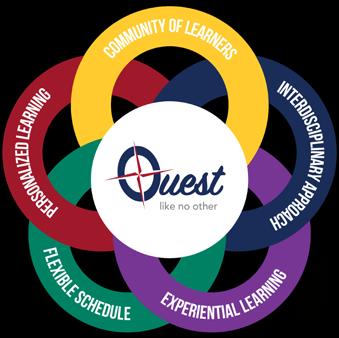
• Flexible Schedule: Students have more control over their schedule and will learn essential time management skills. The schedule and pacing are designed to empower students to take control over their learning process and develop strong time management and executive functioning skills.
• Community of Learners: A small community that allows for close relationships, personalized learning, and daily mentoring.
• Interdisciplinary Approach: Learning experiences emphasize the application and synthesis of knowledge and the development of essential skills and dispositions from across the disciplines.
• Personalized Learning: Units are tailored to students’ strengths and interests. Assessments are meaningful and authentic, and encourage student choice and agency.
Former Quest students have gone on to attend various universities around the world. Because of the strong community bonds that Quest members build, there is regular contact with former students who all attest to the positive impact of the skills developed in Quest:
Quest empowered me in many ways. Not only did the program bless me with foolproof time management skills and the ability to network with adults like a pro, but it also granted me the autonomy to truly discover what I’d like to do in the future. Through reading about my favorite topics, interning at a graduate-level research team from NUS Business School, and choosing a thesis topic, I was able to delve deep into my many interests and pick out the ones I genuinely enjoyed. The experience gave me time and support for thorough self-exploration and refinement. Now, fully equipped with professional skills and more insight into my endeavors, I have gained a head start to adulthood through the Quest program.
- Juliet Mao, Class of 2020Quest alumni have also said that Quest has had a positive impact on their ability to manage independent time in university and that they have felt much more prepared for university than their peers.
The closer relationship I had with my teachers in Quest made it easier to approach my professors and ask for help. I also benefited from the research and resume skills, which helped me apply for a medical dialogue review.
- Armando DiCicco, Class of 2017Students earn grades in Quest through the assessment of interdisciplinary projects and experiences and are scored using rubrics with the applicable standards from the Quest courses. So for one task a student may receive grades in Science, Math, English, and Social Studies. However, the transcript will still reflect the official course titles, the same as any SAS course. Quest students still receive a traditional transcript, same as any SAS student.
Grades for Quest courses are reported in PowerSchool the same way any SAS course reports grades, and will factor into a student’s GPA, along with any other SAS courses a student is taking each semester.
Students select courses from the SAS Program
Students
ID: 48525 Grade: 11–12 Length: Year
Credit: English
Prerequisite: None
The Quest English course immerses students in the academic research process. Students will deeply explore an academic topic, problem, or issue of individual interest. Students will develop an understanding of research methodology, employing ethical research practices, and accessing, analyzing, and synthesizing information as they address a research question. Students will apply this understanding to design, plan, and conduct a year-long research-based investigation to address a research question. For the yearlong Student-Driven Study (SDS), students will develop an informed research question, gather and analyze scholarly journals, and complete their data analysis. Their research will culminate in the writing of a thesis paper and thesis talk. Throughout the units, the students will deliver multiple presentations that consider how style, content, and the advanced use of technology contribute to the power, persuasiveness, or beauty of a text (e.g., making documentaries, digital portfolios, websites, crafting arguments that rely on rhetoric to influence an audience). At the end of the year, students will be able to communicate effectively in various formats while being mindful of audience and purpose.
ID: 48534 Grade: 11–12 Length: Year
Credit: Math
Prerequisite: Successful completion of Geometry.
To receive credit in Math: Data Analysis & Visualization, students are required to demonstrate their learning in interpreting categorical and quantitative data, making inferences, justifying conclusions, and using probability to make decisions. The focus of the course is on deeply understanding the core concepts of statistical analysis and interpreting data. Students will collect, organize, represent, analyze, and visualize data through programming language such as R.
ID: 48536 Grade: 11–12 Length: Year
Credit: Science
Prerequisite: None
Students will explore environmental issues and areas of interaction among natural resources, population, energy, technology, societal institutions, and cultural values through an interdisciplinary lens. They will draw upon course concepts, skills, and community resources in the development of personalized projects. The course is oriented toward understanding the dynamic structure and function of complex systems within our society and the biosphere. Beyond fundamental concepts of ecology, students will study, analyze, and evaluate a range of environmental issues, both natural and humanmade, through the lens of sustainability. This course will challenge students to examine solutions for preventing and resolving environmental problems and will catalyze their active engagement through participation in experiential learning.
ID: 48538 Grade: 11–12 Length: Year
Credit: Social Studies
Prerequisite: None
Students will delve into the characteristics and complexities of organizing societies and what it means to govern. Students will understand the role, responsibility, and limitations of citizens in maintaining, supporting, challenging, and changing how we effectively manage contemporary issues through civic engagement and the interplay between industry, civil society, and government. Quest students will co-create meaningful, authentic learning tasks that deepen their understanding of citizens’ roles, examine their worldviews and notions of governance, and broaden their perspectives of what it means to participate in society. Power and the role industry and civil society play will be further examined through student-selected work and volunteer experiences off-campus. Students will present their work in authentic ways intended for public forum and discourse.
ID: 48526 Grade: 11–12 Length: Year
Credit: English
Prerequisite: Any English AP/AT course Semester I grade of B or higher; or Semester I grade of B+ or higher in English 10/American Studies.
Note: Quest students who completed AT Seminar may choose to submit the thesis papers they produce in this course to the College Board for AP Research exam scoring. Quest will support these students to follow the AP Research guidelines. To earn the AP Capstone Diploma, students must earn three or higher scores on the AP Seminar and AP Research exams and four additional AP exams. The Advanced Topic (AT) designation indicates a course is at the university level, putting it at or above the traditional Advanced Placement (AP) course level. This course has an additional grade point weighting of 0.5.
Please see above for a detailed description of English: Research & Composition. Students wishing to earn Advanced Topic credit in English: Research & Composition will practice narrative, oral communication, digital communication, and argumentative skills at a level that demonstrates the in-depth application of these skills. Students will complete one additional project per unit. These projects may be self-selected but may also be suggested by the advisors.
ID: 48535 Grade: 11–12 Length: Year
Credit: Math
Prerequisite: Completion of Algebra 2/Trigonometry or higher- level math course with Semester I grade of B or higher; or Quest advisor’s recommendation.
Note: The Advanced Topic (AT) designation indicates a course is at the university level, putting it at or above the additional Advanced Placement (AP) course level. This course has a different grade point weighting of 0.5.
Please see above for a detailed description of Math: Data Analysis & Visualization. Students who wish to earn Advanced Topic credit will individually be held to a higher standard of skill acquisition and will need to demonstrate a high level of data processing and analysis skills. Students are required to collect, organize, represent, analyze, and visualize their data through the use of programming language such as R. Students will work in partnership with the Quest advisors to also define their advanced learning objectives and how they go beyond the requirements of the college preparatory level to attain Advanced Topic credit.
ID: 48537 Grade: 11–12 Length: Year
Credit: Science
Prerequisite: Completion of a chemistry course with a grade of B or higher; or completion of a physics course with a grade of B or higher.
Note: The Advanced Topic (AT) designation indicates a course is at the university level, putting it at or above the additional Advanced Placement (AP) course level. This course has an extra grade point weighting of 0.5.
Please see above for a detailed description of Science: Conservation & Resource Studies. ATlevel students will be required to go above and beyond the college preparatory Conservation & Resource Studies course requirements. The AT learning expectations are more rigorous with a higher level of knowledge and skill expected and assessed throughout the investigative process, experiential fieldwork, field journaling, application, and reflection.
ID: 48539 Grade: 11–12 Length: Year
Credit: Social Studies
Prerequisite: None.
Note: The Advanced Topic (AT) designation indicates a course is at the university level, putting it at or above the additional Advanced Placement (AP) course level. This course has an extra grade point weighting of 0.5.
Please see above for a detailed description of Social Studies: Society, Governance, and Civic Action. Students who wish to earn Advanced Topic credit will individually be held to a higher standard of skill acquisition and will need to demonstrate a high level of communication and analysis skills. Students will practice independent research skills to collect, organize, represent, and analyze their ideas at a level that demonstrates these skills in-depth application. Students will complete projects that may be self-selected but may also be suggested by the advisors.
SAS is committed to meeting the diverse needs of our students by providing a range of exceptional learning opportunities.
The Advanced Studies program consists of our school’s college level course options. The program now includes over 40 college level offerings and is one of the many ways in which our school is working towards its vision of cultivating exceptional thinkers prepared for the future.
As we pursue this vision, we recognise the benefits to our students associated with both standardized and non-standardized approaches to student learning. It is for this reason that the Advanced Studies program is a hybrid of standardized and non-standardized curricula that includes both Advanced Placement (AP) courses and Advanced Topic (AT) courses.
Our AT courses are designed to foster the development of essential 21st-century skills as well as to provide opportunities for students to showcase these skills in ways that are both authentic and unique. These courses are designed to help students to learn by doing, emphasizing production and real world application. Whenever possible, AT courses also connect students with relevant experiences and expertise in the field. Depth is prioritized over breadth, and students are expected and supported to have agency in directing their own learning.
Peak performance in AT courses is diverse, with students collaboratively publishing books, learning Chinese history in Chinese, co-constructing historical inquiries, planning and producing their own performing arts exhibitions, exploring various phenomena through computer modeling, and even consulting for local entrepreneurs.
It is impossible to capture all aspects of these courses in this guide so we encourage you to reach out to our teaching faculty and counselors for further guidance and support.
SAS has a long and successful history with the AP program, with students and faculty collaborating together to deliver exceptional results in over 20 courses each year. For many of our students, our AP program provides the perfect entry point to college level learning and plays a critical role in helping to develop college readiness.
SAS students may earn up to seven (7.0) year-long-equivalent AP credits during their high school careers. Though students may only earn seven AP credits, it is possible for students who plan appropriately to take more than seven AP exams. If you have any questions about the credit limit, please feel free to contact the college counseling department or high school administration.
Taking the AP exam in an AP Course is not mandatory. However, each year SAS has over 600 students taking a total of almost 2000 AP exams. Successfully delivering a program of this scale while still operating a full campus is a significant undertaking. As a result, SAS is only able to provide access to AP exams to students currently enrolled in the corresponding AP course, or in an aligned AT course. Similarly, faculty can only provide predicted AP scores to students currently enrolled in their classes. Students wishing to take an AP exam in a course in which they are not currently enrolled may contact their counselor who may be able to suggest a testing center here in Singapore.
The AP program provides one potential avenue for earning college credit. We are also pleased to be able to offer this opportunity through our continued partnerships with Syracuse University. During the 2022-23 school year, SAS students taking AT Psychology are eligible for concurrent enrollment in Syracuse University courses.
Concurrent enrollment is not mandatory, and students will choose whether or not to participate at the beginning of the course. Please note that there is a fee per credit hour that participating students and
families must pay. This fee is determined by Syracuse University Project Advance (http://supa.syr.edu) and universities themselves. We will continue to explore partnerships with Syracuse University for some of our other AT courses in subsequent years.
We are fortunate to be in a position to offer such a diverse range of college level learning opportunities and are grateful for the work of our exceptional faculty in continuing to strengthen our program. We encourage you to reach out to our high school counselors or our Head of Advanced Studies, Tim Trainor (ttrainor@sas.edu.sg), should you have any questions or need support. The following section offers a brief summary of all our Advanced Studies offerings. For full course descriptions, please refer to the entries for each course that appear earlier in this guide under each department. Those courses that provide access to AP Exams or concurrent enrollment credit opportunities are also outlined in Appendix III.
ENGLISH
• AP English Language & Composition Year English
• AT English: Literature Year English
• AT Non-Fiction and Rhetoric Year English
• AT English: Writing Workshop & Publication Year English
SOCIAL STUDIES
• AP Comparative Government & Politics Semester II Social Studies
• AP Economics Year Social Studies
• AP Economics (Self-Paced) Year Social Studies
• AP U.S. History Year US History
• AP U.S. Government & Politics Semester I Social Studies
• AT Economics: Globalization Semester Social Studies
• AT Entreprenuership Semester Social Studies
• AT Geography & Field Research Year Social Studies
• AT Historical Inquiry & Research Year Social Studies
• AT Psychology Year Social Studies
• AT Urban Studies Semester Social Studies
MATHEMATICS
• AP Calculus AB Year Math
• AP Calculus BC Year Math
• AP Calculus BC (Post-AB) Semester I Math
• AP Statistics Year Math
• AT Finite Math Modeling Semester II Math
• AT Linear Algebra Semester Math
• AT Multivariable Calculus Semester Math
• AT Post-Euclidean Geometry Year Math
SCIENCE • AP Biology
• AP Chemistry
• AP Physics 2
• AP Physics C
• AT Environmental Science & Research
• AT Science: Computational Modeling & Simulation
Physical Science
Physical Science
Physical Science
Life Science
Physical Science
WORLD LANGUAGES
• AP French Language & Culture
• AP Spanish Language & Culture
• AP Chinese Language & Culture
• AT Spanish Language: Latin American History and Culture Through Arts Media
• AT Chinese Language: History
TECHNOLOGY, ELECTIVES AND CAPSTONE (TEC)
VISUAL AND PERFORMING ARTS
• AP Computer Science
• AT Computer Science: Data Structures
• AT Seminar
• AT Research & Catalyst
• AP Drawing
• AP 2-D Art & Design
• AP 3-D Art & Design
• AT Performing Arts & Catalyst
• AT Visual Arts Collaborative Creation
• AT Visual Arts Catalyst
DEPARTMENTS ADVANCED STUDIES OFFERINGS
PHYSICAL EDUCATION
QUEST
• AT Kinesiology
• AT English: Research & Composition
• AT Math: Data Analysis & Visualization
• AT Science: Conservation & Resource Studies
• AT Social Studies: Society, Governance, & Civic Action
Language
Language
Language
Language
Language
Elective
Elective
Elective
Elective
Visual/ Performing Arts
Visual/ Performing Arts
Visual/ Performing Arts
Visual/ Performing Arts
Visual/ Performing Arts
Visual/ Performing Arts
Physical Education
English
Math
Science
Social Studies
The SAS learning support department offers targeted services for students who need support or further instruction to help them succeed in their academic coursework. Any student, including those with a diagnosed learning need, may access support services when referred by a school professional or when recommended through a Student Services Meeting (SSM). The program’s goal is for students to build strategies and skills that they can apply to their academic coursework and future lives.
ID: 47505 Grade: 9 Length: Year
Credit: May be taken for elective credit or non-credit.
Prerequisite: By teacher and school professional referral. The goal of the Learning Lab class is for 9th grade students to develop the skills necessary for success in their high school academic program and to work on individual learning goals. Students in this class will be flexibly grouped according to their individual needs in one or more of the following areas: reading, writing, math, and/or executive function. As students strengthen their strategies and skills in any of the above areas, they will have some class time to apply this learning to their academic coursework.
ID: 47502 Grade: 10–12 Length: Year
Credit: May be taken for elective credit or non-credit.
Prerequisite: By teacher and school professional referral. In the Learning Support II program, 10th to 12th grade students work on individualized goals to acquire or refine the executive function and study skills necessary for success throughout high school and in preparation for college. The curriculum targets seven areas: self-management, selfawareness, relationships, responsible decision making, social awareness, goal setting and special interest topics which support transition to college. Through small group instruction, students are assisted in applying these skills and strategies to their academic course work. The Learning Support II program aims to build confidence, self advocacy, and independence.
ID: 47511/2 Grade: 10–12 Length: Year
Credit: May be taken for elective credit or non-credit.
Prerequisite: By teacher and school professional referral. This course provides targeted, individualized, small group support to students in grades 10, 11, and 12 to support their reading, writing, speaking,
listening, and vocabulary skills in their humanities courses. Instruction and interventions for this course are driven by goals that are designed around specific areas of need for each student to build tools, strategies and skills to apply to content-area classes.
ID: 47521 Grade: 10–12 Length: Year
Credit: May be taken for elective credit or non-credit.
Prerequisite: By teacher and school professional referral. This course provides targeted, individualized, small group support for students in Geometry to develop their mathematical knowledge and skill, mindset, and confidence. With a focus on each student’s individual goals, instruction and interventions in this course focus on vocabulary development, conceptual understanding, study strategies and test-taking strategies for Geometry.
ID: 49998 Grade: 9-12 Length:Short-term, Semester or Year
Credit: Non-credit
Prerequisite: By teacher and school professional referral or by a student’s self-referral.
The Supervised Study program offers support for students who may benefit from additional structure to help them organize and complete specific tasks or stay up-to-date with their work. In Supervised Study, students work with a coach to help them prioritize their work, plan their time, and provide accountability, as needed, to help them achieve their goals. Placement in Supervised Study may be short-term or long-term, depending on student need. Some students choose to enroll in Supervised Study while others are referred by a teacher or counselor.
All students are required to participate in the Interim Semester program and select their courses during the academic year.
The program is committed to:
• deepening students’ understanding of the world around them;
• inspiring students to contribute to the global community;
• encouraging students to challenge themselves; and
• building a sense of community.
Courses are offered in the following categories:
• Global Studies: These courses denote active participation and awareness of our interconnectedness with people and cultures around the world. Students will deepen their understanding of the world through themes. These themes may cross any academic discipline and often focus on development (resource management, environmental care, poverty), peace and conflict, cultural expression, and political conditions. Language study, which facilitates all cultural understanding, is also a valued focus area.
• Service Learning: These courses have the capacity to touch on each of the learning aspirations of the school’s strategic focus. By using the model that knowledge leads to compassion, and compassion to action, service learning projects give students the opportunity to make a positive impact on the local community in which they work. Service learning provides a framework in which students learn and develop through active contribution in thoughtfully prepared service that meets the needs of the community.
• Eco-Adventure: These courses are designed around the belief that the outdoors provides the greatest context for humans to grow socially, emotionally, and academically. As such, eco-adventure courses provide students opportunities to learn and develop physically and intellectually while being fully immersed in the natural environment. Students will return from these excursions with an improved self-perception, increased academic skill-set, and a robust sense of the environmental dynamics of the region visited.
Beginning with the members of the Class of 2016 all students must complete at least one service learning Interim course. Due to the impacts of COVID the classes of 2024 and 2025 are exempted from the service learning requirement.
The SAS Summer Semester offers two types of learning experiences for high school students. The first option includes non-credit courses that last one week. These courses are opportunities for students to explore areas of interest such as art, writing, debate, robotics, or other topics. Each week different courses are offered based on the expertise of the instructors.
The second option is for-credit courses in Algebra I and Geometry. Summer Semester courses which allow students to earn high school credit (e.g. Algebra I and Geometry) are self-paced. Students work independently to meet the standards of the course. In order to be successful in the program, a student should be self-motivated, focused, and have a keen interest in the subject area. An assessment of the student’s progress will be made at the end of the first two weeks to ensure the student is on pace to complete the course. If evidence indicates the student is clearly not on pace to meet the course standards, parents may withdraw the student from the course. They will receive half of the Summer Semester payment for the course back.
A SAS Summer Semester transcript will become a part of the student’s official academic record. Courses that are eligible for credit will be listed on the SAS transcript as a P (pass) grade, which is similar to how credits are listed on the SAS transcript for students transferring into SAS from any other high school. Credits earned through the SAS Summer Semester could be used to fulfill SAS graduation requirements but would not be included in the calculation of a student’s SAS grade point average (GPA). A Summer Semester transcript, including the actual grades or comments, would be sent to colleges as an additional page of the SAS transcript.
Summer Semester offerings will be shared on the SAS website starting in February.
At SAS, a team of college counselors works with juniors and seniors every year to assist them in the process of selecting and applying to colleges and universities. The focus is on helping students find colleges that will be a good fit for them: colleges to which they are admissible, at which they will be successful and happy, and from which they will graduate.
Every SAS student is assigned a college counselor in the spring of sophomore year. At that point, the college counselor will work with the student on questions regarding curriculum planning and course registration. In the middle of junior year, the college counselors begin the college counseling process in earnest, meeting with students and families to talk about ideas and aspirations and to begin building a college list. The college counseling office also offers a wide range of programming for parents interested in learning more about college admissions.
The best way for students to prepare for college is to have robust academic and extracurricular lives. All students will benefit from investing themselves fully in a wide range of courses and from becoming engaged in meaningful extracurricular activities, but each student’s college interests and search will be unique. The SAS college counselors are here to work with each individual student and family to talk about and plan for the journey ahead.
When admissions officers in the US review applications, they take a broad range of factors into consideration. At most schools, the first and most important factors are grades, course choices, and rigor. Some institutions may also consider SAT or ACT scores, though many US colleges now have test blind or test optional admissions policies. Most schools in the US will also look at letters of recommendation, student essays, involvement in activities, and the college’s own institutional priorities. US colleges prefer to see students who are both engaged in the classroom and who contribute to their communities.
Each year, between 10 and 25 percent of SAS seniors choose to apply to colleges in locations such as Australia, Canada, Singapore, and the UK. Each of these countries has its own unique application review system. The SAS High School College Counseling website has information about these countries and the factors they use in their admissions reviews.
At most universities outside of North America, students are required to be certain of their course of study at the time of application. This means that students must be prepared to launch into a specific course of university study—and to stay with it for three years or until the degree is completed. Therefore, students interested in studying at universities beyond North America generally benefit from deciding on their intended course of college study early on. In consultation with their college counselor, they should plan their course schedule with careful attention to the field that they think they might like to pursue in the future. Most universities in the UK require that students sit for three AP exams (or five, in a handful of cases) related to their intended area of study, so students who are UK-bound should plan accordingly.
US colleges expect each student to pursue a curriculum that is appropriately rigorous for that individual student––in other words, one in which the student can be challenged and can also be academically successful. This means that, when choosing high school courses, it is important to take a strong academic program––but it is even more important for students to take classes that they enjoy and in which they can earn strong grades.
The minimum SAS graduation requirements are just that: minimums. All students should look at the “US College Recommended” column in Appendix V rather than the “Credits Required To Graduate” column when deciding how many years of study to pursue in a given subject area. Students should speak to teachers and their PAC counselor (if they are in grade 9) or to their college counselor (if they are in grade 10 or 11) for advice on exactly which courses to take. Each student’s schedule is different at SAS; there is no one single pathway to graduation. Some students will take more rigorous course loads than others, and colleges understand this. Students should know that our Advanced Studies (AP and AT) courses are more challenging, asking students to undertake rigorous and sophisticated assignments and to work independently. When choosing courses, students who enroll in Advanced Studies classes must plan on dedicating significantly more time to those courses each day. Students should take this into consideration and be realistic about what they can and will do.
While both AP and AT courses receive additional GPA weighting at SAS, no US colleges require that students take advanced courses. US colleges simply want each student to take a course load that is appropriately rigorous. As noted above, most universities in the UK require that students sit for and score well on three (and, in a few rare instances, five) AP exams in their area of interest, so students who are UK-bound should plan to take at least three classes that offer AP exams. UK-bound students should also look to round out their studies with other course choices that will allow them to demonstrate their dedication to a particular field. Universities in Singapore, South Korea, and a few universities in Australia may also expect to see some AP scores, so AP classes may be important for students headed to these countries.
It is important to note that, while US colleges are looking for academically able students who have challenged themselves, they also want students who have contributed to their school or community. US colleges are looking for interesting people who will become active members of their campuses; they will seek out students who are significantly involved with a few meaningful extracurricular activities. Students should, therefore, plan to balance their academic load with other interests and activities.
Each student will be provided with a comprehensive list of SAS’s college application policies, but we would like to highlight three of our policies here:
Neither the SAS college counselors nor AP teachers will share predicted AP exam scores with students.
2. Disciplinary Reporting Policy
SAS will disclose any disciplinary infraction resulting in an out-of-school suspension when asked about disciplinary infractions by colleges.
After reviewing the information in this guide, please use the High School Pathways Planner to develop a high school plan of study. Make certain that the minimum graduation requirements are fulfilled, but remember they are just that—minimum requirements. College-bound students graduate with significantly more than the minimum credits. Students should enroll in a challenging academic program in which they can be successful while also having time to fully immerse themselves in their SAS high school experience.
Teachers and counselors are happy to answer any questions about this request process or any of the SAS courses.
Students can log in to PowerSchool and click the class registration icon to open the course selection screen. Access to this page is only available during the registration period in the spring. Follow the on–screen instructions to select courses for next year. Note that all courses are available throughout the registration period: seats are not allocated until after the process ends. Click a subject area to see the available courses. The list of available courses is based upon the courses already completed, the prerequisites that have been met, or recommendations entered by current teachers. New students who recently joined our school and have no SAS course history may be missing prerequisites; in this case, please see your PAC counselor (grade 9) or college counselor (grades 10 & 11) so that prerequisite courses can be manually added.
Students going into ninth or tenth grade must choose seven courses per semester. Students going into eleventh or twelfth grade may select either six or seven classes per semester; they may not register for fewer than six.
Once the correct number of courses has been entered, click submit. The course requests will be displayed. Until the request period ends, students can go back and review or change course requests.
Note: For students who do not plan to return to SAS next year, please complete this process anyway. It will help us plan for new students and can also help students think about their future course planning.
After submitting course requests, a summary of courses will be displayed. Students can then check graduation progress by clicking the “view graduation progress link”. These charts combine all credits: those that have been completed, those that are in-progress this semester, and those that have been requested for next year. The top graph shows progress toward meeting minimum SAS graduation requirements, and the bottom one shows progress toward fulfilling typical college preparatory expectations.
English Humanities 9 2xYR
American Studies 2xYR
English 10 YR
Asian Literature SM
Creative Writing SM
Literature/Imagination SM
British Literature SM
Contemp American Lit SM
Studies in Satire S2
World Lit Myths/Monsters S2
Read, Write, & Publish YR
AP Eng Lang/Comp YR
AT Eng Lit YR
AT Eng: NonFic & Rhetoric YR
AT Eng: Writing Workshop/
Publication.... YR
Social Studies
Humanities 9 2xYR
American Studies 2xYR
US History & Govt YR
Modern Hist of S’pore SM
Modern Philosophy SM
Law & Justice SM
Economics SM
Behavioral Econ/Game SM
Business SM
Personal Finance SM
Psychology SM
AP Comp Gov/Politics S2
AP Economics YR
AP Econ (Self-Paced) YR
AP US History YR
AP US Gov/Politics S1
AT Econ: Globalization SM
AT Entrepreneurship SM
AT Geo & Field Research YR
AT Hist Inquiry/Research YR
AT Psychology YR
AT Urban Studies SM
Mathematics
Accelerated Math I YR
Accelerated Math II YR
Algebra I YR
Algebra II/Trig YR
Conceptual Algebra II YR
Data Analytics YR
Discrete Math YR
Geometry YR
PreCal with Statistics YR
PreCal with Parametrics YR
AP Calculus AB YR
AP Calculus BC YR
AP Calculus BC (Post-AB) S1
AP Statistics YR
AT Finite Math Modeling S2
AT Linear Algebra SM
AT Multivariable Calculus SM
AT Post-Euclidean Geo S1
Science
Life Sciences:
Biology .....................................YR
Accelerated Biology YR
Anatomy & Physiology SM
Biotechnology SM
Environmental Science SM
Forensic Science SM
Marine Biology SM
Zoology ....................................SM
Physical Sciences: Chemistry YR
Accelerated Chemistry YR
Physical Science YR
Physics.......................................YR
Accelerated Physics YR
AP Biology YR
AP Chemistry YR
AP Physics 2 YR
AP Physics C YR
AT Computational Modeling & Simulation SM
AT Env Sci/Field Research YR
World Languages
French: Novice YR
French: Intermediate YR
French: Intermediate II YR
French: Intermediate III YR
French: Intermed High YR
French: Intermed High II YR
French: Intermed High III YR
Spanish: Novice YR
Spanish: Intermediate YR
Spanish: Intermediate II YR
Spanish: Intermediate III YR
Spanish: Intermed High YR
Spanish: Intermed High II YR
Spanish: Intermed High III YR
Spanish: Advanced YR
Spanish Advanced II YR
Chinese: Novice YR
Chinese: Intermediate YR
Chinese: Intermediate II YR
Chinese: Intermediate III YR
Chinese: Intermed High YR
Chinese: Intermed High II YR
Chinese: Intermed High III YR
Chinese: Advanced YR
Chinese: Advanced II YR
AP French Lang/Culture YR
AP Spanish Lang & Culture YR
AP Chinese Lang & Culture YR
AT Spanish Lang: Latin American
Hist & Culture YR
AT Chinese Lang: History YR
TEC
Computer Science & Design: Comp Sci:Mob App Dev SM
Comp Sci I SM
Designing Virtual Worlds SM
Emerging Tech SM/YR
Graphic Design SM
Engineering/Robotics: Intro to Robotics SM
Robotic Science SM/YR
Engineering Design YR
Journalism & Media Options: Journalism Yearbook YR
The SAS Catalyst Project SM
AP Comp Sci YR
AT Comp Sci: Data Structures YR
AP Capstone/Catalyst:
AT Seminar YR
AT Research & Catalyst YR
Independent and Online:
Independent Study SM
Global Online Learning SM&YR
Visual/Performing Arts
Visual Arts:
Art I: Foundations SM
Ceramics I SM
Ceramics II SM
Ceramics III YR
Studio Art YR
Mixed Media/Dig Proc SM
Film/Photography:
Filmmaking SM
Adv Filmmaking SM
Digital Photography SM
Adv Digital Photography SM
Media Arts:
Media Arts: Broadcast Film YR
AP Drawing YR
AP 2-D Art & Design YR
AP 3-D Art & Design YR
AT Visual Arts Collab Creation YR
AT Visual Arts Catalyst YR
Performing Arts:
Theater: Stagecraft SM
Theater: Production SM
Theater: Adv Production S2
ITheater: mprovisation SM
Theater: Adv Improvisation SM
Musical Theater:Hist/Prod SM
Theater: Sketch Comedy SM
Strings:
Concert Strings YR
Chamber Strings YR
String Ensemble YR
Band:
Concert Band YR
Jazz Improvisation SM
Symphonic Band YR
Wind Ensemble YR
Vocal Music:
Concert Choir SM/YR
Choral Ensemble YR
SAS Singers YR
Additional Music Courses:
Introduction to Guitar SM
Advanced Guitar SM
Dance:
Dance I - Intro to Dance...........SM
Dance II ....................................SM
Dance III SM
Dance Performance YR
AT Perf. Arts & Catalyst YR
Physical & Health Education
Physical Education: Athletics SM
Climbing/Adventure Trg SM
Dance I - Intro to Dance...........SM
Dance II ....................................SM
Dance III SM
Dance Performance YR
Fld Hockey/Softball/Golf SM
Fit for the Body/Mind SM
Group Fitness SM
Group Fitness II SM
Indoor Team Sports SM
International Sports SM
Lifeguarding SM
Life Skills/Human Dev SM
Personal Def & Combatives SM
Racquet Sports SM
Safety/First Aid SM
Soccer/FlagFtbl/Rugby SM
Weight Training & Cond I SM
Weight Training & Cond II SM
AT Kinesiology SM
Quest
Eng:Research/Comp YR
Math: Data Analysis/Vis YR
SS:Soc,Gov/Civic Action YR
Sci: Conserv.& Resource YR
AT Eng: Research/Comp YR
AT Math: Data Analysis/Vis YR
AT SS: Soc, Gov/Civ Action YR
AT Sci: Conserv.& Resource YR
Advanced Studies
English:
AP Eng Lang & Compo YR
AT Eng Literature YR
AT Eng: NonFic & Rhetoric YR
AT Eng: Writing Workshop/ Publication.... YR
Social Studies:
AP Comp Gov/Politics S2
AP Economics YR
AP Econ (Self-Paced) YR
AP US History S1
AP US Gov/Politics S1
AT Econ: Globalization SM
AT Entrepreneurship SM
AT Geo & Field Research YR
AT Hist Inq & Research YR
AT Psychology YR
AT Urban Studies SM
Mathematics: AP Calculus AB YR
AP Caculus BC YR
AP Calculus BC (Post-AB) S1
AP Statistics YR
AT Finite Math Modeling S2
AT Linear Algebra SM
AT Multivariable Calculus SM
AT Post-Euclidean Geometry S1
Science:
AP Biology YR
AP Chemistry YR
AP Physics 2 YR
AP Physics C YR
AT Env Sci & Field Research YR
AT Sci: Computational
Modelling & Simulation YR
World Language:
AP French Lang/Culture YR
AP Spanish Lang & Culture YR
AP Chinese Lang & Culture YR
AT Spanish Lang: Latin American Hist & Culture ...........................YR
AT Chinese Lang: History YR
Techonology, Electives & Capstone (TEC):
AP Comp Sci YR
AT Comp Sci: Data Structures YR
AT Seminar YR
AT Research & Catalyst YR
Support Services
Learning Support Program:
Learning Lab I YR
Learning Support II YR
English Lang Arts Lab I YR
English Lang Arts Lab II YR
Geometry Math Lab YR
Supervised Study Program:
Supervised Study ST/SM/YR
(Recommendation is required for these courses.)
Objective:
The following information will help students and families to better understand their access to AP Exam and/or Syracuse University credit based on course enrollment.
The Singapore American School Advanced Studies program is pleased to offer students the opportunity to take a wide variety of AP exams and to earn Syracuse University credit through concurrent enrollment. In order to access these opportunities, students must be enrolled in the associated Advanced Placement (AP) or Advanced Topic (AT) courses here at SAS. (Please note that independent study may not be used to obtain access.) The following table lists the AP exams and university credits available at SAS alongside the courses that provide access to these opportunities.
SUBJECTS AP EXAM OR UNIVERSITY CREDIT ASSOCIATED ADVANCED STUDIES COURSE
ENGLISH AP English Language Exam
AP English Literature Exam (requires selfstudy)
AP Calculus AB Exam
MATHEMATICS
AP Calculus BC Exam
AP Statistics Exam
AP Biology Exam
AP Chemistry Exam
AP Environmental Science Exam
SCIENCE
AP Physics 1 Exam (requires self-study)
AP Physics 2 Exam
AP Physics C: Mechanics Exam
AP Physics C: Electricity & Magnetism Exam
AP Gov & Politics: US Exam
Calculus
(Year-Long or Post-AB)
Biology
Environmental Science & Field Research
Physics
AP Gov & Politics: Comparative Exam
Gov & Politics: Comparative AP Macroeconomics Exam
AP Microeconomics Exam
Syracuse University Credit (PSY 205)
AP US History Exam
Economics
Psychology
History
VISUAL & PERFORMING ARTS
WORLD LANGUAGES
QUEST
AP Computer Science Exam
AP Seminar Exam
AP Research Exam (also offered in Quest)
AP Drawing Exam
AP 2-D Art and Design Exam
AP 3-D Art and Design Exam
AP Chinese Language & Culture Exam
AP French Language Exam
AP Spanish Language Exam
AP Research Exam (also offered in TEC)
Advanced Placement (AP) Exam Guidelines:
AP Computer Science
AT Seminar
AT Research & Catalyst
AP Drawing
AP 2-D Art and Design
AP 3-D Art and Design
AP Chinese Language & Culture
AP French Language
AP Spanish Language
AT English: Research & Composition
Singapore American School only administers AP exams to SAS students who are currently enrolled in the respective AP course or in an associated AT course that explicitly provides access to an AP exam. If SAS does not currently offer a particular AP course, students cannot take the course as independent study and SAS will not administer the respective AP exam(s). Please refer to specific Advanced Studies course descriptions to see if a course explicitly provides access to an AP exam.
Students who transfer to SAS at the start of the second semester can request to take an AP exam for a course they are not enrolled in at SAS, if they have been enrolled in the course at another high school before transferring to SAS mid-year. The request must be endorsed by a student’s college counselor, an SAS teacher who is a subject expert in the respective exam, and the Advanced Studies Coordinator.