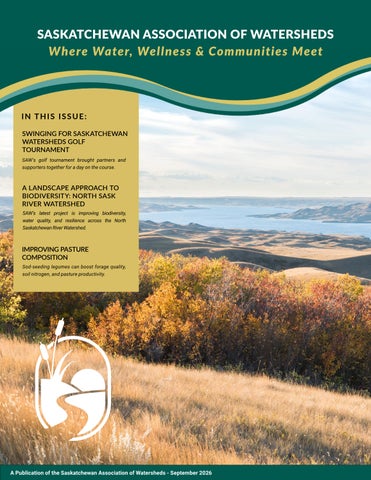
SASKATCHEWAN ASSOCIATION OF WATERSHEDS Where Water, Wellness & Communities Meet Aa
IN THIS ISSUE: SWINGING FOR SASKATCHEWAN WATERSHEDS GOLF TOURNAMENT SAW’s golf tournament brought partners and supporters together for a day on the course.
A LANDSCAPE APPROACH TO BIODIVERSITY: NORTH SASK RIVER WATERSHED SAW’s latest project is improving biodiversity, water quality, and resilience across the North Saskatchewan River Watershed.
IMPROVING PASTURE COMPOSITION Sod-seeding legumes can boost forage quality, soil nitrogen, and pasture productivity.
A Publication of the Saskatchewan Association of Watersheds - September 2026
1
TABLE OF CONTENTS Swing for Saskatchewan Watersheds Golf Tournament
3
UPCOMING EVENTS SEPTEMBER 2026 Sept. 15 - Northwest District Advisory Committee Meeting, Rosthern Sept. 29 - Southwest District Advisory Committee Meeting and Prescribed Burn
Applying a Landscape Approach to Improve Biodiversity: North Saskatchewan River Watershed
4
Workshop, Eastend
OCTOBER 2026 Oct. 7 - Lake Winnipegosis Watershed Planning Meeting, Norquay
Improving Pasture Composition
5
Oct. 14 - Lake Winnipegosis Watershed Planning Meeting, Kelvington Oct. 15 - Early Adopter Field Day, Cupar Oct. 22 - Northeast District Advisory Committee Meeting, Yorkton Oct. 29 - Southeast District Advisory Committee Meeting, Lumsden
2
SWING FOR SASKATCHEWAN WATERSHEDS GOLF TOURNAMENT
Hillcrest Golf Course, Moose Jaw, SK
On August 18th, we hosted our Swing for Saskatchewan
Events like this remind us how fortunate we are to have such
Watersheds golf tournament at the Hillcrest Golf Club in Moose
strong support from our partners and community. We’re grateful
Jaw. With 37 golfers hitting the course - and an even larger crowd
for everyone who participated, volunteered, or joined us for
joining us for supper - the day was a great success and a welcome
supper. A special thank you goes to our event sponsors - Ottawa
chance to celebrate our shared commitment to protecting
Real Estate, Minuteman Press, Strictly Fences, Velocity Ford, and
Saskatchewan’s watersheds.
HD Drake Builders - whose contributions helped make the day possible.
The competition stayed tight from the first tee to the final putt, with the winning team taking the prizes by a single stroke.
Whether you came for the golf, the food, or just to enjoy a day
Congratulations to Mike Ferguson, Nicole Moffat, Martha
outdoors with colleagues, we appreciate you being part of a
Shareski, and Nathan Avery on claiming the top spot! Julie Anne
fantastic event. We look forward to seeing everyone back for our
Howe earned the prize for her excellent closest to the pin shot, a
next event!
well placed effort that stood out among the day’s attempts - some more hopeful than accurate!
Julie-Anne Howe and her prize bundle for getting the ‘closest to the pin’ shot.
Tournament winners: Martha Shareski, Nicole Moffat, Michael Ferguson, and Nathan Avery.
3
APPLYING A LANDSCAPE APPROACH TO IMPROVE BIODIVERSITY: NORTH SASKATCHEWAN RIVER WATERSHED
The Saskatchewan Association of Watersheds (SAW), with
Together, these practices demonstrate how actions on the
support from Environment and Climate Change Canada
land can provide multiple benefits for biodiversity, water
(ECCC), is working with landowners and communities
quality, agricultural operations, and climate resilience.
in the North Saskatchewan River Watershed to improve biodiversity, water quality, and watershed resilience through
Through
this
project,
SAW
is
working
with
our Applying a Landscape Approach to Improve Biodiversity
landowners and partners to demonstrate that small
project. The project is taking a practical, landscape-scale
changes across the landscape can create meaningful
approach by implementing a range of beneficial management
benefits for the watershed. The lessons learned will help
practices that work together to support healthy land
inform future watershed stewardship and biodiversity
and water.
initiatives across Saskatchewan.
Key activities include:
For questions on the Applying a Landscape Approach to
•
Off-site watering systems to help reduce livestock
Improve Biodiversity project, email info@saskwatersheds.
access to riparian areas, protect streambanks, and
ca, call: 306-541-9902.
improve water quality. •
Eco-buffer shelterbelt sites that will provide habitat for wildlife and pollinators, reduce wind and soil erosion, and improve landscape connectivity.
•
A floating treatment wetland on an effluent lagoon to help improve water quality by using native plants and their associated root systems to naturally remove nutrients and other contaminants.
4
CLICK HERE TO LEARN MORE
local
IMPROVING PASTURE COMPOSITION By Jeremy Brown, PAg Rancher/Grazing Consultant
Some common goals for older tame pastures are to increase forage yield and to extend the life of the pasture stand. Often tame forage that has been in place for a number of years is short of nutrients, especially nitrogen. Introducing (or re-introducing) leguminous forage species is one way to boost soil nitrogen levels and often will also improve forage yield and quality. Four key elements to a rejuvenation plan via sod-seeding are species selection, site preparation, seeding method, and weather conditions. When selecting forage species to add, it is important to know what plants already exist in the pasture, and their relative abundance. In most cases, even older tame forage stands will still have a reasonable number of favorable grass plants, although the plants may not be vigorous. Adding new grass seeds will really only be beneficial if there is significant bare ground between grass plants, such as you might find in bunchgrass stands like Crested Wheatgrass or ryegrass.
Adding legumes to a grass pasture can improve forage yield and quality
Legume forages that are typically sod-seeded include alfalfa, sainfoin, cicer milkvetch, and clovers. These species can all
we can choose the timing of seeding. Waiting for a year and
produce high protein forage and their roots will co-operate with
season with soil moisture and chance of rain will greatly
soil microbes to fix nitrogen from the atmosphere. In most
increase the odds of success.
cases, having appropriate microbial inoculants applied to the seed will increase the ability to capture nitrogen.
Adding beneficial forage plants to your pasture is an attractive idea. Success rates are mild to moderate, so it is well worth
The existing pasture species (and their sod) are a barrier to
having a plan to select the right seeds and then give them the
establishment of new seedlings. In order to give the seeds and
greatest chance of survival. Once they are an established part
seedlings a chance, usually the stand is weakened somewhat
of the pasture sward, legumes can provide pasture health and
to even the playing field. This may be accomplished by a severe
productivity benefits for many years.
graze or with moderate rates of a herbicide such as glyphosate. Improving Pasture Composition is eligible for support through For germination and establishment, good seed-to-soil contact
SAW’s SWEAP (Saskatchewan Watersheds Environmental
is essential. Ideally the seeds are placed down in the mineral
Agriculture
soil and then packed, which can be accomplished with a disk
Management Practice program. Funding for SWEAP is provided
drill or hoe drill with narrow openers. If broadcasting the seed is
by Agriculture and Agri-Food Canada through the Agriculture
the only option, follow-up with a rotary harrow or some similar
Climate Solutions – On-Farm Climate Action Fund (OFCAF).
Program)
Rotational
Grazing
Beneficial
implement can help with incorporation. Like most farming practices, soil moisture will be the greatest
C L I C K H E R E TO L E A R N M O R E
determinant of success. Although we can’t control precipitation,
5
OFFICE LO C ATI ON Our office locations are open Monday to Friday from 9 AM to 4 PM (closed 12 PM - 1 PM).
H E A D O F F I C E M A I L I N G A D D R E S S 300B - 99 Diefenbaker Dr., Moose Jaw, SK
Box 1177, Moose Jaw, SK, S6H 4P9
CONNEC T WITH US
6
S AW M A I N P H O N E N U M B E R
EMAIL ADDRESS
1 (306) 541 - 9902
info@saskwatersheds.ca
7