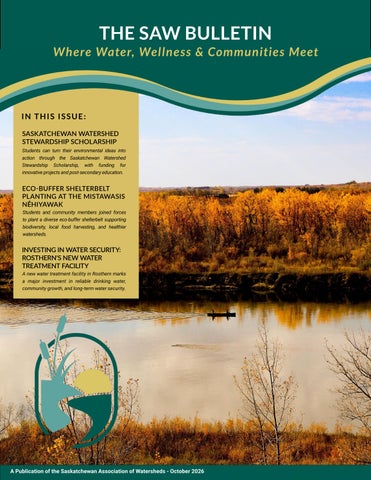
THE SAW BULLETIN Where Water, Wellness & Communities Meet Aa
IN THIS ISSUE: SASKATCHEWAN WATERSHED STEWARDSHIP SCHOLARSHIP Students can turn their environmental ideas into action through the Saskatchewan Watershed Stewardship Scholarship, with funding for innovative projects and post-secondary education.
ECO-BUFFER SHELTERBELT PLANTING AT THE MISTAWASIS NÊHIYAWAK Students and community members joined forces to plant a diverse eco-buffer shelterbelt supporting biodiversity, local food harvesting, and healthier watersheds.
INVESTING IN WATER SECURITY: ROSTHERN'S NEW WATER TREATMENT FACILITY A new water treatment facility in Rosthern marks a major investment in reliable drinking water, community growth, and long-term water security.
A Publication of the Saskatchewan Association of Watersheds - October 2026
1
TABLE OF CONTENTS
UPCOMING EVENTS OCTOBER 2026
Saskatchewan Watershed Stewardship Scholarship: Solutions for Healthy Watersheds
3
Eco-Buffer Shelterbelt: Planting at Mistawasis Nêhiyawak: North Saskatchewan River Watershed
4
Investing in Water Security: Rosthern’s New Water Treatment Facility
5
Oct. 22 - Northeast District Advisory Committee Meeting, Yorkton Oct. 29 - Southeast District Advisory Committee Meeting, Lumsden Oct. 29 - Lake Winnipegosis Watershed Planning
Cover Crop Adoption in Northwest Saskatchewan: P Cross Ranch’s Experience
6
Welcome to the Team
6
Meeting, Kelvington
NOVEMBER 2026 Nov. 3 - SaskSoil Cover Crop Workshop, Assiniboia Nov. 4 - SaskSoil Cover Crop Workshop, Kindersley Nov. 5 - SaskSoil Cover Crop Workshop, Melfort Nov. 25 - On-Farm Funding Programs & Resources Hub, Canadian Western Agribition, Regina Nov. 30 - SaskSoil Cover Crop Workshop, Moosomin
2
SASKATCHEWAN WATERSHED STEWARDSHIP SCHOLARSHIP: SOLUTIONS FOR HEALTHY WATERSHEDS
Have an idea that could make a difference for Saskatchewan’s
From Idea to Implementation
watersheds?
Stewardship
Applicants will identify a local environmental challenge (within
Scholarship gives students the opportunity to develop and
Saskatoon and the Meewasin Valley Authority) and develop a
implement
watershed
project proposal outlining their proposed solution, expected
stewardship in the City of Saskatoon and the South Saskatchewan
environmental benefits, budget and implementation plan. Projects
River Watershed.
should demonstrate achievable outcomes, opportunities for
The an
Saskatchewan
innovative
Watershed
project
supporting
community engagement and potential for lasting impact. Whether you’re passionate about water conservation, habitat restoration, biodiversity or creative solutions to local environmental
Applications must include a completed application form, a project
challenges, this scholarship offers a chance to put your ideas into
proposal of no more than five pages, a cover letter, current resume,
practice. Successful applicants can receive up to $5,000 in project
letter of recommendation and proof of enrollment. Students can
funding and an additional $5,000 toward the following year of post-
explore watershed stewardship resources and current initiatives
secondary education upon successful project completion.
at www.saskwatersheds.ca to help develop their ideas.
The scholarship is a collaborative initiative between the
Important Dates
Saskatchewan Association of Watersheds (SAW), the City of
Applications open September 30, 2026, and close December
Saskatoon, Meewasin Valley Authority and participating post-
1, 2026. Finalists will compete on March 2, 2027, with project
secondary institutions, supporting locally relevant solutions for
implementation and reporting taking place from March through
healthier, more sustainable watersheds.
August 2027.
Who Can Apply?
Students interested in making a meaningful contribution to
Applicants must be at least 18 years old, legally entitled to study
watershed health are encouraged to apply. This scholarship
in Canada, and enrolled at the University of Saskatchewan or
offers financial support, hands-on experience and opportunities
Saskatchewan Polytechnic in a program related to environmental
to collaborate with environmental professionals and community
stewardship. Relevant fields include environmental science,
partners while building skills for the future.
geography, water resources, agriculture, ecology, engineering and sustainability.
Ready to get started? Click the link below or contact scholarship@ saskwatersheds.ca for more information.
University of Saskatchewan students must be in their second year entering their third year, or third year entering their fourth
CLICK HERE TO LEARN MORE
year. Saskatchewan Polytechnic students at any campus must be in their first year entering their second year, or second year entering their third year. Students must remain enrolled during the application and project implementation periods and be able to complete their project within the scholarship timeline.
3
ECO-BUFFER SHELTERBELT PLANTING AT MISTAWASIS NÊHIYAWAK: NORTH SASKATCHEWAN RIVER WATERSHED
The Saskatchewan Association of Watersheds (SAW), with support from Environment and Climate Change Canada (ECCC), is working with landowners and communities in the North Saskatchewan River Watershed to improve biodiversity, water quality, and watershed resilience through our Applying a Landscape Approach to Improve Biodiversity project.
The
project
is
taking
a
practical,
landscape-scale approach by implementing a range of beneficial management practices that work together to support healthy land and water. On September 23rd, SAW and the community of Mistawasis Nêhiyawak First Nation, including the Grade 8 class at the Chief Mistawasis School, planted an eco-buffer shelterbelt site. Eco-buffer shelterbelt planting sites help reduce soil erosion, filter runoff before it reaches waterways, provide important
aspen and raspberries. Scots pine was used because of its
habitat for wildlife and pollinators, and protect land from
hardiness, drought tolerance, and ability to thrive in various
wind erosion. This site was designed to include a variety
soil types.
of species, including fruit bearing tree and shrub species such as saskatoon berry, apple, chokecherry, pears, plums,
By planting a diverse mix of fruit-bearing trees, shrubs,
gooseberries, haskaps, grape, beaked hazelnut, josta berry,
and native plants, these spaces can create opportunities
red currant, cherries, cranberries, scots pine, trembling
for traditional and local food harvesting while restoring habitat and improving soil and water health. This ecobuffer shelterbelt site will provide a meaningful naturebased solution to supports food security, biodiversity, and community well-being for future generations. For questions on the Applying a Landscape Approach to Improve Biodiversity project, email info@saskwatersheds.ca, call: 306-541-9902.
C L I C K H E R E TO L E A R N M O R E
4
INVESTING IN WATER SECURITY: ROSTHERN’S NEW WATER TREATMENT FACILITY Access to safe, reliable drinking water is essential to healthy communities, economic development, and longterm sustainability. The Town of Rosthern, Saskatchewan, has taken an important step toward strengthening its water security through the development of a new $19.6 million water treatment facility. This significant infrastructure investment represents a commitment to improving drinking water services, supporting community growth, and building resilience for the future. Modern water treatment infrastructure plays a critical role in maintaining drinking water quality, improving operational reliability, and ensuring municipalities can respond to
to two sewage pumping stations, improving pumping
changing demands and environmental conditions.
capacity, operational reliability, and the system’s ability to accommodate future community growth.
From a watershed management perspective, investments
Rosthern announced the grand opening of its new water
in drinking water infrastructure highlight the important
treatment plant on October 9, 2026. The project also includes
relationship between water resources, municipal planning,
the following upgrades:
and community resilience. As Saskatchewan communities
•
Constructing five new water wells
face increasing pressures associated with climate variability,
•
New Water Treatment Plant with larger water reservoir
aging infrastructure, and population growth, proactive
•
Installing new raw water supply lines
investments in water systems are essential to long-term
•
Integrating a new communications system
water security.
•
Upgrading existing well control buildings
•
Demolition of the old Water Treatment Plant and reservoir
On September 15, 2026, the Northwest District Advisory Committee (NW DAC) participated in a tour of the new facility
Projects such as this remind us that protecting and managing
and infrastructure, guided by Public Works, Owen Green, and
our water resources requires collaboration, long-term
the Mayor of Rosthern, Dennis Helmuth.
planning, and continued investment in the infrastructure that communities depend on every day.
The NW DAC also toured the town’s lagoon system. In 2018, Rosthern undertook approximately $2 million in upgrades
5
COVER CROP ADOPTION IN NORTHWEST SASKATCHEWAN: P CROSS RANCH’S EXPERIENCE Located in Northwestern Saskatchewan, P Cross Ranch is owned and
Garret
shared
operated by Garret and Jocelyn Poletz. Their 3,000-acre operation
onboarding and application
includes corn silage production, pasture grazing, and cover cropping,
process
alongside a 3,500-head feedlot. Since 2025, Garret and Jocelyn
extremely easy thanks to their
have accessed funding through the Saskatchewan Watersheds
coordinator
Environmental Agriculture Program (SWEAP), working closely with
explained that “Bailey makes
Bailey Norgan of the Saskatchewan Association of Watersheds (SAW)
the process virtually effortless
to advance their environmental stewardship goals.
and is always ready to answer
for
that SWEAP
Bailey.
the is
Garret
any questions you may have.” Through SWEAP, P Cross Ranch has implemented cover cropping
When asking Garret if he
as a beneficial management practice (BMP) on their operation. Their
would recommend SWEAP
cover crop blend consists of the following species - fall rye, barley,
to others he shared that he
and forage peas. When asked why they continue to participate in the
would highly recommend this program to any farmer or rancher
program, Garret explained: “As the years go on since adopting this
looking to improve their overall soil health of their operation as well
practice, we are continuing to see our marginal acres improve as
as getting the most out of their acres.
well as a decrease in soil erosion due to the living root always being in the soil.”
The Saskatchewan Watersheds Environmental Agriculture Program (SWEAP) supports farmers and ranchers in adopting BMPs,
Beyond improvements to marginal acres and reduced erosion,
including nitrogen management, cover cropping, and rotational
the ranch has observed other benefits, including the presence of
grazing. Funding for SWEAP and PWCP is provided by Agriculture
beneficial insects. Maintaining soil cover and living roots over winter
and Agri-Food Canada through the Agriculture Climate Solutions
has also created opportunities to integrate cover crops into their
– On-Farm Climate Action Fund (OFCAF). The 2027 intake opens
grazing system. Garret explained that the regrowth allows them
February 3, 2027.
to turn cattle out to graze in early spring, around calving season, helping make productive use of their acres while supporting their livestock operation.
CLICK HERE TO LEARN MORE
WELCOME TO THE TEAM DANIA ME YERS, WATERSHED EDUCATION & OUTREACH MANAGER Dania Meyers is the Watershed Education & Outreach Manager with the Saskatchewan Association of Watersheds. With 30 years of experience in education, a background in organizational leadership, and roots in a mixed grain and cattle farm, she brings a practical understanding of the connections between people, land, and water. She is passionate about making complex ideas easier to understand and helping people see the connections between the world around them and the systems that shape it. At SAW, Dania is developing educational programming that connects Saskatchewan learners with watershed awareness and the importance of healthy water and landscapes. Outside of work, Dania enjoys gardening and spending time with her family.
6
OFFICE LOCATION Our office locations are open Monday to Friday from 9 AM to 4 PM (closed 12 PM - 1 PM).
H E A D O F F I C E M A I L I N G A D D R E S S 300B - 99 Diefenbaker Dr., Moose Jaw, SK
Box 1177, Moose Jaw, SK, S6H 4P9
CONNEC T WITH US
S AW M A I N P H O N E N U M B E R
EMAIL ADDRESS
1 (306) 541 - 9902
info@saskwatersheds.ca 7