SASKATCHEWAN ASSOCIATION OF WATERSHEDS Where Water, Wellness & Communities Meet Aa
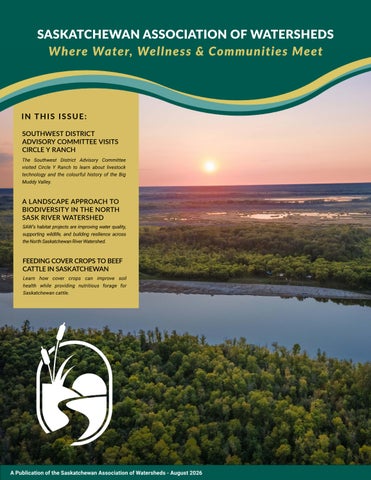
IN THIS ISSUE: SOUTHWEST DISTRICT ADVISORY COMMITTEE VISITS CIRCLE Y RANCH The Southwest District Advisory Committee visited Circle Y Ranch to learn about livestock technology and the colourful history of the Big Muddy Valley.
A LANDSCAPE APPROACH TO BIODIVERSITY IN THE NORTH SASK RIVER WATERSHED SAW’s habitat projects are improving water quality, supporting wildlife, and building resilience across the North Saskatchewan River Watershed.
FEEDING COVER CROPS TO BEEF CATTLE IN SASKATCHEWAN Learn how cover crops can improve soil health while providing nutritious forage for Saskatchewan cattle.
A Publication of the Saskatchewan Association of Watersheds - August 2026
1
TABLE OF CONTENTS Southwest District Advisory Committee Visits Circle Y Ranch
3
UPCOMING EVENTS AUGUST 2026 Aug. 19 - SAW Annual General Meeting, Moose Jaw Aug. 26 - Early Adopter Field Day, Foam Lake
SEPTEMBER 2026 Sept. 3 - Ministry of Agriculture Water Blitz,
Applying a Landscape Approach to Improve Biodiversity in the North Saskatchewan River Watershed
4
Maple Creek Sept. 15 - Northwest District Advisory Committee Meeting, Rosthern Sept. 29 - Southwest District Advisory
Feeding Cover Crops to Beef Cattle in Saskatchewan: Tips for Success
5
Committee Meeting, Eastend
OCTOBER 2026 Oct. 7 - Lake Winnipegosis Watershed Planning, Norquay Oct. 29 - Southeast District Advisory Committee Meeting, Lumsden
2
SOUTHWEST DISTRICT ADVISORY COMMITTEE VISITS CIRCLE Y RANCH
On July 23, the Southwest District Advisory Committee was graciously hosted by committee member Michael Burgess and his wife, Tamela, at Circle Y Ranch in the historic Big Muddy Valley. The meeting included a presentation from Becky Radcliffe, Sales and Marketing Specialist, with Farm Simple Solutions, who shared information about the company’s remote monitoring solutions for livestock producers. The group also enjoyed a delicious ranch-toplate lunch, featuring barbecue pulled moose cooked over charcoal in a cast-iron Dutch oven. Signage at Circle Y Ranch located in the Big Muddy Valley
In addition to regular committee business, members had the opportunity to learn more about the rich outlaw history of the Big
north into Canada, while Canadian horses were taken south into
Muddy Valley. Tamela shared stories of the area’s past during a visit
the United States.
to the Old Porch Gallery, providing a fascinating look at the outlaws, ranchers, and RCMP officers who played a role in the region’s
In 1902, two RCMP officers set up camp in the Burgess yard, which
history.
was occupied by Jasper Huntley at the time. As the outlaws proved difficult for just two officers to apprehend, a larger detachment of
A History of Outlaws in the Big Muddy Valley
six officers was established in 1904 to deal with notorious figures
The Circle Y Ranch and surrounding Big Muddy Valley have a long
including Dutch Henry, Coyote Pete, Sam Kelly, and Frank Jones.
and colorful history connected to outlaws and horse thieves. In the late 1800s, the area became a route for horse thieves escaping
The new detachment was established at the James Marshall
justice in the United States. Stolen American horses were moved
Ranch. It was then discovered that Jasper Huntley had ties to the outlaws and was warning them when the patrolmen were in the area, allowing them to avoid capture. Once the RCMP established their own headquarters, they were able to regain control of the valley and provide greater security for the ranchers settling in the area. The last known outlaw to live in the valley was Sam Kelly, who moved to northern Saskatchewan in 1913. He later passed away at the North Battleford Mental Institution in 1937 at the age of 78. A sincere thank you to Michael and Tamela Burgess for welcoming the Southwest District Advisory Committee to Circle Y Ranch, sharing a wonderful meal, and giving us the opportunity to learn more about the fascinating outlaw history of the Big Muddy Valley.
SW DAC members step back in time while learning about the Big Muddy Valley’s outlaw history at the Old Porch Gallery
3
APPLYING A LANDSCAPE APPROACH TO IMPROVE BIODIVERSITY IN THE NORTH SASKATCHEWAN RIVER WATERSHED
Healthy habitats are the foundation of clean water, resilient
excessive algae growth, and improving water quality within
ecosystems, and sustainable watersheds. By restoring and
the North Saskatchewan River.
protecting natural landscapes, we can improve water quality, support biodiversity, and build resilience to a changing
These projects demonstrate how working with nature can
climate.
deliver multiple benefits for people, agriculture, and the environment. By investing in habitat enhancement today,
SAW, with support from Environment and Climate Change
we are helping ensure the North Saskatchewan River
Canada, continues to work with landowners, municipalities,
Watershed remains healthy, productive, and resilient for future
and local partners within the North Saskatchewan River
generations.
Watershed to implement habitat enhancement projects that provide lasting environmental benefits. Eco-buffer shelterbelt
SAW
will
be
planting sites help reduce soil erosion, filter runoff before it
and FTW project this fall in the North Saskatchewan
reaches waterways, provide important habitat for wildlife
River Watershed. To learn more about the Applying
and pollinators, and protect agricultural land from wind
a
erosion. Offsite watering systems for livestock improve herd
project,
health while reducing direct access to streams and wetlands,
306-541-9902, or click the link below.
Landscape please
implementing
Approach email
an
to
eco-buffer
Improve
shelterbelt
Biodiversity
info@saskwatersheds.ca,
helping to protect riparian areas, reducing bank erosion, and improving water quality. Floating Treatment Wetlands (FTWs) offer an innovative nature-based solution by using native plants to absorb excess nutrients and contaminants, limiting
4
CLICK HERE TO LEARN MORE
call:
FEEDING COVER CROPS TO BEEF CATTLE IN SASKATCHEWAN: TIPS FOR SUCCESS Cover crops are gaining momentum across Saskatchewan as producers look for ways to improve soil health, build resilience to weather extremes, and maximize the productivity of every acre. While often recognized for their environmental benefits, cover crops can also provide high-quality forage through fall grazing, greenfeed, or silage production. Through the Saskatchewan Watersheds Environmental Agriculture Program (SWEAP), cover cropping is recognized as a Beneficial Management Practice (BMP) that supports both agricultural productivity and environmental stewardship. When
may slow dry down when making green-feed. Silage is often an
integrated into a livestock operation, cover crops can improve soil
excellent option for multi-species blends because it reduces weather
health while generating valuable feed for beef cattle.
risk and minimizes drying challenges. For quality silage, harvest at approximately 60–70% moisture, pack well to remove oxygen,
Why Feed Cover Crops?
seal promptly, and allow adequate fermentation before feeding.
Cover crops can help producers achieve multiple goals by:
Wrapped balage can be an excellent feed option to can preserve a
•
Extending the grazing season.
high proportion of the crop’s digestible nutrients and protein when
•
Providing additional forage during feed shortages.
harvest conditions make dry baling a challenge.
•
Improving soil cover and reducing erosion.
•
Increasing soil organic matter and biological activity.
Test Before You Feed
•
Enhancing water infiltration and moisture retention.
Cover crop forage quality varies with species, maturity, and growing
•
Supporting nutrient cycling.
conditions. A forage analysis is essential before incorporating cover crops into winter rations. Forage testing helps build balanced rations
Selecting the Right Mix
and optimize cattle performance.
The ideal cover crop blend depends on your feeding goals and
Test for:
cropping system. Common species used in Saskatchewan include
•
Crude protein
oats, barley, spring triticale, field peas, annual ryegrass, clovers, hairy
•
Energy (TDN)
vetch, forage turnips, forage radish, forage rape, and sunflowers.
•
Fibre (ADF/NDF)
Diverse mixtures often provide the greatest overall benefit. Cereals
•
Moisture
contribute forage yield and effective fibre, legumes increase
•
Mineral content
protein and support nitrogen cycling, while brassicas provide highly
•
Nitrates, particularly following drought, hail, frost, or high
digestible, energy-rich forage.
nitrogen fertility
Grazing Cover Crops
Balance the Winter Ration
Fall grazing is one of the most economical ways to utilize cover crops.
Although cover crops can provide excellent nutrition, they should
It can reduce harvesting and transportation costs while returning
be incorporated into a balanced feeding program. Be sure to match
valuable nutrients to the field through manure and urine. To improve
nutrient supply to the class and stage of production of your cattle.
grazing success:
Ensure adequate effective fibre for proper rumen function and
•
Introduce cattle gradually to lush forage.
supplement minerals and vitamins based on forage test results.
•
Provide access to dry hay during the transition period.
Work with a livestock nutritionist if needed to optimize performance
•
Use temporary electric fencing for strip grazing to improve forage
and feed efficiency.
utilization and reduce trampling. •
Ensure cattle have access to clean, reliable water.
Through programs like SWEAP, producers are adopting practices that strengthen both farm profitability and long-term environmental
Green-feed and Silage for Winter Feeding
sustainability—creating lasting benefits for their operations and
When grazing isn’t practical, cover crops can be harvested as green-
Saskatchewan’s agricultural landscape. Funding for SWEAP is
feed or silage for winter rations. Harvest cereals at the boot to early
provided by Agriculture and Agri-Food Canada through the Agriculture
milk stage for an excellent balance of yield and quality. Legumes
Climate Solutions – On-Farm Climate Action Fund (OFCAF).
increase protein content, while brassicas improve digestibility but
5
C L I C K H E R E TO L E A R N M O R E
OFFICE LO C ATI ON Our office locations are open Monday to Friday from 9 AM to 4 PM (closed 12 PM - 1 PM).
H E A D O F F I C E M A I L I N G A D D R E S S 300B - 99 Diefenbaker Dr., Moose Jaw, SK
Box 1177, Moose Jaw, SK, S6H 4P9
CONNEC T WITH US
6
S AW M A I N P H O N E N U M B E R
EMAIL ADDRESS
1 (306) 541 - 9902
info@saskwatersheds.ca
7