Fall 2020
V o l u m e 11, I s s u e 1
Mentorship Provides Opportunity to Share MĂŠtis Culture
Winding Words with the Saskatchewan Festival of Words Keeping Museum Conversations Online
Engage Published by saskCulture Inc.,
highlight is designed to
the work of cultural leaders, volunteers
diversity and the
of activities supported by the
Culture section of sask lotteries Trust Fund for sport, Culture and Recreation.
Contents
mentorship Provides opportunity to share métis Culture . . . . . . . . . . . . . . . . . . . . . . . . . . . . . . . . . . . . . . . . . . . . . . . . . . . . . . . . . 4 smooth transition to online for saskatchewan Writers' Guild . . . . . . . . . . . . . . . . . . . . . . . . . . . . . . . . . . . . . . . . . . . . . . . . . . . . . . . . . 6 Winding Words with the saskatchewan Festival of Words . . 8 Keeping museum Conversations online
...
11
Take-home Arts and Craft Kits Popular During Pandemic . . 12 New Program Keeping Bands Together
.......................
13
Partnership Develops Videos to Help share Indigenous Culture . . . . . . . . . . . . . . . . . . . . . . . . . . . . . . . . . . . . . . . . . . . . . . . . . 14 Augmented Reality Creates Moving Pictures: Increases Accessibility to Art Work . . . . . . . . . . . . . . . . . . . . . . . . . . . . . . . . . . . . . . . . . . 16 Combining In-Person and Virtual Programming for a New Cultural experience . . . . . . . . . . . . . . . . . . . . . . . . . . . . . . . . . . . . . . . . . 18 métis mondays with the Battlefords Boys and Girls Club . . . . . . . . . . . . . . . . . . . . . . . . . . . . . . . . . . . . . . . . . . . . . . . . . . . . . . . . . . . . 20 The show will Go on!
............................................. ...........................
22 23
4
8
12 13
16
20
Graphic Design:
Diane ell, editor dell@saskculture.ca
J. lauder Publishing & Design joanne.lauder@sasktel.net
404, 2125 11th Ave., Regina sK s4P 3X3 Tel: (306) 780.9284 www.saskculture.ca
Andréa ledding, Busayo osobade, Dave margoshes, Nickita longman, Penny smoke, scott stelmaschuk, and shaunna Grandish
Busayo osobade, Publishing Coordinator bosobade@saskculture.ca
2
10
......................
Popular Indigenous Peoples Day Gathering Goes Virtual
Direct Inquiries to:
On the COver:
v O l u M e 11, I S S u e 1
message from the Ceo . . . . . . . . . . . . . . . . . . . . . . . . . . . . . . . . . . . . . . . . . . . . . 3
Finding New Ways to safely engage
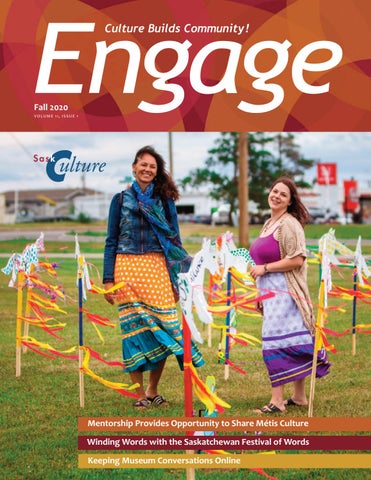
local artists leah Dorion (left) and Danielle Castle (right) created outdoor art installations in Prince Albert. Photo courtesy of the Mann Art Gallery
Fall 2020
Contributing Writers:
Print copies of this publication are circulated for free to saskCulture members, partners and through community outreach activities as determined by saskCulture Inc. Engage is also available in PDF version on the saskCulture web site at www.saskculture.ca. Engage is published thanks to financial support from sask lotteries Trust Fund for sport, Culture and Recreation. The publication does not currently accept paid advertising. Article ideas for future publications can be submitted to info@saskculture.ca or by calling (306) 780-9284. Published November 2020. Articles may be reprinted with permission.
FAll 2020
crisis did bring forth some positive change. “We The witnessed a widespread conquering of virtual meeting
platforms and other forms of technology. Zoom, Teams and other platforms were always there but we now had to dive deep into the technological pool and see if we would stay afloat. And float we did!
Message from the
t
CeO
– DeAn KuSh
”
he past six months have thrust our whole society into an unprecedented era of uncertainty. In march of this year, the world changed and with it, we all had to find our way through a new way of living, doing business, creating and sharing. At first, we all looked for answers – answers that we now know very few could provide. As time passed, our mindsets transitioned to one that fortunately is a cornerstone of the cultural sector – one of creativity, innovation and resilience.
We packed up our computers, our office chairs and set up work stations in our living rooms, basements and, yes, even in a backyard garden shed! We knew that our organizations, our members, artists and cultural workers still had the motivation, ability, talent, information and knowledge to share with the wider community. But how could it be done?
I would never want to diminish the dire circumstances certain parts of the sector are going through as a result of CoVID-19. However, the crisis did bring forth some positive change. We witnessed a widespread conquering of virtual meeting platforms and other forms of technology. Zoom, Teams and other platforms were always there but we now had to dive deep into the technological pool and see if we would stay afloat. And float we did! Regular virtual meetings were sometimes a therapeutic way to wade through all of the uncertainty that weighed on our minds. After a bit of the proverbial dust settled, creative minds moved forward.
FAll 2020
sharing of knowledge, in some ways, became more accessible. We now attend webinars on a more frequent basis and when we do, the knowledge we receive can come from just about any viable source around the globe. Perhaps the pandemic made us reach out beyond our usual “bubbles”.
In this issue, we have highlighted the incredible work being done by cultural leaders who have shown that innovation in arts, culture and heritage through technology is possible. Whether it is making the huge leap to take a festival online or conducting band lessons online, many dedicated individuals made valiant efforts to create the change needed to
continue to engage the people they serve. These individuals are to be congratulated!
Finally, times like these should remind us how fortunate we are to be part of the sask lotteries family. lottery tickets sales remain strong and we hope this will allow our arts, culture and heritage organizations to move forward with a higher degree of confidence compared to many other jurisdictions in the country. Please remember to promote sask lotteries whenever you can.
Dean Kush
Working and meeting remotely becomes a new normal for saskCulture staff. Photo by Diane Ell.
3
C
Mentorship Provides Opportunity to Share Métis Culture
onnecting and learning has created challenges for many this past year, but for one young artist, it brought an opportunity to showcase learnings from an exciting mentorship. This past year, emerging métis artist and educator Danielle Castle had the opportunity to be mentored by leah marie Dorion, a wellknown and established métis artist and Knowledge-Keeper.
4
“
By AnDréA leDDInG
People were so happy to see art going up in the community, it was in all outdoor venues so it was safe, it was phenomenal and it was fun.
”
- leAh MArIe DOrIOn
In 2019, the mann Art Gallery (mAG) in Prince Albert launched an ongoing Artistsin-Residence workshop series designed to share artistic practices and cultural knowledge. By working together, Dorion and Castle created temporary art installations around Prince Albert that could be enjoyed by the community. When the pandemic impacted in-person programming, these art installations
FAll 2020
provided an ideal means for the public to enjoy the work while social distancing.
“It was our way of connecting with community in a safe way, and we were able to share the métis culture,” says Dorion, adding they put up perimeters so people could come and watch all five installations in public places. “People were so happy to see art going up in the community, it was in all outdoor venues so it was safe, it was phenomenal and it was fun.” The project followed Government of saskatchewan restrictions on physical distancing and health precautions. They engaged people via social media doing live updates. “With CoVID-19, word of mouth doesn’t work — everything is online,” says Castle, adding that using more online communication created a big learning curve. “It was always a goal of the Gallery and now it’s been accomplished. People would post comments, people would send update reports, and some of these installations were up for six weeks. We were still able to communicate closely with the community and members in a safe manner.”
They even had people from other cities and across the province taking part in the online discussion and social media updates. They noted that it had a positive and inspirational impact on the community.
“Just the feedback we got — this makes things so beautiful, the buffalo running by the riverbank for example,” she says of the art installation of a herd of buffalo at the riverbank, which was painted in part by newcomer children in a YWCA summer camp program. “The newcomer children could experience culture, learn words, paint, and have their art work shown to the public — it was a really positive impactful workshop.”
Their final installation took place in october alongside a planned painting of buffalo for Culture Days. A few more workshops will be held before closing the mentorship. “I just wanted to see Danielle grow and share her gifts and be witness to it,” says Dorion of the mentorship, adding she
Just the feedback we got - this makes things so beautiful, “ the buffalo running by the riverbank for example - the
”
newcomer children could experience culture, learn words, paint, and have their art work shown to the public. - DAnIelle CAStle
became especially proficient in media interviews as they progressed. “Her description of projects just got stronger and stronger. It’s a modelling. We had a relationship of mentorship that we modelled and then we showed the community how to do that as artists.” They both noted that they worked well together.
“she could unblock me when I was blocked and vice versa, and we could take over one for the other to continually get things done,” notes Castle, adding that this made
them very productive when working with the public. “This is a good way to show even with the most humble materials you can just go out and do it. “That was a highlight,” agrees Dorion. “We took the most basic art materials - like we were in kindergarten and made art — people said, ‘I’m going to go home and make this.’ They watched and learned. We did that for the community and are happy about that.” This project received support through SaskCulture's Aboriginal Arts and Culture Leadership Grant, with funding from Sask Lotteries.
Top: local artists leah Dorion (right) and Danielle Castle (left) created outdoor art installations in Prince Albert. Photos courtesy of the Mann Art Gallery.
FAll 2020
5
once we made it “through the first few
months of uncertainty, with cancellations and working from home, we started to focus on what we could do moving forward.
- trACy hAMOn
”
at the Guild’s Regina headquarters, but also streamed live on Facebook and turned up later on YouTube. Hamon notes, “We’d just had a successful launch of a Virtual Writer-in-Residence program (aimed at rural members) before CoVID-19." But the approximately 600-member, provincial writers' organization, the oldest in the country (it celebrated its 50th birthday last year), has many other programs and faced the challenge of finding ways to keep delivering them.
Smooth transition to Online for Saskatchewan Writers' Guild
W
By DAve MArGOSheS
“once we made it through the first few months of uncertainty, with cancellations and working from home, we started to focus on what we could do moving forward,” Hamon recalls. “some of our programming we didn’t have to change” —for instance, the Guild’s print publications, such as Freelance and Grain, and even the weekly Ebriefs, delivered via email, continued to function as usual. But many things did require change.
In many ways, living through the pandemic has been more a positive experience than a negative one for the Guild.
riting is a lonely pursuit. As saskatchewan Writers’ Guild executive Director Tracy Hamon puts it, “writers are used to solitarily sitting in front of their computer – happily, I should hope – writing word after word.” so when the Covid-19 pandemic hit, isolation on a daily basis was nothing new. The Guild was already one step ahead of the curve. As an organization with members all over the province, rural as well as urban, the saskatchewan Writers' Guild (sWG) had already been experimenting with delivering programs online. A regular lunch-hour talk, for instance, was delivered to a live audience 6
Above: sWG staff Yolanda Hansen (left), Tracy Hamon (right), Andrea mcleod (seated) working in the office.
Bottom: l-R sWG staff Yolanda Hansen, shirley Fehr, Andrea mcleod, Cat Abenstein, and Debbie sunchild-Peterson at Meet the Staff virtual meeting held April 29, 2020. Photos courtesy of SWG.
FAll 2020
box” is the new normal. staff “continue to respond on a daily basis to the current climate. They are imaginative with the programming and services, and they’ve learned to be nimble. our mantra is: ‘if we can’t do that, then we’ll try this.’” Response to the “new” sWG from members has been encouraging, Hamon says. “moving online helped us to increase our presence in isolated and rural areas, and those members are responding enthusiastically.” The Guild’s online views [website and social media] increase steadily, including those from writers elsewhere in the country who aren’t members.”
online helped us to increase our presence in “ moving isolated and rural areas, and those members are responding enthusiastically. - trACy hAMOn
“We’ve always been working towards building more online programming so that we could help remove barriers for writers without access,” Hamon says. “In a way, CoVID-19 assisted us in figuring out how and what to deliver in online quality programming. It also enabled many of our facilitators and members to gain new skills.”
”
Guild staff “started looking at our programming with new eyes—by seeing change as an opportunity to respond differently and more inclusively.” Hamon credits her staff of seven (five full-time) with doing “some really amazing work” while faced with unprecedented challenges, in a climate where thinking “outside the
With restrictions in saskatchewan easing considerably as summer wore on, Guild staff started “doing a bit of double or hybrid programming—still offering mainly online, but keeping the door open to the possibility of some in-person programming.”
The annual conference in late october in Regina will be a blend of online and small in-person events. “As we move into fall, we’re becoming quicker with responding with new programming ideas and subsequent events,” Hamon says.
And, of course, writers keep on writing, no matter what, so the demand for the kind of support the Guild provides hasn’t abated. If anything, it’s increased. Saskatchewan Writers' Guild recieves operational funding from Sask Lotteries.
Top: sWG staff Tracy Hamon (left) and Yolanda Hansen (right) still meet in person at the office. Bottom: sWG members (l-R) Harold Johnson, Kristine scarrow, D.m. Ditson, Gail Bowen, Anne lazurko at the Isolation Conversation held may 5, 2020.
FAll 2020
7
Winding Words with the
Saskatchewan Festival of Words By SCOtt StelMASChuK
A
s the CoVID-19 pandemic began to force business closures and social distancing guidelines, many organizations throughout saskatchewan were faced with a difficult decision: do they postpone or cancel events that had been planned for months or do they find new ways to adapt to the challenges posed by the pandemic? The saskatchewan Festival of Words (sFW) chose to adapt, moving its programming to a digital format, in order to connect with audiences at home and abroad.
“We were working on a final schedule when CoVID-19 hit. The day that saskatchewan started shutting everything down was less than a week from [litCon] a one-day conference we were planning,” says Amanda Farnel, operations coordinator, saskatchewan Festival of Words. “We gave ourselves to the end of April to make the decision on what would happen with the Festival.”
8
“
It was important for us to provide some escape from the news and the isolation of the pandemic. even though we weren't able to bring people together in person, we were able to bring our community together to chat in every stream. - AMAnDA FArnel
”
Despite the uncertainty, cancelling the event entirely wasn’t an option that was considered. “A couple of weeks into April, it was clear that there would be no way for an in person festival to take place, so we quickly made the decision to take it online,” Farnel adds. “It was important for us to provide some escape from the news and the isolation of the pandemic. even though we weren’t able to bring people together in-person, we were able to bring our community together to chat in every stream.” Drawing inspiration from other festivals who were taking their programming online, festival organizers were able to look at what others were doing and how their contemporaries could help them develop their own online program. “We were lucky that there were other literary
Andino suns perform at the moose Jaw Cultural Centre and at the saskatchewan Festival of Words. Photos by Lampack Studio.
FAll 2020
festivals already making the transition to a virtual event before we started planning our transition. We were able to watch them and make decisions on what worked and what didn’t.”
While lessons were learned from watching others, taking events online was not without its fair share of challenges. “our main concern was accessibility. We knew that many people would not be able to afford an online festival, so we made the decision to host the festival for free and ask for donations if people could afford them,” Farnel says. But financial accessibility wasn’t the only access issue the festival chose to focus on. “We wanted to have live captioning available for the whole Festival, but there are not a lot of options for captioning in saskatchewan,” she adds. “A few companies were recommended, but we were not happy with the accuracy and it was incredibly expensive. We decided to host meetings through Google meet, which has a free automatic live captioning option, and stream that meeting through YouTube.”
For others wanting to go online, Farnel says, “make sure you test a lot. We had a test event before the Festival to make sure that everything was working properly.
“It’s also important to have a good team in place. We had one person reporting any technical problems, one person in charge of interacting with the presenters, one person controlling the stream and a couple of people moderating the chat.”
“
make sure you test a lot. We had a test event before the Festival to make sure that everything was working properly. It’s also important to have a good team in place. We had one person reporting any technical problems, one person in charge of interacting with the presenters, one person controlling the stream and a couple of people moderating the chat. - AMAnDA FArnel
”
The sFW, which runs the third weekend of July each year, and normally features workshops, panels, readings, and poetry slams, ran a scaled-back model this year with 20 events as opposed to their usual 60. Despite the condensed programming schedule, the Festival was a success for organizers. “We had about 4,000 viewers throughout the 20 events,” Farnel says.
“We realized that a virtual event allows us to reach people we never would have been able to reach. We had viewers from France, India, Philippines and england. We were also able to reach people who can’t attend our events because of accessibility issues. We are actually planning to incorporate a digital portion in future, even if we can host an in-person event again.” Saskatchewan Festival of Words receives support from SaskFestivals thanks to funding from Sask Lotteries. FAll 2020
Top: Authors participate in a panel on Rights and Responsibilities of Authors at the saskatchewan Festival of Words. Bottom: Nelson Bird interviews author Paul seesequasis at Festival of Words. Photos courtesy of SFW.
9
Keeping Museum Conversations Online
I
By BuSAyO OSOBADe
n a year where nothing is going as expected and human connection is challenging, a virtual chat can go a long way.
As the pandemic spread throughout the world, museums across the province had to face mandatory shutdowns and restrictions. When the museums Association of saskatchewan (mAs) cancelled its June conference and contemplated programming going forward – it realized its online Community Chat fit right in as a response to the pandemic.
“We felt we needed a way to connect mAs to the museum community and to allow the museum folks from across the province to connect to their peers as well,” says em Ironstar, community engagement coordinator, mAs.
The Community Chat was launched in April, and the agenda for each meeting is usually informal. It starts with relevant and timely updates from the mAs staff about the museum sector. most recently, the organization has added more programming to the agenda with plans to extend the Community Chat until 2021.
“We decided to invite the folks who had applied to be presenters at the conference to instead present at the chats. We now have a great slate of programming lined up well into the spring of 2021,” says Ironstar. “The Community Chat allows people to connect via Zoom on a bi-weekly basis and join museum folks from across the province for an online culture-sector hangout to catch up, chat, ask questions and seek advice.”
The mAs had just started to use Zoom meetings about two months before the pandemic began so there wasn’t a lot of challenges when adapting to the new reality but “it still took some getting used to, especially with a larger number of people.” 10
We felt we needed a way to connect mAs to the museum “community and to allow the museum folks from across the province to connect to their peers as well. - eM IrOnStAr
she adds, “We generally see about 20 to 40 people, which has really been exceeding my expectations honestly. We rarely see less than 20 people logging in and participating and most times, depending on programming and schedules we have seen even higher numbers.” According to Ironstar, mAs hopes to connect to its community with the Chat. “We want our members and stakeholders to feel supported and connected to us and their peers during these challenging times.
”
We want to offer a space for that connectivity and sharing. We also want to facilitate a space for learning and professional development that is as accessible to as many people as possible.” The Community Chat is held bi-weekly on Wednesdays at 10:00 am. Visit mAs’ website at www.saskmuseums.org for more information.
MAS receives operational funding from Sask Lotteries.
em Ironstar moderates discussions with participants during a Community Chat. Photo by Em Ironstar.
FAll 2020
Popular Indigenous Peoples' Day
Gathering Goes virtual By nICKItA lOnGMAn
W
hen you are planning to gather hundreds to participate in a popular walk in support of an important cause, a pandemic will not slow you down. so when CoVID-19 cancelled all public gatherings, the saskatoon Indian & métis Friendship Centre (sImFC) decided to take its National Indigenous Peoples Day event online. For the past two years, sImFC has proudly hosted a National Indigenous Peoples Day event in saskatoon. each year, the event has incorporated a ‘Rock your Roots Reconciliation Walk’, which was an added component to honour Residential school and the sixties scoop survivors, and sees roughly 5,500 attendees throughout the course of the day.
unfortunately, the pandemic pushed sImFC’s staff to strategize and continue to plan for the event, but in a virtual, online format. “The staff is used to hosting big [in-person] events, therefore, it took some adjusting,” explains Program manager melanie st. Juste. “In the end, we were happy with the results.”
FAll 2020
The organization aimed to keep a similar agenda online to what may have taken place in the park, including greetings from saskatchewan’s Premier scott moe, City of saskatoon mayor Charlie Clarke, National Chief of the Assembly of First Nations Perry Bellegarde, and the métis Nation saskatchewan President Glen mcCallum. The online event began with an opening prayer, a Grand entry song, the national anthem and the métis anthem. “The entertainment components we included in the online gathering ranged from Ahkamayimo linklater singing opera to a young man named John Timmons singing elvis covers,” st. Juste says. other entertainment included performances by singer/songwriters, a powwow dance troupe, drumming, hoop dancers and métis jiggers. Closing remarks were delivered by sImFC’s executive Director Robert Doucette.
While the engagement was drastically different from previous years, st. Juste feels as though sImFC was still able to provide cultural education by implementing
Indigenous and métis facts and history lessons throughout the program. “The feedback we received was very good,” she says. “(People) enjoyed the sound of live music and the performances.”
since the start of the pandemic, sImFC has hosted a handful of online events including its annual FolkFest programming that featured Indigenous culinary techniques and a high school graduation celebration which highlighted up and coming Indigenous performers. Videos of both events are still on the sImFC website. While the online National Indigenous Peoples Day event may not have seen as much traffic as in the past, the recorded online celebration remains on sImFC’s YouTube channel and can be enjoyed yearround. This event received support from SaskCulture's Multicultural Initiatives Fund, funded by Sask Lotteries.
members of the Calling Bear singers performing during sImFC's 2020 National Indigenous Peoples Day celebration held virtually. Photo courtesy of SIMFC.
11
programming we were exploring included live, drop-in sessions, or creating art kits with craft supplies and online instruction sheets that are housed on our website.”
As part of this program, arts and craft kits were developed and advertised on sCYAP’s Instagram and Facebook for pick-up. “The response was great and a third of our supplies were snatched up immediately,” she says. “Plans to continue creating and distributing kits will be dependent on funding, however, with an amazing response to our initial roll out of the kits, it will be easier to prove that these were a needed addition to our organization’s programming in this time of social distancing.”
take-home Arts and Craft Kits Popular During Pandemic
t
By nICKItA lOnGMAn
he CoVID-19 pandemic may have caused many organizations, to cancel their events or programs but it also allowed some organizations, such as saskatoon Community Youth Arts Programming Inc. (sCYAP), to find new ways and platforms to connect to its audience.
opportunity to engage youth with online workshops, accompanied by activity kits they could use in their own homes.
Requests for projects that help instill pride, awareness and history for First Nations and métis culture sparked a new online program. sCYAP took the
In the early stages of the pandemic, Tammy Krueckl, sCYAP’s Project manager, says the shift to online was in the early phases of development. “some examples of online
When in-person drop-in sessions became less likely due to social distancing, sCYAP focused on its exploring Indigenous Culture through online Workshops and small Group sessions project, with financial support from sask lotteries.
12
sCYAP, a charitable non-profit that aims to help youth-at-risk by providing services such as drop-in art programs, art workshops, and employment-readiness training, mainly focused on in-person programming and support. However, like many arts organizations geared toward public participation, the pandemic has required the organization to shift its offerings to online and distanced delivery methods.
sCYAP’s biggest partnerships are with schools. schools rely on the programs offered through the organization, particularly to students who are experiencing trouble in a classroom setting. With uncertainty of what the upcoming months may look like, Krueckl explains that sCYAP will continue to remain flexible and prepared for whatever those needs may be. “It is really hard to say what those partnerships will look like during the upcoming school year and into winter,” she says. Plans to deliver the arts and craft kits are currently in the works.
Krueckl describes a necessary learning curve with staff members and their adaptability to an online presence. “We are exploring new ways of delivering workshops, and adjusting to an online world,” she notes. “It is exciting in a way, because so much is happening in online formats recently.” Hosting their own YouTube channel is currently being explored.
The adjustment to online programming would lead to internal staff training and development while providing an opportunity for the sCYAP team to gain new skills. “Perhaps we’ll see a shift in our team roles and responsibilities as we adjust to a larger online presence,” Krueckl adds.
With the continued shift in formatting programming to an online structure, Krueckl encourages those interested in art workshops to keep an eye on sCYAP’s social media platforms and website. “We will be promoting upcoming workshops as much as possible,” she says. updates to social media and the website occur on a weekly basis.
sCYAP launched the arts and crafts program during the pandemic to engage First Nations and métis youth. Photo by Tammy Krueckl.
FAll 2020
participants who “Zoomed” in for the four days of sessions with over 20 presenters and a roster of engaging topics.
Gorman says increasing support for rural and remote band development had been a priority for the organization but with the cost of providing that support in-person, "we began looking into other options."
l
new Program Keeping Bands together By DAve MArGOSheS
ike many other cultural organizations with members and activities around the province, the saskatchewan Band Association (sBA) had already begun experimenting with delivering programs online. so when the CoVID-19 pandemic threw a monkey-wrench into its normal operations in march, it already had a blueprint for adapting. The result was a slew of online programming, instructional ideas and webinars.
“We are doing tons of online programming and lots of that has been quickly planned in response to the impact CoVID-19 has had on the band community,” explains suzanne Gorman, executive director, sBA. The focus of this activity through the summer was an online band program providing individual rather than group instruction.
The sBA, established in 1983, has been offering “wildly popular” in-person band camps for youth every summer for over 25 years, four of them have been week-long, day camps and one, at Kenosee lake, a traditional week-long “sleep-away”. After the pandemic arrived, “we held on as long as possible before making the sad call to cancel all of the in-person camps,” Gorman says with a sigh. That left “both youth and adult band musicians” clamoring for “something to do over the summer.” The answer was three distinct online programs open to anyone. “They were a huge hit,” Gorman says.
For adults, the Prairie music Residency, normally held in saskatoon in August, was transformed from an in-person program into an “online extravaganza.” Planned and delivered by the saskatoon Brass Band with sBA as partners, the program offered
doing tons of online programming and lots of “thatWehasarebeen quickly planned in response to the impact CoVID-19 has had on the band community. - SuzAnne GOrMAn
”
The sBA was successful in quickly adapting programs to engage bands during CoVID-19. Photo courtesy of SBA
FAll 2020
By last November, the sBA “already had a number of online systems, including a then relatively unknown thing called Zoom in place and tested,” Gorman says. “The fact that we were already on the path to using online delivery in some manner was the reason we were able to adjust and react so quickly.” one result was the production of “an incredible series of instrument-specific educational videos for band musicians of all ages and levels. We focused first on providing resources that band directors could use to keep students engaged…and it grew from there.
“There is no way we could have done that – certainly not in such an incredibly short time – if we had not already been working on our online education plan, had a team and technology platforms in place. CoVID19 was not the reason we made the transition to online programming… it just sped it up…a lot! ” Gorman says her staff and volunteers “loved the creativity and ‘can-do’ approach we took to manage these new demands.” The sBA, with over 700 members – bands and individuals – is heavily dependent on lottery-generated funding from sask lotteries.
For most bands, CoVID-19 hit “at a particularly bad time,” Gorman says, “right when they were in final preparations for participation in band festivals, about to head on school band trips and about to deliver spring concerts in their communities.” online is not for everyone, she admits, but students and adults who participated in the summer online programming have been appreciative and enthusiastic. The programs “allowed me to continue working on music to play with others,” said one student. “It took some of the pain away from not being able to play in a community band.” Another said, "please keep this program running as we deal with CoVID-19, so musicians can retain the feeling that we are still playing in a band, albeit virtually.”
13
grounds in communities for 2020 Treaty 4 Gathering, hosting in-person workshops in the arbor. unfortunately, CoVID-19 came with its challenges. However, under the leadership of sheena Koops, nation builder advocate, Treaty education Alliance, the partners came up with a great solution – to create videos that will share First Nations culture, and can be used as virtual student activities.
The Districts are now developing more partnerships and creating more videos. They partnered with Harold littletent, from the Kawacatoose First Nation, and his family for educational teachings and opportunities to learn about Cree/Nehiyawak traditions from around the province under the name Dancing Horse Dance Troupe. In this video, activities and reflections were created and shared on YouTube and other online platforms as part of the annual Treaty 4 Gathering in september 2020.
Partnership Develops videos to help Share Indigenous Culture
W
By BuSAyO OSOBADe
“our project was to record dancing and drumming while Harold spoke and shared the rich history, heritage and culture around powwow. In hosting these videos we want to reconnect, recognize and honor the spirit and intent of Treaty 4,” says martin. “The Districts work in all communities in the province. We realize the need to work harder at building trust and relationships with First Nations communities.”
hen Prairie Central District partnered with Common Weal Community Arts and the Buffalo Peoples Art Institute in 2018, and ouTsaskatoon in 2019, on collaborative projects, they originally saw these as an opportunity to introduce themselves to First Nations communities and the people of Treaty 4. As a result, these partnerships continued to open doors to more partnerships and increased community engagement.
This year, Prairie Central District joined forces with south east District, south West District, and Parkland Valley District, and with First Nations communities on Treaty 4 to create videos designed to educate viewers on First Nations culture, and to share the message that "we are all neighbors and Treaty people." Aileen martin, community consultant, Prairie Central District, says as part of this work the team wished to be on the
14
FAll 2020
with people and organizations within Treaty 4. Parkland Valley looks forward to partnering again in the future and hopefully contributing in person when it is safe to do so. Parkland Valley also values the partnership between the four sport, Culture and Recreation Districts. This opportunity has allowed us to work together and we look forward to future collaborations.” - Chelsey Johnson, Parkland Valley sport, Culture and Recreation District.
she adds that the project is “aimed to create mindful, meaningful, user-friendly activities and reflections that teachers and/or distance learners could participate in on their own time and space.” The Treaty 4 Gathering is a week-long annual gathering that takes place in midseptember, to recognize the time – september 15, 1874 – when Treaty 4 was signed.
When asked what this partnership meant to them, here’s what the Districts had to say: “Parkland Valley District values the partnership with the Treaty 4 Gathering student Activities Committee, as it has introduced us to many new connections
Districts on Treaty4 partnered with members of Harold littletent's Family to create videos that will share First Nations culture. Photos by Aileen Martin.
FAll 2020
“The south West District was thrilled to partner with other Districts and the Treaty 4 Gathering to offer student activities. We hope that many teachers and students have been able to view the videos, and do the activities, and find them interesting and thought-provoking.” - Anne Weisgerber, south West District for Culture, Recreation and sport.
“south east District appreciates any opportunity to partner and create dialogue that increases a historical understanding of Treaty 4 Territory. Working with the other Districts, Harold littletent and Dancing Horse allowed us to create an accessible learning opportunity that has given us, and we hope many others, a deeper understanding of Cree/Nehiyawak cultural traditions. In 2019, Gina starblanket said, ‘Today, we are hopeful that this gathering will encourage expansive treaty-based modes of relating'." - Tara-leigh Heslip, south east sport, Culture and Recreation District. 15
Augmented reality Creates Moving Pictures:
Increases Accessibility to Art Work
A
By ShAunnA GrAnDISh
n exhibition hosted by the Art Gallery of Regina, during Culture Days in 2020, has taken the art gallery experience virtual and increased its accessibility.
Moving Pictures is an on-demand screening of video artworks by saskatchewan artists through an augmented reality smartphone app called Artivive. This app, which is paired with augmented reality-enabled posters scattered throughout Regina and other locations, provides a link that will connect users to a new and innovative art experience in saskatchewan. sandee moore, curator of exhibitions and programming, Art Gallery of Regina, says Moving Pictures was not only a reaction to CoVID-19 restrictions but it was also a response to how many people view the traditional art gallery experience. “We were aware that even before CoVID 19 that a lot of people had anxiety about entering an art gallery; they may think that an art gallery isn’t for them,” explains moore. “We thought it was important to reach out and engage people in a novel experience of art – one that is facilitated by familiar technology in a place that they are already comfortable with.”
16
moore, who is also a media artist and an instructor at the university of Regina, had previous experience working with augmented reality technology in her own practice. Because of that experience, she knew how easy it was to use this technology. Through her work as a university lecturer, she observed that many young people and newcomers rely solely on their smartphones, rather than home computers, to connect. To help in the quick development of Moving Pictures, she looked for work that was already completed. moore also searched for artists’ work that expressed universal experiences while telling stories about the diversity and complexity of the saskatchewan experience.
According to moore, viewing and sharing these stories allows for people to ‘connect’ with one another even though they aren’t physically together in a gallery. she hopes that people will come across them by accident. “everyone is burned out with Zoom meetings, so let’s invite people to walk around and use the phone in their pocket to experience art,” says moore.
What is Augmented reality?
Augmented reality is created when digital content is laid over a live view of the physical world, often shared through a smartphone or other viewing device. For Moving Pictures, users just take out their phones, open the free Artivive app and view the poster through the app connected to their phone’s camera. The video plays on their phone, when it is aligned with the artwork on Augmented Reality poster.
FAll 2020
“
We were aware that even before CoVID -19 that a lot of people had anxiety about entering an art gallery; they may think that an art gallery isn’t for them. We thought it was important to reach out and engage people in a novel experience of art – one that is facilitated by familiar technology in a place that they are already comfortable with. - SAnDee MOOre
People can experience Moving Pictures not only in Regina, but in several other communities across the province such as shaunavon, leader, estevan and Yorkton. moore says she has heard feedback that viewers found the art exciting and delightful including comments from someone in Willow Bunch who talked about how great, and unexpected it was to view art in a local pub.
”
can encounter it on the street anytime, anywhere.”
The Art Gallery of Regina received support through SaskCulture's Culture Days Hub Sponsorship for the project.
moore adds that when she was putting up posters at a playground, children came by to see what she was doing. she showed them the augmented reality video and they were astounded. seeing a still image come to life was like magic to them, she says. moore also used this opportunity to talk with the children about the video. “Video art still seems a little out there for some people,” notes moore. “We are saying that experiences of technologybased art shouldn’t be limited to the big cities. We want to put this out in communities across the province, and this is an easy way to do it. You don’t need to make an appointment with a gallery or sign up for an online screening to see it – you
FAll 2020
Artists lindsay Arnold's The Messenger (previous page), John Graham'sTrio of Enchanted Visions (top), Dennis Jackson's Journey Through Fear (side), and Theo Pelmus with Kristin snowbird's Adam and Eve Salteaux (bottom) were part of the video arts selected for the Moving Pictures event. Photos courtesy of the Art Gallery of Regina.
17
what they needed to bring to this year’s programming. most importantly "food is such a huge part of Tapestrama, we needed to have food. But, due to CoVID-19 restrictions, we were only allowed no more than 30 people in the venue. That’s when we decided to have multicultural Food Trucks outside where we could allow more people to be able to purchase food during the Tapestrama Festival,” Hassler says.
Combining In-Person and virtual Programming for a new Cultural experience
A
By SCOtt StelMASChuK
In addition to having Vietnamese and Filipino Food Trucks supplying traditional Asian cuisine, participants were also able to experience multicultural performances associated with Tapestrama. music and dance routines were shared on screens that were set up as part of the outside venue. “We decided to have large screens with speakers outside so, even when they are lining up for food, attendees would still be able to watch the virtual cultural performances,” Hassler adds. “With our virtual celebration, most of the cultural performances, music and dances offered the the chance for performers to talk about the meaning of their song, dance, or their traditional regalia. There was an opportunity for storytelling within the performance, so that participants not only got to enjoy and witness the performances, they learned from it.”
cross saskatchewan, annual events have created brand new formats in order to stick to new public health guidelines to help keep patrons safe. Instead of postponing or cancelling due to CoVID-19, the Tapestrama Festival in Prince Albert reimagined the festival experience creating a blended program that combined both inperson experiences with digital components.
“It has been very challenging for everybody since CoVID-19 started, a lot of programming, services, concerts, events have been modified or even cancelled or postponed,” says michelle Hassler, executive director, Prince Albert multicultural Council (PAmC). “Tapestrama has been a huge part of the community for many years now, and we did not want the year to end without having Tapestrama. We still wanted the community and even the whole province to come together safely as one and celebrate the various cultures we have in our community.” With the decision made to proceed with the Festival, organizers begin to identify
18
Top: Participants tasted some Asian cuisines from the multicultural Food Trucks during Tapestrama Cultural Festival. Above: Dean smith and Garry larson performed some métis and old Time Fiddle music. Photos courtesy of the Prince Albert Multicultural Council.
FAll 2020
“
Having it together as in livestream online gave many individuals, who are going through challenges and who are not able to attend the regular events, the opportunity to participate and celebrate with us. - MIChelle hASSler
The food truck in-person event had over 200 participants over the two-day weekend, while the virtual event had over 10,000 views and reached a total audience of over 11,000 people. “I think participants were happy to be able to still celebrate Tapestrama this year despite CoVID-19,” Hassler says. “Having it livestream online gave many individuals, who are going through challenges and who are not able to attend the regular events, the opportunity to participate and celebrate with us. It’s something you don’t think of, but it’s there, and PAmC would like to continue to provide this, if we are able to, in next year’s celebration to be inclusive of all.” While the event was a resounding success for organizers, it wasn’t without its share of hiccups due to the digital learning curve. “It’s challenging and risky not knowing how the internet and technical equipment will work that day. We did have a couple of technical glitches, for a short period, but it’s part of the virtual world,” she says. “my advice, if doing a virtual celebration, is to make sure to tap into professional help in doing so because they definitely know what is best. Plan to get started as soon as you can, just in case there are technical challenges. Just have fun. You are doing this for the community and that’s the most important thing!” FAll 2020
”
Top: Indian classical dance performance by Nrityati Performing Arts. Bottom: The North sound share personal stories through music at the event. Photos courtesy of the Prince Albert Multicultural Council.
19
Métis Mondays
y
with the Battlefords Boys and Girls Club
outh, ages 11-14, are building meaningful relationships through their shared connection to culture. A new, weekly program, called métis mondays, highlights and celebrates the métis culture, instilling a sense of pride, compassion and understanding among its young participants, who are mostly from First Nations and/or métis backgrounds. Nicole Combres, executive director, Battlefords Boys and Girls Club, describes métis mondays as an opportunity for youth to learn about and celebrate métis culture and an opportunity to engage in métis cultural activities. Participants engage in hands-on activities showcasing métis culture and art, while also learning about métis heritage and values.
While organizers were very aware of CoVID-19 concerns, they felt strongly it should be an in-person program. “We don’t have any virtual programming, so we decided the sooner we could gather the better,” says Combres, of having to work
20
By AnDréA leDDInG
All of our program “ staff are wearing masks,
but we haven’t made it mandatory for the members. We do supply them if they want to wear them.
”
- nICOle COMBreS
within CoVID-19 protocols. While the group meets in-person, she says “there’s no longer drop-ins because of strict capacity, so we had to move to a registration process.” only 15 youth at one given time can participate. each participant is screened by health questions before
before being admitted, with temperature taking, with hand sanitizing at the door, followed by hourly hand washing and washing before and after eating.
“All of our program staff are wearing masks,” Combres says, “but we haven’t made it mandatory for the members. We do supply them if they want to wear them.” And in the program space, program staff are encouraging physical distancing and air high fives.
CoVID-19 aside, métis mondays are providing an engaging cultural experience. Combres says the hands-on activities create a sense of pride, accomplishment, and teamwork. Projects include forts, kits to assemble and decorate, and tactile kits that include beaver and rabbit pelts, the métis sash and flag, cards, a fire bag and other objects which are educational and hands-on. “You don’t get your final results by the snap of a finger — it takes thought, confidence, persistence, practice, and
FAll 2020
If not for CoVID-19, the Battleford’s Boys and Girls Club would have been able to have a larger gathering each week and the program’s métis resource people would have been able to join them in-person. As it is, the organization only has about a third of its members participating.
These days public safety in programs requires constant vigilance. “We are ensuring we have one staff member handling the nutrition from start to finish,” notes Combres, adding the organization had previously gotten used to all the members helping with food prep and serving as part of the program. “even just how we set up the programming space, we had to ensure that we had furniture that was easily sanitized that we could space out,” she notes, explaining how they are also using hospital grade cleaning products and have additional cleaning staff. Combres adds that they are incredibly grateful for the support of sask lotteries funding, through saskCulture’s métis Cultural Development Fund, in being able to provide métis mondays and the métis programming. “When you’re working through the best of days, let alone a pandemic, our revenue haven't expanded, so we’re incredibly grateful for the support in adding programming.”
teamwork. Hands-on is really important for teachings, it’s an opportunity to teach along the way and take pride in the finished result they [participants] put effort into. “We want to make sure that we’re providing opportunities for our members to learn in ways that they maybe don’t have opportunities to learn from normally,” she says, adding that this increases their awareness, understanding of diversity, and ability to celebrate each other and one another’s differences. “We have to take time as an organization to showcase different cultures and the diverse members and staff that we have. sometimes differences are viewed as negative or less than, and here we make sure that we celebrate our differences — that’s what makes everyone unique and special.” she adds that it’s important to reach the youth because they’re the future of the community. FAll 2020
Indigenous and non-Indigenous youth are making forts, and have discussions about métis culture. Photos courtesy of Battlefords Boys and Girls Club.
21
“When we saw michael during the storytelling activities, he really caught our attention with his long hair,” she says, explaining how the family was intrigued. she noted that linklater’s message resonated with her son Jagger.
“It was like, oh wow that is really cool. of course, Jagger could identify with some of linklater’s message of honour and knowledge he shared in his stories.”
Jagger, 9, Grade 4 student, says that “I have never had experience with short hair. I am proud of my hair and I like that michael was proud of his hair.”
t
the Show will Go On! By Penny SMOKe
he 32nd Annual Nutrien Children’s Festival of saskatchewan had a huge twist this year. Instead of being hosted outside in a park, the whole program went virtual. Instead of a few days, the festival lasted the whole month of August. In addition, changes to this year’s programming not only created more opportunities, but being online helped it reach many more participants.
“We wanted to be able to give the children an interactive experience but also engage them and keep everyone safe as well,” says Darcie Young, general manager, Nutrien Children's Festival. “We decided in the summer months on the perfect time, when nothing was going on due to CoVID-19 restrictions, and the response was great.”
Prior to recent restrictions the event was held over a four-day period, with two main stages that showcased the latest performances in children’s entertainment. “We generally had about 10,000 in-person attendees in that time period in previous years,” explains Young.
When the decision was made to run the festival online for a month, the task was set for organizers to provide content and entertainment for those tuning in for both morning and afternoon workshops.
over the years, the Nutrien Children’s Festival has hosted culturally diverse programming. Young was ecstatic when she learned of the success the Cochran family had with the Boys with Braids ReadAloud programming and how they encouraged others to check out all the other festival events.
organizers are now playing it by ear, but are already planning next year’s activities. “We hope that once everything goes back to a semi-new normal that the festival can be held over the four-day span [as in the past], in the park with stages and lineups,” says Young. “But until then we will keep aiming to provide interactive and diverse entertainment for the children.”
In addition, Nutrien Children's Festival created a YouTube channel where people could view the events on their own time.
The Festival, which became a province-wide party for children, began with performances from various entertainers. Workshops included Indigenous Hoop Dancer Terrance littletent; omayra Issa, who shared stories about African Villages; and michael linklater, of the Boys with Braids movement, who talked about the significance of long hair for Indigenous Peoples.
The Cochran family, who usually attended the Nutrien Children's Festival each year, were somewhat disappointed when the festival was first cancelled, then postponed. However, once they realized it was going to take place online for a whole month, “the enthusiasm was once again on in the household,” says Carla Cochran.
Top: The Cochran family have been frequent attenders of the annual Nutrien Children's Festival. Photo by Carla Cochran side: (top) omayra Issa and Indigenous Hoop-Dancer Terrance littletent (bottom) led workshops at the virtual event. Photos courtesy of the Nutrien Children’s Festival.
22
FAll 2020
F
Finding new Ways to Safely engage By BuSAyO OSOBADe
estivals, live concerts and musical performances have become quite quite rare due to CoVID-19 and social gathering restrictions. While many communities are still looking for safe ways to come together during the pandemic, the Heritage Community Association in Regina used its ingenuity to engage community members in its annual Harvest moon Festival themed “safely Together edition.”
The annual festival, which brings about 500 people in the community together in a normal year, was intent on holding its annual festival on september 12 to 22 this year. “We wanted to still find ways to bring people together and to celebrate the arts and culture in the neighborhood, but we realized we had to do it in a different and safe way with all the groups, and also online,” says shayna stock, executive director, Heritage Community Association. The “safely Together edition” featured several in-person activities and workshops, such as a needle-felting, salsa dancing, mandala and schitzel, as well as a small music show with the band let There Be Theremin, whose performance was recorded and shared online. All workshops were held with safety in mind. each required pre-registration, and was held outdoors to create enough space for people to social distance. The events were filmed and shared on the FAll 2020
Association’s Facebook page so that members could participate from home.
We wanted to still find “ways to bring people
together and to celebrate the arts and culture in her neighborhood but we realized we had to do it in a different and safe way with all the groups, and also online.
”
- ShAynA StOCK
Top: let There Be Theremin held mini concert at the Art Park. Above: Flower Power felting workshop with melanie monique Rose. Photos by Shayna Stock. Interview by Penny Smoke.
“We filled all of our events,” says stock. “They were small groups, but they were about ten to 15 people that could preregister and attend, and they were all full. And we got a good response online too from people who were watching the videos and doing the workshops from home.” she adds that the event provided a unique opportunity for the community to gather in a small but safe space. “People that attended learned some new skills and got to know their neighbors or fellow community members.” When asked if planning the festival was challenging, stock says it was exciting to think outside the box. “We are really pleased with the way things turned out and with the results that we had in terms of still being able to bring people together and to celebrate our neighborhood. It was a memorable experience for those who participated. It’s unlike anything we’ve done before.”
For next year, stock says it is still too early to know what the festival will look like as it depends on the CoVID-19 numbers and provincial restrictions. This event received support through SaskCulture’s Multicultural Initiatives Fund, thanks to funding from Sask Lotteries.
23
SaskCulture
404 - 2125 11th Avenue, regina, SK S4P 3X3 info@saskculture.ca • www.saskculture.ca
Cree Cultural Advisor Harold littletent shares information about men's and Women's Traditional Dance, regalia and other teachings at the Treaty 4 Gathering held virtually. Photo by Aileen Martin.
Publication Mail Agreement #40063014
Return undeliverable Canadian Addresses to: Administration Printing services 111-2001 Cornwall street Regina, sK s4P 3X9 email: adminprint@sasktel.net