SUMMER 2013
Volume 3, Issue 3
Big Culture Days in a
small town
Aboriginal narratives tell the story
of Cumberland House
Ness Creek: Bringing the world to
Saskatchewan 2012 - 2013
SaskCulture Year In Review
Table of Contents SUMMER 2013
Engage
6
published by
SaskCulture Inc.,
designed to
highlight work
is
the
of
cultural leaders, volunteers
diversity activities and the
of
supported by the
Culture Section of Saskatchewan Lotteries trust Fund for Sport, Culture and Recreation.
14 16 18
Volume 3, Issue 3
President’s message . . . . . . . . . . . . . . . . . . . . . . . . . . . . . . . . . . . . . 3
General manager’s message . . . . . . . . . . . . . . . . . . . . . . . . . . . . . . 4 Youth connect with culture through summer music camp . . . . 6
Retreat helps Aboriginal youth share their stories . . . . . . . . . . . 7 Fresh look for saskatchewan German Council . . . . . . . . . . . . . . . 8
Big Culture Days in a small town . . . . . . . . . . . . . . . . . . . . . . . . . . . 9
saskatchewan loves Culture Days . . . . . . . . . . . . . . . . . . . . . . . . . 10
Cultural Q & A with the south West District . . . . . . . . . . . . . . . . 12
Ness Creek: Bringing the world to saskatchewan . . . . . . . . . . . 14 saskatchewan youth supported to pursue creativity . . . . . . . . 15
Allan museum is providing a fresh take on history. . . . . . . . . . . 16 Art provides exploration and escape for women in transition . . 18 Aboriginal narratives tell story of Cumberland House . . . . . . . 20
montessori school – exploring geometric patterns in nature . . 21
Cultural planning around the province. . . . . . . . . . . . . . . . . . . . . 22
2012-2013 SaskCulture Year in Review
Boards and Committees . . . . . . . . . . . . . . . . . . . . . . . . . . . . . . . . . 23
summarized Financial statements . . . . . . . . . . . . . . . . . . . . . . . . 24
saskatchewan lotteries Trust Fund for sport, Culture and Recreation. . . . . . . . . . . . . . . . . . . . . . . . . . . . . . . . . . . . . . . . . . . . . 26
Direct Inquires to:
Diane ell, editor dell@saskculture.sk.ca
michelle Brownridge, Publishing Coordinator mbrownridge@saskculture.sk.ca
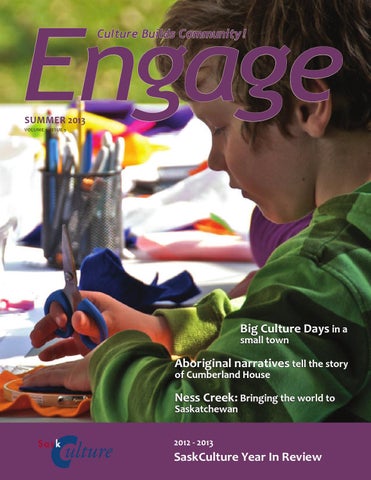
404, 2125 11th Avenue, Regina sK s4P 3X3 Tel: (306) 780.9284 www.saskculture.sk.ca ON tHE COvER: Participants had the opportunity to try interactive, hands-on activities at the 2012 Culture Days Kick-off in Regina, SK. Photo by Jeff Hamon.
2
Graphic Design:
J. lauder Publishing & Design jlauder@myaccess.ca Contributing Writers:
michelle Brownridge, sarah Ferguson, shaunna Grandish, Diane ell, Danica lorer and Paul spasoff.
Print copies of this publication are circulated for free to saskCulture members, partners and through community outreach activities as determined by saskCulture Inc. Engage is also available in PDF version on the saskCulture web site at www.saskculture.sk.ca. Engage is published thanks to financial support from saskatchewan lotteries Trust Fund for sport, Culture and Recreation. The publication does not currently accept paid advertising. Article ideas for future publications can be submitted to saskculture.info@saskculture.sk.ca or by calling (306) 780.9289. Published June 2013. Articles may be reprinted with permission.
SUMMER 2013
Engage
President’s message
I
am very proud of the work the Board
has done in the past year. The saskatchewan lotteries Trust Fund has now been supporting sport, culture, and recreation activities in the province since 1974. such a long history of support could not be possible without the impressive dedication of staff and volunteers throughout the provincial network. As a direct beneficiary of various sport, recreational, and especially cultural activities, throughout my life, I would like to thank the volunteers and staff from across the entire cultural community that have worked to make saskatchewan a place that is unique, vibrant, and exciting; a place I am proud to call home.
I would like to offer my special thanks to the saskCulture Board members for the time and expertise they have volunteered in the past year. It is truly a pleasure to work with such an engaged and supportive group. I would like to similarly give my thanks to saskCulture’s staff. I am continually impressed by their collective depth of knowledge and passion for the work they do and the creative ways in which they innovate in their respective environments. As people are the backbone of delivery and experience of cultural activity, the Board has been putting consideration into how to maintain and strengthen the networks of which we are a part.
Reggie
ir Newk
k
nher a She Brend
Engage
SUMMER 2013
a Brend
ing Sherr
hosh Bula G
some key actions include the following:
We are very proud of the work saskCulture has done over the last five years. As ticket sales have been very strong, we were very pleased to be able to grow the pool of funding available for the eligible organizations and increase the funding levels of several key grant programs. We are also happy with the growing success of new endeavours such as Culture Days in saskatchewan and Creative Kids. The Board is keenly aware of the need to engage people throughout saskatchewan: To remove barriers to accessibility, to open pathways to new interests, and to grow the support and public perception of the value of culture in this province.
• At saskCulture’s 2013 AGm, we will host a gathering of board representatives from our member organizations to connect and to share strategies and key messages designed to strengthen awareness and collaboration between cultural organizations.
• saskCulture’s progress towards a renewed multiculturalism strategy continues on. This process is necessarily long and involved; the Board wants to make sure that the groundwork for such a complex and deep issue has been set with due diligence of research, discussion, and consultation. • We have been evaluating the need for greater awareness of cultural activity, and the mechanisms that support it, among the public in saskatchewan. Beginning in 2013, a public awareness survey will help us identify our ongoing progress to saskCulture’s end of people valuing and supporting culture in saskatchewan.
With that in mind, I strongly encourage all our member organizations to re-engage the public around them with a renewed vigor. Word of mouth is still the most direct and powerful tool for the extension of the network of influence one has. Although you may had already done so many times before, invite your friends and families to your activities and events. In addition, call your local politicians, invite them to your events; when they’re there, speak to the value you deliver, even when it speaks for itself, and how it’s supported.
• Finally, the Board and staff are continuing with the required work to renew the lottery licence Agreement with the Government of saskatchewan to ensure the continued support of the cultural sector from the saskatchewan lotteries Trust Fund for sport, Culture, and Recreation.
C David
a ormic
n
is Fjes Denn
King Gwen
tad
sincerely,
James Ingold
J a me
H arve
ht y Knig
ju h Otito Josep
n s H aw
J a me
kel s Win
ra Pat G
Laure
l Reim
yston
che
3
P
General manager’s message
reparing a message for the Annual Report edition of Engage is a time for reflection on the year just completed. my initial thoughts, when faced with the task, always touch upon how quickly the year went by and what, of all the things that have taken place, should I write about in the report.
so much of what we do is dependent on the people behind the programs. I am going to start by thanking the saskCulture staff team, as well as the Board of Directors, for their commitment, knowledge and humanity. The saskCulture membership, along with the cultural community of saskatchewan, is richer because of these wonderful people. saskCulture also has many other dedicated volunteers that serve on program committees and funding juries and our member organizations and partners also play a vital role in supporting the work that we do to build a ‘more culturally vibrant saskatchewan.’ I want to thank this tremendous group of people and organizations that work together, directly and indirectly, to make saskatchewan a rich and diverse place to call home.
When the current lottery agreement was negotiated and signed in 2009, the case was made that the lottery-funded system needed to be more supportive of the organizations that depend on the proceeds from the saskatchewan lotteries Trust Fund for operational funding. over the past three years, the spending Plan has increased operational funding to the eligible organizations and encouraged them to prioritize and address organizational capacity with the additional funds. Thanks to stable funding, the Culture section was also able to pre-fund the operational grants for eligible organizations by a year. The past year saw the completion of a new Annual Global Funding (AGF) application process, which was used for the first time in November 2012. In addition to completing the 3-year application, each
4
eligible organization now participates in an annual organizational reviews designed to help them in proactively assessing potential challenges within their organization. The AGF changes were implemented to assist saskCulture in better evaluating the eligible groups and to build opportunities to assist the organizations through individual and group education. The preceding work supports saskCulture’s role in ensuring the effective use of the resources in the Culture section of the Trust and provides evidence that saskCulture is actively engaged in the process of ensuring that the funds are relevant, accessible, effectively used, and based on cultural impact. strong supporting evidence, from the AGF funding and other areas, is essential to saskCulture and its lottery partners as we work together with government on a new lottery agreement for April 2014.
Funding from the Culture section of saskatchewan lotteries Trust Fund was also allocated to numerous museums, galleries and festivals throughout the province. As well, project funding was provided to many programs and projects in the cultural community. These programs and projects were delivered directly by saskCulture or through our partnership with the saskatchewan Arts Board (details on these grants can be found on page 2930). As we continue to work on the supporting materials for a new lottery agreement we are constantly evaluating the impact of all the organizations and projects that are funded through the Culture section of the Trust to ensure that they support the public interest priorities defined in the current agreement. The ongoing work of saskCulture requires continuous nurturing of our many partnerships. This past year was no different. The lottery partnership with sask sport Inc. and the saskatchewan Parks and Recreation Association Inc. and, to some extent, the Government of saskatchewan, requires a significant
amount of organizational capacity. significant resources are invested in ensuring that funding from the Culture section of the Trust is available for cultural activities throughout the province. There is a lot of give and take in making the lottery partnership work because the cultural community operates very differently from that of sport and recreation. A number of saskCulture’s other partnerships stem from our lottery partnership, including : RespecteD, District delivery, Tri-global Aboriginal Initiatives, Community Grant Program, Community Development Fund, Dreambrokers, Give Kids a Chance Charity and the Administration Centre for sport, Culture and Recreation. We have a different, but equally demanding, partnership with the saskatchewan Arts Board (sAB), which is guided by a board-to-board, over-arching agreement developed and signed by the two organizations in 2008, as well as an operational agreement that is updated annually by staff. our corporate cultures are somewhat different so, like our lottery partnership, it requires significant give and take to succeed. And, like the lottery partnership, it is also worth nurturing because the whole cultural community is stronger if our two organizations are working together.
seven rural districts have been voting members of saskCulture since 2010. since that time they have been actively participating in saskCulture’s AGm, annual gatherings and working with saskCulture staff and members to increase their cultural capacity. Although there are resource challenges for the districts, in terms of cultural expertise and dollars for their work, there has been progress in terms of their cultural mandates. most of the districts actively participated in the ArtsVest program, promoted Culture Days, organized cultural meetings in their districts, as well as promoted cultural activities taking place within their boundaries. lakeland District continues to deliver the Creative Kids program as part of the pilot to determine the most SUMMER 2013
Engage
appropriate means of supporting Creative Kids delivery.
Culture Days continues to help saskCulture move forward with its ends, particularly in building awareness of culture and increasing public participation in diverse cultural activities. Participation levels for Culture Days spiked last year, from 5-7,000 people in past years, to approximately 2022,000 participants in 2012. Culture Days is meant to serve as an audience development tool. We have many examples of cultural groups finding that Culture Days provided an opportunity to attract new audiences and build longterm participation. For example, this year, Wanuskewin Heritage Park was able to attract over 500 people to its weekend Culture Days celebrations, compared to normal weekend attendance of approximately 100 people. Dance saskatchewan, in partnership with shakespeare on the saskatchewan, saskatchewan Writers Guild, and saskatchewan express, continue to attract large audiences to their weekend Culture Crush, where they appreciate the opportunity to collaborate with other cultural organizations and cross-promote programs and services.
saskCulture also sees Culture Days as an opportunity to build awareness of, and accessibility to, multicultural and/or First Nations and métis cultural activities in the province. In 2012, through increased community connections and partnerships, activities that involved First Nations and/or métis and/or multicultural groups were 22.7% of all activities, compared to 16% in both 2010 and 2011.
since it was initiated, Creative Kids has provided close to $590,000 to over 1,800 children and youth facing barriers in more than 100 saskatchewan communities access cultural activities. Communities from as far south as eastend and estevan to as far north as the muskoday First Nation, meadow lake and laRonge, have accessed Creative Kids funding. Although a new charitable program, Creative Kids was successful with its fundraising campaign in 2012. Increasing the community profile and awareness of Creative Kids has not only increased fundraising revenue, it has also resulted in a significant increase in program applications provincially. saskCulture’s current strategic Plan has a strategic priority that states that the organization wants to suPPoRT AND leVeRAGe the strength and energy of the relationships resident in the saskCulture
Engage
SUMMER 2013
network, in order to increase participation in cultural activities in communities across the province. Within that strategic priority, the fourth objective states that by march 2014, ‘saskCulture and its network are inclusive, responsive and reflective of saskatchewan’s diverse populations.’ In setting this particular objective, saskCulture wanted to ensure that its network included saskatchewan’s many diverse First Nations, métis, and settlers from other lands who arrived early in the province’s history, as well as the diversity of citizens arriving today from many different corners of the world. To that end a good deal of time and effort continues to be spent developing a multicultural strategy for saskCulture. The process started with group discussions at the June 2012 member Consultation and continued at saskCulture’s 2012 Gathering. At this year’s AGm in June 2013, saskCulture will launch the strategy. There are other pieces of saskCulture’s work that I could write about but I do not want to make my report too long. Read through the rest of Engage to learn more about the broad reach of saskCulture and the positive impact of culture and cultural activity in the province.
SASKCULtURE StAFF:
Back row, left to right: Christie Nenson, Paul Gingras, Catherine Folstad, Nichole Williams, Shaunna Grandish, Rose Gilks, Dean Kush, Marian Donnelly, Damon Badger Heit, Angie Sawatsky, Diane Ell.
Front row: Michelle Brownridge, Gloria Walsh, Shawn Bauche, Janice Kyle, Dennis Garreck.
“SaskCulture has many dedicated volunteers, member organizations, and partners that play a vital role in supporting the work we do to build a more culturally vibrant Saskatchewan. ”
sincerely, Rose Gilks
5
Youth connect with culture through
summer music camp BY MICHELLE BROWNRIDGE
One the final day of the camp, youth performed concerts, one in Regina and one in Saskatoon, to demonstrate the new skills they had learned.
I
n July 2012, over 80 youth from Regina and saskatoon participated in a first of its kind summer music camp.
Carol Donhauser, executive director, saskatchewan music Festivals Association, explains how, "students had the opportunity to try seven different instruments [violin, guitar, piano, percussion, band, as well as First Nations storytelling and hand drumming]," explains Donhauser. "They spent the first day or two experimenting with each instrument or technique before focusing their efforts to learn one instrument in particular. on the last day, a large gala concert took place with family, friends, sponsors, board members and other stakeholders in attendance." The camp was initially conceived in a partnership between saskatchewan orchestral Association, saskatchewan Choral Federation, saskatchewan music Festivals Association, the Dream Brokers Program, and saskCulture.
The four-day program was considered a great success. one camp participant said it best: "my favourite part was the final performance”, he says. “I played the keyboard and next year I want to try the violin. This was the best camp I ever went to!”
6
Nichole orr is currently working as a Dream Broker in saskatoon. "The purpose of the Dream Broker Program is to help connect youth and their families to various sport, culture and recreation opportunities," she explains. "There is still a disconnect between inner-city youth and cultural activity," she says. "We are trying to bridge that gap and the music camp was an excellent chance for the kids we work with to experience culture first hand."
saskatoon Camp Coordinator, Adam Jacks, was impressed by the students’ final performance. "They really held their own on stage, and I am saying that from the point of view of a professional musician," he says. "They did such a fine job performing for being so young and inexperienced. For some of the students, participating in this camp was the first time they picked up an instrument and by the final concert, three days later, they were playing entire songs." He adds that, “the music flowed so effortlessly, it was incredible!” orr recognized the benefit of the camp for the youth she works with right from the start. "even if they don't continue to pursue music after the camp, we hope this one opportunity can perhaps spark some interest in music later on in life," she says. "We want to give our students the chance to try as many different sport, culture and recreation activities as possible, especially at a young age," adds orr. "The camp provided a different avenue to experience an aspect of the arts a lot of kids never get to experience."
Plans are already in the works to hold the camps again in 2013. Donhauser explains, "It was evident afterwards that the program was needed in the communities. In fact, we are going to be offering the camp in Prince Albert this year." organizers are also working on efforts to help students become involved in music programming all year. "The responsibility to ensure students become involved with music lies with all of the parties involved; the organizing committee, stakeholders, and Dream Brokers," she says. "ongoing communication needs to take place to ensure the long-term impact for students.” SUMMER 2013
Engage
Retreat helps Aboriginal youth share their stories
A
BY SHAUNA GRANDISH
boriginal youth are sharing their stories. last August, the saskatchewan Writers’ Guild (sWG), in partnership with the First Nations university of Canada (FNuC), hosted the first annual Bringing Back the Buffalo: Aboriginal Youth Writers’ Retreat in Regina. This project was designed to encourage Aboriginal youth, ages 15 to 22, from all backgrounds to share their stories through written literary works and artwork. According to Joely Bigeagle, Aboriginal program coordinator at the sWG, the idea for the retreat was developed out of the need to get Aboriginal youth to tell their own stories.
“The outcome of the writers’ retreat was to transfer knowledge to the youth in terms of storytelling and history,” explains Bigeagle. “We wanted to give them ways to empower themselves so they can share their stories in their own words and writing styles.”
saskatchewan broadcaster and performer, Carol Daniels, was hired to lead the fourday program as an Aboriginal arts and culture leader. Daniels organized each day into a specific theme: storytelling, imagery, poetry, political expression and celebration of culture. each day, the 13 youth participants were involved in writing workshops, assignments and presentations. They also had to present their daily writings to the group.
“We developed a program that we thought would help to nurture the youths’ desire to write,” says Bigeagle. “exposing them to a university environment and getting them to think about their future was an additional benefit of the program,” she adds. By the end of the four days, enough literary material was written to produce an anthology.
Bigeagle believes the first Aboriginal Youth Writers’ Retreat was a tremendous success. so much so, the sWG plans to hold one in Regina and in saskatoon again this year.
“The youth were impressed with the leadership and confidence they gained as the week unfolded,” says Bigeagle. she adds that, “many of last year’s participants want to return again this summer.” Thanks to funding from a saskCulture Aboriginal Arts and Culture leadership Grant, the sWG was able to turn the idea of a youth writers’ retreat into a reality.
tOP: Youth work on writing projects during the retreat. RIGHt: Elder Lily speaks at an evening reception.
Engage
SUMMER 2013
7
“We have to thank SaskCulture for providing us with the Capacity Building Grant. Without it we probably wouldn’t have been able to undertake a project like this.”
Fresh look for the saskatchewan
German Council
t
BY SHAUNNA GRANDISH
he saskatchewan German Council (sGC) has revamped their look just in time for spring.
This march, the sGC received a positive response to the launch of its new website and branding, according to sabine Doebel-Atchison, executive director, saskatchewan German Council. The project was a result of the sGC’s strategic planning process where it became apparent that the organization was lacking a brand. The previous logo was so outdated and they did not have current digital files of the image.
“There was no coherent appearance for the organization,” explains Doebel-Atchison. “We thought it would be a good idea to address it all in one big rebranding project.
With the help of a saskCulture Capacity Building Grant, the sGC began the rebranding process. over the course of about a year, the Council took the time to gather input from various stakeholders. After the long consultation process, a new brand for the saskatchewan German Council was finally unveiled. A new logo, stationary, business cards, tradeshow materials, a comprehensive social media brand and a dynamic website were among the products of this project. According to Doebel-Atchison, deciding on the new colours for the sGC was a difficult task; however, it was decided that green, red and yellow would be the organization’s official palette. “We are not a German organization,” she explains. “The ‘German’ in the name saskatchewan German Council stands more for the language rather than the country of Germany. We have members who are Austrian, German-Russian or belong to the mennonite or Hutterite community.” To be inclusive, the organization had to find colours which didn’t exclude communities.
“We decided to go with saskatchewan colours to show our connections to the province,” she adds. “Green is a fresh and positive colour, and that was important to us as well.” The sGC is excited about the rebranding and wants to continue building on the success of the launch. “We have to thank saskCulture for providing us with the Capacity Building Grant,” says Doebel-Atchison. “Without it we probably wouldn’t have been able to undertake a project like this.” To check out the saskatchewan German Council website, please visit: www.saskgermancouncil.org
8
SUMMER 2013
Engage
Big Culture Days in a small town
t
he Kamsack Community Arts Council didn't start out with baby steps. They wanted to introduce themselves to the community and be seen as a strong presence from the very beginning. In its first year, the group exceeded expectations by coordinating a busy Culture Days weekend. The community, with a population of 2,000, hosted 15 events during Culture Days in 2012.
Nikki lachambre, president of the arts council says, “The fact that we were able to host so many activities and create so much buzz on our very first time out is a real success story. We must have come close to hosting the most Culture Days events per capita in saskatchewan!
“We learned about Culture Days through saskCulture and were immediately motivated to participate on a large scale,” she says. “our arts council members not only had a bunch of great ideas, but also the energy and motivation to implement them. All the local organizations we contacted about participating jumped on board.” she was excited by the concept of the nationwide movement. “Culture Days is a wonderful way to bring members of communities together, especially, I think, in small towns, where there aren't a lot of opportunities locally for focusing on the arts and recognizing the cultural diversity in our own backyards.”
BY DANICA LORER
With the cooperation of local organizations they offered a range of activities for all ages. There was an interactive music program for toddlers, a local Aboriginal storyteller, an improvisation workshop, a window decorating contest, a museum scavenger hunt, and for the competitive-minded-a creative lawnmower race.
An international food and artisan fair offered guests an opportunity to taste dishes including bannock, perogies, cabbage rolls and Korean fare. spectators enjoyed colourful costumes and regalia as they watched the dance groups and musicians. "All events allowed participants to try new things, but probably the best example was the Aboriginal round dance, which pushed people of different cultures out of their comfort zones in a fun and unusual way,” says lachambre. Her favourite activity was the old Time Photo Booth. "It was so much fun to see young families and elderly people alike enthusiastically playing dress up and then posing for a photo shoot. There was a lot of laughter in the museum that day," she says.
The annual Kamsack Rodeo occurred the same weekend and this overlap helped to increase attendance at both events.
organizers were pleased to see more participants than they had expected attend the events in 2012 and are looking forward to Culture Days 2013. "We are participating in Culture Days this coming year and are currently brainstorming ideas for new and unique events as well as bringing back the most popular ones. We've got a really creative bunch of volunteers working behind the scenes,” she says. "While last year's events were highly interactive, our upcoming program will take the interactive aspect and take it to the next level. We're prepared for an energetic and entertaining celebration of arts and culture in Kamsack that will leave participants having learned something new about their community and hopefully about themselves at the same time,” says lachambre.
the Kamsack Arts Council launched their community’s first Culture Days experience with many activities including Aboriginal storytelling with George Musqua and cultural dance performances.
Engage
SUMMER 2013
9
Culture Days 2012 in
Numbers
239 157
CULtURAL ACtIvItIES
61%
ACtIvItY ORGANIZERS
54
INtERACtIvE ACtIvItIES
22,000+ COMMUNItIES
39
PARtICIPANtS
41%
RURAL COMMUNItIES
92%
HELD MORE tHAN ONE ACtIvItY
INtEREStED IN PARtICIPAtING AGAIN 10
saskatchewan loves Culture Days
S
ince 2010, Culture Days has continued to gather momentum in saskatchewan communities. The initiative, which encourages communities to invite residents to participate in interactive cultural activities during a late september weekend, has inspired many cultural organizers to get involved.
“Culture Days continues to provide an opportunity for saskatchewan to showcase its cultural community,” explains Rose Gilks, general manager, saskCulture. “each year, we always hear about cultural groups that experience spikes in attendance and interest from new participants.” last year, the museum of Antiquities at the university of saskatchewan, was one of the examples of how participating in Culture Days helped the organization hit a record attendance figure of 300. Culture Days 2012 resulted in 239 activities registered by 157 organizers from 54 different saskatchewan communities. over 22,000 people participated in 2012
and this is significant growth over previous years. saskCulture continues to help lead the initiative in the province through innovative programming such as the Culture Days Animateur Program. “We were pleased with the increased reach the Animateurs had in 2012,” adds Gilks. “These artists continue to provide a unique opportunity for community members to gather, experience cultural activities and learn more about Culture Days at the same time.” In 2012, the four artist Animateurs visited 121 communities, held 115 workshops and engaged 6,500 participants leading up to Culture Days.
Plans are underway for 2013 Culture Days taking place september 27-29. Four new Culture Days artists – Carol Daniels, matt Josdal, shayna stock and Karlie King – are already meeting with communities to discuss Culture Days opportunities. Registration is open at www.culturedays.ca.
For more information on Culture Days in saskatchewan, visit www.skculturedays.ca or call marian Donnelly at 306-780-9295 or mdonnelly@saskculture.sk.ca.
SUMMER 2013
Engage
2013 Animateurs
help communities plan for Culture Days
Ready to explore how your community can be involved with Culture Days taking place september 27-29, 2013. Invite a Culture Days Animateur to be part of your meeting or community event.
Carol Daniels
Carol is Cree and Chipewyan, with roots in sandy Bay, saskatchewan. Her unique combination of art - which includes storytelling, music, writing and visual art - is a tribute to her love of family, culture and community.
Tel: 306-535-1214 email: carol.daniels@sasktel.net
Matt Josdal
matt is a saskatchewan-born theatre and voice-over artist. In addition to performing, matt also volunteers with the live Five theatre series as a member of its Board of Directors. Tel: 306-341-1312 email: mattjosdal@gmail.com
Karlie King
Karlie was born and raised in saskatchewan and obtained a B.A. from the university of Regina with a double major in Religious studies and Fine Arts. Her academic pursuits took her to Newfoundland in 2003, where she continued to further her artistic practice in ceramics, her primary medium, and developed a keen interest in textiles, knitting and rug hooking.
Tel: 306-845-2659 Cell: 306-845-7940 email: monel13@hotmail.com
Shayna Stock
shayna is a performance poet, facilitator, and community builder. shayna’s poetry explores themes as diverse as social and environmental justice, her beloved bicycle, creativity, privilege and heartbreak. Tel: 306-569-6040 email: shayna.stock@gmail.com
For more information on Animateur availability, contact marian Donnelly at 306-780-9295 or mdonnelly@saskculture.sk.ca
Culture Days Idea Book
Check out the Culture Days Idea book at www.saskculture.sk.ca for ways to get engaged in Culture days. Print copies of this book are available, thanks to saskatchewan ministry of Parks, Culture and sport, and saskatchewan lotteries Trust Fund for sport, Culture and Recreation. For more information, contact marian Donnelly at 306-780-9289 or mdonnelly@saskculture.sk.ca.
Engage
SUMMER 2013
11
Cultural Q & A
with the south West District
BY MICHELLE BROWNRIDGE
Current), happening in June, is a feast for the eyes with everything kite-related. From creature kites to stunt kites and kite making, it is a wonderful event for any age. The saskatchewan Festival of Words (moose Jaw), happening in July, is a jampacked, four-day festival with everything word-related. meet Canadian authors, listen to readings, cheer on slam poets, attend concerts, take in a workshop and experience the world of words.
The southern Prairie Railway (ogema) is a great way to experience travel from a past era. Travel the prairie in a beautiful heritage rail coach car, watch the deer on the hills and imagine what it must have been like arriving to this province for the first time.
MB: What has the district done to
promote and highlight culture in the south west?
CS: The south West District for Culture,
S
port, Culture and Recreation Districts have been established in saskatchewan to assist community sport, culture and recreation leaders and those who are seeking information on participation or program opportunities. The mandate of the Districts is to focus on facilitating community development and coordinating networks within their district, with the aim of enhancing access to sport, culture and recreation programs and services in the province. michelle Brownridge recently had the opportunity to speak with Christie saas,
Recreation and sport has a unique role in promoting culture in the south west. our work is designed to support our cultural clients, leaders, volunteers and organizations so they have the tools they need to promote culture in the south west.
executive director of the south West District for Culture, Recreation and sport about culture in the south west.
MB: tell me about some cultural highlights in your district?
CS: south west saskatchewan is a truly culturally rich district. This time of year, it’s nice to highlight some of the cultural attractions that can be experienced during the summer.
The Windscape Kite Festival (swift
We connect with communities and cultural clients, leaders, volunteers and organizations to share information on new and developing trends in the cultural sector and we provide timely and relevant information on funding, programs, services and new directions. We also consult with our cultural clients, leaders, volunteers and organizations to learn their interests and needs. We provide training and developmental opportunities so cultural leaders have the tools they need to sustainably build their programs and services.
MB: In your opinion, what are the top
three must-see cultural attractions or events?
ABOvE: the Windscape Kite Festival in Swift Current attracts kite enthusiasts from across North America every summer. Everyone can experience the thrill of kite flying alongside some of the best kite artists and performers. For more information visit: www.windscapekitefestival.ca
12
SUMMER 2013
Engage
Alternately, individual consultations are also very useful, and compiling ideas can also be a great way to learn more. The goals each group decides to work towards will be unique to each community. Big or small, they are all important in growing a thriving cultural community in your area.
“We work together to find innovative solutions to culture issues. sometimes having someone help with a few of the little details like key contacts, new ideas or tips on how to run a workshop, is all that is needed to empower a community, cultural clients, leaders, volunteers and organizations to achieve big goals.” CS: my personal favourite top three must-
see cultural attractions in the south West District are: • The sukanen ship museum Halloween Village in moose Jaw
• The metal sculptures in the field as you drive into Tugaske
Consulting with other community leaders will help determine the goals everyone hopes to achieve and identify common successes and challenges. If possible, it is helpful to bring everyone together for a discussion meeting.
The south West District for Culture, Recreation and sport can help communities with this process. We have three Community Development Coordinators who work with communities to help facilitate the cultural planning process. We can join you for a discussion, bring ideas and help troubleshoot the barriers.
MB: Have any communities in the district embraced Culture Days as a way of growing culture in their communities? CS: many communities in the south West
District have embraced Culture Days as a way of growing culture. maple Creek is a great example. During the 2012 Culture Days, the Jasper Cultural and Historic Centre held card making workshops, circle art workshops, an afternoon tea and musical performances.
• The Great sand Hills museum and Interpretive Centre in sceptre
MB: What advice would you give to a
community leader in the district who is interested in growing their cultural community?
CS: A good first step is to get to know
more about the cultural activity that is already going on in your community. Celebrating what you already have will provide support and encouragement, which is vital to keep things growing. If communities want to explore a more formal cultural plan, it is important to begin by putting together a list of key community leaders, both cultural and from other sectors.
tOP: visitors to the Southern Prairie Railway are treated to a rail excursion similar to what pioneers of the 1920s would have experienced when arriving in Saskatchewan. For more information visit: www.southernprairierailway.com ABOvE RIGHt: In the 1930s, a Finnish immigrant from the Macrorie district built this ship with the intention of sailing to Europe. visitors are able to explore the ship and other attractions at the Sukanen Ship Museum outside of Moose Jaw. For more information visit: www.sukanenmuseum.ca
Engage
SUMMER 2013
13
Ness Creek:
Bringing the world to saskatchewan
BY SARAH FERGUSON
members of the newcomer community with peers from First Nations and métis communities in saskatchewan. “We focused on the idea of ‘human libraries’,” she explains. “Festival-goers could travel around the grounds, sit down and hear stories from newcomers, and First Nations and métis community members,” she explains.
t
he power of music brings people together, and the Ness Creek music Festival is harnessing that power to bring the world to saskatchewan.
Ness Creek’s Intercultural Connections Project is aimed at creating a grassroots experience of First Nations and International culture during the festival.
Deb Aiken, festival administrator says, “The project began two years ago, with the festival’s Cultural Ambassador program. “We decided to reach out [to the saskatoon newcomer community] through The saskatoon open Door society, the Newcomers Information Centre, and the saskatchewan Intercultural Association,” she explains. “We looked for performers, artisans, storytellers and found some great people who were interested in sharing with the crowd,” she added. since then, she notes, the festival has attracted “a gamut” of performers and people from India, Bangladesh, and Africa, as well as First Nations peoples.
“last summer’s acts included a dance academy from India, and a woman and her two daughters from Bangladesh. They talked about music and poetry, and dressed in their regalia. It was beautiful.” Aitken says that the festival went a step further in 2012, and paired
14
“It’s all about experiencing and respecting cultural diversity among people.”
Aitken explained that the Intercultural Connections Project is important to Ness Creek and the surrounding communities for several reasons. “It allows us to build relationships with newcomer communities in saskatchewan,” she says. “As a result, we have a bigger pool of talent to draw from,” she adds. “It’s also an opportunity to attract volunteers and festival-goers. support from saskCulture’s multicultural Initiatives Fund and the multicultural Council of saskatchewan has been crucial to our success.” Aitken said the project has received an enthusiastic response from audience and performers alike. “People who were performers last year are now heading up the team for this year —it’s a sure sign that it’s been successful,” she said.
Randy morin is one of those performers. He grew up on the Big River Reserve, and knows the area well. As the co-cultural coordinator for the 2013 festival, he has a busy schedule, but says taking part in the 23-year-old festival is “an honour”.
morin explains,“There are a lot of learning opportunities at Ness Creek that people can take advantage of ...storytelling, performances, workshops, artisans from different countries…there is so much to choose from,” he adds.
“We’re planning to have a First Nations Dance Troupe for this year, and some First Nations and International workshops too,” he said. “There will be a teepee, cultural teachings and maybe even a sweat lodge this year…it’s going to be great!” The Ness Creek music Festival is held yearly in saskatchewan’s Boreal Forest, on the edge of Prince Albert National Park, and attracts approximately 5,000 people every year. For further information, visit www.nesscreek.com SUMMER 2013
Engage
Creative Kids is one way we are breaking down barriers and forging a creative future for youth.
saskatchewan youth supported to pursue creativity
J
ason sylvestre taught himself to draw when he was 12. Today, he is an illustrator and co-author of several books, including the bestseller You Might be from Saskatchewan If…. He believes that all kids need the opportunity to express their own creativity.
“I grew up in a single-parent household,” he says. “We didn’t have the money to allow us to try out a lot of things that interested us. I wanted to be able to assist other kids in similar situations get past the financial barriers so they can explore the arts.” This interest led sylvestre to become part of a dedicated group of volunteers helping to build and sustain the Creative Kids Program in saskatchewan.
Creative Kids is a charitable-giving program that raises funds to remove the financial barriers that prevent children and youth from participating in quality cultural activity or experiences. launched in 2010 by saskCulture and its partners as part of Give Kids a Chance Charity Inc., Creative Kids has provided close to $600,000 in grants, to just over 1,800 kids, from more than 100 saskatchewan communities. “saskCulture is pleased to see the
Engage
SUMMER 2013
opportunities that Creative Kids enables,” explains James Ingold, president, saskCulture. “It is our role to help ensure that all people in saskatchewan have the opportunity to experience and contribute to cultural activity. Creative Kids is one way we are breaking down barriers and forging a creative future for youth.”
All funds raised for Creative Kids go directly to support youth activity. While 30% of donations come from individual donors, another 70% of funds are raised from corporate sponsorships including PotashCorp, sGI, Great-West life, london life, Canada life Greystone managed Investments, sIC, saskTel, TD Bank Group and City of saskatoon. saskCulture Inc., thanks to financial assistance from the saskatchewan lotteries Trust Fund for sport, Culture and Recreation, covers all administrative costs of running the Creative Kids program. For more information on Creative Kids, visit www.creativekidssask.ca.
According to Dr. David millar, chair of the Creative Kids Provincial Advisory Committee, “We are very grateful to the charities that help with basics, such as food, shelter and clothing. We think it is equally important to feed the spirit. For a young person living with financial disadvantages, the chance to play a musical instrument, paint, dance or act in a play can be life-changing.” saskatchewan has one of the highest child poverty levels in the country with close to 33,000 children living below the poverty line. (2010 Poverty Report Card, social Policy u, university of Regina).
Presently, volunteer Creative Kids committees exist in shaunavon, Big River, lakeland District, the Battlefords, saskatoon and Regina. Creative Kids also runs a provincial program which accepts applications from all other areas of the province. 15
Allan museum is providing a fresh take on history
BY PAUL SPASOFF
museum. We set out to change our displays every year.”
When the museum opened in 2005 with limited space, it began as a loaning institution rather than a museum seeking to develop a collection. Displays are created from artifacts sourced directly from residents of the Allan area.
H
istory...heritage...artifacts... memories.
on their own, these are merely words nouns to be exact. Together, they serve as reminders of the past and add up to a description of a museum. The Allan Community Heritage society & museum fits this description perfectly.
However, in Allan, they’ve added another word to the list - fresh. Although it runs counter to what one traditionally thinks of a museum, the Allan museum is giving history a fresh look in the community.
Displays in the Allan Museum are kept fresh by incorporating objects on loan to the museum from local residents. 16
many museums - particularly those in smaller communities - tend to have one collection constantly on display, with new artifacts added as they become available. In Allan, the museum reinvents itself every year with new displays and attractions. “We didn’t want to be a museum that you go see once, and if you go back in 10 or 15 years, it’s the exact same display - just drier and dustier,” explains Belinda RiehlFitzsimmons, one of the founding members of the museum committee. “We wanted people to come regularly to our
“our local community and people from the area who had moved away were very supportive in lending us items,” RiehlFitzsimmons says. “Initially we had our volunteers go to (donors) homes and ask what they would be willing to lend the museum.” she adds, “every spring we contact people to say what theme we are doing this year and see what they are willing to lend. It’s amazing after this many years that people are still finding things that they can loan.” Gradually, the loaning museum began to take on a collection of its own. In its computer database, the museum has approximately 5,000 items that were donated between 2005 and 2008 - the majority paper and photos. Artifacts donated between 2009 to the present are still waiting to be catalogued.
“We had some families that were moving away or selling off an estate and they wondered if they could donate items to our museum,” she says. “We were hesitant because we didn’t have a lot of storage space to start accepting donations.” since the facility first opened, wedding and military displays have been mainstays at the museum. In fact, one of the rooms, dubbed the wedding room, displays photos dating back to the early 1900s. Past themes have focused on Christmas and family entertainment. “our main focus initially was to display things relating to people who lived in the area,” says Riehl-Fitzsimmons. “That’s still a large part of our focus, but we realize sometimes that is a little too narrow. so we’ve had to expand beyond that a bit, but it all ties back to our local history.” When the Allan museum opens for the season on may 26, one of the main displays will celebrate the 100th birthday of the school in Allan. other displays will SUMMER 2013
Engage
include bells, an old-fashioned bar, candy dishes and cookie jars, and a library. last year, the museum also began offering children’s programming.
“We’ve been fortunate to get some items that have a history and a story and add a real uniqueness to our community.”
In september, the museum will once again participate in Culture Days. Thanks to volunteers in the community, local school children will get an opportunity to churn butter, bake biscuits and buns, learn crossstitching, try woodworking and making rope.
“The community has been very supportive of the museum,” Riehl-Fitzsimmons says. “We’ve been fortunate to get some items that have a history and a story and add a real uniqueness to our community. There’s so much you can learn from these things and to have them in your possession is really special. We’re really appreciative of the things we’ve received as donations.” opening a museum was a topic of conversation in the community for many years, but it didn’t start to become a reality until the four founding members of the museum committee came together in 2004. Thanks to the generous donation of the museum property and buildings, the Allan museum opened one year later in conjunction with saskatchewan’s 2005 Centennial.
situated on main street in Allan, a community of more than 700 people, located 55 kilometres southeast of saskatoon, the museum consists of two buildings. The main building is the former office of the local rural municipality (Rm), which was built in the early 1940s. It served a variety of owners and purposes before beginning life as a museum.
The building is comprised of several smaller rooms and served as the only display area during the museum’s first year of operation. According to RiehlFitzsimmons, the most notable feature in the building is the vault. With its 16-inch concrete walls, the Rm used the vault to secure money and important records. “unfortunately, the gentleman who was the last Rm secretary to work in the building no longer recalls the combination,” she says. “so, we keep the big door propped open now.”
Engage
SUMMER 2013
The second building is a 1920s farm house that was moved into Allan in the 1950s as living accommodations for the Rm secretary. most recently, it served as a preschool before being donated to the town along with the other museum property. The main floor has a kitchen, living room and bedroom, while the upstairs is reserved for storage.
To ensure they are able to properly care for the artifacts, the museum will be launching a capital fundraising campaign this year. The museum is planning to construct a new building that will provide space to conduct research year round, as well as properly store the artifacts in climate-controlled areas. The Allan museum is supported through saskCulture’s museums Grant Program, funded by the Culture section of the saskatchewan lotteries Trust Fund for sport, Culture, and Recreation.
17
Art provides exploration and
escape for women in transition BY DIANE ELL
drop in to participate in different art programs during their stay.
It provided an opportunity for these mothers to have some time to focus on something other than their challenging situations. “It is high stress when you have 30 days to find a job and a place for your family to live,” explains mackasey. “The act of creation uses a different part of your brain – the visual elements, and it can help you relax in other areas, and relieves some of the stress.” sometimes, it can be a life-changing experience.
In her role as an artist in residence, mackasey shares how many of these women require some coaxing to join a class. “one of the women, who was reluctant to join at first, was very thoughtful and spent a great deal of time on the project,” adds mackasey. In the end, she was very pleased with her accomplishment. she told mackasey that she had never thought to try threedimensional drawing before, because she didn’t think she could do it. Yet, after this experience, she planned to pursue some art classes when she got settled.
Women at the YWCA Crisis Shelter and residence in Saskatoon have the opportunity to express their creativity.
18
W
omen and children at the saskatoon YWCA Crisis shelter and Residence often face sometimes overwhelming challenges. The opportunity to express their creativity helps many to set their worries aside for a few hours and get some needed stress relief. As part of a Creative Partnership between Common Weal Community Arts and the YWCA, saskatchewan artist, michèle mackasey was able to create a welcoming art space in the lobby of the YWCA where mothers and their children were able to
Reluctance to engage has been a common obstacle. “one woman said she preferred to just watch,” notes mackasey, “but with some persuasion from others she eventually tried her hand at painting a landscape with acrylic paint. she did an amazing job, and while she didn’t say much, you could tell she felt a great sense of accomplishment.” still, many others engage eagerly and look forward to this time as an outlet for their creative energy.
While the children are always eager to participate, the youth group proved to be a bigger challenge. After building and a connection, mackasey engaged them in a collective painting, where each youth was asked to work on one or more of the 20 panels that would form a four-by-five foot, wall-size portrait of Bob marley. The women in the shelter also had the opportunity to participate in a special art project that inspired them to think about the importance of home. “They are asked SUMMER 2013
Engage
to construct a ‘wish home’ out of compact disc cases: four walls, a base and two-sided roof,” explains mackasey. ”In each disc case they created small portraits of what home means to them.” on the inside, less visible to the public, they wrote the ingredients of their wish home. When complete, lights will be placed inside each home and they will be hung as part of an installation piece called “Wish Home Neighbourhood”, which will be displayed at the snelgrove Gallery, located at the university of saskatchewan, in late August. “Although the artwork is anonymous and they leave it behind,” she says, “these women gain a sense of accomplishment for taking the opportunity to express themselves and contribute to this exhibition.”
saskatchewan Arts Board, is funded by the Culture section of saskatchewan lotteries Trust Fund for sport, Culture and Recreation.
“the art of creation uses a different part of your brain – the visual elements, and it can help you relax in other areas, and relieves some of the stress.”
mackasey recently held an exhibition, called Michèle Mackasey: face à nous, at the mendel Art Gallery, which featured lifesize portraits of women who live on the margins of society facing prejudice and economic hardship. she brings her arts background, experience and sensitivity to this subject matter to her work with the women at the YWCA Crisis shelter. The Creative Partnerships Innovations Grant Program, administered by the
Engage
SUMMER 2013
19
Aboriginal narratives tell story of Cumberland House
B
y digging into the stories and pictures of the past, the community of Cumberland House is unearthing its roots and rewriting history with Aboriginal narratives. The project is revealing the stories and the positive narratives of the past for the present and the future.
sasipenita, an arts organization that focuses on disseminating Aboriginal narrative and themes through the sasipenita education exhibit (see), is working with the community of Cumberland house to create an exhibit entitled Rivers’ Roots – Historical Families of Cumberland House. see’s curator Felicia Gay has been conducting meetings in the community and interviewing the 29 families involved. "I noticed growing up in a small community there was divisiveness,” explains Gay. “We're trying to show we're really connected, we're all related, and these families have been here for generations.” Gay, along with her aunt maria Fiddler and mother Valendie lathlin-Buck, has been visiting elders to collect stories for the project. Fiddler and lathlin-Buck help to translate some of the stories. Gay brings a scanner into the families' homes to copy photographs so they can be enlarged for display.
The first exhibit highlights the Nabess family. In an interview Doug Nabess, son of louis Nabess, spoke
20
BY DANICA LORER
to Gay about the large number of Aboriginal veterans in the community and also of the trapline. "When they went to the trapline, I would say they lived off the land,” he says, sharing memories of his father. “When they used to go out, it would take them a month. Not like today, now you go there with a skidoo and come back the same day.” she explained how showing the images opens a dialogue that will benefit all generations. “When people view these photographs and read these stories, memories will connect our unions, our victories, our loss, our endurance, our laughter, our tears, our dashed dreams and our hopes, - our memories are a vehicle to remind us of our connections despite difference, to show visually our river’s roots,” she says in her curatorial statement.
Gay has enlisted the help of high school students to assist with the technical aspects of the installation of the exhibits and has spoken to them about curating and other jobs in the arts. “It is really important to the older people that younger people understand the recent history of Cumberland House,” says Gay.
The first phase of the project will be completed by the end of 2013 and the second is planned for 2014. There will be eight exhibits in 2013 at the Veterans Hall. The displays will include stories in vinyl lettering on the wall in both Cree and english and the photographs.
sasipenita means “never give up” in swampy Cree. The sasipenita educational exhibit is “one of saskatchewan's newest arts-based organizations dedicated to the dissemination of Aboriginal narratives and themes that work to both educate and honour the struggles, contributions and achievements of saskatchewan's First Peoples.” The Rivers’ Roots - Historical Families of Cumberland House project was supported through saskCulture’s métis Cultural Development Fund for sport, Culture, and Recreation.
Historical images from the Nabess family photo collection help to tell the history of the community of Cumberland House.
SUMMER 2013
Engage
montessori school – exploring
geometric patterns in nature
Q
BY DIANE ELL
uite often, it is the patterns in nature that capture our attention. The shapes on a giraffe’s fur, the rings of a tree stump, and the unique designs of a snowflake, are all patterns that might inspire the artist in us and contribute to our creativity.
Thanks to an Artssmarts grant, saskatchewan artist Brendan schick and teacher Nathan Bauche are working with a group of Grade 1-3 students from montessori school in Regina to develop their eye for patterns and shapes, and to explore where these geometric patterns can be found in nature.
“Instead of just focusing on geometry, such as different types of triangles and parallelograms, out of a book, these students are learning how to look around them to identify, compare and explore the geometric patterns and shapes found in nature,” explains Bauche. As part of these explorations, the students have the opportunity to create their own artwork based on their discoveries. According to schick, the montessori classroom, which allows students to follow their own interests, is a great environment for this type of learning experience. To be successful, the learning concept, “needed to be open, playful and flexible enough to explore, and see what ideas the students would absorb.”
To begin, schick helped the students become familiar with simple artistic mediums, such as line drawings and textures using lead pencils, charcoal, water colour pencils, as well as blenders and erasers. “I hoped by trying many different mediums, they would eventually find a preference,” he says. They used these different mediums and techniques to create visuals from different sessions in their own sketchbooks. Their first session involved exploring natural objects, such as acorns, a wasp nest, a bird’s nest and quail eggs.
The next session featured a slide show, by Ray Poulin, a visiting biologist, on the patterns and colours in animals and the
Engage
SUMMER 2013
use of camouflage patterns in nature. The students also visited the martha Cole exhibit at mysteria Gallery to explore how the Cole embeds patterns from nature into her work. she reproduces various natural elements, such as the patterns found in lichen, a form of fungus found on rocks, as well as bark and leaves, in her fabric artwork pieces. The students used putty to take transfers of lichen from rocks to explore the patterns. most recently, the students explored the different patterns in layers of snow. Two graduate students from the Department of Geography at the university of Regina shared slides from their research so the students could see the differences in snowflake design, layers of ice, hoar frost and wind patterns. “As part of this experience, the speakers dug a hole in the ice, poured in coloured Gatorade, to highlight the cross-sections,” Bauche says. He was impressed that “some of the students noticed how it looked like the patterns found in layers of rock.”
It is schick’s hope that the students gain an appreciation for the arts, and some inspiration from nature. He plans for the students to select a medium and subject that is meaningful to them. “The challenge will be to select a final project from the categories covered which can be shown as part of a student exhibition.” The students will select their best work and have the opportunity to speak about it to an audience. schick plans to compile the works into a small booklet or catalogue that can be given out at the exhibition. Artssmarts is a partnership initiative, administered by saskatchewan Arts Board, with funding from the saskatchewan ministry of education and the Culture section of saskatchewan lotteries Trust Fund for sport, Culture and Recreation.
Students had an opportunity to explore different mediums and drawing techniques.
“I like drawing the snowflakes.” Ben 7, Grade 2
“I like using the putty and drawing the lichens.” Simon 9, Grade 3
“I liked the first slideshow with the bee on the stick. I just gotta say ‘Wow’ with the colours.” Dickie 8, Grade 2
“I like Mysteria Gallery the best because you could see all the patterns. We got to draw stuff.” Janna 7, Grade 1
21
Cultural planning around the province
C
ultural Planning helps many saskatchewan communities identify and realize the potential of the cultural assets in their community. To maximize the economic and social benefits of culture, more and more municipalities are seeking out grant dollars to support the planning process.
The municipal Cultural engagement and Planning Grant, offered by saskCulture, is intended to encourage municipalities, both urban and rural, as well as First Nations Bands, to explore and plan for the creative and cultural potential of their communities through cultural engagement and planning initiatives. The map below shows communities that have participated in municipal cultural planning, cultural engagement and implementation of cultural plans. For a full, interactive version of the map, please visit http://bit.ly/ZTWBnr. To find out more about the cultural planning initiatives, or scan the QR codes using your smartphone.
Saskatoon
Uncovering the Cultural Drivers for Saskatoon's Cultural Plan.
Known for its river, its heritage, and its vibrant arts and culture scene, saskatoon jumped on the opportunity to incorporate its unique culture into a range of different priorities including urban design, youth engagement, recreation programming, economic development, as well as neighbourhood and downtown revitalization.
Yorkton
Yorkton Aims for Cultural Excellence.
Yorkton was one of the first saskatchewan communities to develop a cultural plan. organizers saw its development as an opportunity to achieve greater community engagement in the development of Yorkton’s cultural sector and its contribution to the city’s quality of life.
Maple Creek
Maple Creek capitalizing on its cultural roots.
A couple of years ago a group of community-minded people gathered in maple Creek for a community planning meeting. Twenty-one citizens representing 13 groups in maple Creek drafted a vision at that meeting, "to be leaders in building partnerships for a sustainable community in maple Creek and area."
Battleford
Opera house inspires community's culture planning.
A shrine to saskatchewan’s rich history, the Town of Battleford has moved its historic Town Hall/opera House onto centre stage as part of its most recent municipal cultural plans.
Built in 1912, the Battleford Town Hall/opera House is a three-story, brick building with a metal roof and crownjewel- design replica windows. A common sight on the prairies in the early 1900s, only a few of these buildings remain in existence today.
Saskatoon
tours Helping New Comers Discover Saskatoon.
since the fall of 2010, the City of saskatoon has been hosting Discover saskatoon – a tour that uncovers the unique sites and history of saskatoon. With funding from the federal and provincial governments, the tours are held twice a year in collaboration with saskatoon’s Newcomer Information Centre and the university of saskatchewan to help welcome newcomers to saskatoon. To scan the codes download a free QR code scanning application to your phone from the app store (ios), Google Play (Android) or Blackberry App World. 22
SUMMER 2013
Engage
2012-2013 Boards and Committees Board of Directors 2012-2013
Constitutional Review Committee
James Ingold, President
James Ingold, President Peter England, Past President Jan Seibel, Past President Bula Ghosh James Hawn Staff – Rose Gilks Staff – Gloria Walsh Staff – Nichole Williams
Reggie Newkirk, Past President David Cormican, Director Dennis Fjestad, Director Bula Ghosh, Director Pat Grayston, Director James Hawn, Director Gwen King, Director Harvey Knight, Director Joseph Otitoju, Director Laurel Reimche, Director Brenda Shenher, Director Brenda Sherring, Director
General Manager Review and Succession Planning Committee James Ingold, President Reggie Newkirk, Past President Pat Grayston Brenda Shenher
James Winkel, Director
Saskatchewan Lotteries Community Funding Committee
Eligibility Committee
James Ingold, President Dennis Fjestad
Pat Grayston, Vice President Reggie Newkirk, Past President Dennis Fjestad
Saskatchewan Lotteries Trust Fund for Sport, Culture & Recreation
Bula Ghosh
Reggie Newkirk
James Hawn Harvey Knight Brenda Sherring
Strategic Committee for Sport, Culture and Recreation Districts
Staff – Dean Kush
Gwen King Staff – Dennis Garreck
Audit Committee
2012-2013 Adjudication Jurors
Laurel Reimche
Jennifer Altenberg Bernice Aramenko Cindy Baker Cheryl Bauer Hyde Patricia Bigstone Angela Bishop Jolee Blackbear Terry Boyer (deceased February 2013) Corey Bowers Brian Chaboyer Jyotsna Custead Heather Dillon Lori Evert Lori Glauser Gary Gullickson Ira Horse Renu Kapoor Ryan Karakochuk Annette Labelle Judy MacLeod Campbell Lindsay Manko Adam Martin Modeste McKenzie William Mintram Leonard Montgrand Valerie Mulholland Dolores Neil Darren Okemaysim Sheila Pocha Carmen Robertson
David Cormican James Winkel Kelly Antill, CA
Staff – Gloria Walsh Staff – Janice Kyle
Nomination Committee Reggie Newkirk Harvey Knight Gwen King Ingrid Cazakoff Joseph Otitoju Marcus Miller Rhonda Rosenberg,
Staff – Nichole Williams
Spending Plan Committee James Ingold, President Reggie Newkirk, Past President Jan Seibel, Past President Bula Ghosh James Hawn James Winkel
Staff – Gloria Walsh
SaskCulture Year In Review
Dominga Robinson David Roman Marvin Sanderson Amanda Scandrett Jan Seibel Edwin St.Pierre Catherine Tomczak Heather Wilson - Gerbrandt Getachew Woldeyesus Kristi Yarshenko Terrie Topola Marge Thomas Flo Frank Gerry Ruecker Joanne Shannon Celine Perillat Amber Andersen Donald Stein Wendy Thienes Gailmarie Anderson Janine Windolph Bruno Kossmann Mei Shan Wan Vickie Clarke
First Nations and Métis Advisory Circle Bernice Aramenko April Buffalo - Robe Ray Fox Harvey Knight Sandra Lachance Marie T. Ledoux Larry Oakes Louise Oelke Darren Okemaysim Marian Otter Linda Young Staff – Damon Badger Heit
Creative Kids Provincial Committees Provincial Advisory Committee Dr. David Millar Jan Seibel Reggie Newkirk Peter Sametz Battlefords Jane Zielke, Chair Cindy Tymorouski, Secretary/ Treasurer Siobhan Gormley Elaine Poirer Big River Paulette Atchison, Chair Carla Chadwick, Treasurer Mila Pisz, Secretary Charlene Puddicombe
Shaunavon Cathy Smith, Chair Wendy Thienes, Treasurer Anne Bennett, Secretary Linda Pomeroy Faye Anderson Tammy Willman Dianne Greenlay Vivienne MacNeil Lakeland District Cheryl Bauer-Hyde, Chair Melissa Sisson Bryce Michael Erica Cochrane Erin Standish Crystal Clarke, Community Development Coordinator, Lakeland District Regina Michelle Carr, Chair Jason Sylvestre, Vice-Chair Don List Jessica Elsaesser, Secretary Kendra Nixon Keely Tyler Amy Nelson Carol Donhauser Saskatoon Jami Young, Co-Chair Jill Pelton, Co-Chair Tracy Schiele, Treasurer Danielle Dutka, Secretary Meagan Dubois, Communications Jody Hobday-Kusch, Community Outreach Vinesh Kohli, Corporate Relations
SaskCulture Staff Rose Gilks, General Manager Damon Badger-Heit, First Nations and Métis Coordinator Shawn Bauche, Creative Kids Coordinator Michelle Brownridge, Communications Coordinator Marian Donnelly, Culture Days Coordinator (one-year term) Diane Ell, Communications Manager Catherine Folstad, Creative Kids Administrative Assistant Dennis Garreck, Community Outreach Coordinator Paul Gingras, Organizational Outreach and Development Coordinator Shaunna Grandish, Organizational Support Dean Kush, Assistant General Manager Janice Kyle, Business Administrator Christie Nenson, Creative Kids Fund Development Coordinator Angie Sawatzky, Grants Administrator Gloria Walsh, Administration Manager Nichole Williams, Executive Assistant
23
Summarized Financial Statements May 15, 2013 Management’s Responsibility
Independent Auditors’ Report
To the Members of SaskCulture Inc.:
To the Members of SaskCulture Inc.:
Management is responsible for the preparation and presentation of the accompanying financial statements, including responsibility for significant accounting judgments and estimates in accordance with Canadian accounting standards for not-for-profit organizations and ensuring that all information in the annual report is consistent with the statements. This responsibility includes selecting appropriate accounting principles and methods, and making decisions affecting the measurement of transactions in which objective judgment is required.
The accompanying summary financial statements, which comprise the summary statement of financial position as at March 31, 2013 and the summary statement of operations for the year then ended are derived from the complete financial statements of SaskCulture Inc. as at March 31, 2013 and for the year then ended, on which we expressed an opinion without reservation in our report dated May 15, 2013.
In discharging its responsibilities for the integrity and fairness of the financial statements, management designs and maintains the necessary accounting systems and related internal controls to provide reasonable assurance that transactions are authorized, assets are safeguarded and financial records are properly maintained to provide reliable information for the preparation of financial statements. The Board of Directors is composed of Directors who are neither management nor employees of SaskCulture. The Audit Committee, which is appointed by the Board, is comprised of directors and other community volunteers who review the financial statements in detail with management and report to the Board prior to their approval of the financial statements for publication. MNP LLP, an independent firm of Chartered Accountants, is appointed by the members to audit the financial statements and report directly to them; their summarized report follows. The external auditors have full and free access to, and meet periodically and separately with, both the Audit Committee and management to discuss their audit findings. May 15, 2013
These summary financial statements do not contain all the disclosures required by Canadian accounting standards for notfor-profit organizations. Reading the summary financial statements, therefore, is not a substitute for reading the audited financial statements of the SaskCulture Inc.
Management’s Responsibility for the Summarized Financial Statements - Management is responsible for the preparation and fair presentation of a summary of the audited financial statements in accordance with Canadian accounting standards for not-for-profit organizations. Auditor Responsibilities - Our responsibility is to express an opinion on the summary financial statements based on our procedures, which were conducted in accordance with Canadian Auditing Standards (CAS 810), “Engagements to Report on Summary Financial Statements.” Opinion - In our opinion, the summary financial statements derived from the audited financial statements of SaskCulture Inc. as at and for the year ended March 31, 2013 are a fair summary of those financial statements, in accordance with Canadian accounting standards for not-for-profit organizations.
Regina, Saskatchewan May 15, 2013
Chartered Accountants
____________________________
Rose Gilks General Manager
24
SaskCulture Year In Review
SaskCulture Inc.
Summary Statement of Financial Position As at March 31, 2013
Assets Cash and short-term investments Accounts receivable Prepaid expenses and deposits Loan receivable Capital assets
Liabilities Accounts payable and accruals Grant holdbacks payable Deferred revenue Due to Saskatchewan Lotteries Trust Fund for Sport, Culture and Recreation Current portion of lease inducements Lease inducements Net Assets Invested in capital assets Unrestricted
March 31, 2013
March 31, 2012
2,346,021 28,168 4,730 2,378,919 343,790
1,732,848 16,737 4,329 10,050 1,763,964 380,552
2,722,709
2,144,516
281,458 920,834 585,923 19,544 1,807,759 123,779 1,931,538
314,132 396,538 9,755 588,204 19,544 1,320,173 143,323 1,463,496
343,790 447,381 791,171
380,552 300,468 681,020
2,722,709
2,144,516
SaskCulture Inc.
Summary Statement of Operations For the period ended March 31, 2013
Revenue Grants from Saskatchewan Lotteries Trust Fund for Sport, Culture and Recreation Grants from Government (Federal and Provincial) Self-generated Expenses Other Program initiatives Excess of revenue over expenses
12-months ended March 31, 2013
8-months ended March 31, 2012
7,439,968 133,563 110,150 7,683,681
5,256,646 51,634 5,308,280
1,873,378 5,700,153 7,573,531 110,150
1,177,138 4,104,508 5,281,646 26,634
Detailed financial statements are available on request.
____________________________ Director
SaskCulture Year In Review
_________________________________ Director
25
Saskatchewan Lotteries Trust Fund for Sport, Culture and Recreation
SASKATCHEWAN LOTTERIES TRUST FUND FOR
Sport, Culture and Recreation 2012/2013 FISCAL YEAR
Overview
Guiding Principles
Saskatchewan’s lottery system is built on a complementary relationship that exists between the Government of Saskatchewan and the volunteer-driven, non-profit sport, culture and recreation communities. Saskatchewan Lotteries Trust Fund for Sport, Culture and Recreation, established in 1974, is a unique partnership of SaskCulture Inc., Sask Sport Inc. and Saskatchewan Parks and Recreation Association Inc. (S.P.R.A.). Through a multi-year agreement with the provincial government, these partners administer all funds generated from the sale of lottery tickets in Saskatchewan to support volunteerdriven sport, culture and recreation organizations and activities for people of all ages and abilities throughout the province. The current five-year, lottery licence agreement, negotiated by the lottery partners for 2009-2014, includes a licence fee of 3.75%.
SaskCulture ensures that arms-length adjudication processes are used to support all funding decisions assigned to the Trustee for the CST. Funding committee members are guided in this work by the Saskatchewan Lotteries Trust Fund Agreement and SaskCulture's Cultural Policy.
The partners share responsibility in the overall governance and policy direction of their respective Sections of the Trust. As well, partners jointly deliver programs that support all three areas of sport, culture and recreation.
• equitable program opportunities for all Saskatchewan residents, regardless of age, gender, geographic location, or economic or social circumstances;
The Trust fund supports over 12,000 beneficiary sport, culture and recreation groups from over 800 communities, rural municipalities, and First Nations.
The Trust Fund Agreement emphasizes support for accessible sport, culture and recreation opportunities through activities that provide for: • enhanced quality of life of Saskatchewan people through the provision of quality sport, culture and recreation programs; • services that improve the economic and social viability of communities and the province;
• engaging Saskatchewan people through sport, culture and recreation so that they are proud of and informed about the province; • facilitating involvement of volunteers in sport, culture and recreation through effective volunteer management practices;
Culture Section of the Trust
• improving physical activity and health outcomes for Saskatchewan people; and
As Trustee for the Culture Section of the Trust (CST), SaskCulture supports cultural activities offered by a variety of different cultural organizations and groups throughout the province, as well as SaskCulture itself.
• ensuring openness and accountability for the use of public funds.
Funding levels of the Trust continued strong with lottery ticket sales totaling $198 million. This provided the CST with over $16.6 million for distribution. The stable revenues enable SaskCulture to continue pre-funding the CST which provides all beneficiaries of lottery funding the confidence that funding is in place as they mobilize their strategies and plan for the future. The maintenance of lottery funding levels depends on continued efforts by beneficiary groups to promote Saskatchewan Lotteries and encourage lottery ticket sales. Beneficiary groups also play an important role as advocates in support of the benefits of sport, culture and recreation to Saskatchewan communities. The continued support of volunteer organizations in Saskatchewan through the lottery license agreement is based on recognition of the importance of sport, culture and recreation to community life.
The funding provided by the Culture Section of Saskatchewan Lotteries Trust Fund is guided by SaskCulture in its role as Trustee for the CST. SaskCulture's own Cultural Policy is the tool that it uses to set the policy framework for funding decisions. The Cultural Policy places emphasis on: • cultural impact; • participation and access; • organizational effectiveness; and • high standards of accountability. SaskCulture’s Cultural Policy supports cultural activity that is in line with SaskCulture’s Ends and the Government of Saskatchewan’s Cultural Policy – Pride of Saskatchewan: A Policy Where Culture, Community and Commerce Meet. Both of these documents speak to greater accessibility and inclusiveness. SaskCulture’s 14-person volunteer Board of Directors has overall responsibility for the development of policy, as well as the spending plan for the CST. The Board also determines the amount of funding to be allocated to each funding block annually. This work is done by the Board between January and March of each year in accordance with the fiscal year of the Trust.
26
SaskCulture Year In Review
For the fiscal period ending March 31, 2013, funds allocated from the Culture Section of the Trust: FUNDING BLOCK
Eligible Organizations
Grant Programs
CATEGORY
2012/13
2011/12
Annual Global Funding Special Funding (eligibility related) Member Funding
7,736,625 146,319 150,000
6,979,123 50,000 0
Subtotal
8,032,944
7,029,123
Delivered by SaskCulture: Aboriginal Arts and Culture Leadership Grant Capacity Building Grant MĂŠtis Cultural Development Fund Multicultural Initiatives Fund Museum Grant Program Municipal Cultural Engagement and Planning Grant
319,500 393,692 182,261 367,071 780,685 76,500
375,000 195,836 75,904 224,377 759,686 225,000
Culture Days Grant (New in 11/12) Creative Kids Grant (New)
120,000 455,000
100,000 0
2,694,709
1,955,803
659,900 255,000 580,000 309,000 250,000 190,000
473,750 150,000 476,700 307,500 250,000 139,050
Subtotal
2,243,900
1,797,000
SaskCulture Operations Other Strategic Initiatives Creative Kids Operations Culture Days Delivery Global Functions Communities of Interest
2,011,448 N/A 185,000 265,000 141,187 889,368
1,611,652 (405,500) N/A N/A 253,494 739,109
Subtotal
3,492,003
2,198,755
Administration Centre Federation of Saskatchewan Indian Nations
155,170 33,520
150,638 56,805
Subtotal
188,690
207,443
16,652,246
13,188,124
Subtotal Delivered through SAB partnership: Creative Partnerships ArtsSmarts/Treaty Smarts Festivals Grant Program Gallery Grant Program Media Arts Grant SAB Program Delivery
SaskCulture Block
Tri-Partite Block (Culture's share)
Total
SaskCulture Year In Review
ALLOCATION NET OF RETURNS (IN $)
27
Saskatchewan Lotteries Trust Fund for Sport, Culture and Recreation
For the fiscal period ending March 31, 2013, the Culture Section of the Trust (Grants Allocated): Funding Block PERCENT %
2012/13 $
Eligible Organizations AGF
48%
8,032,944
Program Funds (SC Delivered)
16%
2,694,709
Program Funds (SAB Delivered)
14%
2,243,900
SaskCulture Block
21%
3,492,003
Tri-Partite Block (Culture's Share) Total
1%
188,690
100%
16,652,246
The various programs and services supported by the CST include:
Annual Global Funding for Eligible Organizations Lottery funding is an important part of the public resources used to support volunteer, non-profit organizations involved in delivering sport, culture and recreation programs and services to the citizens of Saskatchewan. The majority of the Culture Section funds (over 48%) are distributed to Eligible Organizations through the Annual Global Funding (AGF) program, which has been in place since 1984. The AGF program supports the annual operations of cultural organizations, identified on the Minister’s Eligibility List, recognized for their role in this delivery system. AGF is a multi-year operational grant which provides organizations with a broad base of financial assistance, while allowing a high degree of freedom as to how funding is spent.
The flexibility of this grant program has been instrumental in fostering the growth of many diverse cultural activities throughout the province. AGF supports a tremendous infrastructure that empowers Saskatchewan’s volunteer-driven, cultural community to deliver a wide selection of activities throughout the province. Over 1,500 eligible member organizations are active in communities throughout the province. AGF finances the base of operations that has enabled many of these organizations to leverage additional grants and corporate funds. AGF also supports the continued stability of Eligible Organizations’ operations which enables successful long term programs and partnerships.
Grant Program PERCENT %
2012/13 $
Aboriginal Arts & Culture Leadership
7%
319,500
Capacity Building Grant
8%
393,692
Métis Cultural Development Fund
4%
182,261
Multicultural Initiatives Fund
7%
367,071
16%
780,685
Municipal Cultural Engagement & Planning Grant 2%
76,500
Museum Grant Program Culture Days Grant
2%
120,000
Creative Kids Grant
9%
455,000
13%
659,900
ArtsSmarts/TreatySmarts
Creative Partnerships
5%
255,000
Festivals Grant Program
12%
580,000
6%
309,000
Media Arts Grant
5%
250,000
SAB Program Delivery
4%
190,000
Gallery Grant Program
Total
28
100%4,938,609 is
SaskCulture Year In Review
Grant Programs Funding Programs delivered by SaskCulture. Visit www.saskculture.sk.ca for program details and a list of grant recipients.
Aboriginal Arts and Cultural Leadership Grant
Museum Grant Program
The Aboriginal Arts & Culture Leadership (AACL) Grant aims to support Aboriginal arts and culture leadership at the individual, group and community levels. The program builds capacity in Aboriginal communities through the development of arts and culture leaders. This creates cultural opportunities aimed at enhancing skill development, personal growth and positive lifestyles. It will also increase the number of Aboriginal people with the skills and training to work with, and support, cultural programming. Finally, it will develop the organizations and cultural leadership needed to assess community needs, to build community linkages and to effectively plan and implement cultural programs. The two deadlines for funding submissions are April 15th and October 15th. In 2012, 16 initiatives were approved through this program.
The Museum Grant Program, which transferred into the lottery delivery system from government in 1991, provides operational support to museums throughout the province. The program supports and promotes the advancement towards operational excellence in Saskatchewan museums and supports the work of over 100 community museums throughout Saskatchewan each year. The Museum Grant Program complements the training programs and standards developed by the Museums Association of Saskatchewan. The annual deadline for applications is November 30th. This past year, 113 museums received operational funding under this program.
Capacity Building Grant Established in April 2008, the Capacity Building Grant supports the building of capacity within cultural organizations to respond to emerging needs in the cultural community, and to support new initiatives/ opportunities outside of the current operations of the applicant. Its intent is to complement, rather than replace or duplicate, existing support to culture. Funding is offered twice per year – May 7th and October 15th. In 2012, 50 applications were approved.
Municipal Cultural Engagement and Planning Grant Introduced in April 2011, the Municipal Cultural Engagement and Planning Grant is intended to encourage both urban and rural municipalities, and First Nations bands, to invest in cultural engagement and cultural planning. The matching grant aims to support Saskatchewan municipalities to explore and plan for the creative and cultural potential of their community, and supports partnerships that promote cultural vitality, creativity and economic sustainability. The annual deadline date for applications has been changed to February 15th. In 2012/13, 12 different communities throughout the province – Waterhen First Nation to Eastend, Oxbow to Hudson Bay - were approved for this grant.
Métis Cultural Development Fund Established in February 2001, in recognition of the need for support to be directed to the Métis community, the Métis Cultural Development Fund supports community-based cultural activities and initiatives that preserve and pass on Métis culture and traditions. SaskCulture administers the program in partnership with members of the Métis community and through a partnership agreement with Gabriel Dumont Institute. Applications are accepted for two deadlines annually, April 30th and October 31st. In 2012, 26 Métis cultural groups were supported through this program.
Multicultural Initiatives Fund Established in 1999, the Multicultural Initiative Fund supports ethnocultural, multicultural, First Nations and Métis initiatives, projects and activities aimed at the advancement of multiculturalism in Saskatchewan. Multicultural activities are supported in the areas of cultural identity, intercultural understanding and issues related to social justice and harmony. The Multicultural Initiatives Fund supports programs that increase access to cultural activities for Saskatchewan people, particularly in areas not already supported through conventional funding systems. This program offers funding three times per year – January 31st, March 15th and September 30th. In 2012/13, 10 organizations applied for operational support and 34 MIF projects were approved through this program.
SaskCulture Year In Review
Culture Days Culture Days is a pan-Canadian movement that aims to increase awareness, accessibility, participation and engagement of all Canadians in arts and cultural activities in their communities. Culture Days includes all areas of culture: arts, heritage, multiculturalism, ethno-culturalism, First Nations and Métis cultures, and creative industries. Culture Days funding assistance is designed to support Culture Days initiatives that engage public participation and inspire future involvement in the cultural life of Saskatchewan communities during the Culture Days weekend (last weekend in September). The annual application deadline is May 15th. There were 239 Culture Days activities coordinated in 54 Saskatchewan communities in 2012, with over 22,000 participants. Culture Days funding assistance provided 50 groups the opportunity to engage people in the cultural life of their communities through over 100 Culture Days 2012 activities and the engagement of 122 artists.
Creative Kids Creative Kids is a charitable-giving program designed to reduce social and financial barriers for children and youth ages 4 to 19, who wish to participate in arts and culture programs. The initial dollars were provided through the Regina Mayor's Arts and Business Awards in 2007, and a portion of the proceeds from the Saskatchewan Legacy Fund of the Saskatchewan Pavilion at the 2010 Winter Olympics in Vancouver. SaskCulture, through the Culture Section of the Trust, now provides an annual grant to this program, but the program is primarily funded by corporate sponsorships, private donations and other fundraising initiatives. Since 2010, Creative Kids has helped over 1,800 kids in 100 communities across the province.
29
Saskatchewan Lotteries Trust Fund for Sport, Culture and Recreation
Funding programs delivered by the Saskatchewan Arts Board (SAB), on behalf of SaskCulture, through a partnership agreement. For information on these grants, visit www.artsboard.sk.ca
ArtsSmarts/TreatySmarts
Gallery Grant Program
SaskCulture, SAB and the Ministry of Education work together on this program to offer arts and education grants to schools, artists and community partnerships for innovative projects in any art form that bring K-12 students and professional artists together. TreatySmarts encourages teachers to employ the ArtsSmarts model to inquiry-based projects related to treaty knowledge and concepts.
Resources are pooled with the SAB’s Professional Arts Organization fund, to provide gallery funding to 11 not-for-profit art galleries and two artist-run collectives annually to support their operational costs.
Creative Partnerships These funding programs provide opportunities for public access to the arts and responds to community needs for development in the arts by engaging Saskatchewan artists to work, and reside in, communities for a period anywhere from six months to two years. It has grown from the Artist in Residence program that placed an artist in a particular residency/community, to expanding the term residency to a range of different hosts, which include schools, health and justice institutions, businesses, municipalities and First Nations reserves. The program is divided into two separate grants: the Partnerships Explorations Grant provides the applicant with the opportunity to complete a community assessment to determine its needs; while the Partnership Innovations Grant covers different artist/applicant collaborations.
Festivals Grant Program This program provides funding towards administrative and artistic costs for Saskatchewan cultural festivals. Over 30 Saskatchewan festivals, celebrating the arts, multiculturalism and youth, are supported each year.
Media Arts Grant The Media Arts Grants was originally a member funding program of the Saskatchewan Motion Picture Association. Today it is delivered by the SAB and provides operational support to non-profit community based film, video and new media organizations throughout the province.
SAB Program Delivery The SAB delivers the above five programs through a partnership agreement with SaskCulture. This operational grant is provided to the SAB to assist with the costs associated with the adjudication, administration and overall program delivery of these funding programs.
SaskCulture Block SaskCulture Operations This funding includes an annual operating grant to SaskCulture itself, as well as support to some ongoing, or new, initiatives that benefit the entire system. SaskCulture has 15 full-time staff positions.
Global Functions This fund gives SaskCulture the capacity to respond to significant opportunities and build partnerships that will benefit the cultural community as a whole. This past year, Global Functions supported the administrative costs of the Creative Kids program so that 100% of funds raised went directly to supporting children in cultural activities, the delivery of Culture Days, Northern Spirits program, “Spirit of our Nations” Cultural Celebration and Pow Wow, bonding and liability insurance for Eligible Organizations, the publication of a special edition of
30
Revue historique commemorating 2012 the Year of the Fransaskois in Saskatchewan, and research projects on information technology and public awareness.
Communities of Interest (COIs) In order to contribute to an effective SaskCulture that is fully representative of, and informed by the cultural community as a whole, SaskCulture contracts services or provides support through the appropriate mechanisms to engage its COIs including arts, heritage, multiculturalism, cultural industries, and First Nations and Métis. These funds include support for the Saskatchewan Arts Alliance, Heritage Saskatchewan and the Youth Heritage Fairs, Saskatchewan Cultural Industries Development Council, the First Nations and Métis Advisory Circle, and research on multiculturalism and diverse populations.
SaskCulture Year In Review
Tripartite Block Administration Centre for Sport, Culture and Recreation
Federation of Saskatchewan Indian Nations (FSIN)
Operated by Sask Sport Inc., the Administration Centres for Sport, Culture, and Recreation provides non-profit sport, culture and recreation organizations with comprehensive business services such as a full service print shop, postal service, website development and maintenance, bookkeeping, payroll services, office and storage spaces, meeting rooms and video conferencing services in Regina and Saskatoon. The level of support for each Section of the Trust is determined by the percentage that their member organizations use the centre. The current usage for culture is 25%.
The FSIN receives an annual funding grant to enable direct support for sport, culture and recreation initiatives. Seventy percent of the combined annual contribution from SaskCulture, Sask Sport and S.P.R.A. must be used to directly support sport, culture and recreation programs.
Other Shared Funding Initiatives with Sask Sport and S.P.R.A. Community Grant Program (CGP)
Community Development Fund (CDF)
The CGP provides lottery funding to over 1,200 communities throughout Saskatchewan. These communities, in turn, distribute project funds to non-profit, volunteer organizations in support of sport, culture, and recreation programs. The Culture Section of the Trust contributes 35% of the approximate $5 million dollars allocated annually to the CGP.
The CDF provides funding to the seven Sport, Culture, and Recreation Districts to facilitate community development through enhanced access to sport, culture, and recreation programming throughout the province. The Culture Section of the Trust contributes 30% of the approximate $4 million dollars allocated annually to the Community Development Fund. The CDF also supports annual funding for 27 Northern Community and School Recreation Coordinators, the Northern Saskatchewan Sport and Cultural Festival, eight Dream Brokers at 11 inner-city community schools in Regina, Saskatoon and Prince Albert, and community-based field trips offered through the Youth Experience Program.
CGP funding is available to all communities in Saskatchewan including 79 First Nations, 35 northern settlements, 296 rural municipalities, 146 towns, 304 villages, 151 organized hamlets and 16 cities. This funding supports over 3,700 initiatives annually, including approximately 1,000 cultural programs and services, with funding allocation decisions made at the community level and reaching priority groups such as youth-atrisk, and families facing financial barriers. The CGP funding also includes an allocation of $195,000 to the cities of Regina, Saskatoon, Prince Albert, Yorkton, North Battleford, and Lloydminster for the Urban Aboriginal Community Grant Program which funds projects aimed at increasing access to, and assisting in the development of sport, culture and recreation programs and leadership opportunities for, First Nations and MĂŠtis people in those urban centers.
SaskCulture Year In Review
31
FUNDING PROVIDED BY
404 - 2125 11th Avenue Regina sK s4P 3X3 saskculture.info@saskculture.sk.ca www.saskculture.sk.ca
Local businesses in Kamsack competed in a dueling windows contest during Culture Days 2012. Art and other cultural displays filled the windows along main street throughout the weekend.