VOLUME 2, I S S UE 4
suMMer 2012
Grants make a difference
for First Nations and MĂŠtis groups
Community partnership
leads to cultural growth
Culture Days:
two years and growing
INsIDe:
2011 - 2012 saskCulture Year In review
Table of Contents
suMMer 2012
VOLUME 2, ISSUE 4
Message from SaskCulture’s President . . . . . . . . . . . . . . . . . . . . . . . . . . . . . . . . . . . . . . 3
Engage, published
Greeting from the General Manager . . . . . . . . . . . . . . . . . . . . . . . . . . . . . . . . . . . . . . . . 4
7
by SaskCulture Inc., is designed to highlight the work of cultural leaders, volunteers and the diversity of activities supported by the Culture Section of Saskatchewan Lotteries Trust Fund for Sport, Culture and Recreation.
12 20
Year of Fransaskois community celebrating ‘joie de vivre’ in 2012 . . . . . . . . . . . . . . . . . . . . . . . . . . . 6
Grants make a difference for First Nations and Métis groups . . . . . . . . . . . . . . . . . . . . . . . . . . . . . . . . . . 7
New partnership sparks Métis interest. . . . . . . . . . . . 9
Community partnership leads to cultural growth . . 10
Culture Days: two years and growing . . . . . . . . . . . . 12
Creative Kids and the PotashCorp Challenge . . . . . 14
Prince Albert Historical Society and Treaty Education . . . . . . . . . . . . . . . . . . . . . . . . . . . . . . . . . . . . 16
Artists part of celebrating 100-year-old Legislative Building . . . . . . . . . . . . . . . . . . . . . . . . . . . . . . . . . . . . . 18 Sport, Culture and Recreation Districts . . . . . . . . . . . 19
Luseland wild about whooping cranes . . . . . . . . . . . 20
Summer employment at the Filmpool beneficial for all . . . . . . . . . . . . . . . . . . . . . . . . . . . . . . . . . . . . . . . . 22
2011-2012 Boards and Committees . . . . . . . . . . . . . . . . . . . . . . . . . . . . . . . . . . . . . . . . . . 23 SaskCulture Inc. Summarized Financial Statements. . . . . . . . . . . . . . . . . . . . . . . . . . . 24
Saskatchewan Lotteries Trust Fund for Sport, Culture and Recreation . . . . . . . . . . 26
Direct Inquires to:
Diane Ell, Editor dell@saskculture.sk.ca
Michelle Brownridge, Publishing Coordinator mbrownridge@saskculture.sk.ca
404, 2125 12th Avenue, Regina SK S4P 3X3 Tel: (306) 780.9453 www.saskculture.sk.ca Cover Photo:
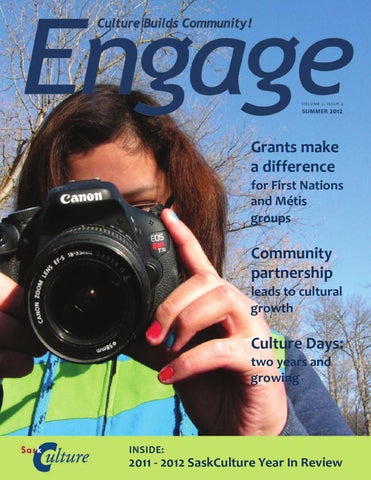
Courtesy of Pierette Settee, from Cumberland Houses's Niso Awasisak Memorial School Community Media Arts Project: Yesterday, Today and Tomorrow - Preserving our traditions through Media Arts, Traditional Storytelling and Traditional Arts
2
Graphic Design: J. Lauder Publishing & Design jlauder@accesscomm.ca
Contributing Writers: Damon Badger Heit, Michelle Brownridge, Diane Ell, Rose Gilks, Shaunna Grandish, Mei Shan Wan and Reggie Newkirk
Print copies of this publication are circulated for free to SaskCulture members, partners and through community outreach activities as determined by SaskCulture Inc. Engage is also available in PDF version on the SaskCulture web site at www.saskculture.sk.ca. Engage is published thanks to financial support from Saskatchewan Lotteries Trust Fund for Sport, Culture and Recreation. The publication does not currently accept paid advertising. Article ideas for future publications can be submitted to saskculture.info@saskculture.sk.ca or by calling (306) 780.9289. Published June 2012. Articles may be reprinted with permission.
suMMer 2012
Engage
Message from
SaskCulture’s President
T
Practicing Good Governance
he Board of Directors has handled some challenging and exciting issues this year in its stewardship role of SaskCulture and Saskatchewan Lotteries Trust Fund for Sport, Culture and Recreation. While it has been exciting to move forward with the proceeds from higher than average lottery sales, there were still challenges and we continue to keep government informed and help support the cultural community in meeting the needs of Saskatchewan in 2012 and beyond. Through the course of the year, we had ample opportunity to demonstrate our good governance practices.
The most distinguishing characteristic of the Board this year has been how well all of the Directors work together. Though Directors come from different segments of the cultural community, our unity of thought and action this past year has been stellar. This success is due to our: • Collegiality and understanding that power and authority are vested equally among Directors;
• Unity of thought: Directors may give a voice to different opinions, views and ideas yet we are able, through a frank, respectful consultation process, to achieve unanimity or a majority when voting; and ultimately a, • Single voice as a Board.
How did we achieve this? The answer is simple. First, all Board members are committed to ascertaining the facts of a situation. Remember facts are not necessarily ‘statements of truth’, though a fact may contain a truth. The trick is for Directors to determine the facts during the course of discussion at the Board table and for directors to agree upon these facts for the given situation. Next, we look for relevant principles and board policies that pertain. The Directors’ discussions on these points then lead to an affirmation of their relevance to the topic at hand. This discussion will include examination of SaskCulture’s Ends in relation to the topic on the table. Often consideration is given
to innovative and creative discussions while balancing both social realities and practicalities. Is the issue part of the Board’s mandate? Is it relevant to SaskCulture as a whole, or in part? If so, what positive action can, or ought, the Board take?
Such open, diverse, creative, positive and respectful discourse results in the articulation of a clear motion that every Director understands; however, if a Director has a substantive question about the motion, then it is reviewed to clear up any misunderstanding, misgiving or apprehension.
The work of the Directors does not stop or end at making a decision. In addition, Directors have an obligation to support and uphold decisions made by a majority vote (even if a specific Director votes against it). In my view, once the Board decides a matter, it functionally becomes a decision of each member. Directors, consequently, are ethically bound to avoid expressing or commenting on a “minority” view point. This can undermine the Board and confidence in its decisions. I am pleased to report to you that your SaskCulture Board of Directors has operated at the highest level of these principles. I think you sense this as well. The culture community’s support of the Board’s decisions is evidence that its mode of operation is both effective and unifying. As my term as your president draws to a close, I would like to express my very personal sense of gratitude for the trust you placed in me to serve as your president for the last 20 months.
In your service, with best wishes and warm regards,
saskCulture Board of Directors, back row: Joseph otitoju, James Ingold, harvey Knight, Pat Grayston and James hawn. Front row: Peter england, reggie Newkirk, Gwen King, Laurel reimche, Bula Ghosh, Cheryl Avery. Missing: David Cormican, Jennifer holmes and Brenda M. shenher.
Engage suMMer 2012
Reginald Newkirk
3
Recreation section of this issue, page 29. The individual grants under each grant program are available on our website.
Greetings from the
General Manager As with all non-profit organizations, every year is busy and for SaskCulture, the 2011/12 year was no exception.
I
n 2010/11, SaskCulture underwent a move and numerous staff changes, so we were looking forward to 2011/12 as a year in which we would implement our new strategic plan and get more comfortable working as a team in our new surroundings – a year with less change. However, change is the greatest constant, so we just could not leave well enough alone.
At the October 2011 AGM, the Board decided to ask the membership to change the fiscal year-end from July 31st to March 31st in order to run SaskCulture in the same fiscal year as the Saskatchewan Lotteries Trust Fund for Sport, Culture and Recreation. The members endorsed the change. Although this change was a welcome one for staff, it came with a number of adjustments to our annual planning cycle. First off, it was necessary to condense our fiscal reporting period to eight months for the 2011-2012 year to reflect August 1, 2011 to March 31, 2012. This meant we were preparing for year-end, the audit process, board elections and an AGM before the end of June rather than at the end of the summer. Fortunately, we decided to keep the annual Gathering in late October because we knew members would not want to commit to such an event in late June. This change also impacted the strategic planning cycle. With only eight months, we had barely laid out our strategies and the first year was near completion. So, it was determined that the new SaskCulture Strategic Plan would be based on eightmonths plus three years, and will now carry us to March 31, 2015. After only eight months, SaskCulture is already hard at work implementing the
4
three strategic priorities in the plan:
1. Supporting and Leveraging the Network; 2. Elevating Awareness and Maximizing Understanding; and 3. Investing in Online Technologies
Placing our focus upon these three areas wasn’t difficult because the work with each strategy had, to some extent, been initiated in the 2009-11 three-year plan.
The first strategic priority in the plan is around “Supporting and Leveraging the Network”. Work done in this area includes our current work with the final phase of the eligibility review, planning the 2012 Gathering at the end of October around the theme of ‘the Changing Faces of Saskatchewan’, along with increasing our work with the Districts, municipalities, newcomers, and First Nations and Métis individuals and organizations. A big piece of our work within this strategic priority is to finalize a specific multicultural strategy with input from members and nonmembers alike. That strategy will define SaskCulture’s role and help inform its programming decisions. The 2012 Gathering sessions should increase awareness of SaskCulture’s focus in this area, as well as stimulate some interesting discussion.
This area also includes enhancing our relationships with those we fund. Over the past eight months, we consulted with eligible organizations and revised the Annul Global Funding Application process and materials for eligible organizations. We also updated components of many of our other grant programs including changes to application deadlines. The listing of the total amount granted in each funding program can be found in the Culture Section of the Saskatchewan Lotteries Trust Fund for Sport, Culture and
Within the strategic priority of “Supporting and Leveraging the Network”, SaskCulture has also continued to support its Communities of Interest Mechanisms and build upon its ongoing partnerships with the Saskatchewan Arts Board, Sask Sport Inc., Saskatchewan Parks and Recreation, and members. As well as the work we do with member organizations, we have also invested in a closer working relationship with the Saskatchewan Urban Municipalities Association (SUMA) and we are supporting the ArtsVest initiative in Saskatchewan by providing office space to the provincial coordinator.
The second priority for SaskCulture is “Elevating Awareness and Maximizing Understanding.” This particular priority is always one of keen relevance and necessity for the cultural community, but given the current decision trends we are seeing from all levels of government, it is one that will require even greater dedication and clarity over the next few years. On top of ensuring that Saskatchewan citizens recognize the value of cultural activities in communities throughout the province, the SaskCulture Board also wanted to increase their recognition of SaskCulture and the support it provides through the Culture Section of Saskatchewan Lotteries Trust Fund for Sport, Culture and Recreation. Many funding recipients have already been informed of their new obligations to provide recognition to SaskCulture, as well as Saskatchewan Lotteries in their promotions. SaskCulture will be exploring more opportunities to raise its profile including increasing its presence at funded events, maximizing exposure in its news magazine and website, as well as through the use of social media. Culture Days continues to be an opportunity for SaskCulture to increase awareness of cultural activity, as well as its own efforts in supporting the sector. In 2011-12, we added a new grant program to support participation in Culture Days, hired four Saskatchewan artists as Culture Days Animateurs, and worked very hard to ensure that Culture Days 2011 was ‘bigger and better’ than the inaugural 2010 event. In 2011, there were 180 cultural activities registered by 36 Saskatchewan communities; an increase from the 130 activities registered from 23 communities last year. I had the good fortune to spend the Culture Days weekend in Swift Current suMMer 2012
Engage
one of our plan may be outdated by year three. SaskCulture’s challenge, and possibly yours too, when addressing technology, is to be strategic – to find the right technology to use as a tool to best accomplish our work.
As SaskCulture continues its work over the next three years, it will work to strike a balance between providing services to the members and the cultural community, exercising good stewardship of lottery dollars and promoting the value of cultural activities as a main ingredient of healthy, happy and prosperous communities.
where over 30 cultural events took place. I had a wonderful time and my hat goes off to the local organizing folks of Swift Current and the many other participating communities and organizations throughout the province.
Supporting the Creative Kids program is another way SaskCulture is creating awareness and increasing accessibility to culture. Although the program has been running since 2010, we took the opportunity this year to celebrate and officially launch it to the province. To date, 893 applications have been approved, over $223,000 has been granted, reaching children and youth in 66 communities across Saskatchewan. SaskCulture is very thankful to the individuals and organizations that have contributed to the fund. Of particular note is the commitment from the Potash Corporation of Saskatchewan for $100,000 in matching funds to be shared between the cities of Regina and Saskatoon. Finally, the most difficult of the three strategic priorities to address has been the “Investing in Online Technology”, or more specifically how we will “lead in the use of online technologies to benefit our network and achieve our Ends”. This priority is challenging because technology is changing so rapidly – what we do in year
At this point, we see SaskCulture’s focus with technology as two-fold: setting up a user-friendly, online funding application and follow-up reporting system, that is effective and efficient for the applicant and SaskCulture. Secondly, we are working toward making better use of social media tools, including our website, in order to strengthen our communications and advocacy. This will include new ways to access SaskCulture information and other topics of interest to the community. Right now, we are in the process of finalizing the technology strategy by having staff work with a technology consultant to finalize a very fluid strategy.
As we were digging deeper into these new strategies over the past year, we realized that our human resource capacity was still not at the level necessary to deliver on the tasks in the strategic plan, as well as the ongoing work of SaskCulture. As a result, two additional staff members were brought onto the team and these positions have increased our confidence in moving forward. As SaskCulture continues its work over the next three years, it will work to strike a balance between providing services to the members and the cultural community, exercising good stewardship of lottery dollars and promoting the value of cultural activities as a main ingredient of healthy, happy and prosperous communities. That work will require a balance between work within, as well as outside the cultural community. The Board and staff of SaskCulture are excited to take on that challenge and we look forward to working on it with you. Sincerely,
Rose Gilks
saskCulture staff: Back row, left to right: shawn Bauche, Paul Gingras, Christie Nenson, Gloria Walsh, Damon Badger heit, Nichole Williams, Dean Kush, Diane ell, Angie sawatsky, Dennis Garreck, shaunna Grandish. Front row: Janice Kyle, Michelle Brownridge, Mei shan Wan, rose Gilks.
Engage suMMer 2012
5
Year of Fransaskois community celebrating
‘joie de vivre’ in 2012
BY SHAUNNA GRANDISH
Fransaskois inventors and businessmen have helped in building the province’s economy. Bourgault Industries in SaintBrieux is one example of the French contribution to the economy. For 50 years, from 1918 until 1968, the teaching of French was limited to one hour per day in the province and the Fransaskois community had to develop its own teaching material and exams in order to guarantee that the one hour a day would insure the survival of the language. It was these efforts by the ACF and the FrancoCanadian community that has led to a solid Fransaskois and French immersion program in Saskatchewan today.
Back in December, the
provincial government declared 2012 as the Year of the Fransaskois in Saskatchewan and events marking this year-long celebration have been taking place across the province.
The Conseil Culturel Fransaskois (CCF) have had a busy past several months planning and showcasing the culture of the Fransaskois, according to CCF Executive Director Suzanne Campagne. The term “Fransaskois” refers to the Francophone population in Saskatchewan.
The CCF is currently producing multimedia, retrospective shows, one for the annual Fête Fransaskoise and one for a MetisFrench Christmas show that will have a distinctive 100 year anniversary flavour since 2012 will mark the centennial of the Assemblée communautaire fransaskoise (ACF), the governing body of the francophone community in Saskatchewan.
Saskatchewan-based Francophone musicians Alexis Normand and Shawn Jobin will also be hosting a special tour throughout Québec and the Maritimes. The duo co-wrote a song that became the official Fransaskois Theme Song in honour of Year of the Fransaskois.
“We (CCF) will have a national broadcast for the Christmas show to celebrate l’Année des Fransaskois and to thank the province for the honour with a fabulous presentation of ‘MERCI, MA PROVINCE!’ [the theme song] on December 15th,” says Campagne. “Stay tuned!”
practices in rural Saskatchewan. Mostly farmers, Franco-Canadians, as they were called before the advent of the word Fransaskois in the mid-seventies, were involved in the creation of cooperatives and credit unions across the province. The first credit union in Saskatchewan was in the French community of Albertville north of Prince Albert. It was established in 1916, 20 years before the province adopted a law for the creation of credit unions. FrancoCanadian farmers were also strong supporters of the Saskatchewan Wheat Pool and other co-operative endeavours.
The Fransaskois have made many contributions to the cultural fabric of Saskatchewan and these events will help expose the public to the accomplishments and the dynamic culture of this community. “As a society, the people of Saskatchewan know very little of the contribution of its people to the development of the province,” says Campagne.
For over a century, the French community have been involved in all sectors of the development of Saskatchewan life, everything from the economy to culture and politics. During the first half of the 20th Century, French-speaking religious orders like the Grey Nuns of Montreal and the Sisters of Notre-Dame de Chambriac established hospitals in Saskatchewan while hundreds of Quebec-trained family doctors set up
“It is a cultural community that is open to all who appreciate and like French. It is expressed in many ways through its music, theatre, dance, the visual arts, its writing, but mostly through the ‘joie de vivre’ that a Fransaskois family gathering, or a Fransaskois community get-together, will create,” adds Campagne. Saskatchewan has a rich, multicultural heritage and it is important for this province’s residents to celebrate their heritage.
“By celebrating multiculturalism, we are recognizing the enormous contributions made to the development of this country and province by immigrants from diverse ethnic origin,” explained Campaign. “The cultural and artistic expressions of each of these groups remind us that we are unique in our relation to rest of the world in the expressions of how we learn, how we love and how we live.” The CCF receives annual operating dollars from the Culture section of the Saskatchewan Lotteries Trust Fund. For more information about the CCF, please visit: www.culturel.sk.ca.
Above: In 2005, the Government of saskatchewan adopted the Fransaskois Flag as a provincial emblem, recognizing the status of French as one of Canada's official languages. Below: Fransaskois musicians shawn Jobin and Alexis Normand are set to tour Quebec and the Maritimes!
6
suMMer 2012
Engage
Grants make a difference for First Nations and Métis groups BY DAMON BADGER HEIT
The interest in the Aboriginal Arts and Culture Leadership grant, as seen by the rising amount of applications, continues to grow. In fact, this past year, the program saw unprecedented growth in the number of applications it received.
Youth participate in Media Arts and traditional storytelling workshops through the Yesterday, today and tomorrow Project in Cumberland house.
Engage suMMer 2012
awareness and engagement of the broader public,” says Reggie Newkirk, president, SaskCulture. “The Aboriginal Arts and Culture Leadership Grant has been successful in meeting these needs.”
T
he Aboriginal Arts and Culture Leadership Grant (AACL) was launched by SaskCulture in 2007 following a funding model developed by the Saskatchewan Arts Board. The AACL grant is aimed at increasing the capacity in Aboriginal communities through the development of arts and cultural leadership and mentorship opportunities.
“We heard from many First Nations and Métis communities of the need for project funding to help increase opportunities for cultural mentorship of their young people, as well as support to enhance the cultural
Activities range from youth powwow and Métis jigging programs, to culture camps and elder/youth mentorships, to projects in bridging technology and culture through photography, film and video, as well as projects in music and arts. Recent recipients show the diversity of those funded and the range of innovative programming. In 2011, the Lestock Métis Local and the town collaborated in preparation for their centennial year celebrations by bringing in expertise to build their own Red River cart on site. The cart will be unveiled this year in the centennial parade to celebrate Métis heritage in the region. Last year, the Oskayak School in Saskatoon and the Newo Yotina Friendship Centre in Regina provided powwow programs to teach dance, regalia-making and singing to those entering into the annual powwow trail. Muskoday First Nations began a process of Elder interviews and research for a travelling display designed to educate the broader public to the rich history of the 7
“We are pleased to see the enthusiasm and increased access of First Nations and Métis communities, as well as being able to respond with funding increases to match this demand”
Eagle Staff and Lance Run. The display will be part of the 2013 First Nations Summer Games, hosted by Muskoday First Nations, and continue on as a legacy for future games. As well, the Living Sky School Division used the grant to bring in cultural expertise, for its project “Living History, Telling our Stories, Treaty Education for
All”, to provide middle years students with information about historical and traditional Aboriginal knowledge and ways of knowing through the larger contest of the arts. “We are pleased to see the enthusiasm and increased access of First Nations and Métis communities, as well as being able to respond with funding increases to match this demand,” says Newkirk.
The number of programs supported through the AACL in 2011-12 is equivalent to the entire first three years of the program, from 2007-2009. Nearly $490,000 was provided to support 27 First Nations and Métis initiatives in rural and urban settings across the province.
The increase in access and demand for this program can be attributed to enhancements in the cultural network with efforts in promotion through magazines such as Engage and Eagle Feather News, as well as outreach by staff through Tribal Councils and Sport, Culture and Recreation Districts, various community consultations, partnership work with Sask Sport and Saskatchewan Parks and Recreation Association and a partnership agreement with Gabriel Dumont Institute.
A young Pow Wow dancer performs for a crowd with a drumming circle in the background. Photo courtesy of the Maple Creek old timers Museum.
8
suMMer 2012
Engage
New partnership sparks Métis interest
I
BY DAMON BADGER HEIT
n its first year, the partnership between SaskCulture and Gabriel Dumont Institute (GDI), intended to increase interest and awareness of funding available to preserve Métis cultural heritage, has resulted in an overwhelming response from the Métis community to SaskCulture’s volunteer adjudication program. In a recent call out for volunteer jury members to help adjudicate a variety of funding programs, nearly half of the entire response came from the Métis community alone. At the end of selection process, nearly 35% of SaskCulture’s jury pool is of Métis ancestry. “Along with this increased interest in SaskCulture, thanks to the endorsement and promotion by Gabriel Dumont Institute, it is hoped that applications to the MCDF will also increase,” says Dean Kush, Program Manager, SaskCulture. In 2011, a partnership agreement was signed between Gabriel Dumont Institute and SaskCulture, to work more closely on increasing the success of the Métis Cultural Development Fund (MCDF), funded by Saskatchewan Lotteries Trust Fund for Sport, Culture and Recreation, as well as increasing Métis involvement with SaskCulture.
“The MCDF grant program helps our community maintain and preserve our treasured cultural identity. The Gabriel Dumont Institute is delighted to partner with SaskCulture to ensure the grant becomes well-known and frequently accessed.” - Amy Briley, GDI the grant is in line with the cultural needs of Métis peoples in Saskatchewan.”
Amy Briley, the MCDF liaison for GDI adds, “The MCDF grant program helps our community maintain and preserve our treasured cultural identity. The Gabriel Dumont Institute is delighted to partner with SaskCulture to ensure the grant becomes well-known and frequently accessed.” Thanks to this new partnership and the
assistance of GDI, the most recent intake of MCDF grant applications has already increased by 300 per cent.
For more information on the Métis Cultural Develop Fund (MCDF) grant, contact Damon Badger Heit at (306) 780-9251,
email: d.badgerheit@ saskculture.sk.ca or visit www.saskculture.sk.ca.
Participants take part in voyageur games. Photo courtesy of Friends of Batoche historic site Inc.
Over the past few years, the MCDF grant has been under-utilized. “We heard the criteria were too narrow and that its requirements were too vague,” explains Kush. “In our efforts to increase participation of Métis peoples and communities in cultural activity, we asked GDI for their input.”
According to Kush, “the partnership agreement outlines how the organizations will work together to increase awareness of the current MCDF grant program, as well as engage the Métis community in the volunteer adjudication process. Through the partnership, GDI can also help ensure
Engage suMMer 2012
9
Community partnership leads to cultural growth BY DIANE ELL
“Downtown provides a sense of community and place. It is a powerful symbol of shared experiences, of common memory, of the challenge and struggle of building a civilization. Main Street was always familiar, always recognizable as the heart and soul of the village, town or city.” Carol Rifkind, author, Main Street: The Face of Urban America, 1977.
A
n interest in cultural planning by five Saskatchewan communities has blossomed into an innovative regional partnership, which includes involvement in the Main Street pilot projects and increased community momentum.
The Cultural Resource Use Partnership (CRUP), made up of the towns of Indian Head, Wolseley, Fort Qu’Appelle, Town of Qu’Appelle and the District of Katepwa, began as a means to work collaboratively on cultural planning. In 2011, the CRUP group first received a Municipal Cultural Engagement and Planning (MCEP) Grant from SaskCulture that enabled them to work together on planning for cultural growth in the area.
Two of the communities, Indian Head and Wolseley, have since been selected as Main Street Saskatchewan Pilots, a program supported by the Ministry of Parks, Culture and Sport and the Heritage Canada Foundation. The Main Street Saskatchewan initiative was designed to support communities in revitalizing their historic commercial areas.
According to Tara-Leigh Heslip, program coordinator, Indian Head Main Street Revitalization, “Going in the process the community as a whole was somewhat skeptical, but after involvement in the focus groups and other informationsharing sessions, we felt a renewed sense of community and are inspired by the wealth of human resources, varied skills, interests and insights we have.”
10
suMMer 2012
Engage
“We are very excited about the integration of the Cultural Resource Use Partnership into the Main Street program, as it allows for a more complete community viewpoint than would perhaps occur with solely the Main Street program.” Ed Attridge, coordinator, Wolseley Main Street Revitalization, says “The community reaction in Wolseley to the Main Street and CRUP programs has been enthusiastic and wide-spread. Main Street Wolseley has received positive feedback regarding the two programs from schools, the business community, the art community and the community in general.”
Above: Citizens of Indian head engage in cultural planning sessions. Below: Grand Avenue in Indian head which is the focus of main street revitalization.
Dennis Fjestad, Mayor of Wolseley and Main Street program Chairman
The process has been very inclusive and has led to lots of re-envisioning of what these communities hope to become. According to Ben Friesen, local businessman from Indian Head, “the experience of the engagement process and planning focus groups were a spiritual awakening for the community.” Youth of Indian Head were also part of the process. Heslip says many, “were inspirational, genuinely engaged an gave valuable insight to their perspective of community and what we had existing in the town to interest them.”
Engage suMMer 2012
11
Culture Days BY DIANE ELL
two years and growing
It only took two years for Culture Days to capture the imagination of people in cities and towns throughout Saskatchewan.
I
nspired by this success, SaskCulture, along with many community organizers, is eager to keep Culture Days as a focal point for cultural celebration each year. An interest in cultural planning by five Saskatchewan communities has blossomed into an innovative regional partnership, which includes involvement in the Main Street pilot projects and increased community momentum. Culture Days in Saskatchewan, held the last weekend in September each year, continues to be part of the collaborative, pan-Canadian, annual movement that aims to raise awareness, accessibility, participation and engagement by all people in the cultural life of their local communities. It encourages community organizers to offer interactive cultural activities at no charge to the public during the Culture Days weekend. Getting people to express their creativity and “try something new” is seen as an opportunity to develop their interest and connections to the cultural community. This past year, Culture Days in Saskat-chewan, which took place September 26-30, increased in popularity, with 180 cultural activities, from 36 different Saskatchewan communities, registered in the national database, compared to the 130 activities registered in its first year. It is estimated that well over 7,000 people participated in Culture Days this past year. There was a total of 6,000 events registered across Canada, and well over one million people participating nation-wide. A key component of Culture Days in Saskatchewan, and enduring highlight, is the Culture Days Animateur program. Last year, SaskCulture built on its Animateur model, hiring four Saskatchewan artists to use their talents and creativity to “breathe life and meaning” into the Culture Days promotions and activities.
Over a five month period, the Culture Days Animateurs met with close to 850 potential activity organizers, lead over 4,000 participants and in the end, helped to
12
suMMer 2012
Engage
register 107 different Culture Days activities. Many of the Animateurs felt that the personal contact was integral to building relationships. In 2011, SaskCulture also offered an additional funding to groups to help them hold their activities. These funds resulted in over 60 paid opportunities for Saskatchewan artists to engage others in cultural activity during Culture Days. In 2012, Culture Days plans are already underway. Culture Days will take place September 28-30, 2012 in Saskatchewan and across Canada. Join the movement at www.skculture.sk.ca.
The 2011 Culture Days Animateurs were: Paul Wilson, an award-winning author, editor, publisher and cultural worker from Regina, who has written four books and published nearly 30 others, who travelled around southeast and southwest Saskatchewan sharing the concept of “the Invisible Library”.
Darlene Williams, a choreographer, director, repetiteur, educator and founding director of White Birch Ballet Company out of Saskatoon, focused on the north central and eastern side, providing advice to community cultural leaders and presenting a dance project that invited progressive development from those involved.
Johanna Bundon, an independent artist whose practice includes choreography and a physical approach to theatre creation, spent time in Regina and southern Saskatchewan, creating a Sound Walk, that would engage people in the culture embedded in the world around them. Mindy Yan Miller, a mixed media artist and teacher living in North Battleford, visited classrooms and artists in the western part of the province, including a few local First Nations reserves, holding several workshops that engaged participants in making collages and sculpting clay heads.
“I would count my term as Artist Animateur for SaskCulture to be one of the most gratifying experiences I have had as a professional artist.” Paul Wilson Engage suMMer 2012
Culture Days 2011 in Numbers:
180 114
CULTURAL ACTIVITIES
65%
ACTIVITY ORGANIZERS
OF ACTIVITIES FEATURED INTERACTIVE ELEMENTS
7,000+ 23
PARTICIPANTS
36
RURAL COMMUNITIES
SASKATCHEWAN COMMUNITIES
56%
OF ORGANIZERS HELD MORE THAN ONE ACTIVITY
86%
INTERESTED IN PARTICIPATING AGAIN Above: Culture Days participants make bannock as a part of the 2011 celebrations at Wanuskewin. Previous page: Performer Andy shauf at the Creative City Centre in regina.
13
Creative Kids and the PotashCorp Challenge
R
BY MEI SHAN WAN
egina and Saskatoon have officially been challenged. PotashCorp has issued a city-wide challenge to both communities to raise $50,000 each for Creative Kids. If these communities can rise to the challenge, PotashCorp will match the donations, dollar for dollar, by up to an amazing $100,000.
Creative Kids relies on the support of the community,” explains Christie Nenson, fund development coordinator, Creative Kids. “We wouldn’t be able to give kids the chance to participate in cultural activities without the generosity of individuals and organizations. We want to give those who may not normally have the chance to take the same classes as their friends to participate with them, and give them the same opportunities and experiences in arts and culture.”
“We want to give those who may not normally have the chance to take the same classes as their friends to participate with them, and give them the same opportunities and experiences in arts and culture.” - Christie Nenson, Creative Kids Fundraising Coordinator
14
Regina and Saskatoon Creative Kids Committees have already been working hard to secure donations, and the community support has started to show. “We recently heard of an impromptu singing duet in Saskatoon with Carrie Catherine and the CEO of the Saskatchewan Chamber of Commerce – they ended up raising $940.00, which is really $1880.00 suMMer 2012
Engage
“The addition of staff for Creative Kids is a testament to how this wonderful program is addressing the needs of children in Saskatchewan and the future of this program is bright and the potential of what it can accomplish is very real.” - Dean Kush, Program Manager, SaskCulture
with the PotashCorp challenge going on right now,” says Nenson.
Now that the program is gaining recognition in Saskatchewan, the program has begun to receive donations from individuals and different organizations around the province. “It has been great to see the different ways that people contribute to the program,” said Nenson. “Some people stop by the office and give us cash, some people make a donation in honour of a loved one or in honour of a birthday – we even received a donation in honour of Julie Andrew’s 76th birthday!” Donations have also been received by several cultural organizations, such as the Organization of Saskatchewan Arts Council (OSAC), the Saskatchewan Choral Federation, and Dance Saskatchewan. These organizations have donated money raised from their own events.
“Organizations like these understand the importance of arts and culture to a child’s life and they have found creative ways to contribute” says Nenson. “The best thing about the program is that,
since all the administrative costs are supported by SaskCulture, we are able to tell our donors and sponsors that 100 per cent of their donation goes directly to the applicant, and that every penny donated is a penny available to be granted.”
Besides Nenson, who will focus solely on fund development, the Creative Kids team now includes Shawn Bauche as the new Creative Kids Program Coordinator and Mei Shan Wan as Program Support. Dean Kush, program manager, responsible for Creative Kids at SaskCulture, says, “The addition of staff for Creative Kids is a testament to how this wonderful program is addressing the needs of children in Saskatchewan and the future of this program is bright and the potential of what it can accomplish is very real.” For information on Creative Kids Volunteer Opportunities, contact Shawn Bauche, Creative Kids Coordinator at 306.780.9469 or email: sbauche@saskculture.sk.ca or visit www.creativekidssk.ca.
Above left and bottom right: Jerome Wang and samone Karner-Ashong are two of the participants who have already benefitted from the Creative Kids Program. top right: Creative Kids Provincial Committee: Peter sametz, reggie Newkirk, rick Korowich, Jan seibel, tracey Knutson, David Millar and Christie Nenson.
Engage suMMer 2012
15
creating an Aboriginal education resource that will be available to educators and their students when visiting the Prince Albert Historical Museum. “The Society recognized that classroom teachers were mandated to provide a Treaty and Aboriginal component in their instruction,” says Harris May, secretary/ treasurer, Prince Albert Historical Society. Lesson plans have been organized into a multi-grade and subject resource binder available to educators to support museum visits.
Prince Albert Historical Society and Treaty Education
Teachers from local school divisions from across the curriculum and grade levels participated in the two- day workshop to collaboratively create three lessons plans in a given subject and grade level that supported Treaty and Aboriginal education.
T
BY MEI SHAN WAN
he Prince Albert Historical Society understands that passing on a complete history and current reflections about Treaty education in Saskatchewan is important.
Early this year, the Society began planning the Treaty and Aboriginal Education Project - a cross-curricular project organized in partnership with local school divisions, and the Saskatchewan Urban Native Teacher Education Program (SUNTEP). The partnership worked on
“We had the opportunity to assist these teachers in making better use of our artifacts and informing the students that our organization exists to assist them.” Lesson plans have been organized into a multi-grade and subject resource binder available to educators to support museum visits.
“In preparing for the program, we realized that there is limited original artifact and archival material available for the classroom teacher to use,” says May. “Schools are providing the best Treaty and Aboriginal instruction that is currently possible. What schools are lacking is the resources for them to use during their instruction,” she explains. “This program provided local instructors with knowledge of our collection, information on how to find items in the collections, and how these items relate to the education modules being presented to the students.” Teachers from local school divisions from across the curriculum and grade levels participated in the two- day workshop to collaboratively create three lessons plans in a given subject and grade level that supported Treaty and Aboriginal education. Two project leaders were brought into assist with the program. Michelle Taylor, an Education Program Coordinator with a degree in Anthropology and a partial B.Ed. degree, and Kurtis Hamel, a board member at the Society who graduated from SUNTEP and has extensive experience in teaching, as well as project management involving producing Métis-specific resources to support the Saskatchewan Education Curriculum. Both project leaders worked with teachers to ensure that the plans were aligned with Saskatchewan curriculum and the Office of the Treaty Commissioner Treaty Education Curriculum.
The first lesson is a pre-museum visit plan to
teachers participate in training to learn how to better utilize museums and artifacts in conjunction with the curriculum to engage students.
16
suMMer 2012
Engage
prepare students for the visit. The second and third lessons incorporate tangible activities that allow students to handle artifacts and to participate in hands-on activities that are to be implemented while visiting the museum.
“Instructions on how to use an artifact, or archival information posted on the Internet, and the opportunity to read the archival records and identify with older generations are but a few of the hands-on learning opportunities that are available at the museum,” says May. The project’s vision is to provide Aboriginal educational opportunities to educators and their students, provide hands-on learning opportunities at the Museum, and provide meaningful Aboriginal education resources that support Saskatchewan curriculum and inquiry-based learning. “By providing access to the collection with the assistance of educators, we hope to assist in providing knowledge and pride in our multicultural heritage. We hope to see increased social
interaction and understanding between cultures. We hope this project will nurture an appreciation for the work done in museums and archives that shape and expand the knowledge of our heritage,” she says.
The Society received funding for this project through SaskCulture’s Multicultural Initiatives Fund. The Society is governed by a board of directors and 16 volunteers.
It currently has 86 members, 36 of whom volunteer in various capacities. The archive now contains over 325,000 images and documents and 12,000 artifacts. The Society provides tours of its museums and city, outreach to senior homes and service clubs, and research for visitors and historians. It has a long history with artifacts dating back to 1886. This year marks the centennial of the first aircraft to land in the city. The Society will be partnering with Prince Albert Tourism to host a centennial celebration of built heritage and aircraft this summer.
The project’s vision is to provide Aboriginal educational opportunities to educators and their students, provide handson learning opportunities at the Museum, and provide meaningful Aboriginal education resources that support Saskatchewan curriculum and inquiry-based learning.
teachers work collaboratively with workshop facilitators to create three lesson plans focusing on treaty education.
Engage suMMer 2012
17
Nations reserves other institutions such as the Synchotron in Saskatoon or the Esterhazy Potash mine.
Artists part of Saskatchewan Legislative Building celebrations
T
BY MEI SHAN WAN
his year, Saskatchewan artist Laura Hale has been hired to creatively engage others in celebrating the 100th anniversary of the Saskatchewan Legislature Building.
Through this new artist-in-residence opportunity, people will have the opportunity to learn more about Saskatchewan’s historic Legislative building, as well as more about the artists and artistic legacy that marks the occasion. Hale, who has held other residencies in the province, as well as being the first Culture Days Animateur in 2010, will serve as artist coordinator, overseeing the work of eight other residences with different guest artists that will ultimately result in one legacy artwork for display.
resources and expertise,” says Carol Greyeyes, arts consultant, Saskatchewan Arts Board.
“In the past, the artist-in-residence program was a way to get artists into rural communities where access to the arts was almost non-existent, but it began to stimulate a real curiosity about what these artists were doing,” she says. Since those early days, the program, now known as part of the Creative Partnerships Program, has grown to include residencies in schools, businesses, municipalities, First
“What really happens in a residency is transformation,” explains Greyeyes. “The professional artist who has the training in any discipline works collaboratively to engage the community in innovative artistic activity, creating opportunities that might not normally exist. It should work on multiple levels. It should introduce people who have no experience to the art form. It should also help advance the practice of those in the community who already have some basic skills and knowledge. And finally, it should be a collaboration and mentorship between individuals and the senior artist.”
The writer-in-residence writing therapy project that involved Saskatchewan writer Ted Dyck and the Canadian Mental Health Association (Saskatchewan Division) is another great example. “Since the inception of the pilot project in 2009, the project has continued to find great success in using writing to provide therapeutic support for mental health clients,” says Greyeyes. “The successful Explorations Writing for Therapy Project and Writing for Your Life Project have produced an impressive showcase of talented writers in Saskatchewan.”
New artists announced for the saskatchewan Legislature Anniversary project appear with hon. Kevin Doherty, Minister of Parks, Culture and sport. Artists (left to right) Laura hale, terri Fidelak, Allan Dotson, Minister Doherty, Miranda Jones, heather Cline, Anita smith and sandra Ledingham. Missing: robert Assie.
This new artist-in-residence program delivered in partnership by the Saskatchewan Ministry of Parks, Culture and Sport, the Provincial Capital Commission and the Saskatchewan Arts Board, as part of the Creative Partnerships Program, which receives funding assistance from SaskCulture and Saskatchewan Lotteries Trust Fund for Sport, Culture and Recreation. The artist in residence program at the Saskatchewan Legislature is one of nearly 20 artist residencies currently underway in the province, and one of hundreds held over the years thanks to the innovative Creative Partnerships Innovations and Explorations programs, supported collaboratively by the Saskatchewan Arts Board and SaskCulture.
“The success of partnerships like this come from the fact that in Saskatchewan we have always accomplished great things by working together and sharing
18
suMMer 2012
Engage
Sport, Culture and Recreation Districts
sport, Culture and recreation Districts have been established in saskatchewan to assist community sport, culture and recreation leaders and those who are seeking information on participation or program opportunities. the mandate of the Districts is to focus on facilitating community development and coordinating networks within their district, with the aim of enhancing access to sport, culture and recreation programs and services in the province. Contact your district to find more information:
Southeast Connection Sport, Culture and Recreation District Inc. Joni Hagen, Executive Director 157 - 3rd Street NE, P.O. Box 370, Weyburn, SK S4H 2K6 Ph: (306) 842-2188 Fax: (306) 842-2186 Email: jhagen@southeastconnection.ca www.southeastconnection.ca
Regina Sport District Dan Frank, General Manager #201 - 1860 Lorne Street, Regina, SK S4P 2L7 Ph: (306) 780-9274 Fax: (306) 781-6021 reginasport@sasktel.net www.reginasport.ca
South West District for Culture, Recreation and Sport Inc. Christie Saas, Executive Director #415 – 310 Main Street North, Moose Jaw, SK S6H 3K1 Ph: 306-694-7934 Fax: 306-694-7907 Email: csaas.swdcrs@sasktel.net www.swdcrs.ca
Parkland Valley Sport, Culture and Recreation District Inc. Sheila Hryniuk, Executive Director P.O. Box 263, Yorkton, SK S3N 2V7 Ph: (306) 782-3353 Fax: (306) 782-3354 Email: shryniuk@parklandvalley.ca www.parklandvalley.ca Prairie Central District for Sport, Culture & Recreation Inc. Stephanie Cuddington, Executive Director Box 818, Wynyard, SK S0A 4T0 Ph: (306) 554-2414 Fax: (306) 554-2412 Email: stephanie.pcdscr@sasktel.net www.pcdscr.ca
Saskatoon Sport District Shane Carter, Executive Director 510 Cynthia Street, Saskatoon, SK S7L 7K7 Ph: (306) 975-0830 Fax: (306) 242-8007 Email: saskatoonsportscouncil@shaw.ca www.saskatoonsportscouncil.ca
Rivers West District for Sport, Culture and Recreation Inc. Donna Johnston-Genest, Executive Director P.O. Box 1480, Rosetown, SK S0L 2V0 Ph: (306) 882-3030 Fax: (306) 882-2744 Email: rwdscr.donna@sasktel.net www.riverswestdistrict.ca
Lakeland District for Sport, Culture and Recreation Inc. Lyle Campbell, Executive Director Box 280, Prince Albert, SK S6V 5R5 Ph: (306) 953-1623 Res: (306) 763-4873 Fax: (306) 952-1624 Email: lyle.ldscr@sasktel.net www.lakelanddistrict.ca
Northern Sport, Culture and Recreation District Inc. Michelle Hewison, General Manager Box 1097, La Ronge, SK S0J 1L0 Ph: (306) 425-3127 Fax: (306) 425-4036 Email: mhewison@nscrd.com www.nscrd.com
Northern Sport, Culture and Recreation District Judy MacLeod Campbell, Program Manager of Culture and Community Development #301 1008 – 1st Ave. West, Prince Albert, SK S6V 4Y4 Ph: (306) 922-2008 Fax: (306) 922-2021 Email: jmacleodcampbell@nscrd.com
Engage suMMer 2012
19
Luseland wild about BY SHAUNNA GRANDISH
whooping cranes
the Whooping Crane Centre, onto the present building.” The museum receives a SaskCulture Museum Grant that will assist in preparing the new exhibit.
Whooping Cranes once populated the Luseland area, which is located about a two-hour drive west of Saskatoon, and the Luseland and District Museum is spearheading an initiative to revive the presence of this magnificent bird.
20
T
he Town of Luseland is preparing to welcome back a former resident. The Luseland and District Museum is planning to add a new wing to their centre that will focus on educating the public about Whooping Cranes. According to Val Finley, volunteer at the Luseland and District Museum, “The museum received a legacy this past December, which will enable it to build a much needed addition,
“People like to visit places featuring natural history,” says Finley. “This part of the province is a long way from Regina and the Royal Saskatchewan Museum. The proposed Whooping Crane Centre will be a great facility for locals, visitors and particularly for the students in the schools of the area. It will be a very interesting tourist drawing card for the west-central part of the province.” Creation of interactive displays of the Luseland area and featuring the Whooping Crane is planned for the museum’s new wing. The Royal Saskatchewan Museum has donated a man-made Whooping Crane egg that was previously on display in their Whooping Crane diorama. Other items for display include a copy of a 1922 government notice concerning the danger of extinction of these marvellous birds, and a large painted mock-up of Whooping Crane parents and their chick made out of ply-wood.
suMMer 2012
Engage
Finley believes it is very important for children to learn about Whooping Cranes, which is the tallest bird in North America, because the Luseland area was the flight path for these unique migratory birds. “We have had enthusiastic meeting with the school. At this point we see this as an ongoing educational project, which is very exciting,” said Finley.
The Whooping Crane was declared an endangered species in 1967 after decades of population decline due to over hunting and habitat loss, which pushed the species to the brink of extinction with just 21 birds in the wild in 1941. Since 1941, conservation efforts have slowly brought the Whooping Crane numbers to around 400 in the wild today. Whooping Cranes are protected in Canada and the US under the Migratory Bird Convention Act.
Finley said she feels optimistic about Whooping Cranes coming back to the area since the International Crane Foundation has experimented with various ways of reintroducing the birds and they seem to be having success. Having students involved with opportunities to learn about the bird through school will help to create an awareness of wildlife and the responsibilities of conservation that will ensure the Whooping Cranes’ future, said Finley.
Above: Nature experts Dr. George Archibald, Bill Cholin and Lorne scott at shallow Lake. Previous Page: Lorne scott and Bill Cholin helping with the Whooping Crane centre. Photos courtesy of val Finely, Luseland museum.
Engage suMMer 2012
21
Summer employment at the Filmpool beneficial for all BY MICHELLE BROWNRIDGE
screening to be held at the Filmpool, all within 48 hours.
It’s not often that a budding filmmaker finds a summer job that will complement his or her future career and passion perfectly, but that was just the case for Mattias Graham. Throughout the summer of 2011, Graham, a film production student, had the once in a lifetime opportunity to work at the Saskatchewan Filmpool Cooperative (the Filmpool). “I was hired on as a Production Teaching Assistant. The primary role of the position was to help develop and instruct the SaskFilm Summer Film Camp. However, the camp is only one week in the summer and there was plenty of work to be done in the office before and after,” says Graham.
The Filmpool is a non-profit artist run centre which supports, encourages and assists independent, visionary filmmaking in Saskatchewan. The Filmpool hired Graham as a summer student with a subsidy from the Student Summer Works program, which is administered by SaskCulture on behalf of the provincial government.
One of the main projects Graham worked on over the summer was the organization, administration and instruction of the SaskFilm Summer Film Camp. According to Gordon Pepper, executive director of the Filmpool, “Designing, organizing and presenting the camp is an ambitious and time consuming endeavour, which requires the services and resources of
both Filmpool staff and summer employment assistance. So having the ability to hire a summer student to assist in the delivery of the summer camp is essential to its success.”
The annual summer camp, now in its seventh year, helps young filmmakers learn how to create stories visually, using all kinds of film and video equipment. Participants shoot and edit all week long; trying out different film crew positions and working together to create several amazing short films. Graham’s roots in filmmaking go back to his teens when he was a participant in the summer camp. He says “Film camp was crucial in my development and while working with the Filmpool, I had the wonderful opportunity to give back to the community and help encourage a new generation of young filmmakers.” Graham also played a key role in another Filmpool project over the summer as well. The 48 Hour Filmmaking Frenzy involved teams coming up with an idea, shooting it, and processing, then editing a 16mm film for a
According to Berny Hi, production coordinator, it’s a pretty exciting and frantic couple of days. “It’s really a crash course in filmmaking,” he says. “Participants have the opportunity to shoot two rolls of 16mm film, develop it themselves in a darkroom, then edit it all together and develop a soundscape.” Pepper adds that it is an opportunity for young filmmakers to experiment with traditional filmmaking techniques, such as working with celluloid film and learning where words like “cutting” and “splicing”, which are now readily used in the digital film world, originated.
As a summer student, Graham also did a number of other duties around the Filmpool including cataloguing and archiving the Filmpool archive, designing a professional DVD for the film camp and maintaining and preparing equipment for the membership. Pepper says, “It’s often these skills, that some might consider trivial, such as learning how to check equipment for damage after it is returned, that are really valued in the real world. They garner a lot of respect in the industry. Just by being at the Filmpool, Mattias was able to pick up this knowledge.” Aside from the responsibilities of the camp and the Frenzy, Graham worked together closely with Filmpool staff and educators and the experience served as an excellent opportunity to meet professional video production personnel within the industry. Graham attests to this, “Working at the Filmpool opened a whole new realm of possibilities. Working with a small team in culture prepares you to work in any artist-run centre. Already this year, I have a similar opportunity lined up in Montreal, directly due to my experience at the Filmpool. Overall, the Filmpool gave me the confidence and tools to continue in what is a harsh industry no matter where I am.”
Youth participate in instructional sessions at the saskFilm summer Film Camp last year.
22
suMMer 2012
Engage
2011-2012 Boards and Committees Board of Directors
Reggie Newkirk, President Peter England, Past President James Ingold, Vice President Cheryl Avery David Cormican Bula Ghosh Pat Grayston James Hawn Jennifer Holmes Gwen King Harvey Knight Joseph Otitiju Laurel Reimche Brenda Shenher Staff – Rose Gilks Staff – Nichole Williams
Board Committees Eligibility Committee James Ingold – Chair Cheryl Avery Peter England Bula Ghosh James Hawn Jennifer Holmes Gwen King Jan Seibel Staff – Dean Kush
Audit Committee David Cormican – Chair Kelly Antill, CCA Cheryl Avery Laurel Reimche Staff – Gloria Walsh Staff – Rose Gilks Staff – Janice Kyle Nomination Committee Peter England – Chair Amy Briley Ingrid Cazakoff Bula Ghosh Marnie Gladwell Brenda Shenher Kara Stonechild Staff – Nichole Williams Spending Plan Committee Reggie Newkirk – Chair David Cormican Peter England Bula Ghosh Pat Grayston James Ingold Harvey Knight Jan Seibel Staff – Gloria Walsh General Manager Review and Succession Planning Committee Reggie Newkirk Peter England James Ingold Cheryl Avery
Saskatchewan Lotteries Community Grant Program and Community Development Fund Harvey Knight Reggie Newkirk
Municipal Cultural Engagement and Planning Grant Corey Bowers Bruno Kossmann Judy MacLeod Campbell Marvin Sanderson Staff – Dennis Garreck
Saskatchewan Lotteries Trust Fund for Sport, Culture and Recreation Peter England
Museums Grant Program Gailmarie Anderson David Klatt Annette Labelle Kristine Montgomery Valerie Mulholland Dolores Neil Donald Stein Wendy Thienes Terrie Topola Heather Wilson-Gerbrandt Kristi Yarshenko Staff – Paul Gingras
Strategic Committee for Sport, Culture and Recreation Districts Joseph Otitoju Staff – Dennis Garreck
First Nations and Métis Advisory Circle Bernice Aramenko April Buffalo - Robe Norma Jean Byrd Leevon Delorme Ray Fox Harvey Knight Sandra Lachance Marie T. Ledoux Larry Oakes Louise Oelke Darren Okemaysim Marian Otter Linda Young Staff – Damon Badger Heit
Student Summer Works Program David Dahlgren Modeste McKenzie Jan Seibel Staff – Shawn Bauche
Creative Kids Provincial Committees
Provincial Steering Committee Dr. David Millar, S.O.M. – Chair Tracey Knutson Janette Seibel Peter Sametz Reggie Newkirk Staff – Christie Nenson Staff – Mei Shan Wan
2011-12 Adjudicators Aboriginal Arts and Cultural Leadership Grant Bernice Aramenko Heather Dillon Adam Martin William Mintram Leonard Montgrand Staff – Damon Badger Heit
Battlefords Jane Zielke – Chair Cynthia Tymoruski, Treasurer Amanda Fisher Elaine Poirier Siobahn Gormely Pearl Fisher Maria Jones
Capacity Building Grant Cheryl Bauer Hyde Terry Boyer Flo Frank Gary Gullickson Jan Seibel Staff – Dennis Garreck
Town of Big River Paulette Atchison – Chair Carla Chadwick Charlene Puddicombe Mila Pisz Yvonne Netlson-Olsen
Métis Cultural Development Fund Jennifer Altenberg Patricia Bigstone Terry Boyer Modeste McKenzie Sheila Pocha Staff – Damon Badger Heit
Lakeland Cheryl Bauer-Hyde – Chair Crystal Clarke Erica Cochrane Bryce Michael Melissa Sisson Erin Standish
Multicultural Initiatives Fund Jolee Blackbear Vickie Clarke Jyotsna Custead Renu Kapoor Gerry Ruecker Staff – Paul Gingras
23
Regina Tracy Knutson – Chair Jo-Jo Amichand Michelle Carr Sarah Honeysett Kendra Nixon Douglas Stroud Jason Sylvestre Keely Tyler
Shaunavon Cathy Smith – Chair Faye Anderson, Past-Chair Anne Bennett, Secretary Wendy Thienes, Treasurer Tammy Willman Vivienne MacNeil Linda Pomeroy Dianne Greenlay Saskatoon Jami Young – Chair Jill Pelton Vinesh Kohli Candice Kloeble Danielle Dutka Lasha Haché Jody Hobday-Kusch Angela Kempf Tracy Schiele
SaskCulture Staff
Rose Gilks, General Manager
Damon Badger Heit, First Nations and Métis Coordinator
Shawn Bauche, Creative Kids Program Coordinator (as of Feb. 15, 2012)
Peter Brass, Culture Days Project Coordinator (ended Feb. 29, 2012)
Michelle Brownridge, Communications Coordinator (as of Feb. 1, 2012) Diane Ell, Communications Manager
Dennis Garreck, Community Outreach and Development Coordinator
Paul Gingras, Organizational Outreach and Development Coordinator
Shaunna Grandish, Organizational Support Dean Kush, Program Manager
Janice Kyle, Business Administrator
Christie Nenson, Creative Kids Fundraising Coordinator (as of Feb. 1, 2012)
Angie Sawatzky, Grants Administrator (as of Feb. 1, 2012)
Gloria Walsh, Administration Manager
Mei Shan Wan, Program Support Creative Kids/General
Nichole Williams, Executive Assistant
Summarized Financial Statements May 31, 2012
Management’s Responsibility
Independent Auditors’ Report
to the Members of saskCulture Inc.:
to the Members of saskCulture Inc.:
Management is responsible for the preparation and presentation of the accompanying financial statements, including responsibility for significant accounting judgments and estimates in accordance with Canadian generally accepted accounting principles and ensuring that all information in the annual report is consistent with the statements. This responsibility includes selecting appropriate accounting principles and methods, and making decisions affecting the measurement of transactions in which objective judgment is required.
The accompanying summarized financial statements, which comprise the balance sheet as at March 31, 2012 and the statement of operations for the 8-months then ended are derived from the complete financial statements of SaskCulture Inc. as at March 31, 2012 and for the 8 months then ended, on which we expressed an opinion without reservation in our report dated May 15, 2012.
These summarized financial statements do not contain all the disclosures required by Canadian generally accepted accounting principles. Readers are cautioned that these statements may not be appropriate for their purposes. For more information on SaskCulture’s financial position, results of operations and cash flows, reference should be made to the related complete financial statements.
In discharging its responsibilities for the integrity and fairness of the financial statements, management designs and maintains the necessary accounting systems and related internal controls to provide reasonable assurance that transactions are authorized, assets are safeguarded and financial records are properly maintained to provide reliable information for the preparation of financial statements.
Management’s responsibility for the summarized Financial statements
The Board of Directors is composed of Directors who are neither management nor employees of the Corporation. The Audit Committee, which is appointed by the Board, is comprised of directors and other community volunteers who review the financial statements in detail with management and report to the Board prior to their approval of the financial statements for publication.
Management is responsible for the preparation and fair presentation of a summary of the audited financial statements in accordance with Canadian generally accepted accounting principles. opinion
MNP LLP, an independent firm of Chartered Accountants, is appointed by the members to audit the financial statements and report directly to them; their summarized report follows. The external auditors have full and free access to, and meet periodically and separately with, both the Audit Committee and management to discuss their audit findings.
In our opinion, the summarized financial statements derived from the audited financial statements of SaskCulture Inc. for the 8 months ended March 31, 2012 are a fair summary of those financial statements, in accordance with Canadian generally accepted accounting principles.
May 15, 2012
Regina, Saskatchewan May 15, 2012
Rose Gilks General Manager
24
Chartered Accountants
25
SASKATCHEWAN LOTTERIES TRUST FUND FOR SPORT, CULTURE AND RECREATION
Sport, Culture and Recreation
SASKATCHEWAN LOTTERIES TRUST FUND FOR
Guiding Principles
2011/2012 Fiscal Year
PLEASE NOTE: The fiscal year of the Saskatchewan Lotteries Trust Fund for Sport, Culture and Recreation represents the 12-month period of April 1, 2011 to March 31, 2012.
SaskCulture ensures that arms-length adjudication processes are used to support all funding decisions assigned to the Trustee for the CST. Funding committee members are guided in this work by the Saskatchewan Lotteries Trust Fund Agreement and SaskCulture's Cultural Policy.
Overview
The Trust Fund Agreement emphasizes support for accessible sport, culture and recreation opportunities through activities that provide for:
Saskatchewan’s lottery system is built on a complementary relationship that exists between the Government of Saskatchewan and the volunteer-driven, non-profit sport, culture and recreation communities. Saskatchewan Lotteries Trust Fund for Sport, Culture and Recreation, established in 1974, is a unique partnership of SaskCulture Inc., Sask Sport Inc. and Saskatchewan Parks and Recreation Association Inc. (S.P.R.A.). Through a license agreement with the provincial government, these partners administer all funds generated from the sale of lottery tickets in Saskatchewan to support volunteer-driven sport, culture and recreation organizations and activities for people of all ages and abilities throughout the province.
• enhanced quality of life of Saskatchewan people through the provision of quality sport, culture and recreation programs; • services that improve the economic and social viability of communities and the province;
• equitable program opportunities for all Saskatchewan residents, regardless of age, gender, geographic location, or economic or social circumstances; • engaging Saskatchewan people through sport, culture and recreation so that they are proud of and informed about the province;
The partners share responsibility in the overall governance and policy direction of their respective Sections of the Trust. As well, partners jointly deliver programs that support all three areas of sport, culture and recreation.
• facilitating involvement of volunteers in sport, culture and recreation through effective volunteer management practices;
The Trust Fund provides funding to over 12,000 sport, culture and recreation groups in more than 1,000 communities, rural municipalities, First Nations, and non-profit organizations.
• improving physical activity and health outcomes for Saskatchewan people; and
• ensuring openness and accountability for the use of public funds.
Culture Section of the Trust
The funding provided by the Culture Section of Saskatchewan Lotteries Trust Fund is guided by SaskCulture in its role as Trustee for the CST. SaskCulture's own Cultural Policy is the tool that it uses to set the policy framework for funding decisions. The Cultural Policy places emphasis on: • cultural impact; • participation and access; • organizational effectiveness; and • high standards of accountability.
As Trustee for the Culture Section of the Trust (CST), SaskCulture supports cultural activities offered by a variety of different cultural organizations and groups throughout the province, as well as SaskCulture itself.
Funding levels of the Trust surpassed expectations in the 2011/12 fiscal year, with lottery ticket sales totaling $184.4 million. This provided the CST with over $18 million for distribution, which included a total contribution exceeding $3 million to the Community Grant and Community Development Funds.
SaskCulture’s Cultural Policy supports cultural activity that is in line with SaskCulture’s Ends and the Government of Saskatchewan’s Cultural Policy – Pride of Saskatchewan: A Policy Where Culture, Community and Commerce Meet. Both of these documents speak to greater accessibility and inclusiveness.
The stable revenues in the 2011/12 fiscal year enabled SaskCulture to continue pre-funding the CST to allow all beneficiaries of lottery funding the confidence that funding is in place as they mobilize their strategies and plan for the future. The maintenance of lottery funding levels depends on continued efforts by beneficiary groups to promote Saskatchewan Lotteries and encourage lottery ticket sales. Beneficiary groups also play an important role as advocates in support of the benefits of sport, culture and recreation to Saskatchewan communities. The continued support of volunteer organizations in Saskatchewan through the lottery license agreement is based on recognition of the importance of sport, culture and recreation to community life.
SaskCulture’s 14-person volunteer Board of Directors has overall responsibility for the development of policy, as well as the spending plan for the CST. The Board also determines the amount of funding to be allocated to each funding block annually. This work is done by the Board between January and March of each year in accordance with the fiscal year of the Trust.
26
For the fiscal period ending March 31, 2012, funds allocated from the Culture section of the trust: FuNDING BLoCK
Eligible Organizations
Grant Programs
CAteGorY
ALLoCAtIoN Net oF returNs (IN $) 2011/12 2010/11
Annual Global Funding
6,979,123
6,342,620
suBtotAL
7,029,123
6,612,620
375,000
299,582
Special Funding (eligibility related)
Delivered by SaskCulture:
Aboriginal Arts and Culture Leadership Grant Capacity Building Grant
MĂŠtis Cultural Development Fund
Multicultural Initiatives Fund
75,904
224,377
759,686
Culture Days Grant (New)
100,000
270,000
399,462
239,446 510,000
968,194
225,000
390,000
1,955,803
2,806,684
473,750
597,350
Festivals Grant Program
476,700
454,890
Media Arts Grant
250,000
250,000
1,797,000
1,898,890
1,611,652
2,187,000
suBtotAL
Delivered through SAB partnership: Creative Partnerships
ArtsSmarts/Treaty Smarts
Gallery Grant Program
SAB Program Delivery suBtotAL
SaskCulture Operations
150,000
307,500 139,050
Other Strategic Initiatives
-405,500
Communities of Interest
739,109
Global Functions suBtotAL
Tri-Partite Block (Culture's share)
195,836
Museum Grant Program
Municipal Cultural Engagement and Planning Grant
SaskCulture Block
50,000
253,494
0
231,650
230,000 135,000
405,500
663,534
988,060
2,198,755
4,244,094
Administration Centre
150,638
146,260
suBtotAL
207,443
201,420
13,188,124
15,763,708
Federation of Saskatchewan Indian Nations
totAL 27
56,805
55,160
SASKATCHEWAN LOTTERIES TRUST FUND FOR SPORT, CULTURE AND RECREATION
Funding Block as of March 31, 2012 16%
2%
14%
53% 15%
Eligible Organizations AGF
Program Funds (SC Delivered)
Program Funds (SAB Delivered)
SaskCulture
Tripartitie Block
For the fiscal period ending March 31, 2012, the Culture section of the trust (Grants Allocated): FuNDING BLoCK
Per CeNt %
Eligible Organizations AGF
53%
Program Funds (SC Delivered)
15%
Program Funds (SAB Delivered)
SaskCulture Block totAL
7,029,123
1,955,803
14%
1,797,000
2%
207,443
16%
Tri-Partite Block (Culture's Share)
2011/12 ($)
100%
2,198,755
13,188,124
the various programs and services supported by the Cst include:
Annual Global Funding for Eligible Organizations
The flexibility of this grant program has been instrumental in fostering the growth of many diverse cultural activities throughout the province.
Lottery funding is an important part of the public resources used to support volunteer, non-profit organizations involved in delivering sport, culture and recreation programs and services to the citizens of Saskatchewan. The majority of the Culture Section funds (over 53%) are distributed to Eligible Organizations through the Annual Global Funding (AGF) program, which has been in place since 1984. The AGF program supports the annual operations of cultural organizations, identified on the Minister’s Eligibility List, recognized for their role in this delivery system.
AGF supports a tremendous infrastructure that empowers Saskatchewan’s volunteer-driven, cultural community to deliver a wide selection of activities throughout the province. Over 1,500 eligible member organizations are active in communities throughout the province. AGF finances the base of operations, that has enabled many of these organizations to leverage additional grants and corporate funds. AGF also supports the continued stability of Eligible Organizations’ operations, which enables successful long-term programs and partnerships.
AGF is a multi-year, operational grant that provides organizations with a broad base of financial assistance, while allowing a high degree of freedom as to how funding is spent.
28
Grant Programs as of March 31, 2012 7%
8%
4%
10%
2%
5%
6%
13% 4%
12%
20% 3%
6%
Aboriginal Arts and Culture Leadership Grant
Capacity Building Grant
MĂŠtis Cultural Development Fund
Multicultural Initiatives Fund Museum Grant Program
Municipal Cultural Engagement and Planning Culture Days Grant
Creative Partnerships
ArtsSmarts/TreatySmarts Festivals Grant Program Gallery Grant Program Media Arts Grant
SAB Program Delivery
GrANt ProGrAM
Aboriginal Arts and Culture Leadership
Capacity Building Grant
Per CeNt %
2011/12 ($)
10%
375,000
2%
75,904
5%
MĂŠtis Cultural Development Fund
Multicultural Initiatives Fund
6%
Museum Grant Program
Municipal Cultural Engagement and Planning
224,377
20%
759,686
3%
100,000
6%
Culture Days Grant
195,836
225,000
Creative Partnerships
12%
Festivals Grant Program
13%
476,700
7%
250,000
100%
3,752,803
ArtsSmarts/TreatySmarts
4%
Gallery Grant Program
8%
Media Arts Grant
SAB Program Delivery
4%
totAL
29
473,750
150,000
307,500 139,050
SASKATCHEWAN LOTTERIES TRUST FUND FOR SPORT, CULTURE AND RECREATION
Grant Programs
Funding Programs delivered by saskCulture visit www.saskculture.sk.ca for program details and a list of grant recipients Aboriginal Arts and Cultural Leadership Grant
operational excellence in Saskatchewan museums and supports the work of over 100 community museums throughout Saskatchewan each year. The Museum Grant Program complements the training programs and standards developed by the Museums Association of Saskatchewan. The annual deadline for applications is November 30th. This past year, 117 museums received operational funding under this program.
The Aboriginal Arts and Culture Leadership (AACL) Grant aims to support Aboriginal arts and culture leadership at the individual, group and community levels. The program builds capacity in Aboriginal communities through the development of arts and culture leaders. This creates cultural opportunities aimed at enhancing skill development, personal growth and positive lifestyles. It will also increase the number of Aboriginal people with the skills and training to work with and support cultural programming. Finally, it will develop the organizations and cultural leadership needed to assess community needs, to build community linkages and to effectively plan and implement cultural programs. The two deadlines for funding submissions are April 15th and October 15th. In 2011, 27 initiatives were approved through this program.
Municipal Cultural Engagement and Planning Grant
Introduced in April 2011, the Municipal Cultural Engagement and Planning Grant is intended to encourage both urban and rural municipalities, and First Nations bands, to invest in cultural engagement and cultural planning. The matching grant aims to support Saskatchewan municipalities to explore and plan for the creative and cultural potential of their community, and supports partnerships that promote cultural vitality, creativity and economic sustainability. The annual deadline date for applications has been changed to October 31st. In 2011, 18 different communities throughout the province – La Loche to Val Marie, Yorkton to Maple Creek - were approved for this grant.
Capacity Building Grant
Established in April 2008, the Capacity Building Grant (CBG) supports the building of capacity within cultural organizations to respond to emerging needs in the cultural community, and to support new initiatives/opportunities outside of the current operations of the applicant. Its intent is to complement, rather than replace, or duplicate, existing support to culture. Funding is offered twice per year – May 7th and October 15th. In 2011, 48 applications were approved.
Funding programs delivered by the saskatchewan Arts Board (sAB), on behalf of saskCulture. For information on these grants, visit www.artsboard.sk.ca
Métis Cultural Development Fund
ArtsSmarts/TreatySmarts
Established in February 2001, in recognition of the need for support to be directed to the Métis community, the Métis Cultural Development Fund (MCDF) supports community-based cultural activities and initiatives that preserve and pass on Métis culture and traditions. This fund is administered in partnership with members of the Métis community and promotion by Gabriel Dumont Institute. Applications are accepted for two deadlines annually, April 30th and October 31st. In 2011, 20 Métis cultural groups were supported through this program.
SaskCulture, Saskatchewan Arts Board (SAB) and the Ministry of Education work together on this program to offer arts and education grants to schools, artists and community partnerships for innovative projects in any art form that bring K-12 students and professional artists together. TreatySmarts encourages teachers to employ the ArtsSmarts model to inquiry-based projects related to treaty knowledge and concepts.
Creative Partnerships Innovations and Explorations Grant
Multicultural Initiatives Fund
Established in 1999, the Multicultural Initiative Fund (MIF) supports ethno-cultural, multicultural, First Nations and Métis initiatives, projects and activities aimed at the advancement of multiculturalism in Saskatchewan. Multicultural activities are supported in the areas of cultural identity, intercultural understanding and issues related to social justice and harmony. The Multicultural Initiatives Fund supports programs that increase access to cultural activities for Saskatchewan people, particularly in areas not already supported through conventional funding systems. This program offers funding three times per year – January 31st, March 15th and September 30th. In 2011/12, 14 organizations applied for operational support and 44 MIF projects were approved through this program.
These funding programs provide opportunities for public access to the arts and responds to community needs for development in the arts by engaging Saskatchewan artists to work and reside in communities for a period anywhere from six months to two years. Formerly known as the Artist in Residence Program, the Creative Partnerships program places an artist in a particular residency in a community, school, health or justice institution, business, municipality, or First Nations reserve. The program is divided into two separate grants: the Partnerships Explorations Grant provides the applicant with the opportunity to complete a community assessment to determine its needs; while the Partnership Innovations Grant covers different artist/applicant collaborations.
The Museum Grant Program (MGP), which transferred into the lottery delivery system from government in 1991, provides operational support to museums throughout the province. The program supports and promotes the advancement towards
Resources are pooled with the SAB’s Professional Arts Organization fund, to provide gallery funding to 11 not-for-profit art galleries and two artist-run collectives annually to support their operational costs.
Museum Grant Program
Gallery Grant Program
30
Festivals Grant Program (SaskFestivals)
CGP funding is available to all communities in Saskatchewan including First Nations band councils, northern settlements and municipalities (cities, towns, villages, organized hamlets, and RMs). In total, 310 rural municipalities, 148 towns, 312 villages, 13 cities, 34 northern communities, and 79 First Nations are eligible for this funding. These communities allocate funding to their own local sport, culture and recreation priorities. A portion of the grant must be used to increase participation of under-represented populations. The CGP funding also includes an allocation of $195,000 to the cities of Regina, Saskatoon, Prince Albert, Yorkton, North Battleford, and Lloydminster for the Urban Aboriginal Community Grant Program (UACGP) which focuses on funding support for Aboriginal programming in those urban centers.
This program provides funding towards administrative and artistic costs for Saskatchewan cultural festivals. Over 30 Saskatchewan festivals, celebrating the arts, multiculturalism and youth, are supported each year.
Media Arts Grant
Transferred from a member funding program of the Saskatchewan Motion Picture Association in 2008, the Media Arts Grant provides operational support to non-profit, community-based film, video and new media organizations throughout the province.
SAB Program Delivery
The Saskatchewan Arts Board delivers these five programs through a partnership agreement with SaskCulture. This operational grant is provided to the SAB to assist with the costs associated with the adjudication, administration and overall program delivery of these funding programs.
Community Development Fund (CDF)
The CDF provides funding to Sport, Culture, and Recreation Districts to facilitate community development through enhanced access to sport, culture, and recreation programming throughout the province. The Culture Section of the Trust contributes $1,409,812 (30%) towards the total of $4,699,375 allocated to the Community Development Fund. The CDF supports annual funding to the seven rural Sport, Culture and Recreation Districts, as well as $1,247,100 in support of the Northern Community & School Recreation Coordinator Program (NC&SRCP) in Northern Saskatchewan. The NC&SRCP employs over 20 people in the North to coordinate sport, culture and recreation programming. New in 2011, the CDF also supports the Dream Brokers programs in Regina and Saskatoon, and provided over $900,000 in financial support this past year. The Dream Brokers program employs three people in each of Regina and Saskatoon to remove barriers to the participation of inner-city children to sport, culture and recreation programming.
SaskCulture Block SaskCulture Operations
This funding includes an annual operating grant to SaskCulture itself, as well as support to some ongoing, or new, initiatives that benefit the entire system. SaskCulture has 15 full-time staff positions.
Global Functions
This fund gives SaskCulture the capacity to respond to significant opportunities and build partnerships that will benefit the cultural community as a whole. This past year, Global Functions supported Creative Kids, Culture Days, Youth Heritage Fairs, “Spirit of our Nations� Pow Wow, Tourism Saskatchewan, bonding and liability insurance for Eligible Organizations, and the Saskatchewan Native Theatre Company.
Administration Centre
Operated by Sask Sport Inc., the Administration Centres for Sport, Culture, and Recreation (located in Regina and Saskatoon) provides a professional business support system to over 250 non-profit sport, culture, and recreation organizations in Saskatchewan. Its services include payroll for 400 employees, group pension and benefits, accounting, office space for 60 organizations, a full-service print shop and postal service. The Centre generates over $1.9 million in self-help revenue annually with its Trust grant being less than 25% of its total operating budget. The level of support for each Section of the Trust is determined by the percentage that their member organizations use the centre. The current usage for culture is 25%.
Communities of Interest (COIs)
In order to contribute to an effective SaskCulture, which is fully representative of, and informed by the cultural community as a whole, SaskCulture contracts services or provides support through the appropriate mechanisms to engage its COIs. These funds include support for the Saskatchewan Arts Alliance as the mechanism for the Arts COI, support for Heritage Saskatchewan, Saskatchewan Cultural Industries Development Council, and the First Nations and MĂŠtis Advisory Circle.
Federation of Saskatchewan Indian Nations (FSIN)
The FSIN receives an annual funding grant to enable direct support for sport, culture and recreation initiatives. Each year, 70% of the combined annual contribution from SaskCulture, Sask Sport and S.P.R.A. must be used to directly support sport, culture and recreation programs.
Other Shared Funding Initiatives with Sask Sport and S.P.R.A. Community Grant Program (CGP)
The CGP provides funding to community, non-profit, volunteer organizations in support of sport, culture, and recreation programs. The Culture Section of the Trust contributes $1,639,138 (35%) towards the $4,683,252 amount allocated for the Community Grant Program. 31
404, 2125 11th Avenue, Regina Saskatchewan S4P 3X3 Tel: 306.780.9284 Fax: 306.780.9252 Email: saskculture.info@saskculture.sk.ca www.saskculture.sk.ca
In 2011, Lestock MĂŠtis Local and the town of Lestock celebrated their centennial by building their own red river cart.
Photo courtesy of Bonnie Wohlberg, coordinator - Aboriginal Services, Prairie Central District for Sport, Culture and Recreation.