SPRING 2012 VOLUME 2, ISSUE 3
Featuring:
Culture Synk Inspires Creative Voice, Talents to Watch, Storytelling through Digital Animation and more!
Table of Contents
SPRING 2012
VOLUME 2, ISSUE 3
General Manager’s Message . . . . . . . . . . . . . . . . . . . . . . . . . . . . . . . . . . . . . . . . . . . . . . . 3
Engage, published
4
by SaskCulture Inc., is designed to highlight the work of cultural leaders, volunteers and the diversity of activities supported by the Culture Section of Saskatchewan Lotteries Trust Fund for Sport, Culture and Recreation.
10 15 18
Collaboration a big part of new music alliance . . . . . . . . . . . . . . . . . . . . . . . . . . . 4
Culture Synk brings out the creative voice of youth. . . . . . . . . . . 6
Popular fiddle fest continues to grow . . . . . . . . . . . . . . . . . . . . . . . . . . . . 8
Storytelling through digital animation. . . . . . . . . . . . . . . . . . . . . 10
Opera house inspires community’s culture planning . . . . . . . . . . 11
Weyburn sees Culture Days success. . . . . . . . . . . . . . . . . . . . . 13
Saskatchewan Arts Alliance buzzing about buttons . . . . . . . . . . . . . . . . . . . . . . . 15
Dream Brokers now connecting kids to culture. . . . . . . . . . . . . . . . 16
Moose Jaw Art Gallery and Musuem acquires suite of Carl Beam etchings . . . . . . . . . . . 17
Emerging Saskatchewan artists: talent to watch. . . . . . . . . . . . . . . . . . . . . . . . . . . . . . 18
Saskatchewan youth selected as national arts leader . . . . . . . . . . . . . . . 20
PAVED Arts Outreach: leaving a lasting community legacy . . . . . . . . . . . . 21
Yorkton Film Festival celebrates 65th anniversary . . . . . . . . . . . . . . . . . . . . . . . . . . . . 22
Gravelbourg bursting with culture . . . . . . . . . . . . . . . . . . . . . . . . . . . . . . . . . . . . . . . . . 23 Direct Inquires to:
Diane Ell, Editor dell@saskculture.sk.ca
Michelle Brownridge, Publishing Coordinator mbrownridge@saskculture.sk.ca
404, 2125 12th Avenue, Regina SK S4P 3X3 Tel: (306) 780.9453 www.saskculture.sk.ca CoVeR PhoTo:
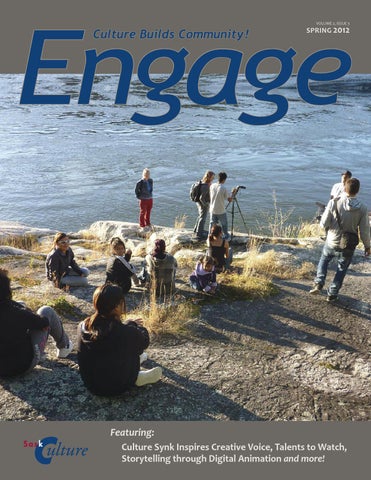
Members of the artist collective Culture Synk work with the youth of Sandy Bay to create a music video. Photo courtesy of Culture Synk artist collective.
2
Graphic Design: J. Lauder Publishing & Design jlauder@accesscomm.ca
Contributing Writers: Damon Badger Heit, Peter Brass, Michelle Brownridge, Diane Ell, Shaunna Grandish, Justin Loffler and Mei Shan Wan
Print copies of this publication are circulated for free to SaskCulture members, partners and through community outreach activities as determined by SaskCulture Inc. Engage is also available in PDF version on the SaskCulture web site at www.saskculture.sk.ca. Engage is published thanks to financial support from Saskatchewan Lotteries Trust Fund for Sport, Culture and Recreation. The publication does not currently accept paid advertising. Article ideas for future publications can be submitted to saskculture.info@saskculture.sk.ca or by calling (306) 780.9289. Published April 2012. Articles may be reprinted with permission.
SPRING 2012
Engage
10 15 18
Greetings from the General Manager
Arts important to culturally vibrant Saskatchewan By RoSe GILkS
MoRe ThAN juST eNTeRTAINMeNT, the arts open our eyes to the world around us and motivate us to explore, ask questions and create. The arts teach us to think beyond boundaries and overcome obstacles. The arts are vital to communities that want to be leaders, or even just keep up to the changes taking place in the world around us. This issue of Engage highlights a small sample of the impact the arts are having in Saskatchewan. From countless examples of visual and performing arts, a wealth of festivals and activities, as well as long lists of emerging artists, the range of creativity worth highlighting in Saskatchewan is immense. Selecting topics for this issue was indeed a challenge.
progress and help determine mutually beneficial strategies. Staff teams from both organizations remain in contact on all partnership activity. It’s a partnership that benefits the end-user and the province as a whole. Other partnerships with organizations such as the Saskatchewan Arts Alliance, the cultural industries and other provincial arts organizations, many of whom are members of SaskCulture, help reach out and connect the wider arts community. In
my work at the national level, other provinces are impressed by how connected the arts and larger cultural sector are in Saskatchewan. These connections enable greater accessibility, participation and collaborations. We have seen the value of this connected network through the successful launch of initiatives in the province, such as Culture Days and Creative Kids. As well, SaskCulture has always aimed to maintain a mutually beneficial partnership with government. It currently works with the Saskatchewan Ministry of Tourism, Parks, Culture and Sport to build awareness of arts and culture in Saskatchewan, and the importance of the provincial Cultural Policy to quality of life of Saskatchewan residents.
However, perhaps the most important partnership or collaboration is between the arts and community. Opportunities that forge partnerships between artists and Saskatchewan residents have proven to be successful for individuals and for building community. The Creative Partnerships program offered through SAB, (with funds from Saskatchewan Lotteries), as well as SaskCulture’s Culture Days Animateur Programs, are a few examples of how arts and community connect for a greater good. The arts nurture our souls, provoke thought, foster understanding, inspire us move forward, and are an important investment in building a culturally vibrant Saskatchewan!
Behind many of these stories, lies the story of partnerships and collaboration in the arts. Partnerships and collaborations are the backbone of many successful arts ventures, and as SaskCulture has found, key to sustaining a thriving arts community. We continue to invest in partnerships that will help bring arts and culture to the people of this province. Our partnership with the Saskatchewan Arts Board (SAB) continues to be an important means of furthering the arts in this province. By working together as partners, the SAB and SaskCulture have established an increasingly seamless and integrated system to fund the arts and offer support to the community as a whole thanks to funding from Saskatchewan Lotteries Trust Fund. Both the SaskCulture and SAB boards meet each year to review
Engage SPRING 2012
3
new music alliance Collaboration a big part of By MICheLLe BRoWNRIDGe
By working more closely together, members of the newly-formed Saskatchewan Music Alliance (SMA) have been able to extend their reach throughout the province, as well as enter into some exciting new shared initiatives. While the annual conference has been a group effort for some time, a new summer music camp for at-risk youth offers a new opportunity for collaboration.
4
In 2007, five provincial music organizations, supported by SaskCulture and Saskatchewan Lotteries, entered into discussions as a way to investigate collaborative possibilities and create new synergies. These discussions brought about the formation of the Saskatchewan Music Alliance (SMA), which includes the Saskatchewan Band Association (SBA), the Saskatchewan Choral Federation (SCF), the Saskatchewan Music Educators Association (SMEA), the Saskatchewan Music Festival Association (SMFA), and the Saskatchewan Orchestral Association (SOA).
Val Kuemper, executive director of the Saskatchewan Music Educators Association, says that by forming the SMA, “Communications between all five of our organizations has improved tremendously. It is so nice to be able to collaborate and work together on things. We are communicating on almost a daily basis, which rarely would have happened before.”
A main avenue of collaboration for the organizations has been the Saskatchewan Music Conference, held annually in either Regina or Saskatoon, which attracts over 200 delegates. Denise Gress, executive director, of the Saskatchewan Choral Federation, and chair of the SMA, says, “The conference has five currents running through it, so each of the five organizations is able to have a programming stream.” In addition to each organization’s specific programming, the SMA has also been able to incorporate more general sessions that would be of interest. “Often delegates at the conference wear many different hats, especially in rural communities,” explains Gress. “They may be the music teacher at the school, who conducts a choir on Sunday at church and teaches private music lessons in the evenings. It makes sense for them to attend our one conference, and get all the information in one place.”
The SMA is also working on a partnership with the Dream Brokers program. Coordinators from the Dream Brokers program work in schools to ensure children and youth, who traditionally have not had access, get the chance to participate in sports, culture and recreational opportunities. “SaskCulture approached us a while ago with the opportunity to work with the Dream Brokers,” Gress explains. “We proposed a summer music camp for at-risk youth, where those involved will have the opportunity to engage in several different types of musical experiences.” The SMA is
Talented young performers participate in a variety of musical activities. Photos courtesy of the Saskatchewan Music Alliance.
SPRING 2012
Engage
taking into account the possibility that participants might not have had a lot of music involvement up to this point in their lives. The music camp will offer an experience that will hopefully encourage lifelong participation in music.
Each organization also offers a wide-range of individual programs and support for music and music development in Saskatchewan. The Saskatchewan Choral Federation (SCF) coordinates choral music in the province, offers summer choral camps for youth, a choral concert series, mentorship programs and scholarships. The Saskatchewan Band Association (SBA), which coordinates band programming and development in the province, offers summer band camps, community band funding and provincial band festivals. The Saskatchewan Orchestral Association (SOA), which coordinates and promotes orchestral music in the province, offers workshops and grants to its member organizations. The Saskatchewan Music Festivals Association (SMFA) coordinates the provincial music festival competitions and provides performance and educational opportunities. And, the Saskatchewan Music Educators Association (SMEA) is a central resource of music educators in the province, as well as supporting provincial honour bands and choirs.
Many young musicians throughout Saskatchewan get support from one or more of the members of the Saskatchewan Music Alliance. Linsley, executive director, of the Saskatchewan Band Association. “The larger the organization is, it not only has more power in programming, but also power in a united voice to government
and funders.” Kuemper adds, “I think that there is power in numbers. One organization can do great things, but five of them working together can do even greater things.”
Talented young performers participate in a variety of musical activities. Photos courtesy of the Saskatchewan Music Alliance.
The formation of the SMA has given a stronger advocacy role to all five organizations involved. "We have a stronger political voice as well,” says Tim
Engage SPRING 2012
5
Culture Synk
brings out the creative voice of youth By MICheLLe BRoWNRIDGe
The youth in the northern Saskatchewan Village of Sandy Bay felt they had nothing to do, or at least that is how they saw it until a group of artists known as Culture Synk came to the village for six days to create a collaborative music video project called Sandy Bay in Motion. 6
The music video project, funded through SaskCulture’s Aboriginal Arts and Culture Leadership project grant, was an opportunity for Culture Synk, to share their talents in music and sound recording, theatre art and film-making, engage with youth in expressing their creativity, as well as leaving a lasting legacy of cultural opportunity in the community.
The four artists involved share a collaborative approach to creativity. Michele Sereda, a theatre artist from Regina, says, “Individually, we have all worked with youth in diverse communities,
using a collaborative process. We found that our individual philosophy made us ideal partners.” Along with Sereda, Culture Synk is comprised of: musician and composer, Ramses Calderon; Halifax filmmaker Ann Verrall, and film-maker Gabriel Yahyahkeekoot. Culture Synk entered into the Sandy Bay in Motion project knowing that the best approach would be to remain open and flexible. The artists engaged the youth in a variety of activities, such as filming, sound recording and writing lyrics or rap verses, in order to create the music video. “During
youth living in Sand Bay take turn filming for music video production. Photo courtesy of Culture Synk artist collective.
SPRING 2012
Engage
the six days we spent in Sandy Bay, we lived in the community so we were available and working all hours. Each day we would assess where we were with the project and what was needed, who was around, what they were interested in and their availability,” explains Verrall.
"There were two main rappers, Desmond and Anthony, who created a beat and a rap verse for the music that Ramses composed, they were our most consistent participants,” she explains. The main workspace for the project was a lodge that
Maybe by teaching the youth our forms of artistic expression, it might help them to continue to work on and hone their ability to express themselves. is normally used for sweats and the project was filmed in various locations in and around the community by the youth. The recording of the song was done at night in the lodge and there were many people who came out to watch. On the last day, Yahyahkeekoot and Verrall edited together a very rough assembly of the “music video” and an hour-long collection of footage. This was screened and left with the community. Yahyahkeekoot says, “I just hope that they believe what they think, say and do matters. Maybe by teaching the youth our forms of artistic expression, it might help them to continue to work on and hone their ability to express themselves.” Calderon adds, “It’s like planting a seed that sooner or later will bloom. In fact, I have already seen some positive changes in some of the youth.”
The Sandy Bay In Motion project was made possible by the support of funders such as SaskCulture, supported by Saskatchewan Lotteries, as well as The Saskatchewan Filmpool Cooperative, the Saskatchewan Cultural Exchange Society and the Canada Council for the Arts. Watch the Sandy Bay in Motion music video on YouTube or by scanning the QR code with your smart phone.
youth from Sandy Bay learn to operate video recording equipment. Photo courtesy of Culture Synk Artist Collective.
Engage SPRING 2012
7
Popular Fiddle Fest
continues to grow By DAMoN BADGeR heIT
“We started on a much smaller scale with only four fiddle workshops,” explains Vicki Arcand, organizer, John Arcand Fiddle Fest. “The next year, we added one jigging workshop and the next year we added a few more. Our organization does things in baby steps, growing things slowly. What we do is based on available funding and when audience and participants just keep saying they want more and more.” This past year, there were 1,040 participants in workshops, which nearly broke their record of 1,082 participants in 2008.
The Fiddle Fest has attracted talent and participants from neighboring Manitoba and from down south in the States since it began. Professional instructors in fiddle, piano, jigging and guitar provide training to registered participants from skill levels ranging from absolute beginner, to beginner, intermediate and advanced skill levels.
The annual john Arcand Fiddle Fest has come a long way in 15 years. It has grown from offering a few fiddle work-shops to an eventful, four-day festival, held at Windy Acres in Saskatoon, featuring concerts, competitions, dances and performances, as well as the popular Professional Workshop Series for those seeking to enhance their skills in Métis music and dance. 8
The John Arcand Fiddle Fest saw about 4,000-5,000 people come to its camp last summer. “It’s a family atmosphere here,” says Arcand. Children’s activities run throughout the weekend thanks to the assistance of Saskatoon’s CRU Wellness Centre. She adds, “for the last three years, some of the same youth keep coming back to work the festival. It’s engaging Aboriginal youth in programming, learning, experiencing and exposure to culture.”
One participant, Daniel Gervais, began as a novice fiddle player and came back every year. He eventually began entering into competitions at the festival and is now an instructor for the workshop series. “We take novices who are interested to come full circle and help them get there, he explains, “jigging and fiddling is going to disappear if we don’t disseminate them.” Arcand and the instructors are all committed to keeping these traditions alive in Saskatchewan. “You can talk all you want,
young fiddlers take part in one of the many workshop sessions offered at the festival. Photo courtesy of the John Arcand Fiddle Fest.
SPRING 2012
Engage
The John Arcand Fiddle Fest saw about 4,000 5,000 people come to its camp last summer. make advertisements or whatever,” says Gervais. He explains how important it is to get people out to the festival, so they can see the opportunity for themselves.
According to Arcand, there are a few changes planned for summer of 2012. “This year there is another switch up,” she says. “We’ve dropped the piano workshop. We had an offer from the Gabriel Dumont Institute to provide culture classes in Métis beading and finger weaving. Workshops are two hours long. There is a $10 fee for the leather and beading kit. Everything else is free once you pay entrance fees.” The 15th Annual John Arcand Fiddle Fest and the Annual Professional Workshop Series are set to launch on August 9-12th, 2012. The Professional Workshop series received funding from the Metis Cultural Development Fund offered by SaskCulture/ Saskatchewan Lotteries, in partnership with Gabriel Dumont Institute. For more information on the John Arcand Fiddle Fest visit www.johnarcandfiddlefest.com Festival-goers enjoy the festivities at the john Arcand Fiddle Festival. Photo courtesy of the John Arcand Fiddle Fest.
Engage SPRING 2012
9
Storytelling
through digital animation By MeI ShAN WAN
Capturing Your Animation”, and “Editing Your Animation”. The gallery is hoping to attract at-risk youth to participate in the programs.
“Students will be offered a unique opportunity with our new programs,” said Dyck, “We’ve taken some of Allen Sapp’s paintings and digitally altered some of the people out so only the backgrounds remain. We did this with the intention that students will be able to take the pictures and animate his paintings with their own interpretations and artistic perspectives.”
FoR MANy oRGANIzATIoNS, keeping up with technology can be a daunting task, such as using new tools in the workplace, incorporating new skills into daily life, or keeping up with social media trends. For the Allen Sapp Gallery, technology is about embracing the future and welcoming the next generation into an evolving world of art and culture.
“We spent two days at a workshop lead by two Pixar studio animators at the University of Saskatchewan College of Arts and Science, and it was amazing,” said Robin Dyck, acting administrator of the Allen Sapp Gallery, who has been busy creating several animation programs and workshops. “We brought back a lot of good ideas with us and we’re ready to try them out,” she continued. “Our staff has also been trained and oriented in story development, story
10
boarding, animation software, SMART technology, and the use of digital cameras. Our educational programmers have also attended digital photograph workshops, basic animation workshops, and had hands on instruction with the Frames 4 software and use of iMac computers.” The programs that are to be piloted this year will help provide access points to the art of Allen Sapp and build on SMART board technology, an interactive whiteboard to improve learning outcomes and assist in teaching advanced art concepts. SMART boards combine the simplicity of a whiteboard with the power of a computer to produce an interactive whiteboard that delivers dynamic lessons. Some of the programs offered will include: “Introduction to Animation”, “Story Development and Story Boarding”,
Several pilot sessions are to begin mid2012, with hopes to officially launch the sessions shortly after. Currently, the gallery continues to offer unique educational programming, as well as tours of exhibitions. The gallery currently uses SMART technology, traditional art mediums, games, as well as elder teachings as a regular part of the program plans. It started developing stop-motion animations three years ago, as a means for students to develop skills in a new media of art and storytelling. The current offerings use artifacts and historical information to connect the current exhibitions to First Nations traditions, culture, and practices. The Allen Sapp Gallery opened in 1989 and is the only “public” gallery in honour of a living artist. The Gallery received funding support from SaskCulture through the Capacity Building Grant to assist with development of these new programs. With the grant, the Gallery hopes to provide new access points to the art of Allen Sapp and build capacity in art instruction by creating new educational programs.
Students use SMART boards to create digital artwork and animations. Photos courtesy of the Allen Sapp Gallery.
SPRING 2012
Engage
Opera house inspires
community’s culture planning
A ShRINe To SASkATCheWAN’S rich history, the Town of Battleford has moved its historic Town Hall/Opera House onto centre stage as part of its most recent municipal cultural plans.
Built in 1912, the Battleford Town Hall/Opera House is a three-story, brick building with a metal roof and crown-jewel- design replica windows. A common sight on the prairies in the early 1900s, only a few of these buildings remain in existence today. Besides being tied to the historical beginnings of the town, the Opera House was valued for its role in accommodating opera, school plays, high school graduations, live theatre, musical talent nights, Christmas concerts, dances and banquets in the community. In 1965, a fire caused extensive damage to the building. While the lower level was renovated, the upper-level opera house was left vacant and unusable. Dean Bauche, local consultant and former director of the Allan Sapp Gallery, was hired in 2011 to assist in
Engage SPRING 2012
determining how to proceed with turning the space into a cultural facility. According to Bauche, “Although there was talk over the years about renovation, no formal progress was made until 2009, when Mayor Chris Odishaw recognized the opportunity and initiated a process to obtain the community’s input on what could be done with the facility.” The Opera House has always been recognized for its historical value. “The construction of opera houses during this period is representative of the cultural aspirations of the people of the area,” says Bauche. The building was known for its extraordinary acoustics for performing arts and providing a gathering place for the community.
Initially, Bauche connected with the cultural community in Battleford. He began working with Safira LaChapel and Kjelti Anderson of Common Ground Collective, a group of individual artists and arts organizations in the area who were establishing their own vision and goals, and were eager to see the Opera House become a cultural facility that would help mobilize and stimulate creative arts in the
By DIANe eLL
area. The alliance applied for and received a Capacity Building Grant from SaskCulture that enabled them embark on community consultation.
Consultations began with a very successful, invite-only viewing of the Opera House facility. “Many people in the community had never seen the inside of the building before,” explains Bauche. Out of 200 invites, over 150 people showed up for the first consultation. “They were amazed at the potential,” adds Bauche. “There were many sighs of ‘oh, my goodness,’ when visitors saw the 4,000 sq. ft. facility, its arch-enhanced stage, hardwood flooring, 22 ft. high ceilings…which provided impeccable acoustics. It had people imagining the possibilities, and saying, ‘Who wouldn’t want to perform in this type of facility?’”
After the viewing and hearing an overview of the project, about 70 people turned out to attend three facilitated sessions that focused on performing arts, visual arts, and patrons of the arts. “We got a snap shot of which people and organizations saw a role for the Opera House and how it could work with other institutions,” he says. 11
Town Hall/Opera House. The new tower would enable the building to include an elevator, washrooms, serving kitchen as well as providing a viewing deck that offers 365 degree views of the picturesque and historically significant regional geography. “The town of Battleford is very supportive of not only the restoration of a heritage building,” says Bauche, “but the intention of making it into a cultural facility as well. In fact, the mayor and councillors participated in the community consultation sessions, as participants. The Mayor of North Battleford and one of his councillors were also able to attend a few sessions as well.”
Bauche feels the project is going well. Thanks to a Municipal Cultural Engagement and Planning Grant from SaskCulture, supported by Saskatchewan Lotteries, “We are putting together the pieces of the puzzle,” explains Bauche. The project is now able to move forward to gather information from experts in acoustics, theatre, galleries and programming and others. The initial work was also a very important requirement for positioning ourselves to receive federal funding from the Canada Cultural Spaces Program. Bauche feels strongly that success will be based on whether people from the
There was substantial interest in aiming for a first class venue for performing and visual artists, he says, where home-grown, community arts and culture could thrive in a heavily utilized facility.
community see their vision in the final outcome. “Eight out of ten contributors to the process have found their way into the final report,” he says. “So, I’m confident that the community’s view has been reflected and they will be pleased with the results.”
PReVIouS PAGe: The original Town hall/opera house in the Town of Battleford Sk. LeFT: Architectural rendering showing potential renovations of the building. RIGhT: Members of the community visiting the space at an invite only site viewing. Photos courtesy of Dean Bauche.
The community consultation process proved extremely successful. A survey conducted at the time resulted in 98-99% support for turning the Opera House into a new cultural facility in Battleford. “We were flabbergasted at the tremendous buy-in from the community,” says Bauche. “The cultural organizations in Battleford don’t really have a home and often have to find other facilities for their purposes.” Following an extensive consultation, Bauche began dialogue with the facility’s architects, RBM Architecture to determine final changes that will turn the century-old Opera House into a 21st Century cultural facility. RMB Architecture has already won an award for the first phase of their work on the Opera House, replacing the building's roof in 2009. “The architects said it was one of the finest examples of existing Opera Houses in the country,” remarks Bauche. The architects’ Phase III plan includes the incorporation of a tower, built in the same period architecture as the
12
SPRING 2012
Engage
Weyburn sees Culture Days success By PeTeR BRASS
CuLTuRe DAyS IS STILL A NeW opportunity to many communities. Those considering taking the opportunity to organize a Culture Days activity or event may want to check out Weyburn’s example.
Alice Neufeld, the arts and culture director for the City of Weyburn, has had over 20 years of experience organizing activities for her community. She was organizing Culture Days activities before Culture Days became a pan-Canadian movement. Since 2010, Weyburn’s Culture Days popular arts and culture celebration continues to attract new audiences, of all ages, from their community.
“We offer demonstrations for everyone to take part in,” explains Neufeld. “This sparks interest for groups and individuals. And, we do not charge for the initial activity. Our goal is to first educate the public on what it is.” This, she says, helps to capture the interest of people so they are more likely to participate and try something new.
Engage SPRING 2012
Neufeld says booking in advance is key. “You need to make contact with the instructors at least six months in advance if they are from out of town,” she says. “This helps guarantee their services during Culture Days.” This forward thinking not only guarantees the instructor you want during the province-wide celebrations, but organizers can also use the instructor’s name in early promotions of the program.
Next, Neufeld also makes connections with the schools as early as possible. “I want to get the schools involved in Culture Days, so I usually approach them at the end of August, just before school starts,” she explains. As a result, many children are able to participate in the Culture Days activities, including the workshop. “The times for the activities are also an important consideration,” adds Neufeld. “Last year, the times did not allow for working people to come. This year, we are considering having the workshops in the morning before the
13
Weyburn Culture Days estimates that over 1,000 people attended their event last year.
main Culture Days event begins. Groups would be setting up while the students are there. If they got a glimpse of what to expect, maybe they would bring their parents back later.” Hosting a Culture Days activity is a great way to build community pride and make new connections with the public. “Just be sure to let the city or town know about your schedule,” notes Neufeld. “Parking was an issue. But, I contacted the Chief of Police and asked for leniency with parking for exhibitors during set up and take down.”
All of Neufeld’s work has been paying off. As each Culture Days passes, more and more people have participated and already asking about the upcoming year’s celebrations. Neufeld adds, “it’s a lot of work to put on this event, but the end result makes it worthwhile.” Weyburn Culture Days estimates that over 1,000 people attended their event last year. youth in Weyburn take part in some of the many activities offered for Culture Days. Photos by Shawn Bauche.
14
SPRING 2012
Engage
There’s something magical about making buttons. potential audiences, but it would reflect the organization’s work: representing artists and cultural industries across the province.
Saskatchewan Arts Alliance
Buzzing about Buttons IT’S ALL ABouT BRINGING SeVeRAL existing parts together and adding in your own dash, statement and individuality.
According to David Sereda, of the Saskatchewan Arts Alliance (SAA), “We thought button-making could be a Culture Days activity for all ages. It was hands-on, and the activity would draw people in because of the fun factor.” The SAA used the opportunity to engage people in a conversation about the arts during Culture Days in 2011. “Some of the ideas that came up in conversations ended up on the one-of-a-kind buttons that would hopefully travel the city, the province and beyond,” he adds.
Engage SPRING 2012
Every day is “culture day” at the SAA. The organization is always looking for ways to increase the visibility of arts and cultural activity and spur conversations about the importance of the arts to a truly healthy society. “Culture Days, which celebrates artistic and cultural activity, seemed the perfect platform to inaugurate our buttonmaker,” he adds.
The SAA held two Button Bees in downtown Regina; one outdoors on the Scarth Street Mall and one inside the Dunlop Art Gallery. “We teamed up with The Globe Theatre and the Dunlop Art Gallery, two of our member organizations, who provided set up space and tables,” he says. This was the first year SAA participated in Culture Days and the organization decided that partnering would not only increase its
“We brought materials for people to collage with, a variety of coloured pens and pencils and also some ready-made designs with slogans about the power of artistic activity,” Sereda says. These slogans, which included “The Arts Live Here”, “Powered by the Arts” and “Art Works”, were the result of an online slogan brainstorm held earlier in the summer on SAA’s Facebook page.
According to Sereda the idea was a success. “The Button Bees were buzzing,” he says. “We had line-ups even as we were setting up on the Scarth Street Mall. There were lots of smiles, intense concentration and pride in the finished pieces.”
At the Dunlop, there were duelling machines in the foyer of the Film Theatre, accompanied by a Sound Jam, led by composer Jeff Morton. “The arts engage us,” says Sereda, “for even in a simple activity, [such as a button bee] we use so much of ourselves: our aesthetic sense, emotions, and ideas.” He goes on to share how the Culture Days Button Bee enabled people to share the results with friends and strangers, admire each other’s work and think about the possibilities of what a small circle can hold.
Marnie Gladwell and David Sereda of the Saskatchewan Arts Alliance assist Culture Days participants in making their own buttons. Bottom: Participants proudly show off newly created buttons. Photos courtesy of Brenda Shenner.
15
Dream Brokers
now connecting kids to culture By MICheLLe BRoWNRIDGe
Brokers Program, more organizations and service providers are expressing an interest in getting involved. “The Saskatchewan Music Alliance has recognized a need to initiate and engage the participation of children and youth in music activities,” Sutherland explains. “It has proposed a summer music camp that will provide approximately 120 children the chance to explore and try out various musical activities.”
It is hoped that momentum behind the program will continue to grow. “The Dream Broker Program is very fortunate to have such an enthusiastic and passionate group of people working together to accommodate our participants,” continues Sutherland. “We look forward to building our relationships with SaskCulture and its organizations so that the needs and interests of underprivileged children and youth in our communities are addressed.” For more information about the Dream Brokers Program, please contact Lindsay Sutherland, community development coordinator, Sask Sport by e-mail at lsutherland@sasksport.ca.
IT’S No SeCReT ThAT BeING Involved in cultural, sport or recreation activities during childhood can have many benefits. Participation can foster a greater sense of belonging and develop valuable life skills, however for some children facing social and economic challenges, participation in these activities is not always an option.
This past year, SaskCulture has partnered with Sask Sport and the Saskatchewan Parks and Recreation Association to support the Dream Brokers program in Saskatchewan. The Dream Brokers was started in 2006 by Sask Sport in partnership with the Regina Public and Catholic school boards. Dream Broker coordinators work in schools to ensure children and youth, who traditionally have not had access, get the chance to participate in sports, culture and recreational opportunities. “The Dream Broker Program is very excited to have SaskCulture as a partner on this initiative,” says Lindsay Sutherland, community development consultant, Sask Sport Inc. “Dream Brokers are starting to get more and more requests for cultural activities by the children and youth.”
16
To increase access to cultural activities for children and youth, the Dream Brokers have been working closely with the Creative Kids program. Creative Kids is a program aimed at reducing financial barriers for children participating specifically in the areas of arts and culture. The program grants up to $750 annually to a program, or programs of their choice.
The Dream Brokers act as a liaison between children who have an interest in participating in cultural activities, but whose families may not be able to afford the associated costs. The partners believe that having children involved in such activities and programs helps to improve their life skills, enhance their sense of belonging and encourages them to foster pride in their accomplishments.
The success of the Dream Brokers program can be seen and heard from all those involved. One school principal stated, “I cannot imagine our school without the program. I feel it has helped to better our entire community. These kids are being given a huge opportunity for involvement in interests that would not develop without the program. It helps our students make better choices and has a positive impact on their lives.” As awareness builds about the Dream
SPRING 2012
Engage
Moose Jaw Art Gallery and Museum
Acquires suite of Carl Beam etchings By MeI ShAN WAN
The CoLuMBuS PRojeCT, A LARGe body of work by the late Aboriginal artist Carl Beam represents a repossession of indigenous identity and is considered a prominent historical milestone. Part of that project, The Columbus Suite, is a suite of 12 powerful etchings that face the “discovery” of the Americas. For many of those familiar with the stunning and renowned work of Carl Beam, they know the significance, and rarity, that his work brings to Canadian history. Beam’s work is closer to home that one might expect though, as the Moose Jaw Museum and Art Gallery has acquired and created an exhibition with all 12 prints of The Columbus Suite.
“It’s very special to have all 12 prints of the suite,” said Heather Smith, curatorial director at the Moose Jaw Museum and
Art Gallery. “Pieces are often broken up and it can be hard to find a collection in its entirety.” The prints were located by Gordon Novak, a master printmaker who relocated to Admiral, Saskatchewan from Edmonton several years ago. Novak had collaborated on prints and other one-of-akind pieces with Beam. When visiting with Novak, Smith noticed a large picture by the late Aboriginal artist hanging at the end of the hall. “I was so excited to see the picture. We [the museum] had to save up for two years and apply for a matching grant to purchase our first Carl Beam piece,” says Smith. Knowing the museum’s interest in Beam’s work, Novak was able to contact two Toronto-based collectors, Gloria and Vlado Vujeva, who graciously donated the prints to the Moose Jaw Museum and Art Gallery in 2009 so the etchings could be shared with the rest of Saskatchewan. The Columbus Suite makes its debut in Prince Albert in October 2012. In his work, Beam addresses half a millennium of colonialism, reclaiming and examining
notions of discovery and identity to counter the public celebration of Columbus’s “discovery” of the Americas. This body of work is a response to the irony of the 500th anniversary celebration of the European “discovery”. “Beam, along with many other people whose ancestors were indigenous to North America, was annoyed at the representation of history from that European perspective,” said Smith.
“He believed that all cultures have knowledge to share and it has the ability to move people forward,” Smith continues. Beam writes, “My works are like little puzzles, interesting little games. I play a game of dreaming ourselves as each other. In this we find out that we’re all basically human.” Beam earned a reputation for being “fearless, visionary, and ultimately, unforgettable” in his work. He was honoured with a Governor General’s Award in Visual and Media Arts and recognized by the National Gallery of Canada as one of Canada’s most important artists. Beam died in 2005 at his home and birthplace of M’Chigeeng on Manitoulin Island in B.C.. After attending residential school, he studied at the Kootney School of Art in 1971, and graduated from the University of Victoria in 1974. He had also begun a Masters of Fine Arts program at the University of Alberta, but left over a dispute about his thesis on native art. His work has been included in the National Gallery of Canada, Art Gallery of Ontario, Canadian Museum of Civilization and many others. The Moose Jaw Museum and Art Gallery received funding support from SaskCulture’s Multicultural Initiatives Fund (MIF) grant to assist with framing the 12 prints. The Carl Beam traveling exhibition, Dreaming Ourselves as Each other: Carl Beam and The Columbus Suite will be touring around Saskatchewan to community galleries, museums, arts councils, libraries, and other venues.
ABoVe: Carl Beam, Sitting Bull and Whale, 1990, etching on Arches paper. BACkGRouND IMAGe: Carl Beam Columbus and Bees 1990, etching on Arches paper.
Engage Fall 2011
17
Meara Conway
jacob Pratt
Greg ochitwa
young emerging artists, from a variety of disciplines, find ways to build their careers in Saskatchewan. Whether their talents are honed as part of their culture, through years of lessons and practice, or supported by various provincial cultural organizations, this new generation is eager to share their advice and experiences on advancing their careers with others. They may have different tactics, but they all seem to agree that Saskatchewan is a very exciting place to be an emerging artist. 18
Alana Moore
Talent to Watch Emerging Saskatchewan Artists
By MICheLLe BRoWNRIDGe
Meara Conway
An avid interest in music, text and acting made becoming a singer a “no brainer” for Meara Conway. Her musical interests began with the cello. "I started playing cello when I was five, and I still remember being in total awe of the shiny, miniature cello that glistened when I first plucked it from its soft cloth case, “she says.
“I went to work teaching myself the theme song to the Teenage Mutant Ninja Turtles,” she laughs, “and thus a prodigy was born.” Today, she is often referred to as an “opera singer” but some of her song repertoire, where she sings texts in Italian, German, Spanish, French or English, such as poems that have been set to music, is quite independent of any opera and includes some of her favourite material. She is quick to thank others for their support of her work and her awards. Recently, Conway won the Regina Musical Club Competition and was the recipient of the Wallis Memorial Opera Award. "I have never been wanting for opportunities or support systems in my home province and city," adds Conway.
"The Saskatchewan Music Festival Association has been huge in this respect,” she says. “Several generous scholarships have sustained my studies over the years, whether they were given in the name of Goodfellow, Kinsmen, Rose, Schumiatcher or Wallis - they all provided an awful lot of support." Conway will be singing with both the Saskatoon Symphony, as well as the Regina Symphony in their upcoming 2012/13 seasons. Besides pursuing a career in classical singing, Conway is also studying law at McGill University in Montreal.
Alana Moore
Alana Moore was born in Calgary in 1988 and continued to move around western Canada until she came to study Fine Arts at the University of Saskatchewan in Saskatoon. "I have explored many mediums, including drawing, painting, sculpture, photography and printmaking,” she says, “yet, I continuously return to painting, as my main focus and challenge. It is through painting that I am able to communicate what is uncertain."
SPRING 2012
Engage
After graduating, Moore moved to the small village of Bienfait, Saskatchewan in 2003. "It was a huge shock after growing up in Grand Prairie and Calgary,” she says. “Moving to a small rural town in Saskatchewan shifted my perceptions and I suddenly became acquainted with myself without the distractions, friends, and places to go. I was stuck with my thoughts, the endless gravel roads and the railroad tracks. I gained an appreciation for simplicity and silence in contrast to the often overwhelming aspects of a large city. I definitely see that reflected in my art." She encourages emerging artists to “take risks and make foolish things”.
“Whenever I have an idea that is ridiculous, it's easy to dismiss it,” she says. “but when I actually follow through with these ideas they teach me a lot about myself and painting.” And, as an advocate of the quiet life of rural Saskatchewan, she also advises artists to, “Simply spend a lot of time in your studio without distractions. I think it is necessary to have a place in solitude to get good work done.” Moore has a few exciting projects on the go at the moment. While completing her Fine Arts degree, she is continuing work on a series of oil paintings that deal with individual and community relationships with social media devices in contrast to solitude. "I am interested in finding a balance between figuration and abstraction through layering combination of images,” she says. “I have also been playing with making short films of people interacting with technology.”
jacob Pratt
Pratt, a multidisciplinary artist from Cote First Nation, is an accomplished musician, dancer, choreographer, beader, model, video artists, as well as an aspiring actor. He believes making connections is an important part of building a career in the arts.
“You have to work hard on your art, but also be aware that there is more to being a good artist than creating your art. Do your research and make connections with the right organizations and people. Those connections will help you become the artist you want to be,” he says. He also credits his Dakota/Saulteaux background for his ongoing interest and engagement in an artistic career. "First Nations people have always been a culture of artists," says Pratt. “Being raised in a traditional First Nations family, I became an artist without knowing it. I started as a young dancer and as I got older I began to
Engage Fall 2011
pick up new skills that complemented my dance." He is also in the process of completing his Administration degree at the First Nations University of Canada.
Recently, Pratt started a performance company called Wambdi Dance and is working on a multimedia, theatre dance performance. “I don't believe anything quite like it has been done before and my team and I are very excited about it,” he says. He is working towards his putting out his next CD and organizing a couple of cross-country performance tours. Visit www.jacobpratt.ca
Barbara Reimer
graphers. I have been experimenting with on-site developing, historical processes and, most recently, creating digital negatives”.
She received an Independent Artists Grant in the spring of 2010 from the Saskatchewan Arts Board for the Finding a Green Photo project, which assisted her in travelling to Nicaragua to research and photograph the landscapes of the communities of people living in and out of the garbage dumps. “I was able to start my project in a significant way,” she says, “I wouldn't have been able to do on my own. Having organizations that support emerging artists in this way is very importanttotheartsinSaskatchewan." Visit www.reimereason.ca
Greg ochitwa
Greg Ochitwa, a Regina-based actor, writer and rapper, says, “Drown yourself in experiences. Go to everything: plays, movies, hockey games, concerts, poetry readings, and dance creations. See everything. Talk to strangers. And, never stop creating!”
Barbara Reimer isn’t really certain how she became interested in the arts. “A ‘career' in the arts is still a sort of foreign concept to me. Yet, art and specifically art photography always seemed to be the thing that I would return to,” she says. “Sometimes I don't think I really chose to be an artist… it just sort of happened."
A Saskatoon artist, Reimer is an experimental photographer who studied at the University of Saskatchewan receiving a BA in Studio Arts 1996 and BFA in 2008, as well as spending a year studying at Ryerson's School of the Image Arts (1998-99). She is currently working on a project entitled “Finding a Green Photo” which begins a complex argument about sustainability, community, history and site through the images of landscape. Through this project she has found herself photographing in garbage dumps, as well as at tourist- and known- ecological sites and communities, in both first and third world conditions and developing her photos on-site where possible. “I am working with a non-toxic coffee process for developing film and paper while researching an ecologically responsible photograph, both in process and content.” explains Reimer. “I use homemade and refurbished old cameras and dated film discarded by other photo-
Ochitwa is part of the cast of the hip-hop musical Cope, which just completed a successful run at The Globe Theatre in Regina and is now moving on to Live Five Theatre in Saskatoon in Spring 2012. He encourages young artists to experience as much as they can and keep creating. “At the end of the day as an artist, you'll stay sane and happy as long as you keep creating. He grew up in Balgonie, SK and became interested in acting at an early age. “I've been up on stages performing since I was three, and it wasn't because my parents were pushing me up there. I just loved to perform,” he says.
“The main benefit of being an artist is that I get to create my art at home in Saskatchewan. At the moment, our province is bursting at the seams with an incredible group of up and coming artists who seem to be feeding off one another, pushing each other. It’s a healthy competitiveness that is lifting the art to some really exciting new places.”
It is the exciting artistic environment in Saskatchewan that drew Greg back home after spending 2008 and 2009 in Toronto, “I like being based out of Saskatchewan,” he says. “Places like The Globe Theatre are providing young artists, such as me, with the most amazing opportunities to create art. I really feel like it is a defining time for Saskatchewan artists right now. I am excited to be here to contribute and be a part of the magic.” 19
national arts leader Saskatchewan youth selected as By MICheLLe BRoWNRIDGe
a high level of involvement in the arts, especially drama. “Almost half of the students at my school are involved in drama,” says Wyatt. “I come from more of a sports background, so to be more involved in the arts was really different for me.” The National Youth Advisory Committee consists of Wyatt, Charles MacDougall, the official spokesperson for the NYAC and five other students. The students range in age from grades eight to twelve and are from both rural and urban areas, living in both of Canada’s official languages and celebrating a range of socio-ethnic backgrounds. The Committee will be responsible for reviewing grant applications received from around the country to the 21YCC program. “Once we receive the grant applications, we are going to meet up in Toronto and evaluate them using the criteria we developed at our first meeting. It is going to be a tough job to adjudicate the applications and decide what projects are going to receive the available grants,” explains MacDougall.
The first meeting of the NYAC was held in January 2012 in Toronto when and where the committee developed the application forms that youth will use to apply for the program, as well as the logo for the program. “At the first meeting we also really focused on team-building and leadership, getting to know wach other and forming the team was really important,” says MacDougall.
IT WAS A SuRPRISe To BRoADVIeW School student Adam Wyatt when his mother asked him if he would like to travel to Toronto to participate in a new program focused on youth leadership. The program, initiated by ArtsSmarts, brings together students from across the country onto a National Youth Advisory Committee to focus on a 21st Century Youth Creativity Challenge (21YCC).
"21YCC is a grant program that is trying to get students to take a more active role in ArtsSmarts programs by having them lead the projects instead of just participating in them,” says Wyatt. “Students will design the projects and actually put them on themselves with the help of a teacher and an artist if they are selected to receive a grant.”
20
Wyatt was pleased to be chosen as part of this committee. “The principal of my school and a teacher nominated me to be on the committee because of my previous involvement with ArtsSmarts program,” explains Wyatt. ArtsSmarts is a dynamic approach to teaching, learning, doing and thinking that has been changing the lives of students, artists, educators, and entire schools and communities since 1998. The program generates and sustains innovative school partnerships centred around the arts.
Broadview School, an active participant in ArtsSmarts programs in Saskatchewan, has
Wyatt's work for the NYAC isn't finished when he gets home. "We have to promote ArtsSmarts and the 21YCC by putting out a call for the program and by going to talk to our teachers and principals and encouraging them to send in applications,” says Wyatt. “We also have to go around to schools in our area to tell them about the project and urge them to take advantage of this great leadership opportunity." Adam, Charles and the rest of the committee will be meeting in Toronto again in March 2012 to jury the applications. To find out more about ArtsSmarts in Saskatchewan please visit http://www.artsboard.sk.ca to learn more about ArtsSmarts, the 21YCC or the NYAC, please visit www.artssmarts.ca. In Saskatchewan, ArtsSmarts programs are delivered by the Saskatchewan Arts Board and supported in part by SaskCulture/Saskatchewan Lotteries and the Saskatchewan Ministry of Education.
Members of the 21yCC National youth Advisory Committee gather in downtown Toronto. Photo courtesy of Frances Shakov, ArtsSmarts.
SPRING 2012
Engage
PAVED Arts Outreach:
leaving a lasting community legacy By ShAuNNA GRANDISh
oVeR The PAST FIVe yeARS, PAVeD Arts has made outreach programming a priority for Saskatchewan’s media arts community.
“The PAVED Arts’ outreach program has been very active and since the organization was first established,” says Bilana Velkova, executive director, PAVED Arts. Established in 2003, PAVED Arts is a nonprofit, artist-run centre whose mandate is to support local, regional and national artists working in the ‘PAVED’ arts. The word ‘PAVED’ is an acronym for the art forms: photographic, audio, video, electronic and digital. The centre’s mission is to support artists who work in these media. Currently, it is the only artist-run new media centre in Saskatoon.
According to Velkova, former Outreach Coordinator Aleyna May has helped build a foundation to connect the Aboriginal youth community with the province’s arts and cultural community. While in her position as Outreach Coordinator, May developed over 20 successful partnerships that delivered long lasting and legacy building projects with local organizations, such as: the Core Neighbourhood Youth Coop, the Saskatoon Open Door Society, Saskatoon Health Region to name a few.
With programs and projects reaching more than 500 youth from across Saskatchewan, PAVED Arts outreach programming is helping to make an impact within our communities. In 2010, a very successful program called Healing Through the Arts came into fruition. Healing Through the Arts was an
Engage SPRING 2012
audio project that offered participants in the group Str8-Up, which consists of young men and women who are exiting gangs, a positive opportunity to express themselves through art and culture.
By providing a safe space and technical assistance, the program helps the youth who took part in this program to develop the confidence to fully express themselves through creativity, explains Velkova.
“The youth left a lasting legacy in our organization and community,” she adds. “They gave us the inspiration and platform to build on future outreach programs.” Several of these outreach programs are also slated to be delivered this year. One such program is the Urban Aboriginal Radio Broadcast project. According to Velkova, the purpose of this initiative is to enable PAVED Arts to deliver a media arts program for local Aboriginal youth. Partnering with CRU Youth Wellness Centre and Saskatoon’s CFCR Community Radio, the centre will facilitate workshops that will help the participants create their own media and sound projects, which will be later broadcast through the community radio station. PAVED Arts outreach programming has many positive effects on the community.
“The programming provides a safe place for local youth, students, artists and other members of the community to create and have a voice through art,” explains Velkova. “The programming also brings the community together and allows for everyone’s voice to be heard and remembered long after the project has been completed.”
According to Velkova, PAVED Arts would not be able to program, facilitate and deliver outreach projects without the generous support of SaskCulture. PAVED Arts have received funding from several SaskCulture funding programs, such as the Aboriginal Arts and Culture Leadership Fund and the Multicultural Initiatives Fund. “We are always thankful for the support SaskCulture has given us over the years and we look forward to working together on future projects,” adds Velkova. PAVED Arts also received a grant from Student Summer Works program, administered by SaskCulture, but funded by Saskatchewan Ministry of Advanced Education, Employment and Immigration. For more information about PAVED Arts, please visit: www.pavedarts.ca.
young performers take part in PAVeD outreach programming Ladyshow, featuring eekwol in june 2011. Photos courtesy of Biliana Velkova, PAVED Arts
21
Yorkton Film Festival
Celebrates 65th Anniversary By ShAuNNA GRANDISh
Bright lights will be shining on yorkton this May as the city welcomes film-lovers from across the country.
This year, the yorkton Film Festival, which bills itself as the longest running film festival in North America, will be celebrating its 65th anniversary on May 2427, 2012.
“It’s an exciting time for the Yorkton Film Festival,” says Randy Goulden, director of the Yorkton Festival. She says, “Many activities will be taking place during the festival to commemorate its 65th anniversary. A display of historical photographs from past festivals will be shown and screenings of three short films that have gone on to receive Oscar nominations are just a couple of special events featured at this year’s festival. In addition to visiting filmmakers, delegates and the general public, this year’s festival will also host past festival founders and leaders as part of anniversary celebrations.
“People enjoy coming to Yorkton because it’s laid back,” explains Goulden.
Celebrations have already started in the months leading-up to the big event in late May. The festival has hired a researcher to catalogue the film festival’s history on its website and will be screening past festival films around the province.
A big turnout is expected for the festival. Over 100-150 filmmakers and delegates are expected to descend onto the small prairie city at the end of May. Over the duration of the festival, attendees have a choice to view about 300 short films, which showcase talent from across the country.
The festival also hosts major networking events for filmmakers hoping they could strike deals with broadcasters from across Canada. Since the Yorkton Film Festival is smaller in size compared to other film festivals, filmmakers have a greater chance of direct interaction between themselves and broadcasters, Goulden explains. The film festival also serves as a way for films to qualify for other festivals and for the Gemini and Genie Awards. “It’s been thrilling getting to know everyone in the film industry,” says Goulden, who has
22
been the film festival’s director for the past four years.
When the film festival initially took off 65 years ago, some people weren’t enthusiastic as to the event’s long-term chances at success. Established by volunteers in 1947 originally as the Yorkton Film Council, the film festival was the first of its kind in North America. Many at that time considered Yorkton to be too small and too isolated for a major film competition to be a success.
Apart from geography, the festival has had to deal with some other challenges over the past several decades, such as a fire destroying Stan’s Avalon Studios in the late 1950s and the advent of television in the 1960s, which caused festival attendance to plummet. However, because of the determination and innovation of staff and volunteers over the years, the Yorkton Film Festival will be celebrating its 65th anniversary this year. “The longevity of the festival is due to the volunteers and boards who have a passion for film,” said Goulden. “This year we will be celebrating that.” The Yorkton Film Festival has beaten the odds over the past 65 years and that is giving people a reason to celebrate. For more information about the Yorkton Film Festival, please visit: http://goldensheafawards.com.
There are many exciting screenings, workshops and activities to take in at the yorkton Film Festival. Photos courtesy of the Yorkton Film Festival.
SPRING 2012
Engage
Gravelbourg
bursting with culture By juSTIN LoFFLeR
FeSTIVALS ARe A GReAT PLACe To showcase local talent and highlight unique aspects of a community, such as cultural diversity and heritage.
The Summer Solstice Festival D’été held in Gravelbourg, Saskatchewan has been an active force in the community for the past 11 years. Held on, or around, the summer solstice, which occurs June 21, when the sun reaches the highest point of its arc in the sky, the Summer Solstice Festival d'été serves as an annual opportunity for local residents and visitors to celebrate culture, heritage and community. This year’s festival is scheduled for June 22-24, 2012.
“The festival is a great opportunity to mark the beginning of summer and showcase the community’s unique culture,” says Guylaine Green, Sports, Culture and Recreation Director for the Town of Gravelbourg and Coordinator for the festival. Gravelbourg is located 2 hours southwest of Regina. Thanks to its rich culture, remarkable Francophone heritage, regal architecture and diverse spirit, Gravelbourg offers visitors a Touch of Europe on the Prairies. The Summer Solstice Festival D’été provides an opportunity to showcase the
Engage SPRING 2012
community’s diversity. The festival kicks off with an International Food and Music Festival that highlights the cuisine of over 15 countries. “It’s a great opportunity to sample food from Mexico, Korea, Germany and many other countries,” notes Green. Participants also enjoy opportunities to learn more about the cultural heritage of their neighbours, including performances by different cultural groups. The International Food and Music festival is only the beginning of a weekend filled with music, literary and performing arts programming for an audience of all ages. Besides national talent, the festival features performances from local artists, who have gained national recognition, as well as emerging talent. The Artisan Village can be found at Soucy Park and the court house grounds are home to the kids' activities corner, beer gardens, concession area and main stage. Each year the festival attracts approximately 1,000 people from the community and beyond, generating additional revenues for the community. “Last year was the first year the festival had to move inside due to inclement weather, “ Green
says. “Despite having to cancel some of the outdoor festivities, the event was well-attended and considered successful.”
A key factor in this festivals success is the commitment of volunteers. “We have over 100 local community volunteers who commit more than 2,500 hours each year to the success of the festival,” remarks Green.
The festival is organized by the Southern Saskatchewan Summer Solstice Festival Inc., whose mandate is to celebrate the spirit of its southern Saskatchewan landscape through arts, music, dance, literature and drama providing a living, interactive diary of culture – things of the spirit – to local, regional and provincial audiences. Over the past 11 years, the festival has helped nurture bilingualism, multicultural arts and culture through a diversity of programming and performances.
The festival receives funding from both SaskFestivals, delivered by the Saskatchewan Arts Board and the Multicultural Initiatives Fund (MIF), delivered by SaskCulture, both of which are supported by Saskatchewan Lotteries Trust Fund. For more information on the 2012 Summer Solstice Festival D’été, visit www.summersolsticefestivaldete.com Arial view of Gravelbourg . Insert: youth are a big part of community festival. Photos courtesy of the Town of Gravelbourg.
23
404, 2125 11th Avenue, Regina Saskatchewan S4P 3X3 Tel: (306) 780.9284 Fax: (306) 780.9252 Email: saskculture.info@saskculture.sk.ca www.saskculture.sk.ca
Greg ochitwa performs in his hip-hop musical "Cope" with kaitlyn Semple. Photo by Kiriako Iatradis.