ArchaeoCaravan out in Saskatchewan
Nature Quest popular
with Saskatchewan students
Treaty Education in Saskatchewan
Year of India
celebration a success
Maple Creek
capitalizing on its cultural roots
VOLume 2, ISSue 2,
wINTEr 2012
Table of Contents
Engage is a
publication, published by SaskCulture Inc., designed to highlight the work of cultural leaders, volunteers and the diversity of activities supported by the Culture Section of Saskatchewan Lotteries Trust Fund for Sport, Culture and recreation.
Taking heritage to the next level . . . . . . . . . . . . . . . . . . . . . . . . . . . . . . . . . . . . . . . . . . . . 3
ArchaeoCaravan out in Saskatchewan . . . . . . . . . . . . . . . . . . . . . . . . . . . . . . . . . . . . . . . 4
Cultural Leader: James Ingold. . . . . . . . . . . . . . . . . . . . . . . . . . . . . . . . . . . . . . . . . . . . . . . 6
macklin: heritage helps define community . . . . . . . . . . . . . . . . . . . . . . . . . . . . . . . . . . . . 7
Nature Quest popular with Saskatchewan students . . . . . . . . . . . . . . . . . . . . . . . . . . . 8
Partners for creative Treaty education . . . . . . . . . . . . . . . . . . . . . . . . . . . . . . . . . . . . . . 10
Students go digital as part of Treaty learning . . . . . . . . . . . . . . . . . . . . . . . . . . . . . . . . . 11
museum in a suitcase . . . . . . . . . . . . . . . . . . . . . . . . . . . . . . . . . . . . . . . . . . . . . . . . . . . . . 13 Year in India celebration a success . . . . . . . . . . . . . . . . . . . . . . . . . . . . . . . . . . . . . . . . . . 14
Looking forward to next Culture Days. . . . . . . . . . . . . . . . . . . . . . . . . . . . . . . . . . . . . . . 16
Animateur work gives dancer pride in her province . . . . . . . . . . . . . . . . . . . . . . . . . . . 17
maple Creek capitalizing on its cultural roots. . . . . . . . . . . . . . . . . . . . . . . . . . . . . . . . . 18
Connecting culture through social media . . . . . . . . . . . . . . . . . . . . . . . . . . . . . . . . . . . . 20
Horses important to cultural healing . . . . . . . . . . . . . . . . . . . . . . . . . . . . . . . . . . . . . . . . 21
Pinehouse brings community together . . . . . . . . . . . . . . . . . . . . . . . . . . . . . . . . . . . . . . 22
DIrECT INQuIrES To:
Diane Ell, Editor 404, 2125 12th Avenue regina SK S4P 3X3 Tel: (306) 780.9453 Email: dell@saskculture.sk.ca www.saskculture.sk.ca
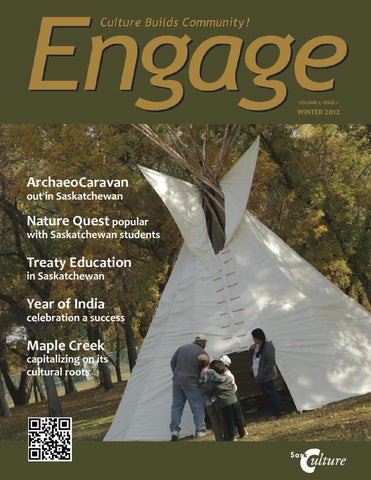
CovEr PhoTo: Families came out to enjoy different cultural activities as part of Culture Days 2011 in Swift Current, SK. Photo by Don List, Birdsong Communications
2
Graphic Design: J. Lauder Publishing & Design Email: jlauder@accesscomm.ca Contributing writers: Damon Badger heit, Shawn Bauche, Peter Brass, Dennis Garreck, Shaunna Grandish, Mei Shan wan, Darlene Kidd
Print copies of this publication are circulated for free to SaskCulture members, partners and through community outreach activities as determined by SaskCulture Inc. Engage is also available in PDF version on the SaskCulture web site at www.saskculture.sk.ca. Engage is published thanks to financial support from Saskatchewan Lotteries Trust Fund for Sport, Culture and recreation. The publication does not currently accept paid advertising. Article ideas for future publications can be submitted to saskculture.info@saskculture.sk.ca or by calling (306) 780.9453. Published January 2012. Articles may be reprinted with permission. ISBN 0-9878456 Photo of Wanuskewin Heritage Park by Kevin Ell
wINTEr 2012
Engage
GeNeRAL mANAGeR’S meSSAGe
Taking heritage to the next level
AS wE PrEPArE for Heritage Week in late February, it is a good opportunity to reflect on the energy and effort that has gone into making Heritage Saskatchewan what it is today. The seeds of potential for Heritage Saskatchewan were planted back in 1999, when SaskCulture called together over 40 leaders from Saskatchewan’s heritage community to discuss a means for the whole of the heritage community to work together on common issues, including increased funding and public awareness for heritage in the province.
The discussions on the appropriate mechanism for bringing the heritage community together continued until in 2002 when the Heritage Community of Interest Committee was formally established. This Committee worked to strengthen the heritage network in Saskatchewan and encouraged dialogue among the diverse heritage interests in the province. The Committee was involved in several heritage projects, including the Heritage market Study in 2004 and the Student Heritage Project in 2005, and was successful in finalizing a new definition of heritage for SaskCulture’s Cultural Policy, which was inclusive of tangible and intangible aspects of heritage including built, natural, human, cultural and social. Although there wasn’t always agreement in future direction, the heritage leaders on this Committee worked collaboratively with SaskCulture to discuss options and unite community interests. In 2009, after completing an intensive Funding Review process that included community consultations, SaskCulture announced one of its recommendations
Rose Gilks discusses importance of heritage, arts, cultural industries and multiculturalism with the media during Culture Days in Swift Current. Photo by Don List, Birdsong Communications
Engage
wINTEr 2012
was to create an independent heritage organization to take on a leadership role in the heritage community. After feasibility research, the Heritage Saskatchewan Alliance was formed and incorporated in 2010 as an organization and established a provincial office in Regina.
Since its establishment, Heritage Saskatchewan has continued to work to bring the heritage community together and advocate for increased support for heritage in the province. It has continued the Committee’s tradition of holding successful Heritage Forums, publishing Heritage E-Advocate, meeting with government, as well as giving numerous community presentations and holding a well-attended mLA Reception in 2011. Its membership continues to grow, along with its ability to support the diverse needs of heritage in Saskatchewan. Along with SaskCulture and partners in the Heritage Branch inside government, Heritage Saskatchewan has helped highlight the need for increased government investment for heritage.
This past year, the heritage community was pleased with increased provincial government funding to the Saskatchewan Heritage Foundation, from $375,000 to $500,000, for the 2011-12 fiscal year and additional dollars for a new main Street Program, which supports heritage
revitalization. SaskCulture also set up a new grant fund for municipal Cultural engagement and Planning. So, while there is still a need for more funding, these incentives demonstrate that the value of heritage is growing and support is moving in the right direction.
SaskCulture has no doubt that Heritage Saskatchewan will be a vital player in the cultural mosaic of this province. It will continue its focus on the whole of heritage, similar to how SaskCulture keeps its focus on the whole of culture. Just recently, its Board of Directors completed work on the organization’s long-term ends (ends Statements). The CeO, Ingrid Kazakoff, feels the ends are similar to, and as “inclusive” as, SaskCulture’s ends, and that the organization appears to be well on its way to garnering tremendous progress for heritage in Saskatchewan.
For those interested in heritage in Saskatchewan, I highly recommend attending the Heritage Forum this February 24-25, 2012 in Saskatoon to be part of Heritage Saskatchewan’s exciting future. Sincerely,
Rose Gilks
H E R I TA G E W E E K / FEBRUARY 20-25, 2012 / H E R I TA G E W E E K
HERITAGE FORUM 2012
“Connecting Heritage & Creativity: How Heritage Connects to Creative Communities” Friday & Saturday, February 24-25, 2012 / Sheraton Cavalier Hotel, Saskatoon Celebrate Heritage Week by joining Heritage Saskatchewan and heritage leaders from around Saskatchewan for a two-day dialogue on heritage and community, featuring a keynote address by award-winning author Maggie Siggins entitled “Giving Birth on a Saddle: Four Incredible Journeys into Saskatchewan’s Past”. Panel discussions include: The Power of the Past: the Role of Memory and How Heritage Contributes to Quality of Life; Mapping Tangible and Intangible Heritage; and How Heritage Tourism Contributes to Sustainable Development For more information or to register, visit www.heritagesask.ca.
3
ArchaeoCaravan out in Saskatchewan BY ShAwN BAuChE
ThIS hAS BEEN AN EXCITING YEAr for the Saskatchewan Archaeological Society (SAS). Acting executive Director Kim Cloutier says the SAS’s success comes largely from two new initiatives designed to introduce archaeology to those who are unfamiliar with the practice.
“Through the Society’s activities and educational resources, we aim to engage people so they become archaeological stewards, protecting our past for future generations,” she says. So far, archaeological “newcomers” have embraced these new activities.
The Society typically hosts two hands-on, hands-dirty, field schools in the province – one at South Branch House, a probable fur-trading post location along the South Saskatchewan River, near the village of St. Louis; the other at various locations in Wanuskewin Heritage Park. The field schools are practical ways for archaeologists of all experience levels (including no experience) to participate in site surveying and excavation.
4
This summer, Cloutier notes, the Saskatchewan Archaeological Society added a third field school to the list by partnering with engineering consulting firm, Stantec, for a project in Hudson Bay. Stantec was excavating near Hudson Bay, and the town requested a public component for the dig. The SAS was excited by the partnership and coordinated and supervised 17 volunteers from the community while “providing new exposure for people in an area where not a lot of archaeological opportunities for the public have happened,” says Cloutier.
The other summer project, with even more potential for an introduction to archaeology, is the re-tooling of a former SAS ArchaeoCaravan Program. The ArchaeoCaravan was developed as a way for Grade 4 to 9 teachers and educators to bring a glimpse of archaeology into the school curriculum by showing how various aspects of archaeology relate to subjects the children study in school. To aid the educators, the SAS developed a mobile activity centre to demonstrate how artifacts were made and used, and
wINTEr 2012
Engage
to give an understanding of past lifestyles and the importance of Saskatchewan history.
In June, the SAS partnered with the Allan Community Heritage Society and museum and various community members to bring the ArchaeoCaravan to Allan’s Family Day in the Park. Children and parents explored the ArchaeoCaravan through hands-on activities, such as rock-painting, potterymaking, fire-starting and a traditional spear-throwing game known as atlatl.
The Allan activities were part of a pilot project done in partnership with museums Association of Saskatchewan to assess the potential of this program’s use at other museums. “It was a premiere to see how the community responded; how feasible the project was; and how many people were needed to run it,” notes Cloutier. The community wants to do it again for Family Day in the Park, and Allan is in one of the museum networks (Quill Plains museum Network) we wish to explore.”
With the success during the Allan Family Day, the SAS is gauging interest in similar events for museums in two regional museum networks in the artifact-rich areas near Saskatoon. The Society hopes
Engage
wINTEr 2012
to run the program as a two-part offering for museums in the future. First, SAS would “assess and advise museums on their archaeological artifacts, possibly helping with identification and ideas for optimum interpretation.”
Secondly, we would also provide the ArchaeoCaravan for them to invite children and community members to the museum for a day of hands-on archaeological experience,” Cloutier says. While details of the initial assessment are pending, the program has received positive attention from educators and museums and will likely move forward in the New Year.
The Saskatchewan Archaeological Society is dedicated to the education and conservation of archaeology and promotes responsible stewardship of Saskatchewan’s rich and diverse archaeological heritage. The SAS receives Annual Global Funding from SaskCulture, thanks to support from Saskatchewan Lotteries Trust Fund for Sport, Culture and Recreation.
CeNTRe PHOTOS: The ArcheoCaravan featuring First Nations dancers was part of Culture Days in Saskatoon. Photos courtesy Saskatchewan Archaeology Society
Schools or museums interested in more information on the ArchaeoCaravan, or the more than 22,000 recorded archaeological sites in Saskatchewan, can contact the Saskatchewan Archaeological Society. Details about the SAS educational curriculum are available at www.saskarchsoc.ca, under the Educational resources portion of the resources menu.
SIDeBAR PHOTOS: Residents of Allan, SK had the opportunity to participate in a range of archeological activities that were part of the ArcheoCaravan created by SAS. Photos courtesy Saskatchewan Archaeology Society
5
James Ingold CULTURAL LEADERSHIP IN SASKATCHEWAN
what cultural project or activity are your working on right now, or have just completed?
I am currently part of a working group for Heritage Saskatchewan that is creating a publicly accessible database of available heritage-related grants and funding. As there are so many different sources of funding and so many diverse areas within the heritage community, it is often difficult to know where to look to find support for an organization, project, or activity. This database, when complete, should provide an easily-accessible starting point to discover what's available. what has been your most memorable cultural project/activity so far?
Brenda Shenher, James and Laurel Reimke (l-r in photo) are all current SaskCulture Board members. James has served on the SaskCulture Board of Directors since 2009 and is currently the Vice President.
I quite enjoyed my time working on the City of Saskatoon's Built Heritage Database. I found so many interesting people and stories connected to the city's built structures through my research; it really drove home the many fascinating
interactions between people and the places they inhabit and how those relationships are negotiated and re-interpreted as people continue to use and shape a space. what is your favourite cultural activity and why?
music. From a musician playing on a street corner to a festival full of people, music has an ability to connect people so instantly and intimately, in a way that few other forms of communication can.
what advice would you give to future cultural leaders – who want to follow in your footsteps?
I'm not quite sure yet where my footsteps actually lead, but if there is one thing that drives me forward it is speaking with, and listening to, others. There is such a wealth of diverse experiences, ideas, and ways of thinking in the cultural community that one can never know them all. each new person I speak to adds one more facet to my understanding of self and what it means to live in Saskatchewan and yet I can say with certainty that there will never come a day when that understanding is complete. That's a great thing.
If you were able to spend a day with any Saskatchewan cultural figure, current or historic, who would it be, and why? Probably Saskatchewan visual artist ernest Lindner. His paintings seem so firmly rooted in Saskatchewan and yet have the ability to transport me to another world entirely.
where do you think is the “best place to be” in Saskatchewan? Any place that's outdoors and with people.
6
wINTEr 2012
Engage
macklin: heritage helps define community BY DArLENE KIDD
While working on the trail, historians became aware of some of macklin’s famous former residents, including Agnes martin, a world-famous minimalist painter who was born in 1912, and Clarence Campbell, who went on to become president of the National Hockey League, to name a few. macklin is also known as the “Home of the World’s Largest Bunnock”. This notorious monument, a 32-foot high replica of a bunnock (a horses’ foreankle bone), houses the community’s information booth. It represents the community’s active interest in bunnock, a Germanheritage game. The three-day, Annual World Championship Bunnock Tournament attracts over 10,000 visitors to macklin each year, not to mention the interest of younger residents.
macklin’s heritage imprint may still escape many local residents and students, but its tributes, plaques and writing are a legacy for those of tomorrow. How often do residents allow the remarkable drama to slide away with the passing years We heed not what once was ours; believing it will always be so. But without effort and concerted preservation, so much of the texture of our fabric can be flattened under the iron of time, under the effort of building a future and the challenges of survival.
MACKLIN – A SMALL TowN hugging the Alberta border. This extreme westerly area in Saskatchewan was relatively late to be settled. european settlers had only begun to seek settlement in 1906. The first passenger train arrived in January 1910. The community was officially formed in 1912.
Initially, macklin’s citizens were too concerned with survival to concentrate much on commemorating and preserving their heritage. However, as early as 1935, the Fourth meridian Old Timers’ Association was formed, and since then its members
Engage
wINTEr 2012
and other community groups have had a lengthy history of commemorating and celebrating macklin’s heritage. The community’s preservation includes a memorial gate at the cemetery, the macklin History Book published in 1992, the Centennial monument erected as part of the 2005 Saskatchewan Centennial, a modern Cenotaph honouring the major overseas conflicts, and the macklin Lake Historic Walking Trail which features 12 commemorative plaques on a fivekilometre nature trail.
The community is currently working on a new publication called ‘The Centenarians’, which will celebrate the lives and contributions of those who lived in macklin in 1912, as well as a drama production entitled “Settling this Prairie”, which will be part of the community’s Centennial celebrations.
TOP: The World’s Largest Bunnock, a horses’ fore-ankle bone, is found in macklin Saskatchewan. Photo by Ponnopresse.
CeNTRe: Lake Historic Walking Trail commemorative plaque.
BOTTOm: Cenotaph honoring all those who served in WWI, WWII, Boer or Korean conflicts.
7
Nature Quest popular with Saskatchewan students BY ShAuNNA GrANDISh
Saskatchewan in 2004-2005 with the purpose of bringing nature educators into the schools to discuss the importance and cultural richness of the Boreal Forest and the biodiversity of the creatures who call the forest home. The educators, who have travelled as far north as uranium City and as far south as Val marie, engage the students in a conversation about the forest through presentations, storytelling and music.
SASKATChEwAN STuDENTS are getting back to nature with the help of Nature Saskatchewan’s Nature Quest program.
“There has been fantastic response by both students and their teachers to the Nature Quest indoor and outdoor programs,” according to Deanna Trowsdale-mutafov, Conservation and education manager at Nature Saskatchewan. Nature Saskatchewan wants students to realize there is a large forest,
the Boreal Forest, in Saskatchewan – a place most people associate with prairie grasslands – and it’s one of the last large remaining intact forest ecosystems in the world.
“We want them to develop a sense of curiosity and wonder about the forest and to have a sense that the forest is worth exploring and protecting,” says Trowsdale-mutafov. Nature Quest was initiated by Nature
Nature Quest has been a hit with students and teachers. “many schools request return presentations due to the response from their students. The Nature Quest programs are growing in popularity each year,” according to Trowsdale-mutafov. 8
Students are encouraged to plan projects of all sizes to spend some time in the forest. Youths are also given the opportunity to participate in programming through a partnership with the Saskatchewan Boreal Forest Learning Centre. In these programs, some students are able to spend more than a week in the forest learning activities, such as canoeing, winter camping, photography, biology, poetry, ecology, sweat lodge ceremonies, traditional herbal knowledge, music, journaling, silviculture, skiing, horseback riding and hiking.
“We want to remind them of Saskatchewan’s indigenous culture and history associated with the forest, including the Treaties,” she says. “We want them to feel confident in developing positive relationships with the culture if it’s not part of their day-to-day life. Particularly if it’s part of their life, then we encourage them to honour and share it with others.”
Nature Quest has been a hit with students and teachers. “many schools request return presentations due to the response from their students. The Nature Quest programs are growing in popularity each year,” she adds.
Storyteller, Joseph Naytowhow helps students learn about the Boreal forest as part of the Nature Quest program. Photo courtesy Nature Saskatchewan
wINTEr 2012
Engage
Nature Saskatchewan estimates that, since 2005, over 14,000 people – mostly youth – have been reached through Nature Quest.
many students send testimonials as to how the presentations affected them. One young student wrote: “I really enjoyed when you played the whistle and violin. I enjoyed the stories that you told about the wildlife and traditions. When we were told we had a presentation about forest, I was kind of bummed but it turned out that I really enjoyed the pictures of the animals and the storytelling. I did not feel bored at any time in this presentation. This helped me to realize what is going on in our forests today. Someday I would like to help out the forests. We live on the edge of a river and a forest. Thank you for teaching me so much about forests!”
Students get the opportunity to get out in the field and learn first-hand about natural heritage at Ness Creek Boreal Forest site.
Photo courtesy Nature Saskatchewan
Nature Saskatchewan estimates that, since 2005, over 14,000 people – mostly youth – have been reached through Nature Quest.
According to Trowsdale-mutafov, Nature Quest hopes to expand the cultural and on-site aspects of the program and new schools and school divisions will be contacted with their programming. A Treaties component to the Nature Quest presentations is in development, as well as further development of the on-site programming at the Ness Creek site, and more programming in the south and central parts of Saskatchewan.
Nature Saskatchewan has been successful in receiving Capacity Building Grants to support the development of the Nature Quest Program. For more information about Nature Saskatchewan, please visit: www.naturesask.ca.
Engage
wINTEr 2012
9
understanding the Treaties is an important step to understanding our identity as people of Saskatchewan...our diversity, traditions, customs, values, institutions and laws. Over the last few years, Treaty education has continued to evolve in schools throughout the province, including the development of new resources, instruction by elders and other knowledge keepers, as well as the introduction of opportunities involving arts.
TreatySmarts began in 2009 as part of the ArtsSmarts program, administered by the Saskatchewan Arts Board with partial funding support from Saskatchewan Lotteries Trust Fund for Sport, Culture and recreation and the Ministry of Education. The program was designed to encourage artsbased inquiry projects related to Treaty topics, concepts and understanding tied to provincial curriculum objectives. According to the Office of the Treaty Commissioner, “Treaties are considered mutually beneficial arrangements that guarantee a coexistence between Treaty parties. Newcomers and their descendents benefit from the wealth generated from the land and the foundational rights provided in the Treaties. unfortunately, there are still misconceptions that only First Nations peoples are part of the Treaties, when really ‘all people in Saskatchewan are treaty people’.”
Partners for creative Treaty
education
BY DIANE ELL
STuDENTS IN ThE PrAIrIE vALLEY School Division explored their relationship to the land and to the Treaties through a Creative Partnership that had them interviewing community members, visiting outdoor sites and learning about digital film-making.
“We were looking for an opportunity to connect the many schools in the area, which includes both First Nations and provincial schools,” explains Sandy PinaySchindler, an educator with the Prairie Valley School Division (PVSD). “We wanted to explore the idea of learning about Saskatchewan history, First Nations culture, settlers and the growth of this province, as part of Treaty education.”
The School Division received a Creative Partnerships explorations Grant that enabled them to form a partnership with a Saskatchewan artist in order to collaboratively explore, assess and plan a learning opportunity based on one of the essential Learnings in the Treaty education curriculum. The explorations Grant is the first step for any group interested in receiving a Creative Partnerships Innovations Grant that can be used to hire an artist to work on a longer-term partnership project.
“Through our exploration we decided to work on determining what, as Treaty people, was our relationship to the land,” explains Pinay-Schindler. Teachers worked together to create the lesson plans and worked with Saskatchewan artist Lesley Farley to create a learning opportunity that would incorporate digital photography, video, audio and storytelling from community members. upon receiving the Innovations Grant, the Division was able to engage 200 Grade 10 students from eight schools in the Fort Qu’Appelle, Indian Head and Crooked Lake areas, which included three First Nations schools, in a project where they visited each others communities and explored the different connections people had with the land. One group of students had an opportunity to visit a fourth generation farm during harvest season and listened to local farmer manuel miller share his experience with the land. “many students hadn’t had the opportunity to visit a farm before,” says Pinay-Schindler, “it was an opportunity to hear a different perspective.” Others travelled to Standing Buffalo reserve to visit with a band that didn’t sign Treaty 4 and hear a different perspective. Their tours included
many Saskatchewan teachers have taken the opportunity, through programs, such as TreatySmarts or Creative Partnerships offered by Saskatchewan Arts Board, to invite artists into the classrooms to help students explore their relationships with the Treaties.
10
wINTEr 2012
Engage
Another group of students met with elder Sam Isaac, from the Ochapowace First Nations. “He stood on the edge of a hill above Round Lake and pointed out areas of significant meaning to the students, such as the location of winter camps, where he was born, the meaning of the lake, how the land sustained the people,” explains Pinay-Schindler. “He shared stories about Chief Kakisiwew and Cree teachings of respect for animals, plants, and all living things. His teachings were riveting for students. He explained how human beings depend on everything else to survive.”
“The experience was very positive for the students and for the community,” she says. “The students appreciated how willing community members were to share their views on the Treaties and their personal stories about their relationship to the land.” After visiting different locations and reviewing the stills, footage and audio they had collected, the students learned how to compile the most meaningful work into documentary films. In total, 12 films were created, along with a bonus film by artist Lesley Farley, and were screened at a special gala event held this past June.
“The learning process, the community visits and the films have created a lasting legacy for the school,” adds PinaySchindler. Although not yet ready for public viewing (copies of the DVD were given to all participating students, community members, elders, and teachers, and copies were given to all of the Treaty 4 and PVSD schools for their Treaty kits), the films will become part of ongoing Treaty education in the Prairie Valley School Division.
Creative Partnerships is a grant program offered by the Saskatchewan Arts Board in partnership with SaskCulture with funding from Saskatchewan Lotteries Trust Fund for Sport, Culture and Recreation. The program provides communities, businesses, schools and other organizations a range of opportunities to partner with artists and tap the creativity of the province.
Engage
wINTEr 2012
Photos courtesy Sandy Pinay-Schindler, Prairie Valley School Division
Treaty 4 Governance Centre, heritage buildings such as Hudson Bay Co., and other monuments.
Students go digital as part of Treaty learning BY DIANE ELL
STuDENTS FroM BALCArrES learned that the art of film, audio and digital photography can create a fascinating opportunity to learn about Treaties in Saskatchewan.
In 2010, the students were given the opportunity to interview and record conversations with community members, including high profile First Nations Leaders on the Treaties and their impact in the province. Students were then able to utilize this knowledge and create a documentary film on their findings. They worked under the guidance of project leaders, Nicole Strandlund, michele Schwab, Ali matai, David Racette, and Chrysa Peterson. “We were looking for an opportunity to use the arts to raise awareness of what Treaty means,” explains Larry Strandlund, vice principal and art teacher at Balcarres High School. “The TreatySmarts grant provided us with the opportunity to get the expertise required for this multitiered, multi-media approach.”
To begin, the students formed three production teams that each had individuals responsible for interviewing, audio and filming. Saskatchewan documentary film artist, Angela mae edmunds, helped the students learn interview skills, such as how to formulate questions and put people at ease during the interview. “They even practiced the interview process, interviewing each other on video,” explains Strandlund. “Then they critiqued the videos, discussing things such as how well different shots, lighting options and camera angles had worked and what they could do better.” Along with interview and videography skills, the students also learned from First Nations Liaison Officer Rose Alma Bellegarde, the proper protocol for working with First Nations elders. When they were ready, the students met with individuals such as Chief Perry Bellegarde of Little Bear First Nation,
CONTINueD ON PAGe 12
11
Photos courtesy Larry Strandlund, Balcarres High School
held June 2011 that was open to students from the entire school. “Those community members that were interviewed and featured in the film were invited to attend and participate in a panel,” Strandlund says. “After viewing the documentary, students had the opportunity to ask the panel questions about what they had learned.”
community. Some of the students did not have much experience working with elders. They were bowled over by the knowledge of these people and amazed at their willingness to spend time sharing their knowledge.”
Chief michael Starr of Starblanket First Nation, Chief mary Anne DayWalkerPelletier of Okanese First Nation, Dan Bellegarde, knowledge-keeper Wendall Starr, Barry Tuckanow, martine Desnomie and Frieda Koochicum. “This opportunity enabled us to put a face on treaty knowledge,” remarks Strandlund. “The students were astounded by the knowledge in the
After completing the interviews, the learning continued. edmunds worked with them to create the documentaries. “Students had to have a lot of patience,” he says, “as they worked with teachers through several software difficulties. At one point, their work disappeared, but in the end, they managed to piece a product together.” Other students, who had taken still photographs at each of the interviews, worked to create Role model posters as part of another project that ran in conjunction with the Treaty project. The work was screened at a gala event
As well as the Role model posters, the event also featured an exhibition of the Grade 7-9 paintings based on Treaties and how they are very much alive today. Artists Cristian Barreno and maurice Louison helped these students express their vision of Treaties through visual art. Besides seeing the works, visitors attending the gala could also view a computer-projected display featuring interviews of the students talking about their work, including different aspects of the paintings and their understanding of Treaty.
The entire experience had a lasting impact on the school. “It left us with expertise in documentary film-making, photography and visual art, several tools for teaching future students about Treaty, and equipment such as cameras, lighting and digital recording devices, which have been incorporated into the arts program.” The school is already preparing for another project where a partnership with SIAST will enable the students to explore photography in more detail, as well as add a more literary focus to the Role model poster concept. Perhaps more importantly, “This was a wonderful opportunity for the entire school to work together on a project, learn new skills and learn about Treaties,” explains Strandlund. “It created a positive connection between students and community.”
TreatySmarts, which receives funding from SaskCulture and Saskatchewan Lotteries Trust Fund for Sport, Culture and Recreation, is offered through the Saskatchewan Arts Board. This program is part of ArtSmarts, which enables student, teacher and artist collaborations, focuses on inquiry learning which encourages students to develop their own questions, learning methods and ideas. For more information, contact Dianne Warren at (306) 787.4659 or email: dianne@artsboard.sk.ca.
12
wINTEr 2012
Engage
museum in a suitcase
ThE KroNAu hErITAGE MuSEuM has designed an outreach program to take the museum’s exhibitions to those who would, because of mobility issues, have difficulty visiting the museum in person.
“The ‘museum in a Suitcase’, as the name implies, is a miniature version of the storyboards and photos of an exhibit, packed in a suitcase along with some appropriate props,” explains Audrey euteneier, board member, Kronau Heritage museum. “The photos and storyboards are displayed in a scrapbook format and paired with some hands–on, user-friendly objects, such as various grains and scale models of farm machinery.” The purpose of these items is to provide tactile objects to compliment the story.
‘Rithematic” and “Simple Fun” exhibits,” she adds.
The museum in a Suitcase was produced with assistance from HBC Local History Grant Program. The Kronau Heritage museum receives operational funding from SaskCulture thanks to Saskatchewan Lotteries Trust Fund for Sport, Culture and Recreation.
“The photos and storyboards are displayed in a scrapbook format and paired with some hands-on, userfriendly objects, such as various grains and scale models of farm machinery.”
The purpose of these items is to provide tactile objects to compliment the story.
At present, the first museum in a Suitcase, based on the “From Field To market - The Story of Grain” exhibit, has been produced and presented at various Saskatchewan schools and at the Wascana Rehabilitation Centre in Regina. “It was met with a very enthusiastic response,” explains euteneier.
The museum intends to produce a series of suitcases based on each of the rotating exhibitions, in order to make them more accessible. “We are presently working on the scrapbook for a second suitcase, based on the story boards and artifacts from our former “Reading, Writing and
Engage
wINTEr 2012
Photos courtesy Kronau Heritage Museum
13
“I believe celebration of multiculturalism is very essential in our lives regardless of caste, colour, creed, faith and ethnic background,” Kapoor says. “Multiculturalism is, who we are, what we have, and what we can become by sharing. we need to develop respect for our values.”
ABOVe: Sudha Srinivas and Alpana Trivedi group help to celebrate the Republic Day celebration at Balfour Collegiate on Jan. 26, 2011 CeNTRe: Performers from India showcase their talents at the Bollywood musical Sandsrom, which took place at Regina’s Conexus Arts Centre on Oct. 25, 2011. Photos courtesy India Canada Association
14
Year of India celebration a success BY ShAuNNA GrANDISh
ThE BrIGhT CoLourS of the Saskatchewan east Indian community were proudly on display this past year in celebration of culture and friendship between this province and India.
Over the course of this past year, there were over ten events – almost one event every month -- taking place around Regina in celebration of the Year of India in Canada 2011. Some of the main event highlights over the past year were: Fusion Dance, Writer’s festival, Puppet Dance Theatre, India in the Park and Bollywood musical Storm.
According to Renu Kapoor, chairperson, Year of India in Canada 2011, all the events showcasing east Indian culture, traditions, fashions and cuisine were well attended. “India in the Park was the biggest highlight and the evening ended with a grand
display of fireworks. It also coincided with India’s Independence Day celebrations,” says Kapoor, which SaskCulture was a major sponsor. “India and Canada share core democratic values and growing economic relationships,” says Kapoor. “2011 was declared the year of discovery between the two great countries to foster the bond of friendship, better understanding and economic ties.” The celebration enhanced opportunities to further social, cultural and economic power between Canada – and Saskatchewan in particular – and India. This was the main goal of having Year of India in Canada 2011, according to Kapoor. Regina was one of only eight Canadian cities that were chosen by the High Commission of India in Canada to be wINTEr 2012
Engage
honoured as a site for the Year of Indian in Canada 2011 celebrations. Along with displaying the economic and trade ties between Canada and India, the Year of India events showcased part of the multicultural fabric that makes up Saskatchewan.
“I believe celebration of multiculturalism is very essential in our lives regardless of caste, colour, creed, faith and ethnic background,” Kapoor says. “multiculturalism is, who we are, what we have, and what we can become by sharing. We need to develop respect for our values.” She adds that, peaceful co-existence and international understanding are the two main pillars of multiculturalism and because of this it teaches us how to live together peacefully and to have respect for each other’s values and cultures.
The India Canada Association of Saskatchewan was founded in 1975 on the main premise to promote social, cultural and educational understanding between east Indian community and other residents of this province. “The year-long celebrations in 2011 have made our association stronger and provided more visibility. We had many partners and sponsors who contributed to the success of the celebrations and promoted our organization and culture,” says Kapoor. The Association is also seeing a rise in membership with new immigrants settling in Regina and all over this province. According to Kapoor, the City of Regina has also passed a motion embarking on an exciting initiative to twin the city with a sister city in India. “This is a bold statement about the City of Regina’s optimism, not only toward India’s growing economy, but also toward our shared governance structure,” remarks Kapoor. “Our association’s future looks very promising!”
To learn more about the Indian Canada Association of Saskatchewan, please visit: indiacanadasask.ca.
ABOVe: Local dancers from Regina, brought together by India Canada Association, performed at SaskCulture’s Gathering in October 2011. Photo by Shawn Bauche.
Engage
wINTEr 2012
15
Looking forward to next Culture Days BY PETEr BrASS
Culture belongs to us all and Culture Days really helps to show that, and to show it off. we all get into it, heritage is the soul, the arts are the voice, and the heart is community – and that’s culture for you. Swift Current residents came out to enjoy one or more of the 27 different Culture Days activities offered in Swift Current this past year. Photos by Don List, Birdsong Communications
NEXT
SEPTEMBER 28-30, 2012
16
Now ThAT CuLTurE DAYS has come and gone for 2011, many organizations have had the chance to reflect on their involvement. The Art Gallery of Swift Current is the one of many cultural organizations that was pleased with the results.
Originally, Kim Houghtaling, director and curator of the Art Gallery of Swift Current, thought Culture Days would be a great opportunity to work collaboratively with organizations that otherwise may not have had the chance to work together. As Houghtaling puts it, “some of the groups that worked together for Culture Days this year had not really collaborated on anything else. They had their own world of activities and didn’t really have a reason to branch out with any other groups. Culture Days provided that opportunity to work together. It worked out really well in Swift Current.” A common goal can bring a community together, he notes. And have a lasting effect. “Knowing that those organizations now see themselves as part of Culture Days makes it easier to make connections for future projects. If something came up now, we wouldn’t hesitate to call up the recreation folks to get involved and vice versa.”
It is not only the new working relationships that appeal to the Art Gallery. It is the opportunity to reach and entertain a wider audience, encouraging new visitors to the Gallery. “People who normally feel comfortable coming out for a recreation event, but maybe not cultural events, were able to take part in Culture Days and feel comfortable about it,” explains Houghtaling. “In 2011, the hope was to have a city-wide open house for Culture Days and invite everyone to take part. Culture Days increased the comfort level for people to go into culture facilities or take part in culture-based activities.” Based on the successes of this year, Houghtaling has high hopes for next year’s celebration.
“Yes, we will do Culture Days again next year,” he says, “along with all our friends. Culture is not a special interest, it’s not a business model, and it isn’t elitist or exclusive. It’s just the opposite. It’s inclusive.”
He adds, “Culture belongs to us all and Culture Days really helps to show that, and to show it off. We all get into it, heritage is the soul, the arts are the voice, and the heart is community – and that’s culture for you.” wINTEr 2012
Engage
Animateur work gives dancer pride in her province
Photo by Ke vin
ell
BY PETEr BrASS
Williams had previous experience with Culture Days. In 2010, her dance company, The White Birch Dance Company, had given a performance in Rose Valley. Now as an Animateur, Williams took the opportunity to include those she met in a creative process. “I encouraged them to talk about their own cultural and artistic activities and how they came to do what they do,” she says. “I used a ‘word art’ project as a spring board, and asked workshop participants to share with each other how their cultural work impacts the communities in which they live. In some locations, I engaged participants to take the project one step further and "move" their word art.” Williams was able to demonstrate
Engage
wINTEr 2012
Williams says, “The Animateur Program was a great way to demonstrate SaskCulture's sincere care for all artists all across the province. I heard over and over again how grateful people were that I came to their community to meet them and to see what they do.” moving forward, Williams plans to continue, “teaching ballet, choreographing and looking/finding ways in which to connect with the arts and cultural community provincially.” ABOVe: Animateur Darlene Williams leading a dance workshop. Photo by Shawn Bauche.
r y Yan mille
Williams enjoyed her work helping support communities with Culture Days preparations. “I loved being immersed in rural Saskatchewan over the past six months,” she says. “The Animateur experience provided me with a greater feeling of being connected to all of Saskatchewan as a whole. I am even more proud to live in Saskatchewan after being part of Culture Days in Saskatchewan.”
l Kevin el Photo by
“It was so clear in meeting with people in very small communities that they really understand how culture builds communities,” she notes. “They realize that if they don't do something their community might not be as vibrant. most have a great deal of pride in their community’s artistic and cultural accomplishments.
Photo by m ind
When she was hired by SaskCulture as one of four Culture Days Animateurs, Darlene Williams, a dancer and choreographer, needed to step out of the studio and get on the road and share the creative process with others in the province. Williams visited seven rural communities, as well as Saskatoon, in the four months leading up to Culture Days. Her main task was to engage communities and organizations in the Culture Days movement.
just how culture can be celebrated and how important it is.
n sociatio ltural As ruba Cu urtesy Yo Photo co
CrEATING ArT is usually a personal experience for an artist. The process of creation usually occurs in studios out of sight, which often results in work that can be shared with the public.
Culture Days 2011 got people around the province actively enjoying a cultural activity, from making clay faces, painting and stenciling to enjoying different aspects of cultural heritage.
17
maple Creek capitalizing on its cultural roots BY DENNIS GArrECK
A CouPLE oF YEArS AGo a group of community-minded people gathered in maple Creek for a community planning meeting. Twenty-one citizens representing 13 groups in maple Creek drafted a vision at that meeting, "to be leaders in building partnerships for a sustainable community in maple Creek and area". Advance the clock two years and you have a community excited about working on community engagement and a municipal cultural plan. The community received support from SaskCulture’s municipal Cultural engagement and Planning Grant and in addition, the South
West Saskatchewan Old Timer's Association in maple Creek was successful in its bid to be one of four Saskatchewan communities to undertake a main Street Heritage Demonstration Project, funded through the ministry of Tourism, Parks, Culture and Sport.
According to Adrienne Gradauer, Tourism manager, “The initial community planning meeting two years ago attracted people from the business community, town council, service clubs, education, health region, rural municipality, churches, museum, sport groups, District for Sport, Culture and Recreation, as well as people
from the Newcomers’ Welcoming Committee.” One of the goals was to develop and support more cultural activities, which related directly to the community’s pride in its heritage and culture.”
Participants of this, and other community meetings, commented on their experience as an opportunity to work together. “To have dialogue, to have comments and ideas shared by all, to bring forward great ideas and to hold participatory meetings were important parts of this experience,” Gradauer adds. Also in 2009, maple Creek Town Council designated a downtown Heritage District and the community developed the motto "Where Past is Present". Today, under the staff leadership of main Street Coordinator, Royce Pettyjohn, and Gradauer, the Cultural Planning and main Street Projects are moving through a process of community engagement and planning to further develop maple Creek's culture, heritage and community identity. One of the other intended results is to create an innovative and vibrant
18
wINTEr 2012
Engage
One of the other intended results is to create an innovative and vibrant community that uses the knowledge and talents of maple Creek residents to become inclusive and responsive. community that uses the knowledge and talents of maple Creek residents to become inclusive and responsive.
The main Street Project is essentially a community revitalization initiative centered on heritage conservation. The objectives of the program are to preserve and restore the distinct face of the community with a focus on maple Creek’s historic downtown. “The historic, 1911 Grand Theatre, with its original colourful tin ceiling tiles, is also on the radar in this plan,” explains Pettyjohn, “and there is community interest to restore The Grand as a gathering place of arts, culture and heritage.” The main Street Project will elevate the economic and tourism potential while enhancing community pride and the quality of life for maple Creek residents.
The two staff people are supported by a number of community leaders, including mayor Barry Rudd, Council member and business leader Tina Creswell, as well as Rachel Casponi, Chair of the Arts, Heritage and Cultural Coalition. These individuals will make up a municipal cultural planning steering committee who will bring together other representatives from all groups and activities to develop and promote cultural activities for the
Engage
wINTEr 2012
enhancement of the towns' cultural and economic life.
maple Creek is a community that organizes and supports an incredible number of community events including a Heritage Festival, a Heritage Walking Tour, a multicultural mosaic, a Family Day Winter Festival, Communities in Bloom, The Cowboy Poetry Gathering, a Taste of maple Creek, The Farmer's market, a Cowtown Christmas, the Battle of the Big Puck, a music Festival, museum activities, Canada Day celebrations and most recently the establishment of etoile International Culinary School. Streetscape of maple Creek Heritage District along Jasper Street. SIDeBAR: TOP: SouthWest Saskatchewan Old Timers’ museum established in 1934. CeNTRe: A community parade that was part of the Cowtown Pro Rodeo. BOTTOm: Blythman’s Garage now known as the C.m. Glascock Heritage Building.
All photos by Royce E.W. Pettyjohn
19
Connecting culture through
social media interested in embarking on social media opportunities.
Social media continues to grow at a rapid pace. Today, there are over 800 million Facebook users, and over 200 million users on Twitter. users continue to create new options to meet every need. AT ThE SASKCuLTurE GAThErING in 2011, social media expert Darren Barefoot began by clarifying the difference between “digital immigrants”, those who are just learning to use social media (usually 32 years plus), and “digital natives” those that have grown up in an online world. According to Barefoot, social media might have created the greatest age divisiveness since rock ‘n roll.
However, Barefoot feels that organizations can take positive steps in building social media into their operations and daily routines. Barefoot, who lives in Vancouver, is a co-founder of Capulet Communications, a writer, marketer and technologist, who regularly speaks about social media and has co-authored, along with Julie Szabo, the book Friends With Benefits: a Social Media Marketing Handbook (2009). In his presentation, he shared several key lessons for the digital immigrants
20
“Teach your staff – digital natives and immigrants alike – about privacy online,” Barefoot says. Privacy concerns are usually divided by age, he says, generally the older someone is, the more concerned they might be. When in reality, he explains, privacy is less of an issue than one may think.
“Deliver value,” he says. There is so much online competition for a user’s attention. He says, those using social media are looking for entertainment, advice, education, information and to be inspired. In addition, he says organizations should be aware of what strategies their competition might be undertaking.
Social media continues to grow at a rapid pace. Today, there are over 800 million Facebook users, and over 200 million users on Twitter. users continue to create new options to meet every need. For example, LinkedIn offers a professional social network opportunity and FourSquare, which uses a global positioning system on a mobile device, helps build what is known as “social swarming tool” – where one can track down businesses, friends and special deals by location. mySpace, which was one of the earliest out the gate, is still in use. And, Google+, which has arrived late in the game, is ready to tackle its competition with a user-friendly format.
Studies show that North Americans spend on average 55 hours a week looking at a screen, whether it’s a television, mobile device or computer. Barefoot notes that the increased use of mobile devices needs serious consideration. His statistics say that over one-third of Facebook users, check Facebook from a mobile device, as do over half of Twitter users. Over 33 per cent of brand searches are on mobile
BY DIANE ELL
phones or tablets. “Consider how your web site looks on a mobile device,” he adds. And, the increased mobile use has lead to an increased interest in mobile applications, known as Apps. However, he points out that more than half of online users that still come through a browser.
Barefoot encouraged organizations to think, or rethink, about their online audiences. He shared a concept from Rick Warren’s book, “A Purpose-driven Church” (1995), that involves identifying who is in an organization’s crowd, its community, its congregation, its committed and its core. each of these groups requires different tactics to move them closer to an organization’s core.
He suggested many different engagement tools designed to inspire user contributions, such as reviews, ratings, online polls, storytelling, contests, maps and the use of Quick Response (QR) codes on print promotions. Whatever the tool, he recommended following Seth Godin’s advice, from his book The Purple Cow (2010), and “aim for remarkable”. He urged those interested to create a strategy around social media that included identifying key objectives that would help determine which social media tool would be the best driver for their organization. And, once social media programs are in place, Barefoot recommends continued measurement of its use, though readily available tools such as Google Analytics. most delegates were intrigued and recognized the needs to investigate further. “It’s early days for the social media technology,” says Barefoot. “But it’s here to stay.”
At SaskCulture’s 2011 Gathering, featured presenter, Darren Barefoot captivated a roomful of mostly “digital immigrants”, as he refers to those just learning how to use social media tools.
wINTEr 2012
Engage
Horses important to cultural healing BY DAMoN BADGEr hEIT
activity involved engaging youth in the program during summer camps in July and August. At these camps youth learned the historical and cultural significance of the horse from a Cree world view. Prosper incorporated the standard programming of the equine assisted learning and therapies and tied it back to culture for both the young people participating in the workshops and also through mentorship with the staff of the centre. According to Koralie Gaudry, one of the equine Centre’s programmers, “It was amazing. Kids were sitting at the door steps at 8 a.m. before the staff even showed up. The closeness as a group really grew.”
oNE Arrow FIrST NATIoN, a Cree community north of Saskatoon, has retained its ties to its historic horse culture. Over the past year, the band, along with the One Arrow equestrian Centre, has partnered to create a program where horses and traditional knowledge are part of a healing process for youth and community.
“One Arrow has made a significant investment financially, mentally, physically, emotionally and spiritually in using equine Assisted Learning and therapies as a fundamental strategy to instill hope, healing and prosperity for the community,” explains Chief Paul Dwayne, in a letter to SaskCulture. He explained how, the youth of One Arrow First Nation are facing similar hardships to those of other First Nations communities: significant difficulties at home and school, four times the rate of youth being placed in foster care than non-Aboriginal children, failing to complete high school, alienation and depression, high incidents of abuse and high rates of risk behavior and suicide. The leadership at One Arrow First Nation wanted to creatively and proactively address these problems. In 2011, they
committed to support the I.D.e.A.L. (Inspire Direction equine Assisted Learning) program that included a strong cultural component integrated into the program.
“The horse is a powerful spiritual entity in Cree culture,” writes Chief Dwayne of One Arrow First Nation, “The horse gives us strength and symbolizes freedom.” The horse, or mistatim which literally translates as ‘Big Dog’ in the Cree language, has a special place of honor in the cultural heritage of First Nation peoples. The introduction of the horse during european settlement revolutionized First Nation cultures of the plains and this relationship was quickly integrated into fabric of the day to day life. The horse greatly enhanced capabilities in hunting, travel and trade and to this day, this bond between human and horse is considered sacred.
Other communities, such as St. Louis, Nipawin and other First Nations bands, are now interested in the program, says Gaudry. Besides reaching out to new communities, the equine Assisted Learning Centre plans to continue to build the cultural component of the program. “The connection with horses, culture and spirituality,” she adds, “is effective in building strong, healthy and culturally knowledgeable young people.”
The grand opening of the equine Assisted Learning Centre was on June 9, 2011, which saw roughly 300 guests including delegates of the FSIN and One Arrow Leadership, featured several different demonstrations.
elder Gerald Prosper, who has been supportive from the beginning and onset of the program, was engaged over the summer, thanks the help of SaskCulture’s Aboriginal Arts and Culture Leadership Grant, to incorporate the cultural components of the IDeAL program. The main
Youth get an opportunity through equine Assisted Learning to learn about horses and their historical and cultural significance to the First Nations peoples. Photos courtesy One Arrow Equestrian Centre
Engage
wINTEr 2012
21
Pinehouse brings communities together BY DAMoN BADGEr hEIT
ThIS PAST SPrING, one small northern community decided to host an event that would bring together the northern communities together to share, learn and celebrate métis culture.
“We had been talking for a while about how to bring communities together,” explains micheal Natomagan, mayor of Pinehouse, SK, “to work together, to move forward together.” He explains that there are a lot of issues to talk about
in the north, from “our proximity to uranium, to the demographics of education. We wanted elders to connect with each other to bring our communities together.”
Thanks to support from a métis Cultural Develop Fund Grant (mCDF), offered by SaskCulture, in partnership with Gabriel Dumont Institute, a week-long cultural event called Reconnecting all our Relations and Generations was held in the Village of Pinehouse, SK on June 5-10, 2011. Representatives from 25 northern communities brought along elders, young students and other community members, resulting in participation of over 800 people throughout the week.
Several keynote speakers shared their knowledge with those in attendance. “Willie ermine of Sturgeon Lake came to speak about the historical treaties, “says Natomagan. “even though we’re métis, we’re still connected to them.” Russ merasty spoke about fostering Aboriginal and non-Aboriginal relations. “Russ is a Cree-speaking, high-ranking RCmP officer,” Natomagan adds. “He receives a lot of respect.” Calvin Helin, author of Dances With Dependency, talked about the importance of Aboriginal partnerships and Denny morrison organized the Grand march and pow wow.
22
wINTEr 2012
Engage
“We were so proud because we never had held a pow wow in our community before,” says Natomagan. “We learned how to set up a tipi, and offered tipi teachings including what the colors mean. We also had the Ashom Stompers come all the way from manitoba to teach us the métis jig.”
Beyond the keynote addresses held each day, activity stations were set up throughout the camp community. Activities included: skiff-building and paddle-building workshops, rabbit and small game skinning workshops, smoke house workshops, as well as opportunities for kids to learn how to set up canvas tents. There was also a trade fair with 14 agencies represented to share information with the community. “We were overwhelmed by the response,” remarks Natomagan. “It was supposed to be a one-time deal, but the communities are asking for us to do it again this June.” Pinehouse had hoped to hand the event off to a different community, but is planning to host it once again. “Hopefully another community will do it next,” he adds. “We had 20 volunteers working all week making sure there was food, coffee and moose meat. They didn’t get much sleep!”
Natomagan plans on re-applying for the mCDF grant through the Northern Village of Pinehouse to continue and build on the success of the Reconnecting all of our Relations and Generation event for next June of 2012.
Engage
wINTEr 2012
Several northern communities gathered in Pinehouse to celebrate their métis cultural heritage and share traditional knowledge, including tanning, skiff and paddle building, and smoking meat as seen in photos. Photos courtesy of the community of Pinehouse, SK.
23
404, 2125 12th Avenue, Regina, SK S4P 3X3 Tel: (306) 780.9284 email: saskculture.info@saskculture.sk.ca
www.saskculture.sk.ca
Traditional skiff building was part of elders Gathering in Pinehouse. Photo courtesy Pinehouse,SK
SaskCulture Inc. receives financial assistance from: