Spring 2018 V o l u m e 8, I s s u e 1
Resilience and Respect: Canada 150 and Beyond
Engage
Contents
Spring 2018
Published by saskCulture Inc.,
highlight is designed to
the work of cultural leaders, volunteers
diversity and the
of activities supported by the
Culture section of saskatchewan lotteries Trust Fund for sport, Culture and Recreation.
Resilience and Respect: Canada 150 and Beyond . . . . . . . . . . . . . . 3 Where are the Buffalo?. . . . . . . . . . . . . . . . . . . . . . . . . . . . . . . . . . . . . . . . . . . . . . 5 michif is a Beautiful language
Connecting with your Inner ‘story-ior’
Photo by SaskCulture staff.
2
.........................
13
Keeping language Alive . . . . . . . . . . . . . . . . . . . . . . . . . . . . . . . . . . . . . . . . . . . 15 New Partnership Formed to Help Distribute Funding
for Indigenous languages in saskatchewan . . . . . . . . . . . . . . . . . . 18 moving Forward: Resilience and Respect:
Canada 150 and Beyond . . . . . . . . . . . . . . . . . . . . . . . . . . . . . . . . . . . . . . . . . . . 19 examining Canada’s musical Past, Present & Future . . . . . . . . 21 successes of the #Welcomehome150 – Creating
Welcoming and Inclusive Communities project . . . . . . . . . . . . . . 22
15
5
10
8
19
Graphic Design:
Diane ell, editor dell@saskculture.ca
J. lauder Publishing & Design joanne.lauder@sasktel.net
404, 2125 11th Ave., Regina sK s4P 3X3 Tel: (306) 780.9284 www.saskculture.ca
Buffalo People Arts Institute, shelley Fayant, Gabriel Dumont Institute, shaunna Grandish, saskatchewan Aboriginal Writers Circle Inc., saskatchewan Arts Board and saskatchewan Indigenous Cultural Centre
shaunna Grandish, Publishing Coordinator sgrandish@saskculture.ca
On the COveR:
8
Bridging Distances Through Technology . . . . . . . . . . . . . . . . . . . . . . . 10
Direct Inquiries to:
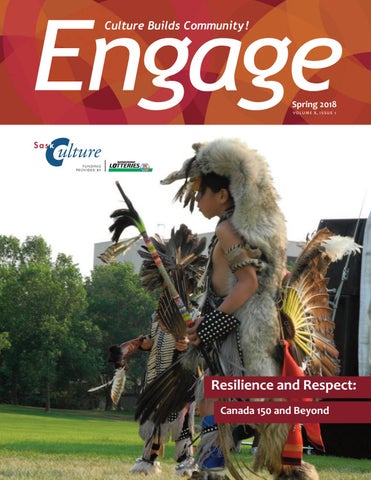
A young pow-wow dancer performs at the Buffalo Festival, which was hosted by the Buffalo People Arts Institute at the MacKenzie Art Gallery. This event was part of the Resilience and Respect: Canada 150 and Beyond project.
....................................
v O l u m e 8, I S S u e 1
Contributing Writers:
Print copies of this publication are circulated for free to saskCulture members, partners and through community outreach activities as determined by saskCulture Inc. Engage is also available in PDF version on the saskCulture web site at www.saskculture.ca. Engage is published thanks to financial support from saskatchewan lotteries Trust Fund for sport, Culture and Recreation. The publication does not currently accept paid advertising. Article ideas for future publications can be submitted to saskculture.info@saskculture.ca or by calling (306) 780-9284. Published may 2018. Articles may be reprinted with permission.
SPRInG 2018
(GDI), saskatchewan Aboriginal Writers Circle Inc. (sAWCI), Buffalo People Arts Institute and the saskatchewan Arts Board. over the course of the year, each organization did its own project in response to Canada’s 150th. Their individual areas of work are presented throughout this edition of Engage.
Resilience and Respect:
I
Canada 150 and Beyond By DamOn BaDGeR heIt anD ROSe GIlkS
n the years leading up to 2017, Canada’s 150th year of Confederation, the Truth and Reconciliation Commission (TRC) hearings were taking place across the country. These hearings and subsequent work culminated into a report that was released just prior to Canada’s 150th birthday. The Truth and Reconciliation Commission's report includes the ten principles of Truth and Reconciliation, 94 Calls to Action and the 46 articles of the united Nations Declaration on the Rights of Indigenous Peoples (uNDRIP). saskCulture believes the TRC report and its contents have opened a window for Canadians and the world to learn some of the truth of Canada’s colonial history and its impact on First Nations, métis and Inuit people throughout the country. It also tasks each and every one of us as individuals, organizations and governments to respond to those Calls to Action and work towards a collective goal of “reconciliation”. Given the truths identified in the TRC Report and saskCulture’s work on inclusion and diversity, celebrating Canada’s first 150 years as a country was not appropriate. Instead, saskCulture knew it needed to work harder to strengthen relationships with Indigenous cultural organizations to SPRInG 2018
create long-lasting partnerships that would last into the future as the focal point. After much dialogue and planning, we were successful in our application to the Canada 150 fund to support the partnership project - Resilience and Respect: Canada 150 and Beyond - receiving $400,000 from Canadian Heritage. The partners in the project were the saskatchewan Indigenous Cultural Centre (sICC), Gabriel Dumont Institute
Initially, some partners were reluctant to engage in a Canada 150 project. eugene Arcand, an Indian Residential school survivor Committee member for the TRC, was approached early on by saskCulture as a resource to help guide the project and to assist us and our partners in preparation and planning for Resilience and Respect: Canada 150 and Beyond. As Arcand explained, “When I was first approached on this project regarding the Canada 150 celebration, I immediately put up a screen, or a wall. Along with the participants, we didn’t feel that this was a celebration. The Truth. The true history of this country for Indigenous peoples, the first peoples of this land (for the past 150 years), was not a celebration.”
saskCulture worked with eugene and the partners to ensure the approaches taken in the partnership and subsequent project wrap-up gatherings in Regina and saskatoon, held in early 2018, were done with the consent and direction of the entire partnership. As project coordinator, Damon connected with the projects throughout the year to maintain communication and connection to the collective.
(continued on next page)
Resilience and Respect: Canada 150 and Beyond partners and contributors. Back row, L-R: Eugene Arcand, Laura Rathgaber, Norman Fleury, Jeremy Morgan, Lorne Kequahtooway, Melody Wood, Damon Badger Heit, Dean Kush, Rita Bouvier, and Jay Kimball. Front row, L-R: Karon Shmon, Linda Young, Rose Gilks, Colleen Charlette, Wanda Wilson and Joely BigEagle-Kequahtooway
3
Prior to the public gathering in saskatoon in January 2018, the partners and some community leaders came together to talk about the project. one of the people invited to that day was linda Young, a community elder who had served on saskCulture’s Board of Directors back in 2006 and had been an integral part of its original First Nations and métis Advisory Circle around the same time. linda was able to reflect on where saskCulture had come from as an organization, beginning this work in the early 2000s and where it is today. sometimes it’s very difficult to see movement on important areas of work when we are immersed in it. she wrote about that day:
“I was truthfully blown away by the presenters and the projects that the partners had produced in the past year. This led me to reflect on SaskCulture’s history in working with First Nations and Métis partners since the early 2000s. I believe SaskCulture’s success in its partnerships with First Nations and Métis organizations (via the Advisory Circle to begin with) is due to having respect for the contributions, suggestions, visioning offered by members of the Advisory Circle, staying focused on engagement, capacity building and advocacy for First Nations and Métis, and supporting Outreach Consultant, Damon Badger Heit’s work in forging meaningful connections with Indigenous communities and organizations. As an artist, a kohkom, nehiyaw-iskwew and educator, I am
Plains Cree: mînowin êkwa manâcihitowin: Resilience and Respect.
Saulteaux: āyānkwāmišiwin manācihitiwin: Resilience and Respect. 4
thankful to have witnessed the power of these partnerships.”
The legacy that we want to have from this project is that it is not just a “one-off”. The relationships and the partnerships that were developed and are going to continue will be strong. our hope from the start was that this project as a whole would set the foundation for strong partnerships with First Nations and métis cultural organizations so that collectively, we function better together and that programs supported by saskCulture are reaching communities in more meaningful ways. That is what we hoped to accomplish with this 150 project.
Damon Badger Heit
Rose Gilks
Resilience and Respect:
Partner videos
The Canada 150 and Beyond partners had videos made highlighting their projects. You can find the videos by visiting saskCulture’s YouTube channel.
Dene: ɂenánét'éle chu ɂësehųdı́: one who does not quit, and respect. nakota: wicozani yuoniha: To be respectful, but resilient.
saskCulture thanks Canadian Heritage for the funding from the Canada 150 Fund, as well as the saskatchewan Indigenous Cultural Centre, Gabriel Dumont Institute, Buffalo People Arts Institute, saskatchewan Aboriginal Writers Circle Inc. and the saskatchewan Arts Board for their dedication and partnership in this work.
The logo strip below represents that partnership, with emphasis on Indigenous language. Translations provided by: Allan Adam (Dene), Darren okemaysim (Cree), Tim Haywahe (Nakota), Norman Fleury (michif), and lynn Cote (saulteaux).
The graphic red arrow represents pre-colonization on the left with a solid unbroken arrow. The midsection of the arrow represents contact and colonization. The arrow points to the desired future state on the right with a strong and resilient thrust into the future.
michif: taapitow ni shoohkishin ni shoohki kishchiitaymitoonaan: We are always strong. looking at each other in high regard.
SPRInG 2018
Where are the Buffalo?
How a project brought the buffalo spirit back to the streets of Regina
B
uffalo returned to the streets of Regina last summer – in the form of a buffalo dance parade -- thanks to an initiative honouring the importance of the animal to Indigenous life on the prairies.
In 2017, the Buffalo People Arts Institute (BPAI), in partnership with New Dance Horizons and Indigenous performers, hosted a series of workshops to create, design and develop buffalo head costume SPRInG 2018
pieces and choreography. The project culminated at the Queen City exhibition Parade in Regina on August 1, with a buffalo dance parade procession to honour the spirit of the buffalo. This project was part of the Resilience and Respect: Canada 150 and Beyond partnership, supported by Canadian Heritage's Canada 150 Fund.
Joely Bigeagle-Kequahtooway, project coordinator, BPAI, says, “This project was
initiated to return the buffalo into the collective consciousness of the people of Regina, saskatchewan and hopefully nationally. The Buffalo are still here alive in our spirits and alive in our ceremonies, as they will continue for millennia. sometimes dormant, but always present. Although the Buffalo do not run wild, they still run in our hearts, minds and spirits.”
she goes on to explain that Indigenous peoples have lived amongst the buffalo for 5
thousands of years before european colonization. Their familial connection to the buffalo was severed 150 years ago when the Canadian government implemented a policy to clear the plains of buffalo in order to systematically remove Indigenous people from the prairies.
“The government literally wrote, ‘Kill the Buffalo, kill the Indian.’ They attempted to decimate the food source, clothing and shelter that Indigenous people had so there was nothing left for [Indigenous people] to do, but be forced on to reserves begging for government rations,” she adds. The creation of headpieces and dance movement emulating the buffalo was shared through community workshops. A week-long workshop was also held afterwards, attracting both Indigenous and non-Indigenous participants who learned about, and undertook the role of, the buffalo for the parade. Contemporary dance moves were incorporated with hiphop, square dance and pow-wow movements and were made into a dance to a buffalo honouring song. Altogether there were about 75 participants who took part throughout the project.
(This page): Participants create buffalo headpieces and practice movements for the buffalo dance parade.
(Next page): Pow-wow dancers perform at the Buffalo Festival that took place at the MacKenzie Art Gallery. Photos by SaskCulture staff.
6
According to Bigeagle-Kequahtooway, the learning and sharing of contemporary and traditional teachings between Indigenous and non-Indigenous people and artists, who worked side-by-side, contributed to this project coming to fruition. “We learned that when non-Indigenous and Indigenous people work together in a sincere partnership for a collective good, true reconciliation and healing can be attained,” she explains. “Bringing infants, youth, adults and elder participants together, helps complete the circle of life.” SPRInG 2018
"We learned that when non-Indigenous and Indigenous people work together in a sincere partnership for a collective good, true reconciliation and healing can be attained." - J O e ly B I G e a G l e-k e q ua h t O O Way
SPRInG 2018
7
According to Karon shmon, director of publishing, Gabriel Dumont Institute (GDI), the michif language is at a critical state with only 100 - 500 speakers across Canada, many of whom don’t live close to each other and don’t have the opportunity to use and practice the language on a regular basis.
li michif nitooni katawashishin
P
michif is a Beautiful language
reservation is key to the survival of the michif language. Thanks to a gathering of speakers last year, michif will be banked for future generations. The michif language Banking Gathering, Li Michif nitooni katawashishin: Michif is a Beautiful Language, was on held June 19 and 20, 2017, at the site of the John Arcand 8
Fiddle Festival. It brought together michif speakers, who ranged in age from 64 to 85, in a relaxed, informal outdoor setting to have conversations and help preserve, or ‘bank’, the language. This project was part of the Resilience and Respect: Canada 150 and Beyond partnership, supported by Canadian Heritage's Canada 150 Fund.
“By international standards, michif is critically endangered,” adds shmon. one of the goals of the gathering was to record, or ‘bank’, the language so it would be accessible for all.
“[During the gathering], the michif elders could speak about anything they felt was important. All of the conversations were audio recorded and many of them were also video recorded,” explains shmon. “These new topics will add both depth and breadth to [GDI]’s michif holdings. We are using the term ‘banking the language’ because of the great value we place on the language.” The recordings will be translated into english and transcribed in both michif and
SPRInG 2018
english, a task that will take many months to complete, but will then provide a rich repository of our language for resource development and michif learning tools. “more importantly, we have preserved our elders and speakers using our heritage language, a precious gift that will remain forever and be posted on the [GDI]’s virtual museum.” (located at www.metismuseum.ca).
says. “Their contributions are greatly appreciated and are an invaluable contribution as we reclaim our cultural heritage through our language, michif.”
she adds, “We are grateful to saskCulture for successfully organizing the funding
application which enabled this activity to take place under the theme Respect and Resilience: Canada 150 and Beyond, which is taapitow ni shoohkishin ni shoohki kishchiitaymitoonaan in michif.”
GDI also will now have many more hours of michif from which additional language learning resources can be made. After analyzing the topics GDI has already covered in michif, the focus for new material became: games and toys; gatherings and celebrations; housing and building; clothing; spirituality and beliefs; and family income.
Both days at the gathering were hard work; however, there was also time for fun and socializing in the evenings. Gathering attendees had the pleasure of being entertained both evenings by métis fiddler John Arcand and musician Jess lee. The li Toneur Niimiyitoohk métis Dance Group also attended an evening social where many of the elders joined them for jigging and square dancing. “It was a treasured gift to spend time with the speakers, each of whom feels passionate about sharing michif,” shmon
SPRInG 2018
Photos courtesy of the Gabriel Dumont Institute and SaskCulture staff.
9
Bridging Distances through technology lIVe Arts goes National
F
or the first time, teachers from across Canada were invited to sign up their Grades 3-8 classes for a series of lIVe Arts broadcasts as part of Resilience and Respect: Canada 150 and Beyond celebrations. These curriculum-based lessons featured Indigenous artists living in saskatchewan and collaborators from other areas of Canada. The artists focused on the topics of resilience, respect and reconciliation. The opportunity to collaborate with other Indigenous artists was made possible thanks to the support from Canadian Heritage’s Canada 150 Fund. established in 2005, lIVe (live Interactive Video education) Arts engages teachers and students in an interactive distance learning experience. Professional artists provide grade-specific broadcast programs in drama, dance, music and the visual arts through the saskatchewan ministry of education’s lIVe Network. even the most remote rural communities are reached by the program, with more than 30,000 saskatchewan students participating in 2016.
laura st. Pierre, former artist program manager, lIVe Arts, says that organizers looked for a variety of types of artists to lead the special broadcasts. “We selected saskatchewan artists from the visual arts, music and theatre disciplines. We invited them to choose another artist they wanted to work with who is from outside saskatchewan,” she says. “We gave artists a fairly free platform to discuss and create programming based on what they felt reconciliation should be about.” The resulting partnerships created hip hop broadcasts with Brad Bellegarde/InfoRed and David Nelson/emotionz, theatre broadcasts with Yvette Nolan and michelle olson and visual arts broadcasts with Kevin Wesaquate and Nyle Johnston.
InfoRed and emotionz explored the four main elements of hip hop culture (mCing, DJing, graf writing and breakdancing). They demonstrated how the art form of hip hop has the ability to educate and connect people with Indigenous history. students had the opportunity to practice rapping, beat-boxing and graf writing during the broadcast, as well as to write a song collectively. Nolan and olson, both First Nations theatre artists, led students through a process called storyweaving, a theatrical technique using gesture, voice, song, movement and repetition. The pair used this technique to create work to share stories from their Indigenous perspectives. students and artists examined their personal connections to the land and to each other and created a short theatre/movement piece that explored how we live together.
Artist Kevin Wesaquate leads a LIVE Arts broadcast.
10
SPRInG 2018
Photos courtesy of Saskatchewan Arts Board.
SPRInG 2018
11
students experiencing the broadcasts from a distance were also able to participate. students at st. mary school in saskatoon wrote this story during the storyweaving broadcast:
"A mountain of ice carries three mistasinîy (big rocks in Cree) for hundreds of years. The ice slowly moves over the prairie. The warm sun begins to melt away the ice and rivers flow, carving the land. The grassland takes over and teems with bison, mammoth, giant deer and sabre-tooth cats, rubbing and hiding among the mistasinîy. European humans arrive and Saskatoon is built around the mistasinîy, threatening their existence. The St. Mary students hike to the mistasinîy and join in their ancient history." Wesaquate and Johnston explored Indigenous stories and storytelling in their broadcasts. students wrote their own stories and used them as the basis for a visual artwork that combines text, image and colour.
Zoé Fortier, lIVe Arts associate artist program manager, says the students participating in the broadcasts made a real connection with the artists. “The artists were so generous and so open to sharing their vulnerabilities,” she explains. “They talked about their parents’ experiences with residential schools and their own hardships. There was a rawness between the students and the artists. The workshops had moments of connection that were really touching and moving.”
more than 8,200 students from across the country tuned in for the lIVe Arts 150 workshops. Classrooms that missed the live broadcasts can contact lIVe Arts staff for a password to access the program’s archives at liveartsaskatchewan@gmail.com LIVE Arts is supported by the Saskatchewan Arts Board, SaskCulture Inc., with funding from the Saskatchewan Lotteries Trust Fund for Sport, Culture and Recreation, and the Saskatchewan Ministry of Education in partnership with host school divisions. LIVE Arts 150 is supported by additional funding from the Canada 150 Fund at Canadian Heritage/Patrimoine Canadien as part of the Resilience and Respect: Canada 150 and Beyond partnership involving SaskCulture, the Saskatchewan Arts Board, Buffalo People Arts Institute, Gabriel Dumont Institute, Saskatchewan Aboriginal Writers Circle Inc. and Saskatchewan Indigenous Cultural Centre.
12
SPRInG 2018
Connecting with your Inner ‘Story-ior’
How the saskatchewan Aboriginal Writers Circle Inc. is building a community of Indigenous storytellers
“The writing workshops were small but impactful for the students. several were inspired to continue developing their writing skills” – kaROn ShmOn
h
Colleen Charlette, board member, SAWCI, engaged students at a workshop.
elping Indigenous youth find their inner story warrior, or ‘story-ior’, was behind the programming and initiatives leading up to the Ânskohk Festival this past year.
In addition to the Ânskohk Festival, held in october 2017, the saskatchewan Aboriginal Writers Circle Inc. (sAWCI) was able to offer two new outreach activities, Voices of Today and Birth of a Family,
SPRInG 2018
thanks to funding from the Canada 150 Fund, delivered by Canadian Heritage. sAWCI, which aims to build communities that nurture Indigenous story and art, was one of five organizations that participated in the Resilience and Respect: Canada 150 and Beyond partnership.
This year, the goals were “achieved by celebrating and showcasing Indigenous writers and by nurturing, mentoring and connecting Indigenous “story-iors” with supportive resources in the community,” explains Karon shmon, sAWCI board member. The organization has often found itself facing financial challenges, so “the opportunity to apply to Canada 150 funding through saskCulture provided an opportunity to change both what sAWCI does and how it is done. We were able to focus on two activities: community
outreach to areas of the province beyond saskatoon; and a special Ânskohk Aboriginal literature Festival.”
leading up to the Ânskohk Festival, sAWCI began its community outreach with a new partnership with the summer writer-in-residence program run by Common Weal Community Arts and the John m. Cuelenaere library in Prince Albert. Voices of Today included five young Indigenous writers who had been working throughout the summer with the writerin-residence, lynda monahan. The youth took turns reading their original writings. shmon says the event was well attended, and seats were full of family, friends and interested public. “Both new partners felt the event was a huge success and were extremely happy to partner with sAWCI,” adds shmon. (continued on next page)
13
other outreach activities included the screening in saskatoon of Birth of a Family, a story about the reuniting of siblings who survived the ‘60s scoop. The screening was hosted by sAWCI Board member Colleen Charlette, herself a ‘60s scoop survivor, who engaged students in a critical dialogue and writing workshops. “The writing workshops were small but impactful for the students,” says shmon “several were inspired to continue developing their writing skills.” In addition, sAWCI was also able to expand its outreach to the northern communities of Ile-a-la-Crosse and la loche, as well as Prince Albert, where people were encouraged to begin and continue their writing.
In october 2017, sAWCI hosted a special Ânskohk Festival held in october that showcased the vitality of Indigenous languages in the literary arts. The event had an interactive format between the presenters and participants that provided many opportunities to share and learn. The attendees enjoyed a mixture of panels, speakers, workshops, storytellers and keynote presentations on Indigenous voices and issues. An open mic event also invited emerging and established writers to present their work. “The event was lively and interactive, and the tables were filled with discussion and laughter,” says shmon. In total, approximately 25 literary artists and publishers contributed to the festival. According to shmon, the sAWCI board feels the festival was a success and would like to continue with it in the future.
“ Creating additional partnerships, adding more writing circles, and offering a high caliber Ânskohk Festival has positively impacted the province’s Aboriginal literary community and will help Indigenous writers and 'story-iors' (fulfill their own goals).”
14
Lorne Kequahtooway and Joely BigEagle-Kequahtooway explain the meanings behind the gifts they created, for partners of Resilience and Respect: Canada 150 and Beyond, to recipients Jay Kimball, SAB, and Karon Shmon, GDI.
“
Reconciliation has been a short cut for many, and this process of the truth and the true history of this country, as uncomfortable as it may be, still has to be exposed and understood as we move into this buzz word that is in our communities: Reconciliation. What is reconciliation? What are we as Indigenous people reconciling? What did we do wrong? When we start accepting that there is better understanding, reconciliation can be the focal point. It is important for everyone to understand, that for reconciliation- there are no short cuts. the truth has to be included. So the title of Resilience and Respect, is what we adopted as a process to move forward. It hasn’t been an easy process. But it has been an exciting process, a challenging process and all the participants have grown from it.” - Eugene Arcand - Indian Residential School Survivor Committee Member to the Truth and Reconciliation Commission.
SPRInG 2018
keeping language alive
l
Connecting language with the First Nations World View
anguage camps presented by saskatchewan Indigenous Cultural Centre (sICC) help to preserve the First Nations word view.
sICC was one of five organizations that participated in the Resilience and Respect: Canada 150 and Beyond project. As part of this initiative, sICC hosted six youthfocused language camps during the summer of 2017. The camps were held at standing Buffalo First Nation, Pheasant Rump Nakota Nation, sweetgrass First
SPRInG 2018
Nation, Wahpeton Dakota Nation, Treaty 4 Gathering in Fort Qu'Appelle and James smith Cree Nation.
Through community elder guidance, the camps assisted saskatchewan First Nations communities with conversational language and incorporated the First Nations world view, way of life, kinship and land stewardship. These camps also recognize the importance of youth in keeping alive these languages and traditional First Nations way of life.
According to Wanda Wilson, president, sICC, with language comes knowledge. “A lot of our elders say, ‘our language has a spirit,’ and we can’t feel that spirit when we are in a classroom and writing it down. We are trying to use concepts that don’t belong to us, when we try to recapture or preserve our languages – and that isn’t working.” Wilson goes on to say that these camps are important as they are often more authentic and engaging ways to learn
(continued on page 17)
15
“A lot of our elders say,
‘our language has a spirit,’
and we can’t feel that spirit when we are in a classroom and writing it down. We are trying to use concepts that don’t belong to us, when we try to recapture or preserve our languages – and that isn’t working.” - WanDa WIlSOn
16
SPRInG 2018
language. “We are also connecting with the land. The spirit of the language comes out from it,” she further explains.
Camp participants had the opportunity to learn language while being immersed in a variety of First Nations’ traditions such as medicine walks, tipi teachings, moccasinmaking, traditional food knowledge and teachings. several of the camps also included the construction of ceremonial lodges. At standing Buffalo Youth Camp, the camp also incorporated the Dakota language into the youth’s activities that focused on the buffalo, which included ceremonies about taking a buffalo’s life, as well as smoking, hide scraping and tanning. Camp participant Ashley Waditika says, “We are thankful for the ones who have travelled a long way and took time out of their life to come over and share some knowledge with the people here.” The legacy of this Resilience and Respect: Canada 150 and Beyond project would see communities empowered to host their own camps in the future.
Wilson says that, “Through these projects, the community will have the knowledge and necessary tools to ensure the continuance of language camps that are planned, hosted and facilitated by the community itself.”
she adds that, the communities involved recognize that there is an importance for youth to carry on the traditional First Nations way of life. she hopes that these camps will spark an interest within them to build and carry on this knowledge.
All photos taken at Pheasant Rump Nakota First Nation language camp. Photos by SaskCulture staff.
SPRInG 2018
17
New Partnership Formed to Help Distribute Funding for Indigenous languages in saskatchewan Getting funding out to local First Nations, community-based, language programs is important to both saskatchewan Indigenous Cultural Centre (sICC) and saskCulture.
F
or the past few years, sICC and other regional Indigenous cultural centres had been advocating to decentralize funding given directly from Canadian Heritage in order to better serve language activities at the local level. In 2017, Canadian Heritage made sICC a third party funder for its Aboriginal languages Initiative (AlI) grant. eager to build an accessible grant program, sICC partnered with saskCulture in February 2018 to help deliver the AlI fund throughout saskatchewan. According to Damon Badger Heit, saskCulture consultant working to deliver
18
the AlI grant, “In the past, local First Nations communities had to consult and apply directly to Canadian Heritage in ottawa for support.” The Department of Canadian Heritage recognized that initiatives that aim to preserve and revitalize Indigenous languages must be flexible and responsive to the broad range of community needs, goals and priorities. The partnership brings needed expertise to support the distribution of this grant. As the third party funder, sICC offers its vast experience and knowledge, as well as its strong relationships with First Nations
communities and organizations in the province. saskCulture brings its knowledge of grant development and implementation. Together, the partners hope these funds will connect with community and make a difference.
“In 2018-2019, sICC and saskCulture will work together to rebuild the AlI grant program to better serve the preservation and use of First Nations languages in the province,” explains Badger Heit. Communities can expect the revamped AlI program to be launched in early Fall of 2018, with a deadline in December 2018.
SPRInG 2018
moving Forward: Resilience and Respect: Canada 150 and Beyond
l
ast year, SaskCulture's partners in Resilience and Respect: Canada 150 and Beyond project – the Buffalo People Arts Institute, Gabriel Dumont Institute, saskatchewan Indigenous Cultural Centre, saskatchewan Aboriginal Writers Circle Inc. and the saskatchewan Arts Board – worked hard on cultural programming that highlighted the resilience of Indigenous peoples’ cultures and languages.
In early 2018, saskCulture delivered its portion of the project by hosting two gatherings – one in saskatoon and the other at Regina’s mâmawéyatitân centre – that provided attendees the opportunity to network with the project partners; learn about the work they have carried out in 2017; direct focus to "the beyond" part (youth engagement); and ignite dialogue about how the province's cultural community can move forward together respectfully and meaningfully. more details about these gatherings will featured in the upcoming saskCulture Year In Review.
Photo above: Youth panel with Gordon Tootoosis Nīkānīwin Theatre Circle of Voices participant Tommy Ziegenbein, with MC Zoey Roy at the Resilience and Respect: Canada 150 and Beyond gathering in Saskatoon.
Bottom photos, clockwise, L-R: Sid Fiddler, Elder, Waterhen Lake First Nation; artist Harmony Johnston-Harder and author Harold Johnston; and a student participant at a beading workshop at the Resilience and Respect: Canada 150 and Beyond gathering in Regina.
Thank-you Canadian Heritage for helping to fund Resilience and Respect: Canada 150 and Beyond. SPRInG 2018
19
“
One cannot deny the impact these projects must have had on all participants. Imagine participating in a four-day Dakota or Cree or nakota culture and language camp that includes learning hand signs, birthing teachings, medicine walks, ceremonial lodge construction, tipi raising, quilling, shooting a buffalo, butchering, scraping and tanning the hide, traditional games, sweet grass and sage picking, picking berries, smoking and making dried meat, Giveaway ceremony, trickster stories, or taking over the streets of Regina with a buffalo dance parade - how that must have felt? Or the emotional ‘catch my breath’ experience of viewing the repatriated items belonging to Poundmaker that have been brought home? the powerful practice of ‘banking the (michif) language’ or joining Ânskohk writers, story tellers in ‘passing on the teaching – tying one generation to the next’ festival.” Linda Young, Elder, Onion Lake First Nation
“
I just want to take the opportunity to applaud the efforts of SaskCulture in this project of respect and resilience. What SaskCulture has done in bringing these five projects together for public education and understanding and partnership deserves applause and a pat on the back. Congratulations to all who participated in this process.” Eugene Arcand - Indian Residential School Survivor Committee Member to the Truth and Reconciliation Commission
Damon Badger Heit, project coordinator, Resilience and Respect: Canada 150 and Beyond, congratulates (top photo) Linda Young, Elder, and (bottom photo) Rose Gilks, CEO, SaskCulture on their contributions to the project. This happened during the Resilience and Respect: Canada 150 and Beyond partners gathering that was held in Saskatoon on January 25, 2018. 20
SPRInG 2018
examining Canada’s musical
Past, Present & Future By Shelley Fayant
and featured saskatchewan artists such as eekwol and Blake Berglund, as well as a diverse array of artists from across Canada like Vox sambou, Cris Derksen and mélisande. Interpretations of quintessential standards by well-known and well-loved Canadian legends leonard Cohen, Joni mitchell and Buffy saintemarie also made an appearance on stage. Butel and her colleagues took care to ensure that the line-up of artists, and the songbook, was respectful, genuine and inclusive. “one of the messages that really resonated with me was from the speech [Federal minister of Public safety] Ralph Goodale delivered at the funding announcement, when he referred to Canada as “a work in progress”.
t
o sandra Butel, Ceo and artistic director, Regina Folk Festival (RFF), Canada’s 150th birthday was a perfect opportunity to examine the country’s past, present and future through a musical lens. The result was Canada Far & Wide: Grands Esprits – a joint initiative with four other folk festivals, which saw each event add an extra day of music featuring free performances by a diverse roster of artists covering classic Canadian songs.
SPRInG 2018
“I worked with my counterparts from the other festivals to create a songbook that we felt truly reflected Canada,” says Butel. “And a key piece for us was to ensure that there was adequate diversity in the songbook, so that we could look at the history, including some of the more unsightly history, of our country.” The RFF’s Canada Far & Wide Regina concert took place Thursday, August 10 (the day before RFF officially kicked-off)
“This was the shared sentiment as we were brainstorming the idea,” she continues.“We believed that we could address that idea through the power of music in a folk festival setting, which is really all about community and harmony, and that perhaps we could inspire each other, as Canadians, to do better in the future.” Approximately 2,000 people attended the special concert in Regina’s downtown Victoria Park. The Regina Folk Festival was one of 19 Saskatchewan organizations that received Canada 150 Funds from Canadian Heritage.
Photos courtesy of the Regina Folk Festival.
21
Successes of the #Welcomehome150 – Creating Welcoming and Inclusive Communities project By Shaunna GRanDISh
making their respective communities more welcoming and inclusive for their members,” explains Rafat. The pledgetaker first downloads the Welcome Home Pledge form from mCos’ website, then posts a video or photo of themselves with the pledge and shares it with the world on social media with the tagline #welcomehome150. This encourages friends and families to follow suit in taking the pledge themselves.
t
he multicultural Council of saskatchewan (mCos) invited saskatchewan residents to pledge their commitment to making communities more welcoming and inclusive for all, as part of its Canada 150 efforts.
The WIC toolkit was developed last summer, in partnership of the saskatchewan urban municipalities Association (sumA) and continues to encourage saskatchewan communities and organizations to focus on becoming welcoming and inclusive places for all. mCos also held a series of workshops as part of the WIC project. Rafat says the most significant aspect of this project was to get saskatchewan municipalities on board with the commitment. “That also posed as a challenge. In order to involve municipalities, they needed to know the project existed and how effective the WIC
toolkit would be,” she adds. “Instead of going to cities and towns individually, we initiated contact with sumA.” she notes that mCos continues to build relationships with individual municipalities but the toolkit’s endorsement by sumA was a giant leap forward for the project. Now that Canada 150 has officially wrapped-up, Rafat says that WIC project will continue providing resources for future generations to use in creating welcoming and inclusive communities across this province. she adds that mCos plans to continue building on the partnership with sumA to further reach communities and organizations as they work closely with museums Association of saskatchewan, Heritage saskatchewan, and other sports and cultural districts and settlement agencies across saskatchewan to implement the WIC Toolkit.
The Multicultural Council of Saskatchewan receives funding through the Saskatchewan Lotteries Trust Fund for Sport, Culture and Recreation.
The #WelcomeHome150 – Creating Welcoming and Inclusive Communities (WIC) project, delivered in 2017, aims to develop a deeper understanding of Canadian history and set into place the foundation for a positive future of shared experiences between this province’s diverse peoples and cultures. mCos was one of 19 saskatchewan groups that received Canada 150 Funds from Canadian Heritage.
According to Jamal-e-Fatima Rafat, project coordinator, mCos, the WIC project is designed to help build relationships among saskatchewan people at a time when the population is becoming more and more diverse with newcomer and Indigenous populations. The project first came into fruition with the #WelcomeHome150 pledge. “The Welcome Home Pledge is a promise. It is a tool through which people, organizations and municipalities show commitment to
22
Top photo: Rhonda Rosenberg, executive director, MCoS speaks at Canadian Heritage's Canada 150 Fund announcement. Bottom photo: The SaskCulture staff takes the #WelcomeHome150 pledge in 2017.
SPRInG 2018
155 47
#Welcomehome150
Welcoming & Inclusive Communities toolkits have been distributed.
384
Welcome home Pledges were taken.
Intercultural Facilitators were trained in 10 different
15
communities across Saskatchewan.
200
new Small and larger Partnerships developed.
Welcoming & Inclusive Communities toolkits distributed in both english and French.
Top photo: Ralph Goodale, Federal Minister of Public Safety, took the #WelcomeHome150 Pledge. Bottom photo: MCoS Board members (L-R) Julio Torres-Recinos, Xiaofeng Zhang, Asit Sarkar (President), and Bob Lesperance with their #WelcomeHome150 Pledges.
SPRInG 2018
23
Above: George Fayant leads high school students through the steps in assembling a Red River Cart wheel. This is one of several workshops that took place at the mâmawêyatitân centre in Regina on February 1-2, 2018. These activities were part of the Resilience and Respect: Canada 150 and Beyond gatherings held in Saskatoon and Regina earlier this year. Photo by Shaunna Grandish.
404 - 2125 11th avenue Regina, Sk S4P 3X3 saskculture.info@saskculture.ca www.saskculture.ca
Publication mail agreement #40063014
Return undeliverable Canadian Addresses to: Administration Printing services 111-2001 Cornwall street Regina, sK s4P 3X9 email: adminprint@sasktel.net