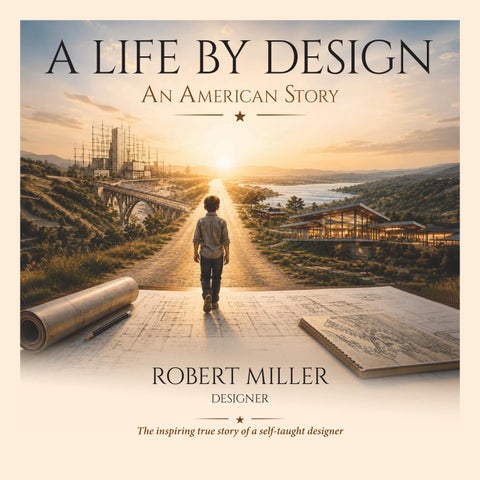
A LIFE BY DESIGN A N A MERICAN STORY
ROBERT MILLER DESIGNER The inspiring true story of a self-taught designer
THE INSPIRING TRUE STORY OF A SELF-TAUGHT DESIGNER
A LIFE BY DESIGN
ROBERT MILLER DESIGNER
A Life by Design. Copyright © 2026 Robert Miller All rights reserved No portion of this book may be reproduced, distributed, or transmitted in any form or by any means without prior written permission of the copyright holder, except for brief quotations used in reviews or other uses permitted by copyright law. First Edition. | ISBN: [TO BE ADDED] | Printed in [Country]
WITH GRATITUDE
For Linda: None of this journey was mine alone.
To my Daughter: THANK YOU for designing the logo that has represented our family and our work for over 50 years.
CONTENTS Introduction
Why This Story . . . . . . . . . . . . . . . . . . . . . . . . . . . . . . . . . . . . . . . . . . . . . . . . . . . . . . . . . 6 Chapter One
Foundations . . . . . . . . . . . . . . . . . . . . . . . . . . . . . . . . . . . . . . . . . . . . . . . . . . . . . . . . . . 11 Chapter Two
Why Can’t I Draw These? . . . . . . . . . . . . . . . . . . . . . . . . . . . . . . . . . . . . . . . . . . . . . . . 19 Chapter Three
A Leap of Faith . . . . . . . . . . . . . . . . . . . . . . . . . . . . . . . . . . . . . . . . . . . . . . . . . . . . . . . . . # Chapter Four
Learning to Think Bigger . . . . . . . . . . . . . . . . . . . . . . . . . . . . . . . . . . . . . . . . . . . . . . . . # Chapter Five
Losing My Way to Find It Again . . . . . . . . . . . . . . . . . . . . . . . . . . . . . . . . . . . . . . . . . . # Chapter Six
Solving More Than Buildings. . . . . . . . . . . . . . . . . . . . . . . . . . . . . . . . . . . . . . . . . . . . . # Chapter Seven
Robert Rose . . . . . . . . . . . . . . . . . . . . . . . . . . . . . . . . . . . . . . . . . . . . . . . . . . . . . . . . . . . . # Chapter Eight
Beyond the Horizon . . . . . . . . . . . . . . . . . . . . . . . . . . . . . . . . . . . . . . . . . . . . . . . . . . . . . # Chapter Nine
More Than a Client . . . . . . . . . . . . . . . . . . . . . . . . . . . . . . . . . . . . . . . . . . . . . . . . . . . . . # Chapter Ten
Knowing When to Leave . . . . . . . . . . . . . . . . . . . . . . . . . . . . . . . . . . . . . . . . . . . . . . . . . # Chapter Eleven
Designing Around Life . . . . . . . . . . . . . . . . . . . . . . . . . . . . . . . . . . . . . . . . . . . . . . . . . . .
—6—
CONTENTS Chapter Twelve
Learning from the Experts . . . . . . . . . . . . . . . . . . . . . . . . . . . . . . . . . . . . . . . . . . . . . . . . Chapter Thirteen
The Measure of Success . . . . . . . . . . . . . . . . . . . . . . . . . . . . . . . . . . . . . . . . . . . . . . . . . . . Chapter Fourteen
Believing in the Vision . . . . . . . . . . . . . . . . . . . . . . . . . . . . . . . . . . . . . . . . . . . . . . . . . . . Chapter Fifteen
Foundations . . . . . . . . . . . . . . . . . . . . . . . . . . . . . . . . . . . . . . . . . . . . . . . . . . . . . . . . . . . . Chapter Sixteen
When the Dream Doesn’t End . . . . . . . . . . . . . . . . . . . . . . . . . . . . . . . . . . . . . . . . . . . . . Chapter Seventeen
Master Planning . . . . . . . . . . . . . . . . . . . . . . . . . . . . . . . . . . . . . . . . . . . . . . . . . . . . . . . . . Chapter Eighteen
Drawing Energy . . . . . . . . . . . . . . . . . . . . . . . . . . . . . . . . . . . . . . . . . . . . . . . . . . . . . . . . . Chapter Nineteen
A Designer Never Stops Designing . . . . . . . . . . . . . . . . . . . . . . . . . . . . . . . . . . . . . . . . . Chapter Twenty
Built of Trust . . . . . . . . . . . . . . . . . . . . . . . . . . . . . . . . . . . . . . . . . . . . . . . . . . . . . . . . . . . . Chapter Twenty-One
One More Move (2016–2023) . . . . . . . . . . . . . . . . . . . . . . . . . . . . . . . . . . . . . . . . . . . . . . Chapter Twenty-Two
Timeless Lines at Eighty-Seven (2024–2026) . . . . . . . . . . . . . . . . . . . . . . . . . . . . . . . . . Chapter Twenty-Three
Still Designing. . . . . . . . . . . . . . . . . . . . . . . . . . . . . . . . . . . . . . . . . . . . . . . . . . . . . . . . . . .
—7—
Introduction
WHY THIS STORY For most of my life, I never thought about writing a book. I was too busy living it. For more than sixty-six years, Linda has been my wife, my partner, and the person beside me through nearly every adventure in these pages. She has packed our homes when another opportunity took us somewhere new, raised our family while I chased ideas and projects, traveled with me around the world, and sometimes had the good sense to tell me when it was time to stop, listen, or simply come home. Many of the buildings, homes, resorts, yachts, and ideas in this book began on my drawing board. But the life surrounding them belonged to both of us. As I reached eighty-seven, people began asking me why I was still working — why I was still designing. I never really knew how to answer that question. Designing has never felt like work to me. I see something and immediately begin wondering what it could become. I want to know why something is the way it is and whether there might be a better way. That curiosity has been with me for as long as I can remember. When I began putting this book together, I thought I was simply going to create a record of the projects I had designed over the years. I had boxes of drawings, sketches, photographs, and memories, and I wanted my children, grandchildren, and great-grandchildren to know what I had done. But as I began looking through them, something unexpected happened. I realized the projects weren’t really the story. The story was about the people who trusted me with them. Long before I had an office, a reputation, or much confidence in myself, someone would give me an opportunity and say, in one way or another, “I think you can do this.” Sometimes I wasn’t nearly as certain as they were. But I would listen. I would become curious. And then I would pick up a pencil and try. I didn’t always think first about what I would be paid. Sometimes the opportunity itself was enough. I wanted the chance to see what I could make of it. If the client didn’t like what I created, I didn’t have to charge them. I had still taken the adventure. I had gone somewhere in my imagination that I had never been before. That pattern followed me throughout my life — from a little boy drawing pictures in a hospital, through foster homes and state homes, into construction, architecture, and design, across countries and oceans, and eventually into projects I could never have imagined when I was young. There were successes. There were failures. There were wonderful clients and a few relationships that didn’t work out. There were times when we had very little and times when opportunities seemed almost too large to believe. Through all of it, Linda was there. And somehow, at eighty-seven, I am still sitting in front of a blank page, wondering what I might design next. So this isn’t really a book about buildings. It is the story of a boy who discovered that drawing could become a way of seeing the world — and of the people who trusted him enough to let him keep drawing.
Someone trusted me before I trusted myself. That is where A Life by Design begins.
—8—
Chapter One
FOUNDATIONS
—9—
Chapter One. — Part 1 — Out of the Ashes My story as a designer began long before I knew what design was. I was born in Washington in 1939 as Phillip Shaffer. Four years later, a devastating fire changed the course of my life. I was severely burned and spent more than a year in a hospital. Somewhere during that long stay, I began to draw. The war was still going on, so I drew the things a young boy saw and heard about — airplanes, tanks, and soldiers. The nurses began taking my drawings and hanging them along the hospital hallways. I don’t remember what those drawings looked like today. What I remember is that someone thought they were worth putting on the wall. At five years old, I couldn’t have known how important that would become. — Part 2 — Someone Trusted Me When my brother and I left the hospital, our father took us to Los Angeles. My mother gradually disappeared from our lives, and for much of my childhood she existed more as a memory than a presence. Years later, I found my aunt Sandra, who had been there when the fire happened. Through her, I began to understand more about my mother and how deeply losing us had affected her. My brother eventually located our mother through the Salvation Army in San Francisco. We tried to bring her to Los Angeles, but her struggle with alcohol had taken over much of her life. We saw her briefly. Then she returned to San Francisco. We never saw her again. Our father disappeared from our lives as well. With our family broken apart, my brother and I entered the foster-care system. Home became a series of unfamiliar houses, each one temporary. Looking back, I hesitate to call many of them families. They were simply places where we stayed. In 1950, when I was eleven years old, my brother and I were adopted by the Miller family. Overnight, Phillip Shaffer became Phillip Miller. We settled in Santa Monica. Before daylight each morning, I rode my bicycle through the coastal fog delivering newspapers. While I was in junior high, I also worked at a neighborhood pet shop owned by Mr. and Mrs. White.
— 10 —
Chapter One
Pet shops were very different then. They sold everything from animals to fertilizer — just about anything someone might need for a pet. I cleaned cages, cared for the animals, stocked shelves, and helped customers whenever the store became busy. One day, Mr. White suffered a heart attack and planned to close the shop while he recovered. I asked if I could keep the store open after school, care for the animals, help the customers, and close up at the end of the day. I was only thirteen or fourteen years old. To my surprise, he said yes. For nearly a month, the shop became my responsibility. Looking back, I realize it wasn’t just a part-time job. It was the first time someone outside my family had trusted me with something important. That trust meant more to me than I understood at the time. I wanted to prove that his trust wasn’t misplaced. Perhaps without realizing it, I was beginning a pattern that would follow me for the rest of my life: give me an opportunity, and I would do everything I could to prove I belonged there. I have to confess one small crime. Every now and then, I would “borrow” a nickel or a dime from the cash register, walk next door, and buy a Snickers bar. I always intended to pay it back, although I can’t honestly remember whether I always did. Even now, that memory still makes me smile.
— 11 —
Chapter One — Part 3 — Discovering My Gift My first year at Santa Monica High School changed my life in a way I could never have imagined. I walked into my first drafting class, picked up a T-square and a pencil, and experienced a feeling I had never known before. For the first time in my life, I felt completely in control. The lines on the drawing board went exactly where I intended them to go. They didn’t argue. They didn’t disappear. They didn’t change without reason. After years of uncertainty, I had found something that made perfect sense to me. Home was a different story. The Millers were never the loving family I had hoped for. Discipline was often harsh. If I wasn’t doing exactly what was expected of me, Mrs. Miller would grab me by the ears and drag me across the room. As the years passed and she began drinking, life at home became even more difficult. Outside the house, life remained unsettled. We moved again, this time to Inglewood, where we lived in a small trailer. High school had all the usual distractions, including one memorable day when I was punched in the nose by the jealous boyfriend of a girl I didn’t even know. But none of that seemed to matter once I sat down at a drafting table. The drawing board became my refuge. Every line I drew gave me confidence. Every project taught me something new. Without realizing it, I wasn’t simply learning to draw. I was discovering a gift that had first revealed itself in a hospital room years earlier. Our next move took us to Orange County, where I spent my senior year at Anaheim High School. By then, drafting had become more than a class. It had become my language. One day, my drafting teacher studied my work and quietly said something I have never forgotten: | “You’ve already learned everything I can teach you.” Then he asked if I would be interested in preparing detailed perspective drawings and schematics for the auto shop and wood shop classes so that other students could learn from them. Once again, someone had trusted me. Those words meant more to me than I understood at the time. I had spent much of my childhood moving from one place to another, never quite knowing where I belonged. Now, someone wasn’t simply telling me I was good at something. He was trusting me to use what I knew to help others learn. I wanted to prove that his trust was deserved.
— 12 —
Chapter One
I struggled in many of my other classes, and my report card reflected it. But drafting was different. It was where I belonged. I graduated with an A+, not because I was the smartest student in school, but because I had finally discovered something I loved enough to give it everything I had. Around that same time, another small change took place. One afternoon, while we were playing football, my brother laughed and said, “Phillip Miller doesn’t sound like someone carrying the football.” Like most boys in those days, we all had nicknames, so he simply started calling me Bob. Years later, as my career began to take shape, Bob gradually became Robert. It sounded a little more professional. Sometimes I smile and wonder what might have happened if Phillip Shaffer had kept his name and lived a completely different life. But perhaps the names were never what mattered. The curious boy behind them had never really changed.
— 13 —
Chapter One — Part 4 — Looking for Where I Belonged The stability I had found didn’t last. My brother ran away and disappeared from my life for several years. Before long, the Miller adoption also fell apart, and I found myself back in the foster care system. During those difficult years, I got by largely because of the kindness of others. One of my closest friends was Norbi Keolanui. His mother always seemed to have an extra plate of food waiting whenever I needed one. Looking back, I realize that simple act of generosity meant far more to me than she probably ever knew. Like most teenage boys, Norbi and I were convinced we knew more than we actually did. Neither of us was old enough to drive, and we certainly weren’t supposed to own a car. That didn’t stop us. Somehow, we scraped together enough money to buy a worn-out black 1940 Ford for twenty-five dollars — a debt I’m not entirely sure we ever finished paying. Gasoline cost only nineteen cents a gallon, but even that was often more than we could afford. Most days, we had to push-start the old Ford, jump inside, and pop the clutch to bring the engine to life. One afternoon, we were coasting toward a gas station, hoping to buy just enough fuel to keep going, when we discovered that the brakes didn’t work. There wasn’t much we could do except hang on. The car finally came to a stop when we crashed into a giant pile of discarded tires beside the station. We were underage, unlicensed, broke — and very lucky. At the time, it felt like one of the greatest adventures two boys could have had. I never saw Norbi again.
— 14 —
Chapter One — Part 5 — Finding My Roots When I graduated from high school and turned eighteen, the State of California handed me fifty dollars and wished me well. That was the end of their responsibility. It was the beginning of mine. For the first time in my life, I was completely on my own. Like many young men searching for direction, I wanted to understand where I came from. I knew my biological roots led back to Washington, so I searched for my grandfather’s name in a telephone book. What I discovered surprised me. My grandfather had served as Mayor of Tacoma from 1926 to 1932. As I learned more about my family’s history, I also found a copy of a telegram he had sent congratulating Amelia Earhart after her historic flight across the Atlantic. To most people, it might have seemed like nothing more than an old piece of paper. To me, it meant everything. I had spent years moving from one home to another, never quite knowing where I belonged. Now I was holding something in my hands that connected me to a family and a history I had barely known. It didn’t answer all my questions. But for the first time, I knew I had come from somewhere. And at eighteen years old, with fifty dollars in my pocket, it was time to find out where I was going.
— 15 —
Telegram, June 18, 1932. Tacoma, WA., to Amelia Earhart, New York
Chapter Two
WHY CAN’T I DRAW THESE?
— 17 —
Chapter Two — Part 1 — “Why Can’t I Draw These?” By early 1957, the orange groves around Anaheim were being transformed into something magical. Disneyland had recently opened its gates, and I became one of its first busboys. It was honest work, and I enjoyed being part of something so new. But even then, I found myself paying less attention to the crowds and more to how everything around me had been designed and built. I was fascinated by it. Before long, I traded my restaurant tray for a shovel and found work as a construction laborer in Orange County. The work was hard. My foreman constantly pushed me, shouting for me to carry two twenty-foot timbers at a time instead of one. They were almost more than I could manage, but I welcomed the challenge. I wanted to become stronger, and I quickly learned that construction rewarded effort more than excuses. More importantly, I learned to keep my eyes open and my mouth shut. Among the carpenters was a craftsman who had spent his life building homes. Somehow, he saw potential in a young laborer who knew very little but was willing to learn. He took me under his wing and patiently taught me the craft of carpentry. Over time, he became more than a mentor. He became my partner. Together, we built homes, and every day became another classroom. He taught me how to frame walls, set beams, and solve the countless problems that arise on a construction site. But while everyone else was focused on hammers, saws, and nails, my mind kept drifting somewhere else. I found myself wondering: | Who imagined this house before the first board was ever cut? | Who decided where every room belonged? | Who envisioned the roofline, the windows, and the way a family would live within these walls? I wasn’t just fascinated by how a building was built. I wanted to understand how it was imagined. I was fascinated by the design. Around that same time, my life found its greatest anchor. I met Linda. A while later, we married, and before long, we welcomed our children into the world. Suddenly, life wasn’t just about surviving anymore. I had a family depending on me. Every paycheck mattered. Every decision mattered. Construction work was never steady. Jobs came and went. Paychecks were often late, while the bills never were.
— 18 —
Chapter Two
Linda carried much of that uncertainty with quiet strength. She worried about paying the rent, buying groceries, and making sure our young family had what it needed. Watching her shoulder those worries only strengthened my determination to build a better future for us. By my mid-twenties, I had earned my California contractor’s license in Los Angeles. It was an accomplishment I was proud of, but I knew it wasn’t enough. I wanted more than the uncertainty of one job followed by another. I wasn’t dreaming about success. I simply wanted the chance to see whether the things I imagined could actually be built. I had learned how to build someone else’s ideas. Now I wanted to know whether I could create my own. Each evening, after long days on construction sites, the other workers headed home to rest. I stayed behind. The builder’s discarded blueprints were often scattered around the job site, stained with dirt and destined for the trash. I gathered them up and carried them home. Night after night, while Linda and the children slept, I spread those drawings across our small dining room table.
Me and Linda on our wedding day, City, Date, Year
I studied every line. Every note. Every detail. Hour after hour, I traced the thinking of people I had never met. Then one evening, I asked myself a question that would quietly change the course of my life. | “Why can’t I draw these?”
— 19 —
Chapter Two — Part 2 — The Power of One “Yes” I had loved drafting in high school. I already understood the language of a pencil and a drawing board. The more I studied those blueprints, the more convinced I became that I could draw buildings just as well as I could build them. While working on a home for one of my construction clients, the owners mentioned that they wanted to add onto the house. They dreaded sending the plans back to the architectural firm because of the time and expense involved. Before I could talk myself out of it, I heard the words come out of my mouth, | “I can draw that for you.” There was a brief silence. Then they smiled and said, | “All right.” They trusted me. I went home, prepared the drawings, and brought them back for their approval. Just like that, I had designed and drawn my first project. Looking back, I realize that moment changed the direction of my life. It wasn’t because I suddenly became a designer. It was because, for the first time, I believed I could become one.
— 20 —
Chapter Two
Not long afterward, life presented an even greater challenge. Late one evening, a contractor friend I was working with called me. His voice was different than usual. The superintendent overseeing a forty-four-unit apartment project in Pasadena had fallen down an open elevator shaft and been killed. The contractor asked if I would take over the project. I was stunned. I had never managed anything that large in my life. I told him I wasn’t qualified, but I would help for two weeks while he found someone with more experience. He quietly replied, | “I know you can do it.” Those words stayed with me. For the next two weeks, I immersed myself in the drawings. I studied every sheet until I understood not only what had to be built, but also the order in which everything needed to happen. Then I decided to go for it. When the two weeks were up, I gathered every subcontractor at the job site and presented a new construction schedule designed to keep the project moving efficiently. Most of them agreed. One didn’t. The electrician looked at me and saw a young kid he didn’t have to listen to. His work was critical to the next inspection, and without it, the entire project would be delayed. I explained why we needed his cooperation. He looked me in the eye and said, “I’ll get to it when I have time — and when I feel like it.” What happened next happened quickly. He walked away with a bloody nose. It wasn’t one of the proudest moments of my life, and it certainly isn’t how I would handle a disagreement today. But it happened. And after that, we got back to building. When the final numbers were tallied, we had completed the entire Pasadena apartment complex nine weeks ahead of schedule. The investors were impressed enough to offer me the opportunity to leave my contractor and work directly for them on future projects. It was a tempting offer. I turned it down. The man who had given me this opportunity had trusted me when I was still an unknown young builder. I wasn’t about to forget that. Loyalty mattered more to me than a bigger opportunity. Looking back now, I realize something important. Throughout my life, doors rarely opened because I asked for them. They opened because someone trusted me.
— 21 —
Chapter Three
A LEAP OF FAITH
— 23 —
Chapter Three — Part 1 — A Leap Across the Pacific With a family to support, I needed more than an occasional paycheck. I wasn’t looking for an adventure. I was looking for an overseas project that could offer us a better future. One day, I saw a newspaper advertisement for a construction project in Hawaii. To me, Hawaii was overseas! And it meant the possibility of earning more money and building a better life for my family. The interviews were being held at the Disneyland Hotel. When I arrived, more than sixty men were already standing in line, hoping for the same opportunity. After my interview, one of the managers smiled and said, | “You may actually be overqualified. We’ll let you know.” I didn’t think much of it. That evening, the telephone rang. Out of more than sixty applicants, they had selected only six. They wanted me to serve as their construction manager. I could hardly believe it. This was bigger than anything I had ever taken on. I walked into the house and excitedly told Linda that I had gotten the job and that we were moving to Hawaii. She looked at me as though I had completely lost my mind. I explained that I needed to go first, get everything organized, and then send for her and the children. She listened patiently... and then, as she later liked to remind me, | “yada, yada, yada...” Sunday morning, the developer pulled up to the curb and honked the horn. Linda still didn’t believe I was actually leaving. It was early, so she went back to bed. I climbed into the car, a little confused myself, and headed for the airport. Hours later, I called her from Hawaii. When she answered the telephone, her first question was, | “Where are you?” | “I’m in Hawaii.” That conversation did not go particularly well. Eventually, after many more phone calls — and probably more patience than I deserved — Linda packed up our children and joined me in Kailua-Kona, Hawaii. The company provided us with a rental home overlooking the Pacific Ocean.
— 24 —
Chapter Three
On the surface, it looked like paradise. But paradise had a few surprises waiting for us. Geckos raced across the ceilings. Enormous spiders claimed the walls as though they owned the place. Then came the centipede. That first evening, Linda decided a warm bath might relieve some of the stress of moving halfway across the Pacific. She turned on the tub faucet, and out crawled a six-inch centipede. Her scream probably echoed across the island. That was the moment she knew we were no longer living in California. Unfortunately, the wildlife wasn’t our biggest problem. Before construction on the project ever began, the entire development collapsed. Almost overnight, I found myself stranded on an island thousands of miles from home with a wife, two young children, and no income. The financial pressure was overwhelming. Linda and I were both frightened. We looked at every possible solution, but none of them seemed good. Finally, we made the hardest decision either of us had faced. Linda and the children would move to Tucson to stay with her aunt while I remained in Kona and tried to build a future for us. Watching them board that airplane was one of the most difficult moments of my life. As their plane disappeared into the sky, I stood there alone. When I returned to the little house overlooking the ocean, it no longer felt like paradise. It felt empty. The silence that followed gave me complete clarity. I had two choices. I could go back to California, or find a construction job, and start over. Or I could stay in Hawaii, and somehow build a future that would bring my family home again. I chose to stay.
— 25 —
Chapter Three — Part 2 — Building a Future I found steady work as a carpenter — enough to keep food on the table — but I knew I couldn’t spend the rest of my life simply waiting for the next construction job. While working on projects around Kona, I noticed something that everyone else seemed to accept as normal. Every set of blueprints had to be flown to Oahu — or sometimes all the way to the mainland — just to be copied and printed. To me, it didn’t make sense. Almost without realizing it, another familiar question surfaced in my mind. | “Why can’t I do that here?” The question quickly grew into something bigger. | “Why can’t I open a blueprint shop — and design buildings myself?” With little more than determination, my drafting tools, and the belief that there had to be a better way, I took another leap of faith. I rented a small, inexpensive office and opened the doors to Kona Drafting and Blueprint Shop. At first, I wondered if anyone would come. Then the telephone started ringing. Builders were relieved to have someone on the island who could prepare drawings and print blueprints without waiting for shipments from Oahu or the mainland. Before long, I was working from early morning until late at night. Every project taught me something new. Every set of plans deepened my understanding of local building codes and construction requirements. I wasn’t learning from textbooks. I was learning by doing. The business grew quickly. Soon, I hired two people — one to help with drafting and another to operate the blueprint equipment. For the first time since arriving in Hawaii, I could see something I had been working toward all along: a future for Linda, the children, and me.
— 26 —
Chapter Three
Then came the project that changed everything. One of Kona’s most respected families, the Thurstons, asked me to design their new home. I poured everything I had into the design. Years later, the property would be purchased by Microsoft co-founder Paul Allen, who expanded it into one of the most remarkable oceanfront estates on the Kona coast.
However, none of us could have imagined that future. I was simply grateful that someone had trusted me with their dream. But one opportunity had a way of leading to another.
— 27 —
Chapter Three — Part 3 — Learning By 1969, the boy who had once slept in cardboard boxes was being asked to design a 106-unit oceanfront condominium project — Casa de Emdeko. It was one of the largest projects of my career to that point. When the development was completed successfully, word spread quickly throughout Kona. One satisfied client led to another. Soon, I was designing custom homes, commercial buildings, and larger developments throughout the island. People often told me how lucky I was. | “You were just in the right place at the right time.” Perhaps there was some truth to that. But luck alone doesn’t explain what happened. Long before the opportunities arrived, I had been learning. Learning to draw. Learning to build. Learning to solve problems. Learning to listen. And perhaps most importantly... ...learning to see possibilities where other people saw problems.
— 28 —
Chapter Three
— 29 —
Chapter Four
LEARNING TO THINK BIGGER
— 31 —
Chapter Four — Part 1 — Learning to Think Bigger One day, while looking out over Kona Bay, I noticed something unusual forming over the water. At first, it looked like a large column of water spinning offshore. As it moved toward town, it grew larger. Then it came ashore. It jumped onto the end of the wharf and moved between two buildings like a tornado. From there, it struck a new seven-story steel-framed structure and flattened it. It continued toward the bank, where cash suddenly filled the air before disappearing into a nearby field. Remarkably, no one was hurt. As I watched what was happening, I remembered a conversation I’d had about a year earlier with Daddy Bray, a Hawaiian Kahuna whose judgment people respected. He had told me that the Hawaiians did not want that large hotel built in town. | “It will never last,” he had said. Standing there, looking at the destruction, I couldn’t help but remember his words. The hotel was eventually rebuilt and still stands today. But I never forgot what Daddy Bray had said — or what I witnessed that day. Not long afterward, another condominium client approached me with an unexpected question. | “Would you consider moving to Colorado?” He was developing projects in Breckenridge and wanted me to design them while also overseeing construction. I saw it as the kind of opportunity I had been hoping for from the beginning. I accepted. The mountains of Colorado were a world away from the beaches of Kona, but the work was exciting. Before long, the same client asked me to remodel an office building in Denver. Then something unexpected happened. Instead of simply completing the renovation, I rented space in that very building, opened my own office, and began hiring designers. Without realizing it, I was no longer working as a one-man drafting service. I was building a design firm. The pace of life accelerated almost overnight. One evening, while having dinner with friends, I was introduced to a prominent developer. Their company owned more than 1,500 acres outside Denver and planned to create an entirely new community. They had hired a respected architectural firm from New York to prepare the master plan.
— 32 —
Chapter Four
There was only one problem. The drawings didn’t feel like Colorado. The designs lacked the rugged character and spirit of the American West that the developers envisioned. Financing deadlines were closing in, and they had only three days left to make a decision. Then someone around the table looked at me and asked a question that caught me completely off guard. | “Could you come up with a better design?” I had never master-planned a 1,500-acre development. I had every reason to say no. Instead... The size of the challenge didn’t frighten me nearly as much as the opportunity excited me. I said yes. Because of the tight deadline, I asked if they would allow me to focus first on the town center design. The next morning, two designers and I locked ourselves inside the office. For three days and three nights, we lived almost entirely on coffee, determination, and adrenaline. This was long before computers transformed the profession. Every line was drawn by hand. Ink flowed across sheets of Mylar. Our hands became stained black. Our eyes burned from exhaustion. Yet somehow, piece by piece, an entire town began to emerge. By the time presentation day arrived, we had finished the plan and sketches. Barely...
— 33 —
Chapter Four
I stood before the development committee to present our vision. After three days without meaningful sleep, my body finally reached its limit. I couldn’t think. The words refused to come. I stumbled through the presentation, unable to explain the very drawings I had spent days creating. The committee members looked at one another. Finally, one of them smiled and said, | “Robert, go home. Get a couple of hours of sleep, then come back tonight.” It was the kindest thing they could have done. I went home, slept for a few hours, and returned that evening. This time, I presented the project the way I had imagined it all along. When I finished, the room grew quiet. Then they awarded us the commission. Looking back, I often think about how close I came to losing one of the biggest opportunities of my career — not because of a lack of preparation, but because I had pushed myself too far. I had spent three days proving how hard I could work. That evening taught me something just as important: Even determination has its limits.
— 34 —