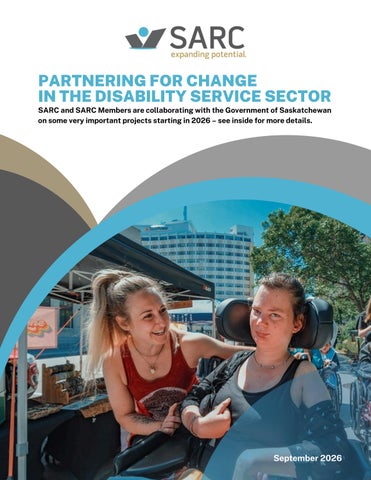
PARTNERING FOR CHANGE IN THE DISABILITY SERVICE SECTOR SARC and SARC Members are collaborating with the Government of Saskatchewan on some very important projects starting in 2026 – see inside for more details.
September 2026
Saskatchewan Disability Service Sector
6,700
People Served
90+
Communities
4,800
CBO employees
SARC Members are non-profit, community based organizations that operate all across Saskatchewan, from Île-à-la-Crosse to Lloydminster to Yorkton to Estevan. They are essential to the health, safety, wellbeing, and inclusion of thousands of people in Saskatchewan, including those with complex health and/or behavioural support needs that require 24-hour care and support. 01
Partnering for Change SARC, SARC Members, and the Government of Saskatchewan will be working together to address some long-standing issues of critical importance to services and the health and safety of people experiencing disability. Started in early 2026, the Ministry of Social Services intitiated a Community Living Service Delivery (CLSD) Funding Standards Review. Additionally, two new working groups are being established to consider Educational Standards in the Disability Service Sector and Healthcare for People with Intellectual Disabilities.
02
CLSD Funding Standards Review Background: The stability of operations in the Disability Service sector is a serious concern for CBOs with the increasing complexity of service delivery, costs on the rise, and limitations in compensation and benefits funding hindering employee recruitment and retention. Past investments have been appreciated, but there are still gaps obstructing CBOs’ ability to function effectively and truly deliver personcentred services. With an employee turnover rate of over 30% for the last five years and costs for operational necessities continuing to escalate, a comprehensive funding review was deemed necessary. Action: The Ministry of Social Services has launched an internal review of the CLSD Funding Standards and has invited SARC to join the project’s Executive Steering Committee. CBOs will be consulted and will play a critical role in identifying key pressure areas and the consideration of opportunities to address funding challenges. 03
Goals: The project’s goals are to: Simplify and modernize the structure of standards to enhance clarity in funding usages and support more transparent reporting for organizations Assess financial pressures across service areas to inform recommendations for targeted adjustments to the funding standards Identify opportunities for improved financial efficiency and cost savings for both the Ministry and service providers in the salary and non-salary standards
SARC and SARC Members look forward to a robust review process with meaningful opportunities for CBOs to provide feedback on the current funding structure and insights into what a future funding structure could look like. This project will span multiple fiscal years.
While underway, the sector requires inflationary funding injections at a minimum so that it doesn’t fall further behind.
04
Educational Standards in the Disability Service Sector Background: There is a growing movement across Canada and the United States to establish educational standards/requirements and pathways in the Disability Service sector, with some jurisdictions already having systems in place. There are currently no formally established educational standards in Saskatchewan’s Disability Service sector. While many individuals enter the sector with strong values, commitment, and lived experience, the absence of consistent educational standards can create risks that employers must manage, including physical injuries, medication and medical errors, neglect, and limitations to the autonomy, dignity, and quality of life of the people being supported. At the same time, we recognize the significant recruitment and workforce challenges already facing CBOs across Saskatchewan. Any discussion regarding educational standards must consider these realities while supporting the long-term goal of further professionalizing the sector and strengthening the quality of services provided to people with intellectual disabilities. 05
Action: SARC is leading a working group focused on exploring educational standards in Saskatchewan's Disability Service sector. This group will be made up of representatives from SARC, SARC Members, and the Ministry of Social Services. We also intend to engage with other government ministries, post-secondary institutions, and accrediting bodies.
Goals: The Educational Standards Working Group will provide advice and recommendations regarding:
The need for and potential benefits of educational standards within the Disability Service sector Possible models for educational standards, credentialing, certification, and ‘earn while you learn’ or apprenticeship pathways Workforce implications and implementation considerations Training and professional development opportunities
The focus of this work will not only be on identifying potential educational standards, but also on examining accessible pathways for current and future employees to attain them, including training opportunities, recognition of prior learning and experience, and workforce development strategies.
06
Healthcare for People with Intellectual Disabilities Background: Advancing health equity improves access to care and health outcomes for people with intellectual disabilities. People with intellectual disabilities often experience significant barriers when accessing healthcare services, navigating the healthcare system, and receiving equitable and responsive care. Over the years, SARC Members have raised numerous concerns on behalf of the people they support regarding access to healthcare services and interactions with healthcare professionals and systems. These concerns have included challenges with primary care, specialist services, emergency care, mental health supports, communication, accommodations, and coordinated care. There is an opportunity to pursue more focused discussions to better understand the challenges people experience and identify priorities for future action.
07
Action: SARC is leading a working group focused on improving healthcare experiences and outcomes for people with intellectual disabilities in Saskatchewan. This group will be made up of representatives from SARC, SARC Members, and the Ministry of Social Services. We also intend to engage with other government ministries as well as healthcare institutions and providers. Goals: The Healthcare for People with Intellectual Disabilities Working Group will provide advice and recommendations regarding: Key healthcare access barriers experienced by people with intellectual disabilities Challenges related to communication, accommodations, and system navigation Access to mental health supports and services Opportunities to improve coordination between disability services and healthcare providers Promising practices and initiatives from other jurisdictions Priority areas for advocacy, education, collaboration, and system improvement
We recognize that Saskatchewan’s healthcare system is facing many complex pressures and challenges. This working group will not seek to address all healthcare system issues. Rather, its focus will be on identifying opportunities to improve healthcare experiences, access, and outcomes for people with intellectual disabilities and their families. 08
SARC Members Are a network of 100+ non-profit organizations, with 70+ providing essential, daily supports to people experiencing intellectual and developmental disabilities Operate in 90+ communities across Saskatchewan, making it possible for people to receive services near family and friends Are among the largest employers in many rural Saskatchewan communities Contribute to their local economies by paying taxes, providing jobs, and buying local for operational supplies Value community relationships, volunteering and partnering with other non-profits to strengthen their communities
Show your support for the Disability Service sector by: Connecting with SARC Members in your constituency Connecting with SARC or the Ministry of Social Services for updates on these important projects
09
Questions or comments? Contact us at advocacy@sarcan.sk.ca