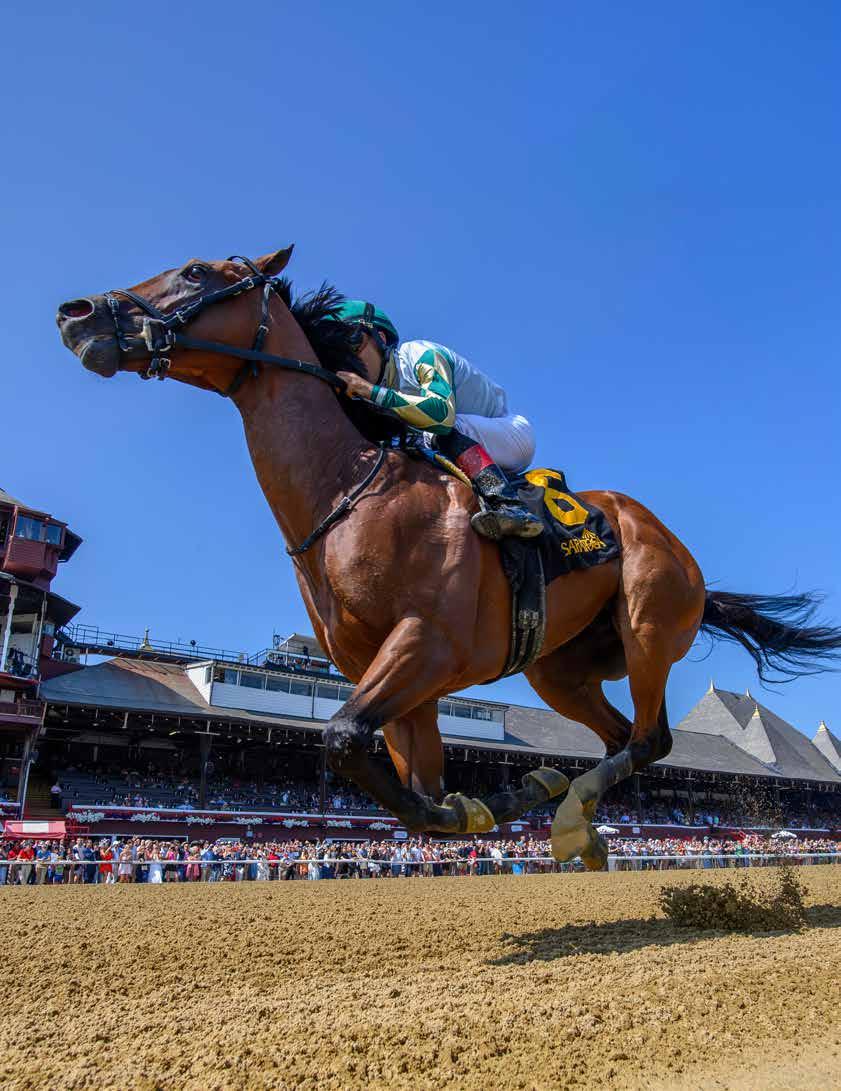
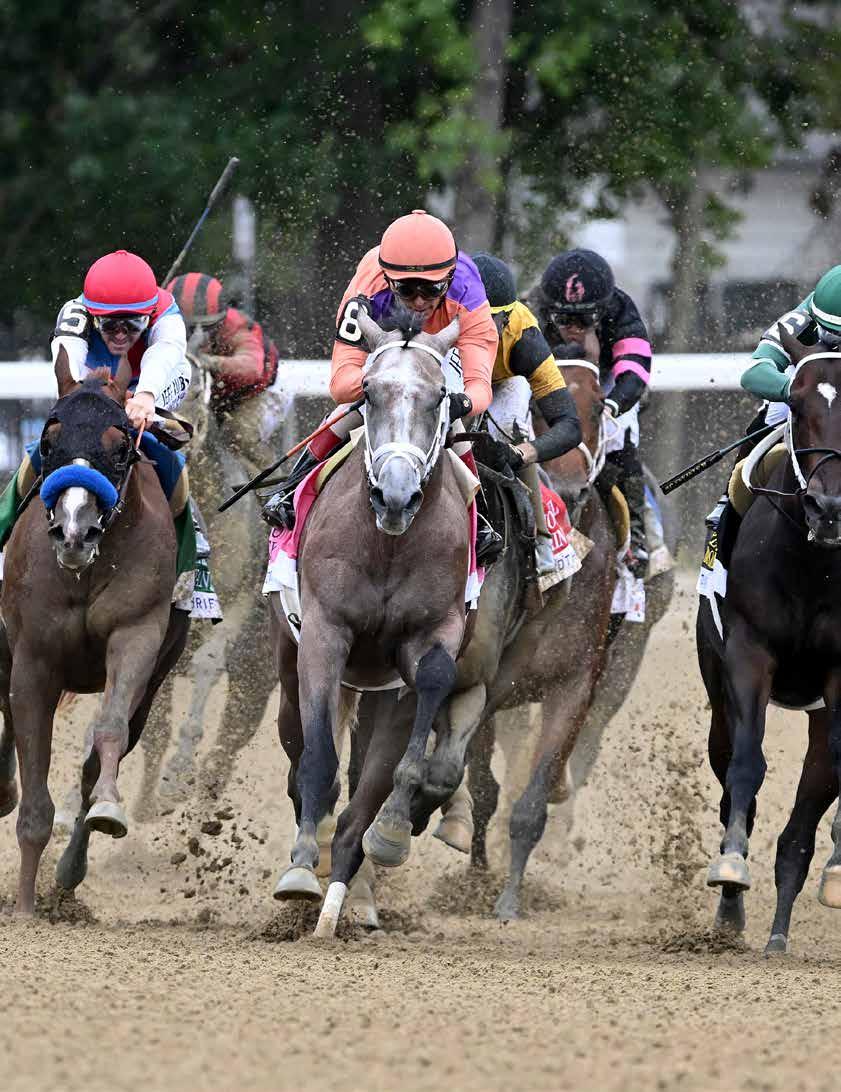
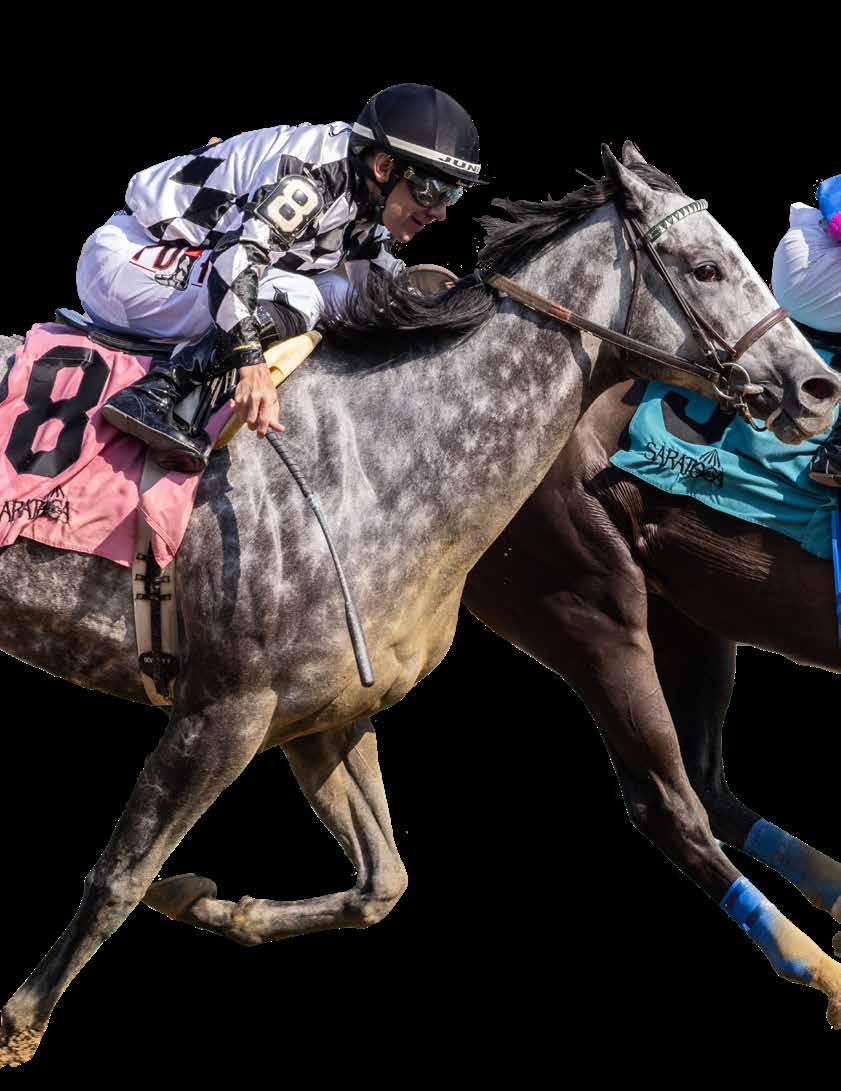
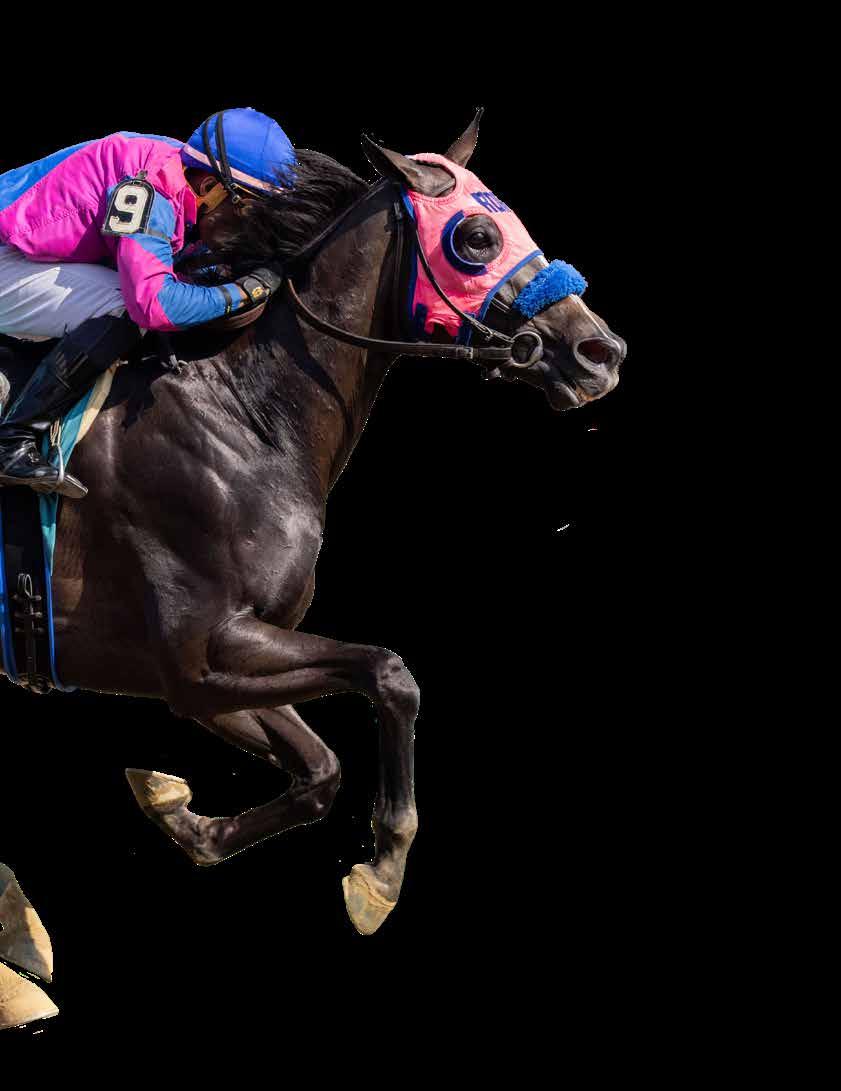
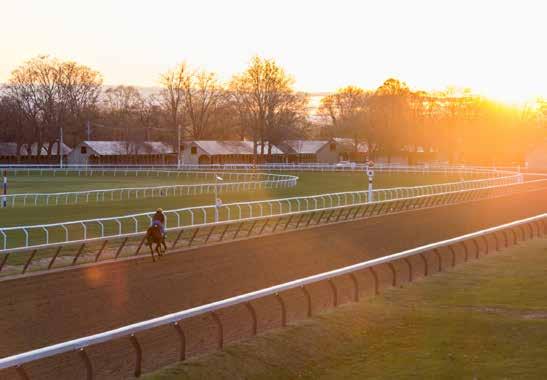
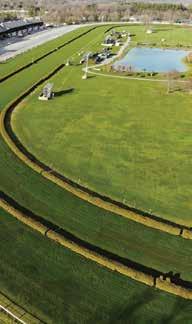
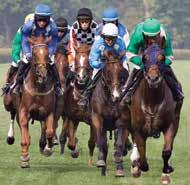
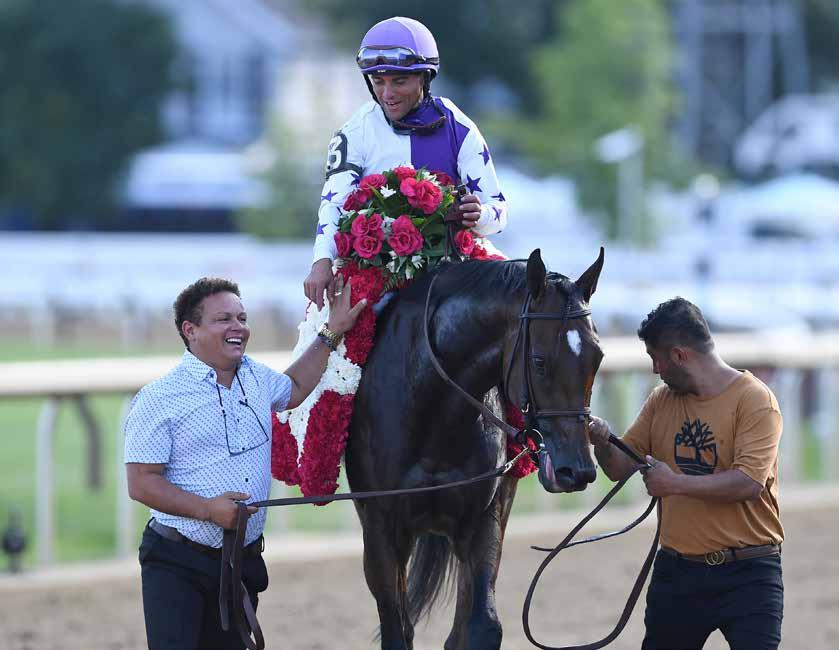
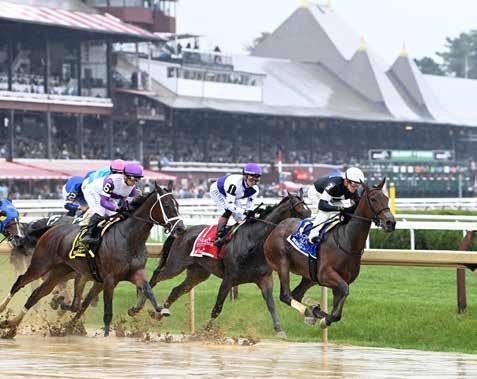
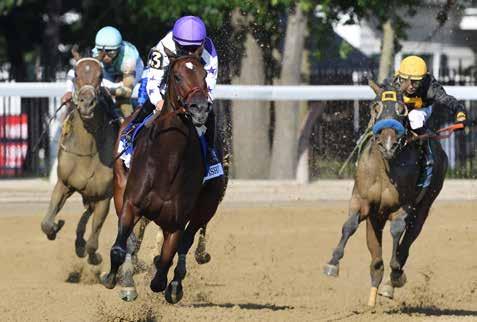
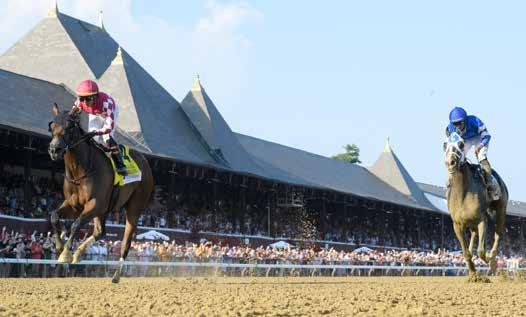
The summer meet features 46 days of racing, concluding Labor Day weekend.
Marquee Race Days: Jim Dandy Day
August 1
Whitney Day
August 8
Travers Day
August 29
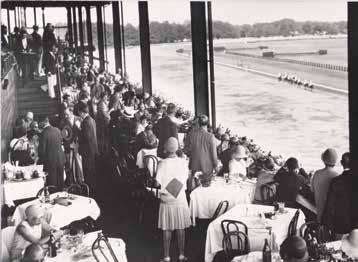
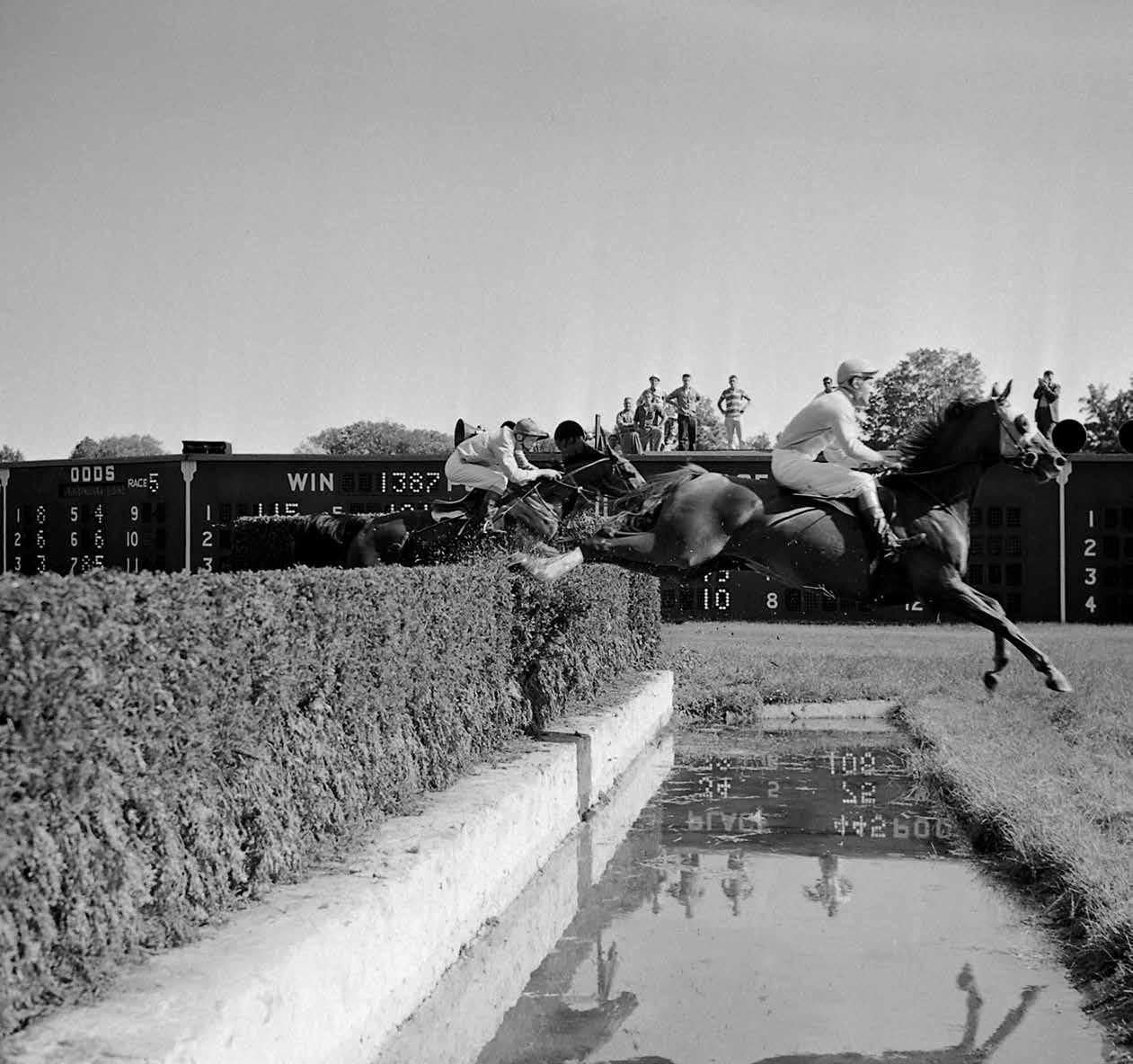
"From New York City you drive north for about 175 miles, turn left on Union Avenue and go back 100 years." -Red Smith, Sportswriter (1905-1982)
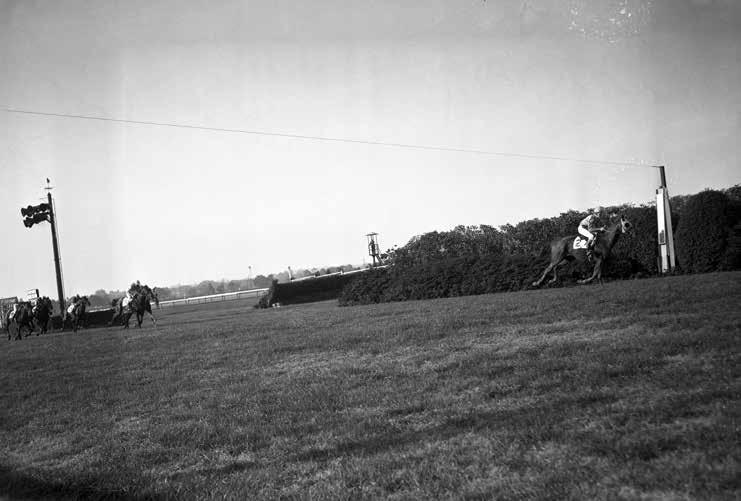
Photo: George S. Bolster Collection
JULY 3 - SEPTEMBER 7
JULY
JULY 3 Giveaway: Saratoga 250 Tumbler
$150,000 Saranac (NW of SS)
$200,000 Schuylerville
$150,000 Wild Applause (NW of SS)
JULY 4 Giveaway: Saratoga 250 Tumbler
$750,00 Belmont Derby (G1)
$600,000 Belmont Oaks (G1)
$225,000 Sanford (G3)
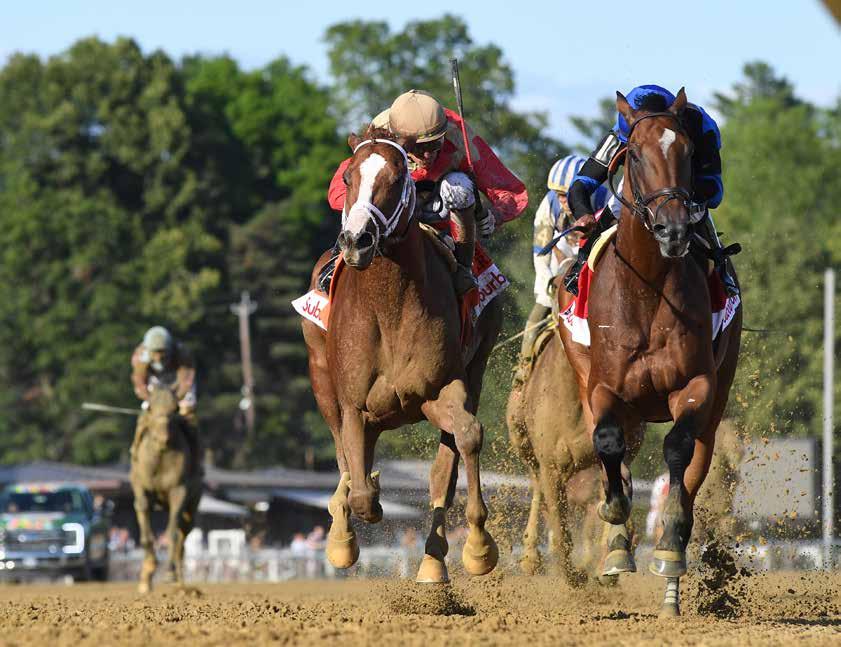
$500,000 Suburban (G2) pres. by Subourbon Life
JULY 5
$200,000 Harvey Pack
$225,000 Kelso (G3)
$150,000 Leo O’Brien (G1)
JULY 10 Giveaway: Spa FC Soccer Jersey
$225,000 Victory Ride (G3)
JULY 11
$250,000 Bowling Green (G2)
$250,000 Caress (G2)
JULY 16
$75,000 Jonathan Kiser Novice Memorial
JULY 17 Giveaway: Saratoga Belt Bag
$150,000 De La Rose (NW of GSS in 2025-2026)
JULY 18
$225,000 Coronation Cup (G3)
$500,000 Dunkin’ Diana (G1)
JULY 19
$225,000 Quick Call (G3) pres. by Thoroughbred Retirement Foundation
JULY 23
$200,000 Suzie O’Cain (NYB)
JULY 24 Giveaway: 'Meet Me at the Spa' Pin
$200,000 Rick Violette (NYB)
$250,000 Shuvee (G2)
JULY 25
$500,000 Coaching Club American Oaks (G1)
$400,000 Alfred G. Vanderbilt (G2)
JULY 26 Giveaway: Kids Day Horse Plushie
$250,000 Honorable Miss (G2) pres. by Mionetto
JULY 29
$150,000 Curlin (NW of GSS) pres. by Casamigos
JULY 30
$250,000 Glens Falls (G2)
JULY 31
$250,000 Amsterdam (G2)
Photo: Adam Coglianese / NYRA
GIVEAWAY DAY
AUGUST
AUGUST 1 - JIM DANDY DAY
$500,000 Jim Dandy (G2) pres. by Mohegan Sun
$225,000 Lake George (G3) pres. by Surfside
$250,000 Saratoga Special (G2)
AUGUST 2 Giveaway: Saratoga Straw Hat
$225,000 Adirondack (G3)
AUGUST 5
$150,000 A.P. Smithwick Memorial (G1)
$200,000 Johnstone (NYB)
AUGUST 6
$200,000 John Morrissey (NYB)
AUGUST 7 Giveaway: Whitney Pin
$500,000 Fasig-Tipton Saratoga Oaks (G2)
$400,000 National Museum of Racing Hall Of Fame (G2)
AUGUST 8 - WHITNEY DAY
$750,000 Fourstardave (BC) (G1)
$750,000 Saratoga Derby (G1) pres. by Qatar Racing
$500,000 Test (G1) pres. by Ticketmaster
$1,000,000 Whitney (BC) (G1)
AUGUST 9
$300,000 Troy (G2)
AUGUST 12
$75,000 Michael G. Walsh Memorial Novice
AUGUST 13
$200,000 Birdstone
AUGUST 14
$200,000 Smart and Fancy
AUGUST 15
$750,000 Christophe Clement Turf (BC) (G1)
$200,000 Galway
SEPTEMBER
SEPTEMBER 2
$150,000 Jonathan Sheppard Memorial (G1)
SEPTEMBER 3
$200,000 Bernard Baruch pres. by Snap-On
SEPTEMBER 4
$200,000 P. G. Johnson
$200,000 Seeking the Ante (NYB)
AUGUST 16 Giveaway: Corgi Cup Pin
$225,000 Mahony (G3)
AUGUST 19
$150,000 NYSS Statue of Liberty Division
AUGUST 20
$150,000 NYSS Cab Calloway Division
AUGUST 21
$200,000 Fleet Indian (NYB)
AUGUST 22
$600,000 Alabama (G1) pres. by Keeneland Sales
$300,000 Ballston Spa (G2) pres. by STIHL
AUGUST 23 Giveaway: Mini Lawn Jockey
$200,000 Albany (NYB)
AUGUST 26
$200,000 Bolton Landing
AUGUST 27
$200,000 Skidmore
AUGUST 28
$225,000 Waya (G3)
$200,000 West Point (NYB) pres. by Rood & Riddle Equine Hospital
AUGUST 29 - TRAVERS DAY
$1,250,000 DraftKings Travers (G1)
$500,000 Forego (BC) (G1)
$500,000 H. Allen Jerkens Memorial (G1)
$400,000 Lake Placid (G2)
$500,000 Personal Ensign (BC) (G1)
$500,000 Resorts World Casino Ballerina (BC) (G1)
AUGUST 30 Giveaway: Saratoga 2026 Pin
$200,000 Yaddo (NYB)
BETTING TERMS
Win: Your horse must finish first.
Place: Your horse must finish first or second.
Show: Your horse must finish first, second, or third.
Across the Board: Separate win, place, and show wagers of equal amounts on the same horse.
Exacta (box): Pick the first two horses in the correct order. Box it and the horses you select can finish in any order.
Trifecta (box): Pick the first three horses in the correct order.
Box it and the horses you select can finish in any order.
Superfecta (box): Pick the first four horses in the correct order. Box it and the horses you select can finish in any order.
“Boxing” your choices in exacta, trifecta, and superfecta bets makes your wager more expensive but allows you to win if your selected horses finish in any order! In addition, adding additional horses to your wagers raises the price of your ticket, but gives you more chances to win.
BETS WITH MULTIPLE RACES
Daily Double: Pick the winners of two consecutive races.
SEPTEMBER 5
$300,000 Spinaway (BC) (G1)
$225,000 With Anticipation (G3)
SEPTEMBER 6 Giveaway: Flannel Shirt
$150,000 Disco Partner (NW of GSS in 2025-2026)
$225,000 Prioress (G3)
$300,000 Spendthrift Farm Hopeful (G1)
SEPTEMBER 7
$200,000 Funny Cide (NYB)
$200,000 Gio Ponti
Grand Slam: Pick a horse to finish in the top three in three straight races, capped by the winner of the fourth race in the sequence. If there is no show wagering in one of the first three legs, the horse must finish second.
Pick 3: Pick the winners of 3 consecutive races
Pick 4: Pick the winners of 4 consecutive races
Pick 5: Pick the winners of 5 consecutive races
Pick 6: Pick the winners of 6 consecutive races
Photo: Susie Raisher / NYRA
Misty Mornings at Saratoga...
Who Trains that Horse?
WRITTEN BY BARRY POTOKER
PHOTOS BY SUPER SOURCE MEDIA STUDIOS
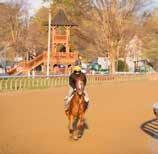
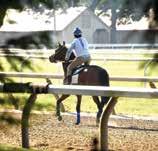
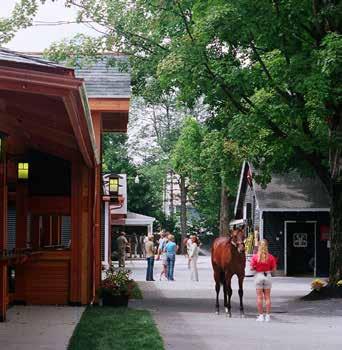
TThe setting is a crisp, misty and sometimes foggy early August morning at Saratoga Race Course.
As the sun begins to burn through the haze on a beautiful summer dawn at this historic track, the infield trees are very still with only a hint of a breeze while the geese in the pond behind the tote boards are beginning to stir. The morning dew certainly smells sweet but there is a pungent aroma from the steaming hay filling the air. Things become clearer as first light pours down on these storied grounds, and yet the stables and the backstretch have been alive for hours. What a feeling to be part of the awakening of the track in the a.m.! Both the Oklahoma training track and
the Main flat oval in the morning are much like being backstage before a Broadway play. It's simply exhilarating knowing that later that day, the place will be bustling with fans ready for the main event.
Around you are trainers, jockeys, agents, clockers, exercise riders, grooms, hot-walkers and owners. It’s an up-close and personal festival of the Sport of Kings. The majestic star performers are not only working out and training, but are meticulously being attended to – bathed, groomed, schooled at the starting gate and, of course, fed breakfast. There is an abundance of activity, yet it is a calm, pristine and organized scene.
So, if you’re heading “to the barns” or backstretch or the grandstand for the morning experience of workouts, don’t go without picking up one of these...
Now in its 18th year of publication, ThoroFan’s 2026 Saddle Towel Guide is your companion to the morning workouts. It’s the essential guide to identify “Who Trains that Horse” quickly and easily from their saddle towel. The “program” is broken down TWO ways - by saddle towel color and alphabetically by trainer name. There are also feature stories and interesting facts about trainers, horses, and happenings in and around this hallowed racetrack.
Join ThoroFan it's
ThoroFan is a non-profit organization dedicated to the philosophy that "An Educated Fan is a Better Fan" and this simple yet useful guide to the Saratoga workouts is a winner. It’s the original idea of local Saratogian, Bob Giordano, who spends months on the rail looking for newly arriving trainers to incorporate their identifying logos. Horses race in Owners’ silks in the afternoons, Trainers have multiple owners. Clockers recording times need to know which particular saddle towel to spot and identify many similar horses working out. The trainers’ saddle towel is their clue. Bob’s vision was to help new, casual and seasoned fans learn more about the sport of thoroughbred horse racing. This handy pocket guide is now also used by the clockers, owners, photographers, and even handicappers to spot specific horses.
The FREE 2026 edition will be available on opening day (July 3rd) and can also be found at many other locations. These include The Whitney Stand at the Oklahoma training track, the horsemen's Morning Line Coffee Stand in the backstretch barn area, the Porch for Breakfast at Saratoga, the Saratoga Visitor's Center and several Saratoga businesses. It is also available to view online at ThoroFan.com or via the handy QR Code.
Misty morning workouts at Saratoga are amazing, mesmerizing, and so much more enjoyable nowadays with the official ThoroFan Saddle Towel Guide at your fingertips…along with your camera, a fresh egg sandwich and a piping hot cup of coffee!
The Whitney Stand, Oklahoma Training Track
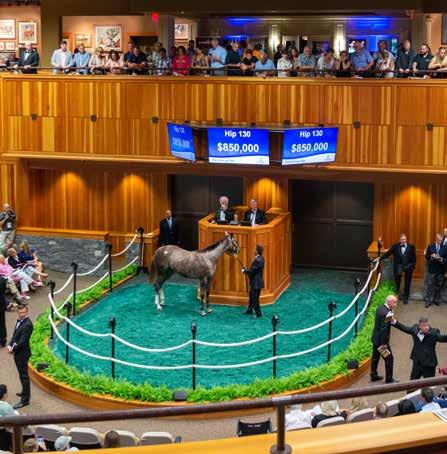
2026 SARATOGA SALES
Fasig-Tipton SINCE
New York Bred Yearlings
AUGUST 16 & 17
Held the Sunday and Monday following The Saratoga Sale, the New York Bred Yearlings sale is the industry’s leading source of quality New York-bred yearlings.
The New York Bred Yearlings sale showcases New York’s finest yearlings. The sale is the industry’s leading source for quality New York-bred yearlings eligible for the $65 million distributed each year in purse money, incentives, and awards for New York-breds.
Recent graduates include Grade 1 winner Therapist, graded stakes winner Mo Plex, and New York-bred champions The Wine Steward, Cara's Time, Dr Ardito, and Silver Skillet.
The Saratoga Sale
SELECTED YEARLINGS
AUGUST 10 & 11
Experience the excitement, tradition, and prestige of “The Spa!”
Held during the prestigious Saratoga race meet for 100 years, Saratoga selected yearlings regularly go on to become racing’s next superstars.
The Saratoga Sale experience is one of the most unique in the Thoroughbred world, offering a rich racing and social scene.
Yearlings catalogued in The Saratoga Sale have been selected on pedigree and physical conformation by Fasig-Tipton’s respected inspection team. The quality on offer is reflected in the sale's recent results, including last year's sale, which shattered records for gross, average, and median. Recent graduates include Breeders' Cup Classic winner Sierra Leone, back-to-back Preakness S. winners National Treasure and Seize the Grey, and Grade 1 winners And One More Time, Kingsbarns, and Prince of Monaco.
L.A. Berry
Photo:
How It All Began...
The origins
of Saratoga racing
WRITTEN BY BRIEN BOUYEA
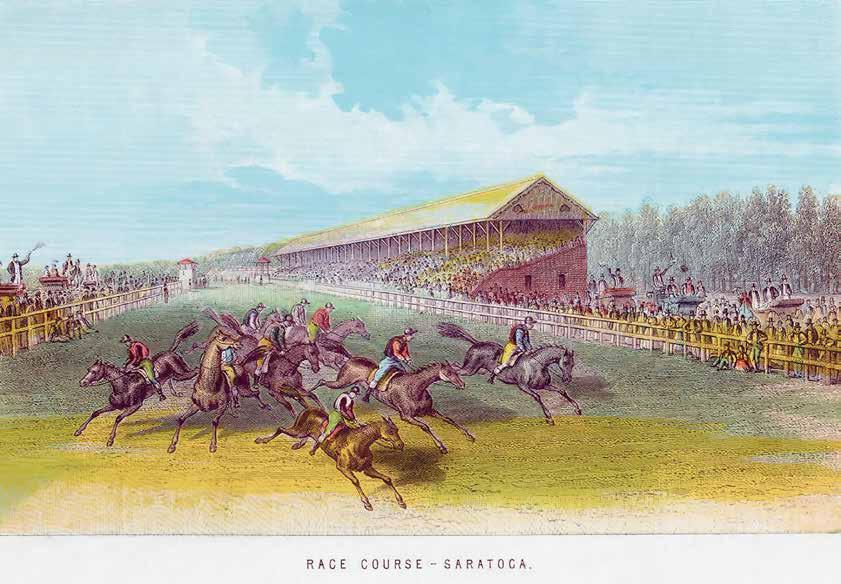
Two years before the 13th Amendment to the United States Constitution was ratified (outlawing slavery and involuntary servitude), an unlikely individual pulled off an even more unlikely endeavor. It was an idea that forever altered the course of history for Saratoga Springs.
The year was 1863, and the Civil War was tearing America apart during Abraham Lincoln’s first term as president. Exactly one month after an estimated 8,000 Americans were killed in the Battle of Gettysburg, 32-year-old former bare-knuckle boxing champion John Morrissey acted on his seemingly illogical plot. His plan: Bring the first organized thoroughbred race to Saratoga.
SARATOGA C. 1867
The odds were against Morrissey for several reasons, foremost of which was the fact that organized horse racing in America was at a standstill because of the war. In fact, even finding enough quality thoroughbreds to stage the meet was problematic because the Union had requisitioned just about every horse for the war effort.
Morrissey, however, was a daring and determined individual with a history of proving people wrong. He proceeded undeterred. His entrepreneurial vision, moxie, and sheer will were traits that served him well.
Long before Morrissey made the scene, Saratoga was already steeped in historical significance. The Battles of Saratoga in the autumn of 1777 turned the tide in the Revolutionary War and remains one of the most important events in American history.
Following the Revolutionary War, health-seekers ventured to Saratoga in search of the famous mineral springs. George Washington even passed through one day and wanted to buy the entire place. Washington arrived in Saratoga on July 27, 1783, and was so enamored with the village that he sent a letter to New York Gov. George Clinton asking what he could do in his efforts “respecting our purchase of the Saratoga Springs.” In his correspondence with Gov. Clinton, Washington noted Saratoga as “famous by being the Theatre of Action in 1777” and added “I have money now by me and shall, at any time, be ready to answer your call.”
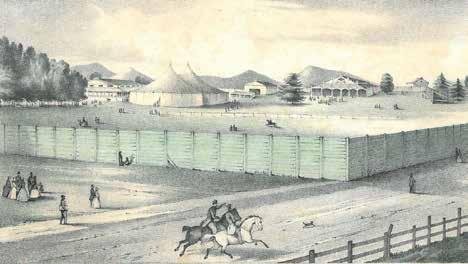
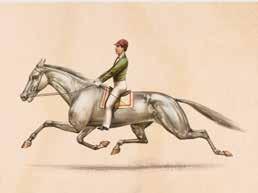
On Saturday, Aug. 14, 1847, Saratoga entrepreneurs George Cole and Alfonso Patten opened the Saratoga Trotting Course. The inaugural race was won by the immortal Lady Suffolk, known as “The Old Gray Mare” in Stephen Foster’s folk song. Lady Suffolk was the most famous trotter in the land and a major drawing card. The village was able to circumvent the anti-racing law because Saratoga was the site of the upcoming State Fair. The trotters were supposedly staging only exhibitions and “trials of speed.” A crowd estimated at 5,000 saw the 14-year-old Lady Suffolk defeat Moscow in a best-of-five series of one-mile heats. The trotting meet featured a total of five days of racing.
A month later, the State Fair, featuring five more days or racing, opened at the Saratoga Trotting Course. Former presidents Martin Van Buren and John Tyler attended, as did future president Millard Fillmore. The first thoroughbred race at Saratoga went virtually unnoticed as part of the festivities. On Thursday, Sept. 16, 1847, Lady Digby defeated Disowned and Hopeful in three straight heats in a race for “running horses.” Racing was sporadic in Saratoga during the years between 1847 and 1863. Several small courses came and went, although the Saratoga Trotting Grounds remained. Morrissey arrived in Saratoga in the early 1860s and opened a gambling house on Matilda Street (now Woodlawn Avenue). He saw the opportunity to further pad his pockets through racing.
IMAGES: (ABOVE)
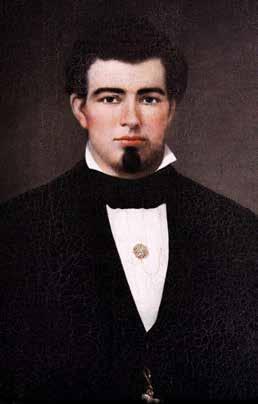
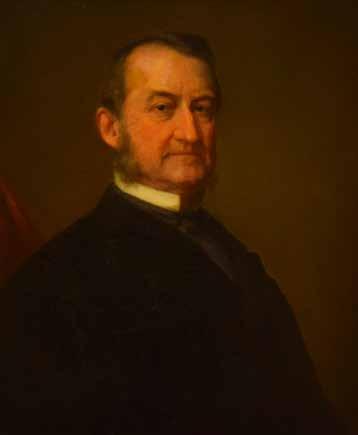
John Morrissey portrait
Photo by Brien Bouyea from a portrait at the Saratoga Springs History Museum.
Lady Suffolk, known as “The Old Gray Mare,” and winner of the inaugural race at Saratoga Trotting Course in 1847. Image: Library of Congress
(LEFT)
1847 State Fair
Photo courtesy of the George S. Bolster Collection
The charade of staging illegal race meets under the guise of a carnival, or labeling contests as speed exhibitions, was a thing of the past. Morrissey wasn’t hiding anything. An advertisement in the Daily Saratogian proclaimed as much: “Running Races! AT SARATOGA.” Two races were carded each day from Aug. 3-6, 1863. The curtain had risen on thoroughbred racing in Saratoga.
Morrissey convinced the top sportsmen in the country to back his meet. “All sections of the North and West, and some portions of the South will be represented by their best horses, and Canada will also contend for some of the various purses,” Morrissey said in his advertisement. “Excellent racing is anticipated.”
A crowd of more than 3,000 attended opening day. Admission was $1. They watched the races from carriages, as there was no grandstand. The track had many issues. The sightlines were poor because the track disappeared behind trees, barns, and a stabling area. The course itself had extremely sharp turns and was 297 yards short of the mile it was supposed to be. Still, the purses, sweepstakes money put up by the entrants and the quality of the competition ensured the meet was a rousing success.
A dark bay filly named Lizzie W., with a oneeyed Black jockey in the irons, won the first contest of Morrissey’s thoroughbred meet by
defeating the heralded colt Captain Moore in a best-of-three sweepstakes. More than 15,000 people attended the four days of racing. Lizzie W. capped the proceedings with another victory in the meet’s final contest. One of the great accomplishments of the meet went mostly ignored by the newspapers. Only the Spirit of the Times noted that seven of the eight race winners at Saratoga that summer were trained by the Black conditioner William Bird, who went on to considerable success, including a victory in the 1884 Kentucky Derby with Buchanan. Morrissey had delivered a winner.
The Spirit of the Times said Morrissey’s meet “... laid the foundation for a great fashionable race meeting at the Springs” and added “... the formation of a competent club, and further proceedings, would seem to be a matter of course.”
Morrissey moved quickly to build upon his success. He purchased an initial 94 acres across the street from the Saratoga Trotting Grounds to construct Saratoga Race Course almost immediately after the conclusion of his inaugural meet. The original course was converted to a training track, which is still in use today and known as Horse Haven. Commodore Cornelius Vanderbilt helped underwrite the cost of the new racecourse, while Morrissey brought in William R. Travers, Leonard Jerome and John Hunter to lend prestige to the new Saratoga Association.
IMAGES: (ABOVE)
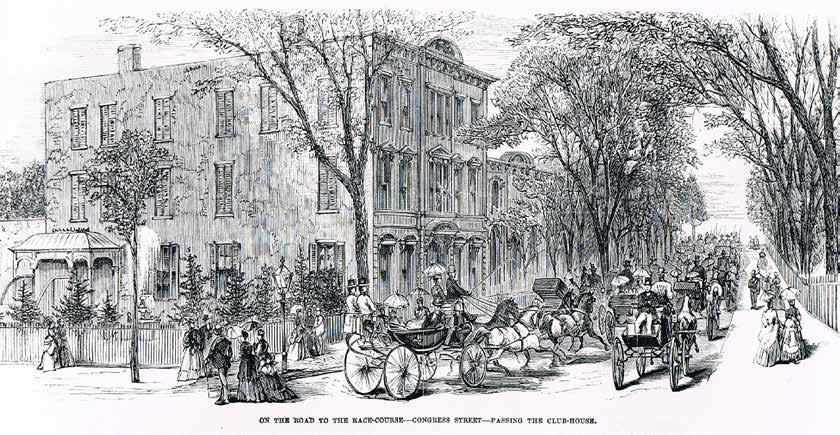
"On the road to the Race Course - Congress Street - passing the Club House." The Club House, established by Morrissey in 1870, is now present day Canfield Casino.
Photo courtesy of the George S. Bolster Collection
(PAGE 21) William Travers Painting by unknown artist
Travers was a Baltimore-born stockbroker, who was described in his New York Times obituary as “… probably the most popular man in New York.” He was named the first president of the Saratoga Association and was a partner in the famed Annieswood Stable, which campaigned the legendary racehorse Kentucky.
Jerome, a lawyer, publisher, and the grandfather of Winston Churchill, was dubbed the “King of Wall Street.” He was a partner in Vanderbilt’s railroad deals and less than a month before Morrissey’s 1863 meet was perched in a window at the New York Times, defending the building with a Gatling Gun during the New York City Draft Riots. Jerome, who went on to play a major role in the opening of three tracks in the New York City area and helped form The Jockey Club, was named a vice president at Saratoga.
Hunter, a prominent breeder and horse owner, was brought in to represent the Association’s Executive Committee. He partnered with Travers on a number of quality thoroughbreds, including Kentucky and Alarm. Hunter later became president of The Jockey Club, and is credited with proposing the race that led to the creation of Pimlico Race Course in Maryland, the home of the Preakness Stakes.
Vanderbilt, the railroad and shipping tycoon who was the wealthiest man in the country, stayed in the background as a silent partner when it came to the track’s affairs. Although they were from different walks of life, Vanderbilt and Morrissey were close friends. The Commodore greatly benefitted from Morrissey’s Tammany Hall political connections when he began to consolidate his railroad empire. They were regularly seen together at the races.
The only place Morrissey was silent was in the official documentation. He owned the majority of the stock in the Saratoga Association and presided over the new track with an iron fist, but his name was not on the books. Morrissey understood that his project would be more widely accepted if men such as Travers and Jerome were fronting the operation. After all, Morrissey had a gang affiliation with the Dead Rabbits in New York City and the former pugilist was considered a bit too rough around the edges for the high society clientele he was attempting to lure to his new track. With Travers and Jerome as figureheads, the new venture was well received.
The team Morrissey assembled was described in the New York Herald as “ … a guarantee of the thoroughly high-toned character of all the proceedings.” That type of acceptance would
not have been achieved if Morrissey included his name in the official documentation.
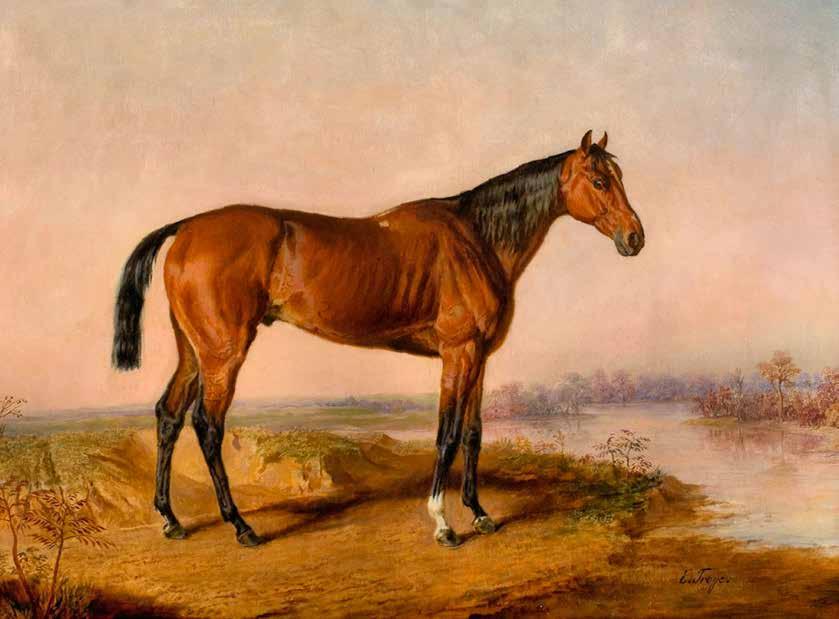
Saratoga Race Course opened for the first time on Aug. 2, 1864. The first race was the inaugural running of the Travers Stakes. It was won by the great racehorse Kentucky, owned in partnership by Travers, Hunter and Osgood. Kentucky became the track’s first equine hero, as he also won the first two editions of the prestigious Saratoga Cup.
A new era of racing excellence had been ushered in. The track was popular from the beginning and is now regarded as a pillar in the sport. Today, more than 160 years after Morrissey’s inaugural meeting, Saratoga Race Course stands as the oldest active sporting venue in the country. It remains the standard by which all of American racing is measured.
IMAGE: (ABOVE)
Kentucky, winner of the first running of the Travers Stakes in August, 1864. Painting by Edward Troye
ROYAL COURTS
WRITTEN BY L.A. BERRY
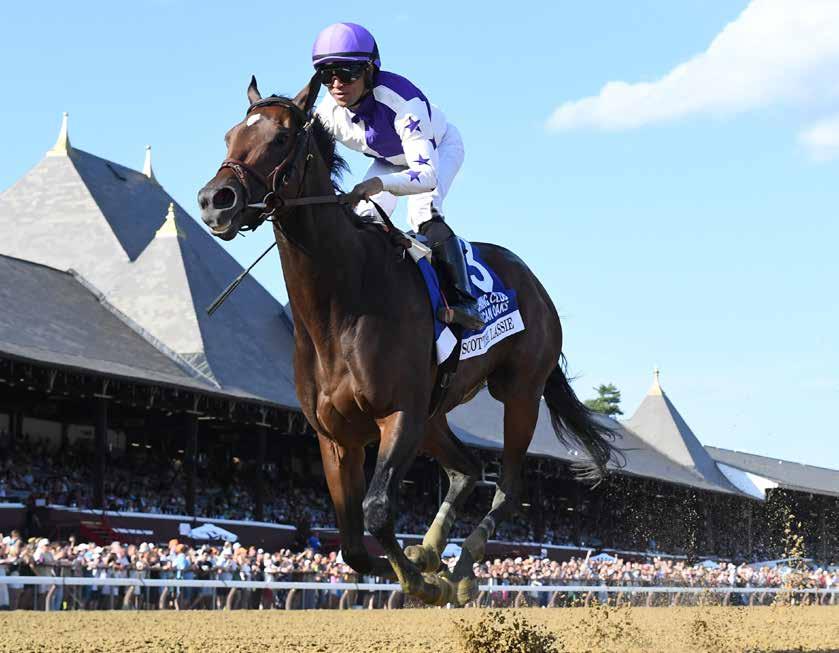
Scottish Lassie wins the 2025 CCAO.
Photo: Dom Napolitano / NYRA
There’s the Triple Crown and then there’s the Triple Tiara.
Acorn Stakes
Any three year-old Thoroughbred racehorse strong and swift enough to go the distance in the Kentucky Derby, Preakness and Belmont Stakes can chase a Triple Crown, but in the Empire State? Only the fillies that sweep the Acorn Stakes, Coaching Club American Oaks (CCOA), and Alabama Stakes get to tuck a New York Triple Tiara in their metaphoric jewelry box (unlike the Triple Crown, the Triple Tiara lacks a singular, permanent physical trophy to be award annually).
Also known as the Filly Triple Crown or NYRA Triple Crown, the top honor for three-year-old fillies usually begins over nine dirt furlongs of Belmont Park racetrack in the G1 Acorn Stakes. Lucky for us, while Belmont Park puts the finishing touches on its redesigned venue and 1½-mile dirt track slated to open this fall, Saratoga Race Course will hold these history books one more time and host all three legs of the Triple Tiara.
CCOA
Alabama Stakes
Tiara v. Crown... What’s the Diff ?
For mavens of semantics, here’s the scoop. When is it a crown and when is it a tiara?
The base of a crown is always a full circle, whereas a tiara is semi-circular. Crowns may be bestowed on the heads of either gender, but the tiara is a singularly feminine adornment.
Photo: Dom Napolitano / NYRA
Photo: Amira Chichakly / NYRA
Photo: NYRA
Fleet the Hoof that Carries the Tiara
Like the diadems of human dignitaries, the jewels within the Triple Tiara change to adapt with their times. The first 20th century champions, Wistful (1949) and Real Delight (1952), went largely unreported for sweeping the original series of the Kentucky Oaks, Pimlico Oaks (now Black-Eyed Susan Stakes) and Coaching Club American Oaks.
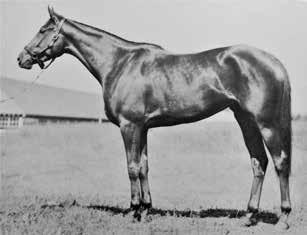
In American Classic Pedigrees 1914-2002, Avalyn Hunter described the first Triple Tiara winner, Calumet Farm’s chestnut filly, Wistful, as “goodnatured with suspect ankles, who stood about 16 hands and looked the part of a classic runner with an attractive head, long well-sloped shoulder, and rangy build. She tended to do her best running off the pace and had a strong closing drive after getting her long stride into gear. Always a slow starter but a fast finisher, she was a good ‘doer.’”
A really good one, if you asked Thoroughbredracing.com commentator, Mary Pitt, whose October 18, 2020 blog described the filly besting the largest field (14) to date in that 33rd running of Belmont’s Coaching Club American Oaks:
“Wistful, having virtually walked out of the gate, trailed the field for the first half-mile, then began steadily gaining ground, running down Adile by a half-length in front of a crowd of 36,599. The roan Adile would go on to win the Alabama. The taking of a fillies’ triple was only alluded to in passing in the press at the time.”
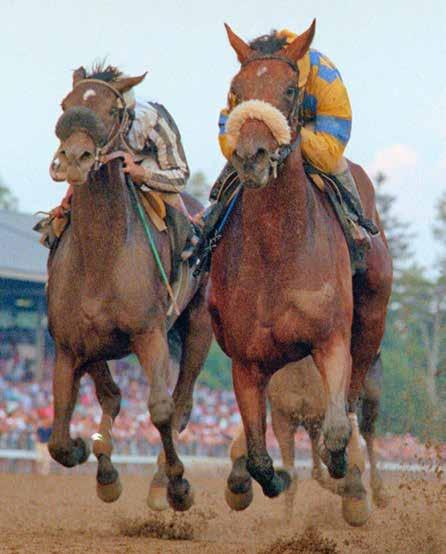
Sky Beauty (right) winning the 1993 Alabama Stakes. Photo: NYRA
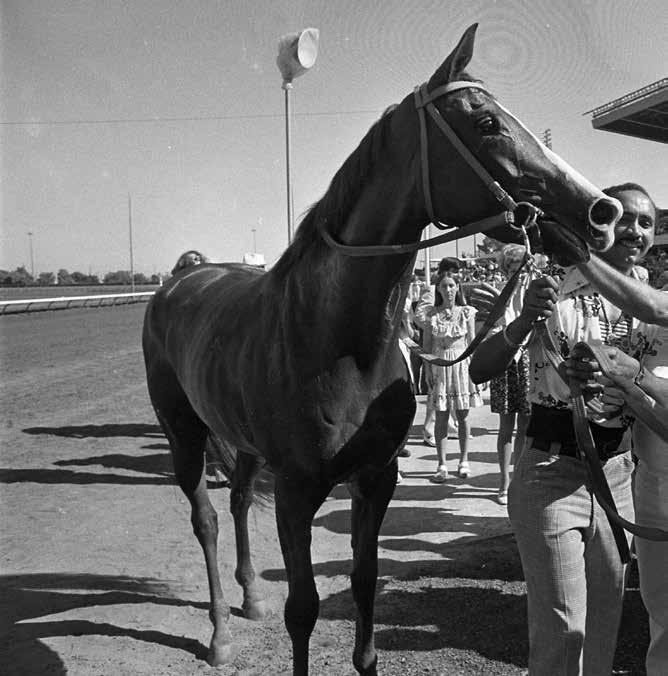
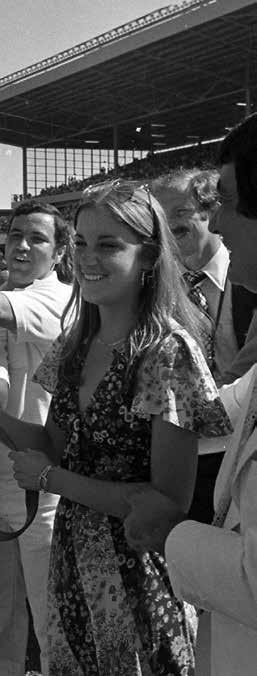
Tennis player Chris Evert meeting her namesake, New York Filly Triple Tiara champion Chris Evert, at Hollywood Park, CA.
Photo: Los Angeles Times Image archive deeded to UCLA under CC-BY4.0 International License
Wistful - the first Triple Tiara Winner. Photo: thoroughbredracing.com
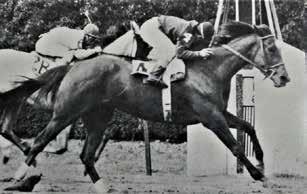
Wistful narrowly winning the 1949 CCAO. Photo: thoroughbredracing.com
The Greatful Eight
Only eight racing fillies have won a New York Triple Tiara:
Dark Mirage (1968)
Shuvee (1969)
Chris Evert (1974)
Ruffian (1975)
Davona Dale (1979)
Moms’ Command (1985)
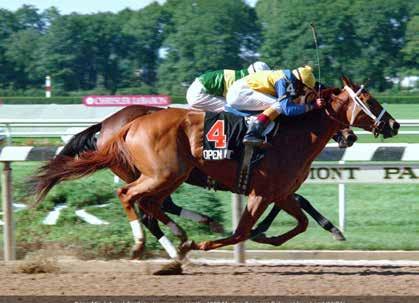
Open Mind (1989)
Sky Beauty (1993)
In hopes of perking public interest, the New York Racing Association restrung its jewels into an all-Belmont Park series that consisted of a mile-long Acorn Stakes, the 1 1/8th Mother Goose Stakes, and a Coaching Club American Oaks of varying distances between 1¼- and 1½-mile. The result, between 1968 and 1993, were eight Triple Tiara champions (see sidebar)
The last two winners have been Open Mind, winner of both the Triple Tiara and Kentucky Oaks (1989), and Sky Beauty (1993), trained by “Giant Killer,” H. Alan Jerkens.
Ten years later, NYRA restrung its Triple Tiara to the Mother Goose Stakes, Coaching Club American Oaks, and Alabama Stakes, in August at Saratoga. As operator of the Belmont and Saratoga racetracks, NYRA decided to offer a $2 million bonus to any filly winning all three races on both tracks, but the bonus was discontinued in 2005 and two years later, the Triple Tiara returned to an Acorn, Mother Goose, and American Oaks format that produced no winning sweeps.
Open Mind winning the 1989 Mother Goose at Belmont by a head. Photo: NYRA
Time for a New York Queen
What makes the chase for the New York Triple Tiara worth following now, when no filly has risen to its challenge in over a quarter of a century? Because wouldn’t it be all the sweeter if you could say that you spent your summer vacation watching racing history rewritten at the ‘graveyard of champions.’
If you’ve a taste for long shots or comebacks, here are some early gems sparkling on the horizon hoping to make their own setting in the elusive Triple Tiara:
• Bella Ballerina (Street Sense x Pretty City Dancer) Trainer Brendan Walsh
• Counting Stars (Honor A.P. x Paynterbynumbers) Trainer Mark E. Casse
• Dancin in Old Town (Tapit x Abington) Trainer J. Keith Desormeaux
• Energy Issei (Mozu Ascot x Energy Heart) Trainer Daisuke Takayanagi
• Goldmunze (Suave Richard x Piece d’Or) Trainer Daisuke Takayanagi
• Perfect Town (Speightstown x Perfect Forever) Trainer Steve Asmussen
• Zany (American Pharoah x Mo’ Green) Trainer Todd Pletcher
“We are all in this business for value of our fillies,” Steve Westland of Parkland Thoroughbreds said of their 15 ½-length CCOA winner at Saratoga in 2025, Scottish Lassie (McKinzie x Bodebabe/Bodemeister).
“This definitely increases her value and shows the world she is something special.”
The odds of greatness writing its name in the Saratoga homestretch remains to be seen but when watching fillies one may always rely on the observations of the late editor-inchief of The Blood-Horse, Joseph A. Estes:
“The conclusion remains unshaken that the value of a mare as a producer is in direct proportion to her class a racer, and no better standard for choosing a broodmare is available to the breeder, however long he may pore over pedigrees.”
Look to the New York Triple Tiara to attract a royal court.
Scottish Lassie racing in the 2025 CCAO. Photo: NYRA
A History ... The National Museum of
RACING AND HALL OF FAME
WRITTEN BY JOE RAUCCI
TThe corner of Union Avenue and Ludlow Street is the site of one of the Crown Jewels of Saratoga’s landscape. It is the home of the National Museum of Racing and Hall of Fame. Within its confines, many of horse racing’s most coveted trophies, artwork and memorabilia are on display.
Since the permanent museum opened in 1956, it has grown immensely in stature. Ongoing innovations have brought it to its present status as a world class destination for those who have an interest in the sport. It’s also the perfect venue for the novice or vacationer to get a feel for the importance of horse racing on the American sporting scene.
Photo: Theresa St John
The Beginnings
The actual timeline of the museum dates back to 1950. It was in that year that a group of horse racing dignitaries led by Cornelius Vanderbilt Whitney made plans to preserve and showcase important memorabilia pertaining to the sport.
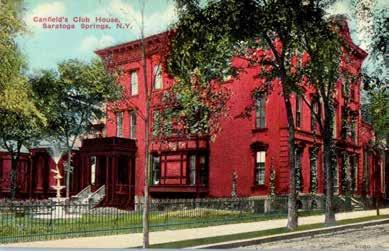
Whitney and his colleagues needed a building to house the collection. In 1870, John Morrissey, a professional boxing champion and the founder of Saratoga Race Course had erected a gambling establishment known as The Clubhouse. Near the turn of the century it was purchased by renowned art collector Richard Canfield. With its lavish interior and high stakes games of chance, the Clubhouse was considered one of the finest gambling establishments in the world.
In 1911 anti-gambling laws were passed in New York State that led to the closure of Canfield’s Clubhouse. The city of Saratoga Springs purchased the building from Canfield and oversees the property to this day. It is now the home of the Saratoga Springs History Museum where visitors can catch a glimpse of Saratoga’s colorful past.
Located in Congress Park, Canfield’s Casino with it’s proximity to Broadway and the racetrack was a perfect choice to house the Racing Museum until a permanent residence was erected.
On August 6, 1951 the National Museum of Racing was opened to the public. Despite only a few items on display, the museum was an immediate success.
In its first year 8000 patrons viewed the collection. One of the highlights was a horseshoe worn by Lexington. He is regarded as one of America’s great thoroughbred champions of the nineteenth century.
1.
PHOTOS:
Vintage postcard of Canfield’s Clubhouse (Casino) c. 1910
2. Cornelius Vanderbilt Whitney
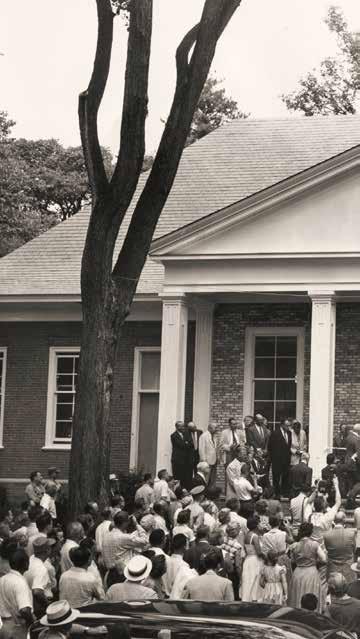
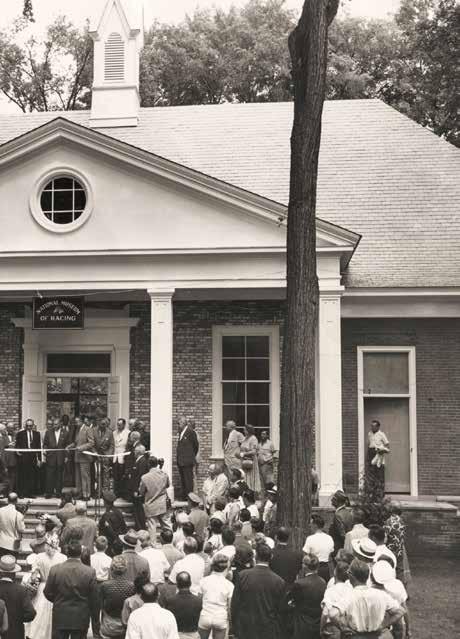
3. 1956 grand opening of the museum.
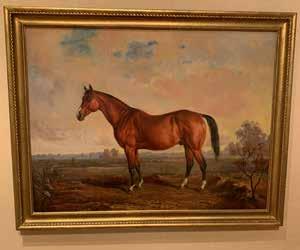
4. Painting of Lexington Credit: Edward Troye
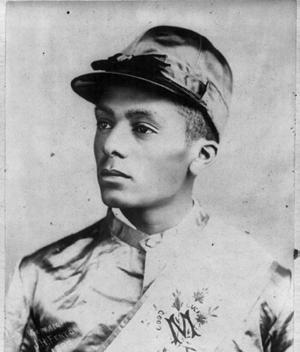
5. Isaac Murphy the King of nineteenth century jockeys. Courtesy of Library of Congress
A Permanent Home
In 1953 Walter Jeffords replaced CV Whitney as President. He was related by marriage to Man o’ War’s owner Samuel Riddle. The highly respected horseman decided that the time had come for a permanent home for the museum to become a reality. In 1954 ground was broken at 191 Union Avenue signaling the construction of the new building located directly across from Saratoga Race Course.
The following year the museum added a Hall of Fame. Its purpose was to honor horses, jockeys, and trainers for extraordinary career achievements.
In its first year 27 charter members were enshrined. The racehorse category was limited to those who performed in the nineteenth century. The list was led by the legendary Lexington, along with Salvator and Sir Archie.
Earl Sande who rode both Man o’ War and Gallant Fox, along with Isaac Murphy, one of the great black riders of the later years of the nineteenth century, led the roll call of jockeys inducted.
5
The trainers enshrined included the likes of Sam Hildreth, whose resume included conditioning CV Whitney’s champion Equipoise as well as having achieved seven Belmont Stakes victories.
The permanent museum opened for its inaugural season on June 2,1956. The actual dates for public viewing were limited to the four week racing meet. The museum then closed its doors until the following August.
Enter Elaine Mann
For the next 30 years the museum was managed by Saratoga Springs resident Elaine Mann. She was the daughter of Hall of Fame jockey Buddy Ensor. Her background gave her a keen knowledge of the sport. In her tenure as director, the museum grew in stature. An impressive collection of over 300 equine paintings adorned the walls. Stakes race trophies crafted of the finest precious metals were acquired. They represented many of the significant horse races conducted in America.
Expansion of the Property
During the years 1957 through 1978 the Georgian style building underwent several expansions to showcase the various items in the growing collection.
The early renovations increased the size of the museum. The presentation however was considered somewhat choppy, with an outdated format for the optimum viewing of the paintings, trophies and Hall of Fame plaques.
In 1987 Paul Mellon the owner of Rokeby Stables, and one of the great philanthropists of the twentieth century envisioned a modern museum that would highlight the sport on a grand scale. Mellon, along with museum president Whitney Tower raised over 6 million dollars to fund the project. It was considered an enormous amount of money at that time.
The construction began in the fall of 1987 and was put on a fast track to be completed to coincide with the opening of the 1988 racing season. The entire indoor space of the building was gutted.
An English firm was contracted that specialized in modernizing a horse racing theme and elevating it to a hands-on experience. The firm enhanced the displays of trophies and paintings. They also added walk through exhibits that included a starting gate, a life size skeleton of a thoroughbred racehorse in full stride, and a facsimile of the jockey’s room. These were just some of the new additions to the museum.
The Hall of Fame bronze plaques that honored the horses, jockeys and trainers were also given a new setting. Previously they had been relegated to a room that was shared with trophies and artworks belonging to the museum collection. The 1989 makeover gave the plaques a modern exhibition room with silks of many of the great racing stables depicted above them.
The renovation gave the museum the boost it needed to open its doors to the public on a year-round basis. This was a major development that Paul Mellon and Whitney Tower had envisioned when they started the project.
Millennium Was a Very Good Year
As the world celebrated the onset of the twenty- first century, the racing museum was about to undertake its most important renovation since its opening in 1956.
Paul Mellon, the leader of the 1989 makeover passed away in 1999. His will bequeathed over two and a half million dollars to the museum, along with numerous art treasures from his private collection and important trophies won by his Rokeby Stables runners.
No time was wasted in using the bequest for the betterment of the museum. A Paul Mellon wing was added to house the many priceless items that he had donated.
Paul Mellon will always be remembered for his numerous contributions to the museum. He was inducted as a Pillar of the Turf in the charter class of 2013. Sixteen years later in 1989, he received the museums most prestigious award, becoming one of only six named Exemplars of Racing.
IMAGES:
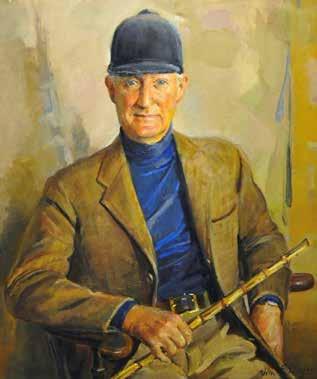
1. Portrait of Paul Mellon by William Franklin Dryer, 1977. Courtesy National Museum of Racing and Hall of fame.
2. Hall of Fame Theater. Photo: Gary Gold
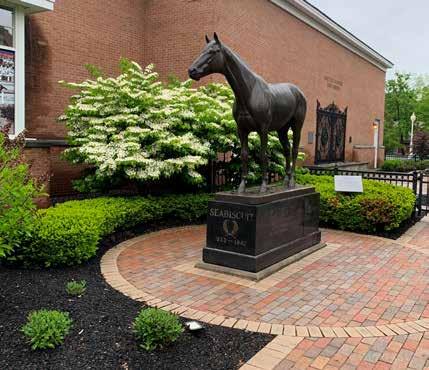
3. Statue of Seabiscuit in front of Beautiful Pleasure Courtyard. Photo: Joe Raucci
2020...
The Future is Now
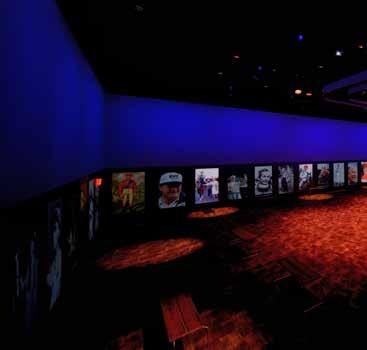
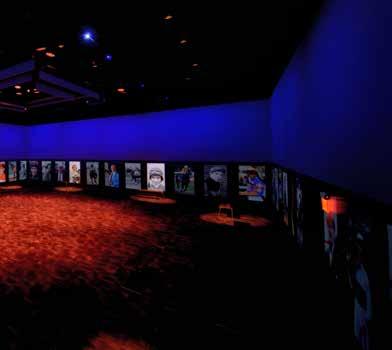
In the year 2020, the most comprehensive makeover of the museum occurred. A campaign to raise twenty million dollars necessary for the project was led by museum president John Hendrickson. He and his wife Mary Lou Whitney spearheaded the effort with a one million dollar contribution. Major additions were made to the museum. A Hall of Fame Gallery was erected. The highlight of the gallery is a film that is shown in the round. The viewer is immersed in a sixteen minute documentary narrated by Bob Costas. Various aspects of the sport are presented with commentary from some of the sports most well known personalities. The gallery is also the home of the Hall of Fame. Interactive touch screens were introduced replacing the bronze plaques that were previously displayed. The viewer can look up the Hall of Fame inductees. A biography of every member is available along with photos and video relating to their careers. Eddie Arcaro, Bill Shoemaker, Man o’ War, Seattle Slew, Secretariat, Johnny Nerud and “Sunny Jim” Fitzsimmons are just a few of the legends of the turf that come to life on the gallery screens.
One of the additions that the fans can enjoy is the “Call the Race” exhibit. Here museum guests can test their announcing skills in a booth that simulates the actual one at the racetrack.
Another attraction is the “Winner’s Circle.” A life size rendition of a horse and jockey in the winner’s circle are depicted. It creates a perfect photo opportunity for those visiting the exhibit.
These are just a few of the innovations that took place during the renovation. What started in a small room in the Canfield Casino has grown into a twenty first century architectural masterpiece. The imposing rooms and galleries that showcase many treasures of the American turf are the result of meticulous planning and monetary donations that made it all possible.
Touring the Museum
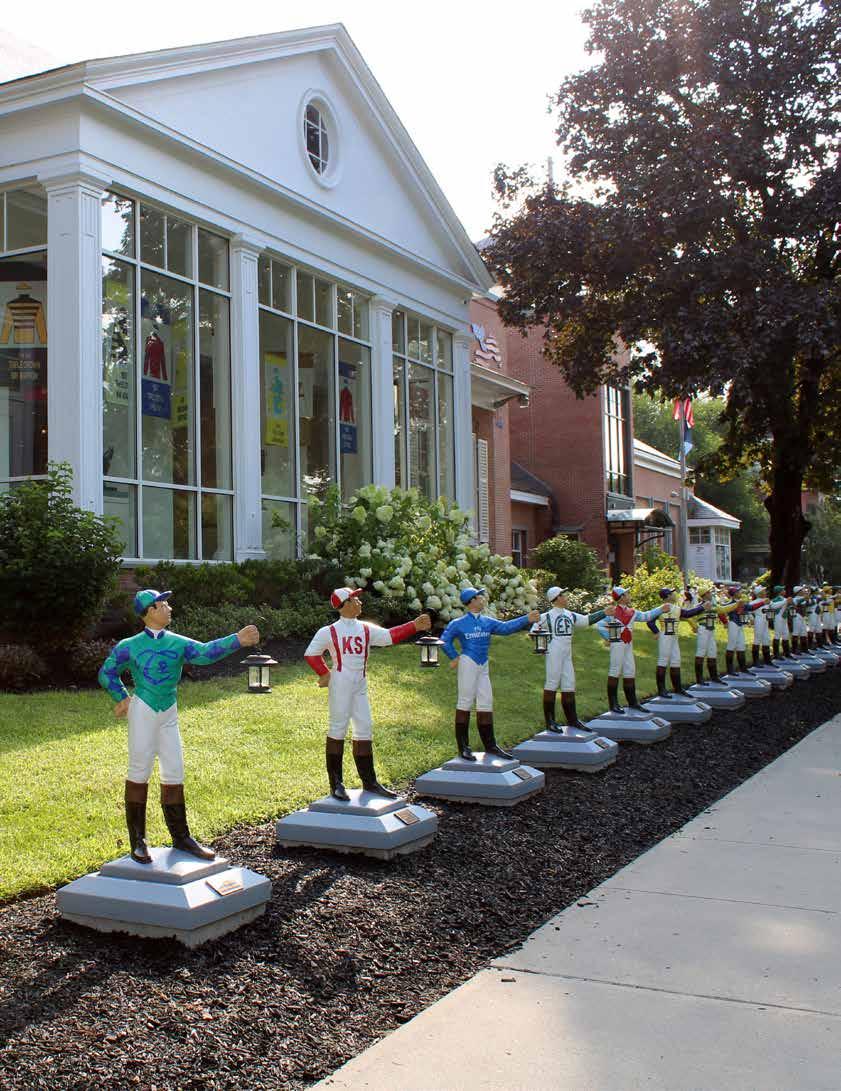
When approaching the museum the sidewalks are flanked by a long line of colorful lawn jockeys. Many represent the great racing stables from the history of the sport, both past and present. The grounds leading to the entrance are perfectly manicured. When entering the museum the guests are met by a friendly and knowledgeable staff.
There is so much to see in the spectacular setting that it may become overwhelming at times. Good advice would be for the visitors to take their time visualizing the many treasures that the museum has on display. It is a learning experience that gives insight as to what has made horse racing a grand and time honored sport.
When leaving the museum a walk through the Beautiful Pleasure Courtyard awaits. It was added to the grounds during the 2020 renovation. In front of the courtyard entrance a life size statue of Seabiscuit can be viewed. The statue was gifted to the museum in the 1990s by the descendants of Charles Howard, the owner of the famous racehorse.
Entering the brick lined courtyard beautiful manicured gardens, benches, lawn jockeys and an imposing fountain await the visitors. A must see is the original iron entrance gate from Pimlico racetrack dating back to 1870. It hangs on the outer wall of the museum facing the courtyard.
A great place to end your visit is the Cornelius Vanderbilt Whitney Courtyard. It is the centerpiece of the outdoor setting. In 2018 the area was named in honor of the first president of the museum. The focal point of the courtyard is a beautiful statue of the great Secretariat in full stride. Bricks with the names of the donors who helped fund the addition line the courtyard floor.
The history of the museum doesn’t end here. It’s an ongoing work in progress. New innovations and displays are a reminder that the management, staff and trustees of the property are always looking toward the future and the betterment of the treasure that is The National Museum of Racing and Hall of Fame.
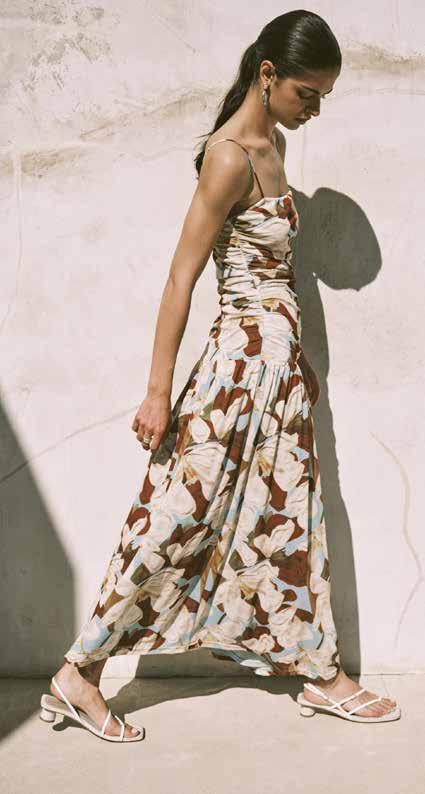
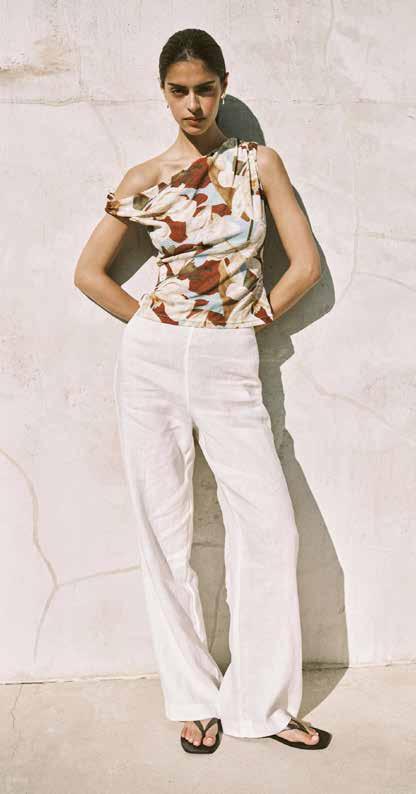
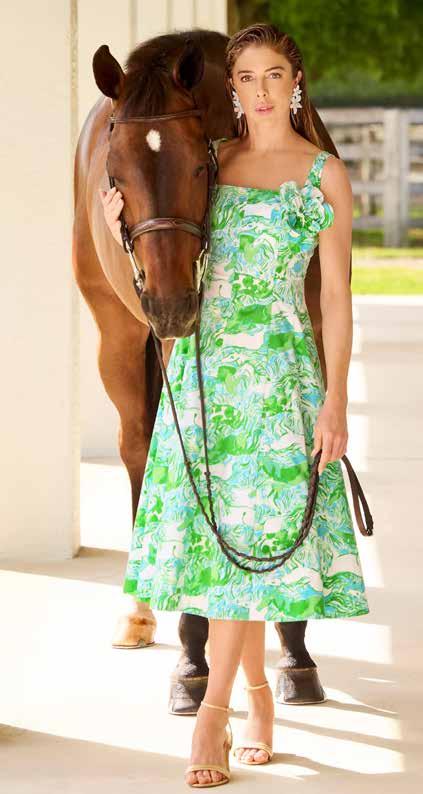
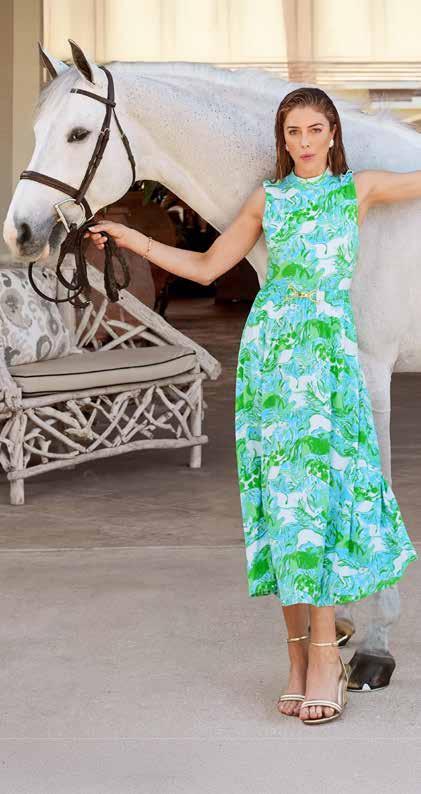
FAsHION SUMMER 2026
Photo: NYRA pgs 36-43
A.P. Smithwick: The Man Behind the Steeplechase
WRITTEN BY L.A. BERRY
Jockey Alfred Patrick ‘Paddy’ Smithwick was barely 30 years-old when he and his timber racehorse-training kid brother Daniel ‘Mikey’ Smithwick said yes to an invitation from the wife of Ogden Phipps to bring a six-year old steeplechase racehorse, with “a disposition as delightful as a children’s hack” and “textbook form over fences,” back to winning form after a year off.
The horse Mrs. Lillian (nee-Bostwick) Phipps lovingly described was Neji.
From 1955 to 1960, Neji (Hunters Moon IV x Accra) would come as close as any American Thoroughbred steeplechase racehorse ever did to common household name status achieving, in less than five years, a trio of Grand National wins, three American Steeplechase Champion/ Horse of the Year titles (1955, 1957, 1958), and an earnings record ($270,834) that stood unchallenged for 22 years.
Paddy Smithwick was replacing Mrs. Phipps’ brother, Peter Bostwick, with whom Neji had twice won the Brook National Handicap (1954, 1955), and 1955 Temple Gwathey Handicap and American Grand National. But when the horse sat out the 1956 season to nurse a splint to a hind leg cannon bone, it was time for a change.
“While recuperating, he acquired a new trainer,” Margaret Worrall wrote in 100 Runnings of the Maryland Hunt Cup. “At the time, Mrs. Phipps had enlarged her racing stable, and Bostwick did not care to commit himself. D.M. (Mikey) Smithwick, 28 at the time, became Mrs. Phipps’
trainer, and brother Paddy, two years older, became Neji’s jockey.”
By the following year, the horses trained by Mikey and ridden by Paddy won 38 races for Mrs. Phipps and a record $220,000, amounting to 30% of all available purse money that season.
With Paddy in the irons, Neji’s comeback led to another four stakes races, plus repeat wins in the Grand National (at 168 pounds) and the Temple Gwathmey (at a record 173 pounds) and a second (1957) Steeplechase Horse of the Year title.
But these were hardly the only achievements in the life of a horseman who, despite standing an inconvenient 5’10” tall, accrued 398 wins as a professional jockey between 1946 and 1966 (second only to Joe Aitcheson’s 440 on the all-time jockey table), and dipped his pen in writing Triple Crown history as owner of the War Admiral granddaughter, Bel Sheba, dam of 1987 Kentucky Derby and Preakness Stakes winner, Alysheba.
AP 'Paddy' Smithwick was jockey and his brother Mikey was trainer for steeplechase horse owner Mrs. Ogden Phipps.
Neji, Pat Smithwick up, Saratoga, August 24, 1960
Photo: Keeneland Library Morgan Collection
Who Was AP Smithwick?
Paddy Smithwick could not help but be smitten by horses. As a kid, he and Mikey lived at the Elkridge-Hartford Hunt Club in northern Maryland, where their father, Alfred, was honorary huntsman and manager of the club.
Alfred fought for the English cavalry in WWI but, after a Sinn Fein assassination attempt, made the jump from Ireland to the United States, where he launched a lucrative business importing Irish horses to sell as foxhunters to an avid Maryland clientele.
“Paddy and Mike worked with their father from age 10,” wrote Betsy Burke Parker in the Temple Gwathmey Steeplechase Foundation (TGSF) digital compilation, Legends of Steeplechase. Paddy, drafted into the U.S. Army in 1945, was stationed overseas when Alfred died so, as the family’s eldest son, he was allowed to leave the Army and return to the United States.
While en route he made what was supposed to be a brief visit to his father’s native Ireland but homages turned into horses. Paddy stuck around long enough to ride in a few races as an amateur and, as his son Patrick Smithwick later described, “got bit and hard” by the steeplechase bug.
It would prove as fierce an addiction as the cigarettes Paddy smoked to assuage his appetite and maintain his lean frame.
“Pop was tall and built more like a lightweight boxer than a jockey,” Patrick said. “All he ate was steak and salad at night and he had to sweat – wearing thermal underwear and blasting the heater in the car -- every time he rode.”
Athletes, including jockeys like Paddy, understood that weight and career management operated simultaneously.
“Paddy was tall for a steeplechase jockey,” Worrall wrote. “He constantly reduced to make riding weights. He frequently drove to hunt meetings attired in a sweat suit with the heater on full blast and was a regular in sweat boxes at major race tracks.”
Tall Boots, Even Taller Horseman
It didn’t matter how Paddy arrived to a meet. What mattered was how he finished it and more often than not that meant in the money. But earnings weren’t the most memorable detail to what TGSF called his “Homeric epic” of a life.
Paddy also reveled in being a father and delighted in watching his love for steeplechasing carry forward to the next generation of Smithwicks. In Steeplechasing in America, Jack Cooper recounted Paddy’s reaction to Patrick, still a teenager, winning the Bowman Bowl on Count Walt at the Virginia Fairfax meet: “Paddy was so excited that he too jumped a fence. It was wire. Paddy made it. His trousers didn’t.”
Bad fences will destroy more than trousers. In July of 1966 at Monmouth Park, at 39 years old and at the height of his career, Paddy was forced to abruptly retire from racing after breaking his neck in a rotational fall over a hurdle on a horse called Totem.
“A week later, I was allowed to see him,” Patrick wrote in his 2006 autobiography, Racing My Father: Growing Up in the Shadow of a Jockey Legend. “The earliest stories I heard were that he wouldn’t live. Then I was told he would live but would be paralyzed for life. Totem had fallen over a hurdle at Monmouth Park, catapulting Pop forward. The ground had been hard and dry and Pop’s neck had taken all the pressure of the fall. His spinal cord had snapped.”
When Patrick turned 39, the same age as his father’s life-altering injury, he and his mother talked about that day. “My mother explained that Pop had been trying to quit riding, to move into full-time training. Mom said she could remember as if it were yesterday the tears in my father’s eyes as his mother sat in our living room over Christmas and told him he had to ride one more year: the year of Bon Nouvel, 1966. The family wanted him to keep going – for where in the family business was there room for two full-time trainers?
Pat
Pat Smithwick and trainer Ed Neley at Hialeah Park, CA. 1967
Paddy was caught in what his son describes as a web of undiminished talent. “If only he had slid off Bon Nouvel in the shed row one morning, taken the red pack of Pall Mall’s from his chest pocket, thrown it down in the manure pile, and said to the groom holding the horse, or to Mikey, or to the owner of Bon Nouvel, or to me, “That’s it!” And yet, then he wouldn’t have been my father. That just would not have been him.”
A.P. “Paddy” Smithwick was who he was and that was enough for fellow horsemen like Bobby Burke: “I loved him like a brother. He was the greatest. Scotty Schulhofer has a photo of Paddy jumping a hurdle on a gray horse at Aiken. The horse’s head is on the ground! Paddy sat back, pulled that sonofabitch’s head up and finished second. For a man to get a horse around a course, there never was and never will be any better.”
The winter after his terrible fall, Paddy surprised Burke with a visit to his South Carolina farm and they shared a few drinks. The next morning, he asked Paddy what he wanted to do and Paddy said to get back on a horse.
“Come on, Paddy, you’re just out of the hospital,” Burke told him.
“Bobby,” he insisted, “I’ve got to do it.”
So Burke says he saddled up a couple of horses and they jogged out to the woods. “Paddy’s balance not looking great, his left side was just sort of hanging. I came up alongside. Paddy kept his eyes on the hurdle, clucked to his horse, and we galloped into it head and head. His horse stood off and Paddy leaned way back, let the reins slide, and managed to stay on. We pulled up. He looked over at me. ‘Well, at least,’ he said, ‘I can still do that.’”
He was also determined to train horses and got his license, and while the left side of his body never regained its original strength, it did not stop him from riding his “stable pony,” the hurdles and timber winner, Crag.
“Even partly paralyzed and decimated by cancer,” Patrick said, “Pop could outride anyone.”
The only challenge this jockey could not outride was cancer, which claimed A.P. ‘Paddy” Smithwick in November 1973.
The following August, A.P. Smithwick was inducted into the National Museum of Racing and Hall Fame, where brother Mike Smithwick (1971) and Neji (1966) were waiting.
In 1980, Saratoga Race Course inaugurated the A.P. Smithwick Memorial Steeplechase and today’s $150,000 A.P. Smithwick Memorial (NSA-1) is a 2 3/8th mile hurdle handicap for older horses. Last year’s winner, Historic Heart, ridden by Danny Mullins and trained by Keri Brion, was a big-hearted, eight-year-old gelding returning -- much like Neji – to the hurdles after a layoff. Paddy would have liked that.
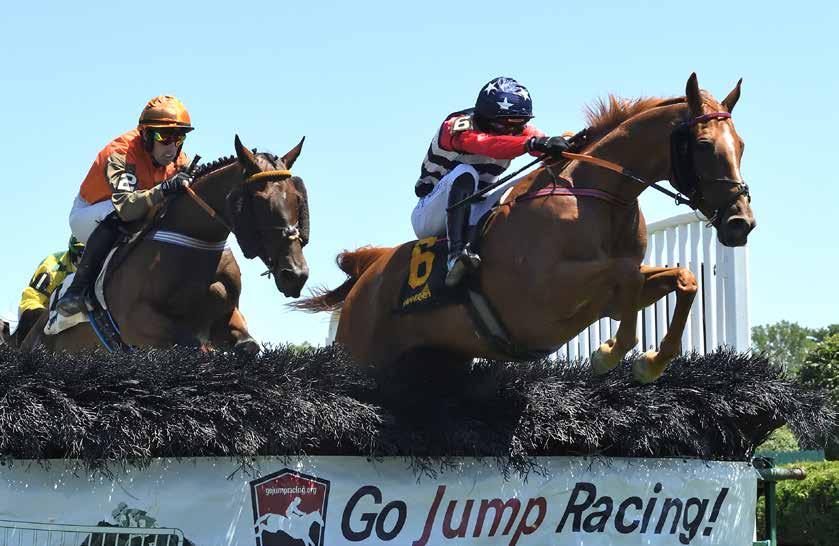
Photo: Susie Raisher / NYRA
Historic Heart completed a long road back from injury to win by a spectacular nose over Proven Innocent in the 2025 G1 AP Smithwick Memorial Stakes. Historic Heart, was bred in Ireland, a nostalgic nod to hurdles namesake and HOF jockey, ‘Paddy’ Smithwick.
Photo: NYRA
Doc McCully and His Modern Methods
ORZELL
In the waning years of the nineteenth century, a Canadian veterinarian and 1890 graduate of the Ontario Veterinary College, who had once practiced with a circus, was engaged at Fleetwood Park in the Bronx. This brought him to New York, where he developed a tremendous reputation in the thoroughbred industry and grew one of the most lucrative veterinary practices that the world has ever known. His name was Dr. Robert W. McCully (sometimes spelled McCulley in publications of the period). WRITTEN BY BILL
His practice through the early decades of the twentieth century involved him with several members of racing’s Hall of Fame, including Colin, Roamer, Exterminator, Man o’ War and Zev. His client list included the leading owners in thoroughbred racing and breeding, including Harry Payne Whitney, August Belmont, William R. Coe, Richard T. Wilson, Willis Sharpe Kilmer, Harry F. Sinclair and Joshua S. Cosden. Dr. McCully also was consulted at sales, and would often act as an agent representing owners, placing auction bids on their behalf. Remarkably, much of Doc McCully’s professional service was provided gratis, establishing a dominating position among his profession on the turf.
In 1908 Dr. McCully was called in when trainer James Rowe suspected his star performer Colin had bowed a tendon. The veterinary determined, as no soreness was apparent as the swelling subsided, that the brown colt had stepped on a stone or in a hole, and although a violent wrench had occurred, there was no tendon damage. This proved to be the case, as Colin won that year’s running of the Belmont Stakes, the test of champions.
This veterinarian also did a lot of business in consigning thoroughbreds to Europe and importing race horses to America, where he took their identification marks, and provided examination and stabling at his 22 E. 36th Street stable in Manhattan, until the imports could be shipped to their new owners. The Saratogian on July 21, 1926 wrote as they welcomed him back to his summer quarters at Elm Court in Saratoga Springs’ Horse Haven, “Dr. McCully is not only known to every owner and trainer in the east but has his friendship and confidence of every stable boy and rider who ever entered the local enclosure.”
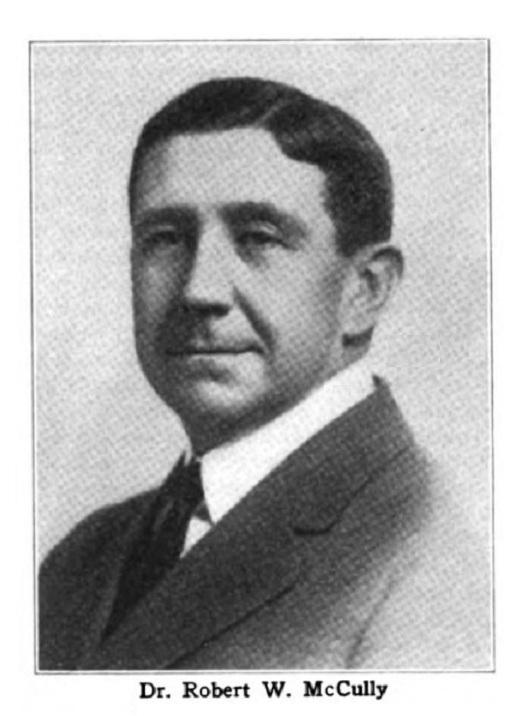
Portrait of Dr. McCully, Veterinary Magazine Corporation 1925.
In addition to Dr. McCully’s normal veterinary responsibilities at various racetracks, he often performed duties as a steward, and was called upon when suspicions of tampering with horses arose. A method of “stopping” a good horse, or at least slowing down a good runner, was to insert a sponge in a horse’s nostril, just out of view. This nefarious device would allow oxygen to reach the lungs, but not in sufficient quantity to run well. Following a race, the perpetrator would remove the device from one or both nostrils, and the disabled animal would return to its previous form.
Dr. McCully became very well acquainted with thoroughbred air passages, and the natural occurrence of colds, pneumonia, and breathing issues. He refined a surgical procedure to correct the disorder, which previously had ended the racing career of many horses.
An equine affliction long known to horsemen was termed “roaring” or “whistling,” and was difficult for veterinarians to combat. This condition in horses is known as laryngeal paralysis, which occurs particularly during racing or other exertion. According to the American Veterinary Medical History Society (AVMHS) sources there were three distinct groups, in three countries, involved in the procedures developed to surgically correct this condition. The first was the Professors Gunther, father and son, the original pioneers in Germany, and though mostly unsuccessful, they documented so much of their work that made the sharing of these surgical ideas possible with others. The second and third
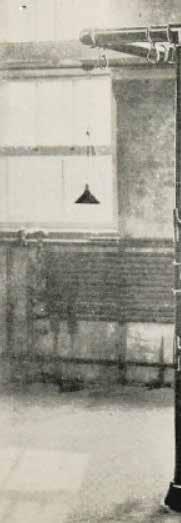
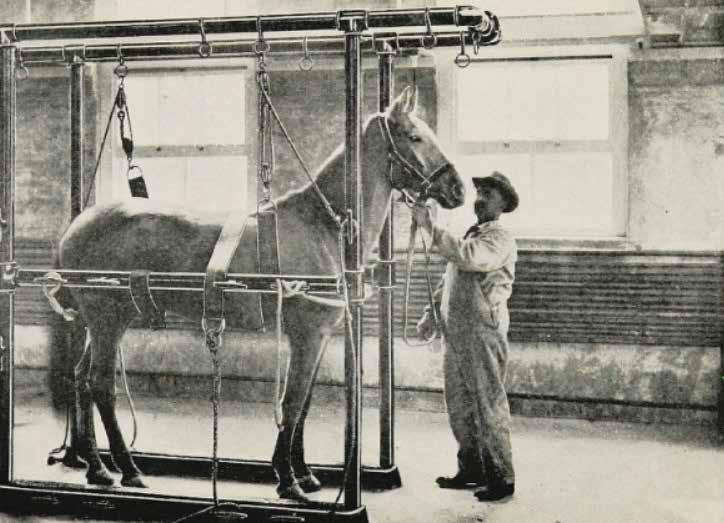
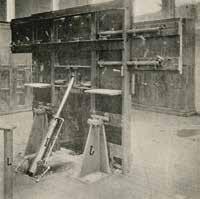
Above: New York State Veterinary College operating table, rear view
Left: New York State Veterinary College metal stocks
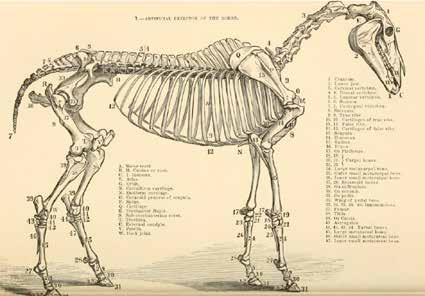
Below: Artificial skeleton of the horse. Image: Library of Congress
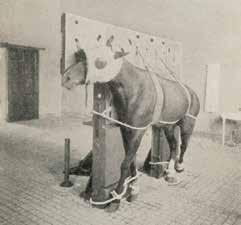
practitioners to be involved were Dr. Walter Long Williams of Cornell, and Sir Frederick T. G. Hobday, working concurrently yet separately, in the United States and the United Kingdom respectively. The Veterinary Journal of 1911 makes it clear these people had the horse’s welfare first. In the paper read by Frederick Hobday, he states that Dr. Williams read his paper to the American Veterinary Medical Association in 1906, and although he laid claim to the originality of several modifications, he learned that American methods included operating only through the cricoid cartilage, without injuring either the thyroid or cricoid cartilage, and to procedurally double strip both ventricles. He also mentioned being aware of the Gunther’s work in Germany. The history of these events is somewhat imprecise, forcing those with an interest toward theory and conjecture. Dr. Walter Long Williams, of Cornell’s New York State Veterinary College, was well known across the Empire State for his pioneering achievements, where at Ithaca in 1897 he developed the first equine operating table. The large import/ export operation that Dr. McCully ran at New York Harbor made him the most likely veterinary liaison between the US and UK, and would also have put him in a position to perform the surgery himself, which there is a substantial record of his doing so.
New York State Veterinary College table, upright position, with horse secured to it after operation, prior to being released.
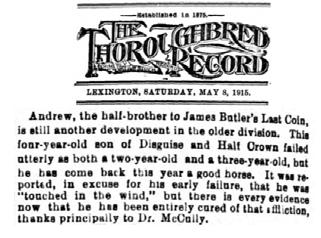
The May 8, 1915 Thoroughbred Record reported that James Butler’s 4-year-old colt Andrew had been an utter failure as both a 2 and 3-year-old because he was “touched in the wind.” They noted Andrew transformed remarkably and,
“There is every evidence now that he has been entirely cured of that affliction, thanks principally to Dr. McCully.”
Star Master, a chestnut son of Star Shoot, was shelved as a three-year-old due to “a wind affection,” however the Daily Racing Form of March 30, 1918 reported the successful throat operation and that,
“It may be a permanent cure, and if it is, great credit is will be due Dr. McCully.”
That was apparently the case as Star Master won and placed in several stakes races afterward.
The Daily Racing Form of June 12, 1921 reported that, “Round Robin, which won the Hollis Stakes at Belmont Park last week, was one of the thick-winded horses cured by Dr. McCully’s modern method.”
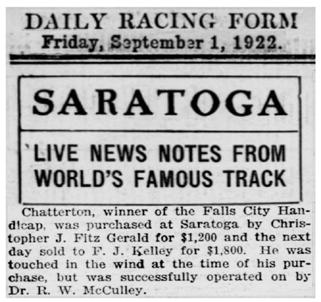
The following summer at Saratoga, the chestnut colt Chatterton, a son of Fair Play, changed hands. The Daily Racing Form September 1, 1922 reported that,
“He was touched in the wind at the time of his purchase, but was successfully operated on by Dr. R.W. McCulley.”
On May 14, 1923 a juvenile named Cockney, who belonged to Mr. and Mrs. Walter Jeffords, won the Pimlico Home-Bred Purse and Plate. The Morning Telegraph reported the chestnut colt won,
“Due to the skill of Dr. McCulley. The youngster showed signs of trouble with his wind as a yearling and Dr. McCulley operated and has done away with the trouble entirely.”
There were multitudinous everyday duties at the tracks for the vet; fevers to remedy, horses with coughing spells or influenza, suturing cuts, firing osselets from fetlock joints and geldings to perform. There was also the ultimate veterinary mercy to occasionally render, such as when the noble Roamer broke his right foreleg in his retirement paddock. These routine duties would be balanced by the honor of being selected as a judge at the annual National Horse Show at Madison Square Garden.
Though being well known to sportsmen with blue-blooded stock, Doc McCully was revered by the hustling horsemen attempting to string together a subsistence at numerous racetracks, where he was a true friend in need.
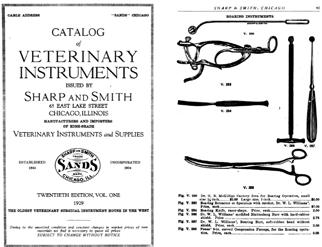
Roaring and tracheal instruments, Catalog of Veterinary Instruments Sharp and Smith 1929.
May 8, 1915 Thoroughbred Record article reporting on colt Andrew's resurgence after being treated by Dr. McCully.
The Daily Racing Form details Dr. McCully performing his operation for horses “touched in the wind” at the Saratoga Race Course.
Certainly, horse racing blends many personalities and motivations. This, unfortunately, might have been a factor in the mysterious 1925 demise of the chestnut colt Sunny Man, who the year before had won the United States Hotel Stakes, the Saratoga Special, and the Whirl Stakes for Willis Sharpe Kilmer of Binghamton, and was considered a strong contender in the three year old crop which would convene in the spring at Louisville. His fate took an unfortunate turn in Maryland, perhaps being poisoned by criminal interests. Dr. Robert McCully was summoned to Pimlico, and was determined to save the colt; however, the effects of the poison had an insurmountable lead.
The owners and trainers who operated on the New York circuit, which included the Metropolitan tracks and Saratoga, realized that many of their employees came to the track early in life, sacrificing what they might have gained in the public schools. Private night schools were created for jockeys, exercise riders, grooms and stable hands to teach the basics of reading, ‘riting, ‘rithamatic and geography. Doc McCully was a willing participant, and his lectures on horse anatomy were well attended.
In the later 1920s, when prohibited stimulants began to become a concern, Dr. McCully was appointed as Veterinary Advisor to the Jockey Club, giving him full authority to oversee the fitness of horses at all racetracks.
As 1927 drew to a close with the annual holiday season, while at home in Manhattan, tragedy struck, with the sudden death of his wife Elizabeth, hours after she had given a Christmas Eve dinner party.
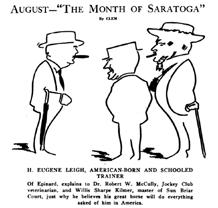
Caricature of Doc McCully and associates at the racetrack, The Field Illustrated August 1924.
His responsibilities to the Jockey Club required him to supervise winter racing at Oaklawn Park. The following January, while in route to Hot Springs, Arkansas, he was involved in a railroad accident. His injuries required minor surgery. Unfortunately, complications set in, which led to his unexpected demise on May 7, 1928 at age 58.
Following his death the Journal of the American Veterinary Medical Association wrote that he was, “a man who probably had the most remunerative specifically equine practice on the North American Continent.”
Dr. McCully was a respected leader in his profession, which held great demands on his nerve and skill, while recognized as a friend by everyone connected to the stable, from owner to groom.
Cheryl White Cheryl White America’
BERRY
IIt’s not every day that a children’s toy writes a chapter in American horse racing history. But it’s not every day that racing history meets a jockey like Cheryl White.
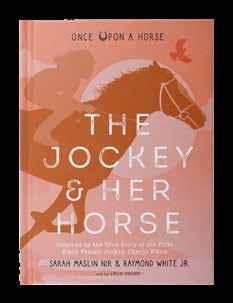
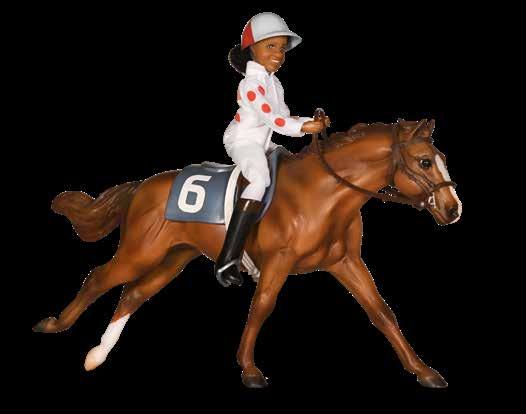
The Cheryl White / Rider, Horse and Book Set by Breyer® Horse Models first introduced horse lovers and collectors to Cheryl and her chestnut American Thoroughbred, Jetolara, in 2023. Accompanying the set was the fictional novel, The Jockey and Her Horse, by New York Times writer Sarah Maslin Nir and Cheryl’s brother, Raymond White, Jr., and inspired by the true story of the girl who became America’s first Black female jockey.
The fully articulated model became the first Breyer figure depicting not only a real-life equestrienne’s face but also her hair.
From the Gate
Cheryl’s break from the gate toward a racing career began like any young hopeful: with a good bloodline. She was born in Cleveland, Ohio, where her mother Doris was described as a PolishAmerican racehorse owner and her father (a former jockey) trained Thoroughbreds. ‘Mr. Raymond,’ as he was known, had his daughter riding and racing by her teens, albeit Cheryl modestly quipped that she “didn’t exactly tear up the track.”
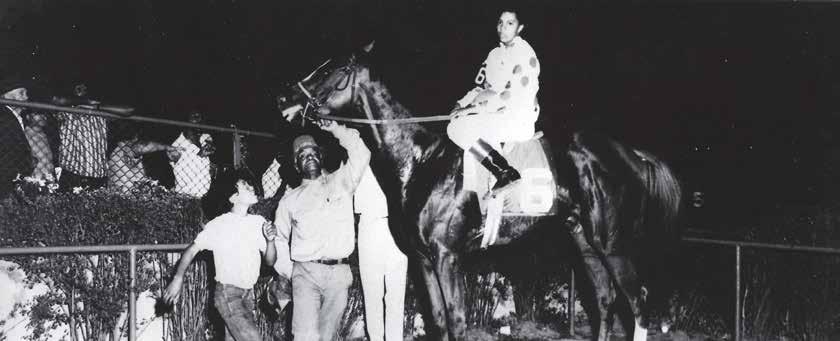
But those lucky enough to be at Waterford Park in West Virginia on September 2, 1971 did get to see her tear it up, sending Jetolora (Jet Ace x Halara), bred by her mother and trained by her father, across the finish line and into history as the first Black female jockey to win a race. But wait there’s more.
Known today as Mountaineer Casino, Racetrack & Resort, Waterford Park’s one-mile dirt oval was a popular hub for nightly racing when, that same September, it shared Cheryl’s next milestone, posting two wins in one day on two different horses at two different -- Waterford Park and Thistledown (Ohio) -- tracks.
Making History
Cheryl White up, Jetolara, September 2, 1971 at Waterford Park, W.Va. This was the 1st win of White's career, and also made her the first Black female jockey to win a race.
That earned an invitation from Atlantic City, to ride on August 28, 1972 in the second annual 1 1/8-mile on grass all-female Boots and Bows Handicap. She accepted and legged up Heliamber, a great-granddaughter of Man O’ War and Hyperion, to race against 13 other mares and fillies, all with the fairer sex in their irons.
The two were long shots until -- 1:51 3/5 and 2 ½ lengths later -- they endeared themselves to bettors with a $49.40 winning payout on their $2. Betts Mandy, under Donna Hillman, placed second. Whistlers Aunt, ridden by Lois Meals, was third.
“Miss White,” a New York Times reporter genteelly noted, was an “undergraduate at Bowling Green, is from Cleveland and does not ride regularly as a professional.”
Indeed, Cheryl had graduated in the top 10% of her high school class and, with a college scholarship secured, was planning to major in mathematics and teach algebra. She had appeared on the TV student quiz show, It’s Academic, had run track and captained her Grand Valley High School basketball team and yes, if being a jockey didn’t work out, she was ready to become a math teacher.
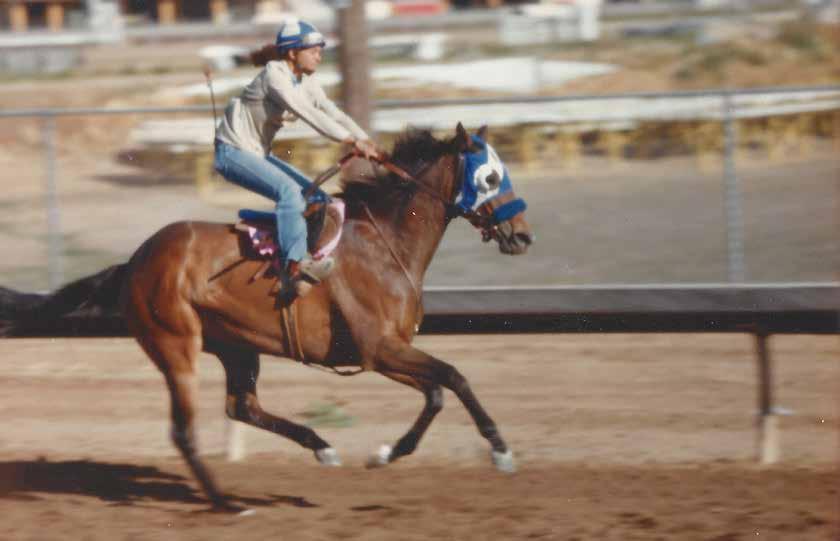
Plans change. She came home from a vacation to California in 1973 with a life-changing souvenir: the horse bug. A year later she was on the West Coast, racing at two of 10 California Fair Circuit tracks. Within another year, she was riding at all of them. It was the start of her career as a racehorse jockey in at least five — Appaloosa, Arabian, Paint Horse, Quarter Horse and Thoroughbred — breeds.
By the Numbers...
As of 2025, only 4% to 8% of the 750-1000 members of the Jockeys Guild are Black; no publicized numbers of any Black female jockeys are currently available. 4-8% 1%
Of roughly 43,000 U.S. Hunter Jumper Association members less than 80 are Black. 80
2025
Less than 1% of USEF-registered competitive equestrians identify as Black
Polo has recently produced high goal pioneer, Shariah Harris, the first Black woman to compete in the US Women’s Polo Championship, and in 2025, Atlanta B.E.S.T. Academy formed the nation’s first all Black high school polo team.
“Her overall Life Time Record of wins, all breeds, is staggering – 750 total races won,” notes her Appaloosa Horse Club (ApHC) Racing Hall of Fame biography.
“Consider the year – 1974 – a young, Afro-American, female, starting a racing career in a sport dominated in all phases by males. It was not exactly a level playing field for succeeding. As the record will show however, succeed she did, and at a level which was impressive by any standard.”
By 1977, Cheryl was the first woman to accept an ApHC Jockey of the Year award and made racing history yet again as the first woman to win five races in one day – October 19, 1983 -- at the Fresno Fair in California.
“The last winner I rode that day,” she drolly said, “was Montfort. A 10-year-old making his 100th start.”
Don’t knock staying power. That year (1983) was not only the first of three consecutive ApHC Jockey of the Year titles for Cheryl, but concurrent with three consecutive (1983-85) Leading Jockey on the California Fair Circuit awards.
She would return to the Golden State in 1991 to become its first female racetrack steward, shortly after the African American Sports Hall of Fame recognized her with its Award of Merit. In 2011, the Appaloosa Horse Club inducted her into its Hall of Fame.
Cheryl kept riding into Thoroughbred and Appaloosa racehorse winner’s circles more than 750 times before passing at age 65 in 2019.
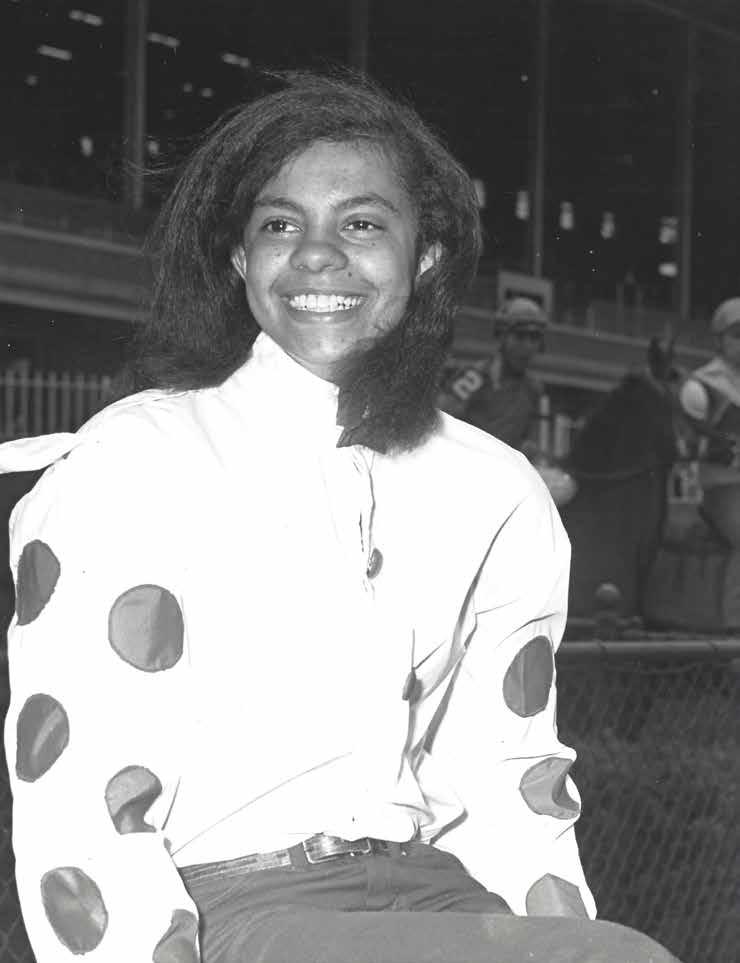
Photo: Cheryl White riding, 1985.
2010
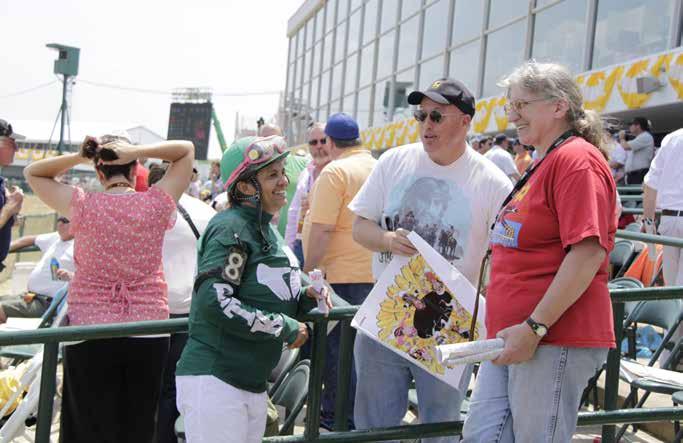
Cheryl White signing autographs for fans at the 2010 Preakness
The Write Stuff
Look for the Cheryl White / Rider, Horse and Book Set by Breyer® and other horse and rider models at area shops like Breyer Flagship store The Cheshire Horse of Saratoga (402 Geyser Road), G. Willikers (461 Broadway), Impressions of Saratoga (368 Broadway) and Replay Toys (Burnt Hills and ebay), or online at BreyerHorses.com. Purchase the book, with illustrations by Laylie Frazier, separately at Abramsbooks.com and wherever books are sold.
The Breyer set honors Cheryl and Jetolara’s place among Black contributors to a sport historically built on the labor of enslaved people, and as co-authors of The Jockey and Her Horse, Cheryl’s brother, Raymond Jr., and New York Times reporter and two-time Pulitzer Prize finalist, Sarah Maslin Nir, saw a story that deserved telling.
“As a writer I uncover hidden histories,” Sarah said. She and Raymond Jr. met at the Cheryl C. White Memorial Stake held each October in Ohio at the Hollywood Gaming Mahoning Valley Race Course. She says the toy company’s release is a more thorough recounting of Black contributions to horse racing. “Kids will see themselves in Cheryl.”
Raymond Jr. grew up wearing more than one hat in the family horse business – jockey agent, exercise rider, assistant trainer, groom – but grew too tall to be a jockey like his sister. Instead he poured what he remembered into The Jockey & Her Horse and dedicated to “My sister the legend.” It was up to him to comb through every detail to assure that Breyer® rendered her image faithfully: “We started with a baldheaded doll’s face. If it wasn’t right, from the nose to the hair, I didn’t approve it.” It grew
into a collaborative effort among those who loved and remembered Cheryl.” I’d share [a working model] with our family and friends, and get their input, too.”
One detail that had to be absolutely correct was the Black jockey’s hair.
“She always had her hair in a ponytail or puffballs under her helmet,” he said. “Breyer made it perfect.”
Representation is as important now as it was on July 19, 1971, when this young jockey shared the covers of Jet magazine with such consequential Black figures of her day as boxing champion Muhammad Ali, Congressman John Conyers, civil rights activist Angela Davis, and entertainer Sammy Davis, Jr.
“To say Cheryl White competed with and excelled against the boys is an understatement,” her ApHC Racing HOF commemoration states. “While outstanding female jockeys are rather commonplace in today’s world of horseracing, she faced and overcame the challenges of her times, and her contributions to the industry, and to all the jockeys that would follow, were groundbreaking.
“Cheryl was more than the first. She excelled and set new standards.”
One of the Best Rides in The History of the Sport...
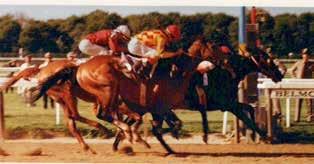
Cordero's Ride on Bold Forbes in the 1976 Belmont Stakes
WRITTEN BY WILLIAM G. GOTIMER JR.
This year marks the 50th anniversary of what many racing historians consider the best ride in the history of the Triple Crown. The year 1976 saw Angel Cordero, Jr. coax, cajole and carry a fast sprinter named Bold Forbes to victory in the Belmont Stakes – the mile and a half “Test of Champions”. It was no easy feat. Watching the replay of the race fifty years later, one can be excused for feeling that they are simply watching a tiring horse struggle to the finish line and barely hold on for the win. However, the accomplishment was far more than meets the eye. Bold Forbes was a sprinter, by both style and pedigree and all indications were that longer distances would be his undoing. No one told the colt, but many told his trainer and rider that his speed would not last around two turns. Rather than be deterred both trainer Laz Barrera and jockey Angel Cordero, Jr. developed a plan.
1976
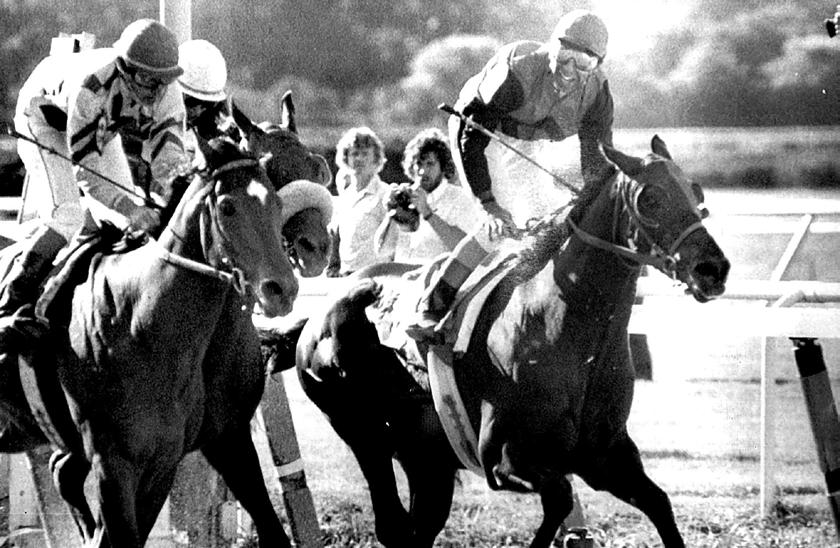
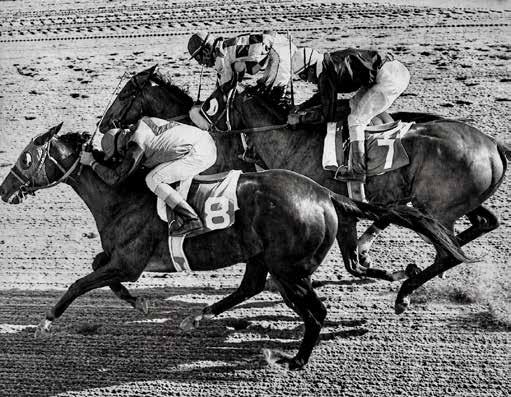
Bold Forbes with Angel Cordero, Jr. up at the finish line of the 1976 Belmont Stakes. AP Photos
Photo: Bob Coglianese/ NYRA
The horse Cordero dubbed his “Puerto Rican Rolls Royce” (later mistakenly dubbed the “Puerto Rican Cadillac”), had normal origins. Foaled in Kentucky, Bold Forbes was bred by Eaton Farms, Inc. and Red Bull Stable. He was owned, by Estéban Rodríguez Tizol, a Puerto Rican banker, who purchased him for $15,200 from the 1974 Fasig-Tipton Kentucky yearling sale. His connections took him immediately to their native Puerto Rico where he easily won his first five races by open lengths and it soon became apparent that Bold Forbes had talent that demanded he come to the mainland. Bold Forbes was transferred to top trainer Laz Berrera and quickly won two stakes, one at Belmont and one at Saratoga before suffering “bucked shins”, a typical injury to young horses, ending his season. Those two-year old efforts proved he belonged in the upper echelon and garnered him the title of Puerto Rico Two-Year Old of the year but the same honor for greater North America went to a juggernaut and fellow speedster named Honest Pleasure. That colt hailed from the powerful LeRoy Jolley barn which had just produced the similarly named Foolish Pleasure and numerous other stakes winners. As the winter of 1975 took hold, it was widely expected that Honest Pleasure would be the main force in the 1976 Triple Crown.
A collision course of speedsters was set.
(RIGHT)
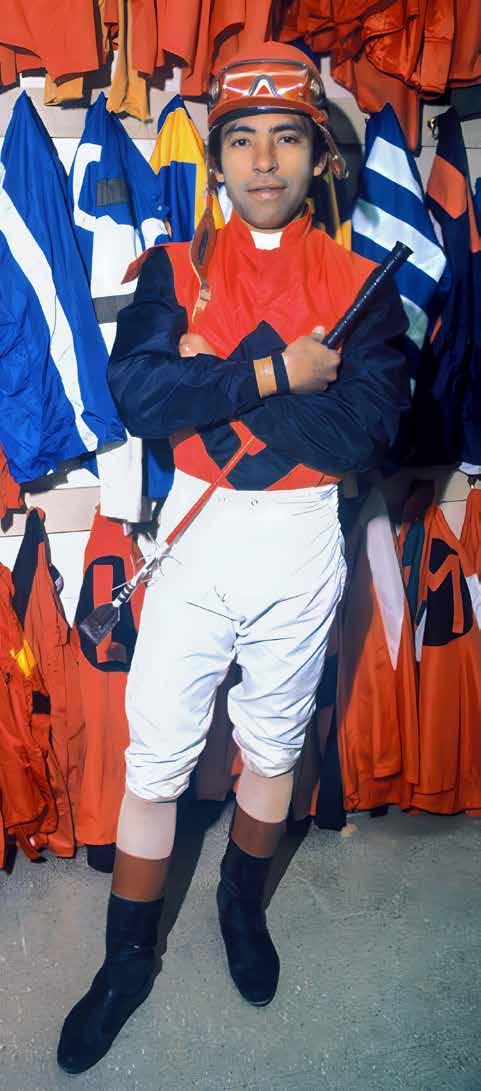
Angel Cordero, Jr. dressed in ER Tizol silks (ABOVE)
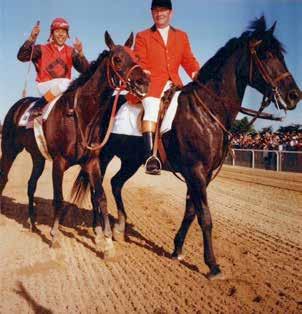
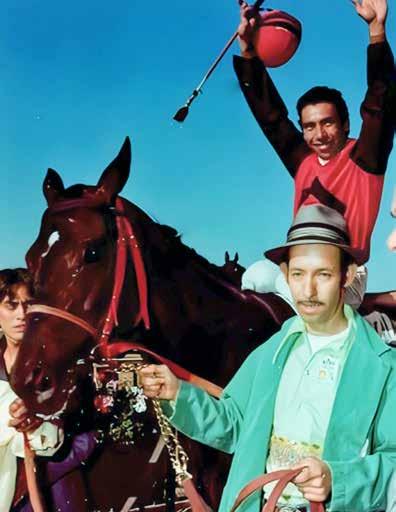
Bold Forbes, Angel Cordero, Jr. up post race at the 1976 Belmont Stakes
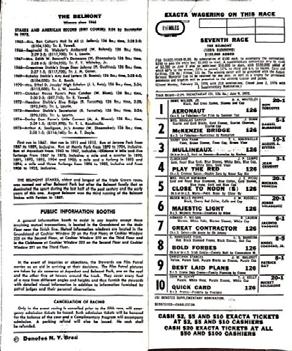
Pick Sheet for the 1976 Belmont Stakes Place Your Bets!
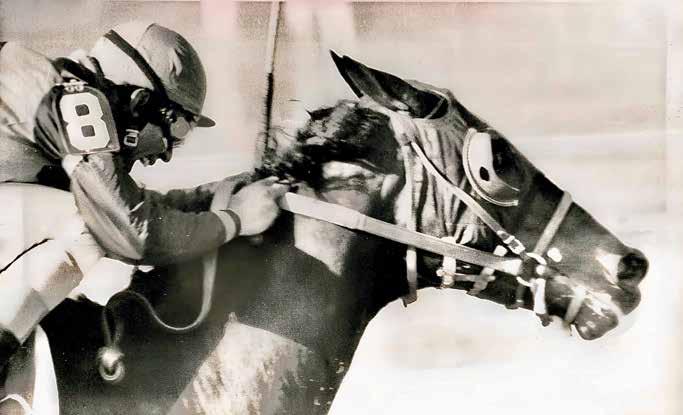
Bold Forbes, Angel Cordero, Jr. uppost position #8.
Track: 1 1/2 Miles AP Photos
Chasing sunny weather and uninterrupted training, Barrera got nothing of the sort as rain inundated Southern California that winter. Bold Forbes’ four starts at Santa Anita to begin his Triple Crown campaign were less than stellar but Barrera was undaunted reasoning that his speedy, but nervous, colt simply did not care for the Santa Anita surface. He promptly returned to New York to prepare in earnest. The “New York route” to the Kentucky Derby was a popular one at that time and after successfully winning the sevenfurlong Bay Shore Stakes, in stakes record time, it was time to stretch him out in distance and try two turns. The one mile and one-eighth Wood Memorial would be that test.
In the Wood Memorial Bold Forbes won easily again setting a stakes record time but critics pointed to the slow early pace of that race as undercutting the result and voiced skepticism that he could carry his speed when pressed early. They predicted the combination of Honest Pleasure’s speed and the extra eighth of a mile in the Kentucky Derby would be Bold Forbes’ undoing. To prepare for the added distance Barrera began galloping Bold Forbes two miles in the morning to build stamina.
When the first Saturday in May arrived, Barrera, Cordero and Bold Forbes took no prisoners – they treated the Kentucky Derby as a sprint and played “catch me if you can” setting extremely fast early fractions while Honest Pleasure’s rider – Braulio Baeza rode more conservatively (perhaps due to Jolley’s persistent criticism of most of Baeza’s recent rides). When Honest Pleasure moved to within a half-length of Bold Forbes in the stretch the smallish colt became determined and held him off moving away towards the wire to victory. Barrera and Cordero felt vindicated – critics remained unconvinced and blamed the ride on Honest Pleasure for the favorite’s defeat.
They met again two weeks later in the Preakness and this time there would be no uncontested lead. The connections of Honest Pleasure were determined not to let the race be a repeat of the Derby and the suicidal early fractions that ensued between the protagonists cost both runners who became vulnerable to Elocutionist’s (third in the Derby) late run to victory.
While the effort in the first two legs of the Triple Crown took its toll on Honest Pleasure forcing him to skip the Belmont, the connections of Bold Forbes pushed on to the Belmont and the punishing distance of a mile and one-half, despite suffering an injured coronet band (an injury to his hoof) during the running of the Preakness.
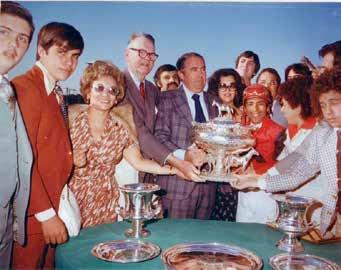
Without Honest Pleasure, the Belmont Stakes then became all about Bold Forbes, all about the distance of the race and all about Puerto Rico. The New York Racing Association hired Tito Puente –“El Rey de los Timbales,” or “The King of the Timbales” - and his orchestra to play and the Governor of Puerto Rico, Rafael Hernandez Colon was invited to attend. Cordero appeared with the band earlier in the day wearing the red and black silks of Bold Forbes’ owner, Estéban Rodríguez Tizol, whom Cordero emotionally recalled had given Cordero his first mount as a jockey back in El Comandante racetrack in 1960 (finishing 4th). All that stood in the way of a celebration was one and a half miles.
To negotiate that trip took some ingenuity. It was important to dole out Bold Forbes’ speed by setting internal race fractions of no faster than 47 seconds (47) for the first half-mile, 1 minute 11 seconds (1:11) for the first six furlongs and 1 minute and 38 seconds (1:38) for the first mile if the speedster was to last the full mile and onehalf. Racing historian Eugene Viti recalls, “Cordero was skeptical, but Barrera remained confident, Barrera told Cordero, ‘get the first half-mile no faster than 47 seconds and you can put the beans on the fire because we are going to eat!’ Cordero continued to have his doubts but dutifully nodded and smiled then accepted the challenge.
Barrera and Cordero now had plans – and a secret. A secret Barrera would afterwards reveal - “Now I can tell a secret, something I wouldn't mention except that the Triple Crown races are now over. I noticed while we were in California and in Puerto Rico that our colt runs fastest when he's close to the rail.” Therefore, the trick to slowing down Bold Forbes was to keep him away from the rail early in the race. It meant traveling an extra distance, but it would allow him to save his early energy.
When the gates opened in the Belmont Cordero executed the plan to perfection by going wide into the clubhouse turn and down the back stretch. He nursed the favorite along in the desired 47 seconds for the first half-mile and 1:11 for six furlongs - but the colt had enough of the restraint when briefly challenged by one of his opponents and rushed to the mile marker two seconds faster than the desired 1:38 - reaching there in 1:36. Lasting to the wire would now be a challenge.
The rider said before the race he whispered to the colt, “get me to the eighth pole and I will get you to the wire” and so it was. Bold Forbes ran hard and fast to the eighth pole and then, exhausted, he relied on Cordero to make good on his promise.
It was a delicate balance, Cordero allowing a tired colt to save enough energy as not one, but two opponents steadily gained in the final yards – each quickly getting closer as the wire beckoned – before finally nudging the colt in the final yards to give one more push. Cordero gave the left-handed cue at the final moment, and the colt responded lunging for the wire in a desperate three horse photo. The favorite had won. The band played. The sun shined.
In the Winners’ Circle Cordero and Barrera were greeted by Governor Rafael Hernandez Colon of Puerto Rico, hearty embraces were engaged by the trio. Around the circle, greetings and words of praise were shouted in Spanish by fans. Cordero again paid tribute to Estéban Rodríguez Tizol who was too ill to attend the Triple Crown races in person.
One of the best rides of Triple Crown history was in the books.
Some final notes:
• Eugene Viti believes Bold Forbes was one of the most underrated colts in American racing history. But for the injury in the Preakness, Viti believes he would have won the Triple Crown.
• In his Belmont Stakes victory, Bold Forbes injured himself again grabbing a quarter coming out of the starting gate, shearing off part of a front heel.
• To that date only Secretariat, in 1973, with a time of 2:24, had substantially faster fractions than Bold Forbes. Riva Ridge - whose 2:28 Belmont victory in 1972 was the fourth fastest - did not set as fast a pace as Bold Forbes.
WATCH IT HERE:
Photo: Bob Coglianese/ NYRA
Photo: Bob Coglianese/ NYRA
In the Homestretch...
Belmont Park Race course
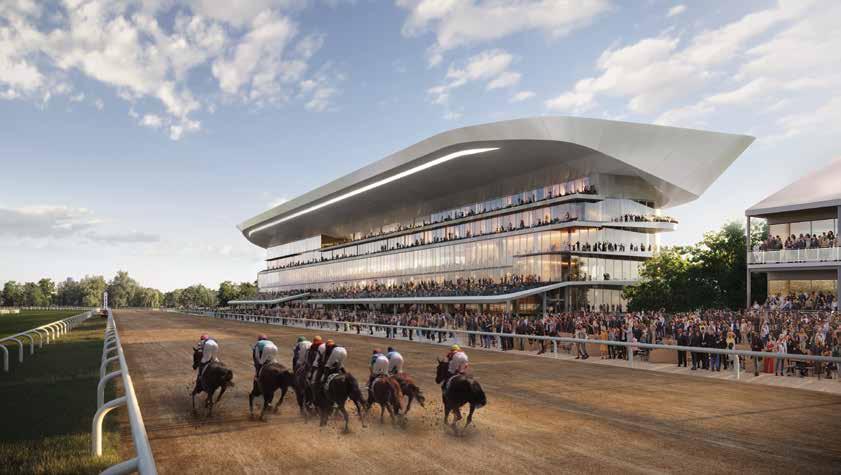
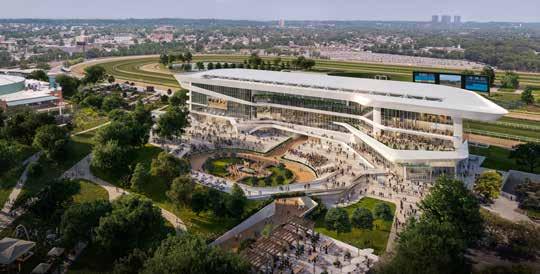
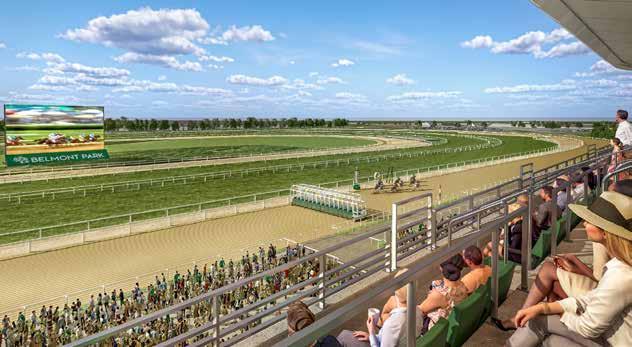
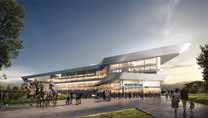
After three years of construction, the newly re-designed Belmont Park is scheduled to open on Friday, September 18, 2026.
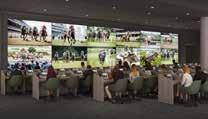
At a cost of more than $400 million, the park will feature a modern 250,000-square-foot grandstand and clubhouse.
The reimagined state-of-the-art venue will kick-off racing with an Opening Day program anchored by the Grade 1, $1 million Jockey Club Gold Cup! For more information visit: nyra.com/belmont