Garvey Kia Opens State Of The Art Dealership On Quaker Road In Queensbury
Glens Falls Pursues Parking Reforms And Development Initiatives Downtown
Courtesy Garvey Kia
that had to be made.”
BY PAUL POST
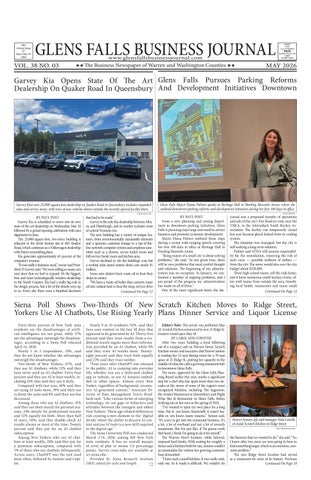
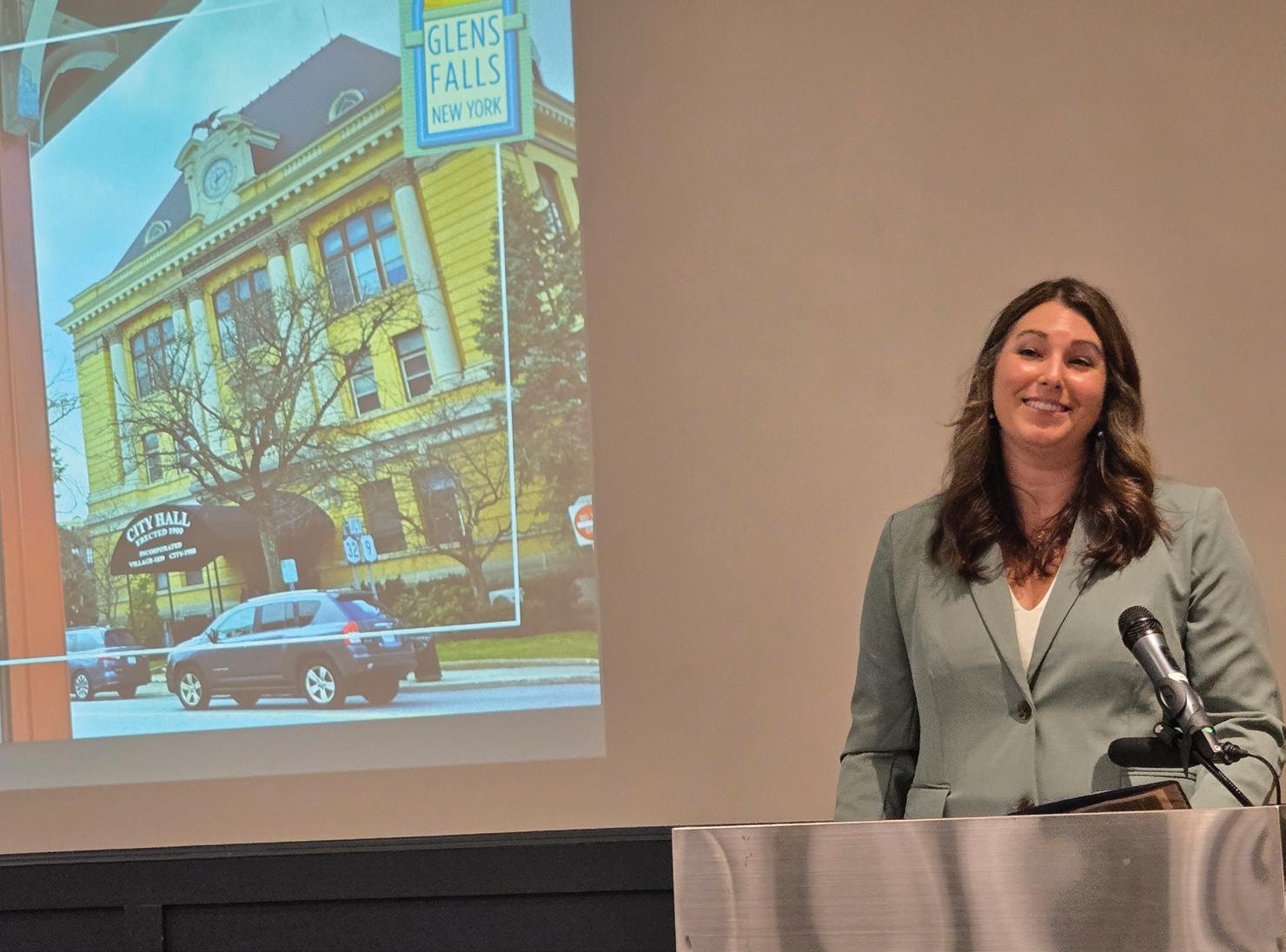
Garvey Kia is scheduled to move into its new state-of-the-art dealership on Wednesday, May 20 followed by a grand opening celebration with area dignitaries in June.
The 25,000-square-foot, two-story building is adjacent to the firm’s former site at 483 Quaker Road, which continues as a Volkswagen dealership with future remodeling plans.
Kia generates approximately 65 percent of the company’s revenue.
“It was really a business need,” owner and President J.P. Garvey said. “We were selling so many cars next door that we had to expand. It’s the biggest, best and most technologically modern dealership in the North Country. Kia had a really big role in the design process, but a lot of the details were up to us. Every day there were a hundred decisions
Garvey is the only Kia dealership between Albany and Plattsburgh, and its market includes most of central Vermont, too.
The new building has a variety of unique features, from environmentally sustainable elements and a spacious customer lounge to a top-of-theline network computer system and employee amenities such as a shower, secure locker room and full-service break room and kitchen area.
Garvey declined to cite the building’s cost, but a rooftop solar panel system alone cost nearly $1 million.
Some auto dealers burn waste oil to heat their shops in winter.
“We have a waste oil boiler that converts waste oil into radiant heat to heat the shop, service drive
Continued On Page 12
Siena Poll Shows Two-Thirds Of New Yorkers Use AI Chatbots, Use Rising Yearly
Forty-three percent of New York state residents say the disadvantages of artificial intelligence are too great, while 37% say the advantages outweigh the disadvantages, according to a Siena Poll released April 14, 2026.
Nearly 1 in 5 respondents, 19%, said they do not know whether the advantages outweigh the disadvantages.
Two-thirds of New Yorkers, 67%, said they use AI chatbots, while 32% said they have never used an AI chatbot. Forty-four percent said they use AI at least weekly, including 21% who said they use it daily.
Compared with last year, 48% said they are using AI tools more, 39% said their use is about the same and 8% said their use has decreased.
Among those who use AI chatbots, 41% said they use them mostly for personal reasons, 24% mostly for professional reasons and 32% equally for both. More than half of users, 56%, said they double-check AI results always or most of the time. Twenty percent said they pay for an AI chatbot subscription.
Among New Yorkers who use AI chatbots at least weekly, 28% said they pay for a premium subscription, compared with 5% of those who use chatbots infrequently. Across users, ChatGPT was the tool used most often, followed by Gemini and Copilot.
Nearly 9 in 10 residents, 92%, said they have seen content in the last 30 days that appeared to be generated by AI. Thirty-five percent said they trust results from a traditional search engine more than information provided by an AI chatbot, while 8% said they trust AI results more. Twentyeight percent said they trust both equally and 23% said they trust neither.
“Four years after ChatGPT was released to the public, AI is creeping into everyday life, whether you use a dedicated chatbot app or website, or use AI features embedded in other spaces. Almost every New Yorker, regardless of background, encounters AI-generated content,” Associate Director of Data Management Travis Brodbeck said. “Like various forms of emerging technology, we see gaps in behaviors and attitudes between the youngest and oldest New Yorkers. These age-related differences risk creating a new element to the ‘digital divide’ where the ability to discern AI content and use AI tools is a new skill required in the digital age.”
The Siena University Poll was conducted March 3-14, 2026, among 810 New York state residents. It has an overall margin of error of plus or minus 3.6 percentage points. Survey cross-tabs are available at sri.siena.edu.
Provided by Siena Research Institute (SRI); edited for style and length.
BY PAUL POST
From a new planning and zoning department to downtown parking initiatives, Glens Falls is pursuing steps large and small to attract business and promote economic development.
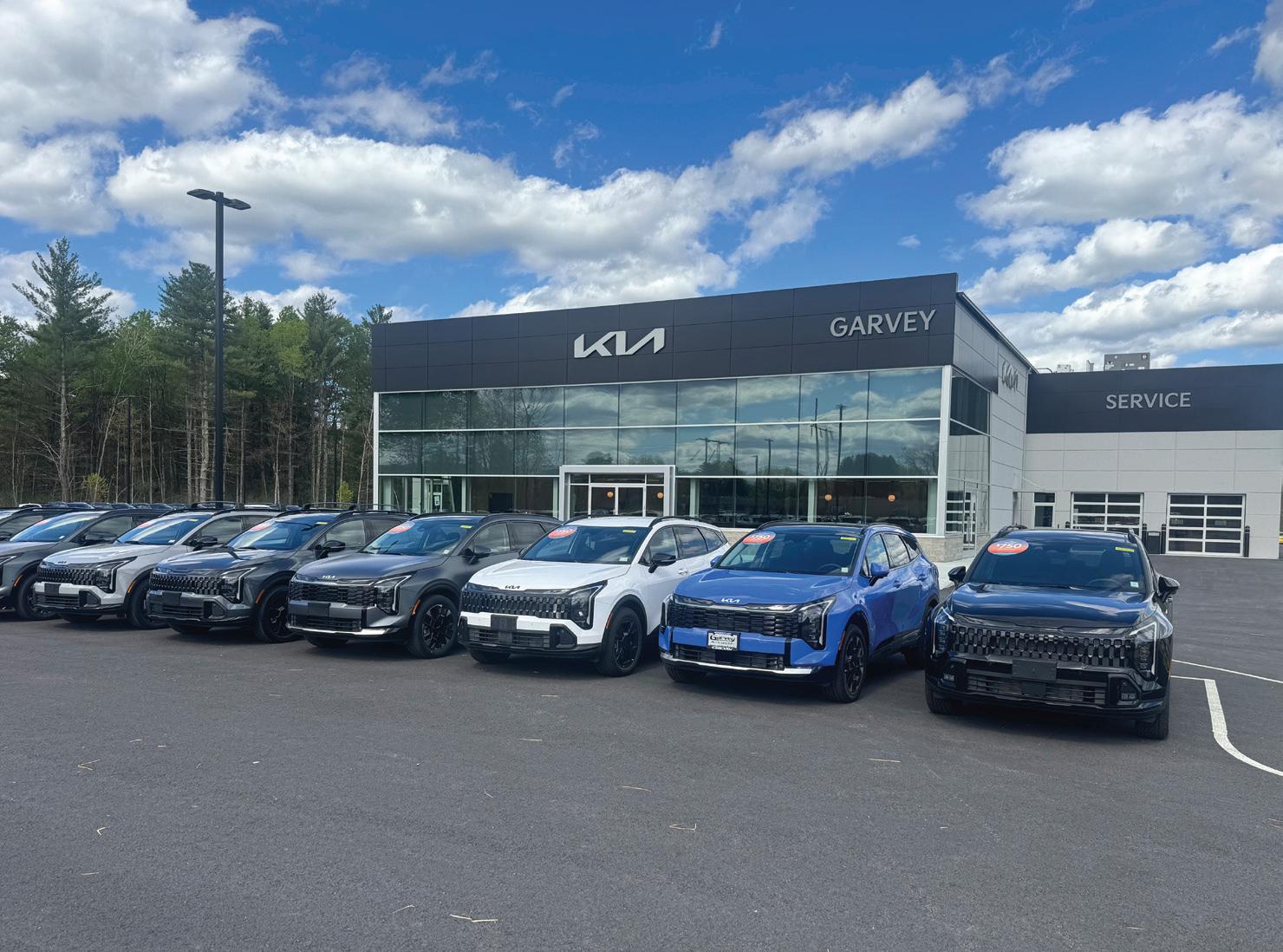
Mayor Diana Palmer outlined those steps during a recent wide-ranging speech covering her first 100 days in office at Heritage Hall in Harding Mazzotti Arena.
“Being mayor of a small city is about solving problems,” she said. “At any given time, there will be new problems that need careful thought and solutions. The beginning of my administration was no exception. In January, we confronted a number of ongoing problems, and I am proud of the progress my administration has made on all of them.”
One of the most significant items she dis-
cussed was a proposed transfer of operations and sale of the city’s Fire Road ice rink, near the YMCA, to the Adirondack Youth Hockey Association. The facility was temporarily closed last year because glycol leaked from its cooling system.
The situation was managed, but the city is still seeking a long-term solution.
Palmer said AYHA will assume responsibility for the remediation, removing the risk of such costs — possibly millions of dollars — from the city. The move would also save the city budget about $250,000.
Three high school teams call the rink home, and it hosts numerous youth hockey events, often with teams from outside the area, benefiting local hotels, restaurants and many small
Continued On Page 12
Scratch Kitchen Moves to Ridge Street, Plans Dinner
Service and Liquor License
Editor’s Note: This article was published May 14. Scratch Kitchen announced its new 21 Ridge St. location would open May 18.
BY CAROL ANN CONOVER
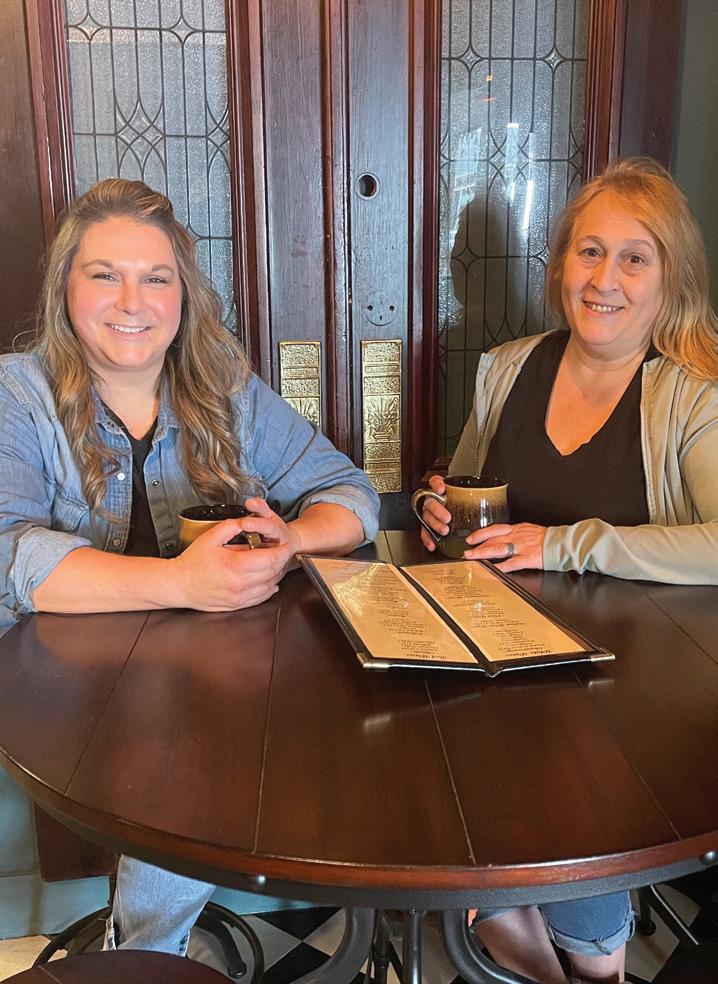
After two years building a loyal following out of a compact cafe on Warren Street, Scratch Kitchen owner and executive chef Denver Semon is trading her 12-seat dining room for a 70-seat space at 21 Ridge St., putting her squarely in the middle of what she calls a growing restaurant hub in downtown Glens Falls.
The move, approved by the Glens Falls Planning Board earlier this year, marks a significant step for a chef who has spent more than two decades at the stoves of some of the region’s most recognized kitchens, including The Sagamore, the Aviator Restaurant in Queensbury and Flight Wine Bar & Restaurant in Glens Falls, before striking out on her own in the spring of 2024.
“I’ve wanted to open my own place for a long time, but it, you know, financially it wasn’t feasible or, you know, many reasons,” Semon said. “It’s scary to get into the restaurant business. It’s a lot, a lot of overhead and not a lot of rewards sometimes. But I’m just like, if I’m gonna work that hard, I think I’m going to do it for myself.”
The Warren Street location, while beloved, imposed hard limits. With seating for roughly a dozen and a kitchen built for one, Semon couldn’t accommodate the volume her growing customer base demanded.
“I have such a small kitchen. It was really only, only me. So it made it difficult. We couldn’t do
the business that we wanted to do,” she said. “So, I knew after two years we were going to have to find something larger, which is an awesome, awesome problem.”
The new Ridge Street location had served as a restaurant for most of its history. Previous
Denver Semon, left, and manager Nicki Loiselle sit inside Scratch Kitchen on Ridge Street. Glens Falls Business Journal
Garvey Kia’s new 25,000-square-foot dealership on Quaker Road in Queensbury includes expanded sales and service areas, with rows of new vehicles shown outside the recently opened facility there.
Glens Falls Mayor Diana Palmer speaks at Heritage Hall in Harding Mazzotti Arena, where she outlined downtown parking reforms and development initiatives during her first 100 days in office.
Courtesy Paul Post
Personnel Briefs
Northern Insuring Agency, Inc. has added Chrystina Chaney to its Personal Insurance Division as a Retention Specialist Assistant in the company’s Glens Falls office.
Chaney joined the team in January and has obtained her NYS Insurance License. She and her husband live in Hudson Falls with their three children and pets.
“We’re excited to welcome Chrystina to the team,” said Melissa Kokofsky, manager of the Personal Insurance Division. “She brings years of face-to-face experience working with people from all walks of life, along with a strong commitment to providing exceptional service. We’re thrilled to have her on board.”
Northern Insuring Agency, Inc., founded in 1930, provides auto, home, business, life and health insurance, and employee benefits services.
Provided by Northern Insuring Agency, Inc.; edited for style and length.
Arrow Bank National Association has hired Cara Schroeder as Assistant Vice President, Business Banking Relationship Manager. In her new role, Schroeder will support small businesses by developing new relationships and strengthening existing ones with customized financial solutions. She will manage a portfolio of business customers, collaborate with internal partners to drive business growth and support retail teams across small business and business banking.
Schroeder has more than 20 years of banking experience. She began her career with TD Bank in 2004 and held roles including Teller, Head Teller, Customer Service Representative, Small Business
Specialist and, most recently, SBA Business Development Associate. A native of Averill Park, New York, Schroeder will support businesses throughout the region.
Arrow Bank National Association, part of the Arrow Family of Companies, is a commercial bank headquartered in Glens Falls, New York, serving eight counties in northeastern New York. It operates 38 banking offices and provides banking, wealth management and insurance services.
Provided by Arrow Bank National Association; edited for style and length.
Whiteman Osterman & Hanna LLP announced that Emma E. Marshall and Matthew D. Mosdell have joined the firm as associates.
Marshall joins the firm’s Environmental and Land Use & Development Practice Groups. She has advised clients on regulatory, environmental and energy matters, including proceedings before the New York State Department of Public Service under Articles 10, VII and VIII and guidance through the State Environmental Quality Review Act process. Her work has included due diligence, hazardous waste compliance and telecommunications regulatory matters. She earned a Juris Doctor, summa cum laude, from Albany Law School and a Bachelor of Arts in Biology from Binghamton University.
Mosdell joins the firm’s Litigation and Appeals Practice Group. Before joining the firm, he served as an Appellate Court Attorney with New York’s Appellate Division, Third Department, preparing reports and draft decisions for Justices. His background includes general litigation involving commercial disputes, personal injury, medical malpractice and estate matters. He earned a Juris Doctor, summa cum laude, from Albany Law School and holds a Ph.D. and M.A. in Philosophy from the University of Utah and a B.S. from Utah State University. Provided by Whiteman Osterman & Hanna LLP; edited for style and length.
Park Theater Names New Executive Director To Lead Community-Focused Growth
BY ANN DONNELLY
The Park Theater Foundation’s board of directors recently announced John Snyder as its new executive director, ushering in a new chapter for the downtown arts hub. Snyder, who relocated from Michigan’s Upper Peninsula, officially took the reins March 2, bringing more than a decade of nonprofit and arts leadership to the organization.
Snyder comes to upstate New York from the Calumet Theatre, a historic venue in a remote Michigan village of 700 residents. Operating since 1900, the theater relied heavily on community support to attract talent to an area Snyder called “the end of the road.” He hopes to bring a similar communitycentric approach to Glens Falls, drawing on a background that includes nearly two decades of performing in bands before he transitioned to nonprofit management.
“I come from Michigan’s Upper Peninsula, a region shaped by resilience and a strong sense of community, where the concepts of quiet determination, grit, and perseverance are a way of life,” Snyder said.
Arriving in Glens Falls, Snyder was immediately struck by the robust local arts scene, noting the impressive presence of the Glens Falls Symphony and the Hyde Collection. He has spent his first few months conducting door-to-door networking, visiting downtown business owners to introduce himself, discuss sponsorships and break through the modern clutter of digital communication.
“It’s hard to ignore somebody when they show up, and they don’t have an appointment, and that’s kind of the way I like to do things,” Snyder said.
The Park Theater Foundation, which manages all performances on the historic stage, currently operates with a lean staff of 2.5 employees. Program Director Chris Ristau continues to handle the venue’s bookings, consistently curating high-level talent ranging from touring artists such as Californiabased Chris Pierce to regional acts such as Saratoga Springs’ Reese Fulmer and the Carriage House Band. To support the small staff, the foundation relies on a dedicated roster of dozens of volunteers who manage the box office and check-in duties on show nights.
Under Snyder’s leadership, the foundation is expanding its reach with several new communitydriven initiatives. A major priority is fostering collaboration within the local nonprofit sector. The theater recently launched a “Nonprofit of the Month” program, selecting the Moreau Community Center as its inaugural partner for May. Through a dedicated promotional code on the theater’s website, patrons receive a 10% discount on tickets, and the foundation donates 10% of those sales directly to the partner organization. Snyder noted that the theater is actively accepting online nominations for future nonprofit partners.
“We all raise each other up,” Snyder said. “We all have to work as a team in the nonprofit world. If you’re not helping people, what are you doing?”
The theater’s summer programming also is rapidly expanding. The foundation will launch “Comedy Underground” on June 3 in the building’s basement space, formerly Doc’s Restaurant. Designed with a speakeasy vibe, the comedy showcases are scheduled
for alternating Wednesdays to attract crowds winding down from downtown’s “Take a Bite” events.
In addition, the foundation is stepping outside its own venue. On July 25, it will host “Bands and Brews” at Dancing Grain Farm Brewery. The event will run from 4 to 9 p.m. and will benefit Big Brothers Big Sisters of the Southern Adirondacks. This event joins the foundation’s traditional summer series, which features free Friday night concerts with regional bands at Crandall Park. The theater will also continue its popular Third Thursday Jazz series and “Rewind” tribute shows.
Snyder noted that while the Park Theater boasts an incredible listening room where patrons can “hear a pin drop between songs,” he is eager to see audiences let loose. Though the crowds are respectful, Snyder admitted he is sometimes the person moving the most in the room during upbeat performances.
“I can’t wait to see someone dance in this room,” Snyder said. “I’ve been waiting patiently.”
As he looks to the future, Snyder is focused on expanding the theater’s audience, reaching both lifelong Glens Falls residents and those in surrounding communities. The venue also remains available for private rentals and events, with the option to include catering services from Park Street Hospitality.
“I look forward to building upon The Park Theater Foundation’s mission, expanding programming, and collaborating with local partners, artists, and supporters to ensure it continues to serve as a vibrant cultural hub for the region,” Snyder said.
For those looking to get involved or learn more, the box office is open Tuesday through Thursday from 10 a.m. to 3 p.m. Visit www.parktheatergf.com.
Photo of John Snyder, supplied by The Park Foundation:https://drive.google.com/file/ d/11uGEiGmKhJlsgmIBNiJSs_ZBvMpKDUH5/ view?usp=sharing
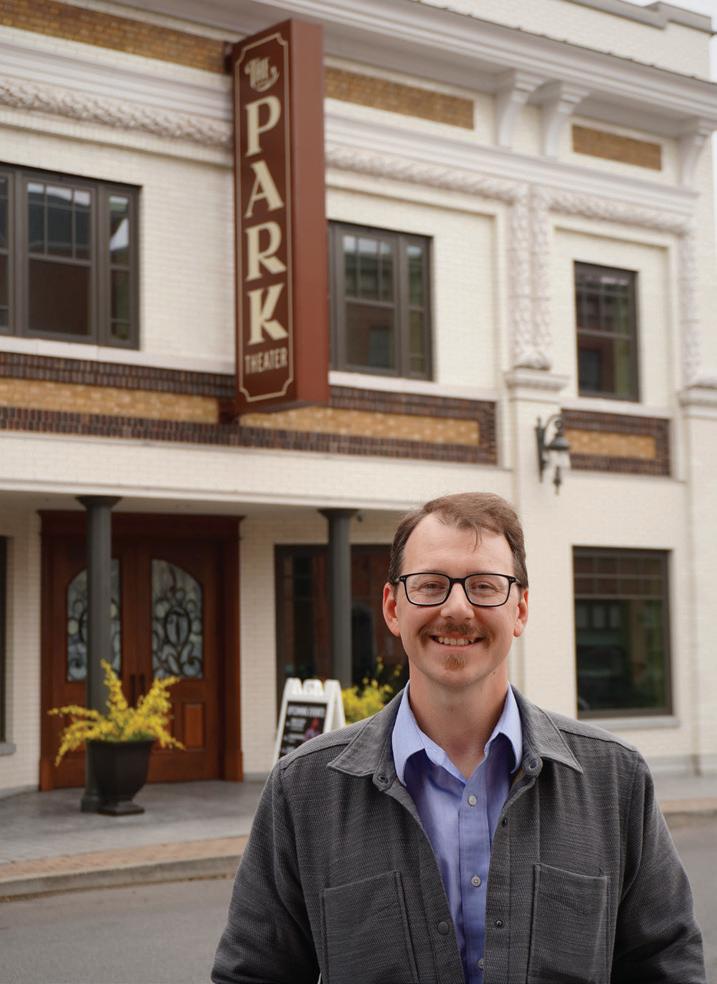
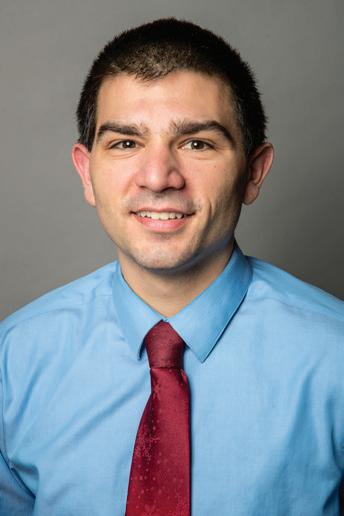
John Snyder, The Park Theater Foundation’s executive director, stands outside the theater. Courtesy Park Theater
Eco Haven Pest Control Builds Regional Growth With Eco Friendly Pest Solutions
BY PAUL POST
Jake Dorsey goes where the problems are, which, depending on the time of year, can be anything from bats, squirrels and mice to ticks, bees and carpenter ants.
His Hudson Falls-based Eco Haven Pest Control business, founded just over a year ago, already has clients from Kingston to Lake Placid and from western Vermont to the Mohawk Valley.
Eco Haven uses pesticides and chemicals to battle bugs and critters only when absolutely necessary, as opposed to area-wide applications.
“If there’s no target, why are you shooting?” said Dorsey, a 27-year-old entrepreneur.
The goal is to provide permanent solutions instead of repeat annual treatments.
To exclude insects and tiny rodents, for example, Eco Haven installs small metal barriers the same color as a home’s siding to keep them from getting inside.
For bat control, the company allows bats to exit safely and prevents re-entry without trapping them inside. Once out, all access points are sealed, and guano removal is recommended, if present, to prevent health concerns.
He previously worked for other firms in the industry before launching on his own. Dorsey emphasizes eco-friendly solutions because he understands the public’s growing concern about environmental safety.
“Nobody wants a guy to show up and use chemicals that can be harsh to them or their pet,” he said. “The main reason I got into pest control is it allows me to help people. Anything from bats, mice and squirrels to bed bugs or carpenter ants in a house adds a great deal of emotional stress.”
He has two full-time employees, both fully trained and licensed technicians.
Most of Eco Haven’s work is residential, although it also has a number of commercial clients.
“We’ve done everything from getting bats out of local historic buildings to getting squirrels out of log cabins built on stilts with no foundation on Lake George,
and modern homes in Clifton Park,” Dorsey said.
“Pest control as an industry is kind of cyclical,” he said. “You roll into spring and you get the early bat calls, carpenter ants, and you start to see termite swarms coming up now. By the middle of summer, it’s almost entirely stinging insects, bees and wasp nests; they’re all over the place.”
“When it gets colder, you get your fall invaders — Asian lady beetles, box elders and stink bugs. There’s also an influx of squirrels and mice getting into people’s houses because it’s cold out and warm inside. You’re almost doing something different every month. When one goes away, another comes after it.”
“Business has expanded a lot faster than I thought it would by just being honest, doing exactly what I said I’m going to do and getting the job done right,” he said. “We figure out what’s going on with your house and we fix it. There’s a solution to every problem if you know what you’re looking at.”
WSWHE BOCES Partnership Wins State Honor For Career Education Program
WSWHE BOCES, working with SUNY Adirondack, has been named a “Champion of Change” by the New York State School Boards Association for its annual Manufacturing and STEAM Day.
The recognition, part of NYSSBA’s Champions of Change program, cites the event as an example of an innovative partnership that connects students to postsecondary options and careers in advanced manufacturing.
“We are honored to receive this recognition for a program that reflects the meaningful opportunities we strive to create for students,” said WSWHE BOCES District Superintendent Turina Parker. “Our partnership with SUNY Adirondack is a powerful example of how collaboration can open doors. Manufacturing and STEAM Day helps students see what’s possible and envision themselves in careers that are critical to our regional economy.”
The Oct. 17 event included a panel of PTECH graduates who earned Mechatronics degrees from SUNY Adirondack and discussed the transition from school to the workforce. Students also visited regional employers including Adirondack Studios, Cre-
atacor, Fort Miller Group and GlobalFoundries and met with industry professionals and faculty.
Two former SUNY Adirondack P-TECH graduates also represented their employer, Praxis Technology, during the career fair.
“The strength of this program lies in its ability to connect education and industry in meaningful ways,” said President of SUNY Adirondack Anastasia Urtz. “Through our partnership with WSWHE BOCES, students engage with industry leaders and discover exciting, in-demand careers. Together, we are illuminating pathways from classroom to career and supporting students to build a great future in our region.”
The event is coordinated by the WSWHE BOCES Innovative Programs Team led by Michelle Maddalla and SUNY Adirondack’s Continuing Education Office, led by Susan Wynkoop.
NYSSBA representatives presented the recognition and a commemorative banner at the WSWHE BOCES Board of Education meeting April 15.
Provided by WSWHE BOCES; edited for style and length.
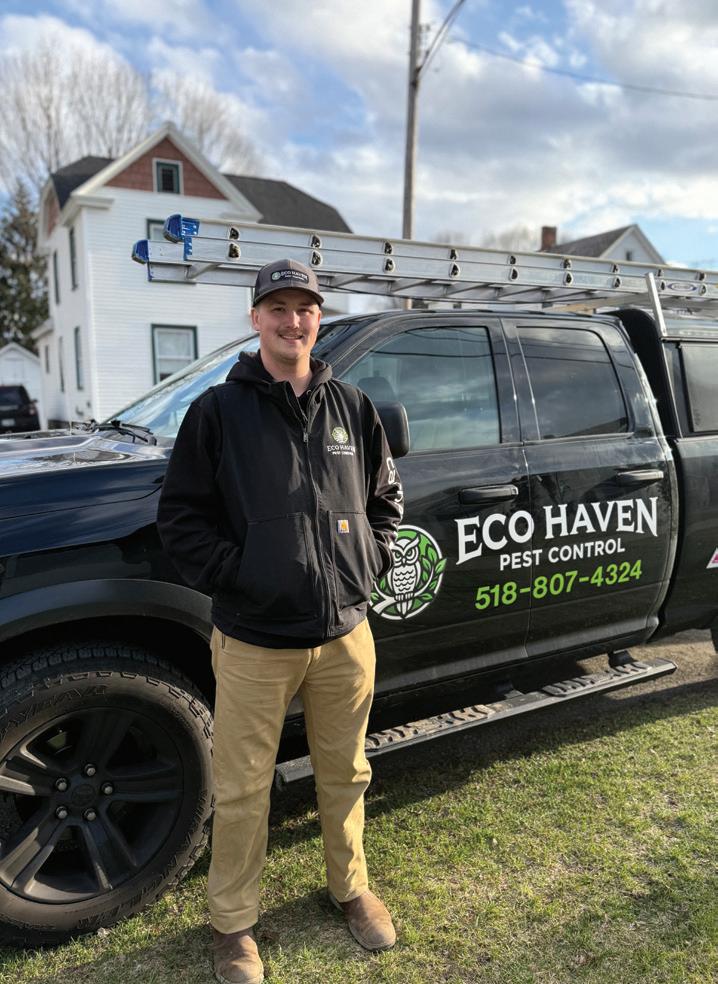
Eco Haven owner Jake Dorsey stands beside one of the company’s pest control trucks.
V. Bodensieck, CPA
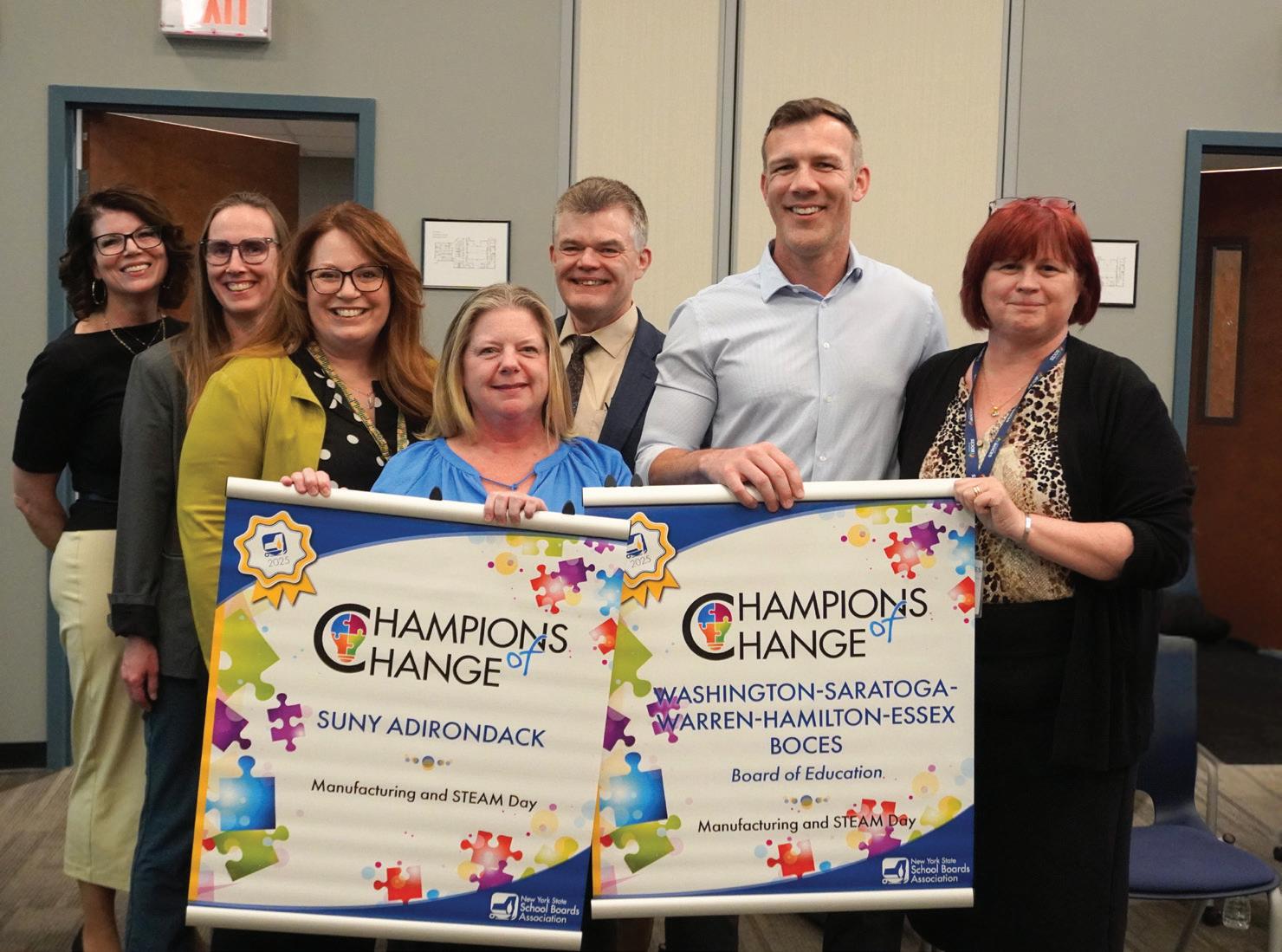
Champions of Change banners recognize WSWHE BOCES and SUNY Adirondack for Manufacturing and STEAM Day, a partnership linking students to postsecondary options and manufacturing career paths.
Courtesy WSWHE B OCES and SUNY Adirondack
GLENS FALLS BUSINESS JOURNAL
2000 Business Of The Year
Adirondack Regional Chamber Of Commerce
9 Broad St. Glens Falls, NY 12803 (518) 581-0600 • Fax: (518) 430-3020 • www.glensfallsbusinessjournal.com Reach Harry Weinhagen at HarryW@glensfallsbusinessjournal.com
Publisher & Editor Harry Weinhagen
Editor Emeritus Rod Bacon
Sales and Customer Service Harry Weinhagen Mary Longley
Production Manager Graphic Precision
Contributing Writers Susan Campbell Lee Coleman Carol Ann Conover Ann Donnelly Paul Post
Glens Falls Business Journal is published monthly, the second week of each month, by Weinhagen Associates, LLC and mailed to business and professional people in Warren and Washington Counties.
Glens Falls Business Journal is independently owned and is a registered tradename of Weinhagen Associates, LLC
Falls, NY 12801 (518) 581-0600.
From 40 Tasks to Just One: Severus AI Wants to Give Business Owners Their Mornings Back
BY ANN DONNELLY
Small business owners often fi nd themselves drowning in daily tasks, from answering repetitive phone calls to managing social media and organizing emails. Christopher Crowd, founder of the Glens Falls-based startup Severus AI, believes artificial intelligence is the key to escaping this cycle of burnout and regaining control.
Severus AI is a project two years in the making, designed to address the specific pain points of entrepreneurs. Using a proprietary platform called Ada, the company creates customized artificial intelligence agents that handle email, social media, incoming calls, website leads and complex workflow automation.
“As a business owner, your job is to scale,” Crowd says, “If you don’t, eventually you’re going to burn out. Rather than getting up in the morning and running to your desk, going through 100 emails and trying to respond to everybody, these tools allow you to get up very calmly and have a cup of coffee. It’s all fun for you.”
For many solopreneurs, hiring a full staff is fi nancially out of reach. Crowd envisions the Severus AI workflow automation tools as acting like a micro-employee. Th is fractional assistant can read private and business emails, summarize them, manage calendars and send daily reports to staff.
Voice integration takes this concept a step further. Crowd detailed a scenario in which a client can simply speak to their phone during a morning commute to receive an email recap or to command the system to fi x a presentation before they arrive at the office.
Customer service is another major focus for Severus AI. The company offers advanced voice agents capable of handling calls, booking appointments and quoting prices. Unlike standard automated phone trees, these agents converse naturally and capture vital lead information immediately.
“The most basic example would be our voice agent answers the telephone for you, and the fi rst step already has their number saved, then it has their email address, their full name, done,” Crowd said. “So that’s now an asset.”
New voice web agents feature voice-to-voice technology without transcription delays. Crowd noted that this allows the soft ware to detect emotional tones and adjust responses appropriately. If a customer needs human assistance, the system performs a warm transfer to a staff member, ensuring context is passed along so the caller does not have to repeat their issue from scratch.
Any industry can use Severus AI, but Crowd noted that the company has had particular success with the real estate industry, where it can transform property listings by editing photos to create “night and day” scenes, removing rain, cleaning up pools and driveways, and even generating animations to swap out furniture in a room. He also noted that the platform is useful for industries where managing appointments and the services associated with them are important,
such as salons, HVAC, lawyers, dentists and doctors.
Beyond communication, Severus AI tackles marketing struggles. The platform manages social media by generating unique graphics, drawing on a company’s own imagery and ensuring posts align with the brand’s fonts and colors. According to Crowd, “AI can take a single video sent by a client and turn it into ‘infi nite content’ such as reels and still images.” The system also tracks engagement analytics to determine the best times to post based on industry trends.
The team at Severus AI designs and develops automated workflows to undertake any task more quickly, efficiently and effectively. One client used Severus AI to generate a 100-slide PowerPoint for a trivia night, customized for the specific bar that hired them to present the event, saving them hours of work.
A common hesitation surrounding artificial intelligence is the fear of generic or inaccurate outputs. Crowd addressed this by explaining that Severus AI builds distinct, personalized microsystems for each client instead of relying on public models.
“It’s a business-centric system,” Crowd said. “So when you’re talking to it, it’s not looking at other people, other things. It’s just your business.”
Security remains a priority. Rather than sharing server space, each client receives a private cloud environment. Th is ensures that a business’s data remains insulated and strictly private.
Crowd said this dedicated technology levels the playing field for small operations. “Basically, a solopreneur has the same power as an IBM, an Apple, Google,” Crowd said. “It’s the fi rst time in history we’ve been on a level playing field.”
Despite the heavy reliance on automation, Severus AI maintains strict human oversight. The company employs account managers who Christopher Crowd, founder of Severus AI, develops AI tools for small business owners.
WWIDA Launches Study To Measure Arts Economy Across Two Counties
BY CAROL ANN CONOVER
The Warren Washington Industrial Development Agency has approved a study to inventory and quantify the economic impact of the creative economy across Warren and Washington counties, a sector that includes more than 85 identified arts, culture and creative economy organizations and that local leaders say has long operated without the data to demonstrate its full value.
The WWIDA board approved up to $200,000 for the project, to be conducted by an outside consulting fi rm selected through a formal request for proposals process. Proposals are due May 14, with a consultant expected to be recommended to the full WWIDA board by mid-June. Chuck Barton, WWIDA chief executive officer, said the study will inventory the region’s creative assets and produce an economic impact analysis to inform future planning and strengthen grant applications.
“We’re looking for a group to bubble up who will take the results of the study and run with it,” Barton said.
The initiative grew out of a coalition called MOSAIC, formed through conversations among Glens Falls arts organizations and the Warren County Economic Development Corp. The WWIDA joined those discussions and agreed to fund the study, seeing alignment with its broader mission of promoting economic development and job creation across both counties.
The study’s scope will extend well beyond Glens Falls. Barton said the consultant will be expected to capture the full inventory across Warren and Washington counties, including festivals, historical societies, libraries, museums, theaters and small-scale artist enterprises, many of which operate year-round despite the region’s seasonal tourism patterns. Barton expects the actual inventory to significantly exceed the initial 85-venue scan.
“We’re looking for this to be very broadly defi ned,” he said. “All inclusive and all-encompassing.”
Phil Casabona, executive director of the Lower Adirondack Regional Arts Council, is among those named to the advisory committee. LARAC’s June Arts Festival is widely recognized as the largest single economic driver in the city of Glens Falls, drawing regional visitors each summer and generating spending across local hospitality, retail and service businesses.
Casabona said the WWIDA’s fi nancial commitment gives the MOSAIC coalition a foundation it had lacked. “Chuck Barton, Juan Gonzales, and the Warren Washington County IDA’s instant interest and backing of MOSAIC, in my opinion, has not only helped us orient some goals that will become the foundation of MOSAIC, but their fi nancial commitment to this study will have a great and broader impact regionally,” he said. “Th is study and subsequent actions will bolster the reach of our arts organizations, the organizations in both counties, and will be the driver for proper and guided growth across multiple platforms.”
Casabona added that he believes the work
will carry long-term significance for younger residents. “I also fi rmly believe that over the coming years this study will help our governance actively create more opportunities for our younger populations to sustain living and working here in this wonderful region,” he said.
Erin Harrington, executive director of the Hubbard Hall Center for the Arts and Education in Cambridge, is also serving on the advisory committee. Hubbard Hall operates out of a historic opera house, offering theater, dance, visual arts and an artist residency program with partners including the Drama League of New York City. Harrington said the study carries particular weight for rural organizations operating with limited data and limited resources.
“We’re really excited for some of the potential ways to really grow the arts and culture organizations within the two counties through this effort, as we are such a big part of the economy for both counties,” Harrington said. “Hubbard Hall is a major driver for the community of Cambridge. And this is just going to make not only us, but all of our community stronger.”
The WWIDA pointed to Ulster County as a comparable model. That county, home to Woodstock, Kingston, New Paltz and the Catskill Mountains, conducted a similar analysis and found its arts and culture sector generates $814 million annually in direct, indirect and induced economic activity, a figure the WWIDA hopes to replicate for the twocounty region, which has a combined population of approximately 120,000.
The timing of the initiative coincides with a period of significant fi nancial pressure on the nonprofit arts sector. Federal funding for cultural institutions has faced reductions and uncertainty, with consequences felt at the local level.
Among the most direct impacts has been the curtailment of programs administered through the Institute of Museum and Library Services. IMLS supports rural library services nationally, including books-by-mail programs that serve homebound patrons and veterans in communities with limited in-person library access. Reductions to that funding have forced local institutions to redirect dollars from other budget lines to cover the gap.
Those redirected funds often come at the expense of arts and cultural programming that libraries host for the broader community.
The ripple effect is visible in organizations like the Folklife Center at Crandall Public Library in Glens Falls, which presents folk arts programming and free public concerts at Crandall and at the Historic Salem Courthouse in Salem, drawing on dedicated budget lines that pay performing artists directly. When federal support for library operations contracts, institutions must make difficult choices about which programs to sustain. For the artists who rely on those engagements, and for the community members who attend at no cost, the impact is immediate and local, even when its origin is a policy decision made in Wash-
Warren County Makes Judge Austin’s History Collection Publicly Available
Late Warren County Judge John Austin left behind a collection of books and documents dating to the 1600s that is now available to the public, county officials said.
Austin, a former county judge, historian and Queensbury town supervisor, died in June 2019 at 84. He spent decades researching genealogy, local history, the Town of Queensbury and Warren County.
The Warren County Historian’s Office and Warren County Clerk’s Office organized the materials into a research library housed in the Warren County Clerk’s Office record room.
Before he died, Austin wanted the collection to be available for public use.
“John was an amazing man, and his hope before he passed was that we could fi nd a way to make this available for the public to use,” said Warren County Historian Dr. Stan Cianfarano.
Retired Warren County Clerk Pam Vogel spent hundreds of hours organizing the material so the public could use it, Cianfarano said. Vogel died in October 2025 and left a list of remaining tasks.
Austin also left money in his will to Warren County to preserve and display the collection, officials said.
The shelves include hundreds of books, folders and other materials. Much of the collection pertains to Queensbury residents, along with documents and books related to Irish lineage, information about local immigration from Ireland, and material from the Mayflower Society.
Members of the Warren County Board of Supervisors were shown the collection April 17.
“We are very thankful for this gift from
Judge Austin. He was a great man and dedicated public servant, and it is fitting that even after he has passed, his lifetime of work will live on to benefit all of us,” said Kevin Geraghty, chairman of the Warren County Board of Supervisors.
Cianfarano said officials are also reviewing computer fi les Austin compiled and how they might be made available to the public.
The public can review the collection by appointment. Call Cianfarano at 518-761-6544. Provided by Warren County; edited for style and length.
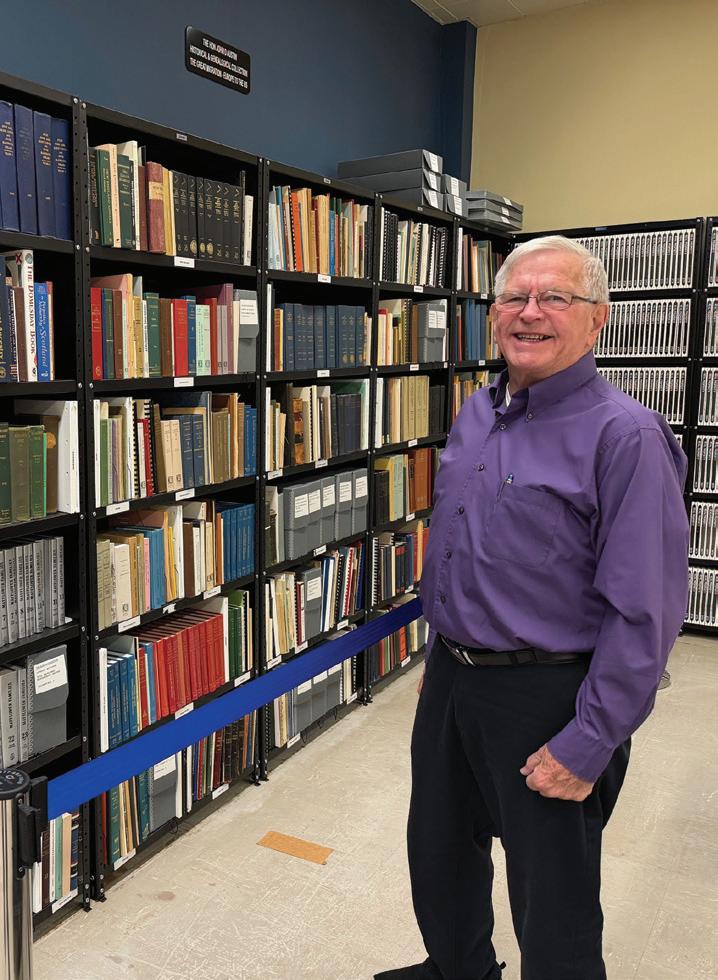
Dr. Stan Cianfarano stands beside Judge John Austin’s local history collection shelves.
Courtesy Dr. Stan Cianfarano
GLENS FALLS BUSINESS JOURNAL
Construction
New Sewer Plant Spurs Development, Housing And Tourism In North Creek
BY PAUL POST
The expected completion this summer of a new $10.1 million sewage treatment plant is spurring transformative economic development in the hamlet of North Creek.
A new Ski Bowl lodge is scheduled to connect to the system when lateral lines are installed this fall, along with the 30-room Public House with two restaurants and the possibility of an affordable housing project that would give people such as Johnsburg Central School teachers a place to live in the community.
“This is exactly how the hamlet of North Creek was zoned by the Adirondack Park Agency more than 50 years ago,” said Town of Johnsburg Supervisor Sterling Goodspeed. “It’s zoned for residential development. The sewer district, which primarily encompasses Main Street and the town-owned Ski Bowl park, is in keeping with that zoning. I think it will attract affordable housing and business growth, particularly restaurants and those things than can feed off the ski industry.”
Plans also call for the opening of a new mountainside alpine coaster ride this summer by the Ski Bowl lodge, making North Creek a more year-round recreational tourist destination.
“It’s designed to target the shoulder seasons and
summer,” Goodspeed said. “The projection is that it will bring as many as 40,000 visitors to North Creek.”
Weekender Hotels, which also owns Alpine Lodge in North Creek and other sites in the Adirondacks and New Hampshire, is promoting the Public House, formerly Copperfield Inn, as a base for people to explore and enjoy the region’s many recreational opportunities.
In addition to skiing at Gore Mountain, these include whitewater rafting, tubing, paddling, hiking and rail bike rides, by Revolution Rail, at the historic North Creek train depot where Theodore Roosevelt began his journey en route to becoming 26th president of the United States.
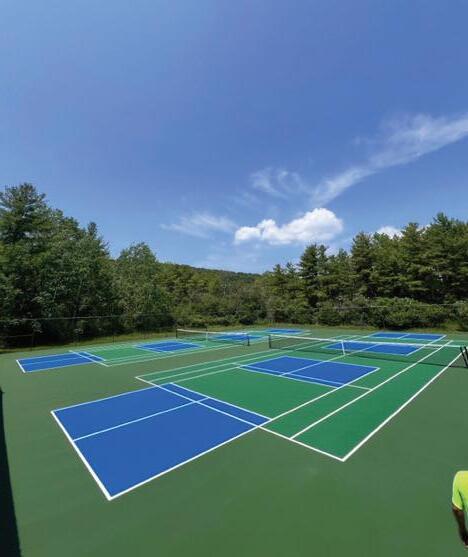
The Public House website says guest rooms “are being fully renovated with a modern Adirondack aesthetic – warm textures, natural light, and a calming simplicity that brings the outdoors in.” Amenities, in addition to two restaurants, include a library, pool courtyard, tennis and pickleball courts, and a fitness center.
“It becomes an incredibly more significant development and more valuable development when you add that final piece of the puzzle, the septic district,” Goodspeed said. “It’s an example of how important the infrastructure can be.”
Continued On Page 11
Owner Of Multiple Subway Franchises Finding Success Developing Retail Plazas
BY ROD BACON
A recently completed retail plaza in The Outlets at Lake George is now completely tenanted.
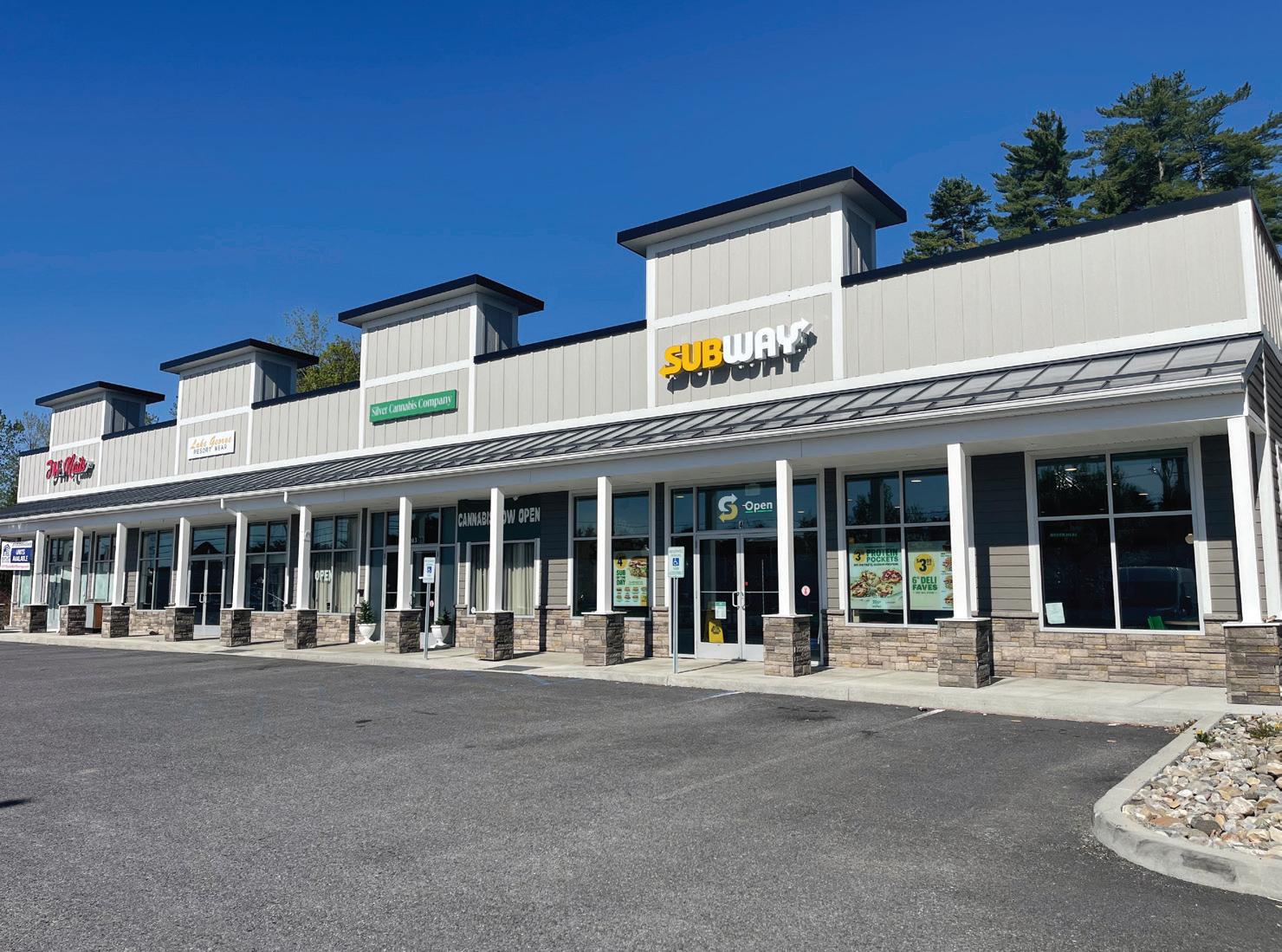
The 8,400-square-foot building houses a Subway sandwich shop, a Silver Cannabis Dispensary, a Hi nails beauty salon, and a Tommy Bahama outlet. There are also 24 storage units behind the building, several of which are still available.
This is the sixth commercial plaza built by developer Russ Faden, who owns 41 Subway franchises in the region.
“One of my Subway shops is in there and I am happy to welcome the other tenants to the project,” he said.
“I built the storage units because it is the best use of the property,” he explained. “They’re hidden behind the commercial building. Now that I’ve had success with these I plan to look for opportunities to build more.”
He has two other commercial developments in Queensbury that are in the planning stages. One is retail and the other is slated to have approximately 34 apartments.
“We’re about to submit our conceptual to the town on that one, so it’s very early in the process,” he said.
Construction of Faden’s current project, a
retail plaza on Wolf Road in Colonie is slated to begin this month.
Financing has been secured through Pioneer Bank and all approvals are in place except for a permit from the Department of Transportation.
“All the contractors are lined up and we’re ready to go,” he said. “We’re just waiting on that last permit.”
Scott Lansing of Malta-based Lansing Engineering PC did much of the work to secure the approvals and permits.
The 6,400-square-foot building, designed by C2 Design Group of Schenectady, can accommodate three tenants, one of which will be a Subway sandwich shop. The estimated cost is $2.5 million.
“I own the Subway shop and we’re assuming there will be two other businesses in there,” Faden said.
Most of his franchises are in the Albany area but his reach extends north to Lake George, west to Cobleskill, and east into Vermont and Massachusetts. He said they are a combination of existing ones he purchased and others he built from the ground up, many in commercial plazas he has developed.
Continued On Page 11
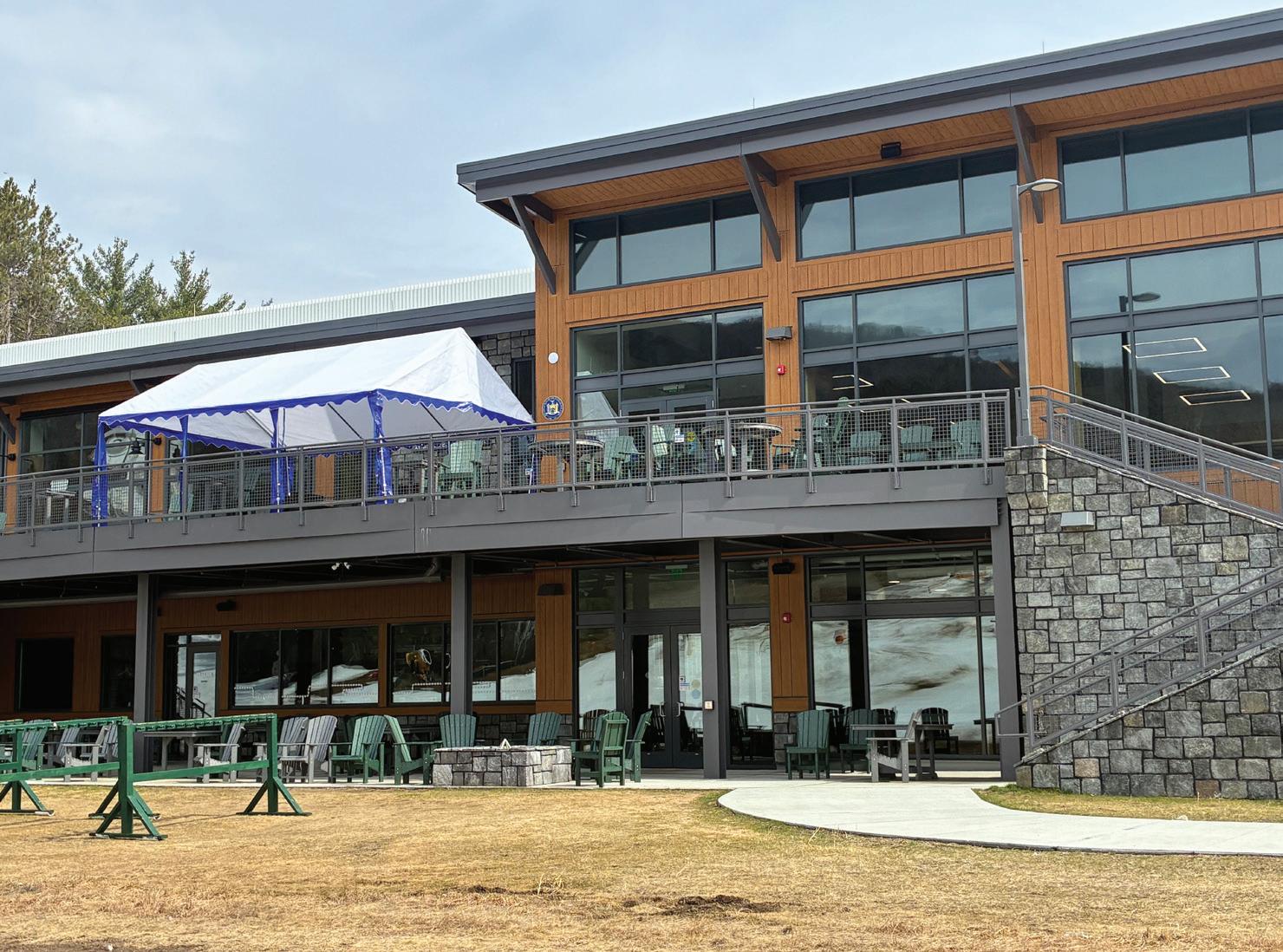
The new Ski Bowl lodge in North Creek is scheduled to connect to the hamlet’s new sewer system, which town officials say will support housing, tourism and business development in the area soon.
Courtesy Ski Bowl Lodge
A Subway shop anchors a recently completed commercial plaza, built by developer Russ Faden, in The Outlets at Lake George.
Glens Falls Business Journal
Eastern Heating Grows HVAC Business Th rough Service And New Construction
BY PAUL POST
Heating, cooling and ventilation are the unseen components of buildings that house some of the Capital Region’s largest and most important employers, including colleges, hospitals and senior living centers.
Founded 81 years ago, Eastern Heating & Cooling has evolved into a full-service mechanical contractor with $42 million in annual revenue. It specializes in design-build HVAC systems, controls, fabrication and longterm service, with commercial clients within a 100-mile radius of its Albany headquarters.
“We want to be the solution to the problems that keep customers up at night,” company President Buddy Tricarick said. “If we can maintain their equipment, where they don’t have to worry about it, that’s the goal. That’s what exceptional customer service is. Preventive maintenance goes a long way.”
Business Development Manager Luke Schreiber said, “We meet with the customer, talk to them, ask questions and really try to understand what their business and equipment needs are, tailoring an approach that’s better aligned with their business versus a cookiecutter solution.”
In addition to HVAC, the fi rm’s highly trained technicians also take care of boilers, chillers, refrigeration and ultra-low-temperature freezers.
Service department maintenance agreements ensure that all types of mechanical equipment are kept running smoothly. “Just like any person is different, one from another, the equipment and business needs are unique to that business or facility,” Schreiber said. “It’s our job to understand what we need to adjust so everything’s running optimally so they get what they need, not what they don’t need.”
Maintenance programs include comprehensive annual servicing.
“We’re putting load on equipment and make sure we look inside and out, at every touch point, to make sure there’s no failure points,”
Schreiber said. “If we fi nd an issue that’s out of range of the optimal, we bring that to the customer’s attention and tell them how long it could last and what the best replacement alternatives are. We educate clients so they can make a decision that’s best for them.”
Retrofits for aging equipment account for about 60% of Eastern’s business, with the rest devoted to new construction.
“Our Controls Division is booming because of new construction and existing customers upgrading their systems,” Tricarick said. “Our total company backlog last April was $17 million. Th is April we were at $26 million and a lot of that is Controls.”
Eastern is the area’s only authorized dealer for Automated Logic building control systems that manage heating, cooling and energy use.
Recent climate change trends have not only presented new challenges but make what Eastern does more critically important to people’s lives and livelihoods.
“We’re seeing more and more extreme heat and cold for longer periods of time than what we’ve seen historically, which puts an exceptional load on equipment within the region,” Schreiber said. “Sometimes this far exceeds what the equipment was designed for, which is especially concerning for older equipment.”
Excessive temperature and humidity could make it difficult for office workers to do their jobs. In a health care setting, it could be potentially dangerous to someone’s life.
“One of our customers controls the grid system for New York state, so if there’s an issue and their system goes out there could be a statewide power outage or blackout,” Schreiber said. “So it’s important that we stay on top of any issues or concerns that we’ve identified.”
At present, Eastern is working on Glens Falls Hospital’s $25 million new emergency department. Other health care clients are Albany Memorial, Ellis (Schenectady), Sa-
Northern Builders Expands With Focus On Trades, Workforce And Growth
BY ANN DONNELLY
When Mark Stewart and Nic Denno merged their independent contracting companies to form Northern Builders in 2020, they brought more than construction expertise to the table. Both men balanced successful careers in law enforcement with their building endeavors, an experience that forged a strong foundation for their business partnership.
Stewart, a former investigator who retired from the Saratoga County Sheriff ’s Department in 2023, and Denno, who worked as a police officer and a contractor for about 20 years before retiring in 2025, met while working the 4 p.m. to midnight shift at the sheriff ’s department. Today, their South Glens Falls-based company employs 22 to 24 in-house staff members and manages 40 to 60 subcontractors daily. The team oversees 12 to 14 major projects at any given time, handling
custom residential homes, commercial projects and high-end renovations.
“We really wanted to switch from being contractors and home builders to a construction company,” Stewart said.
For Denno, the partnership thrives on the mutual respect they built in their previous careers.
“When you work as side-by-side law enforcement, you gain an appreciation and a respect and a trust for somebody,” Denno said. “If you care about your people and you care about each other and the business that you’re growing, then it really takes the animosity and everything else out of it. We have a mutual vision and a mutual goal.”
To streamline operations and adapt to regional growth, Stewart and Denno are expanding
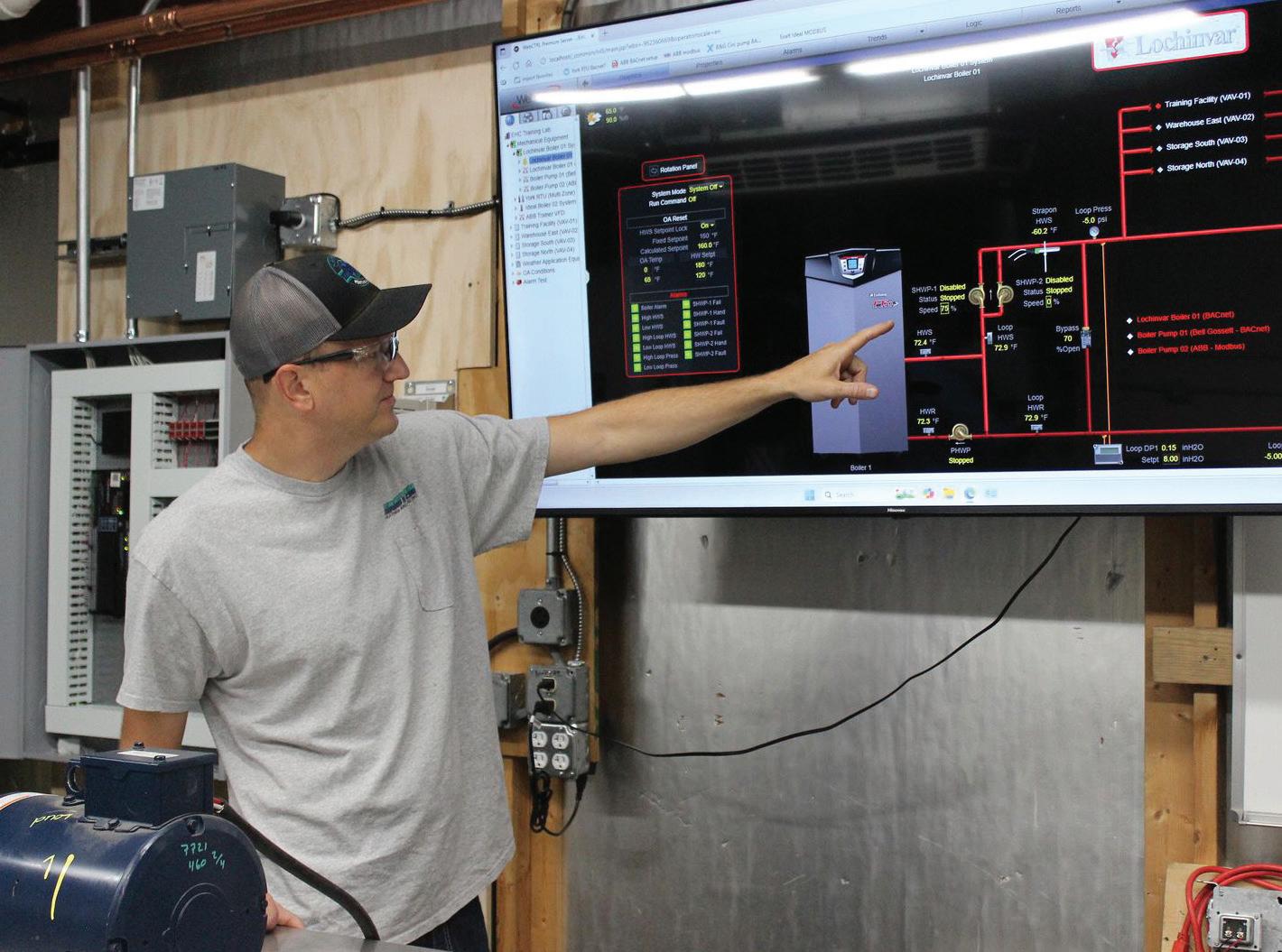
Dan Knapp of Eastern Heating & Cooling points to a control system display as the Albany-based mechanical contractor grows its HVAC service, controls and new construction work across the region.
Courtesy Eastern Heating
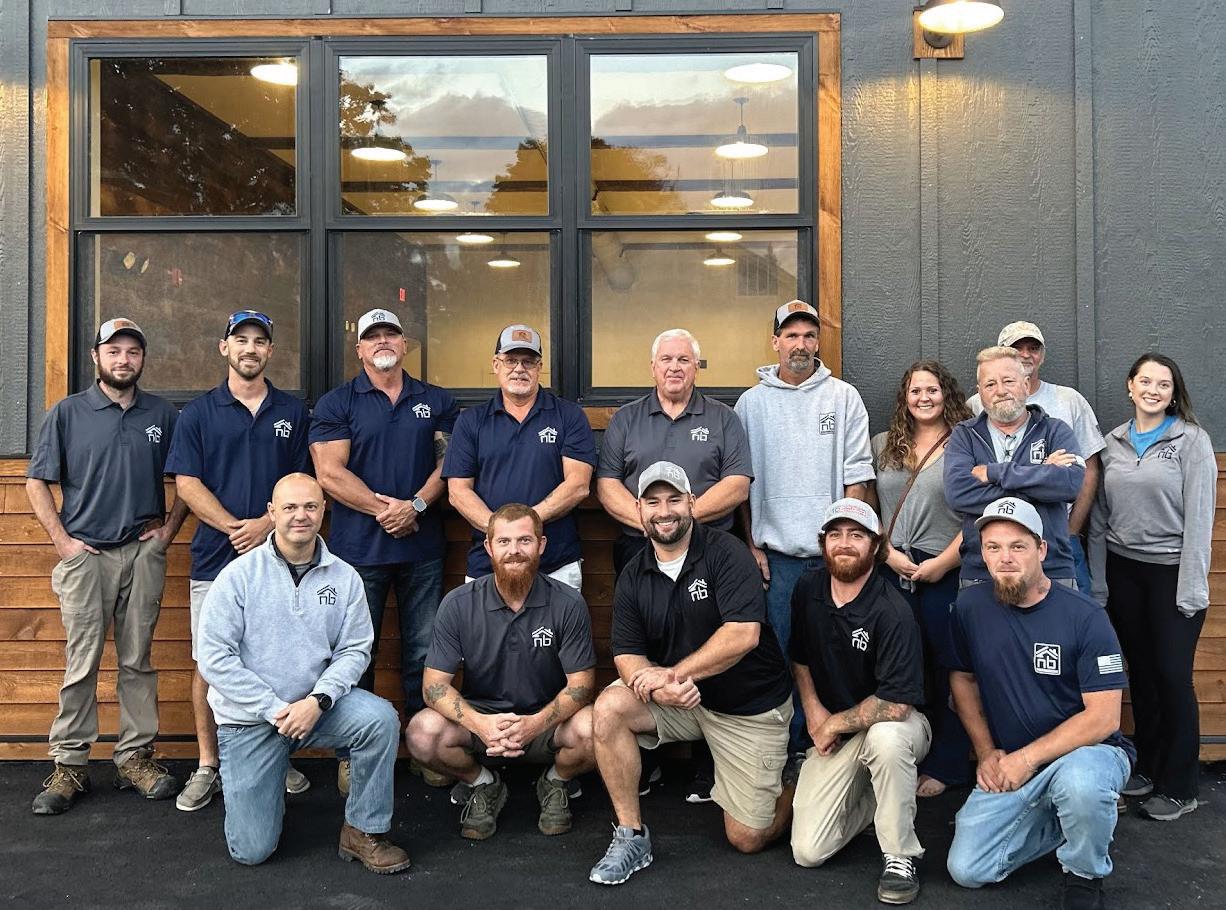
Northern Builders owners Nic Denno, bottom left, and Mark Stewart, bottom center, are shown with team members outside the South Glens Falls-based company, which they formed together in 2020.
Health Community Services
Countryside Adult Home Blends Residential Care, Meals And Community Engagement
BY CAROL ANN CONOVER
Amy McByrne started working at Warren County’s Countryside Adult Home straight out of high school, thinking she was taking a gap year. Thirty-five years later, she is the facility’s director.
“I thought I was taking a gap year,” McByrne said. “And then all of a sudden it’s, yeah, I’m 20, and I’m like, you know, I really love what I do. And it just became — yeah, this is it, this is me.”
The facility, at 353 Schroon River Road in Warrensburg, is a 48-bed adult home owned and operated by Warren County and regulated by the New York State Department of Health. It operates on a social model of care — not acute medical care — designed for individuals who need supervision, medication assistance, transportation to appointments, help with personal care and access to nutritious meals but who do not require skilled nursing.
Beyond residential services, Countryside operates an adult day care program, offers respite care and serves as the production site for the Warren County Office for the Aging’s Meals on Wheels program. The facility prepares about 100 meals a day, five days a week, for delivery by Office for the Aging staff and volunteers throughout the Warrensburg and Chestertown areas.
The state reimburses 50% of operating costs. The daily resident rate is $158.08, set by the state. Those who cannot pay contribute their income instead; the facility applies for Medicaid temporary assistance on behalf of Warren County residents whose resources fall at or below $3,700.
An on-site provider through Hudson Headwaters Health Network visits weekly. Residents may retain their own primary care physician, and Countryside provides trans-
Regional Childcare Shortage Pushes Families, Employers And YMCA To Adapt
BY CAROL ANN CONOVER
When a parent in Warren, Washington or Saratoga counties goes looking for infant care today, the search often ends before it begins. The wait list at the Saratoga Regional YMCA’s Malta Early Learning Center stretches two years. In some cases, families are signing up before they even try to conceive.
That reality is not an anomaly. It is the baseline. Between 2019 and 2022, the number of regulated childcare facilities in Warren County fell 40 percent, from 50 to 30, according to a 2023 needs assessment by the Southern Adirondack Child Care Network. Washington County lost 37 percent of its facilities over the same period. Across New York state, 60 percent of census tracts qualified as childcare deserts in 2023, a designation meaning at least three children under age five exist for every available slot, according to a February 2025 report from the Office of the State Comptroller. Rural upstate communities, the report found, are the most negatively affected.
with the Saratoga Springs and Schuylerville school districts serving roughly 72 children, and a schoolage before-and-after-care program operating at 15 locations across seven school districts throughout the three-county region, including Glens Falls, Queensbury, Ballston Spa, and Saratoga Springs.
“We believe that every child deserves great care and learning opportunities and no family should be held back by financial constraints,” said Rebeccah Potavin, the YMCA’s associate vice president of child care. “So we do offer financial assistance for all of our programming that we offer as well, regardless of income. So even people who think that they don’t qualify for something, we run them through our system and a lot of times we have generous donors who really want to make sure that you know, income is not a barrier to great programming.”
That financial assistance infrastructure is central to what the Saratoga Regional YMCA’s CEO, Allison D’Antonio, describes as the organization’s defining purpose. The YMCA also accepts DSS subsidies under New York’s Child Care Assistance Program, which serves families of four earning up to approximately $108,000 annually — a threshold that makes it relevant well into the middle-income range but one that not all area providers choose to navigate.
Into that void, the Saratoga Regional YMCA operates a layered system of childcare programming across its six branches. The association expanded its footprint on Jan. 1, 2025, when the Family YMCA of the Glens Falls Area officially merged to become its sixth branch, deepening the organization’s reach across Warren County. The programming spans a licensed full-day daycare center at its Malta Early Learning Center serving approximately 100 children from infancy through kindergarten, a half-day preschool program at its Saratoga Springs branch serving 45 children ages 2 through 4, Universal PreKindergarten classrooms operated in partnership
“We accept DSS, which not all providers do,” D’Antonio said. “There’s an administrative function to it that smaller providers don’t have the capacity to work with. So, we did see a large influx in people … unfortunately the state didn’t have enough funding to support all of them. So, we have done our
Continued On Page 9 Continued On Page 9
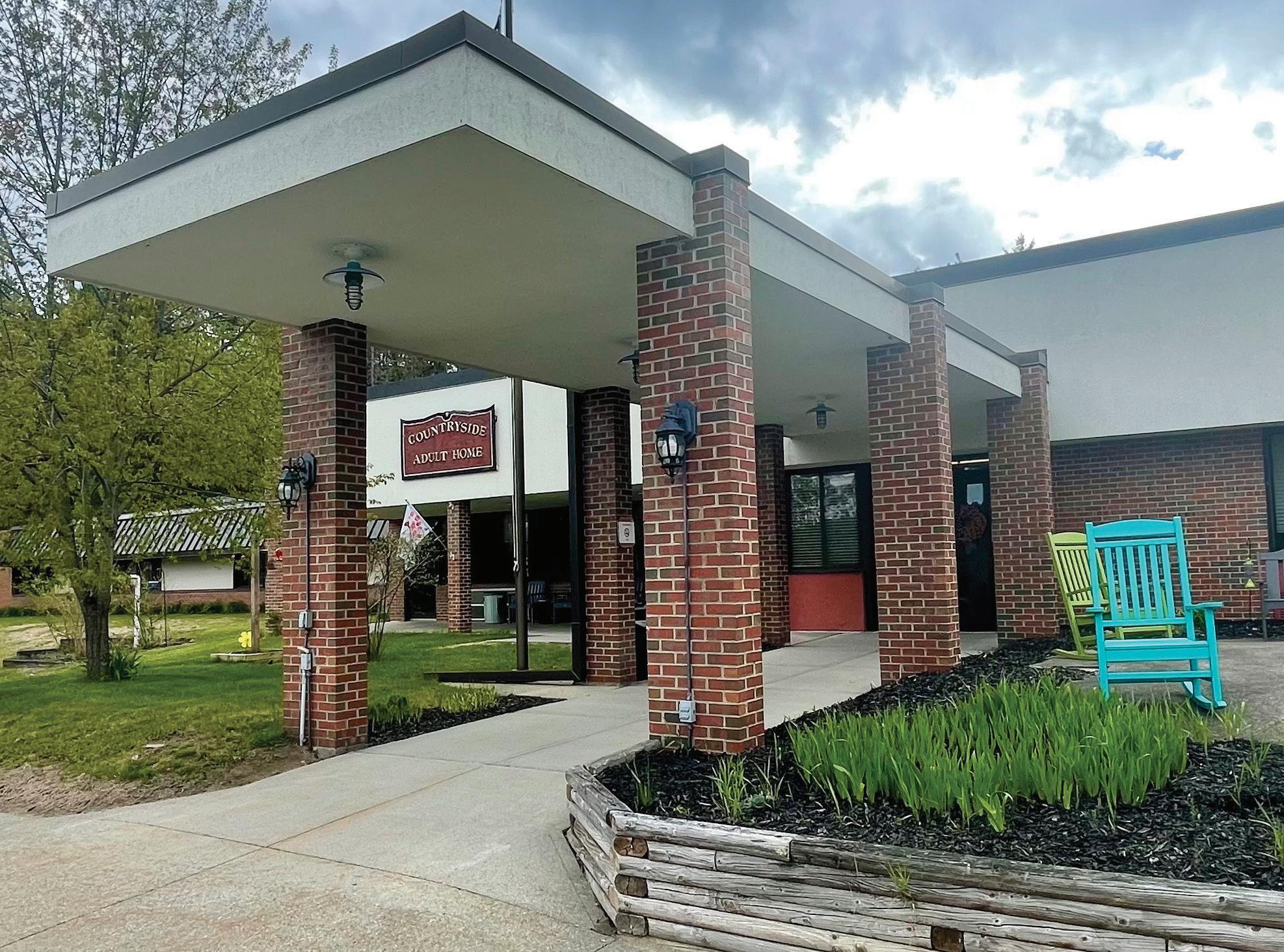
Countryside Adult Home in Warrensburg is a 48-bed adult home offering residential care, day care and respite services, while preparing Meals on Wheels deliveries for Warren County residents. Glens Falls Business Journal
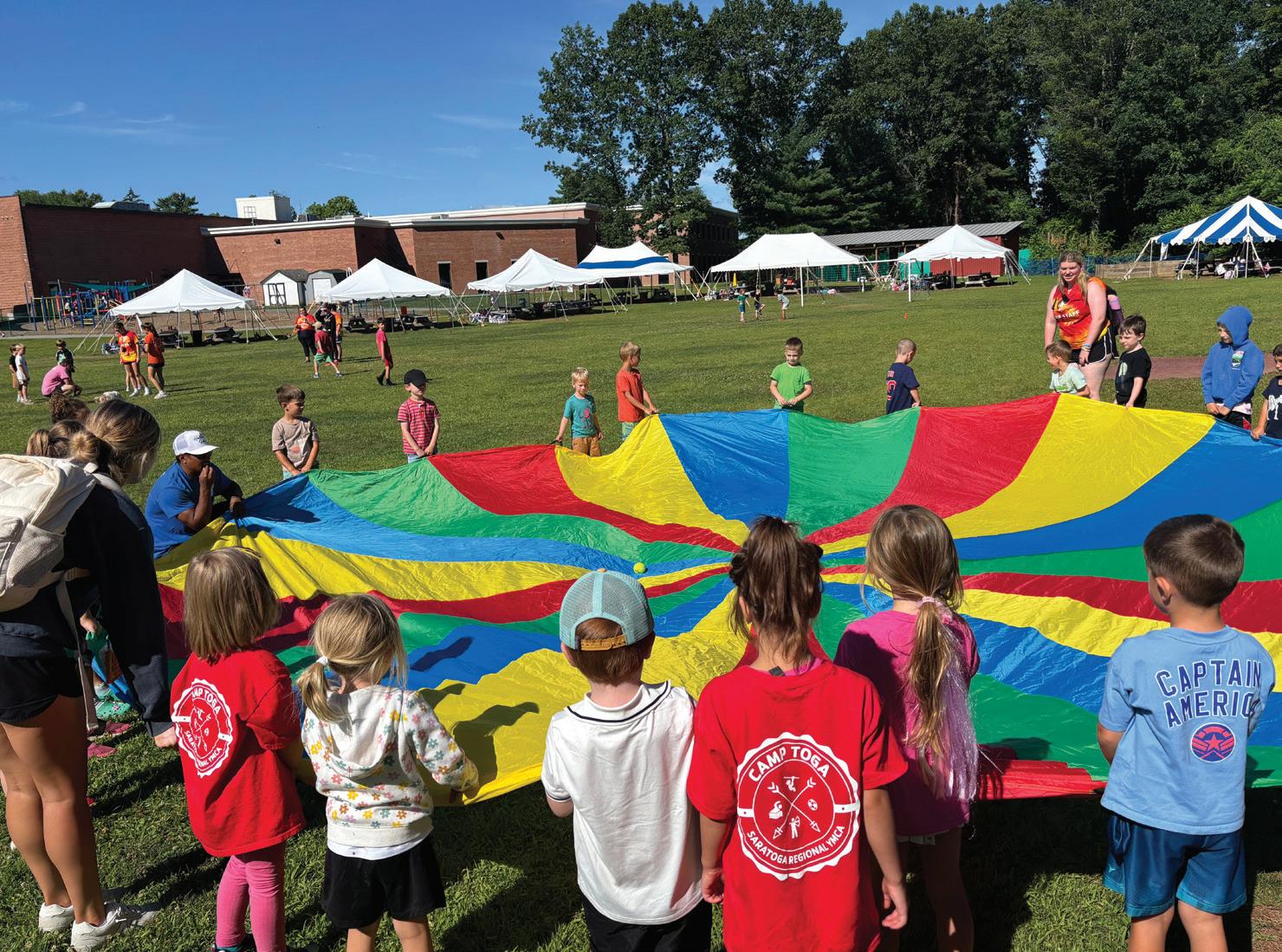
Children take part in a Saratoga Regional YMCA activity as the organization expands child care programs across the region to help families and employers adapt to a shortage of available slots.
YMCA
Continued From Page 8
best to accommodate those families through our traditional financial assistance program if they are no longer eligible for DSS funding, but … it’s a terrific program. It allows us as a provider to remain full while providing and making sure that a family can stay in the workforce.”
The state subsidy picture has grown more complicated in recent months. Liza Ochsendorf, director of Warren County Workforce Development, said that childcare consistently ranks among the top three barriers to employment for people coming through regional career centers. She noted that the CCAP subsidy program has been significantly constrained.
“There are families that have had to take their kids out of childcare because their subsidies ended or ran out,” Ochsendorf said. “That was also a barrier to us recruiting and opening more home-based providers.”
Ochsendorf framed the structural problem in terms that go beyond any single funding stream. “There aren’t enough childcare slots, it’s not affordable for families, and the wages of childcare providers are not sustainable,” she said. “So, it doesn’t help to recruit or retain childcare providers with their livable, sustainable wages. So those three issues are constant … the childcare slots, the affordability for families, and then the providers not making a salary that helps us recruit and sustain them.”
New York state data bears that out. The median annual wage for childcare workers statewide was $38,234 in 2023 — more than $20,000 below the median for all New York workers — according to the state comptroller’s report. The state’s average annual childcare cost rose nearly 18 percent from 2018 to 2023, reaching $14,621 per child. A separate analysis by the First Five Years Fund placed New York’s average cost of care at $20,439 per year. The inaccessibility of childcare costs New York an estimated $13.6 billion annually in lost earnings and productivity.
At the Saratoga Regional YMCA, the half-day preschool program runs 9:15 to 11:45 a.m. and costs approximately $13 per hour, with swim instruction and adventure center time included beginning next year. The Malta Early Learning Center runs 7 a.m. to 6 p.m. Monday through Friday year-round and is licensed by the New York State Office of Children and Family Services for up to 96 children. UPK classrooms are fully state-funded and require no tuition or YMCA membership. The before-andafter school BASE program runs at sites spanning Saratoga, Warren, and Washington counties, of-
SeverusAI
Continued From Page 4
review daily reports and monitor interactions to ensure quality. Crowd described this approach as semi-autonomous, serving as a chaperone for the technology.
“I think that we’re not ready for fully autonomous systems yet,” Crowd said. “Humans need to be involved, not replaced.”
Looking ahead, Crowd warned that business owners who ignore artificial intelligence will soon be unable to keep pace with their
fering morning care beginning at 7 a.m. and afterschool care through 6 p.m.
The workforce dimension of childcare access is no longer a background issue for area employers.
D’Antonio said her team is in active conversations with multiple large organizations about employersupported childcare models. Stewart’s Shops already offers its employees a 50 percent subsidy toward YMCA childcare, a partnership D’Antonio described as a meaningful example of what employer investment can look like.
“Employers are realizing they’re going to have to reserve childcare spots whether they have an employee to fill that spot or not,” D’Antonio said. “It’s more like a healthcare model, right? You’re paying for your employees’ healthcare whether they’re utilizing it or not … in order to recruit and retain staff they need to be in this childcare space.” She noted that healthcare sector employers in particular are taking notice after recognizing that nurses are leaving the field after having children due to a lack of care that accommodates their demanding schedules and longer shifts.
Ochsendorf pointed to a “thirds” model gaining traction in other parts of the country, in which the employer, the state or local government, and the family each pay one-third of childcare costs. She also flagged New York State regulations that currently prohibit most workplaces from housing on-site childcare centers. She called for localized sustainability funds that businesses and individuals could contribute to, helping providers absorb unexpected operational costs that can force closures.
“We’ve got to do something different. We’ve got do something else,” Ochsendorf said. “We can’t just keep throwing money at the problem. We need a system-wide overhaul.”
Back at the Saratoga Regional YMCA, D’Antonio said the organization’s financial assistance program is available to any family, regardless of circumstances, and is not limited to those in persistent financial hardship. “It’s not always just based on someone who might continuously be going through a financial struggle,” she said. “Things happen-- someone loses their job, someone’s out of work because of an illness, someone has a tragic life moment and they just can’t keep up. And that’s where we want to step in and support, and that’s what we do.”
Families interested in learning what they qualify for can visit any YMCA branch and ask to be run through the financial assistance program. The Saratoga Springs branch, which houses the association office and the half-day preschool, is located at 290 West Ave. The Malta Early Learning Center, which has openings remaining in its preschool and summer camp programs, can be reached through the Saratoga Regional YMCA’s main line at 518-5839622. Job openings are posted at srymca.org.
competitors. As artificial intelligence advances, tools capable of doing the work of several employees will become the standard.
However, Crowd views this technological shift as an overwhelmingly positive development for tired entrepreneurs. By offloading repetitive duties, business owners can reclaim their valuable time.
According to Crowd, “AI is a gift because you can get back to being creative as a human, and have the space to remember why you even started your business in the fi rst place.”
For more information on Severus AI, visit www.severusai.com.
Countryside
Continued From Page 8
portation for outside appointments. Physical and occupational therapy and wound care are arranged through outside providers as needed.
Days at Countryside are built around meals, activities and socialization — exercise classes, crafts, games and discussions fi ll the morning hours, and outings and special events are woven throughout.
Outings are a regular part of life at Countryside. Th is past winter, residents attended hockey games. Last summer, they went out on boats. Trips to restaurants are common and organized through the activities department. The facility also runs a pen pal program with students at Bolton Landing School and recently hosted a joint bingo night with The Landing using an outdoor movie projector set up indoors.
“Getting them engaged in the community is our number one priority,” McByrne said.
The facility completed a $4.6 million capital improvement project in 2023, covering structural, HVAC and amenity upgrades. McByrne described the result as a homelike setting, with a living room-style lobby, a large activity room, an expansive dining room, a family room, a game room, outdoor patio spaces and a pond area.
Visitor hours run from 8 a.m. to 8 p.m., with flexibility extended as needed. Families are welcome to use facility spaces for gatherings; McByrne asks only that they call ahead.
Admissions follow a prescreening process to match prospective residents to the appropriate level of care. Most referrals come from the community or through Hudson Headwaters. Those needing more intensive support are referred to skilled nursing facilities.
The facility currently has some openings. What distinguishes Countryside as much as its programs is the continuity of its staff. The facility employs 35 people and averages
WWIDA
Continued From Page 8
ington.
At the state level, arts organizations have reported that funding from the New York State Council on the Arts has become slower to arrive and in some cases reduced. The lag between application, award notification and disbursement can stretch to nine months or longer, a timeline that strains small organizations with limited cash reserves. Those pressures have pushed some local arts groups to rethink their fi nancial models and explore strategies for attracting private investment alongside traditional grant support.
Barton said a credible economic impact study would help on that front as well, giv-
20 years of employee tenure. Four retired staff members have returned to work part time. Several colleagues McByrne began working alongside 35 years ago are still there.
“My residents know who’s going to be there at Monday morning to give them their shower, who’s going to be working Saturday afternoon to put a movie in for them,” McByrne said. “They know it’s not going to change unless it’s time for them to retire.”
New staff members complete at least 80 hours of in-house training in personal care, medication assistance and residents’ rights, plus 12 hours of state-required continuing education annually.
“Seeing a resident come here and blossoming,” she said. “They weren’t following their diet or they weren’t getting the nutritious meals or they weren’t getting their medications or they weren’t getting to the doctors. And they’re here six months and it’s like a totally different person. I think that’s my favorite thing, knowing the type of impact that we have and how we can change one person’s life completely.”
McByrne said her primary goal is raising awareness. Because the facility sits outside the region’s population centers, many who could benefit from its residential, day care or respite services — or whose loved ones receive Meals on Wheels prepared in its kitchen — do not know it exists.
“I want them to know that we’re here, that we offer respite, that we offer daycare,” she said. “If you need resources, call us. We’ll — sometimes we can’t offer them an admission here, but I give them whatever knowledge I have to help them, maybe lead them to where they need to be to get what they need for their loved one or even themselves.”
Countryside Adult Home is at 353 Schroon River Road, Warrensburg, NY 12885. The facility can be reached by phone at 518-6233451. Those interested in volunteering may ask for activities coordinators Lori Durkin or Faye Perry. Inquiries about Meals on Wheels enrollment should be directed to the Warren County Office for the Aging.
ing organizations stronger evidence to support applications at every level of funding.
“Having this information about economic impact helps boost the merits behind applications for grants,” he said.
Barton was also direct about what he hopes does not happen once the study is complete. “We don’t want this to sit on a shelf and collect dust,” he said. “We want meaningful action items that are actionable, with the right leadership to drive this.”
The WWIDA expects to announce the selected consultant following its June 15 board meeting. The study duration will be determined by the selected fi rm, with WWIDA anticipating a timeline of six to 12 months to account for the region’s seasonal creative calendar.
For more information about the WWIDA and its programs, visit warren-washingtonida.com.
Scratch Kitchen
Continued From Page 1 tenants include Fiddleheads, Black Watch and most recently Birch Bark Eatery, the vegan restaurant whose owner relocated to Albany, before the space was used as an event venue for about two years. The existing hood and infrastructure meant Semon’s build-out focused on outfitting the kitchen with new commercial equipment and refreshing the dining room and bathrooms, rather than undertaking structural work.
The interior aesthetic, Semon said, drew inspiration from the existing light fixtures. “Nicki, who’s the manager at my other little shop, she’s come along with me,” she said, referring to manager Nicki Loiselle, with whom she is also discussing a future partnership. “She looks up at the lights that were here and they have like a copper undertone and we’re like, we really like that copper, like kind of turquoise look.” The team settled on a wallpaper that anchored a palette pulled from Scratch Kitchen’s existing logo. Semon described the evening atmosphere as dark and moody. “Accessible elegance,” she called it, borrowing a phrase that came up during the interview. “Nobody’s going to feel like they can’t be here, but it’s going to be a nice space.”
The restaurant will open first for breakfast and lunch, maintaining the menu of house-made breads, sandwiches, salads, pastries and specialty coffee that built Scratch Kitchen’s reputation on Warren Street. Semon plans to phase in dinner service, tentatively beginning in June, with a small-plates concept drawing on Spanish, Asian and American regional culinary traditions.
“I would like to do like a tapas style menu, but with a few signatures,” Semon said. “Smaller plates, lots of sharing kinds of foods — we’re probably going to change that menu constantly, like weekly, with seasonal food. I love the farmto-table kind of thing.”
Semon credits chef David Britton — a mentor she met during her years at The Sagamore and later worked with at Springwater Bistro and Saratoga Polo — with shaping her affinity for Spanish cuisine and its ingredients. That influence, along with her time at the Culinary Institute of America in Hyde Park, where she graduated in 1998 with an associate degree in culinary arts, underpins a cooking philosophy that resists being boxed in.
“I love the whole international — I love Spanish food,” she said. “With dinner service, I think that’s really going to be able to come out to play.”
The Ridge Street space also features a small bar, and Semon has begun the application process for a liquor license, with the intention of offering beer, wine and a specialty cocktail menu on dinner nights. In the interim, she plans to develop a mocktail program. Saturday brunch — which she piloted at the Warren Street location — will be expanded, and she is considering adding live acoustic music on a rotating weekly or biweekly basis during the warmer months.
Semon also plans to sell artisan breads through a front-window display, building on the sourdough and house-made roll program she established at Warren Street. Online ordering for breakfast and lunch, along with DoorDash delivery, is in development for the website at scratchgardenskitchen.com.
The expansion comes at a propitious moment for the city. Downtown Glens Falls has undergone a sustained revitalization, anchored in part by the completion of the South Street Market Center — a project that leveraged a $9.7 million Downtown Revitalization Initiative grant from New York state into more than $48 million in total investment, according to the governor’s office. SUNY Adirondack’s culinary campus on Hudson Street has added another dimension to the city’s culinary identity, and a growing roster of independent restaurants has positioned the downtown as a regional dining destination in its own right.
“I feel like Glens Falls is kind of getting like… it’s becoming… we’re coming into our, you know, a place people go to on purpose,” Semon said. “I love that I get to be part of that, like to bring that kind of momentum to the area.”
Semon’s husband, Martin Semon, a former culinary professional who now works as a carpenter at Great Escape, has contributed labor and custom built-ins to the Ridge Street build-out. In addition to Nicki, Semon said the front-of-house team is largely staffed by people who have worked with her previously, and she continues to accept applications.
As of the interview, Scratch Kitchen was awaiting a building and codes inspection and a health inspection before receiving its certificate of occupancy and setting an official opening date. Semon said the restaurant is otherwise ready to open.
“We’re ready, we’re ready to go,” she said. “We just need those two things.”
Scratch Kitchen’s new location at 21 Ridge St. will share the block with Farmacy and Radici Kitchen and Bar. For updates, visit scratchgardenskitchen.com or follow the restaurant on Facebook.
Glens Falls Dining Guide
The Glens Falls Region Dining Guide! With so many great restaurants, Glens Falls NY dining is a not-to-be-missed experience! Search for cafes, coffee shops, bakeries, lunch spots, restaurants offering nearly every type of cuisine, and more.
e Docksider Restaurant
298 Glen Lake Road Lake George, NY 12845 www.docksiderrestaurant.com
Mint
80 Warren Street Glens Falls, NY 12801 www.mint518.com
Open year round on Glen Lake in Queensbury, The Docksider Restaurant features lunch and dinner with a fireplace for winter and a great deck for outdoor dining overlooking the water.
Enjoy seasonally fresh fare and exquisite cocktails in a relaxed atmosphere at Mint in Glens Falls. The upscale yet casual restaurant supports local farms and artisanal crafters to be able to use fresh, thoughtfully raised, in-season ingredients.
Jack's American Bistro
730 Upper Glen Street Queensbury, NY 12804 www.jacksamericanbistrony.com
Jack's American Bistro was the culmination of a lifetime spent in the restaurant business. After several months of planning in June 2004 the doors were open to a new dining experience in the Glens Falls/Queensbury area.
* * * * *
Park & Elm
19 Park Street Glens Falls, NY 12801 www.parkandelm.com
Morgan & Co. Restaurant 65 Ridge St Glens Falls, NY 12801 www.morganrestaurant.com
Experience fine American dining in downtown Glens Falls at Morgan & Co. Every dish offers a unique and innovative twist on original recipes. Morgan & Co. also caters events from weddings to reunions and more!
* * * * *
Radici Kitchen & Bar
26 Ridge St Glens Falls, NY 12801 www.radicikitchen.com
Park & Elm is a multi-concept eatery with a gourmet market, delicatessen and fine dining restaurant located in downtown Glens Falls. Enjoy an elevated dining experience, grab breakfast or lunch or shop the market for local goods.
* * * * *
Experience the authentic taste of Italy with a modern, upscale flair at Radici Kitchen & Bar in Glens Falls. This intimate eatery focuses on scratch-made cuisine, blending traditional techniques with contemporary flavors for a sophisticated outing.
North Creek
Continued From Page 6
A vacant, undeveloped parcel just north of the Public House on Main Street “becomes a different parcel of land” ripe for development when there is a municipal sewage district, he said.
Affordable housing is one of the highest priorities, and Goodspeed believes “developers are going to be more incentivized to create more building units.”
The sewage project is “a union of economic growth, benefiting business while at the same time protecting the environment and preserving heritage; a rare triple combination that’s a further indicator of the potential for success here,” he said.
He cited the town’s strong working relationship with the Olympic Regional Development Authority for much of the success already realized.
The Ski Bowl, one of the Northeast’s most historic ski venues, was nonoperational for quite some time before reopening several years ago with an interconnection to Gore Mountain. The Hudson chairlift follows the exact track of a 1940s-era T-bar. From the summit, guests can link to Gore Mountain proper or stay and ski in the park.
Hudson chairlift usage has tripled in the past three years.
Some visitors prefer using the Village lift to stay
in the Ski Bowl all day, similar to situations at resorts such as Killington, where people can visit a large resort but enjoy a much smaller area.
“On a Saturday or Sunday this winter the volume of Ski Bowl traffic was astounding,” Goodspeed said. “There were more than 500 cars there some days.”
The treatment plant is on previously vacant land adjacent to Johnsburg Town Hall. Firms working on the project are Jersen Construction Group of Waterford, William J. Keller & Sons Construction Group of Rensselaer, Stilsing Electric Inc. of Rensselaer and Saratoga Springs-based Cedarwood Engineering Services PLLC.
Most funding is from a bond anticipation note and two rural development grants. Warren County has agreed to provide $250,000 per year in occupancy tax funding for 10 years, but only if needed, to keep work moving forward.
The town is in the process of drafting rules and regulations for operation of the system and what new participants must do to connect to it.
“It’s incredibly complicated from an engineering and financial standpoint,” Goodspeed said. “We’re trying to keep all those balls in the air, everyone communicating and getting paid so the system can be finished.”
Eastern Heating
Continued From Page 7
maritan (Troy), St. Mary’s (Amsterdam) and Albany Medical Center hospitals.
“And the area is booming with apartments,” Tricarick said. “That’s a big part of what we do, especially on the new construction side. Also, a lot of old warehouses are being converted into apartments in places like Cohoes and Menands.”
Siena College, Coburg Village retirement community in Rexford and Washington County’s municipal complex in Hudson Falls are also significant clients.
Eastern has close working relationships with a variety of contractors, including Munter Enterprises and Pike Construction Services.
As with every project, HVAC is now integrated early in the construction planning process, and Eastern’s in-house sheet metal fabrication division allows tighter scheduling and quality control.
Eastern started as a family-run business in 1945, focused mainly on refrigeration, and continued that way for several decades until former President Fred Giardinelli co-founded Comfort Systems USA, which went public in June 1997 with 12 operating companies.
Houston-based Comfort Systems is now an $8 billion corporation with more than 45 companies in over 170 locations and 18,000
employees.
Th is relationship gives Eastern a great deal of support and outreach.
Considering the strength of the Capital Region economy, Tricarick said he is quite optimistic about Eastern’s business future.
“We’re adding five to 10 young technicians per year,” Tricarick said. “We have good relationships with colleges and BOCES programs. That’s how we do our recruiting. When we bring a young technician on, just out of school, they do a full year’s training with a senior technician before getting a van on their own.”
Eastern assigns each technician to specific accounts so customers become familiar with the person who provides service, and vice versa. Th is way, when technicians go to a building they are familiar with its equipment and do not have to be shown around and assess things, like a fi rst-time visitor would.
“Finding experienced technicians is very difficult, so the next best thing is to bring in young people and train them,” Tricarick said. “Sometimes that’s better because they aren’t coming in with bad habits. We’re training them the way we would like them to do things. We’re successful and have a great reputation and it’s because of our talented, well-trained workforce.”
Subway Franchises
Continued From Page 6
He started developing commercial plazas in 2018. He said he likes to own the real estate where his Subway shops are located because he has control over the site and it’s the best way to generate long-term income.
Another project in the early planning stage is a 74-unit apartment building at the corner of West Avenue and Station Lane in Saratoga Springs. Plans call for one- and two-bedroom apartments. Lansing Engineering is working with local officials on securing the permits.
After earning a degree in criminal justice from Salem International University in West Virginia, Faden was a patrol officer with the Saratoga Springs Police Department for 12 years. He started his entrepreneurial journey in 2007 while still on the force when he purchased his first Subway shop on Broadway. He remained with the police force for five years before he was able to transition full time to the business.
In July 2017 Subway implemented its Fresh Forward initiative, requiring its franchisees to modernize their stores, giving them a brighter, more open look. To date, Faden has remodeled 35 of his locations to the concept and any stores he acquires in the future will be built to these specifications.
“Within two more years all my stores will be remodeled according to the concept,” he said.
With so many locations Faden obviously cannot oversee all of them on a daily basis. He said he has committed, hard working employees at every level who keep thing running smoothly. Every store has a manager and there are area managers and a maintenance crew as well. Between full- and part-time workers he employs 300 people.
“We have a big team of people and everyone does their part,” he said. “It’s definitely a team effort.”
Northern Builders
Continued From Page 7
Northern Builders’ capabilities. The company already operates its own excavation and hauling divisions, with a fleet of trucks. The owners are in the early stages of launching a standalone concrete business to secure their supply chain.
“We have great concrete subcontractors. They’re amazing. We owe them a lot, and they do a lot for us,” Denno said. “But the reality of it is, we don’t know how much longer we’re going to have them. So we’re going to be proactive. We’re going to see, we’re going to invest in it and put it together.”
“We really try to put out that great product in the shortest amount of time because our homeowners, when you put a shovel in the ground, they’re very, very excited,” Stewart said, noting they aim to turn over custom homes in an eight- to 12-month period.
Like many construction firms, Northern Builders faces industrywide staffing challenges as an older generation of skilled tradespeople prepares to retire. Rather than solely competing for a shrinking labor pool, Stewart and Denno are focused on the future. They recently partnered with the Workforce Partnership Coalition, an initiative closely tied to BOCES, to encourage students to explore careers in the trades. Stewart recently visited students at South Glens Falls High School to promote the industry, emphasizing that the narrative pushing all students toward a traditional four-year college education, and the potential debt that comes with it,
is shifting.
“The program supports that mission to have people get into the trades,” Denno added. “We’re lucky that people recognize that, and we’re lucky that there are organizations out there and the educational systems are actually promoting that.”
Fostering a supportive work environment is essential to their retention strategy. Northern Builders offers comprehensive benefits, including health insurance, retirement plans and paid vacation, aiming to treat its workforce like family.
“I always tell everybody, one of my lines that I used to use and I meant it was ‘I’m not interviewing for a job, I’m here interviewing for a career,’” Stewart said. “We want you to grow, we want you to show that growth.”
“We realize that being able to go to work every day and wanting to be there is huge,” Denno said. “We want that for our guys. We care about how they are doing.”
Despite its rapid expansion, Northern Builders remains deeply rooted in the community. Stewart and Denno regularly assist their neighbor, the Moreau Community Center, and help clients navigate the complexities of local planning and zoning boards. For the two former officers, success comes down to the people around them.
“Strong communication and supporting of your community is the base that builds companies within the community,” Stewart said.
For more information on Northern Builders, visit https://northernbld.com.
Mayor
Continued From Page 1
businesses.
AYHA President Royce Lawrence said, “Our program alone brings in tens of thousands of people to the community every winter.”
AYHA has used the facility for 40 years. AYHA and city attorneys are negotiating an agreement that may or may not involve AYHA ownership, but the organization will do whatever it takes to keep the rink open, including buying it, Lawrence said.
“We’re trying to be the best community member possible and make sure that facility stays open, not just for us, but the entire community,” he said.
Palmer, who previously chaired the city Recreation Commission, said, “We are looking at ways to grow our recreational offerings and expand sports tourism, including youth sports.”
On a related note, she said the city is pursuing new ways, in cooperation with the county Tourism Department, to promote special events downtown. “We will be sharing the county’s application portal for occupancy tax funding for special events,” she said. “This is going to create a more fair and consistent process for the community groups that organize events in our city.”
One of Palmer’s first steps as mayor was creating a new planning and zoning department, separate from building and codes, which she said makes it easier for people to get the information and approvals needed to invest in Glens Falls.
“We want to make the city as user-friendly as possible for people who want to do business here,” she said. “And that starts with setting clear expectations and having clear processes from the beginning.”
One resident asked what steps are being taken to fill vacant storefronts on Glen Street. The new planning and zoning department will help people bring proposals to the Planning Board for review, the mayor said.
In addition to South Street’s transformation, considerable investment is occurring outside downtown. “KRU Coffee’s new cold-brew production facility in Tech Meadows (West Glens Falls) is now under construction and will add
jobs and diversity to our local economy,” Palmer said.
In addition, the Warren County Economic Development Corp. has presented the city with a new strategy, based on smart-growth principles, for bringing more business to Tech Meadows.
“Manufacturing is growing too,” Palmer said. “Adirondack Mechanical Services is preparing to move into a long-vacant warehouse at 7 Pruyn’s Island Drive, bringing a minimum of 50 jobs into our community. Even the Glens Falls office sector is expanding, reversing an office downsizing trend that continues around the country.”
For example, four new tenants are expected to move into the high-rise at 333 Glen St. soon, bringing more than 70 office and professional jobs downtown. The building’s occupancy dropped significantly following the pandemic as large tenants shifted to hybrid work models. “New tenant deals are smaller, but more diverse, and that diversification is creating a more stable office market moving forward,” the mayor said.
Parking, vitally important to business, continues to be a major challenge downtown, especially with dozens of new apartment and condo units opening soon. “Historically, Glens Falls has grown quickly without always planning carefully for how that growth affects parking,”
Palmer said.
Several steps are designed to improve the situation while eliminating the need for a multimillion-dollar new parking garage. First, the two-hour time limit is being extended to three hours, giving people more time to attend meetings and do business without getting a ticket.
“Second, we have removed time limits outside the downtown core,” Palmer said. “That means if you need to be here all day, you can park a couple blocks away and walk in.”
Third, the city is working with businesses and other parking lot owners to make lots available to the public at night and on weekends, when special events are held. “Fourth, we are taking a hard look at the permit system,” she said. “Right now, we are not charging market rate and as a result, some people are holding more spaces than they actually need. Those spaces often sit unused, but because they are assigned, no one else can use them. We are mov-
Garvey
Continued From Page 1
and balcony area, too,” he said.
One of the building’s most innovative elements is a fully automated loading dock and freight elevator, somewhat unusual for a car dealer, designed specifically for the company’s e-commerce division.
In addition to auto sales, Garvey is also the largest dealer of Kia accessories in the U.S., offering factory-authorized products such as floor mats, roof rails and tow hitches. It developed this line of business more than 10 years ago.
“We sell direct to consumer for people who want to enhance their vehicle,” Garvey said. “They can go to their dealer, but it’s easier to go online and buy from us.
The loading dock “is one of the biggest investments in the building,” Garvey said. It’s modeled after the kind used by rail cars, which have different heights, to serve the different types of trucks that make deliveries to the dealership, from FedEx vehicles to 18-wheel tractor-trailers.
A large storage area for e-commerce business was also part of the building’s design.
Garvey said the Kia expansion will create seven new jobs, primarily service technicians, with many more to follow. “We’re doubling our service capacity so we’re hoping to add quite a few technicians to better serve customers,” he said. “There’s more room for e-commerce staff and salespeople so we’re looking to add more of those people, too.”
A touch screen in the sales area allows customers to “build” a new car by viewing and choosing specific options such as color.
Kia, a Korean automaker, began selling cars in the U.S. in 1993-94 with corporate U.S. headquarters in Irvine, California. Garvey has been a Kia
ing toward a more flexible system that includes daytime permits, night and weekend permits, and full-time permits for those who truly need them.”
“By matching permits to how people actually use parking, and by adjusting the pricing, we can free up spaces that are currently sitting empty and make them available to more people,” the mayor said.
The city is also considering reducing the
dealer since 1998.
Primarily targeting a middle-class market, vehicles range in price from $25,000 for the K4 compact sedan to more than $65,000 for the EV9, a three-row SUV, and include traditional internal combustion engine, hybrid and fully electric vehicles.
“We’re a big believer that the market has to meet customers where they are,” Garvey said. “Kia is looking at all the power train options, which gives consumers the most choice. With the uptick in fuel prices, the biggest growth the last few months has been in hybrids.”
Congressional termination of federal tax credits for new, $7,500, and used, $4,500, electric vehicles has hurt those sales, he said.
But the new dealership property has a dozen Level 2 EV chargers and four high-speed DC Level 3 fast chargers.
All technicians are fully trained to handle every type of vehicle.
Customers can drop cars off inside in an enclosed environment. A fully functional service drive has two drive-through vehicle quick checks.
There’s also a delivery module for customers to pick up new vehicles.
Much of the building’s concept is from Kia’s retail architect, ChangeUp, with an emphasis on creating an open, welcoming atmosphere. But Garvey spared no expense on wide-ranging details, from noise-reducing acoustic tiles to mounted chrome fire extinguishers.
Garvey worked closely with Ethan Hall of Glens Falls-based Rucinski Hall Architecture. V&H Construction of Fort Edward completed the 18-month construction job.
“I can’t tell you how much time we spent on this,” Garvey said. “There are 15 global design firsts in this building meaning we’re the first Kia dealership in the world to put them in.”
size of parking spaces from a maximum of 26 feet to 20 feet on corners and 22 feet elsewhere, which would create more spaces. “And finally, we are working with the Business Improvement District on wayfinding and updated GIS mapping so people can easily find where to park and understand the rules,” Palmer said. “Because part of the challenge is not just availability, it is making sure people know where the parking is and how to use it.”