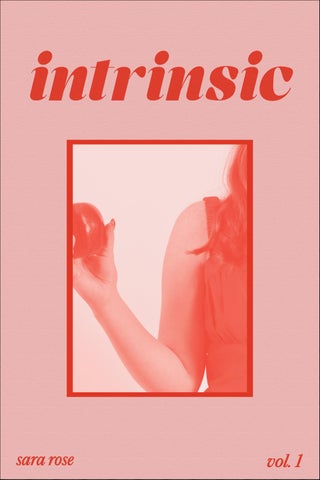
a letter from sara rose... If you’ve picked up this humble little magazine, please know I am thankful for your time and readership. In the summer of 2023, I was itching for a creative project and had been inspired by the many student publications I had seen at universities. So, I just gave it a go. I got to reconnect and spend time with such lovely women while creating these articles and taking these photos. It’s so often that I forget to slow down and get to know people, and creating this magazine allowed me to do that. I hope I did justice to these women’s stories, as they are all forces to be reckoned with. Please enjoy hearing about their lives as women in art as they explore the shades of the feminine experience. In tandem with the articles are some poems and a think piece, a bit more unconventional but meant to inspire thought. I encourage you to read them and decide what they mean to you. Intrinsic is synonymous with essential, natural, and innate. Femininty is within the world, and art cannot function without it. Femininity provides an energy that cannot be replicated, only lived. Femininity is intrinsic. Lastly, I’d like to address the matter of the magazine. The magazine is unapologetically feminine. It uplifts women’s voices, explores femininity, and helps highlight female stories. I wanted to create a feminist piece of literature and art that amplified the voices of the women I admire around me, so that’s what I did. However, I want to acknowledge that this provides a very binary perspective. I understand femininity doesn’t just take its form in individuals who identify as women. I started “safe” as a journalist and creator. In future writing and interviews, I want to challenge myself to explore how the binary is fluid and how femininity looks different for everyone. For anyone reading, no matter how you identify, if you connect to anything written or illustrated in the magazine, this is for you. Feminine experiences do not look one way, and neither does our world. I encourage everyone to read with that in mind.
“Feminity is leading with the spark of life,” Jones said. “In terms of girlhood, I feel like that’s hearing music and having the instinct to sing and dance, or whatever it is in somebody that makes them decide to twirl. As you grow older, I feel like it’s the thing that makes you look out for other women in your life. It’s leading with the spark of life.” Jones’ description spotlighted the words I was trying to find but couldn’t. Aubrey Jones had defined femininity in the pleather booth of a downtown diner. Jones grew up in Cincinnati, OH, and from a young age, she knew what her heart desired; hours of ballet and gymnastics classes cultivated her childhood. She ended up at Cincinnati’s School for Creative and Performing Arts and is now continuing her studies as a Musical Theater major at Pace University. A genuine triple threat, Jones is a woman of extraordinary talent and the passion and drive that translates into her work. Your eye cannot help but be drawn, and your heart cannot help but be moved to her performance on stage. We met in the Cincinnati theater scene in high school, but we’ve never had the opportunity to get to know each other very well. So, after being a friend and admirer of her craft for a few years, I decided to sit down and get to know her story. Jones is a Musical Theater major and performer in all aspects. However, she considers herself an artist in dance. “I feel like that is where my storytelling and artistry come from,” she said. “I feel like, if I am having a time of mental turmoil, I’ll Troy Bolton that shit and dance it out. I tell my saddest stories in dance; I tell my happiest stories in dance; I feel like that is my art form.” Her love story with dance began when she was young. As a girl with undiagnosed ADHD, Jones struggled to complete
work; specific subjects didn’t click. But, when she stepped onto the dance floor, everything translated perfectly, “I think my body just had a connection to it,” she said. “I got into that class, and it was like they were speaking in a language my brain didn’t have to do much to process. I was like, this is what I’m built to do. This turn makes sense, or going upside down like that makes sense to me.” For a long time, ballet and dance have often evoked traditional thoughts and constructs of femininity, poised, passive, “perfect,” etc. Aubrey’s lifetime of performance has offered her perspective on the ebb and flow of being a woman in the industry and society. When asked what time she felt most connected to her femininity, she answered not with a dance anecdote but with a bittersweet redemption story. “When I was little, I was a bows and skirts girl,” Jones said. “My mom loved to put me in the bows and skirts. All the adults were like, ‘You’re so precious,’ and I was like, ‘This is so fun.’ Then, other little kids were not so nice about the bows and skirts. I got called twinkle toes when I would wear sparkly sneakers. It made me sad because I felt like that was such a big part of who I was for the longest time, and without that, I felt like I was just trying to pretend to be something that wasn’t that. So, for my senior photos, my gift to my younger self was to do them in a princess dress. I wore the biggest, poofiest princess dress I could find. And I ran around Over-The-Rhine barefoot, took photos, spun around, and did everything that little girl would’ve loved to do.”
Jones’ commitment to herself and her inner self is one to admire. After learning more about her autobiography, we spoke about her experience as a woman in the dance and theater industry. Without trepidation, Jones explained that being a woman defines her work actions. At such an early age, she has already experienced the still existent wage gap between men and women in the workforce. “There have been shows where I’ve had the same amount of stage time as males in the cast and gotten paid $100 less,” she said. “As a child.” Not only is there a monetary burden, but an emotional one that many women, specifically black women in the performance industry, have to harbor. There is the unmistakable experience of women battling the labels or fears associated with taking up space. Whether that’s physical, their personality, or their ideas, Jones reflected that early in her work, others branded her a “show-off ” for exhibiting her extraordinary talent. She watched as her male peers exhibited similar behavior and skill without this label being stickered upon them. “I’ve had to remind myself that I’m literally a performer; what is my job other than to show off?” she stated. “If I’m preventing myself from being to my fullest for fear of being branded a show-off, I am dimming my full potential when I don’t need to.” I had always seen Aubrey as the most talented triple threat I’d met in Cincinnati. Her “marking,” a dance, is most people’s full out. She not only performs, but you can feel every ounce of energy put into her performance. Frankly, I’ve only seen an ounce of that selflessness and care to evoke emotion and love through performance in the male performers I’ve worked with. Yet, the line will always be moved.
“I don’t know what it is that whenever I do it to my fullest, it is too much,” Jones said. “Not only do I feel that comes from womanhood, I feel like some of that comes from black womanhood as well.” Growing pains and industry hardships have already formulated Jones’ career as a performer, albeit they’ve provided her with the vocabulary to identify and expand on these issues. Jones’ experiences have also offered her conscientiousness towards how her femininity ebbs and flows. She indicated that her favorite dance genre differs from the genre that makes her feel most feminine. “Heels [evokes a feeling of femininity.]” Jones stated. “I love to put on my black LaDuca boots, straddle a chair, arch my back, and flip my hair. I look at myself in the mirror and say, “You’re hot.” It feels so good and so womanly. Look at all that I am and can do.” However, Jones is most comfortable in a more grounded contemporary dance style, which she describes as more athletic. Contemporary style roots into the ground and calls for confidence in one’s physical ability, all while evoking strong emotion. Perhaps heels class offers more femininity while contemporary offers more female power. But that’s up to Aubrey, not myself. Jones and I concluded our conversation by discussing what she sees in the future. It involved some hesitation but also redirection. It felt so sincere. It was a perfect example of what it’s like to answer “What do you bring to the table?” as a woman or “What is it that you do?” It is so hard for a woman to take up the space she deserves.
It can be a formidable opponent just to be. I’ll let you reflect on this as I did in our conversation. Sara Rose: “So, where do you see yourself after university?” Aubrey Jones: “I see myself….on stage somewhere, should the universe provide. I’m starting my journalism minor next year. So, I’m not entirely sure what I want to do with that yet, but I feel like the combination of journalism and performance can be powerful when it comes to telling stories that matter.” (a moment of silence) “You know what, I see myself on Broadway. And I’m going to claw, tooth and nail until that’s true.” In that moment, Jones led with that spark she had mentioned earlier. She had let herself win, which was our hour-long discussion’s most potent moment. I had heard of her becoming the woman she is today, and I’ve seen her hard work and passion from the sidelines. However, at that moment, I experienced the energy that she wields.
It was beautiful.
organic
Are you sick of it? Being compared to something inanimate or edible, I mean? I love fruit. My favorite? It’s probably an apple. Apples are diverse and carry mouthfuls of nutrition and life. They feel so impactful. They’re the juice box you sipped watching Max & Ruby on the television with your babysitter on a crisp summer Thursday. They’re the slices with peanut butter you ate when going through a healthy snack phase in middle school. They’re the autumn activity with childhood friends you reconnect within your twenties.
It may derive from the idea of original sin that has interwoven into the quilt that is society. Maybe our “punishment” for Eve eating the fruit will forever be categorized as what the tree bore. Beard’s Women and Power writes that media that negates the intrinsic worth of a woman dates centuries. Most literature in Ancient civilization represents this condemnation of original sin, silencing the public voice of women.
But apples are passive. All fruit is. The memories that surround them derive from the person consuming the fruit. So why are women and their bodies still being compared to fruit? Why is it that a woman cannot just have a body? She must be pear-shaped or strawberry-shaped. While less common than it was in the 2010s, the practice of identifying body shape through a standardized vehicle, such as fruit, feels to be burned into society. Women must be one way or the other. They must be identifiable, something men can put their finger on to understand or sink their teeth into.
Without her voice, she’s demeaned as only a body. Beard highlights that in Ovid’s Metamorphoses, Io and Echo are transformed.
Io, into a cow, where her voice is merely a “moo,” and Echo, whose voice can only repeat others’ words. Rarely in classical literature is a woman allowed to speak without being seen in the image of a man or without consequence. Let’s return to the Bible, looking at it as a classical text. Part of Eve’s punishment was that her seeds brought forth a childbirth of anguish. In the beginning, women were condemned to control over their bodies by a man (?), although I would argue God is an entity.
Women were condemned to a life of physical strife, affecting their bodies and minds. This text has informed society and culture, other classical literature, and remnants of the punishment today. All from a fruit. In We Should All Be Feminists, Adichie highlights that behavior becomes normal, especially with habituated women’s gender norms. She says, “If we do something over and over again, it becomes normal. If we see the same thing over and over again, it becomes normal.” Seeing my body as fitting into a label had become normal. Being reduced to simply a body has become normal.
We still compare an embryo’s and fetus’s size to fruits. A woman’s vagina and breasts have crude slang as fruits. In the early 1900s, a “fruit” was both a derogatory term for a gay man or a promiscuous woman. A common feminine Southern American idiom is “She’s a peach.” Whether or not the parallels are incidental, women have far too long been demoted. Can we at least ensure a young girl on the internet never sees an article or graphic comparing her body to a fruit? It still seems a lot to ask not to be categorized by some sorting hat of capitalism, either selling us products or making us the products. We need to become comfortable in our bodies, and uncomfortable with being placed into file folders labeled “fruit.”
So yes. I’m sick of it. My body has run the gamut from a strawberry to an apple to a pear. I’m simply sick of having to care.
MAKING MOVES
I was scrolling on my Instagram feed when I saw a video of a woman sitting on her windowsill. windowsill The shadows danced around her silhouette, and they bled into a shot of the woman’s face. It was my friend, Nina’s. The video continued and played with vignettes and moments of beauty, grief, and life. I knew I had just seen the birth of a compelling creative, and she was one of my dear friends.
The form that gives her life can also be the one that tries to suck it out from under her. “I feel like I have to work ten times harder because there are no women in the industry,” she said. “Not many people can name female directors other than Greta Gerwig and Sofia Coppola. I constantly have to overcompensate just to be taken seriously. The older I become, the more apparent that is for sure.”
Morra and I have grown up together. Our friendship dates back to songwriting and performing our concerts in the third grade. With regrettable haircuts and outfits, we sang our hearts out to Christmas songs and had many a sleepover. While we were never best friends, we found comfort in each other. We’ve seen each other at our worst and our best. She is a constant.
However, there is nuance in every situation. While being a woman in film is still underappreciated in some spaces, there has also been room for Morra to explore her power as a woman in the industry. On set, Morra was taken under the wing of Amy Faust, an influential woman in the Cincinnati cinematography scene. “Amy Faust is a badass; she’s awesome,” Morra said. “She was talking about the very few women there are in the industry; you have to stand up for yourself; you can’t take a shit. You have to be assertive.”
Morra hit the ground running this year as she transferred to the University of Cincinnati’s CCM for Media and Production. Morra has made her mark within the city’s film scene in recent years. She’s already crafting her tool belt as she’s worked on feature films and commercials. “I think it’s one of the art forms that includes so many different mediums,” she said. “There is just so much that goes into making movies, TV shows, and commercials. Everything is so detailed. Nothing is a coincidence.” Working in a male-dominated industry at such an early age has given Morra some perspective on roles in her industry.
I asked her what she lived by, something she learned early on. “Just keep your head up; take it as it comes,” she said. Instead of staying in a lane, Morra has created her own. Her heart leads her through adversity and unsureness. She is unapologetically powerful and avant-garde. Morra told me that femininity looks different for everybody, but for her, it’s all the things that make her comfortable with herself. Femininity isn’t a specific way to dress or present; it’s a feeling. life.
“ I BRING DIFFERENT, NON-TRADITIONAL IDEAS ”
This understanding of being a woman has translated to confidence in her dreams and how she defines her life. “In the past year, I’ve learned that my past doesn’t define my self-worth, my mistakes, or anyone else other than myself,” she said. “I learned how important it is to trust myself, be able to advocate for my own needs, and be there for myself when I need it.” She reflected that she brings a touch of femininity and a fresh perspective to her work. “Being young in everything, I bring different, non-traditional ideas,” she said. “I also think that since I haven’t worked in it too long, I have much more excitement and drive. It’s not boring to me; I give it my all. Despite any unfavorable situations early in her career, Morra hasn’t been jaded. She stays true to herself and offers the grace she needs to grow and achieve her goals. This woman is the one to watch. I’ve been incredibly blessed to have such notable figures in my life, but nobody has exemplified more resilience and reclamation of her dreams than Nina Morra. I found out she was transferring universities when she posted her artwork. That short film, a minute at most, profoundly impacted me. There were no words, but it spoke volumes to the creative that Morra is.
She rose from the ashes of high school, where she was underappreciated and undervalued, and became the woman she had always wanted to be. She was nobody else’s image, just hers.
Being a passionate artist doesn’t look one way. A multiplicity allows life to flow
from the mind to the tactile. Maeve’s story reflects a dream not abandoned but abided by. Through Miami University Fashion & Design, Maeve Vulcan has exemplified her talent for thousands through the annual fashion show and her position as Executive Design Director. Vulcan has spent her last three and a half years at Miami as an Art Education and Fashion Design Co-major, exploring her interests and tapping into her talent. “I remember being four years old in the car seat of my mom’s minivan and being like “I’m gonna be a fashion designer,” Vulcan said. I don’t know if that was from me watching too much TV, I don’t know if that was like me loving my Barbies and liking movies and costumes and dresses, but it was always just in there, and that never left; I never really wanted to do anything else.” That 4-year-old’s spirit stayed with Vulcan despite obstacles telling her to extinguish it. She attended Miami as a non-fashion major, but her heart gave in to her love of creating. (And thank goodness it did!) “My parents did not support me in fashion design, so I was trying to make it less important to me,” Vulcan said. “But when I got to Miami, I took Fashion 201, and I was just like: “I’m lying to myself; this is ridiculous; I don’t know why I wouldn’t just do this?’” Vulcan’s design portfolio spans three personal collections, La Métamorphose De La Femme (2022), Fanciful (2023), and Transcend (2023), as well as the collaborative Ethereal collection (2023). These pieces have walked the runway in Millet Hall at Miami University. She is currently working on two personal collections and the collaborative collection for MUF&D’s 2024 Fashion Show.
Her dedication to discovering aesthetics and identity shapes how she challenges herself. She described the pressure of putting together fourteen looks for the Ethereal show. It’s a daunting task; all she wanted was for her second collection to come together seamlessly. “I was scared throughout the whole year, like, “What if I don’t pull it off? Vulcan said. “What if nobody gets it? What if it sucks? And it didn’t suck, and I pulled it off, and people got it. And I was standing on the stage as my pieces were walking behind me, and the music I picked was playing, and I just cried. This was everything I wanted it to be.” Her designs quickly became a fan favorite during the Ethereal Fashion Show as they graced the stage, practically coming to life on the runway. As an audience member, no one else’s collection touched me like Vulcan’s. All these patches of trial and error and success have made Vulcan the artist she is today. Discovering how her femininity presents itself has allowed her to play with different styles and pieces throughout college. “I think that femininity is energy,” she said. “It’s not something you put on. It has a shape in people’s minds, and in different cultures, that’s different. It is soft, but it is hard. It is strong, but it is weak. It is not easily definable.” Fashion has given Vulcan the tools and confidence to sew her life as she sees fit. As connected as she is to design, she’s creating a different future for herself. “Now people will be like “Oh my god, you’re gonna be a fashion designer in New York!” Vulcan said. “I’m like, ‘um…I don’t see that for me.’ I want to design, and I want to sew. I don’t want that lifestyle. I’m just figuring out how to have that childhood goal but still care for myself and live independently in the Midwest.”
The future holds both fashion and teaching, fulfilling the lifestyle she wants, not a narrative that others have created for her. So many are habituated to thinking specific professions have simple definitions, often perpetuated by film and media. What is most admirable about Vulcan is her commitment to herself as both a person and an artist. There’s a balancing act to perform, but she’s not falling off a tightrope; she owns the stage as she sees it. When touching on femininity within fashion, Vulcan has discovered nuances within her designs and others. Vivienne Westwood is the woman Vulcan looks up most to in fashion. “There was a three-piece suit on a woman in her recent show,” Vulcan said. “I literally love it. It’s on my camera roll. It is a very [traditional] masculine garment, but this woman looks so good. She seemed so confident on the runway. I was just like, this is so amazing; I want to wear that. I think clothing that evokes emotion in me inspires me.” Vulcan’s description of the blending of power dynamics within this runway piece helps to define how vital fashion can be in helping find fluidity in femininity. There’s so much to explore with how clothes exude beauty, passion, and personality; it doesn’t look one way or the other. There is no correct answer. When reflecting on Vulcan’s 2023 line, Transcend very clearly exudes femininity, whether she meant for it to or not. It weaves in a story of loss, acceptance, love, and independence, all surpassing into ethereal energy. It feels as if she’s handcrafted this spark of life that is so very female. Vulcan, who is highly immersed in clothing craftsmanship, offered her opinion on today’s fashion industry. “We need to get our heads out of our ass and stop making garbage,” she said.
“I am so serious I hate going to the mall because I’m just like: this is the ugliest clothing I have ever seen; I know no one is going to buy this, and it’s going to go to the landfill. We need to use natural fibers and stop making so much clothing. We should make less but charge more because quality is more important than quantity. We need to educate consumers and hold brands accountable.” As one can imagine, it’s frustrating to see the corporate cycle of fashion spew microtrends and microplastics into an industry that should be based on quality and care. More recently, Vulcan interned at a vintage warehouse, reworking old clothes and restoring life to antiqued pieces. That dedication to artistry is much more rare in a capitalistic-dominated fashion world. No matter how she incorporated sewing into her life, Vulcan’s passion for her art will always exude tenfold the energy and life of any Urban Outfitters trend. Speaking with Vulcan gave me perspective and a new mindset into how I feel about my art. Quality over quantity, dedication to my heart, and deciding how I will define my life; All of these things are essential to giving yourself grace and tapping into what it means to be authentic. Her story is what it means to learn and grow. Her story is what it means to be a woman. To be told “No,” “This has to be this way,” and so forth. Vulcan’s story is inspirational and encouraging. So, take it from her when she said, “I think that femininity is an energy. It’s not something you put on. It has a shape in people’s minds, and in different cultures, that’s different. It is not just soft but hard. It is strong but weak; it is not easily definable to say it is this, it isn’t that. It is a feeling and an energy that people experience.” Passion and art are not easily definable. They meld into new forms and don’t take on one definition; it’s whatever you make them to be.
inspirations and sources Adichie, Chimamanda Ngozi. We Should All Be Feminists. Fourth Estate, 2014. Beard, Mary. Women & Power : A Manifesto. Liveright Publishing Corporation, A Division Of W.W. Norton & Company, 2017. Orenstein, Peggy. Girls & Sex. Harper Collins, 2017. Steinem, Gloria. “If Men Could Menstruate.” Women’s Reproductive Health, vol. 6, no. 3, July 2019, pp. 151–52, https://doi.org/10.1080/2329 3691.2019.1619050.
A special thank you to Aubrey Jones, Nina Morra, and Maeve Vulcan for sharing their stories so vulnerably with me. I am incredibly honored to have these women in my life. Additionally, a thank you to Sophie Wertz, Kendra McGuire, and Nya Hodge for posing for the “Organic” photoshoot. I would like to extend gratitude for all the strong women who have mentored me and helped me to grow into the 20-year old woman I am today. I still have so much to learn and experience, but I could not be more appreciative of those who have shaped me into the form I am currently. Finally, a thank you to my mother, who raised me with the mindset that I can do absolutely anything I put my mind to. She is the reason I can unapologetically be myself, and create a magazine for no reason other than to create.
created by sara rose detwiler