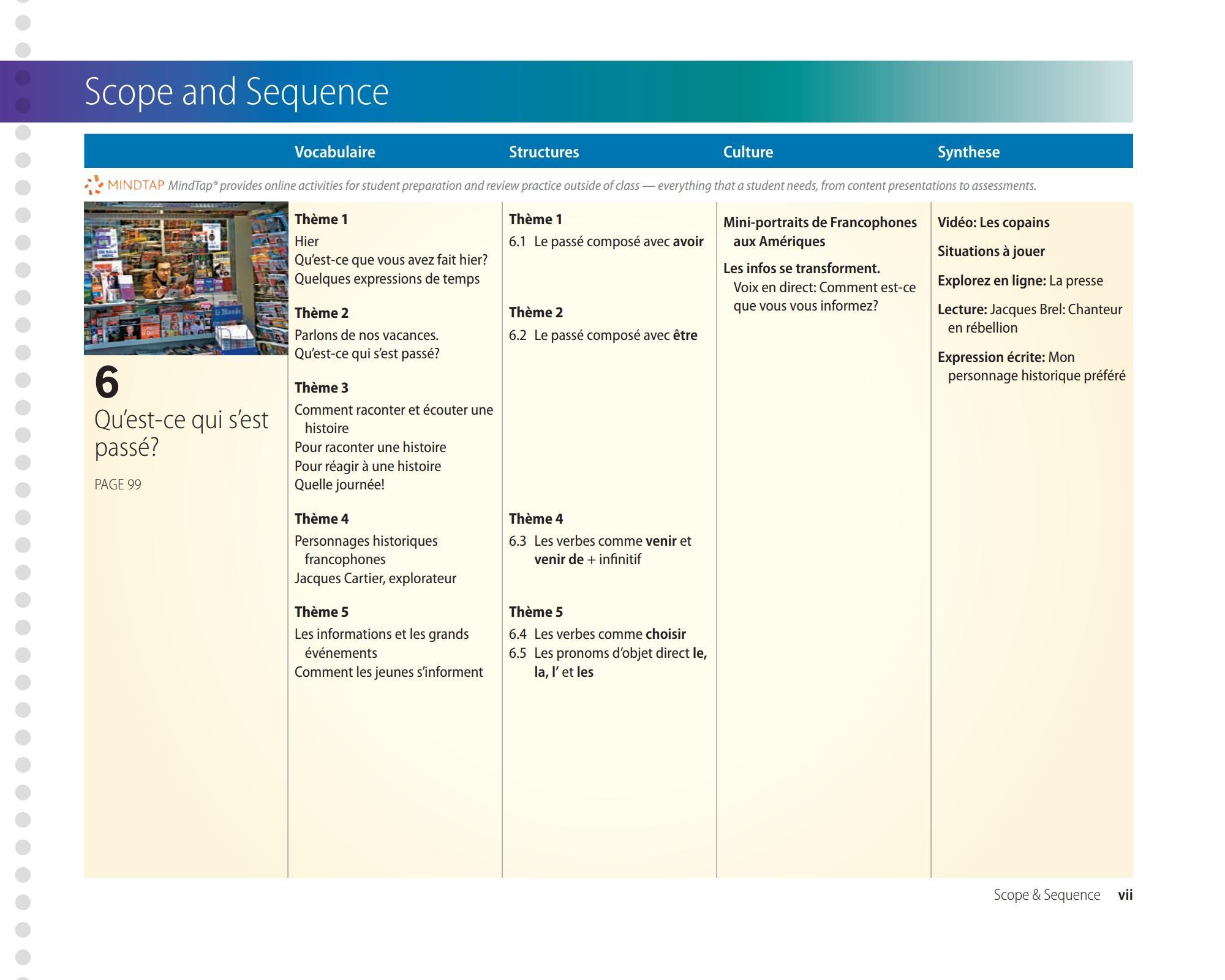
#. 1 # MIN DTAP MindTap ®provides onfine activities for student preparation and review practice outside of class - everything that a student needs, from content presentations to assessments.
Th eme4
Les activites: (a bouge!
Les activites de loisir
Themes
Les projets
Les projets
Theme 1
Comment inviter
Comment inviter
Comment repond re a une invitation
Invitat ion entre copains
Theme 2
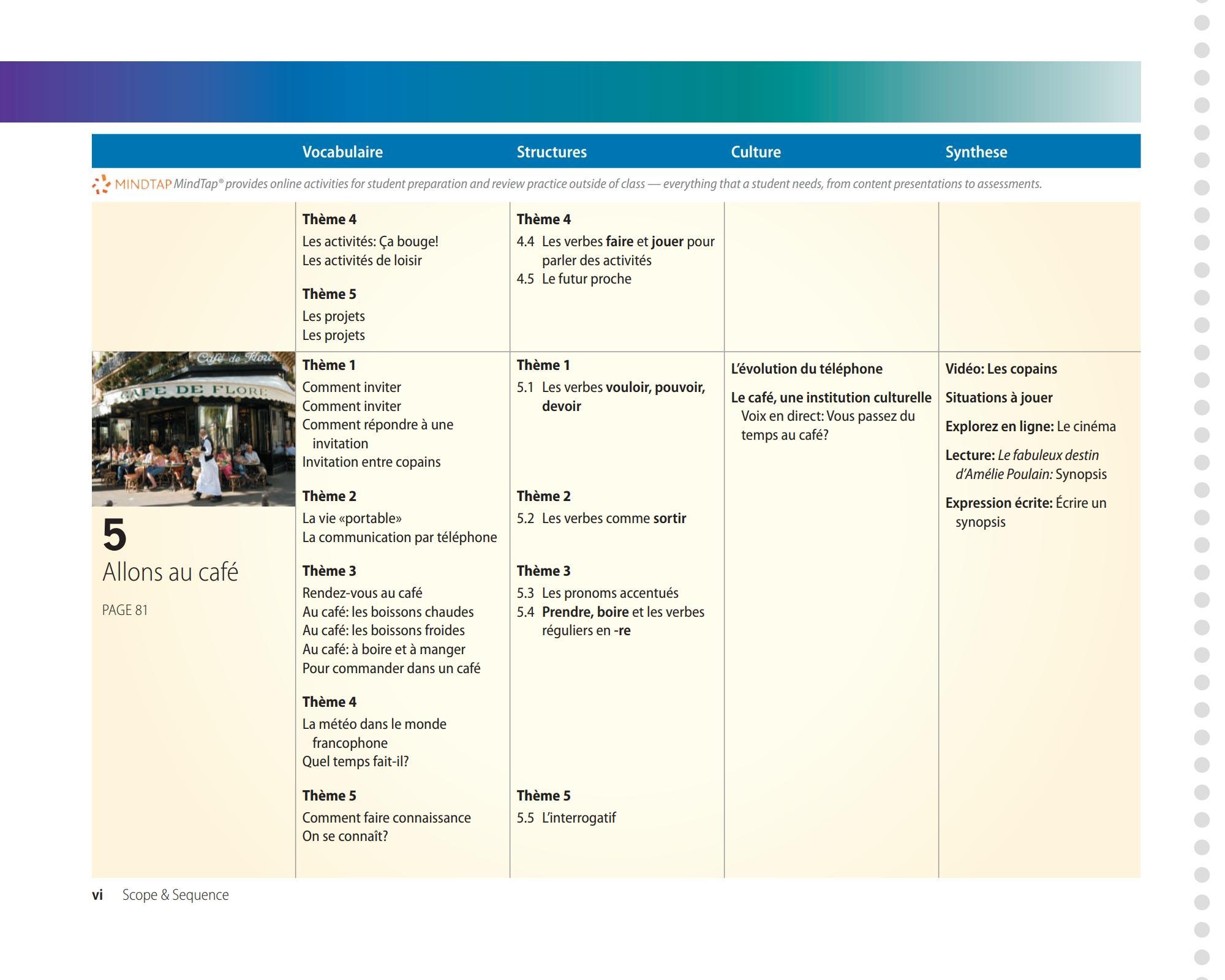
Allons au cafe
Scope & Sequence
Th eme4
4.4 Les verbes f aire et j ouer pour parler des activites
4.5 Le futur proche
Theme 1
5. 1 Les verbes voul oir, pouvo ir, devoir
Theme 2
La vie «portable » 5.2 Les verbes com me sortir
La communication par telephone
Theme3
Rendez- vous au cafe
Au cafe: les bo issons chau des
Au cafe: les bo issons froides
Au cafe: a bo ire et a manger
Po ur commander dans un cafe
Th eme4
La meteo dans le monde francophone
Quel temps fait-il?
Th eme S
Comment faire connaissance
On se connait?
Theme3
5.3 Les p ronoms accentues
5.4 Prendr e, boire et les verbes regulie rs en - re
L'evolution du t elephon e
Le caf e, un e in stitution cultur ell e Vo i x en direct: Vous passez du temps au ca f e?
Vid eo : Le s copain s
Situation s ajou er
Expl orez en ligne : Le cinema
Lecture: Le fabuleux destin d'Amelie Pou/ain: Synopsis
Expr es sion ecrit e: Ecrire un • synopsis
Themes
5.5 L'interrogatif
Vocabulaire
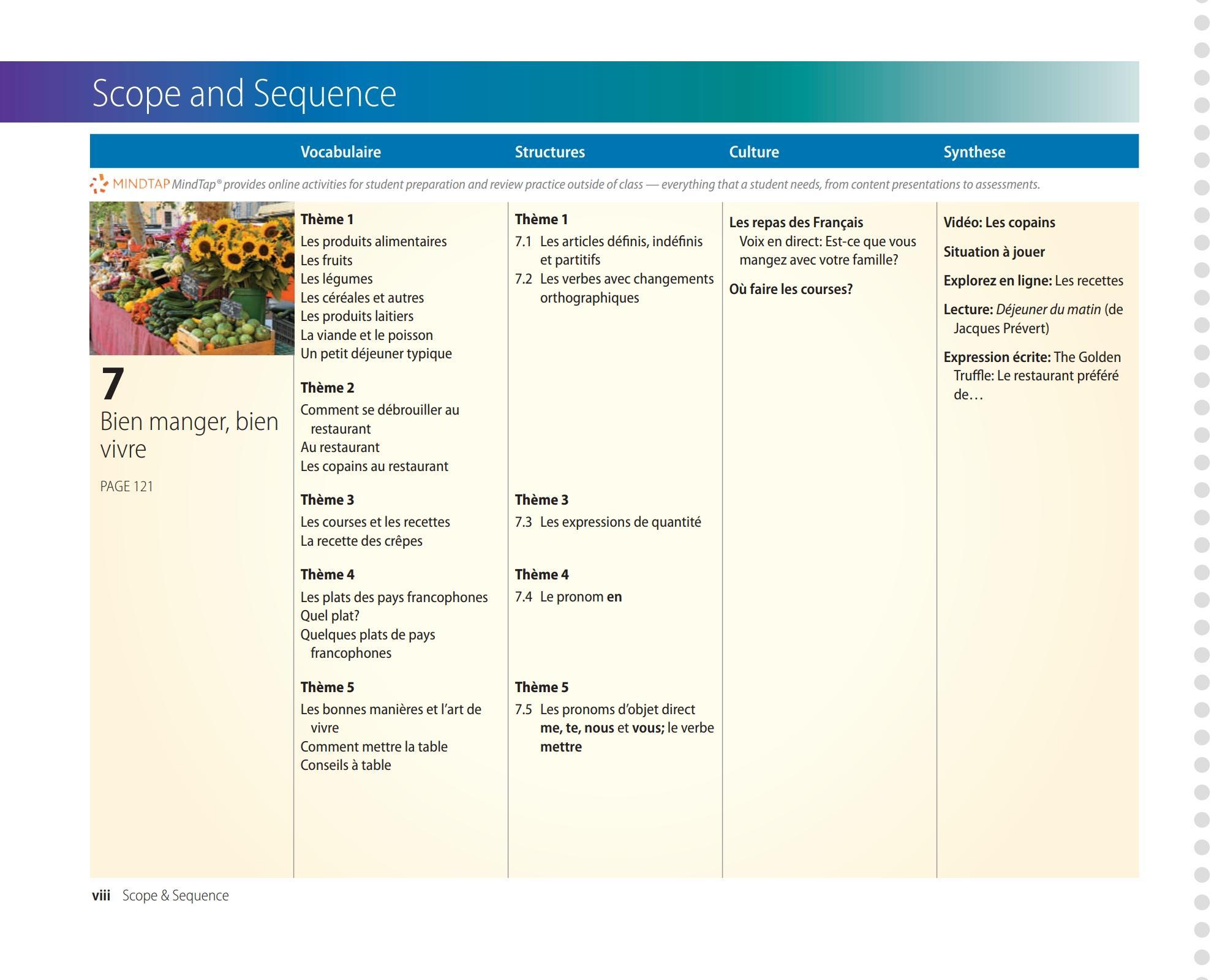
~: : MIN DTAP MindTap® provides on line activities for student preparation and review practice outside of class- everything that a student needs, from content presentations to assessments.
Theme 1
Hier
Qu'est-ce que vous avez fait hier?
Quelques expressions de temps
Theme2
Parlons de nos vacances.
Qu'est-ce qui s'est passe?
Theme3
Qu'est-ce qui s'est passe? PA GE 99
Theme 1
6.1 Le passe compose avec avoir
Theme2
6.2 Le passe compose avec etre
Mini-portraits de Francophones aux Ameriques
Les infos se transforment.
Voix en direct: Comment est-ce que vous vous informez?
6.3 Les verbes com me venir et venir de+ infinitif
Themes
6.4 Les verbes comme choisir
6.5 Les pronoms d'objet direct le, la, I' et les
manger, bien
Scope & Sequence
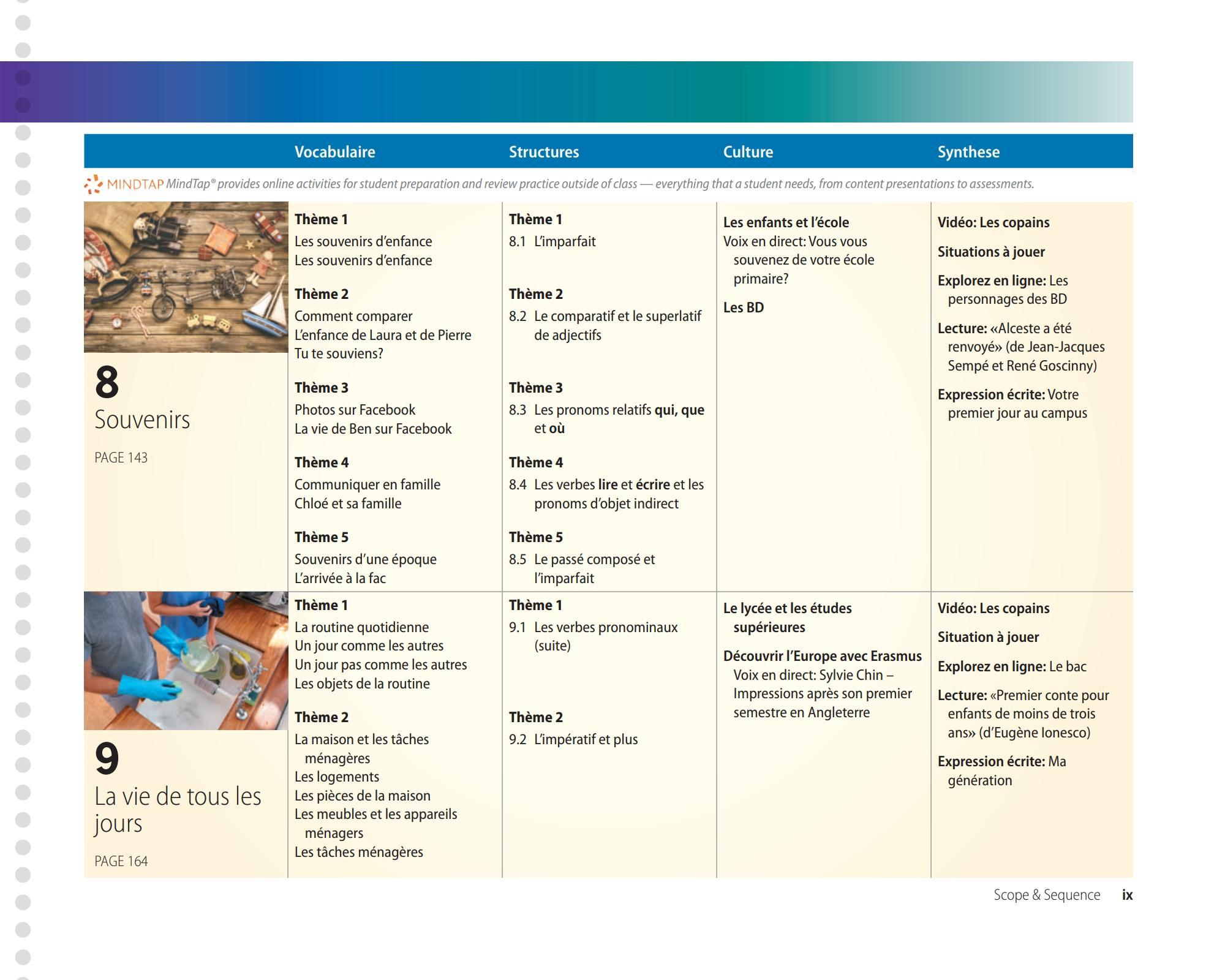
Vocabulaire
Theme 1
Les produits alimentaires
Les fruits
Les legumes
Les cereales et autres
Les produits laitiers
La viande et le poisson
Un petit dejeuner typique
Theme2
Comment se debrouiller au restaurant
Au restaurant
Les copains au restaurant
Theme3
Les courses et les recettes
La recette des crepes
Theme4
Les plats des pays francophones
Quel plat?
Quelques plats de pays francophones
Themes
Les bonnes manieres et l'art de . v1vre
Comment mettre la table
Conseils a table
Theme 1
7.1 Les articles definis, indefinis et pa rtitifs
7.2 Les verbes avec changements orthographiques
Les repas des Fran~ais Voix en direct: Est-ce que vous mangez avec votre famille?
Ou faire les courses?
Video: Les copains
Situation ajouer
Explorez en ligne: Les recettes
Lecture: Dejeuner du matin (de Jacques Prevert)
Expression ecrite: The Golden Truffle: Le restaurant prefere de
Theme3
7.3 Les expressions de quant ite
Theme4
7.4 Le pronom en
Themes
7.5 Les pronoms d 'objet direct me, te, nous et vous; le verbe mettre
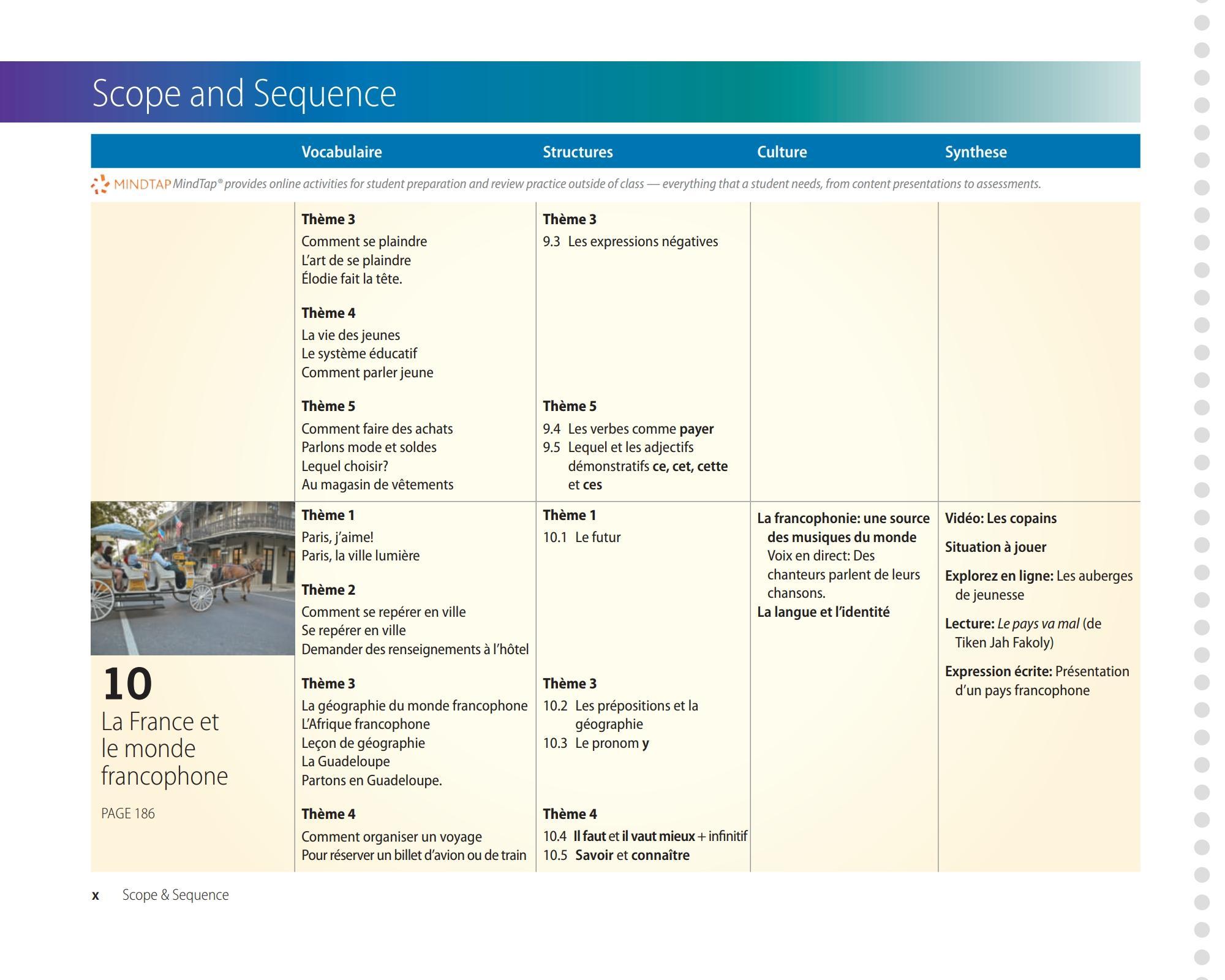
Vocabulaire
#. '# MIN DTAP MindTap ®provides on line activities for student preparation and review practice outside of class - everything that a student needs, from content presentations to assessments.
Theme 1
Les souvenirs d 'enfance
Les souvenirs d'enfance
Theme2
Comment comparer
L'enfance de Laura et de Pierre
Tu te souviens?
Souvenirs
E 143
Theme3
PhotossurFacebook
La vie de Ben sur Facebook
Theme4
Comm uniquer en fa mi lie
Chloe et sa famille
Themes
Souvenirs d'une epoque
L'arrivee a la fac
Theme 1
La routine quotidienne
Un jour comme les autres
Un jo ur pas comme les autres
Les objets de la routine
Theme2
La maison et les taches ' ' menageres
Les logements
Les pieces de la maison
Les meubles et les appa reils ' men agers
Les taches menageres
Theme 1
8.1 L'imparfait
Theme2
8.2 Le comparatif et le superlatif de adjectifs
Theme3
8.3 Les pronoms relat ifs qui, que ' etou
Theme4
8.4 Les verbes lire et ecrire et les pronoms d'objet indirect
Themes
8.5 Le passe compose et l'imparfait
Theme 1
9.1 Les verbes pronominaux (suite)
Les enfants et l 'e cole
Voix en direct: Vous vous souvenez de votre ecole primaire?
Les BD
Video: Les copains
Situations ajouer
Explorez en ligne: Les personnages des BO
Lecture: <<Alceste a ete renvoye>>(de Je an-Jacques Sempe et Rene Goscinny)
Expression ecrite: Votre premier Jour au campus
Theme2
9.2 L'imperatif et plus
Le lycee et les etudes . super1eures
Decouvrir !'Europe avec Erasmus
Voix en direct: Sylvie ChinImpression s apres son premier semestre en Angleterre
Video: Les copains
Situation ajouer
Explorez en ligne: Le bac
Lecture: «Premier conte pour enfants de moins de trois ans>> (d'Eugene Ionesco)
Expression ecrite: Ma generation
& Sequence
Theme3
Comment se plaindre
L'art de se plaindre
Elodie fait la tete.
Theme4
La vie des jeunes
Le systeme educatif
Comment parler jeune
Themes
Comment faire des achats
Parlons mode et soldes
Lequel choisir?
Au magasin de vetements
Theme 1
Paris, j'aime!
Paris, la ville lumiere
Theme2
Comment se reperer en ville
Se reperer en ville
Demander des renseignements al' h6tel
Theme3
La geographie du monde francophone
L'Afrique francophone
Le~on de geographie
La Guadeloupe
Partons en Guadeloupe.
Theme4
Comment organiser un voyage
Theme3
9.3 Les expressions negatives
Themes
9.4 Les verbes comme payer
9.5 Lequel et les adjectifs demonstratifs ce, cet, cette et ces
Theme 1
10.1 Le futur
Theme3
10.2 Les prepositions et la geographie
10.3 Le pronom y
Theme4
10.4 II faut et ii vaut mieux + infinitif
Pour reserver un billet d'avion ou de train 10.5 Savoir et connaitre
La francophonie: une source des musiques du monde
Voix en direct: Des chanteurs parlent de leurs chansons.
La langue et l'identite
Video: Les copains
Situation a jouer
Explorez en ligne: Les auberges de jeunesse
Lecture: Le pays va ma/ (de Tiken Jah Fakoly)
Expression ecrite: Presentation d'un pays francophone
Vocabulaire
'• MIN DTAP MindTap ®provides online activities for student preparation and review practice outside of class - everything that a student needs, from content presentations to assessments.
Al1 aeroport
Comment organiser le depart
Comment organiser le retour
Themes
ldentites francophones
L.1Europe francophone
L.1Amerique francophone
Theme 1
Les parties du corps
Les parties du corps
Le visage
Theme2
Quand on ne se sent pas bien
Les problemes physiques
Les problemes emotionnels, les sentiments
La sante et le bonheur
Theme2
11.1 Expressions idiomatiques
• avec avo1r
Pourquoi ne sont-ils pas au travail?
Paul et le foot
Les conseils d ' Elodie
Theme3
Comment parler au medecin
Chez le medecin
Theme4
Comment donner des conseils
Des conseils
Themes
Pour se sentir bien dans sa peau
La classe de yoga
Theme3
11.2 L.1emploi de depuis
Theme4
11.3 Le subjonctif (introduction)
11.4 Dire avec l'objet indirect
Themes
11.5 Les adverbes
La sante: un droit ou un privilege?
Etre heureux dans la vie
Voix en direct: Pour vous, c'est quoi le bonheur?
Video: Les copains
Situation ajouer
Explorez en ligne: Doctorissimo
Lecture: <<.Je suis malade» (de Jean-Jacques Sempe et Rene Goscinny)
Expression ecrite: Une campagne d'education: La sante pour tous!
• Scope & Sequence XI
Vocabulaire
#. '# MIN DTAP MindTap® provides online activities for student preparation and review practice outside of class - everything that a student needs, from content presentations to assessments.
Theme 1
Une histoire d'amour
Une rencontre amoureuse
La vie conjugale
Les problemes de couple
La rupture
Theme2
Valeurs et opinions
Rapports entre copains/copines
Lamour et l'amitie PAG E224
xii Scope &Sequence
Theme3
Comment exprimer ses sentiments
Expressions d'emotions
Les objets pour exprimer les sentiments
Entre amis
Theme4
Retrospective sur Les copains
Les copains: souvenirs
Theme S
Entre copains
Qu 'est-ce qu'il se passerait si. ?
Theme 1
12.1 Les verbes pronominaux (suite)
12.2 Les verbes voir et croire
Theme3
12.3 Le subjonctif (suite)
Le couple en transition
Perspectives sur l'amitie
Voix en direct: C'est quoi pour vous l'amitie?
Video: Les copains
Situations ajouer
Explorez en ligne: Les personnalites preferees des Fran<;ais
Lecture: <<L'affaire du collier>> (de Magali Morsi)
Expression ecrite: Des conseils
Theme4
12.4 Le passe compose et l' imparfait (suite)
Theme S
12.5 Le conditionne l
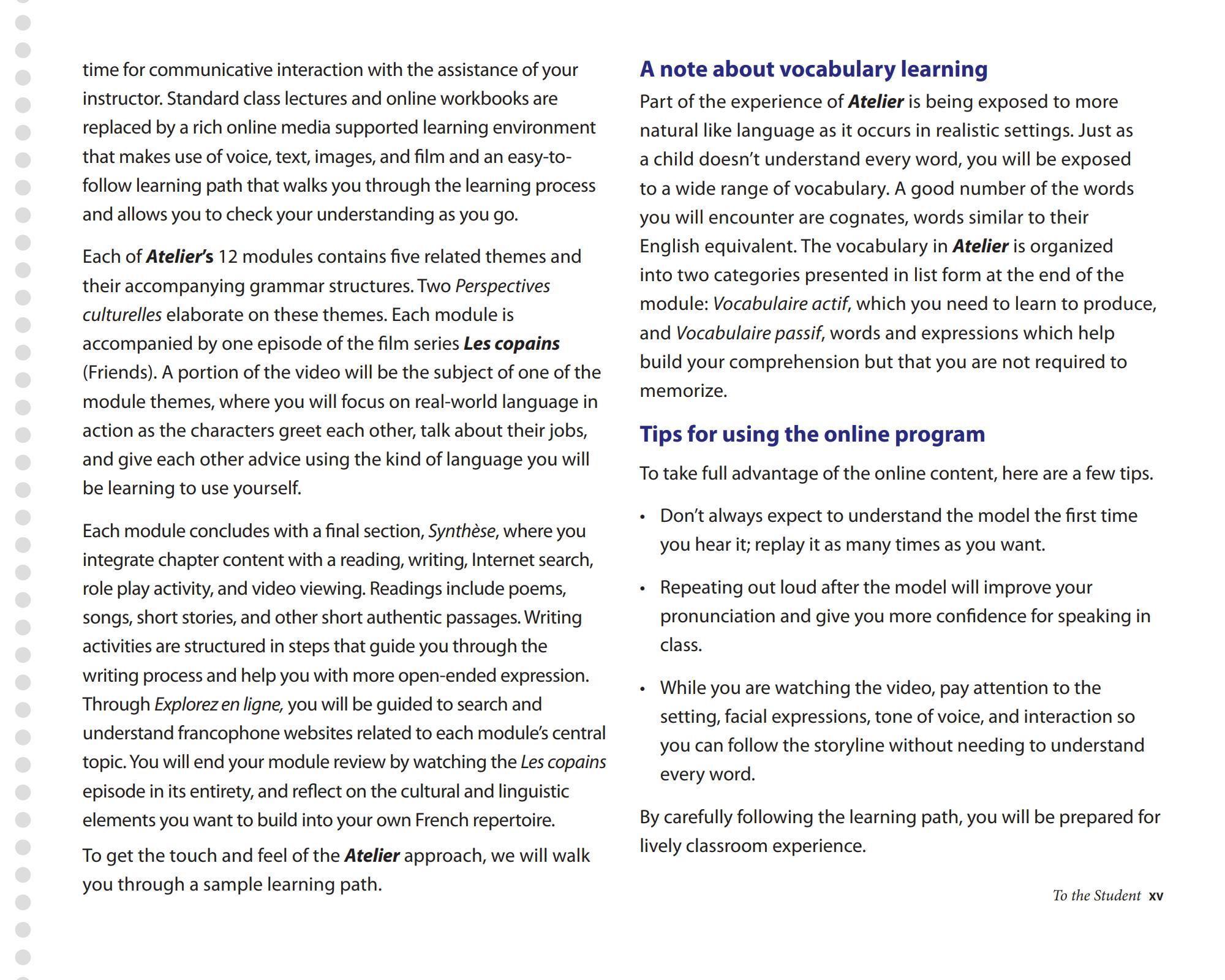
Welcome to Atelier, your personal studio for learning French and francophone language and culture. With its blend of on line learning tools and class activities, Atelier will guide your independent learning of French so that you are ready to communicate with others both in the classroom and online. Atelier brings you the sights, sounds, and stories of everyday life in tightly designed units centering on themes such as family life, university studies, hobbies, and food
This media - rich program presents content through film, images, audio, and text.
• Film: Each module features an episode from Les copains, an original film series especially created for Atelier revolving around a close group of friends living in Paris. Whether they ' re making a new acquaintance, sharing their taste in popular culture, complaining about a living situation , or trying a yoga class- Paul , Elodie, and Manu find themselves in situations that you will be learning to navigate yourselves.
• Thematic vocabulary: Each new theme begins with a photo display of thematic vocabulary narrated by Camille, an expert at making herself clear to non - native speakers. The vocabulary presentations, which you can view at your own pace, include photo images, audio, and text.
• Structures: In animated grammar tutorials, you will meet Jeremie, a bilingual French instructor who uses the walls of Paris to illustrate new structures. With explanations in English , he makes lively use of charts, images, and sample sentences to give you a solid understanding of how to form and use the structures presented in each module.
• Perspectives culturelles: While culture is integrated throughout the Atelier program , special sections called Perspectives culture/Jes highlight up-to - date cultural content with illustrated, focused presentations. You will gain an intercultural perspective by reflecting on your own and your classmates ' cultural practices while learning about those in the francophone world.
To the Student xiii
Atelier's Learning Path
Atelier guides your online instruction with a carefully designed " learning path " to take you step by step through each module. This process is fundamental to your success. If you are using Atelier in a blended learning environment, you will be expected to complete the online learning path before coming to class. Here are the steps of the learning path:
• Ready?: A short introduction to the broad content of each theme encourages you to anticipate the material you will be learning.
• Learn it!: All new thematic vocabulary, culture, and structures are presented through film , animation , and voiceover photos and text. Learn it! is always followed by Try it!, offering quick comprehension questions followed by answers so you can verify your understanding of the presentations. These questions are only for you and are not graded or reported to your instructor.
• Practice it!: Most of your online practice with new material will be labeled Practice it! Activities include more extended comprehension checks of vocabulary, grammar, and culture , such as multiple choice, fill - in -the - blank, matching , photo identification, and listening comprehension. Answers are provided. These activities may be assigned by your instructor for grading purposes.
• Use it!: Activities labeled Use it! give you a chance to use what you are learning to express yourself creatively. These are
xiv To the Student
designed to be submitted online or prepared for class discussion. Some activities allow you to post individual comments and photos, read and respond to your classmates ' postings.
• Got it!: Each theme ends with Got it! Begin by evaluating yourself using a checklist of statements that specify what you are expected to be able to accomplish after completing the theme. When you are ready to test yourself, do the Micro quiz, where you demonstrate your ability to use what you have studied. If the Micro quiz is assigned, your instructor will get the results.
The Manual
If you are using Atelier in a blended learning environment, you will use the Manual for your face -to -face classroom interaction . The Manual follows the thematic presentation of material that you saw online in condensed form for reference and quick review. Since you have already worked through the content step by step on your own, class time can be focused on using French for lively communication. Classroom activities are the heart of the classroom experience. Each module concludes with a brief summary of the grammar structures and a complete list of the module vocabulary that you can use for quick reference during class activities and for review before exams.
Explanation of Atelier's organization
You may have heard about flipped , blended, or hybrid instruction. Atelier uses this innovative approach allowing you to progress at your own pace outside of class while maximizing classroom
time for communicative interaction with the assistance of your instructor. Standard class lectures and online workbooks are replaced by a rich online media supported learning environment that makes use of voice, text, images, and film and an easy -tofollow learning path that walks you through the learning process and allows you to check your understanding as you go .
Each of Atelier's 12 modules contains five related themes and their accompanying grammar structures. Two Perspectives culture/Jes elaborate on these themes. Each module is accompanied by one episode of the film series Les copains ( Friends) . A portion of the video will be the subject of one of the module themes , where you will focus on real - world language in action as the characters greet each other, talk about their jobs, and give each other advice using the kind of language you will be learning to use yourself.
Each module concludes with a final section , Synth ese, where you integrate chapter content with a reading , writing , Internet search, role play activity, and video viewing. Readings include poems, songs, short stories, and other short authentic passages. Writing activities are structured in steps that guide you through the writing process and help you with more open - ended ex pression . Through Explorez en ligne, you will be guided to search and understand francophone websites related to each module's central topic. You will end your module review by watching the Les copains episode in its entirety, and reflect on the cultural and linguistic elements you want to build into your own French repertoire.
To get the touch and feel of the Atelier approach , we will walk you through a sample learning path.
A note about vocabulary learning
Part of the experience of Atelier is being exposed to more natural like language as it occurs in realistic settings . Just as a child doesn ' t understand every word , you will be exposed to a wide range of vocabulary. A good number of the words you will encounter are cognates , words similar to their English equivalent . The vocabulary in Atelier is organized into two categories presented in list form at the end of the module: Vocabu/aire actif, which you need to learn to produce, and Vocabulaire passif, words and expressions which help build your comprehension but that you are not required to
• memorize.
Tips
for using the online program
To take full advantage of the on line content, here are a few tips.
• Don 't always ex pect to understand the model the first time you hear it; replay it as many times as you want.
• Repeating out loud after the model will improve your pronunciation and give you more confidence for speaking in class .
• While you are watching the video , pay attention to the setting, facial expressions, tone of voice, and interaction so you can follow the storyline without needing to understand every word .
By carefully following the learning path , you will be prepared for lively classroom experience.
To the Student xv
Acknowledgments
We're grateful to the many people who've helped make our vision of a blended learning French language program become a reality. We had help from a number of creative individuals. Foremost, we want to thank Celine Decoux, French director of the Les copains video. She understood our concept and helped us with everything, from casting to site selection. Thanks to Chantal Baoutelman and Marlene Hanssler-Rodrigues for script writing. We'd also like to acknowledge Charles Hamway, creator of Jeremie, the animated "grammar guy:' Charles initially created several renditions of Jeremie. The one he developed was selected by popular student vote. Thanks to Anneka Haddix and Kereen Montgomery for their work on the presentation slides to smooth the transition from the on line to the classroom environment. At (engage, we are grateful to Nicole Mori non and Beth Kramer, for first supporting the idea of a blended learning program and to Lara Ramsey, our indefatigable acquisitions editor who has guided us at every stage. Thanks to Isabelle Alouane, our development editor for her careful work and helpful feedback. Atelier depends on good visual design, and for this, we're grateful to Esther Marshall, our Senior Content Project Manager. Our thanks also go to Elyssa Healy, Peter Schott, Carolyn Nichols; Jason Baldwin, Jason Clark, Sarah Seymour, Bethany Martin, Nathan Carpenter, Dana Edmunds, Sean Hagerty, Nicole Naude, Ralph Zerbonia, Severine Champeny, native reader and proofreader, Kendra Brown and Katy Gabel, Lumina Datamatics project managers; Jaishree Venkatesan, Sylvie Waskiewicz, Lori Mele Hawke (for the Transition guide and Visual Preface).
Finally, we want to acknowledge, Kim's husband, Glen Jansma. Glen's technical expertise and conceptual advice has been invaluable.
We would like to thank the f o llowing reviewer s of Atelier for their comments a nd advice:
Jeffrey Allen, North Carolina State University
Elaine Ancekewicz, Long Island University
Debra Anderson, East Carolina University
Katie Angus, University of Southern Mississippi-Hattiesburg
Indra Avens, Queensborough Community College
Jane Backer, University of Colorado
Mariana Bahtchevanova, Arizona State University
Julie Baker, University of Richmond
Jody Ballah, University of Cincinnati Blue Ash
Caren Barnezet Parrish, Chabot College
Edith Benkov, San Diego State University
Evelyne Berman, El Camino College
Florence Bernard-Lemoine, Texas State University
Didier Bertrand, Indiana University-Purdue
University Indianapolis
Dikka Berven, Oakland University
Geraldine Blattner, Florida Atlantic University
Chesla Ann Bohinski, SUNY Binghamton University
xvi Acknowledgments
Mayra Bonet, Northern Essex Community College - Haverhill
Parfait Bonko u ngou, Auburn University - Montgomery
Habiba Boumlik, CUNY LaGuardia Community College
Thomas Buresi, Southern Polytechnic State University
Nancy Burket, Ava Maria University
Ruth Caldwell, Luther College
Kim Carter-Cram, Boise State University
Nick Carty, Dalton State College
Matthieu Chan-Tsin, Coastal Carolina University
Rosalie Cheatham, University of Arkansas at Little Rock
Benjamin Cherel, Swarthmore College
James Chestnut, University of North Georgia
Kathy Comfort, University of ArkansasFayetteville
Isabelle Corneaux, George Fox University
Tomaz Cunningham, Jackson State University
Amanda Dalola, University of South Carolina
Diane Dansereau, University of Colorado, Denver
Kelly Davidson Devall, Valdosta State University
Edward Dawley, Delaware State University
Guylene Deasy, University of North Carolina, Greensboro
Joan Debrah, University of Hawaii at Manoa
Sophie Degat-Willis, University of Pennsylvania
S. Pascale Dewey, Kutztown University
Aurea Diab, Dillard University
Nathalie Dieu-Porter, Vanderbilt University
Isabelle Drewelow, University of Alabama
Sebastien Dubreil, University of Tennessee, Knoxville
Andrzej Dziedzic, University of Wisconsin - Osh Kosh
Mary Ellen Eckhert, East Los Angeles College
Shirin Edwin, Sam Houston State University
Sylvaine Egron-Sparrow, Wellesley College
Cindy Evans, Skidmore College
Gisele Farah, Mott Community College
John Fields, Florida State College at JacksonvilleSouth
David Fieni, SUNY College at Oneonta
Lucia Florido, University of Tennessee-Martin
Tara Foster, Northern Michigan University
Stephanie Gaillard, Louisiana State UniversityBaton Rouge
Russel Ganim, University of Nebraska-Lincoln
Sahar Ghattas, Horry Georgetown Tech College
Sarah Glasco, Elon University
Gary Godfrey, Weber State University
Lisa Gonzales, Monterey Peninsula College
Sarah Gordon, Utah State University
Carmen Grace, University of Colorado
John Greene, University of Louisville
Frederique Grim, Colorado State University
Jeanne Hageman, North Dakota State University
Cheryl Hansen, Weber State University
Suzanne Hendrickson, Un iversity of Missouri-St. Louis
Araceli Hernandez-Laroche, University of South Carolina Upstate
Marie-Laure Hinton, Long Beach City College
Ruth Hottell, University of Toledo
Julie Human, University of Kentucky
Ann-Marie Hyland, Rio Salado College
Andrea Javel, Boston College
Michael Johnson, Central Washington University
Mary Helen Kashuba, Chestnut Hi l l College
Brian Kennelly, California Polytechnic State University-San Luis Obispo
Vera Klekovkina, University of Wisconsin-Stevens Point
Kris Knisely, University of South Dakota
Julia Knowlton, Agnes Scott College
Kristi Krumnow, San Jacinto College
Betty LaFace, Bainbridge State College
Laurence Lambert, Sierra College-Rocklin, Rosevi Ile-Gateway
Ann Le Barbu, Los Angeles Pierce College
Rebecca Leal, Elmhurst College
Marie Leticee, University of Central Florida
Tamara Lindner, University of Louisiana-Lafayette
Lara Lomicka Anderson, University of South Carolina
Pamela Long, Auburn University-Montgomery
Mary Ann Lyman-Hager, San Diego State University
Mary Lynett Moore, College of DuPage
Chanta l Maher, Palomar College
Maria Manterola, College of Lake County
Jack Marcus, Gannon University
George McCool, Towson University
Melissa McLennen-Davis, Blinn College-Bryan
Maria Melgarejo, Saint Cloud State University
Catherine Mennear, WakeTech Community College-Raleigh
Lindsy Meyers, University of Missouri-Kansas City
Maria Mikolchak, Saint Cloud State University
Anne-Helene Miller, East Carolina University
Annik Miller, Liberty University
Nicole Mills, Harvard University
Claire Moisan, Grinnell College
Francisco (Paco) Montano, CUNY-Lehman College
Kristina Mormino, Georgia Gwinnett College
Shawn Morrison, College of Charleston
Martine Motard-Noar, McDaniel College
Markus Muller, Cal State University-Long Beach
Stephane Natan, Rider University
Linda Nodjimbadem, University of Texas-El Paso
Frances Novack, Ursinus College
Therese O'Connell, Jacksonville University
Philip Ojo, Agnes Scott College
Kory Olson, Richard Stockton College
Uriel Ornelas, San Diego Mesa College
Kate Paesani, Wayne State University
Helene Pafundi, SUNY Albany
Robin Peery, Massasoit Community College
Marina Peters-Newell, U of New Mexico
Keith Phillips, Lansing Community College
Randi Polk, Eastern Kentucky University
Nora Portillo, Southwestern College-Chula Vista
Joseph Price, Texas Tech University
Steve Puig, St. John's University - Queens
Linda Quinn Allen, Iowa State University
Sudarsan Rangarajan, University of Alaska, Anchorage-Main Campus
Robin Rash, University of Memphis-Lambuth Campus
Deb Reisinger, Duke University
Anne-Christine Rice, Tufts University
Radonna Roark, Oklahoma Baptist University
Steve Rodgers, Puget Sound
Francine Rozenkopf, Los Angeles City College
Anna Sandstrom, University of New Hampshire
Lorie Sauble-Otto, University of Northern Colorado
Jean Schultz, University of California-Santa Barbara
Paul Scotto di Pompeo, Howard University
Gilberto Serrano, Columbus State Community College
Eileen Sm ith, Shasta College
Mariagrazia Spina, University of Central Florida
Kathryn Stewart-Hoffmann, Oakland Community College-Orchard Ridge
Jane Stribling, Pell issippi State Technical Community College
Anita Suess Kaushik, Schoolcraft Collge
Amye Sukapdjo, University of North Georgia
Francoise Sullivan, Tulsa Community College
Heather Swanson, Community College of Philadelphia
Eve Taylor, Fresno City College
Sandra Trapani, University of Missouri-St. Louis
Janina Traxler, Manchester University
Sandra Valnes Quammen, Duke University
Aurelie Van de Wiele, Hamilton College
NancyVirtue, Indiana University-Purdue University-Fort Wayne
Lynn Vogel-Zuiderweg, East Los Angeles College
Ying Wang, Pace University
Kristina Watkins Mormino, Georgia Gwinnett College
Anna Weaver, Mercer University
Catherine Webster, University of Central Oklahoma
Lynni Weibezahl, University of Nevada-Reno
Martina Wells, Chatham College
Acknowledgments xvii
Joseph Wieczorek, Community College of Baltimore County
James Wilkins, Lee University
Phi li ppe Willems, Northern Ill ino is UniversityDeka lb
Ann Wi ll iams, Metropolitan Sta t e Un iversity of Denver
Heather Willis-Allen, University of WisconsinMadison
Terri Woellner, University of Denver
Dierdre Wolown ick, American River College
Jennifer Wolter, Bowling Green State University
We would like to recognize those who reviewed the MindTap ® for World La ngu a ges pl atform :
Whitney Bevill, Un iversity of Virginia
Ka t herine Bevins, University ofTennesseeKnoxville
Anne-Sophie Blank, University of Misso u ri-St. Louis
Goedele Guli kers, Pri n ce George's Community College
Solene Halabi, Mt San Antonio College
Katherine Morel, North Carolina State University
Steven Spalding, US Naval Academy
xvi ii Acknowledgments
Valerie Wust, North Carolina State Un iversity
We would like to recognize our Faculty Development Partners:
Claudia Acosta, College of the Canyons
Daniel Anderson, The Univers ity of Oklahoma
Steph anie Blankenship, Liberty Un iversity
Amy Bomke, Indiana University- Purd u e
University Indianapolis
Jul ia Bussade, The University of Mississippi
Monica Garcfa, California State University
Sacramento & American River College
Marilyn Harper, Pe ll issippi State Community College
Bryan Koronkiewicz, The University of Alabama
Kajsa Larson, Northern Kentucky University
Cristina Moon, Chabot College
Marilyn Palatinus, Pellissippi State Community College
Tina Pena, Tulsa Comm u nity College
Joseph Price, University of Arizona
Goretti Prieto Botana, University of Southern California
Michelle Ramos, California State University San Marcos
Eva Rodriguez Gonzalez, University of New Mexico
Borja Ruiz de Arbulo Alonso, Bost on Univers ity
Laura Sanchez, Longwood University
Steven Sheppard, University of North Texas
Sandy Trapani, University of Missouri - St. Louis
We would like to recognize the advice a nd input from members of the World Languages Technology Advisory Board:
Douglas W. Canfie ld, The University of Tennessee, Knoxville
Michae l B. Dettinger, Louisiana State University
Senta Goertler, Michigan State Un iversity
Michae l Hughes, California State University
San Marcos
Jeff Longwell, New Mexico State Un iversity
Theresa M inick, Kent State University
Jenn ifer Rogers, Metropolitan Community College
Steven Sheppard, University of North Texas
Theme 1 Comment se sa luer et se presenter
Structure 1.1 Addressing others formally and informally Tu etvous
Cl -2 A l'Ambassade de France
Circulate around the classroom as if you were at a formal cocktail party. Greet people formally, shaking hands when you say bonjour. Replace the words in bold with your personal information.
Modele:
- Bonjour, Madame. Je m'appelle Fabien Vivier. Et vous?
- Bonjour, Fabien. Je m'appelle Sophie Mer/et. Je suis de Montpellier. Et vous?
Cl-1 !2! Sur le campus
In groups of three, fol low the model to greet two other classmates informally. Replace the words in bold with your personal information.
Modele:
-Je m'appe/le Jennifer. Et toi?
- Moi, je m'appelle Jake.
- Je suis de Chicago. Et toi?
- Moi aussi, je suis de Chicago. I Mai, je suis de Portland.
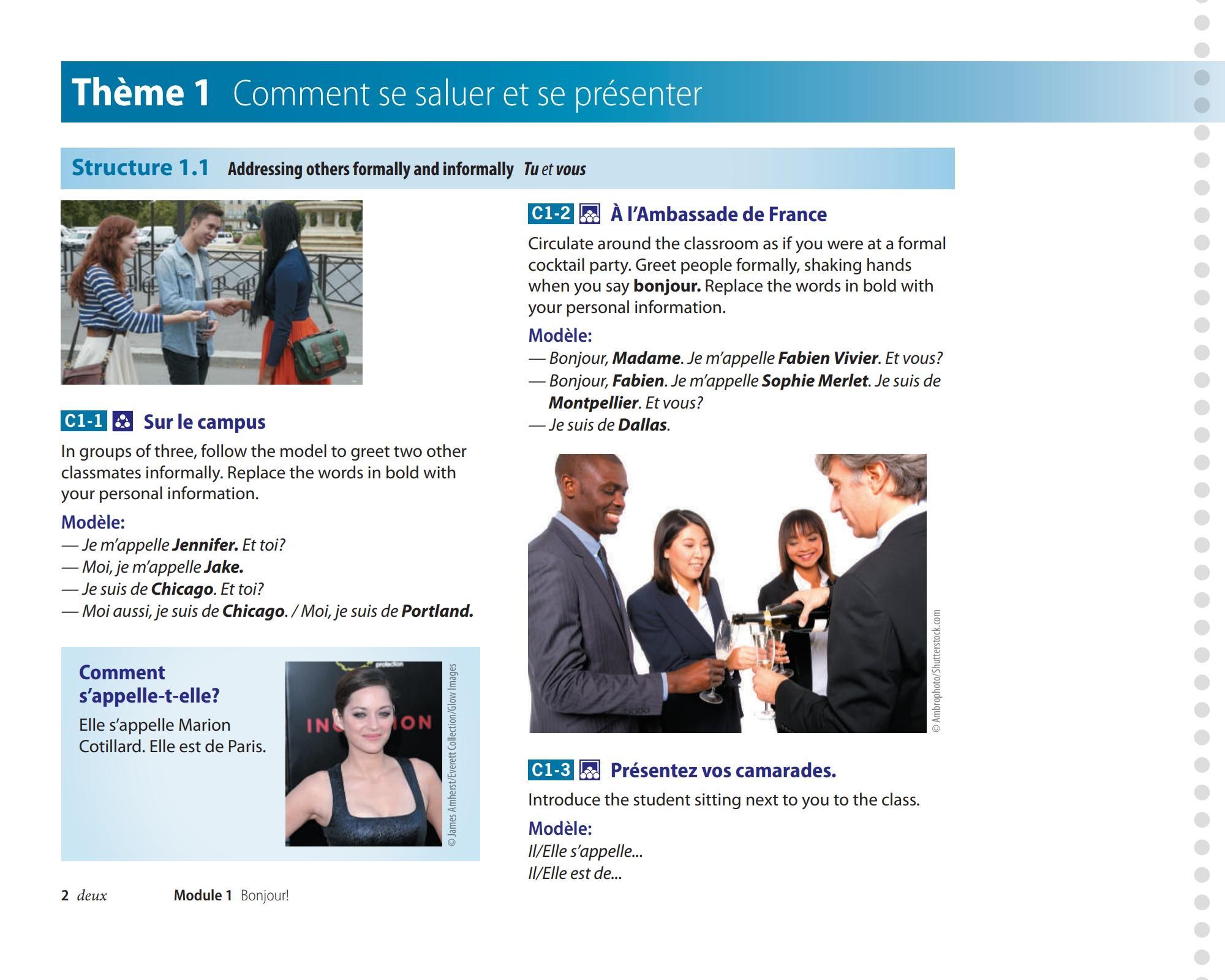
Comment s'appelle-t-elle?
Elle s'appelle Marion Cotillard. Elle est de Paris.
2 deux Module 1 Bonjour!
- Je suis de Dallas.
Cl -3 Presentez vos camarades.
Introduce the student sitting next to you to the class.
Modele :
JI/Elle s'appelle...
JI/Elle est de
Comment se sa lue r et se presente r Theme 1
Cl -4 ID Dans votre classe
With a partner, point to some students and ask Comment s'appelle-t-il/elle?
Modele:
- Comment s'appe/le-t-el/e?
- Elle s'appe/le Elizabeth.
Cl -5 !'a Presentations
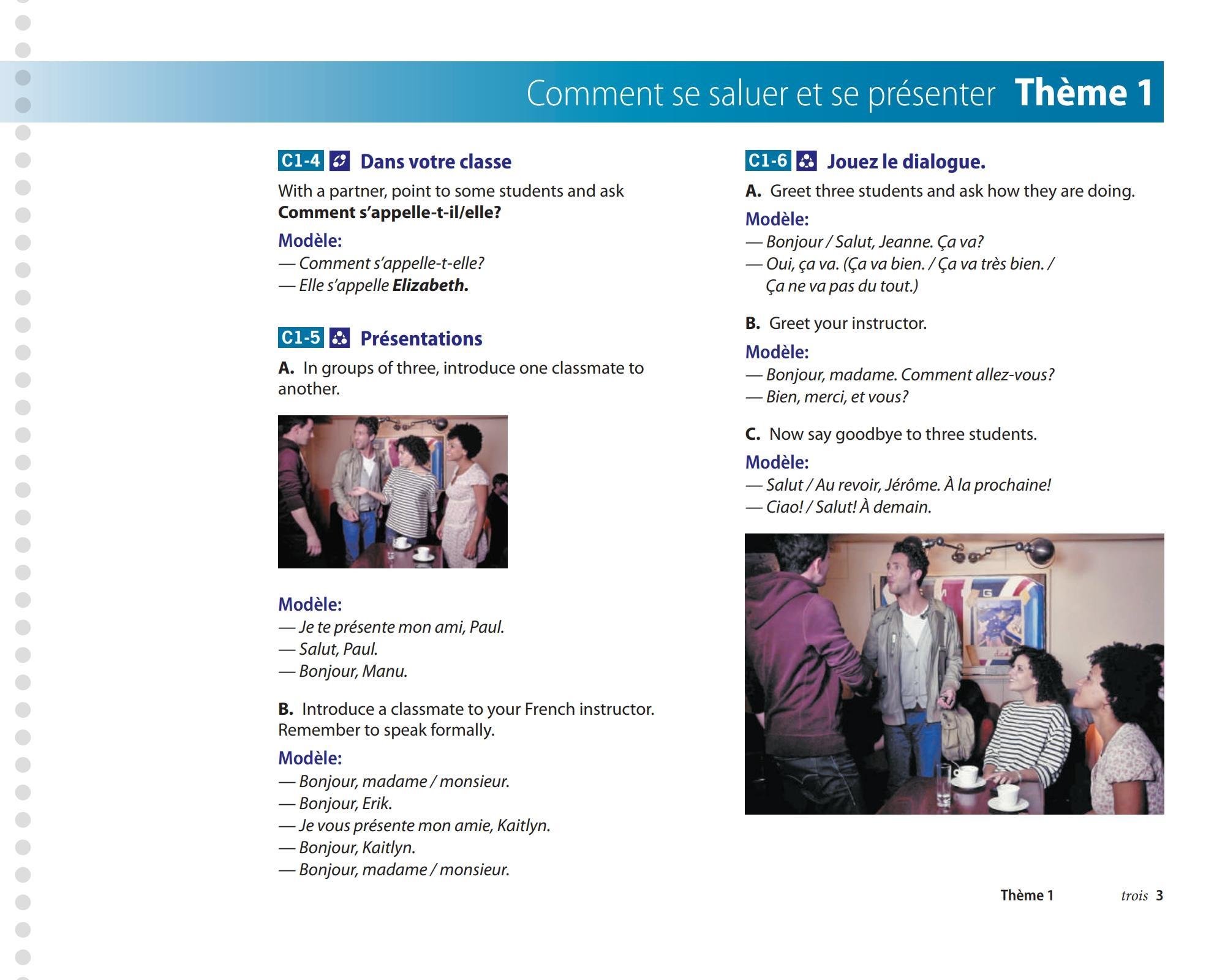
A. In groups of three, introduce one classmate to another.
Cl-6 ra Jouez le dialogue.
A. Greet three students and ask how they are doing.
Modele:
- Bonjour I Salut, Jeanne. <;a va?
- Oui, (a va. (<;a va bien. I <;a va tres bien. I <;a ne va pas du tout.)
B. Greet your instructor.
Modele:
- Bonjour, madame. Comment a/lez-vous?
-Bien, merci, et vous?
C. Now say goodbye to three students.
Modele:
- Salut I Au revoir, Jerome. A la prochaine!
- Ciao! I Salut! A demain.
Modele:
-Je te presente man ami, Paul.
- Salut, Paul.
- Bonjour, Manu.
B. Introduce a classmate to your French instructor. Remember to speak formally.
Modele:
- Bonjour, madame I monsieur.
- Bonjour, Erik.
- Je vous presente man amie, Kaitlyn.
- Bonjour, Kaitlyn.
- Bonjour, madame I monsieur.
Theme 1 Perspectives cu lture ll es
Greetings in French
Learning how to negotiate greetings and farewells is important for feeling comfortable in a foreign culture. Whenever French people come into contact with others, whether friends or strangers, they greet them upon arrival and say goodbye before leaving.
Bonjour!
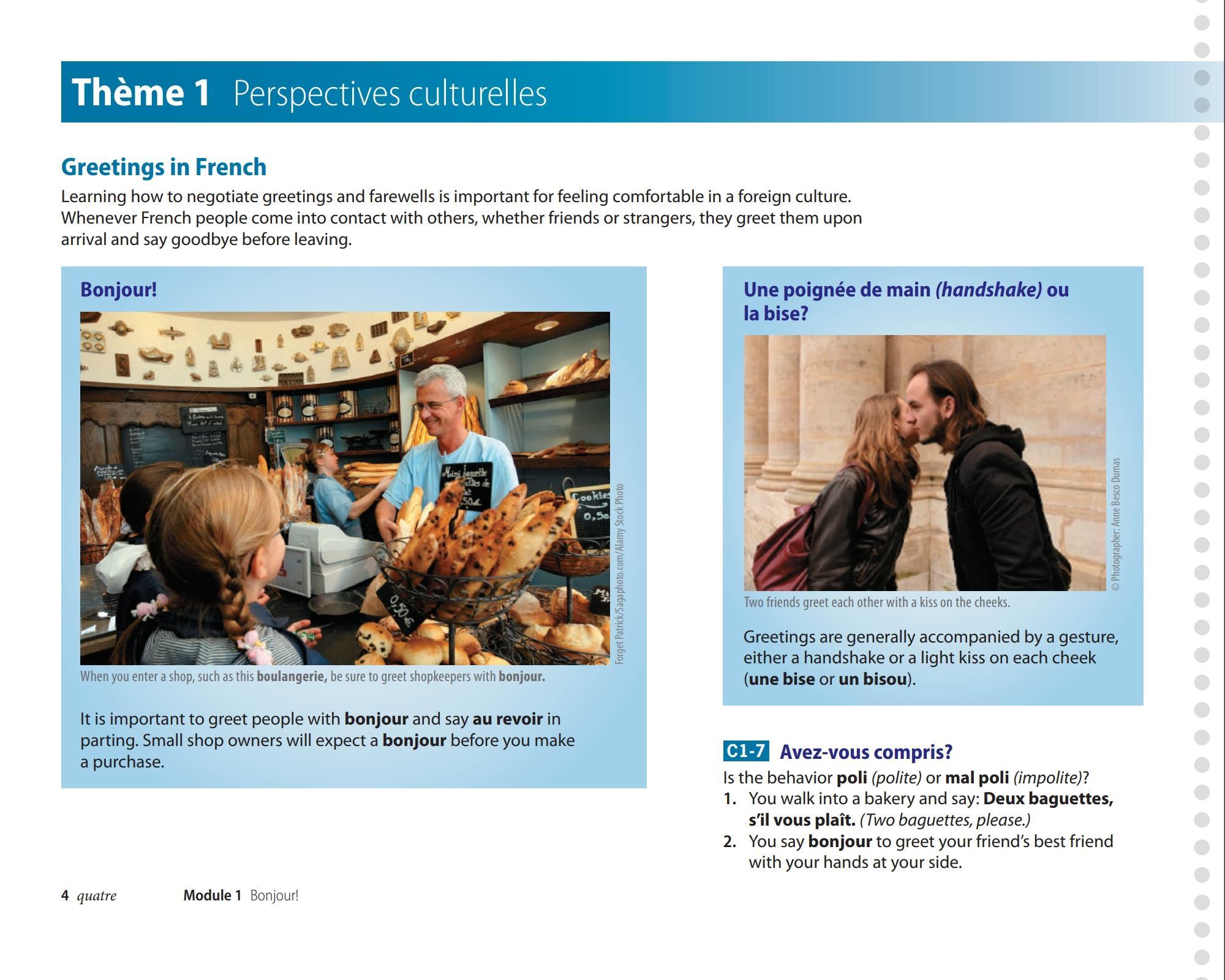
When you enter a shop, such as this boulangerie , be sure to greet shopkeepers with bonjour.
It is important to greet people with bonjour and say au revoir in parting. Small shop owners will expect a bonjour before you make a purchase.
Une poignee de main (handshake) ou la bise?
Greetings are generally accompanied by a gesture, e ither a handshake or a light kiss on each cheek (une bise or un bisou).
Cl -7 Avez-vous compris?
Is the behavior poli (polite) or mal poli (impolite)?
1. You walk into a bakery and say: Deux baguettes, s'il vous plait. ( Two baguettes, please )
2. You say bonjour to greet your friend ' s best friend with your hands at your side.
Two friends greet each other with a kiss on the cheeks.
Tuou vous?
Business colleagues greet each other.
One of the most complicated cultural practices in French involves deciding whether to use the formal or informal form of address. These practices vary throughout the francophone world.
In France
Use tu with a friend or family member. Use vous to show respect , when addressing several people, or when in doubt
In Quebec
Use yous with teachers. Use tu with shopkeepers and even your boss.
In French-speaking Africa
Greetings are more drawn out and the informal tu is common. Comment ~a Ya? Comment Ya ton pere? Etta mere?
Perspectives cul ture ll es Theme 1
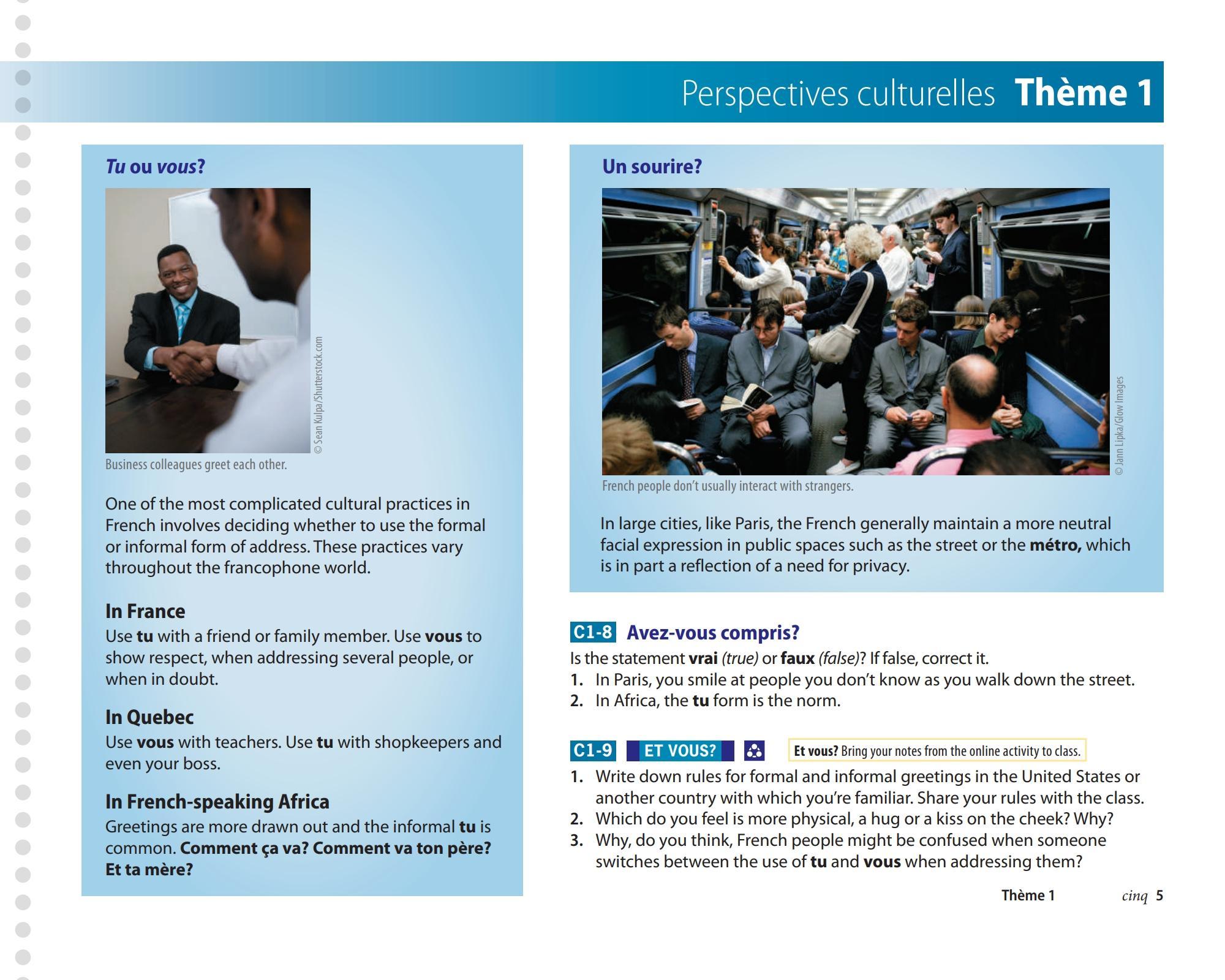
Un sourire?
French people don't usually interact with strangers.
In large cities , like Paris, the French generally maintain a more neutral facial expression in public spaces such as the street or the metro, which is i n part a reflection of a need for privacy.
Cl -8 Avez-vous compris?
Is the statement Yrai (true) or faux (false)? If false, correct it.
1. In Paris, you smile at people you don' t know as you walk down the street .
2. In Africa , the tu form is the norm
Cl -9 ET VOUS ? f'i! Et vous? Bri ng you r no tes from the online activity to class.
1. Write down rules for formal a nd informal greetings in the United States or another country with which you ' re familiar. Share your rules with the class .
2. Which do you feel i s more phy sical , a hug or a kis s on the cheek? Why?
3. Why, do you think , French people might be confused when someone switches between the use of tu and yous w hen addres sing them?
Theme 1 cinq 5
Other documents randomly have different content
The Project Gutenberg eBook of Murtoviivoja:
Novelleja
This ebook is for the use of anyone anywhere in the United States and most other parts of the world at no cost and with almost no restrictions whatsoever. You may copy it, give it away or re-use it under the terms of the Project Gutenberg License included with this ebook or online at www.gutenberg.org. If you are not located in the United States, you will have to check the laws of the country where you are located before using this eBook.
Title: Murtoviivoja: Novelleja
Author: L. Onerva
Release date: September 24, 2017 [eBook #55615]
Language: Finnish
Credits: Produced by Tapio Riikonen
*** START OF THE PROJECT GUTENBERG EBOOK MURTOVIIVOJA: NOVELLEJA ***
Produced by Tapio Riikonen
MURTOVIIVOJA
Novelleja
Kirj.
L. ONERVA
Helsingissä Kustannusosakeyhtiö Otava 1909.
SISÄLLYS:
Onni
Marketta Salminen
Meiri
Kuvittelija
Itsenäinen nainen
Äänet
Luonnonlaki
Elämä kuoleman jälkeen
Manja Pavlovna
Kati
Viha Lankeemus
ONNI
Heikki Vaulo odotti joka hetki vaimoaan palaavaksi. Tai oikeastaan hän ei odottanut, pikemmin toivoi hän, että tämä viipyisi vielä…
Hän avasi ikkunan ja kurkisti ulos. Kaikki oli hiljaista, kaikki ennallaan. Pienen pihamaan tukevarunkoiset palmut katsoivat häneen hievahtamattomin viuhkoin ja nurmikon keskellä kihelmöivän suihkulähteen vesi pisaroi laiskasti maahan pitkin sammaltuneen kivialustan kuvetta. Kummallista! Hän näki tuon saman joka päivä ja aina oli se hänestä yhtä ihmeellistä. Hän ei voinut koskaan tottua tähän etelämaan ainaiseen kesään.
Väsyneesti istahti hän ikkunanlaidalle. Tästä saattoi hän kuulla Elisan askeleet. Kauan hän viipyikin kaupungilla… Tummasti punertavaa taivasta vastaan lenteli jo kömpelöitä yölepakoita ja pitkin pimentyvää maata alkoivat lyhdyt syttyä toinen toisensa jälkeen kuin lukemattomat heleän-viheriät kiiltomadot. Kaukana jollakin sillalla kulki pitkä sotilasjono soittaen yksitoikkoista säveltä.
Satuahan tämä kaikki vain oli ja unta, niin hänestä tuntui. Joksikin tällaiseksi oli hän kuvitellut sitä aurinko-kajastusta, joka kerran kirkastaisi hänen pitkien ponnistustensa kaukaisen lopun; joksikin
tällaiseksi oli hän kuvitellut onnea. Ja nyt se oli tullut, ja hän ei ollutkaan onnellinen. Mutta miksi, mistä syystä? Sitä kyseli hän nykyään itseltään lakkaamatta ja siksi oli hänellä tarve olla yksin. Mutta miksi oli tämä yksinäisyyden ikäväkin tullut nyt vasta, nyt juuri, kun hän oli lopettanut yksinolonsa ja mennyt naimisiin? Ennen hän ei suinkaan välittänyt mistään kahdenkeskeisistä puheluista itsensä kanssa eikä hänellä silloin edes ollutkaan mitään sisällisiä arvoituksia. Hänellä ei ollut, suoraan sanoen, tilaisuutta, ei aikaa eikä varaa sellaiseen. Ulkonainen taistelu oli vaatinut kaiken. Aina oli hän saanut olla varuillaan ja haarniskassa, aina valmiina kynsin hampain ryöstämään itselleen pienimmänkin osuuden elämästä. Mutta sitten oli taistelu äkkiä lakannut, onnettomuus loppunut ja hänen salaisimmat siunauksen pyyteensä kuin ihmeen kautta toteutuneet. Hän oli nyt itsenäinen mies, vapaa omaan työhön, siinä suuressa aurinkoisessa maailmassa, jota hän entisen ahdinkotilansa aikana oli katein mielin ajatellut, ja omisti sen naisen, jota aina oli omakseen toivotellut. Ja nyt tuntuikin tämä autuus niin joutavalle, tämä avara maailma niin tyhjälle ja hän itse sen sylissä niin tuiki mitättömälle, sekä hän että hänen työnsä. Hän ei nähtävästi osannut elää onnellisen miehen elämää, jota ei ollut koskaan opetellut. Oli kuin olisi elämän ponnistin jollakin lailla vikaantunut ja löyhtynyt. Hän tunsi olevansa kuin vetämätön kello ja turhaan koetti hän tyrkyttää itselleen levon nautintoa tai työn iloa. Kumpikin oli yhtä mahdotonta ja joka kerta yksin jäätyään vaipui hän synkkiin mietteisiin. Sillä hän tahtoi tulla selville siitä missä oli vika, ajatella niidenkin vuosien puolesta, joina hän ei ollut ehtinyt mitään ajatella. Mutta mitä enemmän hän tuijotti omaan sieluunsa, sitä oudommaksi vain kävi se hänelle, ja hän huomasi nyt vasta, että hän kaikki nämä vuodet oli kantanut itsessään maailmaa, josta hän ei tiennyt mitään. Hän oli luullut olevansa jo niin varma ja voimakas, niin täyteen mittaansa
kasvanut, ja nyt, esiin kutsuttuna, nousikin hänen sielunsa hänelle aivan toisena: värjöttävänä ja keskenkasvuisena ja avuttomana kuin laiminlyöty lapsi. Se pyyhkäisi kerrassaan pois hänen iloisen itseluottonsa ja rohkeutensa. Hän kävi alakuloiseksi ja araksi ja tuli lopulta siihen päätökseen, että hänen entinen työvoimansakin oli ollut pelkkää petosta. Se ei ollut johtunut hänen vapaasta tahdostaan. Se oli ollut vain luonnonlapsen sokeaa itsesäilytysviettiä, jonka kiihottimena oli ollut ja täytyi olla se alkeellisin ja alhaisin sysäys: vastavoima ja viha. Mikään muu ei pannut häntä liikkeelle. Hän oli vapauteen vallan kypsymätön. Hän ei kyennyt tekemään enää mitään. Hän tunsi vain vajoavansa kuin jonnekin syvään kuiluun, josta ei ollut enää poispääsyä. Ja hän saattoi salaa toivoa takaisin pakkoa ja piiskaa ja halveksia itseään…
Heikki oli niin vaipunut ajatuksiinsa, ettei ollut muistanutkaan kuunnella Elisan tuloa. Hän heräsi vasta siihen, kun ovi narahti. Ja samassa laskeutui kaksi pehmeää käsivartta hänen kaulalleen.
— Mitä sinä mietit, Heikki? kysyi Elisa.
— Minä! En mitään. Katselen vain tätä helmikuun kesää…
— Mutta sinähän et pidä siitä, minä tiedän sen, naurahti Elisa. Sinä tahtoisit oikeaa talvea, lunta, hankia ja kaikkea sitä…
Heikki ei vastannut.
Elisa kävi surulliseksi. Hän ei nauranut enää.
— Heikki, kuiskasi Elisa, miksi sinä olet minulle vihainen?
— Vihainen! Enhän toki, en suinkaan. Mistä olet tuollaista saanut päähäsi!
— Minä olen kyllä huomannut jo kauan, jatkoi Elisa, että olet ollut niin kummallinen ja alakuloinen. Sano minulle, millä olen sinua pahoittanut?
Heikki oli yllätetty ja hämmästynyt. Elisan ääni tuli niin oudon syvältä.
— Älä sinä huoli siitä, Elisa, sanoi hän pakotetun keveästi. Ei se ole mitään vaarallista. Eikä se ole sinun syysi ollenkaan. Minulla on vain sellainen raskas luonne. En minä osaa sitä selittää…
— Niin, sinä et rakasta minua enää.
— Mutta Elisa, sinähän tiedät…
Heikki ei voinut jatkaa. Hänestä tuntui kiusalliselta kiistellä tästä asiasta.
— Sinä olet kokonaan muuttunut, jatkoi Elisa itsepäisesti.
— Olosuhteet ovat muuttuneet, siitä se riippuu. Tiedäthän, pikku Elisa, minä tulen niin raskaasta päivätyöstä. Salli minun siksi nyt huoahtaa!
— Voi, Heikki, enhän minä muuta toivoisi kuin että nyt kerrankin oikein levähtäisit kaikesta ja olisit oikein onnellinen. Mutta kun minä näen, että sinä et ole onnellinen. Jokin on hullusti. Sano, mikä se on!
Mikä sinua vaivaa?
Elisa pelkäsi loukkaavansa. Ja tämä pelko teki hänen äänensä niin hyväilevän araksi ja ohueksi, että se tuskin kosketti ilmaa. Mutta juuri sentähden vaikutti se Heikkiin tuskallisesti. Hän ei tiennyt mitä vastata.
— Minua ei vaivaa oikeastaan mikään, ei mikään ulkonainen ainakaan. Syy on aivan minussa itsessäni. Mikä se on, en tiedä vielä. Minä en ole nähtävästi luotu lepäämään. Mutta työkään ei suju. Tämä on niin outoa. Tai olen kenties ennen tehnyt työtä liiaksi, elänyt liian pohjoisessa elääkseni nyt näin etelässä, ollut liian onneton, liian kauan, kuuletko, osatakseni tottua onneen. Älä suutu, Elisa! Et ole varmaankaan koskaan ennen nähnyt ihmistä, jolle onni käy taakaksi.
Heikki katsoi Elisaa avoimesti silmiin, mutta Elisa siirsi katseensa sivulle.
— Minä käyn sinulle taakaksi, sanoi hän matalasti. Miksi et sano sitä suoraan? Sinun on ikävä olla minun kanssani, minä näen sen.
Heikki säpsähti. Jompikumpi heistä oli sanonut jotakin sellaista, jota ei olisi saanut sanoa. Joko se nyt alkoi heissäkin tuo rakkauden kuolinkamppailu, tuo kohtaus kohtaukselta etenevä sielujen-tauti, tuo kautta kotien kulkeva rutto, joka hävitti maailmasta kaiken perhe-onnen? Sitä oli hän aina kauhulla katsellut muissa, sitä aina itse pelännyt. Ja siksi oli tämä saavuttamisen siunauskin ollut hänestä koko ajan niin luonnoton: se oli varmasti salainen kirouksen enne, hänen vahingokseen viritetty ansa, kukkulalle pääsy vain laskeutumisen vuoksi. Muuta tietä ei ollut. Huipulta alaspäin nyt vain, onnesta poispäin niin että hurisi! Miksi hän ei ollutkin vielä kukkulan tuolla puolen!
Kaikki tämä välähti salaman-nopeudella läpi hänen aivojensa. Hän kuuli
Elisan jatkavan:
— Minä en riitä sinulle. Sinä kaipaat muuta seuraa…
Ja hän tunsi sillä hetkellä rajua vihaa tuota säälimätöntä ääntä kohtaan, joka välittämättä mistään teki hävitystyötään nauliten hänen salaisimmat epäilynsä lyönti lyönniltä auttamattomaksi todellisuudeksi. Turmion alku oli nyt valmis. Tästä se nyt lähti se huima alamäki. Mutta hermo-ärsytys käski hänen vielä lisäämään vauhtia.
— En minä seuraa kaipaa, vaan yksinäisyyttä, murahti hän.
— Minä olen siis liikaa, näethän nyt. Sinä tahdot jo päästä minusta erilleen, sanoi Elisa koettaen yhä vielä pysytellä tyynenä, mutta ääni värähteli jo petollisesti.
Nyt vasta katsahti Heikki Elisaan. Hän oli painautunut nurkkaan ja seisoi siinä kalpeana ja jäykkänä taistellen kyyneleitään vastaan. Heikin tuli paha olla. Hänen kävi sääliksi heitä kumpaakin, mutta etenkin lasta tuossa, joka ei vielä tiennyt mistään, ei aavistanut mitään elämänkulusta, ei ymmärtänyt olla edes varovainen. Hän tunsi, että hänen oli sanottava jotakin kaunista ja lohdullista, vaikkapa sitten kuinka valheellista. Hän ei voinut sanoa totuutta, jos totuus oli se, minkä hän äsken oli sielussaan läpikäynyt.
Hän meni Elisan luo.
— Älä ymmärrä minua väärin, rakas Elisa, sanoi hän lempeästi. Sinun pitää aina olla minun luonani. Ja sinä oletkin aina, yksinäisyydessäkin. Silloin minä ikävöin Elisaa, uneksin Elisasta…
— Niin, niin, keskeytti Elisa nopeasti. Sinä tahdot vain uneksia minusta, et elää minun kanssani. Siinä se on. Voi miten kauheasti olen erehtynyt! Sinä tarvitsit vain unelman ja minä annoin itseni…
Ja Elisa rupesi itkemään.
Heikin valtasi kummallinen raukeus. Mitä auttaisi tässä selittelyt? Julma kohtalo yksin puhui Elisan suun kautta, eihän hän itse olisi noin osannutkaan. Jokainen uusi sana oli uusi pyövelin isku. Tämä oli ensimäinen kohtaus heidän välillään. Näin tulisi nyt jatkumaan, yhä useampia ja useampia, siksi kunnes kaikki oli lyöty rikki…
— Minkätähden sinä nyt oikeastaan itket, kun ei ole mitään syytä? kysyi hän väsyneesti.
— Kun sinä et ole onnellinen minun kanssani, nyyhkytti Elisa.
— Onko ihminen sitten koskaan niin täydellisesti onnellinen! Oletko itse?
— Minä olin, en ole enää…
Heikki aikoi vastata, mutta hän hillitsi itsensä. Elisa oli oikeassa.
Hänkin tiesi sen jo. Poispäin onnesta nyt vain, auringon-silmästä kohti pimeyttä! Kukkula, kultapilvi, päivännousu se oli vain sinä yhtenä ainoana saavuttamisen silmänräpäyksenä. Ah, sitä huminaa silloin, sitä jumalallista juhlariemua, sitä yläpuolella kaiken maailman lentämistä! Niin, niin, hän muisti sen kyllä, mutta kuinka lapsellinen hän oli, että hän sitä koetti pidättää. Nyt vain alaspäin. Ja laskeutuminen oli varmasti oleva vielä vaikeampaa kuin nousu. Nyt vasta tuntui tulevankin se oikea taistelu. Ja kummallista, että se alkoi nyt juuri, jolloin kaikki näennäisesti oli hymyilevintä. Siinä se olikin, se vaikein. Taistelu oli siirtynyt ulkoa sisälle, vihollinen vieraista omaan kotiin, vihan piiristä rakkauden turviin. Se oli muutoksen ydin. Sitähän se ennustikin tämä outo rauha…
Ja Heikki tunsi itsensä äkkiä niin tyyneksi ja vanhaksi. Miten tyhmä hän oli ollut vielä äsken, miten väärältä tasolta alkanut tämän uuden taistelun! Ikäänkuin toinen ihminen koskaan voisi ymmärtää toista ja lisäksi vielä nainen! Oli vain annettava illusioni ymmärtämyksestä, vain se, minkä toinen saattoi ottaa vastaan, niin pitkällinen harhaluulo kuin suinkin. Sitä tarkoitti tämä uusi taistelu…
Hän laski kätensä isällisesti Elisan olalle.
— Lapsi, lapsi, alkoi hän puhua niinkuin vanha isä. Sellaista on rakkaus. Se tahtoo tietää kaikki ja sanoa kaikki ja sitten se siitä särkyy. Nuo salaiset hämärä-kuvitelmat olivat arinta mitä minussa oli, suurinta millä saatoin todistaa rakkauteni ja uskoni sinuun. Ja sinä käsitit sen päinvastoin. Näet itse, että minun olisi ollut parempi piiloutua yksinäisyyteen. Toiste teenkin sen, sillä en tahdo nähdä sinun itkevän.
Elisa nosti Heikkiin itkettyneet silmänsä hämmästyneenä. Hän tunsi, että syyllisyyden paino oli muuttunut hänen puolelleen.
— Ei, ei, rakas Heikki, huudahti hän avuttomassa tuskassa, älä mene pois minun luotani! Älä sulkeudu minulta! Anna minulle anteeksi! Tästälähin en väärin ymmärrä sinua koskaan. Sinun pitää kertoa minulle kaikki, kaikki!
— Ja sitten olet siitä onneton…
— Ei, ei, päinvastoin olen siitä niin onnellinen, et voi aavistaakaan! Minä kuolisin, jos tietäisin sinun salaavan minulta jotakin tai arkailevan minua. Sinun pitää olla aivan sellainen kuin olet, Heikki, ja kertoa minulle kaikki, kaikki…