
Cárdenas
Sarah Rener
https://medium.com/@sarah rener/neither-abstract-nor-figurative-the-unstable-territory-of-alejandro-cárdenas-188a6bce2835
Alejandro Cárdenas belongs to a generation of artists whose trajectory has been shaped more by sustained practice than by immediate visibility. Biographical details about his life rarely take center stage — something that already suggests a certain resistance to the traditional narrative of artistic success. Instead, his development appears deeply tied to ongoing material experimentation and a persistent investigation into the boundaries between painting, object, and installation. Rather than a career defined by spectacular milestones or moments of recognition, what characterizes his path is an accumulative logic, where each work operates as a sediment of previous decisions — a continuity that does not seek closure but constant reformulation. This approach places him in a distinct position within the contemporary art landscape, distancing him from practices that prioritize constant reinvention and instead embracing a deeper engagement with recurring formal and conceptual problems.
Materiality stands as one of the most visible axes of his practice. In his work, the surface ceases to function as a neutral support and instead becomes a field of tension where gestures, decisions, and temporalities accumulate. Layers overlap, conceal, and partially reveal one another, generating a sense of depth that is not only visual but conceptual. There is something almost archaeological in this way of working, as if each piece were the result of an excavation process in which what matters is not only what appears on the surface, but also what remains buried beneath it. However, this same intensity of material engagement can become problematic when accumulation begins to operate as an end in itself. In such cases, the work risks closing in on its own internal logic, becoming self-referential, where tactile and visual richness does not always translate into a meaningful experience for the viewer.
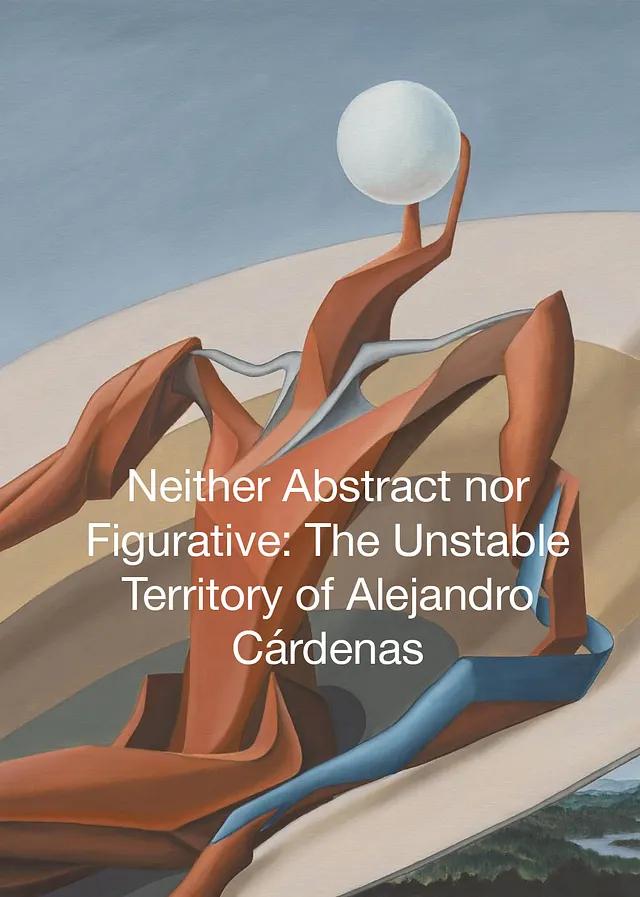
Alongside this material dimension, there is a complex relationship with representation that never fully resolves itself. Cárdenas’s works inhabit an intermediate territory where abstraction coexists with remnants of figuration — traces that suggest recognizable forms without ever consolidating them. This ambiguity is one of the most compelling aspects of his language, as it opens the work to multiple interpretations and resists the closure of meaning. Yet it also introduces a difficulty: when the work remains too long in this state of indeterminacy, it can create a sense of suspension that is not always productive. Constant suggestion, without a more stable anchor, may leave the viewer with the impression that something is there to be deciphered, but without enough elements to sustain that effort.
https://medium.com/@sarah rener/neither-abstract-nor-figurative-the-unstable-territory-of-alejandro-cárdenas-188a6bce2835
The emphasis on process is another defining feature of his practice, contributing significantly to his artistic identity. In his works, time is not hidden but revealed through visible traces of intervention: layers that are corrected, areas that are transformed, decisions that are not entirely erased but remain as vestiges of what the work has been at different moments. This exposure of process aligns his work with a tradition that understands art as an accumulation of actions rather than a finalized object. However, this visibility also introduces a critical tension. When process becomes too dominant, the final result may lose strength, leaving the viewer facing a work that clearly shows its construction but does not always articulate why that construction matters. In these moments, the work seems to depend on an implicit narrative that does not fully materialize within the immediate experience.
Within the broader context of contemporary art — where many practices are explicitly engaged with issues of identity, politics, or technology — Cárdenas’s work occupies a position that might be described as lateral. It does not clearly align itself with these dominant discourses, which can be interpreted both as a limitation and as a deliberate stance. On one hand, this distance may cause his work to appear disconnected from certain urgencies of the present, particularly in a moment when art is often expected to function as a tool of social intervention. On the other, it can also be read as a form of resistance against the expectation that every artwork must be supported by an explicit discourse, instead reclaiming a more sensory, openended, and less instrumental dimension of artistic experience.
This ambivalence translates into an aesthetic experience that does not aim to provide clear answers or fixed positions, but rather to create a space of uncertainty in which the viewer must take on an active role. However, this demand does not always work in his favor. In an environment shaped by fragmented attention, the need to invest time and effort into engaging with a work can become a barrier. Even so, it is precisely within this tension that much of the interest of his practice resides: in the insistence on sustaining a mode of making that does not easily adapt to contemporary conditions of circulation.
Ultimately, Alejandro Cárdenas’s work is defined by its capacity to inhabit instability. His pieces do not offer solutions or closed conclusions but remain in a constant state of tension between material, process, and meaning. When this balance is maintained, the result is a dense experience capable of generating a deep, almost meditative relationship with the viewer. When it
rener/neither-abstract-nor-figurative-the-unstable-territory-of-alejandro-cárdenas-188a6bce2835
falters, the work can become opaque, overly self-contained. Yet it is precisely within this risk that its relevance emerges: in the refusal to simplify, in the resistance to immediacy, and in the commitment to a complexity that, even when not fully resolved, remains necessary in an artistic context that often privileges the opposite.
To explore his work further, visit lejandro Cárdenas’s website:
Alejandro Cardenas: Artist Overview - Almine Rech
Discover the artworks of Alejandro Cardenas. Learn more about the artist, and explore their biography, bibliography…
#AlejandroCardenas #ContemporaryArt #ArtCriticism #AbstractArt #Materiality #ArtProcess #Painting #ConceptualArt #ArtTheory #VisualArt #ArtWriting #ArtEssay #ModernArt #ArtLovers #ArtCommunity #EmergingArtists #ArtAnalysis #CreativeProcess #ArtDiscourse #MediumArticles
https://medium.com/@sarah rener/neither-abstract-nor-figurative-the-unstable-territory-of-alejandro-cárdenas-188a6bce2835