JOURNAL S T U D I O A R T Q U I LT A S S O C I AT E S 2020 | Volume 30, No. 2
Special Digital-Only Issue
I N T H I S I SS U E : H O P E W I L M A R T H • J I M A R E N D T • m o S A i Q A • OUR NEW MANAG EMENT EXHIBITION CENTER • JURIED ARTIST SHOWCASE • MEMBER GALLERY • I N S P I R E D • U P CY C L E ! • C O L O U R W I T H A U • A R T TA L K
00
(D
Use your OWN machine and the 0-Zone Hoop-Frame to create the perfect free-motion quilting system
What's Free-Motion Quilting? ANY SIZE OUILT
Quilt queen, king, and larger sized quilts
SPACE-SAVING SIZE Fits in any space with a length of only 4.5 feet
Find a dealer near you at www.graceframe.com
Your sewing machine sits on a carriage that can move freely and effortlessly across the frame. You'll be amazed at how the needle glides over the fabric, like pen over paper.
See what your machine can do with a Hoop-Frame! Call for a FREE catalog. 800.264.0644
IN THIS ISSUE FEATURE ARTICLES: BOARD MEMBERS
Featured Artist: Hope Wilmarth. . . . . . . . . . . . . . . . . . . . . . . . . . . . . 10
PRESIDENT
Jim Arendt: Work-hardened stories. . . . . . . . . . . . . . . . . . . . . . . . . 18
Lewisville, Texas
SAQA’s new exhibition management center. . . . . . . . . . . . . . . . . 24
VICE PRESIDENT
moSAiQA Conference Wrap-up. . . . . . . . . . . . . . . . . . . . . . . . . . . . . 32
Deborah Boschert Dolores Miller
San Jose, California TREASURER
COLUMNS:
Gwyned Trefethen
Thoughts from the President. . . . . . . . . . . . . . . . . . . . . . . . . . . . . . . . . 4
SECRETARY
Inspired by Instinct: Regina Marzlin. . . . . . . . . . . . . . . . . . . . . . . . . . . 5
Reston, Virginia
Editor’s Notes. . . . . . . . . . . . . . . . . . . . . . . . . . . . . . . . . . . . . . . . . . . . . . . . . 6
Cohasset, Massachusetts
Jayne Gaskins Mel Beach
San Jose, California
Holly Brackmann Ukiah, California
Earamichia Brown McKinney, Texas
Shannon Conley
Art Talk: Life as an artist manager today . . . . . . . . . . . . . . . . . . . 28 GALLERIES:
Member Gallery: Climate Control. . . . . . . . . . . . . . . . . . . . . . . . . . . . . 8 SAQA Global Exhibitions: Upcycle!. . . . . . . . . . . . . . . . . . . . . . . . . . 26
Moore, Oklahoma
Juried Artist Showcase. . . . . . . . . . . . . . . . . . . . . . . . . . . . . . . . . . . . . . 30
Vivika DeNegre
Regional Exhibition: Colour With a U. . . . . . . . . . . . . . . . . . . . . . . . 38
Guilford, Connecticut
Carolyn Ducey
Lincoln, Nebraska
SAQA NEWS
Susan Else
Santa Cruz, California
Welcome new board members. . . . . . . . . . . . . . . 16
Cynthia Friedman
Merion Station, Pennsylvania
Candice Phelan
In Memoriam: Suzanne Woods Gail Thomas. . . . . . . . . . . . . . . . . . 41
Wellington, Florida
Sara Trail
Antioch, California
Maggie Vanderweit
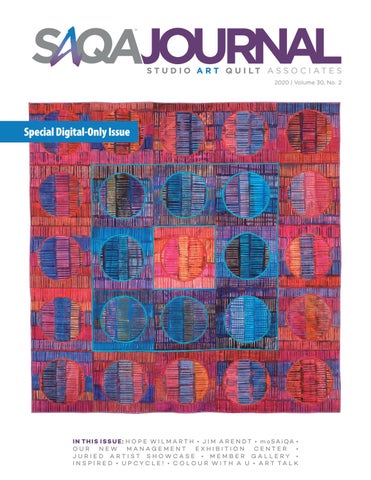
ON THE COVER:
Fergus, Ontario, Canada
Stephanie Shore Obscured Meaning
EXECUTIVE DIRECTOR
35 x 35 inches | 2019
Martha Sielman
Hebron, Connecticut
SAQA JOURNAL EDITOR
Diane Howell
Chandler, Arizona DESIGNER
YellowDog
Denver, Colorado
Go Green! You can choose to read the
Photo by Joe Ofria
QUICK NOTES To find out more about SAQA, contact Martha Sielman, executive director, by phone at 860.530.1551, or by email at execdirector@saqa.com. Explore varied resources on our website at www.saqa.com. Annual membership levels for U.S. and international members, listed in USD, are: Artist/Associate, $80; Juried Artist, $145; and Student, $45 (must present full-time student ID). Studio Art Quilt Associates, Inc. (SAQA) is a nonprofit organization whose mission is to promote the art quilt. Through exhibitions, resources, publications, and membership, we seek to increase appreciation for the art quilt as a fine art medium and to support our members in their artistic and professional growth.
SAQA Journal online only.
The SAQA Journal is published four times a year. To submit articles or story ideas, contact Diane Howell, SAQA Journal editor, at editor@saqa.com. Review submission guidelines at www.saqa.com/journal-submit.
Login to mySAQA (www.
For delivery questions, contact circulation@saqa.com.
saqa.com/mySAQA) and select Manage Your Account.
For advertising information, visit www.saqa.com/ads. SAQA Journal • 2020 | No. 2 •
3
THOUGHTS FROM THE PRESIDENT
SAQA’s momentum continues to grow by Deborah Boschert As I’m writing this column, we’ve
symbols like bowls, ladders,
just wrapped up an amazing virtual
stones, or trees. I love combin-
conference. In the face of a fright-
ing commercial prints with my
ening global pandemic, there was
original surface-designed cloth,
something comforting and inspiring
and mixing machine stitching
about being together even on our
with hand embroidery.
computer screens. Lisa Walton and I
At some point during my
have been to many video-conference
creative explorations, I joined
meetings together during her term
SAQA. When we lived in Mary-
as president, so maybe it was fitting
land, I loved the local meetings;
All the small details work together.
that we passed the symbolic crown
I became the regional rep and learned
Just as every member makes an impact
across our virtual screens.
how rewarding it can be to volunteer.
on our organization, each stitch is
This moment in our world feels full
After attending one of SAQA’s first
important to the design. The bouncy
of uncertainty, but I’m still eager to
live-webinars, I volunteered to join
line at the top may appear loose and
think about SAQA’s exciting future.
the Education Committee. Soon, I
improvisational, but it was carefully
It’s an honor to be SAQA’s new presi-
was chair of the Education Commit-
designed. I tested different lines and
dent. I’m grateful that our board of
tee, and in 2016 I was elected to the
redrew the pattern many times. In the
directors elected me to lead us for the
SAQA Board of Directors.
same way, SAQA’s growth is a balance
next two years. I’m thankful for Lisa’s
As president, I’m eager to seize the
of intentional planning and embrac-
leadership and for all the dedicated
momentum that SAQA has gener-
board members who have served
ated. Our membership is growing.
over the years. It’s a pleasure to work
We’ve introduced new programs. Our
excitement. Let’s connect. I’ll be
with extraordinary staff members
exhibitions tour the world. We’ve
representing SAQA at several upcom-
who expertly juggle all the exciting
launched successful fundraising
ing events and you can find me on
projects we’re working on—and the
efforts. Members connect with each
SAQA’s social media channels. I am
less exciting, but equally important,
other in all kinds of ways. There’s a
so excited to see where this momen-
day-to-day tasks that keep our organi-
buzz of excitement, don’t you think?
tum takes us. ■
zation on track. I’m an artist and a quilter, just like
looking out to the horizon and feeling full of potential. It’s a good
made my first quilt using a Quilt in
metaphor for SAQA in this
a Day pattern. After that first quilt,
moment. We’ve got a solid
I made more pieced quilts, explored
foundation of programs,
original block compositions, learned
dedicated members, and a
paper piecing, and experimented
skilled staff—like a line of
with surface design. Then I took a
big trees that provide stabil-
workshop from Melody Johnson, and
ity and shade. The color
my creative world was blown open
palette is energetic, bright,
by the possibilities of raw-edge fused
and fresh, like the energy
appliqué. In the last ten years or so,
you feel when you spend
I’ve developed a personal style of lay-
time with SAQA members
ering fabric, paint, and stitching. My
and talk about favorite
art quilt collages incorporate personal
materials and techniques.
• SAQA Journal • 2020 | No. 2
I’m eager to share this buzz of
My quilt, Day Break, is inspired by
many of you. In the mid 1990s, I
4
ing spontaneity.
Daybreak
40 x 40 inches | 2019
Instinct
INSPIRED BY
by N.K. Quan
Regina Marzlin
A Rare Bird
12 x 12 inches | 2016
A
n innate ability to create is the foundation for A Rare Bird by SAQA Juried Artist member Regina Marzlin.
foundation for the design, I stand back, trust my abilities, and let the simple lines and circles tell me a story.”
With no set design in mind, Marzlin used a technique that incorporated gesso, aluminum foil, and white cotton fabric to build this quilt. Using a brayer, she spread a thin layer of gesso onto the foil, let it dry slightly, and then flipped the painted foil onto the fabric. Working quickly before the gesso completely dried, she used a blunt tool to draw lines and circles on the foil, guided only by instinct. With a flick of her wrist, she drew a line here, a circle there, and then pulled off the aluminum foil to reveal black marks on the white fabric.
The image that emerged from this particular monoprint was an exotic, stork-like bird set in an environment that could be read as a river, a swamp, or an otherworldly dream. She painted the fabric using ink and Derwent Inktense pencils. The predominant colors in the piece are her favorites, orange and blue. A row of stitching is run on top of the black lines.
“This technique is a spontaneous, dynamic process that transfers creative energy in an immediate way, and prevents me from overthinking,” Marzlin says. “Once I have the subconscious
“My art seems to be impressionistic in that I like unplanned, spontaneous mark making and trying to work in a loose and energetic way. Most of my inspiration comes from nature, as that is what surrounds me every day. While I see many interesting structures and compositions, I’m not interested in reproducing them in a realistic fashion.”
Marzlin’s move from Germany to Canada helped to inform her work as a textile artist. She did not learn to sew as a child and was unfamiliar with art quilts. She was influenced by European culture and the great art she experienced in museums there. The first time she saw art quilts was in 2003. Fascinated with the art form, she taught herself how to sew and the basics of quilting. Within a year, she had started to create her own designs. “The piece was titled A Rare Bird because that is what it is. I would not be able to reproduce it. I can’t draw it again in the same fashion as it was the result of ‘seeing’ a structure in the random lines.” Regina Marzlin is based in Nova Scotia, Canada. ■ N.K. Quan is a Phoenix-based writer and editor. SAQA Journal • 2020 | No. 2 •
5
EDITOR’S NOTES
Love in the time of Covid-19 by Diane Howell Yes, the headline is supposed to sound
your SAQA Journal with no delays due
like the book written by Gabriel García
to factors beyond our control.
Márquez, Love in the Time of Cholera
In this issue, we have a new president
(I highly recommend reading it if you
and five new board members to wel-
have not done so—at least watch the
come. Each one brings a background to
movie!). And, yes, I was going to put
our organization that will support our
it on Steve Dingman’s essay about
mission well into the future.
being Susan Lenz’s artist manager. But
We also look back at our March
I couldn’t resist saving it for myself,
moSAiQA conference, originally
despite the support this husband-and-
scheduled to take place in Toronto;
wife team give each other. I saved the
it was converted in only two weeks’
pun for me because I feel that we long
time to a virtual event due to COVID-
for one giant group hug.
19 concerns. Amazingly, the online
Since I can only sit here in Arizona
format still allowed participants far
and other shipping needs. It is versa-
and write, aided by two fluffy dogs, I
and wide to fall in love with Canada,
tile, efficient, and designed with quilt
hope this special digital-only issue finds
because we were able to see it through
conservation in mind.
you well, and even more that it pro-
the eyes of our Canadian members.
Speaking of exhibitions, alongside
vides you with much-needed connec-
I invite you to enjoy the update
tion. This second installment for 2020
on our new SAQA Global Exhibition
selected works from Colour with a U
is, after all, about us, the SAQA commu-
management center, a facility that
are included. This regional exhibi-
nity, and our community is resilient.
was made possible by your donations.
tion from Canada was installed at the
Our new approach this month is a
From its first open day in January, it
Homer Watson House & Gallery in
temporary change to ensure you receive
has been the hub for our exhibition
Kitchener, Ontario, just prior to our
our regular gallery departments,
conference. Thanks to the moSAiQA local organizing committee’s quick
Paula Gron
Crotalaria
34 x 30 inches | 2019
This work was submitted as part of Member Gallery: Climate Control. More selections are found on page 8.
work, conference attendees were able to see it as a virtual tour. There is plenty to reflect on as you read the articles on artists Hope Wilmarth, Jim Arendt, and Regina Marzlin. What’s more, Dingman’s article sums up how the pandemic has affected his job as an artist manager who suddenly has no exhibitions to shepherd. Instead, he sees a renewed period of creativity for Lenz and undertakes a search for future exhibition opportunities. His essay shows us, with good humor, how to have hope. My wish for all of you is that your hope for certainty quickly turns to reality. ■
6
• SAQA Journal • 2020 | No. 2
SAQA is here for you. Can This Really Be Me? (detail)
Bodil Gardner
From storing exhibition quilts to writing the SAQA Journal, our work for you continues. We support your creative spirit with live Zoom chats, art on Facebook and Instagram, and virtual artist panels. Our new exhibition management center is up and running, and our new website is nearing completion. You make SAQA possible. A gift from you now will allow us to stay the course and to move forward when COVID-19 has passed.
Let’s get through this together. Support your SAQA community. To make a gift, visit www.saqa.com/together. SAQA Journal • 2020 | No. 2 •
7
MEMBER GALLERY
Climate Control
Suzanne Evenson Rising Tide: We Have Been Warned 52 x 20 inches | 2014
Maryte Collard Cracked Ice
36 x 36 inches | 2019
Sam Milford Eco Fish
37 x 10 x 3 inches | 2018
Rickie Seifried Coastal Kelp
24 x 36 inches | 2018
8
• SAQA Journal • 2020 | No. 2
Jancy McClellan Climate Crisis
17.75 x 18.5 inches | 2019
Elaine Filyk On Thin Ice
19 x 25 inches | 2018 Photo by Susan Greenwell
Beth Schnellenberger Scorched Earth
26 x 71 inches | 2016 Photo by Larry Hampton
Maggie Vanderweit Melting
30 x 37 inches | 2019
SAQA Journal • 2020 | No. 2 •
9
FEATURED ARTIST
Hope Wilmarth Fine lines define abstract style by Cindy Grisdela
Hope Wilmarth, of Spring, Texas, is known for her fine line series of abstract art quilts, with two pieces earning a place in the prestigious Quilt National exhibitions. Debris, her Quilt National ’19 entry, is a great example of Wilmarth’s style. She cuts strips three-fourths of an inch wide from her fabrics, sews them together, and then recuts them. The new “fabric” is sewn intuitively into
Hope Wilmarth
a new construction. Debris is “dedicated to the good people from around the country who helped Houston clean up” after Hurricane Harvey, Wilmarth says. She describes herself as an intuitive artist without an art background. She spent her professional life as a registered nurse helping psychiatric patients. “I draw on life experiences whatever they might be,” she says while considering a question about whether her professional work influences her art. Everything she’s ever done can come into play, even if she doesn’t know exactly how it’s related, she adds. Her mother taught her to sew on a 1948 Singer Featherweight, which she still owns. Eventually, Wilmarth joined a neighborhood group that made traditional quilts, but became restless as she followed patterns designed by others. In 2009, she turned her attention toward art
Debris
51 x 48 inches | 2018
10
• SAQA Journal • 2020 | No. 2
quilts, taking classes with Jeannette De Nicolis Meyer, Katie Pasquini
Mother of Exiles
Asylum
46 x 33 inches | 2018
41 x 55 inches | 2018 Masopust, Claire Benn, Elizabeth
has experimented with a technique
Busch, Melody Randol, and others.
taught by Melody Randol, where the
Her first class was a weeklong retreat with Meyer, and her goal was simple: to abstract a real image.
components of the design are fused and quilted as you go. Asylum is a mixed-media piece
“My image was a photo taken by my
created using some of these tech-
cousin of a colorful row of house
niques. Wilmarth designed the letters
fronts in Provence. I have that little
and the figure on nonwoven mate-
piece hanging on the wall to remind
rial, then painted them with acrylic
me how challenged I was, and often
paint and appliquéd them to a whole
still am, to abstract a real image either
cloth background. The background
in my head or from a photo.”
is quilted with a barbed wire pat-
Her years of traditional quiltmak-
tern. This quilt is part of a new series
ing served her well when she tran-
inspired by current events that Wilm-
sitioned to art quilts. Working from
arth calls “perspective art.” Another
one of Jean Wells Keenan’s intuitive
piece in this series is Mother of Exiles,
piecing books, “I found that break-
depicting an outline of the Statue
ing the rules of cutting, sewing,
of Liberty on a background of text,
color, and design required knowing
including the words from the statue’s
the rules to make work that holds
inscription: “Give me your tired, your
together.” Abstract work can be
poor, your huddled masses... .”
good or bad, just like any other art.
Wilmarth’s intuitive style means
The good pieces have a foundation
she rarely draws out an idea in
of cohesive design and technique,
advance. “I just dive in and sew
she says.
pieces together to see where they lead
In addition to fine line piecing,
me. If I am making material, I pull
Wilmarth enjoys surface design
out paint and brushes and stamps,
techniques, including painting onto
silk, organza, fabric. I play a lot first
fabric with dye or acrylics, decon-
before settling on a path.”
structed screen printing, stamping, and other mark making. She also
She pieces and quilts on a Bernina 710 sewing machine. While she
Shoreline Serenade
72 x 30 inches | 2018
SAQA Journal • 2020 | No. 2 •
11
Wings
55 x 43 inches | 2019
Signs of Spring
42 x 38 inches | 2019
owns a longarm machine, she uses it primarily for charity work and family quilts. “I was sure the longarm would enhance my art quilts, but personally I find the time [required] to build that skill better spent creating the surface design of the art.” Inspiration comes from a variety of sources. Sometimes it’s from a call for entry theme, or materials that have caught her eye, or her personal experiences. One of these personal pieces
ExplOCEAN
50 x 30 inches | 2018
is ExplOCEAN. Wilmarth used a photo transfer of a photograph she took traveling on the Oregon coast. She compares the waves crashing on the shoreline to “champagne uncorked in an explosion of bubbles.” She used embellishments such as felted wool on the rocks and painted organza and tulle for the blowing water. Wilmarth doesn’t have a focus on selling or teaching. “I am not driven to sell my work. I am delighted when it does. My art is a response to my
12
• SAQA Journal • 2020 | No. 2
Hope Wilmarth at work in her studio
Edge of Space
43 x 42 inches | 2019
own need to create.” She believes hav-
and large shapes in a muted color
work before you can do good work.”
ing a good website is important, and
palette of blue, gray, and black.
Through failure, you will grow as an
she has made some sales that way, as
Wilmarth advises other art quil-
well as selling images of her work for
ters to take classes to learn the rules.
reproduction to outlets as varied as a
“Then do the work. Just do the
hotel in Houston and a medical text.
work. Make bad stuff and improve
group very helpful to discovering how
it. You can get discouraged, but you
to do her best work. Wilmarth par-
have to fail. You have to do bad
ticipated in a critique led by Michael
She also has a passion for charity sewing for homeless children in her
artist and learn about yourself, she says. She finds belonging to a critique
community, and she teaches other quilters at her church who want to contribute to that effort. Wilmarth recently began a new series that focuses on large shapes of color. One of these, Signs of Spring, was juried in to Quilt Visions 2020 at Visions Art Museum in San Diego, California. It makes use of a controlled palette of green, black, gray, and off-white stitched into large angular shapes that move the eye around the composition. Straight line stitching adds movement to the design. Another piece in the new series is Edge of Space, which explores lines
Broken Promises
33 x 50 inches | 2018
SAQA Journal • 2020 | No. 2 •
13
Unending Rhythm 47 x 20 inches | 2018
Metronome
57 x 42 inches | 2019
James in 2014 during a symposium at
artists to bring their own perspective
more piecing is likely in her future. A
the Renwick Museum in Washington,
to bear on the work being discussed.
potential new direction is three-dimen-
D.C. He taught participants how to
“I find that over time I visit muse-
sional work, and she is interested in
critique the work of others—focus-
ums, galleries, and the internet more
creating wall art that is more dimen-
ing on discussing both strengths and
frequently to view art. Having made
sional and stands out from the wall. ■
weaknesses in a positive way, not just
art, I find I can appreciate and under-
giving compliments. Wilmarth’s small
stand art in new ways now.”
Cindy Grisdela is a SAQA Juried
critique group includes artists whose
Today, she is primarily interested in
work is very different, which reduces
gallery and museum shows. She enjoys
ginia. You can view her work at
feelings of competition and allows
her abstract work, and that means
www.cindygrisdela.com.
14
• SAQA Journal • 2020 | No. 2
Artist member residing in Reston, Vir-
2020
SAQA
BENEFIT
AUCTION
SEPTEMBER 14-OCTOBER 4, 2020 Make your art the center of attention! Donate a 12 x 12-inch quilt to support SAQA’s mission to promote the art quilt. Every year, these small works typically raise $60,000+ to support our exhibitions, education, outreach, and more. It starts with you! SUBMISSION DEADLINE IS JULY 1. (Due to the current health situation, we have extended the deadline, but please complete the online donation form by June 20.)
For details on how to donate, visit www.saqa.com/auction SAQA Journal • 2020 | No. 2 •
15
Meet SAQA’s new board members
We welcome five members to the SAQA Board of Directors: Mel Beach, Earamichia Brown, Shannon Conley, Sara Trail, and Maggie Vanderweit. Their experience with SAQA and other nonprofit organizations provides a range of expertise to grow our many initiatives, from exhibitions to education. We are proud to introduce our new board members to you.
Mel Beach
Earamichia Brown
Mel Beach
School of Fashion Industries in New
whose work is informed by her expe-
Mel Beach is a quilt artist, teacher, and
York City. But she opted for Plan
rience as a cell biologist and biochem-
B and became an attorney by day,
ist. She runs a biomedical research
which allowed her to support her love
lab at a large university and ideas for
of fiber. She graduated from George
her pieces often arise from scientific
Mason University in Fairfax, Virginia,
research performed by her or others.
with a BA in Government and Politics
She has been artistic her whole life,
lecturer based in San José, California. Her work breaks from tradition with the addition of her own modern, beautifully textured, and vibrant twists. To date, she has completed more than eighty quilt projects. All of them draw on her inquisitive nature, series work,
and from Howard University School of
and art quilts have been her primary
Law in Washington, D.C., with a JD.
medium since 2009. She explores the
Earamichia’s love of crafts and fiber
connections between science and reli-
flourished. She became an avid knitter,
gion, and between the physical world
designed and made garments as gifts
and the way it is colored by our varying
and commissions, and taught knitting.
perspectives. Much of her recent work
In 2000 she was introduced to quilting.
has focused on interpreting the diver-
on Quilting Arts TV and The Quilt Show.
Her fiber resumé includes teaching vari-
sity and interconnectedness of various
ous subjects in eHow videos and being
ecosystems using fabric and stitch.
Earamichia Brown
published in a number of quilt-related
She grew up in southern New
Earamichia “Encyclopedia” Brown
books. Her work has been exhibited at
Mexico and retains a strong connec-
began her love of fiber arts and
International Quilt Festival/Houston
tion to the dry mountains and high
craft as a child. Her family had two
and other venues across the country.
desert, areas that frequently appear
comedy improv studies, and a love of nature and photography. Her awardwinning quilts have been exhibited internationally and published in books and magazines. She has been featured
fascinating book sets: World Book
Earamichia serves on several profes-
in her ecology and nature-inspired
Encyclopedia and Childcraft: The How
sional boards and is a board member
pieces. Though her practice origi-
and Why Library. The Childcraft series
of Quilt Alliance.
nated with traditional quiltmaking
contained a volume entitled Make and Do, which she did plenty of. Earamichia wanted to be a fashion designer, and attended the High
16
• SAQA Journal • 2020 | No. 2
Shannon Conley
techniques, these approaches are often expanded to include the use of
Shannon Conley is an art quilter and
nontraditional fibers and fiber-like
fiber artist from Moore, Oklahoma,
materials, as well as other media and
Shannon Conley
Sara Trail
Maggie Vanderweit
design approaches, including surface
Sewing Academy (SJSA) in Antioch,
in many publications, including
design, sculpting, and cutwork.
California, to be a platform where
Quilting Arts Magazine.
Sara Trail Sara Trail learned to sew at the age
youth creates art that engages and educates communities.
Maggie has operated Stone Threads Fibre Art since 2000. She creates original contemporary art with
of 4, and is now a successful author,
Maggie Vanderweit
sewing teacher, and pattern and
Maggie Vanderweit’s work is exhib-
and botanically dyed fabrics; hand
fabric designer. At age 13, she wrote
ited and sold in galleries, shops,
embroidery; beading; collage; and
a book for C&T Publishing, Sew
museums, and art quilt exhibitions
intricately machine quilted surfaces.
with Sara, which teaches teens and
around the world.
Maggie, now retired, presented a
hand-painted, hand-dyed, rust-dyed,
tweens how to sew cute clothes and
She is a Juried Artist member
variety of talks, lectures, retreats, and
accessories for fun and profit. At 15,
of SAQA, a professional member
workshops for SAQA conferences, gal-
she starred in Cool Stuff to Sew with
of Canadian Quilters’ Association
leries, museums, guilds, the Halibur-
Sara, a DVD project with C&T Pub-
(CQA), and belongs to Connections
ton School of Art and Design, Elora
lishing. She has designed two fabric
Fibre Artists. She has won numerous
Art Workshops, quilt stores, CQA,
collections for Fabri-Quilt, Folk
awards, including the 2013 Award
and Creativ Festival.
Heart and Biology 101, and a pattern
for Excellence in Innovation at the
collection for Simplicity, Designed
at the CQA National Juried Show,
nizing Committee for the 2020
with Love by Sara.
the Grand Prize at Threadworks 2016,
moSAiQA Conference in Toronto,
and the Shirley Hastedt Award at
which became a virtual experience.
While attending the University of California, Berkeley, Sara created a
Quilts=Art=Quilts at the Schweinfurth
quilt in memory of Trayvon Martin,
Museum in Auburn New York.
and her love for sewing and passion
Maggie chaired the Local Orga-
Since joining SAQA in 2013, Mag-
for social justice intertwined. After
gie has had thirteen pieces juried into
graduating from the Harvard Uni-
eight SAQA global exhibitions. Her
versity Graduate School of Educa-
book Stone Threads was released in
tion, she founded the Social Justice
June 2016, and her work is included
SAQA Journal • 2020 | No. 2 •
17
Jim Arendt:
Work-hardened stories told in denim by ZJ Humbach
Jim Arendt’s art is rooted in the lives
as antidotes to estrangement from
of laborers. He wants to develop and
objects and one another.”
share a true understanding of the
Arendt’s life revolves around
people, their craft, and the impact
art. “My hobbies include being an
economic change has on their lives
associate professor of visual arts
and communities.
at Coastal Carolina University in
His firsthand knowledge of the
Conway, South Carolina, and direct-
labor force comes from growing
ing its Rebecca Randall Bryan Art
up outside Flint, Michigan, in the
Gallery. I also make art,” he laughs,
1980s, when he saw workers who had
noting he is not a full-time artist. “I
endured a farm crisis and auto manu-
enjoy being a teacher, preparing stu-
facturing plant closures. “Through
dents and future artists for success
portraiture, I try to make the scale
in creative fields, and still feel that I
and complexity of these economic
am learning.”
shifts easier to comprehend. The cul-
He lives near the university in a
tural practices that unfurl as a result
quiet area draped in Spanish moss
of those relationships taught me
and frequented by beachgoers. “Our
strategies to craft a working life that
home consists of two artists, three
embraces wholeness and integrity
kids, five undocumented chickens,
Mom
61 x 30 inches | 2012 Jim Arendt takes the long view of works in progress.
18
• SAQA Journal • 2020 | No. 2
two dwarf rabbits, one black dog, nine antiquated sewing machines, bikes, equipment, crates, and other necessities. It’s a work in progress.” Finding time for his art is a challenge. “Tag-team parenting and late nights are what I use to get the work done. My partner and I try to help each other as much as possible, but you simply have to let go of the illusion that other things are going to happen if you want to do the work of making art,” explains Arendt. “That means dishes, laundry, and lawn care are neglected or delegated to children old enough to handle the responsibility. Oh, and we admire other people’s vacations on social media!” His studio is a one-car garage located near the house, which allows him to efficiently circulate between his family and his work. The studio itself is systematically unkempt and rife with unfinished false starts. “Since my studio is so small, each piece of equipment has to earn its place or it has to go,” Arendt says. “This pragmatic attitude reassures me
Logan: Totemic Figures
that I have not developed a hoard-
78 x 48 x 48 inches | 2014
ing disorder, and am, in fact, making things that could be dangerous or beautiful.” He usually rolls up the garage door and works in the sun at one of the industrial machines he has restored and mounted on casters. “Beyond the donated denim is a collection of machines I’ve bought cheap, inherited, or liberated. I call it adventures in sewing-machine stewardship. Some, such as my 100-year-old Singer 29-4 ‘patcher’, I like because they are pretty. Others hold a place in my heart, like my grandmother’s Kenmore 158 whose light bulb still warms the machine oil. The workhorse of my studio is a Singer 111W155 that I purchased
Logan, detail
Logan, detail SAQA Journal • 2020 | No. 2 •
19
Totemic Figures (Seven)
74 x 48 x 48 inches (each) | 2014 Work in situ at Mississippi Valley Textile Museum Almonte, Ontario, Canada, July-September 2019 the people I know and love? Denim seems created to be abused, worn out, patched, stained, and burnt through. Its characteristics are mirrored in the individuals I choose to represent. Yet, jeans remain supple, and, with the right pair of boots, can still go to the ball. I like that.” While denim is his medium of choice, Arendt also incorporates very unusual materials into his art. “Most recently I learned that if you ask real nicely, the guy at the tire shop lets you take all the truck inner tubes you want. Then you can sew them into unusual shapes, and with enough luck, the whole thing will hold air. I also negotiated for four months with the local power comat auction for $59 and can sew
materialist at heart. I am always
pany to get them to loan some of
through anything I can get under
looking for material that has an
their coal for an installation project
[its presser] foot.”
inherent metaphoric quality. What
titled Repose.”
What usually goes under the presser foot is denim. “I’m a
Jim Arendt’s favorite material is denim. Photo by Yvette Cummings
20
• SAQA Journal • 2020 | No. 2
other material could bring me closer to the lived experiences of
Arendt uses a variety of springboards to start a project. On occasion
Sarah & Augustus
66 x 66 x 3 inches | 2016
he builds models. Other times he gathers reference photos. “Mostly, I ruminate: Sometimes for days, generally for years. I try to figure out how to get at the best iteration of an idea, and I am usually wrong,” he confesses. “I carry a pocket-sized notebook to jot down a rough doodle and text, and promptly forget about it until I reopen that page a year or two later and discover that I know how to make it better. “When I am completely lost, I organize the studio. I usually get bored and set something aside to pursue another project. I like to leave the work up so it can stare at me reproachfully until I can’t leave it half-done anymore. I cut and I sew, blocking in large areas and fussing over details. I mess it up. I’ll excise a section and start over. It’s very important to stand in the driveway at night and squint and ask yourself if it’s done. It usually isn’t!” One of Arendt’s “hobbies” leads him to build a certain practicality
Cat: Free Will Ain’t Cheap
85 x 60 inches | 2017
into his creative process. “As a gallerist myself, I attempt to design my work with the people who will have to eventually move it, install it, and handle it in mind. My work must be durable enough to survive transportation, and simple enough to assemble and hang so that it doesn’t require heroic efforts to mount a display. I imagine the work existing in a museum, the effect I want it to have on the viewer, and then run the camera backward, imagining each step of its journey. Then, I design the work to run as simply as possible through those steps.” He uses donated and reclaimed denim to make portraits of family and friends. “They model my worries and desires. For me, representation is still a form of magical power. Even
Eryks
70 x 93 inches | 2015 SAQA Journal • 2020 | No. 2 •
21
Robs: Permanent Vacation
60 x 90 inches | 2015
though I know how all the tricks work, I never tire of watching someone appear from bits of Wrangler blue and acid-wash white.” One portrait especially near to his heart is Meghann (page 18). “She’s my niece who was born prematurely and weighed approximately two pounds. “She’s now in her thirties and has known more than her fair share of adversity. I wanted to make an image of her that provided some of the love and protection I could do from a distance. So, my partner helped me cut out the rivets from all the jeans I had on hand. It took three days. I turned those rivets into a chainmail-like shirt
Adrian: Lies
144 x 66 x 48 inches | 2018
22
• SAQA Journal • 2020 | No. 2
for her to wear forever. She looks
others’ images and decided that I’d
pleasure in talking about my work
tough.”
make my own the most vulnerable
with third graders. They understand
to compensate.”
me better than most critics.” ■
Another portrait gives a glimpse into the artist himself. “Jim is a
His view on creating art is simple:
self-portrait inspired by shed cicada
Reflect on what brings you pleasure
shells and the vernacular of denim,”
about your work and value that
quilting and sewing teacher, and profes-
says Arendt. “It shows my transfor-
reality. “Prestigious exhibitions,
sional longarm quilter. She owns and
mation process from farm boy to art-
sales, and awards are usually how we
operates Dream Stitcher Quilt Studio in
ist and professor. I built a career on
gauge success. I find more value and
Thornton, Colorado.
ZJ Humbach is a freelance writer,
Jim
96 x 60 inches | 2013
Meghann
69 x 30 inches | 2012 SAQA Journal • 2020 | No. 2 •
23
SAQA global exhibition management center becomes reality by Allison Reker One major benefit of being a SAQA
exhibition management center. It took
One of the offices has been set aside
member is the ability to enter artwork
three trips with a 27-foot long truck to
to house inventory such as catalogs,
into our global exhibitions program.
get all of the artwork, crates, supplies,
back issues of SAQA Journal and Art
Many museums are impressed to learn
catalogs, and other stored items moved
Quilt Quarterly magazines, note cards,
that a membership organization runs
into the new facility. Here are some
rack cards, envelopes, conference sup-
one of the most prolific and well-trav-
telling statistics from the first month of
plies, booth supplies, and other items.
eled exhibition programs in the world.
operation:
Just outside that room is a designated
Ten years ago, SAQA produced two
• More than two tons of quilts and
space for shipping and receiving
new exhibitions per year. In 2019, we premiered six new exhibitions, and we are premiering six more in 2020. With seventeen exhibitions on tour, we are currently promoting the work of more
materials were shipped and received. • There were fifteen semi-truck shipments. • Three to four different couriers
individual quilts, catalogs, and smaller items, separate from the loading and quilt work areas. The new global exhibition management center is more than simply a
than 600 artist members to more than
arrived for small package deliveries
warehouse for processing and shipping
thirty venues on four continents.
and shipments every business day.
artwork and materials. It is an immacu-
• 584 individual quilts were opened,
late facility that is devoted to the high-
The exponential growth of SAQA Global Exhibitions, including the
inspected, documented, and
est standards of collection care. William
acceptance of more and more three-
packaged.
Reker, SAQA’s director of global exhibi-
dimensional art, made it impractical to continue running the program from a spare bedroom. In January, after years of planning and tremendous support from our board, donors, and membership, SAQA opened its very first global
• Nine exhibitions were shipped to and from venues. • Seventy-two quilts were sent back to artists. • Twelve quilts were shipped to buyers. SAQA’s new facility comprises • Approximately 2,500 square feet of workspace that includes room for offices, collection management,
tions, interviewed museum professionals and major collectors about a variety of issues, including lighting, insect prevention, temperature, humidity, fire protection, safe cleaning methods, and the most ideal systems for quilt storage between venues. “With the new global exhibition management center, every quilt receives the highest quality of care. The center was designed and
shipping, and storage.
configured specifically for collection
A loading area with overhead doors
the space and flexibility to analyze and
is configured to ship and receive large deliveries. It includes a lift that eliminates the need for SAQA to pay extra for trucks equipped with liftgates.
management. The new center gives us improve our procedures and workflow, whereas before we were lucky to have sufficient space to complete all of our necessary tasks. Not only can SAQA
William Reker, director of global exhibitions, works in his office, which features an art quilt portrait of SAQA founder Yvonne Porcella, created by SAQA member Kathleen McCabe.
24
• SAQA Journal • 2020 | No. 2
All photos by Dan Cleary
William Reker operates the lift that allows shipping crates to be loaded and unloaded into any transport truck, regardless of its height. The lift eliminates the need for shipping companies to dispatch a truck with a liftgate, which reduces SAQA’s shipping costs.
other fees, SAQA saves $300 each time an exhibition is shipped to or from a venue. This helps us to be a better steward of our membership’s funds. Members who are juried into SAQA Global provide museum-quality care for all
Hendrickson, registrar and collec-
Exhibitions save on their shipping costs
of the artwork, now there is also room
tions manager, at The National Quilt
as well—up to $10 per shipment.
to expand our popular exhibition
Museum; and collector Jack Walsh.
program.”
“Their willingness to share their
promote our members’ art to muse-
expertise and years of collection man-
ums, and more of those museums are
large work room and the quilt storage
agement experience was invaluable
partnering with us, the new global
vault. The workroom has two raised
in setting up the global exhibition
exhibition management center gives
32-square-foot tables which provide
management center.”
us the resources to meet that demand
At the heart of the facility are a
ample space for examining and rolling
Aside from the increased quality of
As SAQA continues to work hard to
and grow into the future. ■
quilts, while also holding all of the
care and improved workflow, there
supplies needed to work with them.
are additional benefits to having the
Allison Reker is SAQA’s membership
Exhibitions can be easily brought in
center. The cost to ship to a business
coordinator and catalog editor. She has
through the connected loading area,
address is less than to a residential
authored five books of fiction and is a
then unpacked, inspected, inventoried,
one. By not having to pay for residen-
freelance editor for various publications.
documented, and prepared for ship-
tial pickup or delivery, a liftgate, and
She resides in Beavercreek, Ohio.
ment to the next venue. As part of the workroom, there is a space to photograph works and to place them into our rolling shipping crates. The storage vault is a separate, lockable room which will soon have a custom-built, museum grade textile storage system installed. The vault, like the rest of the global exhibition management center, is monitored several times each day for humidity and temperature fluctuations. Reker says SAQA sends a special thank you to Carolyn Ducey, curator of collections, and Jamie Swartz, collections assistant, at the International Quilt Museum; Laura The workroom features tables to carefully process quilts for an entire exhibition and also has an area for photography.
SAQA Journal • 2020 | No. 2 •
25
Selections from
Upcycle!
Fiber art has a rich tradition of incorporating elements that would otherwise be discarded by turning them into compelling compositions. Repurposing materials is one of the most effective solutions to deal with today’s environmentally devastating waste issues. Full of creative energy, Upcycle! offers artwork with intriguing details and unusual materials, and will surely spark conversations from viewers. The juror for this exhibition is Katie Pasquini Masopust; the exhibition benefactor is Lisa Ellis. For more information, visit www.saqa.com/upcycle.
Laura Wasilowski Painting the Town #1 47 x 33 inches | 2014
Carol Larson Keeping Up Appearances 4 48 x 27 inches | 2012
The text is used with permission of the Amy Vanderbilt Kellar Literary Property Trust.
26
• SAQA Journal • 2020 | No. 2
Karen M. Balos Thank You Holly
51 x 34.5 x 2 inches | 2018
Stephanie Shore Obscured Meaning 35 x 35 inches | 2019 Photo by Joe Ofria
Yael David-Cohen Mirrors 1
48 x 24 inches | 2018 Photo by Max Alexander
Laurie McCown The Seven Sisters and Their Ghosts
48 x 42 inches | 2018
Laurie Bucher Planet Earth
40 x 38 inches | 2019
SAQA Journal • 2020 | No. 2 •
27
ART TALK
The life of an artist manager during COVID-19 by Steve Dingman
It’s me, Steve Dingman. I have a PhD
the time; I was forty-six and about to
for 2021. While I didn’t have to drive
in civil engineering, although I left
be transformed into a rather reluctant
a forty pound, 46 x 57-inch piece
that career decades ago to join my
artist manager. Over the past nineteen
to the Wayne Art Center in Wayne,
wife, Susan Lenz, in a little business
years, I’ve learned plenty in my new
Pennsylvania (614 miles one way),
endeavor we called Mouse House. It
job, from navigating cross-country
Susan was really disappointed that
was supposed to be a mom-and-pop
deliveries to box building, from proof-
Second Marriage wouldn’t be seen in
custom picture framing shop. By
reading to psychotherapy, and from
this international exhibition.
2001, there were fourteen people on
tactful ways to give artistic feedback to
ArtFields, an art competition and
payroll and we averaged 250 finished
being a storage system specialist—and
festival that celebrates artists from the
pieces per week. I was in charge of
I’m still doing the books.
U.S. Southeast--and has more than
ordering supplies, building frames,
Earlier this year, the COVID-19
$145,000 in award money up for
paying bills and taxes, and keeping
pandemic spread across the globe and
grabs—was cancelled. So I didn’t have
up with business paperwork.
right into Susan’s studio. Doom and
to drive to Lake City, South Carolina,
gloom descended on busy March and
to help install an 8 x 15 x 15-foot
“wanted to be an artist when she grew
April calendar pages. Art Quilt Elements
installation called The Cocoon, but
up.” She was forty-two years old at
was postponed, and is now scheduled
Susan didn’t get better images of the
Then Susan declared that she
piece or enjoy it being seen by more than twenty people. And the hits just kept on coming. Within a week, two solo shows were sitting in silent venues. Next, Columbia Open Studios announced a postponement and a refund check came from the statewide fine craft show. Susan’s Red Carpet Dress was present at the opening of Castaways: Art From The Material World at the Bateman Foundation in Victoria, British Columbia, Canada. But the museum had to shut its doors after that first night, although you can see still see the dress online at www.batemanfoundation.org. Four venues where Susan had work in group shows closed to the public. A touring exhibition co-curated by Sandra Sider and Pamela Weeks, Susan Lenz and Steve Dingman
28
• SAQA Journal • 2020 | No. 2
“Deeds not Words”: Celebrating 100
Years of Women’s Suffrage, was scheduled to premier at the National Quilt Museum in Paducah this April, but was postponed due to coronavirus. The exhibition is currently scheduled to be in late October at the International Quilt Festival/Houston. As for me, I didn’t have to drive to any of these locations or ship any artwork. The solo shows were, in a sense, put into storage—just not in our house. My only task became to deal with a single artist’s depression.
Steve Dingman and Susan Lenz use a propane torch to remove air bubbles from a UV-filtering epoxy on one of her works.
If looks could kill, I wouldn’t be writing this article. Saying things
bars that I already cut and built. Many
such as, “Aren’t you glad you got
afternoons found us in the garage
evening when I was about ready
rejected from the Smithsonian Craft
pouring UV-filtering epoxy. We did
to serve dinner, I heard Susan say,
Show this year because it just got
this after I set everything up, and in
“One more minute.” Time during
postponed?” or “It could always be
the morning there was clean-up too.
this pandemic has seemed to stand
worse” were not appreciated, but did
Workhorses were installed in the liv-
still because one minute always
lead to conversations about positive
ing room so that Susan could stitch
lasted at least fifteen. But I guess
thinking. After all, the artwork wasn’t
hundreds of keys into a piece called
that should have been expected
damaged. FedEx or UPS hadn’t lost
Lock Down 2020. Vacuuming the
because “one more stitch” before
an art quilt (that has happened).
studio became impossible. In a state of
bed also seemed to take fifteen
The sewing machines were in perfect
total exhilaration, Susan paper-pieced
minutes.
working order and surely there were
a crazy quilt using found fabric wall
enough fabric and thread inventories
covering from the South Carolina
another problem appeared. Every-
on hand to last a lifetime.
State House renovations of the late
thing created during these stay-at-
It didn’t take long for me to
1990s. Itty-bitty pieces of paper were
home weeks was going immediately
remind Susan that being deemed
everywhere while Stir Crazy in SC was
into storage. I was the only person
“non-essential” by the City of
under construction.
who could admire the finished pieces
Columbia meant more than going
The more positive reinforcement I
She sure put in time! Every
As Susan’s new artwork piled up,
by saying, “Wow! That’s worth at
broke. It meant “studio time.” In a
provided, the more ideas seemed to
least twenty bucks.” So, I rehung our
very real sense, “sheltering in place”
pop into Susan’s head. I’m not even
walls in tighter arrangements and
was an unintentional, at-home art
sure how many projects were going
cleared a few shelves. Susan wrote
residency. For Susan, this also meant
on at any one time, but I was asked
blog posts and shared images to social
an art residency with a personal cook
for my thoughts on each of them.
media platforms, trying to make
and housekeeper, as domestic tasks
Critiquing artwork in progress is
are also part of my job description.
always tricky, especially when using
As an artist’s manager, it fell to me
technical terms like “doodad” and
sense out of so much production in the face of so few opportunities. As this artist’s manager, it is now
to keep up with the pace of a produc-
“thingamajig.” I couldn’t really help
my job to scour the internet for new
tive, full-time artist. I spent the better
it if I saw faces where there weren’t
calls for entry and for venues book-
part of one afternoon researching and
supposed to be any. It didn’t seem
ing exhibits in 2021 and beyond.
ordering slating/roofing nails because
to help when I wired a framed piece
It is my job to bolster confidence
Susan insisted that the “pretty” three-
upside down either. Thankfully, Susan
with enlightened hope. To do this, I
quarter-inch copper ones were abso-
generally knitted her eyebrows at all
constantly remind Susan that she’s
lutely necessary for the edges of eleven
my suggestions and said, “I’ll put in a
not dead yet and that a new normal
art quilts mounted on the stretcher
little more time on that one.”
is just around the corner. ■ SAQA Journal • 2020 | No. 2 •
29
JURIED ARTIST SHOWCASE
Juried Artist Showcase is a gallery of work produced by artists who have each been named a Juried Artist member of SAQA. A Juried Artist is an artist who has successfully presented a portfolio to the Juried Artist Review Panel. This portfolio includes a selected body of work and documentation showing a professional approach to art.
Julia Graber The ‘93 Pete 10 x 7 inches | 2017
Jennifer Day Long Hard Day 32 x 36 inches | 2018
30
• SAQA Journal • 2020 | No. 2
Judy Hooworth Chinese Whispers 49 x 64 inches | 2017
Paula Kovarik Beastie Boy and His Pals 39.5 x 41 inches | 2018
Catherine Kleeman Seeing Red 44 x 44 inches | 2018
Photo by Allen Mims
SAQA Journal • 2020 | No. 2 •
31
Connectivity emerges as core conference message The moSAiQA conference demon-
fabric, fiber sculptures, and art quilts
first by making art with hard materi-
strated the value of connections.
made with yo-yos—sewn circles of
als such as plywood, nails, and wire,
From effectively branding your work
fabric—that form portraits. Her goal is
and then moving on to embroidery.
to recognizing why handmade work
to elevate traditional women’s work to
She earned BA, MA, and MFA degrees
makes us human, our speakers set an
a place of power for women.
from San Diego State University in San
inclusive tone that was perfect for SAQA’s first virtual conference.
Her work is time-consuming, a pur-
Diego, California, before accepting
poseful act. It re-enacts the creative
various professor positions at San José
process of birthing. Her process testi-
State University in San José, California,
fies that transculturation has always
where she ultimately led the Fiber/
been part of our lives as seen through
Textile Area in the university’s School
varied culinary and musical practices.
of Art and Design. She also served as an
You can learn more about Chin at
adjunct professor at California College
www.shinheechin.com.
of the Arts in Berkeley. Her themes include the division of
Shin-hee Chin
people and nations and harm being
Kansas-based artist Shin-hee Chin’s
done to natural flora and fauna. Her
opening keynote presentation
biography notes that Underwood’s
explored many interrelated themes,
work “is a reflection of personal border
from the use of recycled materials to
experiences: the interconnectedness of
motherhood. Chin’s address, titled
societies, insisting on beauty in strug-
Mother Tongue, Motherhood, and
Consuelo Jimenez Underwood
Transculturation, traced her artis-
Consuelo Jimenez Underwood
ing’ this world through my tri-cultural
tic journey through a career that
discussed how threads have helped
lens.” You can learn more about her at
answers “yes” to this question: Can a
define her life’s journey. Her work
www.consuelojunderwood.com.
diasporic artist find creative expres-
merges politics, spirit, and thread,
sion? To do so, however, Chin had
and her guiding principles are based
to let go of her mother tongue to
in Zen Samadhi, considered by practi-
speak with a new voice.
tioners to be the ultimate understand-
Early in Chin’s career, fiber became
ing of reality. Some key takeaways
her voice, and she worked with a
from her presentation were:
material she could afford: old clothes.
• Mindfulness is required as well as
Her love of upcycled materials continues today. She used clothing labels to create a large installation work titled Behind the Labels, which showed how the world is interconnected through the stratified world of fashion. Today, the planet is interconnected with Covid-19, she said. Chin is a professor of art at Tabor College in Hillsboro, Kansas. Her portfolio includes string-covered recycled
32
• SAQA Journal • 2020 | No. 2
gle, and celebrating the notion of ‘see-
a true understanding of materials and tools. • Run don’t walk, and if possible
Judy Martin Miranda Bouchard Penny Berens Good friends make good art partners,
drive; you don’t have that much
as a collaboration started in 2016 by
time on the planet.
Canadian artists Judy Martin and
• Have a clear image of yourself. At a young age, Underwood wanted to be part of the society that wove with threads, but she was picking tomatoes. She found her way into the art world,
Penny Berens attests. The duo engaged emerging curator Miranda Bouchard to co-develop an exhibition of their new work, scheduled to debut in 2021. The intergenerational project is
productive and filled with camaraderie
as well as Gutermann’s rPET thread,
details of the work she creates with art
although they live in different cities.
which is made from recycled polyes-
partner Deb Cashatt, the information
ter in a limited range of colors.
is accessible for multiple uses, includ-
“Penny and I are passionate about getting our work out of us. The curator
Other green choices are natural
ing exhibition entries and sales.
keeps us focused and writes things
dyes and sustainable packaging. “Be
down. The results of our work will be
the change you want to be; small
program GYST, short for Getting
felt and understood by a new genera-
actions matter. Choose one thing
Your Sh*t Together. She uses GYST to
tion, some not yet born. They will feel
you’ll change.”
document Pixeladies’ artwork with
the love in our stitches,” Martin said.
Sazaki demonstrated the software
size, date, price, and other informa-
They generally convene remotely
tion, such as availability.
every four to six weeks and rely on
Another software program to
each other for success. Martin points
explore is Artwork Archive, which
out that it is understood that they have
allows users to post a gallery for oth-
to do their best work because other
ers to explore.
careers are involved. Early on, the two artists gave Bouchard a reading list
Dan Mariani
which enhanced her research and led
Marketing consultant Dan Mariani
her to more resources. The curator’s
helped moSAiQA attendees discover
training broadens and encourages the
their brand image through a series of
established artists’ practices.
insightful exercises. Attendees answered
Because both artists work in natural
questions such as, “If you were an
dyes, their palettes work well together,
actor, who would you be?” and selected
Martin said. Berens adds that coinci-
personal colors based on a list of attri-
dence, or perhaps their similar view-
butes associated with those hues. The
points, also allows their work to flow.
work yielded eye-opening surprises.
The project includes writing, a task
As Mariani explained in class
they hope adds depth even though it
materials, color communicates at a
is “work we don’t like,” Berens said.
subconscious level. What you believe
Purposeful Quilting
“Miranda’s questions make us think
your personal color is may not be
Four activist artists shared their
deeper and recognize what’s inside us.”
present in your art, and that can cre-
experiences in creating meaning-
ate a dichotomy. “Make sure [your
ful community projects. Pictured
visit www.judithmartinart.com and
color] is who you want to communi-
clockwise from upper left, the artists
www.tanglewoodthreads.blogspot.com.
cate. Connect your art to your brand;
were Berene Campbell (Toronto
you can’t be all things to all people.”
Love Project), Andrea Tsang Jackson
To complete the exercises, down-
(The Here and Elsewhere Bee), Tina
load them at www.saqa.com/confer-
Struthers (Indompté/Untamed), and
ence from the schedule of events link.
Laurie Swim (Hope and Survival
To learn more about the artists’ work,
Memorial Quilt). Each artist walked attendees through their approaches to public art.
Bridget O’Flaherty
They offered some tips into creating
Sustainability consultant Bridget
successful community art projects:
O’Flaherty gave attendees insight into
• Find a skill level for your participants
how to be a green fiber artist. Since all textiles are toxic to make, she reduces
Kris Sazaki
her impact by seeking out natural,
Kris Sazaki of Pixeladies shared the
organic, recycled, and wool materials.
importance of tracking your art inven-
She uses cotton and organic threads
tory in a database. By organizing the
• Find a way for participants to attach themselves to the project, such as by signing their names.
SAQA Journal • 2020 | No. 2 •
33
• Ask for support letters from members
Life: Working by Hand and Discovering
art quilts. She shared the progres-
of the communities you work with
the Life You Are Meant to Live. After a
sion that led her to this process, and
to help secure funding.
successful career at Abrams Books in
confided that she loves cutting into
New York, Falick left the company to
things. Kirigami presents challenges,
follow her own path. She realized she
as it relies on the folds holding their
had never directly answered the ques-
shape, but she has created some inter-
tion of why making things by hand
esting structures using it. You can see
is experiencing a renaissance. As she
these quilts when you explore her
• The process is as important as the end result. • Set guidelines to ensure project cohesion. • Seek sponsors who can provide
researched her book, she discovered a
blog, found at
materials, such as fabric companies
truth: “Making things by hand is our
www.shannonconleyartquilts.com.
or vendors.
evolutionary birthright; [it] makes us
• Collaborate with a partner or organization. • Have an original concept that is easy to work with from construc-
human.” That fact is something mak-
Conference bonus videos
ers need to own, not be marginalized
moSAiQA attendees were also given
by, she said. You can read more about
access to extra presentations. They
her book at www.melaniefalick.com.
were:
tion to installation.
• Selections from HERstory: A Celebration of Strong Women by
• Employ social media.
Susanne Jones. • Art Quilt Elements History by Cindy Friedman.
Shannon Conley Melanie Falick
Oklahoma-based artist Shannon Con-
• New Acquisitions at the International Quilt Museum in Lincoln, Nebraska by Carolyn Ducey. ■
ley uses kirigami, a Japanese paper art This article was compiled by Diane
Melanie Falick detailed her journey
that combines folding and cutting, to
to write her latest book, Making a
create some of her three-dimensional
Howell, SAQA Journal editor.
Regina Marzlin: The Dress (de)Code Project: Empowering Young Women through Textile Art.
to talk about self-care.
Lightning Talks Lightning Talks are a highlight of every SAQA conference, but what are they? They are focused presentations where each speaker has twenty seconds to enliven each of twenty slides. This format provides for just less than seven minutes per speech. Our 2020 Lightning Talks featured six prerecorded speakers who addressed topics from embracing imperfection to finding your artistic voice. Our moSAiQA presenters and topics were: Gunnel Hag: Extraordinary Prints from Ordinary Objects Christine Hager-Braun: The Alchemy of Resilience: From Personal Growth to Artistic Voice Maggy Rozycki Hiltner: Every Stitch Counts/ Count Every Stitch Jenny K. Lyon: The Quiet Beauty of the Imperfect
Sue Sherman: Penguins! Nancy Turbitt: Hanging by a Thread: Using Art to Advocate Hag and Sherman shared insight into their creative process. Lyon, a recovering perfectionist, reminded us of how our approach does not need to be perfect to be effective. “Only when I embrace imperfection does it release my own creativity,” she said. Hager-Braun said that all experiences challenge you and give you opportunities to define your creative voice. To capture the benefits, you should be committed to your art practice, be true to yourself as you choose subject matter, and be open to authentic change. She uses her artistic voice
Marzlin traced her work on a project in Nova Scotia that introduced girls to textile art. Young artists returned week after week to work in a small room where they learned everything from how to operate a sewing machine to how to design on the fly. When they finished, each young artist received $100 and a place in an exhibition. Turbitt’s love of nature led her to create four 12 x 12-inch quilts focused on endangered habitats. Creatures represented in her work included bees, the pygmy owl, and marine life. She will continue this series, and one subject in her next set of four quilts will be a koala. Hiltner noted that fiber artists have many places to be heard. “Art makes statements,” she said. “This is SAQA: We make art.” ■
Join SAQA - Members Only on Facebook
Be part of SAQA - Members Only to enjoy • Daily contact with SAQA members around the world • Inspiration • Special invitations • Works in progress • Camaraderie SAQA
8 Comments Seen by 13
Like
Comment
Join
Connect today!
https://www.facebook.com/groups/mySAQA
World’s Largest Quilting Membership Organization
SHOWS 2020
It Suddenly dawned by Elena Stokes
Calendar by Linden Lancaster
CanadIan SeaSonS by Joan Hugvaleriote
SAQA’s “SEASON AFTER SEASON” EXHIBIT AT THE AMERICAN QUILTER’S SOCIETY QUILTWEEK SHOWS
Lancaster – The Nook
Grand Rapids
*Paducah*
Charleston
August 5–7
August 19–22
(Rescheduled Spring Show)
September 30-October 2
September 2–5 JOIN THE FUN!
Quilt Exhibits
|
Workshops, Lectures & Events
Learn more at QuiltWeek.com
|
Shopping & Demonstrations
AQS Members Save 20% on Admission, Events, Workshops, and More.
NATIONAL BRAND PARTNER Reliability by Design
SAQA Journal • 2020 | No. 2 •
35
From IRL to virtual How moSAiQA became an online experience by Diane Howell
In late February, moSAiQA was a go
that people around the world could
for Toronto, Canada, the culmination
participate, especially in the meet-
nology concerns, Shaiken reached
of three years’ planning. In a few short
ing rooms, where great content from
out to membership. “My role was
days, SAQA’s first conference outside
the Special Events Committee (SEC)
to inform our members about the
the United States was cancelled due
helped,” says Jennifer Solon, SAQA
conference and get them excited to
to growing concern over SARS-CoV-2,
assistant executive director.
sign up.” She also worked with Tracey
the virus that causes COVID-19. SAQA volunteers and staff, having
SAQA at work
As Solon continued to address tech-
Lawko and Arja Speelman in Canada to create a virtual tour of the 35-piece
put the safety of attendees first, saw
What did it take to get to that point?
regional exhibition, Colour with a U,
the potential to still host the confer-
The first step was openness to the
installed at the Homer Watson House
ence as a virtual event using Zoom, an
idea. SAQA, itself a virtual operation,
& Gallery in Kitchener, Ontario.
online webinar and meeting platform.
has a corporate culture that encour-
Beginning the first week of March, they
ages long-distance collaboration and
coordinator Desi Vaughn contacted
began to convert everything from the
had discussed the possibility of a
all of the speakers. Vaughn worked
plenary sessions to the Spotlight Auc-
virtual conference. “We were already
out details with them, and found two
tion into an online experience. Two
familiar with Zoom, which helped,
replacements for presenters who were
weeks later, they opened the three-day
but we did have to upgrade our
unable to take part in the new format.
conference on March 19, right on time.
account and test all the new features.
The schedule became fluid due to the
We also have a staff that is techni-
change in speakers and the elimina-
the year to switch to a virtual format
cally proficient,” says Martha Siel-
tion of live events. SEC co-chairs
because of the pandemic, and the
man, SAQA executive director.
Georgia French and Sue Bianchi
SAQA was the first quilting event of
benefits were immediate and impactful.
The steps taken to turn moSAiQA
On another track, conference
maintained up-to-date changes to it
As events worldwide were cancelled,
into a successful online event
and developed a question-and-answer
our attendees were together, sharing
started with technology. Solon and
format for the virtual breakout rooms
a love of art quilts and healing con-
Lucy Shaiken, SAQA communica-
to help participants break the ice. In
cern for the future. They viewed the
tions coordinator, handled most of
Toronto, the moSAiQA local organiz-
regional exhibition Colour With a U
the technical requirements. Solon
ing committee led by Maggie Vander-
via an online tour. They heard stories
researched Zoom capabilities for
weit was busy too, with one of its
of collaboration and community art
webinars, small meeting rooms, and
main tasks being to cancel in-person
in Canada. The professional develop-
large meetings. She implemented
activities that ranged from dinners to
ment speakers, many based in Canada,
necessary changes and tested the
the Colour with a U tour.
enriched them with their viewpoints.
results with staff and volunteers.
Virtual meeting rooms allowed attend-
Staff members also ran practice
While this crucial work occurred in the background, updates were made
ees from Canada, United Kingdom,
Zoom sessions with conference
to the website and emails about the
Australia, the United States and more
presenters and provided documenta-
new online opportunity were sent
countries to meet together in real time,
tion and technical support before and
out. Frequently Asked Questions
if not real life. Registered attendees who
during moSAiQA. This included hav-
(FAQs) were created about the confer-
couldn’t join live took in the plenary
ing backup presentations in case of a
ence to explain the virtual event and
sessions later via recordings. “We loved
technical glitch during a session.
to publish the finalized schedule.
36
• SAQA Journal • 2020 | No. 2
Thank you to our sponsors and volunteers! Our sponsors supported us as we converted our event into a virtual experience. Our 2020 moSAiQA sponsors were: Platinum Sponsor Innova A new fee schedule was established
Wrapping up
and options for donations were
But the work wasn’t over just yet.
publicized. Solon notes that careful accounting was a key to the changeover, and she set up a system to track refunds, donations, and other bookkeeping tasks.
Spotlight Auction For the Spotlight Auction, a sea change had to occur. The event is typically an in-person silent auction during the Saturday evening banquet. To move forward, online bidding platforms were researched. BiddingOwl was selected as the host site to sell the 266 small quilts, which meant images of all of the quilts had to be templated and a database set up to track their progress through the auction. Patricia Gould, special projects coordinator, ensured that all of the images were prepped and Shaiken, who had taken receipt of the auction quilts at her home in Toronto, took pictures of the quilts as needed. Another set of FAQs was created to help bidders—who would now include anyone who visited BiddingOwl’s site—understand how everything from bidding to shipping would work. Bidding opened Thursday evening, and auction updates were provided by Solon, who facilitated the discussion groups. After expenses, the Spotlight Auction raised $26,911, a record-breaking total.
After the conference, Shaiken led the team dedicated to processing more than twelve hours of video. “An advantage of the online format is that attendees can go back and watch everything again if they missed a session or didn’t take notes,” she says. And, there was the final paperwork. Thanks to the generosity of so many, and all of our sponsors supporting our virtual event, the SAQA conference was a financial success. The final tally was in the black by $19,207. The positive tone that reverberated from moSAiQA means more virtual conferences may be in the organization’s future. “We are exploring similar virtual experiences
Silver Sponsor Attached Inc./Mistyfuse Bronze Sponsors eQuilter Alegre Retreat Aurifil The Quilt Show We also want to thank all of the volunteers and staff members who planned moSAiQA—and then planned it again as a virtual conference. Our Special Events Committee members are Georgia French, co-chair, Sue Bianchi, co-chair, Jayne Gaskins, Jackie Heupel, Sherri McCauley, Diane Nunez, Carrie Payne, Marika Pinedal, Jennifer Solon, and Desi Vaughn. The Toronto Local Committee liaisons were Maggie Vanderweit and June Robertson, assisted by a host of people involved with everything from the Colour With a U exhibition to providing event support.
so that more members around the world can participate. These would be in addition to our annual physical conference, but shorter in dura-
To everyone who attended, your flexibility to come along with us on this journey was immensely appreciated.
tion at perhaps a day and a half. We hope to capture the regional flavor we experienced in Canada in other
regions to do the same,” Sielman
locations, such as Europe or Ocea-
says. “While we wish we could have
nia,” Solon says.
been together in person in Toronto,
Another takeaway from the confer-
overall we established a pathway for
ence is that SAQA now offers more
SAQA and others to take during this
live chats utilizing Zoom’s small
time. We still had our conference,
meeting room feature. “They are a
and it was wonderful!” ■
tremendous tool to bring our members closer together. Our president, Deborah Boschert, is doing more live
Diane Howell is the editor of the SAQA Journal.
chats, and encourages individual
SAQA Journal • 2020 | No. 2 •
37
SAQA REGIONAL EXHIBITION
Colour with a U
This juried exhibition of 35 art quilts created by Canadian SAQA members reflects on the theme of diversity and inclusion to give “colourful” representations of Canadian cultural identity. Each work offers an individual perspective on how Canadians see themselves in their social, historical, and physical landscapes. Scheduled to be showcased during the 2020 moSAiQA annual conference in Toronto, it was installed at the Homer Watson House & Gallery, but enjoyed as a virtual tour by participants when the conference became a virtual event. For more details about this exhibition, visit www.saqa.com/colour.
Lorraine Roy Sassafras Mandala
35 x 35 x 1 inches | 2019
Krista Zeghers Powwow Power
28 x 26 inches | 2020
38
• SAQA Journal • 2020 | No. 2
Dawn Piasta Eh, Eutopian Sky
26.25 x 25 inches | 2020
Catherine Ugrin The Dancer 24 x 36 inches | 2019
Valerie Wilson The Hockey Boys
65.5 x 42 inches | 2019
Mary Pal Peggy 24 x 40 inches | 2019
Joan Kilpatrick Colour in Transit
41 x 60 inches | 2019
SAQA Journal • 2020 | No. 2 •
39
We are grateful to our SAQA family for making our 2020 Annual Conference a smashing success! Your support allowed us to reinvent moSAiQA as a virtual experience enjoyed by members around the world, and ensured that it was a financial success as well. Thank you to everyone who made this outcome a reality!
The following individuals made cash donations: Margaret Abramshe, Rhonda Baldwin, Elizabeth Bamberger, Diana Bartelings, Nancy Bavor, Stephen Berkenfeld, Margaret Blank, Julie Bohnsack, Esther Brabec, Judith Content, Sherri Culver, Lisa Ellis, Caryl Bryer Fallert-Gentry, Marvin Fletcher, Cynthia Fowler, Judith Quinn Garnett, Cindy Grisdela, Jackie Heupel, Tina Hilton, Cathie Hoover, Leslie Tucker Jenison, Jenny K. Lyon, Therese May, Shirley Neary, Candice Phelan, Dorothy Raymond, Barbara Schneider, Martha Sielman, Jennifer Solon, Katie Stiassni, Marianne R. Williamson
These conference attendees chose to donate all or a portion of their registration fee: Robert Bein, Heather Bennett, Susan Bianchi, Arlene Blackburn, Christina Blais, Margaret Blank, Helen Blumen, Deborah Boschert, Miranda Bouchard, Sharon Boucher, Susan Boyer, Holly Brackmann, Sonja Campbell, Deb Cashatt, Shin-hee Chin, Shannon Conley, Vicki Conley, Paulette Cornish, Deborah Cowan, Millie Cumming, Vivika DeNegre, Heather Dubreuil, Carolyn Ducey, Lisa Ellis, Susan Else, Sarah Entsminger, Joyce Ferrie, Margaret Filiatrault, Robin Fischer, Marvin Fletcher, Cynthia D Friedman, Jayne Gaskins, Mary Louise Gerek, Mita Giacomini, Pat Gould, Cara Gulati, Sharon Hamlin, Terry Hartzell, Carolyn Higgins, Greta Hildebrand, Jaynie Himsl, Linda Ingham, Lisa Jenni, Karen Johnson, Kathy Johnson, Jennie Johnston, Debra Kay, Jill Kerttula, Frank Klein, Joan Kilpatrick, Gul Laporte, Cat Larrea, Lisa Lauch, Tracey Lawko, Judy Leslie, Jenny K. Lyon, Edith MacGregor, Wendy MacKinnon, Jeanne Marklin, Janet Marney, Judy Martin, Regina Marzlin, Sally Maxwell, Carol McCann, Sherri Lipman McCauley, Dale McMillan, Dolores Miller, Karen Miller, Joanne Misener, Susie Monday, Elisabeth Nacenta, Amy Nelson, Nysha Oren Nelson, Bobbe Nolan, Katie Pasquini Masopust, Carrie Payne, Paula Perri, Candice Phelan, Dawn Piasta, Marika Pineda, Heather Pregger, Dorothy Raymond, Martha Ressler, Mary Ann Rich, June Robertson, Maggy Rozycki Hiltner, Lisa-Marie Sanders, Helena Scheffer, Anne Severn, Maria Shell, Marion Shimoda, Candace Hackett Shively, Sue Siefkin, Martha Sielman, Sarah Ann Smith, Anne Solomon, Jennifer Solon, Carol Stanley, Kathy Suprenant, Linda Syverson Guild, sandra teepen, Jan Tetzlaff, Judith Trager, Gwyned Trefethen, Andrea Tsang Jackson, Nancy Turbitt, Jean Tutolo, Linda Van Gastel, Maggie Vanderweit Meredith, Desiree Vaughn, Kit Vincent, Lisa Walton, Betty Warner, Laura Wasilowski, Allison Wilbur, Marianne Williamson, Martha Wolfe
40
• SAQA Journal • 2020 | No. 2
In Memoriam Susanne Woods Susanne Woods, 47, passed away in February at her home in Pleasanton, California, from complications associated with metastatic breast cancer. Susanne was well-known in the quilting and crafting industries. After working for various publishers, she founded Lucky Spool Media, which publishes books by some of today’s best-known quilt designers. Susanne was a mentor to many quilters who became authors and teachers. Susanne also served on the Modern Quilt Guild board of directors from 2012 through 2018, and then joined the organization’s advisory board. We send our deepest condolences to Susanne’s family and friends. We will miss her passionate energy, laughter, and constant support of those who love making quilts.
Gail Elizabeth Thomas
Born in Saskatchewan, Canada, and raised in Alberta, Gail ultimately found her home in British Columbia. She was an artist and in more recent years discovered quilting, which allowed her to unite her painting talent with her love of fabric. SAQA extends condolences to Gail’s family and friends. We will miss her enthusiasm for life and seeing her artwork that was so rich with love and color.
expressing life s journeys joy inspiration spirituality ’healing grief peace •
•
•
•
•
What Quilters Do When Nobody’s Watching by Maggie Ward
Gail Elizabeth Thomas, 66, passed away in early May. Last summer, she learned her cancer had returned, and she made the difficult decision to decline further treatment. Her family cherished this special time with her.
ACCEPTING ENTRIES: October 10, 2020 - January 10, 2021 2021 EXHIBIT: July 15-25, 2021, in Herndon, VA See the 2019 Exhibit, currently traveling around the USA Visit our website for dates and locations near you! SPONSORED BY:
www.sacredthreadsquilts.com SAQA Journal • 2020 | No. 2 •
41
Gateway Canyons Presents
ALEGRE RETREAT 2020
*** New Dates ***
An Annual Art Quilting Conference ~ July 19th - July 24th Featuring Renowned Fiber Artists:
Jacquie Gering | Jean Wells Keenan | Laura Wasilowski | Katie Pasquini Masopust
Alegre Retreat is an escape from everyday life for art quilters to come together to learn and share their expertise. Join us at Gateway Canyons to study with one teacher for five days and hear lectures from all. The conference will feature Jacquie Gering’s class, “Composing with Line”; Jean Wells Keenan’s class, “A Sense of Place”; Laura Wasilowski’s class, “Fuse-Design-Stitch”; Katie Pasquini Masopust’s class, “Jumpstarting Your Creativity”. To Register: 970-931-2725 | 43200 Hwy 141 | Gateway, CO 81522 More Information: www.alegreretreat.com | www.gatewaycanyons.com
We bring your art to the world! CALL FOR ENTRIES
SOFA - Chicago CALL FOR ENTRY: June
1-30,2020
Primal Forces: Earth CALL FOR ENTRY: September
Light the World
CALL FOR ENTRY: November
Connections
CALL FOR ENTRY: January
Microscape
1-30, 2020
1-30, 2020
1-31, 2021
CALL FOR ENTRY: February
1-28, 2021
For complete details, visit www.saqa.com/calls
42
• SAQA Journal • 2020 | No. 2
Fabrics, threads, and sewing machines have always been Fabrics, threads, andI sewing haveconstruction, always been a big part of my life. startedmachines with garment a big moved part of to mytraditional life. I started with garment then quilting. Finally, Iconstruction, combined then moved to traditional quilting. Finally, I combined artistic skills and quilting fabrics and have found my artistic and quilting fabrics and ahave found home inskills art quilting! SAQA has been big part ofmy this home in art quilting! SAQA has been a big part of this journey. I have enjoyed the conferences, the amazing
journey. I have enjoyed conferences, the amazing online information, andthe encouragement of like-minded online information, and encouragement ofand like-minded folks. Most of all, I cherish the connections lifelong folks. Most of all,have I cherish connections lifelong friendships that comethe through SAQA.and I want to friendships that have come through SAQA. I want to see SAQA continue long into the future, inspiring the
see continue long into the future, inspiring the to nextSAQA generation of art quilters. That’s why I’ve chosen next generation of art quilters. That’s why I’ve chosen donate to SAQA and have left instructions in my will. I to donate to SAQA and have left instructions hope many others choose to do the same. in my will. I hope many others choose to do the same. —Beth Schillig —Beth Schillig
Is Is SAQA SAQA in in YOUR YOUR will? will? CALL FOR ENTRY
2020 SDA INTERNATIONAL EXHIBITION
DEVOTION: SEWING THE SACRED
JURORS
This year’s EIP seeks to reveal the Each year, Surface small gestures that Design Association’s emerge out of our International daily routines and Exhibition In Print invite artists from showcases the many material breadth and depth of traditions to contemporary artists and explore the theme designers working with or of Devotion: Sewing inspired by fiber art and/ the Sacred as it or textile-based materials, manifests in their methods, and techniques. The particular lives. work of selected artists are featured in the Fall 2020 issue Online submissions of the Surface Design Journal. accepted through June 15, 2020.
Jovencio de la Paz Artist, writer and educator, University of Oregon Lauren Sinner Managing Editor, Surface Design Journal
SUBMISSIONS This call is open to all artists working in a variety of media. SDA Members, $25 Non-Members, $45 More information at: surfacedesign.org/events-exhibits/
SAQA Journal • 2020 | No. 2 •
43
Sleek, Colorful... Sophisticated
The new With a beautiful new sleek and colorful design, the is sure to be appealing to the quilters sense of sophisticated style. The INNOVA has become the industry’s benchmark with its core foundation in industrial design. There are many new innovative hardware and software features streamlining the The
setup and use. integrates a new power supply box, eliminating the need for
consumer purchased power surge protectors. It houses all the power needs of the INNOVA longarm systems, provides filtering, and simplifies wiring. Addition of AutoPilot is effortless with plug-in components at the rear of the machine. • Viewing windows for LED diagnostics.
• Integrated PantoVision when activated.
• Integrated strip LED lighting system with black light, dim, and bright.
• Tested at speeds up to 4000 stitches per minute.
• Integrated needle laser light.
• Automotive sound deadening insulation.
• Fully adjustable handles with multiple joints allowing nearly 360 degrees of rotation for perfect positioning.
• Cooling system for increased life.
• Power button at front of machine. • Integrated Lightning Stitch control system with new horizontal orientation and new user interface. • Integrated Autopilot when activated.
• 10 Year limited warranty see website for details. • Integrated Grand Format Embroidery for AutoPilot, needs only to be activated. • Another INNOVA exclusive innovation, High Definition Stitch for AutoPilot! HD Stitch allows the user to define parameters for perfect corners and points.
INNOVA M series machines are Built To Quilt! www.innovalongarm.com
Download the INNOVA Everywhere app today!